US Aid, Russia, and Ukraine

US aid suspension hits Russian independent media and NGOs

The decree by US President Donald Trump’s decree halting American aid to foreign countries and suspending the work of the United States Agency for International Development (USAID) hits exiled Russian media and NGOs hard. For many organizations and publications, grant funding is the sole means they have of ensuring their continued existence.

As soon as the new US administration announced the suspension of all international aid programs, there was panic among the Russian emigrant community. Most exiled Russian NGOs and media rely on grants as their major—and sometimes sole—source of funding, with a significant chunk coming from Washington. The topic has been high on the agenda for Russia’s opposition and anti-war communities— though only behind the scenes. Affected NGOs and media outlets do not want to admit publicly that they receive American funding, as it could lead to criminal prosecution by the Russian authorities. They are also reluctant to publicly discuss financial problems.

Dozens of organizations are under threat from within the Russian-language anti-war diaspora community, including those who help persecuted individuals to leave Russia, try to protect minority rights and bring accurate information about the war to audiences within Russia. According to the Moscow Times, citing a source in Washington, up to 90 organizations have already lost their funding. As one example, The Ark, which offers temporary housing, legal aid, psychological support and other assistance to Russians forced to flee their homeland, immediately lost half its budget.

Former political prisoner Andrei Pivovarov (released in the summer 2024 prisoner exchange) wrote that Trump’s decree would lead to the cancellation of one-off events and the abandonment of long-term projects. “You can cancel a conference, but you can’t, for example, stop paying the rent. You can’t tell your landlord: ‘wait, Trump will work it out’. He’ll just cancel the contract. And many simply do not have the kind of safety net that can pay for these three months, or raise money via crowdfunding,” he explained. “It will be even more difficult with people. There are many countries where residency is tied to a work contract, and if there is no money for that it raises questions about the basis for extending [residency].”

Russian propaganda channels are jubilant. For decades they have been telling Russians that the opposition lives on Western money and carries out orders from abroad. Trump’s decree offers them a great opportunity to say that these claims have now been proven and that “independent” media is nothing of the sort. Of course, nobody on the pro-Kremlin side is bothering to look at the details of how Western grant funding actually works. Maria Zakharova, a representative of Russia’s Foreign Ministry, has already claimed that USAID forced “countless grant-eaters” to remain silent about alleged Ukrainian war crimes.

Not all funding for Russian civil society came from US state grants.  Private foundations as well as European governments also support Russian initiatives. But removing perhaps a quarter of the support from Russian journalists and organizations can only lead to ever more fierce competition for the remaining funds—not every project will survive.

Why the world should care

Trump’s radical measures are hitting activists and NGOs around the world. Russian organizations and media outlets, cut off from their homeland, face greater problems than many as they have far fewer sources of alternative funds.

Written by Peter Mironenko, translated by Andy Potts and edited by Jake Cordell

Source: The Bell (newsletter), 3 February 2024


If Russia had a wish list, it would include gutting the DOJ and FBI to eliminate counterintelligence operations and successful prosecutions, crippling U.S. sanctions enforcement by weakening the Treasury Department, fracturing America’s alliances to isolate the U.S. on the global stage, and dismantling USAID to eliminate vital democratic and humanitarian aid programs worldwide. That wish list is now being fulfilled—not by the Kremlin, but by Elon Musk and Trump.

Each of these attacks is a direct blow to U.S. national security and global influence but I’m going to focus on the dismantling of USAID—a move that Russian officials and state media are openly celebrating.

This isn’t just about shutting down an aid agency; it’s about deliberately weakening U.S. power while handing a geopolitical victory to authoritarian regimes in Moscow and Beijing.

Gutting USAID—A Gift to Russia

With Trump’s full backing, Musk has taken aim at USAID, calling it “a criminal organization” that “needs to die,” and branding the agency “a viper’s nest of radical left Marxists who hate America.” Shortly after, he announced that Trump had personally agreed USAID should be shut down.

Now, its funding is frozen, employees are locked out of headquarters in Washington, lawmakers are barred from entering the USAID building, and critical aid programs are being dismantled.

USAID is set to be merged into the State Department, but it will be a shell of its former self—stripped of its resources, workforce, and influence, ensuring it can never have the same impact.

For decades, USAID has been a pillar of American influence abroad, supporting independent journalism, anti-corruption initiatives, election monitoring, and providing critical, life-saving humanitarian assistance across the globe. It has played a key role in countering Russian, Iranian, and Chinese influence, providing a lifeline to civil society organizations resisting authoritarian regimes or strengthening their democracies. Now, that support is disappearing.

Russia’s reaction? Celebration as Kremlin propagandists and state officials are jubilant. And they’re right—USAID has been one of the biggest obstacles to its authoritarian expansion. With its demise, Russia gains a clearer path to spread its influence, undermine democracies, and prop up pro-Kremlin regimes worldwide.

Who Benefits from USAID’s Collapse? Russia and China

The closure of USAID isn’t about cutting spending—it’s about weakening U.S. global influence while empowering our adversaries. With American aid disappearing, nations that once relied on USAID for support will turn to Russia and China for funding.

This is a seismic shift in global power. Russia and China will step into the vacuum left by the U.S., using economic leverage to expand their authoritarian agendas. This is exactly what Moscow and Beijing have wanted for decades—and Trump and Musk are delivering it on a silver platter.

At the same time, Musk is propping up pro-Kremlin far-right parties across Europe—or, as I like to call them, ‘Kremlin projects’—while interfering in the elections and internal affairs of our allies.

Trump and Musk Are Lying—USAID Was Critical

Trump and Musk have claimed USAID was corrupt and ineffective. That’s a lie. USAID has been one of the most scrutinized and audited agencies in the federal government, and their accusations are baseless and an excuse to dismantle a tool that supports democracy, transparency, and independent governance.

The truth is simple: dismantling USAID doesn’t benefit the American people—it benefits authoritarian regimes. Its closure will leave a vacuum that Russia, China, and other adversaries will quickly fill.

Their claims of “fraud” are just a smokescreen for a broader effort to undermine democracy and erase America’s ability to support those fighting for freedom worldwide.

Musk’s Expanding Control Over Federal Systems

Simultaneously, Musk’s influence over the federal government is growing at an alarming rate, giving an unelected, unvetted billionaire, and his unvetted associates unprecedented access to highly sensitive data. His aides have locked career federal workers out of their systems at the U.S. Office of Personnel Management, effectively cutting off access to vital personnel records and personal information.

Meanwhile, his team has gained unauthorized access to General Services Administration systems, deploying AI tools to reshape the agency in ways that remain undisclosed to the public. Adding to these alarming developments, Musk’s handpicked allies—including unvetted college students—have taken over Technology Transformation Services, which manages critical government IT systems, sparking chaos and raising significant security concerns.

Musk and his unvetted, unelected team now have access to everything— our Social Security records, Medicare payments, tax filings, federal employee data, and other sensitive and classified files. Even our children’s information is now in their hands.

What will Musk do with it? Who will he share it with? This isn’t hypothetical—it’s a direct national security threat and threat to all of us and we need immediate answers.

Demand Accountability

We cannot allow this to happen without a fight. Contact your Senators, Representatives, and local officials and demand answers:

  • Did Trump give direct authorization for Musk to have access to sensitive government systems and all our private data?
  • What safeguards exist to prevent him from sharing Social Security numbers, tax filings, and federal employee records with foreign actors or private interests?
  • What steps are being taken to prevent further infiltration in government operations?
  • Who is ensuring our personal, financial, and national security data isn’t exploited for political or corporate gain?

Flood their phone lines, send emails, and make noise on social media platforms. We need answers because none of us want a billionaire beholden to Russian and Chinese interests to have our private info.

Source: Olga Lautman (Substack), “Elon Musk and Trump Shutting Down USAID—A Gift to Russia,” 3 February 2025


The website of the United States Agency for International Development went dark over the weekend and employees were put on leave, as Elon Musk said Monday that President Donald Trump wanted to shut down the largest disburser of U.S. foreign aid. The remarks were made by Musk during a live stream discussing the work of his government task force, the so-called Department of Government Efficiency, that he was announced to be leading by the president. Media reports meanwhile said that USAID could be absorbed into the State Department while many of the projects its supports – from health to infrastructure and disaster-relief programs – would be slashed significantly. USAID spending equals less than 1 percent of the federal budget.

The United States Agency for International Development, USAID for short, is the biggest dispenser of U.S. foreign aid, according to the federal website Foreignassistance.gov. It disbursed almost $44 billion in the fiscal year of 2023 (latest available), with $16 billion going to Ukraine. The number represents more than 60 percent of all U.S. foreign aid listed on the website. The agency pays out only economic aid, with military aid being handled by the Department of State and the Department of Defense.

After Ukraine, USAID payments were predominantly going to the Middle East and Africa in 2023. Ethiopia, Jordan, Afghanistan and Somalia all received more than $1 billion from USAID that year. U.S. aid recipients are found all over Latin America, Africa, Asia and Eastern Europe. Together with the Department of State/Defense spending, which focuses on the Middle East even more due to military aid components, it is the widest-ranging U.S. foreign aid paid out.

Source: Katharina Buchholz, “Where USAID Is Going,” Statista, 3 February 2025


German Chancellor Olaf Scholz criticized U.S. President Donald Trump’s proposal to tie military aid for Ukraine to access to the country’s rare earth resources, calling it “very selfish and self-centered,” Spiegel reported on Feb. 4.

Speaking after an informal meeting of European leaders in Brussels, Scholz reportedly stressed that Ukraine should first be helped to “get back on its feet” and that its resources should be used for reconstruction after the war.

This comes as Trump told reporters on Feb. 3 that he was seeking a deal where Ukraine would “secure what we’re giving them with their rare earths and other things,” though he did not specify which materials Washington is targeting.

A source in the Presidential Office told the Kyiv Independent that sharing Ukrainian resources with allies is already part of President Volodymyr Zelensky’s “victory plan,” which has been presented to foreign leaders, including Trump.

Trump’s remarks come amid uncertainty over the future of the U.S. aid to Ukraine.

The U.S. has provided $65.9 billion in military aid to Ukraine since the start of Russia’s full-scale invasion, with assistance remaining unaffected by the current aid freeze, Zelensky confirmed on Jan. 25. Non-military programs run by the U.S. Agency for International Development (USAID) have lost funding under the new administration.

USAID has provided Ukraine with $2.6 billion in humanitarian aid, $5 billion in development assistance, and over $30 billion in direct budgetary support. In response to the funding cuts, Ukraine’s parliamentary committee on humanitarian and information policy has begun consultations with European partners to temporarily replace U.S. funding.

Under Scholz’s leadership, Germany has become Ukraine’s second-largest military donor after the U.S. However, the chancellor has resisted providing Taurus long-range cruise missiles, citing escalation concerns.

Scholz has also blocked the proposed additional security assistance for Ukraine worth 3 billion ($3.09 billion) euros unless it is covered by additional government borrowing.

The plan, backed by German Foreign Minister Annalena Baerbock and Defense Minister Boris Pistorius, included three additional Iris-T air defense batteries, 10 howitzers, and more artillery ammunition.
Source: Tim Zadorozhnyy, “‘Selfish’ — Scholz blasts Trump’s aid-for-rare earths Ukraine plan,” Kyiv Independent, 4 February 2024

Who Wants to Be a Ruble Millionaire?

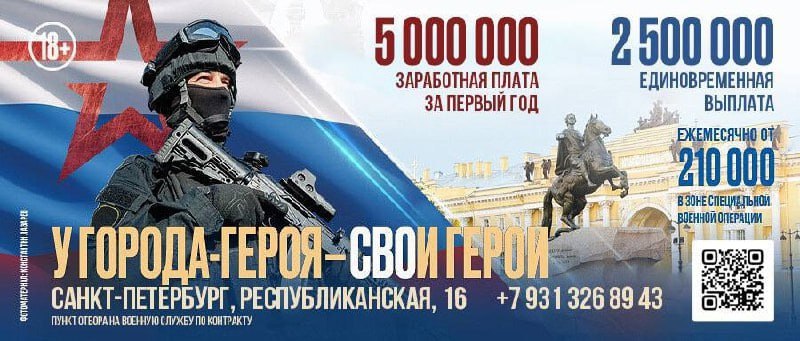
“A first-year salary of 5,000,000 rubles [approx. 48,000 euros]. A one-time [signing bonus] of 2,500,000 rubles. Monthly pay starting at 210,000 rubles [approx. 2,000 euros] in the special military operation zone. THE HERO CITY HAS ITS OWN HEROES. 16 Republican Street, Saint Petersburg, +7 931-326-8943.”

The signing bonus for volunteering for combat duty has been raised to 2.5 million rubles in Petersburg

The amount was increased by 400,000 rubles. Previously, those wishing to go to the front were paid a lump sum of 2.1 million rubles. On the poster, which was published in the Red Guards District administration’s chat group, the amount that can now be earned for a year of service in the war zone is listed as 5,000,000 rubles.

Judging by the information on the Smolny’s [Petersburg city hall’s] website, the signing bonus was increased three days ago, at the expense of the city budget. Rotunda was told the same thing at the military service recruiting center in the Central District.

Source: Rotunda (Telegram), 20 January 2025. Translated by the Russian Reader


Nizhny Novgorod: sales assistant-cashier

Low-price chain store seeks a sales assistant-cashier.

Responsibilities: serving customers at the cash register; restocking products in the sales area; maintaining order and cleanliness. The candidate should be energetic, trainable, and ready for intensive work.

On-the-books employment. Schedule: two days on, two days off. Salary: 56,000 rubles [a month, i.e., approx. 540 euros a month].

The employer pays for training and a medical examination, offers corporate discounts at all stores in the chain, provides material assistance in difficult situations, and arranges for gifts for children.

Source: Natalya Suvorova, “Ten vacancies for no-experience jobs with a wage of up to eighty thousand rubles per month,” Rabota.ru, 20 January 2025. Translated by the Russian Reader


[…]

In 2025, Russian authorities are continuing to increase payments for contract soldiers participating in the war in Ukraine. 

From January, men who sign a military contract in the Samara region will receive a one-time payout of up to 4 million rubles ($38,900) — the highest of any region in the country. 

In addition to these one-time payouts, which vary by region, military personnel also receive a monthly salary of at least 210,000 rubles ($2,000). In the event of a soldier’s death, their family is entitled to a “funeral allowance,” which can amount to up to 5 million rubles ($48,600), according to a presidential decree.

The substantial payouts to contract soldiers are part of the authorities’ efforts to turn the military into the country’s new elite, says historian Dmitry Dubrovsky. 

“One of the key outcomes of the ongoing war is the attempt to construct a ‘Putin Elite 2.0’ to replace the original elite that emerged in the early 2000s, built on oil and gas revenues,” Dubrobsky said. “This process began as early as 2014, when the ‘heroes of the Russian Spring’ gradually started integrating into Putin’s regime. However, it became fully evident with the onset of the full-scale aggression [against Ukraine].”

In addition to million-ruble payouts, the state also provides military personnel with subsidized mortgages and free university education for their children, including at prestigious institutions such as Moscow State University and the Higher School of Economics. 

Nearly 15,000 soldiers who fought in Ukraine, as well as their children, were admitted to Russian universities under this program in 2024 — almost double the number from 2023. And increasingly, Ukraine war veterans are being appointed to political roles, though not on a wide scale.

“The privileges of military personnel are evident in the growing practice of integrating ‘veterans’ into various political projects and regional administrations, often as deputy governors,” says historian Dubrovsky. “Overall, the families of military personnel see themselves as part of a superior class, a perception eagerly reinforced by Putin’s propaganda.”

[…]

Source: Angelina Trefilova, “‘I’m a Real-Life Katyusha’: As Russia Hikes Payments for Soldiers, Their Wives Flaunt Newfound Affluence,” Moscow Times, 16 January 2025

Alexander Skobov: Closing Statement at Trial

Alexander Skobov’s closing statement at trial:

I was brought up in the Soviet Union to believe that when a malicious, cruel aggressor attacks civilians, you have to take up arms and go do battle with him, and that if you cannot bear arms, you help the people who are doing battle and call on others to do the same.

All my work as a political commentator has been about calling on people to go do battle with the aggressor which has attacked Ukraine, to assist Ukraine with weapons and ammunition.

No one had attacked or threatened Russia.

It was Putin’s Nazi regime which attacked Ukraine, only because of the megalomania of the regime’s ringleaders, because of their inhuman thirst for power over all they survey.

Murdering hundreds of thousands of people is their way of bolstering their self-esteem. They are degenerates, scum, and Nazi riffraff.

The guilt of Putin’s Nazi dictatorship in plotting, unleashing, and waging a war of aggression is obvious and does not need to be proven. We also do not need to prove our right to offer armed resistance to this aggression on the battlefield and in the aggressor’s rear. It would be laughable to expect this right to be acknowledged by a regime which tosses people in prison for morally condemning its aggression out loud. All legal means of protesting Putinist Russia’s aggression have been eliminated.

My calls to resist the aggressor’s regime with armed force have caused me to be charged with terrorism.* I won’t deign to argue with the aggressor’s officials even if they claim my actions constitute pedophilia. Russia’s courts have long ago shown themselves to be appendages of the Nazi tyranny and seeking justice from them is pointless. I will never stand up before these people, who are the lackeys of murderers and scoundrels.

I see no point in arguing with puppets of the dictatorship about how conscientiously they execute their own laws. In any case, these laws are the laws of a totalitarian state and their aim is to stifle dissent. I do not recognize these laws and I will not obey them.

I also have no intention of appealing any rulings made by or actions taken by representatives of the Nazi regime.

The Putinist dictatorship may murder me, but it cannot force me to stop fighting against it. Wherever I find myself, I will keep calling on honest Russians to join the Ukrainian Armed Forces. I will keep calling for airstrikes on military facilities deep in Russian territory. I will keep calling on the civilized world to inflict a strategic defeat on Nazi Russia. I will keep trying to prove that the new Hitler’s regime must be routed militarily.

Putin is the new Hitler, a vampire driven insane by impunity and drunk on blood. I shall never grow tired of saying, “Crush the viper!”

Death to the murder, tyrant and scoundrel Putin!

Death to the Russian fascist invaders!

Glory to Ukraine!


[Grani.Ru:] Thanks to Alexander Valeryevich’s dedicated wife Olga Shcheglova (pictured above). Thanks to SotaVision for filming at the Petersburg military court (Skobov is participating in the trial via video link from Syktyvkar). Thanks to those who didn’t unsubscribe from Grani.Ru after it closed. It’s as if Skobov timed his brave deed to coincide with the final moral collapse of numerous media brands. And yet he will be heard by a handful of his contemporaries. But he has already gone down in history.

* Skobov has been charged with “publicly calling for terrorism,” “publicly condoning terrorism or promoting terrorism using the mass media, including the internet” and “organizing a terrorist community and participating in it.” If Skobov is convicted on these charges, he faces a maximum penalty of ten to fifteen years in prison and fines of up to one million rubles (approx. 9,500 euros) — TRR.

Source: Grani.Ru (Facebook), 15 January 2025. Translated by Thomas Campbell (aka the Russian Reader)

Leavers vs. Remainers, Vol. 1

anatrrra, On the Arbat, December 2024

Kirill Medvedev,* a poet, publisher, and member of the band Arkady Kots, left Russia in 2023 and returned in late 2024. At Republic Weekly’s request, he explains his winding road, what Moscow looks like when one hasn’t seen it from the inside for a long time, and what remainers have to say about leavers.

After a year and a half of living in other countries for personal (but, of course, political) reasons, I have been living in Moscow for several months now. Despite certain risks, I really don’t want to leave, and I am terrified of everything having to do with living in exile. I’m willing to speak in allegories or even to keep silent altogether just to be able to live in my hometown. Although what could be more important than waking up in the morning and smacking the Putin regime in the face without pulling your punches?

Everything in Moscow is still familiar and homely. I am indifferent to Sobyanin’s renovations. Things have improved in some places, while in other places it’s the reverse. Half-abandoned spots have suddenly emerged even in the most expensive neighborhoods, as if the money had suddenly been hoovered out of them. I’m certain that’s literally what happened.

I don’t see any particular feasting amid a plague, but I guess I’m just not hitting the right spots. Moscow has become more desolate and wild on the whole. When the capital is finally moved to Siberia, the Moscow I know and love will look even better. But for now, it is still what it is: a crazy quilt fashioned from Eurasian chaos, absorbing a million shades of the glitz and poverty of the entire country and its neighbors, and tempting us with new revolutions somewhere in its squares and back alleys.

All of Russia can be found in Moscow, and yet, as everyone knows, Moscow is not Russia. Thanks to this fun fact, it is easier for Muscovites than for anyone else to love the entire country, albeit an imaginary and unfathomable country, shaped from different scraps. “I stand as before an eternal riddle, / Before a great and fabulous land,” sang one remarkable Muscovite. I repeat another poet’s line about another city, thinking that love for one’s capital city and one’s country is an enormous, complicated privilege: “May it not be my lot / To die far away from you.”

Online public communication habits have actually changed a lot because of the risks involved. It no longer feels like your event didn’t happen if it wasn’t written up online and if you didn’t post a photo of yourself with a crowd of happy spectators.

There are [now] more personal channels of communication within communities and more word of mouth. Reactions are more reserved in public and more emotional among friends. Pardon my sentimentality, but there is little to compare with physical hugs with friends and family in a city charged with your own and other people’s memories.

Of course, there are a lot of new problems, and I’d rather deal with some variety of internet addiction than the nightmare in which everyone has found themselves. And yet there is the perception that the war has ushered in the degradation of all ways of living in Russia. This is not true. Humans are ultra-creative and crafty creatures. Violent shocks do not neutralize life but propel it into new forms. A caveat: no new ways of living and creating can justify the mass murder of people who will never wake up to life again. But cultural, activist, educational, and other communities who persist and change, albeit semi-clandestinely, albeit at the cost of compromise or risk, increase our chances of transitioning to a different way of living in this country in the future. The more allies we have here at home now, the more likely they are to be in the right place at the right time—that is, if the first flights our friends who have been shoved out of the country plan to take are delayed a bit.

Irony or irritation towards the people who have left [Russia] for one reason or another is evident among almost all those who have stayed, except for those who are definitely planning to leave. One of the frequent complaints is “They left to live in safety, and they did the right thing—they just shouldn’t pass it off as a political act.”

That is true, though with many caveats. Bravo, of course, to the activists who have been helping people who have to leave to get out of the country and to adapt to life abroad. Bravo to the journalists who have moved to relatively safe places and continue to fulfill their professional obligation to their fellow citizens. Regular albeit serious news, reported with respect for themselves and the audience, without unnecessary harshness (“so that you can send it to your grandmother”) is needed desperately: almost everyone talks about it. But pessimism and aggression about life inside the country on the part of fellow citizens who have left the country is completely out of place. It is clearly old-fashioned exile self-therapy and should be practiced in private.

While the demand for alternative information is great (many people in the USSR who were not necessarily anti-Soviet also listened to Voice of America), one can see skepticism or simply a lack of interest in émigré politics. Why is this the case? There seem to be many examples in history when political émigrés came back home, were involved in great transformations, or even spearheaded them. Escaping from prison in Russia, making one’s way abroad, drinking to a successful adventure with comrades in Geneva, discussing future strategies in a relaxed atmosphere, and soon returning home to work underground was a typical trajectory for Russia’s radical democrats in the early twentieth century.

Things have changed since then, although today many also travel back and forth. You can talk at length to those who have stayed in Russia about the hardships of emigration, and they will agree and sympathize with you, especially if you were actually in danger here at home.

For the most part, though, people still see someone else’s moving abroad as their means of upgrading their private existence.

By renouncing your past life, it is as if you automatically renounce your past community. The propaganda, of course, does its best to inflate the resentment, but it’s not just propaganda at work. Emigration is indeed an experience of constant self-denial. Especially today, when Russian emigrants are so evidently prodded (gently and not so gently) to cancel themselves in terms of of their citizenship, background, language, identity, or even flag. Moreover, the reanimated ethical-religious discourse of the Cold War, with its confrontation between good and evil on a global scale, has played a considerable role in this.

The field where dialogue should have taken place between leavers and remainers, as well as between moderate oppositionists and hesitant loyalists, has been overrun by moralizers in proverbial white coats and rabid patriots. They are the dividers and conquerors.

The leavers more often argue in terms of negative freedom—freedom from censorship, political crackdowns, and military mobilization, from having to indirectly finance the war or live among its supporters. The remainers stay because they do not see how they can realize themselves abroad, at least not without the sort of superhuman effort and self-denial that many of them find more frightening than living under the threat of arrest or self-censorship. They often speak of duty—to elderly relatives, students, patients, voters, political prisoners, the graves of relatives, the homeland, etc. And they often hear in response that it is immoral to be involved in the normalized life in today’s Russia. The ethical conflict is evident.

I wander the Pokrovkas and the Ordynkas, thinking about where I can get money to pay the bills and pay off my debts. There are posters calling for men to sign up for the army. Somehow I don’t feel more upstanding than the guys who go off to kill for money. I would definitely not go to do that, but this certainty does not raise my moral self-esteem. I think of an old comrade who perished in the “special military operation.” His debts, low social status, and leftist anti-western ressentiment had blossomed into imperialist obfuscation.

I sit in a cafe, thinking about my plans. The people around me talk about different things, while people in a neighboring country are bombed in our name.

I’m good at displacing unpleasant things. We all are good at it.

Being here, dissolving into this life, it is difficult to feel like a member of an ethics committee. It’s easier to realize that all people are basically the same, that there are no insuperable differences between them. All our actions (whether ordinary, shameful, or magnificent), all the passivity of the masses, all the revolts of nations, are manifestations of the same human principle in different historical circumstances. The way humanness manifests itself in our present circumstances, the way my own humanness manifests itself in them, is the most interesting thing to observe. Okay, we’ve established that.

No, of course, there is a huge difference between opposition to evil, passive non-participation, and complicity in it. Putin’s propagandists have been blurring the distinction between the first, second and third to depoliticize and morally degrade society. We know this, and you can’t fool us. In both the secular and Christian systems, a person always has a choice and a responsibility for it. We should not see the individual as a unwilling victim of want and propaganda. But something else is also true: even if you believe that you have made your own super-correct moral choice once and for all, endlessly judging your neighbor, or believing they are made of some qualitatively different stuff than you, or finding them complicit in collective guilt without trial is also a quite devilish temptation, akin to the temptations proffered today in our country by various spiritual and political leaders.

Political evil is countered not by personal virtue, and even less by moralistic posturing. It is countered by political or civic ethics, but our country has a huge problem with that.

All the debates between the leavers and the remainers, all the debates over the slogans “peace now” vs. “war until the dictatorship’s defeat,” all the debates about whether Navalny should have returned to Russia, revolve around the missing answer to the ethical (aka political) question: for what are we willing to risk our private lives, for what collective ideals?

I certainly don’t have a clear answer. Russia is long past the heroic times of liberalism and socialism, when people believed that civic heroism was not weak-mindedness or recklessness, but a deliberate, mature step toward a better future. Popular willingness to take to the streets against war and dictatorship is impossible without the conviction that we are on the right side of history, that we are in a movement that both overlaps with and transcends our private interests.

The Bolsheviks believed in communism’s inevitable advent on a global scale, and were able to convince many people this would happen, which was why they won. In 1991, Russians believed that by defending the [Russian] White House and confronting the coup plotters’ tanks, they were leading Russia onto the road of progress which all democratic nations were already rolling down. Whether we like it or not, Russia is not ready to follow any well-trodden path. There is no single road anymore: the road is just going to have to be paved anew. (I’m reckoning on this.)

Today we see a faint glimmer of hope in republicanism, with its idea that community spirit is not a consolation prize for people who lack professional fulfillment and personal happiness. It is not reducible to a professional or personal virtue and is not a profession itself.

Anyone willing to stand with others to oppose tyranny and then work every day to prevent it from happening again is capable of demonstrating civic valor. And the brighter, bolder and more constructively a person commits to this work, the more they make use of their professional, creative and other kinds of potential, the greater their authority in the community will be and the more likely they will remain in the community’s memory. This sounds good as a motivation, but if the republican ethic is realizable, then it is realizable in the small and medium-size spaces of campaigns around residential buildings, courtyards, neighborhoods, and (at most) cities, where it is possible to find analogues of the ancient Greek square for people to hold meetings.

A national community is imaginary, no matter how you look at it, and it is based on a rather sketchy common historical plight and collective memory. If we do not want it to be the memory of how “everyone was afraid of us,” it should be the memory of how we survived together and resisted—secretly and explicitly, passively and actively—the extermination of others and self-extermination, of how we built ties, engaged in “culture,” taught children, supported political prisoners, and helped the bombing victims and the homeless.

This is the ground of community, a ground not nourished by moral superiority, by denying oneself and one’s roots, or by essentializing differences. It is nourished by responsibility for the people who stand or have stood next to you in the same squares and the same queues, for the people who walk the same streets, who went to the same schools, who share the same hopes for the future.

If we indeed stand on this ground, then it makes sense for us to challenge and set our hearts on something together.

* Medvedev has been placed on the Russian Justice Ministry’s registry of “foreign agents.”

Source: Kirill Medvedev, “I Returned to Moscow from Exile and I Don’t Want to Leave,” Republic, 5 January 2024. Translated by the Russian Reader


Yosif [sic] Brodsky, “Stanzas to the City,” trans. Nicholas Zissermann, Landfall 20, 2 (1966): 152. You can read the original poem in Russian here.

The Storming of Grozny: Thirty Years Later

A Chechen refugee in front of her destroyed apartment building
in downtown Grozny, February 17, 1995. Photo: Reuters (via Julia Khazagaeva)

On the thirtieth anniversary of the storming of Grozny, the liberal Russian media reminded the Russophone audience that there had been such a war—the Chechen War. When I see this title, I don’t even open the movie, I flip through it. A couple of excerpts are basically enough for me to be convinced that these people have still understood nothing after three decades. Even over the three years of the recent, utterly treacherous imperial war in Ukraine, the obvious facts about what Chechnya means to Russia have not became obvious to them.

Almost any decent Russian would point out to you, of course, that bombing towns chockablock with civilians was a bad thing to do and foul play. Carrying out mop-ups in villages and burying the victims in mass graves was also outrageous. But then the exclamation “but!” is sure to follow. They will tell you about Chechen bandits, forged letters of credit, and the intransigent Dudayev. Yes, it was wrong to destroy a third of Chechnya’s population, this notional Russian would lament, but the Chechens were bad eggs themselves and were asking for it.

If you ever do open a Russian [documentary] film reconstructing the events in Chechnya thirty years ago, you will find that it is about the enlisted lads who on New Year’s Eve 1994 were thrown into the epicenter of hell. Not properly trained to shoot or drive a tank, alone against hordes of heavily armed rebels, they were unfortunate sons of the Motherland: may their memory live forever. This artistic device is deployed, for example, by the Maxim Katz-affiliated project Minute by Minute. The [YouTube] channels Current Time and Popular Politics have also recalled this selfsame “Chechen War.”

Minute by Minute, “The New Year’s Eve Storming of Grozny: A Minute by Minute Reconstruction” (December 31, 2024)

Semantically, the construction “Chechen War” operates the same way as the coinage “captive of the Caucasus.” It conceals the aggressor, suggesting we look at the object of the aggression as the aggression’s cause. In this logical trap, Chechnya seems to have gone up in flames by itself. It was its inhabitants who shelled and bombed themselves silly. It was not Russia that invaded the Caucasus, it was the Caucasus which for some reason held Russia’s soldiers in captivity. It is not without reason that when people say “he was killed in Chechnya,” it is the place where he was killed that appears to be the malefactor. The listener is not prompted to wonder what this soldier was doing under arms in a foreign land. It is as if Chechnya had shown up in Samara and killed an innocent tanker.

When we think, write and say “Chechen War,” we automatically interpret it from the point of view of the colonizer and the aggressor. We accept the interpretation imposed by Moscow, which insists that Chechnya is part of Russia, not a sovereign country it attacked. If Russia is not mentioned in the nomenclaturee of this historical event, Chechnya is automatically read as an undeniable part of the empire, and the conflict itself sounds akin to the November Uprising or the Tambov Rebellion.

In fact, it was the Russo-Chechen War which began on December 11, 1994. The war deserves to be identified as such both in terms of the nature of the hostilities and the status of the warring parties, because by the time the Chechen Republic of Ichkeria was invaded by Russian troops, it had been three years since it had legally, by popular vote and a declaration of independence, withdrawn from the USSR on an equal footing with the RSFSR. The Chechens had NOT been part of the newly minted Russian Federation for a single day.

The independent journalist Vadym Zaydman has written about this better and more clearly than anyone else. There is no need to paraphrase him when I can instead quote what he has written:

“At the time of the USSR’s death/colllapse, Chechnya was no longer legally related either to the defunct Soviet empire or to the RSFSR. By that time the Chechen-Ingush ASSR had existed as a Union Republic for over a year. Thus, by definition it could not be a part of the Russian Federation, as proclaimed on December 25, 1991. When the Russian Federation was born, Chechnya was initially not a part of it.

“Russia itself did not regard Chechnya as part of Russia during this period. On March 31, 1992, the Federation Treaty was incorporated into the Russian Constitution. It changed the status of autonomous republics to sovereign republics within the Russian Federation. The treaty was signed by representatives of twenty federal subjects of the Russian Federation. Neither the Chechen-Ingush Republic nor Chechnya was involved in the treaty.

“It was only in the wake of the notorious events of October 1993, when Yeltsin was adopting a new Russian constitution, that he unilaterally incorporated Chechnya into the Russian Federation. In fact, Yeltsin committed a fraud like the one committed by the Russian authorities when, after the Soviet Union’s collapse, they declared Russia a member of the UN Security Council as the USSR’s legal successor, although Russia was not even a rank-and-file member of the UN. Ukraine and Belarus were members of the UN, but Russia aka the Russian Soviet Federative Socialist Republic was not! Having incorporated Chechnya, a year later Russia started to establish ‘constitutional order’ in Chechnya as its own fiefdom! Clever, isn’t it?!”

End quote.

The term “Chechen War” is thus as illegitimate as the use of the term “Ukrainian War” is unacceptable. Ukrainians would not allow the latter, and the entire civilized world would not agree to it. For everyone, the current war is the Russo-Ukrainian War. But the same thing should happen in our minds when describing the war in Chechnya. It is the Russo-Chechen War.

Many Russians would understandably prefer it go down in history in a more modest way—ideally, not as a war at all, but as a “special military operation,” or a “counter-terrorist operation,” for it is the security forces, not the simple folk, who are responsible for such operations. “SMO” and “CTO” sound mundane and localized, like a police “amber alert,” nor are they freighted with collective guilt and responsibility. Most vitally, if correlated with these Putinist terms, western sanctions come to be regarded as an exorbitant and unwarranted punishment, since they make “ordinary people suffer.”

Why do you think various Putinist and anti-Putinist institutions have spent the last three years relentlessly measuring public opinion on whether Russians want war? Yes, it’s simple: because of the sanctions—and Russia’s slightly tarnished image in the eyes of the international community. But if the West is shown the relevant polls quite often and reminded that “public opinion polls don’t work in a totalitarian society,” this mantra will work like a charm the thousandth time. It will then be much easier for Brussels officials to explain to themselves and their electorate why they are lifting restrictions: because they oppress an already “downtrodden” civil society, which in no way wanted war, but which was forced by Putin to want it.

Meanwhile, to answer the question of how much the Russian populace shares its leadership’s imperial mindset, it is enough to take the case of the Russo-Chechen War. From the sociological viewpoint, it is a scientifically pristine experiment. In 1994 (as in 1999, when the second phase of the war began) there was no totalitarianism in Russia. There were no western sanctions, and there were no Russian émigrés criticizing the regime from abroad. U.S. President Bill Clinton expressed “concern” when he learned that civilians were being killed in Chechnya. France supported the establishment of constitutional order on Russia’s own territory. They all thought that the new Russian Czar Yeltsin was better than any Communist, even if he fought like one.

Enjoying the full favor of the international community, Russia razed Grozny to the ground along with the remnants of its civilian population on New Year’s Eve 1994. This did not cause any outcry in Russian society. The first protest rally in Moscow took place on January 10, 1995: organized by Yegor Gaidar, it was a partisan affair and sparsely attended. Noticeable civil protests against the war in Chechnya would not begin until 2001—that is, five years later. [My comrade Antti Rautiainen, who was very much in the thick of things in those years (he was a co-organizer of the first antiwar street protest in Moscow, in November 1999), has pointed out to me (in a comment to Ms. Khazagaeva’s original post in Russian) that the biggest protest in Moscow against the Second Chechen War took place in January 2000, not in 2001 — TRR.] However, even then, according to Radio Svoboda, which interviewed passersby, “Muscovites were in no hurry to join the protesters: everyone was rushing about their business.”

Protests during the first phase of the Russo-Chechen War were isolated and (one might say) personal in nature. From the very first days of the invasion, the Soviet dissident, Russian human rights activist and Russian human rights commissioner Sergei Kovalev traveled to Grozny. He tried to stop the bombing of the city. In March 1995, he was removed from the post of human rights commissioner for supporting the “wrong” side. TV news presenter Svetlana Sorokina took liberties on air: after a commercial break she emotionally remarked that “no laundry detergent can wash clean the conscience of the Russian generals.” Independent Chechnya and its legally elected presidents Dzhokhar Dudayev and Aslan Maskhadov were subsequently supported by Valeria Novodvorskaya. Boris Nemtsov tried to stop the war by circulating a petition [which was allegedly signed by a million Russians—TRR]. But there was no grassroots public outrage in Russia, apart from the campaign led by the mothers of the conscripts, neither in the first phase of the war, much less in the second.

This was how sociologist Yuri Levada described attitudes to the war in Chechnya in 2001: “Sentiments against the war are strong in [Russia], but unfortunately we cannot overestimate their significance. The fact is that many people think that more decisive actions, with greater loss of life, perhaps could have led to success. Disavowing the war does not exclude, for example, approving such savage measures as ‘mop-ups,’ which are now quite difficult for the authorities in Chechnya and Russia to cope with. So, an unwillingness to continue the war is an expression of fatigue, not an expression of conscious, directed protest.”

Sociologist Lev Gudkov described Russians who supported Chechnya’s return to the bosom of the empire as follows: “They are younger and better educated Russians who argue that the Chechens must be crushed at any cost and this problem must be solved by force, that no negotiations with Maskhadov are possible, that he represents no one, and that there is only one solution—the total, crushing defeat [of the Chechens]. On the contrary, those who argue that it is necessary to seek a peaceful resolution however possible, including entering into negotiations with Maskhadov, are people of an older age, somewhat wiser and more experienced, and in this sense more tolerant, inclined to recognize Chechnya’s independence as long as the war is brought an end.”

So when Russian liberals, society’s cream of the crop, write and talk about the “Chechen War,” you now know their attitude toward the empire and its conquests. Were it not for the unprecedented western sanctions for invading the European country of Ukraine, you would be surprised to learn what Russians really think about the war. As a gentleman who left Russia twenty years ago once told me in a private conversation: “I still feel sorry for our guys. After all, the Ukrainians have killed more Russians in this war than the Russians have killed Ukrainians.”

Source: Julia Khazagaeva (Facebook), 4 January 2025. Translated by the Russian Reader

Victims Too

For years, survivors of Assad and Russia’s chemical attacks in Syria were silenced. Today, we uncovered shocking evidence that many of these witnesses were forcibly taken to Moscow and pressured to lie – part of an extensive cover-up by the Russian state.

Now, with Assad no longer in power, these survivors are free to speak. In this video, they reveal the horrific reality of the chemical attacks – scenes of unimaginable suffering, children foaming at the mouth, and entire families wiped out.

As someone living in Ukraine, I’ve witnessed Russia’s war crimes firsthand – from white phosphorus to targeted civilian attacks. The patterns of brutality are clear, stretching from Syria to Ukraine.

This story exposes the disinformation campaign that echoed globally, amplified by figures like Aaron Maté and platforms like RT. But the truth matters now more than ever.

Watch as the survivors share their experiences and shed light on the true scale of Russia’s actions – crimes that continue to affect lives across multiple continents.

Source: Caolan Robertson (YouTube), 5 January 2025. Thanks to Michael Karidjis for the heads-up.


“Muskovites [sic] celebrating the New Year on Teatralnaya Square.” Photo: Yevgeny Messman/TASS (via Moscow Times)

Victimhood can be a tricky thing. Nobody doubts that ordinary Ukrainians are victims of this war. Russia’s political opposition, in exile, prison or dead, are also viewed as victims. But what of the country’s silent majority? What of the millions who stayed in Russia, kept their heads down and focused on living their ordinary lives, rather than the war and the online space it occupied?

Many things have changed in Russia since 2022. But one of the main constants has been the average Russian citizen’s desire for peace and ending the war. The majority have not been militantly opposed to or cheering the war effort on. Instead, they have been focused on living in the present, trying to salvage what remains of normality and longing for its imminent return – what some are calling the silent majority.

They are not happy with the war or satisfied with the current situation and have few ways of expressing that. Many do feel guilt on a certain (very private) level.

One thing hard not to notice in Russia throughout the conflict is how that silent majority has simply hunkered down and carried on. The war is very much in the background now. When I leave my building every morning, the same middle-aged man is defrosting his car, mothers are walking with strollers and children are heading to the local school.

When you eavesdrop on their conversations or stop to say hello, they sound normal – not like indoctrinated quasi-fascists, as some scholars are suggesting. They sound like any other school child whose teacher is just trying to get through the copious material thrown at them by the school director. The mothers just want their children to grow up in safety and comfort. Cheering on an expensive war pushing up the price of baby food is hardly a means of achieving that.

The war may come to an end in 2025. Negotiations are likelier than at any point since early 2022. And make no mistake, a peace agreement is inevitable. When the war ends, however, on whatever terms, Russia and its population of 146 million will still be there. It will not disappear or suddenly go away. The man defrosting his car as I write these words is not likely to have a huge epiphany when it does. His life has hardly changed since 2022. The increased number of women publicly wearing hijabs in our city is not doing so as a passive sign of resistance.

By living here, watching life unfold how it does, the more one cannot help but think something that many in the West will find unpopular. The war is not their fault. Tens of millions of innocent Russians are victims too. Their freedoms have been curtailed, their movements and opportunities restricted. Did they deserve that by virtue of where they were born? A classic liberal would argue not.

Like millions across the world, the average Russian is just trying to feed and raise their families, and get through the month. Many colleagues in academia have questioned from the comforts of the West, their tenured positions and with nothing to lose why many Russians do nothing to oppose the regime. What they neglect when arguing from their moral high ground is that those people I spoke of earlier do have a lot to lose being critical online. They have about as much power to topple the regime and change its course on the war, as the average Westerner does.

There will be blame to go around. Russian officials and the security apparatus, who carried out the decisions to invade Ukraine and suppress its own population, are obvious contenders. On the Ukrainian side, President Volodymyr Zelensky and his generals will have to answer for decisions they made. Kyiv’s Western allies clearly could have done more to support Ukraine, yet did not. 

Russia’s silent majority will not want to be blamed and they must not be. They personally did not harm anybody or choose the war. Unlike routine acts of everyday life, the war was not their personal fault or responsibility. Collective guilt is too controversial; thousands protested, millions left and staying silent was, in its own way, an act of defiance by refusing to enter the discourse. Guilt by association is also not a tenable position. Not every Soviet citizen was responsible for the Stalinist Terror. Not every Russian citizen can be responsible for the war, especially not on the basis that they refused to cheer on Ukraine and their own country’s defeat.

Blaming those who are faultless will only cause resentment where there was none to begin with. In the long term, it will not make the world safer or more peaceful. Then comes one of liberal democracy’s sore spots that Ukraine, Georgia and even Moldova will have to reckon with on its European journeys: those people in the silent majority will still have a right to have an opinion – as will the pro-Russian segments of their populations. Dismissing these views or people will not make them, nor those in power, more rational.

If the West were serious, it would try to reach out to Russia’s silent majority, who can be won over. The Russian population at large do not hold the same positions as those in and around the Kremlin currently. Most of the population wants Russia to be an open, peaceful country, especially to the West. Make no mistake, westerners, their companies, money and popular culture will be welcomed back with open arms one day. Moreover, this part of Russian society will want to be welcomed back, too. Not doing so only will push the Kremlin into a closer alliance with the likes of China and North Korea.  

Moreover, it is absolutely naive to assume that Russia’s social and economic problems will be fixed automatically by the sudden absence of Putin and the return of democracy. Although it stands a much better chance, we have been here before and there is no guarantee of success. Democracy will need to involve this silent majority beyond Moscow and the big cities – felt on the local level – seen to be actually working and fixing the people’s problems. If not, that silent majority will simply resign themselves, remaining disillusioned and ambivalent.

Gleb Pavlovsky once predicted what the end of the Putin regime would look like: it would collapse in a day and be replaced by something exactly the same. He may be proven right. If he is, that is the fault of those in power, not Russian society.

Source: Anonymous, “Russia’s Silent Majority Are Victims Too,” Moscow Times, 1 January 2025. This is not a parody, apparently, although it reads like one. ||| TRR


Pretrial Detention Center No. 2 in Taganrog (Rostov Region) was a place where, until 2022, minors, women, and mothers with children were detained. After the outbreak of full-scale war in Ukraine, Russian security forces cleared the detention center to make room for Ukrainian army soldiers and other prisoners of war, including the defenders of the Azovstal steel plant.

Pretrial Detention Center No. 2 gained a reputation as a gruesome torture camp for Ukrainian detainees. Many POWs in other detention centers are threatened with being sent to Taganrog and so forced not to oppose the prosecution. Few people have come forward to talk about the torture.

The story of Ukrainian Dmytro Lisovets was one of the first indications that the detention center in Taganrog had been turned into a torture camp. Lisovets had tried to flee with his family from occupied Mariupol, but failed to get through a filtration point in the Rostov Region. A former member of Ukrainian volunteer units, Lisovets was sent to the Taganrog detention center without being assigned any procedural status.

Lisovets’s lawyer told Mediazona that the Russian authorities “don’t pull any punches with the Ukrainians in this detention center”: “They burst into the cells in masks and beat everyone indiscriminately.” His client was also beaten and tortured in order to force him to admit that he had been involved in the hostilities. Consequently, Lisovets was sentenced to sixteen years in prison.

Once they were detained at Taganrog pretrial detention center, the Ukrainians were completely cut off from the outside world. According to one of the lawyers defending the prisoners, they were not allowed to talk to their clients in private, only in the presence of a police investigator. Moreover, the detention center staff forced the detainees to sign papers waiving their right to communicate with their defense lawyers.

The detainees were able to talk about the torture only after they had been transferred to other pretrial detention facilities.

“We were thrown from the back of KamAZ trucks—our hands tied and eyes blindfolded—and forced to line up against the wall under a hail of blows, where the beatings continued with hands, feet, batons and electric shockers,” one of the captured Ukrainians told his lawyers.

He also said that “at the offices” (that is, during interrogations) he would be bound with a leather belt, placed on the floor, and have a sandbag placed on his chest to make it harder for him to breathe. He would then be beaten with a rubber truncheon and tortured with a stun gun. “It was during such ‘procedures’ that [the Russians] extracted confessions of ‘war crimes,'” the Ukrainian wrote.

There were also mass beatings, including during rare walks outside in the yard. “At every turn of the walking route, a special forces soldier was stationed and was obliged to hit [the prisoners] with a stick,” said one of the convicts. Some officers were “humane” and did not beat wounded prisoners ands prisoners ofter fifty. “The attitude toward us in captivity depended on who was on duty in the prison. There were wardens who would beat all the prisoners,” said Yuriy Hulchuk, an Ukrainiian marine who spent time in Pretrial Detention Center No. 2.

There was no decent food in the detention center either. One of the defense lawyers of the Ukrainian prisoners, speaking on condition of anonymity, said that once a day the wardens “would feed them cabbage broth and quarters of black or white bread.” Ukrainian military officer Artem Serednyak was detained at the Taganrog detention center from September 2022 to the summer of 2023, during which time he lost twenty-two kilograms.

One of the prisoners calls Pretrial Detention Center No. 2 “hell with all its demons,” where it is scary to return: “Even the definition of ‘concentration camp’ would be too mild for Pretrial Detention Center No. 2,” he said. Human rights activists say that there was also sexualized violence against prisoners at the detention center: for example, prisoners had rubber truncheons shoved up their anus.

It was not only military personnel who were locked up in the detention center. For example, Ukrainian journalist Victoria Roshchyna, who was detained by the Russians in the occupied part of Donetsk Region, was sent to the Taganrog pretrial detention center for a year. She died last year: presumably, she was about to be exchanged for Russian prisoners. She did not have time to provide details about her life in the detention center. It is only known that Roshchyna was held in solitary confinement from May to September 2024.

The Russian authorities have not reacted in any way to the reports of torture. Russian human rights commissioner Tatyana Moskalkova visited the pretrial detention facilities where Ukrainian prisoners are held, but she did not report poor detention conditions either. Human rights activists say that the administrators of the detention centers would get ready for such inspections. “[T]hey prepared for this day: everyone was given new clothes, the grass was painted, the lawns were trimmed, and so on. They even gave them [the Ukrainian prisoners] biscuits, which they were extremely happy about, because the usual diet was very meagre,” [Irina Soboleva], one of the lawyers defending Ukrainian prisoners, says.

Source: “There is a torture prison for Ukrainians in Taganrog,” WTF? newsletter (Mediazona), 9 January 2025. Translated by the Russian Reader


In the age of forever war, the use of mercenaries, paramilitary forces, and irregular troops have become increasingly common on the battlefield. But now Russia is resorting to luring unwitting civilians from Yemen and other countries across Asia with little to no military experience to fight alongside its troops in the war in Ukraine.

As reported by Ali Younes, a recruitment network run by a high-ranking Yemeni political and military official with ties to the Houthi government is tricking young Yemeni men desperate for jobs into signing employment contracts for work in Russia, only for them to find once they arrive that they cannot leave and are forced into military training camps and sent to the frontlines.

As the war in Ukraine approaches its fourth year with no end in sight, Russia has turned to recruiting unwitting young men from Yemen and other Arab countries to fight alongside its troops on the front lines. The men are lured under false pretenses, they tell Drop Site News, with promises of lucrative jobs and opportunities for migration, unaware that they are being forcibly recruited as mercenaries to fight in a foreign war despite having little to no military experience.

Two men who fell victim to the scheme told Drop Site they found out they were being sent to fight with the Russian army in the Ukraine war only once they had landed in Russia. Drop Site obtained a copy of an employment contract, corroborating photos and video, and spoke with a human rights organization that has documented the practice.

Mohamad, a Yemeni national who declined to give his last name for security reasons, said he was working in a restaurant in Oman in July when he was approached by Abdul Wali Al Jabri, a high-ranking Yemeni political and military official. Mohamad said they told him about job opportunities in Russia with a good salary and a hefty signing bonus and that he would be working for a civilian company according to his skills. He was eventually convinced to sign up through a company that recruits laborers in Yemen and Oman owned by Al Jabri, who is a general in the Yemeni armed forces of the Houthi government and a member of parliament in Sanaa.

Mohamad said the agreement between the Yemeni recruits and Al Jabri was a monthly salary of $2,500 with a signing bonus of $20,000. A copy of an employment contract written in both Arabic and English obtained by Drop Site lists the Al Jabri General Trading & Investment Co. SPC and Abdul Wali Al Jabri as the company representative. The contract outlines the company’s role in arranging for jobs in Russia “in the military, security, or civil field, based on…qualifications, experience, and capabilities” and says the contract ends after the signee “obtains Russian citizenship.” Mohamad said he was never told that he would be sent to fight for the Russian army in Ukraine and there is no indication in the contract.

Al Jabri has a fee built into the contract, whereby the signee is obliged to pay him $3,000 upon getting employed in Russia. Al-Jabri did not respond to repeated messages of inquiry from Drop Site for this story. However, Al Jabri did respond to questions posed by Tawfik Alhamidi, a Yemeni lawyer and human rights defender based in Geneva, Switzerland who runs the SAM Organization for Rights and Freedoms, and has documented the forced recruitment of poor young Yemeni men into Russia’s war with Ukraine.

Al-Jabri defended the practice to Alhamidi, saying he owns a “travel company” and that people in Yemen have asked him to “arrange for them to travel to Russia and join the army in order to obtain Russian citizenship and earn money to spend on their families back in Yemen.”

He dismissed criticism, adding that “he obtained a Russian approval for the Yemeni men to travel to Russia with good salaries but some political parties in Yemen who are currently fighting Ansar Allah [the Houthis] became worried that they might lose their soldiers to go fight with Russia and therefore created a social media storm over this issue.”

In September, Mohamad traveled to the Russian city of Nizhny [sic] via Dubai. He shared a video of himself with Drop Site on the plane, holding his boarding passes. He and a group of around 20 Yemeni men stayed in Nizhny for 24 hours before being shipped to the city of Rostov, a command base for the Russian army near the frontlines with Ukraine. They also discovered that their salaries were just $300 a month with a meager signing bonus.

Mohamad said that in both Nizhny and Rostov the Yemeni men were met by Russian soldiers. Mohamad said that they were forced to sign another contract, written in Russian, that obliged them to serve in the Russian military. “We were forced to sign contracts in the Russian language that we didn’t understand to serve in the Russian military,” Mohamad said. “We were very afraid.”

He said that in Rostov his group protested to the Russian officers that they didn’t want to fight in the war and demanded to go back to Yemen but they were prevented and ended up being forced to stay in Russia for months where they were forced into military training camps. Mohamed also shared a photo of a Yemeni recruit in full military fatigues and combat gear holding an assault rifle and another of a dog tag written in Cyrillic.

“We were trained by an Arabic-speaking Egyptian Russian military officer who told us that we are in Russia to fight for the Russian army and that we will be deployed to the front lines and not working as civilians,” Mohamad said. He said in the camp he met many men from Iraq, Syria, and Sudan and elsewhere receiving military training. Mohamed was finally able to return to Yemen at the end of October and he spoke to Drop Site from Sanaa.

Another video shared by Mohamed [sic] with Drop Site shows a group of about 10 Yemeni men inside a tent with wooden bunk beds in Nizhny. In the video, one man says, “We came from the sultanate of Oman for civilian work, everyone according their skills,” pointing to each one in turn, he adds, “This man is a metalworker, this man works with hydraulics, this man is an electrician, this man is a driver, this man works with electrical equipment. We are all civilians who work civilian jobs.” He goes on to say they were taken from the airport to Nizhny and they were “terrorized by armed soldiers and forced to sign contracts.” Pointing to a pile of camo backpacks on the floor, he says they were being taken to a training camp. “We are civilians and we know nothing of this,” he says in the video and calls on the Yemeni government to help them. “We are sons of Yemen and we fell into a trap.”

Drop Site also communicated via WhatsApp messages with Jalal, another Yemeni man recruited by the same network who is currently deployed as a soldier fighting for Russia in Ukraine. He told Drop Site he was lured into coming to Russia to escape poverty with the promise of a large salary and signing bonus as well as Russian citizenship. He said he ultimately decided to stay and fight in the war in the hope that he could earn enough money to be able to return to Yemen with savings as well as to possibly obtain Russian citizenship.

Alhamidi characterizes the recruitment practice as exploitative and a human rights violation.

“Dire poverty conditions in Yemen enabled human trafficking and recruitment networks to proliferate and lure young men to go to Russia under false promises of civilian work and high salaries,” Alhamidi told Drop Site, adding that Yemen’s laws contain many loopholes that [allow] Yemeni nationals to join foreign armies as mercenaries without being criminalized. “This has enabled powerful men in Yemen with connections to the Houthi government and Russia to mislead hundreds of young men into traveling to Russia to fight in Ukraine.”

A report by SAM published in November based on interviews with several Yemeni nationals who who were recruited by Al-Jabri and traveled to Russia titled, “With False Promises of Jobs and Attractive Salaries: Recruitment Networks Force Yemeni Youth into the Russia-Ukraine War,” found that: “The forced recruitment of Yemeni youth into the Russian-Ukrainian war through coercive networks constitutes a clear violation of international humanitarian law and human rights and rises to the level of human trafficking… The organization reported that once recruits arrive in Russia, they are subjected to severe abuses, including being forced to fight under harsh and inhumane conditions, being deprived of food and medical care, and suffering injuries or death from indiscriminate shelling on the battlefronts.”

According to Alhamidi, Al Jabri has traveled to Russia numerous times and has obtained visas to Russia for thousands of Yemenis to lure them into traveling there and forcing them into military training camps, though it is unclear how many have actually made the trip.

Similar recruitment networks in other countries have lured unwitting civilians to Russia with promises of work or other opportunities and then forced them to serve in the Russian army. One human trafficking network in India sent dozens of Indian nationals to Russia for combat training before being deployed to the front. Citizens of Nepal and Sri Lanka have also been illegally recruited in similar ways to fight for Russia in Ukraine.

Source: Ali Younes, “Russia is luring unwitting Yemeni civilians to fight in Ukraine,” Drop Site, 10 January 2025

Drones over Aprashka

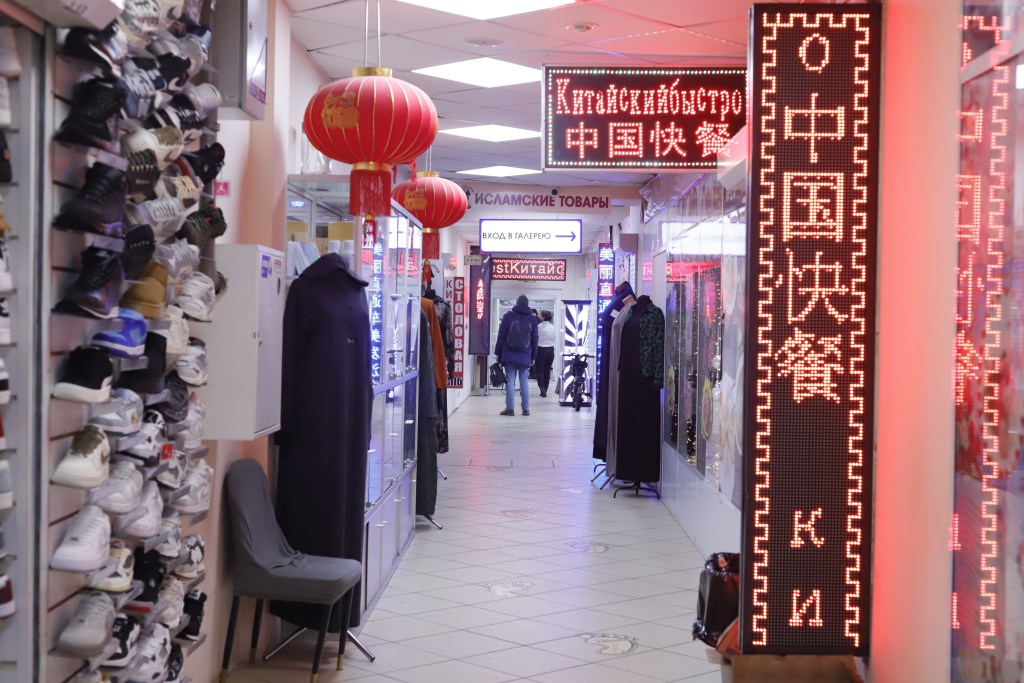
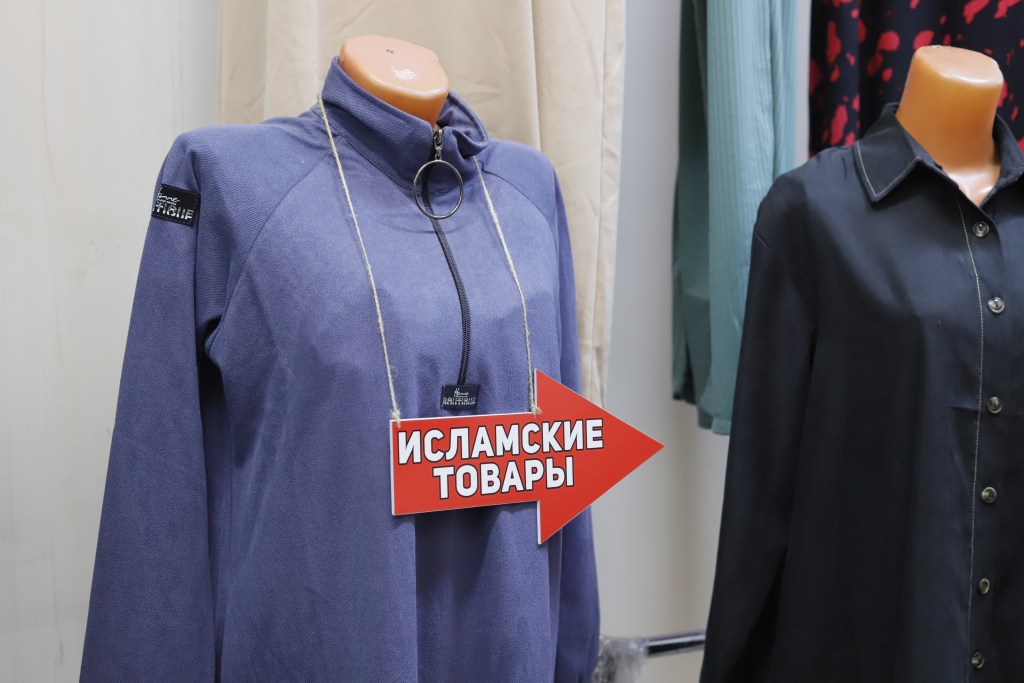
As Ukrainian drones attacked the surrounding Leningrad Region this past weekend, life went on, seemingly unaltered, at downtown Petersburg’s notorious, glorious Apraksin Market aka Aprashka. Thanks to anatrrra for kind permission to reprint their stunning photo reportage from the market.


“Chinese bistro”
“Islamic goods”
Continue reading “Drones over Aprashka” →

Antiwar Pianist Polina Osetinskaya Canceled in Russia’s Cultural Capital

Polina Osetinskaya. Photo courtesy of YouTube channel “Yuzefovich” (via MR7.ru)

Christmastime Encounters with Polina Osetinskaya, a festival which was to be held on January 5, 6 and 8 at the Petersburg pub Fontanka 69, has been canceled, as reported January 5 on the pub’s Telegram channel.

“Due to circumstances beyond our or Polina Osetinskaya’s control, the festival will not take place,” the organizers said. The pianist had planned to perform pieces by Bach, Debussy, and Desyatnikov.

In its social media post, Fontanka 69 also said that the festival had been conceived by its director Denis Rubin as a way of financially supporting Osetinskaya. “Live performances are the main source of Polina’s livelihood,” emphasized the organizers.

The pub’s post also says that the tickets purchased for the festival could be returned and refunded on the ticket seller’s website. “We would be grateful if you would be willing to hold on to your tickets and support the artist in this way,” the authors of the post emphasized, however.

This is not the first time Osetinskaya’s concerts have been canceled in St. Petersburg. In September 2022, the pianist was not able to perform on stage at the Great Hall of the St. Petersburg Philharmonic. Instead, Eugene Izotov played a concert organized by the Employment Promotion Fund.

Osetinskaya spoke out against the special [military] operation on social media on 24 February 2022. Later, as a trustee of the Oxygen Foundation, she signed an appeal by Russian NGOs to stop the SMO.

Source: “Pianist Polina Osetinskaya’s Christmas Concerts in Petersburg Cancelled,” MR7.ru, 5 January 2024. Translated by the Russian Reader


Polina Osetinskaya performs the first two movements of Leonid Desyatnikov’s Reminiscences of the Theater (1985)
at 142 Throckmorton Theatre, Mill Valley, California, 4 June 2006

“I Can’t Stifle My Feelings”: Petersburg Translator Elena Abramova Faces Criminal Charges over Two Antiwar Pickets

Elena Abramova. Photo courtesy of RFE/RL

A court in St. Petersburg has begun hearing the case against translator Elena Abramova, who has been charged with repeatedly “discrediting” the Russian army because she engaged in public protests brandishing placards that called for the release of Alexei Navalny and all other political prisoners, and an end to Russia’s war against Ukraine. Because of the criminal case against her, Abramova is no longer permanently employed, although she has stayed in Russia.

Elena Abramova was born and raised in Magadan. Her parents met as students at a teachers institute. Her mom worked as an insurance agent, and her dad, Arnold Yeryomenko, was a Russian language and literature teacher. In the late 1980s, Yeryomenko was imprisoned for two and a half years over his manuscript “October Vanquished,” which detailed “his thoughts on the regime, the Soviet government, and the Soviet legacy.” The family does not have the text of the manuscript: although Abramova’s mother asked the FSB for a copy, she was told that the document had been lost.

“I don’t know for sure whether Dad planned to publish his manuscript officially, or if he was hoping [to publish it] in samizdat. But he definitely talked about it, and someone in his entourage was aware of its contents. That someone was probably an informant, which is how the KGB found out about the manuscript. Informers probably think they are doing something useful in this way, so they inform on people,” Abramova says.

Yeryomenko spoke at protest rallies and led a pro-democracy movement in Magadan, which “held meetings with supporters, but was not involved in electoral politics.” He was asked to run for office but declined.

“I don’t think Dad had any political ambitions. Power never appealed to him. He had his job, which he enjoyed, he spent time with his family, and he read a lot — we had a very extensive library. In short, he had other interests,” says Abramova. “My father’s principled position was that the individual human being had supreme worth. There should be no pressure [on the individual], no compulsion to [hold particular] views or [adhere to] any particular ideology. He always advocated for de-ideologizing society, for the possibility to freely voice one’s thoughts, to speak out freely, to freely participate in peaceful political campaigns. This is what we lack now.”

Yeryomenko’s political activism peaked in the mid-1980s, after he was released from prison, and waned in the 1990s.

“My family welcomed the fall of the Soviet Union,” says Abramova. “I had to wear a Young Pioneer tie for a year, and I remember how we constantly made up excuses to avoid wearing it: that it was supposedly in the laundry, or something else was the matter. When it was all over, I remember the feeling of relief that now I wouldn’t have to do it: there was something contrived about it. I thought that now we would be able to live in peace, without these tokens of the Soviet regime. It seems to me that after the collapse of the Soviet Union, when that short period of freedom dawned, many people just relaxed. It was such a contrast with the past that everyone wanted to get on with their own lives finally, to enjoy the advantages that became available after the regime changed.”

Abramova says that her own views, on the one hand, come from her family, although she was not particularly interested in politics before Russia’s invasion of Ukraine. Her father died in 2008, and five years later she left her job at a large gold mining company and moved to St. Petersburg, where she got a job as a translator. She was buried in her own cares, including working and raising a child.

“I lived my life. Now I look back and recall that my interest in politics emerged not so long ago, and it was provoked by the outbreak of hostilities to a large extent. Before that, I was aware of certain events, of course, and I had opinions on certain issues. I was simply shocked when I heard that [the war in Ukraine] had beguin. At that moment, I was not up to speed at all, I didn’t folloow in detail what was going on. When I saw [the President’s televised] address [announcing the war], I didn’t even realize what was happening. I couldn’t believe that such a thing was even possible, and it took me several days to just to get my head around it. I read news feeds like crazy and watched YouTube. It was a complete surprise, I didn’t think it would happen. The catastrophe is that people are being killed every day,” Abramova says.

Abramova held her first protest picket in late 2022. At the time, she was not only reading news about the hostilities in Ukraine but also following the political trials [in Russia].

“Ilya Yashin was sentenced on December 9. I decided that I had to protest publicly. Although it would be a purely symbolic gesture, I had to do it because I was ashamed. I was ashamed that my country had been plunged into such chaos and darkness. I didn’t know when it would end, and it was clear that this solo picket wouldn’t change anything, but it was a public statement I had to make, which I had to make against all the odds, despite the restrictions. I was a bit scared: I had no prior experience of solo pickets. I had gone to rallies in support of Navalny, and after [Boris] Nemtsov was murdered. But I had not been to the protest rallies that were held at the very outset [of the war]. I was not subscribed to any [social media] communities and didn’t know where they were held, who had made arrangements with whom, or where to go. But this time I decided that I had to go out,” says Abramova.

Abramova’s first picket lasted for only five minutes, although the site — the square outside the Mariinsky Palace — was not very crowded.

“[I stood for] five minutes, maybe a little longer. I soon noticed law enforcement officers approaching me — slowly, demonstratively slowly, as it seemed to me. They detained me quite politely, they weren’t rude. But there was one man in civilian clothes, in a tracksuit, who was also at the police station later, and he asked the most questions. While I was standing there, I saw someone from the opposite side of the street taking a picture of me. Some people walked by and said “thank you” — it was a young couple, I think. Others pretended not to notice. My placard that time out read “No War.” A couple of months later, in February [2023], a court hearing took place, at which I was fined 30,000 rubles [approx. 380 euros at the time],” Abramova recalls.

Abramova was sentenced to another fine for taking part in a protest rally against the military mobilization, and in late April 2023 she held another solo picket outside Gostiny Dvor. She was able to stand there for a few seconds before she was detained. She held her third picket on [June 4], the birthday of politician Alexei Navalny.

Elena Abramova

“I took up my position on the Field of Mars, were there were no police officers at all. Later, I went to Gostiny Dvor, where I was detained immediately. An arrest sheet was drawn up for the second picket, but the case did not go to court. After I left the station, they telephoned me and asked me to come in for ‘additional testimony.’ They probably realized this was already my second arrest. But it was not listed in the arrest sheet, and so I declined to go in. After my third picket I was taken to the same station, and this time the police pulled my rap sheet and opened a criminal case against me,” says Abramova.

Several men in balaclavas, an investigator, and Center “E” officers (officers from the Interior Ministry’s “anti-extremism” unit) soon came to search Abramova’s home.

“I said I had to get dressed, and they said I literally had five seconds to do it. I began to get dressed, but they were banging on the [front] door and practically breaking it down. My child was asleep, so I woke him up, told him not to worry, and explained there was going to be a search. When they were already inside the apartment they behaved themselves, but they confiscated my phone and didn’t even let me call work to warn them I wouldn’t be coming,” says Abramova.

During the investigation, it came to light that the criminal case against Abramova had been launched illegally. Since she is a voting member of an election commission, a criminal case can only be initiated through a special procedure, which had been violated. Formally, then, the case against Abramova was launched twice: first in the summer of 2023, and again in May 2024.

The criminal case against Abramova is currently being heard in court. According to Russian law, for two antiwar pickets she faces a huge fine, forced labor, or up to five years in a penal colony. Abramova attends the court hearings and has no intention of leaving Russia.

“I don’t see any use for myself abroad. I had difficulties finding work in St. Petersburg, especially after the criminal case was opened and I was fired, back in September of last year. I missed a day of work because of the search, and I was immediately asked to turn in my resignation. It was a commercial firm, and the management was probably afraid of scrutiny from law enforcement. But still, I can’t imagine what I would do if I weren’t in Russia. I think that there may come a time when people will need to be here, but the people who need to be here won’t be here. And then, even if I leave, I can’t stifle my feelings. I also feel my share of the guilt for what is happening — for my indifference and lack of involvement. And the pain over the fact that my country unleashed a war against a neighboring country would still remain. I would still have to live with it. Changing locations wouldn’t affect this much,” says Abramova.

Source: “‘I can’t stifle my feelings’: criminal charges for two antiwar pickets,” Radio Svoboda, 1 January 2024 (originally published by Okno). Translated by Thomas Campbell

Thе New Year Spirit


Faithful to its avant-garde nature, Noise Cabaret premieres the immersive series Dialogues, based on the philosophical works of Plato, on December 25. Alexander Khudyakov turns ancient Greek philosophy into a lively, witty and provocative dialogue with the audience.

Along with his partner Ivan Wahlberg, Khudyakov, who not only acts in the project but directs it, will guide the audience through the labyrinths of Plato’s thought. What is justice? Where is the line between existence and non-existence? What is the true nature of love? These and many other fundamental philosophical questions will serve as starting points for reflection and debate.

Dialogues is a series of interactive performances in which each viewer is involved in a philosophical discussion consisting of adapted texts by Plato and actorly improvisation, meaning that the way the performance goes depends on the audience’s involvement. Each new performance is a separate chapter dealing with a specific philosophical problem, so you can join the series at any stage. The first episode deals with the concept of justice.

Noise Cabaret plans to invite Petersburg celebrities to enrich the conversation with the audience with their own opinions and views.

Khudyakov shared the idea behind the project.

“We wanted to do a story related to people talking in a bar. But just people talking to each other is not interesting. There has to be a big focus. When I studied Plato, I was interested in several aspects of his philosophy. It would have been wrong to limit ourselves to a single topic. So the idea to make a series arose: take Plato, read him, and discuss the themes he raises in the Socratic dialogues.

“We plan to produce a new episode every two or three months. There’s no pretense here that we’re serious scholars of Plato’s philosophy: it’s more of an excuse to talk to people about difficult topics, to air the Dialogues and reflect on them. And a bar is a place where you can talk about all sorts of things, including philosophy.”

Source: Fontanka.ru, 23 December 2024. Translated by the Russian Reader


Russians spent almost 6 billion rubles on Ozempic generics in 2024

Semaglutide-based drugs are commonly used for weight loss

In the first ten months of 2024, Russians spent 5.9 billion rubles [approx. 52 billion euros] on over one million packs of generic versions of the drug Ozempic (semaglutide), according to DSM Group, as reported by Vedomosti.

Among the most popular generics are Geropharm’s Semavic and Promomed’s Quincenta. The original drug Ozempic stopped [sic] official supplies to Russia in December 2023, opening the market to domestic analogues.

2024 was a record year for drugs in this category. By comparison, in 2023, Russians spent only 297 million rubles on Ozempic, buying 20 thousand packs. In 2022, they spent 1.9 billion rubles (256 thousand packs); in 2021, 758 million rubles; and in 2020, 76 million rubles.

Semaglutide-based drugs are used to treat diabetes but have recently been gaining popularity as weight loss drugs, which has also contributed to their sales growth in Russia.

Source: ASTV.ru, 21 December 2024. Translated by the Russian Reader


St. Petersburg will open a new metro station this week, Governor Alexander Beglov announced Thursday, marking the former Tsarist capital’s first new metro station in five years.

The Gorny Institute metro station, located on Vasilievsky Island, will extend the fourth (or “orange”) line westward. It will begin operations at 9:00 a.m. on Friday, with its vestibule open for both entry and exit, Beglov said.

“The opening of Gorny Institute is a milestone,” the governor wrote on Telegram, noting that the city had overcome “significant challenges” during the station’s construction.

Beglov thanked President Vladimir Putin, metro builders, engineers and residents of St. Petersburg for their patience and support, calling the station’s completion the “first results” of sustained efforts to advance the city’s metro system.

The station’s opening comes after years of delays. Initially scheduled for completion in 2015, its opening was postponed to 2018 and later to 2022. Construction efforts were further overshadowed by a fatal scaffolding collapse in June 2020 that killed one worker and injured another.

Gorny Institute is the first station to open since 2019, when three others — Prospect Slavy, Dunayskaya, and Shushary — were inaugurated.

St. Petersburg’s metro is currently made up of five lines and 72 stations. However, it has expanded slowly over the years, in stark contrast to Moscow’s burgeoning metro system, which this year opened eight new stations.

Source: Moscow Times, 26 December 2024


[…]

In trying to grasp the tonality of the film [Anora], I am reminded of a line from Francis Bacon: “You can be optimistic and totally without hope.” The situation the characters find themselves in, being at the mercy of the rich, is totally without hope. The “hopeful” version of the script would be one in which Vanya does stand up to his parents and runs off with Ani, even at the price of losing his wealth—this is the film’s narrative lure. Or maybe another where the ruthless capitalist mother gains a grudging respect for her tough daughter-in-law, like in the last season of Fargo. But despite its grim closure, the impression the film gives is far from dreary or pessimistic. The hopeless optimism of Baker’s cinema lies in the sheer life that seems to almost burst out of the filmic frame, and, especially, his deep care for his characters, even Vanya.

Source: Aaron Schuster, “The Ethical Dignity of Anora,” e-flux Notes, 20 November 2024


In the fall of 2023, with the goal of understanding what is really happening with Russian society during wartime, the Public Sociology Laboratory team went on ethnographic research trips to three Russian regions—Sverdlovsk, Krasnodar and Buryatia. Over the course of a month, PS Lab researchers observed how people talk about the war and how it affects daily life in cities and villages. In addition, they recorded sociological interviews with local residents. PS Lab has compiled three detailed ethnographic observation diaries (more than 100,000 words apiece) and conducted 75 in-depth interviews. Overall, it has managed to collect truly unique data that provides an idea of what people say and think about the war in everyday situations, and not only when answering researchers’ questions.

The full text of the report is book-length and written in a book-style format: it consists of seven chapters, introduces many characters, and allows readers to be fully immersed in contemporary wartime Russia. The following summary, meanwhile, highlights the main analytical conclusions.

  • Russian society remains politically demobilized and deideologized. Despite the prevailing opinion that it is strictly militarized, we see that the war has become routine and therefore a disregarded part of reality. For example, compared to the first years of the war, the amount of prowar symbolism in public spaces has decreased in all three regions. The war has neither become a source of new ideas in the cultural life of cities or villages nor been integrated into familiar and already-established cultural formats. The war is not discussed in public places, including, with rare exceptions, local online communities.
  • In spontaneous conversations, Russians rarely discuss the overall goals and causes, criminality, or justifications of the war. They are concerned with the impact of the war on their everyday lives. When they talk about the war, they mostly talk about the same things they discussed before the war, for example, everyday difficulties, money, or ethics. Men more often discuss topics that are considered “masculine” in society, such as the technical side of the war, and women usually talk about “feminine” topics, such as how war destroys families.
  • Participation in various types of prowar volunteering and organized assistance for the military, which are often cited as an example of the mobilization and militarization of Russian society, is rarely motivated by people’s firm support for the “special operation.” It is usually associated with pressure from the administration, community moral norms (concerning mutual assistance), and/ora desire to help loved ones, rather than a wish to make victory for Russia more likely. Observation of volunteers’ activities show that while working, they do not discuss the war or politics, rather choosing topics that are personable and relatable to them: prices, pensions, families, and/or stories related to the volunteer centers.
  • Despite all these similarities, the war is perceived slightly differently in different regions. The peculiarities of each region’s view owe to factors like the number of military units and penal colonies from which prisoners are recruited, proximity to the combat zone, the prosperity of the region and the availability of decent jobs, the density of social ties, the circulation of news transmitted by friends on the front lines, etc. In other words, the differences in perceptions of the war are attributable mainly to the peculiarities of life in the regions before the invasion of Ukraine.
  • The conflict between opponents and supporters of the war is gradually subsiding, while the rift between those who stayed in Russia and those who left is growing. This is happening both because the shared experience of living through a difficult situation within the country is becoming more important for many Russians than any differences in viewpoint, and also because people are discussing the war less.
  • At the same time, the waning conflict between opponents and supporters of the war does not always mean more social cohesion. Since people are trying to live as if the war is nonexistent and the government does not talk about any losses or problems associated with the war, all negative consequences of the war are either normalized or pushed into the realm of “personal problems” that are not discussed with anyone and that everyone must deal with on their own.
  • Overall, many people do not feel able to influence political decisions. Therefore, they are increasingly distancing themselves from the war. They understand that they cannot change government policy, but they retain at least some control over their private lives—and therefore they are immersed in them. Over time, not only apolitical Russians but even sure opponents of the invasion experience this powerlessness and, as a result, some of them accept the new reality while continuing to condemn the war internally.
  • Consequently, many Russians are increasingly distrustful of political news from a broad range of sources. Instead, they put their trust in local media. Local problems and news seem much more important and relevant to them. Moreover, they feel that, unlike the war, local issues are at least sometimes within their ability to influence.
  • At the same time, the war is weighing people’s emotional state. Many of our interlocutors admit that they experience anxiety, tension, uncertainty, fear, even if these things are not usually spoken about openly. The departure of sons and husbands to war makes women “scream at the top of their lungs.” However, people rarely share such emotions with others, and if they do, they do so in groups with close friends.
  • Many Russians who are not interested in politics may justify or condemn the war depending on the communicative context.
  1. They tend to non-emotionally justify the war through normalization (“there are always wars”) or rationalization (“it was necessary”) when asked about it directly in more formalized settings, such as research interviews.
  2. They are more likely to criticize the war when prompted to think about how it negatively affects them as ordinary Russians. This criticism differs from that of war opponents. For opponents, the war is a moral crime against Ukraine, whereas for apolitical Russians, the war is seen as something that destroys Russian society and harms ordinary people. However, this criticism does not lead apolitical Russians to question the war’s necessity or inevitability, nor does it extend to criticizing the Russian government.
  3. They tend to emotionally justify the war when confronted with traditional anti-war narratives. When Russia is accused of committing moral crimes against the Ukrainian people, they often take such accusations personally and attempt to defend their own dignity.
  • Some people have experienced a strengthened sense of national identity, and sometimes a demand for greater solidarity arises. It’s important to note that this increased sense of national identity does not lead Russians to adopt the official imperial brand of nationalism. Unlike the Kremlin, ordinary people live in a world of nation states, not in a world of imperial fantasies (according to which Ukraine is not a real state and Ukrainians are an inferior people).
  • A feeling of uncertainty is what truly unites Russians today. Despite the fact that people choose various strategies to cope with this feeling, it still significantly complicates the ability to plan one’s life and plunges Russians into pessimism.

Thus, on the one hand, the formerly extraordinary nature of the war is giving way to normalization: the war is gradually becoming something ordinary, another unremarkable part of the surrounding world. In a sense, many Russians resist both the Kremlin’s attempts to turn ordinary citizens into ideological supporters and the attempts of the anti-war liberal opposition to force society to actively experience guilt and fight. On the other hand, the war constantly reminds us of its existence, creating new threats, new anxieties, and new reasons for discontent in Russians.

Source: Public Sociology Laboratory (The Russia Program), December 2024


Dear readers!
Times are tough, and the key in this case is holding on in every sense.
No one says it’s easy.
But it’s not so hard either.
The other day I asked Vladimir Putin whether he expected anything more from himself in the outgoing year.
But I want to ask you: do you expect anything more from yourself in the coming year?
We need to expect things. We need to want things. It’s a way of holding on to ourselves. Of looking after ourselves. Of not losing ourselves. And even of finding ourselves.
A hard sign (“Ъ”) will never be a soft sign (“Ь”)!
Happy incoming New Year!
Let’s not be on the defensive!

Andrei Kolesnikov, Special Correspondent, Kommersant Publishing House

Source: Email from Kommersant, 31 December 2024. Translated by the Russian Reader. The so-called hard sign, which the Bolsheviks dropped from the Russian Cyrillic alphabet in 1918, has been the logo of Kommersant since the newspaper’s relaunch in January 1990. Andrei Kolesnikov has been the newspaper’s special Kremlin correspondent — that is, its chief Putinversteher — for many years. Of course he’ll deny it all when push comes to shove and Putin goes, and he’ll point of course to the cynical, jocular (but ultimately loyal) way he’s written about the Russian dictator and war criminal all these years.