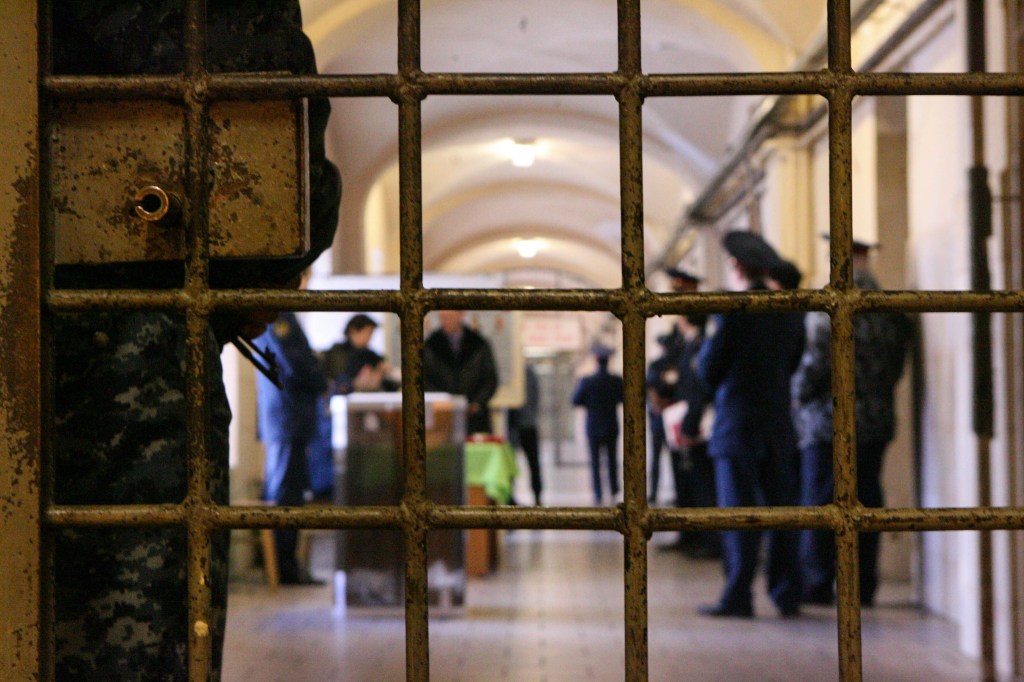
Voting in prison is not a bad form of entertainment. Dozens of prisoners are escorted to the ballot boxes simultaneously, providing a rare opportunity to chat and exchange news with your neighbors.
We were assembled in the “gully” and launched in pairs into a room equipped for a polling station. The convicts had fun arguing who to vote for. Mostly, of course, there were juicy quotes from Leningrad’s song about elections….
“Elections! Elections! The Candidates Are Buggers!” The song, written by Alexei Kortnev for the theater production Election Day (2003), was performed in the eponymous film (2007) by Sergei Shnurov and Leningrad
With a clear conscience, I wrote “FOR RUSSIA WITHOUT PUTIN” on my ballot paper. After that, I conducted a spontaneous exit poll at the prison polling station, thanks to which it transpired that most of the inmates had voted for anyone, just not for [ruling party] United Russia. Only one of them admitted that he had ticked the box for [incumbent Moscow mayor Sergei] Sobyanin. The guy, however, is a United Russia activist himself: he embezzled a factory and is now serving a sentence for fraud. So it all makes sense.
And I also saw and hugged Sergei Klokov (Vedel) for the first time in several months. For a year and a half, the man has been doing time for a telephone conversation with relatives, bugged by the security services, during which the murders in Bucha were discussed. He looks tired and misses his family, including his two young children. But he is slightly encouraged by the news that Ukraine is willing to exchange its collaborators for Russian political prisoners. I hope Sergei will be released soon. He’s a good guy.
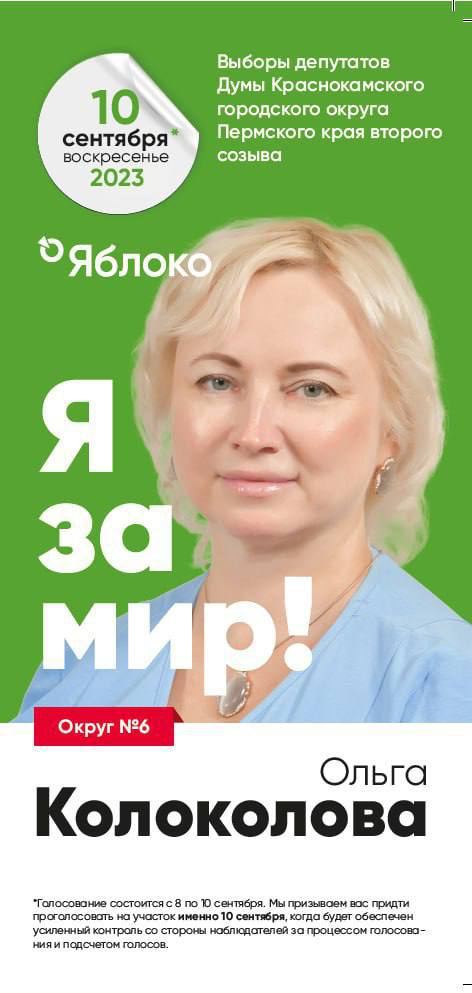
Olga Kolokolova’s campaign poster in the 10 September 2023 elections in Krasnokamensk (Perm Territory): “I’m for peace!” Image courtesy of Igor Averkiev
Olga Kolokolova, the head of the Perm regional branch of the Yabloko Party for many years, won the elections to the City Duma in Krasnokamsk (a satellite city of Perm). Moreover, she won running on the slogan “I’m for peace!”
Having received 55.2% of the votes cast, Olga Arkadyevna was returned to the Krasnokamsk City Duma, of which she was a deputy from 2005 to 2018.
Kolokolova is a veteran of the Perm loyal democratic opposition. (I say this without the slightest hint of judgment: the loyal opposition has its own positive mission, especially during periods when the regime relaxes the rules.) She is one of the most well-known politicians in Krasnokamsk, and the most consistent and most well-known Yabloko Party activist in the region.
Despite her status as a member of the loyal opposition, the election of Olga Kolokolova as a deputy in our time, and running on such a slogan, is really an unusual event, a kind of relic or vestige of the Putin regime’s bygone hybridity. In any case, it is impossible not to be happy for Olga Arkadyevna.
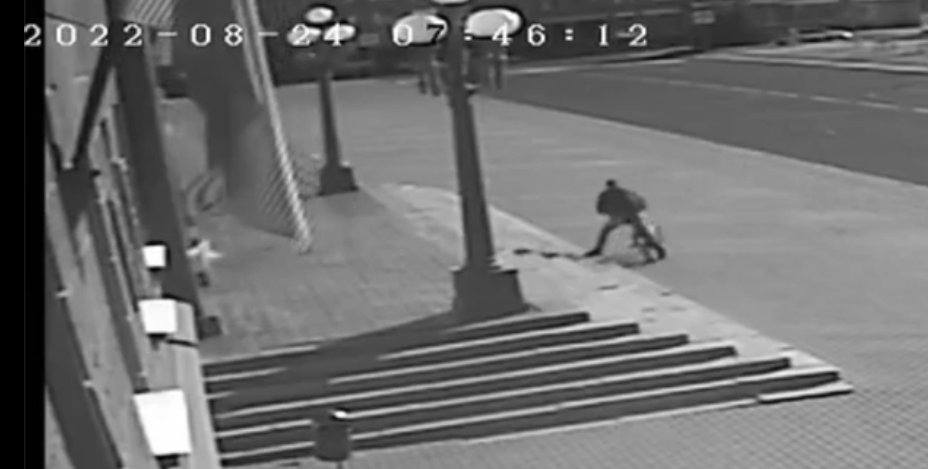
A still from CCTV footage of the attack on Oryol regional government building
Compulsory psychiatric treatment for man alleged to have thrown Molotov cocktails on Ukrainian Independence Day
On 1 August 2023, the 2nd Western District Military Court sentenced 49-year-old Mikhail Davydov to compulsory psychiatric treatment. Davydov had been charged with “terrorism” (per Article 205.1 of the Russian Federal Criminal Code) over Molotov cocktails thrown at the regional administration building in Oryol last year.
The criminal case was launched after an unknown cyclist threw two Molotov cocktails at the front doors of the Oryol regional government building on Ukrainian Independence Day (24 August) last years. The cyclist’s actions were captured by a surveillance camera.
The alleged perpetrator, Mikhail Davydov, was apprehended only a week later, on 31 August 2022. A 48-year-old resident of the region, Davydov was allegedly on the federal wanted list for “refusal to testify” (per Article 308 of the Criminal Code). According to investigators, Davydov had been hiding from the FSB since 22 April 2019. Davydov and his lawyer Larisa Melikhova denied this, however. According to them, Davydov had not been hiding from anyone, “since he had been providing for himself since 2019 and had petitioned the Federal Bailiffs Service for alimony payments, which request was denied. He was not in hiding, but had lived the entire time in the Oryol Region’s Bolkhov District, where he was detained by police officers.”
On 8 September 2022, Davydov was charged with “reckless attempted murder” (per Articles 30.3.e and 105.2 of the Criminal Code of the Russian Federation). The region’s governor, Andrei Klychkov, reported that a regional administration staffer had been wounded during the attack. However, the surveillance footage shows that the cyclist began throwing the Molotov cocktails before the doors opened (that is, they had no intention of killing anyone). In addition, the governor wrote that the employee in question was “doing fine.”
Davydov’s remand in custody at the pretrial detention center was extended several times, each time on the attempted murder charges. Davydov, however, was sent to a psychiatric hospital, apparently in February 2023. At any rate, in March 2023 the court extended his term of detention at a psychiatric hospital.
In June 2023, the case was submitted to the 2nd Western District Military Court, but now on charges of “terrorism.” On 1 August 2023, the court issued a ruling that Davydov be subjected to compulsory medical treatment. According to Kommersant newspaper, “the defendant was declared insane.”
Compulsory psychiatric treatment, unlike imprisonment, is not limited to a fixed term. It ends when a panel of physicians rules that the individual has been “cured,” and the court seconds their ruling. There have been cases in which people were subjected to compulsory psychiatric treatment for many years.
On June 28, Valeria Zotova, a 19-year-old woman from Yaroslavl, was found guilty of “plotting to commit a terrorist act” (per Article 30.1 and Article 205.1 of the Russian Federal Criminal Code). Zotova will spend six years in prison because of the “experiments” that the FSB (the Russian Federal Security Service) conducts on people.
According to police investigators, Zotova wanted to set fire to a warehouse where “aid” was collected for Russian servicemen fighting in the war against Ukraine.
In the video footage of her arrest, Zotova is pulled from the passenger seat of a car by masked men. However, the other people in the car were apparently not touched.
Prior to this, a certain “Andrei” had for a long time been writing to Valeria, claiming that he lived in Ukraine. In the letters, he asked Valeria to perform “missions” for him. She refused and showed the exchanges with “Andrei” to her mother. After some time, Andrei’s “girlfriend” “Karina” started writing to Valeria in VKontakte. According to Valeria’s mother, “Karina” harassed her daughter, constantly writing and calling her, and urging her to commit arson. When Valeria was detained, “Karina” was in the vehicle with her, but “Karina” was not charged in the case.
It transpired that “Andrei’s girlfriend” was an FSB officer and a secret witness. At one of the hearings in Valeria’s trial, “Karina” openly stated that it was all a “crime re-enactment” [sledstvennyi eksperiment, which translates literally as “investigative experiment”—TRR] Although the FSB chose not to conceal its actions, this had no effect on the verdict.
The defense provided the court with obvious evidence of Valeria’s innocence, namely, her correspondence with Karina, in which Valeria repeatedly refuses to commit arson.
Despite the fact that the court did admit this evidence into the case file and “weighed” it, Valeria was found guilty on the charges. Instead of the eight years of imprisonment requested by the prosecutor, the court sentenced Valeria to six years.
Valeria’s lawyer has appealed the verdict, so we can look forward to an appeals hearing in the future.
On the outside, Valeria worked very hard, almost seven days a week. In her spare time, she drew and beaded. In winter, she skated whenever possible. She adores doing crosswords and other such puzzles. She is an extraordinarily upbeat and resilient young woman who always succeeded at whatever she undertook.
A drawing that Valeria Zotova sent from the pretrial detention center in Yaroslavl Courtesy of Solidarity Zone
Valeria is currently in custody at the Yaroslavl pretrial detention center. You can show your solidarity and support by sending her a letter. She is always glad to get them and expresses her gratitude for all the support.
Address for letters and parcels:
Zotova Valeria Igorevna (born 2003)
10 ul. Portovaya nab., SIZO-1
Yaroslavl 150001 Russian Federation
You can also send her letters via FSIN-Pismo and Zonatelecom.
Solidarity Zone is supporting Valeria Zotova.
#wewriteletters
Source: Solidarity Zone (Telegram), 14 August 2023.Thanks to Simon Pirani for the heads-up.Translated by the Russian Reader.People living outside of Russia will find it difficult or impossible to send letters to Russian prisons via the FSIN-Pismo and Zonatelecom services or regular mail. In many cases, however, you can send letters (which must be written in Russian or translated into Russian) via the free, volunteer-run service RosUznik. Ms. Zotova has not yet appeared on their list of supported addressees, however. You can write to me (avvakum@pm.me) for assistance and advice in sending letters to her and other Russian political prisoners.
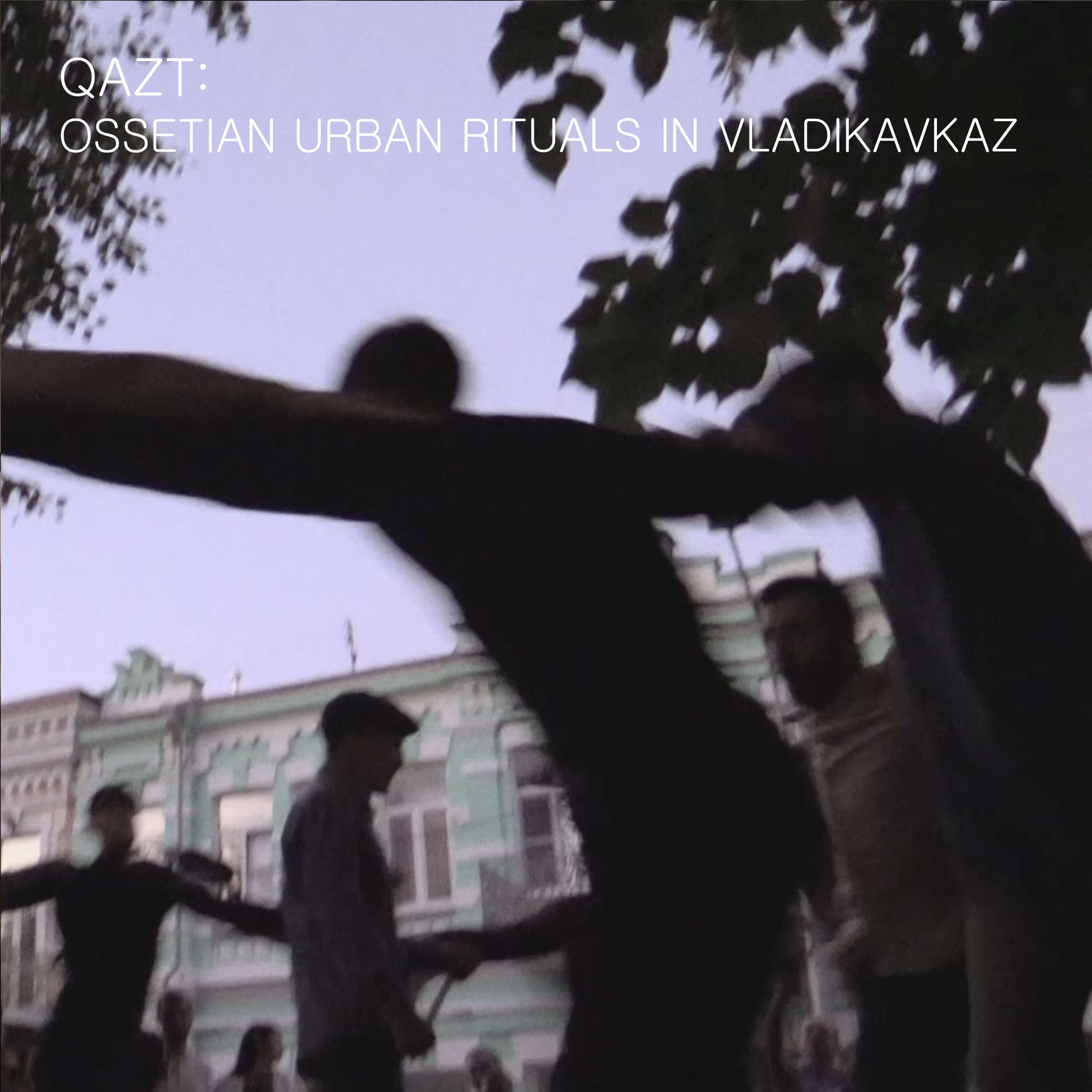
Today is my birthday, and I can think of no better birthday present than Qazt: Ossetian Urban Rituals in Vladikavkaz, a 46-minute documentary film released earlier today by Tbilisi-based Ored Recordings, whose remit is “traditional and local music from the Caucasus and beyond.” The film comes hot on the heels of Ored’s release of the eponymous album a week ago.
Nothing would make me happier today than if you watched the film and listened to the album, which I’ve pasted into this post, below. If you like what you hear, see, and read, support Ored’s vital mission by sending them what you money can afford and downloading the Qazt digital album or any of the other releases in the label’s growing back catalogue. Thanks! ||| TRR
Qazt is a traditional game among the Ossetians. It is a ritualistic, musical, dance, and social space that forms on various festive occasions. During the qazt, young people would socialize, boys would showcase their courage, and they would compete in various heroic and joyful activities. In 2020, we traveled to Vladikavkaz to explore the urban qazts, make a documentary film, and issue this release. We were interested in qazt as a new cultural phenomenon, an event of urban culture, and a modern form of Ossetian self-organization.
Qazt is a traditional game among the Ossetians. It is a ritualistic, musical, dance, and social space that forms on various festive occasions.
During the qazt, young people would socialize, boys would showcase their courage, and they would compete in various heroic and joyful activities.
Analogues of qazt can be found among other peoples in the Caucasus. For example, among the Circassians, such festive dances are called dzhagu. The semantics of the Ossetian word “qazt” and the Circassian “dzhagu” are even the same — “game.”
In 2020, we traveled to Vladikavkaz to explore the urban qazts, make a documentary film, and issue this release. We were interested in qazt as a new cultural phenomenon, an event of urban culture, and a modern form of Ossetian self-organization.
During the pandemic years, traditional dances on the streets of Vladikavkaz became a noticeable event — qazts were covered by Caucasian media and Ossetian bloggers. We were invited to film the event by Alik Pukhaev, the author of the Rajdian blog.
In 2020, qazts seemed to be a growing initiative. This youth movement had it all: a vibrant cultural component, moderate protest, and an orientation towards the future, rather than a romantic desire to return to the past, where everything was considered better, purer, more authentic, and more national.
The qazts were organized not by officials who often do things formally, nor by the elderly, who are used to scolding the youth and imposing what they consider to be the authentic traditions of their people. No, this new cultural movement was led by young people who equally loved Ossetian culture and some global elements — like rock music or hip-hop. What was even more important is that the organizers did not draw boundaries between their local and global identities, between the traditional and the modern.
Qazts in the center of Vladikavkaz became part of urban culture, something that not only ethnographers but also urbanists from fancy magazines would write about in the future. The urban dances and songs struck a balance between preserving Ossetian culture and Caucasian solidarity. Initially, Ossetian students were inspired by Circassian festivities in Nalchik and decided to create something of their own.
It is important to note that at weddings in North Ossetia, Circassian and Chechen dances are very popular. According to Ossetian cultural activists, sometimes they are even too popular. Despite their desire to build horizontal connections with their neighbors and avoid getting trapped in provincial ethno-patriotism, the organizers of the qazts noticed that foreign cultural elements were becoming more popular than local ones, and many traditional dances were being forgotten.
Therefore, their project had specific rules: only Ossetian songs were allowed to be performed, and only Ossetian dances were allowed to be danced. All the other variety was appreciated but could be done on another occasion.
They also had a dress code: men were not allowed to dance in shorts, and women were not allowed to wear trousers. Some people criticized this approach on social media. Working with traditional culture is often associated with conservatism, so some viewed the effort to dress the audience in a certain way as backward.
On the other hand, one could compare this practice to dress codes at raves. It would be unfair to label a Berghain bouncer as a backward traditionalist if they don’t let someone in for not adhering to the techno dress code.
“It’s not a return to the past; we were creating a new culture for ourselves and others. We were trying not only to introduce Ossetian songs and dances into the urban environment but also to rethink our own culture. In the past, each dance had its context, which might not be understood in Vladikavkaz today. That’s why it’s important to come up with new meanings,” explained one of the qazt initiators, Tamu Berozti.
People of different generations – from children to grandparents – attended the qazts and embraced what the youth offered them. These evening gatherings in the city park or on the central avenue of Vladikavkaz provided many with an answer as to why all these songs about past heroes and dances with strange meanings were important. Or rather, the question “why?” did not arise because qazt had become a natural form of uniting people with similar identities.
The youth didn’t just bring culture to the public sphere, where people literally encountered Ossetian language and music while strolling through the city. For a while, the qazts managed to break the monopoly that academic and exemplary song, and dance ensembles had built. Qazt deliberately distanced itself from a staged show. It was not choreography for the audience, but a way to spend time together and, in the long run, negotiate with each other.
Since the release was recorded and the film was shot, three years have passed. In 2020, the main concern was the pandemic, which forced people to seek new ways of living together and uniting. Today, the main context in which the North Caucasus and other regions included in the Russian space live is war. The issues of preserving identity, culture, and solidarity have become even more acute.
It’s difficult to say why the qazts didn’t become a new driving force, a space for reflection, or simply a viable cultural phenomenon. They emerged brightly, attracted attention, and slowly faded away.
Perhaps the general fatigue of the main participants played a role: in the North Caucasus, musicians often expect overwhelming success and recognition after their first successful events, but over time, they lose enthusiasm and feel discouraged.
Maybe some tensions among the main organizers contributed to it – it was evident that they had disagreements on various issues. Or against the backdrop of a general depressive atmosphere in the region after 2022, they all became tired and engaged in other projects. More intimate and with clear structure – like the Ragon traditional music ensemble and the Uatsamonga choir.
In any case, there was no cultural revolution, and the qazt remained a ghost of a possible future.
However, its influence is still felt. Street concerts with Ossetian-language indie music in Vladikavkaz have increased. The Ragon group is releasing its second album and actively performing at festivals.
In the Rajdian blog, there was a post about a tweet from a dissatisfied Ossetian from the diaspora in Turkey:”Cultural youth is not the necessary generation for the continuity of ethnic identity. We need a political youth,” commented a descendant of migrants.
Many active young people in the North Caucasus share this view, perceiving music and dances as entertainment and distraction from problems. While we dance and sing approved songs joyfully, our languages are disappearing, and social problems are increasing more and more.
Initiatives like the Vladikavkaz qazts could have become an example of music aimed not only at entertainment but also at solidarity.
And the fact that our new release is once again about something from the past proves that cultural identity without a civic position is insufficient for gradual and confident development.
Film by Tamerlan Vasiliev will be out soon
Recorded on August 2020 in Vladikavkaz
Sound and mixing: Timur Kodzoko
Cover photo: Tamerlan Vasilyev
Cover art: Milana Khalilova
Liner notes: Bulat Khalilov
Translation: Bella Mirzoeva
Petersburg is getting ready to welcome groups of visa-free travelers from Iran. It could increase the tourist flow to the city by as much as eight percent.
The Economic Development Ministry reported that Russia has completed the procedure of exchanging lists of tourist organizations with China and Iran for the early launch of bilateral intergovernmental agreements on visa-free group tourist trips. In preparation for this, the St. Petersburg Tourism Development Committee and representatives of the hospitality industry held a series of “Welcome to St. Petersburg!” field presentations in the largest cities of the Islamic Republic of Iran—Tehran, Isfahan, and Shiraz. The events were attended by over 250 professionals from the country’s tourism industry.
“The people of Iran love to travel. The interest of the citizens of this country in Petersburg has been growing noticeably lately. The field events, realized as part of the national project ‘Tourism and the Hospitality Industry,’ provide Petersburg tourism industry professionals with a unique opportunity to establish new contacts with Iranian colleagues and, of course, increase interest in our city,” says Sergei Korneyev, chair of the St. Petersburg Tourism Development Committee Sergey Korneev.
On May 26, St. Petersburg welcomed the first passenger flight from Tehran, operated by Meraj Airlines, and on June 1, a direct flight from Iranian capital to St. Petersburg was made by Russia’s Nordwind Airlines. “Previously, when there were direct flights from Iran only to Moscow, trips were planned to the two cities at once. Now that direct flights have been established, tourists from Iran will be able to go straight to Petersburg and its suburbs,” says Yana Kozhevnikova, a partners and agencies specialist at tour operator Bon Tour.
Next year, Petersburg is planning to send a cultural and business mission to its Iranian sister city of Isfahan. Hossein Nasr, head of the Isfahan Association of Tour Operators, spoke of the need for vigorous development of tourism between the two cities. “Events where new connections can be established are very important to us. Representatives of the relevant companies in our city held constructive talks with their Petersburg colleagues, and this is a good foundation for strengthening relations and mutually increasing the tourist flow in the future,” he said.
Dmitry Tyurin, head of the commercial department at the international transfer ordering service I’way, argues that cooperation in the field of tourism between Iran and Petersburg opens up significant prospects for both sides. “This cooperation will bring many benefits both to the city and to business. An increase in the number of tourists will lead to an increase in the load on infrastructure facilities, thus contributing to the growth of profits and the development of the city’s economy. And the variety of needs and preferences among Iranian tourists will generate new opportunities for entrepreneurs involved in the hotel business, restaurants, souvenir shops, and travel agencies. In addition, the development of cooperation with Iran can contribute to the strengthening of diplomatic and cultural ties between the countries. The influx of Iranian tourists will enable local residents and entrepreneurs to better understand Iranian culture,” he says.
According to political scientist Inna Litvinenko, the willingness of Iranian tour operators to send tourists to Petersburg points to large-scale prospects for developing the tourism sector and related sectors of the city’s economy.
“First of all, it will affect the hotel and restaurant business, airlines, and tourist agencies. The growing interest in visiting Petersburg is explained by the Northern Capital’s rich historical legacy, its geographical location, and the concentration of business flows. Visa-free agreements with Iran will increase the tourist flow by 5–8%, and the word-of-mouth effect on neighboring Islamic states will also kick in, making it possible to achieve a 12–15% increase in tourists by the end of 2024. Another obvious plus will be the influx of investments into actively developing industries—construction, the hotel and restaurant business, and the service sector,” predicts Litvinenko.
I was just flying from Leningrad to Istanbul, and the coach of an Iranian football team was seated next to me. I had this feeling like I was in the movie Cabaret. On the other hand, if I had said to him, ‘Well, how’s it going with the ayatollahs?’ he could have said to me, ‘And how’s it going with Putin?’ He got up in the middle of the flight and handed out our poor northern apples to his players while I drank white wine. We caught each other’s eye and smiled at each other. For the last hour, he studied English on his phone using an Iranian app. The good guys will beat the bad guys.
The Russian state is keen to foster loyal young people. We have already recounted how the authorities have clamped down on liberal universities and brought them to heel, rewritten school history textbooks, and shut down independent educational projects. But this is just the tip of the iceberg.
Today, the website Protocol and the YouTube channel RZVRT claimed that college students in Tatarstan’s Alabuga Special Economic Zone have been made to assemble [Iranian] kamikaze drones. They face expulsion and a fine of 1.5 million rubles if they refuse to do it. Students also have to play paintball, and the losers are forced to dig trenches and are “executed” with paintball guns. Two cases of suicide have already been reported. In addition, the college management tricks female students from African countries into doing the dirtiest menial labor.
“‘Alabuga: producing death with the hands of death.’ The second part of Protocol and RZVRT’s joint investigation of Alabuga. We talk about how students are forced to dig trenches and assemble Iranian Shahed drones, about how students from African countries were lured into applying to the college through Tinder, and about how the leadership of the special economic zone treats students.” Protocol (YouTube), 24 July 2023 (in Russian)
This is not the only such case. The authorities in Russia have recently been inspired by the idea of free child labor, including for the needs of the army fighting in Ukraine.
Thus, on July 20, the State Duma immediately passed in its second and third readings a bill on “community service” for schoolchildren. Children will now have to clean classrooms, plant trees at school, and help in the library on a “voluntary-compulsory” basis. Permission from parents will no longer be required for this. Commenting on the new law, State Duma Speaker Vyacheslav Volodin said that “only through labor can one cultivate an attitude to many issues that [the child] will later need to solve. The child will grow up different. Harmony will come.”
“Community service” goes hand in hand with the militarization of schools. During “basic training” lessons, children will learn how to pilot drones. “Today’s army is not only the Kalashnikov assault rifle, but also advanced unmanned vehicles,” said Federation Council member Artyom Sheinin.
From September 1, military training will be introduced for pupils in grades ten and eleven. Among other things, children will practice military greetings, drilling, handling small arms, combat actions, and first aid during hostilities.
There are also serious changes to the history curriculum. In September, high school students will get new textbooks featuring chapters about the “special military operation.” They will be told that:
Kiev “secretly colluded with NATO.”
Peace in Crimea was preserved by the “polite people”, that is, by the unidentified Russian soldiers who seized the peninsula in March 2014.
Ukraine wanted to get its hands on nuclear weapons.
The war, which was the Kremlin’s only option, has “consolidated society.”
There is a “fake news industry” in the world that allegedly lies about the Russian army’s actions in Ukraine.
Schoolchildren will also be made to read excerpts from Putin’s speeches and look at a map of Russia that includes the occupied territories in Ukraine.
The refusal of State Duma deputies to raise the lower limit of the draft age from 18 to 21 is part and parcel of the same series of initiatives for turning schoolchildren into propagandized soldiers. Deputies claims that there are a lot of young people who want to go to serve right after leaving school. Meanwhile, universities are raising tuition fees, effectively introducing income barriers to higher education.
Children must learn in advance how to shoot, assemble deadly drones, pilot them, and love the Motherland. The Russian state doesn’t seem to need anything else from them.
Asilomar State Beach, 21 July 2023. Photo by the Russian Reader
Who is Girkin?
Igor Girkin (Strelkov) is an ethno-fascist FSB officer and the warlord who prepared the ground and then launched the war in Donbas in 2014. He stated that without him, “there wouldn’t be any war”. He is also responsible for ordering the execution of numerous civilians, for which he still face justice. He was sentenced to life imprisonment in absentia by the International Criminal Court on November 17, 2022 as perpetrator of the downing of Malaysian Airlines 17 and the murder of 298 people—a war criminal.
Stunning drone footage has revealed details of the Batagaika crater, a one-kilometer-long gash in Russia’s Far East that forms the world’s biggest permafrost crater.
In the video two explorers clamber across uneven terrain at the base of the depression, marked by irregular surfaces and small hummocks, which began to form after the surrounding forest was cleared in the 1960s and the permafrost underground began to melt, causing the land to sink.
“We locals call it ‘the cave-in,'” local resident and crater explorer Erel Struchkov told Reuters as he stood on the crater’s rim. “It developed in the 1970s, first as a ravine. Then by thawing in the heat of sunny days, it started to expand.”
Scientists say Russia is warming at least 2.5 times faster than the rest of the world, melting the long-frozen tundra that covers about 65% of the country’s landmass and releasing greenhouse gases stored in the thawed soil.
After the court hearing [in his criminal case], Oleg Orlov read out a long list of names of people convicted of “disseminating fake news” or “discrediting the army.” He mentioned Alexei Gorinov, Dmitry Ivanov, Samiel Vedel (aka Sergei Klokov), Vladimir Kara-Murza, Ilya Yashin, Maxim Lypkan, and many others.
“I am not imprisoned, and I can say what I deem necessary. I can answer your questions. But how many of my and your kindred spirits are deprived of this opportunity,” Orlov reminded. “I consider it my duty to read out the list. These are only some of the people who have been imprisoned for their anti-war stance.”
After reading out the names, Orlov cited data from OVD Info. “634 people from 78 regions [of Russia] have faced criminal charges for anti-war protests, for words and statements,” the human rights activist said. “And 200 of them have already been incarcerated. Let’s remember these people.”
Orlov stressed that he was fighting not only for his own sake. “Both my lawyer Katerina Tertukhina and my public defender Dmitry Muratov — we are fighting like this and trying to prove the nullity of the charges [against him], the nullity of the [prosecution’s] expert witness analysis, because we are trying to fight for all people.”
Crimean Tatar-led underground movement is already active behind Russian lines and hundreds of young Tatar men are ready to take up arms to liberate the occupied peninsula, a veteran community leader has said.
Mustafa Dzemilev, widely seen as the godfather of the Crimean Tatar rights movement, pointed to operations by the Atesh guerrilla group, comprising Crimean Tatars, Ukrainians and Russians, in Crimea and other occupied Ukrainian regions.
Atesh, which means “fire” in Crimean Tatar, was created in September last year, primarily to carry out acts of sabotage from within the ranks of the Russian army. It claims more than 4,000 Russian soldiers have already enrolled in an online course on how to “survive the war” by wrecking their own equipment.
There is no evidence linking the group to the latest attack on the Kerch Bridge, early on Monday morning, but the group has claimed a string of smaller-scale attacks, blowing up Russian checkpoints, assassinating Russian officers, setting fire to barracks and feeding sensitive information to Ukrainian intelligence. It recently accused Russian sappers of laying mines in the Krymskyi Titan chemical works in Armiansk, northern Crimea. An explosion there could spread an ammonia cloud across the land bridge between the peninsula and mainland Ukraine.
“Atesh is very deep underground,” Dzhemilev, 79, told the Guardian in an interview in Kyiv. “There was not a single arrest among Atesh members, but they are working inside Crimea territory blowing up targets.”
Hello! This is Alexandra Prokopenko with your weekly guide to the Russian economy — brought to you by The Bell. In this newsletter we focus on the Kremlin’s decision to seize the Russian assets of two major foreign companies and what it means for the business climate and the other Western businesses who cannot — or will not — leave Russia. We also look at Friday’s interest rate hike and new Western sanctions on Russia.
Nationalization of Western assets heralds broader property redistribution
Finland’s Fortum and Germany’s Uniper saw their Russian assets seized by the Kremlin earlier this year. This week was the turn of France’s Danone and Denmark’s Carlsberg. It feels like we are witnessing the final chapter in the history of Western business in post-Soviet Russia. If the transfer of Fortum and Uniper’s energy assets to external management was explained as a response to the European Union’s treatment of Russian energy companies, there is no such obvious reason for the behavior toward Carlsberg and Danone and it likely reveals the Kremlin’s real intentions. This is direct nationalization — and opens the door to a new distribution of property in Russia.
The Arkhangelsk Region has allocated 800 million rubles to the occupied Ukrainian city of Melitopol, which will be used to repair the city, which has suffered from Russia’s invasion. However, the region itself does not have enough money to repair its own housing. Arkhangelsk is considered the capital of the Russian North, but has been informally dubbed the “capital of dilapidated housing.” Many people live in substandard housing: the city is chockablock with barracks and crumbling wooden houses. Watch Valeria Ratnikova’s report on how the region copes with a budget deficit while its money is spent on the war.
00:00 Opening 02:15 Ruins, barracks, and crumbling houses 06:00 Brevennik Island: expensive prices and derelict housing 10:56 Natalia Zubarevich about the lack of money in the region 12:04 The campaign against waste haulage to the region 16:18 The authorities are taking revenge on opposition activists opposed to landfills 31:35 Denunciations and criminal cases for statements about the war 33:22 One of the protesters went to the war 36:15 What residents say about the war 38:26 Getting fired for criticizing the war 39:40 A female student fled to Lithuania — the authorities wanted to jail her for talking about the war 46:25 The region’s environmental problems 49:10 Journalists detained during Putin’s visit 51:11 How the war has affected life in the region
On June 28, the 2nd Western District Military Court sentenced nineteen-year-old Valeria Zotova to six years in prison in a criminal case fabricated by the FSB.
The court has not yet provided a copy of the verdict to either Valeria or her lawyer. Therefore, the lawyer could not prepare a full-fledged appeal. But he did file a brief complaint to meet the deadline: an appeal must be filed within fifteen days of the date of sentencing.
The appeals process is a very important component of legal proceedings. Until the appeals stage has been completed and the sentence comes into force, there is hope that the verdict will be reversed or changed and Valeria will not be sent to a penal colony at this time.
You can always support Valeria by writing her a letter or sending a parcel.
Address for letters and parcels:
Zotova Valeria Igorevna (born 2003)
10 ul. Portovaya nab., SIZO-1
Yaroslavl 150001 Russian Federation
Source: Solidarity Zone (Facebook), 16 July 2023. Translated by the Russian Reader. People living outside of Russia will find it difficult or impossible to send parcels to Russian prisons or to use the FSIN-Pismo and Zonatelecom services to contact Russian political prisoners. In many cases, however, you can send letters (which must be written in Russian or translated into Russian) via the free, volunteer-run service RosUznik. As of this writing, Ms. Zotova has not appeared on their list of supported addressees. You can also ask me (avvakum@pm.me) for assistance and advice in sending letters to her and other Russian political prisoners.
Valeria Zotova, 19, from Russia’s Yaroslavl has been sentenced to six years behind bars for plotting to set a military aid collection point on fire, Solidarity Zone reports.
The woman was found guilty of attempted “terrorist attack”. The state prosecution wanted eight years in prison for Zotova.
“However, the case materials, correspondence received by the lawyer and Valeria’s own words indicate that the case was a provocation staged by the FSB, whose agents actively persuaded the woman to set the aid collection point for the Russian military ablaze. Zotova may have attracted the attention of the special services due to her anti-war stance,” human rights activists said.
A criminal case against Zotova was opened in February. The woman went for a walk with her friends in mid-February. Later that night, law enforcers showed up at her place for a search without any explanation. During the search, the detainee’s mother was threatened with promises to make her a suspect in her daughter’s case for “participating in anti-war rallies”. She denies these accusations: despite her anti-war views, she did not participate in rallies against the Ukraine war. The news emerged later that Valeria was held in a detention centre in Yaroslavl.
In April, Russian authorities placed Valeria’s mother Svetlana Zotova on the extremist list. The woman had previously been charged with “calls” to commit terrorist and extremist actions. The charges stemmed from comments allegedly posted by Svetlana Zotova on Telegram channels. The woman was prohibited from leaving the country. She could face up to ten years in prison on the charges.
The criminal war as such does not outrage them. The war itself completely suits them all. They love this war. They just don’t like that their slave husbands are kept at the front for too long without leave.
Source: KOLOKOL XXI (Telegram), 8 July 2023. Translated by the Russian Reader. Specifically, the women in this video appeal to Vladimir Putin ask that men who are mobilized to fight in Ukraine (as their husbands and sons were, allegedly, in September 2022) should spend no more than six months at the front and should be relieved by “trained reserves as soon as possible”: “Our men need R&R. Send our men back home,” says one of the women. The woman shown holding a baby, at the end of the video, suggests that the mobilized men be relieved by some of the “over four and a half million professionals” serving in the Emergencies Ministry, the Interior Ministry (i.e., the police), and the regular army. Nevertheless, the women unambiguously voice their support for the “special military operation,” while claiming that their own “lives are hell.”
Vladimir Putin visiting a training ground for mobilized soldiers. Source: Russian Defense Ministry via Republic
Russian troops at the front are severely depleted due to the lack of rotation, which in turn is caused by a shortage of reserves, according to the Institute for the Study of War (ISW) in the United States. Meanwhile, the deputy chairman of the Russian Security Council, Dmitry Medvedev, radiates optimism on this score. At a meeting to discuss reinforcing the Russian armed forces with contract soldiers, held the other day, Medvedev claimed that, according to the Defense Ministry, over 185,000 men had enlisted in the Russian army over the past six months, during the period 1 January to 4 July 2023.
Data from various sources suggest that a significant portion of Russia’s current contingent of “contract soldiers” consists not so much of men who for one reason or another (usually financial, less often ideological) actually have volunteered to go to fight in Ukraine, as of men who have been turned into mercenaries under contract in a “voluntary-compulsory” manner.
We have already reported that, judging by Rosstat’s numbers on migration flows in the Russian Federation in 2022, Tajik nationals have been forced to “volunteer” in this fashion. And this includes not only Tajiks who, by an unfortunate coincidence, came to Russia to work in 2022 and now can only come return to Russia via the front line in Ukraine, and from there go home either in a plastic bag or in a wheelchair. Attempts are underway to make “volunteers” of Tajiks who have not left their country and had no plans to leave, but who are forcibly mobilized into the Russian army by the government of their native Tajikistan.
It seems, however, that although the Russian leadership is running out of Tajiks, it intends to keep fighting for a long time. For this reason, it could find no better solution than to forcibly reclassify young men already conscripted in Russia itself as “contract soldiers.” This campaign, apparently, has also enjoyed only fair to middling success. Moreover, so much so that the authorities are now not only forcing mostly previously untouchable young Muscovites to join the army (and in the current circumstances this actually means sending them to the front), but even those residents of the capital who have papers certifying them as unfit for military service on medical grounds.
The Telegram channel of the human rights organization Soldiers’ Mothers of St. Petersburg relates the story of nineteen-year-old Muscovite Andrei B. Armed with medical certificates that should have enabled him to receive a reprieve from the army (in particular, he needs surgery due to a joint disease), Andrei and his lawyers went to the military enlistment office in Moscow’s Izmailovsky District. However, the enlistment officers immediately confiscated Andrei’s [internal] passport, forbade him from using his phone, and kicked his lawyers out into the street. Basically, Andrei was forcibly captured by the Russian National Guard and held by its officers inside the military enlistment office. Summoned by Andrei’s lawyers, the police who arrived at the scene assisted the Guardsmen, rather than the young man, who was being held by force. Andrei became ill when his blood sugar spiked. An ambulance crew summoned by the lawyers were not allowed to attend to the young man.
Consequently, according to the post on Soldiers’ Mothers Telegram channel, “assisted by the Russian National Guard, the young man, who could barely stand on his feet, was escorted to the assembly point, where neither his mother nor his lawyers were admitted. Unfortunately, it proved impossible to secure the young man’s release from the assembly point.”
According to Soldiers’ Mothers, such cases are widespread. On the same day, a dozen more young Muscovites were sent to the assembly point from this same enlistment office alone.
In fact, we are witnessing the next wave of a covert “partial mobilization.”
There are two significant points about this story. The first is that nearly all the forcibly mobilized young men had medical reprieve certificates and went to the military enlistment offices with their lawyers, who, in turn, had been provided to them by human rights organizations. In this regard, the naivety of human rights activists, including the Committees of Soldiers’ Mothers, and commentators of this story on social media, who have been outraged by the “violations of the rights” of young men thus “shanghaied” into the army, cannot help but astonish us.
The second point is that the large-scale dispatch of Muscovites into combat suggests that the regime has fewer and fewer human resources available to it. The quality of these mobilizable reserves is questionable, however.
Bloomberg identifies convicts and Kadyrov’s Chechen fighters as two other additional sources for replenishing the Russian army’s manpower.
Of course, the Russian Defense Ministry can continue to recruit convicts, but the numbers and quality of these soldiers will steadily decrease. This is simply because the numbers of murderers, robbers, and rapists who have already been killed or seriously injured, and whom Prigozhin prioritized over other residents of prisons and penal colonies, since they had the specific relevant “background,” have for obvious reasons greatly decreased. As we recall, Prigozhin himself claimed that 20,000 Wagner fighters, half of whom were ex-convicts, had been killed in the battles for Bakhmut alone.
The number of Chechen soldiers whom Kadyrov is willing to send to the front is also limited, since he has to maintain significant forces in Chechnya itself, both to protect his own clan from possible uprisings, and in case of “unforeseen” circumstances during which the federal center would be greatly weakened and he would finally deem it possible to declare himself an independent sovereign. Whatever the case, Kadyrov has cited two figures: 7,000 of his loyalists already in the combat zone and an additional 2,400 men undergoing training. Slim pickings, as the saying goes.
The quality of these “TikTok warriors” is also questionable. Not because Chechens don’t know how to fight. They do know how to fight, as they proved in both Chechen wars, in 1994–1996 and 1999–2004. But this is not their war.
Sooner or later, a significant percentage of Russian soldiers will reach the same conclusion.
Men in military uniforms robbed a magic store in Belgorod.
Yesterday afternoon, two men in camouflage who had allegedly returned from the war zone entered the store, Promagia, on People’s Boulevard. The shopkeepers claim that the two men introduced themselves as “Wagnerians.” Video footage of the incident shows that one of the men sported a Wagner PMC patch on his rucksack.
Footage of the alleged incident at the Promagia magic store in Belgorod, as posted on Telegram
According to the shopkeepers, at first the military men tried to extort money: allegedly, the previous tenant was in debt to them. When the shopkeepers explained that they were new tenants, the men in uniform did not calm down and stole a pendant on a chain from the counter before snatching another item from a shopkeeper’s hands. When they were told they had to pay for the items, one of the “Wagnerians” replied that he had “given himself a gift.”
Police later arrived at the store to document the theft by the military men. The police told the shopkeepers that information about the same two soldiers had been reported by other shops.
Source: News Flash — Belgorod (Telegram), 9 July 2023. Translated by the Russian Reader. Thanks to News.ru for the tip. It is possible that this incident was cooked up and leaked into the media as part of the regime’s current smear campaign to discredit Yevgeny Prigozhin and the Wagner Group. But given that they are ruthless fascist thugs themselves, it is just as possible that two “Wagnerians” did rob the magic store on People’s Boulevard in downtown Belgorod. Stranger things have happened.
We will talk about what is happening to people who are terribly far from Moscow and St. Petersburg. Who are terribly far from the congresses, conferences and conflicts of opposition leaders. Who are terribly far even from popular YouTube channels and shows. Who are also terribly far even from Telegram.
Why does this matter? It matters because otherwise we won’t understand how the country got to this point and why some Russians volunteer to fight in the war.
In this episode, you’ll learn what worries Russians more than Prigozhin’s rebellion, why the Baltic Sea in Kaliningrad is becoming bloody, in which city it is easiest to encounter wild bears on the streets, and the job you have to land to make a dream salary of 8,000 rubles [approx. 80 euros] a month.
Subscribe to our channel, where we talk about the problems of ordinary people. And if you live beyond the Moscow Ring Road and are facing trouble right now, write to us at:
strashnodaleki@gmail.com
We will definitely tell our viewers about it. Because we do care.
The Usvyaty District of the Pskov Region belongs to the ethnographic area known as Poozerye (Lakeland). There used to be many folk musicians there, the most famous of whom was the singer Olga Sergeeva (1922-2002).
Ekaterina Trusova (maiden name Kozintseva, tracks 1-7) is a garmon (Russian button accordeon) player living in Usvyaty. She was recorded at the Usvyaty House of Culture on December 12, 2021.
The other two musicians featured on this album belong to a previous generation and were recorded by Ekaterina herself in the 1990s on a home cassette tape recorder. The cassettes were digitized by Alexander Yuminov (KAMA Records) in 2022.
Sofya Rubisova (tracks 8-13) is a folk singer from the village of Sterevnevo, Usvyaty District.
Dmitry Kozintsev (tracks 14-17) is Ekaterina’s father, a garmon player from the village of Pysi. Unfortunately, the recordings of him are of poor quality, as the tape in the cassette turned upside down. But we still decided to include them in the album.
Another album from the area, from the village of Tserkovishchi, can be found here.
Branded “foreign agent,” Yaroslavl media outlet announces closure
YARNOVOSTI announced it was suspending its work on July 7. The publication had been running for over ten years. It covered the inhabitants of Yaroslavl, corruption, problems with public amenities, and politics.
In June, the Justice Ministry had declaredYARNOVOSTI a “foreign agent.” None of its employees agreed to work under this label. The editors said that during its entire existence it had not received “a kopeck” of foreign funding.
“Of course, we expected to continue working, but, as Vladimir Putin said, nothing lasts forever. We are still getting to the bottom of what happened on June 2: we have made all possible and even impossible inquiries, and have drawn up the paperwork for the court,” the media outlet’s editorial team wrote.
Source: 7 x 7 (Telegram), 7 July 2023. Translated by the Russian Reader. As of this writing, YARNOVOSTI seems to have shut down its website, but its page on VKontakte is still functioning. In its latest post there, published on 7 July 2023, it informed readers of the decision to suspend its work.
A roadside fireworks stand in Soledad, California, 28 June 2023. Photo by the Russian Reader
When issuing diplomas, colleges in Ingushetia now require graduates to sign a summons to the army or refuse to accept the conscription notice and face possible administrative and criminal charges, Fortanga was told by a source close to one college.
“To get a diploma, you need to sign a conscription notice. Otherwise, you will not receive a diploma no way no how. Either you accept the conscription notice, or you sign a waiver . That is, accepting the notice means you have to join the army, while turning it down means saying ‘Hello, prison, here I come,'” the source said.
According to the source, the practice was introduced after the director of the college in Nizhnie Achaluki reported, at a meeting involving the head of the republic Mahmud-Ali Kalimatov, that thirty students had been drafted from his institution into the army. Subsequently, military enlistment officers and government officials “jumped on the bandwagon,” the source claims.
Students are being forced to come to colleges in person to get their diplomas, the source added. That is, young men cannot receive them by mail or ask that they be handed over to a family member or a proxy.
When the graduate refuses to sign the conscription notice, a report is immediately drawn up and signed by witnesses. First-time offenders face administrative charges under Article 21.5 of the Administrative Offenses Code (i.e., “Non-fulfillment of military registration duties by citizens”) and a fine of 500 to 3,000 rubles. Repeat offenders face criminal charges under Article 328 of the Russian Federal Criminal Code (i.e., “Evasion of military and alternative civil service”) and a fine of up to 200,000 rubles, forced labor, arrest, or imprisonment for up to two years.
Ingush lawyer Kaloy Akhilgov noted that the legality of such a practice “depends on the procedure for issuing a summons.”
“Educational institutions can only serve conscription notices, not issue them themselves. That is, first the military enlistment office must send the notice to a specific citizen, and after that the organization can hand it to the student,” he explained.
For those who want to avoid receiving a military conscription notice , the lawyer recommended that after completing their bachelor’s or master’s degree, they take postgraduate leave until August 31 and file the relevant paperwork with the military enlistment office. “Then they should not be bothered during the [current] spring conscription drive. And such ‘automatic’ draft notices issued along with diplomas lose their significance,” he added.
Mark, 26 years old: a former engineer turned waiter in Yerevan Before I left Russia I was building a career: I was a senior fire and security systems engineer. Such people are needed everywhere: it’s a fairly good position. I worked in government agencies, so I was served my conscription notice directly at work. However, I had never served in the military: I had a deferment due to health reasons.
That was October seventh: I usually have a hard time remembering dates, but this was like in a movie since it divided my whole life into before and after. At night, I packed all my things and moved to another apartment, then I flew to Turkey and from there to Armenia.
It’s amazing: my grandfather is Armenian, but I had never been to Armenia before then. The authorities have even confirmed that I can get citizenship. But if I get it while I’m still eligible for military service, I will have to serve in the Armenian army for two years. And if you evade military service you can be banned from leaving the country or imprisoned. I went to the local draft board, and they told me straight up: come back in a year to get your citizenship. So that’s what I’ll do.
A short time before the mobilization, I was offered the chance to rent an apartment near Rybatskoye subway station in Petersburg for fifteen thousand rubles a month. I was sitting at the dacha, thinking about how I would rent this apartment, how I would invite friends over to my place—everything was good. But the next day the mobilization was announced, and my parents said to me, “Maybe you should leave?” I thought it over for a long time, and didn’t talk to anyone for several days. Then the conscription notice was delivered. Almost all of my friends supported me [in my decision to leave]. I had this conversation in the smoking room with a colleague, who told me, “I’m not going anywhere, I’ll sue. If push comes to shove, I’ll fight within the system.” In the end, he was drafted.
I had savings, so I didn’t work for six months. I tried to get a job as a technician or engineer in my field, but the old boys network is quite strong in Armenia: it is unlikely that they would hire a person off the street, and one who isn’t Armenian at that. And you need to know Armenian for any serious job. For a while I was depressed that I couldn’t find a job, that I had had everything squared away, but here I was nobody. I was a highly qualified specialist, but now I was unemployed. It was a big blow to my pride. At my old job, they waited another six months for me to return.
At first I went to work as a courier at Yandex Delivery. Maybe it is still possible to do the job on scooters and bicycles, but it is absolutely impossible. I had to walk 40-50 kilometers a day. I came home on the third day, soaked my feet in a basin, and sat there for several hours. There is an inadequate system of fines and impotent support staff that knows nothing. All couriers want to protest, both in Yerevan and in Moscow.
The delivery job was so hard on me that I even wanted to go home. I was in such a depressed state that the part of my brain that is responsible for the comfort zone was activated: “Yes, everything is fine, everything has already quieted down, and I have a home there.” I know several people who have returned [to Russia] after working such jobs. I even called my boss in Petersburg and asked if they’d hired someone to replace me, but they already had.
When you’re getting started in a country, I advise everyone to go to work as waiters. You have to carry plates and interact with people, but we all know how to do that. And you have to memorize the menu. I speak to foreign tourists in English or Russian, and I tell Armenians that I am learning the language, and they are always understanding. I tell them, “Come back in six months, and we’ll chat,” and they’re happy that I’m learning their language. Sometimes even Armenians who don’t know Armenian themselves come in and ask for a Russian menu. I even asked once, “How’s that?”
I think I lucked out: I’m treated well, we have a very friendly atmosphere, the cooks teach me Armenian, and everyone is always supportive and understanding. The money is enough to live on. And they treat me well as a Russian. Today, a client, a friend of the owner, gave me a teach yourself Armenian book in a beautiful paper bag printed with Armenian letters.
Very many young researchers and decent specialists have left Russia. This is sad, of course, but it is natural after such actions on the part of the state. It was pretty hard to swallow the whole thing. You can say it was pride, that, like, you’re going have to work in completely different jobs. I don’t like the buzzword “relocatees”—we are all migrants.
I am learning the language and I can already make myself understood: Armenian is not as difficult as it seems. When I learn the language, I will return to my profession, because it will stand me in good stead wherever I go. Naturally, emigration is not at all what I’d imagined. But this is our new home, and we have to learn to live here. Remarque has a book about emigration, Shadows in Paradise. A lot of people who also moved after wars became very strong personalities: it is an incredible experience. It is so intense that when you look through time into the past, you feel so much more mature, so different as a person, that you regard everything differently. So I’m even grateful to fate for these changes.
A farewell ceremony was held at the Serafimovskoe Cemetery in St. Petersburg for four soldiers of the Neva Battalion who perished during the special military operation, the governor’s press service reported on July 3. The funeral was attended by the city’s head, Alexander Beglov, and the speaker of the St. Petersburg Legislative Assembly, Alexander Belsky.
The deceased men—Mikhail Sokolov, Roman Galinsky, Mikhail Manushkin, and Sergei Isayko—were posthumously awarded the Order of Courage. In his speech, Beglov said that the men had been killed in heavy fighting.
“They are continuers of Russia’s military glory. We are proud of our fellow townsmen. Petersburg shall cherish their memory,” the governor said.
After the start of the special operation, the Smolny’s press service began publishing news about the deaths of Petersburgers in the Donbas, accompanying them with a mention of the condolences expressed by Beglov. Later, the release of such reports was abandoned for a long time. In December, Beglov unveiled a plaque on the facade of School No. 369 in memory of army officer Alexander Zhikharev, who perished in the SMO. In February, the governor and education minister Sergei Kravtsov met with Zhikharev’s relatives, and in March the school was named in his memory.
You can’t show them your vulnerabilities or reveal your desires and fears. (Don’t ask!) This information will be used to intimidate and torture you. (Don’t be afraid!) Or it will be used for bargaining: they will promise to go lighter on you in exchange for your cooperation and will certainly deceive you. (Don’t believe!)
Source: Elena Efros (Facebook), 4 July 2023. Translated by the Russian Reader. Ms. Efros, a well-known human rights activist, is the mother of imprisoned theater director Zhenya Berkovich. Thanks to Ivan Astashin for the heads-up.





 Address for letters and parcels: