Silly little fly was burning on a candle Burning the small fry, smoke that is so tender Little star has fallen into the puddle by the steps The squadron did not notice the fallen fighter
The dead one did not live, the sick’s not kicked the bucket The seer was not blind, the sleeper is still tucked in Merry beating brave hearts (in Morse code would tell) The squadron did not notice the fallen fighter
No-one was more dear, no-one was more pretty No-one was more pained, no-one was more happy There was no beginning and there was no end The squadron did not notice the fallen fighter
— Eric Boros, “The Squadron,” from Secondhand Guitar, released February 3, 2014 • Music and words: Yegor Letov • Translation by Szarapow
For months, Elvira Kaipova had not heard from her son Rafael, a Russian soldier deployed in Ukraine.
Military officials responded to her repeated questions about his whereabouts by saying he was on active duty and therefore incommunicado. Then, late last November, two days after they again made that assertion, she learned that he had gone missing on Nov. 1 — from a Telegram channel that helps military families.
“We lost your son,” Aleksandr Sokolov, the officer in Rafael’s unit in charge of family liaison, told her when she traveled to its headquarters in western Russia.
“Lost him how?” she says she responded, alarmed and angry, especially when the officer explained that after Rafael had failed to check in by radio, a search had proved impossible. “How do we search for him?” she says the officer told her.
Variations on that grim scenario have been repeated countless times since Russia invaded Ukraine in February 2022. The Russian Ministry of Defense lacks any formal, organized effort to track down legions of missing soldiers, according to bereaved families, private organizations that try to assist them and military analysts. Relatives, stuck in limbo, fend for themselves with scant government information.
The ministry itself declined to comment for this article. Mr. Sokolov, the liaison officer, said in a text message: “You do realize that I can’t comment on anything.”
Even if Russia and Ukraine reach a peace agreement, the hunt for missing soldiers is expected to endure for years, if not decades.
Last year was the deadliest for Russian forces since the start of the full-scale war in Ukraine: at least 45,287 people were killed.
This is almost three times more than in the first year of the invasion and significantly exceeds the losses of 2023, when the longest and deadliest battle of the war was taking place in Bakhmut.
At the start of the war, losses happened in waves during battles for key locations, but 2024 saw a month-on-month increase in the death toll as the front line slowly edged forward, enabling us to estimate that Russia lost at least 27 lives for every square kilometre of Ukrainian territory captured.
The BBC Russian Service, in collaboration with independent media outlet Mediazona and a team of volunteers, has processed open source data from Russian cemeteries, military memorials and obituaries.
So far, we have identified the names of 106,745 Russian soldiers killed during the full-scale invasion of Ukraine.
The true number is clearly much higher. Military experts estimate our number may cover between 45% and 65% of deaths, which would mean 164,223 to 237,211 people [have been killed].
20 February 2024 was the deadliest day for Russian forces that year.
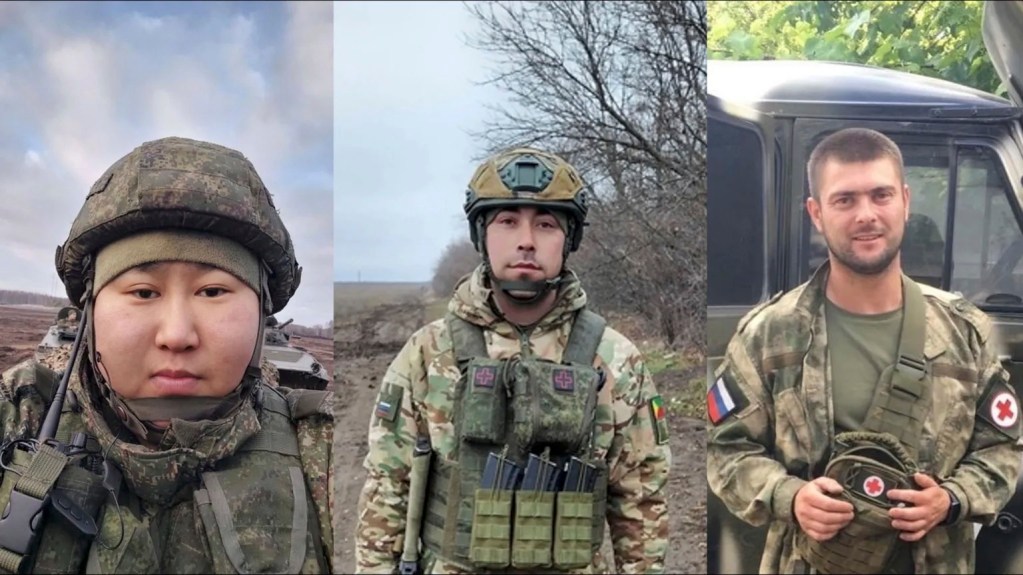
Among the casualties were Aldar Bairov, Igor Babych and Okhunjon Rustamov, who were with the 36th Motorised Rifle Brigade when four Ukrainian long-range HIMARS missiles hit a training ground near the city of Volnovakha in occupied Donetsk.
They had been ordered to line up for a medal ceremony. Sixty-five servicemen were killed, including their commander Col Musaev. Dozens more were wounded.
Bairov, 22 and from Buryatia in eastern Siberia, had studied to be a food sanitation specialist but was drafted for mandatory military service and then signed a contract to become a professional soldier.
In February 2022 he went to fight in Ukraine and was part of the battle for Borodyanka during his brigade’s advance towards Kyiv in March 2022. The town was almost completely destroyed. Ukrainian sources say Russian soldiers were involved in the execution of civilians.
Aldar Bairov (left), Okhunjon Rustamov (C) and Igor Babych were all killed in a strike on 20 February last year
Okhunjon Rustamov, 31 and from Chita in Siberia, had worked as a welder after serving a mandatory term in special forces. He was mobilised during a partial draft in October 2022.
Unlike Rustamov, Igor Babych, 32, had volunteered to go to war. He had worked with adults and children diagnosed with cerebral palsy, helping them with physical therapy until April 2023.
In total, 201 Russian soldiers died on that day, according to our data.
A few hours after the strike on the training ground, then-Russian Defence Minister Sergei Shoigu met Vladimir Putin to bring him news of military success from the front line.
There was no mention of the training ground attack, nor was there any word from the Ministry of Defence in its daily reports.
A relative of Okhunjon Rustamov said she had already buried three close family members over the course of the war. “In December 2022, my husband died. On 10 February 2024, my godfather. And on 20 February my half-brother. From one funeral to the next.”
In our analysis, we prioritised exact dates of death for soldiers. If that wasn’t available, we used the date of the funeral or the date the death was reported.
In the first two years of the war, 2022 and 2023, Russian losses followed a wave-like pattern: heavy fighting with high casualties alternated with periods of relative calm.
In 2023, for example, most casualties occurred between January and March, when Russian forces attempted to capture the cities of Vuhledar and Bakhmut in Donetsk Oblast.
In the first year of the full-scale invasion, according to our calculations, Russia lost at least 17,890 soldiers. This number does not include losses from Russia’s two proxy forces in occupied eastern Ukraine.
In 2023, the number rose to 37,633.
In 2024, there was no period showing a significant fall in casualties. Bloody battles for Avdiivka and Robotyne were followed by intensified assaults towards Pokrovsk and Toretsk.
In August 2024, Russian conscripts were killed when Ukrainian forces stormed over the border into the Kursk region. From August 6 to 13 alone, an estimated 1,226 Russian soldiers died.
However, the heaviest overall losses occurred during a slow Russian advance in the east between September and November 2024, according to leading US military analyst Michael Kofman.
“Tactics emphasised repeated attacks with dispersed assault groups, using small infantry fire teams, which increased overall casualties relative to terrain gained,” he explained.
After almost two years of intense fighting, Russian forces seized the logistical hub of Vuhledar in Donetsk on 1 October 2024.
According to estimates by the American Institute for the Study of War (ISW), from September to November 2024, Russian forces captured 2,356 square kilometres of Ukraine.
Even then, Ukrainian forces at the front did not collapse.
The cost of this advance was at least 11,678 Russian military deaths.
Actual losses figures are likely higher. We have only accounted for soldiers and officers whose names appeared in publicly available obituaries and whose dates of death or funeral fell within this period.
Overall in 2024, according to ISW, Russia captured 4,168 square kilometres of land.
If we assume that our figure of 45,287 confirmed deaths in 2024 is about 40% of the full number, then the total number would be closer to 112,000 fatalities last year.
This means that for each square kilometre captured, 27 Russian soldiers were killed, and this does not include the wounded.
How losses are changing recruitment
Russia has found ways of replenishing its depleted forces.
“Russian recruitment also increased in the second half of 2024 and exceeded Russian casualties, allowing Moscow to generate additional formations,” says Michael Kofman.
We also class as volunteers those who signed up to avoid criminal prosecution, which was allowed by law in 2024.
Volunteers have become the fastest-growing category of casualties in our calculations, making up a quarter of those we have identified.
In 2023-2024, thousands of volunteers who signed contracts with the Ministry of Defence were sent to the front lines only 10–14 days later. Such minimal training will have dramatically reduced their chances of survival, experts say.
One Russian republic, Bashkortostan, has seen the highest numbers of casualties, with 4,836 confirmed deaths. Most were from rural areas and 38% had gone to fight with no military experience.
The one-time payment for signing a Russian army contract in Ufa is 34 times the region’s average salary of 67,575 rubles (£600).
Calculating deaths from open source data will always be incomplete.
This is because the bodies of a significant number of soldiers killed in the past months may still be on the battlefield and retrieving them presents a risk to serving soldiers.
The true death toll for Russian forces increases significantly if you include those who fought against Ukraine as part of the self-proclaimed Donetsk and Luhansk People’s Republics.
An assessment of obituaries and reports of searches for fighters who have lost contact suggests between 21,000 and 23,500 people may have been killed by September 2024.
That would bring the total number of fatalities to 185,000 to 260,700 military personnel.
CLARIFICATION 5 May 2025: This story has been updated to make it clear that the figure of 27 losses per sq km is based on an estimated number of deaths last year of about 112,000.
I have been in police custody since April of last year. I was formally charged in early June, and since then I have been an “accused” man. I see this word in paperwork, I sign statements containing it, and that is how the prison authorities address me. “Accused” has been my new social status for the past nine months.
A criminal change can be a serious burden. I have met people in prison, albeit a few, who are plagued by a sense of guilt for what they have done. In this sense, though, my case is simple. All the accusations against me are ridiculous and absurd, and the article [in the criminal code] under which I am being tried should not exist, basically. I find it easy and pleasant to take a consistent stance and to tell the truth. I have always adhered to this principle both in public life and in personal matters.
The investigation, whilst trying to accuse me of spreading “fakes,” has constructed one giant fake. Literally the entire indictment, from the first word to the last, is at odds with reality. I subscribe to every word I wrote a year ago. All my emotional assessments have retained their force, and all factual claims have been borne out many times. So there can be no question of any sense of guilt on my part in terms of the present case.
Life, though, is much more complicated than a trumped-up criminal case. A year ago, events happened that shocked the world. In a matter of days, the foundations of life, which had seemed to us unshakable, were destroyed. The most terrible pictures stepped off the pages of history textbooks, reviving the nightmares of bygone years and wars whose fury had long ago been stilled. Unable to stop this ongoing tragedy, tens of millions of Russians have come face to face with an oppressive sense of guilt. It is a normal reaction to the monstrously abnormal situation in which all of us find ourselves.
If you feel guilty, it means that you have a conscience. It means that you cannot see the suffering of innocent people without feeling pain in your heart, that you are able to empathize with someone else’s grief. What is more, a sense of guilt for the actions of one’s country is impossible without a sense of belonging. It means that no matter where you are now, you maintain an emotional connection with your homeland, you realize that you are a citizen of Russia and worry about its fate. You — we — are real patriots of Russia in the true sense of the word! We love our country, and so we are especially hurt and ashamed that this inhuman war is waged on its behalf.
It is vital to remember that the guilt that we cannot help but feel is irrational per see. After all, we are not actually to blame for what is happening. The blame is on those who unleashed and wage this war, on those who issue and carry out criminal orders, on those who commit outrages on foreign soil, as well as on those who condone these crimes by cracking down on their own people and generating an atmosphere of fear and intolerance.
On the contrary, we want to live in a free and peaceful country. We want a better future for ourselves and our neighbors. In order for our hopes to come true, we must move away from a passive sense of guilt, focused on the past, and strive to realize our own civic responsibility. We must move away from regrets about what has happened to solving existing problems and making plans for the future. Yes, right now we are unable to stop the war, but this does not mean that we are powerless. I want each of you to think about what you can do personally. The answer “nothing” is not acceptable. First, if you are not on the side of the scoundrels, if you have remained true to yourself, have kept your wits about you, and have not fallen into despair, if you are listening to me now or reading this text, this is much more than nothing. And second, even I can do something and am doing something. I keep talking, communicating the truth about events to people. I have been using this trial as a platform for public anti-war statements. To the best of my ability, I have been helping those who, due to their civic stance, have found themselves on the same side of the bars as me. You have many more opportunities to act today for the sake of our common better tomorrow.
Our problem is the inability to take the initiative and find allies. We are used to following leaders and waiting for instructions. Don’t wait — act! Become volunteers, help refugees, support political prisoners, form horizontal ties. Get to know your neighbors, colleagues and classmates, set common goals and achieve them together. When someone needs your help, don’t ignore them. Make this world a better place for us and for our children.
We like to repeat, like a mantra, the words “Russia will be free!” But Russia is us, and what it will be depends only on us. The war will inevitably end, and then the regime that unleashed it will cease to exist. This is the law of history. We have a lot of work ahead of us, work which we must start now. This work of ours, I am sure, is bound to succeed. Russia will be free — because we will make it so.
Source: Darya Kornilova (Facebook), 1 March 2023. Thanks to Elena Zaharova for the heads-up. Originally published on the website of the movement For Human Rights. Translated by the Russian Reader. The verdict in Mr. Ivanov’s case is scheduled to be announced on March 7. The prosecutor has asked the court to find him guilty as charged and sentence him to nine years in prison. See my translation of Mediazona‘s detailed account of the case and trial against Mr. Ivanov, below.
Russian lawmakers on Thursday voted in favor of a bill that would make it a criminal offense to “discredit” anyone fighting on Russia’s side in the war in Ukraine, not just the Russian military.
The legislation aims to expand current laws criminalizing the discrediting of the Russian Armed Forces to include mercenaries serving in the ranks of Russia’s growing number of private military companies, such as the Wagner Group.
The bill was unexpectedly introduced by State Duma deputies Wednesday in the form of amendments to two largely unrelated bills that were already due to be voted on in the lower chamber of the Russian parliament.
If signed into law, the amendments would introduce sentences of up to seven years in prison for “public acts aimed at discrediting volunteer formations, organizations or individuals” that are aiding the work of the Russian Armed Forces.
The proposed amendments also increase the maximum punishment for violating the existing law against spreading “false” information about the army.
Those found guilty of “spreading fake information” about the army or a volunteer military formation would then face up to five years in prison instead of the three years outlined in the current law.
The new law would also raise the maximum fine from 700,000 rubles ($9,250) to 1.5 million rubles ($19,830).
In cases in which the dissemination of “false information” is deemed to have had “grave consequences,” violators could face up to 15 years in prison, under the new legislation.
The bill must now pass its third reading in the State Duma on March 14 before going to the upper house of parliament for approval and then finally to the president for his signature.
The trial of Dmitry Ivanov, a mathematics student and creator of the Telegram channel “MSU Protesting,” is nearing completion in Moscow’s Timiryazevsky District Court. Ivanov is accused of disseminating “fake news” about the army. (The investigators claim that reports of war crimes, the killing of civilians and the destruction of Ukraine’s civilian infrastructure are “fake news,” as well as Ivanov’s refusal to call the war a “special operation.”) Today, Prosecutor Yulia Pravosud asked the court to sentence Ivanov to nine years in prison. Mediazona examines the grounds for the case against the activist and how investigators have tried to prove his guilt.
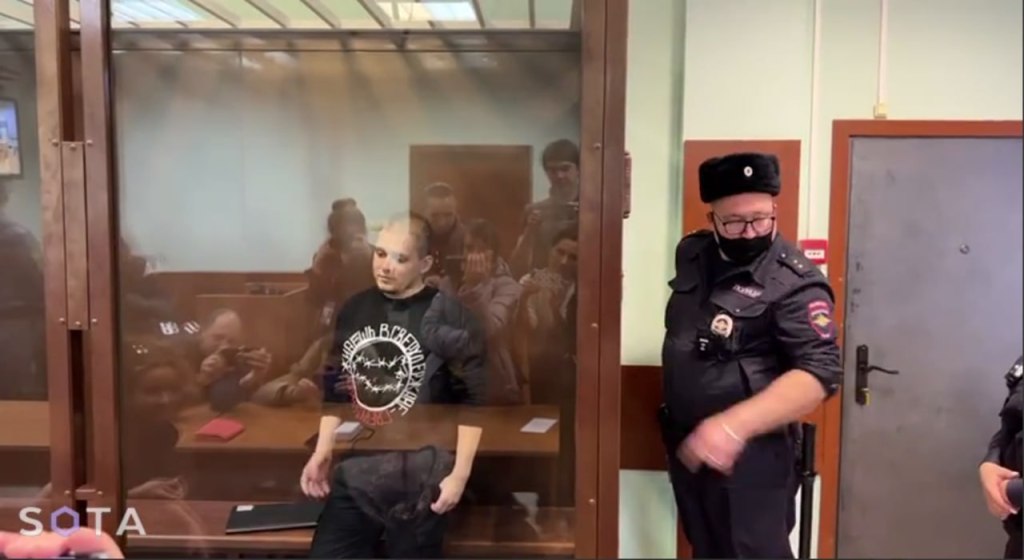
Dmitry Ivanov in the “fish tank” at court. Photo: Alexandra Astakhova/Mediazona
“Don’t betray the Motherland, Dima” was the message painted on 16 March 2022 on the door of the Moscow flat in which the Moscow State University student Dmitry Ivanov had lived all twenty-two years of his life. The message was embellished with three huge Z’s. At the time, Ivanov joked: “We have already washed off the door — a simple Soviet acetone helped us make short work of the paint.” The Telegram channel “MSU Protesting,” which he had created and ran, continued to write about the war and anti-war protests inside Russia, until its author was detained on April 28 as he was leaving the university. He has not been released since.
On April 29, the Nikulinsky District Court jailed Ivanov for ten days for “organizing a rally” — this is how the security forces deemed one of the posts in his channel. He served his jail sentence in the Sakharovo Temporary Detention Center for Foreign Nationals outside of Moscow, but on May 9 he was detained as he was leaving the facility and sentenced again under the same article of the Administrative Offenses Code — this time for twenty-five days. The student missed the state exams and was unable to submit his honor’s thesis. After serving the new sentence, he was immediately detained again on June 2, this time on a criminal charges. He was taken from the detention center to the Investigative Committee for questioning.
Ivanov managed to transfer the admin of “MSU Protesting” to his friend Nikita Zaitsev. Ivanov’s friends later created a separate channel in his support, “Prison MSU.”
“From the very beginning of my imprisonment, I have lucked out in terms of symbolic dates. I was tried on Victory Day and on the day the mobilization began, and I was transferred to the pretrial detention center on Russia Day. Another hearing will be held on the anniversary of Navalny’s return to Russia. Back then it seemed that all the masks had been doffed and there was nothing more that could shock us. If only we had known what would happen a year later,” Ivanov wrote in a letter to our correspondent.
What Dmitry Ivanov is accused of
The case against Ivanov was handled by the Investigative Committee’s First Major Case Department. Like most cases investigated under the article on “fakes about the military,” it was launched on the basis of “law enforcement intelligence.” Еhe report on the student was written by Lieutenant Colonel A.L. Kapustin, a field officer in the FSB’s Moscow and Moscow Region directorate.
Kapustin copied several posts from “MSU Protesting,” and Captain K.A. Myagkov, a major case investigator, concluded that they were sufficient to launch a criminal case.
The prosecution argues that the activist, “motivated by political hatred” and “foreseeing the inevitability of socially dangerous consequences in the form of undermining and discrediting the current state authorities,” is alleged to have disseminated the following claims on Telegram between 4 March and 4 April 2022:
— the Russian army attacked the Zaporizhzhia nuclear power plant;
— The Russian armed forces have been destroying cities and civilian infrastructure and killing civilians in Ukraine;
— Russia is waging a real war, not a “special military operation”;
— Russian aviation has suffered significant losses in the war;
— Russian soldiers committed war crimes in the towns of Bucha and Irpen.
Most of the posts that investigators attributed to Ivanov were reposts of allegations made by other people, including politician Alexei Navalny, Ukrainian president Vladimir Zelensky, BBC journalist Ilya Barabanov, blogger Maxim Katz, and the writers on social media news page Lentach.
From a broken phone to a canceled thesis defense: how field officers and MSU officials persecuted an undesirable student
In 2018, Ivanov was a student majoring in computational mathematics and cybernetics. Along with dozens of other students and lecturers, he protested against construction of a World Cup fan zone outside Moscow State University’s main building. The inhabitants of the building complained that the construction work prevented them from working during the day and sleeping at night, and that the crowds of fans would make their lives unbearable.
It was then that Ivanov launched the initially anonymous Telegram channel “MSU Protesting,” in which he described in detail the struggle of students and lecturers against developers. He would go on to write about other protest actions. On 16 December 2018, Ivanov was detained at a rally outside the FSB building in Moscow: the infamous Center “E” officer Alexei Okopny did not like the fact that the student had photographed him.
The very next day, Ivanov’s channel ceased to be anonymous. “Hi, my name is Dima, I’m 19, I study at Moscow State University, and today I became a victim of torture,” the student wrote. He said that after his arrest the security forces had demanded that he give them the password to his phone; when he refused, they beat him and threatened to rape him with a police baton. Having failed to achieve their goal, they simply broke the phone, and access to “MSU Protesting” was lost. Ivanov created a new channel with the same name and recounted his experiences in detail in his inaugural post.
Ivanov thus became one of the well-known activists whom the security forces snatched from the crowd first during protests. On 2 February 2021, he was detained at a rally in support of Alexei Navalny, who had returned to Russia after recovering from poisoning. It was then that, for the first time, the Meshchansky District Court sent the student to the Temporary Detention Center for Foreign Nationals in Sakharovo for thirty days. At this center for migrants facing deportation, where Moscow opposition activists were taken to serve their administrative sentences that winter, a second charge sheet was drawn up against Ivanov because he argued with the guards. Ten more days were added to the thirty days he had got for attending the rally.
Ivanov’s friends estimated that he spent a total of 101 days under administrative arrest.
Ivanov was scheduled to defend his honor’s thesis on 1 June 2022. The student was supposed to be released from the detention center on the second of June. Ivanov’s defense team asked the court to shorten the term of arrest by at least one day and requested a postponement from the examination commission, but to no avail. In July, Ivanov was expelled from Moscow State University for not having passed the state final certification.
“I got out of the subway, saw a building with paddy wagons, and decided to give evidence”: the prosecution’s witnesses
The investigation into the Ivanov case was completed in two months. During this time, several witnesses were questioned at the Investigative Committee. Only one of them, Yuliaslava Korolevich, a school friend of the activist, testified in his defense. The security forces searched the home of Korolevich and her mother, and then brought the young woman in for questioning. She said only that she knows Dmitry “as a person who can listen and help out in difficult times, and who is intelligent, rational and logical by nature.”
The other witnesses in the case did not have their homes searched. All of them unfailingly identified themselves as “patriots” during questioning, and the wording of their testimony against Ivanov overlaps almost verbatim. All of them described the arrested student “negatively as an anti-Russian fascist,” and his posts in the Telegram channel as “not corresponding to the position of the Defense Ministry of the Russian Federation.”
The most verbose among the witnesses was the former dean of the Faculty of Fundamental Physical and Chemical Engineering at Moscow State University Lyudmila Grigorieva, infamous for her confrontation with student activists. In 2021, she was forced to resign after she called the Initiative Group at the university “western liberasts” who “grunt, crawl and shit constantly for scraps.”
During questioning, Grigorieva labeled herself “a patriot and a person who loves her country very much, and also stands for kindness, state power, unity, and public order.” She thus considered it her duty to testify against a student who, in her opinion, is a “fascist” and “belongs to a political sect.”
“Ivanov hates people who do not share his liberal views, and defends all the dregs of society,” she said.
Later, at the trial, Grigorieva voiced the hope that not only Ivanov, but also another opposition mathematician from Moscow State University, associate professor Mikhail Lobanov, would pay for “anti-Russian activities.”
Three more prosecution witnesses are Grigorieva’s former subordinates Alexander Krasilnikov, Daniil Afanasyev, and her former graduate student Kirill Borisevich. In court, none of them (like the ex-dean herself) could explain how they had ended up in the investigator’s office and had decided to testify against Ivanov.
“I was walking from the subway, I had got out of the subway. I saw a building with paddy wagons, and decided to give evidence,” Krasilnikov said uncertainly. Each of the three repeated verbatim Grigorieva’s epithets for the student, and in court they read their testimony from a phone or a piece of paper.
What connects the unemployed man Ivan Lyamin and Kolomna Philharmonic musician Mikhail Zhuravlev with the case of Ivanov is not at all clear. In court, Lyamin explained that he had “accidentally stumbled upon” the Telegram channel “MSU Protesting.” He would sometimes read it. He then told an acquaintance about it, who advised him to contact the Investigative Committee.
Zhuravlev claimed that he had decided to testify so that justice would prevail.
“Because freedom of speech has become too much,” he said.
During questioning, Zhuravlev said that Ivanov “is trying to disorient his readers about the events in Ukraine and impose a sense of guilt for the conduct of the special operation not only on Russian citizens, but on all ethnic Russians. He is also trying to shape public opinion among citizens of the Russian Federation about the need to stop the actions of the Armed Forces of the Russian Federation in Ukraine in order to preserve the power of the nationalists.”
The witness could not repeat such a long statement from memory, so in court the prosecutor had to read out his written testimony .
The evidence and witnesses for the defense
The prosecution argues that, since the posts on the Telegram channel “MSU Protesting” diverged from the official reports of the Defense Ministry, meaning that they were “deliberately false,” this is sufficient proof of Ivanov’s guilt. This conclusion was reached by linguists from the FSB, who testified in court.
Defense counsel Maria Eismont asked psychologist Veronika Konstantinova and linguist Igor Zharkov to prepare an independent expert analysis of the activist’s posts. They concluded that, at the time of their publication, the information in Ivanov’s posts was not “knowingly false” from his point of view. The prosecutor retorted that the experts were only “trying to discredit the actions of the investigation.”
In addition to the expert analysis, the defense presented the testimony of seven people in court. Unlike the prosecution witnesses, all of them were personally acquainted with Ivanov. Andrei Stroganov taught Ivanov computer science at school. Ivanov worked on his honor’s thesis with Alexei Borodin, a senior researcher at the Institute of System Programming. Ivan Shmatin, a fifth-year student at Moscow State University is not only friends with the defendant, but also knows Lyudmila Grigorieva, whom he called “a person hyper-concentrated on people who espouse democratic values.”
All of them described the accused as an honest individual and a talented mathematician. This was said by activists Irina Yakutenko and Konstantin Kotov, with whom Ivanov had been involved in solidarity campaigns for political prisoners — the mathematician Azat Miftakhov and the defendants in the New Greatness Case.
Mathematician and leftist politician Mikhail Lobanov, for whose election campaign to the State Duma Ivanov had worked, was also summoned to court. He talked about defendant’s involvement in the life of the university. According to Lobanov, “Uniquely, Dima was not embittered, even as he was being persecuted for his views.”
Grigory Mikhnov-Voytenko, a bishop of the Apostolic Orthodox Church and a human rights activist, helps Ukrainian refugees who find themselves in Russia. Their accounts fully confirm the veracity of Ivanov’s posts, the clergyman said in court.
A billy club and a dog in court, summonses to the Foreign Ministry and the Defense Ministry
On January 19, Ivanov was beaten by a guard. The reason was that the defendant did not immediately exit the “fish tank” after the court hearing, but stayed to find out from Maria Eismont when she would visit him in the pretrial detention center. It later transpired that the escort guard’s name was Alexei Nikolayevich Zhalnin.
Without giving the defendant a chance to talk to his lawyer, Zhalnin dragged Ivanov into the escort guard room. The next day, Ivanov told Eismont that the escort had taken him downstairs, turned off his body cam, and kicked him in the head and ribs and beaten him with a billy club. Zhalnin tried to put Ivanov’s head into the toilet and threatened that he would “insert a stick in his anus.” The second escort guard “watched” this and “did nothing.” The bruises suffered by the activist were documented at the detention center’s medical unit.
Dmitry Ivanov and Alexei Zhalnin, the escort guard who beat him, allegedly, on 19 January 2023. Photo courtesy of SOTA via “Prison MSU” (Telegram)
The defense has filed complaints about Zhalnin’s actions to numerous authorities, but so far to no avail. At the subsequent hearings, however, Ivanov was escorted by emphatically polite guards, and Judge Daria Pugacheva asked whether he had any complaints about the escort. Meanwhile, bailiffs stopped letting members of the public who could not recall the judge’s surname into the courthouse. Previously it had been enough to name the defendant’s last name at the entrance. A continuously whining service dog appeared in the courtroom.
Coincidentally, all these security measures were introduced when Eismont persuaded the court to call as witnesses Defense Ministry spokesman Igor Konashenkov, Foreign Minister Sergei Lavrov, and Russia’s UN ambassador Vasily Nebenzya.
“Ivanov is charged with a serious crime based on a comparison of his texts with statements made by Nebenzya, Lavrov, and Konashenkov. This means that these people are essentially witnesses for the prosecution, and so he has the right to question them in court,” the lawyer argued.
Eismont had attempted to use this trick before, at the trial of the politician Ilya Yashin, but the court did not even issue summonses to the high-ranking officials then. In the Ivanov case, the summons reached their addressees, but the witnesses ignored them.
What else Ivanov was asked in court
Before oral arguments were made, Ivanov was himself put on the witness stand. While answering the questions posed by Prosecutor Yulia Pravosud, he explained why, as a student, he had written about pension reform, how he had checked his sources of information for reliability, and which media outlets he trusted. The prosecutor then tried to get Ivanov to talk about allegations that the Russian language has been banned in Ukraine.
“Do you know anything about Zelensky’s attitude toward the Russian language?” she asked.
“It’s his native language, basically. He’s completely fluent in it,” Ivanov replied.
“Is the Russian language banned or not banned [in Ukraine]?”
“I had not heard that the Russian language was banned in Ukraine. As far as I know, many regions used it as the primary one. The Mariupol City Hall maintained all its social media and websites in Russian even after 2014.”
“I see, and what about Zelensky’s position? Does he allow [Ukrainians] to communicate [in Russian]?”
“Probably, if he forbade communication in Russian, the mayor of Mariupol would not have spoken publicly in Russian, and would not have maintained online resources in Russian.”
Prosecutor Pravosud then read aloud a post from “MSU Protesting” in which Ivanov admitted that he could face criminal charges for his statements about the Russian army’s actions in Ukraine.
“Why did you, knowing of the criminal liability, still write on your Telegram channel?” she asked Ivanov.
“‘Freedom is the freedom to say that two plus two make four. If that is granted, all else follows.’ That’s a quote from George Orwell,” he said. “Should I explain it to you?”
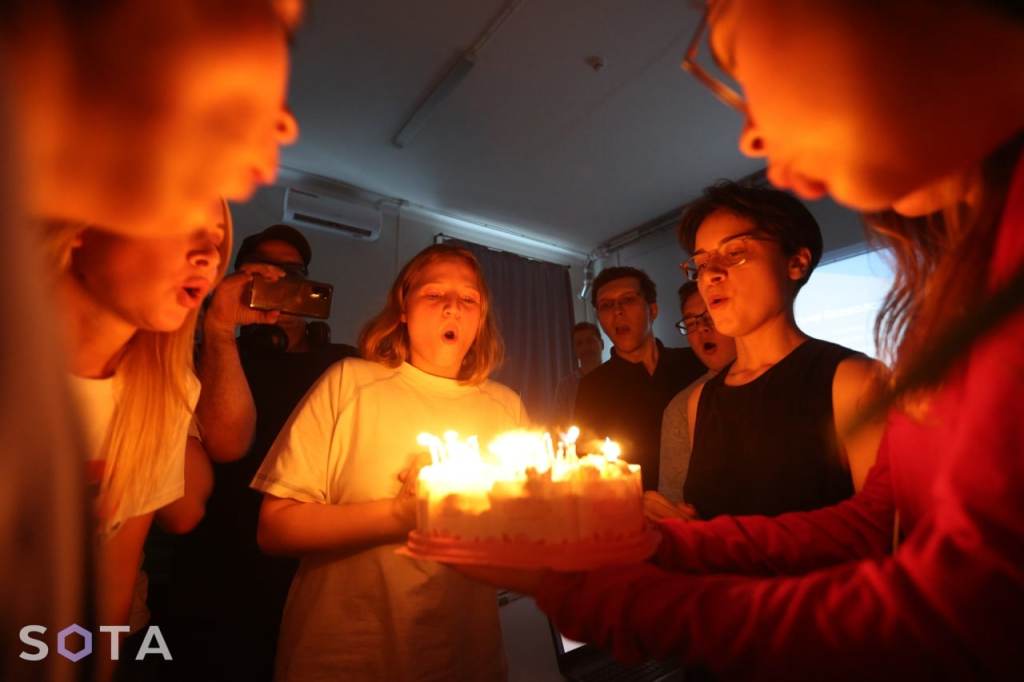
Today, Open Space Moscow celebrated the birthday of a political prisoner Dmitry Ivanov, the editor of the Telegram channel “MSU Protesting,” with cakes, stickers, candles, and merch.
In addition to Ivanov, who is on trial for disseminating “fake news about the army,” the evening’s organizers remembered other people currently jailed under Article 207.3 of the Criminal Code who are not as well known, in particular:
Olga Smirnova, a Petersburg activist with Peaceful Resistance, who has been prosecuted for writing post about the war in Ukraine and burning a cardboard letter Z.
Vladimir Zavyalov, a businessman who hung anti-war price tags in a supermarket.
Ioann Kurmoyarov, a priest who said on YouTube that hell awaits the soldiers who attacked Ukraine.
Igor Baryshnikov, a Kaliningrad activist who wrote about Bucha on Facebook.
Source: SOTA (Telegram), 5 August 2022. Translated by the Russian Reader
“Dima is in jail for words” A merrymaker at Russian political prisoner Dmitry Ivanov’s birthday party writes him a postcard.