May 21st marks Circassian Remembrance Day, or the Day of Remembrance for the Victims of the Russo-Caucasian War. This war, spanning from 1763 to 1864, resulted in the loss of independence for the North Caucasus region and, for the Circassians (one of the region’s indigenous peoples), in genocide and mass exile from their historical homeland.
In the 1990s, Circassian activists, public figures, politicians, and scholars successfully secured official recognition for this date as a day of mourning. Since then, two official narratives have coexisted in the North Caucasus, particularly in Kabardino-Balkaria, Adygea, Karachay-Cherkessia, and the Krasnodar Krai: one asserting the voluntary integration of North Caucasians into Russia, and the other describing a colonial war, genocide, and expulsion.
The state actively supports the first narrative in every way possible, while the second is methodically squeezed out of the public discourse.
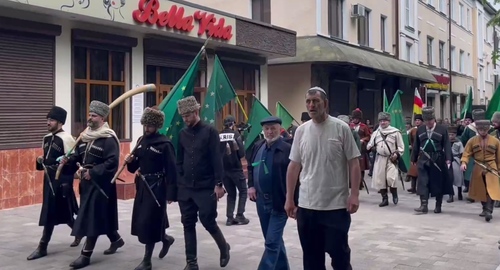
Every year on May 21st, a mourning procession, comprising both walkers and horsemen, winds its way through Nalchik. They proceed along the central thoroughfare, passing the monument to Maria Temryukovna, the Circassian wife of Ivan the Terrible, which bears the inscription “Forever with Russia,” before continuing on to another monument: Psezhig (The Tree of Life), created in memory of the Circassian victims of the Russo-Caucasian War.
Since 2016, Ored Recordings has been releasing projects timed to coincide with this somber date. The liner notes for these albums remains unchanged: again and again, we speak of trauma, and of the immense difficulty in discussing it, as the state systematically closes off any space for dialogue. While in the early years we opted for highly neutral phrasing, since 2022, officials have begun banning commemorative events; consequently, finding the right words has become increasingly challenging. We are permitted to remember, mourn, or reflect only within strictly prescribed forms. Thus, cultural projects and musical releases serve as an insufficient, yet absolutely necessary, form of resistance against assimilation and suppression.
This year, we decided to shift our focus away from the trauma itself or the specific subject of the Russo-Caucasian War, choosing instead to present a cross-section of new Circassian music — music that is not merely being preserved, but is actively evolving.
Shyshagh (ЩIыщIагъ, meaning “underground” in Adyghe) offers a snapshot of an imagined Circassian underground scene, as curated by Ored Recordings.
Three artists have contributed their distinct visions of independent Circassian music to this compilation.
For this release, Cherim (Maykop born, Tbilisi based) has departed from his signature industrial hip-hop and hauntological ambient styles, recording two indie-folk ballads featuring lyrics that are at once simple and deeply poignant. The tracks contain echoes of both Soviet-era pop music and the lo-fi underground tradition exemplified by acts such as Low or Rivulets.
Temir (from Nalchik, based in Paris) is an electronic producer, collagist, and vocalist who translates Circassian aesthetics into the realms of deconstructed club, ethereal pop, and other forms of emotive avant-garde music. Ethnographic archives from the last century, along with rehearsal raw recordings from Jrpjej, served as the foundation for these qafe without dancing.
Two additional tracks come courtesy of duos featuring Timur Kodzoko (originaly from Nalchik, Göttingen based), a co-founder of Ored. From our archives, we unearthed an old rehearsal recording by Zafaq, a dormant Circassian Black Metal project. It is raw, instrumental bm-rooted in traditional melodies, yet one that explicitly rejects the aesthetics of folk metal. In 2020, the drums were handled by Amar Abazov, founder of the Zhest records.
The second track comes from Shkhafit (meaning “free” in Adyghe), a drone-folk project by Timur and his son, Astemir Kodzoko. It is a semi-improvised acoustic ambient piece performed on the shichepshin (Circassian fiddle), as well as various other string and wind instruments. It evokes the ghosts of an unfulfilled future and the spirit of new pshynatles-sagas. It is a soundscape where Mark Fisher visits Murdin Tesh.
Shyshagh stands as Ored Recordings’ most ironic and chaotic release to date. As yet another May 21st passes, we see no immediate light at the end, yet we remain ready to unite and carry on!
Cherim – recorded in Tbilisi, Georgia, in 2026. All music by Cherim Tsei. Production for the song “Pari (Nothing)” by Temir.
temir – recorded in Paris, France, in 2026. All music by temir. “Duguj” based on Jrpjej rehearsal recordings. “Zechir” based on archival Circassian recordings.
Zafaq – recorded at the House of Radio, Nalchik, Kabardino-Balkaria, in 2020. Timur Kodzoko – guitar Amar Abazov – drums
Shkhafit – recorded in Göttingen, Germany, in 2026. Timur Kodzoko – strings, bowed instruments, and effects Astemir Kodzoko – physharmonium and wind instruments
Cover photo: Tulip tree in the village of Golovinka, Lazarevsky District, Krasnodar Krai/Shapsugia. Photo by Lilit Matevosyan Cover design: Milana Khalilova Text: Bulat Khalilov (English translation by Bella Mirzoeva)
Source: Ored Recordings (Bandcamp). I have included the entire album here for your listening pleasure, but I would urge to download it from Bandcamp, paying what you can to Ored Recordings to support their fine mission. That’s what I just did. \\\\\ trr
As the sun rises on 21 May, marking the Day of Remembrance for the Circassian Genocide, we invite you to listen beyond the silence that often surrounds the wounds of colonialism. In the following article, Bulat Khalilov, co-founder of Ored Recordings – a label dedicated to traditional and post-traditional music from the North Caucasus – reflects on a paradox within Circassian music today: how a culture with rich vocal traditions has, in a sense, sidelined its most distinctive feature, the polyphonic vocal technique of zhiu?
In conjunction with today’s commemorations, Ored Recordings is releasing a compilation, Shopsh: Circassian Vocal Tradition of Zhiu, which highlights the vocal tradition of zhiu as both a form of remembrance and a possibility.
21 May is the Day of Remembrance for Circassians – or, more directly, the Day of the Circassian Genocide.
In 1864, the Russian Empire marked this day as the official end of the Russo-Caucasian War, which had begun over a century earlier in 1763. What Russia celebrated as victory, most Circassians – and many other peoples of the North Caucasus – remember as loss: a brutal war for independence that ended in exile, devastation and what many now call genocide.
That view isn’t fringe. It’s shared by most Circassian historians and civil society voices. To date, only Georgia and Ukraine have officially recognised this as genocide. But across the Circassian diaspora – from Türkiye and Syria to Jordan, the EU and the US – 21 May is marked with acts of remembrance. And yes, those memories echo back home, too – in Adygea, Kabardino-Balkaria and Karachay-Cherkessia.
However, most Circassians in the North Caucasus are suspicious of these gestures, considering them to be opportunistic and insincere. Their refusal to embrace recognition from other states usually stems from a desire to avoid becoming a pawn in a larger geopolitical game.
Officially, the Russian state doesn’t like to talk about any of this. The war itself is treated as taboo, its memory reframed as a tool of Western propaganda or a threat to national unity. And yet, every year, people still gather. From moderates to patriots, from Nalchik to Cherkessk to Maykop, Circassians take to the streets – sometimes quietly, sometimes defiantly.
At Ored Recordings, we return to this trauma again and again – not to dwell, but to listen. To ask how this wound still shapes the way we live, create and imagine. Every year on 21 May, we release a concept album. One year, it’s heroic songs from the war. Another, it’s diaspora voices from Türkiye. Or wartime songs of the 20th century. Each time, we try to trace how our people processed a colonial wound through music, or indeed failed to do so.
This year, we chose to focus on traditional vocal techniques in Circassian music. At first glance, this may seem unrelated. But in truth, every serious conversation about the state of Circassian culture circles back – if not to 1864 itself, then certainly to the long shadow it cast.
This release is a compilation of mostly unpublished recordings. Think of it as a teaser – a warm-up – for future albums. In those upcoming releases, we’ll dive deeper into each performer’s story and the recording context.
This essay – and this release – emerged from a simple question: what’s really going on in Circassian music today?
A big part of the tradition is group singing. Usually it’s men (sometimes women, sometimes mixed groups), gathering to sing. The lead voice carries the main melody, while the others hold a choral drone or a call-and-response. This choral technique is called zhiu or yezhiu.
Like in many cultures, group singing wasn’t just about music – it was a way to be together, to make a space for cultural and social connection.
Most Circassians today learned about this from the elders. From people who sang at weddings and late-night gatherings. Or from those who, as kids, would secretly listen to adults sing into the night. But our main source are still the archives – dusty tapes recorded by Soviet folklorists. Interestingly, the folklorists’ archives have ended up becoming tradition-bearers in their own right.
Academic work on Circassian vocal music – papers, dissertations, theoretical frameworks – has had almost no impact on today’s performers. Music theory and actual practice in Adyghe communities have mostly run on parallel tracks, rarely intersecting.
But the sound itself – those dusty Soviet-era recordings collected by ethnomusicologists – found a way through. Once digitised, they slipped into public circulation (sometimes semi-legally) and became a strange kind of bridge: not from scholar to scholar, but from singer to singer, across generations.
Those old recordings remind us that the song and its lyrics are guardians of language, poetic style and cultural memory. And yezhiu? That’s the secret ingredient. The thing that gives it punch. Soviet musicologists put it nicely: yezhiu helps the song “reach the hearts of the people”.
There’s even a sharp old proverb: “Ежьур уэрэдым и щIопщ” – yezhiu is the whip for the song. It keeps the rhythm. Holds the structure together. Gives the song its shape.
And yet – despite this deep knowledge and respect for vocal technique – modern Circassian music mostly revolves around instruments. Not voices.
So we asked ourselves: how did a whole new wave of Circassian music appear – something unthinkable even ten years ago – and why does almost all of it seem to avoid yezhiu, the central tool of our tradition?
Abkhazia is a country (some would argue an occupied region) with which it is impossible to work without ignoring the political context. It is an unrecognized state that in the 90s separated from Georgia, wanting to gain independence. Independence that came at the cost of war, brutality on both sides, historical trauma and nationalist myths. Most of the international community calls those events the Georgian-Abkhazian conflict, while Abkhazians themselves believe that it was the Patriotic War, singing about the victory in traditional music. Unrecognized, but actual separation from Georgia became possible due to participation of North Caucasian volunteers, and after that, assistance from Russia. Today there are Russian military bases in Abkhazia, so Georgia perceives Abkhazia as an occupied region, although similar thoughts can be voiced on the other side of the Georgian-Abkhazian border.
Given the painful past, ambiguous present and shaky future of Abkhazia, any project with its culture can be perceived as a political statement. Especially if the project is made by a North Caucasian label with residence in Germany and an independent nomadic director. That is why we are happy that we are releasing films 12 years after they were recorded: we had time to think and choose our words.
While filming on Gagra beach, a local TV station caught him for a story titled “Wow, a French filmmaker came in search of a unique culture,” quite typical of regional media in the Caucasus. The journalist then asked Vincent if Abkhazians have well preserved their musical heritage.
[Vincent laid it on thick.]
“It is very bad. You have the most beautiful music, but it is very difficult to talk about its preservation and development. If everything goes on like this, you will lose everything. You need more work.”
This was a very important and thoughtful reaction for us. European attention to Caucasian cultures sometimes perpetuates oriental clichés and deceptively reassures locals: “Europeans are coming to us in search of lost antiquity, so everything is fine. We are still ancient and unique.” In this sense, Vincent’s response was both sobering and provocative. And even total disagreement with the brash Frenchman is also a good option. It’s either work or don’t listen to those who learned about your culture yesterday.
In addition, in interviews, and in general during the course of the project, we said a lot that it was important to document the diversity of Abkhazian music. While we were trying to find the most ancient and ‘authentic’ forms of folklore, Vincent insisted on recording everything from state choirs to late patriotic songs.
Today it seems to us that this is the political and social meaning of the project: to start a living archive with different music from Abkhazia. Music that is not limited to the war for independence and the defense of political freedom before a new ally. Before the 90s, Abkhazians had bright moments in history and battles sung in songs.
Besides, in 2013 we could only meet folklorists, bearers of tradition and rare indifferent officials who were interested in working on the project. Today we are releasing this release with the support of the cultural center SKLAD in Sukhum. It is not enough for young curators and artists to preserve culture and revel in nostalgia. Instead, they are creating a new context. 12 years ago such initiatives were hard to find. Now they are a visible voice of contemporary Abkhazia. Our films and recordings are intended, among other things, to make such voices audible.
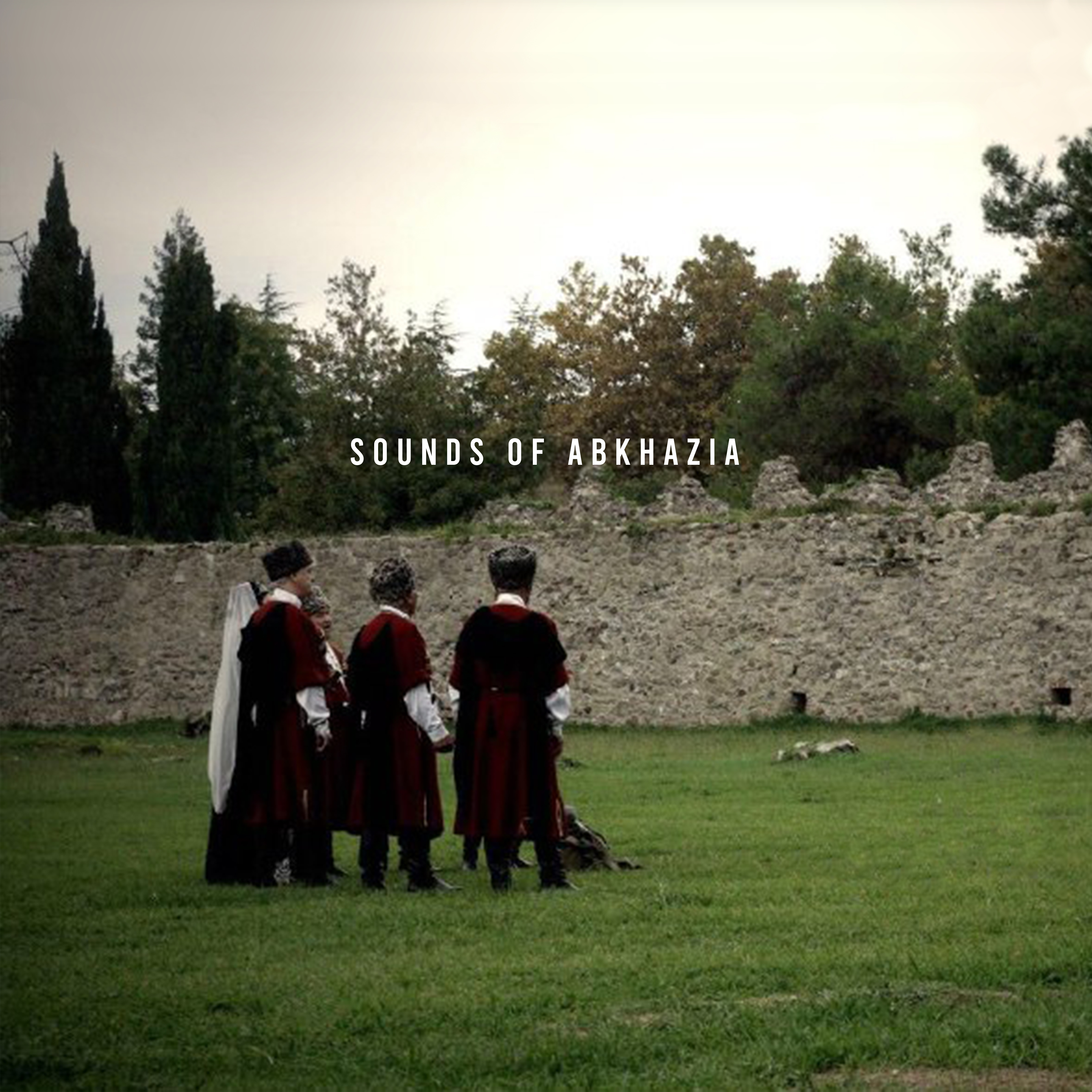
A collection of ten short films recorded in Abkhazia, an independent republic bordering the Black Sea. Filmed by Vincent Moon and produced by Petites Planètes in collaboration with Ored Recordings. Listen to the album on https://oredrecordings.bandcamp.com/album/sounds-of-abkhazia
“When an empire falls, does it make a sound? And who is there to hear it?” – so read the opening line of the call for papers for this issue in October 2021. Looking back at that text from the vantage point of 2025, that sounds far too optimistic and premature. Shortly after that call was published, the empire in question made a whole lot of noise about its unwillingness to stay fallen. The shadow of Russia’s brutal war of conquest in Ukraine hangs over this issue – as it has over any project that deals with the post-Soviet since February 2022 – determining both its shortcomings and, in a perverse way, its urgency.
That the full-scale invasion came to many of us as a shock is the result of complacency and unwillingness to listen to the comparatively quieter rumblings that have been shaking the region over the past two decades. To the fact that the invasion commenced already in 2014 with the occupation of Crimea and Russian military support for separatist forces in Donetsk and Lugansk. To the 2008 week-long war with Georgia that concluded with Russian occupation of the disputed territories of Abkhazia and South Ossetia. To the forceful integration of Belarus into Russia that began as soon as the Belarusian dictator Lukashenka came to power in 1994 and intensified with the establishing of the so-called “Union State” in 1999. Not even to mention the Russian imperial ventures in Africa and the Middle East.
The world refused to listen until the noise became impossible to ignore – the noise of bombs and artillery shells falling on Kyiv, Kharkiv, Mariupol, Odesa, Dnipro, Zaporizhzhia and many more. Yet even these sounds fall on deaf ears far too often: many among the anti-imperialist left, enamored by the platonic ideal of a multi-polar world, seem to prefer listening to Putin’s propaganda, just as many left-leaning intellectuals were similarly entranced by Soviet propaganda during the Cold War. And many across the political spectrum – including the sitting US president – who campaign against military aid to Ukraine seem to prefer the comfortable silence of subjugation to the noisy cacophony of resistance.
What, then, can a niche academic publication on sound(s) from the post-Soviet realm – in itself a controversial designation tinged with colonial history – hope to achieve? Especially one edited by a Russian-Jewish academic based in Western Europe, with all the problematic positionality this brings? Perhaps nothing. Or perhaps, the promise of a sonic epistemology long held as a keystone of sound studies – that of attuning and entangling oneself with the object of listening as opposed to holding it in a distancing gaze – could be fulfilled at least to some extent here, opening some ears and minds to the politics of the region.
In the video installation Repeat after Me by the Ukrainian artist collective Open Group – arguably the most important sound artwork of this decade and the centerpiece of the last Venice biennale – Ukrainian war refugees recount their experiences of the invasion while recreating its soundscape with their voices: the sounds of shelling, explosions, war planes and drones, air raid sirens, etc. A row of microphones in front of the screen and onomatopoeic subtitles in the video invite the public to join in and voice those sounds in karaoke fashion as a “gesture of togetherness” (Keylin 2023: 128). The playful format allows participants to empathize with the refugees’ traumatic experiences from the safe distance of Verfremdung (estrangement), while making them acutely aware of the very safety and distance that they enjoy. In this way, Repeat after Me attunes the audience both to the (sonic) reality of the war and to their own positionality.
Hence, the aspiration of this issue: to make the post-Soviet realm audible – not as a continuous, homogenous soundscape far too often conflated with Russia, but as a cacophony – decidedly not a symphony – of diverse cultures, identities, aesthetics, and political programs; to sound out both the connections that gave the Second World its identity against the First and Third ones and the contradictions that made it fall apart. In the hope that listening – from a safe distance – to the sounds of the post-Soviet realm can attune the reader’s ear to the voices coming from it.
A multitude of limitations – some fundamental, some situational – work against this aspiration. First, the diversity of sound cultures and the complexity of political relationships within the post-Soviet space are far too vast to address comprehensively in any single publication. Second, the discipline of sound studies has only begun to establish itself in the region over the past decade, often lacking institutional support and publication venues. Moreover, much of this emerging discourse, especially in Russia, orients itself more towards Western academic scholarship than towards the post-Soviet realm and its own sound practices (e.g., the History of Sound book series at the New Literary Observer press, which in large part consists of translations of key anglophone works). One important exception that has to be mentioned here is the 2018 multilingual special issue of the Topos journal, P.S. Soundscapes,edited by Benjamin Cope and Pavel Niakhayeuand dedicated to sound and music in contemporary Eastern Europe. All of this greatly limits the pool of potential authors for this issue, to the extent that half of the texts included here are written by Western scholars. Finally, the war itself had an obvious impact, delaying this issue by over two years and leading several prospective authors, particularly those hailing from the post-Soviet realm itself, to withdraw their texts. Not a perfect issue, then, but hopefully still capable of opening the space for a dialogue.
Listening to the Subaltern Empire
Despite recent post- and decolonial turns in sound studies that shift focus away from Eurocentrism and acknowledge the global diversity of sounding and listening practices, the post-Soviet space remains largely a sonic terra incognita. The few exceptions that prove the rule include the sound experiments of the Soviet avantgarde – owing to Andrey Smirnov’s monumental study Sound in Z (the title’s correspondence to the current Russian military symbol is an unfortunate prophetic coincidence) – and the overtone singing traditions of the Far East. However, the academic attention that both these phenomena received does not stem from any specific interest in the region, but from their attachment to more famous “brands”: the historical avantgarde and Tibetan spirituality respectively.
The post-Soviet world falls into the cracks between the Global North and the Global South, persistently absent from the sonic maps of either realm. It tests the limits of post- and decolonial frameworks, which were largely developed to address the relationships between European empires and their overseas colonies. Political scientist Viatcheslav Morozov describes Russia’s peculiar position in this coordinate system as a “subaltern empire” that, “while remaining a sovereign state,” has “colonized the country on behalf of the global capitalist core” (Morozov 2015: 32) into which it was integrated on unequal, subordinate terms. As a result, Russian political consciousness is built on an unsolvable paradox of holding in suspension Eurocentrism and Euroscepticism: the aspiration to be an equal part of the Global North and the resistance to its cultural influence. In a twist of fate that the academic community still struggles to wrap their heads around, Morozov was arrested in January 2024 in Estonia and later plead guilty to spying for Russia. Although this fact may cast a shadow on Morozov’s academic work, the notion of the subaltern empire has been crucial to the postcolonial discourse on the post-Soviet realm.
In his influential – if controversial – book Internal Colonization, cultural historian Alexander Etkind similarly approaches the Russian imperial project as one of self-colonization that inevitably results in self-othering. “The state was engaged in the colonization of foreign territories and it was also concerned with colonizing the heartlands,” he argues, leading “peoples of the Empire, including the Russians” to develop “anti-imperial, nationalist ideas in response” (Etkind 2011: 2). Etkind’s work was rightfully criticized (as I will discuss below) for sidestepping Russia’s actual colonial conquests – its subjugation of Siberia, Caucasus, East Asia, or Belarus and Ukraine – and its colonial subjects. It is, however, notable for pointing out the “reversed, internal orientalism” (Etkind 2011: 16) suffusing modern Russian culture – one that simultaneously construes Russia itself as a colonial other to the enlightened West and conceives a colonial other within Russia in the form of its uneducated and uncivilized narod (a word that literally means “people”, but more often than not is used to denote peasants and commoners).
Two articles in this issue demonstrate how this contradictory mentality unfolded in the experimental music and sound art scene in 1980s Saint Petersburg, a city originally designed as a flagship for the Europeanization of Russia, but which came to be known in the twenty-first century as a hub of Russian nationalism and fascism. Giada Dalla Bonta’s article “Sounding the dissolution from a Cosmic Space” introduces the universalist trend typified by the electronic music duo New Composers, Valeriy Alakhov and Igor Verichev. Bridging avantgarde legacies and rave culture, the pair’s work was informed, on the one hand, by the avantgarde concept of vsyochestvo (from the root vsyo – “all, everything” – and the suffix combination -chestvo that typically refers to “practice”), of an inter- and postmedia approach to art taken to extremes. On the other hand, their work was rooted, in the holistic worldview of Russian Cosmist philosophy, rhymed with the everyday mythology of the Soviet space program. Dalla Bonta’s article pursues two lines of inquiry: first, it reassesses the role and influence of sonic practices on the late Soviet underground art. Second, it examines the New Composers’ idiosyncratic blend of aesthetics and philosophies through the lens of Kodwo Eshun’s notion of sonic fiction (1999) and Jean-Luc Nancy’s relational theory of sound (2007), revealing how they expressed a politics of togetherness characteristic of late Soviet underground culture.
New Composers, “Exactly Today and Exactly Now” (1989)
Dalla Bonta acknowledges an ostensibly paradoxical ideological shift towards conservatism and nationalism in the underground art scene following the dissolution of the Soviet Union but purposefully limits the timeframe of her account to the 1980s to focus on liberatory impulses in the New Composers’ early work. Conversely, Sam Riley’s article “A Butterfly Akin to a Bird: Imagining New Jazz in Leningrad” examines how the roots of this shift can be found already in the late Soviet period. The text focuses on two other emblematic figures of underground sonic experimentalism: composer and pianist Sergey Kuryokhin and critic Efim Barban. Through a reading of Barban’s book Black Music, White Freedom, which initially circulated in Samizdat and laid the theoretical foundations for the late Soviet experimental music scene, Riley explicates the racism inherent in Barban’s theory and Kuryokhin’s practice as they strived to disentangle jazz from its Black American origins, formulating a purportedly superior Soviet-Eurocentric “new jazz” idiom. The late Soviet sonic underground thus aligned with progressive and conservative trends simultaneously: both emancipatory – in resisting the authoritarian state and its ideology – and reactionary – in reinforcing the Eurocentric cultural hegemony under the guise of Enlightenment-style universalism.
Belliphonic Relationalities
The principal critique of the theory of Russia’s self-colonization, as presented in Etkind’s work, addresses two fundamental issues. The first concerns how its focus on internal colonization obscures the external conquests of the Russian Empire. The second, more insidious issue relates to what exactly is construed as the internal territory being self-colonized. As literary scholar Vitaly Chernetsky points out, “in his argument about Russia’s internal colonization, […] Etkind’s frame of reference is constituted by the events that took place and the phenomena that existed in Ukrainian and Belarusian territory. Thereby Etkind perpetuates the aspects of Russian colonialist ideology that he apparently internalized to an extent that makes them invisible to him” (Chernetsky 2007: 43). Etkind’s blind spot is indicative of a key characteristic of the Russian imperialist mentality: an unselfconscious refusal to see Ukrainians and Belarusians as anything other than inferior Russians. The lack of racial difference between these peoples is weaponized to conceal the reality of colonial difference. This denial of self-determination undoubtedly drives much of Russia’s expansionist politics: the forceful integration of Belarus and the violent invasion in Ukraine – clear attempts to replay the history of the not-so-internal colonization. In this context, it would hardly be controversial to say that the three texts dedicated to the current political soundscapes of these two countries, as they are conditioned by Russian aggression, form the core of this special issue.
In “Warbound: Collective Audio Streaming from Ukraine,” Olya Zikrata directly addresses the sonic dimension of the ongoing Russian invasion in Ukraine and the Ukrainian resistance. Her article revolves around the 2022 project Listen Live consisting of five online broadcasts by sound artists from different parts of Ukraine that together weave a multifaceted soundscape of living in the middle of a violent invasion. Building on – but also challenging – J. Martin Daughtry’s notion of “belliphonic” as the agglomeration of war-related sounds (2015), Zikrata argues that the sonic experience of the war in Ukraine is not reducible to a catalogue of explosions and sirens but rather includes the totality of acoustic environments affected and effected by the invasion. In stark contrast to the sound design of war movies, the streams of Listen Live focus on the quieter aspects of war: the digging of trenches, the life in frontline cities in between bombings, the refugee experience in western Ukraine. Zikrata approaches them as acts of acoustic witnessing, a “collectively developed sonic intelligence,” revealing the situated relationalities that bind together the land and its human and non-human inhabitants living through the invasion.
The themes of witnessing, testimony, and acoustic relationality also suffuse my interview with Sashko Protyah, an independent filmmaker from war-torn Mariupol, as he reflects on the past 15 years of his career. His early influences, including experimental music and sound poetry, shaped his affinity for sound as compositional material rather than mere accompaniment to visuals, which has resulted in a number of collaborations with experimental musicians, sound artists, and beatboxers. The evolution of Protyah’s artistic trajectory took him from playful absurdism to politicized documentary storytelling, underscoring an approach to sound and cinema as tools for reflection and resistance, gaining a particular urgency under the condition of war.
Finally, Pavel Niakhayeu’s article (bordering on a short monograph in its breadth and detail) “Voices, Noises, and Silence in the Political Soundscape of Belarus” is a meticulous sonic ethnography of Belarusian political life, covering the period from 2020 to 2023. The 2020 election, in which the dictator Alyaxandr Lukashenka once again fraudulently declared himself the winner, catalyzed a peaceful protest movement. It quickly became the largest protest in modern Belarusian history before being violently quelled with Russian backing, forcing protesters into hiding or emigration. Combining field recordings and soundwalks, sociological interviews and media analysis, Niakhayeu’s article documents how these phases unfolded in the acoustic dimension: from the political soundscapes of the protest itself – suffused by poetry, folk songs, and the sound of Belarusian language – to the “sonic violence continuum” of the authoritarian state’s reaction and the silence(s) that followed. These soundscapes may also be called belliphonic – both in the sense of Putin using Belarus as a launching site for his attack on Ukraine, and in the sense of Belarus itself being the object of a hybrid warfare of sorts.
Soundscapes of the “South of the Poor North”
Whereas Russian imperialism in Ukraine and Belarus was (and is) driven by the ostensible non-distinction of their peoples, other forms of Russian colonial conquest relied on familiar constructions of the racialized colonial other. One of the critiques levied at Etkind by the decolonial theorist Madina Tlostanova is that, in his focus on the internal, self-othering Orientalism of the Russian elites, he fails to notice the more obvious, outward Orientalism “directed against Russia’s South – the Caucasus, and its Orient – Central Asia” (Tlostanova 2014: n.p.). A linguistic quirk that would be amusing if not for the oppression that it represents: While in English, the term “Caucasian” connotes “white,” in (post-)Soviet vernacular Russian, “Caucasian” (kavkazets – formed from the bureaucratese “person of Caucasian ethnicity”) is a term of racialization and othering, coding the members (or presumed members) of any of the diverse Caucasian nations as decidedly non-white.
Tlostanova’s own theory proposes that the post-Soviet realm neither fits within nor breaks off from the colonial North-South dichotomy, but rather mirrors and complicates it. She conceptualizes Russia as “the poor North,” separated from the global (rich) North by imperial difference, as well as from its own “South of the poor North,” by colonial difference (Tlostanova 2011). The “imperial difference […] refers to various losers that failed to succeed in or were prevented by different circumstances and powers from fulfilling their imperial mission in modernity. These losers took second-class places and became intellectually, epistemically or culturally colonized by the winners” (Tlostanova 2011: 71). Consequently,
Russia projected its own inferiority complexes onto its non-European colonies in the Caucasus and Central Asia through its self-proclaimed modernizer and civilizer role. The Russian colonies either felt the double dictate of coloniality of knowledge in its modern Western and Russian/Soviet versions, or, regarding themselves as standing higher on the human scale (within the same Western modern epistemic system, grounded in taxonomizing people into those who have the right and the ability to produce knowledge and those who are doomed to act as objects of study and consumers of theories produced in the West) than the Russian subaltern empire, have refused its dictate and negated its epistemic authority, choosing a direct European influence instead and dreaming to become at some point fully integrated. (Tlostanova 2015: 47)
Brian Fairley addresses the sonic experience of such a paradoxical positionality through the example of Georgian Orthodox chant in his article “Singing at Your Own Funeral: Overdubbed Intimacy and the Persistence of Tradition in Soviet Georgia.” Counted among the oldest Christian denominations in the world, the Georgian Orthodox Church was first subordinated to the Moscow Patriarchate following the integration of Georgia into the Russian Empire, then persecuted and all but banned (along with all other religious practices) under Soviet rule. Fairley discusses amateur tape recordings of Georgian requiem chants made in the 1960s by the singer Artem Erkomaishvili, which were later played at his own funeral. The article weaves together the sonic history of Georgian indigenous musical culture under colonial rule and the media history of anti-Soviet dissent. Fairley likens Erkomaishvili’s recordings to magnitizdat, a dissident practice by which censored music – most often rock music bootlegged from the West – found unofficial circulation in amateur tape recordings. This case study thus exemplifies the complex entanglement of contradictory indigenous, Soviet, and Western vectors characteristic of the sound cultures in “the South of the poor North.”
Tlostanova does not make a principal distinction between the imperial projects of tsarist Russia and the Soviet Union. This position, however, is not universally shared, particularly among historians of Central Asia. Adeeb Khalid, for example, argues that the Soviet project consisted in “homogeniz[ing] populations in order to attain universal goals” (Khalid 2006: 233), a strategy associated with the modern state rather than a colonial one, which would conventionally be built on perpetuating difference. Historian Botakoz Kassymbekova, on the other hand, points to the futility of classifying the USSR as either a modern state or a colonial empire, as its “cultural policies […] were contradictory and entailed elements of both modern(izing) and colonial rule […] Blurring boundaries between imperialism and socialism, colonialism and state building, the Soviet political design combined ideas and mechanisms of liberation and oppression, universalism and difference” (Kassymbekova 2016: 15, 17). Pointing out that most Central Asian societies have never thought of themselves as colonized or postcolonial, ethnographer Sergei Abashin similarly suggests that the culture and politics of the region are better described as a complex and site-specific entanglement of local and metropolitan forces that act at times in accord and at times in conflict with each other (Abashin 2015: 44).
In my interview with the Kazakhstani “imaginary art institution” Krëlex zentre, its members Ruthia Jenrbekova and Maria Vilkovisky discuss how such localities facilitate highly idiosyncratic sonic idioms that can be described as a kind of creole. The duo lists among their influences Soviet radio, Western classical and experimental music, punk, electronica and techno, and the soundscapes of Almaty’s industrial suburbs, all of which coalesce into an equally eclectic practice incorporating sound poetry, experimental theatre, and installation art, among many other things. They describe themselves as pirates, plundering the global cultural archive in order to challenge the ethnicization and genderization of artistic identities.
Finally, Phoebe Robertson’s article “The Chanting Flute: Uncovering Russian Orthodox and Shamanic Sounds in Sofia Gubaidulina’s …The Deceitful Face of Hope and of Despair (2005)” traces a similar creole-esque aesthetic in the works of the late Sofia Gubaidulina. Of Tatar ancestry and Russian Orthodox faith, working in the European New Music paradigm, and hailed as the most important Russian composer of the past century, Gubaidulina exemplifies the contradictions that permeate the sound cultures of the post-Soviet realm. Robertson examines how the composer brings together musical references from Russian Orthodox and Siberian shamanic chants within the European concerto genre – an act that in other contexts could amount to cultural appropriation. In the post-Soviet context, however, both the eastward and westward cultural vectors point to a shared history of repression and dissent, one that Gubaidulina’s work highlights.
The eight diverse texts collected in this special issue throw into sharp relief a point I made in passing in the opening section: that the (post-)Soviet is emphatically not a symphony. The region’s political and cultural history is one of contradictions, holding many familiar dichotomies – of the East and the West, the progressive and the reactionary, the colonial and the emancipatory – in a superposition, a dissonant cluster defying harmonic resolution. (Post-)Soviet sound thus demands a mode of listening that is attuned to these contradictions and that attends to the region not as a monolithic soundscape but as a collection of idiosyncratic localities, each resonating their own sets of frequencies.
References
Abashin, Sergey (2015). The Soviet Kishlak: Between Colonialism and Modernization [Советский кишлак: между колониализмом и модернизацией]. Moscow: New Literary Observer.
Chernetsky, Vitaly (2007). Mapping Postcommunist Cultures: Russia and Ukraine in the Context of Globalization. Montreal: McGill-Queen’s Press.
This is a single release of the song “Hand in the Air,” which is the first track on our forthcoming sixth album, Goodbye Work (2025).
This song is an ode to the nerdy child who raises their hand when the teacher asks a question in class. An impressionistic, autobiographical song about the awkward years in junior high.
The picture in the window Lights up from behind The richer is the meadow That we seek but fail to find
chorus: Was it you Was it you Was it you On the landing? (Too demanding?)
Was it you Was it you Was it you With your hand in the air?
The poster isn’t yellow Maybe orange, maybe green When a man starts to bellow One makes sure not to be seen
A chair in the corner To pretend to try to hide A face getting warmer So it turns to the other side ______________________
Rosie Harris: lead vocals Sumanth Gopinath: backing vocals, acoustic guitar, Hammond organ Beth Hartman: backing vocals, egg shaker Cody Johnson: bass guitar Nate Knutson: electric guitars Paul Hatlelid: drums
music by The Gated Community, lyrics by Sumanth Gopinath
Much beloved Minnesota Americana band The Gated Community celebrate the release of their sixth full-length studio album, Goodbye Work! Special guests acclaimed musicians Rich Mattson and Germaine Gemberling (aka “Rich and Germaine”) of Rich Mattson and the Northstars open the night.
The Gated Community is an Americana band with a nearly twenty-year history. Formed in 2006 in Minneapolis’s storied West Bank neighborhood, the band is known for its gripping original songs, beautiful vocal harmonies, and multiple lead singers. Led by South Asian American singer/songwriter Sumanth Gopinath (aka Sonny), the band’s music is eclectic in style, encompassing country, folk, bluegrass, and rock. Born in Chicago and raised in Louisiana, Gopinath relocated to the Twin Cities in 2005, after stints in Texas and Connecticut.
Current members have been in the band for a decade or more. Their lineup includes Sumanth Gopinath (acoustic guitar), Rosie Harris (banjo), Beth Hartman (percussion), Paul Hatlelid (drums), Cody Johnson (bass), and Nate Knutson (electric guitar). Everyone in the band sings lead and plays multiple instruments. They perform in a range of configurations, including as small as a duo or trio.
The Gated Community is thrilled to hold this album release show at The Parkway Theater. After placing in the venue’s first-ever “Battle of the Bluegrass Bands” in 2019, the band later headlined The Parkway that same year. Six years and a global pandemic later, the band returns again to the theater with renewed energy and purpose amid the chaos of the present.
The Holy Bible (1994) was a remarkably coherent and thoughtful, if violent and unreasonable protest against the ‘end of history’ that had been declared a couple of years earlier – theirs was the 1994 of Srebrenica and Rwanda, not of Fukuyama or Anthony Giddens. Musically, while hardly avantgarde, The Holy Bible had a newly acquired postpunk angularity and a disdain for the American marketplace. Subjects were political (‘Revol’, a bizarre song speculating on the sex lives of Soviet leaders), historical (two songs about the Holocaust, hugely ill-advised in theory but surprisingly tactful in practice), or concerned different forms of personal collapse, told in the first-person, as in the staccato, self-undermining assertions of ‘Faster’, or ventriloquised through female narrators, such as the depressive sex worker of ‘Yes’ and the anorexic teenager of the exceptionally disturbing ‘4st 7lb’.
Manic Street Preachers, The Holy Bible (1994)
These songs asserted physical and intellectual self-control to the point of psychosis, as a means of armouring the self against a terrifying and repugnant outside world. The Holy Bible is striking not just for Jones’s and, especially, Edwards’s punishingly moralistic and sometimes surreal lyrics, but for the fact that Bradfield and Moore were able to crowbar them into rock anthems, of a sort. The results can still send shivers up the spine, as when the brutal, unforgiving words of the disgust-filled, misanthropic ‘Of Walking Abortion’, or ‘Archives of Pain’, a Foucault-inverting paean to the guillotine, are bellowed as stadium rock choruses. In these songs Bradfield didn’t sing so much as ‘bark phonemes’, as Tom Ewing put it of the breathtaking ‘Faster’. Bradfield had managed to turn the amusicality of his two lyricists into a virtue, and ‘I am an architect; they call me a butcher’ into my personal favourite first line of a rock single.
It was an incredible performance, bearing no apparent resemblance to what the Manics had originally aimed to do – this wasn’t selling sixteen million copies in any lifetime – but there was no failure, now. The Manics had set out, to quote a Ballard interview sampled midway through the album, to ‘rub the human face in its own vomit, and then force it to look in the mirror’, and that’s what they did. There is still nothing in rock music quite like it, and it was practically impossible to follow.
Aotearoa singer/songwriter Marlon Williams (Kāi Tahu, Ngāi Tai) performs an intimate concert to a small group of fans at the RNZ studio to celebrating 20 years of NZ Live on RNZ National. Marlon performs five tracks and chats to RNZ’s Jesse Mulligan about making his fourth solo album, ‘Te Whare Tīwekaweka’ and the process of songwriting in te reo Māori. […] Tracks as they appear in the session:
Watch Ambika Mod read from Heart Lamp, the #InternationalBooker2025-shortlisted novel written by Banu Mushtaq and translated by Deepa Bhasthi. In twelve stories, Heart Lamp exquisitely captures the everyday lives of women and girls in Muslim communities in southern India. In the titular story, Mehrun, a young mother, despairs at the way her life has unfolded.
Filmación de los históricos conciertos en el Estadio Nacional que marcaron el retorno triunfal de Los Prisioneros después de casi 10 años de separación. Grabado los días 30 de noviembre y 1 de diciembre de 2001.
A recording of birdsong made in the late afternoon of 30 April 2025 at George Washington Park in Pacific Grove, California, by Comrade Koganzon using the Merlin Bird ID app. The following birds can be heard on this recording: Hutton’s vireo, oak titmouse, yellow-rumped warbler, American crow, lesser goldfinch, acorn woodpecker, bushtit, American robin, dark-eyed junco, California towhee, Anna’s hummingbird, chestnut-backed chickadee, house finch, spotted towhee, and song sparrow. ||| TRR
Future History of Earth’s Birds
Amie Whittemore
—after Alexander Lumans and Jennifer Ackerman
Among them, a common language of alarm.
Also, rapture.
Know that when zebra finches felt the first pinch of climate change, they chirped to their offspring, still shelled, to warn, to insist, they hatch smaller and fiercer. Dawn’s chorus is a peace-making operation. The birds with the biggest eyes sing first. Thus light is the first part of song.
Some birds create barriers of pinging notes—golden bells dangling
in the air, alarms and warnings. Does it matter
what kind of birds did this? They’re all dead now.
In bird language, there’s a call for mobbing, a call for fleeing.
To avoid danger, sometimes you must approach it.
In the shell, a bird recognizes its parents’ voices. In love, mates sing duets they invent together. On death, the survivor must learn a new tune.
There are such things as universal truths.
Some kites drop fire onto the earth to scare up dinner. Some kites,
dropping fire, taught humans their first warm meal.
Neither ice nor snow lived long enough to hear the last bird sing—just wind,
which carried those notes as far as it could before they slipped from its palms—
There is a common language of alarm.
Source: poets.org. Originally published in Poem-a-Day on May 11, 2025, by the Academy of American Poets.
For several years now, almost every May 21st, we release a statement that speaks more clearly about memory, colonialism, defiance against repressive mechanisms, and resistance to assimilation.
For the Circassians, this day is a day of mourning, marking the end of the Russo-Caucasian War in 1864, the loss of independence, and the mass expulsion from their historical homeland.
Alongside the Adyghe, the Abkhazians also mourn on this day, having faced similar displacement. The Ubykhs, who lived in what is now Krasnodar Krai, are believed to have disappeared entirely, save for their descendants, who scarcely remember their language and cultural heritage. Most of them now identify as Circassians.
Open sources provide general information on these events, and the descriptions of past May releases cover our stance on the Circassian genocide.
The situation regarding how federal authorities in Russia and regional authorities in Kabardino-Balkaria, Karachay-Cherkessia, Adygea, and Krasnodar Krai address the history of the Circassians and the Caucasus, as well as their reactions to contemporary issues, remains unchanged. It is consistently disheartening, and one could reread our texts from previous years to find that everything stays on the same trajectory. We’ve even expressed this very thought a few years ago.
However, there is a positive stability — Circassian society continues to calmly and confidently speak about their problems and historical traumas while striving to build their future. Those engaged in linguistic activism, genetic and archaeological research, history, music, or contemporary Circassian art in recent years are unlikely to seriously hope for systemic changes, official acknowledgment of past mistakes, or a shift in the offensive or bland rhetoric of officials, such as “we brought you culture.” Yet, the realization that self-education and self-driven work are essential has dawned on many, if not all.
Xexes — The Diaspora
One visible result of the Russo-Caucasian War was the creation of a massive Circassian diaspora in Syria, Jordan, the United States, Europe, and especially Türkiye. Today, there are more Adyghe in these countries than in the Caucasus (various sources estimate between 3 and 5-6 million). These are the descendants of the muhajirs, forced migrants of the 19th century.
They have their own context, their own struggles, and even their own intonations in music and culture. In Türkiye, all North Caucasians — Balkars, Karachays, Ossetians, Dagestanis, Chechens, Ingush, Abazins, and Abkhazians — are collectively referred to as Circassians.
For a long time, the Turkish government prohibited muhajirs and their descendants from speaking their native languages, using native names and surnames, or naming villages in their native languages. Consequently, Caucasians in Türkiye carry two surnames: an official Turkish one and their “real” native one.
There was no systematic direct communication between the diaspora and the homeland for a long time. Since the early 20th century, muhajirs have returned home with exciting projects (e.g., Adyghe educator Nuri Tsagov/Tsağe Nuri). Or the North Caucasian political figures or abrek warriors who became heroes at home left for Türkiye and Europe (e.g., Kabardian abrek Murat Ozov/Wazi Murat or the founders of the Mountain Republic), but these were exceptions rather than the rule.
In the context of fragmentation and separation from each other, the Adyghe and Abkhazians have preserved and developed their music differently depending on the region. In the diaspora, songs and melodies that are no longer remembered in the Caucasus have been preserved, but those still remembered at home have been lost.
For example, neither Türkiye, Syria, nor Jordan have preserved the violins (shichepshins), but the accordion has developed unique features. Each diaspora has created its own style, which did not exist in the homeland. In this sense, diaspora life has gifted diversity to our people. However, the Circassians and Abkhazians in the diaspora retain a romantic and even sacred perception of the homeland (Hequ for the Circassians) as a pure, untouched, and genuine place.
This presents a danger — any information from the Caucasus is perceived as an unquestionable truth, and any style coming from Hequ is considered the most authentic. Consequently, young musicians sometimes ignore their local characteristics and strive to sound like Kabardian pop music. As a label, this disheartens us.
Nevertheless, the desire for unity and strong ties between the diasporas and the Caucasus is generally positive. Perhaps we should view fragmentation not as a problem but as a feature that makes us more global and mobile.
Düzce and Sakarya
This album includes recordings from a major expedition across Türkiye in 2017. Some of these materials have been released in previous years. This release features songs and tunes we collected in two neighboring provinces: Sakarya and Düzce.
In Sakarya, we visited the Abkhazian family ensemble Azar, which folklorist Madina Pashtova and our friend Erhan Turkav recommended to us before the expedition. Erhan, a Circassian from Türkiye, knew almost all the elderly and young musicians in Sakarya and Düzce.
The rare recordings we found on Facebook from compilations promised a meeting with an old style, free from academic or pop influences. Expeditions in Abkhazia showed that such music is almost gone there. The Soviet influence was very strong — choirs in Sukhumi, Pitsunda, and even villages often sounded like ensembles from radio committees or cultural centers. This, of course, is also interesting, but we wanted to find performers who had either not been influenced by this or had somehow overcome it.
Thus, we were looking forward to our trip to the villages of Sakarya, perhaps even more so than other meetings in Türkiye. It seemed our informants were just as eager to meet us. From the doorstep, we were greeted by elderly Abkhazians keen to show us their hospitality — the table was full of homemade food, and people were ready for well-wishes and toasts (though we only drank tea there).
During the long feast, we learned that the ensemble had faced difficult times — one of the main vocalists and experts in traditional Abkhazian songs, Nezhmettin Anashba, had recently passed away, making it harder for the group to maintain the style of Abkhazian polyphony. It was also sad that there seemed to be no replacements among the younger generation. Azar was regarded as the last bastion of Abkhazian table singing. As is often the case, people were more focused on preserving the image of the last and most valuable bearers of tradition than on acquiring their knowledge and skills.
Fortunately, Tolat Sadzba was still alive — an elder who still remembered the song lyrics and was willing to sing them. That day, after several dishes and traditional blessings, we managed to record only two songs. A heroic ballad from the Russo-Caucasian War about Ajgerei-ipa Kuchuk (about whom there are both Circassian and Ossetian songs) and a song-melody for choral dances — “Aurasha.”
Perhaps we could have recorded more, but the informants were more interested in talking and asking about the homeland (both Abkhazia and the Circassian republics) than in singing songs. The first expedition is often introductory, where we establish contact, and the main part of the material is recorded during the second visit when people are no longer trying to impress us with their hospitality. We left Sakarya firmly believing we would return later and record the rest. But just a few months after our recording, Tolat Sadzba passed away. Thus, these two incredible songs became our only recording of the legendary Azar.
Recording in Düzce
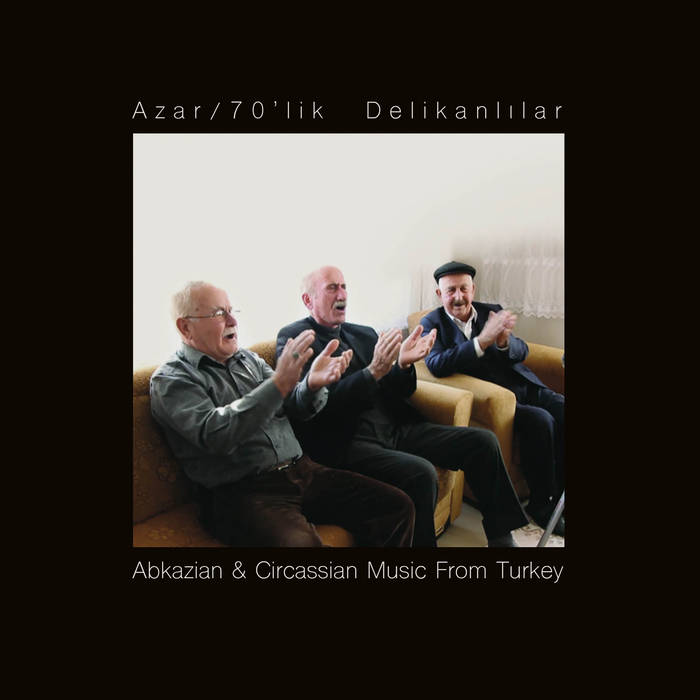
Erhan also organized the recording in Düzce. There, elders (mostly Shapsugs and a few Abkhazians) formed a home ensemble with the ironic name “70-Year-Old Youth” (70’lik Delikanlılar). This joke not only accurately described the participants’ age and enthusiasm but also the music played by the unofficial group — wedding music for games — dzhegu.
The lively elders passed the accordion, played the melodies from hand to hand, sang dance refrains in chorus, and used large wooden benches as percussion instruments, hitting them with wooden sticks (called pkhachag here).
The musicians energized each other, getting into a groove and creating a festive atmosphere for themselves. However, this was not a real wedding but a recording session, so the “70-Year-Old Youth” quickly grew tired and switched to having tea with guests from Nalchik. We managed to record a few very bright but too short tunes. If it had been a real wedding, the release would have consisted of many hours of melodies. Even so, the release conveys an atmosphere of joy and musical festivity.
Hope Instead of Despair
We cannot find reasons for joy or even for optimistic forecasts regarding the attitude of official institutions towards Circassian and Abkhazian history. The situation is either stagnating or worsening, with less space for free discussion of colonialism. Circassians march in mourning despite unjustified bans, and Abkhazians fight against the distribution of their lands and the pressure on civil activists. Instead of developing and striving for the future, our people are forced to defend basic things.
Nevertheless, it is fundamentally important for us to release something every May 21st that speaks not only of mourning but more about hope. Yes, Tolat Sadzba is no longer with us, but his voice and the voices of his friends are preserved in digital formats. These people sang songs and found reasons for joy in the harshest conditions. What they preserved, new generations can take and infuse this music with new meanings and moods.
The joy lies in the fact that there are people for whom these recordings are made. There are those for whom these songs can be sung.
Дызэкъуэтымэ – дылэщщ.
Sound: Timur Kodzoko
Sound editing: Timur Kodzoko
Cover image: Timur Kodzoko
Cover art: Milana Khalilova
Notes: Bulat Khalilov, Sergey Zotov and Bella Mirzoeva
Special thanks to Erhan Turkaw for organization and Fatih Ersem for contacts. Also we want to thank Aslanbek Nacho for his financial support.
Recorded in Sakarya and Düzce, Turkey, November 2017
Source: Ored Recordings (Bandcamp). I would strongly encourage all my readers to buy and download this digital album (paying as much as you wish) and thus support the unique, vital mission of Ored Recordings. |||TRR
Today is my birthday, and I can think of no better birthday present than Qazt: Ossetian Urban Rituals in Vladikavkaz, a 46-minute documentary film released earlier today by Tbilisi-based Ored Recordings, whose remit is “traditional and local music from the Caucasus and beyond.” The film comes hot on the heels of Ored’s release of the eponymous album a week ago.
Nothing would make me happier today than if you watched the film and listened to the album, which I’ve pasted into this post, below. If you like what you hear, see, and read, support Ored’s vital mission by sending them what you money can afford and downloading the Qazt digital album or any of the other releases in the label’s growing back catalogue. Thanks! ||| TRR
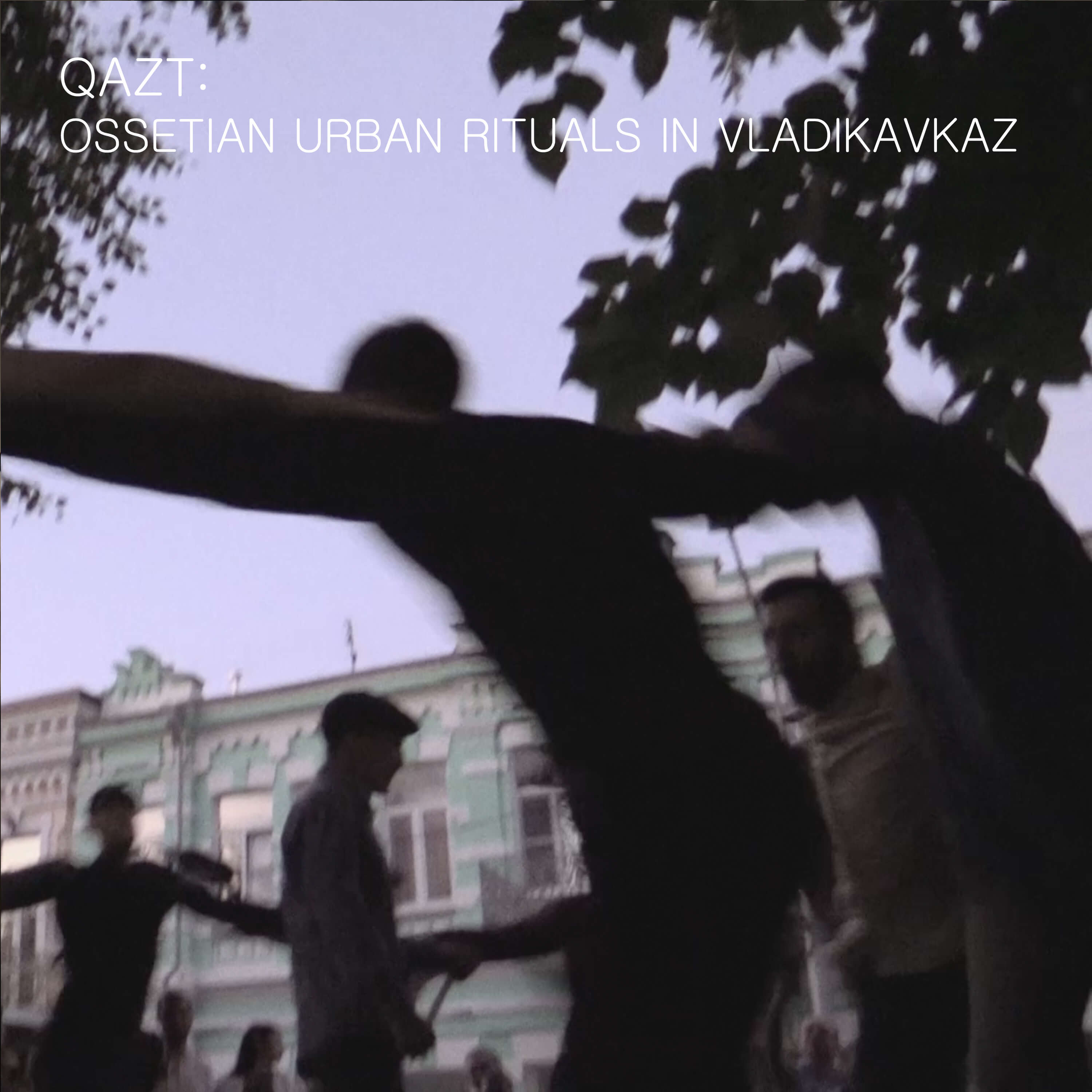
Qazt is a traditional game among the Ossetians. It is a ritualistic, musical, dance, and social space that forms on various festive occasions. During the qazt, young people would socialize, boys would showcase their courage, and they would compete in various heroic and joyful activities. In 2020, we traveled to Vladikavkaz to explore the urban qazts, make a documentary film, and issue this release. We were interested in qazt as a new cultural phenomenon, an event of urban culture, and a modern form of Ossetian self-organization.
Qazt is a traditional game among the Ossetians. It is a ritualistic, musical, dance, and social space that forms on various festive occasions.
During the qazt, young people would socialize, boys would showcase their courage, and they would compete in various heroic and joyful activities.
Analogues of qazt can be found among other peoples in the Caucasus. For example, among the Circassians, such festive dances are called dzhagu. The semantics of the Ossetian word “qazt” and the Circassian “dzhagu” are even the same — “game.”
In 2020, we traveled to Vladikavkaz to explore the urban qazts, make a documentary film, and issue this release. We were interested in qazt as a new cultural phenomenon, an event of urban culture, and a modern form of Ossetian self-organization.
During the pandemic years, traditional dances on the streets of Vladikavkaz became a noticeable event — qazts were covered by Caucasian media and Ossetian bloggers. We were invited to film the event by Alik Pukhaev, the author of the Rajdian blog.
In 2020, qazts seemed to be a growing initiative. This youth movement had it all: a vibrant cultural component, moderate protest, and an orientation towards the future, rather than a romantic desire to return to the past, where everything was considered better, purer, more authentic, and more national.
The qazts were organized not by officials who often do things formally, nor by the elderly, who are used to scolding the youth and imposing what they consider to be the authentic traditions of their people. No, this new cultural movement was led by young people who equally loved Ossetian culture and some global elements — like rock music or hip-hop. What was even more important is that the organizers did not draw boundaries between their local and global identities, between the traditional and the modern.
Qazts in the center of Vladikavkaz became part of urban culture, something that not only ethnographers but also urbanists from fancy magazines would write about in the future. The urban dances and songs struck a balance between preserving Ossetian culture and Caucasian solidarity. Initially, Ossetian students were inspired by Circassian festivities in Nalchik and decided to create something of their own.
It is important to note that at weddings in North Ossetia, Circassian and Chechen dances are very popular. According to Ossetian cultural activists, sometimes they are even too popular. Despite their desire to build horizontal connections with their neighbors and avoid getting trapped in provincial ethno-patriotism, the organizers of the qazts noticed that foreign cultural elements were becoming more popular than local ones, and many traditional dances were being forgotten.
Therefore, their project had specific rules: only Ossetian songs were allowed to be performed, and only Ossetian dances were allowed to be danced. All the other variety was appreciated but could be done on another occasion.
They also had a dress code: men were not allowed to dance in shorts, and women were not allowed to wear trousers. Some people criticized this approach on social media. Working with traditional culture is often associated with conservatism, so some viewed the effort to dress the audience in a certain way as backward.
On the other hand, one could compare this practice to dress codes at raves. It would be unfair to label a Berghain bouncer as a backward traditionalist if they don’t let someone in for not adhering to the techno dress code.
“It’s not a return to the past; we were creating a new culture for ourselves and others. We were trying not only to introduce Ossetian songs and dances into the urban environment but also to rethink our own culture. In the past, each dance had its context, which might not be understood in Vladikavkaz today. That’s why it’s important to come up with new meanings,” explained one of the qazt initiators, Tamu Berozti.
People of different generations – from children to grandparents – attended the qazts and embraced what the youth offered them. These evening gatherings in the city park or on the central avenue of Vladikavkaz provided many with an answer as to why all these songs about past heroes and dances with strange meanings were important. Or rather, the question “why?” did not arise because qazt had become a natural form of uniting people with similar identities.
The youth didn’t just bring culture to the public sphere, where people literally encountered Ossetian language and music while strolling through the city. For a while, the qazts managed to break the monopoly that academic and exemplary song, and dance ensembles had built. Qazt deliberately distanced itself from a staged show. It was not choreography for the audience, but a way to spend time together and, in the long run, negotiate with each other.
Since the release was recorded and the film was shot, three years have passed. In 2020, the main concern was the pandemic, which forced people to seek new ways of living together and uniting. Today, the main context in which the North Caucasus and other regions included in the Russian space live is war. The issues of preserving identity, culture, and solidarity have become even more acute.
It’s difficult to say why the qazts didn’t become a new driving force, a space for reflection, or simply a viable cultural phenomenon. They emerged brightly, attracted attention, and slowly faded away.
Perhaps the general fatigue of the main participants played a role: in the North Caucasus, musicians often expect overwhelming success and recognition after their first successful events, but over time, they lose enthusiasm and feel discouraged.
Maybe some tensions among the main organizers contributed to it – it was evident that they had disagreements on various issues. Or against the backdrop of a general depressive atmosphere in the region after 2022, they all became tired and engaged in other projects. More intimate and with clear structure – like the Ragon traditional music ensemble and the Uatsamonga choir.
In any case, there was no cultural revolution, and the qazt remained a ghost of a possible future.
However, its influence is still felt. Street concerts with Ossetian-language indie music in Vladikavkaz have increased. The Ragon group is releasing its second album and actively performing at festivals.
In the Rajdian blog, there was a post about a tweet from a dissatisfied Ossetian from the diaspora in Turkey:”Cultural youth is not the necessary generation for the continuity of ethnic identity. We need a political youth,” commented a descendant of migrants.
Many active young people in the North Caucasus share this view, perceiving music and dances as entertainment and distraction from problems. While we dance and sing approved songs joyfully, our languages are disappearing, and social problems are increasing more and more.
Initiatives like the Vladikavkaz qazts could have become an example of music aimed not only at entertainment but also at solidarity.
And the fact that our new release is once again about something from the past proves that cultural identity without a civic position is insufficient for gradual and confident development.
Film by Tamerlan Vasiliev will be out soon
Recorded on August 2020 in Vladikavkaz
Sound and mixing: Timur Kodzoko
Cover photo: Tamerlan Vasilyev
Cover art: Milana Khalilova
Liner notes: Bulat Khalilov
Translation: Bella Mirzoeva
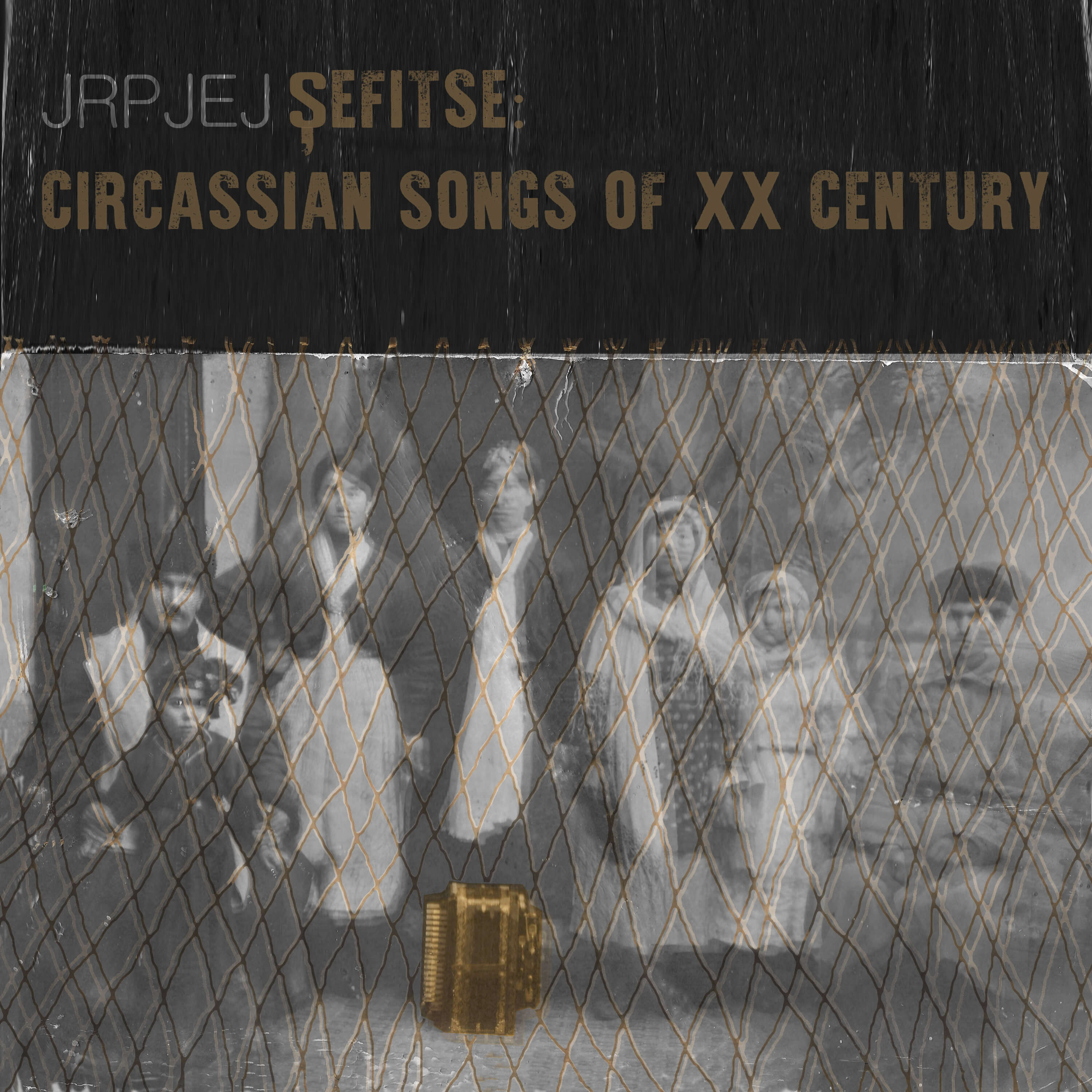
On the day of the end of the Russian-Caucasian war of 1763–1864, on the day of memory and sorrow of the Circassians, we publish another album-manifesto from Jrpjej.
In addition to music, the album is accompanied by a pdf-zine with our reflection on Circassian songs of the 20th century and their relevance today
“Sefitse” is a line from the song “Quedzoqo Tole Tsiku.”
In the Adyghe language, “se” is a homonym that means both milk and bullet. To intensify the tragedy, the bullet in the song is called black. We found this metaphor and wordplay profound. Death and the life-giving drink go hand in hand, as death permeates the everyday life of wartime.
It is important for us to release this album on May 21st, the Day of Remembrance for the Adygs. For several years now, we have been releasing special albums on this day. Most often, these are songs from the period of the Russo-Caucasian War. The accompanying text to these albums hardly changes, just as the official discourse in the political space of the North Caucasus does not change. In fact, it has only gotten worse — the 2022 Jrpjej album was our protest against the ban on the mourning procession in Nalchik.
In 2023, the traditional procession is once again officially banned for fabricated reasons. Therefore, any action that helps people remember and resist assimilation seems particularly important to us.
Songs about the executed Zalimgery Keref, the battle of Kars, of Tole Kodzoko bleeding in the trench, and others tell us that the methods of repression do not change. But no matter how much our voices are drowned out, these songs still resonate. One hundred years ago and right now.
This album is about memory, action, and solidarity.
Jrpjej:
Timur Kodzoko
Daiana Kulova
Alan Shawdjan
Gupsa Pashtova
Astemir Ashiboko
Zaurkan Mazlo
Session musicians:
Aslan Tashu
Dzhanet Siukhova
Iland Khadjaev
Recorded on September 2022 and April 2023.
Recording location: Dom Radio, Nalchik, Kabardino-Balkaria
Sound and mixing: Timur Kodzoko
Cover art: Milana Khalilova
Liner notes: Bulat Khalilov
Translation: Bella Mirzoeva
Source: Ored Recordings (Bandcamp) Please consider paying (whatever you like) at the link and thus being able to download a high-quality mp3 file of the album, which includes a fascinating 47-page illustrated booklet in Russian and English. ||| ••• TRR •••
[…]
Unlike Inversia, Nalchik’s Platform festival was conceived, organized and launched literally on the fly. In the summer of 2019, Bulat Khalilov and Timur Kodzokov, the founders of the ethnographic music label Ored Recordings, specializing in the traditional music of the peoples of the Caucasus, came up with the idea of holding an educational and musical marathon in their hometown of Nalchik. They appealed for support to Oksana Shukhostanova from the Art Hall Platform Urban Development Institute, an agency under the municipal administration, who acted as an intermediary between the mayor’s office and festival organizers, and also gave the event its name.
“Platform is primarily a festival of urban culture, and music is only one of its components”, Khalilov says. “In terms of engaging with urban spaces and communities, we have both strengths and points that are sagging and need to be improved. For example, we open new places for fun-filled informal events. So, the first festival breathed life into the almost-forgotten but once-popular Dance Hall. It had been a long time since live music was played there, especially in this format.”
Subsequently, the festival was held in one of the halls at the House of Trade Unions in the city center, where, according to the event’s organizers, no cultural events had ever been held at all.
“It is quite odd, because both the pompous Soviet-style building itself and the hall, with its excellent acoustics, were begging for something interesting to happen in them. Last year, at this location, we staged performances by Utro, Pasosh, Fyodor’s Garden, Alina Petrova and Sergei Khramtsevich, and Foresteppe. And most recently (in January 2021), Platform had a cool spin-off – a collaboration between Ored Recordings and Le Guess Who? For this project, Platform and Ored swapped places: the label was the organizer, while the institution was the partner. A mini-festival of contemporary Circassian music – from traditional to black – was held in the concert studio of Radio House, where folk choirs, orchestras and many more musicians were recorded in Soviet times. Now we (Ored and Platform) are planning to work with regional radio, so we want to continue to do something interesting in these spaces.”
On the other hand, Platform has not yet able to utilize several venues at once, thus immersing the whole of Nalchik in an atmosphere of musical celebration. Khalilov argues that this is a problem of scale and resources: at this stage, the organizers cannot afford to invite many musicians and hold a large number of other activities in the city – for example, educational events (lectures, seminars, master classes, film screenings) and interdisciplinary events (exhibitions, audiovisual performances, theater productions) – in order to engage more locations and more diverse sites.
“I see a problem in the fact that we don’t always manage to involve local communities,” says Bulat. “In terms of music, this happens because the local scene is still in its infancy: we have almost no musicians that we could put in the same line-up with Brom or Utro without compromising the quality. The exceptions are the local traditional music and rare gems like the vinyl DJ RK.”
The organizers also note that interacting with city hall is one of the most difficult aspects of their work. As in the case of Inversia, communication with the authorities often comes down to solving formal issues and proving to officials that the festival has great potential for developing the city, improving its image, boosting tourism in the region, and so on. The Platform team admits, however, that the Nalchik administration provides all possible assistance to their undertaking: the festival receives a considerable chunk of its budget through city hall. And yet, they say, the cooperation could be closer and more productive, thus benefiting, first of all, the city itself. Because, as Platform’s curators emphasize, the main goal of the festival, as well as of Ored Recordings, is to build a community or environment for traditional music that would fit into a contemporary context – that is, to generate conditions in which performers understand how and why to make music, and listeners, where to listen to it. Platform aims to grow communities in Nalchik that will nurture profoundly local phenomena (in music, literature, etc.) that are in demand both at home and globally.
“That’s why we combine traditional music and the provisional ‘stars’ of independent music in the line-up,” Khalilov says. “Having Pasosh and Susanna Talijokova on the same stage with dance performances is strange even by the standards of local music lovers. I’m not sure that our audience deciphers this message, but with each subsequent festival, it is noticeable how the teenagers who have come for the post-punk and fans of Circassian music get used to each other and do not perceive different music as something strange.”
Finally, the Platform team regards the negative experience of interacting with local non-folk musicians as another problem. “Many of them send applications to play at the festival, but rarely come to the festival itself,” says Bulat. “It’s strange when people seem to want their moment of glory at the festival, but they don’t seem to need it.” He notes that, perhaps, it is a matter of time and soon there will be groups of a suitable format in Nalchik, or maybe something deeply local in contrast to Platform, since the festival is focused on a somewhat narrow albeit woke audience. (According to him, there are other events in Nalchik for mass audiences, including Art Bazaar, Gastrofest, and the Festival of Flowers.) Any of those outcomes would be tantamount to progress in Khalilov’s eyes.
“In terms of interacting with the city and the local community, we look at festivals like Le Guess Who? and Unsound, and among the Russian festivals we are inspired by Bol and Inversia,” Khalilov continues. “Although it’s a young festival, Platform copes with this job at some level. We always have something local on stage. If the festival had more resources, it would be possible to recruit more local musicians to various projects. We are working in this direction, but it is also vital that local content is presented not only as part of a quota or due to having a local residence permit. You cannot make allowances for a musician because they live in Nalchik. I am sure that Jrpjej is invited to major festivals not because they’re ‘exotic’ (although some of the audience, of course, perceives them as these weird Circassians), but because of their unique sound and good material. We think it’s important to show local residents and local musicians that, musically speaking, geography and your home address are not big obstacles. You can find more advantages than obstacles in living in Nalchik.”
Platform’s impact on Nalchik’s cultural image is still difficult to assess — the festival is too new. There are a lot of people in the city who haven’t even heard of it. The organizers are sure that their project and Ored Recordings reveal and highlight an important problem: in fact, there is neither a culture industry nor a clearly delineated media space in Nalchik.
“If you’re promoting a concert at DOM or Shagi in Moscow, I understand that you have to send announcements to Afisha and The Village, and post info on the right Telegram channels and VK community pages, but it’s not entirely clear how you convey information to the Nalchik audience,” Bulat says. “There are no information channels, everything is as spontaneous and quirky as possible. We are working on this aspect, which is also a good thing.”
On the other hand, Platform has formed its own audience, which waits for the festival to come around each year and asks the organizers to invite specific performers (from Ivan Dorn to M8L8TH). There are also fans from other regions who come to Nalchik specifically for Platform. And, finally, there is attention from the media. So, for some locals and outsiders, Nalchik has already become a more comfortable and interesting place to live and visit.
The authorities of Kabardino-Balkaria have banned holding events in memory of the victims of the Caucasian War, threatening responsibility for violating the ban, reports Aslan Beshto, the chair of the Coordinating Council of Adyghe Public Associations.
Caucasian Knot has reported that in 2022, the authorities of Kabardino-Balkaria refused to sanction a march in memory of the victims of the Caucasian War. Despite the ban, on May 21, a mourning meeting was held at the “Tree of Life” monument, and several dozen young people held a march in memory of the victims of the Caucasian War on the streets of Nalchik. The police drew up a report on the violation of public order against a horseman who took part in the march.
On May 20, 2022, participants of the mourning events held at the “Tree of Life” monument in Nalchik lit 101 candles. The activists criticized the republic’s authorities for cancelling the march on the Circassian Day of Mourning.
According to Aslan Beshto, the chair of the Coordinating Council of Adyghe Public Associations, he was warned that if organizers held an unsanctioned rally, they would be brough to responsibility under the “rally” article, Kavkaz.Realii reports.
This article was originally published on the Russian page of 24/7 Internet [news] agency Caucasian Knot on May 14, 2023 at 01:08 pm MSK. To access the full text of the article [in Russian], click here.
Events have been held in Nalchik to commemorate the Circassian Day of Mourning, including a march through the streets of the city that was not permitted by the authorities. The people involved in the events considered it vital to preserve Adyghe traditions.
As Caucasian Knot has reported, May 21, the Day of Remembrance for the Victims of the Caucasian War, was officially declared a holiday in Adygea, Kabardino-Balkaria and Karachay-Cherkessia, where Circassians are the titular nation. This year, the authorities in Kabardino-Balkaria banned holding events in memory of the victims of the Caucasian War on May 20 and 21, threatening to prosecute those who violated the ban, said Aslan Beshto, chair of the Coordinating Council of Adyghe Public Associations.
Adyghe (Circassians) is the common name for a people living in Russia and abroad, who have been divided into Kabardians, Circassians, and Adygeans. May 21 is celebrated annually as Circassian Day of Mourning, according to the Caucasian Knot reference guide.
Several events were held in Nalchik to commemorate the Circassian Day of Mourning
Events commemorating the 159th anniversary of the end of the Caucasian War began in Nalchik on the evening of May 20 at the Tree of Life Memorial. There, the republic’s musical groups performed folk songs about the dramatic events of the Caucasian War, and 159 candles were lit. Traditional funeral treats, lakum, were handed out to attendees our correspondent reported.
Today, the main events took place in Nalchik, including an unauthorized march by several dozen people through downtown Nalchik from the railway station to Abkhazia Square, and from there to the Tree of Life Memorial. The marchers carried [Circassian] flags and periodically shouted the phrase “the Adyghe tribe is alive” in their native language. Although the march had not been permitted by authorities, no one stopped them.
The Caucasian War, which lasted from 1763 to 1864, brought the Adyghe peoples to the brink of extinction. After the war and the mass deportation of Adyghe to the Ottoman Empire, a little more than 50,000 Adyghe remained in their homeland. The Russian authorities have not yet acknowledged the Circassian genocide during the war.
Several hundred people gathered in the park near the Tree of Life Memorial. At twelve noon Moscow time, a rally began. It was kicked off by Mukhadin Kumakhov, Kabardino-Balkaria’s minister of culture. He explained that the head of the republic, veterans, members of parliament, members of the government, heads of administration of districts and villages, clergy and elders had came to honor the memory of their ancestors.
Most of the speech given by Houti Sokhrokov, president of the International Circassian Association, was in Kabardian. In Russian, he said that 159 years had passed “since the bloodiest war.” “We stand today in a place sacred to all the Adyghe, the Tree of Life Memorial, and remember those who fell in that war. We shall cherish the memory of their courage in our hearts, and pray that this never happen to any nation again,” he said.
Sokhrokov then asked for a minute of silence, after which continued his speech. “As we remember today the events of those distant years, we pay tribute to the wisdom, foresight, fortitude and perseverance of our ancestors, who, despite all their hardships, saved the Adyghe people, remained faithful to the fateful choice they had made once upon a time, and preserved their historical homeland for future generations. This historical continuity has not been severed. It is only thanks to this that the Adyghe have preserved their language, traditions and culture,” he said.
The republic’s leading Muslim clerics performed a dua, a memorial prayer ritual, after which flowers were laid at the memorial, our correspondent reported.
Nalchik residents pointed out the importance of preserving Adyghe traditions
The date is a sad one for Adyghe, Timur Shardanov, chair of the Council of Veterans of the War in Abkhazia told our correspondent. “Today is a sad day for us Adyghe. We war veterans have come to honor the memory of ancestors who passed away at that time. We cherish their memory and try to pass it on to our [children]. We must do this so that it does not happen again somewhere. We know what war is, and we don’t want our children to see it,” he said.
Shardanov argues that an equestrian procession is optional on the Day of Mourning. The main thing, in his opinion, is to come to the memorial and stand for a while there.
An injustice was committed against the Adyghe, which consists not only in the expulsion of the people, but “also in an attempt to erase the memory of this page of history,” another attendee, Alexei Bekshokov argues. “The Koran says: I have forbidden injustice to myself and I forbid it to you,” he explained to our correspondent
Bekshokov considers the ban on the equestrian procession an excessive measure. “Nothing would have happened if it had taken place. Horse marches were part of Circassian history,” he said.
In 2022, the authorities in Kabardino-Balkaria turned down a request by a grassroots group to hold a solemn procession in memory of the victims of the Caucasian War. Despite the ban, on 21 May 2022, several dozen young people marched through the streets of Nalchik. The security forces charged a rider who took part in the procession with disturbing the peace. The atmosphere during the march was tense, and the clash between the police and the riders heated it up even more, eyewitnesses said. The march had been held for many years without incident, Martin Kochesoko, the president of [rights group] Habze, noted at the time.
Anatoly Thagapsoev, a resident of Nalchik, argues that the best tribute to the memory of their ancestors would be if the Adyghe did not lose traditions which have been part of their existence for centuries.
“I see that women without headscarves and men without hats have come to the memorial event. This used not to be allowed among the Adyghe. They bring children in ethnic costumes and take pictures of them in front of the memorial, as if it were a holiday. The line between the Adyghe man and the Adyghe woman, the older and younger [generations], is also being erased. Previously, a woman had no right to cross a road in front of a man. When a man passed by, a woman had to stand up, even if it was a boy, for the boy is a future man. These are nuances, but being Adyghe consisted of them,” the Nalchik resident told our correspondent.
Community leader Idar Tsipinov believes that the Adyghe Day of Remembrance contributes to the revival of national consciousness. “Personally, I am opposed to globalization. I believe that the more nations, the more different cultures there are, the more interesting it is. This does not mean that we live in the past. This means that we live in the present, we look to the future, but we don’t forget the past either,” he told our correspondent.
The Circassian Day of Mourning (Adyghe: Шъыгъо-шӏэжъ маф, Russian: День памяти жертв Кавказской войны) or the Day of Mourning for the Victims of the Circassian Genocide (often censored in Russian media as Day of Remembrance for the Victims of the Caucasus War) is mourned every year on 21 May in remembrance of the victims of the Russo-Circassian War and the subsequent Circassian genocide by members of the Circassian diaspora. The choice of the date is due to the fact that on 21 May 1864, General Pavel Grabbe held a military parade in the what is now Krasnaya Polyana in honor of the victory in the Battle of Qbaada.
Background
From 1763 to 1864 the Circassians fought against the Russians in the Russian-Circassian War. During the war, Russian Empire employed a genocidal strategy of massacring Circassian civilians. Only a small percentage who accepted Russification and resettlement within the Russian Empire were completely spared. The remaining Circassian population who refused were variously dispersed or killed en masse. Circassian villages would be located and burnt, systematically starved, or their entire population massacred. Leo Tolstoy reports that Russian soldiers would attack village houses at night. Sir Pelgrave, a British diplomat who witnessed the events, adds that “their only crime was not being Russian.”
A mass deportation was launched against the surviving population before the end of the war in 1864 and it was mostly completed by 1867. Some died from epidemics or starvation among the crowds of deportees and were reportedly eaten by dogs after their death. Others died when the ships underway sank during storms. Calculations, including taking into account the Russian government’s own archival figures, have estimated a loss of 80–97% of the Circassian population in the process. The displaced people were settled primarily to the Ottoman Empire.
In 1914, Nicholas II celebrated the 50th anniversary of the defeat of the Circassians, describing it as one of the empire’s greatest victories. Boris Yeltsin acknowledged in 1996 when signing a peace treaty with Chechnya during the First Chechen War that the war was a tragedy whose responsibility lies with Russia.
Holiday
In 1990, the Circassians designated 21 May as the Day of Mourning for their people, on which they commemorate the tragedy of the nation. It is memorable and non-working day in the three republics of the Russian Federation (Adygea, Kabardino-Balkaria and Karachay-Cherkessia) as well as in the Circassian villages of the Krasnodar Krai. The government of the partially recognized Republic of Abkhazia also mourns the day of mourning on May 21 (until 2011, it was mourned on May 31).
The day is also widely mourned with rallies and processions in countries with a large Circassian diaspora, such as Turkey, Germany, United States, Jordan and other countries of the Middle East.
The Russo-Circassian War (Adyghe: Урыс-адыгэ зауэ, romanized: Wurıs-adığə zawə; Russian: Русско-черкесская война; 1763–1864; also known as the Russian invasion of Circassia) was the invasion of Circassia by Russia, starting in July 17, 1763 (O.S) with the Russian Empire assuming authority in Circassia, followed by the Circassian refusal, ending 101 years later with the last army of Circassia defeated on 21 May 1864 (O.S), making it exhausting and casualty-heavy for both sides. The Circassians fought the Russians longer than all the other peoples of the Caucasus, and the Russo-Circassian War was the longest war both Russia and Circassia have ever fought.
During and after the war, the Russian Empire employed a genocidal strategy of systematically massacring civilians which resulted in the Circassian genocide where up to 2,000,000 Circassians (85-97% of the total population) were either killed or expelled to the Ottoman Empire (especially to modern-day Turkey; see Circassians in Turkey), creating the Circassian diaspora. While the war was initially an isolated conflict, Russian expansion through the entire region soon drew a number of other nations in the Caucasus into the conflict. As such, the war is often considered the western half of the Caucasus War.
During the war, the Russian Empire did not recognize Circassia as an independent region, and as a result, it considered Circassia Russian land which was under rebel occupation, despite the fact that the region was not and had never been under Russian control. Russian generals did not refer to the Circassians by their ethnic name, instead, they called the Circassians “mountaineers”, “bandits”, and “mountain scum”. The war has been subjected to historical revisionism and it has also garnered controversy due to the fact that later Russian sources mostly ignored or belittled the conflict, and Russian state media and officials have gone as far as to claim that the conflict “never happened” and they have also claimed that Circassia “voluntarily joined Russia in the 16th century”.
May 21 marks the Circassian Day of Mourning, a time of remembrance for the victims of the Russo-Circassian War.
In 1864, the Caucasian War ended on this day. The Russian Empire held a prayer service and celebrated the victory. For Circassians this war ended in tragedy: the loss of independence, mass extermination of the population, eviction to the Ottoman Empire, Syria and other countries, the breakdown of the social system, and a colossal trauma.
For Circassians May 21 is more than just a sad date, and the Russo-Circassian War is not a thing of the past. These events still determine our reality. What the official Russian historical science interprets as a military-political conflict or even the pacification of a troubled region, Circassians perceive as genocide.
The events of 1864 and the subsequent colonization of the former Circassia and the North Caucasus remain an acute problem that official authorities ignore.
One can re-read the texts for our releases on May 21 or the posts we have made in past years. They are all relevant and can be reproduced again and again. There are no shifts or new trends in Russian society or the official political course.
There are also alarming signs that discourse is being further constricted. In 2020 and 2021, the traditional mourning procession in Nalchik was canceled due to the pandemic. The Circassian public accepted the extraordinary circumstances, and it did not cause any indignation.
In 2022, the rally was canceled again for strange reasons. The authorities of Kabardino-Balkaria did not clarify them, and the International Circassian Association referred to “difficult times” and “the situation with the special operation in Ukraine”.
The Circassian community was outraged by the absurdity of these statements. And so were we.
Initially, we did not plan to release an album, but make a post about grief and memory. On May 17, we learned that the main Circassian symbolic event in our hometown was canceled. Yes, there will be a minute of silence and other mourning events, but there will be no main unifying procession in which Circassians of different views, confessions, and political orientation stand shoulder to shoulder to make a peaceful democratic statement.
And we decided to record and publish an album with songs of the Russo-Circassian War.
This is our traditional way of memorizing the past, a call for working with heritage and defending our subjectivity. We believe that problems need to be discussed and solved together, and not put off until better times. Otherwise, these better times will never come.
The songs on this album are war and mourning ballads of those who fought for their independence. For us, this is also an anti-militaristic statement, since all this music is set against repression and aggression.
Circassians, who have suffered from imperialism, must understand that colonial optics and repressive methods are unacceptable against any other groups of people, small or large. Every group or community has the right to determine its future.
Jrpjej:
Timur Kodzoko — guitar, shichepshin, vocals
Alan Shawdjan — vocals, accordion
Daiana Kulova — vocals, shichepshin, percussion
Guest singers:
Zaurbek Kozh
Zaur Nagoy
Sound recording: Timur Kodzoko
Sound editing, mixing: Timur Kodzokov
Cover photo: Elina Karaeva
Cover design: Milana Khalilova
Text: Bulat Khalilov and Bella Mirzoeva
Recorded on May 20-21, 2022
Recording location: Dom Radio, Nalchik, Kabardino-Balkaria
Except “Тыгъужъыкъо Къызбэч,” recorded by Daan Duurland at Katzwijm Studio, Netherlands, November 2021.
NB. This entry was updated on 22 May 2023. ||| ••• TRR •••
We’re thrilled to announce our latest album, a result of a collaboration between Ored Recordings and Luminary, an educational center in the village of Khryug, in the Ahtynsky district of Dagestan.
Luminary works with local children, offering them various classes in design, programming, music, and other fascinating topics. Our collaboration with them involved a three-day expedition of young Lezgins through their native Ahtynsky district, recording the songs of bards, local ensembles, and cultural workers.
In addition to the audio release, we’ve also published a printed zine, in which the children describe their experience, and we share our thoughts on the symbolism of such trips.
Ored Recordings is an ethnographic label, whose team travels mainly in the Caucasus, studying and recording local music. While there are many similar projects around the world, they are often led by white Europeans on an “exotic safari” in foreign lands. However, in our case, things are different. Ored Recordings is led by Circassians, who immerse themselves in their own tradition and the culture of their neighbors. In our eyes, there is less exoticism and orientalism, which can be found in the work of the French in Tibet or Americans in Ethiopia.
Nevertheless, we know relatively little about the music and culture of neighboring republics. Even in Dagestan, we may be neighbors, but we are still outsiders. We try to bridge the gap by taking local guides and carefully preparing for trips to other republics. However, the most honest thing we can do is to send the locals on the expedition themselves, without us.
When the Luminary center in Khryug invited us to do something together with their kids, it became evident that they should go on an expedition to their native villages and share their music and personal discoveries with everyone.
Ored Recordings’ role was to provide young ethnographers with tools, without imposing our vision. We didn’t teach young Lezgins what music was worthy of recording and what should be forgotten. Nor did we decide for them what would become a hit or what would be boring.
The result is an album of diverse music, the faces of living bearers of tradition, an engaging story of an ethnographic adventure, and a beautiful zine.
Importantly, the project is not interesting merely because it was done by children. The release and zine by the Luminary kids are not cute; they are serious works that adults could have done worse. And to us, this carries great symbolic value: traditional music does not belong to us — the elders, academics, and art curators. It’s for everyone, especially the new generations.
We hope you enjoy this album and take a moment to appreciate the work of these talented young musicians and ethnographers.