Man repeatedly detained at protest rallies in Perm deported from U.S. to Russia
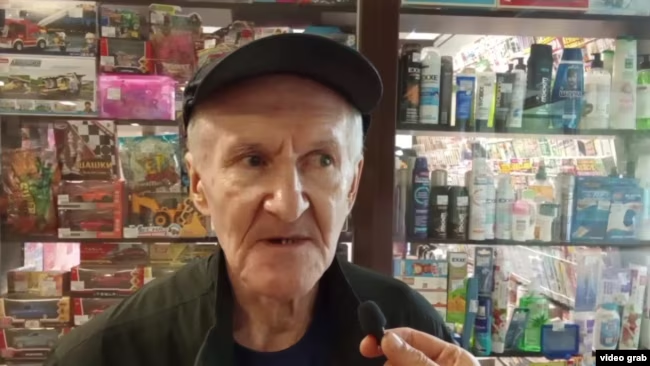
Today, 25 July, Perm activist Leonid Melekhin, who had been wanted by law enforcement authorities for several years and is on the Russian federal list of “terrorists and extremists,” was remanded to custody in a pretrial detention center, Properm.ru’s correspondent has learned. Melekhin had attempted to emigrate to the U.S. via Mexico, a process about which his friends had written extensively on social media.
Melekhin tried to cross the border between Mexico and America in August last year and spent several months in detenshen (immigration prison in the U.S.), but lost his legal bid to remain in America. This entire time he was wanted by the Russian authorities for his cooperation with the Navalny Headquarters (an organization deemed “extremist” that has been banned in Russia).
According to our correspondent, Melekhin was turned over to the Russian authorities [sic!] before being deported to Russia and detained on suspicion of “condoning terrorism.”
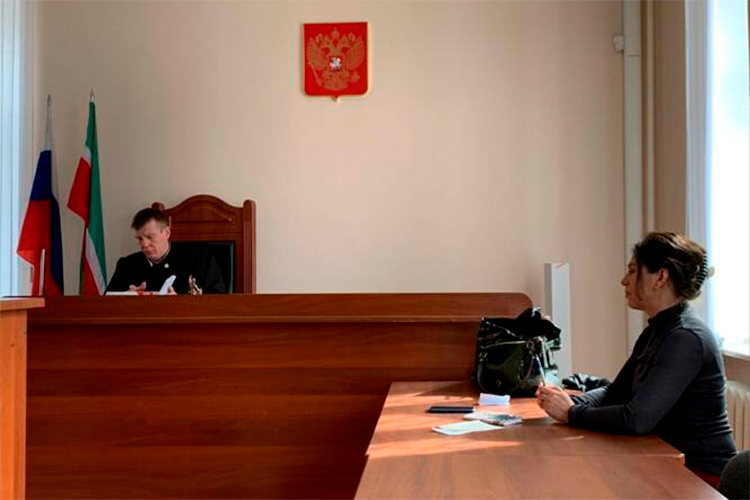
As their source at Perm’s Lenin District Court confirmed to our correspondent, Judge Oksana Korepanova today granted the motion filed by an FSB investigator and remanded Melekhin to a pretrial detention center until 25 September.
Before leaving Russia in late 2023, Melekhin was repeatedly detained by the police for his involvement in unauthorized protests.
“Let’s stand up for the truth.” A military recruiting billboard photographed earlier this summer in Kaluga, promising five million rubles (approx. 56,000 euros) for one year of “contract” (voluntary) military service, a one-time signing bonus of two and a half million rubles, and a monthly salary of 210,000 rubles for service in the “Special Military Operation zone.” Photo: Alexander Gronsky (Facebook). Thanks to Sergei Medvedev for the heads-up.
An American father who moved to Russia to avoid LGBTQ+ “indoctrination” for his kids is being sent to the front line in Ukraine, despite being assured he would serve in a non-combat role.
Derek Huffman, 46, feels he is being “thrown to the wolves” after being told that his job in the military would be as a correspondent or as a welder, his wife, DeAnna, said in a recorded plea for prayers, which has since been removed from her YouTube page.
Huffman has no prior military experience, DeAnna said, adding that his limited training was conducted in Russian. She suggested the language barrier has made her husband particularly unprepared for the horrors of combat.
“Unfortunately, when you’re taught in a different language, and you don’t understand the language, how are you really getting taught?” she pondered. “You’re not. So, unfortunately, he feels like he’s being thrown to the wolves right now, and he’s kind of having to lean on faith, and that’s what we’re all doing.”
Huffman joined the military in the hope of gaining Russian citizenship for his family through an expedited process. He also felt such service would allow him to “earn” the respect of his new countrymen, which is something he once said migrants in the United States refuse to do.
“The point of this act for me is to earn a place here in Russia,” he told Russian state media last month. “If I risk myself for our new country, no one will say that I am not a part of it. Unlike migrants in America who come there just like that, do not assimilate, and at the same time want free handouts.”
Undocumented migrants cannot join the U.S. military during peacetime. A program launched by former President George W. Bush allowed such immigrants to seek citizenship by serving in the military, but that pathway was shuttered during President Donald Trump’s first term.
DeAnna, 42, suggested her husband had been misled during the military recruiting process. She added that, after a month of service, her family had yet to receive any pay.
“When he signed up and had all of that done, he was told he would not be training for two weeks and going straight to the front lines,” she said. “But it seems as though he is getting one more week of training, closer to the front lines, and then they are going to put him on the front lines.”
Huffman moved his family to a village outside Moscow in spring. It was launched by American blogger Tim Kirby—who has lived in Russia for two decades—in 2023 to attract Americans seeking to escape the “liberal gender norm.” That project has been a flop, with United24Media reporting that only two families, including the Huffmans, have moved in.
Huffman, a native Texan, brought his wife, three daughters, and their family Husky, “Baby,” with him to Russia. The couple also have three sons from prior marriages who opted to remain in the United States.
Huffman’s admiration for Russia runs deep. The Russian state-operated news agency RIA Novosti reported last month that the couple honeymooned in Moscow.
“The city charmed us with its rich history, vibrant culture, and welcoming atmosphere,” DeAnna told the outlet. “Before that, we figured out whether moving to Russia would fit our family’s needs and values. However, it wasn’t until we saw Moscow in person that we truly felt a connection.”
DeAnna said that she was not surprised that her husband wanted to volunteer for the Russian military, even as it is in its third year of a bloody war with Ukraine. Ukrainian officials estimated this week that more than 1 million Russian soldiers have died in the conflict, which continues to rage on despite President Trump’s demands for peace.
”It didn’t come as a surprise to me,” she said of his joining the military. “He always spoke so highly of the country, its president, and its people, and he has a strong passion for doing the right thing.”
“I got upset when the doctor told me I had diabetes,” said Yurii. “Because uneaten sweets are waiting for me at home, and we’ve already bought lemonade for New Year’s.”
Yurii is 16 years old, and every day he starts with a long-acting insulin injection. Later throughout the day, ten minutes before each meal, he measures his blood sugar levels, calculates the amount of carbohydrates he will get from food, and injects the appropriate dose of insulin.
Type 1 diabetes is an autoimmune disease that changes your life forever and can be triggered by infections or, as it is in Yurii’s case, by severe stress – especially after what happened to his brother.
Chronic stress has been rising among Ukrainians since the start of Russia’s full-scale invasion, as Moscow continues to shell the country daily. The continuous sleepless nights and the fear of being hit by a drone or missile are affecting both the mental and physical health of the people in Ukraine.
In June 2025, Russians increased the number of drones and missiles launched at Ukraine increased by 60 percent, according to Oleksandr Syrskyi, the Commander-in-Chief of the Armed Forces of Ukraine. In addition, June saw the highest number of civilian deaths since April 2022 as a result of military actions: 232 people.
The invisible effects are compounding: Ukrainian children have begun to experience health conditions that could affect the rest of their lives.
Statistics show a rise in the number of patients with type 1 diabetes in the frontline Kharkiv region, and the number of people diagnosed with diabetes in general is also on the rise across the country.
Before the invasion, Yurii lived with his parents in the central Ukrainian city of Cherkasy. They tried to get out of town every weekend — whether that meant going fishing or mushroom-picking in the forest.
“Children need to breathe fresh air,” Olena, Yurii’s mother, told The Counteroffensive with a nostalgic smile on her face.
She begins the conversation by saying, “I am the mother of two wonderful sons.”
Yurii has a brother, Volodymyr, also known as Vova, who is 10 years older and who looked after Yurii from an early age.
“We walked all over Cherkasy together, went to parks, squares, the Dnipro River, and he treated me to McDonald’s. Vova [a nickname for Volodymyr] always told me, ‘When you grow up, we’ll go out with girls together. ’ And Vova loved everything related to the army,” said Yurii.
When Olena talks about her eldest son, her voice begins to tremble.
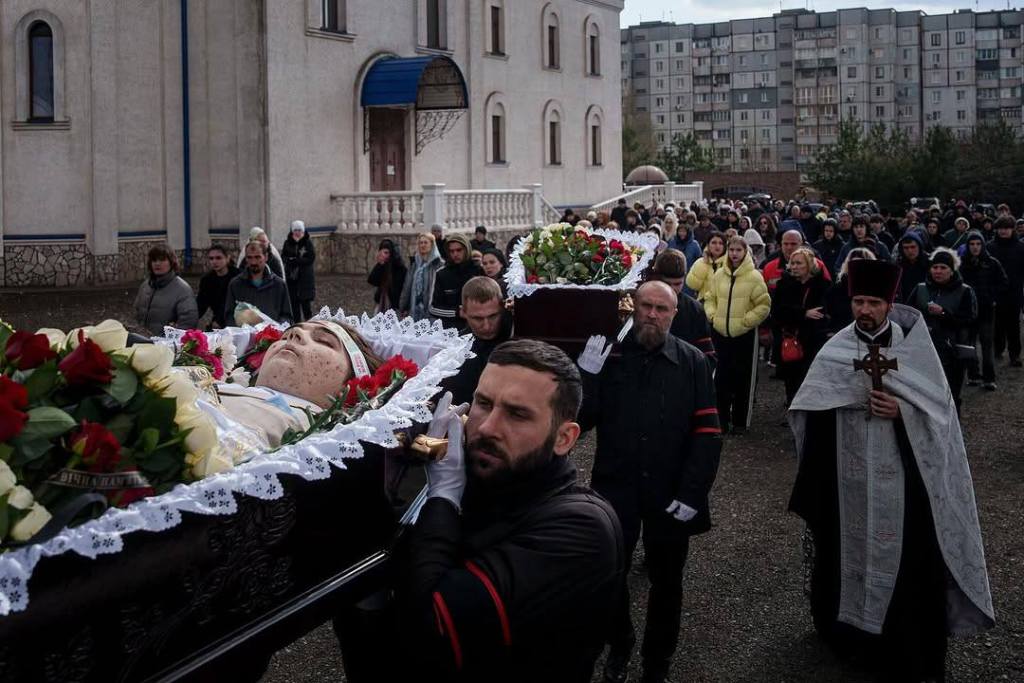
Vova died on May 3, 2022, while defending Mariupol at Azovstal, a strategic steel factory that was besieged by Russian forces for almost three months, a famous last stand.
He died after his car rolled onto an enemy mine.
The family only learned about his death six months later.
“One day, Vova’s commander called me, introduced himself, and asked how I was doing. I replied, ‘Do you know where my son is? Wasn’t he in captivity with you?’ He told me that Vova had died on May 3 and asked, ‘Didn’t you know?’ It felt like half my heart had been cut out of my chest at that moment,” remembered Olena.
Volodymyr was only buried in February 2023. After the tragedy, Olena began to have health problems: she constantly felt weak, and eventually doctors had to remove her thyroid gland so that she could get better.
In the fall of 2023, months after Volodymyr’s funeral, the family went to the Carpathians for a break. During the trip, Olena noticed that Yurii, then 14 years old, was drinking more water than usual and had lost a significant amount of weight. Despite being naturally thin and 1.74 meters tall (5 feet 9 inches), he weighed just 45 kilograms (99.2 pounds).
“Yurii took his brother’s death very hard. It wasn’t that he cried a lot, but as if something inside him had burned out,” said Olena.
Yurii and Olena returned to Cherkasy and went to see the doctors. While Olena had developed a problem with her thyroid, everything seemed normal in Yurii.
But when the doctor routinely tested Yurii’s blood sugar levels, they found he had developed type 1 diabetes.
“It felt like I was beaten to death with feet, after all the horror we had already gone through,” said Olena.
Many autoimmune diseases of the endocrine system occur in childhood or young adulthood, as these are periods of active growth and hormonal changes, said Natalia Pogadaeva, head of the endocrinology department at Okhmatdyt, Ukraine’s largest pediatric hospital, which was hit by a missile strike last year.
Genetics plays a significant role in the onset of diabetes, as in other autoimmune diseases. However, the trigger for their onset is usually stress, she added. The following six months after the start of Russia’s invasion of Ukraine, the number of patients with diabetes and other immune diseases surged, she added.
Due to full-scale Russian invasion and the displacement of the Ukrainian population both within Ukraine and abroad, it is very difficult to determine the actual extent of the increase in diabetes, Pogadayeva says.
“Children who lived in Kyiv could have gone abroad and realized they were sick, or vice versa: a child moved from Kherson to Kyiv and is being treated in Kyiv, not where they lived,” she added.
Still, some statistics hint at the broader toll. For example, 398 patients with type 1 diabetes under the age of 18 were registered in the first 9 months of 2023 in the Kharkiv region, a frontline region in the northeast of Ukraine. During the same period in 2024, the number had already increased to 501 patients – a more than 25 percent increase.
According to the Ministry of Health of Ukraine, 531,200 people were diagnosed with different types of diabetes in 2023, the first full year of the full-scale invasion. In 2022, the number was 489,934 – an 8 percent increase.
Many of the children who went to Okhmatdyt to get treated had either survived Russia’s occupation, had experienced the aggression firsthand, or had evacuated from Mariupol or Bakhmut, Pogadaeva said.
“At the beginning of the full-scale invasion, among other things, logistics were also greatly changed,” said Pogadaeva, the head of the endocrinology department at Okhmatdyt.
Children who already had diabetes had a hard time accessing insulin and the supplies needed to measure their blood sugar. As a result, they had to be hospitalized.
Diabetes can have severe complications if not taken care of properly. Uncontrolled blood sugar can damage blood vessels, which are present in every organ of the body. If affected, the kidneys, the limbs, and the eyes are the first to suffer. In the long run, it can lead to kidney failure, loss of sensitivity, loss of vision, and even to the amputation of limbs.
Pogadaeva explains that our bodies have a stress hormone called cortisol, which can be released during periods of prolonged stress, such as experiencing daily shelling, night-time air raid alarms, and lack of sleep — all situations Ukrainian children have been experiencing for the past three years.
The release of cortisol leads to uncontrolled fluctuations in blood sugar levels, she added.
Yurii will start college this year. Olena fears that having to prepare for exams will add to the stress of the war. She said that while at her house, they have adapted to a diet appropriate for the disease.
Yet Yurii’s blood sugar levels are still fluctuating.
They relocated to a village near the regional centre to be closer to nature. There, Yurii has his workshop and chickens, for which he recently built a drinking trough.
The family fondly remembers his older brother, Volodymyr, who was posthumously awarded the Order for Courage, a state award given by the President of Ukraine for heroism shown in emergencies.
“It’s hard to say that anything in our lives has changed significantly because of the illness. Now it’s just a way of our life.
My husband is only sometimes dissatisfied, saying, ‘I don’t want porridge, I don’t want salads. When will we have varenyky [Ukrainian dumplings]?’ But that’s it, if the child can’t have it, then no one can,” Olena said.
A BBC Russian investigation can reveal that at least 240 Russian eighteen-year-olds have been killed fighting in Ukraine in the past two years. Many joined up straight from school taking advantage of new rules allowing them to bypass military service and go straight into the regular army as contract soldiers. Some of those on our list were killed within weeks. BBC Russian has been speaking to bereaved families to find out why school leavers whose lives are only just beginning, are signing up to die in Putin’s brutal war.
On 7 May 2025, pupils at School No. 110 in Chelyabinsk took part in a ceremony to mark the eightieth anniversary of the end of the Second World War.
Dressed in tunics and khaki-coloured shorts, the older children paraded into the school hall waving Russian and Soviet flags. The younger ones followed behind – little girls in knee-high socks and boys in smart shirts. The children were also carrying pictures of former pupils who had gone on to fight in the full-scale war in Ukraine.
One of the pictures was of Aleskandr Petlinsky who joined up two weeks after his eighteenth birthday, and was killed just twenty days later. His mother Elena, and his aunt, Ekaterina stood side by side in the hall, tearfully watching the ceremony.
After a minute’s silence to honour the dead, Ekaterina took to the stage to speak about her nephew.
Sasha, as she called him was a determined and passionate boy who dreamed of a career in medicine and had got a place at the Chelyabinsk Medical College.
“But Sasha had another dream,” Ekaterina added after a pause. “When the special military operation began, Sasha was fifteen. And he dreamed of going to the front.”
She was referring to the full-scale war in Ukraine, which Russia launched in February 2022.
Sasha Petlinksy is one of at least 240 eighteen-year olds killed in Ukraine over the past two years, according to open source information compiled and confirmed by BBC Russian.
How did someone so young and barely out of school end up dead on the frontline, and what does his story tell us about the choices facing young people in Russia today?
Red lines and rule changes
Since the first months of the war in Ukraine, the involvement of very young people in combat has been a subject of debate in Russia.
At first, the focus was on army conscripts.
Vladimir Putin has pledged several times that no young men called up to do their obligatory military service at the age of eighteen would be sent to fight in Ukraine. However, in March 2022, just four days after Putin promised no conscripts were involved in the ‘special military operation’ the Defence Ministry admitted that some had indeed been sent into the combat zone.
The BBC has confirmed the names of at least 81 conscripts killed in Ukraine during the first year of the full-scale war. The Ukrainian authorities claim to have captured “hundreds” more.
The army is no longer sending conscripts to fight in Ukraine, but there are other ways that very young people are being drawn into the conflict.
When Ukrainian troops occupied parts of Russia’s Kursk Region in August 2024, conscripts guarding the border were among the first to come under fire.
But according to data gathered by the BBC the way most eighteen-year-olds end up on the battlefield is by signing up as contract soldiers.
In the spring of 2022, the Russian authorities changed the law in order to actively encourage men of fighting age to join up. And since 2023 regional authorities have been offering big cash payments to new recruits.
Initially young men who wanted to take advantage of the new rules had to have at least three months’ conscript service under their belts. However, in April 2023 this restriction was quietly dropped, despite protests from some MPs, and now any young man who has reached the age of eighteen and finished school can sign up to join the army.
MP Nina Ostanina, who is head of the Duma Committee on Family, Women, and Children, warned that the changes would have dire consequences for vulnerable school leavers.
“Children just out of the classroom who want to earn money today by signing a contract will simply be unprotected,” she said.
“Contract service — a worthy future”
Since the beginning of the full-scale invasion, Russian teachers have been required by law to hold classes dedicated to the ‘special military operation’. And as the war has ground on, it’s become normal for soldiers returning from the front to visit schools and talk about their experiences.
Children are taught how to make camouflage nets and trench candles, and even nursery school pupils are encouraged to send letters and drawings to soldiers on the frontline.
Since eighteen-year olds were allowed to sign contracts to join the army, many Russian independent media outlets have reported that schools are increasing efforts to promote contract service.
There are many examples from across the country.
In Perm, schoolchildren were given leaflets with a photo of a middle-aged man in military uniform hugging his wife and young son, and the slogan: “Contract service — a worthy future!”
In the Khanty-Mansisk Autonomous Region, posters appeared on school noticeboards urging everyone to “Stand shoulder to shoulder for the Motherland”.
In Krasnoyarsk a poster with the slogan “Call now” was put up on a classroom board.
At the start of the new school year on 1 September 2024, a new subject was brought into the curriculum.
In a throwback to the Soviet era, senior students are once again being taught how to use Kalashnikov rifles and hand grenades as part of a course called “The Basics of Safety and Homeland Defence”.
In many regions, military recruiters now attend careers lessons in schools and technical colleges, telling young people how to sign up as contract soldiers after they graduate.
In April 2024, Konstantin Dizendorf, head of the Taseyevsky District in the Krasnoyarsk Region, visited a local technical college to talk to the children about their futures. He singled out one particular student for praise. Eighteen-year-old Aleksandr Vinshu had already announced that he wanted to join the army. Vinshu was held up as local hero and allowed to take his final exams early in order to sign up as soon as possible. Seven months later in November 2024 news came that Vinshu had been killed.
Counting Russia’s young war dead
As part of our ongoing project using open sources to count Russia’s war dead, BBC Russian has looked at casualty figures from April 2023, when the law changed allowing school leavers to skip conscription and sign up to join the army.
We have identified and confirmed the names of 240 eighteen-year-old contract soldiers killed in Ukraine between April 2023 and May 2025.
All were enlisted as contract servicemen and judging from published obituaries, most joined the armed forces voluntarily. However, twenty-one were very recent school leavers who signed contracts while they were doing their military service. Families of some of these young men allege they were pressured to join up by senior officers.
Our data shows that the regions with the highest number of deaths among eighteen-year-olds are all in Siberia or the Russian Far East: We confirmed eleven deaths in Novosibirsk Region, another eleven in Zabaykalsky Region, and ten more in the Altai and Primorsky regions, respectively.
The BBC’s figures are based on open-source information and because not every death is publicly reported, the real losses among eighteen-year-old contract soldiers are likely to be higher.
However, it’s important to note that these losses, devastating as they are for the families concerned, are still dwarfed by the casualty figures for older men signing contracts to join the army.
From the open source data gathered by the BBC since the start of the full-scale invasion we have identified the names of 486 individuals aged 18–20 years who have been killed in Ukraine fighting as contract soldiers. This compares to 3,703 deaths of men aged 48–50.
While older soldiers may face higher fatality rates due to being in poorer physical shape, the stark imbalance likely also reflects a lower willingness among younger men to enlist, even when substantial financial incentives are offered.
This aligns with аn opinion poll conducted by the independent Levada Centre in May 2025, which showed thirty-five per cent of 18–24 year olds supported the war in Ukraine, compared to forty-two per cent of 40–54 year olds, and fifty-four per cent of those aged over fifty-five.
Taken together, these figures suggest that as a whole younger Russians are more reluctant to participate in the conflict and less ideologically aligned with its objectives. However, as the young men featured in this story show, some are still either susceptible to propaganda narratives or to pressure from the authorities.
Shining eyes
According to his friends, Aleksandr Petlinsky was a gentle young man who liked to help others. He loved drawing and was always ready to do sketches of favourite cartoon characters for his friends. He was also an active member of a local youth organisation, collecting books for local libraries, going on visits to local museums, and organising a meeting with a nurse who had worked on the frontline in Ukraine.
Everyone we spoke to told us Aleksandr dreamed of becoming a doctor, but no-one seemed to know why he also dreamed of joining the army and going to fight in Ukraine.
Was his romanticizing of the war a result of the patriotic education he’d been subjected to at school? Did he really understand that he would be involved in killing soldiers of a neighbouring country? Had he given any serious thought to all the peaceful civilian lives being destroyed in the war?
On 31 January 2025, Aleksandr turned eighteen. The first thing he did was to apply to take a year out of college so that he could sign a contract with the Defence Ministry.
“When he submitted the request I asked him what his mother would say,” the college secretary later told local journalists. “He said – what’s it got to do with my mum? It’s my choice. His eyes were shining.”
Just three weeks later Aleksandr had already signed a contract and joined his training unit. Just before he set off, he met up with his friend Anastasia.
The two former classmates sat on a bench talking about drawings. Aleksandr drew a torch with a flame on Anastasia’s wrist as a farewell gift.
It was the last time she would ever see him.
Handcuffed and beaten
The story of how eighteen-year-old Vitaly Ivanov from Irkutsk region in Siberia ended up in the army could not have been more different.
He was born and raised in Tayturka, a small working-class settlement two hours from Irkutsk, with a population of just 5,000 people.
In high school, he and his friend Misha, had worked part-time at a local boiler house and helped dig potatoes in gardens. In the summer, he earned money by taking inflatable bouncy castles round neighbouring villages.
During that time, he met a young woman who we’ll call Alina. They began dating, and Vitaly often visited her. He helped her too—digging potatoes at her dacha and fixing things around the house.
“He used to tell me that I was under his wing, under his protection,” Alina says. But sometimes, when they argued, Vitaly would threaten to leave and sign up for the army. “It was like, I’ll go and I’ll be fine,” Alina remembers.
When he turned sixteen, Vasily left school and got a place as a trainee mechanic in a local college. But he soon dropped out. When he turned eighteen he planned to do his compulsory military service and then go to Kazan to work shifts road building, his friend Misha told the BBC.
But in November 2024 everything changed. There was a robbery at a local shop and when the police looked at the CCTV they decided that one of the perpetrators looked like Vitaly.
Vitaly’s mother Anna told the BBC he was known to the police because the previous year he had been arrested after getting into a fight with someone she says was a local drug dealer. He was charged and sentenced to community service.
Vitaly was summoned to the police station and held there for several hours. When he was finally released he sent his girlfriend a Telegram video message, which she shared with the BBC. In it, Vitaly is crying as tells his girlfriend he was handcuffed and beaten up by the police. “Those devils were so horrible,” he says between sobs. “I was just so fucking shocked.”
Vitaly told his mother and his girlfriend that the police wanted him to confess to the robbery. His mother thinks it was the police who told him to sign a contract to join the army. “It’s understandable, he was scared, he was just eighteen,” she says. “They handcuffed him and beat him for two hours.”
Straight out of the police station Vitaly met Misha and told him he had decided to sign up to join the army. Misha was shocked: “I said, what do you want to do that for?” Come to Kazan with me to do the road building, You’ll be much better off.”
Misha told the BBC another friend also had tried to dissuade him but Vitaly deleted all their messages and cut off contact.
The day before leaving home, Vitaly called his mother, who had left for work.
“Mum, I’m leaving soon.”
“For Kazan? Okay, off you go.”
“No Mum you don’t get it. I’m going to the special military operation.”
Anna says she “cried all night”. “He was so secretive about it all. He didn’t tell me anything. Never complained. And did everything behind my back,” she says.
Alina remembers that during their last meeting Vitaly seemed completely calm. He bid her a restrained goodbye to her and told her not to cry. Then he calmly went home, packed his things, and left for the train station.
On the advice of a friend who had already been to the front, he decided to sign up in Samara Region instead of Irkutsk.
In the autumn of 2024, Samara Region that was offering some of the highest sign-up bonus payments in the country. Vitaly would have received about four million roubles in regional and federal bonus payments — that’s the equivalent of around fifty thousand US dollars, an almost imaginable sum for an eighteen-year-old village boy with little education and even less prospects.
A first and last mission
By their very different routes, and both just turned eighteen, Vitaly and Aleksandr arrived at the front at about the same time — in February 2025.
Alina recalls that while Vitaly was still in training, they stayed in constant contact. “He wrote that he regretted it. That he was having trouble sleeping,” she says.
“Mum, I’ve realized this is no joke,” his mother Anna remembers him telling her. After just two weeks training, Vitaly was assigned to a role in military reconnaissance.
“Son, did you learn anything in training?” Alina asked him.
The answer was not reassuring.
“Mum, to become a real recon soldier, you have to study for three years!” he replied. “I’ve only learned just a little bit.”
The last time Anna heard from Vitaly was on 5 February. He wrote that he was being sent on a combat mission.
“It was his first and last mission,” Anna says.
On 4 March, officials from the military enlistment office called Anna and told her that her son had been killed in action on 11 February 2025. He had served just one week at the frontline.
His body was brought back to Tayturka in a zinc coffin. Several dozen people came to pay their respects and then the coffin was taken to the local cemetery.
Officials from the city administration gave speeches at the funeral.
“They said he gave his life for our homeland, that he was brave and went off to fight. The usual stuff,” says Misha. “But everyone was asking why he did it, and saying it was pointless to go to war at such a young age. Many people still couldn’t believe it – including me.”
Vitaly’s family and friends did not comment on the fact that his participation in the war could have led to the deaths of Ukrainian soldiers or civilians.
Deeply upset
A month after Vitaly’s death, on 9 March, Aleksandr Petlinsky was also killed.
His friends from the local youth movement posted a memorial message online noting that he had “died in the line of military duty during the Special Military Operation”.
“How could he have even been there if he had only just turned eighteen a month before???” someone wrote in the comments underneath.
Aleksandr’s funeral took place in the memorial hall of the Russian Railways hospital in Chelyabinsk. “Everyone cried a lot,” his aunt told the school event. “You could hear the sobbing in the room.”
Officials gave speeches, but Aleksandr’s friends “preferred to stay silent” as one of them told the BBC.
Anastasia says they were all deeply upset by the fact that he had lived less than two months after turning eighteen and had spent just a couple of weeks at war before being killed.
Aleksandr’s mother, Elena, told the BBC: “As a citizen of the Russian Federation, I am proud of my son. But as a mother — I can’t cope with this loss.” She declined to say more.
The BBC was only able to reach Vitaly’s mother, Anna, on the second or third attempt — in the first minutes of the call, she was sobbing and unable to speak. She said keeps replaying her last goodbye with her son in her mind. “It still feels like it happened yesterday.”
Anastasia, Aleksandr’s friend, says that for her, the fact that eighteen-year-olds are signing contracts to join the army is now a very “painful subject”.
“They’re young and naïve, and there’s so much they don’t understand,” she says. “They just don’t grasp the full responsibility of what they’re doing.”
Vitaly’s friend Misha thinks the same. He spoke to the BBC from Kazan where he’s now working on the road-building project he and Vitaly were planning to do together. Asked whether he might decide to sign a contract to join up himself he said: “I don’t even want to think about it.”
“No one’s interested and no one cares”
Although the deaths of Aleksandr and Vitaly have deeply affected their friends and family, the fact that eighteen-year-olds are signing up and getting killed in Ukraine does not so far seem to have had wider resonance in Russian society.
The family of another very young man who joined up from school and was killed very soon after did try to campaign to stop high school graduates being sent to the frontline.
Daniil Chistyakov from Smolensk, was less than two months past his eighteenth birthday when he was killed. Like Aleksandr and Vitaly he had just arrived at the front. His family only found out he was joining the army on the day he signed up.
“I wrote to many agencies, trying to reach someone, to get the law repealed that allows eighteen-year-olds to sign contracts,” one of his relatives told the BBC. “But no one was interested or cared.”
Vitaly’s mother Anna has tried and failed to get the authorities to investigate the police officers who detained her son and who she believes are responsible for his sudden decision to sign up.
In her efforts to “get justice”, she also wrote a long letter about her son’s case to the state TV Channel One talk show Men and Women in Moscow. The letter was sent by recorded mail but no-one from the show ever came to pick it up from the post office.
“A volunteer legal observer says she was left bruised after being detained by ICE,” KPBS Public Media
Earlier this week—in a story that reads as a perfect encapsulation of abuses by Trump’s immigration enforcement—masked ICE agents roughed up and detained a 71-year-old U.S. citizen volunteering as a legal observer to monitor them at a federal courthouse in San Diego.
Grandmother Barbara Stone says she was documenting the detention of asylum-seekers with the group “Detention Resistance” at San Diego’s immigration court when she was baselessly accused of pushing an officer. Multiple masked agents then pursued Stone, grabbed and handcuffed her (leaving bruises), confiscated her phone and purse, and detained her for over eight hours, she says.
Once Stone was released, ICE returned her bag but kept possession of her phone. Why? Stone says an ICE agent compared the situation to “a drug bust where they keep a drug dealer’s phone because I had used it in the crime.”
But the only “crime” of which Stone says she’s guilty is documenting immigration enforcement. If this is true, the episode would track with other apparent attempts by ICE agents to avoid accountability of late, for instance, by wearing masks so they can conduct raids and arrests anonymously.
In a statement to a local outlet, ICE accused Stone of assaulting an officer, citing “a 700% increase in assaults” against its agents over the last year (a statistic the agency uses to justify agents concealing their identities, as well).
That 700 percent increase, it should be noted, is a somewhat misleading way to say there have been 79 alleged assaults against ICE agents this year, compared to 10 in the same timeframe last year. Meanwhile, ICE interactions have become dramatically more frequent and aggressive.
ICE’s numbers unfortunately deserve further scrutiny, as the agency has been defining “assault” quite loosely. In another high-profile arrest of a U.S. citizen, for example, ICE last month detained New York City Comptroller Brad Lander for assault—an accusation not unlike when a schoolyard bully accuses his victim of getting in the way of his fist, as Washington Post columnist Philip Bump put it.
One might add, to this list of questionable ICE allegations, its new claims about Stone.
Convicted Russian anti-war activist Andrei Trofimov. Photo: Mr. Trofimov’s Vkontakte page, via Mediazona
In 2023, Andrey Trofimov, an anti-war activist from Tver, was sentenced to ten years in a maximum security penal colony on several charges [to wit, disseminating “fake news” about the Russian army, calling for “extremism,” and attempting to join the Free Russia Legion]. In his closing statement at trial, he called Vladimir Putin a “dickhead” [khuilo] and “heartily endorsed” Ukraine’s attacks on the Crimean Bridge and the Kremlin. This statement was the grounds for the second criminal case against Trofimov, this time on charges of “condoning terrorism” and “defaming the army.”
Today [6 May 2025], Judge Vadim Krasnov of the Second Western District Military Court lengthened Trofimov’s sentence to thirteen years. Prosecutor Andrei Lopata had petitioned the judge to impose a longer sentence of fifteen years.
Before the verdict in his first trial was read out, Trofimov had petitioned the court to impose the maximum penalty. Now he has suggested that he be charged with the more serious offense of high treason, claiming that he has been involved in the information war on the Ukrainian side.
Below, Mediazona has published a slightly abridged version of Trofimov’s statement during oral arguments at the [second] trial.
* * * * *
Your honor, the factual circumstances of my actions, which the investigation has categorized as crimes, are correctly stated in the indictment and have been fully investigated during the court hearing.
In my statement I would like to dwell on the reasons for these actions, on my goals, to review in detail, charge by charge, my response to the allegations—that is, to explain my motives for not pleading guilty. And, in my conclusion, I would like to petition the court as to what to do with me next.
I was living quietly at the dacha with my cats and was a bother to no one. My life changed drastically on 24 February 2022. The reason for both the first criminal case and the current criminal case [against me] was Russia’s invasion of Ukraine. I will further explain why I regarded this event in this way.
I am in prison for what I have said, after all. I took no action in either the first case or the second. But this has been my way of being involved in the events, because it was physically impossible for me to leave the country, and I had no desire to stay silent in this situation. I mean, it is my life.
Why have I done this? I must respond to your remarks yesterday to the effect that my statements, including in court, could harm my own interests. Your honor, I have no interest in a shorter sentence. I am already imprisoned.
What is the purpose of what I am doing? Writ large, it is a matter of self-preservation. It is just that I understand the instinct of self-preservation not as the preservation of the body per se, of its physical health, because I am not my body alone. I want to preserve my conscience in this difficult situation, my ability to tell black from white, and lies from truth, and, quite importantly, my ability to say out loud what I believe to be true.
This thing of mine did not start in 2022. I have always tried to live this way. It is just that my desire to preserve this ability in such situations—meaning, the ability to tell the truth, to maintain my conscience— is what causes such actions.
What actions have we observed? We have witnessed concrete evidence of crimes with which I have not been charged, evidence of the violation of Article 278 of the Russian Federal Criminal Code—that is, the forcible seizure or the forcible retention of power. I am referring to Vladimir Putin, who has held the highest official post in the Russian Federation for exactly a quarter of a century. During this entire time, the Constitution of the Russian Federation has contained the principle of succession of power, set out in the guise of the two-term rule [for Russian presidents]. We have witnessed a direct violation of this rule—that is, the forcible retention of power.
In what has occurred since 24 February, we see concrete evidence of a violation of Criminal Code Article 353—that is, the planning, preparation, unleashing, and waging of a war of aggression.
What have I done in this situation? Publicly, in the mode of a solo picket (just a protracteed one), I have demonstrated the Russian state’s insanity. Look, the prosecution is asking for fifteen years in total—the sentence given for murder, but even for murder, sentences are often shorter. And yet my deeds harmed no one nor caused any damage.
I am not just talking about the period covered by these criminal cases. I have never laid a finger on anyone, never stolen a penny, in my entire life. Nevertheless, [the prosecutor wants to send me down for] fifteen years. I believe that this is a demonstration of the state’s insanity. The state happily displays this quality using me as an example.
What have I done in response? I have shown fortitude. This is vital, because I hope that what I have been doing is seen by Ukrainians. Look at this: they arrested him. He was convicted and given a dozen years of maximum security. Judge the effect in terms of the second case. Did you do a good job of convincing me [of the error of my ways]? That is, have I stopped doing what I was doing? Has my voice become less audible? No, it has not.
We have witnessed the same thing on the military front. For four years running, the Russian state has been spilling blood in a neighboring country. Ukraine has not surrendered and will not surrender.
Among the things that I have not exactly been charged with, but which have been repeated in the indictments and in the evidence presented at trial is my insulting Vladimir Vladimirovich Putin by using the foul word “dickhead.” What have I done? It is called desacralization.
Because the sacredness of supreme power is one of the foundations of the Golden Horde method of governance. When I publicly, repeatedly, and daily, at the first trial, at the second trial, in the pretrial detention center, perform this trick, I am desacralizing Vladimir Putin. This is important, because this regime will end all the same, and I very much want to hasten its end. I hate this man. And what the prosecution says about the “motive of political hatred” is the sacred truth. I can confirm that.
The audience I am addressing by these actions is not in Russia, because Russian society is dead and it is useless to try and talk to it. Ukraine is my audience.
As for the charges against me, I do not plead guilty to either count of violating Criminal Code Article 205.2. At issue is one and the same text, simply posted on the internet and spoken aloud in the pretrial detention center. Because I do not consider the incidents which I chose to include in my closing statement at trial to be “terrorist acts.” I chose them on purpose.
What is at issue are the two attacks on the Crimean Bridge. The Crimean Bridge is a vital transport artery which supplies the Russian federal armed forces in Crimea. An attack on a military installation is an instance of armed hostilities. The attack was carried out by the armed forces of Ukraine.
Why was it categorized as a “terrorist attack”? I know perfectly well why. This was done in order, first, to use it in Russian propaganda to dehumanize the enemy. In other words, the Russian Federation is at war not with the armed forces of Ukraine, which are stipulated under Ukrainian law and are doing their constitutional duty, but with terrorist gangs of “Banderites” and “Ukronazis.” To support this agenda, decisions are made to launch criminal proceedings on charges of “terrorism” over instances of armed conflict.
As for the second incident I mentioned, the attack on the Kremlin on 3 May 2023, what do we know? The communique from the Investigative Committee, which the prosecutor quoted yesterday, states outright that the attack was carried out against the residence of the President of the Russian Federation, who is the commander-in-chief of the Russian federal armed forces. Moreover, the Ukrainians also hit the building of the Senate, which is in the section of the Kremlin closed to tourists and where one of Putin’s offices is actually located. Excuse me, but this was not a terrorist attack. It was a Ukrainian combat operation, and a failed one at that.
I must say loudly and out loud that I do not condone or support terrorism, and that I have never condoned terrorism, nor do I intend to condone terrorism. I have a categorically negative attitude to the ideology and practice of terrorism.
Let us move on to [the charges under] Article 280.3 of the Criminal Code. This article is brand-new: it was adopted after the start of what we call the “special operation.”
This is a pure example of persecution for telling the truth. Because a situation has arisen where it has been necessary to shut the mouths of the war’s opponents, but it is impossible to charge them with violating, say, my beloved Criminal Code Article 207.3. How can you charge a person with “disseminating fake news” if they simply voice their attitude to current events? This is how Article 280.3 and the notion of “defamation” emerged, which is quite poorly conceptualized legally.
I have been told that my phrase “Ukraine is a victim of aggression on the part of the country of Russia” defames the Russian federal armed forces. What do we have? We have the UN General Assembly’s 2014 resolution saying that Russia “annexed” Ukraine. Those are not my words. This is a General Assembly resolution: there is no veto power there [as there is on the UN Security Council], so it was passed by a decent majority [of member states]. This is the position of international law.
Similarly, we have a March 2022 UN General Assembly resolution, in which the events of February 24 are labeled an “aggression.” And we have a UN General Assembly resolution on Russia’s incorporation of the Ukrainian regions of Donetsk, Luhansk, Zaporizhzhya and Kherson which labels these actions “annexation.”
I should note that the statements of, say, Foreign Ministry spokesperson Masha Zakharova are not a source of international law. Statements by Russian Foreign Minister Lavrov are not a source of international law. UN General Assembly resolutions are, on the contrary, a source of international law, and so my assessments are based on international legal documents.
But my phrase about “Putin’s scumbags” is also part of the “defamation” charge against me, of course. First, from your viewpoint, “Putin’s” cannot be defamatory, because as you see it, Putin is good. As for the second word [in the phrase], yes, this is my personal opinion, and it does not apply solely to Russian servicemen who carry out unlawful orders. Yes, there are also people in the Russian armed forces who do not carry out unlawful orders, but they are not the only ones fighting there.
Excuse me for characterizing in this way people who murder the soldiers of a neighboring country for money. This is my personal judgment, and it is based on [their] actions.
I will summarize this part of my statement. The Russian federal constitution contains Article 29, [which guarantees] the right to free speech, including the right to gather and disseminate information. This is what I have actually been doing. That is, I have not overstepped Article 29 of the Constitution by a single millimeter. But at the same time I certainly have violated these two current articles of the Criminal Code.
How can this be the case? It can be the cacse because the articles under which I have been charged are unconstitutional. If Russia had a real Constitutional Court, these articles would have ceased to exist long ago.
I cannot fail to mention my report to Prosecutor Zhuk, which was not part of the charges against me, but nevertheless we heard witnesses talk about it yesterday. It does not contain the text of [my] closing statement [at the first trial]. It makes no mention of terrorism or any violent acts at all. I did not say a word about the armed forces either.
The point is that this second case is the result of my statement to the prosecutor’s commission. Because the case file contains two resolutions by FSB investigator Lieutenant Colonel Sergey Vyacheslavovich Yerofeev to dismiss the case—that is, by the investigator in my [first] case, with whom I have a very good level of mutual understanding and who understands exactly what I have been doing and what I have been trying to achieve. He tried to dismiss this case twice.
In the final part of my statement, I turn to the correct characterization of my actions. I am involved in the war on the Ukrainian side. It just that this involvement takes place without weapons, because war is such an extraordinarily multidimensional event. Apart from the fighting in the steppes of Donbas, in the Black Sea, and in the skies above Ukraine, it is fiercely fought in the information space by state entities, by Russian bodies. On the Ukrainian side, for example, interesting entities are also involved.
I am an information warrior. In what sense? On 9 October 2022, I wrote and sent an email to Ukrainian President Volodymyr Oleksandrovych Zelensky asking him to grant me Ukrainian citizenship. I am entitled to it because of my ancestry. All my grandparents hailed from Ukraine. Ukrainian law says that I have the right to [Ukrainian] citizenship.
I was able to enter a screenshot from Kasparov.ru into the record and have it examined in court. What does it confirm? The fact that, apart from publishing my closing statement at trial, Kasparov.ru has published me on a regular basis. What does this confirm? That what I am being tried for now was, in fact, just an instance of my work, which I have not ceased.
I will also mention, of course, Novaya Gazeta, whose website also published my letters. And my latest achievement in this wise is that I have been officially designated a political prisoner, because that is what I call myself at the pretrial detention center, and that is how I sign my petitions to this honorable court. But it was still a kind of self-designation as it were.
On 14 April of this year, the Council on Political Prisoners of the Memorial International Human Rights Defense Center published a decision[designating me a political prisoner]. As part of my work, I have used the criminal cases [against me], the first and the second case, as publicity opportunities.
The information war is a real thing. I am involved in it, and I am trying to prove this now. Informationally, I support Ukraine and the armed forces of Ukraine. In fact, I have defected to the enemy side in an armed conflict involving the Russian Federation. This is the essence of the crime defined in Article 275 of the Russian Federal Criminal Code—high treason.
I ask the court to send my criminal case back to the prosecutor, as the factual circumstances indicate that there are grounds for charging me with a more serious crime. Try me for treason: I betrayed your deranged state.
* * * * *
Address for letters:
Trofimov Andrei Nikolayevich (born 1966)
141 ul. Bagzhanova, FKU SIZO-1 UFSIN po Tverskoi oblasti
Tver,  Tver Oblast 127081 Russian Federation
You can send letters to Mr. Trofimov and other Russian political prisoners via ZT, F-Pismo, and PrisonMail.online. (The last of these services accepts payments made with non-Russian bank cards.)
As the sun rises on 21 May, marking the Day of Remembrance for the Circassian Genocide, we invite you to listen beyond the silence that often surrounds the wounds of colonialism. In the following article, Bulat Khalilov, co-founder of Ored Recordings – a label dedicated to traditional and post-traditional music from the North Caucasus – reflects on a paradox within Circassian music today: how a culture with rich vocal traditions has, in a sense, sidelined its most distinctive feature, the polyphonic vocal technique of zhiu?
In conjunction with today’s commemorations, Ored Recordings is releasing a compilation, Shopsh: Circassian Vocal Tradition of Zhiu, which highlights the vocal tradition of zhiu as both a form of remembrance and a possibility.
21 May is the Day of Remembrance for Circassians – or, more directly, the Day of the Circassian Genocide.
In 1864, the Russian Empire marked this day as the official end of the Russo-Caucasian War, which had begun over a century earlier in 1763. What Russia celebrated as victory, most Circassians – and many other peoples of the North Caucasus – remember as loss: a brutal war for independence that ended in exile, devastation and what many now call genocide.
That view isn’t fringe. It’s shared by most Circassian historians and civil society voices. To date, only Georgia and Ukraine have officially recognised this as genocide. But across the Circassian diaspora – from Türkiye and Syria to Jordan, the EU and the US – 21 May is marked with acts of remembrance. And yes, those memories echo back home, too – in Adygea, Kabardino-Balkaria and Karachay-Cherkessia.
However, most Circassians in the North Caucasus are suspicious of these gestures, considering them to be opportunistic and insincere. Their refusal to embrace recognition from other states usually stems from a desire to avoid becoming a pawn in a larger geopolitical game.
Officially, the Russian state doesn’t like to talk about any of this. The war itself is treated as taboo, its memory reframed as a tool of Western propaganda or a threat to national unity. And yet, every year, people still gather. From moderates to patriots, from Nalchik to Cherkessk to Maykop, Circassians take to the streets – sometimes quietly, sometimes defiantly.
At Ored Recordings, we return to this trauma again and again – not to dwell, but to listen. To ask how this wound still shapes the way we live, create and imagine. Every year on 21 May, we release a concept album. One year, it’s heroic songs from the war. Another, it’s diaspora voices from Türkiye. Or wartime songs of the 20th century. Each time, we try to trace how our people processed a colonial wound through music, or indeed failed to do so.
This year, we chose to focus on traditional vocal techniques in Circassian music. At first glance, this may seem unrelated. But in truth, every serious conversation about the state of Circassian culture circles back – if not to 1864 itself, then certainly to the long shadow it cast.
This release is a compilation of mostly unpublished recordings. Think of it as a teaser – a warm-up – for future albums. In those upcoming releases, we’ll dive deeper into each performer’s story and the recording context.
This essay – and this release – emerged from a simple question: what’s really going on in Circassian music today?
A big part of the tradition is group singing. Usually it’s men (sometimes women, sometimes mixed groups), gathering to sing. The lead voice carries the main melody, while the others hold a choral drone or a call-and-response. This choral technique is called zhiu or yezhiu.
Like in many cultures, group singing wasn’t just about music – it was a way to be together, to make a space for cultural and social connection.
Most Circassians today learned about this from the elders. From people who sang at weddings and late-night gatherings. Or from those who, as kids, would secretly listen to adults sing into the night. But our main source are still the archives – dusty tapes recorded by Soviet folklorists. Interestingly, the folklorists’ archives have ended up becoming tradition-bearers in their own right.
Academic work on Circassian vocal music – papers, dissertations, theoretical frameworks – has had almost no impact on today’s performers. Music theory and actual practice in Adyghe communities have mostly run on parallel tracks, rarely intersecting.
But the sound itself – those dusty Soviet-era recordings collected by ethnomusicologists – found a way through. Once digitised, they slipped into public circulation (sometimes semi-legally) and became a strange kind of bridge: not from scholar to scholar, but from singer to singer, across generations.
Those old recordings remind us that the song and its lyrics are guardians of language, poetic style and cultural memory. And yezhiu? That’s the secret ingredient. The thing that gives it punch. Soviet musicologists put it nicely: yezhiu helps the song “reach the hearts of the people”.
There’s even a sharp old proverb: “Ежьур уэрэдым и щIопщ” – yezhiu is the whip for the song. It keeps the rhythm. Holds the structure together. Gives the song its shape.
And yet – despite this deep knowledge and respect for vocal technique – modern Circassian music mostly revolves around instruments. Not voices.
So we asked ourselves: how did a whole new wave of Circassian music appear – something unthinkable even ten years ago – and why does almost all of it seem to avoid yezhiu, the central tool of our tradition?
In the wee hours of Sunday, 4 May, Russian security forces raided concerts in St. Petersburg and Yekaterinburg, at which, among other things, they asked attendees about their attitude to the war, local media have reported.
In Yekaterinburg, law enforcement officers interrupted a concert at the club Syndrome. As the musicians were performing, people in uniform came on stage, halted the concert, and asked the concert organizers to turn on the lights, concertgoers told the Telegram channel Svet. Ekaterinburg.
“People were ordered to stand facing the walls and told that there would be a document check. [The police] checked everyone’s documents, tattoos, and elbows, asked about their attitudes to left-wing radical movements and to the SMO (the war in Ukraine—ed.), and they checked the messenger apps on their phones. After the check, people were taken outside and ordered to scram,” said one of the guests.
Another clubgoers told the news website E1.RU that police locked him in a paddy wagon, confiscated his phone, and checked his contents. Police insulted the detainee and refused to explain the reasons for the check. According to eyewitnesses, police and Russian National Guard officers took part in the raid. Those agencies declined to comment on this report.
Regular raids by law enforcers in Russia
In St. Petersburg, law enforcers raided a rave party at the [underground] club Kontrkult. A source close to the police told Ren TV that the reason for the raid was that the event had not been “sanctioned.” According to the news website 78.ru, partygoers had their documents checked and were searched for banned substances. The publication adds that the event’s organizers were detained. This has not been officially confirmed.
Footage of the raid on Kontrkult, as posted on the Telegram channel SHOT
Similar raids on various establishments have happened regularly in Russia in recent months. Law enforcers have carried out several raids on fitness centers, in which people were issued military conscription board summonses. Similar raids have been carried out against migrant workers, who also had their documents checked and summonses handed to them, along with members of the LGBT community, who have been declared “extremists” in Russia.
💬 Student from Nizhny Tagil fined 120,000₽ in criminal “defaming” case
In Nizhny Tagil, 21-year-old student Yekaterina Sergeyenko has been sentenced for “defaming” [the Russian army]: she was fined 120,000 roubles [approx. 1,280 euros]. According to the news agency Mezhdu Strok (“Between the Lines”), criminal charges were filed over the young woman’s comments in the “Incident Nizhny Tagil” group on the social network VKontakte.
Vechernye Vedomosti reports that at the time she posted the comments, Sergeyenko had a prior administrative conviction for painting sixteen pacifist slogans on buildings in the city. This fact influenced the decision to file criminal rather than administrative charges against her.
Judge Oksana Belkina of the Tagilstroy District Court found Sergeyenko guilty. Although the verdict has not yet entered into legal force, the fine, according to Mezhdu Strok, has already been paid.
On 22 April 2025, Voronezh police raided the homes of activists believed by Center “E” [Russia’s “anti-extremism” police] to be connected to the Telegram channel Free People of Voronezh. The searches also involved severe beatings and threats, and some of the activists were forced to record videos supporting Putin and the war in Ukraine. Almost all the activists had previously been prosecuted on political charges, but now they feel so intimidated that they are afraid to file a torture complaint against the police.
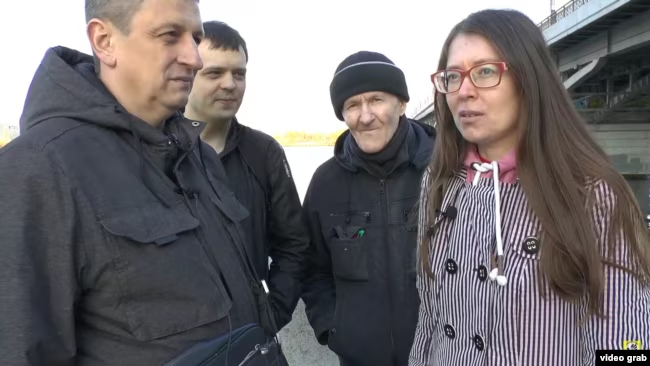
A 38-minute video was posted on the Free People of Voronezh channel on 16 April 2025. The video itself was viewed by less than three hundred people. In the video, four activists—Grigory Severin, Nadezhda Belova, Yuri Avsenyev, and Alexander Zheltukhin—discuss the news before jogging along an embankment of the Voronezh River. The genre is the “coffee klatch”: using the news as a springboard, the friends talk about the problem of alcoholism, apathy in society, increasing drug use, and the overall sense of doom and gloom.
Activists of the Telegram channel Free People of Voronezh: Grigory Severin, Alexander Zheltukhin, Yuri Avsenyev, and Nadezhda Belova
Nadezhda Belova sums up the video’s content at the very beginning.
“To cut it short, everything is bad, but it will get worse. To put it in a nutshell, the situation in this place is at the terminal stage,” she says.
She argues that Russia is inevitably moving in the direction “North Korea”—toward a mothballed, rotten dictatorship, because Russians “somehow still support it and want to live in it.” Belova has reason to be pessimistic: even before the war, the state had charged her with “condoning terrorism” for comments she had made on social media in the wake of Mikhail Zhlobitsky‘s [suicide] bombing of the Arkhangelsk FSB. in 2020, a military court sentenced Belova to pay a fine of 400,000 rubles. She was on Rosfinmonitoring’s list of “terrorists and extremists” for several years, and her family had to leave their home village and rent a flat in Voronezh, as their fellow villagers did not support Belova in her fight against the unjust charges.
The video posted on the Telegram channel Free People of Voronezh on 16 April 2025
“Again, the whole of Voronezh is covered with drug adverts. The law enforcement agencies run protection for [the illegal drug trade], and if they didn’t run protection for it, there wouldn’t be these adverts. At my neighborhood Pyaterka [convenience store], right at the entrance, there is a graffito painted in color on the doorstep: ‘Buying a stash is like going out for bread,'” says Alexander Zheltukhin. In previous years, Zheltukhin was fined for picketing against Belova’s persecution and arrested for protesting in support of Navalny. “And if it was not protected, I would argue, by the selfsame FSB, who probably take a percentage from it—”
“Watch out! You are discrediting the FSB,” Belova says, interrupting him. “I don’t agree! It cannot be!”
Caveats and omissions run through the entire conversation. The activists know that any free speech is potentially dangerous in today’s Russia, and they try to cover their bases whenever possible. (Spoiler: it didn’t work).
“They say it’s impossible not to confess”
A few days later, on 22 April, police raided the homes of all four people involved in the run, as well as those of other Voronezh activists. Searches were done at eight locations, allegedly connected with Free People of Voronezh. In most cases, the law enforcers acted extremely harshly. They used handcuffs and stun guns, beat people, intimidated the activists and their families, and emotionally abused them.
A photo posted by Nadezhda Belova
All the members of Belova’s family were shot with a stun gun. Belova later posted photos of her own bruises and the bloody marks on the bodies of her husband and son on Facebook. The police confiscated all their electronic devices and turned upside down their rented flat, which the landlady demanded that the Belovs vacate immediately after the search. The police threatened to send the son, a university student, to the war, and after the search, a policeman recorded a repentant video featuring Belova.
“Off camera, the [policeman beating Belova’s husband] says, ‘Do you support the [special military operation]?’ I say, ‘Yes.’ He says, ‘Do you support Putin?’ I say, ‘Yes.’ It’s light fare, but disgusting, especially when I saw a stun gun pressed against my son’s leg,” Belova told Okno.
The police recorded similar video “confessions” by several other people [caught up in the raids].
After the searches, Zheltukhin ended up in hospital with five broken ribs and several damaged vertebrae. He told OVD Info that he had tried to escape from the “punitive operation” and fell from the roof of a village house: “I broke my ribs when I fell, apparently, and they hit me [on those ribs]: it hurts a lot.” The police put a bag over his head and shocked him with a stun gun. His friends later photographed Zheltukin at hospital: his face was covered with bruises.
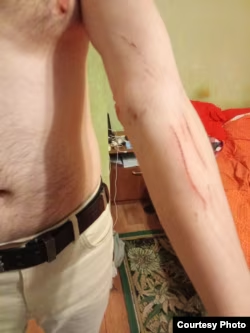
Fyodor Orlov, 36, was also beaten; after the experience, he says that he “did it all to himself.” He inflicted all the bruises and abrasions on himself, blindfolded himself with a scarf and sat like that for two hours, and fell into a briar bush on his own; there are photos of his back, entirely covered with flecks of blood. “Then someone—that is, I—drew a sex organ on my bald head just for fun,” he told OVD Info. The law enforcers also threatened to cut off one of his fingers, leaving behind telltale scratches.
Fyodor Orlov’s finger
“It was quite rough. As rough as possible, to the point that they say that now they understand why people confess to crimes they did not commit. Because, they say, it’s impossible not to confess. Orlov has several hundred stun gun marks [on his body]. Several hundred! They drove him into the woods. He thought they were taking him there to kill him,’” says Pavel Sychev, 38.
Sychev is a Voronezh activist and political consultant. He knows the administrators of the Free People of Voronezh channel from his past work as an activist: they crossed paths at pickets, but do not keep in close contact. Sychev’s home was also searched on 22 April, but there was no violence.
“[The police] search my home, as a rule, without breaking the law, and they never use force against me or my family. They have been coming to my home every year since 2022. These are just routine searches. I have always been searched as a witness in criminal cases to which I don’t even have an indirect connection,” says Sychev. “There is a federal case [for example, the case against Grigory Melkonyants and other activists of the Golos movement—Okno], and they do a series of searches all over the country, and they come and search my house for good measure.”
“Evil loves silence”
It is unlikely that the new series of searches was occasioned by the latest video posted on the Telegram channel. Our sources suggest, rather, that the reason for the raids was that Free People of Voronezh constantly writes and speaks about people convicted on charges of high treason and terrorism (for sabotaging railroad switch boxes, cell towers, etc.). The channel admins treat these people as anti-war resisters. For law enforcers, on the contrary, they are criminals convicted of violent crimes.
The formal pretext for the series of searches on 22 April was the criminal case, on charges of repeated discrediting of the army, brought against Grigory Severin. As follows from the indictment, while serving his sentence in a penal colony [he had been sentenced to two and half years in prison for “publicly calling for extremism”; he served his time and was released last autumn—Okno], Severin discredited the Russian armed forces. After the search, he was detained and placed under arrest.
Sychev believes that this criminal case was “canned.”
“You see, in Russia we have the practice of ‘desk drawer cases.’ Meaning you already have a criminal case against you: the entire case file is ready in advance, and it is lying in a desk drawer, waiting for its day to come. In the case of Severin, his first case was also ‘in a desk drawer.’ When he was arrested, it transpired that the entire case file had been readied a year earlier.”
It is not known what prompted the police to pull the case file from the drawer right now. But the fact that Severin faces prosecution does not surprise Sychev in itself.
“Everyone who knows Grigory, even in passing, realizes that he is a man who will not stay quiet. If anyone asks him directly how he feels about this or that situation, he will answer directly, even if the answer risks criminal charges. He is a man who will always try to prove to everyone the viewpoint which he espouses and defends. As far as I know, the first ‘discrediting of the armed forces’ case against him came from his explaining his philosophy of life to traffic police officers who had pulled him over. The second charge came from telling his cellmates about his stance. This in the order of things for him: he does not keep silent; he speaks openly, directly. So it was a matter of time. When a person speaks openly about a very dangerous and sensitive topic—and in our country the ‘special military operation’ is a sensitive topic—there are many chances that sooner or later they will be prosecuted.”
On the same day, a criminal case was opened against 65-year-old activist Yury Avsenyev, another person involved in the run along the Voronezh River embankment. His home was also searched on 22 April, but he was released on his own recognizance. Avsenyev is suspected of “publicly calling for extremism.”
Yuri Avsenyev
The Voronezh activists who fell victim to the police brutality have not yet worked up the courage to file complaints, and they fear excessive publicity.
“They are really spooked,” says Pavel Sychev. “The information I have now is that they will not file torture complaints, but I don’t know, maybe someone will persuade them to do it. They are very much afraid that if they do it, the law enforcers won’t be reprimanded in any way, but will just come and take revenge on them. They are all convinced that they will be killed. I told them that evil loves silence, and if you don’t react now, there is a greater chance of a repeat than if you do. But they said it’s very easy to judge from the outside when you haven’t been tortured. ‘We are afraid that they might do something to us,’ [they say].”
Our sources note that such official lawlessness had not previously occurred in Voronezh. Usually, searches at the homes of political activists and arrests were carried out by the book, without violence. The only widely known case of official lawlessness ended in criminal charges against the police officers involved and monetary compensation for the victims. In May 2018, criminal investigators Sergei Kosyanenko and Oleg Sokolovsky tortured university students Maxim Grebenyuk and Sergei Troyansky, hoping to force them to confess that they had stolen a mobile phone. The students were held at Police Station No. 4 in Voronezh’s Comintern District for six hours in handcuffs and strangled with a plastic bag. They refused to incriminate themselves, and afterwards they documented their injuries and filed a torture complaint with the Investigative Committee. In 2021, Grebenyuk was awarded one million rubles, and Troyansky, 500,000 rubles, in compensation for their suffering.
The Voronezh police’s current brutality may be due to the proximity of the front, suggests a source who requested anonymity. The fact is that, since the start of the full-scale invasion, Voronezh law enforcers have regularly been seconded to the so-called new territories, the occupied Donetsk and Luhansk regions.
“There are quite big problems with the law in those ‘new territories.’ And the practices that are used there are inhuman, I think. When they come back here, to their native land, they simply do not reconfigure themselves,” says our source, who is not connected with the Free People of Voronezh Telegram channel. “They consider themselves above the law. They think that they are involved in a good cause, and they can torture bad people for the sake of the good cause. When a person has tried their hand at it once, when they realize that they can get away with it absolutely scot-free, then it is quite difficult to put the brakes on, and it will grow.”
The 45-year-old resident of the Tatarstan capital with the exotic first name and surname and the patronymic Petrovich has four prior criminal convictions
Holy Week has kicked off for a Kazan defendant with a quite uncommon name: Jesus Christ. The 45-year-old Kazan resident has been charged with falsely registering forty-five migrant workers at his address. Jesus Petrovich has prior repeat convictions for burglary and robbery, and in 2014 he underwent preventive care for substance abuse. Business Online reports on Christ’s failure to appear at his court hearing, and the “way of the cross” he has blazed through Kazan’s district courts.
This photo by Business Online reporter Eva Malinovskaya appears in her original article, but it is impossible to say whether it was taken at Jesus Petrovich Christ’s abortive court hearing in Kazan on Good Friday 2025.
Jesus Petrovich’s “Good Friday”
The biography of Kazan’s latest criminal defendant would not be too different from the average person’s — the divorced and unemployed high school graduate will turn forty-six on the tenth of May — were it not for one catch. His name is Jesus Christ: that is the name listed in his [internal] passport.
The story of how he got the name remains a mystery: neither the court staff nor the state prosecutor know what Christ’s name at birth was. All that the people involved in the criminal proceedings know is that the defendant was “obsessed” with numerology, and this led, allegedly, to his decision to change his name and surname several years ago. He kept only his real patronymic: Petrovich.
Christ was scheduled to appear before the Moscow District Court (the Kizichevsky Vvedensky Monastery is situated right next door to the court building on Justice Street ). The current case against Jesus Petrovich is an anniversary of sorts: he has four prior criminal convictions, having blazed a trail through the city’s district courts on his own “way of the cross.”
Jesus was first convicted in 1994 by the Lenin District Court (now the Aviastroitelny District Court) of robbery, per Article 145.2 of the RSFSR Criminal Code. He was given a two-year suspended sentence. Since his next conviction, for theft, per Article 144.2 of the RSFSR Criminal Code, was handed down by the Novo-Savinovsky District Court, he was given the standard sentence: two and a half years in a medium-security correctional labor colony and confiscation of his property.
After serving his sentence, Christ did not enjoy his freedom for long. In 1999, he appeared before the Volga Regional Court, where he was sentenced to nine years in prison per Article 162.3.g of the Russian Federal Criminal Code, for “robbery committed by a person previously convicted two or more times of theft or extortion.” The convict was sent to a maximum security penal colony and was released in 2007. A little more than a year passed before Christ again came before the Lenin District Court, which by then had been redubbed the Aviastroitelny District Court. He was sentenced to another three years in prison per Article 158.3.a of the Russian Federal Criminal Code, for “theft involving home invasion.”
In addition to his criminal record, Christ had a penchant for illegal substances. From 2014, he was registered with a substance abuse therapist, but not for long, according to his personal file, as submitted to the court. In 2015, a forensic psychiatric expert commission found that Jesus had an organic personality disorder, and he was removed from the substance abuse registry. His mental illness had been triggered by a severe head trauma received in 2010. At the time, Christ did not complete his treatment, leaving the hospital on his own. He was also diagnosed with brain malfunction due to multiple organ dysfunction syndrome and was thus registered as a class III disabled person.
During his last clinical examination, psychiatrists noted the patient’s irritability, brashness, inflated self-esteem, pretentiousness, egotism, and mood swings. Although Jesus’ truculent personality was palpable, it was not significant enough to warrant hospitalization, so his diagnosis was not a factor in the criminal investigation.
The charges
What is Christ accused of this time round? According to police, whose account has been corroborated by the prosecutor’s office, between April and December 2024, Christ registered forty-five foreign nationals as residing in his 31.9-square-meter flat. With the consent of the foreigners, Jesus filled out foreign national residential arrival notices in which he identified himself as their host and provided the address of his flat. He then submitted arrival notices to the Moscow District office of the Tatarstan Multifunctional Public Services Center.
The prosecution is certain that the foreigners did not reside at their registered address. The false information about the arrival of forty-five individuals, as received by the migration department of the Russian Interior Ministry’s Kazan office, was registered and entered into the federal migration registration database. Christ faces up to five years in prison.
“The case is quite ordinary. [Police officers] examine the Multifunctional Public Services Center’s identification numbers and files and identify violators,” said assistant prosecutor Nadezhda Moshkova in a conversation with Business Online before the court hearing.
Common practice in such cases
Such cases are not uncommon. There were several such cases in a row in February alone. Six Tatarstan residents and a foreigner were charged with organizing the illegal immigration and falsified registration of more than three thousand foreigners. Later in the month, three more cases of unlawful employment agreements, involving two thousand migrant workers, were uncovered, and on February 26 it transpired that another resident of Kazan had aided almost three thousand immigrants in registering illegally. So the list of Christ’s “apostles” is not that long compared to those of others.
“Has Jesus Christ stopped by?” the assistant judge asked hopefully over the phone exactly one minute before the start of the trial.
“No, he hasn’t,” the bailiff replied with a grin.
The mood of the people in the courtroom was upbeat, despite the fact that the “appearance” of Christ before the Moscow District Court did not take place. Moshkova assured the court that the defendant had been notified in every possible way, but she herself, even before the hearing, had not actually believed that he would show up. “He’s a curious chap,” the assistant prosecutor said, adding that defendants themselves do not like to appear at such hearings, and jokingly condoned Christ by saying that Easter had not yet arrived.
The accused himself, as it turned out, had no clue about the hearing.“What case? And wait, if a court hearing has been scheduled, why the fuck was a notification and a summons not sent?!” said a perplexed Christ, whom Business Online was able to reach by telephone. After voicing his indignation, our source asked us to leave him alone. “I have done twenty years in prison. You’ve got the wrong number, good luck,” concluded Jesus.
Nevertheless, court-appointed defense lawyer Ksenia Matveeva told us that the defendant fully admits his guilt. He had even requested expedited consideration of the case, but because of his failure to appear, the process had to be postponed to the end of May.
“I order that the defendant be forcibly delivered to the next court hearing,” the presiding judge, Nikolai Zakharov said as he concluded the proceedings. “No one has ever walked away from the court yet,” he said, shrugging.
A 45-year-old Russian national named Jesus Petrovich Christ has gone on trial in Kazan for fictitiously registering foreigners in his apartment. Information on the upcoming court hearing was posted on the website of the city’s Moscow District Court.
The defendant fictitiously registered forty-four illegal immigrants in his one-room apartment, in violation of Article 322.3 of the Russian Federal Criminal Code. In fact, [none of the immigrants] lived in the apartment. Christ did not appear in court, so the hearing of his case did not take place.
According to law enforcers, Jesus Petrovich Christ has four previous convictions — for robbery, armed robbery, and theft.
According to local media, the defendant was given a different name at birth, but he changed his first name and surname after becoming interested in numerology. The man’s patronymic is real.
A Russian citizen named Jesus Petrovich Christ is being tried in Kazan on charges of fictitiously registering immigrants. A notice of the upcoming court hearing appeared on the website of Kazan’s Moscow District Court.
A screenshot of Jesus Petrovich Christ’s court hearing record on the website of Kazan’s Moscow District Court, courtesy of Sergey Abashin
Jesus Christ is suspected of fictitiously registering forty-five illegal immigrants in his one-room apartment, in violation of Russian Federal Criminal Code Article 322.3. Despite receiving a summons to appear in court, the 45-year-old Russian national did not show up for the proceedings, and therefore the hearing of the case did not take place.
It is also known that the man was previously convicted several times — in 1994 and 1996, for robbery; in 1999, for armed robbery; and in 2007, for theft.
The statements about the war made by Muscovite political exiles cause public indignation because what they say is at odds with the horror of the situation. Instead of taking to European podiums and demanding decisive action to defend Ukraine, they ask [European officials] to lift sanctions against Russians and mumble helplessly about “one nation.”
It is obvious that, for the fourth year running, Russia has been waging not just a war against Ukraine on the front lines, but a bloody, boundless campaign of terror. Nearly every day Russian missiles kill [Ukrainian] civilians, including children. Ukrainian soldiers who surrender unarmed are executed on the spot by the Russians, or are even ritually beheaded. But you continue to talk about Russia’s “democratic future,” ignoring the fact that the entire country, including schoolchildren, has been slaving away at destroying the Ukrainians.
I am not a politician, just a microblogger who cares about current events. But even I remember InformNapalm’s OSINT investigation which showed that the Russian fighter planes bombing Ukraine are still equipped with French avionics. Without this unique equipment, Russia’s Su-30SM fighter planes are blind and cannot fly. Russia obtains this equipment through Kazakhstan, thus bypassing sanctions. The report came out a year ago. I don’t know what the situation is like now, but warplanes are still taking off from Russian airfields.
Why couldn’t you have talked about that in the French Senate? Especially since, a week earlier, a Russian missile fired from a fighter plane and packed with shrapnel killed twenty people, including nine children, in Krivyi Rih. The photo of a young [boy] in a coffin, whose face had been riddled by the tiny metal shards, is impossible to forget.
The coffins of 15-year-old Nikita Perekrest and his cousin, 16-year-old Kostiantyn Novik. Nikita’s father serves in the Ukrainian Armed Forces, and his mother took Kostiantyn in after his parents were killed. The two boys were outside in the yard when the Russian army struck Kryvyi Rih. Photo: Evgeniy Maloletka/AP/Scanpix/LETA, via Meduza
I realize that none of Moscow’s so-called opposition activists have the courage of political prisoner [Vladimir] Bukovsky and demand that Ukraine be given missiles to target Lubyanka. But you could launch investigations into the schemes by which Russia circumvents sanctions and obtains not only components for its fighter planes but also foreign chips for its missiles. You could demand that the Bosphorus be closed to Russia’s shadow fleet, which brings Putin the revenue to produce new missiles. Finally, you could show solidarity with Ukraine at least in word [if not in deed] and stop embarrassing yourself by repeating the impersonal and irrelevant slogan “No War.” You could do a lot of things in your safe havens. But instead you just wait for Putin to die and are not even ashamed to say so. Meanwhile, it is not so much the Ukrainians or the decolonizers who are waiting for you to act as it is your own fellow Russian citizens, who have not yet lost their minds and are basically living under occupation in Russia.
///
As for the ridiculous claim that it is easier for non-Russians to go to war and that is why they make up the majority [of soldiers] in the [Russian] army, according to the analytical resource buryatmemorial.org, a total of 2,425 people from Buryatia have been killed in the “special military operation” as of March 2025. And you’ll pardon me, but hardly half of them are ethnic Buryats (as you can see from the photos). This is due to the fact that ethnic Buryats constitute no more than 31% of the republic’s entire population. According to Ukrainian figures, Russian losses have already lost 933,000 men in the war. Even if we multiplied the figures for Buryatia by ten, its war dead would still roughly amount to two and a half percent of the total. I emphasize that the Buryats are an ethnic minority in their own land.
A screenshot of the website buryatmemorial.org, showing the names and faces of Buryatia’s war dead
According to Caucasian Knot, as of March 2025, 233 men from Chechnya, 121 from Ingushetia, 104 from Karachay-Cherkessia, and 112 from Kalmykia have been killed in the special military operation. Again, we can multiply this figure by ten for the sake of statistical rigor, but we still get hundredths of a percent of the total losses.
To put an end to the topic of Vladimir Kara-Murza’s ridiculous misinformation drop, yes, I saw yesterday’s post by the activist Anastasia Shevchenko, from which it follows that she was the mysterious “colleague” who shared with Kara-Murza the “observation” that it may be easier for non-Russians to go to war, while Russians find it psychologically difficult to kill Ukrainians due to their cultural affinity. Anastasia writes that the source of this hypothesis was not even her, but a third party who voiced this conjecture in a private conversation. Do you realize what has happened? This was not a scientific observation; no studies or surveys of Russian POWs were done that would indicate such a trend. This “information” came from the bush telegraph and was repeated by a [Russian] opposition politician in the French Senate, where decisions are made on the basis of the words people utter. And even after the ruckus that this delusional phrase caused among the public, no apology or explanation has been forthcoming from the politician.
Again, I am just a mom with three kids who left Russia to avoid supporting the war. In exile, I wash floors and clean other people’s houses so that I can send at least thirty dollars [a month] to the Ukrainians so they can buy drones. At night I write social media posts and read decolonial literature. I try to do anything I can to stop my former country from murdering innocent people. In my opinion, I have the right to demand that those who call themselves politicians, who have the bully pulpits and the opportunities, do something meaningful to ensure that Russia can no longer wage war.
As a Kyrgyz woman born in the last years of the Soviet Union, I never thought twice about whether my usage of the Russian language was problematic or not — until recently when I reached out to my Ukrainian friend in Russian, and she responded to me in Ukrainian.
I have been thinking about the political aspects of language since then.
Last week I was invited to a podcast to talk about de-colonial feminism in Central Asia by a research group that does memory studies in Kyrgyzstan. There we sat in a warmly lit Bishkek studio in comfortable canary-yellow armchairs — two women of clearly Central Asian descent, with names that mean ‘honey’ and ‘worship’ in our native language, discussing whether the Soviet Union was a colonial empire, and how a more than 100-years history of Russian presence in the region has disrupted and affected the lives of peoples of Central Asia. I am making smart jokes and incisive observations, we laugh, we debate, we lament — all in Russian.
Although this language was not the main subject of our discussion, we comment in passing on it — noting how intangible colonial legacies can sometimes have a constructive element to them.
It is, of course, possible for all of us to drop the language of the colonizer, whether it’s English, French, Spanish, Russian, or Chinese — and speak our own languages, but the ease and comfort of using these when trying to communicate with people outside our cultures is just so tempting! And so then the question is whether to take offense towards the language because it happens to have been “originated” by the ‘big bad’ or to ignore that and make it our own?
Russian was the language of books that took me on journeys across galaxies, of Soviet-era films that fanned the fire of idealism in me, of finding community with other post-Soviet teenagers that, like me, had traveled to the United States as exchange students. We spent the year yell-singing Kino’s songs, making the olivier salad for a New Year’s celebration, and rooting for Evgeni Plushenko in the 2001 Winter Olympic Games in Salt Lake City.
It was the language of the early science fiction stories I wrote when I was twelve, of expressing my first heartbreak in broken poetry form, and of clumsily flirting, building alliances, or of standing up to bullies.
It is also the language of differentiation — a tool of categorizing people into social strata, both inside Russia and in the non-Russian republics during Soviet times. My own mother had been ridiculed for not speaking Russian well, considered ‘dark’ and uneducated, uncultured. To this day she gets offended when my Russian-schooled siblings sometimes laugh at the little mistakes she makes when attempting to speak it because it reminds her of how she was treated when she was younger.
Not to worry though — this is a very rare occurrence, because our mom is so strong-minded that she’s bent everyone to her will, forcing everyone to speak Kyrgyz if they wanted to be understood by her. Even our dad, who was a Russian speaker with a beautifully reverberating voice, had mastered the Kyrgyz language for our mother’s sake. My siblings too, although their attempts at translating their jokes and anecdotes from Russian into Kyrgyz for our mom sometimes backfire because they do not take into account the semantic nuances of the two languages. And despite her lack of Russian, she made a successful career in the 90s as a kommersantka — just like thousands of other women who picked up the baton when the system that was oppressing them fell — traveling by bus and train to Moscow, Minsk, Tallinn, and later by plane to Meshhed, ensuring we were never hungry or dependent on anyone.
Maybe that’s a good example of how language does not have to be a cornerstone of someone’s lived experience. Some people choose to speak the oppressor’s language, some people choose not to. As long as there’s a way of making each other understood, even by mixing words or even using gestures, it’s all good.
My Ukrainian friend was so kind and gracious when I apologized for using Russian when I reached out to her, and she sent me a beautiful voice message back in Russian. I could hear she struggled a little speaking it because, as she explained, she had not spoken it in a while. She said she didn’t mind using it to communicate with me, and that she was sorry she hadn’t learned some Kyrgyz by now because she has other Kyrgyz friends too. And I was sorry I hadn’t learned Ukrainian by now. But eventually it was Russian we exchanged these lamentations in, and the question remains open to me — whose language is it anyway?
Syinat Sultanalieva is a human rights activist and researcher from Kyrgyzstan, who writes science fiction on the side when she’s not busy dissecting power structures and dynamics in the region and the world.
Lӓysӓn Ensemble of Yafarovo Village Let’s Get Together Tonight: Mishar Tatar Songs from Orenburg Region
The Mishars are an ethnic subgroup of Tatars. They have their own dialect and their own culture. The main part of the Mishars live in the Middle Volga region and the Urals.
Yafarovo is a Mishar village located in the Aleksandrovsky district of the Orenburg region.
Izhevsk long ago nabbed Tula’s de facto title as Russia’s arms manufacturing capital: the Kalashnikov Concern is headquartered there, producing shells, assembling drones, and making rifles. But in a seemingly parallel reality amid the rumble of the factories, young Izhevskers have opened an independent bookstore, and they have also been translating the Udmurt avant-garde of the twenties into Russian and publishing literary magazines. Who are these young people? And how was all of it possible?
“We’ll be having a children’s New Year’s party in there”
Five years ago, Albert Razin, an Udmurt activist and patriot, set himself on fire in the capital of Udmurtia, on the square outside the republic’s State Council building. Razin held a placard featuring a quotation from Rasul Gamzatov: “And if tomorrow my language disappears, I am willing to die today.”
In late 2024, I lived in Izhevsk a stone’s throw away from the spot where Razin had burned on behalf of the Udmurt language. It is the very heart of the city: the Eternal Flame, the republic’s government house, the opera house, a Rostic’s fast-food restaurant, the residence of the head of Udmurtia, and the Kuzebay Gerd National Museum are nearby.
Gerd (a pseudonym meaning “knot” in Udmurt; Gerd’s birth name was Kuzma Chaynikov) was a poet, folklorist, and probably the most important Udmurt of the twentieth century. In 1932, he was arrested along with other prominent members of Soviet Finno-Ugric ethnic groups as part of the fabricated SOFIN Case. [SOFIN was the acronym of the fictitious “Union for the Liberation of Finnish Peoples” — TRR.] The poet was accused of plotting to get Udmurtia and other autonomies to secede from the Soviet Union and establish a Finno-Ugric federation under the protectorate of Finland. Kuzebay was shot in 1937 at Sandarmokh in Karelia. He was exonerated in 1958.
The Gerd Museum’s website advertises a separate exhibition dedicated to the Udmurt national poet. The museum is located in the building of the former arsenal. The entrance to the main exhibit is on Kuzebay Gerd Square, where twenty years ago a monument to the poet was erected. Perched on a rock, a quite youthful Gerd gazes thoughtfully at the former military warehouse. He is writing a poem, apparently.
I am all alone at first, but schoolchildren wearing blue ties later come running into the museum. A museum worker, dressed in a traditional costume adorned with a monisto necklace, greets the children in Udmurt — Chyrtkemesi! — but she immediately switches to Russian and talks about the pre-Petrine history of Udmurtia, that is, before Izhevsksy Zavod (the name of the settlement which preceded city) arose in these parts. Count Peter Shuvalov built an ironworks there with the permission of the Empress Elizabeth. A little later, Izhevsk became the Russian Empire’s virtual arms capital (no offense to Tula).
The rooms I have visited recount this history as well as a little bit of Soviet history (artisanal carpets are intermingled with IZh motorcycles and cars — a total delight!), but I cannot go any further.
“But where is the Kuzebay Gerd section?” I wonder aloud.
“Ah, you wanted to see it?” responds the docent. “Unfortunately, it is impossible at the moment. It was in the room next to the ticket office, but it has been temporarily moved to the warehouse. We’ll be having a children’s New Year’s party in there.”
“Nobody the whole day”
Kuzebay Gerd is to Udmurtia what Pushkin is to Russia. One of the creators of the modern Udmurt language, Gerd also lived a very short life, thirty-nine years (five of them in Stalin’s camps). But over those years he wrote hundreds of articles, poems, plays, and prose works which became the foundation of the living Udmurt language.
The writer gained genuine recognition only during perestroika, and it is only recently that streets and museums have been named in Gerd’s honor and his legacy has been studied anew.
Sonya, a clerk at Kuzebay Bookstore, puts up an event flyer.
Kuzebay’s cheerful face can now be seen on posters, lapel pins, and even as an emoji on Telegram. The only independent bookstore in Izhevsk, and maybe in the whole of Udmurtia, bears his name — Kuzebay Bookstore.
Like its spiritual forebear, Kuzebay Bookstore thrives in spite of its circumstances. Today, it is an absolutely metropolitan store that is no shabbier than Vse Svobodny in Petersburg or Falanster in Moscow: Kuzebay stocks the same books on its shelves, and it has the same friendly vibe. But Kuzebay opened a year before the quarantine. Back then, it occupied a small corner at the Center for Contemporary Dramaturgy and Directing. Les Partisans Theater, in which the store’s co-founders, German and Ksenia Suslov acted, was also based there. Kuzebay achieve relative stability in early 2022, after moving to its current location.
The Kuzebay Gerd Museum in the village of Bolshaya Gurez-Pudga, Udmurtia. The museum is located in a hut next door to the local school.
“We were a quite small operation during the covid, so we didn’t give a shit whether we shut down or not,” recounts German Suslov. “We were open for deliveries. Back then, the state still paid me twelve thousand [rubles a month] for the fact that I was my own sole employee. I was like, Great, money’s coming in, cool beans. Things have somehow been growing ever since.”
German even now regularly works as a salesclerk and is awfully good at cleverly persuading people who stop by for the latest detective novel by Darya Dontsova to buy family sagas from House of Stories publishers. But the first person I meet in the store is Gosha, a tall thin salesclerk who looks like a Viking sporting a tiny cap. He sits in a cozy swing chair, playing chess on his phone. He is the only soul in the store.
German Suslov, co-owner of Kuzebay Bookstore and editor-in-chief of Luch magazine, at work.
“Is it so empty often?” I ask as I peruse Mushroom Kingdom, a wacky book by local artist Andrei Kostylev, better known as Bi-jo.
“Not nowadays, but it used to happen,” says Gosha. “This one [female salesclerk] and I even had a competition to see who had fewer people stop by the store in a day. It was a draw: zero.”
“No one at all for an entire day?”
“Yeah, it was winter, so not a single person came in. But there are always people coming in now. And even if there are no sales at the store, there are sales on Ozon almost every day.”
“The worst thing is poetry readings”
German shows up at Kuzebay about half an hour late for our interview. He is in a terrible rush, as always. The Moscow Non/Fiction Book Fair is coming up: Kuzebay is supposed to represent the publishing house and the store, and we have to send the books out in time. We pull a few boxes out of the car together, while Gosha sits down to check the books and put stickers on them. Like the many-armed Shiva, German simultaneously supervises the process, does the interview, eats a flatbread from the Tatar bazaar, pours tea for everyone, and chats with the customers who do come in.
German Suslov and Andrei Gogolev in the storage room of Kuzebay Bookstore
German has always been an energetic multi-tasker. Although he is not yet thirty, he has been a prominent figure in Izhevsk’s cultural scene for nearly ten years. He used to be an actor at the local independent theater Les Partisans, which exists to this day. But his restless nature needed something else besides theater and the history program at Udmurt State University.
“And so, I thought: the craving for theater, music, cinema was instilled in me by older comrades,” says German simply. “But what were my interests before the theater? I wrote poetry. So, I had to get into the business of poetry. And I quickly realized that no one here was doing poetry seriously.”
According to German, the literary scene in Izhevsk was rather fragmented ten years ago. There were no decent places for young people to publish and perform their work. After graduating from college, many people left for the big cities.
In St. Petersburg, a whole generation of young poets from Izhevsk emerged all at once in the early twenty-teens, including Tatiana Repina, Pyotr Bersh, Ilya Voznyakov, and Grigory Starovoitov, all of whom I know personally. Most of the members of that scene gave up writing poetry a long time ago, although Tanya Repina has achieved some fame, and my friend Petya Bersh continues to write and perform.
“When I left in the early teens, nothing was happening in Izhevsk at all. There were no prospects,” Petya, who returned to his homeland in 2022, told me. “Everything has changed now, of course, and Kuzebay has played no small role in that.”
There was no Kuzebay Bookstore at first, though. In 2016, five actors from Les Partisans dreamed up the PoetUP Contemporary Poetry HQ to consolidate Udmurtia’s most interesting poets, give them a venue, and relaunch the literary scene in Izhevsk.
“The worst thing you can imagine is an open mic poetry reading. It’s hell on earth,” says German, laughing. “And even worse is an open mic poetry reading in Izhevsk with no prescreening at all. So, what did we do in 2016? We started selecting and inviting people. Yes, we would have embarrassing events too, but far fewer. What mattered was what we were striving for. We did not want it to happen that one person would read and all his friends would get up and leave when he finished.”
[…]
Excerpted from: Ilya Semyonov (text) and Natalya Madilyan (photos), “Why does a star gurgle?” Takie Dela, 23 January 2025. Translated by the Russian Reader. I would like to finish translating this fascinating long article (this is the first quarter of it) and publish it in its entirety on this website, but that would take a lot of time and hard work. In the real world, where I have worked as professional freelance translator for nearly thirty years, I would charge 600 to 850 euros to translate this article if someone commissioned me to do it. If you would like to support my work in general and read this article in full, please donate to me via PayPal (avvakum@gmail.com) or Venmo (@avvakum). If you cannot afford to donate money right now, you can help my cause by sharing my work on social media and with friends. Thank you!
Riot police disperse protesters in Baymak, Bashkortostan, on 17 January 2024. Photo: Anya Marchenkova/AFP via Getty Images via Foreign Policy
On Wednesday, a local court in the Orenburg region handed out prison sentences to four participants of peaceful rallies in support of Indigenous activist Fayil Alsynov.
Up to 5,000 people gathered in Bashkortostan’s southeastern Baymak district in January last year to protest the imprisonment of Alsynov, a prominent Indigenous rights and environmental campaigner. The protests were followed by sweeping arrests.
Aydar Yusupov, Ilnaz Makhmutov, Zaki Ilyasov and Vallyam Mutallapov, who will spend from three to four years in a penal colony, are among more than 80 men and women facing criminal prosecution in the “Baymak case,” the largest political trial in Russia’s history.
To mark the first anniversary of the Baymak events, Kremlin-installed authorities in Bashkortostan released a propaganda film “The Anatomy of Bashkir Nationalism. The Baymak Tragedy” produced by state-aligned journalist Timur Valitov.
In her piece for From the Republics, Bashkort social researcher Iliuza Mukhamedianova considers why regional authorities invested in the film and aired it during prime time, as well as how carefully crafted smear campaign against the protesters could impact Bashkortostan’s civil society.
Kremlin-Funded Propaganda Fuels Destabilization in Bashkortostan
By Iliuza Mukhamedianova
25 minutes. That’s how much time the creators of “The Anatomy of Bashkir Nationalism” dedicate to speaking about the local national organization “Bashqort.” This is almost a third of the entire movie.
But why pay such close attention to an organization dismantled back in 2020, long before the protests in Baymak?
Perhaps, that’s the easiest way to construct an image of an almighty enemy.
In the film, “Bashqort” — an organization that aimed to reinstate Bashkortostan’s sovereignty and preserve the Bashkort language and culture — is portrayed as the ultimate evil. The filmmakers place sole responsibility for the Baymak protests on “Bashqort” members, accusing them of “extremism” and collaboration with “foreign enemy states.”
Demonizing an organization that no longer exists helps to absolve Bashkortostan’s authorities of responsibility, legitimizes their actions, and justifies their brutal response to the protests.
The film also glances over the fact that protests in Baymak were not organized by a single group like “Bashqort” or one individual but were instead a grassroots action, an organic reaction to the sentencing of activist Fayil Alsynov.
Neither does the film mention who killed protester Rifat Dautov or who tortured the many Baymak detainees. And that’s truly a shame because these are the questions we, the people of Baymak, would like to have answered.
The Baymak protests would not have gained momentum without extensive media coverage — the authorities understand this well.