The War Criminal vs. the Asylum Seeker (The Case of Danila Vasilyev)

Danila Vasilyev

Maria Tyurikova • Facebook • December 31, 2021

URGENT MESSAGE FOR MEDIA AND HUMAN RIGHTS ADVOCATES!

SHARE AND PROMOTE!

Stop deportation of Danila Vasilyev!

PREAMBLE

As a politically active young man, Mr. Vasilyev took part in various movements that took place around the presidential election in Russia in 2018.

He is also a founder of an athletics club which provided the local youth with an opportunity to exercise, take part in competitions and tournaments, as well as to participate in cultural events and activities. The athletic society was also involved in regional politics and a number of its members were political activists. Mr. Vasilyev also participated in the work of a YouTube channel that satirised current Russian political events and Russian politicians.

“War criminal V.V. Pynya”: a photo from a 2018 protest action in Perm accusing Vladimir Putin of war crimes in Ukraine and Syria. Photo by Alexander Kotov. Courtesy of varlamov.ru

As an act of civil disobedience and due to their disagreement with Russian foreign and internal policy (mainly due to the Russian aggression in Ukraine and the Russian carpet bombings of civilian population in Syria), on 11.11.2018 Mr. Vasilyev and two of his friends (A. Shabarchin and A. Etkin) organised a political performance at one of Perm’s squares. The performance consisted of a mannequin with a mask of Vladimir Putin, that was tied to a pole. The placard on the mannequin’s chest read «Военный Преступник Пыня В.В.» [Translation: “War Criminal V.V. Pynya”; this is a derogatory nickname fior Vladimir Putin.] This political performance was recorded and later published on YouTube and various social media.

On 03.01.2019 Mr. Vasilyev and his friends were detained and their homes searched. They were charged with «Hooliganism committed by an organised group in a preliminary conspiracy» (Article 213, Part 2 of the Russian Penal Code). The investigation was conducted among others by the Russian Centre for Prevention of Extremism (known as Centre E), which in reality is one of the main tools of oppression and are frequently used to suppress and terrorise the opposition. The case and the course proceedings were covered by a variety of Russian and international media, while a number of organisations and individuals called the case a political one. On 18.08.2020 A. Shabarchin and D. Vasilyev were found guilty.

Mr. Vasilyev’s sentence ended on 18.09.2021.

THE GETAWAY

Due to persecution Mr. Vasilyev decided to leave Russia and seek political asylum in Europe. Once his probation term ended, he applied for and subsequently received a Hungarian tourist visa and on 14.10.2021 arrived in Budapest. His intention was to seek political asylum in Hungary in accordance with the Dublin Regulation. Upon arrival he reported to a Hungarian police officer at the Budapest Airport, who directed him to an immigration centre where he was informed that Hungary does not accept refugees, asylum seekers and does not grant political asylum. He was instructed to travel to Austria.

He was never able to apply for political asylum in Hungary, no formalised procedure took place (including verbal application), he was not at any point taken into custody and the Hungarian authorities refused to provide any written acknowledgement of his presence there.

He spent the night in a hostel in Budapest and the following day of 15.10.2021 took a train to Vienna.

Upon his arrival at Vienna Central Station on 15.10.2021 (Friday) evening, Mr. Vasilyev entered a local police station where he stated that he seeks political asylum due to persecution in his homeland. Once again he was unable to apply for asylum. He was given a piece of paper with the address of the nearest immigration centre and was told to report there on Monday. As his Schengen tourist visa was still valid for several days, Mr Vasilyev was able to leave the police station and for the next two days was hosted at a private residence of compassionate Austrian nationals.

The day of his arrival in Austria, the Russian authorities arrested a number of his friends and colleagues from the Perm athletic club. Mr Vasilyev’s flat was stormed by the Russian police and his whereabouts were investigated by both police and Russian security services.

On 18.10.2021 he reported to the Refugee Centre at Traiskirchen in Lower Austria, as it was established that he was under no legal obligation to report to the Viennese centre that he was referred to. There, Mr. Vasilyev once again attempted to seek political asylum, however, he was told to report to the Refugee Centre located near the Vienna International Airport Schwechat where he was finally able to apply for political asylum and begin the asylum seeking process as defined by the laws of the Austrian Republic. Following the required first interview he was transferred to the Traiskirchen Refugee Centre.

On 23.10.2021 Mr Vasilyev was transferred to a Refugee Centre in Ohlsdorf, Upper Austria, on the outskirts of Gmunden.

AWAITING DEPORTATION FROM AUSTRIA

On 27.12.2021 Mr Vasilyev received a letter from the Austrian authorities that suggests his eminent deportation to Hungary, in accordance with the Dublin Regulation. On the 29.12.2021 he was able to discuss the document in question with an advisor provided by the Bundesamt für Fremdenwesen und Asyl who failed to clarify the nature of the letter and was unable to communicate with Mr. Vasilyev in a language that he could understand. On 30.12.2021 Mr Vasilyev contacted the responsible agency (Bundesamt für Fremdenwesen und Asyl) with the desire to clarify the content of the letter and in order to preemptively appeal the possibility of deportation.

The Hungarian authorities instructed Mr. Vasilyev to travel to Austria in order to seek political asylum. The current Hungarian government led by Victor Orban is on good terms with the current Russian regime and will undoubtedly repatriate a Russian national who seeks political asylum. The practices of the Hungarian government in regards to refugees and asylum seekers have been criticised by both the UNHR (United Nations High Commissioner for Refugees) and the ECHR (European Court of Human Rights).

It is very likely that the Russian Federation will demand Mr Vasilyev’s extradition based on falsified criminal charges. In the event of his return to the Russian Federation, Mr Vasilyev will be arrested and tried on either false criminal charges or charged with one of the offences that the Russian prosecution service is currently attempting to pin on his friends and his colleagues from the Perm athletic club. A number of them were arrested in October 2021 and several are awaiting trial. In recent years, the regime of Vladimir Putin frequently tries political activists and opposition figures on fabricated criminal charges.

If Danila Vasilyev is returned to Russia and imprisoned, it is possible that he will not survive prison. Those who oppose the Russian government are frequently murdered while incarcerated, tortured by the prison authorities and denied medical assistance. The most prominent case is that of Sergei Magnitsky, a tax advisor who uncovered large-scale corruption and died in prison due to denial of medical assistance. His death resulted in international outrage and a number of sanction lists against Russian officials, enacted by the European Union and the United States.

!!! WE URGE ALL MEDIA, HUMAN RIGHTS ADVOCATES, DECISION MAKERS, and all [concerned] people to stand up for Danila and PREVENT THE EXECUTION OF THE OFFICIAL DECISION TO DEPORT HIM TO HUNGARY and further to the Russian Federation !!!

(Credits to Democratic Movement for Freedom in Russia – Vienna, Austria , Michael Alexander Albert Korobkov-Voeikov for the text)

I have edited this message slightly to make it more readable. ||| TRR


Russian Jets Knock Out Water Supply In Syria’s Idlib • RFE/RL • January 2, 2022

Russian warplanes have bombed a pumping station that provides water to rebel-controlled Idlib city in northwestern Syria, potentially depriving hundreds of thousands of people in the overcrowded city of water, according to witnesses and a monitoring group.

Russian Sukhoi jets dropped bombs in Idlib and several surrounding villages on January 2, witnesses and the U.K.-based Syrian Observatory for Human Rights monitor said.

“Reliable sources said that Russian fighter jets have so far carried out nearly 10 air strikes targeting the vicinity of Al-Sheikh Yusuf village in western Idlib countryside, the vicinity of the central prison near Idlib city, and the vicinity of Sejer water station, which feeds Idlib city and its western villages, leaving the station out of action as pipes have been damaged,” the Syrian Observatory for Human Rights said.

An official at the city’s water utility service confirmed the pumping station was out of action as a result of the strikes.

There was no immediate comment from the Russian or the Syrian armies.

More than 3 million civilians live in jihadist and rebel-controlled Idlib Province, many of them displaced from other parts of Syria during the country’s decade-long civil war. Most of the population in Idlib is dependent on UN humanitarian assistance to survive.

In March 2020, Russia, which backs Syrian President Bashar al-Assad’s forces, and Turkey, which supports some opposition groups, agreed to a de-escalation zone in Idlib. However, rebel attacks and Russian and Syrian bombing have continued despite the cease-fire.

Turkey has thousands of troops deployed at bases in Idlib to deter a Syrian Army offensive, which it fears would push millions of people across the border as refugees.

Syrian and Russian planes have carried out deadly aerial strikes on schools, hospitals, markets, and other infrastructure in Idlib Province that UN investigators and rights groups say may amount to war crimes.

Jihadist factions have also been accused of carrying out possible war crimes.
Foreign Agents

Lyudmila Savitskaya • Facebook • December 28, 2021

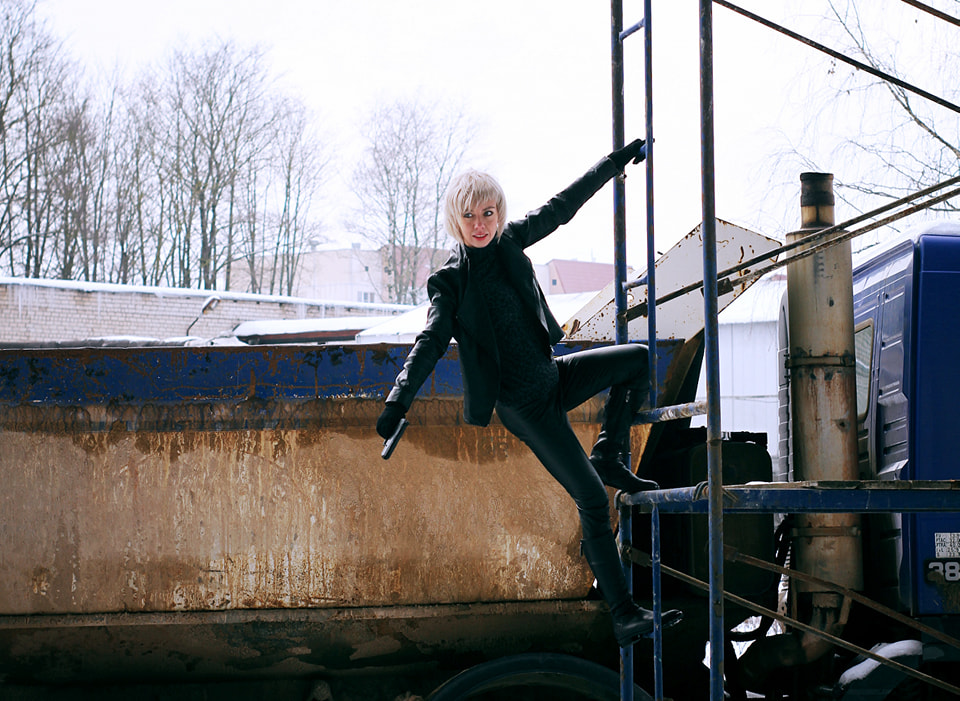
A year ago, the Russian authorities labeled me a foreign agent. THIS MESSAGE (MATERIAL) WAS CREATED AND (OR) DISTRIBUTED BY A FOREIGN MASS MEDIA OUTLET PERFORMING THE FUNCTIONS OF A FOREIGN AGENT AND (OR) A RUSSIAN LEGAL ENTITY PERFORMING THE FUNCTIONS OF A FOREIGN AGENT. During these 365 days, one of my bank cards was blocked on suspicion of money laundering, I was fined over ten thousand rubles for the Journalist-Foreign Agent LLC that I created by order of the Justice Ministry, and I was deprived of the opportunity to work on certain projects. Antidepressants appeared in my medicine cabinet, and a psychiatrist became one of my friends.

My husband Dmitry Permyakov was turned into a family member of an enemy of the people: as a person affiliated with a “foreign agent” he was summoned for questioning by Center “E” and threatened with torture in prison. And another person close to the police called to solicitously warn us that our home had been bugged. You can read this year’s other sad particulars in my column for Sever.Realii – “Luda, the floor is burning under your feet!” (See the link in the first comment.)

But here you can admire my super agent photo shoot, which was cold but quite a lot of fun. No time to die, happy new year!


Russia Labels Pussy Riot Activists, Satirist ‘Foreign Agents’ • Moscow Times • December 30, 2021

Russia has added members of the Pussy Riot art activist collective, a prominent satirist and an independent journalist its registry of “foreign agents” Thursday.

The designations close a year in which Russia labeled nearly every major independent domestic news outlet, as well as dozens of individual journalists and activists, a “foreign agent.”

Founding Pussy Riot member Nadezhda Tolokonnikova and fellow member Nika Nikulshina have been added to the Justice Ministry’s “foreign agents” registry.

Tolokonnikova, 32, was among the Pussy Riot members who were sentenced to prison for their 2012 protest performance in central Moscow’s Christ the Savior Cathedral that criticized the Russian Orthodox Church’s close ties with President Vladimir Putin.

Anti-Kremlin satirist Viktor Shenderovich; Taisiya Bekbulatova, chief editor of the independent Holod news website; and art collector and former Kremlin advisor Marat Gelman have also been added to the list.

“These people systematically distribute materials to an indefinite circle of persons, while receiving foreign funds,” the Justice Ministry’s statement said.

The ministry’s registry now includes more than 100 entities and individuals, most of which were added in 2021.

Rights advocates denounce the country’s “foreign agents” law, saying it seeks to silence groups and individuals that dissent from state narratives by branding them with a label that carries dark connotations from the Soviet era.

Labeled individuals and entities must submit regular financial reports and detailed lists of income and spending, as well as prominently display a wordy disclaimer on all articles, social media posts and other publications — or else face criminal charges.

But officials defend the law, pointing to what they say are harsher equivalent laws in Western countries.

On Monday, prominent BBC Russian investigative journalist ​Andrei Zakharov said he left the country two months after being labeled a “foreign agent,” saying he faced “unprecedented surveillance” following his designation.

And Russian courts this week ruled to liquidate the two main structures of Memorial, Russia’s leading human rights group and a key pillar of its civil society, citing repeated violations of the “foreign agent” law.


Alexander Morozov • Facebook • December 30, 2021

After seeing today’s list of “foreign agents,” I thought: is any more proof required that this status is exclusively political, that its legal aspect does not matter at all? These are not foreign agents in the sense of “lobbyists of a foreign state.” They are “agents of the West” (in the broad sense of “the hostile West”). In this respect, their status directly depends on the Kremlin’s conflict with the outside world. The next stage of escalation (which, in my opinion, is inevitable) will automatically mean that, regardless of their legal status as “foreign agents,” the people on the list will be criminally prosecuted. After all, the list is “good to go”: it exists and therefore should be put to work. So the list is no joke at all. Anyone who does not leave the country before the Kremlin’s conflict with the West accidentally escalates will end up behind bars. Therefore, I won’t congratulate people dear to me on having this label conferred on them. It’s a very dangerous and grim business.


Pussy Riot • Facebook • December 30, 2021

THIS MESSAGE (MATERIAL) CREATED AND DISTRIBUTED BY A FOREIGN MASS MEDIA PERFORMING THE FUNCTIONS OF A FOREIGN AGENT

two of Pussy Riot, Nadya Tolokonnikova and Nika Nikulshina, were added to the government list of “foreign agents” & required to start every tweet w this disclaimer.

OFFICIAL REACTION:

1. lol

2. we will not label my posts, the government can label their asses if they’d like.

3. we will appeal in court.

4. Russia will be free.


Matvey Ganapolsky • Facebook • December 30, 2021

I want to say what will happen with the Russian media in 2022.

1. Domestic opposition media outlets will be destroyed and gutted. TV Rain and Echo of Moscow will have huge problems, including closure or reformatting, because they broadcast oppositional viewpoints. Neither [Alexei] Venediktov nor [Nobel Peace Prize winner Dmitry] Muratov will be able to save them.

2. Under various, poorly concealed pretexts, the local offices of Radio Svoboda [Radio Liberty] and the BBC will be closed. Radio Svoboda’s internet broadcasts and podcasts will be blocked, as well as the websites of these companies. VPNs will also be blocked.

3. The West will find itself in a paradoxical situation in which it will be necessary to resume short-wave broadcasting. Russia will respond by jamming them. Young people will run to their grandparents to retrieve old radios.

4. The media situation will be at the level of the late USSR. It will change only with Putin’s departure or death.

Items 1, 3, and 5 translated by the Russian Reader

The Singuniversal Wages of Glocalism

“The Slavic peoples are like one family. I can’t bear the idea of fighting with Ukraine.”
— Man skating on Moscow’s “packed” outdoor ice rink, quoted on “PM,” BBC Radio 4, 20 December 2021

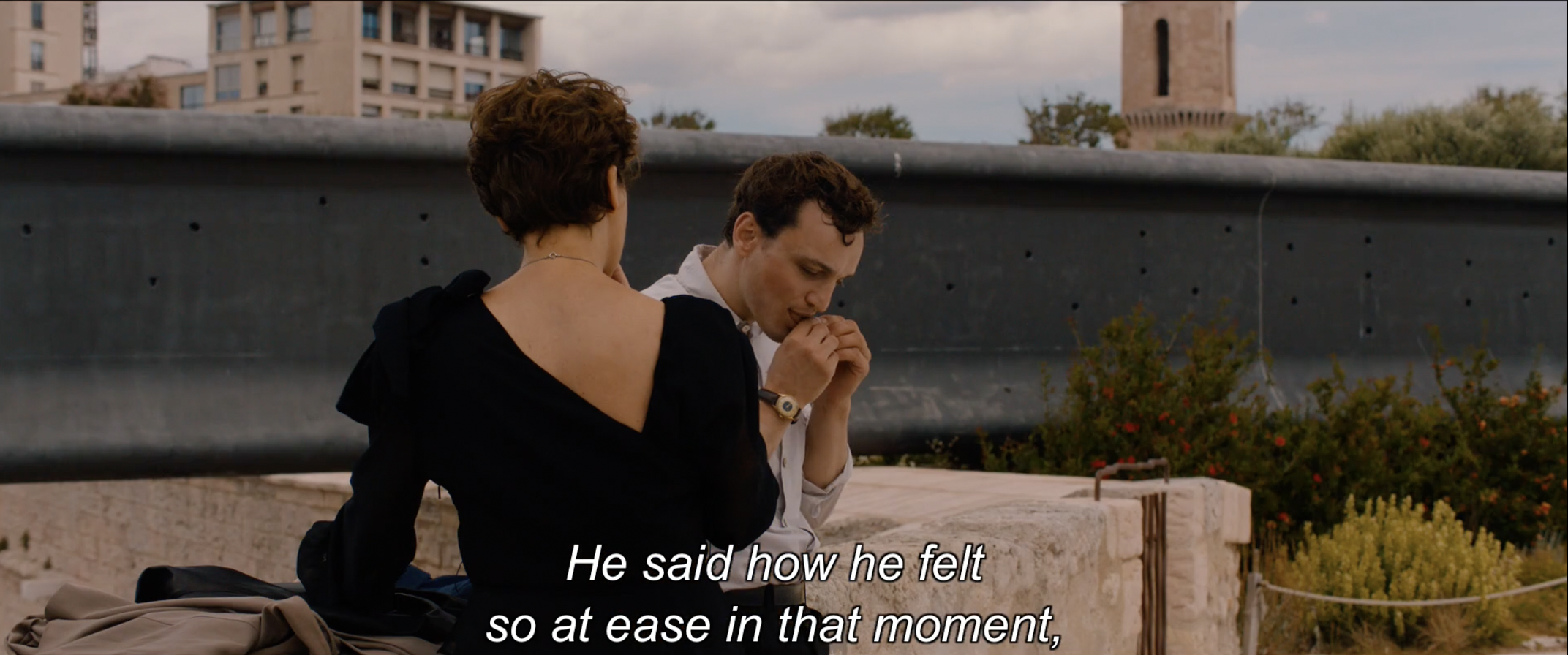
A still from the film Transit (Christian Petzold, 2018)

Beyond freedom and justice, peace on earth is the ultimate purpose of political action. Violence and aggressivity are among the instincts that our nature has equipped us with to achieve the purpose of peace via devious and costly ways. This is Kant’s thesis in Idea of a Universal History from a Cosmopolitan Point of View. I find it realistic, politically. Art is ridiculously powerless on the political level. Its domain is the purposiveness without the purpose. It places its bets on sensus communis, the faculty of agreeing by dint of feeling, as if it were an instinct, knowing well that the chances are great that it is merely an idea. My talk, I realise, is a plea for empirical pessimism combined with transcendental optimism, which is why I embraced neither the optimistic nor the pessimistic view of today’s glocal art world. I am the observer who reflects on the situation. But I am a militant when I claim that there is a difference between the expanding glocal communities involved by the various art biennials and the singuniversal community demanded by the aesthetic judgement when it is uttered as ‘this is art.’ The latter community is humanity itself, all of us.
— Thierry de Duve, “The Glocal and the Singuniversal: Reflections on Art and Culture in the Global World,” Third Text, vol. 21, no. 6 (2007), pp. 687–88

_________

On August 2, 2013, Russian Paratroopers Day, Kirill Kalugin, a Petersburg university student, took to the city’s Palace Square alone to protest the country’s new anti-gay laws. He was immediately set upon by reveling paratroopers (or as he himself suggested, by national activists masquerading as paratroopers), an incident captured on video by Petersburg news website Bumaga.

Kalugin returned to Palace Square this year on August 2 to protest Russia’s increasing militarism and imperialist misadventures in Ukraine. He was roughly detained by police some fifteen seconds after attempting to unfurl a rainbow flag emblazoned with the slogan, “My freedom defends yours.” Despite the fact that Kalugin held his anniversary protest right next to Manifesta 10’s provocative metallic Xmas tree, his protest has so far gone unremarked by progressive humanity (i.e., the international contemporary arts community) and the foreign press.

The interview below was published in August 2013 on the local Petersburg news web site Rosbalt three weeks after Kalugin’s first protest on Palace Square. Unfortunately, it hasn’t lost any of its timeliness, especially given the total absence of an anti-war movement in Russia and the singularity of Kalugin’s bravery and insight.
— “Kirill Kalugin: ‘My Freedom Defends Yours,'” The Russian Reader, 5 August 2014

_________

Alexander Hotz
Facebook
December 17, 2021

A Treaty on the “End of History”

Over time, it has become clearer why the Putin regime started rattling military hardware near the borders with Ukraine. It’s not only about the fear of “NATO expansion” and the struggle for a sphere of imperial influence, as it had seemed at first.

Putin’s “draft treaty” with the collective west is a more profound, existential document, reflecting the regime’s fear of the logic of history, which naturally pushes Russia along the path of European progress and demolition of the dictatorship.

A desperate Putin has offered the west something in the spirit of Fukuyama that would secure the “end of history” and guarantee that the “political system” of Putin’s Russia would remain unchanged. The belief in the power of a document that would stop historical progress is somehow touching in its naivety.

Fully in keeping with Saltykov-Shchedrin’s imaginary town of Glupov, where “history has stopped flowing,” the Putin regime does not propose ruling out “NATO expansion” as such. Rather, it dreams of consolidating the rejection of support for “color revolutions” in Russia, as if revolutions were fueled not by the system’s rottenness, but by the insidious west.

That is the funniest thing about the draft “treaty.” It transpires that it has nothing at all to do with NATO and imperial ambitions in the spirit of a “Yalta 2.” It has everything to do with humdrum fear for the internal stability of Putin’s political system. The deal proposed to the west is not fueled by imperial ambitions (although lip service is paid to them in the treaty, it is unlikely that its authors themselves believe that Ukraine can be returned to Russia’s imperial orbit), but by fear of impending revolutionary change.

It is especially comical that a whole paragraph of the preamble is dedicated personally to Alexei Navalny, his regional organizations, and the Anti-Corruption Foundation (FBK).

Navalny’s surname is not mentioned, but it sticks out of the draft treaty like a sore thumb. Putin demands “strict compliance with the principle of non-interference in the internal affairs, including refraining from supporting organizations, groups or individuals calling for an unconstitutional change of power, as well as from undertaking any actions aimed at changing the political or social system of one of the Contracting Parties[.]”

The Putin system’s fear of “individuals,” which has even seeped into the text of an international document, is impressive in its scale.

All is in order with the demagoguery here too. It is a con man’s clever trick to tear up the Russian Constitution through a “plebiscite,” change the political system, and then demand respect from the west for it. (Redraw the borders, grab Crimea, and then yell about the “principle of non-interference.”)

We are going back to the bad old Soviet Union in terms of international agreements. What kind of language is this? “Changing the political system”: as if we were not talking about democracy (something shared by Russia and the west), but about the struggle between two political economic formations — between capitalism and socialism.

It is no accident that the “Union of Soviet Socialist Republics” has wormed its way into the “treaty” in homage to the glorious Soviet past, for which the Russian kleptocracy yearns. In the 1970s, however, the Kremlin demanded that the west keep its hands off its socialist ideology. Today, the demand is different: “Keep your hands off our kleptocracy!”

The Kremlin stubbornly reproduces the worldview which collapsed along with the USSR a long time ago. Putin has not learned any lessons from history, however.

In fact, the whole draft “treaty” with the west is a desperate call to stop history, freezing Putinism’s collapse due to its internal depravity. It is an attempt to pretend that the reason for the failures of the “social system” is the west’s influence and support of Navalny. It was the same way in the USSR, which sought the cause of its own decrepitude in dissidents, “anti-Soviet agitation,” and “western propaganda.” But the cause was much simpler. Everyone was fed up with the Soviet regime: that was why it collapsed.

The “elites” of the “Pu dynasty” have learned nothing. They want everything to be as it was under “granddad” (Leonid Brezhnev), offering the west an immoral and anti-historical picture of the world in which there is no place for living history with its logic of progress, only for the “insidious influence” of secret services and foreign agents.

They have “Chekism on the brain,” as has been said. A fatal case of it.

But there is an upside to this ridiculous document and its proposal to put the “end of history” down on paper à la Ugryum-Burcheev. It gives us a glimpse of the finale awaiting a “political system” which has lost touch with reality and lives in a dream world.

If you don’t understand where history is headed, have a mystical dread of progress, and are nostalgic for the bad old Soviet Union, then ultimately you’ll get another “geopolitical catastrophe,” one for which you will be to blame, not Navalny or the United States.

Strange as it may sound, Putin wants the United States to subscribe to his version of history. This is not a dispute over spheres of influence, but over what kind of world we live in. The madman wants the doctors to recognize his hallucinations as the norm. (The doctors don’t know what to do with the patient yet: he is not alone in the ward and has a knife in his pocket.)

But regardless of how things turn out for the “crazy old man,” kudos to Alexei Navalny. It is not given to just anyone to be identified in Russian Foreign Ministry documents as the principal threat to Russia and its “political system.”

Thanks to Alexander Skobov for the heads-up. Translated by the Russian Reader

Alexander Skobov: Molotov-Ribbentropp Pact 3.0

Molotov-Ribbentropp Pact 3.0
Alexander Skobov
Kasparov.ru
December 18, 2021

Major props to Sergei Parkhomenko for bothering to read the preamble to the Kremlin’s proposed treaty with the United States. As he quite rightly pointed out, no one reads the preamble, because the preamble is usually just high-minded blah-blah-blah. You have to look at the specific points and clauses in the main text.

In this case, it’s the other way around. All the points about the non-deployment of missiles are the blah-blah-blah, the bow on the behemoth, the pretty packaging. It is the preamble that contains the  point of the whole undertaking. It expresses the essence of the “brave new world” for which the Chief Salamander in the Kremlin is waging his war on humanity. And it is no Yalta 2.0 at all. It is completely different.

Yalta has been unfairly slandered by modern journalists. There is not a word in any official document issued by the Yalta and Potsdam Conferences about carving up the world into spheres of influence. All the official communiques are strictly in the spirit of Woodrow Wilson’s global liberal project.

Yalta did have a “false bottom,” of course. Behind the scenes, the leading powers did actually try to negotiate spheres of influence. And the Allies did recognize that the new regimes of Eastern Europe should be “friendly” towards the USSR. But no one said that they had to be totalitarian.

Apparently, the Allies imagined the future of Eastern Europe as something on the order of post-war Finland, a country that was quite “friendly” to the USSR, but retained a liberal-democratic political system. Were they naive? Or did they cynically and hypocritically pretend to believe Stalin? In any case, in 1947 they had every reason to conclude that Stalin had hoodwinked them. That is when the Cold War began. Over its entire duration, the west declared support for the struggle for freedom by all peoples who found themselves under totalitarian rule. This support remained firm during periods of extreme tension, and during periods of “detente.”

Today, the Chief Salamander demands that the United States “refrain[] from supporting organizations, groups or individuals calling for an unconstitutional change of power, as well as from undertaking any actions aimed at changing the political or social system” of the Russian Federation and its allies. In the second supplementary protocol to the Molotov-Ribbentrop Pact (the German-Soviet Boundary and Friendship Treaty, signed September 28, 1939) there was an amazingly cynical point. The parties pledged to jointly combat “Polish agitation” in the territories under their control—that is, to assist each other in fighting the Polish Resistance.

The treaty partners then adopted a number of measures against political emigration as “gestures of goodwill.” Hitler was not particularly zealous in this respect, by the way. He limited himself to a rather formal ban on the activities of the White emigre organization NTS — although the Gestapo did not particularly bother preventing the members of this organization from gathering “for a cup of tea.” Stalin went much further. He handed over to Hitler more than 200 German communists who were fleeing the Nazi regime in the USSR. He set a good example of genuine partnership.

The Hitlerite in the Kremlin dreams of a world in which the United States forces its European allies to stop the activities of political emigres from the Russian Federation and its satellites, to ban their conferences and “agitation,” and of course, to extradite them to Moscow at the first request. Putin demands that the United States become a Third Reich. Putin seeks to turn the whole world into a collection of Third Reichs.

* * *

And here’s another thing. The diplomatic gangster Ryabkov has just said that Moscow would negotiate a treaty about NATO solely with the United States. Georgy Kunadze (a former deputy foreign minister), who has always been very restrained in his statements, has called the Kremlin’s demands nonsense.

A question naturally arises. Does Putin’s gang hope to make the Americans knuckle under? Or is it just trolling them, as Alexei Venediktov has argued? If it is trolling them, then why? Why is it itching so insistently for a fight — for the flat refusal that Biden’s team is trying hard to avoid and therefore stupidly stalling for time?

I have my own guess. Apparently, the Kremlin has decided to curtail ties with the countries of the Free World — not only economic ties, but also all others, including informational ties. That is, it has charted a course that involves implementing all manner of Fortress Russia-type projects and transforming Russia into North Korea. So far, the comparisons with North Korea have seemed like an exaggeration. But they don’t seem so farfetched anymore.

The changes to the whole current lifestyle [in Russia] would be profound and painful. Of course, a rather weighty reason is needed for such drastic changes, so the Kremlin is looking for such an excuse. Perhaps its scenario also includes a “little” war in Ukraine. Meaning that the Kremlin imagines it would be a brief war — that it would not lead to a global military clash with NATO, but would force the western countries to cut economic ties with Russia. When that happened we could say that they were the first to destroy all ties —and we could shut down the internet.

The west is trying to avoid this option in every possible way because it is also afraid — not so much of a major war, as of being forced to finally split up the common international space. I will try to write in the near future about why it values this increasingly illusory “common space” so much.

Photo and translation by the Russian Reader

The English Lesson

Jenya Kulakova
Facebook
November 18, 2021

A trifle, but an unpleasant one all the same.

According to the Russian Penal Code, convicted foreign nationals have the right to communicate with prison wardens in any language they speak and receive a response in that language. Vitya [Viktor Filinkov], as you know, is a citizen of Kazakhstan. In response to the razor blades planted [and “found”] by prison officials in his cell on his birthday, he wrote a statement in English.

And what do you think happened? The penal colony found an English teacher, Nadezhda Ivanovna Zhavikova, who works at Night School No. 13. in Orenburg, who “checked” Vitya’s composition and “corrected” the “mistakes” in it so that the text would better suit the wardens. The only thing she didn’t do, unfortunately, was grade the composition. But the prison staff probably gave her an A.

Vitya writes, “Before I started, current inspector had said that I should REPLACE my prison uniform. I DECLINED but he took it and gave me new one.”

The meaning is clear. What does Nadezhda Ivanovna write in [her] translation?

“Before that, the duty inspector told me to PUT my clothes in ORDER. I SUGGESTED that he take it away and give me a new one in return.”

At issue here is the tunic that was replaced against Vitya’s will before he went to the baths. After he came back, prison officials “found” a shard of a blade in the seam of the tunic. It thus transpires that it was Vitya who asked for it to be replaced.

Vitya ends his statement with an appreciation of the production staged by the Correctional Colony No. 1 troupe: “I didn’t brake the razor, it’s a play. Good scenario, actors. Good game, well played.”

Nadezhda Ivanovna feigns that she didn’t understand what was at issue, and translates [the passage] as if Vitya was bragging about his own play-acting: “I didn’t break the razor, it’s a game. A good acting script. A good performance, well ACTED [by Vitya, apparently [because the verb is the singular in Russian, not the plural —TRR]].”

Maybe, of course, the teacher didn’t do it out of spite, but simply couldn’t make sense [of Filinkov’s statement]. But somehow it seems to me that she made perfect sense of it and even made it over [to satisfy the wardens].

UPDATE. On a more practical note, if you have a translator’s diploma and would like to write a specialist’s opinion for the upcoming hearing appealing Vitya’s transfer to a single-cell facility for a month, you’re welcome!

Team Navalny
Instagram
November 15, 2021

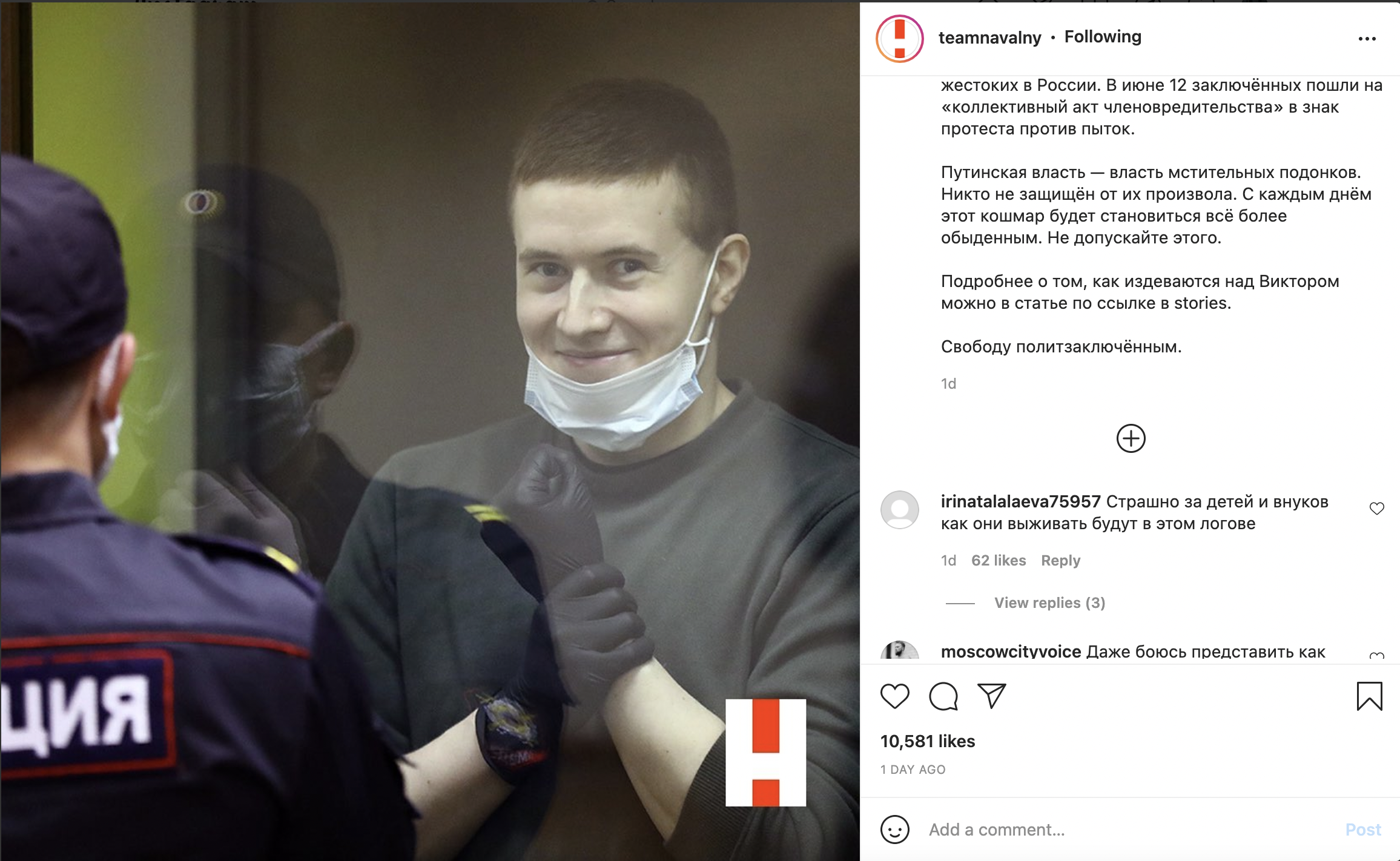
❗️ Viktor Filinkov and the torture colony

Viktor is a political prisoner in the Network case. The case is about a “terrorist community” of young men who were fond of airsoft and openly voiced opposition to Putin.

The FSB took these two facts and cooked up charges that got the defendants sent to prison for terms from six to eighteen years. Allegedly, the young men were divided into combat groups that were supposed to organize bombings in order to “sway the masses for further destabilization of the political situation in the country.”

The defendants claim that they were tortured into confessing, and that the evidence in the case was completely manufactured by the security forces.

The verdicts were announced in February 2020. But the matter did not end when the young men were sent to penal colonies: the authorities began bullying them there. We know the most about their treatment of Viktor Filinkov.

For the slightest offense — such as “didn’t say hello ten times a day to a prison employee,” “washed ten minutes earlier than he was supposed to,” “left his work station during work (he went to the work station next to his to ask how to use the machine because he hadn’t been properly instructed)” —  Viktor is sent to a punitive detention cell. Letters from [Viktor’s] friends and relatives are opened, shown to other prisoners, and even replies to them are forged.

Things are so over the top that when there was a scabies outbreak in [Viktor’s] cell, his cellmates were given ointment, but Viktor himself was not, because “he complained.”

Now Viktor is being transferred to Correctional Colony No. 5 in Novotroitsk, to an isolated solitary cell, for repeatedly violating those supremely absurd rules. This colony is a torture colony, one of the most violent in Russia. In June, twelve inmates there engaged in a “collective act of self-mutilation” to protest the torture.

The Putin regime is a regime of vengeful scum. No one is safe from their lawlessness. This nightmare will become more and more commonplace with every passing day. Don’t let that happen.

More information about how Victor is being bullied can be found in the article linked to in stories.

Release political prisoners!

Translated by the Russian Reader

“They were right to shoot people”

Natalia Vvedenskaya
Facebook
November 12, 2021

In the early 2000s, our computer broke down. There were few computer repairmen back then, and a passing acquaintance suggested her husband for the job. The young man came over and quickly fixed everything. Over tea it transpired that he worked at the FSB.

This was still amazing then, so we naively asked him how he could work in such a place, for the heirs of criminals and all that. And this twenty-five-year-old man literally said, “They were right to shoot people. They just should have done it more quietly.”

Now the whole country from top to bottom is run by people from the FSB. Of course, they want to ban Memorial. What need is there to remember if it was “right” to shoot people? What need is there to defend human rights if it is “right” to imprison people now?

The liquidation of Memorial is just the final whistle: the boat is leaving the dock. We’ll still put up a bit of a fight, of course. What else can we do?  But all the same.

___________

The acquaintance soon divorced the man because he had begun beating their child.

____________

The document, above, is from the family archive. Roman Troshchenko, a priest, worked as a physician’s assistant in an orphanage after serving time in the camps. He was shot, allegedly, for “spreading rumors among the children and the populace that the Soviet regime would fall and the fascists would come to power.”

Translated by the Russian Reader

Doppelganger

“It’s kind of a dystopia. In some respects. Of course, it has nothing to do with reality. The world is shrinking and becoming cramped. Something or someone is always offended in close quarters. And there’s always someone pointing a gun at your head. Sometimes it’s you.”

Masyanya, Episode 152: “Doppelganger.” (Toggle the “CC” button for English subtitles)

____________

The caste of those deprived of their civil rights — foreign agents, undesirable organizations, extremists of all stripes — will constantly expand. Social stigmatization will be strongly encouraged. The number of persons on different registries and lists, and under police watch will grow exponentially. Legal restrictions — bans on participating in elections, serving on various public councils, founding mass media, attending football matches, working in certain areas, and so on — will be supplemented by defamation campaigns. The separation of the estates in terms of legal and social status will be vigorously encouraged by the authorities.

Source: Pavel Chikov, “Not a Tyranny Yet: A Prognosis for the Rest of Putin’s Fourth Term,” Republic, 19 October 2021. Translated by the Russian Reader

____________


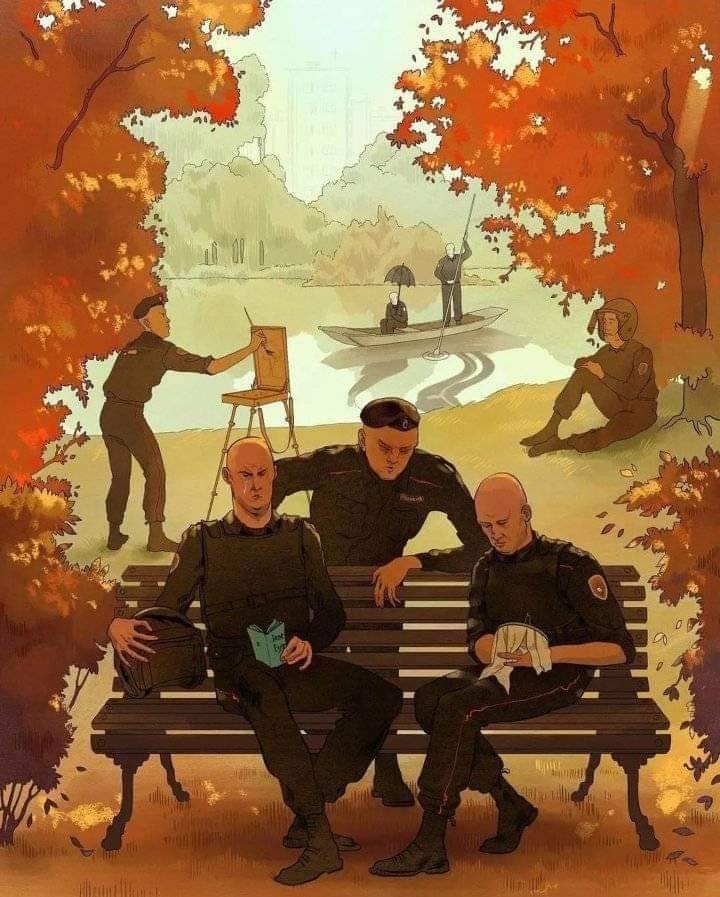
Artist unknown, Russian National Guardsmen in Their Free Time. Posted by Dmitry Vrubel on Facebook. Thanks to Sergei Damberg for the heads-up
____________

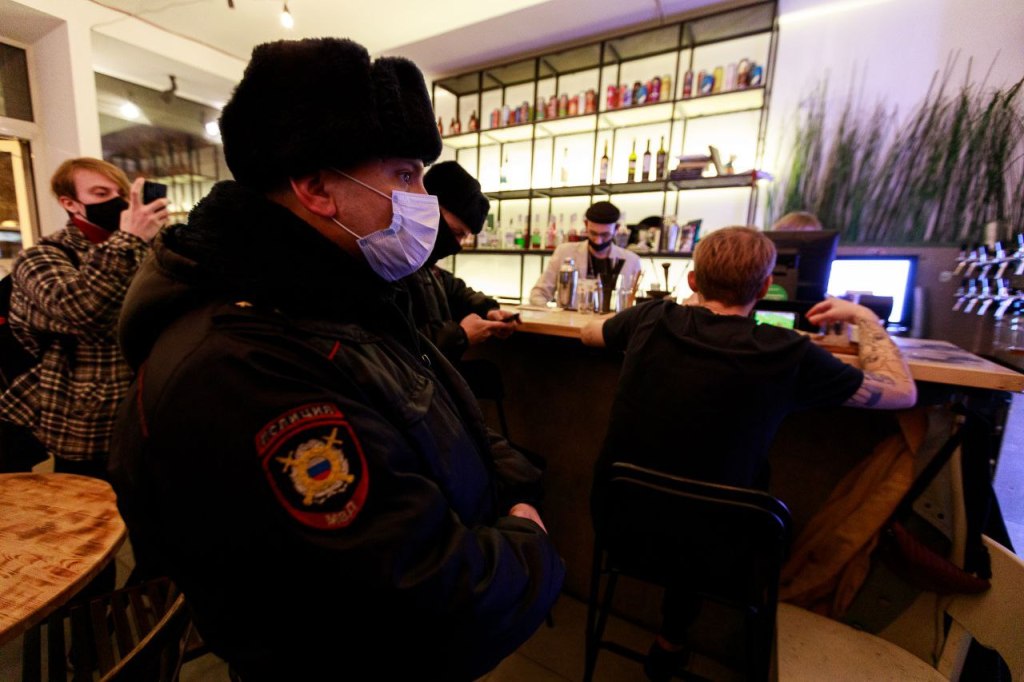
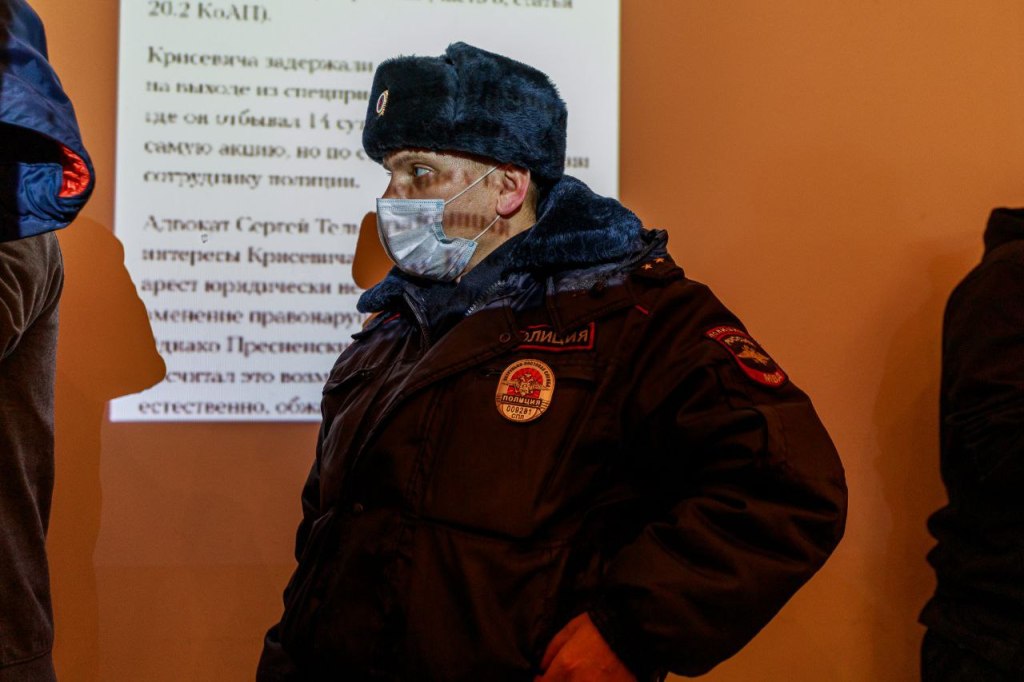
Security forces raided a gathering to write letters to political prisoners at the Vogel Bar. They showed up along with Rospotrebnadzor officials for a surprise inspection on the evening of October 24. After managing to tally forty-five people on the premises and not find markings on the floor mats, the officials sealed the establishment prior to a court hearing. The bar’s management fears bankruptcy and plans to open a new bar in a new location.

The latest gathering to letters to political prisoners at the Vogel this time ended with a visit by regulatory authorities. The police officers who arrived twenty minutes after the event started immediately stated that the 76th police precinct had received a complaint alleging that the bar was not in compliance with the mask mandate. At that moment, the gathering, at which attendees were to write letters to the performance artist Pavel Krisevich, jailed on charges of disorderly conduct after a performance on Red Square in which he pretended to shoot himself, had just begun. That evening, Krisevich’s friends and acquaintances, as well as former political prisoners, were to speak to the guests. One of the bar’s co-founders, Valentin Khoroshenin, told Zaks.Ru that the complaint claimed that a “meeting of anti-covidniks” was planned for that evening at the Vogel. He believes that this was just an excuse to find non-existent violations and close the bar.

The inspection report indicated that more than forty-five people were present in the room at the time. The bar’s management are adamant that this was not the case. The Vogel’s owners have already studied surveillance camera tapes and counted less than forty people on the premises, including the police officers.

Other violations included the absence of markings on floor mats and an insufficient supply of medical masks. According to regulations, such establishments should have a five days’ supply of personal protective equipment. The available supply was only enough for one day. Rospotrebnadzor officials did not enter the kitchen. According to Khoroshenin, they claimed they were too tired to do so.

Vogel Bar has been in business since March 2021. From the very beginning it advertised itself as a venue for activists: political lectures, discussions and debates were held there. During this entire time, Rospotrebnadzor never carried out inspections. But the Interior Ministry regularly sent its people there. For example, Center “E” officers attended the debates. The security forces showed up for other letter-writing gatherings, but everything had ended without trouble.

Text & photos: Konstantin Lenkov, Zaks.ru, 25 October 2021. Translated by the Russian Reader

____________

We have been preparing an investigation into torture in Russian prisons for almost a year. It took a lot of time to track down, earn the trust of, and obtain testimonies from former inmates of the penal colony in Krasnoyarsk Krai, Siberia, thousands of kilometers from central Russia. Simultaneously with The Insider’s investigation, Russian human rights activists published an archive of video footage depicting torture being inflicted on prisoners across Russia. The clips, obtained from the FSB and FSIN secret archive, show prisoners from Irkutsk, Saratov, Belgorod, Rostov and other Russian regions being raped, beaten and humiliated. Torture victims explain their torturers’ motives by their desire to break their will in order to obtain material for blackmailing other prisoners, make them confess to crimes, pay tribute, or even to start torturing other prisoners themselves. This all takes place in the modern world, in a country where there is no war, where torturers are not tasked with extracting valuable military information from prisoners at any cost. Torture is rampant in Russia, a country that has signed a number of human rights and anti-torture conventions and seems to enjoy a peaceful life. We have long known that in Russia, prison is not a place of correction, but rather a strange world separate from everything else, where guards and inmates resurrect on a daily basis the practices of the Stalinist Gulag. This has not always been the case. As early as ten years ago there was serious talk in Russia about the need to reform and humanize the penitentiary system. Now things are different. The authorities have been clearly and unambiguously showing how they prefer to rule the country. That is mainly by fear. Investigations into torture have hardly been a revelation, but in a split instant, they made it impossible to ignore torture and pretend it only concerns those behind bars. Of course, the situation will not change overnight, but one thing is certain – this knowledge has now become an integral part of our society. In the following article, we bring you the raw testimony of people who have experienced torture in Russian prisons. They share their thoughts on why it is used, the impact on them, and recount the involvement even of doctors in their ordeal.

Source: The Insider, 19 October 2021. Thanks to Antti Rautiainen for the heads-up

Five Years Ago Today

This is one of the pleasantest pictures I’ve seen in a long time: former Russian political prisoner Alexei Gaskarov walking in the woods.

Gaskarov was released from prison this past Thursday after serving a three-and-a-half-year sentence for being involved in a peaceful opposition march that was attacked by police and provocateurs, for being truncheoned and kicked while lying on the ground by a policeman who never paid for his crimes, and for being Alexei Gaskarov.

That sounds absurd, but it’s the truth.

Why was the opposition march attacked by police and provocateurs?

Because it took place the day before Putin reinstalled himself as president, this time, apparently, for life. The protesters were ruining his party by showing the country and the world that not all Russian were happy about this semi-legal coup d’etat.

So three dozen people, some more or less famous, like Alexei Gaskarov, some complete strangers to grassroots politics, had to be taught a lesson about what happens to the nominally powerless when they spoil the festivities for the most powerful man in the country.

This is only one of the reasons why those of us know who really know what has been going on in Russia the past seventeen years feel bemused, at best, and furious, at worst, when the snake oil salesman known as Donald Trump praises Putin for his leadership.

In reality, Putin has brought the country to the brink of moral, political and economic ruin. ||| TRR, 29 October 2016. Photo courtesy of Alexei Gaskarov’s Facebook page

Solving Problems

Grigorii Golosov
Facebook
October 14, 2021

Yesterday, President Putin, driven mainly by the curiosity of journalists, publicly tried to solve problems. There are a lot of problems, he noted: they are literally “raining down.” He named only two: the decline in incomes among the population and the population’s rapid decline (the “demographic” problem). He promised to solve the first one non-linearly, i.e., not by growing incomes per se, but through economic growth. As you know, the Russian economy grows rarely and slowly, but when it does grow (which has happened over the past ten years), then for some reason this has no effect on the incomes of the population. However, it depends on whom we understand by “the population.” There is definitely a population of several thousand people constantly getting richer, although this population is more often outside of Russia than inside it. Putin did not elucidate his methods for solving the second problem, but he is certain that they will also be nonlinear. There are no other problems in Russia, however. There is no problem with political prisoners: they are all criminals. I would probably doubt that. But I totally agree with Putin that there is no problem with democracy in Russia. If there is no democracy, there is no problem with it. Verily, “if you don’t have an aunt, then you won’t lose her.”

Translated by the Russian Reader

President Vladimir Putin said Wednesday that Russia — one of the world’s biggest producers of oil and gas — is aiming for carbon neutrality by 2060.

“Russia in practice will strive for carbon neutrality of its economy,” he said at an energy forum in Moscow.

“And we set a benchmark for this — no later than 2060.”

Source: AFP/Moscow Times

Russia’s natural population underwent its largest peacetime decline in recorded history over the last 12 months, an analysis of official government statistics has shown.

Russia’s natural population — a figure which counts registered deaths and births, excluding the effects of migration — declined by 997,000 between October 2020 and September 2021, demographer Alexei Raksha calculated.

The stark drop comes as Russia, which has one of the world’s highest Covid-19 death tolls, continues to see record numbers of lives lost to the pandemic. The country has recorded at least 660,000 excess deaths since the start of the pandemic.

Russia’s total population of around 145 million is lower than it was when President Vladimir Putin came to power in 2000 despite Moscow’s annexation of Crimea in 2014 which added 2 million to Russia’s official population statistics.

Source: Moscow Times

Only 12 World Leaders Greet Putin on His 69th Birthday. In another sign of Putin’s isolation, only 12 world leaders sent him greetings on his birthday this year. None at all came from the US or from EU countries (business-gazeta.ru/article/524870).

Source: Window on Eurasia (Paul Goble)

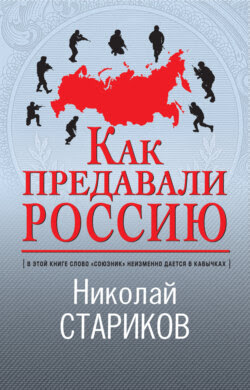
Today’s Mail Bag (How Russia Was Betrayed)

Nikolai Starikov
How Russia Was Betrayed

Who is the culprit of Russia’s troubles in the last three hundred years? Why do we show benevolence and generosity to those who betray us? Leading historian and opinion journalist Nikolai Starikov explores the history of Russia’s relations with the leading countries of the world and answers these questions. This book is a collection of shocking facts about the treachery and cynicism of most countries in Europe and the United States, which will not leave even those who are remote from history and politics unmoved.

__________

A leading public historian of Russia, writer, economist and politician explores the history of Russia’s relations with the leading countries of the world.

This wonderful book gives a comprehensive answer to the question: why today, as a hundred years ago, as two hundred years ago, does Russia have only two allies, its army and navy?

Are we the problem? Is it our naivety? Our almost complete lack of rancor? Our generosity and benevolence?

Yes, partly.

But mostly the problem is the guile and cynicism of most countries in Europe and the United States.

Starikov’s book calmly, step by step, argument by argument, reveals the damning truth about Russia’s relations with so-called allies, partners and brothers.

The reader will discover a lot of unusual, shocking facts in this book. Consequently, it will open everyone’s eyes and reveal the main secret of the ages: who is the culprit of our troubles over the past three hundred years?

Source: Litres email newsletter, 7 October 2021 + website

Were you surprised when you found out about all the offshore companies that Ernst, Chemezov and others own? We weren’t particularly surprised. It has long been clear why Putin and his friends need power: to steal. They don’t do anything useful, but all of them are billionaires. Their children are billionaires, and even their mistresses are billionaires. They made themselves rich at the expense of the federal budget.

The owners of offshore companies are very unhappy when they are not allowed to steal quietly, when they are prevented from disposing of the country as if it were their property. Therefore, they brand all dissatisfied people as “foreign agents” and “extremists” and declare them enemies of Russia.

But they are not Russia. We are Russia. While they are crooks and enemies of our country.

Support Team Navalny, and we promise to spend every ruble to fight Putin and his offshore friends. As always.

Attention! Do not use PayPal if you have a Russian account. We advise everyone who lives in Russia to donate in cryptocurrency: it is the safest way right now. And we also advise you to install a VPN if you cannot open our links: then no blocking will be able to prevent you from opening them.

Thank you for being on our side!
Team Navalny


“Navalny has been in prison for 261 days.”

Source: Anti-Corruption Foundation/Team Navalny email newsletter, 7 October 2021

Central image courtesy of Ozon.ru email newsletter. Translated by the Russian Reader, who received these images and texts via email this morning.