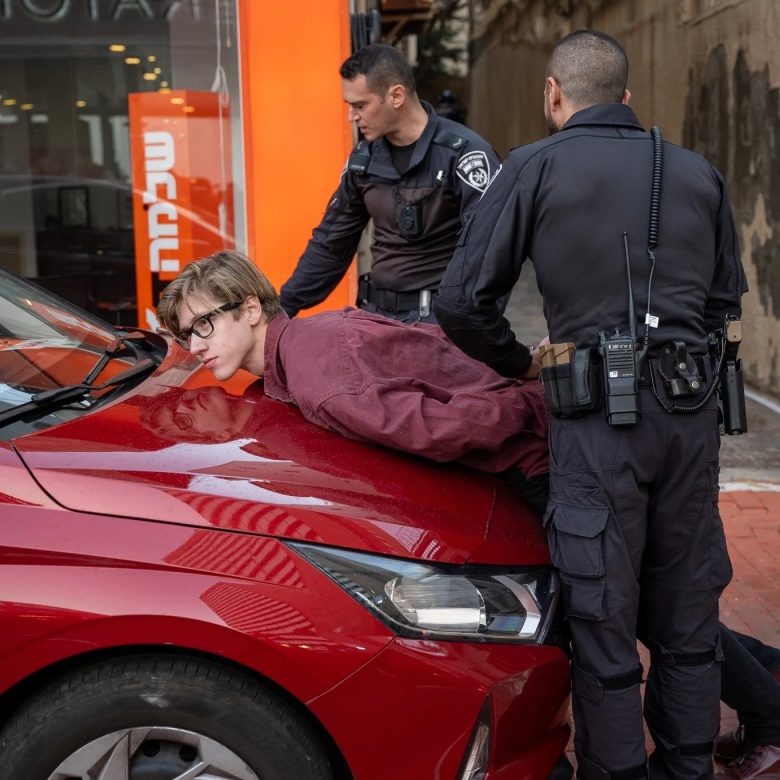
Son of the renowned filmmaker Ilya Khrzhanovsky, anthropology graduate and activist Andrei Khrzhanovsky moved to Israel in 2022. He almost immediately adopted a pro-Palestinian stance in the Middle East conflict, dubbing Israel’s actions genocide, and Zionism an ethnically supremacist idea. He says he is fighting for the rights of Palestinians in the West Bank due to his sense of guilt over the war in Ukraine. He spoke with Marina Berdichevskaya about his radical stance and his conflicts with his family.
Andrei Khrzhanovsky, 26, has been living in Israel since 2022. When Russia launched its full-scale invasion of Ukraine, he found himself in Tel Aviv with his entire family, including his famous father, grandfather, and grandmother. When the time came to fly home, there was nowhere to go. On February 24, Ilya Khrzhanovsky had begun circulating a petition, condemning the invasion of Ukraine, among cultural figures. Andrei flew to Georgia and applied there for Israeli citizenship.
Since March 2022, Andrei X, as he likes to be called, has enthusiastically plunged into the weeds of Israeli life and quite quickly chosen a side: he has taken up activism and, so he claims, journalism, on behalf of “the most vulnerable group on Earth at the moment,” the inhabitants of the West Bank. At the same time, Andrei has been doing battle with “the genocide in Gaza” and on this score has found himself at odds with his father, who has repeatedly said that, in the wake of 7 October 2023, he has felt himself to be Israeli first and foremost.
We talked at length and quite emotionally about how the profoundly erudite Khrzhanovsky, who has a degree in anthropology from the University of London, has decided to atone for the collective guilt of generations for world colonialism. Andrei happily juggles concepts and historical facts and is sure that this is the only way to do things: to always stand up for the downtrodden and to never succumb to propaganda. Whether he himself is suspectible to propaganda is an open question. Ah, yes. The opinions expressed here do not necessarily reflect the views of Republic or its editors—nor should they.
“The closer you are to the empire’s center, the greater the blame”
— Let’s begin with where you live. Your Facebook page says you live in Jericho. Is this true?
— Nowadays, I don’t stay anywhere longer than a few days in a row. I rent a flat, but I won’t divulge its location, because I get several death threats a day. I come home once every month and a half for a couple of days and then I hit the road again. Yesterday, I came from Bethlehem.
— How do people on the West Bank relate to you? Do they understand that you have an Israel passport?
— I’ve never had any problems with this because this is a political conflict, not an ethnic one. I speak with Palestinians deep in Area A (the West Bank is divided into three areas; Area A, which makes up seventeen percent of the West Bank, is wholly controlled by the Palestinian Authority — Republic) whose relatives have been killed, who have done time in prison. Israel fosters the illusion that all Palestinians want to kill all Jews. But this isn’t an ethnic conflict, and not even a religious one at the end of the day.
— In February of last year you said in an interview, “When the war in Ukraine began, I had an enormous sense of guilt that I hadn’t done more [to stop it]. That’s why I’ve thrown myself into all political activism here.” You explained your activism in terms of not wanting to “squander another country.” Where does such a young man come by a sense of personal guilt for what is happening in and with a country? After all, many Russian nationals, especially the remainers, reject the very principle of collective guilt.
Karèn Shainyan, interview with Andrei Khrzhanovsky and Artyom Nikitin (in Russian, with no subtitles)
Today’s episode of Who Am I After This? is very sensitive for me personally. The conversations with its two subjects, leftists and human rights activists, were the hardest and most emotional in the whole project because they both touch on a very painful personal conflict of loyalties for me. This is the only episode where there are two protagonists at once: journalist Andrei Khrzhanovsky and architect Artyom Nikitin. Quite handsome and young, both moved to Israel after the war in Ukraine began, and both travel to the West Bank to support the local Arab [sic] population, even and especially now, when there is a war in [sic] Israel.
— Before February 2022 we all lived in a magical reality of sorts: there was a dictatorship in Russia, seemingly, but no one was getting killed, as it were; everything was sluggish, we had to tackle corruption and so on. But there was no sense of the disaster that any dictatorship represents. This illusion personally crumbled for me on 24 February 2022. The disaster started then, and then intensified after the genocide in Gaza began. Over the past few years, the feeling has only grown in me that we are all to blame for what is happening; some more, some less. The closer you are to the empire’s center, the greater the blame.
— And when did you personally start counting down that blame?
— If we speak of the entire timeline, there were three moments. The first was 24 February 2022. The second was an article by Yuval Abraham (an Israeli journalist and co-director of the Oscar-winning film No Other Land — Republic), based on conversations with soldiers fighting in Gaza who admitted that they had been tasked with firing on civilian targets. And the third was the morning when I woke up, opened Instagram, and saw the video of a man in Gaza burning alive after an IDF strike on a hospital.
Andrei Khrzhanovsky. Source: social media
— How did you get involved in political activism in Israel?
— I had an approximate, general notion of what was happening here when I turned up here. I grew up in the Russophone media space after all. But when I arrived I realized that I had to figure out what was happening. I started reading books and talking to people. The more I researched, the more horrified I was. Suddenly, I found out about the status of Palestinians in East Jerusalem: their land was annexed, but they weren’t granted [Israeli] citizenship. To get into the Shuafat refugee camp, which the Israelis annexed and surrounded with a wall, Palestinians have to go through a security checkpoint. The sheer number of different methods for constructing a state based on ethnic supremacy is insane.
Alexander Lukashenko, the former Soviet state farm director turned Belarus strongman, once said that a woman could never run his country. Then three of them challenged him.
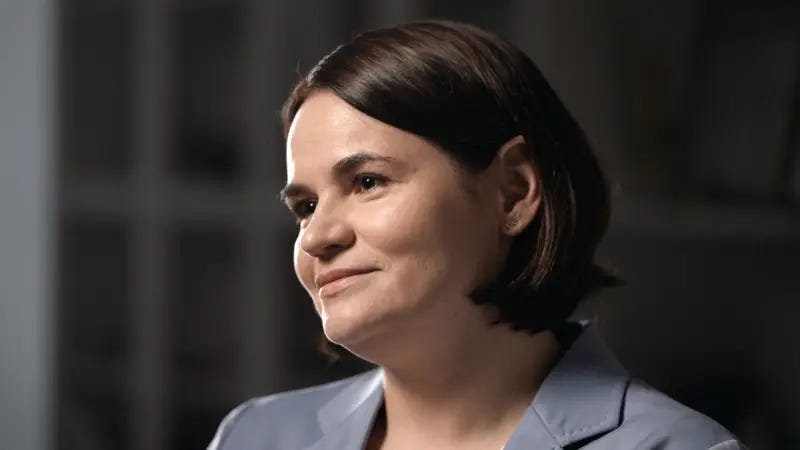
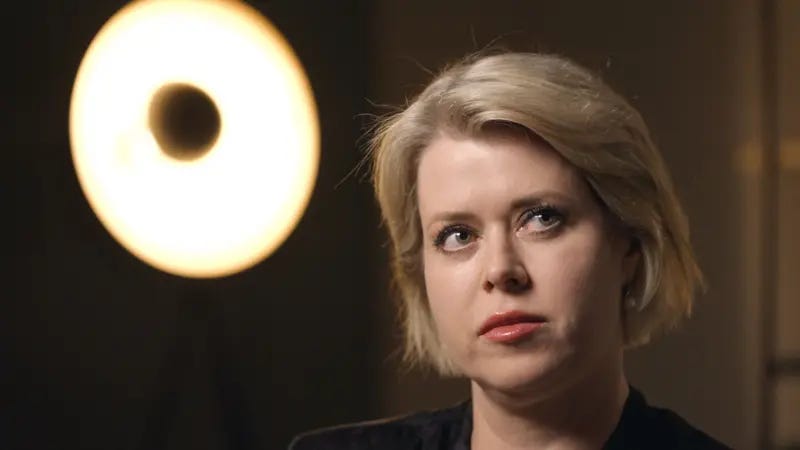
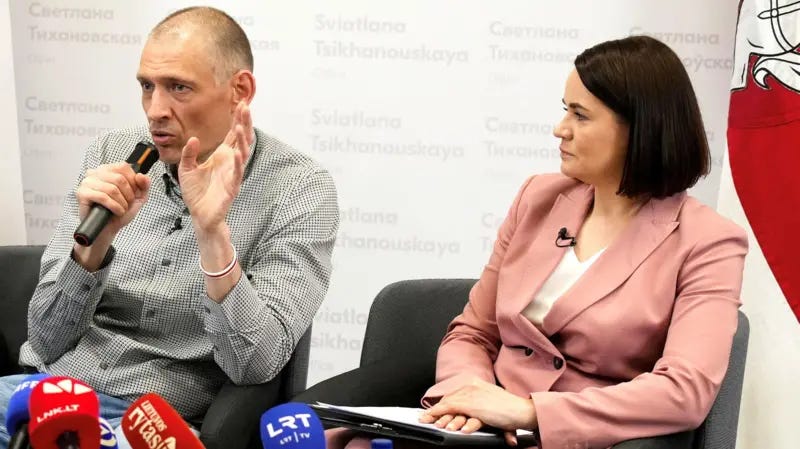
Five years on from the biggest protests in Belarusian history, Svetlana Tikhanovskaya and Veronika Tsepkalo, both now in exile, have been speaking to the BBC about the price they paid for inspiring hundreds of thousands of Belarusians to take to the streets to call for change.
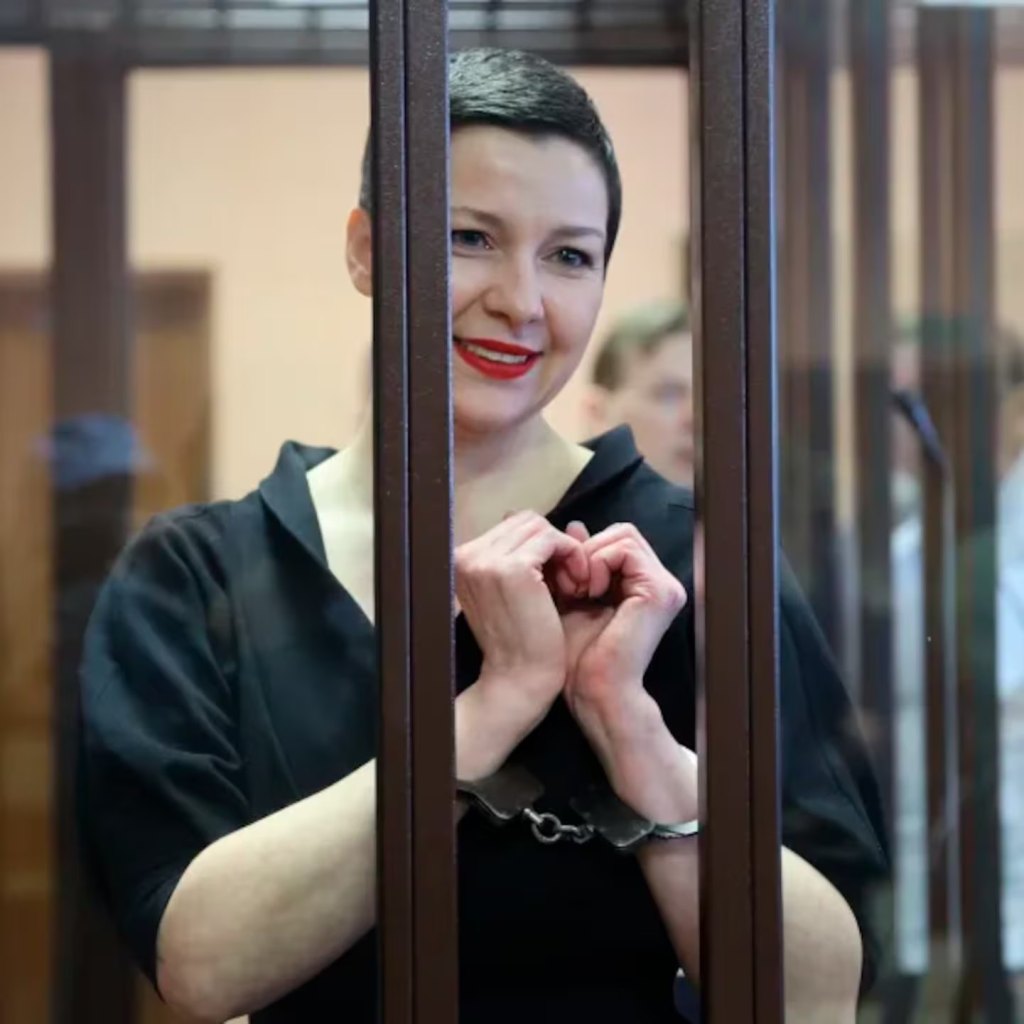
Their former teammate, Maria Kolesnikova, is now in a Belarusian prison, sentenced in 2021 to 11 years for extremism and plotting to overthrow the government.
Her sister Tatsiana Khomich tells the BBC the family haven’t heard from her since last year.
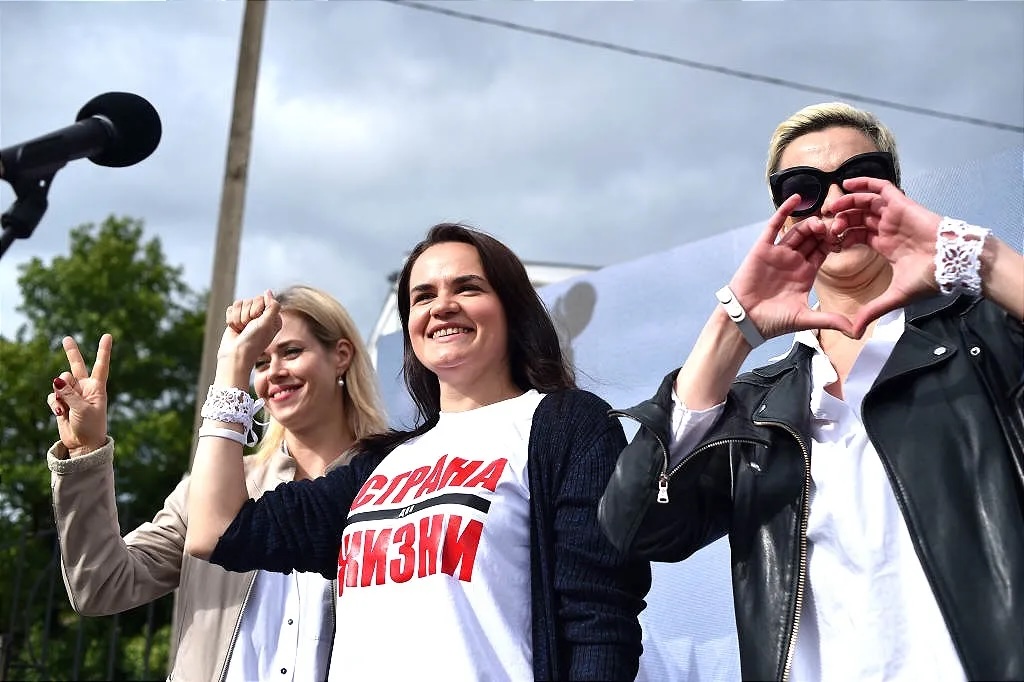
The three women joined forces in August 2020, when the opposition candidates they were supporting were all forced to end their presidential bids.
Their short-lived alliance made global headlines with pictures of them showing a heart, a fist, and a victory sign with their hands.
They claimed it took them 15 minutes to agree to join forces against Lukashenko, who has been in charge of Belarus since 1994.
“Far quicker than it would take men to do it,” said Veronika Tsepkalo, at the time.
She was left in charge of her husband Valery Tsepkalo’s campaign after the former Belarusian ambassador to the US was barred from registering as a candidate and fled the country fearing arrest.
Maria Kolesnikova campaigned for banker Viktor Babaryko, who was also prevented from standing and arrested ahead of the election.
But it was Svetlana Tikhanovskaya who ended up on the ballot, stepping in for her husband, the activist and popular video blogger Sergei Tikhanovsky, after he too was thrown in jail.
Together the three women travelled around the country, drawing big crowds of supporters eager for change. Their promise was simple: release all political prisoners, then hold a free and fair election.
In 2025, Svetlana Tikhanovskaya speaks about the “emotional uplift” all of them felt during those days.
“We managed to unite Belarusians”, she tells the BBC.
When election day came on 9 August, people flocked to the polls. Svetlana’s supporters were convinced she had won the vote, but Alexander Lukashenko claimed a landslide victory.
This sparked unprecedented mass demonstrations across the country, which lasted for several months. The authorities responded with a brutal crackdown. At least four people were killed – their deaths blamed on the security forces.
But none of the three women who had electrified the campaign, were there to lead the protestors.
Tsepkalo left Belarus just before the election. Tikhanovskaya was detained by the KGB a day after the vote and forced out of the country under threat of being jailed and losing her children to state care.
Maria Kolesnikova stayed behind. She was arrested in September, after tearing up her passport at the border with Ukraine to prevent a forceful expulsion.
Along with her former boss Viktor Babaryko, she is one of more than a thousand political prisoners still held in Belarus, according to a human rights group Viasna.
Since 2020 tens of thousands of people have been arrested for opposing the regime, many say they have suffered torture and mistreatment while in detention.
Today, any public dissent in Belarus is crushed.
“I sincerely believed that Lukashenko’s regime would fall”, Veronika Tsepkalo tells the BBC.
Like hundreds of thousands of Belarusians who are estimated to have left the county after 2020, she now lives abroad with her family, working at a big tech company in the UK.
“It was this all-or-nothing approach”, says Tatsiana Khomich, Kolesnikova’s sister who is now campaigning for release of Belarusian political prisoners. “We overestimated ourselves and underestimated what the authorities are capable of.”
Svetlana Tikhanovskaya says she now understands they had no plan and “weren’t ready for any radical change”.
Once a stay-at-home mum who admitted to being shy and lacking her husband’s charisma, she is now recognised as leader of the democratic opposition in exile, and regularly meets heads of state and lobbies for sanctions against Lukashenko’s government.
“If I could transfer my present knowledge, my experience to myself five years ago, I would definitely have felt more confident,” Tikhanovskaya says. “I’ve learned a bit of diplomacy, how to talk to politicians, how to be comfortable around powerful people”.
Less than two months ago Svetlana unexpectedly got her husband back: Sergei Tikhanovsky was released along with 13 other political prisoners and sent to Lithuania to his family.
It is thought that Donald Trump’s administration was key in securing their release.
Having said in the past that she went into politics “out of love” for her husband, Tikhanovskaya now admits she’s since also fallen in love with Belarus and the vision for her country.
“We’re not going to compete with Sergei about who’s more important, who has more followers et cetera. Sergei will be a natural fit for our movement,” she says.
Tikhanovskaya rarely speaks to Veronika Tsepkalo and in the interview with the BBC doesn’t want to go into details of what happened to their relationship.
Tsepkalo is more candid: she accuses her former “sister-in-arms” of hijacking their movement and pushing her out.
“The trio has broken up”, states Tatsiana Khomich.
Khomich, who is still part of her sister’s team, says all of them now have their own projects.
Svetlana Tikhanovskaya says her priority is working towards the release of political prisoners and lists helping Belarusians abroad and keeping Belarus on the international agenda as her achievements.
Veronika Tsepkalo is sceptical of these successes, calling them “action for action’s sake”.
Back in her husband’s team, she has been campaigning to bring Alexander Lukashenko to international justice.
Tatsiana Khomich thinks that trying to force regime change from abroad is “meaningless”.
“In reality, we’re now much further away from it than we were five years ago”, she says.
Both Tikhanovskaya and Tsepkalo believe at some point in the future there will be a free and democratic Belarus.
When asked to respond to criticism that she had put her own ambitions before her team, Tikhanovskaya says:
“Maybe that’s the kind of thing people who don’t really know me would say. I’d like us to finally hold new and fair elections but I certainly won’t be taking part in them.”
Kapela (ensemble) Rej is a group performing traditional Belarusian music. Their main instruments are the duda (Belarusian bagpipe) and the violin.
The ensemble on the recording: Vital Voranaŭ: duda Ursula Oleksiak: violin, vocals featuring Sergi Llena (Spain): frame drum, gaita de boto
The recordings were made in Serbia during the Rog Banata festival in the towns of Zrenjanin (2024, tracks 1-9) and Bečej (2023, tracks 10-13). The album cover photo was taken at the performance in Belgrade in 2024 by Sandra Crepulja.
Maria Kalesnikava, musician, activist, and political prisoner, was detained on this day in 2020. She was kidnapped on the Minsk street by the Belarusian authorities and the next day taken to the Belarusian-Ukrainian border to be thrown out of the country. But she tore up her passport and thus could not cross the border. In 2021, together with Maksim Znak, she was sentenced to 11 years of imprisonment (Maksim got 10 years). Now she is kept in Homiel women’s colony.
Kalesnikava is of my age, and five years of her life she has already spent in jail. Since February 2025, Maria and her family have exchanged no letters or calls… At least, she is not in solitary confinement but kept together with other female prisoners.
I’ve not been writing about the political situation in Belarus for a while, but that is not because there is some improvement. No, every day we read about new detentions. This week human rights defenders have recognized 14 new political prisoners, and the authorities have added 68 names to the so-called “extremist list”. All in all, we now know about 1197 political prisoners, 32 foreign citizens among them. A recent case: a 52-year old British citizen (she also has the Belarusian citizenship) was arrested while crossing the Belarusian border and sentenced to 7 years of prison (https://spring96.org/en/news/118604).
But still hundreds stay unrecognized because of different reasons. Without free Belarus, you won’t have peace in Europe.
Yesterday, I wrote about the five years Maria Kalesnikava had already spent in jail and about 1197 political prisoners in Belarus. And today, we’ve learned about another death.
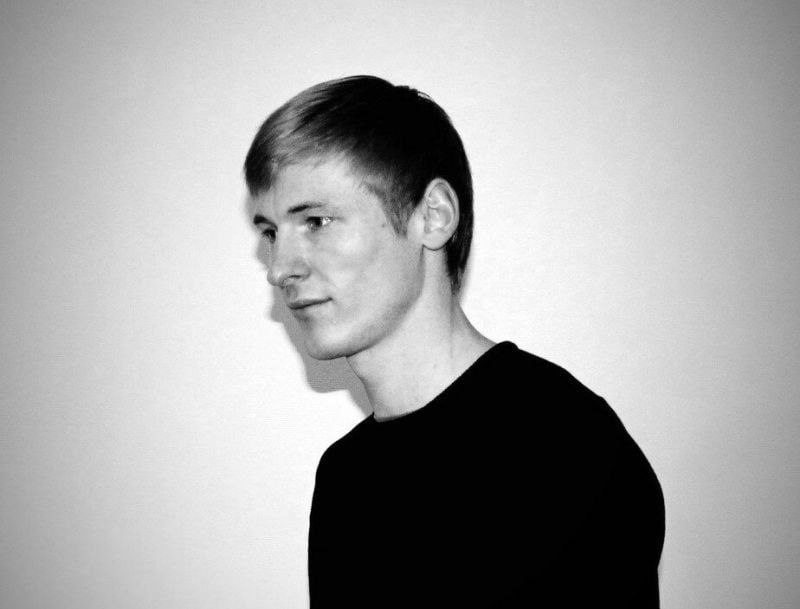
Political prisoner Andrei Padniabenny, a 36-year-old Russian citizen, has died in Mahiloŭ penal colony No. 15. He was tried twice on criminal charges and sentenced to 16 years and eight months in a medium-security penal colony. He had been behind bars for nearly four years. The exact cause of his death is unknown.
His mother Valiantsina, reported on Facebook:
“My precious grandchildren are left without a father… The only consolation is that no one will be able to torture my son anymore, either physically or psychologically… I believe that God’s justice will reach the guilty, and no crime will go unpunished….”
According to the publication, Andrei died on September 3. This is the ninth death of a political prisoner in Belarus and the second death of a Russian citizen behind bars.
Turning Her Back on Propaganda What does daily life consist of in a prison camp? It consists of work, of course, work which is dull and exhausting. It consists of sleep, which is fitful, as sometimes there are inspections every two hours. And it consists of spending time with people whom you didn’t choose to spend time with. The wardens make sure to burden convicts so that they have nothing that is theirs alone, so that they have no time to think about anything, so that they are entirely subordinate to the powers that be. The goal of prison camp “re-education” is the same: breaking the will of the prisoners, turning them into obedient robots who obey all the orders of their superiors.
This is especially true for political prisoners—people who think independently and have their own principles. The overarching mission of the wardens is to attain voluntary submission, joyful and proactive submission, from political prisoners. But the wardens rarely succeed in this mission.
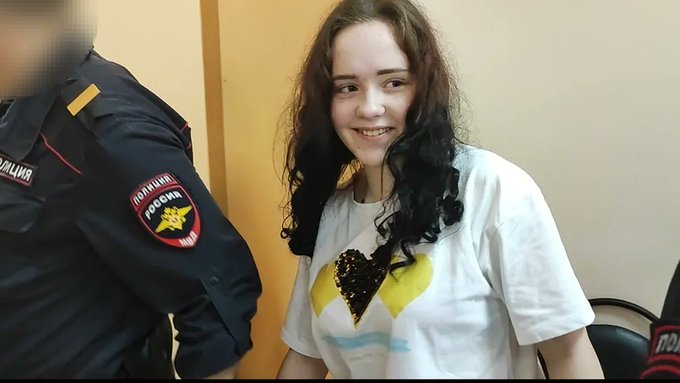
They have utterly failed with Valeria Zotova, a political prisoner at Kostroma Penal Colony No. 3. The wardens have insistently offered her a path to redemption, that is, cooperating with the authorities and taking part in “civic life.” Zotova has turned it down.
Recently, the prison camp’s club showed a movie, a Russian propaganda film titled Callsign: Passenger. Here is what Wikipedia says about the movie: “The movie is set in 2015. The movie’s main character is Nikolai Ryabinin, a trendy Moscow writer and carefree party animal. His brother volunteered for the war in Donbass and has gone missing. Nikolai goes looking for his brother and joins a separatist unit, the Aurora Battalion, in which his brother previously served. There, he gets the ironic nickname “Passenger” and under the leadership of the commander (callsign: Trigger) reevaluates his own life and comes to support the separatists.”
It’s an unimaginative piece of propaganda based on Alexander Prokhanov’s novel The Murder of Cities. It’s cheap trash, of course, like the writer himself, but the convicts are obliged to drink this cinematic concoction down to the dregs. All of them are herded into the club. Zotova refuses to go. Ultimately, it’s her right to watch the movie or not. But what do rights matter when it comes to Russian patriotism! Zotova is forcibly escorted into the auditorium. Watch our high art: look what talented filmmakers made it, what actors starred in it! But Lera Zotova turns her back on the screen and looks the other way.
Turning one’s back on propaganda is simple—simple but dangerous. The pressure on Valeria continues unabated. The harassment has been endless. The wardens summoned a friend of Zotova’s and stipulated to either: “Either freedom or Zotova—you choose.” They have been trying to create a vacuum around the political prisoner, depriving her of contact with those who are close to her in any way. The young woman is twenty-one years old, but she has been bullied like a hardened criminal. Because, as prison authorities envision it, she should be like everyone else: obedient, involved in the prison camp’s civic life, acting in plays, fulfilling the production quotas, and not smarting off to her superiors.
Convicted Russian anti-war activist Andrei Trofimov. Photo: Mr. Trofimov’s Vkontakte page, via Mediazona
In 2023, Andrey Trofimov, an anti-war activist from Tver, was sentenced to ten years in a maximum security penal colony on several charges [to wit, disseminating “fake news” about the Russian army, calling for “extremism,” and attempting to join the Free Russia Legion]. In his closing statement at trial, he called Vladimir Putin a “dickhead” [khuilo] and “heartily endorsed” Ukraine’s attacks on the Crimean Bridge and the Kremlin. This statement was the grounds for the second criminal case against Trofimov, this time on charges of “condoning terrorism” and “defaming the army.”
Today [6 May 2025], Judge Vadim Krasnov of the Second Western District Military Court lengthened Trofimov’s sentence to thirteen years. Prosecutor Andrei Lopata had petitioned the judge to impose a longer sentence of fifteen years.
Before the verdict in his first trial was read out, Trofimov had petitioned the court to impose the maximum penalty. Now he has suggested that he be charged with the more serious offense of high treason, claiming that he has been involved in the information war on the Ukrainian side.
Below, Mediazona has published a slightly abridged version of Trofimov’s statement during oral arguments at the [second] trial.
* * * * *
Your honor, the factual circumstances of my actions, which the investigation has categorized as crimes, are correctly stated in the indictment and have been fully investigated during the court hearing.
In my statement I would like to dwell on the reasons for these actions, on my goals, to review in detail, charge by charge, my response to the allegations—that is, to explain my motives for not pleading guilty. And, in my conclusion, I would like to petition the court as to what to do with me next.
I was living quietly at the dacha with my cats and was a bother to no one. My life changed drastically on 24 February 2022. The reason for both the first criminal case and the current criminal case [against me] was Russia’s invasion of Ukraine. I will further explain why I regarded this event in this way.
I am in prison for what I have said, after all. I took no action in either the first case or the second. But this has been my way of being involved in the events, because it was physically impossible for me to leave the country, and I had no desire to stay silent in this situation. I mean, it is my life.
Why have I done this? I must respond to your remarks yesterday to the effect that my statements, including in court, could harm my own interests. Your honor, I have no interest in a shorter sentence. I am already imprisoned.
What is the purpose of what I am doing? Writ large, it is a matter of self-preservation. It is just that I understand the instinct of self-preservation not as the preservation of the body per se, of its physical health, because I am not my body alone. I want to preserve my conscience in this difficult situation, my ability to tell black from white, and lies from truth, and, quite importantly, my ability to say out loud what I believe to be true.
This thing of mine did not start in 2022. I have always tried to live this way. It is just that my desire to preserve this ability in such situations—meaning, the ability to tell the truth, to maintain my conscience— is what causes such actions.
What actions have we observed? We have witnessed concrete evidence of crimes with which I have not been charged, evidence of the violation of Article 278 of the Russian Federal Criminal Code—that is, the forcible seizure or the forcible retention of power. I am referring to Vladimir Putin, who has held the highest official post in the Russian Federation for exactly a quarter of a century. During this entire time, the Constitution of the Russian Federation has contained the principle of succession of power, set out in the guise of the two-term rule [for Russian presidents]. We have witnessed a direct violation of this rule—that is, the forcible retention of power.
In what has occurred since 24 February, we see concrete evidence of a violation of Criminal Code Article 353—that is, the planning, preparation, unleashing, and waging of a war of aggression.
What have I done in this situation? Publicly, in the mode of a solo picket (just a protracteed one), I have demonstrated the Russian state’s insanity. Look, the prosecution is asking for fifteen years in total—the sentence given for murder, but even for murder, sentences are often shorter. And yet my deeds harmed no one nor caused any damage.
I am not just talking about the period covered by these criminal cases. I have never laid a finger on anyone, never stolen a penny, in my entire life. Nevertheless, [the prosecutor wants to send me down for] fifteen years. I believe that this is a demonstration of the state’s insanity. The state happily displays this quality using me as an example.
What have I done in response? I have shown fortitude. This is vital, because I hope that what I have been doing is seen by Ukrainians. Look at this: they arrested him. He was convicted and given a dozen years of maximum security. Judge the effect in terms of the second case. Did you do a good job of convincing me [of the error of my ways]? That is, have I stopped doing what I was doing? Has my voice become less audible? No, it has not.
We have witnessed the same thing on the military front. For four years running, the Russian state has been spilling blood in a neighboring country. Ukraine has not surrendered and will not surrender.
Among the things that I have not exactly been charged with, but which have been repeated in the indictments and in the evidence presented at trial is my insulting Vladimir Vladimirovich Putin by using the foul word “dickhead.” What have I done? It is called desacralization.
Because the sacredness of supreme power is one of the foundations of the Golden Horde method of governance. When I publicly, repeatedly, and daily, at the first trial, at the second trial, in the pretrial detention center, perform this trick, I am desacralizing Vladimir Putin. This is important, because this regime will end all the same, and I very much want to hasten its end. I hate this man. And what the prosecution says about the “motive of political hatred” is the sacred truth. I can confirm that.
The audience I am addressing by these actions is not in Russia, because Russian society is dead and it is useless to try and talk to it. Ukraine is my audience.
As for the charges against me, I do not plead guilty to either count of violating Criminal Code Article 205.2. At issue is one and the same text, simply posted on the internet and spoken aloud in the pretrial detention center. Because I do not consider the incidents which I chose to include in my closing statement at trial to be “terrorist acts.” I chose them on purpose.
What is at issue are the two attacks on the Crimean Bridge. The Crimean Bridge is a vital transport artery which supplies the Russian federal armed forces in Crimea. An attack on a military installation is an instance of armed hostilities. The attack was carried out by the armed forces of Ukraine.
Why was it categorized as a “terrorist attack”? I know perfectly well why. This was done in order, first, to use it in Russian propaganda to dehumanize the enemy. In other words, the Russian Federation is at war not with the armed forces of Ukraine, which are stipulated under Ukrainian law and are doing their constitutional duty, but with terrorist gangs of “Banderites” and “Ukronazis.” To support this agenda, decisions are made to launch criminal proceedings on charges of “terrorism” over instances of armed conflict.
As for the second incident I mentioned, the attack on the Kremlin on 3 May 2023, what do we know? The communique from the Investigative Committee, which the prosecutor quoted yesterday, states outright that the attack was carried out against the residence of the President of the Russian Federation, who is the commander-in-chief of the Russian federal armed forces. Moreover, the Ukrainians also hit the building of the Senate, which is in the section of the Kremlin closed to tourists and where one of Putin’s offices is actually located. Excuse me, but this was not a terrorist attack. It was a Ukrainian combat operation, and a failed one at that.
I must say loudly and out loud that I do not condone or support terrorism, and that I have never condoned terrorism, nor do I intend to condone terrorism. I have a categorically negative attitude to the ideology and practice of terrorism.
Let us move on to [the charges under] Article 280.3 of the Criminal Code. This article is brand-new: it was adopted after the start of what we call the “special operation.”
This is a pure example of persecution for telling the truth. Because a situation has arisen where it has been necessary to shut the mouths of the war’s opponents, but it is impossible to charge them with violating, say, my beloved Criminal Code Article 207.3. How can you charge a person with “disseminating fake news” if they simply voice their attitude to current events? This is how Article 280.3 and the notion of “defamation” emerged, which is quite poorly conceptualized legally.
I have been told that my phrase “Ukraine is a victim of aggression on the part of the country of Russia” defames the Russian federal armed forces. What do we have? We have the UN General Assembly’s 2014 resolution saying that Russia “annexed” Ukraine. Those are not my words. This is a General Assembly resolution: there is no veto power there [as there is on the UN Security Council], so it was passed by a decent majority [of member states]. This is the position of international law.
Similarly, we have a March 2022 UN General Assembly resolution, in which the events of February 24 are labeled an “aggression.” And we have a UN General Assembly resolution on Russia’s incorporation of the Ukrainian regions of Donetsk, Luhansk, Zaporizhzhya and Kherson which labels these actions “annexation.”
I should note that the statements of, say, Foreign Ministry spokesperson Masha Zakharova are not a source of international law. Statements by Russian Foreign Minister Lavrov are not a source of international law. UN General Assembly resolutions are, on the contrary, a source of international law, and so my assessments are based on international legal documents.
But my phrase about “Putin’s scumbags” is also part of the “defamation” charge against me, of course. First, from your viewpoint, “Putin’s” cannot be defamatory, because as you see it, Putin is good. As for the second word [in the phrase], yes, this is my personal opinion, and it does not apply solely to Russian servicemen who carry out unlawful orders. Yes, there are also people in the Russian armed forces who do not carry out unlawful orders, but they are not the only ones fighting there.
Excuse me for characterizing in this way people who murder the soldiers of a neighboring country for money. This is my personal judgment, and it is based on [their] actions.
I will summarize this part of my statement. The Russian federal constitution contains Article 29, [which guarantees] the right to free speech, including the right to gather and disseminate information. This is what I have actually been doing. That is, I have not overstepped Article 29 of the Constitution by a single millimeter. But at the same time I certainly have violated these two current articles of the Criminal Code.
How can this be the case? It can be the cacse because the articles under which I have been charged are unconstitutional. If Russia had a real Constitutional Court, these articles would have ceased to exist long ago.
I cannot fail to mention my report to Prosecutor Zhuk, which was not part of the charges against me, but nevertheless we heard witnesses talk about it yesterday. It does not contain the text of [my] closing statement [at the first trial]. It makes no mention of terrorism or any violent acts at all. I did not say a word about the armed forces either.
The point is that this second case is the result of my statement to the prosecutor’s commission. Because the case file contains two resolutions by FSB investigator Lieutenant Colonel Sergey Vyacheslavovich Yerofeev to dismiss the case—that is, by the investigator in my [first] case, with whom I have a very good level of mutual understanding and who understands exactly what I have been doing and what I have been trying to achieve. He tried to dismiss this case twice.
In the final part of my statement, I turn to the correct characterization of my actions. I am involved in the war on the Ukrainian side. It just that this involvement takes place without weapons, because war is such an extraordinarily multidimensional event. Apart from the fighting in the steppes of Donbas, in the Black Sea, and in the skies above Ukraine, it is fiercely fought in the information space by state entities, by Russian bodies. On the Ukrainian side, for example, interesting entities are also involved.
I am an information warrior. In what sense? On 9 October 2022, I wrote and sent an email to Ukrainian President Volodymyr Oleksandrovych Zelensky asking him to grant me Ukrainian citizenship. I am entitled to it because of my ancestry. All my grandparents hailed from Ukraine. Ukrainian law says that I have the right to [Ukrainian] citizenship.
I was able to enter a screenshot from Kasparov.ru into the record and have it examined in court. What does it confirm? The fact that, apart from publishing my closing statement at trial, Kasparov.ru has published me on a regular basis. What does this confirm? That what I am being tried for now was, in fact, just an instance of my work, which I have not ceased.
I will also mention, of course, Novaya Gazeta, whose website also published my letters. And my latest achievement in this wise is that I have been officially designated a political prisoner, because that is what I call myself at the pretrial detention center, and that is how I sign my petitions to this honorable court. But it was still a kind of self-designation as it were.
On 14 April of this year, the Council on Political Prisoners of the Memorial International Human Rights Defense Center published a decision[designating me a political prisoner]. As part of my work, I have used the criminal cases [against me], the first and the second case, as publicity opportunities.
The information war is a real thing. I am involved in it, and I am trying to prove this now. Informationally, I support Ukraine and the armed forces of Ukraine. In fact, I have defected to the enemy side in an armed conflict involving the Russian Federation. This is the essence of the crime defined in Article 275 of the Russian Federal Criminal Code—high treason.
I ask the court to send my criminal case back to the prosecutor, as the factual circumstances indicate that there are grounds for charging me with a more serious crime. Try me for treason: I betrayed your deranged state.
* * * * *
Address for letters:
Trofimov Andrei Nikolayevich (born 1966)
141 ul. Bagzhanova, FKU SIZO-1 UFSIN po Tverskoi oblasti
Tver,  Tver Oblast 127081 Russian Federation
You can send letters to Mr. Trofimov and other Russian political prisoners via ZT, F-Pismo, and PrisonMail.online. (The last of these services accepts payments made with non-Russian bank cards.)
On 22 April 2025, Voronezh police raided the homes of activists believed by Center “E” [Russia’s “anti-extremism” police] to be connected to the Telegram channel Free People of Voronezh. The searches also involved severe beatings and threats, and some of the activists were forced to record videos supporting Putin and the war in Ukraine. Almost all the activists had previously been prosecuted on political charges, but now they feel so intimidated that they are afraid to file a torture complaint against the police.
A 38-minute video was posted on the Free People of Voronezh channel on 16 April 2025. The video itself was viewed by less than three hundred people. In the video, four activists—Grigory Severin, Nadezhda Belova, Yuri Avsenyev, and Alexander Zheltukhin—discuss the news before jogging along an embankment of the Voronezh River. The genre is the “coffee klatch”: using the news as a springboard, the friends talk about the problem of alcoholism, apathy in society, increasing drug use, and the overall sense of doom and gloom.
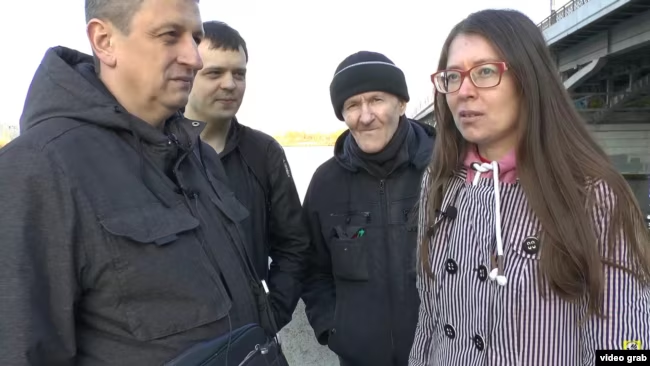
Activists of the Telegram channel Free People of Voronezh: Grigory Severin, Alexander Zheltukhin, Yuri Avsenyev, and Nadezhda Belova
Nadezhda Belova sums up the video’s content at the very beginning.
“To cut it short, everything is bad, but it will get worse. To put it in a nutshell, the situation in this place is at the terminal stage,” she says.
She argues that Russia is inevitably moving in the direction “North Korea”—toward a mothballed, rotten dictatorship, because Russians “somehow still support it and want to live in it.” Belova has reason to be pessimistic: even before the war, the state had charged her with “condoning terrorism” for comments she had made on social media in the wake of Mikhail Zhlobitsky‘s [suicide] bombing of the Arkhangelsk FSB. in 2020, a military court sentenced Belova to pay a fine of 400,000 rubles. She was on Rosfinmonitoring’s list of “terrorists and extremists” for several years, and her family had to leave their home village and rent a flat in Voronezh, as their fellow villagers did not support Belova in her fight against the unjust charges.
The video posted on the Telegram channel Free People of Voronezh on 16 April 2025
“Again, the whole of Voronezh is covered with drug adverts. The law enforcement agencies run protection for [the illegal drug trade], and if they didn’t run protection for it, there wouldn’t be these adverts. At my neighborhood Pyaterka [convenience store], right at the entrance, there is a graffito painted in color on the doorstep: ‘Buying a stash is like going out for bread,'” says Alexander Zheltukhin. In previous years, Zheltukhin was fined for picketing against Belova’s persecution and arrested for protesting in support of Navalny. “And if it was not protected, I would argue, by the selfsame FSB, who probably take a percentage from it—”
“Watch out! You are discrediting the FSB,” Belova says, interrupting him. “I don’t agree! It cannot be!”
Caveats and omissions run through the entire conversation. The activists know that any free speech is potentially dangerous in today’s Russia, and they try to cover their bases whenever possible. (Spoiler: it didn’t work).
“They say it’s impossible not to confess”
A few days later, on 22 April, police raided the homes of all four people involved in the run, as well as those of other Voronezh activists. Searches were done at eight locations, allegedly connected with Free People of Voronezh. In most cases, the law enforcers acted extremely harshly. They used handcuffs and stun guns, beat people, intimidated the activists and their families, and emotionally abused them.
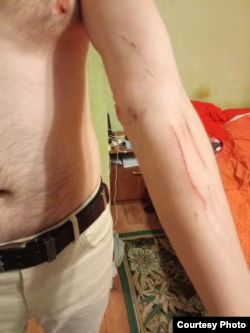
A photo posted by Nadezhda Belova
All the members of Belova’s family were shot with a stun gun. Belova later posted photos of her own bruises and the bloody marks on the bodies of her husband and son on Facebook. The police confiscated all their electronic devices and turned upside down their rented flat, which the landlady demanded that the Belovs vacate immediately after the search. The police threatened to send the son, a university student, to the war, and after the search, a policeman recorded a repentant video featuring Belova.
“Off camera, the [policeman beating Belova’s husband] says, ‘Do you support the [special military operation]?’ I say, ‘Yes.’ He says, ‘Do you support Putin?’ I say, ‘Yes.’ It’s light fare, but disgusting, especially when I saw a stun gun pressed against my son’s leg,” Belova told Okno.
The police recorded similar video “confessions” by several other people [caught up in the raids].
After the searches, Zheltukhin ended up in hospital with five broken ribs and several damaged vertebrae. He told OVD Info that he had tried to escape from the “punitive operation” and fell from the roof of a village house: “I broke my ribs when I fell, apparently, and they hit me [on those ribs]: it hurts a lot.” The police put a bag over his head and shocked him with a stun gun. His friends later photographed Zheltukin at hospital: his face was covered with bruises.
Fyodor Orlov, 36, was also beaten; after the experience, he says that he “did it all to himself.” He inflicted all the bruises and abrasions on himself, blindfolded himself with a scarf and sat like that for two hours, and fell into a briar bush on his own; there are photos of his back, entirely covered with flecks of blood. “Then someone—that is, I—drew a sex organ on my bald head just for fun,” he told OVD Info. The law enforcers also threatened to cut off one of his fingers, leaving behind telltale scratches.
Fyodor Orlov’s finger
“It was quite rough. As rough as possible, to the point that they say that now they understand why people confess to crimes they did not commit. Because, they say, it’s impossible not to confess. Orlov has several hundred stun gun marks [on his body]. Several hundred! They drove him into the woods. He thought they were taking him there to kill him,’” says Pavel Sychev, 38.
Sychev is a Voronezh activist and political consultant. He knows the administrators of the Free People of Voronezh channel from his past work as an activist: they crossed paths at pickets, but do not keep in close contact. Sychev’s home was also searched on 22 April, but there was no violence.
“[The police] search my home, as a rule, without breaking the law, and they never use force against me or my family. They have been coming to my home every year since 2022. These are just routine searches. I have always been searched as a witness in criminal cases to which I don’t even have an indirect connection,” says Sychev. “There is a federal case [for example, the case against Grigory Melkonyants and other activists of the Golos movement—Okno], and they do a series of searches all over the country, and they come and search my house for good measure.”
“Evil loves silence”
It is unlikely that the new series of searches was occasioned by the latest video posted on the Telegram channel. Our sources suggest, rather, that the reason for the raids was that Free People of Voronezh constantly writes and speaks about people convicted on charges of high treason and terrorism (for sabotaging railroad switch boxes, cell towers, etc.). The channel admins treat these people as anti-war resisters. For law enforcers, on the contrary, they are criminals convicted of violent crimes.
The formal pretext for the series of searches on 22 April was the criminal case, on charges of repeated discrediting of the army, brought against Grigory Severin. As follows from the indictment, while serving his sentence in a penal colony [he had been sentenced to two and half years in prison for “publicly calling for extremism”; he served his time and was released last autumn—Okno], Severin discredited the Russian armed forces. After the search, he was detained and placed under arrest.
Sychev believes that this criminal case was “canned.”
“You see, in Russia we have the practice of ‘desk drawer cases.’ Meaning you already have a criminal case against you: the entire case file is ready in advance, and it is lying in a desk drawer, waiting for its day to come. In the case of Severin, his first case was also ‘in a desk drawer.’ When he was arrested, it transpired that the entire case file had been readied a year earlier.”
It is not known what prompted the police to pull the case file from the drawer right now. But the fact that Severin faces prosecution does not surprise Sychev in itself.
“Everyone who knows Grigory, even in passing, realizes that he is a man who will not stay quiet. If anyone asks him directly how he feels about this or that situation, he will answer directly, even if the answer risks criminal charges. He is a man who will always try to prove to everyone the viewpoint which he espouses and defends. As far as I know, the first ‘discrediting of the armed forces’ case against him came from his explaining his philosophy of life to traffic police officers who had pulled him over. The second charge came from telling his cellmates about his stance. This in the order of things for him: he does not keep silent; he speaks openly, directly. So it was a matter of time. When a person speaks openly about a very dangerous and sensitive topic—and in our country the ‘special military operation’ is a sensitive topic—there are many chances that sooner or later they will be prosecuted.”
On the same day, a criminal case was opened against 65-year-old activist Yury Avsenyev, another person involved in the run along the Voronezh River embankment. His home was also searched on 22 April, but he was released on his own recognizance. Avsenyev is suspected of “publicly calling for extremism.”
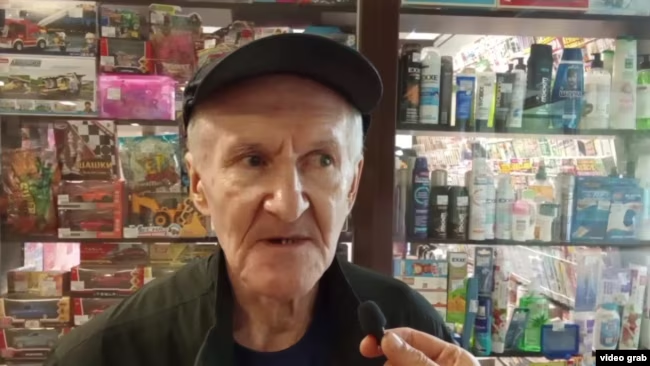
Yuri Avsenyev
The Voronezh activists who fell victim to the police brutality have not yet worked up the courage to file complaints, and they fear excessive publicity.
“They are really spooked,” says Pavel Sychev. “The information I have now is that they will not file torture complaints, but I don’t know, maybe someone will persuade them to do it. They are very much afraid that if they do it, the law enforcers won’t be reprimanded in any way, but will just come and take revenge on them. They are all convinced that they will be killed. I told them that evil loves silence, and if you don’t react now, there is a greater chance of a repeat than if you do. But they said it’s very easy to judge from the outside when you haven’t been tortured. ‘We are afraid that they might do something to us,’ [they say].”
Our sources note that such official lawlessness had not previously occurred in Voronezh. Usually, searches at the homes of political activists and arrests were carried out by the book, without violence. The only widely known case of official lawlessness ended in criminal charges against the police officers involved and monetary compensation for the victims. In May 2018, criminal investigators Sergei Kosyanenko and Oleg Sokolovsky tortured university students Maxim Grebenyuk and Sergei Troyansky, hoping to force them to confess that they had stolen a mobile phone. The students were held at Police Station No. 4 in Voronezh’s Comintern District for six hours in handcuffs and strangled with a plastic bag. They refused to incriminate themselves, and afterwards they documented their injuries and filed a torture complaint with the Investigative Committee. In 2021, Grebenyuk was awarded one million rubles, and Troyansky, 500,000 rubles, in compensation for their suffering.
The Voronezh police’s current brutality may be due to the proximity of the front, suggests a source who requested anonymity. The fact is that, since the start of the full-scale invasion, Voronezh law enforcers have regularly been seconded to the so-called new territories, the occupied Donetsk and Luhansk regions.
“There are quite big problems with the law in those ‘new territories.’ And the practices that are used there are inhuman, I think. When they come back here, to their native land, they simply do not reconfigure themselves,” says our source, who is not connected with the Free People of Voronezh Telegram channel. “They consider themselves above the law. They think that they are involved in a good cause, and they can torture bad people for the sake of the good cause. When a person has tried their hand at it once, when they realize that they can get away with it absolutely scot-free, then it is quite difficult to put the brakes on, and it will grow.”
Olga Menshikh. Photo: Alexandra Astakhova/Mediazona
A panel of three Moscow City Court judges, chaired by Irina Vasina, upheld the verdict in the criminal case against anesthesia nurse Olga Menshikh on charges of disseminating “fake news” about the Russian army: eight years in prison for two posts on the Russian social media network VKontakte, per Article 207.3.2.e of the Criminal Code. This is the longest sentence on these charges handed down to a woman. The following is an abridged version of Menshikh’s statement at today’s court hearing.
You and I understand everything quite well: we are all adults here. You shall say that this is not a frame-up, that it’s the norm. Nevertheless, we understand that there is a more serious organisation* which has ordered this [verdict], and they do things as they see fit regardless of these frame-ups.
Here, for example, is a quotation from my case file: “Olga Sergeyevna Menshikh causes her fellow citizens to feel anxious, afraid and worried, to feel undefended by the state’. I cause that!? I am an absolute loner with a mum who is eighty-six years old, and I have no other interests in life. What can I say? These words in no way apply to me. I completely deny them and consider them slander.
But these words perfectly describe the well-known organisation, known as the FSB, which I have just outlined for you. […] Back in the day, serious conclusions were not drawn about the architecture of the seventy-year utopia, which murdered millions of its own citizens and citizens of other countries and collapsed during an attempt to repair it, but then suddenly rose up and went at it again. Crush what was not crushed earlier! ‘Crush them!’ is the watchword of the day.
Who should be crushed, I want to ask you, your honours? The peasants, whom you destroyed long ago? The hegemon [i.e., the proletariat], whom you long ago turned into a drunkard? Do you want to crush the intelligentsia? Do you want to crush business? How do you plan to live? What have I been observing in Detention Centre No. 6 right now? I just sat for four hours with the nicest businesswoman. You have been clamping down on businesspeople of all stripes.
I have seen all kinds of people here. Lawyers and doctors serving long sentences, mothers with many children, with three or four children, incarcerated here without verdicts. And just now I came in from the corridor, where a disabled woman in a wheelchair was being sent off to a penal colony. Pensioners and young people are held here on completely trumped-up charges. Do you want to crush them, to trample on their lives so as to make others afraid? Is that what you want to do? You want to crush them so that everyone is afraid because you were ordered to do it? Have them be afraid, have them sit in prison.
Well, this is what I want to tell you calmly. A society sick with fear cannot create, cannot be happy, cannot live, cannot love to the fullest, cannot reproduce. You consider it quite necessary for us to reproduce. But [society] cannot reproduce amid this fear. A wild goose never laid a tame egg. This fig tree will die out, you shall kill it off.
This entire fear machine has only one aim: destroying all of us. So many people, so many civilised people were destroyed, that I cannot list their names. I will only quote a great novel. Having worked in the medical field myself, as someone who took patients quite seriously, I will quote the great novel Doctor Zhivago, about Doctor Yuri Andreyevich Zhivago. By the way, he dies before he reaches the age of forty.
Here is what the great diagnostician Yuri Zhivago says: “Microscopic forms of cardiac hemorrhages have become very frequent in recent years. […] It’s a typical modern disease. I think its causes are of a moral order. The great majority of us are required to live a life of constant, systematic duplicity. Your health is bound to be affected if, day after day, you say the opposite of what you feel, if you grovel before what you dislike and rejoice at what brings you nothing but misfortune.”**
Yuri Andreyevich uttered these words exactly a hundred years ago. And so, concerning this organisation, which we all know quite well: a dead man coming back to life cannot make anyone happy. Even when he was alive, he brought happiness to no one. He turned a lot of folk into dead people, and now he is raising another generation suffering from PTSD, post-traumatic stress disorder, which is quite hard to treat.
What can I say? I am sorry. I feel sorry for you, I feel sorry for me. I feel sorry for the people in this detention centre. I feel sorry for the women, for the children. Dear honourable judges and prosecutors, we are all in the same boat. I rest my case.
* In the first part of her statement, Menshikh talks about how she believes the FSB was behind her criminal case from the beginning — Mediazona.
** Translated by Max Hayward and Manya Harari — TRR.
A court in Moscow on Thursday sentenced a 59-year-old nurse to eight years in prison for social media posts opposing Russia’s invasion of Ukraine.
Olga Menshikh was accused of spreading “fake” information about the military with two VKontakte posts that condemned Russian strikes on Vinnytsia, Ukraine, that killed 28 people in July 2022 and Russian troops’ mass atrocities against civilians in the Kyiv suburb of Bucha.
Menshikh denied her guilt, with Mediazona reporting she had 15 followers and that her account may have been breached.
Moscow’s Dorogimolovsky District Court found Menshikh guilty of spreading “fake news” about the Russian military’s actions abroad and handed her an eight-year sentence in a prison colony.
Menshikh was an anesthetic nurse at the Pirogov National and Medical Surgical Center, where Mediazona said she had treated Russian soldiers wounded in Ukraine.
The outlet said Menshikh had faced several administrative arrests and fines for anti-war social media posts and her support for the late Kremlin critic Alexei Navalny.
Russia has cracked down on anti-war protests, the independent press and social media platforms since launching what it calls its “special military operation” in Ukraine in 2022.
Three years ago, one man saved my family and me. He knew nothing about us except that I was a journalist, that I had left Russia because of the war, that I had children, and that we had nowhere to go. Kyle and his wife Katie decided to take us in and give us shelter. We finally had a dot on the map where we were welcome. That was how we ended up in the United States, after traveling through five or six countries in the first three months of the war.
We still live in the house into which Kyle and Katie welcomed us. All these three years, I have felt the kind of care and involvement from them which you don’t normally expect from strangers. A few days after we arrived, Katie’s mom sent us a dinner consisting of food to which we were accustomed. And Kyle was always trying to help. He paid our utilities for a long time, and he gave my husband odd jobs.
Yesterday, Elon Musk fired Kyle and two hundred other employees at the research institute where they work.
“DOGE struck like a thief in the night. Too cowardly to fire us in person, virtually everyone at NIOSH learned they were laying us off via a summary overnight email,” Kyle writes on his Facebook page.
NIOSH is the National Institute for Occupational Safety and Health, which was established by Congress over fifty years ago. It researched health and safety hazards, recommended essential standards for occupational safety and health, and investigated workplace disease outbreaks. For many years, the Institute also monitored the health of 9/11 first responders and tracked occupational illnesses among firefighters and miners.
Kyle himself worked as pulmonary toxicologist at NIOSH. He studied the effects of inhaled toxicants on the lungs and other organs.
“Since 2017, I’ve studied the effects of micronized copper-treated lumber sawdust, Corian/alumina trihydrate, various 3D printer emissions, and, most recently, engineered stone dust. That last material, engineered stone, is currently responsible for a global outbreak of silicosis, a progressive and ultimately fatal lung disease. Truly a public health crisis with profound impacts on exposed workers,” Kyle writes in his post.
DOGE sent the institute’s employees a mass layoff notice at five a.m. Tuesday morning. The brief letter announced that NIOSH was being eliminated “to improve efficiency.”
“To be clear, nothing about these firings was efficient,” Kyle retorts. “This was not trimming the fat, or even a decimation, but a wholesale execution of the institute. Only a skeleton crew now remains, presumably to help sell off instruments and other assets before being fired themselves. Is it efficient to stop millions of dollars’ worth of studies in their tracks, never to be completed? The breadth of institutional knowledge lost is hard to fathom (not speaking of myself here; I have been lucky to be trained by true giants in the field). Were there inefficiencies at NIOSH? Of course, the same as with any large organization, and I would have been happy to see improvements in those areas. Unfortunately, the costs of what happened today will compound over the next several decades, yielding sick and dying workers—husbands, mothers, sons, and daughters. I hope it was worth it. For what? A billionaires’ tax break?
“Ultimately, I think I will be okay, although the prospect of job hunting in a field saturated with thousands of newly jobless scientists is daunting—especially as the current sole breadwinner and with a child on the way. What I know for certain is that somewhere today, a worker is being exposed to something that will eventually kill him, and there will be no one there to figure out why he died.”
///
On April fifth, people all across the United States will take to the streets in protest. Despite Trump’s threats to deport all disloyal people “to their country of origin,” I will be there too. What is more, I will be at a protest rally helping the organizers as a volunteer. Americans have been good to me, so I cannot fade into the woodwork when their accomplishments are under attack and their world is crumbling. I will stand with those who are willing to defend their values.
Source: Julia Khazagaeva (Facebook), 2 April 2025. Translated by the Russian Reader, who thanks the author for her kind permission to publish her text in translation on this website.
Riot police disperse protesters in Baymak, Bashkortostan, on 17 January 2024. Photo: Anya Marchenkova/AFP via Getty Images via Foreign Policy
On Wednesday, a local court in the Orenburg region handed out prison sentences to four participants of peaceful rallies in support of Indigenous activist Fayil Alsynov.
Up to 5,000 people gathered in Bashkortostan’s southeastern Baymak district in January last year to protest the imprisonment of Alsynov, a prominent Indigenous rights and environmental campaigner. The protests were followed by sweeping arrests.
Aydar Yusupov, Ilnaz Makhmutov, Zaki Ilyasov and Vallyam Mutallapov, who will spend from three to four years in a penal colony, are among more than 80 men and women facing criminal prosecution in the “Baymak case,” the largest political trial in Russia’s history.
To mark the first anniversary of the Baymak events, Kremlin-installed authorities in Bashkortostan released a propaganda film “The Anatomy of Bashkir Nationalism. The Baymak Tragedy” produced by state-aligned journalist Timur Valitov.
In her piece for From the Republics, Bashkort social researcher Iliuza Mukhamedianova considers why regional authorities invested in the film and aired it during prime time, as well as how carefully crafted smear campaign against the protesters could impact Bashkortostan’s civil society.
Kremlin-Funded Propaganda Fuels Destabilization in Bashkortostan
By Iliuza Mukhamedianova
25 minutes. That’s how much time the creators of “The Anatomy of Bashkir Nationalism” dedicate to speaking about the local national organization “Bashqort.” This is almost a third of the entire movie.
But why pay such close attention to an organization dismantled back in 2020, long before the protests in Baymak?
Perhaps, that’s the easiest way to construct an image of an almighty enemy.
In the film, “Bashqort” — an organization that aimed to reinstate Bashkortostan’s sovereignty and preserve the Bashkort language and culture — is portrayed as the ultimate evil. The filmmakers place sole responsibility for the Baymak protests on “Bashqort” members, accusing them of “extremism” and collaboration with “foreign enemy states.”
Demonizing an organization that no longer exists helps to absolve Bashkortostan’s authorities of responsibility, legitimizes their actions, and justifies their brutal response to the protests.
The film also glances over the fact that protests in Baymak were not organized by a single group like “Bashqort” or one individual but were instead a grassroots action, an organic reaction to the sentencing of activist Fayil Alsynov.
Neither does the film mention who killed protester Rifat Dautov or who tortured the many Baymak detainees. And that’s truly a shame because these are the questions we, the people of Baymak, would like to have answered.
The Baymak protests would not have gained momentum without extensive media coverage — the authorities understand this well.
Today, the 1st Western District Military Court sentenced 67-year-old dissident Alexander Skobov to 16 years in prison and fined him 300,000 rubles (just over $3,500). Skobov, who first faced criminal prosecution in the USSR, was convicted under charges of “participation in the activities of a terrorist community” (for his involvement with the Free Russia Forum, a Russian opposition conference abroad) and “justification of terrorism” (for his social media posts and articles). Mediazona publishes Skobov’s closing statement from today’s trial—a passionate speech in which he continues to openly support Ukraine, defies persecution and denounces judges as accomplices of Putin’s war crimes.
I will not dwell on the fact that the investigation has branded the organisation I have the honour of belonging to, the Free Russia Forum, as a terrorist community. There has been no official ruling from any government body recognising the Free Russia Forum as such. For now, it is merely an “undesirable organization.”
But I have little interest in all this petty mumbling. I prefer to speak about what truly matters. What matters here is the platform of the Free Russia Forum, a platform I was directly involved in shaping, and one that distinguishes the Free Russia Forum from most other opposition organisations.
Let me remind you that this platform is built on three principles. First: we stand for the unconditional return to Ukraine of all its internationally recognised territories occupied by Russia, including Crimea. Yes, Крим це Україна. [Crimea is (part of) Ukraine — TRR.]
Second. We support all those who are fighting to achieve these goals—including citizens of the Russian Federation who have voluntarily joined the Armed Forces of Ukraine.
And third. We recognise any form of war against Putin’s tyranny inside Russia, including armed resistance. Of course, we are deeply disgusted by the methods of ISIS, when innocent people are targeted, as was the case in Crocus City.
But are the Kremlin’s war propagandists a legitimate target? The Free Russia Forum has not formally debated this issue or adopted any resolutions on it, so what I say next reflects my personal position alone.
I believe that propagandists such as TV host Vladimir Solovyov deserve the same fate as Hitler’s chief propagandist Julius Streicher, who was hanged by the Nuremberg Tribunal. Until these outcasts of the human race are brought before a new Nuremberg Tribunal—and as long as this war continues—they remain legitimate military targets.
For me, the comparison between Putin’s and Hitler’s propagandists is not mere rhetoric. Much of my public writings has been devoted to proving the inherently Nazi nature of Putin’s regime—a regime with which peaceful coexistence is fundamentally impossible.
I appeal now, as I have before, first and foremost to Europe, which should remember the origins of the current European system. Since 1945, Europe has been building a world in which predators no longer prevailed, a world based on the principles of law, justice, freedom, and humanity. Europe had achieved much on this path and seemed to have rid itself of massacres and territorial redistributions forever.
Europe once believed that this safe and prosperous world was securely protected by a great powerful ally across the ocean. Today, this world is being torn to splinters by two scoundrels on both sides: the Kremlin and Washington. People with pro-fascist values have come to power in the United States.
We are witnessing a disgusting attempt at a purely imperialist collusion between two predators. An even more despicable collusion than the Munich Betrayal of 1938. If Putin’s annexations are legalised, it will spell disaster for civilization. Europe, you have been betrayed. Wake up and go fight for your world!
Death to the Russian fascist invaders! Death to Putin, the new Hitler, murderer and scoundrel! Glory to Ukraine! Glory to the heroes!
I usually end my speeches with these words. But today I will be further asked whether I plead guilty.
Well, I am the accuser here.
I accuse Putin’s corpse-stinking clique of planning, unleashing, and waging an aggressive war. Of committing war crimes in Ukraine. Of orchestrating political terror in Russia. Of corrupting my people.
And now, I ask the servants of Putin’s regime present here, mere cogs in the repressive machine: do you find yourselves guilty of complicity in Putin’s crimes? Do you repent?
A Russian military court sentenced Soviet-era dissident Alexander Skobov to 16 years in prison on charges of justifying terrorism and being a member of a terrorist organization, the exiled news outlet Mediazona reported Friday.
Skobov, 67, was arrested in April on allegations that he justified an attack on the Russian-built Crimea Bridge in an online post and was a member of the Lithuania-based liberal opposition platform Free Russia Forum, which Russian authorities have outlawed as “undesirable.”
A military court in St. Petersburg convicted Skobov on both charges and sentenced him to serve his time in a maximum-security prison.
Prosecutors had requested an 18-year sentence for Skobov, whose health had deteriorated significantly during pre-trial detention.news
In a defiant last statement in court, Skobov condemned both Russian and U.S. leaders as “predators” engaged in an “imperialist conspiracy” in Ukraine.
“Death to the Russian fascist invaders! Death to Putin, the new Hitler, the murderer and scoundrel! Glory to Ukraine!” Mediazona quoted Skobov as saying.
“I’m the one blaming you here. I accuse Putin’s ruling clique, which stinks of corpses, of preparing, unleashing and waging an aggressive war,” Skobov added.
Russia’s Justice Ministry designated Skobov as a “foreign agent” in March 2024. He is among the few outspoken critics of Russia’s full-scale invasion of Ukraine to remain inside the country despite the risk of facing criminal charges under wartime censorship laws.
A dissident since the late 1970s, Skobov was convicted twice and subjected to punitive psychiatric treatment for “anti-Soviet propaganda.”
The complete text of Alexander Skobov’s speech during closing arguments at his trial today (18 March 2025). Video: SOTAvision
Those who have been following my trial will certainly have noticed that the position of my lawyers and my position are not quite the same. We have emphasized different things, and we have slightly different objectives. My lawyers have sought to draw attention to a problem that is identified in the reports of international organizations as the abuse of anti-terrorist legislation to restrict the freedom of expression, the freedom of speech.
This problem does exist, and in some quite decent countries, particularly the European countries. The European approach to this problem has differed from the American one. The United States of America has the First Amendment of the Constitution, which expressly prohibits any limitations on freedom of speech. In the wake of the severe trauma wrought by the Second World War, the European countries took a somewhat different path. They introduced measures to restrict the dissemination of ethnic hatred, ethnic superiority, and ethnic inferiority — all the ideas associated with Nazism. A whole system of restricting freedom of speech has arisen out of this. Europe has sought a reasonable balance between freedom of speech and its restriction.
I do not regard this experiment as successful. Freedom of speech either exists or it doesn’t exist. Any restrictions on it will always lead to abuse, no matter how well intentioned. The very idea of prohibiting people from condoning anything or anyone is flawed in principle. It means forbidding people from thinking and feeling. Lawyers have the inalienable right to seek to condone their client any way they can, but so does any human being.
Only this whole story has nothing to do with us. There is no abuse of anti-terrorist legislation in Putin’s Nazi Russia. There is legislation explicitly aimed at quashing all expression of disagreement with the authorities. Under this legislation, a theatrical production about the horrible fate of women who were tricked by ISIS fighters into joining their war as their wives is deemed “condoning terrorism.” Those complicit in the guilty verdict against Yevgenia Berkovich and Svetlana Petriichuk have no souls, they are undead, but the law itself is worded in such a way that it can be interpreted this way. Can we speak the language of law with a state which has adopted a law like this and deploys it in this way? Of course we cannot.
My case is fundamentally different from the case against Berkovich and Petriichuk, as well as from the numerous cases against people who limited themselves to voicing moral condemnation of Russia’s aggression against Ukraine. My case is not about freedom of speech, its limitations, and the abuses of these limitations. My case is about the right of a citizen in a country waging an unjust war of aggression to utterly and completely take the side of the victims of the aggression. It is about the right and duty of a citizen in a country waging such a war.
This right is covered by the category of natural law because it cannot, in principle, be regulated by legal norms. All warring states regard going over to the side of their armed enemy as treason. And the aggressor never recognizes himself as the aggressor and calls the robbery and plunder in which they engage “self-defense.” Can we prove legally to the aggressor that they are the aggressor? Of course not.
But Putin’s Nazi dictatorship is an aggressor of a special kind. Having legislatively declared a war a “non-war,” it regards all armed opposition to its aggression as “terrorism.” It does not recognize the existence of a legitimate armed opponent at all. The obligatory reports of the Russian high command persistently refer to the Ukrainian army as “militants.” Does this have anything to do with law? Of course not. But war, in principle, is not compatible with law. By its very nature, the law is a constraint on violence, while war is violence without restraint. When the guns talk, the law is silent.
My case has to do with my involvement in the armed resistance to Russian aggression, even if only as a propagandist. The goal of all my public statements has been to achieve a radical expansion of military assistance to Ukraine, up to and including the direct involvement of the armed forces of NATO countries in combat operations against the Russian army. For the sake of this goal I refused to emigrate and deliberately went to prison. What I say carries more weight and resounds more loudly when I say it here.
Borrowing the wording of the so-called Criminal Code of the so-called Russian Federation, all these actions constitute assistance to a unfriendly foreign power in generating threats to the national security of the Russian Federation, as described in the current Criminal Code’s article on high treason. Why was I not charged with violating this article, nor with violating the many other political articles in the current Criminal Code, charges which should have been brought against me for my publications? The most important of my publications were never included in the indictment, although I had the opportunity to make sure that the investigation was acquainted with them. In addition, the investigation was aware that I had made personal donations to purchase lethal weapons for the Ukrainian army and publicly encouraged others to follow my example. This is the kind of thing for which the authorities now automatically charge people with high treason.
Why didn’t they do it? I think that they didn’t do it not only due to the overloaded repressive apparatus, human laziness, and the typical aversion of Russian authorities to legal norms in general, including their own legal norms. They are our legal norms, they would say. We do what we want with them, we enforce them when and if we want to enforce them. We call the shots.
But there is another reason. Even among the people who have morally condemned the Russian aggression and risked going to prison for it, there are not many who have dared to take the side of the victims of the aggression. The dictatorship is afraid that there will be more such people, and it is afraid of “bad” examples. So it has had a stake in not amplifying my voice too much and not mentioning the specifics of my case, which I have just mentioned. I have tried to focus the public’s attention on these selfsame peculiarities.
Unlike my lawyers, I really have not tried to prove to the aggressor that they are an aggressor who has violated all internationally recognized legal norms. It makes as much sense as discussing human rights with Hitler’s regime or with Stalin’s similar regime. By the way, maybe the judge can recall which article of the Criminal Code criminalizes equating Stalin’s regime with Hitler’s.
But my lawyers and I are unanimous that my case cannot be considered outside the context of the ongoing war. It is a part of this war. And my lawyers’ attempts to speak the language of law with the aggressor’s authorities only illustrate once more that when the guns do the talking, the law is silent.
Free speech is not the issue in my case. In this war, speech is also a weapon that also kills. The Ukrainians write my name on the shells annihilating Putin’s lowlife who have invaded their land. Death to the Russian fascist invaders, death to Putin, the new Hitler, a murderer and scoundrel! Glory to Ukraine, glory to the heroes! I rest my case.
Prosecutors have requested an 18-year prison sentence for Russian dissident Alexander Skobov, whose trial on charges of justifying terrorism over a social media post he wrote about the Ukrainian bombing of the Crimean Bridge is coming to an end in St. Petersburg, independent news outlet Bumaga reported on Tuesday.
Requesting Skobov be given a six-year sentence for justifying terrorism, as well as a 12-year sentence for “involvement with a terrorist community”, prosecutors also asked the court to ban Skobov from administering websites or Telegram channels for four years and to fine him 400,000 rubles (€4,500). Having openly criticised the regime of Vladimir Putin and opposed both Russia’s 2014 annexation of Crimea and its 2022 full-scale invasion of Ukraine, Skobov was arrested in April over a social media post he wrote about the Ukrainian bombing of the Crimean Bridge, which connects Russia to the annexed peninsula.
Skobov had previously said that the destruction of the bridge was “extremely important from a military-political standpoint” and called a failed Ukrainian attempt to destroy it a “shame”. He had also been fined for his links to the pro-democracy Free Russia Forum, an organisation deemed “undesirable” and thus effectively outlawed in Russia. The Free Russia Forum condemned his detention, calling it “arbitrary”, and demanding his immediate release.
Now 68, Skobov is a well known Soviet-era dissident who was part of the New Leftists opposition movement in the late 1970s. He was forced to spend two three-year stints in a psychiatric hospital, a common fate for political dissidents at the time, for publishing the anti-government magazine Perspectives and for participating in protest actions.
Having been deemed a “foreign agent” by the authorities, Skobov nevertheless refused to leave Russia, despite pleas from his family to leave. While in pretrial detention, Skobov’s health in general, and eyesight in particular, have deteriorated rapidly.