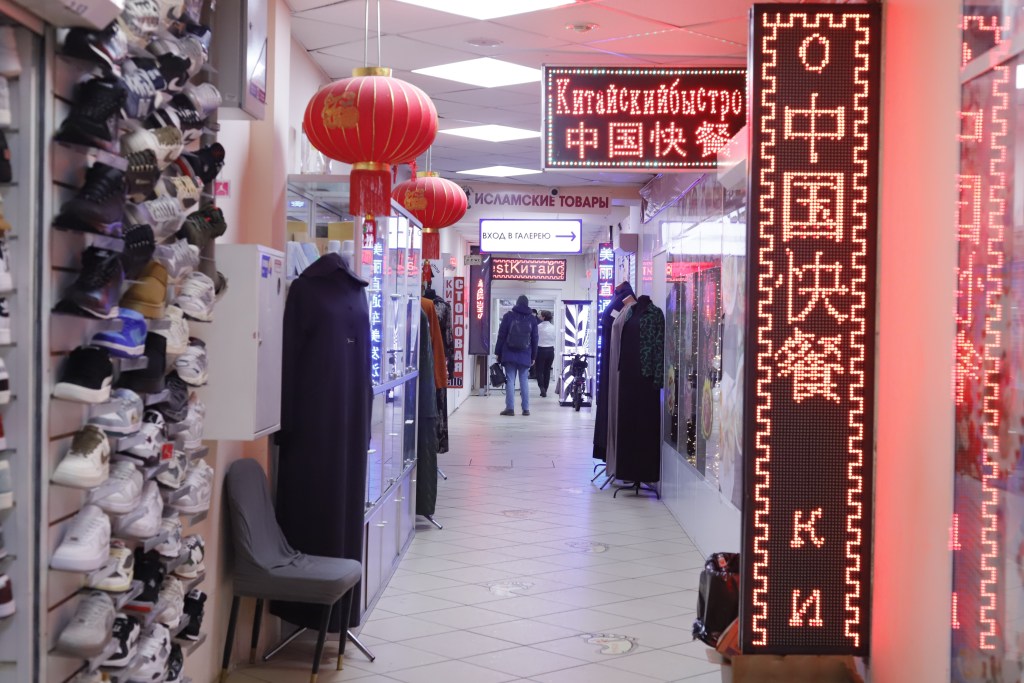
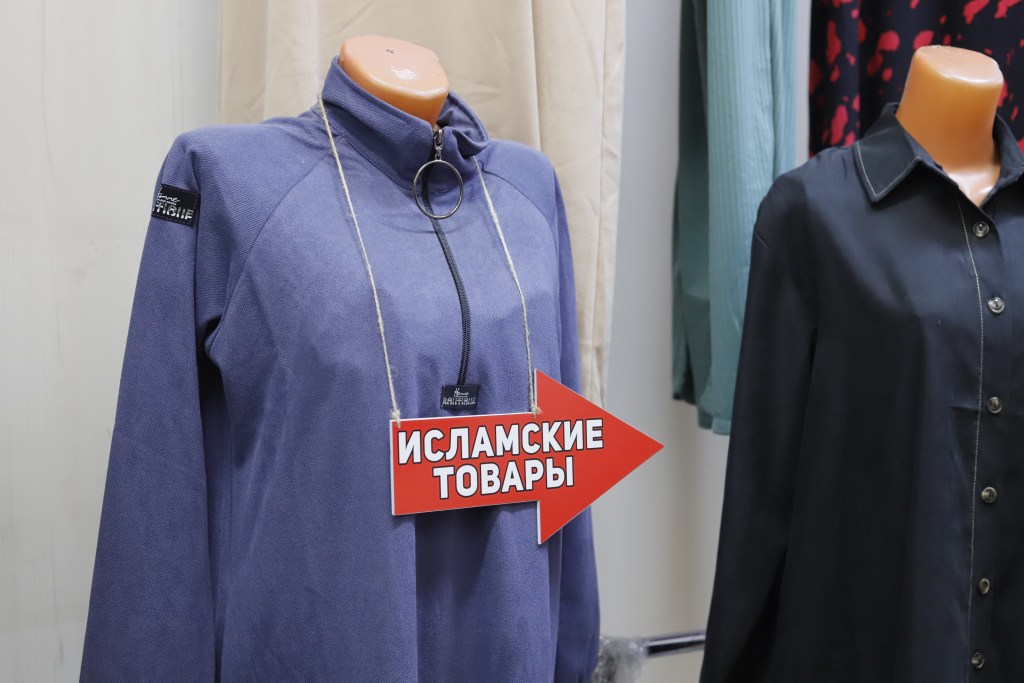
As Ukrainian drones attacked the surrounding Leningrad Region this past weekend, life went on, seemingly unaltered, at downtown Petersburg’s notorious, glorious Apraksin Market aka Aprashka. Thanks to anatrrra for kind permission to reprint their stunning photo reportage from the market.
“Due to circumstances beyond our or Polina Osetinskaya’s control, the festival will not take place,” the organizers said. The pianist had planned to perform pieces by Bach, Debussy, and Desyatnikov.
In its social media post, Fontanka 69 also said that the festival had been conceived by its director Denis Rubin as a way of financially supporting Osetinskaya. “Live performances are the main source of Polina’s livelihood,” emphasized the organizers.
The pub’s post also says that the tickets purchased for the festival could be returned and refunded on the ticket seller’s website. “We would be grateful if you would be willing to hold on to your tickets and support the artist in this way,” the authors of the post emphasized, however.
This is not the first time Osetinskaya’s concerts have been canceled in St. Petersburg. In September 2022, the pianist was not able to perform on stage at the Great Hall of the St. Petersburg Philharmonic. Instead, Eugene Izotov played a concert organized by the Employment Promotion Fund.
Osetinskaya spoke out against the special [military] operation on social media on 24 February 2022. Later, as a trustee of the Oxygen Foundation, she signed an appeal by Russian NGOs to stop the SMO.
Polina Osetinskaya performs the first two movements of Leonid Desyatnikov’s Reminiscences of the Theater (1985) at 142 Throckmorton Theatre, Mill Valley, California, 4 June 2006
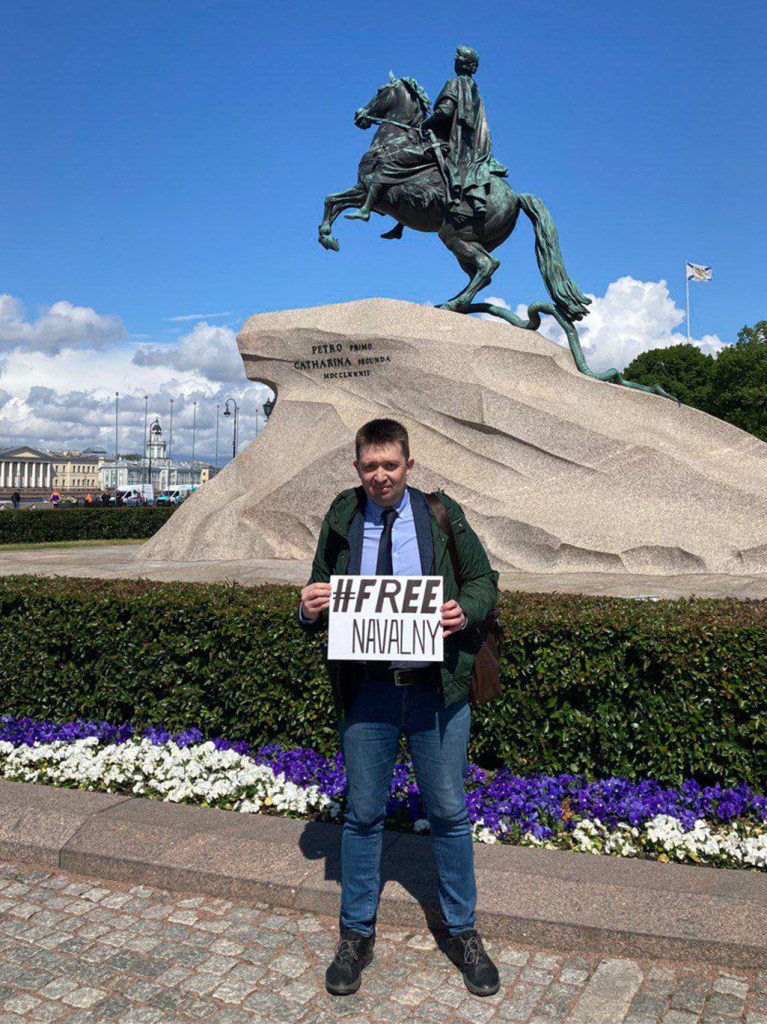
A court in St. Petersburg has begun hearing the case against translator Elena Abramova, who has been charged with repeatedly “discrediting” the Russian army because she engaged in public protests brandishing placards that called for the release of Alexei Navalny and all other political prisoners, and an end to Russia’s war against Ukraine. Because of the criminal case against her, Abramova is no longer permanently employed, although she has stayed in Russia.
Elena Abramova was born and raised in Magadan. Her parents met as students at a teachers institute. Her mom worked as an insurance agent, and her dad, Arnold Yeryomenko, was a Russian language and literature teacher. In the late 1980s, Yeryomenko was imprisoned for two and a half years over his manuscript “October Vanquished,” which detailed “his thoughts on the regime, the Soviet government, and the Soviet legacy.” The family does not have the text of the manuscript: although Abramova’s mother asked the FSB for a copy, she was told that the document had been lost.
“I don’t know for sure whether Dad planned to publish his manuscript officially, or if he was hoping [to publish it] in samizdat. But he definitely talked about it, and someone in his entourage was aware of its contents. That someone was probably an informant, which is how the KGB found out about the manuscript. Informers probably think they are doing something useful in this way, so they inform on people,” Abramova says.
Yeryomenko spoke at protest rallies and led a pro-democracy movement in Magadan, which “held meetings with supporters, but was not involved in electoral politics.” He was asked to run for office but declined.
“I don’t think Dad had any political ambitions. Power never appealed to him. He had his job, which he enjoyed, he spent time with his family, and he read a lot — we had a very extensive library. In short, he had other interests,” says Abramova. “My father’s principled position was that the individual human being had supreme worth. There should be no pressure [on the individual], no compulsion to [hold particular] views or [adhere to] any particular ideology. He always advocated for de-ideologizing society, for the possibility to freely voice one’s thoughts, to speak out freely, to freely participate in peaceful political campaigns. This is what we lack now.”
Yeryomenko’s political activism peaked in the mid-1980s, after he was released from prison, and waned in the 1990s.
“My family welcomed the fall of the Soviet Union,” says Abramova. “I had to wear a Young Pioneer tie for a year, and I remember how we constantly made up excuses to avoid wearing it: that it was supposedly in the laundry, or something else was the matter. When it was all over, I remember the feeling of relief that now I wouldn’t have to do it: there was something contrived about it. I thought that now we would be able to live in peace, without these tokens of the Soviet regime. It seems to me that after the collapse of the Soviet Union, when that short period of freedom dawned, many people just relaxed. It was such a contrast with the past that everyone wanted to get on with their own lives finally, to enjoy the advantages that became available after the regime changed.”
Abramova says that her own views, on the one hand, come from her family, although she was not particularly interested in politics before Russia’s invasion of Ukraine. Her father died in 2008, and five years later she left her job at a large gold mining company and moved to St. Petersburg, where she got a job as a translator. She was buried in her own cares, including working and raising a child.
“I lived my life. Now I look back and recall that my interest in politics emerged not so long ago, and it was provoked by the outbreak of hostilities to a large extent. Before that, I was aware of certain events, of course, and I had opinions on certain issues. I was simply shocked when I heard that [the war in Ukraine] had beguin. At that moment, I was not up to speed at all, I didn’t folloow in detail what was going on. When I saw [the President’s televised] address [announcing the war], I didn’t even realize what was happening. I couldn’t believe that such a thing was even possible, and it took me several days to just to get my head around it. I read news feeds like crazy and watched YouTube. It was a complete surprise, I didn’t think it would happen. The catastrophe is that people are being killed every day,” Abramova says.
Abramova held her first protest picket in late 2022. At the time, she was not only reading news about the hostilities in Ukraine but also following the political trials [in Russia].
“Ilya Yashin was sentenced on December 9. I decided that I had to protest publicly. Although it would be a purely symbolic gesture, I had to do it because I was ashamed. I was ashamed that my country had been plunged into such chaos and darkness. I didn’t know when it would end, and it was clear that this solo picket wouldn’t change anything, but it was a public statement I had to make, which I had to make against all the odds, despite the restrictions. I was a bit scared: I had no prior experience of solo pickets. I had gone to rallies in support of Navalny, and after [Boris] Nemtsov was murdered. But I had not been to the protest rallies that were held at the very outset [of the war]. I was not subscribed to any [social media] communities and didn’t know where they were held, who had made arrangements with whom, or where to go. But this time I decided that I had to go out,” says Abramova.
Abramova’s first picket lasted for only five minutes, although the site — the square outside the Mariinsky Palace — was not very crowded.
“[I stood for] five minutes, maybe a little longer. I soon noticed law enforcement officers approaching me — slowly, demonstratively slowly, as it seemed to me. They detained me quite politely, they weren’t rude. But there was one man in civilian clothes, in a tracksuit, who was also at the police station later, and he asked the most questions. While I was standing there, I saw someone from the opposite side of the street taking a picture of me. Some people walked by and said “thank you” — it was a young couple, I think. Others pretended not to notice. My placard that time out read “No War.” A couple of months later, in February [2023], a court hearing took place, at which I was fined 30,000 rubles [approx. 380 euros at the time],” Abramova recalls.
Abramova was sentenced to another fine for taking part in a protest rally against the military mobilization, and in late April 2023 she held another solo picket outside Gostiny Dvor. She was able to stand there for a few seconds before she was detained. She held her third picket on [June 4], the birthday of politician Alexei Navalny.
Elena Abramova
“I took up my position on the Field of Mars, were there were no police officers at all. Later, I went to Gostiny Dvor, where I was detained immediately. An arrest sheet was drawn up for the second picket, but the case did not go to court. After I left the station, they telephoned me and asked me to come in for ‘additional testimony.’ They probably realized this was already my second arrest. But it was not listed in the arrest sheet, and so I declined to go in. After my third picket I was taken to the same station, and this time the police pulled my rap sheet and opened a criminal case against me,” says Abramova.
Several men in balaclavas, an investigator, and Center “E” officers (officers from the Interior Ministry’s “anti-extremism” unit) soon came to search Abramova’s home.
“I said I had to get dressed, and they said I literally had five seconds to do it. I began to get dressed, but they were banging on the [front] door and practically breaking it down. My child was asleep, so I woke him up, told him not to worry, and explained there was going to be a search. When they were already inside the apartment they behaved themselves, but they confiscated my phone and didn’t even let me call work to warn them I wouldn’t be coming,” says Abramova.
During the investigation, it came to light that the criminal case against Abramova had been launched illegally. Since she is a voting member of an election commission, a criminal case can only be initiated through a special procedure, which had been violated. Formally, then, the case against Abramova was launched twice: first in the summer of 2023, and again in May 2024.
The criminal case against Abramova is currently being heard in court. According to Russian law, for two antiwar pickets she faces a huge fine, forced labor, or up to five years in a penal colony. Abramova attends the court hearings and has no intention of leaving Russia.
“I don’t see any use for myself abroad. I had difficulties finding work in St. Petersburg, especially after the criminal case was opened and I was fired, back in September of last year. I missed a day of work because of the search, and I was immediately asked to turn in my resignation. It was a commercial firm, and the management was probably afraid of scrutiny from law enforcement. But still, I can’t imagine what I would do if I weren’t in Russia. I think that there may come a time when people will need to be here, but the people who need to be here won’t be here. And then, even if I leave, I can’t stifle my feelings. I also feel my share of the guilt for what is happening — for my indifference and lack of involvement. And the pain over the fact that my country unleashed a war against a neighboring country would still remain. I would still have to live with it. Changing locations wouldn’t affect this much,” says Abramova.
Faithful to its avant-garde nature, Noise Cabaret premieres the immersive series Dialogues, based on the philosophical works of Plato, on December 25. Alexander Khudyakov turns ancient Greek philosophy into a lively, witty and provocative dialogue with the audience.
Along with his partner Ivan Wahlberg, Khudyakov, who not only acts in the project but directs it, will guide the audience through the labyrinths of Plato’s thought. What is justice? Where is the line between existence and non-existence? What is the true nature of love? These and many other fundamental philosophical questions will serve as starting points for reflection and debate.
Dialogues is a series of interactive performances in which each viewer is involved in a philosophical discussion consisting of adapted texts by Plato and actorly improvisation, meaning that the way the performance goes depends on the audience’s involvement. Each new performance is a separate chapter dealing with a specific philosophical problem, so you can join the series at any stage. The first episode deals with the concept of justice.
Noise Cabaret plans to invite Petersburg celebrities to enrich the conversation with the audience with their own opinions and views.
Khudyakov shared the idea behind the project.
“We wanted to do a story related to people talking in a bar. But just people talking to each other is not interesting. There has to be a big focus. When I studied Plato, I was interested in several aspects of his philosophy. It would have been wrong to limit ourselves to a single topic. So the idea to make a series arose: take Plato, read him, and discuss the themes he raises in the Socratic dialogues.
“We plan to produce a new episode every two or three months. There’s no pretense here that we’re serious scholars of Plato’s philosophy: it’s more of an excuse to talk to people about difficult topics, to air the Dialogues and reflect on them. And a bar is a place where you can talk about all sorts of things, including philosophy.”
Russians spent almost 6 billion rubles on Ozempic generics in 2024
Semaglutide-based drugs are commonly used for weight loss
In the first ten months of 2024, Russians spent 5.9 billion rubles [approx. 52 billion euros] on over one million packs of generic versions of the drug Ozempic (semaglutide), according to DSM Group, as reported by Vedomosti.
Among the most popular generics are Geropharm’s Semavic and Promomed’s Quincenta. The original drug Ozempic stopped [sic] official supplies to Russia in December 2023, opening the market to domestic analogues.
2024 was a record year for drugs in this category. By comparison, in 2023, Russians spent only 297 million rubles on Ozempic, buying 20 thousand packs. In 2022, they spent 1.9 billion rubles (256 thousand packs); in 2021, 758 million rubles; and in 2020, 76 million rubles.
Semaglutide-based drugs are used to treat diabetes but have recently been gaining popularity as weight loss drugs, which has also contributed to their sales growth in Russia.
St. Petersburg will open a new metro station this week, Governor Alexander Beglov announced Thursday, marking the former Tsarist capital’s first new metro station in five years.
The Gorny Institute metro station, located on Vasilievsky Island, will extend the fourth (or “orange”) line westward. It will begin operations at 9:00 a.m. on Friday, with its vestibule open for both entry and exit, Beglov said.
“The opening of Gorny Institute is a milestone,” the governor wrote on Telegram, noting that the city had overcome “significant challenges” during the station’s construction.
Beglov thanked President Vladimir Putin, metro builders, engineers and residents of St. Petersburg for their patience and support, calling the station’s completion the “first results” of sustained efforts to advance the city’s metro system.
The station’s opening comes after years of delays. Initially scheduled for completion in 2015, its opening was postponed to 2018 and later to 2022. Construction efforts were further overshadowed by a fatal scaffolding collapse in June 2020 that killed one worker and injured another.
Gorny Institute is the first station to open since 2019, when three others — Prospect Slavy, Dunayskaya, and Shushary — were inaugurated.
St. Petersburg’s metro is currently made up of five lines and 72 stations. However, it has expanded slowly over the years, in stark contrast to Moscow’s burgeoning metro system, which this year opened eight new stations.
In trying to grasp the tonality of the film [Anora], I am reminded of a line from Francis Bacon: “You can be optimistic and totally without hope.” The situation the characters find themselves in, being at the mercy of the rich, is totally without hope. The “hopeful” version of the script would be one in which Vanya does stand up to his parents and runs off with Ani, even at the price of losing his wealth—this is the film’s narrative lure. Or maybe another where the ruthless capitalist mother gains a grudging respect for her tough daughter-in-law, like in the last season of Fargo. But despite its grim closure, the impression the film gives is far from dreary or pessimistic. The hopeless optimism of Baker’s cinema lies in the sheer life that seems to almost burst out of the filmic frame, and, especially, his deep care for his characters, even Vanya.
In the fall of 2023, with the goal of understanding what is really happening with Russian society during wartime, the Public Sociology Laboratory team went on ethnographic research trips to three Russian regions—Sverdlovsk, Krasnodar and Buryatia. Over the course of a month, PS Lab researchers observed how people talk about the war and how it affects daily life in cities and villages. In addition, they recorded sociological interviews with local residents. PS Lab has compiled three detailed ethnographic observation diaries (more than 100,000 words apiece) and conducted 75 in-depth interviews. Overall, it has managed to collect truly unique data that provides an idea of what people say and think about the war in everyday situations, and not only when answering researchers’ questions.
The full text of the report is book-length and written in a book-style format: it consists of seven chapters, introduces many characters, and allows readers to be fully immersed in contemporary wartime Russia. The following summary, meanwhile, highlights the main analytical conclusions.
Russian society remains politically demobilized and deideologized. Despite the prevailing opinion that it is strictly militarized, we see that the war has become routine and therefore a disregarded part of reality. For example, compared to the first years of the war, the amount of prowar symbolism in public spaces has decreased in all three regions. The war has neither become a source of new ideas in the cultural life of cities or villages nor been integrated into familiar and already-established cultural formats. The war is not discussed in public places, including, with rare exceptions, local online communities.
In spontaneous conversations, Russians rarely discuss the overall goals and causes, criminality, or justifications of the war. They are concerned with the impact of the war on their everyday lives. When they talk about the war, they mostly talk about the same things they discussed before the war, for example, everyday difficulties, money, or ethics. Men more often discuss topics that are considered “masculine” in society, such as the technical side of the war, and women usually talk about “feminine” topics, such as how war destroys families.
Participation in various types of prowar volunteering and organized assistance for the military, which are often cited as an example of the mobilization and militarization of Russian society, is rarely motivated by people’s firm support for the “special operation.” It is usually associated with pressure from the administration, community moral norms (concerning mutual assistance), and/ora desire to help loved ones, rather than a wish to make victory for Russia more likely. Observation of volunteers’ activities show that while working, they do not discuss the war or politics, rather choosing topics that are personable and relatable to them: prices, pensions, families, and/or stories related to the volunteer centers.
Despite all these similarities, the war is perceived slightly differently in different regions. The peculiarities of each region’s view owe to factors like the number of military units and penal colonies from which prisoners are recruited, proximity to the combat zone, the prosperity of the region and the availability of decent jobs, the density of social ties, the circulation of news transmitted by friends on the front lines, etc. In other words, the differences in perceptions of the war are attributable mainly to the peculiarities of life in the regions before the invasion of Ukraine.
The conflict between opponents and supporters of the war is gradually subsiding, while the rift between those who stayed in Russia and those who left is growing. This is happening both because the shared experience of living through a difficult situation within the country is becoming more important for many Russians than any differences in viewpoint, and also because people are discussing the war less.
At the same time, the waning conflict between opponents and supporters of the war does not always mean more social cohesion. Since people are trying to live as if the war is nonexistent and the government does not talk about any losses or problems associated with the war, all negative consequences of the war are either normalized or pushed into the realm of “personal problems” that are not discussed with anyone and that everyone must deal with on their own.
Overall, many people do not feel able to influence political decisions. Therefore, they are increasingly distancing themselves from the war. They understand that they cannot change government policy, but they retain at least some control over their private lives—and therefore they are immersed in them. Over time, not only apolitical Russians but even sure opponents of the invasion experience this powerlessness and, as a result, some of them accept the new reality while continuing to condemn the war internally.
Consequently, many Russians are increasingly distrustful of political news from a broad range of sources. Instead, they put their trust in local media. Local problems and news seem much more important and relevant to them. Moreover, they feel that, unlike the war, local issues are at least sometimes within their ability to influence.
At the same time, the war is weighing people’s emotional state. Many of our interlocutors admit that they experience anxiety, tension, uncertainty, fear, even if these things are not usually spoken about openly. The departure of sons and husbands to war makes women “scream at the top of their lungs.” However, people rarely share such emotions with others, and if they do, they do so in groups with close friends.
Many Russians who are not interested in politics may justify or condemn the war depending on the communicative context.
They tend to non-emotionally justify the war through normalization (“there are always wars”) or rationalization (“it was necessary”) when asked about it directly in more formalized settings, such as research interviews.
They are more likely to criticize the war when prompted to think about how it negatively affects them as ordinary Russians. This criticism differs from that of war opponents. For opponents, the war is a moral crime against Ukraine, whereas for apolitical Russians, the war is seen as something that destroys Russian society and harms ordinary people. However, this criticism does not lead apolitical Russians to question the war’s necessity or inevitability, nor does it extend to criticizing the Russian government.
They tend to emotionally justify the war when confronted with traditional anti-war narratives. When Russia is accused of committing moral crimes against the Ukrainian people, they often take such accusations personally and attempt to defend their own dignity.
Some people have experienced a strengthened sense of national identity, and sometimes a demand for greater solidarity arises. It’s important to note that this increased sense of national identity does not lead Russians to adopt the official imperial brand of nationalism. Unlike the Kremlin, ordinary people live in a world of nation states, not in a world of imperial fantasies (according to which Ukraine is not a real state and Ukrainians are an inferior people).
A feeling of uncertainty is what truly unites Russians today. Despite the fact that people choose various strategies to cope with this feeling, it still significantly complicates the ability to plan one’s life and plunges Russians into pessimism.
Thus, on the one hand, the formerly extraordinary nature of the war is giving way to normalization: the war is gradually becoming something ordinary, another unremarkable part of the surrounding world. In a sense, many Russians resist both the Kremlin’s attempts to turn ordinary citizens into ideological supporters and the attempts of the anti-war liberal opposition to force society to actively experience guilt and fight. On the other hand, the war constantly reminds us of its existence, creating new threats, new anxieties, and new reasons for discontent in Russians.
Dear readers! Times are tough, and the key in this case is holding on in every sense. No one says it’s easy. But it’s not so hard either. The other day I asked Vladimir Putin whether he expected anything more from himself in the outgoing year. But I want to ask you: do you expect anything more from yourself in the coming year? We need to expect things. We need to want things. It’s a way of holding on to ourselves. Of looking after ourselves. Of not losing ourselves. And even of finding ourselves. A hard sign (“Ъ”) will never be a soft sign (“Ь”)! Happy incoming New Year! Let’s not be on the defensive!
Andrei Kolesnikov, Special Correspondent, Kommersant Publishing House
Source: Email from Kommersant, 31 December 2024. Translated by the Russian Reader. The so-called hard sign, which the Bolsheviks dropped from the Russian Cyrillic alphabet in 1918, has been the logo of Kommersant since the newspaper’s relaunch in January 1990. Andrei Kolesnikov has been the newspaper’s special Kremlin correspondent — that is, its chief Putinversteher — for many years. Of course he’ll deny it all when push comes to shove and Putin goes, and he’ll point of course to the cynical, jocular (but ultimately loyal) way he’s written about the Russian dictator and war criminal all these years.
“Yevgeny Zhumabekov, 96 kilograms” is how he introduces himself. Yevgeny is the person who came up with the idea of replacing Last Address plaques that had been torn down with homemade copies and who did this work incognito for almost a year. Now he can identify himself.
Bumaga has detailed the struggle that erupted over the plaques in December 2023. They began to disappear en masse, but copies subsequently appeared in place of the ones that had been torn down. These copies were also removed, after which a plaque appeared on the 14th Line on Vasilyevsky Island bearing the following message: “Plaques [memorializing] people who had been politically repressed in this place were repressed eight times.”
Here you can read Yevgeny’s own account of how the [Stalinist] crackdowns touched his family, what shaped his views, how his wife and children got involved in the fight for historical justice, why the Zhumabekovs had to leave the country, and who continues to install the plaques in their wake.
How the repressions touched Yevgeny’s family
I was born in the Sverdlovsk Region, in the town of Kushva, which has gradually been turning into a village. It’s a depressing place. Two of the industrial enterprises that supported the town have shut down. People have been leaving, while the old people are dying off.
It so happened that my history teacher at school was a good friend of my grandfather’s. He would come to my grandfather’s house, and they would drink hard alcohol together, play chess, and talk a lot. I often visited my grandmother and grandfather and heard these conversations. That’s how I learned that my grandfather came from a family of a person who had been politically repressed.
His parents had come from the Perm Region. My great-grandmother and great-grandfather were completely ordinary peasants. It was forbidden in their house to drink alcohol, [and because they were teetotalers] they harvested large crops. In 1931 or 1932, they were dekulakized and exiled far beyond the Arctic Circle, while their children were sent to orphanages. After a while great-grandmother and great-grandfather managed to escape, but great-grandmother had fallen ill in exile and died soon after returning home, while great-grandfather had to hide out in remote villages all the rest of his life.
I know that my grandfather also had a hard time as a member of a politically repressed family, but he never told me about it, although I tried to find out. It was such a profound trauma for him that he could discuss it only when he got drunk with his sole friend.
How the FSB visited Yevgeny’s workplace
In 2006, I moved to St. Petersburg, where I worked for a time in the car business. I held various positions: sales manager, head of the customer engagement department, manager of a car showroom. Then, before the war, I transferred to a construction company, where I sold real estate.
In 2021, I went to a rally in support of Alexei Navalny after he had returned from Germany. Then there was the protest action with flashlights and others. Not only did I attend these events but I also talked about them with my colleagues at work. I was just sharing my pain, not encouraging them to do anything.
Petersburg police have arrested a 24-year-old freight handler who threw a Molotov cocktail at a military recruitment office (voenkomat). He had been hoodwinked by scammers whom he had contacted himself.
The Petrograd District Court remanded Daniil Pavlov in custody to a pretrial detention center, Rotunda’s correspondent reports. Pavlov faces ten to twenty years’ imprisonment on charges of “terrorism” (per Article 205 of the Russian Federal Criminal Code). The pretrial restrictions hearing took place in closed chambers.
Baza writes that in early December Pavlov had been unable to log onto the Gosuslugi (municipal and state services) app, and instead of the number for customer support he found the scammers’ number on the internet. They asked him to move the conversation to Telegram and told him that they had hacked the young man’s account. According to RIA Novosti, Pavlov then wired 800,000 rubles [approx. 7,400 euros] to these persons unknown.
“Customer service” told Pavlov that he had to throw a Molotov cocktail at the military recruitment office on Tchaikovsky Street* [in Petersburg’s Liteiny District]. He thus intended to assist in the apprehension of certain “bad guys,” journalists explain.
RIA Novosti writes that he was promised a payment of two million rubles [approx. 18,500 euros] for the job. As soon as the young man threw the flammable mixture, he was detained by police.
📌 Daniil Pavlov lived in [the Petersburg suburb of] Sestroretsk and was employed as a freight handler. Judging by his subscriptions on VKontakte, the young man enjoyed anime and computer games. His girlfriend told Rotunda that they had been planning to get married.
* Tchaikovsky Street in Petersburg is named after the Russian revolutionary Nikolai Tchaikovsky, not the Russian composer Pyotr Tchaikovsky.
🍍🍍🍍🍍 WOW News: the number of pineapples needed to enter prize drawings has dropped! Hurry up and hunt for pineapples and get closer to winning! You still have time to take part in drawings for a flat in Moscow, cars and tours abroad.
√ Search for pineapples on the product pages in the Ozon app.* The products marked with pineapples change daily. You can also get pineapples for purchases of 500 rubles or more. Pineapples are awarded for redeemed items.
√ Double your pineapples when paying for purchases outside Ozon with the Ozon Bank card (more details in the terms and conditions of the promotion).
*The promotion is available only in app versions 17.40 and up.
Source: Email flyer from news@news.ozon.ru, 18 December 2024. Translated by the Russian Reader
Alleged video footage of the arson attack in Bolshoi Kamen, Maritime Territory, Russia
A resident of Bolshoy Kamen (Maritime Territory) attempted to torch a building after he fell prey to scammers, writes the Telegram channel Mash.
After the 23-year-old male was detained, he told police that telephone scammers from Ukraine had persuaded him to take out a bank loan. He later realized he had been conned.
Sometime later the con men again telephoned the local resident. Identifying themselves as members of the secret services, they asked the young man to torch town hall and a bank branch, saying these actions would allegedly repay the detained man’s [sic] debt.
“They sent him instructions on how to assemble a Molotov cocktail and gave him subsequent orders over the telephone,” Mash writes.
Heeding these recommendations [sic], the young man broke a window in the bank branch and set fire to it. According to Telegram channels, he also attempted to torch town hall. The flames also engulfed fire department vehicles.
The fire in the first building was extinguished quickly, but what happened at the other two locations [lokatsii] is not reported.
Earlier in Blagoveshchensk, four people attempted to torch a military recruitment office and were handed prison sentences of up to seventeen years.
The number of Russians who find themselves behind bars for opposing the authorities who launched the war with Ukraine grows by the day. There are hundreds of political prisoners in the country. We try to remind our readers about these people every chance we get. Today, Mediazona’s David Frenkel tells the story of Alexander Skobov, 67, a historian from St Petersburg, a defendant in the last criminal case against ‘anti-Soviet agitation and propaganda’ in Soviet history, a convinced Marxist, and a veteran of the dissident movement, who after decades has found himself on a very familiar path: searches, arrest, psychiatric ward, jail.
Alexander Skobov is one of the most experienced political prisoners in Russia. In the 1970s and 1980s, he was twice sent to a psychiatric hospital for compulsory treatment: the first time as an editor of samizdat, the second time for slogans in favour of political prisoners, which Skobov wrote on the walls of Leningrad houses.
Almost half a century later, in April 2024, the authorities came after him again. Skobov was accused of ‘justifying terrorism’ because of his post about the explosion on the Crimean Bridge and sent to a pre-trial detention centre. In protest, he refused to take his glasses and medication with him. Later, an article on participation in a ‘terrorist community’ was added to the charge, and Skobov was transferred from St Petersburg to Syktyvkar.
“We were left alone for a long time. The reasoning being: we’ll die out on our own. Or we’ll leave and live out the rest of our lives off the once acquired (quite deservedly) political and moral capital. The blow came to other people, most of them much younger,” he wrote from the pre-trial detention centre.
Skobov maintains an active correspondence in pre-trial detention. He discusses philosophical and political topics, his letters are even published in historical journals. Write to Alexander, argue with him, disagree with him, I’m sure it would be valuable to him. The only thing is that his wife asks that the letters to him be written in 18-point Sans Serif font. Skobov can’t even see his own texts well: he first drafts them on the back of used sheets of paper and then blindly transfers the texts to the reply form.
Address:
167028, г. Сыктывкар, поселок Верхний Чов, д. 99 , ФКУ СИЗО-1 УФСИН России по Республике Коми. Скобову Александру Валерьевичу 1957 года рождения
Please write letters in Russian, otherwise the prison censors won’t let them through. You can send letters online via a special services called PrisonMail.
You can also write in English, using the websites Letters Across Borders and Lifeline, two projects by OVD Info, a media outlet and human rights defense group.
It is a tradition in Petersburg to visit the improvised memorial to Timur Kacharava outside the Bukvoyed bookstore on Vosstaniya Street every year on the evening of November 13. Candles and portraits of the antifascist, who was murdered at this spot nineteen years ago, are brought there by his mother and a changing roster of first-time visitors. Last year the memorial was torn down by far-right activists.
Eight people were convicted of the knife attack on the twenty-year-old Timur and his friend Maxim Zgibay (who was wounded but survived the assault), and five of them were sentenced to prison. All of them have been released (the killer was paroled in 2016) and disappeared from the limelight.
Bumaga asked Irina Kacharava about the people she has seen at the memorials over the past nineteen years, how she feels about the release of Timur and Maxim’s assailants, and what life choices her son would have made in today’s Russia.
— How do you usually spend November thirteenth?
— The day before, I always wish it wasn’t happening. I wish it was the twelfth or the fourteenth. I wish I could just forget it, erase it, and be done with it. But I cannot. The thirteenth comes. I spend it at work or at home. Between five and six-thirty my husband and I go to the wall [at the Bukvoyed bookstore] on Vosstaniya Square. We go to the cemetery the day before, of course. We make sure to leave Timur’s favorite flowers, irises, [at his grave].
We hate this day, and we don’t want it to happen. For some reason it’s easy to go to the cemetery, but it’s very hard to go to the wall. But we gave our word that as long as we are alive, as long as we are able, we will go, no matter how hard it is.
We are always surprised that we are not the only ones there. Each year we think that this time round no one will come for sure. People come, and I’m surprised that all of them are young people. I ask them how they even heard about Timur, since they weren’t even alive when it happened. Nineteen years have passed. They say they heard [about Timur] from their moms and dads, and some from their brothers and sisters. That’s surprising.
We dislike this day very much, but we go to the wall, and then we try to start living again.
— Do you meet Timur’s friends? Do you communicate with them on other days?
— For a long time, ten years at least, we kept in very close contact with all of Timur’s friends. We would even get together. That has been winding down now, but it’s normal, I think. So many years have passed, and some have families, while others have left the country.
Mostly strangers or people who have been going for years come to the wall — for example, adults [sic] from the former Memorial.
— Over the years, it has been suggested that a memorial plaque be erected or a street be named in Timur’s honor. Do you think it is still possible?
— MP Nikolai Rybakov(who is the national leader of the Yabloko Party but not an MP — Bumaga) launched the campaign to put up a plaque. He personally approached us at the wall: he said he had made a request to the authorities, and that he was waiting for response. Time has passed, but nothing has happened.
— Would you like it to happen?
— I don’t know: I never thought about it. I don’t believe anyone will ever do it. And I don’t think it could happen at all given the current situation [in Russia].
By the way, there were fewer lads of conscription age [at the yearly memorial] when all these sad events [the war] began. At the beginning of the [military] mobilization, they were afraid to come. Law enforcement agencies are always present there to prevent mayhem.
— How did you react when one of the people involved in the attack, Alexander Zenin, who had been in hiding for twelve years, was detained in 2018?
— I laughed. He had been living in Pesochny the whole time. During that time he had managed to have two children, but the police had been unable to catch him. The trial was hard for me; my husband went to it. The police investigator called us and told us that the case would start to kick off again, that we would have to go to the court hearings again. He said that if we signed a paper that the case could proceed without our presence, then it would be wrapped up in one hearing. So we signed it. It turned out that he just wanted to tick a box and close the case quickly, and so there was no investigation as such. But it didn’t matter by and large. Whether he was caught or not, I wish him well and hope that his children grow up, for God’s sake.
— In 2007, you said about the attackers: “I have no vengeful feelings.” You haven’t had any since then?
— No, it’s not rational to seek revenge.
— Did they try to contact you, to apologize?
— What apologies could there be after I attended the court hearings?! I was alone there without my husband, and our lawyer was away at the time. I was alone against the seven defendants, their parents, and their lawyers. Twenty-one people tried to bite me (figuratively speaking), cut me, and kill me. I had started going to the court hearings to defend Timur. The parents of the defendants felt so angry with me that Timur had crossed their paths and caused their children to suffer.
Zenin sent us fifty thousand rubles in 201. He was apologizing, as it were, so that he would get a big plus [in his character testimony] in court. But I didn’t take the money. I asked the investigator how I could inform the court that I had not taken the money. He told me: “It was the good will of the defendant — he sent the money. Nobody cares whether you took it or not.” (Alexander Zenin was sentenced in 2018 to one and a half years in a medium security penal colony for inciting hatred and enmity.)
— You are employed as a teacher. Do you observe political activism among young children? Have their views been radicalized? Or are their attitudes apolitical?
— I’ll talk about their parents, because everything comes from the family. The parents are completely susceptible to propaganda. Of course, there are children who voice their opinions, but I do not get into these conversations with them due to professional ethics.
There are children who repeat what the TV says, what their parents say. Although there were some pupils whose parents were of the same opinion as me, and, accordingly, their children also think differently. I didn’t discuss things with them, but I was pleased to hear that not everyone was marching in lockstep. Although young people are chewed out, they are decent folk; there are all kinds of different people [among them], just like we were, just like you are. There are always pros and cons. It’s just that now the propaganda is so heavy that it is difficult to analyze the situation and have an opinion.
I can tell you this about the younger children. Whereas before [the war] they played cops and robbers, and no one wanted to be a cop, and everyone wanted to be a robber, now they play terrorists. And for some reason both sides are terrorists.
— What would Timur be doing in Russia in 2024?
— I think he would have left by 2022. He would have gone to Europe: he had his own people there. I would not say that he would have left for political reasons. The most important thing for him was music. He expressed his views through music. That’s where he would have gone. The politics would have been secondary.
— Is life in Russia more dangerous now than it was in 2005?
— Of course. There is no comparison. Despite what happened to our family in 2005, it’s not even up for discussion.
— Would you have been happy if he had left the country, but was safe and doing creative things?
— When children leave home or leave the country, it’s always sad, I guess. I’ve been trying to fool myself all these years (as psychologists have counseled me to do) that he’s alive but has just left the country. But it doesn’t work for me.
Would I have welcomed his leaving? I think it would have been his choice. His father and I would have had to accept that choice. It wouldn’t have mattered much whether we liked it or didn’t like it, whether we were sad or not. And who’s to say he would have been safe there? We don’t know what he would have done there. We would just have had to accept his choices, like we accepted his life choices in 2005.
I was reproached at the trial for not forbidding him from doing all those things. Doing what? Rescuing animals from the streets and feeding homeless people? (Timur Kacharava was a vegan and fed homeless people at Food Not Bombs events — Bumaga.) What were we supposed to forbid him from doing do? I just didn’t realize at the time that it would prove to be so dangerous. We would have just accepted his choice, because he would have had the right to it, as well as the right to make it a reality.
So, it is better that he lived a short, tragic life that was his own life rather than than the long, boring life which we would have dreamt up for him. Of course I would have been sad [had he left]. How could I not have been sad?
“Last night, I stood for a while next to the memorial to Timur outside the Bukvoyed store on Vosstaniya. Suddenly three antifa showed up, one of them sporting a mohawk. They told me that a bonehead [a neo-Nazi skinhead] had just shot at them with a trauma pistol. He had been going to attack one of the antifa, but when he noticed that there were three of them he ran away and fired a parting shot. That’s what they said. E. saw young boneheads at Avtovo that evening. Considering that they now often attack couriers and janitors [i.e., Central Asian migrant workers] in particular, there is partly the same disturbing feeling as before [i.e., during the intense wave of neo-Nazi attacks on ethnic minorities, immigrants, and antifascists in Petersburg in the late 2000s]. That’s on top of everything else.”
How much have Petersburgers’ wages grown over the past year? How do companies and experts explain the shortage of personnel? How will the tightening of migration laws affect employers?Bumaga looked at the numbers and talked to online recruiters hh.ru to give you a picture of the main trends in St. Petersburg’s labor market in 2024.
Bike couriers emerging from a pedestrian underpass in downtown St. Petersburg. Photo: Nikolai Vinokurov/Lori via Bumaga
Petersburgers’ salaries grew by over thirteen percent during the year according to both official stats and hh.ru’s data
Analysts at hh.ru told Bumaga that the average monthly salary advertised to Petersburgers in early October 2024 had increased by nineteen percent compared to last year’s figures — up to 79,300 rubles a month [approx. 750 euros]. Petrostat cites similar dynamics, although it cites different overall numbers. According to the city’s statistical agency, the average monthly salary in St. Petersburg increased by 13.1% in August 2024 compared to last August, amounting to 99,800 rubles.
Top managers enjoyed the biggest increase in their average pay — 20,600 rubles a month — Maria Buzunova, head of hh.ru’s press service for the Northwest Federal District and the Central Federal District, told Bumaga. Consulting and strategy professionals, whose average income increased by 20,000 rubles [approx. 190 euros], came in second place.
“Wages in agriculture, insurance, raw materials extraction, the auto business, and auto repair have also been on the rise. Amid the unfolding personnel deficit, employers are still trying to catch applicants in construction and laborers with the money hook. That said, there is not a single sector where advertised salaries have fallen,” Buzunova says.
According Buzunova, average salaries in agriculture, investment and consulting, the auto business, raw materials extraction, and management have exceeded the 100,000 ruble per month mark. Analysts at hh.ru recorded average monthly salaries of round 100,000 rubles in the information technology, transportation, construction, and real estate fields.
Petrostat’s numbers would lead us to believe that the growth of salaries in the city has already stopped. According to the department’s data, the average monthly salary of Petersburgers was higher in the period from April to June than it is now, amounting to approximately 103,500 rubles [approx. 985]. Data from hh.ru suggest the opposite. The online recruiters told Bumaga in mid April that they had estimated the average advertised salary at 72,500 rubles per month. Thus, in five and a half months, this indicator has increased by 9.4%.
Employers are facing a shortage of employees. Demand for teachers and medics has grown in the city
The experts at hh.ru argue that the main reason for wage growth has been the stable growth of demand for staff on the part of employers. The total number of vacancies in St. Petersburg reached 750,000 from January to early October, which is eighteen percent higher than for the same period in 2023.
“Consequently, the problem of staffing shortages has been deepening. This is confirmed by our survey of employers, which we started a couple of years ago. According to the majority of company reps both in Russia as a whole and in St. Petersburg, staffing shortages remain the fundamental problem of the labor market,” the online recruiters told Bumaga.
Demand for teachers and tutors (up twenty-six percent compared to last year), sales clerks and other retail workers (up twenty-five percent compared to last year), and medical personnel (up twenty-three percent compared to last year) has risen the most in St. Petersburg. One of the reasons for the shortage of teachers and medics is their declining interest in staying in their professions and their leaving for other sectors with better working conditions, hh.ru noted.
However, entrepreneurs from other sectors — for example, owners of restaurants, bars and cafes — have also spoken out about staffing shortages. “There is a shortage of absolutely everyone, both waiters and managers,” Vitaliya Dolinskaya, operations director at the restaurants Chang and Che-Dor, told Bumaga.
According to the heads of the companies surveyed by hh.ru, one of the reasons for the shortage of personnel is the demographic situation in the country. Other factors that negatively impact the labor market are the lack of qualified personnel, the low labor mobility of Russians, and insufficient inflows of foreign migrant workers.
Stricter migration laws may aggravate shortages of sales clerks, drivers and couriers. Companies’ costs will be borne by consumers of their goods and services
The shortage of migrant workers can be explained, among other things, by the actions of the Russian authorities after the terrorist attack on the Crocus City Hall music venue outside of Moscow. The State Duma continues to tighten migration laws, foreign nationals have been increasingly deported from the country, quotas for temporary work-and-residence permits have been reduced, and the police regularly carry out “anti-migrant” raids.
The attitudes of Russians towards labor migrants have also changed. Eighty percent of Petersburgers surveyed by hh.ru believe that there are too many migrants in the city. At the same time, only thirty-six percent of respondents would agree to take “migrant” jobs. Most often this opinion was voiced by workers in the restaurant and hotel business, logistics and transportation, sales, construction, and the retail trade.
Yulia Sakharova, hh.ru’s director for the Northwest Federal District, claims that the upshot of all this is a shortage of people to fill the most high-demand vacancies — for sales clerks, drivers, and couriers.
“The tightening of migration policy may complicate recruitment for companies. In most cases, the depletion of an already scarce resource leads to an increase in its cost. Employers will have higher recruitment costs. They will be forced to compete against each other by raising wages, and further shift the increased costs onto the price of their services, a price that will be paid by the end consumer,” Sakharova explained to Bumaga.
Factories are looking for young skilled workers, and IT salaries have stabilized. A few more trends in the labor market
Here are five more trends in the Petersburg labor market:
St. Petersburg has become less attractive for employment. In the fourth quarter of 2024, the city dropped from fourteenth to twenty-sixth place in hh.ru’s ratings. This happened due to increased competition and an increase in the number of Petersburgers willing to move to other regions. “This does not mean that the city has become a worse place to work. It means that labor conditions have not improved so dynamically in St. Petersburg compared to other regions,” Maria Buzunova.
Petersburg enterprises have been forty-nine percent more likely to offer jobs to young skilled workers than in 2023. Since the beginning of the year, the city’s factories and other production facilities have posted more than 14,000 vacancies which are open to recent graduates and personnel without work experience.
There were about one thousand vacancies for cab drivers in St. Petersburg in August 2024, which was fifty percent more than a year earlier. And yet, there are fewer applicants: on average, one or two people apply for each vacancy (the lower limit is four people per vacancy), hh.ru noted. This circumstance also affects the price of cab rides, which we examined in more detail here.
In 2023, the salaries of IT workers in St. Petersburg decreased for the first time in several years. In 2024, incomes in the IT sector increased again, according to hh.ru. For example, the salaries of developers have grown by seven percent, while those of analysts have risen by fifteen percent. “However, we have also seen a transition from a jobseeker’s market to an employer’s market. According to our research, the overheated market for IT professionals has reached its limit and will gradually stabilize as more and more companies refuse to give employees dynamic salary increases,” hh.ru explained.
Petersburgers are more and more often quitting stressful jobs that negatively affect their emotional state. Given these conditions, employers are forced to introduce practices for handling their employees with care and patience, hh.ru noted.
Russian casualties in Vladimir Putin‘s full-scale invasion of Ukraine have surpassed 700,000, according to Kyiv, which trolled Moscow over the round number of such a grim milestone.
In its daily update, Ukraine’s military said on Monday that over the previous day, Russian forces had suffered 1,300 personnel losses, taking the total number since the start of the full-scale invasion to 700,390.
“‘Perfect numbers like perfect men are very rare.’ Rene Descartes,” Ukraine’s defense ministry posted on X referring to the French philosopher.
Newsweek has contacted the Russian defense ministry for comment. An accurate number of casualties, which Ukraine says are “approximate” and include those who are both dead or injured, is difficult to ascertain, with both sides remaining tightlipped over their losses.
Russia has not updated its figures since September 2022 when it said that just under 6,000 had been killed, while Ukraine’s President Volodymyr Zelensky said in February that 31,000 Ukrainian troops had died, although this was lower than Western estimates.
U.S. officials told The New York Times that September was the bloodiest month of the war since its start in February 2022 and that more than 600,000 were dead and wounded, with the spike caused by assaults in the east of Ukraine where Putin’s forces have made slow gains but at a great cost in personnel.
An unnamed U.S. official cited by The New York Times said that more than 57,500 Ukrainian troops had been killed and 250,000 wounded.
Estonian intelligence estimated that Russia may have lost around 40,000 soldiers in October alone, a figure backed up by other estimates and higher than the 30,000 new soldiers that Ukrainian military intelligence believes are being recruited per month.
In its update in mid-October, independent Russian news outlet Mediazona said that 75,382 killed Russian troops had been identified, an increase of 2,483 since the start of the month.
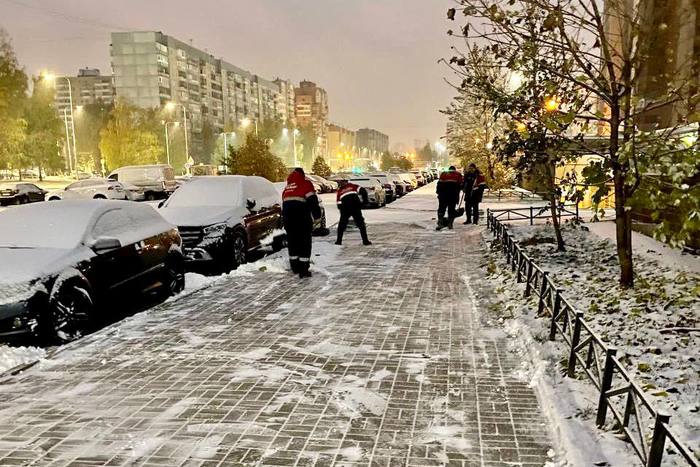
Central Asian migrant workers cleaning snow from the pavement somewhere in Petersburg.
Janitors are the hardest-to-find workers in Petersburg
Since the beginning of 2024, an average of 0.8 applications have been submitted for every janitor job vacancy, the press service of the employment website hh.ru has told Bumaga.
In the first nine months of this year, employers increased the wages offered to janitors by eighteen percent — up to 45,000 rubles a month [approx. 430 euros].
Shop cashier and auto mechanic are the most unpopular occupations among job seekers. During the year, the salary offered to workers applying for these jobs has increased by twenty-five percent and twenty percent, respectively.
According to analysts at hh.ru, “the country’s negative demographic processes” are the main reason for the shortage of employees. “They are long term and quite amenable to forecasting, so, unfortunately, positive trends are not to be expected here,” they argue.
Petersburg has long been short on janitors. In 2023, Yevgeny Razumishkin, deputy governor of St. Petersburg, said that the city had not yet been able to recruit the necessary number of these workers.
The city has tried to recruit janitors and machine operators by increasing their salaries up to 49,500 rubles and 76,800 rubles on average citywide. Last year, the Housing Committee also told Bumaga that it had improved working conditions by installing changing rooms, showers, relaxation rooms and even mini-saunas in janitorial offices.
The Housing Committee told Bumaga that the understaffing is partly caused by the social stigma of the janitorial profession in Russian society. Alla Bredets, the head of Housing and Utilities Control, a regional public monitoring center, argued that the situation with staffing in the housing and construction industry was affected by the outflow of migrants.
Despite an acute labor shortage, the Russian authorities are trying to curtail the numbers of workers arriving from Central Asia. The crackdown intensified after the Crocus City Hall terrorist attack in March, which was reportedly carried out by Tajik nationals. But the appeal of Russia’s job market was already diminished prior to these restrictions. Now, Central Asian migrants are looking for job opportunities in other countries, including in Europe.
Historically, Russia has been the main destination for Central Asian migrant workers. Even after the full-scale invasion of Ukraine—and the recruitment of foreign migrants into the armed forces—Central Asians continued to go to Russia. The Crocus City Hall attack was a watershed moment. In its aftermath, labor migrants faced constant document checks, workplace raids, firings, flight delays, and hours-long lines at the border with Kazakhstan. If they were detained by law enforcement officials, they could be subjected to torture, or given a choice between conscription and deportation.
Even diplomats have been caught in the crossfire. In April, police officers burst into the Moscow apartment of an aide to Kyrgyzstan’s ambassador, ostensibly to establish who was living in the property. His wife and children were home at the time.
Afraid of antagonizing Moscow, Central Asian governments usually ignore such excesses. This time, the infractions have been so serious that officials have been forced into action, with both Dushanbe and Bishkek sending notes of protest. Tajik President Emomali Rahmon spoke up for his compatriots in a May meeting with his Russian counterpart, Vladimir Putin, urging him to fight terrorism, not Tajiks.
There has been no change in approach, however, and that has caused an outflow of migrant workers from Russia. Since April, the number of job seekers from Tajikistan in St. Petersburg has fallen 60 percent, while the number of job seekers from Uzbekistan dropped 40 percent. St. Petersburg is second only to Moscow in terms of its appeal to migrants.
More than a dozen Russian regions have tightened labor restrictions. As a consequence, the Krasnodar region, a leading producer of wheat, corn, sunflowers, and rice in Russia, is experiencing a shortage of agricultural workers. In the Ural Mountains, the same is true for factories, including those producing military equipment. In Yakutia in Russia’s far north, migrants have been banned from driving taxis and other transportation jobs. In Dagestan, there are not enough workers to dispose of the region’s waste.
As a rule, the impetus for imposing restrictions on migrants comes from regional officials. They claim migrants have taken jobs from Russian citizens and depressed wages. In fact, the reverse is true: the economy faces such an acute shortage of workers that wages are rising rapidly. The war on migrants goes on, however, having clearly been accepted by the authorities as an expression of patriotism.
Should the pressure continue, Russia’s labor shortage will only worsen. According to the Russian Academy of Sciences’ Institute of Economics, the country lacks about 4.8 million workers, with deficits particularly affecting industry, agriculture, trade, construction, and utilities: sectors that are generally staffed largely by migrants.
The crackdown is particularly baffling given that migration has gone some way to offset Russia’s demographic problems. At present, Russia’s mortality rate is nearly twice its birth rate, making migration key to maintaining population levels.
Over the past two years, the annual number of migrants entering Russia has remained stable at about 3 million. Most, however, are seasonal workers who do not stay long. Net migration was nearly 500,000 in 2021—the year before the start of the full-scale war in Ukraine—but it fell to 62,000 in 2022 as a result of Western sanctions hitting wages, and the recruitment of migrants into the Russian armed forces.
It might seem an inopportune time for Russia to be alienating Central Asian nations. After all, their governments did not break with the Kremlin after the full-scale invasion of Ukraine. But it seems Moscow believes Central Asian migrants have no alternative to the Russian job market. In any case, Russia has a history of using anti-migrant campaigns as a political tool. In 2006, Georgian migrants were targeted in raids after a group of Russian spies was arrested in Tbilisi. And in 2011, Tajik migrants were detained after Russian airmen were arrested in Dushanbe on suspicion of smuggling.
The Kremlin has even used threats to punish migrants as a way to squeeze concessions from Central Asian governments on issues from language policy to economic integration. Central Asian leaders may care little about the welfare of their compatriots in Russia, but they do worry about the consequences that a fall in remittances would have for their economies.
Remittances account for up to 40 percent of Tajikistan’s GDP, and more than 20 percent of Uzbekistan and Kyrgyzstan’s. With more and more Central Asians leaving Russia as a result of the pandemic, the invasion, and now the crackdown on migrants, less money is being sent home. In 2023, remittances to Uzbekistan, Kyrgyzstan, and Tajikistan fell by 42 percent, 12 percent, and 8 percent, respectively.
As a result, Central Asian governments are looking to help their citizens find work elsewhere, with officials facilitating labor migration to other countries and negotiating to reduce entry barriers to foreign job markets. Officials are even assisting laborers with visa applications. All of this is an attempt to soften the blow from the decline in remittances from Russia.
The number of those who have gone to work instead in Turkey, South Korea, and the Gulf states is already in the hundreds of thousands. Europe is also increasingly a destination for Central Asian laborers. In 2022, there were up to 6,000 Uzbek and Kyrgyz nationals working in the UK. In 2024, as a result of Brexit and the Ukraine war, London raised the caps on visas for Uzbek, Kyrgyz, and Tajik migrants to 10,000, 8,000, and 1,000, respectively.
There is also demand for Central Asian labor in the European Union: particularly in Eastern Europe, where many people have left to work in wealthier Western Europe. In Slovakia, 75 percent of companies report a shortage of workers. Little surprise, then, that the Volkswagen plant in Bratislava employed over 1,500 Uzbeks in 2023. Those workers made an average of 1,400 euros a month: far more than they could earn in Russia. Central Asian labor flows to Poland, Czechia, Lithuania, and Bulgaria are also on the rise.
For now, however, Russia remains the leading destination for Central Asian laborers, and no Asian or European job market will displace it anytime soon. Bureaucratic hurdles, language barriers, and cultural differences all act as obstacles in this respect.
Even so, just a few years ago it would have been impossible to imagine hundreds of thousands of Central Asians seeking work in Asia, or tens of thousands going to Europe. Russia is unmistakably losing its allure for Central Asian migrants: yet another unexpected consequence of the war in Ukraine.