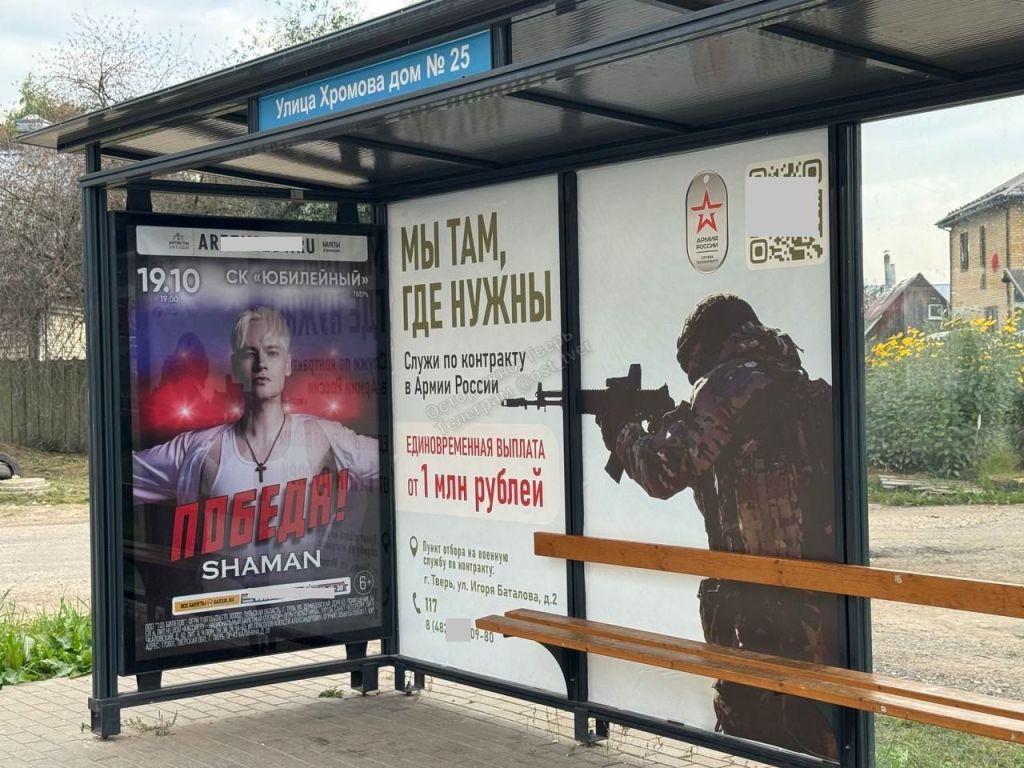
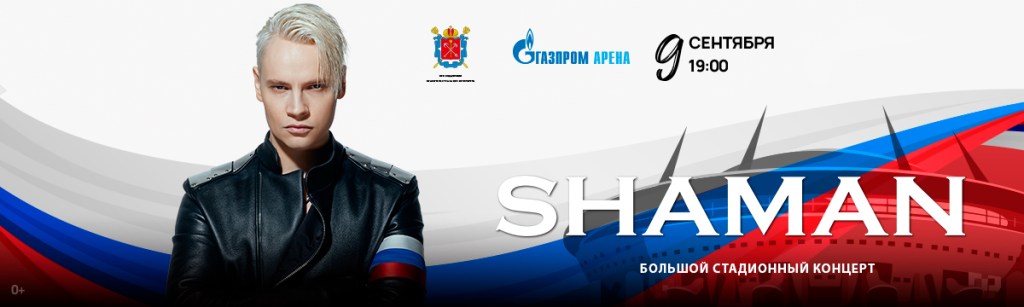
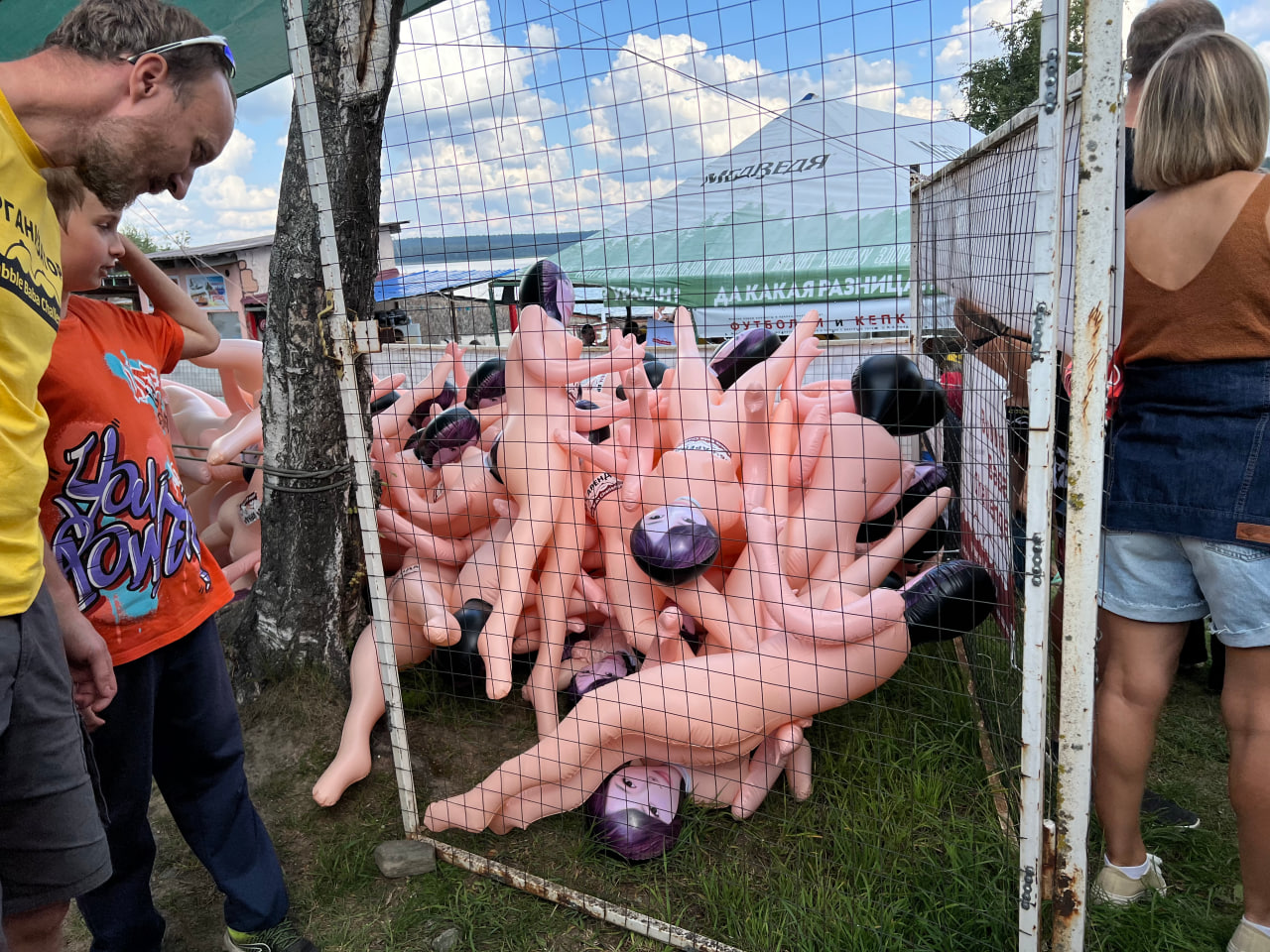
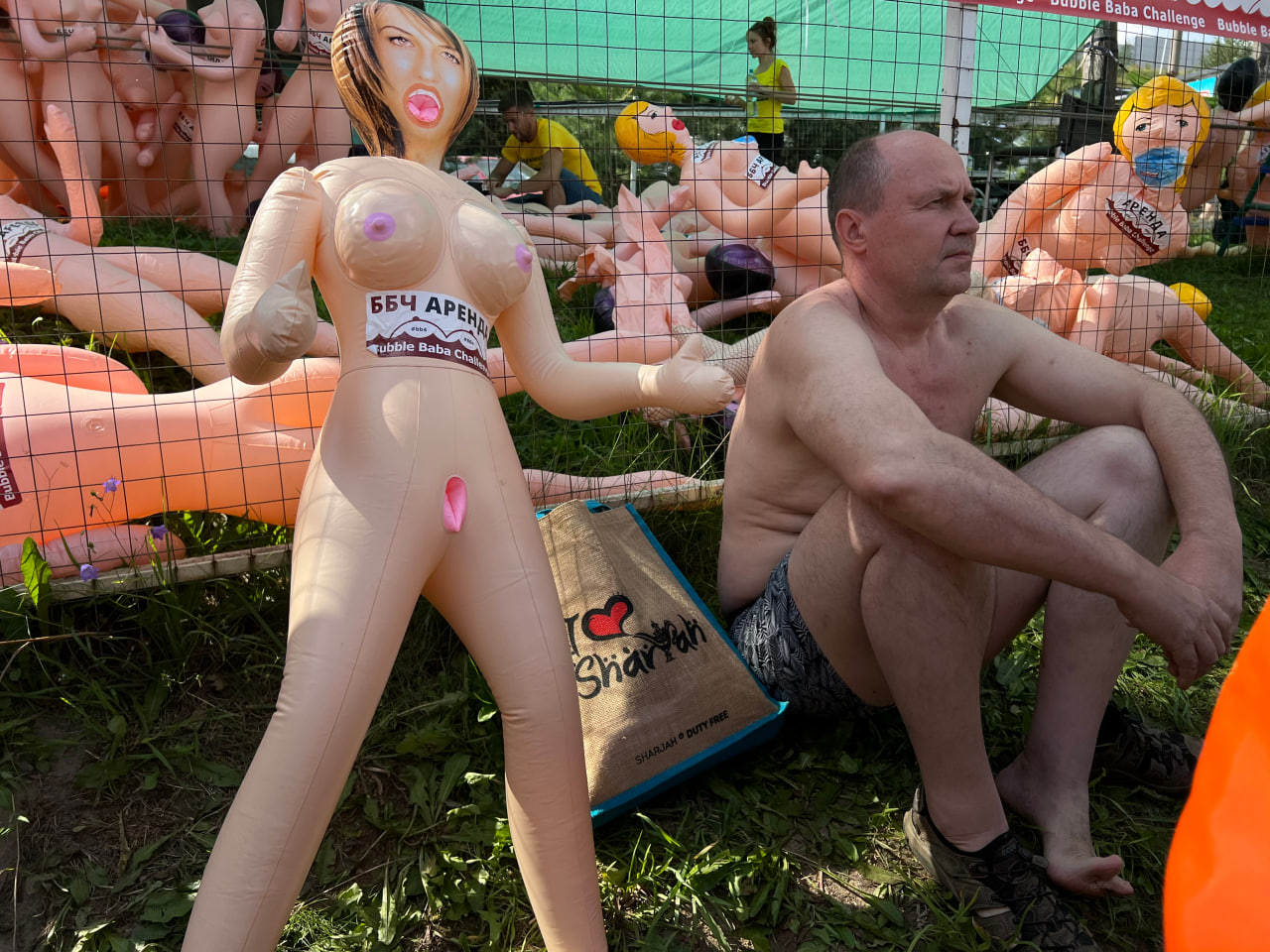
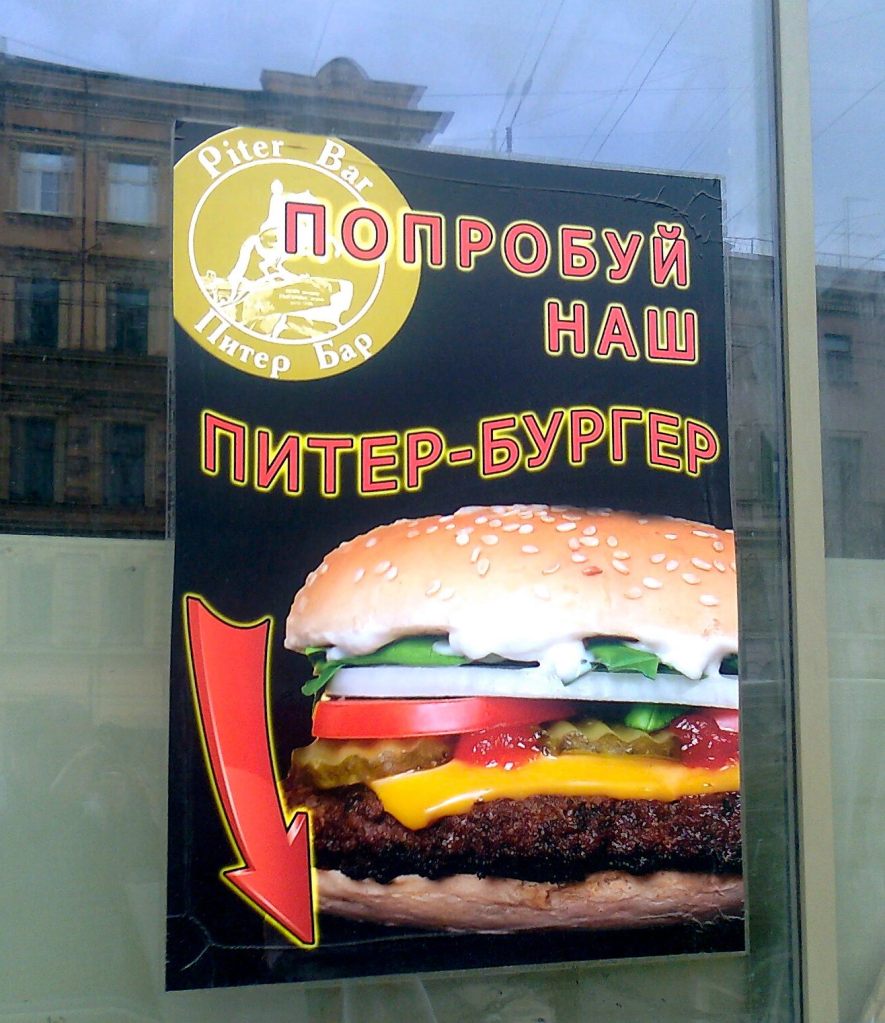
Top: “25 Khromov Street.” Left: “Shaman: Victory!” Right: “We are there where we need to be. Serve as a contract soldier in the Russian Army and get a one-time payment starting at one million rubles.”
Source: Caution, Tver! (Telegram), 1 September 2024. Thanks to Andrey Anissimov for the heads-up. “Basurka” is the faux-Russian nonce word I coined for this distressing post. It was suggested to me by our building’s bilingual garbage bin.||| TRR
Many acquaintances from Russia condemn me for calling for the bombing of Russian factories and supporting the Ukrainian army’s Kursk offensive. They genuinely don’t get how one could wish defeat on one’s own country. Some have quietly unfriended me, while others continue to read my posts but are perplexed and perhaps even offended by them.
They are often the same people who “love (their) country no matter what.” This is where you all and I part ways. You REFUSE to look at reality—you turn away from it in order to love your country without breaking a sweat, as if love were a chain and you’ve been chained to a radiator since childhood. It works differently for me. I make my own decision about whether I like this scene or not. And, if my country jumps from one bloody shitstorm to another like a maniac running in circles, it’s not worthy of my love and I rescind its right to be my country. People are another matter, especially the unborn. It makes sense to fight for them. But it’s secondary to me what the country they’ll live in will be called and how big it will be. If they’ll have a better chance for a decent and safe life in a small country, then we should choose a decent and safe life for them.
Russia is an anti-human phenomenon. It is a threat to the entire world and to the people within the country. Like any rabid macaque with a grenade, it must be stopped. Look reality in the eye at last. Don’t look away. It’s happening right now, and you, with your unadulterated love, are a part of it.
Image number one. A fourteen-year-old girl dressed in white sneakers and a white tank top, sitting on a bench in the yard of her house on an ordinary summer day. It all looks ordinary, but there is one catch: the girl is dead. A fragment of a cluster bomb, which the Russians dropped on Kharkiv on 30 August, tore off the child’s head. Everything happened instantly; no one had time to hide. The girl’s body remained seated on the bench. Perhaps her last thoughts were of her father, who had gone missing in action in the war with Russia. The family knows he was killed, but they can’t get his body back. The worst part is that he gave his life thinking he was protecting his daughter. Russia got to her, though, and so the family’s story is over. Father and daughter are not alive because they were born near Russia. Other Kharkiv residents who were killed in that senseless attack are also “guilty” in this sense.
Image number two. A girl again, but from another city. She is fifteen years old and has come to Novosibirsk from the Altai to enroll in the Olympic reserve school. She is quite beautiful, gentle, kind, and has great hopes. She doesn’t understand why her fellow students call her a “dirty, slant-eyed pig.” They secretly pour waste into her backpack and mock her appearance in public. After two years of this terror, which was encouraged by coaches and school officials, the formerly cheerful girl will come to realize that this life is not for her. In her seventeenth year, she will kill herself and leave a suicide note on her Telegram channel. She will say in the note that the unbearable racist bullying was her reason for leaving this life.
The school will then post a touching obituary on their Vkontakte page. They won’t specify the cause of death, of course. All comments expressing outrage over the bullying will be assiduously deleted. Only the wishes of “soft clouds” and broken heart emojis will be left untouched.
Incitement to suicide is a criminal offense, actually. But no one will answer for the death of Ksenia Cheponova because it is not the custom in Russia to punish one’s own kind for a crime against outsiders. “You’re not my brother, black-ass louse,” says the immortalized Russian movie hero. These words are much more than a mere insult: this is how millions of people in Russia understand justice. Moral rightness is not based on your deeds, but on whether you are an insider or an outsider. It doesn’t matter what you did. What matters is whether you are stronger than me at the moment.
Ksenia Cheponova
Image number three. Beslan. September first marked the twentieth anniversary of the mass murder of children by Russian security forces in that ill-fated school. For twenty years, the perpetrators have never been held accountable for lying about “350 hostages.” There were 1,100 hostages, as we know. No one has been held accountable for firing from a tank at the building where the children were. Three hundred and thirty-four people were killed during the assault, including one hundred and eighty children. This terrorist attack might not have happened if Russia hadn’t started a war in Chechnya. The hostages might have lived if the security forces had actually tried to save them. But they were killed and twenty years on their sacrifices are still covered in lies and impunity.
All of those people could have lived if it weren’t for their country, sick with messianism and aggression. And the “it’s like this everywhere” ploy doesn’t work. No country in the world has 60 million lives lost in wars, gulags, and famines under its belt.
The time for saying “no war” has passed. It is clear that where there is a “great Russia,” there will be perpetual war. That’s why we should say no to Russia, and yes to independent Ukraine, Ichkeria, Buryat-Mongolia, and all free nations.
Or is the idea of a united Russia dearer than the lives of your children?
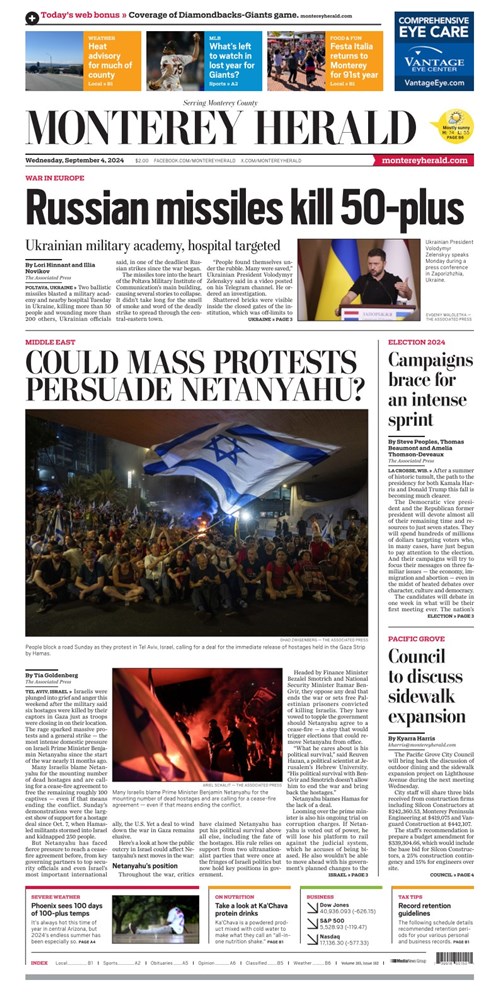
Two ballistic missiles blasted a military academy and nearby hospital Tuesday in Ukraine, killing more than 50 people and wounding more than 200 others, Ukrainian officials said.
The missiles tore into the heart of the Poltava Military Institute of Communication’s main building, causing several stories to collapse. It didn’t take long for the smell of smoke and word of the deadly strike to spread through the central-eastern town.
The strike appeared to be one of the deadliest carried out by Russian forces since the war began more than 900 days ago, with Russia’s Feb. 24, 2022, full-scale invasion.
“People found themselves under the rubble. Many were saved,” Ukrainian President Volodymyr Zelenskyy said in a video posted on his Telegram channel. He ordered an investigation.
Shattered bricks were visible inside the closed gates of the institution, which was off-limits to the media, and small pools of blood could be seen just outside hours later. Field communications trucks were parked along the perimeter. Roads were covered in glass from shattered apartment windows.
“I heard explosions … I was at home at that time. When I left the house, I realized that it was something evil and something bad,” said Yevheniy Zemskyy, who arrived to volunteer his help. “I was worried about the children, the residents of Poltava. That’s why we are here today to help our city in any way we can.”
By Tuesday evening, the death toll stood at 51, according to the general prosecutor’s office.
“My deepest condolences to the families of those killed and injured in the Russian missile attack on Poltava,” Ukraine’s first lady, Olena Zelenska, posted on social media Tuesday. “This is a shocking tragedy for the whole Ukraine.”
Filip Pronin, governor of the region that bears Poltava’s name, announced on Telegram that 219 people were wounded. Up to 18 people may be buried under the rubble, he said.
Ten apartment buildings were damaged, and more than 150 people donated blood, Pronin said.
He called it “a great tragedy” for the region and all of Ukraine, and announced three days of mourning starting Wednesday.
[…]
The academy trains officers in communications and electronics, honing some of the most valued skills in a war where both sides are fighting for control of the electronic battlefield.
“The enemy certainly must answer for all (its) crimes against humanity,” Pronin wrote on Telegram.
The Kremlin offered no immediate comment on the strike. It was not clear whether the dead and wounded were limited to Ukrainian military personnel, such as signal corps cadets, or if they included civilians.
Since it embarked on its full-scale invasion in early 2022, the Russian military has repeatedly used missiles to smash civilian targets, sometimes killing scores of people in a single attack.
Some of the deadliest such assaults included a 2022 airstrike on a theater in Mariupol that killed hundreds of civilians sheltering in the basement and a strike that same year on the train station in Kramatorsk that killed 61. Apartment buildings, markets and shopping centers have also been targeted.
Poltava is about 350 kilometers (200 miles) southeast of Kyiv, on the main highway and rail route between Kyiv and Ukraine’s second-largest city, Kharkiv, which is close to the Russian border.
The attack happened as Ukrainian forces sought to carve out their holdings in Russia’s Kursk border region after a surprise incursion that began Aug. 6 and as the Russian army hacks its way deeper into eastern Ukraine.
The missiles hit shortly after an air-raid alert sounded, when many people were on their way to a bomb shelter, Ukraine’s Defense Ministry said, describing the strike as “barbaric.”
Rescue crews and medics saved 25 people, including 11 who were dug out of the rubble, a Defense Ministry statement said.
The strike came on the day that Russian President Vladimir Putin visited Mongolia. There was no indication that his hosts would heed demands to arrest him on an international warrant for alleged war crimes.
Zelenskyy repeated his appeal for Ukraine’s Western partners to ensure swift delivery of military aid. He has previously chided the U.S. and European countries for being slow to make good on their pledges of help.
He also wants them to ease restrictions on what Ukraine can target on Russian soil with the weapons they provide. Some countries fear that hitting Russia could escalate the war.
“Ukraine needs air defense systems and missiles now, not sitting in storage,” Zelenskyy wrote in English on Telegram.
“Long-range strikes that can protect us from Russian terror are needed now, not later. Every day of delay, unfortunately, means more lost lives,” he said.
Ukraine’s air force said Monday that Russia had launched an overnight barrage of ballistic and cruise missiles and drones at Kyiv as children prepared to return to school. Multiple explosions echoed across the capital early Monday morning as Ukraine’s air defenses shot down many of the weapons, causing damage and fires as the debris fell onto the capital.
Ufa’s Kirov District Court has remanded 20-year-old university student Makar Nikolayev in custody to a pretrial detention center for a month on charges of “promoting terrorism.” The court issued its ruling on 30 August, but it was made public only on Monday, 2 September, as reported by the Telegram channels of Baza and Idel.Realities, who cited sources. The court confirmed Nikolayev’s arrest to news website Ufa1.ru.
In 2020, Nikolayev, then a prep school student, designed an information retrieval method for creating a Russian national archive on the history of the Great Patriotic War. The boy wanted to recover information about his great-grandfather and in the process designed an entire system. His project, “Methodology for Creating a Family Archive,” won the Russian national contest “My Country — My Russia,” one of the projects of the Russia Is a Land of Opportunities presidential platform.
Later, Nikolayev went to Germany to study. According to Idel.Realities, Nikolayev had been studying at a university in Frankfurt am Main in recent years. In August 2024, he came home on holiday to Ufa, where he was detained.
According to police investigators, during his time abroad, Nikolayev wrote comments on social networks supporting Ukraine and urging people to join the Russian Volunteer Corps. The stipulated punishment for violating Russian Federal Criminal Code Article 205.2.2 (“Public calls to carry out terrorist activities; public justification of terrorism or promotion of terrorism, committed using mass media or electronic or telecommunication networks”) is five to seven years in prison.
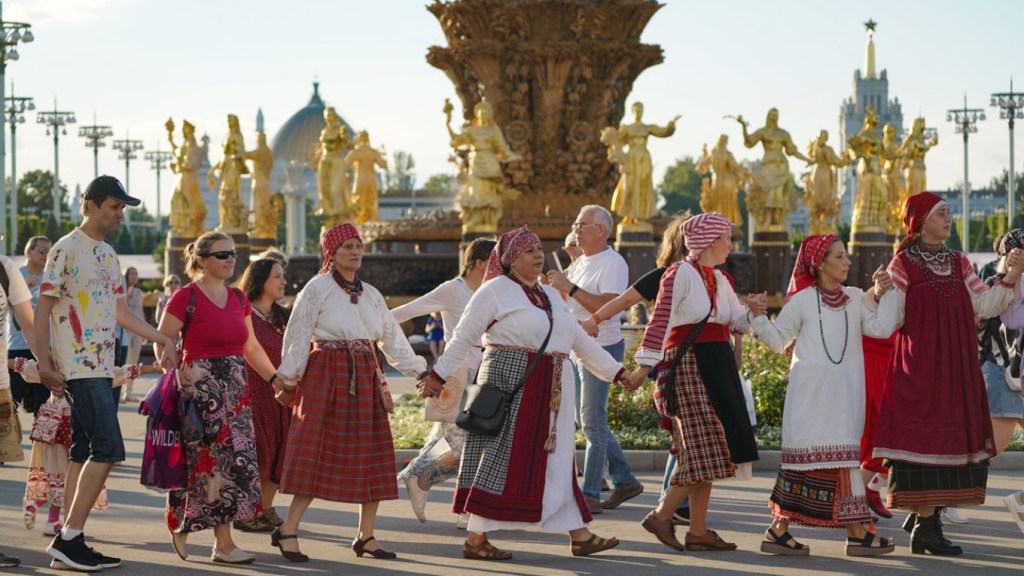
All modern entertainment that “undermines” traditional values should be banned in Russia, conservative philosopher and “Russian World” ideologue Alexander Dugin has said.
“Only morally healthy entertainment should be allowed — first of all, round dances and traveling around one’s native land, and even better, pilgrimages to holy places. Everything else should be banned,” Dugin wrote on his Telegram channel.
According to Dugin, a healthy nation should have wholesome leisure activities, “and not all of that stuff.” As a negative example of entertainment, he cited KVN, which has become, he claims, “a poisonous matrix of degeneration.”
“The sinister nature of this pernicious phenomenon is now clearly visible. [Ukrainian President Volodymyr] Zelensky, [comedian Maxim] Galkin, and all the rest,” Dugin said.*
Earlier, the philosopher claimed that the West regards Russia as its principal foe because Russian President Vladimir Putin has been reviving traditional values and liberating the country from global influence. This, in his opinion, is what provoked the disgust of Western “progressive elites” with Putin.
Dugin has also argued that Russia has neither a parliament nor democracy, but a de facto monarchy headed by Putin, who can do whatever he wants. The philosopher noted the irrelevance of certain laws in Russia, as well as the people who propose or support them. In his opinion, all of this is “boyars dancing for the time being,” that is, until the sovereign pays attention to the antics of these “selfish and thieving bastards.”
Dugin has argued that Russia itself is the Katechon — the last bulwark against the Antichrist, who today reigns in a West “totally perverted” by LGBT+, postmodernism, relativism, and transhumanism.
The philosopher has dubbed the war in Ukraine “the most important event in history.” In his opinion, it is being waged on behalf of a multipolar world, with many superpowers. Consequently, according to Dugin, Russia will free other countries of the world from Western liberal imperialism, in whose grip they are trapped. And yet, Dugin acknowledged that Russia would lose a great many people in the course of the war.
* Zelensky was captain of the Kryvyi Rih KVN team Kvartal 95 from 1998 to 2003.
Enter Thoughts of Days to Come, dressed to the nines in khaki blouses. They are lugging atom bombs, ICBMs, a launching pad. O, how they reel, dance, and caper: “We are warriors and carousers! Russians and Germans will fall together; for example, at Stalingrad.” And like old widow Matryona, cyclotrons are dumbly howling. In the Ministry of Defense a nest of crows is loudly cawing. Look at the pillow. What do you know! Shiny medals all in a row.
“Where there’s a will, there’s a way.” “A pint of vodka, they say, Soon’ll be a ruble a pop.” “Mom, I really don’t love Pop.”
Enter a certain Orthodox, saying: “These days I’m number one. I’m pining for the sovereign, and in my soul the Firebird flares. Soon Igor will reunite with Yaroslavna and have his fun. Let me make the benediction or else I’ll box you on the ears. Worse than evil eye or herpes is the plague of Western thinking. Sing, accordion, and drown out the saxophone, jazz’s vile offspring.” On the icons they plant a kiss, Sobbing victims of circumcis—
WordPess AI-elicited image: “Mongolia, as imagined by Russian liberals”
Political scientist Andrei Nikulin writes on his Telegram channel: “If even Mongolia can be progressive and democratic, then all the more so can Russia be progressive and democratic.” Claims to the contrary are just neurolinguistic programming, he argues.
I am unironically aware that, from the Moscow intellectual’s lofty vantage point, Mongolia is a backward, third-rate country. The whole semantics of Nikulin’s turn of phrase says so. Since those nomads were able to do it, why can’t we, cultured Europeans, have a normal future?
I generally salute positive affirmation. But before we are cheered up by a sense of superiority, let’s face reality. Here are just a few facts about Mongolians today.
Yes, forty percent Mongolia’s population is made up of nomads who, like their ancestors, live in yurts and travel with their livestock. Yes, there are only three paved roads for a population of three and a half million people.
But since 1990, the Mongolian people have elected six presidents, never once allowing any of them to exceed their rightful term in office. The Mongolian constitution gives a leader only one six-year term without the right to re-election, and this norm has never been violated. The average turnout in elections at all levels of government is seventy percent. By comparison, turnout in progressive Moscow barely exceeded thirty percent when Navalny ran for mayor.
Further, while Russians were seizing Crimea and “nullifying” Putin’s previous terms as president, the humble Mongolian nomads forced their government to resign at least twice, in 2017 and 2021. In 2012, a former president was arrested and jailed on charges of bribery.
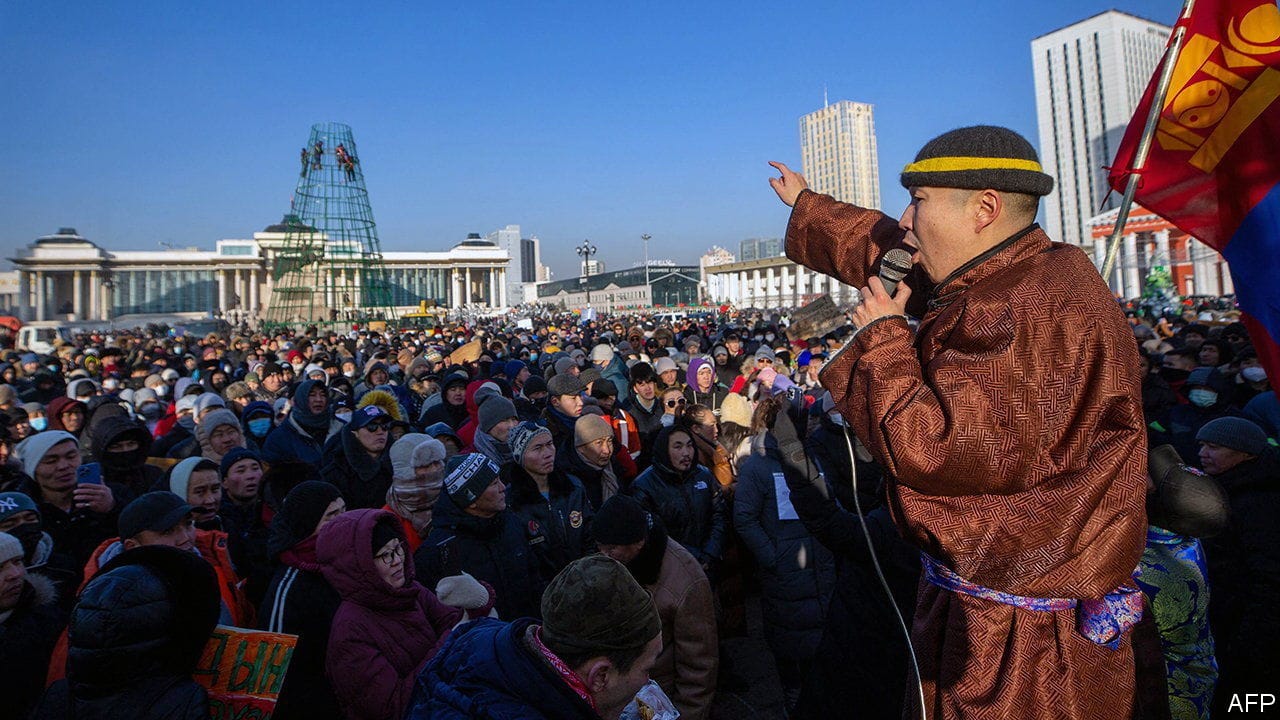
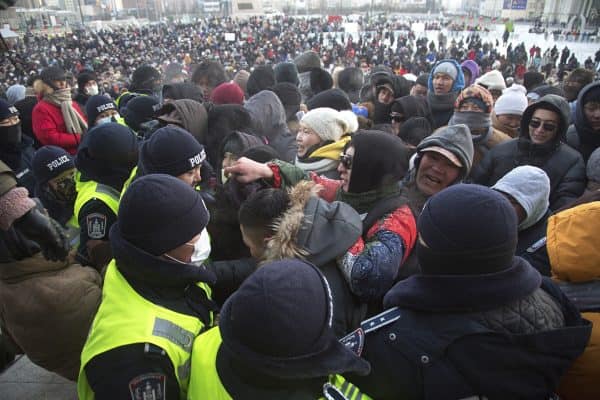
The real, democratic Mongolia, as seen in the photos selected by the author to illustrate her post
More recently, in the winter of 2022, Mongolians staged large-scale protests in Ulaanbaatar over a corruption scandal. It transpired that when exporting coal to China, customs officials had “diverted” six and a half million tons of the cargo, according to the paperwork. Mongolians considered this a theft of national revenues and marched on the capital’s square demanding that the theft be investigated and the names of those involved be made public. Eventually, the protesters stormed government house and demanded the government’s resignation.
Remind me again what Muscovites stormed in Moscow after Navalny’s investigations, of which there were dozens?
But Mongolians protested in the cold for three weeks until they forced the government to arrest the corrupt officials and reform the coal industry.
In April, the protests resumed. This time, Mongolian youth blamed the government for its poor performance and rising prices.
And lastly, let’s talk about the culture. Mongolians do not shout at their children or punish them. You will not hear from a Mongolian mom say to her child “I told you to shut your mouth” or “The more you cry, less you piss.” How should I put it? Mongolians love their children. There are only 924 orphaned children the entire country—that is less than 0.03% of the population. By comparison, there are 391,000 children living in Russian orphanages—that is 0.3% of the Russian population. In other words, children in Russia are left parentless ten times more often.
You can remain trapped in the old optics, looking down on everyone and denying reality. This will not bring social and political change any closer. If you want to go on living, but your body is rotting and falling apart, you need an accurate diagnosis. And the more honest it is, the greater the chances of your recovery.
Ana Tavadze and Dachi Imedadze, members of Georgia’s Shame Movement. Photo: 60 MINUTES
Ana Tavadze: We’re going in with a government that’s completely corrupt, a government that’s pro-Russian, clearly anti-Western, clearly does not really care about what the majority of the population wants and needs.
Ana Tavadze and Dachi Imedadze are members of the Shame Movement – a group with thousands of young followers working towards Georgia’s entry into the European Union.
Ana Tavadze: If Russia wins, it means loss of freedom, loss of everything that we fought for in the past 30 years basically. It’s a fight for values, it’s a fight for where you want to stand in this big fight for democracy.
Dachi Imedadze: As soon as the West in any form, be it the U.S. partnership, be it the European Union, is not represented in this country, Russia will fill the void right away.
They say the influx of Russians is already changing the face of Georgia.
Ana Tavadze: What are they doing, if we look at it? They’re buying apartments. They’re buying private property. They are opening up businesses. Their actions changed — Georgian economy.
Dachi Imedadze: The Russians are buying apartments here in every 33 minutes. They’re purchasing a piece of land in every 27 minutes. And they’re registering a business in every 26 minutes. So, I think we are on the brink of very dangerous situation here in Georgia.
According to public records, Russians have registered more than 20,000 businesses in Georgia over the last two years. And launched five new Russian-only schools, none of which are licensed by Georgia’s department of education.
Russians have driven rent up nearly 130%, prices for everything from food to cars have gone up 7%. over 100,000 Georgians have left the country because many of them can’t afford to live here anymore.
Sharyn Alfonsi: I’ve heard this described as a quiet invasion.
Dachi Imedadze: Quiet invasion, yeah. There is a risk of the economic diversions. There is a risk of military intervention. And there’s a risk of — Georgia’s statehood being destroyed.
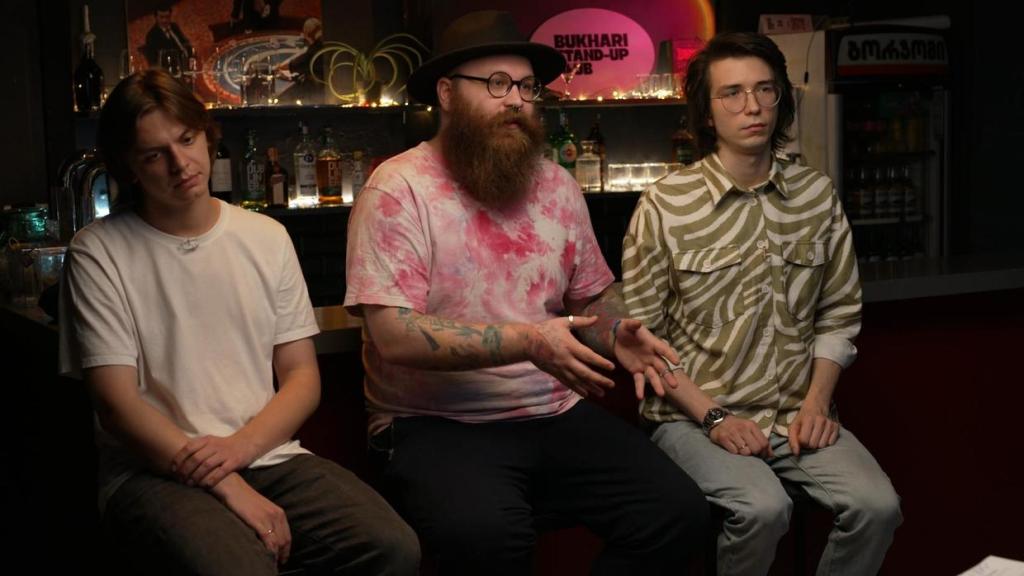
Emmanuil Lisnif, George Smorgulenko and Pavel Bakhadov don’t look like much of a threat.
All Russians in their twenties, they fled their country for fear of being drafted or imprisoned for speaking out against Putin.
George Smorgulenko, Emmanuil Lisnif and Pavel Bakhadov are all Russians living in Georgia. Photo: 60 MINUTES
They now live in Georgia and work at this Russian-owned comedy club in Tbilisi.
Emmanuil Lisnif: I try and said ‘I’m against the war in Russia. I was beaten. and after that going to prison three times.’
Sharyn Alfonsi: So three times you went to jail?
Emmanuil Lisnif: Yes, yes three times.
Pavel Bakhadov: I believe and I know that Russians actually against the war.
Sharyn Alfonsi: You think that most Russians are against the war?
Emmanuil Lisnif: Yeah, just scared, really scared.
Sharyn Alfonsi: Have any of you had any aggression towards you because you’re Russian?
Pavel Bakhadov: Actually I have a big writing on the wall. It’s the biggest thing I see from my window, just big ‘Russians go home.’
There is no subtlety in spray paint… anti-Russian graffiti blankets the city along with support for Ukraine.
This text is based on interviews I did as part of the Hidden Opinions public opinion polling project, which I launched in 2022 and continued in 2023 and 2024. I spoke with dissenting Russians — with those who oppose the current regime and its military actions against Ukraine, both those who have stayed in Russia and those who have left the country. My youngest respondent at the time of the [first] survey was sixteen years old, while the oldest was seventy-two years old. These people hail from a wide range of professions and walks of life, but what they have in common is their categorical opposition to the actions of the Russian authorities. In just two years, I have interviewed 154 people for this project, some of whom I have spoken with two or three times.
In 2022, all of my respondents — both those who had left the country and those who stayed — espoused anti-war views and expressed a negative attitude toward the Kremlin’s policies. However, in 2023, about a year and a half after the war’s outbreak, a group amongst my sources in Russia emerged. Small at first, but constantly growing, it consisted of people who had changed their negative attitudes toward the war and/or the government.
This does not mean that such changes are impossible among those Russians who have left the country. Amidst a full-scale war, research based on representative samples is hampered by the fact that the most accessible respondents are those who have agreed to be interviewed as a result of self-selection. This is a significant limitation to the project.
My research is qualitative, not quantitative, meaning that it would be wrong to speak of a particular percentage of anti-war Russians who have become pro-war. I think it is important to study and understand how views are transformed and what triggers them to change. It is the subject of this text.
***
The sociologist and philosopher Zygmunt Bauman, experimenting with means of gauging the conservatism–to–radicalism spectrum, asked his students to do the following exercise. They were shown twenty drawings, the first one depicting a dog, the last one depicting a cat; in between, the dog gradually shed its canine features and turned into the cat. It was vital that the researcher record the moment when the test subjects had doubts about what exactly was depicted in the picture, when they realized that the dog had mutated irreversibly. In a sense, I have been doing something similar, trying to record the moment at which anti-war or anti-Putin views have been transformed into pro-war or pro-government views.
I have observed that such a change in views depends on a number of extrinsic factors, and the more such factors that are combined, the more likely it is that the person’s stance will change. In addition, a great deal is determined by an individual’s (psychological, social, etc.) resources. Finally, inconsistent views play an important role in transformation and adaptation. In recent years, sociologists have increasingly noted that people often pursue mutually exclusive goals simultaneously without noticing the contradictions in their own behavior.
New rationalizations, disillusionment and loneliness
The gradual realization that the war is a long-term affair, combined with Alexei Navalny’s sudden death in a penal colony, has had a considerable impact on those resisting the regime within Russia. One can swim against the current, but it requires a considerable amount of strength, something not everyone possesses. It is difficult to be amongst the minority for years on end, to conceal one’s views and live in fear of being reported to the authorities. Respondents have thus begun reformatting [sic] their attitude to reality, explaining events in a new light and providing new rationalizations.
Failing to receive the expected support from the outside world or the possibility of a dignified workaround, some of my respondents eventually chose non-resistance to the regime, which in some cases has transmogrified into full-fledged loyalty.
“I don’t want to go to prison, I don’t want to play the rebel. I just want to live. If they send me to listen to ‘Exorcist TV,’ I’ll go without question. If they tell me to go to a [pro-war] concert, I’ll go. I’m not trying to convince anyone of anything anymore. I’m tired. I can only accept it and live the life I have.”
This stance is not directly bound up with support for the war or the regime. Rather, it indicates fatigue and the lack of strength to resist. If the circumstances shift in a direction more in keeping with their own values, these people will gladly slough off the “burden of adaptation.”
It is worth noting that, over the last year, many of my respondents have stopped following the news and focused on their daily lives. There are respondents who, despite the troubling times, have decided to have children. This is also a way of disconnecting from current events.
Another important factor influencing the change of respondents’ views is the narrowing of their circles of trust. Fearing denunciation, dissenters avoid making new contacts. Afraid of being alone and unwilling to live in fear, uncertainty and/or exile, they then join the majority.
The distance between Russians who have left Russia and those who have stayed in Russia has grown greater with every passing year. In 2022–2023, when I asked my respondents about opposition members who had left Russia, they most often would say nothing or would limit themselves to brief remarks along the lines of “We still watch them on YouTube, but they have less and less sense of what’s happening at home.”
Expressions of resentment and frustration have become more frequent in my interviews in 2024. My sources have said that the opposition often engages in wishful thinking and plays fast and loose with the facts, and that the west does not always act logically and decently.
Consequently, previously opposition-minded people have chosen to abandon painful and exhausting self-reflection in favor of loyalty to the regime. This helps them to get on with their lives, normalizing both the war and the political crackdowns. As one respondent put it, “Since the opposition and the west cannot be trusted, we will make friends with Putin. He is an ogre, but he is our own ogre.”
“Western countries seem to be doing everything to help Putin’s propaganda machine. I was quite surprised when I heard Angela Merkel say that all our negotiations were just a smokescreen: we wanted to let Ukraine catch its breath, and the negotiations were just a deception. That is, the leader of one of the largest countries in Europe openly says: a) we can’t be trusted in any negotiations, and b) we have conspired to deceive you. […] Putin’s propaganda machine skillfully makes use of this. But the point is not that the propaganda machine is using it, it’s that it is reality. As a normal person, a question occurs to me: if they treat us this way, [then] we are their enemies. After such statements, the ‘west’ is regarded as the enemy of Russians, and, accordingly, their enemy — Putin — is our friend.”
Those respondents who have changed their views on the war emphasize that when the west blocked their bank cards and accounts, when they heard what Ukrainians (including their relatives and friends) were saying about Russians and how they called for killing them, they decided that the current regime, whatever it was like, was less hostile to them on balance.
Tired of guilt, shame, disappointment and indignation, they have essentially chosen peace by joining the majority and accepting the existing rules: don’t discuss politics, don’t speak out publicly, swear to the values that the government declares. This choice seems reasonable to them in a situation in which no political activism is possible anyway, and the political crackdown machine is only picking up steam.
This strategy ensured material well-being and career success for some of my respondents. For example, some mid-level specialists in the IT sector received good positions and salaries, while for other people the involvement of their relatives in the war has been a means of social mobility and a source of access to material goods. Still others have benefited from the war by arranging parallel imports, etc.
Another factor contributing to the shift in sentiment from anti-Putin to pro-government has been the radicalization and polarization of society.
“A sharp delineation between ‘black and white’ leads to the opposite outcome. Any attempts to express doubts about the actions of the Ukrainian or western side are automatically regarded both inside and outside [Russia] as pro-Putin behavior, the outcome of brainwashing, etc. The other side appears infallible and beyond criticism.
“If you criticize the west’s actions in any way, you are automatically pigeonholed as a ‘Putinist.’ It makes me feel like saying: if that’s how you treat me, well, to hell with you, chalk me up as a Putin supporter.”
The state of rejection and isolation provokes protests amongst some people: since the west condemns them for staying in Russia, they “will go the full mile and become real orcs.”
The mechanisms by which feelings of rejection are transformed into collective pride have been described by researchers and are not unique to Russia. These feelings reinforce nationalist sentiments and contribute to the strengthening of authoritarian regimes.
Emotional dilemma
Speaking about the change in their views from anti-war to pro-war, my respondents noted that in one way or another they were surrounded by people who had suffered in the war: classmates or school friends who had been drafted to the front or had volunteered for combat, their children, colleagues, and mere acquaintances. Telling them straight to their face that their sacrifices were in vain had become both emotionally more difficult and more dangerous. To maintain relationships and friendships, my sources generally had to listen in silence to their acquaintances’ stories about what they had experienced and seen at the front. And if they were people who mattered to them, it was impossible not to sympathize with them.
We should understand that Russians who initially opposed the war and the regime but remained in Russia feel definitely closer to those who went to the front or delivered humanitarian aid there than to those who have left the country. They are “in the same boat” as their relatives, friends, and colleagues. They feel compassion for them.
“When we were teenagers, all sorts of things happened. If the guys were caught [by the authorities], I would perjure myself and lie in all sorts of ways. Later I could tell them what I actually thought of them, but I wouldn’t abandon them. That’s not the way that blokes do things. Now I realize with my head that they are wrong a hundred times over, but they are my boys, I am on their side. And even if I am against the war, I cannot be against them.”
Propaganda equates anti-war sentiment with betrayal, and it paints people who espouse such views as accomplices of Russia’s enemies, who want to kill as many Russians as possible. This causes a very heavy feeling, my respondents note.
Meanwhile, the state softens such emotional blows by offering loyal citizens new benefits and additional material and social goods, free concerts, and beautiful and comfortable urban environments, demonstrating concern for people in general and for those returning from war in particular. “People-centeredness” has become the buzzword in the PR strategies of many employers and officials throughout Russia.
Russians who are concerned about their neighbors also respond to calls for help front-line soldiers, because amidst war and external isolation it is these people with whom, they say, they “share a common plight.” One of my respondents, overwhelmed by such sentimental feelings, volunteered for the army.
As a religious man, he hoped he would not face the need to kill others, but would be able to help “his boys” without bearing arms, because he “could not stand on the sidelines any longer.” If the need to kill arose, he would desert, my source had decided, explaining that he was emotionally prepared to be beaten up and go to prison.
Another type of people whom I have encountered more and more often are those whom researchers Maria Lipman and Michael Kimmage have characterized as anti-anti-war: these people do not necessarily support the war, but they strongly condemn or resent “unpatriotic” fellow citizens who do not support the Russian army or who even take the side of Ukraine.
Seeing soldiers returning from the front and watching the growing number of Russians killed in combat, my sources now often place the blame not on Putin or the Russian military, but on their compatriots who oppose continuing the war until Russia achieves total victory.
Ressentiment and the “demons” of propaganda
Propaganda has awakened ressentiment in some of my respondents. They have come to believe that this war is really about maintaining Russia’s status as a great power, which its enemies are trying to flout and rob. Such people believe it vital that Russia maintain its status as a victor, and they accept the state-imposed version of Russian history that asserts Russia’s greatness in all periods.
War, as happens under autocracies and dictatorships, is seen as the ultimate manifestation of the nation’s strength and vitality and a guarantee that its culture and traditions will be maintained. In conversations with me, my sources have repeatedly used the phrase “releasing demons,” referring to the fact that the current situation helps their acquaintances and themselves experience a sense of unity and superiority over the rest of the world, a sense of their own righteousness and chosenness.
Some respondents noted that the official rhetoric, concrete and catchy, seemed more acceptable to them than the verbose arguments and meaningless self-reflections of the opposition.
Meanwhile, according to my respondents, the number of anti-war-minded Russians today is decreasing. Since Navalny’s death, I have often heard in interviews that every second or third person in the orbit of my sources has changed their views.
It is difficult to say how strong this trend really is. I would estimate that a third of those who unequivocally opposed the war and the regime when I spoke to them [initially] have changed their views, but of course these numbers are in need of supplemental verification, which is not easy to accomplish today. There are probably also people who have switched their pro-war patriotic views to oppositional ones, but I assume that we hear the voices of these people even less frequently.
Respondents who are in a state of uncertainty and/or in the course of switching their views feel the need for support, at least informational support. They need arguments explaining that anti-war sentiments are not a betrayal and that the current war is destroying Russia, not restoring its greatness. But they also acknowledge that such an argument would hardly convince them under the current circumstances. For now, the only thing they think they can do is to maintain their sanity and adapt to reality in order to live to see better days.
***
The Russian regime has proven to be “smarter” and more adaptive than Russian opposition activists and western democracies thought, but this does not mean there is no point or possibility of supporting by any means possible those who have remained in Russia and are still resisting the regime or straddling the fence. One way or another, positive change in Russia is impossible without their involvement.
I think that most of us have not yet understood that the world of Russia has once again, like a century ago, split in two, like an iceberg, and its two halves, the bigger and the smaller, are rapidly drifting apart. It’s just that the split happened less dramatically, without the crowding onto the last steamship, without the “we departed from Crimea amidst smoke and fire” [lines from a poem by White émigré Nikolai Turoverov]. The split has been dragged out in time, and the crack wasn’t so wide at the beginning. Some people are still hopping from one iceberg to the other.
“Endless War”
And yet—that’s it. There are two Russias again. Many people—in both halves—cannot or are afraid to recognize this. It’s time to stop hopping, otherwise you’ll leap to one side and won’t be able to hop back again.
Hopes for the swift fall of the rotten regime (also just like one hundred years ago) have been disappointed. It’s plenty rotten but rot, as everyone knows, spreads.
Last time it took seventy years to root it out. This time it probably won’t take as much time; time moves more quickly in the twenty-first century, but you still have to unpack the suitcases and settle in for a long wait.
“Anticipation of White Nights”
What will happen with the ‘little’ Russia, scattered across different countries, is pretty clear. [Russians] who are younger or more active or more professionally cosmopolitan will assimilate with varying degrees of success. [Russians] who are older and professionally tied to the language and culture will sadly sing “while the light has not gone out, while the candle burns” [a line from a famous Mashina vremeni song] and will support that little flame as long as they have the life and strength for it. This work of theirs is not pointless or in vain, because in ‘big’ Russia there are still a great many people for whom that light will be precious and necessary.
In the mother country—goddamn déjà-vu—things will soon be utterly unbearable. In the longstanding two-hundred-year struggle between the Asiatic state and European culture the Horde has triumphed once again, now zealously working to asiatize the culture. (There is nothing malign about Asia and its culture, which of all people I, a specialist in Asian studies, should know; I am talking about political Asia, in which the state is everything and the individual is nothing.)
The culture of the mother country will be censored, hollowed out, thrust onto all fours and taught to wag its tail. We’ve seen it, we remember. Later, of course, a counterculture will take shape, [yielding] virtuosos of Aesopian language and furtive rude gestures. We remember that too: we had plenty of it. The emigres will coo condescendingly over any vivid manifestations of censored culture—like Nabokov did over Okudzhava. Those in Russia will secretly pass around tamizdat editions. And publish in the West using pseudonyms.
How dreadful and boring this all is, ladies and gentlemen. Russia’s national anthem: “We sowed and sowed the grain, we will stomp and stomp the grain” [lines from a Russian folk song].
For some the price will be their profession, for others poverty or emigration. The most noble will give up their freedom. And even their lives. The higher quality the person, the greater the cost.
And it is all worth it. This is what I’ve been thinking and why I wrote this text, not at all because I wanted to drive you into even greater despondency.
More so than all of us together, each of us individually is facing a big test. We can’t flunk.
Stop referring to “Asia” and “the Horde.” Why insult millions of people in the world and in Russia itself? You are not helping the “little” Russia” in any way.
I see that Akunin has again written something about Asia (where “the state is everything and the individual is nothing”) defeating European values in one particular country.
The point is that Russian intellectuals are, historically, not so fond of anything as repeating German vulgarities. And “Asian” metaphors are the favorites of Germans, and there is no degree of blatant idiocy at which they would stop.
For example, Adenauer explicitly claimed that the “Asian steppes” begin east of the Elbe. (He considered Prussia to be Asian, and so Bismarck’s triumph was an Asian conquest of Germany. Adenauer added the steppe by association.)
No matter how many decades have passed, the pre-war German spirit cannot be taken out of the Russian pamphleteer, and the fear of appearing ridiculous is as alien to them as it was to their mentors.
Quite correct thoughts in general, but there is one big catch.
How does Akunin (Chkhartishvili) differ from those Sieg Heiling in Russia when he starts using “Asia” in such a context, in such a comparison, even with a caveat? Maybe someone will say that I am wrong to try and compare him with the Sieg Heilers. Let me put it another way, then. How does a very good writer differ from those who are called white supremacists in the west?
I recently listened to a very interesting lecture on racism. The lecturer made a rather loose, but interesting ranking, singling out the racism of Soviet people as a separate species.
For some reason, some Europeans, when speaking about Asianness, “forget” about the Inquisition, concentration camps, and many other terrible events in history. Or are these also manifestations of Asianness?
We should also not forget that the current world order is also largely a product of European civilization with all its pros and cons.
One last thing, about why I decided to react in this way to Akunin’s statement, which are quite congenial to my own thoughts. It seems to me that a respected public figure should always think about the consequences of their words and deeds.
[…]
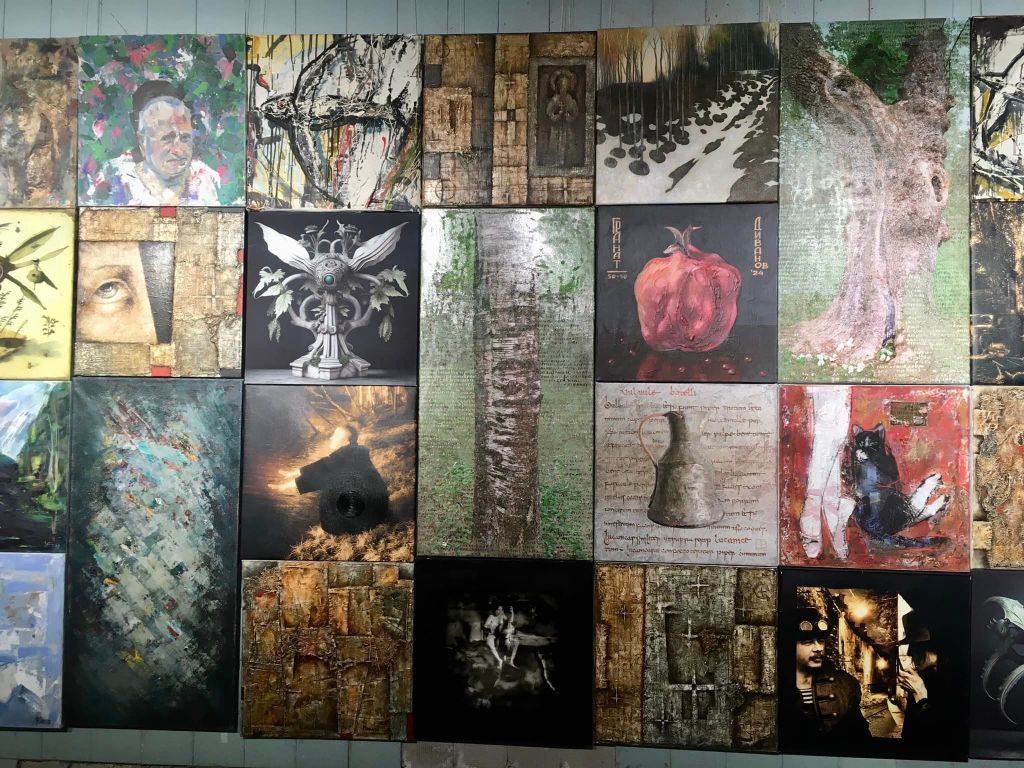
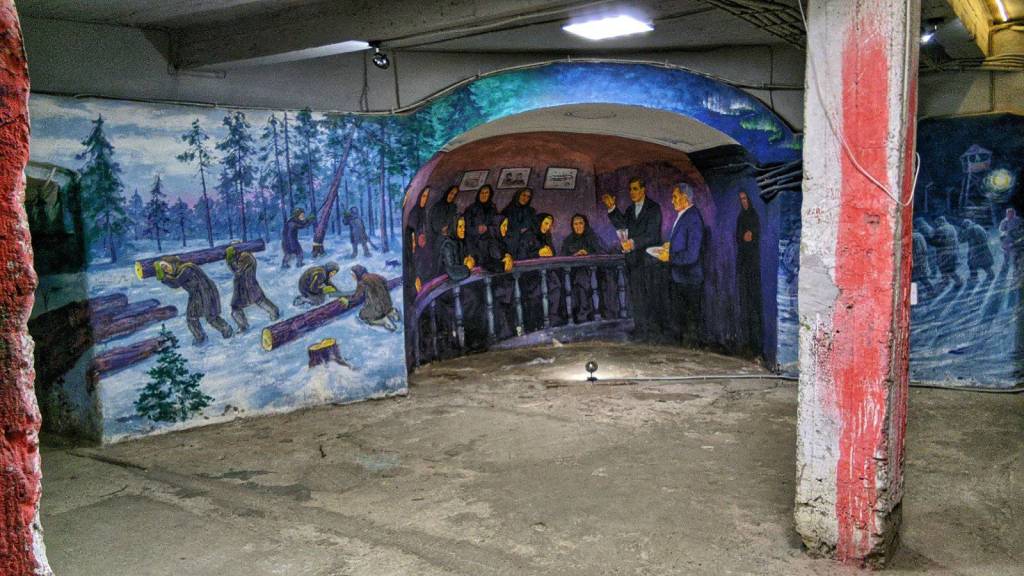
Source: Asya Rudina, “‘The world has split in two:’ the Runet discusses Akunin’s post about the two Russias,” Radio Svoboda, 1 April 2024. Translated by the Fabulous AM and the Russian Reader. The reactions, above, to Akunin’s outburst were not typical. Most of the best-selling author’s fans echoed his sentiments. The photos, above, by our friends V and M, were taken today at an exhibition currently on view in the former swimming pool and catacombs in the so-called Petrikirche on Nevsky Prospekt in downtown Petersburg. They suggest, I think, that the reality on the ground in “big Russia” (and “little Russia” as well) is slightly more complicated than Akunin would have us believe.||| TRR
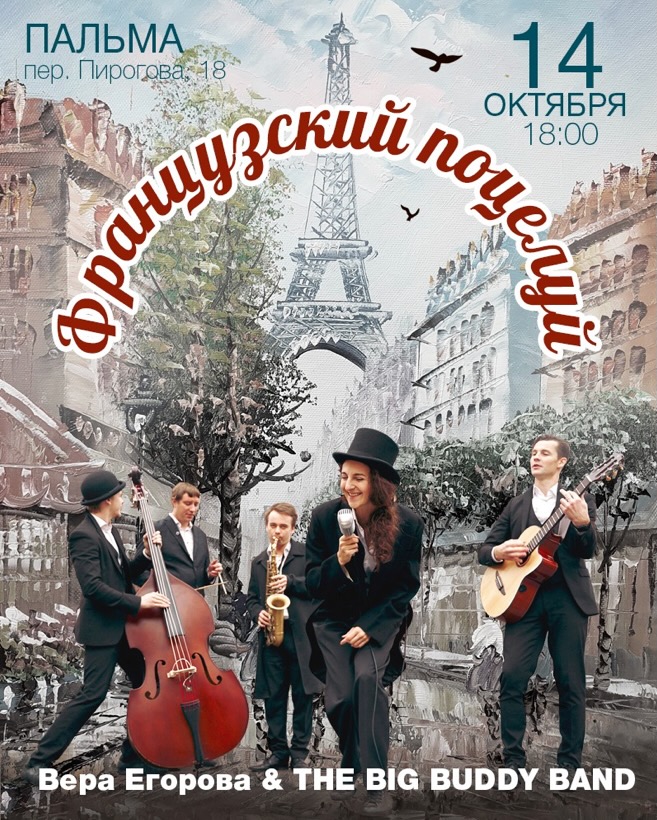
Vocals – Vera Egorova, Double Bass – Anton Krasikov, Guitar – Yuri Yurov, Drums – Ivan Laptev, Saxophone – Anton Seryogin
Description
The lights of the city in evening, the music, the vibe… under a Paris sky!
Stage Magic Agency invites everyone to be inspired by the romantic motifs of France in the light of the crystal chandeliers at the Palma Mansion on October 14. The evening’s programme includes treasures of French pop and chanson as performed by the extravagant Vera Egorova & The Big Buddy Band. We will make a genuine French voyage from Zaz’s contemporary hits to such symbols of the era as Edith Piaf and Yves Montand.
Vera Egorova & The Big Buddy Band are musical hooligans from St. Petersburg and the musical project of singer and actress Vera Egorova. The band has performed more than 500 concerts in Russia and abroad and taken prizes at various international competitions and festivals. Each of their performances is a ton of drive and an endless stream of emotions.
Well, bon voyage! See you at the Palma!
Concert programme: Zaz – Je veux Zaz – Paris sera toujours Paris Zaz – demain c’est toi Edith Piaf – Padam Padam Edith Piaf – La vie En Rose Joe Dassin – Les Champs Elysees Charles Aznavour – Oublie Loulou Paolo Conte – Via con me Yves Montand – Sous le ciel de Paris Patricia Kass – Mon mec a moi Julie London – Fly me to the moon Madeleine Peyroux – J’Ai Deux Amours Osvaldo Farres – Quizas
Duration: 1 hour 15 minutes
Source: Bileter.ru (via the website’s 5 October 2023 email newsletter). The “concert programme” is reproduced here as it appeared in the original.
I could detect almost no actual French in this so-called cover of a French song by the “musical hooligans from St. Petersburg,” making it a perfect illustration of the cargo cult character of “world culture” as imagined and appropriated by xenophobic Putin-era Russians. ||| TRR
Dozens of people, including a 6-year-old child, were killed in a Russian attack that hit a cafe during a wake service in a village in the Kharkiv region of northeastern Ukraine on October 5, according to Ukrainian officials. RFE/RL visited the village a few hours after the deadly attack.
— Why is the issue of colonialism nearly absent from the Russian opposition’s agenda?
— It’s an unpopular topic because it forces us to look for the root of our troubles not only in the Putin regime but in ourselves as well. It forces us to look at our behavior and change it, and that’s an unpleasant process. No one likes admitting they’re wrong. No one likes admitting that their behavior or they themselves are racist. No one likes admitting they’re a xenophobe or colonialist.
— What must we do to rid ourselves of the colonial and imperial mindset?
— First of all, we must understand that Russians have to do this work themselves. Because if someone else from the outside does the work to decolonize Russians, they won’t like it. We don’t have to agree with every position 100%, we can argue on some points.
Changing a mindset is not an instantaneous thing. Unfortunately, we just don’t have time, because if we are going to discuss for another twenty years whether it is possible or not to use slurs in reference to ethnic minorities, nothing can help us anymore. We will turn other people’s lives into hell, and our own, too. But, of course, Russian colonialism won’t let itself be deconstructed without putting up a fight.
— This begs the question about another pattern you described—complaints about Russophobia. Why do you think they are unfounded? And do you consider, for example, banning cars with Russian license plates from entering European countries to be Russophobia?
— Of course, this is a very unpleasant situation. Russian liberals support one of the most important narratives of the Putin regime and of Russian colonialism in general, which boils down to the claim that Russians are victimized. I don’t think that banning Russian cars from entering [the EU] is a manifestation of Russophobia. I think it is a manifestation of the reaction to [Russia’s] full-scale invasion [of Ukraine], which, by the way, is still ongoing. The reaction is going to affect people who themselves have not been involved in the invasion in any way. Moreover, people who are least guilty may suffer from it—for example, activists who have been fighting the Putin regime all their lives.
This will continue, because the citizens of the Russian Federation were unable to oppose what is happening in any way, and in the eyes of the world, most of them fueled this invasion economically, politically, and rhetorically. Precisely because we don’t resist, we have to pay for it somehow. For example, we are in no hurry to separate the criminals from those who have not committed crimes.
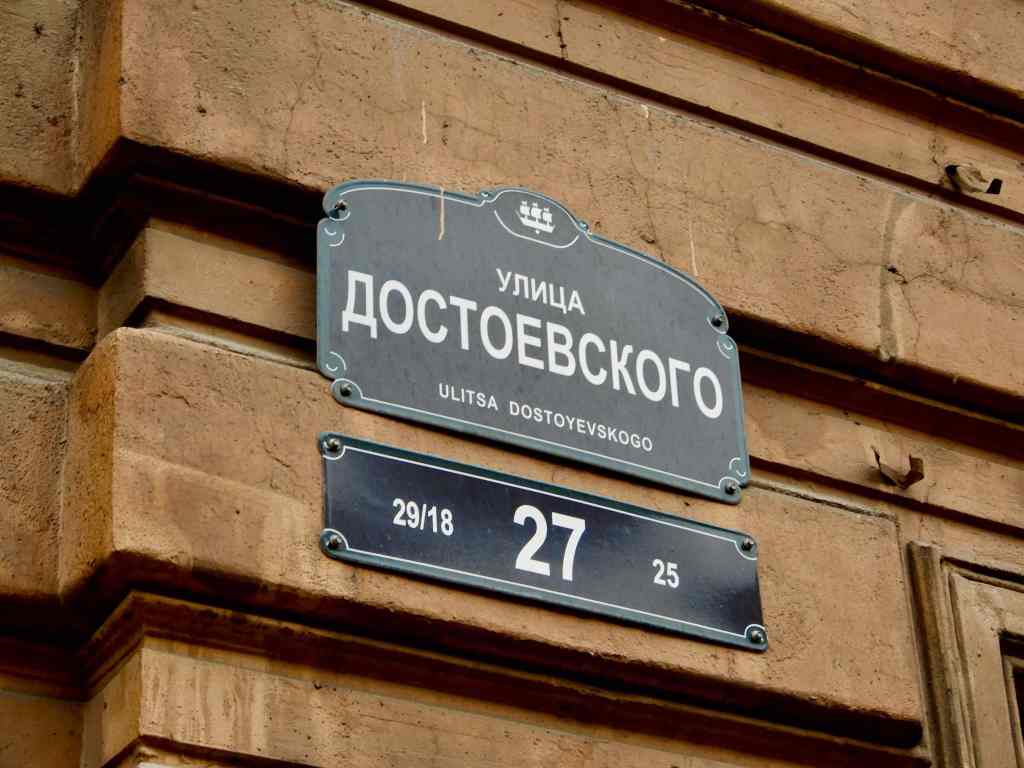
A house sign on Dostoyevsky Street in Petersburg, 10 October 2018. Photo by the Russian Reader
1
Since the second phase of Russia’s war of aggression against Ukraine began on 24 February 2022, there have been heated debates in the press and social media about the extent to which Russian culture—not Soviet culture, but precisely classic Russian culture, starting with the nineteenth century (if not earlier)—is culpable for what has been happening. The accusers say, for example, that all of Russian culture and its leading figures have invariably been infected by the imperialist spirit and the oppression of other countries and cultures. The objections raised against this view can be grouped into several lines of argument. Some opponents say that we shouldn’t ascribe today’s problems to classic writers, while others argue that an entire culture cannot be blamed for this aggression, even if it is supported by the political elite and a considerable portion of society. A third group claims that the Russian officers hurling missiles at civilian settlements or the Russian soldiers looting occupied villages have hardly been immediately influenced by any books whatsoever, so the question of culture’s culpability is entirely irrelevant. Some of the people who object to the notion of a “single and unified” Russian culture hold that those who allege its unity are unwittingly playing into the hands of Kremlin propaganda, which also asserts that Russian culture in its entirety is founded on a “code” and immutable “values,” which the state is supposedly taking great care to uphold by bombing neighboring countries and arresting all dissenters.
I would argue that these debates about culture’s culpability are a psychological trap that takes us back to the early twentieth century, when the humanities were dominated by essentialism—that is, a view of society founded on the absolute certainty that, for example, women and men, or sexual minorities (see Vasily Rozanov’s People of the Moonlight, 1911), or different nations and religions have an immutable essence that predetermines the behavior of individual members of these groups. In the early twentieth century, essentialism was used as an argument in favor of inequality: the “innate characteristics” of women were supposedly such that women should not be allowed to vote, and the “innate characteristics” of colonized peoples were such that they did not deserve the right to self-governance. It is no accident that the twentieth century witnessed the unfolding of two deeply interlinked processes: one social—the fight for the civil and political rights of marginalized groups (feminism, anti-colonialism, queer emancipation), and one in the humanities and sciences that sought to overcome essentialism and affirm the view that the self-consciousness of men and women, the self-consciousness of large cultural or racialized groups, etc., is internally variable and always the result of a long process of historical evolution. Today, we seem to be plunging back down the ladder onto an older rung. As cultural studies scholar Jan Levchenko has astutely noted, Putin’s hostility toward modernity and his rejection of the idea of the future has unleashed an archaization of consciousness in several countries. It is important to resist this process.
A distressing example of the new essentialism can be found in a column published in the Frankfurter Allgemeine Zeitung on 8 September 2023 by the Berlin journalist Nikolai Klimeniouk, titled “Sie wollen, dass wir sie ‘lieben’” (“They want us to ‘love’ them”).[1] Klimeniouk claims that contemporary Russian culture (or all Russian culture? his article does not make this clear) is supposedly founded on the idea of a non-consensual love that does not respect personal boundaries and demands reciprocal “consent” from those nations who were subjected first to Soviet and now to Russian aggression. This belief in the unimportance of other people’s boundaries, Klimeniouk argues, is shared by the intellectuals of Russian descent who defended Andrei Desnitsky, the biblical scholar who was recently fired from Vilnius University following a heated public campaign in the Lithuanian media. The organizers of that campaign took Desnitsky to task for publishing an article in 2012 about the 1940s Soviet occupation of Baltic countries in which he made statements that, in spite of all his caveats at the time, have been read in today’s context as an expression of sympathy for the occupiers.
In his discussion of Desnitsky, Klimeniouk makes an unexpected logical leap. First, he rehashes the viewpoint of the scholar’s supporters:
“The journalist [who wrote about Desnitsky – I.K.] was [not a journalist but] a denouncer. The decision was undemocratic. Desnitsky is an important scholar who brought renown to the university. This would never happen in a civilized country. In Lithuania, they punish you for expressing your opinion, and Russians are hated everywhere.
“This framing is frighteningly similar to a discussion of significance to contemporary Russian culture, which began in 1985 on the pages of the New York Times Book Review, and, it appears, was never concluded.”
Klimeniouk then summarizes two essays which appeared in The New York Times Book Review at that time: “An Introduction to a Variation,” by Milan Kundera, and “Why Milan Kundera is Wrong about Dostoyevsky,” a response by Joseph Brodsky. The turn to this older polemic is symptomatic: Klimeniouk believes that it is possible nowadays to make arguments of the same sort that these two writers exchanged almost forty years ago—although, truth be told, these arguments already sounded quite outmoded even at the time. That’s why it is worth going over these essays in more detail than Klimeniouk provides, since his column revives a debate that already proved unfruitful once.
Milan Kundera’s essay begins with the tale of how, in 1968, a Soviet military patrol stopped him—expelled from all Czechoslovak institutions, his books banned—as he was driving from Prague to Budějovice. The officer in charge tells Kundera, “It’s all a big misunderstanding, but it will straighten itself out. You must realize we love the Czechs. We love you!” This strange declaration of love by an officer of the occupying army makes Kundera recall Dostoyevsky, with his irrationalism and fetishization of strong emotions, as well as Solzhenitsyn, whose Harvard commencement speech criticized the spirit of the European Renaissance. In his essay, Kundera positions himself as a defender of the European cultural values that emerged during the Renaissance: self-consciousness, rationalism, irony, and playfulness.
Joseph Brodsky, already famous in the States but not yet а Nobel Prize winner (that would happen a year after the events described here), took it upon himself to defend Dostoevsky against Kundera on the pages of the New York Times Book Review. However, he also resorted to the same kind of essentialist rhetoric—perhaps to an even greater degree—as his opponent, and to top it off, he also tried to humiliate Kundera, possibly out of sheer irascibility. “[Kundera’s] fear and disgust [toward the occupiers] are understandable, but soldiers never represent culture, let alone a literature – they carry guns, not books. […] Mr. Kundera is a Continental, a European man. These people are seldom capable of seeing themselves from the outside.”
These are more or less the kind of thoughts, according to Klimeniouk, that can be found in the minds of today’s Russian émigré intellectuals, which is why they defend Desnitsky and refuse to entertain the idea of a connection between Russian culture and Russian aggression—they don’t see a link between “guns” and “books” either.
Klimeniouk devotes the rest of his column to a discussion of statements made by Russian writer Maria Golovanivskaya on the topic of love (in an interview with Lev Oborin on the website Polka) and a now-deleted Facebook post by Tatyana Tolstaya (rather unconscionable musings about the rapes of German women by Soviet soldiers). Finally, he quotes a new history textbook for the eleventh grade, written by [former Russian culture minister] Vladimir Medinsky and Moscow State Institute of International Relations (MGIMO) rector Anatoly Torkunov, before concluding, “[In contemporary Russia,] high culture has once again lost the battle with state repression.”
This conclusion seems to me both illogical and, perhaps, formulaic: it seems to follow from a different argument than the entire preceding column. In order for culture to “once again [lose] the battle” with the state, there must be a conflict between the two, and Klimeniouk had so far tried to show that there was no conflict whatsoever between Russian culture and the Russian government. What is more, Klimeniouk ascribes to Russian culture “perennial” motifs that can be expressed with equal success using quotes from Brodsky, Golovanivskaya, or Tolstaya. These same “perennial” motifs underlie, in his view, the connection between Russian culture and today’s war of aggression.
I think that we should analyze the psychological stance underlying Klimeniouk’s article. These days, this approach threatens to spread much farther than a single newspaper article, and not just in the media, but also in scholarship. This is precisely why I think that what matters now is not whether Klimeniouk is interpreting Brodsky correctly, or even what all this has to do with Andrei Desnitsky getting fired. What matters is methodology. How can we contextualize and explain this rhetoric of “love” that Klimeniouk apparently considers something akin to an incurable (or, at any rate, intractable) disease of Russian culture?
2
A newspaper column certainly has its own generic rules: it is meant to quickly convince readers that the author is right. Nevertheless, even taking these rules into account, it is surprising that Klimeniouk does not bring in several rather obvious nineteenth-century texts in which the “love” rhetoric he describes is most effectively expressed. Looking at these texts, however, makes it clear that this rhetoric is an expression of a specific historical-evolutionary line that can be traced to the mid-nineteenth century, rather than reflecting universally shared qualities of Russian culture. This line could be called expansionist universalism. The texts created within its framework became a crucial intellectual resource that facilitated the emergence of the Russian state’s current rhetoric of war—but not as texts per se, but because this rhetoric was later substantially reworked by late-Soviet Russian nationalists.[2]
The first example is Fyodor Tyutchev’s poem “Two Unities” [“Dva edinstva,” September 1870). Addressed to the “Slavic world” (the same sort of ideological construct as the “Russian world” is in our time), with its famous second stanza pointing to Otto von Bismarck as the “oracle of our day”:
«Единство, — возвестил оракул наших дней, — Быть может спаяно железом лишь и кровью…» Но мы попробуем спаять его любовью, — А там увидим, что прочней…
“Unity,” declared the oracle of our day, “Can be forged solely through iron and blood.” But we shall bond our unity through love, And then we shall see which of the bonds gives way.
Tyutchev called for the creation of a Slavic federation led by Russia, which was to be founded on “love.” The famous Czech poet and journalist Karel Havlíček Borovský (1821–1856) once wrote about this “love”: “Russians call everything Russian Slavic in order to later call everything Slavic Russian.” But Havlíček did not mean all Russians when he said “Russians”; he meant the Slavophiles, who were unwittingly playing along with their government. And, while Havlíček criticized the Slavophiles and the Russian state’s autocracy, he also translated Gogol and Lermontov into Czech.
The second example is Dostoyevsky’s “Pushkin Speech,” delivered in 1880. It declares love as the basis of the Russian people’s “world-scale kind-heartedness”:
«…Мы [русские] разом устремились <…> к самому жизненному воссоединению, к единению всечеловеческому! Мы не враждебно (как, казалось, должно бы было случиться), а дружественно, с полною любовию приняли в душу нашу гении чужих наций, всех вместе, не делая преимущественных племенных различий, умея инстинктом, почти с самого первого шагу различать, снимать противоречия, извинять и примирять различия, и тем уже выказали готовность и наклонность нашу, нам самим только что объявившуюся и сказавшуюся, ко всеобщему общечеловеческому воссоединению со всеми племенами великого арийского рода…»
“Indeed, we [Russians] then impetuously applied ourselves to the most vital universal pan-humanist fellowship! Not in a spirit of enmity (as one might have expected) but in friendliness and perfect love, we received into our soul the genius of foreign nations, all equally, without preference of race, able by instinct from almost the very first step to discern, to discount distinctions, to excuse and reconcile them. Therein we already showed what had only just become manifest to us—our readiness and inclination for a common and universal union with all the races of the great Aryan family.”
The third example is Alexander Blok’s poem “The Scythians” (1918), which literary scholars have noted was directly influenced by the “Pushkin Speech”:
Да, так любить, как любит наша кровь, Никто из вас давно не любит! Забыли вы, что в мире есть любовь, Которая и жжет, и губит!
Мы любим все — и жар холодных числ, И дар божественных видений, Нам внятно все — и острый галльский смысл, И сумрачный германский гений…
Yes, to love the way that our blood loves, None of you has loved in countless years! You have forgotten that there is a love That burns and wrecks and wakens fears!
We love it all—the sear of ice-cold numbers, The gift of divine illuminations, We grasp it all—the sharp-edged Gallic wit, The gloomy genius of the Germans.
The version of universalism on which Tyutchev, Dostoyevsky, and Blok insisted assumed that practitioners of Russian culture, who had arrived late to the dialogue of European culture(s), could occupy a central place in that dialogue because they (speaking as it were on behalf of “Russians”) could allegedly understand everything, and this ability to understand was underpinned by the unique Russian capacity for “love.” Mastering a foreign culture, as based on this universal “love,” becomes a form of self-affirmation for the “lover.” This rhetoric was a means of alleviating and masking the constant tension between two images of Russia produced in the press and in government publications, a tension felt ever more strongly over the course of the nineteenth century: Russia as the nation-state of Russians and Russia as a multi-ethnic empire. But this task of “all-conquering love” was not declared on behalf of the government, but rather on behalf of society. While the “we” in Tyutchev’s poem could still encompass the and society, in Dostoyevsky’s speech and Blok’s poem the “we” points first and foremost to a society that was ready, in their opinion, to bring about cultural expansion in place of the state.
Some of their contemporaries sharply criticized this rhetoric. For example, the well-known critic Nikolai Mikhailovsky noted very soon after the publication of the “Pushkin Speech” that Dostoyevsky’s calls for a “united Aryan tribe” had anti-Semitic undertones.
If we examine the examples given by Klimeniouk with a view to older history, it becomes clear that the Russian intelligentsia’s universalism has not always and across the board had an expansionist character. There have been at least two variations. The first is westernizing, which assumes that Russian culture is too archaic and that it can and must be renewed with the help of transfers of Western European culture into Russia. This thinking was, for instance, foundational for the translation strategy of the Russian Symbolists, who were able in the 1900s and 1910s to “catch up” to French poetry, which was developing rapidly at the time. This westernizing conception influenced the program of the World Literature publishing house, founded by Maxim Gorky in 1919. At a different historical stage, westernizing universalism manifested itself in a passion for Polish culture (jazz, poetry, fashion magazines) among the nonconformist intelligentsia in the 1950s-1960s; Brodsky himself was a Polonophile in his youth. Of course, Thaw-era Soviet Polonomania was rarely marked by a deep interest in the other; it was often just the urge to imagine an alternative, better life for oneself, but cultural transfers often occur in exactly this fashion.
The second, rarer variation is philanthropic, whereby the popularization of different cultures in Russia served to express sympathy and moral support for the bearers of said culture(s). In 1916, immediately following the Armenian (and Assyrian) genocide in the Ottoman Empire, an enormous book of translations entitled The Poetry of Armenia from Ancient Times to the Present Day was published under the editorship of the prominent poet and critic Valery Briusov. The translators included other well-known poets such as Jurgis Baltrušaitis, Konstantin Balmont, Ivan Bunin, Vyacheslav Ivanov, Vladislav Khodasevich—and even Alexander Blok, author of “The Scythians.” The anthology did not have colonial or expansionist intentions, however; instead, it voiced Russian civil society’s solidarity with a people subjected to genocide (even though that word didn’t even exist yet). Briusov took on direction of the project only after he gave himself a crash course in basic Armenian and read several books about the history of Armenian literature.
The anthology was the first in a series of translated compendiums of ethnic minority literatures of the Russian Empire, for whom the catastrophes of the First World War were particularly hard. These anthologies were of major philanthropic significance and were edited by Briusov, Maxim Gorky, and several other Russian writers. They included An Anthology of Armenian Literature (Sbornik armianskoi literatury, Petrograd: Parus, 1916, edited by Gorky); An Anthology of Latvian Literature (Sbornik latyshskoi literatury, Petrograd: Parus, 1916, edited by Briusov and Gorky); and An Anthology of Finnish Literature (Sbornik finliandskoi literatury, Petrograd: Parus, 1917, edited by Briusov and Gorky). Adjoining them is an anthology of translations from then-contemporary Hebrew poetry, The Jewish Anthology, published in 1918 by the Moscow publishing house Safrut, and edited by Khodasevich and Leib Yaffe.
In the Soviet context, beginning in the mid-1930s when Stalin veered into isolationism and “Russocentrism” (David Brandenberger’s term), universalism became a stealth-oppositional attitude. It expressed—to use Osip Mandelstam’s coinage—a longing for the world culture beyond the “iron curtain,” and was a way of resisting the notion of Russian culture as something absolute, self-important, and completely adapted to Soviet conditions. There was a reason why in late Stalinism any attempts to study the influence of Western literary traditions on Russian literature were subject to persecution. Research of this sort was stigmatized as “cosmopolitanism” and “kowtowing to the West.”
In the late Soviet period, there was an official universalism in which the rhetoric of “love” à la Tyutchev or Dostoyevsky was invoked only rarely, but which reproduced a construction typical of their texts: “the primacy of the one who loves.” The Russian people were to be understood as an “elder brother” implicitly united with the Soviet state (“The unbreakable Union of free republics / was bound all together by Great Rus,” as the first line of the Soviet national anthem declared).[3] This Soviet official universalism appears to be exactly what the officer whom Kundera encountered was relaying: “we” love “you,” the Czech people, and this is exactly why we saved you from the Prague Spring, from the “pernicious” desire to live as you wish. And this paternalistic, protective, colonialist universalism, ramped up into a sort of cargo cult (“we will repeat what was said then—and it will be as it was then”)is replicated by Margarita Simonyan in one of her tweets (13 July 2023), in which she writes:
“What did you not like about living with us? What was so bad about it? Most of you have us to thank for statehood, you got culture thanks to us. Who was oppressing you? Who messed with you?”
This Soviet version of universalism is exactly what today’s stylistics of “re-enactment” has been replicating, and it is one of the intellectual resources driving Russia’s war against Ukraine. The people who have written and write in this tradition can certainly be held responsible for what is happening today. But there are other forms of universalism that have been preserved and survive in Russian culture. Understanding universalism as a complex, evolving discursive system containing many variations makes it possible to look at Russian culture not as a single, unified, and timeless whole invested with a unified, singular culpability, but as a space open to polemics in which different ideas grapple with each other.
3
Let me move on from the discussion of the varieties of universalism to more general thoughts on the methodology of the contemporary humanities and social sciences. They might seem trivial to my colleagues in history, but over the last year and a half these basic tenets of the profession have seemingly been overshadowed, and it would behoove us to recall them.
A historian is not required to forgive or rehabilitate the figures they write about, but it is important to understand these figures within the context of their own time—what they could or could not think about, what concepts they used, what kind of knowledge or resources were available to their characters, or to whose questions they were responding. This paradigm of historical knowledge was established by the French historians of the Annales school and further developed by the intellectual historians of the Cambridge school—e.g., John Pocock and Quentin Skinner.
Proponents of historicism are sometimes accused of enabling relativism: general rules do not exist; each era has its own norms. Still, the example of late-Soviet humanities scholars—of figures such as Sergei Averintsev, Aron Gurevich, and Mikhail Gasparov—shows that they did not think of historicism as a branch of relativism but as a tool for understanding people from different eras and cultures, and this work of understanding (especially for Gasparov) enabled them to grasp the limitations of the cultural conventions of their own time. They developed their concepts of historicizing interpretation as a tool for understanding over the course of the 1970s and 1980s, and this approach was one of the most significant advances in the late-Soviet humanities and social sciences in terms of both its scholarly and existential utility.
This interpretative sequence—understanding the other so as to better understand one’s own situation and, by reflecting on one’s own situation, gaining an even more accurate understanding of the other—was laid out by proponents of the philosophical school of hermeneutics. Yet neither the hermeneutic philosophers (Paul Ricœur and Hans-Georg Gadamеr) nor the unofficial Soviet humanities scholars directly inquired into the consciousness of an interpreter belonging to a repressed or silenced societal group (even though unofficial humanities scholars in the USSR certainly belonged to such a group), or to one identifying their own sense of self with those in an unprivileged position. (Yuri Lotman’s persistent discussion of the history of the Russian intelligentsia as a stigmatized and marginal group shows that he understood the position from which he was speaking quite well.) In hermeneutics, the interpreter of the world appears as a kind of “default subject” (implicitly, a white European man), so it may seem as if hermeneutics were at odds with critical theory and its closely affiliated approaches—feminism, postcolonial and decolonial theory, queer studies. But the current intellectual state of affairs shows that these approaches can be synthesized.
Critical theory teaches researchers to ask themselves questions—and not just about their own privilege (“check your privilege”), but also about the conceptual tools they are using. For example, I myself should consider whether my mind retains the traces, the discursive debris, of the expansionist universalism which I discussed earlier.
Today, when we talk about history as the result of human efforts with specific social, discursive, and conceptual parameters, feminist, queer, postcolonial and decolonial theory all help to focus our gaze more sharply. But these methods could also benefit from the acuity afforded by historicism, because the human conflicts and interactions they study have differed in different eras and took on a particular shape in each specific instance. Now, let’s turn to why this kind of synthesis is necessary.
In 2011, Stanislav Lvovsky wrote that, sooner or later, Russian culture would have to be reconstituted on new foundations. It is now obvious that he was right. When undertaking this project, it will be important to take stock of the resources available to сultural professionals in their fight against the tendencies that Russia’s leaders have let proliferate and become dominant—no matter how many states emerge out of the ruins of today’s regime at the end of the current political cycle. I think that if we examine the different versions of Russian universalism historically, using the methods developed by the Annales school, we will find that, alongside the passive-aggressive tradition observed by Kundera, Russian culture also has resources for resisting the state’s rhetoric of “paternalistic love.” These resources are primarily found in works of unofficial literature and unofficial scholarship.
I dearly hope that Ukraine wins this war, but a mere military victory would not be enough for me. At the end of the Second World War, scholars in different countries set to thinking up ways to undermine the intellectual foundations that gave rise to Nazism. (Many years after the war, Michel Foucault’s foreword to Gilles Deleuze and Felix Guattari’s Anti-Oedipus called the book “an introduction to non-fascist life.”) Today, people in many different countries also have reason to think about how they can subvert the intellectual foundations which are producing an aggressive right-wing populism that stigmatizes minorities. When right-wing populism is implemented by former security-service officers gripped by ressentiment, you get the nightmare that is playing out in Russia today.
I think that the future of humanity lies not in national but post-national states—societies organized as federations of different minorities. The methodology of the contemporary humanities and social sciences can function both as a common language that different minority groups can use for collective action, and as a crucial tool for understanding the other, and others.
[1] The excerpts from Klimeniouk’s article quoted here were first translated from the original German into Russian by the author himself, and then rendered in English by the translators.
[2] See, for instance, the uncensored version of Stanislav Kunyaev’s poem “Okinu vzgliadom Severo-Vostok,” [“I will cast a gaze at the North-East”], which was first published in 1986: “Let the Mansy salute Yermak, / And it is meet for the Uzbek to praise Skobelev, / for the fact that we now have gas and timber and cotton, / and have room for lots of missiles.”
[3] Text by Sergei Mikhalkov and Gabriel El-Registan.
Veterans of the special military operation and combat veterans will be able to teach the new subject “Fundamentals of the Security and Defense of the Motherland” in schools after undergoing retraining at the State University of Education (GOOP), according to Education Minister Sergei Kravtsov, who was speaking at a plenary session during the Russian national pedagogical forum “Memory Is Sacred.”
“A center for retraining veterans of the special military operation and combat veterans as teachers was created this year at GOOP to implement a new subject area with a priority on practical training in the new subject ‘Fundamentals of the Security and Defense of the Motherland,'” Kravtsov said.
According to the minister, the basic military training module would be enhanced in this subject, which is being implemented as part of the “Fundamentals of Health and Safety” curriculum. The new subject would be trialed this year, and it would be taught in schools beginning in the next academic year, he added.
On June 30, Kravtsov said that, as part of the subject, schoolchildren would gain knowledge of the “role the defense of the country plays in its peaceful socio-economic development and the current complexion of our our Armed Forces.” Schoolchildren would be introduced to concepts such as “military duty” and “military service.” The minister emphasized that the load on schoolchildren would not increase—the number of classroom hours would remain the same.
GOOP’s acting rector Irina Kokoyeva told Vedomosti that the Apex Center for Military-Patriotic Education had been operating at the university since September 1. One of the center’s focus areas is the professional development and retraining of special operation veterans as coordinators of military-patriotic clubs and teachers of the subject “Fundamentals of the Security and Defense of the Motherland.” “We plan to recruit a pilot group in this focus area. Information about the conditions and criteria for recruitment will be posted on the university’s official website in the near future,” she added.
Tuition for veterans of the special operation will be free, Olga Kazakova, head of the State Duma’s education committee, told Vedomosti. According to her, the program at the training center will help veterans who don’t have the requisite knowledge in the fields of child psychology or pedagogy. The deputy also recalled that it was the education committee’s initiative to establish the center. “Together with the State Duma’s defense committee, we are forming a working group on the teaching of this subject. And, of course, we will be directly involved in the process of preparing the curriculum, teachers, and the facilities and resources for these lessons,” she added.
All people, regardless of whether they were involved in the special operation, must undergo special psychological tests to be cleared to work with children, says clinical psychologist Ilya Gavin. “It is good practice to check any category of people working with children. People come in all shapes and sizes, including those with PTSD [post-traumatic stress disorder],” the expert said.
Per the Health Ministry’s standing order No. 342n, all teaching staff are required, as of 1 September 2022, to undergo a psychiatric examination to be cleared to work with children. Previously, teachers were only required to undergo an annual medical examination, as well as an examination when applying for a job. Prior to 2022, employees of educational institutions underwent psychiatric examination at least once every five years.
According to Gavin, the time it takes to recover from PTSD and return to everyday life directly depends on the severity of the disorder, because it can also be accompanied by the emergence of addictions. “The rehabilitation period can vary from three months to a year. The PTSD treatment protocol also includes ten to fifteen sessions of work with a psychologist once a week,” Gavin concluded.
GENEVA, June 15 (Reuters) – A group of U.N. experts said on Thursday they had written to Moscow raising concerns about the use of torture by Russian military forces on Ukrainian civilians and prisoners of war.
The U.N. experts said in a statement the torture included electric shocks, hoodings and mock executions and had been carried out to extract intelligence, force confessions or in response to alleged support for Ukraine’s forces.
It had resulted in damage to internal organs, cracked bones and fractures, strokes and psychological traumas, they said.
A spokesperson for Russia’s diplomatic mission in Geneva did not immediately respond to a request for comment. Moscow has previously denied torturing or mistreating prisoners of war and says it does not deliberately target civilians in Ukraine.
While torture allegations have previously been levelled against both sides in the 15-month conflict, the team of U.N. independent experts said Russian forces’ methods may be “state-endorsed”.
The consistency and methods of alleged torture suggested “a level of coordination, planning and organisation, as well as the direct authorisation, deliberate policy or official tolerance from superior authorities”, according to U.N. Special Rapporteur on Torture Alice Jill Edwards, who sent the letter on 12 June alongside several other independent experts.
“Obeying a superior order or policy direction cannot be invoked as justification for torture, and any individual involved should be promptly investigated and prosecuted by independent authorities,” she said.
Under the U.N. system, a government has 60 days to give a formal response.
This ad for a “big stadium concert” by the Russian nationalist pop singer Shaman, scheduled for 7 p.m., September 9, at Petersburg’s Gazprom Arena, showed up this morning (for the second or third time in the last mont) in the weekly email newsletter I get from Bileter.ru, a Russian online retail ticket vendor. The aesthetic here is both strikingly fascistic/nationalistic and pointedly un-Russian. I would say it’s almost American in its inspiration, if I didn’t know better. ||| TRR
This showed up in my mailbox today too:
За последние две недели в редакции произошли изменения. У нас теперь новый руководитель редакции, а потому скоро вы ощутите изменения, которые make Inc. great again.
Here’s my translation:
There have been changes to [our] editorial board over the past two weeks. We have a new editorial director now, and so you will soon feel the changes that [will?] make Inc. great again.
These days, all “progressive” Russians are fluent in English, supposedly, and this is often how they signal their “progressive” values to each other: by shouting out their true reactionary colors in Rusglish.
In this case, the progressive reactionaries hale from Inc. Russia, “a magazine for entrepreneurs [that] focuses on small and medium-sized businesses, advanced technologies, and the people behind it all.” Founded in the US in 1979, the Russian edition has been in existence since 2016.
The passage that I quoted and translated, above, led off Inc. Russia‘s weekly email newsletter.
Immediately after Russia’s brutal, unprovoked invasion of Ukraine, the Russian Inc.ers were openly dismayed by the sudden turn of events in their otherwise entrepreneurially progressive country—without, however, ever going so far as to oppose the war explicitly. This dismay and confusion gradually and visibly diminished as the war continued. Now, apparently, Inc. Russia has come full circle: they are determined to show that they and their readers live in nearly the best of all possible entrepreneurial worlds. They’ve definitively stopped paying any mind to their country’s breakneck plunge into fascism, much less to the war itself.
And yet the new realities occasionally puncture Russian Inc.‘s otherwise now-placid surface, as in this news item published on their website earlier today:
English to become optional in the subway
It may become option to duplicate information in subways in English. The Transport Ministry has published a law bill addressing the matter. The Moscow subway stopped duplicating [station] names back in 2021, while Nizhny Novgorod and Kazan do not plan to give up English until instructions are received.
As reported by Kommersant, the Transport Ministry has published a draft law on amendments to the orders regulating the “standard rules” for the use of subways, monorails, funiculars, and suspended cable cars.
Carriers are currently required to duplicate all information on diagrams, signs, inscriptions, and station announcements in English. The Transport Ministry proposes doing away with this obligation, leaving the decision to the regions.
The proposal was prompted by “numerous appeals from citizens and [regional governments], due to the considerable informational burden on passengers and taking into account the socio-political situation.”
Moscow’s Metro, Central Circle, and Monorail stopped announcing stations in English back in 2021, after a drop in the number of tourists due to the pandemic and “passenger complaints about additional information.”
Oleg Yaushev, director of the Nizhny Novgorod Metro, said that none of the city’s residents had complained about the English dubbing in the city’s subway, so the company does not plan to remove it.
“We installed this information system relatively recently and spent a lot of money on it. Why remove it now? Tourists who are native English speakers travel to the city. The language is widely spoken, and we welcome them. Of course, if there is a directive to remove everything and leave it only in Russian, we will comply. But it’s not worth freaking out about it,” he said.
Kazan’s Metroelectrotrans also expressed its willingness to execute the order, “if it is issued.” However, local residents there have also not petitioned the company to cancel the dubbing of station names in English.
Russian streaming service Amediateka (thanks to the good offices of sanctions busters HBO) keeps its viewers comfortably ensconced in an alternate reality dominated by the Great Satan’s pop culture:
The second season of the sports series “Winning Time: The Rise of the Lakers Dynasty” recounts the period between 1980 and 1984. It deals with the rivalry with the Boston Celtics, as well as with the personal lives of the players, which prove no less emotional and striking than their play on the court. Jerry Buss wants to get his sons involved in working with the Lakers, Magic Johnson learns to be a good father, and Larry Bird plunges into family squabbles. Won’t this prevent the lads from becoming NBA champions?
Source: Amediateka email newsletter, 14 August 2023. Translated by the Russian Reader
Finally, here is yet another reflection of the Russian petite bourgeoisie’s (and, hence, Russian officialdom’s) peculiar love-hate, cargo-cultish relationship with the “collective west” (i.e., the United States) and the English language.
Don’t turn off your TV set. Keep watching the “most exciting World Cup ever.” While you do that, actual Russians and some non-Russians (i.e., Oleg Sentsov) are suffering horribly for the near-absolute power Russia’s Emperor of Ice Cream and his retinue have acquired over the last twenty years.
It was this same power (and the money that comes with it) that made it possible for the Emperor of Ice Cream and his pals to buy off FIFA’s bid committee and win the right to host the 2018 World Cup. They invoked this same power to spend more on preparations for the World Cup than any other host country has ever spent.
But instead of doing what enlightened despots have been known to do on such occasions — declaring amnesties, pardons, and ceasefires during Olympic Games and other such celebrations and great sporting events — the Emperor of Ice Cream’s repressive and imaginative secret services have seemingly notched up their civil war against their own people while you stay glued to your TV set, pretending it is possible to separate sports from politics.
Tell that to Yuri Dmitriev, rearrested and recharged for a crime for which he had recently been acquitted. Tell that to the Penza-Petersburg “terrorists,” all of them tortured by the FSB (KGB) into forcing them to give the testimony the FSB wanted to hear, never mind that it is total nonsense, the sick fantasies of the FSB itself, which sees or, rather, pretends to see a “terrorist” hiding under every rock. Tell that to Oleg Sentsov, a Ukrainian filmmaker and resident of Crimea, sentenced to 20 years in a maximum security correctional facility in Russia’s Far North for the thought crime of opposing Russia’s occupation of Crimea.
It’s frightening how “natural” absolutely neo-Nazi-like racialism has come to seem to so many folks in the Former East. It really beggars the imagination. What went wrong?
And it’s all reproduced and disseminated, whether in private conversation or more impersonal forums like Facebook, with such aplomb and confidence, as if literally no else in the world has thought or could think otherwise. Even broaching, in the most primitive way possible, the idea that races are a “construct” used to dominate some “races” while advantaging others, not something “natural,” will only expose you to instant derision.
What “race” is this bird? Is it white or black? In fact, it’s black, white, and several shades in between. Obviously, this is an absurd conversation, since we superior beings don’t attribute “race” to birds.
But we do attribute it to each other, missing somehow that the whole point, the only point, is power. Natural’s not in it.
One of the keys to successfully translating contemporary Russian avant-garde poetry into English is having absolutely no sense of colloquial English. The translations should sound leaden, awkward, and dull, as if they had been written by a manager in the Flint, Michigan, water department trying to justify his criminal negligence in an impenetrable and evasive letter to the EPA, to wit:
More fascists at today’s LGBT Pride event in Petersburg, as photographed by the intrepid Sergey Chernov. He reports that a few of the fascists brought small children with them so that it would be possible to charge the LGBT activists with violating Petersburg’s fascist-inspired law against “gay propaganda” amongst minors.
Fascists posing as “Cossacks” at today’s LGBT Pride event in downtown Petersburg, where all the gay activists were arrested by the police, unlike the 200 or 300 fascists, who apparently enjoy near or complete immunity for crimes that would get anyone else arrested. Photo by one of the few faithful friends of freedom left in Petersburg, Sergey Chernov.
Photo by Sergey Chernov: “St. Petersburg LGBT Pride event: fascists.”