The second explanation that also immediately arises is the persistent sense of victimhood, which is embedded in the language: “we are victims of the West”; “we are victims of the Horde“; “we are victims of the authorities and the regime”; “we are victims of immigrants”; “we are victims of the capitalists”; “we are victims of circumstance”; “we are victims of revolution and war”; “we are victims of the Soviet era”, “we are victims of the 1990s”; and so on and so on. Again, this wide range of culprits who have victimized us enables us to integrate the image of victim into any ideological matrix. But all of these versions of victimhood are united by a sense of resentment, a sense of mediocrity, a sense of lacking something, and these feelings are constantly reproduced and cultivated. This language has no room, of course, for a critique of our own history and culture’s imperialism. We are not to blame: we are victims ourselves, our history is a victim, our culture is a victim. How can our sense of victimhood be squared with the fact that we ourselves have victimized others? The perception of ourselves as victims is one of our privileges, one of our special rights; it is our manifest destiny. However, the criticism of imperialism, the emergence of voices who declare themselves our victims, who want to discern our history and culture’s violence, subjugation, and injustice towards them, undermines this language’s entire foundation and our image of ourselves as victims. It undermines the foundation on which we stand, our privilege of being unique. And this triggers pushback and resistance, of course.
The generation of scholars who started studying the Soviet Union in the late 1980s and early 1990s were also shaped by their firsthand experience of the country. When they travelled as foreign students to Moscow, they found impoverished people. Empty shelves and pervasive poverty made Russians look like victims of the Soviet regime, and financially, Soviet Moscow seemed more like a European periphery than an imperial metropole, which they associated with material affluence.
The wave of decolonisation in Africa, the Middle East, South and Southeast Asia, which started after World War II, was accompanied by rigorous academic discussions and scholarship of colonial legacies and tools of violence.
By contrast, the 1991 dissolution of the Soviet Union did not result in similar scrutiny of the Russian imperial legacy.
For metropolitan Western Europe and the United States, Europe stood for metropolitanism – a place from which the world was colonised, not a place of colonisation. Accepting colonial history within Europe made little sense, so the colonial nature of Russia remained unchallenged.
In Russia itself, the dominant narrative was one of victimhood. Russians learned to see themselves as a special nation that sacrificed its own wellbeing for the sake of non-Russians in the Soviet Union. “Let us stop feeding them” was the slogan Russians used to explain Moscow’s decision to let the colonies go in 1991.
A recent article from the American Political Science Association (APSA) examined how the words used to describe Central Asia sometimes reinforce the region’s image as being part of Russia or the Soviet Union. Amid growing awareness of Central Asia’s colonial history, some argue it is time to move beyond terms such as “post-Soviet,” “near abroad,” or “Russia’s backyard” when referring to Central Asia today. Join host Bruce Pannier for a thought-provoking conversation on decolonizing Central Asian discourse with the co-authors of the APSA article: Botakoz Kassymbekova, a lecturer and assistant professor of modern history at the University of Basel; and Erica Marat, a professor at the National Defense University’s College of International Security Affairs.
Putin’s propaganda builds on seeing Russia as both victimized by the West and entitled to regional dominance over Ukraine, Belarus, Central Asia, and the South Caucasus. Russia’s sense of its lost greatness in 1991 after the demise of the Soviet Union fuels a sense that it is the innocent victim of outside powers. Its shrunken geography and collapsing economy made post-Soviet Russia economically poor compared to the wealth accumulated by Western colonial metropoles. Soviet socialism as a global anti-capitalist force had failed to bring the same level of prosperity. Russian intellectuals became preoccupied with their own imagined marginal position vis-à-vis the West fueling the denial of the true colonial nature of the Soviet regime.
At the same time, Russian political elites expect loyalty from former Russian colonies that includes knowledge of the Russian language and political loyalty, and unity in opposition to Western influence. According to such an imperial view, Russian rule over non-Russian populations is not colonialism but a gift of modernity. It is a deeply altruistic act for the sake of backward people. Rejection of Russian cultural dominance, including building independent foreign policy and contesting the Russian view of Soviet history, is an act of political disloyalty. In Central Asia, for instance, Russian ambassadors routinely condemn states’ prioritization of indigenous languages as attempts to limit the rights of the ethnic Russian population. Such search for independence triggers a sense of victimhood in Russia, as if disagreement with the Russian imperial self-image is an attack on Russian cultural greatness.
Putin coupled Russia’s innocent victim narrative with a historical self-image of a civilizing power against former Soviet republics that sought closer ties with the West. The Russian imperial myth allows identity mobilization around militant patriotism while also helping the state keep the public passive and uncritical. Putin recently spoke about Russia’s imperial identity when announcing the military attack on Ukraine: “It was necessary to immediately stop this nightmare—the genocide against the millions of people living there, who rely only on Russia, hope only on us.” Western leaders’ naming atrocities in Bucha a genocide further deepened the Russian regime’s sense of victimhood. The Russian Defense Ministry stated that the West is collectively attacking Russia. Feeling humiliated by the West, the Russian public was simultaneously supporting Russian aggression in former Soviet territories. Economic hardships can be reframed as a burden unjustly borne by a victim-savior or as an imperial duty of those who humanely seek to liberate the world from evil.
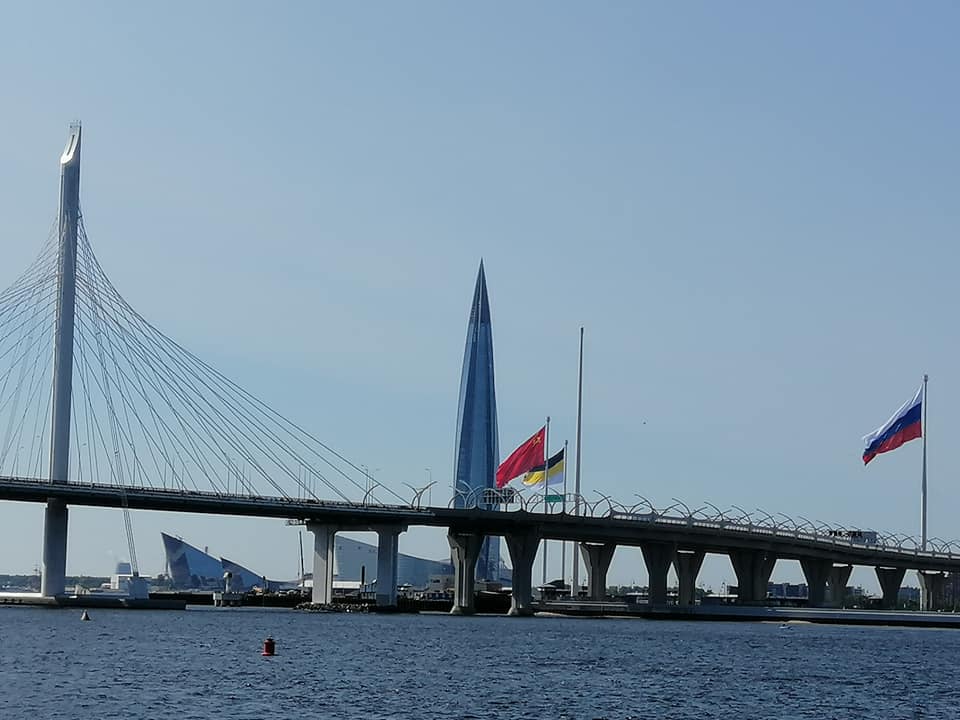
Russian President Vladimir Putin took part in a ceremony to raise the flags of the Russian Federation, the USSR, and the Russian Empire in St. Petersburg Tricentennial Park.
The head of state arrived in the area of the Gulf of Finland near Lakhta Center on the yacht Okhta. He watched the ceremony from the water.
On board the yacht, the head of state was welcomed by Elena Ilyukhina, deputy general director of Gazprom Neft and general director of Gazprom Lakhta LLC.
“St. Petersburg’s aquatic area and maritime facade,” she said, waving her hand at the view. “It’s beautiful. I understand that you have finished this complex,” Putin said, pointing at the 462-meter tower of Lakhta Center. Ilyukhina briefly told the president about the project, and also announced plans to build a 555-meter skyscraper next door.
[…]
“I understand that today’s event is connected with the fact that one stage [of the project] is ending and another beginning,” Putin said. Ilyukhina explained that the flag-raising ceremony, whose guest of honor of was the head of state, commemorated historical dates: the 165th anniversary of the Russian imperial flag, the 100th anniversary of the Soviet flag, and the 330th anniversary of Peter the Great’s tricolor.
Ilyukhina underscored that the choice of banners was not accidental: each flag represented a certain historical stage, marked by feats of heroism, victories and achievements. “The raised banners are a tribute to our history,” she pointed out, saying that Gazprom had erected the three 179.5-meter-high flagpoles to form the world’s first ensemble of flagpoles of such a height built on water. “The trinity symbolizes the continuity of our history,” Ilyukhina emphasized.
“It’s beautiful,” Putin said appreciatively. His interlocutor also noted that as part of the comprehensive improvement of St. Petersburg Tricentennial Park’s shoreline, hydraulic works had been designed to protect the coastline from erosion. A pedestrian bridge would stretch from each of them to the shore. The project’s development and implementation required complex engineering and design solutions and innovative construction techniques.
When the Russian national anthem rang out during the ceremony, Ilyukhina continued her story. The president stopped his interlocutor’s narration with a gesture of his hand, however. He put his finger to his lips, thus asking for silence as the national anthem was played.
After [the anthem was performed], the flag of the Russian Federation, the flag of the Soviet Union, and the flag of the Russian Empire soared into the air. The raised banners are remarkable for their immense size: each width of cloth is slightly larger than half of a football field: sixty by forty meters. Each flag weighs almost half a ton.
St. Petersburg Tricentennial Park is the youngest in the city. It was founded in 1995 to commemorate the three hundredth anniversary of the city’s founding [which did not occur until 2003]. [The then-Petersburg mayor] Anatoly Sobchak and future president Vladimir Putin each planted a tree.
According to Ilyukhina, as part of the project for improving the city’s coastal area, they are now planning to work on the park’s shoreline, including building a water sports base and equipping the beach, sports grounds, and walking paths.
I had visions, I was in them I was looking into the mirror To see a little bit clearer The rottenness and evil in me
Fingertips have memories Mine can’t forget the curves of your body And when I feel a bit naughty I run it up the flagpole and see who salutes (But no one ever does)
I’m not sick but I’m not well And I’m so hot ’cause I’m in Hell
Been around the world and found That only stupid people are breeding The cretins cloning and feeding And I don’t even own a TV
Put me in the hospital for nerves And then they had to commit me You told them all I was crazy They cut off my legs, now I’m an amputee, God damn you
I’m not sick but I’m not well And I’m so hot ’cause I’m in Hell I’m not sick but I’m not well And it’s a sin to live so well
I wanna publish ‘zines And rage against machines I wanna pierce my tongue It doesn’t hurt, it feels fine The trivial sublime I’d like to turn off time And kill my mind You kill my mind, mind
Paranoia, paranoia Everybody’s coming to get me Just say you never met me I’m running underground with the moles, digging holes Hear the voices in my head I swear to God it sounds like they’re snoring But if you’re bored, then you’re boring The agony and the irony, they’re killing me (whoa)
I’m not sick but I’m not well And I’m so hot ’cause I’m in Hell I’m not sick but I’m not well And it’s a sin to live this well (One, two, three, four)
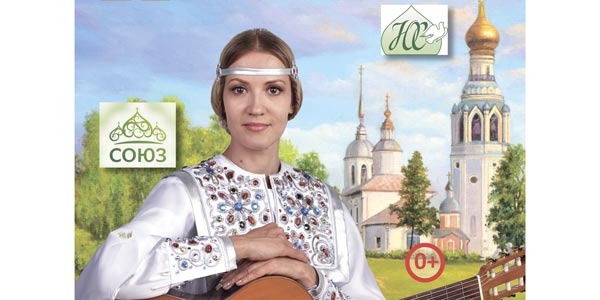
Yulia Slavyanskaya is a Russian singer of spiritual and patriotic songs. In 2002, she recorded her first album Wake up, Soul!, which was a real success! The singer attracted numerous fans who value spirituality, a positive attitude, and patriotism in music. Yulia writes her own music based on the poems of contemporary poets and classic poets.
Even the youngest listeners like the songs of this beautiful performer of contemporary songs [sic] about the soul and for the soul, songs about love for each other and for one’s Motherland. Her extraordinary lucid voice cannot be confused with anyone else’s!
For many years, Yulia Slavyanskaya has been performing solo concerts all over Russia. She has been joyfully welcomed in Donetsk, Gorlovka [sic], Belarus, Serbia, Abkhazia, Kirghizia [sic], and Montenegro.
She has been a prizewinner at many Russian and international festivals of spiritual song. She was awarded the Republic of Abkhazia’s highest honor, the Akhdz-Apsha (“Honor and Glory”) medal, in the third degree, and has received numerous awards from municipal, public, and religious organizations in Russia and other countries.
Yulia Slavyanskaya’s concert and performances can be viewed on the TV channels Spas, Soyuz, A Minor, and My Joy. You can also get to know her work on the website юлия-славянская.рф and social networks on the Internet.
Yulia Slavyanskaya’s concerts are attended by whole families. Her work is filled with amazing light and purity! At the concert in St. Petersburg, Yulia will perform songs from all six of her released albums.
By tradition, the little children who attend Yulia Slavyanskaya’s concert will become its active participants.
Source: Bileter.ru, via their weekly email newsletter. Ticket prices for the concert range between 700 and 1,500 rubles. Translated by the Russian Reader
“Encounters at the Lavra,” Soyuz TV (562K subscribers), 2,055 views, Mar 29, 2021. Priest Anatoly Pershin welcomes Orthodox singer and composer Yulia Slavyanskaya. The program features songs based on the lyrics of Archpriest Andrei Logvinov: “The Martyrs’ Candles Were Lighted” and “So Much Is Given.” Father Anatoly performs the song “How I Want Purity.”
All the swindlers are fleeing Russia:
They have property in the West.
The bandits and sodomites are fleeing
And all those killed by their conscience.

The Judases are running, all going there,
Where there is no love, where there is no Christ.
Where there are gay parades and Nazis,
Liberals and globalists.

God is cleansing Holy Russia,
He protects it himself like his own daughter!
He will not let the evil ones torment us,
May God grant that we keep our faith.
Only an ignoramus doesn't understand
Russia as the last hope.

Let the enemy shout that Putin is bad
And under him all in Russia is bad.
If the whole herd of fleas is mad,
Evidently our Putin has done everything right!
DDT frontman Yuri Shevchuk has released the video “Motherland, Come Home.” In the new single, he calls on his country to stop the war and go about its own business. The video was shot by Shevchuk in collaboration with producer and composer Dmitry Yemelyanov.
Yuri Shevchuk wrote the poem “Motherland, Come Home” in the summer of 2022, a few months after Russia had launched its invasion of Ukraine. In the run-up to the invasion’s anniversary, the rocker set it to music and recorded the song. “Don’t go crazy, this is not your war,” Shevchuk urges listeners.
Yuri Shevchuk & Dmitry Yemelyanov, “Motherland, Come Home”
Shevchuk has repeatedly spoken out against the war in Ukraine. He has consistently taken a pacifist stance and opposed all wars, including the military operations in Chechnya, South Ossetia, and anywhere else in the world.
In 2022, Shevchuk was fined fifty thousand rubles after he was found guilty of “discrediting” the actions of the Russian army. The occasion for the fine was an anti-war statement he made in May at a concert in Ufa. After the outbreak of the war in Ukraine, concerts by his band, DDT, in Russia have often been postponed or canceled “due to technical difficulties.”
In the summer of 2022, the media reported the existence of a list of “banned” Russian artists who had opposed the war in Ukraine, including the bands DDT, B2, Aquarium, and Pornofilms, the rappers Face and Oxxxymiron, and the solo performers Zemfira, Monetochka, and Vasya Oblomov. There were more than fifty names on the list. Many of the musicians have already faced the cancellation of concerts, and some have been designated “foreign agents” by the Russian Justice Ministry.
Никотиновый вдох, Распальцованный взгляд, Я ещё не подох, Ещё мои шланги горят.
A nicotine breath, A swaggering look, I’m not dead yet, My hoses are still on fire.
Этой лютой весной Суета с тишиной Пульс неровный несут. Пульс неровный несут Моё сердце на суд.
This fierce spring Helter-skelter and silence, The pulse is uneven. The pulse is uneven My heart is on trial.
Опустело село, Пьёт Рязань из Днепра, От венков расцвело, В рыжей глине – дыра.
The village is deserted, Ryazan drinks from the Dnieper, The wreaths have burst into blossom, There is a hole in the red clay.
Маята, как сорняк Телевизор в печи, У державы стояк. У державы стояк, Воют бабы в ночи.
The torment is like a weed The TV’s like a furnace, The empire has a boner. The empire has a boner, Women howl in the night.
Тёмен век мой. Господи, как всё случилось? Рваный лик твой – Укололась и забылась. Не сходи с ума, Это не твоя война. Ждут грачи в полях весной. Родина, вернись домой!
My age is dark. My God, how did it happen? Your ragged face, Pricked and forgotten. Don’t go crazy, This is not your war. Rooks wait in the fields in spring. Motherland, come home!
Безнадёги иной Я не переживал, Коллективной виной – Сделал шаг и пропал.
Other doom and gloom Didn’t bother me, But with collective guilt I took a step and went MIA.
Давит воздух густой, Но тебя не забыть, Мертвецов напоить. Мертвецов напоить Родниковой водой.
The air is thick, But I can’t forget you, Get the dead drunk. Get the dead drunk On spring water.
Голоса белены Тянут мысль одну: Ты вернёшься с войны, Вновь попасть на войну.
Voices are faded white They dredge up one thought: You’ll come back from the war To go to war again.
И летят облака, Разбиваясь в дали, О крутые бока Нашей плоской Земли.
And the clouds are flying, Crashing in the distance On the craggy sides Of our flat Earth.
Тёмен век мой. Господи, как всё случилось? Рваный лик твой – Укололась и забылась. Не сходи с ума, Это не твоя война. Ждут грачи в полях весной. Родина, вернись домой!
My age is dark. My God, how did it happen? Your ragged face, Pricked and forgotten. Don’t go crazy, This is not your war. Rooks wait in the fields in spring. Motherland, come home!
Source: Yuri Shevchuk & DDT, “Motherland, Come Home,” Reproduktor. Translated by the Russian Reader
Found archival photo of a Young Pioneer on Mozhaiskaya Street in Leningrad, 1982. Thanks to VG for posting this find on their now-locked Facebook page
“A Calendar of Revolutionary Names. April: Arlen (“Army of Lenin”), Vilenin (“V.I. Lenin”), Viulen (“V.I. Ulyanov-Lenin”), Lublen (“Love Lenin”), Marenlenst (“Marx, Engels, Lenin, Stalin”), Motvil (“We’re from V.I. Lenin”), etc.
VICE News (YouTube), “Nationalism or Nothing: Life in Modern Russia,” 10 Feburary 2023: “President Vladimir Putin’s ongoing invasion of Ukraine, has led to a tightening of dictatorial powers within Russia. Free-speech is virtually non-existent and the public realm is now dominated by outspoken nationalists, who want more war, not less.” Thanks to Marxmail for the heads-up
One day, I hope, someone will explain to me why “progressive” Russians find the English words speak, speaker, speech, etc., so sexy and exciting that they have to incorporate them needlessly into Russian every chance they get.
Do they know that, in English, these words are less evocative than three-day-old bread, duller than dishwater?
In this case, hilariously (and awkwardly, too: “speak” appears after chas, generating an awkward phrase that translates as “hour of speak” or “speak hour,” although it’s supposed to be a play on the idiomatic phrase chas pik, meaning “rush hour”), the word “speak” adorns Sergei Medvedev’s reflections on the “imperialist mindset.”
Indeed.
Thanks to TP for this gem of Rusglish.
Below, you can watch the actual interview (in Russian, not Rusglish — well, almost), which, if for no other reason, is interesting because it was posted almost three months before Russia invaded Ukraine. ||| TRR
Historian and writer Sergei Medvedev is the program’s guest.
In an interview with Nikita Rudakov, he explained:
Why the idea of Russia’s “civilizational superiority” is so popular
Why propaganda encourages the ideological complexes of Russians
How the elite of the 2000s is trying to turn back history.
00:00 Chas Speak: Sergei Medvedev 01:40 The imperialist mindset and the idea of Russia’s greatness 06:10 Is there no place for nationalism in the imperialist mindset? 08:05 “Russia colonized itself” 14:03 The superiority of big ideas: why didn’t the USA become an empire? 21:02 The ideological complexes of Russians 25:41 “We rise from our knees via military achievements and parades on Red Square” 26:50 “Lukashenko does with us what he will”: Russia and Belarus 30:56 “Russia wants to live in the myth of 1945” 34:40 “We were unable to create a nation state”
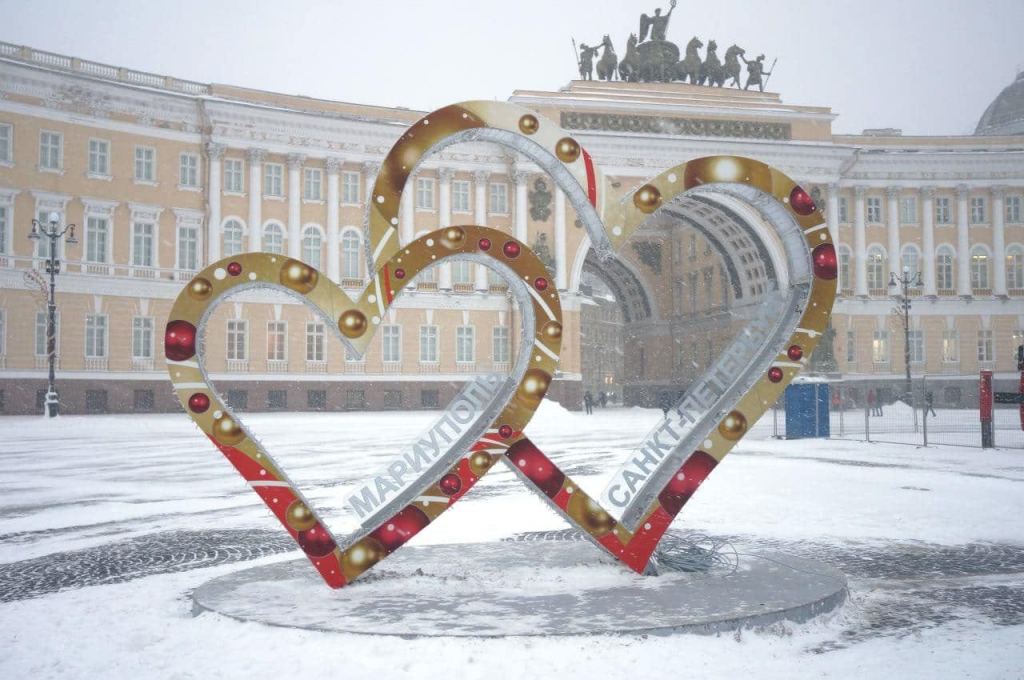
“Mariupol. Saint Petersburg.” A snapshot purportedly taken earlier today by Tatyana Razumovskaya (see her Facebook post, below).
The LED composition “Double Hearts” has been installed on Palace Square in honor of the sister city relationship between Petersburg and Mariupol, as reported on the city’s VK page.
The “Double Hearts” project was approved by Governor Alexander Beglov. Earlier, the installation was on display in a Mariupol city park. It symbolizes the unity, friendship, and love between people living in the sister cities.
Earlier, 78.ru reported that Petersburg authorities would hold a “Wish Tree” event for children from Mariupol.
Palace Square right now. It’s a three-minute walk from here to the house where I grew up and the school where I studied. Right there is the Hermitage, where I used to work.
I wish this were a dream and I could wake up.
Source: Tatyana Razumovskaya, Facebook, 13 December 2022. Thanks to VG for the heads-up. Translated by the Russian Reader
Alexander Andreyev from St. Petersburg has been killed in the military operations in Ukraine. In 2020, he graduated from School No. 368 in the city’s Frunzensky District. The school administration reported the news on its VK page.
During his school years, Andreyev was the captain of the 368 Superheroes volunteer group, and “from the very beginning he was eager to defend his Motherland,” reports the school’s VK page. In the summer, the young man went to serve and was enlisted in the 76th Pskov Airborne Division, the page reports. Later, he signed a contact, and in early October he was sent to the war zone, the post says.
Alexander was killed on October 18, according to the school administration, when the observation post where the soldier was located came under mortar attack. Andreyev was awarded the Order of Courage and buried in the Avenue of Heroes at Babigon Cemetery, the message says.
This is at least the fourth known death of a Petersburger in the war in Ukraine. Earlier, a school teacher from Petersburg, physical education teacher Vadim Sedov, was killed there. In addition, in the first week of October, Andrei Nikiforov, a member of the Nevsky Bar Association, was killed near Lisichansk. In mid-November, news arrived of the death in Mariupol of Konstantin Simonov, a Petersburger who volunteered to fight in March.
The Smolny [Petersburg city hall] is considering three options for special parking permits for residents of the Admiralty District [rayon], Fontanka.ruwrites. On November 1, paid parking was introduced there, and locals were given the option to park their cars in their municipal precinct [okrug] for 1,800 rubles a year, the online media outlet reported.
Petersburgers recalled that residents of the Central District use similar permits throughout its territory, and not only in their own [smaller] municipal precincts, Fontanka.rureports.
As the media outlet’s journalists have written without specifying their source, there are now three possible options for how paid parking will work for Admiralty District residents:
— everything will remain as it is: supporters of this proposal say that permits are needed so that a person can park outside their house for free, while trips around the district only increase traffic, which is what the reform is meant to combat
— the validity of permits will extend to the entire district: proponents of this idea believe that such innovations will soften the public outcry
— residents of the Admiralty District will be able to choose another district in which their permits are valid, giving them the opportunity to travel around nearby districts without worrying about paying for parking.
According to the media outlet, the Smolny will make a choice in the coming days.
Paid parking was introduced in the Admiralty District on November 1. Now those who want to park their car here have to pay 39 or 100 rubles per hour, depending on the type of vehicle, or buy an expensive monthly or annual pass.
But for those who live in the district, the authorities have introduced special annual parking permits that cost 1,800 rubles a year, but are valid only in the municipal precinct in which the motorist owns property or is registered to live. To park a car in any other municipal precinct, one has to pay the standard fare.
On December 9, our country celebrates Day of Heroes of the Fatherland. On this day, Heroes of the Soviet Union, Heroes of the Russian Federation, and recipients of the Order of St. George and the Order of Glory are honored.
And on this day we want to tell you about a hero of our time, Alexander Igorevich Andreyev, a graduate of our school.
ALEXANDER IGOREVICH ANDREYEV
During his school years, Sasha was the team captain of the 368 Superheroes volunteer movement.
From the very beginning of the SMO, he sought to defend the Motherland. In the summer he went to serve and was able to enlist in the legendary Pskov 76th Airborne Division.
He signed a contract [as a volunteer] and just recently, in early October, was deployed in the special military operation.
On October 17, his unit was involved in heavy combat. When a comrade’s machine gun jammed, Alexander covered him before he himself attacked the enemy’s positions, thus contributing to the further advance of the paratroopers. By the end of the day, an enemy fortification had been captured. The next day, October 18, Alexander was at an observation post when the enemy opened fire with a mortar. He was hit by a shell and fatally wounded.
He died at his combat post. He was twenty years old.
By decree of the President of the Russian Federation, Alexander Andreyev has been awarded the Order of Courage.
Alexander is buried at the Babigon Cemetery on the Avenue of Heroes.
May the memory of this Russian Hero, friend and faithful comrade live forever.
We will never forget you!
Source: Secondary School No. 368 Frunzensky District of St. Petersburg, VK, 9 December 2022. Image of Alexander Andreyev courtesy of School No. 368. Translated by the Russian Reader
Petersburg is all gussied up in sparkling joyful lights. The holiday is coming to our town.
I have just read a letter from an acquaintance in a neighboring country:
“There has been no electricity in my city for almost a month. Previously, it was on for four hours a day, then for two, and then for one to two hours every few days. The last time the electricity was on was Friday for two hours. There are no schedules: it can be turned on at three a.m. when everyone is asleep and you just miss it. Along with electricity, there is also no water and heating, although it’s winter outside. Since electricity is provided for one to two hours every few days, it is only at this time that the cellphone tower begins to send out a signal. The rest of the time there is no mobile connection or internet. We have been plunged into the nineteenth century and life has come to a grinding halt.”
Source: Sergey Abashin, Facebook, 13 December 2022. Photo, above, by the author. Translated by the Russian Reader
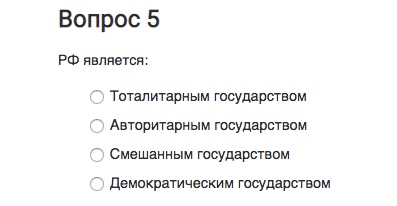
Four and half years ago, I had to renew my Russian permanent residence permit. The procedure had changed considerably since the last time I’d applied for the permit. Among the changes were two written exams that applicants were now required to pass — a Russian language exam and a Russian civics exam. I decided to study for them by doing practice exams which I found online. One of the civics question was “Question 5,” screenshotted above. It’s a multiple choice question. The examinee must decide whether the “RF” (the Russian Federation) is a) a totalitarian state, b) an authoritarian state, c) a hybrid state, or d) a democratic state. To be honest, I no longer remember whether this particular question came up in the actual exam, which I passed with flying colors. But I thought that you, my readers, might find it productive to ponder this question while reading the following three items, ripped straight from this week’s headlines in the Russian media. At the end of this post, you’ll see what the “right” answer was (in 2018, at least) and the answer I tried to give when taking the online practice quiz. ||| TRR
The Ministry of Culture of the Russian Federation has identified 17 priority topics for state financial support of film production in 2023.
The procedure and conditions for selection competitions in 2023 will be announced at the end of December 2022.
“We publish a list of topics before the start of competitions for financing production, hoping that filmmakers will take into account the priorities of state support for film production when developing projects. The Ministry of Culture continues to support such important topics for society as the protection of family values, patriotic education, preservation of the traditions of Russia’s regions, the success of domestic science, and popularization of the professions of engineer and teacher. Given modern realities, we consider it necessary to focus as well on countering attempts to falsify history and modern manifestations of the ideology of Nazism, to talk about the heroism and dedication of Russian soldiers during the special operation and the work of front-line brigades and volunteers,” said Olga Lyubimova, Minister of Culture of the Russian Federation.
Some priority topics have been established pursuant to the Decrees of the President of the Russian Federation: “On the Approval of the Foundations of State Policy for the Preservation and Strengthening of Traditional Russian Spiritual and Moral Values,” dated 09.11.2022, No. 809; “On the Announcement of the Decade of Childhood in the Russian Federation,” dated 29.05.2017, No. 240; “On the Announcement of the Decade of Science and Technology in the Russian Federation,” dated 25.04.2022, No. 231; and “On Holding the Year of the Teacher and Mentor in the Russian Federation,” dated 27.06.2022, No. 401.
The list of priority topics includes:
1. Russia’s culture. The preservation, creation and dissemination of traditional values.
2. The decade of childhood. Families and children, their protection and support.
4. Historical cinema. History lessons, memory lessons. Countering attempts to falsify history. Russia’s peacekeeping mission of Russia. Russia’s historical victories. The eightieth anniversary of the Victory in the Great Patriotic War. The Soviet soldier’s mission of liberation Generational conflict, generational continuity.
5. Russia as a modern, stable and secure state that provides opportunities for growth and self-realization.
6. The heroes among us. Stories of modern Russia’s outstanding individuals. Popularizing the teaching profession. School and college as important stages in social adaptation and personal orientation. The role of teachers and mentors in shaping the individual.
7. Motivating young people to master manual trades and engineering jobs. Improving the social status of the manual worker and the engineer, of research and innovation.
8. Film chronicle. The current state, culture and traditions of Russia’s regions. Development of the Far East and the Arctic. The life of small towns and villages, life in the provinces. Little Russia as a historical region of Russia.
9. Adaptations of works of Russian classical literature, including with the use of animation.
10. Films about outstanding figures in history, culture, science and sports. Popularizing the medical profession. Films about sporting achievements and victories.
11. Countering modern manifestations of the ideology of Nazism and fascism. Popularizing heroism and the dedication of Russian soldiers during the special military operation.
12. Popularizing service in the Russian Armed Forces of Russia. Society’s unanimous support of the army (front-line brigades and volunteers). Strengthening the status of the military profession as based on historical events and recent history.
13. The spiritual, moral and patriotic education of Russian citizens. Countering extremism. Images and models of behavior and creative motivation for modern youth. Spiritual leaders. The volunteer movement in Russia and the CIS countries as an international popularization of volunteerism.
14. The neocolonial policy of the Anglo-Saxon world. The degradation of Europe. The formation of a multipolar world.
15. Society without borders: the self-realization of people with disabilities. Volunteering in Russia. Active longevity.
16. Films about teenagers. Formation of values in life and guidelines while growing up. Disorientation in public space, information overload, forming one’s own way of thinking.
17. Modern society. Moral and ethical choice. Civic engagement. Social unity.
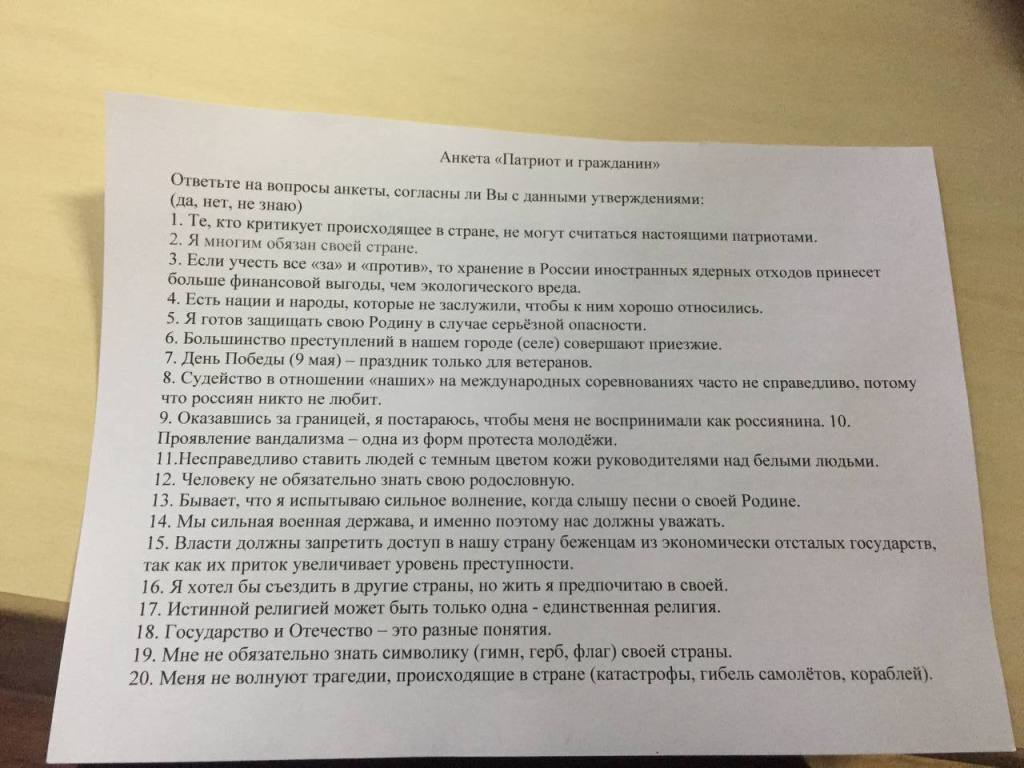
At a secondary school in the Leningrad Region, the Agalatovo Education Center, students were quizzed about racism, Russophobia and the emotions provoked by songs about the Motherland. A photo of the questionnaire, entitled “Patriot and Citizen,” was sent to Rotunda by the parents of one of the schoolchildren. Here are some of statements the children had to evaluate by answering “yes,” “no,” or “I don’t know.”
🇷🇺 Those who criticize what is happening in the country cannot be considered real patriots. 🇷🇺 I owe a lot to my country. 🇷🇺 Sometimes I get very excited when I hear songs about my Motherland. 🇷🇺 We are a strong military power, and that is why we should be respected. 🇷🇺 If I go abroad, I will try not to be seen as Russian. 🇷🇺 I am ready to defend my Motherland in case of serious danger. 🇷🇺 Most of the crimes in our city (village) are committed by outsiders and immigrants.
🇷🇺 Our athletes are often judged unfairly at international competitions, because no one likes Russians. 🇷🇺 If we take into account all the pros and cons, the storage of foreign nuclear waste in Russia brings more financial benefits than it does environmental harm. 🇷🇺 There are nations and peoples who do not deserve to be treated well. 🇷🇺 Vandalism is one of the forms of youth protest. 🇷🇺 It is unfair to put people with dark skin in charge of white people. 🇷🇺 There can be only one true religion.
🤦 The school confirmed to Rotunda that they had conducted such a survey. They agreed to communicate with us only by mail. In a written response signed by the vice principal, they claimed that the questionnaire was needed “as background for a faculty meeting.” The school did not answer questions about how correctly or adequately the questionnaire was worded. Rotunda was unable to contact the school’s principal, Svetlana Sergiyenko. She is a supporter of the United Russia party and has run for election several times on the party’s ticket.
📌 The questionnaire itself seems to have been found by the educators on the internet. In 2014, Belarusian media reported that a similar survey (only with Belarus instead of Russia) was conducted in schools in Minsk.
There is a belief that the Russian elite under President Vladimir Putin has only ever been interested in money. Yet Putin’s militant, anti-liberal, anti-Western, isolationist, paternalistic, and harshly authoritarian regime has always had an ideology.
This ideology is not systematized, but it does exist, and snippets of it can be found throughout Putin’s speeches, articles, and interviews. Now the war in Ukraine has necessitated a more articulated ideology, however.
The initiative to systematize and codify Putinism has led to a presidential decree listing Russia’s “traditional spiritual and moral values,” as well as the development of a new ideological curriculum for colleges.
It is no longer enough to indoctrinate children in kindergartens and schools. It is now time to unify the worldviews of college students, and, by extension, those of their professors, whose ranks will inevitably be purged. A similar course taught during the Soviet era was known as “Scientific Communism.”
The name for this new curriculum is “Fundamentals of Russian Statehood,” though it might as well be called “Scientific Putinism.” It is composed of four units: “History” – historical policy as the imposition of a mythologized official version of history, which is one of the instruments for manipulating the mass consciousness of Russians; “Cultural Codes” or the “traditional spiritual and moral values,” around which Putin has ordered federal and regional governments to unify; “Russia and the World” — a justification of isolationism, anti-Westernism, and jingoism; and “Vision for the Future,” which sets out what the state hopes to achieve beyond victory in Ukraine and the destruction of the “fifth column.”
The curriculum justifies the cult of the eternal leader and doubles down on the idea that Russia is fighting the forces of evil in Ukraine in an effort to “de-satanize” the country. However, at the same time, Scientific Putinism lacks key components such as development goals or a vision for Russia’s future, focusing as it does almost exclusively on the past.
During Dmitry Medvedev’s presidency, there were teams working on a future-oriented ideology and making road maps based on the idea that Russia would fast-track the modernization of the state and society. Putin’s ideology, however, is one that fundamentally opposes modernization.
Putin has successfully convinced a significant portion of the population that Russia must regain its status as a great power, and that Russia is under attack by both the liberal West and traitors at home. As the regime has grown more authoritarian, its ideology has also become more archaic, its propaganda more obtrusive, and any hopes of modernization have dwindled.
An ideology that consists of historical, cultural, and religious myths, bogus traditions, and resentment seeks to legitimize an authoritarian regime and delegitimize those who oppose it.
Such an ideology makes it possible to label nonconformists as enemies, and to divide people into “us” and “them.” The division into “us” and “them” doesn’t just provide a marker for self-identification, it also serves to convince the public that there is a certain majority from which they should not stray.
In the past, the only requirement for being part of the “us” was passive, silent, conformist support. Today, however, this is not enough: Russians must surrender their very bodies to be cannon fodder in the supreme leader’s holy war against the “satanic” forces of the West. This is no longer authoritarianism; it is totalitarianism.
Imperialism and colonialism are key components of Putinism and key factors in the war. There is nothing new about this ideology; it comes almost verbatim from Stalinism and from earlier Eurasian and Slavophile narratives.
The war is being passed off as striving to restore historical fairness, as defensive and preventive, and as liberation. According to Putin, the land of the empire must be “returned and reinforced.”
In just a few years, the regime has evolved from a cult of the victory of 1945 to a cult of war itself, and Putin has managed to persuade a large segment of Russian society that the “special military operation” of 2022 is a natural continuation of World War II. In essence, it is an existential war between Russian and Western civilizations.
Putin has started to refer to Russia as an entire civilization. The state is not just sacred and worthy of the ultimate sacrifice; it is also a separate and superior civilization with a “thousand-year history” and its own special path.
Within this history, cultural codes are being passed down from generation to generation as part of the country’s political DNA. This state-civilization has its own pantheon of heroes unchanged from the Soviet era: Alexander Nevsky, Ivan the Terrible, Peter the Great, Joseph Stalin, and Yuri Gagarin.
This state-civilization has always been under attack by enviers and foes, making its state of permanent conflict critical, and not simply limited to the battlefield. The state must win in all aspects — in culture and in sports, in the construction of Olympic facilities, and in the war against Ukraine and the West.
To defend the sovereignty of this state-civilization, the Kremlin is counting on the security services, or siloviki, who have been given additional funding and are reinforced by spin doctors and so-called “journalists” in the Kremlin’s service.
The Culture Ministry, the communications watchdog Roskomnadzor, and the Russian Orthodox Church are becoming de facto siloviki themselves, enjoying as they do the right to block or ban media, restrict the sales of books by authors who oppose the war, and decide who can perform on theater stages.
The ideology has become corporeal, bolstered by political and military acts, such as the annexation of Crimea and the “special military operation.” In short, the special ideological operation is ongoing, and it seems to be faring rather better than the military one.
This article was originally published by the Carnegie Endowment For International Peace.
Back in the summer of 2018 I tried to answer Question 5 truthfully, replying that the Russian Federation was an “authoritarian state.” But the right answer, then, was “democratic state,” as it turned out. Again, I don’t remember now whether this question was on the actual civics exam that I took, but there were several other “ideological” questions like it, which I would have answered “incorrectly,” thus jeopardizing my chances to get a residence permit, if I hadn’t been schooled in advance by the practice quizzes I’d found online. ||| TRR
So much for the idea of not giving a platform to out-and-out fascists like Alexander Dugin, whose “academic” credentials are borne out by serious-sounding nonsense like the following, as found in Last War of the World-Island and translated by John Bryant:
In all the principal parameters, the Russian Federation is the geopolitical heir to the preceding historical, political, and social forms that took shape around the territory of the Russian plain: Kievan Rus, the Golden Horde, the Muscovite Czardom, the Russian Empire, and the Soviet Union. This continuity is not only territorial, but also historical, social, spiritual, political, and ethnic. From ancient times, the Russian government began to form in the Heartland, gradually expanding, until it occupied the entire Heartland and the zones adjoining it. The spatial expansion of Russian control over Eurasian territories was accompanied by a parallel sociological process: the strengthening in Russian society of “land-based” social arrangements, characteristic of a civilization of the continental type. The fundamental features of this civilization are:
• conservatism; • holism; • collective anthropology (the narod is more important than the individual);
• sacrifice; • an idealistic orientation; • the values of faithfulness, asceticism, honor, and loyalty.
Sociology, following Sombart, calls this a “heroic civilization.” According to the sociologist Pitirim Sorokin, it is the ideal sociocultural system. This sociological trait was expressed in various political forms, which had a common denominator: the constant reproduction of civilizational constants and basic values, historically expressed in different ways. The political system of Kievan Rus differs qualitatively from the politics of the Horde, and that, in turn, from the Muscovite Czardom. After Peter I, the political system sharply changed again, and the October Revolution of 1917 also led to the emergence of a radically new type of statehood. After the collapse of the USSR there arose on the territory of the Heartland another government, again differing from the previous ones: today’s Russian Federation.
But throughout Russian political history, all these political forms, which have qualitative differences and are founded on different and sometimes directly contradictory ideological principles, had a set of common traits. Everywhere, we see the political expression of the social arrangements characteristic of a society of the continental, “land-based,” heroic type. These sociological peculiarities emerged in politics through the phenomenon that the philosopher-Eurasianists of the 1920s called “ideocracy.” The ideational model in the sociocultural sphere, as a general trait of Russian society throughout its history, was expressed in politics as ideocracy, which also had different ideological forms, but preserved a vertical, hierarchical, “messianic” structure of government.
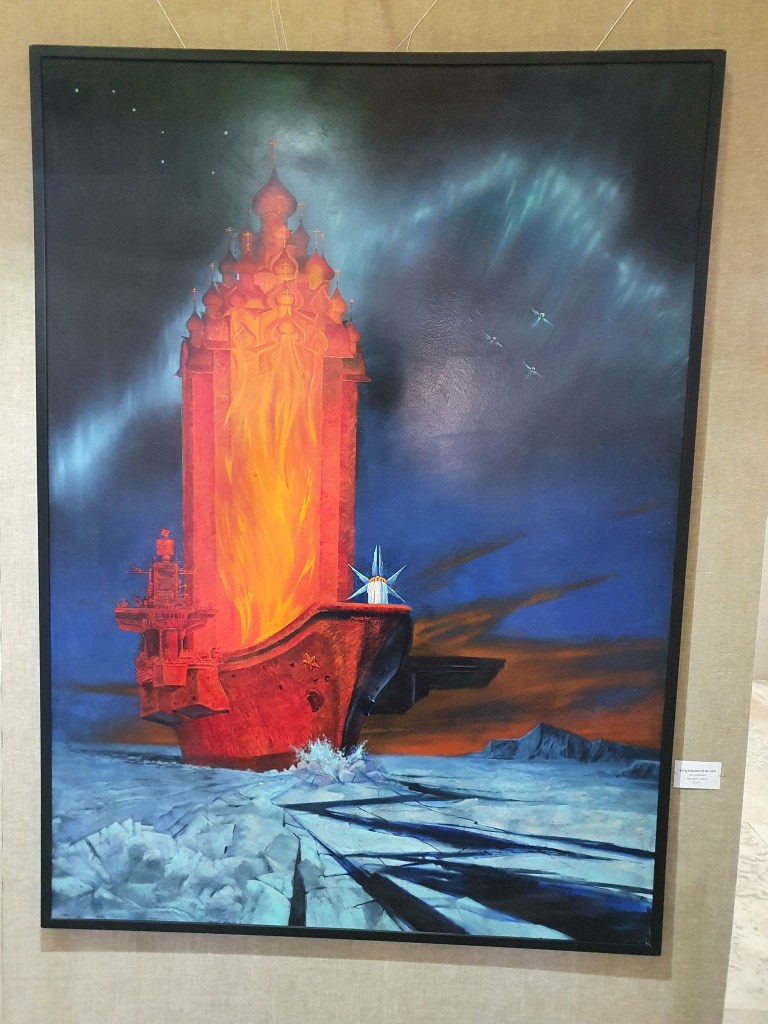
“Russian angel carrier, Artillery Museum, Saint Petersburg.” Source: Pavel Pryanikov, Facebook, 6 November 2022
Alexander Kharichev, head of the Presidential Department for Supporting the Work of the State Council, and three other experts have published a scholarly article entitled “Perception of basic values, factors, and structures of Russia’s socio-historical development, as based on research and testing.” As part of the study, seventy people from the student bodies of Moscow State University and the Higher School of Economics and the teaching staff of a conference in Sevastopol [sic] were interviewed. Among the metaphors of the future they proposed was the burnt second volume of Dead Souls; among the concepts of the modern state, “the Motherland with a laser sword”; among the concepts of the future, “Russia as the world’s ‘guardian of good” and “Pasty” [sic: “Pirozhok”]. The authors concluded that the dominant value for the Russian family is the people of Russia, which itself is a “family of families.”
Mr. Kharichev’s co-authors were Andrei Shutov, dean of the faculty of political science at Moscow State University; Andrei Polosin, doctor of political science and head of Rosatom’s regional interaction department; and Ekaterina Sokolova, deputy executive director for strategy and forecasting at the Expert Institute for Social Research. The article was published in October in the Journal of Political Studies.
The study was conducted by means of group discussions from March to May. The seventy participants answered questions about what Russian statehood is, what would happen to the country in ten years, what our future is, and a number of others.
Based on the discussions, the researchers formed a five-level “pentabasis”: person—family—society—state—country. Dominant values were formed for each level. For the country, [this dominant value] is patriotism; for the state, it is trust in the institutions of power; for the family, it is the people of Russia; for society, it is harmony; for the person, it is creativity. “The thesis was voiced that European society is individualistic, whereas our main value is family + family with friends, which leads to the emergence of the thesis ‘family as a level.’ The dominant value: the people of the Russian Federation as a family of families. Stimulating the birth rate and the concept of a ‘big family,’ the article says [just as incoherently in the original as in this translation].
Metaphors of Russia’s future. “The state as a novel” (written collectively by citizens, it has alternative endings); “the Russian future as the second part of Dead Souls, burned by Gogol,” “the state as the Firebird.”
Concepts of the modern state. “[The] Motherland with a laser sword” (a source of pride for the Russian spirit and a guide to the future), “the friendly service state.”
Messianic concepts of the future state. “Russia as a ‘prophet country’ (opposed to the Grand Inquisitor), “Russia as the world guardian, the ‘guardian of good.'”
Idealistic concepts of the future state. “Wondrous City” ([i.e., promoting] inclusivity, coexistence, acceptance of others as equals; “in no case to be confused with the term ‘tolerance'”), “Pasty” (harmoniously combines different things).
Mechanistic concepts of the future state. “Kaleidoscope” (a multifaceted future), “a medium-sized magnet state” (generates a field for a particular community).
The study participants concluded that the person in the “Russia of the Future” is “proud of his country, influential and highly employable, financially secure, [and] free within certain community rules.” According to the authors of the article, the ideas of self-realization in the Russian Federation are very different from those common in the Western world.
“In the Russian case, self-realization or mission means that an individual contributes to the country’s development. Capitalizing [on one’s] mission is an optional stage,” the authors write.




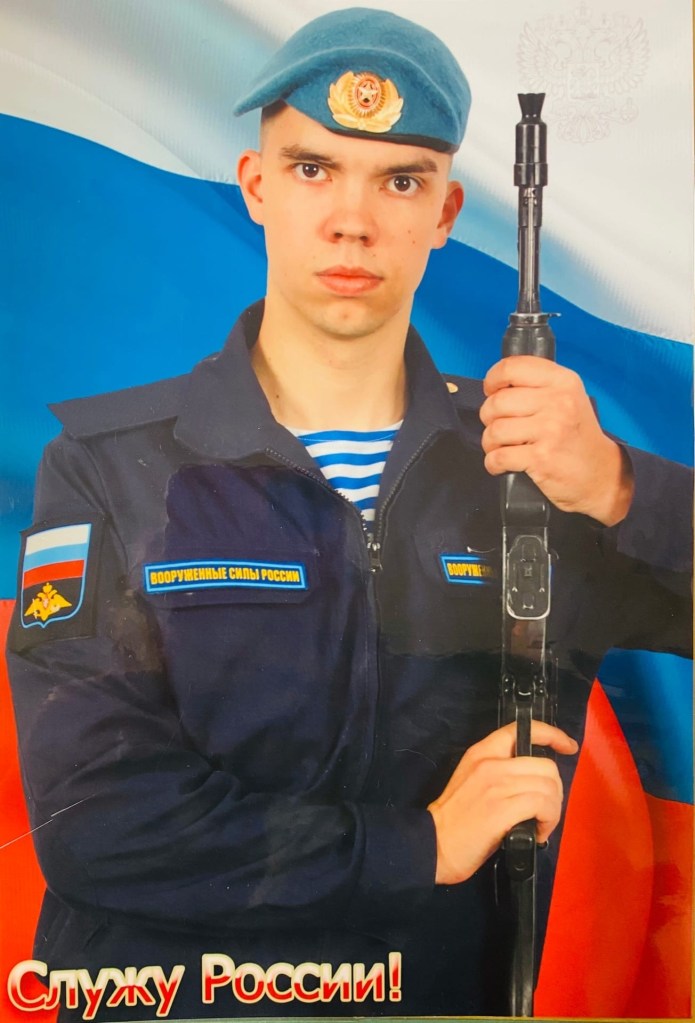
 On December 9, our country celebrates Day of Heroes of the Fatherland. On this day, Heroes of the Soviet Union, Heroes of the Russian Federation, and recipients of the Order of St. George and the Order of Glory are honored.
 May the memory of this Russian Hero, friend and faithful comrade live forever.