Open Season

This just came in the mails.

REMEMBER RUSSIAN ‘GUN-RIGHTS ADVOCATE’ [ 😉 ] AND CONVICTED FELON MARIA BUTINA? Who doesn’t? Welp, here she is w/ your Daily Irony Supplement — and it’s a massive dose! See, as of Jan. 20 she’ll likely get a pardon and move back Stateside to improve on her spying career (hey, how could she do worse?); but in the meantime, she’s trying to get *Americans* (et al.) to go the *other* way, i.e. move to Moscow — y’know, like Our Guy Ed Snowden & his new roommate, Bashar al-Assad, who just *love* it there, right?

[WARNING: Do not watch this video immediately after a meal.]

Source: Mark H. Teeter (Facebook), 18 December 2024


The Gated Community, “Mariia” (from LP The Honor and Glory of The Gated Community, 2023)

Dankhaiaa Khovalyg: Russia’s Asian Republics Speak

Dankhaiaa Khovalyg. Photo: Rinchinaaa/Baikal People

‘I was made from Russian anyway,’ 28-year-old Dankhaiaa Khovalyg writes in her story ‘Ayalga,’ published in early 2022. Its female protagonist tells a psychologist how she feels like a stranger in her own country. When Dankhaiaa was a teenager, she deliberately detached herself from her native culture. She was proud to speak Russian without an accent, and dreamt of leaving Kyzyl ‘to be with her own people’ in Moscow.

During her eight years in Moscow, Dankhaiaa was involved in decolonial activism, researched her own painful background, and launched a project about indigenous people from Russia’s six ethnic Asian regions —the podcast re.public_speaking.

Alina Golovina, a Baikal People correspondent based in Buryatia, spoke with Khovalyg about why it is important to talk about trauma, where decolonization begins, and whether Russia’s ethnic republics can unite for their own benefit. At Danhkaiaa’s suggestion, they spoke to each other using the informal second-person pronoun ty.

As soon as I would lеave home, the world would crash down on me with all its xenophobia

— Tell me about yourself, Dankhaiaa.

— I was born and raised in Kyzyl. After graduating from school, I went to study in Moscow and lived there for eight years. I worked as a client manager in an IT company and was involved in feminist activism. In 2021, I quit my job and realized my childhood dream: I enrolled in literature classes and took up writing. Since March 2022, I have been living in Berlin and doing podcasts and anti-war activism.

— You told me that up to ninety percent of the indigenous people in Tuva speak Tuvan and consider it their native tongue. Why have you prioritized Russian? Is it a problem?

— I’m a city girl: I grew up in Kyzyl. I was sent to a Russian-language kindergarten and, later, to a Russian-language class at school. That was how my mother showed that she cared about me: Russian-speaking classes were considered tonier. I was a bookworm and was engrossed in Russian literature. Unfortunately, I didn’t have access to a large amount of foreign literature at school, and at that moment, eighty percent of me certainly consisted of this great and beautiful Russian literature by the so-called Tolstoyevskys. I read all of that stuff and would dream of going to Moscow. I was a little proud that I spoke such beautiful Russian. Basically, I went through all that internalized colonial chauvinist crap that life was better there, that I was going to get out because I was more like them.

— Did it save you from ethnic discrimination? If not, when did you first encounter it?

— My experience of discrimination actually began long before I moved to Moscow. My mother found opportunities using travel vouchers to send me to summer camps in Krasnodar Territory, Khakassia, and other regions. I was eleven and twelve years old at the time. It didn’t matter whether I traveled five hundred kilometers from home or several thousand, because everywhere I went I encountered phenomenal bullying. I was labeled ‘China girl’ and ‘black.’ No one asked me to dance at dance parties. I was either totally ignored or talked to condescendingly and peppered with passive-aggressive insults. I had lived in my native Tuva in a groovy, comfortable bubble: most people spoke Tuvan, and we didn’t encounter any racism there. But as soon as I would leave home, the world would crash down on me with all its xenophobia. Whereas in Tuva I was considered pretty, smart, and cool, everything and everyone at those camps made it clear to me that I was second-rate.

— How did this affect you?

— These contrasts generated very unhealthy takeaways in my head: that Tuva’s overall level [of development] was much lower than the rest of Russia’s. This absolutely perverted assumption made me, as a teenager, condescend to Tuvan culture and my Tuvan side. It is quite painful for me to remember the instances when relatives addressed me in Tuvan, but I would reply in Russian, saying that I didn’t understand them, although that was a lie. Those memories now make me feel bitter. I feel sorry for that teenage girl.

— What happened later in life? How did Moscow welcome you?

— I often encountered micro-aggressions in public places. For example, I would be standing in the queue at a store, and a huge Russian guy would push me aside and go in front of me. There was no explicit verbal indication that this was because I was non-Russian, but I think this wouldn’t hae happened if I had been of Slavic appearance. I repeatedly had big problems finding a place to live because of my name and my appearance. Or, for example, I would be climbing the stairs to my floor, and neighbors descending the stairs would say, ‘The churkas have come and taken over the place’ when they would see me. They would not say it to my face, but under their breath as it were, and when they were already a flight below me, so I couldn’t even shout back at them as it happened. I would just stand there for a while, frozen on the steps. You always deal with this alone because when you are with your husband or a group of people, those very same neighbors keep their mouths shut. Every such episode of chauvinism really demoralized me, although I didn’t express it outwardly. Because no matter who I would tell, they would say, ‘Oh, don’t pay attention! Rise above it! We don’t stoop to their level.’ I swear that there has never been an instance when someone just shared my indignation for a second.

— Have you experienced physical violence? Have you been attacked?

— I didn’t encounter any actual boneheads (far-right skinheads): I moved to Moscow in 2013, by which time the most ardent supporters of that ideology had been jailed. The cases of physical violence that happened to me are difficult to categorize. The first time it happened was when I was in my first year at university. I was traveling from my part-time job in an empty train carriage to my dormitory. I had leaned my head against the window and fallen asleep with my legs stretched out. I woke up to an old man kicking me and saying, ‘Move your damn feet.’ I did and asked him what was the matter, and he said he wanted to sit down. I suggested he sit down in one of the other free seats, upon which he started kicking me again, saying that I was a churka and if I gave him any guff, he would beat the shit out of me. It was so horrible, because the old man spoke softly and looked like a harmless creature. I didn’t leave because I didn’t want to look weak. He stared at me point-blank the whole way and commented that I behaved very freely in Russia. It was forty minutes of violence.

The second incident happened on Leninsky Prospekt near the Oktyabrskaya subway station. It was summer, I was walking with headphones on in a crowd of people, listening to music. I noticed out of the corner of my eye that a man was walking in my direction and looking at me intently. Over the years, you develop something like a muscle that reacts to unwanted attention and makes you tense up and pull yourself together as if you’re getting ready to react. When the man walked by, he hit me over the head with a bottle. I fell down. He walked on. So there I was, lying propped up on my elbows, looking at the man walking away, and all the other people just passed me by. I thought at the time that it could have been a scene from a film, because only in a film can you get hit and nobody comes up and asks how you’re doing or tries to help you. And there were a lot of little situations — elbowing, pushing, kicking. Several times when I was putting away my dirty tray at a food court, I was told, ‘Hey, clean this up.’

Continue reading “Dankhaiaa Khovalyg: Russia’s Asian Republics Speak”

Making Russia Great Again

America’s Greatness

“Not until I went into the churches of America and heard her pulpits flame with righteousness did I understand the secret of her genius and power. America is great because she is good, and if America ever ceases to be good, she will cease to be great.”  – Alexis de Tocqueville

In the Soviet Union, where I grew up, any expression of faith was met with ridicule and harassment under anti-religion propaganda. This experience deepened my appreciation for the freedom to worship and inspired DEO FAVENTE wine—a tribute to God’s grace and providence.

As we approach Thanksgiving, let us reflect on the foundation of America’s greatness: her faith in God. It is through that faith and the values rooted in His word that our nation remains a true Land of Promise, guided by His hand.

With blessings to you and your families,

Diana Karren

Grapegrower, Winemaker, American


ACCESS YOUR ALLOCATION


LAND OF PROMISE

(707) 971-9995

Unsubscribe  © LAND OF PROMISE 2024

Source: Land of Promise emailing, 14 November 2024


“We chose the name Terra de Promissio, latin for the Land of Promise. because as farmers, the land is about the “promise”. The promise that every new season brings the possibility AND the hope of a bountiful harvest.”

“and as we were both born, have lived and worked overseas, It is the promise of AMERICA, one nation under god AND the American Dream. We very much appreciate what this country represents. America is truly the land of promise and we are grateful for the freedom, liberty and opportunities that these united states offers to all of us.” 

Charles and Diana bought a former dairy ranch in 1999 and then over the next 3 years, oversaw the planting of 33,000 vines. During the summer of 2002, they bought a used trailer to live in and then brought Diana’s Dad and sister Alina from Russia to help manage the vineyard.  We welcomed Diana’s Family to the USA with an American Flag. And from that day on, the American Flag has proudly flown every day here at the vineyard. Terra de Promissio had its first harvest in 2005 and sold to 3 wineries.  In 2007, after renting a house in Petaluma, they converted a barn into a home and moved to the vineyard full time. In 2012 and 2013, they planted an additional 18,000 vines to bring the total planted acreage of Terra de Promissio to 50 acres. 

[…]

Diana KARREN

_DSC0107.jpg

Diana was born in the Soviet Union. She was a Young Pioneer in the Communist System. But in the 1980s as the Soviet Union began to collapse, she put herself thru college and at the same time, worked for western companies that were investing in the now Former Soviet Union. Her hard work and great grades paid off and she was accepted to the University of Pennsylvania’s Wharton School of Business, where she graduated with a Masters of Business Administration in 2003.

During a two year period (2001-2003) Diana single-handily designed, gained government approvals and oversaw the planting of Terra de Promissio, while being pregnant and giving birth to Christian and doing it as a full time MBA Ivy-League student. In 2005, Diana oversaw the first harvest to Siduri, Flowers and Lynmar. In the ensuring years, as the grape production ramped up, Diana added multiple wineries including Kistler, Kosta-Browne and Willams Selyem. In 2011, Kosta Browne received the Wine Spectator’s Wine of the Year for the 2009 Sonoma Coast, which was primarily using grapes from Terra de Promissio.

Since day one, every row and block is custom farmed per each of the winemakers specific instructions. Because of this attention to detail by Diana, Terra de Promissio is now the most vineyard designated pinot noir in Sonoma County with over 10 wineries using the TdP name on their label. Beginning with the 2013 harvest, Diana began overseeing the winemaking process for Land of Promise. She now makes 4 Land of Promise Pinots and one Rosé. For more info, please click here or the link below.

In addition to managing the vineyard and the winery, Diana spends her Sunday mornings at Calvary Chapel Petaluma where she volunteers watching the babies and toddlers during the busy first service, so their parents can enjoy and listen to the sermons.

Source: “Family,” Terra de Promissio


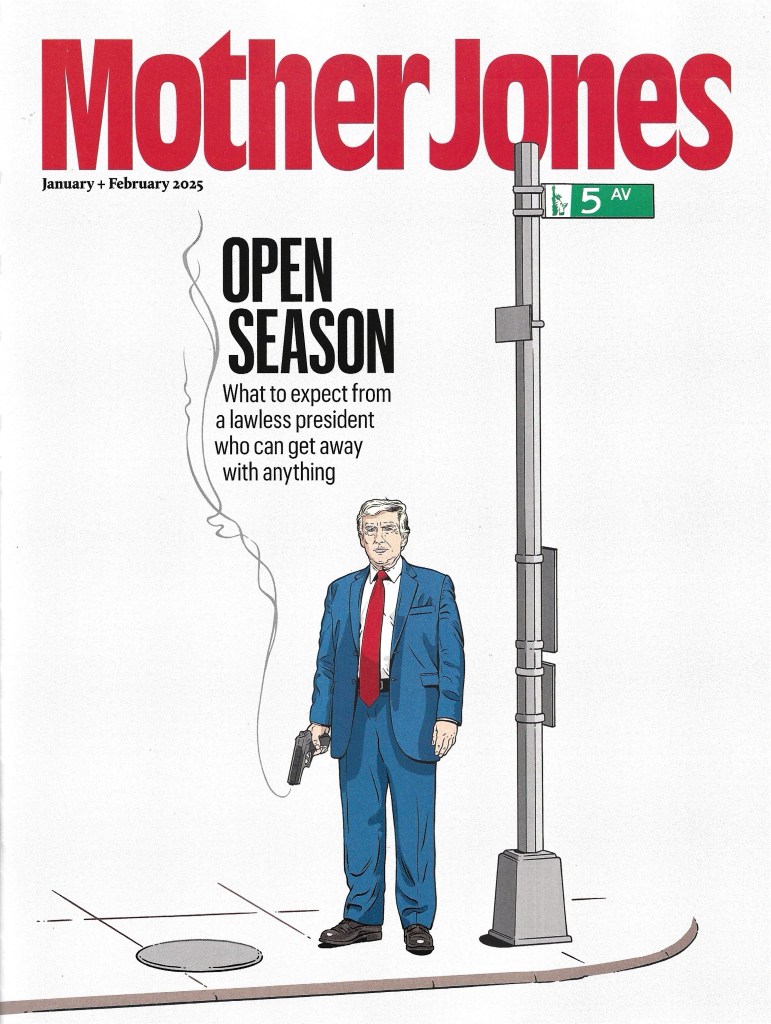
Just one week has passed since Donald Trump’s electoral triumph, and already Russian President Vladimir Putin—one of the strongman leaders Trump admires most—is messing with his head.

First, Putin waited two days before congratulating Trump on his victory. One can imagine Trump receiving phone calls from kowtowing leaders the world over—Ukraine’s Volodymyr Zelensky, Israel’s Benjamin Netanyahu, the Palestinian Authority’s Mahmoud Abbas, the chief of NATO, the European heads of state—all the while wondering about the man whom he’s admired publicly and privately for the past eight years: When is Vladimir going to call?

Then, in response to Trump’s claim that during their phone call, he asked—in some accounts, warned—Putin not to escalate the war in Ukraine, a Kremlin spokesman denied that the two had spoken on the phone at all. (Putin issued his belated congratulations at a news conference.)

I don’t know who’s telling the truth, a practice for which neither man has a sterling reputation. But either way, in the next few weeks, when Putin orders 50,000 fresh recruits (including 10,000 imported North Korean soldiers) to go on the next rampage—ousting Ukrainian soldiers from the thin slice of Russian territory they hold, then retaking soil across the border in Donbas province—he can tell a complaining Trump that he doesn’t recall any such conversation. If Trump thinks Putin actually will refrain from stepping up attacks on Ukraine as a friendly favor … well, maybe our once-and-future president will learn a lesson about the limits of personal relations in the face of perceived national interests early in his second term.

The final twist of this saga came on Monday, when Nikolai Patrushev, an aide to Putin who was previously director of Russia’s Federal Security Service, made the following comment in an interview with the Moscow newspaper Kommersant:

The election campaign is over. To achieve success in the election, Donald Trump relied on certain forces to which he has corresponding obligations. As a responsible person, he will be obliged to fulfill them.

This is a mind-blowing bit of psychological warfare! The Russians are basically telling Trump: We put you in office. Now it’s time for you to pay us back.

Continue reading “Making Russia Great Again”

Textbook Wars: Moscow’s Former Colonies Strike Back

Researchers at INION RAN analyzed depictions of Russia in the history textbooks of CIS and Middle Eastern countries. They found that these textbooks in post-Soviet countries mostly portray Russia as a colonial power.

Photo: Valery Matytsin/TASS, via RBC

The Institute of Scientific Information for Social Sciences of the Russian Academy of Sciences (INION RAN) has drafted a study edited by Vladimir Avatkov, head of the Institute’s Middle and Post-Soviet East Department, on how Russia is depicted in history textbooks in the countries of the Middle and post-Soviet East, as well as in China.

Most of these textbooks portray Russia as a colonial state which has oppressed the peoples in the annexed territories and damaged their culture, Razil Guzayerov, one of the co-authors of the study and a junior researcher in INION’s Middle and Post-Soviet East Department, told RBC. He noted, however, that often much less attention is paid to Russia’s contribution to the growth of these countries.

According to the authors of the study, “the promotion of false and distorted events in history textbooks shapes a negative attitude towards Russia, and in the future may become the basis for the growth of xenophobia and Russophobia.”

What RAN researchers read about Russia in CIS textbooks

“Colonial politics” in Kazakhstan

According to INION’s analysis, the authors of Kazakh textbooks for eighth graders view the Russian Empire as a country which sought to use Kazakhstan as a platform for its military and economic interests. They note that the Russian Empire’s policy of “military and colonial expansion” was the key element of its relations with the hinterlands. It aimed at establishing control over the new territories, exploiting their resources, and managing their populations.

In a textbook for colleges and universities, the authors criticize the policies of the Soviet regime. They pay special attention to the famine of 1921 in Kazakhstan, brought on by crop failure and drought. The authors note that the prodrazverstka, which by late 1920 had extended to all agricultural products, was regarded by the local population as robbery, leading to growing discontent. The famine, the textbook authors point out, seriously impacted the population of Kazakhstan, triggering mass hunger riots and deaths. According to their data, the population of the region decreased by more than two million people compared to 1914.

In a history textbook for tenth graders, the Russian Empire’s policy towards Kazakhstan is described by the author [sic] with terms like “territorial expansion,” “protectorate,” and “colonial politics.” The textbook characterizes the policy of the Russian Empire in Kazakhstan as “aggressive and ineffective,” citing as an example Prime Minister Pyotr Stolypin’s resettlement policy, which, according to the authors [sic], led to social conflicts and popular uprisings.

“Invasion” of Azerbaijan with the aid of ”traitorous forces”

The establishment of Soviet power in Azerbaijan is referenced in that country’s textbooks as a “military invasion,” which was carried out with the support of “traitorous forces.” Uprisings against the Soviet regime and its “exploitative policy” are described in detail. The authors emphasize that the Azerbaijan SSR was established not by the Azerbaijani people but by Soviet Russia, and that the entire Soviet system was “aimed at satisfying Russia’s interests and ensuring its hegemony.”

“History textbooks for general education institutions in Azerbaijan imagine Russia as a colonial empire. The entire history of Russia is covered as the seizure and occupation of lands with subsequent exploitation of the local population. It is important to note that such anti-colonial discourse is especially exacerbated in new textbooks,” the authors of the collection [sic] write. “The current period of relations between Russia and Azerbaijan is presented in more neutral tones, although Moscow is occasionally accused of supporting Armenia and creating the Karabakh issue.”

Russia is identified in textbooks as the cause of the Karabakh conflict and other negative events in the nineteenth and twentieth centuries. Thus, the ninth-grade textbook The Hstory of Victory describes the coming to power of the “pro-Armenian” General Secretary Mikhail Gorbachev, under whom “the separatists ratcheted up their activities.” The authors of the textbook explain the success of “Armenian separatists” in terms of Moscow’s active support.

The INION researchers also note that the authors of some textbooks seek to introduce a divide between the central and local authorities in the Soviet Union. Thus, in these textbooks, life in the Azerbaijan SSR runs its normal course: while the local government carries out industrialization and raises the standard of living, the central government creates misfortunes for the republic.

The authors of the study detect a tendency towards a strengthening anti-colonial discourse around the Russian Empire and the Soviet Union, a negativization [sic] of the entire historical period which “will eventually cause Azerbaijani youth to reject our countries’ common past.”

“Identity damage” and despotism in Uzbekistan

In a basic history textbook for students at the Academy of the Uzbekistan Interior Ministry, the authors describe the annexation of Central Asia as a violent conquest. They also “refute the opinion of historians that the policies of Tsarist Russia in colonized Turkestan had progressive consequences.” The authors challenge arguments about the construction of railroads, telegraphs, and industrial enterprises in Central Asia.

The textbook argues that any imperialist state “attempts to justify its wars of conquest by various propaganda myths, such as that it brings progress and civilization to the conquered peoples and liberates them from despotism, and they voluntarily join the metropole.” The Russian Empire in this context appears to be just such an “imperialist” state.

The textbook offers a harshly negative characterization of the period when Central Asia was part of the Russian Empire and the Soviet Union. With a few exceptions, such as education, the textbook’s main thrust is that Russia damaged both Uzbekistan’s national identity and its economic prospects.

Eradicating the Basmachi and transiting to a settled way of life in textbooks in Kyrgyzstan and Tajikistan

According to INION’s analysis, textbooks in Kyrgyzstan and Tajikistan describe Russia’s influence more positively. Textbooks in Kyrgyzstan thus indicate that relations between Russia and Kyrgyz tribes evolved in different ways at different times — from moderately hostile attitudes to petitions by the Kyrgyz to join the Russian Empire. The authors positively assess Kyrgyzstan’s accession to the USSR, which enabled the Kyrgyz to grow their economy, education system, and industry, and marked the final transition to a settled way of life.

The Soviet period is generally not regarded and, most importantly, not depicted in a negative way by [the country’s] scholars, the researchers point out.

Tajik history textbooks positively assess the actions of Soviet Russia during the civil war in the country [sic]. They point out that Soviet troops were the main force protecting the local populace. The textbooks also note Russia’s contribution to the growth of science in Tajikistan.

In general, Tajik historians assess positively the rise of the Communists to power in Russia, which subsequently led to the attainment of independent statehood by the Tajik nation. And yet, Russia during the Tsarist period is assessed negatively as an imperialist power. Soviet policy is evaluated positively for “eradicating the Basmachi,” and for contributing to Tajikistan’s agriculture, industrialization, culture, and education. Although “individual problematic points” are also noted, they are described as inevitable parts of a complex historical process.

What RAN researchers read about Russia in Israeli and Iranian textbooks

Israeli textbooks describe the Russian Empire and the Soviet Union as anti-Semitic states, while many positive aspects of bilateral relations between Israel and the USSR, especially during the Jewish state’s emergence, are ignored, according to INION.

Russian policy in Iran is often associated with interference in the country’s internal affairs and support for regimes favorable to the empire. Iranian historians present Russia as an aggressor implementing a policy of “expansion” into territories formerly belonging to Persia. The authors also draw attention to the consequences of the Russo-Persian Wars for the mindset of the Iranian people. They see these wars as emblematic of colonial domination and loss of sovereignty.

A textbook for eleventh graders ambiguously assesses the founding of the Tudeh Party of Iran, whose purpose, according to the authors, was anti-government agitation and the forcible secession of Southern Azerbaijan and the country’s northern regions. The textbook notes that the party, which was supported by the Soviet Union, was a factor of destabilization in Iranian society, causing tension and threatening civil war.

Moscow’s provision of arms, military specialists and technical support to the Iraqi army, including Soviet military equipment and missiles, is seen as a factor that complicated the Iran-Iraq conflict and caused great harm to Iran.

According to Murad Sadygzade, president of the Center for Middle East Studies and guest lecturer at the Higher School of Economics, such descriptions of events in history textbooks are not distortions of events, but their interpretation from the position of the losing countries.

“In fact, there were three bordering empires — the Russian, Persian and Ottoman empires — which divided territories between them. Textbooks in these countries describe the events from their own point of view. Of course, they may present Russia as a conqueror. But we can say that this is their position as the losing party. This does not mean that these countries have a drastically negative attitude toward Russia and its people,” Sadygzade says.

Sadygzade argues that Russophobia in the countries of the post-Soviet space and the Middle East is not promoted through [the writing and teaching of] history. Rather, “there are only some figures who try to present it in such a way so as to drive a wedge between countries.”

Diplomatic disputes over textbooks

In August, the Russian Foreign Ministry criticized an Armenian history textbook for the eighth grade, saying that it “depicted events in the South Caucasus during the late eighteenth and early nineteenth centuries in a distorted manner.”

The Foreign Ministry detected an attempt to revise the outcome of the Russo-Persian War of 1826-1828. “The Treaty of Turkmenchay is labeled as nothing other than the ‘annexation’ of Eastern Armenia. Such a framing is capable of causing consternation for any historian,” the ministry said. It noted that the treaty, which ended the Russo-Persian War of 1826–1828, has so far been regarded as having “colossal significance for the future restoration of Armenian statehood.” Moscow viewed this interpretation as “another shameless attempt” to rewrite the common history “in the best traditions of Western propaganda and political engineering.”

As a result, the authors promised to make changes to this chapter of their textbook.

On September 26, Konstantin Zatulin, first deputy head of the State Duma Committee on CIS Affairs, Eurasian Integration and Relations with Compatriots Abroad, voiced concern about the way Russian history was portrayed in foreign textbooks. “I am certainly concerned, as we all are, about the interpretations that are permitted everywhere and anywhere outside of Russia, when it is depicted in a different way than we would like in the national versions of the history of the newly independent states,” he said during a discussion of a draft law on an agreement that would establish an international educational center for gifted children in Tajikistan. According to Zatulin, the Education Ministry and the Foreign Ministry were obliged to respond to all “unfriendly phenomena” in neighboring countries.

RBC sent a request to the Foreign Ministry and Rossotrudnichestvo to provide their own assessments of INION’s finding.

Source: Margarita Grosheva, “RAN researchers describe ‘negative images’ of Russia in CIS textbooks,” RBC, 28 September 2024. Translated by the Russian Reader

Teachers’ Day in Bryansk

A martial dance performance, given, allegedly, at the recent Teachers’ Day celebration in Bryansk

Source: Kolokol XXI (Telegram), 6 October 2024


Distinguished teachers awarded for their many years of work and achievements

On October 5, the country and the Bryansk Region celebrate Teachers’ Day. This is the day when our teachers are thanked and given flowers, and concerts and matinees are organized in their honor.

Celebrations were also held at Prep School No. 27 in the Bryansk Region’s Fokino District. District head Alexander Gavrilov, Department of Education director Alevtina Andreyeva, and others made welcoming speeches.

All of them noted the importance of pedagogical labor, and the huge role which educators and teachers play in the life of every individual. Distinguished teachers were given awards for their many years of work and for their achievements.

A warm atmosphere and positive emotions reigned at the event. The festive mood was supplied by artists from the Railroaders Cultural Center and the village of Belye Berega.

Source: Marina Frolova, “On eve of Teachers’ Day in Bryansk, celebrations held at Prep School No. 27,” Bryansk bez formata, 3 October 2024. Translated by the Russian Reader


“Happy Teachers’ Day!”

On October 3, on the eve of Teachers’ Day, a festive event was held in Bryansk to honor the region’s pedagogical workers — teachers, educators, master trainers, and continuing education instructors. The event was held at the Yuri Gagarin Bryansk Regional Governor’s Palace of Children’s and Youth Creativity. Among the honored guests were Valentin Subbot, chair of the Bryansk Regional Duma, and Alexander Bogomaz, head of the region, as well as representatives of the government, trade unions and educational organizations.

Teachers’ Day is a holiday celebrated in Russia on October 5, coinciding with World Teachers’ Day. The quality of education is annually improved, innovative technologies are introduced, new schools are built, and modern educational centers are opened annually in the Bryansk Region. These achievements have been recognized at the federal level and generate favorable conditions for teachers and students.

In his address to the teachers, Governor Alexander Bogomaz, who himself grew up in a family of teachers, emphasized the importance of their profession. He noted that, thanks to the supreme professionalism and wisdom of teachers, patriots ready to serve their Motherland were being brought up in the Bryansk Region.

The Governor also touched upon the issue of awarding teachers. Seven years ago, the law on awarding the title “Honored Educational Worker of the Bryansk Region” was adopted, but only three such titles are awarded per year. The head of the region proposed increasing this number to ten, taking into account the difficult conditions in which teachers work, especially in border areas. This decision would be a well-deserved recognition of their contribution to the development of education in the region.

Source: Yulia Sumner, “Teachers honored on eve of Teachers Day in Bryansk,” Moi Bryansk, 3 October 2024. Translated by the Russian Reader. The emphasis is mine.


Prices for flowers have skyrocketed in Bryansk in the run-up to Teachers’ Day. This holiday, like March 8, is one of the key days for the flower business. The same picture is observed throughout the country.

According to Izvestia, the average check for a bouquet for Teachers’ Day comes to about three thousand rubles (approx. 28 euros), while the demand for flowers has increased by thirty percent. They note an increase in flower sales on online platforms as well.

The newspaper writes that consumers are increasingly choosing more expensive and complex arrangements, including original bouquets and mono bouquets.

A “teacher’s” bouquet in Bryansk will cost between two and three thousand roubles, on average. Roses, especially bush roses and peonies, as well as chrysanthemums and lilies are traditionally popular on Teachers’ Day.

Earlier, we reported that the Governor of Bryansk Region had proposed amending the regional law on awarding the honorary title “Honored Educational Worker of the Bryansk Region.” The head of the region said that he considers it fair to increase the number of awards to ten per year, as the teachers of the region do a tremendous job.

Source: “Flower prices in Bryansk predictably increase before Teachers’ Day,” Bryanskie novosti, 4 October 2024. Translated by the Russian Reader


The Russian government has submitted a draft federal budget for 2025 and budget projections through 2027 to the State Duma. Although it is called a “draft” budget, no major changes will be made to it, of course. Budget revenues are supposed to increase by 11.6%, while expenditures will rise by only 5.2%. However, before this happens, both revenues and expenditures will grow, especially expenditures: up to 39.4 trillion rubles, against the planned 36.7 trillion.

A year ago, approximately the same people in the government were determined to curb military expenditures in 2025, hoping to end the war in Ukraine. Now it is clear that the war may not end in 2025 either, so the projections for the next two years do not provide for a significant reduction in defense spending. In 2025, 32.4% of Russia’s money will be blown up, buried, shot, crushed, pulverized, etc.: 13.49 trillion rubles! In last year’s forecast, defense spending also took a huge chunk — 29.4% (10.77 trillion rubles) — but it was still not that much.

Projected Russian federal budget expenditures for 2025, in trillions of rubles. “National defense” tops the list, at 13.49 trillion rubles (approx. 128 billion euros), while education (ОБРАЗОВАНИЕ) warrants a meager 1.58 trillion rubles (approx. 15 billion euros). Source: Kommersant, via the Moscow Times Russian Service

Economist Igor Lipsits argues that it will be quite difficult for the financial authorities to cope with this task. It’s not that they won’t find the money; it’s that the conditions under which they find the money will hurt the populace. But the populace is no stranger to that!

As they say, to buy something you don’t need, you have to give something up. The list of things that will have to be given up includes support for Russia’s regions, and money for them has in fact been cut. Although they won’t get any money, they will have their budget debts canceled. The Jesuitic twist here is that they probably wouldn’t pay them back anyway. That’s the practice. In other words, that’s how the federal government supports the regions.

Another funny thing is that the funding for civilian drones has been cut. On the one hand, this is understandable: what do they need civilian drones for? They need military drones! On the other hand, this money has been partially used to finance “voluntary” designs, which subsequently, again in a voluntary fashion, make their way to the front and play a quite significant role there.

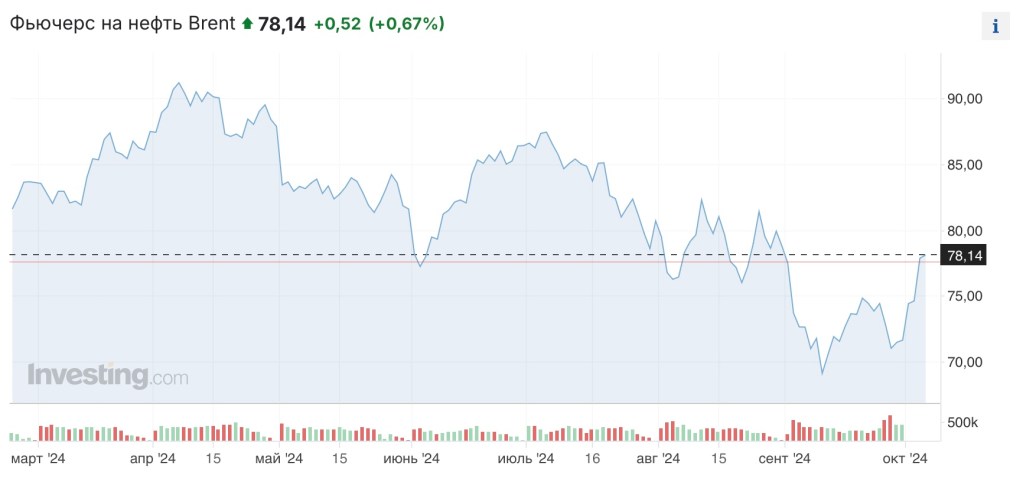
If we return to the revenue part of the budget, as usual, almost a third of it derives from oil and gas revenues. Oil and gas analyst Mikhail Krutikhin explains that not all is rosy with these revenues; they may even go downhill. The fact that some of the most unprofitable Russian companies are state-owned gives some insight into what the prospects for taxing Russian business might look like. And when analysts speak about dividends from oil companies, they argue that they will decrease. The trend, as described by oil and gas experts, is that prices will decline in 2025.

Brent Oil Futures, March 2024–October 2024. Source: Investing.com, via Moscow Times Russian Service

Prices probably would have continued to fall, but then Israel launched a war against Hezbollah, and oil reacted sensitively, triggering a rise in futures prices.

Source: Moscow Times Russian Service, weekly newsletter, 6 October 2024. Translated by the Russian Reader

The Russian Reader Reads: Havli

This is the first in a series of posts in which I showcase a few of the newsletters, blogs, Substacks, and websites — all of them produced by hardworking, passionate lone wolves or tiny, perpetually underfunded grassroots collectives — which inspire me to continue making the Russian Reader and inform me about parts of the world and communities about which I would otherwise be utterly clueless.

Peter Leonard describes Havli as “a Central Asia-themed Substack written by me, Peter Leonard, a former editor at Eurasianet and the one-time Central Asia correspondent for the Associated Press. By drawing on my decades of experience visiting, studying and reporting on the region, I intend to make this newsletter an informative and, fingers crossed, engaging way to keep abreast of developments of note.”

Mr. Leonard’s latest post on Havli dovetails with so many of political and social trends I’ve been tracing over the years that it seems tailor-made for my website. Enjoy! I hope you’ll consider subscribing to Havli and supporting it financially. \\\ TRR

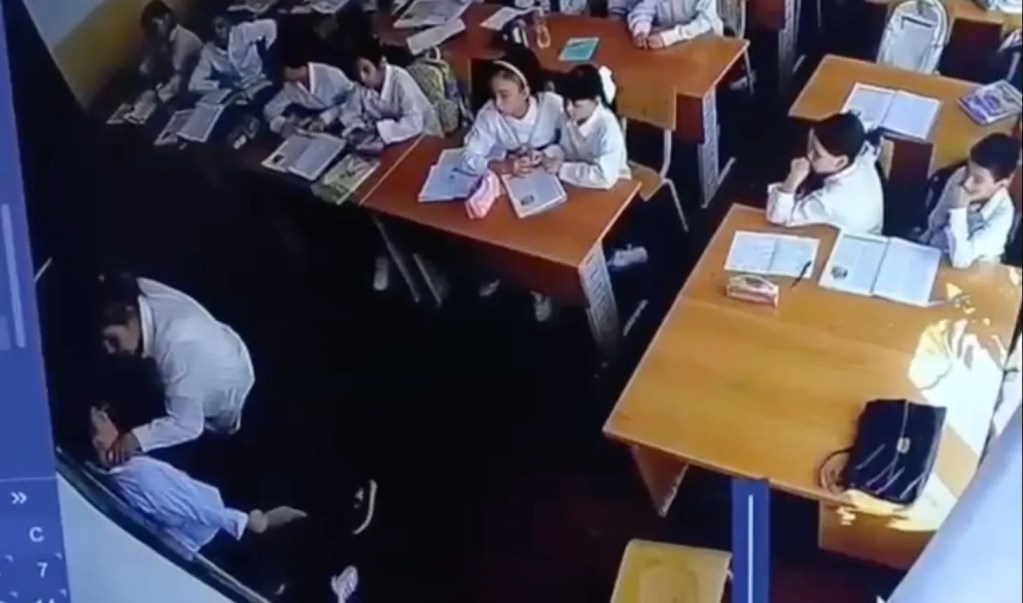
Closed-circuit television footage showing a teacher at a Tashkent school grabbing a pupil by the neck.

In the worst-case scenario, giving a teacher lip usually ends with the offending pupil visiting the headmaster’s office.

Things have to get pretty bad for a classroom kerfuffle to provoke a diplomatic incident.

A teacher at a school in Uzbekistan’s capital, Tashkent, managed to do just that this week by manhandling a pupil who complained that she was conducting her Russian language class entirely in Uzbek. Closed-circuit television footage obtained by the boy’s parents shows the teacher grabbing the child by the neck, and then slapping and screaming at him.

The video images quickly circulated on social media, eliciting howls of protest from self-avowed Russian patriots indignant at this alleged case of maltreatment of their ethnic kinfolk. 

“You can just imagine what a racket there would be if a similar thing happened in Russia with a migrant. And it is not like Uzbekistan is confronting a wave of ethnic crime from Russia; you don’t get murderers, thugs, drug dealers, and Wahhabis going there from our country,” wrote the author of a Telegram account that disseminated the footage.

This was quite the overreach. Expatriate labourers from Central Asia living in Russia face systematic harassment and violence, often from the police. This happens so frequently it barely makes the news.

The spokeswoman for the Foreign Ministry in Moscow was quick to demand an investigation.

“If it is justified, action must be taken against the perpetrator of this cruel treatment against the child,” Maria Zakharova said. “We are monitoring this situation closely.”

The response from Uzbekistan was swift. Alisher Kadyrov, the deputy speaker of parliament, suggested that Russia “mind its own internal business.” 

“The rights of this child are being violated in a school in Uzbekistan, the offence was committed against a child of an Uzbek citizen, and measures will be taken on the basis of laws adopted on behalf of the people of Uzbekistan,” he wrote on Telegram.

Uzbek Foreign Minister Bakhtiyor Saidov delivered the same message in person, albeit more obliquely, to his Russian counterpart on the sidelines of the ongoing United Nations General Assembly, noting that their meeting “underscored the importance of commitment of states to the principle of non-interference to each other’s internal affairs.”

Following this outcry, news emerged that the teacher at the Tashkent school assaulted another pupil in an unrelated incident and has since been sentenced to serve seven days in jail.

Moscow shows every sign of relishing the opportunity to make hay of this episode.

Claims of Central Asia’s allegedly spiralling Russophobia problem have been wielded with increasing readiness by surrogates for the Russian authorities since the start of the invasion of Ukraine. The Kremlin perceives the region’s rulers as more or less loyal, but it worries that the general public is not as reliably slavish. The nightmare scenario for Moscow is that a groundswell of anti-Russia sentiment across parts of Central Asia could eventually force a gradual shift in diplomatic stances. 

The concern looks overblown at present, but it is not fully unjustified.

Older generations, especially the shrinking cohort with vivid memories of the Soviet Union, are typically more sympathetic to Russia and its bellicose conduct. Younger people whose media diet does not consist of consuming Russian state propaganda are more hostile.

Russian chauvinists are alarmed that the increasingly exclusive use of local languages in Central Asia is weakening their ability to project their message.

Research by Central Asia Barometer, an attitudes-surveying think tank, suggests that there is some association between language use and views on the war in Ukraine. Russian speakers in countries like Kazakhstan and Kyrgyzstan are more likely to justify the invasion of Ukraine than those who speak their own languages.

Fears that the status of Russian is slipping leads at times to comically petty whining. 

Earlier this year, famous Russian TV presenter Tina Kandelaki complained in a Telegram post that Kazakhstan was poised to rename a number of train stations to make them sound less Russian. She cast this move — which comprised in the event of changing names like Railway Siding No. 13 to Akshi Railway Siding — as the start of a slippery slope that would end with the closure of Russian schools, the banning of the Russian language and “[Russian] pensioners getting kicked out into the cold.”

Historians in Central Asia crafting narratives that highlight the negative aspects of Russian and Soviet rule are another trigger. The mere suggestion that the region owes its civilisation to an era pre-dating the arrival of the Russians is enough to irk some. 

In August, scholars from all over the region assembled at the Eurasian National University in Astana for the first-ever edition of the Forum of Historians of Central Asian States. “It is important for us to begin to rethink our common history,” Kazakh Science and Higher Education Minister Sayasat Nurbek told the scholars.

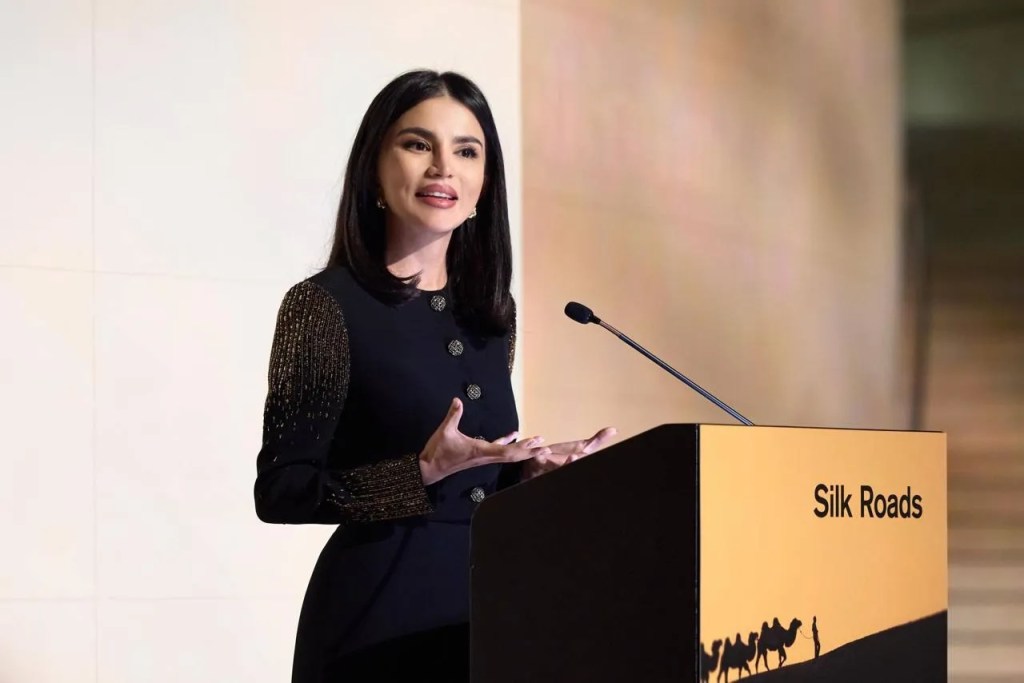
Mirziyoyeva is taking a leading role in lobbying for a vision of Uzbekistan’s history that looks beyond the role of the Russians and the Soviet Union.

The political elite has taken the lead on this. Saida Mirziyoyeva, a senior advisor to her father, Uzbek President Shavkat Mirziyoyev, in August delivered a speech in Kazakhstan that strongly signals what areas of the official narrative on recent history will be emphasised going forward. She alluded in her talk to a pair of reformist and softly nationalist movements that emerged in what are today Uzbekistan and Kazakhstan as having been thwarted by Soviet oppressors.

“At the beginning of the 20th century, both the Jadids and representatives of the Alash movement fought for a single goal: the liberation of the people, for the development of their motherlands. But they were not given the opportunity to realise their dreams,” she said.

Russian critics of this kind of talk smell a rat.

They point to the content of one history textbook in Uzbekistan as evidence of dangerous revisionism. A passage from a book cited by outraged Russian patriots talks of how the “Soviet regime subordinated Uzbekistan’s economy to the interests of the centre, turning it into a raw materials appendage.” This is loathsome ingratitude designed to demonise Russians, they grumble. 

Kyrgyzstan and Tajikistan are far more economically dependent on Russia than either Kazakhstan or Uzbekistan, but they too have in their own small ways worked to forge narratives that are gently but implicitly critical of the legacy of Muscovite rule. In July, Kyrgyz President Sadyr Japarov officially recognized five victims of Soviet repression as founders of the modern statehood of Kyrgyzstan. All the men were executed in 1930s during waves of Stalinist repressions against perceived nationalist movements.

That anti-nationalist campaign was the same one that crushed the Jadidist and Alash movements referenced by Mirziyoyeva.

Central Asian leaders periodically try to soothe the nerves of Russians eager to winkle out evidence of xenophobia in the region. 

In his address to the nation earlier this month, Kazakhstan’s President Kassym-Jomart Tokayev reprised a tried-and-tested Astana mantra.

“In Kazakhstan, there is no — and cannot be any — space for discrimination on linguistic, religious, ethnic or social grounds,” he said. “Incidents and provocations do sometimes occur, but these happen because of the thoughtlessness and ignorance of individual citizens. When these things happen, they are dealt with — and will [always] be dealt with — by law enforcement agencies.”

The large community of vocal Russian revanchists monopolising the public conversation inside their country do not buy it. And they are seizing on any excuse to make their point heard.

Source: Peter Leonard, “Russophobia panic fanned by school scuffle in Uzbekistan,” Havli, 27 September 2024. The link in the sixth paragraph was put there by me. \\\ TRR

Basurka

Top: “25 Khromov Street.” Left: “Shaman: Victory!” Right: “We are there where we need to be. Serve as a contract soldier in the Russian Army and get a one-time payment starting at one million rubles.”

Source: Caution, Tver! (Telegram), 1 September 2024. Thanks to Andrey Anissimov for the heads-up. “Basurka” is the faux-Russian nonce word I coined for this distressing post. It was suggested to me by our building’s bilingual garbage bin. ||| TRR


Many acquaintances from Russia condemn me for calling for the bombing of Russian factories and supporting the Ukrainian army’s Kursk offensive. They genuinely don’t get how one could wish defeat on one’s own country. Some have quietly unfriended me, while others continue to read my posts but are perplexed and perhaps even offended by them.

They are often the same people who “love (their) country no matter what.” This is where you all and I part ways. You REFUSE to look at reality—you turn away from it in order to love your country without breaking a sweat, as if love were a chain and you’ve been chained to a radiator since childhood. It works differently for me. I make my own decision about whether I like this scene or not. And, if my country jumps from one bloody shitstorm to another like a maniac running in circles, it’s not worthy of my love and I rescind its right to be my country. People are another matter, especially the unborn. It makes sense to fight for them. But it’s secondary to me what the country they’ll live in will be called and how big it will be. If they’ll have a better chance for a decent and safe life in a small country, then we should choose a decent and safe life for them.

Russia is an anti-human phenomenon. It is a threat to the entire world and to the people within the country. Like any rabid macaque with a grenade, it must be stopped. Look reality in the eye at last. Don’t look away. It’s happening right now, and you, with your unadulterated love, are a part of it.

Image number one. A fourteen-year-old girl dressed in white sneakers and a white tank top, sitting on a bench in the yard of her house on an ordinary summer day. It all looks ordinary, but there is one catch: the girl is dead. A fragment of a cluster bomb, which the Russians dropped on Kharkiv on 30 August, tore off the child’s head. Everything happened instantly; no one had time to hide. The girl’s body remained seated on the bench. Perhaps her last thoughts were of her father, who had gone missing in action in the war with Russia. The family knows he was killed, but they can’t get his body back. The worst part is that he gave his life thinking he was protecting his daughter. Russia got to her, though, and so the family’s story is over. Father and daughter are not alive because they were born near Russia. Other Kharkiv residents who were killed in that senseless attack are also “guilty” in this sense.

Image number two. A girl again, but from another city. She is fifteen years old and has come to Novosibirsk from the Altai to enroll in the Olympic reserve school. She is quite beautiful, gentle, kind, and has great hopes. She doesn’t understand why her fellow students call her a “dirty, slant-eyed pig.” They secretly pour waste into her backpack and mock her appearance in public. After two years of this terror, which was encouraged by coaches and school officials, the formerly cheerful girl will come to realize that this life is not for her. In her seventeenth year, she will kill herself and leave a suicide note on her Telegram channel. She will say in the note that the unbearable racist bullying was her reason for leaving this life.

The school will then post a touching obituary on their Vkontakte page. They won’t specify the cause of death, of course. All comments expressing outrage over the bullying will be assiduously deleted. Only the wishes of “soft clouds” and broken heart emojis will be left untouched.

Incitement to suicide is a criminal offense, actually. But no one will answer for the death of Ksenia Cheponova because it is not the custom in Russia to punish one’s own kind for a crime against outsiders. “You’re not my brother, black-ass louse,” says the immortalized Russian movie hero. These words are much more than a mere insult: this is how millions of people in Russia understand justice. Moral rightness is not based on your deeds, but on whether you are an insider or an outsider. It doesn’t matter what you did. What matters is whether you are stronger than me at the moment.

Ksenia Cheponova

Image number three. Beslan. September first marked the twentieth anniversary of the mass murder of children by Russian security forces in that ill-fated school. For twenty years, the perpetrators have never been held accountable for lying about “350 hostages.” There were 1,100 hostages, as we know. No one has been held accountable for firing from a tank at the building where the children were. Three hundred and thirty-four people were killed during the assault, including one hundred and eighty children. This terrorist attack might not have happened if Russia hadn’t started a war in Chechnya. The hostages might have lived if the security forces had actually tried to save them. But they were killed and twenty years on their sacrifices are still covered in lies and impunity.

All of those people could have lived if it weren’t for their country, sick with messianism and aggression. And the “it’s like this everywhere” ploy doesn’t work. No country in the world has 60 million lives lost in wars, gulags, and famines under its belt.

The time for saying “no war” has passed. It is clear that where there is a “great Russia,” there will be perpetual war. That’s why we should say no to Russia, and yes to independent Ukraine, Ichkeria, Buryat-Mongolia, and all free nations.

Or is the idea of a united Russia dearer than the lives of your children?

Source: Julia Khazagaeva (Facebook), 3 September 2024. Translated by the Russian Reader


Two ballistic missiles blasted a military academy and nearby hospital Tuesday in Ukraine, killing more than 50 people and wounding more than 200 others, Ukrainian officials said.

The missiles tore into the heart of the Poltava Military Institute of Communication’s main building, causing several stories to collapse. It didn’t take long for the smell of smoke and word of the deadly strike to spread through the central-eastern town.

The strike appeared to be one of the deadliest carried out by Russian forces since the war began more than 900 days ago, with Russia’s Feb. 24, 2022, full-scale invasion.

“People found themselves under the rubble. Many were saved,” Ukrainian President Volodymyr Zelenskyy said in a video posted on his Telegram channel. He ordered an investigation.

Shattered bricks were visible inside the closed gates of the institution, which was off-limits to the media, and small pools of blood could be seen just outside hours later. Field communications trucks were parked along the perimeter. Roads were covered in glass from shattered apartment windows.

“I heard explosions … I was at home at that time. When I left the house, I realized that it was something evil and something bad,” said Yevheniy Zemskyy, who arrived to volunteer his help. “I was worried about the children, the residents of Poltava. That’s why we are here today to help our city in any way we can.”

By Tuesday evening, the death toll stood at 51, according to the general prosecutor’s office.

“My deepest condolences to the families of those killed and injured in the Russian missile attack on Poltava,” Ukraine’s first lady, Olena Zelenska, posted on social media Tuesday. “This is a shocking tragedy for the whole Ukraine.”

Filip Pronin, governor of the region that bears Poltava’s name, announced on Telegram that 219 people were wounded. Up to 18 people may be buried under the rubble, he said.

Ten apartment buildings were damaged, and more than 150 people donated blood, Pronin said.

He called it “a great tragedy” for the region and all of Ukraine, and announced three days of mourning starting Wednesday.

[…]

The academy trains officers in communications and electronics, honing some of the most valued skills in a war where both sides are fighting for control of the electronic battlefield.

“The enemy certainly must answer for all (its) crimes against humanity,” Pronin wrote on Telegram.

The Kremlin offered no immediate comment on the strike. It was not clear whether the dead and wounded were limited to Ukrainian military personnel, such as signal corps cadets, or if they included civilians.

Since it embarked on its full-scale invasion in early 2022, the Russian military has repeatedly used missiles to smash civilian targets, sometimes killing scores of people in a single attack.

Some of the deadliest such assaults included a 2022 airstrike on a theater in Mariupol that killed hundreds of civilians sheltering in the basement and a strike that same year on the train station in Kramatorsk that killed 61. Apartment buildings, markets and shopping centers have also been targeted.

Poltava is about 350 kilometers (200 miles) southeast of Kyiv, on the main highway and rail route between Kyiv and Ukraine’s second-largest city, Kharkiv, which is close to the Russian border.

The attack happened as Ukrainian forces sought to carve out their holdings in Russia’s Kursk border region after a surprise incursion that began Aug. 6 and as the Russian army hacks its way deeper into eastern Ukraine.

The missiles hit shortly after an air-raid alert sounded, when many people were on their way to a bomb shelter, Ukraine’s Defense Ministry said, describing the strike as “barbaric.”

Rescue crews and medics saved 25 people, including 11 who were dug out of the rubble, a Defense Ministry statement said.

The strike came on the day that Russian President Vladimir Putin visited Mongolia. There was no indication that his hosts would heed demands to arrest him on an international warrant for alleged war crimes.

Zelenskyy repeated his appeal for Ukraine’s Western partners to ensure swift delivery of military aid. He has previously chided the U.S. and European countries for being slow to make good on their pledges of help.

He also wants them to ease restrictions on what Ukraine can target on Russian soil with the weapons they provide. Some countries fear that hitting Russia could escalate the war.

“Ukraine needs air defense systems and missiles now, not sitting in storage,” Zelenskyy wrote in English on Telegram.

“Long-range strikes that can protect us from Russian terror are needed now, not later. Every day of delay, unfortunately, means more lost lives,” he said.

Ukraine’s air force said Monday that Russia had launched an overnight barrage of ballistic and cruise missiles and drones at Kyiv as children prepared to return to school. Multiple explosions echoed across the capital early Monday morning as Ukraine’s air defenses shot down many of the weapons, causing damage and fires as the debris fell onto the capital. 

Source: CBS News, 3 September 2024


Ufa’s Kirov District Court has remanded 20-year-old university student Makar Nikolayev in custody to a pretrial detention center for a month on charges of “promoting terrorism.” The court issued its ruling on 30 August, but it was made public only on Monday, 2 September, as reported by the Telegram channels of Baza and Idel.Realities, who cited sources. The court confirmed Nikolayev’s arrest to news website Ufa1.ru.

In 2020, Nikolayev, then a prep school student, designed an information retrieval method for creating a Russian national archive on the history of the Great Patriotic War. The boy wanted to recover information about his great-grandfather and in the process designed an entire system. His project, “Methodology for Creating a Family Archive,” won the Russian national contest “My Country — My Russia,” one of the projects of the Russia Is a Land of Opportunities presidential platform.

Later, Nikolayev went to Germany to study. According to Idel.Realities, Nikolayev had been studying at a university in Frankfurt am Main in recent years. In August 2024, he came home on holiday to Ufa, where he was detained.

According to police investigators, during his time abroad, Nikolayev wrote comments on social networks supporting Ukraine and urging people to join the Russian Volunteer Corps. The stipulated punishment for violating Russian Federal Criminal Code Article 205.2.2 (“Public calls to carry out terrorist activities; public justification of terrorism or promotion of terrorism, committed using mass media or electronic or telecommunication networks”) is five to seven years in prison.

Source: Sergei Kuprikov, “Winner of ‘My Country — My Russia’ contest detained in Ufa,” Deutsche Welle Russian Service, 2 September 2024. Translated by the Russian Reader

Good Clean Fun

Photo: Pelagiya Tikhonova/Moskva Agency (via Moscow Times)

All modern entertainment that “undermines” traditional values should be banned in Russia, conservative philosopher and “Russian World” ideologue Alexander Dugin has said.

“Only morally healthy entertainment should be allowed — first of all, round dances and traveling around one’s native land, and even better, pilgrimages to holy places. Everything else should be banned,” Dugin wrote on his Telegram channel.

According to Dugin, a healthy nation should have wholesome leisure activities, “and not all of that stuff.” As a negative example of entertainment, he cited KVN, which has become, he claims, “a poisonous matrix of degeneration.”

“The sinister nature of this pernicious phenomenon is now clearly visible. [Ukrainian President Volodymyr] Zelensky, [comedian Maxim] Galkin, and all the rest,” Dugin said.*

Earlier, the philosopher claimed that the West regards Russia as its principal foe because Russian President Vladimir Putin has been reviving traditional values and liberating the country from global influence. This, in his opinion, is what provoked the disgust of Western “progressive elites” with Putin.

Dugin has also argued that Russia has neither a parliament nor democracy, but a de facto monarchy headed by Putin, who can do whatever he wants. The philosopher noted the irrelevance of certain laws in Russia, as well as the people who propose or support them. In his opinion, all of this is “boyars dancing for the time being,” that is, until the sovereign pays attention to the antics of these “selfish and thieving bastards.”

Dugin has argued that Russia itself is the Katechon — the last bulwark against the Antichrist, who today reigns in a West “totally perverted” by LGBT+, postmodernism, relativism, and transhumanism.

The philosopher has dubbed the war in Ukraine “the most important event in history.” In his opinion, it is being waged on behalf of a multipolar world, with many superpowers. Consequently, according to Dugin, Russia will free other countries of the world from Western liberal imperialism, in whose grip they are trapped. And yet, Dugin acknowledged that Russia would lose a great many people in the course of the war.

* Zelensky was captain of the Kryvyi Rih KVN team Kvartal 95 from 1998 to 2003.

Source: “Dugin suggests banning all forms of entertainment in Russia except round dances,” Moscow Times Russian Service, 23 July 2024. Translated by the Russian Reader


[...]

Enter Thoughts of Days to Come, dressed to the nines in khaki blouses.
They are lugging atom bombs, ICBMs, a launching pad.
O, how they reel, dance, and caper: “We are warriors and carousers!
Russians and Germans will fall together; for example, at Stalingrad.”
And like old widow Matryona, cyclotrons are dumbly howling.
In the Ministry of Defense a nest of crows is loudly cawing.
Look at the pillow. What do you know!
Shiny medals all in a row.

“Where there’s a will, there’s a way.”
“A pint of vodka, they say,
Soon’ll be a ruble a pop.”
“Mom, I really don’t love Pop.”

Enter a certain Orthodox, saying: “These days I’m number one.
I’m pining for the sovereign, and in my soul the Firebird flares.
Soon Igor will reunite with Yaroslavna and have his fun.
Let me make the benediction or else I’ll box you on the ears.
Worse than evil eye or herpes is the plague of Western thinking.
Sing, accordion, and drown out the saxophone, jazz’s vile offspring.”
On the icons they plant a kiss,
Sobbing victims of circumcis—

[...]

Source: Lib.ru. Translation by the Russian Reader

Inner Mongolia

WordPess AI-elicited image: “Mongolia, as imagined by Russian liberals”

Political scientist Andrei Nikulin writes on his Telegram channel: “If even Mongolia can be progressive and democratic, then all the more so can Russia be progressive and democratic.” Claims to the contrary are just neurolinguistic programming, he argues.

I am unironically aware that, from the Moscow intellectual’s lofty vantage point, Mongolia is a backward, third-rate country. The whole semantics of Nikulin’s turn of phrase says so. Since those nomads were able to do it, why can’t we, cultured Europeans, have a normal future?

I generally salute positive affirmation. But before we are cheered up by a sense of superiority, let’s face reality. Here are just a few facts about Mongolians today.

Yes, forty percent Mongolia’s population is made up of nomads who, like their ancestors, live in yurts and travel with their livestock. Yes, there are only three paved roads for a population of three and a half million people.

But since 1990, the Mongolian people have elected six presidents, never once allowing any of them to exceed their rightful term in office. The Mongolian constitution gives a leader only one six-year term without the right to re-election, and this norm has never been violated. The average turnout in elections at all levels of government is seventy percent. By comparison, turnout in progressive Moscow barely exceeded thirty percent when Navalny ran for mayor.

Further, while Russians were seizing Crimea and “nullifying” Putin’s previous terms as president, the humble Mongolian nomads forced their government to resign at least twice, in 2017 and 2021. In 2012, a former president was arrested and jailed on charges of bribery.

The real, democratic Mongolia, as seen in the photos selected by the author to illustrate her post

More recently, in the winter of 2022, Mongolians staged large-scale protests in Ulaanbaatar over a corruption scandal. It transpired that when exporting coal to China, customs officials had “diverted” six and a half million tons of the cargo, according to the paperwork. Mongolians considered this a theft of national revenues and marched on the capital’s square demanding that the theft be investigated and the names of those involved be made public. Eventually, the protesters stormed government house and demanded the government’s resignation.

Remind me again what Muscovites stormed in Moscow after Navalny’s investigations, of which there were dozens?

But Mongolians protested in the cold for three weeks until they forced the government to arrest the corrupt officials and reform the coal industry.

In April, the protests resumed. This time, Mongolian youth blamed the government for its poor performance and rising prices.

And lastly, let’s talk about the culture. Mongolians do not shout at their children or punish them. You will not hear from a Mongolian mom say to her child “I told you to shut your mouth” or “The more you cry, less you piss.” How should I put it? Mongolians love their children. There are only 924 orphaned children the entire country—that is less than 0.03% of the population. By comparison, there are 391,000 children living in Russian orphanages—that is 0.3% of the Russian population. In other words, children in Russia are left parentless ten times more often.

You can remain trapped in the old optics, looking down on everyone and denying reality. This will not bring social and political change any closer. If you want to go on living, but your body is rotting and falling apart, you need an accurate diagnosis. And the more honest it is, the greater the chances of your recovery.

Everything else can be put down to helplessness.

Source: Julia Khazagaeva (Facebook), 21 June 2024. Translated by the Russian Reader

The Anti-Anti-War Movement

Ana Tavadze and Dachi Imedadze, members of Georgia’s Shame Movement. Photo: 60 MINUTES

Ana Tavadze: We’re going in with a government that’s completely corrupt, a government that’s pro-Russian, clearly anti-Western, clearly does not really care about what the majority of the population wants and needs.

Ana Tavadze and Dachi Imedadze are members of the Shame Movement – a group with thousands of young followers working towards Georgia’s entry into the European Union.

Ana Tavadze: If Russia wins, it means loss of freedom, loss of everything that we fought for in the past 30 years basically. It’s a fight for values, it’s a fight for where you want to stand in this big fight for democracy.

Dachi Imedadze: As soon as the West in any form, be it the U.S. partnership, be it the European Union, is not represented in this country, Russia will fill the void right away. 

They say the influx of Russians is already changing the face of Georgia.

Ana Tavadze: What are they doing, if we look at it? They’re buying apartments. They’re buying private property. They are opening up businesses. Their actions changed — Georgian economy.

Dachi Imedadze: The Russians are buying apartments here in every 33 minutes. They’re purchasing a piece of land in every 27 minutes. And they’re registering a business in every 26 minutes. So, I think we are on the brink of very dangerous situation here in Georgia.

According to public records, Russians have registered more than 20,000 businesses in Georgia over the last two years. And launched five new Russian-only schools, none of which are licensed by Georgia’s department of education.

Russians have driven rent up nearly 130%, prices for everything from food to cars have gone up 7%. over 100,000 Georgians have left the country because many of them can’t afford to live here anymore.

Sharyn Alfonsi: I’ve heard this described as a quiet invasion.

Dachi Imedadze: Quiet invasion, yeah. There is a risk of the economic diversions. There is a risk of military intervention. And there’s a risk of — Georgia’s statehood being destroyed. 

Emmanuil Lisnif, George Smorgulenko and Pavel Bakhadov don’t look like much of a threat.

All Russians in their twenties, they fled their country for fear of being drafted or imprisoned for speaking out against Putin.

George Smorgulenko, Emmanuil Lisnif and Pavel Bakhadov are all Russians living in Georgia. Photo: 60 MINUTES

They now live in Georgia and work at this Russian-owned comedy club in Tbilisi.

Emmanuil Lisnif: I try and said ‘I’m against the war in Russia. I was beaten. and after that going to prison three times.’

Sharyn Alfonsi: So three times you went to jail?

Emmanuil Lisnif: Yes, yes three times.

Pavel Bakhadov: I believe and I know that Russians actually against the war

Sharyn Alfonsi: You think that most Russians are against the war?

Emmanuil Lisnif: Yeah, just scared, really scared.

Sharyn Alfonsi: Have any of you had any aggression towards you because you’re Russian?

Pavel Bakhadov: Actually I have a big writing on the wall. It’s the biggest thing I see from my window, just big ‘Russians go home.’ 

There is no subtlety in spray paint… anti-Russian graffiti blankets the city along with support for Ukraine.

[…]

Source: Sharyn Alfonsi, “Denial of Georgia’s EU membership bid would be ‘a big victory for Russia,’ President Zourabichvili says,” 60 Minutes, updated 9 June 2024. The emphasis, above, is mine. ||| TRR


This text is based on interviews I did as part of the Hidden Opinions public opinion polling project, which I launched in 2022 and continued in 2023 and 2024. I spoke with dissenting Russians — with those who oppose the current regime and its military actions against Ukraine, both those who have stayed in Russia and those who have left the country. My youngest respondent at the time of the [first] survey was sixteen years old, while the oldest was seventy-two years old. These people hail from a wide range of professions and walks of life, but what they have in common is their categorical opposition to the actions of the Russian authorities. In just two years, I have interviewed 154 people for this project, some of whom I have spoken with two or three times.

In 2022, all of my respondents — both those who had left the country and those who stayed — espoused anti-war views and expressed a negative attitude toward the Kremlin’s policies. However, in 2023, about a year and a half after the war’s outbreak, a group amongst my sources in Russia emerged. Small at first, but constantly growing, it consisted of people who had changed their negative attitudes toward the war and/or the government.

This does not mean that such changes are impossible among those Russians who have left the country. Amidst a full-scale war, research based on representative samples is hampered by the fact that the most accessible respondents are those who have agreed to be interviewed as a result of self-selection. This is a significant limitation to the project.

My research is qualitative, not quantitative, meaning that it would be wrong to speak of a particular percentage of anti-war Russians who have become pro-war. I think it is important to study and understand how views are transformed and what triggers them to change. It is the subject of this text.

***

The sociologist and philosopher Zygmunt Bauman, experimenting with means of gauging the conservatism–to–radicalism spectrum, asked his students to do the following exercise. They were shown twenty drawings, the first one depicting a dog, the last one depicting a cat; in between, the dog gradually shed its canine features and turned into the cat. It was vital that the researcher record the moment when the test subjects had doubts about what exactly was depicted in the picture, when they realized that the dog had mutated irreversibly. In a sense, I have been doing something similar, trying to record the moment at which anti-war or anti-Putin views have been transformed into pro-war or pro-government views.

I have observed that such a change in views depends on a number of extrinsic factors, and the more such factors that are combined, the more likely it is that the person’s stance will change. In addition, a great deal is determined by an individual’s (psychological, social, etc.) resources. Finally, inconsistent views play an important role in transformation and adaptation. In recent years, sociologists have increasingly noted that people often pursue mutually exclusive goals simultaneously without noticing the contradictions in their own behavior.

New rationalizations, disillusionment and loneliness

The gradual realization that the war is a long-term affair, combined with Alexei Navalny’s sudden death in a penal colony, has had a considerable impact on those resisting the regime within Russia. One can swim against the current, but it requires a considerable amount of strength, something not everyone possesses. It is difficult to be amongst the minority for years on end, to conceal one’s views and live in fear of being reported to the authorities. Respondents have thus begun reformatting [sic] their attitude to reality, explaining events in a new light and providing new rationalizations.

Failing to receive the expected support from the outside world or the possibility of a dignified workaround, some of my respondents eventually chose non-resistance to the regime, which in some cases has transmogrified into full-fledged loyalty.

I don’t want to go to prison, I don’t want to play the rebel. I just want to live. If they send me to listen to ‘Exorcist TV,’ I’ll go without question. If they tell me to go to a [pro-war] concert, I’ll go. I’m not trying to convince anyone of anything anymore. I’m tired. I can only accept it and live the life I have.”

This stance is not directly bound up with support for the war or the regime. Rather, it indicates fatigue and the lack of strength to resist. If the circumstances shift in a direction more in keeping with their own values, these people will gladly slough off the “burden of adaptation.”

It is worth noting that, over the last year, many of my respondents have stopped following the news and focused on their daily lives. There are respondents who, despite the troubling times, have decided to have children. This is also a way of disconnecting from current events.

Another important factor influencing the change of respondents’ views is the narrowing of their circles of trust. Fearing denunciation, dissenters avoid making new contacts. Afraid of being alone and unwilling to live in fear, uncertainty and/or exile, they then join the majority.

The distance between Russians who have left Russia and those who have stayed in Russia has grown greater with every passing year. In 2022–2023, when I asked my respondents about opposition members who had left Russia, they most often would say nothing or would limit themselves to brief remarks along the lines of “We still watch them on YouTube, but they have less and less sense of what’s happening at home.”

Expressions of resentment and frustration have become more frequent in my interviews in 2024. My sources have said that the opposition often engages in wishful thinking and plays fast and loose with the facts, and that the west does not always act logically and decently.

Consequently, previously opposition-minded people have chosen to abandon painful and exhausting self-reflection in favor of loyalty to the regime. This helps them to get on with their lives, normalizing both the war and the political crackdowns. As one respondent put it, “Since the opposition and the west cannot be trusted, we will make friends with Putin. He is an ogre, but he is our own ogre.”

“Western countries seem to be doing everything to help Putin’s propaganda machine. I was quite surprised when I heard Angela Merkel say that all our negotiations were just a smokescreen: we wanted to let Ukraine catch its breath, and the negotiations were just a deception. That is, the leader of one of the largest countries in Europe openly says: a) we can’t be trusted in any negotiations, and b) we have conspired to deceive you. […] Putin’s propaganda machine skillfully makes use of this. But the point is not that the propaganda machine is using it, it’s that it is reality. As a normal person, a question occurs to me: if they treat us this way, [then] we are their enemies. After such statements, the ‘west’ is regarded as the enemy of Russians, and, accordingly, their enemy — Putin — is our friend.”

Those respondents who have changed their views on the war emphasize that when the west blocked their bank cards and accounts, when they heard what Ukrainians (including their relatives and friends) were saying about Russians and how they called for killing them, they decided that the current regime, whatever it was like, was less hostile to them on balance.

Tired of guilt, shame, disappointment and indignation, they have essentially chosen peace by joining the majority and accepting the existing rules: don’t discuss politics, don’t speak out publicly, swear to the values that the government declares. This choice seems reasonable to them in a situation in which no political activism is possible anyway, and the political crackdown machine is only picking up steam.

This strategy ensured material well-being and career success for some of my respondents. For example, some mid-level specialists in the IT sector received good positions and salaries, while for other people the involvement of their relatives in the war has been a means of social mobility and a source of access to material goods. Still others have benefited from the war by arranging parallel imports, etc.

Another factor contributing to the shift in sentiment from anti-Putin to pro-government has been the radicalization and polarization of society.

“A sharp delineation between ‘black and white’ leads to the opposite outcome. Any attempts to express doubts about the actions of the Ukrainian or western side are automatically regarded both inside and outside [Russia] as pro-Putin behavior, the outcome of brainwashing, etc. The other side appears infallible and beyond criticism.

“If you criticize the west’s actions in any way, you are automatically pigeonholed as a ‘Putinist.’ It makes me feel like saying: if that’s how you treat me, well, to hell with you, chalk me up as a Putin supporter.”

The state of rejection and isolation provokes protests amongst some people: since the west condemns them for staying in Russia, they “will go the full mile and become real orcs.”

The mechanisms by which feelings of rejection are transformed into collective pride have been described by researchers and are not unique to Russia. These feelings reinforce nationalist sentiments and contribute to the strengthening of authoritarian regimes.

Emotional dilemma

Speaking about the change in their views from anti-war to pro-war, my respondents noted that in one way or another they were surrounded by people who had suffered in the war: classmates or school friends who had been drafted to the front or had volunteered for combat, their children, colleagues, and mere acquaintances. Telling them straight to their face that their sacrifices were in vain had become both emotionally more difficult and more dangerous. To maintain relationships and friendships, my sources generally had to listen in silence to their acquaintances’ stories about what they had experienced and seen at the front. And if they were people who mattered to them, it was impossible not to sympathize with them.

We should understand that Russians who initially opposed the war and the regime but remained in Russia feel definitely closer to those who went to the front or delivered humanitarian aid there than to those who have left the country. They are “in the same boat” as their relatives, friends, and colleagues. They feel compassion for them.

“When we were teenagers, all sorts of things happened. If the guys were caught [by the authorities], I would perjure myself and lie in all sorts of ways. Later I could tell them what I actually thought of them, but I wouldn’t abandon them. That’s not the way that blokes do things. Now I realize with my head that they are wrong a hundred times over, but they are my boys, I am on their side. And even if I am against the war, I cannot be against them.”

Propaganda equates anti-war sentiment with betrayal, and it paints people who espouse such views as accomplices of Russia’s enemies, who want to kill as many Russians as possible. This causes a very heavy feeling, my respondents note.

Meanwhile, the state softens such emotional blows by offering loyal citizens new benefits and additional material and social goods, free concerts, and beautiful and comfortable urban environments, demonstrating concern for people in general and for those returning from war in particular. “People-centeredness” has become the buzzword in the PR strategies of many employers and officials throughout Russia.

Russians who are concerned about their neighbors also respond to calls for help front-line soldiers, because amidst war and external isolation it is these people with whom, they say, they “share a common plight.” One of my respondents, overwhelmed by such sentimental feelings, volunteered for the army.

As a religious man, he hoped he would not face the need to kill others, but would be able to help “his boys” without bearing arms, because he “could not stand on the sidelines any longer.” If the need to kill arose, he would desert, my source had decided, explaining that he was emotionally prepared to be beaten up and go to prison.

Another type of people whom I have encountered more and more often are those whom researchers Maria Lipman and Michael Kimmage have characterized as anti-anti-war: these people do not necessarily support the war, but they strongly condemn or resent “unpatriotic” fellow citizens who do not support the Russian army or who even take the side of Ukraine.

Seeing soldiers returning from the front and watching the growing number of Russians killed in combat, my sources now often place the blame not on Putin or the Russian military, but on their compatriots who oppose continuing the war until Russia achieves total victory.

Ressentiment and the “demons” of propaganda

Propaganda has awakened ressentiment in some of my respondents. They have come to believe that this war is really about maintaining Russia’s status as a great power, which its enemies are trying to flout and rob. Such people believe it vital that Russia maintain its status as a victor, and they accept the state-imposed version of Russian history that asserts Russia’s greatness in all periods.

War, as happens under autocracies and dictatorships, is seen as the ultimate manifestation of the nation’s strength and vitality and a guarantee that its culture and traditions will be maintained. In conversations with me, my sources have repeatedly used the phrase “releasing demons,” referring to the fact that the current situation helps their acquaintances and themselves experience a sense of unity and superiority over the rest of the world, a sense of their own righteousness and chosenness.

Some respondents noted that the official rhetoric, concrete and catchy, seemed more acceptable to them than the verbose arguments and meaningless self-reflections of the opposition.

Meanwhile, according to my respondents, the number of anti-war-minded Russians today is decreasing. Since Navalny’s death, I have often heard in interviews that every second or third person in the orbit of my sources has changed their views.

It is difficult to say how strong this trend really is. I would estimate that a third of those who unequivocally opposed the war and the regime when I spoke to them [initially] have changed their views, but of course these numbers are in need of supplemental verification, which is not easy to accomplish today. There are probably also people who have switched their pro-war patriotic views to oppositional ones, but I assume that we hear the voices of these people even less frequently.

Respondents who are in a state of uncertainty and/or in the course of switching their views feel the need for support, at least informational support. They need arguments explaining that anti-war sentiments are not a betrayal and that the current war is destroying Russia, not restoring its greatness. But they also acknowledge that such an argument would hardly convince them under the current circumstances. For now, the only thing they think they can do is to maintain their sanity and adapt to reality in order to live to see better days.

***

The Russian regime has proven to be “smarter” and more adaptive than Russian opposition activists and western democracies thought, but this does not mean there is no point or possibility of supporting by any means possible those who have remained in Russia and are still resisting the regime or straddling the fence. One way or another, positive change in Russia is impossible without their involvement.

Source: Anna Kuleshova, “‘I’m a person with anti-war views, but I suddenly found myself signing up for the front’: how and why Russians have changed their attitude to the war,” Republic, 4 June 2024. The emphasis, above, is the author’s. Translated by the Russian Reader