ICE Goes After Russian Asylum Seekers: The Cases of Alexander Bolokhoev and “Dimitry”

ICE agents in the U.S. have detained Alexander (“Sasha”) Bolokhoev, a cofounder of the movement Tusgaar Buryad-Mongolia, which advocates for Buryatia’s independence [from the Russian Federation].

Sasha left Russia in 2021—that is, before Russia’s full-scale invasion of Ukraine. In April 2022, he arrived in the U.S. and claimed political asylum. Unlike many of our compatriots, however, Sasha did not lie low and do nothing, pointing to the fact that he had been persecuted on ethnic grounds in Russia. He immediately joined the fight. He and Marina Khankhalaeva founded the Tusgaar movement, which has already been added to Russia’s official list of “extremists and terrorists.” He also spearheaded a congress of Buryat political organizations in New York.

Sasha’s detention by ICE was in no wise connected to his activism. He was detained in the state of Oklahoma during one of the anti-immigrant dragnets which have become a daily fact of life under Trump. Sasha was stopped on the highway and taken directly from his vehicle, which was left standing there.

Sasha is in the US completely legally. He has all the necessary papers, including a work permit. In the current reality, though, this may not matter much. Even green card holders and U.S. citizens have been detained and deported from the country.

Sasha is currently in custody in a deportation detention center in Oklahoma. He is held there along with a Chechen man who was also detained during a similar raid. The worst possible outcome for both of them would be deportation to Russia. I agree with Marina that torture and death would await Sasha in a Russian prison.

The Trump administration has instituted the systematic deportation of Russians on standalone flights to Moscow. As of October, at least three known charter flights have deported over a hundred people from the U.S. back to Russia. Upon landing in Moscow, all of these people are screened by the FSB (Federal Security Service) and they are often sent straight to a detention center.

Source: Julia Khazagaeva (Facebook), 21 October 2025. Translated by the Russian Reader. A special thanks to Ms. Khazagaeva for sending me the subtitled video interview with Sasha Bolokhoev, above.


The full interview with Buryat activist in exile Alexander Bolokhoev (in Russian and Buryat, with no subtitles)

Alexander Bolokhoev is a Buryat Mongol who immigrated to the United States and is a nationalist. He graduated from school with straight A’s, but soon left to work in Korea and then in the United States, where he currently is employed as a truck driver. In his featured spot “Saashyn Zam” (“Sasha’s Path”), Bolokhoev will talk about everyday life in the United States and his journey in life. You can join the discussion and ask questions every Wednesday at 8:30 p.m. (Ulaanbaatar time) on the channel @MiniiMongolGer.

Source: Buryadmongol (YouTube), 12 June 2024. You can watch a subtitled six-minute excerpt from this same interview in my translation of Ms. Khazagaeva’s Facebook post, above.


Buryat Emigrant Detained in US: Faces Deportation and Criminal Prosecution in Russia US

Immigration and Customs Enforcement (ICE) has detained Alexander Bolokhoev, an activist for the Buryat independence movement who has been living in the country since 2022 and seeking political asylum. The news was reported by Lyudi Baikala (People of Baikal).

According to the publication, Bolokhoev moved to the US in the spring of 2022, where he worked as a truck driver and participated in anti-war protests. He is an activist for the movement “Tusgaar Buryaad–Mongolia,” which is recognized as “terrorist and extremist” in Russia. In 2023, Bolokhoev participated in a congress of Buryat political organizations in New York, signed a declaration of Buryat independence, and joined the Buryat Independence Committee.

The movement’s leader, Marina Khankhalaeva, stated that if Bolokhoev is deported to Russia, he could face imprisonment or death due to his outspoken position and participation in the activities of the banned organization. The activist is currently being held in a detention center, and his status and a possible court decision on deportation are not yet known.

The movement “Tusgaar Buryaad–Mongolia” (“Independent Buryat-Mongolia”) was founded in the US by former opera singer and current homemaker Marina Khankhalaeva, and historian and professor Vladimir Khamutaev. The initiative advocates for “the self-determination of the Buryat people and the creation of an independent national state.”

Both founders have lived in the US for over ten years. Khankhalaeva was not previously involved in politics and stated she turned to activism after the start of the war in Ukraine. Khamutaev is known for his research on the annexation of Buryat lands to Russia and has been a proponent of Buryat autonomy since the 1980s.

The movement gained notoriety after Khankhalaeva spoke at the European Parliament during the Forum of Free Peoples of Russia, where decolonization issues were discussed. In 2023, the organization “Tusgaar Buryaad–Mongolia” was designated as terrorist and extremist in Russia.

According to Sota sources, the movement actively sought Buryat emigrants, suggesting they build their asylum cases through anti-war and “decolonization” speeches. However, after Trump came to power and mass migration acceptance was halted, such actions ceased to be beneficial for the emigrants but created a threat for them in Russia.

Source: Sota News (X), 21 October 2025


On a rainy evening in March, a Russian man named Dimitry stumbled through the dark, looking for a hole in a fence. In a former life, Dimitry worked as a fitness trainer for cops and bureaucrats in St. Petersburg, so he figured he could jump the barrier — “Honestly, with the shape I’m in, it wouldn’t be a problem.” But he was less confident about landing cleanly on the jungle terrain on the other side. Better, he thought, to look for a break in the chain-link.

The fence enclosed CATEM, a de facto immigrant detention center in Costa Rica where Dimitry, his wife, and their 6-year-old son were sent in February, along with 200 other asylum-seekers from Armenia, Afghanistan, Iran, Turkey, and Russia, among others. They were part of the first wave of migrants and asylum-seekers to be deported by the Trump administration to third countries — places other than their country of origin where, generally, the migrants had never been.

Dimitry’s plan, quickly formed a year earlier in an attempt to evade Russian authorities, had seemed straightforward. The family would fly to Tijuana, where they would download the U.S. Customs and Border Protection’s app, file a claim for political asylum, and wait to be given an appointment. But on January 20, 2025, after eight months of waiting, their appointment was canceled. They drove to the Tecate border crossing and restated their political-asylum claim. After being handcuffed and fingerprinted, the family was placed in a holding facility at the Otay Mesa border crossing. They spent a month there, separated, before they were put on a military plane to Arizona. In Arizona, they were led to a bus. One of the migrants asked the driver where they were being taken next.

“Costa Rica,” the driver replied.

Costa Rica, Dimitry thought. Is that a city or a country?

Continue reading “ICE Goes After Russian Asylum Seekers: The Cases of Alexander Bolokhoev and “Dimitry””

MOVE

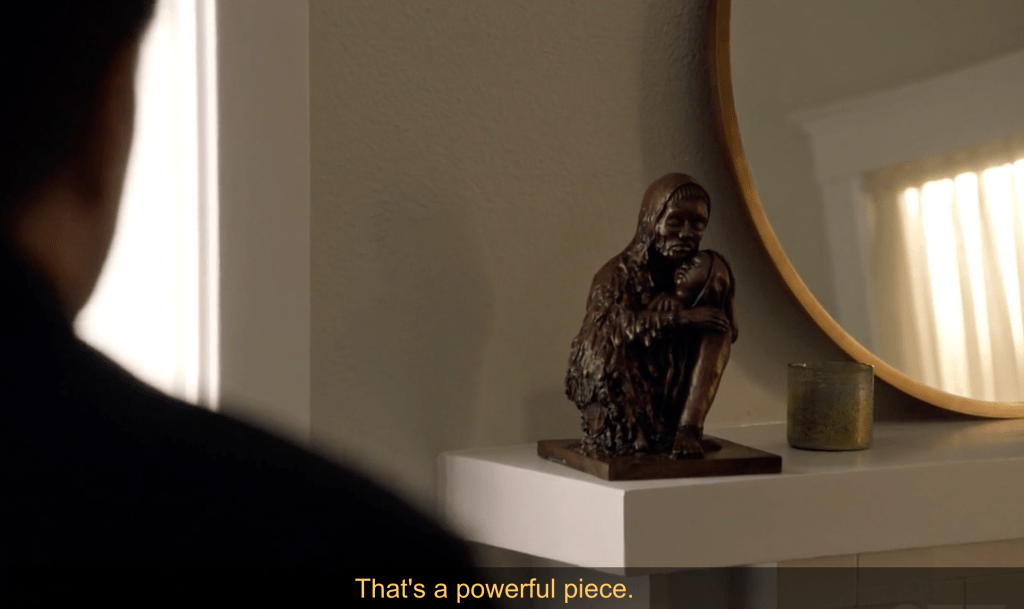
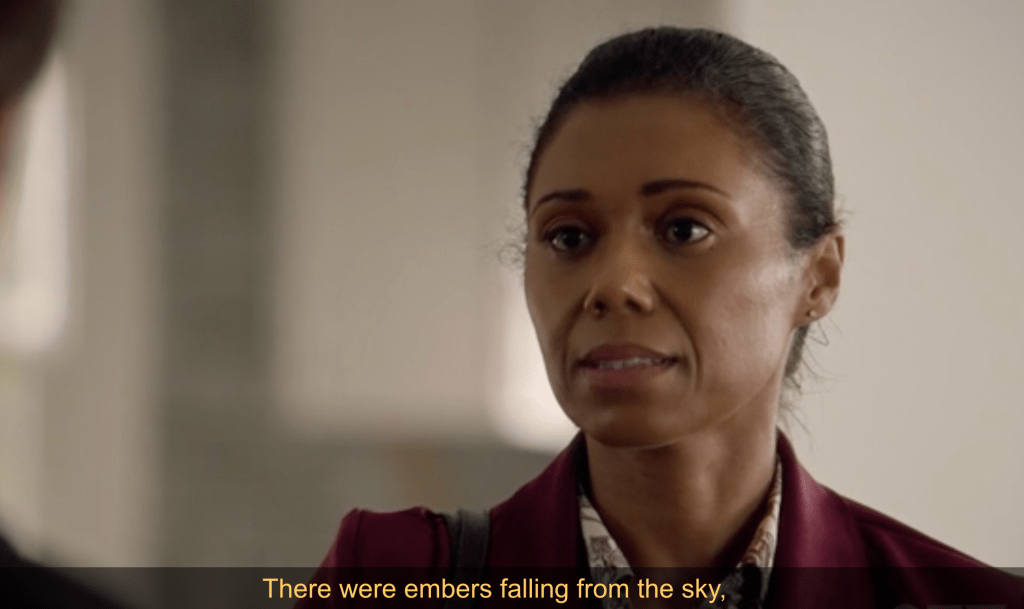
Source: The Rookie, Season 3, Episode 11: “New Blood.” You can read more on the 1985 MOVE bombing here.


“I’m terrified at the moral apathy, the death of the heart, which is happening in my country. These people have deluded themselves for so long, they really don’t think I’m human. I base this on their conduct, not on what they say. And this means that they have become, in themselves, moral monsters.”
James Baldwin

LET’S GET THIS OUT OF THE WAY: When it comes to the recent deaths of immigrants being held in detention, it would be wrong to describe the situation as wholly unprecedented. Detainees died under Bush, Obama, and Biden. But detainee deaths have accelerated during President Donald Trump’s second term, with 17 already since his inauguration. During the Biden administration, there were 26 deaths in 48 months—roughly one death every two months. During Trump’s term, that rate has nearly quadrupled. And ICE, now one of the best-funded operations of the federal government, is planning to double detention space before the end of the year.

“It’s absolutely horrific,” Rep. Pramila Jayapal (D-Wash.), the ranking member of the immigration subcommittee, told me before jumping into the numbers above. In July, ICE was awarded $45 billion to expand its operations—its budget is now significantly larger than that of the federal prison system. And now, Jayapal points out, a little-known LLC has been awarded a $1.2 billion contract to build a facility in Texas despite never having previously won a federal contract for more than $16 million. Meanwhile, another $2.25 million contract was given to a Republican donor who received a presidential pardon from Bill Clinton in 2000 after having pleaded guilty to mail fraud.

“Contracts are being distributed to Trump’s buddies and people with no experience running detention centers, many of these contracts are no-bid,” Rep. Jayapal said. “They’re incarcerating people and allowing them to die, not providing medical facilities. There are no standards. It’s horrific.”

Most ICE and border patrol agents will continue working during the government shutdown; their status as “essential” will shield them from the layoffs OMB director Russell Vought has requested in lieu of furloughs from most agencies and departments. But the nature of immigration officers’ “essential” work has significantly changed over the past eight months to become something far more brutal than procedural; in some cases, it has come to appear simply heartless. We have entered a period in which it is becoming important to ask: What happens when our leaders and the people who work for them see immigrants not as human beings but as scum? And what happens when that way of thinking about people starts also to be applied to others, like journalists and political opponents?

Continue reading “MOVE”

Judging Them by How They Look

A Russian National Guard serviceman checks residency documents during a raid outside the Apraksin Dvor clothing market, in St. Petersburg, Russia, Friday, July 4, 2025. (AP Photo/File)

The immigrant worker from Uzbekistan entered the bank in Moscow, but when he reached the teller, she refused to serve him and she wouldn’t say why.

For him and others from impoverished countries across Central Asia who seek better lives in Russia, such hostility is woven into everyday life. Sometimes it bursts into outright violence.

“Mostly you notice it when you go to the hospital, a clinic, a government office: You stand in line and everyone shoots you dirty looks,” said the man, who spoke to the Associated Press on condition of anonymity because he feared repercussions.

Such xenophobia clashes with economic realities at a time when Russia has a labor shortage, primarily due to its war in Ukraine. In the first quarter of 2025, over 20% of Russian businesses said they were hindered by a lack of workers, according to the Central Bank. 

But rather than welcoming laborers, Russian officials are fomenting anti-migrant sentiment and increasing restrictions on immigrants, which the government says number 6.1 million, but is probably higher. The government is tracking their movement, clamping down on their employment and impeding their children’s rights to education.

A massacre and a backlash

The continued crackdown comes as a trial began this month for four Tajik nationals who are accused of the shooting and arson attack at a Moscow concert hall in March 2024 that killed 149 people. The four were arrested within hours of the attack and appeared in court with signs of being severely beaten. An Islamic State group claimed responsibility but Russia sought to blame Ukraine for the bloodshed.

Anti-migrant rhetoric had been growing in Russia since the early 2020s. But the massacre in particular launched a wave of “terrible violence” against immigrants, said lawyer Valentina Chupik, who has worked with the immigrant community for over 20 years. In the eight days after the killings, she received 700 reports of injuries to immigrants, including “faces smashed against the doors of police stations,” she said.

Parliament speaker Vyacheslav Volodin captured the public mood after the massacre, saying “migration control is extremely important” to ensure foreign nationals carrying out “illegal activity” could be deported without a court order.

The violence drew concern from human rights groups.

“Central Asian migrants seeking work in Russia due to dire economic conditions in their countries of origin today face ethnic profiling, arbitrary arrests, and other harassment by police in Russia,” Human Rights Watch said in a report on the anniversary of the attack.

“The heinous massacre cannot justify massive rights abuses against Central Asian migrants in Russia,” said its author, Syinat Sultanalieva.

Raids, roundups and restrictions

While some violence has subsided, it hasn’t disappeared. In April, police raided a Kyrgyz-run bathhouse in Moscow with video showing masked men forcing half-naked bathers to crawl across the floor and deliberately stepping on them before covering the lens of a security camera.

Police also reportedly rounded up immigrants in raids on warehouses, construction sites and mosques, then coerced them into joining the military to fight in Ukraine. Some are threatened with having their residency documents withheld, while others are recently naturalized citizens who failed to register for military service. In such cases, serving in the military is presented as the only alternative to prison or deportation. For others, a fast track to Russian citizenship is offered as an incentive for enlisting.

Speaking in St. Petersburg in May, Alexander Bastrykin, head of Russia’s Investigative Committee, said “20,000 ‘young’ citizens of Russia, who for some reason do not like living in Uzbekistan, Tajikistan (and) Kyrgyzstan” were serving in Ukraine.

Those immigrants who have avoided violence still are subject to new anti-migrant laws. Much of this is targeted specifically toward workers from Central Asia.

In 2024, 13 Russian regions banned immigrants from certain jobs, including in hospitality, catering and finance, and even as taxi drivers. A pilot program starting in September in the Moscow region requires migrants who enter Russia without a visa to be tracked via an app. Those failing to comply are added to a police watchlist, impeding access to services like banking, and subjecting them to a possible cutoff of cellphone and internet connectivity.

A nationwide law banned children of immigrants from attending school unless they could prove they could speak Russian. Less than six weeks after the law came into force, officials told local media that only 19% of children who applied for the language test were able to take it, and the most common reason for rejection was incomplete or inaccurate documents.

Another man from Uzbekistan who has worked in Russia for almost two decades and lives in St. Petersburg said he’s had to wait in line for over seven hours to get needed residency documents. The man, who also spoke to AP on condition of anonymity for fear of reprisals, hopes to stay in Russia but says the climate has worsened.

“It’s hard to get paperwork,” he said. “There just isn’t the time.”

The oppressive laws sometimes force immigrants to resort to paying bribes. Chupik, the lawyer, believes that Russia’s system results in “violations that cannot be avoided.”

“This is exactly what this mass regulation is striving for: not for all migrants to be here legally, but for everyone to be illegal,” she said. “That way, they can extract bribes from anyone at any moment and deport anyone who resists.”

Encouraging anti-migrant sentiment

Anti-migrant sentiment is unlikely to diminish anytime soon, mostly because it’s encouraged by authorities like the Investigative Committee’s Bastrykin, who said immigrants “physically occupy our territory, not just with their ideology but with specific buildings” — referring to sites such as mosques.

Ultra-nationalist lawmaker Leonid Slutsky said foreign workers “behave aggressively, causing conflicts and potentially dangerous situations.”

Migrants are an easy scapegoat for many social ills, and not just in Russia, said Caress Schenk, an associate professor of political science at Nazarbayev University in Kazakhstan.

“Closing borders, conducting migrant raids and tightening policies are all tools that are easy go-tos for politicians the world over,” she said. “It goes in cycles that are sensitive to geopolitical pressures, as we’re seeing now, but also things like election campaigns and domestic political rivalries.”

A surge of “anti-migrant propaganda” has dwarfed previous rhetoric of recent years, according to the Moscow-based Uzbek immigrant who was ignored by the bank teller.

“If every person paying attention to the TV, the radio, the internet is only told that migrants are ‘bad, bad, bad,’ if they only show bad places and bad people, of course, that’s what people are going to think,” he said.

Such anti-migrant rhetoric has become part of the nationalist narrative from President Vladimir Putin and others used to justify the 2022 invasion of Ukraine — that Russia is under constant threat.

“Russia has started lumping together all of ‘the external enemies’ that it’s created over the years for itself: the migrants, the Ukrainians, the West,” said Tajik journalist Sher Khashimov, who focuses on migration, identity and social issues. “It all becomes this part of this single narrative of Russia being this castle under siege, and Putin being the only person who is on the lookout for ordinary Russians.”

The Uzbek immigrant in Moscow said Russia has created conditions “supposedly to help people, to help migrants.”

“But the rules do not work,’ he added. ”Special barriers are created that migrants cannot pass through on their own.”

Source: Katie Marie Davies, “Immigrants from Central Asia find hostility and violence in Russia,” Associated Press, 22 August 2025


Source: SEIU California (Facebook), 8 September 2025


A prominent nonviolent activist from Moroccan-occupied Western Sahara has been detained by federal immigration officers. Jamal Fadel was seized by masked ICE agents at Manhattan’s notorious federal building at 26 Federal Plaza on August 25 after a routine immigration hearing — an arrest that was caught on video.

Fadel is from the occupied city of Boujdour in Western Sahara. He’s been protesting nonviolently against Morocco’s occupation since he was a high school student, and was threatened by Moroccan authorities so many times that he left to seek political asylum in the United States.

Fadel is currently being held by ICE at the Moshannon Valley Processing Center in Pennsylvania. His attorney expects ICE will move for an expedited removal hearing. If deported, Fadel faces lengthy imprisonment, torture — or worse.

Source: Democracy Now (Facebook), 9 September 2025


I spotted some of the Trump administration’s wanted men on Tuesday, the day after the U.S. Supreme Court granted immigration agents virtually unchecked permission to continue the “largest Mass Deportation Operation” in America’s history.

The wanted stood outside of a U-Haul truck rental outlet in the San Gabriel Valley. They polished other people’s BMWs and Range Rovers at a Pasadena car wash. I saw the wanted women too, walking to jobs as nannies and housekeepers.

They looked suspicious, all right, by the definition outlined Monday by Supreme Court Justice Brett M. Kavanaugh. They were natives of Mexico and Central America, seeking “certain kinds of jobs, such as day labor, landscaping, agriculture, and construction.”

They were suspect to many Californians too, but only of wanting to work, wanting to earn a little cash, wanting to pay their bills and feed their families. One hundred and seventy five years to the day after land that once belonged to Mexico became the 31st American state, California felt to many people Tuesday like it had reverted to a kind of frontier justice, where racial profiling had become the law of the land.

“I am just working hard and paying taxes,” said Mario, 50, between sips of coffee on the sidewalk outside the U-Haul station. Even before the Immigration and Customs Enforcement raids began three months ago, the Honduran immigrant said, life for street-corner workers was not easy.

“People are just looking for work. Some of them are even homeless,” said Mario, who declined to give his last name. “But some people are showing them hate, sometimes even hitting or kicking the homeless. We see it out on the street.”

At the Pasadena car wash where six workers were carted away in late August, those left behind continued their buffing and polishing Tuesday.

“It feels like we have come down low, really low,” said Cesar, between checking in customers. Though he was born just blocks away at Pasadena’s Huntington Hospital, he said he does not feel immune from the raids.

“If now they are just going to judge you by how you look, or maybe how you talk, I can get pulled over. Anyone can get pulled over,” said Cesar, who did not give his last name. “It’s gonna be harder for people to live a normal life. They’re gonna just have to deal with harassment. That’s not something I would want anyone to have to go through.”

Earlier raids by Trump immigration agents have spread far beyond snagging the criminals and drug traffickers the president and his allies claimed to be after. With 10 million Latinos living in the seven Southern California counties covered by the court’s order, a rights group said the high court’s action cleared the way for “an extraordinarily expansive dragnet, placing millions of law-abiding people at imminent risk of detention by federal agents.”

“We should not have to live in a country where the Government can seize anyone who looks Latino, speaks Spanish, and appears to work a low wage job,” Justice Sonia Sotomayor wrote. “Rather than stand idly by while our constitutional freedoms are lost, I dissent.”

The action offered portentous echoes of the mistreatment and greater violence unleashed on Chinese immigrants in the late 1800s. Today, it had U.S.-born citizens, such as The Times’ Gustavo Arellano, feeling they will have to carry their passports to prove their citizenship.

Outside the U-Haul, Mario said he holds a green card. So he will continue waiting on the sidewalk for his next job.

“I believe in God,” he said. “We might think different things, but we all have the same heart. There should be the same heart for everyone. Everyone.”

Source: James Rainey, “Essential California” newsletter (L.A. Times), 10 September 2025


The United States deported 39 Uzbek nationals on a charter flight to Tashkent, the U.S. Embassy confirmed in what it described as part of ongoing efforts to remove migrants without legal status. Earlier this year, more than 100 Central Asians, mostly Uzbeks, were repatriated in a similar U.S.-funded operation. The deportations attest to close cooperation between Washington and Tashkent on migration enforcement. That partnership has been accompanied by political overtures. Last week, Presidents Shavkat Mirziyoyev and Donald Trump held a phone call in which they pledged to broaden their strategic partnership ahead of an expanded dialogue session this autumn. U.S. officials have pointed to investment opportunities in Uzbekistan, particularly in critical minerals, while both sides also highlight cooperation on security and migration.

Source: Peter Leonard, “Central Asia’s week that was #70,” Havli, 10 September 2025

Eating Kimchi in Public

So the Korean Hyundai factory workers were racially profiled and yesterday SCOTUS said racial profiling is now constitutional. The workers were reported to ICE because someone saw a bunch of foreign workers. That is racial profiling.

Yesterday’s news made me think about when I was little and went on road trips with my family. My parents always insisted on preparing and eating Korean food at rest areas along the way. This was before Korean food became more well-known and I remember that if there were people nearby who could smell our food, they often made faces and comments about the smell. Eating kimchi in public was always an interesting experience back then. This was just embarrassing, but does the new Supreme Court ruling mean that in this scenario, it is now something much more ominous we should be worried about?

Now someone could call ICE on a foreign-looking family eating foreign-smelling food in a rest area. When ICE shows up we now would have to show papers to prove we are citizens based on a racially motivated tip, is that our reality? Also, remembering that my mother never became a citizen but had a green card and probably speeding tickets so she would have been deportable under the current regime? What if I can’t prove my citizenship because I don’t carry my passport or naturalization papers, I am detained until I can prove my citizenship and they have the legal authority to do all of this now?

Lawyers, please help me understand. Is this our reality now? Is eating kimchi in public while Korean enough to get ICE called on us?

And I want to add that racial profiling has always been used against Black Americans and to a lesser degree other less white adjacent communities forever in this country, whether it was deemed constitutional or not. This is not new for Black Americans and others and something I have to acknowledge.

Source: Son Mun (Facebook), 9 September 2025


Source: Clarence Patton (Facebook), 9 September 2025

Sunday Reader No. 5: American Pie

Jade Bird, “American Pie” (Don McLean cover). Thanks to the amazing Dick Gregory for the heads-up.

Nearly 3 million Americans identify as transgender, including one in 30 of those aged 13 to 17, according to a new report. But data on the country’s trans community may soon be hard to come by, its authors warned, as the Trump Administration and a number of GOP-led states seek to limit the recognition, and rights, of transgender people.

The UCLA Williams Institute has been publishing reports about transgender Americans since 2011, tracking information such as the race, ethnicity, age, regional location, and mental health of transgender individuals. 

Trans adults and youth make up 1% of Americans aged 13 and older and 3.3% of 13-to 17-year-olds, according to the institute’s Wednesday report. Researchers found that younger adults, those aged 18 to 34, were more likely to identify as transgender than their older counterparts, making up more than 50% of the country’s transgender population.
For its initial 2011 report, the institute relied on just two state-level population surveys. Researchers noted that they have since been able to access broader and higher-quality data through the Centers of Disease Control and Prevention (CDC): To generate the most recent findings, they used data from the CDC 2021-2023 Behavior Risk Factor Surveillance System and 2021 and 2023 Youth Risk Behavior Survey. The report authors noted that the Youth Risk Behavior Survey in particular “currently provides the best available data for our estimates of the size and characteristics of youth who identify as transgender in the U.S.”

But the agency will no longer collect information on transgender people in compliance with President Donald Trump’s Executive Order calling for federal recognition of only two biological sexes. 

Since Trump returned to office in January, information regarding trans people and health resources for LGBTQ+ people has been quietly removed or modified on federal websites. And the Department of Health and Human Services (HHS) has stepped away from its previous practice of supporting gender-affirming-care, in spite of numerous statements from all major medical associations in the U.S., including the American Medical Association and the American Academy of Pediatrics, declaring the care as best practice. In May, HHS called for “exploratory therapy” or psychotherapy to treat individuals with gender dysphoria instead of the medically recommended care.

Multiple states have also sought to restrict access to gender-affirming care, particularly for minors, amid broader global efforts to target such care for trans youth. A June Supreme Court decision upholding a Tennessee state-level ban on gender-affirming-care for youth delivered a heavy blow to the U.S. LGBTQ+ community, permitting similar bans that have been enacted across the country and presenting a significant obstacle to future efforts to challenge restrictions in the courts.

Amid the current political climate, the authors of Wednesday’s Williams Institute report say they are unsure whether survey respondents will accurately respond to questions regarding their gender identity moving forward. In addition to the uncertain future of data on the U.S. transgender population, they wrote, “It is also unclear whether individuals’ willingness to disclose on surveys that they identify as transgender will remain unchanged in the years to come.”  

Despite those looming challenges in gathering information, however, the authors noted it is already clear that younger people are more likely to identify as transgender and they anticipate that to continue being true.

“This has implications for institutions in our society, including educational institutions, the U.S. Armed Forces, civilian workplaces, health care settings, and other areas, regarding how to meet the needs of and provide opportunities for current youth and future generations,” they said.

Source: Solcyré Burga, “1 in 30 U.S. Teens Identifies as Transgender—But That Data May Soon Disappear,” Time, 20 August 2025


Jade Bird, “I’ve Been Everywhere” (Johnny Cash cover)

In the Central Coast, where my father farmed strawberries, the land is mostly flat for miles in every direction so it was easy to spot the green vans and trucks of the Immigration and Naturalization Service heading our way in the distance, kicking up a cloud of dust in their wake. It was the late ‘70s and raids were an occasional part of working in the ag industry.

When the trucks were spotted — most often by a worker — a loud call would go out: “La Migra, la migra.” That’s when immigrant workers without legal status would drop what they were doing and sprint away, either for a nearby riverbed or over a set of raised railroad tracks adjacent to the fields. The immigration raids on my father’s strawberry fields fascinated me when I was a boy. It wasn’t until I was older that I understood the impact on the workers who were rounded up and deported, as well as the effects on the families left behind. I now recall them in a more somber light.

My father worked as a sharecropper in the Central Coast. He oversaw several acres of strawberries and managed up to a dozen workers for Driscoll Inc., the berry company headquartered in my hometown of Watsonville.

From the time I was about 6 or 7 years old until I was 16, I spent my summers and most weekends in the fall in my dad’s strawberry fields. It was backbreaking work. I have the chiropractor invoices to prove it.

Immigration raid methods have changed. The toll they take has not

The ICE raids of the past few months across Southern California reignited my boyhood memories of the strawberry field raids.

What has not changed is the impact on the immigrant families, especially the children. Children of immigrants sustain deep emotional scars from immigration raids.

A study published last month on Psychiatry News said immigrant children or children of mixed-status parents endure serious trauma when their parents are deported.

“Forced family separations, particularly those resulting from immigration enforcement (e.g., detention, deportation), introduce acute psychological risks,” according to the study, which list the results as an “elevated risk of suicidal ideation, externalizing behavior and alcohol use.”

Even living under the threat of having a parent deported is traumatizing to children.

“These fears have been shown to lead to school absenteeism, academic disengagement, and heightened emotional distress,” the study says.

Even as a boy, the fear and desperation were palpable

When I worked in the fields, the raids came about once or twice a summer. I didn’t witness this myself, but the family lore includes the story of a worker who was so desperate to escape the INS that he jumped into a nearby port-a-potty — hiding among the feces and urine in the holding tanks — until the INS agents departed.

Each summer, two or three of my father’s workers would be deported, only to return the following season. That was more common back in the ‘70s than it is today. My dad tried to help his workers without green cards by connecting them with legal aid groups or lawyers so they could straighten out their legal status. Not all of them did and some who had green cards ran at the sight of INS trucks anyway.

In a recent conversation with my younger brother, Peter, he recalled panicking during the first raids he witnessed. He said he asked my older siblings if he should run from the agents, too.

“No, you’re an American. Just shut up,” they told him.

“How do they know that?” my brother asked.

Source: Hugo Martín, “Essential California” newsletter (Los Angeles Times), 22 August 2025


Jade Bird, “Grinnin’ in Your Face” (Son House cover)

[…]

A lost white race of Bible giants—literally bigger, stronger, and whiter than everyone else—fashioned as a symbol of everything conservatives wanted to remake America into, is an all-too-convenient bit of lore for the conspiracy-besotted right. (Never mind that the Nephilim were technically the villains in Genesis!) And the Smithsonian was, if anything, a useful foil for a fringe movement looking for an enemy to accuse of suppressing the truth.

Soon enough, claims that the Smithsonian intentionally hid the bones of Bible giants went mainstream, presaging the country’s own rightward shift. By the 2010s, the Smithsonian’s secret giants appeared in popular paranormal books, on late-night radio shows, in multiple cable TV documentaries (including at least two separate History Channel shows), and across a network of evangelical and far-right media outlets.

Among the most popular of these were the Christian DVDs and later podcasts produced by Steve Quayle and his Nephilim-hunting partner, Timothy Alberino. Quayle, an archconservative, blamed Bible giants for “teaching” men to be gay. He and Alberino were regulars on the right-wing podcast circuit in the 2010s, often appearing with figures like Alex Jones and Jim Bakker so Quayle could hawk their merch, attack Democratic politicians as demonic, and advocate for a targeted genocide of Nephilim-controlled liberals.

Burlinson told Blaze TV that he had been radicalized against the Smithsonian through Alberino’s podcasts and videos. In his podcasts, Alberino has described Bible giants as a “superior race society.”

In recent years, Alberino has made moves to go more mainstream. He has appeared on Ancient Aliens, the History Channel show advocating historical conspiracies, where David Childress is a featured star. That same show also hosted Tucker Carlson, Tennessee Republican Representative Tim Burchett, and others to peddle conspiracies about government cover-ups of space aliens, interdimensional beings, demons, and more.

For the far right, the E.T.s of Ancient Aliens—the same ones Congress is currently hunting in various UFO hearings—are actually angels and demons, and those demons are the souls of the giants who died in the Flood, according to a nonbiblical text Alberino endorses. Burlinson said in 2023 that he thinks UFOs could be angels, and more recently he promised that a congressional UFO hearing to be held on September 9 would feature witnesses who “handled the bodies” of these beings.

Conspiracies about Bible giants are basically the Christian version of UFOs and aliens, and it’s no wonder there is significant cross-pollination between believers in the two camps, even in Congress, where several representatives like Burlinson and Burchett have publicly discussed their belief in both. In fact, both conspiracies give pride of place to the Nephilim narrative from Genesis 6:4 as proof of either fallen angels or alien intervention.

It would be laughable if the Smithsonian conspiracy theory and tales of Bible giants now being spread on Blaze TV, on Joe Rogan’s podcast, and across right-wing media, were not a kind of Trojan horse to soften up the public to accept political propaganda in place of history and complete the assault on America’s museums that failed in the 1990s. But the conspiracists continue to spread their lore, and mainstream conservative politicians continue to escalate their attacks on the Smithsonian—a far-right pincer movement directed at an institution that is both the nation’s premier repository of historical fact and a potent bolsterer of America’s civic fabric. And that is no laughing matter.

Source: Jason Colavito, “The Super-Weird Origins of the Right’s Hatred of the Smithsonian,” New Republic, 21 August 2025


Jade Bird, “Love Has All Been Done Before”

THE BIZARRE TWISTS AND TURNS of Donald Trump’s Ukraine peacemaking project continue: Just three days after the president announced in a triumphant Truth Social post that Vladimir Putin was willing to meet with Volodymyr Zelensky—either one on one or in a trilateral summit with Trump—and to accept an arrangement in which NATO countries would provide postwar security guarantees for Ukraine, the Putin regime has unequivocally shot down both proposals. Russian foreign minister Sergei Lavrov (last seen sporting a “USSR” sweatshirt on his trip to Alaska) has made it clear that there won’t be a meeting with Zelensky until “all the issues” have been resolved—including the question of Zelensky’s legitimacy as president, given that Ukrainian elections have been put on hold on account of the war—and that Russia will not accept the presence of foreign troops, presumably other than its own, on Ukrainian soil.

Trump’s stormy bromance with Putin seems to be off again, too: in social media posts on Thursday, he criticized “crooked and grossly incompetent” Joe Biden for not allowing Ukraine to strike back at Russia and (speciously) compared his chummy-seeming interaction with Putin in Alaska with Richard Nixon’s confrontation with Nikita Khrushchev in Moscow in 1959.

It’s impossible to tell whether Trump’s social-media posturing will translate into action. There is still no word, for instance, on whether the administration is greenlighting Ukraine’s proposal, unveiled after the Monday White House meeting, for $100 billion in U.S. arms shipments to Ukraine (with the Europeans footing the bill) and an additional $50 billion project for joint U.S.-Ukrainian drone production. Nor is there any word on whether or when new sanctions will kick in.

WHILE THE CIRCUS PLAYS ON in Washington and Moscow, the war on the ground—and in the air—continues in Ukraine, and sometimes in Russia. Ukraine is in an undeniably tough position, though nowhere near the desperate predicament imagined both by haters and by worriers who keep predicting an imminent “collapse” of its defenses. On August 12, just before the Alaska summit, many thought they saw a sign of such collapse in a Russian “breakthrough” not far from the long-contested city of Pokrovsk (Donetsk region), near the former coal-mining town of Dobropillia, where Russian forces managed to make rapid advances past severely undermanned Ukrainian lines, move about nine miles forward, seize three villages (now mostly deserted, though some residents who have not been able to get out still remain there), and cut off a vital supply route for Ukrainian troops. These gains appeared to augur the fall of Pokrovsk itself, a prospect that has been discussed since late last year.

But a few days later, the supposed catastrophic defeat turned into an impressive Ukrainian victory thanks to the quick deployment of new units from the Armed Forces of Ukraine and the National Guard, which retook two of the captured villages as well as four previously occupied settlements and cleared the area of Russian troops, reportedly inflicting significant losses. As for Pokrovsk itself, there have been some clashes inside the city, with incursions by small Russian units; but observers such as expatriate Russian military expert Yuri Fedorov think it’s extremely unlikely that the city will fall before inclement weather forces the Russian offensive to wind down.

It is true that momentum is on Russia’s side, in the sense that only Russia is currently conducting offensive operations. But Russian forces’ progress is snail-paced and intermittent, with the Ukrainians often successful in pushing them back (and using drones to make up for manpower and ammunition shortages). The result, more often than not, is a ghastly tug-of-war over small patches of devastated land—contests in which a “win” may consist of planting a flag in a ghost settlement.

Overall, analysts agree that Russia has no chance of capturing the entirety of the Donetsk region—as it has tried to do since the start of Putin’s covert war in Eastern Ukraine in 2014—anytime in the foreseeable future; doing so would require taking heavily fortified urban areas, and even the most cavalier willingness to sacrifice men may not accomplish that goal without several more years of costly fighting. Hence Russian demands for Ukraine to surrender the remainder of the region without a fight.

Ukraine also continues to score successes in its aerial war on strategic Russian targets such as oil refineries, arms and ammunition depots and factories, and trains carrying weapons and fuel to the frontlines. (Russian troops aren’t the only ones feeling the effects: there are reported miles-long lineups for gasoline in parts of Russia.) And, Western arms deliveries aside, Ukraine is making strides in developing its own weaponry, like the new Flamingo long-range cruise missile capable of hitting targets more than 1,800 miles away; Zelensky has said that it could be mass-produced by February.

In other words: Ukraine is still not losing. But there is no question that it is exhausted—and that the enemy’s continuing terrorism against its civilian population is taking its toll. On Wednesday night, Russia launched one of its heaviest assault waves yet: 574 drones and 40 missiles, with targets located as far away from the frontlines as Lviv and Transcarpathia. Most were intercepted by Ukrainian defenses, but one person was killed and over a dozen wounded.

Was this a deliberate middle finger to Trump over his supposed peace effort? It sure looks like it, especially considering the bombing of an American factory in the Transcarpathian city of Mukachevo—the premises of Flex Ltd., a manufacturer of civilian electronic goods. At the very least, it shows that Russia is not de-escalating. Likewise, it’s unclear whether the incursion of a Russian drone that crashed and burned in a rural area in eastern Poland during the overnight attack on Ukraine was a deliberate provocation, as the Polish government charged. But it certainly doesn’t tell us that Putin wants peace.

He can still be forced into it, however. A scenario in which Ukraine drives Russian troops and occupation forces out of its territory is as impossible as one in which Russia makes major territorial gains in Ukraine; but there may come a point, perhaps soon, when the war’s economic and political burdens for the Putin regime become too heavy. Even with rigged elections and a thoroughly owned population, Putin still cannot afford too much discontent among the Russian middle class—or among the elites. There is a reason he has not undertaken another round of mobilization since 2022. But right now, recruitment is dropping, soldiers recovering from wounds or suffering from serious physical and mental health problems are being forced into combat, and mobilization may be the only way to keep the war going. The war will end when Putin starts to see its costs as too high and the chances of achieving his aims, stated and unstated, as too low.

U.S. policy could be instrumental in making that happen. But for that, the Trump administration would have to commit to a firm and consistent pro-Ukraine policy. For starters, the president’s promises of “very severe consequences” if Putin stands in the way of peace should mean something more than memes and empty talk. (And the vice president shouldn’t keep fawning about the “soft-spoken” Kremlin dictator who “looks out for the interests, as he sees it, of Russia.” Sorry, JD, but you sound like a jackass.)

Yet here we are, with Putin doing everything to sabotage any meaningful peace talks but put up an “I ♥ WAR” neon sign on the Kremlin walls—and what is Trump’s response? Another deadline: this time, he says, we’ll know whether a deal can be made “within two weeks”—famously, Trump’s “placeholder” unit of time. No doubt they’re quaking in their boots in the Kremlin.

Source: Cathy Young, “Putin Tanks Trump’s Supposed Peace Effort,” The Bulwark, 22 August 2025

Photo by the Russian Reader

The Trump administration has quietly rescinded long-standing guidance that directed schools to accommodate students who are learning English, alarming advocates who fear that schools will stop offering assistance if the federal government quits enforcing the laws that require it.

The rescission, confirmed by the Education Department on Tuesday, is one of several moves by the administration to scale back support for approximately 5 million schoolchildren not fluent in English, many of them born in the United States. It is also among the first steps in a broader push by the Trump administration to remove multilingual services from federal agencies across the board, an effort the Justice Department has ramped up in recent weeks.

The moves are an acceleration of President Donald Trump’s March 1 order declaring English the country’s “official language,” and they come as the administration is broadly targeting immigrants through its deportation campaign and other policy changes. The Justice Department sent a memorandum to all federal agencies last month directing them to follow Trump’s executive order, including by rescinding guidance related to rules about English-language learners.

Since March, the Education Department has also laid off nearly all workers in its Office of English Language Acquisition and has asked Congress to terminate funding for the federal program that helps pay for educating English-language learners. Last week, education advocates noticed that the guidance document related to English learning had a new label indicating it was rescinded and remains online “for historical purposes only.”

On Tuesday, Education Department spokeswoman Madi Biedermann said that the guidance for teaching English learners, which was originally set forth in 2015, was rescinded because it “is not in line with Administration policy.” A Justice Department spokesman responded to questions by sending a link to the July memorandum and said he had no comment when asked whether the guidance would be replaced.

For decades, the federal government has held that failing to provide resources for people not proficient in English constitutes discrimination based on national original under Title VI of the Civil Rights Act.

In rescinding the guidance, the Trump administration is signaling that it may stop enforcing the law under that long-standing interpretation. The Education and Justice departments have been responsible for enforcing the law.

In the July memorandum, Attorney General Pam Bondi cited case law that says treating people, including students, who aren’t proficient in English differently does not on its face amount to discrimination based on national origin.

Other guidance related to language access for people using services across the federal government is also being suspended, according to the memo, and the Justice Department will create new guidance by mid-January to “help agencies prioritize English while explaining precisely when and how multilingual assistance remains necessary.” The aim of the effort, Bondi said in a statement published alongside the memo, is to “promote assimilation over division.”

The consequences for school districts were not immediately clear, but advocates worry that rescinding the 2015 guidance could open the door for weaker instruction for English learners and upend decades of direction from the federal government to provide English-language services to students who need them.

“The Department of Education and the Department of Justice are walking away from 55 years of legal understanding and enforcement. I don’t think we can understate how important that is,” said Michael Pillera, an attorney who worked at the Office for Civil Rights for 10 years and now directs the Educational Opportunities Project at the Lawyers Committee for Civil Rights.

Without pressure from the federal government to comply with the law, it is possible that some school districts will drop services, Pillera said, particularly as many districts struggle with financial pressures.

“It’s going to ripple quickly,” he predicted. “Schools were doing this because the Office for Civil Rights told them they had to.”

Many districts will probably not change their services, but rescinding the guidance opens the door, said Leslie Villegas, an education policy analyst at New America, a think tank. Advocates may watch for changes in districts that previously had compliance problems or those that had open cases with the Office for Civil Rights related to English-language instruction, she noted.

“The rescission of this guidance may create the mentality that no one’s watching,” Villegas said.

In recent months, the Justice Department notified at least three school districts — in Boston; Newark; and Worcester, Massachusetts — that the government was releasing them from government monitoring that had been in place to ensure they offered services to English-language learners.

Officials in Worcester said they expected the action even before Trump took office. But in Boston, some parent advocates questioned why the monitoring had ended, the Boston Globe reported.

Supporters of immigration restrictions argued that relieving pressure on schools to provide these services might be helpful, especially given the costs to districts.

“If you devote all these resources to these kids coming in [to school] completely unprepared, inevitably it will diminish the quality of education others are getting,” said Ira Mehlman, spokesman for the Federation for American Immigration Reform.

Todd DuBois, communications director for U.S. English, a group that advocates for English as the official and common language, said some education is needed to help “bridge the gap” for students who do not speak English, but the group is concerned that multilingualism “gets in the way of teaching English literacy earlier in life.”

The requirement to serve English-language learners in school is based on two federal statutes. The first is Title VI of the Civil Rights Act, which bars discrimination based on national origin, among other traits. Alandmark 1974 Supreme Court case, Lau v. Nichols, interpreted this law to include a mandate for English-language services in schools.

The second federal law at issue is the 1974 Equal Educational Opportunities Act, which requires public schools to provide for students who do not speak English. A 1981 case decided in federal appeals court, Castañeda v. Pickard, laid out a test to determine whether schools were properly providing services to English learners in school.

In 2015, the Justice and Education departments published their 40-page guidance document, explaining how schools can properly comply with these laws and avoid potential federal investigations and penalties.

“For a teacher, it was kind of like the Bible,” said Montserrat Garibay, who headed the Office of English Language Acquisition under the Biden administration. “If, in fact, we want our students to learn English, this needs to be in place.”

In her memorandum, Bondi said that in addition to cutting back on multilingual services the administration deems “nonessential,” federal agencies would be tasked with boosting English education and assimilation.

“Instead of providing this office with more capacity and more resources to do exactly what the executive order says — to make sure that everybody speaks English — they are doing the total opposite,” Garibay said.

Mark Krikorian, executive director of the Center for Immigration Studies, which supports immigration enforcement measures, suggested the federal government should not direct how school districts offer services. But he also said that teaching children English is consistent with efforts to make sure people living in the United States speak English.

“I’m all for English-language education. We probably need to do even more of that,” he said. “If you’re going to let people in who don’t speak English, then you want them to be acquiring English as soon as possible.”

Source: Laura Meckler and Justine McDaniel, “Education Department quietly removes rules for teaching English learners,” Washington Post, 20 August 2025

Passing Through

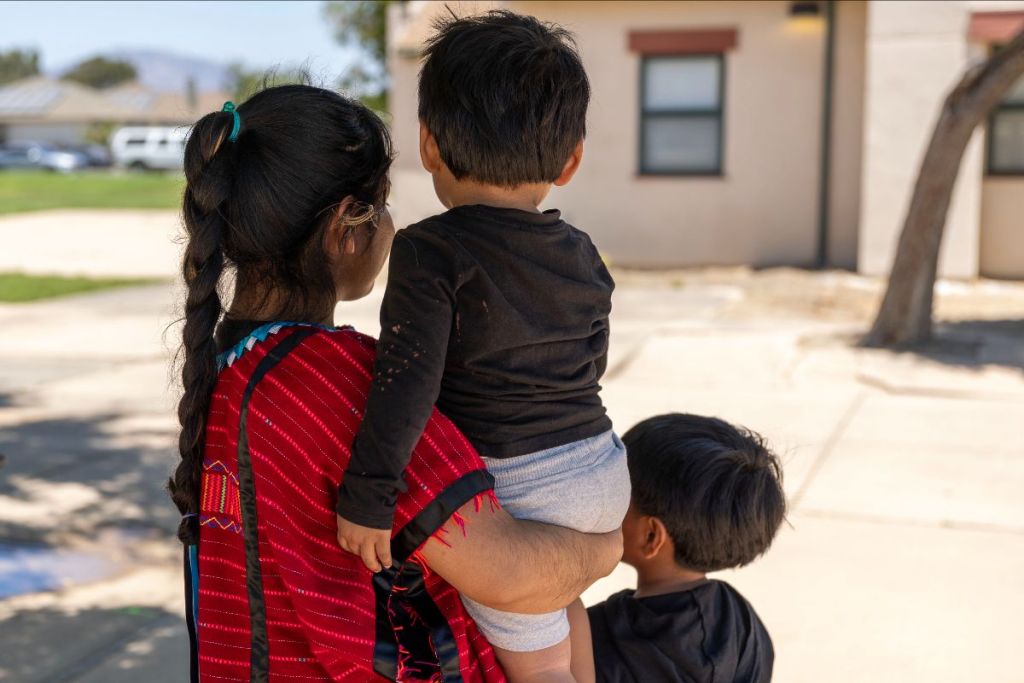
Isabel, a Triqui farmworker who lives in Greenfield, with her two sons. She and her husband prefer to keep their family close to home and are limiting their time outdoors because they fear an encounter with ICE agents could lead to the family being separated. Photo by Celia Jiménez.

Immigrants are living in fear. But this is nothing new in this country’s history.

Good morning.

Celia Jiménez here, thinking about the cover story I wrote for this week’s edition of the Weekly about immigration and how current policies have impacted people’s lives.

This story took me down memory lane. From my mom’s immigration story (she obtained her legal permanent residency during the Reagan Administration), to the anxiety and panic we felt in the early 2010s, when immigration enforcement was active in San Diego, to how outspoken people were about immigration before and during President Donald Trump’s first term when I was a student journalist at San Diego City College, this is on one level a personal story for me.

The latter is what strikes me the most. Why? Because in this country, freedom of speech is a quintessential element of our identity as a nation.

As a student journalist years ago, I interviewed students and professionals, many of them DACA recipients, and they were outspoken about the threats against the DACA program and their immigration status. Reporting on this story, I encountered the opposite. Several people, regardless of their immigration status, are afraid of retaliation or harassment. (As such, in the cover story, we protected the identities of those who trusted us with their stories and helped us uncover how the current immigration narrative is impacting their everyday lives.)

I find myself wondering if this country is moving forward, or falling backward into a past where immigrants and U.S.-born citizens were subjected to xenophobic policies.

Thousands of Japanese and Japanese Americans were locked up during World War II because they were considered a security threat. Over a million of Mexican Americans were deported to Mexico during the Great Depression during the so-called Mexican Repatriation. The reason? They were allegedly taking away resources and jobs from white Americans (sound familiar?).

Even now, people of color, especially Latinos, are being detained and reportedly racially profiled by ICE agents and some U.S. citizens have spent days to years incarcerated at a detention center.

These actions are the reason why everyone, whether you agree or disagree with the current immigration policies, should make sure the law is being followed every step of the way.

In announcing proposed immigration legislation, U.S. Rep. Zoe Lofgren, D-San Jose, pointed out that agriculture, the largest industry in Monterey County, would crumble without an immigrant workforce. “The Central Coast economy is rooted in agriculture. More than half the farmworkers are undocumented. If they are disappeared, the economy of this area will collapse,” she told me.

If you still don’t believe that, industry leaders can fill you in.

Immigrants are key individuals in our communities. This isn’t a personal belief, but a fact—and there is data to back it up.

-Celia Jiménez, staff writer, celia@montereycountynow.com

Source: Monterey County NOW newsletter, 10 August 2025


Passing Through
Stanley Kunitz

—on my seventy-ninth birthday

Nobody in the widow’s household
ever celebrated anniversaries.
In the secrecy of my room
I would not admit I cared
that my friends were given parties.
Before I left town for school
my birthday went up in smoke
in a fire at City Hall that gutted
the Department of Vital Statistics.
If it weren’t for a census report
of a five-year-old White Male
sharing my mother’s address
at the Green Street tenement in Worcester
I’d have no documentary proof
that I exist. You are the first,
my dear, to bully me
into these festive occasions.

Sometimes, you say, I wear
an abstracted look that drives you
up the wall, as though it signified
distress or disaffection.
Don’t take it so to heart.
Maybe I enjoy not-being as much
as being who I am. Maybe
it’s time for me to practice
growing old. The way I look
at it, I’m passing through a phase:
gradually I’m changing to a word.
Whatever you choose to claim
of me is always yours;
nothing is truly mine
except my name. I only
borrowed this dust.

About this Poem

“Passing Through” originally appeared in Next-to-Last Things: New Poems and Essays (Atlantic Monthly Press, 1985) and later in Passing Through: The Later Poems, New and Selected (W. W. Norton, 1995). In his 1995 introductory essay for Passing Through, Kunitz wrote: “Poets are always ready to talk about the difficulties of their art. I want to say something about its rewards and joys. The poem comes in the form of a blessing— ‘like rapture breaking on the mind,’ as I tried to phrase it in my youth. Through the years I have found this gift of poetry to be life-sustaining, life-enhancing, and absolutely unpredictable. Does one live, therefore, for the sake of poetry? No, the reverse is true: poetry is for the sake of the life.” 

Source: Poem-a-Day newsletter, 10 August 2025. Courtesy of poets.org (American Academy of Poets)

Navalny Supporter, Deported to Russia from U.S., Detained on “Condoning Terrorism” Charges in Perm

Leonid Melekhin. Source: XSovietNews

Man repeatedly detained at protest rallies in Perm deported from U.S. to Russia

Today, 25 July, Perm activist Leonid Melekhin, who had been wanted by law enforcement authorities for several years and is on the Russian federal list of “terrorists and extremists,” was remanded to custody in a pretrial detention center, Properm.ru’s correspondent has learned. Melekhin had attempted to emigrate to the U.S. via Mexico, a process about which his friends had written extensively on social media.

Melekhin tried to cross the border between Mexico and America in August last year and spent several months in detenshen (immigration prison in the U.S.), but lost his legal bid to remain in America. This entire time he was wanted by the Russian authorities for his cooperation with the Navalny Headquarters (an organization deemed “extremist” that has been banned in Russia).

According to our correspondent, Melekhin was turned over to the Russian authorities [sic!] before being deported to Russia and detained on suspicion of “condoning terrorism.”

As their source at Perm’s Lenin District Court confirmed to our correspondent, Judge Oksana Korepanova today granted the motion filed by an FSB investigator and remanded Melekhin to a pretrial detention center until 25 September.

Before leaving Russia in late 2023, Melekhin was repeatedly detained by the police for his involvement in unauthorized protests.

Source: “Perm man deported to U.S. remanded to pretrial detention center,” Properm.ru, 25 July 2025. Translated by the Assessment Scene, which always puts in quotation marks the fanciful thought crimes (such as “condoning terrorism”) dreamed up by the Putinist police state to terrorize the Russian populace.

Jesus Petrovich Christ and His Forty-Five False Apostles

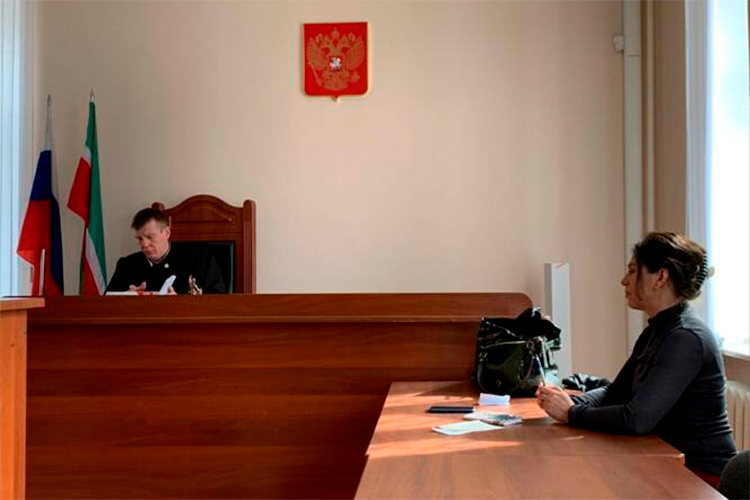
The 45-year-old resident of the Tatarstan capital with the exotic first name and surname and the patronymic Petrovich has four prior criminal convictions

Holy Week has kicked off for a Kazan defendant with a quite uncommon name: Jesus Christ. The 45-year-old Kazan resident has been charged with falsely registering forty-five migrant workers at his address. Jesus Petrovich has prior repeat convictions for burglary and robbery, and in 2014 he underwent preventive care for substance abuse. Business Online reports on Christ’s failure to appear at his court hearing, and the “way of the cross” he has blazed through Kazan’s district courts.

This photo by Business Online reporter Eva Malinovskaya appears in her original article, but it is impossible to say whether it was taken at Jesus Petrovich Christ’s abortive court hearing in Kazan on Good Friday 2025.

Jesus Petrovich’s “Good Friday”

The biography of Kazan’s latest criminal defendant would not be too different from the average person’s — the divorced and unemployed high school graduate will turn forty-six on the tenth of May — were it not for one catch. His name is Jesus Christ: that is the name listed in his [internal] passport.

The story of how he got the name remains a mystery: neither the court staff nor the state prosecutor know what Christ’s name at birth was. All that the people involved in the criminal proceedings know is that the defendant was “obsessed” with numerology, and this led, allegedly, to his decision to change his name and surname several years ago. He kept only his real patronymic: Petrovich.

Christ was scheduled to appear before the Moscow District Court (the Kizichevsky Vvedensky Monastery is situated right next door to the court building on Justice Street ). The current case against Jesus Petrovich is an anniversary of sorts: he has four prior criminal convictions, having blazed a trail through the city’s district courts on his own “way of the cross.”

Jesus was first convicted in 1994 by the Lenin District Court (now the Aviastroitelny District Court) of robbery, per Article 145.2 of the RSFSR Criminal Code. He was given a two-year suspended sentence. Since his next conviction, for theft, per Article 144.2 of the RSFSR Criminal Code, was handed down by the Novo-Savinovsky District Court, he was given the standard sentence: two and a half years in a medium-security correctional labor colony and confiscation of his property.

After serving his sentence, Christ did not enjoy his freedom for long. In 1999, he appeared before the Volga Regional Court, where he was sentenced to nine years in prison per Article 162.3.g of the Russian Federal Criminal Code, for “robbery committed by a person previously convicted two or more times of theft or extortion.” The convict was sent to a maximum security penal colony and was released in 2007. A little more than a year passed before Christ again came before the Lenin District Court, which by then had been redubbed the Aviastroitelny District Court. He was sentenced to another three years in prison per Article 158.3.a of the Russian Federal Criminal Code, for “theft involving home invasion.”

In addition to his criminal record, Christ had a penchant for illegal substances. From 2014, he was registered with a substance abuse therapist, but not for long, according to his personal file, as submitted to the court. In 2015, a forensic psychiatric expert commission found that Jesus had an organic personality disorder, and he was removed from the substance abuse registry. His mental illness had been triggered by a severe head trauma received in 2010. At the time, Christ did not complete his treatment, leaving the hospital on his own. He was also diagnosed with brain malfunction due to multiple organ dysfunction syndrome and was thus registered as a class III disabled person.

During his last clinical examination, psychiatrists noted the patient’s irritability, brashness, inflated self-esteem, pretentiousness, egotism, and mood swings. Although Jesus’ truculent personality was palpable, it was not significant enough to warrant hospitalization, so his diagnosis was not a factor in the criminal investigation.

The charges

What is Christ accused of this time round? According to police, whose account has been corroborated by the prosecutor’s office, between April and December 2024, Christ registered forty-five foreign nationals as residing in his 31.9-square-meter flat. With the consent of the foreigners, Jesus filled out foreign national residential arrival notices in which he identified himself as their host and provided the address of his flat. He then submitted arrival notices to the Moscow District office of the Tatarstan Multifunctional Public Services Center.

The prosecution is certain that the foreigners did not reside at their registered address. The false information about the arrival of forty-five individuals, as received by the migration department of the Russian Interior Ministry’s Kazan office, was registered and entered into the federal migration registration database. Christ faces up to five years in prison.

“The case is quite ordinary. [Police officers] examine the Multifunctional Public Services Center’s identification numbers and files and identify violators,” said assistant prosecutor Nadezhda Moshkova in a conversation with Business Online before the court hearing.


Common practice in such cases

Such cases are not uncommon. There were several such cases in a row in February alone. Six Tatarstan residents and a foreigner were charged with organizing the illegal immigration and falsified registration of more than three thousand foreigners. Later in the month, three more cases of unlawful employment agreements, involving two thousand migrant workers, were uncovered, and on February 26 it transpired that another resident of Kazan had aided almost three thousand immigrants in registering illegally. So the list of Christ’s “apostles” is not that long compared to those of others.


“Has Jesus Christ stopped by?” the assistant judge asked hopefully over the phone exactly one minute before the start of the trial.

“No, he hasn’t,” the bailiff replied with a grin.

The mood of the people in the courtroom was upbeat, despite the fact that the “appearance” of Christ before the Moscow District Court did not take place. Moshkova assured the court that the defendant had been notified in every possible way, but she herself, even before the hearing, had not actually believed that he would show up. “He’s a curious chap,” the assistant prosecutor said, adding that defendants themselves do not like to appear at such hearings, and jokingly condoned Christ by saying that Easter had not yet arrived.

The accused himself, as it turned out, had no clue about the hearing.“What case? And wait, if a court hearing has been scheduled, why the fuck was a notification and a summons not sent?!” said a perplexed Christ, whom Business Online was able to reach by telephone. After voicing his indignation, our source asked us to leave him alone. “I have done twenty years in prison. You’ve got the wrong number, good luck,” concluded Jesus.

Nevertheless, court-appointed defense lawyer Ksenia Matveeva told us that the defendant fully admits his guilt. He had even requested expedited consideration of the case, but because of his failure to appear, the process had to be postponed to the end of May.

“I order that the defendant be forcibly delivered to the next court hearing,” the presiding judge, Nikolai Zakharov said as he concluded the proceedings. “No one has ever walked away from the court yet,” he said, shrugging.

Source: Eva Malinovskaya, “‘He’s a curious chap’: how Kazan tried to put Jesus Christ on trial,” Business Online, 19 April 2025. Translated by the Russian Reader. Thanks to Sergey Abashin for the heads-up.


A 45-year-old Russian national named Jesus Petrovich Christ has gone on trial in Kazan for fictitiously registering foreigners in his apartment. Information on the upcoming court hearing was posted on the website of the city’s Moscow District Court.

The defendant fictitiously registered forty-four illegal immigrants in his one-room apartment, in violation of Article 322.3 of the Russian Federal Criminal Code. In fact, [none of the immigrants] lived in the apartment. Christ did not appear in court, so the hearing of his case did not take place.

According to law enforcers, Jesus Petrovich Christ has four previous convictions — for robbery, armed robbery, and theft.

According to local media, the defendant was given a different name at birth, but he changed his first name and surname after becoming interested in numerology. The man’s patronymic is real.

Source: “Jesus Christ accused of aiding illegal immigrants in Kazan,” Vesti.Ru, 19 April 2025. Translated by the Russian Reader. Thanks to Sergey Abashin for the link.


A Russian citizen named Jesus Petrovich Christ is being tried in Kazan on charges of fictitiously registering immigrants. A notice of the upcoming court hearing appeared on the website of Kazan’s Moscow District Court.

A screenshot of Jesus Petrovich Christ’s court hearing record on the website of Kazan’s Moscow District Court,
courtesy of Sergey Abashin

Jesus Christ is suspected of fictitiously registering forty-five illegal immigrants in his one-room apartment, in violation of Russian Federal Criminal Code Article 322.3. Despite receiving a summons to appear in court, the 45-year-old Russian national did not show up for the proceedings, and therefore the hearing of the case did not take place.

It is also known that the man was previously convicted several times — in 1994 and 1996, for robbery; in 1999, for armed robbery; and in 2007, for theft.

[…]

Source: Danila Titorenko, “Kazan court to hear case of Jesus Petrovich Christ, charged with aiding illegal immigrants,” Gazeta.Ru, 18 April 2025. Translated by the Russian Reader. Thanks to Sergey Abashin for the link.

Sunday Reader No. 2: Outliers


This week’s edition of BBC Radio 4’s obituaries program featured appreciations of the KGB defector Oleg Gordievsky and the composer Sofia Gubaidulina. ||| TRR

Oleg Gordievsky, Renee Goddard, Professor Richard Fortey, Sofia Gubaidulina

Matthew Bannister on Oleg Gordievsky, the KGB agent who defected to Britain and became a valued source of secret intelligence during the 1970s and 80s.

Renee Goddard, the actress and TV commissioner who fled Nazi persecution only to be interned in Britain.

Professor Richard Fortey, the palaeontologist who used his expertise in trilobites to tell stories about the origins of life on earth. Bill Bryson pays tribute.

Sofia Gubaidulina, the composer whose large scale religious works attracted criticism from the Soviet authorities.

Source: Last Word, BBC Radio 4, 28 March 2025


Nacimiento-Fergusson Road is a stunning drive located on the Pacific coast of the U.S. state of California, regarded as one of the best motorcycling roads in central California.

Nacimiento-Fergusson Road

Where is the Nacimiento-Fergusson Road?

The road is located in Monterey County, in the US state of California, running across the eastern slope of the Santa Lucia range within Los Padres National Forest.

Continue reading “Sunday Reader No. 2: Outliers”

Alexandra: A Russian Trans Woman in Trump’s America

Alexandra in Times Square. Personal photo courtesy of Republic

Alexandra left Russia four years ago, fleeing oppression, propaganda, and ever harsher anti-LGBT laws. She applied for political asylum in the U.S., made a home in New York, and felt safe for the first time. But with Donald Trump’s return to power, her fears have returned. The new rules and laws, the rhetoric, and the swaying of public sentiment against trans people have been much too reminiscent of what she had escaped. Alexandra spoke to Republic about how America has been changing and what now lies in store for thousands of people like her.

I arrived in the U.S. exactly four years ago yesterday. A lot has changed in that time. I arrived right when the covid restrictions were still in force. Just a couple of days before I arrived in New York, an order to wear two masks each had been issued. The city was completely empty. I went straight to Times Square, and there were maybe one or two people walking down the street. Gradually, the restrictions were lifted, and more and more people were out in public. And then the border with Mexico was opened, and everything changed dramatically in terms of jobs, the economy, and real estate — rent went up about forty percent. Now there are new problems: Trump and Musk. But first things first.

“I always had a hard time in Russia”

I am thirty-four years old. I lived in Perm until I was twenty-five, then I moved to St. Petersburg and lived there until I moved to the U.S. I did a lot of jobs in Russia, mainly sales. In my final years in Perm, I worked at a real estate agency.

I had traveled a lot and at first I decided to just move to a big city in Russia, which didn’t make me safe in the end. I decided to leave Russia after the lockdown started. My ex-husband had gone to the U.S. in 2011 on the Work and Travel Program and he had really liked the country. Besides, when it was possible to fly anywhere again, the only valid visas we had were for the U.S.

When I was twenty-five years old, I officially changed my gender and got a woman’s passport. This was in 2016, back in Perm. It was quite difficult to do this. The problem was that at the real estate agency where I worked, no one knew about me, but I had to sign legal documents there. So I had to change my surname, first name, and patronymic to something feminine, but without specifying my gender. The civil registry office did not immediately know how to do this legally: they discussed it among themselves for several months. In the end, they changed my name and surname to the feminine versions of the original ones. I had been Alexander, and so I became Alexandra. They got rid of my patronymic because they didn’t know how to come up with a feminitive for it.

Later, after the updated information had been entered into my birth certificate, I went to the passport office. They remembered me there because a couple of years earlier they had refuse to issue me a passport on the grounds that the photo I had given them was of a young woman, but my papers indicated my gender as “M.” I had filed a complaint with the prosecutor’s office, but it hadn’t led to anything at the time. Ultimately, though, the [passport office] staff decided to meet my needs and help me. I was issued a passport with an “F” in it. I have had several cosmetic surgeries, but have not had intimate plastic surgery, meaning I haven’t undergone a complete transition, but a social one. I don’t want to have surgery yet.

It was always hard for me in Russia. If you are lesbian or gay, you can hide it from society somehow. This is impossible for us transgender people.

You go to apply for a job and you are simply rejected, at best. At worst, you are threatened and humiliated.

I was also harassed at school. For example, I was subjected to a full body search with no clothes on at the checkpoint when I took my Unified State Exam. When it comes to medical institutions, even if you go to a private clinic for a paid operation, you still face discrimination. When I tried to get permission for a sex change, they suggested I go to the male ward because in the female ward they thought I would “rape all the female patients.”

I was an activist in Rainbow World, the Perm branch of the Russian LGBT Network: I constantly attended events and was actively involved in organizing them. When I needed supporting evidence [for my asylum claim] from the head of Rainbow World, she was afraid to communicate with my lawyers, since she seriously feared reprisals from the authorities. Now she doesn’t contact me at all.

We once took part in the May Day rally. We had got all the permissions beforehand, but the placards had not been discussed, and so we ended up having our own mini-gay pride parade. Things were still relatively calm at the time: we marched down the street and people heard us; we were written about and discussed. But then the pressure started. Public opinion shifted dramatically in the direction of aggression towards LGBT people. A few months later, the police came to the offices of our organization and searched them. They confiscated our laptops, and there, of course, they found all our info — addresses, contacts, and passwords. No one thought at the time that things would take such a turn for the worse.

At one point, when I was working at the real state agency in Perm, a local activist came into my life. I don’t know who he was, but he had sent me clip from an episode of the Malakhov show in which he had taken part. He was always stalking me outside the real estate office where I worked. When I would walk past him with my colleagues, right in front of them he would say, “You have to give me an interview.” I would say, “I don’t know you. What’s this about anyway?’ And he would say, “If you don’t, I’ll tell everyone who you are.” This would happen in public, right on the street.

After the first law banning so-called LGBT propaganda for minors was adopted in 2013, police officers started showing up at my house because I right then I was helping out transgender teenagers. The police would knock on our door and ring the doorbell. They would try to get into my flat under various pretexts. One time they stood outside the door for three hours. We just pretended nobody was home. Then, when it got quiet, we looked out the window. The police officers looked up too, realized we were looking at them, and came upstairs again. They stood outside our door again for a while.

Then some people assaulted me and my ex-husband. It turned into a brawl, and a police patrol turned up “by chance.” We were all taken to the police station and advised to “keep quiet and stay inconspicuous.” After that, in 2019, we decided to move to Peter. Everything was relatively calm in Petersburg. But then they found us there too. I do not know what kind of databases they have, but they found us, although I didn’t show my face anywhere at all in Petersburg, and I wasn’t involved in any organizations. The only thing I did was go to the Side by Side LGBT film festival.

I was in no hurry to leave Russia because I have an elderly father, who is seventy-one. I didn’t want to leave him. And I never thought that I should leave the country where I was born, grew up, worked, and paid taxes. Plus, I had a flat and a car in Russia. I didn’t want to start all over again in another place. When covid started, my husband’s and my Schengen visas had expired. We only had our U.S. visas left, and they were still valid for about six months. We decided to give it a try, because we were afraid that, later, the authorities wouldn’t let us go anywhere at all, that the country was heading towards the Iron Curtain.

“Since Moving to the U.S., I Haven’t Been Hiding Anything from Anyone at All”

We arrived in New York on a visa, on a direct flight from Moscow. We started looking for human rights organizations who could provide free lawyers. We called various places: our English was nonexistent, so we used online translators and sometime just read the text into an answering machine. Several organizations reached out to us. Eventually, an organization which deals with domestic violence helped us out. We lived in a hotel at first. We were quarantined there for a fortnight, then we rented a place through Airbnb and looked for a permanent place. I started working three weeks later.

I am currently working as a cleaner and as a webcam model. Webcam modeling is not an easy gig. I started doing it back in Petersburg, because I was afraid of getting a on-the-books job. Initially, you think that it’s easy money and that it won’t affect you in any way, but then you realize you’re just a piece of meat. It’s quite tough psychologically. All this overlapped with my old traumas, and eventually led to big psychological problems. Before the New Year, I stopped taking the antidepressants I’d been taking since 2018.

You can make $100, $300, and $500 a day in the webcam industry. Here in the U.S., it’s a legitimate job, you pay taxes, it’s all above board. Since moving to the U.S., I haven’t been hiding anything from anyone at all. It’s my new principle in life.

I am horrified to read the news from Russia about LGBT people being labeled “extremists” and being murdered in prisons, about gay bars and clubs being raided. It’s wacky, it’s incomprehensible. After moving to the U.S., especially after Russia’s war with Ukraine began, I realized how effective propaganda was in Russia. All my friends and acquaintances in Russia suddenly changed their opinions about politics dramatically, even about LGBT people. Even my friends who are LGBT people themselves either try to avoid the topic or say, “Well, that’s right, but what can we do? It’s the way it has to be.” Some of them I’ve stopped talking to, some I haven’t. Maybe they are simply afraid to say too much.

The authorities inserted pedophilia into the law on “LGBT propaganda” and thus made a strong link in people’s heads between LGBT people and pedophiles. This propaganda has been effective even in my own family.

My dad’s new wife has a niece. The niece’s son was three years old at the time. Kids are drawn to me and I always play with them. But at one point I saw how afraid she was to leave her child alone with me. The propaganda has affected even those closest to me.

In the U.S., I saw a completely different world and attitude towards people like me. When I told someone at work for the first time that I was a transgender woman, I got a neutral reaction, as if I was talking about something quite ordinary. The first time I went to the New York Pride March, it was more like a carnival: it was beautiful, friendly, and flamboyant. There were a lot of children there, and there were separate events for them. For the first time in my life I felt I was no different from anyone else, that I had rights, that I could speak openly, that I could receive proper medical care. When I lived in Perm, I was even unable to find an endocrinologist who did hormone replacement therapy. [Living in New York] has changed my sensibility a lot.

Alexandra in Times Square. Personal photo courtesy of Republic

Donald Trump’s policies have not affected me specifically yet. But knowing how it all kicked off in Russia, I am scared. In 2013, there was the ban on “gay propaganda,” and consequently, teenagers were left without the support that, for example, they had received from Lena Klimova and her project Children 404. I also helped kids out then, shared my know-how with them, and tried to support them. All transgender people have been dismissed from the [U.S.] army. It’s a nightmare. When the state starts cracking down on a single albeit tiny segment of the populace, and it succeeds, it keeps on going.

“Judging by the First Month of Trump’s Presidency, We Are in for Tough Times”

I believe that common sense should prevail in all things. Previously, the bias had gone in the other direction in the U.S.: people used to be afraid to say something against LGBT, and this was also wrong. Everyone should have freedom of speech. For example, my acquaintances from [the country of] Georgia had this thing happen to them. They were working on a commission for a moving company: a gay couple was moving. One of the workers looked askance, or they said something among themselves. They then got a call from the front office and a dressing-down. They were warned that they would be fired if it happened again. Or there was the case of the flower shop: the owners refused to sell flowers for a same-sex wedding, and the shop had to close because of the scandal that erupted. That’s over the top. I think that if you’re refused service somewhere, you can go to some other place. Let them lose their profits. It’s the same with clubs: if the bouncers don’t let you in, well, those are their views. Everybody has different views. But now it’s going too far in the other direction and it’s scary. I hope that one day we will reach a sensible balance.

Now I live with my fiancé, who is from Ukraine. We discuss politics, and we both want the war to end soon, for people to stop dying. I would like to make a trip to Russia.

I don’t think Russia belongs to Putin and his lackeys. It’s my country, just like it is yours, just like it is everyone else’s. I would like to believe that things will change and we can go back someday.

I am in the U.S. legally, but I am waiting for political asylum. There are numerous such cases, and they take a very long time to process. The approximate wait time for a green card in the past was ten years . I was involved in a class action lawsuit against the U.S. Immigration Service, and I was told that as long as I had a short wait time, the case would not be considered. I appealed that decision and have been scheduled for an interview for late 2026. I would like to go to Turkey, for example, to meet my relatives. I would really like to see my dad. But even if everything goes well at the interview, I will probably not get a green card until 2028.

My father loves me, but over the last three years, since the war started, we have come to disagree about Russian politics, and over time we stopped discussing it. He watches [Russian] television and relays to me what is said there. He constantly accuses me of being under the influence of “American propaganda” and “brainwashed.” But I just reply, “Fine.”

They usually say that the first one hundred days of a presidency set the course for the next four years. Judging by the first month of Trump’s presidency, we are in for tough times, although maybe these measures are like Margaret Thatcher’s — first shock therapy, then stabilization. I hope to get citizenship in the future. I would finally feel safe: there is still a risk of deportation for now. I try not to give up, to hope for the best. Let’s see if positive thinking does the trick.

Source: Maria Litvinova, “‘Trump’s rhetoric has become similar to Putin’s, and it’s scary’: How does a Russian trans woman who emigrated to America under the Democrats feel?” Republic, 27 February 2025. Translated by the Russian Reader