Torture First, Ask Questions Later (The Case of Azat Miftakhov)

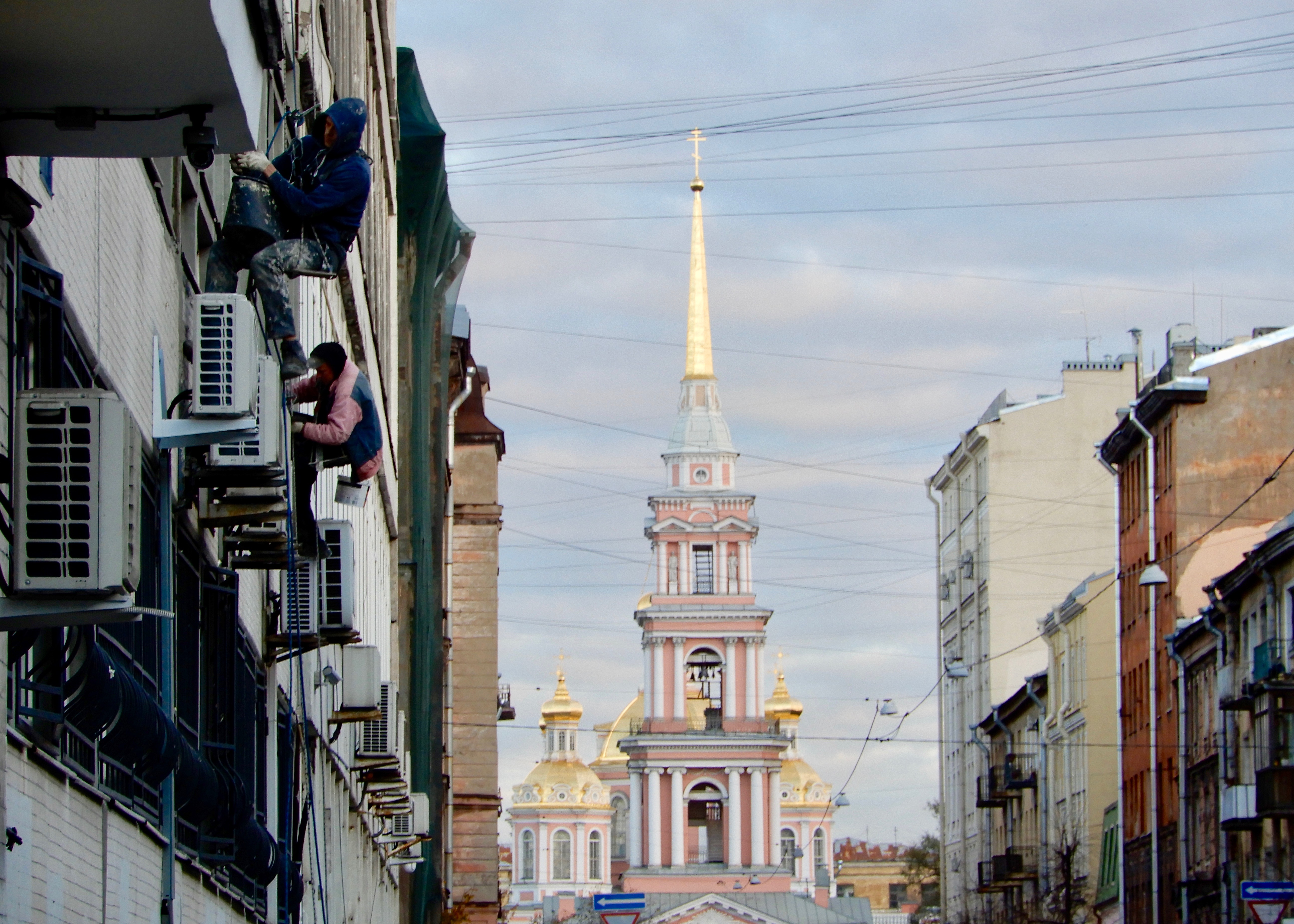
азатAzat Miftakhov. Courtesy of Autonomous Action
Detained Moscow State University Mechanics and Mathematics Grad Student Tells Lawyer Security Forces Beat Him
Mediazona
February 3, 2019

Defense lawyer Svetlana Sidorkina reported to Mediazona that Azat Miftakhov, a graduate student in the mechanics and mathematics department at Moscow State University, told her he was beaten by security forces officers after they detained him.

“In the office [at the Balashikha police station — Mediazona] where he was held, they demanded he confess and were upset he asked to call family members or a lawyer. As he told me, one of the officers pressed an object that appeared to be a screwdriver to his chest and said he would use it if [Miftakhov] did not do as they asked,” Sidorkina told us.

“Then he was beaten on the arms and face. As [Miftakhov] said, they kicked and punched him in the chest. But there were no visible injuries. Then [one of the security forces officers]  wanted to stick the screwdriver in his anus. [Miftakhov] took the threat seriously, but [the officers] did nothing. Ultimately, [Miftakhov] did not tell them anything nor did he sign a confession,” said Sidorkina.

She noted that, aside from a bruise on Azat’s ear and a mark made by the screwdriver, there were no visible injuries on his body.

Miftakhov did not know what security agency the men who beat him represented.

Sidorkina added that Miftakhov was detained as part of an investigation into a violation of Russian Criminal Code Article 223.1 Part 1 (illegal manufacture of explosives).

According to Sidorkina, Miftakhov was detained on the morning of February 1. After his dwelling was searched, he was delivered to the Balashikha police station. In the evening, after he was interrogated by security services officers, he was taken to hospital, where he was treated for abrasions from the screwdriver and injected with a sedative. He was driven back to the police station, but held in the car until three in the morning.

Sidorkina suspects the security forces did not know how to charge the detained graduate student.

Ultimately, Miftakhov was placed in a room for people detained on administrative charges in the Balashikha police station’s other building, which houses its investigative department.

On the morning of February 2, however, he was taken back to the first building. According to Miftakhov, he was held in a office there for the entire day, but he was handcuffed. Around seven o’clock in the evening, he was driven back to the Balashikha police station’s investigative department, where the written record of his detention was read out to him.

At least eleven other people were detained as part of the explosives investigation. Except for Miftakhov, all of them have been released.

Mediazona has spoken with six of the former detainees. Daniil Galkin told us that, after the search, FSB officers tortured him with a taser and tried to force him into testifying against Miftakhov and doing an interview with a news crew from Channel One.

Translated by the Russian Reader

Deza

deza

The bog standard “progressive internationalist leftist” narrative on today’s Russia can be encapsulated in four simple words: “Everything is Yeltsin’s fault.”

There is thus no need to shell out your hard-earned money on books with lots of pages and fancy words in them when the takeaway message is so easily memorized and painlessly digested.

If you suffer from panic attacks, as I do, repeating this message like a mantra will also calm you down in no time at all and put you to sleep on restless nights.

Everything is Yeltsin’s fault. Everything is Yeltsin’s fault. Everything is Yeltsin’s fault. Everything is Yeltsin’s fault. Everything is Yeltsin’s fault. Everything is Yeltsin’s fault. Everything is Yeltsin’s fault. Everything is Yeltsin’s fault. Everything is Yeltsin’s fault. Everything is Yeltsin’s fault. Everything is Yeltsin’s fault. Everything is Yeltsin’s fault. Everything is Yeltsin’s fault. Everything is Yeltsin’s fault. Everything is Yeltsin’s fault. Everything is Yeltsin’s fault. Everything is Yeltsin’s fault. Everything is Yeltsin’s fault. Everything is Yeltsin’s fault. Everything is Yeltsin’s fault. Everything is Yeltsin’s fault. Everything is Yeltsin’s fault. Everything is Yeltsin’s fault. Everything is Yeltsin’s fault. Everything is Yeltsin’s fault. Everything is Yeltsin’s fault. Everything is Yeltsin’s fault. Everything is Yeltsin’s fault. Everything is Yeltsin’s fault. Everything is Yeltsin’s fault. Everything is Yeltsin’s fault. Everything is Yeltsin’s fault. Everything is Yeltsin’s fault. Everything is Yeltsin’s fault. Everything is Yeltsin’s fault. Everything is Yeltsin’s fault. Everything is Yeltsin’s fault. Everything is Yeltsin’s fault. Everything is Yeltsin’s fault. Everything is Yeltsin’s fault. Everything is Yeltsin’s fault. Everything is Yeltsin’s fault. Everything is Yeltsin’s fault. Everything is Yeltsin’s fault. Everything is Yeltsin’s fault. Everything is Yeltsin’s fault. Everything is Yeltsin’s fault. Everything is Yeltsin’s fault. Everything is Yeltsin’s fault. Everything is Yeltsin’s fault. Everything is Yeltsin’s fault. Everything is Yeltsin’s fault. Everything is Yeltsin’s fault. Everything is Yeltsin’s fault. Everything is Yeltsin’s fault. Everything is Yeltsin’s fault. Everything is Yeltsin’s fault. Everything is Yeltsin’s fault. Everything is Yeltsin’s fault. Everything is Yeltsin’s fault. Everything is Yeltsin’s fault. Everything is Yeltsin’s fault. Everything is Yeltsin’s fault. Everything is Yeltsin’s fault. Everything is Yeltsin’s fault. Everything is Yeltsin’s fault. Everything is Yeltsin’s fault. Everything is Yeltsin’s fault. Everything is Yeltsin’s fault. Everything is Yeltsin’s fault. Everything is Yeltsin’s fault. Everything is Yeltsin’s fault. Everything is Yeltsin’s fault. Everything is Yeltsin’s fault. Everything is Yeltsin’s fault. Everything is Yeltsin’s fault. Everything is Yeltsin’s fault. Everything is Yeltsin’s fault. Everything is Yeltsin’s fault. Everything is Yeltsin’s fault. Everything is Yeltsin’s fault. Everything is Yeltsin’s fault. Everything is Yeltsin’s fault. Everything is Yeltsin’s fault. Everything is Yeltsin’s fault. Everything is Yeltsin’s fault. Everything is Yeltsin’s fault. Everything is Yeltsin’s fault. Everything is Yeltsin’s fault. Everything is Yeltsin’s fault. Everything is Yeltsin’s fault. Everything is Yeltsin’s fault. Everything is Yeltsin’s fault. Everything is Yeltsin’s fault. Everything is Yeltsin’s fault. Everything is Yeltsin’s fault. Everything is Yeltsin’s fault. Everything is Yeltsin’s fault. Everything is Yeltsin’s fault. Everything is Yeltsin’s fault. Everything is Yeltsin’s fault. Everything is Yeltsin’s fault. Everything is Yeltsin’s fault. Everything is Yeltsin’s fault. Everything is Yeltsin’s fault. Everything is Yeltsin’s fault. Everything is Yeltsin’s fault. Everything is Yeltsin’s fault. Everything is Yeltsin’s fault. Everything is Yeltsin’s fault. Everything is Yeltsin’s fault. Everything is Yeltsin’s fault. Everything is Yeltsin’s fault. Everything is Yeltsin’s fault. Everything is Yeltsin’s fault. Everything is Yeltsin’s fault. Everything is Yeltsin’s fault. Everything is Yeltsin’s fault. Everything is Yeltsin’s fault. Everything is Yeltsin’s fault. Everything is Yeltsin’s fault. Everything is Yeltsin’s fault. Everything is Yeltsin’s fault. Everything is Yeltsin’s fault. Everything is Yeltsin’s fault. Everything is Yeltsin’s fault. Everything is Yeltsin’s fault. Everything is Yeltsin’s fault. Everything is Yeltsin’s fault. Everything is Yeltsin’s fault. Everything is Yeltsin’s fault. Everything is Yeltsin’s fault. Everything is Yeltsin’s fault. Everything is Yeltsin’s fault. Everything is Yeltsin’s fault. Everything is Yeltsin’s fault. Everything is Yeltsin’s fault. Everything is Yeltsin’s fault. Everything is Yeltsin’s fault. Everything is Yeltsin’s fault. Everything is Yeltsin’s fault. Everything is Yeltsin’s fault. Everything is Yeltsin’s fault. Everything is Yeltsin’s fault. Everything is Yeltsin’s fault. Everything is Yeltsin’s fault. Everything is Yeltsin’s fault. Everything is Yeltsin’s fault. Everything is Yeltsin’s fault. Everything is Yeltsin’s fault. Everything is Yeltsin’s fault. Everything is Yeltsin’s fault. Everything is Yeltsin’s fault. Everything is Yeltsin’s fault. Everything is Yeltsin’s fault. Everything is Yeltsin’s fault. Everything is Yeltsin’s fault. Everything is Yeltsin’s fault. Everything is Yeltsin’s fault. Everything is Yeltsin’s fault. Everything is Yeltsin’s fault. Everything is Yeltsin’s fault. Everything is Yeltsin’s fault. Everything is Yeltsin’s fault. Everything is Yeltsin’s fault. Everything is Yeltsin’s fault. Everything is Yeltsin’s fault. Everything is Yeltsin’s fault. Everything is Yeltsin’s fault. Everything is Yeltsin’s fault. Everything is Yeltsin’s fault. Everything is Yeltsin’s fault. Everything is Yeltsin’s fault. Everything is Yeltsin’s fault. Everything is Yeltsin’s fault. Everything is Yeltsin’s fault. Everything is Yeltsin’s fault. Everything is Yeltsin’s fault. Everything is Yeltsin’s fault. Everything is Yeltsin’s fault. Everything is Yeltsin’s fault. Everything is Yeltsin’s fault. Everything is Yeltsin’s fault.

ДЕЗА

Messages like the one quoted below don’t jibe with the standard narrative aggressively enforced these days like Stalinist dogma among the west’s champagne socialist hipsters, who see Vladimir Putin as the nearly blameless victim of forces unleashed in the 1990s by the real villain of post-Soviet Russian history, Boris Yeltsin.

The problem with the standard hipster socialist narrative, however, is that it’s mostly wrong. It simply cannot account for wild variations among supposedly capitalist countries, just as it has trouble making sense of all the oddities and excesses of the Putinist system, many of which have nothing or almost nothing to do with capitalism and class relations as such.

Vladimir Putin. Let the Russian president stand in for any number of his country’s adept hackers. The country may have been relatively quiet—though not inactive—during the midterm elections, but Russia’s hackers still caused all manner of trouble throughout the world. Upset over a doping-related ban, they hacked and released emails of the International Olympic Committee in January, then attacked the Pyeongchang Olympics themselves, wreaking havoc during the opening ceremonies with so-called Olympic Destroyer malware. When a lab investigated the nerve agent used in the attempted murder of former Russian double agent Sergei Skripal, Russia tried to hack it, too. They continue to probe the US power grid for weaknesses. And on and on, all before you even get to Putin’s continued, unprecedented cyber-aggression against Ukraine. Russia has spent this year actively, opening lashing out at the world online—with Putin at the command.

We Change Our Minds like Socks, or, The Pollocracy’s Comeback

3Focus group drawing from the study “Autumn Change in the Minds of Russians: A Fleeting Surge or New Trends?” The first panels is labeled “Now.” The second panel shows a drunken Russia at the bottom of the stairs “in five years,” while “the US, Europe, Canada, China, [and] Japan” stand over it dressed in swanky business suits. The third panel is entitled “Friendship.” Source: Fond Liberalnaya Missiya
Experts Who Predicted Bolotnaya Claim Attitudes of Russians Have Changed
Vladimir Dergachov
RBC
December 24, 2018

Economists Mikhail Dmitriev and Sergei Belanovsky, and psychologists Anastasia Nikolskaya and Elena Cherepanova have authored a new report, “Autumn Change in the Minds of Russians: A Fleeting Surge or New Trend?” which they will present on Monday, December 24.

RBC has obtained a copy of the study. It was conducted as a follow-up to previous autumn opinion polls, which identified a loss of interest in foreign policy among Russians, growing dissatisfaction with domestic policy, and a collapse in reliance on the government.

How the Study Was Conducted
The experts combined qualitative sociology and psychological tests [sic], comparing the results with the Levada Center’s polling data. In October and November 2018, respondents in Moscow, Vladimir, Gus Khrustalny, Yekaterinburg, Krasnoyarsk, Saransk, Romodanovo (a village in Mordovia), and Ufa were surveyed as part of focus groups. In Moscow, a number of focus groups were convened involving public sector employees, including physicians, and university lecturers and researchers from the Russian Academy of Sciences (RAN). There was also a mixed focus group featuring engineers, traffic police officers, and theater employees.

Peace Instead of Scandals
Previous surveys, conducted by Dmitriev and Belanovsky in April and May 2018, showed Russians largely supported the country’s foreign policy, although critical respondents said the country spent too much money on supporting other countries and used foreign policy to distract people from issues at home. Six months later, the statements made by respondents revealed a demand for a peaceable foreign policy. “Spy scandals, falling missiles, certain statements by Russian politicians, and the protracted war in Syria” have led to a downturn in support for Russia’s foreign policy, the report claims.

In the May 2018 study, respondents were not yet pessimistic about the future. In the October surveys, however, a majority (68%) of respondents had a negative attitude towards the future. They envisioned a Russia that, in five years, was weakening and lagging behind other countries in terms of progress, a country whose populace was intimidated and did not have the right to vote.

They Predicted the Bolotnaya Square Movement

In March 2011, Dmitriev and Belanovsky, then employed at the Center for Strategic Development (TsSR), presented a report in which they alleged a profound political crisis had emerged, and support for Vladimir Putin, Dmitry Medvedev and United Russia had fallen off. They predicted increasing dissatisfaction with the political system. Less than a year later, sparked by insufficiently [sic] fair and transparent elections to the State Duma, large-scale protests kicked off in Russia.

Self-Expression Instead of Survival
In the May study, the demand for justice had increased dramatically, shunting aside the previously dominant demand for a strong leader. In October, the invocation of distributive justice (a more equal distribution of income and assets) gave way to the demand for procedural justice (equality of all before the law).

The respondents in all the focus groups felt physical needs and government welfare were less important than the need for respect, liberty, and leaders capable of voicing these values. Harsh statements by public officials on social issues (i.e., that people could live on 3,500 rubles a month by eating macaroni, etc.) had provoked increasing irritation. Concerning the raising of the retirement age, the respondents negatively assessed the suddenness of the decision and the way it was made behind closed doors.

Ninety-four percent of respondents claimed they no longer relied on the government, only on themselves. Sixty-three percent of respondents expressed a willingess to contribute personally to the country’s progress. This contribution was conceived in different ways: from a willingness to pay high taxes and be involved in charitable work, to grassroots activism and educational outreach. According to a Levada Center poll, 60% of respondents felt responsible and were willing to make personal efforts to facilitate improvements in Russia.

A Demand for Change
The May study testified to a slackening of reliance on a strong leader among Russians. In October, the analysts registered a demand for new leaders who would respect people, be honest and democratic [sic], admit to their mistakes, and act in the people’s interest. These qualities were bound up with the values of self-expression, which were foregrounded by respondents.

These qualities had little in common with the positive and negative qualities Russians [sic] had used to assess Vladimir Putin in a July poll by the Levada Center (stability, respect, personal charm, capacity for compromise, firmness, and foresight). The discrepancy in criteria was a sign of the rudimentary emergence of counter-elite sentiments [sic], the researchers warned.

A growing demand for change was noted among the respondents. Up to 76% of respondents would be willing to support temporarily painful reforms vital to overcoming the crisis in Russia. Russians no longer demanded immediate improvements. They were willing to wait and endure hardship for the sake of a positive ultimate income.

The respondents had almost no substantive notions of the necessary reforms. The experts compared public opinion to an “empty vessel” waiting for new leaders who inspired confidence.

None of the focus groups voiced aggression towards the regime, but the willingness to get involved in social movements had grown. The demand for respect and freedom prevailed over other demands, and thus the struggle for respect was imagined by the respondents as peaceable and legitimate.

Negativism towards the regime was no longer associated with a demand for populism, whose tokens include the appeal to distributive justice and anti-immigrant sentiments.

Frustation of Public Sector Employees
The report devotes a entire section to moods in the study’s public sector worker focus groups. The researchers discovered the highest level of tension among these people.

Public sector employees were frustrated not because of financial problems [sic], but because of the sector’s irrational organization [sic]. For example, due to the May 2012 decree on raising salaries, the managers of many public sector organizations took some workers off payroll, dramatically increasing the workload of other employees. The respondents were also dissatisfied with the avalanche of reports due to increasing bureaucratization, the chronically poor quality of management, and the fact that personal loyalty to bosses had replaced professionalism in the management hierarchy.

Three Scenarios
According to the experts, these trends indicate Russian public opinion has moved beyond the “stasis” of the post-Crimean consensus. They paint three possible scenarios for further changes in public opinion. The first would involve returning to “rallying around the flag,” typical of the post-Crimean period. This scenario would become a reality if international conflicts involving Russia escalated dramatically.

The second scenario would involve a rollback to counter-elite populism [sic] due to negative economic changes.

The third scenario foresees the consolidation of new values in the public’s mind over a lengthy period. This turn of events is likely if the status quo in the economy and foreign policy is maintained, that is, given sluggish economic growth and the absence of intense international conflicts. The experts cite Iran as an example of a country where this scenario has come true [sic]. Eighty percent of Iranians were born after the Islamic Revolution and have no experience of life under the previous regime. Due to the economic difficulties caused by western sanctions, young Iranians are tired of permanent crisis and disapprove of the country’s costly expansionist foreign policy. The unfavorable socio-economic conditions have a generated a demand for a alternative secularized and westernized lifestyle among young people.

In this scenario, the experts suggest altering the way the regime interacts with the populace in order to diminish its growing negativity. This is doable as long as the populace manifests no aggression towards the regime and is open to constructive dialogue.

The researchers note this scenarios contradicts the prevailing international trend of populists taking power. Unlike the societies of many developed countries, Russians have not descended into archaic populism and “social infantilism,” displaying instead increased social maturity and responsibility for the state of affairs in Russia [sic].

A Long-Term Shift
Political consultant Dmitry Fetisov generally agrees with the study’s findings. He links society’s growing demand for a peaceful foreign policy with the fact the Kremlin demonstrated a successful example of this policy during the 2018 FIFA World Cup [sic],  and the critical attitude of public sector employers towards the regime with the pension reform. Fetisov argues, however, that these trends could change depending on how the Kremlin acts.

Political scientist Nikolay Mironov is certain these shifts in public opinion are long term. He argues the trends described in the study have been caused by the post-2014 economic stagnation. Mironov does not believe a return to the “rally around the flag” consensus is possible, even in the event of international conflicts, unless they impinge on Russian territory. Mironov concludes what is needed are large-scale economic reforms and an easing of foreign policy.

Levada Center sociologist Denis Volkov also notes the growing criticality of respondents towards officialdom and public fatigue from assistance to other countries [sic]. However, Volkov argues it is wrong to chart changes in public opinion by comparing surveys of focus groups, rather than using quantitative research. Fetisov likewise points to the study’s lack of representativeness, as it is based on comparing the opinions of different focus groups.

Translated by the Russian Reader

This article and the research paper it purports to summarize and analyze should be read with a huge spoonful of salt.

First, “public opinion” polls in Russia are wildly unreliable, as I have tried to show over the years on this website, often with a leg up from likeminded Russian journalists and researchers.

Second, this study, apparently, is a funhouse mirror image of the usual “Putin’s wild popularity” poll. The economists and psychologists who wrote the report set out to detect a “positive” sea change in Russian public opinion and, God willing, they found it, by offering their focus group respondents a weak-tea pipe dream they obviously dream themselves. If that dream seems rife with contradictions, it is, although the researchers seem utterly unaware of them.

Third, even in a country as messy, corrupt, and authoritarian as Russia, the idea that people can rely only on themselves is absurd. Of course, they rely on the government for lots of things, at least if they are living in more or less large towns and cities. To the extent that libertarianism has become popular here, it has done so only as a consequence of the prevailing black political reaction, as cultivated by the Putinist state and its propaganda organs.

On the other hand, we are supposed to imagine these newly minted libertarians would be simultaneously willing to pay high taxes and endure hardships to make their country a better place, and yet this is supposed to happen without the “social infantilism” of “developed countries” where people protest on the streets against elites.

Given that the once-mighty RBC has long been a shadow of its former self, I was tempted to write this passage off as ad-libbing on the part of their reporter, but, in fact, he merely paraphrased the report’s authors, to wit:

В отличие от обществ многих развитых стран, население которых продолжает скатываться популистскую архаику и «социальный инфантилизм», российское население неожиданно для всех начинает демонстрировать возросшую социальную зрелость и ответственность за положение дел в стране. Эти качества в наибольшей мере ассоциируются с модернизированной системой ценностей, характерной для развитых стран до того, как их стала охватывать волна контрэлитного популизма.

“In contrast to the societies of many developed countries, whose populace continues to slide into archaic populism and ‘social infantilism,’ the Russian populace has surprised everyone by beginning to show increased social maturity and responsibility for the state of affairs in the country. These qualities [were] associated with the modernized value system of the developed countries before the wave of counter-elite populism engulfed them.”

As this blog has shown over the last eleven years, I have often been among the first to celebrate and chronicle emergent grassroots resistance and social movements in Russia, but the people who wrote the passage above were engaging in wishful thinking, not scholarship. If anything, their counterintuitive, baseless conclusion shows the contradictions of the newfangled method of governance at arm’s length I have dubbed the “pollocracy.”

The pollocracy has been used by the regime to monitor “public moods” while also explicitly and aggressively shaping that mood by asking pointed questions that countenance only certain answers.

On the other hand, it is used by the regime AND its allegedly liberal pseudo-critics to, alternately, register tremors of discontent among an otherwise disenchranchised and disempowered populace, and demonstrate these exact same people are routinely subject to all sorts of illiberal, irrational populist delusions and phobias, thus making them unfit to govern themselves.

Finally, the pollocracy has been used as a substitute for actual, full-fledged grassroots political involvement. A populace that “slides” into “archaic populism” and “social infantilism” is one thing (a bad thing), but a populace that meekly agrees to confine its dissent to skewed public opinion polls and hokey focus groups is both “socially mature” and not a threat to anyone, least of all to the current Russian regime.

It is especially telling these “socially mature” focus groups expect, allegedly, a less aggressive Russian foreign policy to emerge ex nihilo, merely because they wish it into existence in the safety of their anonymous focus groups. God forbid they should have to organize a national anti-war movement on their own. {TRR}

Are Russians Eating Well?

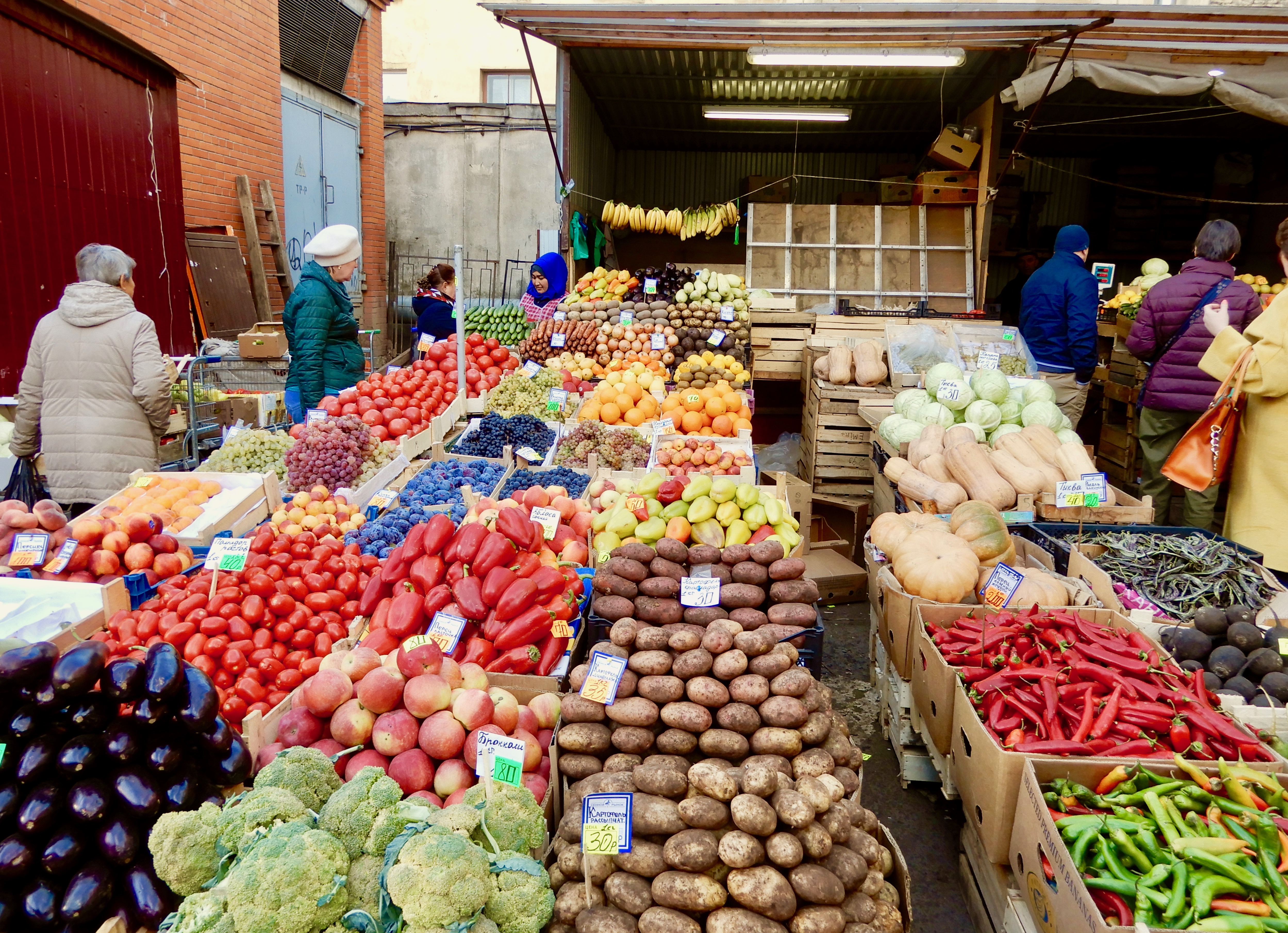
DSCN1832A fruits and vegetables stall at the famous Hay Market (Sennoy rynok) in downtown Petersburg, September 29, 2018. Photo by the Russian Reader

Eating Their Fill: Russia’s Food Security in the Wake of Crimea
Have Russians Eaten Better After the Government Moved to Defend Them from Western Food? 
Yevgeny Karasyuk
Republic
December 6, 2018

Soon after the embargo that was imposed four years ago in response to the stance of western countries on Crimea, analysts warned Russia itself would primarily suffer from food anti-sanctions.

“We won’t heighten the Russian Federation’s food security at all. In fact, we will reduce it,” Natalya Volchkova, a professor at the New Economic School, said at the time.

Of course, the criticism of the experts was ignored. No one in government questioned the policy of forced import substitution. Most Russians even imagined it was a rare instance when the government made a good decision. Only a few years ago, 71% of the populace [sic] spoke in favor of limiting imports.*

Time has passed, and the experts to whom no one listened have compiled figures showing where the policy has taken the country. A recent report, authored by a group of researchers from RANEPA, provides an analysis of its consequences.

Import substitution in the food sector was an obsession and, at the same time, a source of pride for ex-agriculture minister Alexander Tkachov. His replacement, Dmitry Patrushev, son of the Russian Security Council’s secretary and a none-too-successful state banker, has changed little in the government’s take on the situation. The new minister is certain Russia has reached a level of self-sufficiency above 90% in terms of basic food staples. Thus, Alexei Gordeyev, deputy prime minister for agriculture and an ex-agriculture minister himself, is convinced Russia has successfully carried out import substitution.

Food imports actually did slump sharply—by 46%—from 2013 to 2016. Although an unbiased analysis if how Russian producers succeeded in turning the tables and quickly saturating the market with their own products would point to the ruble’s sudden devaluation, rendering foreign imports uncompetitive, as had already happened in recent history, rather than to the success of the anti-sanctions.

Whatever the cause of Russia’s newfound food independence, however, it has not lead to food security. Citing the international standard, the authors of RANEPA’s report define food security as “the physical and economic availability of safe nourishment, sufficient for an active, fulfilling life.” In other words, there really are more domestically grown and produced food items in Russia nowadays, but the bulk of the populace has less and less access to them.

“Caloric Value of the Russian Diet.” The blue line indicates caloric value, while the dotted line indicates the recommended daily caloric intake per family member in kilocalories. The light purple area indicates the number of Russians who suffer from obesity, in thousands of persons, while the shaded dark purple area indicates the number of Russia who suffer from anemia, also in thousands of peoples. Source: Rosstat and RANEPA. Courtesy of Republic
Last year, Russia was ranked forty-first in the Global Food Security Index, compiled by the Economist Intelligence Unit, meaning that it ranked lower than it had in 2013, when it ranked fortieth. This was due, among other things, to insufficient funding of research and a reduction in the variety of food products.

According to official statistics, food accounts for approximately 35% of expenses in Russian household budgets, which is a high proportion when compared with the OECD countries, among which even the highest percentages, achieved by Poland and Mexico, fall short of 25%. Independent evaluation of spending on food, however, claim that the proportion of Russian family budgets spent on food is actually over fifty percent. Given the almost continuous drop in the real incomes of Russians, the selection of products has declined in quality and abundance. On average, Russian households continue to skimp on everything they can do without, as confirmed by the compilers of the Coffee and Milk Index, as published by Romir, a Russian marketing research company. (The index tracks sales of chocolate, coffee, milk, and bottled water.) RANEPA’s researchers noted the discrepancy between the excess fat in the food and bread Russians eat and the low number of calories in their diets.

By closing the borders to imports and showering the domestic agro-industrial complex with generous state subsidies—1.2 trillion rubles [approx. 15.9 billion euros] in the past six years from the federal budget alone—the regime has persuaded itself it has been filling the nation’s bellies and improving its health. Its expectations were exaggerated, however. Oversaturated with cheap carbohydrates, the standard fare eaten by many Russians remains unbalanced and low on energy. “This is borne out by widespread anemia among the populace as a whole and children in particular,” RANEPA’s researchers write. The number of Russians who suffer from obesity has grown for the same reason.

Obviously, these problems cannot be written off as temporary glitches in demand in the domestic food market, whose revival has been unanimously trumpeted by former agriculture ministers and the current agriculture minister. Rather, they are the natural consequence of systemic problems with the natural resources economy that shoulders the burden of the Kremlin’s geopolitical capers. The average Russian family often simply cannot afford a plentiful variety of healthy, high-quality food.

The authors of RANEPA’s report have emphasized this.

“Neglecting this fact can lead to a distorted picture of the state of food security,” they write.

However, there is still very little chance the alarming conclusions of the experts will be heard this time around, forcing the government to make adjustments to its food policy.

* How did they do that? Was a nationwide referendum held? The author, of course, is referring to a so-called public opinion poll in which, at best, a thousand or two “ordinary” Russians were asked loaded questions, to which they gave the “right” answers. {TRR}

__________________________________

Russians Spend 30% of Their Budgets on Food
Georgy Tadtayev
RBC
December 17, 2018

Russians spend nearly a third of their household budgets on food. Russia lags behind Montenegro, Latvia, and Turkey in this sense. Russians spend less than seven percent of their budgets on culture and leisure.

According to RIA Rating, as reported by RIA Novosti, Russians spent 31.2% of their household budgets on food in 2017.

The estimate of the percentage of their household budgets people in forty European countries, Russia, Kazakhstan, and Turkey spend on food was based on information from the IMF and national statistics agencies. Russia ended up in the bottom ten of the ranking, ranking 31st. Its nearest neighbors were Montenegro (29.7%) and Latvia (31.7%).

Ukrainians spend the greatest portion of their household budgets on food: 50.9%. People in Kazakhstan (46%, 39th place) and Moldova (43.4%, 38th place) also spend more than 40% of their budgets on food.

Western European countries topped the rating. Luxembourg came in first place. Residents of the duchy spend a mere 8.7% of their money on food. Close behind Luxembourg were Great Britain (10%) and the Netherlands (10.6%).

The agency also ranked countries according to percentages of income spent on alcohol and cigarettes. Residents of three Balkan countries—Romania (8.2%), Bulgaria (5.1%), and Serbia (4.7%)—spend the most on bad habits. Luxembourg (1.3%), Moldova (1.5%), and Cyprus (1.6%) spend the least on alcohol and cigarettes. Russia ranked 24th: Russians spend 3% of their househould budgets on bad habits.

Sweden was the top-ranked country in terms of spending on culture and leisure: Swedes spend 18.7% of their budgets for these purposes. Moldovans spend the least on leisure and culture: 1.3%. Russia ranked 21st: Russians spend 6.9% of their money in this category.

Translated by the Russian Reader

Banned: The Kremlin’s Empire

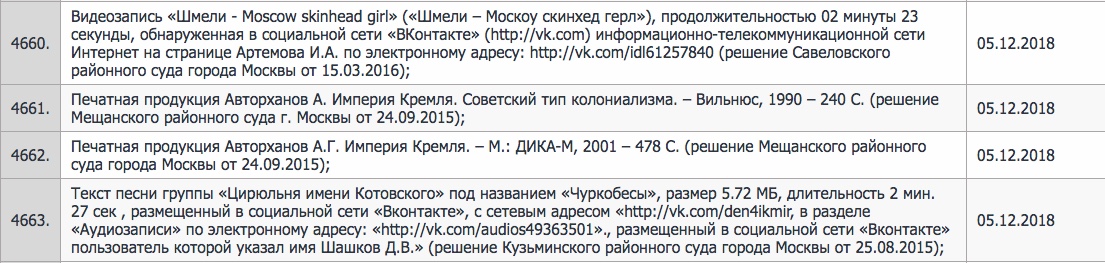
kremlin's empire.jpegA screenshot of the section of the Russian Justice Ministry’s list of “extremist” matter containing two editions of Abdurakhman Avtorkhanov’s The Kremlin’s Empire: The Soviet Style of Colonialism. They are wedged between a video entitled “Bumblebees: Moscow Skinhead Girl,” and the lyrics to a song entitled “Wog Devils” by the group Kotovsky Barbershop, each of them posted on personal pages on the Russian social media network VK. 

Avtorkhanov’s Kremlin’s Empire Ruled Extremist
Grani.ru
December 15, 2018

Two editions of The Kremlin’s Empire: The Soviet Style of Colonialism by Abdurakhman Avtorkhanov, a Chechen émigré historian of the Soviet Union, have been placed on the list of “extremist” matter, as published on the Russian Justice Ministry’s website. The SOVA Center reported the news on Friday.

The first edition of Avtorkhanov’s book was published in the Bavarian town of Garmisch-Partenkirchen in 1988. The first Soviet edition of the book was published in Vilnius in 1990. In 2001, Moscow publisher Dika-M reprinted the book, dropping the subtitle The Soviet Style of Colonialism. The Vilnius and Moscow editions were placed on the list of “extremist” matter on December 5, registered under No. 4661 and No. 4662, respectively.

Avtorkhanov’s book was placed on the list due to a ruling made over three years ago by the Meshchansky District Court in Moscow. On the court’s old website, which is no longer updated, there is a record of ten administrative suits filed by Yevgeny Novikov, who was the Meshchansky Inter-District Prosecutor at the time. Judge Maria Kudryavtseva ruled in Novikov’s favor on September 24, 2015. The Justice Ministry and the Library of Ukrainian Literature in Moscow were third parties in each of the proceedings.

Along with Avtorkhanov’s book, the Justice Ministry also placed a number of books in Ukrainian on the list of “extremist” matter on December 5, books that had also been banned by order of the Meshchansky District Court on September 24, 2015. This could mean Avtorkhanov’s book was confiscated during one of the numerous police searches carried out at the Library of Ukrainian Literature.

Grani.ru was unable to locate the decision to ban the editions of Avtorkhanov’s book in open sources.

“Perhaps the complaint against the book had to do with Avtorkhanov’s interpretation of the Molotov-Ribbentrop Pact or the history of the Bandera movement, which the prosecutor and the court construed as dissemination of falsehoods about the Soviet Union during the war,” SOVA Center wrote in its article. “However, evidence that Russian Federal Criminal Code Article 354.1 [exoneration of Nazism – Grani.ru] may have been violated cannot serve as formal grounds for ruling an item extremist.”

In his youth, Avtorkhanov (1908–1997) was a Bolshevik Party functionary in Chechnya. He was arrested and tortured in 1937. In 1940, he was exonerated. After his acquittal was reversed, he fled from Grozny into the mountains, but was soon captured. In October 1941, he was sentenced to three years in prison. He was released in April 1942. Lavrenty Beria tasked Avtorkhanov with assassinating his childhood friend Hasan Israilov (1910–1944), who in 1940 led an armed revolt against the Soviet regime in Chechnya. Avtorkhanov secretly contacted Israilov and gave him the memorandum “A Provisional Popular Revolutionary Government of Chechnya-Ingushetia,” which he had drafted for the German government.

In the summer of 1942, during the German offensive in the Caucasus, Avtorkhanov crossed the frontline, presenting the Germans with the memorandum, and offering to a write a series of pamphlets about anti-Soviet uprisings in the region. In January 1943 he moved to Berlin, where he was involved in the North Caucasus National Committee. He lived in a displaced persons camp from 1945 to 1948, subsequently settling in Munich.

In 1949, Avtorkhanov was appointed a lecturer at the US Army Russian Institute in Garmisch and Regensburg. In 1955, US counterintelligence foiled an assassination attempt on Avtorkhanov’s life. He retired in 1979. During the 1990s, he supported Chechen independence.

Avtorkhanov’s other books include The Technology of Power (1959), The Origin of the Partocracy (1973), The Mystery of Stalin’s Death (1981), From Andropov to Gorbachev (1986), and Lenin in the Destinies of Russia (1990). The Technology of Power was widely distributed in samizdat in the Soviet Union. Reading and possessing the book was a criminal offense.

Thanks to EZ for the heads-up. Translated by the Russian Reader

Give Me Your Datasets!

December 10, 2018

Hi,

I am trying to collect a richer database of all the large protests that have occurred in Russia since 1/1/17, and where they have occurred in space and time.

Our research is to determine the significance of cultural landmarks and locations for protests.

For example, we know 4 large protests occurred on the following day and locations (and we are trying to pin point the approximate time):

datasetBut we would love 100s more records.

By the looks of the attached white paper [there was no “white paper” attached], and the below links, CEPR has tracked over 2,500 protest locations.  I would love to work with the CEPR team doing this research, collaborating in any way we can.

http://cepr.su/category/monitoring-protests/

https://themoscowtimes.com/news/number-protests-russia-spikes-in-2018-researchers-say-63428

“With less than two months to go before the end of 2018, CEPR researchers said they have already recorded over 2,500 protests this year compared to under 1,500 nationwide last year, according to the report published Thursday.”

Thanks,

Mark

______________________

December 10, 2018

Mark,

You introduced yourself in no way, shape or form, and I’m not sure what it is that you’re asking me to do. I’m not an information clearinghouse.

I edit, translate, and write a blog called the Russian Reader, which is not affiliated in any way with the Center for Economic and Political Reform, although I have translated several articles by the center’s director, Nikolay Mironov, over the years.

If you would like to work with the CERP, you would have to send them a letter or call them. Their contact information is clearly indicated on their website.

http://cepr.su/about/

Контакты ЦЭПР:
E-mail: ceprsu@yandex.ruceprsu@gmail.com
Пресс-служба: +7 916 629 5609

If you don’t speak Russian, I would encourage you to learn it before doing research on Russia.
Yours,

The Russian Reader

______________________

December 11, 2018

Dear Russian Reader,

You sound angry. I think what I was asking for was pretty straightforward, and I don’t need to know Russian for what I am looking for.

I am looking for a dataset of protest locations in space and time, which is just simple math.

Have a nice 2019 and thanks for the tip on CERP.

Mark

______________________

And you are obtuse.

You just want a dataset. It’s simple math.

Where did I indicate on my site that I was in the business of handing out datasets I don’t have to people who don’t introduce themselves?

What you were asking for was not straightforward, and you were asking the wrong person.

People who don’t know Russia or Russian probably shouldn’t attempt to do research on it. Because you could have the most precise dataset on Russian protests possible, but it wouldn’t tell you anything about Russia or Russians.

Just as you failed to tell me anything about yourself or why you need this dataset.

______________________

From: Mark
7:18 AM (15 minutes ago)

Whatever.

Sent from Mobile Phone

Crimea and Gays Be Damned (For the Record)

DSCN3271

This morning, I came across a flat-out lie (or an honest mistake), penned by a professor at one of the most august universities in the United States. But you would only know it was a lie or a mistake if you had been here in Petersburg to see what actually happened at Manifesta 10, and had some basic street smarts when it comes to the art scene and real grassroots politics here.

This partly explains why, for example, there is virtually no anti-war movement in Russia: because too many people whose avowed politics should make them natural leaders and organizers of a Russian anti-war movement (i.e., a movement against Russian imperialist military aggression, not a choir of angels hovering above all frays everywhere and quietly chiding “all parties to the conflict” on social media) have been more concerned to make the right impression on the right people in the big white world.

This is not to mention that virtually no one in the so-called Russian leftist art/activist community, especially in Petersburg, made even so much as a peep when the St. Petersburg Legislative Assembly and, later, the State Duma passed the infamous homophobic laws, which are still safely and shamefully on the books in Russia.

I really don’t understand how, thirty or forty years from now, scholars and merely curious people will be able to get to the bottom of anything that happened in our time with so much abject propaganda camouflaged as journalism and “research” lying around everywhere.

“After the annexation of Crimea and the passing of a number of restrictive laws in Russia (not least the banning of so-called ‘homosexual propaganda’), it seemed macabre to many that the avowedly progressive European Biennale should take place in the State Hermitage museum as planned. The collective Chto Delat?, who were slated to participate in the biennale, wrote an open letter to star curator Kasper König, demanding that Manifesta 10 issue a public statement against the recent action of the Russian government. When their calls went unmet (aside from prompting critique of direct politicization in contemporary art) Chto Delat? and a number of Russian and Polish artists withdrew from the show.”

No Russian artists withdrew from the show whatsoever. That is a fact. Some local artists loudly withdrew from one part of Manifesta only to pop up quite prominently in another part of Manifesta. These same people mocked any “Polish artists” (?) who might have actually withdrawn from the show. They definitely attacked anyone outside Russia who called for an international boycott of the show. For literally all the Petersburg artists and curators involved, the show absolutely had to go on, Crimea and gays be damned. {TRR}

Photo by the Russian Reader

How to Become a “Russian Expert” on Facebook in a Matter of Weeks!

paintingSaints Cyrill and Methodius Church on Ligovsky Avenue in Petersburg, as seen from the end of Tyushin Street, 27 October 2018. Photo by the Russian Reader

How do you become a “Russia expert” on Facebook in a matter of weeks?

Method No. 1: Claim “the Russians” are behind literally everything untoward that happens in the world, from attempted piped bombings in the United States to typhoons in the South Pacific.

How does this method work?

It’s easy!

First, never provide any hard evidence of this alleged “Russian” influence. Refer vaguely but insistently to allegedly irrefutable research—done by someone else, of course—on how social networks can be used to disseminate fake news and crackpot theories.

Second, don’t learn Russian or spend any time in Russia.

In fact, it helps a lot if you know as little as possible about Russians and Russia, because knowing something would needlessly complicate your ambition to have yourself deemed a “Russia expert” on Facebook.

Finally and most important, if someone calls you on the carpet for your glaring lack of evidence and knowledge, and the spurious logic of your arguments, accuse the person of being “rude and aggressive” and immediately unfriend them. You can’t afford to have someone who actually knows something about Russia and Russians or can even just ask a decent question that throws a less than glowing light on your dicey arguments and made-up facts hanging round bothering you and your devoted virtual fans, for you have a higher calling.

You’re a “Russia expert”! {TRR}

Leonid Volkov: The Export Pozner

pozner-yale-1.jpgVladimir Pozner at Yale University on September 27, 2018. Photo by Peter Cunningham. Courtesy of YaleNews

Leonid Volkov
Facebook
September 28, 2018

Yale has an incredibly rich extracurricular life. Every evening is chockablock with special events, public lectures, round tables, debates, and so on. Many politicians and public figures consider it an honor to speak at Yale. Today, for example, the president of Ghana is going to be lecturing, and there is nothing exotic about it.

All these events fight for an audience. They are advertised in a variety of mailings, and the bulletin boards on campus are densely crammed with flyers.

I imagine the president of Ghana will be sad today. He was beaten this evening [September 27]. The prettiest flyers, which have been on the bulletin boards since mid-August, announced a lecture provocatively entitled “How the United States Created Vladimir Putin.”

I had never seen such a popular event here. It was standing room only. Audience members (students, professors, researchers, etc.) sat on the steps of the lecture hall and stood in the aisles. There were around three hundred people. And no, I could not resist my curiosity, either. I was really interested in how Channel One operated when it was exported.

On stage was the ageless Vladimir Pozner. Would that everyone looked like that at eighty-four! His speech and manners were flawless. His manner of interacting with the audience was impeccable. He joked when it was appropriate and answered questions quickly. He was a professional of the highest class.

[These were Pozner’s talking points.]

  • Putin extended a helping hand after 9/11, but it was rejected.
  • The first proposal Putin made when he was elected to the presidency in 2000 was that Russia should join NATO. He was mortally offended by NATO’s rejection of his offer.
  • He fully voiced this resentment in his 2007 Munich speech, and the resentment was justified.
  • The western media have portrayed Putin in a negative light, all but comparing him with Hitler. This treatment has been wholly undeserved.
  • By offending and attacking Putin, they naturally angered him and made him what he is. The media are to blame for this (sic).

Did Russia meddle in the 2016 US presidential election?

[Pozner’s response was that] the Russian regime cheered for Trump, naturally, because Hillary Clinton had said so many bad things about Putin, but Pozner had seen no proof of meddling. Besides, had America not meddled in elections the world over?

And so it went.

Moreover, [the tone of the Pozner’s speech was captured] in the very first words [out of Pozner’s mouth].

“First of all, believe me when I say I am not representing anyone here. I speak here as an independent journalist, a breed that has nearly died off in Russia.”

Oh, while I was writing all this down, there was a question about Crimea. [Pozner’s response can be paraphrased as follows.]

Was international law violated? Yes, it was, but Sevastopol is a city populated by Russian naval officers and sailors. How could Russia have allowed the possibility of losing its naval base there and having it replaced by a NATO base, by the US Sixth Fleet? Should international law not be disregarded in such circumstances? Besides, Crimea has always been part of Russia.

Finally, [Pozner told his listeners, they] would understand better what had happened in Crimea if [they] imagined what would happen if a revolution occurred in Mexico (sic). In this case, would the US not want to deploy several army divisions on its southern border?

Yes, a new referendum should probably be held in Crimea, but [Pozner] was absolutely certain of the referendum’s outcome.

Argh!

Pozner equated Putin and Russia, of course, in all his remarks.

“It was clear the Russians had to respond in a certain way,” he would say in reference to actions taken by Putin.

In short, my friends, I was impressed. The export Pozner is nothing at all like the Pozner served up for domestic consumption in Russia. (I hope he is very well paid.)

But despite his best efforts, Pozner portrayed Putin as a rather pitiful man: insecure, petty, and vindictive. In this sense, of course, Pozner did not lie.

Leonid Volkov has been attacked on his own Facebook page by readers and Mr. Pozner himself on the latter’s website for his allegedly inaccurate portrait of Mr. Pozner’s appearance at Yale. Stories about the evening published on Yale University’s in-house organ YaleNews and the university’s student-run newpaper the Yale Daily News, however, substantially corroborate Mr. Volkov’s sketch of the event. His description of Pozner and his talk also jibe with my own sense of Mr. Pozner as a chameleon who skillfully tailors his messages to his audiences and the times. Or was it not Mr. Pozner who routinely appeared on my favorite news program, ABC’s Nightline, when I was a teenager in the early 1980s, to defend the moribund Soviet regime with a completely straight face? Read “In the Breast of Mother Russia Speaks a Kind and Loving Heart” for an account of a similiarly virtuoso agitprop performance by Mr. Pozner in the US nearly four years ago. {TRR}

Translated by the Russian Reader

A Funny Thing Happened in Pryamukhino

Bakunin_PryamukhinoThe Pryamukhino Estate, birthplace of Mikhail Bakunin, circa 1860. Photograph courtesy of Wikimedia Commons

Mala Vida
Facebook
July 20, 2018

On the Police Raid in Pryamukhino

The Pryamukhino Readings, an annual open conference, took place on July 7–8, 2018. This year, the conference attracted the notice of Russian law enforcement. Since the conference has taken place in a village school for the last eighteen years, the Pryamukhino village council and the Kuvshinovo district council were informed in advance about the conference, but they made no attempt to prohibit the event.

However, as the conference’s organizing committee later learned, police officers had visited the village council on July 6, 2018, on the eve of the conference’s opening day.

Several men in plain clothes, who showede all the signs of being law enforcement officers, attended the first day of the conference, July 7. They chatted with conference goers about abstract historical and philosophical topics, but they also wondered aloud whether there were any “terrorists” in modern Russia.

On the second day, July 8, two police cars and a car without license plates arrived at the gathering point right when the annual sightseeing excursion of Pryamukhino Estate and Pryamukhino Park was to begin. Eight policemen, including members of the Torzhok Intermunicipal Police Precinct, members of the precinct’s immigration desk, and plainclothes officers who produced no IDs (they were probably officers of Center “E” or the FSB) checked and photographed the passports of the sightseers. According to the police officers, a public nuisance complaint from an unnamed local resident was the grounds for their visit.

As a consequence of the documents check, a conference goer, Artyom Markin, a Belarusian national, was detained. He was informed he was “banned” from entering Russia, a fact that had not been brought to his attention either when he crossed the Russian border or when police checked his papers.

Markin was taken to the Torzhok Intermunicipal Police Precinct. He refused to communicate with secret service officers, since no written charges had been filed against him. He was then taken for a medical examination, because the police, allegedly, suspected him of having used psychoactive substances. After Markin refused to take the medical exam (i.e., his alleged drug use was not certified by physicians), and despite the fact that he had not shown any signs of drug use (conference goers testifed Markin had not used psychoactive substances and did not look out of the ordinary), a magistrate declared him guilty of evading medical diagnosis (Russian Administrative Offenses Code Article 6.9 Part 1) and sentenced him to three days in jail.

At the same time, on the afternoon of July 8, two of the plainclothes officers returned to Pryamuhino, explaining they had come again because, allegedly, they were looking for Markin’s girlfriend. Their presence and the need to protect conference goers from the illegal actions of the authorities generated considerable difficulties when it came to proceeding with the conference. The plainclothes officers left for Torzhok only after four in the afternoon.

After spending three days in jail, Artyom Markin was forced to leave Russia. He was issued a notification from the immigration desk of the Torzhok Intermunicipal Police Precinct prohibiting him from entering Russia until 2022.

We believe that recent events in Belarus (e.g., police roughly detained local anarchists on June 30, 2018, during a gathering in the woods), a possible call from Belarusian law enforcement and security services to their Russian counterparts, and heightened security during the 2018 FIFA World Cup in Russia occasioned such furious actions on the part of the police. The ban on entering Russia, as issued to Artyom Markin, was justified, allegedly, in order to ensure “defense, national security or public order,” as stipulated by Article 27 of Russian Federal Law No. 114 (“On the Procedure for Departing and Entering Russia”), which outlines amendments to the law introduced during international sporting events.

Because the Pryamukhino Readings are an academic conference open to all comers, the organizers make an effort to get to know all of our attendees in order to ensure order and their own safety. However, we do not have the resources to prevent the use of force on the part of the police and curiosity on the part of the authorities.

The Pryamukhino Readings are an annual event run by volunteers. We do not cooperate with the authorities any more than is necessary for holding the conference. We have never supplied the authorities with personal information about our attendees or any additional information about them.

In the event of conflicts like the one described, above, our job is taking care of our out-of-town guests. However, we do not have the resources to provide qualified legal assistance on the spot.

We urge everyone to study the current Russian laws in order to better defend their rights when confronted by law enforcement officers, who often interpret the laws governing their own conduct too freely or falsely.

The Pryamukhino Readings Organizing Committee condemns crackdowns on social movements and independent public events, as well as the framing of social activists and the arbitrary use of administrative and other penalties in the absence of evidence and a demonstrable danger to the public.

The Pryamuhkino Readings Organizing Committee

Translated by the Russian Reader

_____________________________________

Anarchists Go on a Pilgrimage to Tver
Yulia Solovyova
Moscow Times
August 15, 2003

PRYAMUKHINO, Tver Region — Pavel Glazkov is fed up with people who hear the word anarchy and instantly conjure up thoughts of debauched sailors wreaking havoc and chaos.

Anarchism is a moral thing above all, Glazkov says, and it hinges on order, self-discipline and mutual assistance.

A graduate student from Tambov, Glazkov is in the process of writing a thesis on Mikhail Bakunin, the 19th-century philosopher whose ideas laid the foundation for modern anarchism. And he is active in spreading the gospel of anarchy. Glazkov posts leaflets at his university urging students to take action. At a children’s summer camp where he works as an educator, he tells children stories about anarchism before bedtime. The Tambov bar where he once worked as a bartender turned into a sort of a revolutionary circle full of conversation and debate, not unlike one of Bakunin’s many secret societies.

“I’m trying to educate people,” says Glazkov, 24, a gentle giant who wears black-rimmed glasses and two earrings in his left ear. “When I was a kid with an anarchy badge on my chest listening to the Sex Pistols no one told me what I was supposed to do as an anarchist.”

Late last month, Glazkov traveled 10 hours by train and bus to Pryamukhino, the Bakunin family estate in the Tver region, in search of like-minded people. What he found was an improbable mix: white-bearded intellectuals studying the Russian gentry culture alongside pierced and tattooed 20-somethings in black T-shirts and ragged jeans who were doing little more than frolicking in nature away from their parents’ control.

Glazkov spent a weekend in Pryamukhino. He took part in a scientific conference and civic duties like picking up trash in a park. At night he listened to romances—lyrical, sentimental songs—and drank vodka with the academics. Then it was time for a drunken rendition of the “Mother Anarchy” song by the kids, who described themselves as anarcho-communists, Marxists, Maoists, hippies and anti-fascist skinheads.

“It was great,” Glazkov enthused. “I met young people who are into ideas, and they don’t just stick to some stiff, outdated beliefs, but take them further.”

The Pryamukhino Free Co-Op was created in 1995, when a group of students from Moscow decided that Bakunin’s birthplace, which was formally protected by the state, actually needed protection from the state. Since then, a few dozen anarchists from central Russia and, occasionally, from abroad, have come here every summer to work in the park, scandalize the locals by skinny-dipping in the creek and debate anarchism around the campfire. They live in a cramped log house with a black anarchy flag flying from the roof and a sign over the door that reads, “Work is the best hangover treatment.”

The anarchist movement can encompass certain elements of other ideologies, such as Maoism and communism, while rejecting those components relating to authoritarian political control. The anarchist movement is not uniform, but this doesn’t appear to present a problem.

“What’s important is the rejection of the state, hierarchy, clericalism, dominance, all dogmas, everything that’s dead and rotten,” said Vasily Prytkov, who helped organize this summer’s co-op. “People who come here share these ideals.

Pryamukhino’s mixed appeal is the result of its rich heritage. In the 19th century, this traditional nobles’ nest was a nationwide cultural magnet. Bakunin’s parents and ten siblings were well-educated people known for their various talents, bon vivant habits and a taste for sophisticated company. Leading lights of the times, such as literary critic Vissarion Belinsky, novelists Ivan Turgenev and Leo Tolstoi, and thinker Nikolai Stankevich, walked among the exotic plants that grew in the estate’s sumptuous park.

All in all, the Pryamukhino harmony, as the contemporaries described life on the estate, shared little of the rebellious spirit of its most famous resident—the man who was all passion and bustle and pure will, the prototype of Richard Wagner’s Siegfried and the very model of a thunderbolt-hurling revolutionary.

Bakunin believed that the state and capitalism are evil and must be destroyed. He fought for a society based upon justice, equality and freedom. Being more of a doer than a writer, he threw himself into the insurrections that burst across Europe like thunderstorms in his day. Bakunin is often contrasted with Karl Marx, and credited with forecasting the inevitable connection between state communism and the Gulag.

Bakunin’s prophecies came true in the Soviet Union, and although streets across the country were named after him, his legacy was forgotten or distorted, and anarchy became almost a swearword. Similarly, his family’s country estate was plundered and destroyed. The great park, with fish ponds, artificial waterfalls and hills, became neglected and overgrown.

Today, Bakunin’s followers include the ragtag members of the international New Left movement, who share the values of anti-globalism, pacifism, environmentalism and human rights. In Russia, they are few and have little formal organization, with few exceptions, including the groups Avtonomnoye Deistviye, or Autonomous Action, and the Russian branch of the Rainbow Keepers, a radical eco-anarchist group.

“Collective social activity is much more important than setting up formal organizations,” said Mikhail, 31, one of the founders of the Pryamukhino Free Co-Op, who asked that his last name not to be used. “In Russia, people don’t have faith left in collective action and social change. But it’s necessary to keep trying.”

The anarchists occasionally participate in joint actions and social protests like the annual anti-capitalism rally in Moscow. Otherwise they are largely invisible on Russia’s political landscape.

On a recent Sunday morning, a group of anarchists, looking slightly woozy from the night before, trickled into a garden. While some camp goers are serious about anarchism, others are clearly there for the lifestyle that the relaxed environment provides, especially given the fact that the Bakunin Foundation covers all transportation and food costs.

The anarchists settled on the grass among flowers and buzzing bees, where they conducted a meeting concerning the areas of the camp that needed the most work. Soon, armed with a variety of garden tools, they began trimming plants in the park and cleaning up a pond under the supervision of Sergei Kornilov.

Kornilov is a director of the Bakunin Foundation, which was created to promote the legacy of the Bakunin family and restore the estate. A former theater director who says he was too brainwashed to care about anarchism in Soviet times, Kornilov, 65, has dedicated his life to the Pryamukhino estate since he moved there from Moscow in 1998.

A tanned and energetic man who looks like a 19th-century aristocrat, Kornilov mapped out Pryamukhino’s future as an artist would. Tourists were to stay in the recreated interiors of the Bakunin house, and church services, grand balls and theater plays would be staged in the vaulted basement of the remaining south wing of the estate.

“I looked up plays about Mikhail Bakunin, and there weren’t any,” Kornilov said. “So I decided to write one myself.” Kornilov has written a trilogy of plays about Bakunin.

Meanwhile, Glazkov, the Bakunin scholar from Tambov, wrestles with applying his ideas to contemporary realities.

“Go tell a Muscovite whose relative was killed in a terrorist act that Russia needs anarchism and they’ll tell you, ‘What are you, crazy?'” he said. “People are tired of terrorism, Marxism, and other isms. What they want is stability and strong leadership.”