The New Serfs

kozyrev-muscovitesPhoto by Yuri Kozyrev for the project Muscovites. Courtesy of Novaya Gazeta

The New Serfs
On July 9, Millions of Migrant Workers and Foreign Students Will Be Stripped of the Right to Freedom of Movement in Russia in a Single Bound. What Has Happened?
Vyacheslav Polovinko and Tatyana Vasilchuk
Novaya Gazeta
July 6, 2018

On June 28, Vladimir Putin signed Federal Law No. 163-FZ, which clarifies the guidelines for immigration registration in Russia. According to the amended law, such notions as a foreign national’s place of residence and the party hosting the foreign national have been defined more precisely. The majority of media outlets have described the new law as making the lives of migrant workers less burdensome, since the new law says foreign workers can be registered as dwelling in construction site trailers. This has provoked grumbling among “tolerant” Russians, who have complained migrant workers will arrive in even greater numbers and occupy all the country’s trailers.

In fact, the situation is quite different. The new rules are a blow to all law-abiding migrant workers and nearly all foreign students. Any legal entity that attempts to hire foreign nationals to work or study in Russia could find itself in violation of the law.

Even people who have all the papers and permissions for staying in Russia could be deemed lawbreakers.

The July Eighth Law
When a foreign national arrives in Russia, she is obliged to present herself to the immigration authorities and register her place of residence. However, she cannot register herself: the people or entities who invited her are obliged to do this. If she has come on a private visit, this would be the owner of the flat she has rented or the hotel where she is staying. If she has come to Russia to study, the university where she will be studying is obliged to register her. If she has come to Russia to work, the company in which she is employed must register her. (The last instance is more flexible, because her company is obliged to register her with the immigration authorities, but they may or may not register her place of residence as they wish, apparently.) Private landlords are a separate topic, but legal entities would take the easy way out. The law used to permit them to register the university or the company’s main address as a student’s or employee’s domicile. However, the foreign national could actually live somewhere else. It was understood, however, that if the police or other competent authorities were looking for her, they could do so at the address where she was officially registered.

The old system had its advantages and its shortcomings.

“There are companies that have five or six thousand foreign nationals on staff. It is convenient for them to register people at their business address to oversee whether their employees are paying for work permits and extending their residence permits on time,” says migration expert Svetlana Salamova.

The other side of the coin has to do with the poor living conditions of some foreign workers. This is most often the case among migrant workers from Central Asia.

“Employers would sometimes accommodate fifteen people at a time in trailers, in which the living conditions were rough. Besides, finding people via their legally registered domicile was often quite complicated,” explains human rights defender Andrei Babushkin.

To solve these problems, the definitions of key notions in the immigration laws have been amended. Actually, however the circumstances of migrant workers and their Russian employers have been considerably worsened, not improved. The amendments signed into law on June 28 stipulate that the place where the foreign national stays cannot be a normal domicile, but it can be other premises where the foreign national or stateless person actually resides, i.e., regularly uses for sleep and relaxation. If she is registered by a Russian organization, the foreigner must live for all intents and purposes in premises belonging to the organization. However, the premises must be equipped as a dwelling space.

In other words, if a foreign worker wants her company to register her with the authorities, she is obliged to reside full time in the company’s living accommodations.

The catch is that most legal entities simply do not having living accommodations. Construction companies will have the easiest time of it. They will now actually be able to register workers as legally residing in trailers and makeshift barracks at construction sites. All other companies have nowhere to accommodate their employees from other countries. A sofa and a microwave are not sufficient conditions for turning a room into a legal residence.

“Legally speaking, a domicile is a place that has been registered as such,” says Salamova. “An office with a sofa in it is not a domicile, but if your company lets you keep your suitcases there and install a stove and refrigerator, theoretically you could be registered as dwelling there. In this case, however, the employee from the personnel department who registers you with the Russian Interior Ministry [i.e., the police] will have to supply the immigration authorities with paperwork showing the room has been registered as a domicile.”

Will Russian companies be willing to turn their offices into bedrooms? The answer is obviously no.

Large auditing and consulting agencies, a field in which many foreign nationals are employed in Russia (not only expatriates but also graduates of Russian universities who are nationals of the former Soviet republics) have started to warn their employees about the need to look for a place where they can be registered as residing. Victoria Plotinskaya, marketing and public relations director at AT Consulting, told us that foreign employees at her company must register at their actual addresses before July 9. Previously, AT Consulting registered them at its business address, but now it is willing to provide them with legal assistance. Plotinskaya assumes their employees will have no difficulties, since registering oneself as residing in a rented flat is not a problem,  she claims.

We, however, have learned that several employees of major companies have been thinking about quitting their jobs or transferring to their home countries because their landlords have no intention of registering them.

“Companies will lose the ability to keep track of the immigration registration of their foreign national employees, while  foreign nationals who live in rented flats will have to negotiate with their landlords about registering them,” says Roman Gusev, director of Ernst & Young’s taxation and legal services department. The company does not plan to lay off any employees.

“In practice,” Gusev continues, “we see that many landlords refuse to deal with this procedure, because they don’t want the added administrative burden. In such cases, foreign nationals will have to urgently look for new accommodations. On the other hand, landlords who agree to meet the new requirements will have to keep close watch over their foreign tenants’ arrivals in the Russian Federation, since they have to be registered with immigration authorities after each such arrival.

“There are also risks for conscientious landlords. If their foreign national tenants arrive in the Russian Federation and fail to inform them, the landlords will be breaking the law without knowing it. On the other hand, foreign nationals could also find themselves in a pickle if their landlords suddenly refuse to register them with the immigration authorities or are simply unable to do what the law requires of them because they happen to be out of town,” concludes Gusev.

Unfortunately, the new rules are also retroactive, apparently, meaning everyone who is registered as residing at a business beyond July 8 will be in violation of the law come this Monday—unless, of course, they are unable to swiftly persuade their landlords to register them. In this case, however, no one can vouch that landlord will supply this service for free. Rental agreements presume that landlords pay taxes on the rent they charge. Verbal agreements to rent someone a flat and register them while not paying taxes could lead to a rise in the price of flats let to foreign nationals in Russia.

Formally, nothing has been said about the retroactive force of the amendments to the law, as signed by Putin. However, human rights activists have already been getting reports of attempts to deport migrant workers for dwelling in places where they are not registered to reside. In fact, the Interior Ministry already has the power to deport a non-Russian national if an inspector discovers him somewhere other than his registered domicile, say, at another flat in the evening.

This was what happened to Uzbek nationals in Omsk Region, says human rights activist Valentina Chupik. The Uzbeks went to a immigration center with registration papers obtained from a middleman, and they were sent off to be deported, allegedly because they did not live at their registered domicile.

In other words, under the new law, migrant workers no longer have the right to spend the night somewhere other than their legally registered, actual residence.

Under Article 54 of the Russian Constitution, laws cannot be applied retroactively. This was underscored by the specialists at Alliance Legal Migration, a firm based in Petersburg. In theory, then, all registrations issued before July 8 should be valid for their full terms. This can be proven only in court, however. Yet Russian courts rarely side with migrant workers.

Dormitory Hostages
Foreign nationals employed by Russian companies are only half of the problem. If push comes to shove, they can pay landlords extra money to register them. All foreign students in Russia are now at risk as well. Previously, universities would register their main buildings as the legal domiciles of their foreign students, but now they will be obliged to register all of them in university dormitories. However, the number of rooms in the dorms does not match the number of foreign students, and out-of-town Russian students have to live in dorms as well. Besides, there are students who do not want to live in dorms and can rent flats, students who have children, for example. Previously, they could count on their universities registering them, but now they will have to take care of their own registration.

The new law also applies to students who left for summer holidays not knowing they would return to Russia in the autumn on new terms. In addition, students who are registered in dorms are virtually their hostages.

Any violation of university regulations or, for example, attendance at an opposition rally gives university deans the chance to opportunity to revoke the registration of “troublesome” foreign students, which automatically means they are in violation of immigration laws and can be deported. Considering the fact that many international students have never experienced serfdom, they behave like free women and men. Their freedom will now be harshly restricted by the hours when the dorm’s main entrance closes.

Universities themselves seemingly have not yet figured out yet what they are going to do. The new rules have been a big surprise to most of them. The main issue they face is how they will now enroll international students if registering all of them legally has become impossible.

The Peoples’ Friendship University of Russia (RUDN) refused to comment on the amended rules. We were told by a spokesperson at the Higher School of Economics (HSE) that they were in the process of working out a way of dealing with the new rules. However, we have in our possession correspondence between students and the HSE’s immigration department, who categorically informed the students they could be registered only at their actual places of residence.

At Moscow State University (MGU), we were told, “The issues of timely migration registration and visa extensions for foreign students residing in rented flats is currently being examined by university management in order to find the optimal solution.”

“The university has not contemplated any limitations to enrolling foreign students due to the adoption of Federal Law No. 163-FZ, dated June 27, 2018,” a MGU spokesperson added.

Other universities failed to respond to our inquiries before this issue of the newspaper was sent to the presses.

“If a university does not have a dormitory or does not have enough room in its dormitories, students can ask for a written request from the university to landlords, asking them to register the students at their actual domiciles. And then the landlords can register them if they want to do so,” explains Salamova.

Closely Watched Flats
You should not imagine that all of the above is a headache for foreigners, but has nothing to do with you.

According to the new rules, Russian nationals who let flats to foreign nationals are automatically regarded as “hosts,” meaning they are obliged to register them as residing in their dwellings and are responsible for them.

“There will also be increased check-ups and fines in the case of noncompliance with the laws for people who let flats to foreigners,” predicts Salamova.

In all fairness, such fines also existed earlier, but they were almost never issued. We have been informed that as soon as the World Cup ends, the police will make an extra effort to inspect all residential buildings and search for unregistered foreigners living in them.

Moreover, Russians are currently responsible for foreign nationals, even if they have left the country but their immigration registration is still valid. A law bill, sponsored by Irina Yarovaya and on the verge of its second reading, has been tabled in the State Duma. If passed, it would make it possible to remove foreigners from the immigration registry instantly and on one’s own via the web. This means landlords would also be able to remove tenants from the registry whenever they wanted, claiming, for example, that they had lost touch with the migrant workers in question. Foreign tenants would thus be subject to the whims of landlords, who could raise their rent at the drop of a hat, threatening to remove them from the immigration registry if they failed to pay. Besides, if a migrant worker does not live in the flat where she is officially registered, she can find herself without papers at any minute because, according to yet another amendment, she can be stricken from the rolls as residing in a particular flat without her knowledge. This means that beat cops can stop her on the street and automatically fine and deport her.

In mid June, the State Duma approved yet another law bill in its second reading. If passed, it would make organizations that invite foreigners to Russia wholly responsible for their actions. For example, if a foreign national works somewhere else than the organization that invited him or “is up to no good,” as MP Viktor Karamyshev has put it, the authorities will pay a call to the foreigner’s primary host organization. In addition, companies would have to make sure that when an employment contract ends, the migrant worker leaves the country instantly. Otherwise, the companies would be fined.

At the same time, the State Duma approved a new list of fines for noncompliance with all these rules on the part of organizations and ordinary Russians.

Under the new regulations in the Administrative Offenses Code, individuals will pay fines of up to 4,000 rubles for violations involving migrant workers, while officials will pays up to 50,000 rubles, and legal entities will pay up to 500,000 rubles [approx. 6,700 euros].

Beneficiaries  
By and large, the batch of laws that have been adopted or are still under consideration (the Interior Ministry, for example, has launched an expert group to draft a Migration Code) should at least be sent back to the relevant committee for revision, since, as Babushkin says, “The harm they do outweighs the good.” But the way the new rules have been drafted and adopted behind the scenes—they did not warrant a single public hearing nor, as far we have ascertained, did their authors consult with independent migration lawyers—suggests their oppressiveness is advantageous as they currently stand.

Who stands to gain, however? MP Irina Yarovaya, for example, argues that certain changes, such as the ability to remove migrant workers from the registration rolls on one’s own, are in the interests of ordinary Russians. She states her case in a clarification to the law bill that the MP’s aides sent to us in reply to a request for comments. On the contrary, human rights activists argue the Interior Ministry, which now has complete oversight over immigration, has received yet another tool for extorting bribes. Any migrant worker can be stopped on the street by the police and threatened with deportation: he will find it easier to pay them off. Any landlord can be intimidated with fines.

The threat of deportation is a convenient tool for dealing with troublesome individuals.

Our newspaper published the story of Gulchekhra Aliyeva and her family. She and her son were locked up for five days without food and water at the Ramenki District Police Station in Moscow. They were let out of their cells twice a day to go to the toilet. According to the Aliyevs and human rights advocates, the police tried to extort them, promising to deport them if they did not pay up. The ostensible cause was the tightening of security on the eve of the World Cup. After human right defenders intervened, the Aliyevs were released, and a criminal investigation into allegations of torture was launched.

“However, when the Aliyevs were summoned for questioning, it transpired  the police planned to deport them for being registered at their place of work rather than where they actually lived,” says Chupik.

Moreover, this happened before the new law had taken effect.

“We basically saved them by escaping the police station,” recalls Chupik.

The special services also stand to benefit from the new law. As we have learned from a source with ties to the academic world, special services officers have connections to the immigration departments in several Russian universities.

This is tantamount to reviving the Soviet system of “working” with international students at universities. Given that they inevitably violate the rules, they can be inclined to “friendship” and “cooperation” when necessary.

Besides, foreigners per se will now be unable to take the slightest step in Russia without official registration. Nationals of our allies Kyrgyzstan and Kazakhstan will also be punished, but that is collateral damage.

Finally, fly-by-night fake migration registrars stand to gain from the law, since their entire business will disappear into the shadow economy. Even now, migrant workers who travel to the Multi-Purpose Migration Center (MMTs) in Sakharovo, in the far southern outskirts of Moscow, cannot have their domiciles registered while other papers are being processed, including their work permits. Human rights activists say the MMTs has lost this right due to the new law.

“Everyone mobs Kazan Station, getting registered by people who give them counterfeit papers,” claims Chupik.

As far as we know, the neighborhood around the Kazan Railway Station, in central Moscow, has the largest number of people offering such dubious services. Moreover, these deals are made more or less in plain view of law enforcement officers, who do nothing about them: maybe they know something important we do not know or know more thane we. The price of counterfeit registration papers is between seven and eight thousand rubles [approx. 95 to 110 euros], a hefty sum of money for migrant workers.

The Interior Ministry stubbornly persists in saying nothing about how the new law will be enforced: it has not published any official clarifications. We have sent the ministry a request to comment, but when this newspaper went to the print, the ministry had not yet responded.

Thanks to Sergey Abashin for the heads-up. Translated by the Russian Reader
Double Jeopardy: Yuri Dmitriev’s Acquittal Quashed by Karelian Supreme Court

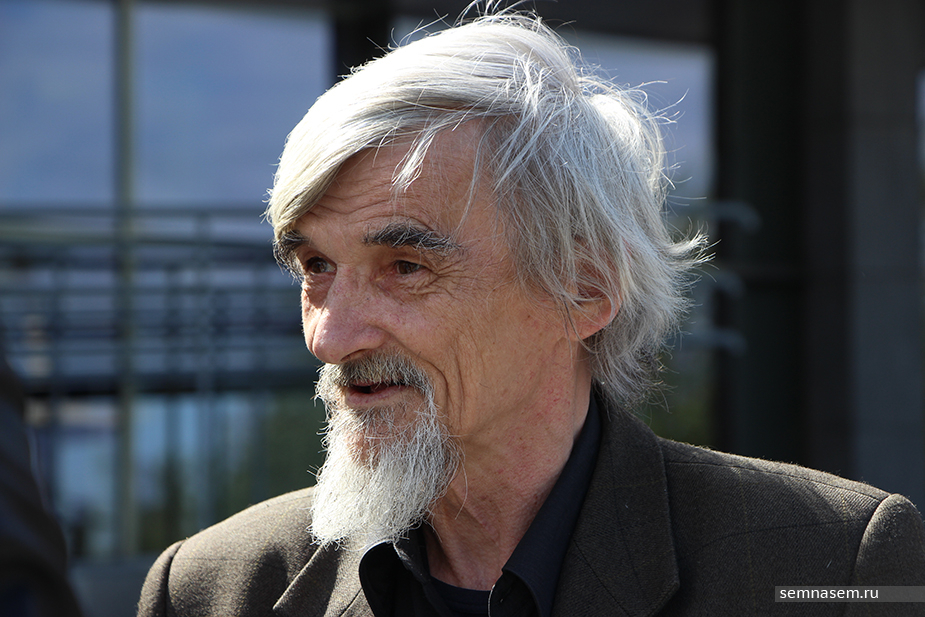
dmitrievYuri Dmitriev. Photo by Anna Yarovaya. Courtesy of 7X7

Karelian Supreme Court Overturns Karelian Researcher Yuri Dmitriev’s Acquittal 
Anna Yarovaya
7X7
June 14, 2018

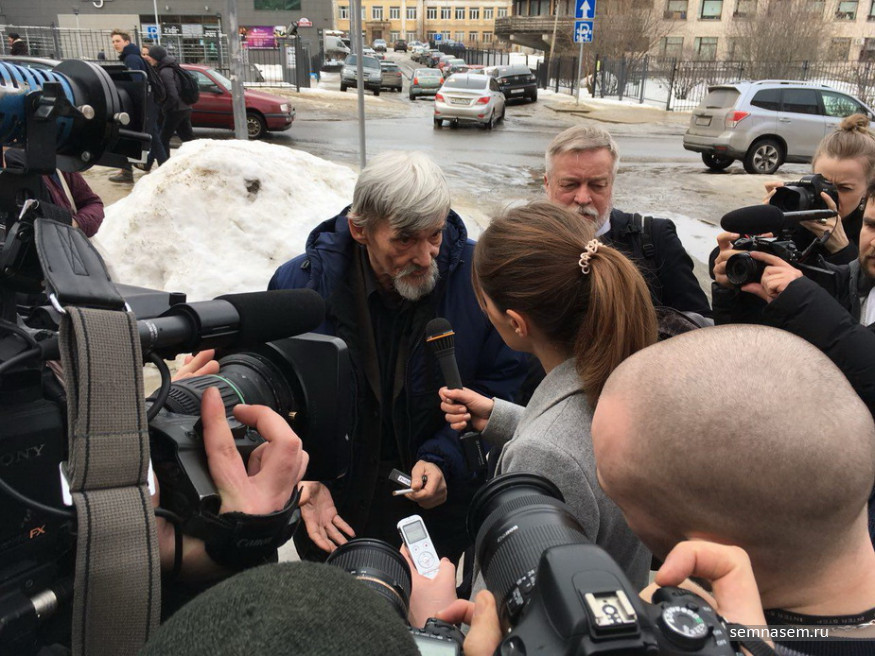
The Karelian Supreme Court has overturned the acquittal of Yuri Dmitriev, head of the Karelian branch of the International Memorial Society. His defense counsel, Viktor Anufriev, reported the news after the June 14 court hearing.

According to Anufriev, the prosecution made a motion to summon the children’s ombudsman and a psychologist who had examined Dmitriev’s foster daughter to testify. Anufriev opposed the motion, while the court supported it. The court heard from the girl’s grandmother, who had filed an appeal against the acquittal.

After the Petrozavodsk City Court acquitted Dmitriev of the charge of producing pornography involving a juvenile, his foster daughter was referred to a psychologist for an examination. According to Anufriev, during the examination, Dmitriev’s foster daughter was coerced into making a statement that she was upset and disgraced. This was one of the reasons Anufriev’s acquittal was overturned. Anufriev called the fact the authorities had involved the child in the case an “abomination.”

Consequently, the Karelian Supreme Court overturned the acquittal and returned the case to the Petrozavodsk City Court to be retried.

Yuri Dmitriev is head of the Karelian branch of the International Memorial Society who researches the Stalinist Terror. He was detained on December 13, 2016, and charged with producing pornography. According to police investigators, Dmitriev had photographed his foster daughter in the nude. The defense argued that the photographs were part of a diary monitoring the girl’s growth, which Dmitriev kept for children’s protective services. The expert witnesses concurred with this argument.

Dmitriev’s trial began on June 1, 2017. The case was heard in closed chambers. Dmitriev stood accused of violating three articles of the Russian Criminal Code: Article 242.2 (“Producing pornography involving the depiction of minors”); Article 135 (“Sexual abuse not involving violence”), and Article 222 (“Illegal possession of a firearm”).

At the request of Petrozavodsk City Prosecutor Elena Askerova, the Serbsky Institute performed a forensic psychiatric examination on Dmitriev on January 22, 2018, for which purpose the historian was specially transported under armed guard to Moscow. On January 27, 2018, Dmitriev was released from remand prison on his own recognizance. On February 27, 2018, the court release the findings of the examination: Dmitriev had been deemed healthy.

Prosecutor Askerova asked the court to sentence Dmitriev to nine years in a maximum security penal colony. Defense counsel Anufriev called the Dmitriev case a mockery of the historian’s daughter. On April 5, 2018, the court acquitted Dmitriev on the charge of producing pornography. The judge found Dmitriev guilty of the charge of illegally possessing a firearm and sentenced him two years and six months of parole. Considering the time Dmitriev had already served in the remand prison, the sentence was reduced to three months.

On May 12, 2018, with the court’s permission, Dmitriev was able to attend the Moscow Helsinki Group’s Human Rights Awards ceremony. He was awarded a prize for his historic contribution to the defense of human rights.

Translated by the Russian Reader. Read my previous postings on the Dmitriev case and the context in which it has taken place.

Diabetics in Saratov Deemed Threat to Russian National Security

insulincPatriotic Russian diabetics treat their disease only with domestically produced insulin, such as Rosinsulin, pictured here. Photo courtesy of Medsintez Pharmaceutical Plant
For Insufficient Enthusiasm
Court Rules Saratov Regional Organization of Chronic Diabetes Sufferers “Foreign Agents.” Activists “Undermined the State’s Authority” by Questioning  Insulin Produced in Russia
Nadezhda Andreyeva
Novaya Gazeta
March 28, 2018

Saratov’s Frunza District Court today concluded its hearing of administrative charges against the Saratov Regional Organization of Chronic Diabetes Sufferers. Judge Maria Agisheva ruled the diabetics had violated the law on “foreign agents.”

The defense had asked for a postponement of the hearing, since Moscow human rights lawyer Nikolai Dronov, who had been representing the diabetics in court the past five months, was unable to travel to Saratov today. In addition, the organization’s president, Larisa Saygina, had not been able to read the findings of a forensic examination of the case, submitted to the court on Friday, May 25. Judge Agisheva rejected the defense’s motion, but announced a half-hour recess so the diabetics could read the findings of court-appointed experts.

The forensis examination was carried out by faculty members at the Saratov State Legal Academy (SGYuA). The court had attempted to engage specialists from RANEPA and the Kazan Interregional Expertise Center, but they had turned down the court’s request on various pretexts. SGYuA had also rendered its expert opinion last year, when the administrative case was in the process of being filed. As we reported earlier, Professor Ivan Konovalov saw signs of the work of “foreign agents” in the activities of the diabetics organization. The forensic examination was performed by his SGYuA colleagues Associate Professor Elena Koloyartseva and Professor Viktor Kupin.

According to SGYuA’s experts, the Saratov Regional Organization of Chronic Diabetes Sufferers was awarded a grant of 712,000 rubles [approx. €9,800] from foreign pharmaceutical companies. The authors of the forensic examination thus concluded the organization had engaged in political activity, namely, it had submitted critical remarks about the work of officials to the authorities. According to the political scientists, the organization’s former head, Yekaterina Rogatkina, had publicly expressed doubts about the quality of insulin produced in Russia, thus undermining the Russian state’s authority. [The emphasis here and elsewhere is in the original article—TRR.]

The experts found it noteworthy the media reported on the filing of administrative charges against the diabetics organization. In particular, the commentary of the organization’s current president, Larisa Saygin, filmed for the Saratov TV program “Open Channel” on a city street, was regarded by the experts as a solo picket. According to SGYuA’s faculty members, the news report had been deliberately aired three months before the presidential election in order to discredit presidential candidate Vladimir Putin.

We should recall at this point it was Nikita Smirnov, the head of Putin’s student campaign headquarters in Saratov, who had filed the complaint against the diabetics with the the local prosecutor’s office.

As the experts emphasized in their findings, opposition leader Mikhail Khodorkovsky offered the Saratov diabetics legal assistance, which likewise testified to the organization’s guilt.

As indicated on SGYuA’s website, Professor Koloyartseva studied in the 1980s at the Saratov State Pedagogical Institute. In 2001, she was awarded a kandidat degree in political science. She serves on the public council of the Saratov Regional Duma. She is also a member of Civic Dignity, a grassroots organization that supports social and civic activism among young people and has been heavily involved in forums on moral and spiritual growth sponsored by the authorities.

According to the website Legal Russia, Viktor Kupin graduated from the Lenin Military Political Academy in 1978, while Saratov media outlets earlier reported he studied at the Engels Air Defense Academy.

Until 2007, Professor Kupin taught a course entitled “Philosophical and Political Problems of National Security” at military academies in Petersburg.

In 2004, Professor Kupin defended his doktor dissertation, entitled “The Geopolitical Imperatives of Global Security.”

In 2014, Kupin was an expert in the trial of Partnership for Development, an environmental organization that had operated in Saratov Region since 1995. The NGO received $42,000 from the US government to encourage civic involvement in the region’s villages and small towns. An anonymous complaint against Partnership for Development was filed with the prosecutor’s office on July 10, 2014. On July 22, an administrative case was opened against the organization under Article 19.34 of the Administrative Offenses Code (“Absence of registration in the relevant registry on the part of an organization performing the work of a foreign agent”).

Professor Kupin’s expert finding was ready the very same day. As he explained in court, he wrote the five pages of text in several hours, since he had been asked to do it “as soon as possible.” According to Professor Kupin, Partnership for Development showed clear signs of carrying out the “political orders of a foreign state, orders meant to undermine social stability, generate political tension in the region, expand the base of political influence on public opinion [sic], and  implement US geopolitical interests.”

“The interest in Saratov Region was occasioned by its special place and exceptional geopolitical position in Russia as a lynch pin in the emergent Eurasian Union of Russia, Belarus, and Kazakhstan,” wrote  Professor Kupin. “[Partnership for Development’s] activity runs counter to the security interests of Russia, which opposes the uni-polar dictatorship of the world, headed by the US.”

Less than a month after the prosecutor received the anonymous complaint, a court ruled Partnership for Development was a “foreign agent.” It was fined 300,000 rubles. Its chair, Olga Pitsunova, was also personally fined 100,000 rubles. Partnership for Development closed up shop.

At today’s hearing, Judge Agisheva denied the defense’s motion to summon its own expert witnesses to the trial. The diabetics were fined 300,000 rubles [approx. 4,100 euros]. The organization’s ex-president, Ms. Rogatkina, told us the diabetics would appeal the ruling.

“We are discouraged. This case was absurd from the outset.  We consider it a miscarriage a justice.”

Putinist youth activist Nikita Smirnov. Photo courtesy of Novaya Gazeta
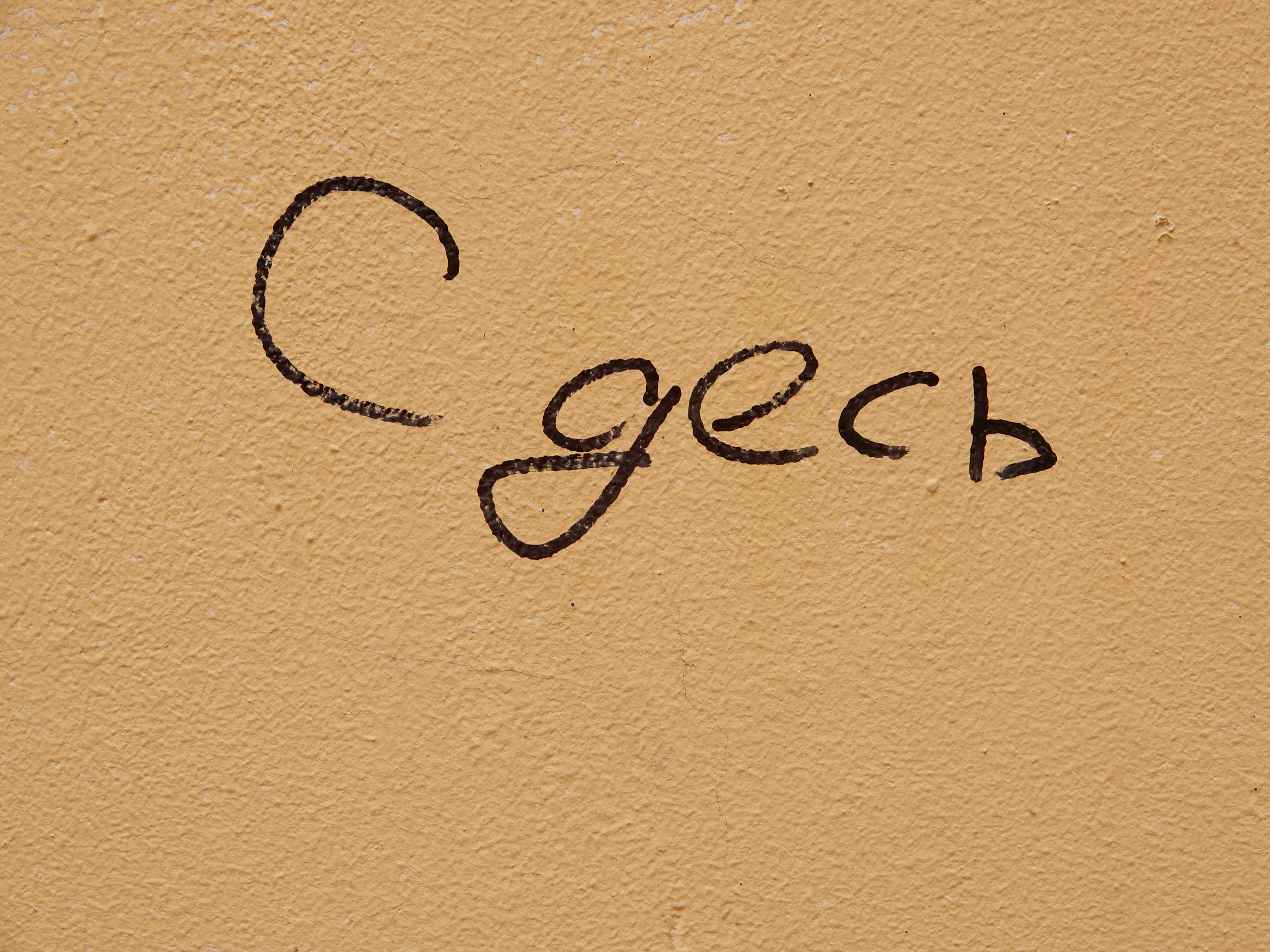
Last year, Mr. Smirnov, a student at the Saratov Medical University and head of Vladimir Putin’s student campaign headquarters, asked the Frunza District Prosecutor’s Office to verify whether the work of the diabetic organizations was covered by the law on “foreign agents.”

As the future physician told us, he had “read on the internet that the organization was financed by foreign companies, I don’t remember which.” He had felt it was his “civic duty” to “send a signal.”

Translated by the Russian Reader

‘Ere, or, Applied Culanthics

DSCN5744.jpg‘Ere, 2018. Graffiti found in Central Petersburg. Photo by the Russian Reader

This is a soundbite of champagne leftist culanthical research at its worst.

Monstrations are a symptom of a deep crisis of the pro-state nationalist and anti-state liberal discourses that reduce Russia’s complex political reality to two formulaic camps, obliterating space for democratic debate. Could there be an American monstration? One that resists Trump, but also refuses to explain away the phenomenon of Trump by referring to bigots and Russian agents? One that neither demonizes Russia nor justifies the actions of Putin’s regime?

Is Russia’s political reality really all that complex?

Why, if the US is filled with teenagers who can take the stage at a massive rally on the Mall in DC and make inspiring, cogent, coherent speeches, do we need the incoherent, politically feckless, thrift-store surrealism of the Novosibirsk Monstrations?

If we can either impeach Trump, pin him down with a crippling special investigation or, finally, simply fail to renominate or reelect him, why do we need to explain him away or even explain him at all?

What is the difference between Trump and “the phenomenon of Trump”?

If, nevertheless, well-paid, tenured academics force us to explain this “phenomenon,” why can’t we refer to bigots and Russian agents? Are they mere figments of our imagination?

Who does a better job of “demonizing” Russia?

People trying to explain away the phenomenon of Trump?

(By the way, why isn’t it “the Trump phenomenon”? Is “the phenomenon of Trump” more culanthically correct?)

Or are the true demonizers the Putin regime itself, a regime that has been quite demonstrably engaged in setting a new land speed record in sheer gangster nastiness at home and abroad at least since 2014, although we know they started much, much earlier (i.e., when Putin was deputy mayor of Petersburg in the early and mid nineties, and served as Mayor Anatoly Sobchak’s bag man and liaison with dicey “foreign investors” and local gangsters)? // TRR

P.S. The culanthics only go downhill from there.

The banners you see at monstrations state their theme obliquely. In the spring of 2014, when Russia annexed the Crimea, the slogan “Crimea is ours!” dominated pro-government media channels and billboards. The liberal opposition, conversely, stressed that the Crimea was illegally stolen. Meanwhile, monstrations sided with neither of these accounts. On May 1, 2014, the Novosibirsk monstration walked behind the banner “Hell is ours!”, a statement that iconically and ironically challenged the official slogan, but also refused the simplified version of the political events advanced by the liberal opposition. The march united young people with different political opinions, from those who saw the annexation as an isolated unlawful act to those who refused the liberal oppositional story and instead saw the Crimea in connection with other events, including the attempts of the extreme right and ultranationalist movements in Ukraine to hijack the popular Maidan revolution.

Such is the secret of the trendy “third position” in Russian and Russophile “anti-authoritarian leftism”: to side with nobody but other third positionists, to hover high above Moscow, Peterburg, Crimea, Donetsk, Aleppo, Eastern Ghouta or, in this case, the Berkley Hills like angels of history. God forbid the third positionists should ever do something so rash as actually organize a real anti-war movement explicitly and loudly opposed to the Kremlin’s predations in Ukraine, Syria, and elsewhere.

One, it would involve a lot of needless work.

Two, it could get the third positionists, otherwise accustomed to a heavy schedule of jetsetting from academic conference to art residency to speaking engagement, into a lot of hot water. They definitely do not want to go to prison for any reason, unlike those careless antifascists from Penza and Petersburg, about whom the third positionists mostly have nothing to say, unsurprisingly.

(Russian and Russophilic third positionism requires its adepts to refrain from criticizing Russia’s foreign and domestic policy catastrophes and crimes as much as humanly possible. People who, on the contrary, criticize the current Russian regime’s actions loudly and often are labeled “liberals” and “Russophobes,” the worst words imaginable in the third positionist vocabulary.)

Three, it would mean the third positioniks would have to give up their firmly held conviction, which they share with Vladimir Putin, Alexander Dugin, and Vyacheslav Surkov et al., that all the evil in the world originates solely in the United States and that, however ham-fisted and controversial its actions, Russia has only been reacting to the miseries deliberately visited on it by American unilateral imperialism and neoliberalism.

Russophile leftists lap this spiked rhetorical gravy up like hound dogs who have not been fed for a week, so the invitations to appear at conferences and contemporary art hootenannies, and contribute essays to “politicized” art mags and cutting-edge scholarly journals keep pouring in. After all, it is what really matters in life, not Syrian children, blasted to smithereens by Russian bombs, or hapless Crimean Tatars, rotting in Russian prisons because they are too stupid to know what is good for them. // TRR

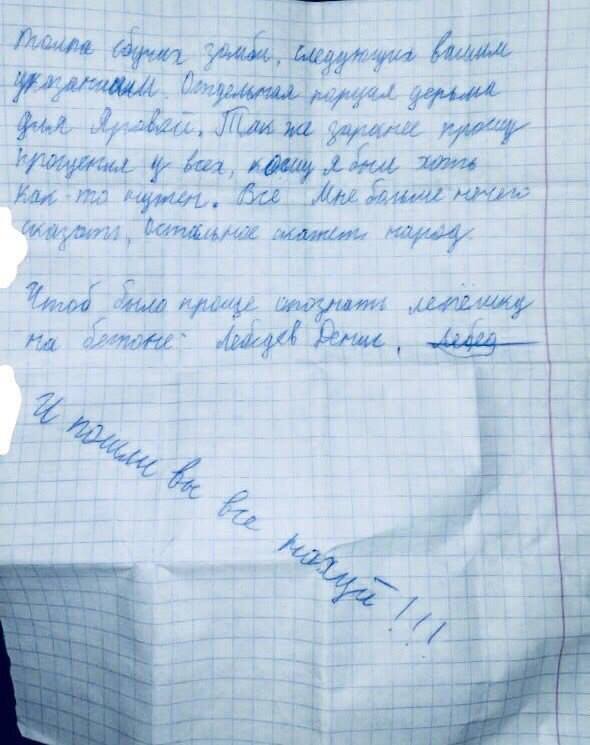
Denis Lebedev’s Suicide Note

lebedev-1.jpgThe first page of Denis Lebedev’s suicide note. Courtesy of Ivan N. Ivanov
Ivan N. Ivanov
Facebook
26 April 2018

The suicide note of the boy who jumped from a window after the Russian Federal Security Service (FSB) intimidated him has been posted on the net.

Denis Lebedev was seventeen years old. He was a brilliant pupil and an Academic Olympics winner in chemistry. Chemistry was his passion in life. He did experiments in a small laboratory at home and dreamed of attending university.

Neighbors complained to the FSB about “explosions” in Lebedev’s flat, and one day the secret services forced their way in Believing Lebedev was either a terrorist or revolutionary, they turned the flat upside down, stole his telephone, computer, and lab equipments, scared him and his parents half to death, and made them sign a nondisclosure agreement.

On April 23, the day of his birthday, Denis was found dead on the ground outside his high-rise apartment building.

lebedev-2The second page of Denis Lebedev’s suicide note. Courtesy of Ivan N. Ivanov
This is addressed to the police, FSB, and other law enforcement agencies.

I’m just completely fucking exhausted. I don’t need anything fucking more from this life. No one induced me [to commit suicide], it was my personal decision.

The only thing I would like to say in the end is that I really fuck hate you motherfuckers.

You took from me the only passion that gave me joy and distracted me from my problems. I really fucking hate your entire government, whose only impulse is to ban the shit out of everything. Well, then you should fucking ban water, because you can use electrolysis to turn water in a canister into a bomb.

And fuck this system, in which my goddamn life depends on a single exam that has been compiled in such a way you cannot make fucking heads or tails of it. It is total shit, tailored to everyone identically.

You don’t need a people. You need a mob of fucking zombies who follow your orders. A separate portion of shit for Yarovaya.

Also, I apologize in advance to everyone to whom I meant something. That is it. I have nothing else to say. The people will say the rest.

To make it easier to identify the pancake on the cement: I am Denis Lebedev.

You can all go fuck yourselves!

Reports on Mr. Lebedev’s suicide in the Russian media:

Thanks to Evgeny Shtorn for the heads-up. Translated by the Russian Reader

Suicide Invoice

FSB_FlagRussian Federal Security Service (FSB) flag
17-Year-Old, Winner of All-Russia Academic Olympics in Chemisty, Commits Suicide in Moscow Region
Ekho Moskvy
April 25, 2018

The teenager killed himself after the Russian Federal Security Service (FSB) paid him a visit.

In his suicide note, the boy wrote, “The state has no need of gifted people.” He also wrote that people like him are “strangled by inspections.”

The teenager was a straight-A student and winner of numerous Academic Olympics. He built himself a mini-laboratory at home, where he did experiments.

Neighbors reported this to law enforcement. Law enforcement officers inspected his flat, and the teenager and his parents signed a nondisclosure agreement, reports Moskovsky Komsomolets newspaper.

Thanks to Evgeny Shtorn for the heads-up. Translated by the Russian Reader. Image of FSB flag courtesy of Wikipedia

The Kids Are (Not) Alright, Part 3: Are You Ready to Defend the Motherland?

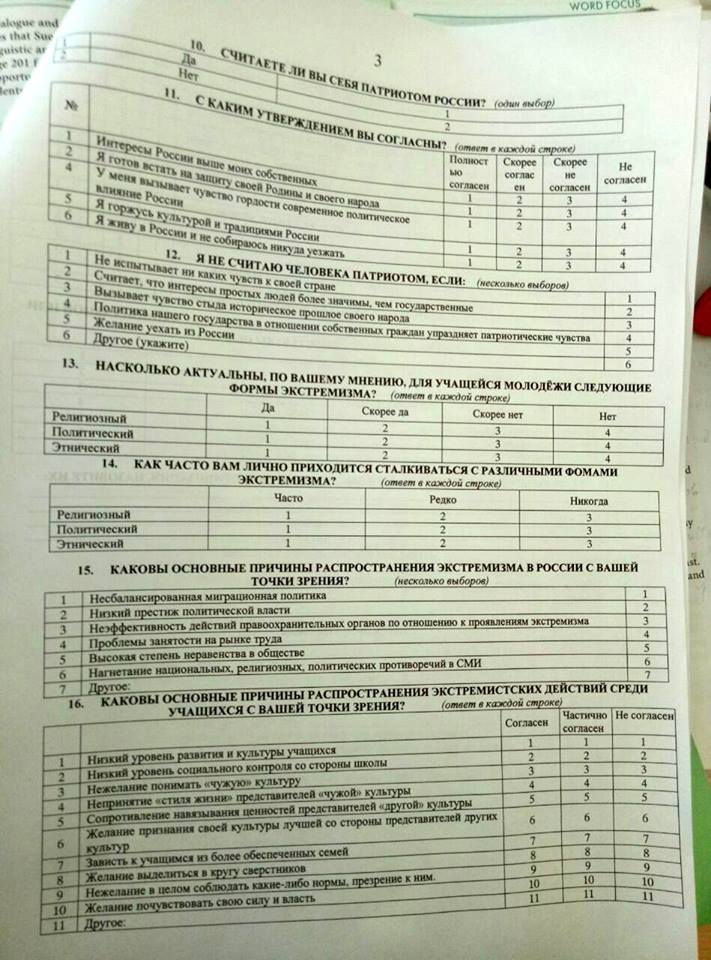
30707960_10156005294207203_9089823561300341523_nThe third page of a questionnaire focusing on “patriotism” and “extremism,” allegedly administered to schoolchildren in Petersburg’s Moscow District. Photo courtesy of Daniel Alexandrov, Jr.
Daniel Alexandrov, Jr.
Facebook
April 20, 2018

The most monstrous thing currently in the works is the forthcoming ban on imported drugs. Much has been written about it, emotions have flared, and I have nothing to add. I would imagine we have seen nothing like it in recent Russian history. People are cynicallly willing to sacrifice tens of thousands and hundreds of thousands of lives, by sending medical care forty or fifty years back in time, in order to increase the profits of several Russian companies.

But what kicked off the other day in Petersburg’s schools is no less vicious, although it is not such an obvious case of cannibalism. As Marina Tkachova, on whose page I saw the link, wrote correctly, a witch hunt has been launched.

In violation of Article 29 of the Russian Consitution,* which directly prohibits forcing people to voice their political views, the Moscow District Administration, assisted by the Center for Psychological, Pedagogical, Medical, and Social Aid, made schoolchildren fill out a questionnaire.

The questionnaire asked the schoolchildren, for example, to voice the extent to which they agreed with the following statements.

  • Russia’s interests are greater than my own.
  • I am ready to defend the Motherland and the people [narod = das Volk].
  • I feel proud of Russia’s current political influence.
  • I am proud of Russia’s culture and traditions.
  • I live in Russia and I do not plan to emigrate to another country.

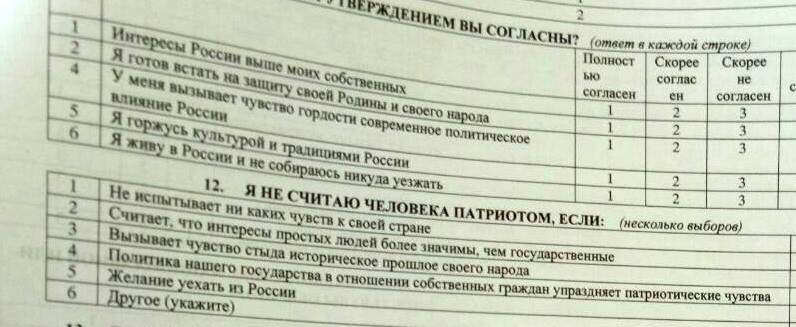
31068869_10156005294157203_338838680958886823_nPart 12 of the questionnaire reads, “I don’t consider a person a patriot if . . . ” 1) He experiences no feelings for his country; 2) Believes the interests of ordinary people are more significant than the state’s interests; 3) The historic past of his people makes him ashamed; 4) The policies of our state towards its own citizens abolish patriot sentiments; 5) he want to leave Russia; 6) Other (specify).” Students could chose more than one answer. Photo courtesy of Daniel Alexandrov, Jr.

In addition, the pupils were asked to determine what social phenomena and psychological traits (!) generate nationalist or extremists moods among young people. The people who compiled the questionnaire openly provoked teenagers into violating Article 282 of the Russian Federal Criminal Code [which forbids “inciting the hatred and enmity” against other people based on ethnicity, religion, etc.] by asking them, “Are their religions or ethnic groups you dislike?” and “When faced with people different from you in appearance, ethniicity or religion, you usually . . .” One of the possible answers was, “I act aggressively.”

30742559_10156005294177203_1430095687740250696_nThe fourth and final page of the questionnaire focuses on the attitude of students toward different ethnic, religious, and social groups, thus encouraging them to violate Article 282 of the Russian Criminal Code, as Mr. Alexandrov points out. Photo courtesy of Daniel Alexandrov, Jr.
The Education Committee at Petersburg City Hall explained to Fontanka.ru that the questionnaire was part of a “comprehensive plan for preventing juvenile delinquency among minors during the 2017–2018 academic year.” It is a program for monitoring and identifying potential “extremists” among schoolchildren.

I have the sense these people either do not realize what they are saying or they do realize it, which is even worse.

Even the Soviet Union was bereft of such idiocy and meanness, as when minors were asked to fill out questionnaires with questions like, “How much do you love the Motherland on a scale from one to five?” or “Whom do you love more, the Motherland or Mom?”

I have learned the schools on Vasilyevsky Island have not administered the questionnaire—yet—but since the Education Committee has adopted the plan, it means the questionnaire will be administered, if not now, then in September.

This cannot be ignored. We cannot stay silent about this. Interrogating schoolchildren about their love of the Motherland and their willingness to sacrifice themselves, and suggesting they should rat on themselves are real manifestations of fascism, and there are no ifs, ands, or buts about it. Friends, city council members, human rights activists, public figures, and local journalists: do something about it.

Article 29 of the Russian Constitution:

1. Everyone shall be guaranteed freedom of ideas and speech.

2. Propaganda or agitation instigating social, racial, national or religious hatred and strife shall not be allowed. Propaganda of social, racial, national, religious or linguistic supremacy shall be banned.

3. No one may be forced to express his views and convictions or eject them.

4. Everyone shall have the right to freely look for, receive, transmit, produce and distribute information by any legal means. The list of data comprising state secrets shall be determined by federal law.

5. The freedom of mass communication shall be guaranteed. Censorship shall be banned.

Thanks to Valery Dymshits for the heads-up. Translated by the Russian Reader. I slightly edited the excerpted quotation from the Russian Constitution to make it more readable.

Karelian Historian Yuri Dmitriev Acquitted of Trumped-Up Charges

333Yuri Dmitriev. Photo by Gleb Yarovoi. Courtesy of 7X7
Court Acquits Karelian Historian Yuri Dmitriev of Pornography Charges
Anna Yarovaya
7X7
March 5, 2018

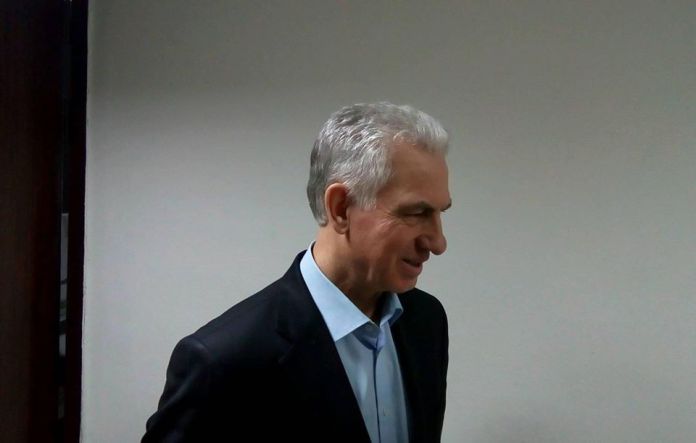
In Petrozavodsk, Judge Marina Nosova acquitted Yuri Dmitriev, head of Memorial Karelia and a historian of the Great Terror, of charges he had produced pornography involving images of minors.

The judge acquitted Mr. Dmitriev on the charges of manufacturing pornographic matter depicting minors and committing nonviolent acts of sexual abuse. On the charge of illegal possession of a firearm, the judge sentenced Mr. Dmitriev to two years and six months of police supervision. Deducting the time Mr. Dmitriev already spent in the Petrozavodsk Remand Prison, he will be under police supervision for three months. During this time, he will have to report to a parole officer periodically.

Defense attorney Viktor Anufriev commented on the court’s decision.

“Yesterday, the media quoted the president’s statement that judges who failed to uphold the law should look for other jobs. Today’s verdict is confirmation the president’s statement was heeded. Yuri Alexeyevich has been acquitted on nearly all counts. The court awarded him the right to vindication and compensation for pain and suffering. He was convicted of possessing part of a smoothbore gun and sentenced to two years and six months of police supervision, meaning he must report to the parole inspector twice a month. He spent one year, one month, and fifteen days in police custody. One day in custody is equal to two days of community service, meaning he has already served two years and three months of his sentence,” said Mr. Anufriev.

Yan Rachinsky, chair of the International Memorial Society, came to Petrozavodsk for the reading of the verdict.

“It’s a completely outrageous case. When a man like this, the champion of a cause, is accused of god knows what, the accusation cannot be real. My natural reaction is to do what I can to voice my solidarity. Solidarity takes various shapes. But today is the day of the verdict. I have been more worried about the plight of a specific person than how it has affected Memorial. This is much more important. But yes, of course, various contemptible means of mass disinformation have glommed onto the story. What can you do? You cannot force anyone to be honest,” said Mr. Rachinsky.

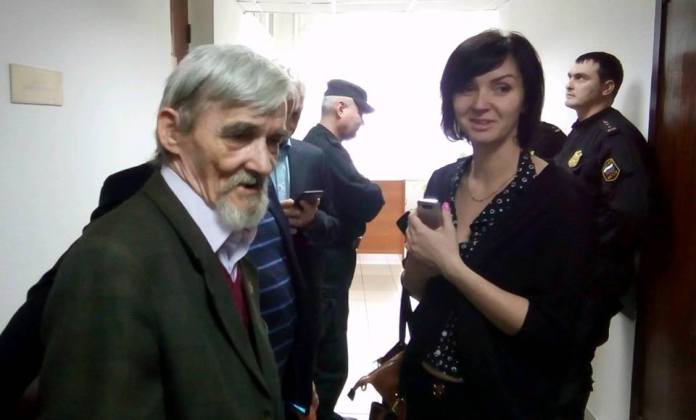
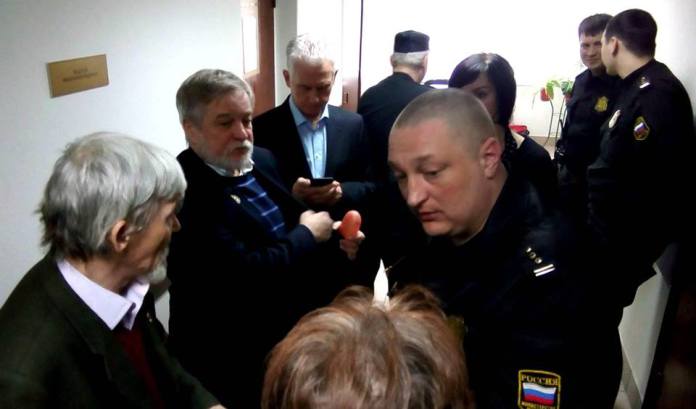
Like the entire trial, the verdict was announced in closed chambers. [Verdicts must be read out in open court according to Russian law—TRR.] Before the hearing, court bailiffs blocked the hallway, and reporters, friends, and Mr. Dmitriev’s supporters were unable to approach the courtroom doors the entire time.

Mr. Dmitriev was detained on December 13, 2016. According to police investigators, he had photographed his foster daughter while she was naked. The historian’s defense counsel claimed the photos were part of a diary, charting the girl’s health, that Mr. Dmitriev kept for children’s protection services because his foster daughter was abnormally thin. Court-appointed experts corroborated these claims.

Mr. Dmitriev’s trial in Petrozavodsk City Court commenced on June 1, 2017. The case was heard in closed chambers. Mr. Dmitriev was charged under three articles of the Russian Federal Criminal Code: Article 242.2 (production of pornographic matter depicting minors), Article 135 (nonviolent sexual abuse), and Article 222 (illegal possession of a firearm).

During the investigation, the photographs in question were subjected to two forensic examinations. The first examination deemed the photographs pornographic. The second examination, on the contrary, found no traces of pornography in them.

On January 22, 2018, the Serbsky Institute performed a psychiatric examination of Mr. Dmitriev, for which purpose the historian was transported under armed guard to Moscow. On February 27, 2018, the court announced Mr. Dmitriev had been deemed mentally healthy.

On January 27, 2018, Mr. Dmitriev was released from remand prison on his own recognizance. In the first interview he granted after his release, he spoke of life in prison and his plans to finish a book.

On March 20, 2018, Petrozavodsk City Prosecutor Yelena Askerova asked the court to sentence Mr. Dmitriev to nine years in a maximum security penal colony. On March 22, 2018, Mr. Anufriev said the Dmitriev case was a mockery of the historian’s foster daughter. A series of solo pickets in support of Mr. Dmitriev took place in Petrozavodsk on March 25 and March 26, 2018.

Translated by the Russian Reader. Read my previous coverage of the Dmitriev case.


Defense Asks for Acquittal of Historian Yuri Dmitriev on All Charges

Defense in Dmitriev Case Asks for Acquittal of Historian on All Charges
Valery Potashov
Chernika
March 22, 2018

Anufriev
Yuri Dmitriev’s defense attorney Viktor Anufriev. Photo by Valery Potashov. Courtesy of Chernika

On March 22, defense attorney Viktor Anufriev made his closing arguments in Petrozavodsk City Court, where the criminal case against Yuri Dmitriev, the famous researcher of Stalin’s Great Terror, has been heard in closed chambers. Mr. Anufriev asked the court to acquit Mr. Dmitriev on all counts, including the main charge, production of child pornography using his foster daughter.

“I was given the time to make a closing argument, which is what I did. I asked that Yuri Alexeyevich be acquitted on all counts and explained to the court why it should do this,” Mr. Anufriev told reporters after the hearing.

V-sude
Defendant Yuri Dmitriev and his eldest daughter Katya in the courthouse hallway. Photo by Valery Potashov. Courtesy of Chernika

He noted that Mr. Dmitriev had indeed taken photographs of his foster daughter when she was naked, but that these actions were not evidence of the crime of which the historian had been accused.

“There was no sexual motive. He is not a pedophile. He is mentally fit, and he made the photographs in order to monitor the child’s health. His objectives were medical. This was the conclusion of the last two forensic examinations, which were trustworthy, I would say,” Mr. Anufriev emphasized.

Commenting on the closing argument of Prosecutor Yelena Askerova, who two days earlier had asked the court to sentence Mr. Dmitriev to nine years in a maximum security penal colony, Mr. Anufriev noted that the criminal charges against the researcher had been filed unlawfully.

AskerovaPetrozavodsk Prosecutor Yelena Askerova. Photo courtesy of Guberniya Daily and Chernika
“He was arrested without sufficient cause, and the foster daughter was removed from his custody and taken out of the city. This what was caused mental harm to the child, not Yuri Alexeyevich’s actions.”

Mr. Anufriev also voiced the opinion that Petrozavodsk Prosecutor Yelena Askerova’s decision to ask the court to find Mr. Dmitriev guilty on all counts of the original charges was made by the Karelian Prosecutor’s Office.

“The prosecutor’s office is an agency where everyone wears a uniform and has a rank. There is a chain of command. The law says prosecutor’s offices are independent. But they are not independent when it comes to stating their position today. They have vetted their position with the prosecutor’s office that oversees them, so it follows that the overseeing prosecutor gave the command to press for a guilty verdict,” Mr. Anufriev told reporters.

Pristavy
Judge Marina Nosova asked the bailiffs not to let people into the courtroom. Photo by Valery Potashov. Courtesy of Chernika

According to Mr. Anufriev, on March 27, the parties to the trial will be given time to make counterarguments, and then the judge will allow Mr. Dmitriev to make a closing statement before retiring to chambers to deliberate her decision. It is noteworthy that even before today’s hearing in the Dmitriev case, Judge Marina Nosova asked the court bailiffs not to let people who had come to support Mr. Dmitriev get near the courtroom doors.

Mr. Dmitriev’s trial in Petrozavodsk City Court began in June 2017. He was remanded in police custody for over a year and was only released from the remand prison after undergoing an inpatient forensic examination at the Serbsky National Medical Research Center for Psychiatry and Addiction Medicine in Moscow. The examining physicians concluded the defendant had no pedophilic propensities whatsoever.

Thanks to Victoria Andreyeva for the heads-up. Translated by the Russian Reader

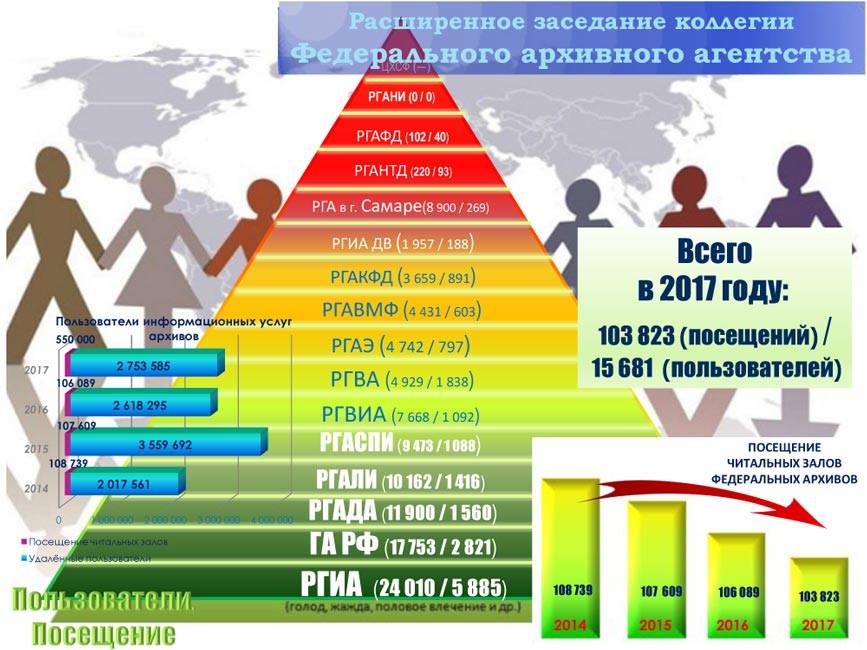
“Hunger, Thirst, Sexual Attraction, Etc.”: Russia’s Federal Archives

“[Title] Russia Federal Archival Agency (Rosarkhiv), Extended Meeting. || [Upper right] 2017 Totals: 103, 823 visits / 15,681 [remote] users || [Center left] Users of information services in the archives (violet=reading room visits; turquoise=remote users): 2014 – 108,739 visits and 2,017,561 remote users; 2015 – 108,739 visitors and 3,559,692 remote users; 2016 – 106,080 visits and 2,618,295 remote users; 2017 – 550,000 [sic] visits and 2,753,585 remote users. || [Bottom right] Visits to federal archive reading rooms: 2014 – 108,739 visits; 2015 – 107,609; 2016 – 106,089; 2017 – 103,823. || [Pyramid, from bottom rung to peak ] Users / Visits. 1. (hunger, thirst, sexual attraction, etc.); 2. RGIA (Russian State Historical Archive, Petersburg): 24,010 / 5,885; 3. GARF (State Archive of the Russian Federation, Moscow): 17,753 / 2,821; 4. RGADA (Russian State Archive of Ancient Documents, Moscow): 11,900 / 1,560; 5. RGALI (Russian State Archive of Literature and Art, Moscow): 10,162 / 1,416; 6. RGASPI (Russian State Archive of Socio-Political History, Moscow): 9,473 / 1,088; 7. RGVIA (Russian State Military History Archive, Moscow): 7,688 / 1,092; 8. RGVA (Russian State Military Archive, Moscow): 4,929 / 1,838; 9. RGAE (Russian State Archive of the Economy, Moscow): 4,742 / 797; 10. RGAVMF (Russian State Archive of the Navy, Petersburg): 4,431 / 603; 11. RGAKFD (Russian State Film and Photo Archive, Krasnogorsk, Moscow Region): 3,659 / 891; 12. RGIA DV (Russian State Historical Archive of the Far East, Vladivostok): 1,957 / 188; 13. Russian State Archive in Samara: 8,900 / 269; 14. RGANTD (Russian State Archive for Scientific-Technical Documentation, Mosow): 220 / 93; 15. RGAFD (Russian State Archive of Sound Recordings, Moscow): 102 / 40; 16. RGANI (Russian State Archive of Contemporary History, Moscow): 0 / 0; 17. TsKhSF (Insurance Fund Storage Center, Yalutorovsk, Tyumen Region): —.”

Kirill Belousov
Facebook
March 23, 2018

“Hunger, thirst, sexual attraction, etc.”

This strange slide is posted on the Russian Federal Archive Agency’s official website in a section [containing the text of a report delivered by the agency’s director, A.N. Artizov, to an extended intra-agency meeting on March 20, 2018].

The bottom rung of the pyramid contains the words in the headline of my post, while the upper rungs contain information about the number of people accessing and visiting Russia’s federal archives. The people who made the slide were probably in a hurry and did not tidy up the pyramid before publishing it.

My attention was drawn to the fact that the number of visits to the reading rooms of federal archives has dropped considerably, from 108,700 visits, in 2014, to 103,800 visits, in 2017.

Source: http://archives.ru/reporting/report-artizov-2018-kollegia.shtml

#Rosarkhiv #RussianArchives

Thanks to Alexei Kouprianov for the heads-up. Translated by the Russian Reader