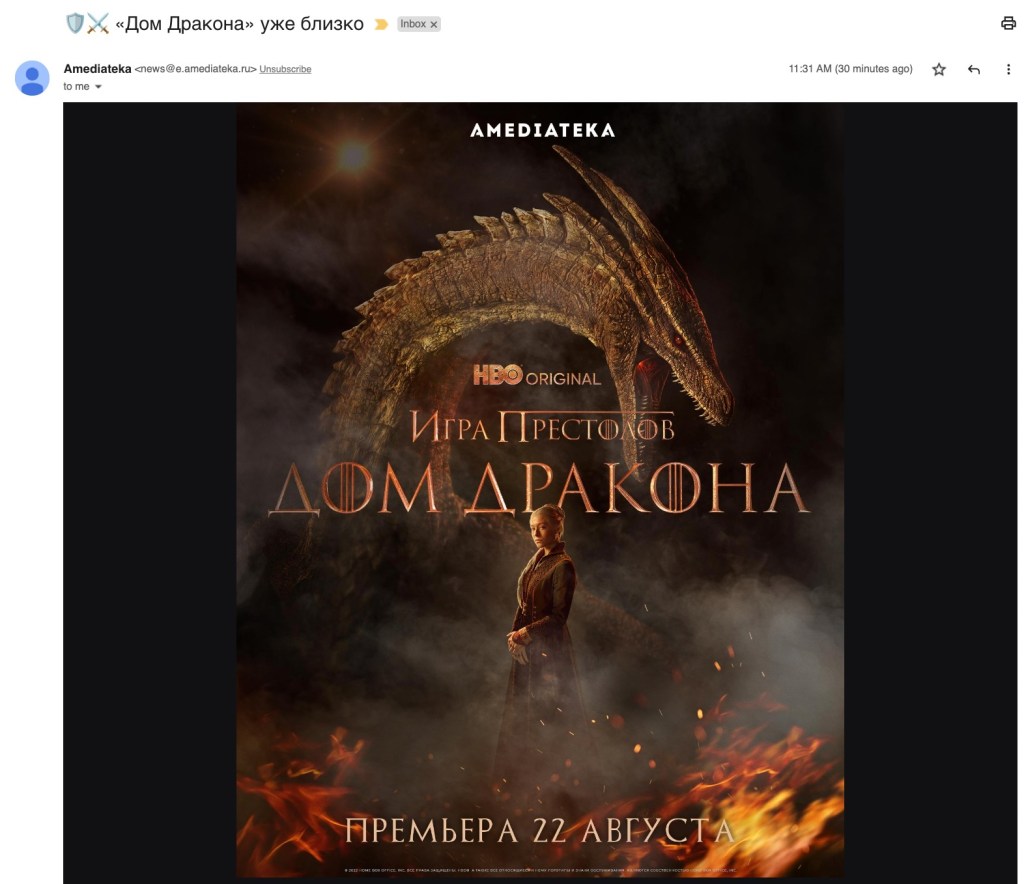
This newsletter from the Russian streaming service Amediateka showed up in my inbox a few minutes ago.
Game of Thrones: House of the Dragon. Premieres August 22
See “House of the Dragon” on Amediateka. We don’t want you to miss the biggest and most interesting premieres (“House of the Dragon,” the prequel to the great and mighty “Game of Thrones” is coming soon!), so we’re reminding you that we have a very useful newsletter. From which, however, you can unsubscribe. What you can definitely keep are the subscription promo codes*: a treasury of international TV series is now closer!
What is Amediateka? What does it have to do with HBO?
Russian streamer Amediateka has struck an exclusive deal that allows it to offer all series from WarnerMedia’s HBO Max, in addition to library content from the US studio.
The agreement, which is effective immediately, hands Amediateka shows including the reboot of cult TV series Gossip Girl, Steven Soderbergh’s film No Sudden Move, sci-fi series Raised By Wolves, Israeli war drama Valley Of Tears and teenage drama Genera+ion.
HBO Max hit The Flight Attendant is also available, along with Sex And The City sequel And Just Like That…, with shows accessible on the streamer in Russia and the CIS.
Animal Kingdom, 11.22.63 and Person Of Interest are among library series available, along with documentaries including 15 Minutes Of Shame, Persona: The Dark Truth Behind Personality Tests and docuseries Generation Hustle and the upcoming One Perfect Shot.
Tatyana Kalita, CEO of Amediateka parent Amedia TV, said the deal would provide “resonant and highly sought-after” shows to its audiences, adding that the streamer had enjoyed “stunning success” with the recent special episode Friends: The Reunion, which Amediateka exclusively released in Russia and CIS in May.
But didn’t HBO’s parent company WarnerMedia stop doing business in Russia this spring to protest Russia’s brutal unprovoked invasion of Ukraine?
Major media companies continue to join the exodus from Russia, with Discovery and WarnerMedia making announcements on Wednesday about halting all programming in the country.
WarnerMedia, CNN’s parent company, previously paused the release of “The Batman” in Russia, citing the “humanitarian crisis in Ukraine.”
As of Wednesday the company is now “pausing all new business in Russia,” CEO Jason Kilar said in an internal memo. “This includes ceasing broadcast of our channels, halting all new content licensing with Russian entities, and pausing our planned theatrical and games releases.”
WarnerMedia had been broadcasting CNN and Cartoon Network in the country. CNN said on Tuesday that the network is not shutting down its Moscow bureau, “but we have ceased reporting from there until we have assessed the impact of this new law.” The law makes it a crime to disseminate what Russian authorities consider to be “fake” information about the invasion of Ukraine.
Discovery, which has 15 channels in the country, said Wednesday that the channels are going dark as well. “Discovery has decided to suspend the broadcast of all its channels and services in Russia,” the company said.
Discovery and WarnerMedia are preparing to merge this spring.
The statements are part of a much broader corporate shunning of Russia that has escalated in the two weeks since the Russian invasion of Ukraine began.
Amediateka is currently offering a 12-month subscription to its streaming service at the bargain basement price of 2,499 rubles — or 41 dollars and some change. That’s for an entire year. In the US, WarnerMedia is currently offering a yearly, prepaid subscription to HBO Max for $69.99 with ads or $104.99 with no ads. ||| TRR
— Supplies of premium headphones manufactured by Sennheiser, Marshall, Sony and JBL are running out in Russia, Kommersant writes. Here is the rundown on supplies in St. Petersburg: https://ppr.today/9MGEytX
— iStories talked to [Russian] soldiers traced to shootings and robberies in the Kyiv region. One confessed to everything: https://ppr.today/e3hRqev
— There are 24 free beds for coronavirus patients in St. Petersburg. The authorities will convert two more hospitals to covid wards: https://t.me/paperpaper_ru/27611
— Petersburgers are getting “subpoenas” and telephone calls recruiting them to fight in Ukraine. Those who do not want to fight are asked to sign a “waiver”: https://ppr.today/rY0KrCX
Photo caption: see what the Perseid meteor shower looks like in the countryside near Petersburg: https://ppr.today/GChPNeX
Source: Bumaga (Telegram), 15 August 2022. Translated by the Russian Reader
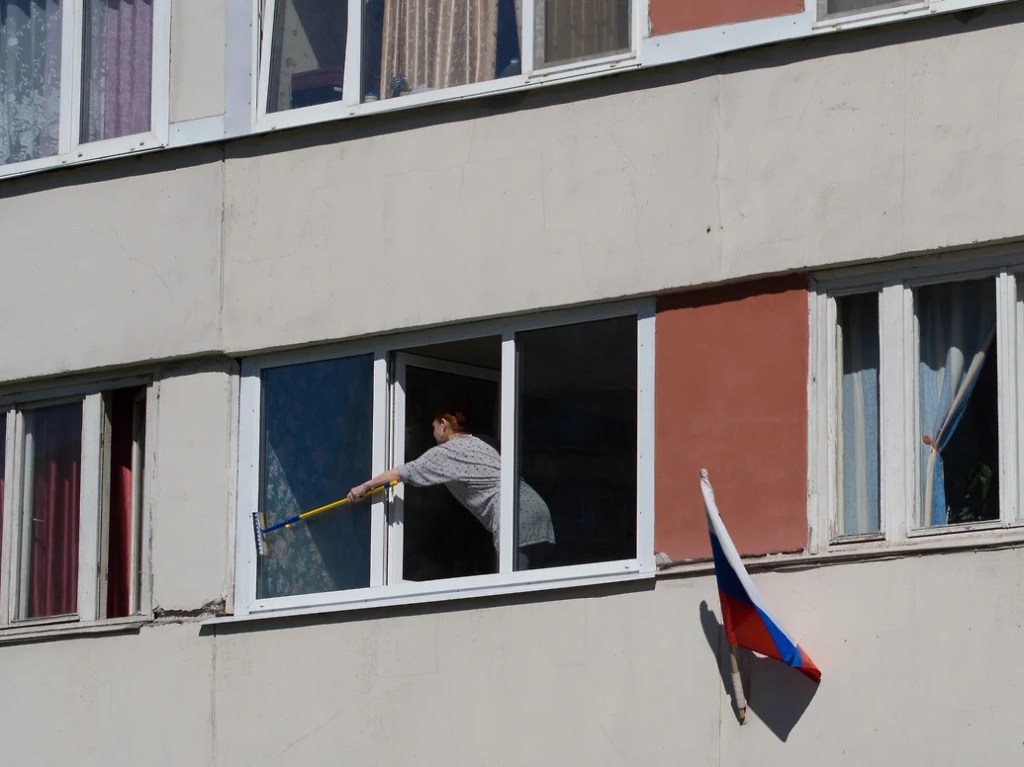
Almost a fifth of households in Moscow and St. Petersburg, even those with average incomes, regularly resort to the services of female domestic workers. Most often they need help around the house, as well as looking after the elderly and children. In most cases, Russians from the region where the employers reside are hired to do this work. A study by researchers at HSE and RANEPA shows that hired female household labor, which is considered a non-essential form of employment, is a vital part of urban economies.
Photo: Yevgeny Pavlenko/Kommersant
Almost one fifth of households in Moscow and St. Petersburg, having mainly an average income, employ female labor. This is the conclusion reached by Yulia Florinskaya, Nikita Mkrtchyan and Marina Kartseva (researchers at the Higher School of Economics and RANEPA) in the article “Women as hired workers in the households of Moscow and St. Petersburg,” published in the scholarly journal Woman in Russian Society (No. 2, 2022).
The first attempt in Russia to define the scale of wage labor in households in Russia’s megalopolises, the research study was based on a survey of residents of those cities who over the past three years have employed other people to do work usually performed by family members. Three thousand eight hundred people took part in the survey; their phone numbers were selected using systematic stratified random sampling. The results of the survey are unusual: although Russians generally believe that housekeepers, domestic help, and hired staff in a household involves a high family income and migrant labor and is a rare thing, it is, in reality, a fairly common practice among middle-income households in Moscow and St. Petersburg, and it is residents of the two capitals who are mainly hired to do such work.
First of all, hiring third parties to perform work in the household is a widespread practice in Russia’s two largest cities.
According to the survey results, female workers were employed by seventeen percent of households. Formally, men are employed by households much more. In fact, respondents were asking about paid employment in the household, including for such types of work as renovations and repairs, where men predominated. (Twenty-eight percent of the households surveyed had hired male hands.) Among “household chores,” “female” specializations were also discovered that would ordinarily not be thought of as “domestic help” — tutoring, primarily. In any case, seventeen percent of Moscow and Petersburg families employed female labor in households, a figure that dropped to around seven to eight percent when tutoring and repairs were factored out. Even with this proviso, however, the phenomenon goes beyond “elite consumption for the wealthy few.”
This also shows that, according to the survey data, most of the households (61%) who employed female workers estimated their incomes as average. When answering the standard question about their income (used, among others, by Rosstat in its questionnaires), they indicated that they had enough money for food, clothing, and household appliances. Twenty-three percent of respondents rated their incomes as high (in particular, as sufficient to buy a car or more) while sixteen percent rated them as low, since they were only enough to buy food. Thus, hired domestic workers are the preserve of the middle class rather than the income elite.
The prevalence of foreign nationals or, at least, migrant workers from other regions of Russia, among domestic workers has also been greatly exaggerated. According to the survey, almost two thirds (64%) of households that purchase women’s services [sic] in the household give jobs to women permanently residing in Moscow or St. Petersburg, where they themselves live.
Only in fourteen percent of households in the two cities was the employed woman a Russian national from another region, and in sixteen percent, a foreign national. (No breakdown by nationality is given.)
However, this fact is well known within the households and is clearly discussed by them. Only six percent of respondents who had dealings with female domestic workers were not aware whether she was a Muscovite [sic], a nonresident, or a foreign national.
Of course, households most often hired residents of their own region as tutors. Among domestic migrants this type of employment was two and a half times less common, while it was practically nonexistent among foreign women. At the same time, foreign women were twice as likely to be hired to do housework as Russian women, both local and migrant. However, domestic workers in the strict sense of the term — that is, those doing “housework” (cleaning, laundry, cooking, caring, and looking after children)— are still Muscovites and Petersburgers in most cases; residents of Krasnoyarsk and Samarkand [that is, domestic and foreign migrant workers, respectively] are in the minority. The authors of the study suggest that children are a “sensitive” area for households, and local women have in this instance an advantage over migrants: households are less likely to “trust” the latter. (The authors of the study avoid reaching an alternative conclusion: that this choice is a consequence of the phobias experienced by a significant part of the middle class towards migrants — phobias that are commonly denied in the middle-class milieu, as least in Moscow.)
Residents of other regions and countries are preferred only as caregivers, and the share of this type of employment among foreign women is three times higher than among women from the same region as their employers.
Florinskaya, Mkrtchyan and Kartseva describe a rather vital social phenomenon: migrant caregivers ask for their work, which is in demand among all strata of society, significantly less pay than do Russian nationals, and for most relatively poor households there is no alternative to hiring them, as they simply cannot afford a nurse from Moscow. But to carry out repair work, local women and migrants were hired with approximately the same frequency: the wallpaper pasted by a Ukrainian woman cannot be distinguished from the wallpaper pasted by a Petersburg woman, even by a specialist.
Finally, wage labor in households is extremely informal. Most often households hired female employees using recommendations from their acquaintances or relatives (63%), and more than two thirds of the households draw up written contracts when hiring female employees. The xenophobia of Muscovites has been exaggerated: female foreign workers lived in the household in a third of cases. (By contrast, 2.4% of households provided housing to residents of their own region, and 18.8% to migrants from within Russian Federation.)
The cautious attitude of Russians to hiring female employees to work in their households is, rather, a late Soviet legacy. After the tradition of employing “servants,” which was relatively common in large Soviet cities among the middle class, disappeared in the late 1940s and early 1950s, the term sounded somewhat insulting from the 1960s until today, and was replaced by euphemisms like “a woman who comes over.” The restoration of the practice is expected, and yet, as the study shows, this phenomenon (if only by virtue of its magnitude) is a vital albeit understated part of the modern urban economy of Russia’s megalopolises.
Up to two-thirds of Russians do not have any savings. Two-thirds of Russians can only afford food and clothes while buying durable consumer goods for them is extremely difficult. Russia is a very poor country, and now, on top of that, we have sanctions that will destroy the lives of ordinary people even further.
A view of Nevsky Prospect, Petersburg’s main thoroughfare, with the Russian National Library (the so-called Publichka), Gostiny Dvor shopping center, the tower of the former City Duma building, the cupola of Kazan Cathedral, and the cupola of St. Isaac’s Cathedral visible on the left in ascending. This picture-perfect cityscape was used by the Facebook page I Love St. Petersburg to illustrate the bizarre, banal, pseudo-historical sentiment that I’ve translated, below. Petersburg was built on the land of the Ingrian people and the captured Swedish fortress of Nyenskans. Or rather, that’s a no less valid way of putting it.
St. Petersburg is the only European capital that has not been captured by the enemy in any period of history.
Source: I Love St. Petersburg (@spb.love.you), Facebook, 13 August 2022. Translated by the Russian Reader
(Upper left, in Russian) “Kiev is the mother of Russian cities.” (Lower right, in Ukrainian) “If I had known, I would have had an abortion.”
Source: Petya Pyatochkin, Facebook, 12 August 2022. Thanks to Volodya Y. for the heads-up. Translated by the Russian Reader
The tables covered in beer Showbiz whines, minute detail (2) Hand on the shoulder in Leicester Square (3) It’s vaudeville pub back room dusty pictures of White frocked girls and music teachers The beds too clean Water’s poisonous for the system (4)
And you know in your brain Leave the capitol! (5) Exit this Roman Shell! (6) Then you know you must leave the capitol
Straight home, straight home, straight home One room, one room (7)
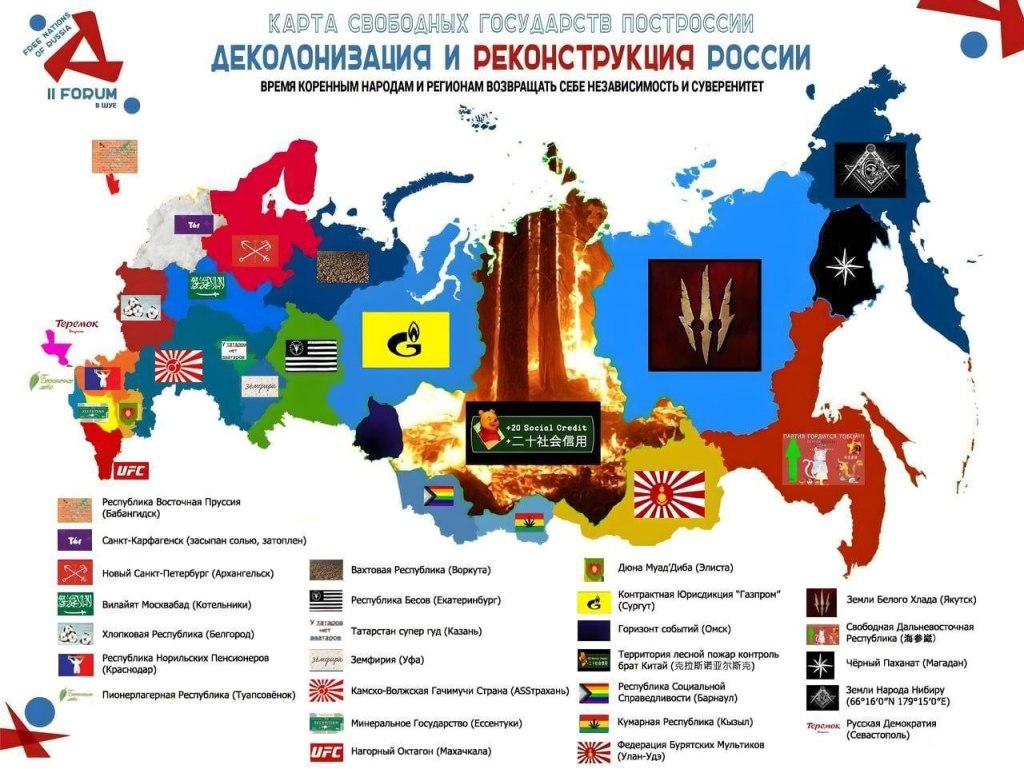
“An Alt-future map where Russia is divided. Could be Post-WW3 or after collapse due to economic sanctions etc.” Source: Reddit
Re: the “volunteer battalions.” Many people, including me, have spoken out quite harshly here [on Facebook] about the irresponsible fools who have posted map[s] of a “collapsed Russia” on the web. The centripetal forces in the country will be more powerful than the centrifugal ones for a long time to come, and if Russia collapses, those daydreamers will definitely not be involved. Nevertheless, work on its collapse is in full swing in Russia itself, and the country’s authorities are leading the effort. Understand me correctly: I am sure that Putin and his friends do not want disintegration, because Russia has become and will forever remain their only available feeding trough. However, heedlessness, as always, trumps vested interest. As in the case of covid, what the center does not cope with, it sloughs off on the regions. But if this was relatively harmless when it came to covid, it is not so harmless when it comes to the “volunteer battalions” being formed on a regional basis. When the “volunteers” return — and some of them will return, inevitably — a small but cohesive and extremely angry force with combat experience and, most likely, access to weapons, will emerge in each region. Precisely due to its local identity, it will become a convenient tool for factions seeking local power. During a social and political crisis, this desire can be realized, but not without a local armed force. And such a force will be there for the taking. The infamous Girkin proved in practice in Sloviansk that even a small group like this can easily take power in a medium-sized city if it encounters no resistance. It will be both easy and pleasant for local security forces to negotiate with “veterans” if such agreements are sanctioned by the “elites” in the towns and villages, but especially in the ethnic republics. A scenario in which Russia will break up into 80+ independent countries cannot be precluded. These countries, however, will not be benevolent democracies in the European orbit, but gangster autocracies. And Russia is being pushed in this direction not by its real or imaginary enemies, but by its own authorities.
“A Map of the Free States of Post-Russia. Decolonizing and Restructuring Russia. It’s Time for Indigenous Peoples and Regions to Take Back Their Independence and Sovereignty.” Source: We Survived Mariupol, 25 July 2022, Telegram
Chechen head Ramzan Kadyrov meeting on 11 August 2022 with his military commanders. The meeting is conducted in Chechen with occasional infusions of isolated Russian words and phrases.
Western intelligence services have never really disguised their plans for our country. Their dream is Russia’s complete collapse and, in fact, the enslavement of its peoples. Our country has always been and remains the West’s number one target. The fact of the matter is that the Russian Federation’s multi-ethnic peoples have never accepted an alien ideology and have historically maintained their identity, mindset, and age-old principles.
And if at one time entire foreign institutions tried to achieve this goal by unleashing two wars in the Chechen Republic, later there were attempts to achieve it via South Ossetia and even Syria. Nothing came of them.
Now the West has played the Ukraine card. But here, too, all their efforts are doomed to utter failure. And I am very glad that the new tactical actions used by our combatants during the special military operation in the Donbass are bringing great success. I had no doubts about this initially. Today it is already obvious that the results have exceeded all expectations.
On Thursday, I met with the commanders and fighters of our detachments involved in the SMO. We once again had a warm conversation in an informal setting, discussing the successes we have achieved. We also discussed in detail the issue of improving the material resources for units from the Chechen Republic, of additionally supplying and equipping our fighters with modern weapons, equipment, and gear.
The most important thing is that [our] warriors are in great fighting spirit. The lads are clearly aware that they are fighting for the sake of all straight-thinking humanity and for the triumph of law, order, and justice. That is why, even after returning home, almost all SMO combatants are eager to go back. They have only one desire — to go all the way alongside their comrades. This is true patriotism, which means that victory will be ours! Absolutely! There is simply no other option.
Source: Ramzan Kadyrov, Telegram, 11 August 2022. Translated by the Russian Reader
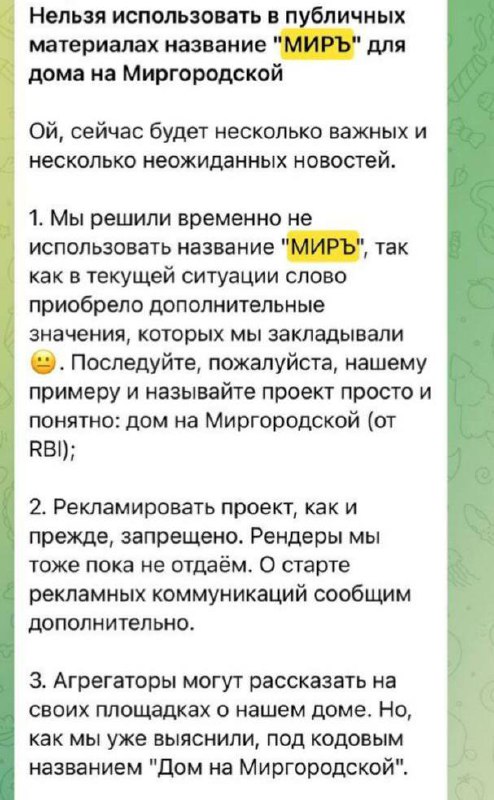
A Petersburg developer asked not to use the name “Mir” (“Peace”) in advertising its [new] residential complex. The company decided to refrain from using the word, which had “taken on additional meanings.”
The screenshot of RBI’s request to shutter the name “Mir” (“Peace”) for its new residential complex on Mirgorodskaya Street (Mirgorod Street) in central Petersburg. Ironically, the street itself is named for the city of Myrhorod in Ukraine. Several other streets in the same neighborhood are named after Ukrainian cities, including Poltava, Kharkiv, and Kremenchuk. It should be pointed out that “mir,” in Russian, also means “world” and “peasant commune.”
RBI’s official website still identifies the residential complex as “Mir,” and this is the case on some other real estate resources as well. And yet, for example, one of the largest industry websites, TsIAN, already refers to it as the residential complex “On Mirgorodskaya, 1.”
Our source at the company told Rotunda that the advertising campaign for the complex had not yet been launched. And that was why they asked their partners — i.e., real estate agencies — “to refrain from directly advertising the sites before the official start of sales.”
Officially, RBI had only the following to say about the meanings implied by the word “Mir”: “As for the word itself, ‘MIR’ in this case refers to the location of the house, as well as to the World of Art [Mir iskusstva] art group.”
Source: Rotunda, 8 August 2022. Translated by the Russian Reader
MIR Club House is a world for connoisseurs of beauty in the very heart of St. Petersburg, a striking house featuring original, artistic architecture.
Compositionally, the complex consists of two buildings: a building of varying heights (six, seven, eight and nine floors) containing 243 apartments, and a small six-story building containing 20 apartments. They are united by a street-facing arch and form a closed courtyard.
The apartments offer picturesque views of Feodorovsky Cathedral, the famous “Kremlin wall of Petersburg,” the historical center, and the new business-class quarter.
The two-week accelerated tactical and weapons training courses for the latest group of volunteers at the Russian Special Forces University @ruspetsnaz in Gudermes have ended.
The soldiers, who are from various regions of Russia, are full of determination and ready to join the battle for truth and justice on the territory of Donbass and Ukraine.
One more flight headed for the site of the special military operation from Hero of Russia Akhmad-Khadzhi Kadyrov Grozny International Airport.
Our dear BROTHERS — Chairman of the Parliament of the [Chechen Republic] Magomed Daudov @MDaudov_95, Deputy Prime Minister of the CR Abuzaid Vismuradov, Secretary of the Security Council of the CR Apty Alaudinov @sovbez95, Deputy Interior Minister and Police Chief of the Interior Ministry of the CR Aslan Irakhanov, and Head of the Grozny Transit Police of the Russian Interior Ministry Ali Tagirov — had parting words for the volunteers
They noted that fascism and Banderism had to be eradicated from the land of Donbass, [and] that [the volunteers] had been given the honorable mission of being part of the force that would bring about the triumph of justice and victory over evil.
We wish our soldiers a successful hunt for Banderites, Nazis and Shaitans! May their joint efforts, courage and heroism bring victory to Russia and freedom to Donbass! AKHMAD IS POWER!!!
Source: Kadyrov_95 (Telegram), 8 August 2022. Translated by the Russian Reader
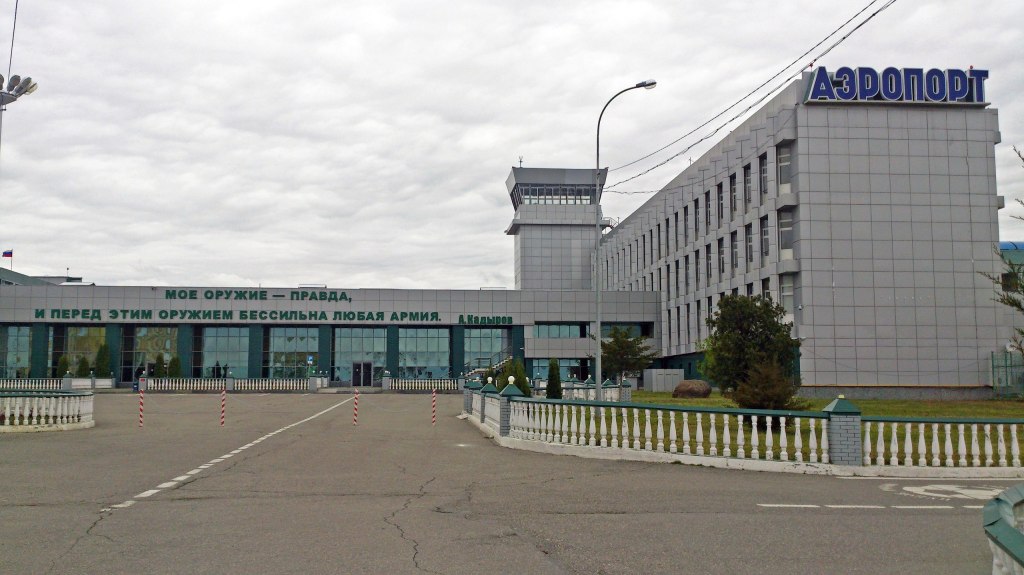
The terminal building at Grozny Airport. The inscription over the entrance reads, “My weapon is truth, and all armies are powerless before this weapon. A[khmad] Kadyrov.” Source: Wikipedia
[…]
According to investigations by Novaya Gazeta and human rights organization Human Rights Watch, as a person in the inner circle of Kadyrov, Daudov often carries out his “special instructions”.
In 2014, according to a Novaya Gazeta investigation, Daudov participated in the torture and beating of detained president of Assembly of the Caucasian people, R[uslan] Kutayev.
In 2015, Novaya Gazeta reported that Chechen authorities were concerned about “true news” about the republic, claiming that bloggers writing about Chechnya in a manner viewed as “incorrect” by the authorities were illegally pressured and forced to apologise. Daudov was mentioned in this context.
On 16 and 17 January 2016, Daudov made posts on his Instagram account that contained insults and veiled threats against members of the Russian opposition, including journalists and right activists (Alexei Venediktov, I.A. Kalyapin, K.E. Merzlikin, A.A. Navalny, L.A. Ponomaryov, M.B. Khodorkovsky, V.I. Shenderovich and I.V. Yashin. Editor-in-chief of Echo of Moscow A.A. Venediktov said: “Magomed Daudov’s statements [addressed to the opposition are] a serious threat and inadequate reaction to inconvenient issues of murder of Boris Nemtsov and a question to investigation and Chechen authorities”.
In a 12 October 2016 Instagram post, Daudov again made veiled insults against I.A. Kalyapin, chairman of interregional public organization Committee Against Torture. Gregory Shvedov, editor-in-chief of online newspaper Caucasian Knot submitted an application to the Investigative Committee of Russia, trying to bring Daudov’s publication under corpus delicti under article 144, part 3 of the Criminal Code of Russia. The Investigative Committee of Russia investigated but chose not to open a criminal case against Daudov.
Press articles covered Daudov’s conflict with the acting Chairman of the Supreme Court of Chechnya T.A. Murdalov.
According to some journalists, on 6 October 2016, Daudov came to the Supreme Court of Chechnya accompanied by security, entered the office of acting Chairman T. A. Murdalov and began to beat him, demanding that he write the resignation letter for health reasons. Murdalov refused.
According to media and human rights activists, Daudov participated in the prosecution of homosexuals in Chechnya and “played the key role in cleaning of the republic from gays, which was approved by republican management Journalists provided evidence that Daudov personally went to secret prisons in Argun and Grozny and managed the transfer of detained gays to relatives.
Hellbent on having fun in the midst of a terrible war — a frightening panorama of Petersburg by virtuoso photographer Alexander Petrosyan. Source: Alexander Petrosyan, Facebook, 7 August 2022
As Russia’s war in Ukraine grinds into its fifth month, Moscow is a city doing everything it can to turn a blind eye to the conflict. It is a champagne-soaked summer like any other in the Russian capital, despite the thousands of dead and many more wounded in a war increasingly marked by acts of savage brutality.
In Gorky Park, outdoor festivals, cinemas and bars were all jammed on a recent evening, with young couples twirling to ballroom dance music as others stopped for selfies along the Moscow river nearby.
“Yes, we are having a party,” said Anna Mitrokhina, one of the dancers at an outdoor dance platform on the Moscow river, wearing a blue-sequin dress and heavy eye-makeup. “We are outside of politics, we want to dance, to feel and have fun. I can’t worry any more and this helps me forget.”
Walk through the city or switch on a VPN to scroll through Instagram or Facebook and you might not even know the country’s at war, a word that the Russian censors have banned from local media and that, even among many friends, has become taboo.
A lifestyle Instagram blogger with more than 100,000 followers who was opposed to the war said that she had consciously decided to stop speaking about the topic — because of the official restrictions but also the backlash she received from subscribers.
“Nobody wants to hear about the war, the special military operation, any more, they tell me to stop talking about this and get back to normal topics like beauty and fitness,” she said, asking that her name not be used. “Every time I mentioned it I would get so much hate in my messages. It hurts me, it hurts my business. I stopped mentioning it. It just doesn’t exist for many people.”
“What hurts the most is it is not really [because of the law], there is just no desire to talk about this,” she said. “People are turning off.”
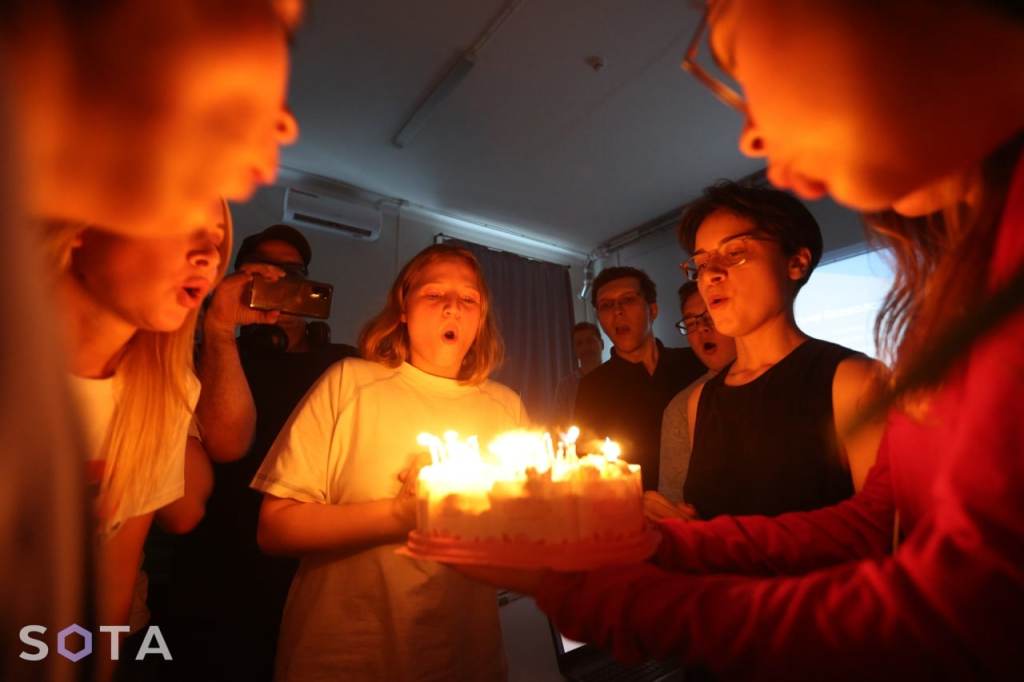
Today, Open Space Moscow celebrated the birthday of a political prisoner Dmitry Ivanov, the editor of the Telegram channel “MSU Protesting,” with cakes, stickers, candles, and merch.
In addition to Ivanov, who is on trial for disseminating “fake news about the army,” the evening’s organizers remembered other people currently jailed under Article 207.3 of the Criminal Code who are not as well known, in particular:
Olga Smirnova, a Petersburg activist with Peaceful Resistance, who has been prosecuted for writing post about the war in Ukraine and burning a cardboard letter Z.
Vladimir Zavyalov, a businessman who hung anti-war price tags in a supermarket.
Ioann Kurmoyarov, a priest who said on YouTube that hell awaits the soldiers who attacked Ukraine.
Igor Baryshnikov, a Kaliningrad activist who wrote about Bucha on Facebook.
Source: SOTA (Telegram), 5 August 2022. Translated by the Russian Reader
“Dima is in jail for words” A merrymaker at Russian political prisoner Dmitry Ivanov’s birthday party writes him a postcard.
My roommate Victor is a completely unique person. He is sixty-seven years old and an absolute image of our Soviet life from the 1970s to the 2010s, with all the paradoxes peculiar to the time. He is a fervent [Russian Orthodox] believer and yet he believes everything said on the radio about the atrocities committed the Ukrainian army. On the other hand, he is perplexed how military operations were launched without consultations. Victor worked as a driver, but also played music in bands. He knows all the western groups of the 70s and all the stars in both the West and Russia. He has seen every Soviet film and remembers all the scenes, all the actors, all the songs. A lot of happy memories are consolidated in him, as well as a lot of regrets about the past. Basically, he’s a typical chip off the old Soviet block. In him you have the songs, you have Pink Floyd and the Rolling Stones and Alla Pugacheva and Eldar Ryazanov and [Leonid] Gaidai and Muslim Magomayev and everyone else, down to the last detail. You might say that he and I are living in the USSR from Khrushchev to Putin. It’s funny, but interesting. It’s Russia.
Source: Anatoly Zaslavsky, Facebook, 5 August 2022. Mr. Zaslavsky is a well-known Petersburg painter currently undergoing treatment at the city’s Botkin Hospital. Victor is his roommate at the hospital and has already featured in earlier social media dispatches. Translated by the Russian Reader
____________
The folding seats clapped, The October’s curtains came down.
The rider finally galloped
Off toward the radiant dawn,
Faded show bills on the wall,
Blue ticket stubs on the floor.
Dusk on Nevsky had almost fallen
As we came out on the corner.
The jeans were Polish, the beret a sham.
Wow, we had enough for Kagor.
We had to live. Return bottles and pass exams.
To live and live till we got to here.
5 August 22
Source: Vadim Zhuk, Facebook, 5 August 2022. Mr. Zhuk is is a well-known Russian actor, screenwriter, TV presenter, and poet, whose poem “A Skeleton in the Closet” was published here last month. Translated by the Russian Reader
____________
On March 18, Irina Gen, a teacher of English in Penza, made an anti-war speech to her eighth-graders while explaining why they would not be able to travel to competitions in the Czech Republic. She told them about the shelling of the maternity hospital in Mariupol and the downed Boeing. One of the pupils recorded the teacher’s speech on a dictaphone and sent the recording to the security forces. A criminal case was opened against Gen ten days later. Today she was sentenced to five years of probation with a ban on teaching for three years. She had [originally] pleaded not guilty.
Source: Dmitry Tkachev, Facebook, 4 August 2022. Mr. Tkachev cites, in the comments, this article about Ms. Gen’s case, published in Mediazona the same day. Translated by the Russian Reader