Anti-Central Asian Migrant Worker Dragnet in Tula

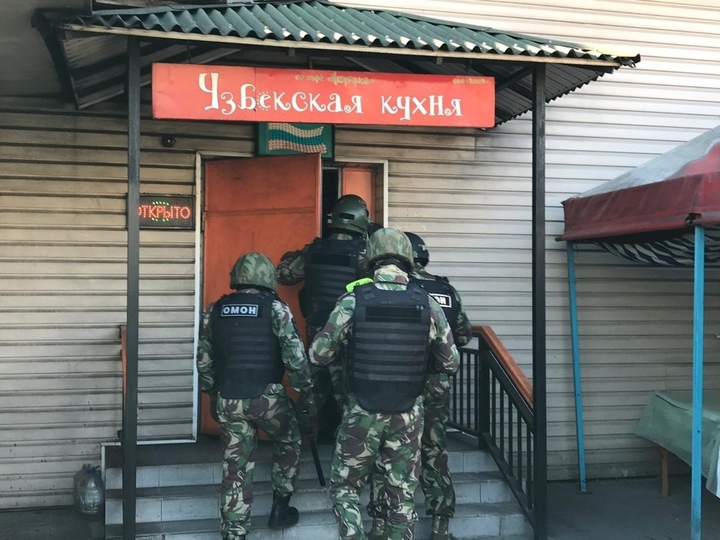
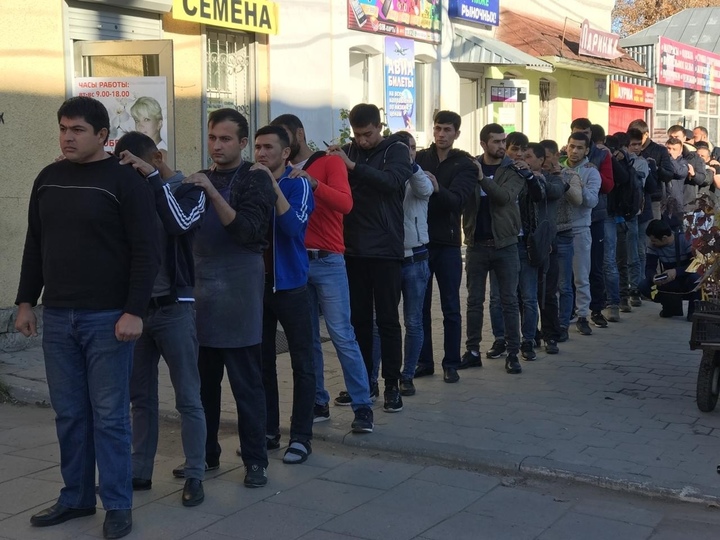
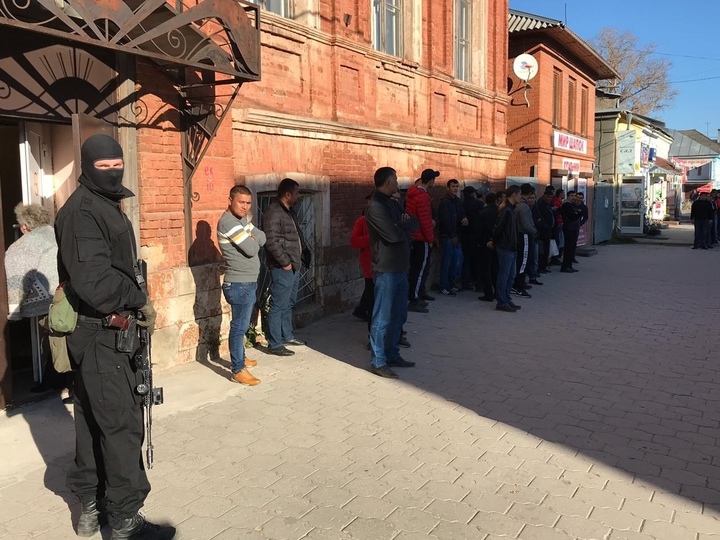
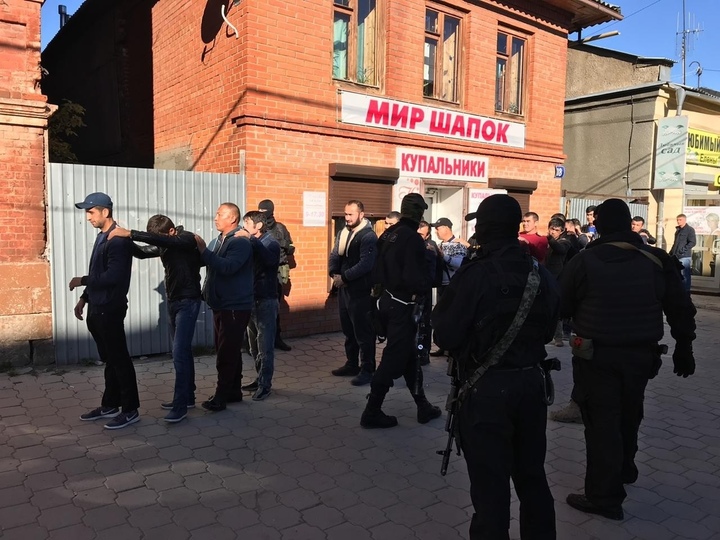
uzbek cuisineRussian riot police (OMON) prepare to enter a business identified as “Uzbek Cuisine” in the Central Market area in Tula during yesterday’s “total spot checks.” Photo courtesy of Moskovsky Komsomolets in Tula

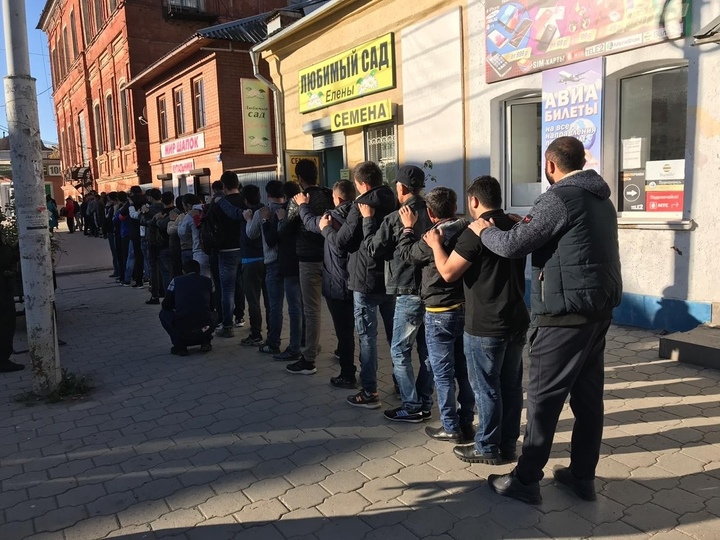
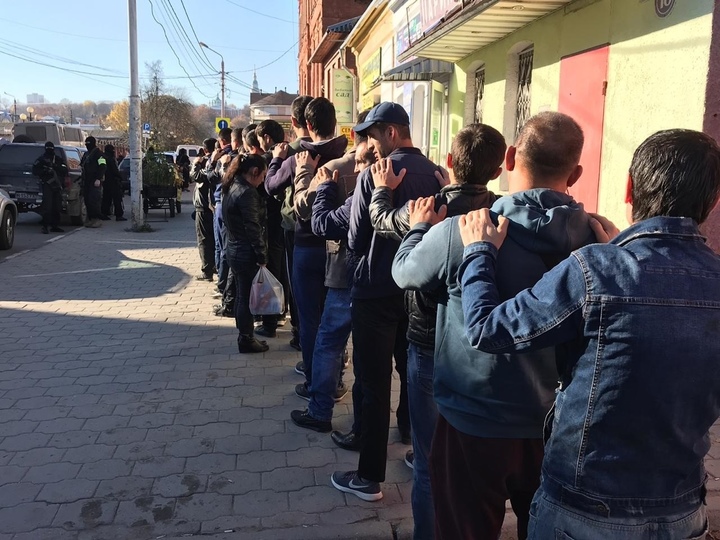
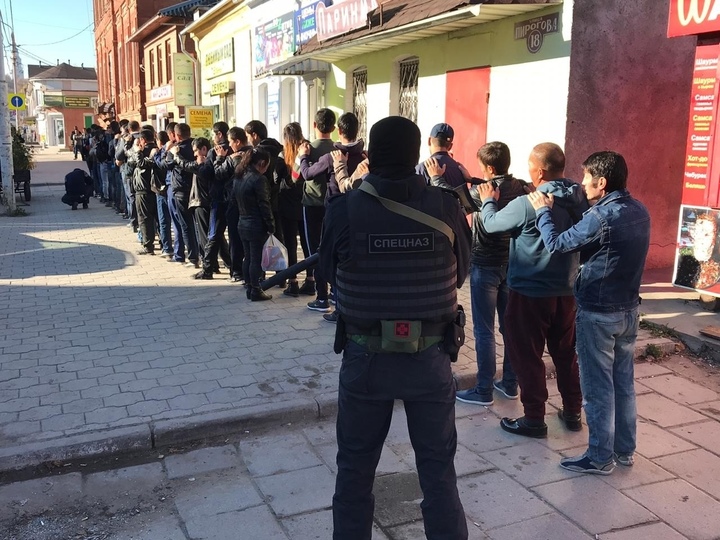
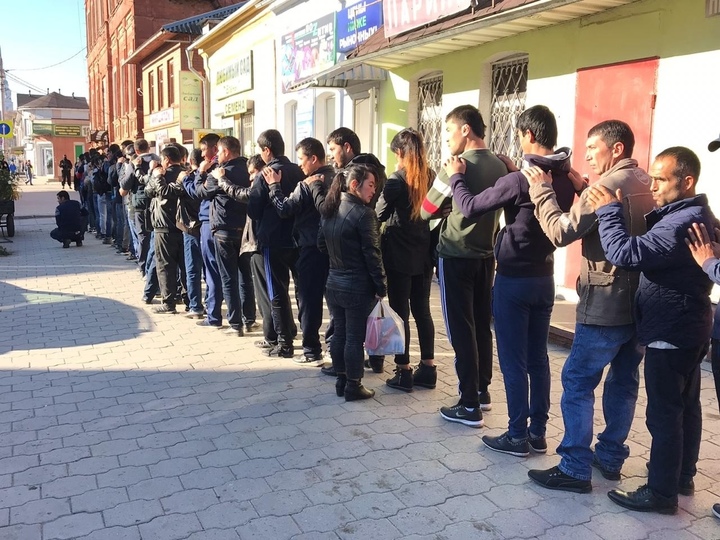
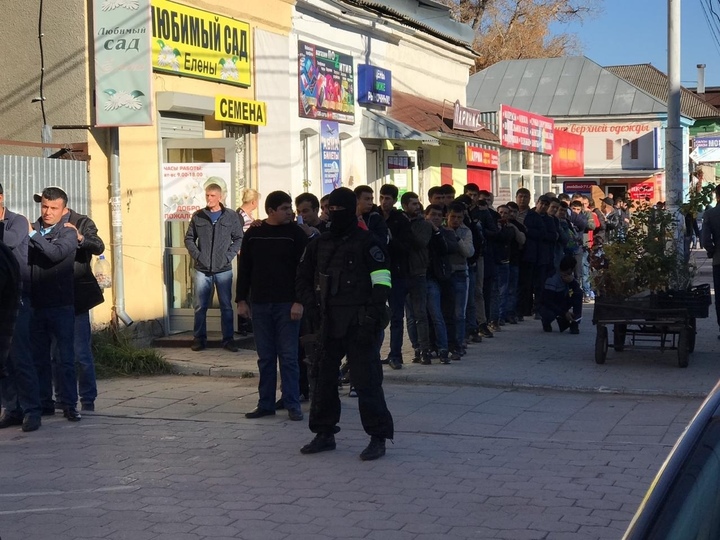
Unprecedented Document Checks in Tula: Migrant Workers Lined Up in Columns Many Meters Long
MK v Tule (Moskovsky Komsomolets in Tula)
October 20, 2018

Беспрецедентные проверки в Туле: мигрантов выстроили в многометровые колонны

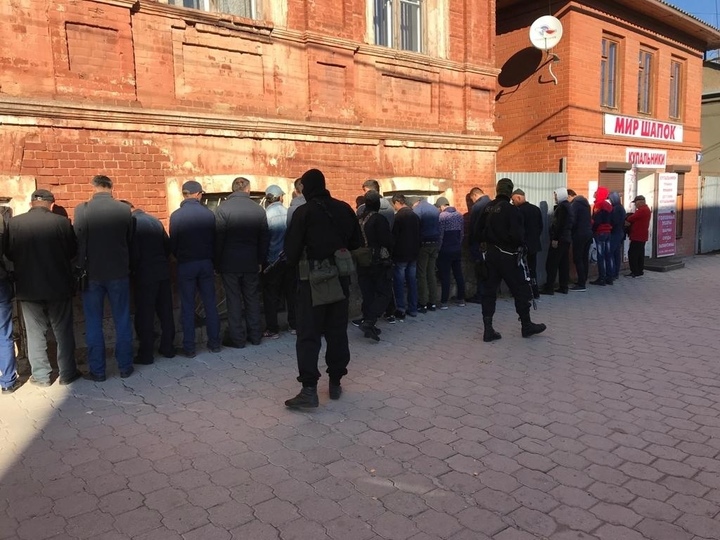
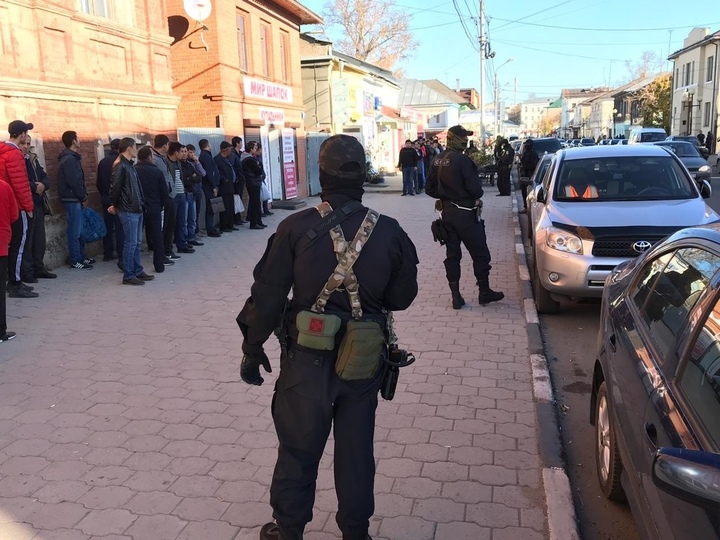
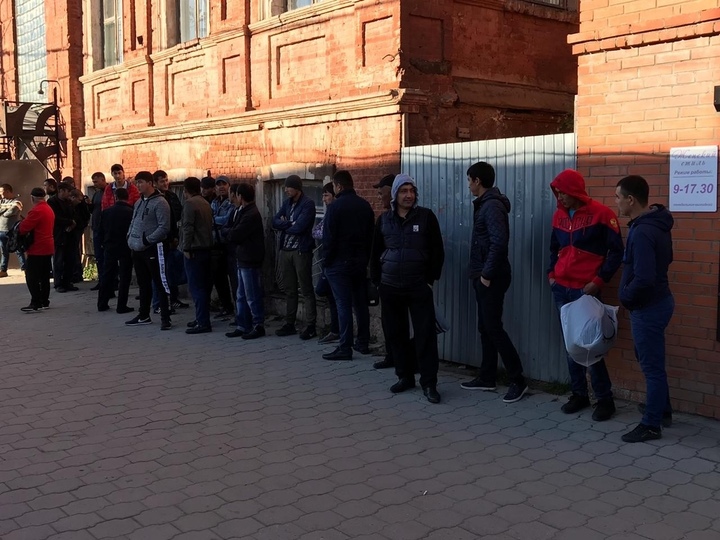
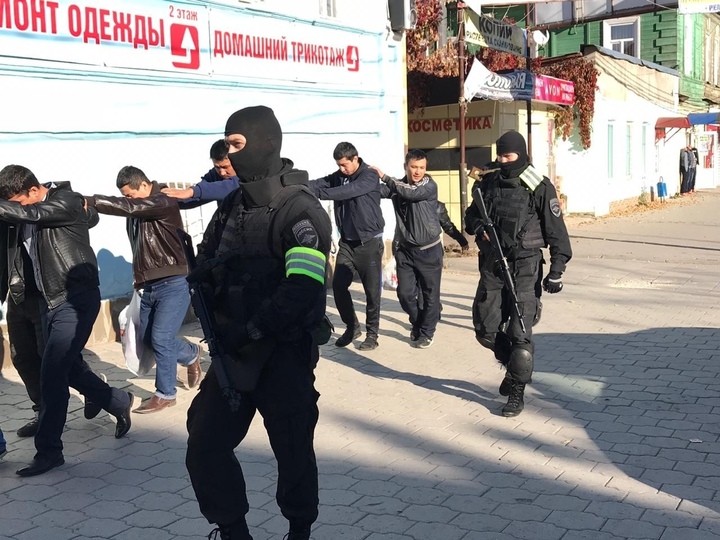
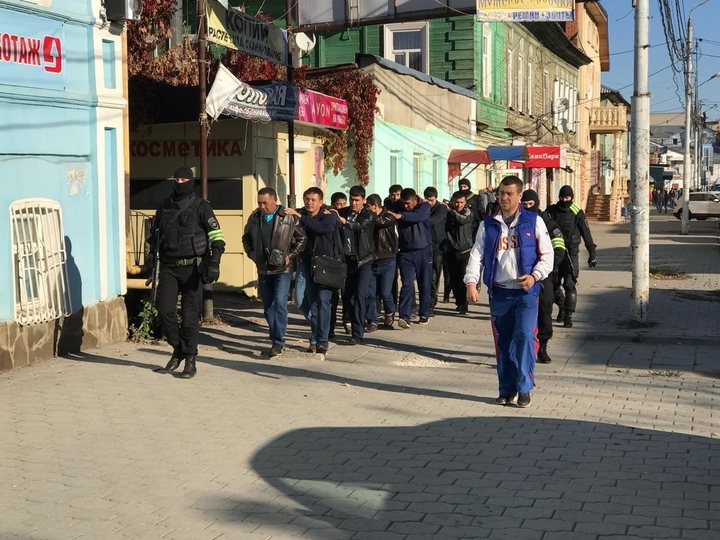
The total checks of migrant workers in Tula have moved beyond the Central Market. According to Moskovsky Komsomolet in Tula‘s correspondent, law enforcers from the Tula Regional Office of the Interior Ministry, the riot police (OMON), the Rapid Deployment Special Force (SOBR), and the Russian National Guard have inspected the streets adjacent to the market.

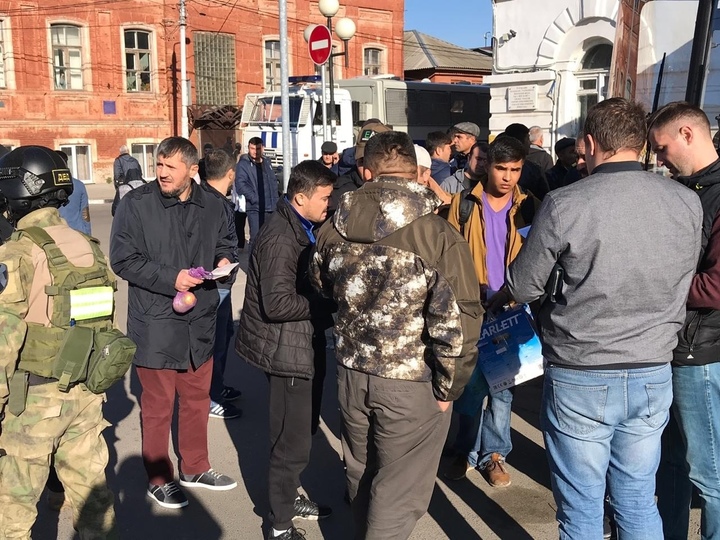
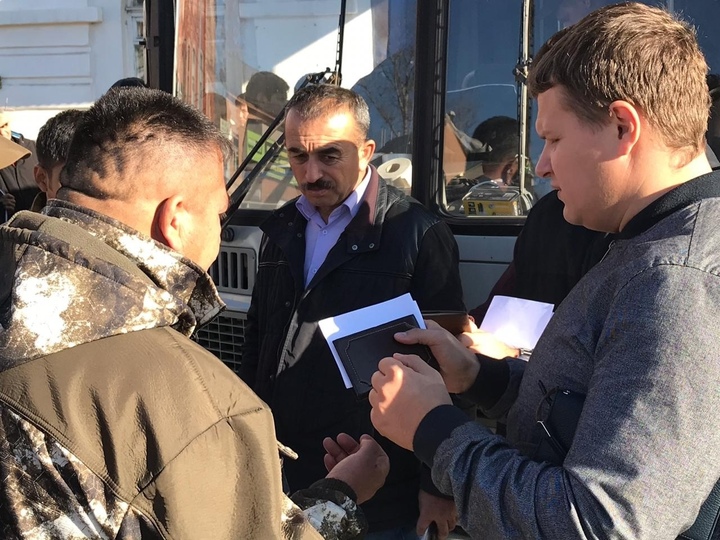
In particular, visitors from the Asian republics [sic] were also checked on Pirogov and Kaminsky Streets. Law enforcers looked to see whether people had documents [sic], residence registration stamps, and work permits.

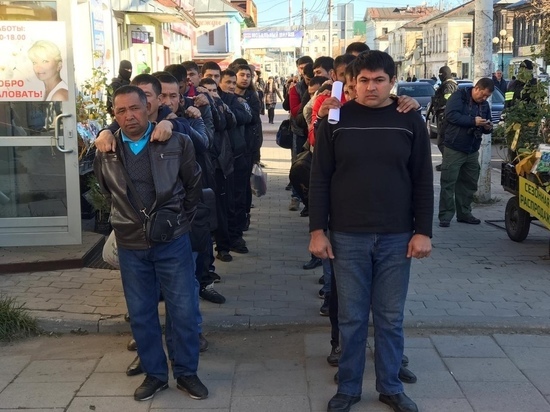
Approximately two hundred migrants workers were formed into a long column that grew longer by the minute. Checks for violations of immigration laws proceeded apace.

The total spot checks for illegals [sic] in Tula started at 10 a.m. on October 20, when law enforcers descended on the Khlebnaya Square area en masse. The entire market was cordoned off.

All photos courtesy of Moskovsky Komsomolets in Tula. Translated by the Russian Reader. Thanks to Sergey Abashin and Valentina Chupik for the heads-up.

Migrant workers, most but not all of them hailing from the former Soviet Central Asian republics of Uzbekistan, Kyrgyzstan, and Tajikistan, have been perfect scapegoats for the Putinist police state, which from day one (nearly twenty years ago) has increased its hold on public opinion through an endless series of semi-official campaigns against nefarious aliens and “national traitors.”

So-called law enforcement officers have long ago turned shaking down migrant workers—something literally every resident of every major city in Russia has seen with their own eyes thousands of times in recent years, but which they have “disappeared” along with most of society’s supposedly intractable problems—into a land office business, that is, a source of easy, quick cash.

In any case, as likely as not, most of the men shown in the photographs, above, probably had all the papers they needed to live and work legally in Russia, including residence registration papers and work permits. Unless they have temporary or permanent residence permits, they would have to renew these papers every three months in a process that is every bit as wasteful, time consuming, and humiliating as yesterday’s dragnet in Tula.

To add to their woes, the top brass of Russia’s dizzying of ever-proliferating, interwing, and competing law enforcement agencies and secret services regularly trot out cooked-up stats showing, allegedly, that migrant workers commit either an outsized proportion of all crimes in Russia or the majority of crimes. Human rights advocates can easily punch holes in these barefaced attempts to generate moral panics while simultaneously proving the police state’s continued indispensability, but these counterarguments rarely if ever get the audience enjoyed by Moskovsky Komsolomets, a mass-circulation national tabloid, based in Moscow, that for many years now has published local supplements in Russia’s numerous, far-flung regions.

Owned until 1991 by the Soviet Communist Youth League (Komsomol), Moskovsky Komsolets abandoned whatever socialist and international principles it had long ago, opting for sensationalism and high circulations. According to the BBC, the newspaper had an average issue readership of 1,215,000 in 2008, making it Russia’s second most read newspaper, after Argumenty i Fakty. Given its heavy internet and social media presence, those readership figures have certainly only gone up in the intervening years.

MK, as it usually styles itself nowadays, perhaps to make us forget about its humble socialist origins, was also identified in 2004 by the Sova Center and the Moscow Helsinki Group as the leading purveyor of hate speech amongst Russia’s national print media outlets. Certainly, yesterday’s “photo essay” in MK in Tula was an attempt to whip up a moral panic while boosting readership.

The newspaper, however, is not primarily responsible for the fact that Russian officialdom and to a certain extent, Russian society at large demonizes, terrorizes, and racially profiles the cheap, supposedly expendable immigrant workforce that keeps the perennially flailing Russian economy afloat.

If you want to learn more about the bigger picture when it comes to migrant workers in Russia, a story egregiously underreported by the international press and reported mostly in the sensationalist, racist manner, displayed above, by the Russian press, I would recommend the following articles, published on this website in the past year, plus Professor Sergey Abashin’s now-classic essay “Migrants and Movements in Central Asia,” published here three years ago. {TRR}


The New Serfs

kozyrev-muscovitesPhoto by Yuri Kozyrev for the project Muscovites. Courtesy of Novaya Gazeta

The New Serfs
On July 9, Millions of Migrant Workers and Foreign Students Will Be Stripped of the Right to Freedom of Movement in Russia in a Single Bound. What Has Happened?
Vyacheslav Polovinko and Tatyana Vasilchuk
Novaya Gazeta
July 6, 2018

On June 28, Vladimir Putin signed Federal Law No. 163-FZ, which clarifies the guidelines for immigration registration in Russia. According to the amended law, such notions as a foreign national’s place of residence and the party hosting the foreign national have been defined more precisely. The majority of media outlets have described the new law as making the lives of migrant workers less burdensome, since the new law says foreign workers can be registered as dwelling in construction site trailers. This has provoked grumbling among “tolerant” Russians, who have complained migrant workers will arrive in even greater numbers and occupy all the country’s trailers.

In fact, the situation is quite different. The new rules are a blow to all law-abiding migrant workers and nearly all foreign students. Any legal entity that attempts to hire foreign nationals to work or study in Russia could find itself in violation of the law.

Even people who have all the papers and permissions for staying in Russia could be deemed lawbreakers.

The July Eighth Law
When a foreign national arrives in Russia, she is obliged to present herself to the immigration authorities and register her place of residence. However, she cannot register herself: the people or entities who invited her are obliged to do this. If she has come on a private visit, this would be the owner of the flat she has rented or the hotel where she is staying. If she has come to Russia to study, the university where she will be studying is obliged to register her. If she has come to Russia to work, the company in which she is employed must register her. (The last instance is more flexible, because her company is obliged to register her with the immigration authorities, but they may or may not register her place of residence as they wish, apparently.) Private landlords are a separate topic, but legal entities would take the easy way out. The law used to permit them to register the university or the company’s main address as a student’s or employee’s domicile. However, the foreign national could actually live somewhere else. It was understood, however, that if the police or other competent authorities were looking for her, they could do so at the address where she was officially registered.

The old system had its advantages and its shortcomings.

“There are companies that have five or six thousand foreign nationals on staff. It is convenient for them to register people at their business address to oversee whether their employees are paying for work permits and extending their residence permits on time,” says migration expert Svetlana Salamova.

The other side of the coin has to do with the poor living conditions of some foreign workers. This is most often the case among migrant workers from Central Asia.

“Employers would sometimes accommodate fifteen people at a time in trailers, in which the living conditions were rough. Besides, finding people via their legally registered domicile was often quite complicated,” explains human rights defender Andrei Babushkin.

To solve these problems, the definitions of key notions in the immigration laws have been amended. Actually, however the circumstances of migrant workers and their Russian employers have been considerably worsened, not improved. The amendments signed into law on June 28 stipulate that the place where the foreign national stays cannot be a normal domicile, but it can be other premises where the foreign national or stateless person actually resides, i.e., regularly uses for sleep and relaxation. If she is registered by a Russian organization, the foreigner must live for all intents and purposes in premises belonging to the organization. However, the premises must be equipped as a dwelling space.

In other words, if a foreign worker wants her company to register her with the authorities, she is obliged to reside full time in the company’s living accommodations.

The catch is that most legal entities simply do not having living accommodations. Construction companies will have the easiest time of it. They will now actually be able to register workers as legally residing in trailers and makeshift barracks at construction sites. All other companies have nowhere to accommodate their employees from other countries. A sofa and a microwave are not sufficient conditions for turning a room into a legal residence.

“Legally speaking, a domicile is a place that has been registered as such,” says Salamova. “An office with a sofa in it is not a domicile, but if your company lets you keep your suitcases there and install a stove and refrigerator, theoretically you could be registered as dwelling there. In this case, however, the employee from the personnel department who registers you with the Russian Interior Ministry [i.e., the police] will have to supply the immigration authorities with paperwork showing the room has been registered as a domicile.”

Will Russian companies be willing to turn their offices into bedrooms? The answer is obviously no.

Large auditing and consulting agencies, a field in which many foreign nationals are employed in Russia (not only expatriates but also graduates of Russian universities who are nationals of the former Soviet republics) have started to warn their employees about the need to look for a place where they can be registered as residing. Victoria Plotinskaya, marketing and public relations director at AT Consulting, told us that foreign employees at her company must register at their actual addresses before July 9. Previously, AT Consulting registered them at its business address, but now it is willing to provide them with legal assistance. Plotinskaya assumes their employees will have no difficulties, since registering oneself as residing in a rented flat is not a problem,  she claims.

We, however, have learned that several employees of major companies have been thinking about quitting their jobs or transferring to their home countries because their landlords have no intention of registering them.

“Companies will lose the ability to keep track of the immigration registration of their foreign national employees, while  foreign nationals who live in rented flats will have to negotiate with their landlords about registering them,” says Roman Gusev, director of Ernst & Young’s taxation and legal services department. The company does not plan to lay off any employees.

“In practice,” Gusev continues, “we see that many landlords refuse to deal with this procedure, because they don’t want the added administrative burden. In such cases, foreign nationals will have to urgently look for new accommodations. On the other hand, landlords who agree to meet the new requirements will have to keep close watch over their foreign tenants’ arrivals in the Russian Federation, since they have to be registered with immigration authorities after each such arrival.

“There are also risks for conscientious landlords. If their foreign national tenants arrive in the Russian Federation and fail to inform them, the landlords will be breaking the law without knowing it. On the other hand, foreign nationals could also find themselves in a pickle if their landlords suddenly refuse to register them with the immigration authorities or are simply unable to do what the law requires of them because they happen to be out of town,” concludes Gusev.

Unfortunately, the new rules are also retroactive, apparently, meaning everyone who is registered as residing at a business beyond July 8 will be in violation of the law come this Monday—unless, of course, they are unable to swiftly persuade their landlords to register them. In this case, however, no one can vouch that landlord will supply this service for free. Rental agreements presume that landlords pay taxes on the rent they charge. Verbal agreements to rent someone a flat and register them while not paying taxes could lead to a rise in the price of flats let to foreign nationals in Russia.

Formally, nothing has been said about the retroactive force of the amendments to the law, as signed by Putin. However, human rights activists have already been getting reports of attempts to deport migrant workers for dwelling in places where they are not registered to reside. In fact, the Interior Ministry already has the power to deport a non-Russian national if an inspector discovers him somewhere other than his registered domicile, say, at another flat in the evening.

This was what happened to Uzbek nationals in Omsk Region, says human rights activist Valentina Chupik. The Uzbeks went to a immigration center with registration papers obtained from a middleman, and they were sent off to be deported, allegedly because they did not live at their registered domicile.

In other words, under the new law, migrant workers no longer have the right to spend the night somewhere other than their legally registered, actual residence.

Under Article 54 of the Russian Constitution, laws cannot be applied retroactively. This was underscored by the specialists at Alliance Legal Migration, a firm based in Petersburg. In theory, then, all registrations issued before July 8 should be valid for their full terms. This can be proven only in court, however. Yet Russian courts rarely side with migrant workers.

Dormitory Hostages
Foreign nationals employed by Russian companies are only half of the problem. If push comes to shove, they can pay landlords extra money to register them. All foreign students in Russia are now at risk as well. Previously, universities would register their main buildings as the legal domiciles of their foreign students, but now they will be obliged to register all of them in university dormitories. However, the number of rooms in the dorms does not match the number of foreign students, and out-of-town Russian students have to live in dorms as well. Besides, there are students who do not want to live in dorms and can rent flats, students who have children, for example. Previously, they could count on their universities registering them, but now they will have to take care of their own registration.

The new law also applies to students who left for summer holidays not knowing they would return to Russia in the autumn on new terms. In addition, students who are registered in dorms are virtually their hostages.

Any violation of university regulations or, for example, attendance at an opposition rally gives university deans the chance to opportunity to revoke the registration of “troublesome” foreign students, which automatically means they are in violation of immigration laws and can be deported. Considering the fact that many international students have never experienced serfdom, they behave like free women and men. Their freedom will now be harshly restricted by the hours when the dorm’s main entrance closes.

Universities themselves seemingly have not yet figured out yet what they are going to do. The new rules have been a big surprise to most of them. The main issue they face is how they will now enroll international students if registering all of them legally has become impossible.

The Peoples’ Friendship University of Russia (RUDN) refused to comment on the amended rules. We were told by a spokesperson at the Higher School of Economics (HSE) that they were in the process of working out a way of dealing with the new rules. However, we have in our possession correspondence between students and the HSE’s immigration department, who categorically informed the students they could be registered only at their actual places of residence.

At Moscow State University (MGU), we were told, “The issues of timely migration registration and visa extensions for foreign students residing in rented flats is currently being examined by university management in order to find the optimal solution.”

“The university has not contemplated any limitations to enrolling foreign students due to the adoption of Federal Law No. 163-FZ, dated June 27, 2018,” a MGU spokesperson added.

Other universities failed to respond to our inquiries before this issue of the newspaper was sent to the presses.

“If a university does not have a dormitory or does not have enough room in its dormitories, students can ask for a written request from the university to landlords, asking them to register the students at their actual domiciles. And then the landlords can register them if they want to do so,” explains Salamova.

Closely Watched Flats
You should not imagine that all of the above is a headache for foreigners, but has nothing to do with you.

According to the new rules, Russian nationals who let flats to foreign nationals are automatically regarded as “hosts,” meaning they are obliged to register them as residing in their dwellings and are responsible for them.

“There will also be increased check-ups and fines in the case of noncompliance with the laws for people who let flats to foreigners,” predicts Salamova.

In all fairness, such fines also existed earlier, but they were almost never issued. We have been informed that as soon as the World Cup ends, the police will make an extra effort to inspect all residential buildings and search for unregistered foreigners living in them.

Moreover, Russians are currently responsible for foreign nationals, even if they have left the country but their immigration registration is still valid. A law bill, sponsored by Irina Yarovaya and on the verge of its second reading, has been tabled in the State Duma. If passed, it would make it possible to remove foreigners from the immigration registry instantly and on one’s own via the web. This means landlords would also be able to remove tenants from the registry whenever they wanted, claiming, for example, that they had lost touch with the migrant workers in question. Foreign tenants would thus be subject to the whims of landlords, who could raise their rent at the drop of a hat, threatening to remove them from the immigration registry if they failed to pay. Besides, if a migrant worker does not live in the flat where she is officially registered, she can find herself without papers at any minute because, according to yet another amendment, she can be stricken from the rolls as residing in a particular flat without her knowledge. This means that beat cops can stop her on the street and automatically fine and deport her.

In mid June, the State Duma approved yet another law bill in its second reading. If passed, it would make organizations that invite foreigners to Russia wholly responsible for their actions. For example, if a foreign national works somewhere else than the organization that invited him or “is up to no good,” as MP Viktor Karamyshev has put it, the authorities will pay a call to the foreigner’s primary host organization. In addition, companies would have to make sure that when an employment contract ends, the migrant worker leaves the country instantly. Otherwise, the companies would be fined.

At the same time, the State Duma approved a new list of fines for noncompliance with all these rules on the part of organizations and ordinary Russians.

Under the new regulations in the Administrative Offenses Code, individuals will pay fines of up to 4,000 rubles for violations involving migrant workers, while officials will pays up to 50,000 rubles, and legal entities will pay up to 500,000 rubles [approx. 6,700 euros].

Beneficiaries  
By and large, the batch of laws that have been adopted or are still under consideration (the Interior Ministry, for example, has launched an expert group to draft a Migration Code) should at least be sent back to the relevant committee for revision, since, as Babushkin says, “The harm they do outweighs the good.” But the way the new rules have been drafted and adopted behind the scenes—they did not warrant a single public hearing nor, as far we have ascertained, did their authors consult with independent migration lawyers—suggests their oppressiveness is advantageous as they currently stand.

Who stands to gain, however? MP Irina Yarovaya, for example, argues that certain changes, such as the ability to remove migrant workers from the registration rolls on one’s own, are in the interests of ordinary Russians. She states her case in a clarification to the law bill that the MP’s aides sent to us in reply to a request for comments. On the contrary, human rights activists argue the Interior Ministry, which now has complete oversight over immigration, has received yet another tool for extorting bribes. Any migrant worker can be stopped on the street by the police and threatened with deportation: he will find it easier to pay them off. Any landlord can be intimidated with fines.

The threat of deportation is a convenient tool for dealing with troublesome individuals.

Our newspaper published the story of Gulchekhra Aliyeva and her family. She and her son were locked up for five days without food and water at the Ramenki District Police Station in Moscow. They were let out of their cells twice a day to go to the toilet. According to the Aliyevs and human rights advocates, the police tried to extort them, promising to deport them if they did not pay up. The ostensible cause was the tightening of security on the eve of the World Cup. After human right defenders intervened, the Aliyevs were released, and a criminal investigation into allegations of torture was launched.

“However, when the Aliyevs were summoned for questioning, it transpired  the police planned to deport them for being registered at their place of work rather than where they actually lived,” says Chupik.

Moreover, this happened before the new law had taken effect.

“We basically saved them by escaping the police station,” recalls Chupik.

The special services also stand to benefit from the new law. As we have learned from a source with ties to the academic world, special services officers have connections to the immigration departments in several Russian universities.

This is tantamount to reviving the Soviet system of “working” with international students at universities. Given that they inevitably violate the rules, they can be inclined to “friendship” and “cooperation” when necessary.

Besides, foreigners per se will now be unable to take the slightest step in Russia without official registration. Nationals of our allies Kyrgyzstan and Kazakhstan will also be punished, but that is collateral damage.

Finally, fly-by-night fake migration registrars stand to gain from the law, since their entire business will disappear into the shadow economy. Even now, migrant workers who travel to the Multi-Purpose Migration Center (MMTs) in Sakharovo, in the far southern outskirts of Moscow, cannot have their domiciles registered while other papers are being processed, including their work permits. Human rights activists say the MMTs has lost this right due to the new law.

“Everyone mobs Kazan Station, getting registered by people who give them counterfeit papers,” claims Chupik.

As far as we know, the neighborhood around the Kazan Railway Station, in central Moscow, has the largest number of people offering such dubious services. Moreover, these deals are made more or less in plain view of law enforcement officers, who do nothing about them: maybe they know something important we do not know or know more thane we. The price of counterfeit registration papers is between seven and eight thousand rubles [approx. 95 to 110 euros], a hefty sum of money for migrant workers.

The Interior Ministry stubbornly persists in saying nothing about how the new law will be enforced: it has not published any official clarifications. We have sent the ministry a request to comment, but when this newspaper went to the print, the ministry had not yet responded.

Thanks to Sergey Abashin for the heads-up. Translated by the Russian Reader

Xenophobia and Corruption Making Russia Less Attractive to Central Asian Migrant Workers

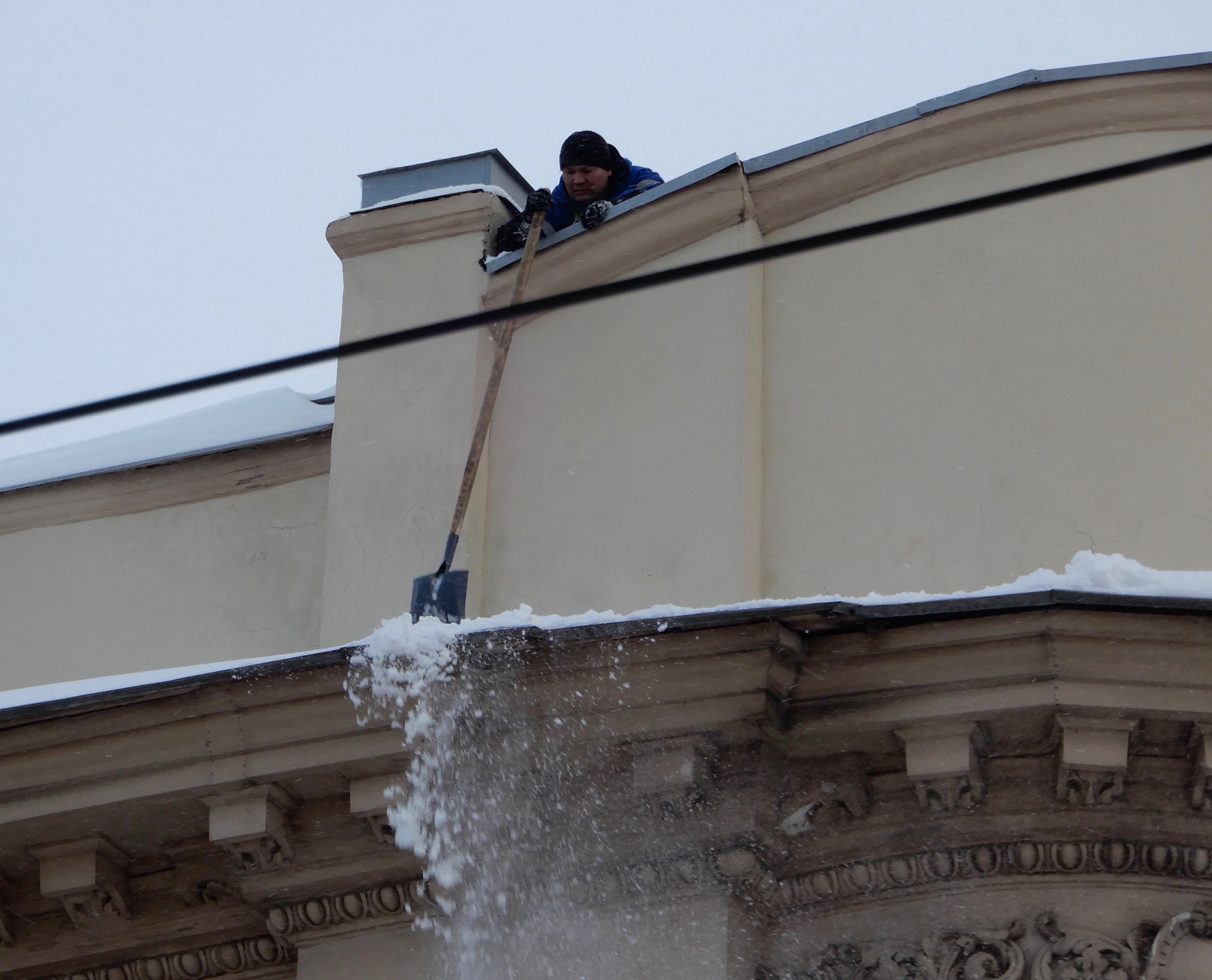
DSCN3525To give only one of a thousand examples, without Central Asian migrant workers, there would be almost no one left to do the heavy and, sometimes, dangerous work of clearing freshly fallen snow from rooftops and pavements during the winter. February 5, 2018, Petersburg. Photo by the Russian Reader

Fists and Epaulettes: Xenophobia and Corruption Making Russia Less Attractive to Central Asian Migrant Workers
Vyacheslav Polovinko and Yulia Reprintseva, with Madina Kuanova
Novaya Gazeta
February 5, 2018

Novaya Gazeta continues to investigate the lives of migrant laborers in Russia. In our last issue, we discussed the magnitude of the corruption faced by immigrants when they apply for resident permits and work permits (“Luck and Labor,” February 2, 2018). However, even when migrant workers finally obtain these papers, their lives in Russia are not made any easier.

Police, Open Up!
In the run-up to New Year’s 2018, detectives from the Perovo and Kuntsevo police precincts in Moscow detained 520 migrant workers. All of them were taken to a police station, where they were forced to stand outside in the cold from six in the evening to two in the morning. According to Valentina Chupik, head of the human rights organization Tong Jahoni (Morning of the World), only those who gave the police 10,000 rubles [approx. 140 euros] each were released. The police said they were collecting money “for celebrating the holiday.”

The police regularly hold such “celebrations” for migrant workers. In a ranking of offenses against immigrants, the police take first place with a large margin (86% of all complaints). Most often, the police extort money during groundless document checks.

“In Russia, the attitude is he is an Asian, so he’ll give us money,” claims Chupik.

In police stations, up to twelve migrant workers are held in seven-meter-square cells for forty-eight hours and not allowed to go to the toilet. Police sometimes assault them. In October 2017, according to human rights activists, the officers at Perovo and Novogireevo precincts in Moscow beat up 39 people.  It was a tough month, apparently.

“Volunteer work days” are another police practice. According to human rights activists, migrant workers were forced to repair a police station in the Moscow suburb of Mytishchi on April 21, 2017.

The migrant workers complain, but to little effect. In 2016, Valentina Chupik filed 6,232 complaints with various police internal affairs departments in Moscow and Moscow Region, but only four of them were passed up the command chain for further review. Meanwhile, the system for expelling migrants on the basis of police complaints operates without fail. In 2016 (there is no data for 2017), Moscow courts expelled over 14,000 migrant workers from Russia for living somewhere other than their registered domicile. They expelled almost 12,000 migrant workers for being in public without their papers on them.

“The main problem is the right the police have accorded themselves to check the papers of migrant workers for any reason,” says Chupik.

“Yes, they do have this obligation, but only when a migrant worker is involved in a criminal case,” she says.

According the Interior Ministry’s latest orders, even a neighborhood police inspector can check someone’s immigration status. He can write the person up for a nonexistent violation, which is immediately entered into a special data base. Two violations are sufficient cause for deportation from hospitable Russia, explains Chupik.

Curiously, at the same time, migrant workers are far from the most dangerous social group in Russia, formally speaking. Moreover, the number of crimes committed by migrant workers has been steadily declining, which has been noted even by the Russian Prosecutor General’s Office. As reported by Kommersant, according to the Prosecutor General, foreign nationals and stateless persons committed 41,047 crimes in Russia in 2017, which was 6.6% fewer than in 2016. In November of last year, Interior Minister Vladimir Kolokoltsev mentioned an even earlier nine-percent drop in crimes committed by migrant workers when presenting the new immigration policy. But what the top brass has said is not digested fully and immediately by rank-and-file police officers.

Commentary
Valentina Chupik, head of Tong Jahoni
State agencies and the police do not hate migrant workers because they are so despicable. The authorities pretend to hate them so it is less shameful when they rob them for their own profit. When you talk to on-duty cops, they claim eighty percent of crimes are committed by migrant workers. When you ask them to go to the Interior Ministry’s own website and take a gander at the stats, they switch to saying most crimes are committed by North Caucasians. Then they say, “Well, it’s just our policy.” When you tell them they should not implement a criminal policy because they are law enforcement officers, they get it. But they complain they have arrest quotas to fill. 
content_09
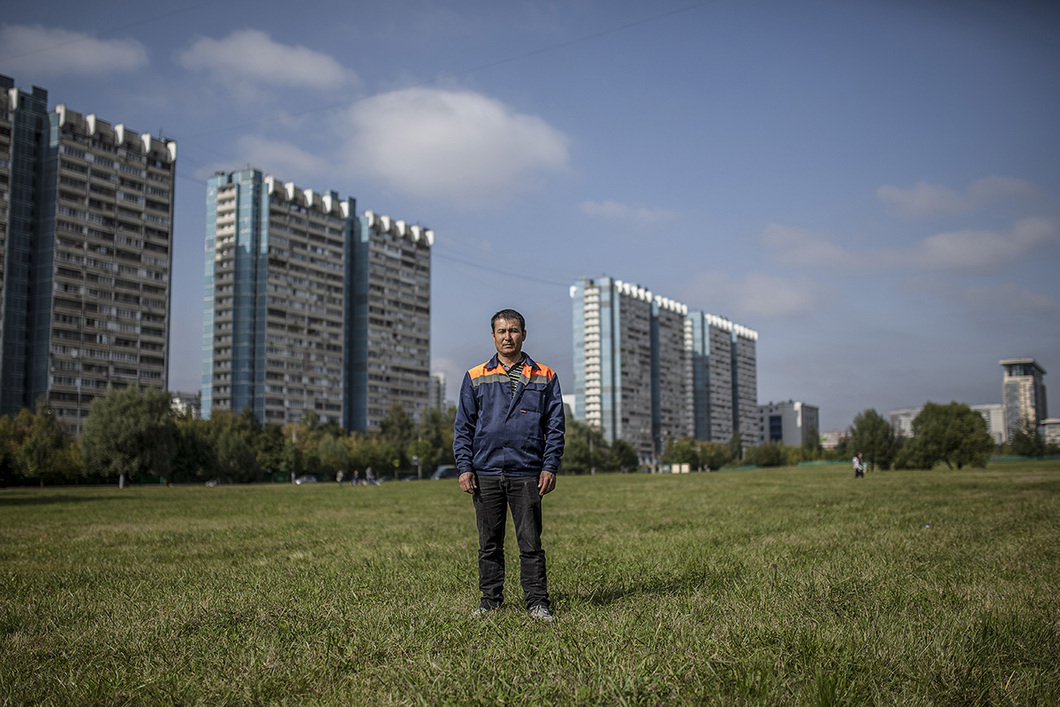
Muhiddin, a janitor. Photo by Vlad Dokshin. See Muhiddin’s story in Novaya Gazeta′s special project Muscovites

Xenophobia Has Momentum
On January 12, the body of 41-year-old Tahirjan Hamrayev was found in Noginsk, Moscow Region. Hamrayev had been stabbed over twenty times. Hamrayev left Kyrgyzstan as a migrant worker in May 2017 and got a job on the construction site of a multi-storey residential building. As reported by Kyrgyzstani media, the dead man’s mother, Hairins Hamrayeva, said her son was supposed to have come home for the New Year’s holidays, but decided to stay in Noginsk since his employers, impressed by his work, had offered him extra jobs. On the fateful day, Hamrayev went into a shop and fell into the hands of at least ten neo-Nazis, local law enforcement official claim, citing an eyewitness’s testimony.

In the various ultra-right groups on social media where the incident is discussed, commentators occasionally write languidly that Hamrayev got what was coming to him. Generally, after the security services were pressured by the Kremlin into mopping up the sector, nationalism and neo-Nazism have died out as phenomena [sic], and nowadays assaults on migrant workers have gradually become something out of the ordinary,although in Petersburg on January 31, for example, a Tajikistani national was attacked with a knife in the subway.

No one, however, has abolished xenophobia, which, although it has displayed a downward trend [sic], is still firmly entrenched in the minds of Russians.

In early 2017, Tong Jahoni published the findings of a study on nearly 50,000 housing rental ads in Russian media. Only one out of every twelve ads was free of xenophobic  insinuations. Most of the people who placed the ads wanted to rent their flats or rooms to “Russian citizens” (50%), “Slavs” (28%), and “ethnic Russians” (7%). The picture presented by help wanted ads was even more distressing. Only one in twenty ads among the 20,000 vacancies examined did not contain xenophobic allusions. Fifty-six percent of employers were seeking “Slavs” to fill the jobs, while 35% were eager to see “Russian citizens” in the positions.

Human rights activists say the situation is typical, and no one wants to change it for the most part. In turn, the media fuel the fire. In 2016, there were approximately 120,000 news reports involving migrant workers. News search websites focused mostly on crime reports, which constituted nearly 98,000 of the news reports filed.

However, the attitude to migrant workers on the part of the rank-and-file population is often quite neutral when they encounter each other face to face. Moreover, human rights activists can cite instances in which the police have helped migrant workers. But in terms of society at large, although xenophobia decreased by 10% last year, according to the official estimates produced by the Russian Federal Public Chamber, it still remains a serious problem. According to pollsters VTsIOM [sic], two thirds of the people they surveyed believed migrant workers took jobs away from Russian citizens.

Commentary
Alexander Verkhovsky, director, Sova Center for Information and Analysis 
There is xenophobia as a mass phenomenon: people’s attitudes and emotions. In this case, we can track changes through public opinon polls [sic]. I am quite glad that there is a growing number of people who, when asked about the feelings they have towards migrant workers (e.g., fear, apprehension, hatred, love), respond that they feel nothing, that they could not care less. The perfect relationship is precisely this, when people do not see a group as something that provokes emotions. They are just other people.

There is xenophobia as discrimination, when seeking employment, for example. Unfortunately, practical discrimination has been underresearched. What matters most is that people do not even perceive some forms of it as discrimination. For example, people are not ashamed to write in an ad that they will rent a flat only to a Slavic family. It is useless to fight this. It is a matter of the social atmosphere [sic].

Finally, the most aggressive form of xenophobia is physical violence. In recent years, the figures have been steadily declining. Just the other day, Sova Center published a new report based on the figures for last year. I would note there is not necessarily a meaningful connection with the decline of popular xenophobia, because assaults are not committed by the masses, but by ideologically motivated young people, who might have completely different opinions from the masses. This is more likely the consequence of a depression amongst radically minded young people. They are scared. They don’t really want to commit assaults [sic]. In the previous decade, they did not know the fear of God at all, as the saying goes, but then Center “E” [Russia’s “anti-extremism” police, established from disbanded anti-organized crime squads during Dmitry Medvedev’s presidency] went after them. Many street fighters went to prison, and this changed the situation.
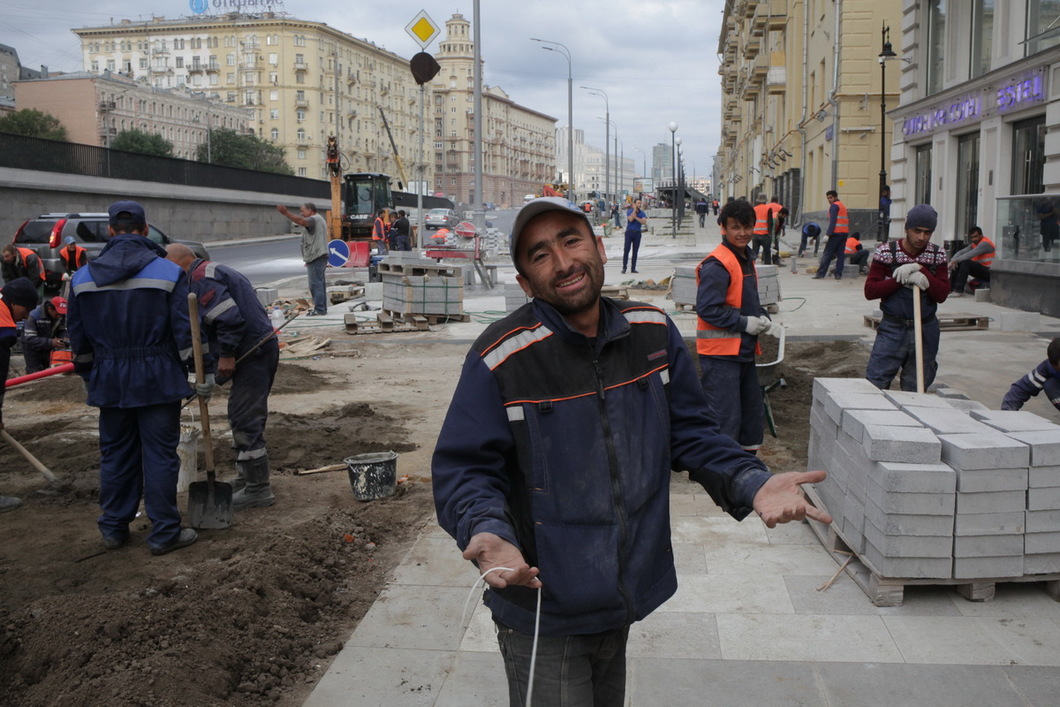
content_Krasavchik_01
Shirinsho “Handsome” Vohidov, from Tajikistan. Photo by Anna Artemieva. See Shirinsho’s story in Novaya Gazeta′s special project Muscovites

Medical Disenfranchisement
When migrant workers take ill in Russia, it is no simple matter for them to recover.

“To enroll at a district outpatient clinic, you need to have a temporary residence permit or residence permit, permanent registration,” says Daniil Kashnitsky, a junior researcher at the Higher School of Economics. “However, a poor command of information and the Russian language, as well as a lack of legal knowledge, means that when migrant workers are yelled at by employees at the intake desk, they leave and do not come back. There are many such instances.”

There is the option of going to a private clinic, but sometimes only a state clinic can help, for example, when tuberculosis is diagnosed. It can help, but it is not obliged.

“Tuberculosis has a dangerous phase when it is communicable through airborne droplets. Patients must be hospitalized during this phase. They should stay in hospital until the tuberculosis bacterium goes away, and they are no longer a danger to others. This usually takes two or three months,” explains Kashnitsky.

If migrant workers are hospitalized due to an accident, the treatment is free, of course, but the attitude towards them will be correspondingly shabby. Last year, when a busload of migrant workers was hit by a train near Vladimir, killing seventeen people, the local hospitals treated several severely injured people.

“I asked that an injured child be sent to Moscow. Two days later, he died in our regional hospital. I remember the child. He was a year and a half old, from an Uzbek family. I said, ‘Why did you send him to our hospital? Call a helicopter and take him to Moscow: he’ll get better help there.’ I was told the decision had been made by the health department,” recounts Alla Boyarova, director of an employment agency for migrant workers. On the morning of the tragedy, her husband had rushed to help the affected immigrants.

Zoyir Karimov, Boyarova’s husband, is deputy chair of the Tajik diaspora in Vladimir. He recalls that the adult victims had huge problems.

“Two of them did not make full recoveries in hospital. They were not operated on and were sent back in this shape to Uzbekistan. They were told they could buy special plates, but they had no money. One broke his shoulder, the other, his leg,” says Karimov.
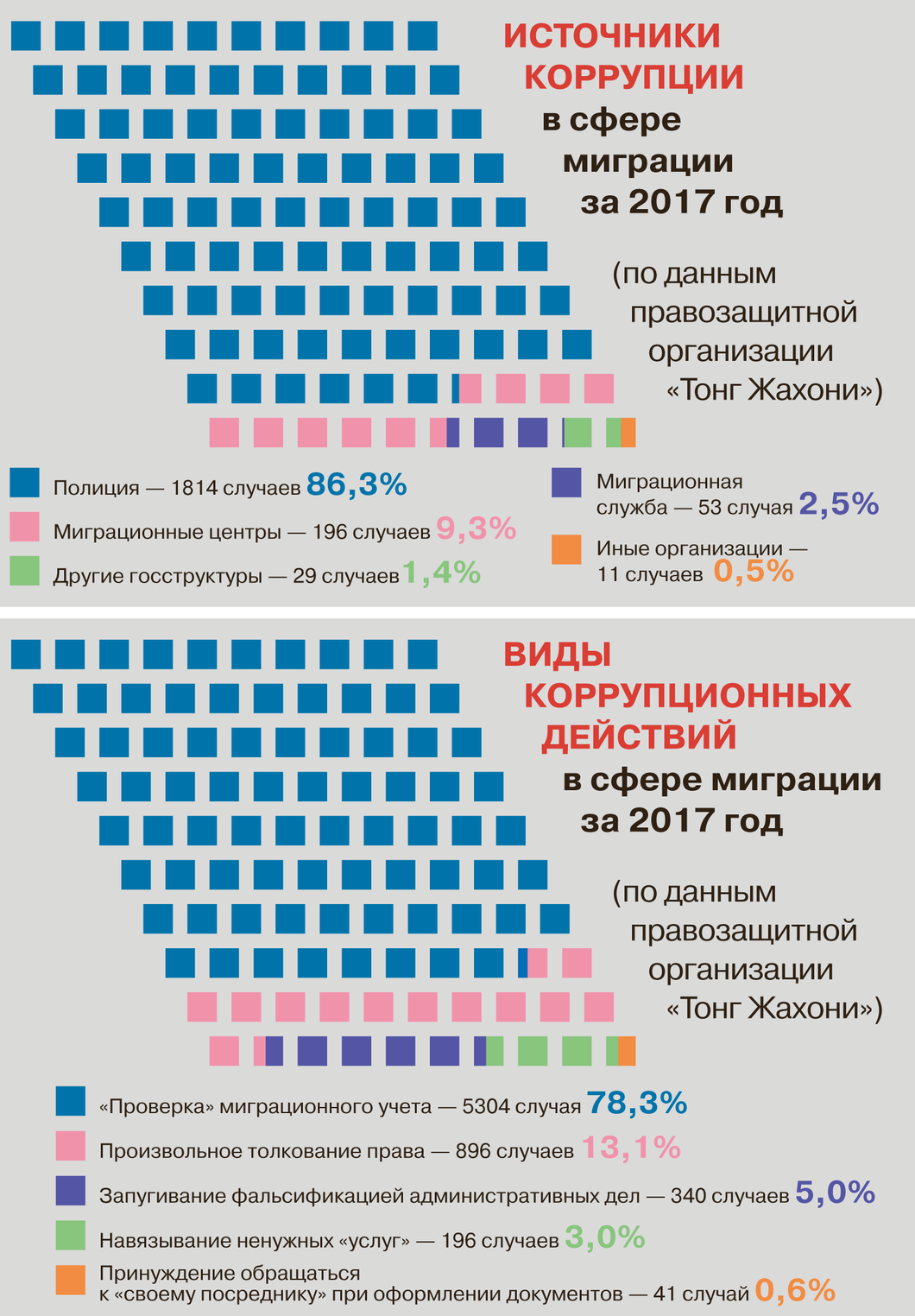
content_4
Infographic No. 1: Sources of corruption in the migrant labor sector, 2017, per information gathered by the human rights organization Tong Jahoni. Police — 1,814 incidents (86.3%); immigration centers — 196 incidents (9.3%); migration service — 53 incidents (2.5%); other state agencies — 29 incidents (1.4%); other organizations — 11 incidents (0.5%). Infographic No. 2: Forms of corruption in the migrant labor sector, 2017, according to the human rights organization Tong Jahoni. “Verification” of registration status — 5,304 incidents (78.3%); arbitrary interpretation of the law — 896 incidents (13.1%); threats by police to file trumped-up administrative charges — 340 incidents (5.0%); high-pressure selling of unnecessary “services” — 196 incidents (3.0%); forcing migrant workers to use a particular middleman when filing papers — 41 incidents (0.6%). Infographics courtesy of Veronika Tsotsko and Novaya Gazeta

Blockchain to the Rescue
It is tempting to dub what is happening in the Russian migrant labor sector a mess. In fact, however, it is more likely a restructuring of the system after the Federal Migration Service (FMS) was incorporated into the Interior Ministry in 2016. The relationship with migrant workers has changed because what the Interior Ministry does most of all is punish people. Many of the organizations that dealt with drawing up papers for migrant workers have been turned into limited liability companies, meaning it has become nearly impossible to monitor their policies, and human rights activists have huge gripes with the new state-run immigration centers. New law bills that have been tabled will only aggravate the circumstances, reducing migrant workers to semi-slave status in Russia.

The question is simple: what to do? At a January 29 meeting of human rights activists to discuss the issue of immigration (a meeting not attended by diaspora leaders) various proposals were voiced. Vladimir Khomyakov, co-chair of the grassroots movement People’s Assembly (Narodnyi Sobor), made the most radical and regressive proposal at the round table.

“We need the strictest possible oversight of each person’s stay in Russia, not just this buying a work permit and hanging out wherever you want,” said Khomyakov. “We need a system of mutual obligations. We need a single government agency that would deal with immigration and use a single database.”

People who intend to travel to Russia should obtain all the papers they need at Russian consulates in their own countries, and each migrant worker should be assigned an ID number under which all information about him or her would stored, argued Khomyakov.

Totalitarian oversight in return for peace and quiet.

But Khomyakov’s idea was not met with unanimous approval by round table participants, just like the proposal, made Vyacheslav Postavnin, former deputy head of the FMS and president of the 21st Century Immigration Foundation [sic], to move immigration registration online or, at least, make it obligatory for immigrants to check in with the migration service by telephone. Some human rights activists were outraged by the fact this would make it easier for terrorists to hide [sic].

“Terrorists never violate immigration laws. Terrorist acts are complicated operations. What, they are going to put themselves at risk of being stopped by police for failing to reregister on time?” Postavnin countered crossly.

He was told that hackers could erase or damage the entiere online database, to which the former deputy head of the FMS showed off his knowledge of the word “blockchain.”

“Even if you wanted to, you couldn’t erase it,” he said.

Tatyana Dmitrieva, deputy head of the Department for Coordinating Local Immigration Offices and Accountable Forms in the Immigration Directorate of the Russian Interior Ministry’s Moscow Office, did not like any of these proposals. She only remarked that the ministry wholly supported a new law bill that would punish legal entities for providing fictitious registration, and that a consensua had to be reached with regard to thorny issues.

The discussion’s moderator, Fyodor Dragoi, chair of the Committee for Safety, Public Diplomacy and Public Oversight at the Council for Ethnic Affairs in the Moscow City Govermnent, suggested drawing up a list of proposals after the discusssion, since “this tumor [could] burst any minute,” and the problem had to be solved.

Another, autonomous proposal has been made by the Center for Strategic Research (CSR), which has published its report on immigration. Recognizing a decline in migration flows from the CIS countries in recent years—2017 saw an increase the numbers of migrant workers from many countries, but the numbers have not returned to pre-crisis levels—the report’s authors propose their own measures for maintaining a migration flow of 250,000 people to 300,000 people annually, which they claim is a necessary number for modern Russia. In particular, they propose introducing something like a green card for highly qualified immigrants in order to stimulate the influx, as well as work cards that would make it easier to obtain a residence permit.

Something has to be done, since Russia will have lost thirteen million able-bodied people by 2030, but internal resources for population growth have been exhausted.

content_4
Viorel, a Moldovan, on a lunchbreak with his workmates. Photo by Viktoria Odissonova. See Viorel’s story in Novaya Gazeta′s special project Muscovites

The problem is that there are not unlimited numbers of highly qualified immigrants, and the ones there are drift in other directions. To take one example, the number of migrant workers from Moldova has decreased over the last two years by more than one and a half times, from 250,000 to 157,000. They have begun looking towards the European Union.  The number of migrant workers from the Eurasian Union has been growing, but their numbers are also limited, especially because Kazakhstani workers, for example, are needed in Kazakhstan itself, a country that, due to geographical proximity, grabs Kyrgyzstani workers away from Russia. The number of immigrants from Tajikistan have been growing steadily. On the other hand, while the number of Uzbekistanis coming to Moscow has grown over the past year, to a million and a half registered nationals, it would seem the numbers will eventually decline, since more convenient job markets have opened up to them.

“Turkey and the Emirates are currently very interesting and attractive to migrant workers from Asia,” says attorney Yulduz Ataniyazova. “The economy there is civilized, and there is a niche in the economy for unskilled workers. At the same time, the workers are provided with normal working conditions. For example, I know that in the Emirates migrant workers who clean houses and work in restaurants note that the cleaning liquids there are less harsh [sic]. This has now become important to them.”

However, the wages there are less than in Moscow, generally, but it depends on how you look at it.

“Uzbeks start doing the maths, and it turns out that here they will pay out more in bribes, whereas in Turkey a policeman would never approach them for no reason at all,” explains Chupik.

Workers from the CIS will keep coming to Russia for some time, of course. But if Russia toughens the rules for migrant workers, even the most desperate adventurers from the CIS countries will prefer, in time, to go somewhere else, to a place where they can work without risking their lives, health, and human dignity, not to mention their wallets.

Translated by the Russian Reader

NB. Perhaps I should have a three [sic]s and you’re out rule on this website, but despite the number of dubious or simply odd claims made by the article’s authors and the experts they quote, I thought there was enough important information and nontrivial viewpoints in the article to make it worth my while to translate and your while to read.

However, on one point—the claim that nationalists and neo-Nazis have come to naught in Russia, and hence the number of assaults on migrant workers has precipitously decreased—I was so bothered I turned to my friend W., a person who has been involved with immigrant rights in Russia both professionally and personally for many years. Here is their response.

“They are engaging in wishful thinking. Nationalism and neo-Nazism have not gone away. It has become very difficult to keep track of attacks. Officially, such reports are not welcome and are rarely discussed in the media. This is the current trend. None of this exists anymore in Russia, allegedly, while in Ukraine, for example, there has been a serious increase in anti-Semitism. According to the official interpretation, there is almost no anti-Semitism in Russia, although there were several egregious incidents in January. Basically, nobody cares about this business, and Jewish organizations mainly smooth over the potentially negative consequences of vociferous discussions.” 

I should also point out the folly of relying on public opinion polling data in an authoritarian country like Russia, where respondents can be expected to give what they think is the “right” answer out of a fear bred into the society in Soviet times.

Nevertheless, in the absence of free elections and other real political freedoms, the Putin years have been a boom time for the country’s main pollsters, VTsIOM (mentioned in this article), FOM, and the supposedly independent Levada Center. They have polled away with merry abandon, and Russian and international journalists, many of them too lazy or lacking the time to do real reporting, have become increasingly dependent on the utterly falsified portrait of “average Russians” the country’s troika of loyalist pollsters has been painting over the last eighteen years. I have dubbed the phenomenon “pollocracy” and discussed it many times on this website. TRR

Evgeny Shtorn: How the FSB Tried to Recruit Me

“I Had a Night to Say Goodbye to My Whole Life”
Sociologist Evgeny Shtorn Left Russia Because the FSB Tried to Recruit Him
Elena Racheva
Novaya Gazeta
January 20, 2018

On January 5, sociologist Evgeny Shtorn, an employee at the Centre for Independent Sociological Research (CISR) in St. Petersburg, left Russia for Ireland. In December, his application for Russian citizenship was rejected, and immediately afterwards he was summoned to the Russian Federal Security Service (FSB), according to Shtorn, where he was interrogated about CISR’s financing and the foreign organizations it collaborates with. (Since 2015, the CISR has been classified as a “foreign agent.”) According to CISR director Viktor Voronkov, Shtorn is at least the fourth CISR employee whom the FSB has attempted to recruit.

Shtorn was born in the Kazakh Soviet Socialist Republic, but in 2000 he left the country to study in Petersburg. In 2004, he was granted Russian citizenship at a Russian consulate in Kazakhstan. He lived for eight years on his Russian passport, but in 2011 he was told by authorities the passport had been issued groundlessly, and he was not a Russian citizen.

Shtorn’s Kazakhstani citizenship had been annulled long before, but he found himself a stateless person after living in Russia for eleven years. The only paper the authorities would issue him was a residence permit for a stateless person, which allowed him to live and work in Russia. After five years, one can apply for Russian citizenship on this basis. This was what Shtorn did in July 2017, after passing the obligatory Russian language exam, assembling a whole dossier of paperwork, and standing in endless queues.

During this time, Shtorn, who is thirty-five, enrolled in the Higher School of Economics MA program and continued working as manager for development at CISR, one of the oldest and most respected independent sociological research institutes in Russia.

“I went to the local Federal Migration Service (FMS) office in late November to pick up my passport,” Shtorn recounts. “I was told my citizenship application had been rejected because I had provided false information about myself. The FMS had decided I did not lived at my registered address, because they had come checking in the afternoon, when I was not home, and I had not listed all the addresses where I had lived in Russia, although in the application I filled out there was a footnote saying I was not obliged to list all of them.”

The rejection meant Shtorn could resubmit his application for citizenship only in a year. Two weeks after his application was rejected, Shtorn was telephoned by a person who identified himself as an FMS employee. He said he was handling Shtorn’s application and asked him to stop by their office.

On December 7, Shtorn went to the FMS office that handles the registration of statelesss persons.

“I was met by a person my age. We went up to the second floor and walked into an office with no plaque on the door,” Shtorn recounts. “I caught sight of a picture of Andropov on the wall, an old-fashioned, insipid, Soviet-era portrait. I immediately understood everything.”

The man showed Shtorn a FSB officer’s ID. Shtorn did not remember his rank, but he did memorize his name and surname, but he is afraid of identifying him publicly.

“He quickly got down to business,” recalls Shtorn. “He said when the FSB reviewed my application, they were quite surprised I worked for a ‘foreign agent’ and at the Higher School of Economics, although I am actually a student there. He asked me what I did at CISR. He was polite, but his vocabulary was bizarre. ‘Who is your patron?’ he asked. I explained we did not have patrons, that researchers operate differently. There are things a person wants to research, and he or she tries to research them. To have something to say, I told him about Max Weber, and the difference between quantitative and qualitative sociology.”

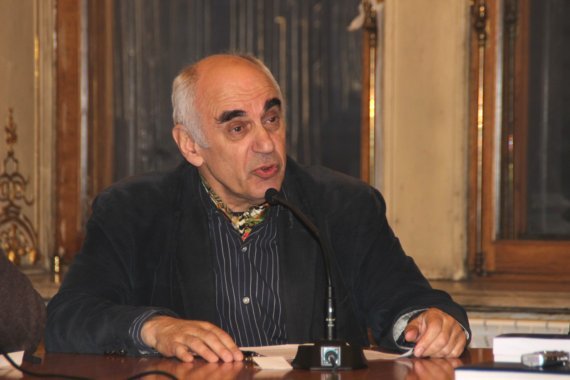
Evgeny Shtorn. Photo from his personal archives
Then, according to Shtorn, the FSB officer asked him where the “foreign agent” got its money and what western foundations CISR worked with.

“I said, ‘What, do foreign agents have money? The American foundations you declared undesirables are gone, and we have big problems with financing.’

“‘So people transport cash from abroad, right?’ he asked.

“I explained I didn’t have a passport, I hadn’t been abroad for many years, and I didn’t have access to those realms, but I didn’t think anyone was transporting cash in their underwear. Then he asked whether I had met with foreign intelligence officers as part of my job.”

According to Shtorn, the FSB officer was well informed about the work of Shtorn, CISR, and related organizations. He knew about academic conferences and listed the surnames of foreign foundation directors, asking whether Shtorn was acquainted with them. He asked what Shtorn was researching at the Higher School of Economics, although he clearly knew Shtorn was researching hate crimes against LGBT. He asked what foreign languages Shtorn spoke.

“Is English your working language?” he asked.

According to Shtorn, the FSB officer was not aggressive, but twice during their ninety-minute conversation he quoted the articles in the Russian Criminal Code covering espionage and treason, commenting they applied to everyone who flirted with foreign special services and foreign organizations.

In the middle of the conversation, the FSB officer asked him whether he had read Zbigniew Brzezinski’s book The Grand Chessboard.

“He said that, way back in the nineties, Brzezinki had written Ukraine would go over to the US in 2012, and this was what had happened. He advised me to read the book.

“At the end of the conversation, he said, ‘How unlucky you were with your citizenship application.’ He explained he was unable to help me in any way. ‘Many believe we are an all-seeing eye, but it’s not like that at all. We also have a tough time obtaining information.’

“He insisted I tell no one about our conversation. When I was getting ready to leave, he said, ‘If I call you again, you won’t be scared? Because some people get scared and change their telephone numbers.’ I said, ‘Of course not. You’re a polite person. What do I have be afraid of?’

“‘And you are such an interesting person, and educated. It’s interesting to chat with you. Thank you for your time,’ he said.

“We left the office, and that was when I caught sight of a bust of Felix Dzerzhinsky behind the coat rack, a life-sized bust.

“‘And here is Felix,’ the FSB officer said.

“I left.”

The FSB officer telephoned Shtorn the very next day. According to him, the FSB officer suggested meeting for coffee.

“I realized that was that. They were going to try and recruit me,” says Shtorn.

He believes if he had refused to work for the FSB, as a stateless person he would have been sent to the Temporary Detention Center for Migrants.

“I felt paranoid,” says Shtorn. “I imagined the FSB had access to all my channels of communication, that they could see all my emails. They realized I had nowhere to go, that without papers I was caged. I realized I had to make a run for it, so I turned to Team 29, LGBT Network, and Civic Control. I got a lot of help from human rights activist Jennifer Gaspar. In 2014, she was also invited to have a chat with the FSB, who stripped her of her residence permit and expelled her from Russia. Jennifer put me in touch with Front Line Defenders, who asked the German, Lithuanian, French, and US governments to issue me a visa. They all turned us down, saying they could not put a visa in a residence permit.”

On the evening of December 21, Front Line Defenders informed Shtorn Ireland was willing to issue him a visa. The next morning he had to fly to Moscow, apply for the visa at the Irish Embassy, and fly to Ireland without any hope of ever returning to Russia.

“I had a night to say goodbye to my whole life,” recalls Shtorn. “It felt like I was standing on the edge of an abyss and jumped off.”

In Moscow, it transpired that, due to the short working day, the Irish consular officials would not have time to draw up his visa, and he flew back to Petersburg. He obtained the visa only on January 4. The next day, he tried to board a Lufthansa flight to Dublin, but the airline refused to let him board the plane. The German Federal Police had informed the airline it would refuse to let a person with a residence permit enter the transit zone. It was clear Shtorn would not be allowed to fly via any of the EU countries. The next flight from Domodedovo Airport to Dublin had a stopover in Moldova.

“I went to the check-in counter,” recounts Shtorn. “The folks there were reasonable. They realized a person with an Irish visa would not want to stay in Chișinău. I bought a ticket. There was 45 minutes until boarding, and the whole time I sat waiting for them to come for me. When the plane took off, I started shaking.”

Shtorn is now in Dublin on a three-month short-term visa.

“Thanks to Front Line Defenders I have a place to live and money for food,” he says. “I don’t know what will happen next. I cannot go back to Russia. If my situation was bad, now I have made it worse. Initially, I wanted to keep mum, but I decided I had to warn the employees of other NGOs. When the law on ‘foreign agents’ was enacted, it stated the penalties did not apply to people who worked for such organizations. My story shows this is not the case.”

•••••

Фото: «Новая газета»

Viktor Voronkov, director, Centre for Independent Social Research (CISR), Petersburg 

Of course, the FSB is interested in CISR. Four of our employees have approached me and said, “They’re trying to recruit me. What should I do?” I think they have tried to recruit nearly everyone at CISR. Some have told me, others have turned them down and not told me, and still others, perhaps, did not turn them down. In conversation with the people they were trying to recruit, FSB officers have mentioned numerous facts they could have learned only from our employees.

It is normal. I know the practice well from the Soviet Union. When they tried to recruit me in 1981, they also asked questions that came out of left field. “Maybe you could describe your critical view of things at the institute? Maybe we could work together? You want to help the Motherland, don’t you?” They always associate themselves with the Motherland. They offered me help traveling abroad via the Soviet-East German Friendship Society. They blackmailed me.

I met with them three or four times. One time, a KGB officer tried to take me into a cubbyhole under the stairs at the institute to work me over. He looked in there, said, “Excuse me,” and closed the door. Another officer was already working someone over in the cubbyhole.

You can get rid of them. They have the right to recruit, and we have the right to turn them down. When they tried to recruit a pal of mine, he simply opened the door of his officer and shouted, “Get the hell outta here!” The KGB guy left. But I do not advise anyone to start talking with them. You cannot win against them. Nowadays, I advise my employees to give FSB guys the bum’s rush.

They tried to blackmail our other employees over trifles, but they were not as vulnerable as Evgeny was. I told him him to pay no mind to the blackmail, but it was not worth taking risks in his position. When a person is guided by fear, it is better to give into that fear.

I think we have to talk about such stories publicly. We could do a flash mob hashtagged #HowTheyTriedToRecruitMe. If there is no public oversight of the KGB, it means the KGB oversees society.

I realize this story could affect CISR, but we have been taking different measures to soften the blow. CISR is currently split. The majority of our employees argues we should disband the center and establish a new one. The minority argues we should not surrender. I have taken the most radical position. Everyone wants to find the means to survive. I want to show there is way to fight we can fight to the end. I hope to their end, not ours.

Translated by the Russian Reader

The Great October Conspiracy

IMG_9393
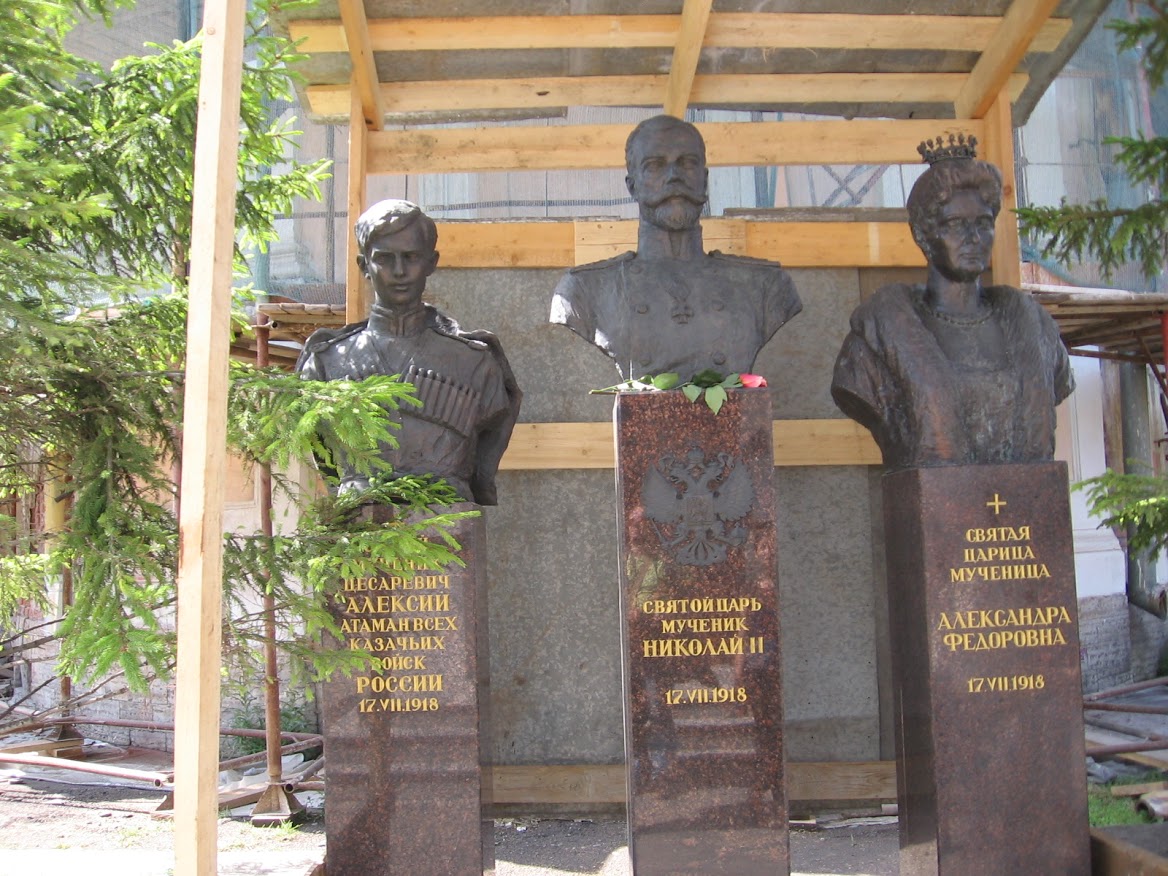
Monuments to the Holy Martyrs Tsarevich Alexei, Tsar Nicholas II and Tsarina Alexandra. Our Lady of Tikhvin Church, 128a Ligovsky Avenue, Petersburg, 19 July 2015. Photo by the Russian Reader.

The Great October Conspiracy
Conspiracy theories were as useful in 1917 as they are one hundred years later
Fyodor Krasheninnikov
Vedomosti
October 31, 2017

A hundred years ago, Russia stood on the treshold of the Bolshevik coup and the subsequent long-term dictatorship of the Communist Party. How did it happen that society could summon up no forces to stop it?

If you believe conspiracy theorists, in 1917, the forces of darkness managed twice in a single year, in February and October, to pull off the same trick: to hatch a plot and overthrow the existing regime. This take on what happened a hundred years ago has become all but official, and on the anniversary of the Bolshevik coup we will be treated to it again and again.

The story of German agents plotting against Russia was dreamt up a hundred years ago. After the July Days of 1917, a brief revolt in Petrograd against the Provisional Government, an idea emerged in the depths of the counterintelligence service, which had been disfigured by revolutionary purges. The Bolsheviks would be declared German intelligence agents, society would be incited against them, and counterintelligence could take the gloves off. Yet no serious evidence of the charges was presented, and consequently the attempt to save the crumbling Kerensky regime by telling a lie dealt a blow to the regime itself.

After the Bolsheviks came to power and did everything they did, the story about German spies took on a life of its own, eventually fusing with the monarchist theory that Freemasons had organized the February Revolution.

Conspiracy theories are equally useful to the authorities in 1917 and in 2017 for an obvious reason: it lets them off the hook for the state of the nation. Economic downturns, foreign policy failures, and popular discontent are all ascribed to outside forces and their domestic agents. When they turn the talk to spies and conspiraces, the powers that be make their lives easier, for inflating spy mania, and encouraging people to tighten their belts and rally round the current regime, whatever it is like, is much simpler than improving the economic and sociopolitical circumstances at home and thereby raising the popularity of the regime itself.

IMG_9398
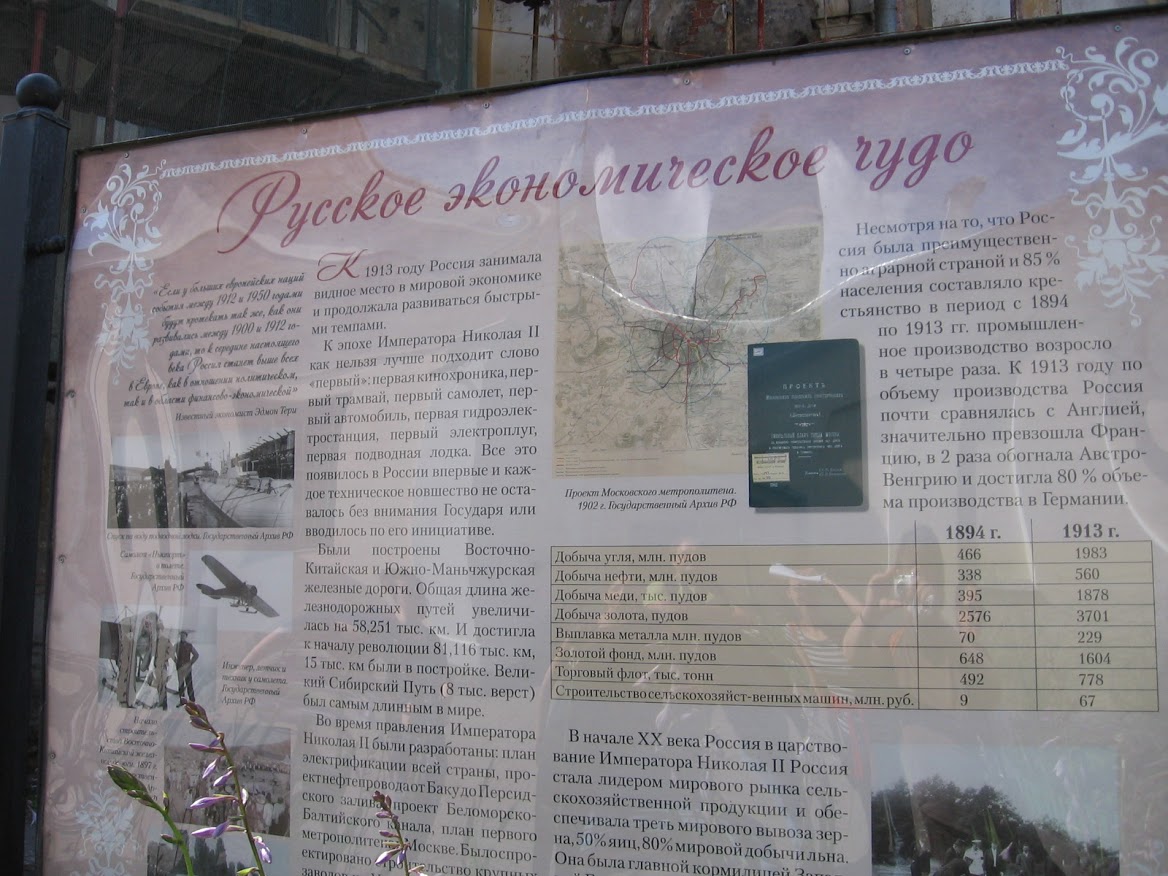
“The Russian Economic Miracle.” A stand purporting to prove that all was well with the Russian Empire on the eve of the First World War and the Revolutions of 1917. Our Lady of Tikhvin Church, 128a Ligovsky Avenue, Petersburg, 19 July 2015. Photo by the Russian Reader

The main lesson to be drawn from a thoughtful reflection on the events of 1917 is that the government is primarily to blame for revolutions and coups, because it generates the prerequisites for its successful overthrow. We can endlessly mourn the last tsar and his family, but the truth is that it was Nicholas II who brought things to the point where a huge empire collapsed in a matter of days for the most ridiculous reason, and the institution of the monarchy proved incapable of mobilizing its potential supporters to defend, if not the overthrown tsar himself, then at least the Romanov dynasty and the monarchical system.

By hemming and hawing, and proving incapable either of solving the most urgent economic problems or holding elections to the Constituent Assembly until state power had utterly collapsed, the Provisional Government did its all to pave the way for the Bolsheviks and their sympathizers to seize power.

No conspiracy hatched by agents could have led to the seizure of power in the vast country if the program and slogans of the Bolsheviks had not been popular, and they themselves had not been regarded as a force capable of introducing at least minimal order, launching urgent social reforms, and finally holding elections to the Constituent Assembly.

We now know that the Bolsheviks deceived the workers, peasants, and soldiers, while also failing to bring the country social justice, peace or prosperity. But as we look back a hundred years, we must judge the circumustances not from the perspective of what we know nowadays, but from the viewpoint of contemporaries of those events, who saw only growing chaos on all sides and took seriously the promises made by the Bolsheviks.

Fortunately, there is no war [sic], no “land question,” and nothing like the Bolshevik Party, with its radical leftist platform and readiness for violence nowadays, so direct comparisons are completely out of place. But attempts by the current regime to chalk up all its failures and all dissatisfaction with it to the baleful endeavors of foreign agents and fabled Russophobes do, indeed, evoke the saddest comparisons with the past.

Fyodor Krasheninnikov is a political scientist based in Yekaterinburg. Translated by the Russian Reader

Sovereign Xenophobic Biopower

download

Putin Talks about Collection of Biological Samples from Russians
RBC
October 30, 2017

During a meeting of the Presidential Human Rights Council, which took place in the Kremlin on October 39, Vladimir Putin claimed that “biological samples” were being collected from people living in Russia.  The meeting was broadcast on TV channel Rossiya 24.

The president’s remarks were preceded by remarks made by Igor Borisov, president of the Russian Public Institute for Voting Rights. He said that on the last nationwide election day, September 10, around a million views of video broadcasts from polling stations “were undertaken from foreign IP addresses.” Borisov asked, “Why are so many people interested in watching our elections and recording them, that is, in recording images of people? What will they be used for down the road?”

“I am personally concerned images of my fellow citizens have fallen into the wrong hands. It is unclear how and to what end they are being held there,” Borisov added.

Putin responded.

“Forget about the images. Do you know biological samples are being collected nationwide, moreover from the different ethnic groups and people who inhabit different parts of the Russian Federation. That is the question: why is it being done?”

The collection of biological samples has been implemented professionally, added the president.

“Russians are the focus of very great interest,” he said.

“Let them do what they will, and we must do what we must,” the president concluded.

When this article went to press, this exchange was missing from the transcription published on the Kremlin’s website. The Human Rights Council had discussed state policy on memorializing the victims of political repression and specific measures that have been taken in this regard, as well as environmental issues.

Igor Borisov told RBC that he had drawn the president’s attention to the “heightened interest not only in our elections but also generally in Russia citizens” on the part of foreign powers.

“During the last elections, just under a million views and recordings were undertaken from addresses located abroad, outside the Russian Federation. It’s clear this information was collected for some purpose,” he said.

According to him, interest in Russia and the Russian nation [sic] is heightened.

“Material that could be used in the future is being collected,” added Borisov.

________________________________

Onishchenko Urges Oversight of Invitro Biological Sample Collectors
Yevgeny Kalyukov
RBC
October 31, 2017

The MP talked about a draft law on the biological security of Russians, pointing to the dangers represented by collecting of their “fluids, organs, and tissues.”

Russian authorities must adopt laws dealing with the biological security of Russians and take oversight of foreign companies carrying out clinical studies in Russia, said Gennady Onishchenko, the country’s former chief sanitary officer and deputy chair of the State Duma’s education and science committee.

The MP noted that Invitro [it is not clear what company MP Onishchenko and RBC have in mind — TRR]  and foreign laboratories operating in Russia have access to “the most intimate things,” which threatens the country.

“They conduct research and do quality research, but they have huge opportunities for studying this matter in our country and sending the data overseas. I have on several occasions alerted the secret services to the fact this must be stopped or seriously monitored,” Onishchenko said on TV channel Rossiya 1.

The MP noted the needed to strengthen biological security at all levels, since the evolution of biotechnology paved the way to the production of genetic weapons.

“The fact that today the fluids, organs, and tissues of our fellows are being collected is nothing more than an indication that the US has not ceased its offensive military program,” Onishchenko explained.

The MP said that a law bill on Russia’s biological security, which is being drafted by the government, could be tabled in the State Duma as early as December.

RBC has sent a request for commentary to Invitro’s press service.

On October 30, during a meeting of the Presidential Human Rights Council, President Putin claimed that foreigners were “deliberately and professionally” collecting “biological samples” from people living in Russia.

“Do you know biological samples are being collected nationwide, moreover from the different ethnic groups and people who inhabit different parts of the Russian Federation. That is the question: why is it being done?” said the president

On October 31, presidential spokesman Dmitry Peskov explained that the collection of “biological samples from Russians” had been recorded by the secret services.

Translated by the Russian Reader. Photo courtesy of ITV

“Senators” vs. “Undesirables”

A37K0741_0
The Russian Federation Council,* whose members have a penchant for calling themselves “senators,” even though they are not a popularly elected body nor a body known as a “senate.” This peculiar fashion has been picked up by the Russian media and, now, even some foreign media, thus reinforcing the fallacy that Russia is governed democratically. Photo courtesy of Izvestia and Zurab Dzhavakhadze

Media Learns about Idea to Expel People from Russia for “Undesirable Behavior”
RBC
September 4, 2017

The Federation Council’s Committee for Defending State Sovereignty and Preventing Interference in Russian Domestic Affairs [sic] has been drafting a law bill that would stipulate expulsion from Russia for “undesirable behavior.” Izvestia learned about the bill from sources in the parliament familiar with the drafting of the document.

Acccording to the newspaper, the penalty of expelling people from Russia for “undesirable behavior” would be stipulated by a law bill that could be tabled in the State Duma as early as next year. It would amend the current federal law “On Undesirable Organizations,” adopted two years earlier.

The newspaper’s sources said that expulsion for “undesirable behavior” would be applied to individuals, mostly foreigners. However, the sources noted the term could be applied to Russian citizens and legal entities.

The newspaper notes that “undesirability” would be determined by whether the actions of the persons caused real harm to Russia’s national security. It could be a matter of “inciting ethnic and religious hatred and political discord,” as well as potential interference in Russia’s electoral process. The newspaper likewise notes that “outside work” with Russian educational institutions and young people could be deemed “undesirable.”

According to the sources, several options for how the law would be applied were currently under consideration. One of them would involve empowering State Duma and Federation Council members with the capacity to send requests to the Prosecutor General’s Office to check whether a person’s activities were “undesirable.” If the audit turned up a violation, Russian citizens could be accountable. [sic] Foreigners, on the contrary, would be threatened with expulsion from the country.

Andrei Klimov, deputy chair of the Federation Council’s Committee on Foreign Affairs confirmed that the amendments to the law were being drafted.

Translated by the Russian Reader

*Сritics of the Federation Council stress that it is an inherently undemocratic body made for regional elites, with little say from the Russian people. Since the reforms advocated and passed by President Putin in 2000, critics have also charged that the Council resembles more of a rubber stamp body for the Kremlin than an independent legislative body. Many senators are viewed as close allies of Putin and the United Russia party, despite rules which explicitly spell out that political factions are not allowed. Since Mironov’s rise in the Council in 2002, the Kremlin’s position on impending legislation is closely communicated to and coordinated with the Chairman and the committee and commission chairs. This top-down approach has meant that the Council votes with extreme efficiency, backing Kremlin positions on legislation nearly all of the time.

Critics also point to how long the Council convenes, meeting only one day every two weeks, speeding through legislative analysis and providing lop-sided majorities for each vote. Many blame this speedy legislation on the enormous influence the Kremlin exerts, who they charge have already instructed Council committee and commission chairs on how to vote. Several left-leaning State Duma deputies have lamented that Putin has stripped away the Federation Council’s last hold on checks and balances.

Since Putin’s restructuring of provincial executives in 2004, placing them under direct appointment by the Kremlin upon approval of their legislatures, federalist supporters have also charged the president in reducing the provincial role of the Federation Council. Where Yeltsin had envisioned a chamber [addressing] regional concerns, they argue, critics view Putin’s restructuring as deeply centralizing the Council to reflect the president’s and United Russia’s political interests, taking away provincial voices. Putin supporters counter these criticisms by acknowledging that Yeltsin had also appointed governors to Russia’s federal subjects in the early days of the Federation.

Source: Wikipedia

Viha Tekee Vihaa, or, The Finnish Class

Khadar Ahmed on the set. Photo courtesy of MTV3 Finland

“In NTV’s report you can by the way suddenly see a Finnish police car driving past, even though it’s about Sweden.”

That’s okay. The home audience just wants to hate on “Europe” and “Muslim terrorists” even if they have been edited, remixed, and totally fabricated out of thin air. The important thing in Putinlandia is to have something and someone to hate intensely all the livelong day.

And if you think this hatred is restricted to the “yobs” and other “uneducated” types, you’d be dead wrong. Over the last glorious seventeen years, I’ve been hearing this free-floating hatred spilling out in increasing quantities from the educated, from professionals, from the so-called intelligentsia.

In fact, I heard it again last night during my Finnish class (not the first time there, either). The remarks were “triggered” by the fact that I had had our group read a Helsingin Sanomat interview with the up-and-coming Somali-Finnish screenwriter and filmmaker Khadar Ahmed, who spoke with an utter lack of bittnerness (and in a totally fluent Finnish that none of us “Aryans” have yet achieved) about the total alienation and discrimination he had experienced as an immigrant to Finland. He’s now relocated to Paris.

My classmates were totally unimpressed that a road movie based on Ahmed’s screenplay, Saattokeikka, would be hitting screens in Finland in the coming days, or that a previous screenplay of his (Kaupunkilaisia) had been filmed by country’s hottest young filmmaker, Juho Kuosmanen, whose luminous and completely perfect film The Happiest Day in the Life of Olli Mäki won the top prize in the Un Certain Regard section at the 2016 Cannes festival and was submitted by Finland to the 89th Academy Awards for Best Foreign Language Film.

My classmates had never heard of Kuosmanen or the film, either, although Olli Mäki was screened right down the street from where we were sitting. That was a few months ago during the annual Finnish film festival, paid for by the Finnish government, who have been trying so hard to be besties with the “neighbor to the east,” which just wants to puff out its chest and hate on everybody as a matter of state policy and mundane practice.

We also read another Helsingin Sanomat piece, about the state of the Finnish nation and the state of “Finnishness,” in which well-known Finns were asked to respond to a set of ten questions that pollsters had posed as well to a larger sampling of ordinary Finns. One of the respondents was the Finnish rapper Prinssi Jusuf (aka Iyouseyas Bekele Belayneh), whose family moved from Ethiopia to Finland when Jusuf was two.

Yet my classmates were convinced, for some reason, that Prinssi Jusuf must rap in English, not Finnish, as if Finnish were too complicated for black people to learn.

One of my classmates was also on the verge of making a comment about who Prinssi Jusuf resembled. As an amateur psychic, I could imagine what she was about to say (Barack Obama, although they don’t look a thing alike), but a well-timed glare shut her up.

This is the lovely world that Putinism has built over the last seventeen years, although everyone answers for the garbage in their own heads, ultimately.

By the way, here’s a video of Prinssi Jusuf rapping in what sounds to me like perfectly fluent Finnish. ||TRR

Thanks to Robert Coalson for the heads-up on the Rinkeby story.

Fleecing Foreigners Makes Us Happy, but Gays Make Us Sad

happiness
Image on the website of the Happiness pastry shop chain. The text reads, “OUR PRINCIPLES: Love, Quality, Care, Interest, Communication.”

Happiness Coffee and Pastry Shop Chain Introduces Surcharge for Foreigners
Paperpaper.ru
August 23, 2016

There is an additional fee for groups of foreigners at the Happiness (Schastie) coffee and pastry shop on St. Isaac’s Square in Petersburg. A Paperpaper.ru editor discovered this while visiting the establishment. A surcharge of ten percent is added to the final bill.

The reasons for the surcharge are not spelled out either in the menu or on the bill. As the establishment’s manager explained to Paperpaper.ru, the surcharged was introduced at the “director’s personal orders.” Besides, the manager assured us that a line explaining the practice would soon appear in the menu.

The surcharge was confirmed by phone calls to the Happiness outlets on St. Isaac’s Square and Rubinstein Street.

The chain’s management informed Paperpaper.ru that the surcharge was indeed enforced in all of its outlets, but only vis-a-vis groups consisting wholly of foreigners. The rule has been in effect since November 2015. According to the chain’s rules, waiters warn customers that a ten-percent service charge will appear on their bill. Management also confirmed to Paperpaper.ru that the rule would be spelled out in the menu.

Article 62.3 of the Russian Federal Constitution states, “Foreign nationals and stateless persons shall enjoy in the Russian Federation the rights and bear the obligations of citizens of the Russian Federation, except for cases envisaged by federal law or international agreement of the Russian Federation.”

In addition, Article 19 of the Constitution guarantees “equality of rights and freedoms of human and citizen, regardless of sex, race, nationality, language, origin, property and official status, place of residence, religion, convictions, membership of public associations, and also of other circumstances.”

_________

central

Message on the home page of the Central Barbershop website: “The services in our barbershops are provided in strict keeping with in-house standards of service [sic], operating procedures, and service [sic]. You can be refused a service if it does not according with the company in-house standards. It is prohibited in the barbershop to bring or imbibe alcoholic beverages, for the female sex to be present, [and] for member of a non-traditional orientation [sic[ to be on the premises.” Curiously, all this discrimination is absent from the English-language version of the same page, which only blandly states, “Men’s barber services are performed in accordance with European and American requirements.”

Petersburg Barbershop Refuses to Serve Homosexuals
Paperpaper.ru
September 6, 2016

The Petersburg barbershop chain Central Barbershop has refused to serve homosexuals, according to its website. Women are also forbidden from being in its barbershops.

“The issue concerns me, since there are lots of gays and lesbians around. I had a bad experience of interacting with this group of people, and I would not like to see them in my salons. It is terrible they are everywere. But this is not homophobia, because homosexualists [sic] have their own places, and they can go there,” said Mikhail Korets, founder of the barbershop chain.

According to Korets, his employees will politely refuse to serve gays, citing a lack of time or available barbers. He compared this kind of refusal with the work of security guards at nightclubs, which do not let people into their establishments by saying there is no room.

According to Yuri Gavrikov, head of local LGBT organization Equality (Ravnopravie), the Petersburg barbershop chain is involved in discriminating against people. He compared the chain’s decision with racial discrimination in the US during the 20th century.

Translated by the Russian Reader. Thanks to Comrade VZ for the heads-up on the English-language website of the fascist barbers.

Back to School Daze: Non-Russian Surnames Spark Racist Social Media Panic

List of “Non-Russian” First Formers in Suburban Moscow Provokes Nationalist Brouhaha
Commentators Divided on Issue of Assimilating Migrant Workers
Moskovsky Komsomolets
September 1, 2016

Publication of a list of pupils in a first form class at Kotelniki Comprehensive School No. 3, in suburban Moscow, most of whom have “non-Russian” names and surnames, has set off a row on the web.

Screenshot of facebook.com/adagamov
The photo of the list, as reproduced on facebook.com/adagamov.

The photograph quickly spread among top bloggers and various socio-political discussion groups, garnering a slew of nationalistic comments.

The children’s names, such as Habiba, Medina, Malak, Idris, Yufusjon, Muhammadyor, and Beghod (there are a total of twenty-eight children in the class) goaded users into making nationalist statements.

However, [the Twitter account] Decadent West, for example, which ironically passes off Russian realities as foreign, commented on the photograph as follows: “A school in the German city of Cologne. Thank you, Angela Merkel, for your excellent refugee policy. Cologne, Germany.”

Screenshot of "Decadent West" (Zagnivaiushchii Zapad) Twitter account entry
Screenshot of Twitter account entry on the topic by Zagnivayushchii Zapad (Decadent West)

Nor all user, however, supported the nationalist rhetoric. Thus, Mitya Aleshkovskiy, director of the website Takie Dela, wrote that “people who are outraged children of migrant workers go to school are animals and a real shame to our country and society.”

He reminded his readers that schooling the children of migrant workers was the best means of assimilating them and claimed that Russia was a country where fascism had emerged victorious.

This prompted users to deluge Aleshkovskiy with nationalist comments.

Commenting on the photograph as posted on blogger Rustem Adagamov’s Facebook page, other users noted that Adagamov himself did not sport a “Russian” surname.

In 2013, residents of Kotelniki wrote and distributed a letter, complaining to the president, prosecutor general, and governor of Moscow Region that their town had “turned into a ghetto of illegal migrant workers from Tajikistan, Uzbekistan, Kyrgyzstan, and other CIS countries, as well as Vietnam and China,” due to the fact it was close to the Sadovod Market.

Translated by the Russian Reader