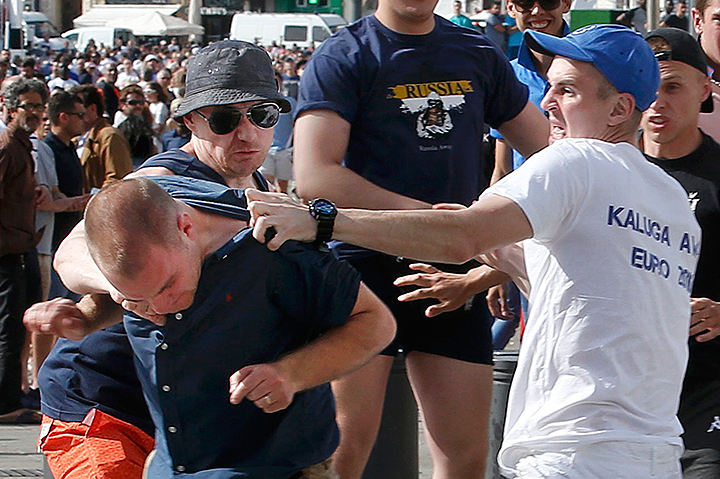
Russian football hooligans attacking an opponent in Marseille. Photo courtesy of tribuna.sports.ru
Come on I will show you how I will change
When you give me something to slaughter
Shepherd boy (Hey!)
Everybody sing (Hey!)
Better act quick (Hey!)
Be my toy Come on have a bet We live on blood We are Sparta F.C.
The Russian National Football Hooligans Squad: The Russia They Represent in Marseille
Sergei Medvedev Forbes.ru
June 14, 2016
Russia has fought yet another small victorious war. On the eve of the national squad’s first match in Euro 2015, a couple dozen Russian fans routed the numerically superior forces of the English fans in the Old Port of Marseille. A day later, right after the match, they went berserk in the English sector at the stadium, beating up everyone in their path, including spectators with families and elderly people. The results were distressing. At least thirty-five people were injured, and a fifty-year-old English fan who was crowbarred over the head is at death’s door. As punishment, UEFA has provisionally suspended the Russian team until the end of Euro 2016 (if the violations are repeated, we will be completely disqualified from the championship) and fined the Russian Football Union 150,000 euros, including for the racist behavior of the Russian sector during the match against England. On June 14, French police detained fifty people from the Russian Union of Supporters, led by the notorious Alexander Shprygin (aka Kamancha) and held them for twenty-four hours. Russian fans made the top world news headlines (isn’t it what they wanted?), and Russia’s chances of losing the right to host the 2018 World Cup have seriously increased.
This shameful episode perhaps should not deserve such attention. Football hooliganism has long ago turned into a sanctuary of violence and a near equivalent of world war. Fans of all countries fight and run rampant, and massacres happen too, like the tragedy at Heysel Stadium in Brussels, which left thirty-nine people dead and led to all English clubs being banned from UEFA competitions for five years. And Marseille well remembers the English fans during the 1998 World Cup, who staged a donnybrook with fans from Tunisia and smashed up half the town.
But the difference lies elsewhere. While in England, supporters are unanimously condemned by society and politicians in the wake of such scandals, over the last few days the football hooligans have figured almost as national heroes in Russia. Dmitry Yegorov, a reporter for Soviet Sport, live tweeted the carnage, commenting it like a football match and admiring the organization and physical training of the Russians. Social media have been buzzing with approval for the supporter, who smacked the spineless English upside the head and stood up for Russia like the three hundred Spartans at Thermopylae. A blog by sports journalist Andrei Malosolov entitled “Why the Victory of Russian Supporters in the Port of Marseille Is Cool!” has been especially popular.
What is even more curious, the Russian hooligans have enjoyed the backing of high-ranking officials. Russian Investigative Committee spokesman Vladimir Markin commented on the reaction of the Marseille authorities on Twitter, calling the Russian fans “well-trained fighters.”
“A normal man, as he should be, surprises them,” he wrote. “They’re used to seeing ‘men’ at gay parades.”
LDPR State Duma deputy Igor Lebedev (whose aides include Shprygin aka Kamancha), a member of the Russian Football Union’s executive committee, wrote, “I don’t see anything terrible about fans fighting. On the contrary, our guys were great. Keep it up!”
“If [Russian sports minister Vitaly] Mutko had been with the fans in the stands, he would have fought too,” Lebedev suggested later, in an interview.
Here we have to acknowledge one unpleasant thing. The fans in Marseille supply a honest picture of official policy and conventional wisdom in post-Crimea Russia.
They are waging the same hybrid so popular in our propaganda, infiltrating well-trained fighters, skilled in hand-to-hand combat and disguised as “holidaymakers,” into France, using force selectively and purposefully, attacking in unexpected places. The web is now full of rumors the hooligans were really Russian military intelligence (GRU) special ops units, who had infiltrated the championship to intimidate Europeans, so pumped-up, organized, and sober did the Russian hooligans appear in the numerous videos, but we shall leave this hypothesis to fans of conspiracy theories. As I imagine it, a joint detachment of so-called ultras from different “firms” of fans, fighters experienced in street brawling, converged in Marseille, attacking beer-bellied English “Kuzmiches,” i.e., simple fans who had come not fight, but to cheer and show off, some accompanied by their families.
One Russian fan admitted as much in an interview that our guys had come to fight.
“It doesn’t matter what cities our fans are from and what teams they support. What matters is that we are from Russia and are going to fight against the English. They have always said they are the main football hooligans. We are here to show that English fans are girls.”
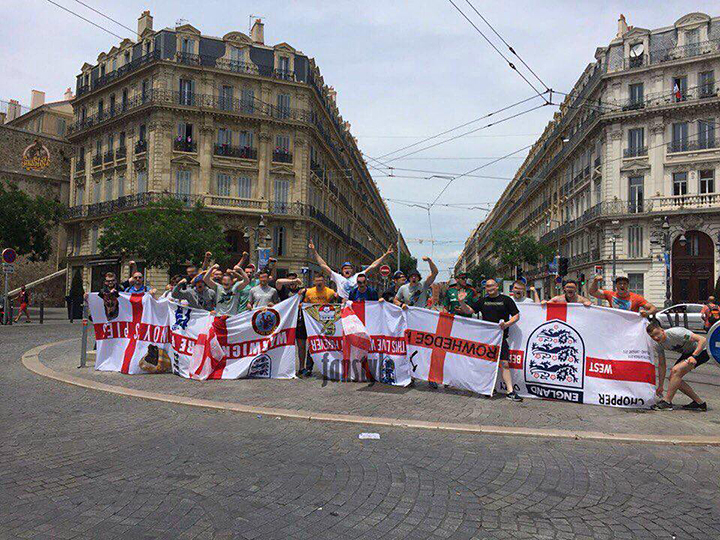
Russian football hooligans displaying captured English flags. Photo courtesy of tribuna.sports.ru
So even if the Russian assault was not really a planned military operation, such rumors do not come out of nowhere. First, Russia is not a novice at “hybrid” interventions in social movements in Europe. It has organized rallies and agitprop campaigns, worked skillfully through the media to fuel anti-immigrant sentiments, cooperated with right-wing radical and neofascist movements, and supported scandalous populists and European separatists. Just as in Soviet times the Comintern engaged in subversion in western countries, Russia has been worming its way into the cracks and fissures of European society. It has been trying to weaken the west from within, explaining it in terms of a total “information war.” Alarmed Europeans see the Russian ultras in this light.
Second, football supporters really are one of the combat units of the regime, which has an irresistible attraction to various groups of mummers who try and make a show of strength, such as Cossacks, bikers, and football supporters. Members of these stern fraternities are invited to drink tea with high officials. They are identified as exemplars of patriotism. They are awarded civil society development grants. And when push comes to shove, they are sent out on so-called Russian Marches and sicked on opposition rallies and individual dissidents. However, the football hooligans are as alien to the football tradition as the Surgeon’s latex bikers, with their Orthodox banners and Saint George’s ribbons, are to the rebellion and freedom of Easy Rider, and the paunchy “Cossacks,” with their glued-on topknots and cardboard medals, specialists in fighting gays and theater productions, are to the honor and glory of Russian Cossacks. They are all fakes in the era of Putin and Pelevin. When “the public” is a total simulation, protest countercultures turn into vehicles for dull officialdom and perfunctory patriotism, into tamed grant recipients.
Finally, the Russian fans (at least the ones who are photographed by reporters) are the readymade products of official propaganda, reproducing on their clothes and bodies all the typical corny kitsch of the era of Crimea and “getting up off our knees”: t-shirts emblazoned with slogans like “polite people” and “we don’t abandon our own,” budyonovkas and earflap caps twinkling with red stars, banners displaying toothy bears and Slavic Siegfrieds, kids in Armata tank t-shirts and, as the apotheosis of all this patriotic trash, a gigantic tricolor, covering half the Russian sector at the stadium, inscribed with the message “YOU’RE FUCKED.” Apparently, these people see this as the new Russia’s national idea.
This mayhem, however, kicked off long before Crimea. Russian fans have usually reserved the most boorish displays of great-power chauvinism and racism for trips abroad. In the Czech Republic, Russian hockey fans unfurled banners emblazoned with tanks and the promise to reprise 1968. In downtown Warsaw in 2012, football supporters staged a march in honor of Russia Day, nearly provoking a battle royal with Polish ultras. Fueled by beer and egged on by propaganda, Russian resentment shows itself to the hilt in the stands at football and hockey matches, taking symbolic revenge for the Soviet empire. Yeah, we forfeited a great power and never have learned how to play football, but we can smash chairs and smack Europeans in the kisser, “kick the shit” (otbutskat) out of them, as Vladimir Putin once put it, invoking a football supporter coinage. Ultimately, wasn’t it Putin who shared a bit of popular wisdom drawn from a tough childhood in Petersburg’s courtyards, i.e., you have to hit first?
The fans in Marseille did just that, and in this sense they are worthy ambassadors of Putin’s Russia.
As MP Lebedev would have it, they should be greeted at the airport as heroes, just as the bikers have been greeted when they return from their patriotic motorcycle rallies. They should be secretly awarded state honors, as the “polite people” were in their time for bringing Crimea back into the fold. And they should be elected to seats in the Public Chamber and State Duma. Football hooliganism is a matter of national importance in hybrid Russia.
The term “football hooliganism” (okolofutbol) quite precisely reflects the essence of events. Despite the adult budgets of its premier league teams and national squad, despite the purchase of international stars (a typical strategy of superficial modernization), Russia has remained an average performer in the world rankings, both in terms of its own national championship and the performances of its national team. Before the start of the Euro 2016, our country was ranked twenty-ninth in FIFA’s world ratings. But, at the same time, a fan movement based on the British model has very quickly and naturally put down roots in Russia. Books by Dougie Brimson, who has written authoritatively on England’s football fan culture, have achieved cult status among Russian supporters. Without becoming a world football power, Russia has succeeded brilliantly in hybrid football hooliganism, spewing its entrenched and publicly recognized culture of violence onto the international arena.
But Russia has been engaged in the same hybrid “football hooliganism” in Ukraine, where it has not been waging an open war, but delegating well-trained groups of fighters, and in Syria, where it arrived with its own agenda and has been bombing targets for reasons known only to it, and in Europe, where it has banked on populism, separatism, and breaking up the European Union.
Football hooliganism substitutes fair play, real work, and the painstaking cultivation of institutions with violent action and demonstrative bullying. This is not the first year the entire Russian state has been playing at football hooliganism. The hooligans in Marseille are merely its away side.
Sergei Medvedev is a journalist, historian, and faculty member at the Higher School of Economics (HSE) in Moscow. Translated by the Russian Reader
Deported, but Hopes to Return
Igor Bubnov Radio Svoboda
April 19, 2016
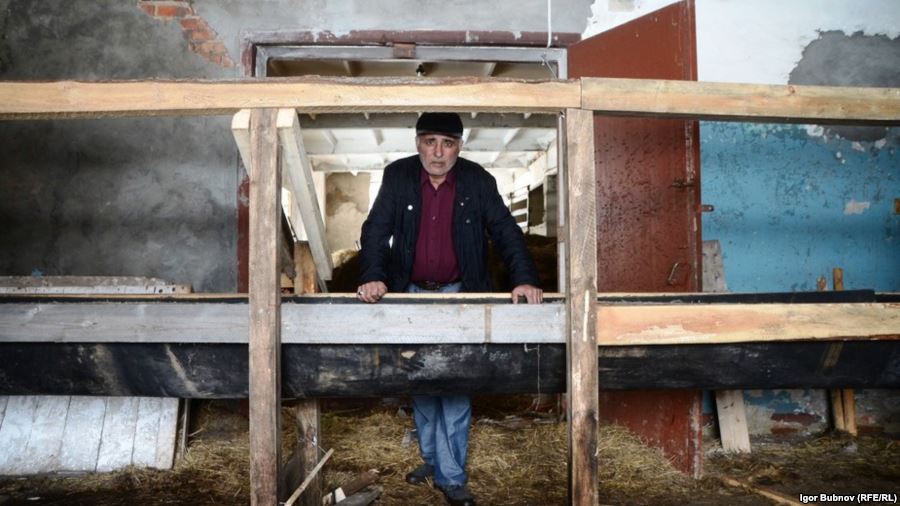
Turkish farmer Akçay Emer, who worked for over twenty years in Syktyvkar, has left Russia. He has been deported, although his Russian residence permit was valid until 2020. On the morning of April 19, Akçay Emer said goodbye to his wife, took his 16-year-old son to school as usual, put his bags in the car, and went to the airport. In Syktyvkar, he has given up his farm: he has been barred from entering Russia for the next two years. His family, friends, and job are here. Akçay Emer hopes to return. After the anti-Turkish campaign kicked off, the Federal Migration Service ordered the farmer to leave the country as he “posed a threat to Russia’s security.”
Akçay Emer
Translated by the Russian Reader. Thanks to Comrade VZ for the heads-up. Photo courtesy of RFE/RL andAzadliq Radiosu, where you can read about Akçay Emer’s case in slightly more detail (in Azeri).
“You’ll Be Gone in Three Minutes. I’m Going to Kill You”
Elena Srapyan, Civic Assistance Committee refugee.ru
April 12, 2016
On Friday, April 8, between Novye Cheryomushky and Kaluzhskaya subway stations in Moscow, an elderly man fired a trauma pistol several times into the head of a man of non-Slavic appearance. The wounded man is now in the intensive care ward of City Clinic Hospital No. 1 in serious condition. The Civic Assistance Committee has taken charge of the victim’s legal defense.
Sulaimon Saidov
On the evening of Friday, April 8, Sulaimon Saidov, a 38-year-old Tajik national, was traveling home from work to Tyoply Stan. He was accompanied by his 19-year-old nephew Mukhammajon Khakimov, who had recently arrived in Moscow from Tajikistan. Saidov has lived in Moscow for over thirteen years. Like most of his relatives, with whom he rents a small flat in Tyoply Stan, he works in construction. The job enables Saidov to feed his four children.
This time, the trip home on the subway proved disastrous. It all began quite casually. At Profsoyuznaya station, a drunken middle-aged man who could barely stand on his feet burst into the subway car. He immediately spotted Khakimov. He went right up to him, pushing him and shouting.
“Who the hell are you? Where are you from? What are you doing here?” he asked Khakimov.
Khakimov modestly replied he was from Tajikistan.
The assailant called Tajiks “black monkeys,” swore, and demanded that uncle and nephew immediately leave the car because it was “only for [ethnic] Russians.” Khakimov went over to his uncle, seeking protection. Saidov stood up, pushed his frightened nephew behind him, and tried to calm him.
“The man is just drunk. Don’t look at him. Don’t pay any attention,” he said.
Staring point blank at Saidov, the assailant said, “You’ll be gone in three minutes. I’m going to kill you.”
As Saidov relates it, he felt no danger: the threat from the elderly, frail-looking man seemed too absurd. Even when he spotted a pistol in the assailant’s hands, he did not believe it. He thought it was a toy. However, the pistol was real, a trauma pistol, and the assailant began firing.
He managed to squeeze off several shots at both Tajiks. He missed Khakimov, but he hit Saidov three times in the head and once in the stomach. At short range, the shots could have been deadly. One of the bullets entered Saidov’s eye and damaged the sclera, while another left a huge wound in his skull.
Saidov realized he had to fight for his life. He felt no pain. In a state of shock, he grabbed for the assailant’s pistol and managed to wrest it from his hands. At that moment, the doors of the subway car opened, and assailant and victim found themselves on the platform of Kaluzhskaya subway station. According to police, there was no CCTV camera in the car, but on the station’s cameras what happened looks like a fight. Rushing to the scene, police detained the man holding the pistol: Saidov. Police grabbed him, wrested the weapon from him, and put his hands behind his back. Only when bystanders shouted that he was the victim was Saidov released.
The assailant managed to escape the scene, but was detained quite soon thereafter. When witnesses identified the attacker on video surveillance recordings at the station, it turned out the man’s face was familiar to police. After the pistol was fingerprinted, there could be no doubt: the assailant was 58-year-old local resident Sergei Tsaryov, who had been detained at the same subway station a week earlier.
Tsaryov was brought in literally minutes later. However, police were unable to talk with him for a long time. The man was so drunk he could not answer clearly. At the same time, relatives of the victim were giving testimony in another office. Saidov was almost immediately taken away by ambulance. His injuries were so severe that doctors feared for his life.
Saidov’s cousin Dilshod Saidov, who speaks Russian well, soon arrived at the scene. At the time, Police Captain Ilyinsky was questioning relatives and witnesses, and drawing up an incident report. Dilshod Saidov assisted the captain by translating for Khakimov. But when Ilyinsky read the interview record aloud, Saidov was struck by the differences between it and Khakimov’s testimony. Saidov began verifying the interview record phrase by phrase. According to the text, it was Khakimov who had got a rise out of the passenger with whom Sulaimon Saidov had later fought.
“As if Mukhammajon had provoked the assailant by the mere fact of his existence,” said an indignant Dilshod Saidov. “I had to fight for every word in his testimony: that alone took two hours. They also tried to give me a hard time. They said, ‘Who the hell are you? Let’s check you out.’ Only I wasn’t scared. I’m a regular guy: all my papers are in order. Yeah, the night at the police station was just awful.”
But most importantly, the ambulance doctors managed to get Sulaimon Saidov to City Hospital No. 1 quickly, where he immediately underwent surgery. Thanks to the efficiency and professionalism of his doctors, Saidov survived.
Saidov’s family are alsop grateful to a young female witness who went with them to the police station and stayed there to the end. Unfortunately, they were unable to exchange telephone numbers. The police were vigilant and made sure that communication between them was impossible.
Saidov’s relatives stood watch outside the intensive care ward all through the evening of April 8 and the early hours of April 9.
“I was at work when it happened,” says Dilafruz Sharapova, a close friend of the victim’s. “I called Sulaimon, but he didn’t answer. That usually doesn’t happen, and I got scared right away. Then his nephew picked up the phone. First he said they were just on the subway. He didn’t want to scare me. When I got home, his cousin called and told me everything. I remember I immediately said to him, ‘Come and get me, and let’s go to the hospital.’ I couldn’t just sit there, you know? We arrived at the hospital, and I waited so long for the doctors to say at least something that it was frightening. I was able to see him only a day later. The operation was over, and the danger had passed. Things will probably be rough for us now, because he won’t be able to work. But I’m not thinking about that for the time being. I am only worried for him. I can’t think about anything else.”
The doctors are now optimistic in their prognoses. Although Saidov suffered a severe bruise to the crown of his head, the brain was not affected. Saidov remembers everything perfectly, and has no problems speaking. The biggest worry is his eye, but the doctors hope to be able to save it despite the damage to the sclera. Perhaps another operation, a more expensive one, will be necessary. The Civic Assistance Committee plans on announcing a fundraiser for Saidov when details have become clear and his relatives have received the necessary medical documents.
The Civic Assistance Committee is defending the interests of the victim, Sulaimon Saidov, in the case.
“For the incident to be qualified correctly it is vital that our lawyer begin working as quickly as possible,” said Marina Leksina, head of the project for the victims of hate crimes. “Because we already have cause to assume that they will try to acquit the assailant by presenting Sulaimon as an active party to the conflict. From what Sulaimon has told us, the attack was motivated only by xenophobia. It was direct aggression, which the assailant accompanied with corresponding language.”
Representing the victim will be Filipp Shishov, an attorney for Memorial Human Rights Center’s Migration and Law Network. Shishov previously represented Maratbek Eshankulov, the young man who unable to return home for four years because of the “dissimilar” photograph in his passport.
Photo courtesy of the Civic Assistance Committee. Translated by the Russian Reader
We don’t ever think. We just have a small collection of tapes we stick in slots in the back of our heads when the need to say something “smart” arises.
* * * * *
Russian speakers living in Finland are not a homogeneous group, but one thing unites them strongly: a large number of them regard asylum seekers with a grain of salt.
“I relate to the phenomenon negatively. I think the people coming here do not have the necessary information on how people live here. They are trying to come here with their own traditions and customs, and at the moment this hinders their adaptation,” say Gleb Ulanov, who lives in Helsinki.
[. . .]
Despite the fact that the Russians themselves are immigrants, they do not want to compare themselves to the people now arriving from the Middle East. Russian speakers are of the view that they do not have similar adaptation problems.
“The biggest difference is the mentality. Most Russian speakers adapt,find work, and respect Finnish customs and celebrations. In my experience, only a small minority of people from the east does this. They prefer to form their own communities,” says Grigory Berkinfand, who lives in Helsinki.
[. . .]
Many Russian speakers fear that Finns have a naive attitude toward the asylum seekers, and do not properly distinguish those who are genuinely in need of protection.
Just like Finns, Russians are primarily concerned about safety. Many say that traditionally peaceful Finland is changing at a rapid pace.
Gleb Ulanov, who in Soviet times lived for about a year in the Caucasus, is of the opinion that merely integrating the refugees is not enough. In addition to telling the asylum seekers about Finnish customs and laws, Finns should also tell the refugees about culture and how they should behave around them.
[. . .]
Even a man from Russian Karelia who is living in a reception center and applying for political asylum questions the motives for coming to Finland of many of the people living with him. The man wished to remain anonymous.
“I can see what is happening here. They do not appreciate either the local culture or the help they receive. The majority are of the opinion that the Finns are obliged to help them. Many of them say that one can live here without working, and everything is given free of charge. They are quarrelsome if they notice they have not been given something and they complain about conditions. For example, I am really satisfied with everything here. Ihave not received such a warm reception in my own country,” he said.
Enter the Abroad, lamenting, with the Forbidden Hemisphere,
And with the Horizon, debased, dangling from her evening gown.
She calls our simple Yermolai names like François, Jacques or Jean-Pierre,
Carps on and on about the law. Unfair tariffs get her going.
She blurts out, “How are things!” Raphael and Buonarotti
Disturb our gaze with flesh’s gloss, but on the back there’s not even a jot.
Workers of the world
March into a bar and grill.
“In those jeans you look like a Yank.”
“Popped her cherry when I was drunk.”
“I was just a simple worker.”
“By the by, we all are wankers.”
Enter Thoughts of Days to Come, dressed to the nines in khaki blouses.
They carry in atom bombs, ICBMs, a launching pad.
Oh how they reel, dance and caper: “We are warriors and carousers!
Russian and German will fall together; for example, at Stalingrad.”
And like old widow Matryona, cyclotrons are dumbly howling.
In the Ministry of Defense a nest of crows is loudly cawing.
Look at the pillow. What do you know!
Shiny medals all in a row.
“Where there’s a will, there’s a way.”
“A pint of vodka, they say,
Soon’ll be a ruble a pop.”
“Mom, I really don’t love Pop.”
Enter a certain Orthodox, saying, “These days I’m number one.
I’m pining for the sovereign, and in my soul the Firebird flares.
Soon Igor will reunite with Yaroslavna and have his fun.
Let me make the benediction or else I’ll box you on the ears.
Worse than evil eye or herpes is the plague of Western thinking.
Sing, accordion, and drown out the saxophone, jazz’s vile offspring.”
On the icons they plant a kiss,
Sobbing victims of circumcis—
“Me? Steak, Director’s Cut, of course.”
“Barge haulers in Severomorsk,
Wasted thin by radiation,
Drag the cruiser to its station.”
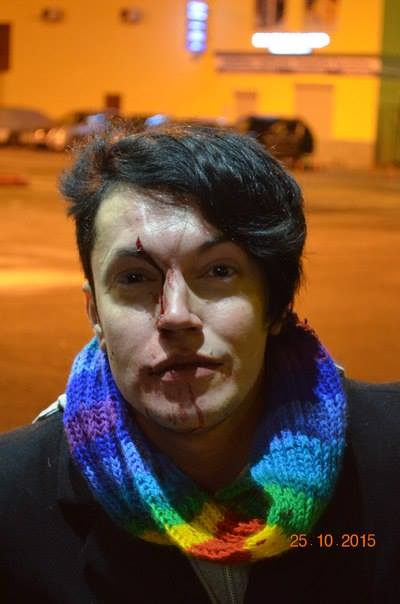
This is the story of how Dante got punched in the kisser and now bears all the hallmarks of an alleged real man.
Petersburg LGBT activist Dante Teodori
I was going to the Rainbow Coffee Klatch on the subway today. I looked and saw this one guy eyeing me quite maliciously. The fellow was well built and dressed in sport clothes but dressed decently. After a while, he came up and leaned over me. (I was sitting down.) He told me either I could take off my scarf and scram from the car or he would kick my ass. (I have omitted the obscenities.) I refused. He smacked me in the face and split my lip. I took the second blow on the head and it split my eyebrow. Then some dude pushed him away.
I got out at a station and looked for the cops or some other official service, but there was no one. I got back on the train and pushed the hotline button to connect me to the driver, but it didn’t work. Well, okay, I thought, I will just go as I am. I asked people for napkins and telephoned the guys to come meet me in the subway, since I thought my nose was broken and I wouldn’t be able to see anything because of the blood. When I got there, the guys suggested calling an ambulance, since we didn’t know where the first-aid station was.
They took me to the hospital, since they didn’t like the look of the epic lump on my forehead. At the hospital, I was examined, stitched up, and sent home to heal.
Second, the scarf was not in the LGBT colors. It was knitted and given to me by a very nice woman with whom I was detained for waving the Ukrainian flag. What does this mean? That technically anyone wearing colorful clothes can get the crap beat of them.
And the most important thing. I think the only chance we have of getting closer to the future we want is to live as if it has already arrived.
Translated by the Russian Reader. Thanks to Gabriel Levy for the suggestion. Photos courtesy of Dante Teodori’s Facebook page. This story has been covered widely in the local media. See, for example, “LGBT activist beaten over colorful scarf,” Paperpaper.ru, October 26, 2015 (in Russian).
The Refugees and the “Death of Europe”
Raimond Krumgold
September 5, 2015 www.nihilist.li
This summer we went to Latvia on our way to Russia.
During the week we were waiting for visas, a lot of things happened along the lines of “they have completely broken away from the collective and become remote from their people.” But the main shock for me was a one-off attempt at reading the latest Russian-language press. The quotas of refugees for Latvia were being discussed just then, along with the great reluctance to take in these same refugees. I scanned several newspapers. They all wrote about the “nightmare brewing in Europe” in a tone of aggressive and malicious ignorance that I found quite unfamiliar. I really had the feeling I had opened a neo-Nazi website. The only difference was the gloating at the Latvians, who had discriminated against “us,” the good guys, and now were going end up with “them,” those awful people. At first, I decided something had changed over the years, and then I realized it was I who had changed. I tried to remember how things had been before and realized these newspapers had always written in a similar tone. It was just I used to think this was normal. I had even considered the Russian-language press internationalistically minded in comparison with the already quite right-wing Latvian press.
As long as I can remember, Europe has been dying. This has not been an article of faith, but a fact of reality. The sky is blue. Water is wet. Europe is dying of multiculturalism and political correctness. It would now be interesting to trace the origins of this ironclad certainty. Maybe it was the death of a huge country, which we experienced in the early nineties. Maybe it was ordinary ressentiment. We grew up in the ruins of one empire and maliciously anticipated another empire’s fall. I was not a racist, quite the contrary. But I had almost no doubts that a Munich caliphate would soon be fighting a Bavarian Kurdistan.
My first two trips to England were basically tourist trips. I brought back a huge number of impressions. But the main impression was that the country I saw did not look as if it were dying. Even in Birmingham, densely populated by immigrants, there was no sense of catastrophe. It gave me pause for thought for the first time.
Then there was my own emigration. It was economic emigration, triggered by the 2009 crisis, which took on the proportions of a natural economic disaster in Latgale, where I lived. It was one of the most difficult years of my life, probably the most difficult. And the experience of looking for work in a foreign country with my money quickly running out has forever changed my views. We lived for a month in Sheffield’s “colored” neighborhood and quickly learned to visually distinguish the various African and Asian ethnic groups. However, it is generally difficult to confuse Nigerians with Somalis, not to mention Ethiopians with Kenyans. We socialized with people at the very bottom. We even worked for a week at the very bottom, in a greenhouse growing flowers. It was a terrible experience. After that I could no longer look the same way at people who, just like me, were struggling to make it in a foreign country from scratch, but with no EU passport in their pocket and different skin color to boot. Of course, my experience is not equivalent to the experience of all Eastern European immigrants. For many of us, living in a multicultural country has only heightened our aggression and hatred towards “others.” But this is usually caused by the inability to examine our fears and ourselves calmly.
The 2011 London riots were probably the finishing touch. Reading the English press and Russian bloggers in parallel, I discovered that Russia, both official Russia and completely “oppositional” Russia, exists in an information space of its own, cut off from all unusual information. The tussle, launched by Jamaican gangs (whose people have been in Britain for at least three generations) and embraced by lower-class white youth, was transformed, in Russian popular consciousness, into an uprising by Muslim immigrants. It was then it first dawned on me that if I had still been within the purely Russian-language information space, I probably would have written such nonsense as well. Until recently, I would have seen this news as confirmation of my view of the world.
An objectively serious refugee crisis is underway in Europe. Something similar happened in the 1930s, during the wonderful Évian Conference, at which only the Dominican Republic acted humanely. All the other countries reported they had no more room. European Jews did not excite the most pleasant feelings among respectable burghers back then, so they had every reason not to increase the quotas for them. The beginning of the Final Solution was only three years away. Now people are fleeing from a place where a wonderful quasi-state quite capable of organizing a small genocide has sprung up. Part of Europe is once again saying there is no room. In the forefront are my dear Latvia and the Eastern European republics generally. Over on the sidelines, licking its chops and brandishing a giant walking stick, is old lady Russia, which was no less dear to me once upon a time. Moreover, it has been closing its borders to former subjects of its beloved Assad. But I don’t want to write about Russia. It is too unpleasant a topic.
I want to write about something else. I will never forget my own immigration experience, which was relatively soft core given that I had a EU passport. I will never forget the people, of various nationalities, who helped us that year. And I will also never forget the right-wing English “journalists” who were generating propaganda against us the whole time. They are Europeans, too, but Fortress Europe is not the Europe of which I am a citizen, a citizenship of which I am even beginning to be proud, despite the fact that initially I strongly opposed the EU.
So as a EU citizen and UK resident I personally signed a petition demanding an increase in the quotas for refugees. If I have to take to the streets to support this idea, I will do it. And I will personally greet the first families brought to our city and hand them flowers. Our island is small and overcrowded, but for their sake we will make room.
As a Latvian citizen I am seriously thinking about launching a similar petition to the Latvian government. This embittered rightwing marsh will not be able to hide from reality for long anyway.
You are burying Europe too soon.
Translated by the Russian Reader. Photo courtesy ofThe Gampr
Movements in Central Asia have become large-scale and permanent, involving all social groups, rich and poor, women and men, young and old. They move around their own countries and among countries. Some go for several weeks or months and come back, while others live far from their place of birth for years, only occasionally visiting their homelands. Still others leave forever, breaking all ties. Some travel in search of a new homeland, so to speak. Others go to make money, study or receive medical treatment. Still others go for fun and excitement.
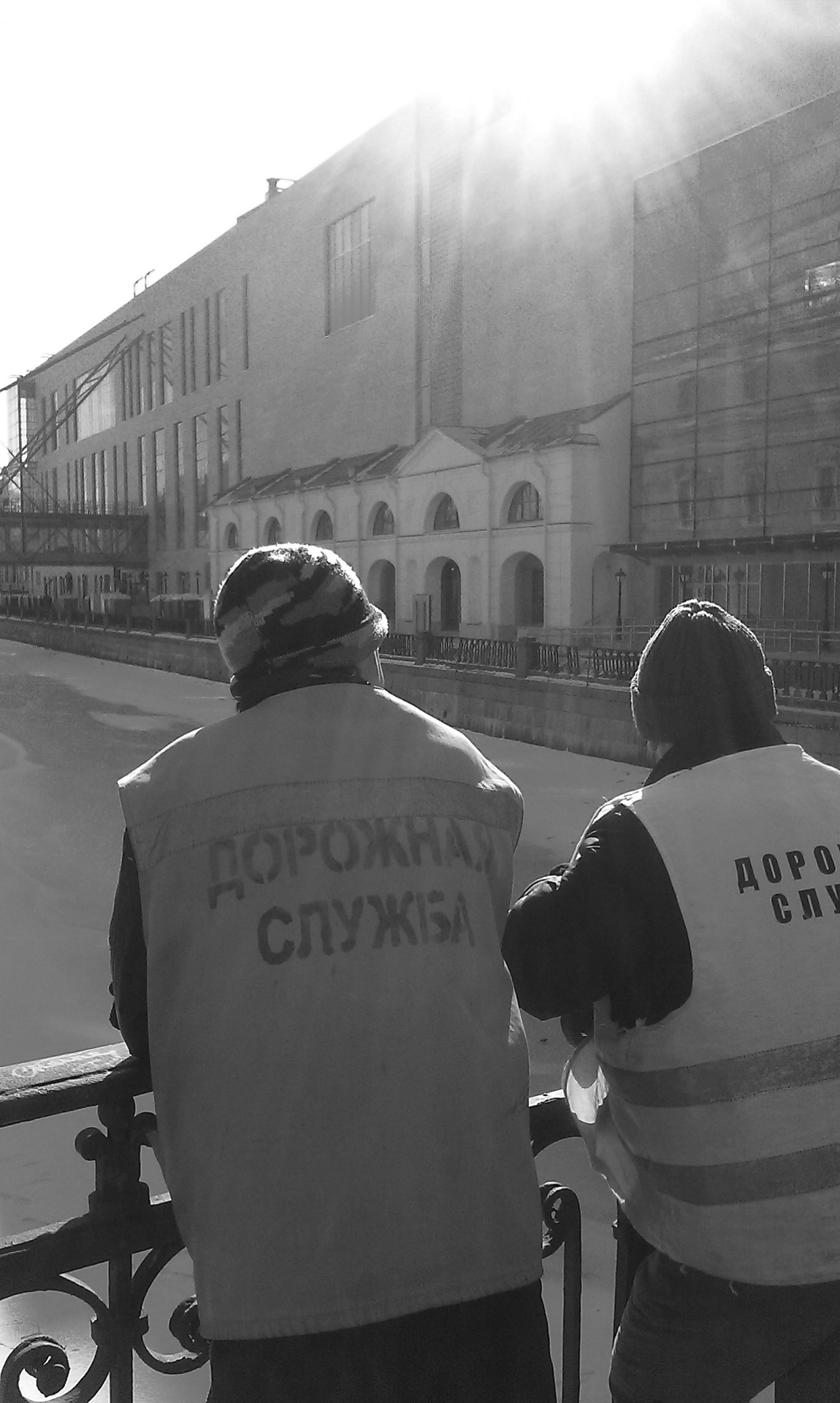
Immigrant road maintenance workers gaze at the newly completed second stage of the Mariinsky Theater. Kriukov Canal, Petrograd, March 15, 2013. Photo by the Russian Reader
All this movement has come as a surprise to experts and politicians. I still remember the debates in the Soviet Union in the 1980s as to why the people of Central Asia were reluctant to travel outside their region. Even then officials and academics in Moscow, observing the beginnings of the demographic decline in Russia itself, were planning to relocate people from borderlands with an excess labor force to the central regions of the then still-unified country. These plans failed, because few people wanted to leave their homes. Only organized and, in fact, involuntary labor recruitment and military labor brigades partly solved the increased need for labor power. The weak affinity that Uzbeks, Tajiks, and Kyrgyz felt for voluntary mobility was proclaimed, on their part, an inherent and incorrigible attachment to family, community, and the hot climate. However, all these explanations were put to shame only a decade after the collapse of the Soviet Union, when millions of people from the titular Central Asian nations felt an irresistible urge to hit the road, leaving and, sometimes, literally abandoning their homes.
Let us try and make sense of these circumstances, to understand why movement in the region has suddenly become a vital life strategy among a considerable number of people. The answer only seems to be lying on the surface. Yes, of course, the collapse of the Soviet system has led to the dismantling of all previous social and economic policies, which kept the population in place through social programs and investment in sometimes loss-making manufacturing enterprises. An abrupt, almost catastrophic decline in living standards, often accompanied by political turmoil and increased feelings of uncertain life prospects, could not fail to provoke an outflow of those wanting to find new prosperity and new stability outside their former worlds. Unemployment and negligibly small wages and pensions have pushed people into new labor markets in countries where even small incomes, by local standards, are much higher than the incomes Central Asians can expect to earn at home.
The future also looks ambivalent, depending on the forecaster’s optimism and pessimism. Some argue that economic, social, and political degradation in Central Asia will continue, becoming chronic, and the movements, therefore, will not stop but might even become even more intense, prolonged, and irreversible. Others, however, argue that sooner or later the situation will improve, investments and jobs will emerge at home, incomes and quality of life will increase and, consequently, outward migration will gradually dwindle.
This approach to movement as a consequence of degradation simplifies, in my view, the picture of events, distorting our perspective by ignoring and failing to analyze many important causes, factors, processes, and attitudes. If we look more broadly at the context in which human mobility in Central Asia has been growing, the first thing we see is an increase in the scope, range, and frequency of movement throughout the entire post-Soviet space and the world as a whole. Second, we see the unconditional link between mobility and the current stage of capitalism, which is sometimes called globalization, sometimes postindustrialism, and sometimes postmodernism. Viewed from this perspective, the picture of Central Asia appears in a somewhat different light than as a mere reflection of the disastrous state of affairs in the region’s newly independent countries. Spatial flows are not only a compulsory means of survival but also an impetus for distributing and assembling people, capital, information, and skills in new social configurations. The latter have a logic and meanings that do not depend directly on the characteristics of a particular country but are subject to wider trends and patterns.
What additional meanings can be attributed to the movements of people in Central Asia aside from as a reaction to post-Soviet degradation?
I think the situation can be described in terms of the momentum of the connections and mutual dependencies between Central Asia and Russia (and other lands) that developed and strengthened over at least a century and a half of coexistence within a single state. Usually, this kind of relationship is characterized as imperial or, if observers want to emphasize a distinctly unequal exchange, colonial. It is believed that empires inevitably fall, to be replaced by liberated nations. In this simple teleological scheme, which now dominates post-Soviet ideologies, much is not entirely clear, but one of the most controversial questions that many postcolonial critics ask is whether empire has actually disappeared or has adopted new shapes in which nations—i.e., constructs actually generated by empire—perform the old functions of borderlands, still pumping resources into the former metropoles in return for patronage and oversight. If we accept this argument, and there are many grounds for doing so, the massive movement of people from Central Asia to Moscow, Petersburg, and other Russian regions appears to be a post-imperial situation in which the circulation of labor power, money, practices, ideas, and information continues, acquiring new tempos and vectors. This movement establishes a new division of labor between the former “heartlands” and “borderlands,” and their hierarchy and mutual need for each other, even if the rhetoric has been dominated by harsh rejection of the newcomers.
Another implication of the movement of people in Central Asia is also quite obvious, although it is little remarked and little analyzed. The large-scale mobility—a significant (if not the lion’s) share of which consists of rural residents going to work abroad—is tantamount to a rather classic proletarization of a still largely agrarian Central Asian society. Soviet modernization attempted in its own way to organize this process by gradually transforming the locals into an agricultural working class while preserving the private agricultural sector and the corresponding rural practices, attitudes, and outlook in the region as a kind of compensation for semi-forced labor. The collapse of the Soviet Union also entailed the collapse of this transformative model. Consequently, the standard version of capitalist development, involving the ruin of the peasants, their impoverishment and exodus to the cities, where they are transformed into ruthlessly exploited proletarians, was inevitable. In other words, what is perceived as degradation is, in fact, a shift in the socio-economic order, not a return to old ways of life, as it sometimes has seemed, but accession to a completely new stage or form of community.
Proletarization has not been subject to discussion because, in particular, its course and effects have been concealed in a strictly ethnic view of the movement. In the countries of origin, the departed are considered traitors, victims or breadwinners. In the host countries, they are considered threatening outsiders or, again, victims. The emphasis, often cultural and racial, on their departure or arrival is more important than the social essence of movement. However, as soon as we remove our ethnic glasses we сan easily identify the class character of mobility. Its specificity consists only in the fact that the system in which class interaction takes place is not limited to particular countries and even regions but is non-national in scale. This system includes, first of all, the post-Soviet space as the nearest and most comprehensible space, a space that has, as I have already said, a history of a common existence and unequal relations of domination and subjugation between heartlands and borderlands. But mobility has already gone beyond the scope of the post-Soviet, spreading into new spaces of global capitalism and incorporating itself into a truly global order.
The other significance of the movement in Central Asia I would like to discuss is the mastery and appropriation of global space, infrastructures, and communication and transportation technologies. Let me explain this with a very simple example. Once upon a time, at the turn of the nineteenth and twentieth centuries, Russian imperial officials built a railroad that linked Central Asia with Russia’s central regions. The railway was built in no small measure to transport troops in the event of local uprisings and conflicts with other world powers, as well as for resettling Russian peasants, who were to colonize the new imperial lands. The railroad was also built to export the region’s cotton to the Ivanovo textile mills and import grain back to Turkestan, where the arable land was to be busy growing cotton. However, whatever objectives Petersburg officials pursued by allocating funds for the railroad’s construction, the end result was new transport infrastructure that made it possible to move large quantities of people and goods quickly, a means that had been available to different groups of people in different historical periods, and could be used for purposes that the said officials could not even imagine. Consequently, a hundred years later, the railway has become one of the main means of transporting millions of people of Central Asia to Russia and all over the world. This shift of functions and tasks might be dubbed mastery of new technologies and appropriation of completely new mechanisms for interacting with space, mechanisms which themselves define the impetuses and trajectories of movement. If we add highways and air travel to the railroads, we find ourselves with a huge network of possibilities that people transform into an element of their everyday practices and plans. The ease with which one can reach the other end of the world in a short time and gain access to new goods itself compels people to travel.
Here I would add the mastery of technologies for obtaining information about the world and communicating at great distances. They help create and maintain images and networks of acquaintances, which are also included in processes of movement and ensure its stability, direction, and reversibility. In a broader sense, I would also include here not only phones, internet, cars, and planes but also knowledge of languages, mastery of global systems of food and clothing, of finding and gaining employment, and so on. The penetration and expansion of such technologies and infrastructures in Central Asia and training oneself in the habits of using them shapes the demand for mobility as a distinct need and, sometimes, as a pleasure.
Finally, I want to use the notion of the migration of peoples for interpreting current movements. Despite the risks of drawing analogies between quite different historical periods, I think it vital to point out the temporal depth, continuity, and cyclical nature of movements, on the one hand, and, on the other, the gradual tectonic shifts in the spread of cultures, languages, and even genetic characteristics, shifts that may not always be visible from the perspective of several decades. I think we must keep sight of this prospect, too, because it is here that new mixtures and hybridizations happen, new cultural types and preferences are constructed, and new communities and identities are shaped. Marriages between locals and newcomers, children of newcomers who are born and grow up in the new land and speak the local language, shifts (back and forth) in musical and culinary tastes that are suggested by the newcomers and turn into new fashions, etc., are the individual and ephemeral symptoms of such transformations. They coalesce to form global trends that become visible after some time and only at a remove from the chaos of the present. The non-obvious nature of this tectonic shift and the uncertainty of its impact do not mean, however, that we do not sense, sometimes as vague and irrational fears and anxieties, the inevitability of this process by which completely new cultural forms emerge and acquire their own force and logic.
2. Migrants
I deliberately did not use the terms migration and migrants in the first part of my text, although in their original sense they are synonyms of movement and people in movement. However, the primarily recent negative usage of the word migrant in Russia, the destination of most Central Asians, has caused me to regard it as a discrete category, which indicates the particular circumstances in which people in movement find themselves. We can easily notice that the word is used selectively in the public debate and generally does not cover all types of movement, for which additional features and criteria are introduced. Why and how do certain people in movement end up in the exceptional circumstances of migrants?
The paradox of the present age is that the more massive and rapid the movement of people has become, the more societies and countries have established legal, political, social, and cultural obstacles and rules, including in the realm of ideology and ideas, for regulating and directing mobility. Having become an important feature of (post)modernity, movement has not changed the social order, which has remained hierarchical and antagonistic. But movement imparts to these hierarchies and antagonisms another, migratory dimension, which has become an important element in the allocation of status, wealth, and opportunity. More precisely, there are many such dimensions, and I will try to spell them out, based on the classification of the causes of increased mobility that I have proposed above. In particular, I mentioned post-imperialism, capitalization and proletarization, the appropriation of global space, and the migration of peoples.
The most obvious is the post-imperial or post-colonial conjuncture. The former distinctions between heartlands and borderlands, which in the past had a tangible and geographically measurable value, have been preserved, having forfeited, however, their sense of spatiality. The parts of the formerly united empire, fused over many decades and centuries, continue to need each other, even after the collapse of the unified state, in terms of resources, finances, labor power, military assistance, technologies, and ideas to maintain their existence and legitimacy. As before, mutual dependence has its own imbalances, which after the Soviet Union’s demise have not only not decreased but also in many ways have even increased. In the past, common imperial Russian and Soviet citizenship certainly served as tools of colonization and Russification, but aside from subordination, they contributed other modernizing and emancipatory consequences and effects. As the residents of the modernized and emancipated regions have flocked to the heartlands, depriving them of a common citizenship and, generally, of a stable legal status has been the new strategy for dominating the borderlands and its inhabitants. Earlier educational and Kulturträger aspirations have finally yielded to cold calculation: utopianism has become an unnecessary expense.
The status and label of the illegal (nelegal) has replaced the former terms aboriginal (tuzemets) and ethnic (natsmen) as the new tool of colonization. Illegality, which in its various shapes accompanies the majority of immigrants from Central Asia throughout their journey to Russia and other countries, is simultaneously a means of overexploitation and replacing distance (which in the past separated the residents of the heartlands from the populace of the borderlands, generating informal relations of “senior” and “junior”) with a new means of distancing. While reproaching the arriving hordes for illegality, Russia does everything possible to maintain this gray zone, which is a prerequisite of postcolonial welfare and subjugation and brings only material and symbolic benefits. Of course, the possibility of becoming a citizen and occupying a top position in the new circumstances remains for the illegal immigrant, just as once upon a time the aboriginal and ethnic could become a tsarist general or a member of the Central Committee, but this career requires stupendous effort, the overcoming of numerous obstacles, and repeated demonstrations of loyalty.
The proletarization of rural dwellers is accomplished not just as a movement from countryside to city but also as a movement from one country to another. This generates not only the possibility of doubly exploiting migrants as workers and, at the same time, as disenfranchised foreigners, but also impedes the formation of a pronounced class identity and class resistance among the new proletarians. Moreover, self-recognition as a working class occurs neither in the country of origin nor the host country.
In Russia, where migrants work and generate surplus value, they are considered guest workers and slaves who are not an electoral force, allegedly hinder the development of the local economy, skew the labor market by working for low wages, and increase crime rates. That is, they generate lots of so-called problems and threats. Even local leftist parties are not willing to recognize them as their own constituency, whose rights and class mobilization should be their concern. In Central Asia itself, where the migrants return with the money they have earned, they do not perceive themselves and are not perceived by others as a proletariat. Rather, they function as a kind of middle class who have successfully completed a business deal somewhere abroad. At home, the guest workers carefully maintain and reproduce all the attributes of prestige characteristic of the rural rich, community members, and supporters of a “traditional” lifestyle, albeit in contrived form. This method of joining the capitalist world prevents immigrants from Central Asia from recognizing their interests as proletarians and fighting for them, which only aggravates their oppressed position in their new circumstances.
Here I want to clarify an important point. Movement itself is not only proletarian in its import. The people involved in it also include businessmen, who attempt to preserve and capitalize their savings abroad; urban educated youth, hoping to enter the cohort of white collar workers; and cultural producers and academics, who are looking for freedom of inspiration and recognition in other countries, and so on. But these groups of Central Asians are often overlooked amidst the public phobias, are not identified as guest workers, and even occupy quite high-status positions in the new society. However, many of them are also under constant threat of ending up living their lives according to a proletarian logic. Subjugation, which cannot be reduced merely to proletarization but has a wider context, assigns people to different categories, leaving them very little choice in determining their own legal, professional, and social trajectories, eventually pushing them into the niche of disenfranchised workers, from which it is difficult to extract themselves.
Another factor associated with access to the infrastructures and technologies of mobility also generates its own limitations and hierarchies. The latter include abilities, skills, and psychological capacities, as well as, I intend to emphasize, the availability of the necessary financial means and connections for implementing this access. An important condition is the availability and number of intermediaries between the individual and the means of mobility.
The hierarchy begins to take shape the moment the decision is made who is personally capable of setting out on the long, distant journey. This decision predetermines who will be the breadwinner, and who, the dependent; who, by taking on heightened risks, will receive more of the symbolic and moral bonuses, and how roles and statuses will be allocated in the future within the family and the community. Depending on the availability of funds and skills, the emigrant chooses between strategies of searching for happiness individually or, more often, of joining a network. Within the network, each person is assigned a certain place, and strict limitations are imposed on all manifestations of independence. The network mediates between the individual and technologies. It gives him or her money for their first steps. It protects and insures them. It explains where they should go and what they should do. The societal network, which guides the individual down the beaten path, provides guarantees and confirms the usual order of relations, and reproduces its own forms of domination and subjugation among elders and youngsters, men and women, pioneers and followers, wise guys and foot soldiers. The technologies and infrastructures of globalization are for many people, paradoxically, a means of reproducing and even reinforcing so-called traditional collective practices and beliefs.
I want to note also that networks, by defining what each of its members should do and how they should do it, exacerbate the stigmatization of these people as illegal immigrants and guest workers. When he or she joins a network, the individual immediately ends up in a social niche already freighted with a given set of obligations and rights, symbols and identities. The Central Asian whom an older relative or acquaintance puts on a plane, then transports to a place of work and so on, is doomed to be a migrant, as no other roads remain open to him or her.
And, finally, the migration of peoples. I have spoken about the fact that this process leads to the invention and cultivation of new hybrid cultural forms and types. And yet the fabrication and materialization of these forms and types happens via alignment with a hierarchy, through assignment to specific superior or inferior positions in social classifications, through application of a whole set of rules and techniques for recognition and exclusion. In particular, in these processes, references to culture, religion, and race, alone or in various combinations, are turned into a necessary attribute for identifying migrants as a discrete category of people in movement.
Migrants are persons necessarily endowed with the signs of aliens. Their physical appearance, faith and religious practices, and cultural habits must be alien. Central Asians with Caucasoid and Mongoloid features are termed “blacks” (chornye). The Central Asian cultures, which experienced a large-scale modernization with the Russian Empire and Soviet Union for nearly a century and a half, are described as almost archaic and “traditionalist.” Central Asian Islam, which has just been recreated after an atheistic era and bears the stamp of eclecticism and internal inconsistency, already figures as a potential, homogenous “threat” both to Christians and atheists. The discursive racialization, and cultural and religious stigmatization to which a significant number of people traveling between countries are exposed is a condition for entering the new situation of constant movement. New generalizing identities and derogatory nicknames legitimize, albeit negatively, the redistribution of space currently underway. At the same time, endowment of legal, professional or class status is made dependent on cultural and biological characteristics. Despite the apparent relativization of culture in movement, the essentialization of these characteristics has only been amplified and has moved from the level of individual countries and regions to the global level.
I want to conclude my short essay on movement and migrants in Central Asia not with a series of conclusions but with something like an inquiry. The new era has opened up many new opportunities for people, but at the same time it has generated new types of dependence and subjugation. How will these opportunities be used? Have we recognized all the risks? I think that when answering these questions we must choose a particular point of view that opens onto a wider temporal and spatial context, that does not focus on details, whatever feelings of pride or resentment they might cause, and that would not be attached to a particular ethnic loyalty and affiliation. Depending on how this works out or whether it works out at all, we can hope for the emergence of a new dialogue about the new era, a dialogue that for the time being we sorely lack.
* My research was conducted with support from a grant by the Russian Humanities Academic Fund (“Problems of Intercultural Interaction between Migrants from Central Asia and Russian Society,” No. 11-01-00045а).
________
Sergey Abashin is British Petroleum Professor of Migration Studies at the European University in Saint Petersburg. His most recent book is Sovetskii kishlak: Mezhdu kolonializmom i modernizatsiei [The Soviet Central Asian village: between colonialism and modernization], Moscow: Novoe literaturnoe obozrenie, 2015.
This essay was originally printed, in Russian, in STAB Almanac No. 1: Regain the Future, edited by Georgy Mamedov and Oksana Shatalova. Published by the School of Theory and Activism Bishkek (STAB) in 2014, the almanac can be accessed in full (in Russian) here. This is the first in a series of new posts dealing with Central Asia, Central Asians, and immigration. Translated by the Russian Reader
Russian literature is often credited with a rich tradition of satire, parody, and absurdism, a tradition associated with writers otherwise as different as Gogol, Dostoevsky, Saltykov-Shchedrin, Chekhov, Bulgakov, Kharms, Ilf and Petrov, and Zoshchenko. But this is a misconception. All these writers were stone-cold realists. You only have to live in Russia for a time and know the language well enough to realize they did not make anything up. They just had to turn on their tape recorders, so to speak. As reporter Elena Rotkevich did for the following article.
There is also no little irony in the fact that this article was going to press just as reports had begun coming in that the almighty Chinese economy was going pear-shaped. Although that now-dubious omnipotence seems to have been achieved at a totally unacceptable cost.
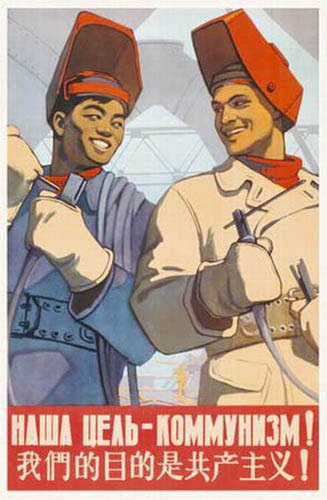
“Our goal is communism!”
___________
“The Hermitage is not particularly interesting to the Chinese”
Elena Rotkevich
July 6, 2015 Gorod 812
Red itineraries will be popular if they are pitched properly to tourists from the PRC. Tourist guide and interpreter Ekaterina Guseva shared her impressions of working with Chinese groups.
Are the Chinese really interested in Lenin?
I think the Chinese will find tours to Lenin and revolutionary sites interesting, especially the fifty-something generation. It is this generation that mainly comes to Russia, because they studied our history and know our literature and culture fairly well. The Chinese were raised on stories about the Soviet Union. It was Big Brother who helped them. They call us a great or militant nation, and they are very curious about how this great nation is faring right now. Do we still sing “Katyusha”? Do we respect Lenin? They often ask whether life under communism was good and whether we miss the communist regime.
We try and reflect the real facts when we answer them. For example, that apartments were distributed for free in the Soviet Union, but some people miss those times, while others don’t.
The most popular sight in Petersburg among the Chinese was the cruiser Aurora, but now, unfortunately, it is undergoing restoration. The main museums—the Hermitage, Peterhof—are not particularly interesting to them. They don’t like boring, highly detailed tours, for example, when the kinds of woods used in the unique parquet floor in the Throne Room are listed. They like something a little more fun.
Touring Lenin sites is not a bad idea. At present, they are not taken to Lenin museums. We only drive up to the Smolny, but we don’t go inside. The demand for red tours will hinge on the right advertising campaign and cooperation with Chinese tour agencies. We could combine Petersburg with Finland and Sweden: with the right revolutionary commentary, Scandinavia will also be popular. The main thing is pitching the material.
Have the numbers of Chinese tourists increased?
This year we had a 300% increase in the flow of tourists from China. We lack licensed Russian tour guides. We have gone public about the problem on more than one occasion since the deficit is made up for by illegals. Semi-legal Chinese tourist firms operating in Petersburg hire similarly illegal Chinese immigrants as tour guides. Someone lends them a young [Russian] woman licensed to lead tours in English or Spanish, and under the guise of this young woman, they show groups around the city. These illegals badly mangle our history, and they distort the characteristics of Russians and Russian culture. I myself once saw a female Chinese tour guide on the grand staircase [in the Catherine Palace] at Pushkin make a sweeping gesture with her hand, pointing to everything in the vicinity, and heard her say to her group, “The Russians stole everything you see here. They went everywhere with warriors, tried to conquer everybody, and stole and stole wherever they went.” We are trying to combat this, but there are lots of them, and a few of us.
Isn’t it time to do the signage on the streets, in the subway, and in museums in Chinese?
In terms of quantity, Chinese tourists outnumber all other foreign tourists, of course. But Chinese tourism is usually group tourism. Quite often they have a group visa, which theoretically does not imply they will be navigating the city independently. They don’t walk the streets or ride the subway on their own, only with a guide. So there is probably no need for this.
Is it hard to work with the Chinese?
It is a lot more pleasant to work with Chinese tourists than with Americans, for example, or Canadians because from the get-go they have a more positive attitude toward Russia and Russians. They buy the same souvenirs as everyone else: matryoshka dolls and scarves. And they love amber.
Translated by the Russian Reader. This article was published on page 19 of the July 6, 2015, print edition of Gorod 812. So far, it has not been published in the magazine’s online edition. This post is a sequel of sorts to a collage of translated material on Russia’s “Chinese turn,” published here last autumn.
This notice was, allegedly, photographed in a notary’s office yesterday.
It reads, “Dear guests from the southern republics! All conversations in this room [should take place] only in the official language of the country that has kindly sheltered you. (The country is Russia, the language is Russian.)”