Paywalls, Firewalls, and “Extremist Content”

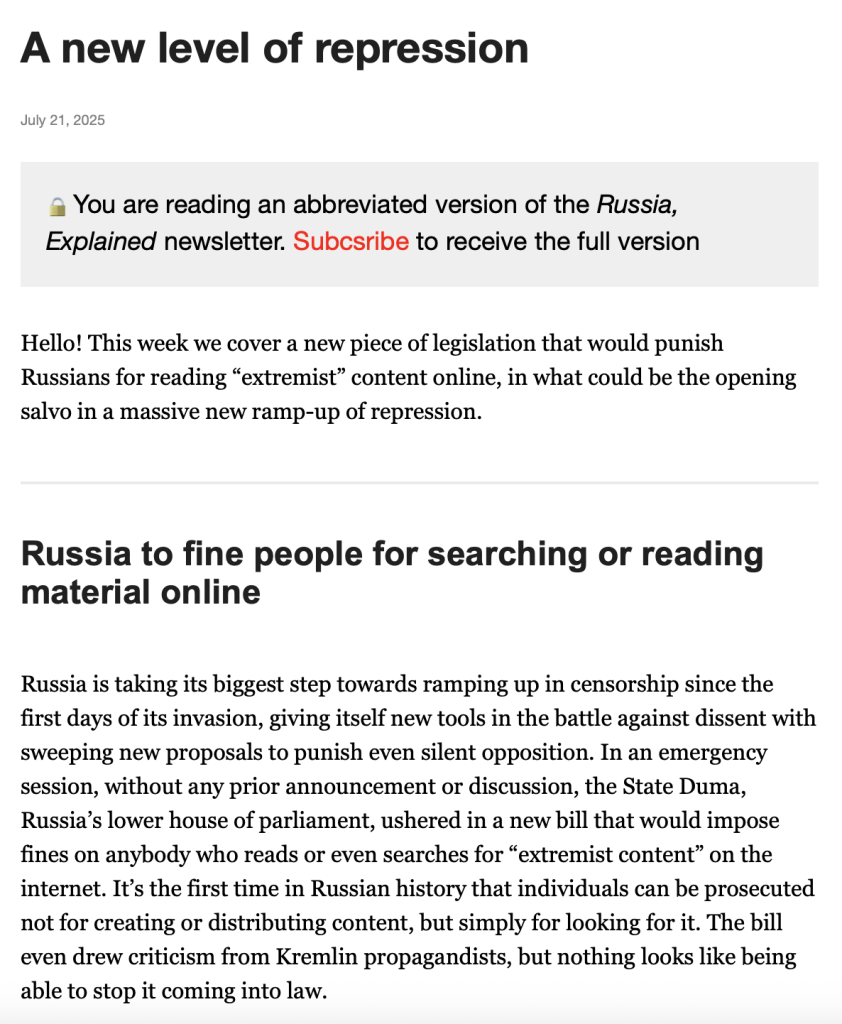
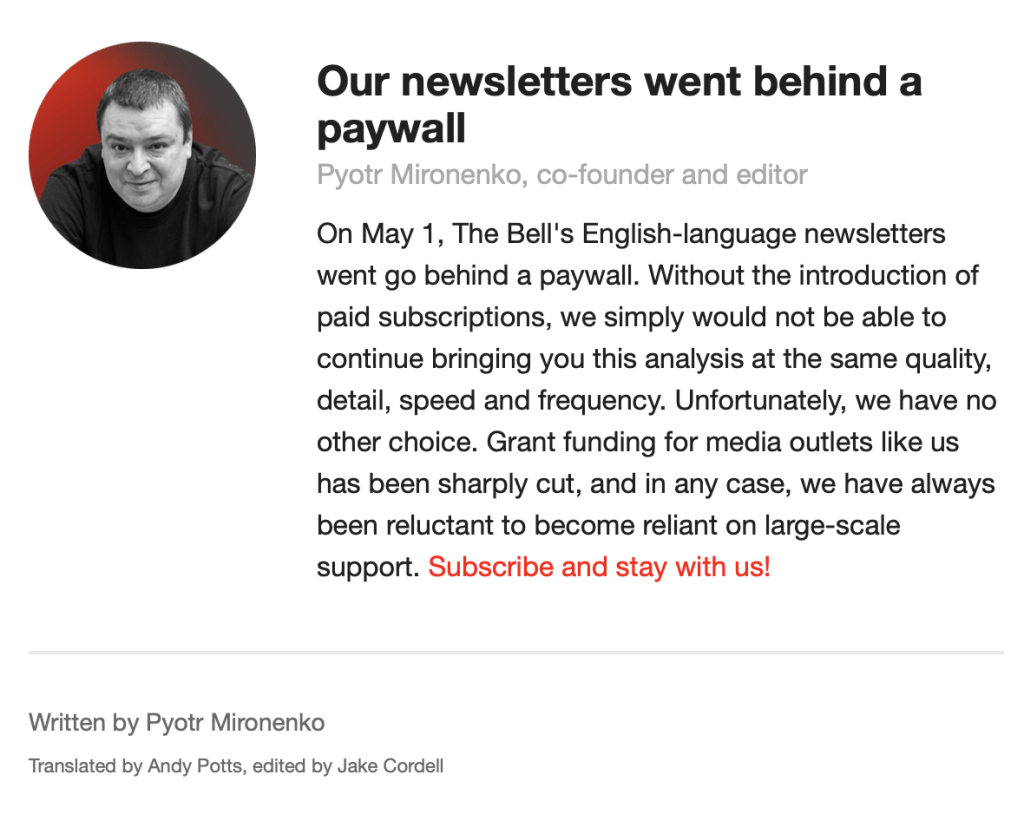
Source: Screenshots of an email from The Bell, 21 July 2025, and pro.thebell.io. I “subcsribe”* to a fair number of newspapers, magazines, and online media outlets. None of them would dare to charge me $348 or even $189 for a mere two newsletters a week. That The Bell asks so much for its meager output gives you an idea of how much it was previously receiving, directly or indirectly, from “grant funding for media outlets like us,” that is, from the U.S. government. ||| TRR

* The same typo was in last week’s “abbreviated version” of Russia, Explained.


A growing chorus of pro-Kremlin figures is speaking out against a proposed law that would impose fines for accessing or searching for online content labeled “extremist” by Russian authorities.

The bill, which was passed in its first reading in the lower-house State Duma on Thursday, envisions fines of up to 5,000 rubles ($64) for individuals who “knowingly” view or search for banned content. It does not specify how such activity would be detected, prompting concerns from experts about increased surveillance and possible abuse by law enforcement.

Yekaterina Mizulina, head of the Kremlin-aligned Safe Internet League, said the legislation could backfire on police, as well as those who support the Kremlin and help authorities in their crackdown on dissent.

“We actively monitor this kind of [“extremist”] content and share findings with law enforcement as part of our chartered mission,” Mizulina wrote on Telegram.

“What’s most striking is that under the draft law, even Interior Ministry officials monitoring such content could technically be acting illegally. And any private citizen who reports, say, [potential school shooters] to law enforcement could also face fines,” she added.

Margarita Simonyan, editor-in-chief of the state-funded RT news network, also criticized the bill.

“Dear government, tell me, plz, how are we supposed to carry out investigations and throw shade on all types of extremist groups like FBK if we are barred from even reading about them?” Simonyan wrote on Telegram, referring to Alexei Navalny’s Anti-Corruption Foundation, which Russia outlawed in 2021.

“I hope there will be changes,” she added.

Amnesty International, a London-based NGO, earlier decried the bill as “vague and overly broad,” warning that it enables arbitrary enforcement.

“Once again, the Russian authorities are disguising their relentless persecution of dissent as countering ‘extremism,’” said Marie Struthers, Amnesty’s Eastern Europe and Central Asia director.

“In today’s Russia, ‘extremist’ materials could be anything from a book promoting same-sex relationships to social media posts by opposition groups,” Struthers added.

The Kremlin on Thursday declined to comment on the controversy surrounding the bill, but acknowledged that the “issue has clearly sparked a strong public reaction.”

Authorities in Moscow currently maintain a list of around 5,500 banned “extremist” materials, including books, religious texts, songs, films and other media.

If lawmakers pass the bill and President Vladimir Putin signs it into law, it would take effect on Sept. 1.

Source: “Pro-Kremlin Figures Decry Bill Criminalizing Access to ‘Extremist’ Content,” Moscow Times, 17 July 2025. The Russian Reader was banned and blocked in Russia in July 2022 (with WordPress’s connivance), as chronicled here, here, and here.

Well-Being and the War

“We love and miss Berlin so much that we decided not to wait until we find ourselves there again . . .”
Samotechnaya Square, Moscow, April 2025. Photo: anatrrra (used with their permission)

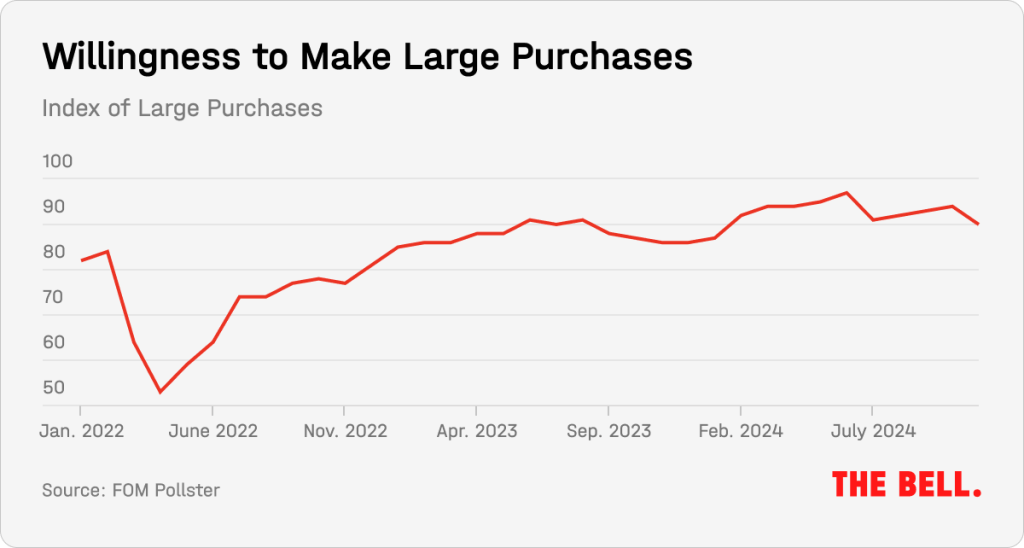
Despite being hit with unprecedented Western sanctions, the war with Ukraine has been accompanied by a noticeable increase in the well-being of Russians. A new study has revealed the extent of the domestic feel-good factor, with economists at the Bank of Finland Institute for Emerging Economics (BOFIT) finding the level of Russians’ satisfaction with their household and personal circumstances has hit its highest in a decade.

  • To understand how the restructuring of Russia’s economy during wartime affected Russians, economists Sinikka Parviainen (BOFIT) and William Pyle (Middlebury College, USA) used data from the Russian Longitudinal Monitoring Service (RLMS), which has been conducted by the Higher School of Economics almost every year since the 1990s. This research tracks the economic well-being of Russian households and individuals with a sample size of around 6,000-8,000 households and 17,000-21,000 people.
  • The economists looked at RLMS data from 2013-2023, scrutinising responses to the questions: “how satisfied with life are you right now?” and “how satisfied with your financial circumstances are you right now?”. They also looked at whether households had made large purchases over the past year, how much they spent on cultural events and how long they could maintain their current lifestyle if they lost their main source of income.
  • They concluded that the first two years of Russia’s invasion — 2022 and 2023 — saw the highest levels of general satisfaction, and specific financial satisfaction had also returned to 2014 levels for the first time. That year is seen as a benchmark before Russia was plunged into an economic crisis following the annexation of Crimea, imposition of Western sanctions and an oil price crash.
  • Large purchases fell to a minimum in 2022 but demand for non-food goods has since increased faster than inflation and wages, in line with The Bell’s earlier  calculations. There was also a sharp rise in the proportion of households spending money on entertainment: in 2023 this reached 2018 levels, the researchers noted. The number of respondents who said they would be able to last more than a few months on their savings reached a 10-year high.
  • These findings correspond with Russia’s official statistics which also point to improved financial circumstances since the start of the war. In 2023, real incomes in Russia not only returned to 2013 levels after a decade of lost living standards, but surpassed the pre-Crimea level by 5%, the researchers highlighted.
  • There are no surprises as to the cause — a huge increase in state spending on the invasion and the military-industrial complex that has driven record labor shortages and pushed wages up across the economy. The high salaries offered by the state to people sent to work at the front, as well as those paid to soldiers (from 200,000 rubles a month) have played a big part, and the main winners have been residents of Russia’s poorest regions, which have recorded an unusually sudden increase in bank deposits.

Why the world should care

Putin’s regime is unlikely to face any internal threat as long as Russians’ well-being and overall happiness is on the rise.

Source: “Russians’ wellbeing levels surge in face of war, sanctions and repression,” The Bell, 2 April 2025


KVS, “SouthTown: The Olympic Quarters” (YouTube, 8 June 2021)

Today’s developers pay no less attention to creating comfortable residential environments in their projects than they do to configuring apartments, for example, and sometimes they pay even more attention to this.

In recent years, the concept of beautifying the area around residential buildings has been transformed from elementary landscaping of yards and equipping playgrounds to creating theme parks within residential complexes, divided into different activity zones, as well as designing additional spaces where residents of the neighborhood can gather, get acquainted, relax, play sports, and organize their own or their children’s leisure activities.

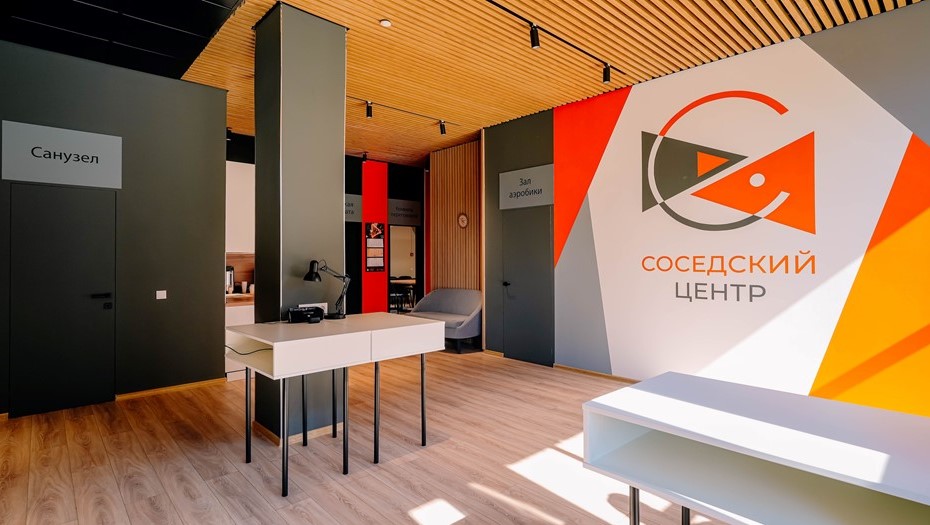
The role of such spaces is most often played by neighborhood centers, and planning these centers has recently become a real trend among developers.

The neighborhood center at the SouthTown development, designed by Anton Rudnik. Photo: KVS Group, via Delovoi Peterburg

The reasons

Residents of apartment buildings have always needed to socialize and spend time together. Back in Soviet times, people would often gather in courtyards to play dominoes, bingo, and table tennis. At some point the tradition was lost, but after the restrictions imposed during the Covid-19 pandemic were lifted, it literally sparkled with new colors.

In their article [sic: no link in the original] on communities, neighborhoods, and neighborliness, researchers from the Higher School of Economics noted that the first contemporary attempts to unite people living near each other into groups were especially noticeable after 2015, when people all over Russia began celebrating Neighbors Day. From a holiday in the classic sense of the word, Neighbors Day has quickly evolved into a multifaceted know-how for working with residents and getting them involved in such community work as spring cleanups and decorating yards for the New Year’s holidays.

With the emergence of urban agglomerations and the integrated development of new estates by developers, the need for communication among the people living there has increased. There is a logical explanation for this. In her time, Birgit Krantz, a Swedish sociologist, architect, and expert on neighborhood relations, argued that the ideal apartment complex contains between fifty to eighty apartments. If a complex has more apartments, it is difficult to manage it and maintain good neighborly relations.

There are many more apartments in new large residential projects, however, even if they are low-rise developments. This is where neighborhood centers come to the rescue. Consequently, they have become an integral part of people’s everyday lives in entire neighborhoods, functioning, per the American sociologist Ray Oldenburg, as “third places” (between home and work or school), as social anchors which facilitate creative interactions among individuals.

A clear demand

Today, the neighborhood centers running in new residential neighborhoods are literally bustling with life, and they are usually open seven days a week from early morning to late evening.

Delovoi Peterburg talked to residents at the KVS Group’s SouthTown development, where such a neighborhood center has been up and running for over six months. The center offers sports classes; clubs for children, including preschool prep; nanny services; rooms for business meetings and negotiations; and movie screenings. A puppet theater also periodically comes to the center on tour, and a planetarium was once even recreated in the space.

According to Anzhelika Alshayeva, director general of the KVS Real Estate Agency, all activities were free of charge for residents during the center’s first three months of operation; the tab was picked up by the developer. Now, the cost of classes is only 200 rubles, and the interest of residents continues to grow. With this in mind, the decision was made to launch the second stage of the neighborhood center — a teen club, which will be equipped with ping-pong and billiards tables, which will undoubtedly appeal to local youngsters.

The teen club at the neighborhood center in the SouthTown development, designed by Anton Rudnik.
Photo: KVS Group,
via Delovoi Peterburg

An important social role

Most importantly, such neighborhood centers, in addition to creating stable communities of around particular interests and hobbies, offer residents various opportunities for professional and personal growth. As practice shows, neighborhood residents themselves provide professional services, working as nannies, coaches, and teachers. Thus, another important issue for the neighborhood as a whole — job creation — is solved. And the concept of the 15-minute city is implemented in the particular housing complex: without leaving home, a person can comfortably take advantage of the full range of social services and work in the same place.

In this sense, co-working spaces can be an important component of neighborhood centers, serving not only as a pleasant but also as a useful feature for buyers and future residents. In addition, a co-working space can potentially generate revenue, thus covering the costs of its own upkeep.

And it does not necessarily have to be a classic room with computers and a coffee machine. For example, in the aforementioned neighborhood center, in the amphitheater of Olympic Hopes Park, the developer decided to create a beauty co-working space — a space with work areas which can be leased by beauty industry professionals. The project promises to be an important element of the neighborhood’s infrastructure, contributing to the growth of small business and strengthening the local community. This comprehensive approach to neighborhood development and neighborly relations was also recognized by Delovoi Peterburg, which awarded it the newspaper’s award for Residential Environment Project of the Year in Creating Versatile and Comfortable Neighborly Infrastructure.

The beauty co-working space at the neighborhood center in the SouthTown development, designed by Olga Fedotova.
Photo: KVS Group, via Delovoi Peterburg

When speaking about the importance of neighborhood centers for residential developments, the experts interviewed by Delovoi Peterburg generally voiced confidence that adding such facilities to residential developments does not make projects much more expensive, but it can increase an an apartment’s per meter cost, as well as make a developer stand out from the competition. The experts recognized that the trend toward neighborliness, according to psychologists, will continue to grow, especially among residents of new neighborhoods.

Source: “Focusing on uniting residents of new neighborhoods,” Delovoi Peterburg, 31 March 2025. Translated by the Russian Reader

Are These the Bad Old Days?

Source: Ekaterina Reznikova and Alexey Korostelev, “2024: A study into repression under Putin,” Proekt, 22 February 2024


Russia jails dissident once targeted by Putin at KGB for 16 years

A court in St. Petersburg has sentenced Alexander Skobov, a 66-year-old Soviet dissident and activist, to 16 years in jail on charges of justifying terrorism and joining a terrorist group. Skovov was first arrested more than four decades ago and Vladimir Putin was among the KGB officers who worked on his case. Prosecutors said Skobov justified terrorist attacks on Russian territory and supported the Freedom of Russia legion, which Russia has deemed a terrorist organisation for fighting alongside Ukrainian forces.

  • Skobov will spend the first three years of his sentence in prison (typically reserved for highly dangerous criminals such as kidnappers and terrorists and repeat offenders), with the rest in a high-security penal colony. He will be 80 by the time he can be released, although it is questionable whether he will survive that long in Russia’s harsh prison system. The activist has many health problems, including diabetes, hepatitis C, asthma and glaucoma.
  • At the court hearing, Skobov made clear that he did not believe he was facing a fair trial. He refused to answer questions and did not stand when the judge addressed him. “Today they will ask me again – do I plead guilty? Well, now I’m the one asking,” he said in his closing statement. “It’s me asking the servants of Putin’s regime who are present here, who are small cogs in his repressive regime: do you plead guilty to complicity in Putin’s crimes? Do you repent of your complicity?”
  • In the USSR, Skobov was repeatedly charged with “anti-Soviet” offenses. He was first arrested in 1978 on charges of distributing anti-Soviet leaflets and was sentenced to two years in a psychiatric hospital (punitive psychiatry was widespread in the Soviet Union and used as one of the main tools of repression in the 1960s, 70s and 80s). Skobov was forcibly hospitalized again in 1982 for daubing anti-Soviet graffiti on the walls of a building and then released in 1985. 
  • Vladimir Putin, who worked in the Fifth Department of the KGB that was tasked with combating “ideological sabotage,” was among the KGB officers that handled his original cases, independent media and rights groups reported.

Why the world should care

This is far from the first instance when somebody in Russia has been imprisoned for a post on social media. Since 2010, prosecutors have opened more than 1,000 such criminal cases. But a 16-year sentence for an elderly activist in frail health stands out as particularly punitive. It’s safe to say that treatment of dissidents in modern Russia is growing far tougher than it was in the post-Stalin Soviet Union. 

Source: “THE BELL WEEKLY: Billion-dollar loss for Russia’s Facebook,” The Bell, 25 March 2025


“Illinois Governor JB Pritzker (D-IL) Speaks at the 2025 HRC Los Angeles Dinner,” Human Rights Campaign (YouTube)

The Trump administration and his Republican lackeys in Congress are looking to reverse every single victory this community has won over the last 50 years. And right now, it’s drag queens reading books and transgender people serving in the military. Tomorrow, it’s your marriage license and your job they want to take. Bending to the whims of a bully will not end his cruelty. It will only embolden him. The response to authoritarianism isn’t acquiescence. Bullies respond to one thing, and one thing only, a punch in the face.

But you see, that starts with fully acknowledging what is happening. The meme lords and the minions in the White House are intentionally breaking the American system of government so they can rebuild it in their own image. They’ve shut down cancer research and HIV prevention. They’ve eliminated drinking water and clean air regulations and upended the lives of veterans. They’ve said that a recession that Trump is likely to cause will be worth it, which is an assessment worthy of Trump University.

At its core, what Elon Musk and Donald Trump are doing isn’t about efficiencies or cost savings. It’s about giving their wealthy friends a tax break and making the middle class and veterans and public school kids pay for it. It’s a few idiots trying to figure out how to pull off the scam of their lives.

Meanwhile, the scariest part is that they’re using the power of the presidency to try to delight their base by targeting vulnerable people, people they think can’t fight back, calling them domestic enemies or claiming they’ll ruin American culture. Remember their slogan, “Make America Great Again.” Authoritarians target vulnerable minority communities first because they think that if they can conquer those that they deem weak, and they can show everyone else who’s boss, which is why we can’t sit back right now and wait to see what happens. If we wait, I guarantee you the battle will have already been lost.

Donald Trump cannot take anything from us that we don’t choose to give him. He and his henchmen don’t want people to realize that. But now is the time for us to wake up. The good news is every day I’m seeing more and more people across this country realize that they don’t want to give him much at all.

The question I get asked most right now is, “So what can I do? What can I do?” And I’m going to be blunt about this. Never before in my life have I called for mass activism, but this is the moment. Take to the streets, protest, show up at town halls. Jam the phone lines in Congress, 202-224-3121, and afford not a moment of peace to any elected representatives who are aiding and abetting Musk and Trump’s illegal power grab. This is not a drill, folks. This is the real thing.

Seize every megaphone you have. Go online and make a donation to the legal funds fighting Trump, to HRC, and to the candidates for Congress that vow to take this country backward. And don’t limit your voice to the traditional political channels. Be like Lucy Welch. When JD Vance went to vacation at the Sugarbush Resort in Warren, Vermont, Lucy, who writes the Sugarbush Daily Snow Report, used her report to defend her diverse and wonderful community, ending by saying, “I am using my relative platform as a snow reporter to be disruptive. What we do or don’t do matters.”

What we do and don’t do matters. It matters right now more than it ever has before. When my future grandkids look back on this moment, I want them to know that my voice was one of the loudest in the room, screaming for justice and fighting against tyranny.

And in the midst of this existential fight, this battle that seems to consume everything, well, let’s not take the soul-sucking path of sacrificing the most persecuted for that which we deem to be most popular. I know that there are transgender children right now looking out at this world and wondering if anyone is going to stand up for them and for their simple right to exist. Well, I am. We are. We will.

I know that amidst the ongoing assault on our institutions, it is easy for people to fall into despair about our democratic system. But I love this country too much not to fight for it. You’re here tonight because you do too. And when I think about that love, I think back to all the times in our history when our ancestors had to fight back against tyrants and racists and those who couldn’t understand that freedom and justice are our foundational promises in this country.

That group of people, that small group of people that got together in Chicago to found this country’s first known gay rights organization. Well, it was called the Society for Human Rights. It was 1924 and the flicker of light was brief. It only lasted a matter of months before social persecution and criminal prosecution bankrupted the promise of the group’s charter. But oh, that flicker ignited something. By whisper and by word of mouth, folks around the country started to catch wind of the idea. And eventually, it ended up in the ears of a man here in California who later said the idea of gay people getting together at all was an eye-opener for him.

Well, that man’s name was Harry Hay. And a couple of decades later, he went on to found the Mattachine Society right here in Los Angeles. It was the first sustained gay rights organization in the United States. Harry said that he was first told about the Chicago group as a warning that the idea was too dangerous and nobody should try to pull anything off like that ever again. How lucky the world is that Harry didn’t listen.

When we say history repeats itself, it’s not because the villains and battles don’t evolve with the ages. They do. But the fight itself remains elemental. It’s always men who would be king, blaming the suffering of the masses on those who look different or sound different or live differently. And since the dawn of time, the triumph of good over evil has relied on those who believe in empathy and kindness, summoning the steel spine needed to defend those values that by their nature leave us vulnerable to attack. This community knows that. You have lived and breathed this fight for generations. Our hope, our hope lies in this room.

The fact that we are still here today means that we have the faith and courage that we will win the battles that really matter. Now, when I first ran for governor in 2018, I started every single stump speech by saying, and this will tell you why Donald Trump doesn’t like me very much. I said at the beginning of every stump speech, everything we care about is under siege by a racist, misogynist, homophobic, xenophobic Donald Trump.

Source: Parker Molloy, “Watch Illinois Governor JB Pritzker Reject the Politics of Trans Abandonment,” The Present Age, 24 March 2025. Thanks to Rebecca Solnit for the heads-up.

US Aid, Russia, and Ukraine

US aid suspension hits Russian independent media and NGOs

The decree by US President Donald Trump’s decree halting American aid to foreign countries and suspending the work of the United States Agency for International Development (USAID) hits exiled Russian media and NGOs hard. For many organizations and publications, grant funding is the sole means they have of ensuring their continued existence.

As soon as the new US administration announced the suspension of all international aid programs, there was panic among the Russian emigrant community. Most exiled Russian NGOs and media rely on grants as their major—and sometimes sole—source of funding, with a significant chunk coming from Washington. The topic has been high on the agenda for Russia’s opposition and anti-war communities— though only behind the scenes. Affected NGOs and media outlets do not want to admit publicly that they receive American funding, as it could lead to criminal prosecution by the Russian authorities. They are also reluctant to publicly discuss financial problems.

Dozens of organizations are under threat from within the Russian-language anti-war diaspora community, including those who help persecuted individuals to leave Russia, try to protect minority rights and bring accurate information about the war to audiences within Russia. According to the Moscow Times, citing a source in Washington, up to 90 organizations have already lost their funding. As one example, The Ark, which offers temporary housing, legal aid, psychological support and other assistance to Russians forced to flee their homeland, immediately lost half its budget.

Former political prisoner Andrei Pivovarov (released in the summer 2024 prisoner exchange) wrote that Trump’s decree would lead to the cancellation of one-off events and the abandonment of long-term projects. “You can cancel a conference, but you can’t, for example, stop paying the rent. You can’t tell your landlord: ‘wait, Trump will work it out’. He’ll just cancel the contract. And many simply do not have the kind of safety net that can pay for these three months, or raise money via crowdfunding,” he explained. “It will be even more difficult with people. There are many countries where residency is tied to a work contract, and if there is no money for that it raises questions about the basis for extending [residency].”

Russian propaganda channels are jubilant. For decades they have been telling Russians that the opposition lives on Western money and carries out orders from abroad. Trump’s decree offers them a great opportunity to say that these claims have now been proven and that “independent” media is nothing of the sort. Of course, nobody on the pro-Kremlin side is bothering to look at the details of how Western grant funding actually works. Maria Zakharova, a representative of Russia’s Foreign Ministry, has already claimed that USAID forced “countless grant-eaters” to remain silent about alleged Ukrainian war crimes.

Not all funding for Russian civil society came from US state grants.  Private foundations as well as European governments also support Russian initiatives. But removing perhaps a quarter of the support from Russian journalists and organizations can only lead to ever more fierce competition for the remaining funds—not every project will survive.

Why the world should care

Trump’s radical measures are hitting activists and NGOs around the world. Russian organizations and media outlets, cut off from their homeland, face greater problems than many as they have far fewer sources of alternative funds.

Written by Peter Mironenko, translated by Andy Potts and edited by Jake Cordell

Source: The Bell (newsletter), 3 February 2024


If Russia had a wish list, it would include gutting the DOJ and FBI to eliminate counterintelligence operations and successful prosecutions, crippling U.S. sanctions enforcement by weakening the Treasury Department, fracturing America’s alliances to isolate the U.S. on the global stage, and dismantling USAID to eliminate vital democratic and humanitarian aid programs worldwide. That wish list is now being fulfilled—not by the Kremlin, but by Elon Musk and Trump.

Each of these attacks is a direct blow to U.S. national security and global influence but I’m going to focus on the dismantling of USAID—a move that Russian officials and state media are openly celebrating.

This isn’t just about shutting down an aid agency; it’s about deliberately weakening U.S. power while handing a geopolitical victory to authoritarian regimes in Moscow and Beijing.

Gutting USAID—A Gift to Russia

With Trump’s full backing, Musk has taken aim at USAID, calling it “a criminal organization” that “needs to die,” and branding the agency “a viper’s nest of radical left Marxists who hate America.” Shortly after, he announced that Trump had personally agreed USAID should be shut down.

Now, its funding is frozen, employees are locked out of headquarters in Washington, lawmakers are barred from entering the USAID building, and critical aid programs are being dismantled.

USAID is set to be merged into the State Department, but it will be a shell of its former self—stripped of its resources, workforce, and influence, ensuring it can never have the same impact.

For decades, USAID has been a pillar of American influence abroad, supporting independent journalism, anti-corruption initiatives, election monitoring, and providing critical, life-saving humanitarian assistance across the globe. It has played a key role in countering Russian, Iranian, and Chinese influence, providing a lifeline to civil society organizations resisting authoritarian regimes or strengthening their democracies. Now, that support is disappearing.

Russia’s reaction? Celebration as Kremlin propagandists and state officials are jubilant. And they’re right—USAID has been one of the biggest obstacles to its authoritarian expansion. With its demise, Russia gains a clearer path to spread its influence, undermine democracies, and prop up pro-Kremlin regimes worldwide.

Who Benefits from USAID’s Collapse? Russia and China

The closure of USAID isn’t about cutting spending—it’s about weakening U.S. global influence while empowering our adversaries. With American aid disappearing, nations that once relied on USAID for support will turn to Russia and China for funding.

This is a seismic shift in global power. Russia and China will step into the vacuum left by the U.S., using economic leverage to expand their authoritarian agendas. This is exactly what Moscow and Beijing have wanted for decades—and Trump and Musk are delivering it on a silver platter.

At the same time, Musk is propping up pro-Kremlin far-right parties across Europe—or, as I like to call them, ‘Kremlin projects’—while interfering in the elections and internal affairs of our allies.

Trump and Musk Are Lying—USAID Was Critical

Trump and Musk have claimed USAID was corrupt and ineffective. That’s a lie. USAID has been one of the most scrutinized and audited agencies in the federal government, and their accusations are baseless and an excuse to dismantle a tool that supports democracy, transparency, and independent governance.

The truth is simple: dismantling USAID doesn’t benefit the American people—it benefits authoritarian regimes. Its closure will leave a vacuum that Russia, China, and other adversaries will quickly fill.

Their claims of “fraud” are just a smokescreen for a broader effort to undermine democracy and erase America’s ability to support those fighting for freedom worldwide.

Musk’s Expanding Control Over Federal Systems

Simultaneously, Musk’s influence over the federal government is growing at an alarming rate, giving an unelected, unvetted billionaire, and his unvetted associates unprecedented access to highly sensitive data. His aides have locked career federal workers out of their systems at the U.S. Office of Personnel Management, effectively cutting off access to vital personnel records and personal information.

Meanwhile, his team has gained unauthorized access to General Services Administration systems, deploying AI tools to reshape the agency in ways that remain undisclosed to the public. Adding to these alarming developments, Musk’s handpicked allies—including unvetted college students—have taken over Technology Transformation Services, which manages critical government IT systems, sparking chaos and raising significant security concerns.

Musk and his unvetted, unelected team now have access to everything— our Social Security records, Medicare payments, tax filings, federal employee data, and other sensitive and classified files. Even our children’s information is now in their hands.

What will Musk do with it? Who will he share it with? This isn’t hypothetical—it’s a direct national security threat and threat to all of us and we need immediate answers.

Demand Accountability

We cannot allow this to happen without a fight. Contact your Senators, Representatives, and local officials and demand answers:

  • Did Trump give direct authorization for Musk to have access to sensitive government systems and all our private data?
  • What safeguards exist to prevent him from sharing Social Security numbers, tax filings, and federal employee records with foreign actors or private interests?
  • What steps are being taken to prevent further infiltration in government operations?
  • Who is ensuring our personal, financial, and national security data isn’t exploited for political or corporate gain?

Flood their phone lines, send emails, and make noise on social media platforms. We need answers because none of us want a billionaire beholden to Russian and Chinese interests to have our private info.

Source: Olga Lautman (Substack), “Elon Musk and Trump Shutting Down USAID—A Gift to Russia,” 3 February 2025


The website of the United States Agency for International Development went dark over the weekend and employees were put on leave, as Elon Musk said Monday that President Donald Trump wanted to shut down the largest disburser of U.S. foreign aid. The remarks were made by Musk during a live stream discussing the work of his government task force, the so-called Department of Government Efficiency, that he was announced to be leading by the president. Media reports meanwhile said that USAID could be absorbed into the State Department while many of the projects its supports – from health to infrastructure and disaster-relief programs – would be slashed significantly. USAID spending equals less than 1 percent of the federal budget.

The United States Agency for International Development, USAID for short, is the biggest dispenser of U.S. foreign aid, according to the federal website Foreignassistance.gov. It disbursed almost $44 billion in the fiscal year of 2023 (latest available), with $16 billion going to Ukraine. The number represents more than 60 percent of all U.S. foreign aid listed on the website. The agency pays out only economic aid, with military aid being handled by the Department of State and the Department of Defense.

After Ukraine, USAID payments were predominantly going to the Middle East and Africa in 2023. Ethiopia, Jordan, Afghanistan and Somalia all received more than $1 billion from USAID that year. U.S. aid recipients are found all over Latin America, Africa, Asia and Eastern Europe. Together with the Department of State/Defense spending, which focuses on the Middle East even more due to military aid components, it is the widest-ranging U.S. foreign aid paid out.

Source: Katharina Buchholz, “Where USAID Is Going,” Statista, 3 February 2025


German Chancellor Olaf Scholz criticized U.S. President Donald Trump’s proposal to tie military aid for Ukraine to access to the country’s rare earth resources, calling it “very selfish and self-centered,” Spiegel reported on Feb. 4.

Speaking after an informal meeting of European leaders in Brussels, Scholz reportedly stressed that Ukraine should first be helped to “get back on its feet” and that its resources should be used for reconstruction after the war.

This comes as Trump told reporters on Feb. 3 that he was seeking a deal where Ukraine would “secure what we’re giving them with their rare earths and other things,” though he did not specify which materials Washington is targeting.

A source in the Presidential Office told the Kyiv Independent that sharing Ukrainian resources with allies is already part of President Volodymyr Zelensky’s “victory plan,” which has been presented to foreign leaders, including Trump.

Trump’s remarks come amid uncertainty over the future of the U.S. aid to Ukraine.

The U.S. has provided $65.9 billion in military aid to Ukraine since the start of Russia’s full-scale invasion, with assistance remaining unaffected by the current aid freeze, Zelensky confirmed on Jan. 25. Non-military programs run by the U.S. Agency for International Development (USAID) have lost funding under the new administration.

USAID has provided Ukraine with $2.6 billion in humanitarian aid, $5 billion in development assistance, and over $30 billion in direct budgetary support. In response to the funding cuts, Ukraine’s parliamentary committee on humanitarian and information policy has begun consultations with European partners to temporarily replace U.S. funding.

Under Scholz’s leadership, Germany has become Ukraine’s second-largest military donor after the U.S. However, the chancellor has resisted providing Taurus long-range cruise missiles, citing escalation concerns.

Scholz has also blocked the proposed additional security assistance for Ukraine worth 3 billion ($3.09 billion) euros unless it is covered by additional government borrowing.

The plan, backed by German Foreign Minister Annalena Baerbock and Defense Minister Boris Pistorius, included three additional Iris-T air defense batteries, 10 howitzers, and more artillery ammunition.

Source: Tim Zadorozhnyy, “‘Selfish’ — Scholz blasts Trump’s aid-for-rare earths Ukraine plan,” Kyiv Independent, 4 February 2024

On Her Knees

This security footage of apparent ballot stuffing at a polling station in Petersburg was released by the Petersburg [Elections] Observers movement on their Telegram channel on 20 March. The polling station was later identified as No. 5, housed in School No. 260 in the city’s Admiralty District. The women shown doing their patriotic duty to prolong Russia’s current fascist regime were identified by another source as school teachers.

Vladimir Putin was re-elected as Russian president. Officially it’s his fifth term in the Kremlin — although in practice it’s six if we include his stint pulling the strings as prime minister. The official results have Putin polling even higher than predicted, taking 87% of the vote. That figure looks utterly implausible and places Putin among the likes of Asian, Middle Eastern and Central Asian autocrats. The election itself went ahead against a tense background, with Ukrainian shelling and attempted incursions into Russia’s border regions along with on-going drone attacks on Russian oil refineries.

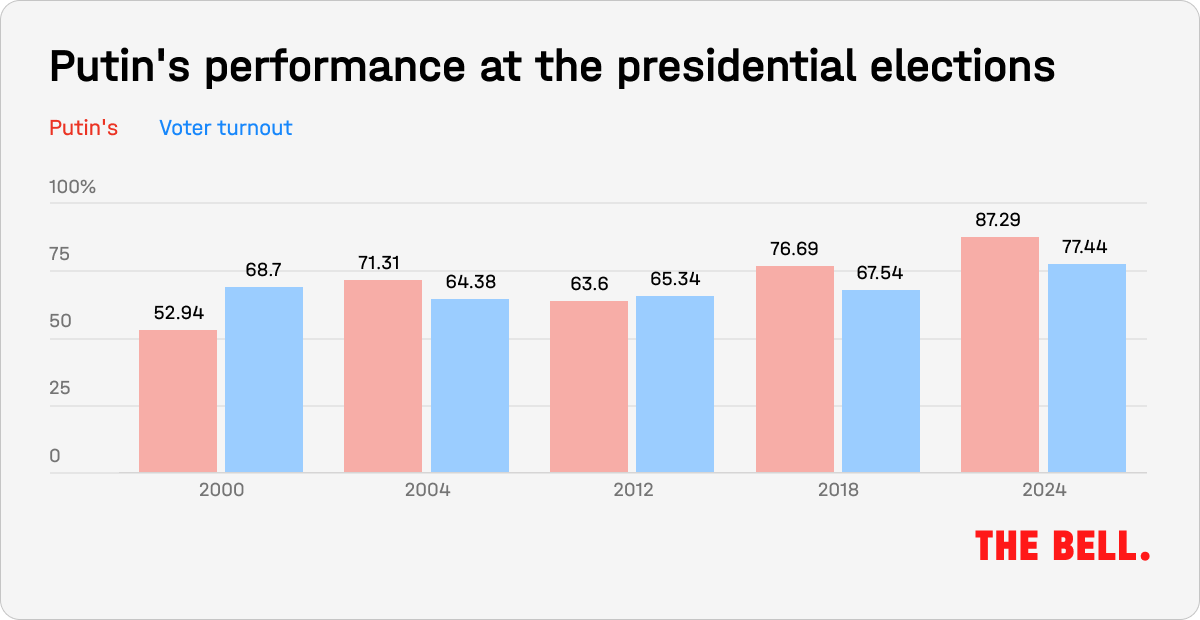
The official election result is already out — Vladimir Putin secured 87.28% on a turnout of 77.44%. Both those numbers are record highs since the collapse of the Soviet Union. And both are about 10 percentage points up on 2018 (when Putin polled 76.8% on a 67% turnout). This suggests that the Kremlin’s political managers were tasked with delivering a significant increase in Putin’s popularity. That in itself is not surprising: in the current circumstances an autocrat needs to demonstrate how his people have rallied around the flag.

Initial research by journalists and independent experts suggests the vote could have been the most heavily falsified in the history of post-Soviet Russia. Analysis by IStories and Ivan Shukshin, a researcher and activist with the Golos vote monitoring NGO, estimated that around 22 million of the 76.3 million votes cast for Putin were “anomalous.” In other words, almost a third of Putin’s official tally could have been false. 

Their methodology is based on analyzing the turnout and vote shares at individual polling stations, using the central election commission’s official data. Districts with higher turnouts also have larger vote shares for Putin — a fact which suggests ballot-stuffing since the two shouldn’t be strongly correlated. IStories and Shukshin didn’t include results in Moscow, where online voting makes the analysis trickier. A third report by Novaya Gazeta Europe said as many as 31.6 million votes — almost half of Putin’s total — could have been fake.

Many experienced observers of Russian politics (1,2) believe that election organizers in provincial Russia “overdid it” this time round. Most pre-election leaks of the Kremlin’s vote strategy featured more modest targets. In spring 2023, for instance, RBC wrote that the Kremlin wanted to secure 75% of the vote on a 70% turnout. A few months later, Meduza wrote that regional authorities were advised that they should secure at least 80% of the vote for Putin. The final pre-election opinion polls conducted by state pollster VTsIOM (which also represent indirect instructions to regional election officials for polling day) showed Putin’s result was at the initial target level of 75%.

The record result places Putin firmly among his fellow autocrats. In free democratic elections, it’s a rare anomaly for a candidate to poll even at 60-70%. Only once, in extreme circumstances, have we seen more than 80% in a democratic country — a huge protest vote that gave France’s Jacques Chirac 82% in a presidential run-off against Jean-Marie le Pen in 2002, the BBC reported. In Russian history, Putin still has something to aim for if we look back to Soviet times. The turnout in 2024 was slightly higher than when Boris Yeltsin was voted president of the Russian Soviet Federative Socialist Republic in 1991, but there is still some way to go to match the Stalin era of 100% turnout in votes to appoint new deputies.

Since Putin was re-elected in 2018, voting in Russia has become even less transparent, and offered greater opportunities for fraud. Remote electronic voting was conducted in 29 Russian regions. Some 70% of the 4.7 million voters registered to vote online apparently cast their votes on the first of the three-day poll. Monitoring violations at physical polling stations is an almost impossible task. The Central Electoral Commission stopped broadcasting live footage from monitoring cameras in polling stations after the pictures from 2018 had depicted numerous violations and led observers to conclude that the scale of ballot stuffing was so great that the real result could not be determined in at least 11 regions. 

The 2024 poll also differed from Putin’s two most recent victories in the selection of candidates who ran against the Kremlin leader. In 2012, political strategists allowed businessman Mikhail Prokhorov to stand, proposing that Russia’s marginal liberal opposition would consolidate around him. And in 2018, that same role went to TV presenter Ksenia Sobchak. But this time round there was no acceptable liberal candidate. Even the little-known politician Boris Nadezhdin, who timidly spoke out against the war in Ukraine, was denied registration. On the ballot were only Putin’s “rivals” from the systemic opposition parties. All of them have been equally supportive of Russia’s repressive turn, backing various crackdown measures that have come before the State Duma in recent years.

The extras in the 2024 race — Communist Nikolai Kharitonov, Vladislav Davankov of New People, and Leonid Slutsky of the LDPR — polled less than 12% combined. That’s slightly less than communist candidate Pavel Grudinin managed on his own in 2018. The 75-year-old Kharitonov’s 4.3% was better than the youthful Davankov’s 3.8%, while Slutsky, the unsuccessful heir to charismatic populist Vladimir Zhirinovsky, trailed in last with 3.2%.

Source: “‘Record’ victory cements Putin’s autocrat status,” The Bell, 19 March 2024


Despite intimidation by the authorities, many Russians went to polling stations across the country and abroad at noon on 17 March as part of the Noon Against Putin protest, which was conceived as one of the few safe ways for Russians to voice their dissent. After all, it is hard to punish people for going to a polling station on election day and queueing.

The protest was the brainchild of Maxim Reznik, a former member of St. Petersburg’s legislative assembly, and it was endorsed by Alexei Navalny. After the opposition politician was murdered in a Russian penal colony, his supporters and other Kremlin opponents urged Russians to take part in Midday Against Putin.

This time round the last day of the election fell on the end of Shrovetide, and the powers that be tried to take advantage of it. For example, in Tomsk, they organized Shrovetide festivities at one of the polling stations to generate “hustle and bustle.” In Arkhangelsk, local restaurants were forced to cook pancakes for free distribution at the polling stations. Festivities were also organized, for example, in Moscow Region, Perm, Chuvashia, Murmansk Region, and Kamchatka.

Investigative journalist Andrei Zakharov quoted an anonymous agitator who, along with his colleagues, was tasked with “inviting people to a Shrovetide party in a park while also suggesting they take their [internal] passports with them in order to vote. It’s not far to the polling station.”

Those who decided to take part in the noonday protest were intimidated by fake mailings. As early as 13 March, some users in Russia received messages purporting to be from Navalny supporters postponing the Noon Against Putin protest to late Sunday. On Saturday, some Muscovites got messages accusing them of supporting “extremist ideas” and demands to vote “without waiting in line.”

There was also intimidation from actual law enforcers. The Moscow Prosecutor’s Office issued three warnings about the danger of the protest and possible criminal chargers against the protesters.

In spite of this, people in Russia and around the world came to the polling stations at noon on 17 March.

The huge queues abroad attracted a lot of media attention. Just look at the number of people at [Russia’s] diplomatic missions in Almaty and Bishkek. In European countries, people stood in line for many hours.

The long waits at polling stations abroad were sometimes caused by the deliberately slow work of the election commissions. For example, in Riga, voters were let in two at a time, although there were six voting booths and four polling station officials available. Voting was also delayed because many embassies and consulates banned cell phones, searched voters as they entered, and made them temporarily surrender their belongings.

In Russia, people were also searched in many polling places after dozens of incidents of attempted arson and spoiling ballot boxes with paint (the handiwork of phone scammers) took place. “First, two policemen search the bags [of voters] very thoroughly outside. I even had to show them my deodorant stick,” a reader of Dmitry Kolezev’s Telegram channel from Moscow wrote.

Due to the [long] queues in Riga, Vienna and Yerevan, for example, the polls were kept open for at least another hour [after they were to have been closed]. But in Berlin, the embassy was immediately closed, prompting the people gathered there to stage an impromptu protest. One of the staffers at the diplomatic mission danced a little jig as they shouted “Shame!”

But the principal queues were in Russia.

The first lines formed at precincts in Siberia and the Urals — for example, in Perm and Yekaterinburg, Novosibirsk and Akademgorodok. In the last place, by the way, Putin lost to [Vladislav] Davankov, a rare case for electoral precincts in Russia itself.

The queues were de facto protest rallies. People lined up outside polling stations in Moscow, St. Petersburg, Arkhangelsk, and Sochi. Officials tried to persuade them to cast their votes on electronic terminals — it is easier to rig the vote that way — but people took paper ballots and either voted for someone other than Putin or defaced them by writing on them such things as “Love is stronger than hate,” or “You have the blood of Ukrainians on your hands, scumbag” (the latter remark was addressed to Vladimir Putin).

As it turned out, nobody interfered with the queues; the police were not violent and did not detain anyone. Most of the detentions that did occur were of independent observers and members of elections commissions who had tried to prevent violations. According to OVD Info, 17 March was “relatively calm.”

The election’s outcome surprised no one in a country where wartime censorship has virtually been introduced. Vladimir Putin took more than 87% of the vote according to the official count — a result almost like that of Central Asian dictators, and greater than that of [Belarusian dictator Alexander] Lukashenko.

The main outcome was that many Russians took advantage of the procedure as one of the few remaining opportunities to safely speak out against Putin and his policies. And they saw that they were not alone.

Source: “What the Noon Against Putin queues showed,” WTF? newsletter (Mediazona), 18 March 2024. Translated by the Russian Reader


In a third video, another man detained by law enforcement agents identified himself as Rajab Alizadeh.

A man off camera asked him: “When you fled from Moscow, you had weapons. Where did you throw them? There or here?”

Alizadeh, whose face and shirt were covered in blood and whose head was wrapped in medical gauze, said “somewhere along the road,” but could not recall exactly where he and his accomplices left their weapons.

An unverified graphic video shared online showed what was said to be Alizadeh lying face down on the ground as Russian law enforcement agents cut off his ear, which, if confirmed, could explain why the man’s head was wrapped in bandages in the interrogation video. 

Source: “Russian State Media Release Interrogation Videos of Concert Attack Suspects,” Moscow Times, 23 March 2024

Business Models

Source: The Bell


While I’ll be the first to admit that The Bell‘s weekly newsletters are worth far more than the fifteen minutes or so it takes to read them, I can’t imagine that they’re worth $168 a year. I subscribe to way too many print and online newspapers and magazines than are good for me or which I have the time to read, but most of those subscriptions cost me far less $168 a year (in fact, most of them cost less than $30 a year).

The only one that costs more is the “newspaper” put out by the style councillors at the Economist (at $192.50 a year, the last time I paid my rates), and that’s probably a rip-off too. But it’s a rip-off that sends me 78 pages of usually super-informative reporting and provocative commentary a week (and in impeccable English!), plus any number of daily and weekly newsletters. (I’ve quoted one of them, below.)

On the other hand, The Russian Reader is free to read (and will always be free) and usually comes out more than twice a week. At last count, I’ve received $448.50 in donations so far this year.

That’s my “business model.”

It’s not even remotely sustainable, of course, but I’d rather take on more part-time jobs (as I’ve been doing recently) than suddenly be seized by the moxie to charge any of you $168 a year for what has always been a labor of love. My foolishness, though, should never deter any of you from sending me donations, however small or large. ||| TRR


Kim Jong Un and Vladimir Putin concluded several hours of talks at the Vostochny spaceport in Russia’s far east. No details were made available, but before the meeting analysts speculated that North Korea may offer Russia artillery ammunition in exchange for missile or satellite technology, in violation of UN Security Council resolutions. Mr Kim toasted his host’s health, and predicted that Russian troops would win a “great victory” over their adversaries, according to reports in Russian state media.

Source: “The World in Brief” newsletter (The Economist), 13 September 2023

Whiskey, You’re the Devil

A .7-liter bottle of Ladoga’s Carrygreen “Irish whiskey” will set you back 1,285 rubles (approx. 17 euros) if you order it online.

Amid the departure of a number of foreign brands, Ladoga Group is the first in Petersburg to launch the production of Irish whiskey under its own brand.

The products will be produced at the plant in Petersburg from Irish grain and malt distillates aged in oak barrels for more than three years. The company is counting on the new product’s success due to Irish whiskey’s growing popularity in Russia and the withdrawal of several foreign brands from the market, Ladoga president Veniamin Grabar said.

“If bottling Scotch whiskey in Russia is already a familiar thing, then Carrygreen is one of the first whiskeys from Irish distillates bottled in Russia. It is now a rapidly growing product in its category,” he said.

Grabar claims that the volume of imports on the market is about 70%. And yet, Irish whiskey’s share of this market has been growing — from 16% in 2017 to 25% in 2021. Since 2017, the number of Irish whiskey brands on the Russian market has doubled, growing to fifty.

As the company told DP, the first batch of products under its own brand will total 63,000 bottles. The planned annual volume is 400,000 half- and .7-liter bottles. At the moment, the project is aimed at the domestic market: the company plans to take a 30% share of Russia’s Irish whiskey segment, and the entire Ladoga Group (including its own import distribution companies) aims to grab 7-8% of the domestic whiskey market. If its resources and feedstocks allow, the group does not rule out starting exports to the CIS countries.

According to Maxim Chernigovsky, head of the Club of Alcohol Market Professionals, whiskey in Russia is currently produced by about twenty factories.

“A significant part of the whiskey market in past years was taken up by imports from the UK and the USA. After the departure of a number of foreign brands, there was a shortage. Russian producers eliminated it by ramping up the production of this alcoholic beverage by 37% in 2022 compared to 2021,” he notes.

Thus, the shortage of whiskey in Russia has already been surmounted by domestic producers. Competition in this segment will definitely be intense, says Chernigovsky. “The segment is interesting: it is premium and high-margin. In fact, there is competition only among our own Russian homegrown factories. Foreign-made whiskey, delivered to Russia through parallel imports, show up on store shelves at a price at least 20% higher,” the expert argues. “Irish whiskey will be bottled in St. Petersburg for the first time, and Ladoga’s prospects can be called positive.“

According to estimates by the Club of Alcohol Market Professionals, 2,838,000 decaliters of whiskey were produced in Russia in 2021; in 2022, production increased by 37% to 3,891,000 decaliters. Among the largest players in this market are the Stavropol-based Alvis Group, the Stellar Group, Beluga’s Georgiyevsk distillery, as well as Tula’s 1911 Distillery. In addition, Bacardi bottles whiskey under the William Lawson’s brand at a Russian plant.

The Ladoga Group consists of several companies, including a production facility with an annual capacity of 4.5 million decaliters and a network of wholesale distributors. In 2021, Ladoga Distribution’s revenue increased by 18% to 12.9 billion rubles, and its net profits amounted to 121.9 million rubles, compared to 345.2 million the previous year.

Source: Svetlana Afonina, “Production of Irish whiskey up and running in Petersburg,” Delovoi Peterburg, 6 February. Translated by the Russian Reader


The Pogues, “Whiskey, You’re the Devil”

Barrister gins have won three medals at the UK’s Gin Of The Year™, considered the most important gin competition in the world. Barrister Organic and Barrister Blue gins won gold medals, Barrister Dry was awarded silver.

Once a year, the world’s most successful gin producers gather in London to present their production to prestigious jury of the UK’s most authoritative gin buyers. Gin of the Year organizer Peak Publishing is “the world’s most influential beverage competition entity” with 1 billion bottles sold since 2006. Barrister family gins traditionally show high results in international competitions such as CWSA, The GIN Masters, Beverage Tasting Institute, World Gin Awards, Frankfurt International Trophy, International Wine & Spirit Competition, New Zealand Spirits Awards and others. Today Barrister gins are available in overseas markets in Europe, Australia, New Zealand, India, China and the Middle East.

Source: “New Barrister triumph in London,” Ladoga, 23 November 2022


International economic institutions, which recently doubted Russia’s economy could survive under Western sanctions, are now sounding more optimistic than even the Russian government. The International Monetary Fund (IMF), known for its gloomy forecasts, this week predicted Russia’s GDP will grow at 0.3% this year.

The typically conservative IMF was much more upbeat than usual in its most recent forecasts for the global economy — for which it anticipates 2.9% growth (up 0.2 percentage points from its October forecast) because of “unexpectedly stable” dynamics. 

Russia’s forecast was upgraded even more than the global figures: in October, the IMF expected a 2.3% fall in Russian GDP in 2023, now it is talking about 0.3% growth. In 2024, they believe Russia’s GDP will increase by as much as 2.1%.

IMF economists explain this surge of optimism with a familiar narrative: the stability of Russian oil exports. “At the current oil price cap level, Russian crude oil export volumes are not expected to be significantly affected, with Russian trade continuing to be redirected from sanctioning to non-sanctioning countries,” the report stated.

The IMF’s latest figures are the most optimistic forecast around. They are well above the February consensus among Russian economists (decline of 1.5% in 2023) and the official projections of the Russian authorities: the Ministry of Economic Development currently predicts a fall of 0.8% in 2023, while the Central Bank expects a drop of up to 4%.

If Russia’s economy is to live up to the IMF’s expectations, output needs to increase by 0.4% every quarter from the fourth quarter of last year to the fourth quarter of 2023, according to a Telegram channel run by Bloomberg Economics’ Alexander Isakov. The economist thinks this is realistic. “The shocks of losing the European gas market, the departure of car manufacturers and others remain… while retail lending is accelerating to finance a recovery in consumer demand,” Isakov wrote. “Thus, the IMF’s figures seem persuasive.”

Russia’s economy has adapted quicker than expected after the shocks of 2022. Central Bank analysts see five underlying reasons for this:

  • The stability of the banking system. Thanks to ample capital reserves, banks have remained in reasonable shape — while lending was supported by regulatory easing;
  • Falling export volumes offset by rising prices;
  • Rapid redirection of exports toward Asia;
  • An effective reshaping of logistics chains by import-based businesses;
  • Government support, with an increase in budget spending.

Business activity in Russia continues to recover. According to an updated State Statistics Service (Rosstat) estimate and the Central Bank’s figures, in the third quarter the economy turned a corner (+0.86% compared with the previous quarter). Russia’s economy moves into 2023 with a higher level of activity than was expected in the spring, Central Bank analysts wrote last month. Demand has been underpinned by government spending.

However, it’s important to point out that the economic recovery is patchy.

Constraining factors include a growing preference for saving rather than spending among the general population, difficulties with maintaining imported equipment and staff shortages. 

In November, almost half of Russian businesses (45%) reported staffing problems. The dwindling workforce and the significant wartime brain drain could result in fierce competition to hire the remaining talent. And that will likely push up salaries faster than productivity can match, bringing inflationary risks (The Bell recently spoke at length with Vladimir Gimpelson, director of the Center for Labor Studies at the Higher School of Economics about current trends on the labor market).

“The IMF scenario is clearly the most optimistic of the possible outcomes that have some chance of happening in 2023,” said Dmitry Polevoi, investment director at Loko-Invest. 

“However, from our point of view, GDP will still fall by 1.5-2.5% in 2023 due to weak demand at home and abroad, coupled with high levels of uncertainty.”

Source: Alexandra Prokopenko, “IMF upbeat on Russia’s economy,” The Bell, 4 February 2023. Translated by Andy Potts

Cossacked

18A so-called Cossack lashes protesters with a plaited whip (nagaika) at the He’s No Tsar to Us opposition protest rally at Pushkin Square in Moscow on May 5, 2018. Photo by Ilya Varlamov

Сossacks Were Not Part of the Plan: Men with Whips Take Offense at the Opposition
Alexander Chernykh
Kommersant
May 8, 2017

The Presidential Human Rights Council (PHRC) plans to find out who the Cossacks were who scuffled with supporters of Alexei Navalny during the unauthorized protest rally on May 5 in Moscow. Meanwhile, the Moscow mayor’s office and the Central Cossack Host claimed they had nothing to do with the Cossacks who attempted to disperse opposition protesters. Kommersant was able to talk with Cossack Vasily Yashchikov, who admitted he was involved in the tussle, but claimed it was provoked by Mr. Navalny’s followers. Human rights defenders reported more than a dozen victims of the Cossacks have filed complaints.

The PHRC plans to ask law enforcement agencies to find out how the massive brawl erupted during the unauthorized protest rally on May 5 in Moscow. PHRC chair Mikhail Fedotov said “circumstances were exacerbated” when Cossacks and activists of the National Liberation Front (NOD) appeared at the opposition rally.

“It led to scenes of violence. We must understand why they were they and who these people were,” said Mr. Fedotov.

“Our main conclusion has not changed: the best means of counteracting unauthorized protest rallies is authorizing them,” he added.

On May 5, unauthorized protest rallies, entitled He’s No Tsar to Us, called for by Alexei Navalny, took place in a number of Russian cities. In Moscow, organizers had applied for a permit to march down Tverskaya Street, but the mayor’s officers suggested moving the march to Sakharov Avenue. Mr. Navalny still called on his supporters to gather at Pushkin Square, where they first engaged in a brawl with NOD activists and persons unknown dressed in Cossack uniforms. Numerous protesters were subsequently detained by regular police. Approximately 700 people were detained in total.

The appearance on Pushkin Square of Cossacks armed with whips has provoked a broad response in Russia and abroad. The Guardian wrote at length about the incident, reminding its readers that Cossacks would be employed as security guards during the upcoming 2018 FIFA World Cup in Russia. The Bell discovered a Central Cossack Host patch on the uniform of one of the Cossacks photographed during the brawl. According to the Bell, which cites documents from the Moscow mayor’s office, the Central Cossack Host was paid a total of ₽15.9 million for “providing security during large-scale events.”

However, Vladimir Chernikov, head of the Moscow Department of Regional Security, stressed, during an interview with Kommersant FM, that on May 5 “no Cossacks or any other organization were part of the plan and the means of providing security.”

Chernikov said police and the Russian National Guard acted impeccably. Spokesmen for the Central Cossack Host also said they had not dispatched any Cossacks to guard Pushkin Square, and that the Cossacks who, wearing their patches, did go to the square, had “voiced their civic stance.”

Bloggers have published information about the Cossacks they have been able to identify from photos and video footage of the rally. One video depicts a bearded man who grabs a placard, bearing the slogan “Open your eyes, you’re the tsar’s slave!”, from a young oppositionist before arguing with Open Russia coordinator Andrei Pivovarov. The Telegram channel BewareOfThem reported the man was Vasily Yashchikov, member of the Union of Donbass Volunteers. Mr. Yashchikov has confirmed to Kommersant he was, in fact, at the rally and was involved in the brawl with opposition protesters. Yet, he claimed, most of the Cossacks at Pushkin Square had nothing to do with the Central Cossack Host, as claimed by the Bell. According to Mr. Yashchikov, the brawlers mainly consisted of nonregistered (i.e., unaffiliated with the Russian government) Cossacks from two grassroots organizations, the First Hundred and the Crimean Regiment. Moreover, they allegedly showed up at the rally independently of one another.

“The rally was discussed in Cossack groups, and someone suggested we go and talk to people,” Mr. Yashchikov told Kommersant. “We have nearly a hundred people in the  Hundred, but only fifteen decided to go. At the square, we met Cossacks from the Crimean Regiment, which is actually not Crimean, but from the Moscow Region. But our organizations are not friendly, so we were there separately.”

He admitted there were several people from the Central Cossack Host at Pushkin Square, but his group did not interact with them, either.
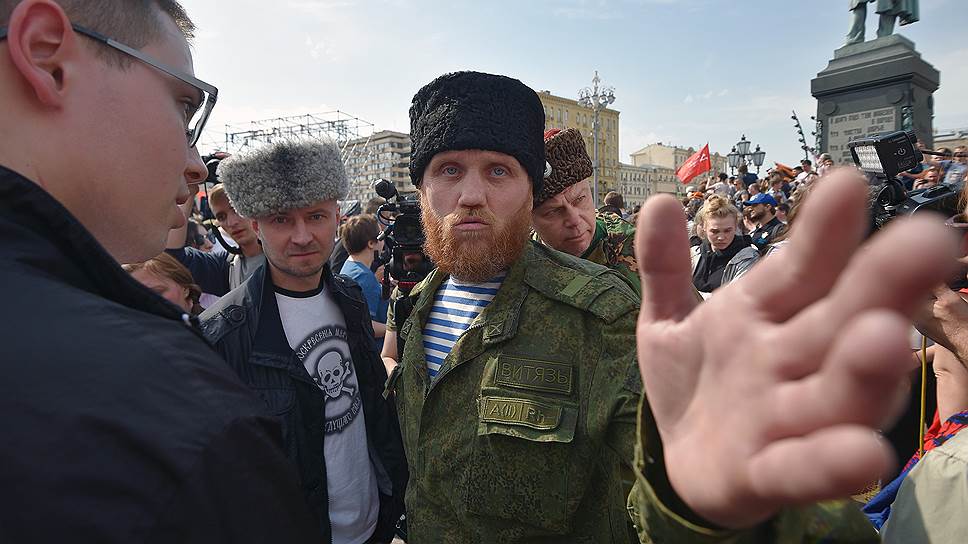
KMO_165050_00034_1_t218_200833So-called Cossacks at the He’s No Tsar to Us opposition rally at Pushkin Square, Moscow, May 5, 2018. Photo by Alexander Miridonov. Courtesy of Kommersant

According to Mr. Yashchikov, the Cossacks came to Pushkin Square to talk with Mr. Navalny’s supporters, but had no intention of being involved in dispersing the rally.

“There were one and half thousand people there [the Moscow police counted the same number of protesters—Kommersant]. There were thirty-five of us at most, and we had only two whips. You could not have paid us to wade into that crowd,” claimed Mr. Yashchikov.

Mr. Yashchikov claimed he managed to have a friendly chat with Mr. Navalny, but opposition protesters were aggressive, he alleged.

“Someone picked on us, asking why we had come there, that it was their city. Another person tried to knock my cap off, while they swore at other Cossacks and blasphemed the Orthodox faith,” Mr. Yashchikov complained. “Well, we couldn’t take it anymore.”

People who attended the rally have denied his claims.

“The Cossacks acted cohesively, like a single team,” said Darya, who was at the rally [Kommersant has not published her surname, as she is a minor]. “They formed a chain and started pushing us towards the riot police, apparently, to make their job easier. The Cossacks kicked me, while they encircled my boyfriend and beat him. They retreated only when they realized they were being film and photographed.”

Darya planned to file a complaint with the police charging the Cossacks with causing her bodily harm. Currently, human rights defenders from Agora, Zona Prava, and Public Verdict have documented more than fifteen assault complaints filed against the Cossacks.

Oppositionists have claimed the police mainly detained protesters, allegedly paying almost no attention to the Cossacks and NOD activists. Kirill Grigoriev, an Open Russia activist detained at the rally, recounted that, at the police station where he was taken after he was detained, he pretended to be a NOD member, and he was released by police without their filing an incident report.

“When we arrived at the Alexeyevsky Police Precinct, a policeman immediately asked who of us was from NOD. I jokingly pointed at myself. He took me into a hallway and asked me to write down the surnames of other members of the organization,” said Mr. Grigoriev.

He wrote down the surnames of ten people, after which everyone on the list was given back their internal Russian passports and released.

*********

Cossacks Confront Navalny Supporters for First Time
Regime Prepares for Fresh Protests, Including Non-Political Ones, Analysts Argue 
Yelena Mukhametshina and Alexei Nikolsky
Vedomosti
May 6, 2018

He’s No Tsar to Us, the unauthorized protest rally in Moscow held by Alexei Navalny’s supporters, differed from previous such rallies. On Tverskaya Street, provocateurs demanded journalists surrender their cameras. By 2:00 p.m., the monument to Pushkin was surrounded by activists of the National Liberation Front (NOD). When protesters chanted, “Down with the tsar!” they yelled “Maidan shall not pass!” in reply. Behind the monument were groups of Cossacks, who had never attended such rallies. In addition, for the first time, the police warned people they intended to use riot control weapons and physical force, and indeed the actions of the security forces were unprecedentedly rough. The riot police (OMON) detained protesters by the hundreds, and Cossacks lashed them with plaited whips.

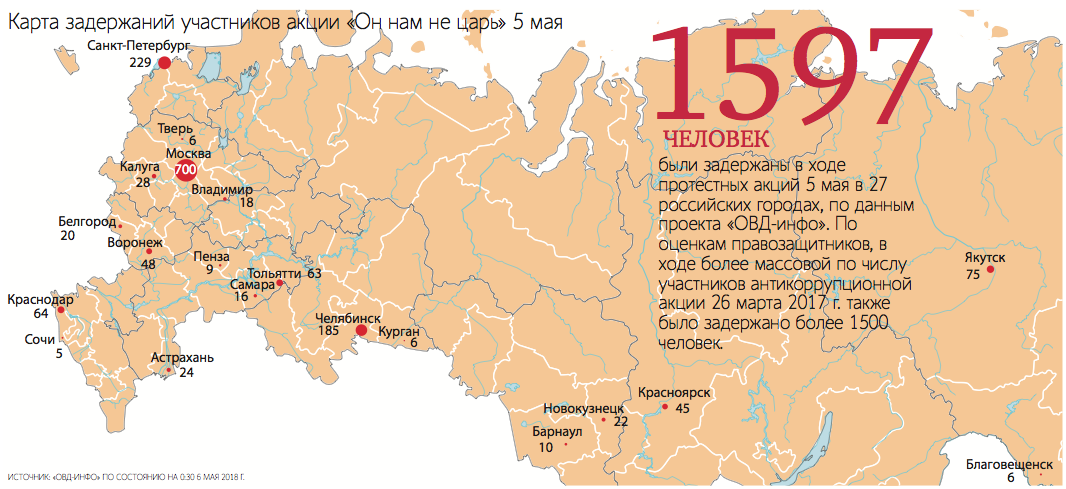
The Moscow police counted 1,500 protesters at the rally, while organizers failed to provide their own count of the number of attendees. Navalny said the nationwide rallies were a success. His close associate Leonid Volkov argued that “in terms of numbers, content, and fighting spirit, records were broken,” also noting the police’s unprecedented brutality. According to OVD Info, around 700 people were detained in Moscow, and nearly 1,600 people in 27 cities nationwide. Citing the PHRC, TASS reported that 658 people were detained in Moscow.
fullscreen-1sdb.png

“He’s No Tsar to Us, May 5: A Map of Arrests. 1,597 people were detained during protest rallies on May 5, 2018, in 27 Russian cities, according to OVD Info. According to human right activists, during nationwide anti-corruption protests on March 26, 2017, more than 1,500 people were detained. Source: OVD Info.” Courtesy of Vedomosti

PHRC member Maxim Shevchenko demanded the council be urgently convoked due to “the regime’s use of Black Hundreds and fascist militants.” According to a police spokesman, the appearance at the rally of “members of different social groups” was not engineered by the police, while the warning that police would use special riot control weapons was, apparently, dictated by the choice of tactics and the desire to avoid the adverse consequences of the use of tear gas.

According to NOD’s leader, MP Yevgeny Fyodorov, 1,000 members of the movement were involved in Saturday’s rally.

“We wanted to meet and discuss the fact the president must be able to implement his reforms. Because we have been talking about de-offshorization and withdrawing from a unipolar world for five years running, but things have not budged an inch,” said Fyodorov.

NOD did not vet their actions with the Kremlin, the leadership of the State Duma or the Moscow mayor’s office, Fyodorov assured reporters.

On Sunday, the Telegram channel Miracles of OSINT reported that, in 2016–2018, the Central Cossack Host, whose members were at the rally, received three contracts worth nearly ₽16 million from the Moscow Department for Ethnic Policy for training in the enforcement of order at public events. As Vedomosti has learned, according to the government procurement website, the Central Cossack Host received eleven contracts, worth nearly ₽38 million, from the Moscow mayor’s office over the same period.

Gleb Kuznetsov, head of the Social Research Expert Institute (EISI), which has ties to the Kremlin, argued there was no brutality at the rally.

“In Paris, the scale of protests is currently an order of magnitude higher, but no one speaks about their particular brutality. In Russia, so far the confrontation has been cute, moderate, and provincial. The only strange thing is that, in Russia, people who are involved in such protests, which are aimed at maximum mutual violence, are regarded as children. But this is not so. Everything conformed to the rules of the game, common to the whole world. If you jump a policeman, don’t be surprised if he responds with his truncheon,” said Kuznetsov.*

The Russian government has allied itself with the Cossacks and NOD, which are essentially illegal armed formations, argued Andrei Kolesnikov, a senior fellow at the Moscow Carnegie Center.

“This does not bode well. Apparently, in the future, such formations will be used to crack down on protests,” said Kolesnikov.

The authorities are preparing for the eventuality there will be more protests. Even now the occasions for them have become more diverse, and they are spreading geographically, noted Kolesnikov.

Grassroots activism has been growing, and the authorities have realized this, political scientist Mikhail Vinogradov concurred. They are always nervous before inaugurations. In 2012, there was fear of a virtual Maidan, while now the example of Armenia is fresh in everyone’s minds, he said.

“The security services had to flex their muscles before the new cabinet was appointed. Although, in view of the upcoming FIFA World Cup, law enforcement hung the regime out to dry contentwise,” said Vinogradov.

* In September 2017, the Bell reported that state corporations Rosatom and RusHydro were financing EISI to the tune of ₽400 million each, and it could not be ruled out that the so-called social research institute was receiving subsidies from other state companies.

Translated by the Russian Reader