
Vladimir Putin was re-elected as Russian president. Officially it’s his fifth term in the Kremlin — although in practice it’s six if we include his stint pulling the strings as prime minister. The official results have Putin polling even higher than predicted, taking 87% of the vote. That figure looks utterly implausible and places Putin among the likes of Asian, Middle Eastern and Central Asian autocrats. The election itself went ahead against a tense background, with Ukrainian shelling and attempted incursions into Russia’s border regions along with on-going drone attacks on Russian oil refineries.
The official election result is already out — Vladimir Putin secured 87.28% on a turnout of 77.44%. Both those numbers are record highs since the collapse of the Soviet Union. And both are about 10 percentage points up on 2018 (when Putin polled 76.8% on a 67% turnout). This suggests that the Kremlin’s political managers were tasked with delivering a significant increase in Putin’s popularity. That in itself is not surprising: in the current circumstances an autocrat needs to demonstrate how his people have rallied around the flag.
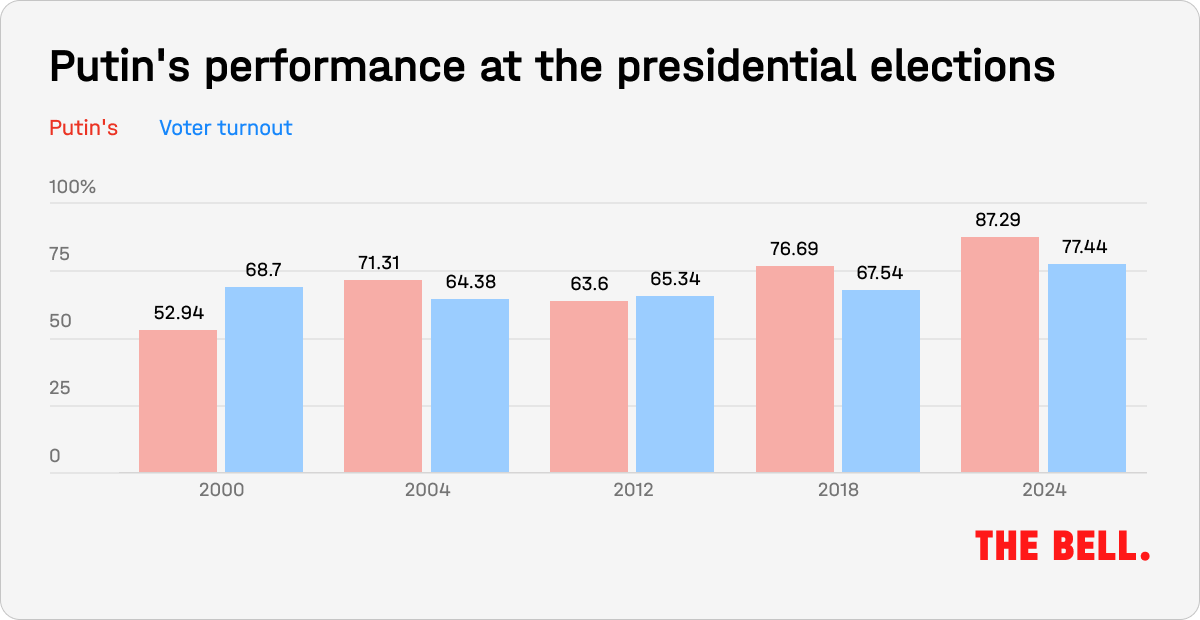
Initial research by journalists and independent experts suggests the vote could have been the most heavily falsified in the history of post-Soviet Russia. Analysis by IStories and Ivan Shukshin, a researcher and activist with the Golos vote monitoring NGO, estimated that around 22 million of the 76.3 million votes cast for Putin were “anomalous.” In other words, almost a third of Putin’s official tally could have been false.
Their methodology is based on analyzing the turnout and vote shares at individual polling stations, using the central election commission’s official data. Districts with higher turnouts also have larger vote shares for Putin — a fact which suggests ballot-stuffing since the two shouldn’t be strongly correlated. IStories and Shukshin didn’t include results in Moscow, where online voting makes the analysis trickier. A third report by Novaya Gazeta Europe said as many as 31.6 million votes — almost half of Putin’s total — could have been fake.
Many experienced observers of Russian politics (1,2) believe that election organizers in provincial Russia “overdid it” this time round. Most pre-election leaks of the Kremlin’s vote strategy featured more modest targets. In spring 2023, for instance, RBC wrote that the Kremlin wanted to secure 75% of the vote on a 70% turnout. A few months later, Meduza wrote that regional authorities were advised that they should secure at least 80% of the vote for Putin. The final pre-election opinion polls conducted by state pollster VTsIOM (which also represent indirect instructions to regional election officials for polling day) showed Putin’s result was at the initial target level of 75%.
The record result places Putin firmly among his fellow autocrats. In free democratic elections, it’s a rare anomaly for a candidate to poll even at 60-70%. Only once, in extreme circumstances, have we seen more than 80% in a democratic country — a huge protest vote that gave France’s Jacques Chirac 82% in a presidential run-off against Jean-Marie le Pen in 2002, the BBC reported. In Russian history, Putin still has something to aim for if we look back to Soviet times. The turnout in 2024 was slightly higher than when Boris Yeltsin was voted president of the Russian Soviet Federative Socialist Republic in 1991, but there is still some way to go to match the Stalin era of 100% turnout in votes to appoint new deputies.
Since Putin was re-elected in 2018, voting in Russia has become even less transparent, and offered greater opportunities for fraud. Remote electronic voting was conducted in 29 Russian regions. Some 70% of the 4.7 million voters registered to vote online apparently cast their votes on the first of the three-day poll. Monitoring violations at physical polling stations is an almost impossible task. The Central Electoral Commission stopped broadcasting live footage from monitoring cameras in polling stations after the pictures from 2018 had depicted numerous violations and led observers to conclude that the scale of ballot stuffing was so great that the real result could not be determined in at least 11 regions.
The 2024 poll also differed from Putin’s two most recent victories in the selection of candidates who ran against the Kremlin leader. In 2012, political strategists allowed businessman Mikhail Prokhorov to stand, proposing that Russia’s marginal liberal opposition would consolidate around him. And in 2018, that same role went to TV presenter Ksenia Sobchak. But this time round there was no acceptable liberal candidate. Even the little-known politician Boris Nadezhdin, who timidly spoke out against the war in Ukraine, was denied registration. On the ballot were only Putin’s “rivals” from the systemic opposition parties. All of them have been equally supportive of Russia’s repressive turn, backing various crackdown measures that have come before the State Duma in recent years.
The extras in the 2024 race — Communist Nikolai Kharitonov, Vladislav Davankov of New People, and Leonid Slutsky of the LDPR — polled less than 12% combined. That’s slightly less than communist candidate Pavel Grudinin managed on his own in 2018. The 75-year-old Kharitonov’s 4.3% was better than the youthful Davankov’s 3.8%, while Slutsky, the unsuccessful heir to charismatic populist Vladimir Zhirinovsky, trailed in last with 3.2%.
Source: “‘Record’ victory cements Putin’s autocrat status,” The Bell, 19 March 2024
Despite intimidation by the authorities, many Russians went to polling stations across the country and abroad at noon on 17 March as part of the Noon Against Putin protest, which was conceived as one of the few safe ways for Russians to voice their dissent. After all, it is hard to punish people for going to a polling station on election day and queueing.
The protest was the brainchild of Maxim Reznik, a former member of St. Petersburg’s legislative assembly, and it was endorsed by Alexei Navalny. After the opposition politician was murdered in a Russian penal colony, his supporters and other Kremlin opponents urged Russians to take part in Midday Against Putin.
This time round the last day of the election fell on the end of Shrovetide, and the powers that be tried to take advantage of it. For example, in Tomsk, they organized Shrovetide festivities at one of the polling stations to generate “hustle and bustle.” In Arkhangelsk, local restaurants were forced to cook pancakes for free distribution at the polling stations. Festivities were also organized, for example, in Moscow Region, Perm, Chuvashia, Murmansk Region, and Kamchatka.
Investigative journalist Andrei Zakharov quoted an anonymous agitator who, along with his colleagues, was tasked with “inviting people to a Shrovetide party in a park while also suggesting they take their [internal] passports with them in order to vote. It’s not far to the polling station.”
Those who decided to take part in the noonday protest were intimidated by fake mailings. As early as 13 March, some users in Russia received messages purporting to be from Navalny supporters postponing the Noon Against Putin protest to late Sunday. On Saturday, some Muscovites got messages accusing them of supporting “extremist ideas” and demands to vote “without waiting in line.”
There was also intimidation from actual law enforcers. The Moscow Prosecutor’s Office issued three warnings about the danger of the protest and possible criminal chargers against the protesters.
In spite of this, people in Russia and around the world came to the polling stations at noon on 17 March.
The huge queues abroad attracted a lot of media attention. Just look at the number of people at [Russia’s] diplomatic missions in Almaty and Bishkek. In European countries, people stood in line for many hours.
The long waits at polling stations abroad were sometimes caused by the deliberately slow work of the election commissions. For example, in Riga, voters were let in two at a time, although there were six voting booths and four polling station officials available. Voting was also delayed because many embassies and consulates banned cell phones, searched voters as they entered, and made them temporarily surrender their belongings.
In Russia, people were also searched in many polling places after dozens of incidents of attempted arson and spoiling ballot boxes with paint (the handiwork of phone scammers) took place. “First, two policemen search the bags [of voters] very thoroughly outside. I even had to show them my deodorant stick,” a reader of Dmitry Kolezev’s Telegram channel from Moscow wrote.
Due to the [long] queues in Riga, Vienna and Yerevan, for example, the polls were kept open for at least another hour [after they were to have been closed]. But in Berlin, the embassy was immediately closed, prompting the people gathered there to stage an impromptu protest. One of the staffers at the diplomatic mission danced a little jig as they shouted “Shame!”
But the principal queues were in Russia.
The first lines formed at precincts in Siberia and the Urals — for example, in Perm and Yekaterinburg, Novosibirsk and Akademgorodok. In the last place, by the way, Putin lost to [Vladislav] Davankov, a rare case for electoral precincts in Russia itself.
The queues were de facto protest rallies. People lined up outside polling stations in Moscow, St. Petersburg, Arkhangelsk, and Sochi. Officials tried to persuade them to cast their votes on electronic terminals — it is easier to rig the vote that way — but people took paper ballots and either voted for someone other than Putin or defaced them by writing on them such things as “Love is stronger than hate,” or “You have the blood of Ukrainians on your hands, scumbag” (the latter remark was addressed to Vladimir Putin).
As it turned out, nobody interfered with the queues; the police were not violent and did not detain anyone. Most of the detentions that did occur were of independent observers and members of elections commissions who had tried to prevent violations. According to OVD Info, 17 March was “relatively calm.”
The election’s outcome surprised no one in a country where wartime censorship has virtually been introduced. Vladimir Putin took more than 87% of the vote according to the official count — a result almost like that of Central Asian dictators, and greater than that of [Belarusian dictator Alexander] Lukashenko.
The main outcome was that many Russians took advantage of the procedure as one of the few remaining opportunities to safely speak out against Putin and his policies. And they saw that they were not alone.
Source: “What the Noon Against Putin queues showed,” WTF? newsletter (Mediazona), 18 March 2024. Translated by the Russian Reader
In a third video, another man detained by law enforcement agents identified himself as Rajab Alizadeh.
A man off camera asked him: “When you fled from Moscow, you had weapons. Where did you throw them? There or here?”
Alizadeh, whose face and shirt were covered in blood and whose head was wrapped in medical gauze, said “somewhere along the road,” but could not recall exactly where he and his accomplices left their weapons.
An unverified graphic video shared online showed what was said to be Alizadeh lying face down on the ground as Russian law enforcement agents cut off his ear, which, if confirmed, could explain why the man’s head was wrapped in bandages in the interrogation video.
