The Socialist Revolutionary Alternative

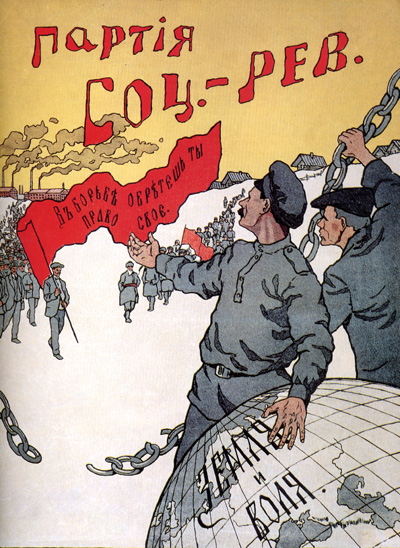
Socialist Revolutionary election poster, 1917. “Party of the Socialist Revolutionaries. Through struggle you will attain your rights. Land and freedom.” Courtesy of Wikimedia

The SR Alternative
Yaroslav Shimov
Radio Svoboda
March 8, 2017

“On the morning of February 23, the workers who had reported to the factories and shops of the Vyborg District gradually downed tools and took to the streets in crowds, thus voicing their protest and discontent over bread shortages, which had been particularly acutely felt in the above-named factory district, where, according to local police, many had not had any bread whatsoever in recent days.”

Thus read a report by agents of the Okhrana on the first day of a revolution that forever changed Russia, February 23, 1917 (March 8, New Style).

Revolutionary events such as the unrest in Petrograd, which the bewildered tsarist regime failed to put down, Nicholas II’s abdication on March 2 (15) at Dno Station near Pskov, and the establishment of the Provisional Government were recalled by contemporaries as happening so swiftly that they were unable to understand where Russia was headed so wildly and who would ultimately benefit from the changes. In February 1917, no one would have predicted that less than year later the Bolsheviks, a radical faction of the Social Democrats who had been on the sidelines of Russian politics, would emerge victorious, and Bolshevik leaders themselves were no exception in this regard.

But an enormous thirst for social justice was apparent from the revolution’s outset. Russia had emerged a quite leftist country. In the stormy months following the monarchy’s fall, it transpired that a definite majority of the country’s citizens sympathized with socialist ideas in one form or another. This was reflected in the outcome of the first free elections in Russian history, which took place in the autumn, when the chaos and anarchy on the war front and the home front were obvious. The newly elected Constituent Assembly was meant to define the country’s future. The Socialist Revolutionaries (SRs), a party that had consistently, albeit violently and bloodily, waged war against the Romanov Dynasty, but in 1917 had favored peaceful but radical reforms, primarily land reforms, scored a convincing victory in the elections.

Soldiers who had gone over to the revolution and armed city dwellers on the streets of Petrograd, 1917

If the country had managed to slip past the threat of dictatorship, issuing from the left (the Bolsheviks) and from the right (radical counter-revolutonaries), the SRs would definitely have been post-revolutionary Russia’s ruling party for a time, argues Konstantin Morozov, a professor in the Institute of Social Sciences at RANEPA and convener of a permanent seminar, Leftists in Russia: History and Public Memory. In an interview with Radio Svoboda, he reflects on why this did not happen and what the SR alternative would have meant to Russia.

*****

What was the condition of the Socialist Revolutionary Party in February 1917?

I would say the the party was then in a state of organization disarray. A considerable part of its prominent leaders was abroad, while the other part was in prison, exile, and penal servitude. It had to be rebuilt from scratch, and it was the SRs who had withdrawn from revolutionary work in 1905–07 but who basically returned to the party in 1917 who mainly engaged in the rebuilding. It was they who organized all the party’s new cells. There were also serious problems among the SRs in terms of internal rifts, especially due to differing viewpoints on the war.  In March, the SRs began to rebuild themselves as a single party, which was implemented subsequently at the party’s 3rd Congress in May and June. In my view, this was a mistake, because the disagreements within the party were such that it could not function, manage itself, and take decisions as a united party. A factional struggle immediately ensued. Accordingly, it ended in collapse and the inability to hew to a single internal party policy in 1917.

Due to the first phase of their history, the SRs are associated in the popular imagination with violence and terrorism, which they had long renounced by 1917. What were the views of the SRs and the leaders on violence as a principle of political struggle? The baggage of their terrorist pasts still haunted Viktor Chernov and other party leaders, after all. How did they view it in 1917?

The Socialist Revolutionary Party discussed the question of terrorism throughout its existence. At first, such figures as Mikhail Gots and Viktor Chernov, who advocated he inclusion of terror in the party’s tactics, had the upper hand. But even then the SRs included people who advocated a popular, mass-based party, who favored propaganda and agitation among the peasantry and proletariat rather than focusing on terror. Their ideal was a grassroots socialist party, something like the Second International’s exemplary party, the German Social Democracy. It went from bad to worse. During the 1905 Revolution, the party’s grassroots combat squads were keen on practicing expropriation and many other things that party leaders dubbed “revolutionary hooliganism.” But after 1909–11, in the aftermath of Evno Azef‘s exposure, the voices of those SRs who had argued for giving up terrorism grew ever stronger. By February 1917, there was no longer any talk of terror. The last terrorist act carried out by SRs had taken place in 1911, after which they basically ceased engaging in terrorism. Terrorist sentiments in the Socialist Revolutionary Party were resurrected only in the wake of October 1917, especially after the Bolsheviks forcibly disbanded the Constituent Assembly. Even then, however, the greater number of SR leaders were against engaging in terrorism against the Bolsheviks. These SR leaders argued that first they had to get the grassroots on their side using the methods of a popular political party.

In his memoirs, Boris Savinkov quotes his friend Ivan Kalyayev, a member of the SR Combat Organization who killed the Grand Duke Sergei Alexandrovich. Kalyayev said that an SR without a bomb was not an SR. In reality, however, the majority of SRs were not involved in terrorism, and they would have disagreed with Kalyayev’s statement. It can be argued that use of terrorist tactics dealt a huge blow to the Socialist Revolutionaries who wanted the party to be a grassroots socialist party, a party that could carry out the will of Russia’s “triune working class” (in which the SRs included the proletariat, the working peasantry, and the working intelligentsia), and a party that proposed an evolutionary and democratic path to progress. Essentially, the SRs were not terrorists, of course. They had more or less given up terrorism in 1911. What mattered politically was that they were able to propose a program, both agrarian and federalist, that excited the sympathies of millions of people. By the autumn of 1917, the Socialist Revolutionary Party had more than a million members, while the Bolsheviks had only 350,000 members. Most important, the SRs won the elections to the Constituent Assembly, taking 41% of the vote.
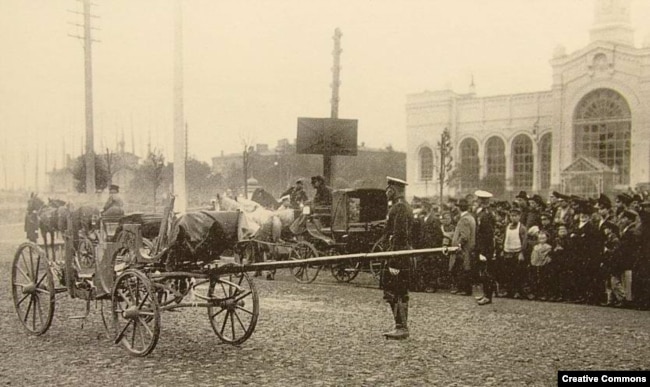
Эсеровский террор начала ХХ века: уничтоженная бомбой террориста карета министра внутренних дел Вячеслава Плеве, убитого 15 (28) июля 1904 года в Петербурге
SR terrorism in the early 20th century: the carriage of Interior Minister Vyacheslav Pleve, killed on July 15 (28), 1904, in St. Petersburg

So 1917 was the heyday for the SRs: they had a million members, and they won the elections to the Constituent Assembly. Why, ultimately, were they unable to take advantage of this? How did it happen that the SRs,  despite their popularity, ceded power to the Bolsheviks later as well, despite attempts to the contrary? What predetermined their failure?

There are two sets of causes, objective and subjective, meaning, the mistakes made by the SRs themselves. What I think is fundamentally important is that it is extremely difficult to campaign for democratic reforms while a world war is underway. The fact that the Revolution took place during the First World War considerably predetermined the entire subsequent course of events. What is a world war? On the one hand, it involves a collapse in living standards and a aggravation of all the contradictions that have been accumulating in society over decades. On the other hand, it involves millions of people getting used to killing other people. This causes quite serious psychological changes. Extreme cruelty is combined with societal expectations pushed to the limit. These expectations had amassed to such an extent that in 1917 very many people wanted everything right away. Say, workers were no longer satisfied they had trade unions that the selfsame socialists would meet halfway. The workers wanted more. They wanted control and management of the factories. Practically, the Mensheviks and SRs could not take this step, because it would have led to serious industrial management issues. And the peasants wanted the land right away.

Here we turn to the mistakes made by the Socialist Revolutionaries. It was wrong to delay the convocation of the Constituent Assembly. Rather, it was wrong to go along with the liberals in the Provisional Government, the Kadets, who tried to postpone the Constituent Assembly any way they could. The liberals realized the leftist parties were stronger. They would have an outright majority in the Constituent Assembly, and consequently the peasantry and proletariat would get much of what they had been demanding. So the Kadets postponed the Constituent Assembly. That was a big, serious mistake.

Did the subjective factor play a role in the fact that the SRs failed? Let’s take a closer look. On the one hand, they were a party who styled themselves as the party of “land and freedom.” They were supported by the peasants. On the other hand, most SR leaders were members of the urban intelligentsia, not the salt of the earth. Did this contradiction factor in the SR electoral victory, but one in which their supporters were unwilling to secure their political power?

It was a lot more interesting than that. The program for socializing land ownership, advocated by the SRs, did not fall out of the sky. It was the outcome of quite serious work on the part of Populist economists and sociologists. It was revenge, if you like, for the failure of the “going to the people” campaign of 1874. In the aftermath, Populist economists, sociologists, and statisticians undertook a serious study of how peasants really lived. Within twenty or thirty years, they had figured out how the Russian peasantry really lived and what it wanted. The SRs based their own land socialization program on this research. Moreover, the SRs tended not to act like typical Russian intelligentsia, who often preferred philosophizing and imposing their own values on others. The SRs always tried to maintain feedback from the peasantry. I came across a quite curious document, a survey of sorts, which the SR Central Committee sent out in 1906 or 1907 to their local organizations, who were supposed to conduct this sociological survey, which asked peasants about their attitudes towards the regime, the army, and the clergy, and what they thought about the land, and how it should be distributed and managed. So it was no wonder the Socialist Revolutionary Party and their program, crafted over many years and through the efforts of many people, were seen by the peasants as their party and their program. On the other hand, there was a fairly powerful peasant lobby in the Socialist Revolutionary Party. The grassroots level of party activists and functionaries consisted of the so-called popular intelligentsia: physician’s assistants, schoolteachers, agronomists, surveyors, and foresters.
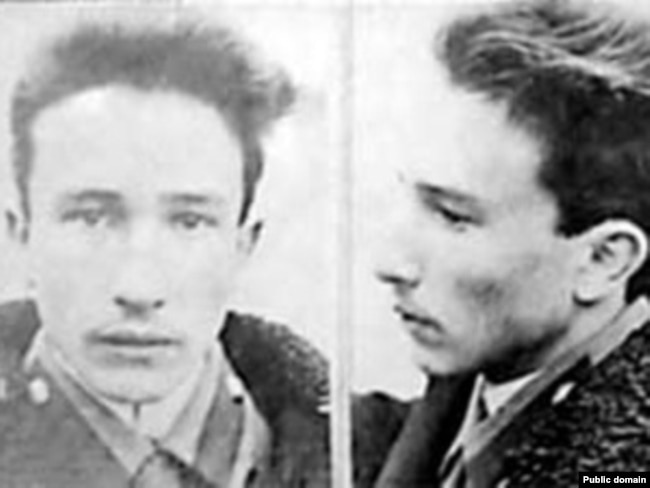
Один из самых известных эсеров, Борис Савинков, в юности. Фото из полицейского досье
One of the most prominent SRs, Boris Savinkov, in his youth. Photos from his police file

The problem was that the SRs did not fully take the peasantry’s interests into account in 1917. The revolutionary authorities were afraid to cede land to the peasants, because, on the one hand, the army’s quartermasters argued that the supply of provisions to the army would immediately collapse. On the other hand, there were fears that the rank-and-file soldiers, who were actually peasants dressed in greatcoats, would immediately desert the front and run home.  Later, at the party’s Fourth Congress, Yevgeniya Ratner, a member of the SR Central Committee, put it quite aptly. She said that for the war’s sake, for the front’s sake, they were forced into compromises with the bourgeois parties and thus were unable to defend the class interests of the peasantry and workers, and this was their huge guilt in the face of history. According to Ratner, they should have convoked the Constituent Assembly two or three month earlier, i.e., in August or September 1917, and set out to implement agrarian reforms. We should point out that some of the SRs had wanted to do this: Chernov, for example, insisted on it. There were ideas for forming a socialist government. In September 1917, the SR Central Committee was leaning towards this option.

By a socialist governmment, do you mean one that would have included all leftist parties, including the Bolsheviks?

There were two options. The first was the most leftist and quite adventuresome, or at least it seemed that way to the SRs themselves. It was proposed by Maria Spiridonova. She suggested the SRs should simply take power and form their own homogeneous SR government.

Meaning, they should have done what the Bolsheviks did finally?

It’s another matter that the Bolsheviks immediately set about tweaking their slogans and their actions. That is, they adopted the same slogans, but over time all of this was transformed into something else entirely. But getting back to the SRs, the majority of them wanted a coalition socialist government that would have included the Bolsheviks. At some point after October 1917, there were negotiations between the Bolsheviks and the socialist parties about forming such a government, but without Lenin and Trotsky. It was Lenin who in many ways destroyed this option. Was the formation of a socialist government a viable alternative if it had been agreed, say, in September? I think so. This would have been followed by elections to the Constituent Assembly, where the socialist parties obtained a majority. The SRs took the top spot, and the Bolsheviks won 25%, meaning they were the second largest faction. Clearly, they would have carried a lot of weight, but this course of events would, nevertheless, have made it possible to maintain a parliamentary democracy. Obviously, after a while, the SRs would have lost power in elections, as we see in Europe, where power swings back and forth between the right and the left. There was a chance then to set up a similar scheme for changing power through democratic procedures, via parliament. After all, the Constituent Assembly was highly regarded in society. It had been elected in the first genuinely free ballot in Russian history.

You have already touched a bit on the period after the Bolshevik coup. But let’s go back in time a bit. One of the key figures of 1917 was Alexander Kerensky. How did the other SRs regard him, and what role did he ultimately play in the party’s history?

It’s a very good question, but before answering it, I would like to voice a more general consideration. You just mentioned the “Bolshevik coup.” On the one hand, centrist and Right SRs used the term themselves. On the other hand, the Left SRs and anarchists would later come to favor the concept of a single Russian revolution that lasted from 1917 to 1921. That is, they saw it as a unified revolutionary process in which there was February and October, followed by the civil war. Currently, this is more or less how it is discussed. Those who rejected the concept argued that October 1917 was not a revolution on its own terms, because it did not involve a spontaneous popular movement. Until the early 1920s, the Bolsheviks themselves would also often speak of a coup, of their coup. But some of the SRs, Mark Vishnyak, for example, rightly noted, in my opinion, that the events of October 1917 could be interpreted as a sort of “staff revolution,” organized from above. It was a symbiosis of a revolutionary process with traits of a coup. When someone simply speaks of a coup, that is not entirely right, because there was definitely support from the workers and soldiers. Besides, the word “coup” itself suggests an analogy with Latin American-style military coups. Whatever the case, we must continue to make sense of those events conceptually.

What if we return to Kerensky?

The SR leadership definitely saw Kerensky as a fellow traveler, as the term was then. He had been in the SR movement during the Revolution of 1905–07. Elected as an MP to the State Duma, he tried to unite different Populist groups. On the other hand, some SRs might have simply envied him. Kerensky was one of the most popular people in Russia. Socialist Revolutionaries who had spent years fighting in the underground and building the party, wound up in the background, while he, who had declared himself an SR, was regarded by society in 1917 as the most important SR. Chernov had harsh things to say about Kerensky. According to Chernov, Kerensky played a quite negative role in the Socialist Revolutionary Party, because he had almost no contact with the SR leadership and did not follow the Central Committee’s instructions. The Right SRs and right-centrists supported Kerensky, while the Left SRs tried to break with him. At the party’s Third Congress, in May and June 1917, the Left SRs sabotaged Kerensky’s election to the party’s Central Committee.  He was rejected outright. It was a real slap in the face.

Александр Керенский, министр-председатель Временного правительства, стал в 1917 году символом демократической России и ее краха
Alexander Kerensky, chair of the Provisional Government, was a symbol of democratic Russia and its collapse in 1917.

What does that tell us? That, unlike the Bolsheviks, the SRs were not a leaderist party, remaining a more collectivist force?

Democrats are generally less inclined to leaderism, and this was fully borne out by the SRs. This does not mean there were no authoritarians among the SRs. It was another matter that the leaders had to adapt to the moods and ideas of the revolutionary milieu, to the subculture of the Russian revolutionary movement. The notions of decentralization, self-reliance, and independence fromthe leadership were quite strong in the Socialist Revolutionary Party. Initially, they had a sort of collective leadership. At various times, it consisted of different people, usually three or four people. Plus, we have to speak here of three or four generations of SRs. The first generation had been been members of the People’s Will, while the last generation joined the party in 1923–24. Meaning, we are looking at a fairly complicated picture. But generally, yes, there was no single leader. Many historians and contemporaries were of the opinion this was a cause of the failure of the SRs in 1917. Chernov argued that if Gots and Grigory Gershuni had still been alive, the three of them could have led the party in 1917. Gershuni was highly charismatic, even more charismatic than Lenin, and perhaps he would have had a chance to keep the party under control. On the one hand, there is a certain point to these hypotheses, but we have to consider the weakness and division existing within the party at the time of the revolution, in particular, the strong differences between the SRs on the issue of the war. Very many people regarded Chernov as a good theorist, but not as a leader and organizer. However, he had the outstanding ability to reconcile different points of view, and he played a unifying role. His opponents dubbed him the “universal bandage.”

Let’s try and sum up. Should we regard the SRs as a failed historical alternative to Bolshevism? Or, given their looseness and perennial internal division, did the SRs nevertheless lack the strength, ideas, and people to lay claim to a truly great historical role?

I think that victory in the elections to the Constituent Assembly, in which they received a plurality and, in fact, adopted the first two laws, including the law socializing land ownership, were in fact the beginnings of a democratic alternative, an SR alternative. Would they have been able to lead the country down this road? I support the viewpoint of my German colleague Manfred Hildermeier, who as early as 1992 wrote in an article that, since one of Russian’s main problems was the huge gap between city and country, the SRs were well suited to play the role of a party voicing the interests of the peasantry, proletariat, and intelligentsia. I would also add we should not exaggerate the extreme peasantness of the Socialist Revolutionary Party. If you look at their program, you see they attempted to unite a European conception of socialism with certain nativist ideas. They argued that the peasantry’s skull was no worse than the skulls of the proletariat and intelligentsia, and was quite capable of taking the ideas of socialism on board. It was one of the first attempts in the world to fuse European values and ideas of modernization with the values of a traditional society, to merge a significant part of the Russian peasantry into the new society as painlessly as possible. The SRs assumed that for many decades to come progress would follow the bourgeois path and there would be a market economy: socialism would not soon emerge. In this sense, they were evolutionists. They were essentially the first to propose an idea that is currently quite fashionable around the world, the idea of peripheral capitalism, according to which capitalism in developed countries and capitalism in second-tier and third-tier countries are completely different things. In peripheral capitalist countries, including Russia, capitalism shows it most predatory features and is the most destructive.

Мария Спиридонова, будущий лидер левых эсеров, в юные годы
Maria Spiridonova, future leader of the Left SRs, in her youth

The SRs also argued the Russian people were definitely capable of adapting to democracy. Moreover, they thought that the Russian traditions of liberty and community self-government afforded an opportunity for magnificent democratic progress as such. The SRs wanted to unlock the people’s democratic collectivist potential. By the way, they did not idealize the peasant commune, arguing it had to be transformed, of course. They counted on the cooperative movement, which had progressed quite powerfully in early twentieth-century Russia. It was entirely under the ideological leadership of the SRs. They believed it was necessary to rely on the working peasant economy. It would then be possible to modernize the country and eventually follow a socialist path. The main thing was that despite a certain utopianism to their views, the SRs were capable of evolving, of course. Another important thing was that the SRs, more than the other parties, were capable of acting as a venue for reconciling different interests. This is basically the road European social democracy took. However, the party’s looseness and internal conflicts were important features of its history. I think that sooner or later the Socialist Revolutionary Part would definitely have split into several parties. If we speak of the SRs as a democratic alternative, then the Maximalists and Left SRs do not fit this bill. Unlike the other SRs, they cannot be considered adherents of democratic socialism. By the way, the SRs and Mensheviks used this term quite vigorously from the 1920s onwards. Later, in the mid twentieth century, the European socialist parties would also speak of democratic socialist values. From this perspective, some SRs and Mensheviks were, undoubtedly, adherents of democratic socialism, which gave rise to the Socialist International.

********

The demise of the Socialist Revolutionary Party was tragic. During the Russian Civil War, the SRs finally split. The Right SRs were involved in the anti-Bolshevik movement, while the Left SRs tended to collaborate with the Bolsheviks. In the summer of 1918, however, finally convinced that Lenin and his entourage were taking Russia down the road to dictatorship, the Left SRs undertook a failed attempt to overthrow “commissarocracy,” their term for the Communist regime. In the 1920s, the party was finally finished off. In the summer of 1922, twelve SR leaders were sentenced to death at a special trial. The executions, however, were postponed, turning the convicts into hostages in case the remnants of the Socialist Revolutionary Party decided to return to its terrorist methods, now against the Communist regime. One SR leader, Yevgeniya Ratner, was held in prison with her young son, causing her to complain to Dzerzhinsky. Subsequently, their death sentences were commuted to various terms of imprisonment and exile. Most prominent SRs who stayed in Russia were victims of the Stalinist crackdowns. Several former SRs, including Maria Spiridonova and her husband Ilya Mayorov, were among those massacred in the Medvedev Forest, outside Orlyov, in September 1941.

Translated by the Russian Reader. Thanks to Comrade Koganzon for the heads-up
Return of the Wreckers

OLYMPUS DIGITAL CAMERA
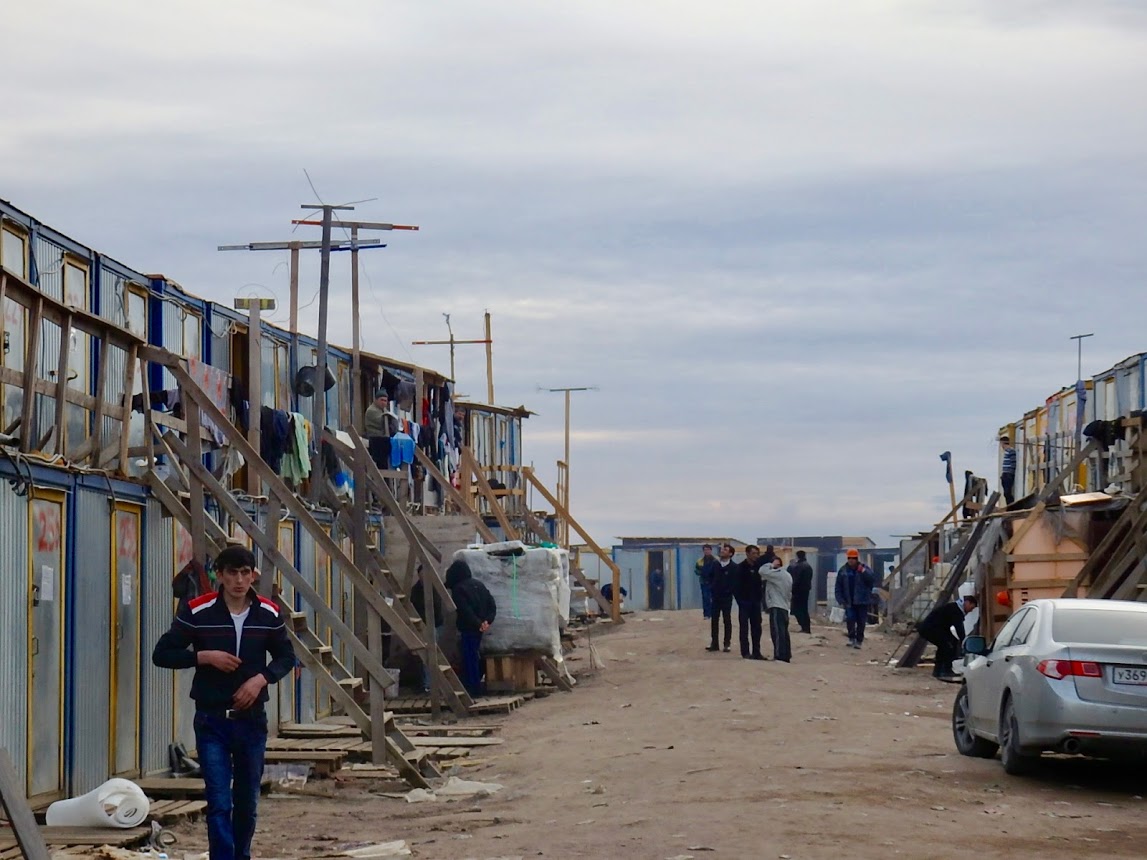
When they work on construction sites, migrant workers from Central Asia often live in shantytowns like this one in Petersburg. Photo by TRR

FSB director Alexander Bortnikov has claimed that migrant workers from the former Soviet Union constitute the bulk of terrorist groups operating in Russia. He called on businessmen who employ migrant labor and officials who insure compliance with immigration laws to act more responsibly.

This comes from an organization whose direct legal predecessor, the NKVD, arrested and shot fifty-four people on the street where I live during 1937–1938. All these people were found guilty on spurious, trumped-up charges, and all of them were “rehabilitated” in the later, more “vegetarian” times after Stalin’s death, as Anna Akhmatova called them. Meaning the Soviet state admitted then, at least to the families of the victims, that their loved ones had been arrested and shot for no reason at all.

And yet, when the Great Terror was in full gear, the country’s leaders and its henchmen in the NKVD (now known as the FSB) were convinced or feigned that the Soviet Union was chockablock with wreckers, saboteurs, provocateurs, and foreign spies.

Now, in the absence of a public investigation and any trials of the accused (or any accused, for that matter), the agency’s current director wants us to believe that migrant workers from Central Asia are rife with “terrorist groups.”

The street I live on is quite small. It consists of two short blocks and exactly twenty houses. I can imagine the sudden arrests and executions of fifty-four of their neighbors made quite an impression on the street’s more fortunate inhabitants in 1937–1938.

As far as I know, the FSB has never really renounced its direct line of descent from the Cheka, the OGPU, the NKVD, the MGB, and the KGB. On the contrary, if statements made by its more prominent veterans such as Vladimir Putin are to be believed, its past and current officers are extraordinarily proud of this legacy, although they may admit on occasion that the Great Terror was a bit excessive.

So, in the interests of the state (which are nowadays equated with the interests of the members of the Ozero Dacha Cooperative and the so-called Laundromat, not with the interests of the “international proletarian revolution”), the FSB is still capable, I would guess, of lying through its teeth and scapegoating entire groups of completely innocent people, i.e., in this case, migrant workers from Central Asia. According to one expert on Central Asia, whom I trust, there are currently around three million such migrant workers in Russia.

How do you think they are going to feel after hearing Bortnikov’s announcement? Would you like to live and work in a country where you are regarded as a de facto terrorist? TRR

Instant Pariahs, or, Fontanka Declares Jihad on Everyone Who Looks Funny

Frightened Passengers Do Not Let Ilyas Nikitin Board Plane in Vnukovo
IslamNews
April 4, 2017

On Tuesday afternoon, passengers did not let Russian citizen Andrei (Ilyas) Nikitin, identified by the media as the alleged organizer of the terrorist attack in the Petersburg subway, on board a plan. The victim himself told IslamNews about the incident.

According to Nikilin, he had passed through passport control, but could not board the Rossiya Airlines plane due to protests from frightened passengers.

mm-e1491303803101
Ilyas Nikitin at Moscow’s Vnukovo Airport. Photo courtesy of IslamNews

Even airport security personnel could not resolve the situation. Ultimately, Nikitin was forced to miss the flight.

Nikitin said the reaction of the passengers was a surprise to him, because on Tuesday morning he had flown from St. Petersburg to Moscow witn no problems.

He noted that law enforcement officials helped him get a refund for his ticket.

“The airline said it would not be able to put me on this plane. I hope to fly out on another plane tomorrow morning,” said Nikitin.

In connection with the incident, IslamNews appeals to its colleagues to comply with journalistic ethics. In particular, you should not publish unconfirmed information that could damage people’s reputations and cause panic in society.

Nikitin gave St. Petersburg law enforcement agencies high marks for their work after the terrorist attack in the city’s subway.

As previously reported, on the day of the terrorist attack, Nikita himself went to the police and said he was not complicit in the tragedy. Before this, video and photos of Nikitin, shot by a CCTV camera, went viral in the media. Because of his outward appearance (the clothes and beard typical of Muslims), the man was christened [sic] the alleged bomber.

____________________

RM348mxQRAODWJqfTEuB

The Search for Jihad in St. Petersburg*
Denis Korotkov
Fontanka.ru
April 3, 2017

The guise of the suspect in the explosion in the Petersburg subway, whose photo has been distributed to police, is unambiguous. If the assumptions are correct, this is a public show. The man in a skullcap with a typical Muslim beard stepped right out of a poster for Islamic State, an organization banned in Russia.

Until April 3, 2017, terrorists did not try and blow Petersburg up [sic].** Homegrown skinheads, who assembled small DIY bombs, do not count in the bigger scheme of things. The first explosion in the subway has been marked with a clear trace. If the man wanted by the Chekists [sic] and police is guilty, he has issued a challenge. He wore no disguise, was emphatically Muslim in appearance, and was calm.

The explosion in the fourth car of the train that had departed from Sennaya Ploshchad subway station was heard around 2:30 p.m., when the train approached Tekhnologichesky Institut station. The dead and wounded are being counted. At the moment, officials agree that “about ten” people have been killed, and the number of wounded is around fifty. According to our information, the number of dead is fourteen. Another explosive device has been discovered and disarmed at Ploshchad Vosstaniya station.

Ambulance crews, Emergency Ministry teams, and police units, sirens blazing. The subway closed, endless traffic jams. Petersburg has never seen the likes of this.***

The prosecutor’s office initially declared the incident a terrorist act, then changed its mind. By 6:40 p.m., the Investigative Committee of Russia had decided the case would be investigated as a terrorist attack, with the proviso that the “investigation intends to look into all other possible explanations of this incident.”  Meanwhile, Petersburg police had already received the photo of the man who, presumably, could have placed the explosive device in the fourth car.

A tall, black skullcap, straight-cut black clothing, a typical beard with no mustache: for a considerable number of Petersburgers [sic], this is what a classic Wahhabi looks like [sic], the kind of person from whom the subway is closed by metal detectors and police units.

Subway explosions have been the “privilege” of the capital until now. On June 11, 1996, a blast between Tulskaya and Nagatinskaya stations in Moscow killed four people and injured sixteen. On January 1, 1998, an explosive device was discovered at Tretyakovskaya station; three subway workers were injured when it exploded. On August 8, 2000, a blast in the underground passage on Pushkin Square killed thirteen and injured sixty-one people. In 2004, an explosion in a train traveling between Avtozavodskaya and Paveletskaya stations killed forty-one and injured two hundred and fifty people. On August 31, 2004, a female suicide bomber blew herself up at Rizhskaya station, leaving nine dead and injuring fifty. On March 29, 2010, two female suicide bombers blew themselves up at Lubyanka and Park Kultury stations, killing forty-one people and injuring more than a hundred.

The outcome of the investigations of the 2014 [sic] and 2010 explosions is well known: the female suicide bombers were radical Islamists who blew themselves up at the behest of their religious mentors.

It was calm in Petersburg until then.**** The bell sounded in August 2016, when an FSB Grad special forces team stormed a rented flat on the tenth floor of a sixteen-storey building on Leninsky Prospekt by breaking through the ceiling [sic]. The details of the operation are unknown even now. According to official reports, four Islamist militants shot back and were destroyed by return fire. Judging by the fact that the liquidated militants were part of an Islamic State-affiliated terrorist group, led by Timur Likhov, who had been killed several days earlier, they had not come to Petersburg for a holiday.***** The FSB’s press service did not say what exactly was contained in the canisters and bags that were taken from the ransacked flat and loaded into an official van.

In November 2016, FSB special forces again stormed a flat, this time on the first floor of a five-storey building on Sofia Kovalevskaya Street. The “peaceful taxi drivers” from Uzbekistan and Kirghizia [sic] who lived there had automatic weapons and explosives in their possession, which did not stop them from asking to go home with an infantile naïveté, right after embarrassed confessions of plans to set off bombs in the Galeriya shopping mall on Ligovsky Prospect or in the subway.

Given that immediately after the explosion on the approach to Tekhnologichesky Institut an explosive device was discovered on Ploshchad Vosstaniia, the Investigative Commission’s proviso about “other explanations,” except a terrorist attack, looks more like overcautiousness. Real explosives were discovered were almost simultaneously as the first explosion in the Petersburg subway happened. You can discuss how typical it is for Islamic terrorists to use a fire extinguisher as a casing for an explosive device or place a bomb under a seat in the subway instead of using suicide bombers, but the list of possible explanations is very short [sic].

Surveillance cameras recorded the man in black allegedly leaving a briefcase containing explosives in the fourth car, strolling across Sennaya Ploshchad without the briefcase, talking with someone on the phone, and then leaving [sic]. ****** He could not help but understand he was doing this in the crosshairs [sic] of video cameras. Then his skullcap and beard are not just a typical image, but a signal.

The signal has been received.

The Petersburg subway reopened at 8:40 p.m. For the time being, Petersburgers prefer not go to under ground.

*********

* This incendiary, Islamophobic article, which shows every sign of violating Russian Criminal Code Article 282 (stipulating incitement of racial, ethnic, and religious hatred as a criminal offense) was posted on Fontanka.ru‘s website on April 3 at 9:35 p.m. Since that time, the “terrorist” in the CCTV camera still photograph, above, has voluntarily visited the police, been identified as Ilyas Nikitin, and has told the police he had nothing to do with the bombing in the Petersburg subway on April 3. Apparently, the police believed his testimony, because they immediately released him. And yet, as of 9:30 a.m. on April 5, this article is still posted on Fontanka.ru without the slightest indication that there have been any developments in the case since then. Is this the way ethical journalists work?

** This claim is false, both in terms of Petersburg’s recent history and certainly in terms of its history more generally. What were the Nazi trying to do during the 900-day siege of the city, during WWII, if not “trying to blow [it] up”?

*** A city that went through three revolutions, a civil war, and a 900-day siege by the Nazis from 1905 to 1944 “has not seen the likes of this”?

**** Petersburg in the mid noughties was anything but “calm.” There were hundreds of assaults, perpretated by neo-Nazi skinheads, on Central Asian migrant workers, students and visitors from Africa and Asia, people from the North and South Caucasus, foreigners in general, and local anti-fascists, many of them fatal.

***** The reporter’s only sources here are articles previously published on Fontanka.ru. Given the website’s well-known connections with local law enforcement agencies, I see no reason to treat these stories as necessarily or wholly true. The Russian security forces would not be the first to exaggerate the terrorist threat by fabricating or embellishing the particulars of its counter-terrorist operations.

****** Where are these images? Where have they been published?

____________________

Evgeny Shtorn
Facebook
April 5, 2017

Everything that happened on April 3 was awful, sad, and alarming. Today, at the entrance to the Vladimirskaya subway station, I was asked to step aside for an inspection. My backpack was checked, and I was asked to take everything out of my pockets. A man of “Slavic” appearance had been walking right in front of me, carrying a big backpack. No one stopped him. On the way back, at Narvskaya subway station, me and another comrade were asked to show our IDs. There was a young woman with us who, sensing the injustice, asked whether she also had to show her ID, but she was told no, she didn’t have to. Racism in action. Everyone has it hard right now, I realize, but some people have it harder. Everyone is scared to go into the subway, but the fear and humiliation is double for some. Skin color, the shape of one’s eyes, and place of birth do not make anyone second-class human beings. We must always remember this. We must remember it everyday.

Translated by the Russian Reader. Thanks to Mr. Shtorn for his kind permission to translate and reproduce his remarks here.

Terrorism in Petersburg: Then and Now

St. Petersburg Gets a Taste of Terrorism
Vladimir Alexandrov
Kommersant Daily
December 20, 1996

A bomb exploded in the Petersburg subway in the early hours of December 19. By a lucky chance, there were no victims. This was the first terrorist attack in Petersburg [sic].* Until the incident, law enforcement had either received false bomb threats or had found the bombs in time. FSB officers, who have joined the investigation, have not yet put forward any more or less convincing explanations of what happened.

The hands on the clock in the driver’s cab showed 12:10 a.m. when he felt the train tremble violently. (It was then traveling between Ploshchad Lenina and Vyborgskaya stations, on the Kirovsky Zavod-Vyborgskaya Line).

“At first, I thought one of the junction boxes in the train’s pneumatic system had exploded, but several seconds later, I realized something unpredictable had happened,” he said.

The steering system was compromised. The emergency sensors lighted up.  The driver immediately reported the incident to the duty officer at the station, and he contacted the police.

In fact, an explosive device had gone off in the train’s second car. There were two passengers in the car at the time, one of whom was deafened by the blast wave. His face and hands were injured by shards of glass.

Despite the fact the energy supply system was malfunctioning, the train rolled into Vyborgskaya station under its own momentum. The wounded man received first aid. Because he had trouble speaking and was quite disoriented, he was almost immediately taken to hospital. The second passenger, a woman, disappeared from the scene for reasons as yet unknown.

An FSB investigative team soon arrived. They inspected the car. It was an awful sight. The bomb had torn apart the car’s insides. The windows had been knocked out, the doors torn from their grooves, and the seats and upholstery ripped apart. The windows had been blown out in adjacent cars as well.

The damaged train was moved onto a storage track, near the Ploshchad Lenina subway station, where there used to be a depot.

The outcome of the forensic investigation was made public only yesterday. Judging by the blast pattern, an explosive device with no casing was placed in the subway car. It contained approximately 400 grams of TNT. The mechanism used to ignite the explosives has not yet been identified.

“It was our good fortune that there were few people on the train at the time of the attack [according to some sources, there were sixteen — Kommersant]. Otherwise, the consequences of the explosion would have been difficult to foresee,” said an FSB spokesman.

The motives and the people who carried out the attack are also still unknown. According to a few witnesses, when the train was stopped at Ploshchad Lenina, several young men dashed out of the car where the explosion would later occur, but no has yet linked the subsequent events with these men. Nevertheless, they are being actively sought by police.

Traffic on the stretch of track between Ploshchad Lenina and Vyborgskaya was restored by early morning on December 19 because the tunnel had suffered almost no damage. Diagnostic work on the tracks and cable conduits will continue tonight, however.

Nearly all police units in St. Petersburg have been on alert since the attack. Security at all subway stations, on public transport, and at other vital sites in the city has been increased. The FSB has established a special task force to investigate the crime.

Petersburg Governor Vladimir Yakovlev was informed about the incident half an hour after the explosion. According to him, it was hardly connected with events in Chechnya. Mentioning recent similar events in different countries, the governor suggested that “terrorism has, apparently, simply become a profitable business.”

This is the first terrorist attack in St. Petersburg in the last three months, although the police constantly receive anonymous bomb threats. (The callers usually claim the bombs have been planted in schools.) The last time police received an anonymous message about a bomb in the subway was in early October of this years. Traffic on the Moskovskaya-Petrogradskaya Line was halted for ten minutes due to the threat.

Translated by the Russian Reader. Thanks to Comrade Norsu for the invaluable heads-up and having a good memory.

_______________________________

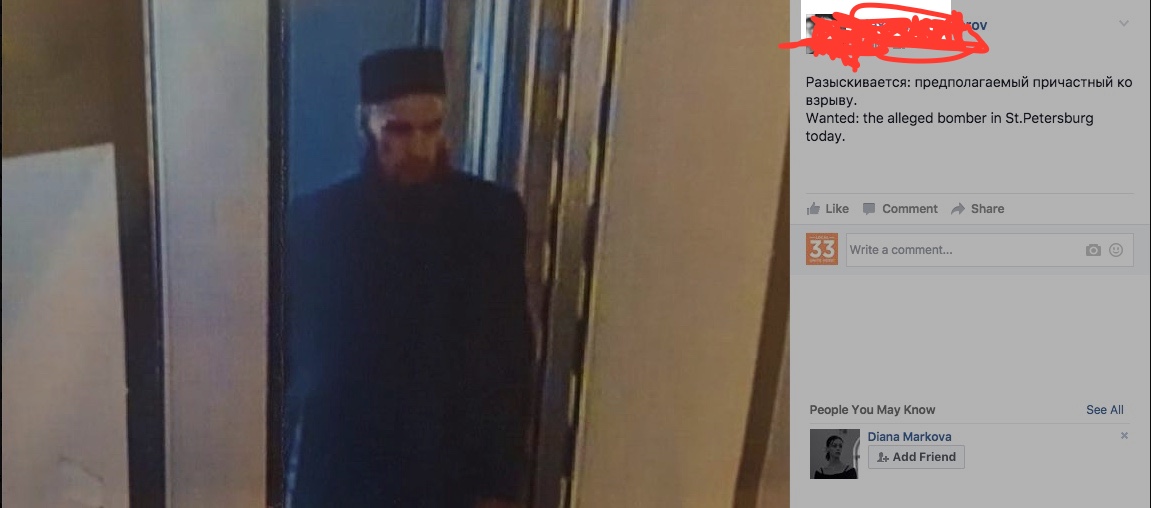
wanted the alleged bomber
Social network users were quick to join the exciting hunt for the “alleged bomber,” especially because the screenshot image disseminated by local media evoked every radicalized Islamophobe’s wet dream of a “Muslim terrorist.”

Man Named as Suspect in Subway Explosion Turns Himself over to Police
Inna Sidorkova and Vladimir Gordeev
RBC
April 3, 2017

A man resembling the man in a photograph whom the media had identified as a suspect in the terrorist attack in the subway has produced himself at a Petersburg police precinct.

“He saw himself on TV, got scared, and came to the police himself,” said RBC’s source in law enforcement. According to him, the man had nothing to do with the terrorist attack.

Earlier, REN TV and online newspaper Fontanka.ru had published a screenshot of a recording made by a CCTV camera. The image showed a man who, allegedly, had carried out the terrorist attack. The still showed a tall, bearded man dressed in black.

Later, Channel Five published the photograph of a second suspect in the terrorist attack.

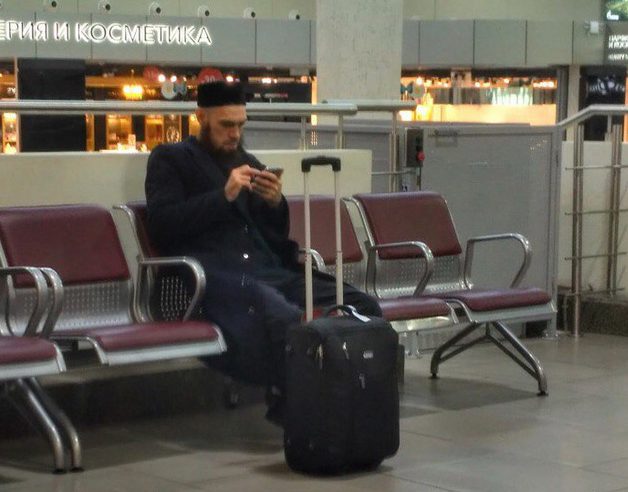
alleged suspect
The “alleged terrorist” looks very much like a Russian Orthodox priest or seminary student. Photo courtesy of RBC and their sources in law enforcement**

** UPDATE (5 April 2017). His real name is Andrei (Ilyas) Nikitin, and here is the touching story of how this totally innocent man got booted off a plane in Moscow because Islamophobic, panick-mongering Russian media and social media users had already dragged him through the mud and labeled him a “terrorist.”

_______________________________

Execution of the five Pervomartovtsy, April 13, 1881. Source: Wikipedia

*Pervomartovtsy (Russian: Первома́ртовцы; a compound term literally meaning those of March 1) were the Russian revolutionaries, members of Narodnaya Volya [The People’s Will] who planned and carried out the assassination of Alexander II (March 1, 1881), and attempted to assassinate Alexander III (March 1, 1887, also known as “The Second First of March”).

The 1881 assassination was planned by Narodnaya Volya’s Executive Committee. Andrei Zhelyabov was the main organizer. After his arrest on February 27, he was replaced by Sofia Perovskaya.

Alexander II was killed on March 1, 1881, by a bomb thrown by Ignacy Hryniewiecki. Hryniewiecki wounded himself fatally in the assassination; Nikolai Sablin committed suicide. The conspirators—Zhelyabov, Perovskaya, Nikolai Kibalchich, Gesya Gelfman, Timofei Mikhailov, and Nikolai Rysakov—were tried by a Special Tribunal of the Ruling Senate on March 26–29 and sentenced to death by hanging. On April 3, 1881, five Pervomartovtsy were hanged, except for Gelfman, whose execution was postponed due to her pregnancy. Her execution was later commuted to indefinite penal servitude. She nevertheless died in prison of post-natal complications.

The second “First of March” was planned by members of the so-called Terrorist Faction of Narodnaya Volya, including [Vladimir Lenin’s older brother] Alexander Ulyanov. On March 1, 1887, they went to St. Petersburg’s Nevsky Prospect with bombs and waited for the Tsar’s carriage to pass by. However, they were arrested on the spot before his arrival. All fifteen conspirators, including Alexander Ulyanov and Pyotr Shevyryov (the main organizers), Pakhomy Andreyushkin, Vasily Generalov and Vasily Osipanov (the bombthrowers), and ten other people were tried by a Special Senate Committee on April 15–19 and sentenced. The first five men were hanged on May 8, 1887, while the rest were sentenced to prison, exile or penal servitude.

Source: Wikipedia. The article has been edited lightly to make it more readable. TRR

_______________________________

A 1988 map of downtown Leningrad, showing Zhelyabova and Perovskya Streets (inside the red oval). The streets were renamed in memory of the People’s Will terrorists in October 1918. The streets reverted to their pre-Revolutionary names (Bolshaya and Malaya Konyushennaya Streets) only in October 1991. (Image courtesy of retromap.ru.)

Yet streets named in memory of their fellow People’s Will terrorists Alexander Ulanov and Nikolai Kibalchich are still firmly in place on the grid of post-Soviet Petersburg to this day.

Alexander Ulyanov Street, in Petersburg’s Okhta neighborhood
Kibalchich Street, in Petersburg’s southern Frunze District

Masha Alyokhina: Speech in Parliament

olegsentsov
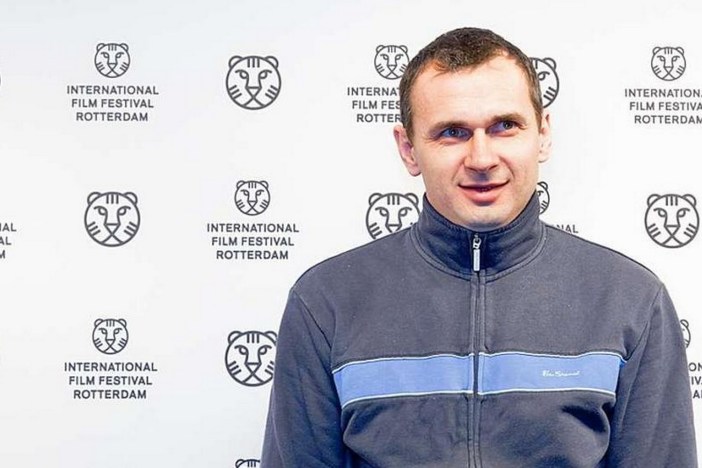
Oleg Sentsov at the 2012 Rotterdam Film Festival. Photo courtesy of De Telegraaf and nvt

Masha Alyokhina
Speech in the British Parliament
October 10, 2016

Because of the Pussy Riot case, I spent two years in prison. In recent months, I have been performing every night on stage as an actress with the Belarus Free Theatre. Every night, I have been trying to convey to the audience part of my life in prison. I do this so people understand and experience the mundane hellishness all political prisoners go through in Russia.

One such prisoner is Oleg Sentsov.

Oleg is a well-known, talented Ukrainian filmmaker. Perhaps he could have been debuting a new movie at the film festival taking place in London this week, but instead he is isolated in a penal colony in faraway Siberia. After being tortured, he was sentenced to twenty years in a maximum security prison on charges of terrorism. He was accused of planning to blow up a monument to Lenin in Crimea. The charges are absurd, total nonsense.

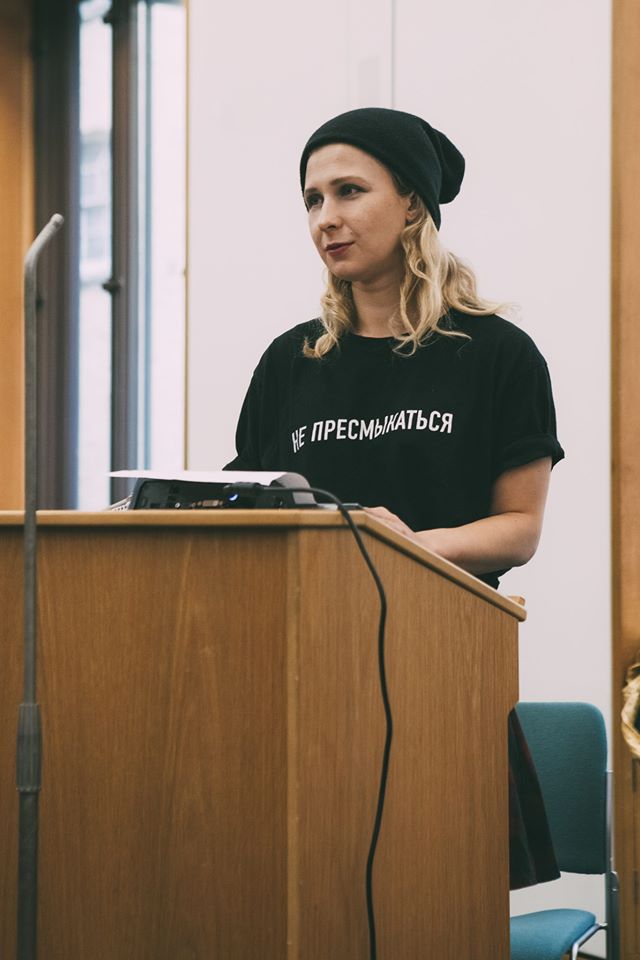
Masha Alyokhina speaking in Parliament, October 16, 2016. Photo courtesy of her Facebook page
Masha Alyokhina speaking in the British Parliament, October 16, 2016. Photo courtesy of her Facebook page

We need to stop talking and start acting. We need to get Oleg Sentsov released from prison and save his life. When I was in prison, it was thanks to your support and scrutiny that nothing threatened my life. In Sentsov’s case, there is not enough scrutiny, and there is such a threat to his life. That has to change.

Sentsov’s trial was not just yet another instance of political persecution by the Russian regime. It was a symbolic attack on the liberties and values you espouse. Oleg still has eighteen years left to serve in prison. He was given this sentence only because he is a brave man who spoke out on behalf of these same values. We can learn a lot from him and what he did, but we must not accept the fact he remains imprisoned. We must pressure the Russian authorities. I am here to urge you to make Sentsov’s release our common cause. I am confident we can see this cause through to the end and free Oleg from prison.

Translated by the Russian Reader. Thanks to Masha Alyohkina for her kind permission to translate the original Russian text of her speech and publish it here.

The People versus the Package

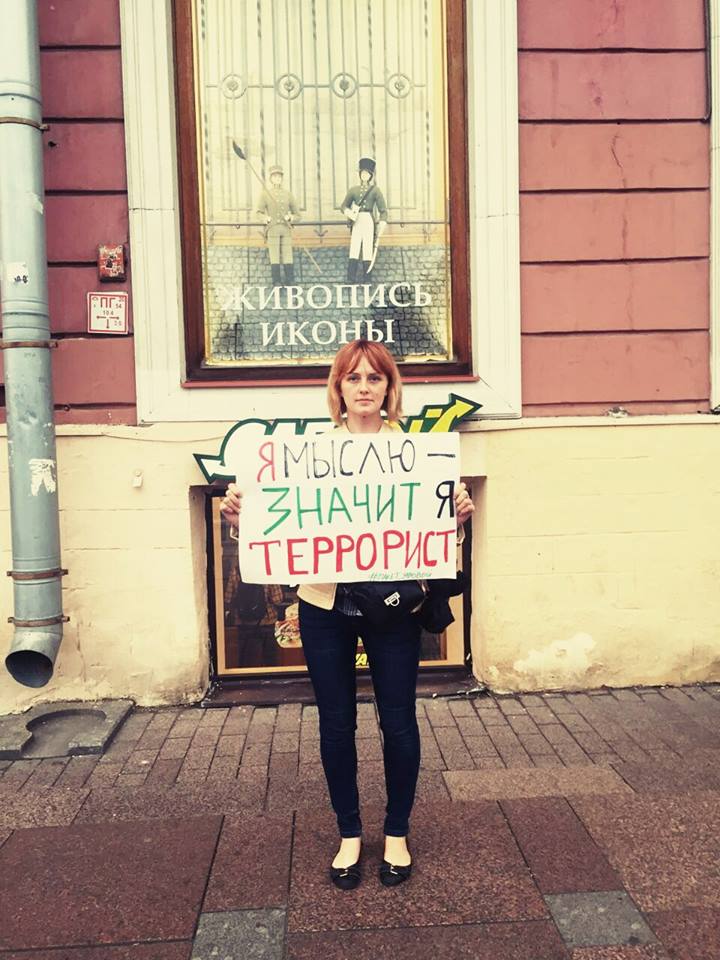
"I think therefore I'm a terrorist." Solo picket on Nevsky Prospect, Petersburg, July 22, 2016
“I think therefore I’m a terrorist.” Solo picket on Nevsky Prospect, Petersburg, July 22, 2016

Varya Mikhaylova
Facebook
July 23, 2016

It doesn’t matter whether you come to the people’s assembly against the so-called Yarovaya package at 7 p.m. on July 26 in front of the arch of the General Staff Building on Bolshaya Morskaya or not. There is already enough evidence to put you away.

***

On July 7, 2016, President Putin signed the so-called Yarovaya package, a series of flagrantly repressive amendments to the Russian Federal Criminal Code. The official objective of the amendments is to combat terrorism.

IF YOU DON’T INFORM YOU’LL GO TO JAIL
An article on non-informing has been added to the Criminal Code. “Failure to report a crime” will entail a sentence of up to one year in prison. This law applies to such crimes as terrorism, seizure of power, and attempts on the life of a public official.

ALL YOUR COMMUNICATIONS WILL BE SAVED AND READ
Monitoring of correspondence has been toughened. Records of all your telephone calls, SMS messages, and emails will be saved for six months, and the security forces will be provided with the means to decode encrypted communications.

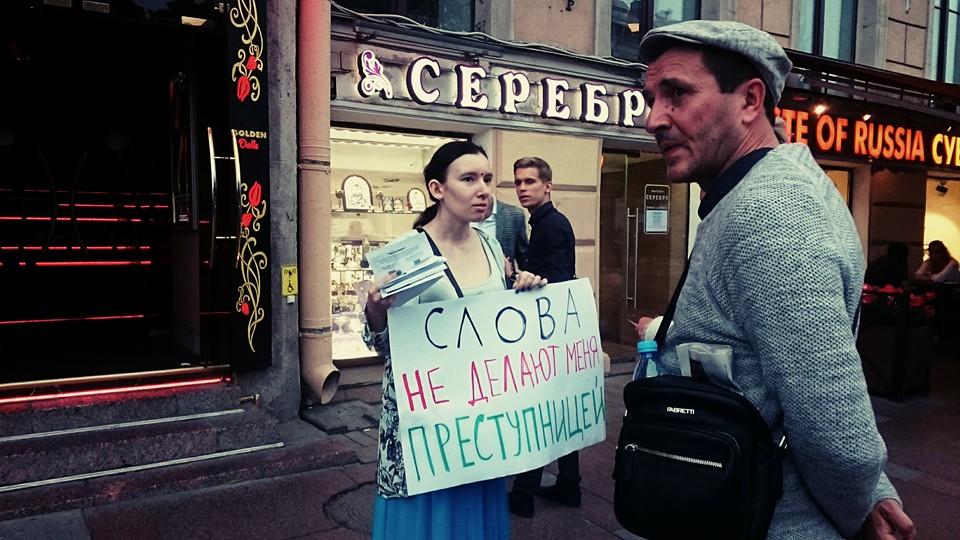
"Words don't make me a criminal." Solo picket on Nevsky Prospect, Petersburg, July 22, 2016
“Words don’t make me a criminal.” Solo picket on Nevsky Prospect, Petersburg, July 22, 2016

YOUR PACKAGES WILL BE VETTED
Postal workers will now be obliged to search vigorously for prohibited items in our packages: money, narcotics, weapons, explosives, and “other devices that pose a threat to human life and health.”

YOU INVITED A FRIEND TO A PROTEST RALLY, YOU GO TO JAIL
The Criminal Code will now include an article on “inducing, recruiting or otherwise involving” someone in organizing a “riot.” The law stipulates a penalty of 300,000 to 700,000 rubles or a prison sentence of five to ten years.

YOU REPOST THE “WRONG” THING, YOU GO TO JAIL
The punishments for “extremist” entries, reposts, and comments on the web have been toughened. Despite the fact that freedom of speech is guaranteed by the Russian Constitution, you can now be fined from 300,000 to 500,000 rubles or sent to prison for two to five years for making certain statements. By the way, 369 people were convicted of “enciting hatred by means of the Internet” in 2015.

YOU’RE STILL A KID? YOU’RE GOING TO JAIL ANYWAY
14-year-olds will now be tried as adults not only for serious crimes but also for involvement in riots and non-informing.

At 7 p.m. on July 26, a people’s assembly on behalf of liberty and against the Yarovaya package will be held on Bolshaya Morskaya in the pedestrian area near the arch of the General Staff Building. The people’s assembly format does not permit the use of political symbols and placards. But no one can forbid us from going outside, talking about the Yarovaya package, and hoping the voice of peaceful protest will be heard.

More on the Yarovaya Package:

"Inform on me and maybe  you won't go to jail." Solo picket on Nevsky Prospect, Petersburg,  July 22, 2016
“Inform on me and maybe you won’t go to jail.” Solo picket on Nevsky Prospect, Petersburg, July 22, 2016

The Package

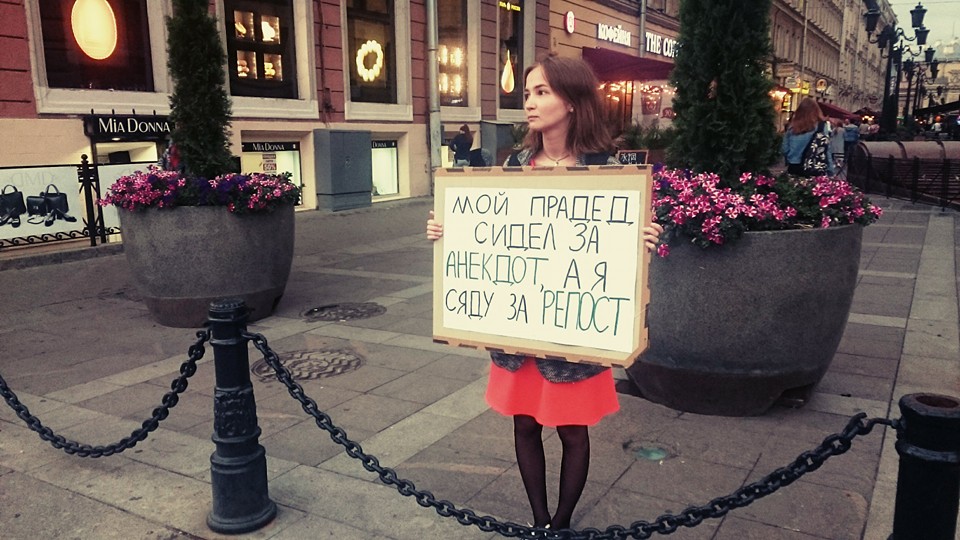
"My grandfather was imprisoned for a joke, while I'll go to jail for a repost."
“My grandfather was imprisoned for a joke, while I’ll be going to jail for a repost.”

Varya Mikhaylova
Facebook
June 24, 2016

As you know, the so-called Yarovaya package, a series of flagrantly repressive amendments to the Russian Federal Criminal Code, whose official aim is combating terrorism, was passed today by the State Duma in its third and final reading.

You can read here why this is bad:


Aleksandra Ermilova and I summarized the worst things about these amendments and went to Nevsky Prospect to hand out leaflets. Or rather, I handed out the leaflets, while Sasha stood holding a remarkable autobiographical placard [pictured, above].

This is what we wrote in the leaflets:

IF YOU DON’T INFORM YOU’LL GO TO JAIL
An article on non-informing has been added to the Criminal Code. “Failure to report a crime” will entail a sentence of up to one year in prison. This law applies to such crimes as terrorism, seizure of power, and attempts on the life of a public official.

ALL YOUR COMMUNICATIONS WILL BE SAVED AND READ
Monitoring of correspondence has been toughened. Records of all your telephone calls, SMS messages, and emails will be saved for six months, and the security forces will be provided with the means to decode encrypted communications.

YOUR PACKAGES WILL BE VETTED
Postal workers will now be obliged to search vigorously for prohibited items in our packages: money, narcotics, weapons, explosives, and “other devices that pose a threat to human life and health.”

YOU INVITED A FRIEND TO A PROTEST RALLY, YOU GO TO JAIL
The Criminal Code will now include an article on “inducing, recruiting or otherwise involving” someone in organizing a “riot.” The law stipulates a penalty of 300,000 to 700,000 rubles or a prison sentence of five to ten years.

YOU REPOST THE “WRONG” THING, YOU GO TO JAIL
The punishments for “extremist” entries, reposts, and comments on the web have been toughened. Despite the fact that freedom of speech is guaranteed by the Russian Constitution, you can now be fined from 300,000 to 500,000 rubles or sent to prison for two to five years for making certain statements. By the way, 369 people were convicted of “enciting hatred by means of the Internet” in 2015.

YOU’RE STILL A KID? YOU’RE GOING TO JAIL ANYWAY
14-year-olds will now be tried as adults not only for serious crimes but also for involvement in riots and non-informing.

Translated by the Russian Reader

Invitation to the Voyage

border guards-1
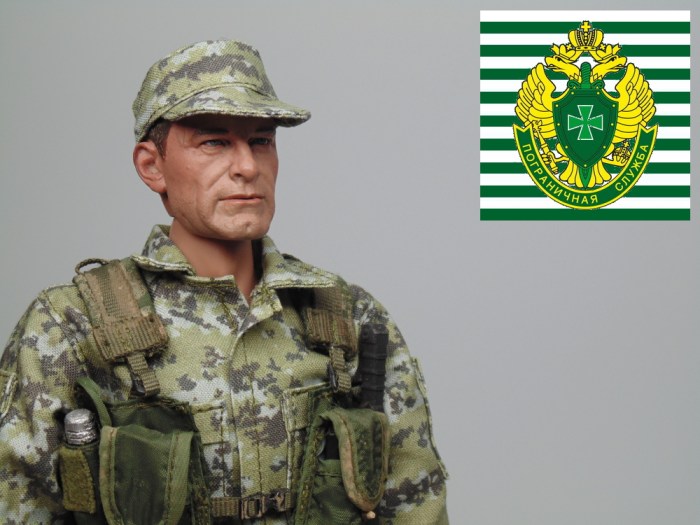
Action figure of a Russian border guard and seal of the Russian Border Guard Service

Boris Vishnevsky
Facebook
May 13, 2016

I have sent this to the Echo website. I hope they will post it soon.

I ask you to repost it.

Friday the thirteenth is a black day in the calendar.

It is no coincidence that on the same day the editorial staff of RBC, one of the best and most professional Russian media outlets, was gutted, the latest paranoid law bill authored by Irina Yarovaya was passed by the Duma.

First, if the bill is passed into law, the Federal Security Service (FSB) will have the right, after issuing a so-called official warning, to ban any citizen from traveling abroad for five years.

For your information, according to FSB Order No. 544, dated November 2, 2010, this “warning” can be given “to an individual in the absence of grounds for criminal prosecution in order to prevent the commission of crimes.” Only “pre-confirmed information” about the “outwardly (verbally, written or otherwise) manifested intent to commit a specific offense in the absence of signs of preparation to commit a crime or an attempt to commit a crime” has to exist.

Let’s translate this from legalese into Russian. There are no signs a crime is being prepped, there are no signs of an attempt to commit a crime, and there are no grounds for criminal prosecution. There is only “information” about the “intent to commit a crime,” information that has appeared out of nowhere and has been obtained god knows how.

Under such rules any undesirable or dissenter can be subject to a “warning,” including people shopped by informers to our beloved secret police for “verbally” or “otherwise” (say, by the look on their face) expressing the intention to commit a crime.

Second, criminal liability will be introduced for “failing to report a crime,” meaning for failing to shop someone to the secret police. As Igor Yakovenko has aptly put it, this will turn “squealing into a civic duty.”

Third, revocation of citizenship would be stipulated for crimes of a “terrorist and extremist tenor,” despite the fact that opposing the authorities is easily classifiable as “extremism.”

All three provisions are blatantly unconstitutional, but they were confidently passed in the first reading, with opposition from an overwhelming minority consisting of Dmitry Gudkov, Sergei Petrov, and Ilya Ponomaryov’s voting card.

You can bet your boots there will be a second and third reading, and the president will sign the bill into law.

I would like to say the Constitutional Court would be bound to quash the law, but considering how it has behaved in recent years there are no grounds for such political optimism.

The darkness is deepening.

However, that always happens before the dawn.

Boris Vishnevsky (Yabloko Party) is a member of the Saint Petersburg Legislative Assembly. Translated by the Russian Reader. Thanks to Comrade Nastya for the heads-up.

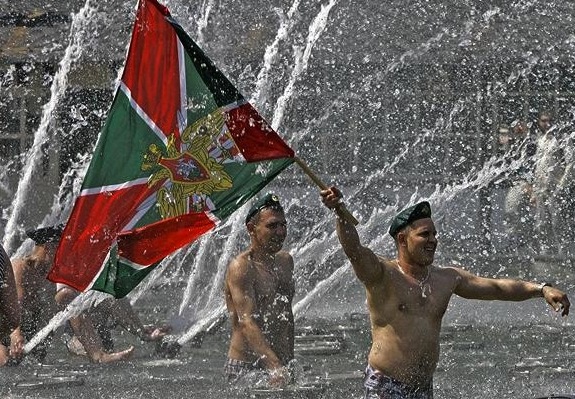
Border Guard Service veterans celebrating their professional holiday, May 28

L’invitation au voyage

Mon enfant, ma soeur,
Songe à la douceur
D’aller là-bas vivre ensemble!
Aimer à loisir,
Aimer et mourir
Au pays qui te ressemble!
Les soleils mouillés
De ces ciels brouillés
Pour mon esprit ont les charmes
Si mystérieux
De tes traîtres yeux,
Brillant à travers leurs larmes.

Là, tout n’est qu’ordre et beauté,
Luxe, calme et volupté.
Des meubles luisants,
Polis par les ans,
Décoreraient notre chambre;
Les plus rares fleurs
Mêlant leurs odeurs
Aux vagues senteurs de l’ambre,
Les riches plafonds,
Les miroirs profonds,
La splendeur orientale,
Tout y parlerait
À l’âme en secret
Sa douce langue natale.

Là, tout n’est qu’ordre et beauté,
Luxe, calme et volupté.
Vois sur ces canaux
Dormir ces vaisseaux
Dont l’humeur est vagabonde;
C’est pour assouvir
Ton moindre désir
Qu’ils viennent du bout du monde.
— Les soleils couchants
Revêtent les champs,
Les canaux, la ville entière,
D’hyacinthe et d’or;
Le monde s’endort
Dans une chaude lumière.

Là, tout n’est qu’ordre et beauté,
Luxe, calme et volupté.

Source

A special day for border guards was established by presidential decree in 1994
The special holiday for Russian border guards was established by presidential decree in 1994

Invitation to the Voyage

Let us leave this tiresome clime
And quit cities made of stone,
Where you are cold and bored,
And sometimes even scared.

The flowers are softer and stars brighter
In the land where the Southern Cross shines,
In the land rich as the dowry chest
Bestowed on enchanted brides.

We’ll build a house taller than a fir,
And face its corners with stone,
Mahogany will panel its walls,
And we’ll put down rosewood floors.

And among the scattered paths
In the vast rose garden
The speckled beetles’ backs
Shall flicker like the stars.

Let’s leave! Unless you do not need
In that hour when the sun has risen
To hear the terrible ballads,
The tales of Abyssinian roses.

Of ancient fairy queens,
Of lions in crowns of flowers,
Of black angels, and of birds
What weave their nests amid the clouds.

We shall find an ancient Arab,
Chanting in a singsong drone
A verse about Rostam and Sohrab
Or the virgins of Zanzibar.

And when we tire of fables,
Twelve slender little Negroes
Shall dance round us in a whirl
And never want to rest.

And magnificent chieftains,
Decked out in ivory gear,
Shall come to visit us
When in spring the rains begin.

In the mountains merry, where the winds
Cry and shout, I shall chop the trees,
Cedars, redolent of resin,
Plane trees spanning to the skies.

I will alter the streams
Of rivers flowing down the hills,
Teaching them now to please
Me according to my will.

And you, you shall have flowers,
And I will give you a gazelle
With such gentle eyes
That it seems as if a flute trills.

Or a bird of paradise, prettier
Than roses and summer lightning flares,
To flutter over your miraculous
Dark blond bonnet of hair.

And when Death comes, slightly sad,
Sliding along the fateful line,
To stand at our threshold,
We shall say to Death, “What, it’s time?”

And, neither longing nor dreaming,
We shall go to God’s highest paradise,
Clear smiles on our faces, recognizing
Everywhere familiar climes.

Original

The Border Guard Service, created in the 18th century, was a separate ministry until 2003, when it became a branch of Russia's Federal Security Service
The Border Guard Service, created in the 18th century, was a separate ministry until 2003, when it became a branch of Russia’s Federal Security Service (FSB)

Invitation to the Voyage

Start by taking a brick and shattering the glass.
Go from the kitchen (mind the steps!) to the dining room.
Sweep Peter Ilyich and Beethoven from the baby grand,
Unscrew the third leg. That is where you’ll find the loot.

Don’t traipse into the bedroom, don’t rifle the chest of drawers,
Lest you start to masturbate. The bedroom and the wardrobe
Smell of perfume, but except for rags from Dior,
There’s nothing you can hustle in the Old World.

Two hours later, when they announce the flight,
Don’t bolt for the gate. Stretch your legs and feign boredom.
In any crowd of passengers you will usually spy
A Jew with forelocks, kiddies in tow. Join their hora.

The next morning, when Zizi pulls up the venetian blinds
And tells you the Louvre is closed, grab hold of her wet curls,
Bury her stupid mug in the pillow and, snarling, “Bite!”
Do to her the thing that deprives the soprano of her trills.

Original

border guards-5
Action figures of a modern Russian border guard (with dog) and an NKVD border guard

Images courtesy of the Telegraph (“Vodka and swimming at Russian Border Guards’ Day celebrations”) and One Sixth Warriors

General Bastrykin Teaches a Lesson in Democracy

This is the mouse, this is the cat.
This is the watch tower, this is the camp.
And this is Time that, on the sly,
Sentences Mom and Dad to die.

source

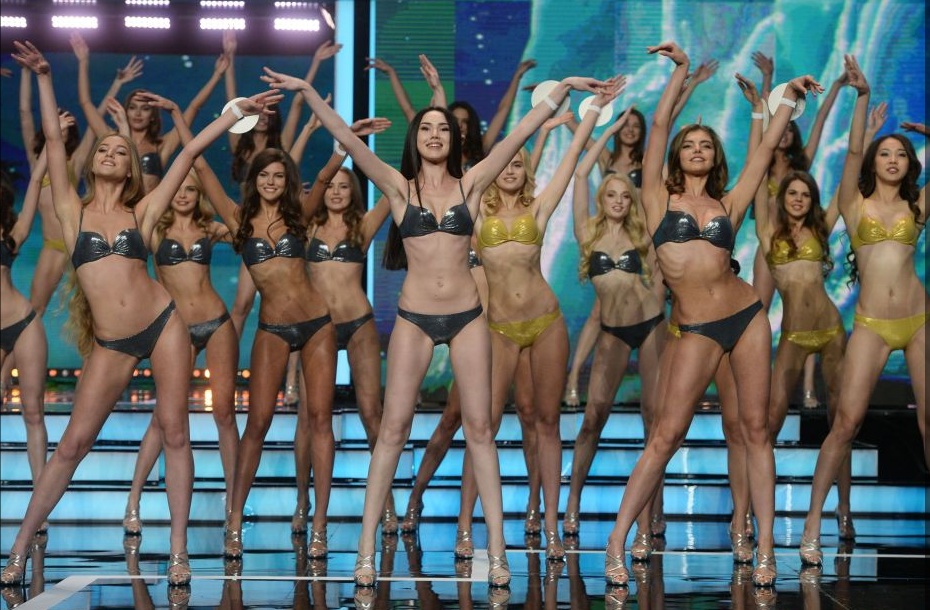
Participants of the national Miss Russia 2016 beauty pageant on the stage of the Barvikha Luxury Village concert hall. Courtesy of Sputnik/Iliya Pitalev

Greg Yudin
Facebook
April 18, 2018

I really like it when a big man in uniform speaks out with fanfare on perennial topics like the structure of society. You think it’s funny they all get Ph.D.s, but they really do consider themselves major theorists and are always willing to teach lessons in wisdom in their spare time. An entire genre has even emerged in Russian newspapers: lessons in political philosophy by generals.

For example, in today’s issue of Kommersant, General Bastrykin casually gives readers an unexpected lesson in democracy.

“For democracy or people power is nothing other than the power of the people itself, realized in its interests. It is possible to achieve these interests only by means of the common good, and not through the absolute freedom and arbitrary will of individual members of society,” he writes.

It must be admitted that this is the pure, unadulterated truth. We might rejoice that democracy in Russia has found a new supporter.

Then, however, Bastrykin the democrat’s argument takes an unexpected turn. He proposes setting things up so that he, Bastrykin, would decide himself what information should be considered extremist, and would limit Internet access without a court order! In addition, he would also decide in which cases providers are obliged to provide him with the personal information of their clients.

There are lots of other tasty tidbits in his article, including innovative tactics for fighting terrorism by confiscating property, but that does not concern us here.

So somebody comes and says, Now I am going to decide who is an extremist and who can read what. You will also be informing me everyone’s personal information. If this is not “absolute freedom and the arbitrary will of an individual member of society,” then what else would you call it?

I am going to have to upset Mr. Bastrykin. Democracy is, in fact, people power. Therefore, the main objective of democratic governance has been and will be preventing the usurpation of power, not defending the people from the machinations of external foes, not hunting down traitors, not surveilling unreliables, but combating usurpers. And so democracy’s main enemy is the guy who comes out and says he is going to decide who the extremists are round here.

The problem with these scholarly generals is that the only form of social organization they are capable of conceiving is the prison camp. And so whether they write about democracy, traditional values or economic progress, the same speech in defense of the prison camp always comes out.

* * * * *

“It’s time to erect an effective barrier against the information war”
Alexander Bastrykin, chair of the Russian Federal Investigative Committee, on methods of combating extremism in Russia 
Kommersant
April 18, 2016

Chair of the Russian Federal Investigative Committee, general of justice of the Russian Federation, doctor of juridical sciences, Professor Alexander Bastrykin, special to Vlast magazine, on the ways and methods of combating extremism in Russia 

In  2015, the Russian Federation witnessed negative trends in criminal extremism and terrorism.

1,329 extremist crimes were recorded, which was 28.5% higher than in 2014 (1,034 crimes). A growth in this type of crime was noted in fifty-six regions of the Russian Federation.

The numbers of such crimes as public calls to extremist activity (Russian Federal Criminal Code Article 280) and inciting hatred or hostility, and humiliation of human dignity has soared by nearly forty percent in comparison with 2014.

The crime of organizing an extremist organization was recorded 42 times (+2,4%).

A significant increase (+36.3%) in terrorist crimes committed in the Russian Federation has been noted. A total of 1,538 such crimes was recorded in 2015 (as opposed to 1,128 in 2014).

Seventy such crimes were prevented at the stage of planning or during the attempt. 133 terrorist crimes were committed with the help of the Internet network.

A particularly difficult situation has been observed in the North Caucasus Federal District, which accounts for the bulk of terrorist crimes: 1,168 crimes or 75.9% of all such crimes (leading to an increase of 32.3%). (In 2014, 883 such crimes were committed.)

Both external (geopolitical) and domestic political factors have contributed to the growth of this type of crime.

Over the past decade, Russia and a number of other countries have been living through a so-called hybrid war, unleashed by the US and its allies. The war has been conducted on various fronts, political, economic, informational, and legal. In recent years, it has moved into a new phase of open confrontation.

Professor Bastrykin
Professor Bastrykin

The main elements of economic pressure have been commercial and financial sanctions, dumping wars on the hydrocarbons market, and currency wars. Skillfully manipulating the huge number of dollars in circulation, the States have brought down the national currencies of developing countries. Russian organizations have had their access to channels of external long-term financing blocked, channels that formed the basis of investment for developing the real (productive) sectors of the economy. It is noteworthy that restrictions on the movement of financing have not affected short-term financing, which currently has been widedly employed to exert speculative pressure on our national currency. In many respects, the outcome of these measures has been the deep devaluation of the ruble, falling real incomes, a decline in industrial production, and economic recession. There has been a budget deficit and ensuing consequences in the form of cuts in expenditures, as well as an increasing fiscal burden to raise revenues.

Unfortunately, international law and the justice based on it have increasingly become tools of this war.

Obvious examples are the decisions in the Yukos cases, the decision in the murder case of former FSB officer Alexander Litvinenko, the report of the Security Council of Netherlands on the investigation into the crash of Malaysian Airlines Flight 17, the FBI’s investigation of the legitimacy of awarding the right to hold the World Cup to Russia and Qatar in 2018 and 2022, and the extradition of our citizens Victor Bout and Konstanin Yaroshenko to the US and their sentencing to long terms of imprisonment.

However, the information war has caused the most devastating effects. By supporting radical Islamists and other radical ideological tendencies, the US has completely destabilized the situation in the Middle East. The effects of artificially initiated coups, revolutions, and crises in this region are still being experienced by Europe, overrun by mobs of refugees who profess qualitatively alien sociocultural traditions and have displaced the local population. Islamic State, the Al-Nusra Front, Al Qaida, and other terrorist organizations involved in the armed conflict in the Syrian Arab Republic have also been an effect of this policy. Manpower for replenishing these organizations are recruited all over the world, including in Russia.

More than a thousand Russian citizens have gone to the Syrian Arab Republic to participate in the armed conflict. 469 criminal cases have been filed against these persons. 135 of them have been killed in armed clashes with Syrian government troops.

The main channels of entry for Russian citizens into areas of heightened terrorist activity have been Turkey and Egypt, where they travel both directly and through third countries (Georgia, Azerbaijan, Belarus, Ukraine, Moldova) under the pretext of holidaymaking, receiving theological education, doing business, etc.

The main technique of the information war is the manipulation of an ideology that a particular social group finds congenial by radicalizing it. It is clear that the system of religious, ethnocultural, and confessional values is the segment of social existence that defines the most significant feature of any nation (ethnic group) and other such social groups as self-identification. Many of these values were shaped,  preserved, and passed from generation to generation for centuries. Therefore, no nation is willing to give up its identity. Perhaps it is the only universal value it is willing to defend with arms and, as they say, until the last drop of blood is spilled.

Aware of the devastating effect of conflicts based on ethnic hatred, the US has bet on this informational element. At the current level of understanding of the issue, it is clear that the subversion of the Soviet Union’s ideological foundations, which were based on the principle of the brotherhood of nations, was also initiated from the outside and based on methods of ethnic strife. It was no accident that in the early 1990s numerous ethnic conflicts (Nagorno-Karabakh, Georgia-Abkhazia, Ossetia-Ingushetia, Transnistria) broke almost simultaneously. At this time, the first mass rallies of nationalist-minded citizens took place in Kiev. In addition, the subversion of state power was carried out by means of anti-Soviet agitation and financing of the political opposition in Latvia, Lithuania, Estonia, Georgia, and other countries.

Of course, in the minds of the local populace, those events were then regarded as local conflicts. However, it is now completely obvious that all these clashes were elements of the initial, as-yet-hidden phase of the information war.

Undoubtedly, the informational-ideological “weapon” will be deployed in the future. This is evidenced by the increase in US government spending on programs for the so-called development of democratic institutions in countries bordering on Russia and in the Central Asian states. The true meaning of these assets becomes clear from the name of this budget item, “Countering Russian aggression through public diplomacy and foreign aid programs, and the creation of stable government in Europe.”

About 4.3 billion dollars have been allocated under his item in 2017, and around a billion dollars will go to programs for the so-called fight against corruption and supporting democracy in countries neighboring Russia.

Funds already received under this program have been spent by by various non-governmental organizations under the guise of promoting education, developing civil society, and other seemingly useful purposes. The outcome has been the incitement of anti-Russian moods in neighboring countries, the shaping of the pro-American and pro-western so-called non-systemic opposition in Russia, and the spread of inter-confessional and political extremism within our country.

Recent events in Nagorno-Karabakh witness to the repeated attempts of forces opposed to Russia to undermine the peace between the Armenian and Azerbaijani peoples and establish yet another hotbed of war on Russian’s borders.

It seems it is time to erect an effective barrier against this information war. We need a tough, appropriate, and balanced response. This is especially relevant in light of the upcoming elections and the possible risks presented by the stepping up of efforts by destabilizing political forces. Enough of playing at pseudo-democracy and following pseudo-liberal values. For democracy or people power is nothing other than the power of the people itself, realized in its interests. It is possible to achieve these interests only by means of the common good, and not through the absolute freedom and arbitrary will of individual members of society.

The following measures can be proposed to counter extremism.

It is extremely important to establish a concept of state ideological policy. Its basic element could be a national idea that would genuinely unite Russia’s unified multinational people. The concept could stipulate specific long-term and medium-term measures, aimed at the ideological education of our younger generation. Conscious resistance to radical religious and other ideologies could knock out the foundations on which current extremist ideologies are constructed. With this protection in place, even the most generous outside financing of destabilizing the situation in Russia will prove useless.

It is also important that youth are regarded by terrorist groups as a natural reserve. From this it follows that everything must be done to seize the initiative, to include young people at risk in the development and implementation of programs for countering armed extremism.

It seems appropriate for the supervisory and regulatory authorities to organize a wide-ranging and detailed verification of the compliance with federal legislation of all religious, ethnocultural, and youth organizations, suspected of engaging in banned extremist activity.

Using the know-how of the Northern Caucasus, we should organize specific and narrowly targeted preventive work with members of informal youth associations in order to adopt measures aimed at procuring information about negative processes underway in the youth milieu and identifying the ideologues and leaders of radical organizations who involved young people in extremist activity.

The positive know-how of the Republic of Ingushetia is also worthy of support. They have established a military-patriotic club that unites the children of law enforcement officers who were killed in the line of duty and children of neutralized members of the bandit underground, which facilitates their rapprochement and shapes an atmosphere of mutual understanding among them.

The proposed concept sees it as expedient to define the limits of censoring the global Internet network in Russia, since at present this problem is causing a heated debate in the light of the stepping up of efforts by advocates of the right to the free receipt and dissemination of information. Interesting in this sense is the know-how of foreign states, opposing the US and its allies. Due to unprecedented pressure from information, they have taken steps to restrict foreign media in order to protect the national information space. Thus, for example, on March 10, 2016, China’s Ministry of Industry and Information Technology  introduced a ban on electronic media fully or partly owned by foreign residents. These media will no longer be able to disseminate information through the Internet and, in the best case, by means of print publications. Chinese media will cooperate with foreign online media only with the permission of the ministry. Only Chinese nationals will be able to work in the management of national media. Online media servers can be located only in the People’s Republic of China.

It seems this know-how could be employed in Russia to a reasonable extent.

Internet providers must be furnished with a integrated set of rules for storing the personal information of their clients and users in the right amount in the event that such information is required when investigating cyber security violations.

In public places (libraries, schools, and other educational institutions) with access to the World Wide Web, filters restricting access to sites containing extremist content should be established.

In addition, it seems appropriate to stipulate an extrajudicial (administrative) procedure for including information in the federal list of extremist content and blocking the domain names of sites that disseminate extremist and radical nationalist information. However, if the proprietors of this information do not consider it extremist, they can appeal the relevant actions of the authorized government agencies in court and prove their innocence there. This procedure will enable a faster and more effective response to the promotion of extremism on the Internet. It is necessary to step up work on introducing modern technology for the effective monitoring of the radio waves and the Internet.

It is necessary to expand the range of criminal law measures to stop the illegal actions of terrorist organizations committed on the Internet network involving recruiting. To this end, we should consider the criminalization of possessing such materials, collecting them or uploading them from a computer. Modern evidence technologies make it possible to present to the court and confirm technical elements of intercourse on social networks that testify to the connections between the accused and the relevant electronic messages.

To expose the real aims and intentions of Islamic extremists and establish the insolvency of their theoretical approaches, which contradict the realities of the modern world and the fundamental interests of Islamic countries, it would seem useful for the State Duma to regularly hold special hearings involving experts from the Federal Security Service (FSB), eminent Islamic scholars and authorities, and scholars of Islam. The hearings should be widely covered in the press.

Particular attention should be paid to the migration process. Migrants are often targets of espionage recruiting and radicalization. Many of them have overstayed their limit in Russia, dropping out of the sight of law enforcement. We must analyze the regulatory acts governing the presence of foreign nationals and persons without citizenship in the Russian Federation. Based on our analysis, we should take additional measures for improving the legislation.

It is necessary to improve the work of precinct police with foreign nationals in the realm of monitoring compliance with the established rules of residence in Russia (monitoring of persons letting and renting residential premises in the precinct, and obtaining information about the nature of these persons’ employment). The internal affairs departments of agencies should exclude possible corruption here. Full use of the public’s assistance should be made.

Certain features of extremist activity have taken shape in the Crimea Federal District, where attempts have been made to mold anti-Russian moods, by means of falsifying historical facts and distorting the interpretation of modern events, and call into question the outcome of the referendum on Crimea’s accession to the Russian Federation. This act of the legal expression of the Crimean population’s popular will has become an integral part of Russian constitutionalism. Considering the place of this act in the hierarchal system of values of Russian state and society, it is certainly in need of special legal protection, including by means of criminal legal coercion.

It should be noted that criminalizing the denial or falsification of historical events of particular importance to a state and society is a widespread practice. For example, in many countries, including Russia, criminal punishment is stipulated for promoting fascism. France and a number of other countries have introduced criminal liability for denying the Armenian genocide. The State Duma of the Russian Federal Assembly is considering a similar law bill, No. 938567-6 (“On Criminalization of Public Denial of the Genocide of the Armenian People in Western Armenia and Ottoman Turkey in 1915-1922”). In Israel, it is a crime to deny the Holocaust.

In view of the above, it seems necessary to supplement the notion of extremist activity (extremism) contained in the federal law “On Countering Extremist Activity” with such a manifestation as denial of the outcome of a national referendum. It is necessary to decisively counteract the deliberate falsification of the history of our state. In this connection, we might also propose that Russian Federal Criminal Code Article 280 (public calls for extremist activity) include an additional stipulation, which would qualify the falsification of historical facts and events as a call for extremist activity.

In addition to countering the ideological component of the information war being waged against Russia, it is important to step up efforts to combat financial support for this activity, including tightening control over cross-border capital flows. As experience has shown, terrorism is often financed by virtual cryptocurrency, which has no central issuer, no single point of transactional control, and features anonymous payments. In addition, as a result of their wide dissemination, these currencies can displace legal money from the market, which threatens the state’s financial stability. It is therefore suggested that criminal liability be introduced for the illegal issuance and circulation of cryptocurrency and other money substitutes.

We should also review social security legislation concerning the close relatives of persons involved in terrorism, entitlement to survivor’s pensions, and other benefits. A person who is going to commit such crimes should know that in the event of death not only will he be buried in an unmarked grave but he will also deprive his loved ones of support from the state.

Another measure that would contribute to the effective fight against extremism, terrorism, and other dangerous criminal manifestations is confiscation of property as a form of criminal punishment. As we know, the relevant legislative proposals have been prepared and are in need of speedy legislative implementation. Unfortunately, this process has been unduly delayed.

No less important is improvement of the legal mechanism of international cooperation among law enforcement and other state bodies empowered to counter terrorism and extremism.

Russian law regulates only the procedure for submitting an international request for legal assistance, whereas international acts in this field stipulate the possibility of closer integration, including the establishment of international investigative teams. Such cooperation would help in cases where Russian investigative authorities need to perform a number of investigative procedures or even perform a preliminary investigation in a foreign country and that country has agreed to provide such assistance. This gap became apparent during investigation of the armed conflict between Georgia and South Ossetia in 2008 and the terrorist act committed on board the Russian Airbus 321 over the Sinai Peninsula.

Translated by the Island of Misfit Toys. Thanks to Greg Yudin for his courage.

It’s Been a Quiet Week in the Motherland (The News from OVD Info)

Maxim Panfilov
Maxim Panfilov

Hello! One of the main events of the past week for us was not Putin’s “Direct Line,” but the arrest of a man who spoke with Putin a year ago. Anton Tyurishev, a construction worker at the Vostochny Cosmodrome in the Russian Far East, complained to the president that he and his mates were not being paid their wages.  Putin promised to get to the bottom of it, but a year on nothing had changed. Tyurishev promised that in response protests would kick off. Later, he was summoned to the police station, where the “Law on Rallies” was read out to him. The day before the “Direct Line” broadcast, he was detained and sent to jail for five days, allegedly, for swearing in public.

Criminal Prosecution

The new defendant in the Bolotnaya Square Case, Maxim Panfilov, who suffers from Tourette’s syndrome and yet was taken into police custody, is not getting the medicines he needs. Instead, he is being administered substitutes that do not alleviate his condition. Panfilov has been appointed an outpatient psychiatric examination. The investigator has agreed to let defense attorneys attend it.

Ildar Dadin, convicted of “multiple violations of the rules for holding public events,” was convoyed from Moscow to Petersburg right on his birthday, which means he will serve his sentence in Leningrad Region.

Ildar Dadin
Ildar Dadin

Last week, it transpired that Magomednabi Magomedov, imam of the Eastern Mosque in Khasavyurt, had been arrested, accused of incitement to terrorism and inciting religious and ethnic hatred. Magomedov, who was transported from one place of confinement to another over several days, complained he had been tortured. Pretrial detention facility officers had beaten him and forced him to kneel, demanding that he confess to the charges.

Euromaidan participant Alexander Kostenko, convicted of harming a Berkut riot police officer, was transferred to solitary confinement shortly before a hearing where his request for parole was to be examined. Naturally, Kostenko’s parole request was rejected.

Alexander Kostenko
Alexander Kostenko

It seems soon Alexei Navalny will have no allies who are not undergoing criminal prosecution. Ivan Zhdanov, head of the Anti-Corruption Foundation’s legal service, and a candidate for the council of deputies in the Moscow suburb of Barvikha, has been charged with evading conscription.

Freedom of Assembly

In Ulyanovsk, police diligently searched for activists who had blocked a road in connection with construction of a residential complex. They visited one activist at work, and telephone another and asked him to report for questioning. When he demanded an official summons, they threatened him with criminal charges. Administrative charges have been filed against three people.

In Volgograd, the leader of the regional Union of Entrepreneurs and Freight Haulers has been slapped with three administrative charges for calling people to a protest rally before the rally was authorized. The court threw out two of the three charges, while the third resulted in a fine.

The confrontation continues in Moscow’s Dubki Park. Defenders of the park, who oppose construction there, are fined for disobeying the police. A female journalist’s arm was injured when an assembly of defenders was dispersed. When he was detained, one of the activists, Dmitry Boinov, was beaten so badly that he has been in hospital for a week recovering from fractures.

Beatings

In Podolsk, three men attacked Maxim Chekanov, a past participant of protest rallies. The incident began when they called Chekanov by name, asked him questions about the “Kiev junta,” called him a “Banderite scumbag,” and then invited him to go round the corner. During the ensuing fight they smashed Chekhanov’s face.

Popular Chechen singer Hussein Betelgeriev, who disappeared in late March, has returned home beaten. It is unknown where he was all this time. Relatives and friends suggest he was abducted, and connect the abduction with his comments on social networks and the fact he ignored the call to attend a pro-Kadyrov rally on March 23.

Reading

Olga Sutuga, mother of anti-fascist Alexei Sutuga, currently serving time at a penal colony in Irkutsk Region, talks about the international aid project Political Prisoners University.

Thanks for your attention!

_________

OVD Info is an independent human rights media project dedicated to political persecution in Russia. We are engaged in daily monitoring of detentions at public events, and publish information about other kinds of political persecution. We believe that information liberates and protects, and analyzing the data we collect can help change the situation for the better in the future.

Editor’s Note. OVD Info sends out a weekly email news roundup, in Russian, to its supporters. I thought that, despite its brevity, this week’s roundup provided a fairly eloquent picture of the state of affairs in this country at present and not just this particular week. You can sign up to the mailing list by going to the bottom of any page n the OVD Info website and entering your email address where you see the phrase ПОДПИСАТЬСЯ НА РАССЫЛКУ.