Pyotr Pavlensky: “The FSB Has Hammered an Iron Curtain Around Itself”

threatArtist Pyotr Pavlensky holding a petrol can in front of FSB headquarters in Moscow. Photograph: Reuters

Pyotr Pavlensky: “The FSB Has Hammered an Iron Curtain Around Itself”  
Elena Kostyuchenko and Ekaterina Fomina
December 10, 2015
Novaya Gazeta

An exclusive interview with the arrested artist

He stands accused of vandalism for setting fire to the door of the FSB building. Pavlensky himself has requested he be tried as a terrorist as a gesture of solidarity with convicted terrorists Oleg Sentsov and Alexander Kolchenko. Observing a vow of silence, Pyotr Pavlensky refused to answer the court’s questions. He did, however, answer Novaya Gazeta’s questions.

Pyotr Pavlensky’s Works

Seam, July 2012. Pavlensky sewed his mouth shut with a coarse thread and stood for an hour and a half in front of Saint Petersburg’s Kazan Cathedral holding a placard that read, “Pussy Riot’s performance was a reenactment of Jesus Christ’s famous performance.”

Carcass, May 2013.  Absolutely naked and not responding to anything, Pavlensky lay wrapped in barbed wired outside the Saint Petersburg Legislative Assembly. The artist attempted to show the new position Russian citizens had found themselves in after the adoption of repressive legislation.

Fixation, November 2013. Pavlensky nailed his scrotum to a cobblestone on Red Square and sat motionless looking at it. “It is a metaphor for the apathy and political indifference of Russian society,” the artist explained. Pavlensky timed his action to coinicide with Police Day.

Freedom, February 2014. Pavlensky and a group of activists burned around fifty tires on Malo-Konyushenny Bridge in Saint Bridge, thus reconstructing the Maidan in Kyiv.

Segregation, October 2014. Pavlensky cut off his earlobe while sitting naked on the fence of the Serbsky State Scientific Center for Social and Forensic Psychiatry. The action was a protest against punitive psychiatry.

Threat, November 9, 2015. Pavlensky set fire to the main entrance of the FSB headquarters on Lubyanka Square. The artist stood before the burning door holding a fuel canister.

What is fear?

I think fear is an animal instinct. You find an example of how fear itself turns into an immediate threat to life in Hannah Arendt’s book Eichmann in Jerusalem: A Report on the Banality of Evil. The question she returns to time and again there is, who was more to blame for the death to which a hundred concentration camp prisoners were led, the two guards who escorted them there or the prisoners themselves? Because they went willingly to their deaths, making no attempt to kill the guards or escape. Fear is dangerous because it suppresses free will. Without free will man becomes something like a domesticated beast of burden, which is not finished off and turned into food while there is the need to keep working it.

How and when did you conceive Threat?

[The answer has not been published in keeping with the requirements of Russian federal law.]

What did the preparation involve?

The choice of the site, the date, and time were the main things. When they have been determined, all that remains is the technical preparation, in which I try to do with the most minimal means.

Was Threat successful?  What constitutes success? Were the other actions successful?

I find it difficult to talk about, because my access to information is limited. But the fact alone that I managed to do it could be considered a big success.

Is there a common theme running through your works? Have your stance and objectives changed?

Yes, in all my works I talk about the prison of everyday life and the possibility of release from this prison. Seam, Carcass, Fixation, and Segregation are the prison of everyday life. Freedom is the possibility of release. But Threat is the power of coercion in this prison, meaning that it is the main threat to free will.

In most of your actions you haven chosen your own body as the object. Why did you decide to choose an external object this time?

This is not true. I have used my body when talking about the prison of everyday life. The statement about emancipation was constructed completely differently. Freedom was implemented by a collective subject. Now I have discussed the threat hanging over every member of society. This is a direct threat to the manifestation of everyone’s free will. I never said I was doing performance art or body art. I work with the tools of power, and what I do is political art.


Freedom.Photo: Pyotr Kovalyov / Interpress / TASS 

Whom are you addressing?

Society. I do not address people in power. I use them as material for undermining the scenery of power. My objective is to call into question the entire façade concealing the ruthless mechanics of control and administration.

Do you identify with the the society you previously depicted (Fixation and Carcass)? If not, where are you?

Well, now I am actually in jail. But if we talk about how much I feel myself to be part of society, then to the extent that we all are part of the same regime. I travel on the same public transportation, I watch the same news, and I hear the same advertisements. The informational field is the same,  and I have worked with elements of it. I take something from one context and transfer it to another context. The contexts collide and new meanings are produced. In this way I identify the discrepancy between the scenery and mechanics of power.

Do you know how people have responded to Threat? Can you follow events from jail?  How do you get the idea across when discussion of the action itself (the scrotum, the door) becomes primary?

No, I know very little about the reactions. But I did find out about the most interesting reaction: the entrance to Lubyanka was covered in aluminum. I have been told that “Lubyanka behind the iron curtain” is what the authorities called their action. The regime is erecting this curtain around itself with its own hands. No, it is still not easy for me to keep track of what is happening. I am partly cut off from communications. I get letters, and my lawyers can tell me some things. Other prisoners also tell me things, but generally the information is very sketchy.


Segregation. Photo: Oksana Shalygina / Facebook

Some say that the action could have caused harm to employees who were inside the building. Did you think about this?

No, I had no such fears. We could discuss such a threat if I had employed heavy artillery instead of a fuel canister.

You have called the FSB a “terrorist organization.” You see no difference between a suicide bomber at Domodedovo Airport and an FSB employee?

The FSB [excised in keeping with the requirements of Russian federal law] is a militarized, well-equipped, armed organization. And it combats its competitors, people who would like to take its place but who simply lack the resources. I think any state is a political institution that has formed as an outcome of long-term political terror.

Whic actionist artists (past or present) do you like?

There are quite a few artists, and not necessarily actionists. They include the Dadaists, Malevich and Suprematism, the works of Caravaggio, and many others. Chris Burden was one of the few good performance artists. If we talk about actionists, I would include Alexander Brener and the Moscow actionists of the nineties. Voina made a huge breakthrough, followed by Pussy Riot, including their last performance at the Sochi Olympics.

Can art exist separately from politics nowadays?

No, it cannot. Art was forced to served ruling regimes for many centuries. It was an effective apparatus for inculcating ideological paradigms. Art was able to free itself from functional obligations in the twentieth century. But regimes continue to exist, and every year they require thousands of new personnel: they make a lot of effort to produce these units. The very existence of these institutions for producing service personnel is already sufficient demonstration of the link between art and politics.


Carcass. Photo: Sergei Yermokhin / Interpress / TASS

Investigators have on several occasions asked psychiatrists to examine you. Have you ever doubted your own mental competence?

No, I have not yet had any reason to doubt it.

How do you understand the holy fool? Some have called you a holy fool. Can you agree with them?

No, I cannot. I am an artist who does political art. Political art involves methodical research of social responses and sets of codes. Aside from the actions, the work involves dealing with the many tools of the regime: law enforcement, psychiatry, mass media, etc. I do not think you can just call this a way of life. In this sense, early punk culture, the residents of psychiatric hospitals, and hippies like Charles Mansion bore a much greater resemblance to holy fools.

What happened after your arrest?

 Everything was fairly by the book: physical detention, handcuffs, searches, the first attempts at interrogation. Usually, during the first twenty-four hours, investigators try to get as much testimony as possible. That is exactly why you have to pay attention during the first twenty-four hours and say nothing at all. The same thing happens with psychiatrists, only they have more power. But much more important is what it means to me. For me, it is a process of defining the boundaries and forms of political art. And what the regimes calls arrest and paperwork procedures is nothing other than a bureaucratic ritual for producing criminals.

What are your conditions like now? Has pressure been brought to bear on you?

There was only one attempt to get me to sign a confession that I had not wanted to harm and threaten the lives of FSB employees. After an hour of back and forth conversation, they were unable to get what they wanted. I went to lockup to relax, and they left.

Why did you ask to be charged with terrorism?

 I thought about the action I had carried out and came to the rather interesting conclusion that the action of setting fire to a door was quite similar to what ultimately led to terrorism charges against the s0-called Crimean terrorists and the ABTO group. Only in those cases, the FSB added to these groups people who had made deals with investigators, and as a result of this cooperation, ringerleaders of terrorist organizations and their accomplices emerged. So I decided to demand coherent logic from the court and justice from the judiciary and law enforcement.

Are you going to remain silent in the court?

Yes, I am going to maintain my silence until the lawlessness of the judiciary and law enforcement comes to an end.

Does an action begin when it is actually implemented or afterwards? Is the action still under way now? Do you recognize the state as a co-author?

An act begins during its implementation and ends when the law enforcement system or psychiatrists detain me. But cessation of the action per se marks the beginning of the process by which the boundaries and forms of political art are defined. So we could say that it is not the action that continues but the process of political art.

What do expect from the future? Are you willing to continue living in a stagnated Russia? Have you thought about applying your energies somewhere else? Are you struggling for a better life for yourself or for the country? (And is it a struggle?)

Each of us is responsible for the situation of stagnation. And for this reason alone I do not want to live somewhere else. As for me and my life, it is not a struggle, but the only possible form of existence under state terror. Everything else is personal responsibility for the life of society within the bounds of border and passport control.

P.S. On December 10, Pavlensky was transferred to St. Petersburg, where the case of setting fire to the tires is being examined.

Photo courtesy of the Guardian. Translated by the Russian Reader

Andrei Marchenko: Closing Statement in Court

The Closing Statement of Andrei Marchenko
Industrial District Court, Khabarovsk, September 30, 2015
Grani.Ru

Exactly one year and two months ago, I had a knock on the door around this time of day. The people knocking identified themselves as election campaigners, but then a huge crowd of people with a video camera turned on burst in as soon as I opened the door. Because of one sentence on the social network Facebook, the FSB had come in connection with the criminal investigation opened against me.

82499
Andrei Marchenko. Photo by Alla Viktorova. Courtesy of Grani.Ru

It was my first search and a lesson for the rest of my life. You should never be afraid of anything, and must know and defend your rights.

Let us start with the fact that I was shown the search warrant in passing, as well as IDs. Apparently that is why I still do not know the first names or surnames of the men who came to search my place. Next, I was denied a telephone call and not allowed to ask neighbors to act as official witnesses during the search. (The official witnesses were soldiers brought by the FSB themselves.)

Naturally, pressure was put on me during the search. But it lasted only until they had checked everything and realized that what they had come for was not in my house (nor could it have been there). There was no money from foreign sponsors, no extremist literature, nothing.

The only thing that gladdened my visitors was the business card of Elizabeth Macdonald, a US consul in Vladivostok, although I do not understand why it is forbidden to communicate with foreigners. In a daze, I signed the search record (which was also a mistake), and they left. They departed, leaving me with a summons to an interrogation.

May it please the court to know that from the outset I considered this criminal case political, and I still do. The charges were filed only to silence me and force me not to voice my personal opinion about the current political situation in the country and the world.

May it please the court to learn that when they were conducting their investigation before criminal charges were filed, the investigators from the FSB Khabarovsk regional office during their so-called private chat with me were intensely and primarily interested in my role in organizing a flash mob in Khabarovsk six years in a row to protest the homophobic policies of the Russian leadership. They asked about my friends from the Khabarovsk LGBT community (both generally and about specific people). They asked about my meetings with a representative of the US Consulate in Vladivostok during her visit to Khabarovsk. I stress it was this aspect of my life that primarily concerned the investigators.

The investigators were also interested in my political views and my personal opinion about the anti-terrorist operation in the east of Ukraine.

I venture to guess that the FSB was investigating me as a “gay foreign agent.”

But after searching my home and questioning witnesses, the investigators at the FSB’s Khabarovsk regional office decided, nevertheless, to charge me with extremism under Article 280, Part 1 [of the Russian Federal Criminal Code].

May it please the court to hear that the forensic examinations made it clear I am not a terrorist and extremist but a simple Russian citizen who takes to heart all the news happening both to Russian citizens and other peoples.

Your honor, when rendering the verdict, I ask you to take into account the propagandistic hysteria that the Russian state media fanned during the summer of 2014.

It was in May and June 2014 that round-the-clock hysteria about “Ukrofascists,” “Banderites,” “crucified boys,” and so on wafted from every TV set. Russians were really being zombified. But I had and have the opportunity to get accurate information from different sources, including Ukrainian, European and American news and analysis channels, and programs on the independent Russian TV station Rain and the radio stations Echo of Moscow and Radio Svoboda.

It was then that my freedom-loving mind (my whole life has been a struggle for justice, for compliance with human rights and freedoms) revolted against all this, and I decided I could freely express my value judgment among like-minded people and friends on the American social network Facebook, which is not subject to Russian laws.

But it turned out (this is in the case file) that my behavior and statements had been monitored for a long while. Although, as a popular blogger, I had heard about total surveillance, it was a shock to me when I learned I was on the list of those being monitored.

Your honor, when I posted the statement for which I have been charged, I was not inciting anyone to carry out acts of violence. It was my impulsive and, perhaps, overly emotional response to the rubbish broadcast that night (Far Eastern Time) by Russian state television.

And, as follows from the results of the forensic examination (volume 2, pages 9–15), the post was my way of expressing my negative attitude towards a specific group of people in Russia who are supporters of fascism and terrorism, and who forcibly seized the territory of another country, Ukraine. I think that, just like me, every honest Russian citizen has a negative attitude towards this group of so-called volunteers. I should emphasize that, according to legal experts at the SOVA Center for Information and Analysis, the current prosecution under Article 280 is unlawful. “Citizens of Russia [who are] supporters of fascism and terrorism and forcibly seized Ukrainian territory” are not a group protected by anti-extremist legislation and, therefore, the use of violence against this group cannot constitute foul play as stipulated by Article 280.

Your honor, I would also like to emphasize that publication of the post mentioned in the charges was nothing more than an expression of my personal point of view. I just wanted to draw attention to the news, to the lies of the propagandists on state television (using their own way of putting things), and to my [Facebook] page.

Your honor, as I have said, this case is purely political and was initiated not because of extremism, but because I, being openly gay and a media figure, have been very civically active and express my opinion, which differs from the general ideological line in Putin-era Russia.

Translated by the Russian Reader


Editor’s Note. According to Grani.Ru, Judge Galina Nikolayeva adjourned the trial until ten o’clock tomorrow morning, Thursday, October 1. It is expected she will announce a verdict in the trial then.

Update. According to an article on the news website Vostok-Media, on October 1, 2015, the Industrial District Court in Khabarovsk found Andrei Marchenko guilty as charged and sentenced him to a fine of 100,000 rubles, but immediately amnestied him as part of a general amnesty celebrating the seventieth anniversary of victory in the Second World War.

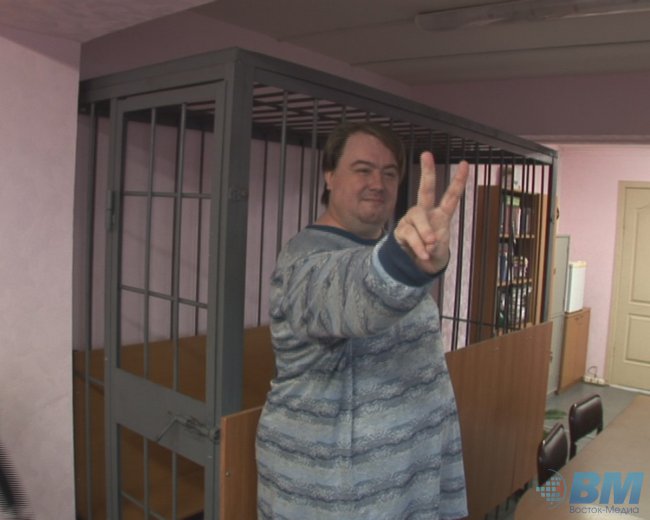
Andrei Marchenko celebrating his virtual victory in court. Photo courtesy of Vostok-Media

The “Gay Terrorist Underground” in Khabarovsk: The Case of Andrei Marchenko

Prosecutor Requests Two Years in Open Penal Settlement for Khabarovsk Blogger Marchenko
September 28, 2015
Grani.Ru

Prosecutor Olesya Demina has asked Khabarovsk’s Industrial District Court to sentence blogger and LGBT activist Andrei Marchenko to two years in an open penal settlement, as reported by Grani.Ru’s correspondent from the courtroom. Marchenko has been accused of extremism for posts he made on Facebook.

andrei marchenko
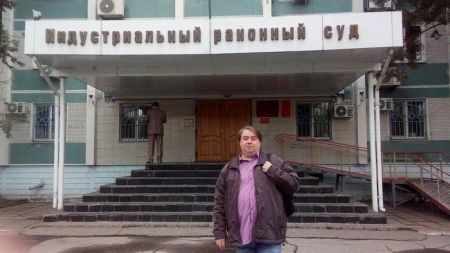
Andrei Marchenko outside of Industrial District Court in Khabarovsk. Photo by Alla Viktorova. Courtesy of Grani.Ru

During closing arguments, defense attorney Natalya Gladych drew the court’s attention to Marchenko’s positive character references, as well as the findings of a psychologist, who concluded that the defendant’s only purpose had been to draw attention to himself and to his position on the war in the east of Ukraine.

“Two years in an open penal settlement is an excessively severe punishment given that the evidence presented by the prosecution is insufficient. The prosecutor speaks of Marchenko as an out-and-out extremist, although the man was simply expressing his opinion. The harsh form in which he delivered it was due only to heightened emotionality,” said Gladych.

On Monday, the defendant was to make his closing statement, but Judge Galina Nikolayeva unexpectedly adjourned until Wednesday, September 30, when Marchenko will deliver his closing statement and the judge will return a verdict.

“I did not expect that the prosecution would request real prison time. There is not a single injured party in the case. There is only the one sentence on Facebook, which did not lead to any real consequences. And for this the representative of the state machine asks the court to sentence me to real prison time,” Marchenko commented to Grani.ru after the hearing.

Marchenko has pleaded not guilty and hopes for an acquittal.

On June 8, 2014, Trinity Sunday, Marchenko published a post on Facebook dealing with the events in the east of Ukraine.

“Impale all the terrorists!!!!!!!!” he wrote. “Kill all of them!! Blood Sunday! Free Ukraine from the fascist Russian terrorists on Trinity Sunday!”

The post was made visible only to Marchenko’s friends in the social network. Nevertheless, it was this publication that led to the blogger’s prosecution.

On August 28, 2014, FSB officers carried out a search at Marchenko’s home during which they seized all his office equipment and mobile phones. The following day, the blogger was charged at regional FSB headquarters under Article 280, Part 1 of the Criminal Code (public incitement to extremism)

andrei marchenko-2
Andrei Marchenko. Photo courtesy of amurburg.ru

A week before the raid, the blogger had also been summoned to regional FSB headquarters. There he was shown screenshots of a certain site according to which Marchenko and another Khabarovsk LGBT activist, Alexander Yermoshkin, were the founders and masterminds of a “gay terrorist underground” that were pursuing the goal of organizing an “orange revolution” in Khabarovsk. As Marchenko noted, the FSB investigator was “utterly serious.” Marchenko was then asked why he did not like “Novorossiya.” He was told that his numerous posts in support of Ukraine and criticizing the Kremlin were the reason for the FSB’s concern.

On September 11, 2014, another five phrases from Marchenko’s summertime posts were sent off for forensic examination.

“Including phrases in support of Poroshenko and phrases about the fact that prices are higher but Crimea is ours,” wrote the blogger.

Two weeks later, it transpired that Rosfinmonitoring had placed Marchenko on its list of terrorists and extremists. However, the blogger kept his bank accounts only for withdrawing money he earned through official freelance bureaus from the WebMoney system. For many years, these earnings had been Marchenko’s only source of income. Thus, Rosfinmonitoring’s decision left the activist penniless.

“Now I don’t even have money for groceries,” wrote Marchenko.

The blogger expressed bewilderment at his inclusion in the list, noting that the court had not yet deemed him either a terrorist or an extremist.

On December 30, 2014, final charges were filed against Marchenko.

Translated by the Russian Reader

NB. Grani.Ru, the opposition news and commentary website that published this article about Andrei Marchenko’s plight is itself banned in Russia as “extremist” and can only be viewed there through VPNs, anonymizers, and mirror sites.

Update. According to an article on the news website Vostok-Media, on October 1, 2015, the Industrial District Court in Khabarovsk found Andrei Marchenko guilty as charged and sentenced him to a fine of 100,000 rubles, but immediately amnestied him as part of a general amnesty celebrating the seventieth anniversary of victory in the Second World War.

Andrei Marchenko celebrating his virtual victory in court. Photo courtesy of Vostok-Media

Askold Kurov: The Importance of Solidarity

Askold Kurov, filmmaker:

I have been shooting the film Release Oleg Sentsov for over a year, since Oleg was brought to Lefortovo Remand Prison in Moscow, and the first hearings in his case were held. The case is an unbelievable absurdity, an absolutely Kafkaesque story. I hope that the film will draw attention to these terrible events. Unfortunately, however, hopes for a favorable outcome, for Sentsov and Kolchenko’s acquittal, are nil.

But this does not mean we should all keep quiet and give up on attempts to do something. It is clear that the lives of Sentsov, Kolchenko, and Afanasiev hinge on people who ignore appeals from cultural figures and people’s public expressions of support for the arrested men. Maybe the appeals and protests even anger and irritate them. But sooner or latter they will have an effect. The time will come when the regime will no longer be able to hold the men hostage. Due to the fact that directors, filmmakers, and the public showed their solidarity and constantly brought up the case, the men might be freed from prison.

Source: snob.ru

_________

Alexander Kolchenko: Closing Statement in Court

“By throwing us in prison, the regime is hastening its end”
Closing statement by anarchist Alexander Kolchenko, accused of terrorism
August 19, 2015
kasparov.ru

I deny the charges of terrorism. This criminal case was fabricated and politically motivated. This is borne out by the fact that a criminal arson case was filed only ten days after the arson itself under [Russian Federal Criminal Code] Article 167 (“Intentional damage and destruction of property by means of arson”) and was changed to a terrorism case only on May 13, after [Gennady] Afanasiev and [Alexei] Chirniy were detained, and the necessary testimony had been obtained from them.

1438171138-7230-sentsov-i-kolchenkoOleg Sentsov and Alexander Kolchenko

As regards the wording used by the investigation and the prosecution [in their formal charges against Kolchenko], it is really remarkable: “[The accused] committed accessory to arson in order to destabilize the authorities of the Republic of Crimea with the aim of influencing the decisions of Russian Federation authorities on the withdrawal of the Republic of Crimea from [the Russian Federation].”

In keeping with the prosecution’s line of thinking, if you use contraceptives, your objective is destabilizing the demographic situation in the country and the country’s defensive capabilities as a whole. If you criticize an official, you do this in order to undermine your country’s image in the international arena.

The list of such assertions is potentially endless.

During the trial itself, we had the chance to hear about the use of threats and torture against [Oleg] Sentsov and Afanasiev by FSB officers.

Interestingly enough, the people who use such methods to obtain testimony do not hesitate to accuse us of terrorism.

The Bolotnaya Square trial in several acts, the trial of Alexei Sutuga, the trial of Ilya Romanov, our trial, and the trial of [Nadiya] Savchenko all have the aim of extending this regime’s time in power. But, by throwing us in prison, this regime hastens its end, and people who only yesterday believed in law and order, are today losing this faith as they observe such trials. And tomorrow or the day after tomorrow, these people, who are part of that selfsame eighty-six percent [of Russians, who, allegedly, according to Russian pollsters, support Putin] will demolish this authoritarian regime.

I also want to note that in Afanasiev’s affidavit [a letter that he wrote from Remand Prison No. 4 in Rostov-on-Don and which defense attorney Dmitry Dinze read aloud during closing arguments—Kasparov.ru], it says that an FSB officer told Afanasiev that the day when he testified in court would be the most important day of his life. Apparently, Afanasiev took these words to heart, and in his own way. I was amazed by this gutsy, strong deed of his.

I would also like to thank those who have supported Oleg and me.

I agree with the arguments of our attorney. I consider them reasonable and fair, and I will not ask the court for anything.

____________

On August 19, 2015, the Russian prosecutor asked a military court to sentence Alexander Kolchenko to twelve years in prison, and his co-defendant, filmmaker Oleg Sentsov, to twenty-three years in prison. The verdict is scheduled to be read out in Rostov-on-Don, where the trial has been taking place, on August 25.

Read more about the Sentsov-Kolchenko case:

Translated by The Russian Reader. Photo courtesy of Unian.net

Alexander Kolchenko: The “Terrorist” from Simferopol

The “Terrorist” from Simferopol
On April 9, Moscow City Court Ordered Alexander Kolchenko’s Arrest Extended for a Month, until May 16
Dmitry Okrest
April 13, 2015
The New Times

According to the FSB, Alexander Kolchenko is a member of the anti-Russian underground in Crimea. Along with three other arrested residents of the peninsula, he has been accused of terrorism. The New Times has tried to find out what the charges are based on (it took nearly a year to gather the evidence), how the Russian security services took over Crimea, and what residents of Simferopol think about the relatives of the arrestees.

kolchenko3_1

Alexander Kolchenko

“Sasha is now accused of terrorism, but he is not a terrorist, and I am not the mother of a terrorist,” says Larisa Kolchenko. “My son literally grew up in front of my coworkers, and after his arrest they have continued to treat me well.”

Larisa Kolchenko works in a grocery store near the Simferopol railway station. She speaks softly and quickly.

“In fact, the arson of which they are accused basically, you could say, left no trace on the city. It popped up in the news once, and that was it. There was no discussion, no publicity.”

The arson at the Russian Community of Crimea building, on the night of April 14, 2014, damaged the front door, the stoop, and an awning above the door. A few days later, a Molotov cocktail flew through the window of the United Russian party’s local office. The fire damage caused to a five-meter-square kitchen in the office was estimated at 200,000 rubles. Doesn’t that sound more like disorderly conduct?

On March 31, 2015, however, Kolchenko was accused of involvement in a terrorist network and committing a terrorist attack. It was then that solidarity actions in support of Kolchenko were held, under the slogan “Send Tundra Back to Crimea,” in Berlin, Bremen, Kyiv, Minsk, Paris, Strasbourg, and Tunis. “Tundra” is Kolchenko’s nickname within the peninsula’s activist scene.

“Only those who cooperate are allowed visits”

According to the FSB, the leader of the Bandera underground in Crimea is filmmaker Oleg Sentsov, who along with Alexei Chirniy, a lecturer in the military history department at the Crimean University of Culture, has been charged with violating Article 205 Part 2 of the Russian Federal Criminal Code (“Terrorist attacks”) and Article 205.4 Part 2 (“Organizing a terrorist network”). In early February, Sentsov was additionally charged under Article 222 Part 3 (“Arms trafficking”).

Before his arrest, Chirniy pursued the hobby of reconstructing medieval armor, considered himself a pagan, and posted Nazi propaganda posters on social networks. A court-appointed attorney is now defending him, and his case will be heard in the military district court in Rostov-on-Don by special procedure. [Translator’s Note: On April 21, 2014, after this article went to press, Chirniy was sentenced to seven years in a maximum-security facility.]

Besides damaging the two offices, the “Sentsov gang” has been accused of planning to blow up the Eternal Flame and a Lenin monument on May 9, 2014. According to the security services, the suspects were also planning to “destroy a number of vital infrastructure sites, railway bridges, and power lines.”

On May 8, 2014, Gennady Afanasiev, an employee of the Zheleznodorozhny District prosecutor’s office in Simferopol, made a deal with the investigation. Afanasiev was tried by special procedure—meaning, without court proceedings, which entitles the defendant to mitigation of punishment. On December 25, 2014, Afanasiev was sentenced to seven years in a maximum-security facility.

Sentsov has denied the charges against him. Kolchenko has admitted he was near the office but was not involved in the attack. He has refused to testify against the others. If Sentsov and Kolchenko are found guilty, they could be sent away for twenty years. Afanasiev and Chirniy will be main witnesses for the prosecution at their trial.

The prosecution alleges that Kolchenko met with Sentsov “at mass events of supporters of Crimea’s being a part of Ukraine,” at which the filmmaker allegedly suggested organizing a gang “for performing attacks in keeping with the Right Sector ideology.” According to the FSB, this gang was to destabilize the work of the newly created authorities “in order to encourage them to decide to withdraw the Republic of Crimea from the Russian Federation.”

Despite the gravity of the charges, nearly all of Kolchenko’s letters begin with the words, “I am still doing well.” He labels the arson a symbolic gesture of protest, rather than an attempt to “intimidate the population of Crimea,” and stresses that at midnight the building was empty.

“I was against the war, against violence. My actions were directed against the United Russia party, which voted for sending in troops,” Kolchenko writes.

In his letters, Kolchenko relates that he has been following the Bolotnaya Square case.

“Doing three and half years in prison for something like that is not really great. In that light, it is frightening to think about the sentence I can expect. I guess my prospects aren’t very bright.”

Larisa Kolchenko is worried that she has not been allowed to visit Alexander.

“They explain that since he refuses to cooperate, there is no reason for his family to talk with him. Visits are allowed to those who cooperate.”

“People in Simferopol won’t understand”

“At school, my son was a justice seeker,” says Larisa. “His heart bled for all of Crimea, and he was involved literally in everything.”

Kolchenko ended up in the radical left crowd because of hardcore music, which he became interested in while still at school. He went on archaeological digs, and marched under the red-and-black banners of the anarchists during demonstrations. He organized a protest campaign against construction of a transport terminal on the Black Sea, and was among the founders of the union Student Action, which fought against the monetization of education in Ukraine. (The nationwide rallies against monetization kicked off in Simferopol.) Later, he advised striking employees at Crimea Trolleybus.

“We literally supported him in everything,” says Kolchenko’s mother. “But when he was planning to go to Euromaidan, and was literally standing in the door with his backpack on, I rushed to him and tried to discourage him from going. I told him that people were being killed in the square [in Kyiv], and that people in Simferopol won’t understand.”

According to Kolchenko’s defense attorney, Svetlana Sidorkina, as an activist, Kolchenko had long been in the works among the security services.

“He has never been afraid of voicing his dissatisfaction. He has always openly advertised his position,” says Larisa Kolchenko.

When the so-called Russian Spring began, Kolchenko opposed the annexation. His mother agreed with him: she refused to vote in the referendum. Not all of Larisa’s kith and kin abided by her stance. Several relatives have ceased communicating with Kolchenko’s family.

“Russia has come: we’re going to act tougher”

“Sasha is a committed antifascist. Every year, he would organize a picket in memory of the murdered lawyer Stanislav Markelov and murdered journalist Anastasia Baburova. She was a local girl, after all, from Sevastopol,” says Larisa Kolchenko. “But now my son has been accused of being a member of Right Sector.”

“The activists were not and are not members of the Right Sector political party,” the press service of the organization, which is banned in Russia, has said in response. “However, we demand their immediate release and an end to political terror in the occupied territory.”

Later, Kolchenko’s defense sent a formal request directly to Right Sector, and got the same answer.

“But it is doubtful whether this is enough for a Russian court,” says Larisa Kolchenko. “Thank God, this absurd accusation played no role for people in Crimea. When we were collecting character references for the court, the attitude to him at the university was still good. At the printing plant where he worked as a freight handler, which did not move to the mainland until after the referendum, his colleagues said the accusation was unfair.”

It is difficult to suspect Kolchenko of being sympathetic to nationalists. In 2012, thirty rightwing radicals assaulted Tundra and three comrades after a screening of a film about Baburova.

Since Kolchenko has been arrested, no Ukrainian officials have attempted to contact him. This worries his mother.

“They seemed to have forgotten about the detainees,” Larisa Kolchenko says.

The Ukrainian Consul in Moscow has not visited the suspects. Russia has declared the men its citizens, but on February 4, 2015, the Russian Prosecutor General suddenly determined that Sentsov had dual citizenship. However, a judge rejected Kolchenko’s lawsuit against the Russian Federal Migration Service after an FMS employee provided the court with a passport request form containing Kolchenko’s information and his alleged signature. The defense now plans to a have a handwriting analysis of the document performed.

“He was forcibly made the citizen of another country,” says Kolchenko’s mother. “He did not fill out any forms.”

In turn, the State Migration Service of Ukraine confirmed Kolchenko’s Ukrainian citizenship in February, and on March 27, 2015, the Kyiv Prosecutor’s Office finally opened a case in the abduction of Ukrainian citizen Alexander Kolchenko. Svetlana Sidorkina said her client has sent a complaint to the European Court of Human Rights against Russian citizenship forcibly having been conferred on him.

When the new academic year began, many Crimean universities were missing students, who had left to complete their studies in Ukraine.

“Some people with whom I was friendly on the civic activism front have shoved off,” says Anton Trofimov, a lecturer in philosophy at the College of Taurida National University. “I even wondered: have all the problems ended? Is the environment no longer a matter of concern?”

Trofimov is an organizer of the carnivalesque Monstration marches, and he cofounded the student union with Kolchenko.

“In the end, a lot of friends have left, and for good reason,” says Trofimov. “FSB officers—former Ukrainian SBU security officers—have paid me a visit as well. They warned me, ‘Russia has come, and we’re going act differently, we’re going act tougher—in accordance with Russian laws.’”

“Sasha also wanted to leave,” says his mother. “But we tried to dissuade him. I didn’t want to let him go far away. We were all afraid—but of the wrong thing!”

A geography major, Kolchenko was deciding between Uzhgorod University and Lviv University, but on May 23, 2014, he was transferred to the Lefortovo remand prison in Moscow.

A friend of Kolchenko, who introduced himself as Roman, explains the cause of the crackdown.

“Throughout the spring, [pro-Russian forces] frightened the people with talk about the militants from Maidan. Except for the Tatars, no one stood up for themselves, and the authorities needed to show that the threat was still real.”

“After the arrest of the first four guys from the pro-Ukrainian movement, the FSB began conducting ‘preventive’ conversations with everyone else,” says Maxim Osadchuk, a history lecturer and buddy of Kolchenko from the leftist movement. “Almost all my friends who had anything to do with public life have left. The question of whether to emigrate or go underground and risk arrest became critical.”

Osadchuk himself left Crimea several days before the referendum and is now fighting as part of the Aydar Battalion.

Osadchuk believes the arrest of the four men was a warning to the remaining activists on the peninsula to curb their enthusiasm.

“Through threats and exhortations we were strongly advised either to leave Crimea or curtail all activism.”

“Luxury items like bouillon cubes and ketchup”

Kolchenko does not complain and is extremely laconic.

In a letter from the remand prison, he writes, “My cellmate and I have amassed so many goodies they will last us for a month. But the goodies are not as tasty as they would seem on the outside.”

In another letter, he writes, “My appetite has slumped here: the cafeteria food is quite enough for me.”

But he dreams of getting his hands on popular science magazines, and “luxury items like bouillon cubes and ketchup.”

Kolchenko has been studying Lenin, Marx, Fromm, and Ivan Franko, the last of whom he read in Ukrainian. He regrets that his familiarization with Russia has begun at a remand prison, and in one of his letters, he shares his impressions of Leo Tolstoy’s current affairs writings: “A typical extremist. Nowadays, they would probably charge him under Article 280.”*

In the letter, he quotes Tolstoy’s essay “The End of the Age”: “What will happen to Russia? Russia? Where is its beginning or its end? […] The Caucasus with all its nationalities? The Kazan Tatars? Ferghana Province? The Amur? […] The circumstance that all these nationalities are regarded as parts of Russia is an accidental and temporary one. […] whilst in the present this combination is maintained only by the power which spreads over these nationalities.”

* Article 280.1 of the Russian Federal Criminal Code, “Public calls for action aimed at violating the territorial integrity of the Russian Federation.”

__________

Editor’s Note. For more information about Alexander Kolchenko’s plight and how you can support him, see the Ukraine Solidarity Campaign’s page on the case (in English) and Autonomous Action’s compilation of articles about the case (in Russian). You can also follow events in the case via the Free Aleksandr Kolchenko Facebook page (mostly in Russian) and read this article (in English) about the political context of the case. Image, above, courtesy of Libcom.org.

Translated by The Russian Reader. Anyone has permission to republish this and any other of the translations or original texts found on this blog, but please acknowledge the blog explicitly in your reposts, and provide a clearly indicated URL link back to the original publication.