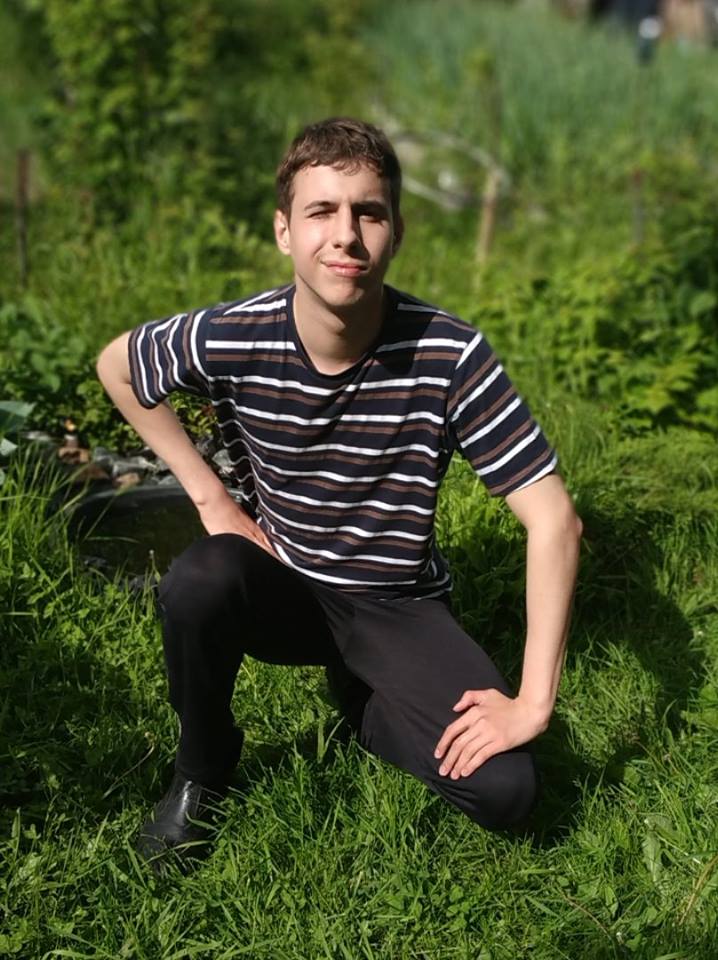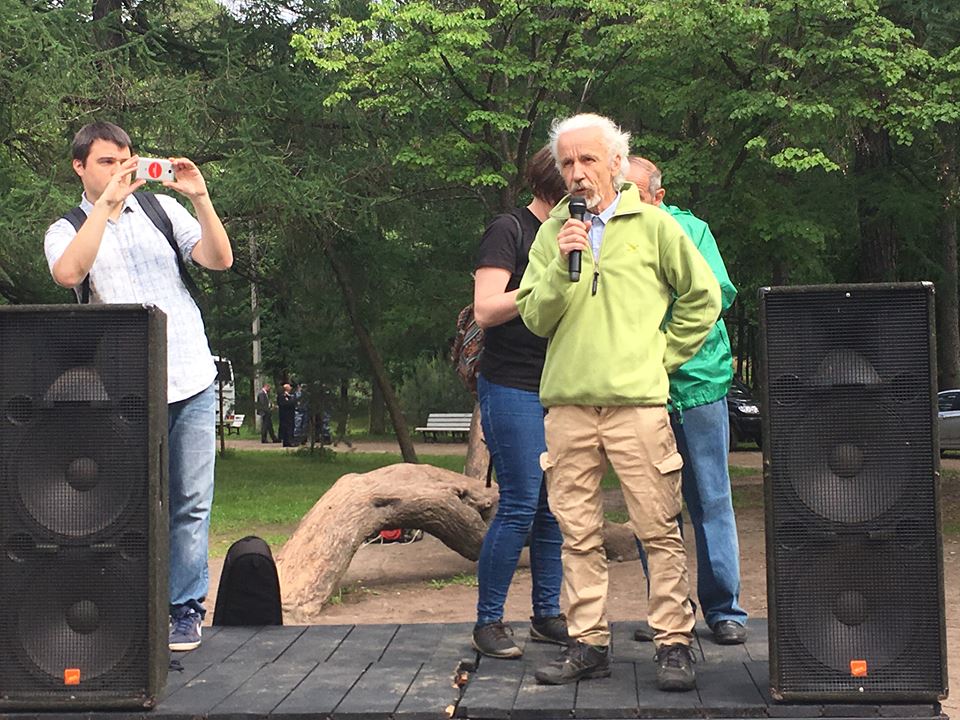
This Is Mikhail Gerasimov from Nizhny Novgorod

gerasimovMikhail Gerasimov. Photo courtesy of his personal page on VK and OVD Info

This is Mikhail Gerasimov from Nizhny Novgorod. He is eighteen. Yesterday, FSB officers came to the young man’s house, took him in for questioning, and arrested him.

Mikhail photographed two pages from the investigator’s warrant and sent them to a friend. Mikhail also managed to call the Political Red Cross and tell them the FSB wants to level criminal charges against him for ten posts on social networks, all of them published prior to [sic] December 2016. It was then, according to Mikhail, that he learned about [Alexei] Navalny and changed his views.

One of the two pages of the warrant refers to a forensic examination of an entry from Mikhal’s personal social media page.

The entry opens with the phrase, “Are you tried of this Moskaland?” It ends with the phrase, “There those Rus[expletive deleted] got what was coming.”

The forensic examination concluded the phrase contained an incitement to physically destroy the legal authorities and justified destructive actions that the author [sic] attributed to ISIS: the crash of a Tupolev Tu-154 [Russian Defense Ministry] jetliner [in 2016] and the murder of the Russian Ambassador to Turkey.

A criminal investigation has been opened into whether Gerasimov made public calls for terrorist attacks or justified terrorism on the internet [punishable by up to seven years in prison under Article 205.2 Part 2 of the Russian Federal Criminal Code].

Today at 2:00 p.m., the Moscow District Court in Nizhny Novgorod will decide whether to remand Gerasimov in custody.

Source: OVD Info’s Facebook page. Read their full story here. Translated by the Russian Reader

Leonid Volkov: The List

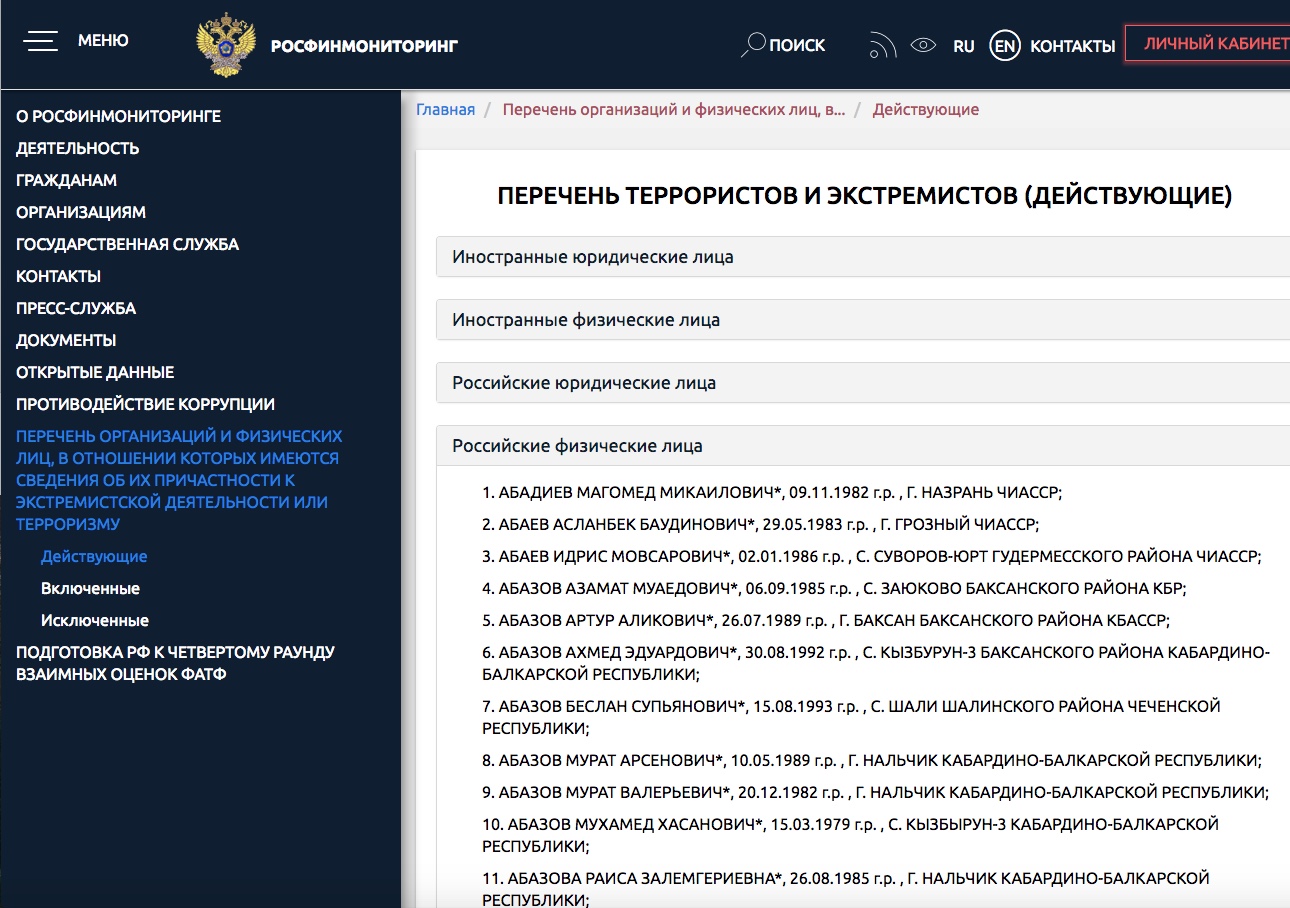
list-2.jpegA screenshot of Rosfinmonitoring’s list of “extremists” (5 August 2018)

Leonid Volkov
Facebook
August 3, 2018

I hadn’t come across this subject before, but it’s completely hellish. It has to do with the conveyor belt of arrests in Barnaul of people who posted memes on social networks. By the by, you read that each of these people, who has been charged with “extremism” for posting funny pictures on VK, is placed on Rosfinmonitoring’s list of people who are, allegedly, accomplices to terrorists.

The list is no joke at all. All your bank accounts and bank cards are blocked, and you cannot open new accounts and get new bank cards. No one can transfer money to you. You cannot be employed anywhere. You cannot take out more than 10,000 rubles [approx. 136 euros] in cash per month from own bank account, so go ahead and live high on the hog.

The kicker is that people are placed on the list without a court order. So, you are charged with a crime and you wind up on the list.

I took a glance at the list: there are 8,507 people on it. Eight thousand five hundred and seven people.* The list really does include “5203. Motuznaya, Maria Sergeyevna, born 26.8.1994, Barnaul, Altai Territory.” Maria Motuznaya is the young woman who broke the story about the Center “E” officers and their informers in Altai Territory.

Of course, Rosfinmonitoring could definitely not care less about the laws on personal information. While you are tortured and fined, they quietly hang you out to dry on their list.

By the way, the list is called the “List of Persons about Whom There is Information of Their Involvement in Extremism or Terrorism,” and its URL is even more telling: http://www.fedsfm.ru/documents/terrorists-catalog-portal-act. So, a state agency, Rosfinmonitoring, labels 8,507 people “terrorists” just like that. It is obvious the majority of them have been placed on the list in the absence of a court ruling, because even when you take into account all the “terrorists” the FSB has dreamt up, actual terrorist cases have probably not amounted to a tenth of this number.

If you’ve been added to the list, there’s no going back. The web page containing the list also features a list of people who have been removed from the list: there are fourten such people.  I don’t know whether this is the number of people who have been removed from the list since it was established or over the last year. In any case, it is less than 0.2% of 8,507.

It’s probably no coincidence the number of acquittals in Russian courts is roughly the same percentage.

Anyone can end up on the list merely for posting a meme. There is no investigation, no trial, no explanations. Wham! Just like that you’re a “terrorist,” a lowlife excluded from modern society.

It’s a horrible thing.

* Since Mr. Volkov wrote this post, two days ago, Rosfinmonitoring seems to have added another nine people to the list.

Leonid Volkov is project manager at Navalny’s Team. Thanks to Yevegnia Litvinova for the heads-up. Translated by the Russian Reader

Two More Suspects Detained in Network Case

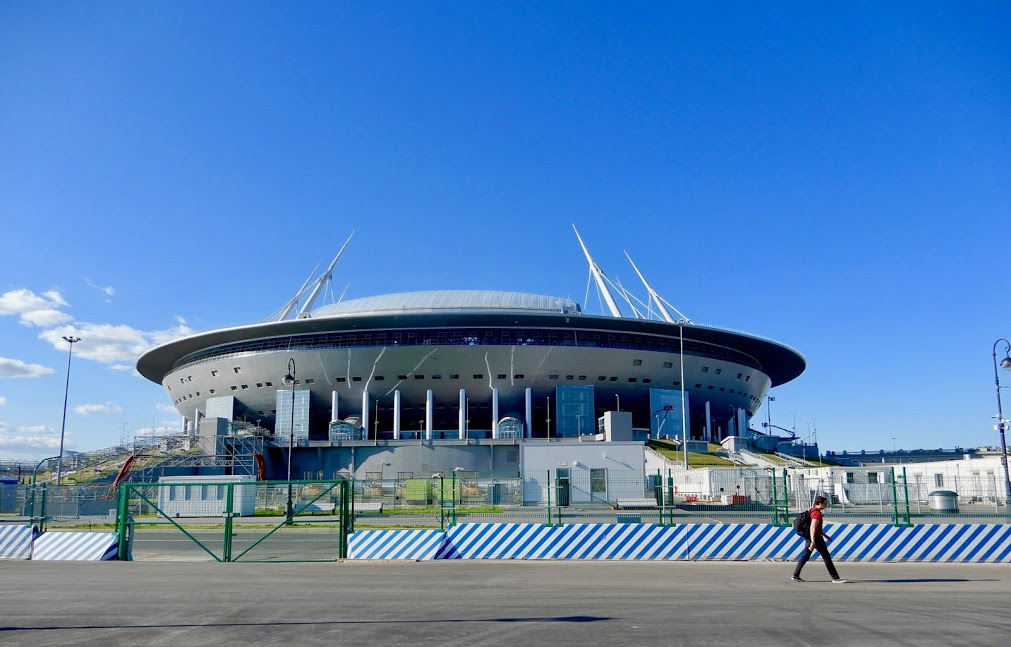
krestovsky stadiumThe members of the wholly mythical terrorist organization the Network have been accused by the FSB of planning to disrupt the March presidential elections and this summer’s World Cup in order to foment rebellion among the hoi polloi. These accusations would be hilarious if they were not served up with heavy helpings of torture, intimidation, and incarceration. Photo of Krestovsky Stadium in Petersburg, a World Cup venue, by the Russian Reader

Two Suspects Detained in Network Case
OVD Info
July 5, 2018

Mikhail Kulkov and Maxim Ivankin, two suspects in the so-called Network Case, have been detained and placed in police custody, OVD Info has learned from Yelena Bogatova, the mother of Ilya Shakursky, another suspect in the case.

The Lenin District Court in Penza has remanded Kulkov and Ivankin in custody until September.

Bogatova had been waiting for a lawyer outside the Penza Remand Prison when Ivankin and Kulkov were brought there. According to her, their parents learned of their arrests on July 4. Their custody hearings took place at 2 p.m. on July 5.

Alexei Kulkov, Mikhail Kulkov’s father, told OVD Info the young men had been detained in Moscow without IDs. Penza’s Lenin District Court has remanded them in custody until September 18. Mr. Kulkov reported that his son and Maxim Kulkin have been charged with organizing a “terrorist community.”  He said he saw the two young men for several minutes in the courthouse as they were escorted down the hallway. He noticed they had black eyes and bruises on their bodies.

Previously, Ivankin and Kulkov were detained in Penza in March 2017 along with antifascist Alexei Poltavets. They were initially charged with drugs possession. According to Poltavets, after they were detained, Russian Federal Security Service (FSB) officers tortured and beat them, demanding they testify against their friends in the antifascist scene. Poltavets later left Russia and had not seen Ivankin and Kulkov since then.

In June 2018, it transpired that Ivankin and Kulkov’s case had been combined with the investigation of the so-called Network, an organization that FSB investigators claim is a terrorist group. Ivankin and Kulkov have been charged with planning to produce or sell drugs in large quantities (Russian Criminal Code Article 228.1 Part 4 Paragraph G and Article 30 Part 3).

In the criminal case files, Ivankin, Kulkov, and Poltavets are identified both by their real names and the pseudonyms Redhead, Ilya, and Boris.

It transpired on July 4 that another suspect in the Network Case, Dmitry Pchelintsev, had been transferred from Penza Remand Prison No. 1, most likely to St. Petersburg.

On May 23, a friend of the accused, Victoria Frolova, was detained at the Russian-Ukrainian border. She was forced to testify against her Penza friends, including Ivankin and Kulkov. In her signed statement, Ivankin and Kulkov are identified as members of the 5.11 (“November Fifth”) cell of the Network. According to FSB investigators, all members of the Network trained with sticks in the woods, practice orienteering and first aid, and learned to set traps.

In the autumn of 2017, five young men were arrested in Penza: Yegor Zorin, Ilya Shakursky, Dmitry Pchelintsev, Vasily Kuksov, and Andrei Chernov. Arman Sagynbayev was detained in St. Petersburg and extradited to Penza. All of them were charged with involvement in a “terrorist” community. The FSB claimed the young young were involved in a terrorist organization known as the Network, whose cells, allegedly, existed in Moscow, Petersburg, Penza, and Belarus. The accused men gave accounts of mental coercion, electrical shock torture, and being hung upside down by FSB officers, as well as their planting weapons in the men’s cars and flats.

Later, several of the suspects renounced their confessions, saying they had been given under torture.

Besides the six suspects jailed in Penza, there are three more young men who have been charged with involvedment in the Network who have been remanded in custody in Petersburg. They are Viktor Filinkov and Igor Shishkin, on whose bodies human rights activists found physical traces of their having been tortured, and Yuli Boyarshinov, originally accused of illegal possession of explosive substances. Later, investigators tried to force him to testifying against the men accused in the Network Case and charged him with the same offenses.

Translated by the Russian Reader

***************

What can you do to support the Penza and Petersburg antifascists and anarchists tortured and imprisoned by the FSB?

  • Donate money to the Anarchist Black Cross via PayPal (abc-msk@riseup.net). Make sure to specify your donation is earmarked for “Rupression.”
  • Spread the word about the Network Case aka the Penza-Petersburg “terrorism” case. You can find more information about the case and in-depth articles translated into English on this website (see below), rupression.com, and openDemocracyRussia.
  • Organize solidarity events where you live to raise money and publicize the plight of the tortured Penza and Petersburg antifascists. Go to the website It’s Going Down to find printable posters and flyers you can download. You can also read more about the case there.
  • If you have the time and means to design, produce, and sell solidarity merchandise, please write to rupression@protonmail.com.
  • Write letters and postcards to the prisoners. Letters and postcards must be written in Russian or translated into Russian. You can find the addresses of the prisoners here.
  • Design a solidarity postcard that can be printed and used by others to send messages of support to the prisoners. Send your ideas to rupression@protonmail.com.
  • Write letters of support to the prisoners’ loved ones via rupression@protonmail.com.
  • Translate the articles and information at rupression.com and this website into languages other than Russian and English, and publish your translations on social media and your own websites and blogs.
  • If you know someone famous, ask them to record a solidarity video, write an op-ed piece for a mainstream newspaper or write letters to the prisoners.
  • If you know someone who is a print, internet, TV or radio journalist, encourage them to write an article or broadcast a report about the case. Write to rupression@protonmail.com or the email listed on this website, and we will be happy to arrange interviews and provide additional information.
  • It is extremely important this case break into the mainstream media both in Russia and abroad. Despite their apparent brashness, the FSB and their ilk do not like publicity. The more publicity the case receives, the safer our comrades will be in remand prison from violence at the hands of prison stooges and torture at the hands of the FSB, and the more likely the Russian authorities will be to drop the case altogether or release the defendants for time served if the case ever does go to trial.
  • Why? Because the case is a complete frame-up, based on testimony obtained under torture and mental duress. When the complaints filed by the accused reach the European Court of Human Rights in Strasbourg and are examined by actual judges, the Russian government will again be forced to pay heavy fines for its cruel mockery of justice.

***************

If you have not been following the Penza-Petersburg “terrorism” case and other recent cases involving frame-ups, torture, and violent intimidation by the Russian Federal Security Service (FSB) and other arms of the Russian police state, read and republish the recent articles the Russian Reader has posted on these subjects.

Valery Rashkin: The Return of the Oprichniki

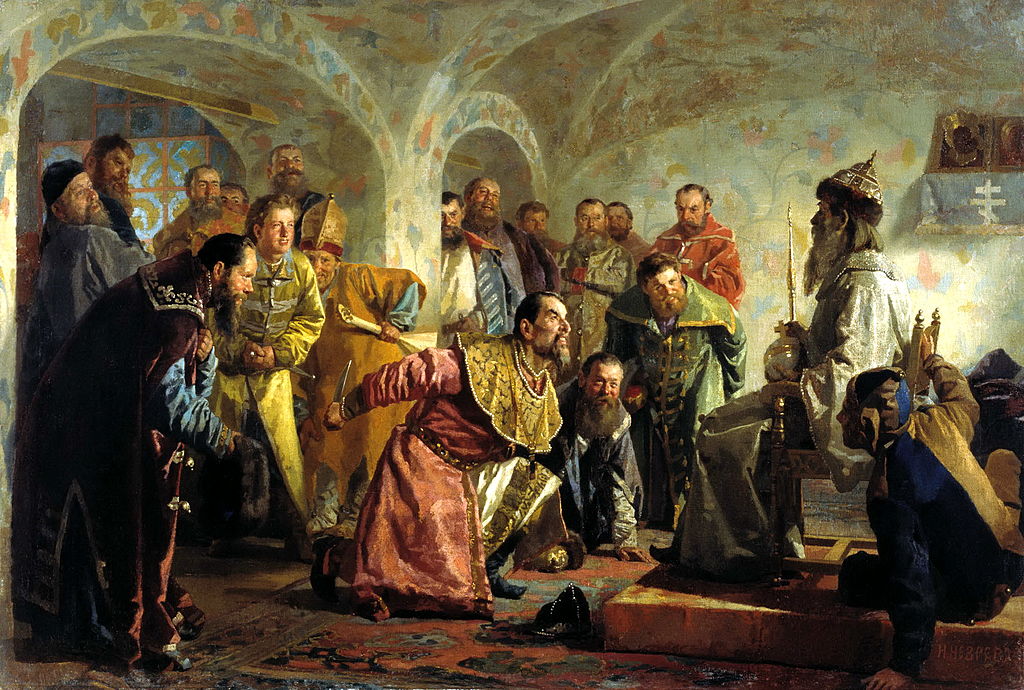
1024px-0NevrevNV_Oprichniki_BISHNikolai Nevrev, Oprichniki, 1870s. Oil on canvas, 102 cm x 152 cm. Courtesy of the Kyrgyz National Museum of Fine Arts. Image courtesy of Wikimedia Commons

Pillaging the Opposition
Valery Rashkin
Echo of Moscow
June 21, 2018

The Russian Supreme Court has ruled law enforcement and secret service officers can confiscate without a court order personal property used in the commission of terrorist and “extremist” crimes. The items that can be confiscated include computers, cell phones, and office equipment. This means personal property can be seized without payment of compensation and made the property of the state.

Can you believe it? The times of Ivan the Terrible have resurfaced. Courtesy of the state, Russia’s siloviki have been transformed into oprichniki and robbers. The ruling is completely unlawful, considering what passes for “extremist” crimes. Such criminal cases are usually frame-ups. They are so absurd they make you laugh and shudder at the same time.

The state has mandated law enforcers to hark back to the old system of remuneration (kormlenie, literally, “feeding”): the more “extremism” charges you file, the more iPhones and computers you can get your hands on. It is tantamount to legalized enrichment at the opposition’s expense. Moreover, even if the person who was criminally prosecuted is pardoned, their property will not be returned.

Don’t write nasty things about the regime on the VK social network, my dears, or the regime will fleece the living daylights out of you. Given the importance and high cost of electronic communications devices in our day and age, that is what it amounts to. The top brass, apparently, has decided that if people aren’t afraid of going to jail, they will intimidate them with the threat of robbery. I wonder who hatched this humiliating plan.

The rationale of hitting people in their wallets, enacted several years ago when fines for involvement in “unauthorized” demonstrations were increased precipitously, has gone beyond legal boundaries. Nothing of the sort exists in European countries: after a criminal investigation is wrapped, the accused has their property restored to them, nor are people are tried as felons for writing posts on social networks.

Naturally, the new dispensation is useless when it comes to deterring terrorists. The risks undertaken by an individual who rigs an explosive device and plots a terrorist attack are completely incommensurable with the risks taken by someone who posts a link to a book banned by the Prosecutor General or a satirical picture. In the first case, the criminals knowingly risk their lives and could not care less what happens to their property, while in the second case people do not even realize they are breaking the law.

Considering the vagueness of the anti-“extremist” laws and the way they are liberally interpreted and employed by law enforcement, the confiscation of property belonging to so-called extremists will only exacerbate the confrontation between the security services and ordinary Russians.

The advantages of the new measure are questionable, while the harm it will cause is obvious.

Valery Rashkin is a Communist MP in the Russian State Duma. Thanks to Elena Zaharova for the heads-up. Translated by the Russian Reader

Nikolai Boyarshinov: I Hope One Day We Can Say the FSB Has Been Banned

nikolai-1Nikolai Boyarshinov, speaking at an opposition rally in Udelnyi Park, Petersburg, June 11, 2018. Photo by Jenya Kulakova

I am Nikolai, father of Yuli Boyarshinov. First, I want to share my joy with all of you. I was finally able to see my son. Only after he had been in jail five months was I allowed to speak with my son. Knowing what he had been through, I was not sure I would see the same person, but it was not like that all. Yuli was still the same kind, attentive person. Caring for others has always been his priority, caring for his parents, friends, acquaintances, and complete strangers, caring for animals and the environment. But I digress.

After Theater.Doc’s staging of Torture [at the Interior Theater in Petersburg] someone suggested I write to Putin as part of his Direct Line TV program. Although I found it quite disgusting, I wrote to him anyway.

“Esteemed Vladimir Vladimorovich! We, the citizens of Russia, are quite concerned about our own safety. We are not sure we are protected from terrorist attacks. The FSB should take care of this. Instead, the FSB abducts young men, frames them for crimes, and practices torture. It is involved everything except protecting people.”

This was followed by the particulars of my son’s case.

I don’t think we should be afraid of Islamic State, which has been banned in Russia. We have the FSB, which has been permitted in Russia. But I hope one day, when we mention the FSB, we can add that it has been banned in Russia.

I would like to thank everyone who has come out today, everyone who is not afraid to speak the truth. I really hope I will live to see my son a free man, and that my son will live to see a free Russia. Thank you.

Protest rally at Udelnyi Park, Petersburg, June 11, 2018

Source: Facebook (Jenya Kulakova)

Translated by the Russian Reader

***************

What can you do to support the Penza and Petersburg antifascists and anarchists tortured and imprisoned by the FSB?

  • Donate money to the Anarchist Black Cross via PayPal (abc-msk@riseup.net). Make sure to specify that your donation is earmarked for “Rupression.”
  • Spread the word about The Network Case aka the Penza-Petersburg “terrorism” case. You can find more information about the case and in-depth articles translated into English on this website (see below), rupression.com, and openDemocracyRussia.
  • Organize solidarity events where you live to raise money and publicize the plight of the tortured Penza and Petersburg antifascists. Go to the website It’s Going Down to find downloadable, printable posters and flyers. You can also read more about the case there.
  • If you have the time and means to design, produce, and sell solidarity merchandize, please write to rupression@protonmail.com.
  • Write letters and postcards to the prisoners. Letters and postcards must be written in Russian or translated into Russian. You canfind the addresses of the prisoners here.
  • Design a solidarity postcard that can be printed out and used by others to send messages of support to the prisoners. Send your ideas to rupression@protonmail.com.
  • Write letters of support to the prisoners’ loved ones via rupression@protonmail.com.
  • Translate the articles and information at rupression.com and this website into languages other than Russian and English, and publish your translations on social media and your own websites and blogs.
  • If you know someone famous, ask them to record a solidarity video, write an op-ed piece for a mainstream newspaper or write letters to the prisoners.
  • If you know someone who is a print, internet, TV or radio journalist, encourage them to write an article or broadcast a report about the case. Write to rupression@protonmail.com or the email listed on this website, and we will be happy to arrange interviews and provide additional information.
  • It is extremely important this case break into the mainstream media both in Russia and abroad. Despite their apparent brashness, the FSB and their ilk do not like publicity. The more publicity the case receives, the safer our comrades will be in remand prison from violence at the hands of prison stooges and torture at the hands of the FSB, and the more likely the Russian authorities will be to drop the case altogether or release the defendants for time served if the case ever does go to trial.
  • Why? Because the case is a complete frame-up, based on testimony obtained under torture. When the complaints filed by the accused reach the European Court of Human Rights in Strasbourg and are ultimately ajudicated, the Russian government will be forced to pay heavy fines for its cruel mockery of justice.

***************

If you have not been following the Penza-Petersburg “terrorism” case and other cases involving frame-ups, torture, and violent intimidation by the Russian Federal Security Service (FSB) and other arms of the Russian police state, read and repost the recent articles the Russian Reader has translated and published on these subjects.

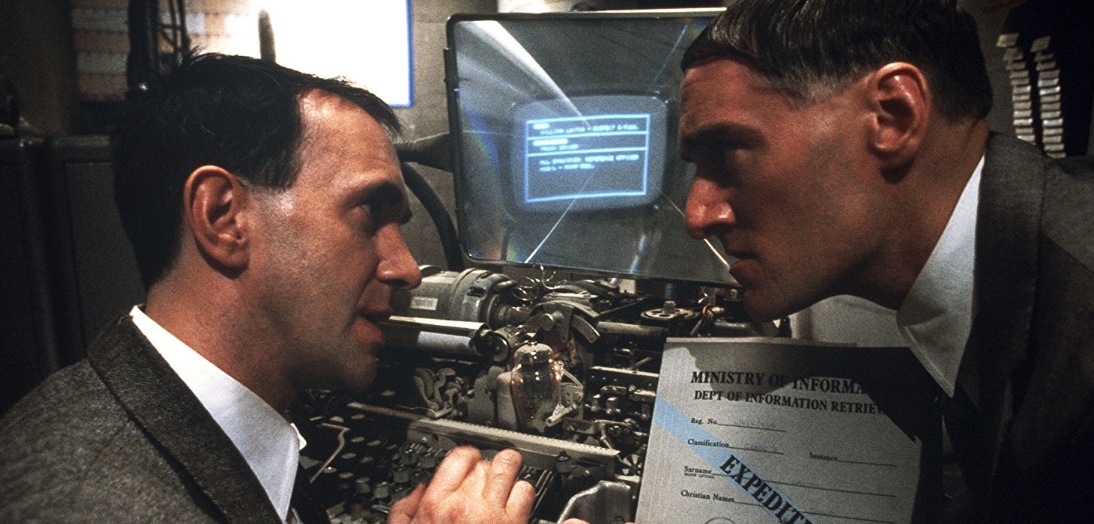
Brazil

brazil.jpegJonathan Pryce and Terry McKeown in Brazil (1985). Courtesy of imdb.com

Authorized to Remain Silent
Why We Know Nothing about the Outcome of Most Criminal Cases and Verdicts against People Who, According to the Russian Secret Services, Planned or Attempted to Carry Out Terrorist Attacks 
Alexandra Taranova
Novaya Gazeta
April 27, 2018

High-ranking officials from the Russian Federal Security Service (FSB), the Russian Interior Ministry (MVD), and the Russian National Anti-Terrorist Committee (NAK) regularly report on the effective measures against terrorism undertaken by their agencies. If we add reports of constant counter-terrorist operations in the North Caucasus, especially in Dagestan and Chechnya, operations involving shootouts and the storming of houses, we might get the impression the level of terrorism in Russia is close to critical, resembling the circumstances somewhere in Afghanistan, the only difference being that Afghanistan does not have the FSB, the MVD, and the NAK to protect it.

Over the past two weeks, there were at least two such stories in the news.

A few days ago, the FSB reported it had “impeded the criminal activity of supporters of the international terrorist organization Islamic State, who […] had begun planning high-profile terrorist attacks using firearms and improvised explosive devices.”

The FSB’s Public Relations Office specified the terrorist attacks were to be carried out in goverment buildings in Stavropol Territory.

Earlier, TASS, citing the FSB’s Public Relations Office, reported that, since the beginning of the 2018, six terrorist attacks had been prevented (including attacks in Ufa, Saratov, and Ingushetia), while three crimes of a terrorist nature had been committed (in Khabarovsk Territory, Dagestan, and Sakhalin Region), and this had been discussed at a meeting of the NAK. Other media outlets quoted FSB director Alexander Bortnikov, who claimed that last year the security services had prevented twenty-five terrorist attacks, but four attacks, alas, had gone ahead.

For the most part, however, it is impossible to verify these reports, because, with rare exceptions, the terrorists, either potential terrorists or those who, allegedly, carried out terrorist attacks, are identified by name. Neither the Russian Investigative Committee (SKR) nor the FSB informs Russians about subsequent investigations, about whether all the terrorists and their accomplices have been rounded up. Likewise, with rare exceptions, we know nothing either about court trials or verdicts handed down in those trials.

Novaya Gazeta monitored reports about prevented terrorist attacks from November 2015 to November 2017. We analyzed all the media publications on this score: the outcome of our analysis has been summarized in the table, below. The veil of secrecy makes it extremely hard to figure out what reports merely repeat each other, that is, what reports relate to one and the same events, and we have thus arrived at an overall figure for the number of such reports. Subsequently, by using media reports and court sentencing databases, we have counted the number of cases that officially resulted in court sentences.

Most news reports about prevented terrorist attacks in Russia are not followed up. For example, at one point it was reported (see below) that five people with ties to Islamic State had been apprehended in Moscow and Ingushetia for planning terrorist attacks, and this same news report mentioned that a criminal case had been launched. But only the surname of the alleged band’s leader was identified, and he was supposedly killed while he was apprehended. There is no more information about the case. Over a year later, we have no idea how the investigation ended, whether the case went to trial, and whether the trial resulted in convictions and verdicts.

Other trends also emerged.

During the two-year period we monitored, reports about prevented terrorist attacks and apprehended terrorists encompassed a particular group of Russian regions: Moscow, Crimea, Petersburg, Kazan, Rostov, Baskortostan, Volgograd, Yekaterinburg, and Krasnoyarsk. When we turn to verdicts handed down in such cases, this list narrows even further. Rostov leads the country, followed by Crimea. There are two reports each from Krasnoyarsk and Kazan, and several isolated incidents. The largest number of news reports about terrorist attacks and acts of sabotage, i.e., 30% of all the reports we compiled and analyzed, originated in Crimea.

  FSB MVD NAK Russian Security Council (Sovbez)
Number of reports of prevented terrorists, November 2015–November 2017 3,505 reports (18,560 identical reports in the media) 1,702 reports

(3,571 identical reports in the media)

492 reports

(852 identical reports in the media)

236 reports

(1,122 identical reports in the media)

Outcomes: arrests, criminal charges, verdicts, etc. 13 verdicts,

14 arrests

3 verdicts,

2 arrests

2 incidents: in one case, it was reported that all the detainees had been killed; in the other, that the detainees awaited trial, but were not identified by name. It is impossible to find out what happened to any detainees, since no information was provided about them. The exception is Lenur Islyamov, who is currently at large and vigorously pursuing his objectives.

The Triumps of the Special Services with No Follow-Up
Here are the most revealing examples.

On November 12, 2016, RBC reported the security services had apprehended a group of ten terrorists, migrants from Central Asia. According to the FSB, they planned “high-profile terrorist attacks” in heavily congested areas of Moscow and Petersburg. Officials confiscated four homemade bombs, firearms, ammunition, and communications devices from the militants. The FSB claimed all the detainees had confessed to their crimes.

In the same news report, the FSB was quoted as having reported that on October 23, 2016 “there occurred an attack on police officers, during which two alleged terrorists were shot dead” in Nizhny Novgorod. The report stressed that, three days later, the banned group ISIL claimed responsibility for the attack, just as it had taken responsibility for an attack on a traffic police post in Moscow Region on August 18, 2016.

There were no names and no details. The outcomes of the investigations, the plight of the detainees, and judicial rulings were never made public, nor did state investigators or defense counsel share any information.

This same RBC article mentions that, four days before the alleged incident in Nizhny Novgorod, the SKR had reported the apprehension of an ISIL supporter who had been planning a terrorist attack at a factory in Kazan, while Interfax‘s sources reported the apprehension of a man who had been planning a terrorist attack in Samara.  It was also reported that in early May 2016 the FSB had reported the apprehension of Russian nationals in Krasnoyarsk who were “linked to international terrorist organizations and had planned a terrorist attack during the May holidays.”

No names were mentioned at the time. Later, however, details of the case were made public.

Thus, on April 7, 2017, Tatar Inform News Agency reported that the Volga District Military Court in Kazan had handed down a verdict in the case of Robert Sakhiyev. He was found guilty of attempting to establish a terrorist cell in Kazan. The first report that a terrorist attack had been planned at an aviation plant in Kazan was supplied by Artyom Khokhorin, Interior Minister of Tatarstan, during a meeting of MVD heads. According to police investigators, Sakhiyev had been in close contact with a certain Sukhrob Baltabayev, who was allegedly on the international wanted list for involvement in an illegal armed group. Using a smartphone, Sakhiyev had supposedly studied the plant’s layout via a satellite image.

On August 2, 2017, RIA Novosti reported that a visting collegium of judges from the Far East District Military Court in Krasnoyarsk had sentenced Zh.Zh. Mirzayev, M.M. Abdullayev, and Zh.A. Abdusamatov for planning a terrorist attack in Krasnoyarsk in May 2016 during Victory Day celebrations. Mirzayev was sentenced to 18 years in prison; Abdullayev, to 11 years in prison; and Abdusamatov, to 11 years in a maximum security penal colony. According to investigators, Mirzayev worked as a shuttle bus driver in Krasnoyarsk and maintained contact with Islamic State via the internet. Mirzayev decided to carry out a terrorist attack by blowing up a shuttle bus.

On January 26, 2017, TASS reported the police and FSB had identified a group of eight people planning terrorist attacks in Moscow in the run-up to State Duma elections. Oleg Baranov, chief of the Moscow police, had reported on the incident at an expanded collegium of the MVD’s Main Moscow Directorate.

We know nothing more about what happened to the “identified” would-be terrorists.

On January 31, 2017, RBC issued a bulletin that the Russian secret services had prevented an attempt to carry out terrorist attacks in Moscow during the 2016 Ice Hockey World Championships. The source of the news was Igor Kulyagin, deputy head of staff at the NAK. The militants were allegedly detained on May 2.

“We succeed in catching them as a result of a vigorous investigative and search operation in the city of Moscow,” the FSB added.

The names of the militants were not reported nor was there any news about an investigation and trial.

In the same news item, Mr. Kulyagin is quoted as saying, “In total, Russian special services prevented around [sic] 40 terrorist attacks, liquidated [sic] about [sic] 140 militants and 24 underground leaders, and apprehended about [sic] 900 people in 2016.”

According to Mr. Kulyagin, in Ingushetia on November 14, 2016, the authorities uncovered five militants who “had been planning terrorist attacks in crowded places during the New Year’s holidays, including near the French Embassy in Moscow.”

Again, the reading public was not provided with any names or information about the progress of the investigation. The only alleged terrorist who was identified was Rustam Aselderov, who had been murdered.

“According to the special services, [Aselderov] was involved in terrorist attacks in Volgograd in 2013 and Makhachkala in 2011.”

We have no idea whether an official investigation of his murder was ever carried out.

Lenta.Ru reported on February 1, 2017, that FSB officers in Krasnodar Territory had prevented a terrorist attack. The supposed terrorists had planned an explosion at New Year’s celebrations. A possible perpetrator of the terrorist attack, a 38-year-old native of a Northern Caucasus republic, was apprehended. No other particulars of the incident were reported, and they still have not been made public to this day.

On October 2, 2017, Russia Today, citing the FSB, reported an IS cell had been apprehended in Moscow Region. Its members has allegedly planned to carry out “high-profile terrorist attacks” in crowded places, including public transport. The FSB added that foreign emissaries had led the cell, whose members had included Russian nationals.

No names or details were subsequently provided to the public.

The same article reported that, on August 31, 2017, the FSB had apprehended two migrants from Central Asia, who had been planning terrorist attacks in congested places in Moscow and Moscow Region on September 1. RIA Novosti reported the same “news” in August 2017. The detainees were, allegedly, members of IS.

According to the FSB, one of the men had “planned to attack people with knives.” His comrade had planned to become a suicide bomber and blow himself up in a crowd. Supposedly, he had made a confession.

We know nothing about what happened to the two men and the criminal case against them.

On November 7, 2017, Izvestia reported MVD head Vladimir Kolokoltsev’s claim that a Kyrgyzstani national had been apprehended in the Moscow Region town of Khimki. The man had, allegedly, been planning to carry out a terrorist attack outside a subway station using a KamAZ truck. The detained man was not identified. We know nothing about what has happened to him or whether the investigation of the case has been completed.

Trials of Terrorists
On July 19, 2016, RIA Novosti reported the Russian Supreme Court had reduced the sentence (from 16 years to 15.5 years) of one of two radical Islamists convicted of plotting a terrorist attack in the mosque in the town of Pyt-Yakh in the Khanty-Mansi Autonomous Okrug. 

“The panel of judges has decided the verdict of the court, which sentenced Rizvan Agashirinov and Abdul Magomedaliyev to prison terms of 16 and 20 years, respectively, should be mitigated in the case of Agashirinov, and left in force in the case Magomedaliyev.”

On August 31, 2016, TASS reported the North Caucasus District Military Court had sentenced Russian national Rashid Yevloyev, a militant with the so-called Caucasus Emirate, to six years in a penal colony for planning terrorist attacks.

On February 15, 2017, Moskovsky Komsomolets reported the Moscow District Military Court had sentenced Aslan Baysultanov, Mokhmad Mezhidov, and Elman Ashayev. According to investigators, after returning in 2015 from Syria, where they had fought on the side of ISIL, Baysultanov and his accomplices had manufactured a homemade explosive device in order to carry out a terrorist attack on public transport in Moscow.

Baysultanov was sentenced to 14 years in prison; Ashayev, to 12 years, and Mezhidov, to 3 years.

On May 10, 2017, Interfax reported the North Caucasus District Military Court in Rostov-on-Don had sentenced ISIL recruiters who had been apprehended in Volgograd Region. The alleged ringleader, Raman Radzhabov, was sentenced to 4 years in prison after being found guilty of recruiting residents of Volgograd Region. His accomplices—Azamat Kurkumgaliyev, Gayrat Abdurasulov, Nurken Akhetov, and Idris Umarov—were found guilty of aiding and abetting Radzhabov, and given sentences of of 2 to 2.5 years in prison.

On May 30, 2017, RIA Novosti reported the ringleader of a failed terrorist attack in Kabardino-Balkaria, Adam Berezgov, had been sentenced to 7 years in prison. The defendant was found guilty of “planning a terrorist attack, illegally acquiring and carrying explosive substances or devices, and illegally manufacturing an explosive device.”

On July 27, 2017, TV Rain reported the Russian Supreme Court had increased by three years the sentence handed down to Ruslan Zeytullayev, who had been convicted and sentenced to 12 years for organizing in Crimea a cell of Hizb ut-Tahrir, an Islamist group banned in Russia. Zeytullayev’s sentence is now 15 years in prison.

On July 31, 2017, RIA Novosti reported the North Caucasus District Military Court had sentenced Ukrainian national Alexei Sizonovich to 12 years in a penal colony for involvement in planning a terrorist attack that was to have taken place in September 2016. The court ruled the 61-year-old defendant and an “unidentifed person” had, allegedly, established a group in Kyiv “for the commission of bombings and terrorist attacks in Ukraine and the Russian Federation.” It was reported the defendant “repented.”

On August 11, 2017, Lenta.Ru reported the North Caucasus District Military Court had sentenced 19-year-old Ukrainian national Artur Panov to 8 years in a medium-security penal colony for terrorism. Panov was found guilty of facilitating terrorism, planning a terrorist attack, and illegally manufacturing explosive substances. His accomplice, Maxim Smyshlayev, was sentenced to 10 years in a maximum-security penal colony.

At the trial, Panov pled guilty to calling for terrorism, and manufacturing and possessing explosives, but pled innocent to inducement to terrorism. Smyshlayev pled innocent to all charges.

On September 18, 2017, RIA Novosti reported a court in Rostov-on-Don had convicted defendants Tatyana Karpenko and Natalya Grishina, who were found guilty of planning a terrorist attack in a shopping mall. Karpenko was sentenced to 14.5 years in prison, while Grishina was sentenced to 9 years.

“The investigation and the court established Karpenko and Grishina were supporters of radical Islamist movements. […] From October 2015 to January 2016, the defendants planned to commit a terrorist attack in the guise of a religious suicide,” the Investigative Directorate of the SKR reported.

Fakes
On April 17, 2017, Memorial Human Rights Center issued a press release stating the case of the planned terrorist attack in the Moscow movie theater Kirghizia had been a frame-up. The human rights activists declared the 15 people convicted in the case political prisoners. It was a high-profile case. Novaya Gazeta wrote at the time that the MVD and FSB had insisted on pursuing terrorism charges, while the SKR had avoided charging the suspects with planning a terrorist attacking, accusing them only of possession of weapons in a multi-room apartment inhabited by several people who barely knew each other. It was then the case was taken away from the SKR.

Whatever the explanation for the trends we have identified, it is vital to note that Russian society is exceedingly poorly informed about the progress of the war on terrorism conducted by Russia’s special services, despite the huge number of reports about planned terrorist attacks. Due to the fact the names of the accused are hidden for some reason, and the court sentences that have been handed down are not made public in due form (even on specially designated official websites), it is impossible to evaluate the scale of the threat and the effectiveness of the special services, and to separate actual criminal cases from those that never went to court because the charges were trumped-up. Meanwhile, using media reports on prevented terrorist attacks for propaganda purposes contributes to an increase in aggressiveness and anxiety among the populace, who has no way of knowing whether all the apprehended terrorists have been punished, and whether this punishment was deserved.

Thanks to George Losev for the heads-up. Translated by the Russian Reader

The Penza “Terrorism” Case

Airsoft: The Penza Terrorism Case
OVD Info
January 29, 2018

5a6f74553c36b
Pretrial Detention Center No. 1 in Penza

On January 23, antifascist Viktor Filinkov disappeared in Petersburg. He was found two days later: the press service of the Petersburg court system related Filinkov had been remanded to police custody after confessing his involvement in a terrorist network whose members “profess[ed] the anarchist ideology.” Members of the Public Monitoring Commission were able to visit him in the pretrial detention center a day later. Filinkov told them he had been tortured.

On January 25, Petersburger Igor Shishkin disappeared after going out to walk the dog. The dog came home with security services officers, who conducted a search of Shiskin’s flat. Petersburg’s Dzerzhinsky District Court remanded Shishkin to police custody on the very same charges that had been imputed to Filinkov. Reporters were not admitted to the courtroom. The investigation and arrests in Petersburg were sanctioned by a municipal district court in Penza.

What is the connection between Penza, Petersburg, and antifascists?

On December 11, 2017, OVD Info published a long report on the manhunt mounted in the wake of the so-called Maltsev Revolution of November 5, 2017. In particular, the report mentioned a criminal investigation of an alleged terrorist network in Penza. We wrote at the time that five people had been charged in the case, and two of them were anarchists. This was not entirely true. Six people have been charged in the case, in fact, and at least some of them are antifascists. One of them, Arman Sagynbayev, lived in Petersburg before his arrest. According to Fontanka.ru, a transcript of Sagynbayev’s interrogation was included in the case file police investigators entered into evidence at Shishkin’s remand hearing.

On October 17 or October 18, 2017, the first suspect in the case, Yegor Zorin, was detained. Antifascist Ilya Shakursky and his friend Vasily Kuksov were detained shortly thereafter. Dmitry Pchelintsev was detained on October 27. Then, in early November, Andrei Chernov was detained in Penza, and Sagynbayev was detained in Petersburg, shipped to Penza, and remanded to the pretrial detention center. According to police investigators, all six men had been members of the terrorist group 5.11 (i.e., November Fifth), who were planning for unrest to kick off in Russia. Five of the men are still imprisoned in the pretrial detention center, while a sixth man has been placed under house arrest. The accused men said they have been tortured while in police custody, enduring psychological coercion, electrical shocks, and being hung upside down, and that FSB officers planted weapons on them.

In airsoft, unlike paintball, there are no ratings, because responsibility for following the rules lies with the players themselves. A player who has been shot is obliged to admit it and immediately don a clearly visible red armband, which denotes he or she has been killed or wounded in the game, and proceed to the place designated as the cemetery or infirmary. Consequently, the point of the game is not winning, but playing fair and having fun. Arguments about whether someone has been killed or not are not kosher, and people who get into rows with each other are sidelined until the game is over.

Players use airsoft guns, which shoot plastic pellets 6 mm or 8 mm in diameter. The projectiles are powered either by compressed air or a gas mixture. Airsoft guns come in four basic models: spring-powered, battery-powered, gas-powered, and hybrid.

“There is no doubt terrorism is a bad thing,” says Vasily Kuksov’s defense attorney Alexander Fedulov. “But you punish the people who are really involved in terrorism, not everyone without exception. I also used to play paintball just to give my head a rest. I also have an airsoft gun at home. You don’t need a permit of any kind for it. I also used to shoot at targets in the park in the evenings. Well, Vasily would go play war. He fired two times from an airshot gun. During the hearing to extend Vasily’s remand to police custody, I gave a twenty-minute speech, but not a word of it ended up in the judge’s ruling. The police investigator read out the prosecution’s appeal: ‘They engaged in the illegal mastery of survival skills in the woods and rendering first aid.’ Where is it written in the Russian legal codes these skills are illegal? And the judge sat there and nodded. ‘They planned to blow up offices of the United Russia party and post offices.’ Rubbish.”

When Kuksov’s wife Yelena came home from work on October 19, she realized Vasily was not there, although he should have been home earlier. She called him on his mobile. The call went through, but her husband did not pick up the phone. A few hours later, Yelena heard someone trying to unlock the door of their flat. When she looked through the peephole, she saw around ten strangers, one of whom was holding her husband by the neck. Vasily could barely stand up. The men claimed they were from the FSB.

Kuksov’s trousers and jacket were torn and blood-stained, and his forehead and nose were badly injured, as if he had been smashed against the pavement. According to Yelena, the search was superficial. The FSB officers then asked Vasily whether he had a car. They took Kuksov and his wife to the car and ordered him to open the door. When he approached the car, Kuksov exclaimed the door lock was broken, to which one of the FSB officers crudely replied, “What do you mean by that?” The men searched the car, allegedly finding a pistol in it. Kuksov, who had been calm until then, screamed the weapon had been planted.

Ilya Shakursky was detained the same day. At first, he was suspected of “organizing” the group, but later the charge against him was reduced to “involvement.” Shakursky had organized lectures and park cleanups as part of environmental campaigns, and animal rights events. He was a fairly prominent figure in the local leftist scene.

A female acquaintance relates how, when they were at school, Shakursky got his classmates together and they went off together to clean up the Moksha River. No one had thought of doing such a thing before, but the idea occurred to Shakursky. A while later, members of the Mokshan city government and policemen came to the school. They organized a special class for the schoolchildren during which they instructed them Ilya was a Nazi, and his peers should stop associating with him. Shakursky and his antifascist friends always laughed when they retold the story.

At the December 14 hearing to extend the accused men’s term in police custody, Shakursky sat in the courtroom, not in the cage with Sagynbayev and Pchelintsev. Perhaps the police investigator did not want Shakursky to speak with the other defendants, although the hearing was for all three of them. Shakursky appeared very depressed, and he sat with his hood pulled over his head. His mother sat next to him, hugging him the whole time. She would ask her son something, and he would give one-word replies. The longest thing he said to his mother was about the New Year: “Mom, be sure to decorate the tree.”

According to Fedulov, Shakursky has confessed. Actually, everyone except Kuksov has confessed. Invoking Article 51 of the Russian Constitution [“No one shall be obliged to give evidence incriminating themselves, a husband or wife or close relatives the range of whom is determined by federal law.”], he refused to answer questions. Some time ago, Shakursky and Pchelintsev were friends. They worked out and played sports together, including airsoft. But they have not seen each other for several months.

Dmitry Pchelintsev writing to his wife:

It is mean to treat people like this. You are suspected and accused of something, but until it is proven, you are not guilty. That is why I am living in such horrible conditions: because it it doubles the punishment for something I did not really do.

Angelina Pchelintseva writing to her husband:

I could not care less about birthdays, New Year, and all the other celebrations, and all the difficulties that happen to me. You are the only thing that matters. If I could, I would be with you and go through all of it. But I know you would be against it, at least, and that it is impossible, at most. I will do everything I can to help you. Just don’t worry about me. Believe me, I will handle things.

Prior to his arrest, Pchelintsev worked as a shooting instructor. He learned his profession while doing his compulsory military service at the Penza Artillery Engineering Institute’s training center.

On October 27, Pchelintsev left home in the early morning to meet his grandmother. His wife, Angelina, was still asleep when her husband returned to the flat in handcuffs, escorted by FSB officers. According to Angelina, during the search, law enforcement officers turned the flat topsy-turvy, ultimately confiscating their personal telephones and other electronic devices, as well as their registered firearms: two hunting rifles and two trauma pistols. They went to look at Pchelintsev’s car. His car had broken down, and he had recently just barely driven it close to their building and parked it. As Pchelintsev recounts, the FSB officers got into the car to search it right when no one was looking at them, and they allegedly found two grenades under the back seat.

“A car without an alarm. You guys are champs,” Pchelintsev said, implying they had planted the grenades in his car.

The same day, Angelina got a call from the FSB. Her husband supposedly wanted her to be present during his interrogation. She was greeted by two secret service agents. According to Angelina, during their conversation, one of them, who was playing with an awl, threatened her husband would be sentenced to life in prison. The FSB officer said someone just needed to be shot in the foot so Pchelintsev stopped refusing to testify by invoking Article 51 of the Constitution.

“The stupidest thing is a terrorist organization that did not commit a single terrorist act and was not planning any,” says Angelina. “Meaning that in court no one can even say they were planning to do such-and-such a thing on such-and-such a day. One cannot say that because they were not planning to do anything at all. All they ever did was learn how to render first aid in field conditions and survive in the woods. Is that illegal?”

After several days in the pretrial detention center, Pchelintsev said he planned to confess his guilt. This shocked his relatives, who were certain of Dmitry’s innocence. To pay the services of an attorney, his relatives borrowed money from a bank: attorney Alexei Agafonov had asked them for an advance of 150,000 rubles [approx. 2,150 euros]. According to Dmitry’s family, despite the high fee, Agafonov was not particularly sensitive to the needs of his client. Aganofov regularly came to the pretrial detention center and showed Pchelintsev where to sign the papers the investigator had brought. As Pchelintsev recounts in his letters, the lawyer would agree to meet with Dmitry on Monday, before the investigator’s arrival, but then show up the same time as the FSB officer, on Tuesday. When Pchelintsev expressed his bewilderment, Agafonov would reply, “Well, I came.”

Dmitry Pchelintsev writing to his wife:

Unfair. Dishonest. Wrong. Pointless. All the roads in my life led only in one direction. You, Grandma, my sister, my parents, and lots of people know I’m a good person. But why does everything happening to me not care a whit about this? Not care about a whole, safe person with his joys and troubles, his thoughts and experiences? What will it bring to me and my relatives except trauma? It doesn’t even make me angry, but it upsets me like nothing. It is not an accident, not a coincidence. It is just someone’s unjust will. An utterly senseless Saturday. I took a shower and shaved off my beard, at least. I don’t want to look like the person they take me for. How am I wrong, Angelina?

Angelina Pchelintseva writing to her husband:

I believe you, as do your entire family and your friends. Everyone is very worried about you and understands what is happening. It is obvious to us. The first month, I tried to understand what a person could have done to be treated this way, but then I gave up looking for meaning. It’s a pitiless steamroller that could not care less about the people it crushes.

Agafonov once met with Angelina and asked her whether husband suffered from “fantasies.” Angelina replied that the situation was probably not very conducive to fantasies. It transpired Dmitry had been telling the lawyer that FSB officers were coming to see him every day and taking him to different cells for interrogations. According to the lawyer, this simply could not be happening in the pretrial detention center, where it was prohibited.

At first, Angelina received no letters from her husband, although later he told her he had written to her practically every day. Later, she found a thick envelope in the mailbox: it was filled to overflowing with all her husband’s letters for a month. It was then she discovered Dmitry had been complaining about Agafonov from the outset. According to Angelina, the fact his own defense attorney did not believe him literally was “finishing off” her husband. Moreover, he was in solitary confinement, isolated as much as possible from everyone, and the lawyer was the only person in whom he could confide.

“Given the relationship between law enforcement and the courts in our city, they will be convicted with a minimal amount of evidence,” argues Alexander Fedulov. “Because this is the first such case in the region, and everyone is interested in it. It is this stick to whack everyone with. ‘What’s with you? Fancy that! They caught some terrorists.’ Who were running round the forest with wooden sticks and pine boughs. Vasily said to me, ‘You know, Alexander, what I was afraid of? That someone would really see me running in the woods playing war. I would have sunk through the ground in shame.’ Changing the constitutional order where? In the village of Shalusheyka? What, they could change the system there with their airsoft guns?”

Once, Angelina received a letter from Dmitry written on a piece of paper torn unevenly from a notebook. It began with a passage about how her husband was reading 800-page books and he loved his wife. But these lines had been crossed out, and at the bottom of the page Dmitry had written in a quite shaky hand, “Don’t write to me, don’t bring me anything, go away as far as possible, don’t ask about me, I’m a goner.” In the same letter, Pchelintsev informed Angelina he was being injected with tranquilizers and given tablets, and it was “worse than death.”

Angelina thought Dmitry was not himself and wrote back to him.

“I took a piece of paper and, my hands shaking, I wrote that everything would be fine. I realized that, although it seemed to us that not so much time had passed, it felt like a much longer time to him. Then his father told Agafonov to take from the advance we had already paid what he considered necessary and give us back the rest. We found a new lawyer.”

After Pchelintsev was formally charged on December 1, he and Angelina were able to see each other and chat. Dmitry said he had asked for a meeting with his wife “to say goodbye.” According to Pchelintsev, he had been tortured every day: he had been hung upside down, and various parts of his body had been hooked up to an electrical current. He was afraid they would kill him and make it look like a suicide. He said his body might not be able to withstand the torture.

“I’m afraid my heart will give out, and I won’t make it out of here alive. This is hell,” he said.

Pchelintsev asked his wife to tell the investigator he had said goodbye to her. Then, perhaps, they would not come and torture him that day.

According to Angelina, she made up her mind beforehand she would not cry in front of the FSB officers, so she kept her cool and tried to cheer up her husband. She tried to persuade him not to despair and wait for the new lawyer to come up with something.

When her husband was led away, the investigator asked Angelina what they had discussed.

“Stop killing Dima,” Angelina replied.

Dmitry Pchelintsev writing to his wife:

I wouldn’t refuse to colonize Mars. Something farther away would be better, so these earthlings could not reach us quickly. I probably don’t need anything in the next care package: no Cheetohs, no Snickers. So don’t come here for the time being. I’ll write if I need anything. Basically, I’m hanging in there. I’m thinking about how we’ll start life over.

Angelina Pchelintseva writing to her husband:

I’ll make arrangements with Elon Musk. We will fly away and never return to this planet. We’ll wait until the ship is built, okay?

Arman Sagynbayev, who was jailed after most of the other accused, has serious health problems and needs constant medical career. During the police custody extension hearing in mid December, he said he constantly felt sick and vomited.

Yegor Zorin and Ilya Shakursky were classmates at Penza State University, where they had studied to be physics teachers. Zorin was the first to be detained, and he was the first to testify. According to relatives of the other accused men, his testimony was “utterly savage.” Zorin rang in the new year in partial freedom: he was released from the pretrial detention center and placed under house arrest.

According to investigators, the so-called November Fifth Group was allegedly established with the aim of planning a revolutionary coup and overthrowing the government using terrorist methods. Other similar groups also allegedly operated in Russia, and they were all part of a single organization with the same goals and methods. Investigators argue the members of November Fifth used conspiratorial methods, and they had a clear division of roles. The group allegedly had a sapper and a signalman, for example. Given this context, according to investigators, the airsoft games were a means of preparing for terrorist attacks.

And yet, currently there is no visible connnection, procedural or actual, between the criminal cases launched in the aftermath of the so-called Maltsev Revolution and the case of the Penza antifascists, except the numbers five and eleven in the name of their so-called terrorist community.

Dmitry Pchelintsev writing to his wife:

The lights are on twenty-four hours a day. If I’m not released because I’m innocent, I’ll be released when I develop Alzheimer’s. The humidity is such I’ll be released when I contract tuberculosis, and it’s so filthy I’ll be released when I contract hepatitis. And I smoke so much I’ll be released when I get cancer. And you all send me too much chocolate, so I’ll be released when I get diabetes. I’m kidding, of course. No one will ever release me.

Translated by the Russian Reader

Breaking Bad with the FSB

ae8d99e04e9a4f73aaeff376d2df1ed5The Russian Federal Security Service or FSB enjoys breaking doors down in its pursuit of fictitious “extremists” and “terrorists.” Photo courtesy of Pinterest

The FSB Breaks Left
A second anarchist from the mythical organization The Network (Set’) has been remanded to police custody at the request of counterintelligence. Viktor Filinkov and Igor Shiskin are suspected of planning an armed insurrection to seize power
Alexander Yermakov
Fontanka.ru
January 27, 2018

The purge of the anarchist movement in Petersburg is due to no more and no less than alleged plans to violently overthrow Vladimir Putin. This is the background the FSB has invoked as it has arrested the young men. They are accused of involvement in a terrorist association about which the courts, the Justice Ministry, and the National Anti-Terrorist Committee have never heard. 

Anarchist Igor Shishkin was sent to the remand prison on Shpalernaya Street in Petersburg on the evening of January 27. He was detained two days earlier by FSB officers, taken to their regional headquarters on Liteiny Prospect, and interrogated for nearly twenty-four hours, except for short breaks. His interrogators focused on Shishkin’s involvement in the anarchist movement and alleged plans for violent acts whose objective was overthrowing the current government through an armed insurrection.

As someone suspected of involvement in a terrorist network (Criminal Code Article 205.4 Part 2), the 26-year-old Shishkin was detained only this morning. After Petersburg’s Dzerzhinsky District made its ruling, he joined Viktor Filinkov, a 23-year-old programmer and Kazakhstani national, who had been remanded to police custody a day earlier, in the remand prison.

According to investigators, Shiskin, Filinkov, and unidentified persons who espoused the anarchist ideology were involved, allegedly, in the so-called Field of Mars (aka Mars) branch of the terrorist organization The Network no later than August 2016. Their purpose was to plan crimes and engage in terrorist activists that the Criminal Code defines quite clearly: the violent seizure of power and armed insurrection.

There is no mention of The Network (Set’) on the web, unless, of course, you do not count the eponymous organization set up by the pro-Kremlin youth organization Nashi. You will also not be able to find The Network in official documents. The Unified Federal List of Terrorist Organizations, as established by court rulings, contains twenty-seven organizations, including foreign and international organizations, but you will not find The Network on the list, a list that is published, in particular, on the websites of the FSB and the National Anti-Terrorist Committee.

Fontanka.ru has learned that the Petersburg anarchists were detained due to possible links with the failed albeit highly publicized “revolution of November 5, 2017,” as promised by Vyacheslav Maltsev, leader of the banned movement Artillery Barrage (Artpodgotovka).

Residents of Russian cities were urged to engage in mass protests. Most of the oppositionists were detained preventively two days before the event. The day passed peacefully in Petersburg, except for the comic arrest of a pacifist in a car chockablock with weapons, and a small gathering near the Smolny, Petersburg city hall. Five people were given jail time for not complying with lawful orders of the police: they refused to show police officers the contents of their bags.

Maltsev himself lives abroad, where he has been granted political asylum, but a wave of detentions has rolled across Russian cities. Among others, the Petersburg native Arman Sagynbayev was arrested in Penza. According to the human rights website OVD Info, Sagynbayev has also been charged with involvement in a terrorist organization. He has, allegedly, made a full confession.

According to our information, FSB officers asked Shiskin and Filinkov whether they knew Sagynbayev. Attorney Igor Mangilev, who has been representing Shishkin, corroborated that a transcript of Sagynbayev’s interrogation was included in the case file used at his client’s remand hearing.  According to other sources, Filinkov and his wife Alexandra, who is currently located in Ukraine, met Sagynbayev around a year ago, in  early 2017.

Criminal charges were filed against Filinkov and Shishkin on January 24, 2018. The case file contains testimony from a large number of witnesses, many of whom are classified.

The media have reported that the FSB managed to chat with another supporter of leftist views [sic], Igor Kapustin. Apparently, he was also interrogated and then released. He has told the press about the threats made by investigators.

Documented proof that the FSB used prohibited methods to pressure a suspect or witness in the case is available only with regard to Filinkov. He was detained on the evening of January 23 at Pulkovo Airport, and was identified formally as a suspect in the case around midnight on January 24. For over a day, he was in the hands of the FSB without any outside oversight. Yesterday, January 26, Filinkov was visited in the remand prison by members of the Petersburg Public Monitoring Commission, who filed a report substantiating numerous recent injuries to Filinkov’s body, including burns on his thigh and chest, produced by a electric cattle prod. Filinkov confirmed in writing he had been subjected to violence, and FSB officers had demanded he memorize his testimony and the names of people whom he, allegedly, knew. Attorney Vitaly Cherkasov confirmed to Fontanka.ru that his client was forced to confess his involvement with the Field of Mars branch of the terrorist organization The Network.

Filinkov and Shiskin have been remanded in police custody until March 23, 2018. In all likelihood, theirs will not be the last names on the list of Petersburg “Networkers.” According to our sources, the FSB has possession of electronic media [sic] that Filinkov tossed in trash containers before heading to Pulkovo Airport.

As for Vyacheslav Maltsev, the criminal case against him has been under investigation since November. He has been named as the organizer of a terrorist network (Criminal Code Article 205.4 Clause 1) and has been accused of pubicly calling for extremist actions (Criminal Code Article 280). Several suspects in the Maltsev case have been charged with planning a terrorist attack.

Translated by the Russian Reader

NB. Although Fontanka.ru has long been Petersburg’s most popular news website (or, at least, it has long claimed to be the city’s most popular website), the foreign reader should bear in mind that its founders, publishers, and editors have backgrounds in military intelligence and the Soviet and Russian police’s criminal investigative divisions. While this has no doubt come in handy over the years and permitted the website’s reporters to do what the name of its founding organization (AZhUR or Investigative Reporting Agency) suggests, there are other times when it is not clear whether Fontanka.ru believes the malarkey which Russia’s so-called siloviki are capable of spinning from whole cloth or whether it is mocking their incompetence. In this article, Fontanka.ru seems to want to have its cake and eat it, too. They suggest the FSB has invented a nonexistent terrorist network from scratch while at the same hinting the FSB has plenty of evidence the young men so far arrested in the case were actually involved in this nonexistent organization. Even a local reader with average intelligence and a healthy amount of skepticism would find this story and how it is reported by Fontanka.ru perplexing, to say the least. TRR

How “Stability” Has Really Been Achieved in Russia

photo_2018-01-24_22-04-13Viktor Filinkov. Photo courtesy of Filinkov’s wife and OVD Info
Petersburg Anarchist Viktor Filinkov, Arrested in Terrorism Case, Says He Was Tortured
Mediazona
January 26, 2018

Antifascist Viktor Filinkov, arrested for alleged involvement in a terrorist network, has told members of the Public Monitoring Commission (PMC) he was tortured, according to the PMC’s report, which Mediazona has in its possession.

According to the PMC report, injuries “inflicted in the last two or three days” were discovered on Filinkov’s body, including numerous traces of burns from an electric shocker all over his right thigh, a hematoma on his right ankle, and burns from an electric shocker on his thorax.

Filinkov explained he suffered the injuries on January 24 in the car in which he was put by FSB officers after he was detained at Pulkovo Airport in Petersburg. The activist was then taken to the local Interior Ministry headquarters, and from there to a hospital. Filinkov was then driven into woodlands and held in the car for five hours.

FSB officers were seated in the front of the car, according to Filinkov. The middle row of seats was occupied by a man wearing a mask, while Filinkov and another man wearing a mask sat in the back of the vehicle. The injuries were inflicted between seven and eight o’clock in the morning.

According to the PMC’s report, “The FSB officers demanded that Filinkov confess, and having obtained his consent, they forced him to memorize the particular wording [of his confession].”

The masked men said very little, while the FSB officers threatened Filinkov that if he subsequently reneged on the confession, the beating they had given him would be a “light version” of the beating he would get later.

Afterwards, Filinkov signed a statement, addressed to the local Interior Ministry headquarters and the local FSB headquarters, in which he informed them of all the things he had been prompted to say. The FSB officers then demanded he not deny the statement in court, threatening to place him in a pretrial detention center with tuberculosis patients.

The only things the masked men said were “Stop twitching!” and “What you shouting for?”

Filinkov was transferred to another car in the woodlands, a Lada Priora, and taken to the local Interior Ministry headquarters. According to Filinkov, the masked men seemed to know their way around the building, as if they had been there many times. They also discussed the fact they should keep their faces hidden because of the security cameras in the building.

The PMC’s report notes that the men wiped the blood off Filinkov’s face with his own hat and with snow, and traces of bood were left on the hat. The leftist activist was also told that if he behaved badly, the FSB would “get to” his wife “even in Kyiv.”

On January 24, Filinkov’s wife told OVD Info her husband had disappeared on his way to Petersburg’s Pulkovo Airport. The antifascist was scheduled to fly to Kyiv at eight o’clock in the evening on January 23. The last time they communicated that day was three o’clock in the afternoon, when Filinkov texted his wife that he was headed to the airport and would text her again after he arrived there.

On January 25, it transpired that the Dzerzhinsky District Court in Petersburg had remanded Filinkov to police custody for two months on suspicion of involvement in a terrorist network (per Article 205.4 Part 2 of the Russian Criminal Code). According to police investigators, Filinikov and unidentified persons who “supported the anarchist ideology” were branch members of a terrorist network whose purpose was to engage in terrorist activities, propaganda, and justification of terrorism.

Today, the wife of another Petersburg antifascist, Igor Shishkin, reported he was missing. Shishkin went missing after his home was searched and he was taken away by law enforcement officers.

Translated by the Russian Reader

Vera Zasulich: A Dreary, Anxious State

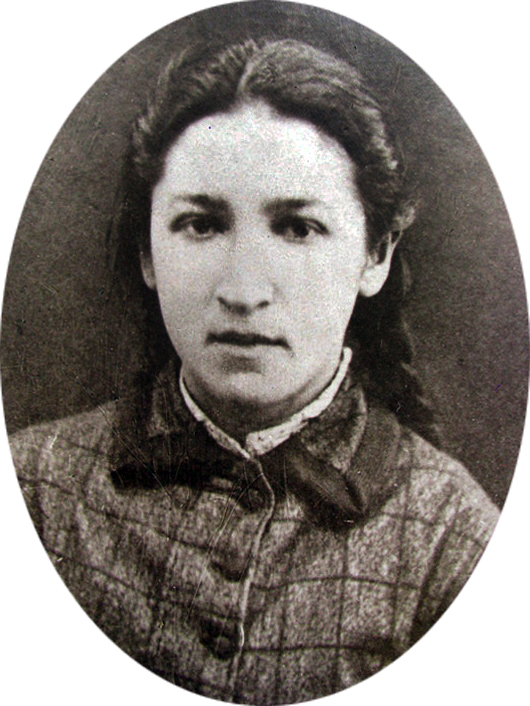
Zasulich-vera
Vera Zasulich

Young people kept on rereading Chernyshevsky’s novel What Is To Be Done?, but the most accessible and easily performed of the previous [responses] to the  question posed by the novel’s title—starting up a cooperative—was no longer satisfying. In the previous period, cooperatives, primarily sewing cooperatives, had sprung up like mushrooms, but most of them had soon disintegrated, and some ended in arbitration courts and bitter quarrels. They were for the most part started by women well off enough to buy a sewing machine, rent an apartment, pay for the first month’s rent until the principles of the cooperative were clarified, and hire two or three experienced dressmakers. They recruited workers partly from among the female nihilists, who did not know how to sew, but ardently wanted to “do” something, and partly from among seamstresses whose only wish was to earn money. During the first month, in the heat of the moment, everyone would sew quite ardently, but very few had the patience, especially if they were not accustomed to manual labor, to sew eight to ten hours a day only for the sake of promoting the principle of cooperation. They sewed less and less. The professional craftswomen were indignant and treated the work carelessly themselves, reducing the number of orders. The best workers would soon leave the workshop, since their share of the income was less than the wages they would receive from a proprietor, despite the fact the founders for the most part refused their shares. Sometimes, the business ended with the skilled workers confiscating the sewing machines and kicking the founders out of the workshops. Arbitration hearings were held.

“Themselves constantly repeated the sewing machine belonged to the labor,” said a perky seamstress at one such hearing I had occasion to attend. “As for their labor, they didn’t do a thing. They would just talk and talk.”

The court, however, did not recognize the seamstress as the personification of labor and ordered the sewing machine returned.

Business was just as bad at the bookbinding workshops, although the work, which was less complicated and did not require long, preliminary preparation, was more amenable to cooperation.

In 1869, the standstill that ensued after the Karakozov Affair continued in full force. Some people of the 1860s quit the scene, while others went into hiding, and so the raw youth who would arrive from the provinces after the crackdown had no access to them. They were completely left to their own devices; they had to find their own way. The Karakozov Affair did not leave a core around which they could have grouped. I am speaking, of course, of the average young people who were affected by the prologue to the Nechayev Affair, which took place in Petersburg in the winter of 1868–1869. The isolation, the lack of propaganda in their milieu, the lack of contact with people of firm convictions who could have helped them in resolving the question, “What is to be done?” left the young people, who were looking for a cause, in a dreary, anxious state.

Source: Vera Zasulich, Memoirs (Moscow: Political Prisoners Publishing House, 1931)

Vera Zasulich was a Russian revolutionary and writer most famed for her attempt on the life of St. Petersburg governor Colonel Trepov in 1878. She was acquitted of the crime by a jury. Photo, above, courtesy of Wikipedia. Translated by the Russian Reader