The Mote and the Beam

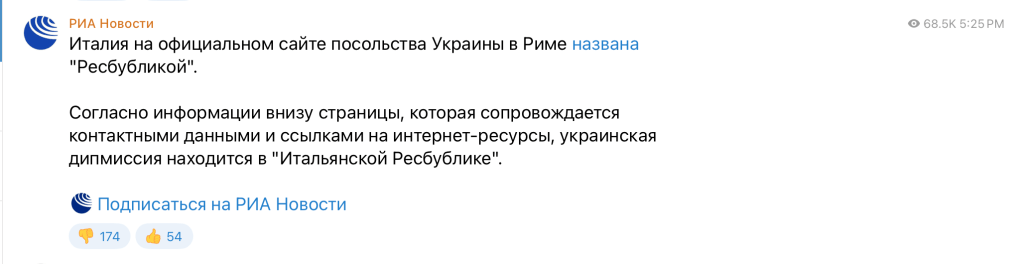
The same “gotcha!” news item (as below) on RIA Novosti’s Telegram channel

ROME, March 18 — RIA Novosti. Our correspondent has discovered that the Ukrainian Embassy in Italy has made a typo on its official website, misspelling the name of its host country.

According to the information at the bottom of the web page (which includes contact details and links to online resources), the Ukrainian diplomatic mission is located in the “Italian Rebublic.” The Italian word Repubblica is spelled with a b instead of a pRebubblica.

Source: “Italy referred to as ‘Rebubblica’ on official website of Ukrainian Embassy in Rome,” RIA Novosti, 18 March 2026. Translated by the Russian Reader


Anton, a 44-year-old Russian soldier who heads a workshop responsible for repairing and supplying drones, was at his kitchen table when he learned last month that Elon Musk’s SpaceX had cut off access to Starlink terminals used by Russian forces. He scrambled for alternatives, but none offered unlimited internet, data plans were restrictive, and coverage did not extend to the areas of Ukraine where his unit operated.

It’s not only American tech executives who are narrowing communications options for Russians. Days later, Russian authorities began slowing down access nationwide to the messaging app Telegram, the service that frontline troops use to coordinate directly with one another and bypass slower chains of command.

“All military work goes through Telegram — all communication,” Anton, whose name has been changed because he fears government reprisal, told POLITICO in voice messages sent via the app. “That would be like shooting the entire Russian army in the head.”

Telegram would be joining a home screen’s worth of apps that have become useless to Russians. Kremlin policymakers have already blocked or limited access to WhatsApp, along with parent company Meta’s Facebook and Instagram, Microsoft’s LinkedIn, Google’s YouTube, Apple’s FaceTime, Snapchat and X, which like SpaceX is owned by Musk. Encrypted messaging apps Signal and Discord, as well as Japanese-owned Viber, have been inaccessible since 2024.

Last month, President Vladimir Putin signed a law requiring telecom operators to block cellular and fixed internet access at the request of the Federal Security Service. Shortly after it took effect on March 3, Moscow residents reported widespread problems with mobile internet, calls and text messages across all major operators for several days, with outages affecting mobile service and Wi-Fi even inside the State Duma.

Those decisions have left Russians increasingly cut off from both the outside world and one another, complicating battlefield coordination and disrupting online communities that organize volunteer aid, fundraising and discussion of the war effort. Deepening digital isolation could turn Russia into something akin to “a large, nuclear-armed North Korea and a junior partner to China,” according to Alexander Gabuev, the Berlin-based director of the Carnegie Russia Eurasia Center.

In April, the Kremlin is expected to escalate its campaign against Telegram — already one of Russia’s most popular messaging platforms, but now in the absence of other social-media options, a central hub for news, business and entertainment. It may block the platform altogether. That is likely to fuel an escalating struggle between state censorship and the tools people use to evade it, with Russia’s place in the world hanging in the balance.

“It’s turned into a war,” said Mikhail Klimarev, executive director of the internet Protection Society, a digital rights group that monitors Russia’s censorship infrastructure. “A guerrilla war. They hunt down the VPNs they can see, they block them — and the ‘partisans’ run, build new bunkers, and come back.”

The app that runs the war

On Feb. 4, SpaceX tightened the authentication system that Starlink terminals use to connect to its satellite network, introducing stricter verification for registered devices. The change effectively blocked many terminals operated by Russian units relying on unauthorized connections, cutting Starlink traffic inside Ukraine by roughly 75 percent, according to internet traffic analysis by Doug Madory, an analyst at the U.S. network monitoring firm Kentik.

The move threw Russian operations into disarray, allowing Ukraine to make battlefield gains. Russia has turned to a workaround widely used before satellite internet was an option: laying fiber-optic lines, from rear areas toward frontline battlefield positions.

Until then, Starlink terminals had allowed drone operators to stream live video through platforms such as Discord, which is officially blocked in Russia but still sometimes used by the Russian military via VPNs, to commanders at multiple levels. A battalion commander could watch an assault unfold in real time and issue corrections — “enemy ahead” or “turn left” — via radio or Telegram. What once required layers of approval could now happen in minutes. Satellite-connected messaging apps became the fastest way to transmit coordinates, imagery and targeting data.

But on Feb. 10, Roskomnadzor, the Russian communications regulator, began slowing down Telegram for users across Russia, citing alleged violations of Russian law. Russian news outlet RBC reported, citing two sources, that authorities plan to shut down Telegram in early April — though not on the front line.

In mid-February, Digital Development Minister Maksut Shadayev said the government did not yet intend to restrict Telegram at the front but hoped servicemen would gradually transition to other platforms. Kremlin spokesperson Dmitry Peskov said this week the company could avoid a full ban by complying with Russian legislation and maintaining what he described as “flexible contact” with authorities.

Roskomnadzor has accused Telegram of failing to protect personal data, combat fraud and prevent its use by terrorists and criminals. Similar accusations have been directed at other foreign tech platforms. In 2022, a Russian court designated Meta an “extremist organization” after the company said it would temporarily allow posts calling for violence against Russian soldiers in the context of the Ukraine war — a decision authorities used to justify blocking Facebook and Instagram in Russia and increasing pressure on the company’s other services, including WhatsApp.

Telegram founder Pavel Durov, a Russian-born entrepreneur now based in the United Arab Emirates, says the throttling is being used as a pretext to push Russians toward a government-controlled messaging app designed for surveillance and political censorship.

That app is MAX, which was launched in March 2025 and has been compared to China’s WeChat in its ambition to anchor a domestic digital ecosystem. Authorities are increasingly steering Russians toward MAX through employers, neighborhood chats and the government services portal Gosuslugi — where citizens retrieve documents, pay fines and book appointments — as well as through banks and retailers. The app’s developer, VK, reports rapid user growth, though those figures are difficult to independently verify.

“They didn’t just leave people to fend for themselves — you could say they led them by the hand through that adaptation by offering alternatives,” said Levada Center pollster Denis Volkov, who has studied Russian attitudes toward technology use. The strategy, he said, has been to provide a Russian or state-backed alternative for the majority, while stopping short of fully criminalizing workarounds for more technologically savvy users who do not want to switch.

Elena, a 38-year-old Yekaterinburg resident whose surname has been withheld because she fears government reprisal, said her daughter’s primary school moved official communication from WhatsApp to MAX without consulting parents. She keeps MAX installed on a separate tablet that remains mostly in a drawer — a version of what some Russians call a “MAXophone,” gadgets solely for that app, without any other data being left on those phones for the (very real) fear the government could access it.

“It works badly. Messages are delayed. Notifications don’t come,” she said. “I don’t trust it … And this whole situation just makes people angry.”

The VPN arms race

Unlike China’s centralized “Great Firewall,” which filters traffic at the country’s digital borders, Russia’s system operates internally. Internet providers are required to route traffic through state-installed deep packet inspection equipment capable of controlling and analyzing data flows in real time.

“It’s not one wall,” Klimarev said. “It’s thousands of fences. You climb one, then there’s another.”

The architecture allows authorities to slow services without formally banning them — a tactic used against YouTube before its web address was removed from government-run domain-name servers last month. Russian law explicitly provides government authority for blocking websites on grounds such as extremism, terrorism, illegal content or violations of data regulations, but it does not clearly define throttling — slowing traffic rather than blocking it outright — as a formal enforcement mechanism. “The slowdown isn’t described anywhere in legislation,” Klimarev said. “It’s pressure without procedure.”

In September, Russia banned advertising for virtual private network services that citizens use to bypass government-imposed restrictions on certain apps or sites. By Klimarev’s estimate, roughly half of Russian internet users now know what a VPN is, and millions pay for one. Polling last year by the Levada Center, Russia’s only major independent pollster, suggests regular use is lower, finding about one-quarter of Russians said they have used VPN services.

Russian courts can treat the use of anonymization tools as an aggravating factor in certain crimes — steps that signal growing pressure on circumvention technologies without formally outlawing them. In February, the Federal Antimonopoly Service opened what appears to be the first case against a media outlet for promoting a VPN after the regional publication Serditaya Chuvashiya advertised such a service on its Telegram channel.

Surveys in recent years have shown that many Russians, particularly older citizens, support tighter internet regulation, often citing fraud, extremism and online safety. That sentiment gives authorities political space to tighten controls even when the restrictions are unpopular among more technologically savvy users.

Even so, the slowdown of Telegram drew criticism from unlikely quarters, including Sergei Mironov, a longtime Kremlin ally and leader of the Just Russia party. In a statement posted on his Telegram channel on Feb. 11, he blasted the regulators behind the move as “idiots,” accusing them of undermining soldiers at the front. He said troops rely on the app to communicate with relatives and organize fundraising for the war effort, warning that restricting it could cost lives. While praising the state-backed messaging app MAX, he argued that Russians should be free to choose which platforms they use.

Pro-war Telegram channels frame the government’s blocking techniques as sabotage of the war effort. Ivan Philippov, who tracks Russia’s influential military bloggers, said the reaction inside that ecosystem to news about Telegram has been visceral “rage.”

Unlike Starlink, whose cutoff could be blamed on a foreign company, restrictions on Telegram are viewed as self-inflicted. Bloggers accuse regulators of undermining the war effort. Telegram is used not only for battlefield coordination but also for volunteer fundraising networks that provide basic logistics the state does not reliably cover — from transport vehicles and fuel to body armor, trench materials and even evacuation equipment. Telegram serves as the primary hub for donations and reporting back to supporters.

“If you break Telegram inside Russia, you break fundraising,” Philippov said. “And without fundraising, a lot of units simply don’t function.”

Few in that community trust MAX, citing technical flaws and privacy concerns. Because MAX operates under Russian data-retention laws and is integrated with state services, many assume their communications would be accessible to authorities.

Philippov said the app’s prominent defenders are largely figures tied to state media or the presidential administration. “Among independent military bloggers, I haven’t seen a single person who supports it,” he said.

Small groups of activists attempted to organize rallies in at least 11 Russian cities, including Moscow, Irkutsk and Novosibirsk, in defense of Telegram. Authorities rejected or obstructed most of the proposed demonstrations — in some cases citing pandemic-era restrictions, weather conditions or vague security concerns — and in several cases revoked previously issued permits. In Novosibirsk, police detained around 15 people ahead of a planned rally. Although a small number of protests were formally approved, no large-scale demonstrations ultimately took place.

The power to pull the plug

The new law signed last month allows Russia’s Federal Security Service to order telecom operators to block cellular and fixed internet access. Peskov, the Kremlin spokesman, said subsequent shutdowns of service in Moscow were linked to security measures aimed at protecting critical infrastructure and countering drone threats, adding that such limitations would remain in place “for as long as necessary.”

In practice, the disruptions rarely amount to a total communications blackout. Most target mobile internet rather than all services, while voice calls and SMS often continue to function. Some domestic websites and apps — including government portals or banking services — may remain accessible through “whitelists,” meaning authorities allow certain services to keep operating even while broader internet access is restricted. The restrictions are typically localized and temporary, affecting specific regions or parts of cities rather than the entire country.

Internet disruptions have increasingly become a tool of control beyond individual platforms. Research by the independent outlet Meduza and the monitoring project Na Svyazi has documented dozens of regional internet shutdowns and mobile network restrictions across Russia, with disruptions occurring regularly since May 2025.

The communications shutdown, and uncertainty around where it will go next, is affecting life for citizens of all kinds, from the elderly struggling to contact family members abroad to tech-savvy users who juggle SIM cards and secondary phones to stay connected. Demand has risen for dated communication devices — including walkie-talkies, pagers and landline phones — along with paper maps as mobile networks become less reliable, according to retailers interviewed by RBC.

“It feels like we’re isolating ourselves,” said Dmitry, 35, who splits his time between Moscow and Dubai and whose surname has been withheld to protect his identity under fear of governmental reprisal. “Like building a sovereign grave.”

Those who track Russian public opinion say the pattern is consistent: irritation followed by adaptation. When Instagram and YouTube were blocked or slowed in recent years, their audiences shrank rapidly as users migrated to alternative services rather than mobilizing against the restrictions.

For now, Russia’s digital tightening resembles managed escalation rather than total isolation. Officials deny plans for a full shutdown, and even critics say a complete severing would cripple banking, logistics and foreign trade.

“It’s possible,” Klimarev said. “But if they do that, the internet won’t be the main problem anymore.”
Source: Ekaterina Bodyagana, “Inside the race to cut Russia off from the global internet,” Business Insider, 16 March 2026

Alexander Krichevsky of Izhevsk: Six Years in Prison for a Comment

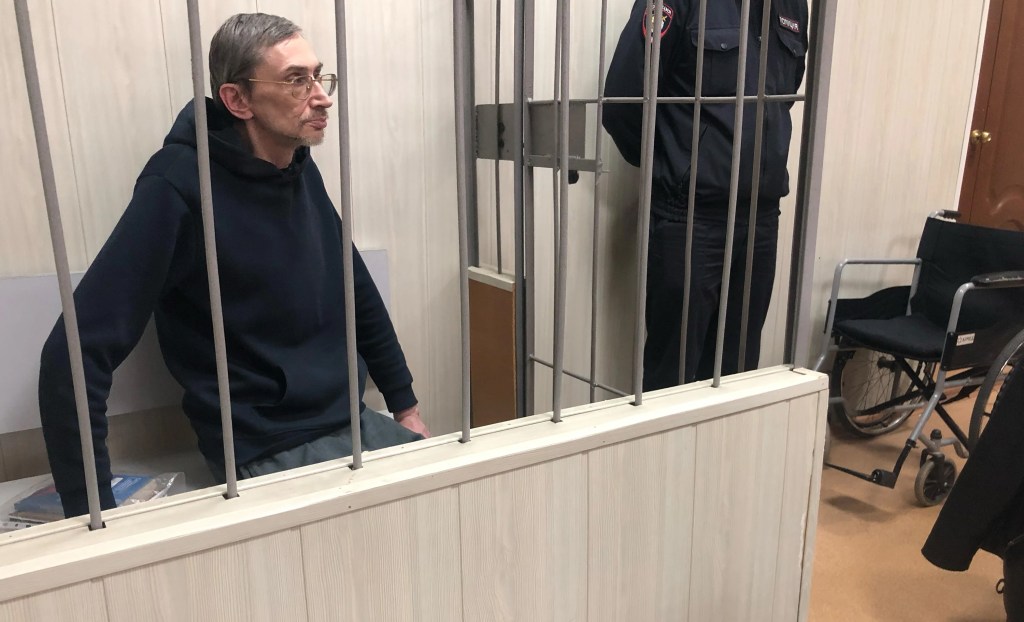
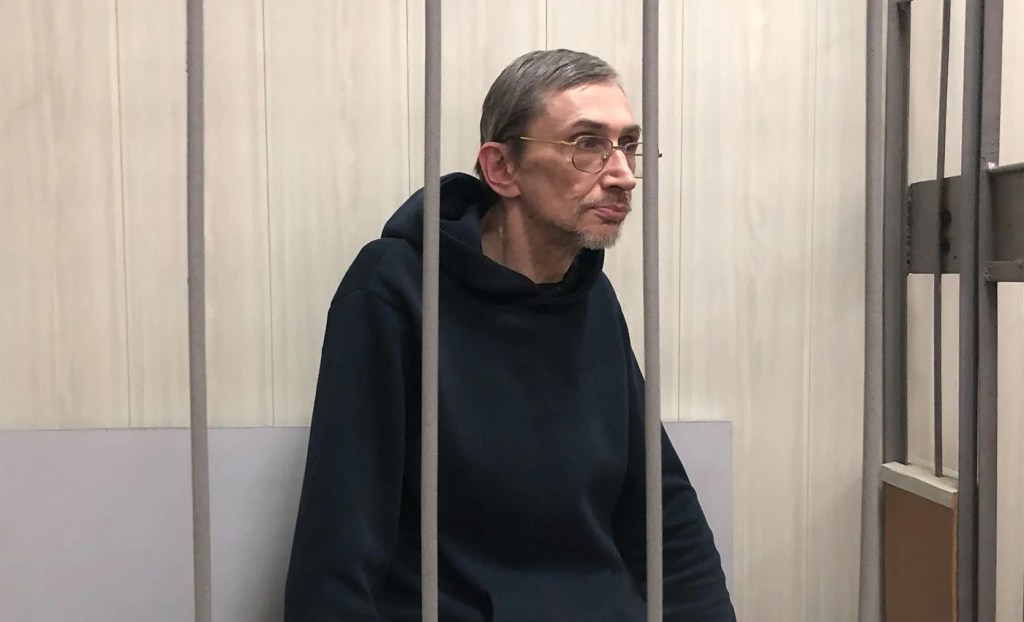
Alexander Krichevsky. Photo: Mediazona

In September 2024, Alexander Krichevsky, a 58-year-old resident of Izhevsk, posted a lengthy comment on a Chechen opposition blogger’s Telegram channel. In the comment, Krichevsky compared Putin and the “FSB clique” to a “darkness” which must be destroyed. The security forces deemed this statement incitement to murder the president and FSB officers. They monitored the man and intercepted his internet traffic. Last December, Krichevsky was detained and remanded in custody to a pretrial detention center despite his ailments and the fact that he is confined to a wheelchair. His ailing mother was placed in a care home, where she died a month later. Today, at the Central District Military Court in Yekaterinburg, where Krichevsky’s case is being heard, the prosecutor requested that he be given the maximum sentence of six years in prison.

“That is why we listen to him, because he is not afraid—he’s a ray of freedom in a kingdom of darkness! And only together will we destroy this darkness, only when we understand that we have only one enemy—Putin and his FSB clique. . . . Both you and we must destroy this enemy to continue living as peaceful neighbors,” 58-year-old Izhevsk resident Alexander Krichevsky wrote in a chat on the channel of opposition Chechen blogger Tumso Abdurakhmanov aka Abu Saddam Shishani, on 11 September 2024.

This was Krichevsky’s response to a user who had asked Abdurakhmanov himself in a chat: “Tumso, aren’t you afraid that Kadyrov’s people might find you?”

When questioned in court, Krichevsky said that he was sure he was responding to the user personally, not writing in a public chat. He repeated many times that he had only figurative “destruction” in mind and had been trying to “reconcile” Abdurakhmanov’s readership by pointing out that they had only one enemy.

“Of course, I wasn’t even thinking about physically destroying such a large number of people and didn’t understand how [what I wrote] would even look. Apparently, my love for pretty words—all those rays of light and other nonsense—let me down. I was thinking in terms of games: when a person plays checkers or chess, they destroy their opponent’s pieces. Roughly speaking, that was the image I had in my head,” Krichevsky said in court.

The FSB operative who discovered Krichevsky’s comment saw it not as criticism alone, but also as a “public call to murder the president of the Russian Federation and officers of the Federal Security Service.”

The same conclusion was reached by Polina Komova, a philologist and expert at the Ministry of Internal Affairs Forensic Center in Udmurtia. She acknowledged in court that the word “destroy” could have other meanings “depending on the context,” but in her opinion it could be understood only in its literal meaning—that is, “to end [someone’s] existence, to exterminate”—in Krichevsky’s comment.

“He was planning a terrorist attack involving self-detonation”: wiretapping and arrest

The security forces began monitoring Krichevsky in early December 2024. It emerged in court that the FSB had requested data on his calls and connections from Rostelecom and learned that on 11 September, when he wrote the comment, he had accessed Telegram from home. Megafon provided the security forces with information about the base stations in the area where Krichevsky’s phone number pinged that day.

On 5 December 2024, the Supreme Court of Udmurtia gave the FSB permission to tap Krichevsky’s phones, and a few days later it approved “gathering information from technical communication channels and acquiring computer information.” A few days before Krichevsky’s arrest, operatives monitored his apartment to “document illegal activities.” The report states that Krichevsky did not leave his home.

On 19 December 2024, Krichevsky was detained and sent to a pretrial detention center. He described his arrest to journalists.

“There was a knock on the door at seven in the morning, and seven people came into [our] small flat: five FSB officers and two eyewitnesses. I opened the door myself. They immediately sat me down on a chair in the hallway. My ailing mother was lying there, barely alive. They said, ‘Can you hand over [your phone]?’ They tried to intimidate me once: ‘If you refuse, we’ll take you away and charge you with additional offenses.’ I realized that resistance was futile. I gave them the phone, and they looked at it and took what they needed.”

The social media comment charges against Krichevsky were accompanied by an FSB report containing much more serious, but in effect unproven, allegations. The document states that, according to “intelligence,” Krichevsky, who opposes the “state’s political course” and the conduct of the “special military operation,” supported radical Islamists fighting for Ukraine and was planning to convert to Islam and carry out a terrorist attack in Udmurtia “by blowing himself up with cooking gas.” The court never did hear what this report was based on.

Photo: Mediazona

“None of my comments or my own thoughts bear this out. When I heard this business about blowing myself up . . . In this case, everything that the prosecutor has just read aloud is pure speculation on the part of the investigators. None of my quotes corroborates it,” Krichevsky said in court.

Judge Alexander Raitsky simply reminded Krichevsky that the case centered on a single [social media] comment, which the defendant himself did not disput, and that the court would evaluate the evidence in the deliberation room.

The case file also contains another comment by Krichevsky from the same written exchange: “Many empires have collapsed in this world. I myself foresee the end of the Russkies [rusnya]. I don’t feel sorry for them: let them collapse with a bang. That’s where they belong. I myself hate these FSBniks, pigs [cops], and other scum who suck the blood of our homeland and shit on our neighbors.”

The security forces deemed this “a statement containing a negative assessment of the group of persons sharing the profession of Federal Security Service officers and police officers,” but it was not included in the indictment.

Responding to the judge’s question about this comment, Krichevsky said that he sometimes tried to “adapt” to the rude tone of the conversation [on the Telegram channel’s chat].

“My mother died four weeks after my arrest”: wheelchair-bound in a detention center

Krichevsky had worked as a systems administrator in Izhevsk before his arrest.

As a child, Krichevsky had moved with his family from Udmurtia to Rostov-on-Don. After high school, he enrolled in medical school, but in 1989 he broke his spine and had to drop out because his left leg was paralyzed and he had lost feeling in his right leg. After a long period of rehabilitation, he was able to walk again, but was unable to recover fully: he had a severe limp and had difficulty going up stairs.

Krichevsky said in court that his father had committed suicide on 11 September 2008.

“He had terminal cancer. He was in serious pain and turned to me because I was in medical school. He wanted me to tell him what poison he could use to commit suicide. I refused to do it. Then, two days before his death, I noticed he was sharpening a knife in an odd way. He died in a rather original way, if that word is appropriate in this situation—he stabbed himself in the heart with a knife,” Krichevsky told the court.

In early 2010, during a trip to Thailand, Krichevsky broke his left leg, which had been paralyzed since his [accident in 1989]. He underwent surgery at a local hospital, but he could not stay in hospital for long because his visa had expired. Krichevsky returned to his hometown of Izhevsk, where he underwent a second operation, but his condition only worsened.

“My knee wouldn’t straighten. They tried to do something about it, but because I had spinal injuries, my knee spasmed, and it remained crooked and they couldn’t do anything about it. And my hip didn’t recover either; I also had a fractured hip,” Krichevsky told the court.

Since then, Krichevsky has been confined to a wheelchair. Other ailments have also emerged: kidney problems, emphysema, and head tremors.

“I don’t know whether it’s early Parkinson’s combined with Alzheimer’s, or something else,” Krichevsky said.

Krichevsky had been living with his elderly mother and caring for her since 2016. Last year, she was hospitalized with a complex fracture. After she was discharged, she was unable to walk, and Krichevsky would help her to sit up and do breathing exercises in order to prevent pulmonary edema and bedsores. After Krichevsky was arrested, the woman was sent to a care home. She died of a pulmonary edema a month later.

“They apparently left her lying in bed at the care home. When a person lies in a horizontal position for a long time, they develop a pulmonary edema. That’s what my mother died of,” he said in court.

Photo: Mediazona

While in pretrial detention, Krichevsky formally lost his Group I disability status, which he had prior to his arrest, and so he was unable to obtain a medical examination.

According to Krichevsky, a neurologist at the Izhevsk detention center promised to send him to a hospital, but instead Krichevsky was transferred to another pretrial detention center. “I thought they were taking me to a hospital, but they took me first to Perm and then to Yekaterinburg. They basically lied to me when they said they were taking me to a hospital,” he said on the stand.

Krichevskny never did get any medical attention: “We’ll only help you if you’re dying, [they said.] Otherwise, just sit there and suffer.”

“Radical views and hostility toward the current government”: trial and pleadings

Krichevsky’s trial was postponed five times in a row: it took a long time to bring him in his wheelchair, first to Detention Center No. 1 in Yekaterinburg, and then to the court. He was brought to the hearings late, and had to spend four to five hours in the police van, where, according to Krichevsky, the temperature was the same as outside.

At the beginning of the trial, Krichevsky filed a motion requesting that he be assigned an inpatient forensic examination and treatment. He said that he had never been examined by a neurologist at the Yekaterinburg detention center, only by a GP. He was taken for examination to the local medical unit, which was not equipped for people with disabilities: there was a “big step” in front of the toilet and sink which he could not get over. As a result, the doctors only checked his reflexes and sent him back.

In their medical report, the doctors at the detention center stated that Krichevsky had no disability and that his overall health was satisfactory, meaning that he was able to take part in the court hearings.

Before the proceedings, Krichevsky again requested to be sent for treatment, “in accordance with the neurologist’s recommendation” in Izhevsk, but Judge Raitsky denied the request, seeing no need for it. Prosecutor Artem Terentyev also asked that the request be denied, as it went “beyond the scope of the criminal case under consideration.”

During the trial, the prosecutor asked that Krichevsky be imprisoned for six years in a medium-security penal colony. The prosecutor stressed that the defendant had “radical views” and was “hostile toward the current government of the Russian Federation and its officials,” and that he had written the offending comment at a time when the mobilization had not yet been completed. The prosecutor considered these to be aggravating circumstances.

The prosecutor cited Krichevsky’s “poor health” as a mitigating circumstance.

You can support Alexander by writing him a letter.

Address:
Russian Federation 620019 FKU SIZO-1, GUFSIN of Russia for the Sverdlovsk Region • Sverdlovsk Region, Yekaterinburg, Repin Street, 4 • Alexander Anatolyevich Krichevsky, born 1967

You can also send letters through the online service Zonatelecom.

Source: Vasily Besspalyi, “Wheelchair user from Izhevsk sentenced to six years in prison for comment about Putin; his mother, sent to nursing home after his arrest, dies a month later,” Mediazona, 22 December 2025. Translated by the Russian Reader. Since letters to Russian prisoners are vetted by prison censors, they must be written in Russian or translated into Russian, something that can done more or less handily using an online machine translator like Google Translate. Please write to me if you need help or advice. ||||| TRR

French Kiss

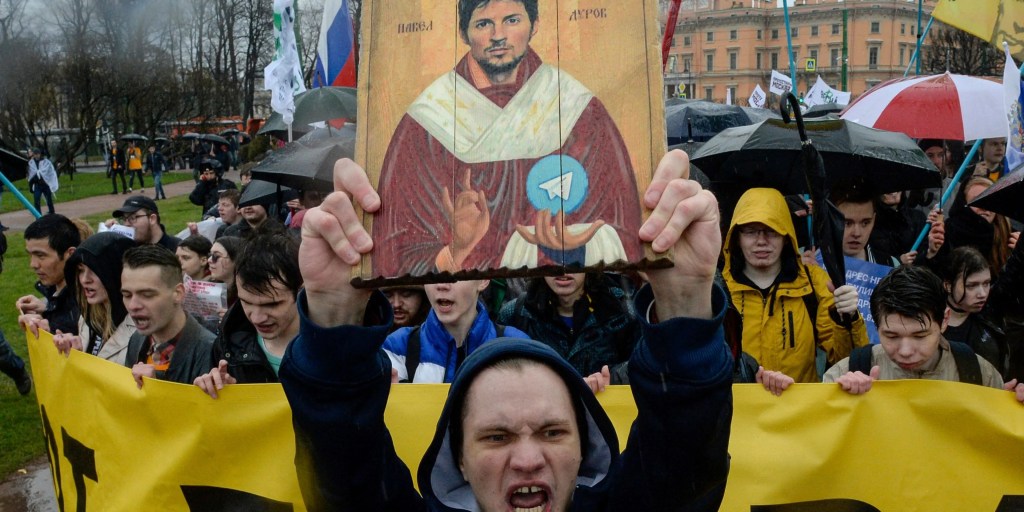
Saint Pavel? A scene from a march protesting the blocking of Telegram, St. Petersburg, 1 May 2018.
Photo: Olga Maltseva/AFP, via Important Stories

French Kiss is an enchanting cabaret show in the style of the Moulin Rouge, as performed by the world-famous Bize Lisu Show Ballet.

The ballet dancers have already conquered the whole world with their performances. They have garnered roaring applause at the birthday of the Prince of Monaco and in the Kremlin Palace, at Europe’s oldest theaters in Malta and the largest modern concert halls in China.

The unique hand-sewn costumes, the sensual dances, the expressive vocals and the compère’s unsurpassed humor are all part of the grandiose performance.

Duration: 2 hours (with 1 intermission)
Age limit: 18+

Performers:
Bize Lisu Show Ballet
Vocals – Yana Radion, Maria Mantrova, Anastasia Radion
Compère – Denis Groshev

*Seat numbers 200 to 220, at the buffet tables in the second row of the balcony.

“French Kiss, the Show”

The venue
The show French Kiss will take place in one of the most entrancing places in St. Petersburg— the cultural space Gaika Space. And it will be held in LUXURY format [sic], in which the audience is able to choose festive board tables for two to four people.

The original menu, featuring delicious appetizers and exquisite drinks from the bar, will help you not only to enjoy the show, but will plunge you into a world of gastronomic discoveries. Our show will make your evening unforgettable!

Secure free parking is provided to guests of the show for the entire duration of the performance.

Source: Bileter.ru. Translated by the Russian Reader


A very cold welcome awaited Pavel Durov in France, but it increasingly seems this is exactly what Durov was aiming for.

Did he come clean? No, it’s just business

Only a week into the discussion of the Pavel Durov case did commentators begin recalling what kind of person he was, and several stories emerged about his life, which, incidentally, has involved support (including financial support), from the “authoritative” Petersburg entrepreneur Mikhail Mirilashvili. Without this support, Durov’s main business venture, the social network VKontakte, might perhaps not have taken off. (Formally, Mikhail’s son, Vyacheslav, was involved in the business, but the money belonged to Mirilashvili père.) To complete the picture, it should be remembered that Mikhail Mirilashvili “developed” (as they say) Petersburg’s casinos, for licensing of which the then-deputy mayor of St. Petersburg Vladimir Putin was responsible.

Vladimir Putin (left) and Mikhail Mirilashvili (right)

Vkontakte rose and flourished on pirated content, which is still abundant on the network, despite the fierce efforts to combat it. Business journalists relish recalling how Durov fought for Vkontakte—not in the sense of freedom of speech, but in the sense of the value of his stake in the social network—and won, pocketing 400 million dollars.

For an interpretation of Durov’s arrest and persecution by the French authorities, see Baruch Taskin and Aaron Lea’s column. I would like to reiterate that Durov is first and foremost a businessman, and a very cynical one at that. It suffices to recall [the time Durov threw money out of a window] in Petersburg and Durov’s reaction [to the crowd’s reaction and the public and media backlash]. He laughed, before summarizing his mockery in philosophical terms:

“We refuse to accept a world where people can betray their humanity for money. If there are people who agree to do it, their behavior should be severely ostracized.”

We know nothing about Durov’s involvement with the FSB—all our assumptions are based on circumstantial evidence—but the left-wing albeit decent newspaper Liberation has written about his cooperation with the French security services, quoting Durov’s own statements.

Pavel Durov (center) may even benefit from his arrest in France:
the court ruling will be an excuse for Telegram’s transition from a media platform to a crypto-business.

Source: Moscow Times Russian Service weekly newsletter, 1 September 2024. All images and captions were included in the original publication. Translated by the Russian Reader


“Pavel Durov launched money from a window (Vesti report)”

Pavel Durov launched paper airplanes with five-thousand ruble bills on board into a crowd on 26 May 2012, which was St. Petersburg City Day. How the crowd lunged for the five-thousand ruble bills can be seen on the footage recorded by the Kazan Cathedral superview webcam. About ten banknotes were thrown, after which the crowd finally became furious and the amusement was stopped.

The webcam continues to follow the events as bloggers give Pavel Durov a bloody nose on 31 May at 6pm (GMT+4). Watch http://vpiter.com/web-camera-kazan/ for the live stream.

Source: Mobotix Webcams Russia (YouTube), 29 May 2012


The webcam is installed on Nevsky Prospekt. The webcam offers a view of the Kazan Cathedral. On the left in the frame is the house of the Singer company. On the days of city holidays, Nevsky Prospekt in this section becomes pedestrian. Live 24/7 we broadcast the life of our metropolis.

Kazan Cathedral (Cathedral of the Kazan Icon of the Mother of God) is one of the largest churches in St. Petersburg. It was built on Nevsky Prospekt in 1801–1811 by architect Andrey Voronikhin in the style of Russian classicism to store a revered list of the miraculous icon of the Mother of God of Kazan. After the Patriotic War of 1812, it acquired the significance of a monument of Russian military glory. In 1813, the commander Mikhail Illarionovich Kutuzov was buried here and the keys to the captured cities and other military trophies were placed.

Source: Taxi Crew (YouTube), accessed 1 September 2024. Happening upon this livestream of Kazan Cathedral and environs, the neighborhood where I lived for my first two years in Petersburg, was oddly reassuring, and so I left it on in the background as I worked on this “collage” of news and views and images. It was only now, as I was finishing the piece, that I realized that Kazan Cathedral itself is a monument to the centuries-long profound misunderstanding, sometimes tawdry, sometimes violent, that goes by the name of “Franco-Russian relations” in polite society. ||| TRR

TASS

Attempts by the American press to present Evan Gershkovich, the Wall Street Journal reporter arrested for espionage in Russia, as an innocent victim are blatant manipulations, says the Russian Embassy in Washington.

“We draw your attention to another fit of hysteria in the local media about the allegedly unlawful detention of Wall Street Journal correspondent Gershkovich after the Moscow City Court declined to change the pretrial restrictions for the espionage suspect. Shielding itself behind the principles of freedom of speech, the American press has been brazenly trying to interfere with the Russian justice system and to question its independence,” the diplomatic mission noted.

“Attempts to present Gershkovich as an innocent victim, and his subversive activities as [performance of his] journalistic duties are a blatant manipulation. The local media, serving the interests of Washington’s ruling circles, have long been famous for this,” the Russian diplomats pointed out.

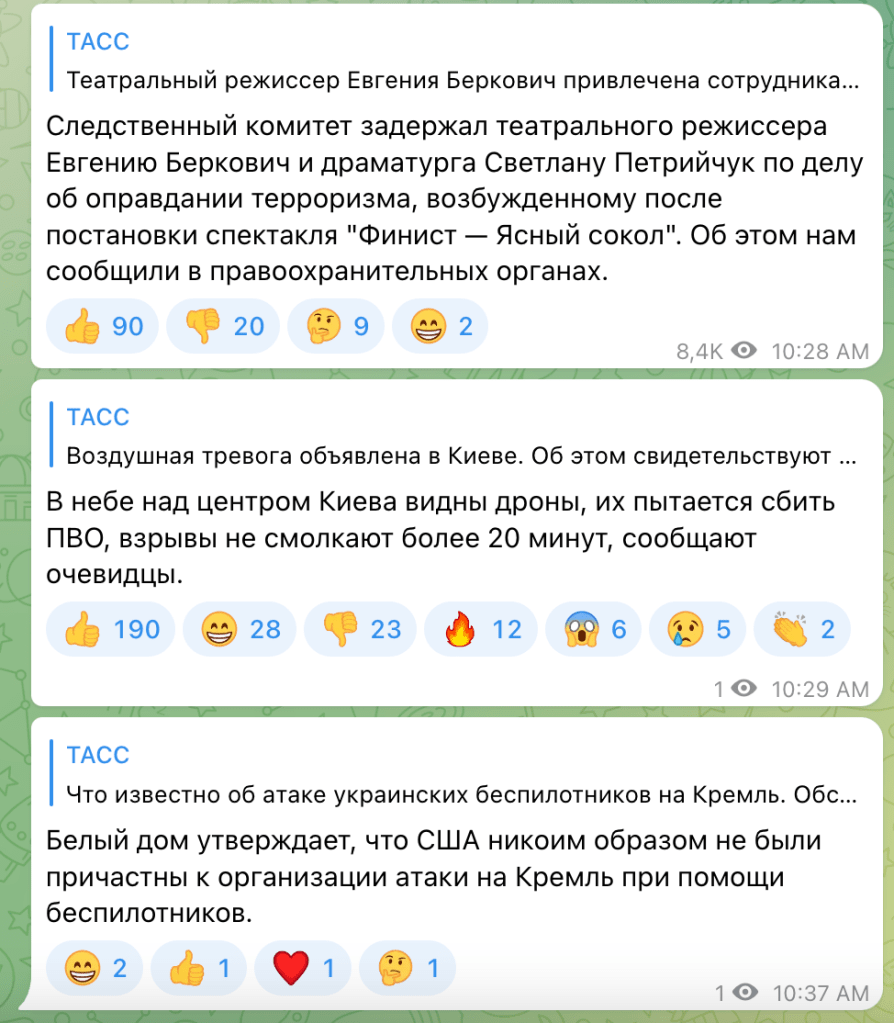
Source: TASS (Telegram), 18 April 2023. Translated by the Russian Reader. TASS’s Telegram channel has 338,460 subscribers. By contrast, my Telegram channel has three subscribers.


A snapshot of TASS’s Telegram feed taken by me at 10:40 a.m. PDT, 4 May 2023. TASS reports the arrest of theater director Yevgenia “Zhenya” Berkovich in Moscow, a Russian-drone attack on downtown Kyiv, and the US White House’s denial of involvement in the recent drone attack on the Kremlin. ||| TRR

100% Herd Immunity

https://paperpaper.ru/papernews/2022/2/15/vlasti-zayavili-chto-peterburg-dostig-k/

[February 5, 2022]

The authorities say that Petersburg has achieved 100% herd immunity. Is it true?

The number of people who been vaccinated and people who have recovered from covid-19 in Petersburg speaks to the fact that the city has achieved 100% herd immunity, first deputy chair of the Health Committee Andrei Sarana said on the St. Petersburg TV channel.

Referring to the Health Ministry’s website, Sarana said that Petersburg had reached 100% collective immunity. According to the official, 3.14 million people, including more than 2,400 children, had been fully vaccinated in Petersburg.

According to Health Ministry’s guidelines, Petersburg has to vaccinate 80% of its entire population, excluding children and adults who cannot be vaccinated — this amounts to 3.5 million people. At the same time, it is not known how this approach works and whether it takes into account people who, for example, were vaccinated more than a year ago.

In fact, 2.9 million residents have undergone a full vaccination cycle in Petersburg, which is equal to only 55% of the total number of people officially residing in St. Petersburg (5.3 million people), according to city hall’s website. Only the covid crisis center reports that 3.5 million people in Petersburg have received at least one dose of a vaccine.

In mid-January, the authorities were already claiming that herd immunity in Petersburg, according to various calculation methods, was at either 88% or 100%. Bumaga discovered then that they were talking about a portion of the total number of the city’s residents. Read more here.

Screen shot from the animated series Masha and the Bear

https://t.me/RKadyrov_95/1240

[February 14, 2022]

Dear compatriots! So as not to give my detractors cause for hysteria that I am exceeding my powers, I officially declare that this is my personal opinion, the humble opinion of Russian citizen Ramzan Kadyrov.

In my appeal there are two messages to two addressees — to the Ukrainian authorities and to the Ukrainian people.

Mr. Zelensky! The time for clowning has come to an end. The hour has come to fulfill one’s duty to one’s own people in order to avoid irreversible consequences. That is, today, more than ever, there is a need to implement the Minsk Accords, which were signed not only by the President of Russia, but also by the President of Ukraine. The strict implementation of the provisions spelled out in this document is the first important step in a political settlement of the growing confrontation not only between our countries, but also in reducing general tension in the global sense of the word. In this regard, you, as the guarantor of the Constitution and the security of your people and state, are simply obliged to do everything in your power to avoid bloodshed and establish peace. President Vladimir Putin and the peoples of Russia do not want war: we know firsthand the meaning of this terrible word. Be reasonable, Mr. Zelensky!

And now I want to address Ukrainians. My dear ones! I love Ukraine and its kind people. From the Soviet history class that I took at school, I know that Kievan Rus is the cradle of Russian statehood and Orthodoxy. Russians and Ukrainians are a single Slavic people with a common history, culture and religion. I will never believe that Ukrainians consider themselves part of the so-called Western world with all its degenerate “values” and Russophobic hysteria. Yes, that’s right, despite the fact that the current anti-national regime and its propaganda are doing everything to erase this sense of community. Somewhere in the depths of my soul I have a glimmer of hope that this historical justice [sic] will be restored by the Ukrainian people themselves without anyone’s help from outside. It cannot be that the spiritual and historical heirs of the great Hetman Bogdan Khmelnitsky and the brilliant writer Nikolai Gogol would not want eternal peace with fraternal Russia!

https://t.me/RKadyrov_95/1241

[February 15, 2022]

I fully support the decision of the State Duma to ask the President of the Russian Federation to recognize the independence of the Donetsk and Lugansk People’s Republics.

I believe that the Supreme Commander-in-Chief will grant the request and our country will recognize the independent status of both republics. Vladimir Vladimirovich is a far-sighted and wise politician. I think he will definitely take such an important step for the advent of peace.

I am sure that this is not only my opinion, but also that of the majority of Russians. Residents of the DPR and LPR have been living under the yoke of lawlessness for many years, their right to self-determination ignored. In this situation, it is recognition of independence that will determine their status in the international arena and put an end to many years of confrontation and bloodshed.

The Chechen people perfectly remember what mayhem, violence and continuous fighting can lead to. We clearly remember the unenviable feeling of hopelessness and believe that only such a logical endpoint will save the inhabitants of these two republics.

A large-scale information campaign has been launched against Russia and the two republics. Every day, fakes [sic] are disseminated about a new date for the crossing of the Ukrainian border by Russian troops and the declaration of war. But everyone has forgotten that Ukraine has been waging such a war with its neighbors for eight years. The foreign media prefer to keep quiet about this.

If officials in Kiev are not going to implement the Minsk Accords, are not attempting to settle the issue peacefully, issue, are heating up the situation, and not looking for ways to solve the crisis, then it is more than logical that our President Vladimir Putin should take over the peacekeeping mission in this difficult political situation.

Peace will come to Donetsk and Lugansk after you say your WORD, Vladimir Vladimirovich!

https://t.me/tass_agency/108662

[February 15, 2022, 1:11 pm]

Russia will not abandon the residents of the Donetsk and Lugansk People’s Republics alone in the event of an invasion of their territory by the Ukrainian army — the response will be commensurate with the scale of aggression, Federation Council Chair Valentina Matviyenko said.

https://t.me/tass_agency/108663

[February 15, 2022, 1:13 pm]

Valentina Matviyenko called even the idea of a war with Ukraine wild, noting that Russia would do everything on its part to prevent such a development of events.

“Our position has been clearly set out by the head of the Russian state: for our part, we will do everything so that there is no war with Ukraine. Not today, not tomorrow, not the day after tomorrow, never!” said the speaker of the Federation Council in an interview with Parlamentskaya Gazeta.

Translated by the Russian Reader

Important Stories

A screen shot of the front page of the IStories website

Telegram banned Roman Anin’s account the day before journalist was labeled “foreign agent media outlet”
Maria Efimova
Novaya Gazeta
August 20, 2021

Telegram has banned the account of Roman Anin,* editor-in-chief of iStories [in Russian, Vazhnye istorii — “Important Stories”].* He reported the incident to Novaya Gazeta himself.

“I couldn’t log in to Telegram yesterday, because my account was deleted, and it says in English that my account is banned. I haven’t been able to restore it yet,” Anin said.

Anin doesn’t know why his account was deleted. Although he has contacted the messenger service’s support team, they have not replied.

Today, the Russian Justice Ministry placed iStories, Anin and several of the publication’s journalists on its register of “foreign agent media outlets.” TV Rain* and the journalist Stepan Petrov* were also added to the list.

Earlier this week, iStories journalists Irina Dolinina* and Alesya Marokhovskaya* reported that persons unknown had mounted a spam attack on their phone numbers. “SMS messages from shops, banks and other places with different codes [were] being sent non-stop,” Dolinina said, also complaining about the incessant “dead calls.” Before that, persons unknown tried to hack and organize a spam attack on the phone of Irina Pankratova, a journalist with The Bell.

Late last year, after iStories published an investigative report about businessman Kirill Shamalov, Vladimir Putin’s [former son-in-law], there were attempts to hack the Telegram accounts of Anin and the other authors of the report. There were attempts to hack their Facebook accounts as well.

* Placed by the Russian Justice Ministry on its register of mass media outlets functioning as foreign agents.

Translated by the Russian Reader. As I just discovered, you can easily support iStories by going to the donations page on their website. I was able to donate 3,000 rubles (approx. 35 euros) in a matter of seconds. And you can read some of their investigative reports in English while you’re at it.

“On the evening of April 9, 2021, the FSB searched the home of iStories editor-in-chief Roman Anin. The search lasted almost seven hours. At the same time, a search was also carried out in the publication’s editorial offices.”

The Arrest and Framing of Mikola Dziadok

Tatsiana Chulitskaya
Facebook
November 12, 2020

My good friend and former student, the very honest person and true patriot Mikola Dziadok has been detained and beaten in Belarus. The video shows that he was severely beaten. There is no point in commenting on the fact that bundles of money were found in Mikola’s flat. Anyone who knows him at all understands what nonsense this is. And I’m even afraid to imagine what these inhumans did to make Mikola talk about “love for the Motherland” in such interiors. We can only hope that we will see Mikola released very soon.🤍❤️🤍

Belarusian Interior Ministry, “A Leader of the Country’s Anarchist Movement Has Been Detained”

Belarus on the Brain
Telegram
November 12, 2020

Reports of Blogger Mikola Dziadok’s Arrest Confirmed

Dziadok ran the increasingly popular Telegram channel Mikola, where he published political analyses of the situation in Belarus and gave his opinion on what should be done to security victory for the peaceful revolution. Now his channel has obviously been hacked and is in the hands of the security forces.

The purge of the Belarusian political blogosphere began in the summer with the arrest of bloggers Sergei Tikhanovsky (A Country for Living), Vladimir Tsyganovich (MozgON), Igor Losik (Belarus on the Brain), Brest blogger Alexander Kabanov, and others.

Dziadok was one of the few Belarusian political bloggers who did not leave the country. Now he is suspect of violating Article 342* of the criminal code of the Republic of Belarus.

* “The organization and preparation of actions that grossly violate public order, or active participation in them, is punishable by a fine, or arrest, or restriction of liberty for up to three years, or imprisonment for the same term.”

________________

Thanks to Tatsiana Chulitskaya for permission to translate and post her message here, and to Sasha Razor for the heads-up and introductions. As soon as I have information about how you can show your support to Mikola  Dziadok, I will publish it here. Translated by the Russian Reader

Mikola Dziadok in happier times. Courtesy of his Facebook page

Stanislava Mogileva: Doing Perfectly Nothing Imperfectly

mogileva
Stanislava Mogileva

This text about quarantine life by the poet Stanislava Mogileva made me weep with spiritual feeling (umilenie).

[24.05.20 17:42]

how to do nothing imperfectly and, what is most important, perfectly nothing,* nothing faster, better, with higher quality, more effectively or interestingly. nothing is the only important thing, besides nothing there is nothing else. the lurid blood of festivals and the tough meat of days of the week have ended, but there remain the sugary pits of dates, numbers. what remains, as usual, is what there was before the imagined excess. the flow, become invisible and insensible, hasn’t been interrupted so long as to stop completely. beyond the limit it’s clean, empty, and not lonely at all, me alone,* it turns out, is completely enough. not too much and not too little—just right, just as much as possible so as not to carry off, not take, not grab, and not saddle. I am lying on the couch, I can’t get up from the couch, and I don’t get up, and this is wonderful. bring me a coffee and a sandwich, my little son. do you know how to make coffee? there’s no cheese and sausage in the house? then give me bread and water. you’ve already learned how to turn on the faucet and open the breadbox, right? excellent, bring it then. good morning.

* “как можно быстрее […] не делать и, главное, не сделать ничего.” I have added the words “imperfectly” and “perfectly” to compensate for the lack of verbal aspect (imperfective and perfective) in English. This is a word-by-word rendition: “how possible faster, better, higher quality, more effectively and interestingly not do [imp.] and, important [nom. adj.], not do [perf.] nothing.” The best (indeed, sublime) discussion of Russian verbal aspect is Boris Gasparov, “Notes on the ‘Metaphysics’ of Russian Aspect,” which tragically doesn’t seem to be online.

* This is the only place in the text that indicates the speaker’s gender as feminine. Since Russian is typically swimming in gendered inflections, this is worth noting.

My readerly associations with this text are overflowing, but let me just say that Mogileva has two sons (4 and 6), as do I (8 and 14), and her text really captured something for me about how, amid all the horrors and traumatizing effects of the corona crisis, my boys are adapting to (evolving/devolving through) the new “idleness” and, I think, doing very well. Suddenly, I see the release of a blocked emergence and independence. And it is helping me unlearn everything I was ever taught about parenting.

Fetch your mom a coffee, my little son. She’s writing a text.

For the original text in Russian and more, see Mogileva’s Telegram channel.

Translation and commentary by Joan Brooks. If you would like to support Stanislava Mogileva’s work, please consider donating. Any amount helps. Please include “stanislava mogileva” in the memo line of your contribution.

Donate Button

The 15th

number15

Man Suspected of “Condoning Terrorism” Remanded in Custody by Pskov City Court
Lyudmila Savitskaya
Sever.Realii
June 13, 2020

Pskov City Court has remanded in custody for two months 47-year-old Alexei Shibanov, whom the regional FSB office suspects of “condoning terrorism” and publicly calling for extremism in sixteen entries on his personal page on the social network VK (Vkontakte), lawyer Tatyana Martynova has reported to us.

Shibanov will be jailed until August 10.

On VK, Shibanov had commented on the suicide bombing of the Arkhangelsk FSB office in 2018, the criminal case against journalist Svetlana Prokopieva (who has also been charged with “condoning terrorism),” the protests against plans to build a church in a park in Yekaterinburg, the suicide of a Russian National Guard deputy commander in Moscow, and the incident in Smolensk Region in which an armored vehicle hit two Russian National Guardsman. The suspect expressed his agreement with Georgian TV presenter Giorgi Gabunia’s televised tirade against Vladimir Putin, and he criticized the actions of the Moscow police during the summer 2019 protests in the city.

At his court hearing, Shibanov said that he made all the entries himself. An FSB investigator testified that more than two persons had read them. Experts at the Moscow State Linguistic University had found in the texts linguistic and psychological cues “to commit violent actions,” “incitement and veiled calls to commit destructive acts,” and “evidence of the condoning of terrorist activity.”

According to Martynova, Shibanov was detained on June 11. He was sitting on a bench when a busload of Russian National Guardsman drove up to his house. They put him on the ground, and one of the officers stepped on him with a boot. After that, Shibanov’s house was searched and his computer and laptop were seized.

After the bombing in Arkhangelsk, the FSB opened several criminal investigations into “condoning terrorism” over comments published on social networks and in the media. Yekaterina Muranova, a resident of Karelia, was 350,000 rubles for a comment on a social network. A resident of Kaluga, Ivan Lyubshin, was sentenced to five years in prison. Vyacheslav Lukichev, a 24-year-old anarchist, anti-fascist and environmental activist from Kaliningrad, was sentenced to a fine of 300,000 rubles for posting an article about the Arkhangelsk bomber [Mikhail] Zhlobitsky on Telegram. Criminal charges have been filed against Pskov journalist Svetlana Prokopieva.

Alexei Shibanov is the fifteen person in Russia who has been prosecuted for, charged with, or accused of “exonerating” or “condoning” the suicide bomber Mikhail Zhlobitsky since October 31, 2018. The others are Nadezhda BelovaLyudmila StechOleg NemtsevIvan Lyubshin, Svetlana Prokopieva, Anton AmmosovPavel ZlomnovNadezhda RomasenkoAlexander DovydenkoGalina GorinaAlexander SokolovYekaterina Muranova15-year-old Moscow schoolboy Kirill, and Vyacheslav Lukichev. Translated by the Russian Reader. The number 15 courtesy of Kids Math Games

Reviewed, it seemed
5 As if someone were watching over it
Before it was
As if response were based on fact
Providing, deciding, it was soon there
Squared to it, faced to it, it was not there
Renewed, it fought
As if it had a cause to live for
Denied, it learned
As if it had sooner been destroyed
Providing, deciding, it was soon there
Squared to it, faced to it, it was not there
Reviewed, it fought
As if someone were watching over it
Before it had sooner been denied
Renewed, it seemed
As if it had a cause to live for
Destroyed, it was later based on fact

Don’t Mention Mikhail Zhlobitsky! (The Case of Nadezhda Belova)

belovaNadezhda Belova. Photo from the VK group page Free People of Voronezh. Courtesy of OVD Info

Voronezh Activist Released After Day in Jail for Comment on Bombing at FSB Office
OVD Info
May 14, 2020

Voronezh grassroots activist Nadezhda Belova has been released after spending twenty-fours in a temporary detention center in connection with a criminal investigation into alleged “exoneration of terrorism.” It was Belova herself who reported the news to OVD Info.

The woman was released on her own recognizance. At the moment, she is suspected of having “exonerated terrorism” (punishable under Article 205.2 of the Russian Federal Criminal Code) by commenting online about [the October 2018 suicide bombing of the Arkhangelsk offices of the FSB]. Belova had been a witness in the case for the last month. In late March, her home was searched by police, and she and members of her family were interrogated.

In recent days, a police investigator had visited Belova at home and summoned her to an interrogation on May 13, which she went to accompanied by OVD Info attorney Sergei Garin. After Belova was questioned, she was jailed for the night in the temporary detention center, and then interrogated again the next morning. According to Belova, she was pressured into saying it was she who had posted the commentary, although she denied any wrongdoing.

According to her, a women was purposely placed in her cell who intimidated her, smoked cigarettes, used profane language, and forced her to clean up the dishes in the cell.

“Yesterday and the day before yesterday, I was a free person, but today, I’m sorry to say, they have been trying to turn me into an out-and-out convict—they have humiliated me. First they handcuffed me, then they said I could go to the toilet only in handcuffs and escorted by a wardress. I want women to know what can happen [to them], what a performance can take place. I have been humiliated to such an extent, dragged through the mud, and I don’t know why. Even if I wrote those thirty words, why such degradation?” Belova said.

During the morning interrogation, according to Belova, the investigator threatened to arrest and jail her for the next two months.

“Today, [the investigator] said to me, ‘Either you wrote this or you’re going to spend another twenty-four hours in the detention center and tomorrow, at my request, you’ll either be put under house arrest or remanded in custody for two months. Or they’ll let you go—but I can’t say what will happen,'” said Belova. “The argument was that I could tamper with witnesses who had allegedly testified that the comment was written in my style, and that I could pose a danger to them.”

The activist has been summoned to another interrogation the following day, supposedly to verify whether she had deleted the comment or not. According to Belova, the investigator has a folder containing her various social media comments and personal messages, and he threatened her that if she continued to engage in activism, there would be other criminal cases.

UPDATE: May 15, 2020. Ekaterina Seleznyova, OVD Info’s legal aid coordinator, has informed us that Belova has been pressured by investigators into confessing not only to posting the comment but also to wrongdoing.

A local grassroots activist, Belova campaigned against the cancellation of direct bus service from Voronezh to Novaya Usman [in the summer of 2019], collecting signatures at people’s gatherings. In this regard, complaints were filed against her, alleging that she was organizing riots. Belova was also actively involved in protests against fare increases.

On October 31, 2018, 17-year-old local resident Mikhail Zhlobitsky detonated a bomb in the Federal Security Service (FSB) building in Arkhangelsk. Three FSB employees were injured, and the young man himself was killed. Several minutes before the blast, a message about the attack was posted on Telegram in the open chat channel Rebel Talk [Rech’ buntovshchika]. The authorities investigated the incident as a terrorist attack.

In Russia, at least ten criminal cases of “exonerating terrorism” have been opened in connection with the October 2018 bombing in Arkhangelsk. In March, a resident of Kaluga, Ivan Lyubshin, was sentenced to five years and two months in prison for commenting on the topic on the internet.

Nadezhda Belova is the latest in a growing list of Russians who have been prosecuted or are facing prosecution for allegedly “exonerating” the suicide bomber Mikhail Zhlobitsky on social media or in the traditional media. Belova has joined the ranks of Lyudmila Stech, Oleg Nemtsev, Ivan Lyubshin, Svetlana Prokopieva, Anton Ammosov, Pavel Zlomnov, Nadezhda Romasenko, Alexander Dovydenko, Galina Gorina, Alexander Sokolov, Yekaterina Muranova, 15-year-old Moscow schoolboy Kirill, and Vyacheslav Lukichev. Translated by the Russian Reader