Source: Screenshots of an email from The Bell, 21 July 2025, and pro.thebell.io. I “subcsribe”* to a fair number of newspapers, magazines, and online media outlets. None of them would dare to charge me $348 or even $189 for a mere two newsletters a week. That The Bell asks so much for its meager output gives you an idea of how much it was previously receiving, directly or indirectly, from “grant funding for media outlets like us,” that is, from the U.S. government. ||| TRR
* The same typo was in last week’s “abbreviated version” of Russia, Explained.
A growing chorus of pro-Kremlin figures is speaking out against a proposed law that would impose fines for accessing or searching for online content labeled “extremist” by Russian authorities.
The bill, which was passed in its first reading in the lower-house State Duma on Thursday, envisions fines of up to 5,000 rubles ($64) for individuals who “knowingly” view or search for banned content. It does not specify how such activity would be detected, prompting concerns from experts about increased surveillance and possible abuse by law enforcement.
Yekaterina Mizulina, head of the Kremlin-aligned Safe Internet League, said the legislation could backfire on police, as well as those who support the Kremlin and help authorities in their crackdown on dissent.
“We actively monitor this kind of [“extremist”] content and share findings with law enforcement as part of our chartered mission,” Mizulina wrote on Telegram.
“What’s most striking is that under the draft law, even Interior Ministry officials monitoring such content could technically be acting illegally. And any private citizen who reports, say, [potential school shooters] to law enforcement could also face fines,” she added.
Margarita Simonyan, editor-in-chief of the state-funded RT news network, also criticized the bill.
“Dear government, tell me, plz, how are we supposed to carry out investigations and throw shade on all types of extremist groups like FBK if we are barred from even reading about them?” Simonyan wrote on Telegram, referring to Alexei Navalny’s Anti-Corruption Foundation, which Russia outlawed in 2021.
“I hope there will be changes,” she added.
Amnesty International, a London-based NGO, earlier decried the bill as “vague and overly broad,” warning that it enables arbitrary enforcement.
“Once again, the Russian authorities are disguising their relentless persecution of dissent as countering ‘extremism,’” said Marie Struthers, Amnesty’s Eastern Europe and Central Asia director.
“In today’s Russia, ‘extremist’ materials could be anything from a book promoting same-sex relationships to social media posts by opposition groups,” Struthers added.
The Kremlin on Thursday declined to comment on the controversy surrounding the bill, but acknowledged that the “issue has clearly sparked a strong public reaction.”
Authorities in Moscow currently maintain a list of around 5,500 banned “extremist” materials, including books, religious texts, songs, films and other media.
If lawmakers pass the bill and President Vladimir Putin signs it into law, it would take effect on Sept. 1.
In the wee hours of Sunday, 4 May, Russian security forces raided concerts in St. Petersburg and Yekaterinburg, at which, among other things, they asked attendees about their attitude to the war, local media have reported.
In Yekaterinburg, law enforcement officers interrupted a concert at the club Syndrome. As the musicians were performing, people in uniform came on stage, halted the concert, and asked the concert organizers to turn on the lights, concertgoers told the Telegram channel Svet. Ekaterinburg.
“People were ordered to stand facing the walls and told that there would be a document check. [The police] checked everyone’s documents, tattoos, and elbows, asked about their attitudes to left-wing radical movements and to the SMO (the war in Ukraine—ed.), and they checked the messenger apps on their phones. After the check, people were taken outside and ordered to scram,” said one of the guests.
Another clubgoers told the news website E1.RU that police locked him in a paddy wagon, confiscated his phone, and checked his contents. Police insulted the detainee and refused to explain the reasons for the check. According to eyewitnesses, police and Russian National Guard officers took part in the raid. Those agencies declined to comment on this report.
Regular raids by law enforcers in Russia
In St. Petersburg, law enforcers raided a rave party at the [underground] club Kontrkult. A source close to the police told Ren TV that the reason for the raid was that the event had not been “sanctioned.” According to the news website 78.ru, partygoers had their documents checked and were searched for banned substances. The publication adds that the event’s organizers were detained. This has not been officially confirmed.
Footage of the raid on Kontrkult, as posted on the Telegram channel SHOT
Similar raids on various establishments have happened regularly in Russia in recent months. Law enforcers have carried out several raids on fitness centers, in which people were issued military conscription board summonses. Similar raids have been carried out against migrant workers, who also had their documents checked and summonses handed to them, along with members of the LGBT community, who have been declared “extremists” in Russia.
💬 Student from Nizhny Tagil fined 120,000₽ in criminal “defaming” case
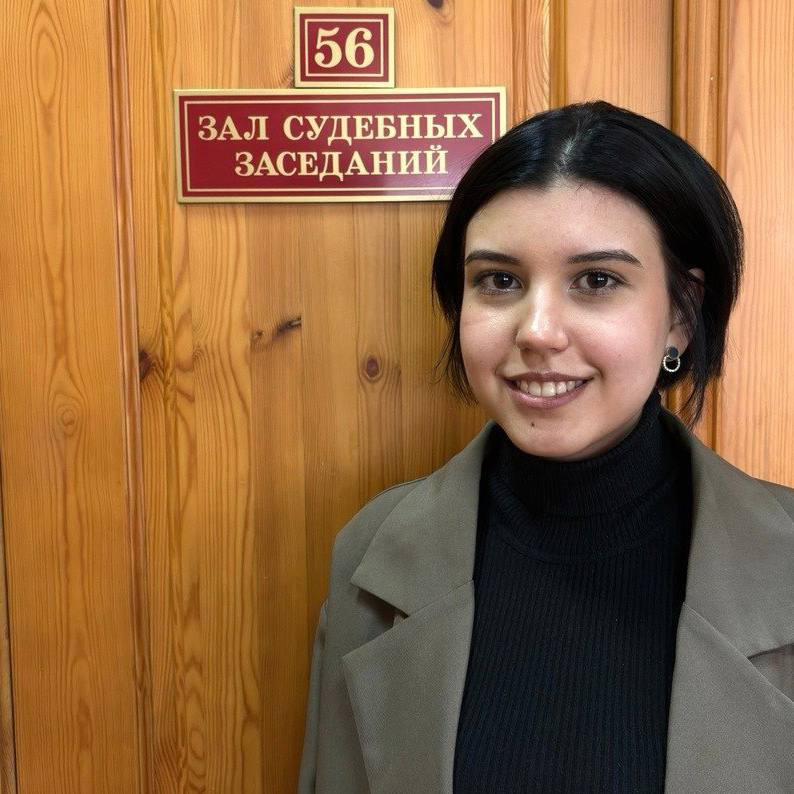
In Nizhny Tagil, 21-year-old student Yekaterina Sergeyenko has been sentenced for “defaming” [the Russian army]: she was fined 120,000 roubles [approx. 1,280 euros]. According to the news agency Mezhdu Strok (“Between the Lines”), criminal charges were filed over the young woman’s comments in the “Incident Nizhny Tagil” group on the social network VKontakte.
Vechernye Vedomosti reports that at the time she posted the comments, Sergeyenko had a prior administrative conviction for painting sixteen pacifist slogans on buildings in the city. This fact influenced the decision to file criminal rather than administrative charges against her.
Judge Oksana Belkina of the Tagilstroy District Court found Sergeyenko guilty. Although the verdict has not yet entered into legal force, the fine, according to Mezhdu Strok, has already been paid.
On 22 April 2025, Voronezh police raided the homes of activists believed by Center “E” [Russia’s “anti-extremism” police] to be connected to the Telegram channel Free People of Voronezh. The searches also involved severe beatings and threats, and some of the activists were forced to record videos supporting Putin and the war in Ukraine. Almost all the activists had previously been prosecuted on political charges, but now they feel so intimidated that they are afraid to file a torture complaint against the police.
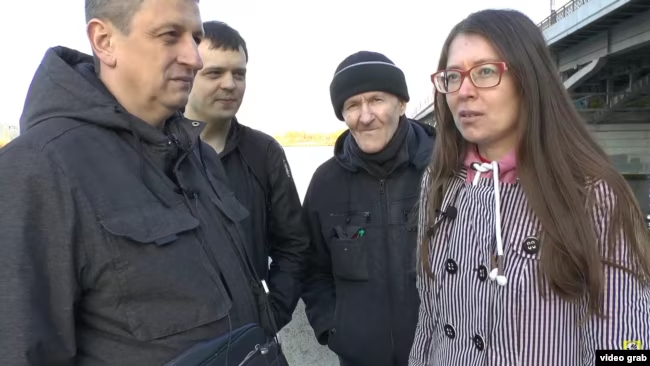
A 38-minute video was posted on the Free People of Voronezh channel on 16 April 2025. The video itself was viewed by less than three hundred people. In the video, four activists—Grigory Severin, Nadezhda Belova, Yuri Avsenyev, and Alexander Zheltukhin—discuss the news before jogging along an embankment of the Voronezh River. The genre is the “coffee klatch”: using the news as a springboard, the friends talk about the problem of alcoholism, apathy in society, increasing drug use, and the overall sense of doom and gloom.
Activists of the Telegram channel Free People of Voronezh: Grigory Severin, Alexander Zheltukhin, Yuri Avsenyev, and Nadezhda Belova
Nadezhda Belova sums up the video’s content at the very beginning.
“To cut it short, everything is bad, but it will get worse. To put it in a nutshell, the situation in this place is at the terminal stage,” she says.
She argues that Russia is inevitably moving in the direction “North Korea”—toward a mothballed, rotten dictatorship, because Russians “somehow still support it and want to live in it.” Belova has reason to be pessimistic: even before the war, the state had charged her with “condoning terrorism” for comments she had made on social media in the wake of Mikhail Zhlobitsky‘s [suicide] bombing of the Arkhangelsk FSB. in 2020, a military court sentenced Belova to pay a fine of 400,000 rubles. She was on Rosfinmonitoring’s list of “terrorists and extremists” for several years, and her family had to leave their home village and rent a flat in Voronezh, as their fellow villagers did not support Belova in her fight against the unjust charges.
The video posted on the Telegram channel Free People of Voronezh on 16 April 2025
“Again, the whole of Voronezh is covered with drug adverts. The law enforcement agencies run protection for [the illegal drug trade], and if they didn’t run protection for it, there wouldn’t be these adverts. At my neighborhood Pyaterka [convenience store], right at the entrance, there is a graffito painted in color on the doorstep: ‘Buying a stash is like going out for bread,'” says Alexander Zheltukhin. In previous years, Zheltukhin was fined for picketing against Belova’s persecution and arrested for protesting in support of Navalny. “And if it was not protected, I would argue, by the selfsame FSB, who probably take a percentage from it—”
“Watch out! You are discrediting the FSB,” Belova says, interrupting him. “I don’t agree! It cannot be!”
Caveats and omissions run through the entire conversation. The activists know that any free speech is potentially dangerous in today’s Russia, and they try to cover their bases whenever possible. (Spoiler: it didn’t work).
“They say it’s impossible not to confess”
A few days later, on 22 April, police raided the homes of all four people involved in the run, as well as those of other Voronezh activists. Searches were done at eight locations, allegedly connected with Free People of Voronezh. In most cases, the law enforcers acted extremely harshly. They used handcuffs and stun guns, beat people, intimidated the activists and their families, and emotionally abused them.
A photo posted by Nadezhda Belova
All the members of Belova’s family were shot with a stun gun. Belova later posted photos of her own bruises and the bloody marks on the bodies of her husband and son on Facebook. The police confiscated all their electronic devices and turned upside down their rented flat, which the landlady demanded that the Belovs vacate immediately after the search. The police threatened to send the son, a university student, to the war, and after the search, a policeman recorded a repentant video featuring Belova.
“Off camera, the [policeman beating Belova’s husband] says, ‘Do you support the [special military operation]?’ I say, ‘Yes.’ He says, ‘Do you support Putin?’ I say, ‘Yes.’ It’s light fare, but disgusting, especially when I saw a stun gun pressed against my son’s leg,” Belova told Okno.
The police recorded similar video “confessions” by several other people [caught up in the raids].
After the searches, Zheltukhin ended up in hospital with five broken ribs and several damaged vertebrae. He told OVD Info that he had tried to escape from the “punitive operation” and fell from the roof of a village house: “I broke my ribs when I fell, apparently, and they hit me [on those ribs]: it hurts a lot.” The police put a bag over his head and shocked him with a stun gun. His friends later photographed Zheltukin at hospital: his face was covered with bruises.
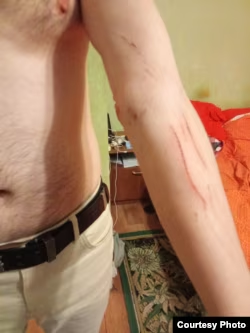
Fyodor Orlov, 36, was also beaten; after the experience, he says that he “did it all to himself.” He inflicted all the bruises and abrasions on himself, blindfolded himself with a scarf and sat like that for two hours, and fell into a briar bush on his own; there are photos of his back, entirely covered with flecks of blood. “Then someone—that is, I—drew a sex organ on my bald head just for fun,” he told OVD Info. The law enforcers also threatened to cut off one of his fingers, leaving behind telltale scratches.
Fyodor Orlov’s finger
“It was quite rough. As rough as possible, to the point that they say that now they understand why people confess to crimes they did not commit. Because, they say, it’s impossible not to confess. Orlov has several hundred stun gun marks [on his body]. Several hundred! They drove him into the woods. He thought they were taking him there to kill him,’” says Pavel Sychev, 38.
Sychev is a Voronezh activist and political consultant. He knows the administrators of the Free People of Voronezh channel from his past work as an activist: they crossed paths at pickets, but do not keep in close contact. Sychev’s home was also searched on 22 April, but there was no violence.
“[The police] search my home, as a rule, without breaking the law, and they never use force against me or my family. They have been coming to my home every year since 2022. These are just routine searches. I have always been searched as a witness in criminal cases to which I don’t even have an indirect connection,” says Sychev. “There is a federal case [for example, the case against Grigory Melkonyants and other activists of the Golos movement—Okno], and they do a series of searches all over the country, and they come and search my house for good measure.”
“Evil loves silence”
It is unlikely that the new series of searches was occasioned by the latest video posted on the Telegram channel. Our sources suggest, rather, that the reason for the raids was that Free People of Voronezh constantly writes and speaks about people convicted on charges of high treason and terrorism (for sabotaging railroad switch boxes, cell towers, etc.). The channel admins treat these people as anti-war resisters. For law enforcers, on the contrary, they are criminals convicted of violent crimes.
The formal pretext for the series of searches on 22 April was the criminal case, on charges of repeated discrediting of the army, brought against Grigory Severin. As follows from the indictment, while serving his sentence in a penal colony [he had been sentenced to two and half years in prison for “publicly calling for extremism”; he served his time and was released last autumn—Okno], Severin discredited the Russian armed forces. After the search, he was detained and placed under arrest.
Sychev believes that this criminal case was “canned.”
“You see, in Russia we have the practice of ‘desk drawer cases.’ Meaning you already have a criminal case against you: the entire case file is ready in advance, and it is lying in a desk drawer, waiting for its day to come. In the case of Severin, his first case was also ‘in a desk drawer.’ When he was arrested, it transpired that the entire case file had been readied a year earlier.”
It is not known what prompted the police to pull the case file from the drawer right now. But the fact that Severin faces prosecution does not surprise Sychev in itself.
“Everyone who knows Grigory, even in passing, realizes that he is a man who will not stay quiet. If anyone asks him directly how he feels about this or that situation, he will answer directly, even if the answer risks criminal charges. He is a man who will always try to prove to everyone the viewpoint which he espouses and defends. As far as I know, the first ‘discrediting of the armed forces’ case against him came from his explaining his philosophy of life to traffic police officers who had pulled him over. The second charge came from telling his cellmates about his stance. This in the order of things for him: he does not keep silent; he speaks openly, directly. So it was a matter of time. When a person speaks openly about a very dangerous and sensitive topic—and in our country the ‘special military operation’ is a sensitive topic—there are many chances that sooner or later they will be prosecuted.”
On the same day, a criminal case was opened against 65-year-old activist Yury Avsenyev, another person involved in the run along the Voronezh River embankment. His home was also searched on 22 April, but he was released on his own recognizance. Avsenyev is suspected of “publicly calling for extremism.”
Yuri Avsenyev
The Voronezh activists who fell victim to the police brutality have not yet worked up the courage to file complaints, and they fear excessive publicity.
“They are really spooked,” says Pavel Sychev. “The information I have now is that they will not file torture complaints, but I don’t know, maybe someone will persuade them to do it. They are very much afraid that if they do it, the law enforcers won’t be reprimanded in any way, but will just come and take revenge on them. They are all convinced that they will be killed. I told them that evil loves silence, and if you don’t react now, there is a greater chance of a repeat than if you do. But they said it’s very easy to judge from the outside when you haven’t been tortured. ‘We are afraid that they might do something to us,’ [they say].”
Our sources note that such official lawlessness had not previously occurred in Voronezh. Usually, searches at the homes of political activists and arrests were carried out by the book, without violence. The only widely known case of official lawlessness ended in criminal charges against the police officers involved and monetary compensation for the victims. In May 2018, criminal investigators Sergei Kosyanenko and Oleg Sokolovsky tortured university students Maxim Grebenyuk and Sergei Troyansky, hoping to force them to confess that they had stolen a mobile phone. The students were held at Police Station No. 4 in Voronezh’s Comintern District for six hours in handcuffs and strangled with a plastic bag. They refused to incriminate themselves, and afterwards they documented their injuries and filed a torture complaint with the Investigative Committee. In 2021, Grebenyuk was awarded one million rubles, and Troyansky, 500,000 rubles, in compensation for their suffering.
The Voronezh police’s current brutality may be due to the proximity of the front, suggests a source who requested anonymity. The fact is that, since the start of the full-scale invasion, Voronezh law enforcers have regularly been seconded to the so-called new territories, the occupied Donetsk and Luhansk regions.
“There are quite big problems with the law in those ‘new territories.’ And the practices that are used there are inhuman, I think. When they come back here, to their native land, they simply do not reconfigure themselves,” says our source, who is not connected with the Free People of Voronezh Telegram channel. “They consider themselves above the law. They think that they are involved in a good cause, and they can torture bad people for the sake of the good cause. When a person has tried their hand at it once, when they realize that they can get away with it absolutely scot-free, then it is quite difficult to put the brakes on, and it will grow.”
Today, the 1st Western District Military Court sentenced 67-year-old dissident Alexander Skobov to 16 years in prison and fined him 300,000 rubles (just over $3,500). Skobov, who first faced criminal prosecution in the USSR, was convicted under charges of “participation in the activities of a terrorist community” (for his involvement with the Free Russia Forum, a Russian opposition conference abroad) and “justification of terrorism” (for his social media posts and articles). Mediazona publishes Skobov’s closing statement from today’s trial—a passionate speech in which he continues to openly support Ukraine, defies persecution and denounces judges as accomplices of Putin’s war crimes.
I will not dwell on the fact that the investigation has branded the organisation I have the honour of belonging to, the Free Russia Forum, as a terrorist community. There has been no official ruling from any government body recognising the Free Russia Forum as such. For now, it is merely an “undesirable organization.”
But I have little interest in all this petty mumbling. I prefer to speak about what truly matters. What matters here is the platform of the Free Russia Forum, a platform I was directly involved in shaping, and one that distinguishes the Free Russia Forum from most other opposition organisations.
Let me remind you that this platform is built on three principles. First: we stand for the unconditional return to Ukraine of all its internationally recognised territories occupied by Russia, including Crimea. Yes, Крим це Україна. [Crimea is (part of) Ukraine — TRR.]
Second. We support all those who are fighting to achieve these goals—including citizens of the Russian Federation who have voluntarily joined the Armed Forces of Ukraine.
And third. We recognise any form of war against Putin’s tyranny inside Russia, including armed resistance. Of course, we are deeply disgusted by the methods of ISIS, when innocent people are targeted, as was the case in Crocus City.
But are the Kremlin’s war propagandists a legitimate target? The Free Russia Forum has not formally debated this issue or adopted any resolutions on it, so what I say next reflects my personal position alone.
I believe that propagandists such as TV host Vladimir Solovyov deserve the same fate as Hitler’s chief propagandist Julius Streicher, who was hanged by the Nuremberg Tribunal. Until these outcasts of the human race are brought before a new Nuremberg Tribunal—and as long as this war continues—they remain legitimate military targets.
For me, the comparison between Putin’s and Hitler’s propagandists is not mere rhetoric. Much of my public writings has been devoted to proving the inherently Nazi nature of Putin’s regime—a regime with which peaceful coexistence is fundamentally impossible.
I appeal now, as I have before, first and foremost to Europe, which should remember the origins of the current European system. Since 1945, Europe has been building a world in which predators no longer prevailed, a world based on the principles of law, justice, freedom, and humanity. Europe had achieved much on this path and seemed to have rid itself of massacres and territorial redistributions forever.
Europe once believed that this safe and prosperous world was securely protected by a great powerful ally across the ocean. Today, this world is being torn to splinters by two scoundrels on both sides: the Kremlin and Washington. People with pro-fascist values have come to power in the United States.
We are witnessing a disgusting attempt at a purely imperialist collusion between two predators. An even more despicable collusion than the Munich Betrayal of 1938. If Putin’s annexations are legalised, it will spell disaster for civilization. Europe, you have been betrayed. Wake up and go fight for your world!
Death to the Russian fascist invaders! Death to Putin, the new Hitler, murderer and scoundrel! Glory to Ukraine! Glory to the heroes!
I usually end my speeches with these words. But today I will be further asked whether I plead guilty.
Well, I am the accuser here.
I accuse Putin’s corpse-stinking clique of planning, unleashing, and waging an aggressive war. Of committing war crimes in Ukraine. Of orchestrating political terror in Russia. Of corrupting my people.
And now, I ask the servants of Putin’s regime present here, mere cogs in the repressive machine: do you find yourselves guilty of complicity in Putin’s crimes? Do you repent?
A Russian military court sentenced Soviet-era dissident Alexander Skobov to 16 years in prison on charges of justifying terrorism and being a member of a terrorist organization, the exiled news outlet Mediazona reported Friday.
Skobov, 67, was arrested in April on allegations that he justified an attack on the Russian-built Crimea Bridge in an online post and was a member of the Lithuania-based liberal opposition platform Free Russia Forum, which Russian authorities have outlawed as “undesirable.”
A military court in St. Petersburg convicted Skobov on both charges and sentenced him to serve his time in a maximum-security prison.
Prosecutors had requested an 18-year sentence for Skobov, whose health had deteriorated significantly during pre-trial detention.news
In a defiant last statement in court, Skobov condemned both Russian and U.S. leaders as “predators” engaged in an “imperialist conspiracy” in Ukraine.
“Death to the Russian fascist invaders! Death to Putin, the new Hitler, the murderer and scoundrel! Glory to Ukraine!” Mediazona quoted Skobov as saying.
“I’m the one blaming you here. I accuse Putin’s ruling clique, which stinks of corpses, of preparing, unleashing and waging an aggressive war,” Skobov added.
Russia’s Justice Ministry designated Skobov as a “foreign agent” in March 2024. He is among the few outspoken critics of Russia’s full-scale invasion of Ukraine to remain inside the country despite the risk of facing criminal charges under wartime censorship laws.
A dissident since the late 1970s, Skobov was convicted twice and subjected to punitive psychiatric treatment for “anti-Soviet propaganda.”
The complete text of Alexander Skobov’s speech during closing arguments at his trial today (18 March 2025). Video: SOTAvision
Those who have been following my trial will certainly have noticed that the position of my lawyers and my position are not quite the same. We have emphasized different things, and we have slightly different objectives. My lawyers have sought to draw attention to a problem that is identified in the reports of international organizations as the abuse of anti-terrorist legislation to restrict the freedom of expression, the freedom of speech.
This problem does exist, and in some quite decent countries, particularly the European countries. The European approach to this problem has differed from the American one. The United States of America has the First Amendment of the Constitution, which expressly prohibits any limitations on freedom of speech. In the wake of the severe trauma wrought by the Second World War, the European countries took a somewhat different path. They introduced measures to restrict the dissemination of ethnic hatred, ethnic superiority, and ethnic inferiority — all the ideas associated with Nazism. A whole system of restricting freedom of speech has arisen out of this. Europe has sought a reasonable balance between freedom of speech and its restriction.
I do not regard this experiment as successful. Freedom of speech either exists or it doesn’t exist. Any restrictions on it will always lead to abuse, no matter how well intentioned. The very idea of prohibiting people from condoning anything or anyone is flawed in principle. It means forbidding people from thinking and feeling. Lawyers have the inalienable right to seek to condone their client any way they can, but so does any human being.
Only this whole story has nothing to do with us. There is no abuse of anti-terrorist legislation in Putin’s Nazi Russia. There is legislation explicitly aimed at quashing all expression of disagreement with the authorities. Under this legislation, a theatrical production about the horrible fate of women who were tricked by ISIS fighters into joining their war as their wives is deemed “condoning terrorism.” Those complicit in the guilty verdict against Yevgenia Berkovich and Svetlana Petriichuk have no souls, they are undead, but the law itself is worded in such a way that it can be interpreted this way. Can we speak the language of law with a state which has adopted a law like this and deploys it in this way? Of course we cannot.
My case is fundamentally different from the case against Berkovich and Petriichuk, as well as from the numerous cases against people who limited themselves to voicing moral condemnation of Russia’s aggression against Ukraine. My case is not about freedom of speech, its limitations, and the abuses of these limitations. My case is about the right of a citizen in a country waging an unjust war of aggression to utterly and completely take the side of the victims of the aggression. It is about the right and duty of a citizen in a country waging such a war.
This right is covered by the category of natural law because it cannot, in principle, be regulated by legal norms. All warring states regard going over to the side of their armed enemy as treason. And the aggressor never recognizes himself as the aggressor and calls the robbery and plunder in which they engage “self-defense.” Can we prove legally to the aggressor that they are the aggressor? Of course not.
But Putin’s Nazi dictatorship is an aggressor of a special kind. Having legislatively declared a war a “non-war,” it regards all armed opposition to its aggression as “terrorism.” It does not recognize the existence of a legitimate armed opponent at all. The obligatory reports of the Russian high command persistently refer to the Ukrainian army as “militants.” Does this have anything to do with law? Of course not. But war, in principle, is not compatible with law. By its very nature, the law is a constraint on violence, while war is violence without restraint. When the guns talk, the law is silent.
My case has to do with my involvement in the armed resistance to Russian aggression, even if only as a propagandist. The goal of all my public statements has been to achieve a radical expansion of military assistance to Ukraine, up to and including the direct involvement of the armed forces of NATO countries in combat operations against the Russian army. For the sake of this goal I refused to emigrate and deliberately went to prison. What I say carries more weight and resounds more loudly when I say it here.
Borrowing the wording of the so-called Criminal Code of the so-called Russian Federation, all these actions constitute assistance to a unfriendly foreign power in generating threats to the national security of the Russian Federation, as described in the current Criminal Code’s article on high treason. Why was I not charged with violating this article, nor with violating the many other political articles in the current Criminal Code, charges which should have been brought against me for my publications? The most important of my publications were never included in the indictment, although I had the opportunity to make sure that the investigation was acquainted with them. In addition, the investigation was aware that I had made personal donations to purchase lethal weapons for the Ukrainian army and publicly encouraged others to follow my example. This is the kind of thing for which the authorities now automatically charge people with high treason.
Why didn’t they do it? I think that they didn’t do it not only due to the overloaded repressive apparatus, human laziness, and the typical aversion of Russian authorities to legal norms in general, including their own legal norms. They are our legal norms, they would say. We do what we want with them, we enforce them when and if we want to enforce them. We call the shots.
But there is another reason. Even among the people who have morally condemned the Russian aggression and risked going to prison for it, there are not many who have dared to take the side of the victims of the aggression. The dictatorship is afraid that there will be more such people, and it is afraid of “bad” examples. So it has had a stake in not amplifying my voice too much and not mentioning the specifics of my case, which I have just mentioned. I have tried to focus the public’s attention on these selfsame peculiarities.
Unlike my lawyers, I really have not tried to prove to the aggressor that they are an aggressor who has violated all internationally recognized legal norms. It makes as much sense as discussing human rights with Hitler’s regime or with Stalin’s similar regime. By the way, maybe the judge can recall which article of the Criminal Code criminalizes equating Stalin’s regime with Hitler’s.
But my lawyers and I are unanimous that my case cannot be considered outside the context of the ongoing war. It is a part of this war. And my lawyers’ attempts to speak the language of law with the aggressor’s authorities only illustrate once more that when the guns do the talking, the law is silent.
Free speech is not the issue in my case. In this war, speech is also a weapon that also kills. The Ukrainians write my name on the shells annihilating Putin’s lowlife who have invaded their land. Death to the Russian fascist invaders, death to Putin, the new Hitler, a murderer and scoundrel! Glory to Ukraine, glory to the heroes! I rest my case.
Prosecutors have requested an 18-year prison sentence for Russian dissident Alexander Skobov, whose trial on charges of justifying terrorism over a social media post he wrote about the Ukrainian bombing of the Crimean Bridge is coming to an end in St. Petersburg, independent news outlet Bumaga reported on Tuesday.
Requesting Skobov be given a six-year sentence for justifying terrorism, as well as a 12-year sentence for “involvement with a terrorist community”, prosecutors also asked the court to ban Skobov from administering websites or Telegram channels for four years and to fine him 400,000 rubles (€4,500). Having openly criticised the regime of Vladimir Putin and opposed both Russia’s 2014 annexation of Crimea and its 2022 full-scale invasion of Ukraine, Skobov was arrested in April over a social media post he wrote about the Ukrainian bombing of the Crimean Bridge, which connects Russia to the annexed peninsula.
Skobov had previously said that the destruction of the bridge was “extremely important from a military-political standpoint” and called a failed Ukrainian attempt to destroy it a “shame”. He had also been fined for his links to the pro-democracy Free Russia Forum, an organisation deemed “undesirable” and thus effectively outlawed in Russia. The Free Russia Forum condemned his detention, calling it “arbitrary”, and demanding his immediate release.
Now 68, Skobov is a well known Soviet-era dissident who was part of the New Leftists opposition movement in the late 1970s. He was forced to spend two three-year stints in a psychiatric hospital, a common fate for political dissidents at the time, for publishing the anti-government magazine Perspectives and for participating in protest actions.
Having been deemed a “foreign agent” by the authorities, Skobov nevertheless refused to leave Russia, despite pleas from his family to leave. While in pretrial detention, Skobov’s health in general, and eyesight in particular, have deteriorated rapidly.
Our strange post-truth era turns everything upside down and paints black as white. It is vital that we remember the basics and not lose our bearings to avoid going crazy.
So I just want to remind you that:
Vladimir Putin is a dictator, murderer, and war criminal.
It is immoral and outrageous to work on Putin’s behalf and aid him.
The Russian army’s invasion of Ukraine is unlawful and unwarranted.
Ukraine is the victim of aggression.
Russia is a police state: it stifles dissent and persecutes its citizens for dissenting.
Any individual who resists Putin’s regime deserves our encouragement.
Alexei Navalny and Boris Nemtsov are Russian heroes.
There should be a regular transition of power in all countries.
Hi, everyone! The Russian Federation put me on the wanted list today. Why? Because first I taught Russian to foreign students and because of that I became a “foreign agent,” and then, apparently, because I didn’t fulfill the requirements of the law on “foreign agents”: I drew anti-war comics on [“foreign agent”] report forms to the Justice Ministry.
(A story in the guise of a Russian language lesson)
“The accusative case is the object case: it answers the questions whom and what. For example, whom do we love? What do we love? A friend, mom, a city. Whom do we hate? What do we hate? The weather, the rain, the snow.”
I point out the window. A disgusting Petersburg sleet is coming down outside, and the class laughs. We often joke about the the city’s atrocious weather. All my students hail from warm countries: Uzbekistan, Tajikistan, and Azerbaijan. Adults between the ages of twenty and fifty, they are people who are commonly called migrant workers. Tired, in black jackets, they apologize verbosely. They know Russian slang because they learn it on the street, at the market, and at work, but they don’t know what a noun is, because they have had little schooling even in their native languages and have been working since they were children.
“Remember we were talking about the dative case, the case of the addressee? To whom do we give something? To whom do we say something? To a sister, to a friend.’
(Here I want to make an aside about the verticality and horizontality of Russian grammatical cases, but I stop myself because I realize it’s superfluous, although I find the explanation felicitous: the dative case is horizontal, while the accusative case is hierarchical and vertical.)
I say this to my students, but my dean is sitting at the back of the classroom, listening attentively, and next to him sits an FSB officer whom my rector dragged into my class. The FSB officer is also listening attentively. It’s hard to say whether I hate anything in my life more than this situation and those two.
“Unlike the dative case — the case of the second subject in an exchange, where I talk to someone, for example, to a person or to a friend (the person is involved in the exchange: they hear and understand me) — the accusative case indicates the object of an action: I eat a pizza, I read a book.”
A few days earlier, my rector had telephoned me and asked me to ask one of my students to come in, ostensibly for a test. I asked him why this was necessary, if the woman had already taken the entrance exam. He said that an FSB officer would come to my lesson, because the student was person of interest to him, but that she should not know the FSB officer would be there.
I said that it was not part of my job description, that I never lie and would never lie to a student. I also told the rector that my class was a class, not an FSB office, and that I was opposed to anyone being spied on in my class, to which the rector replied that he had the right to come to my class with whomever he saw fit and that he would telephone the student himself.
‘What endings can we use in the accusative case? For masculine nouns, we use the zero ending if it is an object (a what?), for example, ‘I know this film’, ‘I read the text’, or -a/-ia if it is a person (a whom?), for example, ‘I know the [male] teacher’ [uchitelia], ‘I see the [male] student’ [studenta]. For feminine nouns, the ending is always -u, for example, ‘I see the book [knigu], ‘I see the [female] student [studentku].
I don’t see the student in class. I haven’t seen her all week since that phone call and I don’t know what to do. Should I call her and tell her that the dean wants to talk to her and that the FSB is interested in her? If I called her on my mobile phone, then the FSB would be interested in me. All week I have been trudging round the city: it’s autumn, November, the weather is disgusting, my feet are wet, I’m working ten hours a day, I don’t see my children, I don’t see the sun. How come I took it all on myself, this job, this workload? Why do I have to bear it alone? Who’s to blame? I guess it’s my fault. But I can’t afford not to work even on my birthday. And then there’s this student. God, what am I going to say to her? Flee the country? Maybe they’ll just ask her questions. It’s not like they’re going to bring a paddy wagon to the university to arrest her…
“What? Yes, there’s no difference between objects and persons: sister [sestru], girlfriend [podrugu], teacher [uchitel’nitsu], street [ulitsu], hand [ruku].
Why are the two of us — two women in a patriarchy — again getting screwed over for everything? Men have invented the patriarchy, that drug for their delicate egos which comes with wars, exploitation, violence, and control. It messes with your head and then blames you for everything being wrong.
“Yes, that’s right. Oyatullo, please come up with sentences using the verbs ‘read,’ ‘write,’ and ‘see’ with nouns in the accusative case.”
When I came to work today, the dean and the FSB guy were already in the classroom. While I was still thinking what to do, everything had already happened, so I started the lesson. Why aren’t future language teachers warned that their profession will involve this? There was pogrom at my last job, a year ago. They came from the FSB, from the migration service. They blocked the doors from the inside, tore my folders with the students’ documents inside, yelled at me and at the students, and those courses were shut down. Then a year passed, and I found a new job: the cultural capital of Russia, beautiful St. Petersburg, Liteiny Prospekt, the Yusupov mansion, stucco, gold, chandeliers, cold, dust, red carpets, students in their jackets and hats. It was sad but mentally manageable. It seemed like things would be decent now, but no, the cops have shown up here too. Now things are just as they should be, the whole nine yards.
“Okay, great! Now let’s do some exercises from the textbook.”
The thing I hate, the vertical in the back row, is slowly segueing into a diagonal. The FSB guy is sitting next to the radiator. You can tell by his flushed mousey face that he’s spent a lot of time outside today and now, in this warm room, he’s gone limp and snuggled up against the wall.
“Page 218, exercise 8, Munisa, please!”
I’ve been working here for a few months now. I have been telling the students about grammar, and they have been telling me about nationalism. They’ve told me about a lot of things — for instance, about the cop who confiscated one’s student’s sack of apples when he realized she didn’t have the money to pay him a bribe; about how they hid in cement bags; about how the neighborhood beat cop visits them once a month to collect 3,000 rubles from each their flats, just because he can; about how landlords refuse to let flats to them; about what people say to them on the street.
“Okay, now let’s turn the page.”
The FSB guy at the back desk is asleep, while the dean sits with his eyes half closed. I think that’s probably what the peak of your career looks like: when you have an FSB officer asleep in your class. Or, depending on how you look at it, maybe it’s the bottom of your career. I also think that it would be good if he kept sleeping like that. Sleeping Beauty slept for a hundred years, so there are historical precedents. That would suit me just fine. I try to keep my voice down.
“Let’s use these same verbs now in the future tense and at the same time we’ll practice the perfect and imperfect aspects of the verb.”
On the wall of my shabby office, just opposite the blackboard, the phrase “Dasha is a rube” was written in black, but then corrected to “Dasha is a nube” in green.
The student for whom the ambush at the back desk was arranged enters the classroom. She is older than me, thin, and wears a hijab, and she has come with her grown-up son. I quickly think that this is better, that it is good she is not alone. The dean briskly rushes up and tells me and my students to move to another classroom and finish our lesson there.
We leave with our books and notebooks. We walk along the red carpet, past a portrait of the patriarch in a golden frame, past a poster against corruption (I remember how once a student tried to bribe me right under this poster), past some oil landscape paintings, past stands with pictures of the father the rector, his son the assistant rector, and his mother the dean. Then we pass the security guard who calls my students “blacks.”
How shameful.
“Okay, let’s finish this page.”
I stopped by the classroom after class. The student and her son were already leaving, and they looked very upset. I never found out what had happened there or what the FSB had wanted with her, and I never saw her again.
This job of mine ended a few months later because of the [2018] FIFA World Cup. Private universities were prohibiting from offering “pre-university” courses. Formally, this was done to reduce the number of students from Central Asia, but in fact it was done so that there would be fewer migrant workers from Central Asia in Russia’s capital cities during the World Cup, because the superpower Russia hinges not only on power but also on provincialism. What would foreigners from the first world see when they came to Russia? Other foreigners, but from the third world?
My lousy work schedule ended a little later, when I was able to find a normal job, that is, several jobs. A little later still, my quasi-marriage ended, because I couldn’t fool myself anymore, and later still my life in St. Petersburg ended in political persecution and emigration.
And only a prolonged feeling of guilt remained with me in the wake of it all: about how I should have behaved, where that woman is now, and whether she is doing well.
Dear friends, thank you for the words of support. Yesterday, I realized that, although I had know that sooner or later I might be put on [Russia’s] wanted list, I wasn’t ready for it.
I probably used to joke about it, and I still do. For example, there are my children: their parents are wanted because one of them insulted the feelings of religious believers, while the other taught foreign students and submitted incorrect reports to the Justice Ministry.
An illustration of Nikolai Chernyshevsky’s mock execution on Mytninskaya Square in Petersburg, 31 May 1864. Source: Istoriia.RF
But this grotesque discrepancy between the gravity of the “crimes” and the sanctions masks what I see as a modern Russian form of mock execution. Remember how Chernyshevsky was put through this? He had a signboard bearing the words “state criminal” hung on his chest, and his sword was broken above his head.
In addition to that, he was sent into exile, banned from publishing books and living in the capital cities, placed under constant surveillance, and so on.
It’s a pity I don’t have a sword to break.
You know, when it happens to you, the feelings which arise are complicated. If it were only about my relations with the authorities, it would be easier. But it automatically implies that I cannot go back to Russia, and although I had not planned on doing this in the near future, yesterday I realized that it hurts me a lot.
I was on the bus when I got the call from Varya.
“I have to tell you so you don’t find out about this on the new,” she says to me.
“So, what happened?”
“You’ve been put on the wanted list. Are you okay?
(I’m not okay: I’m crying. I forgot I could cry like that.)
“Dasha, where are you now?”
“I’m on the bus, Varya. I missed my bus and the driver of another bus has let me ride for free.”
“He let you on because you could explain everything so well in German?”
“No, because he found out I was Russian. He said he was Serbian and loved Russia.”
(Varya laughs.)
“You tell him that his beloved Russia has put you on the wanted list.”
“Varechka, I still don’t have a ticket and I have to get to my destination, so I won’t tell him about this.”
As I rode in the bus, I thought that I should write down this conversation and that I too, like my Serbian driver, love Russia. I love Kamchatka, Siberia, and St. Petersburg — all three of my homelands, and I miss the people dear to me and the places dear to me, the people and places which nourished me and brought me up, teaching me to be freedom-loving and independent.
So I am sorry that thing are like this, that my country does not want to see me but puts me on the wanted list as if it wanted to see me. I would like our friendship to be mutual.
I was brought up in the Soviet Union to believe that when a malicious, cruel aggressor attacks civilians, you have to take up arms and go do battle with him, and that if you cannot bear arms, you help the people who are doing battle and call on others to do the same.
All my work as a political commentator has been about calling on people to go do battle with the aggressor which has attacked Ukraine, to assist Ukraine with weapons and ammunition.
No one had attacked or threatened Russia.
It was Putin’s Nazi regime which attacked Ukraine, only because of the megalomania of the regime’s ringleaders, because of their inhuman thirst for power over all they survey.
Murdering hundreds of thousands of people is their way of bolstering their self-esteem. They are degenerates, scum, and Nazi riffraff.
The guilt of Putin’s Nazi dictatorship in plotting, unleashing, and waging a war of aggression is obvious and does not need to be proven. We also do not need to prove our right to offer armed resistance to this aggression on the battlefield and in the aggressor’s rear. It would be laughable to expect this right to be acknowledged by a regime which tosses people in prison for morally condemning its aggression out loud. All legal means of protesting Putinist Russia’s aggression have been eliminated.
My calls to resist the aggressor’s regime with armed force have caused me to be charged with terrorism.* I won’t deign to argue with the aggressor’s officials even if they claim my actions constitute pedophilia. Russia’s courts have long ago shown themselves to be appendages of the Nazi tyranny and seeking justice from them is pointless. I will never stand up before these people, who are the lackeys of murderers and scoundrels.
I see no point in arguing with puppets of the dictatorship about how conscientiously they execute their own laws. In any case, these laws are the laws of a totalitarian state and their aim is to stifle dissent. I do not recognize these laws and I will not obey them.
I also have no intention of appealing any rulings made by or actions taken by representatives of the Nazi regime.
The Putinist dictatorship may murder me, but it cannot force me to stop fighting against it. Wherever I find myself, I will keep calling on honest Russians to join the Ukrainian Armed Forces. I will keep calling for airstrikes on military facilities deep in Russian territory. I will keep calling on the civilized world to inflict a strategic defeat on Nazi Russia. I will keep trying to prove that the new Hitler’s regime must be routed militarily.
Putin is the new Hitler, a vampire driven insane by impunity and drunk on blood. I shall never grow tired of saying, “Crush the viper!”
Death to the murder, tyrant and scoundrel Putin!
Death to the Russian fascist invaders!
Glory to Ukraine!
[Grani.Ru:] Thanks to Alexander Valeryevich’s dedicated wife Olga Shcheglova (pictured above). Thanks to SotaVision for filming at the Petersburg military court (Skobov is participating in the trial via video link from Syktyvkar). Thanks to those who didn’t unsubscribe from Grani.Ru after it closed. It’s as if Skobov timed his brave deed to coincide with the final moral collapse of numerous media brands. And yet he will be heard by a handful of his contemporaries. But he has already gone down in history.
* Skobov has been charged with “publicly calling for terrorism,” “publicly condoning terrorism or promoting terrorism using the mass media, including the internet” and “organizing a terrorist community and participating in it.” If Skobov is convicted on these charges, he faces a maximum penalty of ten to fifteen years in prison and fines of up to one million rubles (approx. 9,500 euros)— TRR.
The number of Russians who find themselves behind bars for opposing the authorities who launched the war with Ukraine grows by the day. There are hundreds of political prisoners in the country. We try to remind our readers about these people every chance we get. Today, Mediazona’s David Frenkel tells the story of Alexander Skobov, 67, a historian from St Petersburg, a defendant in the last criminal case against ‘anti-Soviet agitation and propaganda’ in Soviet history, a convinced Marxist, and a veteran of the dissident movement, who after decades has found himself on a very familiar path: searches, arrest, psychiatric ward, jail.
Alexander Skobov is one of the most experienced political prisoners in Russia. In the 1970s and 1980s, he was twice sent to a psychiatric hospital for compulsory treatment: the first time as an editor of samizdat, the second time for slogans in favour of political prisoners, which Skobov wrote on the walls of Leningrad houses.
Almost half a century later, in April 2024, the authorities came after him again. Skobov was accused of ‘justifying terrorism’ because of his post about the explosion on the Crimean Bridge and sent to a pre-trial detention centre. In protest, he refused to take his glasses and medication with him. Later, an article on participation in a ‘terrorist community’ was added to the charge, and Skobov was transferred from St Petersburg to Syktyvkar.
“We were left alone for a long time. The reasoning being: we’ll die out on our own. Or we’ll leave and live out the rest of our lives off the once acquired (quite deservedly) political and moral capital. The blow came to other people, most of them much younger,” he wrote from the pre-trial detention centre.
Skobov maintains an active correspondence in pre-trial detention. He discusses philosophical and political topics, his letters are even published in historical journals. Write to Alexander, argue with him, disagree with him, I’m sure it would be valuable to him. The only thing is that his wife asks that the letters to him be written in 18-point Sans Serif font. Skobov can’t even see his own texts well: he first drafts them on the back of used sheets of paper and then blindly transfers the texts to the reply form.
Address:
167028, г. Сыктывкар, поселок Верхний Чов, д. 99 , ФКУ СИЗО-1 УФСИН России по Республике Коми. Скобову Александру Валерьевичу 1957 года рождения
Please write letters in Russian, otherwise the prison censors won’t let them through. You can send letters online via a special services called PrisonMail.
You can also write in English, using the websites Letters Across Borders and Lifeline, two projects by OVD Info, a media outlet and human rights defense group.
“Not until I went into the churches of America and heard her pulpits flame with righteousness did I understand the secret of her genius and power. America is great because she is good, and if America ever ceases to be good, she will cease to be great.” – Alexis de Tocqueville
In the Soviet Union, where I grew up, any expression of faith was met with ridicule and harassment under anti-religion propaganda. This experience deepened my appreciation for the freedom to worship and inspired DEO FAVENTE wine—a tribute to God’s grace and providence.
As we approach Thanksgiving, let us reflect on the foundation of America’s greatness: her faith in God. It is through that faith and the values rooted in His word that our nation remains a true Land of Promise, guided by His hand.
Source: Land of Promise emailing, 14 November 2024
“We chose the name Terra de Promissio, latin for the Land of Promise. because as farmers, the land is about the “promise”. The promise that every new season brings the possibility AND the hope of a bountiful harvest.”
“and as we were both born, have lived and worked overseas, It is the promise of AMERICA, one nation under god AND the American Dream. We very much appreciate what this country represents. America is truly the land of promise and we are grateful for the freedom, liberty and opportunities that these united states offers to all of us.”
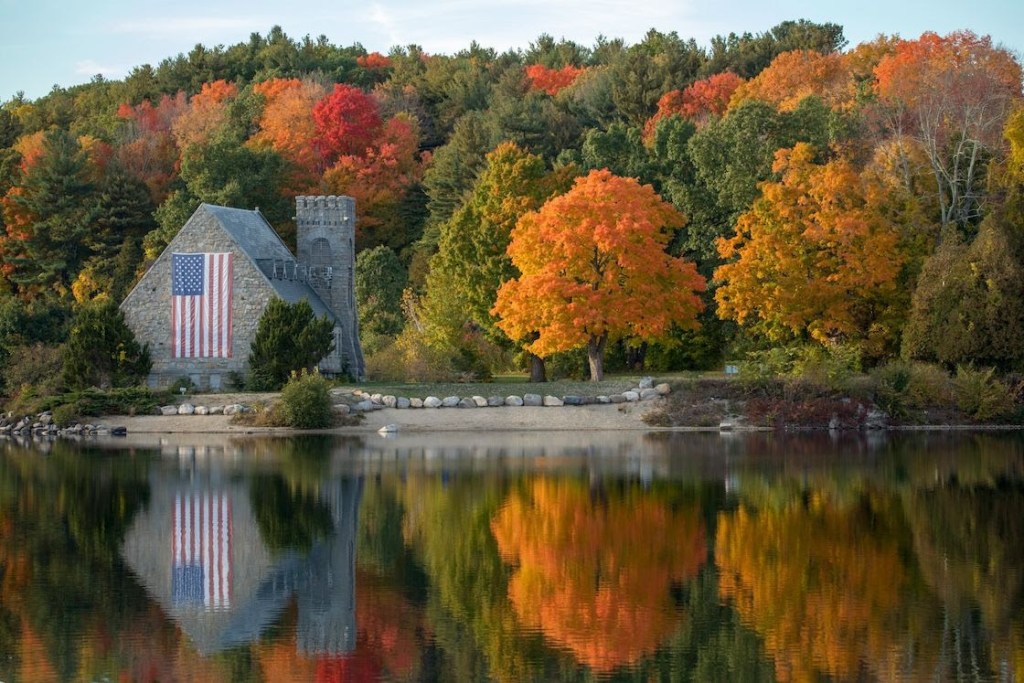
Charles and Diana bought a former dairy ranch in 1999 and then over the next 3 years, oversaw the planting of 33,000 vines. During the summer of 2002, they bought a used trailer to live in and then brought Diana’s Dad and sister Alina from Russia to help manage the vineyard. We welcomed Diana’s Family to the USA with an American Flag. And from that day on, the American Flag has proudly flown every day here at the vineyard. Terra de Promissio had its first harvest in 2005 and sold to 3 wineries. In 2007, after renting a house in Petaluma, they converted a barn into a home and moved to the vineyard full time. In 2012 and 2013, they planted an additional 18,000 vines to bring the total planted acreage of Terra de Promissio to 50 acres.
[…]
Diana KARREN
Diana was born in the Soviet Union. She was a Young Pioneer in the Communist System. But in the 1980s as the Soviet Union began to collapse, she put herself thru college and at the same time, worked for western companies that were investing in the now Former Soviet Union. Her hard work and great grades paid off and she was accepted to the University of Pennsylvania’s Wharton School of Business, where she graduated with a Masters of Business Administration in 2003.
During a two year period (2001-2003) Diana single-handily designed, gained government approvals and oversaw the planting of Terra de Promissio, while being pregnant and giving birth to Christian and doing it as a full time MBA Ivy-League student. In 2005, Diana oversaw the first harvest to Siduri, Flowers and Lynmar. In the ensuring years, as the grape production ramped up, Diana added multiple wineries including Kistler, Kosta-Browne and Willams Selyem. In 2011, Kosta Browne received the Wine Spectator’s Wine of the Year for the 2009 Sonoma Coast, which was primarily using grapes from Terra de Promissio.
Since day one, every row and block is custom farmed per each of the winemakers specific instructions. Because of this attention to detail by Diana, Terra de Promissio is now the most vineyard designated pinot noir in Sonoma County with over 10 wineries using the TdP name on their label. Beginning with the 2013 harvest, Diana began overseeing the winemaking process for Land of Promise. She now makes 4 Land of Promise Pinots and one Rosé. For more info, please click here or the link below.
In addition to managing the vineyard and the winery, Diana spends her Sunday mornings at Calvary Chapel Petaluma where she volunteers watching the babies and toddlers during the busy first service, so their parents can enjoy and listen to the sermons.
Just one week has passed since Donald Trump’s electoral triumph, and already Russian President Vladimir Putin—one of the strongman leaders Trump admires most—is messing with his head.
First, Putin waited two days before congratulating Trump on his victory. One can imagine Trump receiving phone calls from kowtowing leaders the world over—Ukraine’s Volodymyr Zelensky, Israel’s Benjamin Netanyahu, the Palestinian Authority’s Mahmoud Abbas, the chief of NATO, the European heads of state—all the while wondering about the man whom he’s admired publicly and privately for the past eight years: When is Vladimir going to call?
Then, in response to Trump’s claim that during their phone call, he asked—in some accounts, warned—Putin not to escalate the war in Ukraine, a Kremlin spokesman denied that the two had spoken on the phone at all. (Putin issued his belated congratulations at a news conference.)
I don’t know who’s telling the truth, a practice for which neither man has a sterling reputation. But either way, in the next few weeks, when Putin orders 50,000 fresh recruits (including 10,000 imported North Korean soldiers) to go on the next rampage—ousting Ukrainian soldiers from the thin slice of Russian territory they hold, then retaking soil across the border in Donbas province—he can tell a complaining Trump that he doesn’t recall any such conversation. If Trump thinks Putin actually will refrain from stepping up attacks on Ukraine as a friendly favor … well, maybe our once-and-future president will learn a lesson about the limits of personal relations in the face of perceived national interests early in his second term.
The final twist of this saga came on Monday, when Nikolai Patrushev, an aide to Putin who was previously director of Russia’s Federal Security Service, made the following comment in an interview with the Moscow newspaper Kommersant:
The election campaign is over. To achieve success in the election, Donald Trump relied on certain forces to which he has corresponding obligations. As a responsible person, he will be obliged to fulfill them.
This is a mind-blowing bit of psychological warfare! The Russians are basically telling Trump: We put you in office. Now it’s time for you to pay us back.