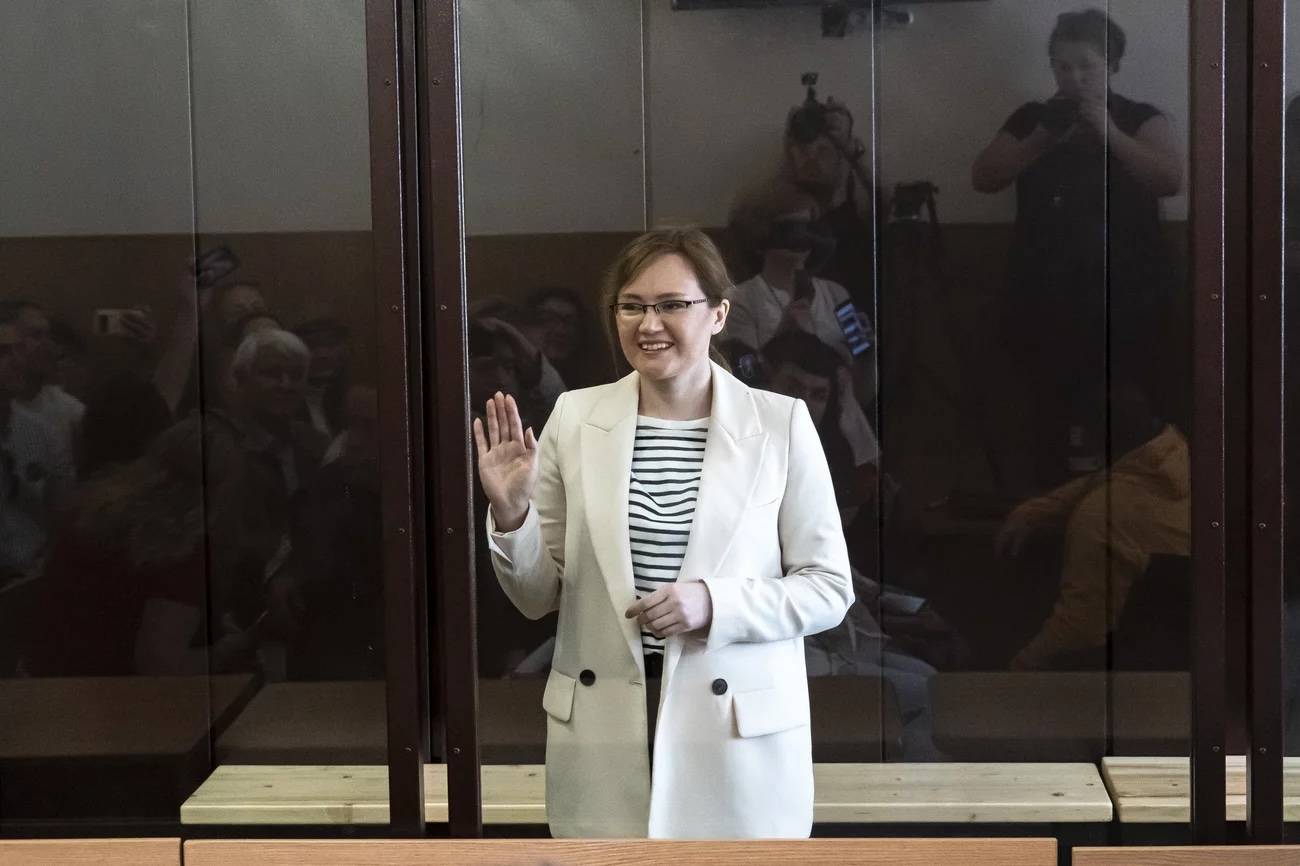
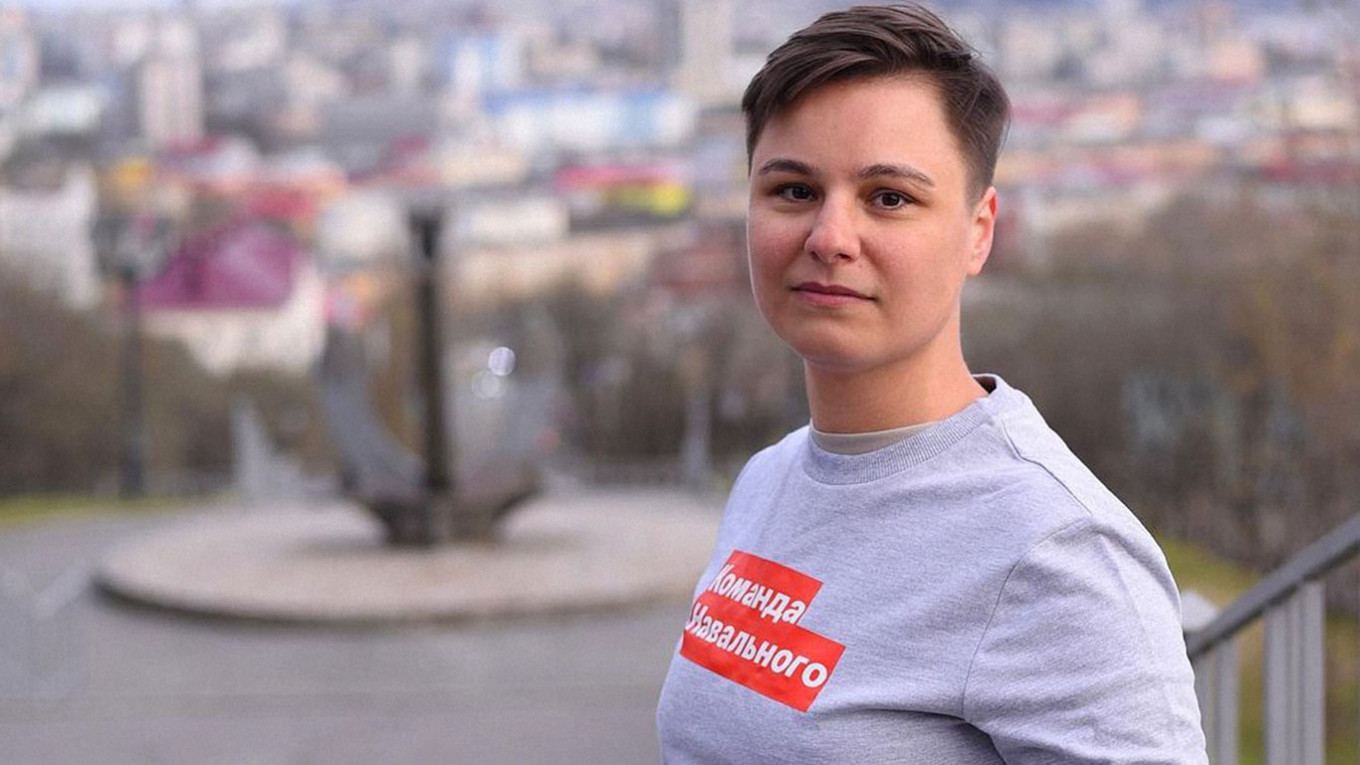
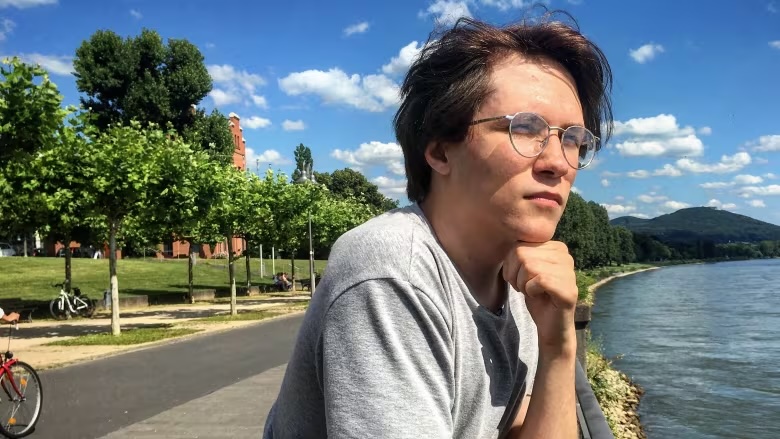
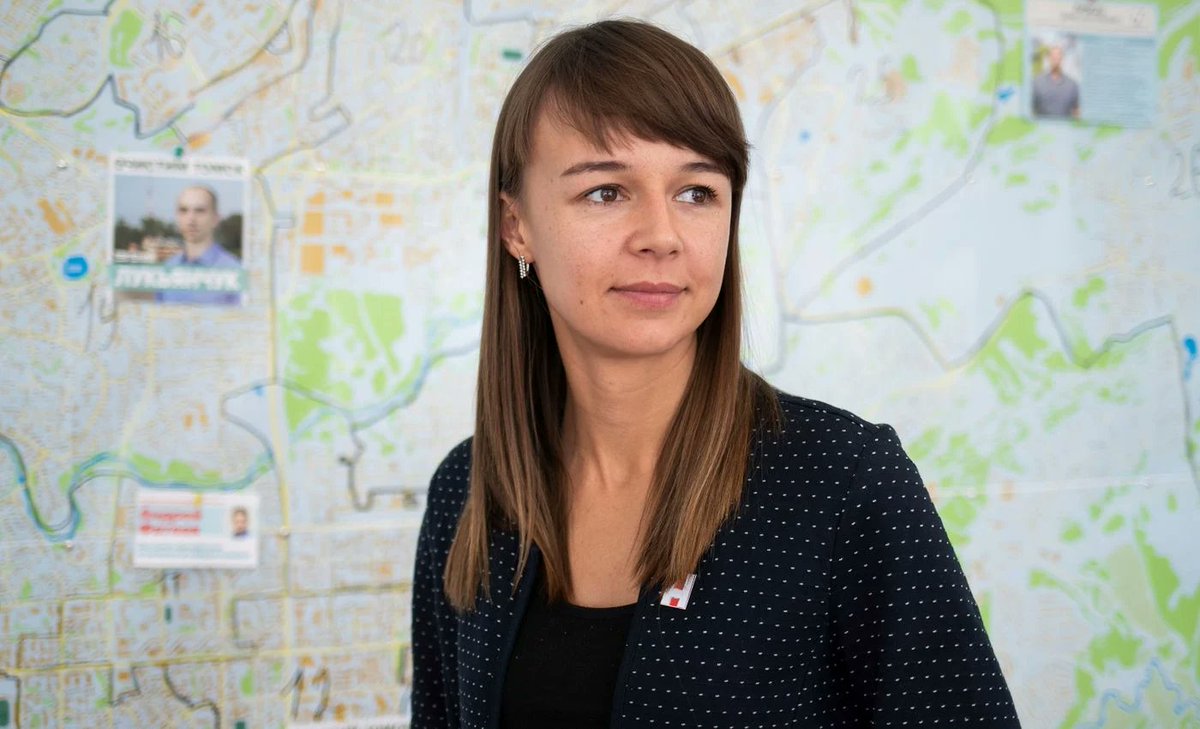
The number of Russians who find themselves behind bars for opposing the authorities who launched the war with Ukraine grows by the day. There are hundreds of political prisoners in the country. We try to remind our readers about these people every chance we get. Today, Mediazona’s David Frenkel tells the story of Alexander Skobov, 67, a historian from St Petersburg, a defendant in the last criminal case against ‘anti-Soviet agitation and propaganda’ in Soviet history, a convinced Marxist, and a veteran of the dissident movement, who after decades has found himself on a very familiar path: searches, arrest, psychiatric ward, jail.
Alexander Skobov is one of the most experienced political prisoners in Russia. In the 1970s and 1980s, he was twice sent to a psychiatric hospital for compulsory treatment: the first time as an editor of samizdat, the second time for slogans in favour of political prisoners, which Skobov wrote on the walls of Leningrad houses.
Almost half a century later, in April 2024, the authorities came after him again. Skobov was accused of ‘justifying terrorism’ because of his post about the explosion on the Crimean Bridge and sent to a pre-trial detention centre. In protest, he refused to take his glasses and medication with him. Later, an article on participation in a ‘terrorist community’ was added to the charge, and Skobov was transferred from St Petersburg to Syktyvkar.
“We were left alone for a long time. The reasoning being: we’ll die out on our own. Or we’ll leave and live out the rest of our lives off the once acquired (quite deservedly) political and moral capital. The blow came to other people, most of them much younger,” he wrote from the pre-trial detention centre.
Skobov maintains an active correspondence in pre-trial detention. He discusses philosophical and political topics, his letters are even published in historical journals. Write to Alexander, argue with him, disagree with him, I’m sure it would be valuable to him. The only thing is that his wife asks that the letters to him be written in 18-point Sans Serif font. Skobov can’t even see his own texts well: he first drafts them on the back of used sheets of paper and then blindly transfers the texts to the reply form.
Address:
167028, г. Сыктывкар, поселок Верхний Чов, д. 99 , ФКУ СИЗО-1 УФСИН России по Республике Коми. Скобову Александру Валерьевичу 1957 года рождения
Please write letters in Russian, otherwise the prison censors won’t let them through. You can send letters online via a special services called PrisonMail.
You can also write in English, using the websites Letters Across Borders and Lifeline, two projects by OVD Info, a media outlet and human rights defense group.
“Not until I went into the churches of America and heard her pulpits flame with righteousness did I understand the secret of her genius and power. America is great because she is good, and if America ever ceases to be good, she will cease to be great.” – Alexis de Tocqueville
In the Soviet Union, where I grew up, any expression of faith was met with ridicule and harassment under anti-religion propaganda. This experience deepened my appreciation for the freedom to worship and inspired DEO FAVENTE wine—a tribute to God’s grace and providence.
As we approach Thanksgiving, let us reflect on the foundation of America’s greatness: her faith in God. It is through that faith and the values rooted in His word that our nation remains a true Land of Promise, guided by His hand.
Source: Land of Promise emailing, 14 November 2024
“We chose the name Terra de Promissio, latin for the Land of Promise. because as farmers, the land is about the “promise”. The promise that every new season brings the possibility AND the hope of a bountiful harvest.”
“and as we were both born, have lived and worked overseas, It is the promise of AMERICA, one nation under god AND the American Dream. We very much appreciate what this country represents. America is truly the land of promise and we are grateful for the freedom, liberty and opportunities that these united states offers to all of us.”
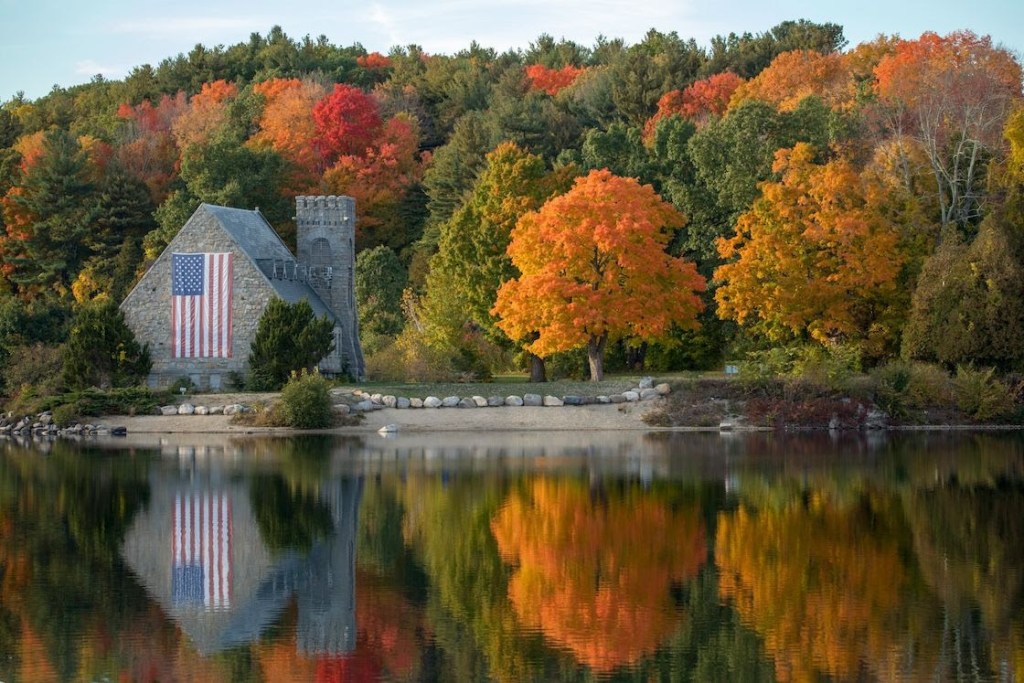
Charles and Diana bought a former dairy ranch in 1999 and then over the next 3 years, oversaw the planting of 33,000 vines. During the summer of 2002, they bought a used trailer to live in and then brought Diana’s Dad and sister Alina from Russia to help manage the vineyard. We welcomed Diana’s Family to the USA with an American Flag. And from that day on, the American Flag has proudly flown every day here at the vineyard. Terra de Promissio had its first harvest in 2005 and sold to 3 wineries. In 2007, after renting a house in Petaluma, they converted a barn into a home and moved to the vineyard full time. In 2012 and 2013, they planted an additional 18,000 vines to bring the total planted acreage of Terra de Promissio to 50 acres.
[…]
Diana KARREN
Diana was born in the Soviet Union. She was a Young Pioneer in the Communist System. But in the 1980s as the Soviet Union began to collapse, she put herself thru college and at the same time, worked for western companies that were investing in the now Former Soviet Union. Her hard work and great grades paid off and she was accepted to the University of Pennsylvania’s Wharton School of Business, where she graduated with a Masters of Business Administration in 2003.
During a two year period (2001-2003) Diana single-handily designed, gained government approvals and oversaw the planting of Terra de Promissio, while being pregnant and giving birth to Christian and doing it as a full time MBA Ivy-League student. In 2005, Diana oversaw the first harvest to Siduri, Flowers and Lynmar. In the ensuring years, as the grape production ramped up, Diana added multiple wineries including Kistler, Kosta-Browne and Willams Selyem. In 2011, Kosta Browne received the Wine Spectator’s Wine of the Year for the 2009 Sonoma Coast, which was primarily using grapes from Terra de Promissio.
Since day one, every row and block is custom farmed per each of the winemakers specific instructions. Because of this attention to detail by Diana, Terra de Promissio is now the most vineyard designated pinot noir in Sonoma County with over 10 wineries using the TdP name on their label. Beginning with the 2013 harvest, Diana began overseeing the winemaking process for Land of Promise. She now makes 4 Land of Promise Pinots and one Rosé. For more info, please click here or the link below.
In addition to managing the vineyard and the winery, Diana spends her Sunday mornings at Calvary Chapel Petaluma where she volunteers watching the babies and toddlers during the busy first service, so their parents can enjoy and listen to the sermons.
Just one week has passed since Donald Trump’s electoral triumph, and already Russian President Vladimir Putin—one of the strongman leaders Trump admires most—is messing with his head.
First, Putin waited two days before congratulating Trump on his victory. One can imagine Trump receiving phone calls from kowtowing leaders the world over—Ukraine’s Volodymyr Zelensky, Israel’s Benjamin Netanyahu, the Palestinian Authority’s Mahmoud Abbas, the chief of NATO, the European heads of state—all the while wondering about the man whom he’s admired publicly and privately for the past eight years: When is Vladimir going to call?
Then, in response to Trump’s claim that during their phone call, he asked—in some accounts, warned—Putin not to escalate the war in Ukraine, a Kremlin spokesman denied that the two had spoken on the phone at all. (Putin issued his belated congratulations at a news conference.)
I don’t know who’s telling the truth, a practice for which neither man has a sterling reputation. But either way, in the next few weeks, when Putin orders 50,000 fresh recruits (including 10,000 imported North Korean soldiers) to go on the next rampage—ousting Ukrainian soldiers from the thin slice of Russian territory they hold, then retaking soil across the border in Donbas province—he can tell a complaining Trump that he doesn’t recall any such conversation. If Trump thinks Putin actually will refrain from stepping up attacks on Ukraine as a friendly favor … well, maybe our once-and-future president will learn a lesson about the limits of personal relations in the face of perceived national interests early in his second term.
The final twist of this saga came on Monday, when Nikolai Patrushev, an aide to Putin who was previously director of Russia’s Federal Security Service, made the following comment in an interview with the Moscow newspaper Kommersant:
The election campaign is over. To achieve success in the election, Donald Trump relied on certain forces to which he has corresponding obligations. As a responsible person, he will be obliged to fulfill them.
This is a mind-blowing bit of psychological warfare! The Russians are basically telling Trump: We put you in office. Now it’s time for you to pay us back.
Elections observer who left message on ballot jailed for 5 days
Marina Popova served as an observer during the elections in St. Petersburg. On Sunday, she decided to vote herself. Prior to this, she specially had herself reassigned to Polling Station No. 2213 on Lomonosov Street [where she was working as an elections observer].
Popova told Rotunda that two other people voted after her. A police officer then noticed a ballot in the ballot box on which a pacifist message [“No war!”] had been written. According to Popova, a polling board member wrote out a statement saying that it was Popova who had dropped the ballot with the message into the ballot box.
Consequently, Popova was detained and taken to the police station. There, she was charged with “petty hooliganism” and, later, “discrediting the army.” The first charge sheet says that Popova disturbed the peace because she wrote a pacifist message in large letters in bright blue ink that was seen by people at the polling station.
Popova was taken to the police station on Sunday morning and never returned to the polling station. She was taken to court on Tuesday. When her detention period expired, she went home. She was taken back to court in handcuffs—the police collected her from her home.
At the court hearing, Popova’s lawyer Alyona Skachko told Rotunda, polling board members claimed that the ballot was state property, which the observer had spoiled. As a result, Popova was fined 30,000 rubles [approx. 300 euros] and jailed for five days.
📌 Marina’s husband Dmitry Popov and two people from the United Russia party were the only observers left at the polling station on Lomonosov Street after it closed on the last day of voting. During the vote tally, Popov was forcibly restrained by persons unknown who, as he claimed, tried to strangle him. Eventually, however, the police arrived and detained Popov. At the police station, he was charged with “petty hooliganism.” It is alleged that he used foul language.
Residents of 81 federal subjects of Russia will vote in regional and municipal elections starting Friday.
The elections mark the second time this year that Russians are heading to the polls following the March presidential election. That vote, which saw Vladimir Putin win a fifth term virtually unchallenged, was marred by widespread reports of vote tampering, restrictions on monitors and pressure on voters.
But unlike the presidential campaign, Russian media coverage of this year’s regional elections has been scarce — likely the result of a deliberate government strategy of decreasing voter turnout to a bare minimum of loyal voters, an analysis published by independent election watchdog Golos suggests.
Golos analysts believe that the Kremlin is betting on mobilizing a relatively small number of voters working in the government sector and demotivating all the rest to ensure a smooth victory for its candidates.
To help you understand what else is expected in the upcoming September elections, the Moscow Times has gathered everything known about the vote so far[.]
What will the voting look like?
Multi-day voting, which was first introduced across Russia during the Covid-19 pandemic, will be implemented in most regions for the September 2024 elections. The majority of voters will have two or three days to cast their ballots depending on the region.
Some regional electoral commissions, including in the republics of Chechnya, Tatarstan and Sakha (Yakutia), have chosen to hold voting on one day on Sunday.
Twenty-five regions will allow residents to vote online via the state portal Gosuslugi, while election officials in Moscow have scrapped paper ballots altogether in favor of online voting.
Independent observers have long argued that extended voting periods and online voting make voter fraud more likely, as it becomes harder for independent monitors and poll workers to do their jobs.
Meanwhile, the CEC advised authorities in six southern Russian regions near Ukraine and in occupied Crimea to limit access to online broadcasts from polling stations, citing public safety concerns.
G[ubernatorial] elections
Residents of 21 regions, including the city of St. Petersburg, will vote for their governors.
The ruling United Russia party has struggled to secure strong wins for its candidates in these regions in the past and incumbents hoping for reelection remain largely unpopular among local populations and elites, according to Golos.
The Urals republic of Bashkortostan will also be under the Kremlin’s close watch as Moscow-backed incumbent Radiy Khabirov stands for reelection in the wake of the January protests in support of jailed activist Fayil Alsynov.
Coupled with high numbers of war casualties in Ukraine and a slew of recent corruption scandals involving Khabirov’s inner circle, those protests forced the incumbent’s approval ratings to plummet.
But as in most other regions, the Kremlin mitigated the possibility of a potential blow in Bashkortostan by not allowing a single independent candidate on the ballot.
Regional parliament elections
Members of regional parliaments will be chosen across 11 regions, including the capital Moscow, the republics of Tatarstan and Tyva and the Khabarovsk region.
This year’s election will see the participation of a record-low number of political parties with an average of 6.2 parties represented on the ballot, according to Golos.
Golos said this worrying statistic is a direct result of an unprecedented scale of repression faced by independent politicians regardless of their political views.
“[A politician] can be declared a foreign agent or convicted of extremism to be removed from the elections,” Golos wrote in an analytical report published last month.
“And if they still [manage to] register and win, there is…the possibility of being declared a foreign agent and deprived of his mandate a couple of weeks after the elections,” the watchdog said.
Municipal elections
Elections for city mayors and city parliaments will take place across 22 regions.
Abakan, the capital of the Siberian republic of Khakassia, and Anadyr, the capital of the Chukotka autonomous district, are two of only four Russian cities where mayors are still chosen through direct election.
Mayoral elections had also been set for Ulan-Ude, the capital of the Siberian republic of Buryatia, but the region’s parliament scrapped the procedure in favor of the council electors system in March.
In St. Petersburg, where 1,560 seats in the city’s [municipal district councils] are up for grabs, candidates running from so-called “systemic opposition” parties — namely the Communist Party (CPRF) and the social-liberal Yabloko party — were barred from registering en masse.
And while CPRF managed to get 25% of its original pool of candidates onto the ballot, Yabloko will not have any representation in this year’s [m]unicipal [c]ouncil[s] race.
Occupied Ukrainian and Russian territories
In annexed Crimea, Kremlin-installed head Sergei Aksyonov will stand for reelection and members of the regional parliament and the legislative assembly of the Crimean port city of Sevastopol — its own federal subject — will be voted in.
The Kremlin refused to cancel voting in the Kursk border region, where Ukrainian forces have been carrying out a bold incursion for more than a month, and where Putin appointee Alexei Smirnov is seeking to secure his mandate as governor.
The CEC instead extended the voting period to 10 days and is supplying local election officials with bulletproof vests and helmets.
Kursk regional authorities announced Thursday that nearly 27% of eligible voters [had] already cast their ballots in the [gubernatorial] election.
GROSS: So Trump recently spoke to the Fraternal Order of Police, and he urged them to watch out for voter fraud. Let’s hear what he said.
(SOUNDBITE OF ARCHIVED RECORDING)
DONALD TRUMP: You’re in serious trouble if you get caught trying to find out what are the real results of an election. It’s an amazing thing. Do you ever see that? They go after the people that are looking at the crime, and they do terrible things to them. But the people that committed the voter fraud and everything, they can do whatever they want to do. It’s so crazy. And I hope you, as the greatest people – just as great as there is anybody in our country – I hope you watch for voter fraud.
So it starts early. You know, it starts in a week, but I hope you can watch, and you’re all over the place. Watch for the voter fraud because we win. Without voter fraud, we win so easily. Hopefully, we’re going to win anyway, but we want to keep it down. You can keep it down just by watching because, believe it or not, they’re afraid of that badge. They’re afraid of you people. They’re afraid of that.
GROSS: Nick, is that voter intimidation? He’s telling the police that these fraudulent voters are afraid of police, implying that the police should use that fear to find voter fraud so that Trump can win.
CORASANITI: I think it – certainly, were it to be carried out – would be challenged by voting rights groups, Democrats and probably even some Republicans – that that would amount to voter intimidation. It’s also pretty important to note that a couple states have very specific laws that, you know, outlaw uniformed police officers having a kind of patrolling presence in – at polling places during elections.
And, you know, there’s a very dark history in the Jim Crow South about uniformed police officers and voter suppression within the Black community. So a combination of history and state laws and then the kind of instruction that the former president was giving to these police officers could certainly amount to voter intimidation or possibly even more unlawful behavior.
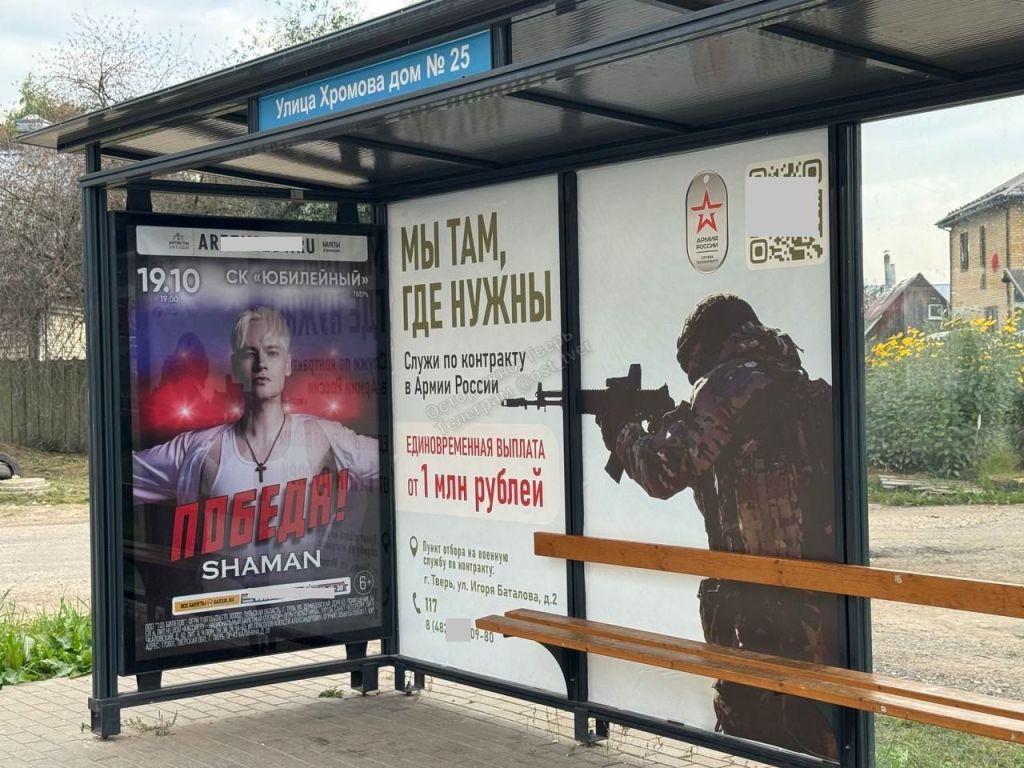
Top: “25 Khromov Street.” Left: “Shaman: Victory!” Right: “We are there where we need to be. Serve as a contract soldier in the Russian Army and get a one-time payment starting at one million rubles.”
Source: Caution, Tver! (Telegram), 1 September 2024. Thanks to Andrey Anissimov for the heads-up. “Basurka” is the faux-Russian nonce word I coined for this distressing post. It was suggested to me by our building’s bilingual garbage bin.||| TRR
Many acquaintances from Russia condemn me for calling for the bombing of Russian factories and supporting the Ukrainian army’s Kursk offensive. They genuinely don’t get how one could wish defeat on one’s own country. Some have quietly unfriended me, while others continue to read my posts but are perplexed and perhaps even offended by them.
They are often the same people who “love (their) country no matter what.” This is where you all and I part ways. You REFUSE to look at reality—you turn away from it in order to love your country without breaking a sweat, as if love were a chain and you’ve been chained to a radiator since childhood. It works differently for me. I make my own decision about whether I like this scene or not. And, if my country jumps from one bloody shitstorm to another like a maniac running in circles, it’s not worthy of my love and I rescind its right to be my country. People are another matter, especially the unborn. It makes sense to fight for them. But it’s secondary to me what the country they’ll live in will be called and how big it will be. If they’ll have a better chance for a decent and safe life in a small country, then we should choose a decent and safe life for them.
Russia is an anti-human phenomenon. It is a threat to the entire world and to the people within the country. Like any rabid macaque with a grenade, it must be stopped. Look reality in the eye at last. Don’t look away. It’s happening right now, and you, with your unadulterated love, are a part of it.
Image number one. A fourteen-year-old girl dressed in white sneakers and a white tank top, sitting on a bench in the yard of her house on an ordinary summer day. It all looks ordinary, but there is one catch: the girl is dead. A fragment of a cluster bomb, which the Russians dropped on Kharkiv on 30 August, tore off the child’s head. Everything happened instantly; no one had time to hide. The girl’s body remained seated on the bench. Perhaps her last thoughts were of her father, who had gone missing in action in the war with Russia. The family knows he was killed, but they can’t get his body back. The worst part is that he gave his life thinking he was protecting his daughter. Russia got to her, though, and so the family’s story is over. Father and daughter are not alive because they were born near Russia. Other Kharkiv residents who were killed in that senseless attack are also “guilty” in this sense.
Image number two. A girl again, but from another city. She is fifteen years old and has come to Novosibirsk from the Altai to enroll in the Olympic reserve school. She is quite beautiful, gentle, kind, and has great hopes. She doesn’t understand why her fellow students call her a “dirty, slant-eyed pig.” They secretly pour waste into her backpack and mock her appearance in public. After two years of this terror, which was encouraged by coaches and school officials, the formerly cheerful girl will come to realize that this life is not for her. In her seventeenth year, she will kill herself and leave a suicide note on her Telegram channel. She will say in the note that the unbearable racist bullying was her reason for leaving this life.
The school will then post a touching obituary on their Vkontakte page. They won’t specify the cause of death, of course. All comments expressing outrage over the bullying will be assiduously deleted. Only the wishes of “soft clouds” and broken heart emojis will be left untouched.
Incitement to suicide is a criminal offense, actually. But no one will answer for the death of Ksenia Cheponova because it is not the custom in Russia to punish one’s own kind for a crime against outsiders. “You’re not my brother, black-ass louse,” says the immortalized Russian movie hero. These words are much more than a mere insult: this is how millions of people in Russia understand justice. Moral rightness is not based on your deeds, but on whether you are an insider or an outsider. It doesn’t matter what you did. What matters is whether you are stronger than me at the moment.
Ksenia Cheponova
Image number three. Beslan. September first marked the twentieth anniversary of the mass murder of children by Russian security forces in that ill-fated school. For twenty years, the perpetrators have never been held accountable for lying about “350 hostages.” There were 1,100 hostages, as we know. No one has been held accountable for firing from a tank at the building where the children were. Three hundred and thirty-four people were killed during the assault, including one hundred and eighty children. This terrorist attack might not have happened if Russia hadn’t started a war in Chechnya. The hostages might have lived if the security forces had actually tried to save them. But they were killed and twenty years on their sacrifices are still covered in lies and impunity.
All of those people could have lived if it weren’t for their country, sick with messianism and aggression. And the “it’s like this everywhere” ploy doesn’t work. No country in the world has 60 million lives lost in wars, gulags, and famines under its belt.
The time for saying “no war” has passed. It is clear that where there is a “great Russia,” there will be perpetual war. That’s why we should say no to Russia, and yes to independent Ukraine, Ichkeria, Buryat-Mongolia, and all free nations.
Or is the idea of a united Russia dearer than the lives of your children?
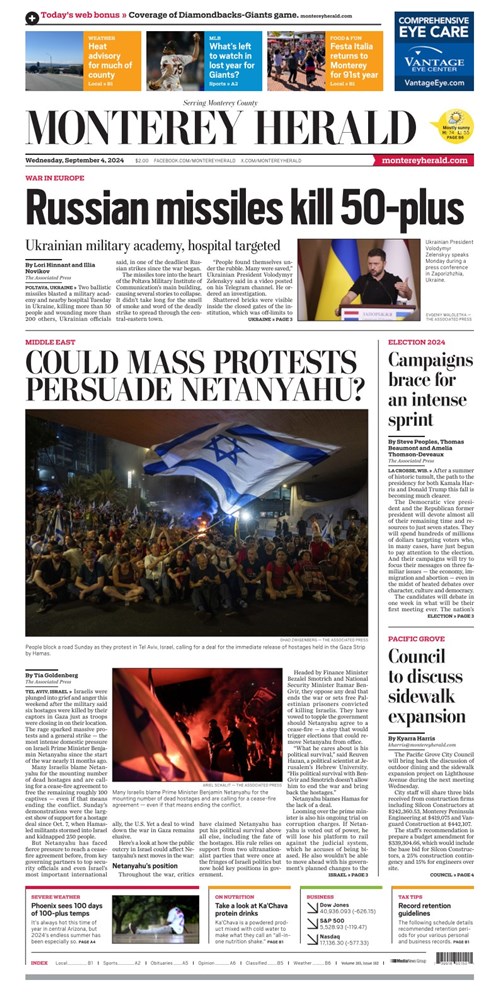
Two ballistic missiles blasted a military academy and nearby hospital Tuesday in Ukraine, killing more than 50 people and wounding more than 200 others, Ukrainian officials said.
The missiles tore into the heart of the Poltava Military Institute of Communication’s main building, causing several stories to collapse. It didn’t take long for the smell of smoke and word of the deadly strike to spread through the central-eastern town.
The strike appeared to be one of the deadliest carried out by Russian forces since the war began more than 900 days ago, with Russia’s Feb. 24, 2022, full-scale invasion.
“People found themselves under the rubble. Many were saved,” Ukrainian President Volodymyr Zelenskyy said in a video posted on his Telegram channel. He ordered an investigation.
Shattered bricks were visible inside the closed gates of the institution, which was off-limits to the media, and small pools of blood could be seen just outside hours later. Field communications trucks were parked along the perimeter. Roads were covered in glass from shattered apartment windows.
“I heard explosions … I was at home at that time. When I left the house, I realized that it was something evil and something bad,” said Yevheniy Zemskyy, who arrived to volunteer his help. “I was worried about the children, the residents of Poltava. That’s why we are here today to help our city in any way we can.”
By Tuesday evening, the death toll stood at 51, according to the general prosecutor’s office.
“My deepest condolences to the families of those killed and injured in the Russian missile attack on Poltava,” Ukraine’s first lady, Olena Zelenska, posted on social media Tuesday. “This is a shocking tragedy for the whole Ukraine.”
Filip Pronin, governor of the region that bears Poltava’s name, announced on Telegram that 219 people were wounded. Up to 18 people may be buried under the rubble, he said.
Ten apartment buildings were damaged, and more than 150 people donated blood, Pronin said.
He called it “a great tragedy” for the region and all of Ukraine, and announced three days of mourning starting Wednesday.
[…]
The academy trains officers in communications and electronics, honing some of the most valued skills in a war where both sides are fighting for control of the electronic battlefield.
“The enemy certainly must answer for all (its) crimes against humanity,” Pronin wrote on Telegram.
The Kremlin offered no immediate comment on the strike. It was not clear whether the dead and wounded were limited to Ukrainian military personnel, such as signal corps cadets, or if they included civilians.
Since it embarked on its full-scale invasion in early 2022, the Russian military has repeatedly used missiles to smash civilian targets, sometimes killing scores of people in a single attack.
Some of the deadliest such assaults included a 2022 airstrike on a theater in Mariupol that killed hundreds of civilians sheltering in the basement and a strike that same year on the train station in Kramatorsk that killed 61. Apartment buildings, markets and shopping centers have also been targeted.
Poltava is about 350 kilometers (200 miles) southeast of Kyiv, on the main highway and rail route between Kyiv and Ukraine’s second-largest city, Kharkiv, which is close to the Russian border.
The attack happened as Ukrainian forces sought to carve out their holdings in Russia’s Kursk border region after a surprise incursion that began Aug. 6 and as the Russian army hacks its way deeper into eastern Ukraine.
The missiles hit shortly after an air-raid alert sounded, when many people were on their way to a bomb shelter, Ukraine’s Defense Ministry said, describing the strike as “barbaric.”
Rescue crews and medics saved 25 people, including 11 who were dug out of the rubble, a Defense Ministry statement said.
The strike came on the day that Russian President Vladimir Putin visited Mongolia. There was no indication that his hosts would heed demands to arrest him on an international warrant for alleged war crimes.
Zelenskyy repeated his appeal for Ukraine’s Western partners to ensure swift delivery of military aid. He has previously chided the U.S. and European countries for being slow to make good on their pledges of help.
He also wants them to ease restrictions on what Ukraine can target on Russian soil with the weapons they provide. Some countries fear that hitting Russia could escalate the war.
“Ukraine needs air defense systems and missiles now, not sitting in storage,” Zelenskyy wrote in English on Telegram.
“Long-range strikes that can protect us from Russian terror are needed now, not later. Every day of delay, unfortunately, means more lost lives,” he said.
Ukraine’s air force said Monday that Russia had launched an overnight barrage of ballistic and cruise missiles and drones at Kyiv as children prepared to return to school. Multiple explosions echoed across the capital early Monday morning as Ukraine’s air defenses shot down many of the weapons, causing damage and fires as the debris fell onto the capital.
Ufa’s Kirov District Court has remanded 20-year-old university student Makar Nikolayev in custody to a pretrial detention center for a month on charges of “promoting terrorism.” The court issued its ruling on 30 August, but it was made public only on Monday, 2 September, as reported by the Telegram channels of Baza and Idel.Realities, who cited sources. The court confirmed Nikolayev’s arrest to news website Ufa1.ru.
In 2020, Nikolayev, then a prep school student, designed an information retrieval method for creating a Russian national archive on the history of the Great Patriotic War. The boy wanted to recover information about his great-grandfather and in the process designed an entire system. His project, “Methodology for Creating a Family Archive,” won the Russian national contest “My Country — My Russia,” one of the projects of the Russia Is a Land of Opportunities presidential platform.
Later, Nikolayev went to Germany to study. According to Idel.Realities, Nikolayev had been studying at a university in Frankfurt am Main in recent years. In August 2024, he came home on holiday to Ufa, where he was detained.
According to police investigators, during his time abroad, Nikolayev wrote comments on social networks supporting Ukraine and urging people to join the Russian Volunteer Corps. The stipulated punishment for violating Russian Federal Criminal Code Article 205.2.2 (“Public calls to carry out terrorist activities; public justification of terrorism or promotion of terrorism, committed using mass media or electronic or telecommunication networks”) is five to seven years in prison.
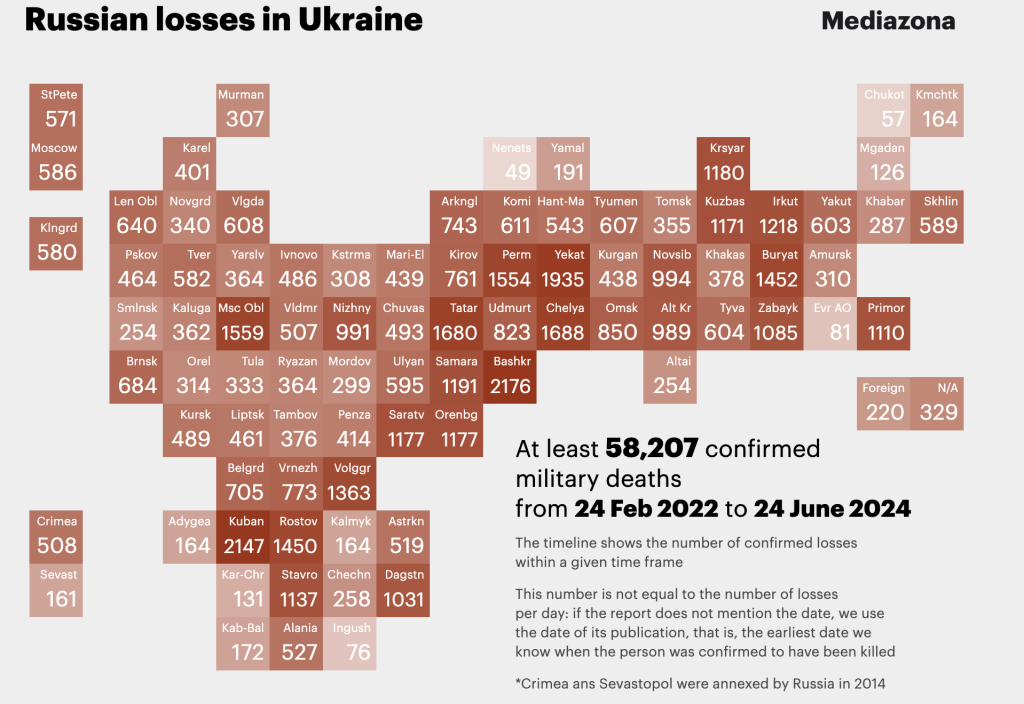
Screenshot of Mediazona infographic, as published here
Russia is losing more and more men in its war against Ukraine.
As of 5 July 2024, Mediazona and its partners in the casualty counting project have ascertained the names of more than 58,000 Russian soldiers killed in action.
The real losses are twice as many, however. Journalists have calculated the actual number of war dead based on information from the probate registry. How they did their work is described in this article by Mediazona. You can read here about how our methodology has been corroborated.
The real losses of the Russian army, including mercenaries, in the war against Ukraine, come to 120,000 dead. The Russian army’s casualties are thus already greater than both the number of US military deaths since the Second World War and all the losses of the Soviet and Russian armies since 1945. Most of the men killed were between the ages of twenty and forty. Those who were younger were usually draftees and prison inmates, while those who were older were “volunteers.”
Seventeen thousand prison inmates recruited by the Wagner Group perished at Bakhmut, according to the mercenary organization’s own documents, as examined by Mediazona. Meanwhile, journalists had estimated that Wagner had lost around sixteen thousand men, which is nearly the same number. Wagner has recruited a total of 48,366 men during the war, meaning that a third of them were killed in the so-called Bakhmut meat grinder.
Prison inmates, “volunteers,” and conscripts, if we judge only by confirmed deaths, have borne the brunt of the losses in the war. At 47.4 percent, they constitute almost half of those who have been killed.
In over two years of war, 3,700 officers of the Russian army and other security forces have been killed, 430 of them in the rank of lieutenant colonel and above.
Between 200 and 250 men are killed every day. This year, the Russian army’s losses have risen dramatically. In 2023, an average of about 120 men were killed every day.
There are two points of view on Russia during the full-scale war. The first is that Russia has turned into a fascist militaristic state in which everyone marches in step and sincerely hates Ukraine. The second is that cynicism and apathy have won the day in Russia: people don’t care about the war as long as it doesn’t affect them personally. Both of these views are mistaken, according to the authors of “We Have to Live Somehow,” a study from the Public Sociology Laboratory (PS Lab).
The researchers traveled to Krasnodar Territory, Buryatia, and the Sverdlovsk Region, living there for a month and interacting closely with the locals. What they tell us does not fit into either of the two common stereotypes about Russians and the war. Here are a few of the tendencies they observed.
The war is invisible in daily urban life. Residents in the Sverdlovsk Region town of Cheryomushkin (whose name was deliberately changed by the researchers) could not recall a single event in support of (or against) the war during the year. In Ulan-Ude, the capital of Buryatia, the pro-war agitprop consisted of a single poster on a Lenin monument. In Krasnodar, pro-war banners still hung on buildings, but people had long ago removed pro-war stickers from their cars. There is no institutional support for the war at the municipal level: such support is the bailiwick of ideological loners and small groups of pro-war volunteers.
Apolitical Russians justify the war, but arguments like “NATO soldiers” and “defending Donbas” are not of primary importance to them. Rather, they simply want to save face themselves, because they take the accusations directed at their country personally. For this reason, Russians have previously been inclined to justify the actions of the state, even when they do not understand or approve them.
The majority of the populace is not opposed to the war. They may disapprove of it in some respects, but they simultaneously defend the state. For example, in the Sverdlovsk Region, women were outraged by the deaths of young soldiers at the front (“They are sending children to fight! Why?!”) while also parroting the propagandists’ arguments about the war against the “collective West” (“Them United States are hammering civilians!”). Non-opponents of the war argue that Russia has been proactive, defending itself rather than attacking (“Now the Luhansk and Donetsk Republics are part of Russia, but our guys aren’t advancing any further—they’re defending all of it”).
Non-opponents of the war regard the residents of Donbas as Ukrainians, not Russians. They scold Ukrainians from the “Donetsk People’s Republic” and the “Luhansk People’s Republic” (“They don’t defend themselves. They’ll be coming here [to Russia], and what, I’ll have to go fight in their place? I don’t want that”) and do not regard these areas as “their own” (“They are not my blood relatives, they are not my own people”).
While opponents and supporters of the war initially had bitter conflicts, solidarity between them has emerged despite their differences of opinion. Those who generally condone the war are increasingly questioning the official version of events, while those who oppose the war are beginning to listen to their opponents (“I have to build a life and continue living with these people”).
Russians try to pretend that the war has not impacted their daily lives in any way, but its signs still permeate their everyday lives and conversations. In the Sverdlovsk Region, a woman is going to “go to great lengths” to prevent her son from serving as a contract serviceman. In Buryatia, a volunteer says mundanely, “I have eight grandchildren, all boys. And it just happened that four more died at the front.” In Krasnodar, a sociologist’s source says he is glad that the city is not being bombed and that the “Wagnerians” did not come their way, but then confesses in a low voice that the future is hazy and “let’s put it this way: things have become a bit tense.”
The big takeaway, however, is that Russians are pushing the war to the back of their minds. And this is bad news for the Kremlin: it has failed to convince the public, over the past two years, that the invasion was launched in pursuit of noble ends. Even as they justify Russia, its citizens don’t understand what good the war does for them personally.
A week ago, a Moscow court sentenced fifteen-year-old Arseny Turbin to five years in prison after convicting him on charges of “involvement in a terrorist organization.” The security forces accused the schoolboy of aiding the Free Russia Legion, which has been officially banned in Russia.
Arseny lived with his mother Irina in the small city of Livny in the Oryol Region. Although he was one of the most successful pupils at the local prep school, he was bullied by his classmates, and yet his teachers did not respond to his complaints. At the war’s outset, Turbin supported the Kremlin’s actions, but later became disillusioned with the government and took an interest in politics, even telephoning [exiled online news channel] TV Rain and telling them that the Conversations about Important Things lessons at school were “utter nonsense.”
In early June 2023, Arseny wrote an email to the Free Russia Legion (an organization we described in detail in a previous newsletter). He wanted to сampaign against the war, but they asked him for too much personal information and he did not send the application form to these strangers. Instead, he started distributing leaflets criticizing the authorities and taking pictures of himself in front of the white-blue-white flag. (The Russian authorities regard this flag as a symbol of the Legion, which has been fighting against Russian forces in Ukraine.)
Meanwhile, a strange thing happened. Turbin made the acquaintance of someone called Maxim, who immediately gave him access to the Telegram channel Occupy Slutophilia 14 (similar names have been used on the Web by the fans of the late Russian neo-Nazi activist Maxim “Tesak” Martsinkevich) and asked him to help with the channel’s content by editing videos. The channel had only a few subscribers, and it featured posts in support of Yevgeny Prigozhin and far-right content revolving around Tesak. Investigators then used Turbin’s involvement in the channel to accuse him of neo-Nazism, despite the fact that the schoolboy’s father was from the UAE, and Turbin himself had been bullied at school due to his dark skin.
At the end of the summer, FSB officers searched the Turbins’ home and summoned Arseny for questioning. It was a very strange conversation: for almost an hour and a half, in different ways, two investigators questioned the schoolboy about his connections with the Free Russia Legion. At the end of the conversation, as Mediazonadiscovered, they assured the teenager that it was “normal” and “not against the law” to send an application to the Legion, which has been declared a “terrorist organization” by the Russian authorities.
The court was not interested in this peculiar circumstance, however. It was interested in Turbin’s statement, allegedly made during the interrogation, that he had sent the application: this was the basis for the charge that he had “joined” the “terrorist organization.” The thing is that Turbin did not say this. Mediazona has in its possession a full transcript of the conversation, and it simply does not contain mention of Turbin’s sending off the application. The investigators inserted it for their own convenience.
Irina Turbina was present at the interrogation. She says that the investigators retyped the statement three times because of mistakes, and suggests that they could have discreetly amended it after lulling her into a false sense of security.
After seeing the transcript, the investigator, Trunov, had even wanted to close the case. In February 2024, however, the investigation was assigned to another investigator, Irina Simonova. She spun the line about Turbin’s alleged neo-Nazi views, obtaining testimony from the boy’s classmates, who assured her that his “idol was the so-called Tesak,” that he had advocated “exterminating the Ukrainians,” and had supported Alexei Navalny. Irina Turbina does not believe this testimony, producing correspondence in which her son called Tesak a “blockhead” and himself a “liberal.” Turbina argues that her son’s classmates testified against him in exchange for “excellent high school diplomas.”
Due to the increased harassment at school, Turbina transferred Arseny to home schooling. He managed to pass his year-nine exams before the verdict was handed down. On 21 June, the court sentenced Arseny to five years in prison, although the prosecution had requested an even longer sentence of eight years. After the sentence was read, he burst into tears, telling his mother, “Mom, I’m sorry—forgive me for letting you down. But I really didn’t know I was violating any laws.”
No one looked for the mysterious Maxim. The court was also uninterested in Turbin’s conversation with the FSB officers who openly provoked the schoolboy and falsified his statement.
PROMPT: Make an illustration on the theme of “Russia’s Fascist Meltdown”
Creating an illustration on the theme “Russia’s Fascist Meltdown” involves capturing the essence of nationalism, authoritarianism, and geopolitical tension. Here’s a description of an illustration:
The illustration features a powerful and imposing figure symbolizing the Kremlin, with a stern-faced leader resembling Vladimir Putin at the forefront. Behind him, the Russian flag waves prominently, but instead of the usual tricolor, it blends with darker hues suggestive of authoritarian control. The background is a stark urban landscape, reminiscent of Moscow’s skyline, but with ominous shadows and smoke rising in the distance.
In the foreground, there are smaller figures representing dissenters and protestors, their faces obscured in shadows or masked to symbolize anonymity and resistance. They hold signs with slogans advocating for freedom and democracy, contrasting sharply with the dominant figure of Putin. The atmosphere is tense, with a palpable sense of division and discord.
To further emphasize the theme of “meltdown,” the illustration includes elements like cracked ice or fire, symbolizing internal turmoil and instability within Russian society. The color palette leans towards shades of red, black, and grey, evoking a sense of danger and crisis.
Overall, the illustration aims to visually convey the complex and contentious dynamics surrounding Russia’s shift towards authoritarian nationalism, capturing both the gravity of the situation and the resilience of those who oppose it.
Pensioners Irina Nippolainen and Anna Trusova, friends and residents of the small Karelian town of Segezha, fled Russia in the spring of 2023 after the FSB came to search their homes. Anna and Irina were forced to make a long trek to Azerbaijan via Belarus before making their way to Germany, where they now have residence permits and social housing, and where they hope to find work. Meanwhile, back in their home country their relatives have been summoned for questioning in the criminal investigation against them. Journalists at the website Okno tell the story of the two women, who chose forced emigration over unfreedom.
ESCAPE
On 20 March 2023, 60-year-old Irina and 58-year-old Anna said goodbye after taken a stroll and went home. A few minutes later, Irina called Anna and told her that the FSB had come to see her. Anna rushed to her house after Irina’s call.
“As soon as I rang Irina’s doorbell, I immediately turned on the video on my phone to put the squeeze on them: Who the hell are you guys? The FSB guys saw that I was filming on my phone and immediately called someone, saying, ‘She’s here, come over.’ Anyway, it transpired that they had come for both of us.”
During the search, the FSB officers confiscated their phones and computers from the two pensioners. The search warrant stated that the searches were part of a criminal investigation into “public calls to engage in activity threatening state security.” Anna and Irina guessed that the case had been triggered by a denunciation. They both had written many posts on their VKontakte pages about their opposition to war, and in response had received a “barrage of hatred” from those who had read the posts.
“It was stressful. I lost eight kilograms during that time: I was so worried, I didn’t eat, and I didn’t know what would happen. I knew that people in Russia are sent to pretrial detention centers at any age even for sneezing at the authorities, and I did not know what exactly the law enforcers would find in the devices they confiscated and how they would interpret what they found. As soon as we were searched, my children immediately got involved in the problem, checking out everything they could: internet sites, their acquaintances, and then their acquaintances who had left the country. They decided how we should proceed—where and how to get asylum or other options. After analyzing everything, they decided that a humanitarian visa was the best option. We had to decide where to go, where to stay, and what to take with us,” says Irina.
They considered fleeing to two countries—Finland and Germany—but decided on the latter because it was easier to get a visa there.
But first Irina and Anna went to St. Petersburg, because they had to get papers for Anna’s dog Ramona. They stayed with an acquaintance of Anna’s, but the woman was very afraid that she would be “prosecuted for her connection” with the fugitive opposition activists, so they had to move out.
Irina, Ramona, and Anna
“Our children, who were assisting us, gave us the contact information for a man who did not know us at all but who wrote, ‘Come and stay as long as you want’. He helped us out and fed us, and we spent all that time while we were taking care of business at his house,” they explain.
Anna and Irina stayed in St. Petersburg for a week before departing for Azerbaijan.
They did not travel to Baku directly. For security reasons, they got themselves new cell phones, discussed the route, decided not to buy plane tickets in Russia, but to do it in Belarus, and went to Belarus by cab, paying 20,000 rubles [approx. 200 euros] for the fare.
“We took everything into account because we didn’t know how quickly they would come for us. In fact, we were very surprised that they didn’t nab us right away. We also chose Belarus because the dog was with us, and we felt bad about putting her in the luggage hold. Belavia is one of the few airlines that allow passengers to transport small animals in a carrier on a seat in the passenger cabin,” says Irina.
Irina and Anna flying from Minsk to Baku
After taking a cab to Minsk, they immediately went to the airport, bought tickets, and flew to Azerbaijan at night. In Baku, Irina and Anna initially settled in a small hotel.
“I was in such a state that my hair stood on end. For Anna, it was like an adventure, but for me it was like a misfortune, because I had left my home, my husband, and my pets. I didn’t want to leave my home or my country. That’s why I was very anxious. I even reached out to a psychologist from an aid organization, but she didn’t help me much,” Irina says.
Anna’s mood was a little different.
“I’m generally a traveler, but I hadn’t been able to travel lately. First there was the pandemic, then this whole thing happened. Not that I was freaking out about it, of course; I was freaking out for other reasons. But when it happened, I put three bathing suits in my suitcase—Ira makes fun of me—and went to the airport. I assumed I might have difficulties in Russia due to my intemperate tongue: I supposed that I would have to leave. I have a daughter in the Czech Republic, but the Czech Republic has a very bad attitude towards Russians, and they wouldn’t give me a visa. I thought that I would go to India, it’s quiet and peaceful there. My suitcase was initially packed with summer clothes. Of course, I was a bit nervous about the dangers. But basically, I always try to stay positive and hope for the best,” says Anna.
Anna, Ramona and Irina on the beach in Baku
Irina and Anna ultimately stayed in Baku for four months. They submitted the paperwork for humanitarian visas to Germany quite quickly, and had been approved by early June. But due to the local and the German bureaucracies they had to wait a long time for their papers. During this time, the pensioners already had their own circle of contacts—their landlady, their neighbors, and other refugees from Russia.
“And while there was uncertainty as to whether we would be granted a visa or not, we were already considering Azerbaijan as a place to live, because we could have lived there on our pensions. We had already found some channels for cashing money there, because our bank cards didn’t work there anyway. But still, we didn’t consider ourselves safe there,” Irina explains.
“GOD, HOW DID YOU BEAR IT ALL?”
In July, all their papers were in hand, so Irina and Anna began packing for Germany. They decided to make their way to Georgia first, since it was cheaper to fly to Germany from Tbilisi than from Baku. They went to Georgio by bus, stayed in Tbilisi for a couple of days before flying to Germany.
“When we arrived in Germany, I was already on VKontakte recounting all our adventures. And people wrote, “God, how did you bear it all?” Because there were a lot of hard moments. Personally, I was constantly stressed out, but it had become a way of life, you know. Anya is fine, she’s easygoing, but I can’t improvise when it comes to serious matters, I have to prepare and think things over. If I hadn’t followed all those rules, maybe we could have flown to Germany more easily, who knows. I’m a thorough person, I don’t want to lose money and end up stranded at the airport not knowing what to do. That is, I was preparing, I was checking out all the chat rooms and websites, seeing what papers we needed to get and where to go. There was a lot of preparation just for the dog. Without the dog, we would have done it all ten times easier, if not more. Because in different countries there are particular papers and certain vaccinations you have to have, and the airlines have certain requirements for the carrier. Ramona is a basically a ‘homeowner’—she had three portable houses,” Irina says.
“The atmosphere is cool”
“For the first time in her life, probably, when leaving Baku, Irina took sedatives because the dog in its carrier had to be placed in the trunk of the bus. And I was so worked up that even I took them too,” Anna remarks.
Anna and Irina flew to Frankfurt, where they were met by a friend of Irina’s who had lived in Germany for a long time. They had to get to their initial placement site, the town of Suhl in Thuringia, which is a three-hour drive from Frankfurt.
“But when we arrived there, we were told that pets were not permitted. Ukrainians used to bring pets there with them, but since now there are few Ukrainians in this camp and mostly Muslims, who have a bad attitude to dogs and are afraid of them, it is prohibited. So we urgently began looking for help on the chat rooms. A Ukrainian family agreed to take Ramona in for a while. They lived right next to the camp, and so we would go to their house to walk the dog. But then this young woman found out she had allergies, so Ana’s daughter quickly came from the Czech Republic and took Ramona away,” Irina explains.
A room in a German dormitory for refugees
The refugee camp where the pensioners were initially placed was a complex of five buildings, mostly inhabited by people from Arab countries.
“It was a bit scary to live in such an unfamiliar environment, given that the doors to the room in which we were put were unlocked. The police even came once because of a conflict in the building. We also had our passports taken from us and there was a risk that we would be processed in a different status—as refugees, even though we had ‘humanitarian visa’ stamped on our papers. We wrote everywhere, because they said that if we were registered as refugees, we could change this status only through the courts, and the courts could take years. That was scary. I said that we could not even return to Russia without a passport. Basically, it was a massive problem. I’d only recently been released, and I had put on two or three kilograms, because one thing or another was causing stress, but there was no getting around it,” Irina recounts.
Everything worked out well, ultimately. After a week, they were moved to the town of Greiz, a two-hour drive from Suhl. There they were allocated a social apartment, started to receive an allowance, were insured, and were issued social security numbers. By October, Anna and Irina had received residence permits for three years. During all this time, however, the pensioners had to confront the famous German bureaucracy more than once.
“They have an algorithm, as it were. But the human factor often gets in the way. People who work in this system, they do not know all the laws, or often they do things just to check off the boxes. But our case was quite peculiar for them: we are Russian pensioners, we have humanitarian visas, and they probably have a million other refugees here. Things were difficult, but when you look back, you think, What was there to worry about?” said Anna and Irina.
After the paperwork was completed, the friends moved again, but not far—to the city of Gera, thirty kilometers from Greiz. Each of them found rented accommodation there, which is paid for by the municipality. The apartments there are rented empty, with no furniture or appliances.
“When we moved from one place to another, they stopped paying us in the old place, but here they hadn’t started paying us yet, and it took two months to process the registration. So for two months we were without money or furniture,” Irina explains.
Since she had not yet been discharged from social housing, they could still live there together legally for some time and work on furnishing their new homes.
“The Ukrainians who live here have set up a help chat room and chat rooms for selling different things. I bought a bed and a chest of drawers from Ukrainians. I got some things for free. Germans often sell things they don’t need for very cheap. For example, I bought a complete kitchen set for only 100 euros, which is practically nothing. Now I’m looking for a bigger refrigerator,” Irina says.
Irina’s apartment after she furnished it
Anna, on the other hand, found an app similar to the Russian website Avito, where used furniture was sold, and bought almost everything she needed at wholesale prices.
“The only thing I was left without was a kitchen. I didn’t have a stove, but I got a microwave, and I could survive with a microwave. I bought a kettle. And that’s how I lived for the first few months,” she said.
The pensioners were at pains to point out that no one refused to help them. People who had also immigrated to Germany, some twenty years earlier and others two years earlier, offered them bedding, dishes, and household supplies. When Irina and Anna had settled in, they passed some of these things on to a family from Ukraine.
Expiring products are given to immigrants for next to nothing
People who have been granted humanitarian visas in Germany can choose not to work and live on benefits. But they can try to find a job if they want. Before they retired, Anna was involved in marketing cosmetics, while Irina helped animals. After ten years at the official municipal animal shelter, she ran a mini-shelter for five dogs, one of which she ultimately adopted. Finding a job in Germany is still difficult for them.
“We don’t speak German, so the opportunities to find work are few and far between for the time being. I am registered at the job center, while Irina is now registered with the Sozialamt, and she can live on her pension in peace, but I will only go on 31 July to test the level of my German. God willing, I will test out at A1, since I almost got A’s in German back in school. After taking this test, I do not know when I will be able to take German-language classes. Many emigrants take these courses two or three times. Then again, I’m old, so things don’t stick in my head nowadays. Of course, I would like somehow to learn the language faster and integrate faster,” Anna says, laughing.
Irina says that she has not been assigned to an integration course, so for the time being she is also living without knowledge of the German language and therefore jobless. While she was still living in Greiz, she worked a two-hour trial day as a seamstress in a local factory . Irina liked it very much. When she moved to Gera, she also wrote to one of the factories there, but was told that German was required. Getting a job is likewise important to Irina because she wants to invite her husband, who stayed behind Russia, to join her in Germany, which is impossible to do if she is unemployed. Irina’s husband would also need to know German, but how and where he can learn it and pass the test for the simplest level is still unclear. Irina herself attends German language courses, but they are run by volunteers and thus unofficial.
Anna and Irina say that even without jobs they have enough to do—they have traveled all over the area.
“We have been traveling a lot since day one. While we didn’t have papers, we used to walk, and then we got the chance to buy transit passes that enable us to travel by rail, buses, trams, and subways,” says Irina, who has also been to travel to Finland to visit her children, and to Stockholm and Copenhagen to meet friends.
Anna has bought a sewing machine and begun sewing.
“I used to do needlework, but in recent years things had not been coming together. Now I have started knitting curtains, and I will start weaving; I want to do a lot of things. I knitted myself a sweater. I bought brushes and paints and started drawing a bit, but have given it up for the time being. Mostly, I want to walk more. We are from Karelia and have a tradition of walking as the first thing one needs to do. And I had a dog then. Here I bought a bicycle as soon as I got the furniture: I jumped on the bike and went riding. You have to see everything around you. It takes a lot of time to see everything, to photograph it, to edit it, to upload it to the internet. So there is not enough time,” she explains.
By the way, both pensioners are each on their third VKontakte page: their previous pages had been blocked by the Russian authorities.
“DID THEY WRITE ABOUT BUCHA?”
Karelian law enforcement never forgot Irina and Anna.
In April 2024, it transpired that a criminal case had been opened against the two émigrés on charges of disseminating “fake news” about the Russian army. They found out about it because Irina’s husband was summoned to testify, for some reason, in the criminal investigation against Anna. Only when he met with the investigator, it transpired that Irina was also being prosecuted on the same charge. The husband refused to answer the investigator’s questions, invoking Article 51 of the Constitution (which permits an individual not to testify against themself or their spouse). Anna’s sister was then summoned for questioning in the same investigation. A little later, it transpired that both Anna and Irina had been put on the federal wanted list. And shortly before this interview, a person unknoiwn, who introduced himself as a policeman, wrote to Anna via WhatsApp and asked her where she was.
How many criminal “fake news” cases have been launched in Russia
In March 2022, after invading Ukraine, Russia adopted laws that criminalized disseminating “fake news” about the Russian army and “discrediting:” its actions. As of February 2024, 402 such cases had been brought. Dozens of Russians have been sentenced to lengthy prison terms for allegedly violating the law. According to human rights activists, this is tantamount to military censorship.
It is still unknown why the criminal case was launched. The relatives were asked during questioning what Irina and Anna had written on their first VKontakte pages. They made a special point of asking, “Did they write about Bucha?”
“It’s no fun feeling like a criminal. Although we all know what it means now in this [sic] country. In short, the crackdown continues: you are on the right side, and they are on the wrong side. They have to do something: there’s probably no one left in Karelia to sink their claws into anymore, but they need fulfill quotas. It’s a crackdown for its own sake. I feared for my relatives, because way back in 1938 there were so-called enemies of the people, and children, wives, and husbands of enemies of the people. I’m afraid lest it come to this,” Irina says.
The human rights activists consulted by Anna and Irina have advised them not to return to Russia before the regime changes, otherwise they will be sentenced to hard time in prison.
“FOR THREE DAYS I BAWLED LIKE A BELUGA”
Both émigrés follow the news from Russia closely. They argue that the country is “hurtling into an abyss.”
“What is happening is simply absurd. It feels like the country exists in a kind of distorted reality in which good is evil, and black is white. They are engaged in such insanity, frankly, and you don’t understand how it is possible to support all of this. And then there are the people who have gone crazy on a nationwide scale and who think everything is fine there, that it’s the way it should be. I worked at a polling place for many years and I used to say all the time that when we socialize only with our own kind, we don’t see what the rest of the people are like, but I saw all kinds of people at the polling station. I know that might sound kind of arrogant, but I saw how massively ignorant people were. I’ve always been skeptical of the claim that the Soviet Union had the best education system. I don’t know how it was the best if it didn’t teach people to think, and if people blindly trust the authorities. The authorities are king and god to them, as this whole situation has shown. Basically, you get the feeling that all people have come down with insanity, and some are immune. The analogy with Hitler’s Germany immediately comes to mind, where the people were fooled in the same way, gulled by propaganda. Maybe there is still hope that if the regime changes and they tell folks on TV how it really was, then…. We are now like spectators looking at Russia from the outside, and it’s scary to watch what is happening there,” Irina says.
When asked how they reacted to the news of politician Alexei Navalny’s death, Anna is unable to reply. She immediately starts crying.
“That’s how we reacted,” Irina explains, crying too.
“It’s good that my daughter was here that day: we went to Munich with her. I spent the whole day with them. But in the evening they went to a concert, and I got on the Munich chat rooms and found out that there would be a rally on Freedom Square and went there,” says Anna.
Alexei Navalny’s Death
The news of Alexei Navalny’s death came on 16 February 2024. He had been serving a nineteen-year sentence for “extremism,” after being convicted on seven criminal charges, including “creating an extremist community.” During his imprisonment, he was sent to a punishment cell twenty-seven times, spending almost 300 days there. After the politician’s death, pickets to mourn his passing were held in Russian cities, and the picketers were detained by the police en masse. The authorities refused to hand over his body to his relatives for a long time, demanding that they bury him in secret. Navalny’s associates argue that he was murdered and blame President Vladimir Putin for his death.
“I bawled like a beluga for three days. I still can’t even look at the photos of him calmly,” Irina adds.
“In the past, Ira, you used to say, ‘Navalny will be released and I’ll go home,'” her friend remarks.
Irina doesn’t make any predictions now that she has emigrated.
“I don’t make any predictions and I don’t listen to them. My motto now is: do what must be done and what will be will be. And I would also add: do what you have to do and what you are able to do. What matters most is saving yourself and your loved ones. We don’t know how long this will last. Analyzing things even as they stand now, I can confidently say that nothing good is going to happen…. Well, how should I put it? Nothing good is going to happen quickly. But I’m not ruling out either possibility: that I’ll stay here, or that I’ll go back there. I’ll go home as soon as I can. If nothing changes there, I’ll stay here.”
Anna, however, says that she has almost no one left in Russia: her daughter emigrated to the Czech Republic back in 2016, and she hardly communicates with her relatives who stayed behind in Russia.
“I will be better off here anyway. As long as they don’t kick me out, I’ll stay here,” she adds.
The pensioners nevertheless try to keep involved in Russian politics. They traveled to Leipzig to sign a petition supporting Boris Nadezhdin’s presidential candidacy and then to Berlin to vote in the presidential election.
Irina signing a petition in support of Boris Nadezhdin’s presidential bid
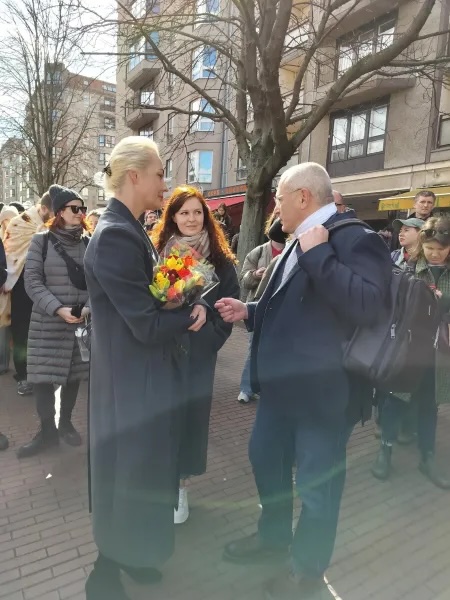
“There was such a huge queue. Because we were afraid of missing the train, we cut the queue a bit. A lot of people could not vote because, I think, only two polling stations were open in Germany—in Berlin and in Bonn. There were a lot of people who wanted to vote. We stood in line there with Yulia Navalnaya. And I talked to Mikhail Khodorkovsky, and we had our pictures taken with Ekaterina Schulmann. There were so many celebrities, and the queue itself was very cool. There were a lot of young people, all chanting “Russia without Putin.” But there were also a few pro-Putin people who have lived in Germany for twenty years and go vote for Putin, and we trolled them a little bit. But this is life, this is reality,” says Irina.
Irina Navalnaya, Kira Yarmysh, and Mikhail Khodorkovsky
What do Anna and Irina dream of?
“Grandchildren!” Anna answers immediately. “And first of all, of course, that the war end!”
“The first thing I wish for is that the war end. And the second is for me to go home,” says Irina.
Andrei Loshak, “The Age of Dissent 2024” (in Russian, with English subtitles)
The eve of the 2018 presidential election saw the release of Andrei Loshak’s series Age of Dissent, about young supporters of Alexei Navalny who were involved in his election campaign.
The sequel to the series, filmed on the eve of the latest presidential “election,” recounts how the lives of the activists who dreamed together with Navalny of “the wonderful Russia of the future” have changed dramatically in six years. Filming was almost completed when news came Navalny’s death. The movie’s protagonists ask themselves how to live without dreams and hope.
The protagonists of Andrei Loshak’s documentary film Age of Dissent 2024: (clockwise, from upper left corner) Filipp Simpkins, Lilia Chanysheva, Ksenia Fadeeva, Yegor Chernyuk, and Violetta Grudina
On June 3, Current Time hosted the premiere of Russian filmmaker Andrei Loshak’s documentary Age of Dissent 2024. It is a sequel to Age of Dissent, which was filmed on the eve of the 2018 presidential election in Russia and focused on opposition politician Aleksei Navalny and the young supporters who helped him with his unofficial campaign. He was denied registration as a candidate but campaigned as if he was on the ballot.
Fast forward six years, to 2024, and another Russian presidential election, which was held in March and won, again, by Vladimir Putin with what the state said was 87.3 percent of the vote. Loshak’s new film, commissioned by Current Time, RFE/RL’s Russian-language TV and digital network, tells how the lives of the same activists who had dreamed, together with Navalny, of a “beautiful Russia of the future” changed dramatically.
Filming was almost completed when news broke in February of Navalny’s mysterious death in a Russian Arctic prison while serving a 19-year term on charges his supporters and many Western governments considered politically motivated.
On the eve of the film’s premiere, Current Time journalist Ksenia Sokolyanskaya met with Loshak in Tel Aviv.
RFE/RL: Did you think from the very beginning that this story would have some kind of sequel? Or did something happen at a certain moment that made you want to return to these people?
Andrei Loshak: I must say that, probably, this idea was there from the very beginning. After I released the first film, I saw that it kind of took off. People began to tell me that they wondered what would happen to the subjects next. And I thought, yeah, it’s really interesting that it will be a new election cycle six years later.
I had to monitor their fates, so I asked to film some things, although I didn’t know for whom it was to be done or when. But then I realized that they had all left Russia, that their fates had changed very dramatically, and that everything that they had fought for and lived for, all of it was destroyed in these past six years.
Yes, it seemed to me that this was enough to return to them and film what had happened to them. But you have to understand that we finished filming in January and early February [of 2024]. I sat in Tbilisi and thought about what to do with all of this.
What was my idea? To draw attention to Aleksei Navalny, because for me, this was such a serious motivator. There was a moment when he was being transferred to [the Polar Wolf prison in Russia’s Arctic town of] Kharp, and he disappeared, and I was struck by how few people wrote about it. For two weeks, it was not clear whether he was alive or not.
They killed Aleksei on February 16. At that moment, I was simply lost. I didn’t understand what to do with the material.
I think it was important to record the reactions of [the film’s subjects] to the news of that day, before they had time to get used to it. Although, to be honest, I’m still not used to it. It killed me, too.
This is probably the most personal film I’ve made in a long time. Because usually you take the position of an observer and film all sorts of things, but in this film I lived with the subjects — with one dream, one hope — and Aleksei was as important a figure for me as he was for them.
RFE/RL: I read the comments under the teaser for the film, which was posted the other day. People wrote that it was painful to watch, that their hearts were broken. We live in a Russia we don’t want to live in, and Violetta in the film talks about “those traumatized by Russia.”
Loshak: Moreover, a psychotherapist gave them such a diagnosis.
RFE/RL: In the film, a separate theme is the question: How do you live when the main thing you’re living for is taken away? Do you think there is an answer?
Loshak: We are all asking this question now, and few people understand how to overcome all this. This is a recording of this moment, when our homeland rejected us. We found ourselves superfluous and unnecessary there. She needs us, but the circumstances are such that they don’t expect us there, they don’t want us there, they push us out of there.
Hope is such a straw. You still clutch at it. Of course, a few months is not enough time to understand how to live now. I am in this process, and my heroes are in this process of understanding. [In the film,] Oleg says this [phrase] from the point of view of common sense: “We need to stop this, guys.”
RFE/RL: Meaning that political activism is not a profession?
Loshak: Yes. It is possible in some historical cycles, but in others it is impossible. And when you find yourself rejected, uprooted and without a homeland, your plan must change….
That’s why I always look at this whole “opposition movement” with great skepticism. I don’t know who looks at it without skepticism. But on the other hand, I don’t deny it. It’s kind of necessary, because they’re doing the right things, but it’s virtually impossible to influence anything in Russia from [exile]. This must be understood clearly.
This feeling of helplessness with which Violetta says: “What, how, and why?” — the loss of these meanings is very painful. But we always have to say goodbye to something; everything has its own lifespan. And unfortunately, we are now at this point where we need to say goodbye to all this and start something new. The question is: What?
RFE/RL: Do you have faith? In the film people talk a lot about faith, and it ends with Aleksei’s words about the need to believe. Do you have faith that Aleksei’s story can also transform into something that people will watch, and that if they don’t know the story of Jan Palach, they will learn it from your film? (Editor’s Note: On January 16, 1969, 20-year-old university student Jan Palach set himself on fire in Prague to protest the August 1968 invasion of Czechoslovakia by Warsaw Pact troops. He died of his burns three days later.)
Loshak: I’m sure of it. I’m convinced of it. Such sacrifices, heroic deeds of such magnitude, cannot be in vain. I am absolutely sure that this is not a wasted sacrifice and that Aleksei will remain in the history of Russia forever as one of these heroic figures, which, of course, will acquire its own mythology. And in what our grandchildren and great-grandchildren will read about him, we would hardly recognize Aleksei.
There are always few such figures in history. I have never encountered anything like this in my life, such a level of self-sacrifice.
RFE/RL: The scale.
Loshak: Yes, but we also had, of course, our own Jan Palach: [Russian journalist] Irina Slavina, who set herself on fire in Nizhny Novgorod [in 2020], opposite the city police headquarters. (Editor’s Note: Before self-immolating, Slavina wrote on Facebook, “Blame the Russian Federation for my death.” A day earlier, she had written that police had searched her apartment, trying to find evidence linking her with the opposition Open Russia group and confiscated her computers and mobile phone.)
She didn’t do it in vain, either. I’m absolutely sure. Although who remembers her now? This was just a few years ago, before the war [in Ukraine]…. She will also be in this pantheon of heroic people who openly came out against evil.
Of course, Aleksei and what he did, and the way he died — all of this will later inspire people because everyone always needs bright examples, everyone needs these myths. And Aleksei has already become this myth. I can already see how people who never appreciated him during his lifetime — and, in general, I heard little good from them about Navalny — are now writing: “But Navalny would not have said that,” or, “Navalny would not have done that.”
His wings have already grown; he is already soaring over this unfortunate Russia, and he will always soar there from now on. This is actually good because you have to believe in something.
RFE/RL: After Navalny’s death, a discussion appeared in the Russian-speaking, mostly emigrant, community. It seems to me that the impetus was Shura Burtin’s manifesto on Meduza that a “beautiful Russia of the future” will not happen and that hope for some kind of good future is harmful. One of your subjects, Violetta, also talks about how she doesn’t feel joy, that she can’t say she lives, she just exists. Do you think you should actually believe such stories?
Loshak: Believe in what?
RFE/RL: You said Aleksei’s sacrifice was not in vain, but it seems to me that for a large number of people this is not true.
Loshak: That everything is in vain, that evil triumphs over good, and that this has always been the case in Russia? It has always been this way. But it seems to me that everything has its time. Even if we look at the history of Russia, evil has always defeated good, but there have also been moments when good had a chance.
There have always been thaws, rollbacks toward democratization, and liberation from the shackles with which the state always entangles people in Russia. We have always had this chance; we just never took advantage of it.
With Aleksei there was this chance; he gave us this chance throughout his political life, starting in 2017, but this liberal layer of us, so to speak, simply looked at it all with the curiosity of a TV viewer, nothing more.
Then he returned. He returned [to Russia from Germany in January 2021 after being treated for poisoning], realizing that, of course, he would most likely be imprisoned. But he gave us this chance again, and it was as if it was all staged. He returned, his documentary Putin’s Palace was released, which was watched by 100 million people. Then there was a rally, and the usual 20,000 to 40,000 people came out.
We wasted the chances that Navalny gave us.
I really believe that at some point people will understand how important it is to participate in politics, how important it is to be a citizen, and not just to be a resident of this country. One of the subjects in the first part of the documentary in 2017 said to me — I won’t say his name now, because he is in Russia, but he was on the Maidan; by accident, he ended up there — “When 10,000 people come out, it’s nothing. But when 1 million people come out, you can’t do anything about it.”
This is why I endlessly respect Navalny: for the fact that he did everything he could, and more than he could, to give us these chances. And we blew them. And I hope that someday this will become obvious. You see, what is happening to Russia now cannot last forever.
RFE/RL: Why?
Loshak: Because it’s against common sense, it’s against the passage of time. This is an attempt to turn back time, to turn it around….
In general, history is cyclical. Now there is some moment of crisis in which Western civilization finds itself. We see incredible divisions within Western countries. I don’t remember this before. This is also some kind of new sign of the times. But nevertheless, Western societies have gone through many crises, and their strength is that they are democratic, and thanks to this openness they survive them, work through them, and reach a new level.
But Russia is not doing this. Russia is simply driving us into some kind of Middle Ages with its boots. The rhetoric that is heard now is about a “holy war,” about the defense of traditional values. It all comes down to homophobia really. This is the only thing they found as a scarecrow around which they built this whole structure about the “holy war” of the Russian world with Western civilization, which is satanic, because gay people can openly hold each other’s hands and recognizes their marriages. This is complete bulls**t.
For this generation, about which I filmed in 2017, there was no issue of homophobia at all. They had already grown up in this cross-border world of the Internet. They saw that this was normal. This is how all people live, and they are happy.
I subscribe to Russian-language Iranian opposition channels. You’re amazed how much the same is there. It’s just that these grandfathers look more colorful there. Ours are in secular blue jackets, and in Iran there are bearded ones in dressing gowns. But everything is the same. People want to live freely; they want to be happy. It is impossible to be happy when everything is forbidden.
It is impossible to keep these prohibitions all your life because the reverse process is taking place all over the world. People are following the path of gaining more and more freedom, because it is more comfortable to live this way, and at the same time respect the freedom of others….
But at any moment the Russian state can invade your life and tell you how you should behave, how to dress. You have nothing. You owe them everything for some reason, but they don’t owe you anything.
This is such an old patriarchal model of the world order. If you look at all this more broadly, I see it as a rebellion against patriarchy. And what is happening in Russia is the agony of the patriarchy. In Russia, the strong are always right. To the question, “What is strength?” [I answer that] in Russia there is strength in strength. Not in any truth. This is nonsense. What is the truth? The truth was on Aleksei’s side. And where is he? I’m sure [these grandfathers] are becoming decrepit. Time will simply kill them because time is not on their side. And at some point they will simply stop being strong, and then they will be finished.
Arriving at Jan Palach’s grave [in Prague], Oleg tells the story about what happened in 1969. And in 1989, the Velvet Revolution [in Czechoslovakia] began with people coming to his grave. Yes, we had to wait 20 years for this name and this feat to become an impulse and begin to work. But now, it seems to me, time flows faster. I would like to believe that we will not have to wait another 20 years.
RFE/RL: When you invited people to the premiere in Tel Aviv on Facebook, you wrote: “I don’t wish you a pleasant viewing. That would be hypocritical on my part.” As someone who has seen the film twice, I can say it is indeed very difficult to watch. What effect do you, as an auteur, hope for?
Loshak: Due to what happened during the filming — and it was not I who wrote Navalny’s death into the script — I stopped thinking at all about who I was doing it for. It’s just a film that has a lot of my personal pain in it. I did this in order to try to part with this pain. It’s like psychotherapy: You have to work through it and live it in order to move on….
Navalny was important to so many people. This is a figure on a much larger scale than perhaps even we thought. Both importance and value. Still, his presence in Russia, even in prison, in this political landscape was completely incommensurable. We just don’t even understand yet how important. And we will understand gradually more and more. This film is probably for these people.
RFE/RL: You wrote a big post on Facebook about Aleksei and said that you miss him, and that it doesn’t go away. And in the end you say that despondency is a mortal sin, that Russia is a terrible fairy tale with a bad ending. You say that faith is an irrational thing. Do you want to return to Russia?
Loshak: Of course, I want to return to Russia now…. If Putin dies, then, of course, I will return….
Listen, this is our homeland. It’s not that we’re injured. It’s normal to want to live in your homeland with your people. They turned us into some kind of national traitors, although they are the national traitors. But we ourselves even began to get used to it, feeling that we were somehow different, which means we don’t belong there, that this is not our homeland.
But, damnit, this is our homeland, our roots are there, our everything is there. Why shouldn’t we want to go back? It’s normal to want to go back and desire to live in a different country. That is, to want changes in your country, which has simply turned into a fiend of hell, which threatens the whole world with nuclear disaster and is working to split the whole world and plunge it into some kind of abyss of chaos.
What is Western civilization? If we talk about European values, this is democracy, this is human rights, this is freedom — these are normal things. This is the norm. And they declared the norm to be evil. Who are they after that? This is some kind of madness that will end either in a nuclear apocalypse or in the fact that at some point they will simply die, as generally happens in history with villains: At some point, they simply died, and the world sighed freely until a new one was born.
RFE/RL: In an interview, you said you’d like to shoot a film in [the Ukrainian city of] Odesa, which is an important place for you. Did you have in mind a film that is less heavy than the one you have made for Current Time? Something entirely different?
Loshak: I really want to. I am very tired of politics, of Putin — of this creature, this absolutely insignificant bastard, who forces us to follow him all the time. Then we all write about it, film it, and react in horror. We are forced to because we react to abuse, to constant violence against us, because this person mocks us.
I want to film about something more metaphysical. With hope, with faith, with love. There is a lot of love missing.
Tell Gordeeva: “The Yashins: ‘His Sentence Will End When the Regime Ends'” (in Russian; no subtitles)
In February 2022, opposition politician Ilya Yashin openly spoke out against the war while declaring that he would never leave Russia. In December, he was sentenced to eight and a half years in prison on charges of “discrediting” the army. Yashin has been held in a punishment cell over a month (since 17 May 2024), a visit from his parents was canceled, and nothing is known about the state of his health. We talked to Yashin’s parents about their son, whom they are proud of.
Contents: 00:00 Why do the Yashins not keep their son’s letters at home? 2:45 “A person is jailed for 15 days and until the last minute he doesn’t know whether he’ll be released or not” 7:15 “I’ll be the first to tell you’re wrong” 10:16 “Emigrating means admitting that we lost”11:47 “Gorinov doesn’t have it better because Ilya’s in prison” 13:43 “Who will know whether you gave your consent or not?” 17:36 “I guess I’ll have to be in prison for a while. What’s a little bit?” 21:21 How the clerk at the Tushino district court fell in love with Yashin and quit her job 22:36 Does Ilya Yashin have a fiancee? 25:20 How Yashin’s ex-girlfriends attend his court hearings 27:29 “We don’t communicate with Ksenia Sobchak” 31:27 Why didn’t Yashin become an actor? 33:53 “We accidentally met Lyudmila Navalnaya at the trial” 35:31 How Lyudmila Navalnaya taught Tatyana Yashina to put together prison care packages 36:48 Why do shampoo and toothpaste have to be poured into a plastic bag? 39:08 “His sentence will end when the regime ends” 40:46 “Now nothing good will ever happen” — on Navalny’s death 42:52 “Both my friends are dead” — Yashin’s letter after Navalny’s murder 44:55 “There are people who have it worse than we do” 48:53 Yashin’s health problems 52:49 How did Yashin’s parents meet? 54:58 Who taught Ilya to box and why 56:46 “I did everything to make sure Ilya was a momma’s boy” — Valery Yashin on parenting 1:00:28 “We Spartak fans are indomitable!” 1:02:16 Yashin asked for a wash basin in prison 1:06:01 “Ilya lived in a barracks in the tenth grade” 1:11:09 “He’s serving the longest sentence in the penal colony in Smolensk” 1:13:47 How his son has changed in prison, according to his father 1:14:36 …and according to his mother 1:19:19 “It’s him doing, but I’m the one who’s ashamed” — how Yasha’s mom taught her son to be a good deputy 1:25:00 “He went to his first protest rally in the eleventh grade after school”1:28:08 “Yabloko decided to do a deal with the Kremlin”1:31:24 How did Yashin and Nemtsov become friends? 1:33:48 “Even from prison, Ilya manages to send me flowers for my birthday” 1:34:46 “Mom, I’m in a paddy wagon but I’m okay” 1:36:57 The scariest day in Tatyana Yashina’s life 1:42:52 “I don’t consider Putin my enemy” 1:47:21 “Our son really did something wrong, but your son is paying for everyone” — what relatives of other prisoners say to Yashins 1:58:20 “Absolute strangers made care packages for him” — about the prisoner transport to Izhevsk 2:01:05 How did Yashin end up in the Okrestina detention center in Belarus in 2020? 2:03:48 “If you haven’t raised a person who is smarter than you, you’ve wasted your life” 2:05:34 “This is a marathon, and I have no doubt you’ll make it to the finish line” — a three-day visit with Ilya 2:07:05 “I missed your omelettes the most” 2:08:03 Why does Ilya Yashin’s mom not want him to become president? 2:10:13 “Guys, don’t get upset!”
Russian opposition politician Ilya Yashin is currently serving an eight-and-a-half year sentence in prison for spreading “disinformation” about the Russian army after speaking out against the mass murder of civilians in Bucha, Ukraine. Journalist Katerina Gordeeva sat down with his parents, Tatyana and Valery, who still live in Russia, to learn how they’re coping with his incarceration, how they support their son in prison, and what hopes they have for the future. Meduza shares key points from the interview.
On not persuading him to leave Russia
We never pressured him on any issue — neither small ones nor something like this. It’s his life, and he has to make these decisions; we can only help. I always told him, “Ilya, no matter what happens in life, know that you have a strong support system. That doesn’t mean you’ll always be right. And if I think you’re wrong, I’ll be the first to tell you.” The decision [not to leave Russia] came in 2012, after the Bolotnaya Square case. Leaving would mean giving up, admitting that everything was in vain.
He didn’t leave then. And then Boris Nemtsov was killed, and he said, “Now, even more so, I can’t leave. Leaving would mean admitting that we lost. As long as I’m alive, I don’t believe that I’ve lost.” We didn’t try to talk him out of it because I understood how he felt, and I can’t imagine him being abroad now. I think it would have been such an ordeal that what he’s going through now is still much easier.
On an exchange
He himself doesn’t want an exchange. His main argument is: “Even if there are any exchanges, I’m far from being the first in line, and probably I’m the last, because there are people for whom it’s a matter of life and death. Secondly, I’m not ready to be exchanged for a hired killer who will then be free. Thirdly, agreeing to an exchange means leaving the country. I could have left the country right away.” I told him, “Ilya, it’s clear which way everything is going. Maybe if the opportunity arises, you shouldn’t be stubborn and should agree? After all, who will know whether you gave consent [for the exchange] or not?” He said: “I will know. That’s enough.”
On why they themselves stay in Russia
Because our son is here. We use any possible fleeting opportunity to see [him]. If there’s an appeal hearing, and he’ll be there via teleconference, maybe he’ll see us, and we’ll wave to him. And then he’ll see and make a heart. Maybe we’ll be given five minutes to exchange a few words. Letters are one thing, but it’s another when you can see him and understand by his expression, [by the way] he shuffles papers, what state he’s in, what his mood is. That’s why we attend all the court sessions.
On their son’s sentence
I was shocked when the prosecutor requested nine years for Ilya. I thought I’d misunderstood, I had misheard, because it couldn’t be true. Then, after we’d left the courtroom but before the sentence was pronounced, there was a moment when it overwhelmed me a little. But I quickly pulled myself together, and by the time of the sentencing, we took it quite calmly, philosophically: when the regime ends, the term will end. He chose this path, and we’re walking it with him. We are beside him, we are helping, and what will be, will be.
On family life
We never had any secrets. In our family, we made all our decisions collectively, so to speak. Any decisions — important or unimportant — were discussed by the whole family, and we included Ilya in this from a very young age.
On how Ilya has changed in prison
Tatyana: He’s become kinder and less rigid, paradoxical as it may sound. When he was young, he could break off relationships abruptly. Now, he’s more understanding, he doesn’t judge. Some things make him smile wryly — but without judgment.
Valery: He used to have moments where he was very categorical in his judgments. He’d listen, understand, agree, but still stick to his opinion. Now, he’s grown more tolerant. He’s developed [an open-mindedness]; he’s matured and become more resilient.
On people’s support
We were in Smolensk; the court was hearing an appeal on an administrative case for failing to fulfill the so-called duties of a “foreign agent.” And the [train] arrives just on the dot, so we had to take a taxi and rush into the building. When we got there, a journalist who’d arrived earlier called us and said, “They changed the courtroom because there are a lot of people.” And when we walked in, we saw a full hall — Smolensk residents of all ages. […]
And then these people came up to us — there were these guys, a very young man, a student, young women, and a local lawyer. They said, “Come with us, we’ll show you where you can sit, have coffee, eat, and warm up.” It was so touching. Then a charming woman, about our age, maybe a bit younger, came up to us. She said, “I live nearby too, you can always rely on me.” I’ve met a lot of people who say things like, “Hold on, everything will be fine, this will all end.” But no one has ever called my son a traitor or whispered it behind my back.
On the future
During our last visit, which lasted three days and was the first in two years, we could hug and talk about anything. We talked a lot. He said: “What can you do? It’s a marathon.” I told him, “Ilya, I might not make it to the end.” He said: “You’ll make it. I have no doubt.”
Open Space is a project that supports grassroots activists. It has two sites, in Moscow and St. Petersburg, with co-working spaces, a human rights center, and a psychological center. The Moscow site is at odds with the pro-government movement SERB, known for its provocations against the opposition. Republic correspondent Nikita Zolotarev is often at Open Space, sometimes as a volunteer. That was how he found himself at the Moscow co-working space last Saturday, where he was detained along with other visitors on the basis of a complaint filed by the “Serbs,” who were assisting the police, and then spent several hours at the Basmannoye police precinct. Here is how it went down.
“It’s showtime,” SERB leader Igor Beketov said on his movement’s video stream before knocking on Open Space’s door. He and another SERB activist, Pyotr Rybakov, were able to get inside after the police arrived.
SERB’s video recap of the SERB-assisted police raid on Open Space Moscow, as posted on their Telegram channel on 19 May 2024
“A circus is about to kick off,” a young woman sitting across from me named Thiya texted a friend at 6:09 p.m. A knock on the door distracted her from solving a strength of materials problem. Nine minutes later, she sent a new message, writing that “the Serbs and the police” had come in.
The [pro-regime] activists walked around filming anything they saw as “extremist propaganda” and drawing the attention of police officers to it. Thus, halting near a painted copy of “The Brotherly Kiss,” the famous photo of Brezhnev kissing [East German leader Erich] Honecker, Pyotr and Igor began explaining something to a policeman. “What does this mean?” Rybakov asked, pointing to the drawing. “Since Soviet leaders could do it, it turns out that…,” he answered his own question uncertainly. The police officer remained expressively silent and photographed the image just in case.
The photograph known as “The Brotherly Kiss” was taken in 1979 at a meeting between Leonid Brezhnev and Erich Honecker in Berlin during the GDR’s thirtieth anniversary celebrations. Source: Regis Bossu/Sygma/Corbis
Then they went looking for members of Left Socialist Action (Levoe sotsialisticheskoe deistvie, or LevSD, for short), having prudently abbreviated the name of the organization to “LSD,” because, after perusing “the page of this movement, [they] saw that it does not smell of any left-wing movement.” What exactly they did not fancy about “LSD” on a day when the latter were holding “an evening of letters from some political prisoners” remains unclear.
“They came and almost broke down the door,” recalls Anastasia, who organized the event. The SERB activists asked her why her movement was holding an event in support of Ukraine, a conclusion at which they arrived after seeing a couple of posts with Ukrainian flags on Lev SD’s Telegram channel. Anastasia tried to persuade them that such “flags are posted after the massive shelling of Ukrainian cities to express condolences.” A brief discussion ensued, whose acme was the following question from Pyotr Rybakov: “Did you see Soviet people publishing posts in support of Germany during the bombing of Dresden?”
This discussion was witnessed by Anastasia’s friend Andrei, a expert on the history of Yugoslavia. He was surprised that Pyotr “probably didn’t know that there was no Telegram back then” and asked what, in Pyotr’s opinion, “equates the Great Patriotic War [World War Two] with current events.” The “Serb” responded by comparing Zelensky’s regime to Hitler’s, dubbing it “absolutely fascist.” After mentioning NATO, they smoothly segued to the bombing of Yugoslavia. This discussion did not last long: Pyotr soon ran out of arguments against the facts Andrei presented. The culmination of their conversation was when Andrei asked whether the SERB activist had read Kurt Vonnegut’s Slaughterhouse Five, to which Pyotr replied that he had “never read Bunin.” Andrei recalls this conversation with a little annoyance: he says that if they had more time, he would have tried to wheedle some “less cannibalistic” information out of this “ideologically charged man” and “make him think.”
SERB leader Igor Beketov (aka Gosha Tarasevich) and his associate Pyotr Rybakov, both wearing black-and-orange scarves. Source: theins.ru.
At 6:32 p.m., a police officer let some of the people who wanted to smoke out by going out with them. It was as if he knew what the visitors were going to experience a little later.
In addition to writing letters to political prisoners event, a session of board games under the auspices of the Libertarian Party of Russia was being held in the basement of the co-working space. As organizer Vladislav tells it, the libertarians were having a quiet time when Open Space volunteer Sasha suddenly appeared and said, “We’ve got a situation: the police have showed up, the ‘Serbs’ have showed, but so far everything is fine.”
“We took note. I won at Jenga: my buddy had happily wrecked the tower,” recalls Vladislav. After that, he went to make coffee on the first floor of Open Space—where he saw the “Serbs” writing a complaint to the police.
At that moment, Andrei, the expert on Yugoslavia, made a terrible blunder for which he repented long afterwards: he offered the provocateurs Roshen caramels, a Ukrainian brand. On the table with the tea bags there was a metal box, where volunteers put sweets that keep for a long time. The ill-fated caramels were in this box on the day in question.
“You can’t get these candies so easily in Moscow—you have to make an effort to find them,” the SERB leader noted.
Forgetting about their complaint to the police, the “Serbs” paced the room talking about Roshen candies. Everyone else in the room was silent, listening attentively to their arguments. But since the entire candy argument consisted of no more than five sentences per two people—Beketov and Rybakov kept repeating the same thing—their listeners could barely contain themselves from laughing. “Sometimes candy is just candy,” Open Space volunteer Sasha finally told them and suggested they taste the caramels, adding that they were delicious. The activists resisted. “Roshen is good quality, no one is arguing about that. But they are Ukrainian candies!” they said. The conversation about candy was interrupted only by the advent of a paddy wagon.
Rybakov and Beketov writing their complaints to the police during the raid on Open Space, 18 May 2024: Source: social media
The people at the board game event hastily made to leave, but a police officer soon came down to them, and, according to Vladislav, “it was clear [we] would spend the next few hours in a less comfortable place.” The moment the policeman stepped away, Vladislav “snuck through a window.” The policeman shouted after him, summoning his partner, but Vladislav managed to escape to a subway station. Not knowing what to do, he wrote on the Libertarian Party’s Telegram channel that the police had begun detaining attendees at their event.
First, the attendees of the two events and several visitors to the space who were just minding their own business were dispatched to the police bus. One of the detainees calmly recalled how she went to the police bus: “Going to the police station isn’t the same as digging a ditch, and I was so tired anyway I wasn’t about to resist. It was a comfortable ride, but it’s a pity they didn’t bring me back.”
Anastasia, who for some reason was transported to the station separately from the others, recalls how she “snapped at the policemen while dying inside.” When asked if she had any sharp objects for stabbing or cutting, she “blurted out that only her tongue was sharp.” The policeman was amused, and a small exchange of pleasantries ensued, but he stopped laughing at her jokes as they neared the Basmannoye precinct.
Ten Open Space visitors went on the first trip to the station. I was among the second batch of six detainees. There were five seats on the Ford Transit bus, not counting the seats reserved for officers, and between the seats was a table, which Thiya occupied by placing the worksheets with the strength of material problems on it.
“More comfortable than in a economy class sleeping car,” said one of the detainees.
The “Serbs” stood by the police vehicle, taking turns proclaiming “Open Space is closed!” They seemed to enjoy the play on words. They too headed to the police station to file their complaint.
The Open Space detainees in the educational classroom at Basmannoye police precinct. Source: social media
We were taken to an educational classroom, where some of the people detained earlier were already located, as well as a couple of people who had been brought to the precinct independently of us—a young man detained for brawling and a woman who had attempted to strangle her sister. Some of the Open Space people were in another office. As transpired later, the officers wanted to take their fingerprints, and several people consented.
As one of the detainees recalls, when the officer “was taking our prints he referred to some order issued by [Interior Minister Vladimir] Kolokoltsev, dated such-and-such a day in July 2023, that all those brought to police precinctd must be fingerprinted.” There is no such order. Moreover, according to Article 13, Paragraph 19 of the Federal Law “On the Police,” an officer has the right to fingerprint a detainee only if their identity cannot be ascertained in any other way. Since almost all the detainees had [their internal] passports with them, they were used to establish their identities. And those detainees who refused to be fingerprinted and later signed statements that they refused to undergo the procedure, left the precinct even earlier than those who had been fingerprinted.
The key question we were all asked by the interrogators was whether we had anything to do with LGBT and whether we were involved in any activities related to this movement. Yevgeny, a lawyer who aid the LevSD detainees, recounted that all the police officers with whom he spoke were convinced that “this was some kind of LGBT gathering, a gay bar and so on.”
“When I told them about the event to aid political prisoners, they started telling me, ‘Come on, stop pitching us a yarn,'” the defense lawyer recalled. In response to the flyer for the event, which Yevgeny showed them, the officers told him, “That’s how they encrypt themselves.”
Around 8 p.m., we were given water and food, and journalists and a support group gathered under the windows of the classroom. At that time we were called out of the classroom to make our statements. It was my turn.
“You’ll tell me all about LGBT. I’ll tell you something too.”
With these words the interrogator started lazily looking for the copy of my passport and preparing a blank form for my statement. At that moment someone called him—probably some supervisor giving additional instructions. The interrogator mostly agreed with what the caller was saying, only at one point he uttered, “They’re mostly came to play board games, that’s all.”
Our conversation flowed smoothly, albeit with a few, brief lyrical digressions.
“What were you doing there?” the interrogator asked in a tired voice.
“I was helping Thiya do her homework, on strength of materials, as it turns out. She still has those strength of materials worksheets with there.”
“No, I forgot most of that stuff a long time ago.”
Another officer passed behind me, and my interrogator seemed to come to life.
“Listen, wait! There should be a broad in red pants out there. You cannot let her go!”
His colleague shared his worries.
“Everyone refuses to be fingerprinted.”
“The hell with them. What matters is the woman in red pants…. Don’t let anyone go at all!”
He was talking about Sasha, the Open Space volunteer.
“Nobody’s going anywhere.”
“That’s fucking great.” After a little silence, he added, drawling his words again, “The journalists haven’t arrived yet for some reason. But never mind.”
“Are you expecting them?” I asked with hope in my voice.
“They already filmed me.”
And then he complained me about how he wanted to get home, how he had already “one foot in [my] slipper, and then your gang arrived.” Suddenly, in an animated voice, he asked the key question of the evening:
“What’s up with LGBT?”
“I don’t know anything, I haven’t seen anything, I don’t belong to LGBT.”
“You getting married soon?”
“I am getting married soon,” I said, and showed him my engagement ring.
Trying to guess what material the ring was made of, he let me read the statement. When I asked him if I could get a copy of it just in case, he waved me off, saying, “Don’t even think about it.” I quotedThe Heart of a Dog, the passage about the “ultimate in certificates,” but it transpired that the interrogator had not “waded through” the novella. And he had not watched he movie version, either, because it was, from his point of view, a “cheesy farce.” He and I parted on these words.
Inside Basmannoye police precinct
While I was giving my statement, an officer came into the educational classroom and asked whether there was a “competent person” among those present, meaning someone legally literate, apparently, someone whou would write a refusal to be photographed and fingerprinted, so that everyone could write their own refusals using his as their model. Such a “competent person” was found, and the question itself provoked laughter among the detainees.
After my return to the “waiting area,” Thiya went to her interview, her strength of materials worksheets in tow. She returned twenty minutes later with a look of bewilderment on her face. The fact is that she is getting married soon—but not to me—and in the process of making her statement, the interrogator, after finding out that Thiya also had nothing to do with LGBT and was also getting married soon, assumed that she was getting married to me. Thiya wasn’t about to argue with him.
The interrogator reread her statement aloud: “I am getting married. I am not inviting the chief of police.”
“The above is an accurate record of my statement,” Thiya added in writing to the end.
One of the detainees who heard this conversation saw my surprised face—I was planning to marry someone else after all—and gave me a piece of advice.
“When questioned later, you answer that it was dark, and that’s why you mixed up [the fiancees].”
“Uh-huh. I was drunk, I don’t remember!” I joked back, and we laughed together.
“Seryoga, did you count the number of [detainees]?” one of the officers asked my interrogator in the meantime.
“I don’t fucking know. How many are there supposed to be? There’s a whole fucking busload of them, a whole fucking classroom of them. Count them as a pack,” Seryoga the interrogator replied. At some point he took the worksheets from detainee Thiya, scrutinized them, and pointed out a flaw in the diagram to her.
Meanwhile, Vladislav the libertarian was walking towards the police station—he wanted to support his comrades. His fellow party member Georgy Belov was signaling to him from the window: fearing that Vladislav would be detained by the police, he waved his hand at him, telling him to get away. One of the officers at the Basmannoye police department did head toward Vladislav, but he managed to escape again. He then went to the store to buy food to give to his fellow party members and, as he put it, “our buddies from LevSD.” Some time later, LevSD and LPR agreed to hold joint events, primarily debates.
At 8:30 p.m., the officers at the station detained Vladislav all the same. When he and the other libertarians at large brought the care package, the policemen noticed him standing under the windows and took him inside.
Vladislav the libertarian is detained outside Basmannoye police station. Source: Rus News
My attention was drawn to a female detainee who at some point started making postcards for political prisoners. She said that she would send them with the note “A postcard from Basmanny police station.” Someone wanted to work, but since there was no free Internet in the department, they were unable to. “I’m giving them a negative rating for not having wi-fi,” a young woman joked.
Anastasia was indignant.
“We are locked up here, a group of people who were not involved in anything criminal at all, while locked up here as well are a young man who was nicked for brawling and a woman who tried to strangled her sister. Instead of dealing with these people, the cops are dealing with political activists.”
This made her so angry that she stopped being afraid.
At some point, all the officers in the precinct left our part of the department. The metal door leading to the officers opens with a key card, so we had no communication with them. For a little over an hour we had “free time.” Everyone socialized, joked, and planned where they would go to drink beer after we were released, while some of the detainees chatted with the support group outside since the windows were open. And if it were not for the bars on those windows, it might have seemed that the detainees had not even left the co-working space.
From Open Space to Basmannoye police precinct. Source: social media
At around 10 p.m., the interrogator and another officer (the head of the department, probably) brought all the paperwork. They caloled the detainees by name, collecting their papers—the copies of their passports, fingerprinting refusals, and statements—and handing back their passports and escorting them to the queue for release.
At first, those who had not been fingerprinted were released, because “the staff had lost their fingers” [sic]. At 10:07 p.m., I found myself outside with a group of detainees. We waited for the others to be released. Journalists taped our commentary for their news dispatches. At that time, Sasha, the Open Space volunteer in the red pants, was driven away by the Basmannoye police officers for an inspection of the “crime scene,” during which they confiscated several stickers and posters. The last detainee, libertarian Georgy Belov, was released at 11:34 p.m.
Activist Alexandra (“Sasha”) Kalistratova on the seizure of stickers and posters in Open Space by law enforcers. Source: Rus News (Telegram)
“I feel like we had an interesting, productive time, but it was complete fucking rubbish per se,” said one of the female detainees. “Saturday night was unforgettable,” concluded Andrei.
Alexander Skobov. Photo courtesy of V. Izotov/Deutsche Welle
A new criminal case, on charges of “involvement in a terrorist community,” has been opened against former Soviet dissident and Russian political journalist Alexander Skobov, who has been detained for over a month on charges of “condoning terrorism.” This news was reported on Saturday, 18 May, on Skobov’s official Facebook account by his wife, Olga Shcheglova.
Shcheglova said that she visited her husband on 14 May in the pretrial detention center in Syktyvkar, where he had been transferred from St. Petersburg. During a conversation with him, his lawyer and local police investigators, she learned that Skobov has also been charged with “condoning terrorism” and “involvement in a terrorist community.” The dissident’s wife is convinced that these two charges stem from her husband’s affiliation with the Free Russia Forum.
According to Shcheglova, on 21 May, Skobov will be sent to the regional psychiatric hospital in Komi for a forensic psychiatric examination. Skobov himself has stated that he would not participate in the investigation and forensic expertise, and he would appear in court only if his mother were present at the hearings. Skobov’s defense has filed an appeal, which will be heard by the court on 22 May.
Skobov’s Persecution in the USSR and Russia
On 22 March 2024, Russian authorities designated Skobov a “foreign agent.” According to the Justice Ministry, he had “disseminated unreliable information” about the decisions of public officials, opposed the war, “identified the Russian Federation with a terrorist organization,” been involved in the work of an “undesirable organization,” and produced and distributed “foreign agent materials” [sic], the human rights project OVD Info reports.
In 1978, Skobov was arrested over his active involvement in the Left Opposition group and the samizdat publication of an anti-government magazine. He was later sentenced by the court to undergo treatment at a psychiatric hospital, from which he was released in the summer of 1987.
This time around, the political journalist was arrested on charges of “condoning terrorism.” Skobov was detained in St. Petersburg on 2 April 2024. In protest, the dissident refused to take with him to jail his diabetes medication and his glasses, despite his poor eyesight. According to the Telegram channel Memorial Support for Political Prisoners, the real reason for his arrest was “a [social media] post condoning the bombing of the Crimean Bridge.”
In early April, 66-year-old dissident Alexander Skobov was arrested for allegedly “justifying terrorism” in his posts online. For his friends and family members, the arrest came as no surprise.
Skobov, a long-time dissident who was made to spend seven years in a psychiatric ward after taking part in protests against the Soviet authorities in the 1970s, had published multiple posts condemning Russia’s actions in Ukraine since 2014. In March he was named a “foreign agent”, and since then people close to him said his arrest had seemed inevitable.
“He and I talked a hundred times about the fact that he would be arrested — if not today then tomorrow,” said Skobov’s friend Yuly Rybakov, a human rights activist and former deputy in the State Duma, Russia’s lower house of parliament. “People have been imprisoned for much less.”
Skobov’s 90-year-old mother, whom he lives with and cares for, said she had been having nightmares about his arrest for months before it happened, and Rybakov recalled that Skobov himself said he “didn’t understand” why the authorities hadn’t come for him yet.
Skobov’s children, who moved abroad long before Russia’s invasion of Ukraine, urged their father to flee the country when they saw him in Istanbul in early March. Other friends have also tried to convince him to leave and avoid arrest, citing his many health issues, including severe diabetes, hepatitis C, chronic obstructive pulmonary disease and near blindness.
But, Rybakov said, Skobov was resolute, telling him that he “wanted to be part of his own judicial process” when he was inevitably arrested.
Rybakov said that Skobov had been “driven to despair” by what had been happening in Russia in recent years and “felt that someone had to be radical”.
Another friend, Mikhail Sedunov, said that trying to convince Skobov to change his course of action was like “grabbing the wing of a plane that was already accelerating down the runway”.
On 2 April, masked policemen arrived at Rybakov’s flat, where Skobov had been staying. When Rybakov left to take the dog for a walk, the police reportedly entered the property, threw Skobov to the ground, twisted his arms and handcuffed him. According to Rybakov, Skobov “defiantly” refused to take either warm clothing, his diabetes medication, or his glasses with him, intending these gestures as an “act of protest”.
Skobov’s wife, Olga Shcheglova, managed to buy him replacement medication and glasses, which she brought to him ahead of his interrogation by Russia’s Investigative Committee. But Skobov refused to accept them — a reaction Shcheglova said she had “expected” from her husband.
Resistance to the authorities and a fight for justice had defined Skobov’s life for more than four decades. His first foray into political activism was in 1976, when he and other university students in St. Petersburg scattered leaflets calling for the “establishment of true humane socialism” and the “overthrow of the tyranny of officials” ahead of a meeting of the Communist Party of the Soviet Union. The students were expelled from university and brought before a court, and some, like Skobov, were then sentenced to compulsory treatment in psychiatric hospitals because, according to Rybakov, it was believed that “only crazy people could dislike the Soviet regime”.
Skobov’s radical spirit remained unquelled when he was finally released from hospital in 1981, however, and he immediately joined the Free Inter-Professional Association of Workers, a dissident group that led the first attempt to create an independent trade union in the USSR. In 1982 he was arrested for his involvement with the group and sent back to hospital, where he spent another three years.
In the early 1990s Skobov taught history at a secondary school for gifted students, writing and publishing his own award-winning textbooks. But later in the decade political activism again became the focal point of his life as he took part in protests against the Chechen wars.
When Russia annexed Ukraine in 2014, Skobov took to social media to rail against the regime, openly supporting Ukraine and condemning Russia’s military action. The same year, two unidentified men armed with knives attacked him outside his home in what his friends and family members say they are sure was retribution for his criticism of the regime.
Even this did not deter him, however, and his friends said his statements opposing Putin’s rule became “even sharper, more unrestrained, and more radical”. Speaking last year at the Free Russia Forum, an opposition conference held biannually in the Lithuanian capital Vilnius, Skobov condemned the regime more harshly than any of the other attendees, despite being one of the only participants still living in Russia.
Another friend of Skobov, Nikita Yeliseyev, said he doubted Skobov would survive the 7.5-year sentence that he is almost certain to receive.
“He is an old man,” Yeliseyev said. “And he has a number of very serious illnesses.”
Sedunov said all of Skobov’s actions stemmed from a desire to “struggle, as vigorously as possible, against the obvious evil represented by the current Russian government”.
“This is the way he was brought up: he wanted to fight evil any way he could. And this was the only way left,” Sedunov said.
Aleksandr Skobov has been a thorn in the side of authoritarian governments for more than four decades, from the Soviet era to President Vladimir Putin’s long rule. And now, in pretrial detention in St. Petersburg and facing prison, he is in no mood for compromise.
“On principle I refuse to comply with fascist laws,” he told RFE/RL late last month, shortly after the Russian government designated him a “foreign agent” on March 22. “I don’t intend to get into debates with the government. I will not try to prove my innocence. I will not label my writings, and I will not write any financial reports for them.”
“A criminal case could be launched at any moment,” he concluded.
He was right: On April 3, the 66-year-old was arrested and charged with “justifying terrorism” for a social-media post about the Ukrainian attacks that damaged the Crimea Bridge that links Russia with the Ukrainian region of Crimea, which Moscow occupied in 2014. The following day, a St. Petersburg court ordered Skobov held in pretrial detention for at least two months.
“If you take any of my articles or YouTube videos, you can find a whole bouquet of possible charges,” Skobov said in the March 31 interview. “Discrediting the army. Inciting hatred and enmity. Justifying terrorism. The rehabilitation of Nazism. I directly equate the actions of the Stalin regime with those of Hitler’s during World War II.”
Another reason for Skobov’s prosecution, his supporters believe, is his leadership role in the Free Russia Forum, a group of mostly exiled opposition figures founded by former world chess champion Garry Kasparov and activist Ivan Tyutrin in 2016 that has been declared “undesirable” in Russia. If he is charged with participation in an “undesirable” organization, he could face up to six years in prison.
“I am a member of the forum’s council, and I regularly participate in its broadcasts,” Skobov told RFE/RL. “I help write its statements and official pronouncements. Several of them I have written myself. I am actively involved, and I do not intend to stop.”
Skobov said he was drawn to the group because “it was the only opposition organization that categorically rejected the idea of the peaceful transformation of Putin’s dictatorship toward democracy using the procedure established by that dictatorship.”
“It was the only organization that, beginning with the annexation of Crimea, unambiguously stood by Ukraine as a victim of aggression,” he added. “We try to help the Ukrainian Army and the Russian volunteer formations that are fighting with them.”
Writing on Facebook after Skobov’s arrest, writer and critic Mikhail Berg said Skobov suffered from “an unbearable fear of being afraid.”
“And that is why he chooses the most painful forms of criticizing the authorities,” he wrote. “He shouts even though the authorities have long been destroying people for whispering or even for just opening their mouths.”
Parallel Lives
Born in Leningrad, as St. Petersburg was called then, in 1957, Skobov participated in his first anti-government protest when he was 19. He and other members of an underground organization threw about 100 flyers calling for “humanistic socialism” from the roof of a downtown building on the eve of the 25th congress of the Soviet Communist Party. Several of the protesters were kicked out of their universities, but Skobov — a first-year history student at Leningrad State University — got off with a disciplinary meeting of the Komsomol youth group.
In October 1978, he was arrested for publishing an underground, anti-government magazine called Perspectives. He spent half a year in a KGB prison before being sentenced to forced psychiatric treatment.
“In the late 1970s and early 1980s, political prisoners in Soviet psychiatric hospitals were rarely forcibly medicated, although there were such cases, of course,” Skobov said. “But I was treated more or less OK. Most of the doctors that I encountered tried to avoid playing the role of executioners or stranglers.”
He spent three years in confinement.
In 1982, he was again sentenced to psychiatric treatment, this time for a samizdat article he wrote defending Chile’s former socialist president, Salvador Allende, who died in unclear circumstances in 1973, and criticizing the rightist dictator General Augusto Pinochet. That article was deemed “anti-Soviet propaganda.”
This time, Skobov spent five years in the hospital before being released in the summer of 1987 during the initial phase of Soviet leader Mikhail Gorbachev’s liberalization campaign.
In many ways, Skobov and Putin led parallel lives during this period. Putin was born in Leningrad almost exactly five years before Skobov and studied at Leningrad State University just before him. But as Skobov became drawn into a life of opposition to authoritarianism, Putin joined the KGB secret police.
The president’s official biography insists that Putin always worked for the KGB’s First Directorate, which carried out counterintelligence operations. However, rumors have persisted for years that he worked for some time in the Fifth Directorate, which was responsible for suppressing internal dissent and prosecuting political dissidents. At the time, a senior figure in that department was Viktor Cherkesov, a longtime member of Putin’s inner circle who served as his deputy when he headed the Federal Security Service — the KGB successor organization — in the 1990s and who died in 2022.
In 2022, journalist and researcher Konstantin Sholmov published a photograph of a KGB archival document from 1976 that he said was on display at the Political History Museum in St. Petersburg. The document, a protocol of a search of the residence of Leningrad artist and dissident Oleg Volkov, named “Lieutenant Putin” as one of the officers carrying out the search.
In 2013, a series of photographs emerged showing a 1989 Leningrad protest during which KGB operatives roughly detained dissident Valery Terekhov. One of the men in the photograph resembles Putin. The Kremlin later denied that the man was Putin, saying the future president had already been sent to East Germany by 1989.
Prominent human rights activist Aleksandr Cherkasov of the banned rights group Memorial told the news outlet Agentstvo earlier this month that he believes Putin was involved in the investigation of Skobov. He said Skobov had told him Putin staked out his Leningrad apartment in November 1982 when prominent dissidents gathered to celebrate Skobov’s birthday.
Despite the danger growing around him after he was designated a “foreign agent,” Skobov refused to consider emigration.
“I’m not going to quit,” he said.
“Today anyone in Russia who disagrees with Putin’s Nazi regime is taking a risk,” he added, “even if he doesn’t really stick out or act publicly. Since the regime has already made the transformation from ‘hybrid totalitarian’ to totalitarian, it demands not just silence from its loyal subjects, but active participation. And even avoidance can be dangerous.”
Opposition leader Aleksei Navalny’s suspicious death in prison on February 16 was “to be expected,” Skobov said.
“Navalny constantly laughed in [Putin’s] face, and a dictator cannot stand that,” he added. “Unfortunately, I don’t think it will be the last death of a political prisoner in Putin’s Russia.”
Brittney Griner spent nearly 300 days incarcerated in Russia after authorities at the Moscow airport found two nearly empty cartridges of cannabis in her luggage. The WNBA star spoke with Terry Gross about the dehumanizing prison conditions, her release, and return to the court. Griner, who is 6’9″, says she felt like a zoo animal in prison. “The guards would literally come open up the little peep hole, look in, and then I would hear them laughing.” Her new memoir is Coming Home.