Polina Yevtushenko: 14 Years Behind Bars for Nothing

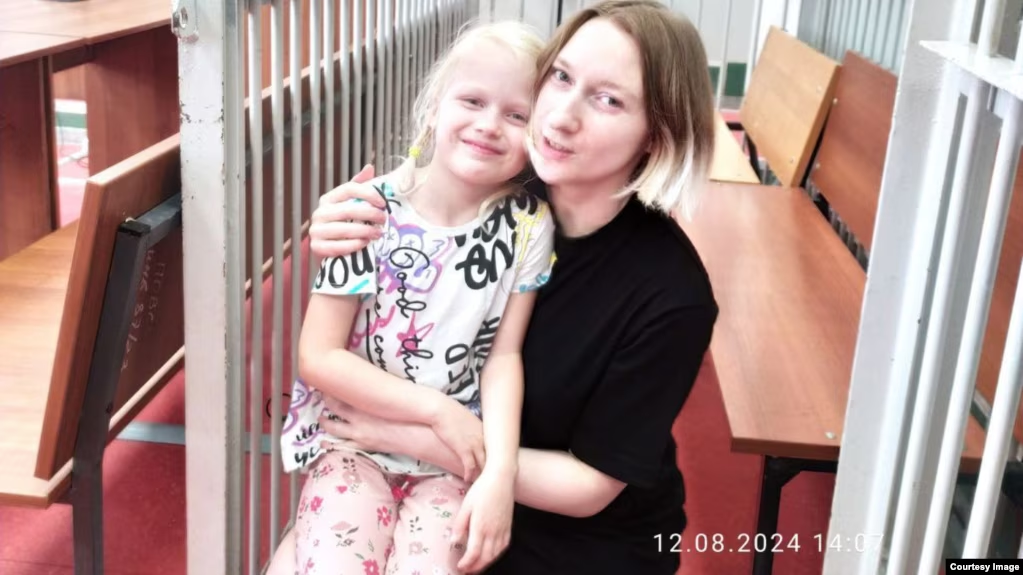
Polina Yevtushenko with daughter Alisa in court, August 2024

Polina Yevtushenko had deleted the social media posts for which she was tried prior to criminal charges being brought against her, she did not commit high treason, and her so-called crimes were victimless. And yet, she has been in a pretrial detention center for almost three years, and the prosecution asked the court to sentence her to eighteen years in prison. According to her lawyers, this would have been the longest sentence ever handed down to a woman in post-Soviet Russian history for a nonviolent crime that was not even committed. Today, the Central District Military Court found Yevtushenko guilty as charged and sentenced her to fourteen years in prison.

“This case is totally fabricated and unfounded. It’s completely unfounded, and the recordings that do exist and were submitted to the court speak to Polina’s innocence. In them, she repeatedly tries to dissuade her acquaintance Komarov from joining the Free Russia Legion. He made her acquaintance specifically so that this vile criminal case would be brought against her. This is a provocation,” say Polina’s acquaintances who attended the trials. (We are not naming them for their own safety.) “Polina is a courageous person. She’s a fine woman and never loses heart. It’s simply monstrous that she has been given such a long sentence for no reason.”

“I thought they were taking me to be killed”

Polina Yevtushenko, who is from the city of Togliatti, in the Samara Region, is twenty-seven. In July 2023, she was arrested for allegedly “inciting a Samara [city] resident to commit treason by defecting to the enemy, namely by joining the armed group the Free Russia Legion in order to take part in hostilities against the Armed Forces of the Russian Federation on Ukrainian soil” (per Article 30.1 and Article 275 of the Criminal Code of the Russian Federation: “preparation of terrorism”).

On that day, she took her daughter Alisa to kindergarten, and when she left, more than a dozen plainclothes security forces officers were waiting for her.

“They put cable ties on my hands and threw me into the car as if I were a sack of potatoes. Then these men got into the car and placed their feet on me. They didn’t explain anything. I thought that they were gangsters and that they were taking me to be killed. I screamed and called for help,” Yevtushenko later recounted.

After Yevtushenko was arrested, she was charged with five more crimes: publicly calling for terrorism on the internet (a violation per Article 205.2.2 of the Russian Federal Criminal Code), publicly calling for extremism, also on the internet (Article 280.2), disseminating knowingly false information about the deployment of the Russian Armed Forces, motivated by political hatred (Article 207.3.2.e), and condoning Nazism (Article 354.1.4). According to the FSB’s Samara office, she persuaded an acquaintance to go and fight in the Free Russia Legion, carried out “propaganda work,” and “posted instructions for Russian military personnel on how to surrender.”

Seven dates and “high treason”

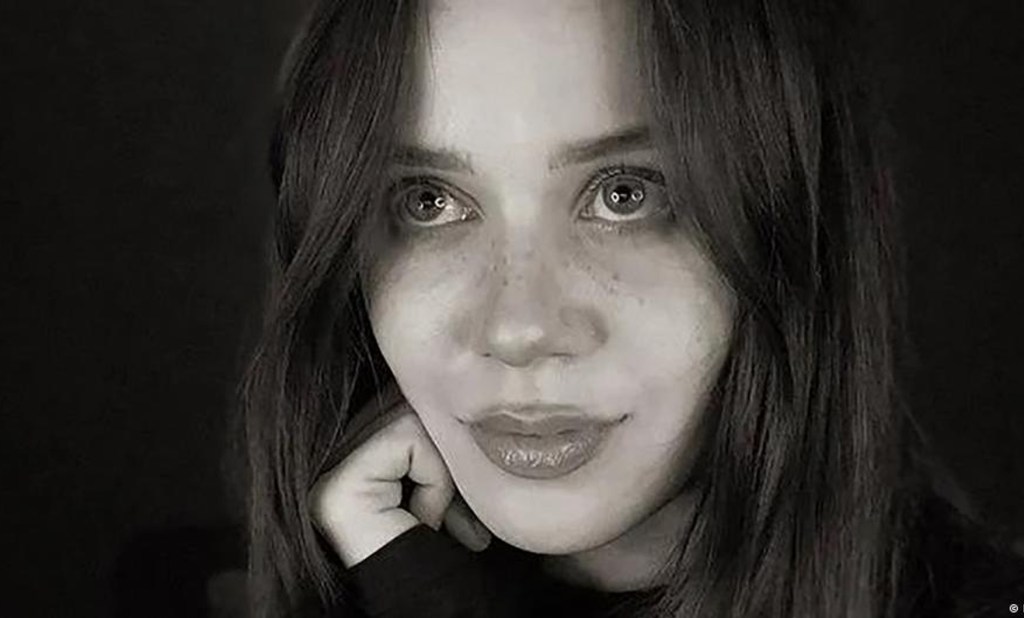
Polina Yevtushenko

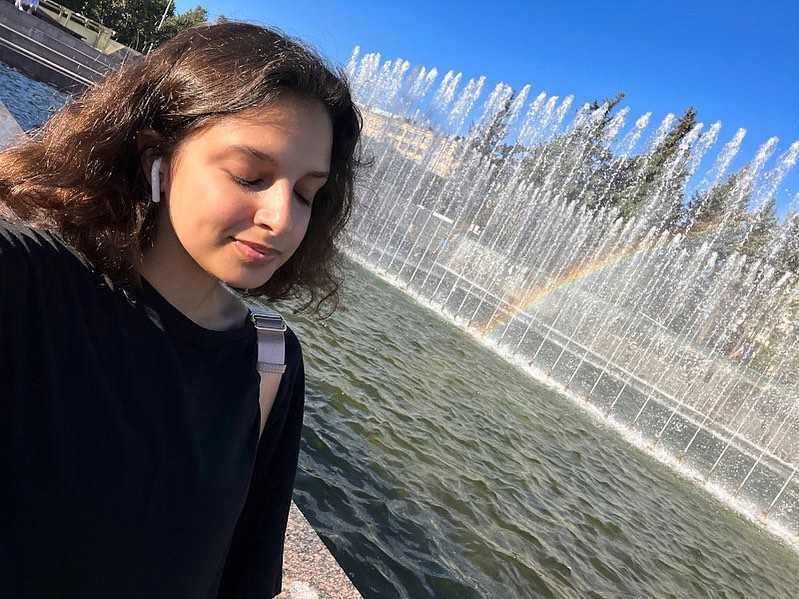
In this photo, Yevtushenko is a slender young woman with blue hair like Malvina’s, wearing a t-shirt and pink jeans. She raised her young daughter alone and painted pictures, which she posted on her Instagram and VKontakte accounts. She also publicized her anti-war views on these social media accounts, republishing a petition demanding Putin’s resignation over the war he unleashed in Ukraine, posts from the Free Russia Legion (at the time, it had not yet been deemed a “terrorist organization” by the Russian Supreme Court and was not yet banned), and instructions on how to surrender in order to survive the war. She was always quite sociable and interested in all kinds of people, easily meeting new people and making friends, according to her acquaintances.

Nikolai Komarov wrote to Yevtushenko on VKontakte. He said she was very pretty and drew beautifully, and that he really wanted to meet her and date her. What is more, her page said that she used to work at a Yota store, and he had a question he couldn’t figure out himself, so maybe she could help? He lived in Samara, she lived in Togliatti, an hour away by bus, but that was not a problem—he would come to Togliatti.

“They had a total of seven dates,” says a [male] friend of Yevtushenko’s. “He always told her how much he liked her. He invited her out to eat. They went for bike rides, went bowling, and sang karaoke together. He asked her about her pictures and her daughter. That is, he made it patently clear that he was interested in her as a woman and that he was courting her.”

It later transpired that the only dates with Yevtushenko which Komarov didn’t record on a dictaphone were the first two.

“He would constantly tell her that he was afraid of getting drafted and wanted to leave Russia, and asked her to advise him where to go, what to do, and how to make a living,” Polina’s friend continues.” She would reply that if he was so afraid, he should go to China or Kazakhstan, open a Wildberries or Ozon outlet there, and not worry. But he kept bringing up the subject again and again, asking her about the Free Russia Legion, whose posts she shared on social media. Polina told him that they were fighting Putin and that was why she supported them, that she had Ukrainian blood and opposed the war. At the trial, recordings were played of Polina telling Komarov many times that he should not go there and get involved, of her trying to talk him out of it. But Komarov kept at her: ‘I want to join the Legion, let’s choose a “street name” for me.’ (That was his term for ‘call sign.’) She communicated with him in a friendly manner and did not want to get closer because the conversations were always the same.”

Yevtushenko was later asked why she had not immediately pegged Komarov as a provocateur. She replied that she had believed “the FSB would not employ such dimwits.”

In court, Komarov testified that he had independently recorded Yevtushenko’s conversations on a dictaphone, but then became frightened by what she was saying and decided to hand the recordings over to the FSB because he thought she could get him into trouble. The recordings show signs of editing, with conversations cut short, Yevtushenko said in court. During the investigation and the trial, her defense demanded access to the complete recordings, but they allegedly do not exist. Komarov claimed that he had long since sold both the dictaphone and the laptop from which he transferred the recordings to discs for the FSB at a flea market. The court took him at his word.

Center “E” operative, FSB agent, or just a criminal on the hook?

In 2009, Nikolai Komarov was sentenced to two years’ probation for stealing a Sony Ericsson mobile phone, Kholod has discovered. While his probation was still in force, Komarov was caught again and charged with seventeen counts of theft of cable and internet equipment. In May 2011, he was convicted and sent to prison for two years and one month, but in April 2012, he was released on parole, after only eleven months in prison.

“He can actually be sweet, handsome, and charming. He knows how to get under your skin, and girls usually like him. He’s a bit of a con artist,” says a friend of Komarov’s.

You would thus never suspect that Komarov had had run-ins with the law. On the contrary, he maintained a Twitter account on which he demanded that the Samara municipal authorities fill in a pothole and finally resolve the issue of an open manhole cover, and he came across as a caring person and even a grassroots activist. This was before the war in Ukraine, however.

In 2017, Komarov showed up at the Navalny organization’s field office in Samara and introduced himself as a lawyer.

“He was a very active member [sic] of the field office. He wanted to be friends with everyone. He would invite people to barbecues, suggest that we drink vodka, hang out at the office all the time, and willingly do whatever needed doing—if we needed to buy water, he would go buy it without question. He took part in our campaigns and protest rallies,” says Marina Yevdokimova, who was a staffer at Navalny’s Samara field office at the time. In 2021, after the organization’s field offices were shut down across the country, she fled Russia.

In 2019, during the COVID pandemic, Yevdokimova was the field office’s social media manager.

“We had just reached the peak of the outbreak, which we wrote about in a post on Telegram. We also wrote that doctors had no PPE. An administrative case was brought against me. The police were staked out near my home. They would knock on my door, but I wouldn’t open it, so then they would go to my neighbors and question them,” Yevdokimova continues. “There was a court hearing in May, and Kolya Komarov was a witness for the prosecution, to my surprise. He hadn’t been at the Navalny field office for a long time. He was upset with us because we hadn’t gone along with his strange proposals. He had then become friends with the Communists and NOD (National Liberation Movement) members, posted photos of himself with them, and participated in their rallies.”
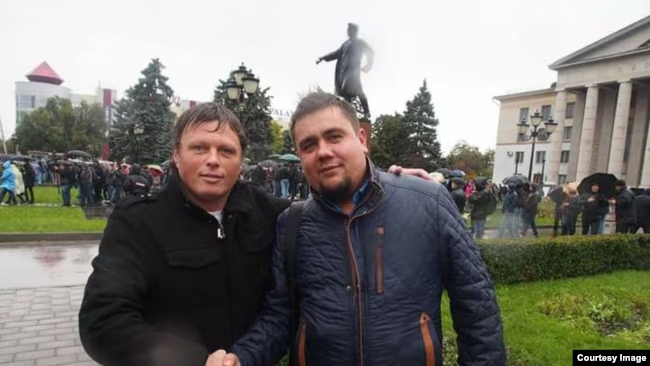
Denis Shepelsky (left), NOD’s “chief of staff” in Samara, and Nikolai Komarov. Source: Komarov’s VK page

At Yevdokimova’s trial, Komarov testified that he had seen her walking through the market in Microdistrict 15 and had allegedly heard her discussing on the phone that she would post this particular message on Telegram.

“I heard about her criminal intentions and could not fail to report them to law enforcement,” he told the court.

“Strangely enough, I was acquitted,” says Yevdokimova. “The lawyer asked [Komarov] simple questions that [he] couldn’t answer properly: ‘Where do you live? How did you end up in the market at that time?’ This was during the pandemic and no one could move freely around town. Besides, many people had access to our Telegram channel, so it was impossible to prove that I was the one who had posted it.”

Yegor Alasheyev, another former staffer at Navalny’s Samara field office, also emigrated from Russia.

“In March 2017, we held a rally called ‘Dimon Will Be Held to Account,’ at which twenty-three of our supporters were detained,” Alasheyev recalls. “We appealed all the fines [imposed on them as punishment] and they were later overturned. Komarov was also detained, but he turned down our assistance, saying that he was a lawyer himself and ‘knew what he was doing.’ It later transpired that he had pleaded guilty and been sentenced to pay a fine. At first, he kept quiet about the situation, then he telephoned our office and asked us to pay the fine. (At that point, he had already stopped hanging out with us.) I told him that we needed to talk to the lawyers and come up with a plan. But he refused to talk to them, and two weeks later, a video was released on TV featuring a ‘disenchanted Navalny volunteer.’ Soon after, he started attending NOD rallies. We looked into Komarov and learned that he had been convicted of stealing cable, but we had suspected that he was here for a reason even prior to that. He always hung around the office and listened carefully to what we were saying. But we didn’t pay much attention to it—he had seemed harmless. We understood of course that someone would inevitably be planted in our midst and that we were being watched.”

In 2022, Protocol Samara discovered that Alexander Melikhov, whom Komarov had befriended, had been planted in the local Navalny field office. Melikhov was a lieutenant colonel in the police, and his surname and passport had been changed for the sake of this operation. Yevtushenko’s acquaintances do not rule out the possibility that both men infiltrated the organization at the same time.

During Yevtushenko’s trial, it transpired that another criminal case had been opened against Komarov. He had been charged with thirty-seven crimes under Article 173.1.2.b of the Russian Criminal Code (“illegal creation of legal entities or provision of documents”). He was sentenced to 330 hours of compulsory community service.

“It seems that he has long been firmly ‘on the hook’ of Center ‘E’ (the Russian Interior Ministry’s office for combating ‘extremism’ and ‘dissidents’—Sever.Realii) and the FSB, but they cover for him. He created thirty-seven fake companies and only got community service,” says a lawyer working in Russia.

A new method of recruiting?

In July, it will have been three years since Yevtushenko was jailed in a pretrial detention center. In June 2025, she was found guilty of “violating” the center’s rules for passing store-bought cookies to a neighboring cell. In July of the same year, she was sent to solitary confinement for ten days because she had described her court hearings in her letters. All this time, she has only been able to see her daughter through glass; the judge has allowed them one-hour visits. Yevtushenko’s parents have been raising Alisa.

“Visits take place through glass over a telephone and last one hour. During this hour, I talk alternately with my mother and with Alisa. During the last visit, I brought a sketchbook with me in which I draw pictures for Alice. She really liked it,” wrote Yevtushenko from the detention center. “Before that, I showed Alice some old photos of us from the time before my arrest, but she started crying, so I decided not to do that again… Of course, conversations through glass can hardly be called visits, but we are grateful for what we have. I really miss hugs. I want to hug and kiss Alisa, but I can’t.”

“Polina gets plenty of letters at the detention center. Many people support her because they understand the injustice of what has been happening to her. She doesn’t get discouraged, she rejoices in every little thing, and she has been learning English by mail,” says a friend of Yevtushenko’s who has attended all the court hearings in her case. “How do we usually imagine sting operations carried out by the special services? They involve persuasion, bribery, blackmail—the classics of the genre. But a new method has supposedly emerged in Polina’s case, which we learned of when FSB expert Tatyana Naumova was cross-examined at the trial. According to her, in a new manual developed by FSB criminologists, which has not been made available to the public, a new method of recruitment is [defined]: it is deemed ‘propaganda’ and ‘recruitment’ when someone praises something—for example, when someone claims that the Free Russia Legion has good equipment. Polina’s defense asked to review this secret manual, but the judge turned down their request. The defense lawyer then asked the judge to examine them himself and confirm that everything was indeed written that way there. But the judge refused to do so. Naumova also said that Komarov was ‘a person conducting covert operations.’ In other words, she effectively admitted in court that the special services had organized a sting. From the point of view of the European Court of Human Rights (ECHR), this is a gross violation of the right to a fair trial (per Article 6 of the European Convention on Human Rights). Evidence obtained in this way is considered inadmissible by the ECHR. And Russia, until it ceased to be a party to the Convention due to the war it unleashed in Ukraine, had been repeatedly punished for this” (e.g., in Vanyan v. Russia, 2005, and Lagutin and Others v. Russia, 2014Sever.Realii).

An excerpt from Polina Yevtushenko’s closing statement at trial

“Your Honor, you have known me for almost two years. I am confident that during these two years you have been persuaded that I pose no danger to the community and that I can be released.

“For two years, I have only been able to see my daughter through glass and cannot even hug her. I did not see her at all during the first year [in police custody]. Last year, Alisa started first grade, and this year, on March first, she will turn eight years old. She needs her mother’s love, care, and help, and I need even more to be with her, to see her grow up, to raise her, to take care of her. I need to make sure she becomes a decent person—well-mannered, smart, well-read, and fond of our Motherland.

“Your Honor, I ask you to release me so that I can raise my daughter. Be a conduit of happiness for two loving hearts—those of a mother and her child. I have never committed treason. I love my Motherland, Russia, and would never do anything to harm her. If I have made any mistakes or committed violations, then being in prison for almost three years is more than enough punishment for me.

“I have come to grips with everything [I have done] and promise you that from now on I will behave in such a way that you shall never be ashamed of me. I ask you to make a just decision and release me to be with my daughter.”


According to a study by the human rights project First Department, between February 2022 and mid-December 2024, 792 people in Russia were charged with treason (per Article 275 of the Russian Federal Criminal Code), espionage (Article 276), and secret cooperation with a foreign state (Article 275.1). In 2024, 359 people were found guilty and sentenced to actual prison terms on these charges, and four more were sentenced to compulsory psychiatric treatment. Of these 359 people, 224 were found guilty under Article 275, 38 under Article 275.1, and 101 under Article 276. A total of 536 people have been convicted of violating these criminal code articles since the start of the war; Russian courts have not handed down a single acquittal. According to First Department, a significant number of these cases were based on sting operations carried out by FSB officers or persons associated with them.

Source: “The recruitment that never happened: Polina Yevtushenko sentenced to 14 years in prison,” Sever.Realii (Radio Svoboda), 6 March 2026. Translated by the Russian Reader
Asylum Seekers

Yulia Yemelyanova. Source: The Insider

Kazakh authorities have granted Russia’s request to extradite activist Yulia Yemelyanova, a former employee of the late Alexei Navalny’s Petersburg office. According to the Russian opposition-in-exile’s Anti-War Committee, Kazakhstan violated its own protocols in making the decision to extradite Yemelyanova, as the Russian activist’s application for asylum is still under review in the country.

This past October, Kazakhstan’s Prosecutor General’s Office had guaranteed that extradition requests would not be considered until all administrative procedures related to obtaining asylum were completed. Yemelyanova’s defense intends to appeal the extradition decision to the country’s Supreme Court.

Yemelyanova was detained on Aug. 31, 2025, at Almaty airport while in transit to a third country. She has been held in pretrial detention ever since. In Russia, she is being prosecuted for theft (Part 2, Article 158 of the Criminal Code) in connection with a 2021 incident in which she allegedly stole a mobile phone from a taxi driver. Yemelyanova’s defense calls the case fabricated. It was sent to court in July 2022, by which time the activist had already left Russia.

Yemelyanova is the fourth Russian asylum seeker since late January to be handed a deportation decision from Kazakh officials. The others are Chechen Mansur Movlaev, an open critic of Ramzan Kadyrov; Crimean resident Oleksandr Kachkurkin, who is facing treason charges in Russia; and Yevgeny Korobov, an officer who deserted from the Russian army.

Source: “Kazakhstan moves to extradite former employee of Navalny’s St. Petersburg office to Russia,” The Insider, 11 February 2026


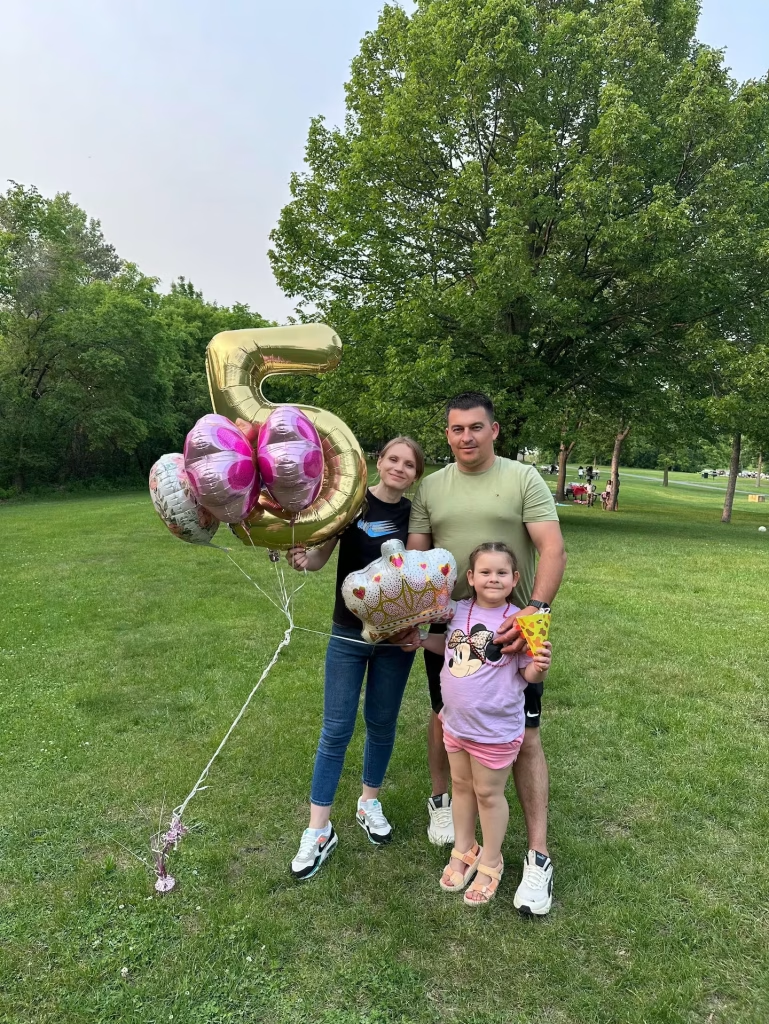
Dmytro Kulyk with his wife Oksana and daughter Elina. Source: Daily Beast

A Ukrainian dad escaped Vladimir Putin’s drone and missile attacks back home only to be grabbed by a band of ICE stooges in a Walmart parking lot in Minneapolis.

“I hoped I would find peace in America. I’ve done everything the government required, I don’t understand why I am behind bars,” Dmytro Kulyk told the Daily Beast from the Kandiyohi County Jail in Willmar, Minnesota.

The 39-year-old father was getting a pickup order at a Walmart in Maple Grove when he found himself surrounded by immigration agents last month. He’d been working as a delivery driver to make ends meet, while also supporting his family by doing roofing work.

Kulyk legally entered the U.S. in late 2023 along with his wife, 38, and daughter, who’s now 5. The family was sponsored by U.S. citizens as part of the Uniting 4 Ukraine program, a humanitarian program set up in April 2022 to allow Ukrainians fleeing Russia’s war to live and work in the U.S. on “parole.”

Once the initial two-year parole period expires, entrants can file for re-parole to remain in the country longer. That’s exactly what Kulyk says he did. His wife and daughter’s applications were approved. But his remained pending.

He said he was putting groceries in his car on Jan. 1 when he was approached by three ICE agents.

“I explained to the ICE officers that the war was killing people, that my wife had a disability, that it was violence, terrorism which we had escaped from but one of them began to laugh,” Kulyk told The Daily Beast. “I asked why he was laughing and I was told that he was pro-Russian, wanted Russia to win the war.”

DHS and ICE did not immediately respond to a request for comment.

He can’t understand why he’s been treated like a criminal. He did everything by the book, he says–paying taxes and filing his immigration paperwork on time, working multiple jobs to take care of his family. He had no criminal record to speak of.

His immigration attorney, Julia Bikbova, suggested his re-parole application may have intentionally been stalled to provide immigration authorities with a pretext to deport him.

“Our government, our Homeland Security, promised Ukrainians to protect them during the war. There are approximately 280,000 Ukrainians on U4U, Uniting for Ukraine program in the United States, including the Kulyk family,” she told the Daily Beast.

“My client did everything the government required him to do: on June 5 he applied for the re-parole and his wife paid $2,040 of fees for her and child’s granted applications. His wife and daughter have recently received their re-paroles but he has not, his application is pending.

“ICE detained him as ‘illegal’ and began deportation proceedings: This is a sick way of forcing a man with a clean criminal record to become unlawful in the U.S. by delaying the review of his application, which the very same authority had requested to file.”

Kulyk is now terrified he’ll be sent to the frontlines to fight Vladimir Putin’s troops if he is deported back home. He and his family endured relentless Russian attacks before finally deciding to flee their home in the Odesa region in 2023. When they saw ruins on their own street in Chornomorsk, they called their friends in Texas and asked for help, leading to their enrollment in the U4U program thanks to having U.S. citizens as sponsors.

Kulyk now can’t stop worrying about his wife, Oksana, and daughter, Elina.

“I am worried they can drag my wife and kid out of our home,” he told The Daily Beast, adding that he wanted to appeal directly to American authorities to make them understand he’d done nothing wrong.

“Please hear me: I came to America to escape the war, to pray in church and work hard. But now my heartbroken and sick wife has lost over 10 pounds since ICE arrested me on January 1. She’s been panicking, and my little daughter has been crying without me every night – this is unjust,” he said.

Oksana says she’s been too “terrified and lost” to leave home while her husband is locked up, afraid that immigration agents might return for the rest of the family.

“I am too scared to drive my 5-year-old daughter to school in my husband’s car. I’m terrified ICE will detain me and our daughter will end up alone,” she told The Daily Beast. “This is just as scary as the war in Ukraine, except now we don’t have Dmytro with us. Our daughter Elina cries herself to sleep with her cat plushie. She says the toy is daddy.”

Most Ukrainian refugees are women and children but some men have also left the country for various reasons. Kulyk was granted a permit to leave in order to care for a family member with a medical condition.

But Kulyk is not the only Ukrainian refugee to be swept up in the Trump administration’s controversial immigration crackdown.

Nearly 1,000 miles away, in Philadelphia, Zhanna was poring over messages in a group chat of 349 other refugees called “Ukrainians in Detention.” She joined the group last month, when her friends Andrii and Yaroslav ended up in detention. Although Bartosh has legal Temporary Protected Status, she stopped going to the office and now works from home.

“ICE rounds up men who buy tools or work in construction, so every day I call my husband, a construction worker, to check if he is OK. Even when the war started in Ukraine and we had to escape abroad, the same morning I wasn’t as stressed as I am now,” she told the Daily Beast. “In our chat I read that all arrestees are men, that at least five of them have signed up for self-deportation… but where is there to go now? Europe is also deporting Ukrainians. Our TPS is good until October but we want to understand, are we really legal in the United States, or is it time to pack up our suitcases again?”

Immigration attorneys count about 300 cases of detained Ukrainians across the United States and up to 150 refugees deported to Ukraine, Bikbova said.

“Most of the arrested Ukrainians are men, the majority of them have a clean criminal record but as we see in Kulyk’s case, they are equated to people who jumped the border, broke the law,” attorney Bikbova told the Daily Beast. “Behind every deported man, there are crying women and children, left without support. For some mysterious reason, we see male Ukrainian refugees being arrested and put on airplanes. If he gets deported, my client Kulyk will most certainly go to the front.”

Trump’s administration has also been deporting Russian asylum seekers. According to a report by Current Times, more than 50,000 Russians have fled the war and political repression to the U.S. since February 2022. Journalist Ilya Azar has been covering the deportations for Novaya Gazeta.

“They send out 40-60 people on each plane. There have been five airplanes,” Azar told the Daily Beast on Tuesday. The deportation planes transit to Russia through Egypt, and Russian security services meet the deported citizens. Azar’s report noted that “all men received draft notices” upon their arrival in December.

Source: Anna Nemtsova, “Laughing ICE Goons Seize Dad Who Fled Ukraine War at Walmart,” Daily Beast, 12 February 2026. The emphasis, above, is mine. \\\\\TRR


Georgy Avaliani. Source: Mediazona

German authorities last week denied asylum to 47-year-old engineer Georgy Avaliani, who deserted from the front line in 2022. His wife and two children were rejected alongside him.

“There is no reason to believe that, upon returning to the Russian Federation, they would face a high probability of persecution or serious harm,” wrote an official from the Federal Office for Migration and Refugees (BAMF), despite Avaliani’s account of being tortured after fleeing the front.

Mediazona has reviewed BAMF decisions in Avaliani’s case and those of other deserters, discovering that officials are producing boilerplate documents that repeat one another almost word for word. In justifying the refusals, the German agency argues, for instance, that mobilisation in Russia was intended to “strengthen the armed forces” rather than repress dissent, and therefore cannot be considered political persecution. They further say that mobilisation has effectively ended because Vladimir Putin announced it—verbally.

When describing potential punishments for deserters, officials cite not the criminal code but an administrative article regarding failure to comply with military registration duties. They even specify that the maximum penalty is a fine of €302.

Most notably, in every decision examined, BAMF cites Mediazona’s own article from 2023“Evading > refusing > fleeing. A year of mobilization in Russia through trials and verdicts”, as evidence that mobilised men face little more than a fine. That article noted that, at the time of publication, failing to respond to a summons did not yet carry a heavy penalty. While the situation has since changed—an eventuality the original article warned about—the original reference remains in the German files.

Relying on information from that article is also fundamentally flawed because BAMF applies it to people already wanted under serious criminal charges for desertion or abandoning their unit. In its rulings, the agency ignores the severity of these consequences, lumping deserters in with those who simply left Russia when mobilisation was first announced. This is exactly what happened to Georgy Avaliani.

A year in a refugee camp

Avaliani, an engineer, arrived in Germany with his wife, Oksana, and their two children on January 26, 2025. By then Georgy, who was drafted shortly after mobilisation began and later deserted, had been on a federal wanted list for over six months.

The family was granted asylum-seeker status without an initial investigation into the specifics of their escape. Like other applicants, they were placed in temporary housing: a small portacabin with two bunk beds at the former Tempelhof airport site. Their journey to Germany had been arduous. On January 18, Georgy, who had managed to leave Russia before his name appeared on the wanted list, met his wife and children in Bosnia. From there, they travelled to the Croatian border and requested asylum.

In Croatia, the asylum process is largely a formality; in practice, obtaining protection there is nearly impossible. Consequently, many migrants use it only as an entry point into the EU before heading to countries with functioning reception systems. The Avalianis did the same. After a preliminary registration in Croatia, they spent a week travelling to Berlin.

For nearly a year, the family was cramped in a camp with 2,000 other applicants. Finally, just before the start of 2026, they were moved to a hostel in western Berlin. But Georgy’s hopes of integration (he had been diligently learning German and hoped to return to engineering) were soon shuttered. On January 16, just two weeks after their move, BAMF rejected the entire family’s asylum claim.

Avaliani intends to appeal. If he fails, the family must leave Germany within 30 days or face deportation to Russia, where Georgy faces up to 10 years in prison for abandoning his unit during a period of mobilisation. Despite having clear evidence of persecution, the German authorities have ignored his claims.

The two escapes of Private Avaliani

Before the war, Georgy Avaliani was a well-paid engineer at the Moscow water utility, Mosvodokanal. He had no plans to leave Russia. Shortly before the full-scale invasion of Ukraine, he even enrolled in a seminary to pursue a religious education.

Georgy had never served in the army due to a heart condition. However, following the “partial mobilisation” announcement, he received a summons on October 6, 2022. At the time, his three children were minors; by law, as the father of a large family, he should have been exempt. The couple tried to contest the draft through the military enlistment office and the prosecutor’s office but failed. Georgy chose not to go into hiding, unwilling to abandon his family.

After a medical commission in November, he was sent to a training camp in the Moscow region and then to the occupied Svatove district of the Luhansk region. His unit was stationed in the village of Novoselivske, 20 km from the front line. After a few days, noticing the chaos within the unit, Avaliani decided to slip away, gambling that no one would notice his absence. He reached a nearby road and hitched a ride to the village of Troitske, a gathering point for mobilised men.

Part of a local hospital had been turned into a shelter for soldiers with nowhere else to go—some had lost their units, others were waiting to withdraw their pay, and some were recovering from wounds.

While staying there, Georgy met another mobilised soldier. They shared the same grim impression of the front and a desperate desire to return home. They found three others who felt the same and hired a taxi driver to take them to a spot where they could cross the border on foot.

After the driver dropped them off, the group split up. Along the way, Avaliani and his companion heard a helicopter. Georgy later told journalists and BAMF officials that the second group had been gunned down from the air. While there is no independent confirmation of this, Avaliani and the other man survived only to be detained in an abandoned village.

There is little doubt Georgy made this journey on foot; “Goodbye to Arms”, a project that assists deserters, thoroughly verified his route. Alexei Alshansky, a coordinator for the organisation, says the helicopter story is the only detail rights activists have been unable to confirm.

Following his capture, Avaliani was thrown into “a basement” for 10 days. He says he was beaten repeatedly and subjected to mock executions. Mediazona has previously reported on this location, known as the Zaitsevo Centre for the Detention of Servicemen, based on the testimony of another deserter, Sergei Savchenko. Volunteers from “Goodbye to Arms” identified the site in the occupied village of Rassypne by comparing testimonies with video footage.

From the basement, Georgy was sent to an assault unit. Two days later, an ammunition dump near their position exploded. Avaliani suffered a concussion and a heart attack. He was sent to a distribution point where he befriended the doctor issuing referrals. The medic sent him to a hospital inside Russia, hinting that he could just as easily head straight for Moscow instead of the ward.

Avaliani did exactly that. After reuniting with his family, he hid at a dacha in the Tula region. Occasionally, he ventured to Lyubertsy for medical treatment. As time passed he grew less cautious, but in mid-February 2024 military police arrested him outside his home.

He was sent to Kaliningrad in western Russia, the permanent base of his unit, to await his fate. When a commander learned of Georgy’s engineering background, he set him to work renovating his private dacha. Meanwhile, Georgy pushed for a formal medical commission. When it finally took place, the results were surprising: he was not only declared fit for service but his category was upgraded from “partially fit” to “fit with minor restrictions”.

In May, he was told to report for questioning regarding a criminal case. Georgy fled again. On the way to the commander’s dacha, he got a taxi and flew to St Petersburg. His wife met him there to hand over his passport. From there he flew to Belarus, then Uzbekistan, Georgia and finally Montenegro, where he was taken in by a Swedish artist for whom he helped build a swimming pool.

Oksana remained in Lyubertsy with the children. Weeks after her husband left, an investigator began calling her. Georgy was placed on a federal wanted list.

In September 2024, security forces raided the family home. They confiscated phones from Oksana and the children, returning them only two weeks later. The stress caused Oksana to suffer a nervous breakdown, leading to a month-long stay in a psychiatric clinic. The visits from military police continued; the last raid occurred on January 7, 2025. After that, Oksana finally agreed to leave Russia.

Georgy has spoken openly to the press about his escape. In Montenegro, he was interviewed by Current Time TV. The family crossed the German border accompanied by a journalist from Die Welt, which later published a detailed account. A report for the Franco-German channel Arte was also filmed by Russian journalist in exile Masha Borzunova.

The first six months in Germany were particularly precarious. Under EU law, the migration service could have deported the family back to Croatia, their first point of entry. To prevent this, Georgy sought help from the church.

The tradition of Kirchenasyl, or church asylum, began in 1983 after Cemal Kemal Altun, a 23-year-old Turkish activist, took his own life in a West Berlin court while facing extradition. His death moved church communities to unite to protect refugees from deportation. Every year, hundreds of people receive a reprieve through this practice. The Avalianis were among them.

“It is a semi-legal, more like a cultural phenomenon that works differently in different states,” explains Alshansky. “The church gives the applicant a document stating they are under their care, and the authorities leave them alone.”

Thanks to this intervention, BAMF could not reject the family simply because they entered via Croatia. They were forced to consider the case on its merits. They rejected it anyway.

BAMF’s motivation

During his personal hearing, Georgy Avaliani detailed his service and desertion. When asked what he feared if returned to Russia, he replied: “I fear for my life. Legally, I could be imprisoned for up to 20 years. But more likely, I will be killed before trial or in prison… I know for certain that if they find me, a subhuman death awaits me.”

His wife, Oksana, tried to explain the psychological toll the military police raids had taken on her and the children. The family provided lots of evidence: the mobilisation order, the wanted notice from the interior ministry’s website, a letter from a German humanitarian organisation, medical records and Georgy’s military ID.

In its rejection, the agency claimed the Avalianis were “apolitical people”, making it unclear why they believed the Russian state would view them as opponents. BAMF argued that if they were truly targeted, Georgy would never have been able to leave Russia so easily.

Having erroneously stated that Avaliani faced only an administrative fine, the official added that it was “not evident that in the applicants’ case, due to specific circumstances, a different [punishment] should apply”.

The document also asserted that officials found no evidence that mobilisation continued after Putin’s verbal announcement. Even if it were to resume, BAMF argued, it was not certain Avaliani would be called up again, given Russia’s 25 million reservists.

“Even taking into account that the applicant evaded mobilisation, it is not to be expected that… he would be subjected to the inhuman or degrading treatment required to grant asylum,” the decision stated.

The agency concluded the family could lead a dignified life in Russia. Despite the economic crisis, the official noted that people in Russia are still provided with food, social benefits and pensions. “It is not seen that… they would find themselves in a completely hopeless situation,” the ruling said. Their physical and mental health was also deemed insufficient to require treatment specifically in Germany.

A template for rejection

Alshansky attributes the BAMF decision to the wave of draft evaders who fled to Europe after 2022.

“A crowd of people rushed to claim asylum over mobilisation, some without even a summons,” he says. “I think they have exhausted the Germans to the point where, as soon as they see a Russian applicant and the word ‘mobilisation’, they just churn out this rejection.” Artyom Klyga, from the rights organisation Connection E. V., confirms that around 1,000 Russians have requested asylum in Germany due to mobilisation.

Alshansky points out that the rejection text clearly treats Avaliani as a mere draft dodger rather than a man who fled the front and is now a fugitive. He believes BAMF compiled the document from fragments of other cases without truly studying Georgy’s story. “I have compared this rejection with others. It is a template; paragraph after paragraph is identical. They just changed the personal details in a Word file,” Klyga agrees.

Mediazona compared several BAMF decisions regarding Russians who fled mobilisation. The similarities are striking. In the case of a young man who left after an attempt to serve him a summons, the agency also cited Putin’s words on the end of mobilisation. The description of the economic situation in Russia—including the detail that 15% of Russians live below the poverty line—is identical in both his and Avaliani’s files.

In another case involving a reservist who left on a tourist visa, the agency used the same argument: that mobilisation is about military strength, not political vengeance. That document also cited the same €302 fine.

The same arguments were used against Anton Sh., a deserter from Ufa whose story was covered by Sever.Realii. He had been tortured in the same Zaitsevo cellar, where guards pulled out almost all of his teeth. Despite his ordeal and the fact he is wanted in Russia, BAMF ruled he faced no danger because he had been able to leave the country freely.

Georgy Avaliani is now consulting with lawyers to appeal. “From my interview, it is perfectly clear that my situation is different [from other cases BAMF cited in the rejection]. This rejection shows that these people either cannot read or didn’t bother to try,” he said.

Even if his appeal fails, Georgy has no intention of returning. “I didn’t come here for tastier sausage, but to avoid dying in prison,” he says. “I had a good job in Russia. I will never reach that standard of living here; I’m not 20 or even 30 years old anymore. I didn’t travel far for a better life. I left solely because of persecution. Pity they don’t understand that.”

“Goodbye to Arms” estimates there are currently about 100 Russian deserters in Germany. For others planning to follow Avaliani’s route through Croatia, Alshansky recommends heading to other countries, such as Spain, where he says the bureaucratic logic remains more straightforward than in Germany.

Source: “Rubber‑stamping rejections. Germany turns away Russian army deserters who refused to fight in Ukraine, claiming they face only a fine back home,” Mediazona, 5 February 2026. Thanks to News from Ukraine Bulletin for the heads-up. The emphasis, above, is mine. \\\\\TRR

Alexander Krichevsky of Izhevsk: Six Years in Prison for a Comment

Alexander Krichevsky. Photo: Mediazona

In September 2024, Alexander Krichevsky, a 58-year-old resident of Izhevsk, posted a lengthy comment on a Chechen opposition blogger’s Telegram channel. In the comment, Krichevsky compared Putin and the “FSB clique” to a “darkness” which must be destroyed. The security forces deemed this statement incitement to murder the president and FSB officers. They monitored the man and intercepted his internet traffic. Last December, Krichevsky was detained and remanded in custody to a pretrial detention center despite his ailments and the fact that he is confined to a wheelchair. His ailing mother was placed in a care home, where she died a month later. Today, at the Central District Military Court in Yekaterinburg, where Krichevsky’s case is being heard, the prosecutor requested that he be given the maximum sentence of six years in prison.

“That is why we listen to him, because he is not afraid—he’s a ray of freedom in a kingdom of darkness! And only together will we destroy this darkness, only when we understand that we have only one enemy—Putin and his FSB clique. . . . Both you and we must destroy this enemy to continue living as peaceful neighbors,” 58-year-old Izhevsk resident Alexander Krichevsky wrote in a chat on the channel of opposition Chechen blogger Tumso Abdurakhmanov aka Abu Saddam Shishani, on 11 September 2024.

This was Krichevsky’s response to a user who had asked Abdurakhmanov himself in a chat: “Tumso, aren’t you afraid that Kadyrov’s people might find you?”

When questioned in court, Krichevsky said that he was sure he was responding to the user personally, not writing in a public chat. He repeated many times that he had only figurative “destruction” in mind and had been trying to “reconcile” Abdurakhmanov’s readership by pointing out that they had only one enemy.

“Of course, I wasn’t even thinking about physically destroying such a large number of people and didn’t understand how [what I wrote] would even look. Apparently, my love for pretty words—all those rays of light and other nonsense—let me down. I was thinking in terms of games: when a person plays checkers or chess, they destroy their opponent’s pieces. Roughly speaking, that was the image I had in my head,” Krichevsky said in court.

The FSB operative who discovered Krichevsky’s comment saw it not as criticism alone, but also as a “public call to murder the president of the Russian Federation and officers of the Federal Security Service.”

The same conclusion was reached by Polina Komova, a philologist and expert at the Ministry of Internal Affairs Forensic Center in Udmurtia. She acknowledged in court that the word “destroy” could have other meanings “depending on the context,” but in her opinion it could be understood only in its literal meaning—that is, “to end [someone’s] existence, to exterminate”—in Krichevsky’s comment.

“He was planning a terrorist attack involving self-detonation”: wiretapping and arrest

The security forces began monitoring Krichevsky in early December 2024. It emerged in court that the FSB had requested data on his calls and connections from Rostelecom and learned that on 11 September, when he wrote the comment, he had accessed Telegram from home. Megafon provided the security forces with information about the base stations in the area where Krichevsky’s phone number pinged that day.

On 5 December 2024, the Supreme Court of Udmurtia gave the FSB permission to tap Krichevsky’s phones, and a few days later it approved “gathering information from technical communication channels and acquiring computer information.” A few days before Krichevsky’s arrest, operatives monitored his apartment to “document illegal activities.” The report states that Krichevsky did not leave his home.

On 19 December 2024, Krichevsky was detained and sent to a pretrial detention center. He described his arrest to journalists.

“There was a knock on the door at seven in the morning, and seven people came into [our] small flat: five FSB officers and two eyewitnesses. I opened the door myself. They immediately sat me down on a chair in the hallway. My ailing mother was lying there, barely alive. They said, ‘Can you hand over [your phone]?’ They tried to intimidate me once: ‘If you refuse, we’ll take you away and charge you with additional offenses.’ I realized that resistance was futile. I gave them the phone, and they looked at it and took what they needed.”

The social media comment charges against Krichevsky were accompanied by an FSB report containing much more serious, but in effect unproven, allegations. The document states that, according to “intelligence,” Krichevsky, who opposes the “state’s political course” and the conduct of the “special military operation,” supported radical Islamists fighting for Ukraine and was planning to convert to Islam and carry out a terrorist attack in Udmurtia “by blowing himself up with cooking gas.” The court never did hear what this report was based on.

Photo: Mediazona

“None of my comments or my own thoughts bear this out. When I heard this business about blowing myself up . . . In this case, everything that the prosecutor has just read aloud is pure speculation on the part of the investigators. None of my quotes corroborates it,” Krichevsky said in court.

Judge Alexander Raitsky simply reminded Krichevsky that the case centered on a single [social media] comment, which the defendant himself did not disput, and that the court would evaluate the evidence in the deliberation room.

The case file also contains another comment by Krichevsky from the same written exchange: “Many empires have collapsed in this world. I myself foresee the end of the Russkies [rusnya]. I don’t feel sorry for them: let them collapse with a bang. That’s where they belong. I myself hate these FSBniks, pigs [cops], and other scum who suck the blood of our homeland and shit on our neighbors.”

The security forces deemed this “a statement containing a negative assessment of the group of persons sharing the profession of Federal Security Service officers and police officers,” but it was not included in the indictment.

Responding to the judge’s question about this comment, Krichevsky said that he sometimes tried to “adapt” to the rude tone of the conversation [on the Telegram channel’s chat].

“My mother died four weeks after my arrest”: wheelchair-bound in a detention center

Krichevsky had worked as a systems administrator in Izhevsk before his arrest.

As a child, Krichevsky had moved with his family from Udmurtia to Rostov-on-Don. After high school, he enrolled in medical school, but in 1989 he broke his spine and had to drop out because his left leg was paralyzed and he had lost feeling in his right leg. After a long period of rehabilitation, he was able to walk again, but was unable to recover fully: he had a severe limp and had difficulty going up stairs.

Krichevsky said in court that his father had committed suicide on 11 September 2008.

“He had terminal cancer. He was in serious pain and turned to me because I was in medical school. He wanted me to tell him what poison he could use to commit suicide. I refused to do it. Then, two days before his death, I noticed he was sharpening a knife in an odd way. He died in a rather original way, if that word is appropriate in this situation—he stabbed himself in the heart with a knife,” Krichevsky told the court.

In early 2010, during a trip to Thailand, Krichevsky broke his left leg, which had been paralyzed since his [accident in 1989]. He underwent surgery at a local hospital, but he could not stay in hospital for long because his visa had expired. Krichevsky returned to his hometown of Izhevsk, where he underwent a second operation, but his condition only worsened.

“My knee wouldn’t straighten. They tried to do something about it, but because I had spinal injuries, my knee spasmed, and it remained crooked and they couldn’t do anything about it. And my hip didn’t recover either; I also had a fractured hip,” Krichevsky told the court.

Since then, Krichevsky has been confined to a wheelchair. Other ailments have also emerged: kidney problems, emphysema, and head tremors.

“I don’t know whether it’s early Parkinson’s combined with Alzheimer’s, or something else,” Krichevsky said.

Krichevsky had been living with his elderly mother and caring for her since 2016. Last year, she was hospitalized with a complex fracture. After she was discharged, she was unable to walk, and Krichevsky would help her to sit up and do breathing exercises in order to prevent pulmonary edema and bedsores. After Krichevsky was arrested, the woman was sent to a care home. She died of a pulmonary edema a month later.

“They apparently left her lying in bed at the care home. When a person lies in a horizontal position for a long time, they develop a pulmonary edema. That’s what my mother died of,” he said in court.

Photo: Mediazona

While in pretrial detention, Krichevsky formally lost his Group I disability status, which he had prior to his arrest, and so he was unable to obtain a medical examination.

According to Krichevsky, a neurologist at the Izhevsk detention center promised to send him to a hospital, but instead Krichevsky was transferred to another pretrial detention center. “I thought they were taking me to a hospital, but they took me first to Perm and then to Yekaterinburg. They basically lied to me when they said they were taking me to a hospital,” he said on the stand.

Krichevskny never did get any medical attention: “We’ll only help you if you’re dying, [they said.] Otherwise, just sit there and suffer.”

“Radical views and hostility toward the current government”: trial and pleadings

Krichevsky’s trial was postponed five times in a row: it took a long time to bring him in his wheelchair, first to Detention Center No. 1 in Yekaterinburg, and then to the court. He was brought to the hearings late, and had to spend four to five hours in the police van, where, according to Krichevsky, the temperature was the same as outside.

At the beginning of the trial, Krichevsky filed a motion requesting that he be assigned an inpatient forensic examination and treatment. He said that he had never been examined by a neurologist at the Yekaterinburg detention center, only by a GP. He was taken for examination to the local medical unit, which was not equipped for people with disabilities: there was a “big step” in front of the toilet and sink which he could not get over. As a result, the doctors only checked his reflexes and sent him back.

In their medical report, the doctors at the detention center stated that Krichevsky had no disability and that his overall health was satisfactory, meaning that he was able to take part in the court hearings.

Before the proceedings, Krichevsky again requested to be sent for treatment, “in accordance with the neurologist’s recommendation” in Izhevsk, but Judge Raitsky denied the request, seeing no need for it. Prosecutor Artem Terentyev also asked that the request be denied, as it went “beyond the scope of the criminal case under consideration.”

During the trial, the prosecutor asked that Krichevsky be imprisoned for six years in a medium-security penal colony. The prosecutor stressed that the defendant had “radical views” and was “hostile toward the current government of the Russian Federation and its officials,” and that he had written the offending comment at a time when the mobilization had not yet been completed. The prosecutor considered these to be aggravating circumstances.

The prosecutor cited Krichevsky’s “poor health” as a mitigating circumstance.

You can support Alexander by writing him a letter.

Address:
Russian Federation 620019 FKU SIZO-1, GUFSIN of Russia for the Sverdlovsk Region • Sverdlovsk Region, Yekaterinburg, Repin Street, 4 • Alexander Anatolyevich Krichevsky, born 1967

You can also send letters through the online service Zonatelecom.

Source: Vasily Besspalyi, “Wheelchair user from Izhevsk sentenced to six years in prison for comment about Putin; his mother, sent to nursing home after his arrest, dies a month later,” Mediazona, 22 December 2025. Translated by the Russian Reader. Since letters to Russian prisoners are vetted by prison censors, they must be written in Russian or translated into Russian, something that can done more or less handily using an online machine translator like Google Translate. Please write to me if you need help or advice. ||||| TRR

Delete All the Messages on Your Phone Before Going to Russia: The Treason Case Against Mikhail Loshchinin

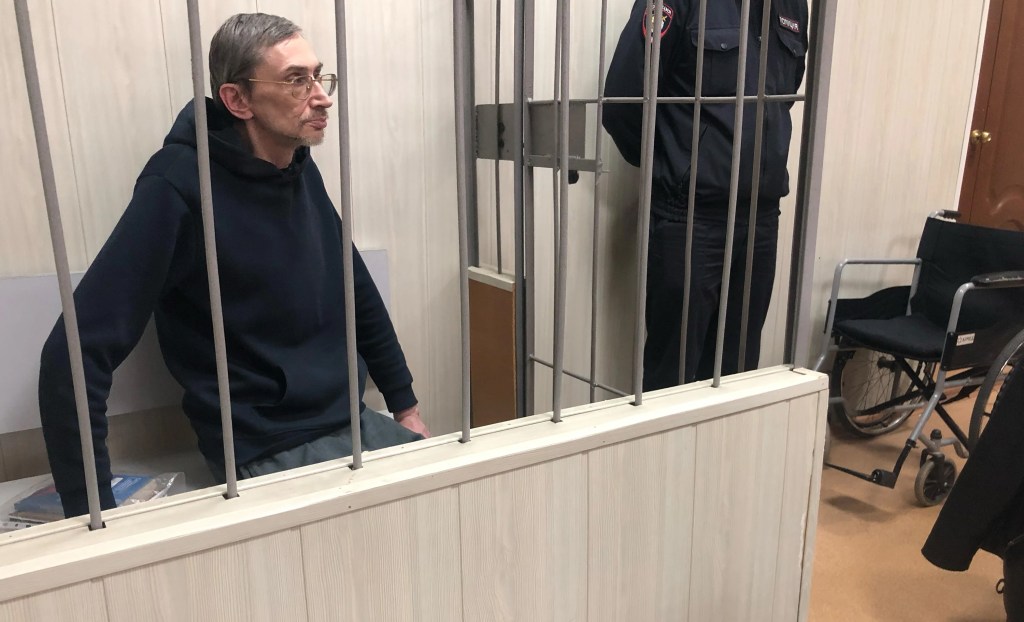
Mikhail Loshchinin and his mother, Olga. Courtesy of RFE/RL

More and more Russians face trumped-up charges of “high treason.” Anything whatsoever—from commenting on a banned organization’s social media post to wiring a paltry sum of money to a relative or acquaintance in Ukraine—can occasion these charges. Foreign nationals who have retained their Russian citizenship have also faced prosecution. It has become ever more dangerous for them to travel to Russia to visit loved ones.

This past summer, Mikhail Loshchinin, a 48-year-old dual Belgian-Russian national, decided to visit his father, who had suffered a heart attack, and headed to Petersburg.

In recent years, Loshchinin had been living in Germany while working as a database manager in Luxembourg. On 1 July 2025, he crossed the Latvian border on a motorcycle with a German license plate and stopped at the Ubylinka border-crossing station, in the Pytalovo District of Russia’s Pskov Region. He was carrying a Russian federal passport, which he presented to the Russian border guards.

“They staged a provocation at the border”

“Sometime around 2020, before the war, Misha traveled to Russia by motorcycle. He made it there and back just fine. He had good memories [of the trip], and so he decided to repeat his ‘feat,'” says Loshchinin’s mother Olga, who now liveas in Poland. “The goal was to visit his father, who had undergone heart surgeries and had been feeling quite poorly after a heart attack; there was a risk the visit would be their last. [Mikhail] decided to travel with his Russian passport so as not to have bother getting a visa. (As a Russian national, Loshchinin does not need a visa to enter Russia—Sever.Realii.) He’d spent the last twenty-five years in Europe: his mindset had changed, he’d been Europeanized. He’d come to rely on the system’s accountability, on the fact that laws were obeyed.”

According to Olga, the border guards asked to check Mikhail’s telephone, on which they apparently found numerous Ukrainian contacts. Before his trip, Mikhail had not deleted anything from his WhatsApp account, as he did not consider corresponding with friends in Ukraine to be a crime.

“There were no grounds to detain him, so they staged a provocation at the border,” says Olga. “He had been waiting there for a long time for the inspection to end when he asked where he could buy some water. They told him to follow them on his motorcycle to the local store, that they would show him the way. He followed them, but they suddenly made a funny turn and detained him for crossing the border. In other words, they had deliberately lured him there to have a legal reason to detain him.”

Mikhail grew up in a large family: the four Loschinin children were born in the Soviet Union but later moved away. Mikhail had been living in Europe since 1999. His sister became a citizen of Ukraine, and he often visited her. He had many friends and acquaintances in Ukraine. Their contact details were stored in his phone, naturally.

Mikhail had always been apolitical, and his arrest has no connection with his work, says Olga.

“It is, rather, a matter of his being in the wrong place at the wrong time, and the police investigator admitted as much to him. . . . Misha has always had an excellent reputation, and his employers have valued him. He’s also a well-rounded fellow: he’s a biker, plays the guitar, and sings and does the lighting for productions by small Russian-language theaters. He bought the [lighting] equipment with his own money and promotes Russian culture among his western friends and acquaintances any way he can: he hasn’t lost his connections with his roots. . . . He falls in love easily, and has had several marriages, but now he’s a bachelor. He has a daughter from his second marriage.”

After Mikhail set off for Russia, he constantly telephoned with his sister and mother, who now live in Poland, but they lost touch with him on July first. Three days later, he called from someone else’s phone and told them he had been detained.

“At 10:27 a.m. on July fourth, there was a call from an unknown Russian number. It was our Misha. He said that Dmitry, an FSB officer, had given him a phone to make the call, that he was under guard at the Hotel Dubrava in the border town of Pytalovo, that they’d confiscated his papers and the keys to his motorcycle, and that the motorcycle itself was parked outside the hotel,” Olga recalls.

Mikhail told his loved ones that he had been given a choice: either he would be sent to a basement somewhere, where he would sit and wait until they decided what to do with him and his papers, or he could go to a hotel and wait there, at his own expense.

“No one wants to sit in a basement, naturally,” Olga continues. “He had some money, and since the rooms were inexpensive, he chose the hotel. They confiscated his telephone, his passport, and the papers for his motorcycle, and they posted guards without whom he wasn’t allowed to leave his room. They had to get the go-ahead for every trip outside the hotel. They escorted him when he would go out to the store and the post office.”

Mikhail spent nearly a month at the Dubrava Hotel.

“Misha’s money was running out. We were by then terribly anxious and contacted a lawyer, who arrived at the hotel on the evening of August first and was able to see Misha and speak with him. On August second, a group of persons unknown took him to an undisclosed location. Those were the roughest days for us. As later transpired, he had been transported from Pytalovo to Stary Oskol, in Belgorod Region, and the journey had taken several days. Misha later told us that along the way they had passed through Smolensk; he had managed to catch sight of that. It turns out that, in his correspondence for 2022, an ex-girlfriend of Mikhail’s had asked him for financial help. Her profile picture now has a Ukrainian symbol on it, but it wasn’t there in 2022.”

The lawyer traveled to Stary Oskol, Olga recounts, but at the local pretrial detention center he was told that they had “no such person” in custody. The lawyer then filed a formal appeal with the prosecutor’s office, the FSB, and the Investigative Committee, asking them to figure out what had become of Mikhail. On 21 August 2025, Mikhail telephoned Olga himself—from Pretrial Detention Center No. 1 in Pskov. The call was again made from an unknown number.

“Judging by how his voice sounded, he wasn’t himself. He was clearly under duress and kept asking whether it was alright to talk now, meaning that the call was made in someone else’s presence,” says Olga. “He said that he had been accused of ‘high treason’ per Article 275 of the Russian Federal Criminal Code: ‘financing representatives of a foreign state hostile to the Russian Federation.’ We got a call from someone named Denis, who introduced himself as Misha’s attorney. He called us again and warned us not to hire anyone else, claiming our own attorney wouldn’t even be admitted to the remand hearing. We recorded the call but of course we didn’t do what he asked; he had no right to say that to us, and our own attorney did attend the hearing. Since then, Misha has been in custody at the Pskov detention center. He’s under investigation.”

Later, Mikhail said that, in Stary Oskol, he had been placed in a specialized facility for Ukrainian prisoners of war.

“He was tortured and abused, both mentally and physically, there” says Olga. “First of all, they took away his glasses. He has terribly poor eyesight, minus eight, and he practically lost his sight. He could only walk with his head down, bent over. They stripped him naked and beat him. He told his lawyer about all of it. He was completely crushed, and of course this was done deliberately to squash any hope that he might be released and to make him agree to sign whatever papers they put in front of him. They forced him to sign a paper stating that he had been gallivanting freely around Russia until August twenty-first. He told us this recently. But we have a document stating that he was in Stary Oskol, and it is unlikely that he could have traveled freely around Russia without papers or a means of transport and without informing his relatives. There are many inconsistencies in their ‘body of evidence.'”

“I am horrified by what has happened to my son”

On 10 November, Mikhail Loshchinin celebrated his forty-eighth birthday in the Pskov detention center.

“I am horrified by what has happened to my son,” says Mikhail’s mother. “I’ve been doing a lot of soul-searching, since I didn’t expect the authorities to behave as they have behaved. And yet I didn’t have full faith in Russian law enforcement. My grandfather was in prison in 1937. He had been an officer in the White Army. The family was then living in Grozny, and my mom was small. Several former [White] officers lived in the vicinity. They would get together for readings and go on picnics; they were cultured folk. The entire group was arrested. Grandfather was the only one of them to survive because he didn’t sign anything [i.e., a confession]; the rest of them were shot. He never told anyone what price he had paid for this. My mom, still a kid then, brought care packages to him in prison.”

Olga has carefully researched Article 275 of the Russian Federal Criminal Code and argues that it has simply been “misapplied to a completely peaceful, innocent man.”

“We have a really good, tight-knit family. Although [Mikhail’s] dad lives in Petersburg, and we’re divorced, we have a decent relationship, and we’ve even started conversing more often now. And all the kids are tight-knit. Misha was always quite kind; we even wanted him to become a doctor, since kindness is quite valuable in a doctor. But he chose a different path in life. He wanted to be a programmer, and he’s been successful at it,” says Olga.

According to her, many of Mikhail’s friends in Luxembourg, where he had worked in recent years, are now deeply concerned about him.

“He always had a good head on his shoulders, and he became quite well known in Russian diaspora theatrical and cultural circles, and not only in those circles. He even did the sound for the Orthodox Church of Luxembourg,” says Olga. “There are videos on YouTube of him playing ‘Under the Blue Sky’ on the guitar in concert and his boss, a Frenchman, singing it in Russian. It is an ironic twist of fate that a person like can be destroyed so simply. . . . Summer is the time when theaters get ready for the high theatrical season, and right then Misha vanished. A support group has emerged, all of his friends. I honestly had no idea that there were so many of them.”

Mikhail’s friends have been writing petitions requesting his release from police custody, which his relatives have been passing on to his lawyer.

“Although Mikhail lived in Luxembourg, he visited us quite often recently. He has a girlfriend in Slovakia, and when he went to see her, he found ways to come through [Poland] and see us,” says Olga.

According to Loshchinin’s family, Mikhail has begun to suffer from retinal detachment while in custody.

“In 2024, he visited an ophthalmologist, who informed him that surgery was not necessary at the time, but that it would have to be performed immediately if he began seeing flashes in his line of sight. Now he has been seeing those flashes,” Olga explains. “It is hard to get proper medical care in prison, and I’m afraid that he may simply go blind in there. I can’t imagine that my son, who has done nothing nasty in his life, is now being treated as one of the most dangerous criminals, and all because he hadn’t cut off his ties with Russia. If you take someone’s phone and check their messages, every other person could be under suspicion.”

“Thousands of people across the country are being held without charge”

Loshchinin’s defense attorney declined to comment for this article because he is bound by a non-disclosure agreement.

Attorney Yevgeny Smirnov, who works for the human rights project Department One, says that there have been many such treason cases, and that there have even been prisoner exchanges involving people convicted of treason.

According to our count, at least 148 people in Russia faced criminal charges of treason, espionage, and clandestine collaboration with foreigners in 2023, and at least 88 such cases were brought before the courts. The trend continued in 2024 and 2025. According to statistics on court rulings for the first half of 2025, as published by the Judicial Department of the [Russian] Supreme Court, 115 high treason cases were instigated, which was twice as many as in the first half of 2024. At the same time, according to data from Department One, the Supreme Court has underestimated the number of convictions in such cases by at least threefold.

“Mikhail Loshchinin wired money to a private individual in Ukraine,” explains Smirnov. “According to the security forces, this is a form of high treason, and it has existed for over ten years: providing financial assistance for activities contrary to the security of the Russian Federation. The FSB often takes advantage of this. They might have claimed, for example, that the young woman to whom Mikhail wired money works for the SBU [Security Service of Ukraine] or is involved in the Territorial Defense Forces. Something like that. And that wiring her money was thus a criminal offense.”

The attorney is not surprised that Mikhail was detained in Pytalovo for a month without charges, staying in a hotel at his own expense and under guard.

“There are thousands of people across the country being held without charge. Some are under administrative arrest, while others are in former hotels refitted as [detention] centers, or in actual hotel rooms. Most often, police investigators need the time to get the go-ahead to file criminal charges. Moscow gives the go-ahead for such cases.”

“There is no good outcome in these situations,” Smirnov notes.

“They might sentence him up to thirteen years in prison. The only hope for release is through a prisoner exchange, and that would involve a political decision,” argues Smirnov. “How many people in Russia have been released in the last ten years via prisoner exchanges? A couple dozen, probably. And how many political prisoners are there in the country currently? Ten to fifteen thousand. [Mikhail’s] chances are a bit greater since he’s a Belgian national, of course. There are not so many Belgian nationals [in Russian prisons], and if Belgian politicians get involved in the campaign to secure his release, the chances will grow for sure.”

Olga, Mikhail’s mother, says that Belgian consular officers have tried on several occasions to get permission to visit him in the detention center but were turned down.

“He’s a Russian national, but Russia doesn’t recognize his Belgian citizenship,” says Smirnov. “Most countries don’t recognize dual citizenships: it’s a normal practice. So, Belgian consuls aren’t being allowed to see him. It’s been the usual practice for decades.”

Smirnov argues that people living abroad should not travel to Russia unless absolutely necessary “because it’s a big risk.” If travel is unavoidable, you should prepare in advance by purchasing a separate telephone, planning your itinerary with care, seeking advice from those in the know, and being ready for the fact that the border guards will question you and search all your devices.

Source: “‘The goal was to visit his father’: dual Belgian-Russian national detained and charged with treason,”Sever.Realii (RFE/RL), 3 December 2025. Translated by the Russian Reader
A Documentary Film about Pavel Kushnir

Kushnir (2025), a film about the late pianist and antiwar protester Pavel Kushnir (in Russian and English, with subtitles)

Pavel Kushnir was a virtuoso pianist, a writer, and a courageous man whom the world discovered only too late. He died on July 27, 2024, in a Birobidzhan detention center following a dry hunger strike. The formal pretext for his arrest was a series of anti-war videos posted on a YouTube channel that had only 5 subscribers.

This film is an attempt to understand the man who played Rachmaninoff until his fingers bled, who dreamed of flying to Mars, who idolized Kurt Cobain, and who called the war by its true name while living in complete isolation.

We have gathered archival footage, previously unknown recordings of Pavel, fragments of his poignant cut-up novel, and memories from close friends and colleagues, including Clean Bandit soloist Grace Chatto, music expert Mikhail Kazinik, and publisher Dmitry Volchek. This is a story not just about a death in prison, but about an extraordinary life that became an act of art and resistance.

In this video:

Unique footage of Kushnir’s performances and artistic actions.

The story of an unmade avant-garde film and friendships with global stars.

The Birobidzhan Diary: a chronicle of loneliness and the fight against fascism.

Why a brilliant musician went unnoticed by the cultural establishment, but not by the prison system.

Source: VotVot (YouTube), 12 December 2025


Our film about the pianist Pavel Kushnir has dropped. […] Honestly, the film was ready to go in late April, but we spent a long while navigating the legal maze around the music, copyrights, and permissions. That was not even the main reason for the delay, though. I wanted to wait until the media hype had subsided and we could take a look at Pavel’s legacy from a certain historical distance, to talk about him not as a victim (although that viewpoint is legitimate, of course) but as a rebel whose choice was deliberate. Similarly, if you will, there are different takes on Christ: some view him as a needless victim who arouses pity, and the more maudlin that pity, paradoxically, the stronger their hatred for his crucifiers; while others see him as a rebel whose heroism was deliberate.

In my opinion, seeing Pavel as a pure “victim” robs him of agency, turning him into an extra in someone else’s play, in which the crucifiers have all the starring roles.

The film is based on Pavel’s own diaries. In terms of composition, I reprised the structure of his screenplay for the unmade film The Six Weary Ones. Three states of madness—prophetic madness, creative madness, and the madness of protest—figure as the three aspects of his personality. As in Joyce, each of Kushnir’s chapters has its own color and symbol. We have added music to these chapters. The music for the red chapter, “Prophet,” is by Rachmaninoff. Bach supplies the music for the blue chapter, “Creator”: blue stands for the heavens and the cosmos, and fugues are cosmic in nature. The third, black-and-white chapter, dealing with rebellion and Birobidzhan, is set to Scriabin’s Prometheus, a [tone] poem about the first rebel in history. Camus writes, in The Rebel, that rebellion confers agency on us, turning us from beasts into human beings. Again, it’s all in the eye of the beholder: some feel pity for Prometheus, chained and tortured by the eagle, while others see in him the power of the unbroken human spirit. And Scriabin’s idea of transforming all of humanity meshes perfectly with the cosmic utopia begun in the previous chapter. Prometheus: The Poem of Fire is a mystery play; as [Russian poet Konstantin] Balmont put it, it is “a vision of singing, falling moons, of musical stardoms, arabesques, hieroglyphs, and stones sculpted from sound.”

The film is chockablock with musical, literary and philosophical allusions which I won’t burden you with now. But if you’re interested, I’ll set up a cozy stream on my tiny Telegram channel where we’ll discuss the film and unpack its hidden layers, and I’ll answer your questions. You can write in the comments about whether this idea seems viable, and I’ll decide what to do based on your feedback.

Once again I want to thank everyone who did their part and helped commemorate a major artist. Thanks to you, we raised 1,185 euros and 533,954.51 rubles [approx. 5,800 euros], which is not just a large sum but a phenomenally large sum, considering that the major media practically ignored our fundraising campaign. That being said, many friends and former colleagues supported us by reposting [our fundraising appealing], which is eloquent testimony to the fact that a person and his reputation are more vital than any institution, and for this I am endlessly grateful to them.

The money we raised was enough for several full-fledged scouting trips and location shoots. Considering the geographical scope of our shoots, which included traveling to Birobidzhan itself, our grassroots war chest was emptied at some point. It became clear that without outside help we wouldn’t be able to complete the project properly, avoid devolving into a Skype interview format, and pay all the courageous artists, editors, and cameramen who had agreed to shoot a film in Russia at their own peril. I understood that asking folks for money again was not a good plan. So, after consulting with our small team, I accepted an offer from the online platform Votvot. They covered our remaining expenses and, most importantly, agreed to our condition that the film would be freely available. Our promises to our donors have not been broken: this grassroots film is being released in a way that is accessible to the grassroots—on YouTube.

I want to thank my friend and colleague Alexander Urzhanov from the bottom of my heart: he was quite emotionally invested in this film and provided us with his fabulous production resources. I would also like to thank all the folks at Narra: they have asked me not to name them, but you know who you are. Misha, Dasha, Ira, and Nastya, I couldn’t have done it without you and by myself! Particular thanks go to Boris Barabanov and Darina Lukutina from Votvot, without whom this film would scarcely have been possible.

I would like to thank Pavel’s relatives for permitting us to use his voice to read his diaries. Getting ahead of myself, I should say that this is the only digitally generated thing in the film. Everything else was filmed or recorded using analog methods: the diaries, the posters, and the drawings of a certain incomparable artists were all done without synthetics or computer glitz. All you see is life’s pleasant graininess.

I thank Pavel’s friends for sharing their archives and letters, as well as everyone who appears in this film.

I have one final request to you. Watch this film tomorrow. More to the point, share this film. I’m afraid that the film will get lost in the ruthless algorithmic desert without your reposts. May this film find everyone who needs it.

Source: Sergey Erzhenkov (Facebook), 12 December 2025. Thanks to Giuliano Vivaldi for the heads-up. Translated by the Russian Reader

Pavel Kushnir was a classical pianist. But according to Russian authorities, he was also a dangerous dissident. In July 2024, he died on hunger strike in a remote prison in Far East Russia. Who was Pavel Kushnir, and why did he end up in jail? Liza Fokht from BBC Russian has been trying to piece together Pavel Kushnir’s story.

Source: Spotify

The Intensifying Crackdown in Russia

Varvara Volkova

“My friends died at the hands of Russian soldiers. Why can’t I talk about it?” 

This question will cost Varvara Volkova 7 years in a Russian penal colony. Here’s her story.

Varvara was a flight attendant, not an impassioned political activist. In a neighbourhood chat, she stated the obvious: Russian forces are killing civilians in Ukraine. The prosecution framed it as “fake news” motivated by hatred toward the armed forces, and the court accepted it.

The mechanism used to go after her relies on a Soviet-style culture of snitching: a Russian tank driver complained about her comments, then a professional informer, who intentionally hunts dissidents, amplified the case and demanded she be jailed.

In fact, there’s a whole network of these informers — they call themselves “SMERSH.” For those who don’t know Russian history, it is a reference to Stalin’s WWII counter-intelligence service. It means “Death to Spies” — a direct revival of the terror methods of the 1930s. They published screenshots of her messages everywhere trying to ruin her life; claimed she called the soldier a “fascist”; said she offered to make tea for Ukrainian soldiers if they reached the Moscow region. For words spoken in anger, the system decided to smash her life to pieces.

There is a grim irony in this tragedy: the regime destroyed Varvara to protect the “honor” of the military and her accuser. But the tank driver who reported her is already dead: he was killed in the war earlier this March. 

Observers abroad often underestimate the price of resistance in today’s Russia. It is not just a fine anymore, but years and years of one’s life. Varvara Volkova shows us the true bill — and it is devastating. 

I track the consequences of speech in modern-day Russia, make sure to follow for more updates.

Source: Khodorkovsky Communications Center (Facebook), 25 November 2025


Preface by the Editorial Board: Below we publish the translation of an article of our Russian comrades about state repression in their country. The article reports, among others, about the situation of comrade Felix Eliseev. He has been in prison for 2.5 years as part of a 14-year prison term. Felix was sentenced for “treason” as he was accused of making propaganda against Putin’s imperialist war against Ukraine and sending money to Ukraine to buy weapons. While the prison authorities do everything to break him, Felix does not lose his spirit and endures his imprisonment stoically. (See https://www.thecommunists.net/rcit/felix-eliseev-a-revolutionary-communist-in-russian-prison/)

We call readers to support Felix by spreading this information about a communist and anti-fascist serving an unjust sentence!

You can also support Felix financially at www.paypal.me/irinablackbook, with the note “for Felix”.

* * * * *

According to the human rights organization Memorial, there are currently over 1,000 political prisoners in Russia, while other groups estimate the number could be as high as 2,500. This number is three times higher than in 2020, more than twice as high as in 2022, and continues to grow. In 2025, there was a sharp increase in criminal cases under articles on “justification of terrorism,” “sponsoring terrorist activity,” and “treason.” This is not due to increased terrorism, but to the fact that the security forces, having perfected their repression mechanisms, have begun to intensify their crackdown on “sponsorship” cases, such as those of the FBK (Anti-Corruption Foundation, recognized as an extremist organization in Russia) or cases related to money transfers to the Ukrainian army, which occurred back in 2022. The term “terrorism” itself has become so vague that even the average person doesn’t always understand what it actually means.

Among political prisoners are many individuals with progressive leftist views, serving time for anti-war activities or “inaccurate” public statements online. The “Foundation for Support of Left-Wing Political Prisoners” provides support to at least some of these individuals. Among them are: defendants in the “Tyumen Case”; defendants in the “Chita Case”; Anton Orlov, a trade union and leftist activist, coordinator of the independent medical workers’ union “Action” in Bashkortostan; Daria Kozyreva, an activist from St. Petersburg known for her anti-war protests and criticism of the Russian army; Gagik Grigoryan, a young activist imprisoned in 2023 at the age of 17; Azat Miftakhov is a Russian mathematician and anarchist, sentenced in 2021 to six years in prison for allegedly setting fire to the United Russia office in 2018. After serving this sentence, he was arrested again in 2023 on charges of “justifying terrorism” in a private conversation with a prison cellmate and sentenced to four years in prison; defendants in the “Kansk teenagers case”; defendants in the “Network case”; Boris Kagarlitsky is a left-wing publicist known in many parts of the world; Ruslan Ushakov is the author of articles published on opposition Telegram channels, sentenced to eight years in prison for posts in a public chat.

The case of the communist Felix Eliseev

Another political prisoner is Felix Eliseev, a Russian communist, blogger, and administrator of the Telegram channels “She Fell Apart” and “Kolkhoznoye Madness.” He was arrested in December 2022 and charged with justifying terrorism. According to investigators, Eliseev posted two anti-war posts on his Telegram channel, one of which endorsed a Ukrainian Armed Forces helicopter strike on an oil depot in Belgorod. The charges were later upgraded, and Eliseev was charged with “treason”. The court alleges that he transferred funds through a cryptocurrency account to a “curator,” who used the funds to purchase equipment and weapons for Ukrainian Armed Forces soldiers.

Felix, like many other political prisoners convicted of “terrorist and extremist” offenses, is serving his sentence under intense pressure from the prison administration. He is regularly placed in solitary confinement cells, where they do everything they can to break him mentally and physically.

However, political repression in Russia involves more than just horrific criminal cases of “terrorism,” “treason,” and other “betrayals of the nation.” It also includes the persecution of undesirable and dissenting youth who dare publicly speak out against the war and the ruling elite, thereby gathering many other concerned young people around them.

The “Stop Time” case

One example of such government abuse is the “Stop Time” case. The “Stop Time” case concerns the persecution by Russian authorities of members of the St. Petersburg street music group “Stop Time” – Diana Loginova (pseudonym Naoko), Alexander Orlov, and Vladislav Leontyev – for their participation in impromptu concerts, including one near the Ploshchad Vosstaniya metro station, where they performed anti-war songs by artists designated by the authorities as “foreign agents.” On October 16, 2025, Loginova was arrested and sentenced to 13 days of administrative arrest for performing a song by an artist unpopular with the authorities. The other members of the band were also arrested and sentenced to 12-13 days. These events resonated in the media (both pro-government and opposition) and society, becoming a topic of discussion in the context of artistic freedom and the tightening of censorship in modern Russia.

On October 29-30, the musicians received another 12-13 days of arrest, and on November 11, two of them were arrested for another 13 days. On November 23, the musicians were released from arrest. The lead singer and one of the band members left Russia that same day.

In many Russian cities, street bands followed “Stop Time’s” example and performed opposition songs by artists-foreign agents to large audiences in public squares. They also faced pressure from the authorities and harassment from Z-Neanderthals.

Also, recently, spiders in a jar have started eating each other. Criminal cases have been brought against several well-known military Z-bloggers for discrediting the army! More than two years after Strelkov’s imprisonment and Prigozhin’s murder, a new steamroller of repression is purging those loyalists who are too undesirable.

All of the above demonstrates that Russian society has no legal means to publicly express its attitude toward the events unfolding around it. For any word “against,” the sword of Damocles of Russian justice hangs over every citizen. Despite this, concerned Russians, especially young people, are finding ways to rally together and show the world that not all is lost in this country.

Meanwhile, cowardly security officials and government officials tremble at the mere thought that the masses will sooner or later awaken from their slumber and rise to deliver justice to the imperialist oppressors in the Kremlin. In Russia, literal punishments are being introduced for thought crimes. Thus, in September of this year, an administrative law punishing “searching for extremist materials” came into force. This law allows the FSB to view any citizen’s internet search history, and if it contains views of materials deemed extremist or terrorist, the user faces a visit from masked officers and a fine. The first cases under this law have already been filed.

Furthermore, the country is introducing a so-called “white list” for the internet—only those websites approved by Roskomnadzor are permitted to be accessed; others are inaccessible, and VPNs cannot be connected. So far, in the spirit of Russian tradition, this system is poorly functioning and flawed, but the day is not far off when Russian society will find itself locked in a “cheburnet.” (*)

Freedom for political prisoners!

For freedom of speech, conscience, and the internet!

Down with political repression!

Radical democratization of the country, not the fascist regime of a dictator!

All power to the working class and the working masses, not to a handful of oligarchic monopolists!

(*) Cheburnet is a mixture of two words: Чебурашка (Cheburashka) and internet. Cheburashka is a character from Soviet cartoon for children. Despite it is kind and helpful, in modern mass consciousness it is associated with Soviet censorship. So cheburnet basicaly means internet under the censorship of Russian government and intelligence agencies.

Source: Communist Tendency (RCIT Section in Russia), “Political Repression in Russia,” Revolutionary Communist International Tendency, 25 November 2025


An appeal from Elena, mother of Ilya Shakursky:

My name is Elena Nikolaevna Bogatova, and I am the mother of political prisoner Ilya Alexandrovich Shakursky. I am crying out for help to save my son so that he does not rot away in solitary confinement.

They took my only son away when he was twenty-one years old. He is now twenty-nine. He has been tortured. He has serious health problems that we still cannot solve. He still has eight years to serve, and they could turn him into a disabled person. I cannot help him on my own, so I am asking all caring people to help us.

It is impossible for a mother to know that her child is being destroyed, and that she cannot save him!

Although he committed no crime, he is in prison under the harsh Article 205 [of the Russian Criminal Code; Article 205 proscribes “terrorist acts”], enduring all the hardships of prison life, without ever receiving any encouragement; we cannot even hope for parole. Right now, [the prison authorities] want to turn him into repeat offender so that he cannot have any visits, phone calls, letters, or packages. They want to take everything away from him.

I ask you to write an appeal. I understand that there are many of us now, and everyone is exhausted. But we must stand together for the sake of our loved ones, for the sake of the younger generation, which is currently being destroyed. Hear the cry of a mother who cannot bear the pain for her son and for all those behind bars. If we push with our shoulders, the walls will collapse….

https://t.me/ilyashakursky

Source: Elena Shakurskaya (Facebook), 28 November 2025. Translated by the Russian Reader


OVD-Info Faces a Critical Situation: We Have Lost All Our Ruble Donations

26.11.2025

Russian payment services have refused to continue working with us, without providing any explanation, and have cut off our ability to accept one-time and recurring donations. This has severed our connection to our main source of support—the 12,000 individuals who regularly transfer money to OVD-Info.

The services’ refusal to cooperate with us is one of the many manifestations of state pressure on human rights organizations and independent media. Some of them even had to close due to the loss of donations in rubles.

This is a severe blow to our work. With these donations we were able to pay for the work of defense lawyers and legal experts, travel to the regions, maintain our free hotline, and help those who are politically persecuted in Russia. Furthermore, regular donations allowed us to plan our long-term work and development.

We do not plan to close or reduce the scope of our work, because repression is not diminishing. Any political activity, expressing a view against the invasion of Ukraine, or criticism of Putin instantly becomes grounds for persecution. We simply cannot abandon Russians to face this brutal, repressive system alone. We are defending over 90 defendants in criminal cases, almost every day we send lawyers to police stations, courts, searches, penal colonies, and pre-trial detention centers. We answer dozens of messages and calls daily—and we want to continue doing this.

However, now everything depends on whether we can find another 12,000 people who will regularly support OVD-Info.

You can support us here.

Source: OVD Info


Yulia Lemeshchenko. Photo from the Memorial website

The Second Western Military District court in Moscow last week sentenced Yulia Lemeshchenko to 19 years’ imprisonment for high treason, sabotage, and preparing and training for an act of terrorism.

Yulia, 42, is a Russian citizen, born in Staryi Oskol, in Belgorod region. She lived in Voronezh in southern Russia, until 2014. Then she moved to Kharkiv, Ukraine, with her son and her husband, who had found work there. Later on the couple separated.

Yulia took up powerlifting and in 2021 was named Ukrainian women’s champion.

In 2024 Yulia did military training in Kyiv – firearms, explosives and flying drones – and returned to Russia, via a third country. She sabotaged power transmission infrastructure near St Petersburg, and in Voronezh conducted surveillance on Aleksei Lobodoi, an air force commander responsible for bombing Kharkiv.

Yulia was arrested in January this year. She did not deny the facts outlined in the prosecution case, but told the court that “from a moral standpoint” she considered herself not guilty. This is a translation of her final statement to the court, published by Mediazona.

=

Ukrainian Champion in a Russian Court: Yulia Lemeshchenko’s Final Statement

As you see, I don’t have any sheets of paper and I haven’t especially prepared, but I think I will improvise. I will now probably say a few things that were already said during this hearing, but let this be a sort of summing-up, in a monologue.

So I already spoke here about the fact that, in any war, two sides clash, and each side insists that it is right and that its cause is just. I took one of these sides. I am not a citizen of the country for which I decided to fight, but, all the same, for me, Ukraine is home. I love that country. And I love Kharkiv, with all my heart.

There is a district in Kharkiv called Severnaya Saltovka. About 500,000 people lived there. Half a million. A few people I knew lived there. My hairdresser lived there. After the Russian shelling and bombing, not a single house in that district was left undamaged. Not a single one. And I am not just talking about a few broken windows. I am talking about whole blocks of flats in ruins.

Right next to the block where I lived, there were explosions. In my block, on the ground floor, my neighbour Anya lived with her four-year-old son Nikita. A shell exploded right under their window. Their apartment was completely destroyed. What has happened to Anya and her son I don’t know. I don’t know whether they are still alive.

Friends of mine have died in this war, one relative – my second cousin – and colleagues of mine. War is monstrous. I could not stand aside. When war comes, people who are affected can either try somehow to fight, or they can flee. People flee – I don’t know – maybe because they are cowardly or weak. I don’t consider myself to be a cowardly or weak person. So I decided to fight back – to fight against Russian military aggression.

It is possible that, by saying these things, I am getting myself still deeper into trouble. But my honour, and my conscience, are important to me. I did what I believed to be necessary. I did what I could. To regret, to repent – who knows, maybe I will do that on my deathbed. But for now, what will be, will be. I have nothing further to say.

=

When the court hearing began, Mediazona reported that the judge, Vadim Krasnov, read out evidence that Yulia gave after being arrested in January. After the all-out Russian invasion of Ukraine in 2022, Yulia at first moved to Germany. In 2023 she returned to Ukraine and made contact with the “Free Russia” legion, but did not join.

In 2024, when she did her military training, the instructors – who did not answer questions about which part of the armed forces they served in – said that, by way of payment for her work, she could receive Ukrainian citizenship.

The judge asked if she had done so, to which she replied, with a smile, “not yet”.

During the hearing, Judge Krasnov asked Yulia why she had chosen such a radical method of struggle, rather than, for example, providing medical help to the wounded.

“I can only answer that question with another, rhetorical question”, she replied. “Why did Russia decide to use violent methods to destroy Ukrainian cities? A war had started. Do you understand?”

The judge responded that, by 2022, the war had already been underway for eight years. Yes, but it had become frozen, Lemeshchenko said. After the invasion, she wanted to help Ukraine however she could, and was invited to become a saboteur.

“How far were you prepared to go?” asked the judge. “I did not want to do anything that would take human lives”, Lemeshchenko replied. “They accepted that point. On that we had an agreement.”

The judge said that the sabotage Lemeshchenko carried out near St Petersburg left hospitals without electric light. She replied that the aim had been to paralyse a drone factory, that she was sincerely sorry if anyone in Petersburg had suffered. And that she and her son had many times sat in their apartment, without light, when Kharkiv was being bombed.

Lemeshchenko also told the court that, during interrogation, agents of the federal security service (FSB) had threatened to murder her, and pushed her head against a wall. She had tried to tell them the truth. She said that she did not retract her evidence – and nor would she complain about her treatment, as she did not believe that those responsible would be punished.

□ Here is Yulia’s statement in court, recorded with English interpretation. Yulia is recognised as a political prisoner by Memorial, and her case was reported by the Kharkiv Human Rights Protection Group.

□ The last word in court by Anton Khozhaev, a trainee officer accused of desertion to the Ukrainian side, and more on Russian anti-war protesters

□ Voices Against Putin’s War, just published by Resistance Books, includes 12 statements by anti-war protesters and associated material. The livestream of a launch event is here27 November 2025.

Source: “‘I decided to fight back. Ukraine is my home.’ Yulia Lemeshchenko’s final word in court,” People and Nature, 27 November 2025

“We Wanted to Show the Whole Range of Anti-War Resistance in Russia”

Thursday 20 November, 7:00 p.m. UK time: TRY ME FOR TREASON – Readings from anti-war protesters’ speeches in Russian courts, and book launch for Voices Against Putin’s War.

You are welcome to attend in person at Pelican House, 144 Cambridge Heath Road, London E1. Or watch the livestream here on Facebook, or on Youtube.

Source: Ukraine Information Group (Facebook), 18 November 2025


What can courtroom speeches by imprisoned protesters tell us about the breadth of anti-war resistance in Russia? British historian Simon Pirani discusses his new book Voices Against Putin’s War with independent Russian journalist Ivan Rechnoy.

Simon Pirani is a British researcher and author who has written about energy and ecology, the history of the Russian Revolution, the labor movement, and post-Soviet Russia. His recent book Voices Against Putin’s War: Protesters’ Defiant Speeches in Russian Courts compiles and analyzes the courtroom speeches of twelve prisoners who were sentenced for resisting Russian aggression in Ukraine. 

— Today in Russia, hundreds of people are serving prison sentences for criticizing the invasion of Ukraine. Twelve of those people are the subjects of your book. How did you select them?

— We wanted to show that opposition to Putin’s war is widespread. What is striking about these people is their diversity. They come from different generations, have different life experiences, and hold different political views. This diversity demonstrates that, despite the absence of public demonstrations and the lack of any real possibility of organizing an open anti-war movement in Russia, an anti-war movement does exist there. It encompasses a very broad spectrum of Russian society as well as people from the occupied territories. For example, the book features the courtroom speech of Bohdan Ziza from Crimea.

We decided not to include some of the most well-known opponents of the war in the book — people who made brave and principled speeches in court, like Ilya Yashin, for example. Their statements had already been widely publicized in the media here. Instead our goal was to draw the attention of English-speaking readers to lesser-known figures. 

On the one hand, there are those who simply said something or posted statements on social media. For example, Darya Kozyreva, the youngest person featured in the book, was arrested for laying flowers at the Taras Shevchenko monument in Saint Petersburg. On the other hand, these are those who did something, such as throwing firebombs — not with the intention of hurting anyone, but to draw attention to the injustice of the war. Igor Paskar and Alexei Rozhkov are among them. These are people who live in smaller towns far from Moscow or Saint Petersburg, where young men are much more likely to receive draft notices from the conscription service. 

We also included the statement by Ruslan Siddiqi, who sabotaged a railway line to stop munitions from reaching Ukraine. 

The texts for the book were put together by a group of friends who, since the February 2022 invasion, had been translating the courtroom statements and some of the posts from the media or social networks. When we were already well into that process, a lot of new material appeared on the website Poslednee Slovo [author’s note: the project’s name translates as “the final statement”]. It’s a terrific project that does an excellent job of collecting and publishing a much broader range of cases than we could cover. 

We limited ourselves to people who have made explicit anti-war statements about the war in Ukraine. However, as you know, there are many other political prisoners who have appeared in court since the 2022 invasion, as well as many more from before that, especially among the Crimean Tatar political prisoners. They are all represented on the Poslednee Slovo website. Another remarkable thing about the website is that it goes back all the way to the Soviet period. They’ve included the 1966 speeches by Andrei Sinyavsky and Yulii Daniel, perhaps the first examples since Stalin’s time of people using the right for a final statement in court as a form of propaganda. 

Our book includes a chapter that lists seventeen additional cases of people who delivered anti-war speeches, beyond the twelve protagonists whose complete statements we published. We hope that either I or my colleagues will eventually translate all of those speeches as well. 

Unfortunately, the final courtroom speech has become something like a literary genre in its own right. This tells us a lot about the difficult and fearful times we are living through.

— How do you envision the audience for this book? Are they people in the West and elsewhere who already have some understanding of the situation in Russia and want to learn more? Or are they readers to whom you want to convey a political message — perhaps even to persuade them of something?

— The book is in English and is therefore intended for English-speaking readers rather than Russian-speaking readers. Only a small percentage of people in the UK, the US, and Europe can read Russian. Since 2022, many of us have been aware of the fate of the anti-war movement in Russia. As you know, it began with large demonstrations, but protesting soon became difficult and then almost impossible. Next came the firebomb attacks on military recruitment centers — actions not meant to harm people, but to draw attention to the anti-war cause. We then started reading, in Russia’s opposition media, the final statements of opposition figures — the courtroom having become, in effect, the last public forum in Russia where protest is still possible. 

However, I think that many people in English-speaking countries remain unaware of all this. 

So, to answer your question, our aim is to reach a wider audience in Western societies: not only those who have closely followed Russia’s attack on Ukraine and its consequences, but also those whose understanding of it comes only from what they have picked up incidentally through the media.

— One of the central figures in your book is Alexander Skobov. One might say he bridges two eras. He was a dissident in the Soviet Union and is once again among the persecuted today. There is another similar example that is not included in the book: Boris Kagarlitsky. How do people in the West perceive the difference between current repressions and the dissident movement during the Cold War? Also, how do they see the difference between the Russian and Western situations now?

— First, I would like to say a few words about Skobov. As someone who regularly travelled to Russia between 1990 and 2019, I was deeply affected by these courtroom speeches. The first one I came across was by Igor Paskar. I thought, “My God, these are such young people — not the youngest, but still much younger than me — who have entered this fight.” Alexander Skobov’s speech also affected me emotionally, perhaps because he is about my age — a year or two younger — and, as you said, he bridges two eras. 

I was particularly touched by the letter that he wrote to his partner, Olga Shcheglova. It was published in Novaya Gazeta Europe, and we also included it in the book. In the letter, Skobov explains that some of his friends and comrades urged him to leave Russia, but he refused. This made it inevitable that he would eventually face trial and imprisonment. In the letter, he explains that he wanted to communicate to the younger generation that the small group of dissidents he once belonged to — the socialist wing of the Soviet dissident movement — stands in solidarity with them in these difficult times. He wanted this message to be recorded in history. 

I think that is a very important statement, and we all owe Alexander Skobov gratitude for linking these two historical periods through his sacrifice. I hope that including his statements in our book will help people in the West understand this continuity more clearly. 

I will try to answer your question about how these movements are perceived. During the Soviet era, people in the West generally considered the dissident movement to be very small and marginal. Given how communication worked back then, it was very difficult for information to break through. Of course, there were large revolts against Soviet power, beginning with the Novocherkassk uprising in the 1960s and other violent revolts in the 1970s and 1980s. I have a friend in Ukraine who studied the major revolt that took place in Dniprodzerzhynsk. These movements were very short-lived, and we hardly knew about them in the West, even those of us who were interested in what was going on in the Soviet Union. 

Today, Russians — and Ukrainians, of course — have a much greater opportunity to have real conversations with people in Western Europe. I think the powers of that time really succeeded in dividing Europe; there really was an iron curtain. But that’s gone now. Millions of Ukrainians and Russians live in Western Europe, the UK, and the US. People are learning to communicate with each other and work together in new ways. 

We can already see examples of this in Germany, in the UK, and elsewhere. I think this conversation must continue — and our book, I think, is part of that ongoing dialogue. 

Of course, it’s not easy to communicate with someone who is literally in a Russian prison. However, through the friends, comrades, and families of the central figures in our book, I hope this conversation will begin and continue over a long period of time. 

— I wanted to ask specifically about the possibility of connecting the Russian-Ukrainian and Israeli-Palestinian agendas. We are, of course, impressed by the huge mobilization in support of Palestine. At the same time, many on the left are frustrated that active support for Ukraine — a country in a situation in some ways similar to that of Palestine — is far less widespread in Europe and the West. Have there been any positive developments in this regard recently? 

— Since October 2023, we have all watched with horror as Israel’s assault on Gaza has unfolded. It has been widely recognized as a genocide, and we now see a larger and more enduring anti-war movement in Western countries than we have seen in decades — comparable perhaps only to the protests against the US-UK invasion of Iraq in 2003, or even the movement against the Vietnam War in the 1970s. 

One of the reasons I felt it was important to translate these texts into English was to show Western audiences how much the Russian anti-war movement has in common with movements here. Of course, their enemies are different, standing on opposite sides of the geopolitical divide, and there are many other differences as well. Yet the similarities are striking — and deeply significant. The motivations of some of those who gave these courtroom speeches — whose statements we have translated — are very similar to those of activists in the UK who have been arrested for supporting Palestine Action, or of those who joined the flotilla recently stopped by Israeli forces as it attempted to reach Gaza. 

I spent much of last year attending the large British demonstrations against Israel’s assault on Gaza and calling for a ceasefire. Together with friends, we carried a banner stating: “From Ukraine to Palestine, occupation is a crime.” Our group wanted to show our fellow demonstrators that Ukraine’s struggle for national self-determination and the Palestinians’ struggle for freedom from Israeli occupation share something essential — the right to decide their futures, free from foreign interference and military threats. 

We received a very interesting response from other marchers. Those familiar with the politics of the so-called left and socialist movements will recognize the reaction we encountered from a small minority, mostly older people, who said things like: “Why are you siding with Ukraine? Ukraine is just a plaything of the Western powers, a puppet of NATO. Why even talk about this issue?” Yet the overwhelming majority — more than ninety percent — of those who approached us said, “Ah, yes, we hadn’t thought about it that way before, but there really is something in common between these struggles.”

Another major obstacle to unity comes not only from the “campism” of certain leftists — those who focus exclusively on American and British imperialism while downplaying or excusing Russian imperialism — but also from the state, the mainstream press, and government propaganda. The official narrative is consistently supportive of Ukraine and entirely condemnatory of Palestinian resistance. Ordinary people sense this imbalance — the racism and discrimination directed at the Palestinian cause, alongside the establishment’s favoritism toward Ukraine. There is some truth in that: the propaganda machinery of our ruling class here is largely sympathetic to Ukraine. Working-class people in the UK and across Europe notice this and grow suspicious. However, I believe that is a suspicion we can overcome — and that has been our experience. 

All of this is my personal opinion. The purpose of the book, however, is to bring to English-speaking readers the voices of our friends and comrades in Russia — those brave people who have found themselves in court and who, in some cases at the risk of additional years in prison, have chosen to exercise their constitutional right (though not always respected by judges) to deliver a final statement before the court. It is a remarkably courageous and difficult decision. 

— I wanted to thank you for the book, and I also wanted to ask you, since you have been interested in this topic for a long time: how did your interest in it arise, and why has Russia become so important to you?

— My connection with Russia began through the labour movement. I first went to Russia in 1990 — to Prokopyevsk, in western Siberia, where the miners’ strikes of 1989 had first broken out. At that time, I was working as a journalist for the mineworkers’ trade union here in the UK. We saw an opportunity to develop links of solidarity between Soviet miners and British miners. And we had some success. Our friends in the British miners’ union established a very close relationship with the Independent Miners’ Union of Western Donbas, based in Pavlograd. This friendship continues even today.

In those days, I was a member of a Trotskyist organisation, and in August 1990, we organised a meeting in Moscow to mark the 40th anniversary of Trotsky’s assassination. This, too, was part of a conversation between Western socialists and people in Russia and Ukraine that had been practically impossible during the “Cold War.”

I continued to follow what’s going on in Russia and Ukraine, and to write about it, and between 2007 and 2021, I worked at a research institute, writing about the energy sectors of those countries. 

Since the pandemic, I haven’t been back to Russia. On February 24th, 2022, when the invasion began, I was at home and was shocked. We were all shocked. The invasion has changed everything, both in Ukraine and Russia, for many years to come. Together with friends, we began translating these courtroom speeches and posting them online. Gradually, that work grew into the idea of making a book.

I hope your readers will read it. Later this year, we’re going to make the book freely available as a PDF, so that everyone can access it. 

If we do make any money — and I should say it is a very cheap book — all proceeds will go to Memorial and political prisoners. Nobody is making a profit from this project. The whole point is to share these voices with a much wider audience.

Source: Ivan Rechnoy, “We Wanted to Show the Whole Range of Anti-War Resistance in Russia,” Posle, 22 October 2025


 Sale! £15.00 £12.00

VOICES AGAINST PUTIN’S WAR
Protesters’ defiant speeches in Russian courts

Speeches by Alexei Gorinov, Igor Paskar, Bohdan Ziza, Mikhail Kriger, Andrei Trofimov, Sasha Skochilenko, Aleksandr Skobov, Darya Kozyreva, Alexei Rozhkov, Ruslan Siddiqi, Kirill Butylin and Savelii Morozov.

Foreword by John McDonnell, Member of UK Parliament

Edited by Simon Pirani

ISBN: 978-1-872242-45-3 (paperback)
e-ISBN: 978-1-872242-47-7 (e-book)
RRP: £15 (pbk)
e-RRP: £7 (Ebook)
196 pages; 140x216mm.
Publication date: September 2025

The E-book can be purchased at the usual online retailers
Any profits will be donated to Memorial: Support for Political Prisoners https://memohrc.org/en

Source: Resistance Books

The Courtroom Rebels Standing Up to Warmonger Putin

Voices Against Putin’s War: protesters’ defiant speeches in Russian courts is published this month by Resistance Books. Here is the Introduction to the book, by Simon Pirani, first published online by the European Network for Solidarity with Ukraine.

At the heart of Voices Against Putin’s War are ten speeches made in court by people who opposed Russia’s war of aggression in Ukraine, and were arrested and tried for doing so. Most of them are now serving long jail sentences, for “crimes” fabricated by Vladimir Putin’s repressive machine.

Along with the speeches, we include other public declarations – social media posts, letters and interviews – in which the protagonists made their case; statements by two more persecuted activists, made outside court; and a summary of 17 other anti-war speeches in court. We hope that, by publishing these translations in English, these resisters’ motivations will become known to a wider audience.

Chapters 1-10 are each devoted to one protester, arranged chronologically by the date of the protester’s first conviction. United in their opposition to the Kremlin’s war, they divide roughly into four groups.

First is Bohdan Ziza (chapter 3), who lived not in Russia but in Ukraine – in Crimea, which has been occupied by Russian forces since 2014. In 2022 Ziza filmed himself splashing paint in the colours of the Ukrainian flag on to a municipal administration building. He was tried in a Russian military court and is serving a 15-year sentence.

Second are two young women from St Petersburg, Sasha Skochilenko (chapter 6) and Darya Kozyreva (chapter 8), prosecuted for the most peaceful imaginable protests against the war. Skochilenko, who posted anti-war messages on labels in a supermarket, was freed after more than two years behind bars, in August 2024, as part of a prisoner swap between Russia, Belarus and several Western countries. Kozyreva is serving a two-and-a-half year sentence, essentially for quoting Taras Shevchenko, Ukraine’s national poet, in public.

Third are three young men who deliberately damaged property, but not persons, to draw their fellow Russians’ attention to the anti-war cause. Igor Paskar (chapter 2) firebombed an office of the Federal Security Service (FSB). Alexei Rozhkov (chapter 9) firebombed a military recruitment centre – a form of protest used dozens of times across Russia in 2022. He fled to Kyrgyzstan, was kidnapped, presumably by the Russian security forces, and returned to Russia for trial. Ruslan Siddiqi (chapter 10), a Russian and Italian citizen, derailed a train carrying munitions to the Ukrainian front. He has been sentenced to 29 years, and has said that he can be seen as a “partisan”, and “classified as a prisoner of war”, rather than a political prisoner.

The fourth group of protagonists, jailed for what they said rather than anything they did, have records of activism for social justice and democratic rights stretching back decades: Alexei Gorinov (chapter 1), a municipal councillor in Moscow who dared to refer to Russia’s war as a “war” in public; Mikhail Kriger, an outspoken opponent of Russia’s war on Ukraine since 2014 (chapter 4); Andrei Trofimov (chapter 5); and Aleksandr Skobov (chapter 7), who was first jailed for political dissent in 1978, in the Soviet Union, and who 47 years later in 2025 told the court: “Death to the Russian fascist invaders! Glory to Ukraine!”

Two activists prosecuted for anti-war action, who made their statements outside court, are featured in chapters 11 and 12. Kirill Butylin (chapter 11) was the first person arrested for firebombing a military recruitment office, in March 2022. No record of his court appearance is available, but his defiant message on social media is: “I will not go to kill my brothers!” Savelii Morozov (chapter 12) was fined for denouncing the war to a military recruitment commission in Stavropol, when applying to do alternative (non-military) service.

The ten anti-war speeches in court recorded in this book are by no means the only ones. Another 17 are summarised in chapter 13. These speeches, along with others by defendants who railed against the annihilation of free speech, or protested against grotesque frame-ups, have been collected and published by the “Poslednee Slovo” (“Last Word”) website.

High-profile Russian politicians jailed for standing up to the Kremlin also made anti-war speeches in court, including Ilya Yashin of the People’s Freedom Party, sentenced to eight-and-a-half years in December 2022 for denouncing the massacres of Ukrainian civilians at Bucha and Irpin, and Vladimir Kara-Murza, sentenced in April 2023 to 25 years for treason. Both of them were freed, along with Sasha Skochilenko, in the prisoner exchange of August 2024. Other prominent political figures remain in detention for opposing the war, including Boris Kagarlitsky, a sociologist and Marxist writer, sentenced in February 2024 to five years for “justifying terrorism”, and Grigory Melkonyants, co-chair of the Golos election monitoring group, sentenced in May 2025 to five years for working with an “undesirable organisation”. Dozens of journalists and bloggers are behind bars too.

These better-known, politically motivated people are only a fraction of the thousands persecuted by the Kremlin.

The cases recorded by human rights organisations include thousands of Ukrainians detained in the occupied territories. In many cases their fate, and whereabouts, is unknown: they may be dead or imprisoned.

Thousands more Russians who have spoken out against the war, or been caught in the merciless dragnet by accident, are behind bars. So are “railway partisans” who sabotaged military supply trains, and others who denounced their regime’s support for Putin’s war, in Belarus.

In Chapter 14, we outline the resistance to the Kremlin’s war, the repression mobilised in response to it, and the scale of the twenty-first-century gulag that has been brought into being. Notes, giving sources for all the material in the book, are at the end.

People resisting injustice have for centuries, in many countries, made use of the courts as a public platform. Irish rebels against British colonial violence began doing so at the end of the eighteenth century. In Russia, the tradition goes back at least to the 1870s, when Narodniki (Populists), speaking to judges trying them for violent protests, denounced the autocratic dictatorship. The workers’ movements that culminated in the 1917 revolutions used courtroom propaganda widely. When Stalinist repression reached its peak in the 1930s, the major purge trials were designed to eliminate it: their format was prearranged, with abject, false confessions. The practice reappeared after the post-Stalinist “thaw”, in the 1965 trial of the dissident writers Andrei Siniavsky and Yulii Daniel.[1]

Courtroom speeches have again become a powerful weapon under Putin – and the Kremlin dictatorship is finding ways to get its revenge.[2] It added three years to Andrei Trofimov’s sentence (chapter 5) – for the fantastical, false “offences” of disseminating false information about the army and “condoning terrorism” – based solely on what he said at his first trial. Other anti-war prisoners, including Alexei Gorinov (chapter 1) have had years added on to their sentences, on the basis of false “evidence” provided by prison officers, or prisoners terrorised by those officers.

Why did they do it? Why did our protagonists make protests that carried the risk of many years in the hell of the Russian prison system? Why, when brought to court, did they choose to make these statements that carried further risk? They have weighed their words and spoken for themselves; no attempt will be made here to summarise. However it is noteworthy that all of them addressed their speeches to their fellow citizens, not to the government.

Andrei Trofimov told the court in his second trial that “Ukraine is my audience”, because “Russian society is dead and it is useless to try to talk to it” – but nevertheless went to extraordinary lengths to make sure that his short, sharp message from his first trial, ending “Putin is a dickhead”, was widely circulated in Russian media.

The others had greater hopes in Russian society, including the Ukrainian Bohdan Ziza, who, in the video for which he was jailed, underlined that: “I address myself, above all, to Crimeans and Russians.” In court he said his action was “a cry from the heart” to “those who were and are afraid – just as I was afraid” to speak out, but who did not want the war.

Alexei Rozhkov had no doubt that “millions of my fellow citizens, women and men, young and old, take an anti-war position”, but were deprived of any means to express it. Kirill Butylin appealed to others to make similar protests so that “Ukrainians will know, that people in Russia are fighting for them – that not everyone is scared and not everyone is indifferent.” As for the government, “let those fuckers know that their own people hate them”.

Aleksandr Skobov, now 67 and in failing health, explicitly addressed younger generations. In an open letter from jail, he recalled how as a socialist he had been a “black sheep” among Soviet-era dissidents, most of whom had now passed away. “The blows are falling on other people, most of them much younger.” While “sceptical about ‘pompous declarations about the passing-on of traditions and experience’”, nevertheless, “I want the young people who are taking the blows now to know: those few remaining Soviet dissidents stood side-by-side with them, have stayed with them and shared their journey.”

Given this unity of purpose, of seeking however unsuccessfully to connect with the population at large, we might see the protagonists as practising the “propaganda of the deed” – not in the sense that phrase was given in the early twentieth century by politicians and policemen, as acts of violence, but in its original, broader sense: as any action, violent or not, that stirred one’s fellow citizens to a just cause. For, while some of those whose words are in this book used violence against property, and some specifically justified Ukrainian military violence against Russian aggression, none used violence against people.

Here are two further observations. First: while all the anti-war resisters shared a common purpose, they started with a diverse range of world views. A profound moral sense of duty runs through some of their statements. “Do I regret what has happened?” Igor Paskar asked his judges. “Yes, perhaps I’d wanted my life to turn out differently – but I acted according to my conscience, and my conscience remains clear.” Or, as Alexei Rozhkov put it: “I have a conscience, and I preferred to hold on to it.”

Andrei Trofimov, in a similar vein, said at his second trial that “writ large, it is a matter of self-preservation” – not “the preservation of the body per se, of its physical health” but the preservation of conscience in this difficult situation, “my ability to tell black from white, and lies from truth, and, quite importantly, my ability to say out loud what I believe to be true”.

Ruslan Siddiqi voiced his motivation differently, in terms of political ideas about changing society. In letters to Mediazona, an opposition media outlet, he described his path towards anarchism. Expressing dislike for the “rigidity” of some anarchists and communists, he nevertheless envisaged a transition “from a totalitarian state to other forms of government with greater freedoms and further evolution into communities with self-government”.

The invasion of Ukraine changed things: anyone who opposed it was declared a traitor by the government. “In such a situation, it is not surprising that some would prefer to leave the country, whereas others would take up explosives. Realising that the war was going to be a long one, at the end of 2022 I decided to act militarily.”

By contrast, Alexei Gorinov founded his defence on pacifist principles, and quoted Lev Tolstoy on the “madness and criminality of war”. Being tried “for my opinion that we need to seek an end to the war”, he could “only say that violence and aggression breed nothing but reciprocal violence. This is the true cause of our troubles, our suffering, our senseless sacrifices, the destruction of civilian and industrial infrastructure and our homes.”

Sasha Skochilenko was still more explicit: “Yes, I am a pacifist” she told the court. Pacifists “believe life to be the highest value of all”; they “believe that every conflict can be resolved by peaceful means. I can’t kill even a spider – I am scared to imagine that it is possible to take someone’s life. […] Wars don’t end thanks to warriors – they end thanks to pacifists. And when you imprison pacifists, you move the long-awaited day of the peace further away.”

Savelii Morozov told the military recruitment commission that he would not refuse to fight in all wars, but in this particular, unjust war. A war in defence of one’s homeland could be justified, but not the “crime” being perpetrated in Ukraine.

For Darya Kozyreva, the central issue is Ukraine’s right to self-determination, asserted by force of arms. The war is a “criminal intrusion on Ukraine’s sovereignty”, she told the court. While identifying herself in an interview as a Russian patriot – “a patriot in the real sense, not in the sense that the propagandists give that word” – Kozyreva justified Ukrainian military resistance. Ukraine does not need a “big brother”; it will fight anyone who tries to invade, she said. In Russia, even some of Putin’s political opponents “do not always realise that Ukraine, having paid for its sovereignty in blood, will determine its own future”. She wants to believe in “a beautiful future where Russia lets go of all imperial ambition”.

Aleksandr Skobov expressed the hope that Russia will be defeated militarily in still more categorical terms. He spelled out in court three principles of his political organisation, the Free Russia Forum: the “unconditional return to Ukraine of all its internationally recognised territories occupied by Russia, including Crimea”; support for all those fighting for this goal, including Russian citizens who joined the Ukrainian armed forces; and support for “any form of war against Putin’s tyranny inside Russia, including armed resistance”, but excluding “disgusting” terrorist attacks on civilians. 

Second: these anti-war speeches have much to tell us not only about Russia and Ukraine, but about the increasingly dangerous world we live in, in which Putin’s slide to authoritarianism has been succeeded by right-wing, authoritarian turns in the USA and some European countries. Russia’s imperial war of aggression has been followed by Israel’s genocidal offensive in Gaza, in which multiple war crimes – mass murder of civilians, the use of starvation as a weapon, deliberate blocking of aid, and the targeting of journalists, aid workers and international agencies – have been facilitated by the same Western powers that offer lip service to Ukraine’s national rights.

The two aggressor nations, Israel and Russia, aligned with different geopolitical camps, are subject to analogous driving forces. Nationalist ideology supercedes rational economic management; expansionist violence supercedes democracy; the decline of Western neoliberal hegemony paves the way for militarist thuggery. Capital’s need for social control underpins near-fascist methods of rule. Readers may recognise, in the Russian state’s dystopian efforts of 2022-23 to punish its dissenting citizens as “terrorists” and “traitors”, patterns that are retraced in the unhinged witch-hunts of 2024-25 in the USA and western Europe, against opponents of the Gaza slaughter.

The powers on both sides of the geopolitical divide are frightened of similar things: the defiance and resilience of the opponents of Putin’s war, and the anger that has brought millions of people on to the streets of north American and European cities, in protest at the Gaza genocide. They are frightened of beliefs that are taking shape, in varying forms, that humanity can and should strive for a better, richer life than that offered by the warmongers and dictators. Some of these beliefs are expressed in the chapters of this book.

□ You can buy Voices Against Putin’s War from the Resistance Books website.  

□ Thursday 20 November 2025, 7:00 pm. TRY ME FOR TREASON. Readings from anti-war protesters’ speeches in Russian courts, and book launch for Voices Against Putin’s War. Pelican House, 144 Cambridge Heath Road, Bethnal Green London E1 5QJ. Register free on Eventbrite here. Flyer attached.

□ More about the book here: How protesters use Russia’s courts to denounce the war on Ukraine 

□ There are English-languages pages on the websites of Memorial: Support for Political PrisonersSolidarity ZoneMediazona and The Last Word.


[1] T.D. Sullivan, Speeches from the dock, or, Protests of Irish patriotism (P.J. Kennedy, New York, 1904); Franco Venturi, Roots of Revolution: a history of the populist and socialist movements in 19th century Russia (Phoenix Press, 2001), Marshall Shatz, Soviet Dissent in Historical Perspective (Cambridge University Press, 1980).

[2] “Vykhoda net: kak v Rossii massovo fabrikuiut novye ugolovnye dela”, The Insider, 19 June 2025

Source: Simon Pirani, “The courtroom rebels standing up to warmonger Putin,” People and Nature, 9 October 2025

Sunday Reader No. 6: Hell Is Full

On Chaplygin Street in Moscow. Photo by anatrrra. Used with their permission

EXTERIOR: A neo-classical building in Moscow’s old German quarter. A plaque on the wall reads, “Western District Military Court No 2”. A group of actors and journalists mill around on the lawn.

INTERIOR: A large hall with a grand staircase. Through the frame of a metal detector stands a statue of Lady Justice in her blindfold, holding scales in one hand and a sword in the other.

A commotion. Several portly guards in flak jackets, with a dog on a leash, escort two handcuffed women through the hall. One, about 5ft tall with big eyes and curly hair, is Yevgenia Berkovich, a 39-year-old poet and theatre director. She is dressed in a white shirt and black trouser-suit. The other, slightly taller, wearing jeans, a white T-shirt and large owlish glasses, is Svetlana Petriychuk, a 44-year-old playwright.

The two women are led into a courtroom and placed in a cage of bullet-proof glass. A bailiff lets in the spectators, who sit down on the upholstered, green benches. Berkovich mischievously sticks out her tongue as photographers’ cameras flash and click. Yuri Massin, the judge, looks towards Berkovich.

Massin: Are you ready for the proceedings?
Berkovich
: Well, it depends on what will happen.

What happened was a show trial that revealed the radicalisation of the Russian state in the past few years. By the time proceedings began on May 20th 2024, Berkovich and Petriychuk had already been in detention for more than a year, having been charged with “propaganda and the justification of terrorism”. In the eyes of the regime, they had committed a crime by writing and staging a play called “Finist, the Bright Falcon”. Part docu-drama, part fable, “Finist” tells the story of the thousands of Russian women who, from 2015, were seduced online by professional recruiters from Islamic State (IS), and travelled to Syria to marry jihadists. Many of these women received lengthy sentences on their return home. The play premiered in 2020 to critical acclaim and was performed across the country.

As with any show trial, this one’s outcome was preordained, and its purpose was to justify the existing system and demarcate the ideological limits of the state. In doing so, it elucidated the ultra-conservative, anti-Western belief system that has expanded across public life since the full-scale invasion of Ukraine in February 2022. Berkovich and Petriychuk were the first artists to be jailed since Soviet times for the content of their work—or, more precisely, the thoughts of their characters. But as theatrical professionals, they managed to turn the trial into their show.

Continue reading “Sunday Reader No. 6: Hell Is Full”

Yulia Moskovskaya, Terrorist

Twenty-two-year-old Yulia Moskovskaya (née Joban) was detained in Petersburg in mid-June. She is suspected of attempting to carry out a terrorist attack against a drone design company employee. She failed to plant an explosive device [sic], according to the press service of the Petersburg municipal courts.

Moskovskaya was remanded in custody to a pretrial detention center. Investigators say that she “espouses a pro-Ukrainian ideology and is hostile to the current Russian government,” and claim that the young woman tried to “impact decision-making” by means of a terrorist attack. Criminal terrorist cases are opened every month, but usually they do not involve harm to specific people. In 2024, seventy-five people, including ten women, were convicted in Russia for carrying out terrorist attacks.

Bumaga has learned that Moskovskaya is not speaking with her family, and that a female friend of her has become her spokesperson. We chatted with this young woman about how the suspect behaved before her arrest, how she got into debt, and when she moved to Petersburg.

The detainee’s family: “Yulia changed her surname: she didn’t want anything to remind her of her kin”

Yulia and I are quite close friends. Her lawyer informed me of her arrest. I was shocked when he contacted me. At first I thought it was some kind of prank. I still can’t believe it has really happened.

I have known Yulia since 2017. We are from different cities and met online in a fan group for our favorite singer. At first, we were pen pals, but then we took our relationship offline and saw each other in person many times.

Yulia wasn’t in touch with many people, so she must have given the lawyer my contact info. She didn’t have many friends. Yulia didn’t speak with her relatives. She has a mother and a younger brother [who live in Moscow], as well as her grandparents, who live in some other city.

Yulia has always had bad relations with her mother. Her mother had a live-in boyfriend who always treated Yulia badly and beat her. Her mother took the boyfriend’s side and didn’t stand up for her daughter.

Yulia Moskovskaya. Source: social media

Yulia’s father died in 2020, and Yulia didn’t have a close relationship with him either. He drank heavily. He regularly brought his drinking buddies home and would get so drunk that he couldn’t stand up. Yulia often escaped to the neighbors when her father, out of his mind, tried to beat her. When we talked on the phone, I could hear her father getting into a fighting mood; he would be saying something to Yulia, and she would scream and run off. The neighbors would even call the police, but they could calm him down only for a while, and only once did take him to the slammer. Yulia essentially had no one to whom she could turn. In difficult situations, she would call the mental health hotline.

As an adult, Yulia changed her surname [from Joban to Moskovskaya]: according to her, she didn’t want anything to remind her of her kin. She sought treatment from psychologists. In the beginning, she had hope that they would help her, but then she just went to them to get things off her chest.

Debts and the move from Moscow to Petersburg: “Creative work was her only stable hobby”

Three times, Yulia enrolled in different [institutions of higher learning]. But she wouldn’t like something about them and would drop out. For a while, she was studying to be a designer. I don’t remember what her other two majors were.

A few years ago, Yulia moved for the first time from Moscow to Petersburg: she had always liked the city. You could say that she flitted between the two capitals.

Yulia originally had her own place to live. After his death, her father left his children an inheritance. Yulia and her brother sold her father’s flat in Moscow and split the money, so she was able to buy her own place in Petersburg. She lived there for a few months, but got bored and bought a flat in another neighborhood. After a while, she went back [to Moscow], buying a flat in the Moscow Region. Soon afterwards she sold her last home and went back to Petersburg, where she lived in a rented flat.

Yulia often changed jobs. The first place she worked was McDonald’s, before it left Russia. She stayed at that job for several years. After that she worked as a courier, then as a consultant in a store. Almost every month she would change jobs if she wasn’t satisfied with something. She didn’t regard any of her jobs as permanent. She said that she would soon leave [Russia] and that she only needed temporary, part-time work.

Yulia Moskovskaya. Source: social media

I know that Yulia had outstanding loans and that she didn’t have enough money to live on. She said that she had been sued by debt collectors. (In May 2025, a Moscow court ruled in favor of debt collectors trying to recover debts from Moskovskaya under a loan agreement — Bumaga.) She had spent the money on surgery [not covered under free public healthcare], and on braces.

Yeah, she’s not a very steady person. She gets bored with things quickly. Creative work was her only stable hobby. (On social media, Moskovskaya followed a lot of literature and Silver Age poetry groups — Bumaga.) She drew and wrote poems. Recently, she had been making her own jewelry and trying to sell it.

Moskovskaya’s views and her abandoned cat: “Before her arrest, she said she wanted to go to the war”

When the war broke out, Yulia immediately supported Ukraine. She said that she didn’t like the regime in Russia. She had a very firm stance. But I wouldn’t say she was always interested in politics. Before the war, I hadn’t noticed that she followed the news. I was surprised when she suddenly became politicized. Moreover, she has no Ukrainian relatives.

Before her arrest — since last summer — she had been saying that she wanted to go to the war. She mentioned that she had visited military enlistment offices and contacted people who could help her get to Ukraine, but everyone, according to her, had turned her down. I tried to warn her about the consequences: what if she died or something? She replied that she didn’t care, that this was her purpose in life and that such a death would be an act of heroism.

All last month, she kept saying that she would be leaving Petersburg for Ukraine and that some people would help her do this.

When Yulia was detained, I was allowed to speak with her for literally several seconds. The only thing she said was that I should go get her cat, which had been temporarily placed in a shelter.

Yulia Moskovskaya’s cat. Source: social media

I had imagined that Yulia would be hysterical, panicked. According to her lawyer, however, she is surprisingly calm.

Source: “‘She attempted to plant explosives under a car’: friend of 22-year-old Yulia, accused of plotting a terrorist attack, speaks of her loneliness and debt,” Bumaga, 30 June 2025. Translated by the Russian Reader