“We Wanted to Show the Whole Range of Anti-War Resistance in Russia”

Thursday 20 November, 7:00 p.m. UK time: TRY ME FOR TREASON – Readings from anti-war protesters’ speeches in Russian courts, and book launch for Voices Against Putin’s War.

You are welcome to attend in person at Pelican House, 144 Cambridge Heath Road, London E1. Or watch the livestream here on Facebook, or on Youtube.

Source: Ukraine Information Group (Facebook), 18 November 2025


What can courtroom speeches by imprisoned protesters tell us about the breadth of anti-war resistance in Russia? British historian Simon Pirani discusses his new book Voices Against Putin’s War with independent Russian journalist Ivan Rechnoy.

Simon Pirani is a British researcher and author who has written about energy and ecology, the history of the Russian Revolution, the labor movement, and post-Soviet Russia. His recent book Voices Against Putin’s War: Protesters’ Defiant Speeches in Russian Courts compiles and analyzes the courtroom speeches of twelve prisoners who were sentenced for resisting Russian aggression in Ukraine. 

— Today in Russia, hundreds of people are serving prison sentences for criticizing the invasion of Ukraine. Twelve of those people are the subjects of your book. How did you select them?

— We wanted to show that opposition to Putin’s war is widespread. What is striking about these people is their diversity. They come from different generations, have different life experiences, and hold different political views. This diversity demonstrates that, despite the absence of public demonstrations and the lack of any real possibility of organizing an open anti-war movement in Russia, an anti-war movement does exist there. It encompasses a very broad spectrum of Russian society as well as people from the occupied territories. For example, the book features the courtroom speech of Bohdan Ziza from Crimea.

We decided not to include some of the most well-known opponents of the war in the book — people who made brave and principled speeches in court, like Ilya Yashin, for example. Their statements had already been widely publicized in the media here. Instead our goal was to draw the attention of English-speaking readers to lesser-known figures. 

On the one hand, there are those who simply said something or posted statements on social media. For example, Darya Kozyreva, the youngest person featured in the book, was arrested for laying flowers at the Taras Shevchenko monument in Saint Petersburg. On the other hand, these are those who did something, such as throwing firebombs — not with the intention of hurting anyone, but to draw attention to the injustice of the war. Igor Paskar and Alexei Rozhkov are among them. These are people who live in smaller towns far from Moscow or Saint Petersburg, where young men are much more likely to receive draft notices from the conscription service. 

We also included the statement by Ruslan Siddiqi, who sabotaged a railway line to stop munitions from reaching Ukraine. 

The texts for the book were put together by a group of friends who, since the February 2022 invasion, had been translating the courtroom statements and some of the posts from the media or social networks. When we were already well into that process, a lot of new material appeared on the website Poslednee Slovo [author’s note: the project’s name translates as “the final statement”]. It’s a terrific project that does an excellent job of collecting and publishing a much broader range of cases than we could cover. 

We limited ourselves to people who have made explicit anti-war statements about the war in Ukraine. However, as you know, there are many other political prisoners who have appeared in court since the 2022 invasion, as well as many more from before that, especially among the Crimean Tatar political prisoners. They are all represented on the Poslednee Slovo website. Another remarkable thing about the website is that it goes back all the way to the Soviet period. They’ve included the 1966 speeches by Andrei Sinyavsky and Yulii Daniel, perhaps the first examples since Stalin’s time of people using the right for a final statement in court as a form of propaganda. 

Our book includes a chapter that lists seventeen additional cases of people who delivered anti-war speeches, beyond the twelve protagonists whose complete statements we published. We hope that either I or my colleagues will eventually translate all of those speeches as well. 

Unfortunately, the final courtroom speech has become something like a literary genre in its own right. This tells us a lot about the difficult and fearful times we are living through.

— How do you envision the audience for this book? Are they people in the West and elsewhere who already have some understanding of the situation in Russia and want to learn more? Or are they readers to whom you want to convey a political message — perhaps even to persuade them of something?

— The book is in English and is therefore intended for English-speaking readers rather than Russian-speaking readers. Only a small percentage of people in the UK, the US, and Europe can read Russian. Since 2022, many of us have been aware of the fate of the anti-war movement in Russia. As you know, it began with large demonstrations, but protesting soon became difficult and then almost impossible. Next came the firebomb attacks on military recruitment centers — actions not meant to harm people, but to draw attention to the anti-war cause. We then started reading, in Russia’s opposition media, the final statements of opposition figures — the courtroom having become, in effect, the last public forum in Russia where protest is still possible. 

However, I think that many people in English-speaking countries remain unaware of all this. 

So, to answer your question, our aim is to reach a wider audience in Western societies: not only those who have closely followed Russia’s attack on Ukraine and its consequences, but also those whose understanding of it comes only from what they have picked up incidentally through the media.

— One of the central figures in your book is Alexander Skobov. One might say he bridges two eras. He was a dissident in the Soviet Union and is once again among the persecuted today. There is another similar example that is not included in the book: Boris Kagarlitsky. How do people in the West perceive the difference between current repressions and the dissident movement during the Cold War? Also, how do they see the difference between the Russian and Western situations now?

— First, I would like to say a few words about Skobov. As someone who regularly travelled to Russia between 1990 and 2019, I was deeply affected by these courtroom speeches. The first one I came across was by Igor Paskar. I thought, “My God, these are such young people — not the youngest, but still much younger than me — who have entered this fight.” Alexander Skobov’s speech also affected me emotionally, perhaps because he is about my age — a year or two younger — and, as you said, he bridges two eras. 

I was particularly touched by the letter that he wrote to his partner, Olga Shcheglova. It was published in Novaya Gazeta Europe, and we also included it in the book. In the letter, Skobov explains that some of his friends and comrades urged him to leave Russia, but he refused. This made it inevitable that he would eventually face trial and imprisonment. In the letter, he explains that he wanted to communicate to the younger generation that the small group of dissidents he once belonged to — the socialist wing of the Soviet dissident movement — stands in solidarity with them in these difficult times. He wanted this message to be recorded in history. 

I think that is a very important statement, and we all owe Alexander Skobov gratitude for linking these two historical periods through his sacrifice. I hope that including his statements in our book will help people in the West understand this continuity more clearly. 

I will try to answer your question about how these movements are perceived. During the Soviet era, people in the West generally considered the dissident movement to be very small and marginal. Given how communication worked back then, it was very difficult for information to break through. Of course, there were large revolts against Soviet power, beginning with the Novocherkassk uprising in the 1960s and other violent revolts in the 1970s and 1980s. I have a friend in Ukraine who studied the major revolt that took place in Dniprodzerzhynsk. These movements were very short-lived, and we hardly knew about them in the West, even those of us who were interested in what was going on in the Soviet Union. 

Today, Russians — and Ukrainians, of course — have a much greater opportunity to have real conversations with people in Western Europe. I think the powers of that time really succeeded in dividing Europe; there really was an iron curtain. But that’s gone now. Millions of Ukrainians and Russians live in Western Europe, the UK, and the US. People are learning to communicate with each other and work together in new ways. 

We can already see examples of this in Germany, in the UK, and elsewhere. I think this conversation must continue — and our book, I think, is part of that ongoing dialogue. 

Of course, it’s not easy to communicate with someone who is literally in a Russian prison. However, through the friends, comrades, and families of the central figures in our book, I hope this conversation will begin and continue over a long period of time. 

— I wanted to ask specifically about the possibility of connecting the Russian-Ukrainian and Israeli-Palestinian agendas. We are, of course, impressed by the huge mobilization in support of Palestine. At the same time, many on the left are frustrated that active support for Ukraine — a country in a situation in some ways similar to that of Palestine — is far less widespread in Europe and the West. Have there been any positive developments in this regard recently? 

— Since October 2023, we have all watched with horror as Israel’s assault on Gaza has unfolded. It has been widely recognized as a genocide, and we now see a larger and more enduring anti-war movement in Western countries than we have seen in decades — comparable perhaps only to the protests against the US-UK invasion of Iraq in 2003, or even the movement against the Vietnam War in the 1970s. 

One of the reasons I felt it was important to translate these texts into English was to show Western audiences how much the Russian anti-war movement has in common with movements here. Of course, their enemies are different, standing on opposite sides of the geopolitical divide, and there are many other differences as well. Yet the similarities are striking — and deeply significant. The motivations of some of those who gave these courtroom speeches — whose statements we have translated — are very similar to those of activists in the UK who have been arrested for supporting Palestine Action, or of those who joined the flotilla recently stopped by Israeli forces as it attempted to reach Gaza. 

I spent much of last year attending the large British demonstrations against Israel’s assault on Gaza and calling for a ceasefire. Together with friends, we carried a banner stating: “From Ukraine to Palestine, occupation is a crime.” Our group wanted to show our fellow demonstrators that Ukraine’s struggle for national self-determination and the Palestinians’ struggle for freedom from Israeli occupation share something essential — the right to decide their futures, free from foreign interference and military threats. 

We received a very interesting response from other marchers. Those familiar with the politics of the so-called left and socialist movements will recognize the reaction we encountered from a small minority, mostly older people, who said things like: “Why are you siding with Ukraine? Ukraine is just a plaything of the Western powers, a puppet of NATO. Why even talk about this issue?” Yet the overwhelming majority — more than ninety percent — of those who approached us said, “Ah, yes, we hadn’t thought about it that way before, but there really is something in common between these struggles.”

Another major obstacle to unity comes not only from the “campism” of certain leftists — those who focus exclusively on American and British imperialism while downplaying or excusing Russian imperialism — but also from the state, the mainstream press, and government propaganda. The official narrative is consistently supportive of Ukraine and entirely condemnatory of Palestinian resistance. Ordinary people sense this imbalance — the racism and discrimination directed at the Palestinian cause, alongside the establishment’s favoritism toward Ukraine. There is some truth in that: the propaganda machinery of our ruling class here is largely sympathetic to Ukraine. Working-class people in the UK and across Europe notice this and grow suspicious. However, I believe that is a suspicion we can overcome — and that has been our experience. 

All of this is my personal opinion. The purpose of the book, however, is to bring to English-speaking readers the voices of our friends and comrades in Russia — those brave people who have found themselves in court and who, in some cases at the risk of additional years in prison, have chosen to exercise their constitutional right (though not always respected by judges) to deliver a final statement before the court. It is a remarkably courageous and difficult decision. 

— I wanted to thank you for the book, and I also wanted to ask you, since you have been interested in this topic for a long time: how did your interest in it arise, and why has Russia become so important to you?

— My connection with Russia began through the labour movement. I first went to Russia in 1990 — to Prokopyevsk, in western Siberia, where the miners’ strikes of 1989 had first broken out. At that time, I was working as a journalist for the mineworkers’ trade union here in the UK. We saw an opportunity to develop links of solidarity between Soviet miners and British miners. And we had some success. Our friends in the British miners’ union established a very close relationship with the Independent Miners’ Union of Western Donbas, based in Pavlograd. This friendship continues even today.

In those days, I was a member of a Trotskyist organisation, and in August 1990, we organised a meeting in Moscow to mark the 40th anniversary of Trotsky’s assassination. This, too, was part of a conversation between Western socialists and people in Russia and Ukraine that had been practically impossible during the “Cold War.”

I continued to follow what’s going on in Russia and Ukraine, and to write about it, and between 2007 and 2021, I worked at a research institute, writing about the energy sectors of those countries. 

Since the pandemic, I haven’t been back to Russia. On February 24th, 2022, when the invasion began, I was at home and was shocked. We were all shocked. The invasion has changed everything, both in Ukraine and Russia, for many years to come. Together with friends, we began translating these courtroom speeches and posting them online. Gradually, that work grew into the idea of making a book.

I hope your readers will read it. Later this year, we’re going to make the book freely available as a PDF, so that everyone can access it. 

If we do make any money — and I should say it is a very cheap book — all proceeds will go to Memorial and political prisoners. Nobody is making a profit from this project. The whole point is to share these voices with a much wider audience.

Source: Ivan Rechnoy, “We Wanted to Show the Whole Range of Anti-War Resistance in Russia,” Posle, 22 October 2025


 Sale! £15.00 £12.00

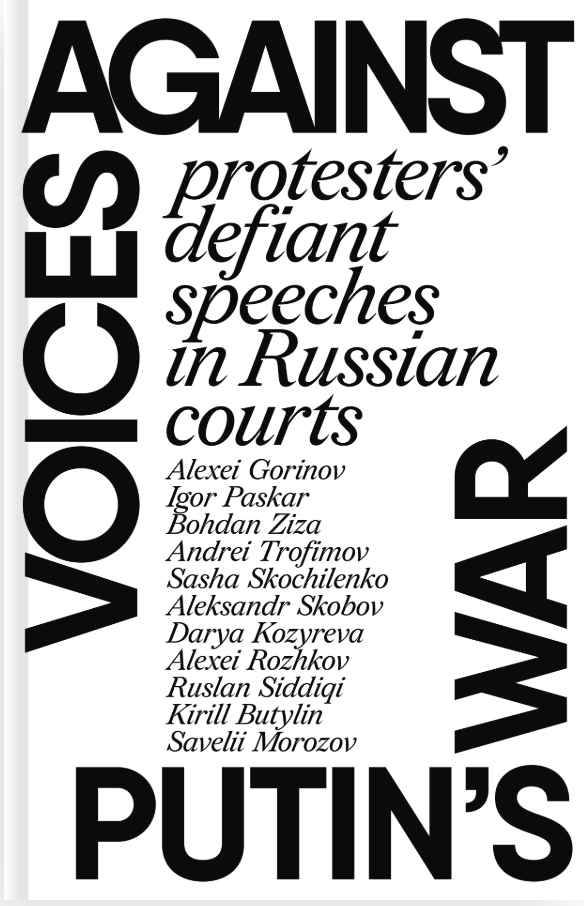
VOICES AGAINST PUTIN’S WAR
Protesters’ defiant speeches in Russian courts

Speeches by Alexei Gorinov, Igor Paskar, Bohdan Ziza, Mikhail Kriger, Andrei Trofimov, Sasha Skochilenko, Aleksandr Skobov, Darya Kozyreva, Alexei Rozhkov, Ruslan Siddiqi, Kirill Butylin and Savelii Morozov.

Foreword by John McDonnell, Member of UK Parliament

Edited by Simon Pirani

ISBN: 978-1-872242-45-3 (paperback)
e-ISBN: 978-1-872242-47-7 (e-book)
RRP: £15 (pbk)
e-RRP: £7 (Ebook)
196 pages; 140x216mm.
Publication date: September 2025

The E-book can be purchased at the usual online retailers
Any profits will be donated to Memorial: Support for Political Prisoners https://memohrc.org/en

Source: Resistance Books

The Courtroom Rebels Standing Up to Warmonger Putin

Voices Against Putin’s War: protesters’ defiant speeches in Russian courts is published this month by Resistance Books. Here is the Introduction to the book, by Simon Pirani, first published online by the European Network for Solidarity with Ukraine.

At the heart of Voices Against Putin’s War are ten speeches made in court by people who opposed Russia’s war of aggression in Ukraine, and were arrested and tried for doing so. Most of them are now serving long jail sentences, for “crimes” fabricated by Vladimir Putin’s repressive machine.

Along with the speeches, we include other public declarations – social media posts, letters and interviews – in which the protagonists made their case; statements by two more persecuted activists, made outside court; and a summary of 17 other anti-war speeches in court. We hope that, by publishing these translations in English, these resisters’ motivations will become known to a wider audience.

Chapters 1-10 are each devoted to one protester, arranged chronologically by the date of the protester’s first conviction. United in their opposition to the Kremlin’s war, they divide roughly into four groups.

First is Bohdan Ziza (chapter 3), who lived not in Russia but in Ukraine – in Crimea, which has been occupied by Russian forces since 2014. In 2022 Ziza filmed himself splashing paint in the colours of the Ukrainian flag on to a municipal administration building. He was tried in a Russian military court and is serving a 15-year sentence.

Second are two young women from St Petersburg, Sasha Skochilenko (chapter 6) and Darya Kozyreva (chapter 8), prosecuted for the most peaceful imaginable protests against the war. Skochilenko, who posted anti-war messages on labels in a supermarket, was freed after more than two years behind bars, in August 2024, as part of a prisoner swap between Russia, Belarus and several Western countries. Kozyreva is serving a two-and-a-half year sentence, essentially for quoting Taras Shevchenko, Ukraine’s national poet, in public.

Third are three young men who deliberately damaged property, but not persons, to draw their fellow Russians’ attention to the anti-war cause. Igor Paskar (chapter 2) firebombed an office of the Federal Security Service (FSB). Alexei Rozhkov (chapter 9) firebombed a military recruitment centre – a form of protest used dozens of times across Russia in 2022. He fled to Kyrgyzstan, was kidnapped, presumably by the Russian security forces, and returned to Russia for trial. Ruslan Siddiqi (chapter 10), a Russian and Italian citizen, derailed a train carrying munitions to the Ukrainian front. He has been sentenced to 29 years, and has said that he can be seen as a “partisan”, and “classified as a prisoner of war”, rather than a political prisoner.

The fourth group of protagonists, jailed for what they said rather than anything they did, have records of activism for social justice and democratic rights stretching back decades: Alexei Gorinov (chapter 1), a municipal councillor in Moscow who dared to refer to Russia’s war as a “war” in public; Mikhail Kriger, an outspoken opponent of Russia’s war on Ukraine since 2014 (chapter 4); Andrei Trofimov (chapter 5); and Aleksandr Skobov (chapter 7), who was first jailed for political dissent in 1978, in the Soviet Union, and who 47 years later in 2025 told the court: “Death to the Russian fascist invaders! Glory to Ukraine!”

Two activists prosecuted for anti-war action, who made their statements outside court, are featured in chapters 11 and 12. Kirill Butylin (chapter 11) was the first person arrested for firebombing a military recruitment office, in March 2022. No record of his court appearance is available, but his defiant message on social media is: “I will not go to kill my brothers!” Savelii Morozov (chapter 12) was fined for denouncing the war to a military recruitment commission in Stavropol, when applying to do alternative (non-military) service.

The ten anti-war speeches in court recorded in this book are by no means the only ones. Another 17 are summarised in chapter 13. These speeches, along with others by defendants who railed against the annihilation of free speech, or protested against grotesque frame-ups, have been collected and published by the “Poslednee Slovo” (“Last Word”) website.

High-profile Russian politicians jailed for standing up to the Kremlin also made anti-war speeches in court, including Ilya Yashin of the People’s Freedom Party, sentenced to eight-and-a-half years in December 2022 for denouncing the massacres of Ukrainian civilians at Bucha and Irpin, and Vladimir Kara-Murza, sentenced in April 2023 to 25 years for treason. Both of them were freed, along with Sasha Skochilenko, in the prisoner exchange of August 2024. Other prominent political figures remain in detention for opposing the war, including Boris Kagarlitsky, a sociologist and Marxist writer, sentenced in February 2024 to five years for “justifying terrorism”, and Grigory Melkonyants, co-chair of the Golos election monitoring group, sentenced in May 2025 to five years for working with an “undesirable organisation”. Dozens of journalists and bloggers are behind bars too.

These better-known, politically motivated people are only a fraction of the thousands persecuted by the Kremlin.

The cases recorded by human rights organisations include thousands of Ukrainians detained in the occupied territories. In many cases their fate, and whereabouts, is unknown: they may be dead or imprisoned.

Thousands more Russians who have spoken out against the war, or been caught in the merciless dragnet by accident, are behind bars. So are “railway partisans” who sabotaged military supply trains, and others who denounced their regime’s support for Putin’s war, in Belarus.

In Chapter 14, we outline the resistance to the Kremlin’s war, the repression mobilised in response to it, and the scale of the twenty-first-century gulag that has been brought into being. Notes, giving sources for all the material in the book, are at the end.

People resisting injustice have for centuries, in many countries, made use of the courts as a public platform. Irish rebels against British colonial violence began doing so at the end of the eighteenth century. In Russia, the tradition goes back at least to the 1870s, when Narodniki (Populists), speaking to judges trying them for violent protests, denounced the autocratic dictatorship. The workers’ movements that culminated in the 1917 revolutions used courtroom propaganda widely. When Stalinist repression reached its peak in the 1930s, the major purge trials were designed to eliminate it: their format was prearranged, with abject, false confessions. The practice reappeared after the post-Stalinist “thaw”, in the 1965 trial of the dissident writers Andrei Siniavsky and Yulii Daniel.[1]

Courtroom speeches have again become a powerful weapon under Putin – and the Kremlin dictatorship is finding ways to get its revenge.[2] It added three years to Andrei Trofimov’s sentence (chapter 5) – for the fantastical, false “offences” of disseminating false information about the army and “condoning terrorism” – based solely on what he said at his first trial. Other anti-war prisoners, including Alexei Gorinov (chapter 1) have had years added on to their sentences, on the basis of false “evidence” provided by prison officers, or prisoners terrorised by those officers.

Why did they do it? Why did our protagonists make protests that carried the risk of many years in the hell of the Russian prison system? Why, when brought to court, did they choose to make these statements that carried further risk? They have weighed their words and spoken for themselves; no attempt will be made here to summarise. However it is noteworthy that all of them addressed their speeches to their fellow citizens, not to the government.

Andrei Trofimov told the court in his second trial that “Ukraine is my audience”, because “Russian society is dead and it is useless to try to talk to it” – but nevertheless went to extraordinary lengths to make sure that his short, sharp message from his first trial, ending “Putin is a dickhead”, was widely circulated in Russian media.

The others had greater hopes in Russian society, including the Ukrainian Bohdan Ziza, who, in the video for which he was jailed, underlined that: “I address myself, above all, to Crimeans and Russians.” In court he said his action was “a cry from the heart” to “those who were and are afraid – just as I was afraid” to speak out, but who did not want the war.

Alexei Rozhkov had no doubt that “millions of my fellow citizens, women and men, young and old, take an anti-war position”, but were deprived of any means to express it. Kirill Butylin appealed to others to make similar protests so that “Ukrainians will know, that people in Russia are fighting for them – that not everyone is scared and not everyone is indifferent.” As for the government, “let those fuckers know that their own people hate them”.

Aleksandr Skobov, now 67 and in failing health, explicitly addressed younger generations. In an open letter from jail, he recalled how as a socialist he had been a “black sheep” among Soviet-era dissidents, most of whom had now passed away. “The blows are falling on other people, most of them much younger.” While “sceptical about ‘pompous declarations about the passing-on of traditions and experience’”, nevertheless, “I want the young people who are taking the blows now to know: those few remaining Soviet dissidents stood side-by-side with them, have stayed with them and shared their journey.”

Given this unity of purpose, of seeking however unsuccessfully to connect with the population at large, we might see the protagonists as practising the “propaganda of the deed” – not in the sense that phrase was given in the early twentieth century by politicians and policemen, as acts of violence, but in its original, broader sense: as any action, violent or not, that stirred one’s fellow citizens to a just cause. For, while some of those whose words are in this book used violence against property, and some specifically justified Ukrainian military violence against Russian aggression, none used violence against people.

Here are two further observations. First: while all the anti-war resisters shared a common purpose, they started with a diverse range of world views. A profound moral sense of duty runs through some of their statements. “Do I regret what has happened?” Igor Paskar asked his judges. “Yes, perhaps I’d wanted my life to turn out differently – but I acted according to my conscience, and my conscience remains clear.” Or, as Alexei Rozhkov put it: “I have a conscience, and I preferred to hold on to it.”

Andrei Trofimov, in a similar vein, said at his second trial that “writ large, it is a matter of self-preservation” – not “the preservation of the body per se, of its physical health” but the preservation of conscience in this difficult situation, “my ability to tell black from white, and lies from truth, and, quite importantly, my ability to say out loud what I believe to be true”.

Ruslan Siddiqi voiced his motivation differently, in terms of political ideas about changing society. In letters to Mediazona, an opposition media outlet, he described his path towards anarchism. Expressing dislike for the “rigidity” of some anarchists and communists, he nevertheless envisaged a transition “from a totalitarian state to other forms of government with greater freedoms and further evolution into communities with self-government”.

The invasion of Ukraine changed things: anyone who opposed it was declared a traitor by the government. “In such a situation, it is not surprising that some would prefer to leave the country, whereas others would take up explosives. Realising that the war was going to be a long one, at the end of 2022 I decided to act militarily.”

By contrast, Alexei Gorinov founded his defence on pacifist principles, and quoted Lev Tolstoy on the “madness and criminality of war”. Being tried “for my opinion that we need to seek an end to the war”, he could “only say that violence and aggression breed nothing but reciprocal violence. This is the true cause of our troubles, our suffering, our senseless sacrifices, the destruction of civilian and industrial infrastructure and our homes.”

Sasha Skochilenko was still more explicit: “Yes, I am a pacifist” she told the court. Pacifists “believe life to be the highest value of all”; they “believe that every conflict can be resolved by peaceful means. I can’t kill even a spider – I am scared to imagine that it is possible to take someone’s life. […] Wars don’t end thanks to warriors – they end thanks to pacifists. And when you imprison pacifists, you move the long-awaited day of the peace further away.”

Savelii Morozov told the military recruitment commission that he would not refuse to fight in all wars, but in this particular, unjust war. A war in defence of one’s homeland could be justified, but not the “crime” being perpetrated in Ukraine.

For Darya Kozyreva, the central issue is Ukraine’s right to self-determination, asserted by force of arms. The war is a “criminal intrusion on Ukraine’s sovereignty”, she told the court. While identifying herself in an interview as a Russian patriot – “a patriot in the real sense, not in the sense that the propagandists give that word” – Kozyreva justified Ukrainian military resistance. Ukraine does not need a “big brother”; it will fight anyone who tries to invade, she said. In Russia, even some of Putin’s political opponents “do not always realise that Ukraine, having paid for its sovereignty in blood, will determine its own future”. She wants to believe in “a beautiful future where Russia lets go of all imperial ambition”.

Aleksandr Skobov expressed the hope that Russia will be defeated militarily in still more categorical terms. He spelled out in court three principles of his political organisation, the Free Russia Forum: the “unconditional return to Ukraine of all its internationally recognised territories occupied by Russia, including Crimea”; support for all those fighting for this goal, including Russian citizens who joined the Ukrainian armed forces; and support for “any form of war against Putin’s tyranny inside Russia, including armed resistance”, but excluding “disgusting” terrorist attacks on civilians. 

Second: these anti-war speeches have much to tell us not only about Russia and Ukraine, but about the increasingly dangerous world we live in, in which Putin’s slide to authoritarianism has been succeeded by right-wing, authoritarian turns in the USA and some European countries. Russia’s imperial war of aggression has been followed by Israel’s genocidal offensive in Gaza, in which multiple war crimes – mass murder of civilians, the use of starvation as a weapon, deliberate blocking of aid, and the targeting of journalists, aid workers and international agencies – have been facilitated by the same Western powers that offer lip service to Ukraine’s national rights.

The two aggressor nations, Israel and Russia, aligned with different geopolitical camps, are subject to analogous driving forces. Nationalist ideology supercedes rational economic management; expansionist violence supercedes democracy; the decline of Western neoliberal hegemony paves the way for militarist thuggery. Capital’s need for social control underpins near-fascist methods of rule. Readers may recognise, in the Russian state’s dystopian efforts of 2022-23 to punish its dissenting citizens as “terrorists” and “traitors”, patterns that are retraced in the unhinged witch-hunts of 2024-25 in the USA and western Europe, against opponents of the Gaza slaughter.

The powers on both sides of the geopolitical divide are frightened of similar things: the defiance and resilience of the opponents of Putin’s war, and the anger that has brought millions of people on to the streets of north American and European cities, in protest at the Gaza genocide. They are frightened of beliefs that are taking shape, in varying forms, that humanity can and should strive for a better, richer life than that offered by the warmongers and dictators. Some of these beliefs are expressed in the chapters of this book.

□ You can buy Voices Against Putin’s War from the Resistance Books website.  

□ Thursday 20 November 2025, 7:00 pm. TRY ME FOR TREASON. Readings from anti-war protesters’ speeches in Russian courts, and book launch for Voices Against Putin’s War. Pelican House, 144 Cambridge Heath Road, Bethnal Green London E1 5QJ. Register free on Eventbrite here. Flyer attached.

□ More about the book here: How protesters use Russia’s courts to denounce the war on Ukraine 

□ There are English-languages pages on the websites of Memorial: Support for Political PrisonersSolidarity ZoneMediazona and The Last Word.


[1] T.D. Sullivan, Speeches from the dock, or, Protests of Irish patriotism (P.J. Kennedy, New York, 1904); Franco Venturi, Roots of Revolution: a history of the populist and socialist movements in 19th century Russia (Phoenix Press, 2001), Marshall Shatz, Soviet Dissent in Historical Perspective (Cambridge University Press, 1980).

[2] “Vykhoda net: kak v Rossii massovo fabrikuiut novye ugolovnye dela”, The Insider, 19 June 2025

Source: Simon Pirani, “The courtroom rebels standing up to warmonger Putin,” People and Nature, 9 October 2025

Sunday Reader No. 6: Hell Is Full

On Chaplygin Street in Moscow. Photo by anatrrra. Used with their permission

EXTERIOR: A neo-classical building in Moscow’s old German quarter. A plaque on the wall reads, “Western District Military Court No 2”. A group of actors and journalists mill around on the lawn.

INTERIOR: A large hall with a grand staircase. Through the frame of a metal detector stands a statue of Lady Justice in her blindfold, holding scales in one hand and a sword in the other.

A commotion. Several portly guards in flak jackets, with a dog on a leash, escort two handcuffed women through the hall. One, about 5ft tall with big eyes and curly hair, is Yevgenia Berkovich, a 39-year-old poet and theatre director. She is dressed in a white shirt and black trouser-suit. The other, slightly taller, wearing jeans, a white T-shirt and large owlish glasses, is Svetlana Petriychuk, a 44-year-old playwright.

The two women are led into a courtroom and placed in a cage of bullet-proof glass. A bailiff lets in the spectators, who sit down on the upholstered, green benches. Berkovich mischievously sticks out her tongue as photographers’ cameras flash and click. Yuri Massin, the judge, looks towards Berkovich.

Massin: Are you ready for the proceedings?
Berkovich
: Well, it depends on what will happen.

What happened was a show trial that revealed the radicalisation of the Russian state in the past few years. By the time proceedings began on May 20th 2024, Berkovich and Petriychuk had already been in detention for more than a year, having been charged with “propaganda and the justification of terrorism”. In the eyes of the regime, they had committed a crime by writing and staging a play called “Finist, the Bright Falcon”. Part docu-drama, part fable, “Finist” tells the story of the thousands of Russian women who, from 2015, were seduced online by professional recruiters from Islamic State (IS), and travelled to Syria to marry jihadists. Many of these women received lengthy sentences on their return home. The play premiered in 2020 to critical acclaim and was performed across the country.

As with any show trial, this one’s outcome was preordained, and its purpose was to justify the existing system and demarcate the ideological limits of the state. In doing so, it elucidated the ultra-conservative, anti-Western belief system that has expanded across public life since the full-scale invasion of Ukraine in February 2022. Berkovich and Petriychuk were the first artists to be jailed since Soviet times for the content of their work—or, more precisely, the thoughts of their characters. But as theatrical professionals, they managed to turn the trial into their show.

Continue reading “Sunday Reader No. 6: Hell Is Full”

Yulia Moskovskaya, Terrorist

Twenty-two-year-old Yulia Moskovskaya (née Joban) was detained in Petersburg in mid-June. She is suspected of attempting to carry out a terrorist attack against a drone design company employee. She failed to plant an explosive device [sic], according to the press service of the Petersburg municipal courts.

Moskovskaya was remanded in custody to a pretrial detention center. Investigators say that she “espouses a pro-Ukrainian ideology and is hostile to the current Russian government,” and claim that the young woman tried to “impact decision-making” by means of a terrorist attack. Criminal terrorist cases are opened every month, but usually they do not involve harm to specific people. In 2024, seventy-five people, including ten women, were convicted in Russia for carrying out terrorist attacks.

Bumaga has learned that Moskovskaya is not speaking with her family, and that a female friend of her has become her spokesperson. We chatted with this young woman about how the suspect behaved before her arrest, how she got into debt, and when she moved to Petersburg.

The detainee’s family: “Yulia changed her surname: she didn’t want anything to remind her of her kin”

Yulia and I are quite close friends. Her lawyer informed me of her arrest. I was shocked when he contacted me. At first I thought it was some kind of prank. I still can’t believe it has really happened.

I have known Yulia since 2017. We are from different cities and met online in a fan group for our favorite singer. At first, we were pen pals, but then we took our relationship offline and saw each other in person many times.

Yulia wasn’t in touch with many people, so she must have given the lawyer my contact info. She didn’t have many friends. Yulia didn’t speak with her relatives. She has a mother and a younger brother [who live in Moscow], as well as her grandparents, who live in some other city.

Yulia has always had bad relations with her mother. Her mother had a live-in boyfriend who always treated Yulia badly and beat her. Her mother took the boyfriend’s side and didn’t stand up for her daughter.

Yulia Moskovskaya. Source: social media

Yulia’s father died in 2020, and Yulia didn’t have a close relationship with him either. He drank heavily. He regularly brought his drinking buddies home and would get so drunk that he couldn’t stand up. Yulia often escaped to the neighbors when her father, out of his mind, tried to beat her. When we talked on the phone, I could hear her father getting into a fighting mood; he would be saying something to Yulia, and she would scream and run off. The neighbors would even call the police, but they could calm him down only for a while, and only once did take him to the slammer. Yulia essentially had no one to whom she could turn. In difficult situations, she would call the mental health hotline.

As an adult, Yulia changed her surname [from Joban to Moskovskaya]: according to her, she didn’t want anything to remind her of her kin. She sought treatment from psychologists. In the beginning, she had hope that they would help her, but then she just went to them to get things off her chest.

Debts and the move from Moscow to Petersburg: “Creative work was her only stable hobby”

Three times, Yulia enrolled in different [institutions of higher learning]. But she wouldn’t like something about them and would drop out. For a while, she was studying to be a designer. I don’t remember what her other two majors were.

A few years ago, Yulia moved for the first time from Moscow to Petersburg: she had always liked the city. You could say that she flitted between the two capitals.

Yulia originally had her own place to live. After his death, her father left his children an inheritance. Yulia and her brother sold her father’s flat in Moscow and split the money, so she was able to buy her own place in Petersburg. She lived there for a few months, but got bored and bought a flat in another neighborhood. After a while, she went back [to Moscow], buying a flat in the Moscow Region. Soon afterwards she sold her last home and went back to Petersburg, where she lived in a rented flat.

Yulia often changed jobs. The first place she worked was McDonald’s, before it left Russia. She stayed at that job for several years. After that she worked as a courier, then as a consultant in a store. Almost every month she would change jobs if she wasn’t satisfied with something. She didn’t regard any of her jobs as permanent. She said that she would soon leave [Russia] and that she only needed temporary, part-time work.

Yulia Moskovskaya. Source: social media

I know that Yulia had outstanding loans and that she didn’t have enough money to live on. She said that she had been sued by debt collectors. (In May 2025, a Moscow court ruled in favor of debt collectors trying to recover debts from Moskovskaya under a loan agreement — Bumaga.) She had spent the money on surgery [not covered under free public healthcare], and on braces.

Yeah, she’s not a very steady person. She gets bored with things quickly. Creative work was her only stable hobby. (On social media, Moskovskaya followed a lot of literature and Silver Age poetry groups — Bumaga.) She drew and wrote poems. Recently, she had been making her own jewelry and trying to sell it.

Moskovskaya’s views and her abandoned cat: “Before her arrest, she said she wanted to go to the war”

When the war broke out, Yulia immediately supported Ukraine. She said that she didn’t like the regime in Russia. She had a very firm stance. But I wouldn’t say she was always interested in politics. Before the war, I hadn’t noticed that she followed the news. I was surprised when she suddenly became politicized. Moreover, she has no Ukrainian relatives.

Before her arrest — since last summer — she had been saying that she wanted to go to the war. She mentioned that she had visited military enlistment offices and contacted people who could help her get to Ukraine, but everyone, according to her, had turned her down. I tried to warn her about the consequences: what if she died or something? She replied that she didn’t care, that this was her purpose in life and that such a death would be an act of heroism.

All last month, she kept saying that she would be leaving Petersburg for Ukraine and that some people would help her do this.

When Yulia was detained, I was allowed to speak with her for literally several seconds. The only thing she said was that I should go get her cat, which had been temporarily placed in a shelter.

Yulia Moskovskaya’s cat. Source: social media

I had imagined that Yulia would be hysterical, panicked. According to her lawyer, however, she is surprisingly calm.

Source: “‘She attempted to plant explosives under a car’: friend of 22-year-old Yulia, accused of plotting a terrorist attack, speaks of her loneliness and debt,” Bumaga, 30 June 2025. Translated by the Russian Reader

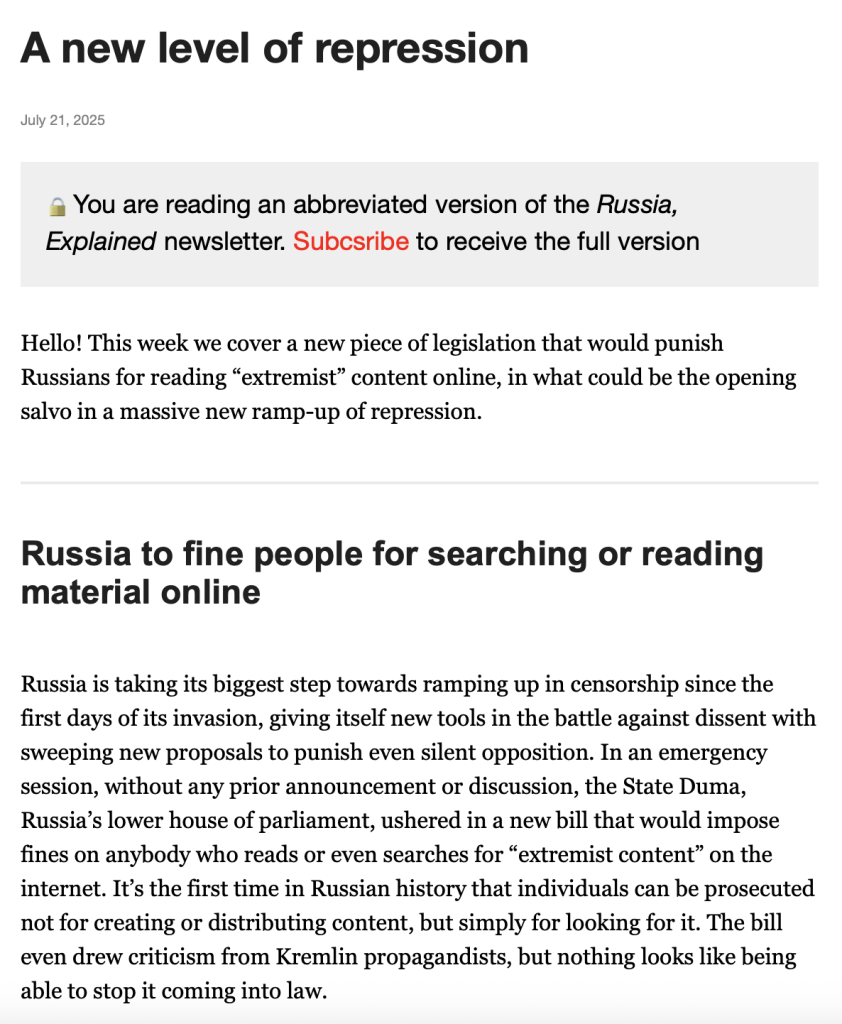
Paywalls, Firewalls, and “Extremist Content”

Source: Screenshots of an email from The Bell, 21 July 2025, and pro.thebell.io. I “subcsribe”* to a fair number of newspapers, magazines, and online media outlets. None of them would dare to charge me $348 or even $189 for a mere two newsletters a week. That The Bell asks so much for its meager output gives you an idea of how much it was previously receiving, directly or indirectly, from “grant funding for media outlets like us,” that is, from the U.S. government. ||| TRR

* The same typo was in last week’s “abbreviated version” of Russia, Explained.


A growing chorus of pro-Kremlin figures is speaking out against a proposed law that would impose fines for accessing or searching for online content labeled “extremist” by Russian authorities.

The bill, which was passed in its first reading in the lower-house State Duma on Thursday, envisions fines of up to 5,000 rubles ($64) for individuals who “knowingly” view or search for banned content. It does not specify how such activity would be detected, prompting concerns from experts about increased surveillance and possible abuse by law enforcement.

Yekaterina Mizulina, head of the Kremlin-aligned Safe Internet League, said the legislation could backfire on police, as well as those who support the Kremlin and help authorities in their crackdown on dissent.

“We actively monitor this kind of [“extremist”] content and share findings with law enforcement as part of our chartered mission,” Mizulina wrote on Telegram.

“What’s most striking is that under the draft law, even Interior Ministry officials monitoring such content could technically be acting illegally. And any private citizen who reports, say, [potential school shooters] to law enforcement could also face fines,” she added.

Margarita Simonyan, editor-in-chief of the state-funded RT news network, also criticized the bill.

“Dear government, tell me, plz, how are we supposed to carry out investigations and throw shade on all types of extremist groups like FBK if we are barred from even reading about them?” Simonyan wrote on Telegram, referring to Alexei Navalny’s Anti-Corruption Foundation, which Russia outlawed in 2021.

“I hope there will be changes,” she added.

Amnesty International, a London-based NGO, earlier decried the bill as “vague and overly broad,” warning that it enables arbitrary enforcement.

“Once again, the Russian authorities are disguising their relentless persecution of dissent as countering ‘extremism,’” said Marie Struthers, Amnesty’s Eastern Europe and Central Asia director.

“In today’s Russia, ‘extremist’ materials could be anything from a book promoting same-sex relationships to social media posts by opposition groups,” Struthers added.

The Kremlin on Thursday declined to comment on the controversy surrounding the bill, but acknowledged that the “issue has clearly sparked a strong public reaction.”

Authorities in Moscow currently maintain a list of around 5,500 banned “extremist” materials, including books, religious texts, songs, films and other media.

If lawmakers pass the bill and President Vladimir Putin signs it into law, it would take effect on Sept. 1.

Source: “Pro-Kremlin Figures Decry Bill Criminalizing Access to ‘Extremist’ Content,” Moscow Times, 17 July 2025. The Russian Reader was banned and blocked in Russia in July 2022 (with WordPress’s connivance), as chronicled here, here, and here.

Clubbing

In the wee hours of Sunday, 4 May, Russian security forces raided concerts in St. Petersburg and Yekaterinburg, at which, among other things, they asked attendees about their attitude to the war, local media have reported.

In Yekaterinburg, law enforcement officers interrupted a concert at the club Syndrome. As the musicians were performing, people in uniform came on stage, halted the concert, and asked the concert organizers to turn on the lights, concertgoers told the Telegram channel Svet. Ekaterinburg.

“People were ordered to stand facing the walls and told that there would be a document check. [The police] checked everyone’s documents, tattoos, and elbows, asked about their attitudes to left-wing radical movements and to the SMO (the war in Ukraine—ed.), and they checked the messenger apps on their phones. After the check, people were taken outside and ordered to scram,” said one of the guests.

Another clubgoers told the news website E1.RU that police locked him in a paddy wagon, confiscated his phone, and checked his contents. Police insulted the detainee and refused to explain the reasons for the check. According to eyewitnesses, police and Russian National Guard officers took part in the raid. Those agencies declined to comment on this report.

Regular raids by law enforcers in Russia

In St. Petersburg, law enforcers raided a rave party at the [underground] club Kontrkult. A source close to the police told Ren TV that the reason for the raid was that the event had not been “sanctioned.” According to the news website 78.ru, partygoers had their documents checked and were searched for banned substances. The publication adds that the event’s organizers were detained. This has not been officially confirmed.

Footage of the raid on Kontrkult, as posted on the Telegram channel SHOT

Similar raids on various establishments have happened regularly in Russia in recent months. Law enforcers have carried out several raids on fitness centers, in which people were issued military conscription board summonses. Similar raids have been carried out against migrant workers, who also had their documents checked and summonses handed to them, along with members of the LGBT community, who have been declared “extremists” in Russia.

Source: Daniil Sotnikov, “Law enforcers raid clubs in St. Petersburg and Yekaterinburg,” Deutsche Welle Russian Service, 4 May 2025. Translated by the Russian Reader

Nizhny Tagil anti-war protester Yekaterina Sergeyenko. Photo: Mezhdu Strok, via Svet.Ekaterinburg

💬 Student from Nizhny Tagil fined 120,000₽ in criminal “defaming” case

In Nizhny Tagil, 21-year-old student Yekaterina Sergeyenko has been sentenced for “defaming” [the Russian army]: she was fined 120,000 roubles [approx. 1,280 euros]. According to the news agency Mezhdu Strok (“Between the Lines”), criminal charges were filed over the young woman’s comments in the “Incident Nizhny Tagil” group on the social network VKontakte.

Vechernye Vedomosti reports that at the time she posted the comments, Sergeyenko had a prior administrative conviction for painting sixteen pacifist slogans on buildings in the city. This fact influenced the decision to file criminal rather than administrative charges against her.

Judge Oksana Belkina of the Tagilstroy District Court found Sergeyenko guilty. Although the verdict has not yet entered into legal force, the fine, according to Mezhdu Strok, has already been paid.

Source: Svet.Ekaterinburg (Telegram), 4 May 2025. Translated by the Russian Reader

Free People of Voronezh

Alexander Zheltukhin

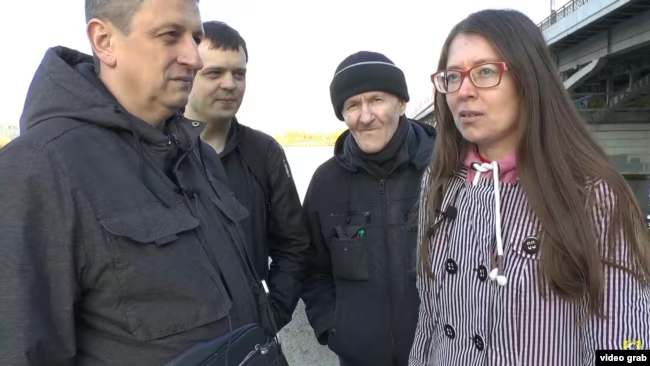
On 22 April 2025, Voronezh police raided the homes of activists believed by Center “E” [Russia’s “anti-extremism” police] to be connected to the Telegram channel Free People of Voronezh. The searches also involved severe beatings and threats, and some of the activists were forced to record videos supporting Putin and the war in Ukraine. Almost all the activists had previously been prosecuted on political charges, but now they feel so intimidated that they are afraid to file a torture complaint against the police.

A 38-minute video was posted on the Free People of Voronezh channel on 16 April 2025. The video itself was viewed by less than three hundred people. In the video, four activists—Grigory Severin, Nadezhda Belova, Yuri Avsenyev, and Alexander Zheltukhin—discuss the news before jogging along an embankment of the Voronezh River. The genre is the “coffee klatch”: using the news as a springboard, the friends talk about the problem of alcoholism, apathy in society, increasing drug use, and the overall sense of doom and gloom.

Activists of the Telegram channel Free People of Voronezh:
Grigory Severin, Alexander Zheltukhin, Yuri Avsenyev, and Nadezhda Belova

Nadezhda Belova sums up the video’s content at the very beginning.

“To cut it short, everything is bad, but it will get worse. To put it in a nutshell, the situation in this place is at the terminal stage,” she says.

She argues that Russia is inevitably moving in the direction “North Korea”—toward a mothballed, rotten dictatorship, because Russians “somehow still support it and want to live in it.” Belova has reason to be pessimistic: even before the war, the state had charged her with “condoning terrorism” for comments she had made on social media in the wake of Mikhail Zhlobitsky‘s [suicide] bombing of the Arkhangelsk FSB. in 2020, a military court sentenced Belova to pay a fine of 400,000 rubles. She was on Rosfinmonitoring’s list of “terrorists and extremists” for several years, and her family had to leave their home village and rent a flat in Voronezh, as their fellow villagers did not support Belova in her fight against the unjust charges.

The video posted on the Telegram channel Free People of Voronezh on 16 April 2025

“Again, the whole of Voronezh is covered with drug adverts. The law enforcement agencies run protection for [the illegal drug trade], and if they didn’t run protection for it, there wouldn’t be these adverts. At my neighborhood Pyaterka [convenience store], right at the entrance, there is a graffito painted in color on the doorstep: ‘Buying a stash is like going out for bread,'” says Alexander Zheltukhin. In previous years, Zheltukhin was fined for picketing against Belova’s persecution and arrested for protesting in support of Navalny. “And if it was not protected, I would argue, by the selfsame FSB, who probably take a percentage from it—”

“Watch out! You are discrediting the FSB,” Belova says, interrupting him. “I don’t agree! It cannot be!”

Caveats and omissions run through the entire conversation. The activists know that any free speech is potentially dangerous in today’s Russia, and they try to cover their bases whenever possible. (Spoiler: it didn’t work).

“They say it’s impossible not to confess”

A few days later, on 22 April, police raided the homes of all four people involved in the run, as well as those of other Voronezh activists. Searches were done at eight locations, allegedly connected with Free People of Voronezh. In most cases, the law enforcers acted extremely harshly. They used handcuffs and stun guns, beat people, intimidated the activists and their families, and emotionally abused them.

A photo posted by Nadezhda Belova

All the members of Belova’s family were shot with a stun gun. Belova later posted photos of her own bruises and the bloody marks on the bodies of her husband and son on Facebook. The police confiscated all their electronic devices and turned upside down their rented flat, which the landlady demanded that the Belovs vacate immediately after the search. The police threatened to send the son, a university student, to the war, and after the search, a policeman recorded a repentant video featuring Belova.

“Off camera, the [policeman beating Belova’s husband] says, ‘Do you support the [special military operation]?’ I say, ‘Yes.’ He says, ‘Do you support Putin?’ I say, ‘Yes.’ It’s light fare, but disgusting, especially when I saw a stun gun pressed against my son’s leg,” Belova told Okno.

The police recorded similar video “confessions” by several other people [caught up in the raids].

After the searches, Zheltukhin ended up in hospital with five broken ribs and several damaged vertebrae. He told OVD Info that he had tried to escape from the “punitive operation” and fell from the roof of a village house: “I broke my ribs when I fell, apparently, and they hit me [on those ribs]: it hurts a lot.” The police put a bag over his head and shocked him with a stun gun. His friends later photographed Zheltukin at hospital: his face was covered with bruises.

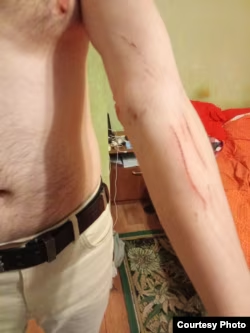
Fyodor Orlov, 36, was also beaten; after the experience, he says that he “did it all to himself.” He inflicted all the bruises and abrasions on himself, blindfolded himself with a scarf and sat like that for two hours, and fell into a briar bush on his own; there are photos of his back, entirely covered with flecks of blood. “Then someone—that is, I—drew a sex organ on my bald head just for fun,” he told OVD Info. The law enforcers also threatened to cut off one of his fingers, leaving behind telltale scratches.

Fyodor Orlov’s finger

“It was quite rough. As rough as possible, to the point that they say that now they understand why people confess to crimes they did not commit. Because, they say, it’s impossible not to confess. Orlov has several hundred stun gun marks [on his body]. Several hundred! They drove him into the woods. He thought they were taking him there to kill him,’” says Pavel Sychev, 38.

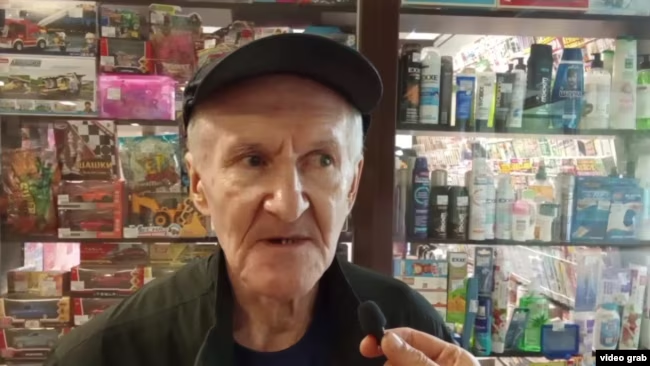
Sychev is a Voronezh activist and political consultant. He knows the administrators of the Free People of Voronezh channel from his past work as an activist: they crossed paths at pickets, but do not keep in close contact. Sychev’s home was also searched on 22 April, but there was no violence.

[The police] search my home, as a rule, without breaking the law, and they never use force against me or my family. They have been coming to my home every year since 2022. These are just routine searches. I have always been searched as a witness in criminal cases to which I don’t even have an indirect connection,” says Sychev. “There is a federal case [for example, the case against Grigory Melkonyants and other activists of the Golos movement—Okno], and they do a series of searches all over the country, and they come and search my house for good measure.”

“Evil loves silence”

It is unlikely that the new series of searches was occasioned by the latest video posted on the Telegram channel. Our sources suggest, rather, that the reason for the raids was that Free People of Voronezh constantly writes and speaks about people convicted on charges of high treason and terrorism (for sabotaging railroad switch boxes, cell towers, etc.). The channel admins treat these people as anti-war resisters. For law enforcers, on the contrary, they are criminals convicted of violent crimes.

The formal pretext for the series of searches on 22 April was the criminal case, on charges of repeated discrediting of the army, brought against Grigory Severin. As follows from the indictment, while serving his sentence in a penal colony [he had been sentenced to two and half years in prison for “publicly calling for extremism”; he served his time and was released last autumn—Okno], Severin discredited the Russian armed forces. After the search, he was detained and placed under arrest.

Sychev believes that this criminal case was “canned.”

“You see, in Russia we have the practice of ‘desk drawer cases.’ Meaning you already have a criminal case against you: the entire case file is ready in advance, and it is lying in a desk drawer, waiting for its day to come. In the case of Severin, his first case was also ‘in a desk drawer.’ When he was arrested, it transpired that the entire case file had been readied a year earlier.”

It is not known what prompted the police to pull the case file from the drawer right now. But the fact that Severin faces prosecution does not surprise Sychev in itself.

“Everyone who knows Grigory, even in passing, realizes that he is a man who will not stay quiet. If anyone asks him directly how he feels about this or that situation, he will answer directly, even if the answer risks criminal charges. He is a man who will always try to prove to everyone the viewpoint which he espouses and defends. As far as I know, the first ‘discrediting of the armed forces’ case against him came from his explaining his philosophy of life to traffic police officers who had pulled him over. The second charge came from telling his cellmates about his stance. This in the order of things for him: he does not keep silent; he speaks openly, directly. So it was a matter of time. When a person speaks openly about a very dangerous and sensitive topic—and in our country the ‘special military operation’ is a sensitive topic—there are many chances that sooner or later they will be prosecuted.”

On the same day, a criminal case was opened against 65-year-old activist Yury Avsenyev, another person involved in the run along the Voronezh River embankment. His home was also searched on 22 April, but he was released on his own recognizance. Avsenyev is suspected of “publicly calling for extremism.”

Yuri Avsenyev

The Voronezh activists who fell victim to the police brutality have not yet worked up the courage to file complaints, and they fear excessive publicity.

“They are really spooked,” says Pavel Sychev. “The information I have now is that they will not file torture complaints, but I don’t know, maybe someone will persuade them to do it. They are very much afraid that if they do it, the law enforcers won’t be reprimanded in any way, but will just come and take revenge on them. They are all convinced that they will be killed. I told them that evil loves silence, and if you don’t react now, there is a greater chance of a repeat than if you do. But they said it’s very easy to judge from the outside when you haven’t been tortured. ‘We are afraid that they might do something to us,’ [they say].”

Our sources note that such official lawlessness had not previously occurred in Voronezh. Usually, searches at the homes of political activists and arrests were carried out by the book, without violence. The only widely known case of official lawlessness ended in criminal charges against the police officers involved and monetary compensation for the victims. In May 2018, criminal investigators Sergei Kosyanenko and Oleg Sokolovsky tortured university students Maxim Grebenyuk and Sergei Troyansky, hoping to force them to confess that they had stolen a mobile phone. The students were held at Police Station No. 4 in Voronezh’s Comintern District for six hours in handcuffs and strangled with a plastic bag. They refused to incriminate themselves, and afterwards they documented their injuries and filed a torture complaint with the Investigative Committee. In 2021, Grebenyuk was awarded one million rubles, and Troyansky, 500,000 rubles, in compensation for their suffering.

The Voronezh police’s current brutality may be due to the proximity of the front, suggests a source who requested anonymity. The fact is that, since the start of the full-scale invasion, Voronezh law enforcers have regularly been seconded to the so-called new territories, the occupied Donetsk and Luhansk regions.

“There are quite big problems with the law in those ‘new territories.’ And the practices that are used there are inhuman, I think. When they come back here, to their native land, they simply do not reconfigure themselves,” says our source, who is not connected with the Free People of Voronezh Telegram channel. “They consider themselves above the law. They think that they are involved in a good cause, and they can torture bad people for the sake of the good cause. When a person has tried their hand at it once, when they realize that they can get away with it absolutely scot-free, then it is quite difficult to put the brakes on, and it will grow.”

Source: “‘Terminal stage’: Voronezh law enforcers brutally beat activists during searches,” Okno, 29 April 2025. Translated by the Russian Reader

Alexander Skobov: “We Are Witnessing a Disgusting Attempt at a Purely Imperialist Collusion Between Two Predators”

Alexander Skobov. Photo: Mediazona

Today, the 1st Western District Military Court sentenced 67-year-old dissident Alexander Skobov to 16 years in prison and fined him 300,000 rubles (just over $3,500). Skobov, who first faced criminal prosecution in the USSR, was convicted under charges of “participation in the activities of a terrorist community” (for his involvement with the Free Russia Forum, a Russian opposition conference abroad) and “justification of terrorism” (for his social media posts and articles). Mediazona publishes Skobov’s closing statement from today’s trial—a passionate speech in which he continues to openly support Ukraine, defies persecution and denounces judges as accomplices of Putin’s war crimes.


I will not dwell on the fact that the investigation has branded the organisation I have the honour of belonging to, the Free Russia Forum, as a terrorist community. There has been no official ruling from any government body recognising the Free Russia Forum as such. For now, it is merely an “undesirable organization.”

But I have little interest in all this petty mumbling. I prefer to speak about what truly matters. What matters here is the platform of the Free Russia Forum, a platform I was directly involved in shaping, and one that distinguishes the Free Russia Forum from most other opposition organisations.

Let me remind you that this platform is built on three principles. First: we stand for the unconditional return to Ukraine of all its internationally recognised territories occupied by Russia, including Crimea. Yes, Крим це Україна. [Crimea is (part of) Ukraine — TRR.]

Second. We support all those who are fighting to achieve these goals—including citizens of the Russian Federation who have voluntarily joined the Armed Forces of Ukraine. 

And third. We recognise any form of war against Putin’s tyranny inside Russia, including armed resistance. Of course, we are deeply disgusted by the methods of ISIS, when innocent people are targeted, as was the case in Crocus City.

But are the Kremlin’s war propagandists a legitimate target? The Free Russia Forum has not formally debated this issue or adopted any resolutions on it, so what I say next reflects my personal position alone.

I believe that propagandists such as TV host Vladimir Solovyov deserve the same fate as Hitler’s chief propagandist Julius Streicher, who was hanged by the Nuremberg Tribunal. Until these outcasts of the human race are brought before a new Nuremberg Tribunal—and as long as this war continues—they remain legitimate military targets. 

For me, the comparison between Putin’s and Hitler’s propagandists is not mere rhetoric. Much of my public writings has been devoted to proving the inherently Nazi nature of Putin’s regime—a regime with which peaceful coexistence is fundamentally impossible. 

I appeal now, as I have before, first and foremost to Europe, which should remember the origins of the current European system. Since 1945, Europe has been building a world in which predators no longer prevailed, a world based on the principles of law, justice, freedom, and humanity. Europe had achieved much on this path and seemed to have rid itself of massacres and territorial redistributions forever.

Europe once believed that this safe and prosperous world was securely protected by a great powerful ally across the ocean. Today, this world is being torn to splinters by two scoundrels on both sides: the Kremlin and Washington. People with pro-fascist values have come to power in the United States. 

We are witnessing a disgusting attempt at a purely imperialist collusion between two predators. An even more despicable collusion than the Munich Betrayal of 1938. If Putin’s annexations are legalised, it will spell disaster for civilization. Europe, you have been betrayed. Wake up and go fight for your world!

Death to the Russian fascist invaders! Death to Putin, the new Hitler, murderer and scoundrel! Glory to Ukraine! Glory to the heroes!

I usually end my speeches with these words. But today I will be further asked whether I plead guilty.

Well, I am the accuser here.

I accuse Putin’s corpse-stinking clique of planning, unleashing, and waging an aggressive war. Of committing war crimes in Ukraine. Of orchestrating political terror in Russia. Of corrupting my people.

And now, I ask the servants of Putin’s regime present here, mere cogs in the repressive machine: do you find yourselves guilty of complicity in Putin’s crimes? Do you repent?

And with that, I’ve said all I needed to say.

Source: “‘I am the accuser here—I accuse Putin’s corpse‑stinking clique’: Closing statement of dissident Alexander Skobov, sentenced to 16 years in prison,” Mediazona, 21 March 2025


A Russian military court sentenced Soviet-era dissident Alexander Skobov to 16 years in prison on charges of justifying terrorism and being a member of a terrorist organization, the exiled news outlet Mediazona reported Friday.

Skobov, 67, was arrested in April on allegations that he justified an attack on the Russian-built Crimea Bridge in an online post and was a member of the Lithuania-based liberal opposition platform Free Russia Forum, which Russian authorities have outlawed as “undesirable.”

A military court in St. Petersburg convicted Skobov on both charges and sentenced him to serve his time in a maximum-security prison.

Prosecutors had requested an 18-year sentence for Skobov, whose health had deteriorated significantly during pre-trial detention.news

In a defiant last statement in court, Skobov condemned both Russian and U.S. leaders as “predators” engaged in an “imperialist conspiracy” in Ukraine.

“Death to the Russian fascist invaders! Death to Putin, the new Hitler, the murderer and scoundrel! Glory to Ukraine!” Mediazona quoted Skobov as saying.

“I’m the one blaming you here. I accuse Putin’s ruling clique, which stinks of corpses, of preparing, unleashing and waging an aggressive war,” Skobov added.

Russia’s Justice Ministry designated Skobov as a “foreign agent” in March 2024. He is among the few outspoken critics of Russia’s full-scale invasion of Ukraine to remain inside the country despite the risk of facing criminal charges under wartime censorship laws.

A dissident since the late 1970s, Skobov was convicted twice and subjected to punitive psychiatric treatment for “anti-Soviet propaganda.”

Source: “Military Court Jails Soviet-Era Dissident Skobov 16 Years for ‘Justifying Terrorism,’” Moscow Times, 21 March 2025

Alexander Skobov: What It Means to Be Anti-War and Anti-Fascist

The complete text of Alexander Skobov’s speech during closing arguments at his trial today (18 March 2025). Video: SOTAvision

Those who have been following my trial will certainly have noticed that the position of my lawyers and my position are not quite the same. We have emphasized different things, and we have slightly different objectives. My lawyers have sought to draw attention to a problem that is identified in the reports of international organizations as the abuse of anti-terrorist legislation to restrict the freedom of expression, the freedom of speech.

This problem does exist, and in some quite decent countries, particularly the European countries. The European approach to this problem has differed from the American one. The United States of America has the First Amendment of the Constitution, which expressly prohibits any limitations on freedom of speech. In the wake of the severe trauma wrought by the Second World War, the European countries took a somewhat different path. They introduced measures to restrict the dissemination of ethnic hatred, ethnic superiority, and ethnic inferiority — all the ideas associated with Nazism. A whole system of restricting freedom of speech has arisen out of this. Europe has sought a reasonable balance between freedom of speech and its restriction.

I do not regard this experiment as successful. Freedom of speech either exists or it doesn’t exist. Any restrictions on it will always lead to abuse, no matter how well intentioned. The very idea of prohibiting people from condoning anything or anyone is flawed in principle. It means forbidding people from thinking and feeling. Lawyers have the inalienable right to seek to condone their client any way they can, but so does any human being.

Only this whole story has nothing to do with us. There is no abuse of anti-terrorist legislation in Putin’s Nazi Russia. There is legislation explicitly aimed at quashing all expression of disagreement with the authorities. Under this legislation, a theatrical production about the horrible fate of women who were tricked by ISIS fighters into joining their war as their wives is deemed “condoning terrorism.” Those complicit in the guilty verdict against Yevgenia Berkovich and Svetlana Petriichuk have no souls, they are undead, but the law itself is worded in such a way that it can be interpreted this way. Can we speak the language of law with a state which has adopted a law like this and deploys it in this way? Of course we cannot.

My case is fundamentally different from the case against Berkovich and Petriichuk, as well as from the numerous cases against people who limited themselves to voicing moral condemnation of Russia’s aggression against Ukraine. My case is not about freedom of speech, its limitations, and the abuses of these limitations. My case is about the right of a citizen in a country waging an unjust war of aggression to utterly and completely take the side of the victims of the aggression. It is about the right and duty of a citizen in a country waging such a war.

This right is covered by the category of natural law because it cannot, in principle, be regulated by legal norms. All warring states regard going over to the side of their armed enemy as treason. And the aggressor never recognizes himself as the aggressor and calls the robbery and plunder in which they engage “self-defense.” Can we prove legally to the aggressor that they are the aggressor? Of course not.

But Putin’s Nazi dictatorship is an aggressor of a special kind. Having legislatively declared a war a “non-war,” it regards all armed opposition to its aggression as “terrorism.” It does not recognize the existence of a legitimate armed opponent at all. The obligatory reports of the Russian high command persistently refer to the Ukrainian army as “militants.” Does this have anything to do with law? Of course not. But war, in principle, is not compatible with law. By its very nature, the law is a constraint on violence, while war is violence without restraint. When the guns talk, the law is silent.

My case has to do with my involvement in the armed resistance to Russian aggression, even if only as a propagandist. The goal of all my public statements has been to achieve a radical expansion of military assistance to Ukraine, up to and including the direct involvement of the armed forces of NATO countries in combat operations against the Russian army. For the sake of this goal I refused to emigrate and deliberately went to prison. What I say carries more weight and resounds more loudly when I say it here.

Borrowing the wording of the so-called Criminal Code of the so-called Russian Federation, all these actions constitute assistance to a unfriendly foreign power in generating threats to the national security of the Russian Federation, as described in the current Criminal Code’s article on high treason. Why was I not charged with violating this article, nor with violating the many other political articles in the current Criminal Code, charges which should have been brought against me for my publications? The most important of my publications were never included in the indictment, although I had the opportunity to make sure that the investigation was acquainted with them. In addition, the investigation was aware that I had made personal donations to purchase lethal weapons for the Ukrainian army and publicly encouraged others to follow my example. This is the kind of thing for which the authorities now automatically charge people with high treason.

Why didn’t they do it? I think that they didn’t do it not only due to the overloaded repressive apparatus, human laziness, and the typical aversion of Russian authorities to legal norms in general, including their own legal norms. They are our legal norms, they would say. We do what we want with them, we enforce them when and if we want to enforce them. We call the shots.

But there is another reason. Even among the people who have morally condemned the Russian aggression and risked going to prison for it, there are not many who have dared to take the side of the victims of the aggression. The dictatorship is afraid that there will be more such people, and it is afraid of “bad” examples. So it has had a stake in not amplifying my voice too much and not mentioning the specifics of my case, which I have just mentioned. I have tried to focus the public’s attention on these selfsame peculiarities.

Unlike my lawyers, I really have not tried to prove to the aggressor that they are an aggressor who has violated all internationally recognized legal norms. It makes as much sense as discussing human rights with Hitler’s regime or with Stalin’s similar regime. By the way, maybe the judge can recall which article of the Criminal Code criminalizes equating Stalin’s regime with Hitler’s.

But my lawyers and I are unanimous that my case cannot be considered outside the context of the ongoing war. It is a part of this war. And my lawyers’ attempts to speak the language of law with the aggressor’s authorities only illustrate once more that when the guns do the talking, the law is silent.

Free speech is not the issue in my case. In this war, speech is also a weapon that also kills. The Ukrainians write my name on the shells annihilating Putin’s lowlife who have invaded their land. Death to the Russian fascist invaders, death to Putin, the new Hitler, a murderer and scoundrel! Glory to Ukraine, glory to the heroes! I rest my case.

Source: Darya Kostromina (Facebook), 18 March 2025. Translated by the Russian Reader

Alexander Skobov

Prosecutors have requested an 18-year prison sentence for Russian dissident Alexander Skobov, whose trial on charges of justifying terrorism over a social media post he wrote about the Ukrainian bombing of the Crimean Bridge is coming to an end in St. Petersburg, independent news outlet Bumaga reported on Tuesday.

Requesting Skobov be given a six-year sentence for justifying terrorism, as well as a 12-year sentence for “involvement with a terrorist community”, prosecutors also asked the court to ban Skobov from administering websites or Telegram channels for four years and to fine him 400,000 rubles (€4,500). Having openly criticised the regime of Vladimir Putin and opposed both Russia’s 2014 annexation of Crimea and its 2022 full-scale invasion of Ukraine, Skobov was arrested in April over a social media post he wrote about the Ukrainian bombing of the Crimean Bridge, which connects Russia to the annexed peninsula.

Skobov had previously said that the destruction of the bridge was “extremely important from a military-political standpoint” and called a failed Ukrainian attempt to destroy it a “shame”. He had also been fined for his links to the pro-democracy Free Russia Forum, an organisation deemed “undesirable” and thus effectively outlawed in Russia. The Free Russia Forum condemned his detention, calling it “arbitrary”, and demanding his immediate release.

Now 68, Skobov is a well known Soviet-era dissident who was part of the New Leftists opposition movement in the late 1970s. He was forced to spend two three-year stints in a psychiatric hospital, a common fate for political dissidents at the time, for publishing the anti-government magazine Perspectives and for participating in protest actions.

Having been deemed a “foreign agent” by the authorities, Skobov nevertheless refused to leave Russia, despite pleas from his family to leave. While in pretrial detention, Skobov’s health in general, and eyesight in particular, have deteriorated rapidly.

Source: “Prosecutors request 18-year prison sentence for Russian dissident’s social media post,” Novaya Gazeta Europe, 18 March 2018

Ilya Yashin: The Basics

Ilya Yashin

Our strange post-truth era turns everything upside down and paints black as white. It is vital that we remember the basics and not lose our bearings to avoid going crazy.

So I just want to remind you that:

  1. Vladimir Putin is a dictator, murderer, and war criminal.
  2. It is immoral and outrageous to work on Putin’s behalf and aid him.
  3. The Russian army’s invasion of Ukraine is unlawful and unwarranted.
  4. Ukraine is the victim of aggression.
  5. Russia is a police state: it stifles dissent and persecutes its citizens for dissenting.
  6. Any individual who resists Putin’s regime deserves our encouragement.
  7. Alexei Navalny and Boris Nemtsov are Russian heroes.
  8. There should be a regular transition of power in all countries.
  9. Human rights are universal.
  10. Human life is priceless.

Source: Ilya Yashin (Facebook), 6 March 2025. Translated by the Russian Reader