Kushnir (2025), a film about the late pianist and antiwar protester Pavel Kushnir (in Russian and English, with subtitles)
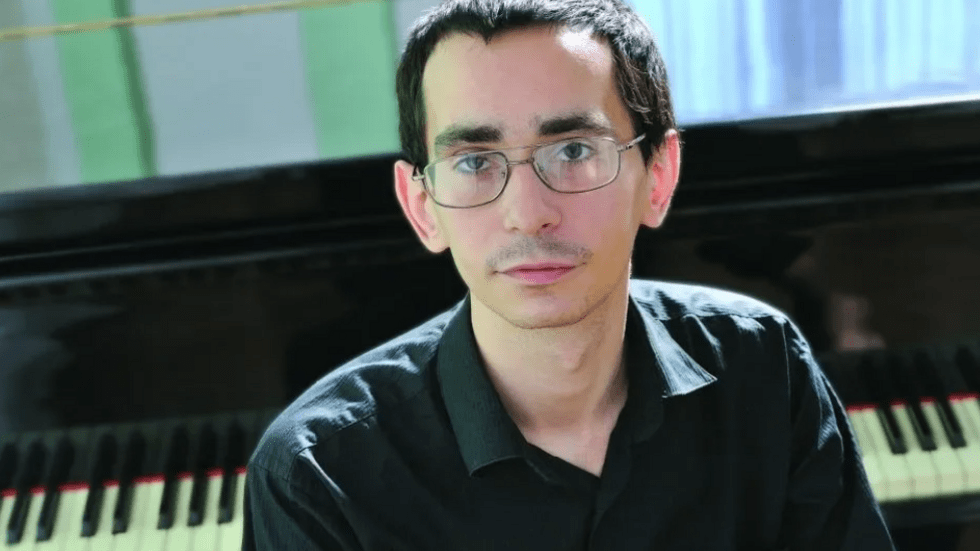
Pavel Kushnir was a virtuoso pianist, a writer, and a courageous man whom the world discovered only too late. He died on July 27, 2024, in a Birobidzhan detention center following a dry hunger strike. The formal pretext for his arrest was a series of anti-war videos posted on a YouTube channel that had only 5 subscribers.
This film is an attempt to understand the man who played Rachmaninoff until his fingers bled, who dreamed of flying to Mars, who idolized Kurt Cobain, and who called the war by its true name while living in complete isolation.
We have gathered archival footage, previously unknown recordings of Pavel, fragments of his poignant cut-up novel, and memories from close friends and colleagues, including Clean Bandit soloist Grace Chatto, music expert Mikhail Kazinik, and publisher Dmitry Volchek. This is a story not just about a death in prison, but about an extraordinary life that became an act of art and resistance.
In this video:
Unique footage of Kushnir’s performances and artistic actions.
The story of an unmade avant-garde film and friendships with global stars.
The Birobidzhan Diary: a chronicle of loneliness and the fight against fascism.
Why a brilliant musician went unnoticed by the cultural establishment, but not by the prison system.
Our film about the pianist Pavel Kushnir has dropped. […] Honestly, the film was ready to go in late April, but we spent a long while navigating the legal maze around the music, copyrights, and permissions. That was not even the main reason for the delay, though. I wanted to wait until the media hype had subsided and we could take a look at Pavel’s legacy from a certain historical distance, to talk about him not as a victim (although that viewpoint is legitimate, of course) but as a rebel whose choice was deliberate. Similarly, if you will, there are different takes on Christ: some view him as a needless victim who arouses pity, and the more maudlin that pity, paradoxically, the stronger their hatred for his crucifiers; while others see him as a rebel whose heroism was deliberate.
In my opinion, seeing Pavel as a pure “victim” robs him of agency, turning him into an extra in someone else’s play, in which the crucifiers have all the starring roles.
The film is based on Pavel’s own diaries. In terms of composition, I reprised the structure of his screenplay for the unmade film The Six Weary Ones. Three states of madness—prophetic madness, creative madness, and the madness of protest—figure as the three aspects of his personality. As in Joyce, each of Kushnir’s chapters has its own color and symbol. We have added music to these chapters. The music for the red chapter, “Prophet,” is by Rachmaninoff. Bach supplies the music for the blue chapter, “Creator”: blue stands for the heavens and the cosmos, and fugues are cosmic in nature. The third, black-and-white chapter, dealing with rebellion and Birobidzhan, is set to Scriabin’s Prometheus, a [tone] poem about the first rebel in history. Camus writes, in The Rebel, that rebellion confers agency on us, turning us from beasts into human beings. Again, it’s all in the eye of the beholder: some feel pity for Prometheus, chained and tortured by the eagle, while others see in him the power of the unbroken human spirit. And Scriabin’s idea of transforming all of humanity meshes perfectly with the cosmic utopia begun in the previous chapter. Prometheus: The Poem of Fire is a mystery play; as [Russian poet Konstantin] Balmont put it, it is “a vision of singing, falling moons, of musical stardoms, arabesques, hieroglyphs, and stones sculpted from sound.”
The film is chockablock with musical, literary and philosophical allusions which I won’t burden you with now. But if you’re interested, I’ll set up a cozy stream on my tiny Telegram channel where we’ll discuss the film and unpack its hidden layers, and I’ll answer your questions. You can write in the comments about whether this idea seems viable, and I’ll decide what to do based on your feedback.
Once again I want to thank everyone who did their part and helped commemorate a major artist. Thanks to you, we raised 1,185 euros and 533,954.51 rubles [approx. 5,800 euros], which is not just a large sum but a phenomenally large sum, considering that the major media practically ignored our fundraising campaign. That being said, many friends and former colleagues supported us by reposting [our fundraising appealing], which is eloquent testimony to the fact that a person and his reputation are more vital than any institution, and for this I am endlessly grateful to them.
The money we raised was enough for several full-fledged scouting trips and location shoots. Considering the geographical scope of our shoots, which included traveling to Birobidzhan itself, our grassroots war chest was emptied at some point. It became clear that without outside help we wouldn’t be able to complete the project properly, avoid devolving into a Skype interview format, and pay all the courageous artists, editors, and cameramen who had agreed to shoot a film in Russia at their own peril. I understood that asking folks for money again was not a good plan. So, after consulting with our small team, I accepted an offer from the online platform Votvot. They covered our remaining expenses and, most importantly, agreed to our condition that the film would be freely available. Our promises to our donors have not been broken: this grassroots film is being released in a way that is accessible to the grassroots—on YouTube.
I want to thank my friend and colleague Alexander Urzhanov from the bottom of my heart: he was quite emotionally invested in this film and provided us with his fabulous production resources. I would also like to thank all the folks at Narra: they have asked me not to name them, but you know who you are. Misha, Dasha, Ira, and Nastya, I couldn’t have done it without you and by myself! Particular thanks go to Boris Barabanov and Darina Lukutina from Votvot, without whom this film would scarcely have been possible.
I would like to thank Pavel’s relatives for permitting us to use his voice to read his diaries. Getting ahead of myself, I should say that this is the only digitally generated thing in the film. Everything else was filmed or recorded using analog methods: the diaries, the posters, and the drawings of a certain incomparable artists were all done without synthetics or computer glitz. All you see is life’s pleasant graininess.
I thank Pavel’s friends for sharing their archives and letters, as well as everyone who appears in this film.
I have one final request to you. Watch this film tomorrow. More to the point, share this film. I’m afraid that the film will get lost in the ruthless algorithmic desert without your reposts. May this film find everyone who needs it.
Pavel Kushnir was a classical pianist. But according to Russian authorities, he was also a dangerous dissident. In July 2024, he died on hunger strike in a remote prison in Far East Russia. Who was Pavel Kushnir, and why did he end up in jail? Liza Fokht from BBC Russian has been trying to piece together Pavel Kushnir’s story.
A charity concert has been held in Paris in tribute to the pianist Pavel Kushnir, who died in detention in Russia. The funds raised were donated to the Paris-based Atelier des artistes en exil (Agency of Artists in Exile), which aids artists who have fled their countries due to war, persecution, and discrimination.
The concert was held at Salle Cortot in Paris. World-renowned pianists Grigory Sokolov and Sergei Babayan performed a program of pieces by Frederic Chopin, Robert Schumann, Franz Schubert, Franz Liszt, and Sergei Rachmaninoff. Tickets for the concert were sold out almost instantly.
“As musicians, we want to voice our support for artists around the world who are persecuted and sometimes forced to leave their native country. Pavel Kushnir chose internal emigration and bravely and unreservedly spoke out against the war. He paid for this with his life. We wholeheartedly support Grigory Sokolov and Sergei Babayan’s November 18 concert in Paris and join them in paying tribute to Pavel, as well as in voicing our solidarity with all artists who are suffering from repression today,” reads a letter in support of the concert, which was signed by Martha Argerich, Daniel Barenboim, Gidon Kremer, Anne-Sophie Mutter, Semyon Bychkov, Paavo Järvi, and many other famous musicians of our time.
“Music can be used for good as well as for ill. Pavel Kushnir always used it for good. Let us honor his memory and follow his example,” says pianist Evgeny Kissin, who also signed the letter.
“I am honored to pay tribute to the memory of a young artist who gave his life for the truth. Pavel Kushnir clearly understood that there can be no happiness and, in fact, no real art when one country causes another country untold suffering, and the truth about this crime is not heard. The deeply inhuman nature of the regime responsible for his death is underscored by the fact that he, a young artist living far from the capital, posed no danger to the continuation of its criminal rule. He made a beautiful recording of Rachmaninoff’s Preludes, and for that reason I wanted to play Rachmaninoff for him. I would have loved to have met Pavel, who was undoubtedly a beautiful, exceptionally sincere young soul. My thoughts are with Pavel Kushnir, his family, and all the victims of the enemies of freedom and truth,” said Sergei Babayan, explaining his involvement in the concert and the works selected for it.
The proceeds from the concert, as well as the donations raised, will be given to the Paris-based Atelier des artistes en exil, which has aided many hundreds of artists during the seven years of its existence.
“When we left Russia, we had heard nothing about Atelier, and it was not clear where we would put down roots,” says composer Dmitry Kurlyandsky, who turned down Russia’s Golden Mask national theater prize, which he was awarded for the music he wrote for Perm-based Theater-Theater’s production of the play Katerina Izmailova. He called the award “antics on the part of a system which is destroying the theater.”
“But on the second day,” Kurlyandsky says, “I had already found out about Atelier. We called them and they invited us to a meeting. It was the very beginning of the wave of emigration from Russia, and Atelier had more capacity to accommodate refugees. We lucked out. Thanks to Atelier we stayed for eight months for free in a hotel in downtown Paris, and during this time we were able to get our papers sorted and find a place to live.”
Judith Depaule
Judith Depaule, founder and head of Atelier des artistes en exil, sat down for an interview with Radio Svoboda.
— How did you find out about Pavel Kushnir’s tragic story?
— From Russian acquaintances. I also read about it in the French press. There wasn’t that much coverage of Kushnir’s plight, but there were some articles nevertheless. Many artists at Atelier talked about it.
It’s all quite frightening, of course. I have been studying the history of theater in the Gulag for a long time. I see Kushnir’s tragedy as a repetition of what already happened, of things with which we are all very familiar. I’m always amazed at how much history can repeat itself. I wonder why it repeats itself, despite everything we know about our past. How is it that people are dying again just for freely expressing themselves! I find it scary, because the right to freedom of expression is what matters most.
— You said that you said that you studied theater in the Gulag. Tell us a little more about that.
— It so happened that as part of my studies I researched the work of the Futurist theater director Igor Terentiev, who was arrested and sent to work on the White Sea Canal. We know a lot about his life on the White Sea Canal because he was photographed by the legendary Alexander Rodchenko. It was a shock to me that the theater could exist in the Gulag. I researched the topic. I went to the Memorial Society, and I was able to interview many former prisoners. I even traveled to Magadan and Vorkuta. So I am an expert on the history of the theater in the Gulag.
— Whose idea was Pavel Kushnir memorial concert? Why were Grigory Sokolov and Sergei Babayan involved in it?
— It was the artists at Atelier who took the initiative. To make the event respectable, they decided to invite famous musicians. We approached Sokolov and Babayan, and they immediately agreed.
— Yes, Sokolov and Babayan are certainly musicians of the highest order. Babayan is also a renowned teacher. Was the concert program solely Sokolov’s and Babayan’s choice? Or did they discuss it with you as well?
— No, they decided themselves what to play in memory of Kushnir. It was their own choice; we didn’t discuss it with them. It was important to us that the program included pieces which they loved and were willing to perform.
— I think any classical music lover would dream of going to such a concert. It’s just a pity that the occasion is so tragic. There was also a letter in support of the concert, signed by a plethora of classical music stars. The letter claimed that Pavel Kushnir had chosen internal emigration, internal exile. Do you agree with this? If so, how do you understand this term?
— I would imagine that Pavel did not want to be the center of attention, but simply wanted to feel freer. This did not work out for him, alas. I think that, while living under a dictatorship, Pavel was trying to find a place where he could at least breathe freely and do what he loved doing. Because Russia is so vast, you could say that it really was internal exile. This again takes us back to the past. When people tried to disappear from the Kremlin’s sight, they left the major cities to feel at least a little bit freer.
— Atelier des Artistes en Exile deals with a wide range of creative genres, not just music or theater, for example. How did you decide to take on such a serious challenge?
— I founded Atelier in 2017 as a response to the migration crisis in Europe, which peaked in September 2015. There were so many Syrian migrants in Paris. I was working in a small cultural center at the time. We just decided to shelter migrants; it wasn’t about artists at the time. Gradually we began helping immigrants and put together a festival that was dedicated to Syria. I often talked to exiled artists, and they always said the same thing: “We were professional artists before we left. We had a profession. What are we supposed to do now? We don’t understand how French society works, we don’t understand its cultural traditions.” And so on. I decided that something had to be done to help performers and artists in exile. Gradually, this idea began to develop, and I set up this agency in early 2017. At the time there was no talk at all about Russian artists and performers, back then it was mostly Sudan and Syria. Atelier has grown because it helps everyone who leaves their country, whatever the reason, whether dictatorship or discrimination. The world is now in a state in which there are wars, dictatorships, and illegal imprisonment everywhere. So performers and artists have started arriving in France much more often.
— What kind of assistance do you provide? Do you help with accommodation, visas, and jobs, or do you support cultural projects?
— For those who are still in their home countries but want to come to France, we help them get visas and explain how to get here. When people are already in France, we help them with long-term visas and residence permits, so that they are staying in France legally. We help them with social services — medical insurance and so on. We provide a place to work, because that is super important. If you don’t have a place to work, you are no longer an artist or a performer. We offer French language courses, and we have put together a program for artists to learn French through art. We help them understand how French society is organized and learn the peculiarities of French culture. We explain to them what rights they have, what benefits they can claim, how they should fill out their income tax declarations, and so on. We also organize cultural events.
— Who supports Atelier des artistes en exil itself?
— It is supported by the French Ministry of Culture, which sponsors various programs. Private foundations also help out. We are constantly looking for resources. The Pavel Kushnir memorial concert also includes a fundraising campaign to support the Atelier. This involves the money from ticket sales and donations, which we need very much, as we have a large team helping hundreds of people — 350-400 people a year.
— How can people who decide to come to you for help prove that they are artists?
— You have to show us what you have done up to this point: a portfolio, internet links, an account of your past work. It is not difficult to check whether a person is actually an actor, musician, or artist. It is immediately clear what kind of experience they have, where they studied, with whom they worked. Then we decide whether or not to work with them.
— Given that there is a full-scale war on in Ukraine, do you prioritize Ukrainian artists who have fled the hostilities when you’re choosing whom to help?
— Because there are many ongoing wars in the world, we don’t prioritize anyone. We just assist people who find themselves in a dangerous situation. If we talk about relevance, we are most often contacted by people from Gaza and Lebanon, who can be killed at any moment and who ask us how they can leave and what they need to do to leave. We are always watching what is happening in the world. It was not that everything was fine in the world when we started, but there were not so many conflicts. After the pandemic, there were immediate problems in Myanmar and Afghanistan, there was the war in Ukraine, there was the brutal crackdown against the women’s rights movement in Iran. And so on and so forth. More and more performers and visual artists have been turning to us because they don’t know how to go on living.
— Has the number of Russians who seek your assistance increased recently?
— It has been a constant flow which doesn’t stop. The current wave of émigrés from Russia is even greater than the very first one, whom we call White Russian émigrés.
— Let us return to the fate of Pavel Kushnir. I have read that famous musicians who learned about this tragedy and then listened to Pavel’s recordings and read what he wrote, voiced regret that they had not known about him or his talent earlier. Do you think there are many such unknown talents in the world? If so, how can we help the world learn about them not only after their tragic deaths, as happened with Kushnir?
— Pavel’s fate mirrors the history of art in many ways. Many great talents have been discovered after their death. There are so many musicians, actors, and artists for whom creating and making art is what matters most, not being famous. It doesn’t matter to them that they are not in the public eye. We can’t know about everyone, of course. I can’t suggest any way of remedying ths; it’s just the way the world works. There are people who will always be in the limelight, and there are people who will go on modestly pursuing what they love. Sometimes they are more talented than the artists we know well. When we discover a great talent after their death, sometimes a hundred years later, we ask ourselves how come we hadn’t heard anything about them until now, how we had missed them. But there’s hardly anything we can do about it.
In late July 2024, 39-year-old pianist Pavel Kushnir died in a Birobidzhan pretrial detention center. His musician friends and musicologists have no doubt he was a genius. Many of them had been unaware of his arrest in May 2024 on charges of “publicly calling for terrorist activities.” The grounds for his arrest were his anti-war videos, although his YouTube channel had only five subscribers at the time.
According to close friends, Kushnir himself had wanted to go “far from the capitals,” so he chose Birobidzhan hoping that he would not be forced to perform WWII Victory Day concerts amidst the ongoing war against Ukraine. As soon as the war started, Kushnir wrote social media posts opposing it, posted antiwar leaflets, and staged hunger strikes in protest. Before he was taken to the detention center, he had gone on at least two protest hunger strikes, one of which lasted for over one hundred days.
“He was almost a professional faster, so I don’t think he could have died in the pretrial detention center solely due to that,” his close friend Olga Shkrygunova told Okno.
“We Live in a Fascist Society”
“I am a musician, a pianist, and I graduated from the Moscow Conservatory, where I studied under Victor Merzhanov. I worked as a soloist at the Kursk Regional Philharmonic for seven years, and as a soloist at the Kurgan Philharmonic for three years. I have also tried my hand as a writer, and published an anti-war novel called ‘Russian Mash-Up’” was how Kushnir introduced himself in one of the interviews his friend Olga quoted to Okno.
Kushnir was born in Tambov, where his closest relatives still live. He studied at the music school and the Rachmaninoff Music College in Tambov. After graduating from the Moscow Conservatory, he worked in the Kursk and, later, the Kurgan philharmonic orchestras. In 2023, Kushnir was appointed soloist to the Birobidzhan Regional Philharmonic, and he was arrested in Birobidzhan in May 2024.
The person closest to him, his father Mikhail Borisovich Kushnir, a music school teacher in Tambov and a promoter of musical cognition, died several years before the Russia-Ukraine war started. Many of his friends note that had Kushnir senior lived to see this day, he definitely would not have survived his son’s death.
“They had a very close relationship. Mikhail Borisovich had great faith in him and was proud of him. They laughed a lot together, and he was very supportive of him,” Olga recalls. “The loss of his father was hard for [Pavel].”
Kushnir’s friends invariably call him super-talented, and even more often they call him a brilliant pianist.
“Pasha was just an incredible person. Ever since he was a child, everyone has talked about his incredible ear for music. For me, he was always a genius, both as a person and as a musician. A genius is an idealist who brooks no compromise, who battles on behalf of love, creativity, and freedom. His inexhaustible imagination knew no bounds. He once studied the language of Avatar and wrote a poem in it. He loved the cinema and knew it well, and he read a lot. He loved Vonnegut’s Cat’s Cradle. He wrote an anti-war novel, Russian Mash-Up: it is an original dystopia with references to Russian literature, and the main idea is to denounce the state dictatorship. Pavel was able to send me the manuscript of the new novel by mail. I hope that we friends of his can pool our efforts and publish it soon,” says Olga, who left Russia for Germany in 2012.
It was then, twelve years ago, that Kushnir last visited Shkrygunova in Moscow. In May 2012, he went to Bolotnaya Square to take part in the large-scale protests that were sparked by the fraudulent elections to the State Duma.
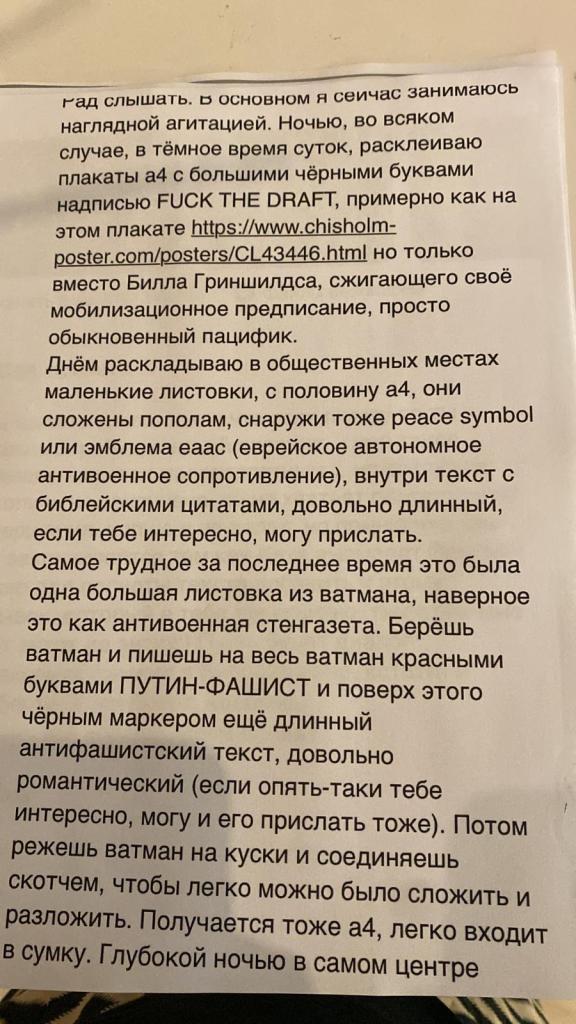
Kushnir’s description of his anti-war leafletting in Kurgan.
“He still believed back then that things could be fixed,” Olga says, sighing. “I know that Pavel protested the war in 2018 by going to pickets against the annexation of Crimea and the war in Donbas. When in May 2018 he went to Pushkin Square [in Moscow] holding a placard that said ‘Down with war, freedom for Russia,’ his homemade sign was torn apart [by police]. After the military invasion, he bitterly observed that nowadays [the police] would tear him apart at such a picket. So, he replaced pickets with leaflets, and leaflets with hunger strikes. They were his form of protest against fascism. He didn’t argue that we should give up picketing, but he understood that it required great courage, ‘because we live in a fascist society,'” Olga quotes her friend as saying.
As Kushnir admitted in his letters to friends, “the turning point and epiphany” for him had been Bucha.
“I think that the Bucha massacre is a disgrace to our motherland. Fascism is the death of our motherland. Putin is a fascist. Our motherland sacrificed millions of the best lives so that fascism would not exist, and we will not accept it. The criminal, despicable war which Putin’s fascism has been waging in our name is a challenge to my conscience, to all my personal hopes, to all the best things in me. I am sure I am not alone. For many people of my generation, accepting the war, ignoring the war, is unthinkable. Two nations are dying in this war. It must be stopped as soon as possible,” Olga quoted him as saying.
In 2022, Kushnir produced anti-war leaflets and posted them around Kurgan.
“At night, he put up large A4-sized leaflets, and during the day he put up small ones with peace symbols and biblical quotes in public places,” says Olga.
“Hunger Striking Is a Peaceful Form of Protest”
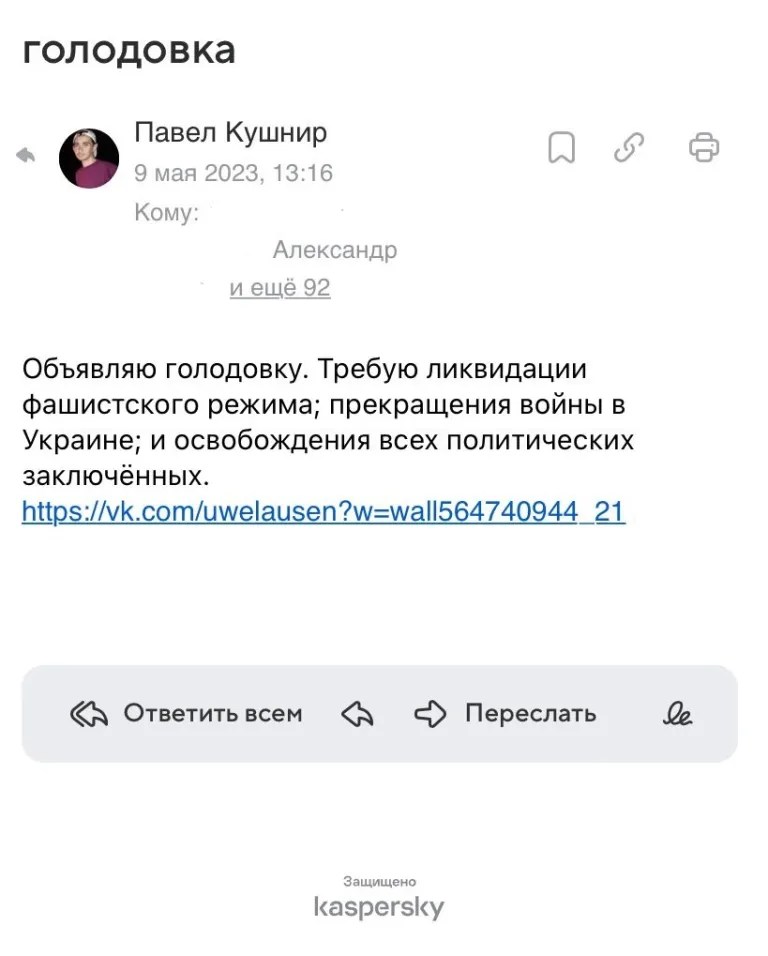
On 9 May 2023, Kushnir declared his first hunger strike, which was to last twenty days.
By his own admission, Kushnir did not expect a positive response from the authorities, but he hoped that other people would embrace his peaceful form of protest.
“I expect people to think hard about their attitude to the war, to end their silence. I expect a miracle,” he wrote.
According to his friends, Kushnir easily tolerated hunger and scheduled his next hunger strike, which was to last one hundred days, in the winter and spring of 2024.
“He went on and off [hunger strikes] absolutely systematically,” says Olga. “In March, when he had finished, he called us to say that everything was fine, that he felt good. He had been drinking water, apple juice, and coffee. As an illustration of his hunger strike, he suggested we imagine a glass of apple juice. So I don’t think he could have died from the hunger strike alone. I don’t believe it. I can’t rule out that they could have beaten him up in the detention center or in some other way they exacerbated his condition.”
In late May 2024, Kushnir was detained by the FSB. A criminal case was launched against him on charges of “publicly calling for terrorist activities” (per Article 205.2 of the Russian Criminal Code). The community Vkontakte page Atypical Birobidzhan was the first to report Kushnir’s arrest, claiming that four videos posted on Kushnir’s YouTube channel had served as grounds for the charges. It also reported that Kushnir was allegedly found in possession of a “homemade FBI agent’s ID.”
The short anti-war video which Pavel Kushnir posted on his “Foreign Agent Mulder” YouTube channel on 5 January 2024
“Pavel had been running the channel ‘Foreign Agent Mulder’ since 2011, and there are only four videos posted there. All of them criticized the war and the policies of the current Russian government. Before Pavel’s death, the channel had exactly five subscribers,” says one of Kushnir’s friends. “Now there are [507] subscribers.”
Many of his friends first learned of Kushnir’s death in late July and only then that he had been behind bars when he died.
“Unfortunately, Pavel’s arrest has come to light only now. I, for example, do a monitoring of court proceedings in the regions quite often, but I missed the news of Pavel’s hearing… I think this was a case when publicity could have saved the prisoner. I learned about Pavel’s death from Arshak Makichan, with whom I was involved in environmental activism; Arshak later left Russia, but he had known Pavel at the conservatory. I think that the intervention of such well-known activists in the case could have prevented Pavel from taking such a desperate step,” says Marina, an activist who corresponds with political prisoners. “Pavel’s cellmates testify that his death resulted from a dry hunger strike, and there is no reason not to trust them. As I understand it, the family is afraid of publicity, as the Moloch of the political crackdowns may strike them as well, so we don’t really know anything yet. But if you watch Pavel’s interviews and listen to his statements, I think it is clear that he was a man of genius, a talented, brilliant, and sensitive man. Unfortunately, such people do not have the ability to stand up to brute, base force, and the only protest that was available in the pretrial detention center was a hunger strike, apparently. Many anti-war activists—Ivan Kudryashov, Maria Ponomarenko, and dozens of others—have gone on hunger strike. When there is no communication with the outside world, no media contacts, alas, this is all that is left to a person. It’s scary to imagine what Pavel went through. The country has yet to realize who we have lost.”
Anna Karetnikova, a human rights activist who for many years aided prisoners as a member of the Moscow Public Monitoring Commission and, later, as a lead analyst in the Federal Penitentiary Service’s Moscow office, argues that the official cause of Kushnir’s death will not be listed as hunger strike, even if that was the cause. According to her, concealment of the real cause of death is a common practice in the Russian penitentiary system, so there are no statistics for hunger strikes in pretrial detention centers and penal colonies.
Pavel Kushnir’s messenger service announcement of a hunger strike, dated 9 May 2023 (celebrated in Russia as WWII Victory Day): “I’m going on a hunger strike. I demand the liquidation of the fascist regime, cessation of the war in Ukraine, and release of all political prisoners.”
“Pavel Kushnir’s death in the Birobidzhan pretrial detention center has been attributed to his hunger strike, a dry hunger strike in which the detainee refuses not only food, but also water. In my experience, cases of hunger strikes in places of detention are frequent and fall into two main categories: those triggered by criminal cases, and those protesting conditions of detention. They can be both for serious reasons, such as gross violations of human rights, and for trifling reasons, such as an investigating officer refusing to bring an inmates cigarettes. They can also be individual and collective. But dry hunger strikes are quite rare, because most detainees realize that it can eirquickly lead to th death,” says Karetnikova. “The law provides for a detainee’s refusal to eat, but it also stipulates what actions wardens should take in such cases. After receiving a written application for a hunger strike, the wardens at a pretrial detention center must notify the person in charge of the criminal case, as well as the supervising prosecutor. In addition, the hunger striker is entitled to a daily checkup by a doctor, during which their temperature, blood pressure, and weight are measured and recorded, and, if possible, to be placed in a separate cell from which all food has been removed. Every day, they will be brought food, which is left on a table, or on the feeder tray if it is open. Also a mentor will come and try to persuade them to give up this waste of time. Information about hunger strikers in each institution is entered daily into the penitentiary service’s overall statistical summary.”
“Forced feeding of detainees is provided for by law. Most often, in agreement with the hunger striker, they are given glucose drips, possibly with something else added to the mix to support them. If their lives are threatened, they can be force fed through a tube.”
“I don’t think hunger strike was listed as the cause of Kushnir’s death, however. I think that only his relatives and friends and cellmates knew that he was on a hunger strike. Even after the publicity, for example, a medic could be punished if he forgot to perform certain formalities— for example, doing a physical examination and taking the inmate’s temperature. He could be reprimanded and, at worst, dismissed. In a similar case, the head doctor of the hospital at the Matrosskaya Tishina prison in Moscow was fired. Of course, no one explained the reasons for his dismissal, and a different cause of death was listed . But the [inmate] had been quite emaciated, and it was feared that the truth could come out. If it had come out, [the doctor] could have been jailed for negligence, for example, or endangerment.
“Force feeding is not practiced as a matter of principle in Russia, because, for example, in order to force feed Alexander Shestun[the ex-head of the Moscow Region’s Serpukhov District (2003–2018) and chair of its Council of Deputies, Shestun was sentenced to fifteen years in a penal colony on charges of fraud and money laundering, but Memorial listed him as a political prisoner] they contacted headquarters a hundred times, since they could not understand what to do and how to do it. But they didn’t get any reasonable instructions from headquarters either, except ‘do something or we’ll punish you,'” Karetnikova says.
According to Karetnikov, the hunger striker loses weight, their vitals deteriorate, and sometimes they are unable to walk.
“There are stomach pains, different organs can fail, and in the long term, people can become confused and sometimes go crazy. Some people engage in self-harm. This is not the case with dry hunger strikers: I usually was able to convince them to give up, in exchange for my promises to do something to help, promises which I tried to keep,” says Karetnikova. “Some detainees starved for months. The longest well-known hunger strikers included Nadiya Savchenko, Alexander Shestun (who was subjected to force feeding), Sergei Krivov, and many other people who were released, but whom I don’t want to identify here. One of the hunger strikers was a stoma patient. One can live without food for about two months, on average. However, many hunger strikers took week-long breaks that enabled them to go without food for months at a time, and they were also put on IVs while on hunger strike. If you give up water too, you can die within a week.”
“He Played for God”
After Kushnir’s death, it was revealed that that he had long foreseen his own arrest, as evidenced in correspondence with his friends.
“He often wrote ‘I haven’t been jailed yet,’ and he sent me interviews where he openly spoke of the current system in Russia as fascist. I tried to persuade him, especially when he was looking for a new place to work a year ago, to come to Germany. I said we would take him in and he would find a job. He agreed but then immediately refused to write a bio, which is what you have to do if you want to play concerts. Those are laws of the music market, what can you do. But he was uncompromising: ‘I am a musician, my music speaks for me,'” Olga recalls. “Then there was the hope that he would be hired in a remote city, as he had decided to stay in Russia. Basically, he strove to be far from the capitals, so that the political pressure would be minimal. For example, he did not want to be forced to perform those selfsame Victory Day concerts.”
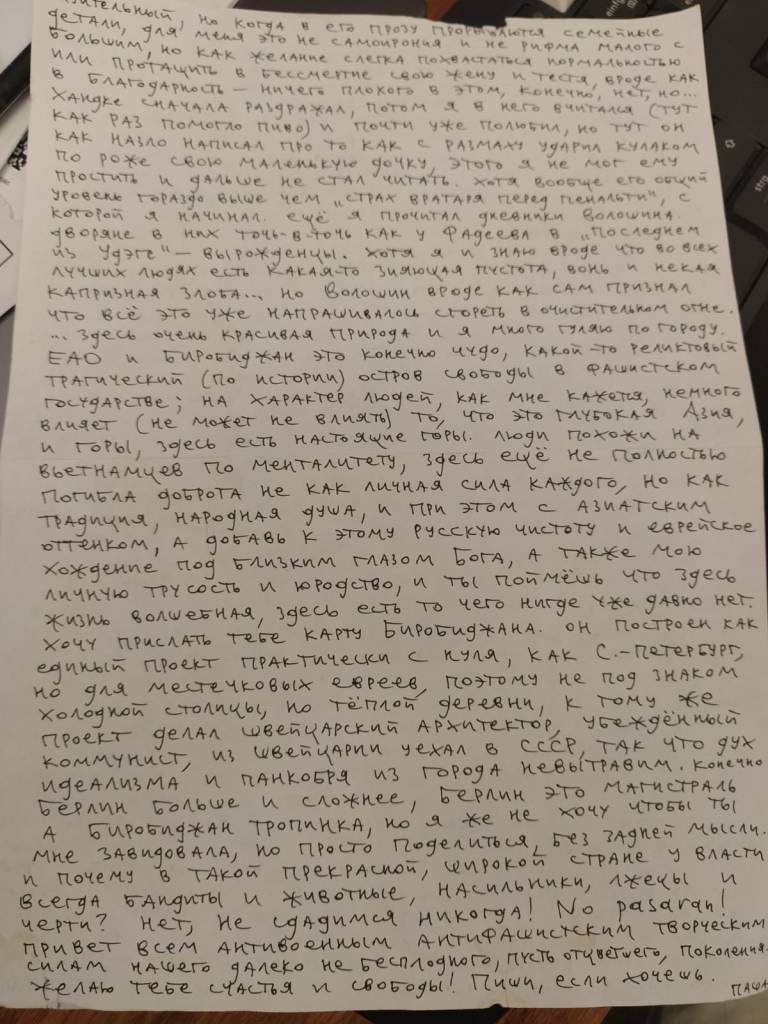
“Maybe I’ll be able to get a job in Russia. Anyway, I had an audition for the Philharmonic, and it seems to have gone well. Anyway, they treated me well, even though I have a ‘no war’ status on my Facebook page… or maybe they just didn’t notice it,” Pavel wrote to Olga at the start of his tenure with the Birobidzhan Philharmonic. “I traveled across the entire country on the Moscow-Vladivostok train, and I looked out the window at the nature, at the people in the parlor car. We have a tragic country, and miserable, predatory people, but so much beauty. We can’t give it to the fascists. Before the audition I ate, so my hunger strike demanding an end to the war was a waste of time. (I had held out for more than twenty days after all.) Probably, a person is free in everything except their own profession. It holds you and doesn’t let you sink, but it also doesn’t let you soar. It’s an anchor of normality.
A letter from Pavel Kushnir to a friend
Kushnir often gave interviews, and the All-Russia State Television and Radio Broadcasting Company even did a story about him. In one of his conversations with journalists, the pianist said that he planned to stay in Birobidzhan: “I had an audition [with another orchestra] but I canceled it. I decided to take a risk to stay and work here for twelve years. If I am not imprisoned, drafted into the army, or fired, I hope I will be with you for the next twelve years.”
“He just wanted to play. Without ingratiating himself to anyone, without making connections, without bending to anyone. Apparently, the ‘plain old’ cities of Russia, unlike Moscow, seemed to him better suited for this. He spoke fondly of Birobidzhan, sent me a map [of the city], and told me that he goes on walks there a lot,” Olga says. “I think he could have been happy there. He could have been happy in any place where you could just say what you think and do what you think. He had a lot of faith in God. He played for God. Maybe now he’s found that place.”
Pavel Kushnir’s concert recordings, even the most amateurish ones, garnered thousands of views, unlike his YouTube channel.
“Pasha Kushnir was in our class,” writes his Moscow Conservatory classmate Julia Wertman.
“We became friends somewhere in the middle of third year, I don’t remember exactly when,” she continues. “We lived in the dormitory, and there was a time when he would often visit my roommate and me for a glass of tea.
“Pasha would recite Brodsky from memory for hours, for days on end. Pasha had a shabby beige overcoat with a bulging pocket. Under the coat he was always dressed in black, and a half-liter bottle of vodka often stuck out of his pocket. (In most cases, it was just there for image. Pasha cultivated the image of a dissident, as if he were Venedikt Yerofeev.)
“Pasha could avoid sleeping, eating, or living, and yet still play absolutely stunningly. There’s an interview with him, linked to in the comments, in which he talks about some genius contemporaries who could prepare for a solo in half an hour under any conditions. As far as I remember, Pasha himself was like that.
“Once, at five in the morning, I went to the dorm kitchen to make breakfast. An incredible scene unfolded before my eyes. Kushnir, as clear-headed as piece of glass, stood at the open window and gazed at Malaya Gruzinskaya Street with a sad, detached look. Before him, a drunken German student with whom he had been living it up way past midnight was crawling on his knees. The German’s speech was so slurred that not even his accent was audible. He was literally sobbing a river of tears.
“‘Brother! Forgive me! Forgive me if you can, for….. Forgive me!’ [he said]. ‘Forgive my grandfather, forgive my great-grandfather, forgive me!!!’
“One Hanukkah, he brought my roommate and me a menorah and candles. I had very little idea at the time what to do with them. I only remember reading on the label: ‘The light of the Hanukkah candles reminds us of G-d’s constant presence in our lives.’
“That was when we nicknamed him ‘Hasid,’ a nickname that stuck.
“‘That’s good,’ Pasha said. ‘Yes, call me that. I think it suits me…’
“Then Hasid showed up at the prom. My favorite person and I were drinking champagne and eating leftover cake. While all the graduates were eating the cake, we danced a waltz somewhere that only we could hear. And G-d knows where Kushnir had been, but he too came have a last piece of cake.
“‘Guys! Be happy! Cheers, guys! [he said]. ‘The main thing now is not to fuck away your diploma!’
“We were only happy for a little while. Hasid went back home to his dad in Tambov, and we went to graduate school. That is, we didn’t fuck away our diplomas. On the contrary, we got PhDs. You basically know what happened after that.
“I tried several times to find the pianist Pavel Kushnir. I found show bills, all of them for concerts in provincial towns. Two years ago, I found out that he was in Birobidzhan. I thought, Well, he’s getting closer to his roots, so maybe he’ll come [to Israel] soon.
“But he didn’t come. Instead, he wound up on on an Israeli news feed, and from there, just now, he came to my attention.
“Was he a rebel? Was he openly calling for some kind of nightmare? I don’t think so.
“He always said what he wanted to say. He didn’t bite his tongue. He wasn’t swayed by stereotypes. He didn’t fit into any system. He lived his own life, thought his own thoughts, and searched his own search. He tried to get to the heart of the matter, like Pasternak. But in all other respects, he was probably more like Vysotsky.
“Hasid, I don’t know what your mother’s name was. Pavel, son of Mikhail, a great pianist, may your memory be blessed.
“And there will be Hanukkah, and there will be light.”
“We will defeat the ogres, and their descendants will ask our forgiveness again.”