The authorities disqualified Sergei Tsukasov in Moscow’s 14th Borough. He won the primaries held there by local activists, collected the necessary number of signatures, and was registered to run as a candidate, apparently because he is not well known to the general public and the mayor’s office did not regard him as dangerous. But after he took part in protest rallies along with the candidates who were barred from running, he was disqualified for the dash he put instead of the phrase “I do not have” in his foreign real estate declaration after a sham candidate filed a complaint against him.
On the other hand, the Moscow City Elections Commission, as if it were having a laugh, recommended putting Sergei Mitrokhin back on the ballot in the 43rd Borough, despite the fact we caught red-handed the factory that had been forging signatures for prospective candidates, including Mitrokhin.
Mikhail Svetov was detained by police right in the Moscow mayor’s office. He had gone there to negotiate (!) a permit for the August 3 protest rally. The crazed crooks in the mayor’s office invited Svetov to the negotiations themselves, and then they helped detain the libertarian themselves, an inconceivable crime against lawfulness anywhere at any time.
Events are unfolding at incredible speed.
Something big is going to happen.
• • • • • • • • • • • • • • •
Screenshot of the tweet that got ex-MP Dmitry Gudkov thirty (!) days in jail: “Facebook killed the link to the meeting with Moscow City Duma candidates this Sunday: over 3,000 people had signed up overnight. I’m confident a missing link cannot prevent us from gathering all the same: 2:00 p.m., July 14, Novopushkinsky Square.”
⚡️Tverskoi District Court sentenced Dmitry Gudkov to thirty (30) days in jail for a tweet about the July 14 meet-the-candidates protest event. He was again convicted (under Article 20.2.8 of the Administrative Offenses Code) as the organizer of an “unauthorized” event.
The court dismissed all motions made by Pravozashchita Otkrytki lawyer Oksana Oparenko. She petitioned the court to let her question the police officer who examined Gudkov’s Twitter page and watch the video, shot at campaign headquarters, confirming Gudkov was not at the rally himself.
According to OVD Info, as of 9:00 p.m. Moscow Time today, July 27, 2019, 938 people had been detained in Moscow for taking part in an “unauthorized” grassroots protest against the disqualification of independent candidates who had registered to stand in the September 8, 2019, election to the Moscow City Duma.
Alexander Beglov was appointed the acting governor of Petersburg or vrio (to coin the acronym for such officials who “temporarily carry out the duties” of one office or another) on October 3, 2018.
His appointment immediately sparked speculation the Kremlin had put him in charge of Putin’s hometown not only temporarily but also so he could run for the post “legitimately” in the upcoming gubernatorial election, scheduled for September 8, 2019.
As luck would have it, the seven-year reign of his predecessor, the dull but mostly inoffensive Georgy Poltavchenko, was blessed by relatively snowless winters.
Petersburg, however, is the northernmost major city in the world and, unsurprisingly, it sometimes snows a lot there in the winter. The “anomalous winter” of 2010–11, during which the local authorities could not get a handle on cleaning relatively heavy snowfalls from streets, pavements, and roofs, spurring wild popular discontent, famously led to the dismissal of then-Governor Valentina Matviyenko and her replacement by the quieter Poltavchenko.
Like all members of Putin’s clique of made men and women, Matviyenko was not punished for her failures. Instead, she was “upmoted” (my term) to the much cushier post of speaker of the Federation Council. There she has been instrumental, I suspect, in persuading the press and the public she presides over a “senate,” peopled by “senators,” not a rubber-stamp entity filled with repellent losers too big to fail who have been rewarded generous sinecures in exchange for total loyalty.
In any case, today’s would-be Russian “senate” is a far cry from the feisty and, at times, mildly separatist Federation Council of the nineties, whose members would never have been so obnoxious as to style themselves “senators” and then get everyone else to go along with this sycophantic malarkey, including opposition activists, reporters, and academics who should know better.
The winter of 2018–19 was another “anomaly,” apparently, and vrio (interim governor) Beglov made it even worse by behaving even more brazenly and clumsily than Matviyenko had done during her own “snow apocalypse.”
You would think the Kremlin would not be so provocative as to shove Beglov, who looks remarkably like Mel Brooks in his salad days, playing the “villain” in one of his hilarious film parodies, down the throats of Petersburgers on Election Day 2019, but that is the plan. All the stops have been pulled out, including a total purge of opposition candidates attempting to run for seats on the city’s district municipal councils, although these underfunded, powerless bodies that have zero say over the Smolny, Petersburg’s city hall, where Beglov and his team call the shots.
The Kremlin is willing to make Beglov the city’s “legitimate” governor over everyone’s dead bodies, as it were, alienating even more otherwise apolitical Petersburgers from the regime.
Finally and, perhaps, apropos of nothing, has anyone ever remarked on the fact that both Beglov and Poltavchenko were born in Baku in the mid-1950s? Does it snow there in the winter?
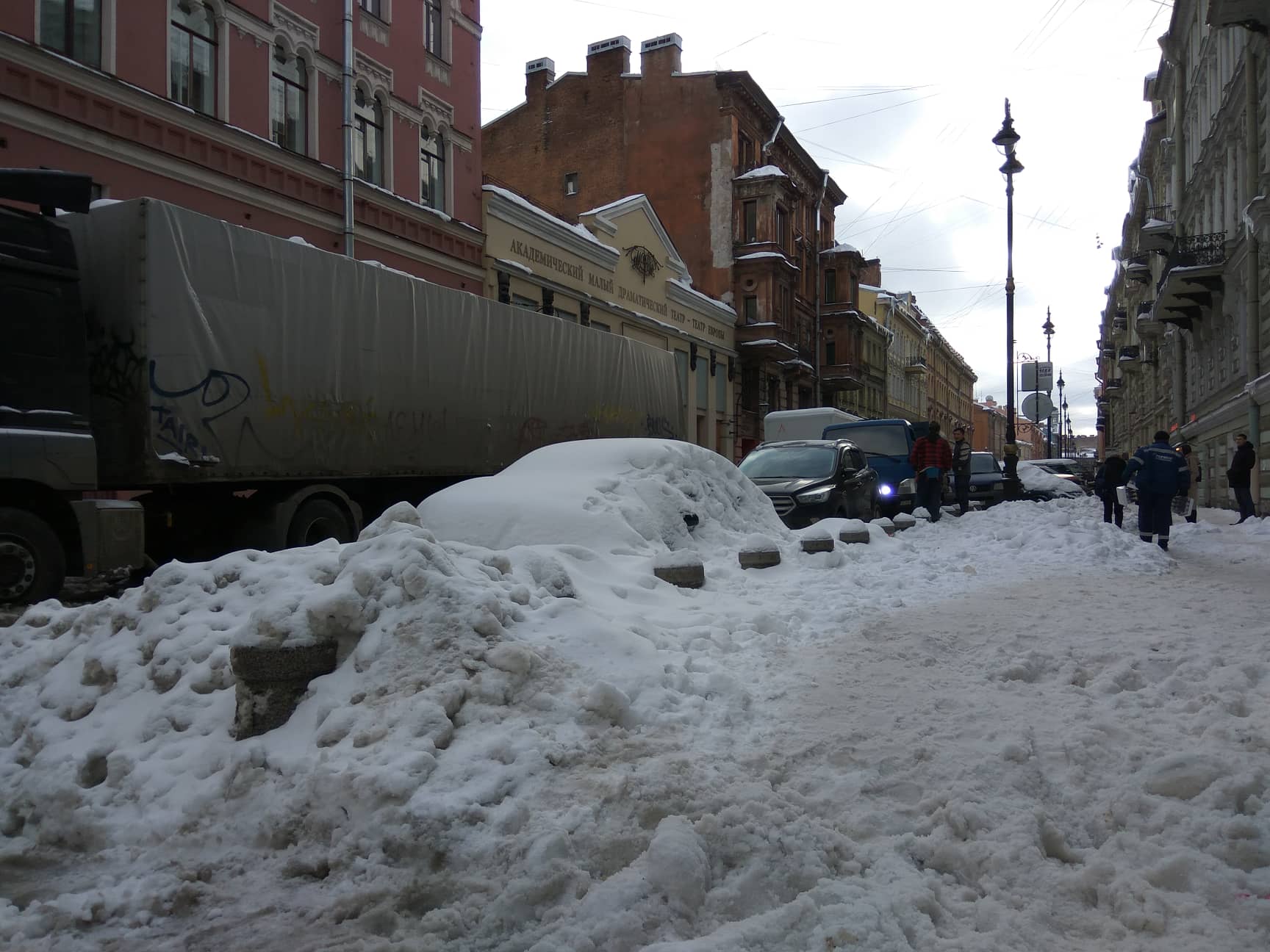
The picture, above, was taken by Kseniya Brailovskaya in downtown Petersburg during the height of the municipal collapse this past winter. As another heat wave envelopes Europe, you will probably see more of these snapshots in the coming days, especially since I have a post or two in the works about the flagrant purges of opposition candidates in Petersburg. They have mirrored similar purges in Moscow, but without sparking spontaneous unrest of the weekend before last or the heavily attended protest rally that took place in the capital on Saturday. {TRR}
A friendly meeting between the heads of over twenty Petersburg media outlets and acting Governor Alexander Beglov took place in the Smolny. The meeting was cast as a campaign event at which heated discussions were not welcome.
During the first hour, Beglov cheerfully talked about all the problems he had solved. He said his priority has been to combat depression among Petersburgers. Beglov thanked, in all seriousness, the opposition for keeping him on his toes and informing him about hotspots.
Then followed several questions from the attendees. The most pointed question was, “How can we help you?” or something like that. Despite being a candidate in the gubernatorial race, Beglov was not taken aback by this offer and spent another hour outlining his plans for the near term.
The only question that knocked the vrio off his high horse had to do with the scandals surrounding the elections to the municipal district councils. Beglov said he could not intervene since he himself was a candidate.
As the meeting drew to a close, the heads of the city’s media outlets asked whether Beglov would be willing to meet with reporters in a similar format in the future. Beglov said he would definitely talk with everyone but only after September 8.
“22 versts to Tsarskoye Selo. 673 versts to Moscow.” An 18th-century milepost in Petersburg. Photo by the Russian Reader
Moscow Trumps Russia: How Urban Renewal Has Thrown Society Backwards Combating Russia’s “Maidan” Has Shaped the Moscow Style of Governance
Maxim Trudolyubov Republic
November 29, 2018
The events of 2011–2014—protests against rigged elections in Russia, revolutions and civil wars in the Arab world, and the EuroMaidan in Kyiv—have had a profound effect on the discussion of what constitutes desirable social change, politicizing the debate. Society and state in Russia have each reached their own conclusions.
The attitude to the steps needed to change state and society for the better has taken different shapes in the grassroots and within the elite. The grassroots have been disillusioned and disenchanted, while the elite has identified a threat. The liberal community’s heightened interest in institutional reforms in Georgia in the noughties and the prospects for similar reforms in post-revolutionary Ukraine in the aftermath of 2014 has turned the Kremlin’s attitude towards them from mistrust to outright rejection.
Talk about how make the state work for society rather than for the elite, about what a state that would be focused on ordinary citizens might be like, quietly came to naught, yielding to talk of Russian political spinning techniques, China’s big data state, urbanism, and comfortable urban environments. In other words, the talk turned to the tools the state had at its disposal rather than to the meaningful questions asked by the general public.
Sidelining Institutions
Russia is still a place where the rules for elections change from one election to the next, laws are written as if they were political lampoons, the conditions of doing business are as unpredictable as the weather, and no one can quickly tell you what the right of private property means. You cannot say the right does not exist, but nor can you say it does exist. In 2018, the Kremlin is even personally involved in permitting and banning pop music concerts.
It is hard to say how the Kremlin measures stability in Russia, but apparently it believes the level of stability is still high. Nearly all the regional elections went as planned. Putin’s approval rating is still above fifty percent. The oligarchs are obedient. Everything is cool. But stability of the rule of law, and the rules of the game generally, are much more important in the long run than approval ratings and managed elections. As it has pursued official so-called stability, the Kremlin has in recent years continued its demolition of institutions and the rules of the game, the things that make long-term relations in society possible, meaning that the Kremlin has tried to score short-term victories by sacrificing a stable, certain future.
Stable institutions, such as protection of property rights, enforceability of contracts, and the rules of the game, would seemingly benefit the Russian elite itself. The Kremlin publicly calls for the repatriation of Russian capital, but it is hard to believe in its sincerty. How can money be repatriated when the rulers themselves (who also often double as capitalist moguls) are always busy redrafting the laws and regulations? It is simply impossible to make plans under this regime, and this applies to the people running the regime.
Fortifying the regime in the face of a possible homegrown “Maidan” has, in fact, sidelined and archaized institutions. This is not entirely accurate, however. Simply holding identical “elections” and tightening the screws would be too negative a program. Moscow also has a positive program. It does not involve internal structural transformations, but the top-down imposition of a new “civilizational” lifestyle. In reality, this new lifestyle is rife with restrictions on movement, freedom of speech, and even freedom of music. The city of Moscow is a successful example of the new approach, which is simultaneously an old approach because it is a traditional Muscovite approach.
The Politics of Municipal Improvement
In Moscow, municipal improvement is a rejoinder in the debate about institutional change. By repairing roads, constructing a new transit system, and achieving significant improvements in municipal beautification projects and the provision of amenities, which are often regarded positively by their users, the inhabitants of Moscow, the city has ultimately been tackling several problems at the same time. On the one hand, it tackled economic problems by employing Moscow’s huge construction sector at a time when the market was saturated and property values (a considerable source of the Russian elite’s wealth) threatened to collapse. It tackled political problems: the regime had to be strengthened. Recalling its experiment with the 2013 mayoral election, Moscow rejected even competition for show when the 2018 mayoral election rolled around. Candidates who could compete with Mayor Sergei Sobyanin in terms of media interest, if not in political terms, were kept off the ballot.
The city also tackled civic problems. Moscow has built new public spaces, whose architecture and landscaping encourages people to spend more time outside and in each other’s company. Meanwhile, the federal government has passed laws and regulations that have restricted the ways these beautiful spaces can be used by the public. It was once enough to notify the authorities of a protest rally, but now they must issue permits for such events. The powers of law enforcement agencies have been beefed up. Consequently, using these public spaces for their intended purpose, as venues for spontaneous discussions of politics and life, has been rendered nearly impossible. Whether this was the plan or not, the upshot has been that one arm of the state has emancipated and complicated public space while another arm of the state has restricted people’s ability to move freely around in public space, thus institutionally archaizing public life.
Zaryadye Park in Moscow, opened in 2017. Photo courtesy of Wikimedia Commons
Most people get their information about Moscow from the municipal government. One has to look long and hard for independent perspectives. Moscow city hall has the Active Citizen social network and numerous local news media outlets in its pocket, which mirror each other, generating a constant atmosphere of approval. The Moscow press operates like the laugh track on TV sitcoms. Viewers realize it is a sound effect, but they laugh and applaud anyway. While urban renewal proceeds apace, the news media are impoverished.
Muscovites enjoy high-quality municipal services. Sometimes, the services are of such a high quality that they anticipate people’s needs, demonstrating city hall’s technocratic sophistication. Muscovites, who used to be dissatisfied subjects, have been transformed into happy clients while bypassing the stage of citizenship and grassroots civic involvement. The effect is the same. Urban renewal simplifies and archaizes civic behavior.
Moscow’s urban renewal program was meant not only to improve municipal services and show foreign tourists the beauty of the Russian capital but also to supply an alternative to grassroots activism aimed at the changing the rules of the game. The idea was to prove everything could also be done from the top down, and everyone would be happy. New public spaces could be fashioned, but so too could new laws that would make certain uses of them illegal, and everyone would be happy. While pursuing a program of urban renewal, you could also produce a rigidly authoritarian political regime, and everyone would be happy.
The conversation about social transformation in Russia has been conducted not only with word but also with physical actions as incarnated in bricks, stones, and tiles. Moscow’s parks, streets, and squares have been used as venues for modernizing urban space while strengthening the authoritarian civic order.
Two Poles: Moscow and the Maritime Territory
Providing friendly, efficient services and amenities for the people of Moscow is a considerable, genuine achievement, but it establishes a clear decision-making hierarchy in which ordinary people occupy the bottom rungs. Now the city has been giving them gifts that would be stupid and practically impossible to refuse, but later people will have to swallow something less desirable than wide sidewalks and convenient bus service.
Moscow has made a point of the putting social rights of its residents above their individual rights. The beautification of the city and the housing renovation program (i.e., the wholesale demolition of five-storey Soviet blocks of flats and the construction of new residential buildings) have proven that individual property rights are insignificant. The vast majority (around ninety percent) of the residents of the old five-storey houses predictably and understandably decided to exercise their right to more modern living space rather than their right to private property. The proprietors of the kiosks and shopping pavilions, demolished by the Sobyanin administration, tried to defend their rights in different ways. They challenged the city’s demolition order in the courts. They agreed to demolish their pavilions themselves in exchange for minimal compensation. They filed complaints with the European Court of Human Rights. Moscow, however, fully implemented its plan to rid its streets of the ugly, “uncivilized” shops on schedule.
Sobyanin’s Moscow is the Kremlin’s most successful political project, and it would be odd not to try and transfer this know-how to the whole of Russia. The Comfortable Urban Environment program is already underway. Federal authorities have allocated 85 billion rubles [approx. $1.3 billion] over three years (less than was spent on Moscow alone), and the regions have to match these funds.
But these efforts will be mere window dressing if each of the regional capitals fails to turn itself into “Moscow” in the civic sense, into a city of satisfied consumers who never think hard about where their “comfortable environment” comes from, a place where the trains run on time, but the lives and property of its people are administered by officials guided by constantly changing rules, rules only they know.
From the Kremlin’s perspective, it would be ideal to turn every major Russian city into a “Moscow.” But how do you reproduce Moscow? Moscow attracts over half the total flow of migration within Russia. Moscow is a region that grows due to an overabundance of people, resources, and tax revenues. Obviously, officials are betting on the fact that the capital of each economic macro-region will become a miniature Moscow, i.e., it will transform the dissatisfied residents of the outlands into satisfied users of what the new, improved capitals will have to offer. This, by the way, wholly jibes with Alexei Kudrin’s idea that Russia should focus on developing twenty urban agglomerations, and with the notion that there are millions of “superfluous” people scattered around the country.
This plan for concentrating Russia’s population in particular metropolitan areas, implemented naturally and spurred by the authorities, could be described as the desire to replace Russia with Moscow, meaning with a certain number of cities that reprise Moscow’s civic functions and could superficially come to resemble Moscow as well. The city halls of the selected major cities renovate their public spaces while the federal authorities draft laws on how to use these spaces in a civilized way.
The question of the plan’s effectiveness boils down to the independence and individual “modernization” of Russians. Everyone has their own individual, professional, and social benchmarks, just as they have their own means of communication. Moscow can continue seeing itself as the sole source of enlightenment and progress, but Russia is home to many economically and civically dynamic people capable of thinking for themselves.
A recent reminder of this has been the unwillingness of people in the Maritime Territory, Khabarovsk Territory, and other regions to behave at the polls according to the schemes imposed by Moscow. The Maritime Territory, where the rigged elections model will be tested again, symbolizes a different political realm, a place that is not Moscow, an independent region with a propensity for grassroots economic activity. On one pole is Moscow with its civilizational approach to the rest of the country; on the other is the country itself, with its own spontaneous rules. Top-down Moscow-style modernization still has competitors nowadays.
Maxim Trudolyubov is a columnist for Vedomosti and The New York Times International Edition and an editor at InLiberty. Translated by the Russian Reader
If we regard all these topsy-turvy achievements as the outcomes of stupidity, the hope emerges that we can fix the stupidity by purging the ranks of officialdom, which is exactly what the Kremlin, in fact, sunk its teeth into today. Actually, what we regard as failure and stupidity have long become the new normal. What we see are the outcomes of a monopoly on political power, which has turned its own replication into an end in itself, and of a negative selection of members of the political elite based on the loyalty principle. In short, a duelist in charge of the Russian National Guard, and poisoners disguised as tourists are the new Russian normal. They are logical and inevitable consequences.
The wailing about a crisis at the top is, therefore, groundless. Russia skipped over the crisis stage. A crisis is a natural turn of events that compels society to look for new solutions and new people to implement them. When this does not happen, society and its superstructures rot. This stinky viscous goo is our current location. Decay prevents collapse: what is rotting cannot collapse. But decay also prevents our country from finding the strength to change.
The ruling class can seemingly take it easy, for the system somehow hobbles along. There are no large-scale protests, and the protests that do occur can either be ignored or quashed, especially since the National Guard has special new crowd-control armored vehicles at its disposal like the Shield, the Storm, the Wall, and so on.
In reality, things have taken a serious turn for Russia. By seeking to ensure its endlessness, the regime has been destroying the Russian state. That is a whole other ballgame. We have reached the point at which the ruling class has been rocking the pillars of statehood, destroying its own guarantee of survival in the bargain.
By outsourcing violence to volunteer oprichniki, the regime has deprived the state of one of its vital attributes: a monopoly on violence. By making Russia a global scarecrow, the regime has undermined the country’s international status and the external habitat in which it dwells. By rejecting strategic planning in favor of tactical maneuvers, the regime has stripped the country of the capacity for progress. By making the Russian state a tool of clan domination, the regime has destabilized the country, since society has been forced to defend its own interests by protesting on the streets.
Finally, by destroying institutions and making the rules of the game relative (there is more than one way to “get things done: in Russia), the regime has plunged the country into a state of lawlessness. When lawlessness ensues, no one is safe from it.
Do the guys in the Kremlin not realize how things will end? Apparently, they do understand, but they are incapable of stopping.
The autocracy survived in 1991 by scrapping the Soviet state. The autocracy has now been trying to survive by turning the post-Soviet Russian state into a lip-synched song about superpowerdom.
Lilia Shevtsova is a well-known Russian political scientist. Translated by the Russian Reader
Until we fail to put a halt to abortions, which, fortunately, annually do away with enough people to populate the city the size of Petersburg, there is no point in discussing or contemplating anything serious.
No wonder the stage of (para)political theater has recently been occupied by such figures: aborted embryos telling us they could have been soldiers, for example, and dead women and men, who worked to the grave, but did not live to see a single kopeck of their pensions.
Bringing together the dead and the unborn was long overdue. This is just what we have done in our protest. We are MONSTERS, a new group of militants in the field of political art in Petersburg.
The other day, I closed my Facebook accounts and pages, I hope for good.
Part of the reason I closed them was that a New York City writer whose books and opinions I admire greatly, and who has a huge following on Facebook, wrote a mean-spirited and divisive post on Facebook condemning “the Heartland,” meaning the middle part of the United States.
While the map she cited is certainly worth studying and full of surprises, I imagine the writer saw only red, literally and figuratively, and blew a fuse.
I doubted out loud, in the comments, whether the writer knew much about the “heartless, dangerous” Heartland. On the contrary, I know a great deal about it, since I was born and grew up there.
She did not respond to my petty, eminently ignorable objections nor did most of her thousands of self-satisfied, bien-pensant followers, certain that the “heartless, dangerous” (and completely imaginary) “Heartland” had irrevocably damaged their beautiful souls and beautiful lives in Clintonia.
But as reporter Issie Lapowsky and map expert Ken Field argue in an article published on July 26 by WIRED (“Is the US Leaning Red or Blue? It All Depends on Your Map”), there are maps, and then there are maps. For example, there is this map, devised by Mr. Field.
Ken Field, “Presidential election 2016: dasymetric dot density.” Courtesy of WIRED
Why do I bring this sad business up on a website dealing with “news and views from the other Russias”?
Over the last several years, I have been fighting a similarly invidious myth about Russia and Russians. To wit, Vladimir Putin is incredibly popular, as conclusively shown, allegedly, by dicey “public opinion polls” and rigged elections, and his “base” is in the “Russian heartlands,” which are, apparently, just as “heartless” and “dangerous” and stupid as the US “Heartland,” and similarly prone to throw their electoral weight behind a tyrant, unlike, we are meant to imagine, the smart sets in Russia’s two capitals, Moscow and Petersburg.
I have been at great pains to show a discursive apparatus I have dubbed the “pollocracy” produces the results that both Putin’s quasi-fascist supporters and faux-liberal detractors need to cling to their respective security blankets. In the case of the so-called liberals, the security blanket consists in the notion that the world’s largest country is largely inhabited by woefully ignorant yahoos who have laid waste to any chance at building a democracy in the Motherland. As viewed by their opponents, the fake “patriots” in Putin’s camp, the same heartland yahoos are the country’s “pious,” “conservative” core and the source of the Putin’s ruling elite’s self-produced mandate to rule the country till kingdom come and particularly badly.
Seventy percent of why I do this website is to show that Russia actually consists of lots of other Russians and lots of other Russias that belie the dodgy “findings” of pollsters and the lazy clichés reproduced ad nauseam by Russian and international reporters, “Russia experts” (nearly all of them resident somewhere other than Russia), politicos, and spin doctors to prove a self-serving conclusion they arrived at long ago without bothering to find out whether it was true or not.
It’s not true. Just as it is emphatically not true the US “Heartland” is “heartless” and “dangerous.” Or maybe it and its mythical Russian counterpart, the “Russian heartlands,” are heartless and dangerous part of the time, but not all of the time and everywhere and on the part of every single woman, child, man, dog, and cat who live there. Nor, vice versa, are the alleged oases of high intellect and liberalism where pollsters, reporters, and opinion leaders (such as the well-known New York writer who, railing and trembling like the Prophet Jeremiah, condemned the place where I was born and grew up to the fires of hell) congregate, cities like New York, Los Angeles, Moscow, and Petersburg, utterly free of meanness, menace, vice, crime, bad governance, popular indifference, ignorance, and support for tyrants.
What does this have to do with abandoning Facebook? First, I spent an inordinate amount of time trying to produce a quasi blog there that would complement and promote this website. Since I am nobody, however, more or less nobody was interested in what I wrote.
They did, however, hang on every word written by people like the New York writer, who, having achieved a modicum of fame, felt no compunction about compounding a rank prejudice about a huge part of her own country and all the people who live there.
So, I have found Facebook an incredibly dispiriting place to try get out my word, a word very few of my so-called friends, real and virtual, wanted to hear, much more wanted to share and spread with their own friends.
Second, the continuing crackdown on bloggers and social media users in Russia has meant that fewer and fewer Russians are willing to write anything interesting on Facebook and its Russian ripoff, VK. Judging by my own real friends, more and more of them have either been observing total radio silence or retreating into the little cubbyholes known as Telegram channels, where they are invisible and inaudible to all the world except their own clique. Since one important feature on this website has been translations of the pithy, thought-provoking things Russian activists and just plain Russians have posted publicly on Facebook and other social media, I was left staring at a once-overflowing well going drier by the minute.
Third, WordPress gives its bloggers some crude but decent tools to see where their readers are finding out about their blogs and blog posts. Over the last two years, as my readership here as continued to climb, the share of those readers who were turned onto my website or particular posts through Facebook has shrunk, meaning that my own friends, real and virtual, have been less likely to share my posts with their friends than complete strangers have been to look up Russia-related topics on the internet and find their way here.
So, rather than continue to pine for support from actually hostile liberal and leftist opinion leaders whose only interest in my Facebook posts and blog posts was to scavenge them for news and ideas they would instantly pass off as their own thoughts and finds without crediting me, I have decided to live without them in order to more fully embrace you, my anonymous, ever more numerous, faithful readers.
In any case, this website will continue to be promoted on Twitter, Google+, Tumblr, and Ello, as before, so it is not as if I am doing a disappearing act. I just wanted to stop pretending I had friends in places where I did not have them. {TRR}
Putin is not genuinely popular. As in other pseudo-populist dictatorships and autocracies, the alleged popularity of Russia’s president for life is the product of a thoroughgoing war against all dissenters, dissidents, and free thinkers, and an ever-evolving personality cult, produced by carpet bombing the populace with TV, radio, social media, and print propaganda twenty-four hours a day seven days a week.
Nor is there any empirical evidence that “young educated Russians” are more critical of Putin than cranky old ladies in Petrozavodsk and Perm. My educated guess would be that, in fact, the opposite is true.
Finally, it is sheer insanity to argue that Putin’s departure is not an “inherently desirable outcome.” Every day Putin is in power is a decisive step backwards in the country’s political and social progress.
Not even the most milquetoast progressive reforms have been possible while Putin and his clique have been in power (i.e., the last eighteen years), and there is every sign that, during his next term, things will go from very bad to incomparably worse.
By the way, why is the writer so certain “Putin will eventually leave power”? If he means Putin is a mere mortal, like the rest of us, and will die sooner or later, this is a factually correct but politically vacuous claim. If the writer means Putin is planning to leave office in the foreseeable future, he must have psychic gifts that most of us do not have. There is no evidence whatsoever Putin is planning to go anywhere in the next twenty years.
But it is easy to engage in free verse exercises like this one when you live and work in Brooklyn. You just make up the facts as you go along, because you will never have to face the consequences of your irresponsible, shambolic analysis.
2. Blame the US government for everything that has gone sour or wrong in Russia, the world’s largest country, a land blessed with natural resources and human resources beyond measure, and thus certainly capable of making its own fortunes and forging its own destiny, which nothing whatsoever prevents from being democratic and progressive except the current regime and its mostly pliable satraps and timeservers. “Genuine popular support” for Putin would vanish in a second if his regime were ever challenged by a strong, broad-based, grassroots democratic movement determined to remove him from office and steer the country towards a different path.
What real evidence is there that civil society groups in Russia serve as “fronts for US intelligence”?
None.
Who has actually been working day and night to generate this “perception”?
The Putin regime and its media propaganda outlets.
Why has “Russia” become “increasingly hostile to such groups”?
Because the Kremlin perceives them as direct threats to its authoritarian rule. It has thus declared them “enemies,” “national traitors,” “foreign agents,” and “undesirables,” and gone to war against them. This blog has published numerous articles detailing this “cold civil war” between Moscow and Russian civil society.
What evidence is there that any US administration has “[tried] to bring Putin down”?
There is no such evidence.
What Russian opposition figures have US administrations “directly supported”?
None.
Aren’t civil society groups “private” by definition?
Yes.
Was Obama’s so-called reset the only or even the primary reason that tensions between the US and Russia increased?
No. Even before Putin went ballistic, invading Crimea, Eastern Ukraine, and Syria, shooting down passenger planes (e.g., Flight MH17) and gunning down opposition leaders right outside the Kremlin (i.e., Boris Nemtsov), his minions were harassing the then-US ambassador to Moscow, Michael McFaul, the co-author of the miserable “reset,” whose purpose was to decrease tensions with Russia, not stoke them. There was no chance of this happening, however, when the Kremlin had long ago made rabid anti-Americanism the centerpiece of its public foreign policy.
Why do I call it “public” foreign policy? Because nearly everyone in the Russian ruling elite has made numerous junkets and trips to the US and other western countries over the years and has lots of personal and business connections to their boon enemies. They have extensive real estate holdings in the west. They educate their children in the west. They park their ill-gotten lucre in the west. In some cases, their families live in the west permanently, while they shuttle between the west and Moscow like some less fortunate people commute between Gary, Indiana, and Chicago.
The Russian elite’s anti-Americanism and anti-westernism, therefore, is a put-on, a hypocritical pose mostly meant for public consumption.
Has the Putin regime done Russian civil society “any favors”?
No, it has done its utmost best to destroy independent Russian civil society and co-opt the remnants it has not killed off. If you want some of the particulars, read what I’ve been posting on this blog for the last six years and, before that, on Chtodelat News, for five years.
Why did the guy who wrote the passage quoted above write what he did?
It is hard to say. The article is a very clever whitewash job for the Putin regime, all of whose high crimes and misdemeanors against the Russian Constitution and the Russian people are passed off as understandable reactions to the alleged predations of the US government against the Putin regime.
Where was this article published?
In The Nation, of course. Who else would print such crypto-Putininst tripe with a straight face?
Why all the needless hyphens, e.g. “civil-society groups,” “human-rights abuse”?
Sheer snobbery, meant to intimate to the magazine’s hapless readers they are dealing with real smart cookies, not tiresome neo-Stalinist windbags.
3. Publish wholly misleading articles about Russia, like the one quoted above. If you cannot manage that (because your readership would notice), publish wholly misleading headlines. They are even more effective than longwinded articles in The Nation, a pro-Putin magazine no one in their right mind has read in the last ten years or so.
People scan headlines, however. It is much easier than reading the fine print.
This is exactly the headline Russian Foreign Minister Sergei Lavrov would want to appear in the Moscow Times, because it places the onus for his government action’s and his own actions on the US government.
How could visa services not be drastically reduced if the Russian Foreign Ministry closed the US consulate in Petersburg and gutted the staff at the US embassy in Moscow once again?
But let us by all means imply, because this IS the message the Putinist tyranny wants its own people to hear, that the US did everything on its own as a way of punishing ordinary Russians. Sadly, a fair number of Russians will believe this.
4. Join a so-called leftist group in the west. Most of them behave as if the Comintern still existed and they were taking their orders from the Kremlin.
Most western so-called leftists these days are boring, uneducated morons. The most boring thing about them is their unshakeable reverence for the Soviet Union, a country about which they do not have the slightest clue, and for its woebegone “successor,” the Russian Federation, which has literally nothing in common with the long-dead Soviet Union.
The really hilarious thing is that most of them manage to maintain these cultish attitudes without ever having set foot in either country and without speaking a word of Russian. Star Wars fans have a more down-to-earth and coherent ideology than the post-Stalinists who pop up to crush you with their Anand Sheela-like rhetorical flourishes (i.e., truckloads of vehement slander and furious personal insults) if you so much as mention as their imaginary Motherland in a slightly untoward light.
I want to live long enough to see the influence of these dead-enders on progressive, anti-capitalist, anti-imperialist politics die off altogether. That would make me really happy, if not genuinely popular, like Vladimir Putin. ||| TRR
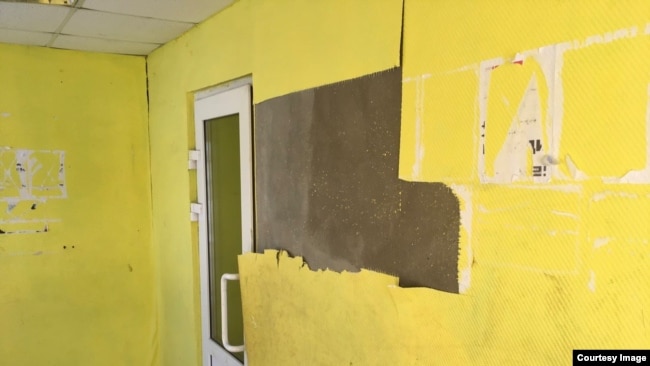
All that is left of the anti-Putin leaflets posted by Nikolai Korshunov
“We Are Racing into a Huge Pit”: The Businessman Who Spoke Out against Putin
Аlexander Valiyev Radio Svoboda
26 February 2018
In the town of Verkhny Ufaley, Chelyabinsk Region, police have torn down posters cataloguing the “brilliant” outcome of Putin’s reign from the outside walls of several shops. The posters were hung there by a local businessman, who has already had occasion to fight the authorities in this way.
Nikolai Korshunov owns six small shop in this company town 120 kilometers from Chelyabinsk. Police paid visits to Korshunov’s shops on the eve of Fatherland Defenders Day, February 23. The businessman told Radio Svoboda what happened.
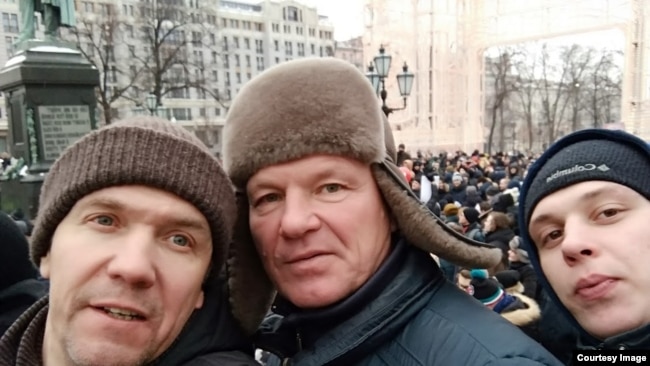
Nikolai Korshunov (middle) with his son and another relative at the Voters Strike, Moscow, January 28, 2018. Photo courtesy of Nikolai Korshunov and Radio Svoboda
Nikolai Korshunov: I am very active civically. I always serve as an elections monitor during elections. I own six small shops. We sell the basics: bread, milk, etc. The stores are my venue for voicing my opinion about current events. This takes the shape of handmade posters, information leaflets.
My argument is that, since the stores are my property, I have the right to post any information whatsoever in them. The Constitution gives me that right. But I have run into opposition from law enforcement and the city hall in our town. It also happened before the 2016 Duma elections, in which Verkhny Ufaley famously voted only four of the twenty United Russia candidates into the local parliament. People read my posters very carefully. Naturally, they regard anything that is not propaganda as out of the ordinary. It is interesting because if they, say, live in one part of town and the neighborhood dairy plant has shut down, they still remember that, but if, say, a timber plant or infant feeding center has ben closed on the other side of town, they might not have heard about it at all, because it does not affect them. But when they read the entire list, they think to themselves, “What a lot of things have happened in our town over this time.” Even since the 2016 Duma elections there have been colossal changes for the worse in Verkhny Ufaley: total poverty, unemployment, and hopelessness.
An excerpt from one of Korshunov’s information leaflets. It lists by name the Verkhny Ufaley plants, companies, businesses, and services that have closed during Putin’s eighteen-year reign. Photo courtesy of Nikolai Korshunov and Radio Svoboda
Radio Svoboda: What was on the the posters?
I have lived in Verkhny Ufaley for a very long time. I was born and raised here. In the run-up to the presidential election I decided to make a list of things that have changed in our town during the eighteen years of Putin’s administration. What businesses and factories have closed? The town’s main employer, the Ufaley Nickel Plant closed [in December 2017]. The Metalworker Factory closed. The open hearth and wheel spring shops closed. Then all hell broke loose: the sausage plant, the dairy, the furniture factory, etc., closed. There are thirty-four items on the list, including the children’s hospital and the railroad’s inpatient clinic. Then there are the plants that are barely hanging on. I wrote about them, too, for example, the metallurgical plant where five thousand people once worked. Now it employs a maximum of five hundred to seven hundred people.
Do you think people have suddenly forgotten about what has been happening in town?
Of course they know, but it is just another reminder, a way of saying, Hey, guys, you say that Vladimir Putin has raised the country from its knees, but I don’t think that is the case. I think we are racing into a huge pit at enormous speed. I cannot answer for the entire country, but as a resident of a small industrial town, I see what has been shut down, what has been destroyed, what has been dismantled, what has been pilfered. When you go and vote, people, think a bit before making your choice.
The continuation of Korshunov’s list. Photo courtesy of Nikolai Korshunov and Radio Svoboda
How many votes do you think Putin will pick up in Verkhny Ufaley?
He will win for one simple reason. Our town is small: everyone knows everything about everyone else, and everyone tells everyone else about everything. I will give you an example. At the employment office—our town has terrible unemployment, by the way, because everything has shut down—the boss gathers his underlings and says, “God forbid you don’t go and vote. If you don’t, I won’t pay you bonuses.” This is more or less what goes throughout state sector. So a huge number of people, maybe even dissenters, will naturally go out and vote in order to keep their miserable jobs at places like the employment office. No one will buck against the bosses. So, Putin will definitely win. Because he has the administrative resource behind him, and huge numbers of people are incapable of thinking.
The administrative resource can compel people to turn out for an election, but people go into the voting booths alone.
They have their tricks. They can ask people to photograph their filled-out ballot paper on their telephones and send them the photos. We have been through it before. It happend during the 2016 Duma elections, and during the 2012 presidential election, when I was a polling station monitor. It’s all elementary. It’s not a problem at all. But most people have, of course, been hypnotized by television. They cannot reason, think or compare facts. When it comes to them, what the TV says definitely goes, although it is flagrant, mendacious, aggressive propaganda.
I am sure people have asked you, “If not Putin, then who?” People do not see an alternative. How do you counter them?
The wall of one of Korshunov’s shops looked like this after a visit from the local police. Photo courtesy of Nikolai Korshunov and Radio Svoboda
There is no alternative for one reason and one reason alone: all of politics has been purged by the administrative resource. Anyone who could compete against Putin would never be allowed to run in honest, alternative elections under any circumstances. That’s why there is no alternative. Putin’s only “opponents” are people who have definitely been appointed to the role. They stand for nothing and no one, and compared with them Putin looks like a superhero. On top of everything is the propaganda and hypnosis that reinforces the message that Putin is the most respected politician in the world, and we are the world’s mightiest country.
Do people in Verkhny Ufaley know about Alexei Navalny, his exposés, and his call to boycott the presidential election?
Most of them don’t know, of course. A particular segment knows, young people mainly, of course, because Navalny has access only to the internet, to YouTube, which is largely viewed by young people, by schoolchildren and university students. Elderly people know nothing about Navalny, naturally. They know only what the propagandists on TV tell them: that Navalny is an out-and-out thief, scoundrel, and so on.
What about middle-aged people?
Middle-aged people are probably more thoughtful, but not so very thoughtful at the end of the day. Our town is basically a village. We live in a kind of swamp. Middle-aged people are averse to risks. They work somewhere in the state sector, earn ten thousand rubles a month [approx. 142 euros], and are up to their necks in debt. When they sit around chatting in the kitchen, they support Navalny, of course. But they cannot voice their opinions actively, because they would be fired from their jobs in two seconds flat. People primarily think about themselves. Their political views come second.
A photograph of all thirty-four factory and other closures in Verkhny Ufaley during the Putin years, along with the message, “Think hard! What will become of the town between March 18, 2018, and March 2024? || March 18: Not an election, but a fraud. Don’t let yourself be fooled. Don’t go [and vote]. The Voters Strike.” Photo courtesy of Nikolai Korshunov and Radio Svoboda
How have the authorities reacted to your protests?
Our mayor is also secretary of the local United Russia party branch. During the 2016 election campaign, I hung up leaflets in my shops saying United Russia was the party of crooks and thieves. The United Russians came running and blatantly tore down the posters. Many locals approached me afterwards and said, well done, I had done the right thing, because the United Russians were high-handed, arrogant, and had lost all sense of measure. During this campaign, they have reacted differently. First, they sent young women who work in lowly positions at city hall to photograph the leaflets in my shops. Then city hall put pressure on the police, who showed up on the eve of Fatherland Defenders Day, February 23. The leaflet had been up for around two weeks by then, and from time to time I had added information to them. They showed up when I was not there and tore down everything. In one shop, they tore down a big piece of fiberglass along with the posters. There were five or six of them. They intimidated the cashiers. They took statements from them and drove away. That happened in five shops. They showed up at the sixth shop the next day. There, however, the cashier is a serious woman. She did not let them tear down the posters and called me. I arrived, and we hashed things out with them for two and a half hours. There were two neighborhood beat cops and an investigator. They were unable to tell me what laws I could have violated. I imagine they are quite unfamiliar with the Administrative Offenses Code. From time to time they would call the dispatch center for instructions. I know there is nothing illegal about my actions. Nothing will come of it, just like last time.
There was no pressure on you after the Duma elections? You were not tormented with surprise inspections of your shops?
No, there was nothing of the sort. I was written up for an administrative violation, but apparently the magistrates told the police there was no law covering leaflets. So nothing came of it, nor was any pressure put on me.
Are you planning to file a complaint against the police?
I did not complain last time, and I will not complain this time, either. It is a waste of time. There is honor among thieves.
Will you put the leaflets back up?
Yes, definitely, they are already up in some shops.
What are your plans for March 18? Will you vote?
I completely agree with Alexei Navalny. I’m going to boycott the vote. I even traveled to Moscow on January 28 for the Voters Strike. But I will definitely go to some polling station or another on election day to help prevent vote rigging.
Translated by the Russian Reader. Thanks to Comrade Uvarova for the heads-up
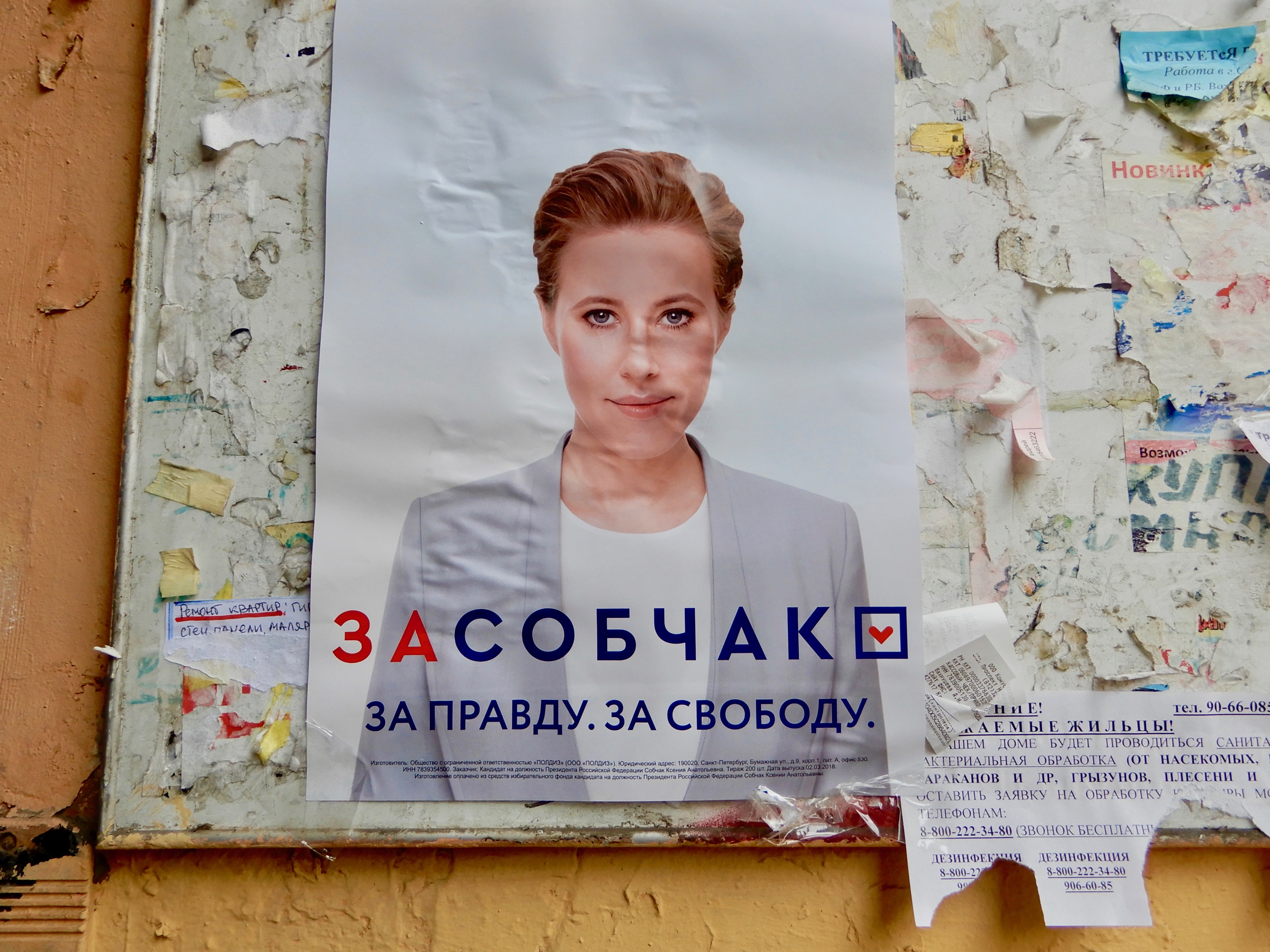
This is literally the only Ksenia Sobchak campaign poster I have seen in Petersburg since the Russian presidential campaign officially kicked off.
The poster, which reads, “For Sobchak. For Truth. For Freedom,” was half hidden in the gateway of a residential building on a street in my neighborhood when I photographed it a week ago today.
I imagine the people working in the city’s housing maintenance and street cleaning services have standing orders to tear down any and all “visual agitation” on behalf of the other so-called candidates (each and every one of them vetted and approved by the Kremlin) running in the so-called Russian presidential election, an utterly rigged farce scheduled for this Sunday, March 18.
The world’s largest country should be ashamed to conduct important national business in such a creepy, petty fashion, but until the self-declared heir apparent to the Romanov throne and his gang of crooks and thieves are chased out of town, there can be no movement on that front, alas.
Or any other front, for their matter, even though I have lots of friends on the left here who think the country is pullulating with “social movements” unfairly ignored by the general populace. To their mind, the rank-and-file Ivans and Natashas currently gumming up the future socialist works should magically learn about these nearly invisible social movements and just as magically support them, without my friends the leftists having to build and deploy anything that resembles even the shadow of an effective grassroots political organization that could reach out to the allegedly benighted Russian rank and file, enlighten it, and give it a doable road map to a better future.
One of the few people in Russia who understands something about political organization and tactics, Alexei Navalny, has been leading a boycott of the presidential election or what he calls a Voters Strike. For their pains, the election boycott activists, most of them young Russians, have been increasingly targeted in a crackdown by Russian security services and police. The plan seems to be to put as many of them as possible in jail on trumped-up charges and keep them there until after March 18, at the least.
My friends on the left, who claim not to like Navalny for his nationalist views, but really resent him because he knows a thing or two about national grassroots political organizing, while they seemingly know next to nothing about it, although they talk about it incessantly, are in no hurry to express their solidarity with the mostly “liberal” activists who have been mowed down by the Kremlin’s dragnet. (In Russia, “liberal” is a powerful swear word employed by leftists and rightists alike.) Their sense of solidarity extends only to those people who more or less share their political views and their lifestyles.
The most shameful thing is how many seemingly intelligent Russians are sanguine about this desperate state of affairs and think talking seriously about domestic politics (although they are often, on the contrary, extraordinarly keen to talk about politics in other countries) is like holding forth in great detail at a swanky dinner party about your daily bowel movements. TRR


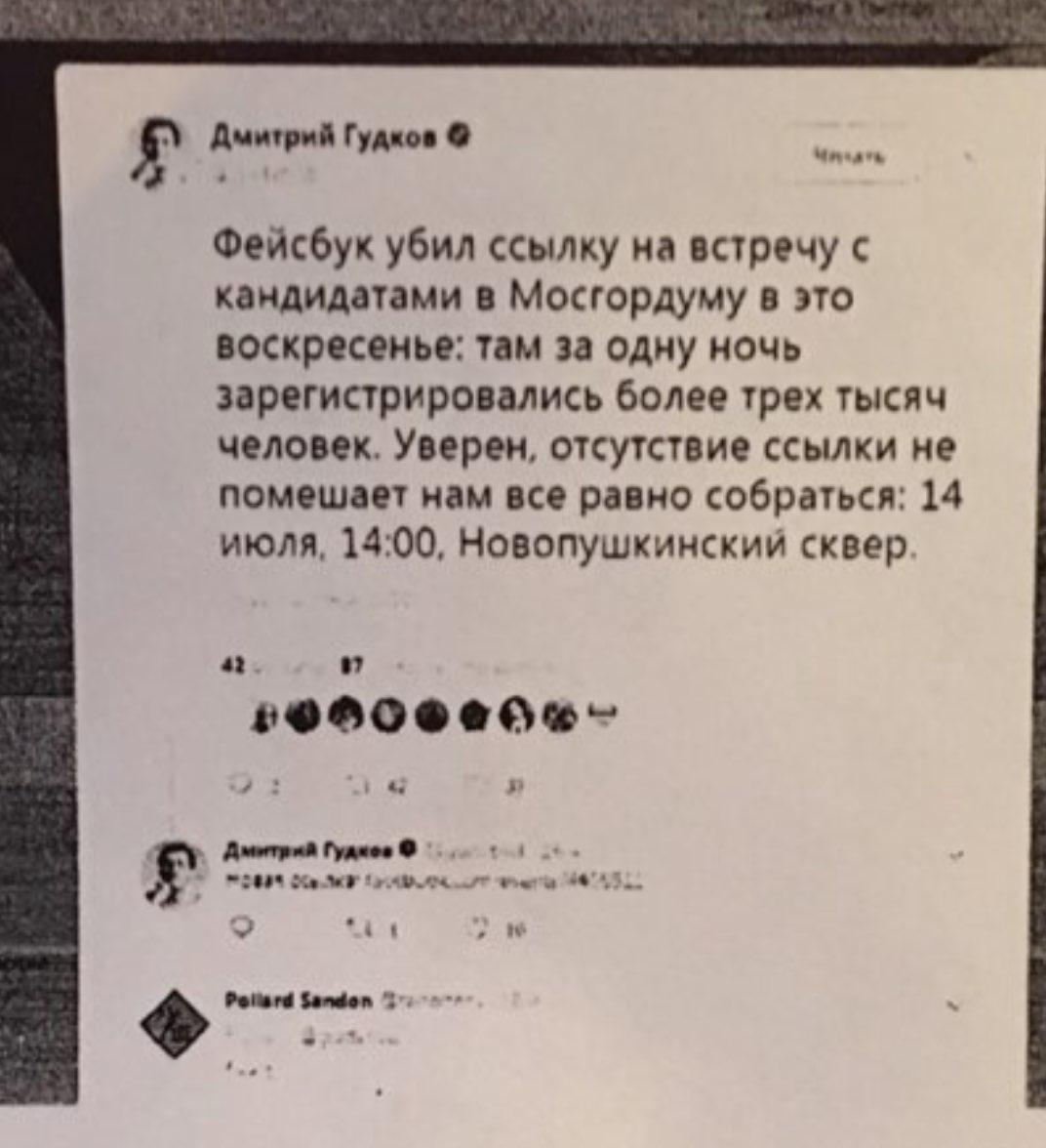 Screenshot of the tweet that got ex-MP Dmitry Gudkov thirty (!) days in jail: “Facebook killed the link to the meeting with Moscow City Duma candidates this Sunday: over 3,000 people had signed up overnight. I’m confident a missing link cannot prevent us from gathering all the same: 2:00 p.m., July 14, Novopushkinsky Square.”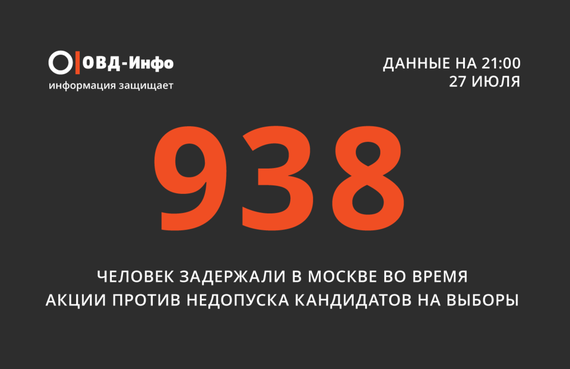
 “22 versts to Tsarskoye Selo. 673 versts to Moscow.” An 18th-century milepost in Petersburg. Photo by the Russian Reader
 Zaryadye Park in Moscow, opened in 2017. Photo courtesy of
  The Wall, one of the Russian National Guard’s new toys for crushing popular unrest. Photo courtesy of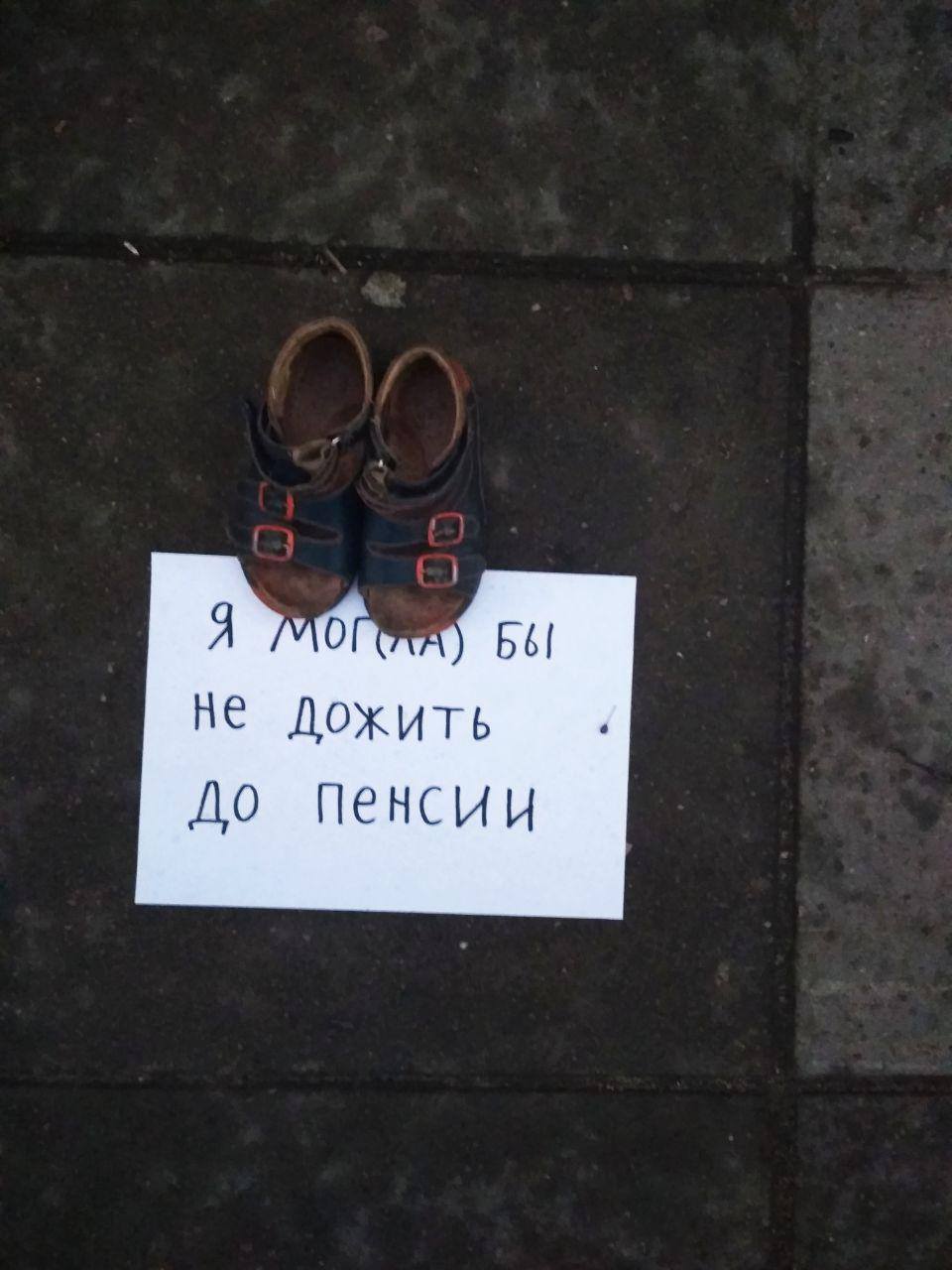

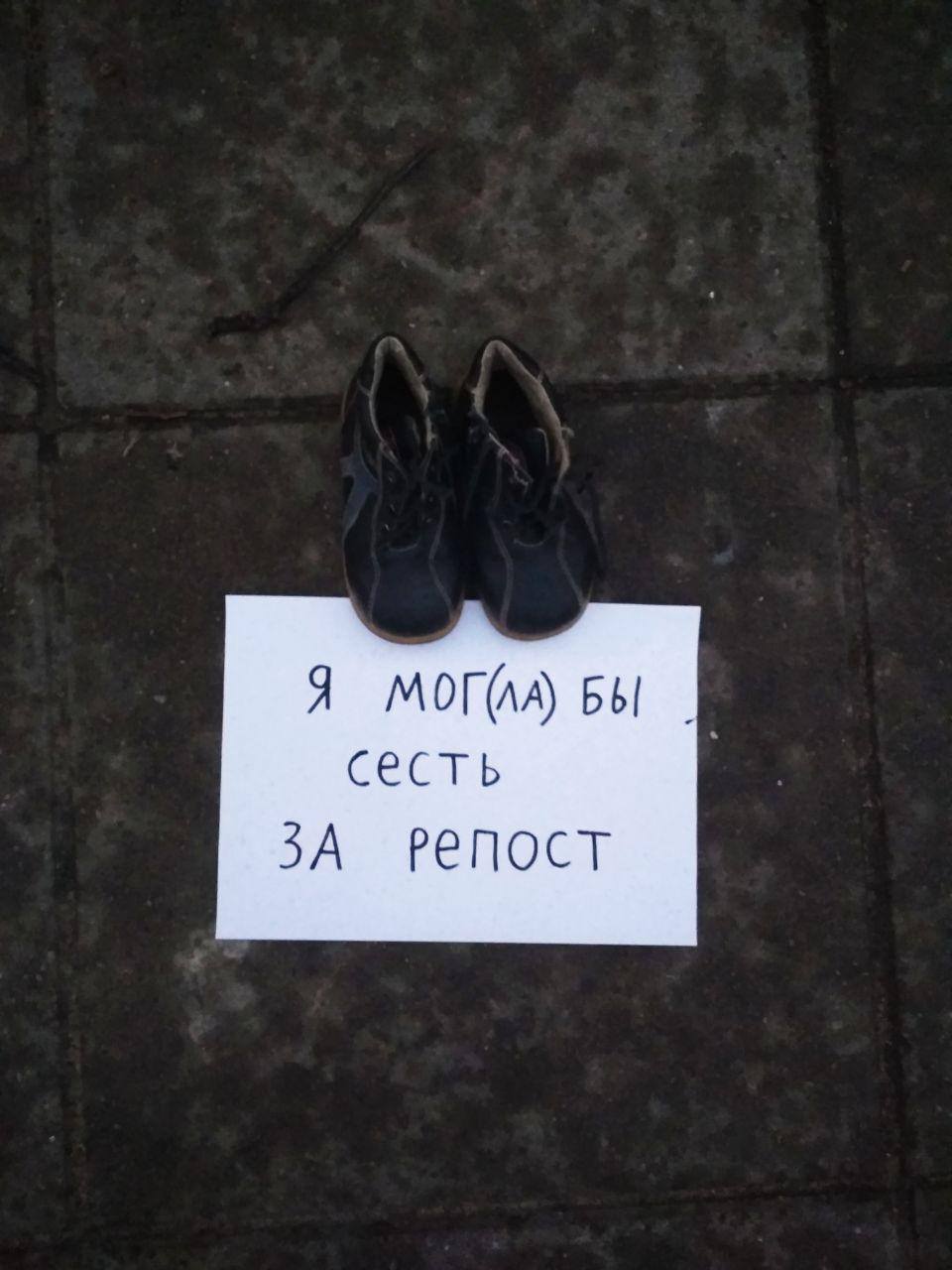
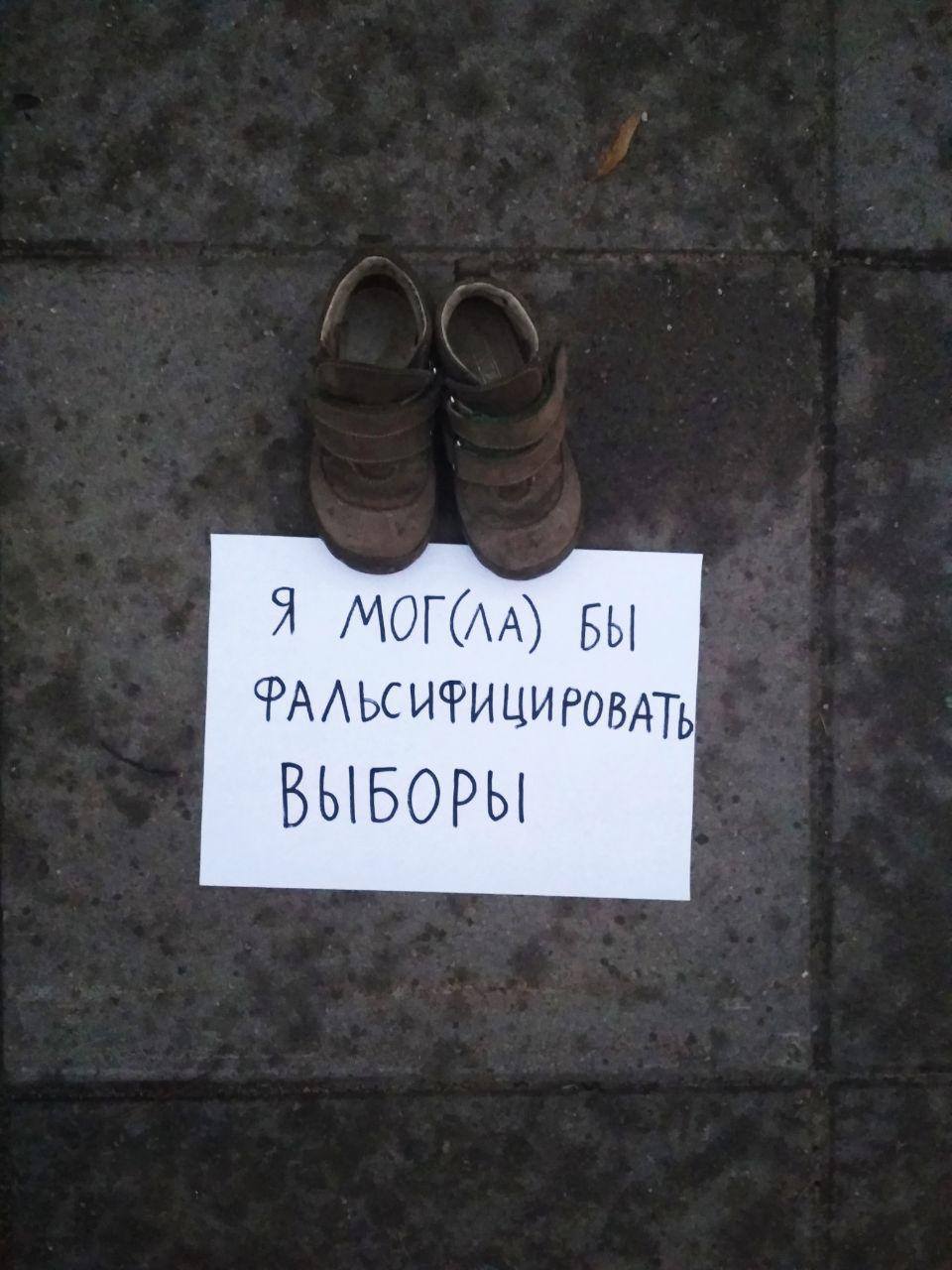
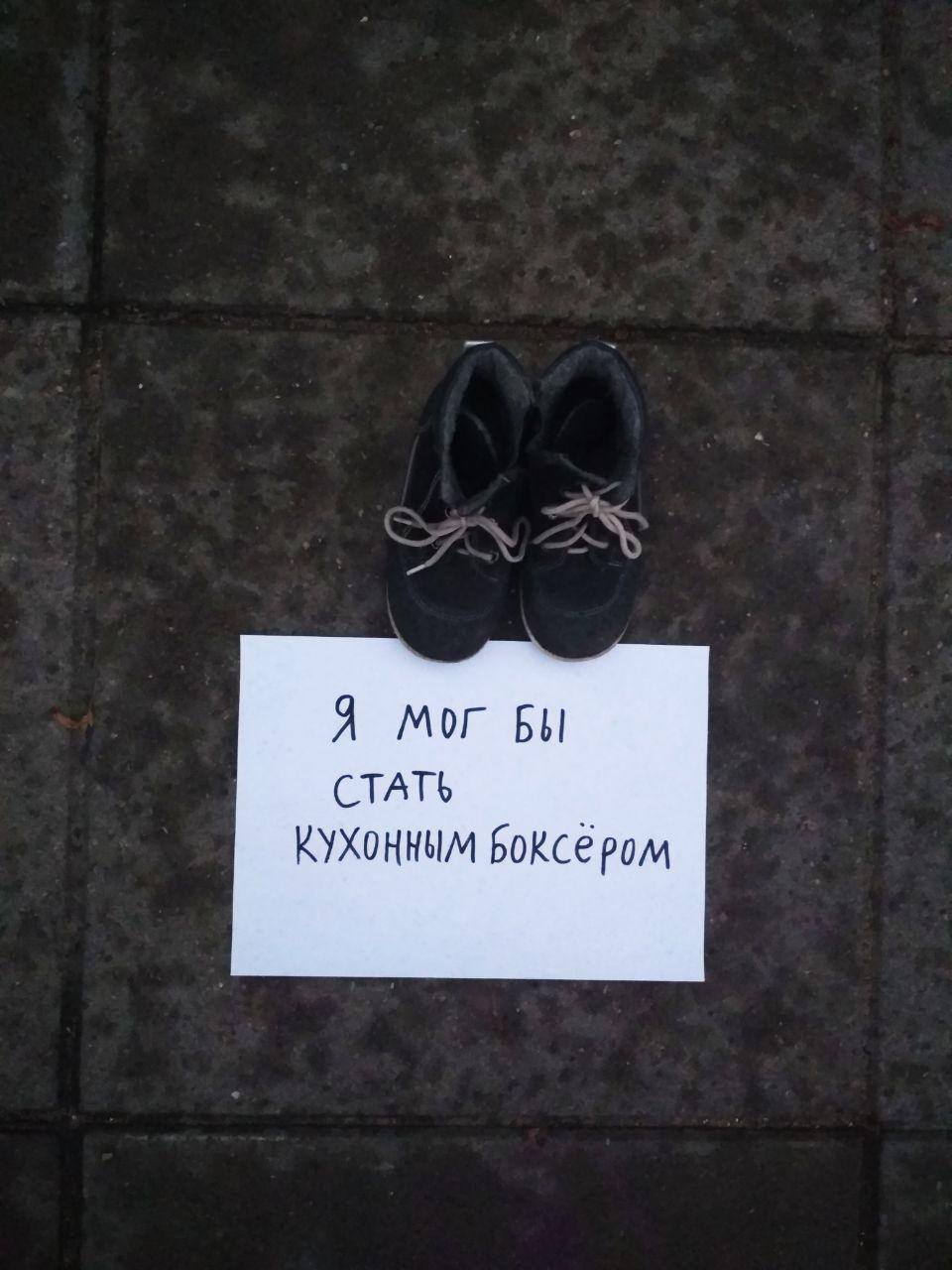
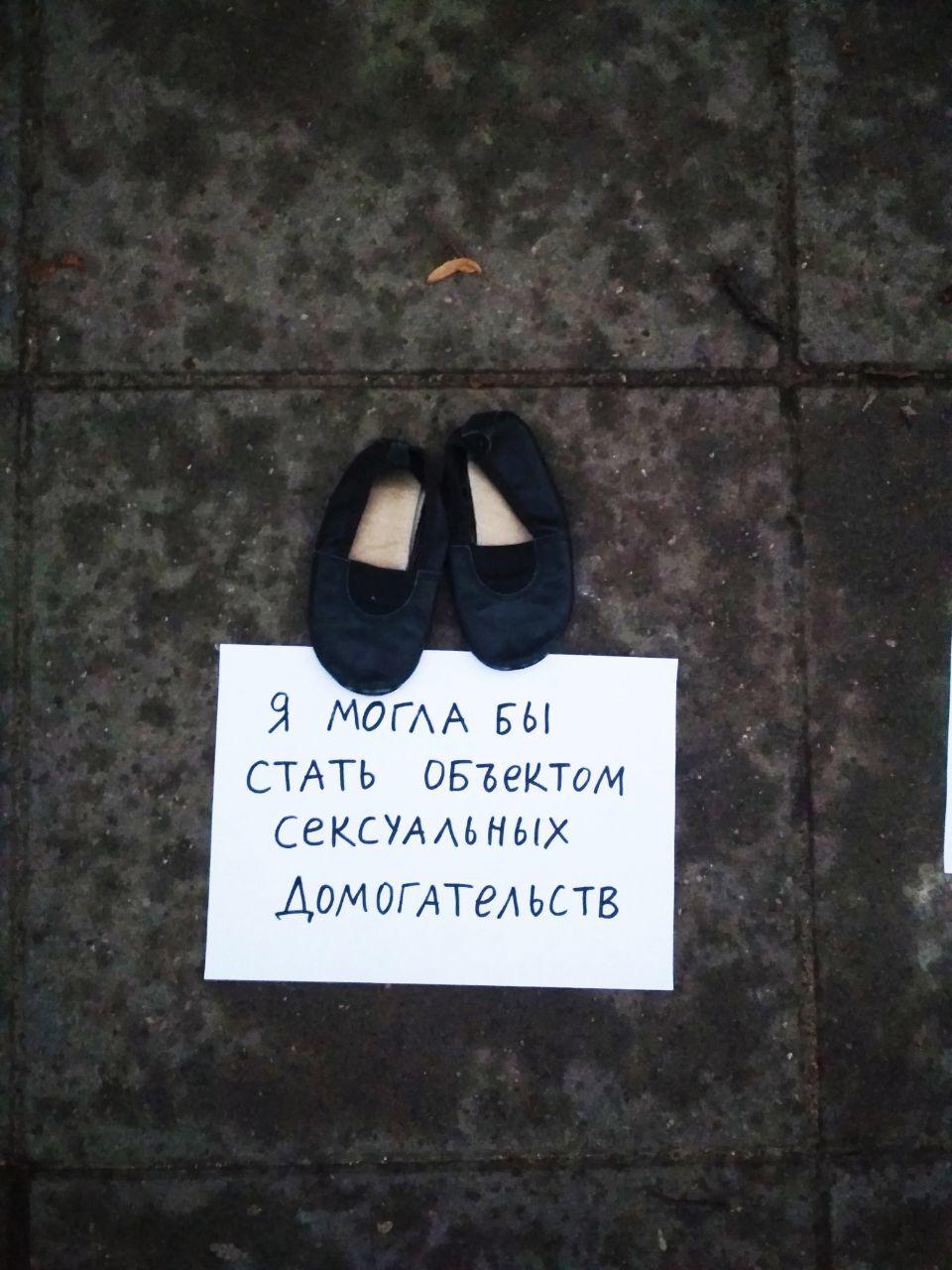
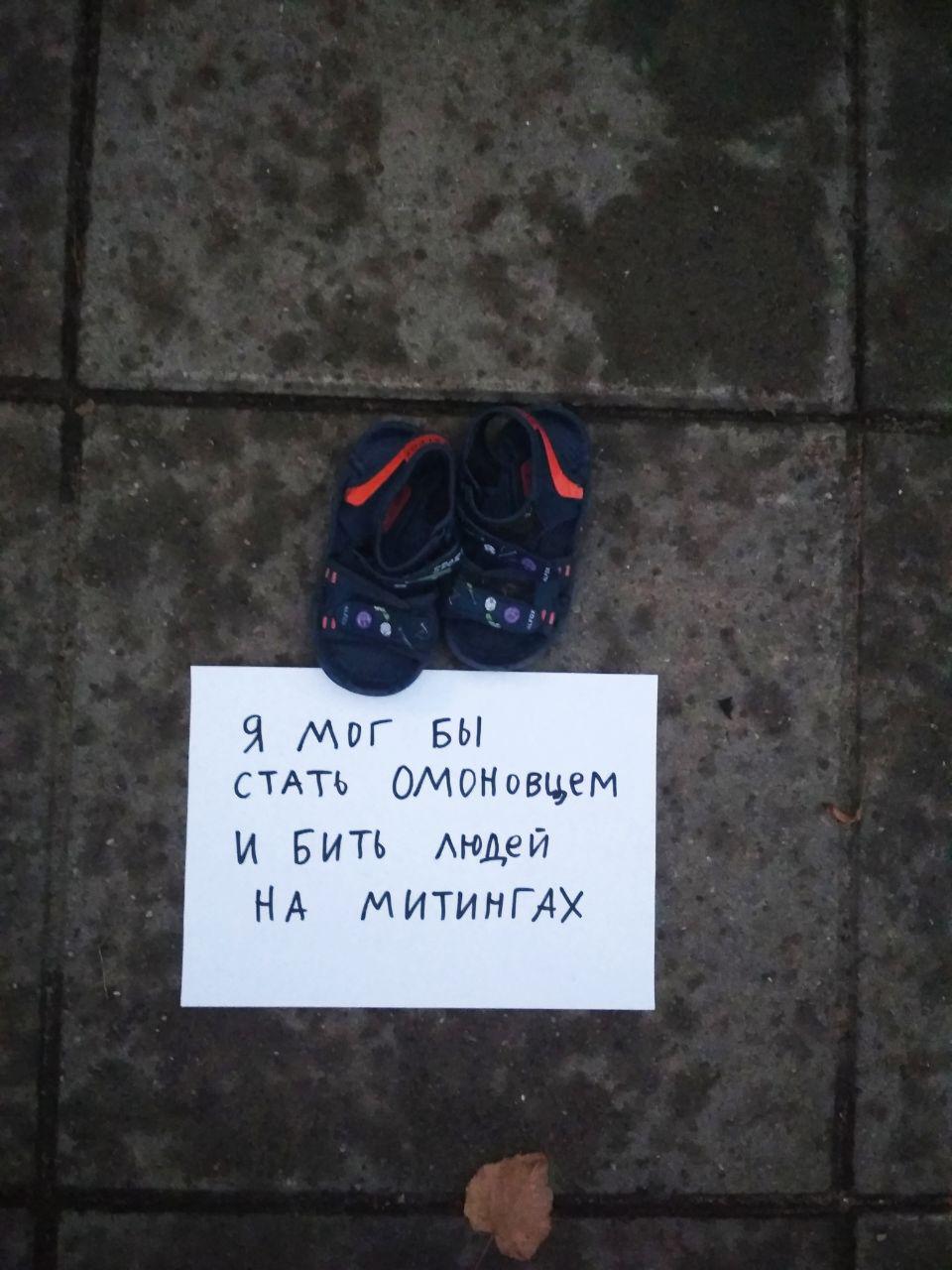
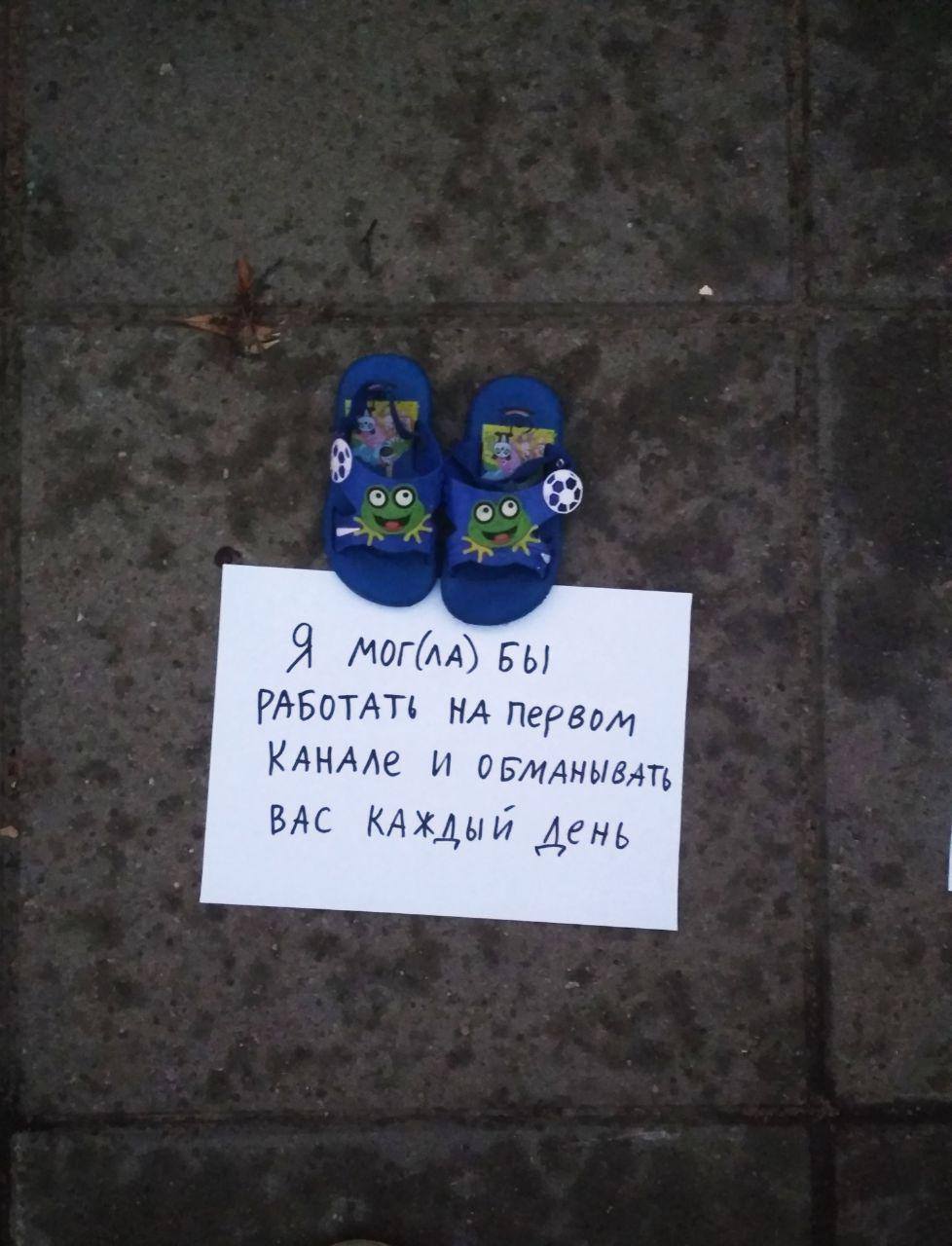
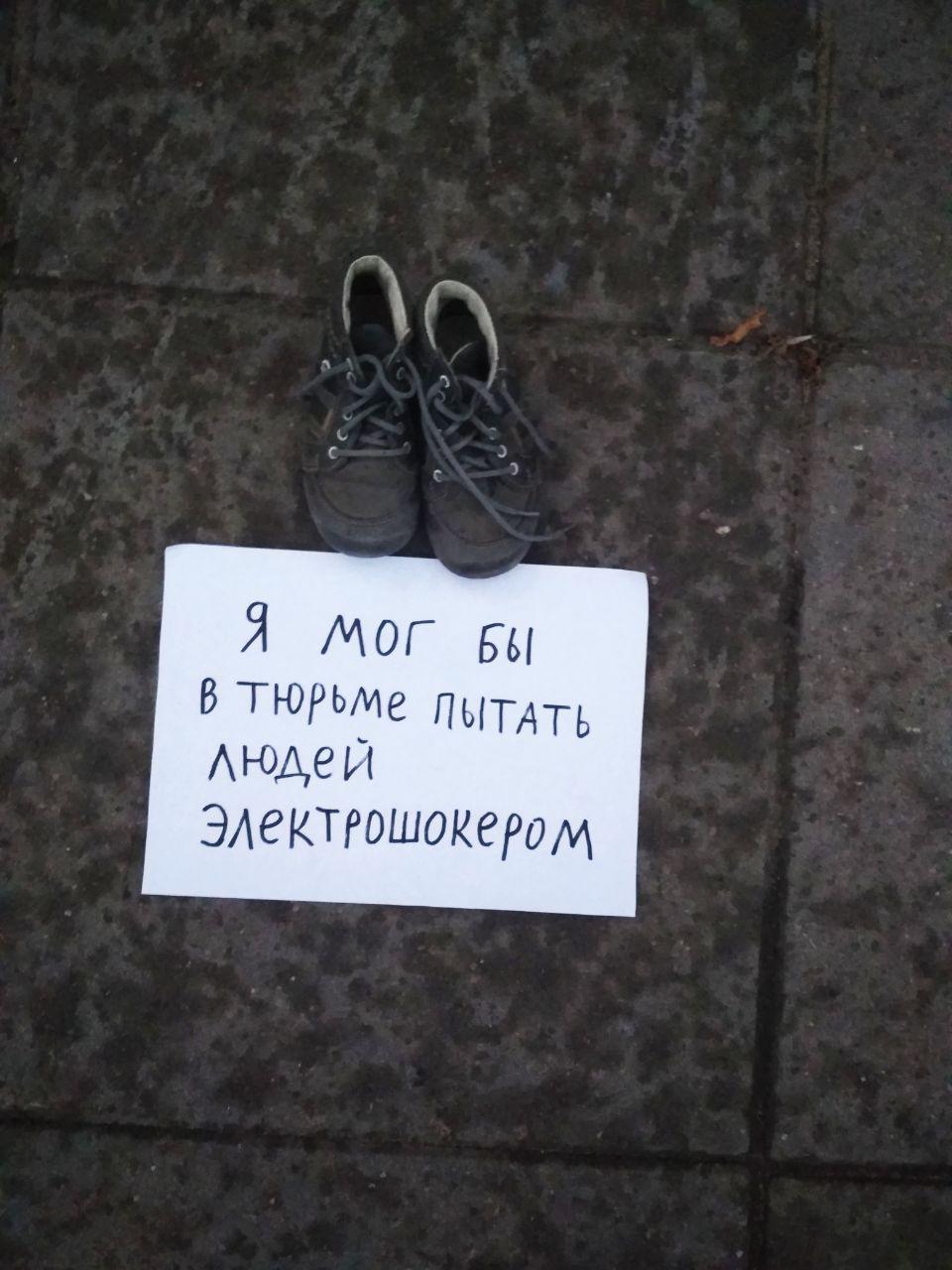
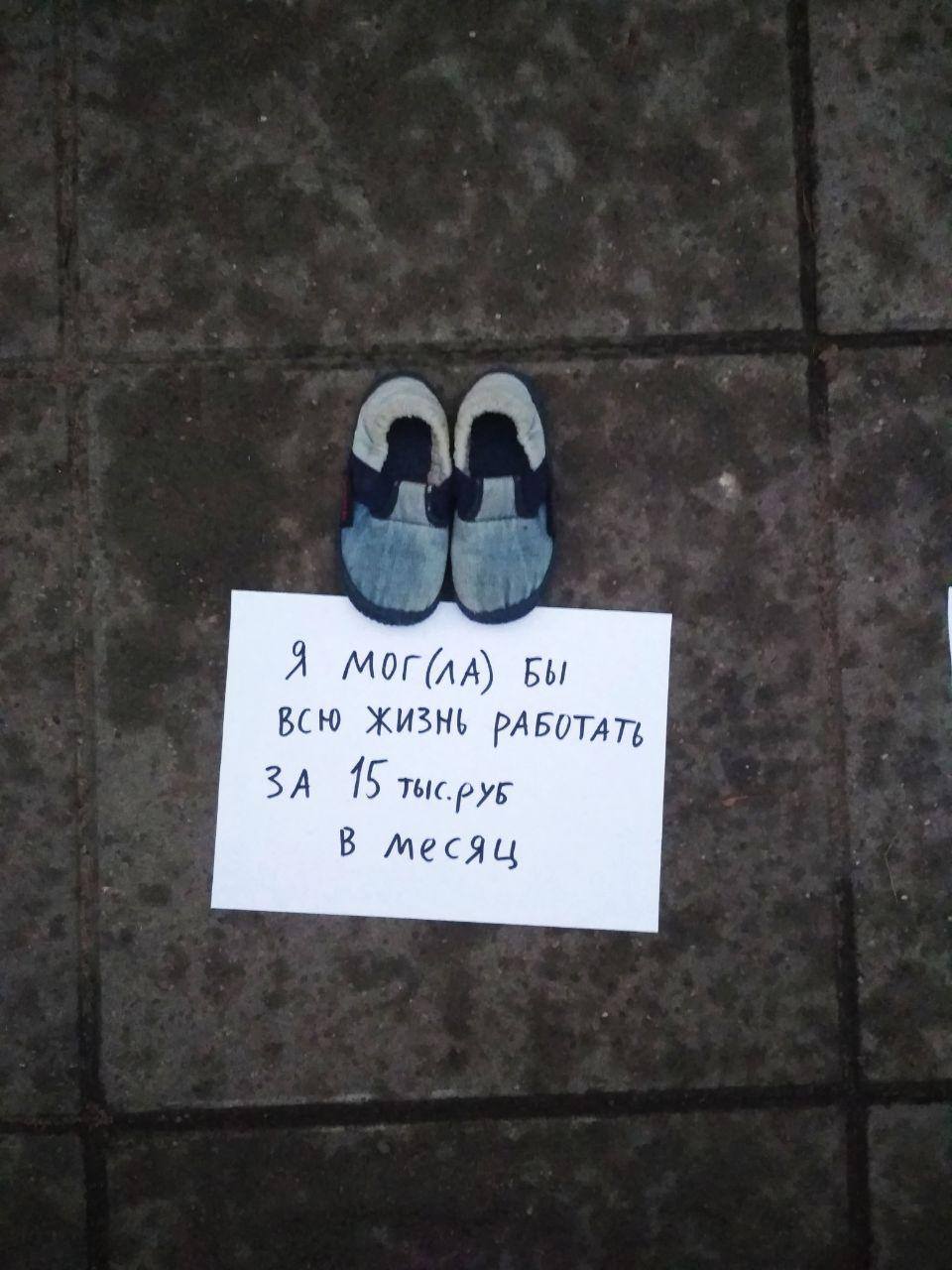
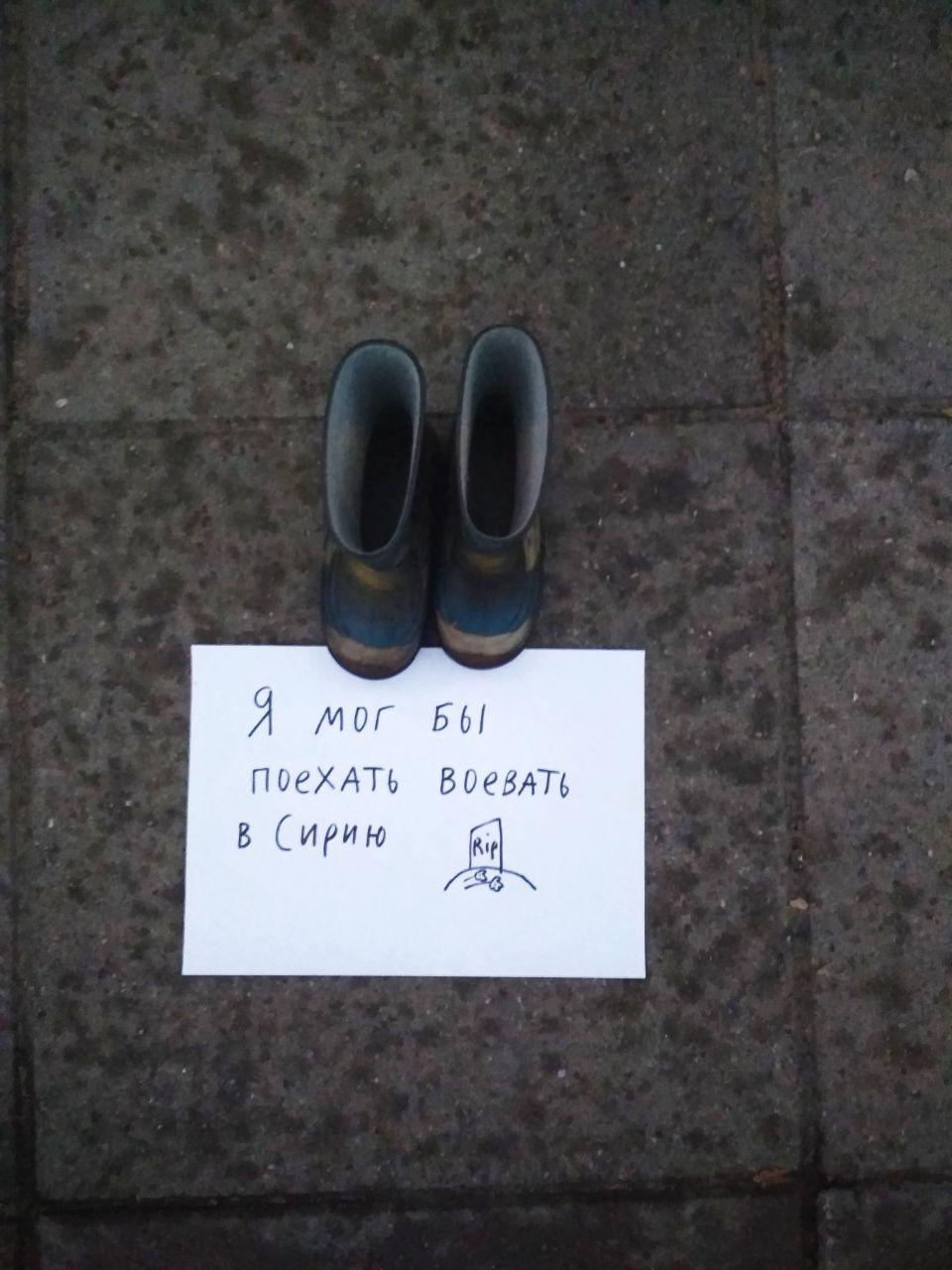
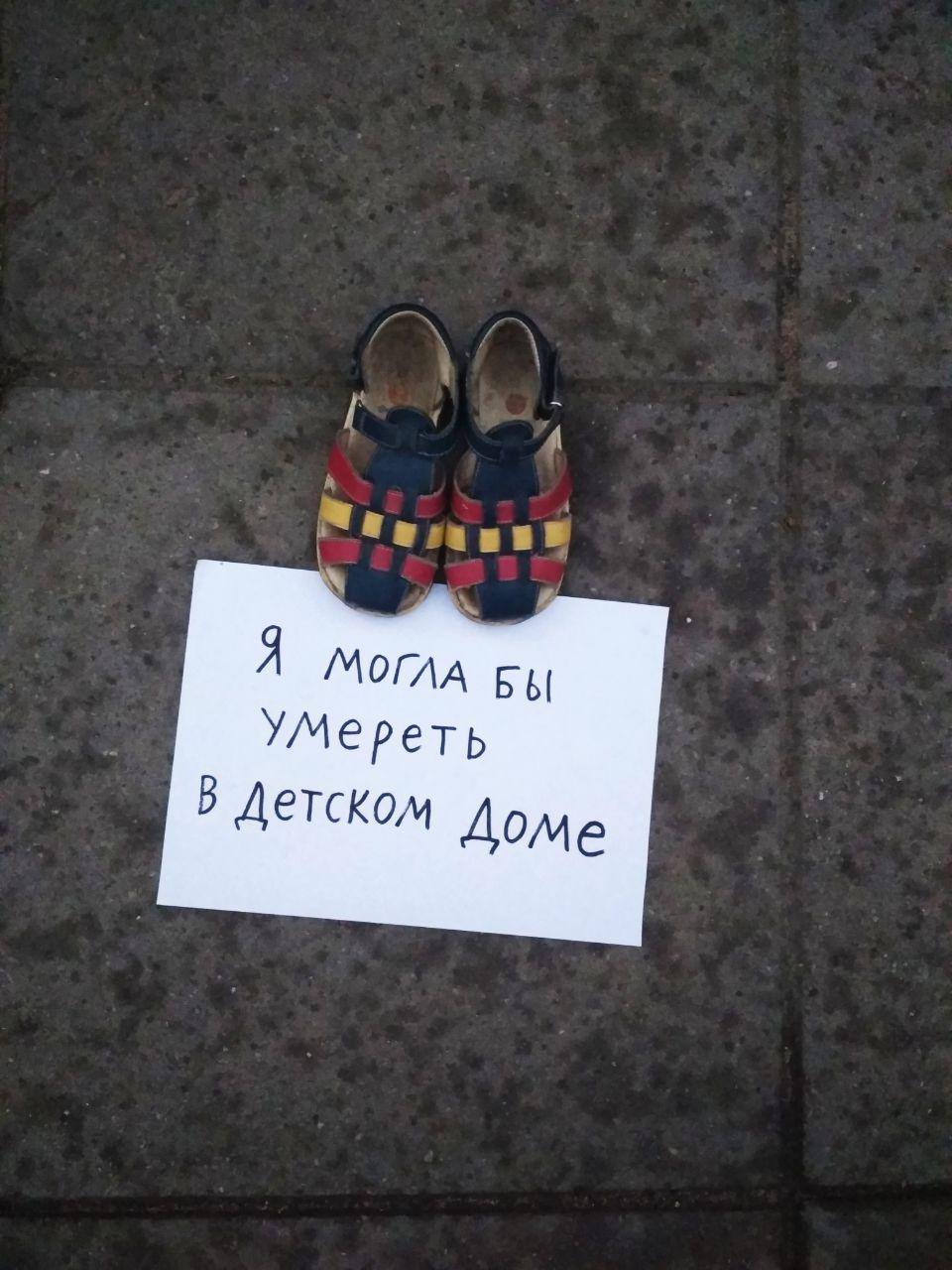
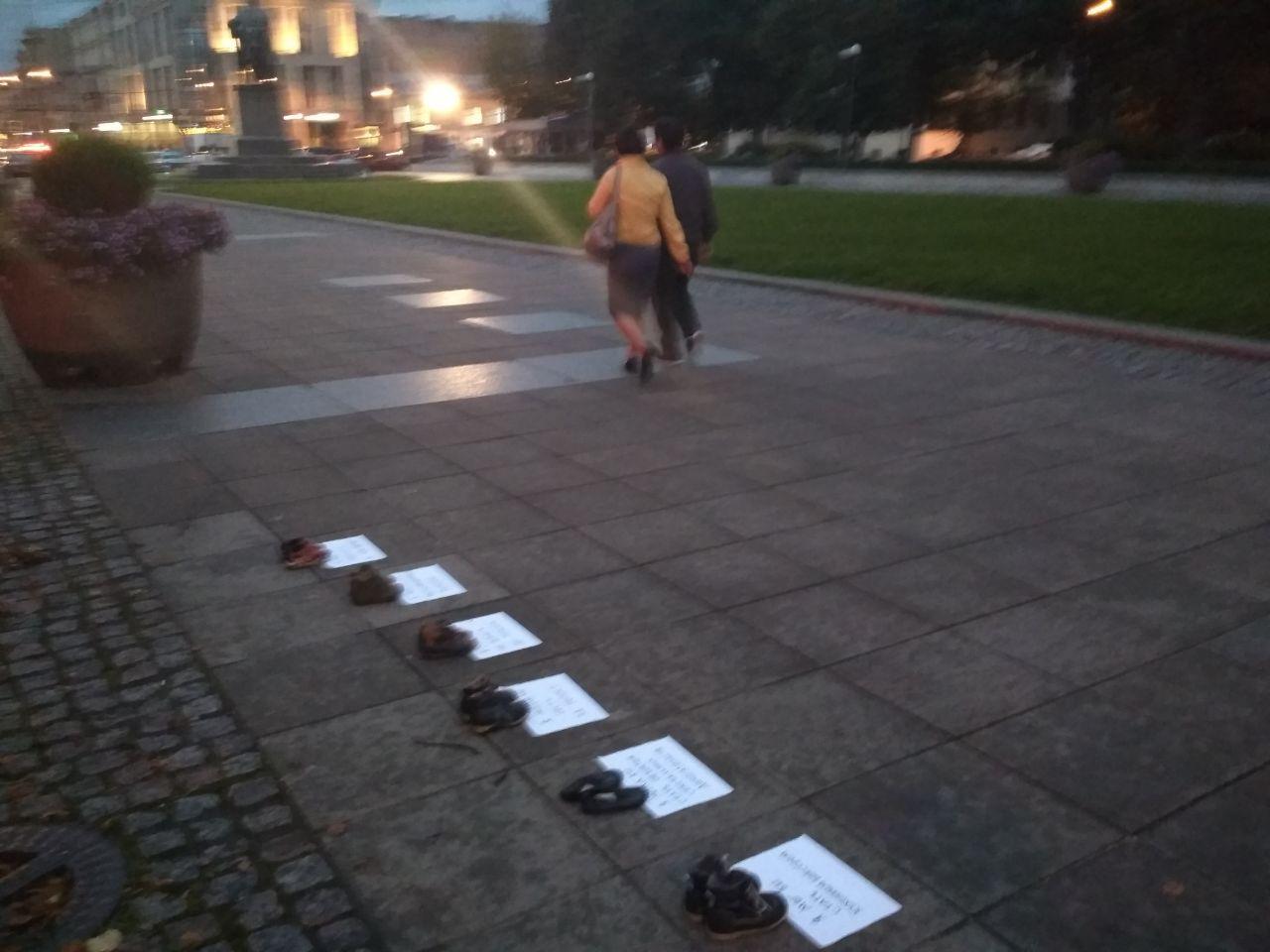 A view of the silent protest on Pioneer Square in Petersburg’s Central District
 Ken Field, “Presidential election 2016: dasymetric dot density.” Courtesy of WIRED
 All that is left of the anti-Putin leaflets posted by Nikolai Korshunov