I never met Alexei Navalny, although we have (or had) a number of mutual friends, as you’d expect. And while his death was not a surprise — this regime had tried to kill him before, but he survived, literally miraculously — it was still a shock when news of it came yesterday morning.
You may have heard AN referred to as “Russia’s Nelson Mandela.” Commentators here have also been invoking Martin Luther King and several other Americans (on a list to which I would add RFK) in an effort to give U.S. listeners/readers a sense of how this loss may affect several generations of Russians.
What those comparisons cannot convey is how much the shock and loss register on a personal level. I am sure that millions of Russians today feel as though they’ve lost a family member — for some immediate, for others more distant — but in any case a relative, someone who was “one of ours” …and who they can’t quite believe is really gone, never to show up again at their homes, at a peace rally or in some live link on their laptops/phones/etc. And doubtless many Russianists abroad, like me, are experiencing a version of that same feeling: an almost palpable sense of personal loss.
Over recent years I have described AN more than once as the only person who, if the nation proved very lucky, might just be able to bring the place to its senses following the prolonged and self-inflicted disaster that has defined Russia in the first quarter-century of the new millennium. But here we are: the nation has not been very lucky (it seldom is), and all of us — Russians, Russianists and the rest of the world — can only mourn the passing of a genuine Russian праведник (PRA-ved-neek; a righteous man) and regret that the country has missed the slim yet credible “Navalny chance” that he represented.
I am discouraged about the near-term future — meaning the country’s prospects overall as well as my own chances of returning to Moscow and our little family there (both wife and grandson continue OK, thanks) as long as the current President for Life remains either above ground or unincarcerated. But I am also trying to stay focused on AN’s injunction, which figures near the end of last year’s Oscar-winning Navalny documentary and is now being cited widely in various media. It goes, in paraphrase, “If they do kill me, it will be a sign of weakness, not strength. So don’t despair — that’s not allowed! — and keep up the good fight.”

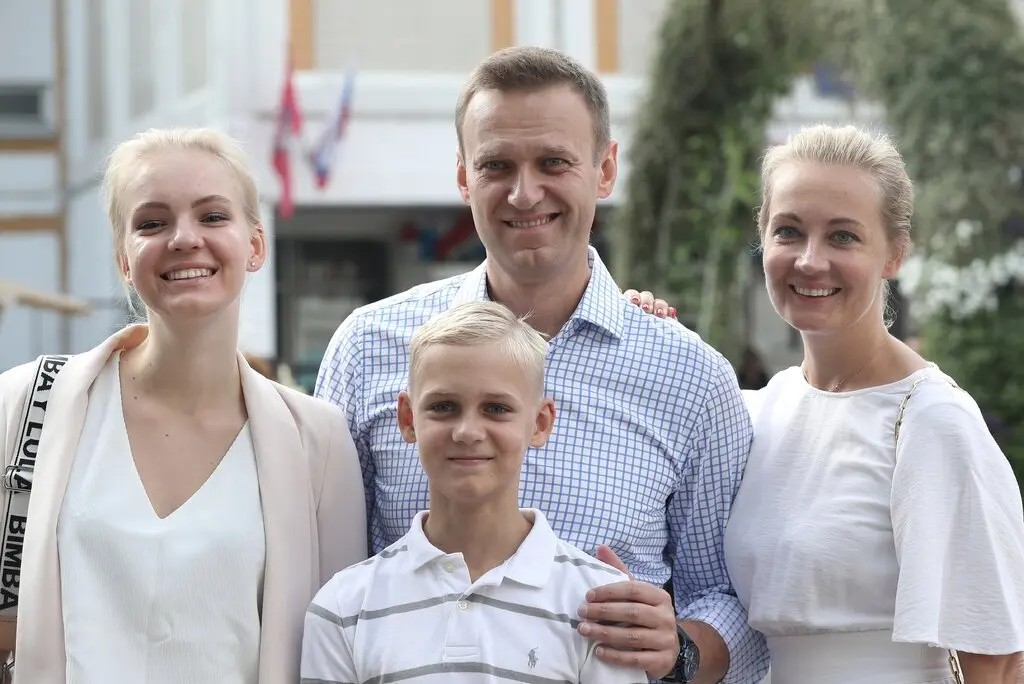
AN’s daughter Dasha is, as you may know, an undergrad at Stanford. Somehow this picture cheers me up a little today.
Source: Mark Teeter, email newsletter to family and friends, 17 February 2024. Thanks to Mark for his kind permission to reproduce it here. Mark is not only a proud alumnus of Stanford University, but he also played a role in welcoming me to Russia for the first time, in 1994. He describes my own feelings about Navalny’s death to a tee. ||| TRR
ALEXEI NAVALNY (1976-2024): Покойся с миром / R.I.P.
“Alexei Navalny, Russian opposition leader, dies in prison”
For Russians, Russianists and friends of the nation everywhere, a day of sadness past any telling of it.