Photo published March 10, 2018, on the Archangelsk Life community page on the VK social network. “Photo of the Day. ‘We’re Going to Vote.’ *The common law wife of regional MP Alexander Dyatlov, chair of the regional committee of United Russia Party supporters, is in the middle.”
A good illustration. Society has left women without pants and, apparently, taken the shirts off their backs. It has reduced them to sexualized objects whose sexual function is emphaized even in the civic act of voting, as remote from the bedrom as could be. But it’s cool: they are going to vote. Why are they naked? Are they going straight from the shower to vote? Then where did those ridiculous high heels come from? Did they just come down from the pole in a strip club? Why is this generally routine and uninteresting act decked out in Russia like a wedding in an archaic society? Men show off their power (see the campaign ads of “rich and successful” men supporting Putin), while women show off their naked bodies, sexual desire, submissiveness, and vulnerability.
Thanks to Bella Rappoport for the heads up. Translated by the Russian Reader
I am somewhat surprised to see the ongoing discussion on whether to vote in the [Russian presidential] election or not. Some people write that if you don’t vote, your ballot will be used, and so on. Meaning it is assumed in advance the election commission is a band of brigands. If this is so, however, they can do whatever they want and, most important, at any level they can enter any figure they like in their official count. What difference does it make, then, if they use your ballot or not?
Actually, there is no election. Why be involved in something that does not exist? I think it is important not only to avoid attending this strange event oneself but also to explain to everyone why they should not attend, either.
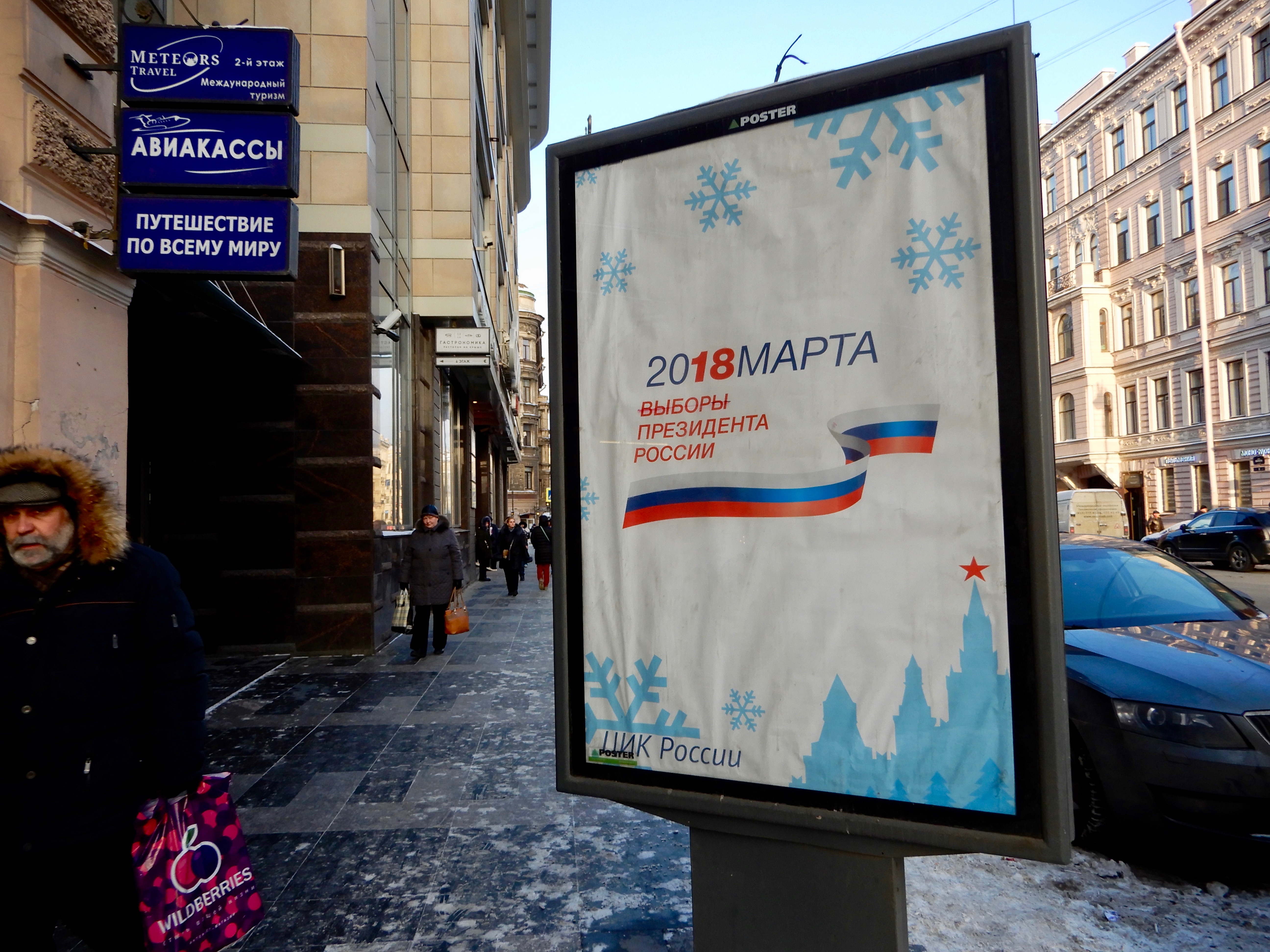
On this “get out the vote” billboard, recently photographed somewhere in central Petersburg, a “vandal” has lightly crossed out the word “election.” Photo by the Russian Reader
Cities with populations over a million will have voter turnouts just over 50%, says a person close to the presidential administration.
All polling is a tool for actively shaping reality. Figures are used to try and suggest a particular interpretation of events, notes another source close to the administration. In his opinion, the downturn in Putin’s support rating can be explained by a lack of activity and mistakes during the campaign.
“In reality, the figure are much lower. The actual turnout is expected to be between 55% and 60%. Putin’s result will range, depending on the region, from 50% to 65%. It will be an accomplishment if the turnout in Moscow is over 50%.”
The difference between the turnout in major cities and the provinces could be as much as 20%. Usually, on the contrary, the turnout in the provinces is between 10% and 12% greater, says another person close to the presidential administration.
“What happens next depends on the whether the mechanism for penciling in votes gets turned on or not. If the election is staged with the full use of the administrative resource, something I do not rule out, it does not matter who gets what in reality. If the elections are staged fairly, Putin’s result in cities with populations over a million will be lower, while his opponents’ will be slightly higher.”
The turnout in cities with populations over a million will be between 45% and 55%, the source believes.
“As reports claim that Russia’s new daily five-hour truce has failed to allow medical evacuations in Syria, a poll by state-run VTSiOM found that almost 75% of those surveyed believe the Russian military’s Syria operation has achieved its goals.” (RA’s Daily Russia News Blast, 28 February 2018)
What is the point of surveying people who either know nothing about the “Russian military’s Syria operation” or have been deliberately and woefully misinformed about said operation whether they think it has “achieved its goals”?
Finally, if you know a poll like this is horribly, irreparably skewed by abject igorance and a severe case of state-induced delusion, why quote its results as if they were newsworthy?
Except for the occasional municipal district council election, whose elected members have almost no power and even less money to exercise their almost total lack of power, all elections in Russia are rigged from top to bottom and beginning to end to ensure the “right” candidates are elected. Since this is the case, why do our media show an almost childish trust in the reliability of Russian “public opinion” polls? It never occurs to all our overeducated, usually incredibly cynical journalists that Russian “public opinion” polls might be just as faulty and fixed as Russian “elections”?
Good journalistic practice should exclude generating false impressions about an entire country and its people by citing demonstrably unreliable polls. TRR
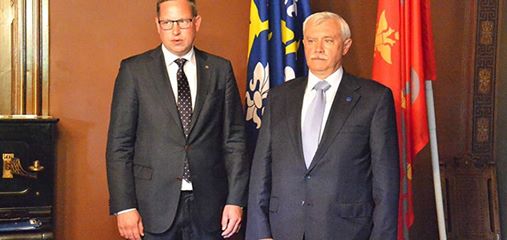
I could not care less about all that as long as Putin leaves Petersburg Governor Georgy Poltavchenko alone. (Poltavchenko is the vaguely unhappy looking man on the right, in the picture above.)
Sure, Poltavchenko returned to his adopted hometown of Petersburg, after several years of bureaucratic carpetbagging, as an appointed satrap, who later obtained spurious legimitacy by winning a low-turnout, rigged election against a slate of astroturfed opponents. In a fit of uncharacteristic cynicism, Poltavchenko dubbed this farce “Democracy Day,” but we have forgiven him long ago for that outburst—by default, as it were, because 99.999% of us Petersburgers could give a hoot about local politics and have no clue about the Tammany Hall-style thuggery that once again covered the Cradle of Three Revolutions in shame on September 18, 2014. We are more the artsy, creative types here in the ex-capital of All the Russias. We go in for fo bo, hamburgers, craft beer, and conspicuous hipsterism.
In Petersburg, taking politics seriously is not cool.
But all the Sturm und Drang of 2014 matter less than Poltavchenko’s signal virtue, which consists in his striking tendency not to do or say much of anything, at least visibly or publicly. Unlike his colleague Ramzan Kadyrov, headman of the horrifying Chechen Republic, who is constantly running off at the mouth and scaring the bejeezus out of everyone, Poltavchenko has gone for whole weeks and months without saying or doing anything significant or noteworthy, much less frightening.
Whatever his other vices as a satrap and “former” KGB officer, it appears he would find it profoundly embarrassing to frighten anyone, especially just to show off, the way Kadyrov does it.
In an authoritarian political system in which making news means feigning to be a rabid, foaming-at-the-mouth nationalist fascist Orthodox maniac, tabling Nazi-like law bills in the Duma as fast as they can be typed up and printed out, there is something to be said for a guy who always looks as if he is always bored out of his mind, as if he would rather be home watching TV, fishing in the lake next to his dacha or tinkering with his car.
Which, of course, is an old Lada, not a Land Rover.
I wrote a report on this Sunday’s elections. Don’t be lazy and read it to the end. You’ll learn a lot of new things.
Who Elects the Head of Adygea: A Political Portrait of the Republic’s Parliament
As you know, on Sunday, September 10, the State Council of the Republic of Adygea (in Adyghe, the Khase) will elect a new head for the republic. There are three candidates, but the outcome is predetermined. Who would doubt it? Correct me if I’m mistaken, but in the history of modern Russia this was probably the first instance when the outgoing head of a Russian region brought his own kinsman to Moscow so that Putin could view the bride, i.e. his chosen successor. Nor, we must note, were he and his kinsman immediately shown the door. This was probably taken by the petitioners from Adygea as a favorable sign.
Everything kicked off when, in March of last year, as it was about to give up the ghost, the members of the Adgyean parliament’s fifth convocation nearly unanimously voted (fifty yeas, four nays) to abolish direct, popular elections of the republic’s head, adopting a special law and making the relevant amendments to the Adygean Constitution. Having denied Adygeans the right to vote directly for head of the region, the “people’s” elected representatives formally explained their decision as a means of making the electoral process less expensive. However, no one abolished another law, a law of everyday life: cheaper doesn’t mean better.
So elections to the sixth convocation of the Adygean Khase, in 2016, took place with the understanding that it would be the new parliament, not the people, that would be picking the republic’s new head. So, the requirements for sifting out the winners were tougher than usuaul. It was boom or bust, literally, all or nothing. The powers that be backstopped its chosen candidates to the hilt, and the elections took place in a stifling climate of lawlessness, generated by the acting executive branch and the local office of the United Russia party. Functionaries of the Rodina (Motherland) party did everything they could to force the Adygean Central Elections Commission to remove the opposition party’s entire regional list of candidates from the ballot, although the party had a good chance of taking several seats in parliament. The billboards, posters, and flyers of all candidates and parties except United Russia and LDPR were destroyed hours, if not minutes, after they were posted. The vote tallies at the polling stations were skewed, and the votes received by candidates and parties that are not part of the so-called parliamentary grouping (United Russia, CPRF, A Just Russia, and LDPR) were totally nullified. The latter parties divvied up their shares of the vote totals in keeping with quotas that had been agreed in advance in Moscow. So, the current Adygean Khase consists of 38 MPs from United Russia, four MPS each from the CPRF and LDPR, and two MPs from A Just Russia. Two more MPs have to be elected in by-elections on September 10. There is no doubt that one of the two will be a United Russia member. Thus, MPs from United Russia make up 80% of the republic’s parliament, while the CPRF and LDPR have 8% of MPs each, and A Just Russia has 4% of MPs. Now let’s compare these proportion with the spread of MP mandates in the Russian State Duma. United Russia’s MPs occupy 76% of the seats; the CPRF, 9.5%; the LDPR, 8.7%; and A Just Russia, 5.8%. The Duma also has two MPs who are not members of these parties. One of them is a member of the Rodina party, the party that was successfully sent packing in Adygea. The outcomes are quite similiar, don’t you think? It’s as if the same templates had been used.
The lineup of MPs running in the 2017 elections has been thoroughly purged. Anyone who provoked the slightest doubts has been removed from the lists. Only five people who have been MPs for more than three convocations are left, and only nine MPS from the last three convocations are still in the running. Two of them are from the CPRF’s faction (Adam Bogus and Yevgeny Salov), while the rest are from United Russia. The other thirty-four MPs (out of a total of forty-eight) were elected during Aslan Tkhakushinov’s last two terms as head of the republic [he resigned in January 2017, after ten years in office], under the watchful eye of his team. In fact, they are part of his team.
Clearly, they express not the will of the people, but the will of their true masters, the men who got them elected. Thus, the clearly unelectable United Russian candidates Sergei Belokrys (District No. 16) and Rustam Kalashov (District No. 21) got the cherished mandates. During their party’s so-called primaries [the English word is used in Russian], they both took an honorable third place in their districts with 7% and 27% of the vote, respectively. Even more unelectable pawns were kinged after winning spots on United Russia’s party list.
They hardly all have the right to be called people’s representatives, if only because not all the MPs in the Khase’s sixth convocation were elected by the people on the new single voting day. Thus, seven of the winning candidates from United Russia list soon resigned for different reasons, and their mandates were automatically handed over to five new MPs from the party list (Yuri Gorokhov, Yevgenia Dyachkova, Zurab Zekhov, Azamat Mamkhegov, and Murat Shkhalakov). Two more MPs will be selected on September in single-mandate constituencies. LDPR’s list of of winners included party leader Vladimir Zhirinovsky and the party’s regional leader Denis Ogiyenko, neither of whom took their seats in the Adygean parliament. Why Zhirinovsky did this is clear enough, but Ogiyenko works as an aide to an MP in the State Duma, where everything is grown-up and they feed you caviar sandwiches. The two LDPR leaders were replaced as Khase MPs by Valentina Chugunova and Tembot Shovgenov, thus technically bypassing the will of voters.
It is interesting to compare how much the majoritarian MP mandates in the republic’s urban districts and rural districts are worth in terms of votes cast by voters. Thus, Maykop, the capital city, is divided into nine electoral districts, inhabited by a total of 132,890 voters. One majoritarian mandate is thus worth, on average, 14,776 potential votes. The Maykop Municipal District [not to be confused with Maykop per se] has three electoral districts and 46,111 voters, so an MP’s mandate is worth slightly more there: 15,370 votes. The Teuchezh District has only one majoritarian mandate, worth 13,549 votes. The Takhtamukay District is home to 51,840 votes, and so its four majoritarian mandates are worth an average of 12,960 votes. In the Giaginskaya District, the mandates are worth a bit less (12,563 votes on average), while in the neighboring Shovgenovsky District, it is worth 12,482 votes. Adygeysk’s single majoritarian mandate is worth 12,029 votes, while the Koshekhabl District’s two mandates are worth 11,407 votes apiece. The Krasnogvardeyskoye District has the “cheapest” mandates: two at 11,013 votes apiece. But strangers do not roam the homeland of the sweet couple of Aslan Tkhakushinov and Murat Kumpilov [Adygea’s acting head and Tkhakushinov’s chosen successor]. They elect only their own people and only on the advice of their superiors.
It was not entirely accurate to distribute MP mandates generally (whether from majoritarian single-mandate constituencies or party lists) in terms of the number of voters in the districts. The largest number of voters lives in Maykop (39% of all voters in Adygea), and its goes down from there. The Takhtamukay District has 15% of voters; the Maykop District, 13.6%; the Giaginskaya District, 7.4%; the Koshekhabl District, 7%; the Krasnogvardeyskoye District, 6.5%; the Teuchezh District, 4%; the Shovgenovsky District, 3.7%, and the town of Adygeysk, 3.5%. Meanwhile, the MPs from Maykop have only 30% of the mandates in the Khase; Takhtamukay District, 20%; Maykop District, 14%; Giaginskaya District, 6%; Koshekhabl District, 10%; Krasnogvardeyskoye District, 8%; Teuchezh District, 6%; Shovgenovsky District, 4%; and the town of Adygeysk, 2%. The imbalance is obvious.
The sixth convocation of the Adygean Khase has only eight MPs (16.7% of the total number) employed in the state sector. Six MPs (12.5%) are party officials. The remaining MPs (over 70%) run businesses in different sectors of the economy. The largest number of them (21 MPs out of a total of 48) earn their money in construction, commerce (including wholesale commerce), and services. Four MPs (8.3%) get their income from agriculture. Three MPs (6.3%) work in banking and investing, while two MPs each (4.2% each) are involved, respectively, in the hotel and tourism business, logging and extractive industries, and industrial manufacturing. Yet the CRPF and A Just Russia factions are dominated by party officials (four out of six), while members of United Russia have a clear advantage in all other lines of work.
The sixth convocation of the Khase includes two high-profile businessmen with criminal pasts (according to the media): United Russia member Gissa Baste (aka Voloskevich) and non-partisan MP Adam Bogus (aka Mazai), who blocks with the CRPF faction. Several well-known businessmen from United Russia have close ties with different dubious firms and people with criminal pasts. In particular, nine deputies (six from United Russia, two from the LDPR, and one from the CPRF) are involved in the construction business in the Takhtamukay District, run by Azmet Skhalyakho aka the Foreman. According to the media, he earned the nickname not on the fields of his native Takhtumukay District, but by shaking down market traders in Krasnodar during the “wild” 1990s. The notorious prosecutor Murat Tkhakushinov, son of ex-republic head Aslan Tkhakushinov, worked in the same district until recently. The Takhtamukay District’s proximity to Krasnodar, the much lower prices for land in the district than in Krasnodar, and the total control over the black market for land plots by criminal gangs, who have fused with Adygea’s government agencies, have made the construction business in the district quite profitable. Especially if you are not bothered by the legality of particular transactions, do not waste money on pollution treatment facilities, and pay no mind to the quite costly environnmental requirements.
Questions also arise when you take a closer look at the life and times of Vladimir Narozhny, head of the United Russia faction and chair of the republic’s parliament. There are strange blanks in his CV from 1981 to 1991, which for some reason he does not particularly advertise. Judging by occasional references, he ran various agricultural businesses during this period. Currently, he is associated with a number of firms, also involved in agrobusiness, in Adygea and Krasnodar Territory. They have different names and legal addresses, and yet they have the very same Primary State Registration Number and Taxpayer Identification Number. Obsessive thoughts of criminal money laundering schemes come to mind, but I have probably read too many detective novels.
As a final touch to my sketch of the current Adygean Khase, I want to focus on yet another imbalance, which testifies to a deeply embedded problem, if not a chronic disease, that affects the regional authorities in Adygea. I have in mind the distortions in personnel policy that favor the so-called titular ethnic group, the Adyghe. This phenomenon, which I would dub the Adyghization of power in the republic, was especially rampant during Aslan Tkhakushinov’s second term and has kept evolving in the present. I would not argue it has anything to do with ethnic conflicts between two great peoples, the Russians and the Adyghe, but has been caused only by attempts by specific members of the so-called Ulyap clan, who have ruled the republic for the last ten years, to ensure they will stay in power for the indefinite future. This is done both by depriving the Adygean populace of the right to elect the republic’s leaders and local government officials in direct elections, and through a deliberate personnel policy of giving preference to members of the titular ethnic group when filling vacancies in state and municipal agencies—if possible, to members of one’s own clan and numerous kinsmen. This cup has also touched the republic’s legislative branch. Whereas the republic’s population consists of approximately 63% Slavs, 25% Adyghe, 3.5% Armenians, and 8.5% other ethnic groups, the Khase is dominated by members of the titular ethnic group, who hold 28 seats (or 58.33%), while the Slavs are represented by 19 MPs (or 39.58% of seats). There is also one Armenian MP in the parliament, and no one else. I do not insist on introducing ethnic quotas. (God forbid, we have already been through such attempts at achieving parity.) I merely want to draw attention to this obviously non-random outcome as the inevitable side effect of dishonest elections.
Ekaterina Schulman Compulsory Love InLiberty
July 27, 2017
When we examine the campaigns, events, and public manifestations that might be dubbed signs of creeping re-Stalinization, the rehabilitation of Stalin, his emergence in the public space amid public approval, we see that each such instance was obviously organized directly or indirectly by the state, rather than by private individuals.
The monuments that have been erected recently and whose numbers have, indeed, been growing, have usually been installed under the auspices of local branches of the Communist Party of the Russian Federation (CPRF). This hardly makes them popular or grassroots endeavors. I would imagine everyone knows what the CPRF’s network of regional branches and our parliamentary parties amount to in reality, the extent of their loyalty to the regime, and the degree to which they coordinate all their moves with local and federal authorities.
It’s Even a Good Thing
Way back in 2002, a street in a city in Dagestan was named Stalin Avenue at the mayor’s behest. It did not happen because the locals came and surrounded town hall, threatening to set it ablaze if the mayor didn’t agree to their demands.
In 2009, in another political era, a line from the Soviet national anthem, “Stalin raised us to be true to the people,” was restored to the visual design of the Moscow subway’s Kurskaya station. Medvedev was then the president. The authorities responded to the indignation then voiced by arguing it was historically accurate. They had simply restored the station to its original appearance.
“Stalin raised us to be true to the people.” Kurskaya subway station, Moscow. Photo courtesy of Lenta.ru
Since then, the Moscow subway has been rendered a powerful tool of pro-Soviet and Stalinist propaganda: there are the trains in which we encounter portraits of Stalin, and campaigns like this year’s “Times and Eras.” The pretext is sometimes stills from a film or historical memoirs. But you realize none of this comes from the grassroots, from ordinary folk, but from subway top brass or Moscow and federal authorities.
In Mari El, a life-sized monument to Stalin (one of the few; busts are usually erected instead) was erected on the premises of the local meat processing plant. As the town’s main employer and a major local business, the plant naturally could not afford to be in opposition to the regime, so it provided the venue for the monument.
Unveiling of a monument to Stalin in the village of Shelanger, Marii El Republic, September 9, 2015. Photo courtesy of Mariiskaya Pravda
2015 saw the opening of a Stalin Hut Museum in the village of Khoroshevo. It was something of a scandal, because the museum was sponsored by the Culture Ministry and personally approved by the culture minister.
A bust of Stalin was erected in Pskov Region in 2016, also with the knowledge and approval of local authorities.
Art exhibitions featuring images of Stalin in paintings of his era, paintings glorifying him and other Communist leaders, opened in Moscow in 2014, 2015, and 2016—for example, a show of works by Stalinist court painter Alexander Gerasimov, who authored the painting popularly known as “Two Leaders after a Rain.” These cultural treasures were shown in the Tretyakov Gallery not at the request of the art community or the museum’s staff.
Alexander Gerasimov, Stalin and Voroshilov in the Kremlin (“Two Leaders after a Rain”), 1938. Image courtesy of s-t-o-l.com
What is important to understand is the following. It does not follow from the things I have listed that there are no people in Russia who would, at their own behest, erect a bust of Stalin at their dacha or even be willing to donate money to restore a monument to him. Because we see a video of ordinary people in Sevastopol standing and applauding during the performance of a song about Stalin by a strange man in white trousers does not mean they were all specially dispatched there by the local authorities.
Sergei Kurochkin, “Bring Back Stalin,” August 2015, Sevastopol
What is the function of state propaganda? Speaking from a hierarchically superior stance, it establishes norms. It informs its audience about what is correct, normal, and permissible. It generates the ambience that lets people know that gadding about with a placard depicting Stalin is, at very least, safe, if not commendable generally. It lets them know that numerous books rehabilitating Stalin’s regime, which pack the shelves of bookstores throughout Russia, will not be deemed “extremist,” that their authors, publishers, and distributors will not face criminal charges under Article 282 of the Russian Federal Criminal Code, unlike other books that someone might think to display prominently in a bookstore. People are given to understand this is normal and not punishable, that it is permissible and encouraged.
When television presenters and state officials tell us there is no need to demonize anyone, that we can take a look at the Stalin era from different viewpoints, but whatever we want to say, the war was won, this is a signal that those who actually feel positive feelings in this regard and those who felt nothing in this regard should suddenly have them, that those who had no opinion on the matter should suddenly have an opinion, because they have been told it is permissible, normal, and even a good thing.
“They Want Their Own Stalin”
Theoretically, conformism is a psychological norm. We can rue the fact, but it is nevertheless the case. Individuals are inclined to join majorities. Individuals are inclined to compare their opinions with opinions they imagine are generally accepted. Maybe this is not the noblest manifestation of our human nature, but it is a sign of a mental health. We people, who are social animals, behave in this way for our own safety and to adapt successfully to society. This endows those who speak on behalf of the state, on behalf of generalized authority, with responsibility. Russia’s national TV channels are not considered sources of information and news, but voices of the powers that be. People consume TV in this way.
Let me remind you that such a sweet, innocent New Year’s TV holiday special as Old Songs about What Matters was first aired on January 1, 1996. The first program imitated the Stalin-era film Cossacks of the Kuban (1950). The film was the frame for the star-studded cast’s song and dance routines. 1996 was a presidential election year. Even the hazards of competing with the Communists in a relatively free election did not intimidate Russia’s ideologists and spin doctors. It did not stop them from organizing such a pretty, funny, sly rehabilitation of one of the most terrible periods in the history of the the terrible Soviet regime. This is what we call normalization. Look, they say, it was not terrible; it was pleasant, even. You can make fun of it and smile a good-natured smile when contemplating it. That was when the process kicked off.
Let me remind you of another early public campaign of this kind. In 2008, which, again, seems like an utterly different political era, there was a TV program, Name of Russia, which purported to pick the one hundred greatest Russians. The idea had been borrowed from the BBC program 100 Greatest Britons (2002), but was done completely in its own way. TV viewers were asked to select the one hundred most outstanding figures in Russian history, leading ultimately to the selection of a single finalist. Huge, persistent efforts were made to persuade viewers that Stalin had “really” won the popular vote, but since this would have been disgraceful, [TV channel Rossiya, known until recently as Channel Two] made the necessary adjustments, and Alexander Nevsky emerged the victor.
Name of Russia: Joseph Stalin, Rossiya TV, 2008
How did this vote really go? Now, with the know-how and knowledge we have amassed since then, we can more or less imagine how the so-called people’s will was determined, especially on television. But Name of Russia was, perhaps, the first time we saw this model fully deployed. The implied message was: they want their own Stalin, but we, the powers that be, are still shielding them from this on the sly. We still need to rein them in a bit.
A similar story involving alleged popular voting occurred in 2013, when Rossiya TV had to pick ten views of Russia, ten pictures, landscapes or historical buildings that exemplified the country. Then, as you remember, an ambitious regional leader organized the voting in such a way that the Heart of Chechnya Mosque would win. Federal officials found themselves in an uncomfortable position, and once again adjustments had to be made to the vote count so the Kolomna Kremlin would win. The ambitious regional leader got pissed off at the cellphone companies Beeline and Megafon, and they were shut down in the Chechen Republic; one of their offices was even pelted with eggs, such was the great indignation over the defeat. I mention this to illustrate how such things are organized and what their real purpose is.
A picture taken on April 14, 2012, shows the high rises of the new skyscraper complex Grozny City (right) and the Akhmad Kadyrov Mosque, known as the Heart of Chechnya (left,) dominating the skyline in the Chechen capital Grozny. Photo courtesy of Agence France-Presse
We must face the truth and realize we are dealing with state propaganda, with notions of what is normal, acceptable, good, glorious, great, and outstanding that have been defined and imposed by the state. These notions strike a chord because they are voiced on the regime’s behalf and because they draw their power from actually existing needs.
A Nationwide Need for Authoritarianism Has Not Been Observed
How can we encapsulate these needs, the reality behind Stalin’s “high” rating?
I was first asked this question at an event sponsored by the Böll Foundation in Berlin.
“How can people in Russia love Stalin?”
When a question like that is tossed right into your face, you start to understand the grassroots need for justice, as understood in a peculiar way, the need for a paradoxically anti-elitist Stalin, the Stalin people have in mind when they say, “If Stalin were around, he’d settle your hash.” This Stalin was the scourge of the nomenklatura, foe of the strong and rich, and champion of poor, simple people. The degree to which this conception is mythologized and savage is beside the point, but it does exist. Many people who utter this phrase mean to appeal to strict law and order, to equality, to a primitive apostolic simplicity.
It is a sin, especially for academic researchers, to quote conversations with taxi drivers, but I too have been forced to listen to tales of how Stalin had one greatcoat and one pair of boots, but look at the way folks today live as they please and can afford everything. Meaning that the anti-elite demand is clearly encapsulated in this rhetoric. But the very idea that there is something to which one can appeal, that it is permissible, normal, and safe, was planted in people’s minds by the machinery of state propaganda.
Let’s see how successful this state propaganda machine has been over the course of several decades. Here is the simple, most basic question, as posed by pollsters at the Levada Center: “How do you personally feel about Stalin?” Look at the pattern of responses from 2001 to 2015. It would be wrong to say that any radical changes—sharp increases in respect, admiration, and sympathy—occurred. There is no evidence of this.
“How do you personally feel about Stalin generally?” Surveys conducted in April 2001, April 2006, October 2008, February 2010, October 2012, March 2014, March 2015. Possible answers: 1. I admire him. 2. I respect him. 3. I like him. 4. I could not care less about him. 5. I dislike him. He irritates me. 6. I fear him. 7. I find him revolting. I hate him. 9. I don’t know who Stalin is. 10. Undecided. All figures given in percentages of respondents.
“Do you agree or disagree with those who say Stalin should be deemed a state criminal?” Polls conducted in February 2010 and March 2015. Possible answers: 1. I completely agree. 2. I rather agree. 3. I rather disagree. 4. I completely disagree. 5. Undecided. Figures given in percentages of respondents.
What emotions have decreased? Dislike and irritation. As part of the same trend, there has been a sharp increase in those would could not care less. What do we call that? The natural course of time. Indeed, Stalin is a quite heavily mythologized figure. When we are told that “our grandfathers fought in World War Two,” we must realize the grandfathers of the current generation of thirty- and forty-somethings saw no combat. Their grandfathers and grandmothers were children during the war years, meaning that for the currently active segment of the populace, the war happened a very long time ago. Stalin has been gradually fading into the pantheon of historical characters in which Napoleon is a beloved Russian cake rather than a French emperor, and Hitler is a meme from the cartoons shared on the VK social network.
Without discussing whether this attitude is moral and good, we do acknowledge it is inevitable, because living historical memory gradually fades away, and the symbolic field remains. So, we see that Stalin is not universally loved. Love of Stalin has not grown, and neither has the need to admire or like him increased. It would be wrong to say that the common folk adore Stalin more and more. It’s simply not true.
How do young people evaluate these distant historic periods? Here is the outcome of a survey on historical events of which we might be proud or ashamed. It was conducted among Russian and American students in 2015.
“Historical events of which students are proud.” Russia: World War Two, 63%; Gagarin’s space flight, 30%; War of 1812 (Fatherland War), 20%; Annexation of Crimea, 10%; Abolition of serfdom, 8%. USA: 1960s civil rights movement, 21%; War of Independence (1775-1783), 17%; World War Two, 16%; Space exploration, 13%; Constitution and Bill of Rights, 10%. Source: Higher School of Economics, 2015
“Historical events of which students are ashamed.” Russia: Stalinist terror, 18%; Collapse of Soviet Union, 11%; 1917 October Revolution, 9%; Execution of the Tsar’s family, 6%; Russo-Japanese War (1904-1905), 5%. USA: Slavery and Jim Crow laws, 46%; military interventions (Iraq, Vietnam, Afghanistan), 36%; Genocide of local (Native American) population), 27%; Discrimination in today’s US (violation of women’s and minorities’ rights), 25%; Internment of Japanese Americans during WWII, 17%. Source: Higher School of Economics, 2015
The correlation between the primary source of pride, victory in the Second World War, and the primary source of shame, the Stalinist terror, illustrates the ambivalence that invariably entangles attempts at complete de-Stalinization, which is impossible as long as “victory” and “Stalin” are fused in the national imagination. Nevertheless, we see that young people have a quite healthy moral focus.
Let’s look at a slightly more realistic question. It does not have to do with a person that neither you nor your grandfathers have never seen, but with the period in which you would have rather lived.
“During the past 100 years, there have been different regimes in our country. The peculiarities of each of them had a marked influence on life in our country. When do you think life in Russia was best? (Mark one answer.)” Surveys conducted in June 1993, October 1994, and January 2017. Possible answers: 1. Before the 1917 Revolution. 2. During the Stalin regime. 3. During the Brezhnev regime. 4. During perestroika. 5. During the Yeltsin regime. 6. During the Putin regime. 7. Undecided. Figures given in percentages of respondents.
The outcomes in this instance are indeed interesting. For some reason, after 2014, there was sharp decline in popularity of the reply that the best time to live was before the 1917 Revolution. I don’t know why, but for some reason the amazing effect of the so-called Crimean consensus came down to the fact that this happy time “before tsarlessness,” as the saying goes, has lost its popularity for some reason. Very few people chose the Stalin era, as we see, and there was no change in this case: its popularity was low and has remained low. Meaning that maybe people “respect” Stalin, but no one is especially keen to live in the period during which he actually ruled.
The Brezhnev era is regarded as a more or less comfy, calm, peaceable time, but its popularity has been decreasing. No one likes perestroika or Yeltsin, for that matter. A good number of respondents were undecided, and since the time span from 1994 to 2017 is quite large, people decided that, given this paltry choice, our own time, perhaps, looked okay after all.
How do these figures—this attitude to Stalin and his era, which, as we have seen, are not at all one and the same thing—correlate with people’s overall socio-political views? I have borrowed data from Kirill Rogov’s research study “Proto-Party Groups in Russia: 2000–2010s,” for which I am extremely grateful to him. The data in question are the outcome of a so-called meta poll, meaning a summary of public opinion polls, conducted over the past eighteen years by the Levada Center.
Here is a survey on a topic most closely bound up with Stalin: “Does our country need a strong hand?”
“The Strong Hand: The Authoritarian, Leader-Centered Model. Are there situations in the country’s history when the people need a strong, authoritative leader, a ‘strong hand’?” Sixteen polls conducted from November 1989 to November 2016. Figures given in percentages of respondents. Possible replies: 1. Our people constantly need a ‘strong hand’ (dark brown); 2. Power should be concentrated in one set of hands (green); 3. We should never allow power to be surrendered completely to one man (light blue); 4. Undecided (beige).
Look at the darkest line, which matches the number of replies that a “strong hand” has been “constantly needed.” The second line represents the opinion that “sometimes this has been necessary, but not always” [sic], while the [light blue] line represents the opinion that it is not necessary in any case. Look at the right side of the chart. Here we also observed the quite strange turning point, as yet unexplained by researchers, that occurred after 2014. Perhaps five or seven years from now we will say the effect of 2014 and its impact on public opinion was not as it was described to us on TV. Look at the upward tendency of the third [light blue] line: after 2014, people suddenly began to say that in no case should all power be handed over to one person. The second line (“It’s sometimes possible, but generally not a very good thing”) has taken a nose dive. The upper line was headed downward, but starting in 2011 it climbed a little, before falling again after 2013. In 2014, it experienced a sustained, short-lived upturn.
What rights do Russians value the most? Let’s look at the trends of recent years.
“What rights Russians value.” The results of sixteen polls conducted between August 1994 and October 2015. Possible replies: 1. Property rights (light blue); 2. Free speech (darker green); 3. Access to information (light beige); 4. Freedom of religion (lighter green); 5. Right to leave Russia and live in another country (crimson); 6. Right to elect one’s own representatives to government bodies.
Here we also see the mysterious, counter-intuitive post-Crimea effect, when, in the wake of 2014, Russians gave access to information and freedom of speech a hard look, while experiencing a certain disenchantment in property rights.
Such are the interesting conclusions that Russians make from what they observe. However you look at this character, it clearly follows that we do not observe either a national yearning for authoritarianism оr the longing for a strong hand. Meaning we are dealing with an idea imposed on society about what it is like. Why is this done? Why are people told they long for the return of capital punishment when don’t particularly long for it? Why are they told that the whole lot of them want to resurrect Stalin? Why are they told they enjoy large-scale crackdowns?
European but Weak
The political regime, which wants, on the one hand, to concentrate power and resources in its hands, remain in power, and yet is not a full-fledged autocracy, does not have a well-developed machine of repression. It does not have a ruling ideology and the capacity for imposing it, and it does not want to be subjected to the procedures of democratic rotation. In fact, it finds itself in quite complicated circumstances.
It holds onto power by a whole series of pretty tricky tools. A considerable number of these tools relate to the realm of propaganda and represent different kinds of imitative models and patterns. Democratic institutions and processes are imitated, for example, elections, political parties, and a variety of mass media, which for all their variety report the same thing. Elections are seemingly held, but power does not change hands. Political parties exist, as it were, but no one opposes anyone. (This applies to the CPRF and the other so-called systemic or parliamentary parties.) This is on the one hand.
On the other hand, it is necessary to imitate autocracy’s rhetorical tools, meaning, roughly speaking, trying to appear in the public space as scarier than you are. Second, it is necessary (this is a subtle point, which is often not fully understood) to present oneself not as a terrible dictator, a bloody tyrant, but, on the contrary, as a civilizing, deterring force who is compelled, ruling over such a savage people with authoritarian tendencies, to keep it reigned in all the time, to constantly moderate its thirst for blood.
Meaning that it is necessary to transmit such ambivalent signals as “Let’s not demonize [e.g., Stalin], but let’s consider the issue from all sides.” It is necessary to pretend you are conceding and, simultaneously, resisting constant public pressure, which demands archaization, clampdowns, fire, and blood. If you didn’t resist the pressure, then everyone would have probably already been hung from the highest tree. Yet you are the selfsame power actor who generated the demand. You organized this entire normalization, to which you subsequently respond reluctantly, as it were.
Why is it necessary to fashion such a terrible reputation for one’s own people? To have an excuse for the crackdown on political rights, primarily voting rights, a crackdown in which you constantly engage. If people are savage, bloodthirsty barbarians, it makes sense to prevent them from electing the people they like at elections. For the time being you, a more or less civilized European, rule them, but if you let them have their way, they would immediately elect “Hitler” (the nationalist scarecrow) or Stalin (the left-wing étatist scarecrow). Both are arguments for limiting the rights of Russians to defining their own lives. Hence, the need for Stalin’s popularity.
What is my thesis? Filling society’s heads with false ideas about itself is meant to paint the government as the only “European” in Russia. Given the current social reality, this has long been untrue, to put it mildly. No, the dichotomy of the “civilized regime” versus the “savage society” does not exist, is not borne out by any reality, and cannot be measured by any instruments.
Our society is complex, multifaceted, and diverse. If we try to single out a public opinion, a common idea of values, as shared by the inhabitants of Russia (something that has been confirmed numerous times in research papers), we would see something like the following picture. We would see a society that espouses the values customarily identified as European. We would see a society that is individualist, consumerist, largely atomized, very irreligious, predominantly secular, and fairly intolerant of state violence, again, contrary to what is usually argued. It would be even more accurate to say that those who are intolerant of state violent are much better at joining forces and much more vigorously express themselves than those who put up with it.
We would see a society with values that researchers ordinarily describe as “European but weak.” We would see a society that is basically conformist, relatively passive, not terribly willing to express its opinion, and inclined to weaving the spiral of silence, which consists in people saying what is expected of them. Nevertheless, this society is not aggressive, not bloodthirsty, and does not long for the establishment of an authoritarian regime in Russia.
To govern a society like this with undemocratic methods, of course it has to be represented in a false manner. Of course you have to screw a little flag with Stalin embroidered on it into its head so as then to point at it and say, “See what they’re like.”
I urge everyone not to get involved in this game and not play up to those who engage in it much more seriously than we do, because these ideas about a wild and terrible people, first, do not capture the fullness and complexity of our reality, and second, hinder us, blocking our way to progress and development.
Ekaterina Schulman is a political scientist at the Russian Presidential Academy of National Economy and Public Administration (RANEPA). Translated by the Russian Reader. Thanks to Sergey Abashin for the heads-up
Elections to the State Duma and regional legislative assemblies throughout the country are scheduled for September 18, and the campaign, such that it is, is in full swing. Journalist and Yabloko Party member Boris Vishnevsky has behaved the way a real city councillor should during his first four years representing part of Petersburg’s giant Central District. So it is no wonder the ruling party, United Russia, has taken aim at him by running a loyalist like Maria Shcherbakova, longtime head of the Central District, against him in the city’s second single-mandate electoral district. And her campaign, it would seem, is pulling out all the dirty stops, confident it will never ever have to pay for its crimes. TRR
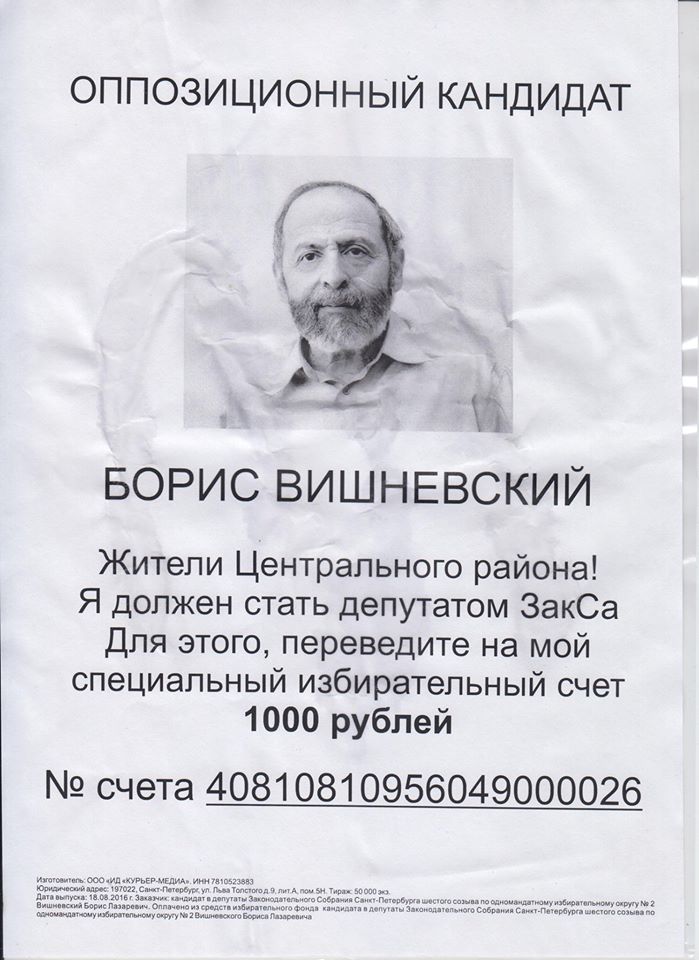
“Opposition candidate Boris Vishnevsky. Residents of the Central District! I must become a deputy in the [St. Petersburg] Legislative Assembly. To make this happen, transfer 1,000 rubles to my special election campaign account. Account no. 40810810956049000026.” The fine print in this counterfeit campaign poster creates the impression the poster was ordered by Vishnevsky himself and lists other fake details, such as the print run and the name of the print planting where the poster was, allegedly, printed, along with its address.
Friends and colleagues, especially those of you from the Central District:
The district has been pasted with fake ads, allegedly endorsed by me, suggesting that people transfer money to my election campaign account.
I think this is a reaction to my complaints against illegal campaigning on behalf of Maria Shcherbakova, United Russia’s candidate [for the seat in the Legislative Assembly currently held by Vishnevsky] and head of the Central District. Likely as not, the fake were posted early in the morning by employees of the housing and maintenance service. By the way, the number of the election campaign account is fake too, of course.
There is nothing surprising about this, friends. They don’t know how to campaign any other way and they won’t do it.
Complaints have been filed with the police, the prosecutor’s office, and the Municipal Electoral Commission.
First, don’t believe fakes.
Second, this is proof I have real support from people, and city hall is scared of me.
Third, when you see something like this, call my campaign headquarters immediately at +7 967 596 5021.
Maximum repost. People should be aware of dirty campaign tricks.
Translated by the Russian Reader
_________
But that is definitely not how low the regime can go. That was just a party trick, so to speak.
Meanwhile, some more productive Petersburgers have produced this nifty map of the city’s subway system. Unlike all other maps of the system, and there have been plenty since it went online in 1955, this one shows the depths, in meters, of all the stations in the subway.
The deepest, at 86 meters, is Admiralteiskaya, a relatively new station, opened in 2011, and located near Palace Square and the Hermitage, as well as, naturally, the Admiralty.
What do Petersburgers do as they ascend and descend the long escalators that take them down into and up out of the underground, rides that can take over five minutes in the most profound cases? Well, they do lots of things, including reading, chatting, meditating, listening to music, etc. One thing they are not doing a lot of, I am afraid, is thinking about the upcoming elections. But that is no accident, just as it was no accident all those fake Vishnevsky campaign posters were plastered all over downtown. TRR
Source: VKontakte; thanks to Comrade DE and others for the heads-up
“I am the pug who barked at Voldemort”: High school teacher in Ryazan Region forced to resign after refusing to campaign for United Russia
Darina Shevchenko
October 30, 2015 Yod
Raivo Shtulberg
Raivo Shtulberg, thirty-six, taught physics, computer science, and German for thirteen years at the only secondary school in the village of Olkha, in Ryazan Region’s Ukholovo District. Before elections to the Ryazan Regional Duma, in September of this year, the school administration demanded that teachers persuade at least six villagers to vote for the ruling United Russia party. Instead, Shtulberg shot a video in which he explained how teachers were being forced to campaign and posted it on the web. Shtulberg was forced to resign, and can now longer find employment as a teacher. Yod learned the details of the story.
The teachers were given questionnaires and asked to return them filled out with the names and signatures of the people they had successfully canvassed. Shtulberg was outraged by this request.
“At first, we filled in the names of distant relatives so they would leave us alone, but we were told it had to be fellow villagers. I got angry then. We were doing repairs at home, but I had to canvas the village for signatures. Other teachers also resented this. In particular, one of them said something about ‘Russian idiocy,’ but they dutifully went out canvassing.”
Shtulberg recorded a video in which he related how teachers had been forced to campaign for United Russia and posted it on YouTube.
“I acted spontaneously. You might say it was the revolt of the underdog. I am like the pug who barked at Voldemort. Village teachers are paid tiny salaries. I wore the same blazer to work for eight years or so, until two years ago it was completely tattered and I had to buy a new one. The principals have bigger salaries, and they can be ordered to campaign, but a full belly does not understand an empty one. I am not against any party or politician: I cannot reconcile myself with the low quality of life of teachers. If tomorrow, United Russia provided good roads and decent wages, I would vote for them or anyone else [who does these things]. Ultimately, it is my legal right to choose whom I vote for,” says Shtulberg.
The video garnered around 15,000 views on YouTube. It was seen by Yuri Bogomolov, co-chair of the regional branch of the opposition Solidarity and RPR-PARNAS parties in Ryazan. On the basis of what he heard, Bogomolov filed a complaint with the prosecutor’s office asking that United Russia be barred from the elections. It was after this, according to Shtulberg, that a crackdown against him was launched at school.
The school’s principal called a faculty meeting, which was attended by Shtulberg’s mother, who also taught at the school. Shtulberg did not attend the meeting himself. He says that the principal made it clear to his mother they both had better resign, otherwise they would be quietly “removed.”
“You can always find fault with a teacher. For example, by doing a full review of all the subjects he teaches and visiting his classes every day, then giving a series of quizzes and removing him for incompetency, and by carefully studying his record keeping,” says Shtulberg.
Yuri Bogomolov urged the disgraced teacher not to resign voluntarily and offered him legal assistance.
“I have no doubt that the campaign questionnaires were handed out at the school where Shtulberg taught. We know that employees at other schools, factories, and hospitals in Ryazan Region were forced to persuade people to vote for United Russia. In my recollection, Shtulberg is the only public sector employee who has openly and personally alleged violations,” says Bogomolov.
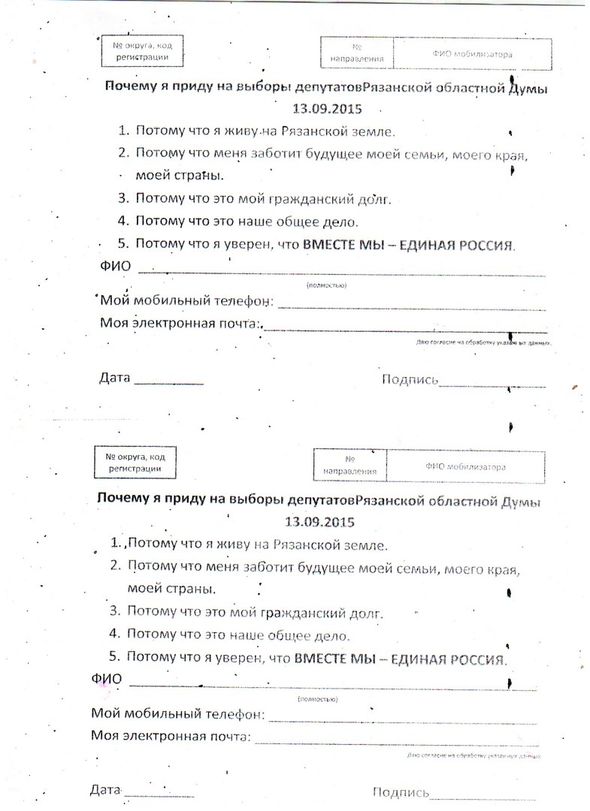
Photocopy of the campaign canvassing questionnaire that Raivo Shtulberg and his fellow teachers were required to ask people in their village to fill out. “Why I will be voting in elections for the Ryazan Regional Duma on September 13, 2015. 1. Because I live in the land of Ryazan. 2. Because I am concerned about the future of my family, my region, [and] my country. 3. Because it is my civic duty. 4. Because it is our common cause. 5. Because I am certain that TOGETHER WE ARE A UNITED RUSSIA. Surname Name Patronymic __________________________ My mobile phone number: __________________________________ My email address: ____________________________.” United Russia received 62% of the votes in the election. Their nearest rivals, the Communists, received a mere 13%. Opposition party Yabloko failed to overcome the five-percent barrier.
Shtulberg turned down the politician’s assistance and voluntarily resigned. His mother also resigned.
“To be honest, I was scared. I was not ready for such an abrupt turn of events,” he says.
Shtulberg’s colleagues responded neutrally to his dismissal.
“Village teacher are mostly good people. They perform their duties conscientiously, but they try and not speak out on political topics, because [they think] it isn’t worth the effort.
“Sit tight, go along with things, do what they ask you to do, get your salary, and don’t dare oppose not only the authorities but even the principal. My colleagues told me reproachfully, ‘United Russia pays our wages. Why can’t [you] live peacefully like other people? We have to vote for whomever the boss tells us to vote,” says Shtulberg.
His fellows villagers were also indifferent to the teacher’s firing. Only the children whom Shtulberg had taught wrote him messages of support on a social network.
Shtulberg says he really loved his job.
“I tried every lesson to give [my pupils] something insightful. In German, I would often offer them extra texts of my own. I would try and make sure the computer games were more interesting, show them lots of videos, and do presentations. I would not say I was pals with my pupils. I kept my distance, but I treated them respectfully.”
After he was fired, Shtulberg tried to find a work at a school. At first, he was offered a job teaching computer science in a neighboring village, but then he was turned down for the job with no explanation.
“I cannot confirm it, but probably they called my previous place of employment and were told what sort of person I was,” says Shtulberg.
He tried to find a job at a school in Ryazan, but realized he would not be able to move to the city. A teacher’s salary would only cover the rent.
His former bosses claim that the athletic Shtulberg is a binge drinker and alcoholic.
Shtulberg says that he now works as a copywriter and earns enough to get by.
His only regret is that his mother lost her job at the school because of him.
“Mom worked forty-five years at that school. She was an excellent public educator. Mom really misses the school and her pupils. She is in bad psychological shape now. I am very scared for my brother. He also works as a teacher, in a nearby village, and I am afraid he also might suffer because of me,” says Shtulberg.
At the Olkha Village School, Yod was told that Raivo Shtulberg had never worked there. In turn, the Ukholovo District Department of Education and Youth Policy told us that Raivo Shtulberg had taught at the village school in Olkha.
“The school’s principal had to cover for him all the time, because he drank and skipped classes. Because of his alcoholism, he recorded a video, posted it on the web, and dragged all of us through the mud,” our source told us.
Shtulberg is not surprised by these comments.
“I did not abuse alcohol and did not skip classes. But a response like this from bureaucrats does not surprise me. For the authorities, public sector employees do not exist as it were. We are these also-rans pottering about somewhere. We behave peacefully, do not ask for a lot of money, and that is fine. Public sector employees are viewed as a silent constituency that can be used at [the regime’s] discretion.”
Translated by the Russian Reader
_________
Our Swimmer
I guess I am a sucker for these stories of underdogs from the Russian hinterlands and margins of Russian society fighting the powers that be practically on their lonesome. There sure do seem to be a fair number of them in the press lately, which is encouraging.
They tell us two things. First, that it is a lie that Putin’s “base of support” is found in places like the village of Olkha in Ryazan Region, where the indomitable Raivo Shtulberg worked as a high school teacher until he was summarily fired for refusing to canvass for the ruling United Russia party in the run-up to regional parliamentary elections there this past September.
If people in places like Olkha “support” Putin and UR, it is not because these mighty rulers have improved their lives in any substantial way. It is because these people are passively afraid of losing what they already have and actively afraid of political authorities in general. History has taught them this lesson.
More importantly, in many cases, they are simply intimidated, upon pain of firing, into “throwing their support” behind the ruling party during elections.
So, among such “losers” like Raivo Shtulberg, Putin is not “popular.” On the contrary, he has been “popularized” among such “simple” and “disempowered” folk through a whole armory of tactics including relentless media propaganda, outright intimidation, and vote rigging.
When push comes to shove, as I hope and think it might someday, folks like Raivo Shtulberg’s fellow villagers will remember his “foolish” deed from several months ago or a few years back, and that will be all she wrote for Putin and UR.
All the pundits, analysts, and journalists who had been excitedly citing polls and 600% approval ratings for Putin in the interim will suddenly do an about-face and pretend they were on the side of the “ordinary people” all along.
Second, Putin’s real base of support is among those who have made out like bandits, either on a major or minor scale, over the past fifteen years. Some of these people might also, technically, be classified as “public sector employees,” like Raivo Shtulberg, but they do not work as village schoolteachers, and their pay grade is way higher. And the kickbacks and perks they enjoy are astronomically better.
And these real-live Putin supporters do not live, for the most part, in villages like Olkha, but in cities like Moscow, Petersburg, and even London.
It is a story too long and convoluted to tell in this slapdash afterword, but to some extent (although certainly not entirely), the Fair Elections movement of 2011-2012 was an attempt by a segment of this pro-Putinist class to save face in its own eyes and the eyes of the “civilized” world by opposing itself feebly to Putin’s “electoral dictatorship.”
Be that as it may, when you are tempted to imagine or encouraged by a lazy journalist or “analyst” to think that Russia’s anti-democratic woes are caused by Putin’s “popularity” among the simple toilers and rural yokels in the “heartlands,” think about what Raivo Shtulberg did and what happened to him, and think again. Russia is where it is today because well-educated people from Moscow and Petersburg with tons of connections to start with wanted it to happen that way.
“Whatever anybody says, especially our foes from abroad, both you and I know that we live in the most democratic country, in Russia.”
— Georgy Poltavchenko
This past Sunday, September 14, was declared “Democracy Day” in Petersburg, Europe’s fourth largest city. What this meant on paper was that the city’s Kremlin-appointed governor, Georgy Poltavchenko, swept to an overwhelming victory in his first “real” gubernatorial race, while ruling United Party crushed the opposition in elections to the city’s neighborhood councils. Then the victors celebrated “democracy” with a pop concert on Palace Square.
What this meant in practice was that Poltavchenko’s only real challenger had been peremptorily “filtered” from the race two months ago, and the melancholic KGB nonentity was left to face a quartet of stick-figure opponents almost no one had heard of before; the United Russia machine pulled out all the stops doing what it loves best—brazenly rigging elections and just as flagrantly cracking down on anyone who challenges its right to do that; and a band of foreign fascists, ultra-right-wingers, and Stalinist clowns, masquerading as “international monitors,” showed up to rubber stamp this bloody farce. No wonder Robert Mugabe backs Russia.
I received the following letter from a friend whose son celebrated “Democracy Day” by serving as a member of the electoral commission at a polling station in central Petersburg. I have translated the letter and published it here with her permission, but I have changed the names of people and places to protect “Dmitry,” “Lyuba,” and the author from further persecution and harassment.
**********
I don’t know whether you are aware of yesterday’s elections in Petersburg. They were completely hellish.
[Our son] Dmitry was a voting member of the electoral commission at Polling Station No. 86, on Austerlitz Street. His girlfriend Lyuba had the same status at Polling Station No. 85, which was in the same building. A bunch of Dmitry’s friends worked in the same capacity at various other polling stations.
The chairs of the commissions hid from them all the time. On Saturday, the day before the elections, Dmitry went to his polling station, where he immediately faced aggression and intimidation: “We’ll have you removed from the polling station,” “Don’t you dare photograph anything,” “We’ll settle your hash later,” and so on. Dmitry demanded to be shown the certificate for receipt of the envelopes containing the absentee ballots. The chairwoman started screaming that this was a provocation. Saturday ended with the chairwoman turning Dmitry over to the police for allegedly photographing the voter lists.
Dmitry was taken to the eighty-third police precinct on the Old Barge Channel, where he was immediately released because the arrest had been illegal. I went to the precinct to get him.
Then came Sunday [election day]. Right away in the morning, Dmitry wrote to us that there had been a bunch of violations; he was again being threatened, and so forth. He was sent out with a mobile ballot box to make the rounds of the old women [pensioners confined to their homes], and while he was out, the chairwoman sent someone with two unregistered ballot boxes to a hospital. At the end of the day, the ballot boxes came back with twenty additional votes that had appeared out of nowhere, as if people had been admitted to the hospital the day before and were immediately registered as voters at this polling station. It was like this with the ballot boxes at nearly every polling station: two hundred votes apiece, cast by completely unknown people, ended up in them.
In the afternoon, I brought Dmitry coffee, because he was afraid to leave the polling station. Lyuba went out to have tea, and while she was out, two ballot boxes were carried away from her polling station: she was informed of this after the fact.
When I arrived at the polling station, they also made as if they were going to arrest me: “Who the hell are you? His mama?” and so on. I snapped at them and told them they were shameless. Dmitry and I went out onto the porch. Some security guards—not cops—came out after us, as if they were keeping track of us. They smoked and swore. We remarked to them that both smoking and swearing were administrative violations. They cussed us out. When Dmitry started filming them with his telephone, they began pushing us down the stairs, trying to snatch the telephone from Dmitry. They got the telephone from him, and Dmitry hurt his hand. (Also, one of the guards got doused with coffee, meaning that Dmitry was left without coffee.) We called the police. When they heard us doing that, the guard cooled their heels and gave back the telephone, but they had erased the video.
Then a polizei came, and Dmitry and I filed an assault complaint. The polizei said he would charge the men with an administrative violation for smoking.
I told the chairwoman that hopefully she was being well paid for everything, because otherwise I saw no point to this mayhem. To which she replied that she was glad I was concerned about her welfare.
But it got really gnarly after the polls closed. We got reports from everywhere about [opposition electoral commission members and observers] being removed from polling stations during the counting of the votes. When Lyuba’s turn came and she refused to leave the polling station voluntarily, the police were summoned and told that she had spit on a local cop. Lyuba was taken away, and like Dmitry the day before, she was just released. She has filed a bunch of complaints against everyone.
At Dmitry’s polling station, on the contrary, they didn’t start counting the votes for four hours: they were supposedly verifying the voter lists. However, the chair of the Shostakovich Municipal District Electoral Commission, a man who weighs over a hundred kilograms, would come up to Dmitry and whisper in his ear, “I will find you and kill you.” He did this several times. Dmitry was alone against twenty gangsters who insulted and threatened him.
Dmitry called us and said he was being threatened, that they were trying to remove him from the polling station for videotaping and interfering with the commission’s work. I telephoned GOLOS (in general, I spent all of Saturday and Sunday phoning and writing everywhere). The people at GOLOS [a Russian electoral rights NGO] told me I should go to the polling station. At one in the morning, Grigory [her husband] and I ran to Austerlitz Street.
Just as we got there, Dmitry rang to say he was being forcibly dragged from the polling station. A police jeep was already parked outside. Dmitry had also called the police and told them he was being unlawfully removed, but they hadn’t shown up, or rather, they showed up to arrest him.
I was talking to Dmitry on the phone, and he was yelling, “Don’t you dare arrest me, you’re breaking the law.”
The door opened, and Grigory and I saw a cop dragging Dmitry from the polling station. I ran up to the cop and told him he was breaking the law and so on. To make a long story short, Dmitry was again being taken to the eighty-third police precinct. We headed there.
Before leaving, I asked the cop a question.
“Look me straight in the eyes and tell me you aren’t ashamed.”
“I am just doing my job,” he said.
“But what about the law?” Grigory asked.
The cop began to walk away.
“Do you believe in God?” Grigory shouted to him as he walked away.
“Yes,” the cop firmly replied.
Well, then we arrived at the police station. Dmitry was almost immediately released. He also dashed off a bunch of complaints.
We got home at four in the morning. Dmitry ate and drank for the first time in a twenty-hour hellish day. Then we were online until six in the morning watching as his electoral commission kept putting stuff up and erasing and rearranging it. They didn’t even have the obligatory large summary vote tally.
Dmitry’s friends were practically removed from all the polling stations [where they served as electoral commission members and observers]. One friend, Eduard Dubinsky, who was a candidate for the municipal council in the Kamenka district, was arrested for allegedly resisting the police. He spent the night in jail, and the next day a court sentenced him to a five hundred ruble fine. So Dmitry got off lightly. But we are waiting for responses to all his complaints.
P.S. We also found out that there were around two hundred ballots in the unaccounted ballot boxes at Dmitry’s polling station that were secretly sent out and brought back from the hospital, but it is impossible to verify who filled them out and how. Twenty-one of these ballots were allegedly filled out by people who had been admitted to the hospital the day before. It is unclear how they could be entered onto the voter lists. In fact, it couldn’t have been done legally. Plus, now Dmitry has checked and spotted the fact that another one hundred additional voters appeared up out of nowhere. He found this while looking over the final report. Meaning that approximately three hundred fake votes were added to the tally at his polling station. That is roughly fifty percent added to the total. Now I understand why the commission was so aggressive and didn’t allow the results to be known, and whey they were looking for an excuse to kick Dmitry out.
Translated by the Russian Reader. Image courtesy ofacademichelp.net
While Manifesta 10’s “public” program sets all that is left of progressive humanity (i.e., the contemporary art world) on fire with its overly provocative metallic Xmas tree, actual public and political life stubbornly and unattractively creaks on in the city that progress and progressive humanity have forgotten, Saint Petersburg, former capital of All the Russias.
This life is of no interest to almost anyone, practically, even in Petersburg itself, so take what follows the way I and many other radio listeners the world over consume the beloved “Shipping Forecast” on BBC Radio 4: as a series of pleasant but ultimately meaningless vocables that have absolutely nothing to do with the way we self-satisfied landlubbers lead our rich, perfectly dry lives.
Gubernatorial and municipal district council elections are scheduled for September 14 in Saint Petersburg. However, even before the pretenders began formally declaring their candidacies this month, many observers, including liberal journalist Vladimir Kara-Murza, argued the fix was in, and the Smolny would never allow any serious opposition to the incumbent (the unelected Kremlin appointee Georgy Poltavchenko) or whatever other candidate the Kremlin might suddenly choose to run for the job.
And indeed that is what has happened. Perhaps the only (mildly) oppositional candidate with the popularity and support to make the race real, Oksana Dmitrieva of A Just Russia party, was nixed before she got to the starting blocks. She did not pass the so-called municipal filter: formal approval of her candidacy by a minimum of 156 district council deputies.
I could not find any report about any of this monkey business in English, but hilariously I did find a badly translated statement from the ruling United Russia party angrily denouncing Dmitrieva for having the temerity to suggest there was something fishy about her failing to get through the filter and demanding an apology from her.
Well, sayonara, fair Oksana. We, the enlightened Petersburg “public,” barely knew who you were anyway, so we won’t miss you.
However, really serious candidates, like Takhir Bikbayev of the “Greens Ecological Party,” a man whose name is synonymous in the minds of Petersburg voters with all things environmental and progressive, (that’s a joke: I really have never heard of him before nor, I gather, has anyone else), easily passed through the dreaded filter.
Meanwhile, opposition candidates are being purged right and left from the district council races or otherwise prevented from registering. One such victim of Putinist vigilance is Fyodor Gorozhanko, a well-known local grassroots housing rights advocate, who was dismissed from the elections after United Russia complained he had “misled” voters who signed a petition supporting his candidacy. A court has upheld the complaint.
How exactly did Gorozhanko “mislead” voters? On the standard-issue petition sheets voters sign to get candidates on the ballot, there is a blank where the candidate has to state whether he or she is “employed” and where. Since Gorozhanko works as a volunteer aide to Petersburg Legislative Assembly deputy Maxim Reznik, he crossed out the word “employed” and pencilled in what he does now in lieu of gainful employment. This is how he “misled” voters. Gorozhanko plans to appeal the court’s decision…
Man, this local politics shit is so, so boring. I am going to switch on the “Shipping Forecast” and wait for a contemporary artist to make another provocative statement in public space about public space and history. Now that will be something to talk about.
P.S. While I was gussying up this post, incumbent Georgy Poltavchenko officially declared his candidacy. He will face stiff competition on September 14 from Irina Ivanova (CPRF), Konstantin Sukhenko (LDPR), Takhir Bikbayev (Greens), and Andrei Petrov (Motherland). I think it’s safe to say the vast majority of Petersburg will have never heard of any of these candidates except for Poltavchenko, of course, although Ivanova and Sukhenko are deputies in the city’s legislative assembly.
Oksana Dmitrieva (A Just Russia) and Anatoly Golov (Yabloko) were refused registration. Dmitrieva has claimed that Poltavchenko pressured municipal deputies into not supporting her candidacy and has filed complaints with the prosecutor general’s office and the central electoral commission.

 Photo published March 10, 2018, on the Archangelsk Life community page on the VK social network. “Photo of the Day. ‘We’re Going to Vote.’ *The common law wife of regional MP Alexander Dyatlov, chair of the regional committee of United Russia Party supporters, is in the middle.”
 “March 18, 2018. Russian Presidential Election. Our Country, Our President, Our Choice! Russian Central Election Commission.” February 19, 2018, Ligovsky Prospect, Central Petersburg. Photo by the Russian Reader
 On this “get out the vote” billboard, recently photographed somewhere in central Petersburg, a “vandal” has lightly crossed out the word “election.” Photo by the Russian Reader