Maria Kuvshinova: What Sentsov Could Die For

What Sentsov Could Die For
Maria Kuvshinova
Colta.Ru
May 25, 2018
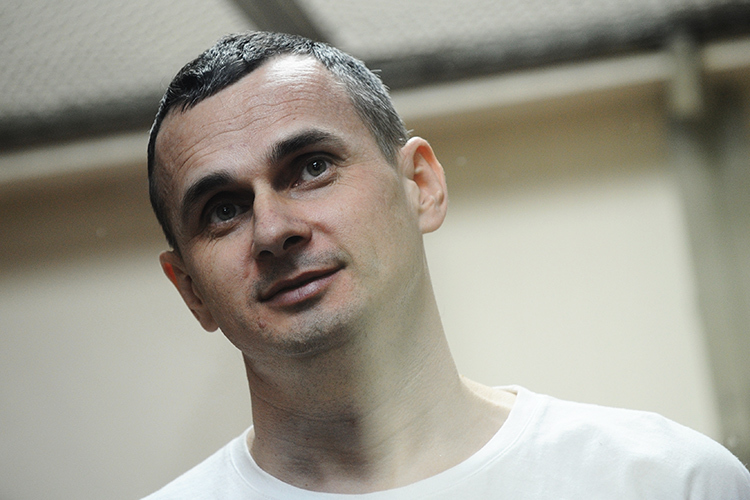
Detailed_pictureOleg Sentsov. Photo by Sergei Pivovarov. Courtesy of RIA Novosti and Colta.Ru 

On May 14, 2018, Oleg Sentsov went on an indefinite hunger strike in a penal colony located north of the Arctic Circle. His only demand is the release of all Ukrainian political prisoners in Russia. According to Memorial’s list, there are twenty-four such prisoners.

In August 2015, Sentsov was sentenced to twenty years for organizing a terrorist community and planning terrorist attacks. The second defendant in the case, Alexander Kolchenko, was sentenced to ten years in prison. Mediazona has published transcripts of the hearings in their trial. Around three hundred people have read them over the last three years. The transcripts make it plain the only evidence of the alleged terrorist organization’s existence was the testimony of Alexei Chirniy, who was not personally acquainted with Sentsov. It is police footage of Chirniy’s arrest while he was carrying a rucksack containing a fake explosive device that propagandists often pass off as police footage of Sentsov’s arrest.

Before his arrest, Sentsov was an Automaidan activist. In the spring of 2014, he organized peaceful protests against Crimea’s annexation by Russia.

“Yesterday’s ‘suicide bomber auto rally’ took place in Simferopol yesterday, but in quite abridged form,” Sentsov wrote on Facebook on March 12, 2014. “Only eight cars, six reporters with cameras, and twenty-five activists/passengers assembled at the starting point. I would have liked to have seen more. Unfortunately, most of the armchair revolutionaries who were invited were afraid to go. The traffic cops and regular police also showed up at the starting line, insisting we not leave for our own safety. We told them our protest was peaceful. We had no plans of breaking the rules, so we suggested they escort us to keep the peace for everyone’s sake.”

The second defendant, Kolchenko, admitted involvement in the arson of an office that was listed in the case file as belonging to the United Russia Party, but which in April 2014 was an office of Ukraine’s Party of Regions. The arson took place at night. It was meant to cause physical damage while avoiding injuring anyone.

The Russian authorities tried to prove both Sentsov and Kolchenko were linked with Right Sector, a charge that was unsubstantiated in Sentsov’s case and absurd in the latter case due to Kolchenko’s well-known leftist and anarchist convictions. Gennady Afanasyev, the second witness on whose testimony the charges against the two men were based, claimed he had been tortured and coerced into testifying against them.

Sentsov and Kolchenko’s show trial, like the show trials in the Bolotnaya Square Case, were supposed to show that only a handful of terrorists opposed the referendum on Crimea’s annexation and thus intimidate people who planned to resist assimilation. The Russian authorities wanted to stage a quick, one-off event to intimidate and crack down on anti-Russian forces. But two circumstances prevented the repressive apparatus from working smoothly. The first was that the defendants did not make a deal with prosecutors and refused to acknowledge the trial’s legitimacy. The second was that Automaidan activist Oleg Sentsov unexpectedly turned out to be a filmmaker, provoking a series of public reactions ranging from protests by the European Film Academy to questions about whether cultural producers would be capable of blowing up cultural landmarks. Segments of the Russian film community reacted to the situation with cold irritation. According to them, Sentsov was a Ukrainian filmmaker, not a Russian filmmaker, and he was not a major filmmaker. The owner of a computer club in Simferopol, his semi-amateur debut film, Gamer, had been screened at the festivals in Rotterdam and Khanty-Mansiysk, while release of his second picture, Rhino, had been postponed due to Euromaidan.

The Ukrainian intelligentsia have equated Sentsov with other political prisoners of the empire, such as the poet Vasyl Stus, who spent most of his life in Soviet prisons and died in Perm-36 in the autumn of 1985, a week after he had gone on yet another hunger strike. The Ukrainian authorities see Sentsov, a Crimean who was made a Russian national against his will and is thus not eligible for prisoner exchanges, as inconvenient, since he smashes the stereotype of the treacherous peninsula, a part of Ukraine bereft of righteous patriots. Sentsov’s death on the eve of the 2018 FIFA World Cup would be a vexing, extremely annoying nuisance to the Russian authorities.

Sentsov is an annoyance to nearly everyone, but he is a particular annoyance to those people who, while part of the Russian establishment, have openly defended him, although they have tried with all their might to avoid noticing what an inconvenient figure he has been. Although he was not a terrorist when he was arrested, he has become a terrorist of sorts in prison, because his trial and his hunger strike have been a slowly ticking time bomb planted under the entire four-year-long post-Crimean consensus, during which some have been on cloud nine, others have put down stakes, and still others have kept their mouths shut. Yet everyone reports on the success of their new endeavors on Facebook while ignoring wars abroad and torture on the home front. Sentsov represents a rebellion against hybrid reality and utter compromise, a world in which Google Maps tells you Crimea is Russian and Ukrainian depending on your preferences. To what count does “bloodlessly” annexed Crimea belong, if, four years later, a man is willing to die to say he does not recognize the annexation?

The success of Gamer on the film festival circuit, which made Sentsov part of the international film world, and his current address in a prison north of the Arctic Circle beg three questions. What is culture? Who produces culture? What stances do cultural producers take when they produce culture? There are several possible answers. Culture is a tool for reflection, a means for individuals and societies to achieve self-awareness and define themselves. It is not necessarily a matter of high culture. In this case, we could also be talking about pop music, fashion, and rap. (See, for example, the recent documentary film Fonko, which shows how spontaneous music making has gradually been transformed into a political force in post-colonial Africa.) On the contrary, culture can be a means of spending leisure time for people with sufficient income, short work days, and long weekends.

Obviously, the culture produced in Russia today under the patronage of Vladimir Medinsky’s Culture Ministry is not the first type of culture, with the exception of documentary theater and documentary cinema, but the founders of Theater.Doc have both recently died, while Artdocfest has finally been forced to relocate to Riga. The compromised, censored “cultural production” in which all the arts have been engaged has no way of addressing any of the questions currently facing Russia and the world, from shifts in how we view gender and the family (for which you can be charged with the misdemeanor of “promoting homosexualism”) to the relationship between the capitals and regions (for which you can charged with the felony of “calling for separatism”). Crimea is an enormous blank spot in Russian culture. Donbass and the rest of Ukraine, with which Russia still enjoyed vast and all-pervasive ties only five years ago, are blank spots. But cultural producers have to keep on making culture, and it is easier to say no one is interested in painful subjects and shoot a film about the complicated family life of a doctor with a drinking problem and a teetotalling nurse.

When we speak of the second type of culture—culture as leisure—we primarily have in mind Moscow, which is brimming over with premieres, lectures, and exhibitions, and, to a much lesser extent, Russia’s other major cities. So, in a country whose population is approaching 150 million people, there is a single international film festival staged by a local team for its hometown, Pacific Meridian in Vladivostok. All the rest are produced by Moscow’s itinerant three-ring circus on the paternalist model to the delight of enlightened regional governors. It matters not a whit that one of them ordered a brutal assault on a journalist, nor that another was in cahoots with the companies responsible for safety at the Sayano-Shushenskaya Dam, where 75 people perished in 2009. What matters is that the festival movement should go on. There is no room in this model for local cultural progress. There can be no free discussion generated by works of art when everyone is engaged in total self-censorship. After I went to Festival 86 in Slavutych, whose curators have been conceptually reassessing the post-Soviet individual and the post-Soviet space, I found it painful to think about Russian film festivals. This sort of focused conceptualization is impossible in Russia. It is of no interest to anyone.

There are two more possible answers to the question of what culture is. Culture is propaganda. Or, finally, culture is only the marquee on a commercial enterprise profiting at the taxpayer’s expense. It is not a big choice, and the kicker is that by agreeing today to be involved in churning out propaganda, milking taxpayers, supplying optional leisure time activities, producing censored works, and colonizing one’s own countrymen for the sake of money, status, and membership in a professional community, the people involved in these processes automatically stop making sense. It is naïve to think the audience has not noticed this forfeiture. It is no wonder the public has an increasingly hostile reaction to cultural producers and their work.

No one has the guts to exit this vicious circle even in protest at the slow suicide of a colleague convicted on trumped-up charges, because it would not be “practical.” The events of recent months and years, however, should have transported us beyond dread, since everyone without exception is now threatened with being sent down, the innocent and the guilty alike.

Post-Soviet infantilism is total. It affects the so-called intelligentsia no less than the so-called ordinary folk. Infantilism means being unable to empathize, being unable to put yourself in another person’s shoes, even if that person is President Putin, a man with a quite distinct sense of ethics, a man who has been studied backwards and forwards for twenty years. Apparently, the message sent to the creative communities through the arrest of Kirill Serebrennikov was not registered. If you want to be a dissident, start down the hard road of doing jail time for misdemeanor charges, facing insuperable difficulties in renting performance and exhibition spaces, becoming an outsider, and experiencing despair. If you want a big theater in downtown Moscow, play by the rules. Like your average late-Soviet philistine, Putin regarded the creative intelligentsia with respect at the outset of his presidential career. (See, for example, footage from his visit to Mosfilm Studios in 2003.) However, a few years later, he was convinced the creative intelligentsia was a rampantly conformist social group who would never move even a millimeter out of its comfort zone and would make one concession after another. A lack of self-respect always generates disrespect in counterparts.

By signing open letters while remaining inside the system and not backing their words with any actions whatsoever, the cultural figures currently protesting the arrests of colleagues are viewed by the authorities as part of the prison’s gen pop, while people who live outside Moscow see them as accomplices in looting and genocide. No one takes seriously the words of people who lack agency. Agency is acquired only by taking action, including voluntarily turning down benefits for the sake of loftier goals. The acquisition of agency is practical, because it is the only thing that compels other people to pay heed to someone’s words. I will say it again: the acquisition of agency is always practical. At very least, it generates different stances from which to negotiate.

Sentsov has made the choice between sixteen years of slow decay in a penal colony and defiant suicide in order to draw attention not to his own plight, but to the plight of other political prisoners. Regardless of his hunger strike’s outcome, he has generated a new scale for measuring human and professional dignity. It is an personal matter whether we apply the scale or not, but now it is impossible to ignore.

Thanks to Valery Dymshits for the heads-up. Translated by the Russian Reader
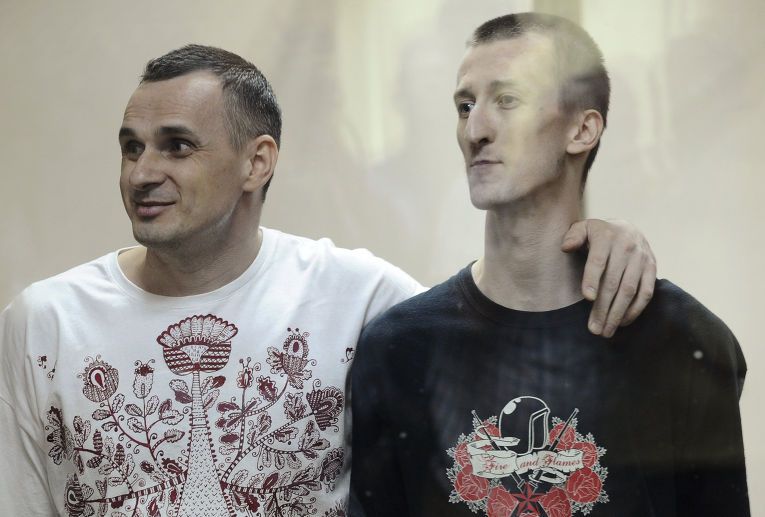
Comrade to Comrade

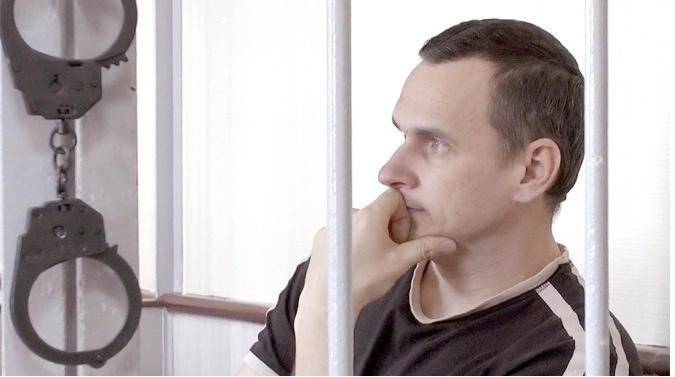
1465990524-5252Crimean political prisoners Oleg Sentsov and Alexander Kolchenko during their so-called trial by a Russian kangaroo court. Photo courtesy of Unian Information Agency
Alexander Kolchenko, Convicted in the Case of the “Crimean Terrorists,” Writes a Letter to Oleg Sentsov
Mediazona
May 22, 2018

Antifascist Alexander Kolchenko, convicted in the Case of the “Crimean Terrorists,” has written a letter to filmmaker Oleg Sentsov, who is in the ninth day of a hunger strike meant to force the Russian authorities to release all Ukrainian political prisoners from the country’s prisons. Mediazona was told about the letter by attorney Svetlana Sidorkina.

According to Sidorkina, Kolchenko was afraid the censor would not pass the letter on to Sentsov, so he gave her a detailed acount of its contents when she visited Kolchenko at Corrective Colony No. 6 in the town of Kopeysk.

“In the letter he wrote that, in his opinion, a hunger strike was an effective means of defense only in cases in which a country valued its reputation. Alexander believes that, in Oleg’s case, Russia could ignore his hunger strike, but not let him die by forcibly feeding and sending him off for a psychiatric examination. Sergei Magnitsky’s death changed nothing in Russia. Instead, the Dima Yaklovev Law was adopted. He did not try and dissuade Oleg, since he knows Oleg is stubborn and does not change his mind. He is quite concerned for his health, since he knows what the climate and living conditions are like in Labytnangi from prisoners he met when he and Oleg were in transit to the prisons where they would serve their sentences. Although Alexander doesn’t agree with Oleg’s method, he respects his stance on freeing Ukrainian political prisoners from Russian prisons and is ready to support Oleg if he needs to,” said Sidorkina.

Sidorkina tried to dissuade Kolchenko from a possible hunger strike by pointing to his health problems and the fact he is underweight. Because of this, he is on a special diet.

Aside from the letter to Sentsov, Kolchenko wrote a letter to Vladimir Putin demanding he intervene in the situation and release Sentsova. Kolchenko, however, was afraid the censor would also prevent the letter from reaching its addressee.

Kolchenko added he had no complaints about conditions in the penal colony. According to Sidorkin, he looked cheerful, but was quite worried about Sentsova. Sidorkina had wanted to show him articles about the Ukrainian filmmaker’s hunger strike, but penal colony staff stopped her from doing so.

In 2015, a court sentenced Kolchenko and Sentsov to ten years and twenty years, respectively, in maximum security penal colonies. According to police investigators, in 2014, Sentsov established a “terrorist community” (illegal under Article 205.4 Part 1 of the Russian Criminal Code). Members of the alleged community supposedly set fire to the doors of the Russian Community of Crimea and the windows of a United Russia Party office. These actions were deemed terrorist attacks, punishable under Article 205 Part 2 Paragraph A of the Criminal Code.

In addition, police investigators insisted members of the alleged “terrorist community” were planning to blow up a monument to Lenin and the Eternal Flame, punishable under Article 30 Part 1 and Article 205 Part 2 Paragraph A. Sentsov was also charged with trafficking in arms and explosives as part of a group, punishable by Article 222 Part 3. Kolchenko was found guilty of involvement in the alleged terrorist community and planning terrorist attacks on the Crimean Peninsula. Both men have denied their guilt.

In the spring of 2016, Sentsov was transported to a penal colony in Yakutia, but in 2017 he was transferred to the White Bear Colony in Labytnangi. In the winter of 2017, the Ukrainian authorities announced they were prepared to exchange Russian prisoners for Sentsov and Kolchenko. On May 14 of this year, Sentsov announced he was going on an indefinite hunger strike to secure the release of all Ukrainian political prisoners in Russia.

Translated by the Russian Reader

“Popular”

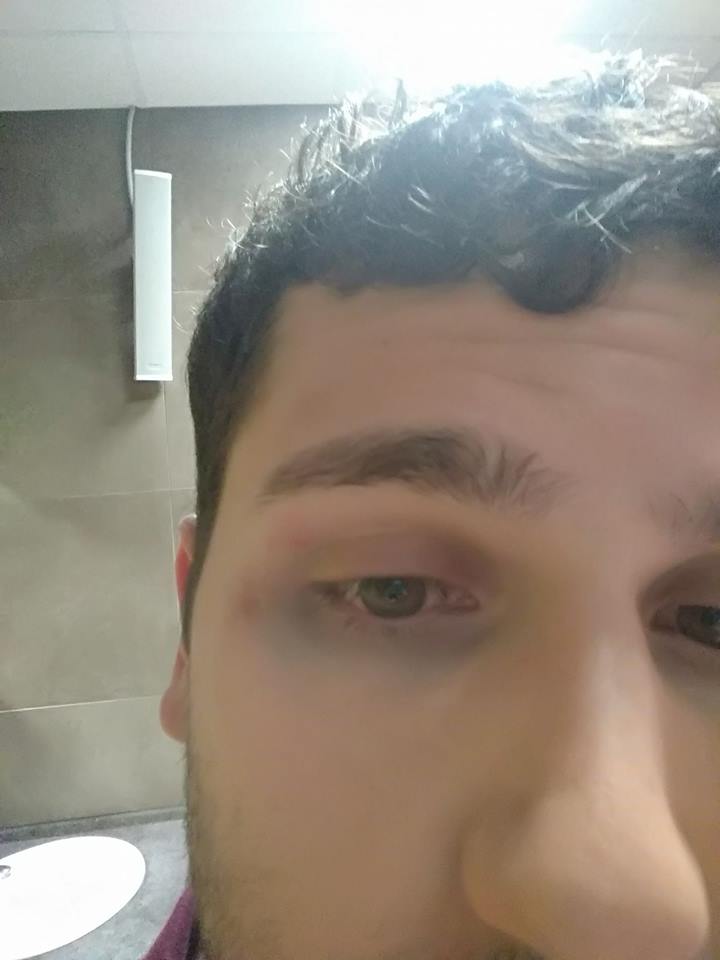
32729013_1730140783711212_4715134261416427520_nA selfie taken by elections observer and Golos coordinator David Kankiya in Krasnodar. He writes: “Dear Veniamin Kondratyev [governor of Krasnodar Territory], I would like to know what you think about the fact I was beaten up today and the continuing pressure exerted on political and grassroots activists by law enforcement. This is how you see the region’s image right before the World Cup?”

Vladimir Putin is not “popular” in any meaningful sense of the term. He is the head of what may be the world’s largest mafia gang. Unless forces emerges within the gang to challenge his leadership, which seems unlikely, he will remain head of the gang (aka the Russian Federation’s ruling elite) until he dies of natural or other causes. It is as simple as that.

How do I know it? Because of the sheer amount of main violence and rabid intimidation visited upon anyone who challenges Putin’s unchallengeable rule in any way, even in ways that are almost imaginary, as in the case of Crimean filmmaker Oleg Sentsov, now on the sixth day of a hunger strike in a Siberian prison. Sentsov was sentenced to twenty years in prison by Putin’s mafia gang after it illegaly invaded and occupied Sentsov’s home of Crimea, part of the sovereign state of Ukraine.

Here is another example, closer to home and the notion that Putin is “popular” and was  thus “popularly” elected. The day after Putin’s “reelection” this past March, NPR filed a story that contained this passage.

A month before Russia’s presidential election, observer David Kankiya was informed by the police that his car might have been used to commit a crime, Reuters reported. He was detained, charged with disobeying police and sent to jail for five days. “I was detained and charged on a false pretext,” Kankiya told the news agency. “It’s political pressure.”

Police say Kankiya didn’t produce identification during a routine check.

As the presidential election drew closer, Kankiya’s car tires were slashed and pro-Kremlin journalists accosted him in two separate incidents, he told Reuters.

Kankiya is a coordinator at Golos, a nongovernmental election watchdog that was labeled a “foreign agent” because it received foreign aid. Volunteers from Golos — a word that translates to both “vote” and “voice” — say when entering or leaving Russia, they are often stopped by border staff who accuse them of having terrorist links, according to Reuters.

Now word has come that Mr. Kankiya was assaulted and battered by two men in the stairwell of his own home yesterday. The word comes from Mr. Kankiya himself, writing on Facebook.

Меня избили в подъезде дома. 2 амбала. Били руками и ногами. Пшикали перцовкой. Очень больно, но это тоже переживу. Господа, силовики, большое спасибо за такое внимание к моей скромной персоне. Но вы уже хотя бы прямо сказали чего вам от меня надо? То аресты, то слежка с избиением. Зачем вы так позоритесь?

I’ve been beaten up in the stairwell of my building. It was two palookas. They hit me and kicked me. They zapped me with pepper spray. I hurt like hell, but I’ll live through this, too. Dear security forces guys, a big thanks for the attention you pay to little old me. But didn’t you already tell me straight to my face what you wanted from me? But first you jail me, then you have me tailed and beaten up. Why do you behave so shamefully?

I could supply you with a thousand more stories like Mr. Kankiya’s. And people like him who are on the frontlines of the fight against Putin’s mafia rule in Russia, including a friend of his and a friend of mine who informed me yesterday about the attack on Mr. Kankiya, could tell you ten thousand more stories like it.

When you add all those stories up, you do not conclude that the country in question is ruled by a truly “popular” leader.

What you conclude is that, for nearly two decades running, a gang of violent thugs has been pummeling, scapegoating, jailing, murdering, intimidating and otherwise silencing its real and imagined enemies—in the world’s biggest country, the list of those enemies has proven almost endless—while a troika of absolutely shameless pollsters (Levada, FOM, VTsIOM), eager beyond belief to stay in the mafia boss’s good graces and “scientifically prove” his “popularity,” has been monitoring, almost by the day, sometimes by the hour, to test whether the rest of the Russian “populace” gets it, whether they realize they have only one choice: “like” their “popular” president for life or “dislike” him and face the unpleasant consequences faced by the likes of Mr. Sentsov and Mr. Kankiya.

The pseudo-pollsters are just as shamelessly seconded by a whole battalion of “Russia hands” and “veteran Moscow correspondents,” like Stephen Cohen and Mary Dejevsky, to name two of the most loathsome, who are ready to tell any lie or fib to justify or explain away Putin’s tyrannical rule and the punishments he and his secret services rain down on their enemies, real and imagined, great and small.

That is the whole story. Anyway who says otherwise really is a liar or a sophist or a “Russia expert” resident in Ottawa or New Haven. // TRR

Three Years Later: Suicide by Crimea

Suicide by Crimea
Nikolay Klimenyuk
oDR
March 17, 2017

As long as Russia maintains its grip on the Ukrainian peninsula, significant changes for the better at home are impossible.

In the three years that have passed since the annexation of Crimea, a consensus has taken shape in Russia. Everything having to do with the Ukrainian peninsula is Russia’s internal affair, and far from the most important one.

The “accession” of Crimea has even quite succesfully happened in the heads of the regime’s opponents. In November 2016, while arguing on Facebook with Crimean Tatar journalist Ayder Muzhdabaev, Mikhail Khodorkovsky expressed a stance then supported by many publicly prominent liberals, including activists and intellectuals. Russian society, he argued, wants to deal with other problems. The opposition’s biggest task is regime change, but returning Crimea to Ukrainian jurisdiction by democratic means would be impossible because public opinion would be opposed. Crimea is not mentioned at all in Alexei Navalny’s 2018 presidential campaign platform.

Russian media outlets generally considered “liberal” (these media usually eschew the word “opposition”) havealso swallowed the annexation and most of the rhetoric surrounding it without a peep. TV Rain, RBC (even before its top editors were replaced), and the online Meduza, which operates out of Latvia and is not not subject to Russian laws, have all long routinely called and depicted Crimea as part of Russia. The standard explanation—it is required by Russian law, and insubordination is fraught with penalties—sounds like an excuse. The law does not require that questions about Crimea be included in a quiz on knowledge of Russian cities (which was amended after public criticism) or that reporters term the annexation a “reunification” (Meduza edited the latter term to “absorption.”)

At the same time, Russian reporters usually have no problem demonstratively violating Ukrainian laws (which require them to enter the occupied territory through the checkpoint at Perekop) and flying to Crimea from Russia (as Deutsche Welle reporter Yuri Resheto did), because it’s cheaper, faster, and simpler, and because Ukraine’s rules are cumbersome, inconvenient, and nonbinding.

After that, you can write critical reports on human rights violations in Crimea till the cows come home, but it won’t change what matters. The voluntary observance of inconvenient Ukrainian rules is tantamount to acknowledging Ukraine’s sovereignty over Crimea, and hardly anyone in Russia wants to do that.

In fact, the seizure of Crimea has been the cause of many pressing problems in Russia that have been on the Russian opposition’s agenda. It has laid bare peculiarities of Russian society that existed longer before the attack on Ukraine.

For example, not only did the extent of imperialist moods become clear but also Crimea’s place in how Russians see themselves as a society and a nation. The imperial myth, still alive and well in Russia, was concocted during Catherine the Great’s reign. From the moment they were implemented, Peter the Great’s reforms had provoked a mixed response. They smacked of “sycophancy,” and modeling the country on Holland seemed somehow petty.

Catherine, on the contrary, conceived a great European power, rooted in antiquity, Byzantine’s direct heir, the Third Rome, a Europe larger than Europe itself. Her ambitious Southern Project, which involved defeating Turkey, uniting all the Orthodox countries in a single empire, and installing her grandson the Grand Duke Constantine on the throne in Constantinople, was brought low by political reality. The only one of her great fantasies she made come true was seizing the Crimean Khanate, in 1783.

The conquest was extremely atypical of Russia. A troublesome neighbor was not subjugated. Rather, the annexed lands were completely reimagined and rewritten. The rewriting was attended by the first mass expulsion of the Crimean Tatars. They did not fit at all into the pictures of the radiant past that Grigory Potemkin was painting in reality on the annexed lands. Crimea was resettled with Plato and Aristotle’s Orthodox descendants: Pontic Greeks, Great Russians, and Little Russians (i.e., Ukrainians). Naturally, all these particulars have been forgotten long since. What has not been forgotten is Crimea’s central place in the self-consciousness of a “great European nation,” as manifest, for example, in the absurd, endlessly repeated expression, “Crimea has always been Russian.”

The saying perfectly illustrates the peculiarities of historical memory in Russia. Crimea’s current “Russianness” is the outcome of over two hundred years of the uninterrupted genocide and displacement of the “non-Russian popuation,” which culminated during the Second World War. After the two Soviet deportations of 1941 and 1944 (ethnic Germans, Greeks, Bulgarians, Italians, Armenians, Karaites, and Crimean Tatatrs were deported), losses during battles, and the Nazi extermination of Jews and Crimeans, only a third of Crimea’s pre-war inhabitants were left. It was resettled with people from Russia and Ukraine, especially by military officers and veterans of the Party and the secret services.

Naturally, few people in Russia today regard Crimea as a conquered and ravaged country, in which a full-fledged state existed until relatively recently, an indigenous culture was long maintained, and Russians were never the ethnic majority even during the lifetimes of the present elder generation.

Regarding Crimea as a territory, not a society, and treating Crimeans as an annoying inconvenience, was a habit in Catherine’s times and has survived into the present. The formal excuse for the Russian incursion was the “defense of Crimea’s Russophone population,” and yet the “Crimea is ours” attitude of Russians to the peninsula’s residents has been quite skeptical from the get-go. They imagine the main business of Crimeans is leaching off tourists, and the only thing that attracts them about Russia is high wages.

Moreover, this opinion is common across the entire political spectrum. Sergei Parkhomenko, a liberal journalist and public figure, expressed it in a very telling way.

“If first you take five days to explain to the population of Crimea that if they return to Ukraine’s jurisdiction, their wages and pensions will be increased, and they’ll also be permitted to build even more chicken coops for holidaymakers in the coastal zone, and only then you ask them to vote in a referendum, 95% will vote for going back. […]  These people have proved they could not care less what country they belong to. And if there is anyone for whom I now feel not an ounce of sympathy as I read about how they are being fooled, robbed, milked, and put under the rule of gangsters pretending to be officials and bosses, it is the population of Crimea.”

The massive support of Russians for the annexation has much more serious and immediate consequences than a display of deeply rooted chauvinism. Having signed off on “Crimea is ours,” Russians have deemed their own power above the law and sanctioned its use in violating all laws and treaties for the sake of higher interests or “justice.” The Russian authorities had behaved this same way previously, but now they have obtained the relevant mandate from society. Quite naturally, the crackdown following the seizure of Crimea has been chockablock with spectacular acts of lawlessness.

One such act was the demolition of commercial kiosks and pavilions in Moscow, which happened despite legalized property rights and court rulings. There was nothing accidental about the fact the Moscow authorities justified their actions by citing the law adopted for settling real estate disputes in Crimea. And the twenty-year-sentence handed down to Oleg Sentsov set a new ceiling for verdicts in political trials. Before Crimea, activists would get a dvushechka (two years) for especially vigorous protests. After Crimea, the Russian authorities have been sentencing people for reposts on VK and holding solo pickets.

Actually, any regime that tasks itself with establishing the rule of law in Russia will first have to annul this “mandate to lawlessness.” The Russian opposition’s attitude to Crimea shows the rule of law is not among its priorities at all. Bewitched by the figure of Putin, the opposition does not regard regime change as a product of the rule of law. The fact that it cannot offer a realistic scenario for regime change is not a problem in itself. Russia’s currrent regime does not presuppose a peaceful change of power. Systemic change might happen as it did in the Soviet Union, at the behest of the bigwigs and under the impact of external circumstances: the state of the economy, public sentiment, foreign policy factors.

The opposition’s most serious problem is that it doesn’t have a meaningful outline of what would come next.

If we believe the alternative to Putin is neither Navalny, Khodorkovsky nor anyone else, but a democratic state based on the rule of law, there are two obstacles in our way: Crimea and Chechnya. The opposition has no vision of how to establish control over Chechnya and incorporate it into Russia’s legal system, but it is possible in theory, at least. There is no such possibility with Crimea. It is impossible to hope for international recognition of the peninsula as part of Russia, and if we keep regarding it as part of Russia, it will thus remain a legal anomaly. Moreover, no rule rule of law is even formally possible without observance of international law.

When discussing Crimea, the Russian opposition evinces a notion of democracy that differs little from Putin’s, although it is consonant with the rhetoric of Donald Trump and the European populists: that democracy is rule based on majority support and not burdened by the observance of laws, procedures, and international obligations. Khodorkovsky, for example, considers “democratic procedure” not the restoration of law, but the adoption of a decision on Crimea based on the opinion of the majority, which, allegedly, is against giving Crimea back to Ukraine. Navalny has suggested holding a new, “normal” referendum.

Yet what the majority really thinks, whether there is such a thing as public opinion on any issue and how to measure it, obviously means nothing at all either to Khodorkovsky, Navalny or many other members of the opposition. By the same token, since Putin is supported by the majority of the Russian population, there is nothing for the opposition to do at all. All these contradictions can be eliminated only by unconditionally recognizing both the illegality of Crimea’s annexation and the total impossibility of keeping it in the Russian Federation on any grounds.

With Crimea in tow, Russia has no positive alternative to the current regime. And as long as the Russian opposition is concerned only about regime change and avoids discussing Crimea, the only thing it can offer is a Putinist Russia sans Putin. Whoever ends up in his place, however, the changes won’t be too noticeable.

Nikolay Klimenyuk writes about politics and culture in Germany and Russia. He was an editor at Forbes Russia, Bolshoi Gorod, and other periodicals. He has lived in Berlin since 2014 and writes for Frankfurter Allgemeine Zeitung and other German mass media. Translation and photo by the Russian Reader

“The Trial: The State of Russia vs Oleg Sentsov” (Panel Discussion, Berlinale 2017)

Panelists: Agnieszka Holland (Director), Askold Kurov (Director), Mike Downey (Producer), Dmitry Dinze (Lawyer of Oleg Sentsov), Natalya Kaplan (Cousin of Oleg Sentsov), Sylvia Schreiber (Translator)

Thanks to Alexei Markov for the heads-up

___________________________

oleg-sentsov
Oleg Sentsov. Courtesy of Berlin Film Festival

Berlin Film Review: ‘The Trial: The State of Russia vs Oleg Sentsov’
Owen Gleiberman
Variety
February 11, 2017

A documentary about the Ukranian filmmaker imprisoned for his support of Crimean independence is a scrappy testament to the true nature of the Vladimir Putin regime.

It has to rank as one of Donald Trump’s most shocking statements — which is really saying something. Asked by the Fox News host Bill O’Reilly how he could respect Russian President Vladimir Putin, whom O’Reilly characterized as a “killer,” Trump replied, “There are a lot of killers. Boy, you think our country’s so innocent?” Over the last year, Trump has presented himself as a racist, a bully, a manhandler of women, a mocker of the disabled, and a loony-tunes conspiracy theorist. But whoever thought he’d come off sounding like the second coming of Noam Chomsky? The notion that the United States government routinely engages in “killer” behavior commensurate with that of what Russia does is, of course, a left-wing idea. (Just ask Oliver Stone, another Putin apologist who should know better.) But Trump put a new spin on it: Whatever the motivation (his desire to tilt the axis of global power against China? Burying those rumored water-sports videos?), he was so intent to claim that his new BFF Vladimir is, you know…not so bad that he was willing to hijack 50 years of radical academic moral relativism by reducing it to a Trump sound bite.

All of which makes me wish that Trump would sit down and watch “The Trial: The State of Russia vs Oleg Sentsov,” a documentary that just premiered at the Berlin Film Festival. It’s a peek into how the Russian state actually operates, and though it raises more questions than it answers, it leaves you with a shuddering chill. The central figure, Oleg Sentsov, is a Ukrainian writer and filmmaker known for his 2011 movie “Gamer.” In Russia, it made him a directorial star, but during the 2014 Crimean crisis he became part of the AutoMaidan movement, devoted to keeping Ukraine — and, specifically, Crimea — independent of Russia. He delivered food and supplies to Ukrainian servicemen, but on May 11, 2014, he was arrested and charged with organizing a terrorist cell, plotting terrorist attacks, and trafficking in illegal arms. He was held indefinitely and is now serving a 34-year prison sentence in Siberia. (The movie ends with clips of that Siberian prison. Have you ever seen Siberia? It looks like … Siberia.)

We’re shown footage of Sentsov in TV interviews during his moment of indie-film fame and then, a few years later, speaking from behind bars in the courtroom (yes, there’s a jail cell in court). Tall and husky, with dark cropped hair, popping eyes, and a grin of goofy optimism, he’s the father of two teenagers, and if you were looking for someone to play him in a movie, it might be Bradley Cooper; he has that kind of rubbery resilience. A number of noted directors — Wim Wenders, Agnieszka Holland — show up to testify to his status as a filmmaker.

In “The Trial,” Sentsov embraces his role as a political prisoner, yet the movie reveals what the stakes are: When he talks to his daughter on the phone, we see the price paid by any dissident — not just the personal agony of incarceration, but the ripped bonds of family. Sentsov was subjected to torture in prison, all to produce a confession to activities that never happened. (He didn’t confess.) The reason “The Trial” is a valuable document, even though it’s not an especially good movie, goes right back to Putin. It was Sentsov’s status as an art-house celebrity that made him a target in Russia. The regime arrested many “terrorists,” but he was held up as an example to the elite, intellectual class. The message was: If we can do this to him, we can do it you. The real terrorism came from the government, a way of driving fear into those who might speak out.

Russia swims in a daily ice bath of fake news (and real-news clampdown), which is why documentaries have been some of the only vehicles for revealing Vladimir Putin’s thug tactics. Ten years ago, the barely seen film “Poisoned by Polonium: The Litvinenko File” was the first inquiry to amass serious data suggesting that what Bill O’Reilly said about Putin is true. In “The Trial,” we see extended clips of Putin addressing the Sentsov case (a member of the Russian Parliament bows and scrapes before Putin so nervously it’s like seeing an outtake from “The Godfather, Part II”), but Putin, in public, is no glowering fascist. He comes off as impeccably civilized and almost geekishly seductive. He makes you want to be his friend. That, of course, is his version of smoke and mirrors.

Directed and shot by Askold Kurov, a Russian filmmaker as brave as his subject, “The Trial” is a thrown-together movie that doesn’t have much of an arc. It’s 75 minutes long, and to be brutally honest, I would have been just as happy watching Sentsov’s story compressed into a “60 Minutes” segment. Yet whatever its flaws, a movie like this one is necessary. It speaks the truth about the Russian regime — the truth that’s buried by Putin, and now buried by our own president, who only dreams that he could do the same thing to his enemies. More than ever, global film culture needs every documentary that lets you stare into the face of oppression with eyes wide open.

Berlin Film Review: ‘The Trial: The State of Russia vs Oleg Sentsov’
Reviewed at Cinemaxx (Berlin Film Festival), February 10, 2017. Running time: 75 min.

Production
A Ceská televise, Prag production in cooperation with the Polish Film Institute.

Crew
Producers: Max Tuula, Maria Gavrilova, Dariusz Jablonski, Izabela Wójcik, Violetta Kaminska.

Crew
Director: Askold Kurov. Oren Moverman. Camera (color, widescreen): Kurov. Editor: Michal Leszczylowski.

With
Oleg Sentsov, Vladimir Putin, Agnieszka Holland, Wim Wenders.

Journalist Vladislav Ryazantsev Assaulted in Rostov-on-Don

Vladislav Ryazantsev. Courtesy of Radio Svoboda

Anton Naumlyuk
January 10, 2016
Facebook

Vladislav Ryazantsev has been assaulted in Rostov-on-Don. Vlad and I covered the entire Sentsov-Kolchenko trial and Nadiya Savchenko’s Donetsk saga together. I arrived in Rostov the first time a couple of days before the Sentsov trial to get my bearings. The next day, I was joined by cameraman Nikita Tatarsky, and we shot a short report about how even the local opposition knew nothing about the trial that was going to take place in their city. Amongst the people we interviewed was Vlad.

Later on, he, a journalist from Mediazona, and I were often the only reporters at the hearings in Donetsk City Court. When people say that Ukrainian media did a great job of covering the Savchenko trial, I recall Vlad sitting alone in the courtroom with his laptop. Mediazona’s correspondent and I would be sitting just as alone in the room where the trial was broadcast. It wasn’t always like this, of course, but it happened.

I would be remiss not to mention the fact that the attack was literally preceded by threats from Chechnya made to the editor-in-chief of Caucasian Knot, for which Vlad wrote. Another Knot correspondent, Zhalaudi Geriev was sentenced in Chechnya to three years in prison for narcotics possession a day before he was scheduled to attend a conference in Moscow entitled “The Media and the Constitutional Court.” You get my drift? It’s not a fact that the attack was connected with the threats. Maybe the local Center “E” guys did their best: they are active in Rostov. Maybe it was pro-Russian militants and mercenaries, who have flooded through Rostov on their way to Donbass. Vlad had publicly taken a pro-Ukrainian stance, and he had a falling out with Sergei Udaltsov‘s leftists and his wife over this point. Maybe it was these leftists who got to him. Whatever the case, threats and aggression towards journalists, made by people who enjoy a special extrajudicial status, open the way to unchallenged violence by anyone whomsoever.

Translated by the Russian Reader

Read more about the attack (in Russian): “Caucasian Knot Journalist Attacked by Unknown Assailants in Rostov,” Radio Svoboda, January 10, 2017

Johnny Depp and Oleg Sentsov

65ca717b4fdfa50aa57bdb0888dd72e8
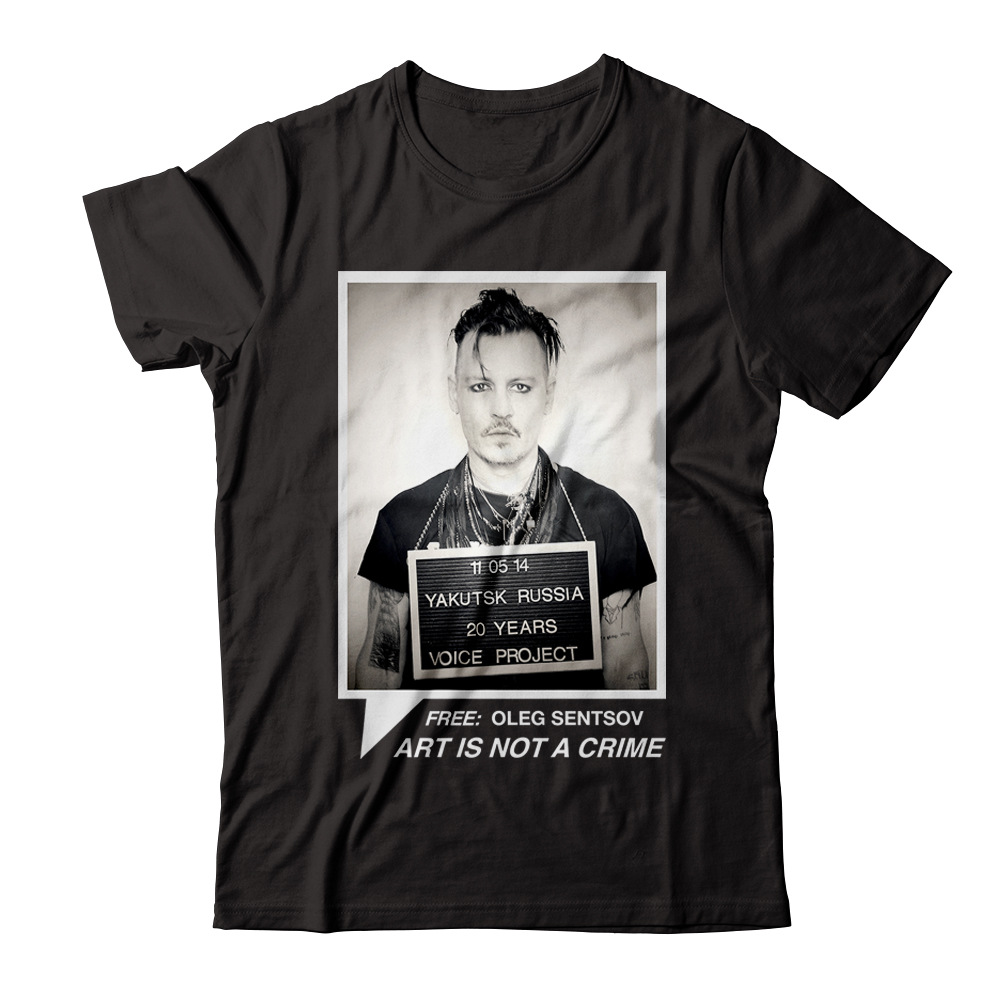
“Oleg Sentsov is a Ukrainian filmmaker. When Crimea was annexed by Russia, he became a prime target to make an example of it in order to stifle dissent. He’s been tortured and sentenced to 20 years in prison, but Oleg is not backing down.” Image and text courtesy of Represent and The Voice Project.

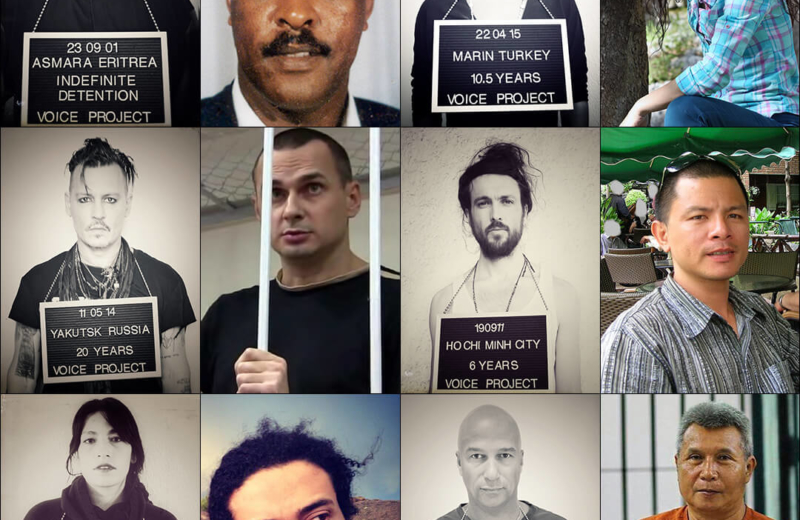
Hanukkah, Christmas, Kwanzaa, and New Year’s are just around the corner. This year, think about giving your friends and loved ones t-shirts, produced by The Voice Project, featuring the mug shots of Johnny Depp, Nadya Tolokonnikova, Peter Gabriel, Tom Morello, Ana Tijoux, and Alex Ebert.

This is their way of bringing attention to the plights of political prisoners around the world, including Ukrainian filmmaker Oleg Sentsov, now serving a twenty-year sentence in Siberia on trumped-up charges of “terrorism.”

I’ll definitely be buying the Johnny Depp t-shirt. Not only has Mr. Depp been one of my favorite actors ever since the days of 21 Jump Street, he has chosen to draw attention to Mr. Sentsov’s imprisonment.

artists-800x520
Image courtesy of The Voice Project and The Kyiv Post

The Voice Project speaks up for those who speak out, for those imprisoned around the globe for having raised their voice in dissent. We have to support each other, no matter the distance, no matter the borders. You never know when you’ll need the same in return.

For singers Trần Vũ Anh Bình and Nûdem Durek, filmmaker Oleg Sentsov, writer Dawit Isaak and poet Ashraf Fayadh, these individuals have fought for change, used their voices to speak out, and are paying with their freedom and their lives. We owe it to them to speak up now on their behalf.

Source: Represent

Masha Alyokhina: Speech in Parliament

olegsentsov
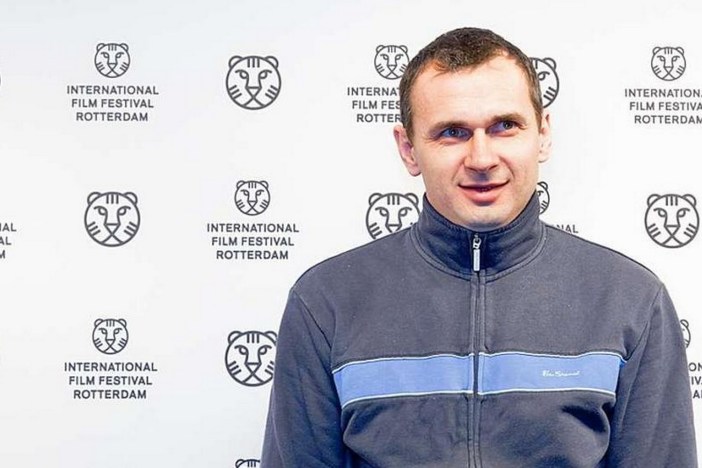
Oleg Sentsov at the 2012 Rotterdam Film Festival. Photo courtesy of De Telegraaf and nvt

Masha Alyokhina
Speech in the British Parliament
October 10, 2016

Because of the Pussy Riot case, I spent two years in prison. In recent months, I have been performing every night on stage as an actress with the Belarus Free Theatre. Every night, I have been trying to convey to the audience part of my life in prison. I do this so people understand and experience the mundane hellishness all political prisoners go through in Russia.

One such prisoner is Oleg Sentsov.

Oleg is a well-known, talented Ukrainian filmmaker. Perhaps he could have been debuting a new movie at the film festival taking place in London this week, but instead he is isolated in a penal colony in faraway Siberia. After being tortured, he was sentenced to twenty years in a maximum security prison on charges of terrorism. He was accused of planning to blow up a monument to Lenin in Crimea. The charges are absurd, total nonsense.

Masha Alyokhina speaking in Parliament, October 16, 2016. Photo courtesy of her Facebook page
Masha Alyokhina speaking in the British Parliament, October 16, 2016. Photo courtesy of her Facebook page

We need to stop talking and start acting. We need to get Oleg Sentsov released from prison and save his life. When I was in prison, it was thanks to your support and scrutiny that nothing threatened my life. In Sentsov’s case, there is not enough scrutiny, and there is such a threat to his life. That has to change.

Sentsov’s trial was not just yet another instance of political persecution by the Russian regime. It was a symbolic attack on the liberties and values you espouse. Oleg still has eighteen years left to serve in prison. He was given this sentence only because he is a brave man who spoke out on behalf of these same values. We can learn a lot from him and what he did, but we must not accept the fact he remains imprisoned. We must pressure the Russian authorities. I am here to urge you to make Sentsov’s release our common cause. I am confident we can see this cause through to the end and free Oleg from prison.

Translated by the Russian Reader. Thanks to Masha Alyohkina for her kind permission to translate the original Russian text of her speech and publish it here.

People and Nature: Punitive Psychiatry Back in Vogue in Russia

Russia: punishment psychiatry back in vogue
People and Nature
February 17, 2016

The Russian performance artist Pyotr Pavlensky has been sent to the notorious Serbsky Institute of Psychiatry, and his family and lawyers are worried about him.

On November 9, 2015, Pavlensky poured petrol over the doors of the infamous Federal Security Service (FSB) building at Lubyanka Square in central Moscow and set fire to them. He named the action Threat (Ugroza). Friends photographed and filmed him as the flames took hold. (Damage was done, but no one was hurt.) Pavlensky was arrested soon afterwards.

The FSB’s building was inherited directly from the Soviet KGB. Thousands of the regime’s political opponents were tortured and killed behind its austere façade.

Pavlensky has been charged with “vandalism motivated by ideological hatred,” whatever that means, and appeared at the Tagansky District Court several times. At his first appearance he compared his case to those of Crimean activists jailed on false “terrorism” charges – including Oleksandr Kolchenko and Oleg Sentsov – and said he would not address the court further.

Oleksei Chirniy, who was charged along with Kolchenko and Sentsov, was also detained at the Serbsky Institute prior to his trial. His supporters alleged he had been mistreated with psychotropic drugs.

Pavlensky is also awaiting trial for charges arising from an earlier performance, Freedom (Svoboda). In February 2014, days after the removal  of Ukrainian president Viktor

Separation (Otdelenie). Pavel Pavlensky protesting against punishment psychiatry, October 2014. Photo courtesy of Calvert Journal

Yanukovich, he went with collaborators to the Maly Konyushenny Bridge in Saint Petersburg, setting light to car tires and banging dustbin lids, to recreate the atmosphere of the Maidan demonstrations in Kyiv.

Pavlensky was sent to the Serbsky State Scientific Centre for Social and Forensic Psychiatry last month (on January 27) to be observed by doctors. The centre was then closed due to an outbreak of a strong flu-like virus, and Pavlensky’s lawyers have been denied access to their client.

Human rights campaigners are focusing on Pavlensky’s case and Amnesty International have expressed concern about it.

On February 3, in Pavlensky’s absence, the Tagansky District Court extended his detention to March 5. His wife expressed fears for his health in a Facebook post: “We do not know if they are injecting him with drugs, trying to give him pills. We don’t know.”

Meanwhile, artists are protesting a decision by the National Centre for Contemporary Art to throw Pavlensky’s performance out of the contest for this year’s Innovation Prize.

His action at the Lubyanka was included after an online vote by critics. But on February 15, the organizers of the prize struck it off, on the grounds that it had involved an illegal act. Members of the expert committee that advised the organizers were angry; art critic Anna Tolstova quit the committee, saying: “I don’t consider myself obliged to agree with censorship and become part of the repressive machinery of the state.”

Clearly, the Innovation Prize organizing committee has taken a step backwards. In 2010, the prize was won by the Voina group for painting a large phallus on a bridge near FSB headquarters in Saint Petersburg.

Punitive psychiatry has been on the rise in Russia again since the 2011 demonstrations against government ballot-rigging.

In October 2013, Mikhail Kosenko, one of the defendants brought to trial after those demonstrations, was sentenced to indefinite psychiatric treatment after the Serbsky Instititue declared him insane. Psychiatric treatment was also used in the recent case of Crimean activists, three of whom are serving long jail sentences in Russia and are widely regarded as political prisoners.

Pavlensky has protested against punishment psychiatry. In October 2014, he sat on the wall of the Serbsky Institute and cut off his earlobe to make his point. He then wrote: “Armed with psychiatric diagnoses, the bureaucrat in a white lab coat cuts off from society those pieces that prevent him from establishing a monolithic dictate of a single, mandatory norm for everyone.”

But punitive psychiatry goes back much further. It was used in the Soviet Union from (at least) the 1940s, to deal with those who defied its tyrannical, misnamed “socialism”, and became widespread in the 1960s. It was the Serbsky Institute that developed the diagnosis of “sluggish schizophrenia” (vyalotekushchaya shizofreniya) which was widely applied to political dissidents.

Not only were internationally known oppositionists, such as the independent trade union organizer Vladimir Klebanov and the Second World War general Pyotr Grigorenko, confined to psychiatric institutions, but psychiatry was used against large numbers of less-well-known Soviet citizens. (Indeed two western writers who studied the phenomenon in Soviet times concluded that the abuse of psychiatry against prominent dissidents was “probably only the tip of an iceberg.” It had a wide-ranging function in dealing with “social deviants,” “suppressing individuality […] so that the state can maintain a stifling social as well as political control.” Sidney Bloch and Peter Reddaway, Russia’s Political Hospitals, Gollancz 1977, pp. 278-279.)

An early (and typical) case was that of Revolt Pimenov, a maths student who resigned from the Communist Party’s Youth League, was diagnosed as schizophrenic and consigned to a psychiatric hospital – the sentence being lifted when he agreed to rejoin the league! His story is recorded in the marvellous archive of the Chronicle of Current Events, a dissident journal. (Thanks to J. who drew that to my attention!)

Revolt Pimenov in his student days. Photo courtesy of the Chronicle of Current Events

Finally, a thought about Pavlensky’s art. I am pretty conservative in my artistic tastes, but it works wonders for me. What is an artist supposed to do when his government becomes increasingly repressive and supports military mayhem in a neighbouring state? Paint landscapes?

In my view, setting fire to the doors of the Lubyanka was a cry of sanity in an insane world. I’m not blind to the limitations of individual protest, but this protest tried seriously to deal with the state machine’s monstrous corrosion of humanity.

If you are a western leftie thinking “Well, this is hardly the worst example of state repression,” give me some credit. I know. I, too, see the sickening irony in the denunciation of Putin for ordering Syrian children’s deaths to gain diplomatic advantage by people who had little to say about Tony Blair and George Bush ordering Iraqi children’s deaths on a vastly greater scale. Well, you know what, it’s not a competition! Putin’s violence is part of the same process as Tony Blair’s, not some sort of answer to it.

For me, this is about the reality with which my friends, activists in social and labour movements in Russia and Ukraine, have to deal.

If you’re a psychiatrist, please get on to your professional association about that institute. If you’re an artist, please get on to that art centre about that competition. If you’re a letter writer, please follow Amnesty’s advice on protesting to the Russian prosecutor, and if you’re fighting for some other cause, big or small, please keep doing what you’re doing. How else can we deal with the inherent madness of the system under which we live? GL, February 17, 2016

Meaningful art: the Lubyanka ablazePeople & Nature, November 2015

■ For the latest on the Crimean political prisoners, read the website of the Kharkiv Human Rights Protection Group

Editor’s Note. A huge thanks to Gabriel Levy for writing this timely and pointed essay and especially for his permission to republish it here.

Contemporary Art Killed My Dog

On a number of issues and events you have opposed Putin’s policies, and now you are at the Moscow Biennale [of Contemporary Art] at the VDNKh, a venue where the order of things is supposed to be questioned [sic]. Do you believe that here, in the current political situation, there can be a place for real criticism that is both anti-Putinist and anti-capitalist?

Yanis Varoufakis, anti-anti-Putinist

[Yanis Varoufakis:] Absolutely. But let me clarify something. I am not an anti-Putinist.  Anti-Putinism is too strong a word. I am very critical of Putin, but his demonization in the West is something I also resist. We should be smarter and think about what it means to be critical. I am extremely critical of what Putin did in Chechnya, and I have not forgiven him for it. But on the other hand, Putin was absolutely right about what happened in Georgia, and the West was absolutely wrong. I think that the West’s position on Crimea has also been inconsistent. Russia was surrounded [sic] by NATO when Latvia, Lithuania, Estonia, and other countries were included in the alliance. And for Russia it was an insult, as well as something close to violating the agreement between Reagan and Gorbachev [sic]. And Putin has been right about this, too. So I have never supported the policy of demonizing Putin. And I am afraid that Russians will have to suffer the awful consequences of this process, consequences which they do not deserve.

So I believe that spaces like this give us hope for the existence of another, rational, critical approach that does not take one side or the other and allows people from the West and Russia to get together and develop a more sophisticated optics for seeing the world and politics, for being critical without demonizing.

—Excerpted from Sergei Guskov, “Yanis Varoufakis: ‘Being critical without demonizing,’” Colta.Ru, October 2, 2015. Translated, from the Russian, by the Russian Reader

__________

There are only a few things I would add to Mr. Varoufakis’s remarks, above. First, he presumably made them in English, not Russian. Since he is an extremely persuasive speaker and conversationalist, it is quite possible some nuances in what he said at the Moscow Biennale of Contemporary Art were flattened or distorted when translated from English (?) into Russian, and these distortions have only been amplified further in my back translation.

But I doubt this is the case. The point of his remarks seems quite plain, so they are either a fabrication on the part of Colta.Ru or what Mr. Varoufakis more or less said in the event, minus the “static” of two consecutive translations.

If this is what he said, then Mr. Varoufakis is only another in a long line of Western leftist thinkers and activists who, seemingly, have found something “anti-hegemonic” or “anti-imperialist” or “productively” anti-American or, God forbid, “anti-capitalist” about Putin’s policies and actions, or have found it possible to hobnob with or shill for Putinists, on the Putinist dime, in the name of some kind of “criticality” or “third position” above the current fray, or just because they were bored and wanted an all-expenses-paid junket to Moscow or Petersburg or Rhodes.

A smarter person than me (and an actual Russian leftist activist to boot) has pointed out that Putin is nothing remotely like an anti-imperialist or anti-capitalist. On the contrary, my smart friend has argued, folks in the west should make an effort to find out about grassroots social and political activism and activists in today’s Russia and look for ways to make common cause with them. Or, at least, not stab them in the back by supporting Putin explicitly or implicitly.

Because Russia, like “the West,” is not a monolith. And that is the second way in which Mr. Varoufakis went wrong in his remarks in Moscow. “The West” is not a single entity, even among its political, intellectual, and media elites. It is not an organism singularly hellbent on “demonizing” Putin, whatever that means. It requires no effort at all to compile a very long league table of Putin’s wholehearted or partial supporters in “the West,” from Stephen Cohen to Donald Trump, from Silvio Berlusconi to Mary Dejevsky, from Nick Griffin to any number of leftist and centrist politicians in Europe. For reasons I haven’t been able to explain, that table has been growing fatter as Putin’s actions have become more aggressive and “demonic,” both at home and abroad.

Neither is Russian society nor the fabled (and utterly imaginary) “Russian people” monolithic, but over the past fifteen years the Russian state apparatus, the Russian mainstream media (especially television), and Russian mainstream political parties have become a monolith, one of whose primary goals, especially in the last two or three years, has been to demonize “the West” and the domestic opposition any way it can, no holds barred.

You would have to have been in the middle of this properly demonic media hysteria, moral panic, and “cold civil war” to appreciate just how thoroughgoing and thoroughly frightening it has been, and since I have been following Mr. Varoufakis’s own adventures over the past year or so, I can imagine he simply has no clue about what has really been happening in Russia since the blocks came off completely post Maidan, because he was very busy with more important matters.

One job this blog has taken on has been to provide little snapshots of that awfulness while also, more importantly, giving non-Russian speakers a chance to hear Russian voices other than Putin’s, however unimpressive or inaudible they might seem to big shots like Putin and Mr. Varoufakis.

Finally, I would like to address the question of why Mr. Varoufakis imagines, apparently, that big hoedowns like the Moscow Biennale of Contemporary Art are such perfect places for elaborating a “sophisticated optics for seeing the world and politics, for being critical without demonizing.”

Just a year ago, my hometown of Petrograd hosted Manifesta 10, another such prominent venue for “criticality.” In the midst of an occupation and invasion of a neighboring country by the host country, the host country and host city’s continuing legal demonization of LGBT, and a local election campaign, for the city’s governorship and district councils, that involved making sure the non-elected incumbent in the gubernatorial race would face no real opposition in his bid to legitimize his satrapy and, on election day, threatening independent election observers with murder, the Manifestashi did absolutely nothing that would really ruffle anyone’s feathers, least of all their sponsors from city hall and the State Hermitage Museum, and they barely reacted to the maelstrom of neo-imperialist hysteria and officially authorized criminality raging around them. Basically, they partied like it was 1999, while providing their fellow citizens with the welcome illusion that the shipwreck wrought by fifteen years of Putinism in politics, the economy, civil society, culture, education, medicine, science, industry and, most painfully, people’s minds could be conjured away or endured and understood a little better by taking a sip of contemporary art’s renowned and heady “criticality” and pretending Petersburg was Helsinki or Barcelona, if only for a summer.

10497395_10152669630307289_178016388250142251_o

What has got better on Russia’s broken social, political, and art scenes since last autumn to make it even more desirable to engage in “criticality” at a biennale in one of Russia’s capitals, this time with the Russian Federal Ministry of Culture footing the bill?

Latterly, a cynical lunatic named Dmitry Enteo has smashed up a bunch of sculptures by the late Soviet sculptor Vadim Sidur and gotten off almost scot-free for his crimes. On the other hand, the list of political prisoners in Russia has continued to grow, and it now includes Crimean activists Oleg Sentsov and Alexander Kolchenko, sentenced to hard time in prison for no particular reason.

And then there is Alexei Gaskarov, who, if he lived in a more democratic country, would be running a party like Syriza or Podemos (minus the “criticality” and verbal cuddling up to other people’s dictators), but instead looks to be facing another two and half years in a penal colony, again, for no particular reason other than his own staunch opposition to Putin’s regime.

In the current dreadful “conjuncture,” a good day is a day that goes by without news of yet another anti-Putinist activist being arrested, an art exhibition’s being trashed by “Orthodox activists” or otherwise shut down because it might offend the sensibilities of someone’s grandmother, or a new law’s speeding down the State Duma assembly line so as to tighten up the screws on dissent and “treason” yet again.

In fact, I had a bit of such good news earlier today, when I learned that Andrei Marchenko, a Khabarovsk blogger whose case I have been following, was only fined 100,000 rubles (approx. 1,350 euros) instead of being sent down for two years to a work-release prison, as the prosecutor had demanded, for the horrible crime of writing one untoward sentence about Putin’s Ukrainian misadventure on his Facebook page in 2014.

Where does Mr. Varoufakis fit into this picture? Probably nowhere, which is probably where he should have stayed instead of playing to Moscow’s art and hipster crowd, always happy to let itself off the hook when it comes to taking responsibility for the ongoing disaster, and to the invisible figure up in the emperor’s box, especially at an opera with the almost deliberately ham-fisted and parodical title of Acting in a Center in a City in the Heart of the Island of Eurasia.

Thanks to Comrade AW for the heads-up. Images courtesy of BBC News and the Manifesta Biennial Facebook page