The Cards

Russian President Vladimir Putin has always been a paranoid man. We know, for example, that he has long eschewed the use of a personal cellphone, all too aware of how easily they can be tracked.

Yet a Kremlin document recently leaked to the press by a European intelligence service lays bare a whole new level of suspicion. Visitors can only approach him after they’ve gone through two layers of screening. His bodyguards now exercise full control over his schedule of appearances; they’ve essentially eliminated visits to any location that has to do with the military. And as for mobile phones: No one who works near Putin is now allowed to have one—they can only carry devices that aren’t connected to the internet. Surveillance systems have been placed in the homes of the cooks, drivers, and cleaners who work for him; they are prohibited from using public transportation. Most revealingly, he and his family members no longer live in their customary residences. Instead, they are sticking to secret locations with extra layers of protection. The document claims that Putin now works only in bunkers dispersed around southern Russia.

It is possible, of course, that the spies who passed this document along to the media are playing a game of their own—perhaps using disinformation to sow dissension and mistrust within the Kremlin. But the details revealed by the leak make perfect sense given the constraints that Putin suddenly finds himself facing.

In January, U.S. forces succeeded in snatching Venezuelan President Nicolás Maduro out of his compound without suffering a single fatality. At the end of February, the Israelis killed Iranian Supreme Leader Ali Khamenei on the first day of the war against Iran—and a host of other top Iranian leaders as well. Nor was it the first time that they were able to finger individual targets in Tehran. The Americans and Israelis have pulled off these operations through a combination of carefully cultivated human sources and signals intelligence, tracking the cellphone calls and internet use not just of the people targeted but also of their aides, guards, and support staffs. All this means that dictators can no longer sleep as easily as they used to.

The former head of Ukrainian military intelligence, Kyrylo Budanov—now chief of staff to President Volodymyr Zelensky—is known to be a student of Israeli targeted killings. His studies have paid off: The Ukrainians have assassinated a string of Russian military officers, politicians, and propagandists—some of them in the heart of Moscow.

In December, a car bomb in the capital took out Lt. Gen. Fanil Sarvarov. That particular hit seems to have sent a collective shiver through Russia’s power elite, allegedly—according to that leaked document—prompting a meeting of top security officials that had them blaming each other for lapses real and imagined. Given that Russia has repeatedly attempted to assassinate Zelensky, Putin has every reason to believe that he, too, has a target on his back.

Putin may well fear internal enemies as much as he does the Ukrainians; rumors of coup plots are rampant in Moscow. But the Russian president’s problems are actually bigger than that. He’s managed to stay in power for 26 years by always keeping a few steps ahead of his enemies. Now he may be running out of room to maneuver.

A Russian offensive planned for this spring has been derailed before it’s gotten off the ground. The Ukrainians claim to have inflicted 35,000 casualties on the Russians in March alone—the fifth straight month, according to Kyiv, that the number of Russians killed and seriously wounded has exceeded the Kremlin’s rate of recruiting fresh soldiers. Perhaps more importantly, the sacrifices of those soldiers were entirely in vain; no major objectives were achieved. “Ukraine is not just doing better than expected,” said Michael Kofman, a senior fellow at the Carnegie Endowment for International Peace. “Time is not on Russia’s side in this war.”

Indeed, the Ukrainians have now actually pushed the Russians back along several stretches of the front. Putin’s military leaders appear to have no new ideas on how to alter the fundamental dynamic on the battlefield. Unless they can change that, throwing fresh manpower into the fight will prove equally fruitless.

The Ukrainians, by contrast, seem to have an endless supply of new ideas. Every day brings the unveiling of some startling new piece of technology or creative use of an old one. Every day also brings news of another audacious strike deep in the Russian heartland. On April 25, for example, Ukrainian drones hit a Russian airfield in the southern Urals city of Chelyabinsk—a little more than 1,100 miles away from Ukraine.

Kyiv’s forces have devoted considerable resources to eliminating Russian air defenses, which now simply aren’t sufficient to protect every strategic target. At one point a few weeks ago, the threat of Ukrainian attacks closed all four of Moscow’s international airports at the same time. Indeed, the growing range of Ukrainian strikes appears to have influenced the Kremlin’s decision to exclude military equipment from taking part in Victory Day celebrations on May 9. Humiliatingly, Putin even felt compelled to ask U.S. President Donald Trump to dissuade the Ukrainians from attacking during the parade. The Russians are clearly rattled.

Yet Kyiv is not staging such strikes for the sake of psychological impact. The evidence suggests that Ukrainian planners are thinking harder than ever about how to maximize the impact of their attacks. At the end of April, a Ukrainian long-range drone attack on an oil refinery in Perm, more than 900 miles away from the border, targeted distillation columns—the systems that enable the separation of crude oil into gasoline and other petroleum products. Hitting storage tanks provides spectacular footage of fires, but they are relatively easy to repair; core infrastructure like these columns is a different matter altogether. “The Ukrainians have developed a theory of victory which involves the destruction of Russia’s oil and gas infrastructure,” said Ben Hodges, a former commander of the U.S. Army in Europe. “Without that, it becomes very difficult for Russia to sustain what they’re doing.”

At the end of March, a Reuters analysis concluded that the strike campaign had succeeded in cutting Russia’s oil export capacity by 40 percent. Admittedly, this may not be enough to fully offset the windfall that Moscow has gained from the sharp rise in global oil prices unleashed by the U.S.-Israeli war against Iran. Even so, in the first quarter of this year, Russia’s budget deficit already exceeded its full-year target. Financial officials cited a 45 percent drop in oil and gas revenues.

This pattern of smart targeting repeats itself across industries. In their attacks on chemical plantssemiconductor fabrication facilities, and steel factories, the Ukrainians keep hitting core components of the industrial processes that feed Russia’s military machine. Strikingly, the Russians seem incapable of paying back Ukraine in the same coin.

The decentralization of Ukraine’s military production—scattered across myriad small factories in inconspicuous locations—is making it extremely hard for the Russians to find effective targets. So they keep attacking power plants and civilians, cruel tactics that may actually serve to stiffen Ukrainian spines.

That the momentum has shifted in Ukraine’s favor is also demonstrated by Zelensky’s increasingly confident tone toward the United States. “In my view, Russia played the Americans again—played the president of the United States,” he said recently, commenting on Trump’s policy of allowing Russia to skirt sanctions on oil sales. The days of flattery and appeasement are over.

Of course, Ukraine has plenty of problems. Its embrace of drones is driven in part by its persistent manpower personnel shortages; many Ukrainian men are refusing to join the military. And the government continues to contend with corruption scandals.

Even so, Kyiv is enjoying a boost in its international standing even as Moscow faces new headwinds. The war in Iran has given new diplomatic openings to the Ukrainians, who have been leveraging their anti-drone expertise to find new friends among the monarchies of the Persian Gulf. Trump seems so sufficiently preoccupied with his own war that he is finding fewer opportunities to pressure Kyiv into unfavorable peace deals.

And the recent electoral defeat of Hungarian Prime Minister Viktor Orban has robbed Putin of his most trustworthy friend in the European Union. Orban’s exit has finally enabled the EU to break the deadlock over a long-anticipated $106 billion assistance package to Kyiv. That’s enough to keep the Ukrainians in weaponry for a long time to come—entirely apart from the variety of joint ventures for arms production that they have created with partners across the world.

Just to add insult to injury, Moscow is also in the process of losing one of its vaunted new allies in Africa: The Moscow-supported military government in Mali is losing its fight against Islamist rebels.

Losing Mali won’t be enough to cost Putin his throne. But losing the war in Ukraine certainly could—especially when combined with a stagnant economy, restless oligarchs, and a population riled by the Kremlin’s recent crackdown on the internet. Even Russia’s military bloggers, long the most enthusiastic supporters of the war, are starting to lose faith. “Little by little, the advantage is going to our enemies,” one of them recently wrote. “[T]he enemy is counterattacking, and he is succeeding.” Other Russians may well be coming to the same conclusion.

Source: Christian Caryl, “Vladimir Putin Is Much Weaker Than You Think,” Foreign Policy, 6 May 2026. You can thank for me for depaywalling this article by encouraging your friends, relatives, and colleagues to check out this website. ||||| trr
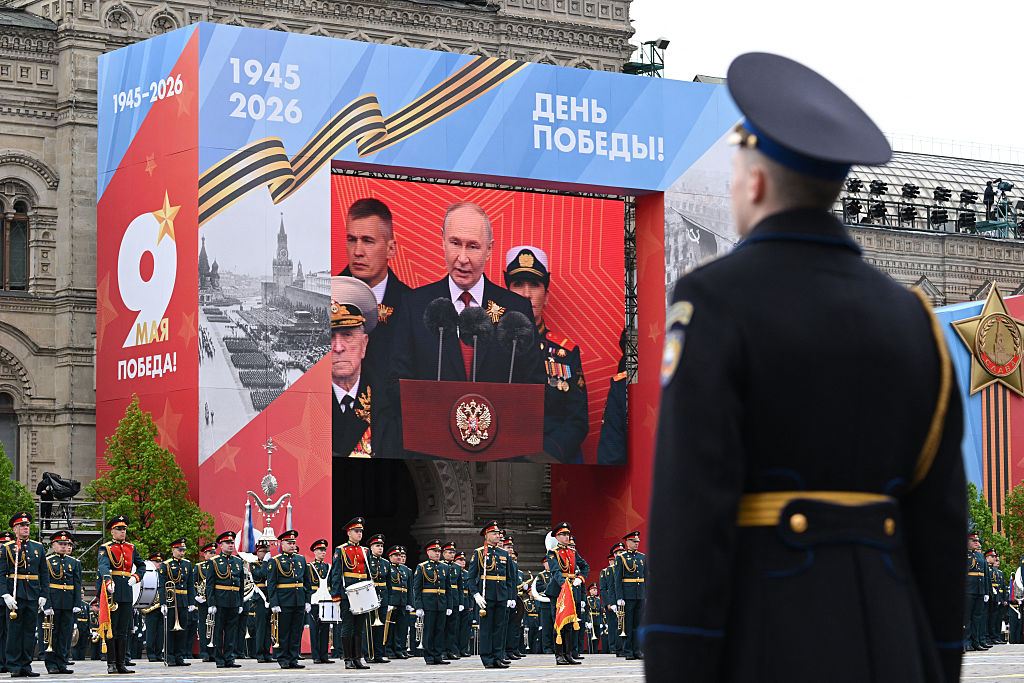

Members of a military band stand next to a screen broadcasting Russia’s President Vladimir Putin’s address during the Victory Day military parade in Moscow on May 9, 2026. Photo: Igor Ivanko/AFP via Getty Images

Just days after Vladimir Putin secured a ceasefire from U.S. President Donald Trump to hold his Victory Day parade, Russia launched a massive air assault on Ukraine, killing at least 16 people in Kyiv and injuring dozens more.

Hi, my name is Oleksiy Sorokin, deputy chief editor at the Kyiv Independent, and this is the latest issue of our newsletter about Russia.

Today, let’s once again talk about why attempting to reach a peace settlement with Putin is a waste of everyone’s time.

Russian President Putin held his parade. Normally, the event is designed as a grand demonstration of military strength and imperial confidence.

This year, it lasted just 45 minutes.

There were no tanks. No heavy equipment. The atmosphere felt restrained, almost uneasy — less a celebration of victory than an attempt to preserve the illusion of power.

After securing Trump’s support for a ceasefire that would effectively ensure Ukraine would not exploit Russia’s weakened air defenses on a day of deep symbolic importance, Putin adopted a different tone regarding the war in Ukraine.

“I think (the war in Ukraine) is coming to an end,” Putin said on May 9. He steered clear of many of the triumphalist themes that have long dominated his public rhetoric. In a somewhat amusing shift, Putin referred to Ukrainian President Volodymyr Zelensky as “Mr. Zelensky” for what may have been the first time in years.

Putin had typically resorted to labeling Ukrainian leadership “Nazi sympathizers” or “drug addicts.”

Yet, the three-day-long ceasefire ended, and Russia once again pummeled Ukraine with missiles and drones. The partly collapsed residential building in one of Kyiv’s neighborhoods, with bodies being pulled from under the rubble, became the glaring illustration of Russia’s intent for peace.

What this episode demonstrated, once again, is that Putin treats negotiations not as a path to peace, but as a weapon of war.

Every pause is used to regroup. Every phone call with Western leaders is presented domestically as proof that Russia cannot be isolated. Every public discussion about concessions reinforces the Kremlin’s core belief that time remains on its side.

This is why attempts to “bring Russia to the table” under current conditions do not bring the war closer to an end — rather, they prolong it.

The logic in the White House still seems to be that if Russia is offered enough diplomatic offramps, enough recognition, enough patience, it may eventually choose compromise over continued aggression. But the past four years have shown the opposite. Russia escalates when it senses hesitation. It hardens its demands when it sees fear of escalation on the other side. And it interprets calls for immediate negotiations not as signs of strength or pragmatism, but as exhaustion.

For Putin, the war has never been only about territory. It is about restoring Russian dominance over Ukraine. Russian demands have remained maximalist. Despite mounting military and economic strain, Putin hasn’t moved one inch.

Negotiations, when offered before Russia faces undeniable military, economic, or political pressure, only invite the Russian leader to repeat his maximalist wants.

Ukraine did secure something in return for agreeing to a three-day ceasefire: If everything goes according to plan, a 1,000-for-1,000 prisoner exchange between Ukraine and Russia will take place on May 15.

That alone justifies allowing Putin to hold his parade. If the price of letting Putin stage a carefully choreographed 45-minute parade was bringing 1,000 Ukrainian prisoners home, that is a trade most Ukrainians would take every time.

But it would be a mistake to confuse this with progress toward peace, or a hint that Russia’s attitude toward Ukraine or the West has changed.

Putin’s comments about the war’s nearing end are domestic messaging to assure the public that everything is going according to plan. It does not, but Putin won’t budge.

At this point, negotiations with the Kremlin often resemble a very specific genre of political theater.

And yet, much of the international discussion continues to revolve around finding the right formula, the right incentive, the right “off-ramp” that will finally persuade Putin to stop the war he chose to start.

There is no indication that the Kremlin is currently prepared to accept a settlement that falls short of its broader wartime objectives. Until Russia faces costs that outweigh those ambitions, negotiations are more likely to drag out the war than bring it to an end.

Source: Oleksiy Sorokin, WTF is wrong with Russia? newsletter (Kyiv Independent), 14 May 2026


Russia launched one of the longest and most massive air attacks since the start of its full-scale invasion just days after the recent ceasefire expired.

Over the course of 30 hours, Russia launched more than 1,500 drones at Ukrainian cities, along with over 50 ballistic and cruise missiles, Zelenskyy said.
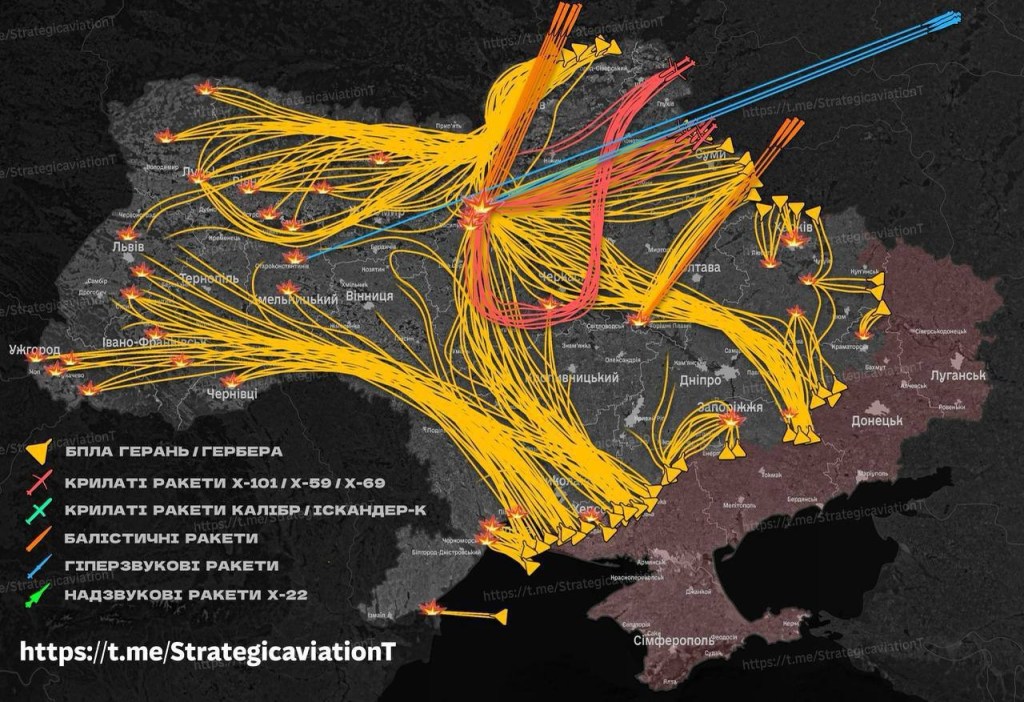
An approximate map of the May 13–14 Russian strikes on Ukraine, from the Telegram monitoring channel @StrategicaviationT.

After a drone strike on the capital, part of a high-rise apartment building collapsed in Kyiv, and rescuers recovered the body of a 12-year-old girl from the rubble.

“We live in a building across the road,” said Olesia Holub-Korba, a Kyiv resident who was just meters from the high-rise last night.

Olesia typically does not go to the shelter during air raids because she [has] to keep running up and down from the 20th floor at night with her young son.

“I always go and lie down in bed with my child so that if there are any falling fragments, I can cover them with my body, and if it’s a missile, then either we survive together, or we…[die],” she told The Counteroffensive.

Olesia and her family had just gone to bed, not yet asleep, when a very loud explosion sounded. Lying on the floor, she literally felt the building shaking.

“Fuck,” she said to her husband, “it’s a direct hit on us.” Olesia’s husband reassured her that it nothing had hit their building, at least not yet.

Fortunately, her family is safe.

However, twenty people from the damaged residential building are still considered missing from the building, which has a completely destroyed entrance, which prevents survivors inside from escaping. Emergency services continue search operations under the debris, which will apparently last into the night.

On the first day of last week’s ceasefire, Putin told reporters that he thinks the war is “coming to an end.”

Zelenskyy responded: “These are certainly not the actions of those who believe the war is coming to an end.”

Government-funded Ukrainian news organization United24 reported that this was the longest and largest aerial attack since the start of the full-scale invasion, though that superlative could not be independently verified by The Counteroffensive. The assault ended on the morning of May 14.

97 percent of the drones launched toward Ukraine were neutralized, according to a report from the Ukrainian Air Force, as were 73 percent of missiles.

Although the vast majority of air targets were successfully downed, Russia damaged around 180 buildings, including 50 residential buildings across Ukraine. In Kyiv, at least five people were killed and dozens more injured. Over 100 people have been injured across the country.

Russia has changed its tactics and is now deliberately trying to stretch out attacks in order to exhaust Ukraine’s air defenses. During the day, Russia sent hundreds of attack drones mainly to the west of Ukraine to exhaust the air defense. In the late evening, there was a second wave of strikes, followed by missiles, targeting the capital.

Russia’s Defense Ministry described the strike as a “massive retaliatory attack” for recent Ukrainian long-range strikes inside Russia.

Zelenskyy stated that there will be a “fair” response to that.

The massive attacks come just days after a decree from Zelenskyy effectively ‘allowed’ Putin to host his WWII Victory Day Parade in Moscow’s Red Square, though the celebration was scaled down, likely due to fear of Ukraine’s long-range strike capabilities. Putin’s anxiety over the annual event signaled a shift in Moscow’s projection of power.

On May 8, Trump announced the 3-day ceasefire, and both Putin and Zelenskyy agreed to its terms, which included a 1,000 for 1,000 prisoner swap.

That ceasefire, though fragile as ever on the front lines with both sides alleging a breach, technically expired on Tuesday, May 12, marked by a mutual exchange of fire.

Over the course of the past week, Putin and Trump — the latter of whom campaigned on a promise to end this war in 24 hours — both said they think the war will end soon during the days leading up to last night’s attacks.

Also, for the first time ever, Putin said he is prepared to meet with Zelenskyy in a third country, outside of Moscow, but only in pursuit of a final agreement that ends the war.

Source: Mariana Lastovyria and Jacqueline Cole, “NEWSFLASH: Putin launches massive attacks after signaling war’s end,” The Counteroffensive, 14 May 2026. You can thank for me for depaywalling this article by encouraging your friends, relatives, and colleagues to check out this website. ||||| trr
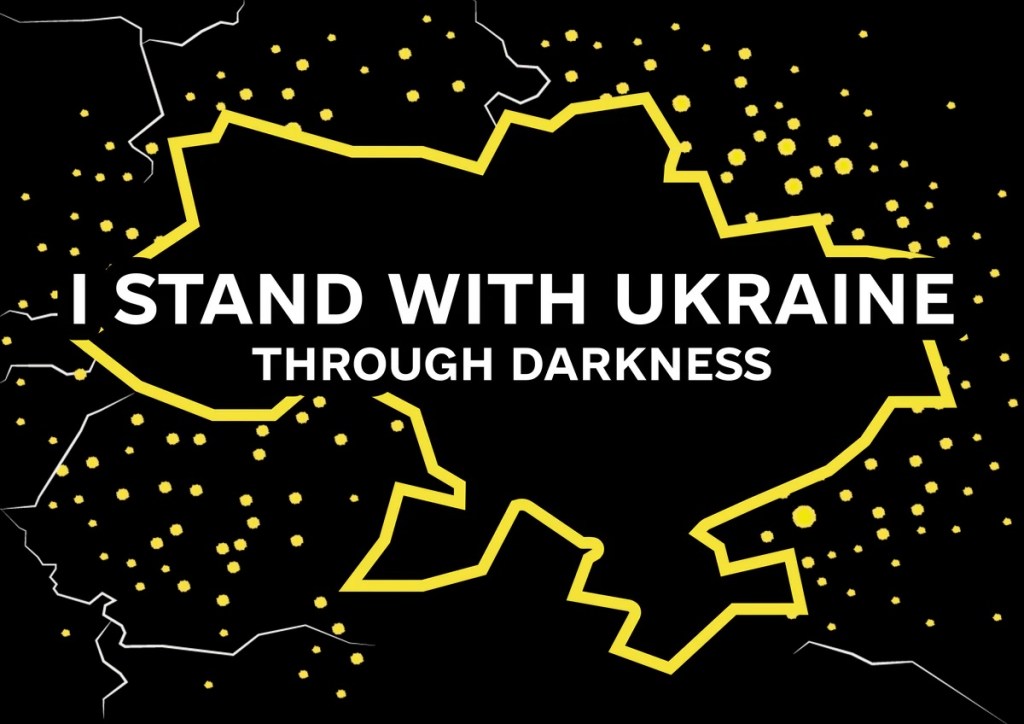
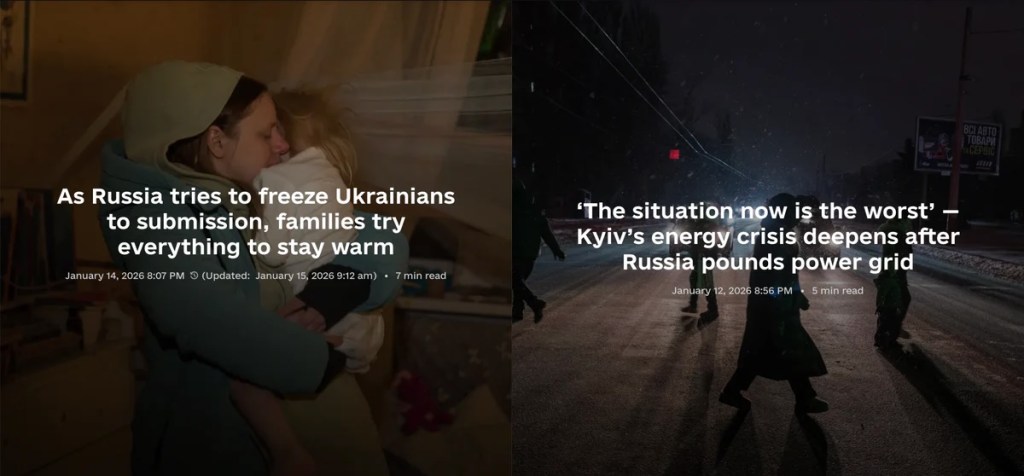
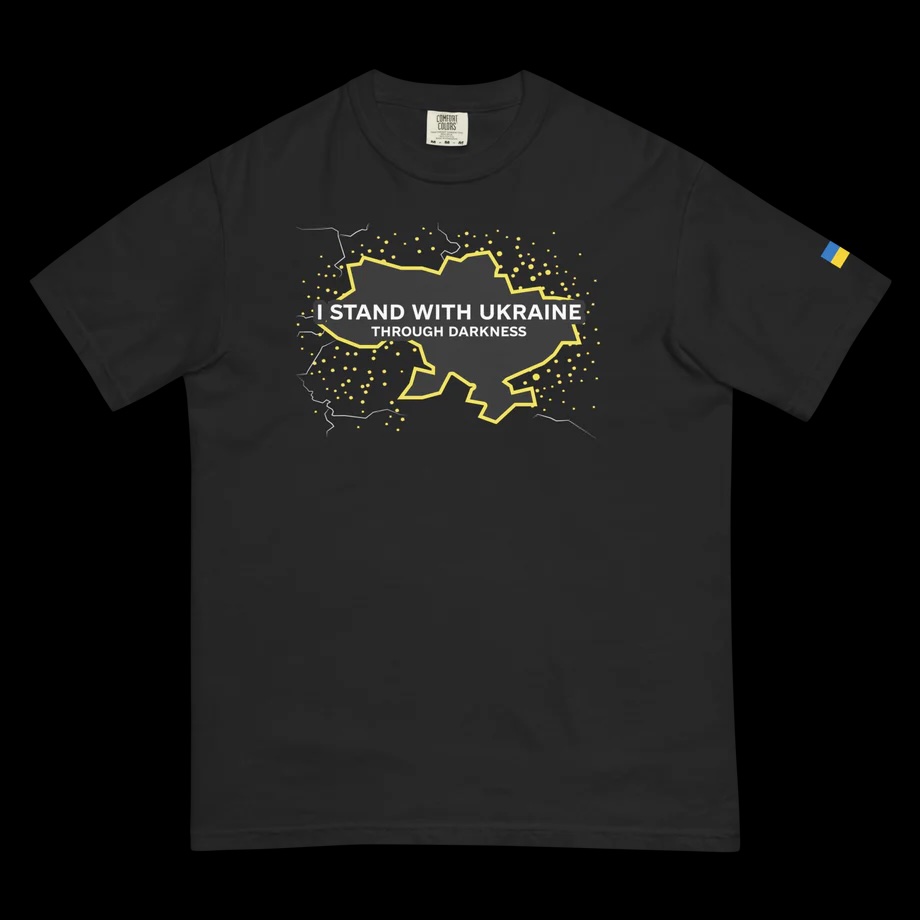
Stand with Ukraine Through Darkness

As temperatures in Kyiv plunged to -20°C (-4°F), Russia intensified its attacks on Ukraine’s energy infrastructure, leaving millions in total darkness and biting cold. Though Russia has tried this strategy before, this winter is different. The scale and relentlessness of these attacks have reached unprecedented levels. Many Ukrainians are now forced to survive winter without steady heat, without light, without the basic infrastructure that makes normal life possible.

“As Russia tries to freeze Ukrainians to submission, families try everything to stay warm”
“‘The situation now is the worst’ — Kyiv’s energy crisis deepens after Russia pounds power grid”

The reality behind the headlines

While this crisis unfolds, international coverage has been limited. We want you to see what’s actually happening on the ground.

Our journalists are reporting these stories while living them — and so is everyone else in Kyiv, rushing to charge phones during brief power windows, cooking on camping stoves in their kitchens, huddling under blankets in apartments that feel like freezers. For the elderly, it’s worse. When elevators stop working, they are stuck in their own homes, unable to reach food or medical care. What was occasional last winter is now constant.

To light the darkness

Building on our “I Stand with Ukraine” T-shirt, we’re launching I Stand with Ukraine Through Darkness — available as a T-shirt and hoodie.

From January 20 through February 3, all proceeds from this collection go to supporting the charitable organization Starenki, which helps older people living in vulnerable situations.

This winter Starenki’s volunteers provide a lifeline by:

Delivering essentials — Food and hygiene kits for older people, especially those who are physically unable to navigate stairs to reach shops. When high-rise buildings are left without power, elevators become inoperable — effectively trapping seniors in their apartments.

Providing emotional aid — Companionship and conversation to combat the profound isolation that comes with darkness.

SHOP I STAND WITH UKRAINE THROUGH DARKNESS

Why this matters now

As Ukraine enters its fourth winter of war, international attention is fading. The reality of these freezing blackouts is slipping from the headlines.

By wearing this design, you do more than help support the elderly in Ukraine — you raise awareness of the situation and keep Ukraine from slipping from the world’s attention. 

Share this. Wear this. Spread the word.

Source: The Kyiv Independent Store email newsletter, 20 January 2026. I have purchased one of these t-shirts and would urge you to do so as well. ||||| TRR


[Editor’s note: On January 21, Kyiv’s Mayor, Vitali Klitschko, urged the city’s inhabitants to “leave if you can.” 600,000 have already left these last two weeks since Russia intensified its attack on the city’s energy infrastructure. The mayor says that the constant Russian attacks are pushing the city towards “a humanitarian catastrophe.” Temperatures are plunging to as low as –18°C (0°F). According to Klitschko, “the situation is critical with basic services – heating, water, electricity. Right now, 5,600 apartment buildings are without heating.” This morning, President Zelenskiy said that one million people in Kyiv are now without power. The city’s authorities have now have been forced to drain the city’s central heating and water system to prevent pipes from freezing and bursting. A couple of days ago, Ukraine’s Minister of Energy, Denys Shmyhal, said that “there is not a single power plant in Ukraine that has not been hit by the enemy during the war.”]

Today we received this from a dear, long-term friend in Kyiv:

BY OLEKSIY KURKA, resident of Kyiv, works in diplomacy and policymaking

I’ve written about Russian attacks so many times that the words no longer convey any new meaning, muted by repetition. But friends abroad cared to check in with me after last night, so here is an update.

As of this hour, only a fraction of the capital has electricity. I’ve been without power for about 24 hours now; others for much longer. It isn’t clear when it might return.

The heating is also off. The building is gradually cooling down. Soon I’ll be breathing out vapour, like some of my friends. Those living through ‘no-heat’ situations for longer – such as those near the front lines – are now camping out in their flats. It’s 5-7°C warmer inside a tent inside your flat.

The attack caused massive disruptions to public transport. Segments of the Metro I use to commute were closed due to electricity shortages. Many, myself included, had to stay and work from home.

My portable power station is gradually running out. Not having a predictable source of power is beginning to worry me more. I can predict one thing: our foes will stop at nothing to inflict more suffering on Ukrainians – while they can.

On a brighter note, I found and successfully installed a solution to the lack of internet at home. It’s an external antenna that catches and amplifies signals from nearby towers. Even during prolonged outages, I have about 15-20 Mbps, which is brilliant.

As for the power, I was inspired by my neighbour who took a mini petrol generator out to the courtyard and recharged his upper-floor flat via an extension lead. Now I fancy having the same system – and solar panels, for when there’s more daylight. Anything that minimises energy dependence is a win.

I went for a walk on the slippery, ice-clad streets of my district in an off-grid darkness that once again revealed the starred heavens. Most businesses and shops are running off generators, their light bulbs making up for the absence of proper street lights, coupled with the headlights from cars. This is how we see. That, and the torches in our hands.

Earlier today, we chatted with a visiting colleague who asked many questions about life these days. I made the point that a war of attrition forces things upon you that you’d otherwise never have thought you’d need.

But when it happens a few times, you spot the trend and start thinking even more creatively about what is yet to come. Do I need to consider satellite internet now, or are the mobile towers maintained well enough for me to avoid rushed decisions and unnecessary costs? Thinking ahead and learning from others makes the unpredictability a tiny bit more predictable, as it were.

Do I plan to leave Kyiv because of these ‘inconveniences’? I said a long time ago that there are two conditions for me to make such a significant decision: when there is no drinking water, and when the prospect of Russian occupation looms larger.

The first is not yet a reality for Kyiv, and I hope it never will be. The latter is no longer a reality, thanks to the Ukrainian army and our partners who provide Ukraine with air defence, long-range, and other weapon systems.

One more thing: Even if I leave the place, it’s only to come back.

Source: “#blackoutnotes [Ukraine],” Two Grumpy Old Men on Ukraine, 21 January 2026


Nature in Kyiv now, January 2026

The sun floods the room like a Christmas postcard: snow-covered trees, silence, a fairy tale.

But it ends at the windowpane.

I stand in the middle of the room in two sweaters and a robe, clutching a cup of hot tea as if it could save me. The thermometer indoors reads +9°C (48°F). It’s the third day without heat, and every hour the cold settles deeper into the walls.

In my arms is my six-month-old son, Ustym. I hold him tighter than I should, trying to give him my warmth. And suddenly it hits me: I don’t know how to protect him from the cold.

I can endure it. He can’t.

I cry quietly so he won’t hear. The tears on my sleeve are warmer than the air in the room.

I pack to leave the city.

There, the power may go out—but there is warmth. What a strange word now. A luxury. A reason to flee your own home.

I thought this fear was mine alone. But when I wrote to my colleague Nastia, I realized the cold does not discriminate. She has no child, but the same thermometer, the same сold walls, and made the same decision to leave.

As a result of Russia’s prolonged strikes on Ukraine’s energy infrastructure, including power plants and substations, large parts of Kyiv were left without heating for several days as temperatures dropped to –15°C — the lowest in recent years. During the January 9 attacksdamage to the power grid led to heating outages in approximately 6,000 apartment buildings, nearly half of the city, demonstrating how winter has become yet another front in the war.

Kyiv Mayor Vitalii Klitschko called the situation the most difficult for the capital since the start of the full-scale invasion and urged residents to temporarily leave the city, despite the opening of hundreds of heating centers. 600,000 Kyivans have fled the capital since January 9. For many, leaving the city is no longer a matter of comfort but one of survival.

It is a reminder that in times of war, even a major city can turn perilous overnight, and true security depends not only on the absence of missiles but on access to basic needs like heat, electricity, and water.

Our apartments turned into cold traps we had to escape. We came together to share this strange, frightening feeling, when every minute at home feels like a test, and survival becomes a daily struggle.

Nastia: On the night before the major strike that left us without heat, January 8, I took a hot shower for the first time in a week and had uninterrupted electricity for the whole evening.

Restoration work on hot water and heating had been underway in my building before, we always had problems with heating and water.

I felt like a human being again — someone who, after work, can properly warm up in the shower, instead of heating up a kettle 5 times.

After the attack, I was back to not having water, heating and electricity. When I woke up under two blankets I felt powerless again: I already knew I would cancel the plans I had that evening because of how exhausted I felt.

I didn’t even try to catch the internet in my apartment, because I knew I’d fail. I just washed my face under freezing water and went to the cafe nearby to work.

Later I was riding the metro and barely held back tears. Not even because of the cold, but because I would yet again have to spend my evening in a dark apartment all alone. Such evenings just gnaw at me, creating a deep sense of isolation. I know that when I set foot in the apartment nothing will be waiting for me there, except darkness, silence, and piercing cold.

“Please, come home. Don’t be there alone in the cold,” my parents told me. My dad suggested I go with his friend, who was also planning to leave Kyiv on January 9. I was hesitant at first: I had friends, plans, and work to do. But if I had been able to find ways to function with blackouts and distract myself before, this time I just couldn’t find the strength to bear it.

Myroslava: During the latest Russian attack on Friday, January 9, we immediately lost both electricity and heat. The boiler in the building runs on electricity, so it was clear that if there’s no power, there won’t be heat either.

At first I was calm; this was not the first time, and we’d get through it. But then Mayor Klitschko urged people to leave the city for the weekend, and that was alarming. The apartment was getting colder and colder.

My husband and I decided to go to his parents’ village to wait it out for the weekend, hoping that heat would return soon. On Sunday evening, we returned to Kyiv: heating had already come back in parts of the city. But not in ours. In the morning I took Ustym to my parents, where it was warmer, and went to work.

I dressed him in layers and held him close to share my warmth.

He seemed fine. It was I and even more so his grandparents who were truly scared.

I knew that we would only leave the Kyiv apartment at the most critical moment, when we had no strength left to endure. That’s exactly what happened on the last two nights–not only because my son woke up frequently, but also because of the cold, in which it was impossible to sleep. I was in warm pajamas, under a duvet and three blankets, surrounded by cats – and it still didn’t help.

I left for the Kyiv region on January 13th for my in-laws’ house, which has its own heating. The situation was so bad I couldn’t even wait for my husband to finish work. The frost had turned the roads into solid ice, and with darkness falling early, driving was dangerous. So my father-in-law drove out to pick up Ustym and me.

Nastia: As I was leaving Kyiv it was darker than usual – the blackouts had taken over the capital. Sorrow and the shame of leaving my own home kept me quiet and bitter in the taxi, but it changed when I met with my dad’s army friend; he cheered me up with conversations about life. The roads were covered with ice and snow.

That evening I got a message from my friend.

“I’ve never regretted more… the day I moved to Kyiv,” she said with an exhausted voice.

I often thought the same, but with the same thoughts I realized it was the best decision – it’s the city where I met most of my great friends, found work I love, and made plenty of great memories I want to keep until my last day.

For now I have to witness it from social media and news, or from my friends’ messages.

Energy workers are active around the clock. And they have been working under tremendous pressure for months. The brutal weather makes it much more difficult – just imagine working in the frost night and day, breaking through snow and ice to repair something, while Russia continues destroying more and more facilities.

DTEK, the country’s biggest private energy firm, posted on Threads: “It’s really difficult for us now. The damage from new big shellings is very serious. This was compounded by the severe weather we could all see outside our windows — the harshest winter in many years.”

Myroslava: The thought that we had to leave Kyiv hurts the most; it breaks me from the inside. I always saw the capital as a fortress, a place that must hold out under any conditions. In 2022, many Ukrainians stayed here even when the Russians stood on the outskirts of the city, because they believed Kyiv would be defended to the end. Now people are leaving not because of a military offensive, but because of the weather.

This is exactly what Russia wants – to make Kyiv unlivable, to break Ukrainians’ morale and force concessions. And they’re partially succeeding: home has stopped being a safe place.

That’s why visiting stores have become one of the most painful things for me. Supermarkets are a kind of marker of stability, an indication that tomorrow will still come. When they are open, it feels like life is still holding on.

But a few days ago, I saw a message that supermarkets in Kyiv were starting to close, including one near my home.

The store is closed, and a sign to that effect hangs on the entrance, Kyiv, January 13th, 2026

It stayed open at the start of the war, through heat, cold, and the blackouts of 2023.

And this time, it didn’t survive.

Nastіa: Leaving was difficult not only because it carried a sense of shame for giving up and escaping, while my friends and lots of other people had to stay and endure the cold.

But also it was hard to walk away from the places I love, not knowing how soon I’d be able to return. I don’t know how my apartment is now, or my favorite cafés and stores where I could go from my dark apartment to recharge my phone a bit.

I didn’t spend much time in the cold and blackouts after the latest attack, but it didn’t take long to feel its full effects. I was barely able to get myself out of bed; the indoor temperature had already plunged to about +10°C / 50°F.

And the rest of the time I spent dragging bottled water from the shop to clean up and take a shower before I could leave. At that point, I had no running water at all.

Myroslava: I miss my husband terribly, as he stayed in our Kyiv apartment. He works in Kyiv, and with this weather, regular trips aren’t realistic.

We’ve always done everything together, and now it feels like I’m without my main support. We text each other constantly. I send him photos of Ustym, and we wish each other good morning every day, trying to keep that closeness alive.

He has to keep the bathroom warm so the pipes don’t burst, otherwise the whole building could lose heat for the rest of winter. At –15°C outside, it’s frightening. He uses whatever he can: an oil radiator when there’s electricity, a gas heater when there isn’t.

Our cats, Stuhna and Sherri, stayed in the apartment. I constantly worry that they are cold, curling up and searching for any bit of warmth. They need to be fed and given water, and the rooms need to be kept warm. Every time I think about them, my heart tightens, because I left and they stayed behind.

The war has torn families apart on so many levels, and not just on the front lines. This winter brings a painful new wave of uncertainty and separation – endured not because people are giving up, but because they are forced to protect what matters most.

Editor’s note: The Counteroffensive team will continue to report from Kyiv, but we support any member of their team that wants to go back to their hometowns to be with their families. We also offered to take any member of the team to Warsaw for a week, at least until this blows over. They all refused to leave their country. I hope this shows, in some small sense, the grit, determination and courage of the small team I’m privileged to lead.

Source: Myroslava Tanska-Vikulova and Anatasiia Kryvoruchenko, “Why Myroslava, Nastia left Kyiv,” The Counteroffensive with Tim Mak, 21 January 2026. I am a paid subscriber to this publication and I would suggest that you subscribe to it too. ||||| TRR

Ukraine

Some of Ukraine’s youngest defenders (clockwise from upper lefthand corner): Serhiy Dodurov, Oleksandr Romanuk, Deniz, Ivanna Tsimerman, and Sofiya Yanchevska

As Russia’s full-scale war enters its fourth year, a generation raised under air-raid sirens is now old enough to fight. Despite not yet being subject to conscription, these young Ukrainians are voluntarily joining the military, trading lecture halls for dugouts, or trying to balance both worlds.

Their decision comes at a time when Ukraine is facing mounting pressure to address critical manpower shortages. In 2024, the government lowered the mobilization age from 27 to 25 and later introduced one-year “special contracts” aimed at 18 to 24 year-olds, with Hr 1 million ($24,000) pay and free higher education.

Meanwhile, many young Ukrainians are making another choice — to leave the country — heightening fears of a looming demographic crisis.

The Kyiv Independent spoke to five young Ukrainians about why they enlisted, how they balance study and service, and what they hope for after the war.

Continue reading “Ukraine”

El lector ruso: 603 628 kilómetros cuadrados (solidaridad con Ucrania)

Queridos lectores de The Kyiv Independent

Gracias por su contínuo apoyo.

En caso de que te lo hayas perdido, hace poco agregamos una nueva camiseta a nuestra tienda en línea para ayudar a la organización benéfica East SOS y así mantener nuestro compromiso de apoyar importantes iniciativas ucranianas gracias a tus compras.

Después de que Rusia exigiera que Ucrania cediese cinco de sus regiones como condición para un alto el fuego, diseñamos una camiseta para mostrar solidaridad con Ucrania: sus 603 628 kilómetros cuadrados.

Dos camisetas de mangas cortas con el texto “603 628 km cuadrados” en el pecho. A la izquierda una camiseta negra con el texto en letras blancas y a la derecha una camiseta blanca con el texto en letras negras.

En junio, lanzamos la camiseta “603 628 km²” y donamos las ganancias a la organización benéfica ucraniana East SOS. Gracias a lectores como tú, ya hemos recaudado más de 5000 USD para ayudar a reconstruir hogares devastados por la guerra en el este de Ucrania.

Recopilaremos donaciones hasta el 10 de agosto, por lo que te quedan seis días para conseguir tu camiseta y apoyar la causa.

Collage de seis imágenes. Se ven reparaciones de cristales rotos, rescates de personas, reconstrucción de tejados y el logo de la organización “SOS Este”.

También queremos acercarles a East SOS. Esta organización brinda asistencia integral a ucranianos en regiones del frente de guerra y a desplazados internos que se han visto obligados a huir (IDPs). La organización fue fundada el 2015 y se enfoca en proporcionar suministros esenciales y ayuda humanitaria a quienes viven en zonas del frente de guerra.

Un proyecto para el que East SOS está actualmente recaudando fondos es la reparación de viviendas afectadas por ataques rusos en el este de Ucrania, proyecto que contará con el apoyo de The Kyiv Independent. Hasta la fecha, East SOS ha ayudado a reparar casi 1500 viviendas en las provincias de Járkov y Donetsk, mientras que otras 300 familias están en lista de espera. El proyecto  benéfico trabaja en la reparación de viviendas particulares, priorizando las solicitudes de personas mayores que viven solas o con discapacidad que no pueden realizar tales obras por sí mismos.

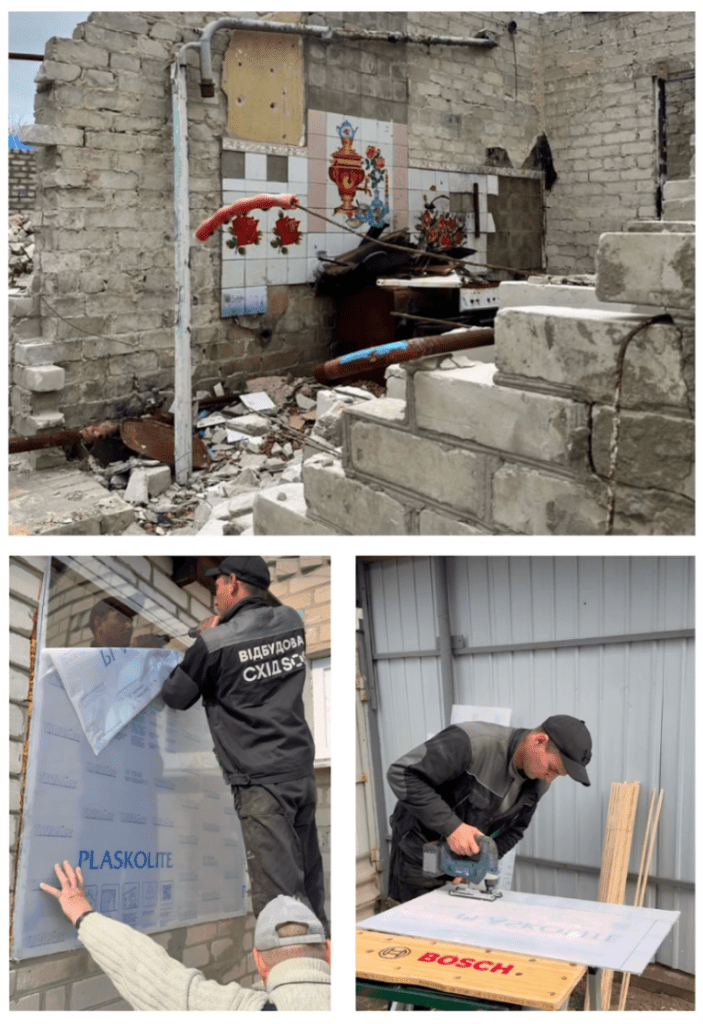
Collage de tres fotografías: una casa semidestruida por los ataques rusos y personal de la organización “SOS Este” reparando ventanas y cortando madera. 
Personal de East SOS restauran casas dañadas por ataques rusos.

El equipo de East SOS interviene inmediatamente cuando una casa es afectada, se reparan techos y ventanas, y se previenen daños adicionales por lluvia o nieve. Después de esta respuesta de emergencia, el equipo regresa a restaurar viviendas gravemente dañadas por los ataques rusos.

A East SOS le cuesta aproximadamente $1,500 reparar una casa; con tu ayuda ya hemos recaudado fondos para cubrir la reparación de tres casas.

Puedes comprar la camiseta “603 628 km²” blanca aquí o negra aquí.

Los miembros de la comunidad de The Kyiv Independent también pueden disfrutar de un 15% de descuento en todos los productos de nuestra tienda online.Únete a nuestra comunidad y descubre más sobre los beneficios de la membresía aquí.

También puede obtener más información sobre East SOS aquí o hacerles una donación  directamente aquí.

Gracias por tu apoyo. Para cualquier duda o pregunta sobre la camiseta, escríbenos a store@kyivindependent.com.

Saludos,

El equipo de The Kyiv Independent

Fuente: Boletín informativo de The Kyiv Independent, 4 de agosto del 2025. Hoy pedí una de estas nuevas camisetas  (como mi propio regalo de cumpleaños) y te recomiendo que compres una. Traducido al inglés por The Russian Reader y al español por Hugo Palomino.


Noticias del Boletín ucranianio n.º 157 (3 de agosto del 2025) 

En el boletín de esta semana: Maltrato y desaparición de prisioneros en Rusia; persecución por motivos políticos en los territorios ocupados.

Noticias desde los territorios ocupados por Rusia:

Solidaridad en el dolor: KVPU pide ayuda tras los mortíferos ataques rusos (KVPU 1 de agosto)

La periodista Iryna Levchenkol, de Melitopol, secuestrada el 2023, ha sido hallada en prisión en Donetsk, región ocupada por Rusia (Grupo de Protección de los Derechos Humanos de Járkov, 1 de agosto).

El rostro de la resistencia: La historia del activista tártaro de Crimea Ruslan Zeitullaiev (Plataforma de Crimea, 1 de agosto)

Una joven pareja crimea podría ser condenada a cadena perpetua por resistirse a la guerra rusa contra Ucrania (Grupo de Protección de los Derechos Humanos de Járkov, 29 de julio)

Rusia reubica a “veteranos” y sus familias en la Ucrania ocupada, mientras deporta a ucranianos (Grupo de Protección de los Derechos Humanos de Járkov, 28 de julio)

Invasores rusos secuestran a una joven ucraniana y la condenan a 12 años y medio de prisión por ayudar a Ucrania (Grupo de Protección de los Derechos Humanos de Járkov, 28 de julio)

CEPA ha publicado un artículo sobre la preservación del idioma tártaro de Crimea (Plataforma de Crimea, 28 de julio)

Noticias desde Ucrania:

Ucrania expone una importante trama de sobornos en la adquisición de sistemas de guerra electrónica: diputados y funcionarios implicados (Ukrainska Pravda, 2 de agosto)

¡Rebeldía, amor, lucha contra la corrupción! Declaración del sindicato estudiantil Priama Diia (Red Europea de Solidaridad con Ucrania, 2 de agosto)

“¿No se cansan de darle basura a la gente?” El parlamento ucraniano revoca la ley anticorrupción tras las protestas callejeras (Euromaidan Press, 31 de julio).

«Luchando por nuestro futuro»: Manifestantes de Kiev celebran el regreso de las medidas anticorrupción (Kyiv Post, 31 de julio)

“Cada vez menos gente quiere hablar ruso”: Cómo ha cambiado la actitud de los ucranianos hacia el idioma ruso durante la guerra (The Insider, 28 de julio)

Terror aéreo en Jersón: una ciudad asediada por drones (Byline Times, 28 de julio)

Cómo la controvertida Ley 4555-IX socava la lucha contra la corrupción y la reintegración — Alena Lunova en el podcast JustTalk Context (Zmina, 25 de julio)

Noticias relacionadas con la guerra desde Rusia: 

Reclutamiento de unidades antiautoritarias (Colectivos Solidarios, 1 de Agosto)

Denys Matsola: Actualización desde el cautiverio (Colectivos Solidarios, 1 de agosto)

Preso político ucraniano desaparece tras ser secuestrado por el FSB en lugar de ser liberado de una prisión rusa (Grupo de Protección de los Derechos Humanos de Járkov, 31 de julio)

Yulia Moskovskaya, Terrorista (The Russian Reader, en español, 29 de julio)

Automóviles para Ucrania (The Russian Reader, 27 de julio)

Noticias desde el frente:

Ciudad destruida: Rusia afirma controlar Chasiv Yar, Ucrania, tras 16 meses de combates. 

Pero la batalla continúa, y solo quedan ruinas (Meduza, 1 de agosto).

Fortaleza bajo amenaza: un año después de alcanzar Pokrovsk, las fuerzas rusas parecen listas para lanzar un asalto total (Meduza, 30 de julio)

Análisis y comentario:

A 2000 metros de Andriivka: la clase obrera ucraniana en la guerra (Liam Record, 3 de agosto)

Capital, poder y guerra: La crisis del régimen de acumulación periférica ruso (Links, 1 de agosto)

Recupere el control de sus dispositivos: el derecho a repararlos y la oportunidad que representa para Ucrania (Commons.com, 1 de agosto)

Protestas en las fronteras internas de Rusia en tiempos de guerra (Posle Media, 30 de julio)

Una crisis política que podría debilitar el propio esfuerzo bélico: Qué significa el giro de 180 grados de Zelensky en la lucha contra la corrupción en un “momento precario” para Ucrania (Meduza, 30 de julio)

Rescoldos moribundos: la crisis del carbón en Rusia provoca quiebras y despidos masivos (The Insider, 30 de julio)

Ucrania, entre el imperio y la revolución: el marxismo anticolonial de Lev Yurkevych (Links, 29 de julio)

Por qué la actual ola de nacionalizaciones en Rusia es más que una simple redistribución de activos (IStories, 29 de julio)

Nuevo gabinete de Ucrania: reformas neoliberales amenazan la solidaridad en tiempos de guerra (International Viewpoint, 26 de julio)

Investigación de abusos de derechos humanos:

ZMINA destaca, en un evento paralelo en la Conferencia Helsinki+50, la persecución con motivos políticos en los territorios ocupados (Zmina, 1 de agosto)

Presos golpeados y amenazados con nuevas condenas son obligados a luchar en la guerra rusa contra Ucrania (Grupo de Protección de los Derechos Humanos de Járkov, 1 de agosto)

La OSCE y los Estados participantes deben actuar ahora para liberar del cautiverio y procesamiento a su personal en Rusia (Zmina, 31 de julio)

Secuestros de mujeres y niñas ucranianas (Grupo de Protección de los Derechos Humanos de Járkov, 31 de julio)

El silencio como forma de tortura (Grupo de Protección de los Derechos Humanos de Járkov, 31 de julio)

Manifiesto de la sociedad civil en el 50º aniversario del Acta Final de Helsinki (Zmina, 30 de julio)

No legitimar la ocupación: se urge a  museos mexicanos y brasileños a abstenerse de colaborar con instituciones en territorios ocupados (Grupo de Derechos Humanos de Crimea, 30 de julio)

Evento paralelo en la conferencia Helsinki+50: «Crimea: 11 años de ocupación, restableciendo la justicia y los compromisos de la OSCE» (Grupo de Derechos Humanos de Crimea, 30 de julio)

Nota importante: No publicaremos el  boletín la próxima semana. El próximo boletín, el n.º 158, se publicará en dos semanas, el 17 de agosto del 2025.

==

Este boletín es elaborado por activistas del movimiento obrero en solidaridad con la resistencia ucraniana. Para recibirlo por correo electrónico cada lunes, envíenos un correo electrónico a 2022ukrainesolidarity@gmail.com. Para dejar de recibirlo, responda con la palabra “STOP” en el asunto. Más información en https://ukraine-solidarity.org/. También estamos en X (antes Twitter), Bluesky, Facebook y Substack, y el boletín se encuentra en línea aquí.

Fuente: Ukraine Information Group. Traducido al español por Hugo Palomino

603,628 Kilometers Square (Solidarity with Ukraine)


Dear Kyiv Independent readers,

Thank you for your continued support.

In case you missed it, we recently added a new T-shirt to our online store to help the charitable organization East SOS, continuing our commitment to support important Ukrainian initiatives through your purchases.

After Russia demanded that Ukraine cede five of its regions as a condition for a ceasefire, we designed a shirt to show solidarity with Ukraine — all 603,628 square kilometers of it.

In June, we introduced the “603,628 km²” T-shirt and are donating the profits to the Ukrainian charity East SOS. Thanks to readers like you, we’ve already raised more than $5,000 to help them rebuild homes in war-torn eastern Ukraine.

We’ll collect donations until Aug. 10, so you have six days left to grab your shirt and support the cause.

We also want to give you a closer look at East SOS. The organization provides comprehensive assistance to Ukrainians in front-line regions and internally displaced persons (IDPs) that were forced to flee the war. The charity was launched in 2015, focusing on providing essential supplies and humanitarian aid for those living in the front-line areas.

One project East SOS is currently raising money for is to repair houses in eastern Ukraine that have been damaged by Russia — this is the project that the Kyiv Independent will support. So far, East SOS has helped repair nearly 1,500 homes in Kharkiv and Donetsk oblasts, with another 300 households waiting for assistance. The charity works to repair private homes, prioritizing requests from elderly people living alone or individuals with disabilities — essentially those who are unable to carry out the work themselves.

East SOS employees restoring houses, damaged by Russian attacks.

The East SOS team steps in immediately after a house is damaged, fixing roofs and windows, preventing further damage from rain or snow. After an emergency response, the team returns in order to restore homes severely damaged by the Russian attacks.

It costs around $1,500 for East SOS to repair one house — thanks to your help, we have already raised funds to cover the repair of about three houses.

You can buy the “603,628 km²” T-shirt in white here or in black here.

Members of the Kyiv Independent community are also eligible for a 15% discount on everything sold in our online store. Join our community and find out more about membership benefits here.

You can also learn more about East SOS here or donate directly to them here.

Thank you for your support. If you have any questions regarding the T-shirt, please feel free to contact us store@kyivindependent.com.

Best,

The Kyiv Independent team

Source: Kyiv Independent newsletter, 4 August 2025. I ordered one of these new t-shirts today (as a gift to myself for my upcoming birthday), and would urge you to buy one too. ||| TRR


News from Ukraine Bulletin No. 157 (3 August 2025)

In this week’s bulletin: Russia’s mistreatment and disappearance of prisoners; politically motivated persecution in the occupied territories.

News from the territories occupied by Russia:  

Solidarity in grief: KVPU calls for support after deadly Russian attacks (KVPU August1st)

Melitopol journalist Iryna Levchenko abducted in 2023 ‘found’ imprisoned in Russian-occupied Donetsk (Kharkiv Human Rights Protection Group August 1st)

The Face of Resistance: The story of Crimean Tatar activist Ruslan Zeitullaiev (Crimea Platform August 1st)

Young Crimean couple could face life sentences for resistance to Russia’s war against Ukraine (Kharkiv Human Rights Protection Group July 29th)

Russia resettles ‘veterans’ and their families in occupied Ukraine, while deporting Ukrainians (Kharkiv Human Rights Protection Group July 28th)

 Russian invaders abduct young Ukrainian, sentence her to 12.5 years for helping Ukraine (Kharkiv Human Rights Protection Group July 28th)

CEPA published an article on the preservation of the Crimean Tatar language (Crimea Platform July 28th)

News from Ukraine:

Ukraine uncovers major bribery scheme in electronic warfare systems procurement: MP and officials involved (Ukrainska Pravda August 2nd)

Rebel, Love, fight corruption! Statement of student union Priama Diia (European Network for Solidarity with Ukraine August 2nd)

“Aren’t you tired of feeding people garbage?” Ukrainian parliament reverses anti-corruption law after street protests (Euromaidan Press July 31st)

`Fighting for our Future’: Kyiv protesters cheer return of anti-corruption safeguards (Kyiv Post July31st)

“More and more people don’t want to speak Russian”: How Ukrainians’ attitudes toward the Russian language changed during the war (The Insider, July 28th)

Aerial Terror in Kherson – A City Under Drone Siege (Byline Times, July 28th)

How the controversial Law No. 4555-IX undermines anti-corruption and reintegration — Alena Lunova on the JustTalk Context podcast (Zmina July 25th)

War-related news from Russia:

Recruiting for units with anti-authoritarians (Solidarity Collectives August 1st)

Denys Matsola: Updates from capitivity (Solidarity Collectives August 1st)

Ukrainian political prisoner vanishes after being abducted by FSB instead of released from Russian prison (Kharkiv Human Rights Protection Group July 31st)

Yulia Moskovskaya, Terrorist (Russian Reader, July 29th)

Cars for Ukraine (Russian Reader, July 27th)

News from the Front: 

A City Destroyed: Russia says it controls Ukraine’s Chasiv Yar after 16 months of fighting. But the battle grinds on, and only ruins remain (Meduza August 1st)

A fortress under threat: A year after reaching Pokrovsk, Russian forces appear ready to launch a full assault (Meduza July 30th)

Analysis and comment:

2000 Meters to Andriivka – the Ukrainian working class in war (Liam record, August 3rd)

Capital, Power and War: The crisis of Russia’s peripheral accumulation regime (Links August 1st)

Take back control of your gadgets: right to repair and the opportunity it presents for Ukraine (Commons.com, August 1st)

Wartime protest across Russia’s internal borders (Posle Media July 30th)

A political crisis that could weaken the war effort itself: What Zelensky’s anti-corruption U-turn means at a `precarious moment’ for Ukraine (Meduza July 30th)

Dying embers: Russia’s coal crisis triggers bankruptcies and mass layoffs (The Insider July 30th)

Ukraine between empire and revolution: Lev Yurkevych’s anti-colonial Marxism (Links July 29th)

Why the current wave of nationalization in Russia is more than just a redistribution of assets (IStories July 29th)

Ukraine’s New Cabinet: Neoliberal Reforms Threaten Wartime Solidarity (International Viewpoint, July 26th)

Research of human rights abuses:

ZMINA highlighted politically motivated persecution in the occupied territories at Helsinki+50 Conference side event (Zmina August1st)

Prisoners beaten, threatened with new sentences to force them to fight Russia’s war against Ukraine (Kharkiv Human Rights Protection Group August 1st)

OSCE and Participating States must act now to free its staff members from Russia’s captivity and prosecution (Zmina July 31st)

Abductions of Ukrainian Women and Girls (Kharkiv Human Rights Protection Group July 31st)

Silence—as a form of torture (Kharkiv Human Rights Protection Group July 31st)

A civil society manifesto on the 50th anniversary of the Helsinki Final Act (Zmina July 30th)

Do not legitimise the occupation: Mexican and Brazilian museums urged to refrain from collaborating with institutions in occupied territories (Crimea Human Rights Group July 30th)

Side event at the Helsinki+50 conference: “Crimea: 11 years of occupation – restoring justice, restoring OSCE commitments” (Crimea Human Rights Group July 30th)

Important Note: We will not be publishing a bulletin next week. The next bulletin, no. 158, will appear in two week’s time on 17 August 2025. 

==

This bulletin is put together by labour movement activists in solidarity with Ukrainian resistance. To receive it by email each Monday, email us at 2022ukrainesolidarity@gmail.com. To stop the bulletin, reply with the word “STOP” in the subject field. More information at https://ukraine-solidarity.org/. We are also on twitterBlueskyFacebook and Substack, and the bulletin is stored online here.

Source: Ukraine Information Group

Ukraine (The Betrayal)

Source: “The World in Brief,” The Economist, 15 February 2025


Today, there was one happy man in the Kremlin. Vladimir Putin banked his legacy on an all-out war that, at one point, looked all but lost for him. But he waited long enough to see the tides change in his favor.

Three years in and hundreds of thousands of deaths after, the U.S. president is calling Putin, offering peace talks on Russia’s terms.

Hi, my name is Oleksiy Sorokin, I’m the deputy chief editor of the Kyiv Independent, and this is the latest issue of our Russia-themed newsletter.

Today we will talk about how Russia is about to win the war.

It’s a topic of debate when authoritarian Russia began morphing into a totalitarian state, but Feb. 24, 2022, is a point that finalized this transformation. A point of no return.

The all-out war was supposed to be quick. It was supposed to be a victory of a new world order and of a new Russia, once again a force that would decide the fate of the world, a force that people would fear.

Taking Kyiv, installing a new Russian-controlled government, and forcing Ukraine to recognize Crimea, Donetsk, and Luhansk as Russian was to be achieved within months, if not days.

The country Putin attempted to subjugate, however, was fiercely resisting. Something that Russian political and military leadership didn’t expect and didn’t prepare for.

Yet, over and over, Russian President Putin was bailed out by the West.

In 2022, Russia was making fortunes on selling off its energy resources to the West. When Russian troops were murdering civilians of Mariupol and nearing Kyiv, Moscow’s war chest was being replenished by Europeans.

The slow phasing out of Russian energy resources in the West allowed Russia to iron out its pivot to the East, building a formidable shadow fleet to transport its energy resources to anyone willing to buy.

When Russia began to lose ground and prepare for a Ukrainian counteroffensive, the U.S. was slowing down military shipments, giving Moscow further breathing room.

Seeing that the West was unwilling to support Ukraine to the fullest and was willing to allow Russia to continue, Russia, well, continued.

Russian leadership doubled down, increasing attacks on Ukraine, making committing war crimes a state policy, and simultaneously choking all forms of dissent at home.

Ukrainian civilians and prisoners of war were tortured and often murdered, and children from occupied territories were abducted.

Domestically, Russia outlawed speaking against the war, with people receiving hefty prison terms for criticising the invasion.

For the majority, however, the state made sure their economic well-being and daily routines remained unchanged, allowing ignorance to flourish. The Russian economy was doing fine.

All this made Putin confident. He knew that time played in his favor. The U.S. would surrender, and Europe would be in no position to object. He was right.

While on the campaign trail, Donald Trump had made it clear that he has little interest in continuing to support Ukraine’s fight against Russia.

His comments of ending the war in “24 hours” were a figure of speech, but it was clear that some sort of peace plan would be presented by the incoming administration.

Russia listed its demands, Ukraine listed theirs. Both waited. The fighting went on along the front line.

Russia was in a better position to negotiate. The West’s unwillingness to truly stop Russia, especially if it meant causing any sort of inconvenience at home, allowed it to regroup and begin a major offensive, ongoing to this day.

What came next was too good to be true… for Russia.

On Feb. 11, U.S. Defense Secretary Pete Hegseth began his European tour. Off the bat, he made public the U.S. position concerning the upcoming peace talks.

Hegseth said, “Returning to Ukraine’s pre-2014 borders is an unrealistic objective,” and that NATO membership for Ukraine is not an option, effectively agreeing with Russia’s demands.

Then, Trump called Putin.

“We both reflected on the great history of our nations and the fact that we fought so successfully together in World War II, remembering that Russia lost tens of millions of people,” said Trump following the call, parroting the Kremlin’s favorite line of the huge sacrifice Russia undertook in a war that ended 80 years ago, and how it is for whatever reason relevant today.

“As we both agreed, we want to stop the millions of deaths taking place in the war with Russia/Ukraine. President Putin even used my very strong campaign motto of ‘common sense’,” Trump added.

“We agreed to work together, very closely, including visiting each other’s nations. We have also agreed to have our respective teams start negotiations immediately, and we will begin by calling President Zelensky of Ukraine, to inform him of the conversation,” he went on.

The next day, Trump proposed to return Russia to G7, the intergovernmental political forum of the most developed democratic countries from which Moscow was kicked out following the start of its war in 2014.

Russian officials and pro-war public figures were openly excited about Trump’s moves.

“The movement that has begun is the result of the heroic work of our fighters and the principled position of Vladimir Putin, who speaks of openness to negotiations but firmly defends Russia’s national interests,” said lawmaker Evgeniy Revenko, deputy head of Putin’s United Russia party.

“Zelensky’s days are numbered, and Trump’s arrival at the Victory Parade in Moscow no longer seems like a fantasy,” he added.

“The phone call between Putin and Trump will go down in the history of world politics and diplomacy. It is not a breakthrough yet, but perhaps the first step towards one. I am sure that in Kyiv, Brussels, Paris, and London, they read Trump’s lengthy commentary on his conversation with Putin with horror and cannot believe their eyes,” said Russian Senator Aleksey Pushkov.

I can’t believe I’m saying this, but I agree with Mr. Pushkov.

Following the call, the Kremlin said, “We, of course, understand that our main counterpart in this process is Washington.”

And here we are today. It took three years, but Russia is where it wanted to be from the start — at a table with the U.S. deciding the fate of the world without the world’s consent.

Putin will push for more, seeking to squeeze the most out of Washington, and give nothing in return.

Russia would demand to keep the territories it controls, and most likely try to take the ones it doesn’t. According to Russia’s new constitution, Russia sees Ukrainian Crimea, and four oblasts — Donetsk, Luhansk, Zaporizhzhia and Kherson — as its own. Russia doesn’t have full control of any of the four.

With NATO off the table, other demands might be thrown at Trump, reducing Kyiv’s army or legalizing Russian language and influence in Ukraine.

Whether the U.S. will agree, and most importantly, whether Kyiv and the EU will go by the agreements that Moscow and Washington are set to achieve behind their backs, remains to be seen. There’s a strong chance that they won’t.

But overall, the sun is now much brighter for Putin than it was just a few days ago.

Eleven years of fighting against Ukraine, three years of all-out war and thousands of war crimes committed, Putin isn’t a pariah anymore. His worldview is on track to become mainstream, and it’s the leader of the free world who is leading him back to the table.

Source: Oleksiy Sorokin, “WTF is wrong with Russia” (newsletter), Kyiv Independent, 13 February 2025


In this week’s bulletin: Russia used US banks to dodge sanctions/ Private military companies at war/ Crimean 2024 human rights report/ Further evidence of Russian tortureexecution of prisoners, fabrication of evidence and withholding of medical aid in occupied areas/ New wave of detentions in Crimea

News from the territories occupied by Russia:  

Young people who have quit the occupied areas: “It’s like being freed from a horrible stench” (Ukrainska Pravda, 9 February)

Stadiums under occupation: sports facilities in Donbas today (Ukrainska Pravda, 7 February)

Russia uses medical torture to fabricate its ‘trial’ of disabled 74-year-old Volodymyr Ananiev (Kharkiv Human Rights Protection Group, February 7th)

Russians refuse to sell insulin and other vital medicines to Ukrainians without Russian passports, reports Ukrainian intelligence (Ukrainska Pravda, February 7th)

How can Ukraine solve the problem of documents from the occupied territories? Human rights defenders share their vision with international partners (Zmina, February 7th)

A janitor, a cook, an informer — who is being tried for collaborating with the enemy? (Kharkiv Human Rights Protection Group, February 6th)

Russian FSB carry out new terror raids and arrests by quota in occupied Crimea (Kharkiv Human Rights Protection Group, February 6th)

Human rights and humanitarian legal norms: 2024 review (Crimea Human Rights Group, 5 February)

Viktor Dzytsiuk was almost tortured to death in occupied Donbas. Now Russia is continuing his torment (Kharkiv Human Rights Protection Group, February 5th)

ZMINA took part in a discussion on the cultural decolonisation of Crimea (Zmina, February 4th)

Russian FSB uses shoddily faked video to charge 63-year-old woman abducted from occupied Ukraine with ‘terrorism’ (Kharkiv Human Rights Protection Group, February 3rd)

First prosecution in Crimea for “childfree propaganda” (Crimea Human Rights Group, 2 February)

The situation at the front:

Russian forces advance on Pokrovsk (Meduza, 5 February)

News from Ukraine – general:  

Support for war victims: human rights defenders presented new roadmap of draft laws (Zmina, February 5th)

Defying Odds In Ukraine  (They Said So, February 4th)

Ukrainian Holocaust survivor: Hitler wanted to kill me as a Jew. Putin is trying to kill me because I’m Ukrainian (Kharkiv Human Rights Protection Group, February 3rd)

How Ukraine lost faith in the Red Cross and UN (Kyiv Independent, January 22nd)

Ukraine: Bikis, our feminist year (Europe Solidaire Sans Frontières, January 20th)

Ukraine: And yet he remained a human  (Europe Solidaire Sans Frontières, January 4th)

War-related news from Russia:

Draft exemptions as Russians know them are ending (Meduza, 6 February)

Rebranding private military companies for the war in Ukraine (Posle.media, 5 February)

Support fundraisers for Solidarity Zone’s recipients in court (Solidarity Zone, 5 February)

Russia used US banks to send billions to Turkey, dodging sanctions (Kyiv Independent, February 3rd)

The Russian far right: “an affinity for violence brings them together” (Posle.media, 29 January)

Analysis and comment:

US Aid, Russia and Ukraine (The Russian Reader, 4 February)

A girl from the burnt village: the story of Maria Nevmerzhytska (Commons.com.ua, 3 February) 

Statement by human rights organisations: another wave of searches and detentions of Crimean Tatars (Crimean Human Rights Group, 2 February) 

Research of human rights abuses:

Prison medicine: ways to humanize it (Kharkiv Human Rights Protection Group, February 7th)

UN monitors report sharp increase in executions of Ukrainian POWs, and point to Russian officials’ effective incitement to kill (Kharkiv Human Rights Protection Group, February 7th)

The Centre for Civil Liberties Participated in the First World Congress on Enforced Disappearances  (Centre for Civil Liberties, February 6th)

“I Urge You to Make Every Effort to Release Ukrainian Prisoners of War And Unlawfully Detained Civilians ” Maksym Butkevych at the UN Security Council (Centre for Civil Liberties, February 6th)

“Crimes Against Peaceful Civilians Warrant Your Action” The Center for Civil Liberties Appealed to PACE Members  (Centre for Civil Liberties, February 6th)

Upcoming events:

Saturday 15 February, 11.0 am — 4.0 pm, Conference: End the Russian invasion and occupation. National Education Union, Mabledon Place, London, WC1H 9BD. Register here.

Saturday 15 February, 11.0 am – Palestine solidarity demo. To join the Ukraine-Palestine solidarity contingent, with our banner, “From Ukraine to Palestine – Occupation is a crime”, meet outside Banqueting Hall, corner of Whitehall and Horseguard Avenue, London SW1A

Saturday 22 February, 12.00 , Demonstrate at the Russian embassyAssemble 12 noon – St Volodymyr statue, W11 3QY Rally 1pm – Russian embassy, W8 4QP. Flyers are available for distribution – email info@ukrainesolidaritycampaign.org and ask for them.

==

This bulletin is put together by labour movement activists in solidarity with Ukrainian resistance. To receive it by email each Monday, email us at 2022ukrainesolidarity@gmail.com. To stop the bulletin, reply with the word “STOP” in the subject field. More information at https://ukraine-solidarity.org/. We are also on twitterBlueskyFacebook and Substack, and the bulletin is stored online here

Source: News from Ukraine Bulletin 133 (10 February 2025)


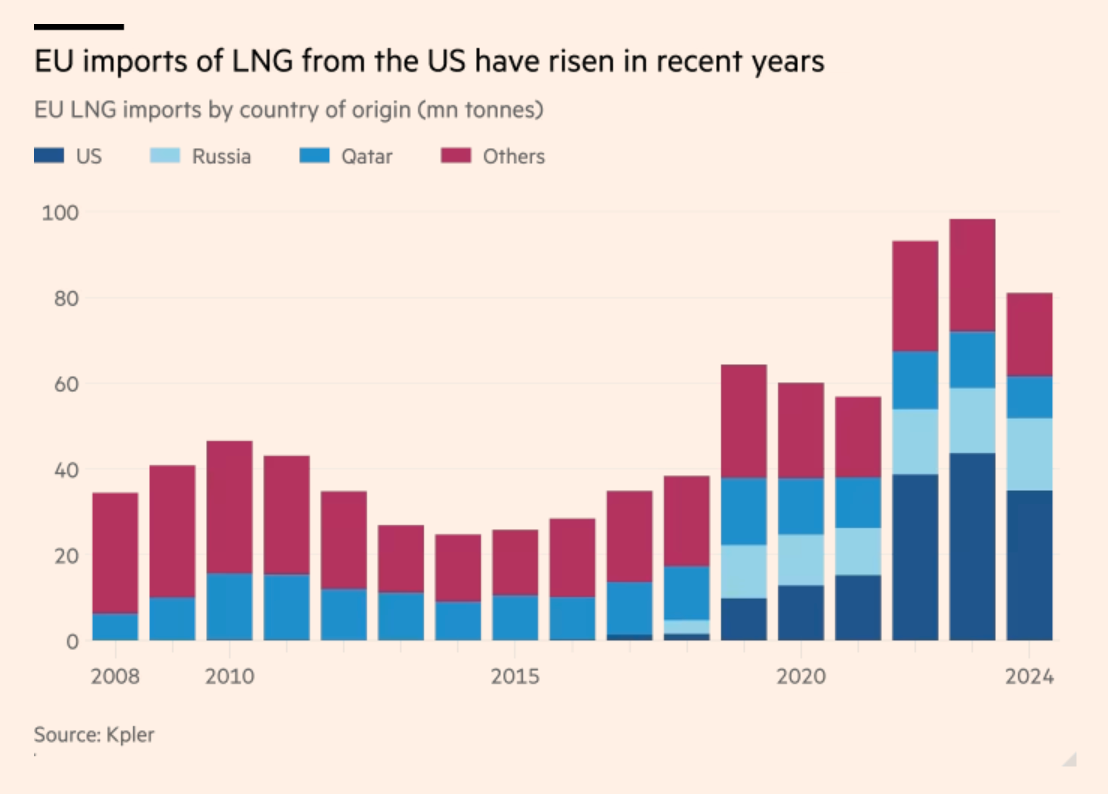
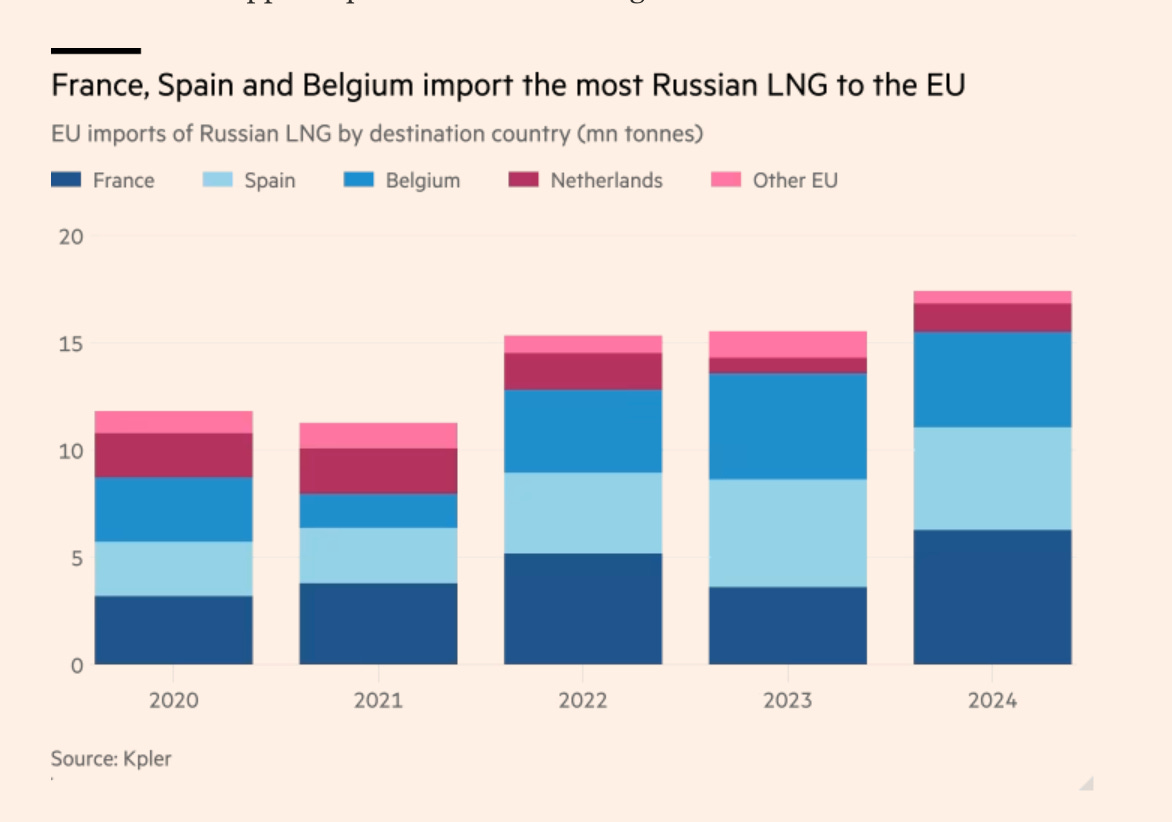
Europeans still like cheap Russian LNG

France, Spain and Belgium are the biggest buyers

Source: FT

Source: Adam Tooze, “Why Europe and India are still buying Russian energy. Friedman and Schwartz disaggregated. Cuba in Africa and the decline of the all-nighter,” Chartbook, 15 February 2025


Russia’s full-scale invasion of Ukraine in 2022 prompted a refugee crisis in Europe. News footage showed people piling onto trains and into cars, desperate to escape the threat of bombs and Russian occupation. In Kharkiv, a taxi driver named Sergii told me how in those chaotic early days of war, he had helped evacuate people as Russian missiles turned his bustling neighbourhood of Saltivka into a ghost town.

“I survived by praying to God,” Sergii said, pointing to the icon of the Virgin Mary dangling from his cab’s rearview mirror. “I helped people with no money get out of Saltivka, because people with money had already left.” He narrowly avoided death himself, he added, explaining a rocket had destroyed his apartment as he went out to his cab to retrieve the mobile phone he’d left on the front seat.

Nearly seven million people have now fled Ukraine. The majority have settled in European countries, many of which responded to the war by waiving visa requirements for Ukrainian refugees. Around 250,000 came to the UK, which decided not to fully lift restrictions but to instead introduce two emergency visas: the Ukraine Family Scheme and the Homes for Ukraine scheme.

At their outset, both visas granted Ukrainian nations the right to live, work and study in the UK for up to three years. Now, as the third anniversary of Russia’s invasion rolls around, anybody who arrived in the early days of the war is about to see their right to remain expire.

Yet this week, many Ukrainians faced the prospect that they may never be able to return to their homes. US President Trump announced he had spoken to his Russian counterpart, Vladimir Putin, to begin peace negotiations that risk handing over occupied regions of Ukraine to Russian control.

Residents of Ukrainian towns and cities previously liberated from Russian control, such as Bucha and Izium, have spoken about the reign of terror and cruelty they endured under occupation, including torture, rape, summary executions and false imprisonment. Should the peace deal go ahead on Putin’s terms, Ukrainian refugees in the UK face an increasingly uncertain future, with those whose homes are in the occupied territories potentially unable to return.

But even before the announcements from the White House and the Kremlin, the UK’s visa schemes have long presented problems for the vulnerable Ukrainians they are supposed to support.

“Before the full-scale invasion, I had a normal life,” Nastya*, aged 24, told openDemocracy “I worked in a supermarket and a fabric factory. Everything was absolutely good. And then on 22 February 2022, the war started.”

At the time, Nastya lived in Uzhorod, a city near the Slovakian border. As missiles battered the country’s major cities and the Russian forces occupied cities such as Izium and Mariupol, committing war crimes in Bucha and Irpin, she decided to flee with her husband.

“It was a stressful time,” she admitted. “I did not know what the future would be and my family were scattered around the world, some in England, some in Germany and some in Ukraine.”

Nastya and her then-husband travelled to Germany, where her mother was living, before coming to the UK on the Ukraine Family Scheme in August 2022. “It was hard to get a job in Germany, especially as I don’t speak German,” she explained. “I didn’t want to live on benefits, I wanted to support myself and live independently. I had heard in the UK there were opportunities for work, so I relocated.”

Nastya and her husband’s visas took only a few days to be approved, and the pair moved in with her sister-in-law in Leeds, where Nastya found a job in a local factory. “The work was hard and physical with lots of heavy lifting but I was earning some money which is good,” she said.

After three months in the UK, Nastya discovered she was pregnant with her first child. It was happy news, but it came as her marriage was falling apart. “It was quite difficult,” she said. ‘My husband was very sad and there were a lot of horrible moments. I decided to separate from him and go to Germany to be with my mother to have the baby.”

Nastya gave birth to a beautiful baby girl, who shares her bright brown eyes and dark hair. While she had wanted to be with her own mother during the birth, as a newly single mum Nastya was keen to return to the UK, where her father and grandmother were living, to get a job, support her daughter, and start a new life.

She had assumed that as she had the right to live and work in the UK, her daughter would be able to join her on the same family visa scheme.

But what Nastya did not realise is that while she was caring for her newborn in Germany, the Conservative government had been quietly restricting Ukrainians’ right to enter the UK. The family visa scheme had been closed and Ukrainians were no longer allowed to sponsor fellow refugees to arrive on the Homes for Ukraine visa.

Now, if Nastya wanted to come to the UK, she would have to leave her daughter behind.

War in Europe

When the Homes for Ukraine scheme was launched in 2022, members of the British public could open their homes to Ukrainian refugees in exchange for an initial monthly payment of £350 from their local council, while Ukrainians who successfully applied for the scheme were granted the right to live, study and work in the UK for three years.

But in February 2024, the then-Tory government brought in a series of changes. It halved the length of time a new Ukrainian applicant would be able to stay in the UK to 18 months, and amended the rules so that only people with British citizenship can sign up to become hosts. At the same time, it cancelled the family visa scheme, meaning Ukrainian nationals living in the UK can no longer sponsor family members to join them.

These changes have effectively made it impossible for Ukrainian nationals in the UK to help loved ones to settle here to escape the war. Now, Ukrainians wanting to come to the UK are reliant on there being an available British citizen who will take them in. But this, too, has suffered changes that have made it a less appealing prospect for many hosts.

In November, the Labour government announced all British citizens signed up to the Homes for Ukraine scheme will be paid £350 a month, regardless of how long they have been hosting. Households who have been hosting for more than a year are currently paid £500 a month.

Even before this announcement, the number of hosts was in decline, according to openDemocracy’s analysis of government data. In the third quarter of 2023, 100,061 households in England received the monthly ‘thank you’ payment, but by the third quarter of Q3 2024, this had fallen to 48,533 households, the lowest number since the full-scale war began.

This decrease in hosts was also apparent in our review of Homes for Ukraine Facebook pages. While at the start of the war, posts from Ukrainians looking for sponsors received multiple comments from potential hosts, these days they often garner no responses or are met with ‘jokes’, with one commenter saying: “I’d rather be in Mykolaiv than London”. Others respond telling those who wish to relocate to the UK from another European country, like Nastya, that the scheme is not for them: “People in the UK would prefer to sponsor people who are in Ukraine and need to be saved from war.”

“Instead of putting more and more administrative barriers in front of people fleeing war, the UK government must show it can match the solidarity and empathy shown by the people of the UK,” said Alena Ivanova, committee member of the Ukraine Solidarity Campaign, which is organising a march to the Russian embassy in London to mark the third anniversary of the full-scale invasion.

“We know that the vast majority of Ukrainians in the UK are vulnerable women, small children and elderly people who carry significant trauma as a result of Russia’s brutal war. The least we as a country can do is not put them further at risk and increase their anxiety but help them settle and rebuild their lives,” Ivanova added.

Those who arrived in the UK through either the Homes for Ukraine or Ukraine Family Visa scheme in the early days of the war are about to see their right to remain expire. But with the conflict ongoing, they can extend their visas via the Ukraine Permission Extension Scheme.

While this extension is undoubtedly needed, the process for obtaining it is fraught – and may put vulnerable people at risk of falling out of the system.

People needing an extension can apply only when they have 28 days or less left on their right to remain, which may impact their ability to work or be housed, with landlords and employers nervous about accepting Ukrainians who may not have the legal right to be in the country. Those who miss the extension window are at risk of becoming undocumented and therefore will be considered to be in the UK illegally. Although the war means it is unlikely these people will be deported, they would be unable to work or access housing, and are at risk of being removed in the future.

And applications for extensions can only be made from within the UK – a problem for women like Nastya in Germany, or for anyone visiting family in Ukraine.

Polling by the Office for National Statistics found that while the majority of Ukrainians are aware of the visa changes and the need to apply for an extension, a small minority of mainly vulnerable refugees, such as the elderly or young, are not.

Uncertainty is also built into the extension scheme. People will be able to extend their right to stay in the UK by only 18 months, half the three years they were initially granted. If they stay for the full term, a Ukrainian refugee’s total residency in the UK will have been four and a half years – six months short of the five years that a person must have continuously lived here to be eligible for the right to settle permanently.

There is also uncertainty for those British nationals hosting Ukrainians. If their guest is granted an extension, their host will need to reapply for thank you payments.

openDemocracy asked the UK government how it plans to deal with the temporary nature of the visas should the conflict continue for another 18 months. We also asked what plans they have in place should a peace deal cede Ukrainian territory to Russia, with those fleeing the occupied regions unable to return home. They did not respond.

‘I feel loneliness’

Nastya had always planned to return from Germany to the UK with her daughter. Here, she could work and have her own home where she, her daughter and her new partner, who is also Ukrainian, could live as a family.

Now, the changes to the visa schemes have cut her and her daughter off, leaving her living in limbo. She and her daughter face a choice: living in Germany where she struggles to find work and faces eviction from her refugee accommodation in the coming year, or returning to Ukraine which endures daily bombardment by Russian bombs and drones.

“In Germany, I face going into a refugee camp, which is no place to raise a child,” Nastya warned. “My mother lives in a separate city and so we cannot see each other regularly.”

Worse, the heartbreak of being separated from her father and grandmother has been devastating.

“They have never had the chance to meet their granddaughter and great-granddaughter,” she said, the pain of separation clear in her voice. “I have not been in touch with them face to face, and they would really like to meet. I want to see my father and grandmother and it is impossible.”

The changes to the visa schemes have left women like Nastya experiencing a double displacement. First, the full-scale invasion forced them from their homes in Ukraine. Now, changing government policy has separated them from family members in the UK.

“I have cried a lot,” said Nastya. “I feel loneliness, it is so hard that I can’t put it into words. I am crying a lot but I don’t want to blame anyone. If I would receive a visa for my daughter it would be really nice and I would be able to meet my family.”

Nastya has some hope. Last month, the Labour government partially reversed the changes made by the previous administration, allowing Ukrainians to bring their children to join them in the UK, a change described as a “welcome step in the right direction,” by Mubeen Bhutta, British Red Cross director of policy, research and advocacy. The charity has supported Nastya and her family.

“Our teams have supported people who had been unable to reunite with young children,” she said. “We’ve seen their pain and suffering and know this will mean a lot to families who have been torn apart. However, even with these changes many family members will remain separated.

“It is still very difficult for displaced Ukrainians to help elderly parents or partners find safety in the UK. It is vital that the government addresses these obstacles and helps more Ukrainians reunite with their loved ones.”

Nastya, who has a legal right to be in the UK, can now apply for an extension and for her daughter to join her. Her partner, however, must find a British national to sponsor him.

“It is really hard to be a refugee,” she said. “It is impossible to see a future for Ukraine. It would be really nice to go to the UK to work, to rent a flat, to pay taxes. This is what I need, simple things to be satisfied. I want my daughter to be happy, to have a good education.”

*Names have been changed to protect identity

Source: Sian Norris, “Harsh UK visa schemes leave Ukrainian families in limbo and torn apart,” openDemocracy, 14 February 2025

US Aid, Russia, and Ukraine

US aid suspension hits Russian independent media and NGOs

The decree by US President Donald Trump’s decree halting American aid to foreign countries and suspending the work of the United States Agency for International Development (USAID) hits exiled Russian media and NGOs hard. For many organizations and publications, grant funding is the sole means they have of ensuring their continued existence.

As soon as the new US administration announced the suspension of all international aid programs, there was panic among the Russian emigrant community. Most exiled Russian NGOs and media rely on grants as their major—and sometimes sole—source of funding, with a significant chunk coming from Washington. The topic has been high on the agenda for Russia’s opposition and anti-war communities— though only behind the scenes. Affected NGOs and media outlets do not want to admit publicly that they receive American funding, as it could lead to criminal prosecution by the Russian authorities. They are also reluctant to publicly discuss financial problems.

Dozens of organizations are under threat from within the Russian-language anti-war diaspora community, including those who help persecuted individuals to leave Russia, try to protect minority rights and bring accurate information about the war to audiences within Russia. According to the Moscow Times, citing a source in Washington, up to 90 organizations have already lost their funding. As one example, The Ark, which offers temporary housing, legal aid, psychological support and other assistance to Russians forced to flee their homeland, immediately lost half its budget.

Former political prisoner Andrei Pivovarov (released in the summer 2024 prisoner exchange) wrote that Trump’s decree would lead to the cancellation of one-off events and the abandonment of long-term projects. “You can cancel a conference, but you can’t, for example, stop paying the rent. You can’t tell your landlord: ‘wait, Trump will work it out’. He’ll just cancel the contract. And many simply do not have the kind of safety net that can pay for these three months, or raise money via crowdfunding,” he explained. “It will be even more difficult with people. There are many countries where residency is tied to a work contract, and if there is no money for that it raises questions about the basis for extending [residency].”

Russian propaganda channels are jubilant. For decades they have been telling Russians that the opposition lives on Western money and carries out orders from abroad. Trump’s decree offers them a great opportunity to say that these claims have now been proven and that “independent” media is nothing of the sort. Of course, nobody on the pro-Kremlin side is bothering to look at the details of how Western grant funding actually works. Maria Zakharova, a representative of Russia’s Foreign Ministry, has already claimed that USAID forced “countless grant-eaters” to remain silent about alleged Ukrainian war crimes.

Not all funding for Russian civil society came from US state grants.  Private foundations as well as European governments also support Russian initiatives. But removing perhaps a quarter of the support from Russian journalists and organizations can only lead to ever more fierce competition for the remaining funds—not every project will survive.

Why the world should care

Trump’s radical measures are hitting activists and NGOs around the world. Russian organizations and media outlets, cut off from their homeland, face greater problems than many as they have far fewer sources of alternative funds.

Written by Peter Mironenko, translated by Andy Potts and edited by Jake Cordell

Source: The Bell (newsletter), 3 February 2024


If Russia had a wish list, it would include gutting the DOJ and FBI to eliminate counterintelligence operations and successful prosecutions, crippling U.S. sanctions enforcement by weakening the Treasury Department, fracturing America’s alliances to isolate the U.S. on the global stage, and dismantling USAID to eliminate vital democratic and humanitarian aid programs worldwide. That wish list is now being fulfilled—not by the Kremlin, but by Elon Musk and Trump.

Each of these attacks is a direct blow to U.S. national security and global influence but I’m going to focus on the dismantling of USAID—a move that Russian officials and state media are openly celebrating.

This isn’t just about shutting down an aid agency; it’s about deliberately weakening U.S. power while handing a geopolitical victory to authoritarian regimes in Moscow and Beijing.

Gutting USAID—A Gift to Russia

With Trump’s full backing, Musk has taken aim at USAID, calling it “a criminal organization” that “needs to die,” and branding the agency “a viper’s nest of radical left Marxists who hate America.” Shortly after, he announced that Trump had personally agreed USAID should be shut down.

Now, its funding is frozen, employees are locked out of headquarters in Washington, lawmakers are barred from entering the USAID building, and critical aid programs are being dismantled.

USAID is set to be merged into the State Department, but it will be a shell of its former self—stripped of its resources, workforce, and influence, ensuring it can never have the same impact.

For decades, USAID has been a pillar of American influence abroad, supporting independent journalism, anti-corruption initiatives, election monitoring, and providing critical, life-saving humanitarian assistance across the globe. It has played a key role in countering Russian, Iranian, and Chinese influence, providing a lifeline to civil society organizations resisting authoritarian regimes or strengthening their democracies. Now, that support is disappearing.

Russia’s reaction? Celebration as Kremlin propagandists and state officials are jubilant. And they’re right—USAID has been one of the biggest obstacles to its authoritarian expansion. With its demise, Russia gains a clearer path to spread its influence, undermine democracies, and prop up pro-Kremlin regimes worldwide.

Who Benefits from USAID’s Collapse? Russia and China

The closure of USAID isn’t about cutting spending—it’s about weakening U.S. global influence while empowering our adversaries. With American aid disappearing, nations that once relied on USAID for support will turn to Russia and China for funding.

This is a seismic shift in global power. Russia and China will step into the vacuum left by the U.S., using economic leverage to expand their authoritarian agendas. This is exactly what Moscow and Beijing have wanted for decades—and Trump and Musk are delivering it on a silver platter.

At the same time, Musk is propping up pro-Kremlin far-right parties across Europe—or, as I like to call them, ‘Kremlin projects’—while interfering in the elections and internal affairs of our allies.

Trump and Musk Are Lying—USAID Was Critical

Trump and Musk have claimed USAID was corrupt and ineffective. That’s a lie. USAID has been one of the most scrutinized and audited agencies in the federal government, and their accusations are baseless and an excuse to dismantle a tool that supports democracy, transparency, and independent governance.

The truth is simple: dismantling USAID doesn’t benefit the American people—it benefits authoritarian regimes. Its closure will leave a vacuum that Russia, China, and other adversaries will quickly fill.

Their claims of “fraud” are just a smokescreen for a broader effort to undermine democracy and erase America’s ability to support those fighting for freedom worldwide.

Musk’s Expanding Control Over Federal Systems

Simultaneously, Musk’s influence over the federal government is growing at an alarming rate, giving an unelected, unvetted billionaire, and his unvetted associates unprecedented access to highly sensitive data. His aides have locked career federal workers out of their systems at the U.S. Office of Personnel Management, effectively cutting off access to vital personnel records and personal information.

Meanwhile, his team has gained unauthorized access to General Services Administration systems, deploying AI tools to reshape the agency in ways that remain undisclosed to the public. Adding to these alarming developments, Musk’s handpicked allies—including unvetted college students—have taken over Technology Transformation Services, which manages critical government IT systems, sparking chaos and raising significant security concerns.

Musk and his unvetted, unelected team now have access to everything— our Social Security records, Medicare payments, tax filings, federal employee data, and other sensitive and classified files. Even our children’s information is now in their hands.

What will Musk do with it? Who will he share it with? This isn’t hypothetical—it’s a direct national security threat and threat to all of us and we need immediate answers.

Demand Accountability

We cannot allow this to happen without a fight. Contact your Senators, Representatives, and local officials and demand answers:

  • Did Trump give direct authorization for Musk to have access to sensitive government systems and all our private data?
  • What safeguards exist to prevent him from sharing Social Security numbers, tax filings, and federal employee records with foreign actors or private interests?
  • What steps are being taken to prevent further infiltration in government operations?
  • Who is ensuring our personal, financial, and national security data isn’t exploited for political or corporate gain?

Flood their phone lines, send emails, and make noise on social media platforms. We need answers because none of us want a billionaire beholden to Russian and Chinese interests to have our private info.

Source: Olga Lautman (Substack), “Elon Musk and Trump Shutting Down USAID—A Gift to Russia,” 3 February 2025


The website of the United States Agency for International Development went dark over the weekend and employees were put on leave, as Elon Musk said Monday that President Donald Trump wanted to shut down the largest disburser of U.S. foreign aid. The remarks were made by Musk during a live stream discussing the work of his government task force, the so-called Department of Government Efficiency, that he was announced to be leading by the president. Media reports meanwhile said that USAID could be absorbed into the State Department while many of the projects its supports – from health to infrastructure and disaster-relief programs – would be slashed significantly. USAID spending equals less than 1 percent of the federal budget.

The United States Agency for International Development, USAID for short, is the biggest dispenser of U.S. foreign aid, according to the federal website Foreignassistance.gov. It disbursed almost $44 billion in the fiscal year of 2023 (latest available), with $16 billion going to Ukraine. The number represents more than 60 percent of all U.S. foreign aid listed on the website. The agency pays out only economic aid, with military aid being handled by the Department of State and the Department of Defense.

After Ukraine, USAID payments were predominantly going to the Middle East and Africa in 2023. Ethiopia, Jordan, Afghanistan and Somalia all received more than $1 billion from USAID that year. U.S. aid recipients are found all over Latin America, Africa, Asia and Eastern Europe. Together with the Department of State/Defense spending, which focuses on the Middle East even more due to military aid components, it is the widest-ranging U.S. foreign aid paid out.

Source: Katharina Buchholz, “Where USAID Is Going,” Statista, 3 February 2025


German Chancellor Olaf Scholz criticized U.S. President Donald Trump’s proposal to tie military aid for Ukraine to access to the country’s rare earth resources, calling it “very selfish and self-centered,” Spiegel reported on Feb. 4.

Speaking after an informal meeting of European leaders in Brussels, Scholz reportedly stressed that Ukraine should first be helped to “get back on its feet” and that its resources should be used for reconstruction after the war.

This comes as Trump told reporters on Feb. 3 that he was seeking a deal where Ukraine would “secure what we’re giving them with their rare earths and other things,” though he did not specify which materials Washington is targeting.

A source in the Presidential Office told the Kyiv Independent that sharing Ukrainian resources with allies is already part of President Volodymyr Zelensky’s “victory plan,” which has been presented to foreign leaders, including Trump.

Trump’s remarks come amid uncertainty over the future of the U.S. aid to Ukraine.

The U.S. has provided $65.9 billion in military aid to Ukraine since the start of Russia’s full-scale invasion, with assistance remaining unaffected by the current aid freeze, Zelensky confirmed on Jan. 25. Non-military programs run by the U.S. Agency for International Development (USAID) have lost funding under the new administration.

USAID has provided Ukraine with $2.6 billion in humanitarian aid, $5 billion in development assistance, and over $30 billion in direct budgetary support. In response to the funding cuts, Ukraine’s parliamentary committee on humanitarian and information policy has begun consultations with European partners to temporarily replace U.S. funding.

Under Scholz’s leadership, Germany has become Ukraine’s second-largest military donor after the U.S. However, the chancellor has resisted providing Taurus long-range cruise missiles, citing escalation concerns.

Scholz has also blocked the proposed additional security assistance for Ukraine worth 3 billion ($3.09 billion) euros unless it is covered by additional government borrowing.

The plan, backed by German Foreign Minister Annalena Baerbock and Defense Minister Boris Pistorius, included three additional Iris-T air defense batteries, 10 howitzers, and more artillery ammunition.

Source: Tim Zadorozhnyy, “‘Selfish’ — Scholz blasts Trump’s aid-for-rare earths Ukraine plan,” Kyiv Independent, 4 February 2024