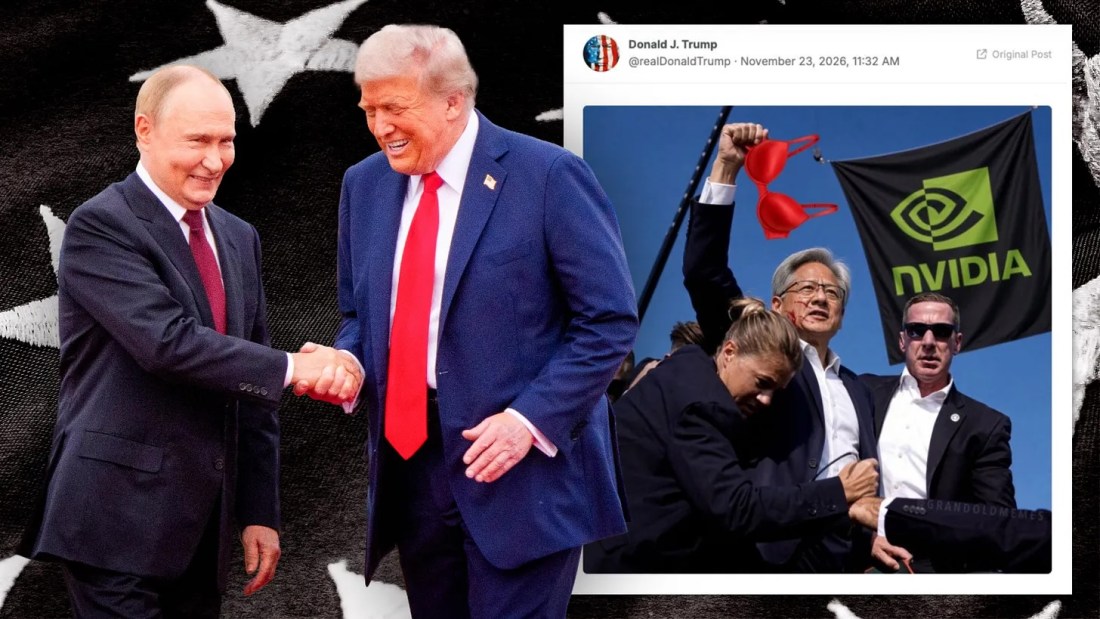
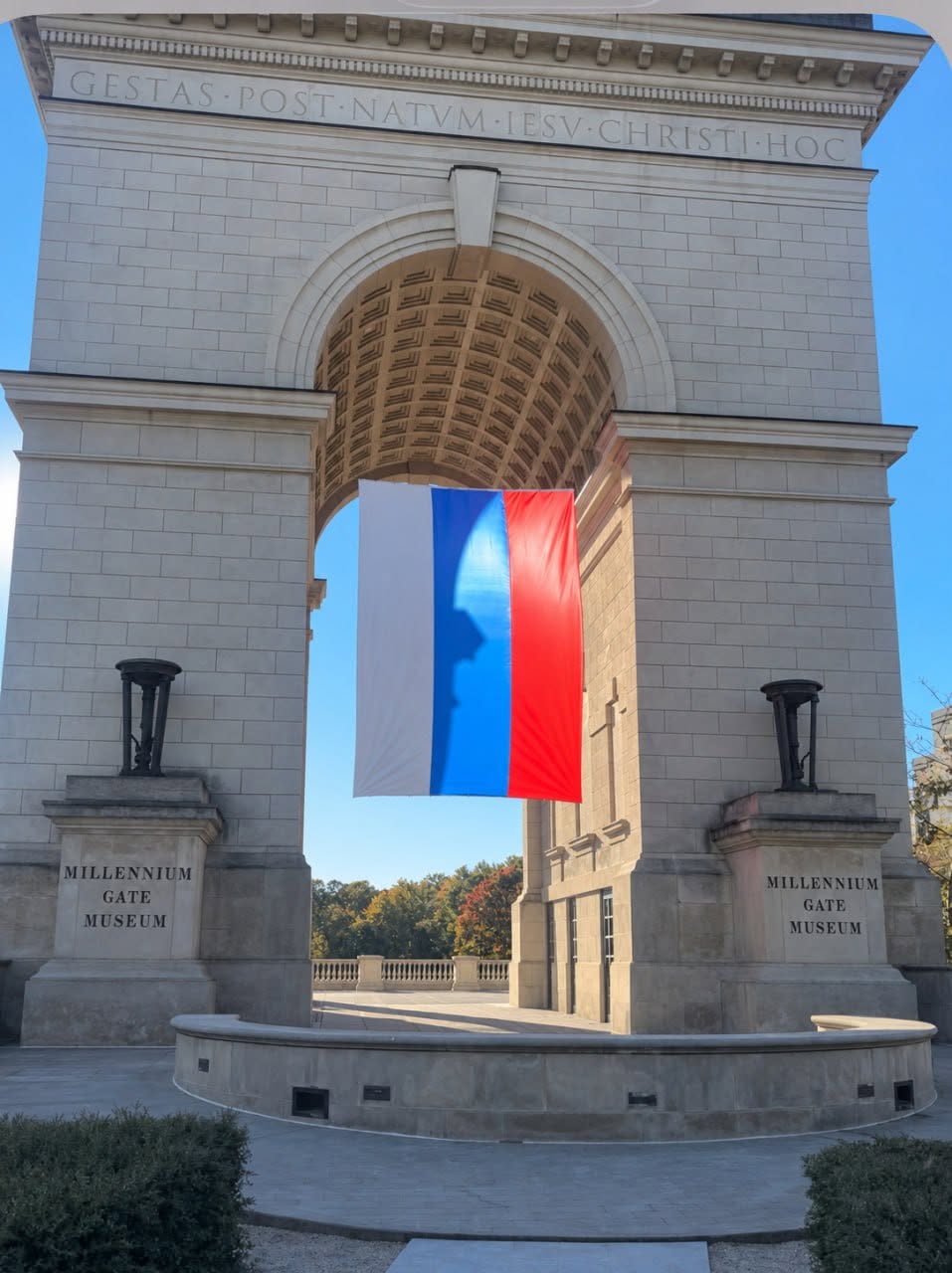
A Donald Trump appointee arranged for a Russian flag to be draped from a Georgia landmark in tribute to President Vladimir Putin’s late ambassador to the United States.
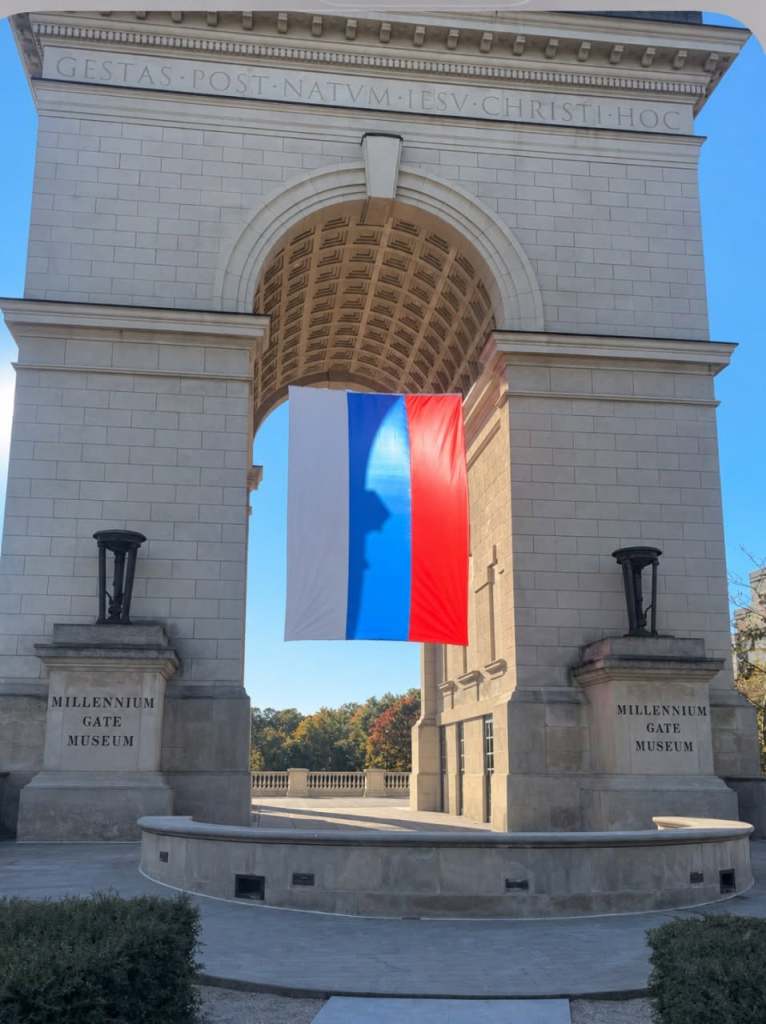
The Russian tricolor hung from the Millennium Gate Museum, an 82-foot classical arch in Atlanta, on Monday [16 November], according to a social media post by the Russian Embassy.
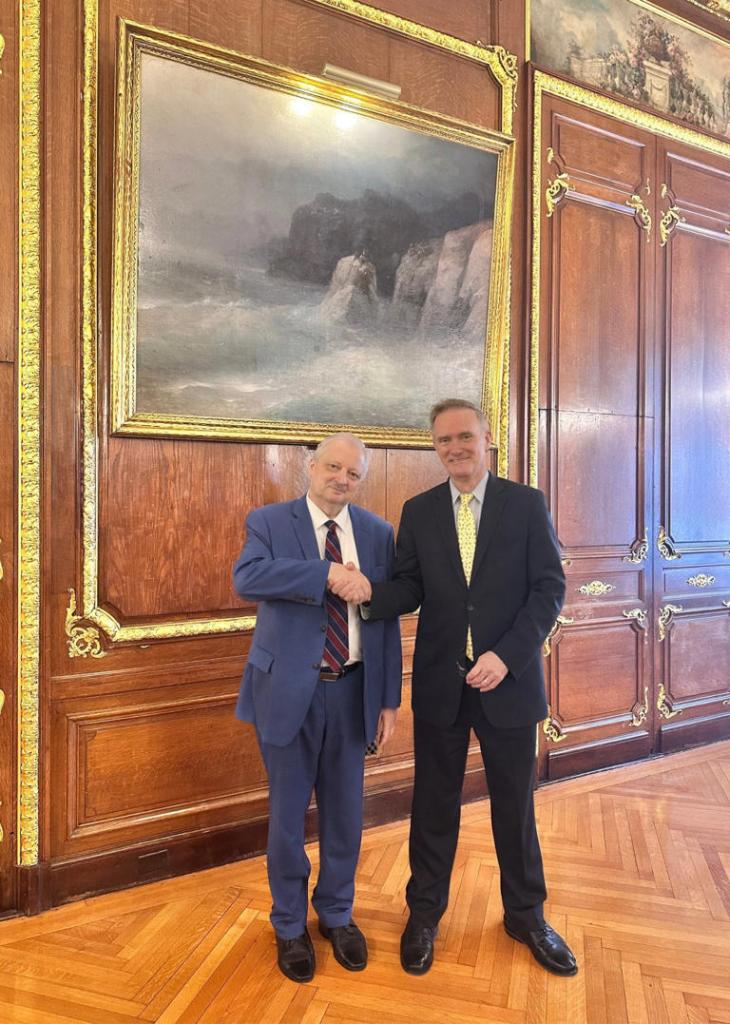
The embassy said the flag was displayed “at the initiative” of Rodney Mims Cook Jr., chairman of the U.S. Commission of Fine Arts, to honor Alexander Darchiev, who died last week.
The pair “met numerous times, paying special attention to the restoration of cultural and humanitarian ties, as well as popularization of the common pages of the history of Russia and the U.S.,” the embassy wrote. “We are deeply grateful to our American colleague for his compassion and friendly support.”
Putin appointed Darchiev as Russia’s ambassador to Washington in 2025. During Russia’s war in Ukraine, the diplomat was a fierce critic of the U.S. and the West.
Darchiev, who previously served as Russia’s ambassador to Canada, died suddenly in Moscow on November 11 of a “chronic illness,” Russian officials said.
Cook’s connection to the Atlanta landmark runs deep. He founded the National Monuments Foundation, which led the design and construction of the Millennium Gate Museum. A longtime champion of classical architecture, he also helped develop the World Athletes Monument for the city’s 1996 Olympic Games.
Trump first appointed Cook to the Commission of Fine Arts in January 2021 and tapped him again in January 2026, putting him at the helm of the federal panel that reviews designs for prominent buildings, monuments and public spaces in Washington, D.C.
“Ambassador Darchiev and Rodney Mims Cook-Jr. met numerous times, paying special attention to the restoration of cultural and humanitarian ties,’” the Russian embassy wrote (@RusEmbUSA)
In that role, Cook has helped advance Trump’s efforts to reshape the capital, including the president’s White House ballroom project. He has also championed Trump’s proposed 250-foot triumphal arch on the Potomac River, arguing that the capitol actually needs three arches.
Cook has also cultivated ties to Russia beyond his meetings with Darchiev.
Earlier this year, he traveled to the country to meet with Putin and actor Steven Seagal, according to a profile in The New Yorker, which described Cook as an “unapologetic Russophile.”
Cook’s push to honor the late Russian ambassador comes more than four years into Russia’s invasion of Ukraine, a war that has killed hundreds of thousands of people. A February YouGov poll found that 61 percent of Americans sympathize more with Ukraine, compared with just 3 percent who sympathize more with Russia.
Russian flag has been put on the historical museum of Atlanta Millennium Gate in memory of the Russian Ambassador to the U.S. Alexander N. Darchiev at the initiative of President of the U.S. Commission of Fine Arts Rodney Mims Cook-Jr.
Ambassador Darchiev and Rodney Mims Cook-Jr. met numerous times, paying special attention to the restoration of cultural and humanitarian ties, as well as popularization of the common pages of the history of Russia and the U.S.
We are deeply grateful to our American colleague for his compassion and friendly support.
In December 2022, Darchiev claimed Russia’s full-scale invasion of Ukraine earlier that year was a “necessary measure that thwarted a scenario of de facto genocide against Russians in the former Ukrainian territories,” repeating a unevidenced claim made by Moscow regarding Russian speakers in occupied parts of Ukraine as a pretext for its offensive. Speaking to Russian state news outlet TASS, the government official accused former US President Joe Biden’s administration of having “effectively refused to discuss Russia’s proposals regarding security guarantees” against the backdrop of NATO expansion.
“There are decades where nothing happens; and there are weeks where decades happen.” It’s a great quotation—but Lenin, alas, appears never to have said it.
On the other hand, Lenin did write this, in a 1918 pamphlet “The Chief Task of Our Day”:
In the space of a few days we destroyed one of the oldest, most powerful, barbarous and brutal of monarchies. In the space of a few months we passed through a number of stages of collaboration with the bourgeoisie and of shaking off petty-bourgeois illusions.
The political revolution in which we’re now engaged here in America is peaceful and freedom-loving, unlike the Bolshevik Revolution. But it too is moving fast. In the space of several months the American people came to a definitive judgment on Donald Trump’s second term, which they rendered on November 3. And in the space of just three weeks since then—thanks primarily to Trump’s own actions—we have come to understand the impossibility of collaborating with late-stage Trumpism, and have begun to shake off any remaining petty-Trumpist illusions.
In these three weeks, we’ve seen Trump reacting to his electoral defeat by appointing Stephen Miller as his chief of staff to crack the whip internally. And we’ve witnessed an intensification of efforts by his White House counsel and his Department of Justice to block investigations or accountability for what Trump and his colleagues have done or are doing.
We’ve also learned a great deal in these weeks about Trump’s refusal to defend our national security from his friend, Jensen Huang. And now we’ve seen Trump’s unabashed trampling over any pretense of concern for the rule of law or national security in securing Huang’s reinstatement as CEO of Nvidia.
Less than a week ago, we saw Trump’s extraordinary self-abasement before both Vladimir Putin and Xi Jinping in Shenzhen.
It’s been an extraordinary few weeks.
But I want to mention one other thing that Trump did this month, less important in its own right than these actions, but nonetheless revealing.
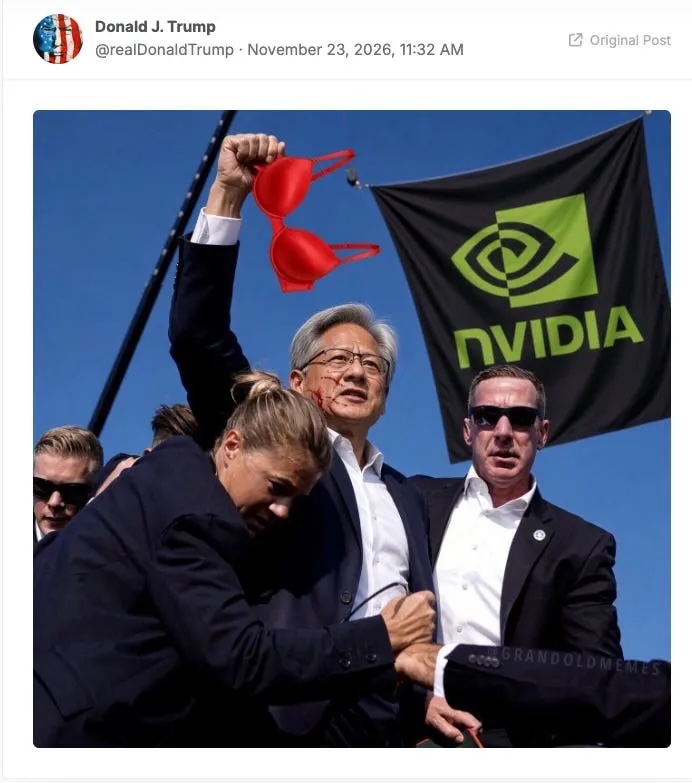
It’s the manipulated image Trump posted yesterday morning on his social media platform, Truth Social, of Jensen Huang in Trump’s place in the immediate aftermath of the assassination attempt in 2024 in Butler, Pennsylvania. Blood splattered across his face, Huang waves a bright red bra triumphantly in the air to declare victory as a black flag with an Nvidia logo—in place of the American flag—hangs behind him.
As Heather Delaney Reese emphasizes in her newsletter, “this isn’t just any image. It is one that has been burned into the minds of millions of Americans.” But as Reese notes, the one thing from the original photo that Trump chose to leave in the image was “the United States Secret Service agents, who are now seen using their own bodies to shield and protect the CEO of a private corporation.”
In doing so, Trump shamefully appropriates their service and courage—which they demonstrated because of their patriotism, a sentiment that Trump can’t grasp. And, Reese adds,
The obscenity of using that image in this way goes even deeper . . . A man died that day in Butler and two other rally goers were critically wounded. There is absolutely nothing funny about that, and yet the president of the United States took that moment and decided to turn it into a joke about a billionaire CEO getting his job back after allegations that he had an affair with a Chinese spy. Donald Trump is laughing at the American people. He is laughing at every working person who is not part of his inner circle of billionaires and oligarchs . . . He is also laughing at the security and the very existence of our country.
This is not, I think, overstated. Trump is laughing at our country. He’s mocking the very idea that he, or anyone else, should serve our nation, or put its interests above one’s personal wishes. Trump’s narcissism is now so complete that he’s entirely lost sight of the country of which he’s president.
Consider also Trump’s response to a question at his White House press conference last Friday, after he’d returned from China. He was asked: “You said that Putin is your friend. Russia, of course, is Iran’s biggest ally. Do you believe Putin is a friend to America?”
I can’t speak to America. I’ve been dealing with Putin during the fake Russia, Russia, Russia hoax and to be honest, he was very nice about it. . . . I consider him to be somebody that I have a very good relationship.
“I can’t speak to America.” That was a moment of honesty for Trump. He can’t speak to America. He can only speak to his own vanity, his own feelings, his own increasingly disordered psyche. He’s abandoned the pretense that he’s acting as an American president. He’s running the government proudly as a personal criminal enterprise, on behalf of himself and his family and his fellow oligarchs and kleptocrats at home—and on behalf of dictators abroad.
Most Americans now understand this. Once this brief stock market rally falters, the wizards of finance may even grasp it. And yesterday we saw evidence that Republican elected officials may be moving beyond their collaboration with Trumpism and their Trumpist illusions.
For what it’s worth, I now believe Trump will be impeached and removed from office next year. We’d still have at least a year of this administration to go, and the damage that has been done and that will continue to be done is very great. Trump’s departure from office would not mean the end of our long national nightmare. But it would be a step toward the end. And the month of November 2026 will have been a key marker along that welcome path.
Thou art wretched, thou art abundant, Thou art mighty, thou art impotent — Mother Russia![2]
Human history these days is making a momentous and most difficult turn, a turn, one might say without the least exaggeration, of immense significance for the emancipation of the world. A turn from war to peace; a turn from a war between plunderers who are sending to the shambles millions of the working and exploited people for the sake of establishing a new system of dividing the spoils looted by the strongest of them, to a war of the oppressed against the oppressors for liberation from the yoke of capital; a turn from an abyss of suffering, anguish, starvation and degradation to the bright future of communist society, universal prosperity and enduring peace. No wonder that at the sharpest points of this sharp turn, when all around the old order is breaking down and collapsing with a terrible grinding crash, and the new order is being born amid indescribable suffering, there are some whose heads grow dizzy, some who are seized by despair, some who seek salvation from the at times too bitter reality in fine-sounding and alluring phrases.
It has been Russia’s lot to see most clearly, and experience most keenly and painfully the sharpest of sharp turning-points in history as it swings round from imperialism towards the communist revolution. In the space of a few days we destroyed one of the oldest, most powerful, barbarous and brutal of monarchies. In the space of a few months we passed through a number of stages of collaboration with the bourgeoisie and of shaking off petty-bourgeois illusions, for which other countries have required decades. In the course of a few weeks, having overthrown the bourgeoisie, we crushed its open resistance in civil war. We passed in a victorious triumphal march of Bolshevism from one end of a vast country to the other. We raised the lowest strata of the working people oppressed by tsarism and the bourgeoisie to liberty and independent life. We established and consolidated a Soviet Republic, a new type of state, which is infinitely superior to, and more democratic than, the best of the bourgeois-parliamentary republics. We established the dictatorship of the proletariat supported by the poor peasantry, and began a broadly conceived system of socialist reforms. We awakened the faith of the millions upon millions of workers of all countries in their own strength and kindled the fires of enthusiasm in them. Everywhere we issued the call for a world workers’ revolution. We flung a challenge to the imperialist plunderers of all countries.
Then in a few days we were thrown to the ground by an imperialist plunderer, who fell upon the unarmed. He compelled us to sign an incredibly burdensome and humiliating peace—as tribute for having dared to tear ourselves, even for the shortest space of time, from the iron clutches of an imperialist war. The more ominously the shadow of a workers’ revolution in his own country rises before the plunderer, the greater his ferocity in crushing and stifling Russia and tearing her to pieces.
We were compelled to sign a “Tilsit” peace. We need no self-deception. We must courageously look the bitter, unadorned truth straight in the face. We must measure fully, to the very bottom, that abyss of defeat, dismemberment, enslavement, and humiliation into which we have now been pushed. The more clearly we understand this, the firmer, the more steeled and tempered will be our will to liberation, our aspiration to rise again from enslavement to independence, and our unbending determination to ensure that at any price Russia ceases to be wretched and impotent and becomes mighty and abundant in the full meaning of these words.
And mighty and abundant she can become, for, after all, we still have sufficient territory and natural wealth left to us to supply each and all, if not with abundant, at least with adequate means, of life. Our natural wealth, our manpower and the splendid impetus which the great revolution has given to the creative powers of the people are ample material to build a truly mighty and abundant Russia.
Russia will become mighty and abundant if she abandons all dejection and all phrase-making, if, with clenched teeth, she musters all her forces and strains every nerve and muscle, if she realises that salvation lies only along that road of world socialist revolution upon which we have set out. March forward along that road, undismayed by defeats, lay the firm foundation of socialist society stone by stone, work with might and main to establish discipline and self-discipline, consolidate everywhere organisation, order, efficiency, and the harmonious co-operation of all the forces of the people, introduce comprehensive accounting of and control over production and distribution—such is the way to build up military might and socialist might.
It would be unworthy of a genuine socialist who has suffered grave defeat either to bluster or to give way to despair. It is not true that our position is hopeless and that all that remains for us is to choose between an “inglorious” death (inglorious from the point of view of the szlaczcic), such as this harsh peace represents, and a “gallant” death in a hopeless fight. It is not true that by signing a “Tilsit” peace we have betrayed our ideals or our friends. We have betrayed nothing and nobody, we have not sanctified or covered up any lie, we have not refused to help a single friend or comrade in misfortune in every way we could and with everything at our disposal. A general who withdraws the remnants of his army into the heart of the country when it has been beaten or is in panic-stricken flight, or who, in extremity, shields this retreat by a harsh and humiliating peace, is not guilty of treachery towards that part of his army which he is powerless to help and which has been cut off by the enemy. Such a general performs his duty by choosing the only way of saving what can still be saved, by refusing to gamble recklessly, by not embellishing the bitter truth for the people, by “surrendering space in order to gain time”, by taking advantage of any and every respite, even the briefest, in which to muster his forces and to allow his army to rest or recover, if it is affected by disintegration and demoralisation.
We have signed a “Tilsit” peace. When Napoleon I, in 1807, compelled Prussia to sign the Peace of Tilsit, the conqueror smashed the Germans’ entire army, occupied their capital and all their big cities, brought in his own police, compelled the vanquished to supply him, the conqueror, with auxiliary corps for fresh predatory wars, and partitioned Germany, concluding alliances with some German states against others. Nevertheless, the German people survived even such a peace, proved able to muster their forces, to rise and to win the right to liberty and independence.
To all those who are able and willing to think, the example of the Peace of Tilsit (which was only one of many harsh and humiliating treaties forced upon the Germans at that period) clearly shows how childishly naïve is the idea that under all conditions a harsh peace means the bottomless pit of ruin, while war is the path of valour and salvation. Periods of war teach us that peace has not infrequently in history served as a respite and a means of mustering forces for new battles. The Peace of Tilsit was a supreme humiliation for Germany, but at the same time it marked a turn towards a supreme national resurgence. At that time historical conditions were such that this resurgence could be channelled only in the direction of a bourgeois state. At that time, more than a hundred years ago, history was made by handfuls of nobles and a sprinkling of bourgeois intellectuals, while the worker and peasant masses were somnolent and dormant. As a result history at that time could only crawl along at a terribly slow pace.
But now capitalism has raised culture in general, and the culture of the masses in particular, to a much higher level. War has shaken up the masses, its untold horrors and suffering have awakened them. War has given history momentum and it is now flying with locomotive speed. History is now being independently made by millions and tens of millions of people. Capitalism has now matured for socialism.
Consequently, if Russia is now passing—as she undeniably is—from a “Tilsit” peace to a national resurgence, to a great patriotic war, the outlet for it is not in the direction of a bourgeois state, but in the direction of a world socialist revolution. Since October 25, 1917, we have been defenceists. We are for “defence of the fatherland”; but that patriotic war towards which we are moving is a war for a socialist fatherland, for socialism as a fatherland, for the Soviet Republic as a contingent of the world army of socialism.
“Hate the Germans, kill the Germans”— such was, and is, the slogan of common, i. e., bourgeois, patriotism. But we will say “Hate the imperialist plunderers, hate capitalism, death to capitalism”and at the same time “Learn from the Germans! Remain true to the brotherly alliance with the German workers. They are late in coming to our aid. We shall gain time, we shall live to see them coming, and they will come, to our aid.”
Yes, learn from the Germans! History is moving in zig-zags and by roundabout ways. It so happens that it is the Germans who now personify, besides a brutal imperialism, the principle of discipline, organisation, harmonious co-operation on the basis of modern machine industry, and strict accounting and control.
And that is just what we are lacking. That is just what we must learn. That is just what our great revolution needs in order to pass from a triumphant beginning, through a succession of severe trials, to its triumphant goal. That is just what the Russian Soviet Socialist Republic requires in order to cease being wretched and impotent and become mighty and abundant for all time.
N. Lenin March 11, 1918
Notes
1. The article “The Chief Task of Our Day,” together with Lenin’s work “’Left-Wing’ Childishness and the Petty-Bourgeois Mentality”(see this volume, pp. 323-54), were published in May 1918 as a separate pamphlet under the title The Chief Task of Our Day, to which Lenin wrote a short introduction.
2. The epigraph is taken from Nikolai Nekrasov’s poem “Who Lives Well in Russia”.
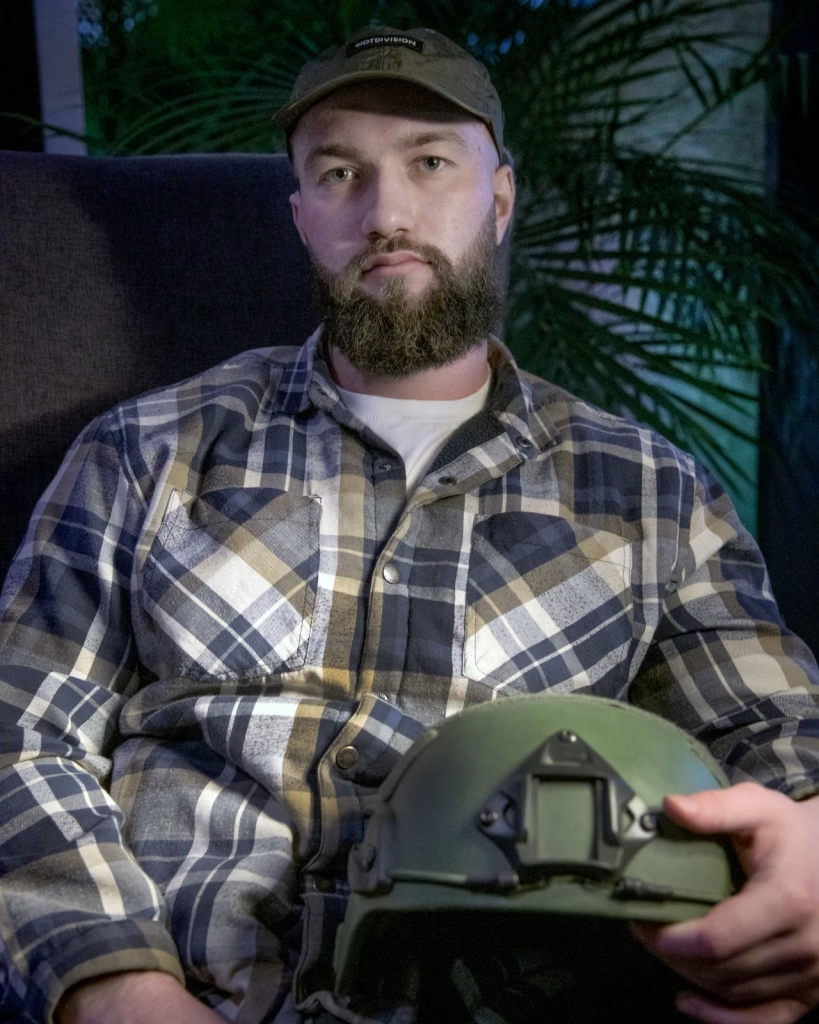
Lev Stupnikov with the Russian helmet he wore when he crossed the frontline to Ukrainian-held territory. Photo: Wall Street Journal
Lt. Lev Stupnikov pulled his truck up to the edge of a field in eastern Ukraine on a frigid February morning, followed by a convoy of senior Russian army officials coming to observe a training exercise near the front line.
For several consecutive days, Russian infantrymen, medics and officers had been drilling on the frozen mud, preparing for an offensive on the nearby city of Vuhledar. The only cover was a line of bare trees.
Stupnikov approached a group of waiting soldiers and snapped a photo, keeping his cellphone close to his chest to avoid drawing attention. Then he quickly tapped out a message: “There must be between 120 and 150 men here.”
Stupnikov, a recent graduate from a prestigious military academy in St. Petersburg, Russia, had a secret. Earlier that month, he had begun covertly sharing information with Ukrainian intelligence.
He had already given his contact the exact coordinates of the field.
Now, with scores of Russian soldiers and their commanding officers gathered there, Stupnikov would have only moments to move out of the line of fire.
“Walk away,” the Ukrainian contact replied, then: “I’m waiting for a message that you’ve left.” Having received no answer, the contact sent a note in all caps a minute later: “LEAVE.”
Stupnikov took this video as he walked away from the target area.
Stupnikov was already on the move, sidling up to a group of drivers smoking beside idling vehicles. Feigning a grimace and clutching his stomach, he asked them for a pack of wet wipes. Then he disappeared into the nearby stand of trees and stooped down, pretending to relieve himself.
He was knocked to the ground by an explosion that sent shrapnel careening into a nearby truck. The Ukrainians had fired a barrage of missiles.
When he got to his feet, Stupnikov was stunned by the gruesome sight. Dozens of mutilated bodies lay strewn across the field. Victims groaned in their death throes. Others were motionless over pools of blood on the black earth beneath them.
His phone buzzed. “Were there explosions? Send a photo.”
“There’s just meat,” he answered.
Later that day, he shared a confirmed tally with the Ukrainians: 68 killed and 60 wounded. Among the dead were 10 officers, including one of Kyiv’s top targets: Col. Gusein Musayev, commander of the 36th Motorized Rifle Brigade. The death toll was among the highest from any single strike since Russia began its invasion of Ukraine two years earlier.
It was the first in a string of attacks that the Ukrainians carried out with Stupnikov’s help, making him one of the most consequential saboteurs in recent military history. Ukraine used the intelligence and coordinates he supplied to kill more than 300 Russian soldiers, according to interviews with his handlers, video footage, text exchanges and official Russian reports.
The 26-year-old’s story offers a rare window into a shadow war waged by Ukrainian military intelligence. Ukrainian agents communicate over encrypted platforms with thousands of Russians, ranging from homemakers living near military factories to soldiers on the front line.
The operation taps into growing political disaffection inside Russia. The aim isn’t just to end Russia’s invasion; Ukraine is trying to build an army of Russian turncoats with the training and determination to one day mount an armed struggle inside Russia and help bring an end to Russian President Vladimir Putin’s decadeslong grip on power.
Stupnikov’s decision to turn against his own comrades came after years of deepening disillusionment with the Russian military. But his deadly act of betrayal, which inspired others to follow his lead, was ultimately enabled by an unlikely person, seeking to get him out of harm’s way—his mother.
Early in her writing career, author Lois Lowry realized that adolescents are in a golden era of reading, when a book can change everything.
The 89-year-old young adult writer is best known for her work of dystopian fiction “The Giver” about a 12-year-old named Jonas and his world-altering realization that the safety of his peaceful-seeming “community” relies on horrific tradeoffs kept secret from children.
From her home base in Maine, Lowry has written more than 50 books for young adults, and she’s done it again. Her new book is called “Building 903,” which, like “The Giver,” takes place in a dystopian future society where books are outlawed and storytelling is forbidden. Her protagonist, Tessa, must break out of the ideological confines of her world to rescue her twin brother Theo, who’s gone missing.
Lowry visited the Globe studio for a “Say More” interview about “dangerous” books and the enduring angst of adolescence. Here are three takeaways from our conversation.
A world without books is a world without empathy
The premise of Lowry’s new book “Building 903” is that a tyrannical government has outlawed books for generations, resulting in a society with no storytelling or imagination. Lowry says she was inspired to write this book when, seven years ago, she visited her grandson’s high school and found a library with no books on the shelves.
This made Lowry fear that young people won’t value the thing she cares about dearly: the power of stories.
“What happens when you don’t have literature, what do you lose?” Lowry asked. “What you lose is your imagination. And what evolves out of imagination is empathy. And when you lose that, you lose your humanity. I think that’s what I most fear.”
Book bans hurt kids and make us all less free.
Again and again in Lowry’s books, including the new one, is the idea that books are powerful. They can change a person who can then change the world. Books are dangerous to oppressive societies.
“Hitler knew that,” said Lowry. “Hitler banned books in ’36. It’s always the first impulse of a dictator to remove knowledge.”
Lowry has empathy for the parents who want to keep upsetting books away from children. It’s an impulse that guides many of the adults in her dystopian novels. But she thinks their protective bans are misguided.
“[Parents] don’t want their kids to be scared or worried or harmed in any way,” she said. “Of course they miss the truth that the things contained in books are what make kids grow and learn.”
Books, even really sad and scary ones, help children grow strong.
“Every kid who is born into this world is going to face hard things. And the best way to prepare for that is sitting in the room with a trusted adult, talking about these things, reading about these things, feeling these things before you’re feeling them for real,” said Lowry.
Lowery worries deeply about the ever-lengthening list of banned books in the US. But writing for children and sharing stories with them brings her feelings of hope and courage.
“I think if we work at it, if we write good books, if we put them into the hands of children, that has to be a good thing,” she said.
Since the start of the full-scale war in Ukraine, Russia’s book publishing industry has faced increasing censorship. Police have raided bookstores, and books by authors designated “foreign agents” or “extremists” have been pulled from shelves. Fearing prosecution, publishers are scrubbing references to the war, queer relationships, and other subjects they worry might anger the authorities. Yet self-censorship is now catching even seemingly innocuous books.
Why is following the rules no longer enough to get a book published in Russia?
Publishers are wary of anything that might attract the authorities’ attention, even if it doesn’t seem to fall afoul of the law. And because there’s no clear way to predict what will cause trouble, books can be shelved for reasons even their editors don’t understand, according to Alexey Kiselev, the former editor-in-chief of the Russian publishing house Individuum. “You don’t know which book will be banned or why, which contracts you’ll have to terminate, or which print runs you’ll have to destroy,” he told Meduza in a recent interview.
Bot blocked
Kiselev was Individuum’s last editor-in-chief. Eksmo, the Russian publishing giant that acquired Individuum and its young-adult imprint Popcorn Books in 2023, shut down both after Russian authorities arrested three people connected to the two publishers, including their warehouse manager, in May 2025 on “extremism” charges over queer literature. Popcorn Books was the first to go. Individuum survived until September 2026.
After the arrests, Kiselev said, Eksmo began using an automated screening system to check books for potentially prohibited content. The system made a lot of mistakes. In one case, it insisted a bestselling parenting guide should be pulled because the book supposedly promoted not having children. The book was Fediatrics: What to Do If You Have a Child.
“At first it’s funny,” Kiselev said. “But you can’t print a book until the bot says ‘yes.’” When the AI system flagged something by mistake, he had to make the case to management that the concern was unfounded.
How to kill a book
The Beam, a science fiction novel by journalist Daniil Turovsky, is set in an alternate-reality version of Russia, with flashbacks to the country’s real history. Individuum had already printed the book and was about to ship copies to stores when Eksmo abruptly put it on hold. Individuum’s editors had spent a long time carefully editing the manuscript and checking it for legal risks, Kiselev said, and they believed it was ready.
The voice actor recording the audiobook, it turned out, felt the novel was “anti-Russian” and said working on it made him feel unsafe. Eksmo sent the book for legal review, a step that, Kiselev said, effectively “kills a book.” Once lawyers begin looking for potential problems, he said, they’ll always say the book can’t be printed in its current form. “They have to show they’ve done some work,” he said. “They’re not going to hand the book back and say, ‘It’s all fine, go ahead and print it.’”
The lawyers objected to the book’s nonfiction passages about Russian history, above all an account of atrocities committed by Russian soldiers in Chechnya. The editors blacked out the passage in violet and added a footnote explaining the omission. But the revised edition was on shelves only briefly. A pro-war blogger got hold of the uncensored original, and Eksmo pulled the book again, “just to be on the safe side,” Kiselev said.
Flying blind
Kiselev said he couldn’t get an explanation from Eksmo of why it had decided not to publish books his team had spent a year and a half working on, even though their layouts and covers were finished. He didn’t know what to tell the authors.
All the uncertainty was making publishing less and less profitable, Kiselev said. Even books Individuum already held the rights to could become impossible to reprint if a character smoked or an author was designated a “foreign agent.”
Before the criminal case against the three publishing employees, Kiselev said, people in the industry assumed that obeying the law and not provoking anyone would keep them safe. “Then the rules changed dramatically,” he said. “It turned out you could simply work in a warehouse or look for ways to grow a publishing business, and that was enough to get you called a terrorist.”
My name is Olesia Bida, and I am a journalist with the War Crimes Investigations Unit at the Kyiv Independent.
Today, I want to recommend a book that holds a special place in the hearts of many Ukrainians. Almost everyone in Ukraine has learned its author’s poems at school. His name is on streets, squares, universities, and cultural institutions across the country.
I am talking about Taras Shevchenko and Kobzar, his landmark collection of poetry, first published in 1840.
Shevchenko was born in 1814, when most of present-day Ukraine was ruled by the Russian Empire. He wrote about Ukraine, freedom, injustice, and imperial oppression — themes that still resonate deeply in Ukraine today. He wrote in Ukrainian at a time when Ukrainian publishing was heavily censored by the Russian Empire. His own works were subject to censorship.
In 1847, Shevchenko was sent into military exile for ten years, with Tsar Nicholas I personally ordering that he be forbidden to write. He continued writing in secret anyway, hiding his poems in tiny handmade notebooks.
Ukrainians often call Shevchenko a prophet. His poetry is full of resistance and the refusal to accept oppression as normal, but also of deep love for Ukraine.
One moment that made his continuing relevance especially vivid to me came during the liberation of Balakliia in Kharkiv Oblast in September 2022.
When Ukrainian soldiers entered the city, they began removing Russian propaganda. One billboard carried the occupation message that Ukrainians and Russians were “one people.” When soldiers tore it down, they discovered an older Ukrainian banner underneath, with Shevchenko’s portrait and lines from his poem “The Caucasus”:
Keep fighting — you are sure to win!
God helps you in your fight!
For fame and freedom march with you,
And right is on your side!
(Translated by John Weir)
The banner had remained there, hidden beneath Russian propaganda, throughout the occupation.
If you would like to read Shevchenko in English, a multilingual edition of Kobzar is available online through the Ukrainian digital library Diasporiana.
There is also a new English-language edition of selected poems from Ukrainian publisher Osnovy, translated by Vira Rich, a British poet and translator who devoted much of her life to Ukrainian literature.
Recommending a Ukrainian book also feels particularly meaningful now. Russian strikes have repeatedly hit Ukraine’s printing houses, publishers’ offices, and book warehouses, destroying millions of books.
There is something painfully symbolic about reading Kobzar in this context: a book associated with the survival of Ukrainian culture under the Russian Empire is still being printed and read while Ukrainian books and the infrastructure that produces them are again being destroyed by Russia.
For me, Kobzar is also part of my own family history. My grandmother gave me my first copy when I was a child, and I still have it.
SOURCE: “Recommendations from the Kyiv Independent: Taras Shevchenko and Kobzar,” Team Recommendations members’ newsletter, 19 November 2026
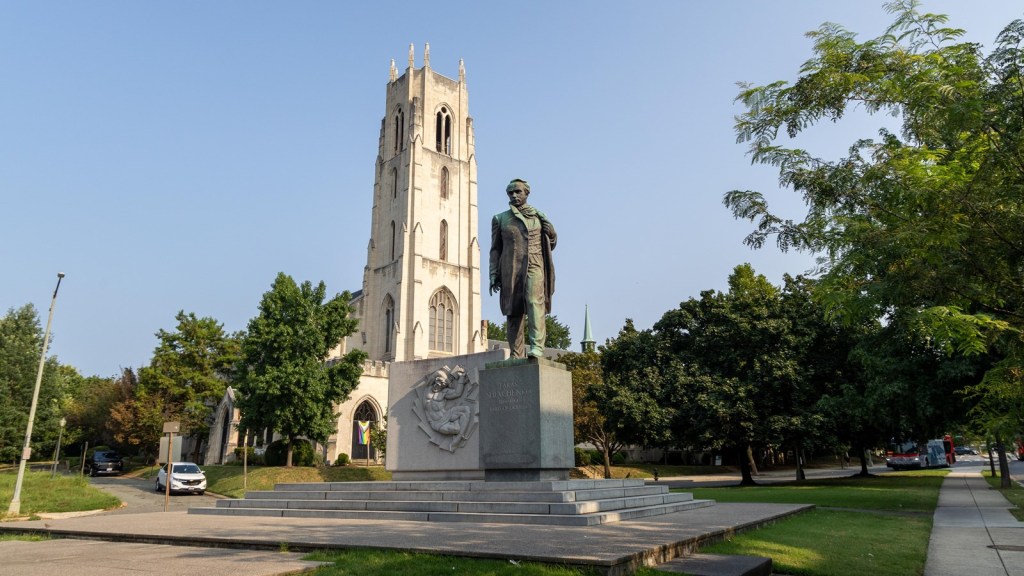
Taras Shevchenko (1814-1861) was a Ukrainian poet and artist who spent many years imprisoned for his pro-Ukrainian independence activities in tsarist Russia. He is revered for his literary works and self-sacrificing contributions to the people of Ukraine.
Inscriptions
Statue platform front face
TARAS SHEVCHENKO 1814-1861 BARD OF UKRAINE
ТАРАС ШЕВЧЕНКО 1814-1861 БАРД УКРАЇНИ
Statue platform back face
Dedicated to the Liberation, Freedom and Independence of all Captive Nations
This monument of Taras Shevchenko, 19th century Ukrainian poet and fighter for the independence of Ukraine and the freedom of all mankind, who under foreign Russian imperialist tyranny and colonial rule appealed for “the new and righteous law of Washington”, was unveiled in June 27th, 1964. This historic event commemorated the 150th anniversary of Shevchenko’s birth. The memorial was authorized by the 86th Congress of the United States of America on August 31, 1960 and signed into public law 86-749 by Dwight D. Eisenhower, the 34th President of the United States of America. On September 13, 1960, the statue was erected by Americans of Ukrainian ancestry and friends.
Pedestal left bottom rear
Leo Mol – Sculptor Radoslav Zuk – Architect
Лео Мол – Скульптор Радослав Жук – Архітектор
White granite wall back
..Не вмирає душа наша. Не вмирає воля, І неситий не виоре На дні моря поле.
Не скує душі живої І слова живого. Не понесе слави Бога, Великого Бога.
Тарас Шевченко – Кавказ – 1845
..Our Soul Shall Never Perish. Freedom Knows No Dying, And the Greedy Cannot Harvest Fields Where Seas Are Lying; Cannot Bind the Living Spirit Nor the Living Word. Cannot Smirch the Sacred Glory Of Th’Almighty Lord.
Aaron Maté, Their Blood, Our Bullets: The Hidden Story of the US–Russia War for Ukraine
The hotly anticipated debut from an award-winning journalist reveals the hidden story of the US-Russia proxy war in Ukraine.
“One hell of a reporter who knows how to get at the truth.” —Seymour Hersh
“Exposes wars and crimes and corruption—Maté, a courageous, independent journalist, has done a great service.” —Katrina vanden Heuvel
“A must-read for anyone hoping to transcend Western propaganda about the Ukraine War.” —John J. Mearsheimer
About the book
In this bombshell investigation, years in the making, Aaron Maté exposes Washington’s professed support for Ukrainian sovereignty and democracy as a sham.
Building on the rigorous, fearless reporting that has established him as a leading independent journalist, Maté irrefutably documents how the US and its NATO allies have meddled in Ukraine with the real aim of weakening and destabilizing Russia.
In pursuit of this aggressive geopolitical design, successive US administrations exploited Ukraine’s internal divisions and sabotaged every chance for compromise while relentlessly backing Russia into a corner. Gambling with the global economy and risking nuclear war, US planners then provoked and prolonged an illegal Russian invasion that has had catastrophic consequences—for the Ukrainian people above all.
Washington’s cynical foreign policy did not just detonate peace in Europe but also deranged politics at home. Controversies around Russia and Ukraine played a pivotal role in three consecutive US presidential campaigns, driving the national hysteria known as “Russiagate” as well as the first impeachment of Donald Trump.
With Trump’s re-election pledge to broker peace still elusive, Maté presents a groundbreaking account of how the Russia–Ukraine conflict came to be, and how a brutal proxy war with existential stakes for humanity can finally be resolved.
Aaron Maté is an independent journalist and co-host of the podcast Useful Idiots. He has reported and produced for outlets including The Grayzone, The Nation, The Real News, Al Jazeera, and Real Clear Investigations. He won a 2019 Izzy Award for outstanding achievement in independent media and was previously a longtime producer at Democracy Now!
Elena Kaspirovich fled political repression in her native Russia nearly a decade ago, when she was targeted by law enforcement for protesting and activism under the authoritarian regime of President Vladimir Putin.
After arriving in the Chicago area, the Russian dissident was elated by the sense of freedom and strength of democratic ideals in the nation that provided her haven.
Yet Kaspirovich has grown increasingly disturbed by the Trump administration’s close – and often fawning – relationship with Putin, the imperialist ruler who has methodically dismantled democracy in her homeland since coming to power in 2000.
She was concerned when President Donald Trump welcomed Putin with a red carpet ceremony in Alaska last summer, a sharp break in traditional diplomatic protocol for a longtime U.S. adversary, particularly one facing an International Criminal Court arrest warrant for war crimes.
She expressed dismay at Trump’s frequent flattery of Putin – calling the autocrat “savvy” and “genius” – as well as the president’s decision last month to waive stiff sanctions and tariffs on Russia.
And more broadly, Kaspirovich is disturbed by a mounting U.S. coziness with an array of dictators and far-right figures, fearing this warmth for autocrats could have devastating consequences on democracy domestically as well as internationally.
“I believe the club of dictators is real,” Kaspirovich said. “Its members never ask each other about human rights. For them, human life counts for nothing. … Dictators admire only power.”
Other Chicago-area survivors of autocratic and totalitarian nations offer similar words of warning as they watch their adopted homeland increasingly embrace the very regimes they came here to escape.
Russia causes the death of Kharkiv teacher illegally held in solitary confinement in Crimea (Kharkiv Human Rights Protection Group, November 6th)
54-year-old Serhiy Diachuk has multiple rib fractures after two years in secret Russian FSB captivity (Kharkiv Human Rights Protection Group, November 6th)
Could Ukraine have made a deal with Russia in 2022? Former foreign minister Dmytro Kuleba on negotiations (Ukrainska Pravda, November 2nd)
Oil on the water: How Russia avoided accountability for the Black Sea tanker disaster caused by its sanctions evasion efforts (The Insider, November 2nd)
Valentyn Vyhivsky endured torture, years in solitary confinement and is still captive in Russia after his sentence (Kharkiv Human Rights Protection Group, November 4th)
Ukrainian POW ‘dies’ in Russian prison as Moscow abandons vital convention against torture (Kharkiv Human Rights Protection Group, November 3rd)
TUESDAY 10 NOVEMBER, 6.30pm Life Under Russian Occupation: Stories from Ukraine. Meeting with Anhelina Zinovieva (Donetsk), Sofia Naumenko (Mariupol), Daniil Shapovalo (Luhansk). Queen Mary, University of London. Hosted by Ukrainian Society and the Centre for Eurasian, Russian, and East European Studies (CEREES)
WEDNESDAY 11 NOVEMBER, 7.00pm. Public meeting: Stand with the people of Ukraine. Meeting with Oleksandr Kyselov (Sotsialnyi Rukh Ukraine). Somers Town Community Hall, 150 Ossulston St, NW1 1EE. Hosted by Anti-Capitalist Resistance
FRIDAY 13 NOVEMBER, 6.00pm. Meeting: The US midterms, Ukraine and the fight against fascism. with Tanya Vyhovsky, Vermont State Senator (Progressive / Democratic), and Dylan Burns, journalist, streamer and founder of Track Ukraine. Hosted by Ukraine Solidarity Campaign. Register here
This bulletin is put together by labour movement activists in solidarity with Ukrainian resistance. To receive it by email each Monday, email us at2022ukrainesolidarity@gmail.com.
On September 5, 1982, a music festival in San Bernardino, California, organized by Apple’s Steve Wozniak, bore witness to the first-ever public television link between the United States and the Soviet Union. Two large screens on either side of the stage broadcast performances by singer-songwriter Alla Pugacheva and rock band Voskreseniye, while Soviet citizens gathered at a Moscow radio station rocked out to the American lineup—that is, until Grateful Dead promoter Bill Graham, “convinced the whole thing was a KGB trick,” as Jeffrey Kripal wrote in his 2007 book Esalen: America and the Religion of No Religion, “literally pulled the plug halfway through the concert.”
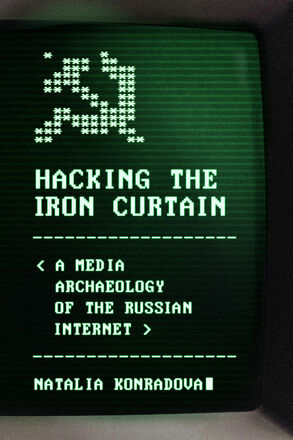
This so-called US-Soviet Space Bridge (the first of several, including one co-hosted by television host Phil Donahue) often features in books about the cultural history of the Cold War. But what many of these books don’t tell you is that a large number of the people who organized these events also hoped to lift the Iron Curtain through another method: telepathy. In her new book Hacking the Iron Curtain: A Media Archaeology of the Russian Internet, journalist and “media archeologist” Natalia Konradova reveals how the story of the early Soviet internet—and the role it played during the collapse of the USSR in 1991—can be traced back to early- and mid-twentieth-century dreams of instantaneous and unmediated mass communication.
Telepathy was, for much of the twentieth century, considered a real possibility—one whose secrets modern science could and would eventually discover.
Though recognized today as a pseudoscientific fantasy, telepathy was, for much of the twentieth century, considered a real possibility—one whose secrets modern science could and would eventually discover. In the Soviet Union, scientific interest in telepathy stemmed not only from a sense of general techno-optimism shared by many countries both before and after the two world wars, but also from beliefs and aspirations particular to communist society. Like cosmism (a philosophical movement that aimed at nothing less than the colonization of space, the attainment of immortality, and the resurrection of every person who ever lived), research into “parapsychology” was expected to help usher in a utopian future.
Of course, what this future looked like depended on who you asked. Some scientists and science fiction authors envisioned a world in which doctors could diagnose patients remotely and one person could beam their skills and talents directly into the bodies of others. The CIA worried that Soviet officials would be able to steal sensitive government information and control “machines on the moon or in the ocean” with their thoughts, according to a 1973 report. Meanwhile, Iosif Goldin—a parapsychology enthusiast and principal organizer of the Soviet side of the first Space Bridge—imagined mass communication as a cure for geopolitical conflict. He once wrote that if “one realizes the observation of the sunrise simultaneously on all continents of the Earth and does it regularly, turning it into a form of bringing people together, there may be no nuclear catastrophe.”
Although the internet itself did not directly contribute to the USSR’s demise, it should come as no surprise that the appearance of one closely coincided with the disappearance of the other. Described by Konradova as a “perfected version of samizdat,” or self-published dissident literature, the rise of the internet and online communities made censorship and the suppression of information virtually impossible—at least for a time. Hacking the Iron Curtain concludes with a brief though warranted reflection on how, amid digital restrictions under Vladimir Putin, the Russian internet ecosystem—Runet—has become increasingly cut off from the rest of the World Wide Web, aiding the country’s return to autocracy.
How did you become interested in parapsychology?
I have worked on many different subjects as an anthropologist and media theorist. But I have always been particularly interested in phenomena or systems that are either created by users or shaped through their efforts and self-organization. It does not really matter whether I’m studying war memorials in small villages, which were one of the subjects I researched in the early 2000s, or internet literature—a phenomenon of the early Russian internet, when users had for the first time the opportunity to publish their literary works without them having to pass through any editorial process.
That was how my research into the Russian-speaking internet began. In the mid-2000s, colleagues in Germany invited me to join their project, where I studied internet forums. At that point, though, neither cybernetics nor parapsychology was anywhere on my research horizon. They emerged only during the research process.
What did you feel was missing from existing treatments of this subject (like Alaina Lemon’s book) that you wanted to explore with Hacking the Iron Curtain?
Because my research is interdisciplinary, I read literature from a wide range of research fields: the history of the internet and digital culture, Cold War studies, studies of utopias and technological imaginaries, “parascience,” and so on. These fields have been studied for a long time, and each has produced fascinating work. What I felt was missing was precisely the connection between them.
Alaina Lemon’s book was an important discovery for me, not only because it was the only work I encountered that placed Soviet parapsychology within the context of the Cold War, but also because she shows just how powerful the mutual desire for communication was among people in both the USSR and the US. That said, Lemon’s approach was grounded more in theatrical practices, and she was not interested in the history of technology. When Soviet parapsychology is discussed elsewhere, it is typically situated within the history of supernatural beliefs and esoteric practices, as in The New Age of Russia: Occult and Esoteric Dimensions, a substantial volume edited by Birgit Menzel.
What interested me was a phenomenon identified in the 1960s by Lynn Schroeder and Sheila Ostrander, authors of the classic Psychic Discoveries Behind the Iron Curtain: for a considerable period in the USSR, parapsychology was treated as a science. Researchers used scientific methods in their experiments and attempted to identify patterns in telepathy, telekinesis, and other phenomena. Yes, this no longer fits within our contemporary scientific understanding of the world, but I am talking about events that took place sixty years ago, when faith in the power of science was virtually limitless. As far as I know, before my work, no one had considered research into telepathy as one scientific field among others—regarded today as a dead end, but one that at the time could be seen as almost equivalent in status to computer science.
At what stage in your research did it become clear to you that there was a connection between parapsychology—telepathy in particular—and the early Russian internet?
I originally set out to study the history of the Russian internet. I interviewed figures from the Runet of the 1990s and worked with online archives. In those archives, I discovered that one of Russia’s first internet providers had actually been founded in the 1980s. This simply did not fit with my understanding that the internet could only have appeared after the collapse of the USSR in 1991.
Once I delved into the history of the first network connections from Soviet territory, I found myself dealing with an entirely new set of questions and, for me, an entirely new research field. Media archaeology is exactly the kind of (proto) discipline that is interested in dead ends, unrealized projects, and strange coincidences. It is still not particularly well known in the US, but I live in Germany, the birthplace of media archaeology.
To what extent was parapsychology research responsible for the rise of the Russian internet?
I distinguish between several levels of this connection. One is relatively simple and straightforward. The first contact between American and Soviet users on Usenet became possible thanks to American entrepreneur Joel Schatz, who came to the USSR in the mid-1980s. He did so because of his connections to the Esalen Institute in California, a well-known center of “alternative research,” now better known as a popular retreat destination for California tech people.
Esalen, in turn, had those connections because people associated with the institute had begun traveling to the USSR in the early 1970s hoping to establish contacts with Soviet parapsychologists (and they did). Later, they established a Soviet-American exchange program and joined the citizen-diplomacy movement, but initially it was the parapsychologists—with their desire for grassroots communication and their refusal to accept conventional boundaries of what was possible—who proved capable of connecting people from two countries on opposing sides of the Cold War.
How the archetype of the quirky, brilliant tech entrepreneur whose ideas could change the world migrated from high-tech hacker culture to Wall Street.
While studying this phenomenon, I also arrived at another, conceptual level of connection. In a sense, the internet is telepathy, except that a digital signal plays the role of the brain waves that science has never succeeded in discovering. In the 1960s, an era of techno-optimism and great hopes that human reason would triumph over war, disease, and death, computer science and the development of computer networks advanced alongside research into other possible forms of communication—forms that do not exist in nature but that, theoretically, could exist.
I think the USSR, as a project intended to realize a socialist utopia—and I am not discussing here how successful that project ultimately proved to be—had much stronger investments in radical scientific discoveries expected to fundamentally transform human life. Some of these ambitions were realized, such as spaceflight. Scientists today are still working on others, such as immortality. Others, such as telepathy, have disappeared from the scientific agenda.
One could probably add that the USSR had an obvious overproduction of specialists in the natural sciences, which was connected to the military-industrial complex. At some point, the Soviet Ministry of Defense also began investing in this new field because it seemed potentially useful for defense purposes. As a result, Soviet laboratories could often find room for experiments involving new and uncertain phenomena.
Still, I think all of this was more a consequence of the first factor: an exceptionally strong belief in scientific progress. Both American and Soviet societies were modern societies, if by modernity we mean above all a reliance on rational knowledge and technology. But in the USSR, this modernity was particularly radical and allowed virtually no alternative: it lay at the very foundation of the state as the only possible form of its existence.
You mention that Soviet scientists like Vladimir Bekhterev continued to research telepathy even after failing to find proof of its existence. Why did this interest persist, including among the CIA and US politicians?
In general, I have the impression that, from the 1920s through the end of the 1980s, scientists around the world were reluctant to abandon the subject completely. I do not know enough about Bekhterev’s activities to speculate confidently about his motives, but I do know that he was aware of the research his former student Vasiliev was conducting at his institute. I interpret this as an attempt not to burn any bridges—simply to keep the possibility open, “just in case.” What if the experiments ultimately did produce results, and you found yourself among those accused of suppressing something new and progressive? But of course, that is only my theory.
As for the CIA and politicians, that belongs to a different period. Judging from documents in the declassified CIA archives, they were deeply impressed by reports of Soviet achievements in this field and wrote alarmed assessments suggesting that the USSR might soon learn to guide missiles with the power of thought, kill people with a glance, and so on. Their primary objective, therefore, was to ensure the United States did not fall behind in this area.
Beyond parapsychology, to what extent did the Soviet internet become possible thanks to perestroika, and to what extent did perestroika become possible thanks to the Soviet internet?
I do not think I would subscribe to either proposition, because for me the causal relationship lies outside both perestroika and the Soviet internet. Rather, a second modernity—or postmodernity—arrived: a period in which users gained real possibilities to influence events. In the USSR, perestroika began, and contacts with the US intensified. In the United States, the internet became available to a critical mass of users. The mythology of the Cold War was ceasing to work on both sides: people understood that official authorities were lying and wanted to escape their control. All of this was happening simultaneously.
Of course, before perestroika, it would have been impossible for an American to walk into a closed Soviet scientific institute and ask to be connected to a classified network—which is exactly what happened when the internet provider SovAm Teleport was founded in the mid-1980s. But perestroika itself would not have happened if a significant portion of Soviet society had not already been ready for it.
You note that, at various points in twentieth-century Soviet history, techno-utopian dreams often gave way to practical and commercial applications. Between the two, which ultimately plays a larger role in this story?
Once connecting to the internet from the USSR became technically possible, there was much less room for fantasy. Why take risks and invest in uncertainty—which any grand vision requires—when a concrete technical solution already exists, and all you need is the money to implement it? More broadly, the USSR was shifting from overregulated socialism to unregulated capitalism, which would reveal itself in full force in the 1990s.
Nevertheless, pragmatism and commerce alone did not define the character of the early Russian internet. Because early users saw the network primarily as a hobby, they enthusiastically invested their time and energy in games, poetry, and all kinds of impractical inventions. Until the end of the 1990s, when the first major commercial projects emerged, the network was primarily a space for entertainment and free communication.
Can you talk about the role Russian Usenet played during and after the unsuccessful 1991 coup attempt to prevent the USSR from collapsing? Could events have played out differently if Russians had not had this window to the outside world?
This was an important moment. Information about the Moscow coup of 1991 reached American media and politicians largely through Usenet users at the Kurchatov Institute, in Moscow. They, in turn, collected information through their internal network, translated it into English, and posted it to newsgroups.
I would say the absence of the internet probably would not have changed the fundamental course of events, because the victory of the democratic forces during the coup depended much more on resistance on the ground than on support from other countries. The absence of access to Usenet might, however, have affected more specific aspects of what happened: how quickly information circulated, how much pressure came from outside the Soviet Union, and so on.
Some people think that if the Soviet internet had developed sooner, it could have ensured the survival of the USSR. Do you share this belief?
The idea that the development of the internet might have saved the USSR comes from the author of an alternate-history novel in which technologies are transported into the Soviet Union from the future. I don’t believe in this idea, because creating the internet required not only high-quality materials, which were in short supply, but also international cooperation, from which the USSR was cut off after World War II. It also required the internet itself—if, by the internet, we mean a system of communication and community formation.
I think this last factor matters most. Soviet society, and even more so the Soviet leadership, had absolutely no need for people to communicate freely with one another beyond institutional control. At the same time, Soviet engineers were already connecting computers into networks before work on ARPANET had even begun. In other words, the technical possibility existed, but neither the social demand nor the political will did. Even telephone services remained unavailable in many Soviet cities until the 1990s. To stay in touch, people exchanged letters, postcards, and telegrams.
Cybernetics, however, did produce a powerful vision that extended far beyond computers and even beyond communication itself. But because cybernetics was a product of Soviet culture as a whole, that vision faded when Soviet culture entered into crisis. The desire to imagine radically different futures was replaced by a desire to “live like people in the West,” particularly in terms of everyday life and living standards.
In the conclusion, you draw parallels between the futurism of Silicon Valley (specifically the quest for immortality) and the techno-utopianism of Soviet cyberneticians. Could you also speak to any meaningful differences between these visions?
To be honest, there are surprisingly few substantial differences, and that amazes me. Eternal life is hardly a new idea, of course, but one might still expect to see signs that these people lived in different periods and in very different cultures.
One possible distinction is that the American version of this techno-utopia is somewhat less closely tied to the public good and more oriented toward individual benefit, whereas Soviet cyberneticians had in mind, first and foremost, a new society, and only then a new human being as a member of that society. But we also have to remember that Soviet cyberneticians wrote articles and gave interviews under conditions of censorship. With that in mind, this difference may be less substantial than it initially appears.
In your conclusion, you write that the “historical connection between the attempts to rebuild the power lost during the collapse of the USSR and the current reality cannot be ignored.” To what extent did the Russian internet contribute to Russian world ideology and its consequences, including the war in Ukraine?
The figures of the early Russian internet did not make the decision to launch a military attack on Ukraine, and they should not be held responsible for it. The concept of the “Russian World” emerged from the political technologies of the late 1990s and early 2000s. Although political technologists participated in the development of the Russian internet, they were not the ones who made the decision to launch Russia’s most recent military aggression.
Nevertheless, I do see—and describe in the book—a conceptual connection between the expansive space of Russian-language verbal culture, which became the first meaningful content of the Russian-speaking internet, and the “Russian World.” The fact that this connection is conceptual is important.
Until very recently, the expression “Russian internet” was something of an oxymoron, because the internet is, by definition, a global network. Yes, you can write in any language you like, but technically you are still writing on a common, international internet that does not recognize state borders. This is no longer entirely the case. In Russia, a “sovereign Runet” whose borders increasingly coincide with the state’s borders has, by now, almost become a reality.
In other words, Russians first entered the American internet; then they developed the concept of the “Runet,” which technically remained part of the global network but was culturally understood as a unique and independent phenomenon; and decades later, they physically carved out a segment of the global network in which international conventions no longer operate in the same way and where an antiwar post can result in a prison sentence. I am not sure I would call this a “Sonderweg,” but it is a remarkable development. One can only hope that the rest of the world will not follow the same path, although there are reasons for concern.
Hacking the Iron Curtain: A Media Archaeology of the Russian Internet is part of JSTOR’s Path to Open initiative, which helps nonprofit university presses meet the challenges of open access publishing. Books in the program become open access three years after publication. JSTOR Daily is making the first and second chapters available for free now to drive awareness of the program.

 Russian flag has been put on the historical museum of Atlanta Millennium Gate in memory of the Russian Ambassador to the U.S. Alexander N. Darchiev at the initiative of President of the U.S. Commission of Fine Arts Rodney Mims Cook-Jr.