Cossacked

18A so-called Cossack lashes protesters with a plaited whip (nagaika) at the He’s No Tsar to Us opposition protest rally at Pushkin Square in Moscow on May 5, 2018. Photo by Ilya Varlamov

Сossacks Were Not Part of the Plan: Men with Whips Take Offense at the Opposition
Alexander Chernykh
Kommersant
May 8, 2017

The Presidential Human Rights Council (PHRC) plans to find out who the Cossacks were who scuffled with supporters of Alexei Navalny during the unauthorized protest rally on May 5 in Moscow. Meanwhile, the Moscow mayor’s office and the Central Cossack Host claimed they had nothing to do with the Cossacks who attempted to disperse opposition protesters. Kommersant was able to talk with Cossack Vasily Yashchikov, who admitted he was involved in the tussle, but claimed it was provoked by Mr. Navalny’s followers. Human rights defenders reported more than a dozen victims of the Cossacks have filed complaints.

The PHRC plans to ask law enforcement agencies to find out how the massive brawl erupted during the unauthorized protest rally on May 5 in Moscow. PHRC chair Mikhail Fedotov said “circumstances were exacerbated” when Cossacks and activists of the National Liberation Front (NOD) appeared at the opposition rally.

“It led to scenes of violence. We must understand why they were they and who these people were,” said Mr. Fedotov.

“Our main conclusion has not changed: the best means of counteracting unauthorized protest rallies is authorizing them,” he added.

On May 5, unauthorized protest rallies, entitled He’s No Tsar to Us, called for by Alexei Navalny, took place in a number of Russian cities. In Moscow, organizers had applied for a permit to march down Tverskaya Street, but the mayor’s officers suggested moving the march to Sakharov Avenue. Mr. Navalny still called on his supporters to gather at Pushkin Square, where they first engaged in a brawl with NOD activists and persons unknown dressed in Cossack uniforms. Numerous protesters were subsequently detained by regular police. Approximately 700 people were detained in total.

The appearance on Pushkin Square of Cossacks armed with whips has provoked a broad response in Russia and abroad. The Guardian wrote at length about the incident, reminding its readers that Cossacks would be employed as security guards during the upcoming 2018 FIFA World Cup in Russia. The Bell discovered a Central Cossack Host patch on the uniform of one of the Cossacks photographed during the brawl. According to the Bell, which cites documents from the Moscow mayor’s office, the Central Cossack Host was paid a total of ₽15.9 million for “providing security during large-scale events.”

However, Vladimir Chernikov, head of the Moscow Department of Regional Security, stressed, during an interview with Kommersant FM, that on May 5 “no Cossacks or any other organization were part of the plan and the means of providing security.”

Chernikov said police and the Russian National Guard acted impeccably. Spokesmen for the Central Cossack Host also said they had not dispatched any Cossacks to guard Pushkin Square, and that the Cossacks who, wearing their patches, did go to the square, had “voiced their civic stance.”

Bloggers have published information about the Cossacks they have been able to identify from photos and video footage of the rally. One video depicts a bearded man who grabs a placard, bearing the slogan “Open your eyes, you’re the tsar’s slave!”, from a young oppositionist before arguing with Open Russia coordinator Andrei Pivovarov. The Telegram channel BewareOfThem reported the man was Vasily Yashchikov, member of the Union of Donbass Volunteers. Mr. Yashchikov has confirmed to Kommersant he was, in fact, at the rally and was involved in the brawl with opposition protesters. Yet, he claimed, most of the Cossacks at Pushkin Square had nothing to do with the Central Cossack Host, as claimed by the Bell. According to Mr. Yashchikov, the brawlers mainly consisted of nonregistered (i.e., unaffiliated with the Russian government) Cossacks from two grassroots organizations, the First Hundred and the Crimean Regiment. Moreover, they allegedly showed up at the rally independently of one another.

“The rally was discussed in Cossack groups, and someone suggested we go and talk to people,” Mr. Yashchikov told Kommersant. “We have nearly a hundred people in the  Hundred, but only fifteen decided to go. At the square, we met Cossacks from the Crimean Regiment, which is actually not Crimean, but from the Moscow Region. But our organizations are not friendly, so we were there separately.”

He admitted there were several people from the Central Cossack Host at Pushkin Square, but his group did not interact with them, either.
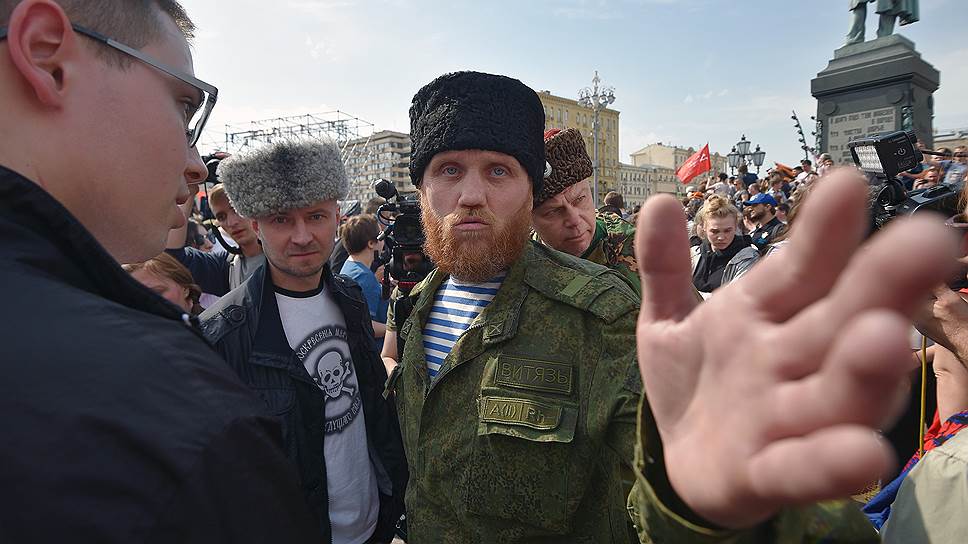
KMO_165050_00034_1_t218_200833So-called Cossacks at the He’s No Tsar to Us opposition rally at Pushkin Square, Moscow, May 5, 2018. Photo by Alexander Miridonov. Courtesy of Kommersant

According to Mr. Yashchikov, the Cossacks came to Pushkin Square to talk with Mr. Navalny’s supporters, but had no intention of being involved in dispersing the rally.

“There were one and half thousand people there [the Moscow police counted the same number of protesters—Kommersant]. There were thirty-five of us at most, and we had only two whips. You could not have paid us to wade into that crowd,” claimed Mr. Yashchikov.

Mr. Yashchikov claimed he managed to have a friendly chat with Mr. Navalny, but opposition protesters were aggressive, he alleged.

“Someone picked on us, asking why we had come there, that it was their city. Another person tried to knock my cap off, while they swore at other Cossacks and blasphemed the Orthodox faith,” Mr. Yashchikov complained. “Well, we couldn’t take it anymore.”

People who attended the rally have denied his claims.

“The Cossacks acted cohesively, like a single team,” said Darya, who was at the rally [Kommersant has not published her surname, as she is a minor]. “They formed a chain and started pushing us towards the riot police, apparently, to make their job easier. The Cossacks kicked me, while they encircled my boyfriend and beat him. They retreated only when they realized they were being film and photographed.”

Darya planned to file a complaint with the police charging the Cossacks with causing her bodily harm. Currently, human rights defenders from Agora, Zona Prava, and Public Verdict have documented more than fifteen assault complaints filed against the Cossacks.

Oppositionists have claimed the police mainly detained protesters, allegedly paying almost no attention to the Cossacks and NOD activists. Kirill Grigoriev, an Open Russia activist detained at the rally, recounted that, at the police station where he was taken after he was detained, he pretended to be a NOD member, and he was released by police without their filing an incident report.

“When we arrived at the Alexeyevsky Police Precinct, a policeman immediately asked who of us was from NOD. I jokingly pointed at myself. He took me into a hallway and asked me to write down the surnames of other members of the organization,” said Mr. Grigoriev.

He wrote down the surnames of ten people, after which everyone on the list was given back their internal Russian passports and released.

*********

Cossacks Confront Navalny Supporters for First Time
Regime Prepares for Fresh Protests, Including Non-Political Ones, Analysts Argue 
Yelena Mukhametshina and Alexei Nikolsky
Vedomosti
May 6, 2018

He’s No Tsar to Us, the unauthorized protest rally in Moscow held by Alexei Navalny’s supporters, differed from previous such rallies. On Tverskaya Street, provocateurs demanded journalists surrender their cameras. By 2:00 p.m., the monument to Pushkin was surrounded by activists of the National Liberation Front (NOD). When protesters chanted, “Down with the tsar!” they yelled “Maidan shall not pass!” in reply. Behind the monument were groups of Cossacks, who had never attended such rallies. In addition, for the first time, the police warned people they intended to use riot control weapons and physical force, and indeed the actions of the security forces were unprecedentedly rough. The riot police (OMON) detained protesters by the hundreds, and Cossacks lashed them with plaited whips.

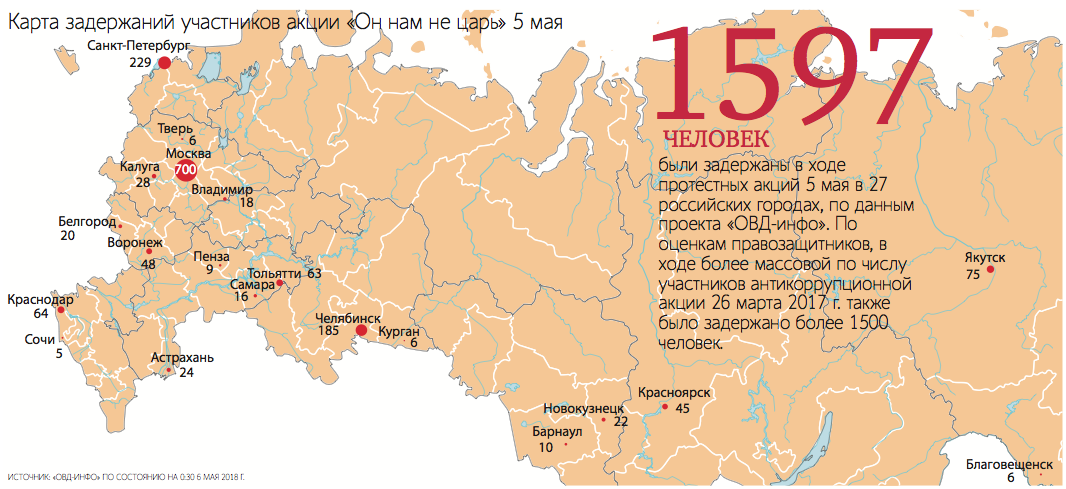
The Moscow police counted 1,500 protesters at the rally, while organizers failed to provide their own count of the number of attendees. Navalny said the nationwide rallies were a success. His close associate Leonid Volkov argued that “in terms of numbers, content, and fighting spirit, records were broken,” also noting the police’s unprecedented brutality. According to OVD Info, around 700 people were detained in Moscow, and nearly 1,600 people in 27 cities nationwide. Citing the PHRC, TASS reported that 658 people were detained in Moscow.
fullscreen-1sdb.png

“He’s No Tsar to Us, May 5: A Map of Arrests. 1,597 people were detained during protest rallies on May 5, 2018, in 27 Russian cities, according to OVD Info. According to human right activists, during nationwide anti-corruption protests on March 26, 2017, more than 1,500 people were detained. Source: OVD Info.” Courtesy of Vedomosti

PHRC member Maxim Shevchenko demanded the council be urgently convoked due to “the regime’s use of Black Hundreds and fascist militants.” According to a police spokesman, the appearance at the rally of “members of different social groups” was not engineered by the police, while the warning that police would use special riot control weapons was, apparently, dictated by the choice of tactics and the desire to avoid the adverse consequences of the use of tear gas.

According to NOD’s leader, MP Yevgeny Fyodorov, 1,000 members of the movement were involved in Saturday’s rally.

“We wanted to meet and discuss the fact the president must be able to implement his reforms. Because we have been talking about de-offshorization and withdrawing from a unipolar world for five years running, but things have not budged an inch,” said Fyodorov.

NOD did not vet their actions with the Kremlin, the leadership of the State Duma or the Moscow mayor’s office, Fyodorov assured reporters.

On Sunday, the Telegram channel Miracles of OSINT reported that, in 2016–2018, the Central Cossack Host, whose members were at the rally, received three contracts worth nearly ₽16 million from the Moscow Department for Ethnic Policy for training in the enforcement of order at public events. As Vedomosti has learned, according to the government procurement website, the Central Cossack Host received eleven contracts, worth nearly ₽38 million, from the Moscow mayor’s office over the same period.

Gleb Kuznetsov, head of the Social Research Expert Institute (EISI), which has ties to the Kremlin, argued there was no brutality at the rally.

“In Paris, the scale of protests is currently an order of magnitude higher, but no one speaks about their particular brutality. In Russia, so far the confrontation has been cute, moderate, and provincial. The only strange thing is that, in Russia, people who are involved in such protests, which are aimed at maximum mutual violence, are regarded as children. But this is not so. Everything conformed to the rules of the game, common to the whole world. If you jump a policeman, don’t be surprised if he responds with his truncheon,” said Kuznetsov.*

The Russian government has allied itself with the Cossacks and NOD, which are essentially illegal armed formations, argued Andrei Kolesnikov, a senior fellow at the Moscow Carnegie Center.

“This does not bode well. Apparently, in the future, such formations will be used to crack down on protests,” said Kolesnikov.

The authorities are preparing for the eventuality there will be more protests. Even now the occasions for them have become more diverse, and they are spreading geographically, noted Kolesnikov.

Grassroots activism has been growing, and the authorities have realized this, political scientist Mikhail Vinogradov concurred. They are always nervous before inaugurations. In 2012, there was fear of a virtual Maidan, while now the example of Armenia is fresh in everyone’s minds, he said.

“The security services had to flex their muscles before the new cabinet was appointed. Although, in view of the upcoming FIFA World Cup, law enforcement hung the regime out to dry contentwise,” said Vinogradov.

* In September 2017, the Bell reported that state corporations Rosatom and RusHydro were financing EISI to the tune of ₽400 million each, and it could not be ruled out that the so-called social research institute was receiving subsidies from other state companies.

Translated by the Russian Reader

The Voice of Rao

voice of rao.jpegIn Kandor City, on the planet Krypton, everyone fears the mysterious, awe-inspiring Voice of Rao, including the little “rankless” priestess Ona. Still from the TV serial Krypton, broadcast on Syfy in Ul Qoma, and on Ororo in Besźel.
Media Learns about Kremlin’s Order to Officials to “Reduce Media Activity”
Maria Bondarenko
RBC
April 27, 2018

The Kremlin has recommended federal officials reduce their “media activity” before Vladimir Putin’s inauguration. According to Kommersant, Dmitry Medvedev’s final public appearance is scheduled for May 3.

According to Kommersant newspaper, the public events Prime Minister Dmitry Medvedev attends on May 3, including a visit to the VDNKh, where he will chair a meeting on agricultural growth, will be his last before Vladimir Putin’s inauguration.

After May 3, according to the newspaper’s sources in the government and the Kremlin, federal officials will disappear from public view. The Kremlin has issued a recommendation to cabinet ministers and regional authorities to “reduce media activity” so as not to interfere with the “chief executive’s information agenda” on the eve of the inauguration, the newspaper’s sources said.

Medvedev conducted his last cabinet meeting on April 26. According to Kommersant‘s sources in the Russian White House, the prime minister arranged a buffet featuring champagne and hors d’oeuvres, and several officials were awarded the government’s highest honor, the Stolypin Medal of the First Degree. It cannot be ruled out the cabinet will meet on Saturday, May 5, to coordinate its actions before the presidential inauguration. According to the newspaper, however, this meeting will be held behind closed doors.

Putin’s inauguration is scheduled for May 7. Afterwards, the current government will resign. The president must then select a new cabinet of ministers. The day after the presidential election, March 19, Putin said he would make changes to the next government. However, he said nothing specific about changes in the cabinet. According to Kommersant, there is a “high likelihood” Medvedev will retain the post of prime minister.

Citing a source in the Kremlin, Kommersant likewise noted that after election to his previous presidential term, Putin personally held meetings with each potential minister and deputy prime minister, while Medvedev was more involved with the government’s overall structure. The newspaper’s source suggested this method would likely be used this time as well.

Translated by the Russian Reader

Monetizing Russia’s Migration Maze?

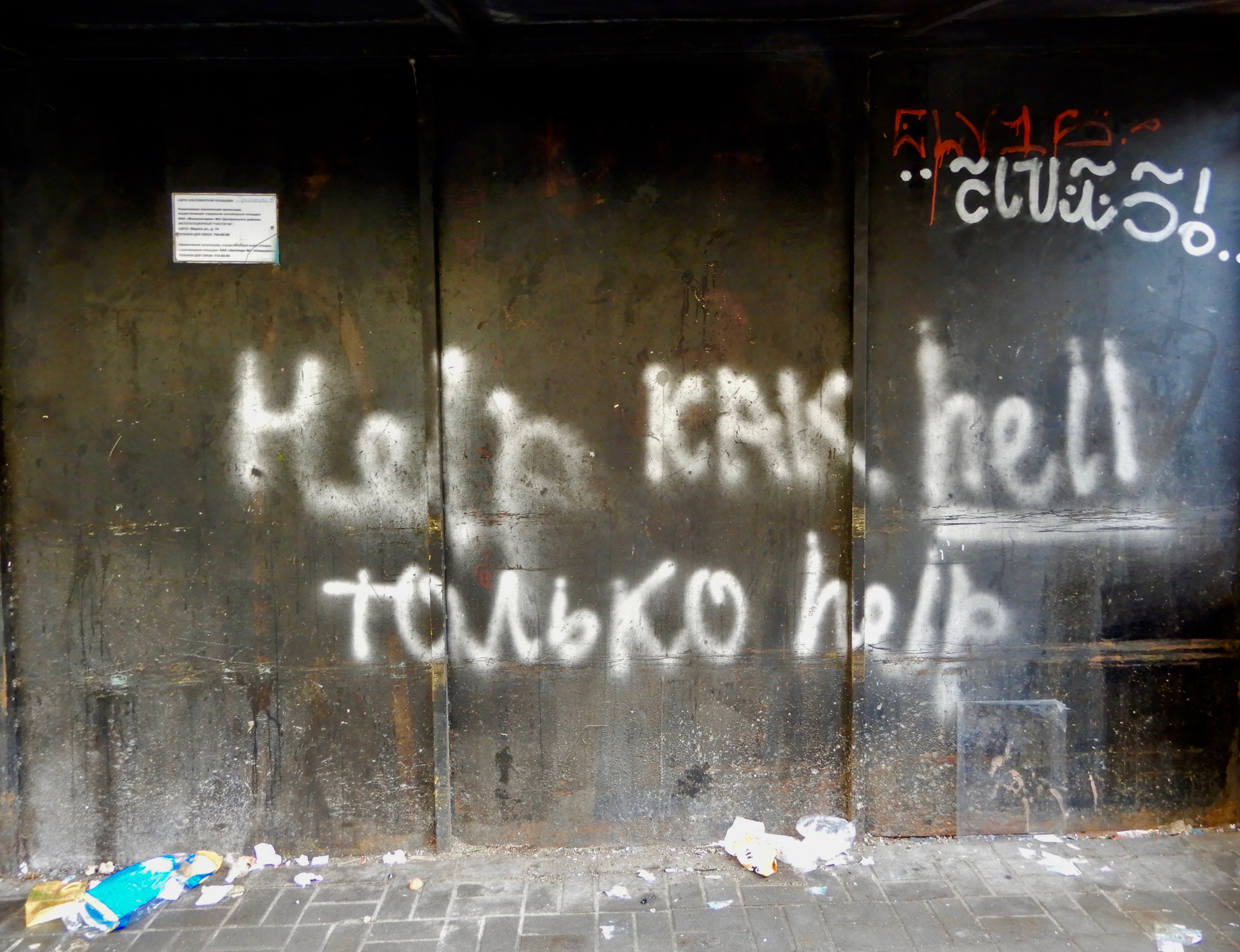
DSCN5633.jpg“Help is like hell, only it’s help.”

Punishment Minus Expulsion
Interior Ministry Develops Individual Approach to Migrant Workers
Anna Pushkarskaya
Kommersant
April 27, 2018

The Russian Interior Ministry has published draft amendments to the Administrative Offenses Code that would permit judges not to expel people from Russia who violated immigration regulations by allow them to take into account mitigating circumstances and substitute monetary fines for expulsion. The individual approach has already been enshrined in several articles of the Administrative Offenses Code by decision of the Russian Constitutional Court, but the police are willing to make it the “general rule for the assignment of administrative penalties.” Meanwhile, the Russian Justice Ministry has reported to the Council of Europe on measures it has taken in response to the complaints of stateless persons, although the rulings of the European Court of Human Rights (EHCR) and the Russian Constitutional Court on these cases have not yet been implemented, experts have noted.

The draft amendments to the Administrative Offenses Code, which would give judges the ability to replace administrative punishment with less harsh penalties, depending on the specific circumstances of the case, have been posted by the Interior Ministry for public discussion until May 4. The police drafted them on the basis of a February 17, 2016, ruling by the Constitutional Court. The ruling was rendered in the case of Moldovan national Mihai Țurcan, who was expelled from Russia for failing to notify the Federal Migration Service he was registered in Moscow Region. (This requirement is stipulated by Article 18.8 Part 3 of the Administrative Offenses Code, and it also applies to stays in Moscow, St. Petersburg, and Leningrad Region.)

Expulsion entails a five-year ban on entering the Russian Federation and reapplying for a residence permit. Courts did not consider the complainant’s work experience and payment of taxes as grounds for mitigating his punishment. The Constitutional Court ruled that these immigration regulations were unconstitutional and obliged legislators to individualize penalties for single violations of the controversial regulation by taking into account the length of an alien’s stay in the country, whether or not s/he has family in Russia, payment of taxes, and law-abiding behavior. Since December 2016, Article 18.8 Part 3 has allowed authorities to avoid explusion except in cases in which the documents confirming the alien’s right to stay have been lost or are lacking. In April 2017, the Constitutional Court’s approach was enshrined in the “General Rules for the Assignment of Administrative Penalties” (Article 4.1 of the Administrative Offenses Code), which deals with violations at official sporting events, for which foreign fans can get off, under mitigating circumstances, with a fine of 40,000 to 50,000 rubles and a ban on visiting stadiums for a period of one to seven years.

In October 2017, First Deputy Prime Minister Igor Shuvalov instructed authorities to extend the approach to all cases of compulsory explusion. If the court concludes that expulsion is an excessive stricture on the right to a private life and is disproportionate to the objectives of administrative penalties, it can be substituted by a fine of 40,000 to 50,000 rubles [approx. 530 euros to 660 euros]. Courts may already opt not to order expulsion in accordance with the clarifications issued by the Russian Supreme Court and Russian Constitutional Court, but now the factors courts should take into account are supposed to be incorporated in the wording of the law, noted lawyer Sergei Golubok. Lawyer Olga Tseitlina told Kommersant the draft amendments are quite important, because courts have, in practice, ignored marital status and other vital circumstances.

At the same time, the Russian Justice Ministry has sent a letter to the Council of Europe’s Committee of Ministers, asking it to recognize that the EHCR’s rulings on complaints filed by stateless persons have been implemented. The virtually indefinite detention of complainants in special Russian Interior Ministry facilities on the basis of rulings by Russian courts and the conditions of their detention in custody were ruled violations of the European Convention on Human Rights. The Justice Ministry reported that compensation had been paid to the complainants. They are now no longer subject to expulsion and deportation, and can “fix their migration status.” Moreover, the State Duma has passed, in their first reading, the admendments to the Administrative Offenses Code drafted by the Interior Ministry to settle the problem, the Justice Ministry reported four years after the ECHR issued its ruling. The Justice Ministry referred to the Constitutional Court’s ruling in the Mskhiladze case. In May 2017, the court also ordered that the Administrative Offenses Code be amended.

The ruling has not been implemented, noted Golubok and Tseitlin, who represented Mr. Mskhiladze. The ECHR’s decision in the case of another of Tseitlina’s clients, Roman Kim, has not been implemented, either, she told Kommersant.

“He has no legal status and de facto cannot apply for [Russian] citizenship or a [Russian] residence permit, since he cannot expunge his conviction due to his unemployment, but he is unemployed because legally no one can hire him,” said Tseitlina.

She stressed the general measures required by the ECHR and the Constitutional Court have not been implemented, either, since no changes have been made to Russian federal laws.

Thanks to anatrrra for the heads-up. Translation and photo by the Russian Reader

“The Rowdies Have to Be Apprehended Legally, So We Can Have a Celebration in the City on March 18, not Bedlam”

8792CD92-EE28-452C-859C-77B15F02744B_w1023_r1_sThe political performance “Clanking Chains,” March 11, 2018, Petersburg. Photo by Tatyana Voltskaya. Courtesy of RFE/RL

Petersburg Puts Oppositionists on Pause: Eight More Activists Detained
Maria Karpenko, Kseniya Mironova and Anna Pushkarskaya
Kommersant
March 13, 2018 (updated March 14, 2018)

The arrests of opposition activists continue in St. Petersburg. In the last two days, police have apprehended eight activists, three of whom ended up in police custody at the courthouse, where they had gone to support their comrades. The court has already remanded eight people in custody for their alleged involvement in a protest rally that took place a month and a half ago. At Petersburg city hall, Kommersant was told, “The rowdies have to be apprehended legally, so we can have a celebration in the city on March 18, not bedlam.”

On Tuesday, Smolny District Court in St. Petersburg sentenced three opposition activists—Viktor Cherkassov, Yekaterina Shlikhta, and Ilya Gantvarg (son of Mikhail Gantvarg, ex-rector of the St. Petersburg Conservatory and Russian Federation People’s Artist)—to ten days in jail. Police had apprehended them on Monday for involvement in the so-called Voters Strike, a protest rally held on January 28 by supporters by Alexei Navalny. Yegor Ryabchenko, who was also apprehended, was only fined.

On Tuesday, police apprehended another three activists—Vladimir Kazachenko, Alexander Kirpichov, and Darya Mursalimova, who had come to support their comrades—right in the courthouse. Mursalimova and activist Sergei Belyaev, also apprehended on Tuesday, were sentenced by the same court around 11 p.m. in the evening. Mursalimova was given fifteen days in jail for repeated involvement in an unsanctioned rally, while Belyaev was sentenced to seven days in jail and twenty hours of correctional labor.

Kazachenko and Kirpichov’s court hearing was scheduled for Wednesday.

The new wave of arrests was prefaced by a flash mob [sic], entitled “Clanking Chains,” during which ten activists marched down Nevsky Prospect in chains and prisoners’ outfits. The [performance], which took place on March 11, was held in support of oppositionists who had already been jailed.

The defense attorneys of all of the activists jailed on Tuesday plan to file appeals in St. Petersburg City Court. If the appeals are unsuccessful, the activists will be released only after the presidential election on March 18, just like the three oppositionists already in police custody on the same grounds.

In early march, the court sentenced Alexei Pivovarov, Open Russia’s regional coordinator, Denis Mikhailov, head of Alexei Navalny’s Petersburg headquarters, and Artyom Goncharenko, an activist with the Vesna (“Spring”) Movement, to twenty-five days in jail for their involvement in the Voters’ Strike.

Moreover, Mr. Mikhailov had just served thirty days in jail for organizing the same event, while Mr. Goncharenko had not attended the rally at all. He had merely displayed an inflatable yellow duck in the window of his apartment building, past which the protesters marched. St. Petersburg City Court rejected an appeal to overturn their jail sentences, despite arguments made by the defense that the “deferred punishment” for violating the rules on rallies was “politically motivated.”

The January 28 protest rally was peaceful. Police detained around twenty people, which was very few compared with previous unauthorized protests in Petersburg. Except for Denis Mikhailov, all of the detainees were released from police precincts after police had so-called preventive conversations with them. They were not even written up for administrative violations.

Our source at Petersburg city hall explained what was happening.

“The rowdies have to be apprehended legally, so we can have a celebration in the city on March 18, not bedlam.”

Thanks to Comrade NN for the heads-up. Translated by the Russian Reader

There Are No Condoms in Russia

360521

Developing a Moral Immunity to HIV
The Education and Science Ministry doesn’t want young people to talk about condoms
Anna Makeyeva and Valeriya Mishina
Kommersant
November 3, 2017

As Kommersant has learned, a scandal has erupted in the Education and Science Ministry over an online HIV prevention lesson for high school and university students. The people responsible for the internet project have refused to fulfill demands by officials to vet answers to users’ questions in advance, as well as their recommendations to “talk about morality in order to get away from slippery topics” and avoid such words as “condom.” It is still unclear how the lesson, scheduled for December 1, will be taught.

The Nationwide Internet HIV Prevention Lesson, timed to coincide with World AIDS Day on December 1, has been held by order of the Education and Science Ministry since 2015. On the eve of the lesson in 2016, Education and Science Minister Olga Vasilyeva noted that the issue of countering the spread of the HIV infection among children and adolescents, given the complicated epidemiological circumstances, had long been a focus of the Education and Science Ministry, and occupied a vital place in a set of measures for preserving and strengthening the health of children and young people.

“The use of such innovative methods as open internet lessons at preventive events in educational institutions will help us cope more effectively with the existing problem,” Izvestia quoted the ministry’s stated position in 2015.

On November 2, a working meeting in preparation for the upcoming internet lesson was chaired by Larisa Falkovskaya, deputy director of the department for state policy on children’s rights at the Education and Science Ministry.

“For the first time in my life, a meeting at the Education and Science Ministry ended in scandal because of my fault. I refused to write the answers for those taking part in the online HIV prevention lesson,” said Sergei Bulanov, who is in charge of organizing the online lesson and heads the Center for Modern Education Technologies, a group of non-profit organizations engaged in educational and related projects.

According to Bulanov, the officials at the meeting deemed use of the word “condom” “unacceptable,” and consequently the meeting was adjourned.

Project organizers suggested to officials they give up the practice of using prepared answers in the video lesson and discuss issues of prevention in a playful way, for example, by arranging a rap battle between student teams from two regions.

“But we were told to talk about morality in order to get away from slippery topics,” complained Bulanov, adding, “The topic is ratherly widely represented in the school curriculum, but currently the Education Ministry has adopted a surprising stance, based on substituting HIV prevention, which is mostly a matter of personal hygiene, with lessons in moral values.”

Besides, Bulanov argues it is incorrect to equate the risk of infection only with antisocial behavior.

“Thirty percent of HIV-infected women were infected by the only sexual partner they ever had. Can we reproach them for antisocial behavior? HIV-positive teenagers who have been infected from birth did not lead an antisocial lifestyle.”

Vadim Pokrovsky, head of the Federal AIDS Center, argues the view it is better not talk to children about sex currently prevails in Russia.

“It is one of the reasons HIV has spread so widely in Russia,” he said.

According to Pokrovsky, twenty percent of young women are already having sex by the age of fifteen. He added that in Germany, for example, sex education is an obligatory subject in schools. Last year, only 3,500 cases of infection were registered there, while over 100,000 cases of infection were registered in the Russian Federation.

“We see two fundamentally [different] approaches and two different outcomes,” Pokrovsky concluded.

The Education and Science Ministry declined to comment on the situation when approached by Kommersant. The Russian Federal Health Ministry learned about the conflict from Kommersant. The ministry said the online HIV prevention lesson was an undertaking of the Education and Science Ministry.

“They did not come to us with this or consult with us,” our sources at the Health Ministry said.

Sergei Bulanov assured Kommersant preparations for the open HIV prevention lesson for young people would be continued.

“We will keep on working, focusing more on recommendations from specialists at the Health Ministry and Rospotrebnadzor [the Russian federal consumer watchdog] than on the client [i.e., the Education and Science Ministry].

The internet lesson will take place on December 1, 2017.

Translated by the Russian Reader. Photo courtesy of Pravda.ru

Remembering Beslan

The Memory of Beslan
Takie Dela
September 1, 2017

On the anniversary of the tragedy, Takie Dela remembers the principal witnesses to the events in School No. 1.

On September 1, 2004, terrorists seized School No. 1 in Beslan. The gunmen herded over a thousand hostages, including small children, into the school’s gym. For three days, the hostages were forcibly held in the building without food and water. The security services assaulted the school to free the hostages.

A total of 334 people were killed in the terrorist attack, including 186 children. 126 of the former hostages were crippled. During the assault, the FSB killed 28 terrorists. The only terrorist taken alive, Nurpashi Kalayev, was arrested. A court later sentenced him to life in prison.

Many articles, investigative reports, and special projects have been written about the Beslan tragedy, and several documentary films and books have been released. Takie Dela recalls the primary witnesses to the events in School No. 1.

Novaya Gazeta

Novaya Gazeta reporter Elena Milashina was in Beslan during the terrorist attack. The first article she filed about the tragedy, “Lies Provoked Terrorists’ Aggression,” was published in the newspaper’s September 6, 2004, issue.

“According to the police officers and special forces soldiers with whom we have spoken, the preparations for the assault were vigorous. That the authorities were learning toward this option is borne out by one other fact. They did not, in fact, negotiate with the gunmen. No one intended to meet even their formal demands. They explained to us, ‘It’s not clear what they want.'”

In 2014, on the tenth anniversary of the tragedy, Milashina recalled how events had unfolded before and after the terrorist attack .

“The Beslan terrorist attack will go down in Russian history as an instance when the populace was disinformed on an unprecendented level. Up until the assault of the school, officials concealed the scale of the tragedy (the number of hostages). They also concealed negotiations with Chechen separatist leader Aslan Maskhadov, who was ready to ask the gunmen to put down their weapons. Akhmed Zakayev, Maskhadov’s emissary, was ready to fly straight to Beslan and take part in negotiations with the terrorists.”

In 2006, Novaya Gazeta published a special issue on the outcome of its investigation, featuring forensic evidence, annotated maps, official reports, and eyewitness testimony. The newspaper came to several conclusions. Reliable information about the upcoming terrorist attack was known to the authorities at least three hours before the school was seized, and Alexander Dzasokhov, president of North Ossetia, offered to replace the children with 800 officials and local MPs, but Moscow forbade him under pain of arrest from entering into negotiations. The biggest public outcry was caused by the newspaper’s claims that the school was fired upon by grenade launchers, flamethrowers, tanks, and helicopters on several occasions when the hostages were still in the building. According to the newspaper, the official inquiry, while it was in full possession of these facts, found no wrongdgoing in the actions of those in charge of the operation to free the hostages.

Twelve years later, Novaya Gazeta special correspondent Elena Kostyuchenko wrote down the dreams of surviving hostages.

“Vladimir’s dream: “I want to pick a plum. “Now,” I say, “I want a ladder to the plum and to pick the plum.” A young girl below me says, “I’m not your little girl.” I say, “And where is my little girl?” She says, “She is not here. I am another girl here.” After all, she was lying with my wife in the grave. “I’m not your daughter,” she says, “Don’t pick me plums.” I say, “Where is my little girl?” She says, “I don’t know. Look for her.”‘”

Kommersant

Kommersant reporter Olga Allenova was returning from Grozny, when her editors called her and told her about the terrorist attack in Beslan. She went to North Ossetia to write a story.

“‘Don’t let the hostages’ relatives on the air. Don’t cite any number of hostages except the official figure. Don’t use the word “storm.” The terrorists should not be called gunmen, only criminals, because terrorists are people you negotiate with.’ This was what several national TV channel reporters, located in Beslan, heard immediately from the top brass. We were all side by side, and I saw how hard it was for those guys to carry out the orders of the top brass. And I saw one of them crying in the evening after the school had been stormed.”

On October 17, 2004, the newspaper published an article entitled “How Did We Help Them?” The story dealt with the fortieth day after the terrorist attack. [In Orthodox culture, the fortieth day after a person’s death is usually remembered and marked by a ritual.]

“In Moscow, we say that forty days have passed since the school in Beslan was seized. Here those days did not exist. In their place is a black hole, like the hole made by a grenade in the floor of the assembly hall. And every day is a day of mourning.

“The entire city of Beslan is dressed in black. There are houses here in which not a single child is left, and entryways through which three caskets a day are carried out.”

In 2011, an infographic was posted on the newspaper’s website: it features a map of the school on which the main locations where the events took place are illustrated by short excerpts from archival video footage.

Esquire

In 2006, the Russian edition of Esquire published an article [in Russian] by New York Times reporter C.J. Chivers, in which he retraced the events in Beslan School No. 1 hour by hour: from the beginning of the ceremonial, first-day-of-school lineup at nine in the morning of September 1 to the medical care administered to the victims in the Vladikavkaz Hospital on September 4. Chivers had written the article [in English] o understand who the hostages had felt the whole time.

“Like many people who have been to Beslan, I subsequently thought a lot about what had happened. Like the people of Beslan, I was infuriated by the endless contradictory statements, the lack of information about many important episodes in the hostage crisis and the actions of the Russian authorities.”

Radio Svoboda

Ten years after the tragedy, Tom Balmforth and Diana Markosian published a story on the Radio Svoboda website about the lives of the surviving schoolchildren. The former hostages talked about their memories, features, and thoughts of the future.

“The children behaved heroically. We all grew up immediately. We really supported each other. In fact, we came together like a family there. Even many of the adults did not behave with as much dignity as the children. Apparently, the adults understand everything in terms of their being grown-up and wise, while we children saw it all through rose-tinted glasses, maybe. I know for a fact that, after those three days, we became completely different people,” recalls Zarina Tsirikhova. She was fourteen when the terrorist attack occurred.

Takie Dela

Takie Dela published Diana Khachatrian’s story about how, in September 2016, the memorial events in Beslan ended in arrests. During the ceremonial school lineup at School No. 1, five women staged a protest. They removed their jackets, under which they were wearing t-shirts that bore accusations against the regime.

Voice of Beslan activists in the gym of School No. 1. Their t-shirts are emblazoned with the slogan, “Putin is the execution of Beslan.” Photo courtesy of Diana Khachartian and Takie Dela

“The female activists of Voice of Beslan stand apart in the gym. The five women are wearing handmade t-shirts on which the inscription “Putin is the executioner of Beslan” has been written in marker pen. This is not a hysterical slogan. Based on their own impressions and evidence from the investigations, the women argue that on September 3, 2004, Vladimir Putin or a member of his entourage gave the orders to storm the school in order to expedite events and prevent negotiations with Aslan Maskhadov. They argue the hostages could have been saved.”

Photography

Photographer Oksana Yushko has for many years produced unique photograph projects on the aftermath of the Beslan tragedy. Yushko takes pictures of the children who were taken hostage in September 2004 at different stages in their school careers, both in everyday life and during graduation from school.

Amina Kachmazova, left, and Fariza Mitdzieva hugging each other in the old school No. 1 in Beslan. Fariza, 18: ‘Here we are, such heroes, living after the attack. And somehow we are able to find happiness in life. Life just goes on and we cannot change what already happened to us. Just the opposite: now it is more pleasant to look at how we laugh, have fun and enjoy life.’ Beslan, North Ossetia, 2013. Photo courtesy of Oksana Yushko

Documentary Films

In 2005, some of the relatives of those who were killed during the terrorist attack established the grassroots organization Mothers of Beslan. That same year, due to friction within the group, a number of committee members left the group and founded another organization, Voice of Beslan.

Rodion Chepel’s The Committee, released on the tenth anniversary of the tragedy, focuses on Beslan’s female activists.

Chepel discussed how the film was made in an interview with Rusbase.

“We have never met such people. They are such uncompromisingly honest people, it was if they would be shot for lying. From a distance it seems that Beslan is god knows what, part of Moscow’s war with terrorism. But when you go there, you understand it is just human grief that has made them so tough and very honest. It’s not a matter of politics. They’re in touch with their humanity. You talk to them and you realize you simply have not met such people. This was what we wanted to show in the film: what these ten years have done with these people is incredible. They just want someone to explain to them what happened, for someone to say, “Forgive me. It was my fault.” Instead, they have been threatened and slandered. People have tried to sick them on each other, drive a wedge through them, and present them as insane.”

Filmmaker Vadim Tsalikov has shot four documentary films about the terrorist attack in Beslan. One of them is Beslan: Memory.

Foreign filmmakers have also shot films about the tragedy in North Ossetia. For example, Joe Halderman shot the film Beslan: Three Days in September for Showtime. The picture was screened at the Tribeca Film Festival in 2006.

Personal Diary

In 2012, one of the hostages, 14-year-old Agunda Vatayeva, decided to publish her memoir of the terrorist attack. The young woman launched a diary on LiveJournal and wrote three posts in which told from beginning to end the story of the three days she spent in captivity.

“If you deliberately searched for my diary, you probably want to read my memoir of the terrorist attack in Beslan: Day One, Day Two, and Day Three. It is unlikely that you will find my LiveJournal exciting or at least positive reading. It was started once upon a time for quite different purposes. It was a kind of psychotherapy for me.”

***

In April 2017, the European Court of Human Rights award three million euros to the relatives of the victims. There were over 400 plaintiffs in the case. The court ruled that the Russian authorities had not taken sufficient measures to prevent the terrorist attack and had violated Article 2 of the European Convention for the Protection of Human Rights and Fundamental Freedoms: the right to life. In addition, Russia had not prevented a threat to people’s lives and had not planned the assault on the school properly. The European Court of Human Rights likewise deemed that the Russian authorities had not properly investigated all circumstances of the terrorist attack and the causes of the hostages’ deaths.

The Kremlin reacted to the ECtHR’s ruling by saying that “an emotional assessment is hardly appropriate.”

“Of course, we cannot agree with this formulation. In a country that has been repeatedly attacked by terrorists, and the list of such countries has been growing, unfortunately, these formulations and purely hypothetic arguments are hardly acceptable. An emotional assessment is hardly appropriate.

“All the necessary legal actions related to this decision will be taken,” said Dmitry Peskov, the president’s spokesman.

Translated by the Russian Reader

A Thorn in Their Side

Kushelev-Bezborodko Palace on Gagarin Street, Petersburg
Kushelev-Bezborodko Palace on Gagarin Street, Petersburg, home of the European University

European University Faces Eviction for Plastic Windows
Maria Karpenko
Kommersant
January 24, 2017

The European University in St. Petersburg, one of the leading non-public educational institutions in Russia, may lose its building. Petersburg city hall has unilaterally terminated the lease agreement for the Kushelev-Bezborodko Palace, which has housed the university since 1995. The Smolny claims university management violated the conditions for using the historic building by making alterations and installing windows and air conditioners. Meanwhile, the university had been preparing to reconstruct the palace, investing 2.2 billion rubles in the project, 670 million rubles of which were to be spent on restoring the historic section of the building.

On December 27 of last year, the St. Petersburg City Committee for Property Relations (KIO) sent the European University notice it was unilaterally terminating the rental agreement. As a source at the committee told Kommersant, the European University hd not fulfilled its obligations to preserve the mansion of Count Kushelev-Bezborodko, built in the nineteenth century.

Officials discovered the violations last summer during an unscheduled inspection. (The Smolny could not explain yesterday why the inspection had been necessary.) As a source at the City Landmarks Use and Preservation Committee (KGIOP) informed Kommersant, university officials had made alterations to the premises and installed reinforced plastic windows and air conditioners without providing authorized documentation and obtaining permission for the repairs. The Dzerzhinsky District Court fined the European University 200,000 rubles in its capacity as user of a culture heritage site.

The Property Relations Committee then deemed it possible to terminate the lease agreement. The European University challenged the agreement’s termination in commercial court, arguing it was groundless. The court adopted interim measures, halting the university’s eviction from the premises until a decision has been made on the claim. The first hearing has been scheduled for March 15.

Meanwhile, the European University had planned in the near future to begin implementing an investment project for adapting the Kushelev-Bezborodko Palace to modern educational needs. The university estimates its cost at 2.2 to 2.4 billion rubles, 670 million rubles of which should go to restoring the historic section of the palace. The project has been in the works since 2013. Architect Jean-Michel Wilmotte, designer of the Russian Cultural Center in Paris, won the competition to carry out the project. As European University Vice-Rector Vadim Volkov told Kommersant, the KGIOP had already partly authorized the reconstruction. (Our sources in the KGIOP confirmed that the methods for restoring the interiors of the palace that had artistic value had been approved.) Next week, the university had anticipated the KGIOP’s decision on the entire project.

“Given our intention to implement such an ambitious project, the KIO’s decision to evict us from the building on account of three windows, a plastic partition, and and extension that was erected under Brezhnev looks odd, at very least,” Mr. Volkov said.

The official statement on the university’s website stresses that none of  the violations uncovered during the inspection “put the cultural heritage of the palace at risk. They would be automatically corrected during the adjustment project as mentioned above.”

The statement goes on to say “[t]here is a degree of incommensurability between the claims of the Committee and the consequences entailed by the latter’s tough stance.”

Vice-Rector Volkov likewise noted that the clause giving the city the right to terminate the lease agreement if the university violated its landmark protection obligations had been added to the agreement only in April 2015 at the behest of the KIO.

“First, the KIO inserted these conditions in the agreement, and then showed up to check just this, certain they would be able to turn up violations of some kind,” Mr. Volkov suggested.

Maxim Reznik, chair of the education, culture and science committee in the city’s legislative assembly, believes the claims are politically motivated.

“Apparently, the presence of such a university, when all the rest have long ago been marching in step, keeps someone awake at night. In my view, the situation can be resolved in the university’s favor only if if the head of state [i.e., Vladimir Putin] or people close to him intervene,” the city MP told Kommersant.

In December of last year, Rosobrnadzor (Federal Service for Supervision in Education and Science) suspended the university’s license. The European University appealed to President Putin, who asked Vice-Premier Olga Golodets to get to the bottom of the matter. As Kommersant wrote, officials who attended a closed meeting concluded the claims were unsubstantial and spoke out in the university’s favor. Three days later, its educational license had been restored.

The university first encountered problems with oversight authorities in 2008, when it was closed for a month and a half [allegedly] for fire safety violations. Last summer, the Prosecutor General’s Office inspected the European University at the behest of Petersburg MP Vitaly Milonov. Prosecutors then gave the university two months to eliminate violations.

Translated by the Russian Reader. Photo courtesy of saint-petersburg.com

Agents of H.A.R.V.A.R.D.

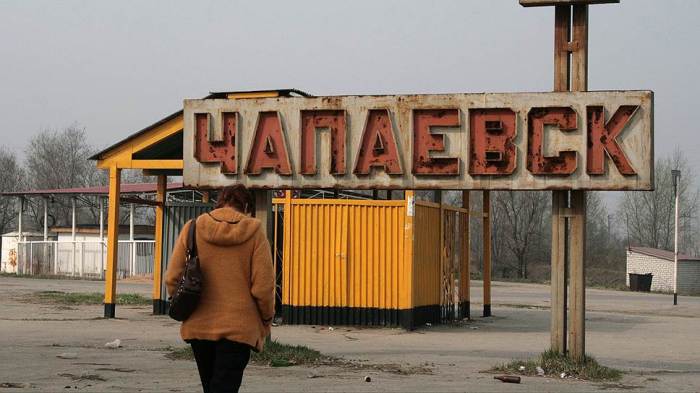
Chapayevsk. Photo courtesy of Yevgeny Bochkaryov/Kommersant

Harvard Agents Association
The Justice Ministry Has Fined an NGO for Medical Research
Alexander Chernykh
Kommersant
December 21, 2016

The Chapayevsk Medical Workers Association, an NGO in the Samara Region, has appealed the Justice Ministry’s decision identifying it as a “foreign agent.” The organization was cited for grants it has been receiving from Harvard for over twelve years to study the health of people who live in enivornmental disaster areas. The Justice Ministry additionally cited the work of its doctors in preventing HIV as “contrary to Russian national interests.” The association is on the verge of closure, despite the unprecedented support it has received from town officials, physicians, and the Russian Academy of Sciences.

The Chapayevsk Medical Workers Association was established in 1999.

“Chapayevsk produced pesticides for many years, which led to increased levels of dioxins,” says Oleg Sergeyev, head of the association and a Ph.D. in medicine. “Increased mortality was recorded in the town. The local hospitals were not coping due to a lack of funds and equipment. So the town’s doctors united into an NGO to try and solve the problem.”

Located 45 kilometers from Samara, the town, whose population is 73,000, was founded in 1909 as a settlement built round an explosives factory. In 1926, a chemical weapons factory went into operation, later converted into a fertilizer plant. In 1999, the State Ecology Committee declared the town an “environmental emergency area.” Chapayevsk received a total of 1.742 billion rubles in federal subsidies, and its status as an environmental emergency area was rescinded in 2005. In 2008, the mayor of Chapayevsk officially proposed resettling the city.

In 2003, the association launched a long-term research study, entitled “Dioxins, Pubertal Growth, and the Development of Boys,” in cooperation with the Harvard School of Public Health and the Russian Academy of Sciences.

“With the consent of their parents, we selected 516 boys between the ages of eight and nine, and have been carefully tracking their health every year since then. Now they are young men between the ages of 19 and 22,” says Oleg Sergeyev. “We have seen how the dioxins and pesticides have impacted the growth, development, and especially the reproductive health of the men.”

The researched has been funded by the National Institutes of Health in the US. In 2003, the NIH made a long-term research grant to the project, and in 2010, it extended the grant for another six years.

“During this period, we received 65.2 million rubles,” says Mr. Sergeyev. “34.2 million was spent on the salaries of seventeen staff members, 21.4 million rubles, on equipment and supplies, and 9.6 million rubles, on social benefit payments.”

The association’s second focus has been HIV prevention.

“In the late 1990s, Chapayevsk ranked third in the region in the spread of HIV,” says Mr. Sergeyev. “This was due to injecting drug use. The drugs were easily accessible here.”

Physicans hit the streets to engage in harm reduction work, which has involved them in meeting with drug users, handing out brochures and free condoms, persuading people to get tested for HIV, collecting used syringes, and supplying clean syringes. Harm reduction programs in Chapayevsky have covered around 800 people annually (a little over one percent of the population). According to doctors, this is around a third of the town’s injecting drug users.

In 2014, the Justice Ministry’s regional office audited the association twice, concluding the NGO was not engaged in political activity. In October 2016, these very same officials changed their opinion and demanded the association be added to the list of “foreign agents.” The Justice Ministry’s Samara office failed to respond promptly to our request for information, but Kommersant has obtained a copy of the audit report. Officials deemed it a violation that Oleg Sergeyev sits on the Samara Regional Duma’s NGO Council and has been involved in the hearings of two committees, on physical education and healthy lifestyles, and on providing social services to the populace. In 2013, one commission recommended that regional MPs ban cigarette ads at public transport stops and in shops. In 2015, it recommended that regional MPs add the phrase “citizens are responsible for maintaining their own health” to the law “On Basic Public Healthcare.” The auditors construed this as “political activity financed by foreigners.”

The association’s work in preventing HIV has also not escaped the auditors’ attention. The Justice Ministry dubbed the needle exchange and the distribution of condoms by physicians the “inculcation of practices contrary to Russian national interests.” In the wake of the audit, the officials asked the court to rule the association a “foreign agent.” The court granted the request, additionally fining the NGO 300,000 rubles and Oleg Sergeyev 50,000 rubles for not registering themselves voluntarily.

“I don’t know where to get the money,” says Mr. Sergeyev.

According to him, no grantmaking organization permits the payment of fines out funds allocated for scientific research.

“It’s a matter of scientific reputation,” say Mr. Sergeyev. “If they had labeled us an ‘organization receiving foreign funding,’ then for God’s sake we would have enrolled ourselves in such a registry. But we have been accused of working for another country, although we have always acted in the interests of our town.”

The organization filed an appeal last week. As candidates for “foreign agent” status, the physicians have received unprecedented support from researchers at the Institute of Genetics and the Institute of Forecasting of the Russian Academy of Sciences, as well as from the town’s chief narcologist.

Chapayevsk’s Mayor Dmitry Blynsky also wrote an official letter to the Justice Ministry. (He resigned in November 2016, but signed the letter while still in office.) According to Blynsky, the NGO’s collaboration with Harvard “has been of great benefit to the town.”

“The medical and lab equipment that has been procured has been used to treat the populace of Chapayevsk. In view of Chapayevsk’s subsidized budget, another important aspect of attracting foreign financing has been the creation of jobs for medical professionals,” wrote Blynsky.

According to the ex-mayor, the outcomes of the NGO’s long-term research studies have been used to develop public programs for the town’s social and environmental rehabilitation.

Translated by the Russian Reader. Thanks to Tamara Koganzon for the heads-up

Loyalties

isip
Dmitry Yegorchenkov and Nikita Danyuk (right), assistant heads of the Institute of Strategic Studies and Forecasting (ISIP) at the Russian People’s Friendship University, after lecturing at the Russian Congress of University Vice Chancellors for Morale and Discipline, Moscow, October 21, 2016. Photo courtesy of the institute’s Vkontakte page

Ideological Underachievement
Russian universities to examine the loyalty of students and lecturers
Alexander Chernykh
Kommersant
October 24, 2016

Kommersant has learned that volunteers at Russian universities have been working to assess the “protest potential” of students and professors. The results will be “compiled as memorandums for official use by state authorities.” Attendees of the Russian Congress of University Vice Chancellors for Morale and Discipline, which took place this past weekend, discussed the assessment. The authors of the study have discovered that the “destructive promotion of anti-state ideas has been occurring” among the student bodies and faculties of the capital’s universities. On the eve of the presidential election, they intend to shift their focus to regional universities.

It was the sixth time the Russian Congress of University Vice Chancellors for Morale and Discipline had taken place in Moscow. Representatives of 642 educational organizations from eighty-one regions attended the congress. Prime Minister Dmitry Medvedev sent his greetings to the congress, and  guests of honor included Stanislav Sulakov, acting head of the Moscow Center for Extremism Prevention (Center “E”), Metropolitan Merkurii, chair of the Synodal Department for Religious Education and Catechesis, and Ernestas Mackevičius, presenter of the news program Vesti.

The meeting of the vice chancellors kicked off with a discussion of a sensitive issue.

“For twenty years, we have had to prove that the country needs discipline and morale in the universities,” complained Zinaida Kalinina, a vice chancellor at Tula Pedagogical University.  Even Pushkin said, ‘The university completes the soul’s education.’ Let them argue with Alexander Sergeyevich [Pushkin]!”

Alexander Stradze, former head of the Department of State Policy on the Education of Children and Youth, one of the first officials to be dismissed by Olga Vasilyeva, the new Minister of Education and Science, tried to define the vector of the discussion. He introduced himself as assistant head of Rossotrudnichestvo, but from force of habit he attempted to preach to the vice chancellors.

“The state’s educational ideology has moved away from paternalism,” he explained. “Yes, it’s easier, probably, to work with loyal subjects, with subordinates. But the country and the conditions are no longer the same today. Nowadays, we bring up children in terms of humanism, free choice, and support for individuality. This path is justified in any democratic society.”

Alexander Balitsky, vice chancellor at Izhevsk Technical University and a former lecturer in the department of scientific socialism, tore the ex-official’s speech to shreds.

“Everything we do has often been canceled out by sociocultural circumstances,” Balitsky began in a roundabout way. “And these circumstances even often originate  in our ministry.”

Mr. Balitsky casually, as it were, mentioned that the Ministry of Education and Science has been implementing a nationwide project entitled “Time to Act,” and read aloud a message from [ministry] officials to university students.

“Twelve of the country’s best entrepreneurs will share their know-how and teach you think in new ways. On September 22, entrepreneur Oskar Hartmann—” the vice chancellor underscored the entrepreneur’s [non-ethnic Russian] given name and surname,* while the audience applauded and laughed in support “—will talk about how you need to think to become a dollar millionaire by the age of thirty.”

“Nifty, eh? There’s an ideal for you. I have nothing against entrepreneurs, but these are not the core values we need. With all due respect to the Ministry of Education and Science.”

“But now there have  been changes in the ministry,” an audience member reminded him.

“Thank God,” the speaker replied.

“Yeah, and there won’t be anymore Soroses,” someone joyfully shouted from the crowd.

“I think the expert community understands the country is in a state of undeclared war,” said Nikita Danyuk, assistant head of the Institute for Strategic Studies and Forecasting (ISIP) at the Russian People’s Friendship University. “It is hybrid in nature, and there are many fronts.  One of them runs inside our country: it is the mental front.”

Complaining that “western planners” use the “practice of inspiring coups,” he acknowledged university students were one of the main “destructors.” To keep the country from “plunging into chaos and anarchy,” Mr. Danyuk’s team had drafted a special educational program, entitled “Scenarios of Russia’s Future,” a series of lectures on “combating politically destructive forces.” Over the past two years, Mr. Danyuk and his colleagues had visited over forty universities in Moscow and a dozen regional universities, where they had encouraged the students to openly express their own views on political issues “and even join in the discussion.” Surrounded by his colleagues, however, Danyuk admitted the real purpose of the trip had been to assess the “protest potential” of students and lecturers.

“The outcomes of the project were compiled as memorandums for official use, including by government officials and officers of certain specialized organizations,” Mr. Danyuk announced proudly. “Unfortunately, the destructive promotion of anti-state ideas has been occurring among professors and lecturers—not openly,  but without being shy about it.”

Danyuk said that society was “most exposed to destructive spin doctoring during the electoral  cycle.”

“Fortunately, our country negotiated the milestone of the parliamentary elections nearly without losses, but our project will be relevant until 2018, when the presidential election will be held. And from the viewpoint of prevention, it will be relevant beyond then.”

The Institute of Strategic Studies and Forecasting at the Russian People’s Friendship University is headed by Georgy Filimonov, a professor in the department of the theory and history of international relations. The university’s website relates that, from 2005 to 2009, Prof. Filimonov worked in the presidential administration as a foreign policy advisor. According to Mr. Danyuk, the “Scenarios of Russia’s Future” lecture series has been implemented with the involvement of the Anti-Maidan Movement, political scientist Nikolai Starikov, and “other media figures.”  The project has already been the source of controversy. In May 2015, students and lecturers at the Russian State University for the Humanities attempted to disrupt a lecture by Nikolai Starikov at their university. Mr. Danyuk confirmed to  Kommersant that he had been at the event. In his opinion, the protest had been organized not by students, but by lecturers at the university.

A series of books recommended for reading by Nikolai Starikov, on sale at a newstand in Pulkovo Airport, Petersburg, October 23, 2016. Photo by the Russian Reader
A series of books recommended for reading by Nikolai Starikov, on sale at a news stand in Pulkovo Airport, Petersburg, October 23, 2016. Photo by the Russian Reader

“The strategy of our foreign so-called colleagues has changed. The protest potential has now shifted to the regions, and we are really interested in making contact with people from regional universities and organizing events there,” he said.

At the end of the event, the vice chancellors queued up to talk with Mr. Danyuk, vying with each other to invite him to their universities and assess the “protest potential” of their colleagues.

* According to an article, dated March 15, 2016, in the magazine Sekret firmy, businessman Oskar Hartmann was born in Kazakhstan to a family of Russian Germans.

Translated by the Russian Reader

Talk of the Town

You would be forgiven if you imagined Russia’s liberal, leftist, technical, creative, conservative and other intelligentsias were abuzz right now with righteous anger or triumphant glee about what the country’s air force (now officially known, bizarrely, as the Russian Aerospace Forces or VKS) has been up to in Syria and, more specifically, Aleppo, these days.

No, many of them are terribly exercised, in various directions, about the controversy over an exhibition by American photographer Jock Sturges in Moscow.

This was borne out by the websites of some of the country’s leading dailies this morning.

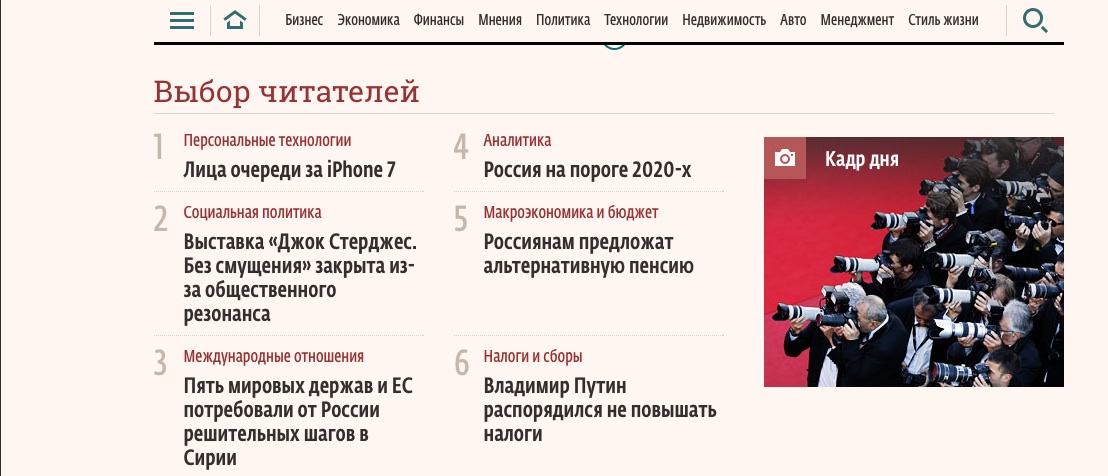
vedomosti-syria

The liberal Vedomosti, a business-oriented newspaper, listed its top stories this morning. The top story was entitled “Faces in a Queue for the iPhone 7”; the second most-read story was about the Sturges show.

True, Vedomosti readers are serious lads and lassies, so the number three story was about Syria. It was headlined, “Five World Powers and EU Demand Decisive Steps from Russia in Syria.”

Earlier today, I posted a few bits from the bizarre article about yesterday’s emergency meeting of the UN Security Council, published in the country’s other serious, formerly liberal, business daily, Kommersant.

Similarly, Moskovsky Komsolomets could not figure out what its readers would find more titillating: reading about how the VKS’s top guns were bombing Aleppo to smithereens or how astroturfed patriots were threatening the God-given right of every self-respecting intelligent to implement Dostoevsky’s maxim that beauty would save the world.

mk-syria

By way of splitting the difference, this morning’s website featured a picture of a chap obviously meant to embody the most average-looking Russian bloke on earth, sadly contemplating one of Sturges’s blasphemous nudes, while a sidebar headline shouts, “Everyone [sic] Is Bombing: Churkin Thinks Peace Impossible in Syria.”

Izvestia has become a particularly noxious loudspeaker for the regime in the past years, so the front page of its website contained a fair number of articles and op-ed pieces chockablock with baldfaced lies about the bloodbath in Aleppo, but at least it had the dignity not to yield to the fake moral panic brewing around the Sturges show.

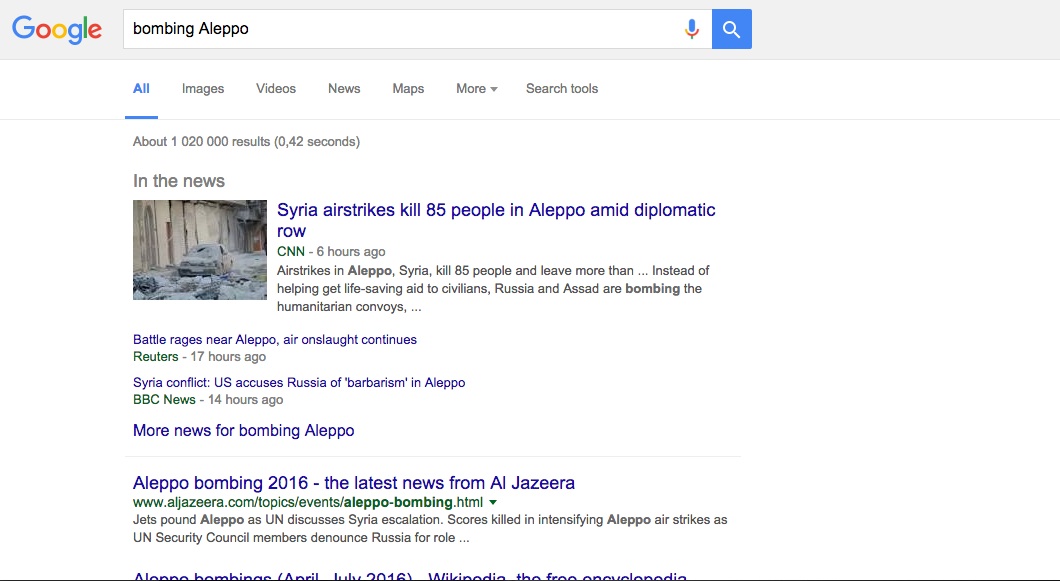
The relative paucity of Russian media coverage of the Syrian conflict and publicly accessible grassroots reactions was confirmed by the following completely unscientific Google search.

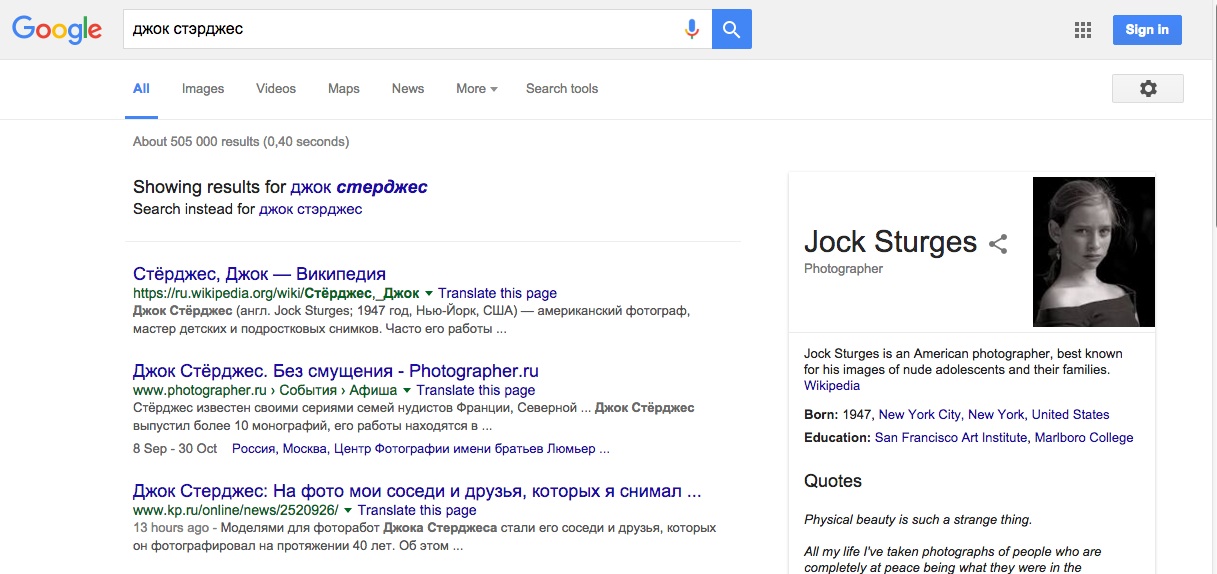
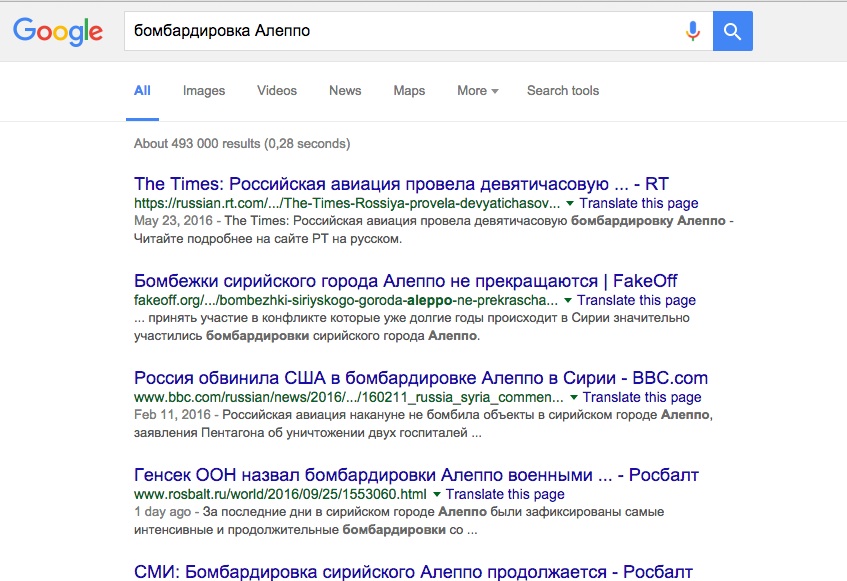
“Джок Стержес” (“Jock Sturges”) got 12,000 more hits than “бомбардироква Алеппо” (“bombing Aleppo”), even though, one could argue, the bombing of Aleppo by somebody or other has been a more topical item in the news for a longer time than Jock Sturges, whatever his longevity or virtues as a contemporary artist.

Results of Google search for
Results of Google search for “Jock Sturges” in Russian, September 26, 2016
Results of Google search for
Results of Google search for “bombing Aleppo,” in Russian, September 26, 2016

When I did the same search (“bombing Aleppo”) in English, I got over a million hits.

Results of Google for
Results of Google search for “bombing Aleppo,” in English, September 26, 2016

Certainly, we immediately have to factor in the sheer numbers of Anglophone media and readers in the world. There are quite a few more of both than there are Russophone media and readers, and so one would expect to find more responses to particular topics of global interest in English than in Russian.

But what about the vox pop?

An even more unscientific survey of the Russophone segment of Facebook this morning (that is, the part of the segment to which I have access, amounting to several hundred people, most of whom could be identified as intelligentsia or quasi-intelligentisa) showed that quite a few people were up in arms over the Sturges show or coolly editorializing about it to their extended communities of invisible friends, while literally no one was writing anything about Syria.

This has been the case for the past year. Not only that, but I have shared a fairly large number of articles and opinions about Syria, including my own, over that time, and have elicited a total of zero likes and comments from my Russian Facebook friends.

Non-Russian friends, on the contrary, like and comment on these posts in the same numbers as they and their Russian counterparts usually react to the other, non-Syrian things I write about.

Maybe I have the wrong Russian friends, but my hypothesis is that “politically engaged” or “socially conscious” Russians are literally afraid to say or write anything in public about the Syrian conflict. They have the good sense to know that their president-for-life has sunken his teeth into this geopolitical chew toy and has no intention of unclenching them.

Hence, anyone foolish enough to comment on this catastrophic attempt to reassert an increasingly impoverished country as a super power might get themselves in trouble with the powers that be. Over the last year, they have been hauling in utterly ordinary people  on “extremism” charges in fairly large numbers for reposting or commenting on the most innocuous things on Facebook and its Russian equivalent, Vkontakte.

Even more telling, there has not been a single public demonstration in Russia against Russian military involvement in Syria during the past year—to my knowledge, at least.*

Again, this has to be taken with a grain of salt. The current Russian regime has gone out of its way to make public demonstrations and pickets an unattractive pastime for all but the bravest of Russians.

Still, the war in Syria is the central international conflict of our time, and Russia’s best and brightest have literally nothing to say about it, even though their nominally elected government has not been merely a party to the conflict, but has come firmly down on one side, arguably, the wrong side, the side causing the most damage.

I find this deafening public silence about Syria more disturbing than anything else happening in Russia right now.

* After I posted this, Comrade BN wrote the following to me: “In Moscow last year there were some very small pickets protesting against the war in Syria, and the people who organized it attempted to set up an anti-war committee. As far as I know, though, the authorities pretty much intimidated them with varying degrees of extremity into giving up.”