Despite the fact the breakdown of the ceasefire achieved through the mediation of Russia and the United States was preceded by systematic ceasefire violations on the part of the opposition, to which Russian Foreign Minister Sergei Lavrov drew the attention of his western counterparts, the initiators of the emergency meeting of the Security Council tried to emphasize violations on the part of Damascus.
[…]
Given the abruptly increasing pressure from the West, the opposition, which the West calls “moderate,” has also delivered a new blow to Moscow’s peacekeeping efforts. A communiqué by the National Coalition for Syrian Revolutionary and Opposition Forces, which unites thirty groups, states that, “as a sponsor and partner of a regime committing crimes against our people,” Moscow’s further mediation is unacceptable.
In this situation, Vitaly Churkin, Russia’s permanent representative to the UN, was forced to admit for the first time, during the Security Council meeting, that a return to peace in Syria had become an almost impossible task.
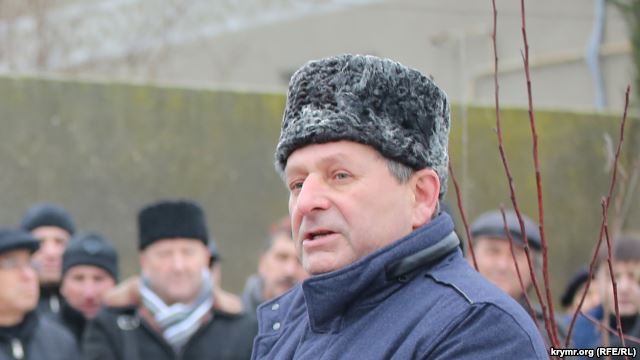
Ahtem Chiygoz, a member of the Mejlis of the Crimean Tatar People who has spent the last year and a half in jail on trumped-up charges of “organizing rioting” and “destruction of property.” Photo courtesy of 112 UA and RFE/RL. See the second article, below, for details
FADN Called on to Protect Ethnic Russians
Irina Nagornykh Kommersant
July 27, 2016
Nine percent of Russian citizens feel they are discriminated against ethnically. In some regions, for example, Tuva, such citizens constitute as many as twenty-six percent, and they hail from the Russian-speaking population. These figures were arrived at by pollsters commissioned by the Federal Agency for Ethnic Affairs (FADN), Igor Barinov, the agency’s head, said yesterday at the Terra Scientia camp. Barinov promised to protect the ethnic Russian population in such regions, and said next year the agency planned to earmark 170 million rubles [approx. 2.3 million euros] on grants for projects in the field of interethnic relations.
Barinov cited the results of a сlassified Georating survey conducted by the Public Opinion Foundation (FOM) while speaking to young people at the Terra Scientia Russian Education Youth Forum on the Klyazma River on the last day of a session that brought together young experts in the field of interethnic relations. According to Barinov, the poll was conducted in June at the FADN’s behest. Pollsters discovered that, on average nationwide, nine percent of the population experienced ethnic discrimination. In certain regions, however, such as Karachay-Cherkessia and Tuva, the situation was more tense. In Tuva, twenty-six percent of citizens complained of ethnic discrimination.
According to Barinov, the number coincided with the number of Russian speakers resident in Tuva, which means we can assume it was this segment of the population who felt they were ethnically discriminated against. Barinov was asked who would protect the interests of ethnic Russians. According to some young people in the audience, ethnic Russian were not as well organized in defending their interests as other ethnic groups in Russia. Barinov cited the fact that 115 million ethnic Russians resided in the Russian Federation, which constituted eighty percent of the country’s population, and in places where the ethnic Russian population predominated, as in Central Russia, this assistance was social and economic in nature. But in regions like Karachay-Cherkessia and Tuva, he promised to protect ethnic Russians.
“We have the authority,” he stressed.
Responding to the same question, Magomedsalam Magomedov, who oversees ethnic relations in the presidential administration, said the “Russian people’s historical mission [was] to unite Russia’s ethnic groups,” and the outcome was the “emergence of a unique civilization whose national leader is President Vladimir Putin.”
“None of the ethnic groups in Russia can feel good if the Russian people feels bad,” concluded to Mr. Magomedov.
According to Barinov, next year the FADN plans to allocate around 170 million rubles on grants for projects in the field of ethnic relations.
“If everything is okay with the budget. We’re at the head of the Finance Ministry’s queue,” he added, reminding the audience that the FADN is awaiting the transfer of the part of the Federally Targeted Program for developing Crimea that concerns the rehabilitation of ethnic groups repressed during Soviet times.
Campers will receive several grants in the amounts of 300,000, 200,000, and 100,000 rubles to support existing interethnic policy projects in the country’s regions from the camp’s organizers: the Russian Federal Public Chamber, Rosmolodezh (Russian Federal Agency for Youth Affairs), and the presidential administration’s Office for Domestic Policy. Moreover, the FADN plans to summarized suggestions made by the campers on concepts for celebrating National Unity Day (November 4), including the brand Russian Braid, which would weave together all the peoples of Russia, comics about different ethnic groups on buses, video clips in airports, and the project Travel with Purpose, which would involve ethnic youth exchange tourism. Session participants plan to appeal to the present not to limit the celebrations to one day a war, but to declare an entire “year of national unity.”
Translated by the Russian Reader. Thanks to Sergey Abashin for the heads-up
________
Who Is Ahtem Chiygoz? The Story of a Crimean Tatar Political Prisoner
Ehor Vasylyev 112 UA
July 29, 2016
A Case That Will Last for Years
Ahtem Chiygoz was arrested on January 29, 2015, as part of the so-called February 26 case. That day he went to the State Investigative Committee in Crimea for questioning, and in the evening the illegitimate Kyiv District Court of Simferopol sentenced him to three months in police custody.
Chiygoz was charged under Article 212.1 of Criminal Code of the Russian Federation: organization of riots accompanied by violence and destruction of property.
Russia accuses activists of being involved in the “riots” on February 26, 2014, which arose near the Crimean parliament during two rallies, one held by the supporters of Ukraine’s territorial integrity , another, by activists of the party Russian Unity.
Since Chiygoz’s arrest, the Crimean courts have been periodically extending his time in police custody. (The last time it was extended until October 8, 2016.)
From March 8 to March 11, 2016, Chiygoz was a hostage: a so-called judge of the Crimean Supreme Court, Galina Redko, arbitrarily (extrajudicially) extended his time in jail.
In addition to Chiygoz, other Crimean Tatars have been charged with involvement in the “riots”: Ali Asanov, Mustafa Degermendzhi, Eskender Kantemirov, Arsene Yunusov, and Eskender Emirvaliev.
The first two have been in police custody for over a year. Another two men, Eskender Nebiev and Talat Yunusov, have already been convicted and sentenced to probation.
In February 2016, two years after the events, the court decided to re-investigate the case. Chiygoz, Asanov, and Degermendzhi were forced to remain in custody.
On July 20, the preliminary hearing began, but it was closed to the public. The Supreme Court of Crimea proposed to divide the case and try Chiygoz separately from the other defendants.
“There are 80 injured parties and witnesses: the case could drag on for years. The court usually questions one or two witnesses a day,” says one of Chiygoz’s lawyers, Emil Kurbedinov.
An Alien Land
Russian prosecutors accuse Ahtem Chiygoz of acts carried out in Ukraine by a Ukrainian citizen against other Ukrainian citizens. Russian prosecutors have prosecuted only Crimean Tatars.
The prosecution is trying to assert the right of the Russian justice system to react to the February 26 rally, which was allegedly directed against Russian interests. The prosecutor general says Russian Unity had a special permit for holding a rally, while the Mejlis did not have such a document.
In addition to violence during the riots, Chiygoz is accused of destruction of property.
“Unidentified Crimean Tatars rushed into the Crimean Parliament, damaged and destroyed its property in the amount of 9,730 rubles,” claims one of the court documents. However, a few hours after the incident, armed Russians occupied the Crimean Parliament and also damaged property.
Why Chiygoz?
“Ahtem Chiygoz at first took a moderately radical position. The prosecutor’s office called him a man ‘in charge of the Mejlis power bloc.’ In winter 2014, he openly expressed the quite radical position that we should not recognize anything,” noted First Deputy Chairman of the Mejlis Nariman Jalal.
In fact, Chiygoz’s position coincides with the opinion of Ilmi Umerov, who is known as an experienced, fairly moderate politician. Ilmi Umerov is quite close to Chiygoz. They both belong to the Bakhchisarai wing of the Mejlis.
“In 2014, we organized many pickets, along the roads, near the military units. Ahtem was actively involved in organizing these events,” says Umerov.
Chiygoz was warned about avoiding “extremist activity,” and some people even complained about him to the Russian FSB. However, Chiygoz did not stop his work, and a month before his arrest, he attended a meeting between Crimean leaders Mustafa Dzhemilev and Refat Chubarov and Ukrainian President Poroshenko.
“Chubarov had five deputies, and Ahtem was the main one,” Umerov explains.
Dzhemilev and Chubarov were refused entry to Crimea as a part of a Russian plan. The Mejlis should be headed by a collaborator. Ahtem Chiygoz was the main obstacle to implementing this plan.
“The Russians believed that Chiygoz encouraged them to rebel. That was why they decided to remove him. At the same time, Chiygoz has been a ‘show’ victim: do not stick your heads out, otherwise your fate will be the same,” stresses Nariman Jalal.
But the plans to co-opt the Mejlis have failed.
“It was a miscalculation. They thought Chiygoz was a kind of central link. They failed to realize the majority of the members of the Mejlis took the same position as Chiygoz; they did not want to be co-opted,” adds the First Deputy Chairman of the Mejlis.
Chiygoz called upon all Crimean Tatars to harshly boycott compatriots who collaborated with the occupying power.
“Different challenges have befallen our people. And we deal with them with honor! No one can break us with prisons or camps! We are not afraid of searches and arrests! We cannot be fooled by puppets! Crimea will never be without the Crimean Tatars,” Chiygoz has written from prison.
And his name is etched in gold in the history of Crimea.
The original of this article was published, in Russian, by Ukrainska Pravda. I have lightly edited the heavily abridged English translation, above, to make it more readable. TRR
The Apocalypse According to Bastrykin The Head of the Russian Federal Investigative Committee Describes a Russia on the Brink of Disaster Due to 16 Years of Putin’s Rule
Fyodor Krasheninnikov Vedomosti
April 20, 2016
One of the pillars of the current regime is not inclined to see Vladimir Putin’s Russia as a stable country with reputable authorities, and people who are united around them and ready to face any and all tests. This is the conclusion one draws from Alexander Bastrykin’s sensational article.
What is Bastrykin’s Russia like? First of all, it is a country standing on the brink of collapse. Things are so bad that only extraordinary measures, described at length at the end of the article, can save it. If you take the article at face value, you might imagine the enemy’s “hybrid” armies are literally camped outside of Moscow, while in the rear the “fifth column” is blowing up the last bridge, and only a miracle and Bastrykin can save the Fatherland.
However, none of this is surprising, for in the Russia described by Bastrykin, our intelligence services are practically dysfunctional, while their foreign counterparts, especially the Americans, are powerful and omnipresent. Bastrykin literally howls,“It’s time to erect an effective barrier against the information war!” This appeal even serves as the article’s headline. It follows that, until April 18, 2016, there was no effective barrier against enemy propaganda and agitation whatsoever, and Russia’s foes could do literally anything they liked.
The vulnerability of Bastrykin’s Russia is quite easy to understand and not at all surprising, for, according to the article, the country has not been very lucky with its population. Bastrykin’s Russia is populated by two categories of people. The first are gullible and prone to react unreasonably to the most trivial things. The second are unprincipled scoundrels, ready to enlist in any intelligence service, extremist or terrorist organization for money.
The first category cause a lot of trouble. As soon as these excitable simpletons read something on the uncensored Internet, hear an unorthodox take on a story or find out someone does not recognize the outcome of a referendum, they immediately join forces with the second category, carefully recruited by foreign intelligence services, and commence destroying their own country. So the first category should be isolated from everything as much as possible, while the second, obviously, should be isolated physically and, preferrably, have their property confiscated as well.
Bastrykin’s Russia is a permanent victim and helpless puppet in the hands of the US. In Putin’s seventeenth year in power, Bastrykin unflatteringly reports on “the shaping of a pro-American and pro-western so-called non-systemic opposition in Russia, and the spread of inter-confessional and political extremism[.]” The author has nothing to say directly about the president, which is odd in itself, for it transpires that under Putin’s administration all kinds of extremism have flourished, and thousands of Russian citizens have traveled “to areas of heightened terrorist activity [through] Turkey and Egypt, where they travel both directly and through third countries[.]” They do this, obviously, because life is no bed of roses. The rest, as I have already said, are just waiting for someone to stir them up.
What about the president?
“Enough of playing at pseudo-democracy and following pseudo-liberal values,” Bastrykin tells him.
The trouble, it turns out, is he has flirted too long with pseudo-democracy.
Judging by Bastrykin’s article, the upper echelons of powers do not expect anything good from the future and Russia’s people, and are openly readying themselves for a merciless fight against any encroachments on their right to remain in power. The head of the Investigative Committee has issued an explicit warning. Whatever abysses the Russian economy plunges into, whatever misfortunes come crashing down on the heads of its people, any dissatisfaction with the authorities will be interpreted a priori as a consequence of the activity of western intelligence agencies, as extremism and terrorism, and will be decisively crushed. Unfortunately, there is no reason to believe Bastrykin is alone in thinking this way.
Fyodor Krasheninnikov is president of the Institute for the Development and Modernization of Public Relations, Yekaterinburg. Translated by the Russian Reader. Image courtesy of Alexander Vilkin
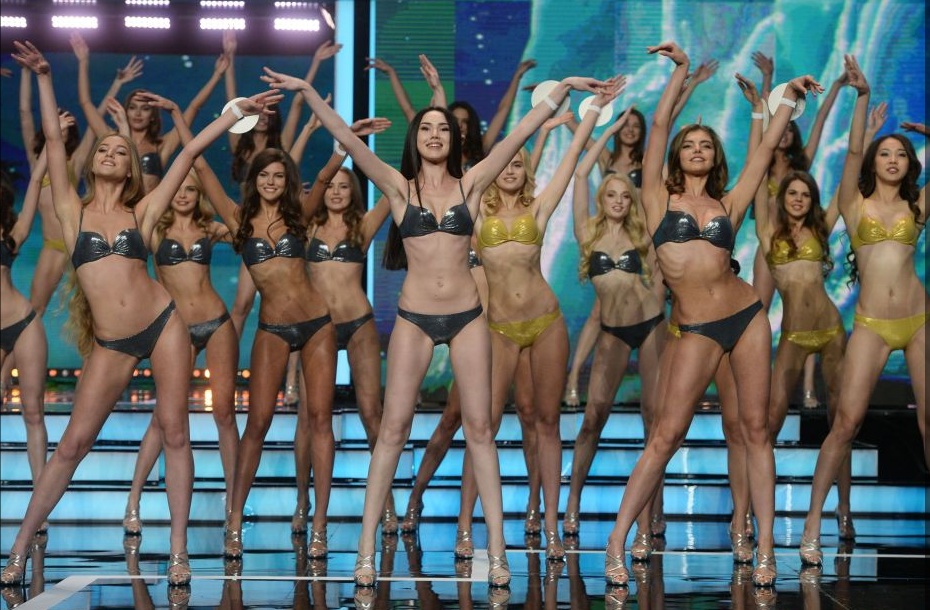
Participants of the national Miss Russia 2016 beauty pageant on the stage of the Barvikha Luxury Village concert hall. Courtesy of Sputnik/Iliya Pitalev
I really like it when a big man in uniform speaks out with fanfare on perennial topics like the structure of society. You think it’s funny they all get Ph.D.s, but they really do consider themselves major theorists and are always willing to teach lessons in wisdom in their spare time. An entire genre has even emerged in Russian newspapers: lessons in political philosophy by generals.
For example, in today’s issue of Kommersant, General Bastrykin casually gives readers an unexpected lesson in democracy.
“For democracy or people power is nothing other than the power of the people itself, realized in its interests. It is possible to achieve these interests only by means of the common good, and not through the absolute freedom and arbitrary will of individual members of society,” he writes.
It must be admitted that this is the pure, unadulterated truth. We might rejoice that democracy in Russia has found a new supporter.
Then, however, Bastrykin the democrat’s argument takes an unexpected turn. He proposes setting things up so that he, Bastrykin, would decide himself what information should be considered extremist, and would limit Internet access without a court order! In addition, he would also decide in which cases providers are obliged to provide him with the personal information of their clients.
There are lots of other tasty tidbits in his article, including innovative tactics for fighting terrorism by confiscating property, but that does not concern us here.
So somebody comes and says, Now I am going to decide who is an extremist and who can read what. You will also be informing me everyone’s personal information. If this is not “absolute freedom and the arbitrary will of an individual member of society,” then what else would you call it?
I am going to have to upset Mr. Bastrykin. Democracy is, in fact, people power. Therefore, the main objective of democratic governance has been and will be preventing the usurpation of power, not defending the people from the machinations of external foes, not hunting down traitors, not surveilling unreliables, but combating usurpers. And so democracy’s main enemy is the guy who comes out and says he is going to decide who the extremists are round here.
The problem with these scholarly generals is that the only form of social organization they are capable of conceiving is the prison camp. And so whether they write about democracy, traditional values or economic progress, the same speech in defense of the prison camp always comes out.
* * * * *
“It’s time to erect an effective barrier against the information war” Alexander Bastrykin, chair of the Russian Federal Investigative Committee, on methods of combating extremism in Russia Kommersant
April 18, 2016
Chair of the Russian Federal Investigative Committee, general of justice of the Russian Federation, doctor of juridical sciences, Professor Alexander Bastrykin, special to Vlast magazine, on the ways and methods of combating extremism in Russia
In 2015, the Russian Federation witnessed negative trends in criminal extremism and terrorism.
1,329 extremist crimes were recorded, which was 28.5% higher than in 2014 (1,034 crimes). A growth in this type of crime was noted in fifty-six regions of the Russian Federation.
The numbers of such crimes as public calls to extremist activity (Russian Federal Criminal Code Article 280) and inciting hatred or hostility, and humiliation of human dignity has soared by nearly forty percent in comparison with 2014.
The crime of organizing an extremist organization was recorded 42 times (+2,4%).
A significant increase (+36.3%) in terrorist crimes committed in the Russian Federation has been noted. A total of 1,538 such crimes was recorded in 2015 (as opposed to 1,128 in 2014).
Seventy such crimes were prevented at the stage of planning or during the attempt. 133 terrorist crimes were committed with the help of the Internet network.
A particularly difficult situation has been observed in the North Caucasus Federal District, which accounts for the bulk of terrorist crimes: 1,168 crimes or 75.9% of all such crimes (leading to an increase of 32.3%). (In 2014, 883 such crimes were committed.)
Both external (geopolitical) and domestic political factors have contributed to the growth of this type of crime.
Over the past decade, Russia and a number of other countries have been living through a so-called hybrid war, unleashed by the US and its allies. The war has been conducted on various fronts, political, economic, informational, and legal. In recent years, it has moved into a new phase of open confrontation.
Professor Bastrykin
The main elements of economic pressure have been commercial and financial sanctions, dumping wars on the hydrocarbons market, and currency wars. Skillfully manipulating the huge number of dollars in circulation, the States have brought down the national currencies of developing countries. Russian organizations have had their access to channels of external long-term financing blocked, channels that formed the basis of investment for developing the real (productive) sectors of the economy. It is noteworthy that restrictions on the movement of financing have not affected short-term financing, which currently has been widedly employed to exert speculative pressure on our national currency. In many respects, the outcome of these measures has been the deep devaluation of the ruble, falling real incomes, a decline in industrial production, and economic recession. There has been a budget deficit and ensuing consequences in the form of cuts in expenditures, as well as an increasing fiscal burden to raise revenues.
Unfortunately, international law and the justice based on it have increasingly become tools of this war.
Obvious examples are the decisions in the Yukos cases, the decision in the murder case of former FSB officer Alexander Litvinenko, the report of the Security Council of Netherlands on the investigation into the crash of Malaysian Airlines Flight 17, the FBI’s investigation of the legitimacy of awarding the right to hold the World Cup to Russia and Qatar in 2018 and 2022, and the extradition of our citizens Victor Bout and Konstanin Yaroshenko to the US and their sentencing to long terms of imprisonment.
However, the information war has caused the most devastating effects. By supporting radical Islamists and other radical ideological tendencies, the US has completely destabilized the situation in the Middle East. The effects of artificially initiated coups, revolutions, and crises in this region are still being experienced by Europe, overrun by mobs of refugees who profess qualitatively alien sociocultural traditions and have displaced the local population. Islamic State, the Al-Nusra Front, Al Qaida, and other terrorist organizations involved in the armed conflict in the Syrian Arab Republic have also been an effect of this policy. Manpower for replenishing these organizations are recruited all over the world, including in Russia.
More than a thousand Russian citizens have gone to the Syrian Arab Republic to participate in the armed conflict. 469 criminal cases have been filed against these persons. 135 of them have been killed in armed clashes with Syrian government troops.
The main channels of entry for Russian citizens into areas of heightened terrorist activity have been Turkey and Egypt, where they travel both directly and through third countries (Georgia, Azerbaijan, Belarus, Ukraine, Moldova) under the pretext of holidaymaking, receiving theological education, doing business, etc.
The main technique of the information war is the manipulation of an ideology that a particular social group finds congenial by radicalizing it. It is clear that the system of religious, ethnocultural, and confessional values is the segment of social existence that defines the most significant feature of any nation (ethnic group) and other such social groups as self-identification. Many of these values were shaped, preserved, and passed from generation to generation for centuries. Therefore, no nation is willing to give up its identity. Perhaps it is the only universal value it is willing to defend with arms and, as they say, until the last drop of blood is spilled.
Aware of the devastating effect of conflicts based on ethnic hatred, the US has bet on this informational element. At the current level of understanding of the issue, it is clear that the subversion of the Soviet Union’s ideological foundations, which were based on the principle of the brotherhood of nations, was also initiated from the outside and based on methods of ethnic strife. It was no accident that in the early 1990s numerous ethnic conflicts (Nagorno-Karabakh, Georgia-Abkhazia, Ossetia-Ingushetia, Transnistria) broke almost simultaneously. At this time, the first mass rallies of nationalist-minded citizens took place in Kiev. In addition, the subversion of state power was carried out by means of anti-Soviet agitation and financing of the political opposition in Latvia, Lithuania, Estonia, Georgia, and other countries.
Of course, in the minds of the local populace, those events were then regarded as local conflicts. However, it is now completely obvious that all these clashes were elements of the initial, as-yet-hidden phase of the information war.
Undoubtedly, the informational-ideological “weapon” will be deployed in the future. This is evidenced by the increase in US government spending on programs for the so-called development of democratic institutions in countries bordering on Russia and in the Central Asian states. The true meaning of these assets becomes clear from the name of this budget item, “Countering Russian aggression through public diplomacy and foreign aid programs, and the creation of stable government in Europe.”
About 4.3 billion dollars have been allocated under his item in 2017, and around a billion dollars will go to programs for the so-called fight against corruption and supporting democracy in countries neighboring Russia.
Funds already received under this program have been spent by by various non-governmental organizations under the guise of promoting education, developing civil society, and other seemingly useful purposes. The outcome has been the incitement of anti-Russian moods in neighboring countries, the shaping of the pro-American and pro-western so-called non-systemic opposition in Russia, and the spread of inter-confessional and political extremism within our country.
Recent events in Nagorno-Karabakh witness to the repeated attempts of forces opposed to Russia to undermine the peace between the Armenian and Azerbaijani peoples and establish yet another hotbed of war on Russian’s borders.
It seems it is time to erect an effective barrier against this information war. We need a tough, appropriate, and balanced response. This is especially relevant in light of the upcoming elections and the possible risks presented by the stepping up of efforts by destabilizing political forces. Enough of playing at pseudo-democracy and following pseudo-liberal values. For democracy or people power is nothing other than the power of the people itself, realized in its interests. It is possible to achieve these interests only by means of the common good, and not through the absolute freedom and arbitrary will of individual members of society.
The following measures can be proposed to counter extremism.
It is extremely important to establish a concept of state ideological policy. Its basic element could be a national idea that would genuinely unite Russia’s unified multinational people. The concept could stipulate specific long-term and medium-term measures, aimed at the ideological education of our younger generation. Conscious resistance to radical religious and other ideologies could knock out the foundations on which current extremist ideologies are constructed. With this protection in place, even the most generous outside financing of destabilizing the situation in Russia will prove useless.
It is also important that youth are regarded by terrorist groups as a natural reserve. From this it follows that everything must be done to seize the initiative, to include young people at risk in the development and implementation of programs for countering armed extremism.
It seems appropriate for the supervisory and regulatory authorities to organize a wide-ranging and detailed verification of the compliance with federal legislation of all religious, ethnocultural, and youth organizations, suspected of engaging in banned extremist activity.
Using the know-how of the Northern Caucasus, we should organize specific and narrowly targeted preventive work with members of informal youth associations in order to adopt measures aimed at procuring information about negative processes underway in the youth milieu and identifying the ideologues and leaders of radical organizations who involved young people in extremist activity.
The positive know-how of the Republic of Ingushetia is also worthy of support. They have established a military-patriotic club that unites the children of law enforcement officers who were killed in the line of duty and children of neutralized members of the bandit underground, which facilitates their rapprochement and shapes an atmosphere of mutual understanding among them.
The proposed concept sees it as expedient to define the limits of censoring the global Internet network in Russia, since at present this problem is causing a heated debate in the light of the stepping up of efforts by advocates of the right to the free receipt and dissemination of information. Interesting in this sense is the know-how of foreign states, opposing the US and its allies. Due to unprecedented pressure from information, they have taken steps to restrict foreign media in order to protect the national information space. Thus, for example, on March 10, 2016, China’s Ministry of Industry and Information Technology introduced a ban on electronic media fully or partly owned by foreign residents. These media will no longer be able to disseminate information through the Internet and, in the best case, by means of print publications. Chinese media will cooperate with foreign online media only with the permission of the ministry. Only Chinese nationals will be able to work in the management of national media. Online media servers can be located only in the People’s Republic of China.
It seems this know-how could be employed in Russia to a reasonable extent.
Internet providers must be furnished with a integrated set of rules for storing the personal information of their clients and users in the right amount in the event that such information is required when investigating cyber security violations.
In public places (libraries, schools, and other educational institutions) with access to the World Wide Web, filters restricting access to sites containing extremist content should be established.
In addition, it seems appropriate to stipulate an extrajudicial (administrative) procedure for including information in the federal list of extremist content and blocking the domain names of sites that disseminate extremist and radical nationalist information. However, if the proprietors of this information do not consider it extremist, they can appeal the relevant actions of the authorized government agencies in court and prove their innocence there. This procedure will enable a faster and more effective response to the promotion of extremism on the Internet. It is necessary to step up work on introducing modern technology for the effective monitoring of the radio waves and the Internet.
It is necessary to expand the range of criminal law measures to stop the illegal actions of terrorist organizations committed on the Internet network involving recruiting. To this end, we should consider the criminalization of possessing such materials, collecting them or uploading them from a computer. Modern evidence technologies make it possible to present to the court and confirm technical elements of intercourse on social networks that testify to the connections between the accused and the relevant electronic messages.
To expose the real aims and intentions of Islamic extremists and establish the insolvency of their theoretical approaches, which contradict the realities of the modern world and the fundamental interests of Islamic countries, it would seem useful for the State Duma to regularly hold special hearings involving experts from the Federal Security Service (FSB), eminent Islamic scholars and authorities, and scholars of Islam. The hearings should be widely covered in the press.
Particular attention should be paid to the migration process. Migrants are often targets of espionage recruiting and radicalization. Many of them have overstayed their limit in Russia, dropping out of the sight of law enforcement. We must analyze the regulatory acts governing the presence of foreign nationals and persons without citizenship in the Russian Federation. Based on our analysis, we should take additional measures for improving the legislation.
It is necessary to improve the work of precinct police with foreign nationals in the realm of monitoring compliance with the established rules of residence in Russia (monitoring of persons letting and renting residential premises in the precinct, and obtaining information about the nature of these persons’ employment). The internal affairs departments of agencies should exclude possible corruption here. Full use of the public’s assistance should be made.
Certain features of extremist activity have taken shape in the Crimea Federal District, where attempts have been made to mold anti-Russian moods, by means of falsifying historical facts and distorting the interpretation of modern events, and call into question the outcome of the referendum on Crimea’s accession to the Russian Federation. This act of the legal expression of the Crimean population’s popular will has become an integral part of Russian constitutionalism. Considering the place of this act in the hierarchal system of values of Russian state and society, it is certainly in need of special legal protection, including by means of criminal legal coercion.
It should be noted that criminalizing the denial or falsification of historical events of particular importance to a state and society is a widespread practice. For example, in many countries, including Russia, criminal punishment is stipulated for promoting fascism. France and a number of other countries have introduced criminal liability for denying the Armenian genocide. The State Duma of the Russian Federal Assembly is considering a similar law bill, No. 938567-6 (“On Criminalization of Public Denial of the Genocide of the Armenian People in Western Armenia and Ottoman Turkey in 1915-1922”). In Israel, it is a crime to deny the Holocaust.
In view of the above, it seems necessary to supplement the notion of extremist activity (extremism) contained in the federal law “On Countering Extremist Activity” with such a manifestation as denial of the outcome of a national referendum. It is necessary to decisively counteract the deliberate falsification of the history of our state. In this connection, we might also propose that Russian Federal Criminal Code Article 280 (public calls for extremist activity) include an additional stipulation, which would qualify the falsification of historical facts and events as a call for extremist activity.
In addition to countering the ideological component of the information war being waged against Russia, it is important to step up efforts to combat financial support for this activity, including tightening control over cross-border capital flows. As experience has shown, terrorism is often financed by virtual cryptocurrency, which has no central issuer, no single point of transactional control, and features anonymous payments. In addition, as a result of their wide dissemination, these currencies can displace legal money from the market, which threatens the state’s financial stability. It is therefore suggested that criminal liability be introduced for the illegal issuance and circulation of cryptocurrency and other money substitutes.
We should also review social security legislation concerning the close relatives of persons involved in terrorism, entitlement to survivor’s pensions, and other benefits. A person who is going to commit such crimes should know that in the event of death not only will he be buried in an unmarked grave but he will also deprive his loved ones of support from the state.
Another measure that would contribute to the effective fight against extremism, terrorism, and other dangerous criminal manifestations is confiscation of property as a form of criminal punishment. As we know, the relevant legislative proposals have been prepared and are in need of speedy legislative implementation. Unfortunately, this process has been unduly delayed.
No less important is improvement of the legal mechanism of international cooperation among law enforcement and other state bodies empowered to counter terrorism and extremism.
Russian law regulates only the procedure for submitting an international request for legal assistance, whereas international acts in this field stipulate the possibility of closer integration, including the establishment of international investigative teams. Such cooperation would help in cases where Russian investigative authorities need to perform a number of investigative procedures or even perform a preliminary investigation in a foreign country and that country has agreed to provide such assistance. This gap became apparent during investigation of the armed conflict between Georgia and South Ossetia in 2008 and the terrorist act committed on board the Russian Airbus 321 over the Sinai Peninsula.
Translated by the Island of Misfit Toys. Thanks to Greg Yudin for his courage.
Kadyrov Is Not Chechnya
Grigory Tumanov Snob
January 26, 2015
Kommersant newspaper correspondent Grigory Tumanov has returned from a trip to Grozny and reports everything you hear about modern Chechnya and its bloodlust is a myth invented by Ramzan Kadyrov
Photo: Dmitry Korotayev/Kommersant
If you said the pro-Ramzan Kadyrov rally, held last Friday in Grozny, was a kind of vote for Kadyrov, you would have to admit it was a failure. It has long been argued the event was meant to hide some of the Chechen leader’s deeper problems, and he had begun to haggle with Moscow not by offering stability in exchange for a free hand, but by offering the explosive situation in the region. But on the ground it turned out all the stories about how, as soon as Kadyrov resigns and loosens his grip, the entire republic would secede from Russia, immediately impose sharia law, and establish a free Ichkeria are a myth.
I remember January 19, 2015, in Grozny: the rally for the Prophet, which had also been organized not without the involvement of the local authorities, to put it mildly. The vast majority of the people at the rally had, of course, never seen any Charlie Hebdo cartoons on the web, the cartoons that sparked the brutal murders of the magazine’s journalists. Despite this, however, from early morning there was a huge traffic jam even on Chechnya’s border with the neighboring republics of Ingushetia and Dagestan. Yes, there were state employees. Yes, ralliers were bussed into Grozny. Yes, there were quotas and roll calls, and prototype placards imposed by the higher-ups, and campaigning in dean’s offices. It is odd, of course, to try and assess the degree to which those people went involuntarily to the Heart of Chechnya Mosque that day, but it should be said they stayed on the square both at twelve o’clock to perform the midday prayer and afterwards.
Several days later, every other car was still sporting a “We Support the Prophet!” placard. It made sense. How, in a Muslim region, would you say no to the question, “Are you going to the rally for the Prophet?” You wouldn’t say it, of course.
“I have not seen the cartoons, but I am a Muslim, so I have no choice but to come out. Rally or no rally, how could I not come out? For some reason you all say we should not be offended by cartoons about something that matters to us. But why should you decide for us? You don’t believe in it!” one rally attendee told me.
It was a conclusive victory for Kadyrov. People really did come out for the rally, driven not only by official lobbying but also by their own indignation. So it was a great way for Kadyrov to announce his candidacy for the post of chief defender of Muslims in Russia.
Photo: Said Tsarnayev/RIA Novosti
Contrary to the official Instagrams posted by Chechen officials and Kadyrov himself, it turned out that the personal pull exerted by the head of the republic was still not comparable to that of Muhammad. The Chechen Interior Ministry reported that over a million people gathered on the squares of Grozny last Friday. This is not true. I stood on the roof of the judicial department of the republic’s Supreme Court and saw with my own eyes that there were hardly 100,000 people in attendance. And as soon as the officials moderating the rally announced it was over, all those one hundred thousand people literally evaporated from the square. It was impressive. I was especially touched by the way that people who were not employed in the state sector proudly said they would not be going to the rally.
“Oh no, I am going to stock up on potato chips and sunflower seeds and plop down on the sofa. If it is a day off, then let it be a day off. No one is going to force me to come out for the tsar,” a private entrepreneur in Grozny told me.
“Maybe we will not be allowed to work on this day, but we are not going anywhere, so if you suddenly feel like some tea, stop by,” the proprietors of a kebab place near the hotel where I stayed told me on the eve of the rally.
While it was true there was no smoke coming from their grills the next morning, all the place’s employees were in fact at work, watching with curiosity as state-sector workers carrying placards shuffled by them on their way to the Heart of Chechnya Mosque.
Yes, everyone with whom I spoke in the crowd on the square spouted off rote phrases about how Kadyrov had raised the republic from ruins, and that he needed support, since Ilya Yashin had launched a real vilification campaign against him. But it was no less impressive to see how people squinted and smiled ironically as they said this, to see placards embossed with slogans about Kadyrov and against Navalny just lying in the flowerbeds after the rally, and how policemen quickly tried to clean them up when they noticed the interest they aroused among photojournalists.
All of today’s Chechnya is a myth invented by Kadyrov. The bloody seriousness and the obsession with sports and Islam are a myth. Another such myth is the stability Kadyrov provides, thus reining in the unbearable craving of Chechens for secession from Russia and terrorism. Talking about politics in the republic frightens everyone, especially talking about politics with reporters. There is the risk you will find yourself on a treadmill with your pants pulled down. Both critics and supporters of the regime agree on the main point, however: the wars are over, the bombing has stopped. However, if you get both critics and supporters to talk, all of them will admit that the choice between nocturnal visits by men in cars with KRA license plates [i.e., marked with Kadyrov’s initials] and Russian bombing raids is not great.
Photo: Dmitry Korotayev/Kommersant
Ruslan has a cafe. If you walk down Putin Avenue and then turn into the courtyards, walk past the houses, go down into a basement, and push the door with a yellow sign featuring a guitar, inside you will find something resembling the Mos Eisley Cantina in the first Star Wars movie. The place is terribly smoky, and there are strange groups of people sitting all round it. Only the drum kit is empty. The alien band that produced the whimsical sounds in the movie has been replaced by a young boy now quite long-windedly showing his support for FC Bayern Munich, whose match is on the telly.
Ruslan was a physical education teacher and was about to get housing in a dormitory when the first Chechen campaign started. On the day Russian forces stormed Minutka Square, he was trying to find bread. Ruslan says he cannot eat supper without bread.
Ruslan also cannot live without the blues. While he never has learned to play the guitar, he knows so many artists by heart it would blow your mind. The cafe is not even a business to him but the chance to live as he likes. Sometimes, friends come to the bar and perform jam sessions, and a bottle of cognac can always be found for regulars.
“Around the New Year it was totally excellent here. Everyone would dance until dawn to Pink Floyd, and they were barely standing when they would go home early in the morning,” says Ruslan.
He understands that even in Moscow a blues cafe is a very niche establishment, not to mention Grozny, but this is how he wants to live.
“I would have long ago earned money from the cafe by showing football matches and letting customers make bets. It is quite profitable, but in Chechnya you are not allowed to engage in bookmaking. It is permitted all over Russia, but here it is forbidden. It is forbidden, and that is that. Why should I regard this as normal?” he says, incensed.
Here it is not the custom to say out loud that there is anything wrong with Kadyrov, but the cafe owner does not like having to choose between war and autocracy.
“Look, no one here has any illusions. By all means, let it be Ramzan and Ramzan. But could they just leave us in peace? I want to work in peace, not to be hassled by anyone. People have nothing to eat, but all day long they show on the telly how Kadyrov went for a sleigh ride, what car he drove and where. It is like a reality show,” says another resident of Chechnya, who has a small business.
For him, the pro-Kadyrov rally was an additional irritant. I do not know whether some good people in Moscow actually explained to the Chechen leader he should not appear before his happy people on Friday or maybe he figured it out himself, but I heard a fair number of jokes about the big theatrical production without the main character on stage.
On the eve of the rally, there were rumors in Grozny that now as never before Kadyrov had to demonstrate people’s gratitude to him, and so the presence of media at the rally that were not subordinate to local authorities was undesirable. Allegedly, the nervousness of the local government had reached such levels that members of patriotic youth clubs had been instructed to seek out federal and foreign journalists in the crowd and prevent them from doing their jobs any way they could.
Ultimately, this did not happen, but such a nervous atmosphere could hardly have arisen if the leader were confident if not in the people’s absolute loyalty then at least in its absolute fear.
Some wonder what to do with the republic’s zombified population when Kadyrov goes. But it turns out that nothing in particular has to be done at all. Kadyrov is not Chechnya, and the Chechens are not the pumped men in camouflage you see in the Instagrams, signed with nicknames ending with the number 95 [i.e., the regional code for Chechnya on Russian license plates].
These are people who are insulted to hear they are wasting Moscow’s money. These are people who are afraid men will come for them in the night. These are people who want to open the kinds of cafes they want to open, and who do not want to stand holding identical placards at eight in the morning instead of going to work, and who do not want war. And what sets them apart from the vast majority of Russian citizens (it has become all the rage lately to oppose the two groups) is that they remember war quite well.
Translated by the Russian Reader. Thanks to Comrade AK for the heads-up. See Sergey Abashin’s recent comment on the same topic, as posted on this website.
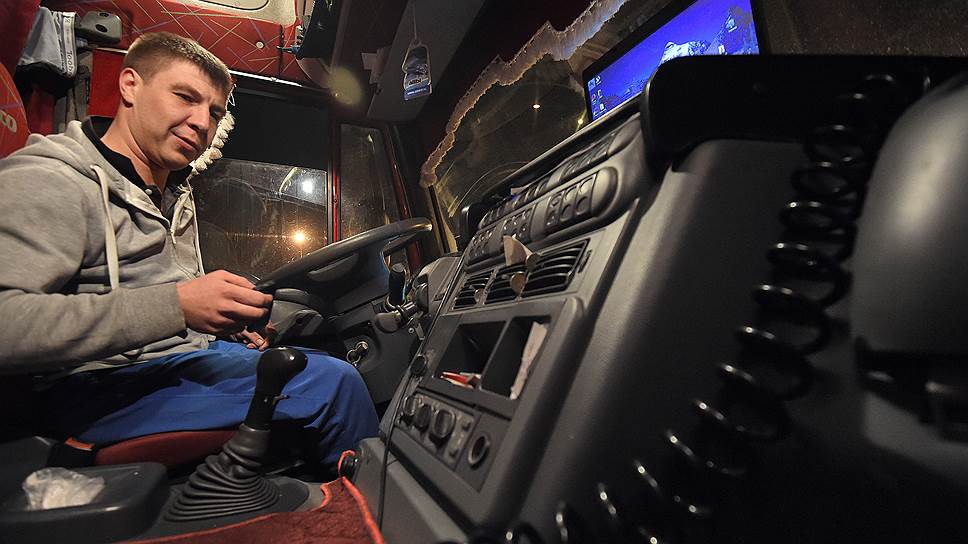
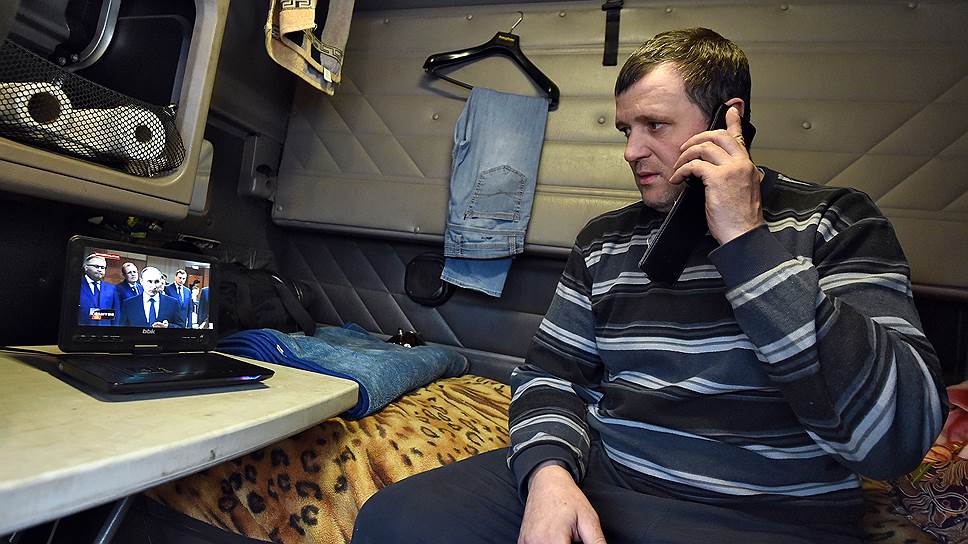
“What is Basil Saying? Where is Oversize Lyokha? And How is Platform Trailer Vadim?” Kommersant Explored How Truckers Are Convoying to the Moscow Ring Road to Protest
Alexander Chernykh and Katerina Shcherbakova
December 3, 2015 Kommersant
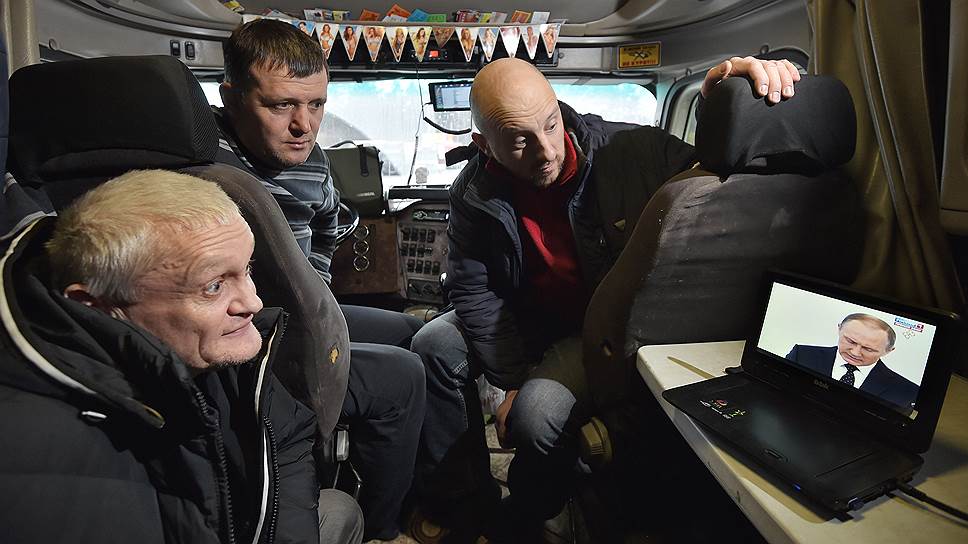
The protests by truckers that have taken place over the past three weeks because of the introduction of the Plato payment system are nearing their climax. On Thursday, drivers around the counters waited for President Putin to mention their problems and promise to get to the bottom of them in his annual Address to the Federal Assembly. When this did not happen, truckers begin forming the convoys that will attempt to travel to Moscow and block the Moscow Ring Road.
The Meeting Place Must Be Changed
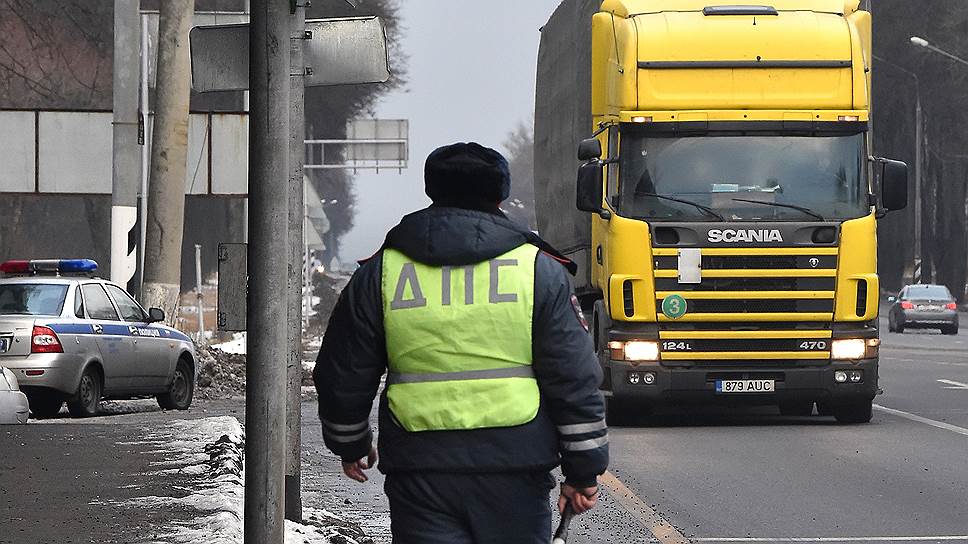
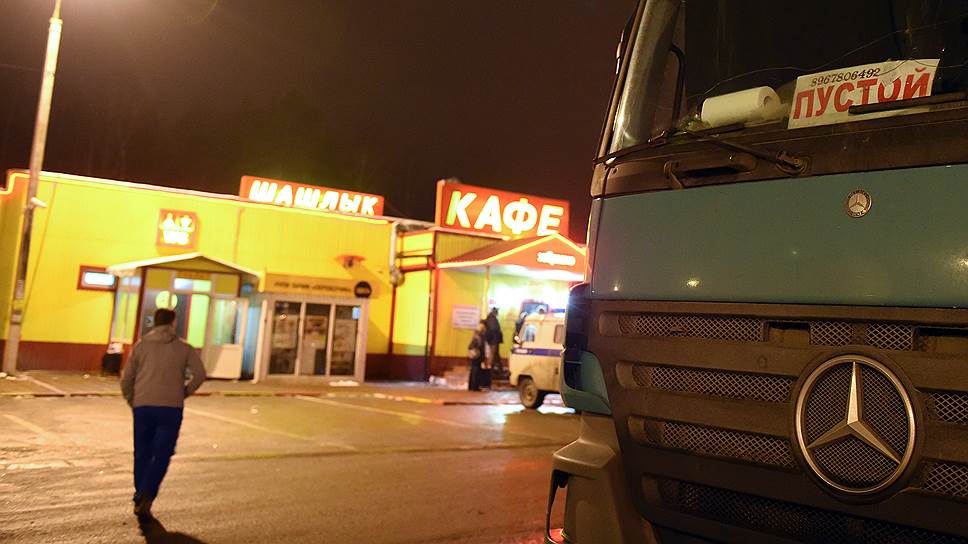
The protesting truckers should have been in Moscow a few days ago, but the traffic police have been successfully countering them all week. Nationwide, traffic cops have been stop suspicious drivers at every post, checking their documents for several hours, looking for explosives or narcotics in their cargo, fining them for not having first-aid kits and fire extinguishers, and simply turning the most active of them around. This has seriously complicated coordination of the protests: several times, police have shown up right at secret meeting places. To learn the location of another such spot, we had to spend two nights in an online dialogue to convince suspicious drivers that we were reliable. Ultimately, our source did send us a telephone number, a contact name, and the address of a small roadside cafe around 200 kilometers from Moscow. We were given strict instructions to not mention the exact location at all over the phone.
When we got there, it turned there was no more need for conspiracy: the drivers had been been made by the police the day before.
“They didn’t even hide,” smiling in amazement, says Viktor, a young trucker from Novgorod the Great. “I had thought I would never notice if I were being tailed. This business is not my thing. But in this case it is all very simple. That passenger vehicle over there arrived after us and has been sitting next to the cafe for a suspiciously long time. Then a Gazelle [light truck or van] with an antenna on its roof parked next to it.”
When the bored drivers decided to go for a ride in a passenger car, the suspicious automobile immediately pulled out behind them, tailed them for the duration of the trip, and then parked in the exact same place. After this, some of the drivers decided to take their trucks to another stop and drove toward Moscow, but within several kilometers they were all stopped by traffic cops, who asked where the convoy of trucks was headed.
“The guys thought they could outfox them. They said they were really going to Petersburg and were just looking the U-turn on the highways,” recounts one of the drivers who has stayed behind. “But the cops told them they would escort them to the regional border. So they traveled with a motorcade.”
Photo: Dmitry Lebedev / Kommersant
A roadside cafe chockablock with truckers is an ordinary sight for those who travel federal highways at night. But this time the setting resembles a black-and-white Soviet film about revolutionary sailors and striking railway workers. Several drivers sit at a table in the corner and noisly discuss where protesters set out for Moscow and where they got stuck. The situation is aggravated by the fact that the protest has no unified leadership, truckers from different cities do not know each other, and communications between individual convoys have to be established right now.
Mysterious phrases break through the buzz of the conversation.
“What is Basil saying?”
“Where is Oversize Lyokha?
“How is Platform Trailer Vadim?”
“He says he has thirty platform trailers behind him.”
“We are confused ourselves,” gaily remarks Viktor to universal laughter. “We are confused about the highways, the days of the week, and about life in general.”
Communication between the convoys is maintained by delegates, trucker drivers who have got behind the wheel of passenger cars to get past the traffic police posts.
“Andryukha traveled to the Don Highway and talked with the groups [of truckers] parked there. In some places there were a hundred trucks, in other places, thirty,” explains Vova, a well-built man in a sweater. “We have to get the lay of the land, to understand how many trucks in all are planning to convoy and what people’s moods are. Meaning the protest movement is looping back on itself. Tonight, everyone should be on the line so that the coordination is tighter the closer we get to Moscow.”
No one knows the exact number of protesters involved, even the date is still under question, but all the truckers know what they have to do: get to the Moscow Ring Road on Saturday, get into the far right lane, and reduce speed to the minimum allowed.
“Picture this. At the same time, we drive onto the ring from different directions and take up positions in our rightful lanes, one and two,” describes Vova, his eyes blazing. “And our Moscow activists switch to passenger vehicles and driver alongside us in lanes three, four, and five. You thus end up with a giant snail: five lanes on the Moscow Ring Road in both directions. And in Moscow, two such snails are enough for everything to short circuit and grind to a halt,” he says, smiling proudly.
The truckers do not know what they will do next.
Heavy Duty Arithmetic
The date when the snail was to crawl on the Moscow Ring Road has been postponed several times. Now the truckers have seemingly come to a final agreement. On Thursday (December 3, 2015) at noon, they will watch President Vladimir Putin’s speech to the Federal Assembly.
“This whole time, nobody has reported about us and our demands, neither Channel One nor NTV,” Victor says with resentment in his voice. “Only the Internet has written about us, but radio and TV have been silent. We are waiting for the address in order to see whether Putin knows about the problem or not, whether he intends to do something or whether we are ‘uninteresting’ to him.”
“I think he doesn’t decide such issues. It is all done for him. Well yeah, the Rotenbergs are his friends. But the law was passed while Medvedev was still president, and he signed this ‘rubbish.’ Maybe Putin just does not have all the information,” says a young driver, a little haltingly.
Photo: Dmitry Lebedev / Kommersant
“Personally, I am fed up with this uncertainty,” wearily says a very thin young man with close-cropped hair as he approaches the table. He is Alexander, a convoy delegate who recently returned from Rostov. It is evident he can barely stand on his feet from lack of sleep, but he shakes hands with everyone and sits down at the table.
“Putin should say it clearly: pay, guys. That is what we have decided and we are not going to change it. It would be good if he came out to the people and told them straight in the eye.”
“And then what?”
“Then I’ll sell my truck, pay off my loans, and go live in some other country.”
Currently, Plato charges 1.53 rubles per kilometer, but beginning in March of next year this rate will double, to 3.06 rubles per kilometer. Self-employed truckers are completely certain that the new toll system will bankrupt them within a few months. To prove this, they discuss their incomes and expenses in detail, citing figures.
“Well, look. A freight run between Petersburg and Moscow costs 36 to 40 thousand rubles. This is considered a very good rate for a round-trip run,” says Viktor. “But almost 20 thousand rubles of this sum goes for fuel. The exact figure depends on the truck. European trucks use less fuel; American trucks use more. Russian trucks use even more.”
On the road, truckers need to fuel up themselves.
“You can see yourselves what the prices are like in the cafes. You go into eat and you spend no less than 300 rubles, sometimes a whole 500 rubles. You run up a food bill of no less than two or two and half thousand rubles during a run.”
A run lasts from three to five days. Moscow is closed at night to trucks, so they often have to idle on the approach to the capital.
“As a result, I have one, at most two runs a week,” says Viktor. “Excluding fuel and food I make 16 to 18 thousand rubles per run. And that is if nothing has broken down on the road. It can happen that you run over a piece of metal and burst a tire. Then you hand over that 18 thousand for repairs. You haven’t been home for an entire week, and you show up with no money.”
In addition, there are monthly expenses on routine maintenance of the truck—topping up the oil, making small, preventive repairs—whose costs come to about 20% of the fuel consumed over a month.
“I also pay 40 thousand a year in motor vehicle taxes,” the drivers says, bending his fingers. “Plus around six thousand for insurance. And I am registered in Novgorod Region, where the rates are tiny. Vovka pays twice as much in Leningrad Region.”
Vovka nods in agreement.
“And there is the excise tax for fuel, seven rubles a liter,” continues Viktor. “And I also have to pay for vehicle inspection, tire replacement, and all expendable supplies. We all here are just barely earning the minimum, and they are trying to finish us off with a new tax.”
According to Viktor, he puts between 100,000 and 150,000 kilometers a year on his truck.
“Next year, the toll will be 3.06 rubles [per kilometer],” the trucker reminds us. “So I will have to pay at least 400 thousand rubles [approx. 5,500 euros at current exchange rates] to the Rotenbergs. Meaning to Plato.”
Photo: Dmitry Lebedev / Kommersant
The truckers have no idea where they will get the money. Officials at the Ministry of Transportation have tried to persuade them that their wallets will not suffer because their customers will end up paying the difference.
“Yeah, the customer will pay me more, but he will raise his prices. I will go into his store and pay more,” says Viktor, shrugging.
In addition, the Ministry of Transportation has not taken into account the fact that truckers have to run empty for many kilometers.
“I live in Novgorod the Great. It is a small city. We have nothing to transport,” says the trucker. “The largest freight turnover is between Moscow and Petersburg. For me to get to a customer in Petersburg I have to travel 200 kilometers, mileage I pay out of my own pockets. Dropping by home is 200 kilometers there and 200 kilometers back. And so it goes every time.”
“I am from Tver. We have work for a fifth of our drivers at most. Everybody else goes to Moscow or Petersburg,” confirms the man sitting next to him at the table.
“Listen, but even if you are traveling empty, you are still damaging the road, no?” I ask.
The truckers eye me suspiciously. Stating that trucks have negative impact on the road surface is a grievous heresy to them.
“Look at the ring roads in Moscow and Petersburg,” they argue. “Cargo vehicles are forbidden from driving beyond the second lane. So what is the lowdown? In the left lanes, where only passenger vehicles travels, the ruts are much deeper and the bumps bigger than in the lanes where trucks travel.”
“And most importantly, what are we paying for?” asks Alexander. “I traveled though Totma just now, the snow was coming down, and they were putting down asphalt? Right under the snow, can you imagine? And they are demanding money from us for this.”
And yet the drivers point out that Platon will be a blow not just for them but for all of small business. Alexander quietly tells us about a small furniture factory in Saratov owned by three young men his age. The factory used to send three truckloads a day to stores in Moscow and Petersburg, but in recent months, they have been sending three truckloads a week.
“They say that because of the crisis all their supplies have become more expensive,” recounts Alexander. “The parts and the leatherette are from China, their furniture has become more expensive, and people don’t want to buy it at the new prices.”
If the factory now has to pay its driver an additonal five or six thousand rubles for each run, it will simply go bust.
“And it is local people who work there, not Uzbeks. I have talked to them. They make 40 to 50 thousand rubles a month, good money. I went into the cafeteria, and there you can eat for fifty rubles, without a markup,” says Alexander. “Who is going to win if the factor closes and dozens of people lose their jobs? Who wants that?”
“That is why we private drivers are so worried< he says, turning to me. “We see our customers, talk with them, and realize that many of them will just not be able to cope. This road toll will finish them off.”
Photo: Dmitry Lebedev / Kommersant
“Well, what are we all going to do?” Viktor asks angrily from the other end of the table. “My daughter is five months old. My wife is taking care of her and cannot work for now. And my wife has a problem with her milk, she has been underfeeding her. We have been buying dry milk now. A can costs 1,200 rubles and lasts for a week. Figure out how much that comes to for a month.”
“I don’t mean this is such an unbearable amount,” he continues with such fervor it immediately becomes clear that this is big money, why hide it? “But it’s another fifteen hundred for diapers. Then it’s something else, and something else again. Now it’s this Plato,” he says angrily. “What am I supposed to? What are we supposed to do now? Where do we go? To be honest, all we know how to do is drive trucks.”
The other truckers look at him in silence.
An eighteen-wheeler slowly passes the window.
“There is another one driving under the black flag,” someone at the table scornfully utters. “Profiting at our expense, the bugger.”
Due to the fact that some drivers are involved in the protests, there has been a deficit of free trucks in recent weeks. Customers have begun offering two times as much for runs, and many private drivers have gladly agreed to haul their goods. But, in order to save money, they also have not installed the Plato system. The striking truckers regularly ridicule them on CB radio, but they prefer to remain silent.
“Well, so what should we call them?” one of the drivers asks me indigndantl. “Strikebreakers? What kind of breakers are they? They’re out-and-out ‘reptiles’ is what they are!”
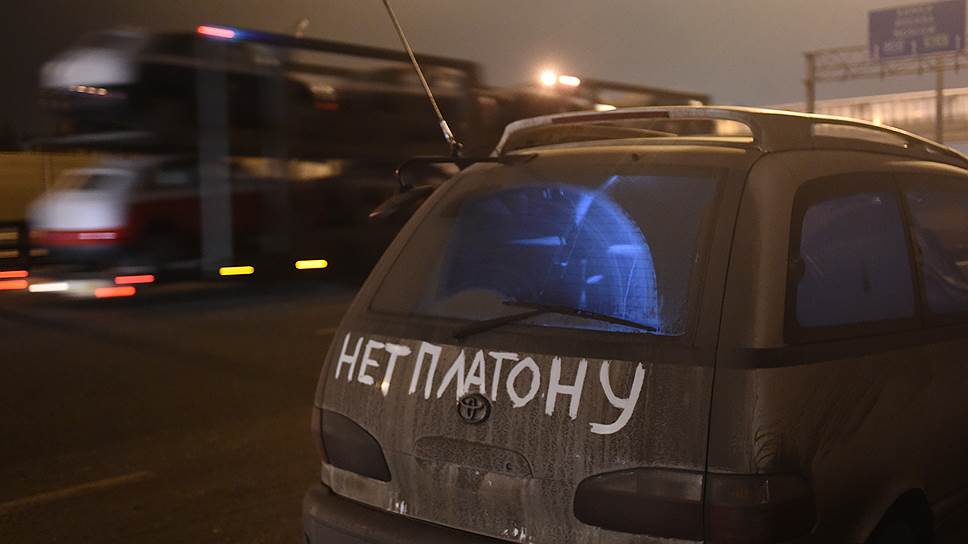
“No to Plato!” Photo: Dmitry Lebedev / Kommersant
Viktor recounts how he recently quarreled with his father-in-law, who is also a truck driver, but said that resistance was useless and installed the Plato system.
“The war hadn’t even begun, and he had already surrendered,” said the driver, outraged. “I told him so. I said, ‘You are my enemy, and I don’t want to know you.”
“You remember how Stalin didn’t free his son from the Germans?” Victor asks unexpectedly. “Well, I thought that if Stalin did not spare his son, then why the hell did I need such a father-in-law. The boys here with me, they are my family.”
The Road to the Moscow Ring Road
Late at night, most of the drivers disperse to their trucks to sleep. Those who are participating as passengers stay up to drink with stringer photographers who have shown up from somewhere. The whole time well-built men drink vodka sourly at the next table. Suddenly, one of them approaches the drivers and screams at a photographer, allegedly, for taking a picture of him. The situation becomes heated instantly. The strangers began pushing and challenging the other men to “come outside and talk.”
“They look like titushky,” says one of the truckers. “We saw them today. They were hanging around that car that has been following us. Now they’ll start a fight, and the cops will show up and detain everyone.”
“No, they’re just drunks,” his comrade disagrees with him. “But it’s unpleasant all the same.”
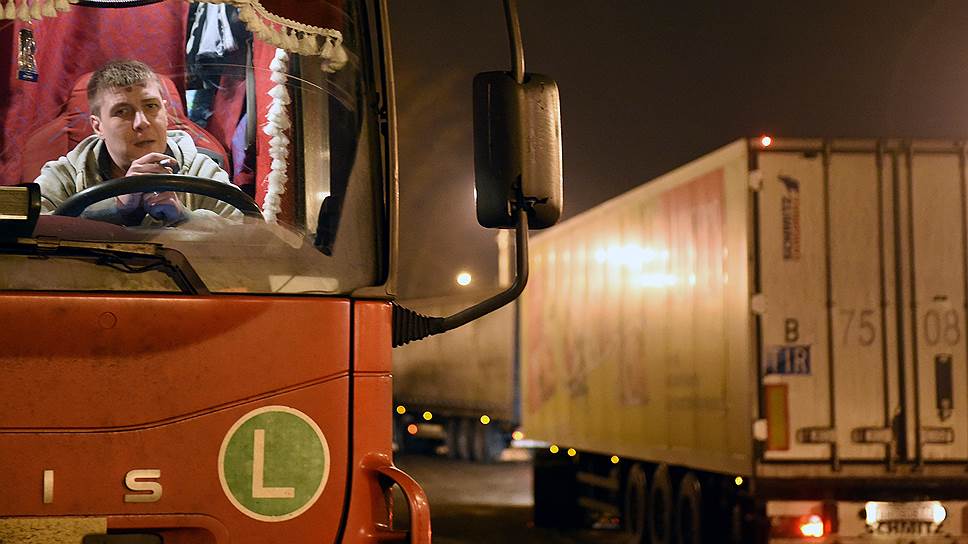
A fight has already begun outside, and the drivers advise all outsiders to leave the cafe until morning. We go to warm up in the truck of Valera, a calm 49-year-0ld man who proudly tells us he has been driving big rigs since 1987.
“Take off your shoes and come in. We’re going drink tea now,” he cordially invites us into the cab of his truck as if it were a flat.
Hearing about the drunken comrades, he shakes his head disapprovingly.
“We are already losing soldiers on the way to Moscow.”
Valera ignites a small burner and puts a tiny metal teapot on it. As the water heats up, we thaw in the warmth and inspect the cab.
Photo: Dmitry Lebedev / Kommersant
“I’ll have to sell the truck now,” the middle-aged driver says softly. “Although who wants it? I’ll get kopecks for it. Yes, it’s old, but I bought it that way on purpose, then repaired it myself. I am good with my hands.”
I ask him why private truckers would rather leave their jobs than work for a haulage company.
“A comrade of mine worked for a company. He made 50 thousand rubles a month,” Valera drily replies. “Only he spent one or two days at home a month. He gets back to Petersburg from a run, leaves his truck at the boss’s lot, gets on a commuter train, rides seventy kilometers, spends the night at home, and in the morning gets a call telling him to come in right away. Is that a life? I cannot take that anymore, I’m too old. And nobody can take it. That is why almost 80% of long-haul drivers are private drivers or tiny individual entrepreneurs who own a couple of trucks.”
We drink hot tea as Valera unfolds the sleeping berth.
“We all realize, of course, that the government suddenly needed money,” he says as we part. “We have got the turmoil in Syria, and missiles also cost money. But MPs should find other reserves to pay for this, not pay for it at our expense.”
In the morning, the drivers sleepily gather for a smoke next to their trucks.
“Policemen approached us last night and warned that everyone would be stopped at the nearest Road Patrol Service post and charged with extremism,” one of them grimly recounts.
“Come on, he was pulling your leg. What kind of extremists are we?” a comrade responds to him incredulously.
“Well, maybe he was kidding, but it is unpleasant in any case,” concludes a third driver.
While the drivers gather in the cafe, where they have planned to watch the president’s speech together, we drive to a Road Patrol Service post.
“We are not looking for any extremism here,” the police commander answers firmly as his subordinates snatch trucks and semis from the stream of traffic with waves of their batons.
“We are just in the midst of Operation Anti-Terror, and we are selectively checking all vehicles,” he explains in an official tone before adjusting a young policeman’s sagging reflective vest and walking away.
The policemen at the post copy down the license numbers and passport details of the truck drivers.
“Are you waiting for the anti-Platonists?” asks one of the policeman, unable to contain himself. “They won’t make it here. They will be stopped before they get here.”
Photo: Dmitry Lebedev / Kommersant
Ten minutes before the start of the broadcast, the drivers suddenly change their location and drive a couple of kilometers to the next cafe, where about a dozen truckers are already sitting. The drivers silently listen to the president. They refrain from commenting on his speech, but with each passing minute they lose more and more interest in it. When the head of state begins talking about the problems of villagers, the drivers start telephoning their comrades and discussing different routes to Moscow.
Counting the Ships as They Sail Past: Rikhard Vasmi at K Gallery
Pavel Gerasimenko
March 11, 2015 Kommersant
Over the last few years, Petersburg’s K Gallery has been closely focused on late twentieth century art. The newly opened Rikhard Vasmi retrospective ranks among these exhibitions. It is the first representative, monographic show of the artist’s work since his death in 1998. Featuring around 200 paintings and drawings, mostly from private collections, the show would hardly have been possible to mount during Vasmi’s lifetime.
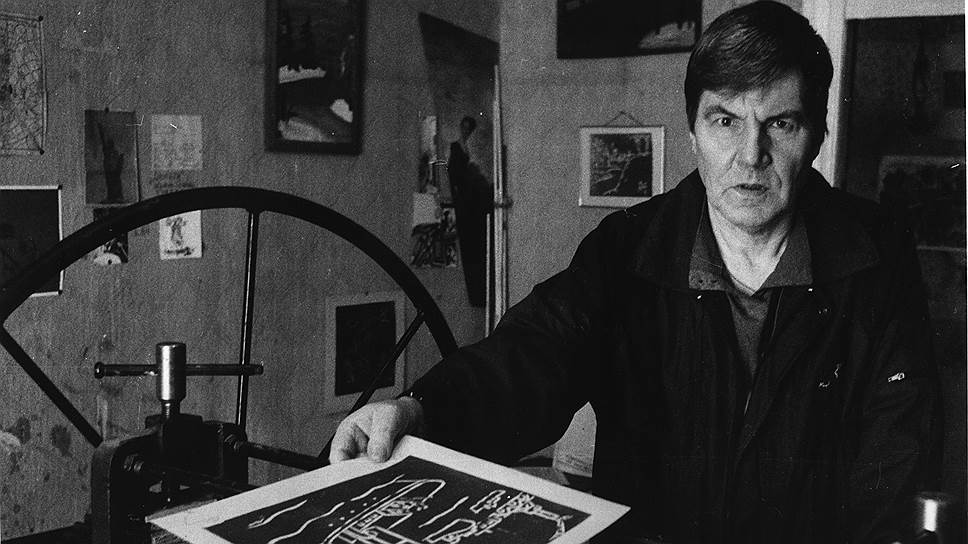
Rikhard Vasmi. Photo courtesy of K Gallery
Vasmi was notorious for the fact that even when he was already counted among the greats of contemporary art, he was reluctant to sell his work and had an extremely negative take on all forms of public permitted activity, regarding exhibitions as a fall from grace for artists, whose job was to paint pictures and work without interruption. Neither then, during his lifetime, nor now has there been anyone else in Leningrad-Petersburg art who thus imagined the artist’s vocation and place in the world. And yet Vasmi was not a sociophobe in the modern sense of the word. He combined a certain standoffishness with a sense of humor and noble manners. It was just that the man had a firm understanding of what mattered most and what was secondary. He knew his worth and did not want to waste his time.
The universally familiar and still encountered type of the landscape painter, easel in tow, might be dubbed a “cold” artist. Rikhard Vasmi was literally such an artist. For the greater part of his life, he earned money through physical labor, was very poor, and was used to getting by with the simplest things. He was one of those who had earned his right to a consistent nonconformism pushed to the limit.
At the turn of the 1950s, Vasmi and several other very young artists —Alexander Arefiev, Vladimir Shagin, Valentin Gromov, and Sholom Shvarts—formed a group they called the Order of Unsellable Painters. The group was bound by close friendship, joint sketching trips, flânerie, and conversations about art. Another member was their mutual friend the poet Roald Mandelstam, who died in 1961. Mandelstam’s poetic images are literally reprised in Vasmi’s paintings: “The evening air is plangent and clean, / The whole city is stone and glass, / Through the blue, blue lane / The sky has flowed into the plaza.”
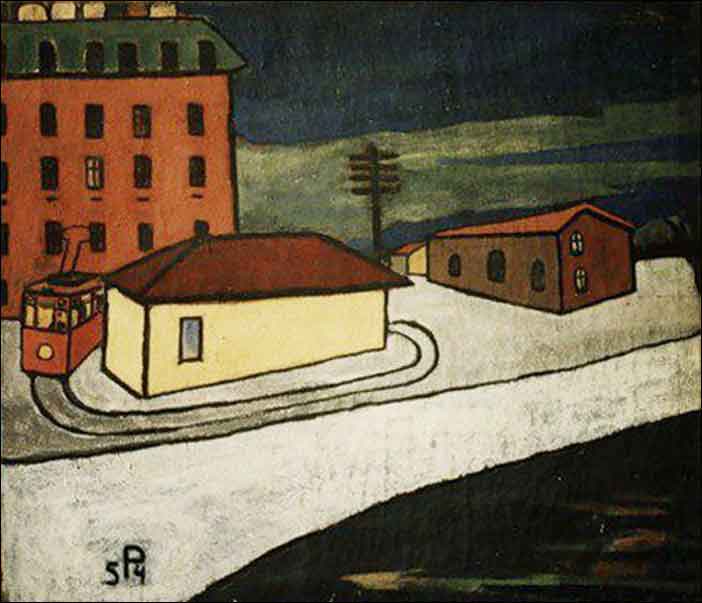
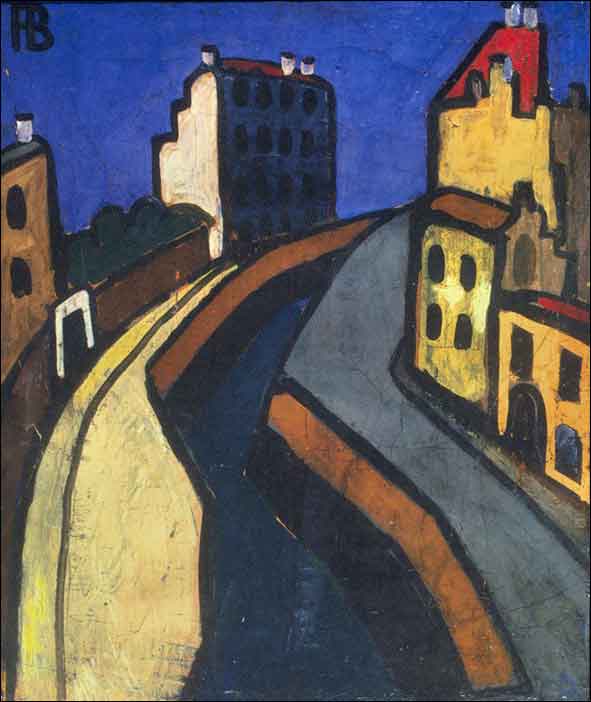
Rikhard Vasmi, Tram Turning Loop, 1954. Image courtesy of art-spb.info
A decade after the Nazi Siege of 1941–1944, Leningrad was still a postwar city. The facades of buildings were chipped, the central districts still had wood sheds to complement the stove heating in the houses, and a completely rural way of life reigned in the outskirts. And even later, when urban renewal came into its own, and new large stone houses emerged, they would still be interspersed for a long while to come with barracks and allotment gardens in outlying areas like Rzhevka and Piskaryovka.
Along with the inner Petersburg district of Kolomna, these were Vasmi’s stomping grounds. It was in these places that the artist produced landscapes that beg the epithet “metaphysical.” But they bear only a superficial resemblance to Giorgio de Chirico’s paintings as they were the product of natural observations made outdoors.
You will not find a work larger than half a meter in Vasmi’s oeuvre. Small formats were a clear token of the period’s unofficial art, but while in Moscow a painting had to be made to fit into the suitcase of a departing diplomat or journalist, in Leningrad it was just hard to secure art supplies without being a member of the official Union of Artists. Vasmi painted in tempera on cardboard and plywood; later, in the 1970s, he often used oil paints.
Vasmi cannot be confused with anyone else, but the significance of his utterly simple visual language changed over the years. The naive manner of the novice painter in the 1950s, who sought maximal contact with reality, has a different meaning than the absolute artistic freedom that ensued in the mid 1970s, when Vasmi produced his pictorial formulation of Petersburg space. The dense surface of his paintings, the way the paints are applied, always leave one with a “house painterly” feeling.
One of the most famous and impressively sized canvases at the show is Canal, dated 1956. The artist has depicted the Griboyedov Canal from a viewpoint unimaginable in reality: the cityscape is seen through the eyes of someone floating in the air, apparently, near the domes of St. Nicholas Cathedral. The painting is heavily cracked, but this is not craquelure, attesting to the piece’s age and thus somehow elegant; here, large chunks of the paint layer resemble cracked sheets of ice, rendering the work even more monumental.
Rikhard Vasmi, Canal, 1956. Image courtesy of art-spb.info
Like his work, Rikhard Vasmi was unhurried, taciturn, laconic, and monumental. All his life he loved watching the ships, and his art conveys the feeling of Petersburg as a maritime city, a feeling found in the work of Leningrad artists of the 1930s, who had reimagined the work of Albert Marquet in their own way. What does the juxtaposition of red-brown and dark blue colors, so frequent in Vasmi’s works, mean? For a Petersburger, it is a rusted ship’s hull in the waters of the Neva, the blank firewalls of houses in Kolomna at sunset—everything that Vasmi’s paintings so clearly and simply depict.
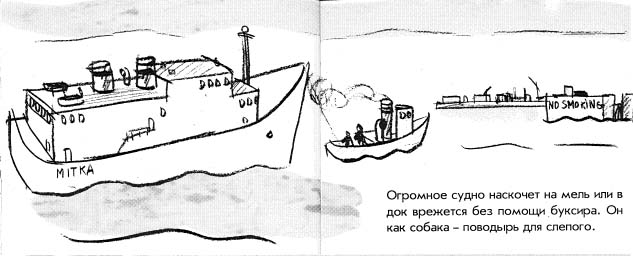
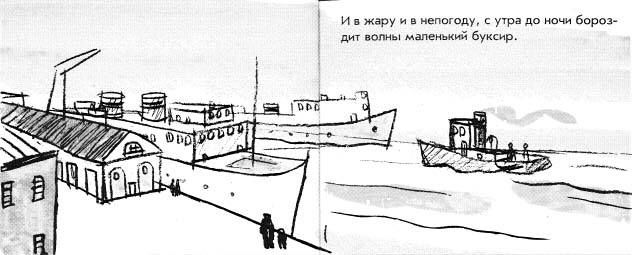
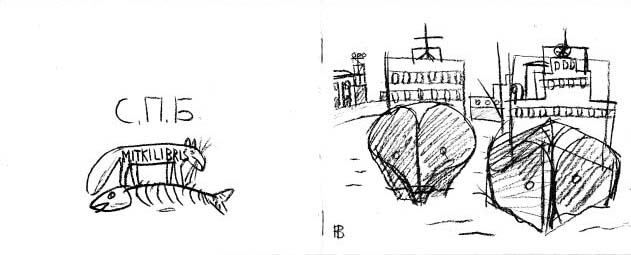
Rikhard Vasmi, We Work in the Port (Mitkilibris, 1994)
On May 16 (27), 1703, on Hare Island, known to the Swedes as Lust Land (Pleasure Land), a “fortress was founded and called Sankt Pieterburch.” (From the Encyclopedia)
The little tug does a big job. In the shallow water, crowded with all sorts of ships, it is indispensable.
The excellent crew of skillful sailors has no time for chitchat. Meeting and seeing off giant ocean liners is all in a day’s work.
Without help from the tug, the huge ship would run aground on a sand bar or crash into a dock. The tug is like a guide dog for a blind man.
In the heat and in rough weather, from morning till night, the little tug crisscrosses the waves.
We Work in the Port, written and illustrated by Rikhard Vasmi, was printed in an edition of one hundred copies by Mitkilibris in Saint Petersburg in 1994. Translated by the Russian Reader.