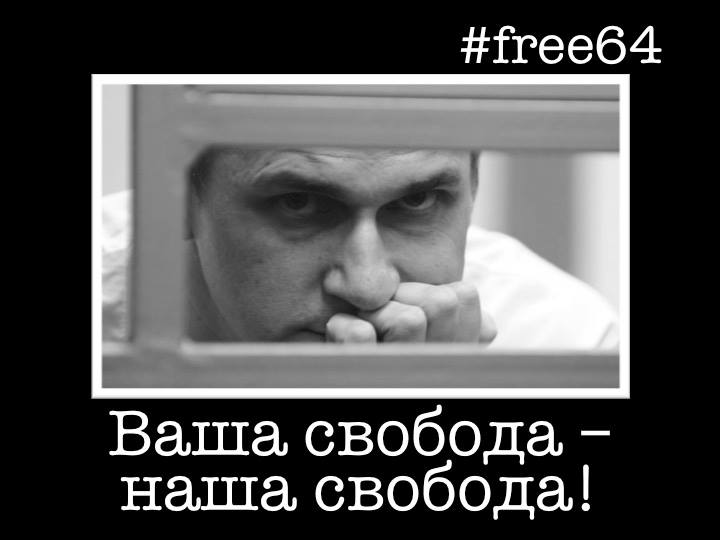
#free64

sentsov-free 64

The logo, above, was designed by the fabulous Petersburg activists Grigory Mikhnov-Voytenko and Natalia Sivohina, who had it printed on t-shirts.

You should do the same.

The slogan on the bottom reads, “Your freedom is our freedom.”

“64” refers to the number of Ukrainian political prisoners currently incarcerated by the Russian Federation. (Although there are claims that the Kremlin has imprisoned 69 Ukrainian political prisoners.)

Ukrainian political prisoner and filmmaker Oleg Sentsov, who is currently serving a 20-year sentence of trumped-up charges in a maximum-security prison camp north of the Arctic Circle, has been on an indefinite hunger strike for nearly three weeks. His only demand is that the Kremlin release all the Ukrainian political prisoners it has in captivity.

So, as some of Grigory and Natalia’s interlocutors suggested on Facebook, the hashtag could read, “#Free64_SaveSentsov.”

In any case, if you write to them via Facebook, they will be happy to send you the full-sized file of the logo for printing on t-shirts, cloth bags or any other convenient, publicly visible surface.

sentsov-sivohinaGrigory and Natalia modeling the Oleg Sentsov solidarity t-shirts they designed. Photo courtesy of their Facebook pages. All of progressive humanity should be wearing t-shirts like these to bring attention to Sentsov’s struggle against the Kremlin.

The Conscience of Petersburg, The Conscience of Ukraine

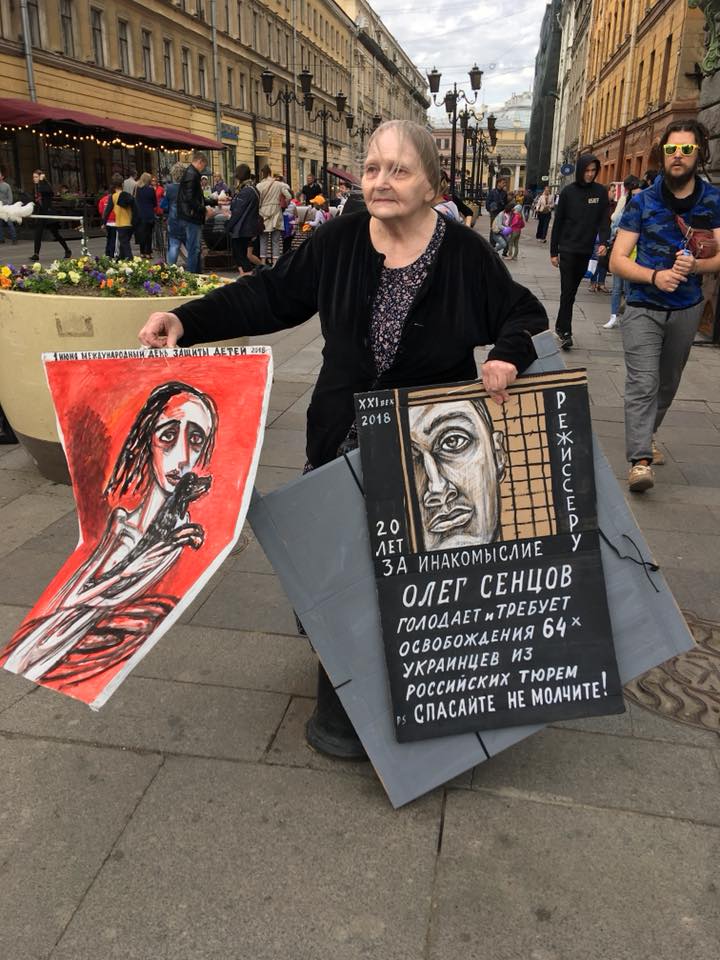
osipova-sentsov-nevsky-1 june 2018Artist Yelena Osipova, protesting on the corner of Nevsky Prospect and Malaya Sadovaya in Petersburg four hours ago. Her placard reads, “2018, the 21st century. A filmmaker gets twenty years [in prison] for dissidence. Oleg Sentsov is on hunger strike. He demands the release of sixty-four Ukrainians from Russian prisons. Save him. Don’t be silent.” Photo by Yekaterina Bogach. 

UPDATE. Yelena Osipova was detained by police two hours later. Grigory Mikhnov-Voytenko captured the arrest on video. Thanks to Comrade Nastia for the heads-up. 

______________________

Fears grow for hunger-striking Ukrainian film director Sentsov
AFP
June 1, 2018

Fears grew on Thursday for the health of Ukrainian film director Oleg Sentsov who has declared a hunger strike in a Russian prison, with a politician who spoke to him via video link saying he appeared unwell and warning “this could end badly.”

The 41-year-old went on hunger strike on May 14, demanding that Moscow release all its Ukrainian political prisoners as Russia prepares to host the 2018 World Cup next month.

Sentsov, a pro-Ukrainian activist and documentary director, was detained in Crimea in 2014 after Russia annexed the peninsula. He was accused of masterminding arson attacks.

Sentsov, who denied the allegations, is serving a 20-year sentence after being convicted on terrorism charges.

Politician and media star Ksenia Sobchak said she spoke to Sentsov in a video call on Thursday and tried to persuade him to halt his hunger strike but he refused.

“I am horrified because I understand that he looks like a man who will go all the way,” she told liberal radio Echo of Moscow.

“And, honestly speaking, this frightened me,” she said, adding that her mother, Lyudmila Narusova, [a member of the Federation Council], helped organize the call to Sentsov’s prison.

“I have a feeling that this hunger strike will end badly,” she said.

“He is very pale, very thin,” she said, adding that his teeth have begun to crumble.

On Monday, Russia’s prison service said Sentsov agreed to “receive supportive therapy,” without providing further details.

The prison service said his condition was “satisfactory.”

Sentsov’s lawyer Dmitry Dinze said on Thursday he had no recent contact with his client but was going to visit him on Monday.

He said the director was stable, but confirmed Sentsov had lost two teeth.

“The climate does not agree with him,” he said, adding that there was no dentist in his prison so teeth have to be pulled out.

Top opposition leader Alexei Navalny, who is serving a 30-day sentence over organising an illegal protest, called on President Vladimir Putin to release more than 60 “Ukrainian political prisoners” including Sentsov.

“His feat, and his sacrifice, and his death will put him on a par with Bobby Sands, (Anatoly) Marchenko, and other titans of humankind,” he wrote on his blog, adding Putin should want to avoid this.

Irish nationalist Sands died in prison in 1981 after 66 days on hunger strike, while Soviet dissident Anatoly Marchenko died in prison in 1986 after a three-month-long hunger strike for the release of Soviet prisoners of conscience.

Zeitgeist Checklist

taste real mexicoA Williamsburg-inspired eatery in snowy central Petersburg, 5 February 2018. Photo by the Russian Reader

It’s remarkable how the MH17 final report and Ukrainian political prisoner and filmmaker Oleg Sentsov’s hunger strike have exacerbated two sad trends among Russia’s left/liberal/creative/academic intelligentsia.

The first trend involves intelligenty out-Putining Putin and his regime’s put-on anti-Americanism by ramping up the number of social media posts and hasbarical hate-a-grams about the US, its sinister machinations, and its signal failings.

This is part of the same operetta in which the nefarious NATO is a greater threat to world peace than a country that reserves the right to invade its closest neighbor and join in crushing a democratic, grassroots rebellion in a faraway country whose people have never harmed Russia in any shape or form.

But it’s no fun talking, much less doing anything, about that at all, because it would require real collective effort. So, depending on your political tastes, it’s much easier, as a Russophone, to hate on NATO or Hamas.

Some Russians go for the trifecta, hating on both “terrorist” organizations, while also indulging in the most satisfying infantile pleasure on our planet today: Islamophobia. You know, Europe has been overrun by Islamic terrorists and that whole tired spiel, which gives such a sense of purpose to otherwise wildly ignorant people who have betrayed their own country and countrymen so many ways over the last 25 or 30 years it should make all our heads spin.

The other trend, which has also kicked into high gear again, is going hipster as hard as you can. There are any number of “projects,” “creative clusters,” eating and drinking establishments, festivals, semi-secret dance parties, and god knows what else in “the capitals” to make the younger crowd and even some of the middle-aged set forget they live in a country ruled by a ultra-reactionary kleptocratic clique that can have any of them abducted for any reason whatsoever at a moment’s notice and charged with “involvement in a terrorist community” or some such nonsense and ruin their lives forever.

That’s no fun to think about it, either, and it’s altogether scary to do something about it, so why not pretend you live in Williamsburg while you can?

The day before yesterday, I translated and posted an essay, by Maria Kuvshinova, about Oleg Sentsov’s hunger strike and the non/reaction to this brave call to action on the part of Russia’s creative so-called intelligentsia. At some point, I thought the essay might be a bit off the mark, but on second thought, despite its obvious quirks, I decided Ms. Kuvshinova had sized up the Russian zeitgeist perfectly.

Post-Soviet infantilism is total. It affects the so-called intelligentsia no less than the so-called ordinary folk. Infantilism means being unable to empathize, being unable to put yourself in another person’s shoes, even if that person is President Putin, a man with a quite distinct sense of ethics, a man who has been studied backwards and forwards for twenty years. Apparently, the message sent to the creative communities through the arrest of Kirill Serebrennikov was not registered. If you want to be a dissident, start down the hard road of doing jail time for misdemeanor charges, facing insuperable difficulties in renting performance and exhibition spaces, becoming an outsider, and experiencing despair. If you want a big theater in downtown Moscow, play by the rules. Like your average late-Soviet philistine, Putin regarded the creative intelligentsia with respect at the outset of his presidential career. (See, for example, footage from his visit to Mosfilm Studios in 2003.) However, a few years later, he was convinced the creative intelligentsia was a rampantly conformist social group who would never move even a millimeter out of its comfort zone and would make one concession after another. A lack of self-respect always generates disrespect in counterparts. // TRR

Maria Kuvshinova: What Sentsov Could Die For

What Sentsov Could Die For
Maria Kuvshinova
Colta.Ru
May 25, 2018
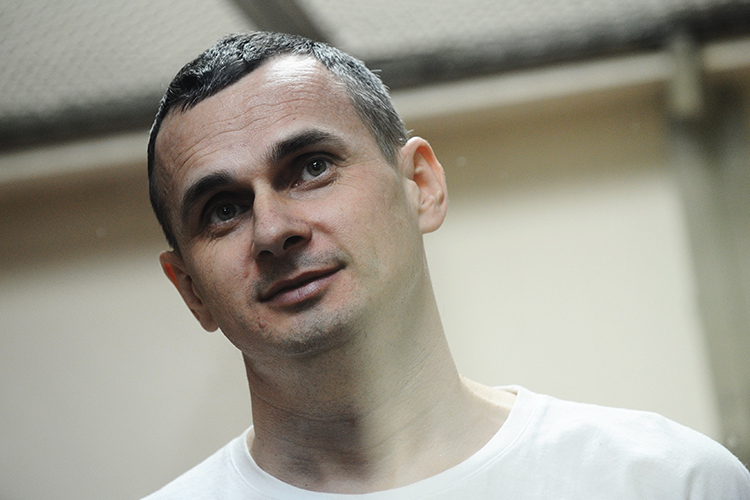
Detailed_pictureOleg Sentsov. Photo by Sergei Pivovarov. Courtesy of RIA Novosti and Colta.Ru 

On May 14, 2018, Oleg Sentsov went on an indefinite hunger strike in a penal colony located north of the Arctic Circle. His only demand is the release of all Ukrainian political prisoners in Russia. According to Memorial’s list, there are twenty-four such prisoners.

In August 2015, Sentsov was sentenced to twenty years for organizing a terrorist community and planning terrorist attacks. The second defendant in the case, Alexander Kolchenko, was sentenced to ten years in prison. Mediazona has published transcripts of the hearings in their trial. Around three hundred people have read them over the last three years. The transcripts make it plain the only evidence of the alleged terrorist organization’s existence was the testimony of Alexei Chirniy, who was not personally acquainted with Sentsov. It is police footage of Chirniy’s arrest while he was carrying a rucksack containing a fake explosive device that propagandists often pass off as police footage of Sentsov’s arrest.

Before his arrest, Sentsov was an Automaidan activist. In the spring of 2014, he organized peaceful protests against Crimea’s annexation by Russia.

“Yesterday’s ‘suicide bomber auto rally’ took place in Simferopol yesterday, but in quite abridged form,” Sentsov wrote on Facebook on March 12, 2014. “Only eight cars, six reporters with cameras, and twenty-five activists/passengers assembled at the starting point. I would have liked to have seen more. Unfortunately, most of the armchair revolutionaries who were invited were afraid to go. The traffic cops and regular police also showed up at the starting line, insisting we not leave for our own safety. We told them our protest was peaceful. We had no plans of breaking the rules, so we suggested they escort us to keep the peace for everyone’s sake.”

The second defendant, Kolchenko, admitted involvement in the arson of an office that was listed in the case file as belonging to the United Russia Party, but which in April 2014 was an office of Ukraine’s Party of Regions. The arson took place at night. It was meant to cause physical damage while avoiding injuring anyone.

The Russian authorities tried to prove both Sentsov and Kolchenko were linked with Right Sector, a charge that was unsubstantiated in Sentsov’s case and absurd in the latter case due to Kolchenko’s well-known leftist and anarchist convictions. Gennady Afanasyev, the second witness on whose testimony the charges against the two men were based, claimed he had been tortured and coerced into testifying against them.

Sentsov and Kolchenko’s show trial, like the show trials in the Bolotnaya Square Case, were supposed to show that only a handful of terrorists opposed the referendum on Crimea’s annexation and thus intimidate people who planned to resist assimilation. The Russian authorities wanted to stage a quick, one-off event to intimidate and crack down on anti-Russian forces. But two circumstances prevented the repressive apparatus from working smoothly. The first was that the defendants did not make a deal with prosecutors and refused to acknowledge the trial’s legitimacy. The second was that Automaidan activist Oleg Sentsov unexpectedly turned out to be a filmmaker, provoking a series of public reactions ranging from protests by the European Film Academy to questions about whether cultural producers would be capable of blowing up cultural landmarks. Segments of the Russian film community reacted to the situation with cold irritation. According to them, Sentsov was a Ukrainian filmmaker, not a Russian filmmaker, and he was not a major filmmaker. The owner of a computer club in Simferopol, his semi-amateur debut film, Gamer, had been screened at the festivals in Rotterdam and Khanty-Mansiysk, while release of his second picture, Rhino, had been postponed due to Euromaidan.

The Ukrainian intelligentsia have equated Sentsov with other political prisoners of the empire, such as the poet Vasyl Stus, who spent most of his life in Soviet prisons and died in Perm-36 in the autumn of 1985, a week after he had gone on yet another hunger strike. The Ukrainian authorities see Sentsov, a Crimean who was made a Russian national against his will and is thus not eligible for prisoner exchanges, as inconvenient, since he smashes the stereotype of the treacherous peninsula, a part of Ukraine bereft of righteous patriots. Sentsov’s death on the eve of the 2018 FIFA World Cup would be a vexing, extremely annoying nuisance to the Russian authorities.

Sentsov is an annoyance to nearly everyone, but he is a particular annoyance to those people who, while part of the Russian establishment, have openly defended him, although they have tried with all their might to avoid noticing what an inconvenient figure he has been. Although he was not a terrorist when he was arrested, he has become a terrorist of sorts in prison, because his trial and his hunger strike have been a slowly ticking time bomb planted under the entire four-year-long post-Crimean consensus, during which some have been on cloud nine, others have put down stakes, and still others have kept their mouths shut. Yet everyone reports on the success of their new endeavors on Facebook while ignoring wars abroad and torture on the home front. Sentsov represents a rebellion against hybrid reality and utter compromise, a world in which Google Maps tells you Crimea is Russian and Ukrainian depending on your preferences. To what count does “bloodlessly” annexed Crimea belong, if, four years later, a man is willing to die to say he does not recognize the annexation?

The success of Gamer on the film festival circuit, which made Sentsov part of the international film world, and his current address in a prison north of the Arctic Circle beg three questions. What is culture? Who produces culture? What stances do cultural producers take when they produce culture? There are several possible answers. Culture is a tool for reflection, a means for individuals and societies to achieve self-awareness and define themselves. It is not necessarily a matter of high culture. In this case, we could also be talking about pop music, fashion, and rap. (See, for example, the recent documentary film Fonko, which shows how spontaneous music making has gradually been transformed into a political force in post-colonial Africa.) On the contrary, culture can be a means of spending leisure time for people with sufficient income, short work days, and long weekends.

Obviously, the culture produced in Russia today under the patronage of Vladimir Medinsky’s Culture Ministry is not the first type of culture, with the exception of documentary theater and documentary cinema, but the founders of Theater.Doc have both recently died, while Artdocfest has finally been forced to relocate to Riga. The compromised, censored “cultural production” in which all the arts have been engaged has no way of addressing any of the questions currently facing Russia and the world, from shifts in how we view gender and the family (for which you can be charged with the misdemeanor of “promoting homosexualism”) to the relationship between the capitals and regions (for which you can charged with the felony of “calling for separatism”). Crimea is an enormous blank spot in Russian culture. Donbass and the rest of Ukraine, with which Russia still enjoyed vast and all-pervasive ties only five years ago, are blank spots. But cultural producers have to keep on making culture, and it is easier to say no one is interested in painful subjects and shoot a film about the complicated family life of a doctor with a drinking problem and a teetotalling nurse.

When we speak of the second type of culture—culture as leisure—we primarily have in mind Moscow, which is brimming over with premieres, lectures, and exhibitions, and, to a much lesser extent, Russia’s other major cities. So, in a country whose population is approaching 150 million people, there is a single international film festival staged by a local team for its hometown, Pacific Meridian in Vladivostok. All the rest are produced by Moscow’s itinerant three-ring circus on the paternalist model to the delight of enlightened regional governors. It matters not a whit that one of them ordered a brutal assault on a journalist, nor that another was in cahoots with the companies responsible for safety at the Sayano-Shushenskaya Dam, where 75 people perished in 2009. What matters is that the festival movement should go on. There is no room in this model for local cultural progress. There can be no free discussion generated by works of art when everyone is engaged in total self-censorship. After I went to Festival 86 in Slavutych, whose curators have been conceptually reassessing the post-Soviet individual and the post-Soviet space, I found it painful to think about Russian film festivals. This sort of focused conceptualization is impossible in Russia. It is of no interest to anyone.

There are two more possible answers to the question of what culture is. Culture is propaganda. Or, finally, culture is only the marquee on a commercial enterprise profiting at the taxpayer’s expense. It is not a big choice, and the kicker is that by agreeing today to be involved in churning out propaganda, milking taxpayers, supplying optional leisure time activities, producing censored works, and colonizing one’s own countrymen for the sake of money, status, and membership in a professional community, the people involved in these processes automatically stop making sense. It is naïve to think the audience has not noticed this forfeiture. It is no wonder the public has an increasingly hostile reaction to cultural producers and their work.

No one has the guts to exit this vicious circle even in protest at the slow suicide of a colleague convicted on trumped-up charges, because it would not be “practical.” The events of recent months and years, however, should have transported us beyond dread, since everyone without exception is now threatened with being sent down, the innocent and the guilty alike.

Post-Soviet infantilism is total. It affects the so-called intelligentsia no less than the so-called ordinary folk. Infantilism means being unable to empathize, being unable to put yourself in another person’s shoes, even if that person is President Putin, a man with a quite distinct sense of ethics, a man who has been studied backwards and forwards for twenty years. Apparently, the message sent to the creative communities through the arrest of Kirill Serebrennikov was not registered. If you want to be a dissident, start down the hard road of doing jail time for misdemeanor charges, facing insuperable difficulties in renting performance and exhibition spaces, becoming an outsider, and experiencing despair. If you want a big theater in downtown Moscow, play by the rules. Like your average late-Soviet philistine, Putin regarded the creative intelligentsia with respect at the outset of his presidential career. (See, for example, footage from his visit to Mosfilm Studios in 2003.) However, a few years later, he was convinced the creative intelligentsia was a rampantly conformist social group who would never move even a millimeter out of its comfort zone and would make one concession after another. A lack of self-respect always generates disrespect in counterparts.

By signing open letters while remaining inside the system and not backing their words with any actions whatsoever, the cultural figures currently protesting the arrests of colleagues are viewed by the authorities as part of the prison’s gen pop, while people who live outside Moscow see them as accomplices in looting and genocide. No one takes seriously the words of people who lack agency. Agency is acquired only by taking action, including voluntarily turning down benefits for the sake of loftier goals. The acquisition of agency is practical, because it is the only thing that compels other people to pay heed to someone’s words. I will say it again: the acquisition of agency is always practical. At very least, it generates different stances from which to negotiate.

Sentsov has made the choice between sixteen years of slow decay in a penal colony and defiant suicide in order to draw attention not to his own plight, but to the plight of other political prisoners. Regardless of his hunger strike’s outcome, he has generated a new scale for measuring human and professional dignity. It is an personal matter whether we apply the scale or not, but now it is impossible to ignore.

Thanks to Valery Dymshits for the heads-up. Translated by the Russian Reader

Comrade to Comrade

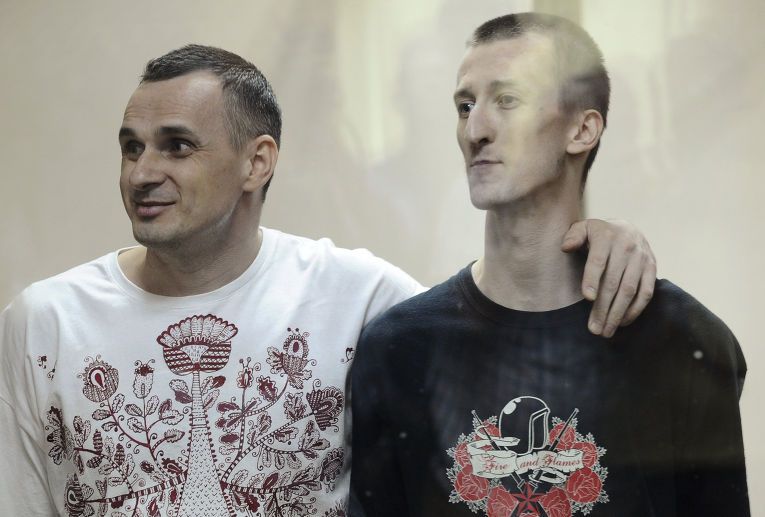
1465990524-5252Crimean political prisoners Oleg Sentsov and Alexander Kolchenko during their so-called trial by a Russian kangaroo court. Photo courtesy of Unian Information Agency

Alexander Kolchenko, Convicted in the Case of the “Crimean Terrorists,” Writes a Letter to Oleg Sentsov
Mediazona
May 22, 2018

Antifascist Alexander Kolchenko, convicted in the Case of the “Crimean Terrorists,” has written a letter to filmmaker Oleg Sentsov, who is in the ninth day of a hunger strike meant to force the Russian authorities to release all Ukrainian political prisoners from the country’s prisons. Mediazona was told about the letter by attorney Svetlana Sidorkina.

According to Sidorkina, Kolchenko was afraid the censor would not pass the letter on to Sentsov, so he gave her a detailed acount of its contents when she visited Kolchenko at Corrective Colony No. 6 in the town of Kopeysk.

“In the letter he wrote that, in his opinion, a hunger strike was an effective means of defense only in cases in which a country valued its reputation. Alexander believes that, in Oleg’s case, Russia could ignore his hunger strike, but not let him die by forcibly feeding and sending him off for a psychiatric examination. Sergei Magnitsky’s death changed nothing in Russia. Instead, the Dima Yaklovev Law was adopted. He did not try and dissuade Oleg, since he knows Oleg is stubborn and does not change his mind. He is quite concerned for his health, since he knows what the climate and living conditions are like in Labytnangi from prisoners he met when he and Oleg were in transit to the prisons where they would serve their sentences. Although Alexander doesn’t agree with Oleg’s method, he respects his stance on freeing Ukrainian political prisoners from Russian prisons and is ready to support Oleg if he needs to,” said Sidorkina.

Sidorkina tried to dissuade Kolchenko from a possible hunger strike by pointing to his health problems and the fact he is underweight. Because of this, he is on a special diet.

Aside from the letter to Sentsov, Kolchenko wrote a letter to Vladimir Putin demanding he intervene in the situation and release Sentsova. Kolchenko, however, was afraid the censor would also prevent the letter from reaching its addressee.

Kolchenko added he had no complaints about conditions in the penal colony. According to Sidorkin, he looked cheerful, but was quite worried about Sentsova. Sidorkina had wanted to show him articles about the Ukrainian filmmaker’s hunger strike, but penal colony staff stopped her from doing so.

In 2015, a court sentenced Kolchenko and Sentsov to ten years and twenty years, respectively, in maximum security penal colonies. According to police investigators, in 2014, Sentsov established a “terrorist community” (illegal under Article 205.4 Part 1 of the Russian Criminal Code). Members of the alleged community supposedly set fire to the doors of the Russian Community of Crimea and the windows of a United Russia Party office. These actions were deemed terrorist attacks, punishable under Article 205 Part 2 Paragraph A of the Criminal Code.

In addition, police investigators insisted members of the alleged “terrorist community” were planning to blow up a monument to Lenin and the Eternal Flame, punishable under Article 30 Part 1 and Article 205 Part 2 Paragraph A. Sentsov was also charged with trafficking in arms and explosives as part of a group, punishable by Article 222 Part 3. Kolchenko was found guilty of involvement in the alleged terrorist community and planning terrorist attacks on the Crimean Peninsula. Both men have denied their guilt.

In the spring of 2016, Sentsov was transported to a penal colony in Yakutia, but in 2017 he was transferred to the White Bear Colony in Labytnangi. In the winter of 2017, the Ukrainian authorities announced they were prepared to exchange Russian prisoners for Sentsov and Kolchenko. On May 14 of this year, Sentsov announced he was going on an indefinite hunger strike to secure the release of all Ukrainian political prisoners in Russia.

Translated by the Russian Reader

“Popular”

32729013_1730140783711212_4715134261416427520_nA selfie taken by elections observer and Golos coordinator David Kankiya in Krasnodar. He writes: “Dear Veniamin Kondratyev [governor of Krasnodar Territory], I would like to know what you think about the fact I was beaten up today and the continuing pressure exerted on political and grassroots activists by law enforcement. This is how you see the region’s image right before the World Cup?”

Vladimir Putin is not “popular” in any meaningful sense of the term. He is the head of what may be the world’s largest mafia gang. Unless forces emerges within the gang to challenge his leadership, which seems unlikely, he will remain head of the gang (aka the Russian Federation’s ruling elite) until he dies of natural or other causes. It is as simple as that.

How do I know it? Because of the sheer amount of main violence and rabid intimidation visited upon anyone who challenges Putin’s unchallengeable rule in any way, even in ways that are almost imaginary, as in the case of Crimean filmmaker Oleg Sentsov, now on the sixth day of a hunger strike in a Siberian prison. Sentsov was sentenced to twenty years in prison by Putin’s mafia gang after it illegaly invaded and occupied Sentsov’s home of Crimea, part of the sovereign state of Ukraine.

Here is another example, closer to home and the notion that Putin is “popular” and was  thus “popularly” elected. The day after Putin’s “reelection” this past March, NPR filed a story that contained this passage.

A month before Russia’s presidential election, observer David Kankiya was informed by the police that his car might have been used to commit a crime, Reuters reported. He was detained, charged with disobeying police and sent to jail for five days. “I was detained and charged on a false pretext,” Kankiya told the news agency. “It’s political pressure.”

Police say Kankiya didn’t produce identification during a routine check.

As the presidential election drew closer, Kankiya’s car tires were slashed and pro-Kremlin journalists accosted him in two separate incidents, he told Reuters.

Kankiya is a coordinator at Golos, a nongovernmental election watchdog that was labeled a “foreign agent” because it received foreign aid. Volunteers from Golos — a word that translates to both “vote” and “voice” — say when entering or leaving Russia, they are often stopped by border staff who accuse them of having terrorist links, according to Reuters.

Now word has come that Mr. Kankiya was assaulted and battered by two men in the stairwell of his own home yesterday. The word comes from Mr. Kankiya himself, writing on Facebook.

Меня избили в подъезде дома. 2 амбала. Били руками и ногами. Пшикали перцовкой. Очень больно, но это тоже переживу. Господа, силовики, большое спасибо за такое внимание к моей скромной персоне. Но вы уже хотя бы прямо сказали чего вам от меня надо? То аресты, то слежка с избиением. Зачем вы так позоритесь?

I’ve been beaten up in the stairwell of my building. It was two palookas. They hit me and kicked me. They zapped me with pepper spray. I hurt like hell, but I’ll live through this, too. Dear security forces guys, a big thanks for the attention you pay to little old me. But didn’t you already tell me straight to my face what you wanted from me? But first you jail me, then you have me tailed and beaten up. Why do you behave so shamefully?

I could supply you with a thousand more stories like Mr. Kankiya’s. And people like him who are on the frontlines of the fight against Putin’s mafia rule in Russia, including a friend of his and a friend of mine who informed me yesterday about the attack on Mr. Kankiya, could tell you ten thousand more stories like it.

When you add all those stories up, you do not conclude that the country in question is ruled by a truly “popular” leader.

What you conclude is that, for nearly two decades running, a gang of violent thugs has been pummeling, scapegoating, jailing, murdering, intimidating and otherwise silencing its real and imagined enemies—in the world’s biggest country, the list of those enemies has proven almost endless—while a troika of absolutely shameless pollsters (Levada, FOM, VTsIOM), eager beyond belief to stay in the mafia boss’s good graces and “scientifically prove” his “popularity,” has been monitoring, almost by the day, sometimes by the hour, to test whether the rest of the Russian “populace” gets it, whether they realize they have only one choice: “like” their “popular” president for life or “dislike” him and face the unpleasant consequences faced by the likes of Mr. Sentsov and Mr. Kankiya.

The pseudo-pollsters are just as shamelessly seconded by a whole battalion of “Russia hands” and “veteran Moscow correspondents,” like Stephen Cohen and Mary Dejevsky, to name two of the most loathsome, who are ready to tell any lie or fib to justify or explain away Putin’s tyrannical rule and the punishments he and his secret services rain down on their enemies, real and imagined, great and small.

That is the whole story. Anyway who says otherwise really is a liar or a sophist or a “Russia expert” resident in Ottawa or New Haven. // TRR

Vladimir Balukh: Rough Justice in Russian-Occupied Crimea

The Balukh Trial: Testimony of Prosecution’s Witnesses Diverges
Grani.Ru
May 15, 2018

The testimony of the prosecution’s witnesses diverged during the latest hearing in the third trial of the Crimean Ukrainian political activist Vladimir Balukh, who allegedly assaulted Valery Tkachenko, warden of the Interior Ministry’s Temporary Detention Facility in the Razdolnoye District, reports the news website Krym.Realii.

93616

Duty officer Mikhail Shubin claimed Balukh wanted to attack Tkachenko, but the guards holding the political prisoner stopped him from doing it. At the same time, Shubin claimed Balukh had “taunted” the warden.

Meanwhile, the facility’s deputy warden, Dmitry Karpunov, testified he did not see the conflict itself. He could only report Tkachenko had entered Balukh’s cell, whence an “intense conversation” was audible, and then the warden exited the cell stained with some kind of liquid.

Karpunov said there had been no attack. Balukh had not committted any violations of prison regulations, not counting his refusal to put his hands behind his back.

The Crimean Human Rights Group reports a total of five witnesses were questioned during Tuesday’s hearing. Aside from Shubin and Karpunov, they included temporary detention facility staffers Seyran Mambetov, duty officer Sergei Tishin, and technician Alexander Konovalov, who extracted the recordings from the CCTV cameras. The Crimean Solidarity Facebook page identifies Konovalov as Balukh’s aquaintance.

Our correspondent reports that, during his testimony, Major Mambetov said, “We are not the Gestapo. We don’t assault people. We police officers do not offend anyone, and we treat all convicts the same.”

The next hearing was scheduled for Wednesday, March 16.

Balukh went on hunger strike on March 19, 2018. May 15 was thus the fifty-eighth day of his protest against the unjust verdict in his previous trial, in which he was convicted of illegally possessing ammunition. On Tuesday, the Crimean Human Rights Group published a letter from Baluch, in which the political prisoner wrote that, on the twenty-fifth day of his hunger strike, his social defender, Archbishop Kliment of the Simferopol and Crimean Ukrainian Orthodox Church of the Kyiv Patriarchate, urged him to moderate his hunger strike. Whereas earlier Balukh had consumed only water and tea, after his conversation with Kliment he drank two glasses of oatmeal kissel and ate fifty to seventy grams of dried breadcrumbs everyday, and added honey to his tea.

Balukh made the decision, he wrote, “To rule out the possibility of forced feeding and the use of medical means of life support I have not authorized, and also to avoid causing irreparable grief to my loved ones.”

Earlier, Balukh’s common-law wife Natalya had pointed out her husband suffered from liver disease, and it was unacceptable for him to go on hunger strike.

93614.jpgVladimir Balukh and his attorneys Olga Dinze and Taras Omelchenko, May 15, 2018. Photo by Alexandra Yefimenko. Courtesy of Grani.Ru

The hearing on the merits of Baluch’s third trial began April 2. Tatyana Pyrkalo, chair of the Razdolnoye District Court, which is controlled by Russia, has presided over the trial. Aside from Archbishop Kliment, Balukh is defended by three professional lawyers, Dmitry Dinze, Olga Dinze, and Taras Omelchenko. Ms. Dinze and Mr. Omelchenko were present at Tuesday’s hearing.

The 47-year-old Balukh, a farmer from the village of Serebryanka in the Razdolnoye District, has beeen charged under Article 321 Part 2 of the Russian Criminal Code (non-threatening violence against a penitentiary officer during performance of his duties), which is punishable by a maximum of five years in a penal colony. According to the prosecution, on August 11, 2017, during morning rounds of the cells at the Razdolnoye Temporary Detention Facility, where Balukh had been transferred from a remand prison while he attended his second trial, Balukh struck Warden Tkachenko in the stomach with his elbow while they were in the hallway, after which he went into his cell, grabbed a bottle of detergent, and struck the policeman on the arm.

Actually, Tkachenko himself assaulted Balukh, insulted his ethnicity, and swore at him. Moreover, these actions were captured by CCTV cameras. We also know the warden had verbally assaulted Balukh prior to the incident. Balukh was framed on the new charges after his defense lawyers filed a complaint against Warden Tkachenko with the police.

During the pretrial investigation, conducted by N. Bondarenko, an official with the Razdolnoye Interregional Department of the Russian Investigative Committee, Warden Tkachenko refused to report to a face-to-face confrontation with Balukh, although Russian law does not provide this right to victims.

Until today, only two hearings had been held in the case. Warden Tkachenko took the witness stand at the second hearing, on April 11.

As defense lawyer Dmitry Dinze noted after the hearing, “The funniest thing about the whole case is that the so-called victim has not evinced any get-up-and-go. The criminal charges did not interest him at all. He was ordered to file a report and draw up all the papers in order to get the case opened. Personally, he has no material and emotional gripes against my client. It transpires the Razdolnoye District Police Department had a stake in cooking up more criminal charges against Balukh.”

In December 2013, during the early weeks of the Revolution of Dignity, Balukh hung the red and black flag of the Ukrainian Insurgent Army (UPA) above his home in the village of Serebryanka. After awhile, the flag was surreptitiously torn down at night, and the farmer replaced it with the Ukrainian national flag. After Crimea was occupied, Balukh did not apply for Russian citizenship.

Balukh was convicted for the first time in 2016 and sentenced to 320 hours of community service for, allegedly, offending a government official, as stipulated by Article 319 of the Russian Criminal Code. The “victim” in this case was Lieutenant Yevgeny Baranov, a field officer with the Center for Extremism Prevention (Center “E”), who was involved in searching Balukh’s home in November 2015.

Balukh faced trumped-up charges for the second time after he attached a sign inscribed “Heaven’s Hundred Heroes Street, 18″ on his house. He was jailed in a remand prison, where he was imprisoned for nearly a year before he was transferred to house arrest. He was returned to the remand prison after his conviction on the second set of charges. Balukh was charged under Article 222 Part 1 (illegal trafficking of ammunitition) and Article 222.1 Part 1 (illegal trafficking of explosives) after police planted gunshells and TNT blocks in his home during a routine search. Earlier this year, Balukh was sentenced to three years and five months in an open penal colony.

Translated by the Russian Reader

All in a Day’s Work

sdy_bxm7qd8Denis Mikhailov. Photo courtesy of the Navalny team’s VK page and OVD Info
Well-known Moscow activist Mark Galperin has been sentenced to two years probation for two videos. The videos, in which Galperin discusses a possible revolution, were deemed calls to extremism. The court forbade the activist frominvolvement in grassroots organizations for three years.

In Crimea, left-wing activist Alexei Shestakovich was transported after a police search with a plastic bag over his head. During the search, he lay on the floor in his underwear and handcuffs. Ultimately, Shestakovich was jailed for ten days.

At the same time, Crimean trade union activist Ivan Markov was detained and then jailed for ten days, but he was released ahead of schedule, as the appellate court overturned the decision to remand him in custody.

Denis Mikhailov was arrested twice for the same “crime.” The coordinator of Alexei Navalny’s presidential election boycott headquarters in Petersburg had just left the special detention center where he had spent thirty days for the January 28 Voters Strike protest rally, when he was detained, taken to court, and jailed for another twenty-five days, once again for the January 28 Voters Strike protest rally. Only in the first case, Mikhailov was tried as an organizer, while the second time he was tried as a participant.

An activist in Yekaterinburg was jailed for fifteen days after he was detained carrying a placard criticizing Putin. The placard was emblazoned with the slogan, “If you want another six years of lies and stealing, vote for Putin.” Sergei Tiunov was accused of a repeat violation of the rules for public events. He has gone on a dry hunger strike.

Source: OVD Info. The Week That Was, No. 45 (email newsletter). Translated by the Russian Reader

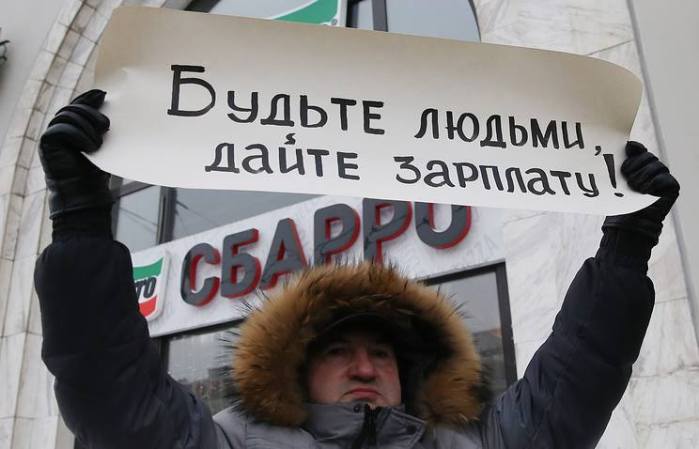
Pizzeria Workers on Hunger Strike in Moscow

"Be human beings! Give us our pay!"
“Be human beings! Give us our pay!”

Hunger Strike, Strike, Pressure on Workers: Protest by Workers at Moscow Restaurant Chain Grows
Novoprof
February 3, 2017

Workers at the fastfood chain Pizzeria (formerly known as Sbarro) who have not been paid continued their hunger strike for the third day in a restaurant on Krasnoprudnaya Street in Moscow. All the tricks played by the “strange” management to make the workers flinch and stop their protest have failed.

Other restaurants in the chain have joined the protest of their comrades on Krasnoprudnaya. Workers at Pizzeria in the Vegas Shopping Center on Kashirka have not worked for three days since joining the trade union. Novoprof has taken calls from a number of other restaurants in the chain, as well as from restaurants in the Yolki-Palki chain.

The workers are desperate because they do not know how to get their hard-earned money. They have been kicked out of rented flats and have no way to pay back their debts, and there is no one and nowhere they can borrow any more money.

Instead of doing everything they can to pay the money they owe their workers, the real employers have been hiding behind “strange” managers. Practically speaking, there is no one with whom workers can negotiate. Trade union members suspect the Yelashvili brothers (Murab and Georgy) are still the actual proprietors of the chains. Instead of solving the problems that have arisen at the restaurants, management has attempted to divide workers by paying out tiny sums on their bankcards, but not everyone’s. They have been trying to throw them a bone, as it were, thus making the workers shut up and return to work.  There have also been attempts to mentally coerce the workers who are on hunger strike.

"There is no crisis. We're just being robbed blind."
“There is no crisis. We’re just being robbed blind.”

We have found out that the former Sbarro, Yolki-Palki, YamKee, and other chains have been re-registered as new legal entities with names like Italian Eatery, Ltd., One-Stop Service, Ltd., and so on. These legal entities have different executive directors, but surprisingly they have the same official address. They do not have their own websites. Similarly, we have been unable to find a website for Rus RST Holding Company, which, allegedly, had taken over management of the restaurants from the Yelashvili-owned G.M.R. Planet of Hospitality.*

Novoprof will continue to support the protesting workers with all their their might, uniting them in the fight for their hard-earned money.

Translated by the Russian Reader. Thanks again to Comrade Ivan Ovsyannikov for the heads-up. Novoprof is short for the New Trade Unions Interregional Trade Union. It was founded in 2011 by brewers from the Baltica plant in Rostov-on-Don, and printers and heating plant workers in Petersburg. Photos courtesy of Ivan Ovsyannikov and Novoprof

Merab Yelashvili. Photo courtesy of Alyona Kondyurina/RBC

* Merab Yelashvili

Born in the Georgian village of Kulashi in 1974 to the family of a Georgian Jewish community leader. At the age of 19, he came to conquer Moscow, where, with his brother Georgy Yelashvili and brother-in-law Roman Shamilashvili, he founded GMR, which distributes products by leading European producers, in particular, Kinder Surprise chocolate eggs. He then moved into real estate. In 1997, he persuaded American franchisors to give him a master franchising agreement to open Sbarro pizzerias in Russia. Since 2007, he has been president of the company G.M.R. Planet of Hospitality. 

In September 2008, on the eve of the Jewish New Year, he and his relatives opened a Sephardic synagogue in the Triumph Palace residential complex in the north of Moscow. In April 2016, Yelashvili set tongues wagging when he organized the wedding of his eldest daughter Anna in Tel Aviv. The two thousand guests who attended the festivities were entertained by Nikolay Baskov, Soso Pavliashvili, and American rapper Ryan Leslie. A year earlier, Merab’s brother and business partner Georgy had celebrated the wedding of his son in the Moscow Manege, inviting over one and a half thousand people.

Source: RBC

Nous sommes tous la cinquième colonne

They Got Out of Their Tractors
Why the so-called common people are increasingly joining the ranks of the so-called fifth column
Gazeta.ru
August 29, 2016

A fifth column of tractors? Photo courtesy of @melnichenko_va/Twitter

The arrest of the people involved in the tractor convoy, as well as new protest rallies in Togliatti after Nikolai Merkushin, governor of Samara Region announced wage arrears would “never” be paid off, are vivid examples of the top brass’s new style of communicating with people. After flirting only four or five years ago with the common people, as opposed to the creacles from the so-called fifth column, the authorities have, in the midst of a crisis, been less and less likely to pretend they care about the needs of rank-and-file Russians. Moreover, any reminders of problems at the bottom provokes irritation and an increasingly repressive reaction at the top.

Previously, top officials, especially in the run-up to elections, preferred to mollify discontent at the local level by promising people something, and from year to year, the president would even personally solve people’s specific problems, both during his televised town hall meetings (during which, for example, he dealt with problems ranging from the water supply in a Stavropol village to the payment of wages to workers at a fish factory on Shikotan) and during personal visits, as was the case in Pikalyovo, where chemical plant workers also blocked a federal highway. Nowadays, on the contrary, the authorities have seemingly stopped pretending that helping the common people is a priority for them.

It is telling that the alleged charging of the tractor convoy’s leader with extremism and the Samara governor’s disdainful interaction with ordinary workers (who responded by blocking a federal highway on Monday) has nothing to do with political opposition.

The people have made no political demands in these cases. Moreover, the main players in these stories almost certainly belong to the hypothetical loyal majority.

The people who took part in the tractor convoy against forcible land seizures even adopted the name Polite Farmers, apparently by analogy with the patriotic meme “polite people,” which gained popularity in Russia after the annexation of Crimea.

In 2011–2012, the authorities used approximately the same people to intimidate street protesters sporting political slogans. That was when the whole country heard of Uralvagonzavod, a tank manufacturer whose workers promised to travel to Moscow to teach the creacles a lesson. Subsequently, the company’s head engineer, Igor Kholmanskih, was unexpectedly appointed presidential envoy to the Urals Federal Distrtict.

Back then, the cultivation of a political standoff between working people from the provinces and slackers, “State Department agents,” and self-indulgent intellectuals from the capitals seemed pivotal, but in the aftermath of Crimea and a protracted crisis, it has almost been nullified.

The people are still important for generating good ratings [via wildly dubious opinion polls — TRR], but it would seem that even rhetorically they have ceased to be an object of unconditional concern on the part of the government.

Nowadays, the authorities regard the requests and especially the demands of the so-called common people nearly as harshly as they once treated the Bolotnaya Square protests.

The government does not have the money to placate the common people, so people have to be forced to love the leadership unselfishly, in the name of stability and the supreme interests of the state. Since politics has finally defeated the economy in Russia, instead of getting down to brass tacks and solving problems with employment and wage arrears, the regime generously feeds people stories about war with the West. During a war, it quite unpatriotic to demand payment of back wages or ask for pension increase. Only internal enemies would behave this way.

“We are not slaves!” Coal Miners on Hunger Strike in Gukovo. Published on August 25, 2016, by Novaya Gazeta. Miners in Gukovo have refused a “handout” from the governor of Rostov Region and continued their hunger strike over unpaid wages. Video by Elena Kostyuchenko. Edited by Gleb Limansky.


So the coal miners in Rostov, who have continued their hunger strike under the slogan “We are not slaves,” have suddenly proven to be enemies, along with the farmers of Krasnodar, who wanted to tell the president about forcible land seizures, and the activists defending Torfyanka Park in Moscow, who were detained in the early hours of Monday morning for, allegedly, attempting to break Orthodox crosses, and the people defending the capital’s Dubki Park, slated for redevelopment despite the opinion of local residents, and the people who protested against the extortionate Plato system for calculating the mileage tolls paid by truckers, and just about anyone who is unhappy with something and plans to make the authorities aware of their dissatisfaction.

Grassroots initiatives, especially if they involve protests against the actions or inaction of the authorities, are not only unwelcome now, but are regarded as downright dangerous, almost as actions against the state. This hypothesis is borne out by the silence of the parliamentary opposition parties. In the midst of an election campaign, they have not even attempted to channel popular discontent in certain regions and make it work to their advantage at the ballot box.

The distinction between the so-called fifth column and the other four has blurred.

Nowadays, the fifth column can be a woman who asks a governor about back wages. Someone who defends a city park. Farmers. Coal miners. Even the workers of Uralvagonzavod, which in recent years has been on the verge of bankruptcy. The contracts the state had been throwing the company’s way have not helped, apparently.

If the authorities, especially local authorities simply afraid to show federal authorities they are incapable of coping with problems, continue to operate only through a policy of intimidation, they might soon be the fifth column themselves, if only because, sooner or later, they will find themselves in the minority.

Translated by the Russian Reader. Thanks to Sean Guillory for the heads-up

________

A surprisingly frank and dead-on editorial from Gazeta.ru, who usually have not struck me as wild-eyed radicals, about how the Russian authorities have increasingly come to behave as if nearly the entire Russian population, including the so-called common people, is a gigantic fifth column arrayed against them.

The reason they have sunk into this black pit of reaction is that the current regime is simply incapable of solving the country’s numerous political, social, and economic crises, because it has directly or indirectly generated nearly all of them, including the utter lawlessness in Krasnodar Territory that was finally too much for a group of farmers who climbed into their tractors and set out for Moscow several days ago. But because even allegedly simple farmers can become a fifth column as soon as they draw attention to their sorry plight and the role of the authorities in it, they got only as far the neighboring Rostov Region on their tractors before the police shut them down.

This editorial is also valuable for its catalogue of similar conflicts, most of which you probably have never heard of because they are not well covered or covered at all by the western press and only marginally better by Russian print and online media. Russian mainstream TV outlets mainly avoid them altogether, as do most of the opposition parties currently contending for seats in the Russian State Duma and regional legislatures, as the editorialists point out.

So the hunger-striking miners in Gukov and their wives are left to their own devices when dealing with their creepy regional governor, no doubt a KGB vet, who all but accuses them of acting on behalf of the CIA, although they just want to get paid for their hard, thankless work.

The only grain of salt one should chew while reading this editorial is the fact that these local grassroots campaigns have been going in rather large numbers across Russia throughout Putin’s 17-year reign. And in many cases the altogether uncommon common people who fought these battles were fifth-columnized (through beatings, murders, and jail time) as badly as the current grassroots campaigners mentioned by the editorialists. During the fat years of the noughties, however, times were much better economically in the Russian capitals for a lot of people than they had been just a few years earlier, so they preferred not to notice too hard what was going on in their midst, much less some part of their country they would never dream of visiting even.

The Putinist state has been waging a cold civil war against the people of Russia for seventeen years whether the media has noticed it or not. But a lot of the common people have noticed. TRR