The Olivier Index

The New Year’s spread on the tables of Petersburgers will be more modest this year than it was in 2021. They won’t have to skimp on ordinary goods yet, but delicacies such as caviar or red fish, as well as premium alcohol, will cost considerably more. Scammers and poachers who offer goods that aren’t readily available on the cheap may try to take advantage of this.

According to the Central Bank, annual inflation, as of November, was 11.98%. During the month, consumer prices increased by 0.37%; fruit and vegetables were among the items that rose most noticeably. Given that they are among the main ingredients in traditional dishes, we should expect that New Year’s Eve purchases will cost more.

Racing against inflation

As Svetlana Kazantseva, associate professor in the Basic Department of Trade Policy at Plekhanov Russian University of Economics, told DP, the annual growth rate of food prices in Petersburg was about 10%, according to research data.

“Prices for dairy and meat products are growing more slowly, which is explained by cheaper animal feed. Taking into account the inflationary component and the desire to save money, we can assume that the amount of the average bill [for New Year’s supper], if it does increase, will be an order of magnitude smaller than the rate of annual inflation, that is, about 5–7%,” the expert notes.

Marina Petrova, CEO of Petrova Five Consulting, is partial to other estimates, according to which the New Year’s meal will cost an average of four thousand rubles, which exceeds last year’s level by 12%. The simplest traditional dishes are taken into account: Olivier salad, herring under a fur coat, jellied meat, chicken with potatoes, sausage slices, champagne, and vodka. If the menu is expanded to include roast pork, fish aspic, red caviar, red fish, cheese, and cognac, then the cost will double. But it should be borne in mind that the percentage of consumers who themselves cook the food for their holiday meal has been decreasing every year. Many people have long preferred to buy readymade dishes at the store or order them delivered to their homes. However, this year they are likely to purchase more budget-conscious options. The desire to save money will primarily impact delicacies, seafood, salmon fish, beef, and caviar. The annual growth rate in prices for fish delicacies and caviar is already higher than the inflation rate.

“Traditional New Year’s menu for residents of Petersburg [clockwise, from far left]: Olivier salad, herring under a fur coat, roast chicken, caviar sandwiches, hard alcohol, sliced cheese, sausage and fish, juices, champagne, mineral water, candy, cake, tangerines.”

Beware of fakes!

According to market participants, a decrease in the total volume of red caviar is expected due to a lower salmon catch in the Far East. It will be bring a higher price than in previous years, however. During the pre-New Year sales period, it is possible that we will see an increase in prices of 35–40% compared to last year. On average, pink salmon has risen in price by 25%, chum salmon, by 5%, sockeye salmon, by 15%, and trout, by 10%. According to the Fishing Union, this year the percentage of Pacific salmon red caviar on the Russian market is close to 100%. Prices for grainy caviar from Far Eastern salmon caught in 2022 increased by an average of 10–15%. However, last year’s caviar is also on the market at a more affordable price. According to Nikita Ostrovsky, a purchasing manager at Lakifish LLC, imported red caviar appears only sporadically on the Russian and Petersburg markets.

“We can talk about insignificant amounts imported from neighboring countries, such as Armenia and, to a lesser extent, Kyrgyzstan (red trout caviar is imported from there). This category of goods is in a lower price and quality segment by comparison with trout caviar, for example, from Karelia,” he says. Another factor are the Russian government’s measures to restrict the import of red caviar to stimulate domestic production.

Ostrovsky also warns that, since caviar is considered a mandatory part of New Year’s feasts, it is likely that buyers will look hard for cheaper offers — for example, at illegal points of sale, where it is offered at a price 50% lower than the average market price.

“This can be imitation caviar, which is sold disguised as the real thing. Caviar diluted with sunflower oil. Or obtained by poaching, without the necessary paperwork. In pursuit of profit, people are willing to purchase such products,” he points out.

In fact, imitation caviar is sold legally in many stores.

Participants of the delivery market expect an increase in orders of readymade meals for the New Year’s meal, despite everything. Many of them note that they usually experience an increase in customer activity on December 21.

“We don’t take orders all day, only until 8 p.m., and then we deliver them to customers’ homes. This time round, we expect the number of orders to double compared to normal days. We regularly observes this pattern on holidays. The average bill for orders in Petersburg should grow this year. In any case, last year it grew by about 25–30%,” Vera Pradchenko, CEO of VIP Fish [a service that prepares and delivers Japanese food], told our correspondent.

[From top to bottom of tree]
Cost of Olivier salad: 408 rubles (2021) vs. 455 rubles (2022); cost of herring under a fur coat: 269 rubles (2021) vs. 292 rubles (2022); cost of a no-frills New Year’s meal: 5909 rubles (2021) vs. 6737 rubles (2022); cost of a more expensive New Year’s meal: 8391 rubles (2021) vs. 10,909 rubles (2022). 40% increase in the per bottle price of imported alcohol in the more expensive meal. 20% increase in the price of premium cheese in the more expensive meal. 2.4% increase in the price of domestic salmon caviar in Russia as of October. Consumer price index for groceries in Petersburg in November: 2021 – 111.3%, 2022 – 108.9%; consumer price index for alcoholic beverages in Petersburg in November: 2021 – 102.8%, 2022 – 106.3%; increase in the price of red caviar in Moscow and Petersburg since the beginning of 2022: Moscow – 13.3%, Petersburg – 13.66%

We won’t be left without champagne

Alcoholic beverages are an equally important part of the New Year’s feast. This year, the patterns of purchases in terms of category is almost identical to previous years. Sparkling wines and vodka are still the primary drinks. But there have been changes within the categories. They have been caused primarily by the aftermath of the departure of global brands, explains Dmitry Isachenkov, director of development at Ladoga. “It is safe to say that Russian vodka will be on 90% of Russian New Year’s tables — here consumers prefer domestic products with festive designs,” he says.

After the brands that made up about 50% of the champagne market in Russia left the country, producers less dependent on the political conjuncture began filling the vacant niches. For example, Ladoga signed contracts with three new suppliers and imported 80 thousand bottles in 2022 by year’s end, which is four times more than by the end of last year. So, Russian consumers can easily find real champagne wines in Russia if they wish.

It is worth noting that the share of imports of wines from Champagne [sic] did not exceed 2.8% of the total volume of sparkling wine imports. The choice of the mass consumer will be distributed one way or another among the major Russian producers: Kuban-Vino, Derbent-Vino, Novy Svet, and Inkerman. Affordable imported sparkling wines — Italian proseccos, Spanish cavas, French cremants, and Austrian sekts — will invariably remain popular.

Isachenkov notes that the structure of purchases in the whiskey category has changed significantly — it is this category that has undergone the most powerful changes after the refusal of major brands to do business in Russia. Most consumers were ready to look for a replacement within the category, including among domestic manufacturers. Thus, sales of entirely Russian-made Fowler’s brand whiskey had by year’s end increased four and a half times compared to 2021. Other consumers have shifted to other categories and are choosing rum, tinctures, brandy or vodka. Sales of still wines increased in proportion to the other categories. At the same time, the product range of both importers and Russian wineries has been growing.

“We should not talk about the growth of the average bill, but about the increase in the cost of each item in the bill. For many, this is a long-awaited holiday after the emotional turmoil experienced during the year, and the consumer selects special drinks for celebrations above the usual cost,” the expert argues.

Different things matter

On average, the prices of the ingredients for Olivier salad have increased by 10% in Petersburg. Potatoes and onions have fallen in price, while he price of carrots has not changed. Green peas and mayonnaise have risen the most, by 20% and 17%, respectively. Herring under a fur coat has risen in price by 7%, primarily due to the main ingredient, herring (which has gone up by 20%), while beets have fallen in price by 32% and potatoes by 25%. However, the so-called Olivier index should be treated with caution.

The various indexes are more of a marketing tool to draw attention to the researcher’s brand. There is the lipstick index (launched by Estee Lauder), which is a litmus test showing how women react to changes in the economy. The American manufacturer argues that, when incomes fall, sales of expensive clothes and shoes decline, while sales of luxury cosmetics, on the contrary, grow. There is Deutsche Bank’s cheap date index (based on the costs of taxi rides, lunches at restaurants, and hotel rooms [sic]). There is the latte index (based on the price of a cup at Starbucks, now Stars Coffee in the Russian Federation) and the Big Mac index (based on the price of a hamburger at McDonald’s, now Tasty, Period). The iPod index has become an atavism.

In Russia, the Telegram channel Sugar. Portion. Collect maintains a cup of tea index by charting weekly changes in the average retail price3s of the ingredients in the Russian Federation. Other researchers use the statistics issued by Rosstat as their benchmark when calculating the cost of preparing borscht, Olivier, or herring under a fur coat.

“Any index is an indicator of rising or falling prices. You can use it to calculate how the cost of goods changes from year to year,” says Daria Zhigalina, a business automation services systems analyst at Kontur.Market. “It is important to understand that all indices are real economic indicators, albeit served up in a humorous package. Every year we see how official agencies publish data on the basket of consumer goods. Everyone has been accustomed to this indicator for a long time and knows that it can be used to assess the quality of life in the country and the purchasing power of the populace.”

According to the expert, by assessing the fluctuations in the cost of ingredients, we can analyze the economic situation separately in each region and in Russia as a whole.


For retailers, the New Year’s Eve period is a time when they can increase their revenue. Judging by the foot traffic in stores, the current situation will most likely not affect retail chains negatively since their turnover is growing. At the same time, the structure of sales will be redistributed towards traditional and inexpensive goods. In my opinion, retail has already begun to change the structure of its offerings, reducing the number of goods above the average price. In this regard, premium retail chains may be in a less advantageous position.

—Irina Kapustina, Director, Graduate School of Service and Trade, St. Petersburg Polytechnic University

Caviar has not been imported [to Russia] since 2014, after government restrictions on the import of certain types of food were enacted. Prior to this, Russia imported frozen red caviar from the USA and Canada. Here it was processed and sold in salted form. The salmon catch this year amounted to 300 thousand tons, and 13–14 thousand tons of caviar were produced. Last year, the catch was over 500 thousand tons, while more than 20 thousand tons of caviar were produced. Compared to last year, the shortfall is 30%. Despite the fact that the supply of caviar is much lower than last year, the price has not increased. If there were a further rise in prices, people would simply stop buying it. It is possible that before the New Year some sellers will raise prices, but they will bring them back down after the holiday.

— Alexander Fomin, Vice–President of the Fishing Association

The growth in the price of goods that have always been considered delicacies — caviar and salted salmon— is indicative. They have doubled in price over the year, and the same dynamic is typical for most other frills. This year, salmon will be largely replaced by trout, which is cheaper, and eggplant caviar will be preferred. Real incomes fell in Petersburg by 2.7%, according to official statistics. By my calculations, for a business person, the celebration of the New Year will be about one and half times more expensive than a year ago. The selection has become somewhat smaller, but if you want them, you can find all the goods you need. We should especially not envy pensioners living on their own. The subsistence minimum doesn’t take factor in the cost of such events.

—Anatoly Golov, Co-Chairman of the Consumers Union of Russia

Russians have no reason to skimp on their New Year’s meal. On the contrary, consumer spending on the New Year’s meal may increase due to both inflation and the fact that some Russians will not be able to celebrate the New Year outside the Russian Federation and will spend money at home. Recently, statistics were published that about 15% of the population have experienced an increase in income, while 20% have experienced a decrease. Consequently, some consumers will still increase spending for the New Year and their average spending will grow at a level slightly higher than inflation.

—Artyom Tuzov, Executive Director of the Capital Markets Department at IVA Partners Investment Company

Source: Darya Zaitseva, Darya Dmitrieva & Yevgeny Petrov, “Petersburgers won’t be serving caviar and red fish on their New Year’s tables,” Delovoi Peterburg, 23 December 2022. Infographics, above, courtesy of Delovoi Peterburg. Translated by the Russian Reader


The morning begins with me looking at the light on the computer monitor. If it is on, it means there is still electricity. When I see that the light is on, I immediately get up and go put on the kettle to refill the thermoses. We got hold of the simplest gas stove, and you can of course heat water on it. But first of all, there is not an endless supply of gas and we skimp on it. Secondly, I am afraid of these stoves: over the past month they have exploded four times in our district alone. I walked past the residential buildings where these stoves exploded and saw the broken windows and cracks in the walls. It’s a little scary, let’s just say.

After I put the kettle on, I get on the Telegram channels. I have to find out whether there were [missile and drone] attacks at night, and if so, whether they hit infrastructure. Now this is the most terrible thing, because if it suddenly turns out they hit infrastructure, it means that soon there will be no heating and water. So then I start rushing between washing and drying my hair, charging the power banks and flashlights, getting the laundry going, and cooking food. You never know when the lights will go out and that’s why you do everything quickly, all at once. You feel like a trained circus animal.

When I’m going somewhere, I always put a few flashlights in my backpack. It’s strange to imagine that not so long ago a flashlight was not a mandatory item. Now it is a “must have” (my phone suggests writing “must heh” — heh!), like a medical mask during the time of covid. It’s even more important! When I go outside and travel somewhere, I never know if there will be light where I’m going. Most often there is no light — or cellphone connection for that matter. I hate this feeling of being in a vacuum: there is no mobile internet, no telephone connection, no light, and no matter what happens to you, you won’t even be able to call an ambulance. You’re living “in the moment,” damn it. Where there is no light, the elevators don’t work. I usually walk slowly up to the sixteenth floor by an isolated dark staircase. Somewhere on the eighth floor there is usually an old, peeling stool on which I can sit in the dark and take a break. I usually don’t need such a rest, but sometimes I turn off the flashlight and sit on this stool in the dark and listen to the wind blowing in the stairwell.

Last week I got stuck in the elevator: while I was going up, the lights turned off and the elevator stopped and went dead. There was a chair inside and a box containing water and medicines. I sat down, but quickly froze. Immediately, before the phone connection disappeared, I had telephoned my husband and asked him to call the help hotline so that they would get me out of there. Otherwise, it was possible to get stuck there and sit for four to seven hours. My husband got through to the hotline in half an hour — he was the twentieth in the queue. Half of the city sits in frozen elevators every day. They pulled me out of there.

When I’m returning home in the evening, I make a wish: please let there be light at home. I ride in a minibus and nothing is visible through its windows since neither the streetlights nor the traffic lights are working. I have developed a “sense” of a way that I cannot see, but I know and understand where I’m going and when I need to get out. After walking up and down all these stairs and unlit streets, I really want to find the light on at home for at least half an hour. If, when approaching our building, I see that there is no light, I slow down. There’s nowhere else for me to hurry — it’s dark and pointless everywhere. Life in general has become quite hectic. Although I have hated hurrying and scurrying my whole life, now I have to hurry and scurry.

Sometimes I manage to find a store where the lights haven’t been turned off yet. It’s like going into a church: it’s light and warm there and your mood improves a little just because you’re in a store and it’s bright inside. The prices have been shooting up monstrously and I wander the aisles for a long time figuring out what I can buy to fit my modest daily budget. But basically, since the light began to leave us, I have got used to eating rusks and croutons in different flavors. I’d never bought them before — they’re not my kind of food — but now they are quite handy. First, they are relatively cheap, and second, they come in different flavors. It’s the illusion of variety. Third, they don’t need to be cooked.

I went to see my mom yesterday. We discussed all these common everyday problems of ours. And then Mom decided to make a joke and asked:

“What are you all doing for the New Year?”

Neither she nor I laughed.

Source: Sergey Abashin, Facebook, 15 December 2022. Professor Abashin is quoting a letter he received from a Ukrainian friend or colleague, but he does not identify her by name or mention where exactly she lives. Translated by the Russian Reader
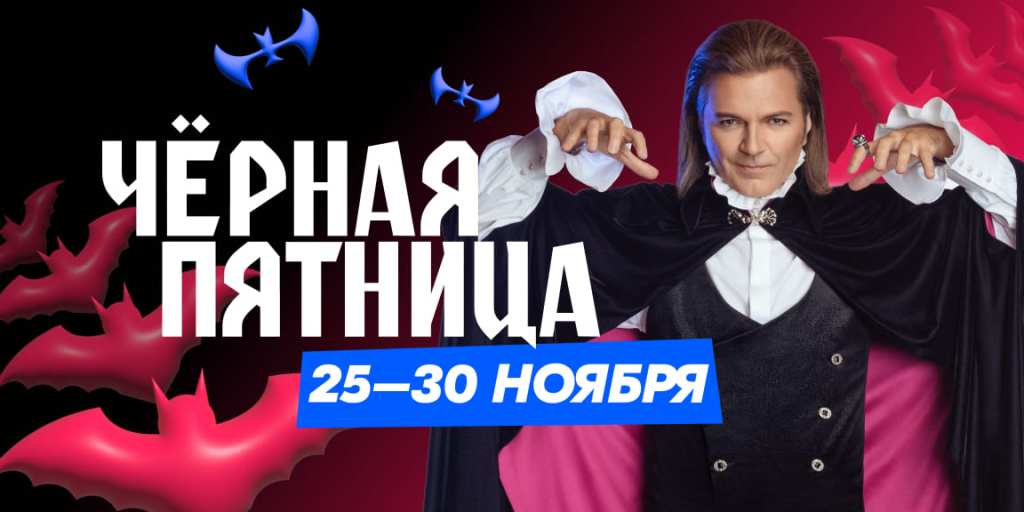
Black Friday

Despite its declared war on “satanic” western values, Putinist Russia continues to slavishly imitate all the worst the mythical west has to offer, including “Black Friday,” as exemplified by this image from an email flyer sent to me earlier today by the major online retailer Ozon, featuring the pop singer Dmitry Malikov. Nor has Putin’s “proxy war” with the west stopped the pidginization of the Russian language, as seen in the second-to-last piece in this grim holiday collage. ||| TRR


The expected tourist flow from Iran may amount to approximately two thousand people a week starting in the spring of 2023, director of the municipal tourist information bureau Yuri Bogdanov said on November 24. According to him, relevant negotiations are underway with air carriers.

“We are negotiating with airlines that want to provide direct flights between Iranian cities and St. Petersburg. We hope that there will be six flights per week with an average number of around 300 seats on board. This is already about two thousand people a week. We expect that, beginning in the spring, these airlines will supply their airplanes,” TASS quoted Bogdanov as saying.

The expert clarified that there were more flights before the pandemic and six thousand tourists used to arrive from Iran every week.

According to Bogdanov, the flow of tourists may return to its pre-covid levels in St. Petersburg by about 2026, but at the same time primarily due to guests from Russia, and not from foreign countries. According to the figures he cited, in 2019, about five million Russians and 5.5 million foreigners visited the Northern Capital, while 6.4 million Russians and 150–200 thousand foreigners visited the city in the first nine months of 2022.

“We have reformatted the priorities for domestic tourism — we want to reach the same 10.5 million tourists a year. There is every ground for this to happen,” Bogdanov opined.

Earlier, the State Duma Budget and Taxes Committee recommended that St. Petersburg be included in the list of regions that charge tourists a resort fee.

Source: “Petersburg expecting two thousand tourists from Iran weekly from spring,” ZakS.ru, 25 November 2022. Translated by the Russian Reader


At least 58 children, some reportedly as young as eight, have been killed in Iran since anti-regime protests broke out in the country two months ago.

According to Human Rights Activists in Iran (HRA), 46 boys and 12 girls under 18 have been killed since the protests began on 16 September, sparked by the death of the 22-year-old Mahsa Amini while in police custody.

In the past week alone, five children were reportedly killed by security forces as violence continued across the country.

Those who died last week include the nine-year-old Kian Pirfalak, who was one of seven people – including a 13-year-old child – killed in the western city of Izeh on Wednesday.

Speaking at Kian’s funeral on Friday, his family said security services had opened fire on the family car, where Kian was sitting next to his father. Iranian security services have denied responsibility for his death, blaming the shooting on “terrorists”.

Iran’s mounting child death toll comes amid escalating violence in cities across the country, with protests showing no sign of abating.

[…]

Young people have been at the forefront of anti-regime protests, which started after Mahsa Amini died in the custody of Iran’s morality police. She had been arrested for not wearing her hijab correctly.

The deaths of two teenage girls, Nika Shakamari and Sarina Esmailzadeh, both allegedly beaten to death by security forces for protesting, provoked further outrage.

Videos of schoolgirls across the country protesting against their killing by removing their hijabs and taking down pictures of Iran’s supreme leaders went viral on social media, leading to raids on schools where children were beaten and detained. According to Iran’s teachers union, another 16-year-old girl, Asra Panahi, died after she was attacked by security forces in her classroom in the north-western town of Ardabil on 18 October.

The attacks on children in schools is continuing, according to Hengaw, which said a 16-year-old girl from Kurdistan is on life support after throwing herself from a school van, having been arrested at her school last week.

HRA says more than 380 protesters have been killed since the protests began and more than 16,000 people have been detained, including children. The figure is disputed by the authorities.

Source: Deepa Parent, Ghoncheh Habibiazad and Annie Kelly, “At least 58 Iranian children reportedly killed since anti-regime protests began,” The Observer, 20 November 2022. Thanks to Sheen Gleeson for the heads-up.


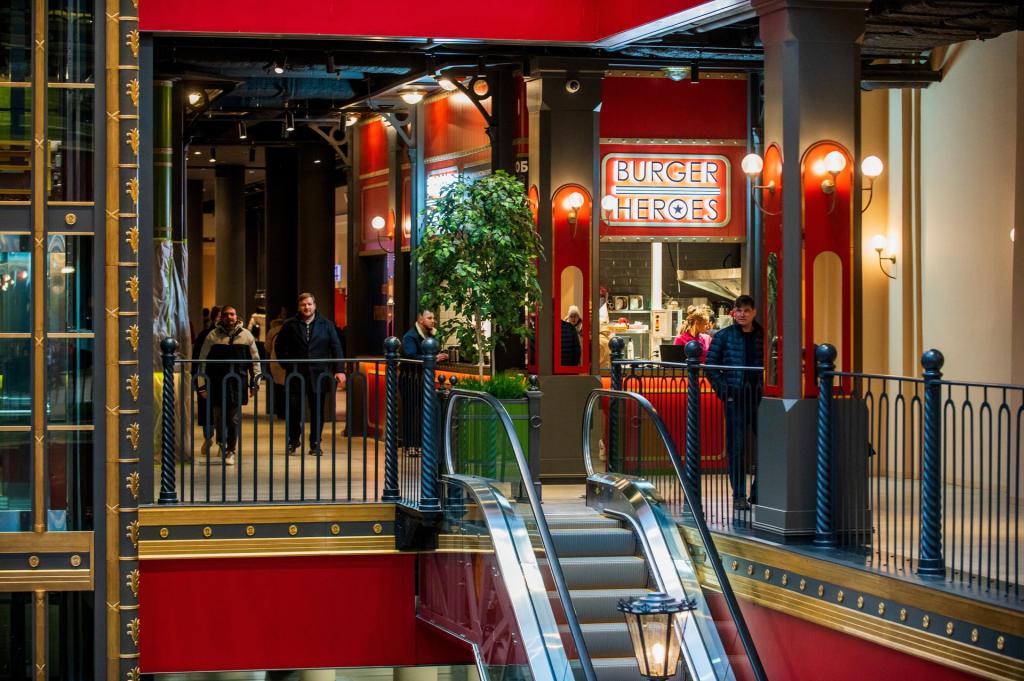
A view of Vokzal 1853 on opening day. Photo: Sergei Yermokhin/Delovoi Peterburg

On November 21, the opening of the food hall [fud-kholl] Vokzal 1853 took place in the building of the former Warsaw railway station.

It is the largest gastronomic space in St. Petersburg and, so its creators claim, in Europe.

So far, not all the establishments in the eater have opened — the launch . The event zone [event-zona] is designed for to accommodate 2.5 thousand guests and have 4 thousand seats, while the entrance to the second floor is still closed.

The cost of renovating the former railway station exceeded 1.5 billion rubles. The Vokzal 1853 food hall [fud-kholl] is a project of the Adamant holding company and restaurateur Alexei Vasilchuk. In total, as stated earlier, more than 90 restaurant concepts [restorannykh konseptsii] will await visitors, and the total area of the food hall will be about 34 thousand square meter.

The company plans to open a concert venue, craft [kraftovye] shops, and a coworking [kovorking — sic] in the space.

Earlier, DP reported that its creators had conceived the decoration of the premises to suggest the atmosphere of nineteenth-century railways stations, and visitors would find themselves in the “epicenter of a bustling creative life.”

Source: “The largest food hall in St. Petersburg opens in Warsaw railway station building,” Delovoi Peterburg, 22 November 2022. Translated by the Russian Reader


Ukraine continued to reckon with the fallout from Russia’s air strikes on its energy infrastructure, with much of the country still struggling with blackouts. Residents in Kyiv, the capital, were told to prepare for more attacks. Russian missiles damaged a hospital on the outskirts of Zaporizhia, a Ukrainian-held city not far from Europe’s largest nuclear power plant, controlled by Russia. Meanwhile, Ukraine’s president, Volodymyr Zelensky, said Russia was heavily shelling Kherson, the southern city recaptured by Ukrainian forces in early November. Local officials said that strikes killed seven people in the city on Thursday.

Source: The Economist, “The World in Brief” email newsletter, 25 November 2022


Maxim Katz, “Why Russians don’t protest — answered by an old experiment (English subtitles),”1,108,570 views. Nov 23, 2022. “The lack of mass anti-war rallies in Russia is often explained with some psychological defect of the Russian people. But is it truly so? Today we will talk about a social experiment called the Third Wave, and think about whether it is true that it can all be explained with some unique malleability of Russian society.”

This is a wildly disappointing exercise in sophism and self-deception by the usually much more lucid Maxim Katz. Russia has arrived at its present murderous and self-destructive bad end not through rigorous and ruthless totalitarian indoctrination and psychological manipulation, as suggested by Katz’s invocation of Ron Jones’s 1967 Third Wave experiment in a California high school, but through a chaotic, consistent indulgence of opportunism, consumerism, escapism, ressentiment, hipsterism, “westernism,” capitalism, cynicism, nihilism, and thuggery by the elites and the much of the so-called intelligentsia, thus almost completely overwhelming the decent, democratic, and egalitarian impulses and undertakings of differently minded and empowered “other Russians” from all walks of life and all parts of the country. It has been one of the missions of this website to bear witness to both these tendencies in their extreme and trite manifestations. You’ll find vanishingly little of what Katz describes in my chronicles of the last fifteen years here and on The Russian Reader‘s sister blog Chtodelat News. You will find, however, plenty of stories of brave grassroots resistance and movement building blunted and, ultimately, murdered by a police state whose PR wing has urged Russians to trade their freedom for food courts. ||| TRR

I’ll Show You the Life of the Mind

An image from Boris Akunin’s One Eight Eight One, as staged by Valery Fokin at the Alexandrinsky Theater in Petersburg.
Image courtesy of alexandrinsky.ru via Delovoi Peterburg

Every Wednesday we tell you about an article that has proved the most interesting to one of our staffers.

Yulia Holtobina, manager of the Subscribers’ News project, has shared an article with us today.

Does modern society need cultural goods? In my opinion, they are simply necessary for people to grow spiritually and achieve inner harmony. Culture is the environment in which the life of the individual and the life of society take place. Culture makes a person a personality.

In our difficult time, people increasingly want to distract themselves, to get away from fatigue and the problems that have piled up. Theaters, cinemas, and museums are the cultural spaces where they can relax, feel joy, find positive energy and inspiration, and return to a stable life.

Delovoi Peterburg thus writes that the preferences of Petersburgers have not changed. People still enjoy going to theaters, museums, exhibitions, and St. Petersburg’s other cultural spaces.

Source: Delovoi Peterburg email newsletter, 16 November 2022. Translated by the Russian Reader


Theatergoers south of Moscow were held “hostage” and shot at by actors playing Ukrainian soldiers during an immersive play that glorifies Russia’s invasion of its neighbor, local media reported Tuesday.

Opening scenes from the production titled “Polite People” showed actors dressed in Ukrainian military uniforms violently capturing audience members and shooting them with what appeared to be prop assault rifles. 

One female captive can be heard screaming “it hurts” and “let go” as the actors drag her onstage.

“Polite People” is a euphemism for the Russian soldiers without insignia who occupied Crimea before Moscow annexed the Ukrainian peninsula in 2014.

“The creators wanted to immerse the audience into the atmosphere of what Donbas residents had experienced for eight years,” the Kaluga region’s Nika TV broadcaster said, using the term for eastern Ukraine’s separatist-controlled Donetsk and Luhansk regions.

Actor Vilen Babichev, who portrays one of the Ukrainian troops, told Nika TV the play aims to show Russian audiences “the nature of the enemy that invaded our territories eight and a half years ago.”

President Vladimir Putin has justified Russia’s deadly invasion of Ukraine with unbacked claims that Kyiv is committing “genocide” against Russian-speaking residents of the Donbas.

“Polite People” is funded through a 10.1-million ruble ($165,000) Russian presidential grant.

Its author, Luhansk-based musician and film studio director Roman Razum, said the project aims to “create positive content to counteract negative content that carries an immoral ideology and counters the Russian cultural code.”

“We show that these aren’t just Ukrainian [soldiers], but fighters fully trained by NATO and supplied with weapons for many years,” Razum told Nika TV.

The play premiered in Kaluga on Monday following dates in occupied Luhansk and four Russian cities in late October and early November. It is expected to go on tour across a handful of other Russian cities until late November.

Source: “Russian Audiences Held ‘Hostage’ By Mock Ukrainian Soldiers in Pro-War Play,” Moscow Times, 9 November 2022


Is there room left in life for celebrating and if so, for what kind of celebrating? DP found out how the preferences of consumers of culture have changed this year.

The Social and Artistic Theater (SHT) told DP that its new season had got off to a good start. “I would say that audiences are going to the theater more, but the decision to go is made at the last moment. Our productions of Anne Frank, The Émigrés, and Cynics are now quite popular. Our classic production is still WITHOUT [An idiot], based on F.M. Dostoevsky’s novel The Idiot,” SHT director Alina Korol said.

No scarier than covid

The Bolshoi Puppet Theater (BTK) said that its audiences did not have any particular new preferences. There are traditionally sold-out performances at the theater, and less popular ones, but they have not noticed any new trends.

“After the start of the SMO, there was a drop-off in attendance that lasted a couple of months, maybe one and a half. If anything has changed post mobilization, it has been insignificant. But when a new wave of covid started in mid-September, many people began to get sick and the flow decreased,” the BTK’s sales department emphasized.

“People want to return to a stable life for at least a few hours, so they go to the theater. We almost always have full houses, and preferences have not changed,” commented Tatiana Troyanskaya, a public relations specialist at the Studio Theater. Among the favorites at the Studio are productions by the theater’s artistic director Grigory Kozlov (The Elder Son, Tartuffe, The Days of the Turbins, Quiet Flows the Don, as well as comedies (Our Avlabar; Dreams of Love, or the Marriage of Balzaminov), and productions for children.

Vladimir Kantor, the editor-in-chief of the magazine Petersburg Theatergoer and the head of the literary department at Saturday Theater, did not notice any new trends in the theater.

“I am familiar with the repertoire of other theaters, but I haven’t noticed any serious changes in audiences. Autumn and winter are the times when people traditionally go to the theater. I cannot mention any changes in the repertoire that can be described as trends. There were enough productions about war before the start of the SMO, as well as dystopias. I can’t name any productions about the new emigration at all,” he commented.

DP also sent requests for comment to several state theaters, including the Young People’s Theater (TYUZ) and the Alexandrinsky Theater, but did not receive responses. Meanwhile, the Alexandrinsky has removed Boris Akunin‘s name from the announcement of the premiere of One Eight Eight One. Akunin wrote the play specifically for the Alexandrinsky, but his name disappeared from playbills at the behest of the Ministry of Culture. Back in August, the audience received an email with a reminder about the upcoming premiere of One Eight Eight One — as “staged by Valery Fokin, with music by Vyacheslav Butusov, to the text by Boris Akunin.” A similar situation occurred in Moscow, at the Russian Youth Academic Theater (RAMT), where there are four productions of plays penned by the writer.

Akunin himself is aware of what has happened and does not condemn the theaters. “I sympathize with the heads of theaters… If a person has decided that the cause you serve is more important than damage to your reputation — this is a difficult choice from which you yourself suffer, but not your team and not your audience,” he wrote on his Telegram channel.

According to the writer, he has not demanded that uncredited productions be removed from the repertoire. On the contrary, they can go on until they are finally banned and even with no compensation to him. As Akunin noted, the Alexandrinsky Theater cannot pay him royalties due to sanctions.

Among private institutions, Beyond the Black River Theater and the City Theater declined to comment. On October 20, a performance of 1984 was canceled at the City Theater — as noted on its social media accounts, “for reasons beyond the theater’s control.” On October 31, the same production was presented to the audience in a new way: in a video format and featuring an encounter with the director and the actors. The theater’s management clarified that “this is probably the last time it would be possible to see 1984.” The theater also said goodbye to the anti-war production A Red Flower, based on the stories of Vsevolod Garshin.

Perennial classics

Petersburg museums did not respond to DP‘s questions about the changing preferences of its visitors. Official requests were sent to the Hermitage, the Russian Museum, and the Erarta Museum of Modern Art. The bookstores Subscription Editions and At the Top of the Voice and the bookstore chain Bookworm also declined to comment on the situation.

Alexander Prokopovich, editor–in-chief at the publishing house Astrel SPb, says that readers’ preferences had begun to change even before early February, during the pandemic, but the trends have persisted. According to him, classics and so-called longreads [longridy] — that is, literature that is demand at all times — have remained relevant, while speculative texts and fashionable literature [sic] have been losing ground.

“Readers reared their heads, rather, by remaining true to their interests in new titles; perhaps for obvious reasons, interest in new titles from the translated literature segment has increased. I have not encountered any restrictions. Writing is a strategic activity: it can take years to create a book, so it is not worth waiting for a sudden change in the subject matter of the fiction we publish. It is another matter that the events [of this year] are so emotionally charged that many authors have simply stopped writing. It is not our publishing housing that is in demand, but the books which we publish. Nothing has changed here: demand for them is determined by the quality of the texts. This has been the case in the past, and it will be the case in the future,” Prokopovich said.

Some authors claim that their works have disappeared from bookstores — for example, collections of poems by the poet Vera Polozkova. She left Russia in March. Over her fifteen-year career, Polozkova has written five books, published in a total of 280 thousand copies. On her social media accounts, the poet noted, “It would be strange to expect them [the authorities] not to touch the books after everything I’ve said and done.” She believes that she will be able to publish abroad either through crowdfunding or self-publishing [samizdat].

On the other side of the cultural barricades is RT editor-in-chief Margarita Simonyan. A month ago, the TV channel presented a collection of front-line poems, Poetry of the Russian Summer, but a few weeks later it transpired that Russian publishers were not willing to publish a book with the letter Z on the cover. Simonyan, on her Telegram channel, called it “a verdict on us all.”

Cinema depends on the weather

Cinemas were reluctant to comment on the situation. Aurora and Rodina did not answer DP’s questions, but Lenfilm did give an assessment of attendance factors. The cinema center’s management said that Lenfilm is difficult to compare with mass multiplex cinemas. “We show festival films, auteur cinema, and retrospectives. Therefore, aside from a general decrease in the number of viewers, the situation has not affected us so much, since our repertoire has stayed the same, and our audience has remained our audience. We are more dependent on the weather. After big news days, the attendance drops at first, but then it more or less levels off,” the studio commented.

Lenfilm also noted that its cinema center has been showing many Russian films. This year’s Lenfilm Film Club events have already featured screenings of Vladimir Kott’s Disobedient, Tatiana Kolganova’s Delayed Happiness Syndrome, and Ruslan Bratov’s Express.

Source: Alina Kizyakova, “Petersburgers looking for stability in theaters and books,” Delovoi Peterburg, 15 November 2022. Translated by the Russian Reader
Pioneer

The withdrawal of the American company Corteva Agriscience (Pioneer) from the Russian market may trigger problems in the country’s agriculture. Experts are already warning about a shortage of seeds for certain crops.

Marina Petrova, deputy chair of the Moscow Chamber of Commerce and Industry’s committee for entrepreneurship development in the agro-industrial complex and CEO of Petrova 5 Consulting, told Delovoi Peterburg that while the level of self-sufficiency with domestic grain seeds exceeds 75%, import dependence remains high for sunflower, at about 70%, and for corn, at more than 50%. Leftover seeds held by suppliers and Russian-produced varieties and hybrids are an alternative source.

“Domestic seeds often have poorer traits than foreign varieties. But Russia has a scientific base and decent domestic wheat, oat, rice and buckwheat seed products,” says Petrova. In her opinion, domestic selection and seed production is in need of structural transformation and state support. Over the past decade, the share of foreign seeds has increased significantly in Russia. This is primarily due to their higher yields. The largest players also offered package solutions involving seeds, agrochemicals, and management via digital platforms. Third-party designs may thus often be incompatible with existing ones.

Corteva Agriscience is a well-known producer of alfalfa, rapeseed, corn, cotton, rice, sorghum, soy, sunflower and wheat seeds, as well as plant protection products (including herbicides, fungicides and insecticides). According to the Leningrad Regional Committee for the Agro-Industry Complex and Fisheries, the region does not depend on Corteva Agriscience’s seeds. The committee’s press service clarified, however, that rapeseed, which is cultivated in the region, is actually grown from imported seeds. But corn and wheat seeds are domestically produced, while wheat seed is produced in the Leningrad Region itself.

Prinevskoye Breeding Farm CJSC (which grows rapeseed, among other things) reported that they had managed to purchase all the seeds they needed for the 2022 sowing campaign. “If there is no possibility of sourcing foreign rapeseed hybrids, we have a domestic analogue, Oredezh 6, which at the moment we can use to cover the needs not only of our farm, but also of the region,“ says Alexander Peretyatko, deputy general director for commercial affairs at Prinevskoye.

According to experts at the Agrophysical Research Institute, Russia has the potential to replace imported corn and rapeseed. This can also be said about wheat, which Crimea supplies in fairly large volumes. At the same time, seeds for protected soil (tomatoes, cucumbers, greens) are limited on the market. The chief researcher at the Institute’s Laboratory for Plant Biophysics, Professor Mikhail Arkhipov, recalls that back in 2016, a decree was issued ordering the production of original and elite agricultural plant seeds in the areas of domestic crop production that were highly dependent on foreign-made seeds. According to Arkhipov, the decree has still not been properly implemented.

“75% of the agricultural holdings that produce grain are owned by foreign companies. Foreign seed companies also continue to be actively involved in the Russian market. However, domestic seed growers can also solve the issue of supplying grain-growing areas with domestic wheat seeds. We have the necessary agricultural resources to produce our own seeds,” the expert notes.

In late 2021, President Vladimir Putin said that within a decade the country would be able to provide farmers at least 75% of the seeds they required. Arkhipov believes that this is a real prospect in the seed market for most agricultural crops. Petrova points out that many seed-growing enterprises need to improve their physical facilities and increase their technologization. Another problem that hinders the industry’s development is a shortage of personnel.

Source: Darya Dmitrieva, “Fresh ground: farmers prepare for shortage of imported seeds,” Delovoi Peterburg, 11 May 2022. Translated by the Russian Reader, who grew up on a farm in the Upper Midwest.


Corteva to Withdraw from Russia

Corteva has made the decision to withdraw from Russia and, having already paused new sales, is initiating a plan to stop production and business activities.

Our priorities remain the safety of our employees and global food security. Since the onset of this tragic war, we have taken all possible action to support and protect our Ukrainian colleagues and their families, our customers, and the communities in which we operate, including through direct and indirect aid to address the immediate humanitarian needs.

We have also put in place direct action to help assure as normal as possible 2022 growing season in Ukraine.

Given the war’s impact on global food security, the Company will donate seeds to Ukraine, Africa, and the Middle East region for the 2023 growing season, to lessen the impact on global food production.

Corteva joins with many others around the world in advocating for peace.

Source: Corteva.com, 28 April 2022

The Show Must Go On

A warehouse in the Edelweiss (Stroybat) hardware store chain in Petersburg. Photo: Sergei Yermokhin/Delovoi Peterburg

Good day!

Skimping on bags and paper, problems with electric cars, and the rise in price of coffee beans

Skimping on little things. Retailers and catering are reducing the use of certain types of packaging, containers, and consumables. Some things you have to give up against your will.

Tired of waiting for guests. The travel industry wants to get a tax exemption from Petersburg city hall, an extension of cashback, and a new version of Booking.com.

Russians charge slowly but drive fast. Sanctions have blocked the way to Russia for foreign electric cars, but import substitution is already being readied.

Pecking like a bird. Petersburg coffee roasters have faced logistical problems. Green coffee beans have risen in price by 15-50%, which has already affected retail prices.

They keep well. In the current situation, warehouses remain the most stable segment of the commercial real estate market, experts argue.

Have a good day!

Source: Delovoi Peterburg, daily email newsletter to subscribers, 7 April 2022. Photo by Sergei Yermokhin for Delovoi Petersburg. Translated by the Russian Reader

Queen’s hits as played by a symphony orchestra

Show must go on? [sic in English] We agree! Great news for everyone who has dreamed of going to a concert by the legendary Queen. On April 21, the group’s international hits will be performed at Tinkoff Arena by the IP Orchestra under the direction of the brilliant Igor Ponomarenko.

Queen is one of the greatest bands in history: their cultural legacy has changed the world of music forever.

The supremely rich acoustic palette of a symphony orchestra, new arrangements of classic Queen compositions, the wild drive of the musicians on stage, and the charming voice of the soloists — all this is part of the patented “Queen Show. Show Must go on” [sic in English].

The IP Orchestra performing Queen Show. Show Must go on. Tickets for their April 21 performance cost between 1,500 and 2,500 rubles [approx. 17-28 euros]. Subscribers to Bileter.ru’s newsletter get a 10% discount

The IP Orchestra has long established itself as a brand not only in Russia, but also in the countries of the near and far abroad. The band has toured on five continents, performed at the world’s best venues, and has thousands of admiring viewers and loyal listeners.

To attend this event, you will need a QR code showing that you have been fully vaccinated or have had the disease, or a certificate showing that you have had a full course of a vaccine, or a document confirming that you have been granted a medical exemption from vaccination along with a negative PCR test for participants and guests over eighteen years of age.

Source: Bileter.ru. Translated by the Russian Reader


Unfortunately, for reasons beyond our control, all parts of J. K. Rowling’s famous saga about the boy wizard will be unavailable on LitRes in three days. Only now can you buy them in time with a 25% discount! It is important that every book remains in your personal library forever.

“Unfortunately, the Harry Potter series will disappear from the LitRes shelves at 23:59 p.m. on 8 April 2022. Buy the books in time and they will remain with you forever.”

To activate the discount, follow this link or enter ACCIO on the promo code page. The offer is valid until April 8.

Source: LitRes email newsletter for customers, 6 April 2022. Image, above, captured on this page on their website. Translated by the Russian Reader

The Russian Anti-War Committee

An image of a “vandalized” howitzer at Petersburg’s Artillery Museum, as posted on the website of the Petersburg Courts Consolidated Press Service and published by the Petersburg business daily Delovoi Peterburg

The Petrograd District Court has arrested Petersburg resident Nikolai Vorotnev on suspicion of vandalism.

According to the Petersburg Courts Consolidated Press Service, on March 23, Vorotnev and a friend painted yellow and blue stripes on howitzers at the Artillery Museum on the Kronverk Embankment.

“Using aerosol cans, the accomplices drew an image in the form of two horizontal stripes, blue and yellow, on the shield coverings of two howitzers, which are relics of the Great Patriotic War, thus desecrating and spoiling property of the Artillery Museum,” the press service reports.

It follows from the evidence in the case that the motive for the man’s actions was ideological, political and national [sic] hatred for military personnel performing their civic duty as part of the special operation in Ukraine.

The suspect has been placed under arrest until April 16. According to Article 214.2 of the Russian Federal Criminal Code of the Russian Federation (vandalism), he could be imprisoned for up to three years if found guilty.

Last week, DP wrote that a resident of the Northern Capital had been fined 30 thousand rubles for anti-war stickers.

Source: Delovoi Peterburg, 23 March 2022. Translated by the Russian Reader


A four-minute video communique from the newly formed Russian Anti-War Committee. In Russian with English subtitles. Thanks to Mark Teeter for the heads-up.

The Moscow District Court of Petersburg has ordered a woman who pasted up anti-war leaflets at the Salut! condo hotel to pay a fine of 30 thousand rubles [approx. 265 euros at today’s exchange rate].

Polina Mityanina was brought to justice under the article of the Russian Federal Administrative Code on discrediting the Russian army.

“Mityanina pasted up pre-made leaflets bearing the inscription ‘No war…’ [sic, in English]. Mityanina thus tried to persuade others in her midst that the Armed Forces of the Russian Federation were involved in a war, not a special operation, and undermined the authority, image, and trust in the use of the Armed Forces of the Russian Federation,” the Petersburg Courts Consolidated Press Service reported.

The detainee explained that she had taken the leaflets from friends under public pressure [sic] and pasted them up only in her own building.

Late last week, DP wrote about the criminal charges filed against a man who made anti-war inscriptions on the Mass Grave of Soviet Army Soldiers Who Perished Defending Leningrad in 1941-1943 memorial.

Source: Delovoi Peterburg, 18 March 2022. Translated by the Russian Reader

The Last Picture Show

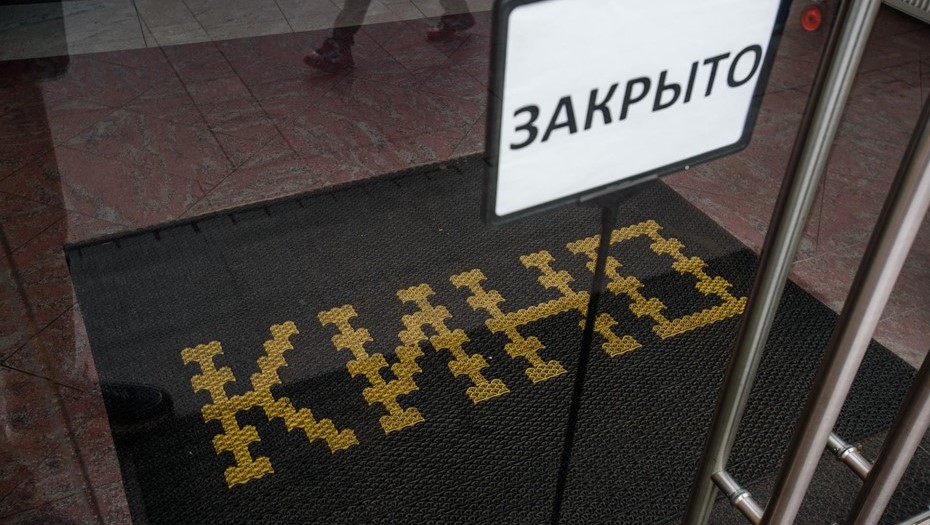
“Cinema. Closed.” Photo by Sergei Yermokhin for Delovoi Peterburg

Due to the cancellation of premieres of foreign films, Petersburg cinemas may lose half of their customers. The business will suffer huge losses, because such pictures account for about 70% of their revenue.

Disney, Warner Bros., and Sony Pictures have decided to temporarily stop releasing films for distribution in Russia. This was reported by the media yesterday The Luxor theater chain told DP that, for now, it could officially confirm the cancellation of The Batman and the animated film Blush whose premieres were to take place in early March. Sony Pictures has removed the film Morbius from its scheduled release date for Russian distribution.

“Even the distribution companies cannot say whether the release dates will be postponed or the films will not be released in Russia ultimately, and how long the restrictions will last,” the cinema chain reported.

Mirage Cinema reported that, at the moment, the only information they had about the cancellation of releases was from the media. “We have no official letters from film distribution companies about the cancellation of premieres,” they said. The KARO chain’s press office laconically replied that they would work with what they had.

The Luxor chain noted that moviegoers choose different content at different venues. For example, in one of the the chain’s cinemas, they chose The Batman, and in another, Blush.

“Hollywood blockbusters garner most of the box office, especially family films. Viewers choose popular artists and trust the quality of the content produced by the film studios. Of course, multimillion-dollar production and advertising costs imply high traffic,” the company noted.

The network is confident that now the Petersburg film industry [sic] will return to the period of October–November 2020, when there were restrictions related to the coronavirus and blockbuster premieres were postponed. Attendance will be affected not only by the cancellation of films, but also by the general emotional and economic backdrop. The Russian film business [sic] will suffer significant losses, but it is difficult to predict further actions in the market now.

Disney and Sony Pictures are the world’s leading filmmakers. Warner Bros. ranked fourth in the 2021 global rating of film studios, behind Universal in third place. Ivan Samoilenko, managing partner of the communications agency B&C, noted that the Russian film distribution market was losing most premieres of western films, which were the main draw for Russian moviegoers. Last year, foreign films in Russia earned 30.3 billion rubles (106 million tickets were sold), while domestic projects had a total box office of 10.4 billion rubles (39.7 million tickets).

Samoilenko pointed out that out of the top ten highest–grossing films last year, eight were foreign (Hollywood) productions and two were domestic. “So we can say that in the absence of western cinema, traffic in Russian cinemas may decrease by 30-50%. This will especially affect the capital and St. Petersburg, which are national leaders in terms of numbers of cinemas, numbers of moviegoers, and turnover,” Samoylenko stressed.

In 2021, analysts at the consulting company JLL noted that traditional entertainment formats, including cinemas, had been experiencing the greatest difficulties in Petersburg’s shopping centers. Over the past year, the cinemas at the Pik shopping center and Ligov shopping mall [in central Petersburg] have closed.

Source: Darya Zaitseva, Delovoi Petersburg, 2 March 2022. Translated by the Russian Reader


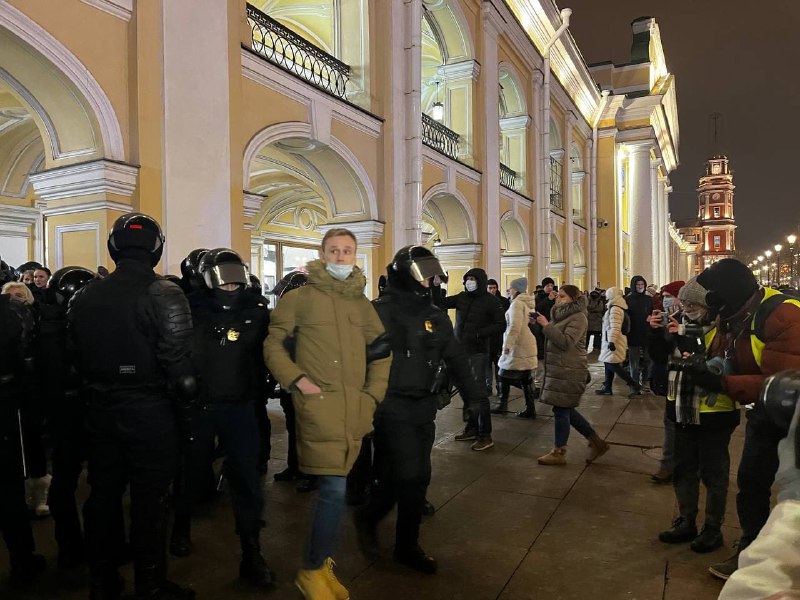
The seventh protest rally in a week has been taking place in downtown Petersburg. The protesters oppose the military special operation for the demilitarization and denazification of Ukraine.

On the evening of March 2, protesters gathered again at Gostiny Dvor on Nevsky Prospekt. According to Kommersant Petersburg’s Telegram channel, initially the protesters declined to chant anti-war slogans, but after some time the situation changed.

A scene from the seventh anti-war rally at Gostiny Dvor in Petersburg, 2 March 2022. Photo: Kommersant Petersburg’s Telegram channel

Police officers have already begun to detain the protesters: participants of the unauthorized rally have been snatched from the crowd and taken to a bus for detainees. The Petersburg artist Yelena Osipova was sighted among the protesters. She always comes to such events with placards that she makes herself. She has also been detained.

It has also known that the pedestrian underpass next to Gostiny Dvor has been blocked. The regional Interior Ministry office and the Russian National Guard have not released official information about the unauthorized protest.

As DP reported earlier, almost 150 administrative hearings were conducted by the district city courts after one of the previous anti-war rallies. As a result, forty-nine participants of the unauthorized protest were jailed for a period of 5 to 10 days. Some protesters were fined and sentenced to community service.

On the afternoon of March 2, a rally in support of Russia’s actions in the Donbas [sic] was held next to the Bronze Horseman monument [in downtown Petersburg]. RIA Novosti has published video footage from the scene.

Source: Delovoi Peterburg, 2 March 2022. Translated by the Russian Reader

The Perfect Gift for Defender of the Fatherland Day

The Dendy Junior with a cartridge and detachable controllers

Toys for everyone

On the eve of Defender of the Fatherland Day [February 23], the demand for electronics (game consoles, laptops, tablets) has grown — they are among the most coveted gifts. Ozon said that in mid-February, unit sales of consoles and accessories had increased 2.2 times year-on-year. “Retro consoles have been an unexpected trend in the video game consoles category — they have been the best-selling products. Dendy Junior and Sega Genesis will be nostalgic February 23rd gifts for Petersburg residents,” the retailer’s press service added.

Wildberries has also seen a run on electronics. But electric razors (demand for them increased by 153% in the first half of February) and hair and beard clippers (up by 48%) have been their most popular items.

M.Video-Eldorado told us that headphones and portable acoustics have been trending. In addition, the new digital reality dictates its own rules: gifts that cannot be touched with your hands are becoming more and more desirable. High demand this year has been shown by digital content such as subscriptions to services (videos, books, etc.). Sales of digital codes for games had more than doubled by February 2021 [sic].

Sales on Avito of laptops and smartphones have also increased by 15% and 9%, respectively. You can buy devices for an average of 22,380 rubles and 17,920 rubles [approx. 249 and 199 euros]. Some female Petersburgers decided to make their task as easy as possible and present men not with a specific gift, but with a gift certificate. The Avito press service said that users spend an average of 4,700 rubles [approx. 52 euros] on them.

Retailers can also make money in February on sales of children’s goods. Radio-controlled toys have become more than twice as popular on Ozon. Wildberries noted that parents purchase toy weapons, cars, airplanes and helicopters, as well as various prefabricated models for their little defenders.

Whether he’s going to the army or on a fishing trip

Goods for hunting and fishing — that’s what female customers have paid attention to this holiday. However, even this involves electronic gadgets. “The list of [our] popular items includes an echo sounder and a case for it, a monocular telescope, powerful binoculars, and a set of walkie-talkies,” Ozon’s press service says.

“In the household and garden goods category, sauna accessories (for example, a hat embroidered with the phrase ‘February 23’) and goods for cooking kebabs and barbecue (a set of skewers with lacquered beech handles in a tight protective cover has been among the top sellers) have been purchased the most,” [reports Ozon]. It’s funny that in St. Petersburg and the Leningrad region this year one of the most popular February 23rd gifts will be a set for making homemade liqueurs.

Wildberries’ female shoppers have been no less creative in choosing gifts. They decided that army dry rations are an inexpensive and original option, orders of which have increased by 344% year-on-year. These are gift sets designed to look like a real soldier’s rations. Jumbo-sized dry rations featuring canned food and snacks cost about 1,5000 to 2,000 rubles [approx. 17 to 22 euros].

Traditional values

And yet the popularity of socks and men’s skin care products remains unshakable. In the first half of February, Wildberries saws the number of orders for socks in St. Petersburg increase by 113%, and shaving kits by 150%, while orders for cosmetic care kits rose by 750%, deodorants, by 46%, and colognes, by 157%. The demand for men’s lotions has increased by 100%, while the popularity of shower gels has soared almost ninefold compared to January. Ties (up 95%), belts (up 153%), and wallets (up 144%) are also among popular traditional gifts.

Corporate customers of online stores this year bought sweets for the holidays. According to SberMarket’s b2b department, companies have most often ordered gift sets of Merci candy, coffee and tea in gift packages, and Old Spice, Palmolive, and Gillette skin care sets for employees for Defender of the Fatherland Day this year.

Source: Darya Dmitrieva, Delovoi Peterburg, 22 February 2022. Image courtesy of Wikipedia. Translated by the Russian Reader

Spikery, or, How to Give Aid and Comfort to Fascist War Criminals While Making Lots of Money

It’s funny the things you find in your email inbox in the morning. This morning, as usual, I found mailers from many of the Russian and English-language online newspapers I read, including Petersburg’s humble but always revealing business daily Delovoi Peterburg.

Today’s big news was that police had searched the head office of Bukvoyed, one of Russia’s largest bookstore chains.

Founded in 2000, Bukvoyed (“Bookworm”) has 140 stores around the country.

A source at Bukvoyed told Delovoi Peterburg the search had nothing to do with the company per se but with one of its business partners.

If you have been monitoring the fortunes of Russian business under the Putinist tyranny, a crony state-capitalist regime, run by “former” KGB officers as if it was the Soprano mob, only a million times nastier, you would know it has not been easy to do business of any kind in Russia during the last twenty years. The country’s current prime minister and ex-president, Dmitry Medvedev, once famously said the regime’s vast police and security apparatus, known collectively as the siloviki, needed to stop “nightmaring” (koshmarit) business.

He also famously said, when he was president, that his country was plagued by “legal nihilism.”

Although he was right on both counts, Medvedev did nothing about it. Since the brief, supposedly more “liberal” period when he was freer to speak his mind because, technically, he was the most powerful man in Russia, the nightmaring of business (and nearly everyone else who makes themselves a target by doing anything more ambitious than hiding their light in a bushel) has only got worse, and legal nihilism, along with anti-Americanism, homophobia, xenophobia, and neo-imperialism, has become even more entrenched as part of the Kremlin’s unwritten ideology and, thus, a guidepost for how Russia’s police, security agencies, prosecutors, and judges deal with “criminals.” 

As Denis Sokolov recently argued in Republic, the siloviki have established a system of “police feudalism” in Russia under which the FSB, the Russian Investigative Committee, the Interior Ministry, the Russian Prosecutor General’s Office, the Russian National Guard, the tax police, and other state security agencies have divided the country into fiefs, bits of “turf” where they are almost entirely free to shake down, rob, nightmare, and legally nihilize whomever and whatever they want under a set of unwritten rules outsiders can only guess at.

After reading about Bukvoyed’s legal-nihilistic woes, then, I was startled by the banner ad I found at the bottom of the page.

mooks“Synergy Global Forum, October 4–5, 2019, Gazprom Arena, Saint Petersburg. Arnold Schwarzenegger. Grant Cardone. Michael Porter. Randi Zuckerberg. Ichak Adize.” Ad courtesy of Delovoi Peterburg

Referred to, hilariously, as “spikery” (“speakers”) on the Russian version of the Synergy Global Forum’s website, these five greater and lesser lights of global capitalism have been, no doubt, promised or paid extraordinarily hefty fees to keynote this hootenanny in the belly of the crony state-capitalist beast.

Formerly known as the Zenit Arena (after the city’s Russian premier league football team, FC Zenit, owned by state-controlled Gazprom), even the venue itself, the Gazprom Arena, is a monument to the mammoth crookedness, thuggery, violence, and corruption replicated all over the world’s biggest country every day for the last twenty years by the Kremlin’s minions.

But you would never know that by reading the cheery boilerplate on the Synergy Global Forum’s website.

Gazprom Arena is the most visited indoor stadium in Eastern Europe, second only to the famous Wembley in London. The main feature of the project — a sliding roof, which allows you to carry out activities in a comfortable environment at any time of the year and in all weather conditions. Large capacity, modern technical equipment, and two-tier parking make Gazprom Arena one of the best venues for major festivals, exhibitions, and business conferences.

More important, however, is the ostensible point of all this spikery, other than making lots of money for everyone involved.

Synergy Global Forum has been held since 2015. The first Forum gathered 6,000 participants and became the largest business event in the country. Two years later, we broke this record and entered Guinness World Records — 25,000 entrepreneurs and top managers participated at SGF in Olympiyskiy in 2017. This year we set a new big goal — to gather 50,000 participants from all over the world at SGF 2019 in St. Petersburg. Synergy Global Forum not only gives you an applied knowledge, but also motivates and inspires to global achievements, gives the belief that any ambitious goal is achievable. What goals do you set for yourself?

Aside from being one big [sic], this sampling of spikery reveals that the apocryphal gospel of Dale Carnegie and other “good capitalist” snake oil salesmen is alive and well and making waves in a place like Russia, where it could not be more out of place.

I don’t mean that Russia and Russians are “culturally” or “civilizationally” incompatible with self-improvement, the power of positive thinking, and other tenets of American capitalist self-hypnosis. If you had spent most of your adult life in Russia, as I have, you would know the opposite is the case.

Unfortunately. Because what Russia needs more than anything right now is not more navel-gazing and better business practices, but regime change and the rule of law. Since I’m a democratic socialist, not a Marxist-Leninist, and, I hope, a realist, these things cannot come about other than through a revolution in which Russia’s aspiring middle classes, at whom snake-oil festivals like the Synergy Global Forum are targeted, join forces with the grassroots, who have been nightmared and legally nihilized in their own way under Putin.

One of the first things a new bourgeois-proletariat Russian coalition government would have to do, aside from prosecuting and imprisoning tens of thousands of siloviki and banning them from politics and the civil service for life, would be to disentangle the country from its current incredibly destructive armed and unarmed interventions in conflicts in other countries, starting with Ukraine and Syria.

What does the Synergy Global Forum and its sponsor, Synergy Business School have to do with such seemingly distant and terribly messy international politics? Well, this:

The school has branches in 26 Russian cities, as well as a unique campus in Dubai, which is home base for an international MBA program for students from the UAE, Yemen, Saudi Arabia, and Iran.

So, in fact, Synergy Business School is in the business of equipping people from some of the world’s most powerful and aggressive theocratic, monarchist, and crony state-capitalist tyrannies with MBAs while claiming its core values are “openness to newness, commitment to development, and intelligence.”

You can say I’m a dreamer but I am nearly sure SBS’s core values are completely at odds with the neo-imperialism, neo-colonialism, militarism, hostility to civil and human rights, and fascism of the current regimes in Russia, Saudi Arabia, and Iran.

I write this not because I believe in building a “better” capitalism (I don’t), but because I am nearly sure one party to this mass chicanery, including the invited spikery, does believe it is possible to do just that and thus “peacefully” transform these countries into slightly quirky versions of Australia and Canada. (For the record, I don’t for a minute believe these supposedly democratic countries have no problems of their own with human rights, etc.)

That is not going to happen if only because, at another level, carefully hidden from the incurious eyes of the people who go to such events, their real purpose is to whitewash these regimes, make them more attractive to foreign investors, and expand their international networks of shills and useful idiots.

I learned this valuable lesson about Putinist Russia by carefully following the amazing career of Vladimir Yakunin, another “former” KGB officer and fellow Ozero Dacha Co-op member who could write a textbook about how to co-opt distinguished foreign academics, decision-makers, and journalists into, mostly unwittingly, toeing the Putinist line.

It comes down to this. Why are Arnold Schwarznegger, Randi Zuckerberg, and their fellow 2019 Synergy Global Forum spikery so willing to help whitewash a gang of fascist war criminals who are also at war with their own people?

Since there is no good answer to this question, they should be arrested upon their return from the forum and charged with colluding with hostile foreign powers.

If you don’t understand what I mean by “fascist war criminals,” please read the article below. // TRR

______________________________________________________

Russia and Assad are butchering Syrian civilians again. No one seems to mind
Terry Glavin
National Post
July 24, 2019

Maybe it’s because of the guilty anti-interventionist conscience of the world’s comfortable liberal democracies, or because it’s now an article of respectable faith in the NATO capitals that Syrian lives simply aren’t worth the bother. Maybe it’s just that we’ve all become so accustomed to reports of slaughter and barbarism in Syria that it barely warrants public attention at all.

Whatever the reason, or excuse, Russian foreign minister Sergei Lavrov is finally having his way in the Syrian governorate of Idlib, and the world barely notices.

It’s been nearly a year since Lavrov expressed his desire that the “abscess” of Syrian resistance in Idlib, a sprawling province that borders Turkey in Syria’s northwest, be “liquidated.” It’s been nearly a month since 11 humanitarian organizations came together with the United Nations Office for Humanitarian Affairs to warn that “Idlib is on the brink of a humanitarian nightmare unlike anything we have seen this century.”

We’ve reached that brink now. Just this week, 66 civilians have been killed and more than 100 non-combatants wounded, the UN reports, in a series of bombing runs carried out across Idlib. The worst massacre was an airstrike Monday on a public market in the village of Maarat al-Numan. At least 39 people were killed, among them eight women and five children.

Since the Syrian dictator Bashar Al-Assad’s barrel bombers and Russia’s fighter-bombers began their recent offensive in Idlib on April 29, the Syrian Observatory for Human Rights has tallied 2,641 casualties. The UN counts 400 civilian deaths, but there is no accurate count of the dead and injured in Syria anymore. The wounded lie dying in the rubble of bombed buildings. At least 25 hospitals and clinics in Idlib have been destroyed since April 29, bringing the number of health centers deliberately targeted since 2011 to about 570. More than 800 health workers have been killed.

Three years ago, when the UN and monitoring agencies stopped counting, the Syrian dead were numbered at 500,000. In the face of these most recent war crimes and atrocities, the UN’s humanitarian affairs office has been reduced to begging Assad and Lavrov to ease up to allow humanitarian aid into Idlib’s besieged districts, and pleading with Russia and Turkey to uphold the terms of a year-old memorandum of understanding that was supposed to demilitarize Idlib. Fat chance of that.

The Kremlin-Ankara pact arose from negotiations that began in the months following the 2016 fall of Aleppo, where thousands of Syrian civilians were slaughtered by Vladimir Putin’s air force in the course of the Kremlin’s commitment to Assad to help bomb the Syrian resistance into submission. Joining with Russia and Iran, Turkish strongman Recip Erdoğan entered into a series of talks in Astana, Kazakhstan, that eventually led to an agreement to establish Idlib as a jointly-patrolled “deconfliction zone.”

A series of these de-escalation agreements have each in their turn become death traps. In Homs, in Ghouta, in Quneitra, the pattern has repeated itself. Weakened by starvation sieges, and bloodied by Russian fighter jets, Assad’s barrel bombs, ground assaults by Iran’s Hezbollah units and multiple chemical attacks — sarin, chlorine, napalm — Syria’s various and fractious resistance outfits have surrendered several cities and towns on the promise of safe passage with their families to one or another de-escalation area. Convoys of buses carry them across the countryside. They settle in, and then they come under attack again.

Until April 29, Idlib was the last of these demilitarized zones, and by then the population had doubled to three million people. Among Idlib’s recent arrivals were civilians fleeing the Syrian carnage who had not been able to join the six million Syrians who have managed to escape the country altogether. But the newcomers also include members of various armed opposition groups, and the Assad regime has deftly manipulated its “de-escalation” and safe-passage arrangements to pit those groups against one another.

More than a dozen safe-passage agreements struck prior to the Kremlin-Ankara arrangement amount to what democratic opposition leaders have called ethnic cleansing and “compulsory deportation.” Most of the opposition groups that submitted to them have ended up in Idlib. Among them: Islamic State fighters from Yarmouk, and the jihadist fronts Ahrar al-Sham and Jaish al-Fatah from districts around Aleppo and Damascus.

What this has meant for Idlib is that the mainline opposition in the Turkish-backed and formerly American-supported Syrian Interim Government has been losing its hold on the governorate, and its democratically elected local councils have come under increasing pressure from the Hay’at Tahrir al-Sham jihadist coalition. And now that Assad’s Syrian Arab Army has been moving in from the south, and Russian and regime bombs are falling from the skies, tens of thousands of civilians are on the move again.

More than 300,000 people are on the roads, most of them headed towards Turkey, but Turkey has already taken in half of Syria’s six million refugees and the Turkish border is now closed to them. More than 1,000 Turkish troops are patrolling Idlib’s northern countryside as part of the Astana accord, and they won’t let the Syrian civilians pass. Humanitarian groups report that hundreds of Syrian refugees have been picked up in Istanbul in recent weeks and deported back to Syria.

“Yet again innocent civilians are paying the price for the political failure to stop the violence and do what is demanded under international law — to protect all civilians,” is the way UN Humanitarian Coordinator Mark Lowcock puts it. “Our worst fears are materializing.”

No help is coming from Europe. The European Union has made its peace with Ankara — Erdoğan prevents Syrian refugees from sneaking into Greece or Bulgaria or setting out in leaky rafts into the Mediterranean, and Europe looks the other way while Erdoğan deports Syrian refugees back to the slaughterhouse of Idlib.

Neither is any help coming from the United States, where the Kremlin-friendly Trump administration is balking at the idea of imposing sanctions on Turkey for buying into Russia’s S-400 missile system, and is otherwise continuing the Obama administration’s policy of thinking about mass murderer Assad as somebody else’s problem.

And then there’s Canada, where we’re all supposed to congratulate ourselves for having high-graded the best and brightest Syrians from the UN’s refugee camps, and we expect the Syrian refugees we’ve taken in to be grateful and to forgive us all for standing around and gawping while their country was turned into blood, fire, and rubble.

Whatever our reasons, or excuses, Idlib is being liquidated, a humanitarian nightmare is unfolding in Syria again, and hardly anybody notices.

Eat Y’Self Fitter

zeitfur“Time for the girlfriend.”

More bad news from Russia’s Northern Capital:

Количество фитнес–клубов в Петербурге превышает спрос. По данным “ДП” их услугами по–прежнему пользуется небольшая часть населения Северной столицы. В настоящее время в Петербурге спортом в фитнес–клубах регулярно занимаются не более 4,8% населения, в то время как в Лондоне их посещают 20% жителей, в Барселоне — 35%, а в Берлине — почти 60%.

“The number of fitness clubs in St. Petersburg exceeds demand. According to Delovoi Petersburg newspaper their services are, as before, enjoyed by a small segment of the Northern Capital’s populace. Currently, no more than 4.8% of Petersburgers work out in fitness clubs, as opposed to 20% of Londoners, 35% of Barcelonians, and nearly 60% of Berliners.”

ATTENTION! Why do you think this is the case? The first person to send me the correct answer in the comments, below, will get a special prize, dispatched via the mails from Berlin, where I am among the 40% of losers who do not work out in fitness clubs.

Please don’t use Google or other artificial intelligences to answer the question. Instead, use the brains the good Lord gave you.

Photo by the Russian Reader