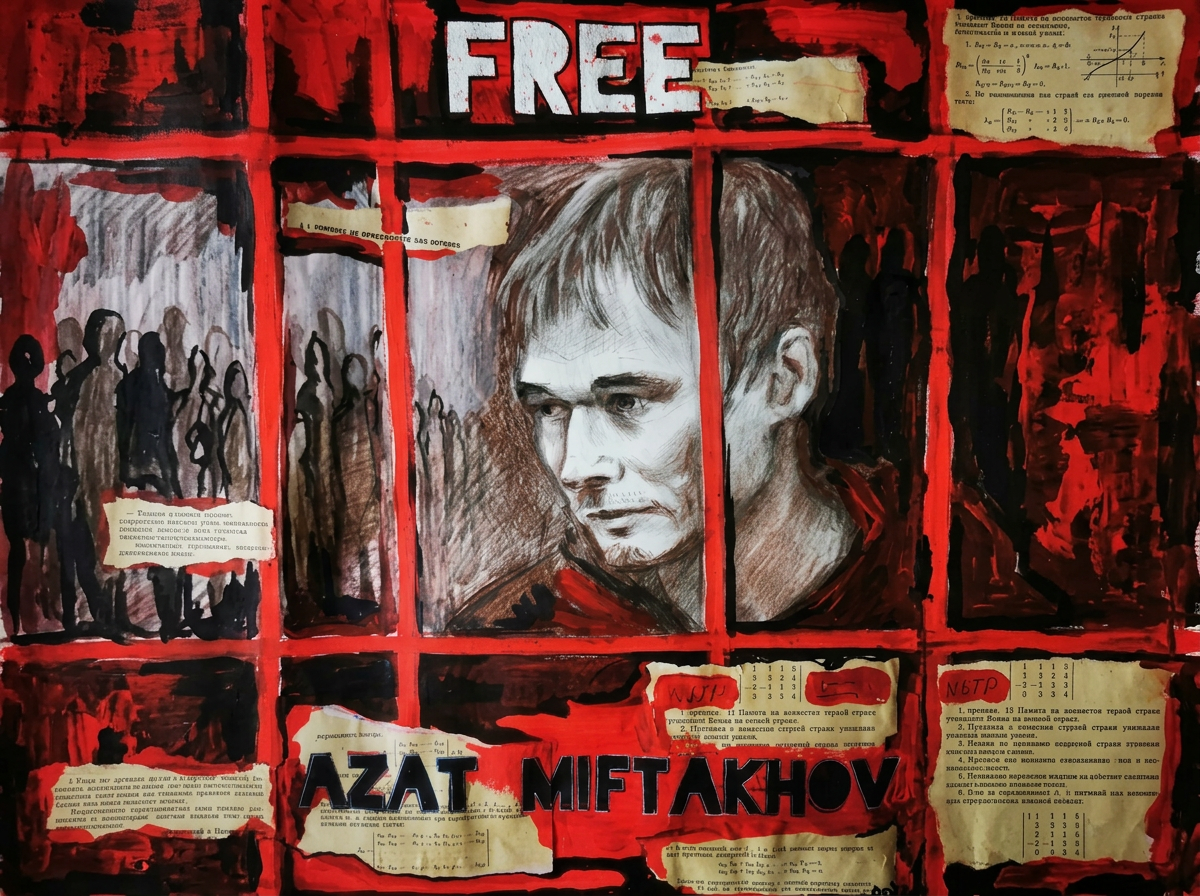
Political Prisoner Azat Miftakhov Continues to Be Tortured by the Putin Regime

Azat Miftakhov is being transferred to the colony where Alexei Navalny was murdered

Anarchist, mathematician, and political prisoner Azat Miftakhov was sentenced on March 28, 2024, to 4 additional years in prison. On September 4, 2023, he was detained upon leaving IK-17 [Correctional Colony No. 17] in Omutninsk, Kirov region, where he had already served his first sentence—allegedly for breaking a window at a United Russia office in Moscow’s Khovrino district. The basis for the new prosecution for “justifying terrorism” was (allegedly) comments Azat made while watching a TV program with other inmates about anarchist Mikhail Zhlobitsky, who carried out an explosion at the FSB office in Arkhangelsk. Testimony against Azat was given by fellow prisoners and a prison employee.

Recently, the political prisoner was transferred from a prison in Dimitrovgrad, Ulyanovsk region. In a letter dated April 19, Azat reported on his transfer from Kirov to Vorkuta:

“I’m writing to you from Vorkuta. And as you understand, I’m heading to Kharp. I think no further comments are needed.

“Two days on the train have worn me out quite a bit. The toilet—once every 4 hours, hot water—three times a day, there’s no room to turn around in the compartments, my bones ache from constantly lying on a hard bunk and the shaking of the train. So the stop in Vorkuta is very welcome. Tomorrow morning we depart, and we’ll arrive in Kharp the same day. It seems I’ll go straight from the train to the camp without intermediate stops (apparently there are no detention centers there).”

The prisoner’s support group comment[ed] on this news:

“It is quite obvious that transferring Azat to Kharp is nothing other than a desire to take revenge on him for his firm stance. It is both a threat that his life depends on the will of the security apparatus and the creation of significant hardship for the remaining 1.5 years of his sentence.

“Kharp is one of the northernmost places of detention in Russia; it is located beyond the Arctic Circle, in permafrost conditions. It was established in 1961 on the basis of preserved buildings of a former camp unit of the Gulag’s Construction Site No. 501.

“In addition to Alexei Navalny, who was unable to leave the colony alive, well-known political prisoners held in Kharp include Platon Lebedev (2005–2006) and Oleg Sentsov (2017–2019).”

Here is what Azat’s wife and defender, Elena Gorban, writes:

“As his lawyer, I visited Azat monthly in the Ulyanovsk region, spending under 10,000 rubles (circa 110 euros) on travel (or not much more, depending on circumstances). Now I understand that a trip to the Yamalo-Nenets Autonomous Okrug will cost closer to 40,000 (circa 440 euros): 5000 for two nights in a hostel, 12000 and 20000 for flights… (12000 is with a middle-of-the-night layover and worst possible service).

“I’ll also have to cross the Ob River to and from the airport. And I hope I won’t have to open and close the swimming season immediately… since, according to a hostel worker, ice crossing is still operational.

“Maybe later I’ll figure out how to make these trips cheaper, but it’s unlikely I’ll manage without expensive flights… after all, two days by train one way, especially when trains don’t run daily, is not something you can do regularly.

“Oh, and if Azat ends up specifically in the colony in the village of Kharp, and not in Labytnangi (the nearest city), then it seems there’s no electronic mail there. That already borders on torture.”

Donate bitcoin for Azat:

Bitcoin: bc1qspn7lwg38ra6r836akqwusnr4zvjhmegz5v9dm

For [details on money transfers] inside Russia, refer to [the original] post in Russian.

Translated by Anarchist Black Cross Moscow

Source: Autonomous Action, 26 April 2026. Thanks to Simon Pirani for the heads-up.


On [5 August 2025] Russia’s Supreme Court rejected the final appeal for Azat Miftakhov, a mathematician and anarchist serving his second politically motivated prison sentence. His latest conviction, for “justifying terrorism,” rests entirely on the testimony of a fellow inmate who claimed Miftakhov had praised an attack on the security services. For over six years, Miftakhov has navigated two coexisting identities in Russia’s brutal penal system: that of a political prisoner and a member of the “obizhennye”, or the “degraded”—the untouchable caste at the bottom of the prison hierarchy. In letters from behind bars, he tells Mediazona how he survives.

Azat Miftakhov, 31, was a graduate student in mathematics at Moscow State University when he was first arrested in February 2019.

Initially accused of making explosives, he was beaten and tortured by security service agents who threatened to rape him with an electric screwdriver. Another detainee was tortured with an electric shocker by security forces who demanded he incriminate the mathematician. After his detention, Miftakhov attempted to slit his wrists but gave no confession.

Bespectacled, short and soft-spoken, the anarchist has not yielded to this day, despite pressure from the FSB and a second fabricated terrorism case.

Back in February 2019, when the security forces failed to find evidence that the young man had been making explosives, Miftakhov was accused in a case concerning a window broken a year earlier at a ruling United Russia party office in Moscow’s Khovrino district.

The pressure campaign continued inside the prison. Officers from the FSB informed other inmates of Miftakhov’s bisexuality. The move was a calculated effort to have him ostracised and forced into the “degraded” caste, a group subject to constant humiliation, violence, and forced labour. Miftakhov did not deny the officers’ words; back in 2019, intimate photos of him were published by Telegram channels linked to security services and later by the state-run TV channel Rossiya-1. 

A vigorous public campaign in support of Miftakhov began from the first days of his arrest, so he could not hide his status as a political prisoner from other detainees, though he did not deliberately advertise it.

“During mail call, the whole prison section is standing in formation,” he explains. “An activist comes up with a stack of letters. The first is for me, the second for me, the third, the fourth… In the end, only two or three letters go to other inmates. The rest are mine.” He often received letters and postcards from France, Germany, and Sweden, something extraordinary for other prisoners. “They’re writing even from America!” they would marvel. The camp’s population changed, but newcomers would often approach me and ask: “Is it true that Oxxxymiron wrote a song about you?”

In the winter of 2021, Azat Miftakhov was sentenced to six years in a penal colony. A secret witness, interrogated a year after the case was opened, claimed to have identified Miftakhov among the group that broke the United Russia office window and threw a smoke bomb inside, recognising him by his “expressive eyebrows.” The anarchist himself denied any involvement in the action.

After his time in Moscow’s pre-trial detention centres, Miftakhov was transferred in August 2021 to serve his sentence at Penal Colony No. 17 (IK-17) in Omutninsk, Kirov region. The prison was “red”, or tightly controlled by the administration through “activists” from among the prisoners.

Although severe physical violence had become a rarity there in recent decades, the colony’s reputation for torture dated back to the late 1980s, especially as punishment for refusing to prepare for official holidays. For many years, the most important of these was Victory Day, and all prisoners without exception were required to participate in preparations for a “parade” featuring models of military equipment.

“It was considered an absolutely mandatory thing, and to refuse meant condemning yourself to unimaginable torment: torture with shockers, bleach, and the punishment cell,” recalls Timur Isayev, who was incarcerated in IK-17 at the same time as Miftakhov. He was serving a sentence for organising an escort agency. After his release, Isayev left Russia.

Miftakhov impressed Isayev immediately upon his arrival at the colony. The inmates learned that during quarantine, security officers had offered the mathematician the chance to “hide” his “degraded” status in exchange for cooperation, but he refused.

“He told them: ‘Chief, you protect laws and rights, yet you speak to me in some kind of criminal jargon that you yourself are supposed to fight against. I don’t recognise your stinking ponyatiyaI don’t recognise this division of people either. Do what you think is necessary.’ The cops were just stunned by such audacity and directness,” Isayev recalls.

Thus, from the perspective of the other prisoners, Miftakhov had essentially “defined” himself as “degraded”, since he had the opportunity to hide his status, explains the source to Mediazona. Therefore, each of [the] muzhiki, or “the men”, regular prisoners, had to decide for himself whether it was appropriate to communicate with him. Isayev says he spoke with him without regard for others: “He had a normal social life in the zone, he was treated very well—not like the others in that caste, with whom he could still interact. He had a completely special position.”

From Azat Miftakhov’s letter to Mediazona (abridged)

You can’t get “infected”’ by talking to someone who is “degraded”, but it’s considered improper for one of “the men” to hang around a “degraded” person for too long. You won’t be “called to account” for it, but you might catch ridicule and taunts from others, even provocations. They might suggest that a “man” “share” living quarters with the “degraded” since he gets along with them so well.

The life of a “degraded” person consists of many prohibitions. Many of them are so fundamental that they cannot be ignored without getting into a conflict with “the men”. Take, for example, the obligation for the “degraded” to be last in every queue: for the canteen, the shop, the medical unit. It happened more than once, for instance, that I’d stand in line for the shop all day. The queue is long, and as always, they’ve brought in an insufficient amount of goods. Every now and then, you hear that this or that has already run out. And then, just as the queue reaches the “degraded” inmates, a dozen more of “the men” suddenly appear from around the corner, having only just decided to join the line. You have to let them go first. It’s frustrating, of course, but what can you do? If you don’t like it, you can get locked in a punishment cell or a cell-type unit. But then you can forget about parcels and visits.

There is only one prohibition that I refuse to accept—the ban on fighting one of “the men”. If someone tries to humiliate my human dignity with an insult or by forcing me to do something, I consider it my sacred right to respond with force. The only thing I have to be wary of when exercising this right is punishment from the activists or the criminal elites. They can beat you severely for it, causing serious injury. However, I value my human dignity too highly to allow it to be debased, even under the threat of injury. Prison is a place where you’d better not “swallow” humiliation. If you “swallow” it once, you convince those around you that you can “swallow” it again and again. It’s better to nip it in the bud. That’s my philosophy on the matter.

I have had to fight “the men” several times, and each time it was over my status. It didn’t always lead to a scandal. Sometimes we managed to make peace with my opponent afterwards. A couple of times, a “case” was brought against me. The “trial” took place in a storeroom. Activists and various influential people as “judges” would cram in there, along with both sides of the conflict, meaning me and my “victim”. Witnesses were also called. Some “judges” seemed eager to pass a harsh sentence, which could have been carried out on the spot. I had to be prepared for such a turn of events and at the same time maintain my composure while justifying my position. Although according to the “prison” law, I was already in the wrong from the start, so my universal human arguments were unlikely to work there.
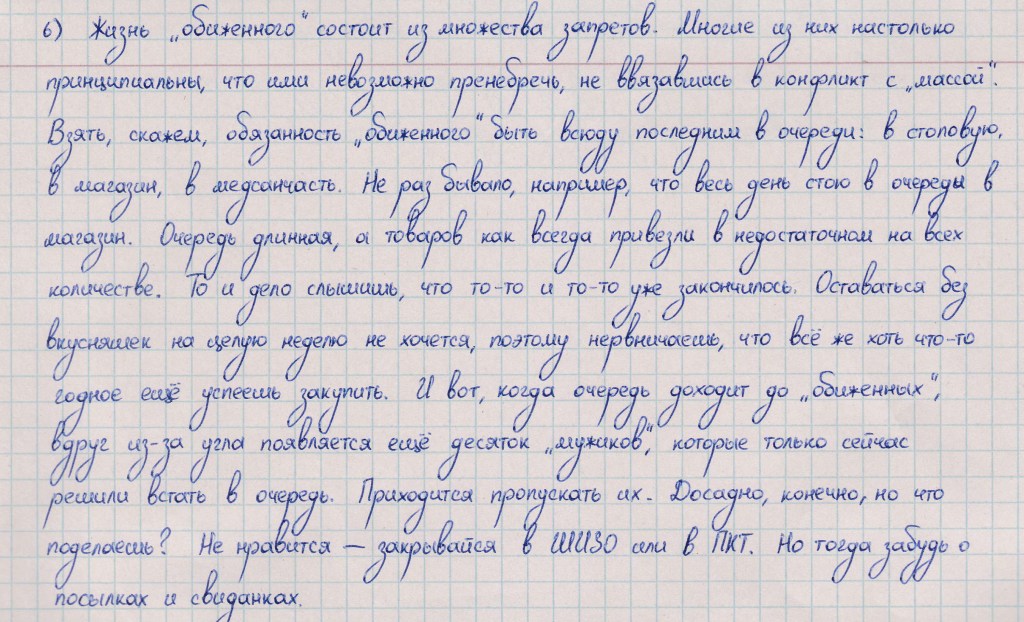
Fragment of Miftakhov’s letter to Mediazona

Miftakhov’s principles faced a major test in the spring of 2022, as the colony prepared for its annual Victory Day parade.

When Miftakhov saw other prisoners painting the “Z” and “V” symbols of the Ukraine invasion onto military props, he informed his detachment chief he would not participate. He expected to be sent to a punishment cell, but the administration, wary of his high profile, opted for a different strategy.

The day before the parade, Miftakhov was summoned; he expected to be tortured there, but instead, an inspector led him to a windowless room hidden deep within the medical unit, furnished only with a bed, a bedside table, and a toilet. Soon, the head of the operational department arrived. He explained that the room would temporarily become a “safe place” for the political prisoner.

From Azat Miftakhov’s letter to Mediazona (abridged)

“We’ve received information that some convicts are unhappy with your position,” the officer told me. “They want to teach you a lesson.”

“Therefore,” he continued, “it was decided to provide you with a safe place. Due to the threat to your health.”

“And how long will I be in this safe place?” I asked.

“Well,” the officer seemed to ponder, “I don’t know. Maybe a month, maybe a year. Or maybe until the last convict who wants to beat your ass is released.”

After talking with me a little more, he left, and I remained in that room. That’s how I began to learn what a “safe place” was. And I must say, it was the best gift the IK-17 administration could have possibly given me.

From then on, I didn’t have to go to work. I could spend all day on self-development, solving math problems and reading books. But most importantly, I could rest from the constant hustle and bustle of the common area. I wished it could last until my release. However, my happiness was not destined to last long. A week later, some random people were asked to sign off that the threat against me was gone. I had to return.

It was in IK-17 that Miftakhov formed a friendship with Evgeny Trushkov, another “degraded” prisoner serving a long sentence for charges including group rape. This friendship would prove to be his undoing. As Miftakhov’s release date in September 2023 approached, the FSB scrambled to build a new case against him. Trushkov became their star witness.

He testified that Miftakhov had “justified terrorism” in conversations with him, allegedly praising Mikhail Zhlobitsky, a teenager who bombed an FSB office in 2018. “I admire the actions of Mikhail Zhlobitsky, who was not afraid to lay down his life in the fight against Putin’s regime,” Trushkov claimed Miftakhov had said.

From Azat Miftakhov’s letter to Mediazona (abridged)

In the two years we knew each other, I received nothing but support from him. Sometimes he would tell me how he wanted to help me evade the FSB’s attention, that he was even willing to postpone his own freedom for it. Some of his suggestions were naive, which only convinced me of their sincerity. So when I found out that Trushkov had testified against me, I didn’t believe it at first. Only gradually, as I got acquainted with my new criminal case, did I begin to understand that he had betrayed me.

I do not think Trushkov initiated the criminal case, as he claimed in court. I am sure his story about how he, out of patriotic feelings, went to report the alleged crime to the detachment chief was fabricated to make the prosecution’s evidence seem coherent.

I believe this is what happened. On July 20, he was presented with a choice: either you give us the testimony we need against Azat, or you get “spun up” with him on a terrorism charge, but a more severe one. And they probably made it clear that the necessary witnesses for such a charge would be found. From there, I see two possible scenarios. First: he got scared for himself. Second: he made a deal with the FSB for my own good. I do not rule out either of these options, nor do I justify them.

Making deals with the FSB is a losing game from the start. One should not think that you can outsmart them this way, gaining more than you lose. Such underestimation of the enemy is extremely dangerous. Once you make one concession to them, they will force you to make a second, a third, and so on, until you give them your soul. In my conversations with him, I noticed this naive underestimation of the special services.

On the day he was due to be freed, Miftakhov was met at the prison gates by FSB agents who immediately re-arrested him. In a new trial based on his friend’s testimony, he was sentenced to another four years for “justifying terrorism.”

He is now held in a high-security prison in Dimitrovgrad, mostly in solitary confinement. His mental health has declined sharply. Trushkov, meanwhile, was released from the colony to fight for [the Wagner Group] in Ukraine. In a phone call to Miftakhov’s wife from the front, he slurred, “Get the kid out of there,” knowing Dimitrovgrad prison’s reputation.

Miftakhov is not scheduled for release until September 2027.

From Azat Miftakhov’s letter to Mediazona (abridged)

“There are no friends in prison,” as the inmates say. I don’t like such generalisations, but there is a certain amount of truth in it. Inmates are inherently placed in a vulnerable position. One wants to be released as soon as possible, another hopes for an unscheduled visit with his wife, and all of this depends on the goodwill of the administration. The administration knows the value of these benefits and sells them for special services. Snitching and betrayal are among them. And yes, prison status has no meaning here: “snitches” are found among both the “degraded” and “the men”. And you can’t say that the proportion among the former is noticeably different from the proportion among the latter.

Nevertheless, I managed to get burned by my friendship with Trushkov. Well, I have to admit that I am apparently a poor judge of character. This incident has significantly affected my perception of people in places of detention. When I meet a new person, I can’t help but start to assess whether he is capable of refusing the chekists if they try to force him to testify against me with threats and promises.

Source: Nikita Sologub, “The double status problem. Anarchist mathematician Azat Miftakhov on his life at the bottom of Russia’s brutal prison caste system,” Mediazona, 8 August 2025

Spring Fundraiser for Political Prisoner Viktor Filinkov

Viktor Filinkov

💫 Fundraiser for continuing Viktor “Vitya” Filinkov’s campaign against the FSIN, the Russian Federal Penitentiary Service!

I haven’t written here for a long time generally and about Vitya in particular. We haven’t seen each other for almost two months. That’s an awfully long time, and I miss him terribly. Soon I will fly back to Orenburg and tell you how Vitya is doing, but after meeting with him.

In the meantime, I’ll tell you about the money, my favorite topic, because there is a constant need for it and it is constantly running out.

Vitya is now “painting the town red” on his own money. Recently, I got hold of 100 thousand rubles from his bank account, which Vitya had earned before he was sent down and which were blocked because he is a “terrorist.” I couldn’t get my hands on the other 70 thousand. They are frozen until Vitya is removed from the registry of “terrorists.”

Those 100 thousand rubles have really come in handy. I am now using them to pay for trips and lawyer’s fees. In 2023, we have already spent 190 thousand rubles on tickets and lawyer’s fees over eight trips. (Luckily, the tickets in January were also quite cheap.) And to this we have to add lodging costs in Orenburg and monthly transfers to Vitya’s account for shopping in the penal colony’s commissary and penalties “for refusing to work” (we are now appealing the latter in court), as well as all sorts of unforeseen expenses, such as notary services, medicines, etc.

So very soon Vitya’s 100 thousand rubles will be done. In 2023, 60 thousand rubles have trickled onto the bank card we use to solicit donations for Vitya, and even then only because 50 thousand rubles were suddenly donated in February. In other months, total donations have ranged between three and 15 thousand. We still have a small reserve left, but it’s really small. It will last us for another month or two at most.

The good news is that we seemingly might be able to get back some of this money, but it will take a long time. In January, the court made the first decision to compensate our expenses in one of the cases we won. This is not compensation for moral injury, but only reimbursement of the lawyer’s travel expenses (50 thousand). The penal colony filed an appeal of course, and the date for that hearing has not even been set yet. And the district court judge has been postponing all our other claims for compensation, waiting for the appeal court’s decision on the first case. Then, if the ruling remains in force, we will wait for this money to be returned: it seems this will take up to three months, So it’s still a long time before we’ll see those initial 50 thousand again, so for the time being we definitely need donations. We have also finally started filing claims for compensation for moral injury, but there have been no hearings on these claims yet.

All the year and a half that Vitya has been in Orenburg, we have spent a lot of money fighting on his behalf, but we have been winning half of our cases in the courts, and ultimately this leads to an improvement in Vitya’s conditions (which are still harsh, however). Lawyer Vitaly Cherkasov ❤ has been working selflessly on all of Vitya’s cases since the first days of his arrest, traveling several times a month between St. Petersburg and Orenburg.

To get to the point: if you are able to donate money, please do. If you have no way to donate money, then maybe you know someone who does and you can share this post with them. Or just repost it. Or maybe you can advise us about where or to whom we can apply for financial support. All such help on your part is incredibly valuable.

In keeping with established tradition, if someone from the FSIN and their ilk are reading this, DON’T HOLD YOUR BREATH — WE’RE NOT GIVING UP. 🙂

Send your donations to help pay the lawyer’s fees and Vitya’s daily expenses to:

Tinkoff Card: 2200700147541501 (Anastasia Sergeevna)

PayPal: abc-msk@riseup.net (specify the currency as euros and write “For Filinkov” in the comment box)

THANK you all SO MUCH for your support — emotional, material, informational, and all other kinds. What we do would be impossible without it.

I will include the payment details separately in the comments, as well as a link to a Google Doc outlining all of Vitya’s court cases during this time.

Source: Jenya Kulakova (Facebook), 20 March 2023. Ms. Kulakova, who is a friend of mine and one of my favorite people on this planet, is the public defender of Viktor Filinkov, a young Kazakhstani national convicted as part of the notorious Network Case, in which the Russian Federal Security Service (FSB) tortured and framed a dozen anti-fascists in Penza and Petersburg for, allegedly, “creating a terrorist community.” I have posted extensively on the case and its aftermath over the last five years. The wardens at the penal colony in Orenburg where Mr. Filinkov is currently serving his sentence have seemingly singled him out since his arrival there, endlessly finding him “guilty” of various (mythical) infractions. With the help of Ms. Kulakova and his defense attorney, Vitaly Cherkasov, Mr. Filinkov has mounted a series of successful legal challenges against this flagrant abuse of his civil and legal rights. The PayPal account that Ms. Kulakova lists, above, is managed by the Moscow chapter of the Anarchist Black Cross and is completely reliable. I have made donations to it on several occasions in the past. Thank you! ||| Thomas H. Campbell, The Russian Reader


Ms. Kulakova and Mr. Filinkov met earlier today (25 March 2023), and Ms. Kulakova posted this snapshot from their meeting:

What Mobilization Has Done to the Sverdlovsk Region

The Sverdlovsk Region is one of the leading Russian regions in terms of the number of casualties among mobilized men. Many of them perished in the Kherson Region, from whose capital Russian army retreated after eight months of occupation. Relatives of the mobilized men said that, despite the fact that the authorities promised not to send untrained soldiers to the front line, their loved ones were killed a week after they were drafted. Some were killed literally within a few days. Despite this, the mothers, wives and children of the mobilized men support the war and thank Putin. Our film explains why.

00:00 Sverdlovsk Region is among the leaders in numbers of mobilized men killed 01:15 “They were quickly dispatched to the Kherson Region” 04:57 A man who had four children was taken away 08:43 How a father went to fight instead of his conscript son 13:10 “We had a funeral, but we didn’t see who we were burying” 14:55 What relatives of dead draftees receive 16:40 The mobilization’s end result

Source: “The Mobilization’s Aftermath: What the War Has Done to Russia,” iStories (YouTube), 14 January 2023 (in Russian, with Russian closed captions).


Alexei Rozhkov responded with Molotov cocktails to the decision by the Russian authorities to launch a full-scale invasion of Ukraine. On March 11, he set fire to a military enlistment office in the suburbs of Yekaterinburg. He was detained the same day and charged with “attempted murder”: allegedly, there had been a watchman in the building at the time. The young man faced up to fifteen years in prison.

Alexei was held in a pretrial detention center for six months. The charges were then unexpectedly reduced to a less serious crime — “property damage” — and the insurgent was released on his own recognizance. After a time, thanks to the support of a human rights organization, Rozhkov left Russia, and we were able to speak to him.

Tell me what you did before February 24. Did you have a job? Any hobbies? Were you interested in politics?

Rozhkov: I lived in the city of Beryozovsky, a suburb of Yekaterinburg with a population of about 100 thousand. Yekaterinburg itself can be reached by bus in twenty or thirty minutes. I worked as a sales consultant at a DNS store.

I was fond of music — I’m a guitarist, a bassist. About six years ago, I had a band, Tell Me the Reason. I started recording a solo album [before February 24], which is still not finished due to the war, having to moving around, and being in prison.

I love dynamic, energetic music: it invigorates me, helps me get out of depression, and gets me warmed up and excited.

I have been interested in politics since I was fourteen. [Alexei is now twenty-five.] My views have changed over time. Previously, they were more democratic or something, more legal. Now I can call myself a left-wing anarchist. I have always campaigned to open people’s eyes and make them see what is happening with the country — for example, with the standard of living. I talked to my family and acquaintances, friends and even strangers. I drew leaflets and spray-painted walls. Do you know those big advertising banners? At night, I would climb up and write “Putin is a thief” on them. At the time, he was merely a thief. But now, of course, he is not just a thief but also a murderer. I wrote on such billboards at night so that people would also start asking questions and arrive at the same opinion.

Tell me why you decided to set fire to the military enlistment office. What did you hope to achieve?

Rozhkov: Since February 22, I had been closely following independent media and social media channels. I expected the war to start in the last week of month, because Russian troops were amassed in Belgorod, Belarus, and other border areas. It was obvious that some kind of movement of troops would begin. And it kicked off on February 24. I began to go into a depression. I was constantly flipping channels and reading the news. I was getting worse every day. I just understood that it was impossible to remain indifferent. What is happening now is illegitimate; it is illegal. Any war means death for ordinary folks. A war in the twenty-first century seems somehow alien to me, especially for such ridiculous, made-up reasons. We annexed Crimea in 2014, and I said already back then that it was wrong. Crimea is not ours and will never be ours. I said there would be consequences. And that’s how it turned out.

It is really awful for me to get my head around the fact that people are getting killed — civilians are dying, and those who do not want to fight, but have been drafted, are also getting killed. I wanted to make some kind of appeal for people to start fighting against this war. I wanted to impact the situation, to do something to stop it all or at least weaken [Russian troops]. So, I set fire to the military enlistment office in the city of Beryozovsky. I didn’t try to burn it down. I threw three Molotov cocktails at the glass doors, which broke. I didn’t even expect them to shatter. Actually, I was thinking that I would just set fire to the door, to the entrance. I was unlucky: at that moment, traffic cops were driving past and noticed what I did. [They] put out the fire, and then they followed me. I couldn’t get far. I ran about a kilometer, and I was blinded by the high beam from their vehicle. I tried to get out of there, to run away, but they threatened to shoot me, and I was forced to surrender.

Tell me how you prepared for this. How spontaneous was this protest?

Rozhkov: It happened quite spontaneously. I didn’t even develop an exit plan and was operating in unfamiliar territory. It seemed to me like some kind of self-sacrifice. I perfectly imagined that I would be held [criminally] liable for this, but I had no fear.

After my protest action was carried out, Putin admitted on Channel One that conscript soldiers had been deployed to the military special operation zone, and [said] that they would be withdrawn from there and that those who had sent them would be punished. It was after my arson attempt that he said this. I was the third person in Russia to set fire to a military enlistment office, and this is [an example of how] several people made an impact to save guys like us, guys our same age. [Conscripts] were not killed in the war. None [of them] were killed: they were simply transferred back to Russia, leaving only contract soldiers [in the war zone].

So you think that the arsons of military enlistment offices also influenced this decision by the authorities?

Rozhkov: Yes, I think so. I’m certain of it.

How did you feel while you were in police custody? Was there any pressure from the investigative authorities? What actually happened after you were detained?

Rozhkov: I was detained, handcuffed, searched, thrown into a paddy wagon, and taken to the police station. I was treated pretty badly at the station. The police chief of the city of Beryozovsky threatened me personally that he would piss on me and beat me with a stick — those were literally his words. But there were also decent people [among the police officers] who did not threaten me and talked to me calmly. They supported me so that I would not go into complete shock.

At Pretrial Detention Center No. 1 in Yekaterinburg, I was quarantined at first. They didn’t issue me bed linens, they didn’t give me a pillow or a blanket — they only gave me a pissed-stained mattress. Thank God I didn’t spend much time there. On the fourth day, the head doctor of the psychiatric ward summoned me. Since I have some ailments, she put herself in my shoes and I was transferred to the hospital wing, to the “psycho hut.” Basically, I liked it there. Despite the fact that some people in my cell were wacky, I had almost no conflicts with them. It wasn’t the first time my cellmates had been in prison. I was the only first-timer.

[In the pretrial detention center] they gave me very strong drugs, which made me feel lousy. One of those drugs was risperidone, which is prescribed to schizophrenics. I was given a triple dose. I suffered from restlessness [akathisia], I had panic attacks, I was short of breath and suffered from insomnia. That is, the treatment wasn’t right for me. Nevertheless, I’m glad that I was sent there, and not to gen pop.

I was a “road worker” [the person in a prison cell or block responsible for the “road,” the illegal system of communication among cells] — they respected me and listened to my opinion. Basically, everything was fine while I was in the joint. The prison staff were mostly supportive: you could talk to them a little bit during inspections or when the gruel was served.

During the period of my imprisonment, I was taken for an inpatient mental competency examination to the psychiatric hospital on the Siberian Route [i.e., Sverdlovsk Regional Clinical Psychiatric Hospital]. I stayed there for twenty-one days. There, on the contrary, the prison staff behaved aggressively and tried to provoke many people, including me, into conflict.

Those who succumbed to provocations were tasered and locked up in solitary confinement. The worst, most deranged prison staff, I believe, were in the tenth ward of the psychiatric regional hospital on the Siberian Route.

Did anyone support you while you were in prison, such as relatives, friends, or maybe human rights campaigners?

Rozhkov: When I was in the pretrial detention center, a lawyer from the Anarchist Back Cross came to visit me and offered their help. They also asked whether I wanted to receive letters, [financial?] assistance, care packages, and publicity for my case. I turned down the assistance and publicity, but decided that it would be nice to get letters from concerned folks who help people like us who are in prison. The letters really gave me a boost. My parents and concerned people from Yekaterinburg helped me by bringing me care packages. I won’t name names, but they helped me and are still helping me.

Why did you decide to turn down the assistance from the Anarchist Black Cross?

Rozhkov: Because I gave into the persuasions of my parents and lawyer. They were against my case being [widely] publicized — allegedly, so as to avoid hounding the investigator in my case. They were afraid that he would toughen the punishment if I attracted public attention. So, due to pressure from [my parents and lawyer], I had to turn down this help.

And yet, when you were in the pretrial detention center, as far as I remember, you were facing the rather harsh charge of attempted murder, right?

Rozhkov: Yes, I had been charged with violating Article 105, part two, in combination with Article 30 — “attempted murder, committed with extreme cruelty, from hooligan motives, in a generally dangerous way.” The crime carries a sentence of between eight years to life in prison.

Do you think that someone’s life was actually threatened as a result of what you did?

Rozhkov: I’m absolutely sure that this wasn’t the case. I doubt that there actually was a woman [night watchperson] of some kind in the military enlistment office building. According to the testimony of the policemen who detained me, who helped extinguish the fire, there were no lights turned anywhere on the premises, and they did not see this woman either. So, I doubt that she was there. In addition, in other such cases — I monitored similar cases — no one was charged under the same article of the criminal code as me. There were no guards there.

When you were released on your own recognizance, you didn’t leave the country immediately. What was holding you back?

Rozhkov: I was promised that the charges against me would be light: Article 167 in combination with Article 30, which translates into “attempted destruction of property,” and carries a maximum sentence of five years. But, after looking at the other cases, I realized that sooner or later, Article 205 [“terrorism”] would be rolled out against all of us.

I also wanted to spend as much time as possible with my family, with relatives and friends, so that I could at least somehow restore our relations and thank them. But ultimately I left. I was evacuated from the country.

How did your relatives react to your actions and to your prosecution?

Rozhkov: They said that I had acted stupidly, that it was impossible to go against the system and that I had let everyone else down. They accused me of suffering from a guilt complex. But I believe that I saved people and that my life is a small sacrifice compared to the number of people who survived thanks to what I did. Even if I had been shot when they were detaining me, I would still have achieved more than anyone else.

How are you feeling right now?

Rozhkov: I feel sad and lonely. I am not in my native country. But I have a friend — I am lucky that he ended up here for the same political reasons — and he helps and supports me. I am also supported by evacuation organizations. I feel pretty bad. But now I’ve purchased the medications prescribed by a psychotherapist, and things are getting easier and easier in my head every day. But sometimes a powerful sadness rolls over me, a melancholy due to the fact that I am lonely and had to leave the country.

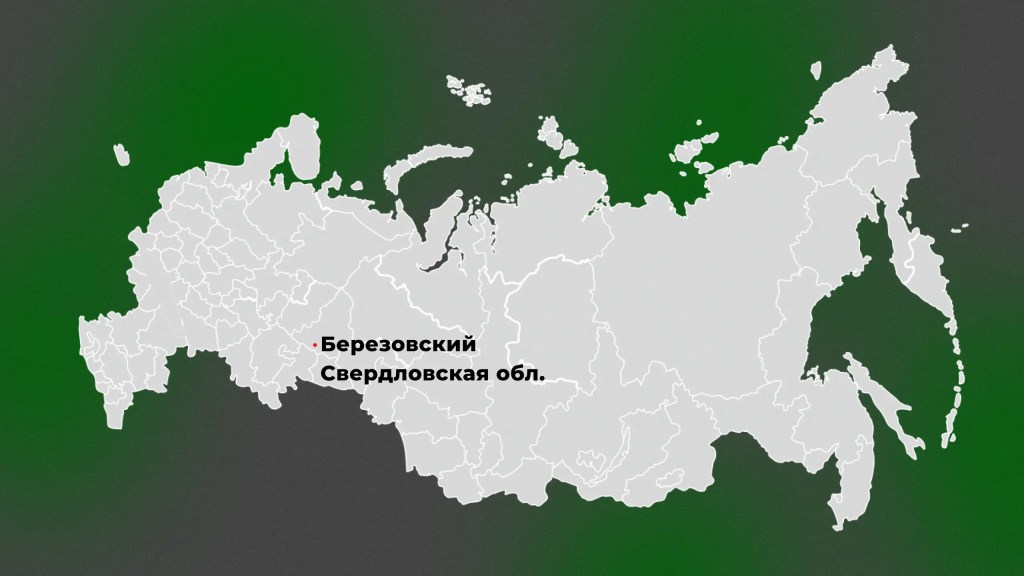
Berezovsky and Sverdlovsk Region, on a map of the Russian Federation. Image courtesy of DOXA

When we were agreeing to do this interview, you said that after you had left [Russia], you tattooed the anarchy symbol on the back of your hand. Can you tell me about it for the interview?

Rozhkov: The symbol means a lot to me. I am an anarchist myself, a leftist; I espouse this political position. And although a society without powerful authorities and hierarchies seems like a utopia, we could get there. Power should belong to the people, not to a bunch of corrupt bastards who commit terrible crimes. My symbol also means that I share the views of the people who helped me when I was in prison. It says that I am close to these people. And that I, in turn, will also help political prisoners at the first opportunity.

Maybe you would like to convey something to Ukrainians?

Rozhkov: Yes, I would. I want them to know that there are dissenters, people [in Russia] who do not want war with Ukraine or any war at all. I hope that soon no one else will suffer due to this shit that Putin has made happen. Ukrainians are doing a good job of retaking their territory and destroying Russian troops. I think everything will be fine sooner or later. Ukrainians are very strong, motivated people and will defend their territory to the end. I respect them for that. I would have done the same thing in their place.

Source: Ivan Astashin, “‘I believe I saved people’: an interview with one of the first to torch a military enlistment office in Russia,” DOXA, 22 December 2022. Thanks to Simon Pirani for the heads-up. Translated by Hecksinductionhour

Coloring in Solidarity with Viktor Filinkov

“An anti-prison coloring book for Jenya and Viktor and everyone”

Not so long ago I wrote that coloring brightens up my minutes and hours of waiting for Viktor at the penal colony. So Yana Teplitskaya has designed an entire coloring book in support of Viktor and me!!

The coloring book can be downloaded at the link below and printed out on a printer, and you can make a donation for it.

If you have a coloring maniac in your life, the book can be your New Year’s gift to them.

And if you’ve never colored, then maybe New Year’s is the time to check it out?

Here is the coloring book. It’s awesome, right?

https://drive.google.com/file/d/1i5jPe9VdQIPhRn9rRrtdS3rv-oY3vmHz/view

Download, print, and color the pages — and send us the results.

Donations for my trips to see Viktor in Orenburg should be sent to my Sberbank or Raiffeisen account via phone number 89217772541.

You can also make donations in euros [and dollars] via PayPal to abc-msk@riseup.net, [writing “Filinkov” at the “What’s this payment for?” prompt.]

Thanks.

You can and should share this post if you like.

Source: Jenya Kulakova, Facebook, 30 December 2022. Ms. Kulakova is the public defender of Viktor Filinkov, a young Kazakhstani national convicted as part of the notorious Network Case, in which the Russian Federal Security Service (FSB) tortured and framed a dozen anti-fascists in Penza and Petersburg for, allegedly, “creating a terrorist community.” I’ve published extensively on the case and its aftermath over the last five years. The wardens at the penal colony in Orenburg where Mr. Filinkov is currently serving his sentence have seemingly singled him out since his arrival there, endlessly finding him “guilty” of various (mythical) infractions and isolating him from the general population on these pretexts. With the help of Ms. Kulakova and his defense attorney, Vitaly Cherkasov, Mr. Filinkov has mounted a series of successful legal challenges against this flagrant abuse of his civil and legal rights. You can help pay for Ms. Kulakova’s frequent trips to Orenburg by donating to the PayPal account indicated, above. It is managed by the Moscow chapter of the Anarchist Black Cross and is totally reliable. I just made a donation myself and I screenshotted, below, the critical step in that process if you need help. Thank you! ||| Thomas Campbell, The Russian Reader

The Second Anniversary


73381220_2389008344688627_4167196150702538752_n“10.19.2017: Ilya Shakursky and Vasily Kuksov are detained in Penza. Both of them are brutally beaten. Two years is already a sentence. Rupression.com.”

Yesterday, October 19, solo pickets were held from two p.m. to five p.m. on Sennaya Ploshchad (Haymarket Square) in Petersburg on the occasion of the second anniversary of the first arrests (in Penza) in the so-called Network case aka the Penza-Petersburg “terrorism” case.

Source: Anarchist Black Cross SPb

74414546_2388648421391286_8123246056956755968_n“What the Chekists from the FSB do: they abduct, they torture, they murder. This is terror! #NetworkCase #NewGreatness #StopFSB.”
__________________________________________

What can you do to support the Penza and Petersburg antifascists and anarchists who have been tortured and imprisoned by the Russian Federal Security Service (FSB)?

  • Donate money to the Anarchist Black Cross via PayPal (abc-msk@riseup.net). Make sure to specify your donation is earmarked for “Rupression.”
  • Spread the word about the Network Case aka the Penza-Petersburg “terrorism” case. You can find more information about the case and in-depth articles translated into English on this website (see below), rupression.com, and openDemocracyRussia.
  • Organize solidarity events where you live to raise money and publicize the plight of the tortured Penza and Petersburg antifascists. Go to the website It’s Going Down to find printable posters and flyers you can download. You can also read more about the case there.
  • If you have the time and means to design, produce, and sell solidarity merchandise, please write to rupression@protonmail.com.
  • Write letters and postcards to the prisoners. Letters and postcards must be written in Russian or translated into Russian. You can find the addresses of the prisoners here.
  • Design a solidarity postcard that can be printed and used by others to send messages of support to the prisoners. Send your ideas to rupression@protonmail.com.
  • Write letters of support to the prisoners’ loved ones via rupression@protonmail.com.
  • Translate the articles and information at rupression.com and this website into languages other than Russian and English, and publish your translations on social media and your own websites and blogs.
  • If you know someone famous, ask them to record a solidarity video, write an op-ed piece for a mainstream newspaper or write letters to the prisoners.
  • If you know someone who is a print, internet, TV or radio journalist, encourage them to write an article or broadcast a report about the case. Write to rupression@protonmail.com or the email listed on this website, and we will be happy to arrange interviews and provide additional information.
  • It is extremely important this case break into the mainstream media both in Russia and abroad. Despite their apparent brashness, the FSB and their ilk do not like publicity. The more publicity the case receives, the safer our comrades will be in remand prison from violence at the hands of prison stooges and torture at the hands of the FSB, and the more likely the Russian authorities will be to drop the case altogether or release the defendants for time served if the case ever does go to trial.
  • Why? Because the case is a complete frame-up, based on testimony obtained under torture and mental duress. When the complaints filed by the accused reach the European Court of Human Rights in Strasbourg and are examined by actual judges, the Russian government will again be forced to pay heavy fines for its cruel mockery of justice.

***************

If you have not been following the Penza-Petersburg “terrorism” case and other recent cases involving frame-ups, torture, and violent intimidation by the Russian Federal Security Service (FSB) and other arms of the Russian police state, read and share the articles I have posted on these subjects.

This Is What Antifascism Looks Like

Varya Mikhaylova
Facebook
May 11, 2018

We stood, too. Not because we believed it would change anything, but so nothing would change us.

The good news was that many passersby were aware of The Network Case, especially young people. Tons of schoolkids had their picture taken with me, promising to come out next time themselves. Amazing kids.

picket 1.jpg
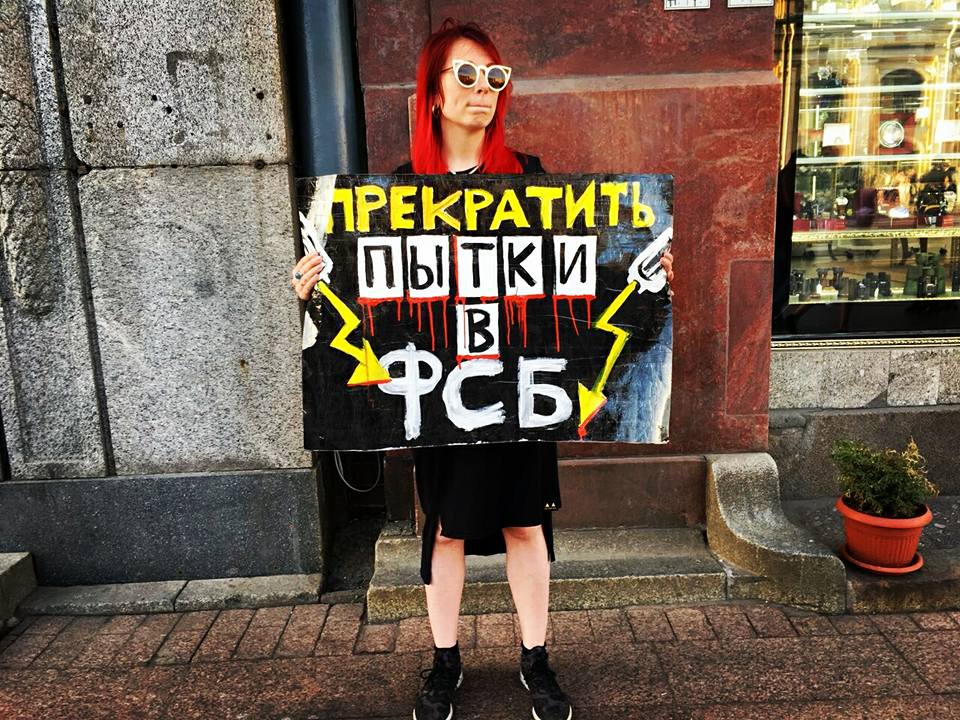
“Stop torture at the FSB”

picket-2.jpg
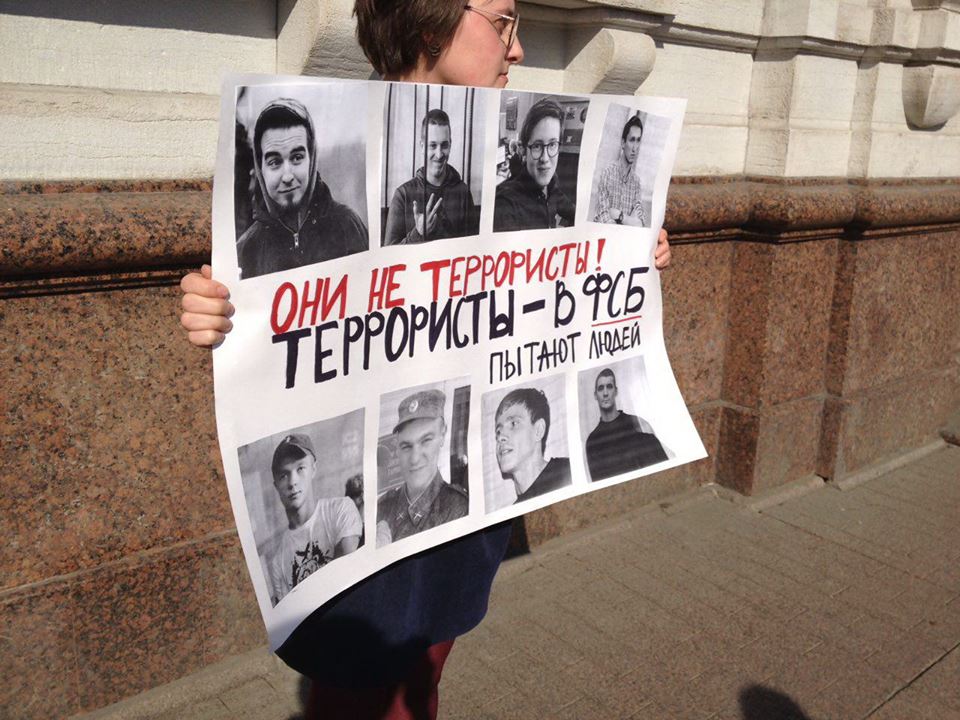
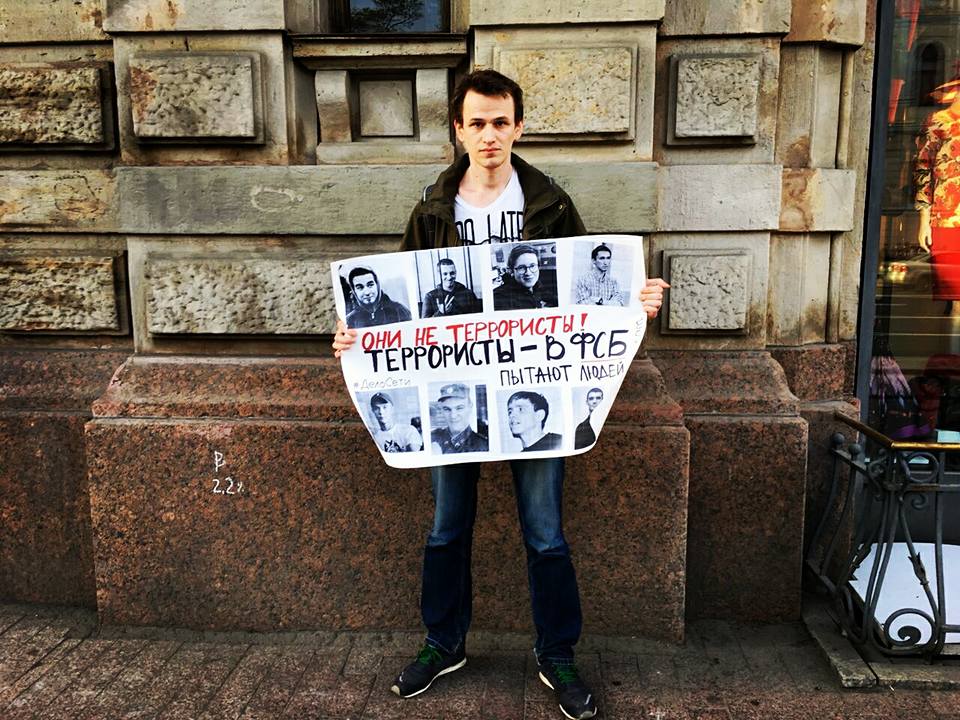
“They’re not terrorists. The terrorists are at the FSB, and they torture people.”

picket-3
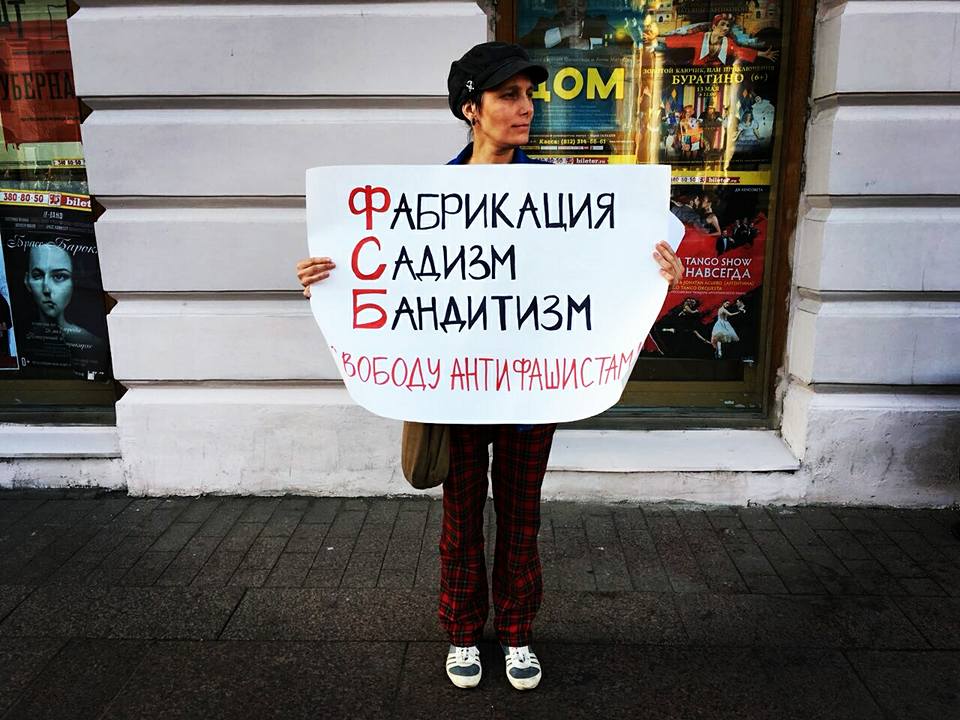
“Frame-up, Sadism, Banditism (FSB). Free the antifascists!”

picket-4
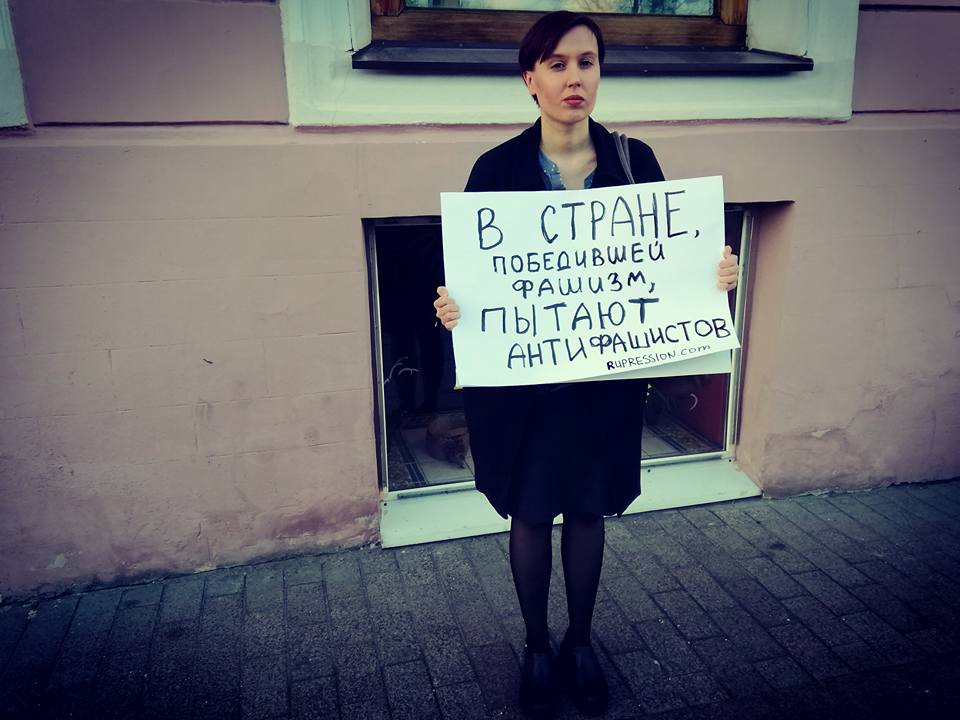
“Antifascists are tortured in the country that defeated fascism. Rupression.com.”

picket-5
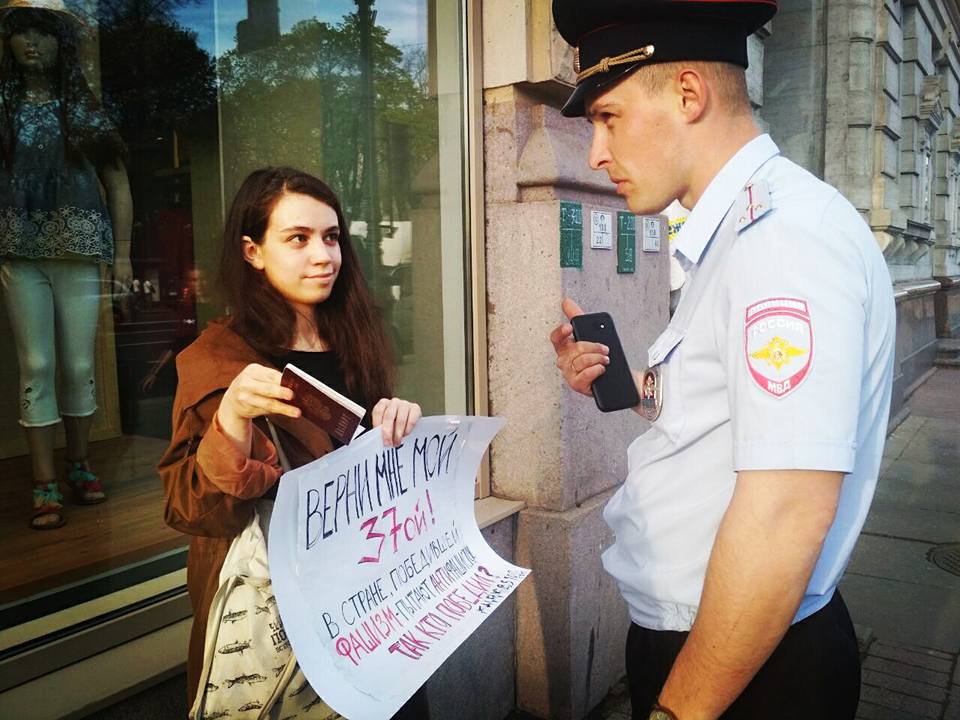
“Give me back my 1937. Antifascists are tortured in the country that defeated fascism. So who won? Rupression.com”

All photos by Jenya Kulakova

***************

Petersburg Anarchist Black Cross
Facebook
May 11, 2018

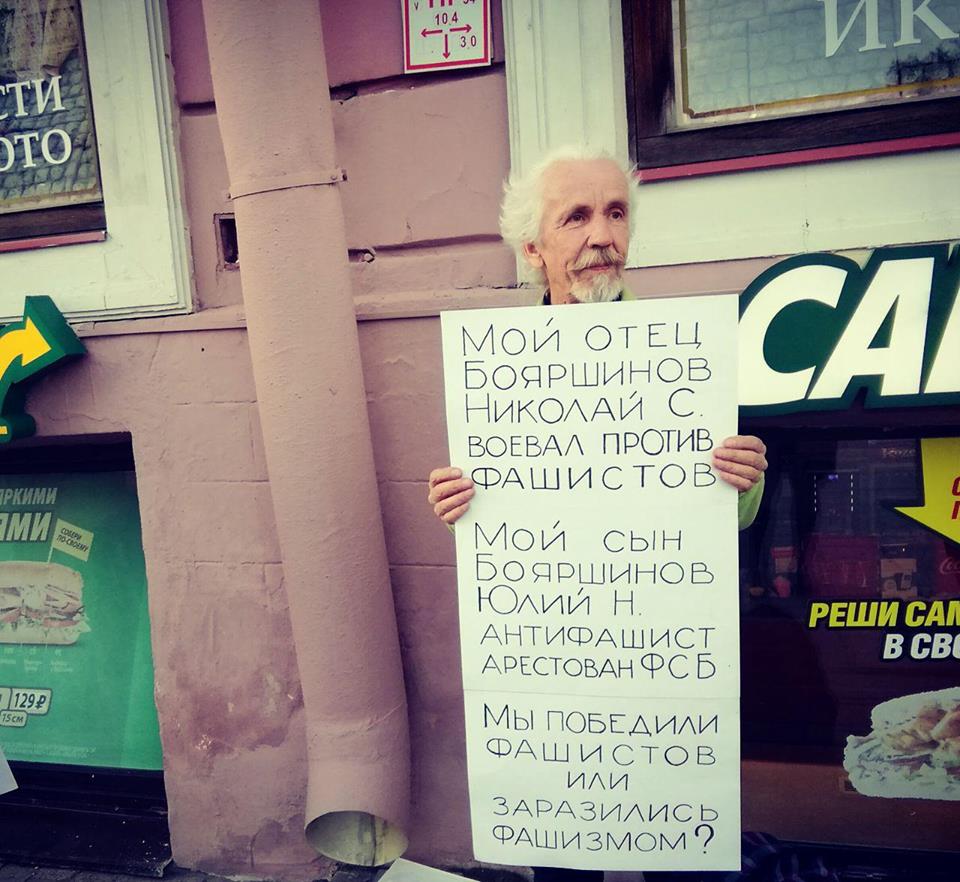
Nikolai Boyarshinov, father of Yuli Boyarshinov, a suspect in The Network Case, carried out a solo picket on Nevsky Prospect this evening. He held up a placard that read, “My father, Nikolai S. Boyarshinov, fought against the fascists. My son, Yuli N. Boyarshinov, an antifascist, has been arrested by the FSB. Did we defeat the fascists? Or have we been infected by fascism?”

picket 6

Nikolai Boyarshinov was joined by ten or so activists in a series of solo pickets. They also stood on Nevsky, holding up placards with slogans that read, “Antifascists are tortured in the country that defeated fascism,” “Stop torture at the FSB,” and “Free the antifascists.” They leafleted passersby. They also collected signatures on a group letter to the warden of Remand Prison No. 6 in Gorelovo, demanding Yuli Boyarshinov be housed in humane conditions.

The passersby included people who asked how to help, who thanked and shook the hands of the picketers, and who voiced their support to Nikolai Boyarshinov. There were also people who said it was not possible that antifascists were tortured in Russia, people who heatedly argued with the picketers.

Police offers warned the protesters a distance of fifty meters must be maintained between solo pickets. They checked the papers of the picketers. Standing next to Nikolai Boyarshinov, they waited an hour and a half for him to roll up his placard and leave Nevsky Prospect.

Thanks to everyone who came out today to voice their solidarity. Write letters to the arrested antifascists, support their parents, and strengthen the networks of solidarity.

Translated by the Russian Reader

***************

What you can do to support the Penza and Petersburg antifascists and anarchists tortured and imprisoned by the FSB

  • Donate money to the Anarchist Black Cross via PayPal (abc-msk@riseup.net) and make sure to specify that your donation is earmarked for “Rupression.”
  • Spread the word about The Network Case aka the Penza-Petersburg “Terrorism Case.” You can find more information about the case and in=depth articles translated into English on this website (see below), rupression.com, and openDemocracyRussia.
  • Organize solidarity events where you live to raise money and drawn attention to the plight of the tortured Penza and Petersburg antifascists. Go to the website It’s Going Down to find downloadable, printable posters and flyers. You can also read more about the case there.
  • If you have the time and means to design, produce, and sell solidarity merch, please write to rupression@protonmail.com.
  • Write letters and postcards to the prisoners. Letters and postcards must be written in Russian or translated into Russian. You will find the addresses of the prisoners here.
  • Design a solidarity postcard that can be printed out and used by others to send messages of support to the prisoners. Send your ideas to rupression@protonmail.com.
  • Write letters of support to the prisoners’ loved ones via rupression@protonmail.com.
  • Translate the articles and information at rupression.com and this website into languages other than Russian and English, and publish your translations on social media and your own websites and blogs.
  • If you know someone famous, ask them to record a solidarity video, write an op-ed piece for a mainstream newspaper or write letters to the prisoners.
  • If you know someone who is a print, internet, TV or radio journalist, encourage them to write an article or broadcast a report about the case. Write to rupression@protonmail.com or the email listed on this website, and we will be happy to arrange interviews and provide additional information. It is extremely important this case break into the mainstream media both in Russia and abroad. Despite their apparent brashness, the FSB and their ilk do not like publicity. The more publicity the case gets, the safer our comrades will be in remand prison from violence at the hands of prison stooges and more torture at the hands of the FSB, and the more likely the Russian authorities will be likely to drop the case altogether or release the defendants for time served if the case ever does go to trial. Why? Because the case is a complete frame-up, based on testimony obtained under torture. When the complaints filed by the accused reach the European Court of Human Rights in Strasbourg and are ultimately ajudicated, the Russian government will be forced to pay heavy fines for its cruel mockery of justice.

***************

If you have not been following the Penza-Petersburg “terrorism” case and other cases involving frame-ups, torture, and violent intimidation by the Russian Federal Security Service (FSB) and other parts of the Russian police state, read and repost the recent articles the Russian Reader has translated and published on these subjects.

“They Are Not Terrorists! The Terrorists at the FSB Torture People”

30716533_1994906870765445_1419384209113350144_n“They are not terrorists! The terrorists at the FSB torture people.” Photo courtesy of St. Petersburg Anarchist Black Cross (@abc.russia.spb)
Anarchist Black Cross-SPb
Facebook
April 15, 2018

Today, April 15, a series of solo pickets took place on Nevsky Prospect in St. Petersburg to protest the frame-up of nine anarchists and antifascists, arrested in Petersburg and Penza, and charged with involvement in a “terrorist community” that the Russian security services have dubbed The Network.

Around fifteen activists took part in the pickets and leafletted passersby. The police showed up only when the picketers were rolling up their placards and heading home. The policemen were very sorry they were unable to write down the internal passport info of the picketers.

Many of the passersby who showed an interest in the pickets were informed about the case and sympathized with the arrestees.

On April 11, 2018, yet another Petersburger, Yuli Boyarshinov, was charged with involvement in the so-called terrorist community. He is currently being held in Remand Prison No. 6, located the village of Gorelovo, Leningrad Region. The prison is notorious as a torture chamber. Boyarshinkov is housed in a barracks with as many as one hundred and fifty other inmates, including murderers, rapists, and robbers.

“He has not been tasered, but the conditions in which my client is being held are tantamount to torture,” says his defense attorney, Olga Krivonos.

We demand the authorities close The Network case and release everyone who has been charged in it. We also demand the Russian Federal Security Service (FSB) officers who tortured the arrested men be brought to justice.

On April 14 and 15, Yekaterina Kosarevskaya and Yana Teplitskaya, members of the Petersburg Public Monitoring Commission, were assaulted by reporters from the pro-regime TV channel NTV, who insolently and intrusively asked the women how often they met with foreign diplomats and why they were aiding terrorists. Today as well, an NTV crew ambushed Vitaly Cherkasov, the defense counsel of Viktor Filinkov, a defendant in the case, outside the lawyer’s home and tried to interview him.

We continue to raise money to pay the defense attorneys for their work and pay for care packages for the arrested men.

Details for Donations
St. Petersburg Anarchist Black Cross Yandex Money Account: 41001160378989
PayPal: abc-msk@riseup.net (Moscow Anarchist Black Cross)

Show solidarity, support the prisoners!

Thanks to George Losev for the heads-up. Translated by the Russian Reader. If you want to learn more about the Penza-Petersburg “terrorism” case, read the extensive coverage on this website and listen to this interview with a member of the Moscow Anarchist Black Cross, recorded in March on The Final Straw Radio Podcast. Thanks to Ed Sutton for the heads-up.

Solidarity with Persecuted Russian Antifascists and Anarchists in NYC and Minneapolis

27540850_322877634890103_3528138355329883641_n

Metropolitan Anarchist Coordinating Council – MACC
As part of the week of solidarity with Russian anarchist political prisoners there will be a demo at the Russian Consulate, 91st Street, today, February 7, 2:30 PM–4:00 PM.

#Antifa #Antifascism

More information on the recent arrest and torture of anarchist and antifascist political prisoners here:

https://freedomnews.org.uk/russia-arrests-and-torture-of-anarchists-and-antifascists/

•••••••••••

Solidarity with Russian Anarchists
The Base
1302 Myrtle Avenue, Brooklyn, New York 11221
7 PM–10 PM, February 8, 2018

Six anarchists have been arrested in Penza, Saint Petersburg, and Crimea, from October 2017 to February 2018, by officers of the Russian Federal Security Service (FSB) on charges of involvement in a terrorist group. During this period, there have been raids on the homes of anarchists and antifascist all over Russia. The arrested anarchists have been tortured into falsely confessing their involvement in the imaginary network. This is clearly a state-fabricated conspiracy being used to eradicate the anarchist movement.

As the support team says, “These repressions can only intimidate people and crush the anarchist movement. In this case it’s necessary to show that we are not afraid and we can’t be destroyed by their force. Otherwise, the repressions will be used every time when the anarchist movement attracts the notice of the FSB. We must show them that the stronger their crackdowns are, the more furious our resistance is.”

We are hosting a movie and information session about the broader anarchist and antifascist movement in Russia, and talking in more detail about this particular case.

About the movie
Antifascist Attitude is the first-ever documentary film on the emerging Russian antifascist movement made by activists themselves. The movie features moderate NGO activists and radical grassroots activists and anarchists from three cities: Moscow, St. Petersburg, and Irkutsk. It also features the antifascist lawyer Stanislav Markelov, murdered by neo-Nazis in Moscow on January 19, 2009.

Come and learn about what’s happening and ways to support our comrades in Russia!

•••••••••••

Solidarity Dinner with Russian Antifascists
Twin Cities IWW General Defense Committee Local 14
5:30–8:00 p.m., Saturday, February 17, 2018
2101 Hennepin Ave, Minneapolis, MN, United States

Join the General Defense Committee for a dinner, discussion, and letter writing to support antifascists targeted by the FSB crackdowns in Penza and St Petersburg.

The far right rises in the US, in Russia, and across the world, attacking oppressed peoples, immigrants, and working class revolutionaries. Antifascists are fighting against nationalist hate across borders, and facing attacks from the ruling class’s governments. In Russia, the FSB (Federal Security Service) are hard at work arresting, torturing, and framing antifascist activists in Penza, St. Petersburg, and elsewhere.

The Anarchist Black Cross in Moscow and St. Petersburg has asked for international solidarity with the Russian anarchists facing repression. We will be holding a dinner in the IWW offices at 2101 Hennepin Avenue South, Suite 101, Minneapolis, on Saturday, February 17, 2018, from 5:30 p.m. to 8:00 p.m.

We’ll discuss the situation in Russia as well as the repression faced by anarchists in Belarus, Ukraine, and other countries. We’ll collect donations, provide a space for letter writing to the defendants, and facilitate discussion on further international solidarity work with political prisoners, labor organizers, and anti-authoritarians.

https://libcom.org/news/support-anarchist-antifa-prisoners-stpetersburg-penza-31012018

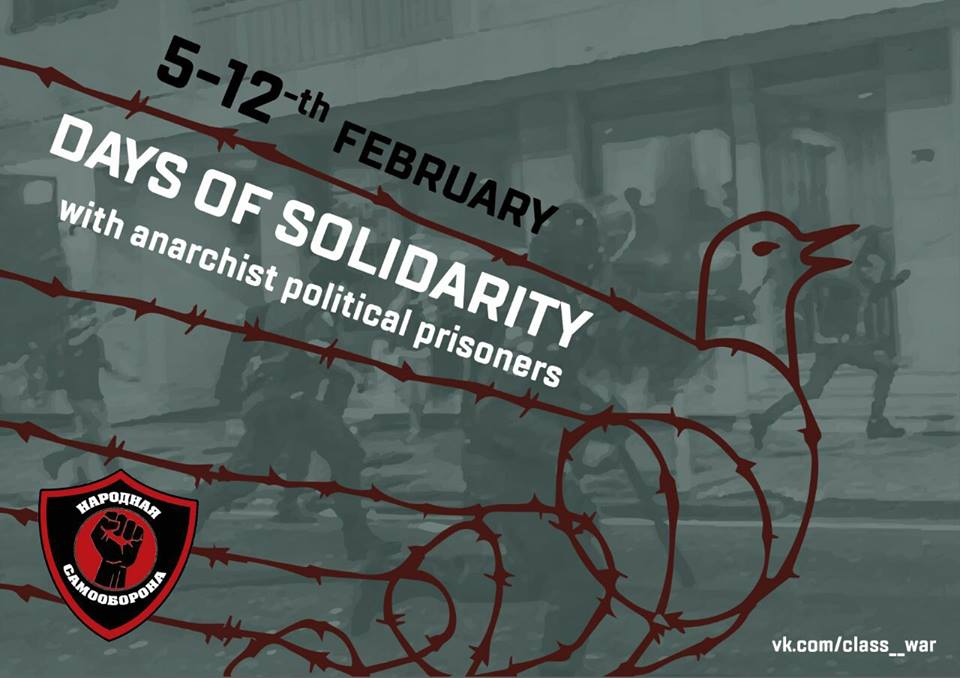
https://itsgoingdown.org/call-international-days-solidarity-russian-anarchist-political-prisoners-feb-5th-12th-2018/

https://avtonom.org/en/news/how-stability-has-really-been-achieved-russia

Petersburg Remembers Markelov and Baburova

On January 19, Petersburg, like its older sister to the south, Moscow, remembered murdered anti-fascists Stanislav Markelov and Anastasia Baburova, as well as other fallen comrades in the struggle against grassroots and state-sponsored fascism and racism.

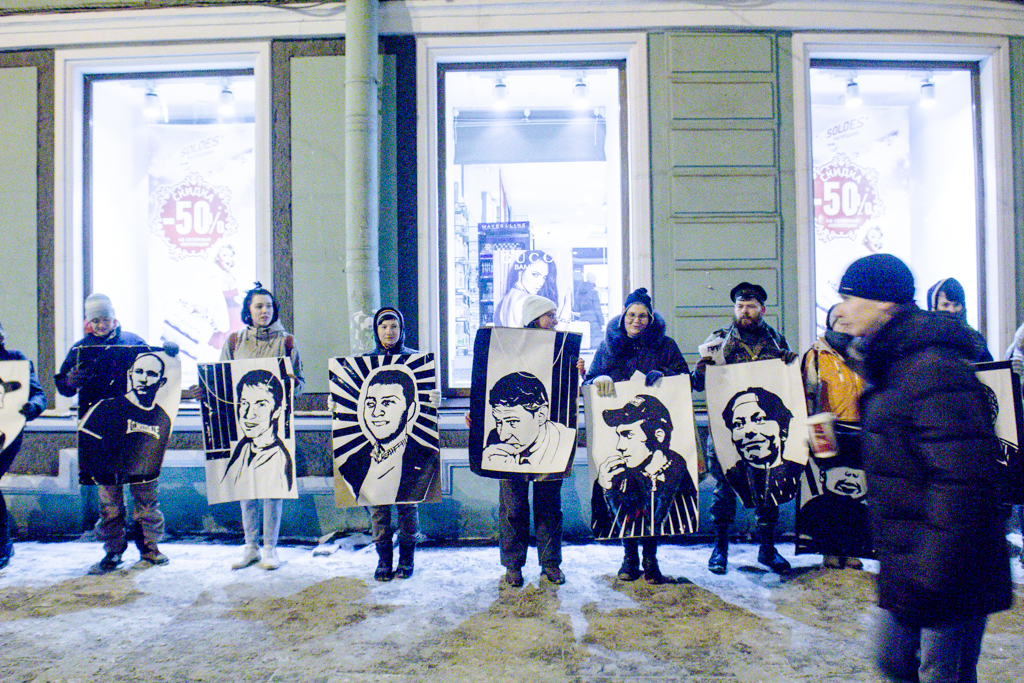
Events included an “exhibition” of posters, commemorating the dead, on the city’s main street, Nevsky Prospect; an unauthorized march to the Field of Mars to lay carnations on the Eternal Flame; and a punk rock concert at a local club to benefit the Anarchist Black Cross and imprisoned Russian anti-fascists such as Alexei Gaskarov and Alexei Sutuga.

Veteran journalist and photographer Sergey Chernov was on the scene to chronicle all these events. I thank him for letting me share some of his photographs with you here.

Picketer holds portrait of slain lawyer on Nevsky Prospect, January 19, 2016. Photo courtesy of Sergey Chernov

19_Jan-7989
Picketers hold portraits of Stanislav Markelov, Timur Kacharava, Anastasia Baburova, and other slain anti-fascists on Nevsky Prospect, January 19, 2016. Photo courtesy of Sergey Chernov

"I don't want to dive into a fascist whirlpool." Photo courtesy of Sergey Chernov
“I don’t want to dive into a fascist whirlpool.” Photo courtesy of Sergey Chernov

Continue reading “Petersburg Remembers Markelov and Baburova”