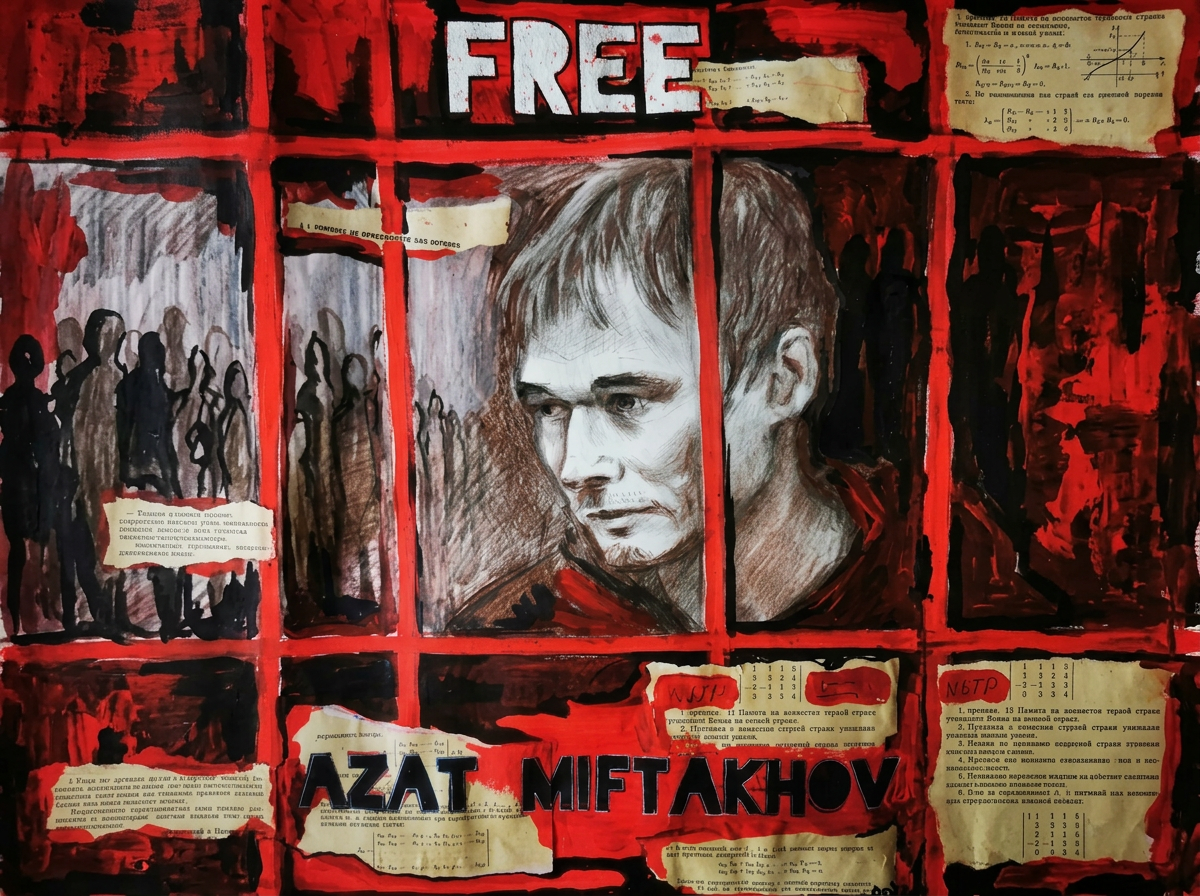
Political Prisoner Azat Miftakhov Continues to Be Tortured by the Putin Regime

Azat Miftakhov is being transferred to the colony where Alexei Navalny was murdered

Anarchist, mathematician, and political prisoner Azat Miftakhov was sentenced on March 28, 2024, to 4 additional years in prison. On September 4, 2023, he was detained upon leaving IK-17 [Correctional Colony No. 17] in Omutninsk, Kirov region, where he had already served his first sentence—allegedly for breaking a window at a United Russia office in Moscow’s Khovrino district. The basis for the new prosecution for “justifying terrorism” was (allegedly) comments Azat made while watching a TV program with other inmates about anarchist Mikhail Zhlobitsky, who carried out an explosion at the FSB office in Arkhangelsk. Testimony against Azat was given by fellow prisoners and a prison employee.

Recently, the political prisoner was transferred from a prison in Dimitrovgrad, Ulyanovsk region. In a letter dated April 19, Azat reported on his transfer from Kirov to Vorkuta:

“I’m writing to you from Vorkuta. And as you understand, I’m heading to Kharp. I think no further comments are needed.

“Two days on the train have worn me out quite a bit. The toilet—once every 4 hours, hot water—three times a day, there’s no room to turn around in the compartments, my bones ache from constantly lying on a hard bunk and the shaking of the train. So the stop in Vorkuta is very welcome. Tomorrow morning we depart, and we’ll arrive in Kharp the same day. It seems I’ll go straight from the train to the camp without intermediate stops (apparently there are no detention centers there).”

The prisoner’s support group comment[ed] on this news:

“It is quite obvious that transferring Azat to Kharp is nothing other than a desire to take revenge on him for his firm stance. It is both a threat that his life depends on the will of the security apparatus and the creation of significant hardship for the remaining 1.5 years of his sentence.

“Kharp is one of the northernmost places of detention in Russia; it is located beyond the Arctic Circle, in permafrost conditions. It was established in 1961 on the basis of preserved buildings of a former camp unit of the Gulag’s Construction Site No. 501.

“In addition to Alexei Navalny, who was unable to leave the colony alive, well-known political prisoners held in Kharp include Platon Lebedev (2005–2006) and Oleg Sentsov (2017–2019).”

Here is what Azat’s wife and defender, Elena Gorban, writes:

“As his lawyer, I visited Azat monthly in the Ulyanovsk region, spending under 10,000 rubles (circa 110 euros) on travel (or not much more, depending on circumstances). Now I understand that a trip to the Yamalo-Nenets Autonomous Okrug will cost closer to 40,000 (circa 440 euros): 5000 for two nights in a hostel, 12000 and 20000 for flights… (12000 is with a middle-of-the-night layover and worst possible service).

“I’ll also have to cross the Ob River to and from the airport. And I hope I won’t have to open and close the swimming season immediately… since, according to a hostel worker, ice crossing is still operational.

“Maybe later I’ll figure out how to make these trips cheaper, but it’s unlikely I’ll manage without expensive flights… after all, two days by train one way, especially when trains don’t run daily, is not something you can do regularly.

“Oh, and if Azat ends up specifically in the colony in the village of Kharp, and not in Labytnangi (the nearest city), then it seems there’s no electronic mail there. That already borders on torture.”

Donate bitcoin for Azat:

Bitcoin: bc1qspn7lwg38ra6r836akqwusnr4zvjhmegz5v9dm

For [details on money transfers] inside Russia, refer to [the original] post in Russian.

Translated by Anarchist Black Cross Moscow

Source: Autonomous Action, 26 April 2026. Thanks to Simon Pirani for the heads-up.


On [5 August 2025] Russia’s Supreme Court rejected the final appeal for Azat Miftakhov, a mathematician and anarchist serving his second politically motivated prison sentence. His latest conviction, for “justifying terrorism,” rests entirely on the testimony of a fellow inmate who claimed Miftakhov had praised an attack on the security services. For over six years, Miftakhov has navigated two coexisting identities in Russia’s brutal penal system: that of a political prisoner and a member of the “obizhennye”, or the “degraded”—the untouchable caste at the bottom of the prison hierarchy. In letters from behind bars, he tells Mediazona how he survives.

Azat Miftakhov, 31, was a graduate student in mathematics at Moscow State University when he was first arrested in February 2019.

Initially accused of making explosives, he was beaten and tortured by security service agents who threatened to rape him with an electric screwdriver. Another detainee was tortured with an electric shocker by security forces who demanded he incriminate the mathematician. After his detention, Miftakhov attempted to slit his wrists but gave no confession.

Bespectacled, short and soft-spoken, the anarchist has not yielded to this day, despite pressure from the FSB and a second fabricated terrorism case.

Back in February 2019, when the security forces failed to find evidence that the young man had been making explosives, Miftakhov was accused in a case concerning a window broken a year earlier at a ruling United Russia party office in Moscow’s Khovrino district.

The pressure campaign continued inside the prison. Officers from the FSB informed other inmates of Miftakhov’s bisexuality. The move was a calculated effort to have him ostracised and forced into the “degraded” caste, a group subject to constant humiliation, violence, and forced labour. Miftakhov did not deny the officers’ words; back in 2019, intimate photos of him were published by Telegram channels linked to security services and later by the state-run TV channel Rossiya-1. 

A vigorous public campaign in support of Miftakhov began from the first days of his arrest, so he could not hide his status as a political prisoner from other detainees, though he did not deliberately advertise it.

“During mail call, the whole prison section is standing in formation,” he explains. “An activist comes up with a stack of letters. The first is for me, the second for me, the third, the fourth… In the end, only two or three letters go to other inmates. The rest are mine.” He often received letters and postcards from France, Germany, and Sweden, something extraordinary for other prisoners. “They’re writing even from America!” they would marvel. The camp’s population changed, but newcomers would often approach me and ask: “Is it true that Oxxxymiron wrote a song about you?”

In the winter of 2021, Azat Miftakhov was sentenced to six years in a penal colony. A secret witness, interrogated a year after the case was opened, claimed to have identified Miftakhov among the group that broke the United Russia office window and threw a smoke bomb inside, recognising him by his “expressive eyebrows.” The anarchist himself denied any involvement in the action.

After his time in Moscow’s pre-trial detention centres, Miftakhov was transferred in August 2021 to serve his sentence at Penal Colony No. 17 (IK-17) in Omutninsk, Kirov region. The prison was “red”, or tightly controlled by the administration through “activists” from among the prisoners.

Although severe physical violence had become a rarity there in recent decades, the colony’s reputation for torture dated back to the late 1980s, especially as punishment for refusing to prepare for official holidays. For many years, the most important of these was Victory Day, and all prisoners without exception were required to participate in preparations for a “parade” featuring models of military equipment.

“It was considered an absolutely mandatory thing, and to refuse meant condemning yourself to unimaginable torment: torture with shockers, bleach, and the punishment cell,” recalls Timur Isayev, who was incarcerated in IK-17 at the same time as Miftakhov. He was serving a sentence for organising an escort agency. After his release, Isayev left Russia.

Miftakhov impressed Isayev immediately upon his arrival at the colony. The inmates learned that during quarantine, security officers had offered the mathematician the chance to “hide” his “degraded” status in exchange for cooperation, but he refused.

“He told them: ‘Chief, you protect laws and rights, yet you speak to me in some kind of criminal jargon that you yourself are supposed to fight against. I don’t recognise your stinking ponyatiyaI don’t recognise this division of people either. Do what you think is necessary.’ The cops were just stunned by such audacity and directness,” Isayev recalls.

Thus, from the perspective of the other prisoners, Miftakhov had essentially “defined” himself as “degraded”, since he had the opportunity to hide his status, explains the source to Mediazona. Therefore, each of [the] muzhiki, or “the men”, regular prisoners, had to decide for himself whether it was appropriate to communicate with him. Isayev says he spoke with him without regard for others: “He had a normal social life in the zone, he was treated very well—not like the others in that caste, with whom he could still interact. He had a completely special position.”

From Azat Miftakhov’s letter to Mediazona (abridged)

You can’t get “infected”’ by talking to someone who is “degraded”, but it’s considered improper for one of “the men” to hang around a “degraded” person for too long. You won’t be “called to account” for it, but you might catch ridicule and taunts from others, even provocations. They might suggest that a “man” “share” living quarters with the “degraded” since he gets along with them so well.

The life of a “degraded” person consists of many prohibitions. Many of them are so fundamental that they cannot be ignored without getting into a conflict with “the men”. Take, for example, the obligation for the “degraded” to be last in every queue: for the canteen, the shop, the medical unit. It happened more than once, for instance, that I’d stand in line for the shop all day. The queue is long, and as always, they’ve brought in an insufficient amount of goods. Every now and then, you hear that this or that has already run out. And then, just as the queue reaches the “degraded” inmates, a dozen more of “the men” suddenly appear from around the corner, having only just decided to join the line. You have to let them go first. It’s frustrating, of course, but what can you do? If you don’t like it, you can get locked in a punishment cell or a cell-type unit. But then you can forget about parcels and visits.

There is only one prohibition that I refuse to accept—the ban on fighting one of “the men”. If someone tries to humiliate my human dignity with an insult or by forcing me to do something, I consider it my sacred right to respond with force. The only thing I have to be wary of when exercising this right is punishment from the activists or the criminal elites. They can beat you severely for it, causing serious injury. However, I value my human dignity too highly to allow it to be debased, even under the threat of injury. Prison is a place where you’d better not “swallow” humiliation. If you “swallow” it once, you convince those around you that you can “swallow” it again and again. It’s better to nip it in the bud. That’s my philosophy on the matter.

I have had to fight “the men” several times, and each time it was over my status. It didn’t always lead to a scandal. Sometimes we managed to make peace with my opponent afterwards. A couple of times, a “case” was brought against me. The “trial” took place in a storeroom. Activists and various influential people as “judges” would cram in there, along with both sides of the conflict, meaning me and my “victim”. Witnesses were also called. Some “judges” seemed eager to pass a harsh sentence, which could have been carried out on the spot. I had to be prepared for such a turn of events and at the same time maintain my composure while justifying my position. Although according to the “prison” law, I was already in the wrong from the start, so my universal human arguments were unlikely to work there.
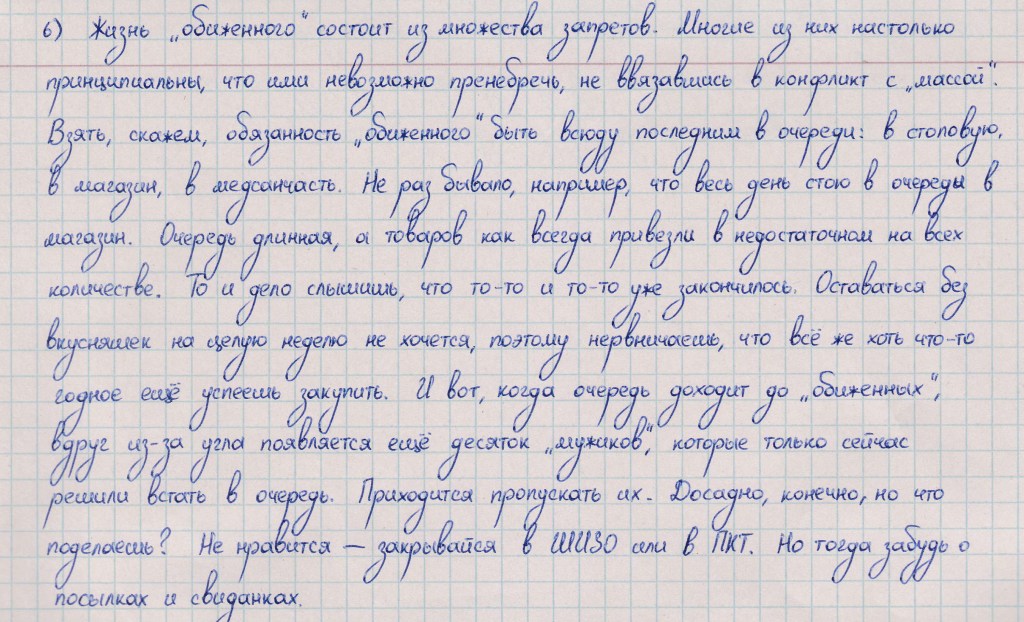
Fragment of Miftakhov’s letter to Mediazona

Miftakhov’s principles faced a major test in the spring of 2022, as the colony prepared for its annual Victory Day parade.

When Miftakhov saw other prisoners painting the “Z” and “V” symbols of the Ukraine invasion onto military props, he informed his detachment chief he would not participate. He expected to be sent to a punishment cell, but the administration, wary of his high profile, opted for a different strategy.

The day before the parade, Miftakhov was summoned; he expected to be tortured there, but instead, an inspector led him to a windowless room hidden deep within the medical unit, furnished only with a bed, a bedside table, and a toilet. Soon, the head of the operational department arrived. He explained that the room would temporarily become a “safe place” for the political prisoner.

From Azat Miftakhov’s letter to Mediazona (abridged)

“We’ve received information that some convicts are unhappy with your position,” the officer told me. “They want to teach you a lesson.”

“Therefore,” he continued, “it was decided to provide you with a safe place. Due to the threat to your health.”

“And how long will I be in this safe place?” I asked.

“Well,” the officer seemed to ponder, “I don’t know. Maybe a month, maybe a year. Or maybe until the last convict who wants to beat your ass is released.”

After talking with me a little more, he left, and I remained in that room. That’s how I began to learn what a “safe place” was. And I must say, it was the best gift the IK-17 administration could have possibly given me.

From then on, I didn’t have to go to work. I could spend all day on self-development, solving math problems and reading books. But most importantly, I could rest from the constant hustle and bustle of the common area. I wished it could last until my release. However, my happiness was not destined to last long. A week later, some random people were asked to sign off that the threat against me was gone. I had to return.

It was in IK-17 that Miftakhov formed a friendship with Evgeny Trushkov, another “degraded” prisoner serving a long sentence for charges including group rape. This friendship would prove to be his undoing. As Miftakhov’s release date in September 2023 approached, the FSB scrambled to build a new case against him. Trushkov became their star witness.

He testified that Miftakhov had “justified terrorism” in conversations with him, allegedly praising Mikhail Zhlobitsky, a teenager who bombed an FSB office in 2018. “I admire the actions of Mikhail Zhlobitsky, who was not afraid to lay down his life in the fight against Putin’s regime,” Trushkov claimed Miftakhov had said.

From Azat Miftakhov’s letter to Mediazona (abridged)

In the two years we knew each other, I received nothing but support from him. Sometimes he would tell me how he wanted to help me evade the FSB’s attention, that he was even willing to postpone his own freedom for it. Some of his suggestions were naive, which only convinced me of their sincerity. So when I found out that Trushkov had testified against me, I didn’t believe it at first. Only gradually, as I got acquainted with my new criminal case, did I begin to understand that he had betrayed me.

I do not think Trushkov initiated the criminal case, as he claimed in court. I am sure his story about how he, out of patriotic feelings, went to report the alleged crime to the detachment chief was fabricated to make the prosecution’s evidence seem coherent.

I believe this is what happened. On July 20, he was presented with a choice: either you give us the testimony we need against Azat, or you get “spun up” with him on a terrorism charge, but a more severe one. And they probably made it clear that the necessary witnesses for such a charge would be found. From there, I see two possible scenarios. First: he got scared for himself. Second: he made a deal with the FSB for my own good. I do not rule out either of these options, nor do I justify them.

Making deals with the FSB is a losing game from the start. One should not think that you can outsmart them this way, gaining more than you lose. Such underestimation of the enemy is extremely dangerous. Once you make one concession to them, they will force you to make a second, a third, and so on, until you give them your soul. In my conversations with him, I noticed this naive underestimation of the special services.

On the day he was due to be freed, Miftakhov was met at the prison gates by FSB agents who immediately re-arrested him. In a new trial based on his friend’s testimony, he was sentenced to another four years for “justifying terrorism.”

He is now held in a high-security prison in Dimitrovgrad, mostly in solitary confinement. His mental health has declined sharply. Trushkov, meanwhile, was released from the colony to fight for [the Wagner Group] in Ukraine. In a phone call to Miftakhov’s wife from the front, he slurred, “Get the kid out of there,” knowing Dimitrovgrad prison’s reputation.

Miftakhov is not scheduled for release until September 2027.

From Azat Miftakhov’s letter to Mediazona (abridged)

“There are no friends in prison,” as the inmates say. I don’t like such generalisations, but there is a certain amount of truth in it. Inmates are inherently placed in a vulnerable position. One wants to be released as soon as possible, another hopes for an unscheduled visit with his wife, and all of this depends on the goodwill of the administration. The administration knows the value of these benefits and sells them for special services. Snitching and betrayal are among them. And yes, prison status has no meaning here: “snitches” are found among both the “degraded” and “the men”. And you can’t say that the proportion among the former is noticeably different from the proportion among the latter.

Nevertheless, I managed to get burned by my friendship with Trushkov. Well, I have to admit that I am apparently a poor judge of character. This incident has significantly affected my perception of people in places of detention. When I meet a new person, I can’t help but start to assess whether he is capable of refusing the chekists if they try to force him to testify against me with threats and promises.

Source: Nikita Sologub, “The double status problem. Anarchist mathematician Azat Miftakhov on his life at the bottom of Russia’s brutal prison caste system,” Mediazona, 8 August 2025

Azat Miftakhov: “It’s Like They’re Telling Us, It’s No Trouble for Us to Put Anyone Away”

Azat Miftakhov in court. Photo: OVD Info

Anarchist and mathematician Azat Miftakhov has been sentenced to four years in a maximum security facility on criminal charges of “condoning terrorism.” The young man will spend the first two and a half years of his sentence in a closed prison. Miftakhov was detained in September 2023 as he was leaving the penal colony from which he had been released after completing his sentence on charges related to the breaking of a window at a United Russia party office. The next day he was remanded in custody in a pretrial detention center. According to the security forces, while watching TV with other inmates Miftakhov had spoken approvingly of the actions of Mikhail Zhlobitsky, who bombed the FSB’s Arkhangelsk offices [in 2018].

Why do I need to know this? Miftakhov’s wife, Yelena Gorban, argues that this criminal case was launched by members of the security forces who wanted to “extend Azat’s sentence for his past political activity.” In her statement to the court, she said that her husband was aware of the dangers of wiretapping in the penal colony, and so he had avoided discussing political topics in the company of inmates. “The conspicuousness and brazenness with which they fake evidence doesn’t embarrass them. It even plays into their hands. It’s like they’re telling us, ‘It’s no trouble for us to put anyone away,'” the anarchist himself said in [his closing statement at the trial].

Source: It’s Been That Kind of Week newsletter (OVD Info), 30 March 2024. Translated by the Russian Reader


A video and audio recording of Azat Miftakhov’s closing statement at his trial and his sentencing, 28 March 2024, Yekaterinburg. Source: FreeAzat (Telegram), 31 March 2024

During the years I was imprisoned on the charges in previous criminal case, I failed to fall head over heels in love with the state, and now I again find myself in the dock. I am now on trial for what the security forces have deigned to call “condoning terrorism” by faking the evidence, as they did five years ago. The conspicuousness and brazenness with which they fake evidence doesn’t embarrass them. It even plays into their hands. It’s like they’re telling us, “It’s no trouble for us to put anyone away.”

We see the same brazenness in the numerous incidents of barbarous torture perpetrated by the regime’s guardians, the FSB. These guardians don’t care that their shameful deeds are made public. On the contrary, these deeds are flaunted as a source of pride. In this way, the state shows its terrorist nature, as anarchists pointed out before the previous presidential election by taking to the streets with the slogan “The FSB are the main terrorists.”

What we were saying back then has now become obvious not only in our country but all over the world. We how see how the [Russian] state’s entire foreign and domestic policy has become a conveyor belt of murder and intimidation. While fake witnesses attempt to prove the charges that I “condoned terrorism,” national TV channels broadcast calls for the mass murder of people who disagree with state policy. We see that the state, while paying lip service to combating terrorism, in fact seeks to maintain its monopoly on terror.

No matter how the Chekists try to intimidate civil society, we see even in these dark times people who find the courage to resist the terror that has spilled over the state’s borders. Risking their freedom and their lives, their actions awaken our society’s conscience, whose lack we now feel so acutely, and their steadfastness to the bitter end stands as an example for us all.

One such example for me was my friend and comrade Dmitry Petrov (aka Dima the Ecologist), who died defending Bakhmut from soldiers who had become tools of imperialism. I knew him as a fiery anarchist who, amidst a dictatorship, did everything he could to lead us to a society based on the principles of mutual aid and direct democracy.

As a graduate of the history program at Moscow State University and a PhD in history, he was well versed in the structure of society and was able to argue his position well, something I had always lacked. And yet he was not limited to theorizing but was also heavily involved in organizing the guerrilla movement, which did not escape the FSB’s notice. Because of this, he was forced to continue his work as an anarchist in Ukraine.

When the grim events of the last two years kicked off, he could not stay on the sidelines. An enterprising comrade, he sought to create an association of libertarian-minded people who would fight for the freedom of the peoples of Ukraine and Russia. Unfortunately, no war is without casualties, and Dima was one of them. It would be unjustifiably selfish of me to admire the selflessness of strangers alone and not to acknowledge the sacrifice of those who are personally dear to me. I am well aware of this, despite my regret that all my fellowship with him is now irrevocably a thing of the past.

And yet I find it hard to accept this loss. Knowing that he was one of the best of us, and wanting to do my best to ensure his sacrifice was not in vain, I have to recognize that my contribution will be insignificant compared to what he was capable of.

What I’ve just said was perhaps unexpected for some people. I cannot rule out that some of my supporters could be disappointed, as I find it difficult, to my own regret, to speak out publicly. Perhaps someone will disagree with my beliefs, which are at odds with pacifism.

Striving to be rational about everything, however, I reject a belief in things whose existence has not been proven. Among other things, I do not believe in the world’s justice. I do not believe that all evil will be punished as a matter of course. That’s why I support vigorously resisting evil and fighting for a better world for all of us.

But even if some of my supporters do not share all of my beliefs, I am still grateful for all of their help.

I am grateful to everyone who has written me letters full of warmth and good wishes. Even amidst the desolation of the penal colony, I received stacks of them almost every week. I am certain that such great attention to me was borne in mind by the people who set out to make me submissive. I find it quite pleasant and touching that people share a part of their lives with me, whether the experiences are joyful or sad. Every letter is very dear to my heart, and I read every single one of them.

Many thanks to all those who have supported me financially. Thanks to them I have never lacked anything during all the years of my imprisonment. There have been times when I have run out of money to support me, but as soon as I put out a call for help, within a few days people who cared about me brought my budget back to a comfortable level. This is very pleasant and impossible to forget. Special thanks to Vladimir Akimenkov, who for more than ten years has been organizing fundraisers to support political prisoners, including me.

I am extremely grateful to the activists in the FreeAzat and Solidarité FreeAzat collectives, who have organized campaigns and events in solidarity with me on a scale which boggles my mind. Your recent “1001 Letters” campaign was one of them. After reading all those letters, I was pleasantly surprised to find out that people in dozens of different countries are concerned about me. Thank you very much to everyone who was involved in this campaign, thus showing me how much you support me.

I am extremely grateful to mathematicians all over the world, and specifically to the Azat Miftakhov Committee, for supporting me on behalf of the mathematical community. I am very touched that people to whom I look up, whose scholarly prowess I dream of achieving someday, know about me and voice their solidarity.

Thank you very much to everyone who has spoken publicly about me. And special thanks to Mikhail Lobanov, who was forced to emigrate to France for vigorously supporting me. But even there, despite all the difficulties of exile, his solidarity with me has been as strong as ever.

Many thanks to the Russian activists, including those who don’t belong to collectives mentioned above, who have risked their comfort by showing solidarity with me while living under a dictatorship. I am very grateful to all who came to support me with their presence by attending the trial. Some of you traveled hundreds of kilometers for this purpose, and some of you did it more than once and more than twice. I was once again pleasantly surprised by such a huge attention to me.

Many thanks to all the honest members of the press who, through their work, have been helping the public to follow my trial.

I thank my defense counsel, Svetlana Sidorkina, for her dedication in defending me at my trials. I never cease to admire her professionalism and I am convinced that I am very lucky to have her. Finally, I would like to thank Lena, my main support in my tribulations. She has helped me through her dedication to overcoming all the difficulties of my imprisonment. On top of that, I am blessed to be in love with her.

As I finish my acknowledgements, I am left with the feeling that someone may have been overlooked. This is a consequence of the tremendous, steady support I have received since the moment of my arrest. I am pleased to see I am not the only one who has been the object of your support—that, despite the dark events of recent years, your solidarity knows no territorial boundaries. This is what gives me hope for a bright future for all of us.

Source: “Azat Miftakhov’s Closing Statement in Court: Yekaterinburg, 28 March 2024,” Telegra.ph. The emphasis is in the original. Translated by the Russian Reader. Thanks to the Fabulous AM for the heads-up.

Five More Months in Remand Prison for Mathematician Azat Miftakhov

azatAzat Miftakhov in the cage at his first custody hearing in February 2019. Photo courtesy of BBC Russian Service

Mathematician Azat Miftakhov’s Arrest Extended for Five Months
OVD Info
March 23, 2020

The Golovino District Court in Moscow has extended for five months the remand in custody of Moscow State University mathematics graduate student Azat Miftakhov, accused of disorderly conduct, according to a post on the Telegram channel FreeAzat!

Miftakhov will thus remain under arrest until September 4. A hearing on the merits was postponed due to the absence of counsel for the injured party. The next hearing in the case has been scheduled for April 20.

A mathematics graduate student at Moscow University and an anarchist, Miftakhov was arrested in connection with an alleged case of disorderly conduct by a group of people, punishable under Article 213.2 of the Russian Criminal Code. According to investigators, on January 30, 2018, Miftakhov, Andrei Yeikin, Yelena Gorban, Alexei Kobaidze, and Svyatoslav Rechkalov broke a window at a United Russian party office in Moscow’s Khovrino District and threw a smoke bomb into it.

The mathematician was detained on February 1, 2019. He later told his lawyer he had been tortured with a screwdriver. Over the following eleven days, his term in police custody was extended under various pretexts. OVD Info has written in detail about aspects of Miftakhov’s detention and published a chronicle of developments in the case of the broken window at the United Russia party office. Miftakhov has been in remand prison for over a year.

Translated by the Russian Reader. Please read my earlier posts on the Khovrino vandalism case and the Russian police state’s relentless persecution of Azat Miftakhov.


Court Extends Azat Miftakhov’s Term in Custody Until April

azat
“Russia needs scientists, not political prisoners. Free Azat Miftakhov!” A woman picketing outside Moscow City Court on February 4, 2020. Photo courtesy of FreeAzat!

Moscow City Court Extends Mathematician Azat Miftakhov’s Term in Custody Until April 7, 2020 
OVD Info
February 4, 2020

Moscow City Court has extended the term in custody of mathematician Azat Miftakhov, charged with disorderly conduct, as reported in Novaya Gazeta‘s live blog from the hearing.

Since Miftakhov has been in remand prison for a year, further extensions of his remand in custody had to be decided in the city court rather than in a municipal district court.

According to the Telegram channel Vestnik Buri Originals, Svetlana Sidorkina, Miftakhov’s defense attorney, reported that before court hearings her client was not delivered directly from the remand prison to the court by the Federal Penitentiary Service, but for unknown reasons was driven around town in a paddy wagon.

The defense asked the court either to transfer the mathematician to house arrest or release him on bail in the amount of 1,994,000 rubles [approx. 28,500 euros], but the court sided with the prosecution and extended Maftakhov’s term in custody till April 7.

Miftakhov, a graduate student in mathematics at Moscow State University and an anarchist, was arrested as part of an investigation of a case of group disorderly conduct, as punishable under Article 213.2 of the Russian Criminal Code. Police investigators allege that on January 30, 2018, Miftakhov, Andrei Yeikin, Yelena Gorban, Alexei Kobaidze, and Svyatoslav Rechkalov broke a window in a United Russia party office and threw a smoke grenade through it. Rechkalov and Kobaidze have fled Russia, and their case is now being investigated separately. In December 2019, the Russian Interior Ministry reported that it had completed its investigation of the case of the broken window at the United Russia party office.

Miftakhov was detained on February 1, 2019. He would later tell his lawyer that he had been tortured with a screwdriver. For the next eleven days, his arrest was extended under various pretexts. OVD Info has written in detail about different aspects of Miftakhov’s arrest and published a timeline of developments in the broken window case.

Translated by the Russian Reader

Svyatoslav Rechkalov: “They Proceeded to Pull Down My Trousers, Threatening to Shock Me in the Groin”

“They Proceeded to Pull Down My Trousers, Threatening to Shock Me in the Groin”: Anarchist Svyatoslav Rechkalov Relateds How He Was Tortured and Beaten after Police Detained Him in Moscow
Mediazona
March 15, 2015

Anarchist Svyatoslav Rechkalov, apprehended by police on March 14, has told Yevgeny Yenikeyev and Kogershyn Sagiyeva, members of the Moscow Public Monitoring Commission (PMC), how he was tortured with electric shocks and beaten in police custody. To corroborate his statement, he showed the members of the PMC the traces left by the electric shocker: “[D]ifferently sized red dots on the outside of the hips and the knee.” The injuries were recorded by a paramedic at the Temporary Detention Center where Rechkalov is currently incarcerated. He and several other people were detained as part of the investigation of an attack in January on a United Russia party office in the Moscow neighborhood of Khovrino. Persons unknown shattered a window in the office and tossed a smoke grendade [sic: Grani.ru has reported it was a lighted flare] into the premises. Yelena Gorban and Alexei Kobaidze were detained on charges of vandalism, but were later released on their own recognizance. Below, we have published a transcript of Rechkalov’s handwritten statement. Yevgeny Yenikeyev posted a scan of the statement on his blog.

* * * * * * * * * *

At seven a.m. on March 14, 2018, police officers came to the flat where I live, at [address deleted], to search it. They knocked down the door, and then the search took place. Around twelve noon, I was taken from the building. I was blindfold with black adhesive tape, my hands were tied, and I was put in a minivan. I was driven around the city for several hours, and then placed in a GAZelle van containing police officers. My flatmates E. Sergeyeva and Yevgeny Popov were also in the van. Before I was placed in the van, the tape was removed from my eyes and my hands were untied.

After some time, I was put back in the minivan. A plastic bag was put over my head and I was handcuffed. In the minivan, two men whom I did not know asked me questions about the anarchist movement Popular Self-Defense (Narodnaya samooborona) and different people. How had I ended up in the movement? What did I have to do with it? What protests had I been involved in? What were the same people they had asked me up to? When I would refuse to answer or give an unsatisfactory reply, I was shocked with electrical current on the outside of my hips and the vicinity my knee (above and below the knee). They mostly shocked me in the left leg. At the moment, traces of the shocks are visible on my legs in the form of red dots.

From time to time, my interlocutors would get out of the minivan, and then two or three men would punch me in the body and legs, and shock my legs. The punches were mainly aimed at my lower back and were not hard. The electric shocks were their main method of working me over. The duration and intensity of the shocks increased. The men demanded I answer all their questions.

When they proceeded to pull down my trousers, threatening to shock me in the groin, I made up mind to incriminate myself in the vein in which the men were demanding I do. I confessed I was admin of Popular Self-Defense’s VK page, and a leader and organizer of the movement. If I refused to testify [later] to the investigator or went public with the fact I had been tortured and beaten, the men threatened to take me on a second trip with the electric shocker, a longer and more harrowing trip, and they promised to charge me in The Network case [meaning the so-called terrorist community The Network. The FSB has detained several anarchists in Penza and Petersburg in the case, and many of them have claimed they were tortured—Mediazona] and make the conditions of my stay in the Temporary Detention Center and Remand Prison difficult. My sense is I spent around an hour in the minivan.

Svyatoslav Rechkalov

I was then taken to a police precinct near the Tulskaya subway station, but maybe it was the Moscow police’s investigative department; I don’t know for sure. Around four p.m. I was taken into a room where Center “E” (Extremism Prevention Center) officers were seated. There, in the presence of Investigator Kostin, I repeated what the men in the minivan had demanded I say. One of the Center “E” officers in the room had been at my place during the search in the morning.

I was then taken off to be interrogated as a witness in the investigation of the case of vandalism against the United Russia party office. Aside from the investigator, whose surname I cannot remember, there were men in plain clothes in the room, including Center “E” officers. I testified in the vein in which I had been asked to testify, identifying myself as an admin of Popular Self-Defense’s VK page and an organizer of the movement. The men demanded I incriminate other people, which I refused to do. In the presence of the investigator, the men in plain clothes in the room threatened to take me on another trip in the minivan, after which I refused to give any more testimony. As a result of threats and coercion, I signed a transcript of my earlier testimony to the effect that I was a leader, organizer, and admin of Popular Self-Defense. That testimony was obtained through torture and threats of further torture.

My interrogation as a witness ended at approximately six p.m., after which I was kept at the police precinct until around nine-thirty p.m. Before this, I had demanded to call a lawyer of my choice, but I was not allowed to do this and was provided with a state-appointed lawyer. During my interrogation as a suspect, I repeated the testimony I had given earlier as a witness. I testifed because I was afraid they would torture me again and because I had given the same testimony as a witness. The interrogation ended at eleven p.m.

I spent the next eight hours in the police precinct until I was taken to the Temporary Detention Center by armed guards at around seven in the morning on March 15.

I am afraid the torture and pressure will continue, that my testimony, obtained through torture, will be entered into the case file, and that the threats to implicate me in The Network case will be carried out.

Thanks to Comrade TR for the heads-up. Translated by the Russian Reader

If you haven’t heard about the Penza-Petersburg “terrorism” case and the related crackdown against Russian grassroots and political activists on the eve of the March 18 Russian presidential election, you need to read the following articles and spread the word.

The Horrorshow Continues: Svyatoslav Rechkalov Tortured in Moscow

Tg4rFSHWUeY“Free Svyatoslav Rechkalov.” Photo courtesy of the VK page Popular Self-Defense
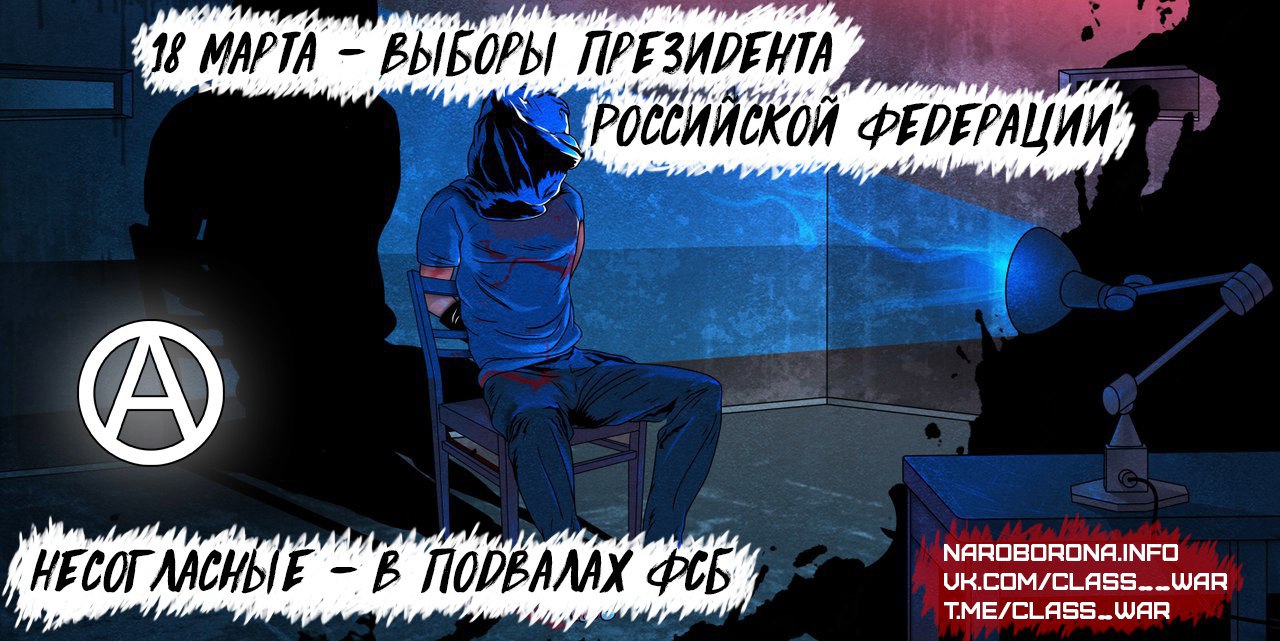
Anarchist Rechkalov Detained in Investigation of Attack on United Russia Campaign HQ, Tortured
Grani.ru
March 15, 2018

Anarchist Svyatoslav Rechkalov, detained yesterday as part of an investigation of the attack on the United Russia party campaign headquarters in the Moscow district of Khovrino, has been remanded in custody to the Temporary Detention Center, as reported in the early hours of Thursday by OVD Info, who cited Yevgenia, a friend of Rechkalov’s who was detained at Rechkalov’s flat along with him and another person whose name has not been ascertained. It cannot be ruled out the person in question was an anarchist named Andrei, who as of Wednesday evening had also not been released from police custody.

Rechkalov informed his comrades that,when he was in the Moscow police’s investigation department, police officers had tortured him, demanding he confess his involvement in the attack. They put a plastic bag over Rechkalov’s head and administered electrical shocks to his legs.

It has not been ascertained whether Rechkalov confessed or not. Yevgenia maintains he had nothing to do with the attack on the United Russia headquarters.

Yevgenia and the unidentifed third detainee were released last night, but on Thursday they were summoned to the investigative department for questioning as witnesses.

On Thursday morning, lawyer Mikhail Biryukov reported he was going to the investigative department to obtain permission to see Rechkalov.

Yesterday, we reported that Left Bloc activist Vladimir Zhuravlov and an anarchist named Artyom had been questioned as witnesses in the case. Both men said they had no information about the attack.

In addition, security services officers searched the Left Bloc’s headquarters, confiscating all the equipment they found there and cracking open a safe. The three activists present the headquarters—Vadim Timergalin, Grigory Sineglazov, and Denis Avdeyev—were detained and taken to a police precinct. They were later released without charge.

The Left Bloc’s VK page reports officers at the precinct had “conversations” with the activists during which they repeatedly threatened them, demanding they testify against their Left Bloc comrades.

It was also noted that, during the search, a lawyer [sic] received messages from unknown accounts, messages supposedly written by the activists. They informed him they did not need his help.

Left Bloc linked the search of their headquarters and the interrogation of Zhuravlov with the ongoing campaign to boycott the upcoming Russian predisdental election. In particular, they mentioned a protest opposite the Nikulin Circus on Tsvetnoy Boulevard during which a banner emblazoned with the slogan “March 18: Tricks and Clowns” had been unfurled.

We assume that, as the presidential election approaches, the police and FSB want to intimidate everyone who has been calling for a boycott. They are justifiably afraid a low voter turnout is a danger to the political farce wrongly called an “election.” All activists involved in the election boycott are now in danger. We concede the outrageous instances of coercion could continue. However, no crackdown can force us to abandon the fight. Boycott the election! We cannot be intimidated! We cannot be forbidden! 

—Excerpt from a pinned post on the Left Bloc’s VK page

“March 18: Russian presidential election. Dissenters in the cellars of the FSB.” Image from the VK page Popular Self-Defense

The attack on United Russia’s campaign headquarters in Khvorino occurred late on the evening of January 30. Three people, including a young woman, took part in the attack. The attackers broke a window in the office and tossed a lighted flare inside. One of attackers filmed the attack on video.

Antifascists Yelena Gorban and Alexei Kobaidze were detained in the case on February 13, charged with vandalism under Article 214 Part 1 of the Russian Federal Criminal Code. The crime entails a maximum punishment of three months in jail and, consequently, does not stipulate that people accused of the crime be remanded in police custody until a verdict has been reached, according to Article 108 Part 1 of the Russian Federal Criminal Procedural Code, which covers incarceration. Nevertheless, both Gorban and Kobaidze were sent to the Temporary Detention Center, as Rechkalov has been now.

However, forty-eight hours after they were apprehended, Gorban and Kobaidze were released on their own recognizance. Gorban had confessed her guilt, while it was reported Kobaidze had refused to testify, invoking his right not to incriminate himself under Article 51 of the Russian Constitution.

Thanks to Comrades AR and ZV for the heads-up. Translated by the Russian Reader

Dragnet (Yelena Gorban and Alexei Kobaidze)

Suspects in Vandalism Committed Outside of United Russia Office Sent to Temporary Detention Facility
OVD Info
February 14, 2018

Paddy wagon in which Gorban was taken away. Photo by Maxim Pashkov. Courtesy of OVD Info

Yelena Gorban and Alexei Kobaidze, suspects in the vandalism case (Russian Criminal Code Article 214) opened after a protest outside a United Russia party office on January 31, have been sent to Temporary Detention Facility No. 1 (Petrovka) in Moscow, as reported to OVD Info by their defense lawyers, Svetlana Sidorkina and Maxim Pashkov.

Gorban and Kobaidze have been jailed for 48 hours. On February 14, investigators plan to pursue their investigation, perhaps by confronting the detainees. According to the lawyers, Gorban has confessed to violating Article 214 Part 1 (vandalism) of the Criminal Code, while Kobaidze has refused to testify, invoking his right not to incriminate himself under Article 51 of the Russian Constitution.

Police arrived at Gorban’s home early in the morning. They searched the flat she shares with her parents, confiscated all electronic devices, and took the young woman to the Investigation Office of the Interior Ministry’s Moscow Directorate. Gorban has problems with her eyesight, but was not allowed to take contact lenses or eyeglases with here. The activist was delivered to the Investigation Office and interrogated as a witness. Her attorney, Svetlana Sidorkina, was not allowed to see her client for four hours. When Sidorkina was finally allowed to see Gorban, she had had decided to confess her guilt and testify.

The police came for Kobaidze in the evening. He refused to open the door, and the police were unable to enter his flat for a long time. Kobaidze’s neighbor Alexei Markov was apprehended by police and taken to the Novogireevo precinct, because he had returned home and refused to opened the door to the flat with his own key. He was then taken to the police station on the premise that he could be inebriated. After testing Markov, the police took him back to the flat and, after showing him a search warrant, opened the door with his key. After the search, Kobaidze was also taken to the Interior Ministry’s Investigation Department and interrogated as a suspect.

During the interrogations, police officers questioned Gorban and Kobaidze about an unauthorized march by Moscow anarchists on Myasnitskaya Street to protest the torture of anarchists and antifascists in Penza and Petersburg (see below).

Translated by the Russian Reader

••••••••••

I have previously posted the following translations of popular press articles on the Penza-Petersburg “terrorism” case and the FSB-led investigation of the April 2017 bombing in the Petersburg subway, which upon close examination seem eerily like carbon copies of each other.