Alexander Beglov, the governor of St. Petersburg, congratulated all Orthodox Christians on yesterday’s Easter holiday during his weekly program on Radio Russia, wishing them peace and health.
“Easter is a symbol of the victory of life over death, light over darkness, good over evil. Today, our soldiers are defending by force of arms the ideals of goodness and justice, and protecting the historical truth and our culture,” the official added.
In his opinion, it was observance of the ancient Christian traditions that made Russia “strong and invincible.”
Announcing his upcoming trip to the St. Petersburg Days celebration in Belarus, Beglov said that both countries opposed fascism. This year, the city will be sending its largest delegation in the history of Petersburg-Belarusian bilateral relations to the neighboring state.
“Christ is risen!”: the traditional Russian Easter greeting, as seen here on a card I received yesterday.
Basically, what I want to say is that I have been incredibly lucky when it comes to people. It is the only real thing, the future. The rest is hell.
Source: An Easter greeting sent to me by an old friend and lifelong resident of St. Petersburg. Translated by TRR
Petersburg mayor [sic] Alexander Beglov and the head of the city’s parliament [sic] Alexander Belsky addressed the residents of the Northern Capital on the occasion of the Orthodox holiday of Easter. The speeches made by the politicians were quoted by the press service for the Smolny.
Beglov and Belsky spent last night at a service in Our Lady of Kazan Cathedral.
Metropolitan Varsonofy conducted the service. Addressing the residents of St. Petersburg, the mayor [sic] recalled the special military operation.
“Today our country is undertaking a special mission. Our military has been facing difficult trials in the name of justice and the future of our children. Our hearts are with them. Our prayers are for them!” the governor said.
In his address, Beglov mentioned Mariupol, St. Petersburg’s sister city, as well as the involvement of Russians in the SMO.
“Our Church prays for them, for the soldiers, for all who are united with us in our values,” Beglov concluded.
After two decades spent in Russian politics, after all that I have seen and experienced, I was sure that nothing can surprise me any more. I must admit that I was wrong.
I’ve been surprised by how far my trial, in its secrecy and contempt for legal norms, has surpassed even the “trials” of Soviet dissidents in the 1960s and 1970s. And that’s not even to mention the harsh sentence requested by the prosecution or the talk of “enemies of the state”. In this respect, we’ve gone beyond the 1970s – all the way back to the 1930s.
As a historian, for me this is an occasion for reflection.
At one point during my testimony, the presiding judge reminded me that one of the extenuating circumstances [in my case] was “remorse for what [the accused] has done”. And although there is little that’s funny about my current situation, I couldn’t help but smile: A criminal, of course, must repent of his deeds. I’m in jail for my political views. For speaking out against the war in Ukraine. For many years of struggle against Vladimir Putin’s dictatorship. For facilitating the adoption of personal international sanctions under the Magnitsky Act against human rights violators.
Not only do I not repent of any of this, I am proud of it. I am proud that [assassinated opposition politician] Boris Nemtsov brought me into politics. And I hope that he is not ashamed of me. I support every word that I have spoken and every word of which I have been accused by this court. I blame myself for only one thing: that over the years of my political activity I have not managed to convince enough of my compatriots and enough politicians in the democratic countries of the danger that the current regime in the Kremlin poses for Russia and for the world. Today this is obvious to everyone, but at a terrible price – the price of war.
In their last statements to the court, defendants usually ask for an acquittal. For a person who has not committed any crimes, acquittal would be the only fair verdict. But I do not ask this court for anything. I know the verdict. I knew it a year ago when I saw people in black uniforms and black masks running after my car in the rear view mirror. Such is the price for speaking up in Russia today.
But I also know that the day will come when the darkness over our country will evaporate. When black will be called black and white will be called white; when it will be officially recognised that two times two is still four; when a war will be called a war, and a usurper a usurper; and when those who fostered and unleashed this war will be recognised as criminals, rather than those who tried to stop it.
This day will come as spring comes after even the coldest winter. And then our society will open its eyes and be horrified by what terrible crimes were committed on its behalf. Through this realisation, through this reflection, the long, difficult but vital path toward Russia’s recovery and restoration begins, its return to the community of civilised countries.
Even today, even in the darkness surrounding us, even sitting in this cage, I love my country and believe in our people. I believe that we can walk this path.
A Russian court sentenced opposition politician Vladimir Kara-Murza to 25 years in prison on charges of treason and “fake news” Monday, capping a high-profile trial of one of the country’s most defiant anti-war voices.
Moscow City Court found Kara-Murza, 41, guilty of treason, “false information about the Russian army,” and affiliation with an “undesirable organization,” Interfax reported.
“Russia will be free, tell everyone,” Kara-Murza said after the verdict, according to the independent news site Avtozak.info.
Russia has witnessed a widespread wartime crackdown on dissent, but the severity of Kara-Murza’s sentence marks a new record as the Kremlin seeks to muzzle any criticism of its ongoing invasion of Ukraine.
The Western-educated politician was detained in April 2022 on charges of “spreading false information about the Russian army” in an address to U.S. state legislators a month earlier.
Kara-Murza was later accused of being affiliated with an “undesirable organization” for participating in a conference in support of political prisoners. His treason charges came in October over anti-war comments made at three public events abroad.
Prosecutors had requested a prison sentence of 25 years — the maximum possible jail term — for Kara-Murza.
“My self-esteem even went up [on the prosecutors’ request]. I realized I was doing everything right,” Kara-Murza’s lawyer Maria Eismont recounted her client as saying.
“Twenty-five years is the highest score I could get for what I did, what I believe in as a citizen, as a patriot, as a politician,” Eismont quoted him as saying, adding that he greeted the verdict “with a smile.”
His trial was held behind closed doors.
Monday’s hearing was attended by several Kara-Murza supporters and foreign diplomats including a U.S. embassy official named David Bernstein, according to the Mediazona news site.
The Kremlin declined to comment on Kara-Murza’s prison sentence, which his supporters and Western governments slammed as politically motivated.
U.S. Ambassador Lynne Tracy called Russia’s criminal prosecution of Kremlin critics “a symbol of weakness, not strength,” while Canadian Ambassador Alison LeClaire said Kara-Murza’s sentence marked a “dark turn” in Russia’s post-Soviet history.
The British Ambassador in Moscow Deborah Bronnert denounced the court ruling and called for the “immediate” release of Kara-Murza, a dual British-Russian citizen.
“The British government expresses solidarity with Vladimir Kara-Murza and his family,” Bronnert told journalists from the steps of the courthouse.
A Russian citizen by birth, Kara-Murza received British citizenship after moving to the United Kingdom with his mother when he was 15.
Russia’s Ambassador in London Andrei Kelin was summoned by the U.K. Foreign Office, which condemned Kara-Murza’s sentence as a violation of his right to a fair trial under international law.
The European Union denounced Kara-Murza’s sentence as “outrageously harsh” and called on Russia to provide access to health care for the ailing Kremlin critic.
The opposition activist suffers from a nerve condition called polyneuropathy which his lawyers say was due to poisoning attempts in 2015 and 2017.
The condition has worsened in prison, and he was too unwell to attend some of his hearings, his lawyers said.
Kara-Murza says he was poisoned twice because of his political activities, but he continued to spend long periods of time in Russia.
Kara-Murza has said he stands by all of his political statements, including those opposing the Ukraine offensive.
“I subscribe to every word that I have said, that I am incriminated for today,” Kara-Murza said in his final address to court last week, highlighting his fight against the Ukraine offensive and President Vladimir Putin.
“Not only do I not repent for any of it — I am proud of it,” he said.
Germany condemned the “shocking level repression” in Russia on Monday, and Latvia announced it had banned 10 Russian nationals from traveling to the Baltic country in retaliation to the court ruling.
At a pinch he could do the same in French, but French specialists were two a penny, and, in any case, Russian was his thing. He loved the Cyrillic alphabet, the byzantine grammar, the soporific, sensuous sound of the Russian language. And once, he had loved a Russian woman.
[…]
“Let’s get some sleep,” said Hyde. “Tomorrow… sorry, make that today, you need to be on top form. The briefing book is right here.” Hyde tapped the file on the table. “Are you up to speed on the current jargon? Post-truth and alternative facts and all of that? What’s fake news in Russian?”
“Feykoviye novosti,” Clive said without missing a beat. “But the purists are up in arms. Feykoviye is not a Russian word. It’s an anglicization. They think it should be lozhniye novosti. Lying news.”
[…]
Then he focused on the job in hand. The mental preparation was always the same, a limbering up of the mind, a rigorous testing of himself. He went through various linguistic exercises, tossing English words and phrases into the air like tennis balls, then hitting them across the net in Russian. It was natural, effortless; he felt completely at ease in either language.
[…]
“Clive was member of our Russian book club on the fourteenth floor of the UN,” Marina said, looking at Hyde.
“I was,” said Clive, looking straight at Marina and taking in every detail of a face he had done his best to forget for over a decade. He had also forgotten the particular musicality of her English, which gave her away as a foreigner. Now and then her “o” was slightly too long and her “r” was a little too hard, and sooner or later she would forget an article,* just as she had a moment ago. Her English was almost perfect. But not quite. It was all part of her infinite charm.
[…]
“Alexei had this thing about grammar. Said I had to speak clean Russian. Clean… That was his pet word. ‘Use the instrumental and not the fucking accusative.’”
[…]
After making love, they would lie in bed and smoke and talk about their favourite writers. They showed off to each other, Marina reciting Pushkin, Clive quoting Shakespeare, and then vice versa, switching effortlessly from English to Russian and back again. They chucked proverbs and abstruse words at each other until they dissolved in laughter.
* But check out the abuse and misuse of articles on display here, of all places:
HARRIET CRAWLEY, “THE TRANSLATOR”. IN CONVERSATION WITH SIR RODRIC BRAITHWAITE
Tuesday, 2 May 2023, 7:00 pm —8:30 pm
5a Bloomsbury Square, London, WC1A 2TA, United Kingdom
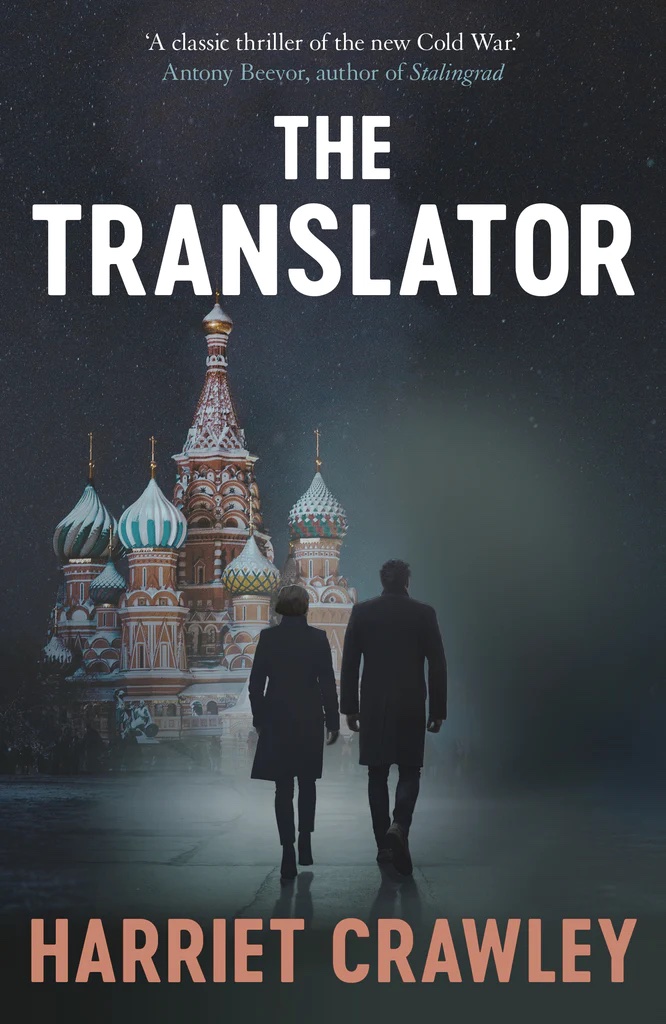
Join us to hear Harriet Crawley discuss her latest novel, a love story and political thriller, with the former British ambassador to Russia, Sir Rodric Braithwaite. The Times has included The Translator in its list of “the best new thrillers”, and the reviews praise author’s descriptions of the everyday life in Moscow, her ability to create suspense, and the political relevance of the plot at the time when the Russian state has once again become a major geopolitical threat.
[…]
The Translator tells a story of two interpreters, one British and one Russian, who embark on a quest to protect vital communication infrastructure connecting the UK and the US from sabotage by Russian special operations forces.
Source: Pushkin House. The emphasis is mine. ||| TRR
While this is a bit closer to the often harsh reality:
Kill the Translator: A Song of Inadequacy


He’s the mad dog of letters, the scrivener of sin.

He stays up nights with dictionaries and gin.

He studies Icelandic with a six-fingered Finn.

            He’s the translator.


He trampled your iambs, desecrated your prose.

He mangled your message and stepped on your toes.

His syntax is suspect, his Swahili a pose.

            Maim the translator.


Your essay’s in tatters, your short story in ruins.

He rendered 'tomato' as 'the mating of loons'.

And tomorrow he’ll english your poem out of tune.

            Harm the translator.


It matters quite little whether he’s stout, thin, or black,

Venetian, Guatemalan, or from Hackensack:

Send him Derrida by mail, and an ounce of crack.

            Suicide the translator.


Stop the presses in Cape Town and summon the cops.

Make a pass at his mother, toss a spear at his pop.

And dare he protest, quote him Lacan till he drops.

            Crush the translator.


Rip his Oxford to shreds, set his grammars on fire.

Break all his pencils, call Nabokov a liar.

Instead of advances, blow him curses by wire.

            Unhinge the translator.


He’s a cheat and a fraud and the foe of good sense.

Promise him the heavens, but repay him in pence.

'Traduttore traditore,' they say, and hence:

            Kill the translator.
Source: The Russian Reader, St. Petersburg, October 1996. The poem was inspired by an incident (one of dozens) in my early career when I was paid a pittance to translate the catalogue for a show of contemporary Russian art in Finland. A few months later, I got a notice from the Finnish tax authority which made it plain that, officially at least, I had been paid several times that amount by the host museum, but the Russian curators had pocketed the difference, thinking I would be none the wiser.
If you don’t want this website and its free, unique, eye-opening content to be maimed, harmed, crushed, suicided, killed, or unhinged, show your support today by liking, commenting, sharing, or donating (via Stripe or PayPal — you’ll find the forms and links in the sidebar). It’s vital for me to know that there are actual people out there who value my unpaid labor of love, which is now in the midst of its sixteenth year. I’ve received only $137 in donations so far this year, alas. That’s not enough financial support for me for to keep doing this much longer, considering that last year, for example, my overhead costs alone were $1,620 (for internet, hosting, and online subscriptions), against only $1,403 in donations for the entire year. ||| TRR
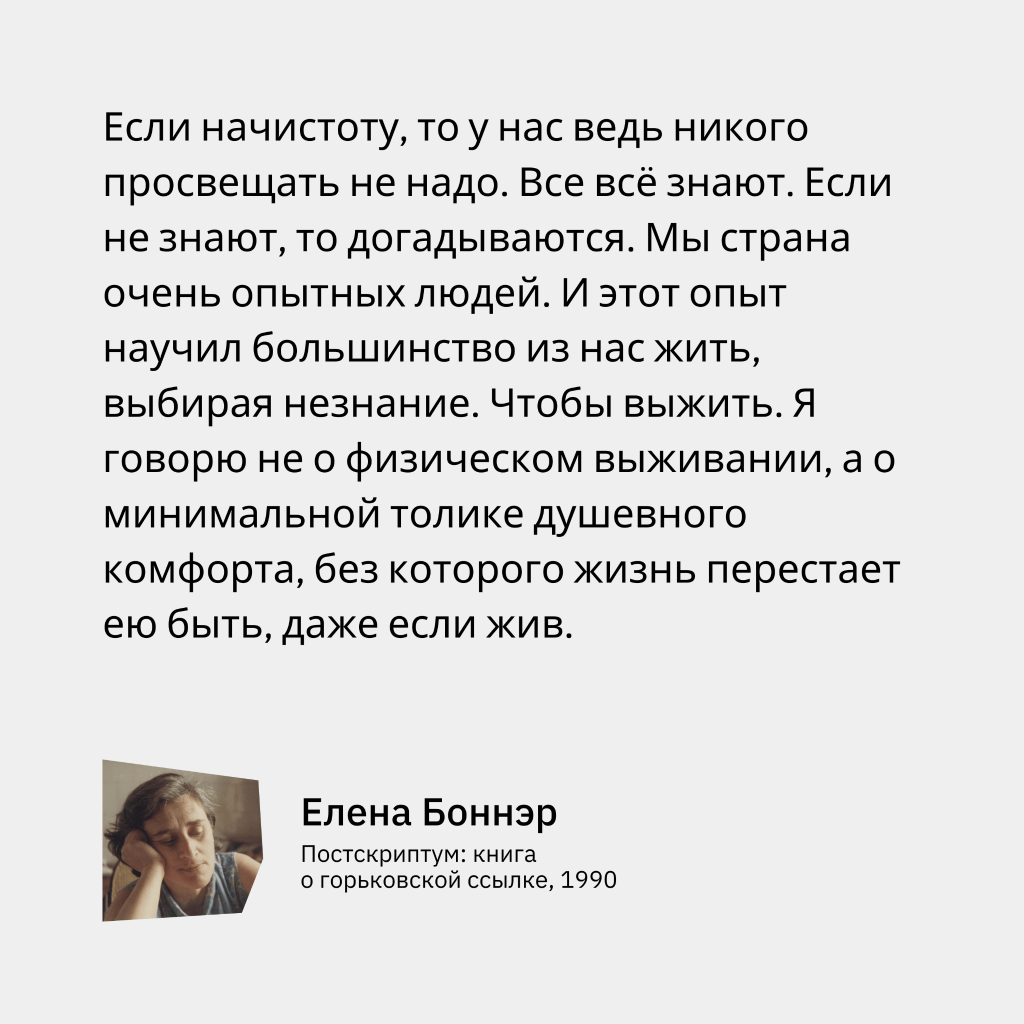
“To be honest, we don’t need to educate anyone. Everyone knows everything. If they don’t know, they have a hunch. We are a country of very experienced people, and this experience has taught most of us to live by choosing ignorance — in order to survive. I’m not talking about physical survival, but about the minimum amount of mental comfort without which life ceases to be life, even if one is alive.” ||| Yelena Bonner, Postscript: A Book about the Exile in Gorky (Moscow: Interbruk, 1990), p. 247
Very soon — this Sunday — our current exhibition will wrap up, and the Sakharov Center will close its doors.
THIS MATERIAL (INFORMATION) WAS PRODUCED AND/OR DISTRIBUTED BY A FOREIGN AGENT, THE SAKHAROV CENTER, OR CONCERNS THE ACTIVITIES OF A FOREIGN AGENT, THE SAKHAROV CENTER. 18+
Coincidentally, our final exhibition is dedicated to Yelena Georgiyevna Bonner, who founded the center. Eviction, of course, does not mean at all that we are ceasing operations. This year we expect to launch a website in honor of Yelena Georgiyevna, produce a podcast, and do a lot more. And yet, it is clear that an important period in the center’s history is coming to an end.
The headquarters of Russian human rights group the Sakharov Center, a rare island of free debate in the Russian capital, will close its doors to the public this weekend in response to an eviction order from local authorities as Russia’s wartime drive to suppress dissent shows no sign of ending.
Opened in 1996 to honor the memory of Soviet dissident and Nobel Peace Prize winner Andrei Sakharov, the center has been an iconic location for talks, exhibitions, funerals and discussions about human rights.
“Without these two buildings, we are no longer a public center,” said Vyacheslav Bakhmin, a veteran human rights activist and the chairman of the board of the Sakharov Center.
“It makes any activity extremely difficult.”
The eviction comes as the few human rights groups still operating inside Russia face intensifying state pressure in the wake of the Kremlin’s decision to invade Ukraine.
The country’s oldest human rights organization, the Moscow Helsinki Group, was closed down by a court order in January, while eight top members of shuttered rights group Memorial, which was jointly awarded the 2022 Nobel Prize last year, were targeted in police raids last month.
The Sakharov’s Center’s final exhibition at its headquarters on the banks of the Yauza River in downtown Moscow was devoted to Yelena Bonner, the wife of Andrei Sakharov and a major Soviet dissident in her own right.
“We did not plan this symbolism, it just happened this way — they started closing us down on the eve of Bonner’s centenary,” curator Natalia Samover told The Moscow Times.
“This center is filled with her name,” she said, standing amid the exhibition that included some of Bonner’s photos and video interviews as well as her desk, notebooks and letters opposing Russia’s 1990s war in the North Caucasus republic of Chechnya.
Bonner was involved in founding the Moscow Helsinki Group in the 1970s and worked tirelessly to raise Sakharov’s profile when he was exiled to Gorky (now Nizhny Novgorod) by the Soviet authorities.
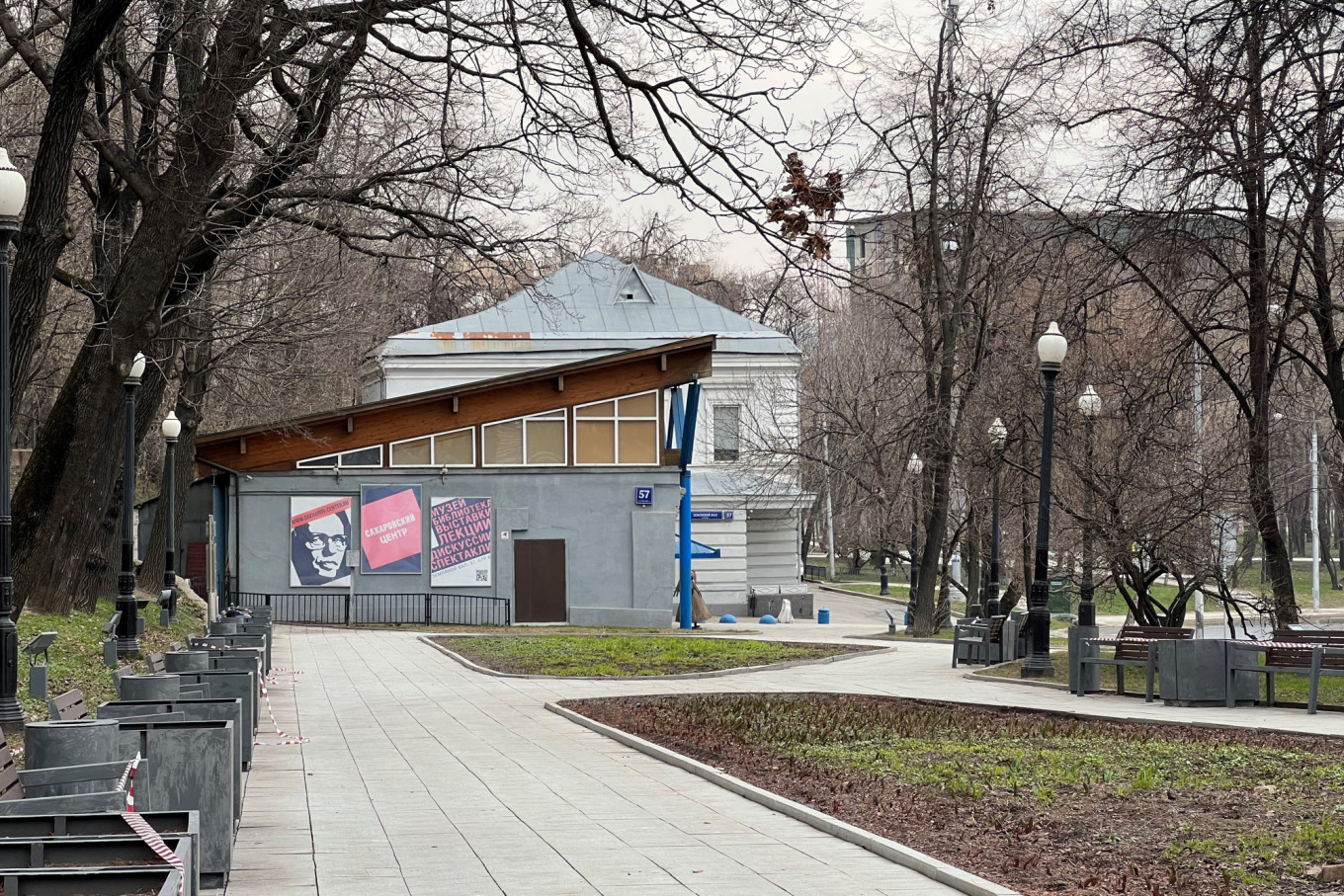
The Sakharov Center. Photo by The Moscow Times
Following Sakharov’s death in 1989, Bonner established the Sakharov Center — gifted rent-free by the Moscow authorities — and opened the Sakharov archives to the public.
On a recent visit by a Moscow Times reporter to the Bonner exhibition, there were a handful of visitors.
“The center is definitely a significant place — it’s important to have different points of view as well as places where these different points of view can be discussed,” said Artemy, an IT specialist, who decided to visit because he knew that the center was due to close.
“I think that everyone can be represented in the public field,” said another visitor, Stanislav, who admitted that he wasn’t aware of “the history of the center.”
The closure of the Bonner exhibition — titled “Life Was Typical, Tragic and Wonderful” — marks the end of the Sakharov Center’s long tradition of public engagement.
Employees earlier this month dismantled the center’s permanent exhibition on the legacy of Sakharov and victims of Soviet-era repression and its final public event — dedicated to Bonner — will take place Sunday evening.
According to the eviction notice, the center must be fully vacated by April 28.
Formally, the authorities’ decision to deprive the Sakharov Center of its Moscow home was a result of the organization’s designation as a “foreign agent” in 2014 — Russian law forbids “foreign agent” organizations from receiving any state support.
But the Sakharov Center has said it believes the order was really motivated by the Kremlin’s desire to destroy “independent organizations that defend the public interest.”
For the moment, the Sakharov Center does not have any new premises lined up and is planning to continue its activities online.
In addition, it is undergoing an unscheduled inspection by the Justice Ministry this month, board chairman Bakhmin told The Moscow Times.
“The results will make it clear whether and how we can continue,” Bakhmin said.
The eviction is just the latest example of official pressure on the Sakharov Center.
Russia’s Prosecutor General’s Office declared the Andrei Sakharov Foundation — a group opened by Bonner in the U.S. — as an “undesirable” organization in January, a designation that means any association with the group could result in criminal charges in Russia.
That means the Russia-based Sakharov Center now avoids any cooperation with its U.S. counterpart.
The current state of human rights in Russia is “unprecedented,” according to Tatiana Lokshina, a Europe and Central Asia expert at Human Rights Watch, which was forced to close its own Moscow office last year.
“While Russia is fighting against Ukraine, it is also fighting against any critical actors within the country. This is a real war with dissenting opinions,” she told The Moscow Times.
Over the years, the Sakharov Center, which describes itself as “a place uniting thousands of Russian citizens who are not indifferent to the fate of the country,” has hosted a number of landmark events — including the unofficial lying-in-state for Soviet dissident Valeria Novodvorskaya and murdered Kremlin critic Boris Nemtsov.
Despite the loss of a physical presence in central Moscow, Bakhmin remains optimistic that the Sakharov Center will survive and the current crackdown will be reversed.
“The situation [in Russia] will change again — the reality we live in right now has no future,” Bakhmin told The Moscow Times.
Today, coming out of the front door of my building, I saw the following tableau. A neighbor from the third floor, who is somewhere between thirty-five and forty, was, on the contrary, coming in the front door. Judging by the bag he was carrying, he had just been grocery shopping. He doffed his baseball cap, clamped it under his arm, and crossed himself three times as he looked at the mailboxes. Then he peered into his own mailbox and let out a sigh of relief. His draft notice had not yet arrived, apparently. To be honest, it took a while for the meaning of his maneuvers to dawn on me. Of course, I pretended that I hadn’t noticed any of it.
On Wednesday, April 12, Samara journalist Sergei Podsytnik posted on the website Change.org a petition calling for the repeal of amendments paving the way for the introduction of electronic military draft notices, as passed the previous day by the State Duma and the Federation Council.
“These amendments violate our rights. A citizen cannot be stripped of their rights without a trial, but now this right has been given to the staff of military enlistment offices,” the petition says. Podsytnik draws attention to the fact that the public services portal Gosuslugi, through which it is planned to serve draft notices to Russians, has a number of vulnerabilities. In addition, not all residents of the country have access to their accounts on the portal, and almost thirty percent of Russians over thirty are not active internet users.
According to the amendments as adopted, if a conscript did not receive a paper summons and did not log into his Gosuslugi account, the summons will still be considered delivered within seven days after it was entered into the register of draft notices. He will then be banned from leaving the country. After twenty days, new bans will come into effect: those who failed to report to a military enlistment office will not be able to work as individual entrepreneurs, manage real estate, drive a car, or take out loans.
“To deprive people of the ability to sell real estate, drive a car, or travel abroad at the request of a person with no specialized legal education is an outrage against our rights and freedoms,” the petition says. At the time this story went to press, the petition had been signed by more than thirty thousand people, and their number was growing rapidly. For the amendments to go into effect, they must be signed by Vladimir Putin and published.
The legislative changes mean that once a Russian citizen has received a military summons online, they will be automatically forbidden from leaving the country, and therefore avoiding the call-up.
If they fail to appear at a draft office within 20 days, they will face a range of restrictions, including a ban on using their own vehicle, selling property or receiving a loan. They also face a fine of between 500 and 3,000 rubles (£5 to £29).
The head of Russia’s parliamentary committee on defence claimed that these measures will only come into force during the next conscription campaign.
The new system also anticipates a unified database where personal data about Russian reserve personnel can be collated by a range of government institutions, such as the tax service, law enforcement, the pension fund and medical facilities.
Such a database will make it “practically impossible” for reservists to avoid being called up, anti-conscription lawyer Alexey Tabalov told independent Russian media outlet Verstka, because military registration offices will have more detailed information about an individual’s home and work address.
This changes the advice he has been giving people who want to avoid mobilisation, Tabalov says.
Whereas he previously recommended that people avoid receiving the physical summons document, that “recommendation has lost all meaning” now, he said. “If you don’t want to serve, don’t go to the military registration office, but you’ll still face restrictive measures,” Tabalov said.
Andrei Kartopolov, head of the State Duma defense committee, spelled out tough penalties for those who do not respond to electronic summonses, including potential bans on driving, registering a company, working as a self-employed individual, obtaining credit or loans, selling apartments, buying property or securing social benefits. These penalties could apply to the thousands of men who are already outside the country.
The electronic summons will be issued via a government services portal, Gosuslugi, used for all manner of state payments and services including taxes, passports, housing services, social benefits, transport documents, medical appointments, employee insurance and countless other matters.
Under the law, personal data of conscripts including identity documents, personal tax numbers, driver’s license details, phone numbers and other information will be transferred by Gosuslugi to military enlistment offices. Universities, business employers, hospitals and clinics, government ministries, law enforcement agencies, the electoral commission and the tax authority are also required to transmit data to the military.
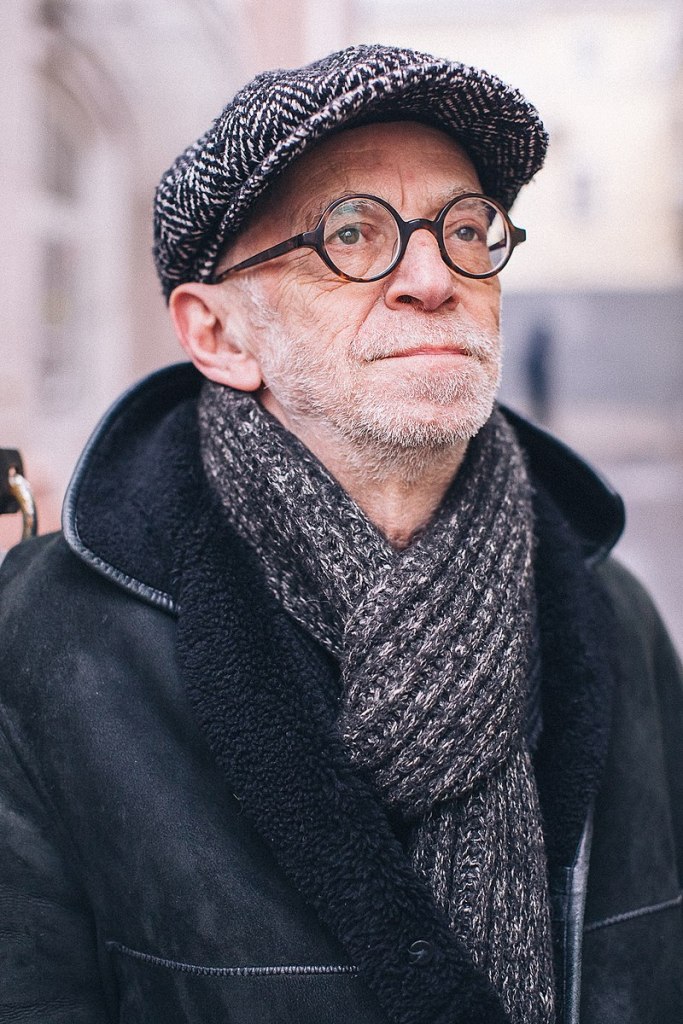
Lev Rubinstein, born 1947 in Moscow, as photographed in 2017 by Natalia Senatorova. Courtesy of Wikimedia
There should be at least some news to slightly brighten — like a mosquito-sized flashlight — the gloomy hopelessness of the current media landscape.
So, this morning a news item flashed across my screen that seemed provisionally positive and even slightly heartwarming amidst the already familiar meteor shower of news items, each one more nightmarish and ridiculous than the last.
However, this seemingly welcome news is also shipshape when it comes to absurdity.
Amid the events happening around us this bit of news struck me as quite strange. I immediately wanted to check whether it was a fake (sorry for the non-Russian word).
But it seems to be true, alright.
“In February–March 2024,” I read, “the World Festival of Youth will be held in Russia, per the decree signed by President Vladimir Putin.”
“Within three months, the government,” I read on, “should start prepping for staging the festival, as well as finding sources of funding.”
While I am amazed, to put it mildly, at the incongruity and obvious strangeness of all this, and while I imagine how the eyes of the various “preppers” and “stagers” light up when they read the word “financing,” one of my most vivid memories serves as a powerful backdrop to these spontaneous reflections of mine.
In the summer of 1957, Moscow hosted the World Festival of Youth and Students — a festival of left-wing youth organizations that had been held since 1947.
The Soviet propaganda of those years stressed the “fight for peace” as an alternative to the “aggressive policy of the imperialist West.”
In the phrase “fight for peace,” the emphasis increasingly shifted towards the word “fight.”
Be that as it may, the word “peace” [mir] in those days, in terms of the frequency with which it was used in both official and unofficial speech, knew no rivals. This is especially often and especially vividly remembered in our own time.
Be that as it may, the 1957 Moscow festival, conceived as a propaganda event, was an important and gratifying event in the life of not only the Soviet capital, but also the whole country.
“Moscow Youth Festival” (1957). Silent footage from Pathé News
I was ten years old—not so big as to understand everything, but not so little as to understand nothing.
That summer, parents were strongly recommended to take their children out of the capital. I don’t remember why I stayed in Moscow, moreover, smack dab in the center of it.
My friend and neighbor Smirnov and I would roam the streets of Moscow during the festival.
My eyes were blinded by the vividness and polychromatism. I remember an overexcited middle-aged dame grabbing the hand of a skinny Indian man. Speaking loudly and syllabically, as often happens when people talk to foreigners, she told him: “I i-dol-ize Indian cinema! Do you understand? I i-dol-ize it! Do you understand me?”
The Indian smiled and nodded his head, which was wrapped in something terribly foreign and incredibly beautiful. Then he shoved some kind of colorful pin into her hand. It is quite possible, however, that he was not from India but from somewhere else.
Smirnov and I were also given pins and postcards by foreigners. We kept them in our collections at home for many more years. Then they disappeared.
In those days it suddenly became obvious that, before the festival, we had been living in a black and white world. A spirit of unthinkable, unimaginable freedom reigned over the capital, which had become prettier and younger and had lapsed into charming frivolity.
“We Became Friends in Moscow” (1957). In Russian
The air was so supercharged with erotic energy that a year after the Moscow festival, babies of all colors of the spectrum showed up in noticeable numbers. Those babies are now all grown up.
But this was not the only trace left behind by the festival. Nor were the toponymic relics in the form of the countless “Festival Streets” and Druzhba (“Friendship”) cinemas. It was then, by the way, that First Meshchanskaya Street (“First Bourgeois Street”) was renamed Prospect Mira (“Avenue of Peace”).
Many artists of the older generation would later admit that the exhibition of modern painting brought to Moscow by the French and shown during the festival turned their ideas about art upside down and provided the first impulse to everything that is now collectively known as contemporary art. However hard the ideological leadership tried to put the “abstractionists” in their place a few years later and in subsequent years, the genie had been let out of the bottle.
After the festival, the stilyagi — the first aesthetic and, so to speak, behavioral dissidents in the Soviet Union — emerged. After the festival, the idea of fashion and fashionableness arose. After the festival, rock and roll appeared in the Soviet Union and spread around the country. After the festival, the youth subculture in our country took on distinctive features, however timid and provincial.
The Stalinist reinforced concrete (not even iron!) curtain was not flung open during the festival. Only a narrow crack opened in it, but the flow of air pouring through this crack was so powerful that it intoxicated an entire generation for many years to come.
“Khrushchev and the Avant-Gardists: from the Manege to the Manege” (1990). Artist Eli Belyutin and his colleagues look back at “30 Years of the Moscow Union of Artists,” held at the Moscow Manege in 1962. The show attracted the notice of the Soviet and foreign press, but it also angered Soviet leader Nikita Khrushchev. In Russian
The festival was yet another lesson about the important fact that freedom is not an absolute concept. That freedom is tangible only in the context of non-freedom. That freedom is just the feeling of freedom and nothing more. And it was this feeling that we experienced then. We were not given freedom. We were only shown it through a crack in a thick curtain.
Smirnov and I didn’t know how to articulate anything of the sort back then. We sensed this freedom in a childlike way, directly. It had appeared to us in a bright and sparkling shape that made even a New Year’s tree seem almost as tedious as a synopsis of the painting Arrived on Vacation.
There was no freedom, but there was the feeling of it then.
This powerful feeling touched even me, a ten-year-old. And for many young people from my older brother’s generation, this event largely shaped their further social and cultural evolution.
People who were twenty years older than me often recalled another brief but bright time when it seemed to many who had returned from the front, who had been able to see another world and other people, to spend time with the soldiers and officers of the allied armies, that “now everything would be different.” They also considered it a great fortune, despite the fact that they were very quickly shown who was the boss in the house, and, most importantly, who had really won that war.
Live coverage of the opening ceremony of the 12th World Festival of Youth and Students, Moscow, 1985. In Russian
History shows that when a totalitarian or authoritarian government, under the influence of certain political (most often external) circumstances, is forced to provide its citizens with a “whiff of freedom,” this is almost always followed by bouts of reaction in different shapes and guises. “You had a little breather and that’s enough!” the government seemingly says to citizens who decided that now things would be different.
Freedom, according to the great poet, comes to us naked. But when she sees that no one welcomes her with flowers and songs, she waits in vain for a while before dejectedly going home.
I cannot even really imagine the upcoming triumph of the spirit, the style and overall thrust of its staging, the number and, most importantly, the quality of its intended participants, and how the keyword of all the previous festivals, the word that begins with a “p,” and which has now become semi-forbidden, will be spun. I lack the imagination.
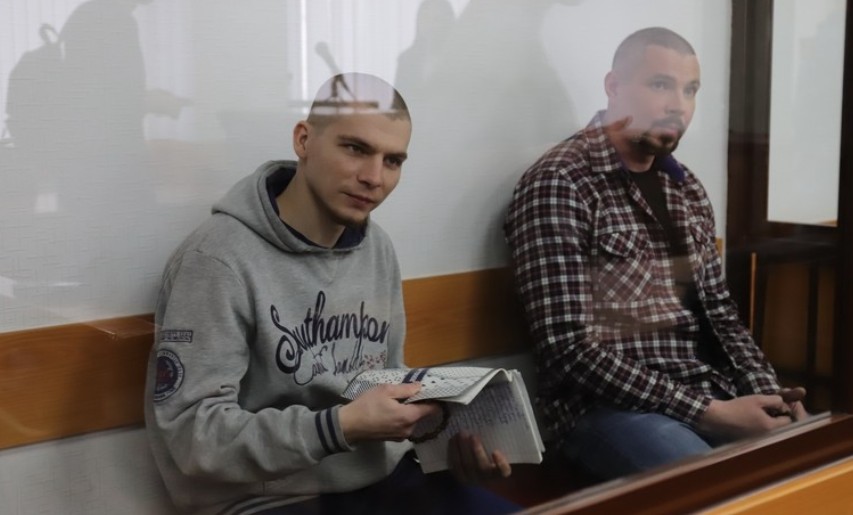
The Central District Military Court at Yekaterinburg, in Russia, yesterday (10 April) handed down 19-year prison sentences to Roman Nasryev and Aleksei Nuriev, for firebombing an administrative office building where a military registration office is based.
Roman Nasryev (left) and Aleksei Nuriev in court. Photo from The Insider
Roman and Aleksei will have to spend the first four years in prison, and the rest in a maximum-security penal colony.
This is the most severe sentence handed down so far for anti-war arson.
Roman and Aleksei received this long term of imprisonment because their actions were defined as a “terrorist act” (Article 205.2 of the criminal code of the Russian Federation) and “undergoing training for the purpose of undertaking terrorist activity” (Article 205.3). The latter Article carries a minimum term of 15 years.
The arson attack that Roman and Aleksei carried out – in reaction to the mlitary mobilisation, and to express their opposition to the invasion of Ukraine – was no more than symbolic. A female security guard was able to put out the fire, with a blanket and a few litres of water. There was damage to a window and some linoleum.
In court Roman Nasryev said:
I decided to carry out this action, because I did not agree with the [military] mobilisation, the “Special Military Operation” and the war as a whole. I simply wanted to show, by my actions, that in our city there is opposition to mobilisation and the “Special Military Operation”. I wanted in this way to make clear my opposition; I wanted my voice to be heard.
Solidarity Zone believes that this type of anti-war arson is not terrorism. That definition is politically motivated, and directly linked to the fact that the Russian government has unleashed a war of aggression against Ukraine.
□ Translated from Solidarity Zone’s Telegram feed. The original asks people to send letters and parcels to Roman and Aleksei in prison. If you are not a Russian speaker and you want to send them a message, there is no point in sending it directly. You can send messages to peoplenature@protonmail.com and I hope to be able to pass them.
The case of Pavel Korshunov, accused of “terrorism” over anti-war arson, sent to trial
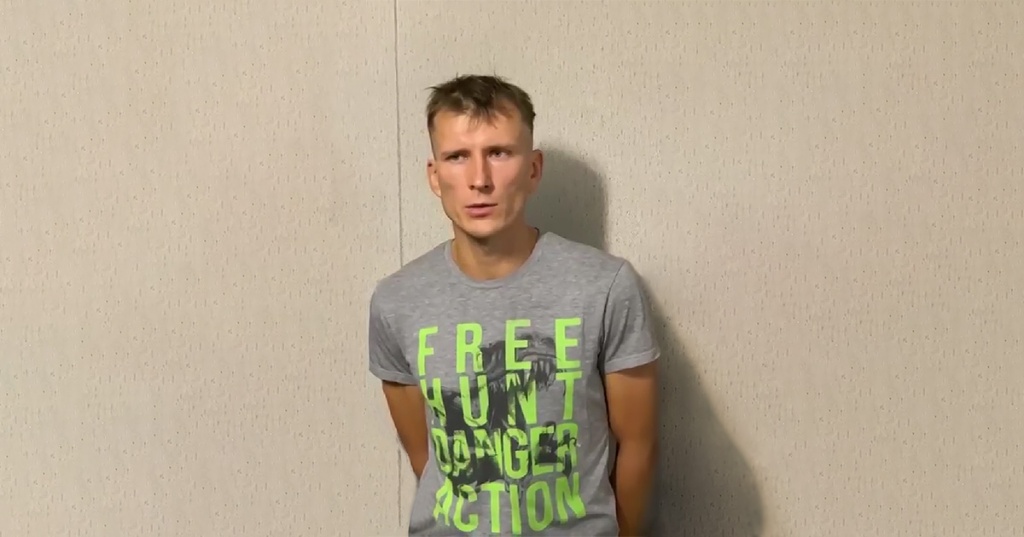
Pavel Korshunov was detained in the city of Togliatti, Samara Region, as if he were a particularly dangerous criminal — a large number of Interior Ministry special forces soldiers were involved in his capture. But, according to investigators, all that Pavel did was set try and set fire to the Togliatti city administration building the day after the mobilization was announced. In a video posted online by the security forces, Korshunov states that he wanted to impede the mobilization.
Before his arrest, Pavel worked at a boathouse. Citing sources in the security forces, the media also write that Korshunov had previously taken part in protests.
Pavel has been charged with “committing a terrorist act” (per Article 205.2.b of the Russian Federal Criminal Code) and “vandalism” (per Article 214.2 of the Russian Federal Criminal Code). He faces from twelve to twenty years in prison if convicted.
On April 7, his case was submitted to the Central District Military Court in Samara. It will be tried by a three-judge panel chaired by Igor Belkin. There is not yet any information about exact trial dates on the court’s website.
✊ Help a teacher from Krasnodar accused of terrorism!
On the night of October 6, persons unknown set fire to the military enlistment office in the city of Goryachy Klyuch, Krasnodar Territory. The next day, the security forces detained two suspects — Bogdan Abdurakhmanov, a 27-year-old native of Minsk, and Boris Goncharenko, a 34-year-old man from Krasnodar.
Abdurakhmanov and Goncharenko were initially charged with “attempted destruction of property” (per Article 30.3 and Article 167.3 of the Russian Federal Criminal Code) and thus faced no more than three years and nine months of imprisonment if convicted. The FSB intervened in the case, however, and the charge was changed to “committing a terrorist act” (per Article 205.2 of the Russian Federal Criminal Code). Bogdan and Boris now face from twelve to twenty years in prison.
Goncharenko graduated from Kuban State University. After graduating, he taught history, social studies, and philosophy at various educational institutions. At one time he worked as a manager for the Garant and Konsultant Plus legal information portals.
Boris does not support Russia’s aggression in Ukraine, and after the outbreak of the full-scale war, he was very worried about the fate of the conscripts, including his former and current students.
Goncharenko does not consider himself guilty of “committing a terrorist act.”
Solidarity Zone has found a lawyer to defend Boris Goncharenko and made a down payment on their fee so that they may begin working. On March 29, we announced a campaign to raise the 250 thousand rubles necessary to pay the lawyer’s fees in full during the investigation phase of the case. To date, less than one fifth of the amount of money needed has been raised.
We urge you to support our fundraiser with donations and reposts!
💳 Sberbank card: 2202 2025 4750 6521 (Vasily)
🪙 PayPal: solidarity_zone@riseup.net (mark it “for Goncharenko” and designate the payment in euros if possible)
🥷 Cryptocurrency (be sure to email us at solidarity_zone@riseup.net if you transfer cryptocurrency to support Boris Goncharenko):
You are not violating any Russian laws by participating in the fundraiser. We have not been deemed “foreign agents” or an “extremist” or “terrorist” organization by the authorities, and raising money to pay a lawyer’s fees is not prohibited in Russia yet. ☺️
Ilya Shakursky. Photo courtesy of Elena Shakurskaya
Today, April 10, my son Ilya turns 27. This is the sixth birthday he has celebrated behind bars. But every year I wait, believe, and hope that he be released from captivity and be near us. I naively believe in justice and truth. A miracle must happen sometime and Goodness will triumph!
My son, the best in the world, I lovingly congratulate you on your birthday! You are a part of me, and from the bottom of my heart I want to wish you incredibly beautiful days and nights, the most wonderful emotions, and fulfillment of ambitious plans! You deserve everything wonderful; may sincere Faith, pure and devoted Love, and optimistic Hope always remain with you! I wish my son the brightest road today. After all, you are all I have. My mother’s heart very often worries about you. It hurts for every trial you go through. It hurts for everything! Know, son, that you are everything to me. You are my only man, for whom I am not sorry to give my life. You’re my rock.
Ilya’s payphones have been turned off, and at the moment there is no connection with him. Today the weather is as warm and sunny as it was in 1996 [on the day he was born]. May the sun’s rays give hope, faith, kindness, and most importantly freedom to Ilya and to all political prisoners!
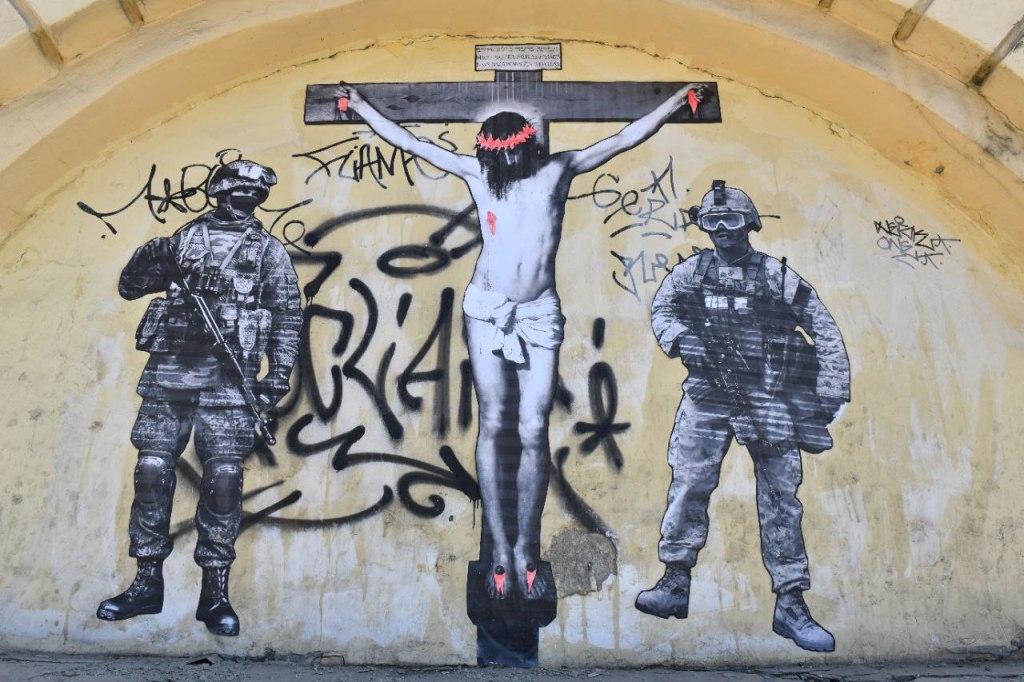
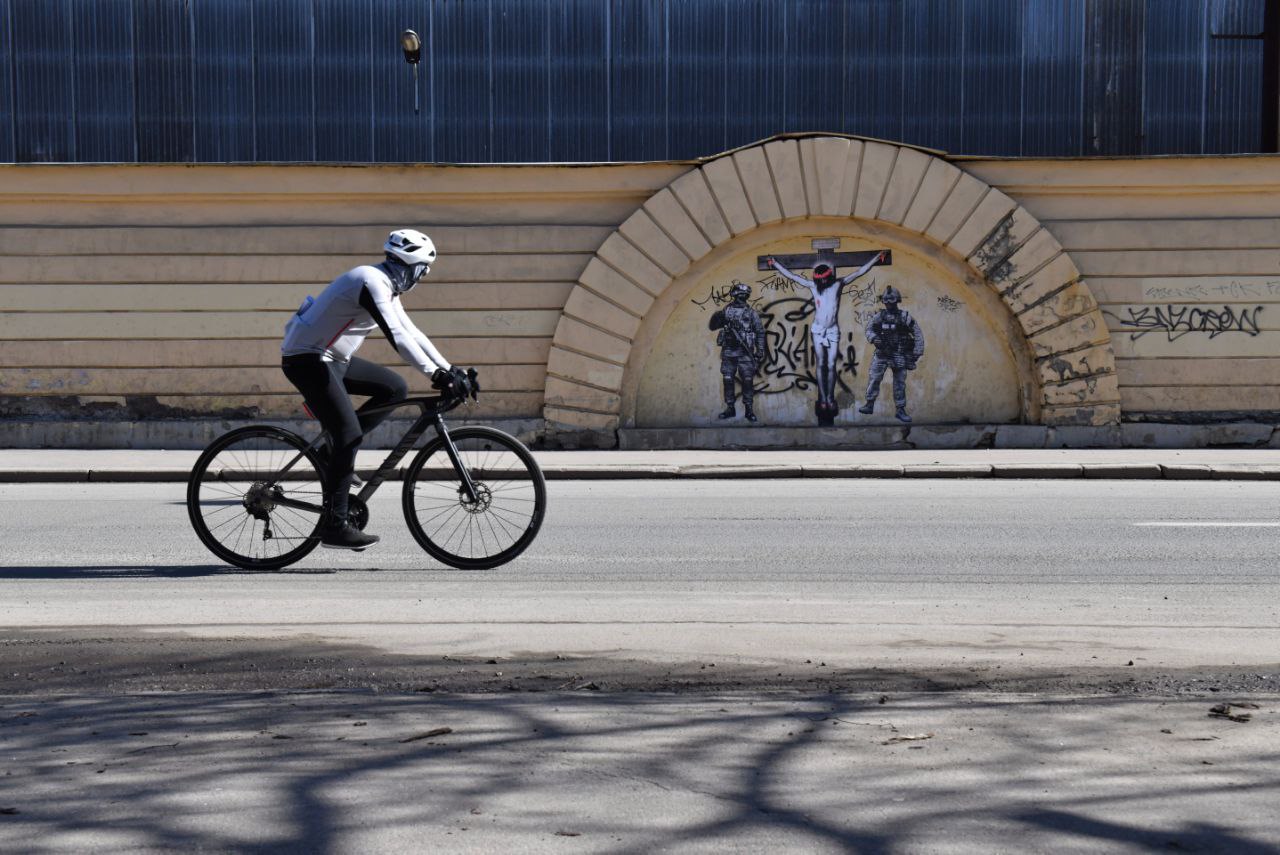
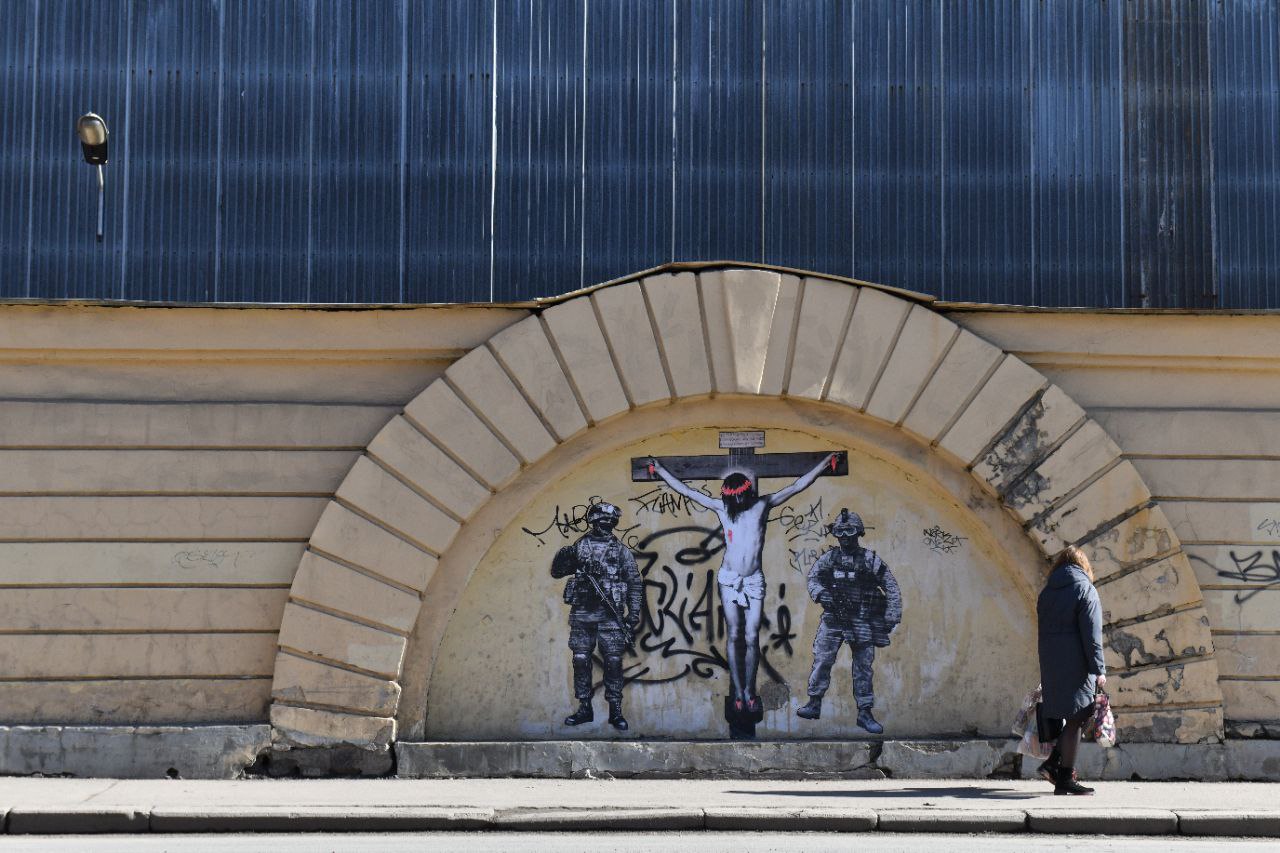
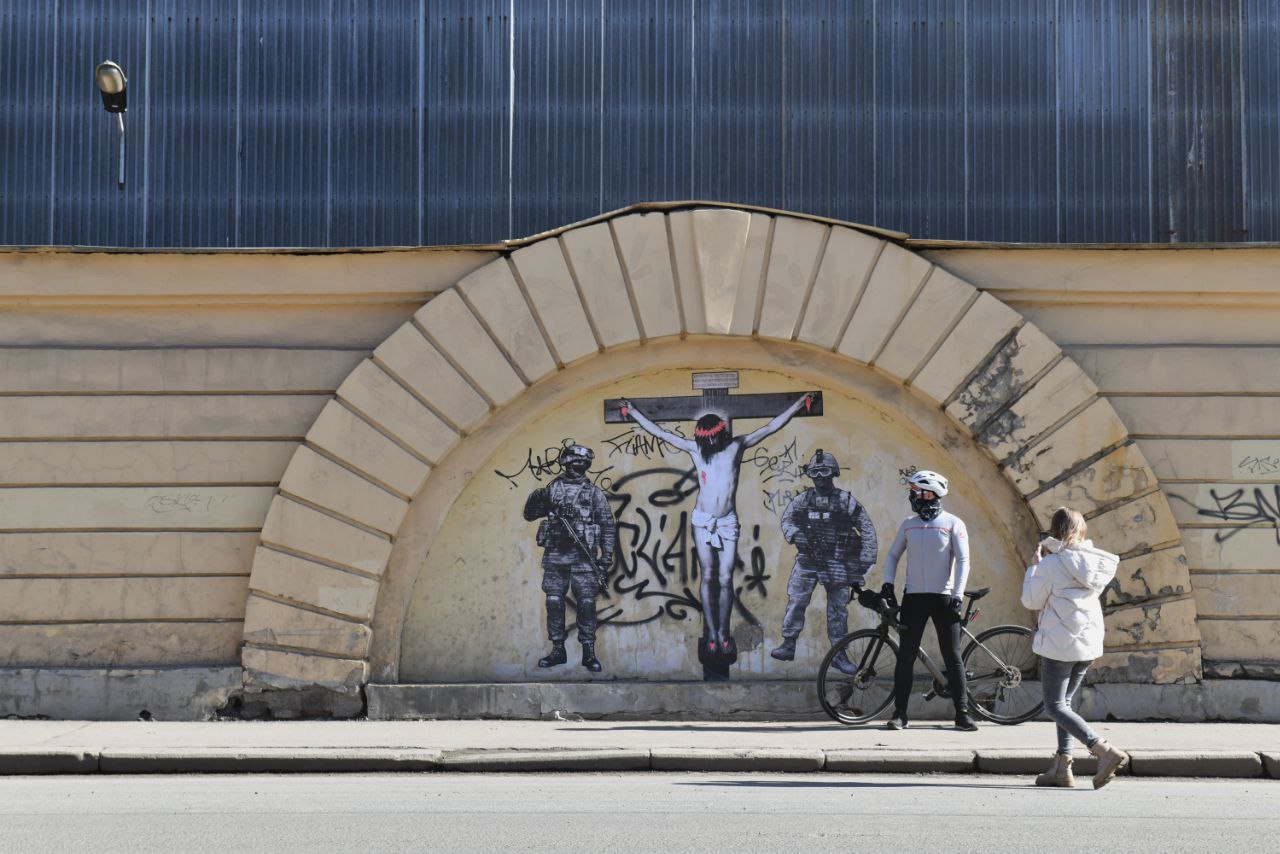
A piece of street art featuring a crucified Jesus Christ and two soldiers with no insignia on their uniforms has appeared on Vasilievsky Island’s Kosaya Liniya. As the author of the work, artist Vano Bogomaz, writes on Instagram, it is a collage that uses images from the internet and reproductions of Diego Velasquez’s painting Christ Crucified.
In his description of the work, Bogomaz quotes the words of Jesus on the cross: “Forgive them, for they not what they do.”
“Two thousand years have passed, and yet we still can’t stop doing evil,” Bogomaz writes. The work was occasioned by Good Friday.
Here we give our readers a glimpse of what the collage looks like and how passersby reacted to it.
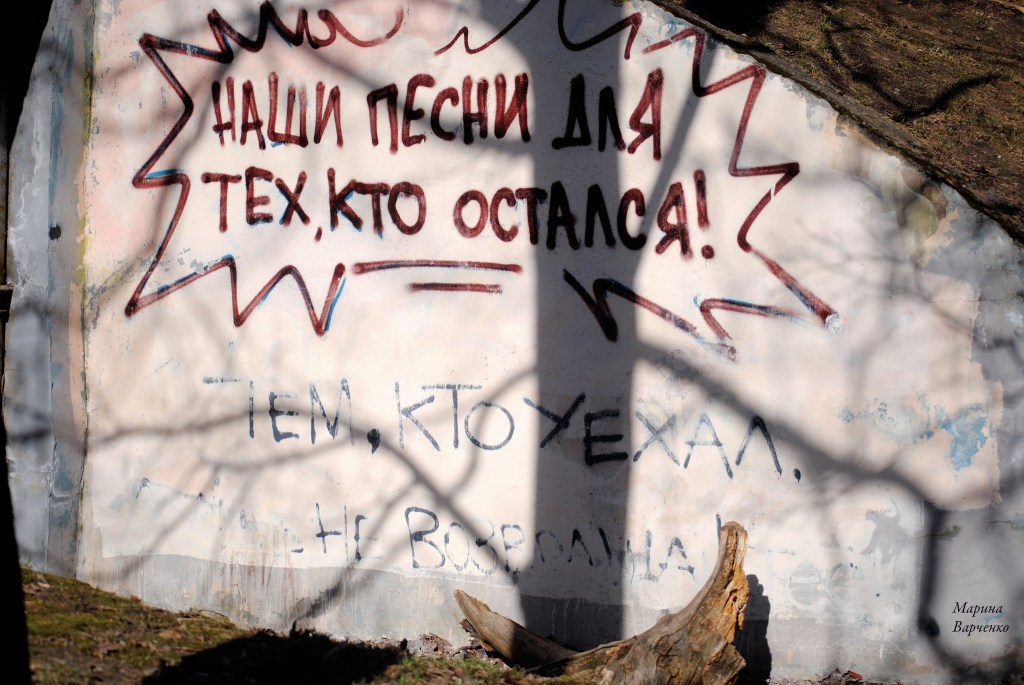
All the swindlers are fleeing Russia:
They have property in the West.
The bandits and sodomites are fleeing
And all those killed by their conscience.

The Judases are running, all going there,
Where there is no love, where there is no Christ.
Where there are gay parades and Nazis,
Liberals and globalists.

God is cleansing Holy Russia,
He protects it himself like his own daughter!
He will not let the evil ones torment us,
May God grant that we keep our faith.
Only an ignoramus doesn't understand
Russia as the last hope.

Let the enemy shout that Putin is bad
And under him all in Russia is bad.
If the whole herd of fleas is mad,
Evidently our Putin has done everything right!