First, if you know someone who might like this newsletter, please forward it to them.
Next, the story. I know many people this week are focused on the killing of Russian blogger Vladlen Tatarsky in St Petersburg. We are working on that (stay tuned).
But I want to talk about the long-term impact of Russia’s war on Ukraine and the social crisis it has caused in my country.
In this case, it’s about Ukraine’s teachers, who are facing serious salary cuts against a backdrop of high inflation, prices, rents and costs of basic services.
It’s a story about who is paying the price of Russia’s war, which has caused hundreds of billions of dollars of direct and indirect damage to Ukraine.
To do it, I spoke to teachers, local officials and trade union activists to find out how the Ukrainian government is being forced to pursue austerity – and what that means for hard-working people across the country.
I found that some local authorities are managing to pick up the shortfall in central grants – while others just can’t do it, as tax income has dropped off following the invasion.
Either way, local officials know it’s political suicide to fire people en masse, and have to scramble and scrape to get through the funding shortfall.
But it feels like a crisis postponed – rather than solved.
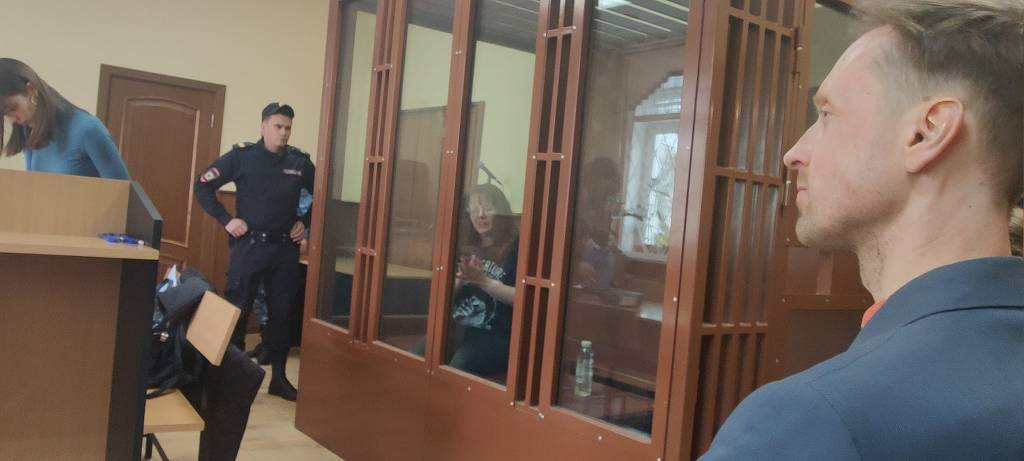
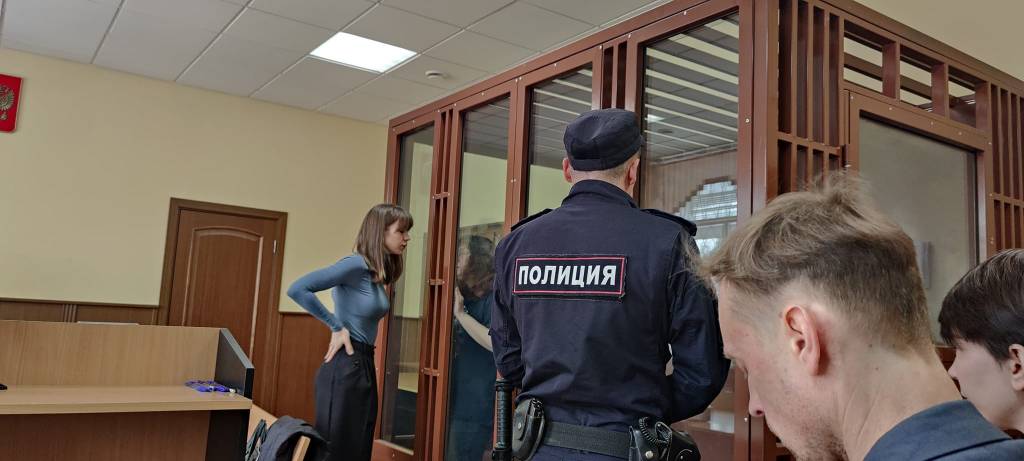
“Fun times” today at the trial of Olga Borisovna Smirnova. The escort guard pushed the defense lawyer, Zyryanova, and ripped a phone from her hands, injuring her fingers. As soon as the ambulance arrived, the doctors took Olga’s defense attorney downstairs to the vehicle and drove her away.
At the trial itself, the prosecutor read out a bunch of papers for three hours regarding the searches of the homes of Olga’s associates. In each instance the investigator wrote that none of this evidence was entered into the case file, whereas earlier she herself had insisted on urgent searches without a court order, which were carried out.
The only variety in these boilerplate search and inspection reports was provided by the descriptions of apartments and rooms. And, for some reason, the prosecutor always says “kitCHEN table,” with the stress on the second syllable.
But there is nothing [“incriminating” in these reports?] except literature in Ukrainian (the prosecutor reads the title in Ukrainian and then the Russian translation, as supplied by Yandex Translate) and placards whose slogans the prosecutor was occasionally ashamed to read aloud, claiming that the slogan “Free political prisoners” was “obscene,” and the slogan “Putin resign” was “illegible.” What sort of sharp practice is it to fill the criminal case file, under the guise of evidence, with stuff that has nothing to do with the case and even according to the investigator is not evidence? Is the prosecutor trying to generate an overall fogginess?
While there is a break in the trial, people wait in the hallway. More than twenty people have come to hearing, including a group of supporters and journalists.
When Olga is escorted out now, the bailiffs close the door to the stairs, where people are standing, apparently so that they won’t be able to shout out words of support to her.
As our correspondent reports, at the latest hearing in the trial of activist Olga Smirnova, in the Kirovsky District Court, the prosecution made public the contents of the nine posts on VKontakte which occasioned criminal charges of disseminating “fake news” about the Russian army.
The posts listed by the prosecution were made on the public social media page of the movement Democratic Petersburg.
A post with a link to a video titled “We will never be brothers,” in which it is reported that the Russian army is “reducing Ukrainian cities to ruins.”
A post with a link to a video that concludes with the words [in Ukrainian], “Glory to Ukraine, glory to the defenders, death to the enemy.”
A post with a link to a video titled “We show Russians photos from Ukraine. The reaction of Russians to the war in Ukraine.” In the video, “the assertion is made” that the photos show Ukrainian cities destroyed by Russian shelling.
A post featuring a photo of a placard on which “the assertion is made” that the Babyn Yar Holocaust Memorial Center was damaged by Russian bombing.
A link to a video titled “No war with Ukraine.”
A post titled “Chronicles of the war, March 9,” in which it is reported that over 1,300 civilians were killed in Mariupol, most of whom were Russian-speaking.
A post titled “Chronicles of the war, March 9, continued,” which reports that Russian troops continue to bomb Kharkiv’s civilian infrastructure facilities.
A post which”sarcastically” reports on a battle between Kadyrovites and Ukrainian National Guardsmen on the premises of the Zaporizhzhia nuclear power plant, claiming that goal of the Kadyrovites is to seize the nuclear power plant in order to “blackmail the whole of Europe with radioactive contamination.”
A post titled “Anti-war pickets: greetings and glory to Ukraine,” which reports that supporters of peaceful resistance in Petersburg came out to protest against the criminal war which Russia is waging against Ukraine.
Due to the absence of witnesses, the prosecution moved to postpone the trial until March and the court granted the motion.
Olga Smirnova is a grassroots activist. She is one of the founders of Strategy 18, an ongoing campaign in support of the Crimean Tatars. She is also a a member of the Petersburg movement Peaceful Resistance, which, according to its own description, “spreads the truth about the Russian Federation’s large-scale criminal war against Ukraine.”
Until 2014, Smirnova worked as an architect, but after Crimea was occupied, she devoted herself to grassroots activism. In 2021, her home was searched due to Strategy 18’s protest campaign, as part of a criminal investigation into “condoning the activities of a terrorist organization banned in Russia.”
The Petersburger faces up to ten years in prison if convicted. You can write to Olga Smirnova in jail: Bumagaexplains how to do it.
Source: Bumaga, “What posts by Petersburger Olga Smirnova does the prosecution consider ‘fakes’ about the Russian army?” 20 February 2023. Translated by the Russian Reader. You can send letters — written in or translated into Russian (if you don’t know a competent translator, you can use a free online translation service such as Google Translate) — to Olga Smirnova and other Russian political prisoners via the free, volunteer-run service RosUznik. You may ask me (avvakum@pm.me) for assistance and advice in sending such letters.
I have been behind bars for almost eight months and increasingly I come across across a question in the letters people write to me. Was it worth it? they ask. Do you regret staying in Russia? Admit it: if you could turn back time, you would prefer emigration over prison.
To be honest, this way of posing the question stumps me. What am I supposed to regret?
I feel tremendous support from people, and my life is filled with meaning. I understand that the truth is on my side, and everyone around me understands this, including my fellow prisoners and my jailers. I am gaining experience in life that makes me stronger, wiser and, oddly enough, kinder. And most importantly: I live in harmony with myself.
Yes, of course, the day-to-day discomfort can be annoying. Yes, I want to hug my loved ones. I can’t go out in nature and I’m bereft of social contacts and certain small domestic joys. But I know for certain that if I had fled, I would have ended up an unhappy and emotionally crippled person, devoid of self-respect.
Everyone chooses for himself
A woman, a religion, a road.
To serve the devil or the prophet,
Everyone chooses for himself.

Everyone chooses for himself
A word for loving and a word for praying
A rapier for dueling, a sword for doing battle
Everyone chooses for himself.

Everyone chooses for themselves.
Shield and armor. Walking stick and patches.
A measure of final reckoning.
Everyone chooses for themselves.

Everyone chooses for themselves.
I choose too, as far as I am able.
I have no gripes with anyone.
Everyone chooses for themselves.
P.S. I am still in Pretrial Detention Center No. 4 Medved, where you can write to me via the FSIN-Pismo service:
Yashin Ilya Valeryevich (born 1983)
63 ul. Vilyuiskaya, SIZO-4 Medved
Moscow 127081 Russian Federation
Source: Ilya Yashin (Facebook), 6 March 2023. Translated by the Russian Reader. People living outside Russia will find it difficult, if not impossible, to use the Russian Federal Penitentiary Service’s FSIN-Pismo service. But you can send letters — translated into Russian (if you don’t know a competent translator, you can use a free online translation service such as Google Translate) — to Ilya Yashin and other Russian political prisoners via the free, volunteer-run service RosUznik. You can also ask me (avvakum@pm.me) for assistance and advice in sending such letters.
Here is a translation of the letter that I just sent to Mr. Yashin via RosUznik:
Dear Ilya,
My wife and I remembered now that we attended a public event that you were at in St. Petersburg many years ago. We don’t remember what it was about, but after you made a fiery speech, you led all of us onto the roadway of Nevsky, where we stood for a few minutes, blocking traffic. Then we just as peacefully and amicably left the roadway. The most amazing thing is that there was not a single policeman there! You still inspire us, and I hope that sometime in the near future we will be able to meet again peacefully on Nevsky. Thinking about this meeting in the past and new meetings in the future, today I translated the Levitansky poem that you quoted recently on FB and published it on my website, where I have already told my readers about you many times. Strength to you and all the best!
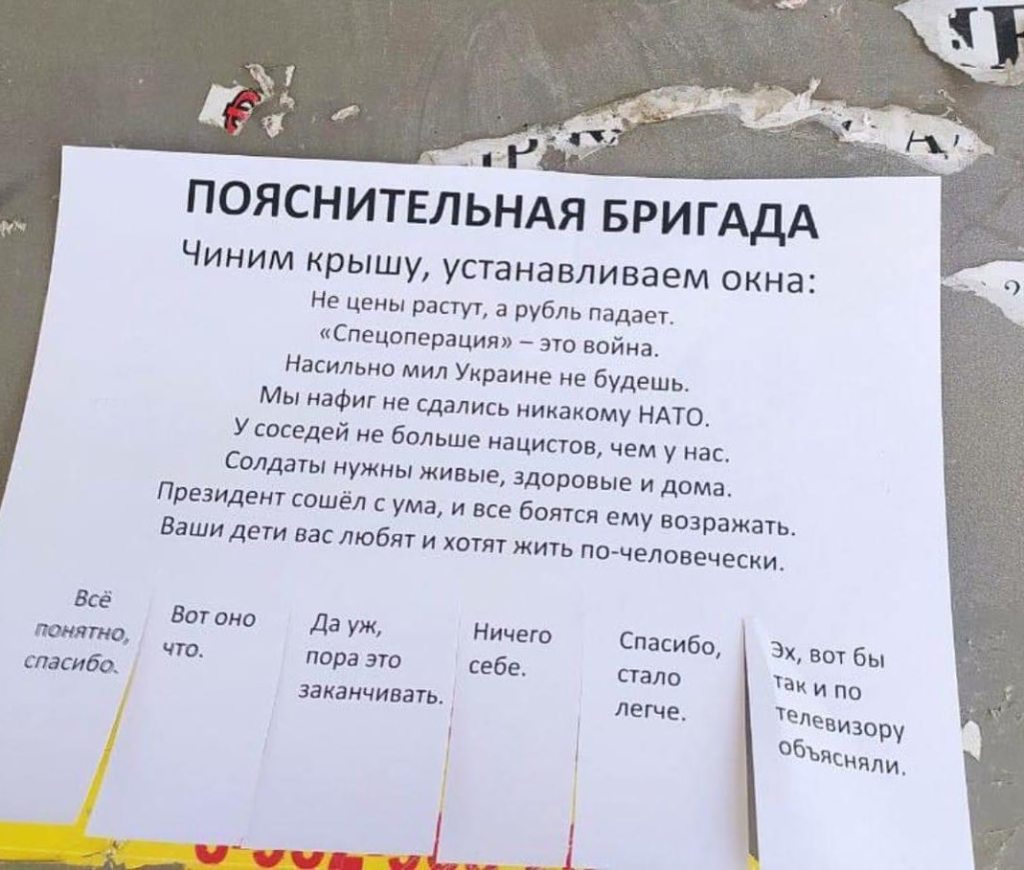
It’s not the prices that are rising — it’s the ruble that is falling. The “special operation” is a war. You can’t force Ukraine to like you. We haven’t surrendered to NATO. The neighbors have no more Nazis than we do. Soldiers should be alive, healthy, and at home. The president has gone mad, and everyone is afraid to contradict him. Your children love you and want to live like human beings.
That’s it, thank you. So that’s how it is. Yeah, it’s time to end it. Wow. Thanks, I feel relieved. Oh, would that they would explain it that way on TV.
The war has made us take a look around. In whose midst do we live? Do our fellow citizens think the same way we do? Public Sociology Lab (PS Lab) is a research team that studies politics and society in Russia. In 2022, it launched a project to study the attitudes of Russians to the war.
How do people explain the conflict’s causes to themselves? How does their attitude to politics affect their personal interactions and self-perception? Do they have a political position at all? We talked about this with researchers at PS Lab. Svetlana Erpyleva works at the Center for Eastern European Studies at the University of Bremen, while Maxim Alyukov, a political sociologist, works at the Institute for Russian Studies at King’s College London.
How is your research on the attitude of Russians to the war with Ukraine set up?
Svetlana Erpyleva: Qualitative methods are the main difference between our team and the other teams doing systematic research on perceptions of the war. We have long conversations with our informants and try to find out not only their attitude to the war directly, but also many other things related to it — what sources of information they trust, how they interact with loved ones, their fears and hopes, and so on.
We searched for respondents using social networks, ads, and the “snowball” method (that is, when an informant helps us set up a conversation with their ow friends). It was a big help in contacting people who do not often reflect on politics.
Some people responded enthusiastically to the ads we placed about finding informants — they wanted to talk to us themselves. Moreover, these are not only people who have a clear stance for or against the war and are willing to share it, but also those who feel that their opinion is not represented in public discussion. Such people do not see other people who think like them on social networks or in the media and want to put themselves on the map.
For example, during the the second stage of our research, in the autumn of 2022, we realized that dividing people into “supporters of the war,” “opponents,” and “doubters” (as we had done in the spring) was no longer warranted. Our sources support some decisions by the authorities, but not others. They regard the war as necessary in some ways, but some things about it terrify them, while other things cause them to doubt. Our interviews, which last about an hour (sometimes longer), have in fact enabled us to understand the peculiarities of how the war is regarded by Russians, with all their contradictions and complications.
Our other goal is to study the dynamics of how the war is regarded. We conducted the first series of interviews in the spring of 2022. We did the second series between October and December 2022. It is important to note here that in the autumn we spoke only with “non-opponents of the war,” that is, with those whom in the spring we had provisionally labeled “supporters” and “doubters.”
Maxim Alyukov: I would also make another important clarification. When people talk about studying perceptions of the war, they often have in mind representative surveys. Using them, we can indeed more or less accurately describe the range of opinions around the country. But polls cannot show how opinions about the war are shaped, or what emotions people experience. We are going deep rather than wide. Yes, we cannot draw large-scale conclusions about public opinion in general, but, unlike the polling projects, it is easier for us to talk about specific mechanisms — what emotions tend to shape certain positions, how different types of media consumption affect perceptions of the war, and so on.
What is the difference between how people regarded the war in the spring and the autumn?
SE: On the one hand, we see from the autumn interviews that perceptions of the war had not changed radically. Almost none of the people with whom we had repeat conversations had changed their attitude to the war from “plus” to “minus” and vice versa. Of course, there have been small shifts in this regard. For example, some of the springtime convinced supporters remained “optimists,” while others had become “pessimists.” The former believe that the “special operation” is going in the right direction, despite all the shortcomings, while the latter criticize the chaos in the army, the chaos during the mobilization, retreats by Russian troops, and so on.
But we shouldn’t deceive ourselves: the pessimists have not stopped supporting the war. Rather, they want Russia to act tougher and more effectively, and ultimately win.
In the first series of interviews in the spring, we identified a group of so-called doubters. But it is clear that even back then different informants in this group were closer to one or the other pole of opinion. Some doubted, but were inclined to support the war, while others were against it. In the autumn, there were fewer informants who were completely unsure of their position. Those who had been closer to the supporters of the war had often begun to support the war a little more. The same thing happened to those who had been more against the war than not: many of them had become a little more strongly opposed to the war (without turning into unambiguous opponents).
On the other hand, the ways people have for justifying the war have changed. Some of the old methods are losing popularity, while others are emerging.
For example, one of the new justifications for war involves imagining it as a natural disaster. We feel sorry, of course, for those who perish in a flood. We cannot regard this other than negatively. But it is impossible for us to oppose it. The same thing has happened with the war.
From the viewpoint of the informants who have resorted to this excuse, the war just happened. It is a terrible reality that we can only accept.
Another new way of rationalizing the war involves turning its consequences into its alleged causes, as when our informants say, “Ukraine has been bombing our border cities, so we need to continue the war,” or, “The war has shown that we are fighting not with Ukraine, but with the collective West. We are fighting not with a fraternal people, but with our perennial enemy, so it is right that we started this war.” The second statement had also come up in the spring, but it has become much more popular. The rationale behind such justifications involves arguing that events that happened after the war started seemingly reveal the enemy’s true identity.
MA: Attitudes towards sources of information have also changed. There are two trends: polarization and stabilization. At the war’s outset, people tried to seek out information, including information from the “opposite camp.” For example, those who supported the war sometimes read opposition and Ukrainian media, because they understood that the Russian state media are propagandistic. Now, on the contrary, many people are so weary that they have not only reduced their consumption of information in general, but also have stopped following sources that reflect the opposite opinion.
At the beginning of the war, the following idea was often discussed: information about the destruction, civilian casualties, and losses among Russian soldiers would gradually undermine the effect of propaganda. Now we see that, over time, the simultaneous consumption of information from pro-government and opposition sources, which paint radically different pictures of the world, has had the opposite effect. It causes discomfort, which leads to the fact that people who are less involved try to shield themselves from information about the war in general, while more involved people consume propaganda and stop paying attention to alternative sources. This is a conscious choice: they realize that they are consuming propaganda. I remember the words of one informant: “There are different points of view, but the brain tends to stick to one theory. I’m inclined to choose the theory of my country, of the state media, so that my brain follows it.”
It transpires that the person understands perfectly well that they are consuming propaganda, and they consciously choose it amidst conflicting explanations that cause discomfort.
Do these changes produce any practical actions? Maybe people stop talking to certain people or get involved in charity?
SE: There are only a few volunteers among our informants.
People can have a positive view of charity, and worry about their country, but most of them do not take any action themselves.
And yet, volunteering that involves assistance to the mobilized is certainly seen positively by our informants (that is, by “non-opponents” with very different views of the war). Such volunteering is regarded not as involvement in the war, but as support for “our boys,” for “our country.” This is not surprising: there are always significantly fewer “activists” and volunteers than there are sympathizers. Only a few people are involved in protests, too.
Changes have also been taking place in the way people talk about the war with their loved ones. For example, many of our informants described the summer as a carefree time when the war had completely disappeared from their lives: they stopped discussing it. The mobilization was the “new February 24” for those informants (who were most often people remote from politics). The topic of war had returned to everyday conversations again. The informants were discussing the events even with strangers. For example, one of our sources told us that even at work meetings with her clients she had occasion to discuss the mobilization.
Do attitudes to specific events affect everyday practices? For example, the mobilization began and people decided to check whether their foreign travel passports were still valid.
SE: Unfortunately, we didn’t talk much about everyday practices in our interviews. Probably the most common reaction to the mobilization’s announcement was anxiety and, simultaneously, the absence of concrete action: “Whatever will be will be, but I hope that nothing bad happens.” Some of our informants who did not want to be sent to the front changed their places of work and residence, but we didn’t often encounter such people in our interviews. (It is important to understand that we were talking to “non-opponents” of the war.)
MA: It’s also worth recalling that a minority of Russians have the possibility of leaving the country. According to our research on social networks (this is another project that my colleagues and I are doing), the most common reaction to the mobilization has been evasion.
Is it possible, then, to talk about a desire for inneremigration among those who have remained in Russia? For example, a person says, “Actually, I have a lot more important and valuable things in my life [than the war], and I want to pursue them.”
SE: It was the presence of this desire among people in the spring of 2022 that made us single out the doubters as a separate group. All of them were typified by the notion that the “distant war” was secondary compared to more important values — work, loved ones, and family. But in the autumn, we saw that fewer and fewer of our informants were able to take a neutral stance, to completely distance themselves from assessing the war. Our informants talked about pressure: they seemed to feel that society demanded that they voice their opinion. In this sense, as Maxim has said, the polarization of views has been increasing.
But our informants assess [this polarization] in different ways. Many supporters of the war say that it is awesome because people are becoming more united, more interested in what is happening around them. The “anti-patriots” will leave the country, but patriotic Russians will remain. Others complain that it is hard for them to cope with the pressure. They would like to take a neutral position, but they cannot manage it. One of my sources described it this way (I’m quoting from memory, of course, but nearly verbatim): “I would like not to take a side, but my smart friends say that the war should be continued. And I understand that they are right, that one should support one’s country in such circumstances. I’m unable to take a back seat.” But a little later she said: “I’m afraid that time will pass and [people] will come and ask me, ‘Have you been reading Meduza? Have you been watching Channel One? Whose side are you on?’ And I won’t have any answer.” This situation even makes her think about emigrating. That is, on the one hand, she chooses to side with supporters of the war; on the other hand, she is afraid to make this choice.
MA: I would add that the desire for neutrality remains. One respondent put it this way: “There is war all round, but I try to maintain peace on my VKontakte page.” He moderates disputes there and shares links to articles about the importance of neutrality. For him, this is a way of creating a space for himself in which there is the possibility of remaining neutral, since he doesn’t have this possibility in other contexts. It is another matter that there are fewer and fewer opportunities for such neutrality.
You say that your respondents feel pressure. Where do they feel this pressure? In interactions with loved ones and colleagues, or somewhere else?
SE: It is often the pressure of their immediate environment. Many opponents of the war have left the country, and the doubters thus have fewer contacts with their viewpoint. They are surrounded, as a rule, more by supporters of the “special operation.” But the cause of such pressure may be an inner conflict. For example, our sources tell us that they were taught at school that when the country is in difficult straits, the worst stance is neutrality. But now they have found themselves in exactly this position. It is really difficult for them: they see the propaganda on both sides, but do not feel strong enough to resist it. This can be illustrated as follows: “Maybe Russia was right to attack, or maybe it was wrong to do so. Maybe Ukraine is the enemy, or maybe it isn’t the enemy. I don’t understand what’s going on at all. But how can I fail to take a stance?”
In such circumstances, people turn to what seems certain to them — for example, to their Russian identity. You may not know who is right, but you have a native country and it must be supported.
MA: This feeling of pressure consists of two parts. The first is personal interaction, about which we have said our piece. The second is the influence of the media, in which you can constantly see appeals and reminders of the war. This background encourages a person to clearly articulate their position.
Is the official newspeak (“special operation”, “line of contact,” etc.) incorporated into the explanations given by the “non-opponents” of the war? Is the state discourse generally used to justify it?
MA: Yes and no. It does happen that our sources literally quote propaganda narratives. For example, they start saying on TV that there are fakes everywhere, and a person repeats this idea. But at the same time, an absolute minority of our sources trust state broadcasts, although there are such people among them. They have doubts and come up with their own hypotheses. But it is important to take into account that our informants live in large cities, so it is likely that, for example, in smaller cities far from the capitals, the ratio is different, that there are fewer people there who are like the majority of our respondents, and more people who trust propaganda.
SE: You also have to understand that there are different types of support for the war, and therefore different explanations for it. There are people who accept the explanations given by the state media. Most often these people are elderly: they regularly watch TV, and then rehash the rhetoric of the propagandists. But there are other kinds of people — for example, those whom we call “committed supporters.” Their attitude to the Russian-Ukrainian conflict was shaped back in 2014, or even in 2004. They can be quite critical of propaganda narratives and are fond of saying, “We have bad propaganda. It is incapable of explaining anything.” Such people are able to explain the war’s causes on their own. And there are, for example, people who are remote from politics, who might watch TV sometimes, but it doesn’t convince them. They can even rehash propaganda cliches, but they do not adopt them, they do not present them as their own words. For example, they say, “We were told that…” or “We are told that…”
Is it possible then to say that, despite propaganda, polarization, and state pressure, even those who are not against the war are in a gray area? In other words, there are no views that could unite people, and accordingly, that is why they cannot unite and make demands.
SE: Yes, that’s right. Unless “convinced supporters” could try to create some kind of association. But I’m sure they’re a minority. Most people are busy with their daily affairs: they are not interested in political positions and movements. We are currently preparing a second analytical report on the results of the autumn stage of our study, and there we even try to avoid the word “position.”
Most of our informants have no “position.” Their attitude to the war is a bundle of fears, doubts, hopes, and other feelings. Such people may want Russia to win, but sincerely worry about the victims of the shelling in Ukraine.
One of our informants said, “If I had been subject to the mobilization I would have been out of Russia in three minutes.” And yet she, for example, wants Russia to win.
MA: Especially since propaganda does not just attempt to impose a certain point of view. It also generates a multitude of contradictory narratives that simply confuse people. This is a paradox of authoritarian propaganda: the state needs this vital demobilizing effect to maintain control, but it also prevents it from generating broad support for the war.
You mentioned sympathy for the victims of the shelling. In your spring report, some of your sources say that they would tolerate a decline in the material standard of living, because for them what matters are spiritual values. Since they are so clearly aware of losses, can we say that Russians perceive themselves as victims?
SE: We rarely see people regarding themselves as victims directly. They say, “The situation has become worse in Russia as a whole, but everything is fine with me. Yes, people are being mobilized, and that’s scary, but my loved ones aren’t being mobilized. Prices have gone up, but we’re coping.” Our sources often regard Russia as a whole as a victim. They are offended on Russia’s behalf: it was forced into the conflict, and it is humiliated everywhere and considered an aggressor. That is, they don’t think “[international] brands have abandoned me,” but those brands have abandoned “poor Russia.”
MA: Ukrainians are also regarded as victims. “The poor residents of Ukraine are being used by NATO. Would that it were over as soon as possible.” In many ways, this is part of the propaganda narrative that Ukraine has become a firing range on which NATO and Russia are fighting using Ukrainians as proxies. But this is, rather, a propaganda cliche that people simply repeat without thinking through their own position on this issue.
It follows that “non-opponents” of the war do not regard it as part of their personal lives?
SE: This is a generalization, of course, but I would say that it is basically true. For the opponents of the war, on the contrary, the war has become an existential challenge. Sometimes they even make themselves experience it as such: “I cannot live an ordinary life. I must remember that there is a war going on.”
But isn’t there a contradiction here? The “non-opponents” of the war do not regard it as a personal matter, but we are saying that they feel pressure from their loved ones, are trying to find their own identity, and are grasping for rationalizations.
SE: This is a difficult question, but let’s try thinking about it. Compared to opponents, supporters and doubters are more likely to try to rid themselves of negative thoughts, to distance themselves from the war. And yet it regularly makes its presence felt. The latter is a new trend, and many of [our respondents] do not like it: they would prefer to live their lives without being reminded about the war. But it has become more difficult to do this.
MA: In our research on how the war is seen by Russians, we have been observing what I had observed in my pre-war research. People, if they are not politicized, rarely hold consistent positions at all. I will give an example from my research on Russian perceptions of the conflict between Russia and Ukraine prior to February 24. A person has a smorgasbord of different political ideas. He supports all the decisions made by the authorities, including the annexation of Crimea and military backing for the so-called DPR and LPR. And yet half an hour later he says, “Basically, it would be a good idea to withdraw the troops and leave Ukraine alone. It’s bad for us.” It’s just that he hadn’t needed to make connections between his disparate views on this issue before. This necessity emerged during our conversation.
We have been observing the same thing now. People are trying to push the war out of their lives. They need arguments in favor of the war — not because it is their political position, but because it is safer to live that way. For many of our respondents, the interview was like an exam in which they were forced for the first time to think about logical chains and formulate at least some kind of a clear opinion about the war, which they had not tried to formulate before.
What goes on in your mind?
I think that I am falling down.
What goes on in your mind?
I think that I am upside down.
Lady, be good, and do what you should,
you know it'll work alright.
Lady, be good, do what you should,
you know it'll be alright.

I'm goin' up, and I'm goin' down.
I'm gonna fly from side to side.
See the bells, up in the sky,
Somebody's cut the string in two.
Lady, be good, and do what you should,
you know it'll work alright.
Lady, be good, do what you should,
you know it'll be alright.

One minute one, one minute two.
One minute up and one minute down.
What goes on here in your mind?
I think that I am falling down.
Lady, be good, and do what you should,
you know it'll work alright.
Lady, be good, do what you should,
you know it'll be alright.
Throughout Putin’s war on Ukraine, the attitudes of the Russian public toward the regime and the conflict have been the subject of much scrutiny. This talk addresses this question by analyzing data released by the Presidential Administration that summarizes monthly correspondence received from the public from January 2021 through December 2022. While the identity of these correspondents is not known, their decision to send non-anonymous appeals to the President suggests that they support or tolerate the Putin regime. The data demonstrate that after an initial period of uncertainty about the war’s economic impact, these concerns abated until the announcement of mobilization in September. Since then, the appeals depict a Russian public that is increasingly concerned about conditions of military service and the war’s impact on service members and their families. At the same time, the data indicate that the Kremlin’s strategy to shift the blame for mobilization from the President to regional authorities appears successful.
Pollsters argue over how many Russians support the Ukraine war
Since the Russian invasion of Ukraine, sociologists have grappled with the question of how many Russians support the Russian army in Ukraine. Both independent and state-run pollsters claim they are the majority, and these studies are frequently referenced in Western media. However, at the same time, a group of independent sociologists have pointed out that these polls may not be representative — many Russians are reluctant to speak freely about their thoughts on the conflict due to draconian wartime censorship laws.
Independent researchers from the Khroniki project recently presented the findings from their latest survey, which suggest using a percentage of how many Russians support the war may not be a very meaningful statistic. In their view, this figure comprises a misleadingly wide spectrum of people: from those who volunteered to fight in Ukraine to those afraid of repression. Moreover, at least half of those who are opposed to the war are afraid to speak out, the Khroniki sociologists said.
To identify the core pro- and anti-war groups in Russia, the pollsters devised a series of questions. The results of their survey suggests that the core support group represents 22% of the population, while the core opposition is 20.1%.
Separately, researchers stress that “the fridge counters the effects of the TV,” and this effect is felt more and more with each passing month. The level of support for the war among TV viewers who are encountering economic pressures is falling. Among TV viewers who have encountered at least one economic problem, support for the war was down 11 percentage points in February.
Other polls, however, show that a vast majority of Russians support the war. For example, according to state-run pollster VTsIOM, 68% of Russian residents welcomed the invasion of Ukraine and just 20% are opposed to it. And leading independent polling agency Levada Center published results in January that suggested 75% of Russians support the war — to varying degrees.
Why the world should care:
It’s not easy to work out exactly what proportion of the Russian population supports the war, but Khroniki is certain that the pro-war lobby is far smaller than polls from leading agencies would suggest. If that is true, it casts doubt on the widely-held belief in the west that the war in Ukraine is supported by most Russians who remain inside the country.
On 1 September 2022, I returned to Russia after almost a year away. The war that began six months ago had been present in my life daily: in the news, in conversations with friends and colleagues, and in the Ukrainian flags on the streets of the European city where I lived. But there was no trace of the war in the town near Moscow where I grew up, and where my parents still live. I did not see pro-war or anti-war graffiti or slogans; war was not mentioned in the streets or by my friends and acquaintances. As I sank into the familiar rhythm of my childhood town, I caught myself thinking that perhaps I was beginning to forget about it too. That all changed on September 21, the day ‘partial mobilisation’ was announced. Suddenly, the war was being mentioned all around me, or rather whispered about, in the cafe where I listened to Putin’s address, in the local library, in the street, on the train from Moscow to St. Petersburg. The war seemed to have reappeared in Russian society instantaneously, with the snap of a finger.
I had observed something similar before, not around me, but as a researcher: in the data my colleagues and I collected. Our Public Sociology Lab began conducting a qualitative study on Russians’ perceptions of the war on February 27, 2022, just three days after the full-scale invasion of Ukraine began. During the first months of the war, we conducted (link in Russian) over 200 interviews with supporters of the war, its opponents and doubters. At that moment, many of our informants, including those who were far from being exclusively anti-war, also said that they had been shocked by the news of the start of the ‘special military operation’ and had tried to make sense of events in their conversations with friends and relatives. But after a few weeks, the emotions of shock and confusion began to fade. The war became routine and faded into background noise.
So we knew that the ‘return of war to society’ following the announcement of mobilisation would also likely be temporary. We waited a few weeks and, on October 11th, conducted our first interview as part of the second stage of our research into Russians’ perceptions of war. Between October and December 2022, we conducted 88 interviews with ‘non-opponents’ of the war, deciding this time to focus the study on support for and disengagement from the war, rather than resistance to it. Forty of these interviews were repeated conversations with supporters of the war as well as its doubters doubters, with whom we had already spoken in the spring.
We were driven by the desire to understand how perceptions of, and predominantly support for, the war were evolving. From the interviews conducted in the spring of 2022, we roughly divided all ‘non-opponents’ of the war into supporters and doubters. Despite the fact that among supporters of the war, there were interviewees who were convinced to a greater or lesser extent, all of them found some means to justify the ‘special military operation’. Some were staunch supporters of ‘the Russian world’ and believed that the war would push the geopolitical threat away from Russia’s borders and strengthen the country’s position; some were worried about loved ones in Donbas and rejoiced at the prospect of an imminent resolution to the longstanding conflict; some, viewers of Russian TV channels, spoke of ‘combating fascism’ and ‘protecting the Russian-speaking population of Donbas’; many expressed confidence or, at the very least, hope: ‘if our government started the war, then it must have been necessary’. Although these people were worried about the casualties caused by the war and looked with apprehension at a future defined by isolation and sanctions, they remained supporters of the ‘special operation’.
It seemed to us, as it did to many others, that the announcement of mobilisation might fundamentally change something in the way Russians viewed the war. However, in addition to mobilisation, the war was marked by a series of other events, each of which could have left an impression on Russian society: the seizure of new territories and their subsequent annexation to Russia, the retreat of Russian troops, the bombing of the Crimean bridge, news of the bombing of Russian border regions. All this occurred against a backdrop of increasing Western sanctions, muddled explanations from the authorities as to why the country was at war, repression of dissenters, and increasing polarisation of views on the war in society. In such a state of affairs, we assumed that the views of the war held by ordinary Russians could not be sustained. In some ways, our assumptions were right, and in other ways, we were wrong.
It was not without reason that we waited a few weeks after the announcement of mobilisation and the swift ‘return of the war to society’ before we began the second stage of our research. The October interviews showed that the emotions associated with the announcement of mobilisation were as strong as they were fleeting. After a few weeks, they began to subside, and ‘partial mobilisation’ became normalised as a part of the new everyday reality. But, most interestingly, despite the negative attitudes towards mobilisation expressed by many of our informants who were not opposed to the war, their dissatisfaction with mobilisation rarely translated into dissatisfaction with the ‘special military operation’.
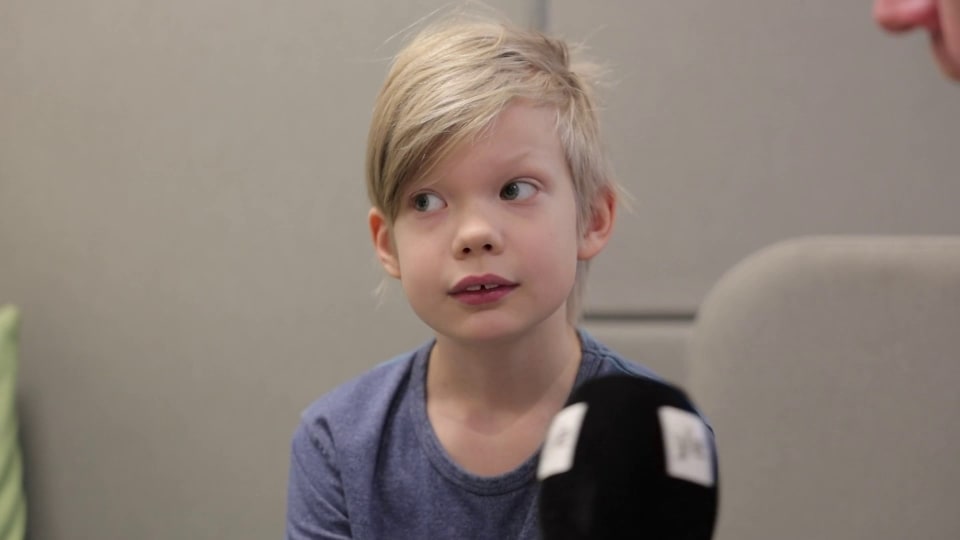
The Russian language has been popular for years at the Lauritsala School in Lappeenranta. Earlier this year, it was still uncertain whether Russian classes could be set up due to a shortage of applicants. In February, nine-year-old Aleksi Liuttu told Yle that he would be ready for Russian lessons.
In Lappeenranta, there has been insufficient enrollment to offer the Russian language as as elective starting in the fourth grade.
This is a rare situation, because for at least the last nine years, schoolchildren in Lappeenranta have been able to study Russian as an elective A2 language from the fourth grade.
Yle reported in February that the Russian language’s popularity in primary schools has plummeted rapidly in several cities. The decline was evident in the languages chosen by third-graders this spring, about a year after Russia began its invasion of Ukraine.
Spanish was the most popular language
No French groups will be formed in Lappeenranta this year either. Instead of Russian and French, fourth-grade students in Lappeenranta can elect to study Spanish and German as A2 languages.
Spanish was by far the most popular language. This was the first time that Spanish was offered as an elective in all primary schools in Lappeenranta. The language elective will be implemented in five schools, whereas previously it could only be pursued in two schools.
German groups will start at seven schools. There were almost equal numbers of those who chose French and Russian, but they were so scattered around the city that it was impossible to set up a group at any one school.
A language group is established when at least ten pupils have elected to study the same language.
I was walking down Dostoevsky Street when a middle-aged dame jumped right at me from out of Candle Lane and screamed, “What an obnoxious street, solid zigzags! There’s no way I can find the right address!”
Somewhat blown away by the notion of a “zigzag street” in Petersburg, I asked what street she needed.
“Razyezzhaya is over there,” I said, pointing up ahead. “You haven’t reached it yet, but you’re blaming the zigzags, although you can actually break your leg here in South America.”
The woman looked at me unkindly, and quickened her pace. I caught up with her at the intersection of Dostoevsky and Razyezzhaya. She was pestering a young fellow about which way Number 12 was even as she stood right under a sign that showed the range of house numbers on that block. The young man was in fact trying to point the sign out to her.
Then she saw me and charged off in the right direction, gesticulating and repeating, “One moron after another.” And I, waving at her as she walked away, suddenly realized that she had meant Aquaphor, [a water filter store] in the consumer services center on the corner of Razyezzhaya and Bolshaya Moskovskaya, not Ecuador.
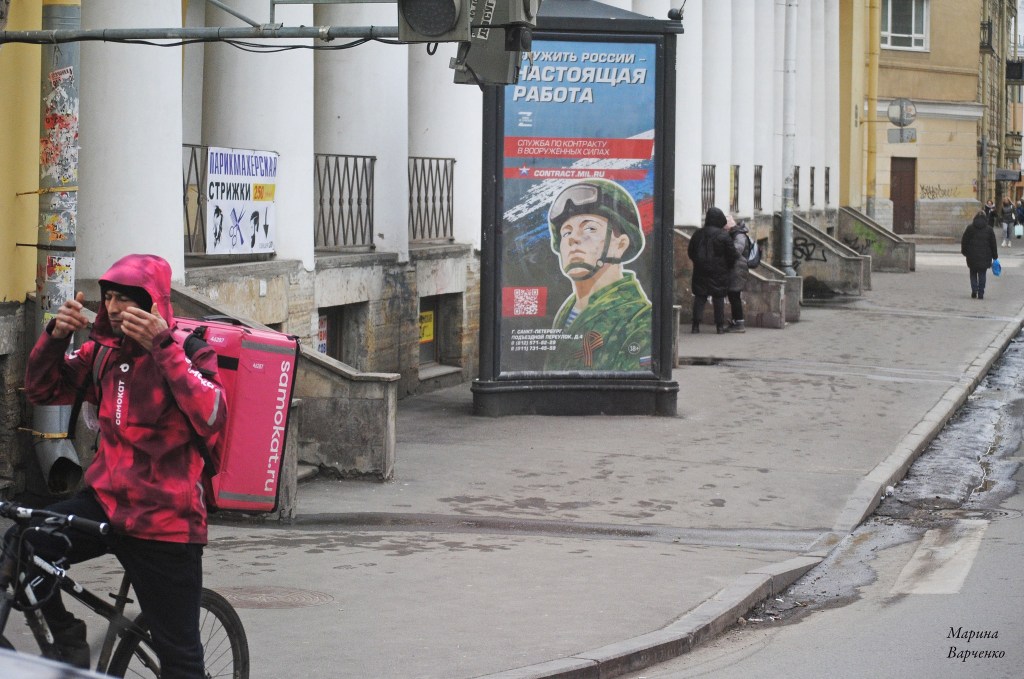
“Serving Russia is real work: voluntary service in the armed forces”: a recruitment ad outside Yamskoi Market in downtown Petersburg. Photo by Marina Varchenko, who captioned it on Facebook as follows: “The horrors of our little town.”
Today I wound up in the Metropolitan Garden at the Alexander Nevsky Lavra. Even though it’s March, the weather was wintry: sunny, frosty, pretty clouds in a blue sky, birds chirping. It was fine. I wandered around, taking pictures (which I’ll show you later). A fairly young lady came towards me and looked at me and my camera.
“What is there to shoot here?” she said. “Go to Kazakhstan, to such and such city”—I’ve forgotten the name—”there is definitely something to shoot there.”
I was so taken aback that I said nothing in reply, which is strange for me in such circumstances.
Okay, whatever: I’d had my little walk. As I was leaving the garden I saw a twenty-something kid begging pitifully and mournfully for money to buy food. When someone gave him ten rubles, he would ask for twenty. When someone gave him twenty, he would ask for forty. When I handed him a 100-ruble bill, he asked for 200 — so insistently that I decided I wouldn’t give more. So he shouted, “That’s something, at least” at me as I walked away, his voice dripping with mockery. Okay, the day was getting interesting.
I wanted to go to the Fontanka, but I was tired already. I decided to take a bus down Nevsky several stops. The bus was packed. I was shoved up against some old biddy, who immediately asked, “Is this where I get off for the Interior Ministry House of Culture?” That was when I let loose about culture, and the Interior Ministry, and everything else. The passengers responded aggressively. Basically, I didn’t make it to the Fontankа — I got off earlier. Otherwise, I would have risked being charged with defamation.
I walked the rest of the way to the Fontanka. The sun was shining, and it was beautiful. I began to calm down. I saw a decent-looking dude, opposite the Mayakovsky Library, doing number one right into the Fontanka. People were walking by him, trying not to notice. I decided to walk on by too: otherwise, I would have got carried away again. As I walked by I was thinking about culture, of course.
I turned onto Lomonosov Street, then onto Razyezzhaya. Seeing a young woman coming toward me, I tensed up in advance. “Where is Dostoevsky Street, 12?” she asked.
“I don’t know where Number 12 is exactly, but it’s somewhere nearby. But you have just passed Dostoevsky Street, you need to turn around and go back,” I said to her, pointing with my hand.
I went on, but the girl stared at her smartphone. And don’t you know, she took off away from Dostoevsky, not toward it.
Since I was freaking out big-time as it was, I went into a store, hoping that nothing would happen at the final frontier before home. And everything did go well, but while I was unloading my groceries at the checkout, the cashier lady was possessed to congratulate me on the upcoming holiday [International Women’s Day], and I was likewise possessed to reply that I didn’t celebrate communist holidays. In a nutshell, I walked out (ran out) of the store as old women and not only old women screamed at me that they had lived well under the Communists, but “liberasts” like me had ruined everything. Yes, sir, it wasn’t a good day.
A criminal case against Zhlobitskaya was launched in December. She was released on her own recognizance after being charged with “publicly condoning terrorism,” per Article 205.2.2 of the Criminal Code. The charge was triggered by posts she had made in November and December 2019 on VKontakte. Among them are reposts of poems from the website stihi.ru, as well as two reposts from the group page of the People’s Self-Defense with information about the bomb blast at the FSB.
According to the prosecution’s expert witnesses, Mikhail Zhlobitsky’s actions in the posts in question were deemed “correct, worthy of support and imitation,” and he himself was characterized as a “good guy.”
17-year-old student Mikhail Zhlobitsky detonated a homemade bomb in the lobby of the FSB’s Arkhangelsk directorate on [October 31,] 2018, killing himself and injuring three security forces officers. A few minutes before the blast, a warning about the attack from Zhlobitsky appeared in the chat of the Telegram channel “A Rebel’s Speech.” The message said that his act, in particular, was motivated by the fact that the FSB had been fabricating criminal cases.
Fundraiser for continuing Viktor “Vitya” Filinkov’s campaign against the FSIN, the Russian Federal Penitentiary Service!
I haven’t written here for a long time generally and about Vitya in particular. We haven’t seen each other for almost two months. That’s an awfully long time, and I miss him terribly. Soon I will fly back to Orenburg and tell you how Vitya is doing, but after meeting with him.
In the meantime, I’ll tell you about the money, my favorite topic, because there is a constant need for it and it is constantly running out.
Vitya is now “painting the town red” on his own money. Recently, I got hold of 100 thousand rubles from his bank account, which Vitya had earned before he was sent down and which were blocked because he is a “terrorist.” I couldn’t get my hands on the other 70 thousand. They are frozen until Vitya is removed from the registry of “terrorists.”
Those 100 thousand rubles have really come in handy. I am now using them to pay for trips and lawyer’s fees. In 2023, we have already spent 190 thousand rubles on tickets and lawyer’s fees over eight trips. (Luckily, the tickets in January were also quite cheap.) And to this we have to add lodging costs in Orenburg and monthly transfers to Vitya’s account for shopping in the penal colony’s commissary and penalties “for refusing to work” (we are now appealing the latter in court), as well as all sorts of unforeseen expenses, such as notary services, medicines, etc.
So very soon Vitya’s 100 thousand rubles will be done. In 2023, 60 thousand rubles have trickled onto the bank card we use to solicit donations for Vitya, and even then only because 50 thousand rubles were suddenly donated in February. In other months, total donations have ranged between three and 15 thousand. We still have a small reserve left, but it’s really small. It will last us for another month or two at most.
The good news is that we seemingly might be able to get back some of this money, but it will take a long time. In January, the court made the first decision to compensate our expenses in one of the cases we won. This is not compensation for moral injury, but only reimbursement of the lawyer’s travel expenses (50 thousand). The penal colony filed an appeal of course, and the date for that hearing has not even been set yet. And the district court judge has been postponing all our other claims for compensation, waiting for the appeal court’s decision on the first case. Then, if the ruling remains in force, we will wait for this money to be returned: it seems this will take up to three months, So it’s still a long time before we’ll see those initial 50 thousand again, so for the time being we definitely need donations. We have also finally started filing claims for compensation for moral injury, but there have been no hearings on these claims yet.
All the year and a half that Vitya has been in Orenburg, we have spent a lot of money fighting on his behalf, but we have been winning half of our cases in the courts, and ultimately this leads to an improvement in Vitya’s conditions (which are still harsh, however). Lawyer Vitaly Cherkasov has been working selflessly on all of Vitya’s cases since the first days of his arrest, traveling several times a month between St. Petersburg and Orenburg.
To get to the point: if you are able to donate money, please do. If you have no way to donate money, then maybe you know someone who does and you can share this post with them. Or just repost it. Or maybe you can advise us about where or to whom we can apply for financial support. All such help on your part is incredibly valuable.
In keeping with established tradition, if someone from the FSIN and their ilk are reading this, DON’T HOLD YOUR BREATH — WE’RE NOT GIVING UP.
Send your donations to help pay the lawyer’s fees and Vitya’s daily expenses to:
Source: Jenya Kulakova (Facebook), 20 March 2023. Ms. Kulakova, who is a friend of mine and one of my favorite people on this planet, is the public defender of Viktor Filinkov, a young Kazakhstani national convicted as part of the notorious Network Case, in which the Russian Federal Security Service (FSB) tortured and framed a dozen anti-fascists in Penza and Petersburg for, allegedly, “creating a terrorist community.” I have posted extensively on the case and its aftermath over the last five years. The wardens at the penal colony in Orenburg where Mr. Filinkov is currently serving his sentence have seemingly singled him out since his arrival there, endlessly finding him “guilty” of various (mythical) infractions. With the help of Ms. Kulakova and his defense attorney, Vitaly Cherkasov, Mr. Filinkov has mounted a series of successful legal challenges against this flagrant abuse of his civil and legal rights. The PayPal account that Ms. Kulakova lists, above, is managed by the Moscow chapter of the Anarchist Black Cross and is completely reliable. I have made donations to it on several occasions in the past. Thank you! ||| Thomas H. Campbell, The Russian Reader
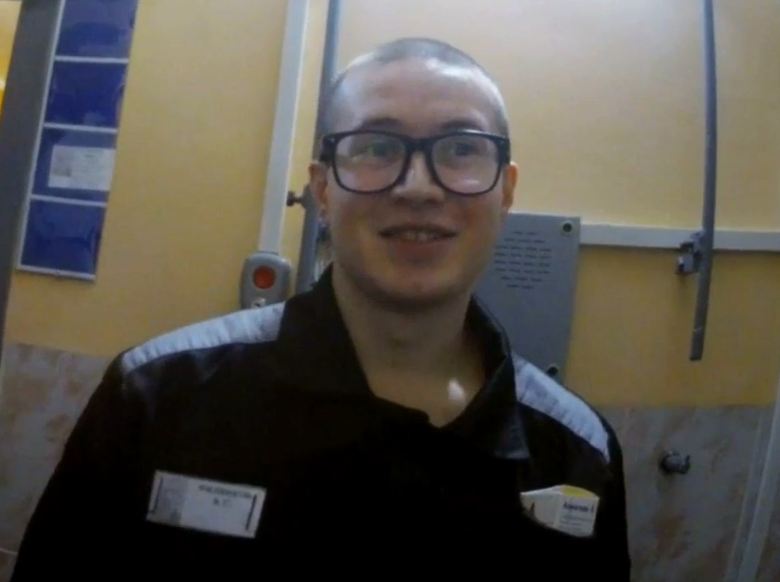
Ms. Kulakova and Mr. Filinkov met earlier today (25 March 2023), and Ms. Kulakova posted this snapshot from their meeting:
Yegor Balazeikin is sixteen years old. In late February, he was detained in Kirovsk, a town in the Leningrad Region: according to police investigators, he wanted to set fire to a military enlistment office, and now he stands accused of “attempted terrorism.” Later, a second criminal case was launched against the schoolboy, also for allegedly attempting to torch a military enlistment office, this time in Petersburg. Our correspondent found out how a teenager who had supported the war in Ukraine a year ago changed his views one hundred eighty degrees and how this has impacted his entire family.
After Yegor was detained, he admitted that he had in fact tossed homemade Molotov cocktails at a military enlistment office, but none of them had started a fire or caused other serious damage. Now the teenager is at risk of going to prison and spending as many years there as the time he has already spent on earth. His family are convinced that the security forces want to ruin the boy’s life. His parents and his lawyer have been forbidden from sharing information about the case with third parties.
Yegor turned sixteen last August. He loves the humanities, especially history and social studies. After finishing school, he wanted to enroll in the law school or economics faculty at [St. Petersburg State U]niversity. His parents had transferred him to School No. 166, one of the leading liberal arts prep schools in St. Petersburg.
“Yegor has always done very well at school. He passed the OGE (the basic state exam taken by pupils after they complete the ninth grade) with flying colors. It was decided to apply to several Petersburg schools at once, and School No. 166 was among them. His parents spent a long time talking it over. They were prepared for the fact that Yegor would have a long commute, since they lived in a single-family dwelling in Otradnoye[forty kilometers east of Petersburg]. Consequently, Yegor’s knowledge so impressed the headmaster at the 166th (who is a historian, by the way) that Yegor was unconditionally accepted into the tenth grade,” says Natalia Krylova, a friend of Yegor’s mother. (Her name has been changed to protect her identity.)
Natalia is close to Yegor’s family. She has know the boy since he was four. She is aware of the details of his life and had tutored him in English. According to her, Yegor’s father, Daniel, was quite supportive of his passion for Russian history.
“He was especially interested in military history and studied all the wars. When Yegor was still a little boy, he got interested in the history of weaponry at his father’s suggestion. I remember his getting books about tanks for New Year’s. He’s just such a dogged young fellow — if he starts doing something, he goes all the way. He knew all the places connected with the Great Patriotic War, he went several times to historical sites near Petersburg, and he often visited military museums,” says Natalia.
Yegor’s interest in military history was also encouraged by his uncle Dmitry, Daniel’s older brother. Dmitry [was] a professional military man with combat experience. He had always been an authority for Yegor when it came to complex historical matters.
When Yegor had just started school, he began having health problems. His mother, Tatiana Balazeikina, took him to the doctors, and they discovered that the boy had a serious disease — autoimmune hepatitis.
“To put it simply, his immune system attacks the liver cells for some reason. Maybe there is some kind of pathogen or virus hidden there, and so the immune system went crazy and began attacking its own tissues in an attempt to get this virus. It is a serious problem, especially if the liver is involved,” says Natalia.
The disease proved to be hereditary: Yegor’s mother also has an autoimmune disease, only it affects a different organ in her body.
“His parents spent so much time with Yegor at all kinds of hospitals trying to understand what was happening to their child that there was practically nothing left in his life except medical tests. He was even classified as a disabled person, a status that was later rescinded,” Natalia recalls. “When he was ten, they had to do something to prevent him from seeing himself as disabled. That’s why they signed him up for kyokushin, a style of Japanese karate.”
Yegor lucked out with his coaches and grew quite fond of this difficult, harsh style of karate. He took part in competitions, often winning, and the Balazeikin home was chockablock with martial arts trophies and medals. After emerging victorious at regional championships, Yegor often judged children’s competitions himself.
But Yegor had to give up his promising sporting career due to his transfer to the new school and having to study for the state exams. His disease eventually went into persistent remission, but he still has to visit a hematologist every three months, have a comprehensive physical once a year, and constantly take life-saving medications.
When Yegor transferred to the new school, his load seriously increased: his classes were harder, and every day he had to spend several hours traveling to the prep school and back. His parents eventually rented him a room directly opposite the school. The family had no extra money for this. Tatiana, who worked as an English teacher, had to go into business as freelance tutor, although there were few lessons to be had, mostly with the children of friends and acquaintances. The family’s main source of income are the wages that Daniel earns as an electrician.
“The child was dying from fatigue, from the huge workload, but his studies were important to him. After arriving home, it would happen that he would fall asleep in the hallway with his coat and shoes still on. Can you imagine how tired he was? Yegor would stay the night at this [rented] room [in the city] when he realized that he could not make it home after school. He would spend all weekends at home. The media has written that his mother left her son to live alone, but this is a lie. He did very well at the new school. Although it was difficult, he got excellent marks. He was looking at several fields to go into. For a long time he dreamed of becoming a diplomat and started studying English in depth, but then he settled on studying history, law, and economics,” says Natalia.
According to Yegor’s new classmates, he is a very kind and intelligent boy. He unfailingly attended all outings, electives, and lectures, and not only always took a clear stance on historical issues, but also knew how to argue his point well.
“Yegor is not terribly talkative, and he didn’t hang out a lot with many people, but he always gave the impression of being a decent, good person. It is a pity that he is in such circumstances now,” a female classmate told our correspondent.
His teachers and the parents of his classmates spoke well of Yegor.
“My son spoke very positively of Yegor. He is a very good boy. It would be a pity to ruin the young fellow’s life,” says one of the parents.
According to Yegor’s relatives, the family had always respected his right to his own opinion and position, and always gave him the opportunity to choose. With the support of his parents, he had grown up to be an individual interested in the history of his country.
When the war in Ukraine began, life in the Balazeikin family changed a great deal. At first there were no disagreements between the parents and the teenager: they all fully supported Vladimir Putin’s decisions.
“I found it strange, but we never quarreled about it, because we are adults who can share their own opinions in the spirit of friendship and grant the other person the right to be different. At first, Yegor was like everyone in his family, like his mom, his dad, his grandmother and, especially, his father’s brother, his uncle, a professional military man. But Uncle Dima was killed almost at the outset of the special military operation. And after his uncle was killed, Yegor’s position began to change,” recalls Natalia Krylova.
It was early April. Dmitry Balazeikin, Yegor’s uncle, volunteered to go to Ukraine as part of an army reserve unit (BARS). He was no longer of military service age, but had a lot of experience. He had served in hot spots, and his relatives called him a “real officer.”
“He didn’t say anything to anyone — he just went off to the front. And he was almost immediately killed near Izyum, where there were terrible battles and heavy losses last March and April,” says Natalia. “He died with dignity, as Tanya told me: he was a platoon commander and was defending his soldiers. But it happened that it was at the beginning of the special military operation, when everything was still unorganized, and he was a volunteer, so his funeral was quite difficult to arrange, including financially. His body had to be claimed and all the paperwork done. Tanya took care of this, since Dima’s mother was completely unable to do it. Besides, she was in Kazakhstan. Dima’s two ex-wives, who have children to care for, couldn’t handle it either.”
It so happened that it was Yegor’s parents who took on most of the chores associated with Dmitry’s funeral, and Yegor watched the whole difficult process unfold.
“It was the first funeral in the family for him. Some time before, his paternal grandfather had died from covid. But Yegor was not involved in any funeral-related events at that time: the covid restrictions were still in effect, and only his father flew to the funeral. The funeral of his uncle, who had been killed, was bound to leave a mark on him,” says Natalia.
“At first, the intensity of his emotions was off the scale. It seems to me that he felt quite conflicted. His uncle had been killed, but you go on the internet and there’s hoople. It’s the same thing on TV. At school, Yegor’s class was studying the First World War, it seems. If it had been me, I really wouldn’t have been able to handle it. It’s a lot of stress at sixteen. I remember when Tanya and I were talking about what was happening in our families, she spoke in great detail about how Yegor was having a rough time processing events, that he was against people getting killed on either side. I thought the right thing to do would be to advise her to take Yegor to a therapist, because it’s a little odd that a child of his age is not interested in girls and friends, but is all tense like a coiled spring. You see, he steered almost all conversations to a single topic, to how Russia was doing wrong. I think everything overlapped so terribly, both this war and his inner emotions,” Natalia says, sighing.
On the evening of February 28, Yegor’s mother received a call from the police informing her of her son’s arrest. According to Russian National Guard officers, it was Yegor who had thrown the Molotov cocktail at the military enlistment office in Kirovsk. The bottle “had broken, but nothing had caught on fire.”
“That day, I received a message from Tanya. It opened with the words, ‘Our family is dead.’ Later, she told me that Yegor had taken his arrest calmly. Perhaps he had anticipated it. He hadn’t tried to break free or run from the police. So far, he has been behaving absolutely calmly, as far as I know. It’s quite strange. I can’t understand it. Apparently, he had thought through all the options, including this one. A person who has decided to carry out a protest like that must be mentally prepared for such an outcome,” Natalia says.
Before she was forbidden to talk about the case, Tatyana Balazeikina managed to tell the media that, immediately after her son’s arrest, she was able to have a short conversation with him, during which he said, “If I hadn’t done what I did, I would probably have hanged myself, because I can’t go around with this weight in my heart, seeing how many people are getting killed.” Yegor was first charged with arson, but later charged with attempted terrorism. According to his mother, during the interrogation, “the investigators very clearly pushed” the teenager to say what they wanted to hear. As was reported on the Telegram channel in support of Yegor, FSB officers threatened that he would be raped in the pretrial detention center and sent to a mental hospital, to which Yegor said, “Do with me what you wish, I will not change my position.”
The 12 March 2023 broadcast of the TV Rain program “Here and Now.” The interview with Tatiana Balazeikina begins at the 48:02 mark.
Yegor is currently in custody at Pretrial Detention Center No. 5. His relatives and other people directly involved in the case have been forced to sign an agreement not to disclose any information about it. His mother was able to deliver to him the medicines and textbooks he needed, along with warm clothes, because it is cold at the detention center. According to Natalia, Yegor has been trying to work out in his spare time and has been thinking a lot about what is happening in the country.
“No one takes into account the age of the offender. There are different circumstances, different life experiences, different motives, and different people. Why can’t he be put under house arrest? He’s just a kid! My only hope and all my prayers are that the criminal code article under which has been charged will be changed. Initially, when he was detained, he was under investigation for violating a completely different article. Now [if he is convicted] he will be imprisoned for ten to fifteen years — at the age of sixteen. This is neither education nor social adaptation. It is a very deep trauma, so many years of isolation. Our state does not value human life as much as it does its own peace of mind,” says Natalia, indignantly.
“Despite their differences over the war, Yegor’s dad has supported his son,” she says. “What has happened has very much brought the family together. Such tragedies either break up families, or, on the contrary, people become even closer to each other. In their case, the second has happened. I think Yegor’s father blames himself for what happened, no less than his mother. Tanya said, ‘Did we bring him up wrong? But how? I really did want him to be a good person…’ I can say that he is in fact a good person. After all, bad deeds don’t always make you a bad person. Everyone can make mistakes. It is a life experience for which you bear responsibility.”
His relatives and human rights activists have launched a Telegram channel in support of Yegor on which they report on his condition. According to Natalia, he really wants people to write him letters.
Petersburg lawyer Leonid Krikun, who is known for having defended a number of activists and public figures, is confident that the court will return a guilty verdict and the length of the sentence it hand downs will depend directly on the defendant’s admission or non-admission of guilt in court.
“With a full confession, the extent of punishment may be smaller. If there is no confession, judges give close to the maximum [sentence] within the scope mandated by the criminal code. The current regime is aware of the populace’s discontent with the mobilization and has been doing everything to stop attempts to prevent it from implementing the mobilization. If criminal cases are launched against disapproving social media posts about mobilization, then for direct actions aimed at disrupting the mobilization, the authorities would have people shot if they could,” Krikun argues. ” The authorities punish assaults on ‘sacred thing’ to the fullest extent of the law, which changes at any time at their discretion.”
Without reliable information about an arsonist’s objectives, the investigating authorities are free to launch criminal proceedings in cases of arson under various articles in the Criminal Code, but after receiving testimony from the suspect, the article under which they are charged may be changed..
Krikun notes that the strictest form of pretrial restriction — detention in a remand prison — is mandated for “undesirables,” and [their lawyers and loved ones] are prohibited from disclosing the investigation’s preliminary findings. The general public thus has no information about the civil rights violations committed by police investigators. Meanwhile, the security forces do not even take into consideration who exactly they are dealing with, even when the suspect is a teenage boy, a young woman, or an elderly lady.
“This is how the authorities intimidate detainees in these cases in order to persuade them to make a full confession of guilt and to repent, and to present them to society not as opposition activists, but as lost sheep who have realized that their own behavior was mistaken,” the lawyer argues.
Source: Yelizaveta Dobrovinskaya, “‘Our Family Is Dead’: The Story of Yegor Balazeikin, Suspected of Torching a Military Enlistment Office,”Sever.Realii (Radio Svoboda), 22 March 2023. Translated by the Russian Reader. If you don’t want the Russian Reader to turn into a chatbot, or for it to be switched off altogether, show your support today by liking, commenting, sharing, or donating. I have to see that there are other human beings out there reacting tangibly to my unpaid labor of love, which is now in the middle of its sixteenth year. I have received only $117 in donations so far in 2023. That’s not enough financial support for me for to keep doing this much longer, considering that last year, for example, my overhead costs alone were $1,620 (for internet, hosting, and subscriptions to online independent Russian media), against only $1,403 in reader donations on the year. ||| TRR
Ruslan Zinin is a real Russian hero, but you won’t find many Russians talking about his heroism or his current plight for the simple reason that they’ve convinced themselves that there is nothing more to be said or done about their country’s dreadful criminal invasion of Ukraine. It is now up to Ukrainians and the “collective West” to stop Putin, whatever the cost. The vast majority of Russians have better things to do, apparently. In the last few days alone, I’ve seen smart Russian friends of mine, people I definitely consider to be among the country’s best and brightest and even (in other circumstances) the most courageous, writing angrily about alleged government bank bailouts in the US and the supposed tendency of US “taxpayers” to vote for conservative politicians, or how they can’t talk about the things that matter to them on social media due to the war (about which they emphatically don’t want to write because enough has been said about it already), or wondering aloud why it took so long for “them” (i.e., the “international community”) to issue an arrest warrant for Putin.||| TRR
Ruslan Zinin
Ruslan Zinin transferred to solitary confinement
Ruslan Zinin’s mother Marina Zinina has reported that on March 21 [her son] was transferred to a solitary confinement cell without explanation.
“They came and took him away, saying, ‘Let’s go to another place.’ They put him in the basement in a solitary confinement cell. […] The conditions are terrible. It’s damp and cold and reeks of sewage, and rats are running around, and there’s nothing in the cell at all, except for a cot. There’s nowhere to store food, nowhere to get water, there’s no kettle, there’s nothing.”
Marina Zinina also said that Ruslan has not received any letters for two weeks, despite the fact that FSIN-Pismo [the Russian penitentiary system’s electronic correspondence service] has been sending people notifications that their letters had been vetted by the censor and handed over to Ruslan.
Solitary confinement is one of two forms of punishment for violating the rules in a pretrial detention center. (The second is a reprimand.) The warden of the pretrial detention center or his deputy can impose these penalties. But before imposing a penalty, the prisoner is given the opportunity to write an explanation about their alleged violation, and they must be notified of the penalty in writing.
Zinin was not charged with violating the rules of the pretrial detention center, and was not informed of any such decisions on the part of the warden.
We consider Zinin’s transfer to solitary confinement to be an escalation of pressure on the prisoner, an attempt to silence him and get him to consent to unfounded accusations of “terrorism.”
A logging truck driver from Ust-Ilimsk (Irkutsk Region), Zinin fired several shots from a sawn-off shotgun at the local military commissar in the midst of the mobilization announced in September of last year. He was incited to do this by the draft notice that had arrived for his brother. The military commissar survived the attack.
In early March, Zinin was charged with committing a “terrorist act” (per Article 205.2.b of the Russian Federal Criminal Code).
Despite the fact that letters are not being handed on to Ruslan at the moment, they remain an important support tool. A large flow of letters shows the wardens at the pretrial detention center that a lot of people are concerned about Ruslan’s plight. An even greater flow of letters and complaints in connection with their non-receipt has repeatedly been shown to be capable of breaking through the information blockade that the authorities impose on political prisoners.
Address for letters and parcels to Ruslan:
Zinin Ruslan Alexandrovich (born 1997)
63 ul. Barrikad, SIZO-1
Irkutsk 664019 Russian Federation
You can send letters electronically from anywhere in the world via the FSIN-Pismo service (subject to payment with a Russian-issued bank card) or the free, volunteer-run resource RosUznik (which allows you to remain anonymous).
❗️ If in the last two weeks FSIN-Pismo has sent you a notification of delivery, write to the service’s support team that your letter was not passed on to Ruslan. (You can say that you found about this in the media.)
You will also find sample complaints about non-receipt of letters on our Telegram channel.
Solidarity Zone has been providing comprehensive assistance to Ruslan Zinin and his family.
Source: Solidarity Zone (Facebook), 22 March 2023. Translated by the Russian Reader. People living outside Russia will find it difficult, if not impossible, to use the Russian Federal Penitentiary Service’s FSIN-Pismo service. It is also probably impossible or nearly impossible to send parcels to Russian detention facilities from abroad. But you can send letters — translated into Russian (if you don’t know a competent translator, you can use a free online translation service such as Google Translate) — to Ruslan Zinin (and many other Russian political prisoners) via RosUznik, as mentioned above. You can also ask me (avvakum@pm.me) for assistance and advice in sending letters.




 Fundraiser for continuing
  has been working selflessly on all of Vitya’s cases since the first days of his arrest, traveling several times a month between St. Petersburg and Orenburg.


 Ruslan Zinin transferred to solitary confinement
 Address for letters and parcels to Ruslan:
 You can send letters electronically from anywhere in the world via the