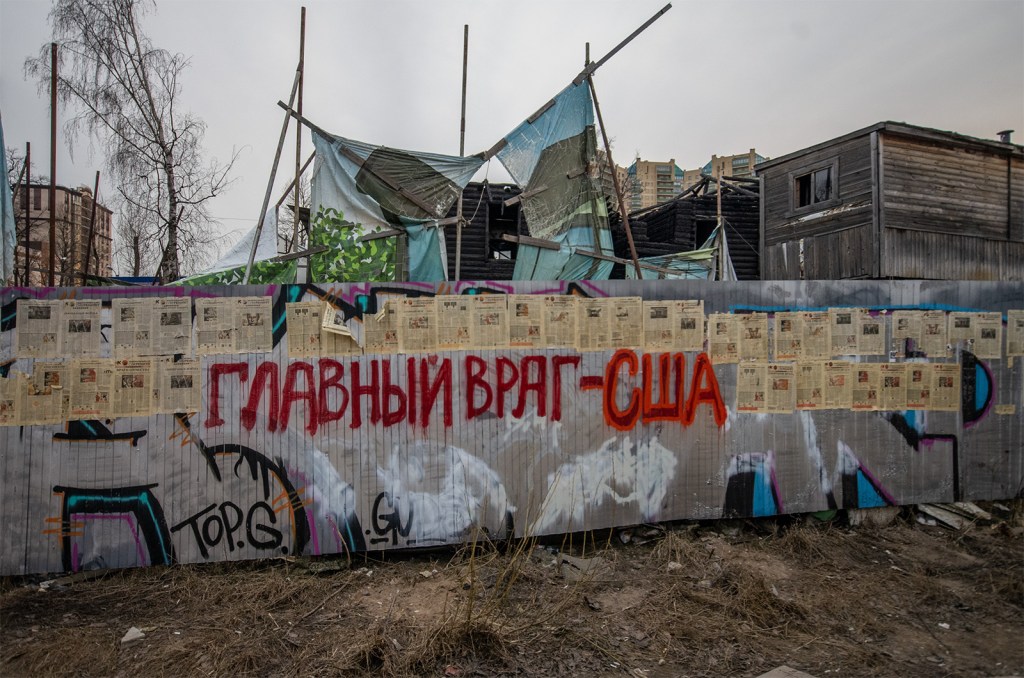
“The USA is the archenemy.” This photo was taken by my friend M. on a recent walkabout in Petersburg.
I had a dream before finally waking up today.
My husband telephoned, saying that he had been working in Pushkin today (which never happened, but okay), and couldn’t come home. I asked why he couldn’t—it was just past six in the evening, according to the clock.
“Just you take a look at the sky,” he replied. “It’s as black as pitch. It’s impossible to travel, you can’t see a thing. It’s probably a shitstorm—a big one, the final one.”
I looked at the sky, and it actually was black. Incredibly low fluffy white clouds floated past, lit up from within by something. Right under these clouds a building was being built; it was already six floors tall. Little devils rode on the clouds, grimacing and pulling up people who were clinging to the edges. The entire scene seemed quite tiny to me.
I told my husband what I saw.
“What is that huge thing they’re building?” I asked. “And who are those people clinging to the clouds?”
My husband was quite surprised.
“They’re building a fence around our beautiful motherland, the tallest fence in the world. Those are people who didn’t leave in time. The little devils are having fun with them by picking them up, but no one knows where they’ll throw them off. They just hope it’s on the other side of the fence.”
Students at the Mechnikov Medical University[in Petersburg] have told Bumaga that the dean’s office has asked them to fill out an online test about their attitude to the war in Ukraine, the president, and the future of Russia.
The students said that they were simply asked to take a survey—they were not informed about possible punishments for those who refused to fill out the test.
Before completing the test, students must log in through their VKontakte accounts or with a phone number, for example.
Students are asked to answer the following questions:
Do you generally trust the rector of your university?
What emotions do you feel when you think about Russia?
How much do you agree that things in our country are moving in the right direction?
Do you generally trust Russian President Vladimir Putin?
Do you think President Vladimir Putin is doing a good job or a poor job as president?
Has your attitude towards President Vladimir Putin changed over the past month? If it has changed, has it worsened or improved?
Choose the symbol that best fits the concept of “President of Russia.”
In your opinion, does Russia face the threat of a military attack?
Do you support Russia’s special military operation in Ukraine?
Choose the symbol that best fits the concept of “Special Military Operation.”
The survey also asks students to indicate what the country’s leadership should prioritize: strengthening sovereignty, strengthening the state, or developing the economy. The only alternative to these options is “undecided.”
The survey was created by the platform Concerned Individual, which operates in cooperation with the Education Ministry. It is marked as “April University Student Survey.” An employee of the Herzen Russian State Pedagogical University [in Petersburg] also reported to Bumaga that [students there had been asked to complete the survey].
If you have received such a request, tell us about it by writing to our Telegram bot: @PaperPaperNewsBot. It’s anonymous and safe.
A screenshot of the front page of Concerned Individual’s website, featuring an interactive map of Russia’s federal districts. According to Concerned Individual, 82% of people in the Northwest Federal District (in red), which includes St. Petersburg, are “concerned individuals.” Twenty-nine percent of them (according to VTSIOM) have donated money to people or organizations. Fifteen percent have donated items to orphanages, old folks’ homes, and homes for the disabled. Four percent have been involved in charity events such as concert and exhibitions. Six percent of them have worked as volunteers.
Universities in all regions of Russia will join the platform Concerned Individual to become initiators and participants of positive change at their educational institutions and in the higher education system as a whole.
Along with the Russian Science and Higher Education Ministry, the Russian Education Ministry, Tomsk State University, and the All-Russian Center for the Study of Public Opinion (VTsIOM), Concerned Individual is launching a program of regular opinion polling of students, teachers, and administrative staff at Russian universities. We plan to recruit representatives of more than 700 tertiary educational institutions to the platform by the end of 2024.
The project’s aim is to form a permanent feedback mechanism between the university community and state authorities, to identify problems that need solving as well as promising directions for the growth of higher education.
“We believe that such a dialogue is especially necessary today, and our platform is technologically and methodically ready to provide it. Concerned people are the key potential for change in the universities, regions, and country. And opinion polls are a scientifically grounded tool that has proven itself well and reflect a real cross-section of the situation. Therefore, we urge students, teachers, and administrative staff to take part in the project and voice their opinion on the most pressing social issues,” comments Vadim Arakelov, CEO of the company Concerned Citizen.
The first wave of polls will kick off on April 10. Respondents will answer questions about the quality of education, media consumption, socio-psychological well-being, and other topics. In 2023, polls will also be conducted in May, September, October, and November. You can take part in the surveys by clicking on the link posted in your personal university account.
The results of the surveys will be published on Concerned Individual’s Telegram channel and website, and posted in the personal accounts of students and university staff.
The number of new cases of HIV infection in Russia has been growing again. In 2022, 63,150 people were diagnosed with HIV, while a year earlier this figure was 61,098 people, according to the Russian Health Ministry. During the pandemic, fewer cases of HIV infection were detected in Russia due to reduced testing coverage and lockdowns.
The HIV detection rate in Russia increased by eight percent per 100,000 people in a year. There was an even bigger jump in particular regions. Compared with 2021, this figure almost doubled in the Belgorod Region. It increased by 76% in the Kaluga Region, by 66% in Yakutia, and by 60% in Ingushetia and the Altai Republic.
HIV infection rates in Russia per 100,000 people between 2004 and 2022, according to the Russian Health Ministry.
However, the Health Ministry’s data encompasses only people who have registered as outpatients at AIDS centers. They do not reflect those who have tested positive for HIV, but were not registered. The number of such people is as high as twenty percent of all confirmed cases of infection, estimates Vadim Pokrovsky, head of the Epidemiology and AIDS Prevention Research Department at Rospotrebnadzor’s Central Epidemiology Research Institute. Nor does this figure include foreign nationals and anonymous positive tests.
In 2021, 1,138,000 people with a confirmed diagnosis of HIV diagnosis resided in Russia. In 2022, another 60,000 people were diagnosed with HIV. To these groups we need to add around 300,000 people (according to Pokrovsky’s estimates) who have HIV but don’t know it because they haven’t been tested. Thus, the number of HIV-positive people in Russia is one and a half million, which is one percent of the country’s population.
2.6% of pregnant women in the Irkutsk Region are HIV positive.
At the Congress on Infectious Diseases, Pokrovsky said that almost a third of Russia’s regions are undergoing the generalized (third) stage of the HIV epidemic. He explained that there are three stages of the epidemic. The first (initial) stage involves isolated cases. The second (concentrated) stage occurs when more than five percent of any high-risk subpopulation is infected (for example, prison inmates, drug addicts, or sex workers, while the third (generalized) stage occurs when more than one percent of pregnant women are infected with HIV.
According to Pokrovsky, nine Russian regions are in the first stage of the epidemic, while forty-eight are in the concentrated stage, and twenty-seven are in the generalized stage. In the Irkutsk Region, 2.6% of pregnant women have been diagnosed with HIV, he noted. Ten percent of Russian prison inmates are infected with HIV, and four percent of Russian men over the age of forty have HIV, adds Pokrovsky.
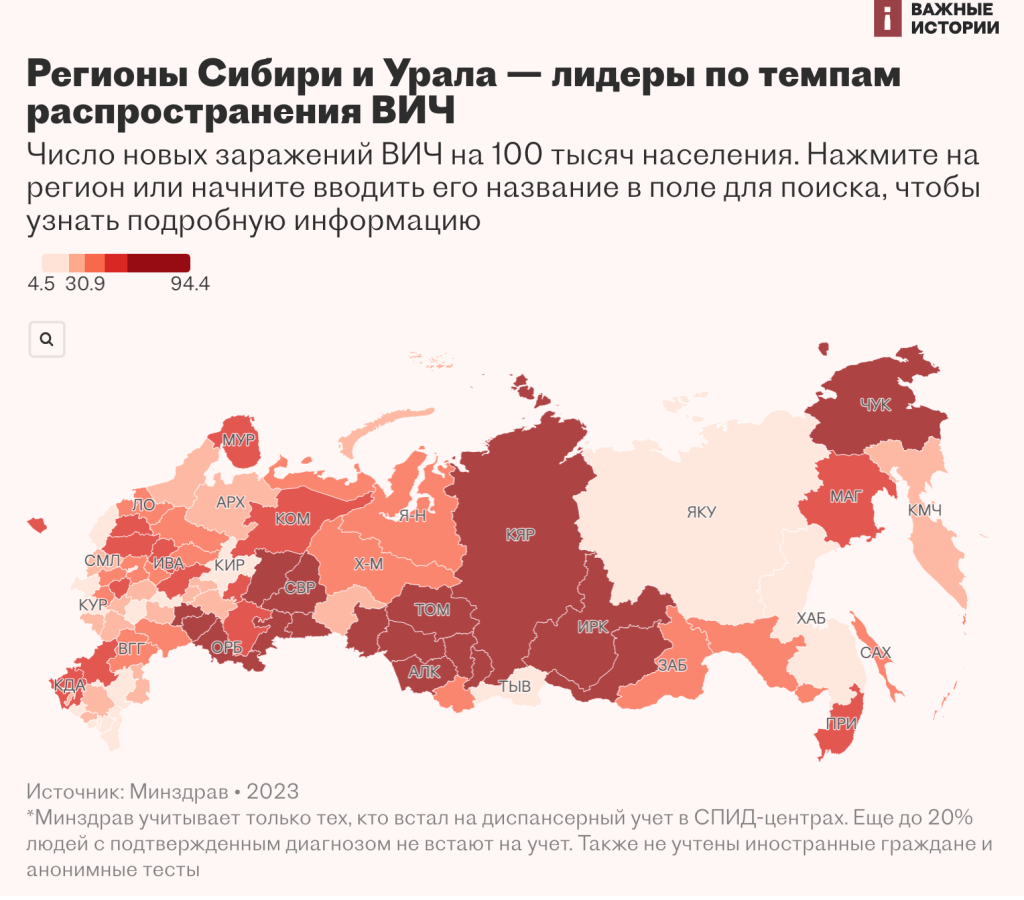
In 2022, regions of Siberia and the Urals — Krasnoyarsk and Perm Territories, Orenburg, Kemerovo, Irkutsk, Tomsk, Chelyabinsk, Novosibirsk, Kurgan and Sverdlovsk regions — remained the leaders in the rate of HIV spread, as in previous years.
“Regions of Siberia and the Urals are leaders in the rate of HIV spread. Number of new HIV infections per 100,000 people. Click on the region or start typing its name in the search box to see specific figures.” This map is interactive in the original article, as published on the Important Stories website.
And yet, flying in the face of its own data, which showed an increase in cases, in March of this year the Health Ministry reported a reduction in the number of new cases of HIV infection in 2022.
According to the UN strategy for eradicating HIV, a country should seek to hit the “90–90–90” treatment target if they want to beat the epidemic. This means that ninety percent of people with HIV should know their status, ninety percent of people who know they are HIV positive should receive sustained treatment, and ninety percent of patients undergoing treatment should have an undetectable (i.e., very low) viral load. When this is the case, an HIV-positive person undergoing antiretroviral therapy cannot transmit the virus to another person.
Antiretroviral (ARV) treatment is the principal means of combating HIV. Every person living with the immunodeficiency virus should receive this therapy. But that is not the case now.
In 2021, 82% of people who had regular medical check-ups and 56% of all those living with a confirmed diagnosis of HIV infection received ARV treatment, according to Rospotrebnadzor’s AIDS Prevention and Monitoring Center. An undetectable viral load was attained by eighty percent of those receiving ARV treatment.
The rest — more than half a million people with a confirmed diagnosis — do not receive treatment. Their viral load remains detectable, so they risk spreading the infection.
By law, Russian citizens should receive ARV treatment for free. However, the Health Ministry procures less medicine than HIV-positive people need, and has not increased the treatment budget despite the fact that the number of patients has been growing every year. Every day, the project “Interruptions.ru” fields messages from patients complaining about the unavailability of treatment.
49% of Russians registered as HIV positive are covered by drugs purchased by the state.
In 2021, Russia procured only 391,000 annual doses, according to the International Treatment Preparedness Coalition. This covers approximately 49% of the number of people who receive follow-up care, and 34.4% of all people registered as HIV-positive. Therapy coverage was thus fifteen percent lower in 2021 than in 2020.
The drugs procurement budget for 2023–2025 must be increased by at least fifteen billion rubles annually in order to provide all patients with the necessary treatment. However, the Finance Ministry is willing to allocate 31.7 billion rubles for drugs procurement annually during the period 2023–2025 — that is, it does not plan to increase spending.
And yet, according to one estimate, Russia spent ten trillion rubles on the war over the past year. This same amount of money could provide all Russians in need of it with ARV treatment for 270 years in a row.
The Health Ministry procures drugs for ARV treatment on the federal level, while the regions must purchase the drugs they lack themselves, an activist who helps people with HIV explained to Important Stories on condition of anonymity.
According to her, AIDS centers in the regions submit applications to the Health Ministry for the amount of drugs they need. But the Health Ministry buys less than requested — for example, AIDS centers might apply for ten thousand doses, but the Health Ministry buys them only seven thousand. The regions have to find the money to make up for the shortfall in drugs.
“We must increase the number of patients in treatment and increase coverage,” our source told us. “At the moment, it is unclear what to do without additional allocations of money for purchasing medicines.”
If the Russian authorities spent ten trillion rubles on medicines, rather than on the war in Ukraine, they could provide HIV-infected Russians with the treatment they need for 270 years in a row.
The regions are not required to buy additional medicines, nor do all of them do it. Consequently, patients find themselves in unequal conditions: in richer regions, they receive the appropriate treatment, while in poorer regions they do not. Moreover, spending on drugs does not depend on how bad the HIV epidemic is in a particular region. This can be seen by looking at procurements of the drug Dolutegravir. According to our source, it is a well-researched and rather expensive drug that is suitable for many patients. But the Health Ministry has been reducing its purchases of the drug, while the country’s richest regions — the Tyumen Region, Moscow, St. Petersburg, and the Khanty-Mansi Autonomous District — spent the most of their own funds on it in 2022.
More than half of Russia’s regions did not purchase additional Dolutegravir for their patients at all, including, for example, the Sverdlovsk Region, where almost three thousand new patients were registered in 2022.
More than 77% of the money spent on Dolutegravir was spent by regions where only 23% of new HIV patients live.
Cutting-edge HIV treatment is available mainly to residents of rich regions
More than 77% of the public funds spent on procuring the drug Dolutegravir in 2022 were allocated by regions where only 23% of new cases live
A table showing how much Russia’s regions spent, in rubles and as a percentage of nationwide spending, on the ARV drug Dolutegravir in 2022, versus new cases of HIV infection last year, both in sheer numbers and as a percentage of the national total. The list includes Tyumen Region (at the top), Moscow, St. Petersburg, Khanty-Mansi Autonomous District, Chelyabinsk Region, Irkutsk Region, Tula Region, Novosibirsk Region, Yamalo-Nenets Autonomous District, Murmansk Region, and “all other regions.”
In 2022, Kommersantwrote about the reduction of purchases of expensive drugs for which there are no less-expensive substitutes. In 2021, such drugs accounted for 67% of the total volume of ARV treatment purchases, while in 2022, this figure was 55%. Cheaper drugs are being purchased to replace them.
Reducing the choice of drugs available makes it more difficult for patients to choose a treatment that suits them without causing side effects. It happens that only one drug out of four is suitable for a person, but the region where they live does not supply it.
Pokrovsky notes that the 63,000 new cases in 2022 is a high rate of infection. In reality, there are even more HIV-positive people in Russia, since the country’s most vulnerable groups are less likely to be tested.
“In part, the large number of new cases is due to the fact that we do test a large portion of the population: more than forty million tests were done in 2022. (But we must take into account the fact that, for example, pregnant women and donors are tested several times a year.) On the other hand, people who are particularly vulnerable to HIV infection — drug users and men who have sex with other men — are not tested enough,” Pokrovsky says.
68% of new HIV infections in Russia were the result of heterosexual sexual contact, so sex education is needed to combat the epidemic.
Pokrovsky argues that to effectively combat the epidemic, the Russian government should promote sex education and fund social advertising campaigns.
“Nowadays, the biggest chunk of funding, over 30 billion rubles [per year], is spent on procuring drugs,” he says. “Treatment is supported by the pharmaceutical companies, so that is where the bulk of the funds are allocated. But there are no market-based solutions to prevention. In this case, you can only count on public funds. Very little is allocated for prevention, literally 500 million rubles [per year], and this amount does not grow from year to year. Most of it is spent on appeals to get tested, rather than on teaching people how not to get infected with HIV. Sex education is now practically prohibited [in Russia].”
Russia was among the top five countries in terms of new HIV case numbers in 2021. According to UNAIDS (the United Nations HIV/AIDS program), Russia accounted for 3.9% of the one and a half million new cases of infection in the world. Russia was bested, in 2021, only by South Africa (14% of all new cases), Mozambique (6.5%), Nigeria (4.9%), and India (4.2%). The Russian Foreign Ministry dubbed the news a “dirty information campaign” on the part of the West. Instead of receiving support, many Russian NGOs campaigning for HIV prevention and patient care have been labeled “foreign agents” by the Russian authorities.
Contrary to the stereotype that drug addicts are the most infected segment of the populace, heterosexual sexual contact is now the primary mode of HIV transmission in Russia, accounting for 68% of new cases.
In Russian prisons, they said they were deprived of effective treatments for their H.I.V. On the battlefield in Ukraine, they were offered hope, with the promise of anti-viral medications if they agreed to fight.
It was a recruiting pitch that worked for many Russian prisoners.
About 20 percent of recruits in Russian prisoner units are H.I.V. positive, Ukrainian authorities estimate based on infection rates in captured soldiers. Serving on the front lines seemed less risky than staying in prison, the detainees said in interviews with The New York Times.
“Conditions were very harsh” in Russian prison, said Timur, 37, an H.I.V.-positive Russian soldier interviewed at a detention site in the city of Dnipro in central Ukraine, and identified only by a first name, worried that he would face retaliation if he returned to Russia in a prisoner swap.
After he was sentenced to 10 years for drug dealing, the doctors in the Russian prison changed the anti-viral medication he had been taking to control H.I.V. to types he feared were not effective, Timur said.
He said he did not think he could survive a decade in Russian prison with H.I.V. In December, he agreed to serve six months in the Wagner mercenary group in exchange for a pardon and supplies of anti-viral medications.
“I understood I would have a quick death or a slow death,” he said of choosing between poor H.I.V. treatment in prison and participating in assaults in Russia’s war in Ukraine. “I chose a quick death.”
The ridiculous Meduza strikes again, now deliberately misnaming the (nonexistent) “Network” (and, by the by, passing off the FSB’s torture-“collaborated” fairytales as facts) after just as deliberately, three years ago, torpedoing the broad-based solidarity movement that had finally sprung up in support of the defendants in the so-called Network Case.*
There is unprecedented public outrage at the verdict and the prison sentences requested by the prosecutor. Hundreds of open letters and appeals—from musicians, poets, cinematographers, book publishers, artists, teachers, and municipal councilors—are published. For the first time in Russia, the practice of torture by the special services is openly and massively condemned. The verdict is called an attempt to intimidate the Russian people. The public demands a review of the Network Case and an investigation of the claims of torture. People stand in a huge queue on Moscow’s Lubyanka Square to take turns doing solo pickets.
But a week later, the wave of indignation is shot down. Meduza publishes a controversial article, “Four Went In, Only Two Returned,” in which a certain Alexei Poltavets confesses to a double murder that he committed, allegedly, with defendants in the Network Case. There had long been rumors about the so-called Ryazan Case—the murders of Artyom Dorofeyev and Ekaterina Levchenko in the woods near Ryazan—within the activist community, but the story had never surfaced, because there was no evidence. There is no evidence now, either: the Network’s involvement in the murder is not corroborated by anything other than the claims made by Poltavets. Poltavets himself is in Kiev, and no formal murder charges are made against the Network. But it is enough to discredit the solidarity campaign. Now, in the eyes of society, those who take the side of the Network Case defendants are defending murderers. Public outrage fades, and the verdict remains the same
Yuli Boyarshinov (left, facing camera) and his father, Nikolai (foreground), after Yuli’s release from the penal colony in Segezha on 21 April 2023. Photo courtesy of RFE/RL
Yuli Boyarshinov, convicted in the Petersburg portion of the so-called Network Case, has been released, our correspondent reports. His parents, wife, and friends were on hand to meet Boyarshinov.
Boyarshinov was released from Penal Colony No. 7 in Segezha, Republic of Karelia, early in the morning of April 21, although his relatives and friends had expected him to be released in the afternoon.
Boyarshinov said that the wardens gave him a ticket for the train to Petersburg, which departs at ten a.m., and released him right on time for that train. “Customer-oriented service,” Boyarshinov said by way of explaining the rush to release him from the penal colony.
The FSB launched a criminal case against the so-called Network “terrorist community” in October 2017. Eleven individuals from Penza, St. Petersburg, and Moscow, most of them anarchists and antifascists, were detained and then remanded in custody. According to FSB investigators, the young people had established a networked community with the aim of committing terrorist attacks and overthrowing the government.
Boyarshinov and Viktor Filinkov were arrested and eventually tried in Petersburg. Filinkov was sentenced to seven years of imprisonment, while Boyarshinov was sentenced to five and a half years in a penal colony. Later, however, his sentence was reduced by three months.
Most of the accused claimed that the evidence was fabricated by the FSB, and repeatedly stated that they had given confessions under torture. The Russian Investigative Committee, however, failed to find any illegalities in the actions of the FSB officers involved the case.
Yuli “Yulian” Boyarshinov, one of the Petersburg defendants in the Network Case, has been released from prison, after having spent over five years in custody. Bumaga was there to capture Boyarshinov’s first moments on the outside, where he was reunited with his wife and his parents.
Yuli Boyarshinov (right) with his wife, Yana Sakhipova. Photo by Andrei Bok for Bumaga
Yuli Boyarshinov (far right) with parents and wife, after his release from prison. Photo by Andrei Bok for Bumaga
Boyarshinov was detained in January 2018 and had been in custody from then until his release earlier today. In June 2020, he was sentenced to five and a half years in a penal colony on charges of “involvement in a terrorist community,” but an appeals court later reduced his sentence by three months. The sentence took into account the time Boyarshinov had already spent in jail.
The Network Case is also known as the Penza Case, since most of the defendants were detained in Penza. However, the FSB claim that the “terrorist community” operated cells not only in Penza, but also in Petersburg, Moscow, Omsk, and Belarus. Leftist activists, antifascists, anarchists, and airsoft players were detained as part of the Network Case.
Before his arrest, Boyarshinov had been employed as an industrial climber and was involved in charity work. He recounted that he had been tortured in the pretrial detention center.
Boyarshinov pleaded guilty to the charges, claiming that the Network’s participants had come together for the purpose of self-defense training. And yet Boyarshinov did not make a deal with prosecutors and refused to testify against the other defendants.
Boyarshinov is the second person involved in the Network Case to be released. The first was Igor Shishkin, who was detained at the same time as Boyarshinov. Shishkin was released in July 2021, after which he spoke to the press about having been tortured.
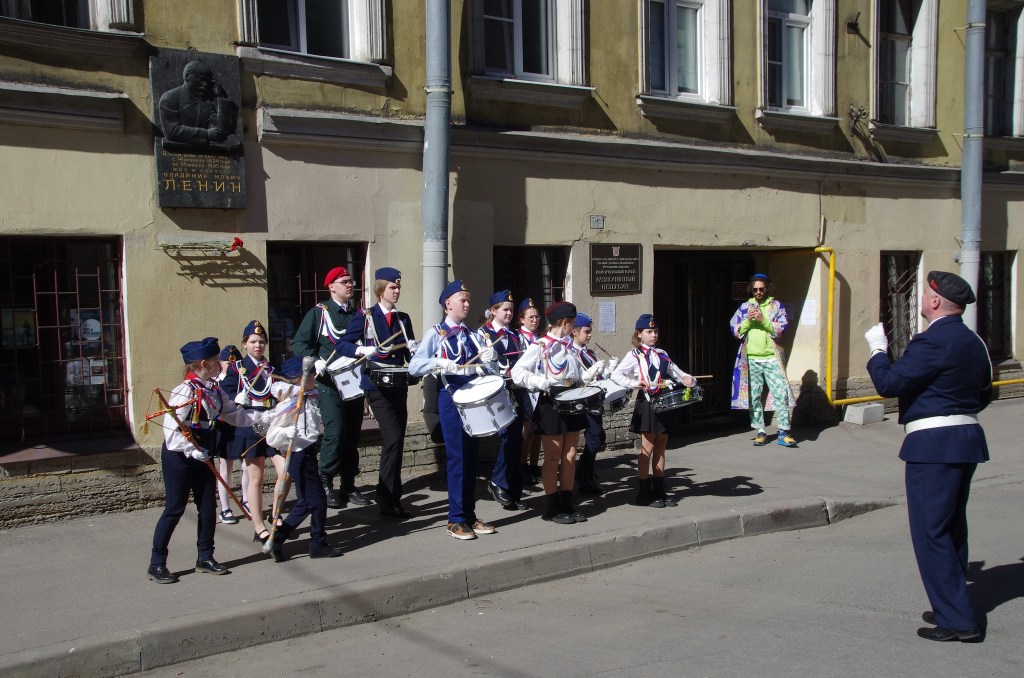
A military youth band plays outside the former Lenin Apartment Museum on Cossack Alley in Petersburg as a local hipster documents the happening, 22 April 2023. Photo by PZ, who kindly gave me permission to reproduce it here.
In pre-revolutionary Russia, the raznochintsy were people whose social status did not strictly conform to the notions of “hereditary nobleman” or “eminent merchant.” Minor clerks, retired soldiers, servants of various stripes, laborers and, of course, students and other intellectual workers lived in neighborhoods remote from Nevsky Prospect.
The museum traces its roots back to 1924.
Cossack Lane has been home to a memorial address since 1924. Vladimir Ilyich Ulyanov (Lenin) lived here from February 12, 1894 to April 25, 1895, and after his death, residents of the neighboring buildings established “Ilyich’s Corner” on the street.
In 1938, Ilyich’s Corner was turned into the V.I. Ulyanov Apartment Museum, part of the Leningrad branch of the Central Museum of Lenin. In 1992, the mayor of St. Petersburg ordered that the museum be preserved as as a historical landmark. It was granted the status of a state museum under the jurisdiction of the Lenin District (later, the Admiralty District) of St. Petersburg and became known as the Museum of the History of the Revolutionary Democratic Movement of the 1880s and 1890s.
In September 2003, by order of St. Petersburg city hall, the museum was transferred to the jurisdiction of the St. Petersburg Culture Committee. In 2006, in connection with the opening of a new permanent exposition, Around the Semyonovsky Regimental Parade Ground, the museum was given its current name — the Raznochintsy Petersburg Memorial Museum
On Thursday, April 20, the Russian Defense Ministry posted a voluntary military service recruitment ad on its Telegram channel. The phrase “You’re a man” is the advertising spot’s slogan.
The Details. The video features three characters: a store security guard, a fitness trainer, and a taxi driver. First, all of them are shown at work, as the following captions appear on the screen: “Is this what you dreamed of defending?”, “Is this how you wanted to show your strength?”, and “Is this the road you meant to choose?” The men are then shown in military uniforms whose sleeves are emblazoned with “Z” patches.
The video concludes with the words “You’re a man. Be one” and a call to sign up for volunteer military service [along with a promise of a monthly salary starting at 204,000 rubles, or approximately 2,280 euros].
Another advertisement for volunteer military service was discovered by Echo FM. The ad spot was originally broadcast on the sports channel Match TV. In the video clip, Russian soldiers are shown driving over rough terrain in a military vehicle.
“It seats a group of up to nine people. Everyone in here is one of our boys,” the characters in the advertisement say.
Who starred in the ad. One of the actors in the “You’re a man” ad was Vladimir Cheprakov, a fitness trainer from Odessa, Verstkadiscovered, after locating his VK social media page.
Meanwhile, Agentstvo reports that the fitness trainer was played by Belarusian national Maxim Shalypin. He was a coach at a Belorussian [sic] club in Vitebsk, the publication writes.
Muscovite Mikhail Morozov also appeared in the ad. In 2014, Morozov published a social media post about the Russian Federation’s “aggression” due to its “declaration of fratricidal war” against Ukraine. In the ad spot, he played the role of a taxi driver.
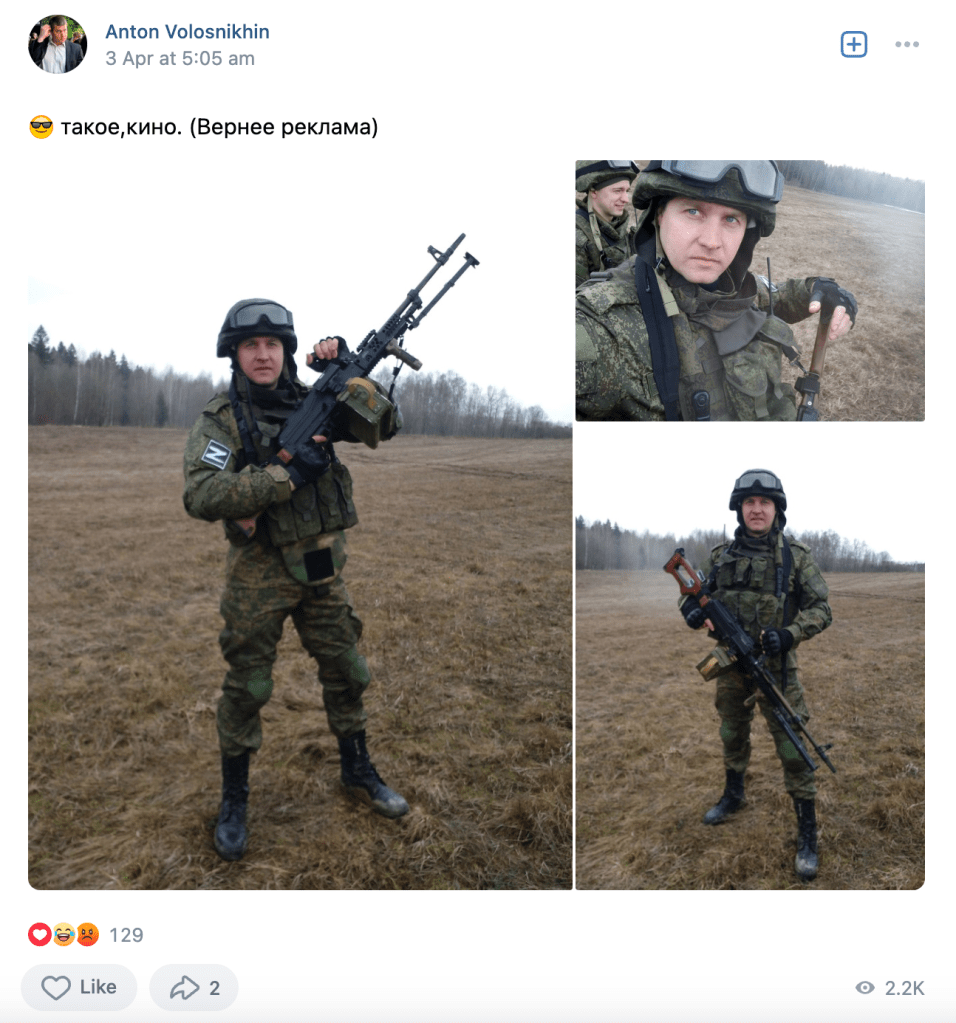
The actor who played the security guard was another Muscovite, Anton Volosnikhin. After the shoot, he posted photos of himself dressed in a military uniform with a “Z” patch on his VK page.
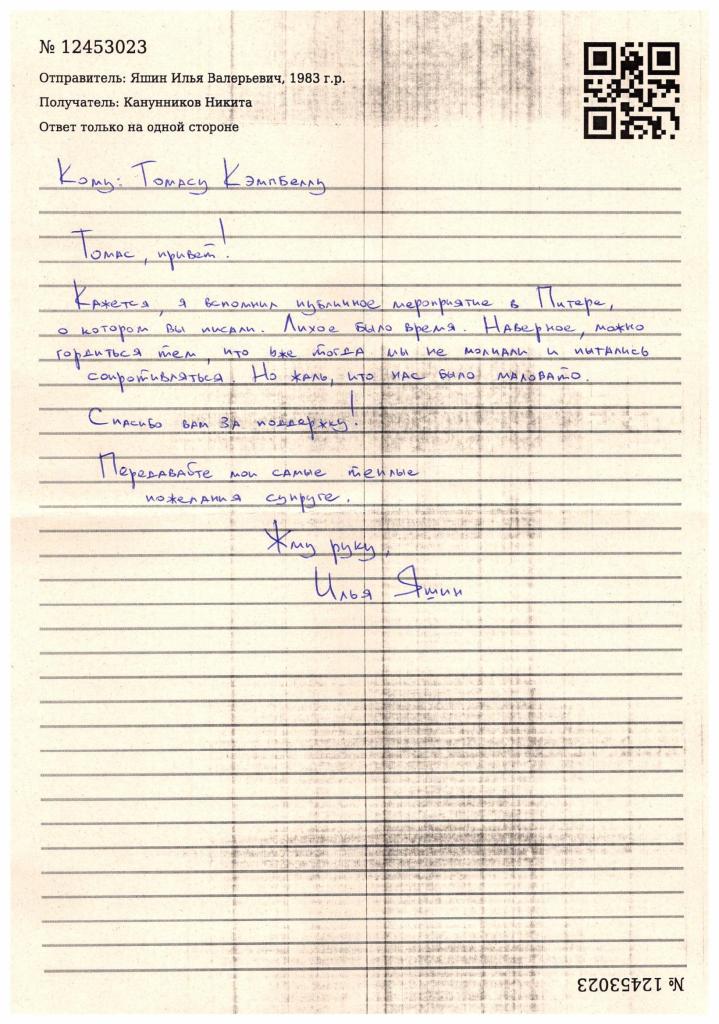
I think I remember the public event in Petersburg that you mentioned. Those were wild times. We can probably be proud that even back then we were not silent and tried to resist. But it’s a pity that there were so relatively few of us.
Thank you for the support!
Please give my warmest wishes to your spouse.
Best regards,
Ilya Yashin
Mr. Yashin’s letter is just the ticket for an obnoxious cold that has laid me low for the last week. And it finally gives me a proper excuse to publish on this blog something I got in the mail around the same time as I was translating the social media post by Mr. Yashin that prompted my letter to him. This “poem in your pocket” was sent to me by the American Academy of Poets in celebration of April’s National Poetry Month. I’ve been keeping it in eyeshot, right next to my computer. Ada Limón is the Poet Laureate of the United States, and her poem seems to “rhyme” with the Yuri Levitansky poem from Mr. Yashin’s post. ||| TRR
A WAKE for Theodor Herzen will take place at 11:30 a.m., Thursday, 20 April 2023, at the Chernyakhovsk District recreation center in the village of Shchegly.
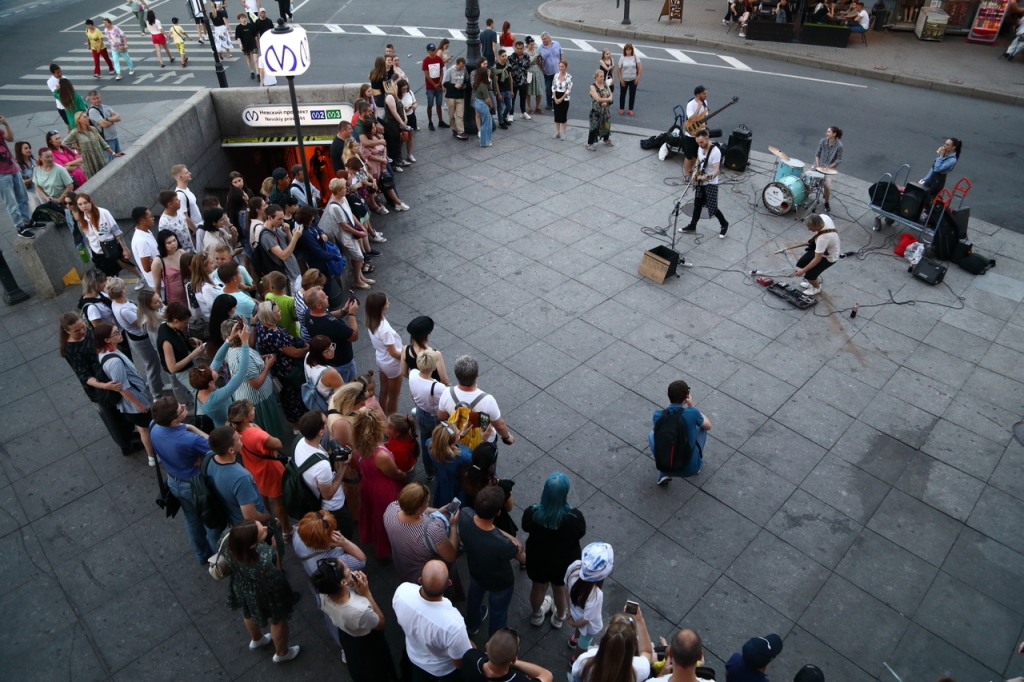
Buskers playing on Nevsky Prospect in downtown Petersburg, date unknown. Photo courtesy of ZAKS.ru
A draft regulation for the authorization of street performances was published on the website of the Government of St. Petersburg on April 11. The new rules should take effect from May.
Musicians will be obliged to notify the district council of their desire to perform ten business days before the concert. If they are going to play without percussion instruments and amplification, the deadline is three business days before the concert.
They can apply by using the Public Services in St. Petersburg app or via the websites of the district councils. To fill out the application, they will have to enter their passport details or information about a letter of proxy authorizing someone else to act on their behalf if the musicians are not seeking permission for the performance independently. In addition, they will have to provide a layout of stage and technical equipment and a list of sound amplifying equipment.
Legal entities will have to attach a copy of their charter, signed and stamped by its management, as well as a document confirming its representative’s authority to act on its behalf.
An approval already issue can be invalidated if necessary. It is planned to notify musicians about the decision of officials via SMS, e-mail, the Public Services portal, or social networks. The notification method will be chosen by the applicants themselves.
The project is undergoing an anti-corruption assessment. Earlier, the Petersburg district administrations presented lists of places where it was planned to allow street performances.
Yesterday, a man who was well over sixty was seated opposite me in a trolleybus going down Nevsky. He clutched a one-hundred-ruble bill.
“Has it been a long time since conductors stopped selling tickets?” he asked. “How do I pay the fare? I haven’t been on Nevsky for over forty years. And I haven’t been on public transport. I have a vintage Lada. That’s what I drive.”
“But your pension is probably transferred directly to your bank card,” I said. “Press it against that doodad to pay your fare.”
The man got up and pressed his Mir card to the validator. His eyes lit up with surprise and delight, as if he’d seen a magician pull a rabbit from a hat. I was сonsumed with envy toward him.
We continued our journey. Seated next to me was a fairly young woman, in her early forties, I think.
Looking disapprovingly at the man, she asked, “How is it that you haven’t been on Nevsky for forty years? What about the Immortal Regiment?”
“I don’t go,” the man said guiltily. “I came to Leningrad in 1979 and rented room on 1st Soviet Street. That’s where my wife was murdered. I moved to Vasilyevsky Island, and came to hate Nevsky. I haven’t shown my nose here since.”
The woman chuckled angrily.
“That’s no defense.”
We rode on in silence. I wanted to ask the man what had brought him to Nevsky today. But then I looked at him — in his striped sailor’s shirt, his face quite patriotic — and decided against it.
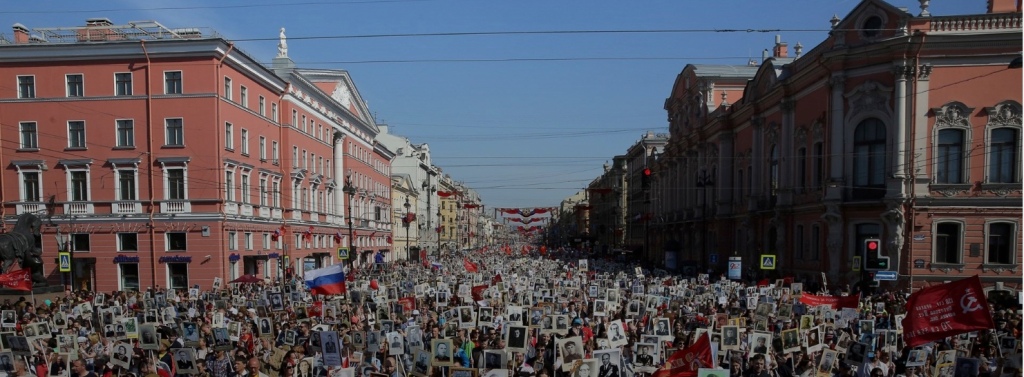
People marching down Nevsky as part of the Immortal Regiment event. The source and date of the photo are unknown. UPDATE (19 April 2023). This year’s Immortal Regiment processions have been canceled Russia-wide.