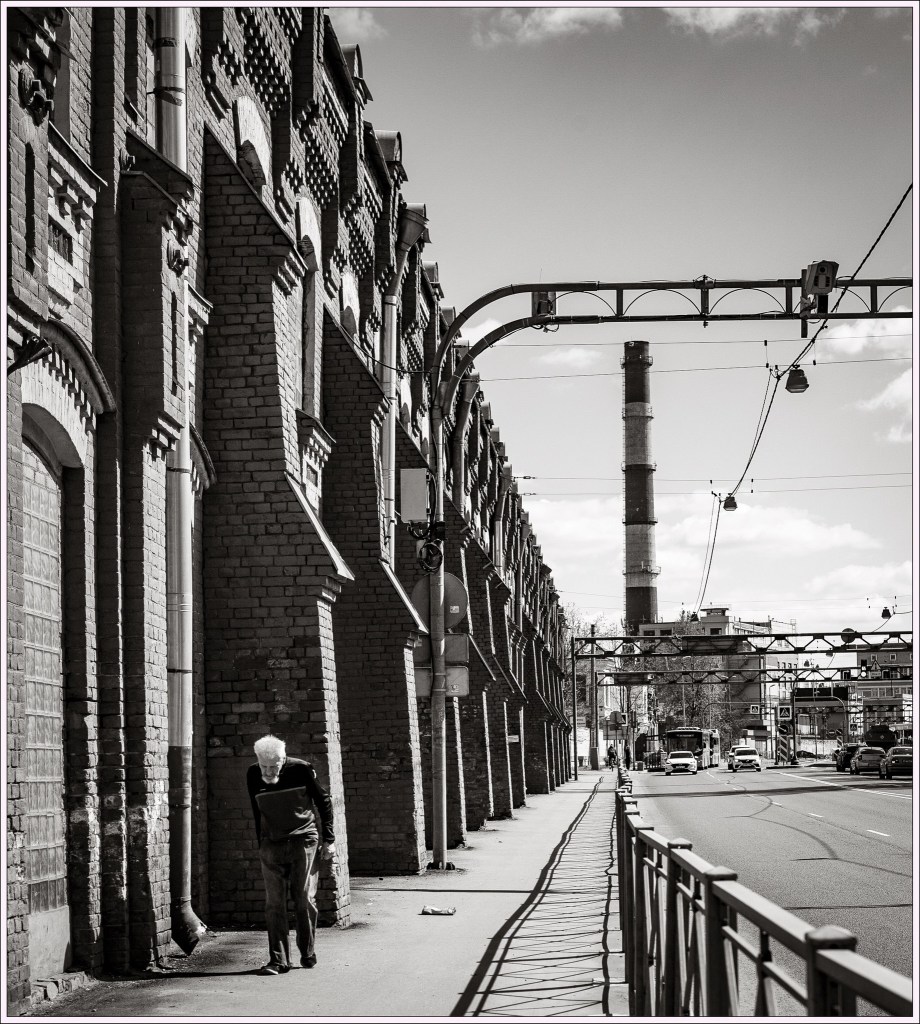
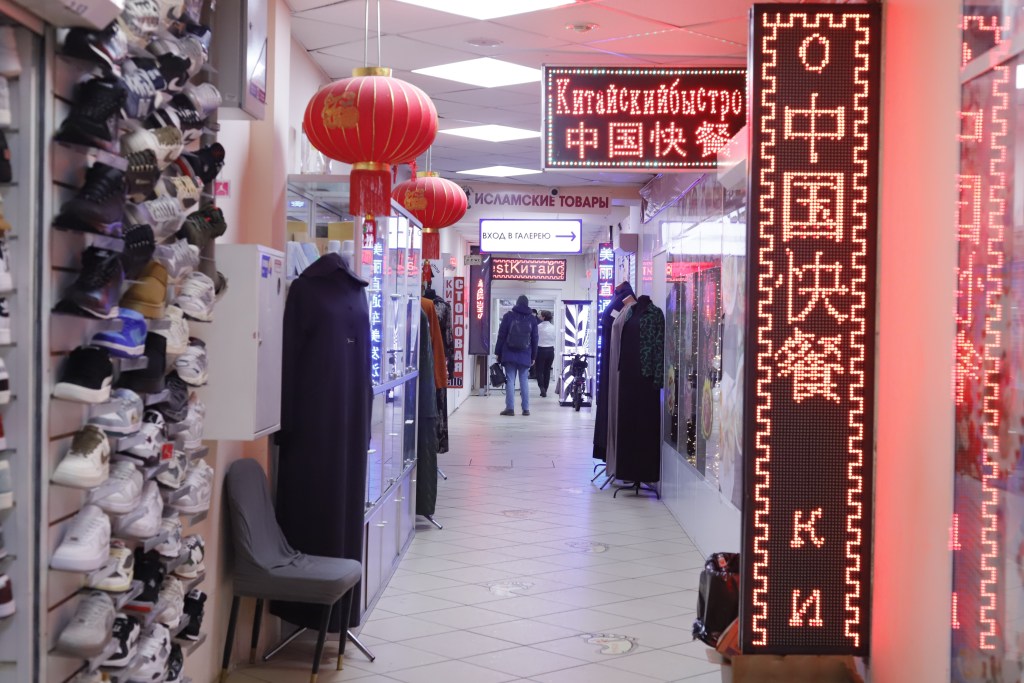
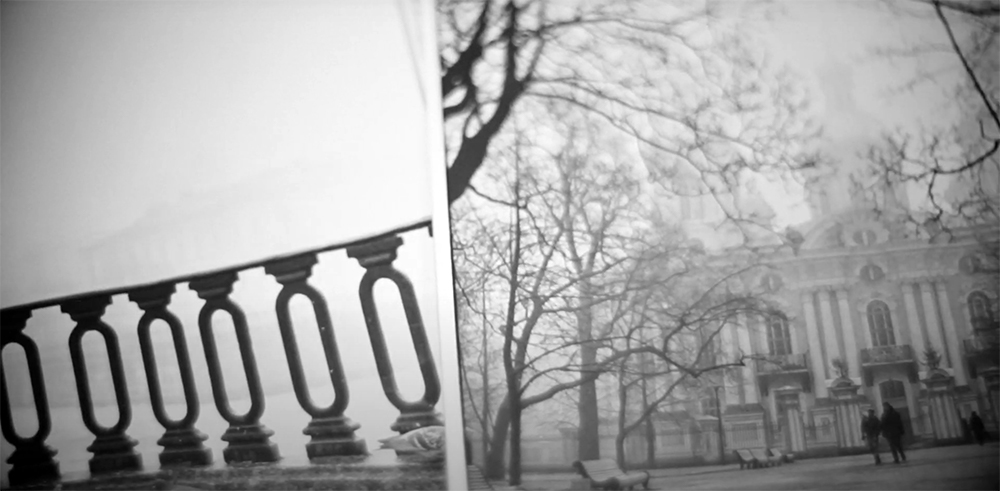
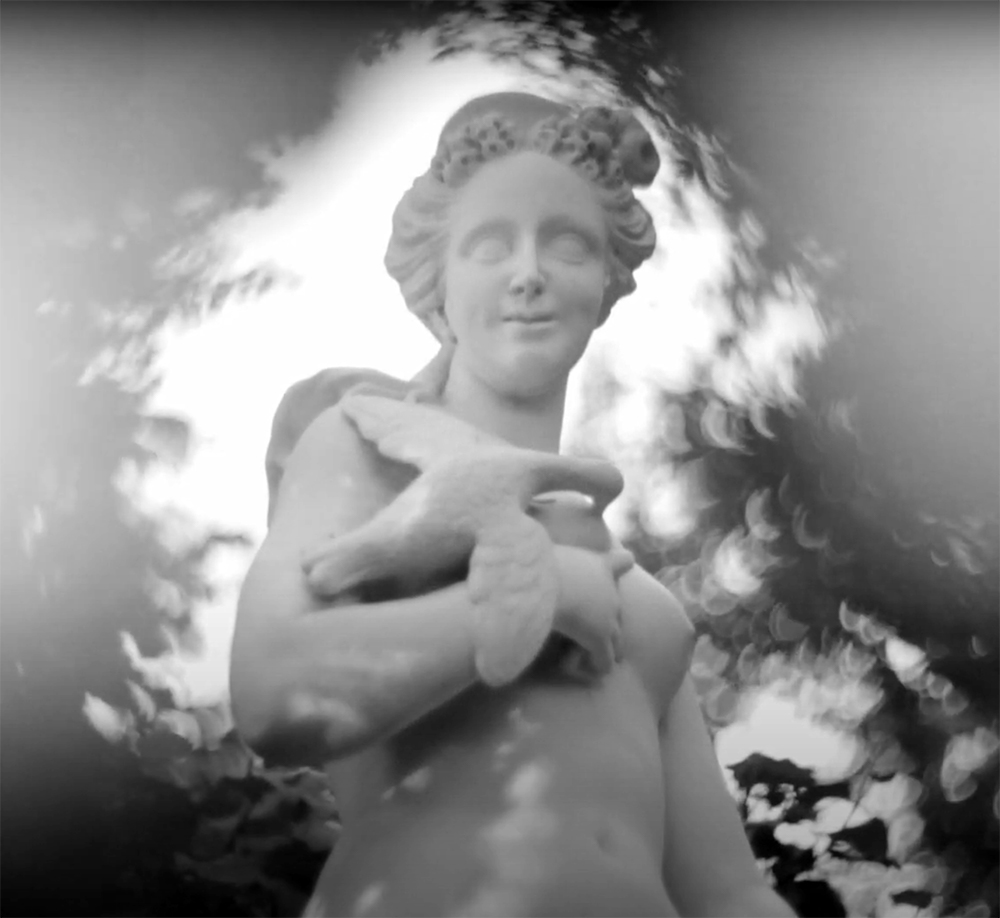
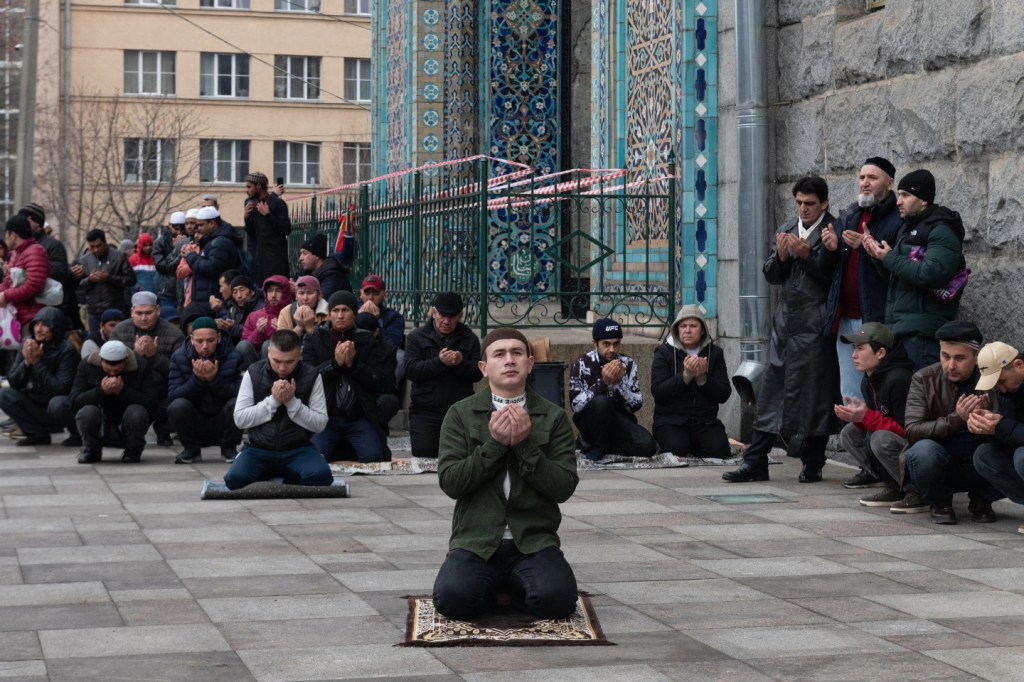
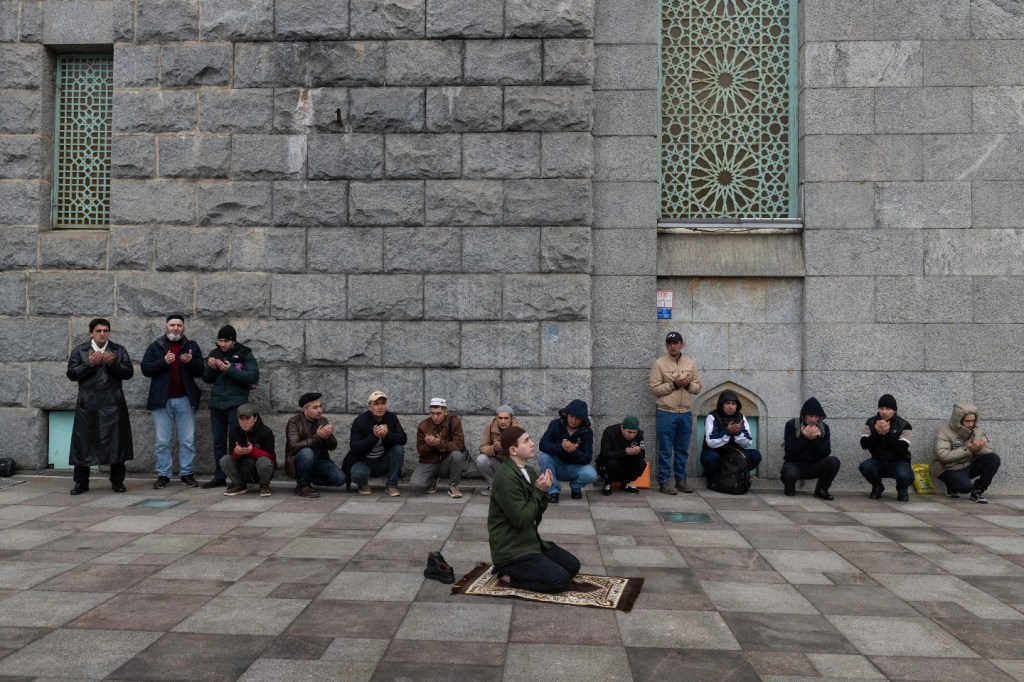
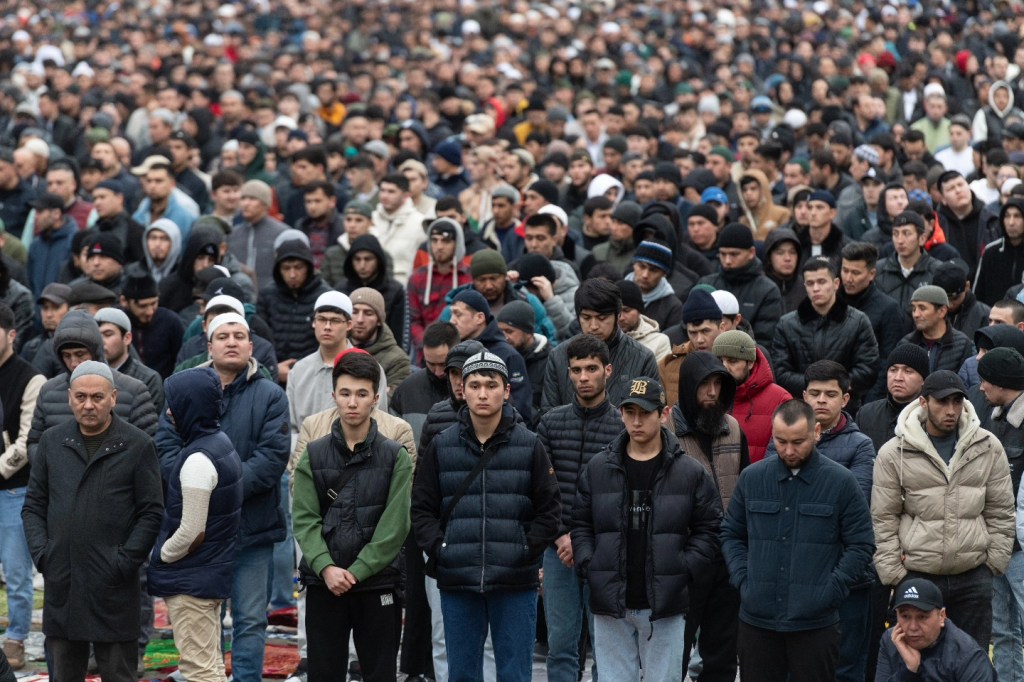
On Chaplygin Street in Moscow. Photo by anatrrra. Used with their permission
EXTERIOR: A neo-classical building in Moscow’s old German quarter. A plaque on the wall reads, “Western District Military Court No 2”. A group of actors and journalists mill around on the lawn.
INTERIOR: A large hall with a grand staircase. Through the frame of a metal detector stands a statue of Lady Justice in her blindfold, holding scales in one hand and a sword in the other.
A commotion. Several portly guards in flak jackets, with a dog on a leash, escort two handcuffed women through the hall. One, about 5ft tall with big eyes and curly hair, is Yevgenia Berkovich, a 39-year-old poet and theatre director. She is dressed in a white shirt and black trouser-suit. The other, slightly taller, wearing jeans, a white T-shirt and large owlish glasses, is Svetlana Petriychuk, a 44-year-old playwright.
The two women are led into a courtroom and placed in a cage of bullet-proof glass. A bailiff lets in the spectators, who sit down on the upholstered, green benches. Berkovich mischievously sticks out her tongue as photographers’ cameras flash and click. Yuri Massin, the judge, looks towards Berkovich.
Massin: Are you ready for the proceedings? Berkovich: Well, it depends on what will happen.
What happened was a show trial that revealed the radicalisation of the Russian state in the past few years. By the time proceedings began on May 20th 2024, Berkovich and Petriychuk had already been in detention for more than a year, having been charged with “propaganda and the justification of terrorism”. In the eyes of the regime, they had committed a crime by writing and staging a play called “Finist, the Bright Falcon”. Part docu-drama, part fable, “Finist” tells the story of the thousands of Russian women who, from 2015, were seduced online by professional recruiters from Islamic State (IS), and travelled to Syria to marry jihadists. Many of these women received lengthy sentences on their return home. The play premiered in 2020 to critical acclaim and was performed across the country.
As with any show trial, this one’s outcome was preordained, and its purpose was to justify the existing system and demarcate the ideological limits of the state. In doing so, it elucidated the ultra-conservative, anti-Western belief system that has expanded across public life since the full-scale invasion of Ukraine in February 2022. Berkovich and Petriychuk were the first artists to be jailed since Soviet times for the content of their work—or, more precisely, the thoughts of their characters. But as theatrical professionals, they managed to turn the trial into their show.
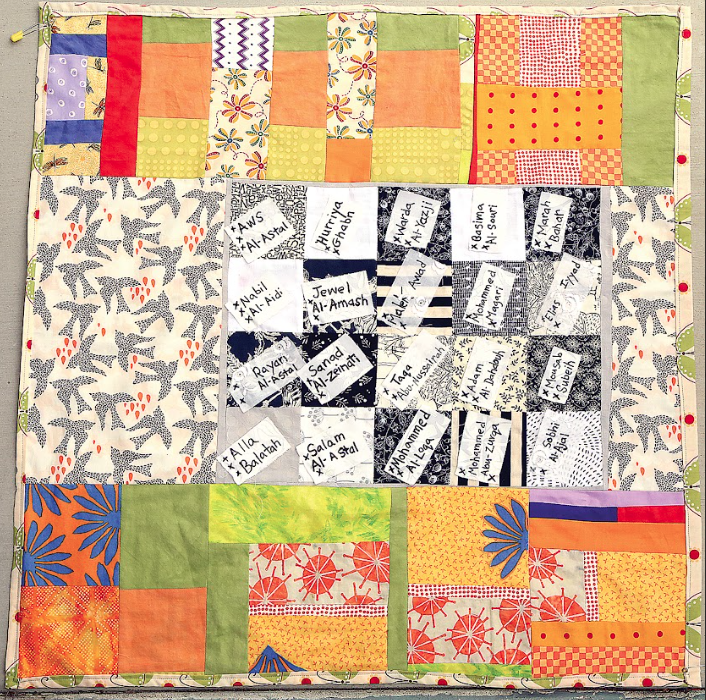
LOCAL INSPIRATION of the day. This quilt by Joleigh Kambic is part of a larger quilt titled “Babies in Gaza Who Never Made It To Their First Birthday.” The quilt is composed of smaller quilts created by nearly 40 quilters from across the Monterey Bay, commemorating the children who were killed in the Israel-Hamas war. It is on display through Oct. 3 at the Unitarian Universalist Church of the Monterey Peninsula, 490 Aguajito Road in Carmel.
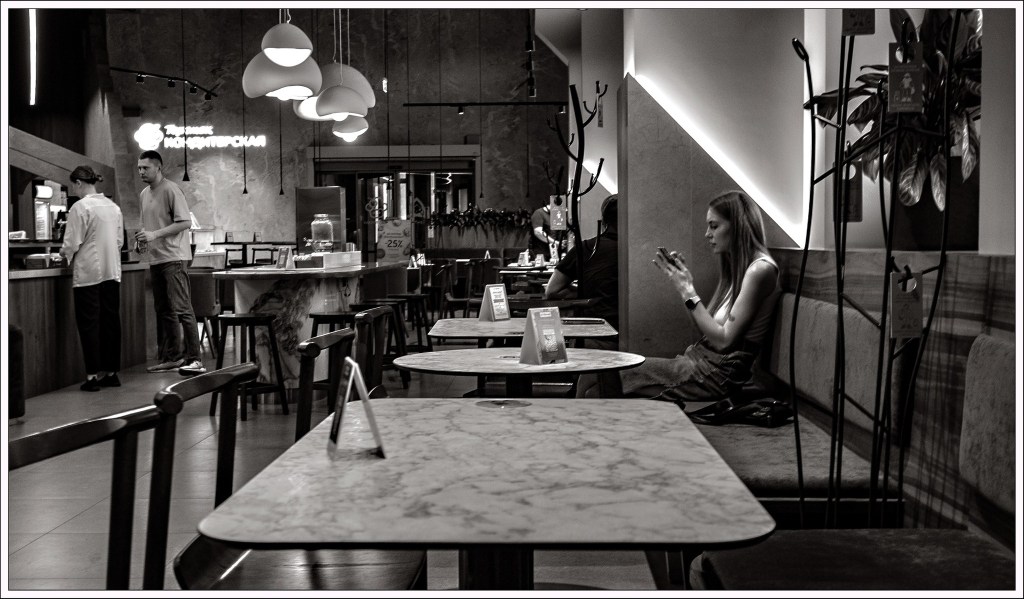
Sergei Podgorkov, A Cafe on Vasillievsky Island (St. Petersburg). Source: Facebook
[…]
Living their best life
And here, the reader will stop for a second and most likely ask the question — but what about Russians, don’t they want the war to stop?
And the answer is most likely no.
Recently, I fell into a rabbit hole, watching videos posted by ordinary Russians on Instagram. It all started when on Twitter (X), people began discussing a post by a Russian blogger who wrote that Moscow is beautiful, sprinkling it with hate speech.
The blogger, who clearly was working with the local government to promote Moscow, basically said that the Russian capital is the best city in the world because it’s clean, everyone is happy, and there are no homeless people and “LGBTQ+ propaganda.”
Displaying a rainbow flag is a criminal offense in Russia.
I went to his page and looked at the videos he was posting. And then some more videos from people living in Moscow.
For a person living in Kyiv, bombarded on a nearly daily basis, this was a very interesting dive. Watching those videos, you would never think that their country is at war.
Moscow has experienced a few waves of transformation since 2022.
Before the start of the all-out war, Moscow was thought to be the most liberal Russian city. The Russian capital harbored people with higher education and better income. Opposition activists were living their lives in Moscow cafes. Late opposition leader Alexei Navalny even once ran in the city’s mayoral election and gained a substantial number of votes.
As soon as the all-out war started, there were even some protests in Moscow, and some members of the local art and culture scene, those who traveled abroad and saw the world, were not supportive of their country’s slide into totalitarianism.
Still, Moscow was far away from the war. Cafes were still packed and people’s day to day, if they weren’t in active opposition, only changed insignificantly.
In late 2022, this changed. When Russia faced one military defeat after another, the local government was instructed to make the war felt in Moscow.
Moscow Mayor Sergey Sobyanin, who at first deliberately distanced himself from the war effort, was now traveling to the Russian-occupied regions of Ukraine, and banners depicting Russian soldiers appeared on the city’s streets.
The 2022 Russian forced mobilization campaign saw police grab people from Moscow’s streets and send them to fight in Ukraine.
Hundreds of thousands of Russians, most of them from major cities such as Moscow, left the country. Some of them for good.
Soon after that, Moscow changed once again. Since late 2023, Russia has been on the offensive. Those who were against the war or actively opposed it are no longer in the country. The Kremlin also has enough troops and hardware to continue the fight indefinitely. It doesn’t need to rely on forced mobilization — instead, it uses high wages to lure volunteers.
It doesn’t need to shove the war in the face of Moscow residents, especially those who do not care. The government is now deliberately shielding the residents of its most important metropolis from the hardships that a war can bring.
Bars, cafes, concerts, new metro stations, international football stars visiting the city, and playing friendlies with the local players who are banned from international competitions. People are living their best lives, while their compatriots, friends or even relatives are murdering civilians in Ukraine.
Watching the videos from 2025 Moscow is a surreal experience. I can’t stop thinking that it must be similar to what life was like in Berlin in 1941 for those who didn’t care about the atrocities their country was committing.
Source: Oleksiy Sorokin, WTF is wrong with Russia? newsletter (Kyiv Independent), 17 July 2025. This post is dedicated to Nan Kim, who has supported this website with a monthly donation for the last two years. I would like to apologize to her for posting so infrequently in the past few months. The work-at-home jobs which over the last eighteen years also afforded me the time and space to produce this website have dried up or disappeared altogether (along with all other donations to this website), so I have had to take work that keeps me away from home most of the day nearly every day. This extreme slowdown in producing this blog is not necessarily a bad thing for me personally. Among other things, it keeps me from asking the question Oleksiy Sorokin asks at the top of this entry: don’t Russians want the war to stop? \\\ TRR
On Friday, May ninth, Treptow Park was perhaps the most heavily guarded place in Berlin. Hundreds of police officers kept the peace at Germany’s most famous memorial to Soviet soldiers on the day Russia marked the eightieth anniversary of the end of the Second World War in Europe, known as the Great Patriotic War in the Soviet tradition. Because Russia has employed symbols of that earlier war in its current war against Ukraine, visitors were banned from displaying or wearing Soviet and Russian flags, military uniforms, and St George’s ribbons at the Berlin memorial this year. An exception was made for veterans and diplomats.
Soviet May ninth traditions and German pacifists
At about half past ten in the morning, a wreath was laid at the monument to the Soviet soldier by Russia’s ambassador to Germany, Sergei Nechayev. The day before, when Germany remembered the Wehrmacht’s surrender and the end of the war, Nechayev and the Belarusian ambassador were not invited to the memorial event at the Bundestag. In his speech, German President Frank-Walter Steinmeier thanked the Allies for liberating his country and recalled the Red Army’s sacrifices, but harshly criticized Russian attempts to justify the war in Ukraine in terms of the fight against the Nazis in the Second World War.
The flood of people in Treptow Park seemed endless: hundreds were there at any one time, and thousands came and went over the course of the day. Many brought scarlet carnations, while some bore wreaths. Russian and German were heard. Most of the visitors were elderly—immigrants from the former USSR living in Germany and Germans. There were also many leftist and ultra-leftist German political activists brandishing placards opposing NATO and calling for “peace with Russia.”
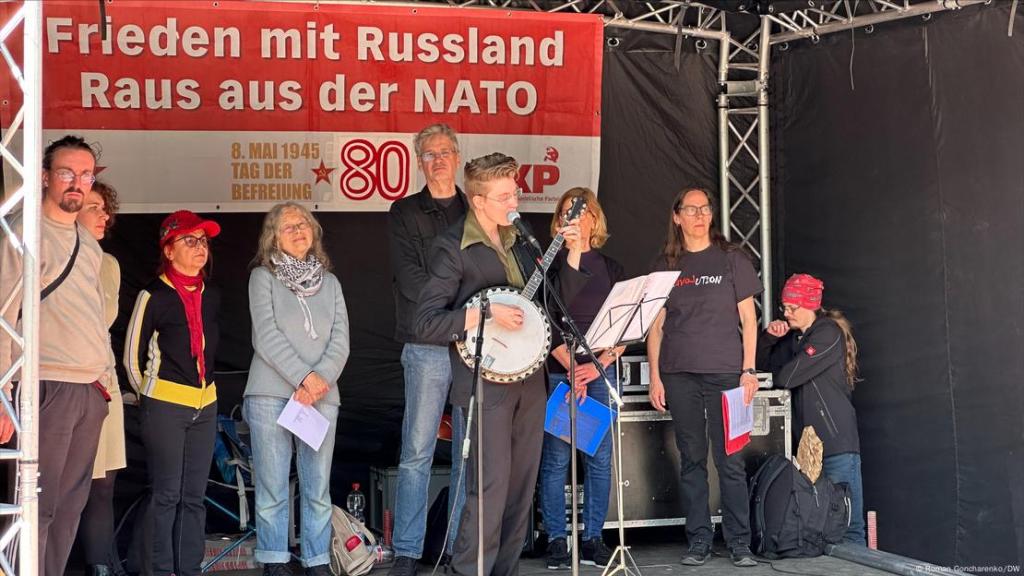
German ultra-leftists rally for “peace with Russia” and Germany’s exit from NATO, 9 May 2025. Photo: Roman Goncharenko/Deutsche Welle
Against this backdrop, the scene resembled a mixture of a traditional Russian May ninth celebration and a political protest by German pacifists, many of whom had clearly lived most of their lives in the GDR.
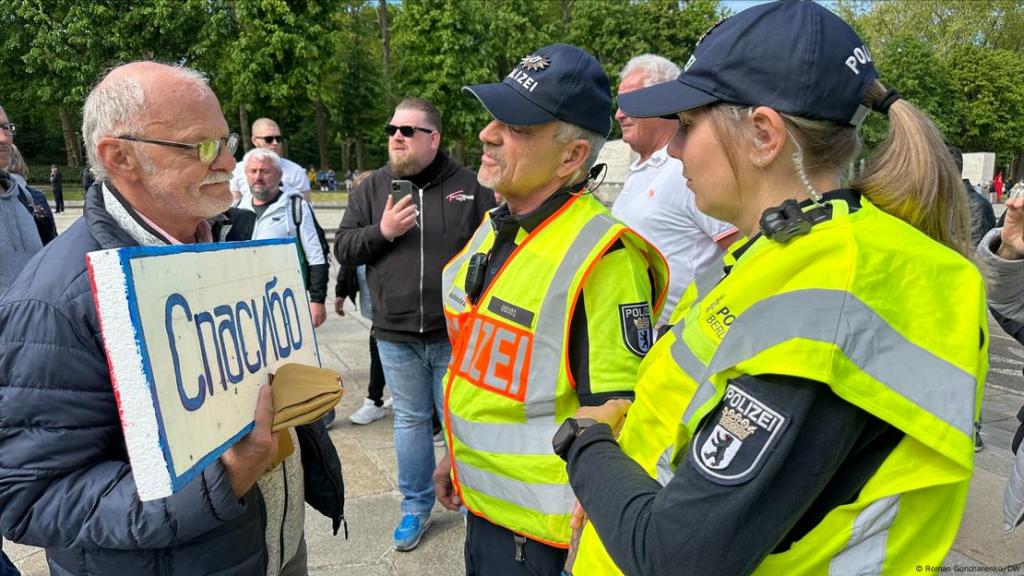
“I was a policeman in the GDR,” said a man in his sixties who held a placard that read “Thank you” in Russian. The policemen asked him to doff his Soviet cap, which sported a red star and a St. George’s ribbon.
“All people want peace, so the politicians should don their own military uniforms and crawl into the trenches,’ the man said.
Soviet wartime songs sounded from loudspeakers and were played live. One man, aged forty-five, climbed atop a mound to get a better view, but a policeman asked him to get off the lawn, explaining, “This is a grave.” The man cursed in Russian but climbed off the mound.
Another man played played “Arise, Great Country” on his clarinet. When he began quietly playing the melody of the Soviet and Russian national anthem, the police literally took him aside, after which he returned to the group of people who had gathered. They were outraged at the restrictions that had been adopted. From time to time, someone chanted “Russia, Russia!” and many other people would join in.
An ex-East German police office (holding a sign that says “Thanks!” in Russian): “All people want peace.” Photo: Roman Goncharenko/Deutsche Welle
Bikers in Treptow Park
Your correspondent saw men and a woman in leather jackets who looked like bikers from the Russian motorcycle gang Night Wolves. They were in small groups and were escorted by a large number of police officers. They posed for pictures in front of the wreaths and left. They could have been someone from a local “support group.” The Berlin press had written that only a small group of bikers made the trip to Berlin to visit the Soviet memorials this year. No incidents had been reported as this article went to press.
Treptow Park, 9 May 2025. The crimson and gold banners at the back of the crowd are inscribed with the names of the various “fronts” in the Red Army’s campaign against the Wehrmacht. Photo: Roman Goncharenko/Deutsche Welle
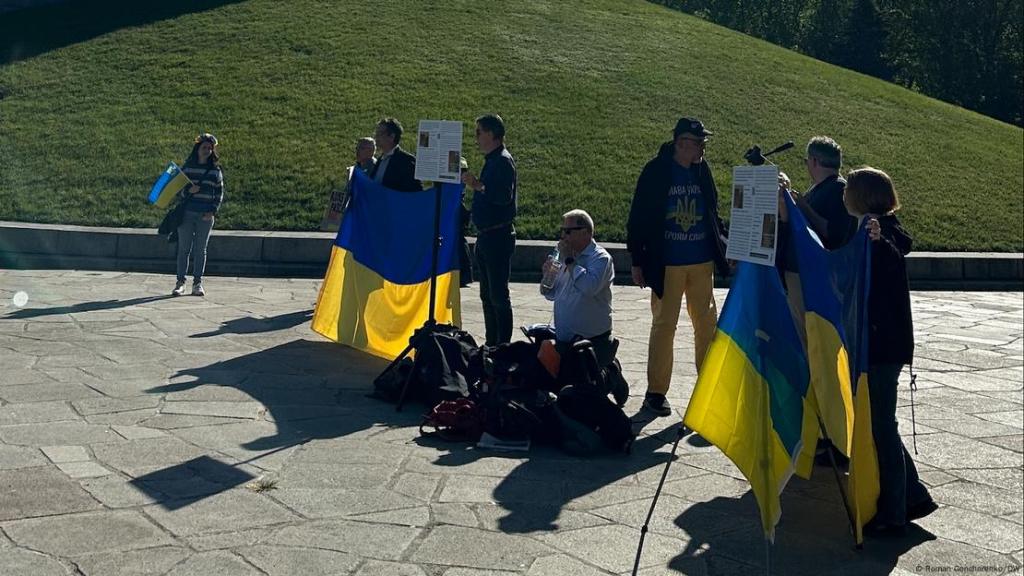
For the first half of the day, at least, things seemed relatively calm. Your correspondent had the impression that most people had come to Treptow Park not for political reasons, but to commemorate the war. And yet the atmosphere was tense. To the right and left of the monument to the Soviet warrior stood a dozen and a half activists holding placards and the flags of Ukraine and NATO.
Activists with placards and Ukrainian flags at the monument to Soviet soldiers in Treptow Park, 9 May 2025. Photo: Roman Goncharenko/Deutsche Welle
They said they wanted to draw attention to the Ukrainian Red Army soldiers who had perished in the Second World War, as well as to Russia’s war against Ukraine.
“I am here to prevent this event from being turned into a Russian propaganda stunt,” said a woman, aged thirty-five. According to her, insults had been hurled at her and the pro-Ukrainian activists.
“Some people regard our presence here as a provocation,” said the woman. “We are not here to change anyone’s mind, but to make Ukraine visible.”
One of their posters read: “Russia has usurped the memory of May eighth and ninth. But it was not Russia who liberated us from the yoke of National Socialism eighty years ago in Berlin. It was the Red Army, in whose ranks many Ukrainians served.”
The poster tells the story of Ukrainian soldier Fyodor Karpenko, who left his name on the walls of the destroyed Reichstag building in May 1945.
Since the Maidan uprising and Russia’s illegal annexation of Crimea in 2014, Kremlin propaganda has consistently portrayed Ukrainian leaders as Nazis or fascists. Russia also accused the Ukrainian authorities of “genocide” of the population of Donbass. On 24 February 2022, while announcing the full-scale invasion, the “denazification” of Ukraine was presented as the primary goal of the war, which is itself portrayed merely as a continuation of the Great Patriotic War: a conflict embedded in a cyclical conception of time in which Russia, eternally under threat from a Western enemy, fights for its very survival — on Ukrainian soil.
On the ground, there is no evidence to support Moscow’s accusations: nobody has ever documented a “genocide” against ethnic Russians or Russian speakers, whether in Ukraine or elsewhere. As for the Ukrainian far-right, its political influence remains minimal: in the 2019 parliamentary elections, the main ultra-nationalist parties, running together on a joint list, received just over 2% of the vote, well below the threshold required to enter Parliament. In short, the image of a “Nazi regime” in Kyiv is based on a glaring mismatch between rhetoric and reality.
So why do the Russian authorities repeatedly invoke references to the Second World War — or, in Russian parlance, the “Great Patriotic War” — when speaking about Ukraine? Understanding this memory dynamic is essential to grasp the power of a rhetoric that, despite lacking any factual basis, continues to shape the official Russian worldview.
The Soviet and Russian insistence on using the term “Great Patriotic War” to refer exclusively to the period from 1941 to 1945 erases the twenty-one months that preceded Nazi Germany’s invasion of the USSR. Between the Molotov–Ribbentrop Pact of August 23, 1939, and Operation Barbarossa on June 22, 1941, Moscow and Berlin were de facto allies: they engaged in extensive economic cooperation, diplomatic coordination, jointly invaded and partitioned Poland in September 1939, and the Soviet Union proceeded to annex the Baltic countries and wage war against Finland. By reducing the war to the period 1941–1945, the USSR and Russia could deny any responsibility in the outbreak of the Second World War and present itself solely as the victim of Nazi aggression and the primary liberator of Europe.
The Great Patriotic War — and especially the victory in 1945 — became the founding event of Soviet history and the cornerstone of collective memory. Yet this memory, often portrayed as monolithic and universally shared, is anything but uniform. A Ukrainian from the west, who endured two successive occupations between 1939 and 1944, remembers a war very different from that of an eastern Ukrainian, whose experience was shaped primarily by Nazi destruction. The memory of a Russian bears little resemblance to that of a Crimean Tatar, who was deported along with his entire community and denied the right of return for decades. As for Soviet Jews, whose families and communities were annihilated in the Holocaust, they were long forced to remain silent — official narratives left no room for the specificity of their suffering.
The collective experience of the war and the official discourse surrounding it deeply reshaped the Soviet population’s understanding of “fascism” and “antifascism.” Rather than referring to a specific political doctrine of the inter-war period, the term “fascism” had become a catch-all label for the ultimate enemy. Trotsky or the British Conservatives could just as easily be branded as “fascists,” as well as domestic and international opponents after 1945 — including even the Chinese Communists. The word “Nazi” itself was rarely used. In everyday life, calling someone a “fascist” served more as the gravest possible insult rather than as a statement of ideological substance.
Under Vladimir Putin, the cult of the Great Patriotic War has been revived. Following the pro-democracy protests of 2011 and Putin’s bid for a third presidential term in 2012, the regime instituted a deliberate policy of historical narrative construction, aimed at grounding its legitimacy in a vision of the nation as under siege. The glorification of the 1945 victory also allowed the regime to purge collective memory of its specifically socialist elements: by retaining only the narrative of national triumph, the Soviet period could be seamlessly integrated into a continuous national history without any revolutionary rupture. At the same time, the rehabilitation of Joseph Stalin as a legitimate victor served to validate autocracy. The mass repressions and genocidal policies that claimed millions of lives were reframed as a tragic but necessary step: they had made the USSR a global superpower, capable of defending civilization against the “brown plague.”
The Kremlin has multiplied its legal instruments to enforce this narrative. Since 2020, the Russian Constitution mandates “respect for the memory of the defenders of the Fatherland” and prohibits “diminishing the importance of the heroism” of the Soviet people. In April 2021, Putin signed a law increasing penalties for “insults” or “false claims” about the Second World War and its veterans. In December 2019, Putin himself gathered some leaders of post-Soviet states around a pile of archival documents that he said proved historical truths long ignored in the West — selectively quoting them to justify, in retrospect, the USSR’s annexation of Poland and the Baltic states. In this way, Putin has weaponized history, which has become inseparable from national interest. To challenge his interpretation is tantamount to treason.
Every year on May 9, Russians march in the Immortal Regiment carrying portraits of relatives who fought between 1941 and 1945. Increasingly, the faces of those who fought — or died — in the war against Ukraine are added to these ranks, as though both wars were part of a single, endless struggle. Past and present warfare are merged, and the victory of 1945 becomes the lens through which all events — past, present, and future — are interpreted in a continuous historical timeline. This symbolic fusion also explains the surreal images of Russian occupation forces who, in recent weeks, have placed propaganda banners in destroyed Ukrainian cities. An uninhabitable Bakhmut was transformed into a stage for celebrating the 80th anniversary of Russia’s victory in the “Great Patriotic War.”
The cult of victory is not only a central element of the Putinist imaginary — it functions as an operating system for both domestic governance and external aggression, with all of Russia’s actions on the international stage framed as part of an eternal war against fascism. A telling example of this is the installation of a giant screen on the Estonian border, broadcasting Victory Day celebrations in a loop — an attempt to remind Estonians, as well as Latvians and Lithuanians, that the Soviet victory represents an unassailable moral superiority. In the Russian collective imagination, the word “fascism” has lost all connection with a specific political ideology and now refers only to an abstract, absolute threat: the desire to destroy Russia. It has become synonymous with “enemy” or “Russophobe,” always denoting the Other, never a historically defined movement. This separation between word and meaning allows the regime to simultaneously glorify the antifascist victory and openly promote xenophobic, homophobic, or ultraconservative rhetoric, without any perceived contradiction.
The word “denazification,” used by Vladimir Putin on February 24, 2022, to justify the invasion, initially puzzled many Russians, most of whom were unfamiliar with the term in this context. Shortly afterwards, the state news agency RIA Novosti published an article by Timofey Sergeytsev — “What Russia Should Do with Ukraine”— aimed at clarifying its meaning: “denazification” was described as a “total cleansing,” targeting not only alleged Nazi leaders but also “the popular masses who are passive Nazis,” deemed guilty of having supported the “Nazi government.” According to Sergeytsev, modern Ukraine is able to hide its Nazism behind aspirations for “independence” and “European development.” To destroy this Nazism, he argues, is to “de-Europeanise” Ukraine. In this logic, denazification becomes synonymous with eliminating all Western influence from Ukraine and dismantling the country’s existence as a nation-state and a distinct society. Incubated on official state platforms, this narrative reveals the true scope of “denazification”: a large-scale project aimed at erasing any trace of Ukrainian singularity, a blueprint for the genocide.
The article recently published on the official website of the Russian Foreign Intelligence Service (SVR), entitled “Eurofascism, Today as 80 Years Ago, Is a Common Enemy of Moscow and Washington,” strikingly illustrates the expansion of the “denazification” discourse far beyond Ukraine. The accompanying image depicts a grotesque hybrid monster: its body is shaped like a black swastika with the EU’s circle of stars in the centre, while its head is a caricature of Ursula von der Leyen. The creature, with its blood-stained claws outstretched, is caught between two bayonets — one American, the other Russian/Soviet. This grotesque image is not merely a provocation: it reflects a narrative deeply entrenched in Russian state propaganda, where “Eurofascism” becomes an operational concept encompassing all European societies.
“Eurofascism, Today as 80 Years Ago, Is a Common Enemy of Moscow and Washington.” Screenshot courtesy of Meduza
The 2022 tipping point revealed these discourses for what they truly are: the ideological foundation of a large-scale invasion, long prepared within the informational sphere. Today, part of European society — particularly elements of the pacifist left — is falling into the same trap: underestimating or ignoring the ongoing propaganda dynamic. But the machine is already in motion. The language of fascism is being broadened daily to include new designated enemies, and the ideological war is shifting: it is no longer stopping at Ukraine — it is now targeting all of Europe. In the face of this brutal reconfiguration of the official Russian narrative, complacency or passivity have themselves become forms of strategic blindness.
Russia’s consolidated military registration registry website, Reestrpovestok.rf, is fully operational. On Friday, 9 May 2025, the human rights project Get Lost, which helps Russians avoid conscription into the army, reported that the notifications that it was operating in test mode had disappeared from the website, and the online resource appeared to have been fully launched.
Upon arrival on the website, users can log in to their personal accounts, check summonses, and obtain copies of records. Earlier, the website indicated that it was functioning in beta mode only in three regions—Sakhalin, Ryazan, and the Republic of Mari El. This notification has now disappeared.
“So far no one who has received a summons through this site or faced automatic restrictions has contacted us,” the human rights activists added. The registry’s launch has not been officially announced.
Recipients of summonses to face restrictions if they fail to report to military recruitment center
The law establishing a consolidated registry of persons subject to conscription and introducing electronic summonses was signed by Russian President Vladimir Putin in April 2023. The text of the document, in particular, states that conscripts who do not report to a military enlistment office within twenty days of receiving a summons may be prohibited from registering as an individual entrepreneur, registering vehicles and real estate, driving a vehicle, and getting a bank loan. In addition, they will not be able to leave Russia until they report to a military enlistment office.
A screenshot of the military enlistment summons website, outlining the penalties imposed on Russians who fail to respond.
The full-fledged launch of the electronic summonses registry was planned for last autumn, but was subsequently postponed.
The registry contains data on all Russian nationals who are already registered and are subject to military registration, as well as those who are not yet registered but are obliged to do so. Lawyers stress that the law and the decree apply to the delivery of any summonses, both for compulsory service and to clarify military registration status, and as part of the wartime mobilization, which Putin has not yet signed a decree to end.
This data will be collected from military enlistment offices. The decree digitizing their databases was signed by Putin back in November 2022. As Defense Ministry officials told the Federation Council, various databases are used for this purpose, including those of the Interior Ministry, the Federal Tax Service, civil registries, and pension funds.
“We love and miss Berlin so much that we decided not to wait until we find ourselves there again . . .” Samotechnaya Square, Moscow, April 2025. Photo: anatrrra (used with their permission)
Despite being hit with unprecedented Western sanctions, the war with Ukraine has been accompanied by a noticeable increase in the well-being of Russians. A new study has revealed the extent of the domestic feel-good factor, with economists at the Bank of Finland Institute for Emerging Economics (BOFIT) finding the level of Russians’ satisfaction with their household and personal circumstances has hit its highest in a decade.
To understand how the restructuring of Russia’s economy during wartime affected Russians, economists Sinikka Parviainen (BOFIT) and William Pyle (Middlebury College, USA) used data from the Russian Longitudinal Monitoring Service (RLMS), which has been conducted by the Higher School of Economics almost every year since the 1990s. This research tracks the economic well-being of Russian households and individuals with a sample size of around 6,000-8,000 households and 17,000-21,000 people.
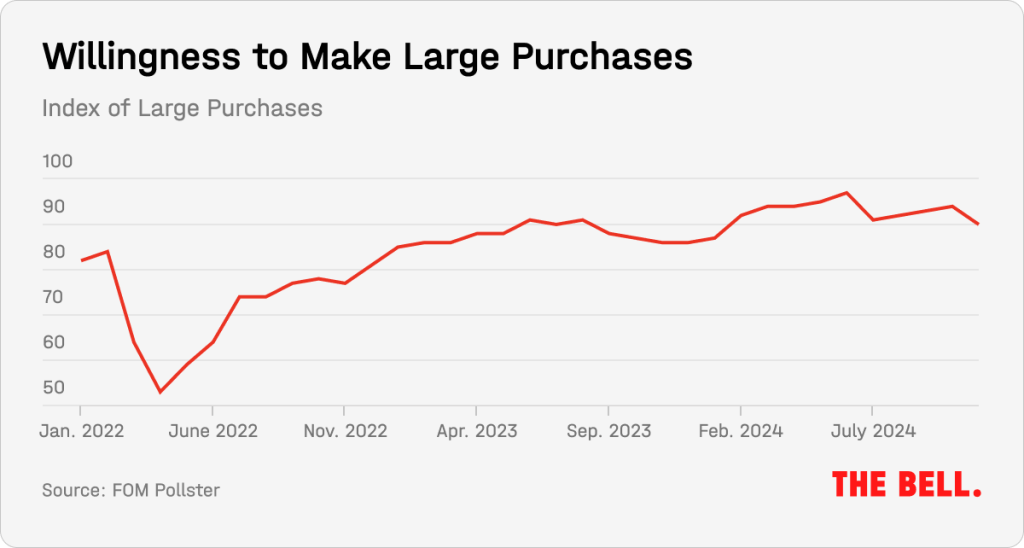
The economists looked at RLMS data from 2013-2023, scrutinising responses to the questions: “how satisfied with life are you right now?” and “how satisfied with your financial circumstances are you right now?”. They also looked at whether households had made large purchases over the past year, how much they spent on cultural events and how long they could maintain their current lifestyle if they lost their main source of income.
They concluded that the first two years of Russia’s invasion — 2022 and 2023 — saw the highest levels of general satisfaction, and specific financial satisfaction had also returned to 2014 levels for the first time. That year is seen as a benchmark before Russia was plunged into an economic crisis following the annexation of Crimea, imposition of Western sanctions and an oil price crash.
Large purchases fell to a minimum in 2022 but demand for non-food goods has since increased faster than inflation and wages, in line with The Bell’s earlier calculations. There was also a sharp rise in the proportion of households spending money on entertainment: in 2023 this reached 2018 levels, the researchers noted. The number of respondents who said they would be able to last more than a few months on their savings reached a 10-year high.
These findings correspond with Russia’s official statistics which also point to improved financial circumstances since the start of the war. In 2023, real incomes in Russia not only returned to 2013 levels after a decade of lost living standards, but surpassed the pre-Crimea level by 5%, the researchers highlighted.
There are no surprises as to the cause — a huge increase in state spending on the invasion and the military-industrial complex that has driven record labor shortages and pushed wages up across the economy. The high salaries offered by the state to people sent to work at the front, as well as those paid to soldiers (from 200,000 rubles a month) have played a big part, and the main winners have been residents of Russia’s poorest regions, which have recorded an unusually sudden increase in bank deposits.
Why the world should care
Putin’s regime is unlikely to face any internal threat as long as Russians’ well-being and overall happiness is on the rise.
KVS, “SouthTown: The Olympic Quarters” (YouTube, 8 June 2021)
Today’s developers pay no less attention to creating comfortable residential environments in their projects than they do to configuring apartments, for example, and sometimes they pay even more attention to this.
In recent years, the concept of beautifying the area around residential buildings has been transformed from elementary landscaping of yards and equipping playgrounds to creating theme parks within residential complexes, divided into different activity zones, as well as designing additional spaces where residents of the neighborhood can gather, get acquainted, relax, play sports, and organize their own or their children’s leisure activities.
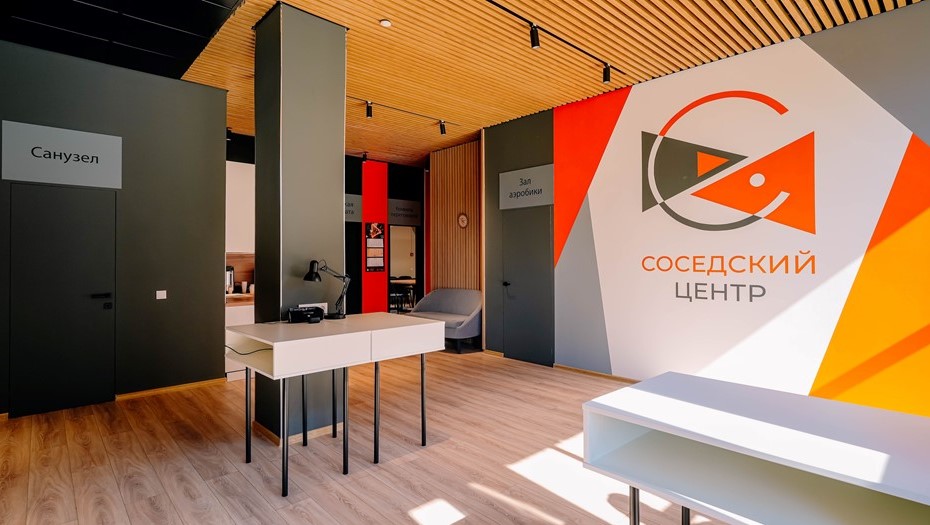
The role of such spaces is most often played by neighborhood centers, and planning these centers has recently become a real trend among developers.
The neighborhood center at the SouthTown development, designed by Anton Rudnik. Photo: KVS Group, via Delovoi Peterburg
The reasons
Residents of apartment buildings have always needed to socialize and spend time together. Back in Soviet times, people would often gather in courtyards to play dominoes, bingo, and table tennis. At some point the tradition was lost, but after the restrictions imposed during the Covid-19 pandemic were lifted, it literally sparkled with new colors.
In their article [sic: no link in the original] on communities, neighborhoods, and neighborliness, researchers from the Higher School of Economics noted that the first contemporary attempts to unite people living near each other into groups were especially noticeable after 2015, when people all over Russia began celebrating Neighbors Day. From a holiday in the classic sense of the word, Neighbors Day has quickly evolved into a multifaceted know-how for working with residents and getting them involved in such community work as spring cleanups and decorating yards for the New Year’s holidays.
With the emergence of urban agglomerations and the integrated development of new estates by developers, the need for communication among the people living there has increased. There is a logical explanation for this. In her time, Birgit Krantz, a Swedish sociologist, architect, and expert on neighborhood relations, argued that the ideal apartment complex contains between fifty to eighty apartments. If a complex has more apartments, it is difficult to manage it and maintain good neighborly relations.
There are many more apartments in new large residential projects, however, even if they are low-rise developments. This is where neighborhood centers come to the rescue. Consequently, they have become an integral part of people’s everyday lives in entire neighborhoods, functioning, per the American sociologist Ray Oldenburg, as “third places” (between home and work or school), as social anchors which facilitate creative interactions among individuals.
A clear demand
Today, the neighborhood centers running in new residential neighborhoods are literally bustling with life, and they are usually open seven days a week from early morning to late evening.
Delovoi Peterburg talked to residents at the KVS Group’s SouthTown development, where such a neighborhood center has been up and running for over six months. The center offers sports classes; clubs for children, including preschool prep; nanny services; rooms for business meetings and negotiations; and movie screenings. A puppet theater also periodically comes to the center on tour, and a planetarium was once even recreated in the space.
According to Anzhelika Alshayeva, director general of the KVS Real Estate Agency, all activities were free of charge for residents during the center’s first three months of operation; the tab was picked up by the developer. Now, the cost of classes is only 200 rubles, and the interest of residents continues to grow. With this in mind, the decision was made to launch the second stage of the neighborhood center — a teen club, which will be equipped with ping-pong and billiards tables, which will undoubtedly appeal to local youngsters.
The teen club at the neighborhood center in the SouthTown development, designed by Anton Rudnik. Photo: KVS Group, via Delovoi Peterburg
An important social role
Most importantly, such neighborhood centers, in addition to creating stable communities of around particular interests and hobbies, offer residents various opportunities for professional and personal growth. As practice shows, neighborhood residents themselves provide professional services, working as nannies, coaches, and teachers. Thus, another important issue for the neighborhood as a whole — job creation — is solved. And the concept of the 15-minute city is implemented in the particular housing complex: without leaving home, a person can comfortably take advantage of the full range of social services and work in the same place.
In this sense, co-working spaces can be an important component of neighborhood centers, serving not only as a pleasant but also as a useful feature for buyers and future residents. In addition, a co-working space can potentially generate revenue, thus covering the costs of its own upkeep.
And it does not necessarily have to be a classic room with computers and a coffee machine. For example, in the aforementioned neighborhood center, in the amphitheater of Olympic Hopes Park, the developer decided to create a beauty co-working space — a space with work areas which can be leased by beauty industry professionals. The project promises to be an important element of the neighborhood’s infrastructure, contributing to the growth of small business and strengthening the local community. This comprehensive approach to neighborhood development and neighborly relations was also recognized by Delovoi Peterburg, which awarded it the newspaper’s award for Residential Environment Project of the Year in Creating Versatile and Comfortable Neighborly Infrastructure.
The beauty co-working space at the neighborhood center in the SouthTown development, designed by Olga Fedotova. Photo: KVS Group, via Delovoi Peterburg
When speaking about the importance of neighborhood centers for residential developments, the experts interviewed by Delovoi Peterburg generally voiced confidence that adding such facilities to residential developments does not make projects much more expensive, but it can increase an an apartment’s per meter cost, as well as make a developer stand out from the competition. The experts recognized that the trend toward neighborliness, according to psychologists, will continue to grow, especially among residents of new neighborhoods.
Kirill Medvedev,* a poet, publisher, and member of the band Arkady Kots, left Russia in 2023 and returned in late 2024. At Republic Weekly’s request, he explains his winding road, what Moscow looks like when one hasn’t seen it from the inside for a long time, and what remainers have to say about leavers.
After a year and a half of living in other countries for personal (but, of course, political) reasons, I have been living in Moscow for several months now. Despite certain risks, I really don’t want to leave, and I am terrified of everything having to do with living in exile. I’m willing to speak in allegories or even to keep silent altogether just to be able to live in my hometown. Although what could be more important than waking up in the morning and smacking the Putin regime in the face without pulling your punches?
Everything in Moscow is still familiar and homely. I am indifferent to Sobyanin’s renovations. Things have improved in some places, while in other places it’s the reverse. Half-abandoned spots have suddenly emerged even in the most expensive neighborhoods, as if the money had suddenly been hoovered out of them. I’m certain that’s literally what happened.
I don’t see any particular feasting amid a plague, but I guess I’m just not hitting the right spots. Moscow has become more desolate and wild on the whole. When the capital is finally moved to Siberia, the Moscow I know and love will look even better. But for now, it is still what it is: a crazy quilt fashioned from Eurasian chaos, absorbing a million shades of the glitz and poverty of the entire country and its neighbors, and tempting us with new revolutions somewhere in its squares and back alleys.
All of Russia can be found in Moscow, and yet, as everyone knows, Moscow is not Russia. Thanks to this fun fact, it is easier for Muscovites than for anyone else to love the entire country, albeit an imaginary and unfathomable country, shaped from different scraps. “I stand as before an eternal riddle, / Before a great and fabulous land,” sang one remarkable Muscovite. I repeat another poet’s line about another city, thinking that love for one’s capital city and one’s country is an enormous, complicated privilege: “May it not be my lot / To die far away from you.”
Online public communication habits have actually changed a lot because of the risks involved. It no longer feels like your event didn’t happen if it wasn’t written up online and if you didn’t post a photo of yourself with a crowd of happy spectators.
There are [now] more personal channels of communication within communities and more word of mouth. Reactions are more reserved in public and more emotional among friends. Pardon my sentimentality, but there is little to compare with physical hugs with friends and family in a city charged with your own and other people’s memories.
Of course, there are a lot of new problems, and I’d rather deal with some variety of internet addiction than the nightmare in which everyone has found themselves. And yet there is the perception that the war has ushered in the degradation of all ways of living in Russia. This is not true. Humans are ultra-creative and crafty creatures. Violent shocks do not neutralize life but propel it into new forms. A caveat: no new ways of living and creating can justify the mass murder of people who will never wake up to life again. But cultural, activist, educational, and other communities who persist and change, albeit semi-clandestinely, albeit at the cost of compromise or risk, increase our chances of transitioning to a different way of living in this country in the future. The more allies we have here at home now, the more likely they are to be in the right place at the right time—that is, if the first flights our friends who have been shoved out of the country plan to take are delayed a bit.
Irony or irritation towards the people who have left [Russia] for one reason or another is evident among almost all those who have stayed, except for those who are definitely planning to leave. One of the frequent complaints is “They left to live in safety, and they did the right thing—they just shouldn’t pass it off as a political act.”
That is true, though with many caveats. Bravo, of course, to the activists who have been helping people who have to leave to get out of the country and to adapt to life abroad. Bravo to the journalists who have moved to relatively safe places and continue to fulfill their professional obligation to their fellow citizens. Regular albeit serious news, reported with respect for themselves and the audience, without unnecessary harshness (“so that you can send it to your grandmother”) is needed desperately: almost everyone talks about it. But pessimism and aggression about life inside the country on the part of fellow citizens who have left the country is completely out of place. It is clearly old-fashioned exile self-therapy and should be practiced in private.
While the demand for alternative information is great (many people in the USSR who were not necessarily anti-Soviet also listened to Voice of America), one can see skepticism or simply a lack of interest in émigré politics. Why is this the case? There seem to be many examples in history when political émigrés came back home, were involved in great transformations, or even spearheaded them. Escaping from prison in Russia, making one’s way abroad, drinking to a successful adventure with comrades in Geneva, discussing future strategies in a relaxed atmosphere, and soon returning home to work underground was a typical trajectory for Russia’s radical democrats in the early twentieth century.
Things have changed since then, although today many also travel back and forth. You can talk at length to those who have stayed in Russia about the hardships of emigration, and they will agree and sympathize with you, especially if you were actually in danger here at home.
For the most part, though, people still see someone else’s moving abroad as their means of upgrading their private existence.
By renouncing your past life, it is as if you automatically renounce your past community. The propaganda, of course, does its best to inflate the resentment, but it’s not just propaganda at work. Emigration is indeed an experience of constant self-denial. Especially today, when Russian emigrants are so evidently prodded (gently and not so gently) to cancel themselves in terms of of their citizenship, background, language, identity, or even flag. Moreover, the reanimated ethical-religious discourse of the Cold War, with its confrontation between good and evil on a global scale, has played a considerable role in this.
The field where dialogue should have taken place between leavers and remainers, as well as between moderate oppositionists and hesitant loyalists, has been overrun by moralizers in proverbial white coats and rabid patriots. They are the dividers and conquerors.
The leavers more often argue in terms of negative freedom—freedom from censorship, political crackdowns, and military mobilization, from having to indirectly finance the war or live among its supporters. The remainers stay because they do not see how they can realize themselves abroad, at least not without the sort of superhuman effort and self-denial that many of them find more frightening than living under the threat of arrest or self-censorship. They often speak of duty—to elderly relatives, students, patients, voters, political prisoners, the graves of relatives, the homeland, etc. And they often hear in response that it is immoral to be involved in the normalized life in today’s Russia. The ethical conflict is evident.
I wander the Pokrovkas and the Ordynkas, thinking about where I can get money to pay the bills and pay off my debts. There are posters calling for men to sign up for the army. Somehow I don’t feel more upstanding than the guys who go off to kill for money. I would definitely not go to do that, but this certainty does not raise my moral self-esteem. I think of an old comrade who perished in the “special military operation.” His debts, low social status, and leftist anti-western ressentiment had blossomed into imperialist obfuscation.
I sit in a cafe, thinking about my plans. The people around me talk about different things, while people in a neighboring country are bombed in our name.
I’m good at displacing unpleasant things. We all are good at it.
Being here, dissolving into this life, it is difficult to feel like a member of an ethics committee. It’s easier to realize that all people are basically the same, that there are no insuperable differences between them. All our actions (whether ordinary, shameful, or magnificent), all the passivity of the masses, all the revolts of nations, are manifestations of the same human principle in different historical circumstances. The way humanness manifests itself in our present circumstances, the way my own humanness manifests itself in them, is the most interesting thing to observe. Okay, we’ve established that.
No, of course, there is a huge difference between opposition to evil, passive non-participation, and complicity in it. Putin’s propagandists have been blurring the distinction between the first, second and third to depoliticize and morally degrade society. We know this, and you can’t fool us. In both the secular and Christian systems, a person always has a choice and a responsibility for it. We should not see the individual as a unwilling victim of want and propaganda. But something else is also true: even if you believe that you have made your own super-correct moral choice once and for all, endlessly judging your neighbor, or believing they are made of some qualitatively different stuff than you, or finding them complicit in collective guilt without trial is also a quite devilish temptation, akin to the temptations proffered today in our country by various spiritual and political leaders.
Political evil is countered not by personal virtue, and even less by moralistic posturing. It is countered by political or civic ethics, but our country has a huge problem with that.
All the debates between the leavers and the remainers, all the debates over the slogans “peace now” vs. “war until the dictatorship’s defeat,” all the debates about whether Navalny should have returned to Russia, revolve around the missing answer to the ethical (aka political) question: for what are we willing to risk our private lives, for what collective ideals?
I certainly don’t have a clear answer. Russia is long past the heroic times of liberalism and socialism, when people believed that civic heroism was not weak-mindedness or recklessness, but a deliberate, mature step toward a better future. Popular willingness to take to the streets against war and dictatorship is impossible without the conviction that we are on the right side of history, that we are in a movement that both overlaps with and transcends our private interests.
The Bolsheviks believed in communism’s inevitable advent on a global scale, and were able to convince many people this would happen, which was why they won. In 1991, Russians believed that by defending the [Russian] White House and confronting the coup plotters’ tanks, they were leading Russia onto the road of progress which all democratic nations were already rolling down. Whether we like it or not, Russia is not ready to follow any well-trodden path. There is no single road anymore: the road is just going to have to be paved anew. (I’m reckoning on this.)
Today we see a faint glimmer of hope in republicanism, with its idea that community spirit is not a consolation prize for people who lack professional fulfillment and personal happiness. It is not reducible to a professional or personal virtue and is not a profession itself.
Anyone willing to stand with others to oppose tyranny and then work every day to prevent it from happening again is capable of demonstrating civic valor. And the brighter, bolder and more constructively a person commits to this work, the more they make use of their professional, creative and other kinds of potential, the greater their authority in the community will be and the more likely they will remain in the community’s memory. This sounds good as a motivation, but if the republican ethic is realizable, then it is realizable in the small and medium-size spaces of campaigns around residential buildings, courtyards, neighborhoods, and (at most) cities, where it is possible to find analogues of the ancient Greek square for people to hold meetings.
A national community is imaginary, no matter how you look at it, and it is based on a rather sketchy common historical plight and collective memory. If we do not want it to be the memory of how “everyone was afraid of us,” it should be the memory of how we survived together and resisted—secretly and explicitly, passively and actively—the extermination of others and self-extermination, of how we built ties, engaged in “culture,” taught children, supported political prisoners, and helped the bombing victims and the homeless.
This is the ground of community, a ground not nourished by moral superiority, by denying oneself and one’s roots, or by essentializing differences. It is nourished by responsibility for the people who stand or have stood next to you in the same squares and the same queues, for the people who walk the same streets, who went to the same schools, who share the same hopes for the future.
If we indeed stand on this ground, then it makes sense for us to challenge and set our hearts on something together.
* Medvedev has been placed on the Russian Justice Ministry’s registry of “foreign agents.”
As Ukrainian drones attacked the surrounding Leningrad Region this past weekend, life went on, seemingly unaltered, at downtown Petersburg’s notorious, glorious Apraksin Market aka Aprashka. Thanks to anatrrra for kind permission to reprint their stunning photo reportage from the market.
Faithful to its avant-garde nature, Noise Cabaret premieres the immersive series Dialogues, based on the philosophical works of Plato, on December 25. Alexander Khudyakov turns ancient Greek philosophy into a lively, witty and provocative dialogue with the audience.
Along with his partner Ivan Wahlberg, Khudyakov, who not only acts in the project but directs it, will guide the audience through the labyrinths of Plato’s thought. What is justice? Where is the line between existence and non-existence? What is the true nature of love? These and many other fundamental philosophical questions will serve as starting points for reflection and debate.
Dialogues is a series of interactive performances in which each viewer is involved in a philosophical discussion consisting of adapted texts by Plato and actorly improvisation, meaning that the way the performance goes depends on the audience’s involvement. Each new performance is a separate chapter dealing with a specific philosophical problem, so you can join the series at any stage. The first episode deals with the concept of justice.
Noise Cabaret plans to invite Petersburg celebrities to enrich the conversation with the audience with their own opinions and views.
Khudyakov shared the idea behind the project.
“We wanted to do a story related to people talking in a bar. But just people talking to each other is not interesting. There has to be a big focus. When I studied Plato, I was interested in several aspects of his philosophy. It would have been wrong to limit ourselves to a single topic. So the idea to make a series arose: take Plato, read him, and discuss the themes he raises in the Socratic dialogues.
“We plan to produce a new episode every two or three months. There’s no pretense here that we’re serious scholars of Plato’s philosophy: it’s more of an excuse to talk to people about difficult topics, to air the Dialogues and reflect on them. And a bar is a place where you can talk about all sorts of things, including philosophy.”
Russians spent almost 6 billion rubles on Ozempic generics in 2024
Semaglutide-based drugs are commonly used for weight loss
In the first ten months of 2024, Russians spent 5.9 billion rubles [approx. 52 billion euros] on over one million packs of generic versions of the drug Ozempic (semaglutide), according to DSM Group, as reported by Vedomosti.
Among the most popular generics are Geropharm’s Semavic and Promomed’s Quincenta. The original drug Ozempic stopped [sic] official supplies to Russia in December 2023, opening the market to domestic analogues.
2024 was a record year for drugs in this category. By comparison, in 2023, Russians spent only 297 million rubles on Ozempic, buying 20 thousand packs. In 2022, they spent 1.9 billion rubles (256 thousand packs); in 2021, 758 million rubles; and in 2020, 76 million rubles.
Semaglutide-based drugs are used to treat diabetes but have recently been gaining popularity as weight loss drugs, which has also contributed to their sales growth in Russia.
St. Petersburg will open a new metro station this week, Governor Alexander Beglov announced Thursday, marking the former Tsarist capital’s first new metro station in five years.
The Gorny Institute metro station, located on Vasilievsky Island, will extend the fourth (or “orange”) line westward. It will begin operations at 9:00 a.m. on Friday, with its vestibule open for both entry and exit, Beglov said.
“The opening of Gorny Institute is a milestone,” the governor wrote on Telegram, noting that the city had overcome “significant challenges” during the station’s construction.
Beglov thanked President Vladimir Putin, metro builders, engineers and residents of St. Petersburg for their patience and support, calling the station’s completion the “first results” of sustained efforts to advance the city’s metro system.
The station’s opening comes after years of delays. Initially scheduled for completion in 2015, its opening was postponed to 2018 and later to 2022. Construction efforts were further overshadowed by a fatal scaffolding collapse in June 2020 that killed one worker and injured another.
Gorny Institute is the first station to open since 2019, when three others — Prospect Slavy, Dunayskaya, and Shushary — were inaugurated.
St. Petersburg’s metro is currently made up of five lines and 72 stations. However, it has expanded slowly over the years, in stark contrast to Moscow’s burgeoning metro system, which this year opened eight new stations.
In trying to grasp the tonality of the film [Anora], I am reminded of a line from Francis Bacon: “You can be optimistic and totally without hope.” The situation the characters find themselves in, being at the mercy of the rich, is totally without hope. The “hopeful” version of the script would be one in which Vanya does stand up to his parents and runs off with Ani, even at the price of losing his wealth—this is the film’s narrative lure. Or maybe another where the ruthless capitalist mother gains a grudging respect for her tough daughter-in-law, like in the last season of Fargo. But despite its grim closure, the impression the film gives is far from dreary or pessimistic. The hopeless optimism of Baker’s cinema lies in the sheer life that seems to almost burst out of the filmic frame, and, especially, his deep care for his characters, even Vanya.
In the fall of 2023, with the goal of understanding what is really happening with Russian society during wartime, the Public Sociology Laboratory team went on ethnographic research trips to three Russian regions—Sverdlovsk, Krasnodar and Buryatia. Over the course of a month, PS Lab researchers observed how people talk about the war and how it affects daily life in cities and villages. In addition, they recorded sociological interviews with local residents. PS Lab has compiled three detailed ethnographic observation diaries (more than 100,000 words apiece) and conducted 75 in-depth interviews. Overall, it has managed to collect truly unique data that provides an idea of what people say and think about the war in everyday situations, and not only when answering researchers’ questions.
The full text of the report is book-length and written in a book-style format: it consists of seven chapters, introduces many characters, and allows readers to be fully immersed in contemporary wartime Russia. The following summary, meanwhile, highlights the main analytical conclusions.
Russian society remains politically demobilized and deideologized. Despite the prevailing opinion that it is strictly militarized, we see that the war has become routine and therefore a disregarded part of reality. For example, compared to the first years of the war, the amount of prowar symbolism in public spaces has decreased in all three regions. The war has neither become a source of new ideas in the cultural life of cities or villages nor been integrated into familiar and already-established cultural formats. The war is not discussed in public places, including, with rare exceptions, local online communities.
In spontaneous conversations, Russians rarely discuss the overall goals and causes, criminality, or justifications of the war. They are concerned with the impact of the war on their everyday lives. When they talk about the war, they mostly talk about the same things they discussed before the war, for example, everyday difficulties, money, or ethics. Men more often discuss topics that are considered “masculine” in society, such as the technical side of the war, and women usually talk about “feminine” topics, such as how war destroys families.
Participation in various types of prowar volunteering and organized assistance for the military, which are often cited as an example of the mobilization and militarization of Russian society, is rarely motivated by people’s firm support for the “special operation.” It is usually associated with pressure from the administration, community moral norms (concerning mutual assistance), and/ora desire to help loved ones, rather than a wish to make victory for Russia more likely. Observation of volunteers’ activities show that while working, they do not discuss the war or politics, rather choosing topics that are personable and relatable to them: prices, pensions, families, and/or stories related to the volunteer centers.
Despite all these similarities, the war is perceived slightly differently in different regions. The peculiarities of each region’s view owe to factors like the number of military units and penal colonies from which prisoners are recruited, proximity to the combat zone, the prosperity of the region and the availability of decent jobs, the density of social ties, the circulation of news transmitted by friends on the front lines, etc. In other words, the differences in perceptions of the war are attributable mainly to the peculiarities of life in the regions before the invasion of Ukraine.
The conflict between opponents and supporters of the war is gradually subsiding, while the rift between those who stayed in Russia and those who left is growing. This is happening both because the shared experience of living through a difficult situation within the country is becoming more important for many Russians than any differences in viewpoint, and also because people are discussing the war less.
At the same time, the waning conflict between opponents and supporters of the war does not always mean more social cohesion. Since people are trying to live as if the war is nonexistent and the government does not talk about any losses or problems associated with the war, all negative consequences of the war are either normalized or pushed into the realm of “personal problems” that are not discussed with anyone and that everyone must deal with on their own.
Overall, many people do not feel able to influence political decisions. Therefore, they are increasingly distancing themselves from the war. They understand that they cannot change government policy, but they retain at least some control over their private lives—and therefore they are immersed in them. Over time, not only apolitical Russians but even sure opponents of the invasion experience this powerlessness and, as a result, some of them accept the new reality while continuing to condemn the war internally.
Consequently, many Russians are increasingly distrustful of political news from a broad range of sources. Instead, they put their trust in local media. Local problems and news seem much more important and relevant to them. Moreover, they feel that, unlike the war, local issues are at least sometimes within their ability to influence.
At the same time, the war is weighing people’s emotional state. Many of our interlocutors admit that they experience anxiety, tension, uncertainty, fear, even if these things are not usually spoken about openly. The departure of sons and husbands to war makes women “scream at the top of their lungs.” However, people rarely share such emotions with others, and if they do, they do so in groups with close friends.
Many Russians who are not interested in politics may justify or condemn the war depending on the communicative context.
They tend to non-emotionally justify the war through normalization (“there are always wars”) or rationalization (“it was necessary”) when asked about it directly in more formalized settings, such as research interviews.
They are more likely to criticize the war when prompted to think about how it negatively affects them as ordinary Russians. This criticism differs from that of war opponents. For opponents, the war is a moral crime against Ukraine, whereas for apolitical Russians, the war is seen as something that destroys Russian society and harms ordinary people. However, this criticism does not lead apolitical Russians to question the war’s necessity or inevitability, nor does it extend to criticizing the Russian government.
They tend to emotionally justify the war when confronted with traditional anti-war narratives. When Russia is accused of committing moral crimes against the Ukrainian people, they often take such accusations personally and attempt to defend their own dignity.
Some people have experienced a strengthened sense of national identity, and sometimes a demand for greater solidarity arises. It’s important to note that this increased sense of national identity does not lead Russians to adopt the official imperial brand of nationalism. Unlike the Kremlin, ordinary people live in a world of nation states, not in a world of imperial fantasies (according to which Ukraine is not a real state and Ukrainians are an inferior people).
A feeling of uncertainty is what truly unites Russians today. Despite the fact that people choose various strategies to cope with this feeling, it still significantly complicates the ability to plan one’s life and plunges Russians into pessimism.
Thus, on the one hand, the formerly extraordinary nature of the war is giving way to normalization: the war is gradually becoming something ordinary, another unremarkable part of the surrounding world. In a sense, many Russians resist both the Kremlin’s attempts to turn ordinary citizens into ideological supporters and the attempts of the anti-war liberal opposition to force society to actively experience guilt and fight. On the other hand, the war constantly reminds us of its existence, creating new threats, new anxieties, and new reasons for discontent in Russians.
Dear readers! Times are tough, and the key in this case is holding on in every sense. No one says it’s easy. But it’s not so hard either. The other day I asked Vladimir Putin whether he expected anything more from himself in the outgoing year. But I want to ask you: do you expect anything more from yourself in the coming year? We need to expect things. We need to want things. It’s a way of holding on to ourselves. Of looking after ourselves. Of not losing ourselves. And even of finding ourselves. A hard sign (“Ъ”) will never be a soft sign (“Ь”)! Happy incoming New Year! Let’s not be on the defensive!
Andrei Kolesnikov, Special Correspondent, Kommersant Publishing House
Source: Email from Kommersant, 31 December 2024. Translated by the Russian Reader. The so-called hard sign, which the Bolsheviks dropped from the Russian Cyrillic alphabet in 1918, has been the logo of Kommersant since the newspaper’s relaunch in January 1990. Andrei Kolesnikov has been the newspaper’s special Kremlin correspondent — that is, its chief Putinversteher — for many years. Of course he’ll deny it all when push comes to shove and Putin goes, and he’ll point of course to the cynical, jocular (but ultimately loyal) way he’s written about the Russian dictator and war criminal all these years.
If you have been to Chronicles Bar[in downtown St. Petersburg], you have definitely seen the photos discussed in this film. In today’s session of “Screening the Real,” we are watching Leningrad 4, a documentary about Sergei Podgorkov and other champions of Leningrad’s unofficial photography scene during perestroika. Yuri Mikhailin spoke to the filmmaker, Dmitry Fetisov, about dramatic structure, time as a form and rhythm, and Soviet-era beer stalls.
“Leningrad 4,” Dmitry Fetisov, 2023 (in Russian with no subtitles)
My path to documentary filmmaking was a tortuous one. At school, I was interested in writing texts, and at the age of seventeen I decided to apply to the St. Petersburg State University of Film and Television (KiT) to study drama, but at the interview I was advised to go into documentary directing. At the time, Victor Kossakovsky was accepting students, but I didn’t go to study with him, I went to Tver (I’m from the Tver Region) and studied three years at the College of Culture, specializing in directing and theatrical acting. Then I went to study in Konstantin Lopushansky’s feature filmmaking program at KiT. I studied for a year, but them I decided to try my hand at documentary filmmaking again, although I didn’t really understand what it was.
I transferred to Vladislav Borisovich Vinogradov’s course, and I more or less made a go of it there. I guess I had found my master. It was the first time I saw examples of poetic documentary films with characters and dramatic structures that intrigued me. I also really liked Vladislav Borisovich’s work (I Return Your Portrait, A New Year at the End of the Century). I think that I have inherited to some extent his format, in which the films are based on interviews with the characters, and the themes have something to do with Leningrad culture.
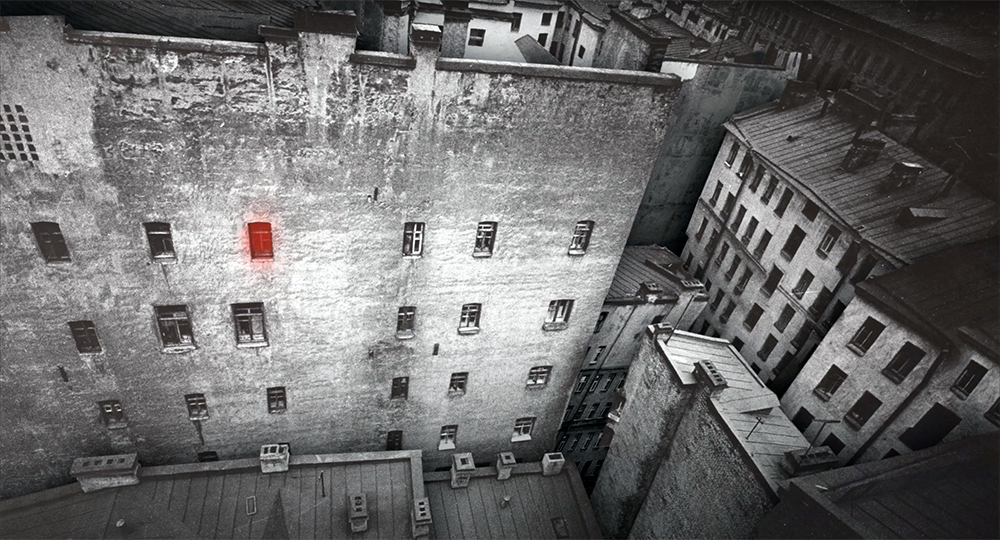
Still from “Leningrad 4,” Dmitry Fetisov, 2023
My interest in photography stemmed from moving to St. Petersburg. I liked the texture of its central districts, the most banal things—palaces and , the difference between the Petrograd Side and Vasilievsky Island. And I was very interested in the movies made at Lenfilm Studios—Ilya Averbakh, the so-called Leningrad school, the perestroika-era pictures. This texture intrigued me. I came across the photographs of Boris Smelov, Leonid Bogdanov, and Boris Kudryakov. I became a big fan of theirs, and started looking for lesser-known photographers.
You could say that Leningrad 4 was born in 2011, when I went to a photo exhibition at the legendary Borey Gallery on Liteiny for the first time and saw Sergei Podgorkov’s work. I thought that I should make a movie about this man. I was very impressed by Ludmila Tabolina’s show at the Akhmatova Museum, as well as the exhibition on the Zerkalo photo club, from which many photographers had emerged.
Still from “Leningrad 4,” Dmitry Fetisov, 2023
In 2021, I decided to make a short film about Sergei Podgorkov. At the time, I had no idea that it would turn out to be a forty-minute movie. I wrote to Sergei on VKontakte, and he invited me to his place in Borovichi. If I were making the film now, I would probably add a video chronicle of the trip. Podgorkov showed us around the town, including the old railway station, and after filming we drank some good Novgorod moonshine with him to celebrate our acquaintance.
Many of the shots were made with Soviet gear—a Helios 40 telephoto lens. I bought it in a thrift store, and I successfully fitted this 1965-made lens to a Sony mirrorless camera. The Helios 40 handsomely blurs the edges and thus emphasizes the subject in the frame. It is my favorite lens.
After filming Podgorkov, I realized that the topic could be pursued further. I had always been interested in the Leningrad Rock Club, and so I decided to film Andrei “Willie” Usov, who was the staff photographer for the band Aquarium and did all the covers of their records, and was friends with Mike Naumenko.
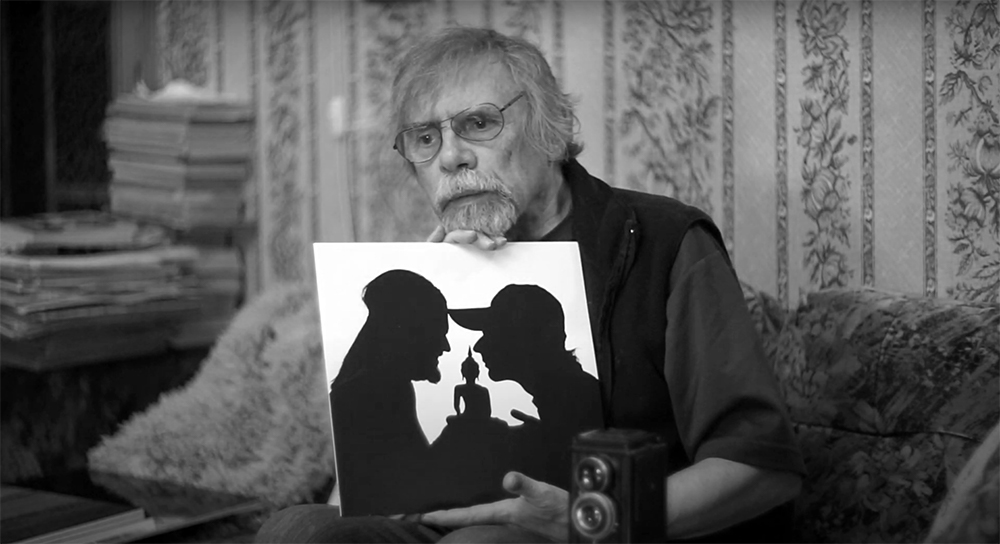
Andrei “Willie” Usov, holding his iconic image of Boris Grebenshchikov and Mike Naumenko. Still from “Leningrad 4,” Dmitry Fetisov, 2023
The third character was the pictorialist Ludmila Tabolina. I appreciate this movement in photography. The next character was Alexander Kitaev. I liked the Kitaev’s powerful countenance, that of a bohemian. Petersburg photographer, and I decided that I would film him even before I got acquainted with his images myself.
Another character is Valery Valran. He is not a photographer, but a well-known artist in Petersburg, a popularizer of photography, a curator of photo exhibitions, and the first to turn [photos by Leningrad’s underground photographers] into a photo album: the book Leningrad Photo Underground appears at the beginning of the film. I decided to include it in the film to tell about this photography movement a little from the outside.
And finally, there was Sergei Korolyov. I filmed him, but during editing I realized that, unfortunately, a short subject about him did not fit into the film. I edited it separately and posted it on my “Blog Stall” which I dreamed up when blogging was the cool thing and where I publish stories related to cinema. This episode is called “The Photographer Korolyov”.
“The Photographer Koroylov,” Blog Stall, episode 26
How did I realize that these characters were enough? When I filmed them, I had an idea for the next film I might make: about photographers who are no longer alive, like Bogdanov and Kudryakov. And I decided that the filming was over.
The film took a long time to edit, almost a year. I realized that each photographer has a certain leitmotif. Sergei Podgorkov has a story connected with beer stalls (although he does not emphasize it himself), Andrei Usov has rock, Ludmila Tabolina has the white nights, and Kitaev has [Petersburg’s] Kolomna neighborhood.
Still from “Leningrad 4,” Dmitry Fetisov, 2023
To separate the interviews and photos, I decided to use a film footage frame. Some of my colleagues think that this is visual bad form, but for me it seems logical: conversations with photographers are the present day, while their photos are the past, and the footage works as a transition between them.
Sometimes I wanted to connect the times. The chapter “Conversations at Beer Stalls” features music by contemporary jazz-noir artist Bebopovsky and the Orkestry Podyezdov. I had enjoyed him for a long time. I met the artist, and the opportunity to use his music in the film presented itself.
While I was editing, I did a photo shoot on black and white film for an acquaintance. I was supposed to make shots like in the scene in Godard’s movie Le petit soldat in which the main character takes a picture of a young woman. For this photo shoot, my friend bought a Leningrad 4 light meter on Avito. I realized that I would call the film that, because the main character is late Soviet Leningrad, and there are four photographers in it. Then I decided that I would divide the movie into four parts. Besides, perhaps these photographers possibly also used the Leningrad 4, as it was one of the most popular exposure meters of its time.
It was later that Sonia Minovskaya, my co-director and assistant on the movie, noticed that in some mythologies the nuumber four is the number of decay, death, and demised. And indeed, in each chapter something fades away or dies. In the first one, the Leningrad white nights are buried, while in the second, Mike Naumenko and a whole erа exits the stage. Then we see the end of the Summer Garden in its historical guise, and in the final chapter, where the rallies in the squares are shown, we see a country disintegrating. I didn’t think about this symbolism when I was making the film. I did it intuitively.
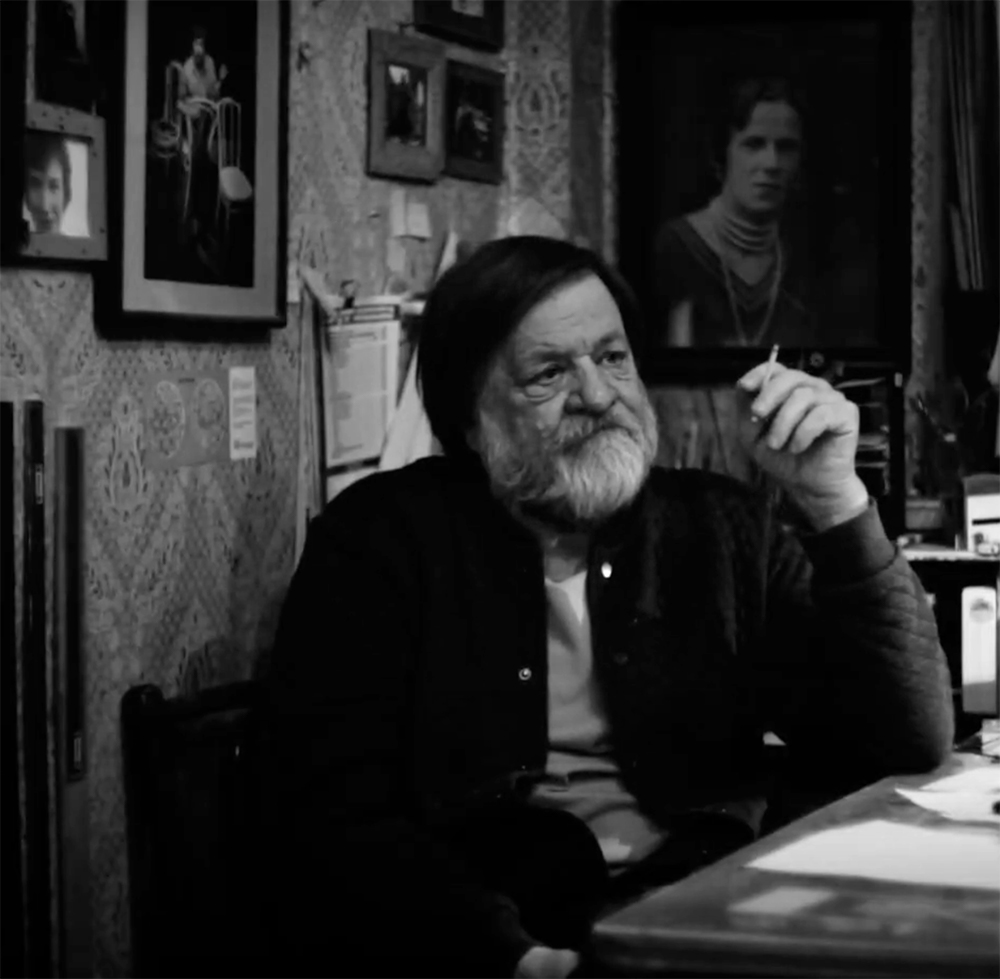
Photographer Alexander Kitaev. Still from “Leningrad 4,” Dmitry Fetisov, 2023
I understand that the editing is finished when a special, unique time emerges in a film. Time is a rhythmic form to me. A movie is ready to go when it suits me rhythmically. My films are calm, lyrical, and meditative. I probably like the documentaries of Wim Wenders for a reason.
Leningrad 4 was screened at the Arctic Open Festival in Arkhangelsk, where it got a super-warm reception; at the Salt of the Earth Festival in Samara; and in the online program at Artdocfest.
At one of the premiere screenings at the Rosphoto Museum, Sergei Podgorkov, with his usual irony, criticized the film for being too sentimental about an era that, in his opinion, is not worth the nostalgia. I did not put nostalgia in the movie, especially nostalgia for the Soviet Union, which I do not have. Andrei Usov noted that the films uses images from a time when the city was more interesting texturally for photographers. Nowadays, Petersburg is quite touristy, shiny and bright. He also admitted that the film left him with a heavy feeling. He and Naumenko had a great, strong friendship, and he still takes his departure quite personally.
Still from “Leningrad 4,” Dmitry Fetisov, 2023. Photo by Sergei Podgorkov
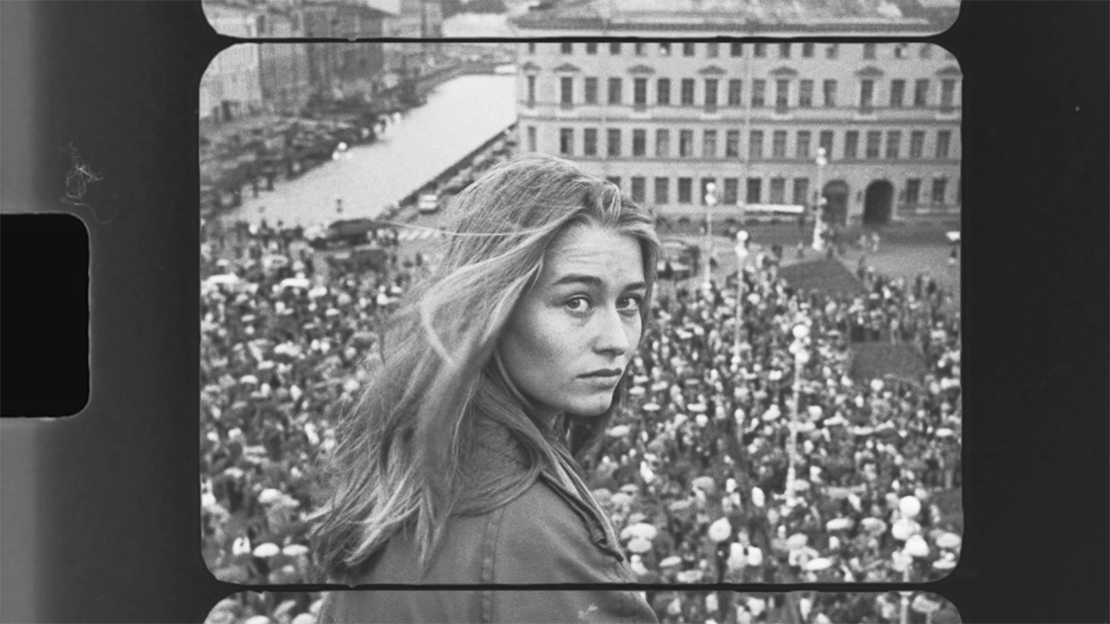
Another character in the movie, Svetlana, attended the screening at the bar WÖD. In the final scene, we see a photo of her standing on the roof of a building opposite the Mariinsky Palace during the attempted coup in August 1991 and looking into the lens—as if that era were upon us today. This is a famous photo by Sergei Podgorkov. Recently, Sergei found Svetlana through the internet and invited her to the screening. And now, thirty-three years later, she saw herself on the screen and recounted how the picture was taken. Podgorkov had run out of film, but Svetlana was also an amateur photographer, so she lent him her own camera, and he photographed her.
Recently, I went to Chronicles Bar on Nekrasov Street and saw Podgorkov’s photos there. It was amazing. It is a young people’s bar, and yet the walls are adorned with photos of Soviet-era beer stalls, so it is as if two eras were connected through Podgorkov’s photographs.
In Russia where 14 million Muslims reside as of 2017, Eid al-Fitr is often known as Uraza Bayram (Russian: Ураза-байрам) and is a public holiday in the republics of Adygea, Bashkortostan, Dagestan, Ingushetia, Kabardino-Balkaria, Karachay-Cherkessia, Tatarstan and Chechnya. Most festive dishes consist of mutton, but salads and various soups are also popular. As the Muslim population is diverse, traditional festive dishes differ between regions – for example in Tatarstan pancakes are popularly baked.
Russian Muslims go to festive worships at mosques in the morning of Eid al-Fitr, after which they often visit older relatives as a sign of respect. In the North Caucasian republics, children popularly go past various houses with a bag to get it filled with candy, specially stored by locals for the celebration. In Dagestan, eggs with bright stickers is a popular traditional dish served there during Eid al-Fitr. People generally dress more during this day – women choose bright dresses with beads while older people would wear papakhas. In many places in the country master classes are also hosted where families take part in activities such as embroidery and clay making.
The festival of Eid Al-Fitr, or “Uraza Bayram,” marks the end of the holy month of Ramadan in Islam. This year 180,000 worshippers marked the event in Moscow, a figure below half of last year’s number.