The world’s end kicks off not with explosions but with alarming news and eerie silence on the streets of Los Angeles. The world is going mad slowly, and Madison Clark (played by Kim Dickens of Gone Girl, House of Cards, and Treme), a school psychologist and mother raising two children, is the first to sense it.
Madison’s new husband, Travis Manawa (played by Cliff Curtis of Training Day, Avatar: The Way of Water, and Invincible), is a teacher trying to build a new life from the ruins of his old one, while also raising his son from a previous marriage. Their mundane problems fade into insignificance when the world order collapses and fear becomes commonplace.
“Victory will be ours” reads the banner on the Russian Embassy in Seoul. Source: Jintak Han/ZUMA/Picture Alliance
On Sunday, 22 February, a fifteen-meter-high banner in the colors of the Russian flag sporting the slogan “Victory will be ours” in Russian appeared on the Russian Embassy’s building in Seoul. The banner was unfurled ahead of the fourth anniversary of Russia’s full-scale war against Ukraine.
The South Korean Foreign Ministry “expressed concerns […] over the large banner,” according to the Yonhap News Agency. The ministry stressed that it could create “unnecessary tensions with South Korean citizens and other countries,” as it is regarded as an allusion to Russia’s war against Ukraine.
Russian Embassy refuses to take down banner
Despite the concerns raised by South Korea’s Foreign Ministry, the Russian Embassy has refused to remove the banner from its building. The banner was hung on the occasion of Diplomatic Workers Day and Defender of the Fatherland Day, according to the Foreign Ministry’s Telegram channel.
“The popular expression on the banner is familiar to all Russians. It is associated with our history, including the mobilization of the Soviet people for victory over Nazi Germany and other glorious chapters of Russian history,” embassy spokespeople underscored. They also claimed that the banner “promotes patriotic consolidation among Russians, and the historical connotations mentioned should not hurt anyone’s feelings.”
Different cities. Different motives. Same profile. White. Male. Armed. Deadly.
The news pretends each act is an isolated tragedy: a troubled man, a random eruption, a community blindsided. But line them up side by side and the repetition is too precise to ignore. These aren’t anomalies; they’re a drumbeat. Churches, schools, bars, government buildings. Nothing is sacred. Nobody is immune. The perpetrators are acting out the same choreography and playing variations on a script that ends with bodies on the ground and their names immortalized in headlines.
Humiliation is the through-line.
Strip away the headlines, the manifestos, the mugshots, and what you see is white men who cannot live with being ordinary, ignored, or denied. White masculinity in America was built on the guarantee of centrality, the right to be heard, feared, and obeyed. When that illusion frays, humiliation takes its place. And humiliation, when combined with access to assault rifles and an internet full of cheerleaders becomes combustible.
Enter Donald Trump.
He is not the author of this script, but he is its loudest hype man. He takes that humiliation and translates it into a politics of grievance. He tells white men their despair isn’t failure, it’s theft. He tells them their rage isn’t weakness, it’s patriotism. He baptizes their sense of collapse as a holy war. Trump doesn’t hand them the gun, but he hands them the permission slip to kill. He turns their humiliation into a rallying cry, their despair into his campaign platform, and their death wish into applause lines.
The assassination of Charlie Kirk proves this. Here was no random eruption in a mall or classroom, but a sniper attack staged at a political rally. What we witnessed was violence designed as theater. The accused, Tyler Robinson, was reportedly obsessed with Kirk, surveilled his movements, and turned grievance into spectacle. This wasn’t just about killing one man, it was about sending a message by inscribing grievance onto the national stage. And while Robinson didn’t appear to seek his own death in the same way as other shooters, the logic still holds: collapse turned outward, humiliation converted into performance, violence as a last-ditch claim to visibility. Whether in a schoolyard or at a rally podium, the impulse is the same — make sure the world cannot look away.
That’s why so many of these killings end with the shooter’s own death. Researchers have long noted that mass shooters often carry suicidal intent. Some kill themselves on the spot, others provoke police into finishing the job. Even those who survive often admit they never planned an escape. They weren’t trying to get away with it. They were trying to make sure we all saw them on the way out.
This is suicide turned outward. Instead of a private exit, it is a public performance. It is despair weaponized into punishment. It is a white man who feels invisible deciding that if he must disappear, he will do it in a blaze that makes his enemies, his community, his whole country remember his name. The bullets are not just aimed at bodies, they are aimed at the world that he believes has betrayed him.
Son of the renowned filmmaker Ilya Khrzhanovsky, anthropology graduate and activist Andrei Khrzhanovsky moved to Israel in 2022. He almost immediately adopted a pro-Palestinian stance in the Middle East conflict, dubbing Israel’s actions genocide, and Zionism an ethnically supremacist idea. He says he is fighting for the rights of Palestinians in the West Bank due to his sense of guilt over the war in Ukraine. He spoke with Marina Berdichevskaya about his radical stance and his conflicts with his family.
Andrei Khrzhanovsky, 26, has been living in Israel since 2022. When Russia launched its full-scale invasion of Ukraine, he found himself in Tel Aviv with his entire family, including his famous father, grandfather, and grandmother. When the time came to fly home, there was nowhere to go. On February 24, Ilya Khrzhanovsky had begun circulating a petition, condemning the invasion of Ukraine, among cultural figures. Andrei flew to Georgia and applied there for Israeli citizenship.
Since March 2022, Andrei X, as he likes to be called, has enthusiastically plunged into the weeds of Israeli life and quite quickly chosen a side: he has taken up activism and, so he claims, journalism, on behalf of “the most vulnerable group on Earth at the moment,” the inhabitants of the West Bank. At the same time, Andrei has been doing battle with “the genocide in Gaza” and on this score has found himself at odds with his father, who has repeatedly said that, in the wake of 7 October 2023, he has felt himself to be Israeli first and foremost.
We talked at length and quite emotionally about how the profoundly erudite Khrzhanovsky, who has a degree in anthropology from the University of London, has decided to atone for the collective guilt of generations for world colonialism. Andrei happily juggles concepts and historical facts and is sure that this is the only way to do things: to always stand up for the downtrodden and to never succumb to propaganda. Whether he himself is suspectible to propaganda is an open question. Ah, yes. The opinions expressed here do not necessarily reflect the views of Republic or its editors—nor should they.
“The closer you are to the empire’s center, the greater the blame”
— Let’s begin with where you live. Your Facebook page says you live in Jericho. Is this true?
— Nowadays, I don’t stay anywhere longer than a few days in a row. I rent a flat, but I won’t divulge its location, because I get several death threats a day. I come home once every month and a half for a couple of days and then I hit the road again. Yesterday, I came from Bethlehem.
— How do people on the West Bank relate to you? Do they understand that you have an Israel passport?
— I’ve never had any problems with this because this is a political conflict, not an ethnic one. I speak with Palestinians deep in Area A (the West Bank is divided into three areas; Area A, which makes up seventeen percent of the West Bank, is wholly controlled by the Palestinian Authority — Republic) whose relatives have been killed, who have done time in prison. Israel fosters the illusion that all Palestinians want to kill all Jews. But this isn’t an ethnic conflict, and not even a religious one at the end of the day.
— In February of last year you said in an interview, “When the war in Ukraine began, I had an enormous sense of guilt that I hadn’t done more [to stop it]. That’s why I’ve thrown myself into all political activism here.” You explained your activism in terms of not wanting to “squander another country.” Where does such a young man come by a sense of personal guilt for what is happening in and with a country? After all, many Russian nationals, especially the remainers, reject the very principle of collective guilt.
Karèn Shainyan, interview with Andrei Khrzhanovsky and Artyom Nikitin (in Russian, with no subtitles)
Today’s episode of Who Am I After This? is very sensitive for me personally. The conversations with its two subjects, leftists and human rights activists, were the hardest and most emotional in the whole project because they both touch on a very painful personal conflict of loyalties for me. This is the only episode where there are two protagonists at once: journalist Andrei Khrzhanovsky and architect Artyom Nikitin. Quite handsome and young, both moved to Israel after the war in Ukraine began, and both travel to the West Bank to support the local Arab [sic] population, even and especially now, when there is a war in [sic] Israel.
— Before February 2022 we all lived in a magical reality of sorts: there was a dictatorship in Russia, seemingly, but no one was getting killed, as it were; everything was sluggish, we had to tackle corruption and so on. But there was no sense of the disaster that any dictatorship represents. This illusion personally crumbled for me on 24 February 2022. The disaster started then, and then intensified after the genocide in Gaza began. Over the past few years, the feeling has only grown in me that we are all to blame for what is happening; some more, some less. The closer you are to the empire’s center, the greater the blame.
— And when did you personally start counting down that blame?
— If we speak of the entire timeline, there were three moments. The first was 24 February 2022. The second was an article by Yuval Abraham (an Israeli journalist and co-director of the Oscar-winning film No Other Land — Republic), based on conversations with soldiers fighting in Gaza who admitted that they had been tasked with firing on civilian targets. And the third was the morning when I woke up, opened Instagram, and saw the video of a man in Gaza burning alive after an IDF strike on a hospital.
Andrei Khrzhanovsky. Source: social media
— How did you get involved in political activism in Israel?
— I had an approximate, general notion of what was happening here when I turned up here. I grew up in the Russophone media space after all. But when I arrived I realized that I had to figure out what was happening. I started reading books and talking to people. The more I researched, the more horrified I was. Suddenly, I found out about the status of Palestinians in East Jerusalem: their land was annexed, but they weren’t granted [Israeli] citizenship. To get into the Shuafat refugee camp, which the Israelis annexed and surrounded with a wall, Palestinians have to go through a security checkpoint. The sheer number of different methods for constructing a state based on ethnic supremacy is insane.
On Friday, May ninth, Treptow Park was perhaps the most heavily guarded place in Berlin. Hundreds of police officers kept the peace at Germany’s most famous memorial to Soviet soldiers on the day Russia marked the eightieth anniversary of the end of the Second World War in Europe, known as the Great Patriotic War in the Soviet tradition. Because Russia has employed symbols of that earlier war in its current war against Ukraine, visitors were banned from displaying or wearing Soviet and Russian flags, military uniforms, and St George’s ribbons at the Berlin memorial this year. An exception was made for veterans and diplomats.
Soviet May ninth traditions and German pacifists
At about half past ten in the morning, a wreath was laid at the monument to the Soviet soldier by Russia’s ambassador to Germany, Sergei Nechayev. The day before, when Germany remembered the Wehrmacht’s surrender and the end of the war, Nechayev and the Belarusian ambassador were not invited to the memorial event at the Bundestag. In his speech, German President Frank-Walter Steinmeier thanked the Allies for liberating his country and recalled the Red Army’s sacrifices, but harshly criticized Russian attempts to justify the war in Ukraine in terms of the fight against the Nazis in the Second World War.
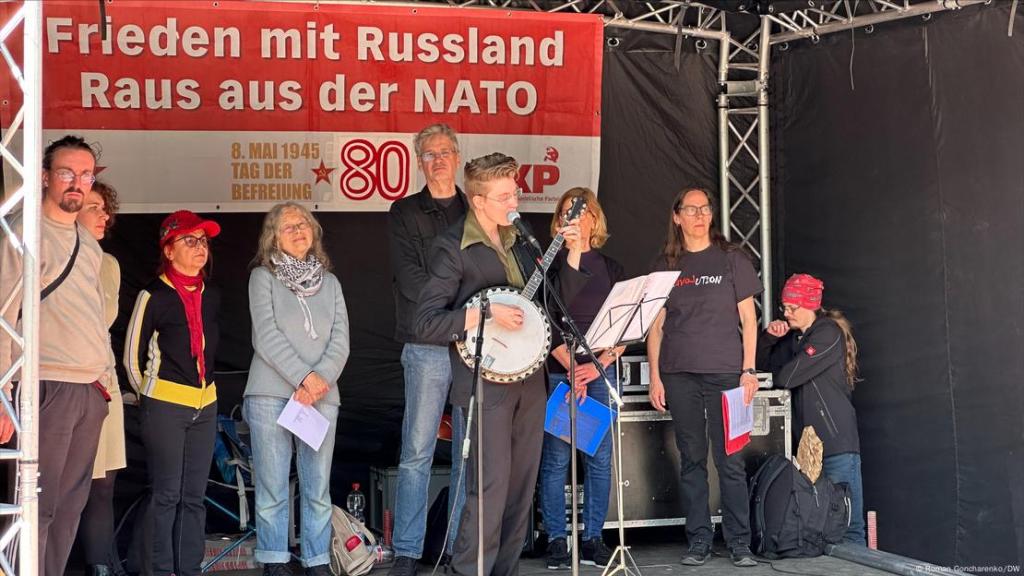
The flood of people in Treptow Park seemed endless: hundreds were there at any one time, and thousands came and went over the course of the day. Many brought scarlet carnations, while some bore wreaths. Russian and German were heard. Most of the visitors were elderly—immigrants from the former USSR living in Germany and Germans. There were also many leftist and ultra-leftist German political activists brandishing placards opposing NATO and calling for “peace with Russia.”
German ultra-leftists rally for “peace with Russia” and Germany’s exit from NATO, 9 May 2025. Photo: Roman Goncharenko/Deutsche Welle
Against this backdrop, the scene resembled a mixture of a traditional Russian May ninth celebration and a political protest by German pacifists, many of whom had clearly lived most of their lives in the GDR.
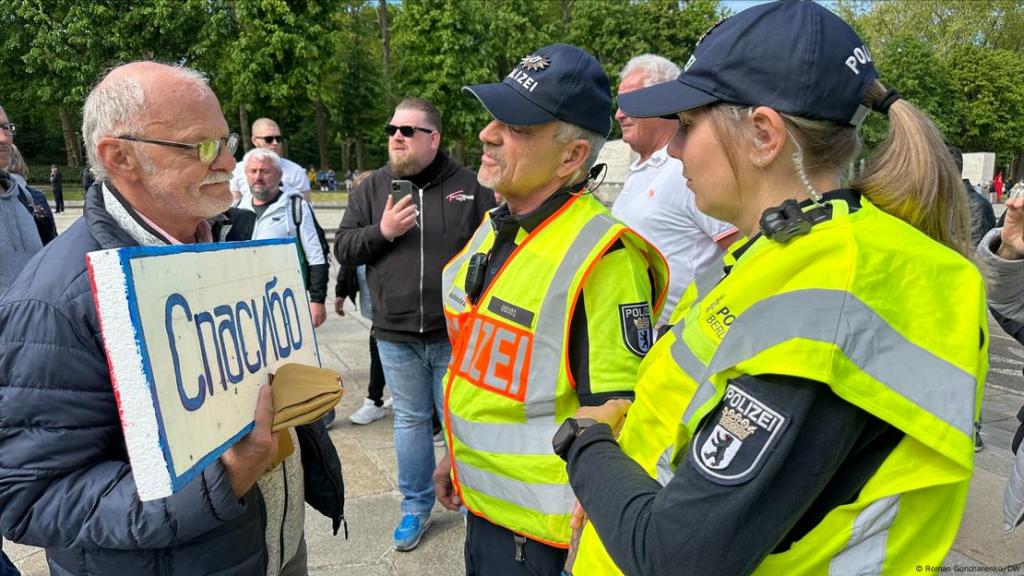
“I was a policeman in the GDR,” said a man in his sixties who held a placard that read “Thank you” in Russian. The policemen asked him to doff his Soviet cap, which sported a red star and a St. George’s ribbon.
“All people want peace, so the politicians should don their own military uniforms and crawl into the trenches,’ the man said.
Soviet wartime songs sounded from loudspeakers and were played live. One man, aged forty-five, climbed atop a mound to get a better view, but a policeman asked him to get off the lawn, explaining, “This is a grave.” The man cursed in Russian but climbed off the mound.
Another man played played “Arise, Great Country” on his clarinet. When he began quietly playing the melody of the Soviet and Russian national anthem, the police literally took him aside, after which he returned to the group of people who had gathered. They were outraged at the restrictions that had been adopted. From time to time, someone chanted “Russia, Russia!” and many other people would join in.
An ex-East German police office (holding a sign that says “Thanks!” in Russian): “All people want peace.” Photo: Roman Goncharenko/Deutsche Welle
Bikers in Treptow Park
Your correspondent saw men and a woman in leather jackets who looked like bikers from the Russian motorcycle gang Night Wolves. They were in small groups and were escorted by a large number of police officers. They posed for pictures in front of the wreaths and left. They could have been someone from a local “support group.” The Berlin press had written that only a small group of bikers made the trip to Berlin to visit the Soviet memorials this year. No incidents had been reported as this article went to press.
Treptow Park, 9 May 2025. The crimson and gold banners at the back of the crowd are inscribed with the names of the various “fronts” in the Red Army’s campaign against the Wehrmacht. Photo: Roman Goncharenko/Deutsche Welle
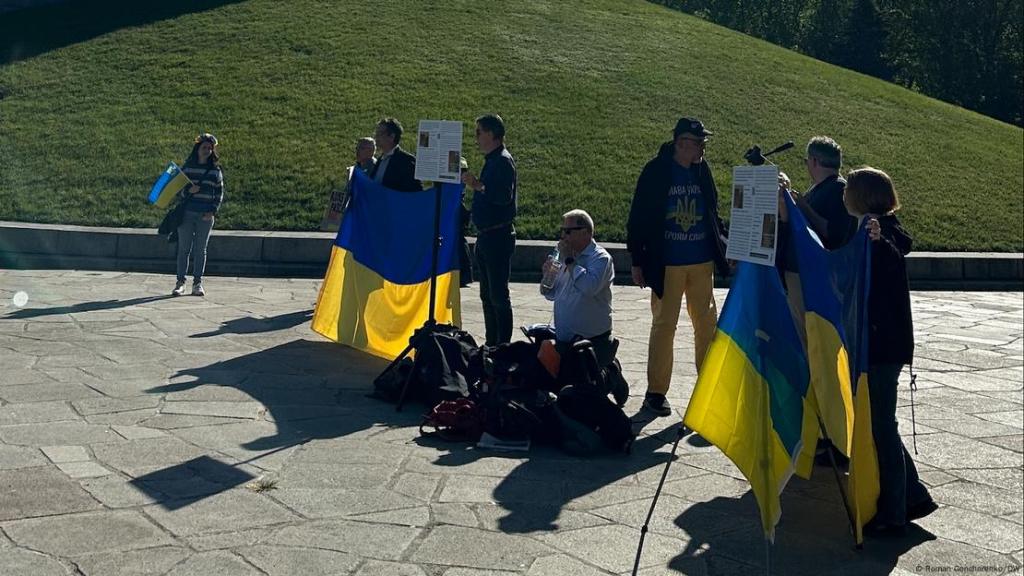
For the first half of the day, at least, things seemed relatively calm. Your correspondent had the impression that most people had come to Treptow Park not for political reasons, but to commemorate the war. And yet the atmosphere was tense. To the right and left of the monument to the Soviet warrior stood a dozen and a half activists holding placards and the flags of Ukraine and NATO.
Activists with placards and Ukrainian flags at the monument to Soviet soldiers in Treptow Park, 9 May 2025. Photo: Roman Goncharenko/Deutsche Welle
They said they wanted to draw attention to the Ukrainian Red Army soldiers who had perished in the Second World War, as well as to Russia’s war against Ukraine.
“I am here to prevent this event from being turned into a Russian propaganda stunt,” said a woman, aged thirty-five. According to her, insults had been hurled at her and the pro-Ukrainian activists.
“Some people regard our presence here as a provocation,” said the woman. “We are not here to change anyone’s mind, but to make Ukraine visible.”
One of their posters read: “Russia has usurped the memory of May eighth and ninth. But it was not Russia who liberated us from the yoke of National Socialism eighty years ago in Berlin. It was the Red Army, in whose ranks many Ukrainians served.”
The poster tells the story of Ukrainian soldier Fyodor Karpenko, who left his name on the walls of the destroyed Reichstag building in May 1945.
Since the Maidan uprising and Russia’s illegal annexation of Crimea in 2014, Kremlin propaganda has consistently portrayed Ukrainian leaders as Nazis or fascists. Russia also accused the Ukrainian authorities of “genocide” of the population of Donbass. On 24 February 2022, while announcing the full-scale invasion, the “denazification” of Ukraine was presented as the primary goal of the war, which is itself portrayed merely as a continuation of the Great Patriotic War: a conflict embedded in a cyclical conception of time in which Russia, eternally under threat from a Western enemy, fights for its very survival — on Ukrainian soil.
On the ground, there is no evidence to support Moscow’s accusations: nobody has ever documented a “genocide” against ethnic Russians or Russian speakers, whether in Ukraine or elsewhere. As for the Ukrainian far-right, its political influence remains minimal: in the 2019 parliamentary elections, the main ultra-nationalist parties, running together on a joint list, received just over 2% of the vote, well below the threshold required to enter Parliament. In short, the image of a “Nazi regime” in Kyiv is based on a glaring mismatch between rhetoric and reality.
So why do the Russian authorities repeatedly invoke references to the Second World War — or, in Russian parlance, the “Great Patriotic War” — when speaking about Ukraine? Understanding this memory dynamic is essential to grasp the power of a rhetoric that, despite lacking any factual basis, continues to shape the official Russian worldview.
The Soviet and Russian insistence on using the term “Great Patriotic War” to refer exclusively to the period from 1941 to 1945 erases the twenty-one months that preceded Nazi Germany’s invasion of the USSR. Between the Molotov–Ribbentrop Pact of August 23, 1939, and Operation Barbarossa on June 22, 1941, Moscow and Berlin were de facto allies: they engaged in extensive economic cooperation, diplomatic coordination, jointly invaded and partitioned Poland in September 1939, and the Soviet Union proceeded to annex the Baltic countries and wage war against Finland. By reducing the war to the period 1941–1945, the USSR and Russia could deny any responsibility in the outbreak of the Second World War and present itself solely as the victim of Nazi aggression and the primary liberator of Europe.
The Great Patriotic War — and especially the victory in 1945 — became the founding event of Soviet history and the cornerstone of collective memory. Yet this memory, often portrayed as monolithic and universally shared, is anything but uniform. A Ukrainian from the west, who endured two successive occupations between 1939 and 1944, remembers a war very different from that of an eastern Ukrainian, whose experience was shaped primarily by Nazi destruction. The memory of a Russian bears little resemblance to that of a Crimean Tatar, who was deported along with his entire community and denied the right of return for decades. As for Soviet Jews, whose families and communities were annihilated in the Holocaust, they were long forced to remain silent — official narratives left no room for the specificity of their suffering.
The collective experience of the war and the official discourse surrounding it deeply reshaped the Soviet population’s understanding of “fascism” and “antifascism.” Rather than referring to a specific political doctrine of the inter-war period, the term “fascism” had become a catch-all label for the ultimate enemy. Trotsky or the British Conservatives could just as easily be branded as “fascists,” as well as domestic and international opponents after 1945 — including even the Chinese Communists. The word “Nazi” itself was rarely used. In everyday life, calling someone a “fascist” served more as the gravest possible insult rather than as a statement of ideological substance.
Under Vladimir Putin, the cult of the Great Patriotic War has been revived. Following the pro-democracy protests of 2011 and Putin’s bid for a third presidential term in 2012, the regime instituted a deliberate policy of historical narrative construction, aimed at grounding its legitimacy in a vision of the nation as under siege. The glorification of the 1945 victory also allowed the regime to purge collective memory of its specifically socialist elements: by retaining only the narrative of national triumph, the Soviet period could be seamlessly integrated into a continuous national history without any revolutionary rupture. At the same time, the rehabilitation of Joseph Stalin as a legitimate victor served to validate autocracy. The mass repressions and genocidal policies that claimed millions of lives were reframed as a tragic but necessary step: they had made the USSR a global superpower, capable of defending civilization against the “brown plague.”
The Kremlin has multiplied its legal instruments to enforce this narrative. Since 2020, the Russian Constitution mandates “respect for the memory of the defenders of the Fatherland” and prohibits “diminishing the importance of the heroism” of the Soviet people. In April 2021, Putin signed a law increasing penalties for “insults” or “false claims” about the Second World War and its veterans. In December 2019, Putin himself gathered some leaders of post-Soviet states around a pile of archival documents that he said proved historical truths long ignored in the West — selectively quoting them to justify, in retrospect, the USSR’s annexation of Poland and the Baltic states. In this way, Putin has weaponized history, which has become inseparable from national interest. To challenge his interpretation is tantamount to treason.
Every year on May 9, Russians march in the Immortal Regiment carrying portraits of relatives who fought between 1941 and 1945. Increasingly, the faces of those who fought — or died — in the war against Ukraine are added to these ranks, as though both wars were part of a single, endless struggle. Past and present warfare are merged, and the victory of 1945 becomes the lens through which all events — past, present, and future — are interpreted in a continuous historical timeline. This symbolic fusion also explains the surreal images of Russian occupation forces who, in recent weeks, have placed propaganda banners in destroyed Ukrainian cities. An uninhabitable Bakhmut was transformed into a stage for celebrating the 80th anniversary of Russia’s victory in the “Great Patriotic War.”
The cult of victory is not only a central element of the Putinist imaginary — it functions as an operating system for both domestic governance and external aggression, with all of Russia’s actions on the international stage framed as part of an eternal war against fascism. A telling example of this is the installation of a giant screen on the Estonian border, broadcasting Victory Day celebrations in a loop — an attempt to remind Estonians, as well as Latvians and Lithuanians, that the Soviet victory represents an unassailable moral superiority. In the Russian collective imagination, the word “fascism” has lost all connection with a specific political ideology and now refers only to an abstract, absolute threat: the desire to destroy Russia. It has become synonymous with “enemy” or “Russophobe,” always denoting the Other, never a historically defined movement. This separation between word and meaning allows the regime to simultaneously glorify the antifascist victory and openly promote xenophobic, homophobic, or ultraconservative rhetoric, without any perceived contradiction.
The word “denazification,” used by Vladimir Putin on February 24, 2022, to justify the invasion, initially puzzled many Russians, most of whom were unfamiliar with the term in this context. Shortly afterwards, the state news agency RIA Novosti published an article by Timofey Sergeytsev — “What Russia Should Do with Ukraine”— aimed at clarifying its meaning: “denazification” was described as a “total cleansing,” targeting not only alleged Nazi leaders but also “the popular masses who are passive Nazis,” deemed guilty of having supported the “Nazi government.” According to Sergeytsev, modern Ukraine is able to hide its Nazism behind aspirations for “independence” and “European development.” To destroy this Nazism, he argues, is to “de-Europeanise” Ukraine. In this logic, denazification becomes synonymous with eliminating all Western influence from Ukraine and dismantling the country’s existence as a nation-state and a distinct society. Incubated on official state platforms, this narrative reveals the true scope of “denazification”: a large-scale project aimed at erasing any trace of Ukrainian singularity, a blueprint for the genocide.
The article recently published on the official website of the Russian Foreign Intelligence Service (SVR), entitled “Eurofascism, Today as 80 Years Ago, Is a Common Enemy of Moscow and Washington,” strikingly illustrates the expansion of the “denazification” discourse far beyond Ukraine. The accompanying image depicts a grotesque hybrid monster: its body is shaped like a black swastika with the EU’s circle of stars in the centre, while its head is a caricature of Ursula von der Leyen. The creature, with its blood-stained claws outstretched, is caught between two bayonets — one American, the other Russian/Soviet. This grotesque image is not merely a provocation: it reflects a narrative deeply entrenched in Russian state propaganda, where “Eurofascism” becomes an operational concept encompassing all European societies.
“Eurofascism, Today as 80 Years Ago, Is a Common Enemy of Moscow and Washington.” Screenshot courtesy of Meduza
The 2022 tipping point revealed these discourses for what they truly are: the ideological foundation of a large-scale invasion, long prepared within the informational sphere. Today, part of European society — particularly elements of the pacifist left — is falling into the same trap: underestimating or ignoring the ongoing propaganda dynamic. But the machine is already in motion. The language of fascism is being broadened daily to include new designated enemies, and the ideological war is shifting: it is no longer stopping at Ukraine — it is now targeting all of Europe. In the face of this brutal reconfiguration of the official Russian narrative, complacency or passivity have themselves become forms of strategic blindness.
Russia’s consolidated military registration registry website, Reestrpovestok.rf, is fully operational. On Friday, 9 May 2025, the human rights project Get Lost, which helps Russians avoid conscription into the army, reported that the notifications that it was operating in test mode had disappeared from the website, and the online resource appeared to have been fully launched.
Upon arrival on the website, users can log in to their personal accounts, check summonses, and obtain copies of records. Earlier, the website indicated that it was functioning in beta mode only in three regions—Sakhalin, Ryazan, and the Republic of Mari El. This notification has now disappeared.
“So far no one who has received a summons through this site or faced automatic restrictions has contacted us,” the human rights activists added. The registry’s launch has not been officially announced.
Recipients of summonses to face restrictions if they fail to report to military recruitment center
The law establishing a consolidated registry of persons subject to conscription and introducing electronic summonses was signed by Russian President Vladimir Putin in April 2023. The text of the document, in particular, states that conscripts who do not report to a military enlistment office within twenty days of receiving a summons may be prohibited from registering as an individual entrepreneur, registering vehicles and real estate, driving a vehicle, and getting a bank loan. In addition, they will not be able to leave Russia until they report to a military enlistment office.
A screenshot of the military enlistment summons website, outlining the penalties imposed on Russians who fail to respond.
The full-fledged launch of the electronic summonses registry was planned for last autumn, but was subsequently postponed.
The registry contains data on all Russian nationals who are already registered and are subject to military registration, as well as those who are not yet registered but are obliged to do so. Lawyers stress that the law and the decree apply to the delivery of any summonses, both for compulsory service and to clarify military registration status, and as part of the wartime mobilization, which Putin has not yet signed a decree to end.
This data will be collected from military enlistment offices. The decree digitizing their databases was signed by Putin back in November 2022. As Defense Ministry officials told the Federation Council, various databases are used for this purpose, including those of the Interior Ministry, the Federal Tax Service, civil registries, and pension funds.
Vladimir Putin speaking with a group of Russian war widows. English subtitles by Julia Khazagaeva
Death as the national idea. Look at the faces of these women who lost their men in the war against Ukraine. They glow with newfound meaning. “I am a mom of four children and, recently, a widow…. Thank you, Vladimir Vladimirovich,” ”I lost my brother in the SVO [special military operation], but my three sons are growing up to be future defenders. Thank you,” they say to the killer of their kin. The Russian existential vacuum has finally been filled. Life has a purpose that redeems existence’s meaninglessness. Losing your life in war confers valor and honor. Nothing in the old life, in peacetime, guaranteed it. A contract [to serve in the army] turns a man into a hero. He is no longer a bastard in the eyes of the women who matter to him.
So the million lives taken by the war do not particularly faze anyone [in Russia]. All the sacrifices and victims are worthwhile as long as they are converted into national pride in the minds of Russians. They won’t spare three million people or more if it comes to it. And it doesn’t matter who they kill, whether they are Ukrainians, Estonians, or Poles. War is a drug. As long as war is underway, the harsh comedown is postponed. This is bad news for the world, especially for those who imagine that it is Putin who is waging the war, while Russians themselves want peace.
P.S. I made English subtitles for the video. You can download it from my Telegram channel. Show it to everyone seeking to understand l’âme russe mystérieuse.
“Tatiana Sokolova will never hear her son call her ‘mom’ again. He heroically fell in the special military operation zone,” began a news broadcast in the Chelyabinsk region about International Women’s Day celebrations for the mothers of Russian soldiers.
This event, which saw flowers handed to soldiers’ mothers, was organized by the United Russia Women’s Movement, a group affiliated with the ruling party.
It was just one of many celebrations focusing on the mothers and wives of soldiers fighting in Ukraine — as well as the widows and families of those killed — ahead of International Women’s Day this year.
International Women’s Day is one of Russia’s most significant holidays, celebrating women’s contributions to society, science and the workforce. It has deep roots in Soviet history, when it was promoted as a symbol of gender equality.
But since the full-scale invasion of Ukraine, Russian officials and state media have upheld a different ideal: being the wife or mother of a soldier.
“With the militarization of society, the education system and the economy, and with the ‘ideal citizen’ — the male soldier — being placed at the center, authorities are actively promoting the image of the soldier’s wife as his counterpart,” gender researcher Sasha Talaver told the Moscow Times.
“The portrayal of women in times of war and state crisis always emerges as a key point for political imagination,” Talaver said.
This Women’s Day, members of the United Russia party and pro-Kremlin activists have been delivering flowers, organizing literary events and visiting military families with gifts and food.
“We are proud of the women who raised the heroes of the special operation and the young men who have signed up as contract soldiers,” Senator Daria Lantratova, co-chair of the United Russia Women’s Movement, said this week.
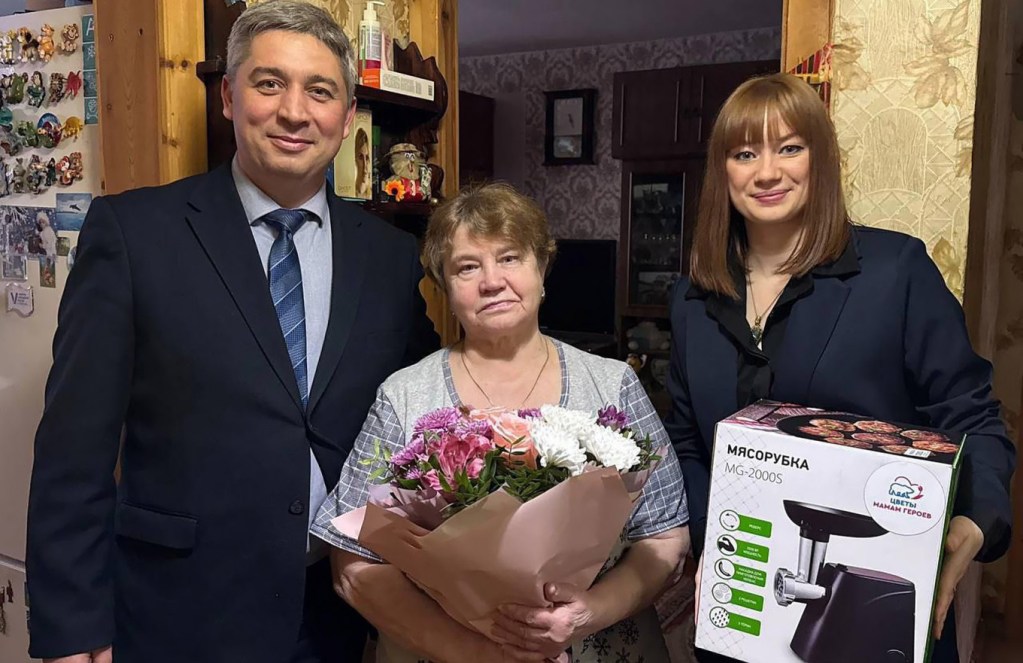
The movement this week launched the “Flowers for the Mothers of Heroes” campaign to deliver presents and flowers to soldiers’ relatives, which has spread to 40 regions.
A resident of the Murmansk region who lost her son in the war was given a meat grinder for March 8 by the United Russia party. Photo: social media
In perhaps the most shocking Women’s Day event, mothers of fallen soldiers were gifted meat grinders from local United Russia officials in the Murmansk region.
The news sparked a wave of criticism, as the kitchen appliance has become a grim symbol of the Russian military’s high-casualty assaults in Ukraine.
After the story went viral in Russian and Ukrainian media, one mother of a deceased soldier recorded a video statement in which she said she had been planning to buy a meat grinder herself, but United Russia “gifted it to her just in time.”
“I actually asked you for it,” the elderly woman said.
In Cheboksary, a city in the republic of Chuvashia, officials organized an event exclusively for the widows and mothers of fallen soldiers.
“May grief soon turn into pride!” declared local deputy Yevgeny Kadyshev. The women were given bouquets and gift bags labeled “Happiness and Joy.”
Russian authorities, including the United Russia party, promote the image of a military wife or mother as the ideal of femininity, gender studies researcher Ella Rossman told the Moscow Times.
The United Russia Women’s Movement was founded in the months following the invasion of Ukraine in 2022 “as a clear response to feminist anti-war activism,” Rossman said, referring to groups like Feminist Anti-War Resistance and movements of mobilized soldiers’ wives and mothers.
“Right now, the most visible female archetype in the public sphere is the woman waiting for her soldier to return from the front,” Rossman said. “But this is not the only image. There are completely opposing narratives, like that of military women themselves.”
Rossman pointed to an article in a pro-Kremlin tabloid about a woman from Rostov who signed a military contract and went to war.
“She is a mother who left her daughter to fight, has already lost a leg in combat and tells journalists that as soon as she recovers, she will go back to the battlefield,” Rossman said.
Local television stations have been covering Women’s Day events for soldiers’ mothers and wives, while also highlighting women assisting the war effort or fighting on the front lines.
After these official celebrations, politicians sometimes invite the women for tea. In Stavropol, a table was set for the mothers and wives of soldiers following a concert at a veterans’ hospital.
“Some of them are waiting for their sons to return home. Others, unfortunately, have lost their defenders who gave their lives for the Motherland,” Senator Daria Lantratova, representing occupied Luhansk, wrote on social media.
United Russia activists also delivered flowers to soldiers’ mothers in occupied Donetsk.
“Your son is a hero. We congratulate you on this holiday and wish you well. We hope this war will end and peace will come,” a United Russia Women’s Movement activist told an elderly woman. After hearing the word “hero,” the woman teared up.
“Don’t cry,” the United Russia activist told the older woman as they parted.
Russian soldiers fighting in Ukraine also sent video messages to military mothers and widows ahead of the holiday.
“Heroes are born in families. Women give birth to us. Women raise us in kindergartens and schools. The making of any hero is thanks to the great women in his life,” Leonid Lapin, a soldier who fought as a sniper platoon commander in Ukraine, said in a video message.
Putin meets with Olga Chebnyova, widow of ‘Hero of Russia’ Sergei Chebnyov. Photo: kremlin.ru
United Russia has even involved children with disabilities in the celebrations. In the Yamalo-Nenets autonomous district, mothers from a center for parents of children with mental and physical disabilities — along with their children — made greeting cards for soldiers’ relatives.
“This is not just a good initiative. Seeing how children with special needs get involved, how their eyes light up, you realize we are on the right path,” said United Russia member Alexei Komarevtsev.
In an interview with a local news channel, he described the craft project as “socialization” for children with disabilities. Some of the cards, he added, will be sent to the front lines, “because there are also girls serving there.”
In some regions, such as Tula, soldiers’ wives and mothers received a one-time payment of 10,000 rubles (about $100) for Women’s Day. Elsewhere, gifts included makeup sets or tickets to the philharmonic.
In the Moscow region, United Russia organized a makeup seminar for soldiers’ wives, saying such initiatives “help strengthen family values and improve quality of life in society.”
“War disrupts social norms and the way of life,” Rossman said. “But war also imposes constraints on the very possibility of a rigid binary between male and female roles, even though war seems to fit that binary perfectly.”
That is likely why the authorities have been working overtime to reinforce the Kremlin’s idea of “traditional” values since the start of the war, she said.
“Russian authorities are forced to declare and reinforce traditional values [because] many families that were once intact before the war have now lost their fathers,” Rossman said. “There are also military women — doctors, for example — and women who have voluntarily gone to war. Ignoring these women is impossible. They, too, are a target audience from a propaganda standpoint.”
As the war drags on and Russia’s battlefield losses mount, authorities are forced to balance different ideals of femininity in their propaganda messaging, Rossman said.
“They are constantly having to create different female archetypes for different audiences,” she said.
There is another reason why the Russian Defense Ministry recruits so many members of ethnic minorities [to fight in the war against Ukraine]: as it turns out, because it is psychologically really difficult for [ethnic] Russians to kill Ukrainians. Because we are one people. We are very close peoples, as everybody knows. We have nearly the same language, the same religion, and centuries of history in common. But if it’s someone from another culture, allegedly it’s easier [for them to kill Ukrainians]. I hadn’t really thought about it before. I thought the reasons were primarily economic. But after what [a colleague who spoke about the Buryats] said, I started thinking about it too.
A screenshot of the video Ms. Khazagaeva cites in her Facebook post
You did get that, friends? It’s so difficult, so unbearable for ethnic Russians to kill you Ukrainians that Buryats and Chechens have been doing all the work for them — because [Buryats and Chechens] are beasts and savages. That makes sense, doesn’t it?
By the way, [Kara-Murza] refers to Buryats and Chechens as “those ethnic minorities.”
In other words, all eleven years [of Russia’s war against Ukraine], the Buryats, who number under four hundred and fifty thousand people, including children and the elderly, have been attempting to kill the forty million Ukrainians. It transpires, however, that the hundred million ethnic Russians have had it “psychologically difficult” all those eleven years. They are mere victims of this war, which is something “those [other] ethnic groups” want. Don’t get them wrong: ethnic Russians love you Ukrainians like brothers!
You have explained everything so clearly, Mr. Kara-Murza. I have literally just a couple of follow-up questions. Excuse me, has it also been the Buryats who have been launching missiles at Ukrainian cities? And the creatures who on Russian television rejoice at the deaths of Ukrainian children in Kryvyi Rih, are they also members of these same ethnic minorities?
I’m sorry, but I have another question. The whole world knows what the Pskov paratroopers did in Bucha. Do you have any ideas how to repaint them as Buryats? Although it would probably be a bit difficult, since “your lads” have already been testifying.
One more question. The other day, 7 April, was the thirtieth anniversary of the Samashki massacre. Eighty people, mostly children, women and old people, were burned alive in Samashki, and hundreds of people were killed in total. This is not to mention the forty thousand Chechen children killed in the two [Chechen] wars. Excuse me, did the Chechens shell themselves? Ethnic Russians are totally incapable of that, aren’t they? To hell with what Tolstoy wrote in Hadji Murat. Tolstoy was a renegade.
Oh, I’ve gotten a little carried away. Two million people were killed in the Soviet invasion of Afghanistan. They say that’s where the notorious practice of “mopping up” villages, leaving mass graves in their wake, originated. I’m sorry, who did the killing in Afghanistan? Was that the Buryats too?
Good Lord, where do you get so many of them?
The only thing I don’t understand is how the idea of the “Russian world” could have emerged, since you ethnic Russians live in love and friendship with all countries. It must have been the Chukchi who overdid it on that front.
I also don’t understand why it is the ethnic Russians who do ballet, but it is the non-Russians who make war.
Updated, 13 April. I have replaced the picture originally below the post with a video featuring the entire quotation by Kara-Murza. Thanks to the good people who provided the AI translation. It shows that Kara-Murza’s words, whether presented in expanded or abridged form, bear the same message: ethnic Russians don’t want to kill Ukrainians, and it’s easier for non-Russians to do it. Because we ethnic Russians and the Ukrainians are one and the same, but we’re not the same as those non-Russians. It matters not a whit that Kara-Murza referenced someone else’s observation. What matters is that he voiced this idea personally and voluntarily, and that he confirmed his commitment to it by saying that it has given him pause for thought too. Think about it. A Russian politician (as Kara-Murza fancies himself), while visiting the parliament of a major European country, says that it is mainly Buryats who want the war. He says this on the record in a place where every word uttered potentially has legal force. He said it not in a bar, not on a beach, but in the French Senate, where decisions on sanctions are made.
I have not emended the text of my original post, dated 12 April.
On 10 April 2025, the Senate Foreign Affairs Committee heard the testimony of Vladimir Kara-Murza, vice-president of the Free Russia Foundation and a former Russian political prisoner. A Russian politician and opponent of Vladimir Putin, Kara-Murza survived two poisoning attempts, in 2015 and 2017. In April 2023, he was sentenced to 25 years in a penal colony by the Russian justice system after criticizing Russia’s invasion of Ukraine. He was released on 1 August 2024 in a prisoner exchange. In his testimony to the senators, he stressed the autocratic and violent nature of Putin’s regime. He called on the European Union to maintain its sanctions against Russia, and to bring its weight to bear on peace negotiations in Ukraine. He maintains the hope that the country will soon become democratic.
“A Russia without profanity. The word mom is sacred! Speak without swearing.” Photo: Igor Stomakhin, Moscow, 2025
What can serve as the basis for new Russian post-war identity? What sort of patriotism can there be in a country which has lived through an aggressive war? Of what should the people of this country be proud? What should they associate themselves with? Republic Weekly presents a programmatic text by the sociologist Oleg Zhuravlev and the poet and activist Kirill Medvedev on how the so-called Russian nation came to 2022 and what its prospects are in 2025.
How can Russia get beyond being either an embryonic nation-state or a vestigial empire? People have been talking about this for three decades now. Does it require years and years of peaceful development? A national idea painstakingly formulated by spin doctors in political science labs? A bourgeois revolution? Or maybe just a small victorious war? The so-called special military operation in Ukraine, which has grown into a global military and political conflict, poses these questions in a new light.
In our view, large-scale social changes are happening inside Russia today, changes which could help shape a new national project.
These changes are not always so easy to spot.
According to the social critique prevalent in the independent media, wartime Russian society is organized roughly as follows. Its freedom-loving segment has been crushed and disoriented, while its loyalist segment is atomized and under the thumb of government propaganda, which preaches xenophobia, imperialism and cynicism. Society is fragmented and polarized, suspended somewhere between apathy and fascism. But these tendencies, which are certainly important — and therefore visible to the naked eye, as well as exaggerated by the liberal discourse — are nevertheless not absolute and probably are not even the most important. Society lives its own life, meaning that different groups within it live their own lives and move in their own directions. When you analyze the trajectories of that movement you get a better sense of the major pathways along which these groups might in the future coalesce into a new nation.
Despite the official rhetoric about unity during the war years, the regime has not managed to consolidate a nation, but it has laid the groundwork for its formation in the future. This has been significantly aided by the west’s anti-Putin policies and the information war waged by the new Russian emigration’s radical wing, which speaks of the collective guilt of all Russians, of their culture and language. Consequently, the only alternative to Putinism and war has seemed to be the disenfranchisement of all Russianness, and the only alternative to official government patriotism has been the “fall of the empire.” Meanwhile, there have been and continue to exist images of the country and modes of attachment to it which cannot be reduced to either of these two options.
THE NEW RUSSIAN PATRIOTISM
The idea of a new Russian identity was expressed succinctly by Boris Yeltsin on 22 August 1991, when he said that the attempted coup had targeted “Russia, her multi-ethnic people” and her “stance on democracy and reform.” The new modern Russian identity was supposed to be the result of choosing Europe, overcoming the archetypes of slavery and subjugation, and transcending the legacies of the October Revolution, interpreted as a criminal conspiracy and lumpenproletarian revolt, and of the Soviet nation as a grim community of “executioners and victims.”
Ultimately, though, it was the reforms themselves, along with the trauma of losing a powerful state, that generated Soviet nostalgia and a new version of Stalinism. [Yeltsin’s] shelling of the [Russian Supreme Soviet] in 1993 and the dubious 1996 presidential election, which many initially regarded as a triumph for the liberal project, proved to be its doom.
Despite the fact that advocates of the radical anti-liberal revanche were momentarily defeated and exited the scene, widespread disappointment and depoliticization was a barrier for further democratization through people’s involvement in politics. The story of 1991 spoke clearly about what the new Russians could take pride in: victory over the revanchists, for which they had taken to the streets and sacrificed the lives of three young men. Subsequently, amid the chaos and bloodshed of 1993, two ideological projects of Russian identity took shape which were mostly in competition with each other, splitting civil society in the period that followed.
LIBERALS VS. THE RED-BROWN COALITION
Vladimir Putin was nominated to strengthen the new capitalism and prevent a “Soviet revanche.” But his most successful project, as was quickly revealed, actually lay in the Soviet legacy’s partial rehabilitation. Putin managed to bridge the gap of 1993: he drew in part of the pro-Soviet audience (by using patriotic rhetoric, bringing back the Soviet national anthem, and taking control of the Communist Party) and drove the most intransigent liberals and democrats into the marginal opposition. The grassroots yearning for a revival of statism, which had taken shape in the early 1990s, was gradually incorporated into the mainstream. Many years later, this enabled things that would have been impossible to imagine even during the Brezhnev era, let alone during perestroika: the erecting of monuments to Stalin, the creeping de-rehabilitation of Stalinism’s victims, the normalization of political crackdowns as the state’s defense mechanism, and, consequently, a greater number of political prisoners than during the late-Soviet period.
Today’s ideal Russians, in Putin’s eyes, are those who identify themselves with all of Russian history from Rurik to the present, see that history as one of continuous statehood, and regard the periods of turmoil (the early sixteenth century, post-revolutionary Russia, the 1990s) as instances of outside meddling which should never be repeated.
The ideological struggle over Russia’s image during the Yeltsin and Putin years was thus rooted in the opposition between the liberal narrative (based on Yeltsin’s reforms) and the Stalinist great power narrative. Putinism, which is institutionally rooted in the Yeltsin legacy, acted as a kind of arbiter in the argument between the Shenderovich and Prokhanov factions, but gradually dissolved 1993’s great power Stalinist and White Russian imperial legacy into semi-official rhetoric.
But was this semi-official rhetoric part of the national identities of ordinary Russians? Or were their national identities not so thoroughly ideologized?
Did most of the country’s citizens even have national identities during early Putinism, which deliberately atomized and depoliticized society?
THE ESCALATION OF NORMALITY
Amid the relative prosperity, socio-economic progress, and apoliticality of the 2000s we see the emergence of a new, rather de-ideologized, “normal” everyday patriotism, involving a decent life, good wages, and an image of the country which made one proud rather than ashamed. Research by the sociologist Carine Clement has shown that this brand of patriotism could be socially critical and emerge from the lower classes (who criticized the authorities for the fact that far from everyone enjoyed good wages), but could also be more loyal to officialdom and come from the middle classes (who believed that the country had on the whole achieved a good standard of living, or had created conditions for those who actually wanted to achieve it).
In any case, early Putinism depoliticized and individualized society, neutralizing the civic conflict between the liberals and the “red-brown coalition,” but one outcome of this ideological neutralization was that it brought into focus something given to citizens by default: their connection to the motherland. This connection is not conceptualized through belonging to one ideological camp or another. It is grasped through one’s sense of the value possessed by a normal, decent life, a life which all the country’s citizens deserve individually and collectively.
This value was politicized after 2011. The Bolotnaya Square protests launched a peculiar mechanism: the escalation of normality. One author of this article recently decided to go back and re-analyze the interviews PS Lab did with people who protested in support of Navalny in 2021. The analysis showed something interesting: the most “radical” protesters, the people most willing to be detained and arrested, who wanted to go all the way and topple Putin, turned out to be the most “normal.” They were middle-class people whose demands were measured and respectable.
They did not dream of building utopias or radically restructuring society, but of a parliamentary republic and combating corruption. Both the Bolotnaya Square and post-Bolotnaya Square democratic movements, including the Navalny supporters, transformed the reasonable demand for a normal, bourgeois, prosperous country into the battle standard of a heroic revolutionary struggle against the Putin regime. Navalnyism, meanwhile, also integrated a measured social critique of inequality into its agenda.
The “normal patriotism” of the lower and middle classes thus became a stake in a fierce political struggle.
The new patriotic pride might have said something like this: “We can expose and vote out corrupt officials, push back against toxic waste dumps and insane development projects, vote in solidarity, and hit the streets to protest for the candidates we support whom Moscow doesn’t like. We have people who look to the west, people who miss the USSR, and people who defended the White House in 1991 and in 1993. We face Putin’s truncheons and paddy wagons together, and together we demand democratic freedoms and social justice.” This was how a civil society made up of Navalny fans, radical communists, and regional movements might have fought together for a “normal” country, how they might have shaped the political project of a vigorous nation pursuing solidarity. They might have done it, but they didn’t have time. They did manage to piss off the Kremlin, though.
In response, the regime launched its own escalation of normality. On the one hand, it responded to the protests with radically conservative counterrevolutionary propaganda and crackdowns. On the other hand, behind the façade of radical conservativism, Putinism erected its own edifice of “normality,” which would prove to be truly durable. Beginning in 2011, the Kremlin appropriated part of the Bolotnaya Square agenda not only in its slogans but also in practice by improving the quality of the bureaucracy, raising living standards, technocratically upgrading public amenities, and advancing technological progress. Sobyanin’s Moscow was the testing ground and façade of a new normalization which involved no democracy at all.
But the real escalation of normality on the Putin regime’s part occurred when the special military operation kicked off in 2022.
WAR, (AB)NORMALITY, AND PATRIOTISM
The war has been something profoundly abnormal for many people. It has meant a break with normal life and with any hopes for a normal country. This is what the war has meant for many people, but not for all of them.
PS Lab’s research has shown that a segment of the Russian populace, the middle-class economic beneficiaries of the new wartime economic policy, argue that Russia is now approaching the image of a normal country, even if they do not support the war. According to them, it is not the war per se but the concomitant economic progress (visible, for example, in the growth of wages and the creation of jobs) and the strengthening of national identity which have finally put paid to the period of crisis and launched a stage of growth.
Their argument goes like this. They do not know the reasons behind the tragic special military operation, which has taken tens of thousands, maybe hundreds of thousands of lives, but in trying to cope with this tragedy, they have strengthened the Russian economy and become more patriotic.
What matters is that the idea of growth is firmly separated, in the minds of such people, from the official “goals and objectives” of the special military operation and its ideological framework. It transpires that heavyweight official patriotism is digested by a significant part of society in a milder form. PS Lab’s respondents claim that they do not support violent methods of resolving foreign policy conflicts and are indifferent to the annexation of new territories, but that it has been a good thing that they have begun to think more about the motherland.
Wartime Putinism has two faces, in other words. On the one hand, we see war, increasing crackdowns, and spasms of neo-imperialist ideology. On the other, Russians are not overly fond of those things. They value other things more, such as economic growth and the strengthening of national identity, which unites the segment of society who feel alienated by the state’s ideological and foreign policy projects. When thinking about their own patriotism, many Russians underscore the fact that it is not defined by imperialist ideology. The country is going through a difficult moment, so would it not be better for Russia to take care of itself, rather than worry about acquiring new lands? This has been a leitmotif in many interviews done by PS Lab.
Economic nationalism in the guise of military Keynesianism and the sense of community experienced by citizens going through trials (in their everyday lives, not in terms of ideology) have thus laid the foundations less for an imperial project, and more for the formation of a “normal” nation-state.
Nor is the issue of democracy off the table: it has been missed not only by the opponents but also by the supporters of the special military operation. We welcome the growth of a sovereign economy, but if Putin strangles civil society and lowers the Iron Curtain, we will be opposed to it, say the quasi-pro-war volunteers. For them, however, Putin remains the only possible guarantor of a “normal” future. Many Russians who want an end to the war and a future life without upheaval have pinned their hopes on the president for years.
This focus on gradually developing and civilizing the country is nothing new. Since the 1990s, part of the intelligentsia and, later, the new middle class, pinned their hopes first on the reforms of the pro-market technocrats, then on the successes of a then-still-liberal Putinism, then on Kudrin’s systemic liberals, then on Sobyanin’s policies, and so on.
Something went wrong, and many of these people are now in exile, but it is quite natural that images of a normal life and a normal country, albeit in radically altered circumstances, continue to excite Russians. Normality can be politicized, however, as it was between 2011 and 2022.
The social movements and the independent opposition which emerged after the Bolotnaya Square uprising have been virtually destroyed by the regime: the last bright flashes of this tradition faded before our eyes at the 2022 anti-war rallies. Nevertheless, the tradition of democratic protest continues. As before the war, the latter can grow from the demand for normalcy.
Moreover, the demand for normalcy can sound particularly radical in wartime.
The hardships of war have given rise to movements such as The Way Home, whose activists, wives of mobilized military personnel, have evolved from human rights loyalism to collective protest as they have demanded a return to normal life. Starting with individual demands for the protection and return of their loved ones from the front, they then arrived at a national agenda of fighting for a “normal” and even “traditional” country in which every family should have the right to a dignified, happy and peaceful life.
After a period of struggle between the two versions of patriotism born in the 1990s, liberal and neo-Soviet, the time for everyday “normal” patriotism has thus dawned. Initially, it existed as a public mood which was not fully articulated, but subsequently we witnessed a mutual escalation of normality on the part of warring protesters and the Kremlin.
The “post-Bolotnaya” opposition, led by Navalny, launched a revolutionary struggle with the regime over the project for a “normal” bourgeois country, attempting to create a broad movement that would reach far beyond the former liberal crowd. In response, the Kremlin unveiled its neo-imperialist militarist project with one hand, while with the other hand it satisfied the public demand for normality on its own after the opposition had been defeated.
TWO SCENARIOS FOR A NORMAL RUSSIA
The above-mentioned contradictions of the Putinist discourse and the complex realities of wartime (and the postwar period?) allow us to imagine two scenarios for society’s growth, the realization of two images of Russian patriotism. In other words, we see two scenarios for a socio-political dynamic which could culminate in the creation of a new nation.
Military Putinism, contrary to its radically imperialist image, has in terms of realpolitik and public sentiment put down certain foundations for the formation of a nation-state in Russia.
If economic growth, redistributive policies, and the strengthening of everyday patriotism continue after the end of the war and captivate the majority or at least a significant segment of society, the project of turning Russia into a nation-state from above will have a chance.
Whether it materializes depends on many unknowns. Will the government be able to maintain economic dynamism after dismantling the wartime economy? Will everyday patriotism turn into a solid ideological edifice? Will the end of the war be followed by a liberalization of political life? (Is this possible at all?) Will the current pro-war and anti-war volunteerism serve as the basis for an industrious, widespread civil society? Will there be a change of elites?
Russia’s transformation into a nation-state under these circumstances would constitute a serious paradox. It would thus emerge not after a lost imperialist war or a war of national liberation, but in the wake of a partly successful war, which evolved from an imperialist war into a nationalist war. What would hold such a society together?
It is easiest to envision an identity based on Russia’s opposition to the west on the basis of geopolitical confrontation or economic and technological competition, especially if a fierce struggle between newly emerging geopolitical blocs lies ahead. This confrontation with the west, which we allegedly have pulled off with dignity (even if we are willing to recognize the special military operation itself as a dubious event), will be accompanied by various practices and emblems of cultural uniqueness.
But will this new nation be capable of producing a powerful culture, as in the nineteenth and twentieth centuries? Or will this future Russia be doomed to cultural and intellectual degradation as presaged by Dugin’s philosophy and pro-war poetry?
There are serious doubts that the grounds listed above would be sufficient for a multi-ethnic and multicultural entity like the Russian Federation to turn into a national community united by an understanding of a common destiny and values. The USSR as a community was based on the complex mix of the new Soviet individual and Russocentrism that took shape in the Stalinist period. The roles of this dynamic duo are currently played by the adjective rossiyskiy, which is a designation of civic membership in a multi-ethnic community, and the similar-sounding adjective russkiy, which is a grab bag of several easily manipulated meanings.
Putin is responsible for regular messages about multi-ethnicism, while numerous actors in the government and the loyalist media are charged with sending signals about Russian ethnicism. In this bizarre system, ethnic Russians, on the one hand, constitute a “single nation” with Belarusians and Ukrainians; on the other hand, they vouchsafe the coexistence of hundreds of other ethnic communities, supposedly united by “traditional values” (and, no matter how you look at it, the most important of these values is the rejection of homosexuality); while, on the third hand, they have a special message for the world either about their own humility, or about the fact that they will soon “fuck everyone over” again.
This complex edifice has been looking less and less persuasive. The zigzags and wobbles of the political top brass — Russia has swerved from alliances with North Korea and China to newfound friendship with the United States; from casting itself as a global hegemon to posing as an aggrieved victim — do nothing to help Russians understand who we are. They have, however, stimulated the growth of local, regional, ethnic narratives and identities which are much more reliable and comfortable. Ethnic brands, music and art projects involving folkloric reconstructions, the vogue for studying the languages of the peoples of the Russian Federation, and the plethora of Telegram channels about ethnic cultures and literatures are all outward signs of the new ethnic revival. Although they do not seem as provocative as the forums of radical decolonizers, they correspond less and less with a vision in which ethnic Russianness is accorded a formative role, while “multi-ethnicity” is relegated to a formal and ceremonial role.
When we draw parallels with the Soviet identity, we should remember that it was based not simply on a set of ideological apparatuses (as the current fans of censored patriotic cinema and literature imagine), but on a universal idea of the future, on the radical Enlightenment project of involving the masses and nations in history (including through “nativization” and the establishment of new territorial entities). The project had many weaknesses from the outset, and it was radically undermined by the deportation of whole ethnic groups and the anti-Semitic campaign (for which the current regime has less and less desire to apologize), but as the British historian Geoffrey Hosking has argued, the fundamental reason for the Soviet Union’s collapse was the lack of civil institutions in which the emerging inter-ethnic solidarity could find expression.
If an ethnic cultural and regional revival really awaits us amid war trauma, confusion, possible economic problems, and the deficit of a common identity, how would Moscow handle it? Would it try to control or guide the process? Or maybe it would focus on loyal nationalists and fundamentalists in a replay of the Chechen scenario? This may turn out to be a prologue to disintegration, or it may serve as the field for establishing new community. The radical democratic opposition, once it has a chance, would simply have to combine local, regional, and ethnic cultural demands with general social and democratic ones.
It is for the sake of this that we must rethink the imperial legacy, the Soviet project with its complex mix of colonialism, federalism and modernization, the way communities have lived together for centuries on this land, sometimes fighting and competing, sometimes suffering from each other and from Moscow, sometimes evolving, and sometimes coming together to fight the central government (as during the Pugachev Rebellion).
This combination of civil struggle and intellectual reflection can not only generate a fresh political counter-agenda but also reanimate the worn-out leitmotifs and narratives of Russian culture.
It can reintroduce the productive tension and contradiction, the universality inherent in a great culture, which the regime, while oppressing and exiling critical voices, has been trying to replace with an emasculated, captive patriotism.
***
We want a quiet private life without upheaval, the life which generations of Russians have dreamed of; we want to be independent, stick to our roots and remain who we are, says one group of our compatriots.
We want to overcome dictatorship, political oppression, inequality, corruption and war; we want to live in a society based on freedom and solidarity, says another group of our compatriots.
Interestingly, both of these scenarios are revolutionary. The first scenario, despite its adoration of technocracy and the petit bourgeois lifestyle, is the result of an anti-democratic revolution from above, during which the authoritarian regime has been transformed from a predominantly technocratic to a counter-revolutionary one and has challenged both the world order and the domestic political order. The abrupt transition to a redistributive military Keynesian macroeconomic policy, which was unthinkable ten years ago, and which fuels the current workaday patriotism, has emerged as part of the war. The war itself has been the decisive event of Putin’s counterrevolution, which, like any counterrevolution, always bears certain revolutionary traits.
But while the first scenario (albeit with a new, rather sinister twist) epitomizes the long-standing dream of a bourgeois life based on comfort and tradition, the second draws on a more grassroots and rebellious vision of social progress and related practices. It hearkens back to the defenders of the Russian White House in 1991 and 1993, the protesters against the monetization of benefits and the Marches of the Dissenters, the radical segment of the Bolotnaya Square movement, and the street movements in support of Navalny and Sergei Furgal. History, including Russian history, knows many such examples of new national communities emerging in radical joint struggles for democracy and justice.
Both scenarios could be generated by the current catastrophic reality, and both are fraught with fresh dangers: the first with the threat of a new descent into fascism, the second with violent civil conflicts. In our opinion, though, it is these two scenarios which shape the field for analyzing, discussing and imagining the country’s future.
Hi, everyone! The Russian Federation put me on the wanted list today. Why? Because first I taught Russian to foreign students and because of that I became a “foreign agent,” and then, apparently, because I didn’t fulfill the requirements of the law on “foreign agents”: I drew anti-war comics on [“foreign agent”] report forms to the Justice Ministry.
(A story in the guise of a Russian language lesson)
“The accusative case is the object case: it answers the questions whom and what. For example, whom do we love? What do we love? A friend, mom, a city. Whom do we hate? What do we hate? The weather, the rain, the snow.”
I point out the window. A disgusting Petersburg sleet is coming down outside, and the class laughs. We often joke about the the city’s atrocious weather. All my students hail from warm countries: Uzbekistan, Tajikistan, and Azerbaijan. Adults between the ages of twenty and fifty, they are people who are commonly called migrant workers. Tired, in black jackets, they apologize verbosely. They know Russian slang because they learn it on the street, at the market, and at work, but they don’t know what a noun is, because they have had little schooling even in their native languages and have been working since they were children.
“Remember we were talking about the dative case, the case of the addressee? To whom do we give something? To whom do we say something? To a sister, to a friend.’
(Here I want to make an aside about the verticality and horizontality of Russian grammatical cases, but I stop myself because I realize it’s superfluous, although I find the explanation felicitous: the dative case is horizontal, while the accusative case is hierarchical and vertical.)
I say this to my students, but my dean is sitting at the back of the classroom, listening attentively, and next to him sits an FSB officer whom my rector dragged into my class. The FSB officer is also listening attentively. It’s hard to say whether I hate anything in my life more than this situation and those two.
“Unlike the dative case — the case of the second subject in an exchange, where I talk to someone, for example, to a person or to a friend (the person is involved in the exchange: they hear and understand me) — the accusative case indicates the object of an action: I eat a pizza, I read a book.”
A few days earlier, my rector had telephoned me and asked me to ask one of my students to come in, ostensibly for a test. I asked him why this was necessary, if the woman had already taken the entrance exam. He said that an FSB officer would come to my lesson, because the student was person of interest to him, but that she should not know the FSB officer would be there.
I said that it was not part of my job description, that I never lie and would never lie to a student. I also told the rector that my class was a class, not an FSB office, and that I was opposed to anyone being spied on in my class, to which the rector replied that he had the right to come to my class with whomever he saw fit and that he would telephone the student himself.
‘What endings can we use in the accusative case? For masculine nouns, we use the zero ending if it is an object (a what?), for example, ‘I know this film’, ‘I read the text’, or -a/-ia if it is a person (a whom?), for example, ‘I know the [male] teacher’ [uchitelia], ‘I see the [male] student’ [studenta]. For feminine nouns, the ending is always -u, for example, ‘I see the book [knigu], ‘I see the [female] student [studentku].
I don’t see the student in class. I haven’t seen her all week since that phone call and I don’t know what to do. Should I call her and tell her that the dean wants to talk to her and that the FSB is interested in her? If I called her on my mobile phone, then the FSB would be interested in me. All week I have been trudging round the city: it’s autumn, November, the weather is disgusting, my feet are wet, I’m working ten hours a day, I don’t see my children, I don’t see the sun. How come I took it all on myself, this job, this workload? Why do I have to bear it alone? Who’s to blame? I guess it’s my fault. But I can’t afford not to work even on my birthday. And then there’s this student. God, what am I going to say to her? Flee the country? Maybe they’ll just ask her questions. It’s not like they’re going to bring a paddy wagon to the university to arrest her…
“What? Yes, there’s no difference between objects and persons: sister [sestru], girlfriend [podrugu], teacher [uchitel’nitsu], street [ulitsu], hand [ruku].
Why are the two of us — two women in a patriarchy — again getting screwed over for everything? Men have invented the patriarchy, that drug for their delicate egos which comes with wars, exploitation, violence, and control. It messes with your head and then blames you for everything being wrong.
“Yes, that’s right. Oyatullo, please come up with sentences using the verbs ‘read,’ ‘write,’ and ‘see’ with nouns in the accusative case.”
When I came to work today, the dean and the FSB guy were already in the classroom. While I was still thinking what to do, everything had already happened, so I started the lesson. Why aren’t future language teachers warned that their profession will involve this? There was pogrom at my last job, a year ago. They came from the FSB, from the migration service. They blocked the doors from the inside, tore my folders with the students’ documents inside, yelled at me and at the students, and those courses were shut down. Then a year passed, and I found a new job: the cultural capital of Russia, beautiful St. Petersburg, Liteiny Prospekt, the Yusupov mansion, stucco, gold, chandeliers, cold, dust, red carpets, students in their jackets and hats. It was sad but mentally manageable. It seemed like things would be decent now, but no, the cops have shown up here too. Now things are just as they should be, the whole nine yards.
“Okay, great! Now let’s do some exercises from the textbook.”
The thing I hate, the vertical in the back row, is slowly segueing into a diagonal. The FSB guy is sitting next to the radiator. You can tell by his flushed mousey face that he’s spent a lot of time outside today and now, in this warm room, he’s gone limp and snuggled up against the wall.
“Page 218, exercise 8, Munisa, please!”
I’ve been working here for a few months now. I have been telling the students about grammar, and they have been telling me about nationalism. They’ve told me about a lot of things — for instance, about the cop who confiscated one’s student’s sack of apples when he realized she didn’t have the money to pay him a bribe; about how they hid in cement bags; about how the neighborhood beat cop visits them once a month to collect 3,000 rubles from each their flats, just because he can; about how landlords refuse to let flats to them; about what people say to them on the street.
“Okay, now let’s turn the page.”
The FSB guy at the back desk is asleep, while the dean sits with his eyes half closed. I think that’s probably what the peak of your career looks like: when you have an FSB officer asleep in your class. Or, depending on how you look at it, maybe it’s the bottom of your career. I also think that it would be good if he kept sleeping like that. Sleeping Beauty slept for a hundred years, so there are historical precedents. That would suit me just fine. I try to keep my voice down.
“Let’s use these same verbs now in the future tense and at the same time we’ll practice the perfect and imperfect aspects of the verb.”
On the wall of my shabby office, just opposite the blackboard, the phrase “Dasha is a rube” was written in black, but then corrected to “Dasha is a nube” in green.
The student for whom the ambush at the back desk was arranged enters the classroom. She is older than me, thin, and wears a hijab, and she has come with her grown-up son. I quickly think that this is better, that it is good she is not alone. The dean briskly rushes up and tells me and my students to move to another classroom and finish our lesson there.
We leave with our books and notebooks. We walk along the red carpet, past a portrait of the patriarch in a golden frame, past a poster against corruption (I remember how once a student tried to bribe me right under this poster), past some oil landscape paintings, past stands with pictures of the father the rector, his son the assistant rector, and his mother the dean. Then we pass the security guard who calls my students “blacks.”
How shameful.
“Okay, let’s finish this page.”
I stopped by the classroom after class. The student and her son were already leaving, and they looked very upset. I never found out what had happened there or what the FSB had wanted with her, and I never saw her again.
This job of mine ended a few months later because of the [2018] FIFA World Cup. Private universities were prohibiting from offering “pre-university” courses. Formally, this was done to reduce the number of students from Central Asia, but in fact it was done so that there would be fewer migrant workers from Central Asia in Russia’s capital cities during the World Cup, because the superpower Russia hinges not only on power but also on provincialism. What would foreigners from the first world see when they came to Russia? Other foreigners, but from the third world?
My lousy work schedule ended a little later, when I was able to find a normal job, that is, several jobs. A little later still, my quasi-marriage ended, because I couldn’t fool myself anymore, and later still my life in St. Petersburg ended in political persecution and emigration.
And only a prolonged feeling of guilt remained with me in the wake of it all: about how I should have behaved, where that woman is now, and whether she is doing well.
Dear friends, thank you for the words of support. Yesterday, I realized that, although I had know that sooner or later I might be put on [Russia’s] wanted list, I wasn’t ready for it.
I probably used to joke about it, and I still do. For example, there are my children: their parents are wanted because one of them insulted the feelings of religious believers, while the other taught foreign students and submitted incorrect reports to the Justice Ministry.
An illustration of Nikolai Chernyshevsky’s mock execution on Mytninskaya Square in Petersburg, 31 May 1864. Source: Istoriia.RF
But this grotesque discrepancy between the gravity of the “crimes” and the sanctions masks what I see as a modern Russian form of mock execution. Remember how Chernyshevsky was put through this? He had a signboard bearing the words “state criminal” hung on his chest, and his sword was broken above his head.
In addition to that, he was sent into exile, banned from publishing books and living in the capital cities, placed under constant surveillance, and so on.
It’s a pity I don’t have a sword to break.
You know, when it happens to you, the feelings which arise are complicated. If it were only about my relations with the authorities, it would be easier. But it automatically implies that I cannot go back to Russia, and although I had not planned on doing this in the near future, yesterday I realized that it hurts me a lot.
I was on the bus when I got the call from Varya.
“I have to tell you so you don’t find out about this on the new,” she says to me.
“So, what happened?”
“You’ve been put on the wanted list. Are you okay?
(I’m not okay: I’m crying. I forgot I could cry like that.)
“Dasha, where are you now?”
“I’m on the bus, Varya. I missed my bus and the driver of another bus has let me ride for free.”
“He let you on because you could explain everything so well in German?”
“No, because he found out I was Russian. He said he was Serbian and loved Russia.”
(Varya laughs.)
“You tell him that his beloved Russia has put you on the wanted list.”
“Varechka, I still don’t have a ticket and I have to get to my destination, so I won’t tell him about this.”
As I rode in the bus, I thought that I should write down this conversation and that I too, like my Serbian driver, love Russia. I love Kamchatka, Siberia, and St. Petersburg — all three of my homelands, and I miss the people dear to me and the places dear to me, the people and places which nourished me and brought me up, teaching me to be freedom-loving and independent.
So I am sorry that thing are like this, that my country does not want to see me but puts me on the wanted list as if it wanted to see me. I would like our friendship to be mutual.
A Chechen refugee in front of her destroyed apartment building in downtown Grozny, February 17, 1995. Photo: Reuters (via Julia Khazagaeva)
On the thirtieth anniversary of the storming of Grozny, the liberal Russian media reminded the Russophone audience that there had been such a war—the Chechen War. When I see this title, I don’t even open the movie, I flip through it. A couple of excerpts are basically enough for me to be convinced that these people have still understood nothing after three decades. Even over the three years of the recent, utterly treacherous imperial war in Ukraine, the obvious facts about what Chechnya means to Russia have not became obvious to them.
Almost any decent Russian would point out to you, of course, that bombing towns chockablock with civilians was a bad thing to do and foul play. Carrying out mop-ups in villages and burying the victims in mass graves was also outrageous. But then the exclamation “but!” is sure to follow. They will tell you about Chechen bandits, forged letters of credit, and the intransigent Dudayev. Yes, it was wrong to destroy a third of Chechnya’s population, this notional Russian would lament, but the Chechens were bad eggs themselves and were asking for it.
If you ever do open a Russian [documentary] film reconstructing the events in Chechnya thirty years ago, you will find that it is about the enlisted lads who on New Year’s Eve 1994 were thrown into the epicenter of hell. Not properly trained to shoot or drive a tank, alone against hordes of heavily armed rebels, they were unfortunate sons of the Motherland: may their memory live forever. This artistic device is deployed, for example, by the Maxim Katz-affiliated project Minute by Minute. The [YouTube] channels Current Time and Popular Politics have also recalled this selfsame “Chechen War.”
Minute by Minute, “The New Year’s Eve Storming of Grozny: A Minute by Minute Reconstruction” (December 31, 2024)
Semantically, the construction “Chechen War” operates the same way as the coinage “captive of the Caucasus.” It conceals the aggressor, suggesting we look at the object of the aggression as the aggression’s cause. In this logical trap, Chechnya seems to have gone up in flames by itself. It was its inhabitants who shelled and bombed themselves silly. It was not Russia that invaded the Caucasus, it was the Caucasus which for some reason held Russia’s soldiers in captivity. It is not without reason that when people say “he was killed in Chechnya,” it is the place where he was killed that appears to be the malefactor. The listener is not prompted to wonder what this soldier was doing under arms in a foreign land. It is as if Chechnya had shown up in Samara and killed an innocent tanker.
When we think, write and say “Chechen War,” we automatically interpret it from the point of view of the colonizer and the aggressor. We accept the interpretation imposed by Moscow, which insists that Chechnya is part of Russia, not a sovereign country it attacked. If Russia is not mentioned in the nomenclaturee of this historical event, Chechnya is automatically read as an undeniable part of the empire, and the conflict itself sounds akin to the November Uprising or the Tambov Rebellion.
In fact, it was the Russo-Chechen War which began on December 11, 1994. The war deserves to be identified as such both in terms of the nature of the hostilities and the status of the warring parties, because by the time the Chechen Republic of Ichkeria was invaded by Russian troops, it had been three years since it had legally, by popular vote and a declaration of independence, withdrawn from the USSR on an equal footing with the RSFSR. The Chechens had NOT been part of the newly minted Russian Federation for a single day.
The independent journalist Vadym Zaydman has written about this better and more clearly than anyone else. There is no need to paraphrase him when I can instead quote what he has written:
“At the time of the USSR’s death/colllapse, Chechnya was no longer legally related either to the defunct Soviet empire or to the RSFSR. By that time the Chechen-Ingush ASSR had existed as a Union Republic for over a year. Thus, by definition it could not be a part of the Russian Federation, as proclaimed on December 25, 1991. When the Russian Federation was born, Chechnya was initially not a part of it.
“Russia itself did not regard Chechnya as part of Russia during this period. On March 31, 1992, the Federation Treaty was incorporated into the Russian Constitution. It changed the status of autonomous republics to sovereign republics within the Russian Federation. The treaty was signed by representatives of twenty federal subjects of the Russian Federation. Neither the Chechen-Ingush Republic nor Chechnya was involved in the treaty.
“It was only in the wake of the notorious events of October 1993, when Yeltsin was adopting a new Russian constitution, that he unilaterally incorporated Chechnya into the Russian Federation. In fact, Yeltsin committed a fraud like the one committed by the Russian authorities when, after the Soviet Union’s collapse, they declared Russia a member of the UN Security Council as the USSR’s legal successor, although Russia was not even a rank-and-file member of the UN. Ukraine and Belarus were members of the UN, but Russia aka the Russian Soviet Federative Socialist Republic was not! Having incorporated Chechnya, a year later Russia started to establish ‘constitutional order’ in Chechnya as its own fiefdom! Clever, isn’t it?!”
End quote.
The term “Chechen War” is thus as illegitimate as the use of the term “Ukrainian War” is unacceptable. Ukrainians would not allow the latter, and the entire civilized world would not agree to it. For everyone, the current war is the Russo-Ukrainian War. But the same thing should happen in our minds when describing the war in Chechnya. It is the Russo-Chechen War.
Many Russians would understandably prefer it go down in history in a more modest way—ideally, not as a war at all, but as a “special military operation,” or a “counter-terrorist operation,” for it is the security forces, not the simple folk, who are responsible for such operations. “SMO” and “CTO” sound mundane and localized, like a police “amber alert,” nor are they freighted with collective guilt and responsibility. Most vitally, if correlated with these Putinist terms, western sanctions come to be regarded as an exorbitant and unwarranted punishment, since they make “ordinary people suffer.”
Why do you think various Putinist and anti-Putinist institutions have spent the last three years relentlessly measuring public opinion on whether Russians want war? Yes, it’s simple: because of the sanctions—and Russia’s slightly tarnished image in the eyes of the international community. But if the West is shown the relevant polls quite often and reminded that “public opinion polls don’t work in a totalitarian society,” this mantra will work like a charm the thousandth time. It will then be much easier for Brussels officials to explain to themselves and their electorate why they are lifting restrictions: because they oppress an already “downtrodden” civil society, which in no way wanted war, but which was forced by Putin to want it.
Meanwhile, to answer the question of how much the Russian populace shares its leadership’s imperial mindset, it is enough to take the case of the Russo-Chechen War. From the sociological viewpoint, it is a scientifically pristine experiment. In 1994 (as in 1999, when the second phase of the war began) there was no totalitarianism in Russia. There were no western sanctions, and there were no Russian émigréscriticizing the regime from abroad. U.S. President Bill Clinton expressed “concern” when he learned that civilians were being killed in Chechnya. France supported the establishment of constitutional order on Russia’s own territory. They all thought that the new Russian Czar Yeltsin was better than any Communist, even if he fought like one.
Enjoying the full favor of the international community, Russia razed Grozny to the ground along with the remnants of its civilian population on New Year’s Eve 1994. This did not cause any outcry in Russian society. The first protest rally in Moscow took place on January 10, 1995: organized by Yegor Gaidar, it was a partisan affair and sparsely attended. Noticeable civil protests against the war in Chechnya would not begin until 2001—that is, five years later. [My comrade Antti Rautiainen, who was very much in the thick of things in those years (he was a co-organizer of the first antiwar street protest in Moscow, in November 1999), has pointed out to me (in a comment to Ms. Khazagaeva’s original post in Russian) that the biggest protest in Moscow against the Second Chechen War took place in January 2000, not in 2001 — TRR.] However, even then, according to Radio Svoboda, which interviewed passersby, “Muscovites were in no hurry to join the protesters: everyone was rushing about their business.”
Protests during the first phase of the Russo-Chechen War were isolated and (one might say) personal in nature. From the very first days of the invasion, the Soviet dissident, Russian human rights activist and Russian human rights commissioner Sergei Kovalev traveled to Grozny. He tried to stop the bombing of the city. In March 1995, he was removed from the post of human rights commissioner for supporting the “wrong” side. TV news presenter Svetlana Sorokina took liberties on air: after a commercial break she emotionally remarked that “no laundry detergent can wash clean the conscience of the Russian generals.” Independent Chechnya and its legally elected presidents Dzhokhar Dudayev and Aslan Maskhadov were subsequently supported by Valeria Novodvorskaya. Boris Nemtsov tried to stop the war by circulating a petition [which was allegedly signed by a million Russians—TRR]. But there was no grassroots public outrage in Russia, apart from the campaign led by the mothers of the conscripts, neither in the first phase of the war, much less in the second.
This was how sociologist Yuri Levada described attitudes to the war in Chechnya in 2001: “Sentiments against the war are strong in [Russia], but unfortunately we cannot overestimate their significance. The fact is that many people think that more decisive actions, with greater loss of life, perhaps could have led to success. Disavowing the war does not exclude, for example, approving such savage measures as ‘mop-ups,’ which are now quite difficult for the authorities in Chechnya and Russia to cope with. So, an unwillingness to continue the war is an expression of fatigue, not an expression of conscious, directed protest.”
Sociologist Lev Gudkov described Russians who supported Chechnya’s return to the bosom of the empire as follows: “They are younger and better educated Russians who argue that the Chechens must be crushed at any cost and this problem must be solved by force, that no negotiations with Maskhadov are possible, that he represents no one, and that there is only one solution—the total, crushing defeat [of the Chechens]. On the contrary, those who argue that it is necessary to seek a peaceful resolution however possible, including entering into negotiations with Maskhadov, are people of an older age, somewhat wiser and more experienced, and in this sense more tolerant, inclined to recognize Chechnya’s independence as long as the war is brought an end.”
So when Russian liberals, society’s cream of the crop, write and talk about the “Chechen War,” you now know their attitude toward the empire and its conquests. Were it not for the unprecedented western sanctions for invading the European country of Ukraine, you would be surprised to learn what Russians really think about the war. As a gentleman who left Russia twenty years ago once told me in a private conversation: “I still feel sorry for our guys. After all, the Ukrainians have killed more Russians in this war than the Russians have killed Ukrainians.”
Pro-Kremlin Telegram channels on Friday circulated a New Year’s video depicting Russian air defense systems shooting down Santa Claus’ reindeer sleigh.
The video, first shared by the Pul N3 Telegram channel, begins with Santa flying over central Moscow to the tune of “We Wish You a Merry Christmas.”
“Hi, Russians! Here are your presents,” says Santa Claus, sipping a Coca-Cola as the camera zooms in on his sleigh, which is loaded with rockets bearing NATO logos.
“Happy New Year,” Santa says before a missile shoots into his sleigh, causing it to explode mid-air.
Ded Moroz and Russian airpower. Image courtesy of Moscow Times
The scene then shifts to a military control room where a Russian serviceman and Ded Moroz — Russia’s version of Santa Claus — monitor the action on a screen as a traditional Russian folk tune plays.
“Is it done?” Ded Moroz asks the headset-wearing serviceman.
“Yes, it’s done. The target was destroyed,” the serviceman replies.
“Good. We don’t need any kind of foreign stuff [in our skies],” Ded Moroz says, embracing the serviceman. “Happy New Year!”
The video’s release comes just days after an Azerbaijani passenger plane crashed in western Kazakhstan, with reports suggesting it was shot down by a Russian surface-to-air missile.