An unseen ruler defines with geometry
An unrulable expanse of geography
An aerial photographer over-exposed
To the cartologist′s 2D images knows
The areas where the water flowed
So petrified, the landscape grows
Straining eyes try to understand
The works, incessantly in hand
The carving and the paring of the land
The quarter square, the graph divides
Beneath the rule, a country hides

Interrupting my train of thought
Lines of longitude and latitude
Define and refine my altitude

The curtain's undrawn
Harness fitted, no escape
Common and peaceful, duck, flat, lowland
Landscape, canal, canard, water coloured
Crystal palaces for floral kings
A well-known waving span of wings
Witness the sinking of the sun
A deep breath of submission has begun

Interrupting my train of thought
Lines of longitude and latitude
Define and refine my altitude
This special holiday blog, featuring several versions of Wire’s evergreen classic “Map Ref. 41°N 93°W,” is dedicated to my old 1990s Russia comrade L.J., who lives a mere seventy or so miles from the map reference in question and once upon a (better) time invited me to screen the world’s greatest mockumentary, First on the Moon, at the fab Mars Cafe in Des Moines. ||||| TRR
Kushnir (2025), a film about the late pianist and antiwar protester Pavel Kushnir (in Russian and English, with subtitles)
Pavel Kushnir was a virtuoso pianist, a writer, and a courageous man whom the world discovered only too late. He died on July 27, 2024, in a Birobidzhan detention center following a dry hunger strike. The formal pretext for his arrest was a series of anti-war videos posted on a YouTube channel that had only 5 subscribers.
This film is an attempt to understand the man who played Rachmaninoff until his fingers bled, who dreamed of flying to Mars, who idolized Kurt Cobain, and who called the war by its true name while living in complete isolation.
We have gathered archival footage, previously unknown recordings of Pavel, fragments of his poignant cut-up novel, and memories from close friends and colleagues, including Clean Bandit soloist Grace Chatto, music expert Mikhail Kazinik, and publisher Dmitry Volchek. This is a story not just about a death in prison, but about an extraordinary life that became an act of art and resistance.
In this video:
Unique footage of Kushnir’s performances and artistic actions.
The story of an unmade avant-garde film and friendships with global stars.
The Birobidzhan Diary: a chronicle of loneliness and the fight against fascism.
Why a brilliant musician went unnoticed by the cultural establishment, but not by the prison system.
Our film about the pianist Pavel Kushnir has dropped. […] Honestly, the film was ready to go in late April, but we spent a long while navigating the legal maze around the music, copyrights, and permissions. That was not even the main reason for the delay, though. I wanted to wait until the media hype had subsided and we could take a look at Pavel’s legacy from a certain historical distance, to talk about him not as a victim (although that viewpoint is legitimate, of course) but as a rebel whose choice was deliberate. Similarly, if you will, there are different takes on Christ: some view him as a needless victim who arouses pity, and the more maudlin that pity, paradoxically, the stronger their hatred for his crucifiers; while others see him as a rebel whose heroism was deliberate.
In my opinion, seeing Pavel as a pure “victim” robs him of agency, turning him into an extra in someone else’s play, in which the crucifiers have all the starring roles.
The film is based on Pavel’s own diaries. In terms of composition, I reprised the structure of his screenplay for the unmade film The Six Weary Ones. Three states of madness—prophetic madness, creative madness, and the madness of protest—figure as the three aspects of his personality. As in Joyce, each of Kushnir’s chapters has its own color and symbol. We have added music to these chapters. The music for the red chapter, “Prophet,” is by Rachmaninoff. Bach supplies the music for the blue chapter, “Creator”: blue stands for the heavens and the cosmos, and fugues are cosmic in nature. The third, black-and-white chapter, dealing with rebellion and Birobidzhan, is set to Scriabin’s Prometheus, a [tone] poem about the first rebel in history. Camus writes, in The Rebel, that rebellion confers agency on us, turning us from beasts into human beings. Again, it’s all in the eye of the beholder: some feel pity for Prometheus, chained and tortured by the eagle, while others see in him the power of the unbroken human spirit. And Scriabin’s idea of transforming all of humanity meshes perfectly with the cosmic utopia begun in the previous chapter. Prometheus: The Poem of Fire is a mystery play; as [Russian poet Konstantin] Balmont put it, it is “a vision of singing, falling moons, of musical stardoms, arabesques, hieroglyphs, and stones sculpted from sound.”
The film is chockablock with musical, literary and philosophical allusions which I won’t burden you with now. But if you’re interested, I’ll set up a cozy stream on my tiny Telegram channel where we’ll discuss the film and unpack its hidden layers, and I’ll answer your questions. You can write in the comments about whether this idea seems viable, and I’ll decide what to do based on your feedback.
Once again I want to thank everyone who did their part and helped commemorate a major artist. Thanks to you, we raised 1,185 euros and 533,954.51 rubles [approx. 5,800 euros], which is not just a large sum but a phenomenally large sum, considering that the major media practically ignored our fundraising campaign. That being said, many friends and former colleagues supported us by reposting [our fundraising appealing], which is eloquent testimony to the fact that a person and his reputation are more vital than any institution, and for this I am endlessly grateful to them.
The money we raised was enough for several full-fledged scouting trips and location shoots. Considering the geographical scope of our shoots, which included traveling to Birobidzhan itself, our grassroots war chest was emptied at some point. It became clear that without outside help we wouldn’t be able to complete the project properly, avoid devolving into a Skype interview format, and pay all the courageous artists, editors, and cameramen who had agreed to shoot a film in Russia at their own peril. I understood that asking folks for money again was not a good plan. So, after consulting with our small team, I accepted an offer from the online platform Votvot. They covered our remaining expenses and, most importantly, agreed to our condition that the film would be freely available. Our promises to our donors have not been broken: this grassroots film is being released in a way that is accessible to the grassroots—on YouTube.
I want to thank my friend and colleague Alexander Urzhanov from the bottom of my heart: he was quite emotionally invested in this film and provided us with his fabulous production resources. I would also like to thank all the folks at Narra: they have asked me not to name them, but you know who you are. Misha, Dasha, Ira, and Nastya, I couldn’t have done it without you and by myself! Particular thanks go to Boris Barabanov and Darina Lukutina from Votvot, without whom this film would scarcely have been possible.
I would like to thank Pavel’s relatives for permitting us to use his voice to read his diaries. Getting ahead of myself, I should say that this is the only digitally generated thing in the film. Everything else was filmed or recorded using analog methods: the diaries, the posters, and the drawings of a certain incomparable artists were all done without synthetics or computer glitz. All you see is life’s pleasant graininess.
I thank Pavel’s friends for sharing their archives and letters, as well as everyone who appears in this film.
I have one final request to you. Watch this film tomorrow. More to the point, share this film. I’m afraid that the film will get lost in the ruthless algorithmic desert without your reposts. May this film find everyone who needs it.
Pavel Kushnir was a classical pianist. But according to Russian authorities, he was also a dangerous dissident. In July 2024, he died on hunger strike in a remote prison in Far East Russia. Who was Pavel Kushnir, and why did he end up in jail? Liza Fokht from BBC Russian has been trying to piece together Pavel Kushnir’s story.
School of Rock performs System of a Down’s “Toxicity” (2022)
Actors Martin and Janet Sheen, John Cusack and Slovenian philosopher Slavoj Žižek have signed an open letter urging Russian prison officials to end the solitary confinement of jailed activist Mikhail Kriger, who has been on a dry hunger strike for more than a week.
They join Garbage frontwoman Shirley Manson, who earlier this week called on the local prison chief to end Kriger’s isolation.
Kriger, 65, first launched a hunger strike in late September. He started a dry hunger strike — meaning abstention from both food and water — last Friday after a planned visit with his daughter was canceled.
Kriger has accused prison authorities of deliberately trying to isolate him to prevent contact with other inmates.
The latest signatories of the letter to the head of Correctional Colony No. 5 in Russia’s Oryol region claimed Kriger’s condition “has now become critical,” according to the letter published by the exiled news website Mediazona.
“[Kriger’s] speech has slowed, his gaze is unfocused and he is extremely weak. Dry hunger strikes cause organ failure and quickly lead to shock and death,” the Sheens, Cusack and Žižek wrote.
Kriger was in 2023 sentenced to seven years in prison for “justifying terrorism” and “inciting hatred” over anti-Kremlin social media posts. The activist said during trial that he was being persecuted for his anti-war views and open pro-Ukrainian position.
The Nobel Peace Prize-winning human rights group Memorial designated Kriger a political prisoner.
The anti-Kremlin activist group Pussy Riot raised alarm over Kriger’s hunger strike earlier this week, calling on followers to write letters to him and the prison administration.
It was not immediately clear whether authorities in the Oryol region prison colony intended to respond to the international appeals.
It was also not clear when Kriger was expected to be moved out of solitary confinement and whether his medical condition was being properly monitored.
Kriger’s support group said the activist was taken to a regional hospital on Wednesday for tests, the results of which have not been shared.
Kriger’s lawyer said he was “cheerful, wrote poems and even offered to hop on one leg to show his strength,” the support group said in an update Thursday.
“Forced feeding will only begin if he loses consciousness or doctors deem his condition critical,” Kriger’s support group wrote on Telegram.
Yegor Shramko holding a placard that reads “No to the war with Ukraine” in Petersburg’s Palace Square
Our correspondent reports that activist Yegor Shramko did an anti-war picket in Palace Square and was detained.
The Petersburg man held a blue-and-yellow placard bearing the slogan “No to the war in Ukraine” and stood this way for around an hour. Shramko told our correspondent that although passersby supported him, the police were summoned by animateurs dressed as Russian emperors and empresses who offer to take photos with them for money on the square.
“I cannot keep silent. A life in which you have to fear everything, keep quiet, and be afraid of every little noise has no value for me,” Shramko explained to Bumaga.
He told RusNews that he had been wanting to stage the protest for four months but only worked up the nerve today.
This past summer, Shramko was jailed for twenty-four hours on charges of “displaying extremist symbols.” The “extremist symbol” in this case was the portrait of Alexei Navalny which Shramko brought to the Solovetsky Stone on the murdered politician’s birthday. At the time, Shramko told Bumaga that Navalny’s own words—”I’m not afraid, and you shouldn’t be afraid either”—had encouraged him to take the plunge and risk arrest by carrying out the proteest.
The activist held a solo picket for about an hour. St. Petersburg residents approached him—some offered words of support, while others began arguing with him. More than 50 minutes after the picket began, security forces in full uniform arrived and detained Yegor.
As you have probably heard, recently, on a Swiss train, a Russian man (with Latvian citizenship) attacked a family. The family was speaking Ukrainian among themselves. He started threatening to kill them and their baby.
It’s easy to dismiss this as just another “fait divers” (which, in a sense, it is), but I think it says something larger. To understand his actions, you have to understand where it comes from.
For centuries, the inhabitants of the Russian state lived in a situation where order depended on fear and extreme forms of violence. This was true in much of the world, but while many countries began to change over the last century (let’s put aside the reasons behind the change), in the Russian/Soviet empire the situation actually became worse. Much worse.
The rules were never something people agreed to follow together (after all, you need to feel a part of a society and thus to share common imaginary to do it, and it is impossible to do it if you live in the empire, however much some contemporary researchers might wish it). It is something they were imposed from above, by the state, or by whoever had power over you at the moment. People learned that laws only mattered when someone strong was watching. So when a person raised in that kind of world finds themselves in a place like Switzerland, where rules work because the majority respects them voluntarily, they see the absence of fear and coercion as a sign that anything goes.
The man in that train was in a setting where no one was looking as capable to physically stop him and he took that as permission to dominate others, those people that he hates for the mere fact of their existence.
This same pattern plays out on a global scale. The Russian state elites see Europe much like that man saw the train: as a place without explicit “real” (military) force. It looks fake, easy to break, like a house of cards, because it relies on trust, and thus, in their view, on NOTHING.
People and societies shaped by fear and domination can’t imagine relationships built on any agreements (that require trust). They assume that if no one is dominating explicitly, it’s an invitation to act.
The man on the train and Putin’s crew are two versions of the same story. Both come from a social setting that sees respect as submission, peace as weakness, agreements as empty shells and absence of explicit force as an invitation to unlimited violence.
Donald Trump told Ukrainian President Volodymyr Zelensky on Friday to make a deal with Russia, pouring cold water on Kyiv’s push for Tomahawk missiles as the U.S. leader pursues a diplomatic solution to the war.
Trump said as recently as last month that he believed Ukraine could take back all its territory — but a day after agreeing to meet Russian President Vladimir Putin for a new summit the American had changed his tune.
After meeting with Zelensky at the White House, Trump said on social media that their talks were “very interesting, and cordial, but I told him, as I likewise strongly suggested to President Putin, that it is time to stop the killing, and make a DEAL!”
Trump also appeared to suggest both sides should accept their current front lines. “They should stop where they are. Let both claim Victory, let History decide!” he said.
Zelensky said after the meeting that Russia was “afraid” of the U.S.-made long-range Tomahawk cruise missiles, but that he was “realistic” about receiving the weapons from Washington.
He told reporters that while he and Trump talked about long-range weapons they “decided that we don’t speak about it because… the United States doesn’t want escalation.”
‘Get the war over’
Zelensky came to Washington after weeks of calls for Tomahawks, hoping to capitalize on Trump’s growing frustration with Putin after a summit in Alaska failed to produce a breakthrough.
But the Ukrainian left empty-handed as Trump eyes a fresh diplomatic breakthrough on the back of last week’s Gaza peace deal.
Trump has appeared far more upbeat about the prospects of a deal since his two-and-a-half hour call with Putin on Thursday, in which they agreed to meet in Budapest.
“Hopefully we’ll be able to get the war over with without thinking about Tomahawks,” Trump told journalists including an AFP reporter as he hosted Zelensky at the White House.
Trump added that he believed Putin “wants to end the war.”
Zelensky, who came to the White House to push for the long-range U.S.-made weapons, said however that he would be ready to swap “thousands” of Ukrainian drones in exchange for Tomahawks.
Zelensky congratulated Trump on his recent Middle East peace deal in Gaza and said he hoped he would do the same for Ukraine. “I hope that President Trump can manage it,” he said.
‘Many questions’
Diplomatic talks on ending Russia’s invasion have stalled since the Alaska summit.
The Kremlin said Friday that “many questions” needed resolving before Putin and Trump could meet, including who would be on each negotiating team.
But it brushed off suggestions Putin would have difficulty flying over European airspace.
Hungary said it would ensure Putin could enter and “hold successful talks” with the United States despite an International Criminal Court arrest warrant against him for alleged war crimes.
Since the start of his second term, Trump’s position on the Ukraine war has shifted dramatically back and forth.
Initially Trump and Putin reached out to each other as the U.S. leader derided Zelensky as a “dictator without elections.”
Tensions came to a head in February, when Trump accused his Ukrainian counterpart of “not having the cards” in a rancorous televised meeting at the Oval Office.
Relations between the two have since warmed as Trump has expressed growing frustration with Putin.
But Trump has kept a channel of dialogue open with Putin, saying that they “get along.”
The U.S. leader has repeatedly changed his position on sanctions and other steps against Moscow following calls with the Russian president.
Putin ordered a full-scale invasion of Ukraine in February 2022, describing it as a “special military operation” to demilitarize the country and prevent the expansion of NATO.
Russia now occupies around a fifth of Ukrainian territory — much of it ravaged by fighting.
On Friday the Russian Defense Ministry announced it had captured three villages in Ukraine’s Dnipropetrovsk and Kharkiv regions.
All last week, Republican leaders tried to portray the No Kings protests scheduled for Saturday, October 18, as “Hate America” rallies. G. Elliott Morris of Strength in Numbers partnered with Atlanta-based science newsroom The Xylom to estimate that as many as 8.2 million people turned out yesterday to oppose the Trump administration. The mood at the protests was joyful and peaceful, with protesters holding signs that championed American principles of democracy, free speech, equality, and the rule of law. As the Grand Junction, Colorado, Daily Sentinel put it in a front-page headline: “‘This is America’ ‘No Kings’ protests against Trump bring a street party vibe to cities nationwide.”
Then last night, after the protests, the president’s social media account posted an AI-generated video showing Trump in a fighter jet with “KING TRUMP” painted on the side. The president sits in the airplane in front of something round that could be seen as a halo. He is wearing a gold crown; weirdly, the oxygen mask is over his mouth and chin, rather than mouth and nose.
Once in the air, the plane drops excrement on American cities, including what seems to be New York City. The excrement drenches protesters, one of whom is 23-year-old liberal political commentator and influencer Harry Sisson. Journalist Aaron Rupar of Public Notice, who shares media clips that reflect politics, commented: “Trump posts AI video showing him literally dumping sh*t on America.” Historian Larry Glickman noted that media outlets make much of alleged Democratic disdain for ordinary Americans, but have had little to say about the disdain for Americans embodied by Trump’s video.
Several administration videos and images have responded to Americans saying “No Kings” by taking the position “Yes, We Want Kings,” an open embrace of the end of democracy. But they are more than simple trolling. Led by Trump, MAGA Republicans have abandoned the idea of politics, which is the process of engaging in debate and negotiation to attract support and win power. What is left when a system loses the give and take of politics is force.
The idea that leaders must attract voters with reasoned arguments to win power and must concede power when their opponents win has been the central premise of American government since 1800. In that year, after a charged election in which each side accused the other of trying to destroy the country, Federalist John Adams turned the reins of government over to the leader of the opposition, Thomas Jefferson. That peaceful transfer of power not only protected the people, it protected leaders who had lost the support of voters, giving them a way to leave office safely and either retire or regroup to make another run at power.
The peaceful transfer of power symbolized the nation’s political system and became the hallmark of the United States of America. It lasted until January 6, 2021, when sitting president Trump refused to accept the voters’ election of Democrat Joe Biden, the leader of the opposition.
Now back in power, Trump and his loyalists are continuing to undermine the idea of politics, policies, and debate, trying instead to delegitimize the Democratic opposition altogether. Yesterday, during the protests, President Donald Trump, Vice President J.D Vance, and the official White House social media account posted a video of Trump placing a royal crown on his head, draping a royal robe around his shoulders, and unsheathing and brandishing a sword (an image that raises questions about why Trump wanted one of General Dwight D. Eisenhower’s swords so badly that he had the museum director who refused to hand it over fired). In the video, Democratic leaders including former House speaker Nancy Pelosi (D-CA) and what appears to be Senate minority leader Chuck Schumer (D-NY) first kneel and then bow to Trump.
Administration imagery doesn’t simply insult opposition leaders; it undermines the idea of politics by suggesting that Democrats are un-American. Last night the White House continued its racist crusade against Democratic leaders by posted an AI-generated image of Trump and Vance wearing jewel-encrusted crowns positioned above an image of House minority leader Hakeem Jeffries (D-NY) and Senate minority leader Chuck Schumer (D-NY) wearing Mexican sombreros. The caption reads: “We’re built different.”
The administration’s hostility to loyal opposition is translating into direct assaults on our government. House speaker Mike Johnson is refusing to seat a member of the opposition. Voters chose representative-elect Adelita Grijalva (D-AZ) on September 23 to fill a vacant House seat, but Johnson has come up with one reason after another not to seat her. Until she is sworn in, she has no access to government resources and cannot represent her constituents. She also cannot be the 218th signature on a discharge petition that would force a vote on whether to demand the release of the Epstein files, the final signature needed.
Grijalva recorded a video reinforcing the political system, saying: “We need to get to work, get on the floor, and negotiate so we can reopen the government.”
But Republican congressional leaders are refusing even to talk with Democrats to reopen the government, let alone to negotiate with them. They are trying to force Democrats simply to do as they say, despite the fact that 78% of Americans, including 59% of Republicans, support the Democrats’ demand for an extension of the tax credit that lowers the cost of healthcare premiums on the Affordable Care Act markets. Lindsay Wise, Anna Wilde Mathews, and Katy Stech Ferek of the Wall Street Journal reported today that more than three quarters of those who are insured through the ACA markets live in states that voted for Trump.
A video of Trump in a bomber attacking American cities carries an implied threat that the disdain of throwing excrement doesn’t erase. This morning, Trump reinforced that threat when he reminded Fox News Channel host Maria Bartiromo: “Don’t forget I can use the Insurrection Act. Fifty percent of the presidents almost have used that. And that’s unquestioned power. I choose not to, I’d rather do this, but I’m met constantly by fake politicians, politicians that think that, that you know they it’s not like a part of the radical left movement to have safety. These cities have to be safe.”
That “safety” apparently involves detaining U.S. citizens without due process. On Thursday, Nicole Foy of ProPublica reported that more than 170 U.S. citizens have been detained by immigration agents. She reports they “have been dragged, tackled, beaten, tased and shot by immigration agents. They’ve had their necks kneeled on. They’ve been held outside in the rain while in their underwear. At least three citizens were pregnant when agents detained them. One of those women had already had the door of her home blown off while Department of Homeland Security Secretary Kristi Noem watched.”
On Friday, the Trump administration pushed its attempt to use the military in Democratic-led cities, asking the Supreme Court to let it deploy troops in Chicago immediately. Chris Geidner of Law Dork notes that four judges, two appointed by Democrats and two appointed by Republicans, have rejected the administration’s arguments for why they must send in troops. Now the Department of Justice has appealed to the Supreme Court, asking for a decision on the so-called shadow docket, which would provide a fast response, but one without any hearings or explanation.
The administration’s appeal to the Supreme Court warned that there was “pressing risk of violence” in Chicago—a premise the judges rejected—and said preventing Trump from going into the city “improperly impinges on the President’s authority.”
How much difference will the No Kings Day protests, even as big as they were, make in the face of the administration’s attempt to get rid of our democratic political system and replace it with authoritarianism? What good is an inflatable frog against federal agents?
Scholar of social movements Lisa Corrigan noted that large, fun marches full of art and music expand connections and make people more willing to take risks against growing state power. They build larger communities by creating new images that bring together recognizable images from the past in new ways, helping more people see themselves in such an opposition. The community and good feelings those gatherings develop help carry opposition through hard moments. Corrigan notes, too, that yesterday “every single rally (including in the small towns) was bigger than the surrounding police force available. That kind of image event is VERY IMPORTANT if you’re…demonstrating social coherence AGAINST a fascist government and its makeshift gestapo.”
Such rallies “bring together multigenerational groups and the playfulness can help create enthusiasm for big tent politics against the monoculture of fascism,” Corrigan writes. “The frogs (and unicorns and dinosaurs) will be defining ideographs of this period of struggle.”
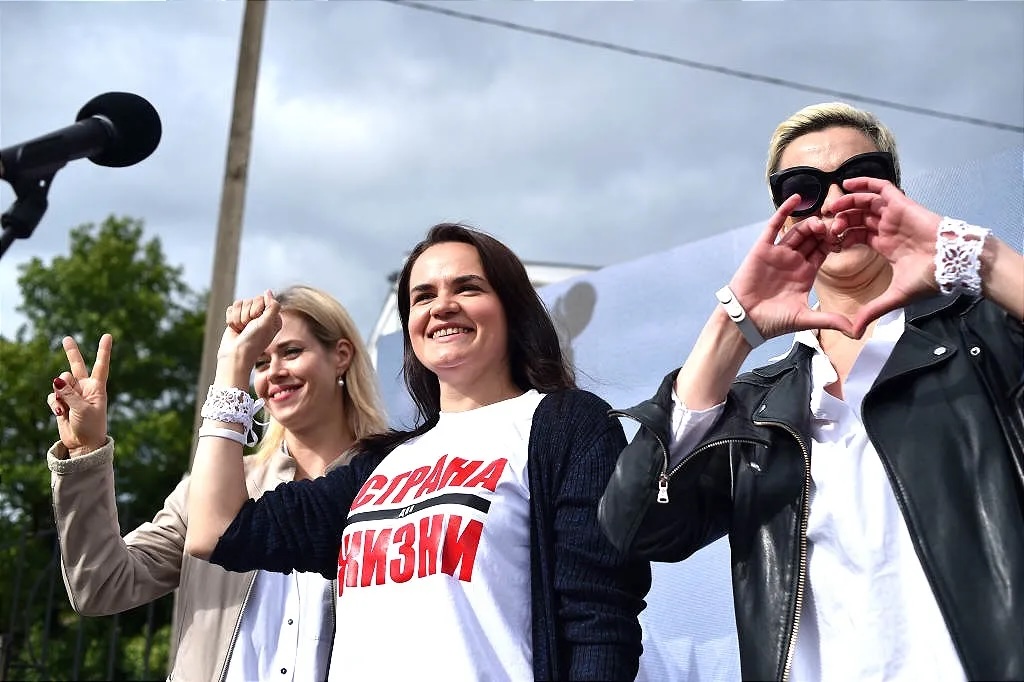
Alexander Lukashenko, the former Soviet state farm director turned Belarus strongman, once said that a woman could never run his country. Then three of them challenged him.
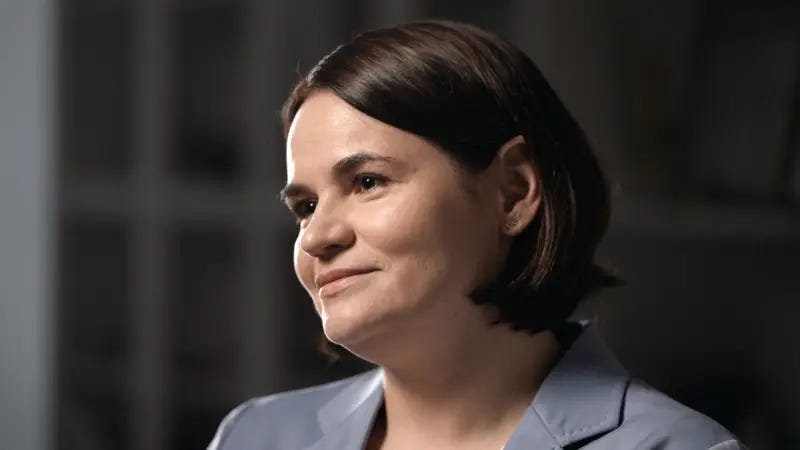
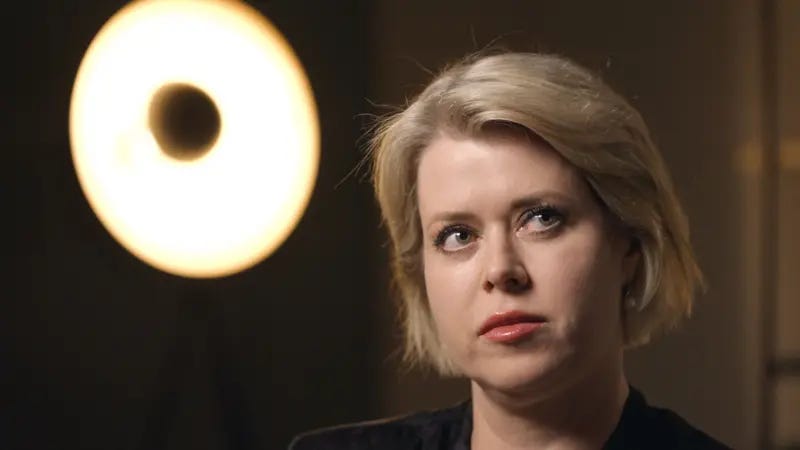
Five years on from the biggest protests in Belarusian history, Svetlana Tikhanovskaya and Veronika Tsepkalo, both now in exile, have been speaking to the BBC about the price they paid for inspiring hundreds of thousands of Belarusians to take to the streets to call for change.
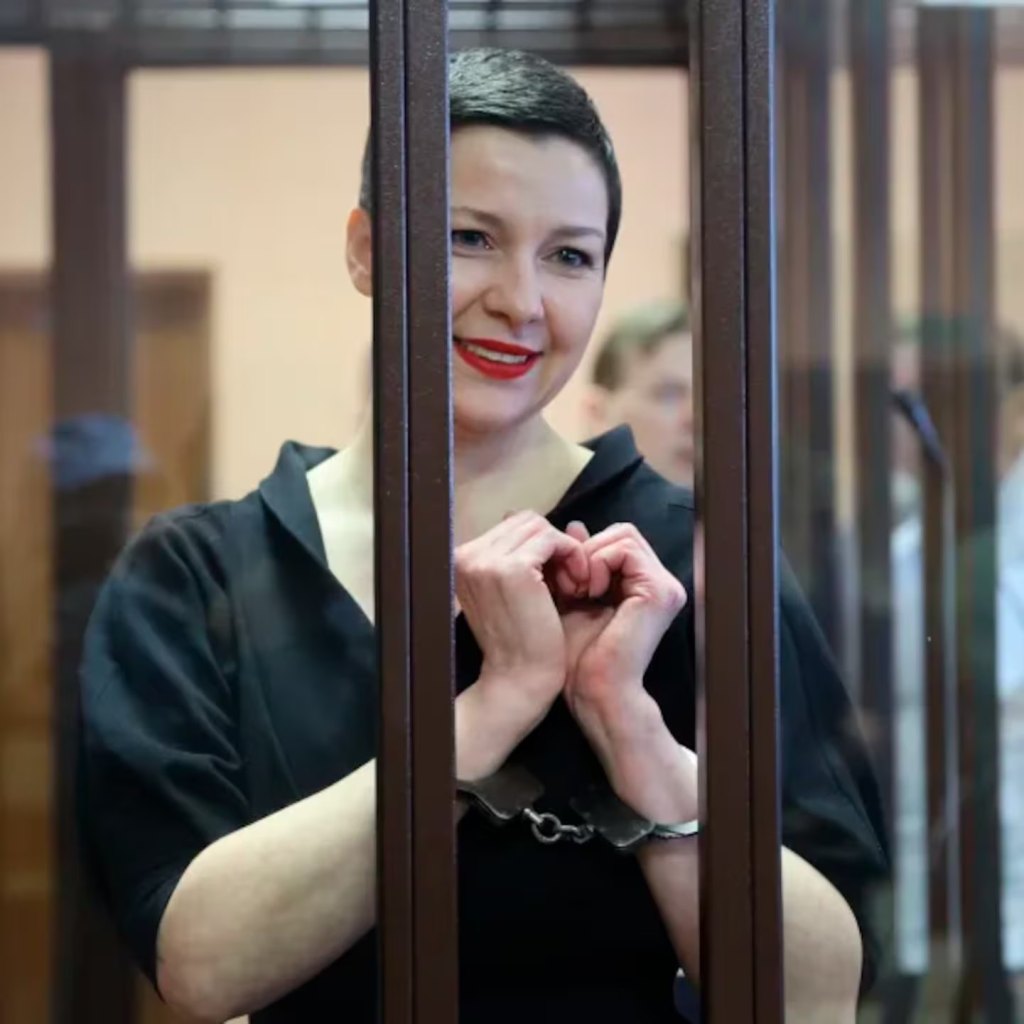
Their former teammate, Maria Kolesnikova, is now in a Belarusian prison, sentenced in 2021 to 11 years for extremism and plotting to overthrow the government.
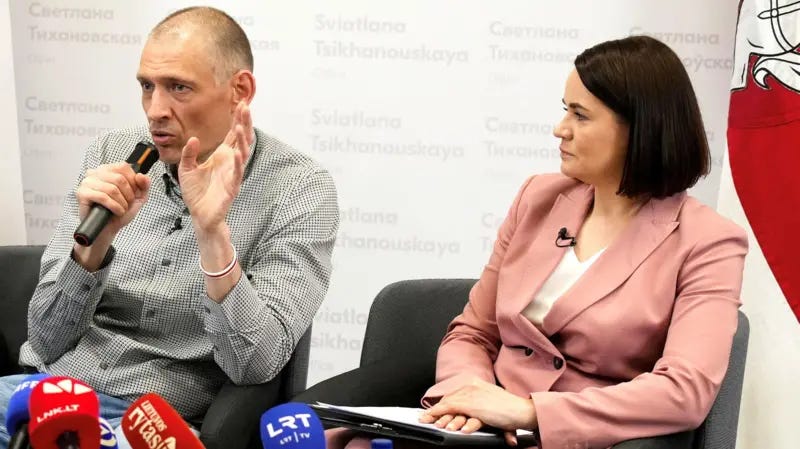
Her sister Tatsiana Khomich tells the BBC the family haven’t heard from her since last year.
The three women joined forces in August 2020, when the opposition candidates they were supporting were all forced to end their presidential bids.
Their short-lived alliance made global headlines with pictures of them showing a heart, a fist, and a victory sign with their hands.
They claimed it took them 15 minutes to agree to join forces against Lukashenko, who has been in charge of Belarus since 1994.
“Far quicker than it would take men to do it,” said Veronika Tsepkalo, at the time.
She was left in charge of her husband Valery Tsepkalo’s campaign after the former Belarusian ambassador to the US was barred from registering as a candidate and fled the country fearing arrest.
Maria Kolesnikova campaigned for banker Viktor Babaryko, who was also prevented from standing and arrested ahead of the election.
But it was Svetlana Tikhanovskaya who ended up on the ballot, stepping in for her husband, the activist and popular video blogger Sergei Tikhanovsky, after he too was thrown in jail.
Together the three women travelled around the country, drawing big crowds of supporters eager for change. Their promise was simple: release all political prisoners, then hold a free and fair election.
In 2025, Svetlana Tikhanovskaya speaks about the “emotional uplift” all of them felt during those days.
“We managed to unite Belarusians”, she tells the BBC.
When election day came on 9 August, people flocked to the polls. Svetlana’s supporters were convinced she had won the vote, but Alexander Lukashenko claimed a landslide victory.
This sparked unprecedented mass demonstrations across the country, which lasted for several months. The authorities responded with a brutal crackdown. At least four people were killed – their deaths blamed on the security forces.
But none of the three women who had electrified the campaign, were there to lead the protestors.
Tsepkalo left Belarus just before the election. Tikhanovskaya was detained by the KGB a day after the vote and forced out of the country under threat of being jailed and losing her children to state care.
Maria Kolesnikova stayed behind. She was arrested in September, after tearing up her passport at the border with Ukraine to prevent a forceful expulsion.
Along with her former boss Viktor Babaryko, she is one of more than a thousand political prisoners still held in Belarus, according to a human rights group Viasna.
Since 2020 tens of thousands of people have been arrested for opposing the regime, many say they have suffered torture and mistreatment while in detention.
Today, any public dissent in Belarus is crushed.
“I sincerely believed that Lukashenko’s regime would fall”, Veronika Tsepkalo tells the BBC.
Like hundreds of thousands of Belarusians who are estimated to have left the county after 2020, she now lives abroad with her family, working at a big tech company in the UK.
“It was this all-or-nothing approach”, says Tatsiana Khomich, Kolesnikova’s sister who is now campaigning for release of Belarusian political prisoners. “We overestimated ourselves and underestimated what the authorities are capable of.”
Svetlana Tikhanovskaya says she now understands they had no plan and “weren’t ready for any radical change”.
Once a stay-at-home mum who admitted to being shy and lacking her husband’s charisma, she is now recognised as leader of the democratic opposition in exile, and regularly meets heads of state and lobbies for sanctions against Lukashenko’s government.
“If I could transfer my present knowledge, my experience to myself five years ago, I would definitely have felt more confident,” Tikhanovskaya says. “I’ve learned a bit of diplomacy, how to talk to politicians, how to be comfortable around powerful people”.
Less than two months ago Svetlana unexpectedly got her husband back: Sergei Tikhanovsky was released along with 13 other political prisoners and sent to Lithuania to his family.
It is thought that Donald Trump’s administration was key in securing their release.
Having said in the past that she went into politics “out of love” for her husband, Tikhanovskaya now admits she’s since also fallen in love with Belarus and the vision for her country.
“We’re not going to compete with Sergei about who’s more important, who has more followers et cetera. Sergei will be a natural fit for our movement,” she says.
Tikhanovskaya rarely speaks to Veronika Tsepkalo and in the interview with the BBC doesn’t want to go into details of what happened to their relationship.
Tsepkalo is more candid: she accuses her former “sister-in-arms” of hijacking their movement and pushing her out.
“The trio has broken up”, states Tatsiana Khomich.
Khomich, who is still part of her sister’s team, says all of them now have their own projects.
Svetlana Tikhanovskaya says her priority is working towards the release of political prisoners and lists helping Belarusians abroad and keeping Belarus on the international agenda as her achievements.
Veronika Tsepkalo is sceptical of these successes, calling them “action for action’s sake”.
Back in her husband’s team, she has been campaigning to bring Alexander Lukashenko to international justice.
Tatsiana Khomich thinks that trying to force regime change from abroad is “meaningless”.
“In reality, we’re now much further away from it than we were five years ago”, she says.
Both Tikhanovskaya and Tsepkalo believe at some point in the future there will be a free and democratic Belarus.
When asked to respond to criticism that she had put her own ambitions before her team, Tikhanovskaya says:
“Maybe that’s the kind of thing people who don’t really know me would say. I’d like us to finally hold new and fair elections but I certainly won’t be taking part in them.”
Kapela (ensemble) Rej is a group performing traditional Belarusian music. Their main instruments are the duda (Belarusian bagpipe) and the violin.
The ensemble on the recording: Vital Voranaŭ: duda Ursula Oleksiak: violin, vocals featuring Sergi Llena (Spain): frame drum, gaita de boto
The recordings were made in Serbia during the Rog Banata festival in the towns of Zrenjanin (2024, tracks 1-9) and Bečej (2023, tracks 10-13). The album cover photo was taken at the performance in Belgrade in 2024 by Sandra Crepulja.
Maria Kalesnikava, musician, activist, and political prisoner, was detained on this day in 2020. She was kidnapped on the Minsk street by the Belarusian authorities and the next day taken to the Belarusian-Ukrainian border to be thrown out of the country. But she tore up her passport and thus could not cross the border. In 2021, together with Maksim Znak, she was sentenced to 11 years of imprisonment (Maksim got 10 years). Now she is kept in Homiel women’s colony.
Kalesnikava is of my age, and five years of her life she has already spent in jail. Since February 2025, Maria and her family have exchanged no letters or calls… At least, she is not in solitary confinement but kept together with other female prisoners.
I’ve not been writing about the political situation in Belarus for a while, but that is not because there is some improvement. No, every day we read about new detentions. This week human rights defenders have recognized 14 new political prisoners, and the authorities have added 68 names to the so-called “extremist list”. All in all, we now know about 1197 political prisoners, 32 foreign citizens among them. A recent case: a 52-year old British citizen (she also has the Belarusian citizenship) was arrested while crossing the Belarusian border and sentenced to 7 years of prison (https://spring96.org/en/news/118604).
But still hundreds stay unrecognized because of different reasons. Without free Belarus, you won’t have peace in Europe.
Yesterday, I wrote about the five years Maria Kalesnikava had already spent in jail and about 1197 political prisoners in Belarus. And today, we’ve learned about another death.
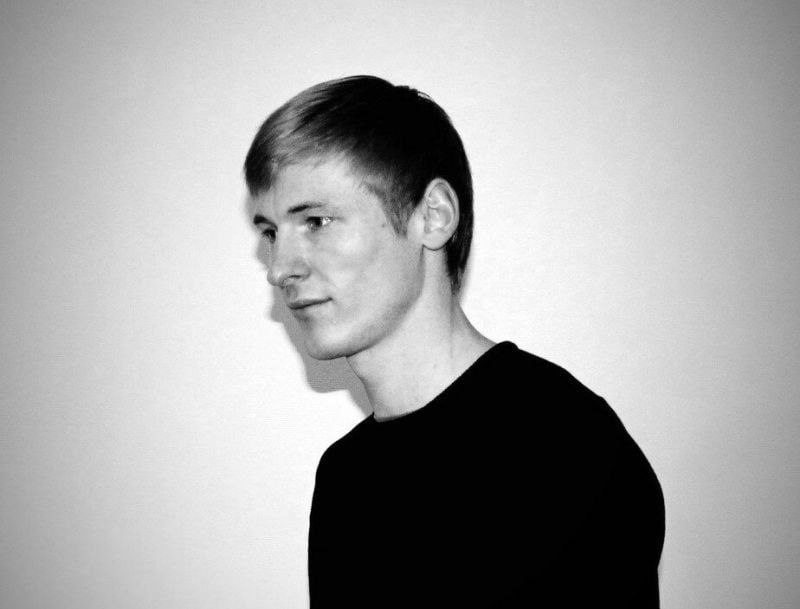
Political prisoner Andrei Padniabenny, a 36-year-old Russian citizen, has died in Mahiloŭ penal colony No. 15. He was tried twice on criminal charges and sentenced to 16 years and eight months in a medium-security penal colony. He had been behind bars for nearly four years. The exact cause of his death is unknown.
His mother Valiantsina, reported on Facebook:
“My precious grandchildren are left without a father… The only consolation is that no one will be able to torture my son anymore, either physically or psychologically… I believe that God’s justice will reach the guilty, and no crime will go unpunished….”
According to the publication, Andrei died on September 3. This is the ninth death of a political prisoner in Belarus and the second death of a Russian citizen behind bars.
Sean Trischka, “Something I Learned Today” (Hüsker Dü cover)
Marxism did not make many inroads in Indian thought in North America – as opposed to its adoption by Indigenous thinkers elsewhere in the Americas – until the Second World War. Six decades before theories of settler colonialism were developed by Maxime Rodinson for Israel and, in their current academic configuration, by Patrick Wolfe for Anglo-settler states, Karl Kautsky refined the distinction between ‘work’ colonies, where Europeans settled and conducted extermination, and ‘exploitation’ colonies, where the aims were more purely extractive and relied on local labour. But the importance of radical politics for Native American thinkers wasn’t merely abstract. Lenin’s policies on safeguarding Indigenous cultures in the Soviet Union were looked on by many Native Americans as preferable to the forced assimilation initiatives of the US Bureau of Indian Affairs. When Native nations petitioned to attend the Versailles Peace Conference, the Wilson administration dismissed them out of hand.
In 1932, the Marxist Nez Perce anthropologist Archie Phinney travelled from Idaho to the Soviet Union. He completed a doctorate at the Leningrad Academy of Science in which he favourably contrasted Soviet management of minority peoples with US federal Indian policy. As Benjamin Balthaser has noted, of particular interest to Phinney was the way that – in theory, if not in practice – the Indigenous peoples of Russia maintained dual identities as Soviet citizens and custodians of their cultures, which retained the right to outright self-determination. Phinney acknowledged the necessity of the developmentalism imposed by the US state but pointed out that it was hardly in Indian interests to become proletarians at the same level as the poorest people in the country. ‘The US government,’ he wrote, ‘feels compelled to rehabilitate [the Niimíipu] and bring them up “to the level equal to that of the average rural white family”. Yet that “average rural white family” is itself in need of a strong dose of “rehabilitation”.’ He argued instead for reforging traditions of common ownership on reservations into democratic co-operatives which would allow Indians to pursue – and exhibit to the rest of the country – alternative paths towards social transformation.
Native-Soviet mutual admiration reached its zenith in 1942, when Chief Fallen Tree of the Mohawk nation presented an Indian war bonnet to a representative of Stalin, whom the Indian Confederation of America voted ‘warrior of the year’. But the rest of the decade saw radicalism weaken dramatically. The interest in Marxism vanished with the Cold War consensus, as figures such as Luther Standing Bear – who starred as an Indian gardener in the Red Scare film Bolshevism on Trial – became a standard bearer for the ‘progressive’ Indian cultural movement of the 1940s and 1950s. More materially, 45,000 Indigenous soldiers had enlisted in the Second World War (the US military relied on code based on the Navajo language). But there were good reasons for Indigenous activists to think that the US state was starting to move in their favour. Roosevelt’s New Deal had included an ‘Indian New Deal’, in the form of the Indian Reorganisation Act, which counteracted some of the measures that had divided Indian lands. His administration closed down Indian boarding schools and other vehicles of violent assimilation, and also sought to re-sovereignise Native lands, including by means of legal jurisdiction. The Reorganisation Act went so far as to include provisions for the state to buy land and restore it to Indian reservations. As a further counter-thrust legal advocates for Natives such as Felix Cohen sought to bring the states back into submission by, for instance, suing them in federal court for withholding welfare payments to tribes. In the following decade, Roosevelt’s Indian New Deal was undermined by Western senators who sought to terminate the status – and take over the territorial holdings – of tribes by using the language of civil rights to insist on their members becoming fully integrated citizens of the nation.
One of Roosevelt’s more enduring reforms was the policy of hiring Native Americans to work at the Bureau for Indian Affairs. Many of the leading Indian activists of the postwar decades held jobs at the bureau, transforming it into a laboratory for reform. They conceived of their mission as preserving New Deal gains and their particular foe was the postwar drive for ‘termination’, by which politicians sought to cut off federal land grants to tribes deemed sufficiently assimilated. The 1956 Indian Relocation Act accelerated this process by moving Indians into cities en masse. The result was predictable: a new revolutionary movement of Native Americans who channelled their sense of dislocation into a new wave of activism known as Red Power.
As the sun rises on 21 May, marking the Day of Remembrance for the Circassian Genocide, we invite you to listen beyond the silence that often surrounds the wounds of colonialism. In the following article, Bulat Khalilov, co-founder of Ored Recordings – a label dedicated to traditional and post-traditional music from the North Caucasus – reflects on a paradox within Circassian music today: how a culture with rich vocal traditions has, in a sense, sidelined its most distinctive feature, the polyphonic vocal technique of zhiu?
In conjunction with today’s commemorations, Ored Recordings is releasing a compilation, Shopsh: Circassian Vocal Tradition of Zhiu, which highlights the vocal tradition of zhiu as both a form of remembrance and a possibility.
21 May is the Day of Remembrance for Circassians – or, more directly, the Day of the Circassian Genocide.
In 1864, the Russian Empire marked this day as the official end of the Russo-Caucasian War, which had begun over a century earlier in 1763. What Russia celebrated as victory, most Circassians – and many other peoples of the North Caucasus – remember as loss: a brutal war for independence that ended in exile, devastation and what many now call genocide.
That view isn’t fringe. It’s shared by most Circassian historians and civil society voices. To date, only Georgia and Ukraine have officially recognised this as genocide. But across the Circassian diaspora – from Türkiye and Syria to Jordan, the EU and the US – 21 May is marked with acts of remembrance. And yes, those memories echo back home, too – in Adygea, Kabardino-Balkaria and Karachay-Cherkessia.
However, most Circassians in the North Caucasus are suspicious of these gestures, considering them to be opportunistic and insincere. Their refusal to embrace recognition from other states usually stems from a desire to avoid becoming a pawn in a larger geopolitical game.
Officially, the Russian state doesn’t like to talk about any of this. The war itself is treated as taboo, its memory reframed as a tool of Western propaganda or a threat to national unity. And yet, every year, people still gather. From moderates to patriots, from Nalchik to Cherkessk to Maykop, Circassians take to the streets – sometimes quietly, sometimes defiantly.
At Ored Recordings, we return to this trauma again and again – not to dwell, but to listen. To ask how this wound still shapes the way we live, create and imagine. Every year on 21 May, we release a concept album. One year, it’s heroic songs from the war. Another, it’s diaspora voices from Türkiye. Or wartime songs of the 20th century. Each time, we try to trace how our people processed a colonial wound through music, or indeed failed to do so.
This year, we chose to focus on traditional vocal techniques in Circassian music. At first glance, this may seem unrelated. But in truth, every serious conversation about the state of Circassian culture circles back – if not to 1864 itself, then certainly to the long shadow it cast.
This release is a compilation of mostly unpublished recordings. Think of it as a teaser – a warm-up – for future albums. In those upcoming releases, we’ll dive deeper into each performer’s story and the recording context.
This essay – and this release – emerged from a simple question: what’s really going on in Circassian music today?
A big part of the tradition is group singing. Usually it’s men (sometimes women, sometimes mixed groups), gathering to sing. The lead voice carries the main melody, while the others hold a choral drone or a call-and-response. This choral technique is called zhiu or yezhiu.
Like in many cultures, group singing wasn’t just about music – it was a way to be together, to make a space for cultural and social connection.
Most Circassians today learned about this from the elders. From people who sang at weddings and late-night gatherings. Or from those who, as kids, would secretly listen to adults sing into the night. But our main source are still the archives – dusty tapes recorded by Soviet folklorists. Interestingly, the folklorists’ archives have ended up becoming tradition-bearers in their own right.
Academic work on Circassian vocal music – papers, dissertations, theoretical frameworks – has had almost no impact on today’s performers. Music theory and actual practice in Adyghe communities have mostly run on parallel tracks, rarely intersecting.
But the sound itself – those dusty Soviet-era recordings collected by ethnomusicologists – found a way through. Once digitised, they slipped into public circulation (sometimes semi-legally) and became a strange kind of bridge: not from scholar to scholar, but from singer to singer, across generations.
Those old recordings remind us that the song and its lyrics are guardians of language, poetic style and cultural memory. And yezhiu? That’s the secret ingredient. The thing that gives it punch. Soviet musicologists put it nicely: yezhiu helps the song “reach the hearts of the people”.
There’s even a sharp old proverb: “Ежьур уэрэдым и щIопщ” – yezhiu is the whip for the song. It keeps the rhythm. Holds the structure together. Gives the song its shape.
And yet – despite this deep knowledge and respect for vocal technique – modern Circassian music mostly revolves around instruments. Not voices.
So we asked ourselves: how did a whole new wave of Circassian music appear – something unthinkable even ten years ago – and why does almost all of it seem to avoid yezhiu, the central tool of our tradition?
Silly little fly was burning on a candle Burning the small fry, smoke that is so tender Little star has fallen into the puddle by the steps The squadron did not notice the fallen fighter
The dead one did not live, the sick’s not kicked the bucket The seer was not blind, the sleeper is still tucked in Merry beating brave hearts (in Morse code would tell) The squadron did not notice the fallen fighter
No-one was more dear, no-one was more pretty No-one was more pained, no-one was more happy There was no beginning and there was no end The squadron did not notice the fallen fighter
— Eric Boros, “The Squadron,” from Secondhand Guitar, released February 3, 2014 • Music and words: Yegor Letov • Translation by Szarapow
For months, Elvira Kaipova had not heard from her son Rafael, a Russian soldier deployed in Ukraine.
Military officials responded to her repeated questions about his whereabouts by saying he was on active duty and therefore incommunicado. Then, late last November, two days after they again made that assertion, she learned that he had gone missing on Nov. 1 — from a Telegram channel that helps military families.
“We lost your son,” Aleksandr Sokolov, the officer in Rafael’s unit in charge of family liaison, told her when she traveled to its headquarters in western Russia.
“Lost him how?” she says she responded, alarmed and angry, especially when the officer explained that after Rafael had failed to check in by radio, a search had proved impossible. “How do we search for him?” she says the officer told her.
Variations on that grim scenario have been repeated countless times since Russia invaded Ukraine in February 2022. The Russian Ministry of Defense lacks any formal, organized effort to track down legions of missing soldiers, according to bereaved families, private organizations that try to assist them and military analysts. Relatives, stuck in limbo, fend for themselves with scant government information.
The ministry itself declined to comment for this article. Mr. Sokolov, the liaison officer, said in a text message: “You do realize that I can’t comment on anything.”
Even if Russia and Ukraine reach a peace agreement, the hunt for missing soldiers is expected to endure for years, if not decades.
Last year was the deadliest for Russian forces since the start of the full-scale war in Ukraine: at least 45,287 people were killed.
This is almost three times more than in the first year of the invasion and significantly exceeds the losses of 2023, when the longest and deadliest battle of the war was taking place in Bakhmut.
At the start of the war, losses happened in waves during battles for key locations, but 2024 saw a month-on-month increase in the death toll as the front line slowly edged forward, enabling us to estimate that Russia lost at least 27 lives for every square kilometre of Ukrainian territory captured.
The BBC Russian Service, in collaboration with independent media outlet Mediazona and a team of volunteers, has processed open source data from Russian cemeteries, military memorials and obituaries.
So far, we have identified the names of 106,745 Russian soldiers killed during the full-scale invasion of Ukraine.
The true number is clearly much higher. Military experts estimate our number may cover between 45% and 65% of deaths, which would mean 164,223 to 237,211 people [have been killed].
20 February 2024 was the deadliest day for Russian forces that year.
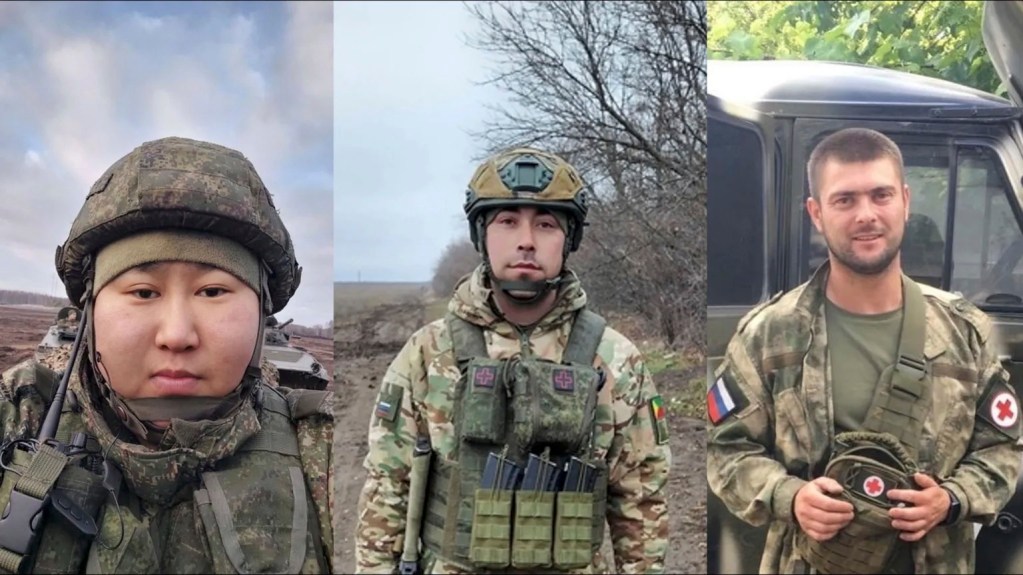
Among the casualties were Aldar Bairov, Igor Babych and Okhunjon Rustamov, who were with the 36th Motorised Rifle Brigade when four Ukrainian long-range HIMARS missiles hit a training ground near the city of Volnovakha in occupied Donetsk.
They had been ordered to line up for a medal ceremony. Sixty-five servicemen were killed, including their commander Col Musaev. Dozens more were wounded.
Bairov, 22 and from Buryatia in eastern Siberia, had studied to be a food sanitation specialist but was drafted for mandatory military service and then signed a contract to become a professional soldier.
In February 2022 he went to fight in Ukraine and was part of the battle for Borodyanka during his brigade’s advance towards Kyiv in March 2022. The town was almost completely destroyed. Ukrainian sources say Russian soldiers were involved in the execution of civilians.
Aldar Bairov (left), Okhunjon Rustamov (C) and Igor Babych were all killed in a strike on 20 February last year
Okhunjon Rustamov, 31 and from Chita in Siberia, had worked as a welder after serving a mandatory term in special forces. He was mobilised during a partial draft in October 2022.
Unlike Rustamov, Igor Babych, 32, had volunteered to go to war. He had worked with adults and children diagnosed with cerebral palsy, helping them with physical therapy until April 2023.
In total, 201 Russian soldiers died on that day, according to our data.
A few hours after the strike on the training ground, then-Russian Defence Minister Sergei Shoigu met Vladimir Putin to bring him news of military success from the front line.
There was no mention of the training ground attack, nor was there any word from the Ministry of Defence in its daily reports.
A relative of Okhunjon Rustamov said she had already buried three close family members over the course of the war. “In December 2022, my husband died. On 10 February 2024, my godfather. And on 20 February my half-brother. From one funeral to the next.”
In our analysis, we prioritised exact dates of death for soldiers. If that wasn’t available, we used the date of the funeral or the date the death was reported.
In the first two years of the war, 2022 and 2023, Russian losses followed a wave-like pattern: heavy fighting with high casualties alternated with periods of relative calm.
In 2023, for example, most casualties occurred between January and March, when Russian forces attempted to capture the cities of Vuhledar and Bakhmut in Donetsk Oblast.
In the first year of the full-scale invasion, according to our calculations, Russia lost at least 17,890 soldiers. This number does not include losses from Russia’s two proxy forces in occupied eastern Ukraine.
In 2023, the number rose to 37,633.
In 2024, there was no period showing a significant fall in casualties. Bloody battles for Avdiivka and Robotyne were followed by intensified assaults towards Pokrovsk and Toretsk.
In August 2024, Russian conscripts were killed when Ukrainian forces stormed over the border into the Kursk region. From August 6 to 13 alone, an estimated 1,226 Russian soldiers died.
However, the heaviest overall losses occurred during a slow Russian advance in the east between September and November 2024, according to leading US military analyst Michael Kofman.
“Tactics emphasised repeated attacks with dispersed assault groups, using small infantry fire teams, which increased overall casualties relative to terrain gained,” he explained.
After almost two years of intense fighting, Russian forces seized the logistical hub of Vuhledar in Donetsk on 1 October 2024.
According to estimates by the American Institute for the Study of War (ISW), from September to November 2024, Russian forces captured 2,356 square kilometres of Ukraine.
Even then, Ukrainian forces at the front did not collapse.
The cost of this advance was at least 11,678 Russian military deaths.
Actual losses figures are likely higher. We have only accounted for soldiers and officers whose names appeared in publicly available obituaries and whose dates of death or funeral fell within this period.
Overall in 2024, according to ISW, Russia captured 4,168 square kilometres of land.
If we assume that our figure of 45,287 confirmed deaths in 2024 is about 40% of the full number, then the total number would be closer to 112,000 fatalities last year.
This means that for each square kilometre captured, 27 Russian soldiers were killed, and this does not include the wounded.
How losses are changing recruitment
Russia has found ways of replenishing its depleted forces.
“Russian recruitment also increased in the second half of 2024 and exceeded Russian casualties, allowing Moscow to generate additional formations,” says Michael Kofman.
We also class as volunteers those who signed up to avoid criminal prosecution, which was allowed by law in 2024.
Volunteers have become the fastest-growing category of casualties in our calculations, making up a quarter of those we have identified.
In 2023-2024, thousands of volunteers who signed contracts with the Ministry of Defence were sent to the front lines only 10–14 days later. Such minimal training will have dramatically reduced their chances of survival, experts say.
One Russian republic, Bashkortostan, has seen the highest numbers of casualties, with 4,836 confirmed deaths. Most were from rural areas and 38% had gone to fight with no military experience.
The one-time payment for signing a Russian army contract in Ufa is 34 times the region’s average salary of 67,575 rubles (£600).
Calculating deaths from open source data will always be incomplete.
This is because the bodies of a significant number of soldiers killed in the past months may still be on the battlefield and retrieving them presents a risk to serving soldiers.
The true death toll for Russian forces increases significantly if you include those who fought against Ukraine as part of the self-proclaimed Donetsk and Luhansk People’s Republics.
An assessment of obituaries and reports of searches for fighters who have lost contact suggests between 21,000 and 23,500 people may have been killed by September 2024.
That would bring the total number of fatalities to 185,000 to 260,700 military personnel.
CLARIFICATION 5 May 2025: This story has been updated to make it clear that the figure of 27 losses per sq km is based on an estimated number of deaths last year of about 112,000.
In the wee hours of Sunday, 4 May, Russian security forces raided concerts in St. Petersburg and Yekaterinburg, at which, among other things, they asked attendees about their attitude to the war, local media have reported.
In Yekaterinburg, law enforcement officers interrupted a concert at the club Syndrome. As the musicians were performing, people in uniform came on stage, halted the concert, and asked the concert organizers to turn on the lights, concertgoers told the Telegram channel Svet. Ekaterinburg.
“People were ordered to stand facing the walls and told that there would be a document check. [The police] checked everyone’s documents, tattoos, and elbows, asked about their attitudes to left-wing radical movements and to the SMO (the war in Ukraine—ed.), and they checked the messenger apps on their phones. After the check, people were taken outside and ordered to scram,” said one of the guests.
Another clubgoers told the news website E1.RU that police locked him in a paddy wagon, confiscated his phone, and checked his contents. Police insulted the detainee and refused to explain the reasons for the check. According to eyewitnesses, police and Russian National Guard officers took part in the raid. Those agencies declined to comment on this report.
Regular raids by law enforcers in Russia
In St. Petersburg, law enforcers raided a rave party at the [underground] club Kontrkult. A source close to the police told Ren TV that the reason for the raid was that the event had not been “sanctioned.” According to the news website 78.ru, partygoers had their documents checked and were searched for banned substances. The publication adds that the event’s organizers were detained. This has not been officially confirmed.
Footage of the raid on Kontrkult, as posted on the Telegram channel SHOT
Similar raids on various establishments have happened regularly in Russia in recent months. Law enforcers have carried out several raids on fitness centers, in which people were issued military conscription board summonses. Similar raids have been carried out against migrant workers, who also had their documents checked and summonses handed to them, along with members of the LGBT community, who have been declared “extremists” in Russia.
💬 Student from Nizhny Tagil fined 120,000₽ in criminal “defaming” case
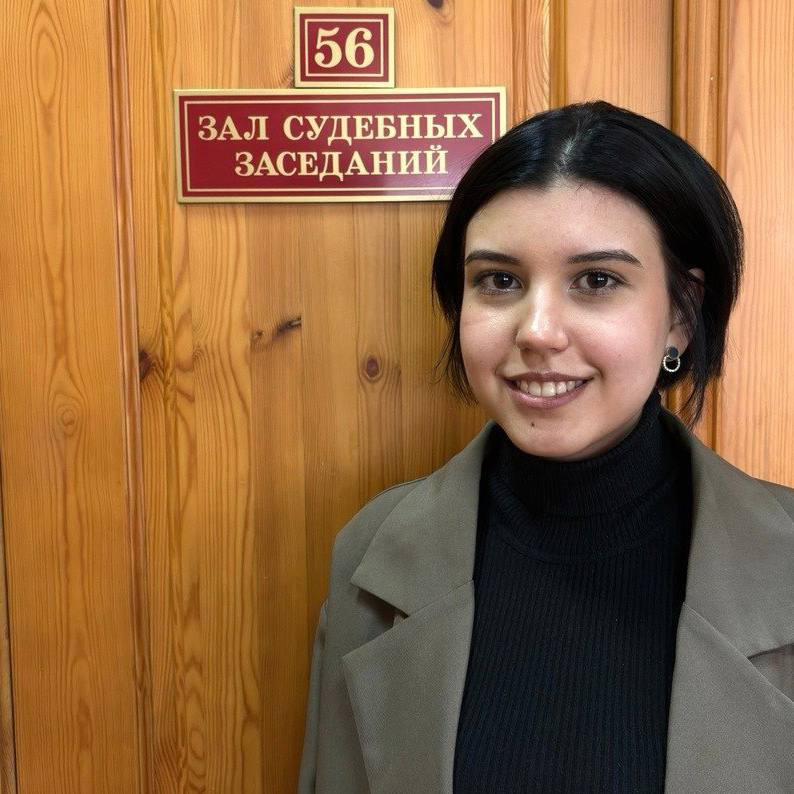
In Nizhny Tagil, 21-year-old student Yekaterina Sergeyenko has been sentenced for “defaming” [the Russian army]: she was fined 120,000 roubles [approx. 1,280 euros]. According to the news agency Mezhdu Strok (“Between the Lines”), criminal charges were filed over the young woman’s comments in the “Incident Nizhny Tagil” group on the social network VKontakte.
Vechernye Vedomosti reports that at the time she posted the comments, Sergeyenko had a prior administrative conviction for painting sixteen pacifist slogans on buildings in the city. This fact influenced the decision to file criminal rather than administrative charges against her.
Judge Oksana Belkina of the Tagilstroy District Court found Sergeyenko guilty. Although the verdict has not yet entered into legal force, the fine, according to Mezhdu Strok, has already been paid.
As a Kyrgyz woman born in the last years of the Soviet Union, I never thought twice about whether my usage of the Russian language was problematic or not — until recently when I reached out to my Ukrainian friend in Russian, and she responded to me in Ukrainian.
I have been thinking about the political aspects of language since then.
Last week I was invited to a podcast to talk about de-colonial feminism in Central Asia by a research group that does memory studies in Kyrgyzstan. There we sat in a warmly lit Bishkek studio in comfortable canary-yellow armchairs — two women of clearly Central Asian descent, with names that mean ‘honey’ and ‘worship’ in our native language, discussing whether the Soviet Union was a colonial empire, and how a more than 100-years history of Russian presence in the region has disrupted and affected the lives of peoples of Central Asia. I am making smart jokes and incisive observations, we laugh, we debate, we lament — all in Russian.
Although this language was not the main subject of our discussion, we comment in passing on it — noting how intangible colonial legacies can sometimes have a constructive element to them.
It is, of course, possible for all of us to drop the language of the colonizer, whether it’s English, French, Spanish, Russian, or Chinese — and speak our own languages, but the ease and comfort of using these when trying to communicate with people outside our cultures is just so tempting! And so then the question is whether to take offense towards the language because it happens to have been “originated” by the ‘big bad’ or to ignore that and make it our own?
Russian was the language of books that took me on journeys across galaxies, of Soviet-era films that fanned the fire of idealism in me, of finding community with other post-Soviet teenagers that, like me, had traveled to the United States as exchange students. We spent the year yell-singing Kino’s songs, making the olivier salad for a New Year’s celebration, and rooting for Evgeni Plushenko in the 2001 Winter Olympic Games in Salt Lake City.
It was the language of the early science fiction stories I wrote when I was twelve, of expressing my first heartbreak in broken poetry form, and of clumsily flirting, building alliances, or of standing up to bullies.
It is also the language of differentiation — a tool of categorizing people into social strata, both inside Russia and in the non-Russian republics during Soviet times. My own mother had been ridiculed for not speaking Russian well, considered ‘dark’ and uneducated, uncultured. To this day she gets offended when my Russian-schooled siblings sometimes laugh at the little mistakes she makes when attempting to speak it because it reminds her of how she was treated when she was younger.
Not to worry though — this is a very rare occurrence, because our mom is so strong-minded that she’s bent everyone to her will, forcing everyone to speak Kyrgyz if they wanted to be understood by her. Even our dad, who was a Russian speaker with a beautifully reverberating voice, had mastered the Kyrgyz language for our mother’s sake. My siblings too, although their attempts at translating their jokes and anecdotes from Russian into Kyrgyz for our mom sometimes backfire because they do not take into account the semantic nuances of the two languages. And despite her lack of Russian, she made a successful career in the 90s as a kommersantka — just like thousands of other women who picked up the baton when the system that was oppressing them fell — traveling by bus and train to Moscow, Minsk, Tallinn, and later by plane to Meshhed, ensuring we were never hungry or dependent on anyone.
Maybe that’s a good example of how language does not have to be a cornerstone of someone’s lived experience. Some people choose to speak the oppressor’s language, some people choose not to. As long as there’s a way of making each other understood, even by mixing words or even using gestures, it’s all good.
My Ukrainian friend was so kind and gracious when I apologized for using Russian when I reached out to her, and she sent me a beautiful voice message back in Russian. I could hear she struggled a little speaking it because, as she explained, she had not spoken it in a while. She said she didn’t mind using it to communicate with me, and that she was sorry she hadn’t learned some Kyrgyz by now because she has other Kyrgyz friends too. And I was sorry I hadn’t learned Ukrainian by now. But eventually it was Russian we exchanged these lamentations in, and the question remains open to me — whose language is it anyway?
Syinat Sultanalieva is a human rights activist and researcher from Kyrgyzstan, who writes science fiction on the side when she’s not busy dissecting power structures and dynamics in the region and the world.
Lӓysӓn Ensemble of Yafarovo Village Let’s Get Together Tonight: Mishar Tatar Songs from Orenburg Region
The Mishars are an ethnic subgroup of Tatars. They have their own dialect and their own culture. The main part of the Mishars live in the Middle Volga region and the Urals.
Yafarovo is a Mishar village located in the Aleksandrovsky district of the Orenburg region.
Izhevsk long ago nabbed Tula’s de facto title as Russia’s arms manufacturing capital: the Kalashnikov Concern is headquartered there, producing shells, assembling drones, and making rifles. But in a seemingly parallel reality amid the rumble of the factories, young Izhevskers have opened an independent bookstore, and they have also been translating the Udmurt avant-garde of the twenties into Russian and publishing literary magazines. Who are these young people? And how was all of it possible?
“We’ll be having a children’s New Year’s party in there”
Five years ago, Albert Razin, an Udmurt activist and patriot, set himself on fire in the capital of Udmurtia, on the square outside the republic’s State Council building. Razin held a placard featuring a quotation from Rasul Gamzatov: “And if tomorrow my language disappears, I am willing to die today.”
In late 2024, I lived in Izhevsk a stone’s throw away from the spot where Razin had burned on behalf of the Udmurt language. It is the very heart of the city: the Eternal Flame, the republic’s government house, the opera house, a Rostic’s fast-food restaurant, the residence of the head of Udmurtia, and the Kuzebay Gerd National Museum are nearby.
Gerd (a pseudonym meaning “knot” in Udmurt; Gerd’s birth name was Kuzma Chaynikov) was a poet, folklorist, and probably the most important Udmurt of the twentieth century. In 1932, he was arrested along with other prominent members of Soviet Finno-Ugric ethnic groups as part of the fabricated SOFIN Case. [SOFIN was the acronym of the fictitious “Union for the Liberation of Finnish Peoples” — TRR.] The poet was accused of plotting to get Udmurtia and other autonomies to secede from the Soviet Union and establish a Finno-Ugric federation under the protectorate of Finland. Kuzebay was shot in 1937 at Sandarmokh in Karelia. He was exonerated in 1958.
The Gerd Museum’s website advertises a separate exhibition dedicated to the Udmurt national poet. The museum is located in the building of the former arsenal. The entrance to the main exhibit is on Kuzebay Gerd Square, where twenty years ago a monument to the poet was erected. Perched on a rock, a quite youthful Gerd gazes thoughtfully at the former military warehouse. He is writing a poem, apparently.
I am all alone at first, but schoolchildren wearing blue ties later come running into the museum. A museum worker, dressed in a traditional costume adorned with a monisto necklace, greets the children in Udmurt — Chyrtkemesi! — but she immediately switches to Russian and talks about the pre-Petrine history of Udmurtia, that is, before Izhevsksy Zavod (the name of the settlement which preceded city) arose in these parts. Count Peter Shuvalov built an ironworks there with the permission of the Empress Elizabeth. A little later, Izhevsk became the Russian Empire’s virtual arms capital (no offense to Tula).
The rooms I have visited recount this history as well as a little bit of Soviet history (artisanal carpets are intermingled with IZh motorcycles and cars — a total delight!), but I cannot go any further.
“But where is the Kuzebay Gerd section?” I wonder aloud.
“Ah, you wanted to see it?” responds the docent. “Unfortunately, it is impossible at the moment. It was in the room next to the ticket office, but it has been temporarily moved to the warehouse. We’ll be having a children’s New Year’s party in there.”
“Nobody the whole day”
Kuzebay Gerd is to Udmurtia what Pushkin is to Russia. One of the creators of the modern Udmurt language, Gerd also lived a very short life, thirty-nine years (five of them in Stalin’s camps). But over those years he wrote hundreds of articles, poems, plays, and prose works which became the foundation of the living Udmurt language.
The writer gained genuine recognition only during perestroika, and it is only recently that streets and museums have been named in Gerd’s honor and his legacy has been studied anew.
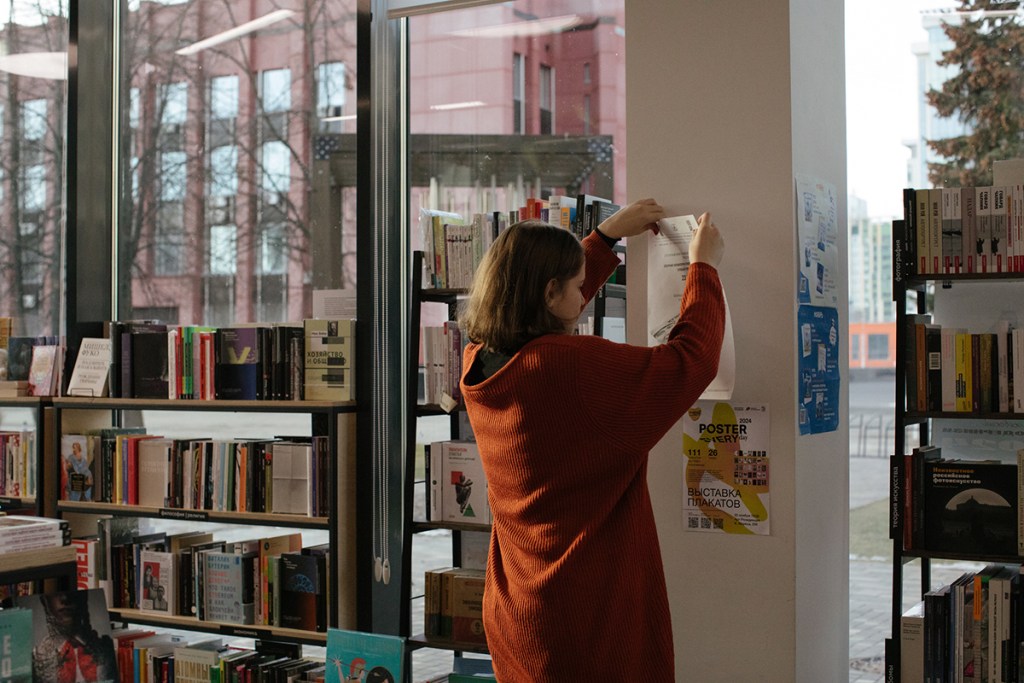
Sonya, a clerk at Kuzebay Bookstore, puts up an event flyer.
Kuzebay’s cheerful face can now be seen on posters, lapel pins, and even as an emoji on Telegram. The only independent bookstore in Izhevsk, and maybe in the whole of Udmurtia, bears his name — Kuzebay Bookstore.
Like its spiritual forebear, Kuzebay Bookstore thrives in spite of its circumstances. Today, it is an absolutely metropolitan store that is no shabbier than Vse Svobodny in Petersburg or Falanster in Moscow: Kuzebay stocks the same books on its shelves, and it has the same friendly vibe. But Kuzebay opened a year before the quarantine. Back then, it occupied a small corner at the Center for Contemporary Dramaturgy and Directing. Les Partisans Theater, in which the store’s co-founders, German and Ksenia Suslov acted, was also based there. Kuzebay achieve relative stability in early 2022, after moving to its current location.
The Kuzebay Gerd Museum in the village of Bolshaya Gurez-Pudga, Udmurtia. The museum is located in a hut next door to the local school.
“We were a quite small operation during the covid, so we didn’t give a shit whether we shut down or not,” recounts German Suslov. “We were open for deliveries. Back then, the state still paid me twelve thousand [rubles a month] for the fact that I was my own sole employee. I was like, Great, money’s coming in, cool beans. Things have somehow been growing ever since.”
German even now regularly works as a salesclerk and is awfully good at cleverly persuading people who stop by for the latest detective novel by Darya Dontsova to buy family sagas from House of Stories publishers. But the first person I meet in the store is Gosha, a tall thin salesclerk who looks like a Viking sporting a tiny cap. He sits in a cozy swing chair, playing chess on his phone. He is the only soul in the store.
German Suslov, co-owner of Kuzebay Bookstore and editor-in-chief of Luch magazine, at work.
“Is it so empty often?” I ask as I peruse Mushroom Kingdom, a wacky book by local artist Andrei Kostylev, better known as Bi-jo.
“Not nowadays, but it used to happen,” says Gosha. “This one [female salesclerk] and I even had a competition to see who had fewer people stop by the store in a day. It was a draw: zero.”
“No one at all for an entire day?”
“Yeah, it was winter, so not a single person came in. But there are always people coming in now. And even if there are no sales at the store, there are sales on Ozon almost every day.”
“The worst thing is poetry readings”
German shows up at Kuzebay about half an hour late for our interview. He is in a terrible rush, as always. The Moscow Non/Fiction Book Fair is coming up: Kuzebay is supposed to represent the publishing house and the store, and we have to send the books out in time. We pull a few boxes out of the car together, while Gosha sits down to check the books and put stickers on them. Like the many-armed Shiva, German simultaneously supervises the process, does the interview, eats a flatbread from the Tatar bazaar, pours tea for everyone, and chats with the customers who do come in.
German Suslov and Andrei Gogolev in the storage room of Kuzebay Bookstore
German has always been an energetic multi-tasker. Although he is not yet thirty, he has been a prominent figure in Izhevsk’s cultural scene for nearly ten years. He used to be an actor at the local independent theater Les Partisans, which exists to this day. But his restless nature needed something else besides theater and the history program at Udmurt State University.
“And so, I thought: the craving for theater, music, cinema was instilled in me by older comrades,” says German simply. “But what were my interests before the theater? I wrote poetry. So, I had to get into the business of poetry. And I quickly realized that no one here was doing poetry seriously.”
According to German, the literary scene in Izhevsk was rather fragmented ten years ago. There were no decent places for young people to publish and perform their work. After graduating from college, many people left for the big cities.
In St. Petersburg, a whole generation of young poets from Izhevsk emerged all at once in the early twenty-teens, including Tatiana Repina, Pyotr Bersh, Ilya Voznyakov, and Grigory Starovoitov, all of whom I know personally. Most of the members of that scene gave up writing poetry a long time ago, although Tanya Repina has achieved some fame, and my friend Petya Bersh continues to write and perform.
“When I left in the early teens, nothing was happening in Izhevsk at all. There were no prospects,” Petya, who returned to his homeland in 2022, told me. “Everything has changed now, of course, and Kuzebay has played no small role in that.”
There was no Kuzebay Bookstore at first, though. In 2016, five actors from Les Partisans dreamed up the PoetUP Contemporary Poetry HQ to consolidate Udmurtia’s most interesting poets, give them a venue, and relaunch the literary scene in Izhevsk.
“The worst thing you can imagine is an open mic poetry reading. It’s hell on earth,” says German, laughing. “And even worse is an open mic poetry reading in Izhevsk with no prescreening at all. So, what did we do in 2016? We started selecting and inviting people. Yes, we would have embarrassing events too, but far fewer. What mattered was what we were striving for. We did not want it to happen that one person would read and all his friends would get up and leave when he finished.”
[…]
Excerpted from: Ilya Semyonov (text) and Natalya Madilyan (photos), “Why does a star gurgle?” Takie Dela, 23 January 2025. Translated by the Russian Reader. I would like to finish translating this fascinating long article (this is the first quarter of it) and publish it in its entirety on this website, but that would take a lot of time and hard work. In the real world, where I have worked as professional freelance translator for nearly thirty years, I would charge 600 to 850 euros to translate this article if someone commissioned me to do it. If you would like to support my work in general and read this article in full, please donate to me via PayPal (avvakum@gmail.com) or Venmo (@avvakum). If you cannot afford to donate money right now, you can help my cause by sharing my work on social media and with friends. Thank you!
25 years ago, on March 26, 2000, Vladimir Putin won the Russian presidential election, making him the official successor of Boris Yeltsin, who had resigned three months earlier. Putin, who was prime minister at the time and had served as acting president after Yeltsin’s resignation, won 53.4 percent of the vote in what is widely considered the last truly competitive presidential election in Russia to date. Over the next 25 years, Putin would only tighten his grip on power. To comply with the constitutional limit of two consecutive terms, he switched to the role of prime minister in 2008 while his ally Dmitry Medvedev occupied the presidency. After amending the constitution to extend presidential terms from four to six years starting in 2012, Medvedev made way for Putin to run in the 2012 presidential election. Putin won 63.6 percent of the vote, securing a third term in Russia’s highest office.
After winning re-election again in March 2018, Putin once again faced hitting the constitutional term limit in 2024. To address what became widely known as “the 2024 problem”, Putin proposed wide-ranging amendmen[t]s to the constitution in January 2020, which included a change to presidential term limits. While making the rules stricter on paper by limiting Russian citizens to two presidential terms in their lifetime — disallowing the shuffling between positions that Putin had employed in 2008 and 2012 — the amendmen[t] was designed to disregard past or current terms, effectively erasing Putin’s first four terms. The new rule paved the way for Putin to run again in 2024 and to seek re-election in 2028 if he so chooses, which could keep him in power until 2036.
If Putin remains in power beyond 2030, he would become Russia’s longest-serving leader, surpassing Joseph Stalin, who led the Soviet Union for 29 years between 1922 and his death in 1953.
Tequilajazzz frontman Evgeny Fedorov explains to Konstantin Eggert, the presenter of DW’s #Trendy, why Putin is a genuinely grassroots president, what Fedorov’s wealthy fans asked him to play at company parties, and how Russian chanson masqueraded as Russian rock.
Konstantin Eggert: You and I are speaking in Vilnius, where your manager had to look for quite a long while for a venue for your gig because many people turned him down. Does this bother you?
Evgeny Fedorov: Of course it makes me sad. We realize that, in our case, it is unfair. There are artists playing both sides of the fence who are traveling around the world to make money. We are vocal opponents of the war and everything that has been happening in Russia. So it’s a little bit offensive to us, but we realize that this is the price the times make us pay and nothing can be done about it.
— It’s gotten harder. I can’t say that we were a big box-office band. Our music is specific: we’ve always had a fairly modest audience, and we’re used to it. Business wise, we are now cut off from the Russian market and can’t tour Siberia and the Far East. It’s not a big deal, because on 25 February 2022 I personally announced on social media that we would stop doing concerts in the Russian Federation. It was a deliberate (not hysterical) step on our part. We have been coping with these difficulties. We have a small but very loyal, attentive, smart fan base. As it turned out, a significant number of them left the country with us, and so I see in the audience the same people who used to come out for our concerts in St. Petersburg and Moscow.
— In one interview, you spoke about the muteness that overcame you when the full-scale invasion began. Is that muteness completely gone now?
— No, it’s not gone. It has become obvious that I have to reinvent myself, to devise a new language, both creatively and literally. It’s just inappropriate even to remember now some of the things I wrote songs about. I have to change a lot, and this applies to all areas of my life.
Konstantin Eggert interviews musician Evgeny Fedorov, Deutsche Welle Russian Service, 26 March 2025 (in Russian)
— What do you mean that you have to change? You once said that writing protest songs wasn’t your thing.
— I’m not good at it. I tried to voice my rage and grief, all the emotions that were overwhelming me, but it sounded stupid and unnatural. Despite the fact that they were my emotions, I couldn’t express them adequately in songs. We wrote only one [protest] song, “A Machine Full of Evil.” These were the first lines I wrote down in a notebook after the war started. I was watching a war newsreel from Ukraine, and this line came to my mind: “A machine full of evil was crawling.” It’s the only song on the subject where it’s quite obvious to everyone what it’s about. We don’t use any Aesopian language in it.
— Do you think that most people in Russia are just running this “evil machine”?
— No, of course not. I see a huge number of people who were not able to leave [Russia] for various reasons. Some of them deliberately stayed behind to try and destroy the system and to help each other survive. But I’m still horrified to see what a humungous number of people wholeheartedly support this crap.
Tequilajazzz, “A Machine Full of Evil” (2023)
— Among them are people with whom you have collaborated — [Vyacheslav] Butusov, [Konstantin] Kinchev, and a considerable portion of today’s Z-patriots from the cultural realm. Did you already feel at that time that this could happen? Or are those people just interested in the money?
— Almost none of them was a surprise to me. They had obviously been drifting in that direction. You could see that they were going over to that side, they had got their own personal confessors. […] The guys were fusing with the regime, it was out in the open for everyone to see, and nobody surprised me. You know, I had a dream a couple of times that Putin and I were in an office. He says, “Zhenka, sit down, I’m going to take care of business and then we’ll go fishing.” Something like that. I remember the nasty delight I felt in the dream. How cool, I’m hanging out with Putin himself! That courtier’s joy of being near power. I woke up, horrified to discover that I had it in me too, that no one was immune.
The more popular an artist is, the more often they are in the regime’s domain. I have friends who played at ex-President Medvedev’s dacha. I realize that if my music had suddenly appealed to Putin and I had been invited, I cannot rule out that a metamorphosis would have happened to me, and that I would suddenly have been possessed by this despicable joy of being around powerful people. I thank God and our firmness, which we have maintained all these years, and our aesthetic commitments and our ethical commitments, too, that we escaped the danger.
We played company parties three times in our lives. Each time it was a former fan of ours who, as a university student, used to pogo at our gigs, but then had struck it very rich, and so for his birthday or for his company’s birthday he had engaged our band and asked us to play our most hardcore alternative songs. It was always quite funny, because it was obviously the wrong music for a company party. It was just that the guy had bought himself the kind of hardcore show which he couldn’t permit himself to attend now, because he was a “big man,” surrounded by security guards, and so on. But God spared us from all those parties organized by the presidential administration and all those people who were trying to craft the new imperialist mindset.
— Is Putin a people’s president?
— I wish I could joke about it, but I look at people, how they relate to him, and everything that is happening now, and it seems that he is in fact a people’s president, because this type of president did not “go viral” for nothing and enjoys such popularity. It means that he resonates with the people, so that means he is a people’s president.
— What resonates?
— The jokes, the quips, the anecdotes. The man thinks in memes from Soviet movies. He knows how to speak this language and this appeals to people. I remember that my normal, sane friends, when Putin started making all those jokes, squealed with delight: “What a great joke he made!” I said, Guys, what’s wrong with you, it’s a purely cop joke, filled with contempt for people and the belief that no one is without sin, that “everyone shits somewhere,” that everyone is dirty, and if they aren’t, they should be made dirty. I think his practice is based on that.
— And even the war, all the Cargo 200s coming home, doesn’t change that?
— Those people are certain they are fighting for a just cause, they have been convinced of it. We all grew up completely convinced we were the kindest and most generous [people in the world], that we couldn’t be wrong. It’s a very cozy room from which it’s hard to escape and realize that we [do not do] the most magnanimous things. And when we save nations, we are just saving a lane for business.
— In January 2000, when Radio Liberty journalist Andrei Babitsky was abducted in Chechnya, I realized the new regime were the enemies of the media, and therefore the enemies of everything else that was decent. Did you have a moment when you realized that this was a catastrophe?
— September 1999, the apartment building bombings. It was quite obvious this was regime change, that [the bombings] had been necessary to bring that person to power. I lived with that horror for twenty years, trying to resist, not allowing myself to flirt with Russian chanson, with underworld things, with what Russian rock later turned into — this fusion of the guitars, the image, and the courtyard songs of Russian chanson with all the paraphernalia of chthonic values — with vodka, herring, the banya, and so on.
— You once said that the need for protest songs ended in the 90s and the bourgeois era of just being creative dawned. Was it a good time for you?
— It’s generally normal for people to do creative work and sing love songs. The need to write protest songs is not normal. We liked the fact that rock and roll was no longer a genre persecuted by the KGB and that it was safe to play. We sang about ugly things, often without delving into lofty matters. Our music is about different aspects of human life, both lofty and absolutely ordinary, even shameful. That’s normal. What is happening now is not normal.
— If you look at the last thirty years, what Russian music, literature or cinema has stuck with you?
— A few Boris Grebenshchikov albums for sure. Now I’m just cut off. I can’t listen to anything that I liked three years ago. I turn on my favorite album and realize I can’t listen to it because it takes me back to a life which no longer exists. I’ve become an “anti-old fart.” Because old farts listen to the music of their youth and choose to stay in their time bubble. My bubble has burst. I’m listening to the stuff teenagers and young adults listen to, to weird experimental stuff that doesn’t sound like what I used to enjoy.
I’m reading a lot of hundred-year-old émigré prose right now, which has suddenly become timely. It’s interesting to compare [my experiences with] the experiences of people who left [Russia] between 1918 and 1920. There is this sense of horror at the darkness that surfaced and deluged everything, the mundane details, the executions, the horror at this outbreak of self-righteous darkness, spewing saliva, blood, and shit… The horror is quite comparable.
— Let’s imagine that tomorrow Putin falls, we make peace with Ukraine and give them back the occupied territories, and the political prisoners are released. Would you be willing to go home?
— I don’t want to see those mugs. Where will all these cops, FSO officers, and the people who are in league with them go? A huge number of my friends in Russia are in a terrible situation. What is it like for those people who are on our side, but who are [in Russia]? How do they survive? How do they each struggle in their own way, often just on an aesthetic level? I have a quite pessimistic view of the future. I don’t believe that any of this will change quickly, if it didn’t change in the few years of freedom that Russia had, which people didn’t savor, but decided to go back to the Brezhnev-era twilight.
Tequilajazz, One Hundred Fifty Billion Steps (LP, 1999)
Evgeny Fedorov is a Russian musician, composer, and producer. Having played and composed music from a young age, he is a well-known and highly regarded figure in the Russian alternative rock scene. Since late August 2024, he has been in ICORN residence in Stockholm after openly criticising Russia’s war in Ukraine.
Evgeny Fedorov joined his first band Объект Насмешек (‘Object of Ridicule’) in 1986 and became very popular in the final years of communism, touring and performing across the USSR until the band broke up in 1991.
In 1993, Fedorov formed another band Tequilajazzz for which he continues to be the lead singer and bass player. The band has recorded and released numerous critically acclaimed albums and has toured all over the world.
In addition to Tequilajazzz, Fedorov has been involved in several other music projects, including Optimystica Orchestra and Zorge, and has composed music for Russian films and TV series.
After openly criticising Russia’s full-scale invasion of Ukraine in February 2022, Fedorov was harassed and threatened with legal action by the Russian government. He was publicly condemned on state-controlled Russian television.
At the end of August 2024, Evgeny Fedorov began an ICORN residency in Stockholm. He continues his work from Kulturhuset Stadsteatern.
Stockholm ICORN City of Refuge
Stockholm has hosted writers and artists at risk since 1998 and has been an ICORN City of Refuge since the network was established in 2006. Since 2012, Kulturhuset Stadsteatern has been managing Stockholm’s ICORN programme, so far hosting 12 ICORN residents, including Faraj Bayrakdar, Arya Aramnejad, and Zahra Hussaini.
Currently, Stockholm offers three ICORN residences simultaneously. Alongside Evgeny Fedorov, music artist Mun Mun from Myanmar and poet and short story writer Raafat Hekmat from Syria are also continuing their work from Stockholm and Kulturhuset Stadsteatern.
Russia ranks poorly in transparency, corruption, and democracy in many international indexes. Researchers at The Economist ranked it 150th out of 167 countries in its Democracy Index last year, highlighting the country’s lack of political diversity and frequent election manipulation. Russia also received a worrying score for corruption in NGO Transparency International’s most recent annual report, where it ranked 154th out of 180.
The Kremlin regime’s repression and journalistic censorship are also reflected in a ranking on global press freedom, with Reporters Without Borders placing the country 183rd out of 208 last year—a score that is hardly surprising, considering that Russia still regularly imprisons journalists, including on the grounds of “espionage.” The government also restricts access to the internet and critical content online.