Reading Recently (Not Necessarily Russian)

Source: “What Ukraine Has Lost,” New York Times, 3 June 2024


Memorial for actor Joachim Gottschalk. When his Jewish wife Meta and son Michael were to be deported, the whole family decided to commit suicide on November 6, 1941. The bronze figure, which was created by Theo Balden in 1967, resembles the actor. It was initially located in a park but had to be moved due to the building of the local Sparkasse in the 1990s. Its new place is a memorial wall in the Joachim-Gottschalk-Straße 35.

Source: “Calau” (Wikipedia)


The Impact of the Gold Rush on Native Americans of California

This inquiry lesson provides primary sources, maps, images, and background history to offer teachers and students insight into a little-known but vitally important aspect of one of the most iconic events in American history—the California gold rush. Students will analyze sources to answer the question: Do American actions against California Native Americans during the gold rush meet the United Nations definition of genocide?

Source: National Museum of the American Indian


The attitude of César Chávez and the UFW towards the undocumented changed over time and can be divided into three periods: 1962 to 1975; 1975 to 1993; and 1993 to the present. A look at these changes reveals much about Chávez, the union, and the times. Frank Bardacke is the author of Trampling Out the Vintage: César Chávez and the Two Souls of the UFW.

Source: Center for Latin American Studies Berkeley (YouTube), 3 August 2012


Whenever an infant heads to nursery, it can feel like an enormous step. Things are changing for everyone. There are all sorts of feelings flying around – relief, sadness, doubt, fear. But what’s going on behind the doors of nurseries and childcare settings in England? India speaks to Joeli Brearley from Pregnant Then Screwed about the current childcare crisis, child development psychotherapist Graham Music about how childcare impacts children, as well as economist Emily Oster on our choices around childcare. India then meets artists Conway and Young who have found a way to make the invisible labour of childcare pay.

Presented by: India Rakusen.
Producer: Georgia Arundell.
Series producer: Ellie Sans.
Executive producer: Suzy Grant.
Commissioning Editor: Rhian Roberts.
Original music composed and performed by The Big Moon.
Mix and Mastering by Charlie Brandon-King.

A Listen Production for Radio 4.

Source: Child, Episode 26: “Nursery,” BBC Radio 4


Childbirth is deadlier in the United States than in any other high-income nation, according to a study released Tuesday by the Commonwealth Fund that underscores the persistence of maternal mortality.

More than 80 percent of pregnancy-related deaths in the United States are preventable, but factors including a shortage of maternity care providers, limited access to after-birth home visits and lack of guaranteed paid parental leave have increased the risk of maternal mortality, especially for Black people, researchers have found.

In 2022, about 22 maternal deaths happened for every 100,000 live births in the United States. For Black people, that number rose sharply to 49.5 deaths per 100,000, according to the report from the Commonwealth Fund, which conducts independent research on health-care issues. Two out of three maternal deaths occur up to 42 days after birth, highlighting the importance of postpartum care, which only some state Medicaid programs and private health insurers cover.

The study compared 14 high-income countries. It used data from the Organization for Economic Co-operation and Development — known as the OECD — which tracks health system metrics across 38 high-income countries, and from the Centers for Disease Control and Prevention Maternal Mortality Review Committees in 36 states.

Although OECD data is widely regarded as the gold standard for international comparisons, the authors note that discrepancies in how countries gather health data may affect the findings.

“We can’t just think of reproductive health at the time of pregnancy because a lot happens after the baby is born. If we’re not supporting women during this crucial time period, we’re never going to solve this problem,” said Munira Z. Gunja, the study’s lead author and a senior researcher at the Commonwealth Fund.

Ten of the countries listed in the report had a death rate of fewer than 10 per 100,000 live births; in 2022, Norway’s maternal death rate was zero.

Laurie C. Zephyrin, senior vice president for advancing health equity at the Commonwealth Fund, said these numbers paint a stark picture of health care in the United States. She called for more focus on community-led investments, including birth centers and health-care teams working with patients in the weeks before and after delivery. She also said health systems should have incentives and accountability involving equitable quality of care, particularly for communities of color.

With 65 percent of maternal deaths occurring after birth, many health experts emphasize the need for not only more prenatal care but an increase in comprehensive postpartum care.

“We want this to be the cultural norm. We want this to be federal policy. We want there to be a big change because we know that we can completely minimize the rate of maternal deaths in this country,” Gunja said.

Health disparities are not unique to the United States. In Australia, Aboriginal people are twice as likely to die of maternal complications compared with other people giving birth, according to the report. Still, experts are hopeful that policy changes and awareness will help bridge the divide and decrease the overall maternal mortality rate in the United States.

The report highlighted the importance of access to midwives, whose work has been described as an important factor in countries with the lowest maternal mortality rates, the report found. Teams involving midwives could deliver 80 percent of essential maternal care and potentially prevent 41 percent of maternal deaths, 39 percent of neonatal deaths and 26 percent of stillbirths, the report said.

Some studies have found that teams led by midwives offer care comparable, or superior, to care provided by obstetrician-gynecologists. In the United States, Canada and South Korea, OB-GYNs outnumber midwives, but in most other high-income nations, midwives are more prevalent.

The United States and Canada face a shortage of midwives and OB/GYNs. Almost 7 million people in the United States live in areas without hospitals or birth centers offering obstetric care or any obstetric providers. The shortage is expected to worsen.

Since Roe v. Wade was overturned in 2022, some states have banned or restricted abortion access, and experts say these restrictions will have a trickle-down effect on health-care access.

“We are setting ourselves up for an absolute reproductive health provider shortage, and contributing to that is this interference into the patient-provider relationship and the restrictions that are being placed on us,” said Tamika C. Auguste, a D.C. OB/GYN and chair of the American College of Obstetricians and Gynecologists Foundation Board who was not involved with the study.

The United States is the only high-income nation without a federally mandated paid parental leave policy and universal health care. Only 13 states and D.C. have paid family and medical leave laws; these policies have been shown to improve health outcomes for pregnant people.

“We are in a dire time in our country, where we’re seeing firsthand the impact of these policy changes at the state level and how they are impacting people’s lives,” Zephyrin said.

In recent years, abortion restrictions have sparked debates and legal battles. State legislatures have been enacting increasingly stringent laws aimed at limiting access to abortion services, such as mandatory waiting periods, ultrasound requirements and bans on certain procedures.

The current wave of abortion restrictions has significantly affected broader health-care services, particularly obstetric care. States that have imposed abortion restrictions often face closure of clinics offering a variety of health-care services, such as cancer screenings, contraceptive services and general reproductive health care. As a result, people in these states encounter greater challenges that exacerbate existing health disparities.

“Women’s health-care providers are being driven out of areas due to the restrictions on practicing full-scope reproductive health care,” Auguste said. “This creates areas where there are no health women’s providers for women.”

Source: Sabrina Malhi, “Childbirth deadlier for Americans, especially Black women, study finds,” Washington Post, 4 June 2024


The factors that led into the creation of their newest album aligns perfectly with the discussions this podcast is about. Just blocks away from the 3rd Police Precinct that burned down during the protests, Twin Cities country-folk band The Gated Community saw many of their recordings lost due a power outage. But being in the center of burning buildings, gunshots, and neighborly concern, Sumanth Gopinath was compelled to write about it. The result: songs about that tumultuous era that culminated in a new album filled with important issues and topics, which fit perfectly with their existing songs and socially conscious perspective as a band. Sitting around one table, I got to hear about the evolution of a band without egos, which is part of what makes The Gated Community so special.

The Gated Community Band Members

  • Sumanth Gopinath (acoustic guitar and vocals)
  • Beth Hartman (vocals and auxiliary percussion)
  • Rosie Harris (vocals and banjo)
  • Nate Knutson (electric guitar and vocals)
  • Cody Johnson (bass guitar and vocals)
  • Paul Hatlelid (drums)

Source: Smouse in the House (podcast), Season 5, Episode 8: “The Gated Community,” 6 June 2024


In his new book, Barons: Money, Power, and the Corruption of America’s Food Industry (Island Press, 2024), Austin Frerick identifies contemporary “barons” in seven different corporations—such as Cargill, Inc., the Driscoll’s and the conglomerate JAB Holding Company—who have taken over food systems and re-shaped communities. Frerick writes in the introduction, “I refer to these people as ‘barons’ to hearken back to Gilded Age robber barons such as John D. Rockefeller and J. P. Morgan because I believe that we are living in a parallel moment when a few titans have the power to shape industries.”

A fellow at the Thurman Arnold Project at Yale University and former Treasury Department official, Frerick has been among the leading experts and researchers in competition policy and antitrust examining food industry consolidation. As co-chair of the Biden campaign’s Agriculture Antitrust Policy Committee, he helped advise several of the leading Democratic presidential candidates on agricultural policy leading up to the 2020 election.

Frerick’s interest in the barons of today’s food-industry is also personal. As a seventh-generation Iowan, Frerick’s interest in antitrust policy began as an undergraduate at Grinnell College where he researched corporate power in Iowa’s slaughterhouse communities.

Barn Raiser spoke with Frerick about how agricultural consolidation has changed the landscape of rural America, and how to bring rural people out from their local Walmart and back onto “Main Street.”

What is it like writing about your home?

It started off as angry and it changed into profound sadness. I think that’s because the origin of the book is in Iowa. “The Hog Barons” chapter is what started this whole thing. This book came about because I published that article in Vox on the hog barons at Iowa Select Farms in Iowa, and I got a book deal from that. I noticed that I changed the tone from when I wrote it as a magazine article and made it into a book chapter. It now reads to me as profoundly sad, like it all kind of fell apart in Iowa. It’s grappling with the Iowa I grew up in and what it’s become, from the anger that’s everywhere to just how industrial the landscape has become.

You wrote that “as farms consolidate, more and more of the wealth leaves rural communities and flows to the Cargills of the world.” You also describe how your hog barons live in a gated community in Des Moines — far from the pollution and working conditions they are creating. A few weeks after your book came out, Jeff and Deb Hansen of Iowa Select Farms, the hog barons you highlight in chapter one, published an op-ed in the Des Moines Register, where they called themselves “stewards of [their] land and communities.” What was your reaction to that op-ed?

They employ their own spokesperson, like someone’s job is to do this for a living, and I just thought it was so poorly written. It reinforced in my head that no one’s ever the villain in their own story. And they’re just delusional. They’re living in a delusional world. They’re just not living in the same world we’re living, and I think the op-ed reflected that. To call themselves stewards of the land with a straight face, it’s just like, no one in Iowa thinks that. That’s an accepted reality at this point.

You hosted a book event in Iowa Falls, where the hog barons are from. What was the reception to your book like there?

Honestly that one shocked me the most. I was actually nervous for that event. I really haven’t been nervous at all during this whole book process. That was the one time I was a little worried for my safety. I turned that tracking thing on my phone so my husband could follow me. It’s a little scary, it’s like you’re going into the heart of the beast. At every book event someone asked me am I worried about my safety, which was, you know, an unnerving question to get all the time. But I had a completely different reaction when I got there. I was shocked. Not only at the turnout—I mean, like 45-50 people—but that there was not one dissenting voice. It was among the most incredible after-talk experiences I’ve had because it felt like a third or half of the room came up and talked to me afterwards, because they all know Jeff and Deb, the hog barons.

They all told me a different story of how Iowa Select Farms bamboozled the community from promises they made and didn’t keep for Des Moines and the intimidation tactics they used to build their empire. Iowa Falls is a beautiful town. It was the epitome of the American Dream for a lot of people and then Jeff and Deb just come in and kind of destroy things to their own personal benefit, and then they hightail it out of there. That’s one thing I kept hearing from people, how they did all this stuff, and then they just left.

In the conclusion of your book, you discuss how “a sense of a distinct regional and local identity” disappears when local businesses disappear. “Unlike the barons, the owners of local businesses live in the communities they serve and are stakeholders in their success. Losing them means losing the glue that binds communities together.” What would need to change for the “Main Street” in rural communities to be revitalized?

This culture of efficiency we live in has stripped us of our community. It views everything as an Excel sheet. There are no coffee beans native to Iowa, you can get coffee anywhere. So much of what you’re buying into is interaction with another human, a sense of being. People bought coffee from my mom because of the human connection and Excel can’t capture that. I was really determined to make that point. Because I saw my mom, who used to work for her own coffee store, and later worked at a corporate Starbucks in Target.

These communities thrive when middle class family farms are around. The biggest way to do that is by putting animals back on the land. These confinements have just destroyed rural communities in every way possible. We also need old fashioned trust busting and antitrust enforcement.

Could you explain how CAFOs are connected to Main Street? How are confinements impacting Main Street?

Denise O’Brien in southwest Iowa really drove home this point to me. She’s a longtime activist, and she talked about how much her street has changed in her lifetime. First of all, one human being can only watch so many cows on pasture—you can’t do robotics for that. Family farms pay local taxes, send their kids to local schools and spend their money locally in town. When that consolidates to one person who owns a big metal shed stuffed full of animals, and the owner of the asset lives in an urban rich community, and then has a low wage worker pop by and take care of things, that’s a very different occupation. It’s the difference between watching a cow on pasture to hauling out dead pig bodies, which is what a lot of that work entails. There’s a whole undercurrent of trauma a lot of these low wage workers experience from basically being surrounded by this incredibly cruel production model that is full of death and destruction.

You write that to change the current system and to “build a more balanced food system” we need to “challenge power directly.” How are you hoping your book will mobilize others to build a more just food system?

That’s my nice Iowa way of rejecting the whole change the food system with your fork mentality that’s been the theory of change the last few decades. To me, it just bifurcated the food system between those that go to the New Pioneer Co-op in Iowa City and those go to Walmart. No one’s ever going to get you a seat at the table. So you have to fight for it.

Source: Nina Elkadi, “The Book That Made the ‘Hog Barons’ Squeal,” Barn Raiser, 6 June 2024


Zhenya Bruno is the pseudonym of a writer who lives in St. Petersburg. 

Source: Zhenya Bruno, “Russian Decency,” New York Review of Books, 20 June 2024


Mariameno Kapa-Kingi, Te Pāti Māori Member of Parliament for Te Tai Tokerau, raised eyebrows recently when she claimed in parliament that the government of had a “mission to exterminate Māori.

Kapa-Kingi was speaking on a proposed change to the processes under which children forcibly removed from their parents by the child welfare agency Oranga Tamariki are placed in foster care.

“The theory of the Minister is that Oranga Tamariki’s governing principles should be colour-blind, which is just another word for white supremacy, because to say we are all one people is really to say we should all be white people,” she explained.

This omnibus post brings together things I've read or listened to recently that made a big impression on me, most of them having nothing to do with Russia. Featuring Joachim Gottschalk, the Native Americans of California,
Mariameno Kapa-Kingi, Te Pāti Māori Member of Parliament for Te Tai Tokerau. Photo: Tania Whyte

Prime Minister Christopher Luxon described the speech as ‘completely out of line’ and ‘unhelpful.’ Opposition leader Chris Hipkins agreed that it was unhelpful, adding  “It’s certainly not language that I agree with.”

Te Pāti Māori co-leaders backed up their MP, however. Rawiri Waititi called it a brilliant speech. “This is how we feel and we will not be told how to feel,” Waititi said. “Many of the policy changes that this Government absolutely makes us feel like there [are] huge extermination processes and policies [aimed at] the very existence of tangata whenua in this country, so it was absolutely the right wording.”

When the facts don’t stack up, you can always appeal to feelings.

Co-leader Debbie Ngarewa-Packer concurred. She could hardly do otherwise, since she herself had used similar language in respect of another of the government’s reforms.  Her own response last November to the incoming government’s move to roll back some recent restrictions on sales of cigarettes was equally immoderate: “There is absolute deliberate intention of this government, as I said, to create systemic genocide,” she said on that occasion.

Te Pāti Māori Co-leaders Rawiri Waititi and Debbie Ngarewa-Packer

The question, however, is not how Rawiri Waititi or anyone else feels about anything, but whether the claim is true. And as everyone who has not completely lost their head knows, such claims are preposterous. Genocide is not just cultural assimilation, but the physical extermination of a people. It is inconceivable without mass violence and ethnic killings.

The closest thing to ethnic violence against Māori on such a scale in New Zealand history was during the land wars of the 19th century.  And even that was not a war of genocide, but a war of dispossession. As soon as the colonial authorities had their hands securely on the land, the fate of the dispossessed Māori became a matter of relative indifference to them.

A repeal of anti-smoking legislation, or of child welfare legislation ­­– ­­­irrespective of one’s attitude to that repeal – does not constitute mass violence. To use such terms to describe what is happening in New Zealand today only debases the language and renders the terms themselves meaningless. And in doing so, it disorients anyone who takes the term for good coin, concealing the true nature of the problem, and disarming anyone who seeks to address it.

What drives Te Pāti Māori to resort to such histrionics and attention-seeking language?

The answer to that question lies in what Te Pāti Māori is. It is an electoral formation and nothing more. It has no existence outside of Parliament and its associated vote-gathering machinery. It is a parliamentary voice without a movement, like a head without a body, and is therefore powerless, despite its presence in parliament, to affect the course of politics in any significant way.

This powerlessness was exposed in the immediate aftermath of last year’s election, when, buoyed by its electoral gains and alarmed by the new government’s right-leaning course, it called for a National Day of Action to coincide with the opening of the new Parliament in early December. The declared kaupapa was to demonstrate the “beginning of a unified Aotearoa approach to the government’s assault on Tangata Whenua and Te Tiriti o Waitangi”. Their hype included the prediction that “The movement that we’re seeing from Māori will make the foreshore and seabed hīkoi look like something extremely small.” This was a reference to the protest of twenty years ago, in which 15,000 Māori and others converged on Parliament, and which triggered the Labour Party’s Māori MPs to quit to form Te Pāti Māori.

Part of the crowd of 15,000 at the Foreshore and Seabed protest at Parliament, 5 May 2004. Photo: Dylan Owen https://natlib.govt.nz/records/23042789

Nothing remotely comparable to this occurred in the December 2023 Day of Action, despite generous support of the action by the liberal news media, which publicised the assembly points in advance. A few hundred marched in Wellington, and groups of a few dozen rallied in various other towns and cities. In the largest working class concentration, Auckland, a handful of car drivers attempted to disrupt traffic on the motorways, with little effect. It was a rather stark revelation of the narrowness of support for Te Pāti Māori, especially among workers.

When its fighting talk in parliament produces zero effect, the party therefore has few options except to open their mouth wider, shout louder, and use more extreme language in order to win the ear of the ruling class. Not just ‘racism’, but ‘white supremacy’ becomes the order of the day.  Not just ‘discrimination’ but ‘extermination’. Not just ‘extermination’, but ‘systemic genocide.’

Don’t be fooled by the truculent posturing and coarseness of tone: these appeals are directed to the rulers, asking “please, listen to us!” They hope to frighten the ruling layers into adjusting their course.

(On his side, Winston Peters of New Zealand First, the counterpart of Te Pāti Māori on the right wing of capitalist politics, uses equally hyperbolic language in his denunciations of Te Pāti Māori, accusing them of “cultural Marxism” and of wanting “anarchy – headed by their Māori elitist cronies turning this country into something akin to apartheid.” Believe me, Winston, nothing could be more alien to Marxism than the politics of feelings!)

But neither the government nor the broader ruling class will listen to Te Pāti Māori.  They defend above all else the dictatorship of profit, and the rate of profit has now fallen to the point where it is incompatible with some of the most basic social rights and needs, such as affordable housing, equitable access to health care, basic infrastructure like water and roads, and more. Their ability to grant even small concessions is strictly limited: on the contrary, their present focus is to restore their profits by making even deeper inroads against our wages and social rights.

And among the things capitalist society today is incapable of delivering is the protection of children from violence. The child welfare ministry Oranga Tamariki has been in a permanent state of turmoil for many years, over the question of uplifting children from their parents. It is no closer to resolving this than it was five years ago, when a shocking Newsroom documentary by reporter Melanie Reid exposed the brutality of child ‘uplifts’.  

On the one hand, Oranga Tamariki is rightly excoriated for the tearing apart of Māori families in circumstances where it is not justified, such as the case documented in the 2019 documentary, causing long-term trauma. On the other hand, it gets criticised – again with full justification, at least in some cases – for failing to protect the lives of children, who suffer violent deaths at the hands of their family members at a high rate in New Zealand.  

Coming under fire from both these opposite directions, the institution lurches from one policy to the opposite, according to the nature of the most recent scandal. At the time of the 2019 documentary, Oranga Tamariki was uplifting hundreds of babies each year, in response to criticism for failing to prevent the violent deaths of babies at the hands of family members. About 70% of these uplifted infants were Māori. (Māori make up about 20% of the population). Oranga Tamariki was under pressure to act pre-emptively in many of these cases, before there was any clear evidence of danger to the child – and therefore these decisions were inevitably based on rumour, prejudice, and racial profiling of Māori as ‘bad parents’.  In many cases, the decision to uplift was taken in secret, without any prior discussion with the family concerned.

An intense public outcry followed the documentary. Protests outside Parliament demanded an end to the unjustified snatching of babies, especially Māori babies, from their parents’ arms. The protests denounced the lasting trauma inflicted on the affected Māori families, and the damage to the social fabric caused by the high rate of children being taken into state care. A petition called Hands off Our Tamariki  (children) gained 17,377 signatures.

Protest at Parliament demands “Hands off Tamariki forever”   Photo: Lynn Grieveson

These protests prompted a switch to the opposite policy. Following multiple inquiries into the functioning of Oranga Tamariki, an amendment to the governing principles of Oranga Tamariki was introduced in 2019, called Section 7AA, which bound the institution to uphold the principles of the Treaty of Waitangi in matters concerning Māori children.  In practice this meant placing uplifted babies with members of their own whānau, or with their wider iwi, wherever possible. Labour Party Minister for Children Kelvin Davis proclaimed “This report will end uplifts as we have known them. While there will always be a need for some children to be taken into care, this should only happen after all avenues with community and whanau have been exhausted.” The rate of uplifts fell steadily, from 963 uplifts in 2018 to 251 in 2022.

This was a small but significant gain for the whole working class. It pushed back state interference in Māori families and strengthened the bonds of solidarity within our class.

The death of another young child at the hands of his family has halted that momentum, and now the pendulum is poised to swing all the way back again. Wellington toddler Ruthless-Empire Wall was beaten to death by family members unknown, just shy of his second birthday, in October 2023 – after the boy’s uncle had alerted Oranga Tamariki to the dangerous environment he was living in, and requested them to place the boy in his care.

Ruthless-Empire Wall. Photo: Ngatanahira Reremoana

Now the government, at the behest of its Act Party component, seeks to restore the policy of wholesale uplifts. Act campaigned on the issue in last year’s election, and repeal of Section 7AA was part of the coalition agreement between the three parties that formed the new government in November 2023. The campaign is headed by Act’s Karen Chhour, the incoming Minister for Children and for the Prevention of Family and Sexual Violence.  Chhour, who is Māori herself and was raised in state care, presented her own petition to repeal Section 7AA, which received more than 13,400 signatures.

Chhour claims that Section 7AA has led to Māori children being removed from safe and loving homes because their caregivers weren’t of Māori descent. “I consider that section 7AA allows the treatment of children and young people as an identity group first, and a person second, it creates a divisive system that has had a negative impact on caregivers. This repeal will make sure that Oranga Tamariki is entirely child-centric and is making decisions that ensure a child’s wellbeing and best interest. Over successive years, Oranga Tamariki has failed our most vulnerable children, and in part that has been because of Section7AA,” she said.

Karen Chhour Photo: Doug Mountain

Chhour presents no evidence to back these assertions, a point noted by the Waitangi Tribunal which entered the debate. If children are actually being torn from existing foster homes where they have already bonded with their caregivers, simply because their caregivers were not of Māori descent, that could be a matter of legitimate concern. But it is incumbent on Chhour to prove that this is in fact happening. Since she does not do so – beyond claiming to have seen it herself – this appears to be a spurious claim.

Nor does she make any attempt to explain why or how adherence to the Treaty of Waitangi should lead to Oranga Tamariki making decisions that are not in the child’s best interest. Her unsupported assertion hints at an unspoken racist explanation: that Māori parents and foster parents are less than competent caregivers. This is a debate with high stakes.

Thus, the issue Mariameno Kapa-Kingi was attempting to address is a real one, and the repeal of Section 7AA should be opposed.  It is the ability to recognise a real problem, combined with the inability to do anything about it, that generates the flailing of arms in Parliament, and the politics of middle class hysteria in general.

Even if the repeal of 7AA is defeated, the social scourge of violence against children can only be expected to worsen in the short term. It is a consequence of, among other things, the divided, weakened state of the working class, which is increasingly being torn apart by the ordinary workings of the capitalist economy, exacerbated by the actions of its government and state.  

Such violence against children is connected with massively increased economic and other pressures on families: the inflation eroding our wages, the growing insecurity of employment, the cuts to social services like health care, including mental health care, the breakdown of attendance at school, and above all, the housing shortage, which hurls ever-wider layers of workers down into the horrors of drug-riddled and gang-infested ‘emergency housing.’

Violence against children is closely connected with the scourge of violence against women, in which New Zealand ranks so shamefully high in the world. It is worth noting that Te Pāti Māori, along with the Labour, National and Green parties, supported legislation that undermined women’s single-sex spaces, including women’s refuges from domestic violence, by requiring them to open their doors to males. They took an active part in the attack which shut down a women’s rally in Auckland in March 2023 by force and violence. This fact alone should nullify their claim to speak in defence of children.  

As long as these social conditions continue, there will continue to be situations in which children have to be removed from their parents’ care in the interests of their own safety. But such removals can also provide an opening for hostile class interests to drive in a wedge that tears apart working class families. This has been done disproportionately, though not exclusively, against Māori, who make up a substantial component of the working class. It is the built-in tendency of intervention by the capitalist state and its agencies like Oranga Tamariki.

It falls to a revived movement of the whole working class to oversee such situations and to ensure that the ties between children and their whānau are maintained as far as possible during their removal, and that they are returned to their parents’ custody as quickly as possible. Strengthening solidarity within the working class, along with raising the social status of women, is the road to ending the violence against children in a more permanent way.

This is not a new problem for the working class worldwide. Farrell Dobbs, a leader of the historic Teamsters Union strikes which organised truck drivers in the US Midwest in the 1930s, once described how these strikes took on the character of the mass social movement. The Teamsters Union Local 574 ‘flying squads’, which had been organised to shut down strike-breaking trucking operations across the city, expanded their operations to intervene when the union got news of unemployed workers being evicted from their homes for non-payment of rent. The arrival of the union flying squad quickly ended the attempts by landlords and their deputy sheriffs to evict the worker.

Farrell Dobbs, (with images from the 1934 strikes behind him)

“In a few instances, the union even adopted children,” Dobbs said.

He explained that at the time it was common for bourgeois charities to identify working-class families that in their view were unable to adequately provide for their children, and the charities would then arrange to have the children adopted out, against the wishes of their parents. The union organisation stepped in to prevent this happening, finding foster parents from among the union ranks to care for the children temporarily, so that they could be returned to their parents at the earliest opportunity. (The talks where Dobbs tells the story of the Minneapolis strikes are available on YouTube, and are very inspiring to listen to in full. Dobbs describes the adoption of children in the third talk, beginning about the 24th minute.)

Children demonstrate in support of their unionist parents

At this point there is little outward sign of such a revived fighting labour movement in New Zealand, so this political course is far from obvious to see.

What is abundantly clear, however, is that Te Pāti Māori, and all those like them who pursue the opposite course – of appealing to the capitalist rulers and relying on their parliamentary apparatus and state institutions –  quickly find themselves in a blind alley.

Source: James Robb, “Te Pāti Māori, Child Welfare, and the Politics of Middle Class Hysteria,” A Worker at Large, 24 May 2024


Errollyn Wallen’s memoir Becoming a Composer is a look into the mind of the composer as well as the life of one. Born in Belize but now based in the far-flung north of Scotland, where she sometimes inhabits a lighthouse, she works at a brisk pace, composing prolifically for orchestra, chamber ensemble, choir, and over twenty operas. Her major public commissions have included music for The Last Night of the Proms, the Paralympic Opening Ceremony, and the Queen’s Diamond Jubilee, and she joins us from her home in the Orkney Islands to talk about Becoming a Composer, and becoming a composer.

Music heard in the show:

Title: Horseplay i. Dark and mysterious
Artist: The Continuum Ensemble/Philip Headlam
Composer: Errollyn Wallen
Album: The Girl In My Alphabet
Label: Avie AV0006

Title: Dervish
Artist: Matthew Sharp (cello), Dominic Harlan (piano)
Composer: Errollyn Wallen
Album: The Girl In My Alphabet
Label: Avie AV0006

Title: Sojourner Truth
Artist: Madeleine Mitchell (violin), Errollyn Wallen (piano)
Composer: Errollyn Wallen
Album: Violin Conversations
Label: Naxos 8574560

Title: Cello Concerto
Artist: Matthew Sharp (cello), Ensemble X, Nicholas Kok
Composer: Errollyn Wallen
Album: Photography
Label: NMC NMCD221

Title: Boom Boom
Artist: Palaver Strings, Nicholas Phan
Composer: Errollyn Wallen
Album: A Change is Gonna Come
Label: Azica Records 71365

The Music Show is made on Gadigal and Gundungurra Country

Source: Andrew Ford, “Becoming a Composer with Errollyn Wallen,” The Music Show, ABC Radio National, 25 May 2024

Pobrecit:a:s

Impact of Discrimination on Integration of Emigrants From the Aggressor Country (with Ivetta Sergeeva)

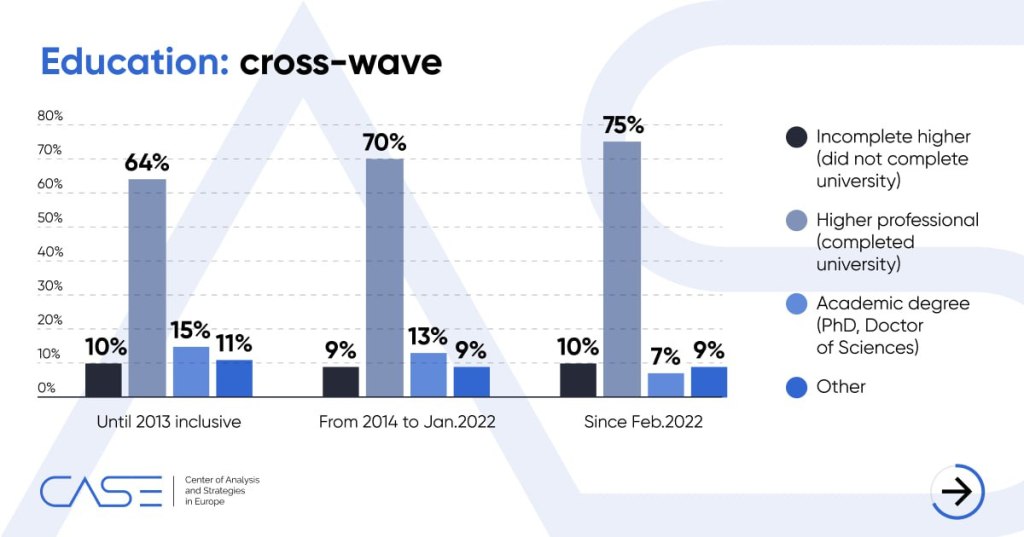
Following the full-scale invasion of Ukraine in 2022, up to one million Russians fled their homeland, marking the most significant brain drain since the Soviet Union’s collapse. While some host countries view the highly educated and politically active migrants as an asset, integrating nationals of the aggressor state has presented challenges. Many migrants face institutional restrictions aimed at sanctioning Russia, alongside varied experiences of discrimination from local populations. This study delves into the effect of discrimination on the assimilation intentions of Russian migrants, focusing on language learning as a key indicator. Laitin’s model of identity building suggests that migrants’ willingness to assimilate depends on the perceived benefits, including acceptance by the host society. Following the model, Sergeeva assumes that discrimination signals to migrants that the host country’s society does not accept them, making learning the local language a less rational choice.

Utilizing a cross-sectional panel survey, the study establishes a link between discrimination and integration, differentiating between the effects of discrimination experienced from local citizens and local institutions on language acquisition. Findings reveal that societal discrimination significantly dampens migrants’ willingness to learn local languages and diminishes their trust in and attachment to host societies, unlike institutional discrimination, which shows no such effect on language learning. These insights contribute to an understanding of the impact of nationality-based discrimination, highlighting the role of societal acceptance in the successful integration of political migrants.

This event will be hosted in person and virtually on Zoom. Register for the Zoom meeting here. Non-NYU affiliates must RSVP for in-person campus access. 

Ivetta Sergeeva is a PhD candidate at the European University Institute in Florence. She specializes in political behavior, civil society, and Russian emigration. She is a co-founder and co-principal investigator of OutRush and ViolenceMonitor (a series of surveys on intimate partner violence in Russia). She also has eight years of experience supervising projects in civil society and human rights organizations in Russia. Website: www.ivettasergeeva.com. Email: ivetta.sergeeva@eui.eu.

Date: 29 April 2024 4:00 PM – 5:30 PM

Speaker: Ivetta Sergeeva

Location: Jordan Center, 19 University Place, New York

Source: Jordan Center for the Advanced Study of Russia (NYU)


Polina Kanis

Professoressa on the Pole

Thu 25 April — Sun 05 May

Professoressa on the Pole* is the result of Polina Kanis’ investigation into the perceptual transformation of the female body in Russia following the onset of the full-scale invasion of Ukraine and subsequent ideological shift within Russian society. As part of this investigation the artist trained as a pole dancer and worked at a strip club.

The exhibit includes photographs documenting Kanis’ three-month stint at a strip club, the club’s rules of conduct for strippers, and a video re-enactment of the artist’s stage performance. The project marks the latest chapter in Kanis’ ongoing research into the changing role of a female teacher in Soviet and post-Soviet Russia, where limitations imposed by the state can only be counter-balanced by imagination.

*Professoressa (Italian: female teacher) refers to the 1967 manifesto Letter to a Teacher (Letters a una Professoressa), which harshly criticizes the power structure and classism of the educational system in 1960s Italy.

location: Expo

price: €5, tickets for a performance of the CARTA ’24 festival give free admission

duration: 5h 

extra info: wed – sun: 14:00 – 19:00, evening performances until 22:00

language: English

is part of: Festival CARTA

Source: De Singel (Belgium)


Nadya Tolokonnikova / Pussy Riot
RAGE
June 21–October 20, 2024

Putin’s Ashes, 2022. © Pussy Riot

Opening: June 20, 7pm

OK Linz
OK-Platz 1
4020 Linz
Austria

www.ooekultur.at
Instagram / Facebook / TikTok

Nadya Tolokonnikova, an artist who is founder of the feminist collective Pussy Riot, has long been persecuted in Russia for her conceptual performances and artistic protest against the Putin regime. Her performance Punk Prayer in the Christ the Savior Cathedral in Moscow, recognized by The Guardian as one of the most important artworks of the twenty-first century, ended for her and her colleagues with imprisonment for “hooliganism motivated by religious hatred.”

OK LINZ is bringing Nadya Tolokonnikova’s art to the museum, presenting her haunting works dealing with resistance, repression, and patriarchy for the first time to the European public.

Tolokonnikova’s oeuvre encompasses objects, installations, and performative works in which she processes her traumatic experiences during her life under Putin. Out of a state of repression, she has developed a visual language that rebels against aesthetical and political realities: anarchic and radical, yet also moving and witty.

“Being from Russia brings me pain. Most of my life, even after 2 years imprisonment following my art protest, I chose to stay in Russia, even though I had plenty of opportunities to immigrate, I tried to change Russia, make it a country that I would be proud of—peaceful, prosperous, friendly, democratic, loving, a country that values human life, art and happiness. First with Voina Group, later with Pussy Riot, I’ve been in performance art since 2007, for 17 long years—years filled with joy of protest and comradery, harassment, arrests. I watched my friends being murdered and revolutions suffocating under Putin’s boot.“ —Nadya Tolokonnikova

An oversized blade hangs like a sword of Damocles over visitors to the OK. “Shiv” is the title, American prison slang for an improvised knife. It stands for the precarious situation of artists and activists in Russia who, like Tolokonnikova herself, live in constant fear of persecution by the Russian judiciary. The exhibition will spotlight a selection of Situatioinist actions by Pussy Riot. At the center is Tolokonnikova’s 2022 performance Putin’s Ashes in which she joined forces with twelve women from Ukraine, Belarus, and Russia who experienced repression and aggression at the hands of the Russian president to burn a portrait of Vladimir Putin in a desert, collecting the ashes in small bottles.

“This art is a weapon,” says Tolokonnikova of her works, analyzing and exploring in this way the role that her art and she herself can play in the context of international power structures.

Curators: Michaela Seiser / Julia Staudach

Source: e-flux mailing list, 22 April 2024


Akhmatova’s Orphans 
International conference
Princeton University 
3-5 May 2024

May 3

4:00 pm–5:00 pm. Location: Firestone Library

The Anatoly Naiman Papers. Visit to the Special Collections

Presentation by Thomas Keenan-Dormany, Slavic Librarian

5:00 pm–6:30 pm. Location: McCosh 50

Rock. Paper. Scissors (2023)

Documentary film screening

Q&A with the co-author Anna Narinskaya

7:00 pm

Reception at the Levings’ residence (Shuttle provided)

May 4

Location for all talks: 245 East Pyne

9:30 am

Breakfast at East Pyne

Session 1

10:00 am–12:00 pm

Veniamin Gushchin, Columbia University

Late Akhmatova and Philology: Intertextuality, Interpretive Communities, and Effective History

Evgeny Soshkin, Free University / Brīvā Universitāte (Latvia)

Akhmatova’s Dead Orphans: Toward the History of a Paradox

Gleb Morev, Independent researcher

Akhmatova and Brodsky

12:00 pm–1:00 pm

Lunch

1:00 pm–1:40 pm

Keynote speech

Roman Timenchik, The Hebrew University of Jerusalem / Princeton University

Akhmatova’s Orphans and the Literary Orbit of the 1960s

Session 2

2:00 pm–4:00 pm

Dmitry Bobyshev, University of Illinois Urbana-Champaign [via Zoom]

On the so-called ‘Akhmatova’s Orphans’

Emily Lygo, University of Exeter

Dmitry Bobyshev’s Poetry of the Turn of the Century

Marco Sabbatini, University of Pisa

“Out of the Magic Choir”: Viktor Krivulin and the Leningrad Underground Poetry on Akhmatova and her Orphans

4:00 pm–4:30 pm

Coffee break

4:30–5:50 pm

Sofia Guerra, Princeton University

Anatoly Naiman’s Translations from Giacomo Leopardi

Benjamin Musachio, Princeton University

Estrada as a Fault Line: Akhmatova and Company vs. Evtushenko

6:00 pm–7:30 pm

Location: East Pyne 010

Akhmatova’s Orphans. Disassembly (2024)

Documentary film screening

Q&A with the director Yuri Leving

7:30 pm

Dinner

May 5

Location for all talks: 245 East Pyne

9:30 am

Breakfast at East Pyne

Session 1

10:00 am–12:00 pm

Maya Kucherskaya, Jordan Center, New York

Solo in a ‘Magic Choir’: The Case of Joseph Brodsky

Michael Meylac, Strasbourg University [via Zoom]

An Enchanting (!) Chorus (?): Different Poets of Dissimilar Fortunes

Alexander Dolinin, University of Wisconsin-Madison

Brodsky’s Poem “Darling, I left the house today…” in the Context of Poetic Tradition

12–1 pm

Lunch

1:00 pm–1:40 pm

Leningrad Poetic Circles of the 1960s Through the Camera Viewfinder

Roundtable devoted to photography of Boris Shwartzman, Mikhail Lemkhin and Lev Poliakov

Session 2

2:00 pm–4:00 pm

Polina Barskova, Berkeley University [sic!]

Depiction of Links and Ruptures of Time in Evgeny Rein’s Poetry

Oleg Lekmanov, Princeton University

On Evgeny Rein’s Poem “In the Pavlovsky Park”

Anna Narinskaya, Independent researcher, Berlin

The Orphans and Jews

4:00 pm–4:30 pm

Coffee break

Session 3

4:30 pm–6:45 pm

Translating Poetry of “Akhmatova’s Orphans” into English

An Open Workshop: Kathleen Mitchell-Fox, Emma George and Ilya Kaminsky, Princeton University

Lev Oborin, Berkeley University

Anatoly Naiman’s “Vegetation”: Towards Poetology of Branching

Maria Rubins, University College London

Is Brodsky a Poet for Our Time?

6:45 pm

Dinner

Organizing Committee:

Yuri Leving, Chair

Ekaterina Pravilova, Ilya Vinitsky and Michael Wachtel

Sponsored by REEES, PIIRS, and Department of Slavic Languages and Literatures, Princeton University

Source: Department of Slavic Languages and Literatures, Princeton University. Thanks to the Fabulous AM for the heads-up.

2 Russia Problem

Boris Akunin

I think that most of us have not yet understood that the world of Russia has once again, like a century ago, split in two, like an iceberg, and its two halves, the bigger and the smaller, are rapidly drifting apart. It’s just that the split happened less dramatically, without the crowding onto the last steamship, without the “we departed from Crimea amidst smoke and fire” [lines from a poem by White émigré Nikolai Turoverov]. The split has been dragged out in time, and the crack wasn’t so wide at the beginning. Some people are still hopping from one iceberg to the other. 

“Endless War”

And yet—that’s it. There are two Russias again. Many people—in both halves—cannot or are afraid to recognize this. It’s time to stop hopping, otherwise you’ll leap to one side and won’t be able to hop back again. 

Hopes for the swift fall of the rotten regime (also just like one hundred years ago) have been disappointed. It’s plenty rotten but rot, as everyone knows, spreads.

Last time it took seventy years to root it out. This time it probably won’t take as much time; time moves more quickly in the twenty-first century, but you still have to unpack the suitcases and settle in for a long wait. 

“Anticipation of White Nights”

What will happen with the ‘little’ Russia, scattered across different countries, is pretty clear. [Russians] who are younger or more active or more professionally cosmopolitan will assimilate with varying degrees of success. [Russians] who are older and professionally tied to the language and culture will sadly sing “while the light has not gone out, while the candle burns” [a line from a famous Mashina vremeni song] and will support that little flame as long as they have the life and strength for it. This work of theirs is not pointless or in vain, because in ‘big’ Russia there are still a great many people for whom that light will be precious and necessary.

In the mother country—goddamn déjà-vu—things will soon be utterly unbearable. In the longstanding two-hundred-year struggle between the Asiatic state and European culture the Horde has triumphed once again, now zealously working to asiatize the culture. (There is nothing malign about Asia and its culture, which of all people I, a specialist in Asian studies, should know; I am talking about political Asia, in which the state is everything and the individual is nothing.)   

The culture of the mother country will be censored, hollowed out, thrust onto all fours and taught to wag its tail. We’ve seen it, we remember. Later, of course, a counterculture will take shape, [yielding] virtuosos of Aesopian language and furtive rude gestures. We remember that too: we had plenty of it. The emigres will coo condescendingly over any vivid manifestations of censored culture—like Nabokov did over Okudzhava. Those in Russia will secretly pass around tamizdat editions. And publish in the West using pseudonyms.  

How dreadful and boring this all is, ladies and gentlemen. Russia’s national anthem: “We sowed and sowed the grain, we will stomp and stomp the grain” [lines from a Russian folk song].

And the number-one national poem: “Everyone chooses for themselves.”

It’s time to choose again: shield and armor, walking stick and patches, a religion, a road, to serve the devil, a measure of final reckoning—and so on down the list.

For some the price will be their profession, for others poverty or emigration. The most noble will give up their freedom. And even their lives. The higher quality the person, the greater the cost. 

And it is all worth it. This is what I’ve been thinking and why I wrote this text, not at all because I wanted to drive you into even greater despondency. 

More so than all of us together, each of us individually is facing a big test. We can’t flunk.

“To the Barricades”

Sergey Abashin

Stop referring to “Asia” and “the Horde.” Why insult millions of people in the world and in Russia itself? You are not helping the “little” Russia” in any way.

“Religion is the opium of the people!”

Ivan Babitski

I see that Akunin has again written something about Asia (where “the state is everything and the individual is nothing”) defeating European values in one particular country.

The point is that Russian intellectuals are, historically, not so fond of anything as repeating German vulgarities. And “Asian” metaphors are the favorites of Germans, and there is no degree of blatant idiocy at which they would stop.

For example, Adenauer explicitly claimed that the “Asian steppes” begin east of the Elbe. (He considered Prussia to be Asian, and so Bismarck’s triumph was an Asian conquest of Germany. Adenauer added the steppe by association.)

No matter how many decades have passed, the pre-war German spirit cannot be taken out of the Russian pamphleteer, and the fear of appearing ridiculous is as alien to them as it was to their mentors.

Pavel Sulyandziga

Quite correct thoughts in general, but there is one big catch.

How does Akunin (Chkhartishvili) differ from those Sieg Heiling in Russia when he starts using “Asia” in such a context, in such a comparison, even with a caveat? Maybe someone will say that I am wrong to try and compare him with the Sieg Heilers. Let me put it another way, then. How does a very good writer differ from those who are called white supremacists in the west?

I recently listened to a very interesting lecture on racism. The lecturer made a rather loose, but interesting ranking, singling out the racism of Soviet people as a separate species.

For some reason, some Europeans, when speaking about Asianness, “forget” about the Inquisition, concentration camps, and many other terrible events in history. Or are these also manifestations of Asianness?

We should also not forget that the current world order is also largely a product of European civilization with all its pros and cons.

One last thing, about why I decided to react in this way to Akunin’s statement, which are quite congenial to my own thoughts. It seems to me that a respected public figure should always think about the consequences of their words and deeds.

[…]

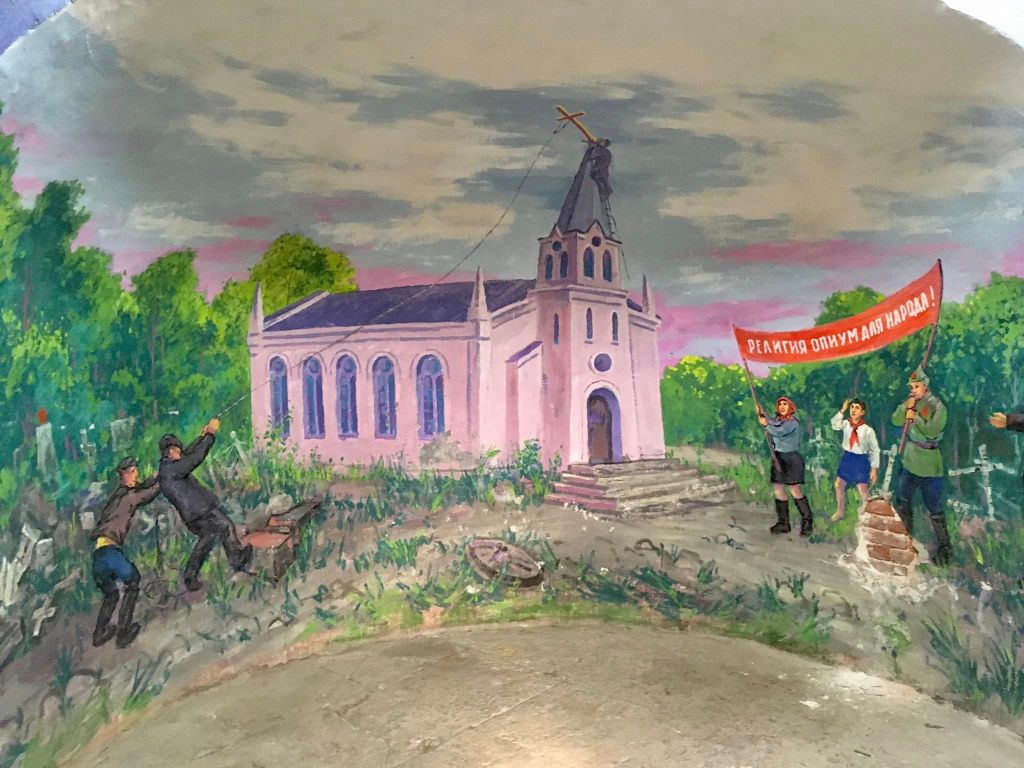
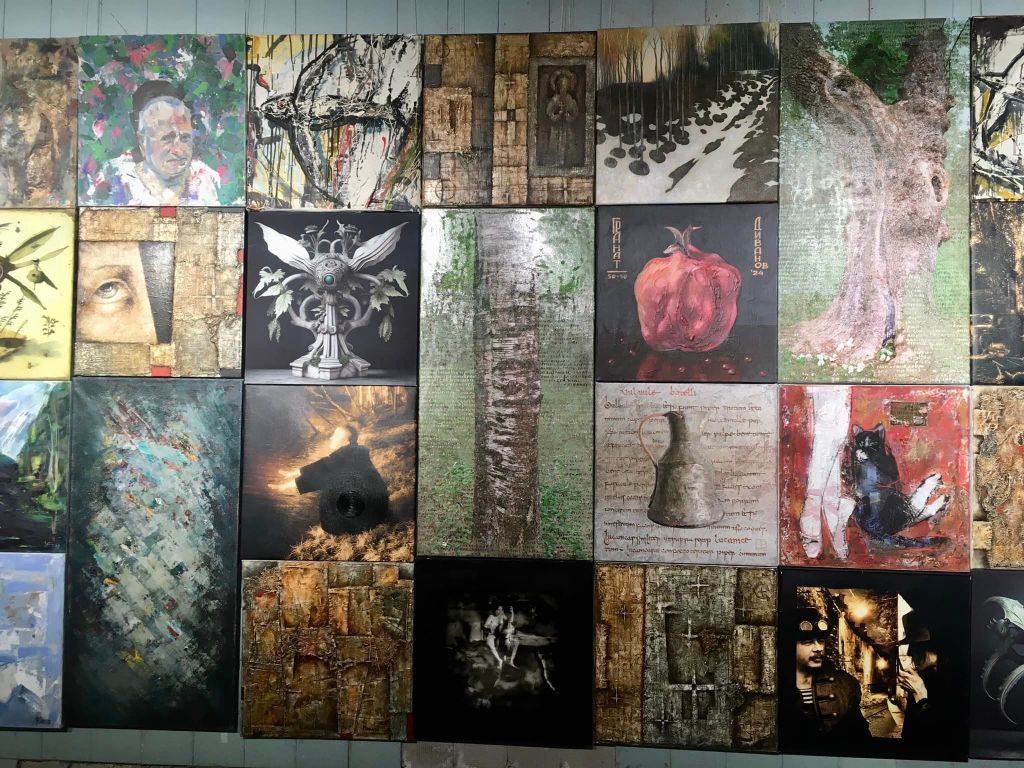
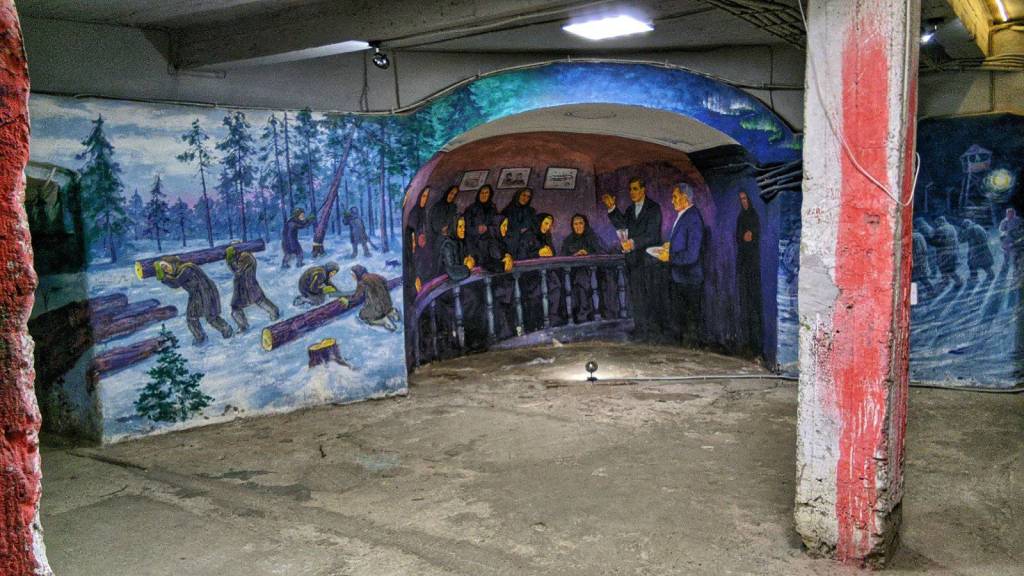
Source: Asya Rudina, “‘The world has split in two:’ the Runet discusses Akunin’s post about the two Russias,” Radio Svoboda, 1 April 2024. Translated by the Fabulous AM and the Russian Reader. The reactions, above, to Akunin’s outburst were not typical. Most of the best-selling author’s fans echoed his sentiments. The photos, above, by our friends V and M, were taken today at an exhibition currently on view in the former swimming pool and catacombs in the so-called Petrikirche on Nevsky Prospekt in downtown Petersburg. They suggest, I think, that the reality on the ground in “big Russia” (and “little Russia” as well) is slightly more complicated than Akunin would have us believe. ||| TRR

The War on Terror

This is not the first time the editors of our local newspaper have “platformed” the lies of the mendacious and violent fascist butcher Vladimir Putin.

1. US warns that Russia will invade Ukraine. General disbelief, daily Russian mockery. (December 3 2021-February 24 2022)

2.  Russia invades Ukraine, kills tens of thousands of people, kidnaps tens of thousands of children, commits other ongoing war crimes (February 24 2022-present)

3.  Russia blames US for Russia’s invasion of Ukraine (March 2022-present)

4. US warns of terror attack in Moscow. Putin denies any risk and mocks the United States. (March 7 and March 19 2024).

5.  Terror attack near Moscow, ISIS takes responsibility, Russia meanwhile kills Ukrainian citizens with drones and missiles as it has for more than two years. (today, March 22 2024)

6.  Russia’s security apparatus, focused on bringing carnage to Ukraine, has failed in Moscow.  Russia’s leaders, focused on demonizing the US, did not protect Russians. What next? Where to direct the blame?

7.  It would not be very surprising if the Kremlin blames Ukraine and the United States for terror in Moscow and uses the Moscow attack to justify continuing and future atrocities in Ukraine.

Source: Timothy Snyder, “Moscow Terror: A Chronology That Might Predict,” Thinking about…, 22 March 2024


This past Friday, 22 March, a horrifying terrorist attack took place in Crocus City Hall in the outskirts of Moscow.  Islamic State plausibly claimed responsibility.

Earlier that day, Russian authorities had designated international LGBT organizations as “terrorist.” Also earlier that day, Russia had carried out massive terror attacks on Ukrainian cities. Those actions reveal the enemies Putin has chosen. As the attack on Crocus City Hall demonstrated, his choices have nothing to do with actual threats facing Russians.

Russia and the Islamic State have long been engaged in conflict.  Russia has been bombing Syria since 2015.  Russia and the Islamic State compete for territory and resources in Africa.  Islamic State attacked the Russian embassy in Kabul.  This is the relevant context for the attack outside Moscow. The horror at Crocus City Hall obviously has nothing to do with gays or Ukrainians or any other of Putin’s enemies of choice.

Putin had publicly dismissed the real threat. The United States had warned Russia of a coming attack by Islamic State.  The United States operates under a “duty to warn,” which means that summaries of intelligence about coming terrorist attacks are passed on, even to states considered hostile, including (to take recent examples) Iran and Russia.  Putin chose to mock the United States in public three days before the attack. 

People reasonably ask how a terror attack could succeed in Russia, which is a police state.  Regimes like Russia’s devote their energy to defining and combating fake threats.  When a real threat emerges, the fake threats must be emphasized.  Predictably (and as predicted), Putin sought to blame Ukraine for Crocus City Hall.

What if Russians realize that Putin’s designations of threats are self-serving and dangerous?  What if they understand that there are real threats to Russians ignored by Putin?  He has devoted the security apparatus to the project [of] destroying the Ukrainian nation and state.  What if Putin’s obsession with Ukraine has only made life worse for Russians, including by opening [t]he way to actors who are in fact threats to Russian life, such as Islamic State? 

These are the questions Putin must head off. It is not easy, however, to blame Ukraine for Islamic State terrorism.  Putin’s first media appearance, nearly a day after the attack, was far from convincing.  The specifics he offered were nonsensical.  He claimed that the suspects in the terrorist act were heading for an open “window” on the Russian-Ukrainian border.

The term “window” is KGB jargon for a spot where the border has been cleared for a covert crossing.  That the leader of the Russian Federation uses this term in a public address is a reminder of his own career inside the KGB.  Yet Putin had obviously not thought this claim through, since a “window” must involve a clear space on both sides of the border.  For escaping terrorists, it would be the Russian side that opened the window.  By speaking of a “window” Putin indicated that the terrorists had Russian confederates preparing their exit, which he presumably did not mean.  It seems that Putin was hastily making things up.

Setting aside the “window” business, though, the whole idea that escaping terrorists would head for Ukraine is daft.  Russia has 20,000 miles of border.  The Russian-Ukrainian part of it is covered with Russian soldiers and security forces. On the Ukrainian side it is heavily mined.  It is a site of active combat.  It is the last place an escaping terrorist would choose. 

And there is no evidence that this is what happened.  Russia claims that it has apprehended suspects in Bryansk, and claimed that this means that they were headed for Ukraine.  (Western media have unfortunately repeated this part of the claim.)  Regardless of whether anything about these claims is true, Bryansk would suggest flight in the direction of Belarus.  Indeed, the first version of the story involved Belarus, before someone had a “better” idea.

In moments of stress, Russian propaganda tries out various ways to spin the story in the direction preferred by the Kremlin.  The reputed suspects are being tortured, presumably with the goal of “finding” some connection to Ukraine.  The Kremlin has instructed Russian media to emphasize any possible Ukrainian elements in the story.  Russian television propaganda published a fake video implicating a Ukrainian official.  The idea is to release a junk into the media, including the international media, and to see if anything works. 

Amidst the flotsam and jetsam are those who spread Russian propaganda abroad, who try out versions more extreme than Putin’s.  Putin does not directly deny that Islamic State was the perpetrator — he simply wants to direct attention towards Ukraine.  But actors outside Russia can simply claim that Ukraine was at fault.  Such actors push the discussion further than the Kremlin, and thereby allow Russia to test what might work abroad.

As a result, we have a bizarre discussion that leads to a harmful place.  Islamic State claims responsibility for Crocus City Hall.  The Islamic State publishes dreadful video footage.  Russia cannot directly deny this but seeks help anyway in somehow pushing Ukraine into the picture.  Those providing that help open a “debate” by denying that Islamic State was involved and making far more direct claims about Ukraine than the Kremlin does.  (This brazen lying leads others to share [a] Islamic State perpetration video (don’t share it; don’t watch it).  So the senseless “debate” helps Islamic State, since the reason it publishes perpetration videos is to recruit future killers.)

Meanwhile, Russia’s senseless war of aggression against Ukraine continues.  In its occupied zones, Russia continues to kidnap Ukrainian children for assimilation and continues to torture Ukrainians and place them in concentration camps.  It continues to send glider bombs, drones, cruise missiles and rockets at Ukrainian towns and cities. 

On the same day as the attack at Crocus City Hall, Russia carried out its single largest attack to date on the Ukrainian energy grid, leaving more than a million people without power.  Among other things it fired eight cruise missiles at the largest Ukrainian dam. Russia attacked the city of Zaporizhzhia (the consequences are in the four photos) and other cities throughout Ukraine.

On Friday Russia fired, in all, eighty-eight missiles and sixty-three explosive drones into Ukraine. And that represents just a single day (if an unusually bad one) of a Russian war of terror in Ukraine that has gone on for more than two years.

Putin is responsible for his mistakes inside Russia. And he is at fault for the war in Ukraine.  He is trying to turn two wrongs into a right: into his own right to define reality however he likes, which means his right to kill whomever he chooses. 

Source: Timothy Snyder, “Moscow Terror (2): The Claim and the Blame,” Thinking about…, 24 March 2024


It is obvious that the terrorist attack at Crocus City Hall on the evening of 22 March 2024, during which 133 people were killed, according to the official count, has clear goals and objectives. A week before Putin’s “election” I wrote that, after receiving a “mandate from the people,” Putin would unleash a mass terror campaign. But for this, of course, he needs a decent and obvious excuse. The exemplary terrorist attack in broad daylight in politically unreliable Moscow is intended to convince society that “decisive action” is what it needs now.

Why would Putin do that? It’s simple logic. Come hell or high water he has to win the war he has unleashed. This is obvious, for it is a matter of self-preservation. If Putin does not win, he is a weakling, a lowlife, and at the same time the person to blame for hundreds of thousands of deaths not only of Ukrainians, but also of Russians. It is clear that he will not last long in this state. Not to mention such a trifle as his sick, wounded ego, repeatedly insulted by Ukraine. But victory would wipe everything out, because victors are not judged, Putin is convinced, taking his cue from his idol Catherine the Great.

So, Putin has to have victory at any cost. But two things have long prevented him from achieving it: 1) his numerous domestic enemies, and 2) a lack of “manpower” in the ranks of the army.

Putin intends to solve problem number one by means of a mass terror campaign against malcontents, especially since he has long been urged to do so by a well-rehearsed chorus of heralds, from Dmitry Medvedev and General Gurulyov to a host of other, lower-ranking epigones of contemporary Russian fascism. Guessing the mood of their Führer, they demand that, at very least, he restore the death penalty; at most, that he carry out “total executions of the terrorists and crackdowns against their families” (per the latest quotable quote from Medvedev).

We can only guess at this point whether Putin’s forthcoming terror will exceed Stalin’s body count or whether the current ruler in the Kremlin will limit himself to “merely” increasing the number of prison sentences meted out to dissidents by a factor of two and carrying out demonstrative executions of dozens or hundreds of his fellow citizens. But there is no doubt that a serious expansion of such tactics is on his agenda.

Putin will solve problem number two through a mass mobilization. This is nothing new either. Piling hundreds of thousands of soldiers into the enemy’s trenches is a time-honored tactic practiced by both the Russian and Soviet military, and, as Putin has seen, it has worked well in the “meat assaults” on Avdiivka, Bakhmut, Severodonetsk, and many other small Ukrainian towns. But these towns are nothing compared to the million-strong cities of Kharkiv, Dnipro, Zaporizhzhia, and Odesa, not to mention the three-million-strong Kyiv. So there must be massively more cannon fodder. The second problem is directly related to the first.

Combined with large-scale crackdowns, the mobilization is sure to proceed more vigorously this time round.

As a bonus for the Kremlin, this terrorist attack diverts public attention (at least for a while) from such things as Russia’s largest-ever strike on Ukraine, involving a hundred and fifty missiles and drones, which happened just a day before the events at Crocus City Hall.

I’d now like to talk about other explanations of this terrorist attack. Looking through the news related to it, I honestly could not help but marvel at the comments of certain respected colleagues, opposition Russian analysts, who easily took the bait about IS, Islamist terrorists, and the other nonsense that the FSB obligingly leaked to the public in the first hours after the attack through the Russian media and Telegram channels.

To clarify, certain people of “non-Slavic ethnicity” were chosen to directly perpetrate this heinous crime. There are hundreds of thousands of Tajik, Uzbek, and Kyrgyz migrant workers in Russia, EVERY ONE of whom is literally turned inside out by the Russian Interior Ministry upon arriving in Russia, including with regard to their attitudes to radical Islam and similar things. The Russian secret services thus have the broadest selection of perpetrators available for such a terrorist attack.

Let us ask ourselves an elementary question: how could Islamist radicals purchase not only assault rifles and pistols but also the flamethrower with which the terrorists torched the unfortunate audience members at Crocus City Hall without the knowledge and support of Russian “law enforcement”? Is such a thing possible in today’s Russia, and in Moscow to boot? If someone thinks that it is possible, I would simply remind them that when members of Eduard Limonov’s National Bolshevik Party tried to buy weapons somewhere in the Altai Territory back in the 2000s, their plan was instantly exposed. The idea of Tajiks buying assault rifles and flamethrowers in today’s militarized Russia, which is chockablock with surveillance cameras and special services, is a bad joke.

Let me also remind you that the initial semi-official Russian explanation was that the terrorist attack at Crocus City Hall was revenge on Russia for its actions in Syria and Chechnya. Seriously? So, it matters not a whit that the Russian army and its air force have not conducted any active operations in Syria for two years now? If you have not been paying attention during this time, let me just remind you that the Kremlin is certainly not concerned with Syria right now. For the last two years all Russian armed forces, including those operating from military bases in Syria and in Armenia, have been deployed in destroying Ukraine. There have been no large-scale military operations in Chechnya for almost twenty years.

However, as it turned out, all this argumentation was completely superfluous, because my gullible colleagues were made to eat their lunch by Putin himself and his favorite propagandist, Margarita Simonyan. As a shadow of her “boss” (as she herself dubs Putin), Simonyan naturally cannot afford to indulge in improvisations not vetted by him, and especially at such a crucial moment. On her Telegram channel, she bluntly pointed out who, in her (and therefore her boss’s) opinion, had organized and perpetrated the terrorist attack: “It wasn’t IS. It was the Khokhols.”

The “boss” himself, who was supposed to address the nation in the early hours after the terrorist attack, unexpectedly postponed his address by twenty-four hours. The delay appears to have been caused by technical blunders. Obviously, organizing the details of a terrorist attack is not Putin’s pay grade. It is clear that in such cases the relevant special services are simply given the go-ahead from the top brass. They are told to do their job. The operation was entrusted, of course, to professional hatchet men. As usual, they made a miserable mess of it. You need a large-scale terrorist attack? The Russian security services always have two or three dozen Tajiks on hand for this purpose, who can be hastily given their marching orders, paid, and… And that’s basically it. The Tajik passport found in a car allegedly belonging to the terrorists is, of course, a masterpiece. It is clear that no terrorist, as he sets off to carry out an attack, ever forgets to take his passport with him. It was meant as a helpful hint to law enforcers, and also so decent folk would know whom to hate. It is strange that the business card of the already half-forgotten Dmytro Yarosh was not found in the car as well.

But the point is that this special operation were certainly not meant to spoil relations with the Islamic world. Russia’s allies—Iran, Hezbollah, Hamas—might take offense.

In addition to the domestic agenda we mentioned above, the terrorist attack was meant to firmly link the globally condemned villains of IS with Ukraine in world public opinion.

This was why Putin’s speech on the terrorist attack was postponed for almost twenty-four hours. The dictator’s dodgy mind was deciding how to clean up the mess made by his numbskulls and tie up the loose ends. That is, to tie IS (or any other Islamists) to Ukraine. And he probably thinks he has figured out how to do it. As he put it, [the terrorists were trying to escape through] “a window prepared for them on the Ukrainian side of the border.”

All these tricks of Putin’s are painfully obvious to people capable of thinking, but he doesn’t care about that. Moreover, having sensed a change in the mood of his American “partners” (remember the reports that the U.S. has been pressuring Ukraine to stop hitting Russian oil refineries, and the fact that for almost two months no American aid has arrived in Ukraine and it is not known whether it will arrive in the future), Putin makes a high-pitched appeal to all countries to unite against this inhuman evil—that is, against Ukraine + Daesh.

Another very important point from Putin’s speech, indicating that he is paving the way for a mass terror campaign at home, is that he called the shooting of civilians at Crocus City Hall nothing more or less than “a blow to Russia, to our people.” He, his propagandists, and the Russian media have already established the link between Islamist terrorists and Ukraine. The next logical step is to claim that those Russians who support Ukraine are direct and immediate supporters of the terrorists who struck “a blow to Russia, to our people”—that is, that they are enemies of the people.

To be honest, all of this is as monstrous as it is predictable. I will repeat what I have said many times before: as long as Putin is alive and in power, things will get even worse and even scarier.

Source: Alexander Zhelenin, “The terrorist attack at Crocus City: who benefits from it and what will happen next,” Republic, 23 March 2024. Translated by the Russian Reader
All the Tabs Open in Chrome


Yekaterina Duntsova, who wants to run for president, said the Kremlin should end the conflict in Ukraine, free political prisoners and undertake major reform to halt the slide towards a new era of “barbed wire” division between Russia and the West.

Nearly 32 years since the 1991 fall of the Soviet Union stoked hopes that Russia would blossom into an open democracy, Duntsova, 40, said she was afraid as she spoke to Reuters in Moscow.

Source


In opinion polls, Russians voice support for the Putin regime’s action in Ukraine. And yet, many Russia would like the war to end, and the dynamics of recruiting “contract” soldiers does not demonstrate that a large number of people are ready to rise up “to fight the West in Ukraine.” What are the real sentiments of Russians? What do they think about the war and how do they justify it?

  • Lev Gudkov, deputy director, research director, Levada Center, “The war and collective identity,” (online)
  • Andrei Kolesnikov, senior researcher at the Carnegie Russia Eurasia Center in Berlin, “A semi-mobilized society in a hybrid totalitarian regime” (online)
  • Svetlana Erpyleva, Humboldt Fellow, Research Center for Eastern European Studies at the University of Bremen; researcher, Public Sociology Lab and the Centre for Independent Sociological Research, “Accepting the inevitable: how Russians justify the war in Ukraine”

Source. Annotation translated by the Russian Reader


Viktor Filinkov, convicted in the Petersburg portion of the high-profile Network Case, turned twenty-nine in early November. It was his third birthday in the penal colony, and for the first time he was not given any special “gift” there. Previously, surprises had been waiting for him that were even hard to imagine—for example, a new uniform with a piece of razor inside it. Filinkov has been imprisoned for six years total. During this time, he has seen a lot, including being threatened with dispatch to a war zone, but he quickly put a stop to such “jokes.” Now he is housed in the high-security wing along with other “repeat offenders.” And he constantly files suits against the penal colony. We talked to his girlfriend and public defender Yevgenia Kulakova, who loves him with all her heart and helps defend his rights behind bars.

Source. Excerpt translated by the Russian Reader, who looks forward to the day when he can see his friend and heroine Jenya Kulakova again and meet his hero Viktor Filinkov in person.


Putin noted that visitors from Tajikistan can stay in Russia for an extended period—fifteen days—without registering with the immigration authorities. They can also apply for a work permit that is valid for up to three years.

In addition, Putin announced the expansion of the quota for university students and postgraduates from Tajikistan—from 900 to 1,000 individuals.

The head of the Russian Federation added that the state would allocate 200 million rubles annually from this year for purchasing textbooks for Russian-speaking schools in Tajikistan.

Various regions of Russia have recently imposed restrictions on migrant labor. There have also been proposals to introduce such bans everywhere for visitors from countries where the Russian language is not recognized at the state level. In Tajikistan, Russian is enshrined in the constitution as the language of interethnic communication.

Due to the unstable financial situation, migrant workers have been leaving Russia. Up to a third of Tajik and Uzbek nationals may leave the country.

Source. Translated by the Russian Reader


As of February 24, 2022, Russian President Vladimir Putin declared the beginning of what he dubbed the “special military operation” and the Russian Armed Forces invaded Ukrainian territory. What the Russian authorities assumed would be a swift operation soon became a drawn-out, full-fledged war. Many events occurred over the course of the first year of war, keeping Russians in suspense, forcing them to detach themselves from the situation, giving them hope, and then driving them to despair. When we conducted our first interviews in spring 2022, many thought the war would not last long.

Since then, it has become clear that the war will be with us for a while. The daily life of Russian citizens has been invaded time and again by dramatic events. The Russian retreat from the occupied territories, the annexation of new regions, the bombing of Kiev, the first Crimean Bridge explosion, and the “partial mobilization”— to name just a few. Have these events changed the average Russian’s view of the war, and if so, how? How did residents of the Russian Federation perceive the “special military operation” more than half a year later? These questions are the focus of the report you see before you.

There are several research teams monitoring changes in Russian perceptions of the war through opinion polls (for example, Russian Field and Chronicles). The work they are doing is very important. However, like any research method, surveys have their drawbacks—there are some things they simply will not show. For example, surveys do not always allow us to understand a respondent’s attitude towards sensitive or hot-button topics, as sometimes people have a tendency to hide their true views. But more importantly, for Russians largely removed from the political process, perceptions of such politically-charged issues as the “special military operation,” war, and military conflict do not fit neatly into the standardized set of coherent positions that a survey is capable of capturing. These perceptions may be complex and contradictory, and in this case, in-depth interviews and long conversations with people allow us to better understand the idiosyncrasies of each viewpoint. To our knowledge, we are the only team that systematically monitors Russian perceptions of the war using qualitative (interview) rather than quantitative (survey) methods.

We released our first analytical report in September 2022. You can read it here (in Russian) and here (in English). In it, we presented the results of our qualitative study through interviews conducted over several months after the start of the war, in March, April, and May 2022. Our interviewees held a variety of opinions on the military conflict—there were those who supported the hostilities in one way or another (war supporters), those who condemned military aggression (war opposers), and those who tried to avoid giving any explicit assessment of the situation (undecided). We compared these three groups of respondents with each other: how they perceive the armed conflict, what emotions they associate with it, and how they consume information, assess the victims of the conflict, discuss the situation with loved ones, reflect on the consequences of the war, and so on. We have also published the results of this research in analytical media outlets, a few examples of which can be found herehere, and here, as well as in scientific journals, such as those found here (in Russian) and here.

The paper you are currently reading is the second analytical report we have published and a continuation of this research. It is based on qualitative sociological interviews with Russian citizens conducted in fall 2022, from 7 to 9 months after the outbreak of the war. We wanted to determine how Russian perceptions of the war had changed during this period. This time, we excluded subjects who consistently opposed the war from the sample and decided to focus our study on the specifics of perceptions held by Russian citizens who did not have an unambiguous anti-war stance.

Source


In audio intercepts from the front lines in Ukraine, Russian soldiers speak in shorthand of 200s to mean dead, 300s to mean wounded. The urge to flee has become common enough that they also talk of 500s — people who refuse to fight.

As the war grinds into its second winter, a growing number of Russian soldiers want out, as suggested in secret recordings obtained by The Associated Press of Russian soldiers calling home from the battlefields of the Kharkiv, Luhansk and Donetsk regions in Ukraine.

The calls offer a rare glimpse of the war as it looked through Russian eyes — a point of view that seldom makes its way into Western media, largely because Russia has made it a crime to speak honestly about the conflict in Ukraine. They also show clearly how the war has progressed, from the professional soldiers who initially powered Vladimir Putin’s full-scale invasion to men from all walks of life compelled to serve in grueling conditions.

“There’s no f—— ‘dying the death of the brave’ here,” one soldier told his brother from the front in Ukraine’s Kharkiv region. “You just die like a f—— earthworm.”

The prospect of another wave of mobilization lingers, even as Moscow has been trying to lure people into signing contracts with the military. Russia’s annual autumn conscription draft kicked off in October, pulling in some 130,000 fresh young men. Though Moscow says conscripts won’t be sent to Ukraine, after a year of service they automatically become reservists — prime candidates for mobilization.

Source


Twenty months ago, after Vladimir Putin had launched his full-scale invasion of Ukraine, many high-ranking Russians believed that the end was near. The economy faced disaster, as they saw it, and the Putin regime was on the brink of collapse.

Today, the mood has changed dramatically. Business leaders, officials and ordinary people tell me that the economy has stabilized, defying the Western sanctions that were once expected to have a devastating effect. Putin’s regime, they say, looks more stable than at any other time in the past two years.

Restaurants in Moscow are packed. “The restaurant market is growing, not only in Moscow, but throughout Russia, facilitated by the development of domestic tourism,” said a top Russian restaurateur. “And the quality of food is also changing for the better. Sure, panic struck the industry in early 2022, but it quickly passed.”

Source


Due to Helsinki’s decision to temporarily close the border with Russia, Finnish resident Yevgeny doesn’t know when he will be able to see his father again. He and other Russian-speaking residents of Finland are trying to get through to the authorities to convince them to open at least one border crossing.

Source. Annotation translated by the Russian Reader


Unprecedented dragnets for conscripts have been taking place in Moscow. The capital’s military enlistment offices have launched a large-scale “single-day” conscription campaign, dispatching people with serious illnesses and visitors from other regions to the army. The Russian conscripts have not yet been sent to Ukraine for full-scaled combat. But the number of lawsuits against draft commissions has tripled compared to 2022 and is approaching a thousand cases. The BBC tells how conscription is taking place in the Russian capital, which lawyers describe as lawlessness.

Source. Excerpt translated by the Russian Reader


Maria Andreeva, whose husband has been fighting in Ukraine for more than a year, is also waging a battle in Moscow: to get him home.

She is not alone.

A growing movement of Russian women is demanding the return from the front of their husbands, sons and brothers who were mobilised after a decree by President Vladimir Putin in September last year.

Initially, the movement pledged loyalty to what the Kremlin calls its “special military operation” (SVO) but what they regard as the perfunctory response they have received is hardening some of their opinions.

Source


The Udege language is so phonetically rich that linguists have devised several Cyrillic-based alphabets for it in an attempt to capture this wealth. Udege has both an inclusive and exclusive first-person plural pronoun (“we”), and the terms describing spatial relationships have parallel meanings in the home and beyond its confines. The language of the Udege people reflects their idea of the equality of time and space, and the starting point for the speaker is either a river or a hearth. Linguist Elena Perekhvalskaya acquaints us with the Udege language.

Source. Excerpt translated by the Russian Reader, who was told the other day by a prominent Udege civil rights activist that the number of native speakers of Udege is now eleven.


In reality, as the testimony of numerous witnesses shows, the armed conflicts between the Russian state and the subjugated peoples of Siberia demonstrate that Russian colonization differs little from European colonialism in Africa, Asia, and the Americas. The only apparent difference was how the colonizers treated the people they conquered. While the Spanish Conquistadors committed large-scale massacres in their pursuit of gold, the Siberian Cossacks were more interested in extracting lucrative tributes from locals. These tributes, paid in the form of furs collected by the legendary hunters of the conquered peoples, became a major source of wealth for the tsars. The legend that indigenous peoples were such expert hunters they could “shoot a squirrel in the eye” persists to this day.

Source


Irina Gurskaya, a human rights activist and volunteer, arrived in Cologne from Penza a year ago. More precisely, she did not come willingly but fled to Germany on a humanitarian visa. At the age of sixty, the pensioner had to leave her home, fearing for her life. The reason for Irina’s intimidation and harassment by the security forces in Penza was that she had helped Mariupol residents taken to Penza to return to their homeland or leave for safe countries.

Source. Excerpt translated by the Russian Reader


We don’t know whether there will be a stalemate on the battlefield moving into 2024, or more dramatic changes in the frontline like we saw in May and November 2022. It remains to be seen whether a more ambitious mobilization campaign will be attempted after the presidential elections in March 2024. It would face the same problems as those I have described here. Utter lack of capacity and resources among the commissariat, informal institutionalized ways of avoiding or undoing the will of the centre to recruit. Massive labour shortages which make industry hostile. A counter-productive administrative system of coercive command. Active and passive agency of the vast majority to avoid the draft. There are various indirect signs that the authorities collectively fear the results of having to implement further mobilization.

The botched first mobilization created an atmosphere of bitterness, fear and hostility to the state’s conduct regarding the war. It would be a mistake to say that mobilization in 2022 broke the social contract between state and people, because there was none to begin with. If the war continues, Russian society will become ‘insurgent’. Not literally, but figuratively, people will become more actively resistant to recruitment to the meatgrinder. No monetary offers, nor spreadsheet autocracy will be effective.

Source


Despite decades under Putin’s rule, it is too simplistic to assert that authoritarianism in Russia has eliminated activism, especially in relation to everyday life. Instead, we must build an awareness of diverse efforts to mobilize citizens to better understand how activism is shaped by and, in turn, shapes the regime.
 
Varieties of Russian Activism focuses on a broad range of collective actions addressing issues from labor organizing to housing renovation, religion, electoral politics, minority language rights, and urban planning. Contributors draw attention to significant forms of grassroots politics that have not received sufficient attention in scholarship or that deserve fresh examination. The volume shows that Russians find novel ways to redress everyday problems and demand new services. Together, these essays interrogate what kinds of practices can be defined as activism in a fast-changing, politically volatile society.
 
An engaging collection, Varieties of Russian Activism unites leading scholars in the common aim of approaching the embeddedness of civic activism in the conditions of everyday life, connectedness, and rising society-state expectations.

Source


The Bolshoy Kinel River flows among the forests of the Orenburg Region. Its name derives from the Bulgar word kin, meaning “wide.” When the ancient Bulgars first encountered it, they saw a wide, full-flowing river and decided to settle there. But nowadays the river is gradually disappearing: the banks have shoaled, the bottom is silted up, and the springs that feed it are clogged. And yet, the Bolshoy Kinel is only source of water for several towns. Its tributaries are also drying up. In 2021, the Turkhanovka River, which flows through the entire length of the city of Buguruslan, completely disappeared. It was a tragedy for the townspeople. The local residents joined together and together cleared the river of debris—and the water returned. It transpired that there are many people living in the town who feel a great love for their land. I spoke with them. And, as I gathered their stories, I saw how everyone’s small deeds, like rivulets, combine into one big, important cause—just as the Turkhanovka River flows into the Bolshoy Kinel, the Bolshoy Kinel into the Samara, the Samara into the Volga, and the Volga into the Caspian Sea.

Source. Excerpt translated by the Russian Reader. Photo by Darya Aslanyan for Takie Dela


There’s an idea about how children learn to read that’s held sway in schools for more than a generation — even though it was proven wrong by cognitive scientists decades ago. Teaching methods based on this idea can make it harder for children to learn how to read. In this podcast, host Emily Hanford investigates the influential authors who promote this idea and the company that sells their work. It’s an exposé of how educators came to believe in something that isn’t true and are now reckoning with the consequences — children harmed, money wasted, an education system upended.

Source


Both sides of the author’s family were remarkable. His maternal grandfather, Alfred Wiener, was a prominent German Jew who created the most extensive archives documenting the Holocaust; Alfred’s wife and daughters were deported to a concentration camp. The author’s paternal grandmother was transported to a gulag in Siberia. A tale of survival, eloquently told.

Source


A lyrical excavation of trauma and healing in the midst of early motherhood – the debut work of an endlessly inventive poet whose work ‘fizzes with energy, physicality, and the levitating openness of song’.

Source


It was snowing heavily when Yulia walked across the only open border between Ukraine and Russia last month, carrying her two cats and dragging a large suitcase behind her.

She had left her village on the edge of Russian-occupied Melitopol, a city in Ukraine’s Zaporizhzhia region, more than 24 hours earlier, paying a Russian ‘carrier’ with a minivan around $250 (nearly £200) to take her to the border-crossing in Ukraine’s northern Sumy region.

Walking across the two-kilometre no-man’s land was the final step in a long journey that is not without risk. Just two weeks earlier, a Russian volunteer who was transporting Ukrainians to the Sumy checkpoint was detained and tortured by Russian security personnel.

It was Yulia’s second attempt at the crossing. The first time, in early autumn, she was turned back at the border because she did not have a Russian passport and her name was flagged in a Russian state database as she had been questioned by the security services twice: once for tearing down Russian propaganda posters and then for arguing with a neighbour about life during the Soviet Union.

Source


If you’d like to see any of the Russian-language articles excerpted here translated in full and published on this website, make a donation in any amount to me via PayPal, indicating which article you’d like me to translate, and I’ll make it happen. ||| TRR

501 Days

The criminal war as such does not outrage them. The war itself completely suits them all. They love this war. They just don’t like that their slave husbands are kept at the front for too long without leave.

How did that line go? Whether you like it or don’t like it, bear with it, my beauty.

Source: KOLOKOL XXI (Telegram), 8 July 2023. Translated by the Russian Reader. Specifically, the women in this video appeal to Vladimir Putin ask that men who are mobilized to fight in Ukraine (as their husbands and sons were, allegedly, in September 2022) should spend no more than six months at the front and should be relieved by “trained reserves as soon as possible”: “Our men need R&R. Send our men back home,” says one of the women. The woman shown holding a baby, at the end of the video, suggests that the mobilized men be relieved by some of the “over four and a half million professionals” serving in the Emergencies Ministry, the Interior Ministry (i.e., the police), and the regular army. Nevertheless, the women unambiguously voice their support for the “special military operation,” while claiming that their own “lives are hell.”


Vladimir Putin visiting a training ground for mobilized soldiers. Source: Russian Defense Ministry via Republic

Russian troops at the front are severely depleted due to the lack of rotation, which in turn is caused by a shortage of reserves, according to the Institute for the Study of War (ISW) in the United States. Meanwhile, the deputy chairman of the Russian Security Council, Dmitry Medvedev, radiates optimism on this score. At a meeting to discuss reinforcing the Russian armed forces with contract soldiers, held the other day, Medvedev claimed that, according to the Defense Ministry, over 185,000 men had enlisted in the Russian army over the past six months, during the period 1 January to 4 July 2023.

Data from various sources suggest that a significant portion of Russia’s current contingent of “contract soldiers” consists not so much of men who for one reason or another (usually financial, less often ideological) actually have volunteered to go to fight in Ukraine, as of men who have been turned into mercenaries under contract in a “voluntary-compulsory” manner.

We have already reported that, judging by Rosstat’s numbers on migration flows in the Russian Federation in 2022, Tajik nationals have been forced to “volunteer” in this fashion. And this includes not only Tajiks who, by an unfortunate coincidence, came to Russia to work in 2022 and now can only come return to Russia via the front line in Ukraine, and from there go home either in a plastic bag or in a wheelchair. Attempts are underway to make “volunteers” of Tajiks who have not left their country and had no plans to leave, but who are forcibly mobilized into the Russian army by the government of their native Tajikistan.

It seems, however, that although the Russian leadership is running out of Tajiks, it intends to keep fighting for a long time. For this reason, it could find no better solution than to forcibly reclassify young men already conscripted in Russia itself as “contract soldiers.” This campaign, apparently, has also enjoyed only fair to middling success. Moreover, so much so that the authorities are now not only forcing mostly previously untouchable young Muscovites to join the army (and in the current circumstances this actually means sending them to the front), but even those residents of the capital who have papers certifying them as unfit for military service on medical grounds.

The Telegram channel of the human rights organization Soldiers’ Mothers of St. Petersburg relates the story of nineteen-year-old Muscovite Andrei B. Armed with medical certificates that should have enabled him to receive a reprieve from the army (in particular, he needs surgery due to a joint disease), Andrei and his lawyers went to the military enlistment office in Moscow’s Izmailovsky District. However, the enlistment officers immediately confiscated Andrei’s [internal] passport, forbade him from using his phone, and kicked his lawyers out into the street. Basically, Andrei was forcibly captured by the Russian National Guard and held by its officers inside the military enlistment office. Summoned by Andrei’s lawyers, the police who arrived at the scene assisted the Guardsmen, rather than the young man, who was being held by force. Andrei became ill when his blood sugar spiked. An ambulance crew summoned by the lawyers were not allowed to attend to the young man.

Consequently, according to the post on Soldiers’ Mothers Telegram channel, “assisted by the Russian National Guard, the young man, who could barely stand on his feet, was escorted to the assembly point, where neither his mother nor his lawyers were admitted. Unfortunately, it proved impossible to secure the young man’s release from the assembly point.”

According to Soldiers’ Mothers, such cases are widespread. On the same day, a dozen more young Muscovites were sent to the assembly point from this same enlistment office alone.

In fact, we are witnessing the next wave of a covert “partial mobilization.”

There are two significant points about this story. The first is that nearly all the forcibly mobilized young men had medical reprieve certificates and went to the military enlistment offices with their lawyers, who, in turn, had been provided to them by human rights organizations. In this regard, the naivety of human rights activists, including the Committees of Soldiers’ Mothers, and commentators of this story on social media, who have been outraged by the “violations of the rights” of young men thus “shanghaied” into the army, cannot help but astonish us.

The second point is that the large-scale dispatch of Muscovites into combat suggests that the regime has fewer and fewer human resources available to it. The quality of these mobilizable reserves is questionable, however.

Bloomberg identifies convicts and Kadyrov’s Chechen fighters as two other additional sources for replenishing the Russian army’s manpower.

Of course, the Russian Defense Ministry can continue to recruit convicts, but the numbers and quality of these soldiers will steadily decrease. This is simply because the numbers of murderers, robbers, and rapists who have already been killed or seriously injured, and whom Prigozhin prioritized over other residents of prisons and penal colonies, since they had the specific relevant “background,” have for obvious reasons greatly decreased. As we recall, Prigozhin himself claimed that 20,000 Wagner fighters, half of whom were ex-convicts, had been killed in the battles for Bakhmut alone.

The number of Chechen soldiers whom Kadyrov is willing to send to the front is also limited, since he has to maintain significant forces in Chechnya itself, both to protect his own clan from possible uprisings, and in case of “unforeseen” circumstances during which the federal center would be greatly weakened and he would finally deem it possible to declare himself an independent sovereign. Whatever the case, Kadyrov has cited two figures: 7,000 of his loyalists already in the combat zone and an additional 2,400 men undergoing training. Slim pickings, as the saying goes.

The quality of these “TikTok warriors” is also questionable. Not because Chechens don’t know how to fight. They do know how to fight, as they proved in both Chechen wars, in 1994–1996 and 1999–2004. But this is not their war.

Sooner or later, a significant percentage of Russian soldiers will reach the same conclusion.

Source: Alexander Zhelenin, “Hidden mobilization wave reaches Moscow as quality of Russian army’s manpower continues to decline,” Republic, 8 July 2023. Translated by the Russian Reader. The emphasis, above, is the author’s.


Men in military uniforms robbed a magic store in Belgorod.

Yesterday afternoon, two men in camouflage who had allegedly returned from the war zone entered the store, Promagia, on People’s Boulevard. The shopkeepers claim that the two men introduced themselves as “Wagnerians.” Video footage of the incident shows that one of the men sported a Wagner PMC patch on his rucksack.

Footage of the alleged incident at the Promagia magic store in Belgorod, as posted on Telegram

According to the shopkeepers, at first the military men tried to extort money: allegedly, the previous tenant was in debt to them. When the shopkeepers explained that they were new tenants, the men in uniform did not calm down and stole a pendant on a chain from the counter before snatching another item from a shopkeeper’s hands. When they were told they had to pay for the items, one of the “Wagnerians” replied that he had “given himself a gift.”

Police later arrived at the store to document the theft by the military men. The police told the shopkeepers that information about the same two soldiers had been reported by other shops.

Source: News Flash — Belgorod (Telegram), 9 July 2023. Translated by the Russian Reader. Thanks to News.ru for the tip. It is possible that this incident was cooked up and leaked into the media as part of the regime’s current smear campaign to discredit Yevgeny Prigozhin and the Wagner Group. But given that they are ruthless fascist thugs themselves, it is just as possible that two “Wagnerians” did rob the magic store on People’s Boulevard in downtown Belgorod. Stranger things have happened.

Independence Day

A roadside fireworks stand in Soledad, California, 28 June 2023. Photo by the Russian Reader

When issuing diplomas, colleges in Ingushetia now require graduates to sign a summons to the army or refuse to accept the conscription notice and face possible administrative and criminal charges, Fortanga was told by a source close to one college.

“To get a diploma, you need to sign a conscription notice. Otherwise, you will not receive a diploma no way no how. Either you accept the conscription notice, or you sign a waiver . That is, accepting the notice means you have to join the army, while turning it down means saying ‘Hello, prison, here I come,'” the source said.

According to the source, the practice was introduced after the director of the college in Nizhnie Achaluki reported, at a meeting involving the head of the republic Mahmud-Ali Kalimatov, that thirty students had been drafted from his institution into the army. Subsequently, military enlistment officers and government officials “jumped on the bandwagon,” the source claims.

Students are being forced to come to colleges in person to get their diplomas, the source added. That is, young men cannot receive them by mail or ask that they be handed over to a family member or a proxy.

When the graduate refuses to sign the conscription notice, a report is immediately drawn up and signed by witnesses. First-time offenders face administrative charges under Article 21.5 of the Administrative Offenses Code (i.e., “Non-fulfillment of military registration duties by citizens”) and a fine of 500 to 3,000 rubles. Repeat offenders face criminal charges under Article 328 of the Russian Federal Criminal Code (i.e., “Evasion of military and alternative civil service”) and a fine of up to 200,000 rubles, forced labor, arrest, or imprisonment for up to two years.

Ingush lawyer Kaloy Akhilgov noted that the legality of such a practice “depends on the procedure for issuing a summons.”

“Educational institutions can only serve conscription notices, not issue them themselves. That is, first the military enlistment office must send the notice to a specific citizen, and after that the organization can hand it to the student,” he explained.

For those who want to avoid receiving a military conscription notice , the lawyer recommended that after completing their bachelor’s or master’s degree, they take postgraduate leave until August 31 and file the relevant paperwork with the military enlistment office. “Then they should not be bothered during the [current] spring conscription drive. And such ‘automatic’ draft notices issued along with diplomas lose their significance,” he added.

Source: “Colleges in Ingushetia only issue diplomas with a summons to the army,” Fortanga, 3 July 2023. Translated by the Russian Reader. Thanks to Marina Ken for the heads-up.


[…]

Mark, 26 years old: a former engineer turned waiter in Yerevan
Before I left Russia I was building a career: I was a senior fire and security systems engineer. Such people are needed everywhere: it’s a fairly good position. I worked in government agencies, so I was served my conscription notice directly at work. However, I had never served in the military: I had a deferment due to health reasons.

That was October seventh: I usually have a hard time remembering dates, but this was like in a movie since it divided my whole life into before and after. At night, I packed all my things and moved to another apartment, then I flew to Turkey and from there to Armenia.

It’s amazing: my grandfather is Armenian, but I had never been to Armenia before then. The authorities have even confirmed that I can get citizenship. But if I get it while I’m still eligible for military service, I will have to serve in the Armenian army for two years. And if you evade military service you can be banned from leaving the country or imprisoned. I went to the local draft board, and they told me straight up: come back in a year to get your citizenship. So that’s what I’ll do.

A short time before the mobilization, I was offered the chance to rent an apartment near Rybatskoye subway station in Petersburg for fifteen thousand rubles a month. I was sitting at the dacha, thinking about how I would rent this apartment, how I would invite friends over to my place—everything was good. But the next day the mobilization was announced, and my parents said to me, “Maybe you should leave?” I thought it over for a long time, and didn’t talk to anyone for several days. Then the conscription notice was delivered. Almost all of my friends supported me [in my decision to leave]. I had this conversation in the smoking room with a colleague, who told me, “I’m not going anywhere, I’ll sue. If push comes to shove, I’ll fight within the system.” In the end, he was drafted.

I had savings, so I didn’t work for six months. I tried to get a job as a technician or engineer in my field, but the old boys network is quite strong in Armenia: it is unlikely that they would hire a person off the street, and one who isn’t Armenian at that. And you need to know Armenian for any serious job. For a while I was depressed that I couldn’t find a job, that I had had everything squared away, but here I was nobody. I was a highly qualified specialist, but now I was unemployed. It was a big blow to my pride. At my old job, they waited another six months for me to return.

At first I went to work as a courier at Yandex Delivery. Maybe it is still possible to do the job on scooters and bicycles, but it is absolutely impossible. I had to walk 40-50 kilometers a day. I came home on the third day, soaked my feet in a basin, and sat there for several hours. There is an inadequate system of fines and impotent support staff that knows nothing. All couriers want to protest, both in Yerevan and in Moscow.

The delivery job was so hard on me that I even wanted to go home. I was in such a depressed state that the part of my brain that is responsible for the comfort zone was activated: “Yes, everything is fine, everything has already quieted down, and I have a home there.” I know several people who have returned [to Russia] after working such jobs. I even called my boss in Petersburg and asked if they’d hired someone to replace me, but they already had.

When you’re getting started in a country, I advise everyone to go to work as waiters. You have to carry plates and interact with people, but we all know how to do that. And you have to memorize the menu. I speak to foreign tourists in English or Russian, and I tell Armenians that I am learning the language, and they are always understanding. I tell them, “Come back in six months, and we’ll chat,” and they’re happy that I’m learning their language. Sometimes even Armenians who don’t know Armenian themselves come in and ask for a Russian menu. I even asked once, “How’s that?”

I think I lucked out: I’m treated well, we have a very friendly atmosphere, the cooks teach me Armenian, and everyone is always supportive and understanding. The money is enough to live on. And they treat me well as a Russian. Today, a client, a friend of the owner, gave me a teach yourself Armenian book in a beautiful paper bag printed with Armenian letters.

Very many young researchers and decent specialists have left Russia. This is sad, of course, but it is natural after such actions on the part of the state. It was pretty hard to swallow the whole thing. You can say it was pride, that, like, you’re going have to work in completely different jobs. I don’t like the buzzword “relocatees”—we are all migrants.

I am learning the language and I can already make myself understood: Armenian is not as difficult as it seems. When I learn the language, I will return to my profession, because it will stand me in good stead wherever I go. Naturally, emigration is not at all what I’d imagined. But this is our new home, and we have to learn to live here. Remarque has a book about emigration, Shadows in Paradise. A lot of people who also moved after wars became very strong personalities: it is an incredible experience. It is so intense that when you look through time into the past, you feel so much more mature, so different as a person, that you regard everything differently. So I’m even grateful to fate for these changes.

Source: Masha Koltsova, “‘I recommend everyone become a waiter after moving to a new country’: men who left Russia due to mobilization on changing professions and living a new life,” Current Time (Radio Svoboda), 3 July 2023. Translated by the Russian Reader
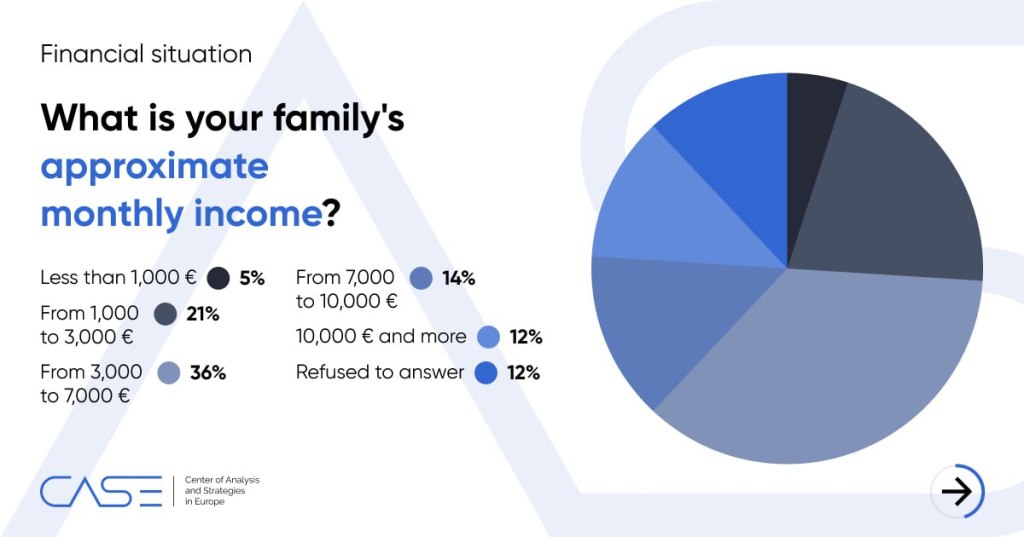

A farewell ceremony was held at the Serafimovskoe Cemetery in St. Petersburg for four soldiers of the Neva Battalion who perished during the special military operation, the governor’s press service reported on July 3. The funeral was attended by the city’s head, Alexander Beglov, and the speaker of the St. Petersburg Legislative Assembly, Alexander Belsky.

The deceased men—Mikhail Sokolov, Roman Galinsky, Mikhail Manushkin, and Sergei Isayko—were posthumously awarded the Order of Courage. In his speech, Beglov said that the men had been killed in heavy fighting.

“They are continuers of Russia’s military glory. We are proud of our fellow townsmen. Petersburg shall cherish their memory,” the governor said.

After the start of the special operation, the Smolny’s press service began publishing news about the deaths of Petersburgers in the Donbas, accompanying them with a mention of the condolences expressed by Beglov. Later, the release of such reports was abandoned for a long time. In December, Beglov unveiled a plaque on the facade of School No. 369 in memory of army officer Alexander Zhikharev, who perished in the SMO. In February, the governor and education minister Sergei Kravtsov met with Zhikharev’s relatives, and in March the school was named in his memory.

Source: “Petersburg says goodbye to four volunteers killed in SMO,” ZAKS.ru, 3 July 2023. Translated by the Russian Reader


In the wake of Zhenya and Sveta’s kangaroo court hearing, what I’ve been thinking about for several days is that we forget the golden rule of all convicts—“Don’t believe, don’t be afraid, don’t ask”—and thus hand them the tool for coercing us.

You can’t show them your vulnerabilities or reveal your desires and fears. (Don’t ask!) This information will be used to intimidate and torture you. (Don’t be afraid!) Or it will be used for bargaining: they will promise to go lighter on you in exchange for your cooperation and will certainly deceive you. (Don’t believe!)

Source: Elena Efros (Facebook), 4 July 2023. Translated by the Russian Reader. Ms. Efros, a well-known human rights activist, is the mother of imprisoned theater director Zhenya Berkovich. Thanks to Ivan Astashin for the heads-up.

You Went Away

A gravestone at El Carmelo Cemetery, Pacific Grove, California, 25 May 2023. Photo by the Russian Reader

Everyone I know who has left [Russia] has improved their circumstances by leaving. I understand that mine is a biased sample, but it is still a sample. One young woman recently said it to me outright: “Things have got better for all of us because of the war. And that scares me.”

We are beneficiaries of the war, me included. I have started earning more money. I live in a great place, better than where I lived in Moscow. Everyone respects me, which was unheard of in Moscow, and sometimes they even recognize me on the streets. Every day something good happens to me: new projects, interviews, interesting encounters. And I’ve generally started feeling better. I have become calmer, kinder, more confident in myself, and I smile more often.

And all because the war is underway.

It scares me to admit it, but sometimes I think: if only it had started fifteen years earlier, when I was younger and I had more vim and vigor. Would it have been to hard for them to arrange? How wonderful my life would have turned out then.

I realized this back in 2014, when I spoke with people who had gone to fight in Donbas completely voluntarily. Yes, of course, there were ideological idiots among. Some were in it for the money. But many honestly admitted that there was nothing else for them to do. Life had become meaningless and hopeless: TV, vodka, the wife. Life was boring, there were no prospects. They had to raise the stakes, and so they went to war.

I was like that myself. In 2014, I worked at a terrible dreary job. My personal life had come to a dead end. I felt that what mattered most in life was happening somewhere other than where I was, and I was just rotting where I was. It was like Groundhog Day, like being in a sludge which you can not get out. Everything was unreal, inauthentic, imaginary. And so I went to report in Donbas, because I knew for sure that that was reality. It didn’t matter what kind of reality, but whatever it was, it was the real thing.

And suddenly everything fell into place. I am a feckless, indecisive person, poorly adapted to life. But suddenly, in the midst of war, I felt that I was in my element. I knew exactly what to do, I had no doubts, I took responsibility. And everything panned out for me, something I wouldn’t have dared to dream of in peacetime. But why was war just the ticket?

There was even a fire in my belly. I thought: there is a chance for people like me in this mess, in this chaos. Now I’m going to show you assholes just like—you’ll dance to my tune. You had me all wrong…

It sounds nice, but there’s something despicable about it.

So did all those failed poets, provincial schoolteachers, and hairdressers with cosmic-scale ambitions who in 1917 posed for pretty photographs and then engaged in mass executions. That’s how history is made. And then they were shot themselves.

And it also eliminates the need for choice. Oh, how easy it is to make decisions when there is no other choice! Can’t make up your mind? It’s okay, the course of things will choose for you. “The coercive force of reality,” as Babel said. Force majeure, as they say in the courts.

In December 2022, I had good papers made for myself, and so now I can move freely around the world. And my first thought was: that’s it, now I’m going to Kyiv. From there I’ll go to Odesa and Kharkiv. I know how it’s done. I have to go. I won’t forgive myself later if I don’t go, so off I go!

But I didn’t go. I wasn’t able to double dare myself. I couldn’t explain to myself why I had to go to the war and what I would do there. I already have a different life from the one I led in Moscow. I don’t need to compensate, to show my worth in a particular way, to prove anything to myself. I think I’m recovering, I’m getting better.

“Have you read the news? What a beautiful article you could write!” a friend recently wrote to me. “Come on, have a whack at it! It would be a powerful move!”

I texted him: “Go fuck yourself!”

But another person wrote: “We have a problem here. Can you…” I answered briefly: “Yes, I’ll do it.”

I’m recovering, but I’m not quite recovered yet.

P.S. For those who are outraged by the first sentence.

I lived badly in Russia, I had nothing to lose. So yes, my life has improved. Everything is relative.

You had been living well, apparently, and now you are experiencing difficulties trying to restore your previous standard of living. That’s also the way the ball bounces. I hate everything about the way things were. I wouldn’t want things to be like they were before.

Source: Yan Shenkman (Facebook), 26 May 2023. Translated by the Russian Reader

Ultra Bra, “Sinä lähdit pois” (“You Went Away,” 1997)

In the wee hours neither of us can party anymore
Tired gazes, hoarse voices
In the background a sun that doesn’t warm

You went away
From the balcony I watched
Your receding back
You skirted the puddles
And I guess you won’t regret this parting

All the birds in the bushes sing before seven in the morning
Tired gazes, hoarse voices
In the background a sun that doesn’t warm

You went away
From the balcony I watched
Your receding back
You skirted the puddles
And I guess you won’t regret this parting, parting

The night’s last drink
Turns into breakfast
To which I added coffee

You went away
From the balcony I watched
Your receding back
You skirted the puddles
And I guess you won’t regret this parting

You went away
From the balcony I watched
Your receding back
You skirted the puddles
And I guess you won’t regret this parting, parting, parting

Source: Genius. Translated from the Finnish by the Russian Reader


KYIV, May 29 (Reuters) — Explosions rang out across Kyiv on Monday as Russia launched its 16th air attack on the Ukrainian capital this month, hours after unleashing dozens of missiles and drones overnight.

Panicked residents, some of whom initially ignored the air raid siren as they ate breakfast in cafes, rushed for cover when the sky filled with smoke trails and blast clouds.

All the Russian missiles were shot down, but one person in the central Podil district was taken to hospital, authorities said. No major damage was reported.

Kyiv mayor Vitali Klitschko said explosions sounded in the capital’s central districts and emergency services were dispatched.

“The attack on Kyiv continues. Don’t leave the shelters!” he wrote on the Telegram messaging app.

Ukraine shot down 11 cruise and ballistic missiles fired in the second of Monday’s attacks on Kyiv, said Valeriy Zaluzhnyi, commander-in-chief of the armed forces.

Heavy air strikes about six hours earlier had targeted the capital, put five Ukrainian aircraft out of action in the west of the country and caused a fire in the Black Sea port of Odesa.

“I would say there has been an activisation, a serious activisation… there are fewer missiles flying, but the regularity of strikes has increased,” said air force spokesperson Yuriy Ihnat.

Russia’s main targets are typically stocks of Western weapons, energy facilities and government buildings, but the fact the missiles over Kyiv were shot down made it difficult to establish their target on Monday, he said.

Russia has increased the frequency of air attacks as Ukraine prepares to launch a counteroffensive.

Kyiv metro stations were packed with people taking shelter although many residents ignored the air raid alarm until they heard loud blasts in city centre.

A local television report from a junction on a busy highway showed missile wreckage that appeared to have hit a traffic light.

Source: Pavel Polityuk and Max Hunder, “Russia launches 16th air strike on Kyiv this month,” Reuters, 29 May 2023


[…]

Just two of the soldiers who were rebuilding the machine-gun nest had been with the battalion since Kherson. One of them, a twenty-nine-year-old construction worker called Bison—because he was built like one—had been hospitalized three times: after being shot in the shoulder, after being wounded by shrapnel in the ankle and knee, and after being wounded by shrapnel in the back and arm. The other veteran, code-named Odesa, had enlisted in the Army in 2015, after dropping out of college. Short and stocky, he had the same serene deportment as Bison. The uncanny extent to which both men had adapted to their lethal environment underscored the agitation of the recent arrivals, who flinched whenever something whistled overhead or crashed nearby.

“I only trust Bison,” Odesa said. “If the new recruits run away, it will mean immediate death for us.” He’d lost nearly all his closest friends in Kherson. Taking out his phone, he swiped through a series of photographs: “Killed . . . killed . . . killed . . . killed . . . killed . . . wounded. . . . Now I have to get used to different people. It’s like starting over.”

Because the high attrition rate had disproportionately affected the bravest and most aggressive soldiers—a phenomenon that one officer called “reverse natural selection”—seasoned infantrymen like Odesa and Bison were extremely valuable and extremely fatigued. After Kherson, Odesa had gone awol. “I was in a bad place psychologically,” he said. “I needed a break.” After two months of resting and recuperating at home, he came back. His return was prompted not by a fear of being punished—what were they going to do, put him in the trenches?—but by a sense of loyalty to his dead friends. “I felt guilty,” he said. “I realized that my place was here.”

[…]

Source: Luke Mogelson, “Two Weeks at the Front in Ukraine,” New Yorker, 22 May 2023

Words and Deeds (577 People)

Yesterday, during a dinner conversation, I was asked why I’d been silent, why I hadn’t been writing anything about the war. Was it because I was afraid of going to jail, or was it something else? These questions were posed point blank albeit sympathetically.

I’ve been asking myself this question for many months. On the one hand, it’s stupid to deny that watching as my acquaintances are given devastating prison sentences does not affect me in any way. It makes an impression, of course.

On the other hand, I wonder what would I write or say now if the level of state terror had remained at least at pre-war levels. I realize that I would still write or say nothing. I can hardly squeeze this text out of myself. I’m just explaining myself because yesterday was not the first time I’ve been asked why I haven’t been writing anything about the war.

I feel that words have lost their meaning.

One of the ideologues of the war, who constantly makes allegations about the “genocide of the Russian language,” writes bezpilotnik, obezpechenie, na primer, and ne obezsud’te. [Instead of the correct spellings bespilotnik, obespechenie, naprimer, and ne obessud’te — meaning, respectively, “drone,” “provisions,” “for example,” and “don’t take it amiss.”] No one corrected him for a year. Compared to him, I’m a total expert on the Russian literary language, but I don’t have the words to stop cruise missiles or send soldiers home, while his bezpilotnik turns residential buildings into ruins in a second.

I do not know what words to find for a mother who, conversing with her POW son, regularly interjects “bitch” and “fuck.” Or for a mother who, as she sees off her son, smiles at the camera and says what actually matters is that she didn’t raise him to be a faggot, and basically, if push comes to shove, she has another child. Moreover, the supplies of such people are really endless.

Now, sadly, only the Ukrainian Armed Forces can “explain” anything. I am not trained in military affairs. So I am silent.

Source: Yevgeny Levkovich (Facebook), 2 March 2023. Translated by the Russian Reader
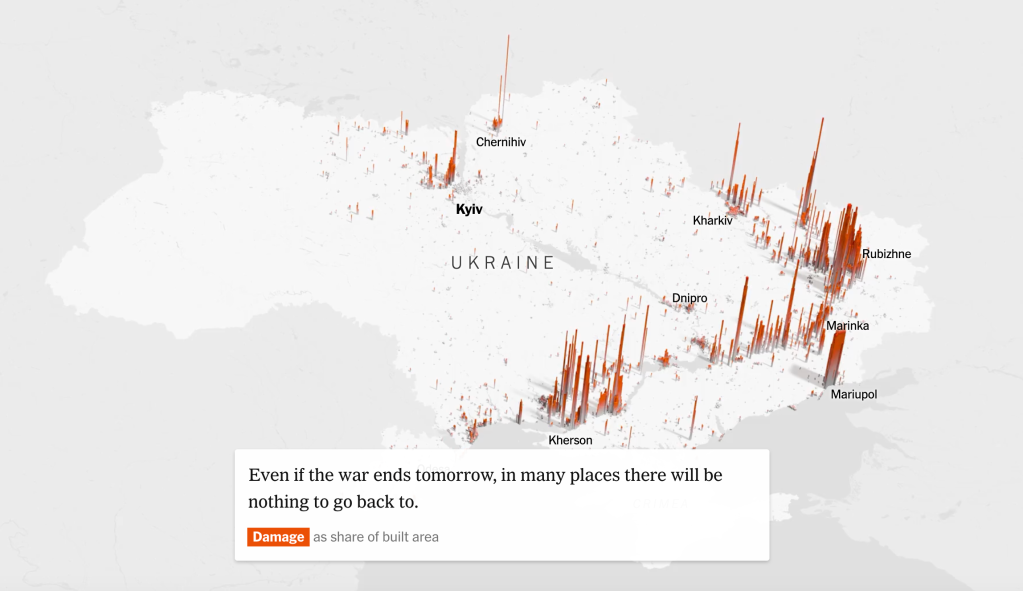

Separately on Friday, police briefly detained Yevgeny Levkovich, a reporter for Radio Svoboda, RFE/RL’s Russian service, at his home in Moscow, and charged him with “discrediting the army,” according to news reports and Facebook posts by Levkovich.

[…]

In Moscow, police detained Levkovich for about five hours at the Teply Stan police station and charged him under Article 20.3.3 of the Administrative code for allegedly discrediting the army; convictions for that offense can carry a fine of up to 50,000 rubles (US$613).

Levkovich wrote on Facebook that his trial was scheduled for Monday, but he did not plan to attend because he did not “see the point” in contesting the charge.

Radio Svoboda wrote that the charge was likely related to Levkovich’s posts on social media, but did not say whether authorities had specified any posts prompting the charge. On his personal Facebook page, where he has about 36,000 followers, Levkovich recently wrote about Russia’s war on Ukraine.

Source: “Russian journalists labeled as ‘foreign agents,’ detained, and attacked while reporting,” Committee to Protect Journalists, 11 April 2022


These are the numbers. I want to do something so that people don’t get caught, and even more actively support those who do get caught. But in the first case, it is unclear what these people are reading, and where the safety recommendations should be published so that they are accessible to such people. And we are already working on the second case, but we lack the human resources.

Those arrested for radical anti-war protest are heroes, although sometimes the charges are completely trumped-up. In any case, all of them deserve support. Solidarity Zone regularly writes about such political prisoners, publishes addresses where you can send them letters, and raises funds to pay their lawyers. Sign up to get news of what is happening to these people and, if possible, get involved in supporting them.

Source: Ivan Astashin (Facebook), 25 February 2023. Translated by the Russian Reader


Solidarity Zone: Numbers

112 people are being prosecuted on charges of carrying out or planning radical anti-war acts.

Solidarity Zone counted how many people have been criminally charged with setting fire to military enlistment offices, sabotaging the railroads and other militant anti-war actions, or planning them, in the year following [Russia’s] full-scale invasion of Ukraine.

What police investigators allege these people have done to warrant criminal prosecution:

1 — “other”

7 — torched vehicles marked with the letter Z

17 — planned arsons of military enlistment or other government offices

36 — sabotaged the railways

51 — torched military enlistment or other government offices

Articles of the Russian criminal code under which these people have been charged:

36 — Article 205: Terrorist Act

31 — Article 167: Destruction of Property

15 — Article 281: Sabotage

14 — Unknown

12 — Article 213: Disorderly Conduct

4 — Other Criminal Code Articles

Of these people:

78 are being held pretrial detention centers (remand prisons).

5 have been sentenced to parole.

4 are serving prison sentences.

1 is under house arrest.

1 has been released on their own recognizance pending trial.

There is no information about 23 of them.

Our statistics are incomplete because the Russian authorities do not always report new criminal cases. Sometimes we only get reports that people have been detained, with no mention of their names or the charges against them, and these reports are thus extremely hard to verify.

Our statistics do not include people who were killed by the security forces during arrest or people prosecuted on administrative charges.

Source: Solidarity Zone (Facebook), 24 February 2023. Translated by the Russian Reader. Here, by way of comparison, are OVD Info’s statistics for numbers of people criminally (as opposed to administratively) prosecuted for “non-radical” anti-war actions since 24 February 2022:

Total defendants: 465 in 77 regions (we include occupied Crimea and Sevastopol in our data because we monitor activities of repressive Russian government authorities that operate there).

Women among the defendants: 90 (19%)

Minors among the defendants: 6 (1%)

(Section 3, Article 207.3 of the Criminal Code) Prosecuted for “spreading fakes about the Russian army” (ie talking about the war in an unsanctioned manner): 141 (30%)

(Section 3, Article 280.3 of the Criminal Code) Prosecuted for “discrediting the Russian army”: 54 (12%)

Convicted: 119 (26%)

Imprisoned upon conviction: 26 people

In pre-trial detention: 108 people

Under house arrest: 17 people

Convicted and given a non-custodial sentence: 62 people

It thus follows that a total of 577 Russians have faced criminal prosecution for anti-war actions of all kinds (violent and nonviolent) since the start of their country’s invasion of Ukraine. As Ivan Astashin, a former political prisoner himself, argues, above, all these people are, indeed, heroes. It’s another matter that they constitute a statistically insignificant segment of the world’s ninth most populous country. Again, by way of (invidious) comparison, at least 1,003 Americans have been charged with crimes for their alleged involvement in the 6 January 2020 riot at the US capitol.

Meanwhile, in Iran (population: approx. 87 million):

At least 522 people have been killed in four months of anti-government protests in Iran, said a report issued on January 15 by the U.S.-based Human Rights Activists News Agency (HRANA). Among the dead are 70 minors and 68 security forces, the agency reported. Nearly 20,000 people had been arrested, 110 on charges that could lead to a death sentence, it said. Four have been executed. Protests were triggered by the death in custody of Mahsa Amini, 22, an Iranian Kurdish woman who was arrested by morality police for allegedly not complying with Islamic dress codes. ||| TRR


Evgeny Krupitsky writes:

I would argue that those who were forced to leave Russia due to Putin’s unleashing of illegal aggression against Ukraine could file a class action lawsuit against the Russian Federation or the ruling elite of the Russian Federation demanding compensation for the moral anguish and economic harm suffered as a result of these events. The Russian federal authorities must fully compensate them for expenses incurred by forced relocation, such as the cost of airplane and other tickets, accommodation in hotels and rented accommodation abroad, and other expenses. Compensation could also include the irreparable losses suffered by citizens within the country due to forced relocation — for example, the loss of a job or a business. Compensation for emotional suffering is a separate issue.

Payments could be made from the Russian federal budget, through the sale of the property of officials directly responsible for unleashing the war, or at the expense of business income from entrepreneurs who have directly supported the illegal aggression. Naturally, compensation for this damage is possible only after full payment of the reparations necessary to restore Ukraine’s economy and civil infrastructure. What do you think about this? #nowar#netvoine

[two selected comments + one response by the author]

Zmey Gurevich A difficult question. It’s true that the monstrous war forced me to leave Russia. But to my incredible surprise, I have have become happy here [in emigration]. Perhaps it’s immoral to be happy when rivers of blood overflow their banks. It’s been eating at me. But the painful departure has led me a new happiness. Some vital knots have been untied… No, I have nothing to bill [the Russian authorities] for. My friends empathize with me and ask me how things are going here. I can’t tell them the truth. I am ashamed. But my departure has turned into a happy time for me. I don’t know what will happen next.

Vlad Shipitcyn Zhenya! Did you go to at least one protest rally against Putin in Russia over [the last] 22 years? No, you didn’t. Did you ever stand on the stand on the street holding a [protest] placard? No. So no one owes you anything, not a kopeck. You too are responsible for both the regime and the war. You let them happen. So calm down.

Evgeny Krupitsky Hi! Yes, I am responsible for this war: it happened due to my connivance, indifference and cowardice. And I said it right away: https://www.youtube.com/watch?v=GsAFChc2HSI And my protest was that on March 6, exactly a year ago, I left the Russian Federation having abandoned everything, because I felt sick and ashamed. Okay, maybe it’s not such a big deal in terms of significance and courage, but I am proud of my little protest. I know you went to the rallies long before the start of the war, that you were detained, beaten and fined, and I respect and admire you for that! But someone will say that they suffered more than you did, that they did more to prevent this war, etc. We need to consolidate, rather than argue about who is more to blame!

Source: Evgeny Krupitsky (Facebook), 3 March 2023. Translated by the Russian Reader

Evgeny Krupitsky, “My take on what’s happening (2 April 2022) #nowar #netvoine”

Some people in Russia are living a normal life, but they feel the lack of real normality, and this causes them discomfort. Others live with a sense of catastrophe, but they feel the absence of a real catastrophe, and this also causes discomfort. Consequently, everyone is on edge. The sensible approach is to live normally with a sense of disaster. But this useful attitude is hard to achieve, and if you don’t have it, then I do not even advise you to start. When it takes shape, it will no longer be relevant.

Source: Grigorii Golosov (Facebook), 4 March 2023. Translated by the Russian Reader


[…]

The four members of this “countryside hub” are among hundreds of Russian opposition activists of various political leanings who have fled their country to Georgia throughout the past year. Some left in the months prior to Moscow’s invasion of Ukraine last February as repression grew to unprecedented levels in the Putin era. Others came after the war began, realizing that with their dissenting opinions, they could no longer live in what they deem a fascist totalitarian state. 

In Tbilisi, they have created or joined new anti-war resistance organizations, which operate on Western grants and employ hundreds of volunteers. Working around the clock, these groups offer services in real time to Ukrainians refugees as well as Russian activists and military deserters fleeing their respective countries. The help comes in the form of evacuation routes, therapeutic services, legal guidance, shelters and resettlement plans.

[…]

From her volunteering as an election monitor in Russia’s 2011 elections to offering pro-bono legal support to activists arrested during protests in subsequent years, Burakova’s career followed a linear trajectory. Degrees in political science and law equipped her with the legal know-how to aid political opponents, and now exiles, over how to wrestle with and escape an authoritarian system that often invents new laws to persecute citizens. As of 2022, “discrediting the Russian army” is now an offense that has landed countless people in prison for sharing anti-war posts on social media.

[…]

“To conduct these types of congresses and host mock parliamentary votes on Russia’s future while in exile just looks a bit cringe-ova,” Burakova tells me, using the popular English word that has been appropriated into the Russian language. Her husband Egor Kuroptev shares the sentiment. 

Source: Aron Ouzilevski, “Russian activists in Tbilisi organize to resist Putin’s war,” Institute of Current World Affairs, 1 March 2023. Thanks to Sveta Voskoboinikova for the heads-up. The emphasis is mine. ||| TRR


M., one of my smartest interlocutors, arrived from Moscow Time. “Well, what is your final conclusion? Why?” he asked me. I told him that now I see three points that we simply missed, that ended up in our blind spot. The first point is that of course everyone worked hard during these years, enthusiastically; everyone had an articulated mission in life, etc. But it was seemingly taken as a natural given that each of us was the client of someone a few floors above us. Now everyone looks back and discovers that their mission has been burned for a long time, and their belonging to one or another Moscow (or regional) clan shines forth in their biography. For some reason, it was automatically believed that, in the nineties, we operated in a world in which, when difficulties arose, we should turn to “the man from Kemerovo” (in the words of Grebenshchikov’s song). In the noughties, however, all this was allegedly vanquished. In reality, nothing was “vanquished”: it was simply transformed into large-scale state clans. That is why now everyone who was engaged in charity, book publishing, media development, etc., has suddenly shifted the emphasis in their reflections on life: wait a second, I worked for Abramovich (or Gusinsky, or Potanin, etc.). The system consisted entirely of a network of clients.

The second point: the language of pragmatic communication. It was a completely abusive language. The smash-mouth jargon permeated everything. Roughly speaking, the country was governed in the language of American rappers (i.e., the Solntsevo mob). All communications! Not only the special communications among those in power, but also all communications in the liberal, academic realm, in civil society. The cynical jargon of abuse reigned everywhere, and it was absolutely acceptable even in highly cultured milieux. And we did not see what consequences this would have.

The third point: “populism.” The automatic perception of the “common people” [narod], which had its origins in the late-Soviet and perestroika periods, was a colossal mistake. It was tacitly assumed, first, that there was a “common people”; second, that the “common people” would determine their own fate; and third, that the “common people” naturally triumph over evil because they themselves are good. It was this “populism” that served as the basis for the compromise with the state when it began to take institutional shape in Yeltsin’s wake.

All three of these points were “organic” in some sense. They were a part of ontology: they were taken for granted without any reflection and criticism. And all three played a fatal role in the process of “slowly boiling the frog alive.”

Source: Alexander Morozov (Facebook), 5 March 2023. Translated by the Russian Reader


Aquarium, “The Man from Kemerovo” (2003)
I had problems,
I had gone way too far.
The lower depths of the deepest hell
Didn't seem so deep to me.
I called my mom,
And Mom was right.
She said, "Straightaway you've got to call
The man from Kemerovo."

He is a man of few words, like de Niro.
Only a wacko would argue with him.
You can't pull one over on him,
He knows all the insides and outs.
The sky could crash to the ground,
The grass could stop growing,
He would come and silently fix everything,
The man from Kemerovo.

Adam became a refugee,
Abel got on a mobile connection,
Noah didn't finish what he was building,
Got drunk and fell face down in the mud.
The history of humankind
Wouldn't be so crooked,
If they had thought to get in touch
With the man from Kemerovo.

I got a call from Kyiv,
I got a call from Kathmandu,
I got a call from the opening of the plenum —
I told them I would not come.
You have to drink two liters of water at night,
To have a fresh head in the morning.
After all, today I'm going to drink
With the man from Kemerovo.

Source: ezh108 (YouTube). Lyrics translated by the Russian Reader


Only one conclusion follows from Stalin’s death: woe is the country where tyrants die natural deaths while still in power.

Source: Roman Osminkin (Twitter), 5 March 2023. Translated by the Russian Reader. Mr. Osminkin’s remarks were occasioned by the social media commemoration of the anniversary of Stalin’s death, yesterday, which often as not consisted of replicating the meme “That one croaked, and this one will croak too.” This means, apparently, that the entire “plan” of the “Russian anti-war movement” and the “anti-Putin opposition” consists in waiting for the current Russian tyrant to die a natural death. It’s a frank admission to be sure. ||| TRR

Fun with Pictures

Source: Josh Holder et al., “The West Tried to Isolate Russia. It Didn’t Work,” New York Times, 23 February 2023


Source: Francesca Ebel and Mary Ilyushina, “Russians abandon wartime Russia in historic exodus,” Washington Post, 13 February 2023


Takeaway: The countries to which “anti-war” Russians have fled in the greatest numbers since February 24, 2022, also figure prominently among the list of countries which have significantly increased their exports to Russia since its invasion of Ukraine. I’ve never seen this issue addressed, much less mentioned, by the “Russian diaspora” or the “Russian anti-war movement.” I wonder why. ||| TRR