Takeaway: The countries to which “anti-war” Russians have fled in the greatest numbers since February 24, 2022, also figure prominently among the list of countries which have significantly increased their exports to Russia since its invasion of Ukraine. I’ve never seen this issue addressed, much less mentioned, by the “Russian diaspora” or the “Russian anti-war movement.” I wonder why. ||| TRR
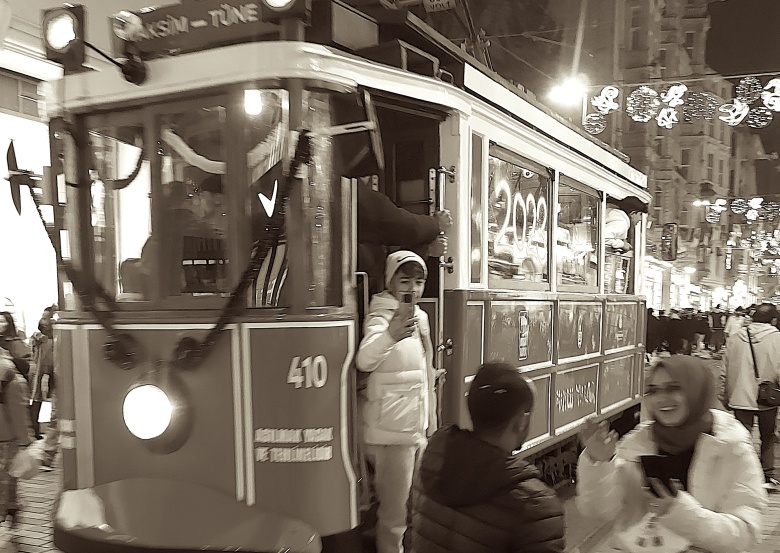
Istanbul, December 2022. Photo courtesy of Republic
[…]
500 vacancies for military registration specialists were advertised from late September to last December last year, according to HeadHunter. Previously, this specialization was considered a rather rare and generally not very sought-after profile in the personnel departments of Russian organizations (private and public). For comparison: only 145 such vacancies were advertised in the whole of 2021. The military mobilization has changed the situation: since September — that is, in just three months — the number of such offers on the labor market has increased by about two and a half times (Superjob’s data also show the same thing). The reasons? One of them (apparently, the main one) is an increase in fines for lapses in paperwork: to avoid them, employers are willing to pay applicants for the popular vacancy 70-80 thousand rubles a month. And this is despite the fact that there is a shortage of a number of other specialists on the labor market (and, presumably, they are no less valuable than SMO-era personnel officers). The number of vacancies on Avito Jobs alone, according to a recent company study, increased by 69% in 2022. Most likely, the trend will continue, serving as a natural continuation of the outflow of people and, ultimately, personnel.
50% — the percentage of last year’s sales of existing housing in the Russian Federation made through a notarized power of attorney. This record figure for the entire observable history of the market, as calculated by investment company Flip, who were commissioned by Kommersant, clearly indicates that the sales trend was primarily shaped by property owners who had emigrated. The high volume of such transactions seems to be an anomalous phenomenon. In 2021, a power of attorney was the basis for sale in no more than 20% of deals. In 2020, this figure was 15%. It was 8% in 2019, and 5% in 2018. You ain’t seen nothing yet, though: the ongoing controversy over whether to confiscate the property of openly anti-war Russians who have left the country must be making an additional contribution to the process of selling apartments and houses, which was gaining momentum as it was.
$81.69 billion — the total amount of deposits by Russian nationals in foreign banks as of the end of November of last year, according to the latest data from the Russian Central Bank. (4.989 trillion rubles were recalculated at the exchange rate in effect on that date.) Over the past eleven months, the amount has more than doubled — and this is even if we rely entirely on the statistics of the Central Bank, which may not have a complete picture of what is happening. (Russian laws oblige citizens to report when they open accounts in foreign banks and move funds in them, but we cannot be absolutely sure that everyone strictly obeys them.) While one part of these funds remains in these bank accounts, the other goes to the purchase of real estate that, for the most part, is also located outside the Russian Federation.
16,300 houses and apartments in Turkey were purchased by Russian nationals in 2022, according to data published by the Turkish Statistical Institute (TurkStat), as studied by RBC. This is not just three times more than in 2021 (when Russian nationals purchased 5,400 housing units in the Turkish Republic), but also more than the total volume of such transactions over the past six years (16,200). It is not surprising that last year, for the first time, Russians took first place among foreigners in buying housing in Turkey, producing almost a quarter of the corresponding demand with their money. Earlier, we wrote that our compatriots purchased two thousand houses and apartments in Turkey in October 2022 alone, overtaking all other foreign home buyers in that country, as reported by TurkStat.
At first glance, the advantages of investing in Turkey are not entire obvious. Inflation in the country, according to TurkStat, exceeded 84% in November, once again breaking records previously established in the autumn of 1998. The Inflation Analysis Group, an independent Turkish entity, estimated that inflation had reached a whopping 170.7% . In addition, prices for real estate, which have rising robustly, can at any moment just as vigorously drop, taking into account, in particular, the rather murky prospects for “Erdonomics,” depending on the results of the upcoming presidential and parliamentary elections. According to Endeksa, in September, the average price for one square meter of housing in Turkey was about 12 thousand Turkish lira (approx. $644), while the average price per housing unit was just over 1.5 million Turkish lira (approx. $83,700). The term of return on investment in housing is estimated at nineteen years, although in the summer this figure was recalculated to seventeen years.
The intense interest on the part of Russian nationals in buying real estate in Turkey is primarily related to the prospect of obtaining Turkish citizenship, Anna Larina, head of the foreign real estate department at NF Group, explained to Republic. (In turn, having a Turkish passport makes it possible to obtain an American E-2 visa, which speeds up the process of immigrating to the United States.) In this sense, it is logical that Russians have become leaders in terms of the number of residence permits issued in Turkey — 153,000, of which, however, as the Turkish Ministry of Migration clarified, 132,000 are short-term tourist residence permits, which are valid for two years.
Turkey is one of the few countries (but not the only country) that is still open to Russian nationals and their private capital. Thus, as 2022 came to a close, Russian citizens took first place among non-residents in buying real estate in Dubai, Bloomberg recently reported, citing figures provided by the brokerage firm Betterhomes.
Withdrawing funds and setting up a new life abroad eloquently testify to the sentiments prevailing among the Russian urban middle class, primarily. Not all people who sell Russian real estate and buy foreign real estate are necessarily irreconcilable opponents of the regime. And yet, it is clear that the vast majority of these people do not want to live and raise children in Putin’s version of the future, which is practically incompatible with modern civilization. In its own way, it is symptomatic that Russians who support the government and dutifully follow it into its deadly adventures are also dissatisfied with what is happening. If it were possible, they would rather return to the past, to a point in time thirty, forty, or fifty years ago.
63% — the percentage of Russians, according to a December poll conducted by the Public Opinion Foundation (FOM), who regret the collapse of the USSR — that is, more than three decades after the event known in Kremlin mythology as “the greatest geopolitical catastrophe of the twentieth century.” Strictly speaking, the current longing for Soviet times cannot be considered a record: after the August 1998 ruble default, there were noticeably more Russians nostalgic for the Soviet Union — 85%. Nevertheless, an important indicator of public attitudes (as recorded, we should underscore, by a quasi-state polling service) is on the rise again, having increased by twelve percentage points since 2011.
It is clear that this sentiment is primarily voiced by the 46–60 age group (88% of whom are “nostalgic”) and to some extent, people aged 31–45 years (79% of whom are “nostalgic”), assuming that a considerable portion of these people associate the late USSR with their happy childhoods and wild youths. However, according to the poll, even today’s Russian youth, that is, people aged 18–30, mostly (64%) consider the Soviet era “generally a good time.” Of course, their judgments are based on the stories of older generations, and most importantly, on the inevitable comparison with what is happening with the largest post-Soviet country right now.
Source: personal email, December 2022, This is the first time I’ve heard from Raffeisenbank in several years, especially since my account with them has been essentially dormant since well before I left Russia in 2019. ||| TRR
Foreign managers are quitting Petersburg hotels: they are resigning their positions amid the withdrawal of international hotel companies from the Russian market.
In particular, the post of general manager of the five-star Four Seasons Lion Palace has recently been filled by Ekaterina Saburova, who had worked as marketing director at the Four Seasons Moscow Hotel. In an interview with Kommersant-SPb, a spokesman for the Petersburg hotel noted that the previous general manager, Richard Raab, had gone on to work at another hotel in the chain.
Similar personnel changes have taken place at the Grand Moika 22 Hotel, which until recently was part of the Kempinski international chain. The hotel is now headed by Yevgenia Nagimova, and the operations director and Russian staff are responsible for day-to-day operations. The previous general manager, Oliver Kuhn, initially took a similar position at the Kempinski Hotel in Cairo, before running a hotel in the Seychelles. He explained that he had left Russia to transfer to another hotel in the chain. The general director has also been replaced at the Radisson Royal and Park Inn Nevsky: instead of Rune Nordstokke, the hotels are now headed by Mikhail Grobelny, who previously worked as the general manager of the Radisson Blu Belorusskaya Hotel in Moscow.
Experts note that, amidst the departure of international hotel chains [from Russia], industry players have basically lost the need for the position of a general manager responsible for liaising with company management. According to Andrei Petelin, general director of the Hotel Saint Petersburg, the personnel changes may be related to the desire of owners to reduce costs during the crisis [sic], since foreign managers earned more than their Russian counterparts, and also received compensation for housing rental and their children’s education.
Some foreigners still continue to work in Petersburg hotels: Eric Pere, general manager of the Corinthia Hotel St. Petersburg; Gerold Held, general director of the Hotel Astoria and the Angleterre Hotel; and Jaehyuk Yang, manager of Lotte Hotel St. Petersburg. Some industry reps have concerns that further resignations by foreign managers may have a negative impact on the level of service. Andrei Petelin, however, is confident that Petersburg-based managers are able to maintain high standards, because they not only have experience working abroad, but also better understand the needs of Russians coming to the Northern Capital to relax.
Speaking of which, since the beginning of 2022, seven million tourists have visited St. Petersburg. Vice-Governor Boris Piotrovsky noted that in November, bookings at the city’s hotels consistently exceeded the sixty-percent mark.
A few weeks ago, DPwrote about how the Smolny [Petersburg city hall] was again thinking about introducing a resort fee. Hoteliers stated that they considered this step reasonable, but only if the revenues generated were used properly.
620,251 views • Dec 2, 2022 • President Vladimir Putin’s war in Ukraine is causing major changes back home. Hundreds of thousands of Russian men are being mobilized to fight and tens of thousands have already been killed or injured. Meanwhile, many Russians have left their country and millions of Ukrainians are thought to have arrived. What impact will these changes have on the Russian population? And could the public response lead to Putin’s downfall? We discuss these questions and more with UCLA’s Oleg Itskhoki in this DW Business Special.
At first glance, massive emigration reduces the potential for political change, because it mechanically subtracts from society the part of society that is critical of the authorities. To a large extent, of course, this is true, but we shouldn’t overestimate this factor.
My subjective observations tell me that one of the leading motives for emigration (let’s put the existential threat of mobilization aside for now) has been the loss of hope for a “normal” life. People have been fleeing because they felt things would only get worse, and that their former relatively prosperous (and sometimes quite lovely and promising) lives were collapsing, along with all their plans.
If you think about it, there is no potential for political change in this worldview. You can’t be a gravedigger of the old regime at the same time as you grieve for the opportunities lost in it.
Let’s take a hypothetical employee of the progressive wing of the Moscow Department of Transport (or any other corporation, bank, etc.) with liberal views, who remembers what a cool project he worked on in 2018 (or even in 2022), but now is leaving the country, because such projects will definitely not happen in the future. He went to protest rallies, voted for the opposition, watched [Maxim] Katz’s YouTube channel, and donated to OVD Info, so his departure is a loss for the opposition. But it’s not a loss for the revolution, because “I want everything to be the way it was before, only with no war and crackdowns, but with fair courts and honest elections” is essentially a reactionary demand. It’s about preserving things, not changing them..
It would be a mistake to think that revolution leaves us along with the emigration: resentment over the supposedly lost prospect of a prosperous Russia, which was stolen from us, is unsuitable fuel for revolution. The political emigration has no political program, because there is no bridge to the “normality” that supposedly existed before 2022 (or 2020, 2018, 2014, 2011, etc.). The emigration’s picture of the world completely excludes the social, economic and political contradictions that have brought us to the present moment and are leading us further, so now it contains nothing but shock, fear, and individual salvation.
Revolution cannot emerge from the failure of an evolutionary project. It will emerge as an alternative to the brutal dictatorship at a fatal crossroads in the country’s history, prompted by the need to radically solve the pressing issues of our coexistence. But the remnants of failed evolutionary trends will surely still play their own reactionary role.
Source: Alexander Zamyatin, Facebook, 29 September 2022. Mr. Zamyatin is a popularly elected member of the Zyuzino Municipal District Council in Moscow and the editor-in-chief of the website Zerkalo. Translated by the Russian Reader
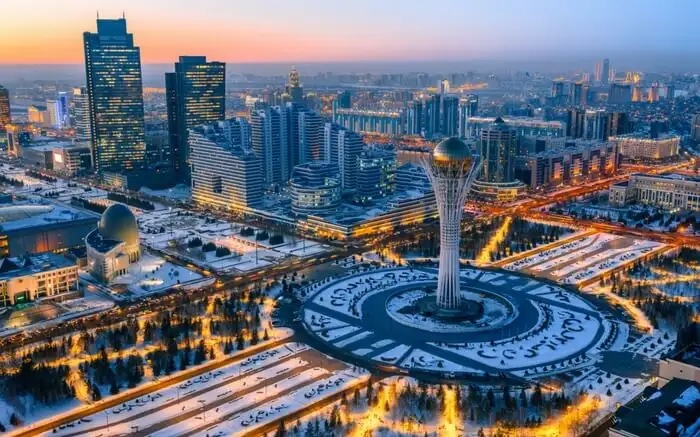
A bird’s eye view of Astana (aka Nursultan), the capital of Kazakhstan. Photo courtesy of Travel Triangle
Observing the discussions about visas [for Russians wishing to escape to the EU], I want to note how detached they are, in a way, from real life. It sometimes seems to me that this discussion is more about how Russians imagine “the West” than it is about helping actual people.
For many reasons it is more advantageous and convenient for certain people to leave, for example, for good old Kazakhstan. Why?
First, [Russia’s] longest land border is with Kazakhstan. There are numerous border crossings, and planes fly to and from there. This is one of the fastest and cheapest ways for many people to leave Russia.
Second, [Russians] don’t need visas to cross the border [with Kazakstan]. You don’t need a large packet of papers proving you have the right to a long-term stay, and you don’t need to go to a [Kazakhstan] consulate [before leaving Russia]. You can get a work patent and some kind of registration on the spot and remain in the country for a long time.
Third, it is easier to transfer your business there, to register it without losing previous business projects and connections. It is relatively easier to find a new job there or start your own business from scratch. There are still many tools for transferring money from Russia to Kazakhstan and back.
Fourth, it is a relatively cheap country: the prices are comparable to Russian ones.
Fifth, [Kazakstan] is still a culturally congenial country. The Russian language is widespread, and many of the bureaucratic rules and habits of everyday behavior in general are similar.
That is, generally speaking, from an “average Joe” point of view, good old Kazakhstan looks at the moment to be a more preferable place to go for very many people than good old Europe does. What follows from this? It implies the need, if we are talking about helping those who have left, to come up with a strategy for interacting with the conditions in Kazakhstan by establishing a dialogue with local politicians and officials, with society and its leaders, with the local media. In the end, this strategy should involve acquiring a basic knowledge of the language, culture and history of Kazakhstan, cultivating an attentive attitude to our own stereotypes and language, and getting rid of imperial habits. Europe and the West in general should be invited to cooperate with Kazakhstan in providing this assistance.
Еuropean visas, in fact, are hardly the main problem.
Almost a fifth of households in Moscow and St. Petersburg, even those with average incomes, regularly resort to the services of female domestic workers. Most often they need help around the house, as well as looking after the elderly and children. In most cases, Russians from the region where the employers reside are hired to do this work. A study by researchers at HSE and RANEPA shows that hired female household labor, which is considered a non-essential form of employment, is a vital part of urban economies.
Photo: Yevgeny Pavlenko/Kommersant
Almost one fifth of households in Moscow and St. Petersburg, having mainly an average income, employ female labor. This is the conclusion reached by Yulia Florinskaya, Nikita Mkrtchyan and Marina Kartseva (researchers at the Higher School of Economics and RANEPA) in the article “Women as hired workers in the households of Moscow and St. Petersburg,” published in the scholarly journal Woman in Russian Society (No. 2, 2022).
The first attempt in Russia to define the scale of wage labor in households in Russia’s megalopolises, the research study was based on a survey of residents of those cities who over the past three years have employed other people to do work usually performed by family members. Three thousand eight hundred people took part in the survey; their phone numbers were selected using systematic stratified random sampling. The results of the survey are unusual: although Russians generally believe that housekeepers, domestic help, and hired staff in a household involves a high family income and migrant labor and is a rare thing, it is, in reality, a fairly common practice among middle-income households in Moscow and St. Petersburg, and it is residents of the two capitals who are mainly hired to do such work.
First of all, hiring third parties to perform work in the household is a widespread practice in Russia’s two largest cities.
According to the survey results, female workers were employed by seventeen percent of households. Formally, men are employed by households much more. In fact, respondents were asking about paid employment in the household, including for such types of work as renovations and repairs, where men predominated. (Twenty-eight percent of the households surveyed had hired male hands.) Among “household chores,” “female” specializations were also discovered that would ordinarily not be thought of as “domestic help” — tutoring, primarily. In any case, seventeen percent of Moscow and Petersburg families employed female labor in households, a figure that dropped to around seven to eight percent when tutoring and repairs were factored out. Even with this proviso, however, the phenomenon goes beyond “elite consumption for the wealthy few.”
This also shows that, according to the survey data, most of the households (61%) who employed female workers estimated their incomes as average. When answering the standard question about their income (used, among others, by Rosstat in its questionnaires), they indicated that they had enough money for food, clothing, and household appliances. Twenty-three percent of respondents rated their incomes as high (in particular, as sufficient to buy a car or more) while sixteen percent rated them as low, since they were only enough to buy food. Thus, hired domestic workers are the preserve of the middle class rather than the income elite.
The prevalence of foreign nationals or, at least, migrant workers from other regions of Russia, among domestic workers has also been greatly exaggerated. According to the survey, almost two thirds (64%) of households that purchase women’s services [sic] in the household give jobs to women permanently residing in Moscow or St. Petersburg, where they themselves live.
Only in fourteen percent of households in the two cities was the employed woman a Russian national from another region, and in sixteen percent, a foreign national. (No breakdown by nationality is given.)
However, this fact is well known within the households and is clearly discussed by them. Only six percent of respondents who had dealings with female domestic workers were not aware whether she was a Muscovite [sic], a nonresident, or a foreign national.
Of course, households most often hired residents of their own region as tutors. Among domestic migrants this type of employment was two and a half times less common, while it was practically nonexistent among foreign women. At the same time, foreign women were twice as likely to be hired to do housework as Russian women, both local and migrant. However, domestic workers in the strict sense of the term — that is, those doing “housework” (cleaning, laundry, cooking, caring, and looking after children)— are still Muscovites and Petersburgers in most cases; residents of Krasnoyarsk and Samarkand [that is, domestic and foreign migrant workers, respectively] are in the minority. The authors of the study suggest that children are a “sensitive” area for households, and local women have in this instance an advantage over migrants: households are less likely to “trust” the latter. (The authors of the study avoid reaching an alternative conclusion: that this choice is a consequence of the phobias experienced by a significant part of the middle class towards migrants — phobias that are commonly denied in the middle-class milieu, as least in Moscow.)
Residents of other regions and countries are preferred only as caregivers, and the share of this type of employment among foreign women is three times higher than among women from the same region as their employers.
Florinskaya, Mkrtchyan and Kartseva describe a rather vital social phenomenon: migrant caregivers ask for their work, which is in demand among all strata of society, significantly less pay than do Russian nationals, and for most relatively poor households there is no alternative to hiring them, as they simply cannot afford a nurse from Moscow. But to carry out repair work, local women and migrants were hired with approximately the same frequency: the wallpaper pasted by a Ukrainian woman cannot be distinguished from the wallpaper pasted by a Petersburg woman, even by a specialist.
Finally, wage labor in households is extremely informal. Most often households hired female employees using recommendations from their acquaintances or relatives (63%), and more than two thirds of the households draw up written contracts when hiring female employees. The xenophobia of Muscovites has been exaggerated: female foreign workers lived in the household in a third of cases. (By contrast, 2.4% of households provided housing to residents of their own region, and 18.8% to migrants from within Russian Federation.)
The cautious attitude of Russians to hiring female employees to work in their households is, rather, a late Soviet legacy. After the tradition of employing “servants,” which was relatively common in large Soviet cities among the middle class, disappeared in the late 1940s and early 1950s, the term sounded somewhat insulting from the 1960s until today, and was replaced by euphemisms like “a woman who comes over.” The restoration of the practice is expected, and yet, as the study shows, this phenomenon (if only by virtue of its magnitude) is a vital albeit understated part of the modern urban economy of Russia’s megalopolises.
Up to two-thirds of Russians do not have any savings. Two-thirds of Russians can only afford food and clothes while buying durable consumer goods for them is extremely difficult. Russia is a very poor country, and now, on top of that, we have sanctions that will destroy the lives of ordinary people even further.
At the moment I’m worried by the sense that there is no way out of the situation at the regional level—the war between Russia and Ukraine can go on indefinitely long. Continuing within the pre-established framework of geopolitical nationalism, Russia wants to expand its borders or fortify them with new puppet buffer entities; Ukraine wants to preserve existing territories and get back lost ones; other countries in the region are concerned about preserving themselves as nation-states; and finally, there are territories that someone hopes become new nation-states. We understand some of the above while condemning others, but all of it together is a nationalistic impasse in globalization from which there is no global way out.
A sensible global response to the crisis will emerge only if the situation (no matter how scary this is to say) actually escalates into a global confrontation, into a Third World War. And then those who abstractly and dogmatically insist today that everyone is to blame for the new insane war and the new arms race—Putin, NATO, Ukrainian and European elites—will be proven right. Because the global war, which has been going on for a long time and has lost even a semblance of meaning, naturally provokes peoples and nations who are worse off to ask questions of elites who are still well off or even better off than they were before.
Apparently, this is the only way the one big question to the world order of the last thirty years can be posed and give rise to a big answer—in the form of a new global anti-war, anti-imperialist, redistributive, climate, human rights, unifying federalist, etc., agenda, which would be articulated by new international bodies fueled by genuinely widespread grassroots discontent.
It would be just terrible if different parts of humanity had to kill and maim each other even more in order to feel unity again, embrace common challenges, and suggest common responses.
[Comments]
Hanna Perekhoda Here the Western left has been looking and looking for an anti-war movement on the Russian left. They have searched high and low, wondering how to help them and guessing that those poor people are thinking how to stop the war and undoubtedly need support. With your permission, I will show them this post as an illustration of the ardent zeal on the Russian left to accelerate the defeat of its own fascist regime and stop the war in Ukraine.
Hanna Perekhoda I reread [this post] and was even more gobsmacked. Has helplessness really crushed your brain so much that you are practicing at imagining exactly how the Third World War would solve problems that you no longer have the courage to try and solve, let alone to think about normally? Have even basic moral and ethical principles fallen by the wayside? This is the living end, and a pathetic one at that. No fucking war indeed. Game over.
Source: Kirill Medvedev, Facebook, 11 July 2022. Translated by the Russian Reader
In an existential crisis and looking to solve a cold case, Max checks into a secretive hotel with elaborate assisted suicide fantasies. He uncovers a disturbing truth, questioning the nature of life, death, and his perception of reality.
“There used to be diasporas, now there are communities,” say newcomers in Kas. Some of them organize traditional guided tours, some are in charge of taxi services jointly with locals or are developing food delivery companies.
Maksim Zaikin creates co-living spaces for people with similar habits and values by subletting villas. Maksim, a mentor for several projects in Moscow and St. Petersburg, creator of Co eco-system, arrived in Kas in November 2020 to pass the winter. He first organized a party in the neighboring town of Kalkan attended by 45 people mostly from Kas. Maksim then realized that it’s better to move there.
“All people that I am talking to here say that it’s a sort of place of power,” he says. “Kas gives you energy and helps you grow. Everyone in my circle can feel it. I was meeting people that I knew through Facebook but never had personal contacts with when Russians were arriving here in big numbers. Now, the trend has reversed — people stayed in Turkey for the officially allowed 90 days and decided to move back home or change the location.”
“We often see people leave, realise what they really want and come back. In the time of war, Kas has become not just an isle of calmness but also a space for development.”
At their peak, Maksim and his business partner Nikita had 6 villas on the peninsula and apartments in the centre. Prices start from $1,000 per month for a double room outside of the tourist season. When it gets hotter, prices go up as well to at least $1,700. Coworking spaces that host events, lectures and workshops are also available. It has essentially transformed into a home for the community or a culture centre. “It’s very easy for us to find speakers, they themselves come looking because Kas is a place with a lot of fantastic people.”
The team is planning to set up camps with experts on their villas and launch educational programs for kids. Maksim himself has two, 8- and 10-year-olds, they are currently studying online. But the entrepreneur is dreaming of creating an offline program for education.
Many Russians come with kids but the nearest school offering education in Russian is located in Antalya.
“I am not thinking of going back to Russia,” Maksim concludes. “I want to create a lifestyle where I can move between hubs: Kas, Bali, Portugal. We go where there’s a market for it, where Russians go. I want to live on the planet, not in a country.”
Source: Olga Grigoryeva, “Russians in Kas: A small town in southern Turkey turned into a hub of Russian intellectuals,” Novaya Gazeta. Europe, 14 July 2022
I have read again ([on the social media pages] of those who have left [Russia], of course) that we [who have stayed in Russia] have no right to rejoice, that we must feel terror and depression all the time. I didn’t want to respond to specific people—I could have snapped and said harsh things—so I will speak out in general. A person who constantly experiences negative emotions is a weak person. All their strength and energy are spent on emoting; they are unable to fight back, unable to do good. Yes, there are people who can draw energy from rage, from anger. But not all people can do this. For example, I cannot; I can only draw energy from positivity. So excuse me, dear departed comrades, but I will go to restaurants and concerts, admire the beauty of the sunset, enjoy an interesting book, and strive to communicate with friends. I will maximize the positive energy in and around me. Because I want to be strong, among other things, so that I can help those who are in trouble. My suffering won’t make their situation any better, but my strength might be useful to them—and to me, too. I woke up the other day with the feeling that I didn’t want to live, so much so that I even got scared. Thank you, but I don’t want any more of this, once was enough. If a person is happy, it doesn’t mean that they don’t care about the horrors in their midst and those who have ended up in this hell. It just means that they want to survive.
Source: Irina Starodubrovskaya, Facebook, 8 July 2022. Thanks to Alexander Kynev for the heads-up. Translated by the Russian Reader
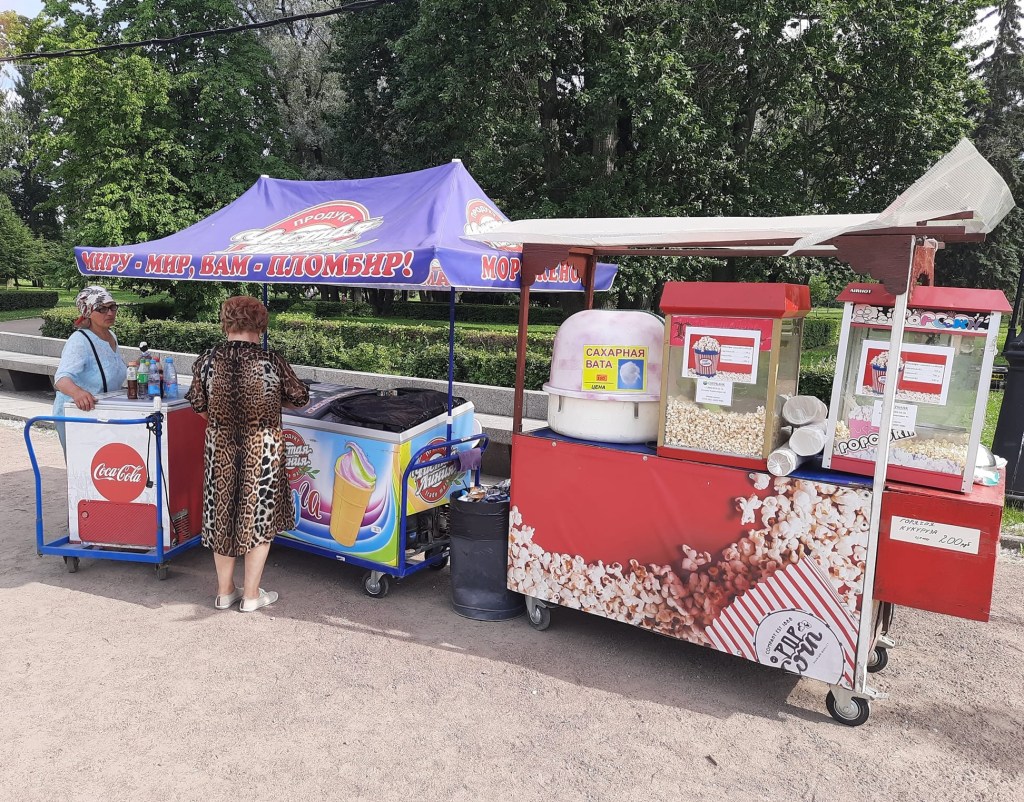
“Peace to the world, and an ice cream for you!” PZ, a grassroots activist in Petersburg, recently shared this provocative snapshot of an ice cream, cotton candy, and popcorn stand in a city park with friends on his closed social media account.
How do the prospects for peace look from Europe? There is a consensus that Putin cannot be expected to end the war. Firstly, because the war enables him and a large group of the war’s beneficiaries to transform Russian society to their liking (his confidence rating has risen to 92%). Secondly, because Putin is confident of his superiority over Ukrainians and believes that Europe will not withstand the war’s economic consequences (inflation, the energy crisis, supply chain breakdowns, etc.).
Can we expect the war’s end to come about due to processes in Russian society? That is, can the society pressure Putin into ending the war? The polling numbers (seventy-five, eighty-five, one hundred percent support for the war) drift from one publication to the next, but European decision-makers do not rely on these figures. They rely on so-called agency. The support figures are fictitious. But the factor of “silence” is a political reality. “Silence” is the absence of agency. Europeans look at the situation and say that, in such circumstances, at least one of the three “manifestations of agency” could be expected.
1. Household protests: mothers protesting the deaths of their men and children, “casserole protests,” family-centered grassroots protests.
2. Mass strikes: the war threatens people with unemployment and the closure of their workplaces, prices are rising but wages are not, etc.
3. A revolt by oligarchs, if only in the shape of an alliance formed abroad.
None of these three things has happened. And since agency has not been manifested in any guise, the concept that “society is silent”—i.e., that there is no society [in Russia]—becomes the explanation. (Usually, in these cases, our delegations tell the Europeans that there is totalitarianism in Russia, people are intimidated by the FSB, etc. To which their interlocutors nod sympathetically. But at the same time they think: it’s the same in Turkey, but all those three factors are constantly flaring up there. No one says it out loud, though, so as not to offend us.)
But what is there? We can say that there is a Russian anti-war movement abroad. “There is one” not in the sense that it is large and influential, but only in the sense that it has “shown up.” “There is one” means that you can point your finger at it. Therefore, Europeans are willing to meet, both individually and in groups, with representatives of this movement—because, by European standards, “it is at least something.”
At the same time, however, everyone is eagerly waiting for the Russian people to evince some minimal will to save themselves and to show up in some way. Then it would be possible to say that, no, ninety-two percent of Russians are not “proud of the successes of Russian arms and the liberation of Ukraine from Nazis,” that there is an sensible part of society and here it is, it has “surfaced”—via casserole riots, strike committees, or a conference of oligarchs on Capri. We could then talk about peace, about the war’s end. Without such “showing up,” it is impossible for Europeans to envision peace.
What is life like for us under fascism? It’s fine. I eat, sleep, work, play computer games and football, and get laid.
Repairs have begun on the roofs of the Soviet high-rise buildings on my work beat. The contractor drags powerful electric roofing kettles onto the roof, hacks away the old tar, melts it down, and immediately pours it back onto the roof. The kettles are powerful—advanced technology that works quickly and efficiently.
The kettles are also five years old. They are left right on the roofs over the winter, and so they are rotted and burned out. The molten tar splashes onto the cables, and everything in the vicinity burns and smokes. It is no exaggeration to say that you can smell the stench two blocks away. It is unlikely that there is anything healthy in the fumes generated by the molten tar. It is Uzbeks who work on the roofs: their bosses persist in calling them jigits. They work without safeguards or personal protective equipment. On the first day, they asked their bosses for water. Their bosses told them to get it themselves—”otherwise, next time they’ll be asking for broads in bikinis.”
Yesterday the cops nabbed them. The cops told them, “Your registration isn’t in our database. So, you either spend a couple days in jail until we figure it out, or you each cough up 5,000 rubles now.” [At the current—official—exchange rate, 5,000 rubles is approximately 88 euros.]
Do you think there is a database somewhere that says that you are just a human being?
Their electrician is from Bashkiria, a skinny kid in glasses with a typical whistling accent. He graduated from an architectural college back home, came to Petersburg, and worked on a low-voltage network for a couple of months, but now has been hired as an electrician servicing the three-phase fifty-kilowatt kettles. On the first day, he regarded the whole setup with mortal dismay. In his bag he has a set of screwdrivers and a crimper for patch cords. Now he dives into the overheated equipment, changes the burnt-out heating elements, and splices the burnt, beaten cables. Then he unsuccessfully tries for hours to wash off the oil stench.
“Who will pay for your disability?” I ask him.
“They can’t pay us overtime.”
He put up with this as long as he could before breaking down and going on a drinking binge. He squandered all his money, arriving back at work with a black eye and his left cheek puffed up like a pillow. His glasses were still intact, however. He asked me to lend him money for beer.
“How much do they pay you?” I ask.
“They promise mountains of gold.”
“Could you be more specific?”
“It’s daily work. 2,500 rubles a day.”
The word he was looking for in Russia was “daywork” [podënnaia], not “daily work” [podnevnaia]. There is such a thing as “daywork” and “dayworkers.” Who make sixteen dollars a day if you calculate their pay in terms of the actual exchange rate.
How much does the Russian lad Vitya, who made the remark about the “broads in bikinis,” make? How much does their supervisor, a handsome, businesslike, quick-thinking middle-aged man with shifty eyes, make?
What will they buy for themselves by pinching the money budgeted for roof repairs? A car? A tiled path for their dacha? When they walk on this path, will they think about the people whose health has been permanently scarred by tar on hot roofs? I doubt it.
Fascist brutality springs from this everyday, workaday brutality. Indifference to people as individuals grows from this virtually legalized slavery.
Source: George Losev, Facebook, 28 June 2022. Mr. Losev works as an on-duty electrician for the housing authority in Petersburg. He points out that the roofing tar kettles he describes are nothing like the one in the video I inserted, above. They are much larger and electric-powered. This is not to mention that “Alfredo the kettle man” (in the video) is wearing protective equipment, unlike the Uzbek workers in Mr. Losev’s story. Translated by the Russian Reader
I was asked to show how to make a “syllable tram.”
I scanned the roadway (see the links, below). The drawings were quite hastily done, right before class. (
The strip should be glued with adhesive tape on the reverse side. (Leave a millimeter between the sections so that it is easier to fold and store.) The tram, which is approximately 290 mm wide (nearly the same width as an A4 sheet of paper) and 85 mm high, is fitted onto the strip. One window in the tram is cut out, and a transparent sleeve is pasted on the other, into which a consonant is inserted.
The strip needs to be fastened with something. (I fastened it to the table with tape.)
The tram travels from right to left. When it reaches a marked stop, a vowel appears in the cut-out window. When you make the tram, test it and draw the letters on the strip so that they appear in the exact same place as the empty spot.
Source: Natalia Vvedenskaya, Facebook, 28 June 2022. Ms. Vvedenskaya teaches Russian to immigrant children at the St. Petersburg Jewish Community Center. Most of these children are originally from Central Asia, like the workers in Mr. Losev’s story. The first image, above, is a screenshot of a short video that Ms. Vvedenskaya included in her original post, showing her pupils playing with her “syllable tram.” Translated by the Russian Reader
There is the strange assumption that Russians would be hotly and much more numerously discussing the war on social media and in public were it not for censorship, surveillance, and the draconian new laws on “discrediting” the Russian armed forces, etc. But this assumption, when it is made by outsiders, is based on the belief that the Russian public’s engagement with important political matters and social issues was palpably greater before the war.
It wasn’t that much greater, in fact, as evidenced, among other things, by the fact that what political ferment there was on Russophone social media in recent times often as not had to do with hot-button events in “the west,” such as George Floyd/Black Lives Matter and Trump’s failed coup. And even then these discussions revealed a broad ignorance (and hatred) of politics in non-authoritarian countries and the extreme rightwing sympathies of the Russian “liberal” intelligentsia.
It is not repression and “fascism” that are the real or the only obstacles to democratic, anti-authoritarian grassroots political movements in Russia, but quietism (to use the polite term) and opportunism, which will ultimately nullify all attempts, I’m afraid, to create meaningful anti-war movements, “united fronts,” and so forth at home and abroad.
In that sense, there’s almost no reason for outsiders to get excited by any of the various “projects,” “movements,” zingy new websites, etc., that the opposition in exile, aided by much braver but usually anonymous comrades at home, have been throwing up rapidly and carelessly since February. Most of them will have vanished just as quickly (quietly, without a trace) by year’s end, if not sooner.
Much less should outsiders pay too much mind to the attempts by the newly minted diaspora to get their pretty mugs and their sentiments broadcast to the world via such respectable outlets as the New Yorker and the New York Times, thus making themselves the heroes and heroines of the story instead of Ukrainians. They just cashing in their more considerable reserves of media, cultural and intellectual capital to right their momentarily capsized boats and advance their own fortunes, not pausing for a second to think how this naked opportunism looks to their former Ukrainian “sisters” and “brothers,” who for various reasons have much less of this capital. ||| TRR