While I’ll be the first to admit that The Bell‘s weekly newsletters are worth far more than the fifteen minutes or so it takes to read them, I can’t imagine that they’re worth $168 a year. I subscribe to way too many print and online newspapers and magazines than are good for me or which I have the time to read, but most of those subscriptions cost me far less $168 a year (in fact, most of them cost less than $30 a year).
The only one that costs more is the “newspaper” put out by the style councillors at the Economist (at $192.50 a year, the last time I paid my rates), and that’s probably a rip-off too. But it’s a rip-off that sends me 78 pages of usually super-informative reporting and provocative commentary a week (and in impeccable English!), plus any number of daily and weekly newsletters. (I’ve quoted one of them, below.)
On the other hand, The Russian Reader is free to read (and will always be free) and usually comes out more than twice a week. At last count, I’ve received $448.50 in donations so far this year.
That’s my “business model.”
It’s not even remotely sustainable, of course, but I’d rather take on more part-time jobs (as I’ve been doing recently) than suddenly be seized by the moxie to charge any of you $168 a year for what has always been a labor of love. My foolishness, though, should never deter any of you from sending me donations, however small or large.||| TRR
Kim Jong Un and Vladimir Putin concluded several hours of talks at the Vostochny spaceport in Russia’s far east. No details were made available, but before the meeting analysts speculated that North Korea may offer Russia artillery ammunition in exchange for missile or satellite technology, in violation of UN Security Council resolutions. Mr Kim toasted his host’s health, and predicted that Russian troops would win a “great victory” over their adversaries, according to reports in Russian state media.
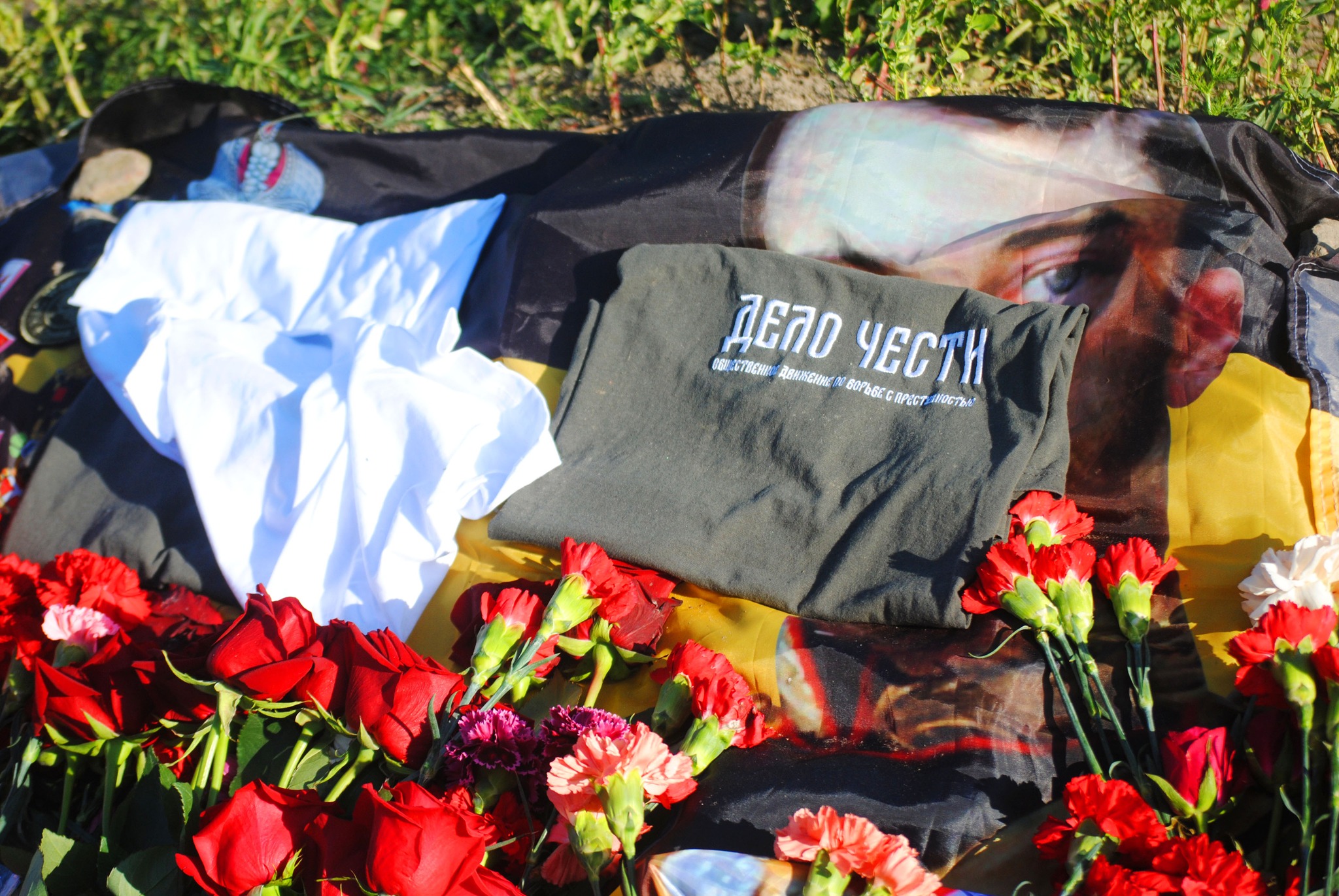
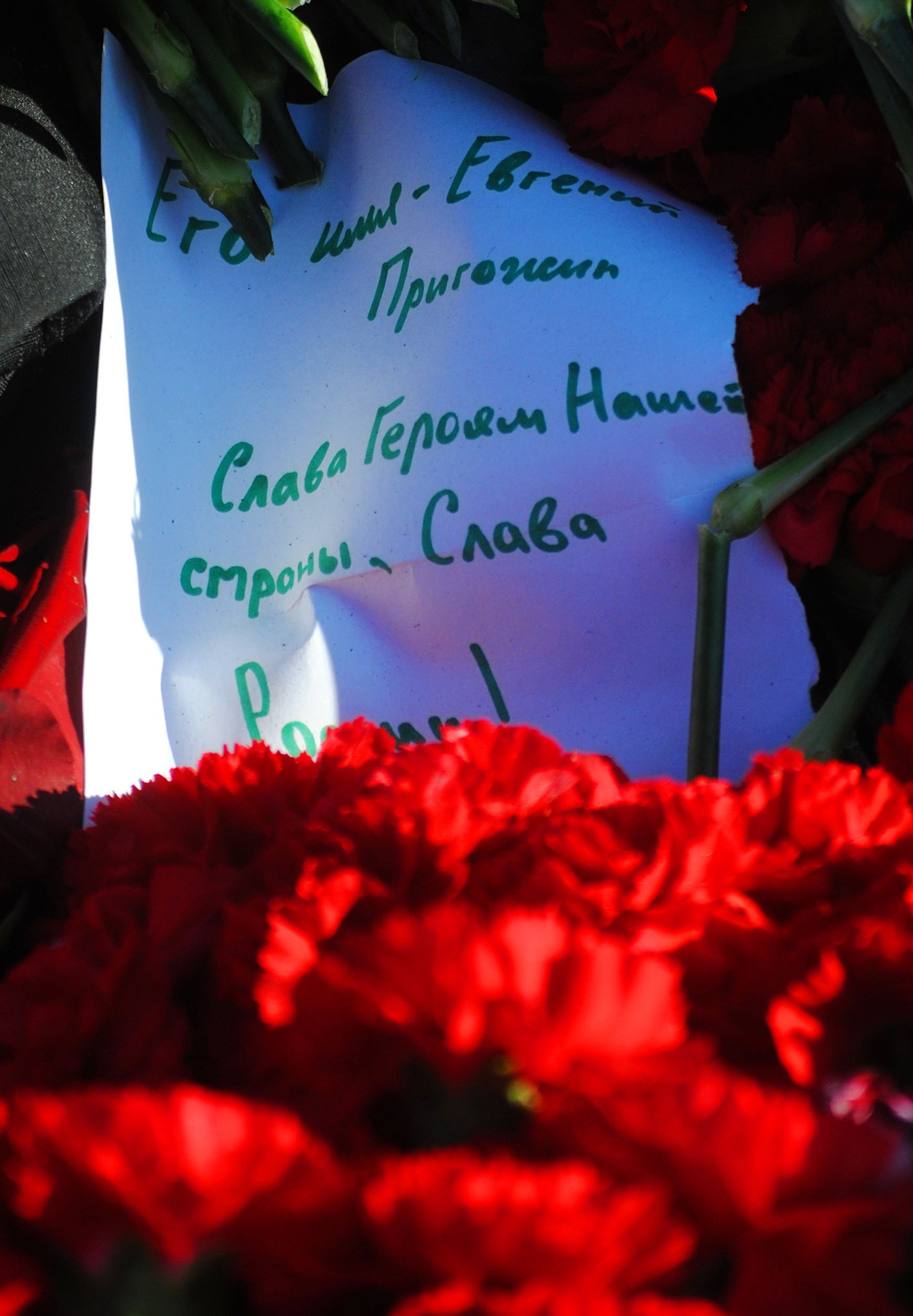
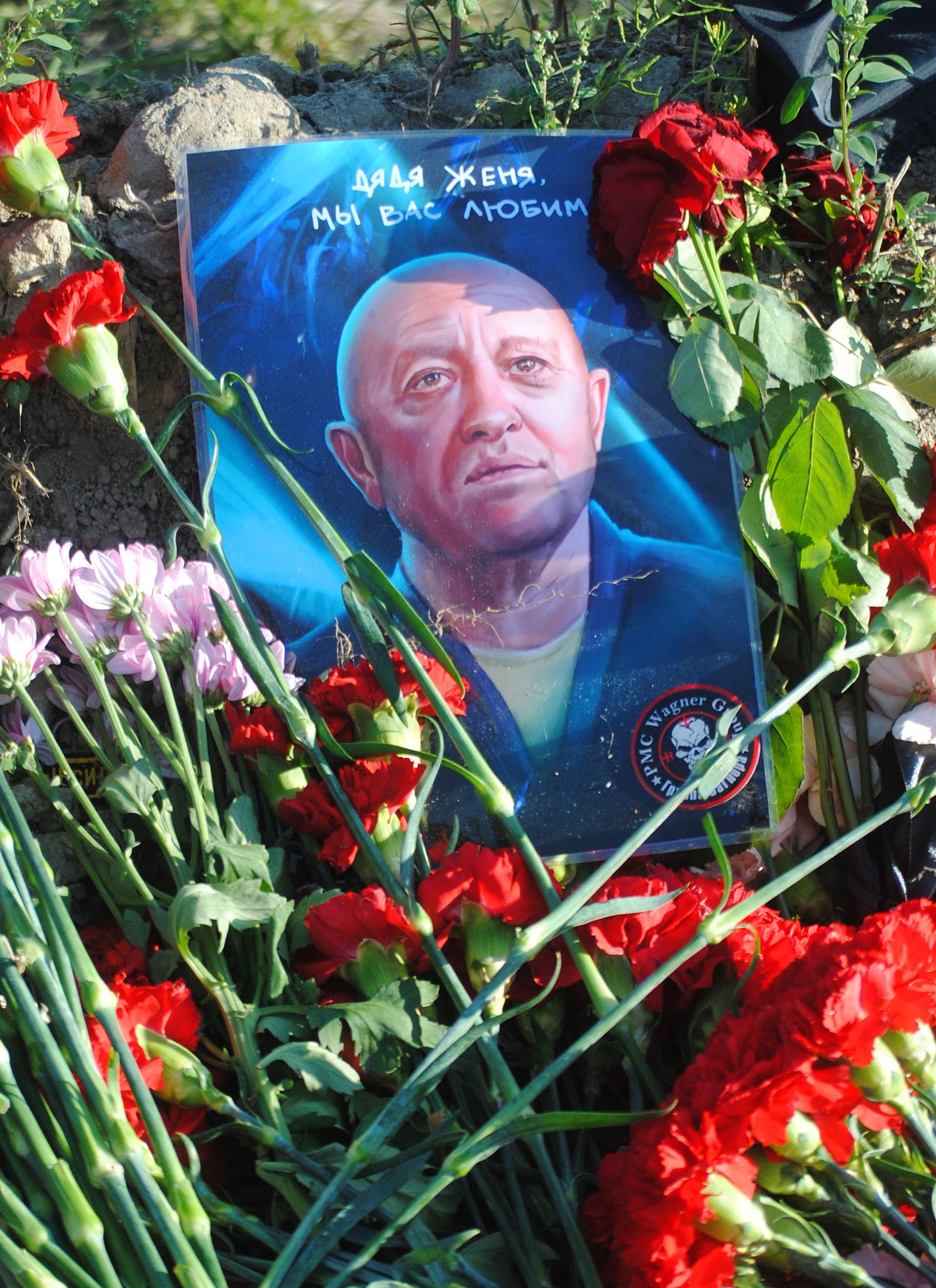
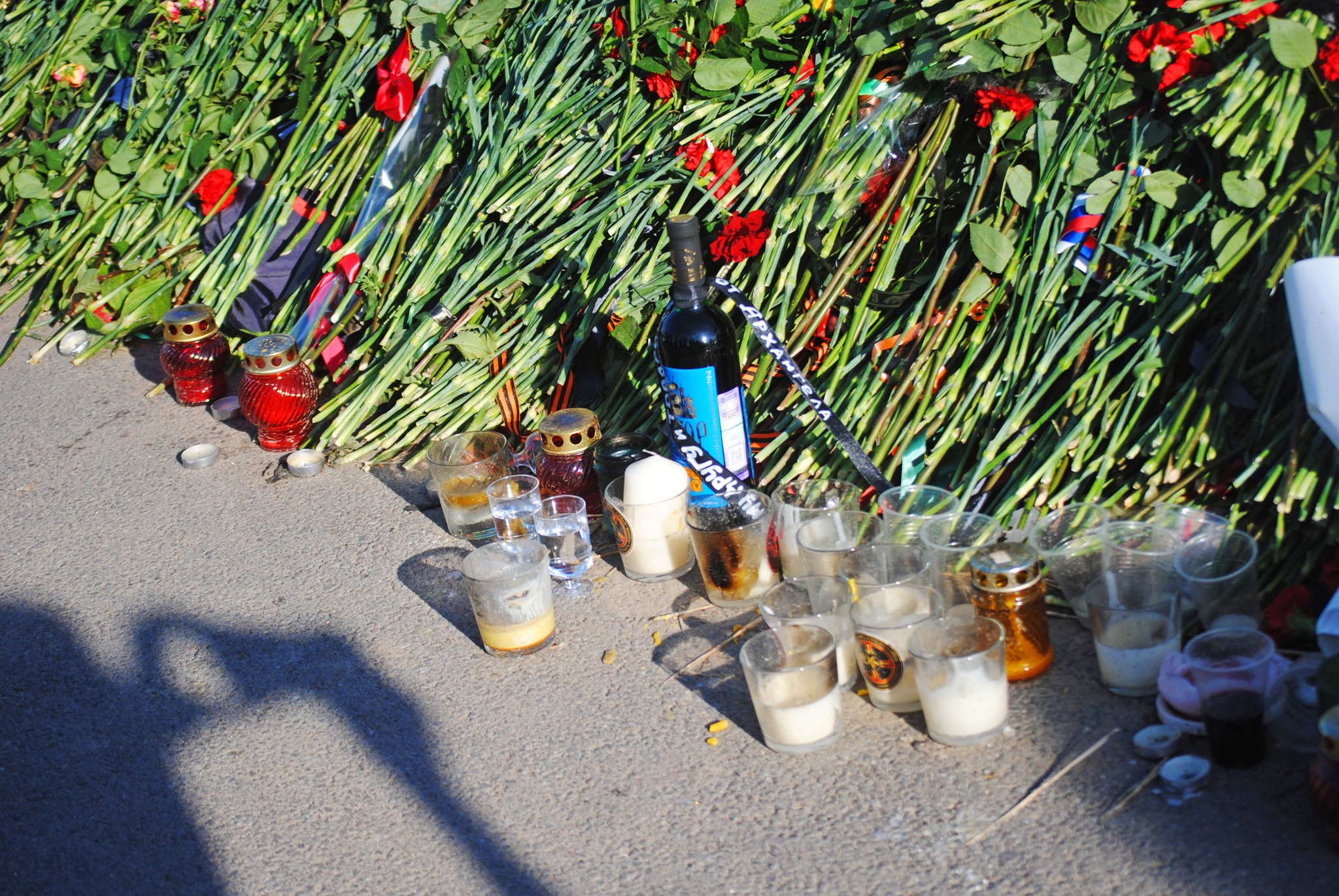
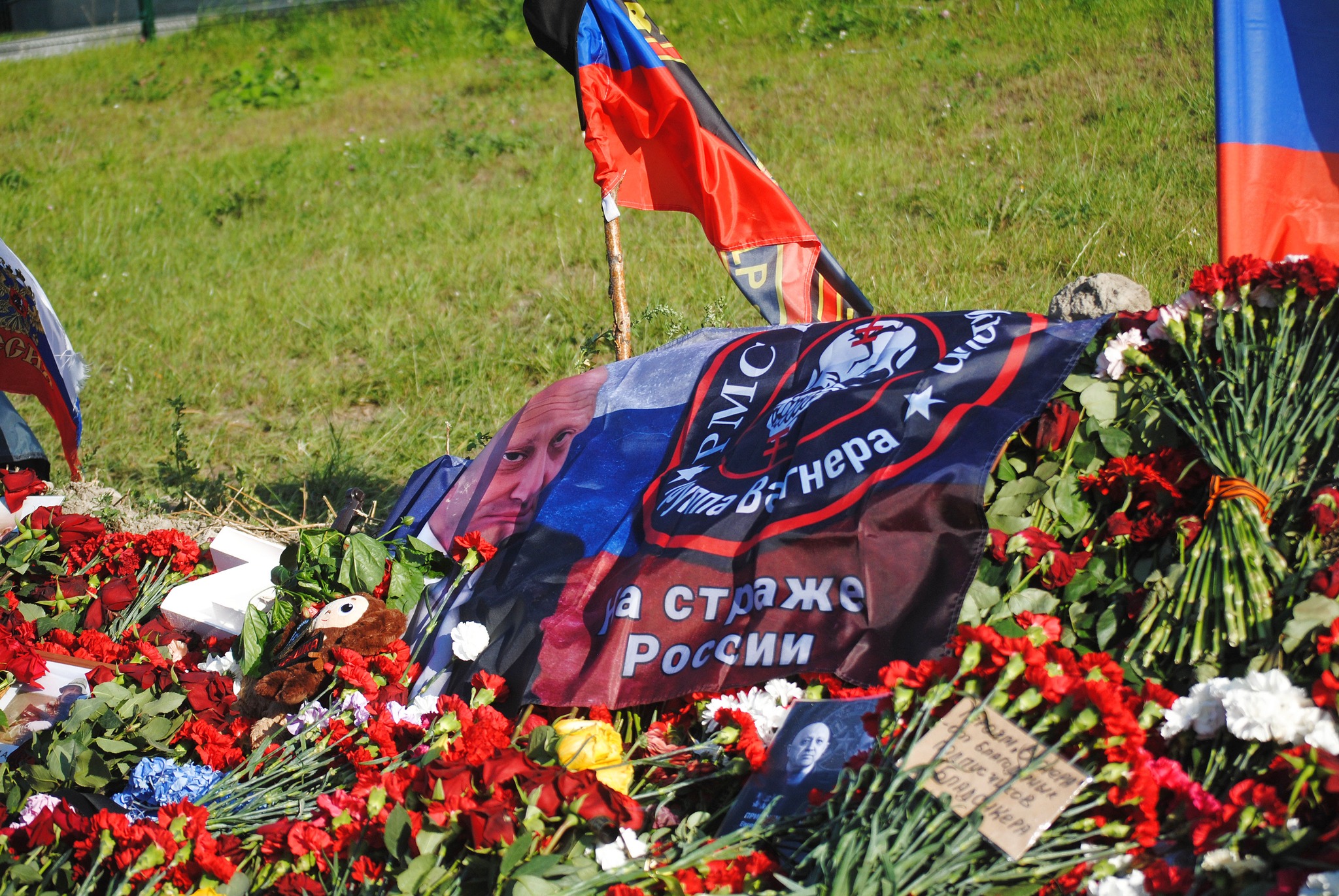
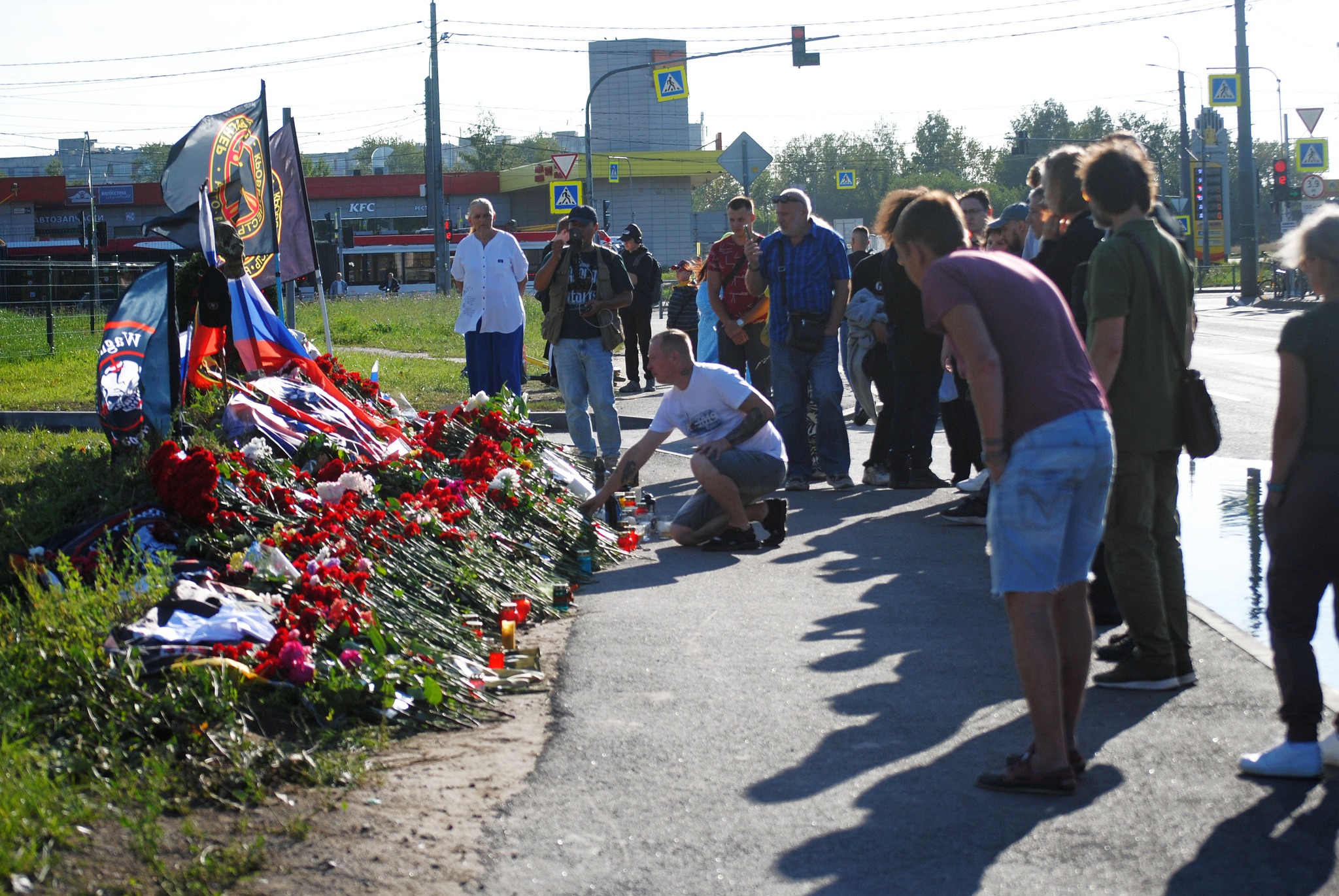
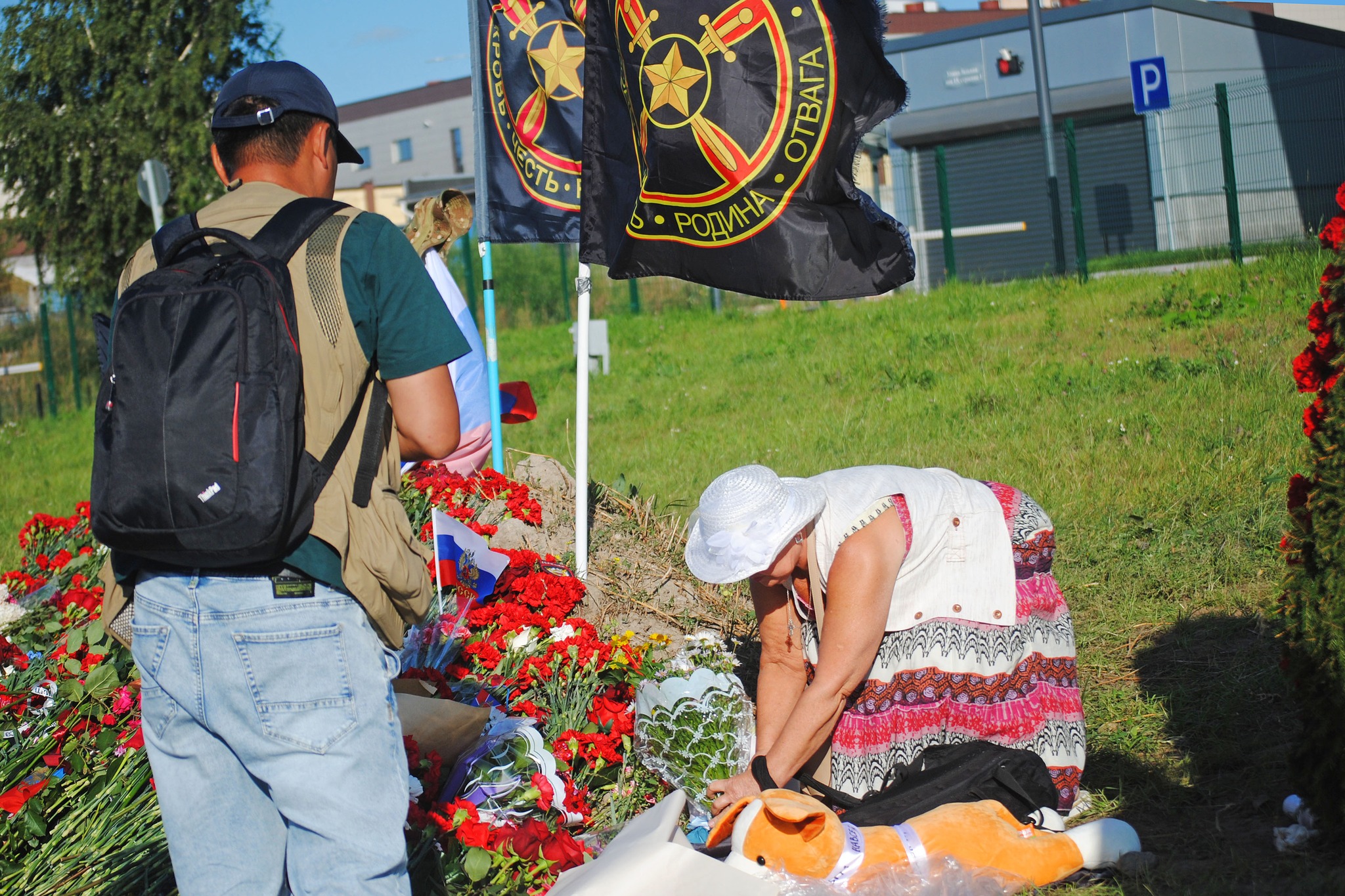
I went to see the spontaneous memorial to Prigozhin on Zolnaya [“Ashes”] Street [near the former (?) Wagner Center office building in St. Petersburg]. I have to say that what I saw impressed me. People kept coming and coming—young dudes and girls, men who were slightly older, and some people even had their kids with them. They brought flowers. They stood and looked for a long while. Some got down on their knees, and this one young dude crossed himself and genuflected. A Chinese guy was videotaping the whole scene and talking in Chinese, but it troubled no one. That’s him sporting a rucksack and filming point-blank the woman in the hat who is putting what looks like a whole bush of roses in a vase.
Hello, dear Moscow Times readers! This is your weekly newsletter, and we’re kicking off with the (near-certain) death of Yevgeny Prigozhin, the man dubbed Vladimir Putin’s “chef.”
However, Prigozhin gained notoriety not for his culinary talents, but for his business ventures. He set up several enterprises that were extremely vital to the Russian authorities. The most well known were the private military company Wagner and the “troll factory” in Olgino, a suburb of Petersburg, which was used as a tool for influencing the information space in the Russian Federation and the world.
Trolls are fantastic creatures, and they vanished of their own accord, you might say, but apparently it was Vladimir Putin who put the kibosh on Wagner. The rowdy band of freewheeling mercenaries, who took their orders from god knows whom, has come to end.
We should recall, of course, that Prigozhin took a long time admitting that Wagner and the Olgino trolls worked for him. He acknowledged this obvious fact only in the midst of the war, and this was the first step toward the mutiny of 23 June and his (near-certain) death on 23 August. The public owner of an effective resource can either use it or give it up. Prigozhin didn’t feel like giving Wagner away—that is, transferring it to the command of the Defense Ministry (and take an oath, as Vladimir Putin has now ordered)—and so the strange mutiny that had such supremely serious political consequences happened, and, later, the Embraer jet plane crashed in the Tver Region. (It was the first time this type of plane had an accident involving fatalities.)
We interviewed people in the know about the moods among Russia’s elites to find out how they were taking the “chef’s” demise. We went further, though, asking several people who kept a close eye on Prigozhin’s rise and (alas, literal) fall to explain the meaning of the story that has unfolded before our eyes.
The first explanation comes from an observer in civil society who claims that the plane crash was caused by underlings going farther than they had been ordered to go. In fact, this observer argues, Putin did not want Prigozhin dead. Without his trolls and without Wagner, which had ceased to operate in the RF and had begun to be transferred to Defense Ministry-controlled outfits in Africa, Prigozhin was no threat to Putin. However, there were people (in the GRU, most likely) who believed that Putin would be pleased if they brought him the mutineer’s head on a plate.
The risks are the same as in the case of the late [Boris] Nemtsov [assassinated near the Kremlin in 2015]. After his untimely death, Prigozhin’s significance as a symbolic figure could increase and thus serve as a consolidating factor. We cannot rule out the possibility that Prigozhin’s memory will lead to the creation of something bigger than what emerged around the man during his lifetime.
The second explanation comes from an observer in the defense sector, who argues that we’re seeing a repeat not of Nemtsov’s murder, but of the death of Polish president Lech Kaczyński in 2010. (The official Polish Tu-154 plane carrying him and other Polish officials crashed while attempting to land in Smolensk, Russia. Many Poles believe that the plane was brought down by a bomb planted onboard by the Russian secret services.)
The hit squad didn’t go too far. On the contrary, [Prigozhin’s plane crash] was a carefully planned operation that was brought off nearly flawlessly. Although we can claim that such things don’t get done without Putin’s consent, there is no way to prove it.
The third explanation comes from a political spin doctor and frequent guest on YouTube channels. He wonders why everyone has decided that the passenger manifest and the presence of his personal effects [at the crash site] is sufficient to prove that Prigozhin was killed. We cannot rule out the possibility that Prigozhin and Putin made a deal and that Yevgeny Viktorovich will be the Kremlin’s secret weapon. I’m joking on this point, of course. But Russian realities are such that a man dies he shakes off all the bad stuff that happened in his life, and people focus on his admirable qualities. Look at Stalin: his bloodthirstiness and lack of principle have been forgotten, and no one remembers the terrible mistakes he made while running the country. He’s a winner, a victor. Stalin and Prigozhin cannot be compared, but nor can we deny that Prigozhin has been the most auspicious commander in the Ukraine war.
The fourth explanation comes from an opinion journalist and writer who asks us to the recall the Russian fairytale about the vixen and the thrush. The vixen terrorizes the thrush by threatening to kill its fledglings. First the vixen asks the thrush to give it something to drink, and then it asks the thrush to feed it, so the thrush helps it to steal food and beer. (The analogy here with the “chef” is obvious.) The sated and drunken predator then orders the thrush to make it laugh, and so the thrush alights on the heads of two peasants, father and son, who cripple (and even kill) each other whilst trying to beat the thrush. (Thus recalling the Olgino trolls and their work on the US elections, for example.) After the vixen has laughed its fill, it says to the thrush, Now scare me! The thrush raises a mutiny against the fox—oh, sorry, it gets hunting dogs to attack the vixen. Depending on which version of the fairytale you find, the vixen either gets killed or escapes the attack, but it is genuinely frightened.
Vladimir Putin wanted to have an alternative both to his own generals and to the supremely dangerous Kadyrovites. He came to count on Prigozhin to carry out sensitive missions both in Africa and the RF, but failed to take into account the man’s ambitions and got carried away. When Putin was faced with Prigozhin as an actual threat, he had to defend himself in earnest.
Russian Media Monitor, “Propagandist blames US, Ukraine and NATO for Prigozhin’s crash,” 24 August 2023 Thanks to Monique Camarra (EuroFile) for the heads-up)
Mykola Honchar lives in a crumbling stone house in what is left of a tiny hamlet of eastern Ukraine. The town was attacked by Russian forces in June of last year, as the Wagner mercenary forces were spearheading a renewed offensive.
Even before the Kremlin set Wagner loose to wreak havoc in Ukraine, the Russian campaign was notable for its brutality. But from the moment Wagner forces entered the war in April 2022, they earned a special reputation for bloodlust from civilians and soldiers alike.
To Mr. Honchar, the death this week of Wagner’s leader, Yevgeny V. Prigozhin, responsible for so much carnage in the war, would be fitting — a violent end to a violent life.
“He has blood on his hands,” said Mr. Honchar, 58. “If there is a god, god will figure out what to do with him.”
Even in a war in which civilians were shot dead in the Kyiv suburb of Bucha, and the town of Mariupol was bombed into oblivion, Wagner and Mr. Prigozhin cultivated an image of brutality.
A video was promoted across Wagner-affiliated social media of the execution of one of Mr. Prigozhin’s own soldiers with a sledgehammer after he was captured and then released by the Ukrainians in a prisoner swap. While in custody, the prisoner had taped an interview saying he did not believe in Russia’s war.
“A dog receives a dog’s death,” Mr. Prigozhin said in the video.
By the time Ukraine regained Mr. Honchar’s village of Bohorodychne, Mr. Honchar was one of only two people left living in the village, once home to around 800 people.
The other person was Nina Honchar, his 92-year-old mother. He had stayed there despite the danger to take care of her. She died earlier this month.
He does not know if Wagner fighters were among the occupiers. “I did not ask for their documents,” he said. But he recalls seeing Russian fighters, who appeared to be on drugs, wandering around town in their underwear, their bodies covered with prison tattoos.
Wagner amplified its force by recruiting prisoners. After Wagner left the battlefield in June of this year, the Russian military continued the use of convicts as part of newly formed “Storm Z” units along the most dangerous front line positions.
To Mr. Honchar, it hardly matters under what banner the soldiers fought. The legacy of Wagner and Russian forces, he said, are one and the same: death, destruction and ruin.
“My brother and his wife were torn apart by shells,” Mr. Honchar said. Before he could bury them, he had to collect their body parts. “There was no skull, his hands were scattered,” he said of his brother.
Once he collected what he could find, he wanted to bury them in the local cemetery but it was under constant attack and too dangerous. He laid their remains in a trench and covered them with dirt.
When his 80-year-old neighbor died, he buried her in the crater of the shell that killed her.
Looming over the village is the Church of the Holy Mother of God, ‘Joy of All Who Sorrow.’ With its sky blue walls visible for miles around and majestic golden domes, it was once a draw for tourists and pilgrims.
Now its walls are blasted apart, one dome has tumbled to the ground and the gold leafing blasted away from another.
The St. Petersburg State University Ethics Commission has ruled that a statement made by Alexandra Zaitseva, a first-year student and editor of the student media outlet Studen, was “incompatible with the prestige of a university student.” Another student media outlet, Lupa and Pupa, has publicized the incident.
The Details. Zaitseva was summoned to appear before the commission on July 7. Initially, the hearing was supposed to be held online, but the university subsequently changed the format to in-person and refused to change it back. According to Zaitseva, this was done so that she would be unable to record the hearing.
The Reasons. In June, an anonymous denunciation of Alexandra Zaitseva was posted in St. Petersburg State University’s virtual guestbook. The author of the denunciation did not like Zaitseva’s post on VKontakte about the expulsion of Mikhail Belousov’s students from the university’s history faculty.
“In this publication, she talks about the ‘vile and unjust expulsion,’ in her opinion, ‘of the students implicated in the sensational Belousov affair.’ In addition, she publicly insults other students (‘a bunch of bastards shouting goida on PUNK at night’) while obviously demeaning and voicing disdain for the patriotic citizens of our country,” the denunciation reads.
St. Petersburg State University replied that they had contacted “law enforcement agencies” and called a hearing of their ethics commission.
The Decision. “We consider A.N. Zaitseva’s behavior incompatible with the prestige of a St. Petersburg State University student,” the St. Petersburg State University Ethics Commission ruled.
Zaitseva told Bumaga that she believes she will be expelled. “I guess the outcome is pretty obvious. Although, I can’t say for sure—no order has been issued yet,” the student said.
The ethics commission members did not like the fact that Zaitseva had given a comment to TV Rain. According to them, in this way the young woman “once again displayed her openly negative attitude towards the university of which she is a student.”
Just prior to the hearing, St. Petersburg State University had banned university employees from giving comments and interviews to “foreign agent” media outlets.
The commission ruled that Zaitseva had violated the second and third paragraphs of the University Student’s Code, i.e., “To represent the university in extracurricular settings with dignity” and “To honor teachers, respect colleagues and students, maintain friendly relations both inside and outside the University, [and] contribute to the creation of an environment of mutual understanding and cooperation.”
“Apparently, the authors really don’t fancy the idea that someone might have principles: this is the only explanation why such a large piece of the text is devoted to them, and not to an analysis of my post,” Zaitseva said in reaction to the commission’s decision.
The leadership of St. Petersburg State University (SPBGU) has fired Mikhail Belousov, a professor at the university’s History Institute, for committing an “immoral act” by speaking out against Russia’s invasion of Ukraine. The university posted its decision on its website.
The university’s decision followed an investigation, during which university leadership confirmed that Belousov had circulated materials “discrediting” the Russian army, and “insulting the memory of those killed while fulfilling their military duty.”
“Belousov’s behavior violates the university’s moral traditions and generally accepted ethical norms, his actions are out of keeping with his and the university’s prestigious positions,” the document detailing the university’s decision says.
Petersburg publication Rotundasays the university began investigating Belousov and his students after Russian official and social media channels circulated screenshots of messages, allegedly written by the professor and his students, openly criticizing the war in Ukraine while the university was mourning one of its students, Fyodor Solomonov, who was killed in Ukraine.
Seven students of the previously dismissed associate professor Mikhail Belousov were expelled from the Faculty of History of St. Petersburg State University, Bumagareports, citing sources at the university. They were among the ten people who were previously called to the ethics commission. The remaining three will have “some kind of meeting with the vice-rector for educational work.”
One of the expelled students told the publication that he would challenge the decision of the university.
At the end of May, Z-channels circulated screenshots with messages in which Belousov allegedly condemned the “internal” symbolism and said that “a direct and open approval of rashism is disgusting.” It was alleged that the associate professor wrote all this in the context of discussing the death of St. Petersburg University student Fyodor Solomonov in the war in Ukraine.
On June 3, Belousov was fired, and a group of his students were summoned to the ethics committee, which ruled that they “considered it appropriate to make fun of” Solomonov’s death instead of “showing normal human feelings.” It was also decided that the students’ actions were “incompatible with the status of a student at St. Petersburg State University.”
In October last year, associate professor Denis Skopin was fired from the same university for participating in a rally against mobilization, calling it an “immoral act.”
We will talk about what is happening to people who are terribly far from Moscow and St. Petersburg. Who are terribly far from the congresses, conferences and conflicts of opposition leaders. Who are terribly far even from popular YouTube channels and shows. Who are also terribly far even from Telegram.
Why does this matter? It matters because otherwise we won’t understand how the country got to this point and why some Russians volunteer to fight in the war.
In this episode, you’ll learn what worries Russians more than Prigozhin’s rebellion, why the Baltic Sea in Kaliningrad is becoming bloody, in which city it is easiest to encounter wild bears on the streets, and the job you have to land to make a dream salary of 8,000 rubles [approx. 80 euros] a month.
Subscribe to our channel, where we talk about the problems of ordinary people. And if you live beyond the Moscow Ring Road and are facing trouble right now, write to us at:
strashnodaleki@gmail.com
We will definitely tell our viewers about it. Because we do care.
The Usvyaty District of the Pskov Region belongs to the ethnographic area known as Poozerye (Lakeland). There used to be many folk musicians there, the most famous of whom was the singer Olga Sergeeva (1922-2002).
Ekaterina Trusova (maiden name Kozintseva, tracks 1-7) is a garmon (Russian button accordeon) player living in Usvyaty. She was recorded at the Usvyaty House of Culture on December 12, 2021.
The other two musicians featured on this album belong to a previous generation and were recorded by Ekaterina herself in the 1990s on a home cassette tape recorder. The cassettes were digitized by Alexander Yuminov (KAMA Records) in 2022.
Sofya Rubisova (tracks 8-13) is a folk singer from the village of Sterevnevo, Usvyaty District.
Dmitry Kozintsev (tracks 14-17) is Ekaterina’s father, a garmon player from the village of Pysi. Unfortunately, the recordings of him are of poor quality, as the tape in the cassette turned upside down. But we still decided to include them in the album.
Another album from the area, from the village of Tserkovishchi, can be found here.
Branded “foreign agent,” Yaroslavl media outlet announces closure
YARNOVOSTI announced it was suspending its work on July 7. The publication had been running for over ten years. It covered the inhabitants of Yaroslavl, corruption, problems with public amenities, and politics.
In June, the Justice Ministry had declaredYARNOVOSTI a “foreign agent.” None of its employees agreed to work under this label. The editors said that during its entire existence it had not received “a kopeck” of foreign funding.
“Of course, we expected to continue working, but, as Vladimir Putin said, nothing lasts forever. We are still getting to the bottom of what happened on June 2: we have made all possible and even impossible inquiries, and have drawn up the paperwork for the court,” the media outlet’s editorial team wrote.
Source: 7 x 7 (Telegram), 7 July 2023. Translated by the Russian Reader. As of this writing, YARNOVOSTI seems to have shut down its website, but its page on VKontakte is still functioning. In its latest post there, published on 7 July 2023, it informed readers of the decision to suspend its work.
So, oDR – openDemocracy’s Ukraine, Russia and wider region team – is at severe risk of closure.
What can I say apart from the fundraising has not been lucky, to put it mildly.
But we’re fighting: a huge last-ditch effort to turn the ship around and keep some of the best journalists, researchers and activists writing for our audience.
To do that, we’ve launched a crowdfunder to help match £50,000 we’ve already raised from private donors. This will buy us time to sort the long-term financing we need.
I’m not sure if folks want to hear about why we’re important, so I’ll be brief:
– Ukrainian journalists writing about Russia’s war
– Belarusian journalists writing about Russia’s war
– And Russian journalists writing about Russia’s war
And that’s aside from our brilliant collaborators in Central and South Caucasus.
So please help us spread the word, and help us keep fighting. There are so many important causes right now, so if you can’t afford – just push this on to people who can.
openDemocracy’s dedicated coverage of Russia and Ukraine is one of our greatest achievements. But now, the team behind that work is under threat of closure.
The two of us helped to found openDemocracy in 2001 to make a space for a global conversation about justice, human rights and democracy and how they are threatened by unaccountable power. Today, at its core is our project on Russia, Ukraine and the wider region.
The project provides an irreplaceable space for voices from the region that do not represent official Ukrainian, Russian, European or American interests.
It gives prominence to Ukrainian journalists reporting Russia’s invasion and its brutalities, alongside threats to economic rights, social welfare and independent journalism
It provides an extremely valuable platform for coverage of Russia from Russian journalists and writers in Russian as well as English
It publishes Ukrainians, Russians and Belarusians who are fighting for democracy alongside one another, creating a framework for analysis and exchange that is unique during the pain of Russia’s war
And because, thanks to openDemocracy, the coverage is translated into Spanish and Portuguese without a paywall, readers across Latin America can learn directly about the experience of what is unfolding
With three million readers annually, and a world-wide reputation, the coverage, grouped together here, is needed more than ever.
It is put together by a small team. Focusing on publishing original, vital, stories on the impact of the Ukraine invasion, whilst keeping everyone secure from the consequences of war as well as Covid, means they have struggled to raise the vital funding essential to survival.
We have to reignite funding fast – very fast. In fact, immediately.
Or the brilliant team – Katia, Tom, Valeria, Polina and Tanya – will be made redundant.
We are doing everything we can to secure, enhance and deepen their work.
Please join us.
We have already secured match-funding of £50,000 from private donors. Now we urgently need your help to unlock this money. Every £10, €10 or $10 you donate will be matched.
£100,000 will give us the time to negotiate with foundations to ensure this project enjoys a long life – long-enough to outlast Putin!
When Israel invaded Lebanon in 2006, John le Carré was furious and headed a funding campaign for openDemocracy:
Let’s support openDemocracy to the hilt. Intelligent, unbought, unspun opinion, uncomfortable but necessary truths and a lot of good horsey argument: heaven knows they are in short enough supply!
We love the ‘horsey’. A master of words, le Carré appreciated that some of our articles are untamed. But that’s because they are unbought and unspun.
Never, ever, has there been a greater need for this than now with respect to Ukraine and Russia. Please help the team publish necessary truths, on-the-ground reporting, much needed level-headed debate, and even good horsey argument, so that the irreplaceable media space they have created survives and grows.
So please, send us £50, €50 or $50 or more if you can; £/€/$25 if that’s possible; or whatever you can. Every donation will be gratefully received.
Thank you,
Anthony Barnett & Susan Richards
Source: openDemocracy. I just made a donation to oDR’s crowdfunder via PayPal, and I would urge you to do the same. ||| TRR
Important Stories • “Putin, Lvova-Belova and their crimes: how Ukrainian orphans are registered as Russians” • 31 May 2023
The Russian authorities have been removing children en masse from occupied Ukrainian territories and do not consider it a crime. But the International Criminal Court in the Hague thinks differently, accusing Vladimir Putin and Russian children’s ombudsman Maria Lvova-Belova of war crimes—namely, the illegal deportation of minors from Ukraine.
Orphans and children left without parental care have been sent all over Russia, even to the Far North. Important Stories found out how this system works and how abducted Ukrainian orphans are forcibly turned into Russian nationals.
[…]
Timecode
00:00 Why Putin and Lviv-Belova have been accused of kidnapping Ukrainian children
01:12 How 2,500 new children appeared in Russia’s database of orphans
02:32 The story of Sasha from Donetsk and his two sisters
03:56 The environment in which Ukrainian children are raised in Russia
05:23 “The children categorically refused to go to the Far North, where we live”
07:12 “The parents were killed there. The children told us terrible things”
07:48 Ukrainian orphans are provided with housing, for which Russians spend years on the waiting list
08:39 “There have never been such crimes in the history of humankind”
SOTA • “Putin is readying young people to rebuild the army” • 31 May 2023
It won’t be possible to wage wars forever, but Putin is trying very hard. Since February 24, 2022, the lives of young people have changed. Starting in kindergarten, children are now taught that serving in the army is the best job in the world, and that the most beautiful thing in life is dying for the good of the Motherland.
[Endlessly repeat the message that] Russia is surrounded by Nazis, the whole world is against it, its soldiers are defenders, and you’re good to go. You’ve raised a whole new generation of soldiers.
This assembly line for producing soldiers has existed for several years. Even before the war, schoolchildren were inspired with imperialism and a desire to go to war. Now, however, everything has reached new levels. Military parades are organized in kindergartens. Schoolchildren are taught to dig trenches, shoot, and render first aid in combat. And university students are trained to serve in the military.
See more about how children are turned into soldiers in our new video.
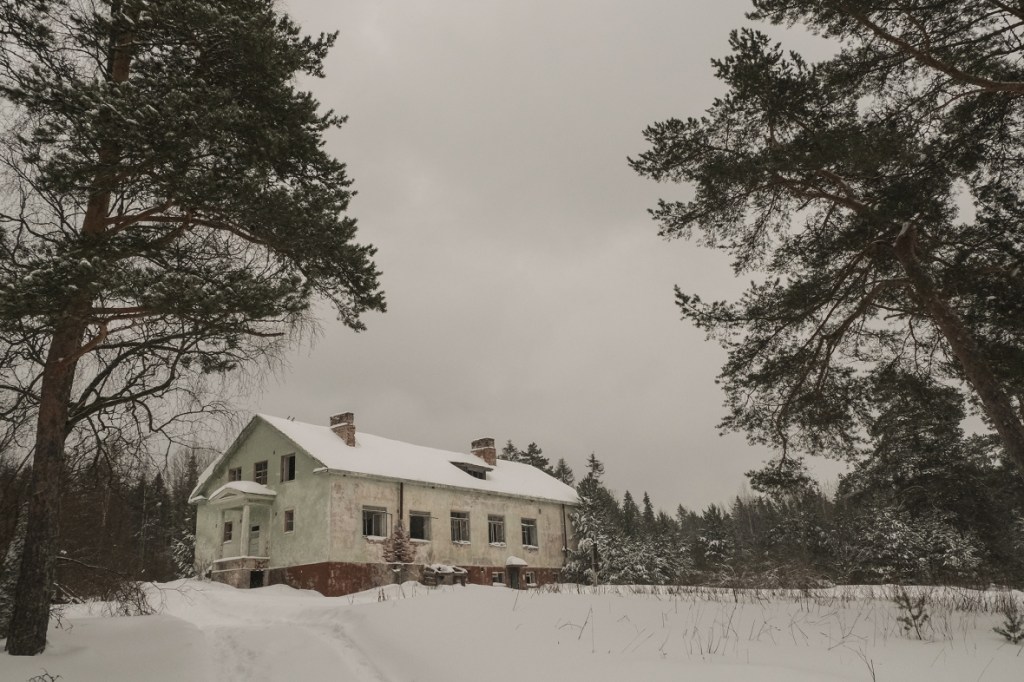
A ruined building of the Burenevo Auxiliary Boarding School for Mentally Retarded Children. Village of Burnevo, Priozersk District (Leningrad Region), 2021. Photo: Olga Matveeva/Republic
“Hello Irina Alexandrovna! This is your pupil writing to you. I decided to write to you. Please write a letter here so that they let me go on my own, whatever date you need, so that I can study from the beginning of the school year, that is, beginning September 1. Say hello to everyone at the school. When you write the letter, address it to the 11th department… Irina Alexandrovna what was the reason you sent me to the mental hospital again. I told you that I would remain at camp…”
This is an excerpt from a letter written by a pupil to the director of the Burnevo Auxiliary School for Mentally Retarded Children. I found the letter in his personal file.
In 1970, the Priozersk Sanatorium Forest School was reorganized into an auxiliary boarding school for mentally retarded children. According to the school’s fact sheet, “Forty-eight mentally retarded children studied [sic] at the school. Ten of them are disabled. All of the children are from at-risk families. Classes are held in one shift, five days a week. On weekends and holidays, ten to fifteen of them, mostly orphans, stay. There are twelve of them in the school.”
It seems that many of the pupils were not mentally retarded or disabled, but they were neglected. Sergei, a resident of the village of Burnevo, spoke to this fact: “Half of the children there were sick, while half of the healthy ones were from dysfunctional families. I attended this school until 1970, and my mother worked there as a minder.”
The school was closed in 2005 due to poor epidemiological conditions. There was only stove heating in the building, and the water was pumped from the lake. The school consisted of several buildings. In the main building there were four classrooms, a teacher’s room, a curriculum office, and the director’s office. There were sleeping quarters in a wooden building. Carpentry workshops, sewing workshops, a recreation and sports equipment room were located in separate buildings. There was also a medical unit with an isolation ward and a speech therapist’s office. There I found an archive containing the personal files of the school’s graduates.
“His grandmother telephoned. She said that her grandson was very bad, it was hard to deal him, his socks were wet and dirty. He gave a jacket to a girl, but lied to his grandmother that he had dropped it off at the laundry. At the class meeting, it was decided to refer him to the psychiatrist to prescribe treatment.”
“Slava ended up the border zone this summer: he told the border guards that he was flying in a spaceship. I had a frank talk with him. He still wants to go see his mother in Vyborg (she does not live with their family). He didn’t find her, got lost, and ended up in the border zone. Slava, smiling, told how me he deceived a border guard and a policeman. Slava was referred to a psychiatrist, who detected no abnormalities.”
“Oleg systematically wipes the dust from his bed badly. This was discussed at a class meeting. There are no results.”
“If children skip classes, they should be reported to the police without delay.”
These are quotes from pupil observation logs. Along with memos, letters, and assessments, they were kept in the students’ personal files. These records about the children were kept for years—from the first grade to graduation. Perusing them, you begin to imagine these children, how they lived, what they worried about, what they did. Their childhoods are written down in slim notebooks. You watch them grow up and go out into the world, or to a psychoneurological residential treatment facility, or to prison.
For bad behavior, children were referred to a psychiatrist and prescribed treatment. There is no data on how many orphans are placed in psychiatric clinics nowadays. The roots of what is happening in this system to this day must be sought in the past.
This project is based on archival materials and interviews with graduates of the Burnevo Auxiliary School for Mentally Retarded Children whom I managed to find.
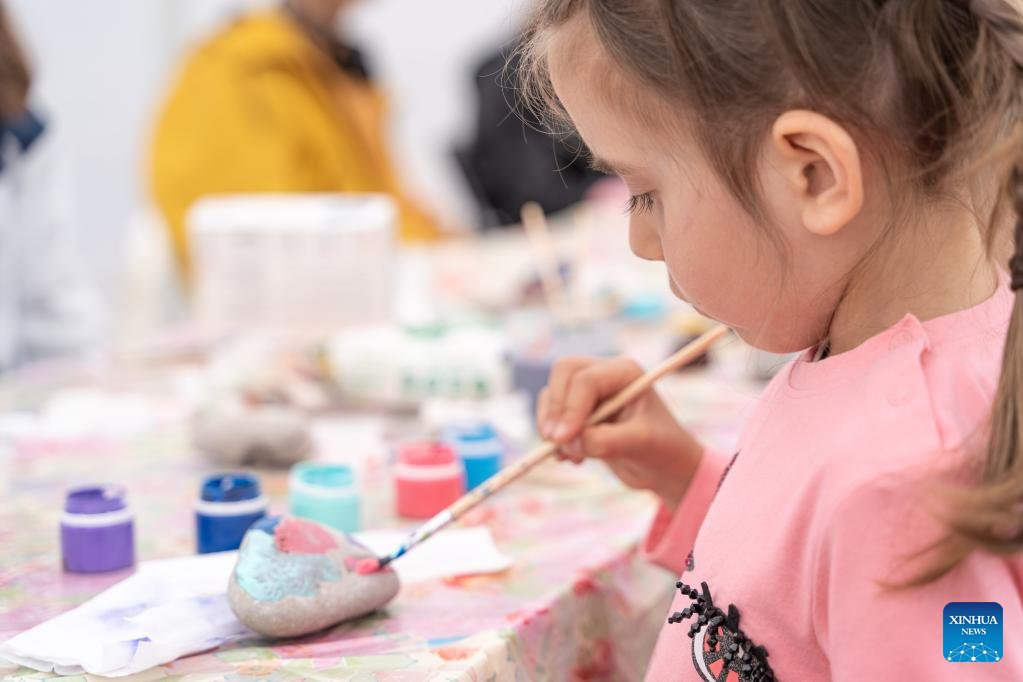
A girl paints a pebble during an event to mark the International Children’s Day in Vladivostok, Russia, June 1, 2023. (Photo by Guo Feizhou/Xinhua)
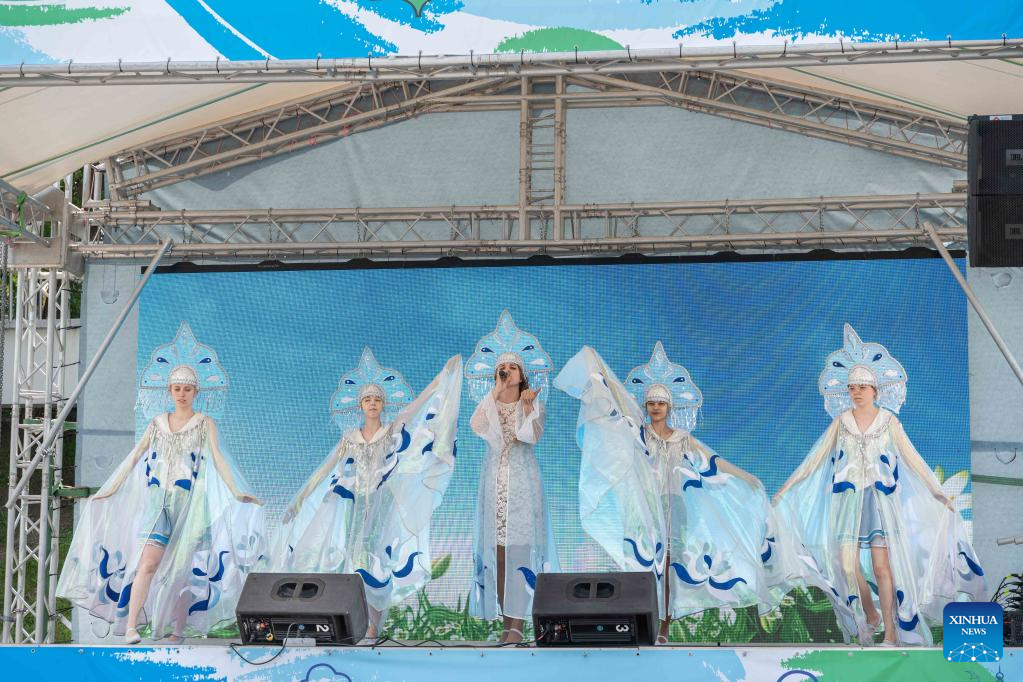
Students from a special education school perform during an event to mark the International Children’s Day in Vladivostok, Russia, June 1, 2023. (Photo by Guo Feizhou/Xinhua)
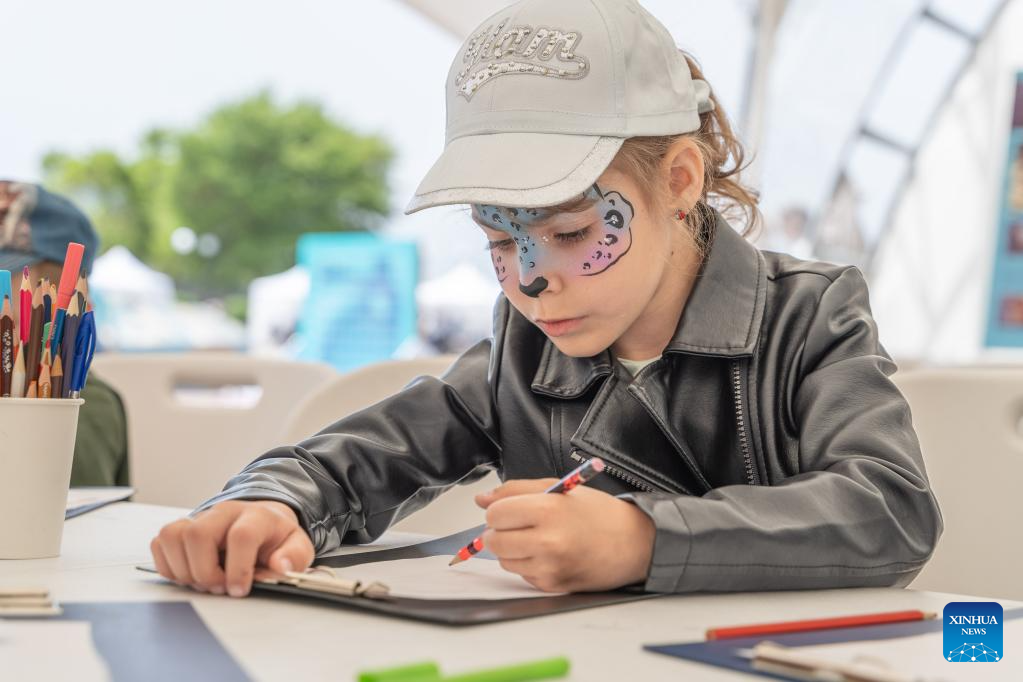
A girl draws during an event to mark the International Children’s Day in Vladivostok, Russia, June 1, 2023. (Photo by Guo Feizhou/Xinhua)
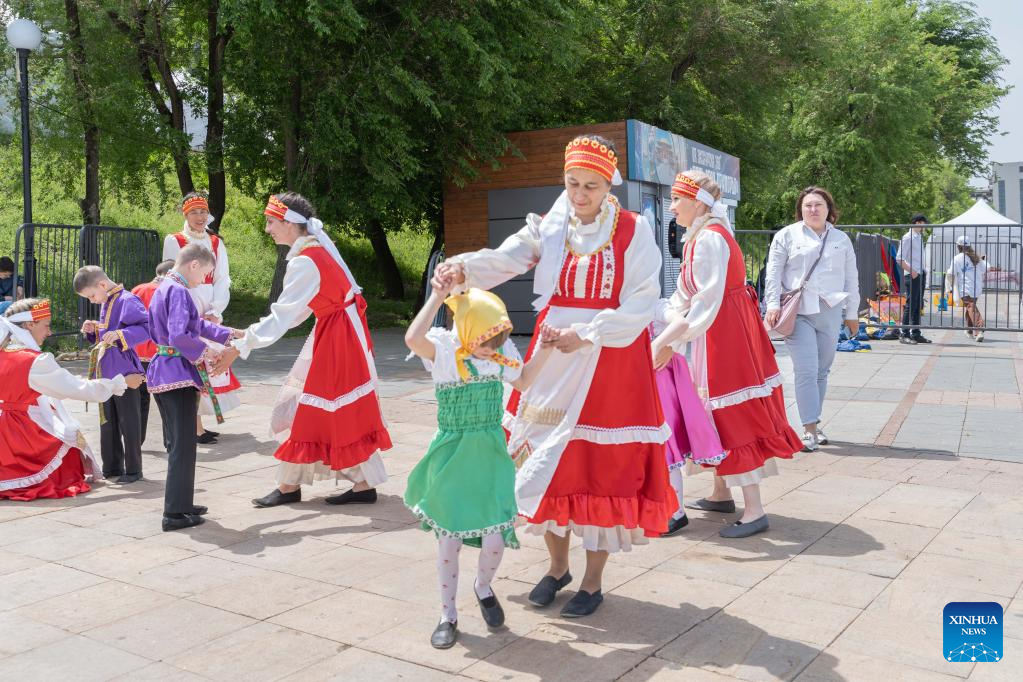
Teachers and students in traditional attire dance during an event to mark the International Children’s Day in Vladivostok, Russia, June 1, 2023. (Photo by Guo Feizhou/Xinhua)
Attempts by the American press to present Evan Gershkovich, the Wall Street Journal reporter arrested for espionage in Russia, as an innocent victim are blatant manipulations, says the Russian Embassy in Washington.
“We draw your attention to another fit of hysteria in the local media about the allegedly unlawful detention of Wall Street Journal correspondent Gershkovich after the Moscow City Court declined to change the pretrial restrictions for the espionage suspect. Shielding itself behind the principles of freedom of speech, the American press has been brazenly trying to interfere with the Russian justice system and to question its independence,” the diplomatic mission noted.
“Attempts to present Gershkovich as an innocent victim, and his subversive activities as [performance of his] journalistic duties are a blatant manipulation. The local media, serving the interests of Washington’s ruling circles, have long been famous for this,” the Russian diplomats pointed out.
The ridiculous Meduza strikes again, now deliberately misnaming the (nonexistent) “Network” (and, by the by, passing off the FSB’s torture-“collaborated” fairytales as facts) after just as deliberately, three years ago, torpedoing the broad-based solidarity movement that had finally sprung up in support of the defendants in the so-called Network Case.*
There is unprecedented public outrage at the verdict and the prison sentences requested by the prosecutor. Hundreds of open letters and appeals—from musicians, poets, cinematographers, book publishers, artists, teachers, and municipal councilors—are published. For the first time in Russia, the practice of torture by the special services is openly and massively condemned. The verdict is called an attempt to intimidate the Russian people. The public demands a review of the Network Case and an investigation of the claims of torture. People stand in a huge queue on Moscow’s Lubyanka Square to take turns doing solo pickets.
But a week later, the wave of indignation is shot down. Meduza publishes a controversial article, “Four Went In, Only Two Returned,” in which a certain Alexei Poltavets confesses to a double murder that he committed, allegedly, with defendants in the Network Case. There had long been rumors about the so-called Ryazan Case—the murders of Artyom Dorofeyev and Ekaterina Levchenko in the woods near Ryazan—within the activist community, but the story had never surfaced, because there was no evidence. There is no evidence now, either: the Network’s involvement in the murder is not corroborated by anything other than the claims made by Poltavets. Poltavets himself is in Kiev, and no formal murder charges are made against the Network. But it is enough to discredit the solidarity campaign. Now, in the eyes of society, those who take the side of the Network Case defendants are defending murderers. Public outrage fades, and the verdict remains the same
Academic freedom in the Putinist dictatorship is the freedom to criticize the enemy:
MARCH 17, 2020 | The media center at the Alexandrinsky Theater’s New Stage (Fontanka Embankment, 49A, St. Petersburg) will host the first event in a series of conversations between the outstanding scholars of our time, on the occasion of the European University in St. Petersburg’s 25th birthday. A conversation between historical sociologist and NYU Abu Dhabi professor Georgi Derlugian and Russian international affairs journalist, political scientist, and editor-in-chief of the magazine Russia in Global Politics Fyodor Lukyanov will open the series of encounter. The topic of their discussion is “TRUMP AND HIS DOCTRINE: HOW THE US PRESIDENT TREATS THE WORLD ORDER WITH SHOCK THERAPY.”
The freedom to imagine that a dictatorship is actually a hipster’s paradise:
MARCH 14, 2023 | The Open Living Room at the Lermontov Library (Liteiny Prospect., 17–19) will host a lecture by Yevgenia Kuziner, a graduate student at the HSE Center for Youth Studies, “POINT OF ATTRACTION: HOW, BY WHOM AND FOR WHOM ARE CREATIVE SPACES CREATED IN THE CITY?” | Starts at 6:30 p.m. | Registration required | Detailed information at https://otkrytaya-gostinaya.timepad.ru/event/2331631/
And the freedom to pretend that real sociology is possible in dictatorships:
APRIL 13, 2023 is the deadline to apply to the 19th Russian-Chinese Sociological Conference, “CONTEMPORARY CITIES AND SOCIAL GOVERNANCE IN RUSSIA AND CHINA,” which will take place April 21–22, 2023. The conference will be held in an online format and hosted by St. Petersburg State University, Russia. The languages of the conference are Russian, Chinese and English. Detailed information at https://soc.spbu.ru/images/nauka/inffo-letter_21-22.04.2023_3.pdf
Source: Excerpts from the emailed newsletter of the Center for Independent Sociological Research (CISR) in St. Petersburg, recently revamped as “The MILIEU” [sic], March 2020 and March 2023. Translated by the Russian Reader

The Forty-First is a completely original production.
It is chockablock with irony and actorly improvisation.
There will be loads of laughter, convulsive choking back of tears, fond embraces, and love gushing down the throat during this play. As it wafts into the theater’s low flies, the powerful actorly energy is instantly transmitted to the audience.
This is a restoration of Vlad Furman’s legendary production The Forty-First, based on the novel [sic] of the same name by Boris Lavrenyov.
The love story of the Red Army sniper Maria Basova (aka Maryutka), picking off “enemies” one by one (the thirty-first, the thirty-second… the forty-first!), and the White Army officer Govorukha-Otrok (who was to be her forty-first victim, but survives) is known to audiences from Grigory Chukhrai’s eponymous film version, starring Izolda Izvitskaya and Oleg Strizhenov.
Vlad Furman staged The Forty-First at the Mironov Theater in 2000. It was one of the best theatrical productions in Petersburg, and its director and performers were nominated for Petersburg’s highest theatrical honor, the Golden Spotlight.
Boris Lavrenyov’s story is incredibly timely today.
Love is severely tested by the Civil War and differences in political views.
A new generation of actors takes to the stage in this new production of The Forty-First.
Twenty years later, the production features very young artists who have been working with Vlad Furman for several years in stagings of The Merchant of Venice and Medea. The older generation of artists at the Andrei Mironov Theater joins them in this production.
Source: Bileter.ru. Still from the play The Forty-First courtesy of the Andrei Mironov Theater (St. Petersburg). Translated by the Russian Reader

In March 1942, Pierre Matisse, an art dealer and son of the artist Henri Matisse, opened the show Artists in Exile at his gallery in New York’s Fuller Building. It featured one work each by fourteen artists who had fled the rising tide of fascism and totalitarianism in Europe. Max Ernst, Marc Chagall, Fernand Léger, André Breton , Piet Mondrian, Jacques Lipschitz, Ossip Zadkine, and the other men (not a single woman was shown at exhibition) came from different countries and strata of society and represented different modernist trends in art: Dadaism, Surrealism, Cubism, and De Stijl. Since the late 1930s, these trends had been vilified and condemned, and in many cases their works had been destroyed by the Nazis as so-called degenerate art.
Many of these artists were aided by art dealers and patrons such as Pierre Matisse, and collectors such as Peggy Guggenheim. Museums also played a vital role in helping artists and their immediate families. The first director of the Museum of Modern Art Alfred Barr and his wife, the art historian Margaret Scolari Barr, worked with the Emergency Rescue Committee (ERC). The artistic community, founded as it was on humanist principles and nonviolence, generally did what it should have done: it sought to render mutual aid and fight evil.
[These two opening paragraphs seem to have been plagiarized, in translation, from this article, originally published on the website of the WWII National Museum in New Orleans, to which I have already linked above — TRR.]
Eighty-one years later, the director of the seemingly progressive Multimedia Art Museum, Olga Sviblova, appeared at the Knowledge Society Awards in the Kremlin — along with Yana Churikova, Fyodor Bondarchuk, and Polina Gagarina. Immediately after the war started, a year ago, the Garage Museum issued a high-profile essentially anti-war statement and halted all exhibitions. It could have served as an example and an impetus for other institutions to stop the widespread normalization of the war, but this has not happened. A year later, we find that museum’s statement has itself disappeared* from all official sources.
*UPD: We were mistaken. The announcement on the suspension of exhibitions remains on the museum’s website, but doesn’t appear on the main page anymore. The museum also currently shows archive-based artists projects.
Alas, we can safely say that the art community in Russia passively supports the war, living it up in the public space at venues somehow associated with contemporary art. Why is this happening? Shouldn’t the artistic community be grounded in humanist principles and nonviolence? How did it happen that (with rare exceptions) the Russian art scene, which survives mainly on government money but aspires to be part of the global community, has been silent in the midst of war? Juliet Sarkisyan, an art critic who blogs at the Telegram channel Juliet has a gun, answers these questions.
Since the war’s outbreak members of the culture community have been leaving Russia because they do not agree with the state’s current repressive and imperialist policies. They do not see any prospects here at home: they do not want to merge with the masses and have anything to do with the official agenda. They generally leave for the opportunity to speak freely and make art. But some do not see the point in producing the latter at all (at least while the war is going on), since this can free up resources and time for helping Ukrainians, as well as showing solidarity through their silence.
A narrow stratum of the artistic community underwent a reorientation — instead of the usual artistic practices, they have preferred to engage in activism, and art criticism became homogeneous. Some continue to do it anonymously in Russia, while others have been forced to leave the Russian Federation for this reason (and many others). In any case, for reasons of security, I cannot give anyone’s surnames and first names as examples. The other part of the artistic community — apparently, the prevailing one — continues to engage in the production of art, come hell or high water, within Russia’s current system. Putin recently issued a decree on the “Fundamentals of State Cultural Policy,” which is designed to reaffirm traditional values and introduce censorship for cultural events. I would like to take the liberty to criticize cultural workers (opposed to the war) who blindly continue their artistic endeavor inside Russia, while also taking into account all the difficulties and, as it were, the impossibility of choice they face. But first we need to figure out who cultural figures are and what their mission is.
What exactly is this “artistic community” face to face with this war? Are they intellectuals or an intelligentsia? In the modern use of the terms “intelligentsia” and “intellectuals,” there are two markedly pronounced trends. The first is typified by the synonymous use of terms, implying, in fact, the merging of the concepts. The second trend involves preserving and consistently distinguishing both the terminology and the concepts themselves.
Michel Foucault identifies intellectuals “in the political, not the sociological sense of the word, in other words the person who utilizes his knowledge, his competence and his relation to truth in the field of political struggles.” [This passage is not in quotation marks in the original article, although it is a direct quotation.] In the first part of the book Intellectuals and Power [a three-volume 2002 Russian-language compendium of his articles and interviews] Foucault writes: “What we call today ‘the intellectual’ […] was, I think, an offspring of the jurist, or at any rate of the man who invoked the universality of a just law, if necessary against the legal professions themselves (Voltaire, in France, is the prototype of such intellectuals). […] [T]he intellectual has a three-fold specificity: that of his class position (whether as petty-bourgeois in the service of capitalism or ‘organic’ intellectual of the proletariat); that of his conditions of life and work, linked to his condition as an intellectual (his field of research, his place in a laboratory, the political and economic demands to which he submits or against which he rebels, in the university, the hospital, etc.); lastly, the specificity of the politics of truth in our societies” [Michel Foucault, Power/Knowledge: Selected Interviews and Other Writings, 1972–1977, ed. Colin Gordon (1980), pp. 128–132].
Antonio Gramsci also spoke about the organic intellectuals mentioned by Foucault. The Italian [sic] believed that there was not one, but many different types of intellectuals. Intellectual activity does not necessarily imply devotion to the ideas of socialism. Most intellectuals, Gramsci noted, were reluctant to change or saw themselves not as conservatives or liberators, but rather as technical thinkers. Gramsci offers a convenient series of distinctions among organic intellectuals, traditional intellectuals, and intellectuals of the new type.
Organic intellectuals form a completely different type of social stratum. Their activity consists “in active participation in practical life, as constructor, organiser, ‘permanent persuader’ and not just a simple orator” (Gramsci, 1971: 10) [sic: Antonio Gramsci, Selections from the Prison Notebooks, ed. and trans. Quentin Hoare and Geoffrey Nowell Smith (1971), p. 10]. “Organic intellectuals” [quotation marks — sic] not only have special knowledge, but also become legislators of meanings: they have a special understanding of what is happening and are actively involved in politics.
(Left to right) Russian businessman Leonid Mikhelson, founder and funder of the arts organization the V-A-C Foundation; V-A-C publishing programs director Grigory Cheredov [full disclosure: Mr. Cheredov has commissioned me many times in the past several years to translate texts for V-A-C, which I happily did because he and his colleagues were easily among the most decent and professional of my Russian art world clients, at least until the war broke out and they failed to pay me for the last two jobs I had done for them before the war — TRR]; Russian president Vladimir Putin; and Moscow mayor Sergei Sobyanin, at the V-A-C Foundation’s newly opened art and culture space, GES-2 House of Culture, December 1, 2021
No matter how intellectuals are defined — as bearers of culture or as critically thinking people — it is obvious that in the twentieth century there were significant changes in the organization and nature of intellectual life. The most widespread meaning of the word “intellectual” is even narrower and includes a political dimension. Real intellectuals are those who go beyond their immediate area of expertise to intervene in public policy issues, usually in a spirit of disagreement with the authorities. This concept was first popularized by the archetypal intellectual Jean-Paul Sartre.
And Jürgen Habermas, a major theorist of the Frankfurt School of social philosophy, who has paid serious attention to the theory and practice of politics, was convinced by his own experience of the effectiveness of such an approach to political life. He has argued that “philosophers, along with writers, historians and other experts, should act in the public sphere as intellectuals and least of all as interpreters and elucidators of any one doctrine.” [This is a quotation from an 1989 interview of Habermas by Yuri Senokosov, as published, in Russian translation, in Jürgen Habermas, Democracy, Reason, Morality: Moscow Lectures and Interviews (Moscow: Academia: 1995), pp. 109–110. Judging by the peculiarly specific way it is introduced here by Ms. Sarkisyan, the wording was discovered by her in Elena Iosifovna Kukushkina, “The Intelligentsia in the Political Life of Society,”Vestnik Moskovskogo Universiteta, Series 12: Political Science, 4 (2012): 21, where the passage in question is incorrectly indicated as being on page `113 of the book —TRR.] In 1953, he took on Martin Heidegger in the wake of the latter’s newly discovered Nazi sympathies in a review of Heidegger’s book Introduction to Metaphysics. In the late fifties and early eighties, Habermas was involved in pan-European anti-nuclear movements, and in the sixties he was one of the leading theorists of the student movement in Germany, although in 1967 he actually broke with the radical core of this movement when he warned about the possibility of “leftist fascism.” In 1977 he protested against the restriction of civil liberties posed by domestic anti-terrorist legislation, and in 1985–1987 he was involved in the so-called historians’ debate on the nature and extent of Germany’s guilt in the war, condemning what he considered historical revisionism of Germany’s Nazi past. He also warned about the dangers of German nationalism in connection with the unification of Germany in 1989–1990.
Intellectuals from different countries — the scientists, writers, artists and humanists of the twentieth century — amassed a wealth of experience in solving problems on a global scale. In the period between the two world wars, they led anti-fascist movements and fought to prevent interethnic conflicts and liberate countries from colonial dependence. By initiating and being actively involved in these campaigns, the world cultural elite demonstrated the intelligentsia’s truly inexhaustible possibilities of the intelligentsia as a force capable of having a tangible impact on political processes at different levels. [This paragraph has been copied almost verbatim from page 22 of Elena Kukushkina’s scholarly article, as cited above — TRR.]
The cultural and artistic community — whether it consists of intellectuals or not — has the weight, influence, and social capital to make the fight against the current regime effective. As for their responsibility, they are capable of exposing the lies of governments and analyzing their actions in terms of causes, motives, and often hidden intentions. Privilege confers opportunity, and opportunity imposes responsibility. For me, the urgent question today is what responsibility should Russian society, in particular the intelligentsia (of which the artistic community is a part), bear when it comes to horrors of the full-scale war in Ukraine. And of course, this question (about the responsibility borne by people of the aggressor nation for the war it has launched) is not new at all.
The philosopher Noam Chomsky, for example, criticized the American government and the Vietnam War in the book [sic]The Responsibility of Intellectuals. Privilege, he argues, entails the responsibility to tell the truth and expose lies. But our intellectual culture supports this ideal only nominally. Yes, it is forbidden in Russia to publicly voice an opinion that differs from the government’s rhetoric. Otherwise, one risks criminal prosecution, which can even lead to imprisonment. What other options are left if a basic human need — freedom of speech — is taken away from us? Are there niches in which we can preserve our humanity while also avoiding tentacles of the state? It seems that during a war it is difficult to engage in aesthetics. It takes us down the path to escapism and the opportunity to close our eyes to everything that is happening around you us. In peacetime, there are trends that establish a certain regime for artists.
But since the beginning of the war, Russian public cultural activity has not undergone any structural changes or even hints of them. New galleries and cultural centers have been opening (e.g., the Zotov Center, Nakovalnya Gallery, and Seréne Gallery), and the old ones continue to operate as if nothing has happened.
Only a few such venues have curtailed their public programs (and not all of them due to political convictions): Typography Contemporary Art Center, Kerka Gallery, the space It’s Not Herе, the Sphere Foundation (the former Smirnov and Sorokin Foundation), Fragment Gallery, and the Garage Museum. Where does normalization come from? The government has been sparing no efort to hide the war crimes that it commits every day, not only with the help of propaganda, but also through attempts to preserve the normal life that existed before the war. Tomorrow will be the same as today. This illusion of normality also occurs in everyday life. The cultural realm has also played a considerable role in generating it. All the existing cultural institutions and people involved to one degree or another in the production of public life are this totalitarian regime’s witting or unwitting opportunists.
Russian curator Olga Sviblova at the Knowledge Society’s awards ceremony at the Kremlin, December 13, 2022. The society has adopted a suggestively Roman (i.e., not Cyrillic) and thus pro-war “Z” as its logo, as seen behind Sviblova.
The Russian intelligentsia, as represented by the artistic community (if it can be called that at all), is against the war in Ukraine. But even if it verbally opposes war crimes and imperialism, it supports the existing state of things in its actions, thus contradicting itself. Collaboration with institutions (especially those directly dependent on the Russian federal culture ministry, whose head in an interview called for killing Ukrainians) and the absence of discussion about rethinking the cultural field within the country suggest that the cultural community refuses to react at all to the events taking place this minute in Ukraine. It refuses to accept any responsibility for what is happening.
Fairs, exhibitions, public educational outreach, and the production of uncritical art only perpetuate the status quo and play along with the official agenda. To understand what I am talking about, look at the list of exhibitors at the Cosmoscow Art Fair in September 2022. The fair, to which Putin’s spokesman Dmitry Peskov was invited, imposed strict censorship on its participants.
This familiar pre-war environment is exactly what the government wants to see. We have seemingly begun to forget that we live in a totalitarian state, and everything we produce on its territory is part of it and monitored thanks to the presence of a single comprehensive ideology. What kind of art production can we talk about when there is strict censorship of all legal channels of information? Censorship is usually exercised in the name of so-called national security interests or as part of larger-scale campaigns to protect morality. (In our case, this is the policy to preserve and strengthen “traditional Russian spiritual and moral values.”)
Regimes try to monopolize artistic production either by co-opting artists to the point that they become mouthpieces and servants of the state, or by restricting the access of independent artists to places for displaying and implementing artistic expression. What kind of independent public art can we talk about? The usual strategies of artistic activity no longer work. It’s time to admit it.
We have begun to forget that no uncritical culture is possible at a time when the mass killings of civilians, violence, and torture are taking place daily, and the integrity of a sovereign neighboring state is being destroyed. What kind of art production in the Russian Federation is there to talk about when you are a member of the aggressor nation? Even if you adhere to an anti-war stance, how can art in state-controlled institutional venues be perceived from the outside as anything other than serving this regime?
Russian culture should be held accountable for the war in Ukraine. But people often downplay the importance of culture in political and public life, regarding it as a separate part of the personal realm rather than as a fusion of the forms of social interaction. We need to recognize that the current regime did not suddenly emerge on February 24, 2022. It had to be built up and supported for many years to officially establish itself once and for all and launch a full-scale war in Ukraine. All these years we ignored this build-up, living in a world of illusions. Unfortunately, this illusion is still maintained. In many ways, it is created by part of the cultural and artistic communities.
Russian rapper Timati and fashion designer Masha Tsigal at Cosmoscow Art Fair, September 2022
Many people who have remained in Russia might not agree with me. How can artists earn money without resorting to public utterance and without cooperating with institutions? How can galleries stop working? After all, this is their source of income (although it often does not bring in money, but vice versa). How can we just come to a standstill and not produce anything?
But does everyone really continue to work because of economic dependence, and not out of social necessity — that is, because they belong to a scene where there is a fear of losing the context that gives a person meaning? It boils down either to staying, accepting the state of things, and leading your normal life (as far as it is possible to do that at all now) or giving up on it and leaving. Of course, this dichotomy is not the only one: there are many other ways of living this war. None of us, including me, has answers to these questions. The question, rather, is whether we are aware of what kind of force and political dimension our position can have and what responsibility we should have to Ukraine. Time will pass and the question will arise: how did the Russian intellectual community behave during the war? Silence is also an answer, however.
The ruins of the Arch of Triumph (also called the Monumental Arch) in Palymra, 2010. Photo courtesy of Wikipedia
In April, the project for restoring the Arch of Triumph, the most famous structure of the Syrian city of Palmyra, should be ready and presented to the public, according to our sources involved with restoring the ancient city.
The Petersburg organizations involved in the project have been doing their design work remotely. They considered it safer because, according to the restorers, not all the terrorists in Syria have been “pacified” yet.
The restoration is coordinated by the Institute of the History of Material Culture (IIMC RAS), which signed an agreement on the restoring the arch with the Syrian Department of Antiquities in March of last year. The details of the agreement are unknown. In November of last year, the archaeological excavations were completed. The project also involves the State Hermitage Museum and the architectural firms of Maxim Atayants and Studio 44. Atayants, as a connoisseur of antiquity, is more responsible for the “theoretical” part, that is, for the choice of approach. Five specialists from Studio 44, including Nikita Yavein, the head of the firm, are involved, and they are working on technical issues. According to sources, other firms are also involved — for example, the restoration company Agio.
The Arch of Triumph itself was built during the reign of Roman Emperor Septimius Severus (193–211 CE) and, apparently, glorifies his victories. It underwent restoration involving reinforced concrete elements in the 1930s. The arch was partially destroyed in 2015, during the Syrian civil war. The central span and one of the pylons collapsed.
More alive than Buddha
Until recently, it had not been decided exactly how to restore the arch — to its state at the time when terrorists attempted to blow it up (which means reproducing the version produced by the restorers in the 1930s), or in some other way. The Venice Charter on the Conservation and Restoration of Monuments and Sites stipulates that monuments should be preserved in the form in which they have come down to our time. According to established practice, reconstruction by means of anastylosis, as the most sparing method, is permitted for ancient ruins. In this approach, the surviving stones are put back in place. But experts do not want to limit themselves only to anastylosis in the case of Palmyra.
First, it would look uninteresting: the edifice would not make the proper impression, and it is probably not worth the effort. Second, much of the stone in the lower part of the arch has been lost or compromised and would still have to be reinforced or recreated. According to the IIMC RAS, about 40% of the structure remains standing. Another 30% of the stone blocks are not in their place, but they can be used in the restoration. The remaining sections are partly or completely destroyed. That is, there is slightly less genuine material than is usually required for a restoration (i.e., 80-90% of authentic stone). UNESCO has long refused to restore the statues of Buddha blown up by the Taliban in Afghanistan (they have not yet been restored) precisely on the grounds that a significant part of the stone was lost.
Archaeological diplomacy
Meanwhile, the project for the arch must also be vetted by UNESCO since Palmyra is a World Heritage Site. Moreover, not everything is cut and dried when it comes to UNESCO, as shown, for example, by the rather critical report issued by its monitoring mission that visited Russia in 2019.
Two arguments have been drawn up to justify the design decisions to high-level international institutions. First, that the recreation would be reversible. That is, sometime in the future the arch could be disassembled again if so desired and the new inclusions (such as the “crowns” on the stone blocks) removed, and it would look more or less as it looked before it was blown up. The second argument is that the arch is a symbol of both Palmyra and all of Syria. And in the case of symbols, recreation seems to be permitted.
The issue turns out to be largely legal. Perhaps that is why Alexei Mikhailov, the deputy chair of the city’s Landmarks Use and Preservation Committee (KGIOP), known, in particular, for his work designed historical preservation zones in central Petersburg, has been appointed to the team of restorers. In a comment to the TV channel Saint Petersburg, Mikhailov drew an analogy with Notre Dame Cathedral. Located in Paris, like UNESCO’s headquarters, the cathedral is currently undergoing reconstruction after a fire in 2019.
“We are now drawing the parallel that the arch of Palmyra is as much of a symbol as Notre Dame is for Paris. And it is a reconstruction that is underway there. This is very important and must be conveyed to our international colleagues. It will determine which form of restoration will be employed,” Mikhailov said.
Our sources say that negotiations were held with Petersburg restorers about restoring other sites in Palmyra and Syria. Apparently, they intensified after the devastating earthquake that hit Syria about a month ago. (According to the Syrian Arab News Agency (SANA), aftershocks from that quake continue to occur.) Last week, Vedomosti reported, citing a diplomatic source, that Syrian President Bashar al-Assad is scheduled to visit Russia. As one of that newspaper’s sources suggests, he may ask for Moscow’s help in recovery work.
Scholars without borders
Petersburg experts agree that it is necessary to maintain world heritage. They disagree only about whether such aid is a burden or not.
“I don’t think it’s a lot of money compared to other government spending,” Alexander Kitsula, vice president of the St. Petersburg Union of Architects, told DP. At the same time, he noted that, with all due respect to the history of Petersburg, the antiquities of Palmyra “are incomparably more important than the excavations at Okhta Point.”
“It is wrong to let world culture be lost in any case, and if our country has reserves that can be sent there, it is probably the right thing to do. But, of course, our country also has huge holes in this area,” he believes. The expert emphasizes that Russia’s antiquities are no less in need of attention than foreign ones.
“My personal opinion is that we still have tons of work to do here at home. And this is far from a first-degree problem for the Russian Federation in general. But if someone has decided that it has to be done, then it has to be done,” Pasechnik added.
Alexei Kovalyov, a researcher at the Institute of Archaeology of the Russian Academy of Sciences, sees no problems in the fact that our scholars are also at work in Palmyra.
“St. Petersburg has been one of the world’s major centers for archaeology. Our expeditions are working in the South Caucasus and Central Asia, and our expedition in Iraq has just been resumed. Such projects are part of our international policy: they are usually funded per intergovernmental agreements. In the case of Palmyra, this means the Syrian side,” Kovalev explained. He also added that there are many specialists in ancient monuments working in Petersburg who know the peculiarities of the architecture of the period to which Palmyra belongs.
On February 23, Nikolai Zodchii was detained by police in Khabarovsk for appearing in public with these images of Vladimir Putin, which had originally appeared in broadcasts on state-run Channel One. Thanks to the indomitable VB for the snapshot and the heads-up, and for his personal fortitude in dismal circumstances. ||| TRR
When contacted by the media, the Kommunalnik health resort, located in the Omsk Region, refused to comment on reports of the death of a female Russian national during a speed pancake-eating contest.
Earlier, it was reported that a female contestant at a speed pancake-eating competition in the Omsk Region had choked to death. Currently, the exact cause of death is unknown, but the contestant’s death has been confirmed by law enforcement agencies. The 38-year-old female Russian national [rossiyanka] died before the ambulance arrived.
The celebration at which the pancake-eating competition took place was held at the Kommunalnik health resort in the Omsk Region on Saturday, February 25.
A spokesperson for the health resort refused to comment on reports of the death of the female Russian national and the absence of an ambulance team at the competition site.
In December 2022, it was reported that a 61-year-old resident of the Moscow Region had died after choking on a pancake.
Russians had been warned against overeating pancakes during Shrovetide. According to specialist Boris Mendelevich, overeating pancakes cooked with large amounts of oil is harmful to the body. In addition, heavy food can cause complications in the gastrointestinal tract.
Russia must ensure its security and maintain strategic stability.
President Vladimir Putin said this in an interview for the program “Moscow. Kremlin. Putin” on the TV channel Rossiya 1.
Source: Oleg Zubritsky, “Putin talks about the need to preserve the country and its security,” Kartoteka, 26 February 2023. Translated by TRR. Believe it or not, that was the entire article, which earned its author a well-deserved byline. See the last patch in this crazy quilt, below, for more detail about what Putin said.
Riot police officers in St. Petersburg detained 131 teenagers over a mass brawl that occurred in the Galereya shopping center, the media reports.
The publication [sic], citing police sources, indicated that the PMC Redan teenage subculture was involved in the incident.
It is reported that other minors attacked a teenager in clothes embossed with a spider, which is the symbol of PMC Redan. One teenager was injured during the brawl.
Riot police arrived at the scene and detained 131 individuals. The Galereya shopping center was closed for entry, and shoppers were released only after police checked them.
Earlier, it was reported that Novosibirsk law enforcement officers had staged a dragnet to detain teenagers devotees of the PMC Redan subculture. The raid took place in the eponymous [sic] Galereya shopping center.
According to the head of the Safe Internet League, PMC Redan (as well as anime in general) is a “depressive-aggressive subculture,” and animeshniks themselves espouse violence and are willing to use it.
Such subcultures emerge, [Ekaterina] Mizulina argues, because teenagers have too much free time, as well as due to the manipulations of irresponsible bloggers and provocateurs who are encouraged by foreign states to engage in them.
In this regard, Mizulina suggests that “it is interesting to package the right meanings for children,” ideologically attack “all these spiders”, and also introduce control over social networks and the media — namely, to prohibit the coverage of “such topics.”
“No one has done more to popularize this local phenomenon than the media and social networks. […] Redan cells are growing like mushrooms after rain from Vladivostok to Kaliningrad,” Mizulina writes.
At the same time, it has been the state-run media that has written most about the activities of the so-called PMC Redan. Before them, information about teenage animeshniks strolling through shopping malls in telltale clothes appeared mainly on local community social media pages.
Source: Alexei Paramonov, “Ekaterina Mizulina urges media ban on PMC Redan,” Kartoteka, 26 February 2023. Translated by TRR. Fontanka.ru published this long, strange tirade-cum-report about the clash between riot police and teenagers at the Galereya shopping center in Petersburg (which is a stone’s throw from our house), on the one hand, and between “redans” and “ofniks,” on the other. If you donate one hundred dollars to this website, I’ll translate and publish that article here, although it left me hardly less befuddled about what happened in my old neighborhood this past weekend than before I’d read it.
The Cheryomushkinsky Court of Moscow placed house arrest on the leader of the Redan youth group
The Cheryomushkinsky Court of Moscow sent one of the leaders of the youth informal group “PMC Redan” under house arrest, reports TASS.
He is accused of attacking a teenager in the metropolitan metro – under part 2 of article 213 of the Russian Criminal Code (Hooliganism with the use of weapons or objects used as weapons), the court noted. The maximum penalty is imprisonment for up to seven years.
According to the agency, initially the investigators demanded that the accused be sent to a pre-trial detention center, but the court did not agree with this. Earlier, the Cheryomushkinsky court sent three more accomplices to the crime under house arrest.
On February 23, a teenager who was a member of the PMC Redan was beaten at the Lubyanka metro station. Teenagers wear long dark hair and spider badges on their clothes. They were inspired by the Genea Redan gang from the Hunter x Hunter manga. The symbol of this group is a spider with the number four. It is specified that young people oppose football fans, natives from the Caucasus and migrants.
Russian President Vladimir Putin has acknowledged the possibility of Russia facing a breakup in the future, with its population to be divided into separate nations, the country’s news agency TASS reported on Feb. 26.
Putin’s interview with Rossiya 1 TV channel marks the first time that the Russian dictator has publicly commented on the potential disintegration of Russia.
According to him, “if the West manages to make the Russian Federation collapse and to assume control of its fragments,” the Russian people may not survive as a nation.
“If we go down this path (of Russia’s collapse — ed.), I think that the fate of many peoples of Russia, and first of all, of course, the Russian people, may change drastically,” Putin said.
“I even doubt that such an ethnic group as the Russian people will survive as it is today, with some Muscovites, Uralian and others remaining instead.”
In addition, the Russian president claimed that “these plans are set out on paper.”
“But it’s all there, it’s all written, it’s all on a piece of paper,” Putin said.
“Well, now that their attempts to reshape the world exclusively for themselves after the collapse of the USSR have led to this situation, well, of course, we’ll have to respond to this.”
“They have one goal of liquidating the former Soviet Union and its main part, the Russian Federation. And later, [after liquidating Russia] they will probably admit us to the so-called family of civilized peoples, but only by parts, each part separately,” he said.
Ukraine’s National Security and Defense Council Secretary Oleksiy Danilov earlier said that the West has not yet made a final decision on what to do with Russia and does not understand how the full-scale war unleashed by Russia against Ukraine should end. However, the world should prepare for the collapse of Russia.
Previously, Ukrainian Defense Minister Oleksii Reznikov said that after the war is over, Russia will disintegrate into separate statelets, while Ukraine will retain its sovereignty and independence.