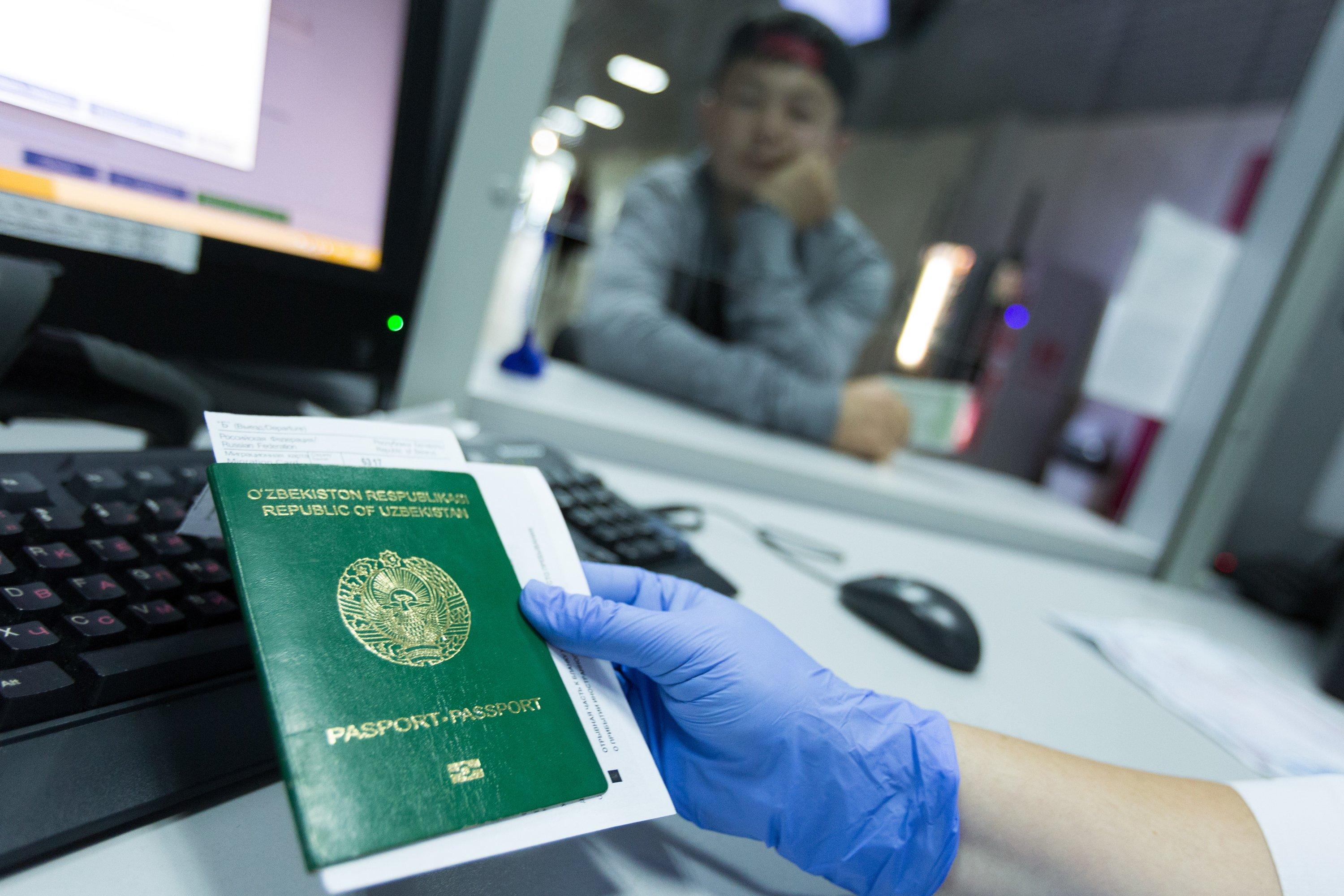
Kill the Bill (That Will Kill Independent Culture and Education and Introduce Total Censorship in Russia)

“This is direct censorship. Withdraw the bill—don’t disgrace yourselves!”
Nikolai Nelyubin
Fontanka.ru
February 8, 2021

Vladimir Putin has received a letter from the progressive intelligentsia. The masters of culture, science and education have asked the guarantor not to touch the law on education by introducing “licenses for educational outreach.” For the depths are lower, and Gorky has nothing to do with it.

Professionals in culture, education and research involved in educational outreach work in our country, are concerned about the future of culture, education, and research. The reason is the draft law “On Amendments to the Federal Law ‘On Education in the Russian Federation,'” adopted by the State Duma in its first reading, which, in particular, would make official vetting of “educational outreach programs” mandatory.

On February 8, more than a thousand Russian professionals in the field of educational outreach published an open letter to the authorities demanding that they reject the amendments, since they  would “open the door to repressive regulation and censorship.” [See my translation of the open letter, below—TRR.]

On February 9, the details of the legislative initiative are slated for consideration by the State Duma Committee on Education and Science, chaired by Vyacheslav Molotov’s grandson Vyacheslav Nikonov. The bill could pass its second reading as early as February 10.

A co-author of the legislation, Dmitry Alshevskikh, a United Russia MP representing Sverdlovsk Region, earlier shared with Fontanka.ru his arguments for adopting the new norms, which would destroy “anti-Russian propaganda” disguised as “educational outreach.”

“Certain forces are trying to introduce Bandera,” the people’s deputy explained.

The authors of the open letter to President Putin, Prime Minister Mishustin, State Duma Speaker Volodin, and all the co-sponsors of the sensational bill are no strangers to post-postmodernism in art, but in this case they are unanimous. There is nothing to be quibble about: we are getting closer to obscurantism and pathological tendencies that are better to nip in the bud.

It will be more difficult to work
Supporters of the independent cultural scene are convinced that the regulations governing educational outreach would complicate the work of people who organize exhibitions, lectures, discussions, and other public events.

“There are currently no requirements for vetting exhibition projects and the educational programs that accompany them (lectures, seminars, and meetings) except for cases when the project is funded by state grants,” says Tatiana Pinchuk, director of Petersburg’s Street Art Museum, about the current state of affairs.

Natalia Karasyova and Elizaveta Zinovieva, co-founders of the Big City Art project, which holds “art breakfasts” featuring lectures and excursions, are afraid of the vagueness of the mechanisms for obtaining a license, the lack of a list of documents for making such application, and, importantly, the cost of the entire procedure.

“It will be virtually impossible to obtain a license due to the cost and bureaucratic hurdles. So, we will be operating outside of the law,” they say.

Moreover, players on the independent education market cannot understand what exactly they would have to license.

“It is not clear from the bill what exactly ‘educational outreach’ includes,” wonder the women at Big City Art. “It is one thing to get a license for an educational center, and another thing to get one for small-scale meetings and blogging.”

Art scholar Anastasia Pronina also argues that the bill is vaguely worded.

“Officials would have additional levers for pressuring and regulating us, while those engaged in educational outreach work would find themselves in a tough spot,” says the curator. “If the bill is passed into law, it will be a problem to vet the topics announced by our speakers, and we will be obliged to draw up contracts for all our lectures and public events. The lectures at Benoit 1890 Cultural Center are educational in nature and free to attend. During the pandemic, we have introduced a nominal entry fee to regulate attendance. Our project promotes contemporary art in a bedroom community in Petersburg. I think it is clear that this is not an easy job, and we are grateful to all the lecturers who speak to our audiences for free.”

Curator Lizaveta Matveeva notes that a separate item in the draft law would require organizations that partner with and hire foreign specialists to obtain special permits.

“This is another go-round in our government’s maniacal desire to rid us of the presence of foreign colleagues and stop the dissemination of their ‘values and information,'” Matveeva argues. “My field cannot function without interaction with foreign colleagues, without a bilateral exchange of know-how. Culture and art cannot survive in isolation. Our country has already been through this experience, and it led to nothing good.”

Where have the censors been rummaging?
“The more vague a law is, the more repressive it is,” Matveeva argues. “Currently, oversight is implemented correctively, but there are concerns that this draft law and subsequent secondary laws may introduce preventive regulation that would require vetting educational materials before they are published, and this is real censorship.”

“It could reach the point that talking about Andy Warhol’s paintings would be considered promotion of the western way of life,” say Karasyova and Zinovieva. “It is absurd, but it is possible.”

According to the organizers of informal cultural events, censorship can manifest itself even more easily in the field of contemporary art. The young women give examples.

“This could concern projects that criticize the government by artistic means, or projects produced in cooperation with foreign colleagues,” they say.

“If cultural institutions are required to clear every exhibition project involving a cultural program with the state, then implementing any project would turn into a bureaucratic hell,” argues Pinchuk. “Also, it is not clear how broad the powers of the supervisory authorities would be. If they don’t like the theme of an exhibition or the subject of a lecture, would they simply ban it?”

Historian Lev Lurie is horrified.

“Educators also tell us about Ohm’s law, after all,” he says. “The question arises: aren’t they hyping the achievements of foreign scientists? Maybe they underestimate the successes of the virologists from the Vector Center in Novosibirsk? We need balance in the natural sciences, too! So, now we need to expand the training of these facilitators. Retired officers—political workers—can handle it. If, God forbid, [Vyacheslav] Makarov is not re-elected to the [Petersburg] Legislative Assembly, he could well attend such events, because he has a sense of who has the “Siege of Leningrad gene” and who doesn’t. He could run such events himself, but monitoring them is more important.”

Who would be affected by the law?
No one has actually counted how many independent educational platforms there are in Russia today. It is clear that this sector was growing quite dynamically until quite recently. There are professional educational platforms and schools, and there are hobby clubs.

“Meetings and lectures are also held in bookstores, libraries, cafes, independent galleries, and other places,” Matveeva explains.

“Based on the blanket statements [in the draft law] we can surmise that a project dealing with the oeuvre of a single artist and a show of his works would be defined as educational outreach since an analysis of the artist’s career constitutes, in one way or another, dissemination of information about the artist’s know-how and expertise,” argues Pinchuk. “Along with doing exhibition projects, museums, including the Street Art Museum, also do cultural and educational projects, and various events—meetings, seminars, and lectures—are held as part of these projects. During these events, knowledge about art is disseminated, and members of the cultural scene share their know-how and competence. That is, the activities of museums fall under the definition of educational outreach as provided in the draft law.”

It comes down to money
“Russian citizens, including vulnerable segments of the populace, would thus also lose the opportunity to gain knowledge from highly qualified specialists on a regular, often pro bono basis,” it says in the open letter to Russian officials.

Matveeva answers the question “why.”

“If organizers and lecturers have to produce and reproduce paperwork to get permission to hold each of their one-off lectures in a library or a cafe, it would be easier not to organize anything at all and wait for better times to arrive in Russia,” she says. “Many events are organized by enthusiasts, by professionals passionate about their work. Events are often held for free or for a nominal fee. They are attended by people who don’t have the opportunity to pay for an expensive course or time to study, but they can periodically go to lectures to learn something new, and maybe meet and hobnob with other people. Educational events are also popular among the elderly: for them it is a form of leisure.”

Karasyova and Zinovieva agree.

“If commercial educational events simply increase in price and part of the audience peels off, then non-profit organizers are likely to fall by the wayside, as they will not be able to carry the costs,” they say.

Lurie is categorical.

“People will show up and say that you are not telling the right story about hedgehogs. ‘You can’t talk about hedgehogs like that,******!” they will tell you. ‘And if I give you fifty thousand, will I be telling the right story about hedgehogs?’ you will ask. ‘Well, for fifty it would be better, but for sixty it would definitely be a good story about hedgehogs.’ That’s all you need to know about this law,” he says.

What history teaches us
“Increasing the amount of paperwork has never helped the cause of popular education,” Pinchuk argues.

There are also examples in history of how to introduce state control.

“The Cultural Revolution in the USSR at the turn of the 1920s and 1930s,” recalls Lurie. “Then all private NEP outfits were put under control. They became state-owned. They were made part of the overall structure. In particular, the Knowledge Society (Obshchestvo “Znanie”) emerged from this arrangement. Or there were the times of [Konstantin] Pobedonostsev, when a bailiff came to every event and could shut it down.”

“We are being dragged into the Middle Ages. Or into the USSR,” says Marina Rudina, an employee of the Russian Museum who specializes in its educational and research work. “This know-how was perfectly tested back then. There is a persistent sense of obscurantism. And, from my point of view, strange information is flowing from every corner, including from federal and state TV channels. We need protection from extremist influences? There is already a law for this. I don’t understand why we have this business about ‘combating extremism’ in the new law again. Apparently, this is a clear formula: there are only enemies everywhere, and we must defend ourselves from them. Are we going to sacrifice everything?”

Lurie recalls other specific examples.

“We feel great about the valiant deeds of Alexander Matrosov and Zoya Kosmodemyanskaya, Valentina Tereshkova and Dmitry Donskoy. We don’t expect anything bad. The problem is that there is imperfect censorship in Russia. There are no firm guidelines, for example, on whether Pobedonostsev and [Georgy] Malenkov are positive characters, and so we don’t know what to expect. There is uncertainty. We are afraid to talk positively about Malenkov. What if suddenly it turns out that he was working against the Motherland?”

To avoid this, says Lurie (who even at the start of Putin’s constitutional reforms spoke about the inevitability of total censorship), there must be “special people” who attend excursions and other events, lectures, and quests, either openly or undercover.

The historian sketches a new dystopian novel on the go.

“They will write a note to their superiors. They will have to record everything with surveillance devices so that it won’t be their word against [their opponents]. Then it will transpire that someone berated Matrosov. This means that a regulation stating that Matrosov cannot be derided will be needed. After all, such thoughts about Matrosov could be whispered by the enemy, while an educator might not have known it was forbidden. We must protect educators!”

“Why are they doing this?”
“The bill will drive another nail in the coffin of private cultural institutions in Russia. It seems that the current policy is aimed at ensuring that there are fewer and fewer educated people with a broad outlook, and that knowledge outside of the school curriculum can only be obtained abroad,” Pinchuk argues.

“The censorship and repressive laws already adopted by our government have greatly changed the climate and environment, and have complicated the already extremely difficult lives of cultural professionals,” says Matveeva. “We can no longer publicly and openly touch on certain topics, we cannot work with certain organizations, and it is better for us not to receive grants from international organizations and foundations. Given that the government provides no support to artists, art historians, and other producers of culture and art, it is not quite clear how officialdom expects people to work and support themselves.”

“Why are they doing this?” Rudina asks, immediately answering her own question.

“To completely obliterate education, to make it impossible for there to be flights of thought and broad spaces to think. There should be many opinions, many sources of knowledge and trends. When everything is regulated, is approved by people at the top, this is direct censorship, the exclusion of any opinions other than those ‘approved by the government line.’ Just withdraw the bill—don’t disgrace yourselves!”

Late last year, Petersburg MP Elena Drapeko told Fontanka.ru that voters had asked the State Duma to introduce censorship in Russia.

As of February 9, over 210,00 people had signed a petition against the proposed amendments.

__________
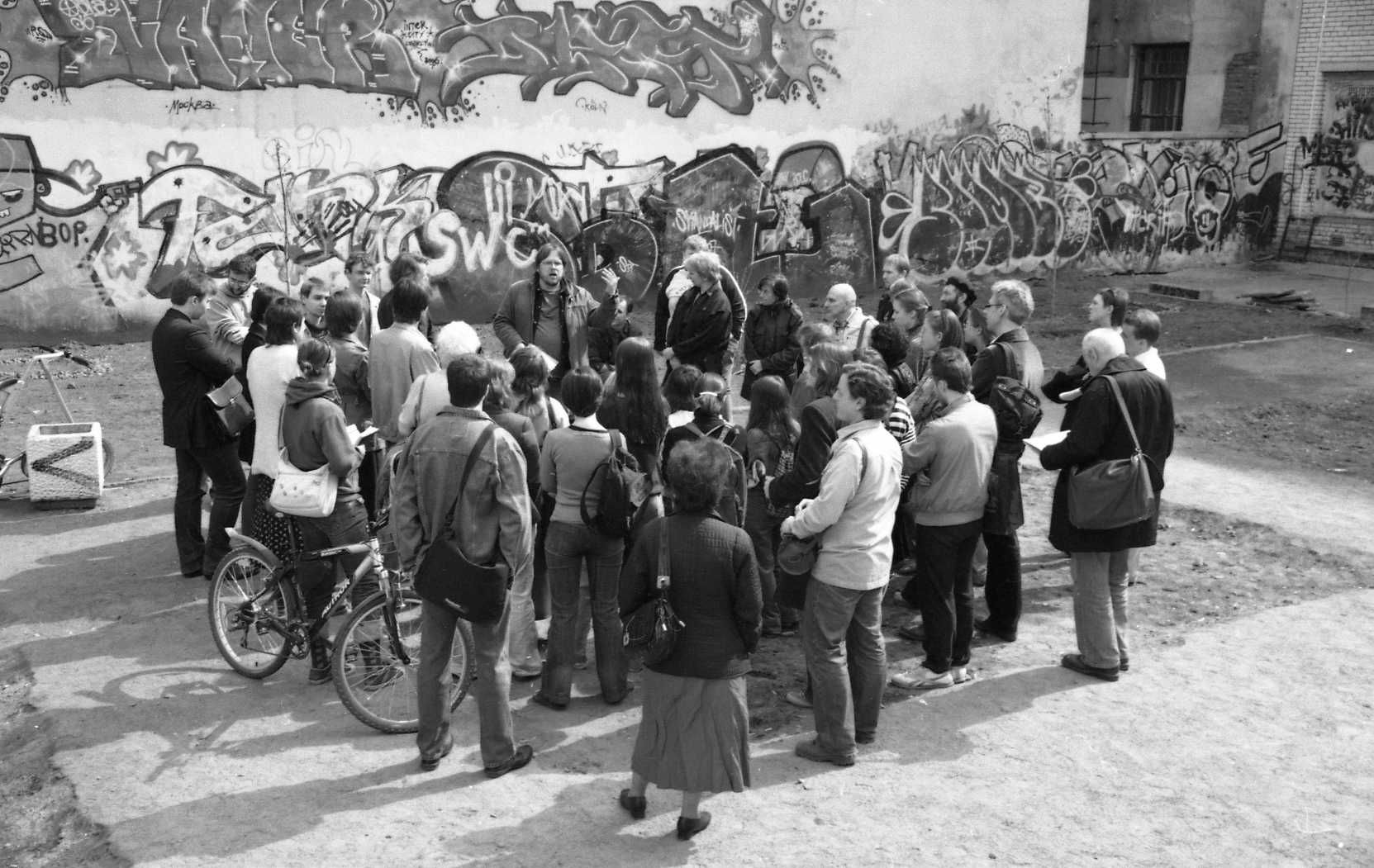
This session of Petersburg’s Street University, held on Elf Square in the city center circa 2008-2009, would have been impossible under the proposed amendments to the Law on Education. 

__________

February 8, 2021

Open Letter

To:

Russian President Vladimir Putin

Russian Prime Minister Mikhail Mishustin

Chairman of the Russian State Duma Vyacheslav Volodin

Russian Federation Council Members A.A. Klimov, E.V. Afanasyeva, A.V. Vainberg, L.N. Glebova, and O.V. Melnichenko

Russian State Duma Members V.I. Piskarev, A.G. Alshevskikh, N.I. Ryzhak, A.K. Isaev, R.D. Kurbanov, I.V. Belykh, N.V. Poklonskaya, D.I. Savelyev, A.V. Chep, A.L. Shkhagoshev, E.A. Yampolskaya, V.V. Bortko, S.M. Boyarsky, O.M. Kazakova, E.G. Drapenko, A.M. Sholokhov, O.L. Lavrov, S.A. Shargunov, O.M. Germanova, V.Yu. Maksimov, N.N. Pilus, and S.B. Savchenko

Russian Federal Minister of Culture O.B. Lyubimova

Russian Federal First Deputy Minister of Culture S.G. Obryvalin

We, the undersigned, are cultural, educational, and academic professionals engaged in educational outreach work in Russia, as well as Russian citizens concerned about the future of culture, education, and research in our country. We write to you in connection with Draft Law No. 1057895-7 “On Amendments to the Federal Law ‘On Education in the Russian Federation’” (hereinafter referred to as “the Draft Law”), which was passed by the State Duma in its first reading. If the Draft Law becomes law, it will, in our opinion, open the door to repressive regulation and censorship. In its current form, it threatens the constitutional rights of Russian citizens and the growth of our country’s educational and cultural fields due to its vague wording and rawness.

The Explanatory Note to the Draft Law states, “The federal draft law is aimed at improving the legal regulation of educational activities in the Russian Federation,” and “the draft law […] would generate additional conditions for developing human culture, encouraging individual socialization, and motivating individuals to form an active civic stance.” However, it contains no detailed comparative risk-benefit analysis proving that the stated goal would be pursued, rather than its opposite.

At the same time, the rules and regulations that would be issued if the Draft Law were passed, as well as the content of the Draft Law itself, have rightly caused fears among professionals that administrative barriers to educational outreach work would be raised that infringe on constitutionally protected rights and freedoms, including:

  • the right to education (per Article 43, Paragraph 1 of the Russian Federal Constitution)
  • the right to seek out, receive, transmit, produce and disseminate information (per Article 29, Paragraph 4 of the Russian Federal Constitution)
  • and freedom of literary, artistic, scientific, technical and other types of creativity, as well as freedom of instruction (per Article 44, Paragraph 1 of the Russian Federal Constitution).

The Draft Law is extremely restrictive

According to Article 43, Paragraph 5 of the Constitution of the Russian Federation, “The Russian Federation establishes federal educational standards, [and] supports various forms of education and self-education.” In its current version, however, the Draft Law and the accompanying regulations adopted if it is implemented (as suggested by the public statements of its authors) are aimed not at supporting but at limiting educational outreach as sponsored by federal cultural and educational organizations, as well as by independent platforms, private organizations, and grassroots groups.

The text of the Draft Law defines educational outreach work as “activities, implemented outside the framework of educational programs, that are aimed at disseminating knowledge, skills, values, know-how and competence in order to develop individuals intellectually, spiritually, morally, creatively, physically and (or) professionally, and meet their educational needs and interests, and that touch on relations regulated by this federal law and other legislative acts of the Russian Federation.” The vagueness of the wording means that educational outreach work can be defined as any public activity in which knowledge and competencies are disseminated. Hence, we can conclude that educational outreach work could include not only individual lectures and workshops organized by licensed educational institutions, but also exhibitions, festivals, conferences, the work of popularizers of science and art, openly accessible blogs and vlogs, and much more.

The Draft Law introduces redundant regulations and opens the door to censoring educational outreach work

The Draft Law prohibits incitement to social, racial, ethnic or religious strife, and incitement to actions contrary to the Russian Federal Constitution. At the same time, the dissemination of information for these purposes is already prohibited by current Russian federal legislation, whose norms are also applicable to educational outreach work (per Article 10 of the Federal Law “On Information,” Article 13 of the Federal Law “On Countering Extremism,” and the corresponding provisions in the Administrative Offenses Code and the Criminal Code).

Currently, oversight is implemented correctively (ex post). We are concerned that the secondary legislation could introduce preventive (ex ante) regulation requiring that educational materials be approved before they are published, thus restricting freedom of opinion, as well as significantly complicating the work of law-abiding educators while not affecting the activities of banned extremist organizations.

The Draft Law is isolationist

The Draft Law obliges educational organizations to obtain the approval of the executive authorities when negotiating educational agreements with foreign organizations and foreign nationals involving expenditures. The provision would cover not only financial contracts involving state educational institutions (to which the laws on public procurement apply), but also other agreements, including non-financial cooperation agreements, which are signed in large numbers by all major educational institutions, as well as contracts made by non-governmental educational organizations.

The introduction of additional restrictions and controls on international exchanges and the engagement of foreign nationals by educational organizations inevitably entails an additional bureaucratic burden that most non-profit independent organizations would not be able to handle because they lack the necessary resources. Consequently, international exchanges would face the threat of significant cuts, leading to the stagnation of culture and research in Russia: growth in these fields is impossible without a constant exchange of know-how and ideas with colleagues from other countries. The lack of an opportunity to build stable, permanent relations with the international professional community would inevitably lead to a lag in the growth of culture, research and education in our country.

Educational outreach is carried out not only by large state institutions, but also by independent non-profit organizations, as well as by grassroots groups who find it difficult to secure the minimal resources needed for engaging foreign colleagues and implementing international projects. In this regard, introducing requirements for obtaining additional permits to engage foreign nationals in educational outreach projects would make it impossible to implement grassroots and non-profit undertakings. Russian citizens, including vulnerable segments of the populace, would thus also lose the opportunity to gain knowledge from highly qualified specialists on a regular, often pro bono basis.

The Draft Law delegates unregulated oversight to the Government

The Draft Law adopted by the State Duma in the first reading is extremely vague: it does not specify procedures and boundaries for overseeing educational outreach work, does not delimit regulatory entities, and does not define the types of international cooperation pursued by educational organizations that would require official approval. Essentially, the State Duma (a legislative body) has wholly delegated policymaking in the educational outreach field to the Government of the Russian Federation (an executive body) without setting any criteria and restrictions. This makes it possible, when adopting secondary legislation, to interpret the will of the legislators quite broadly, in a variety of directions. The vagueness of the wording, as well as the delegation of further rule-making to the Government of the Russian Federation, raises concerns in the professional community that the regulation would be repressive and involve censorship, thus considerably complicating the implementation of educational outreach work.

Oversight and restriction of educational outreach based on extremely vague reasons, thus allowing for varying interpretations “on the ground,” are contrary to the constitutional rights and freedoms of Russian citizens. In this regard, we, cultural, educational, and academic professionals engaged in educational outreach work in Russia, call on you to reject Draft Law No. 1057895-7 “On Amendments to the Federal Law ‘On Education in the Russian Federation,’” as its adoption, in our opinion, would open the door to repressive regulation and censorship due to its vague wording and rawness.

[Signed, in the original, by Lizaveta Matveeva (St. Petersburg), curator of the Main Project of the Seventh International Moscow Youth Biennale, the Art Prospect International Public Art Fair, and the DYI Fair, and 1,002 other signatories]

Thanks to Susan Katz for asking me to translate the open letter and sending me the link to the article from Fontanka.ru. Both texts were translated by the Russian Reader
Fifty Members of the Russian Academy of Sciences: “We Urge the Court to Release Azat Miftakhov”

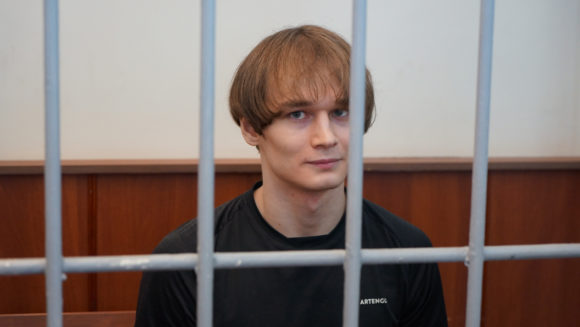
Azat Miftakhov during a hearing at the Golovinsky District Court in Moscow. Photo: N. Demina. Courtesy of Troitsky Variant

[Original letter: https://trv-science.ru/2021/01/free-azat-letter-rs/]

The trial of Azat Miftakhov is of the utmost concern to us, his mathematician colleagues.

Azat Miftakhov, a PhD student in the Faculty of Mechanics and Mathematics at Moscow State University, was detained by security forces in the early hours of 1 February 2019 and has been in custody for almost two years. The charges against him have changed, and the only remaining charge (breaking a window in an office of the political party United Russia) is based only on the testimony of secret witnesses. According to reports by lawyer Svetlana Sidorkina and the Public Monitoring Commission, Azat was tortured in the interim before his arrest was formalised in the late evening of 2 February 2019. However, as far as we know, a criminal investigation into Azat’s allegations of torture has not been launched.

In prison, Azat has written two scientific papers, one of which was published in the Bulletin of the Polish Academy of Sciences. The other was submitted to an international scientific journal.

All petitions to release Azat from pre-trial detention in favor of milder measures of pre-trial restraint were rejected by the court. The punishment already borne by Azat does not appear to be commensurate with the crime he is alleged to have committed, and the sentence of six years in a penal colony requested for him by the state prosecutor provokes our indignation.

We urge the court to release Azat Miftakhov.

[Signatories]

V.M. Alpatov, RAS Academician
A.E. Anikin, RAS Academician
Yu.D. Apresyan, RAS Academician
L.Y. Aranovich, RAS Corresponding Member
P.I. Arseev, RAS Corresponding Member
L.D. Beklemishev, RAS Academician
A.A. Belavin, RAS Corresponding Member
E.L. Berezovich, RAS Corresponding Member
E.A. Bonch-Osmolovskaya, RAS Corresponding Member
A.B. Borisov, RAS Corresponding Member
S.A. Burlak, RAS Professor
A.I. Bufetov, RAS Professor
V.A. Vasiliev, RAS Academician
M.M. Glazov, RAS Corresponding Member
N.P. Grintser, RAS Corresponding Member
A.V. Dvorkovich, RAS Corresponding Member
A.S. Desnitskii, RAS Professor
A.V. Dybo, RAS Corresponding Member
V.E. Zakharov, RAS Academician
A.V. Ivanchik, RAS Corresponding Member
A.I. Ivanchik, RAS Corresponding Member
V.V. Izmodenov, RAS Professor
Yu.Yu. Kovalev, RAS Corresponding Member
A.A. Kotov, RAS Corresponding Member
Z.F. Krasil’nik, RAS Corresponding Member
Ya.V. Kudriavtsev, RAS Professor
E.A. Kuznetsov, RAS Academician
I.Yu. Kulakov, RAS Corresponding Member
A.G. Litvak, RAS Academician
A.A. Maschan, RAS Corresponding Member
O.E. Melnik, RAS Corresponding Member
R.V. Mizyuk, RAS Corresponding Member
A.M. Moldovan, RAS Academician
I.I. Mullonen, RAS Corresponding Member
A.K. Murtazaev, RAS Corresponding Member
A.A. Pichkhadze, RAS Corresponding Member
V.V. Pukhnachev, RAS Corresponding Member
В.I. Ritus, RAS Corresponding Member
N.N. Rozanov, RAS Corresponding Member
A.A. Saranin, RAS Corresponding Member
G.S. Sokolovsky, RAS Professor
O.N. Solomina, RAS Corresponding Member
S.M. Stishov, RAS Academician
S.V. Streltsov, RAS Corresponding Member
S.M. Tolstaya, RAS Academician
A.L. Toporkov, RAS Corresponding Member
F.B. Uspenski, RAS Corresponding Member
E.A. Khazanov, RAS Academician
A.V. Chaplik, RAS Academician
E.M. Churazov, RAS Academician
D.G. Yakovlev, RAS Corresponding Member

The verdict in Azat Miftakhov’s trial is scheduled to be announced at the Golovinsky District Court in Moscow on Monday, January 18, 2021. Thanks to MV for bringing this letter to my attention. || TRR

They Have Nothing Better to Do

Dmitry Gudkov
Facebook
January 9, 2021

I understand that Russians there is no problem more important than Trump’s showdown with Twitter. The precedent of blocking a social network account is not a very good one, of course, but the folks in the US will cope without us. I would venture to throw out a different topic for discussion.

On Monday, January 11, the verdict in the case of Azat Miftakhov will be read out in the Golovinsky District Court in Moscow. Trump was banned on Twitter, but Azat, a graduate student in mathematics from Moscow State University, has been locked up in for allegedly breaking a window at United Russia party office. He has been in a pretrial detention center for two years, although there is no evidence of his guilt.

If you’re worried about freedom of speech, Azat’s case is also cause for worry. At the last court hearing in the case, people who came to support Azat were not only not allowed into the court building. They were simply locked up in the courtyard of the building. A paddy wagon was brought  in and shipped them out of there. The detainees included two journalists, with press cards, but that means nothing to our authorities.

If the Miftakhov case were given at least 1% of the attention that has been spent on Trump in Russia, the case would not have happened. And we’re not taking about a ban on Twitter here, but arrest, torture, and a [possible] imprisonment in a penal colony.

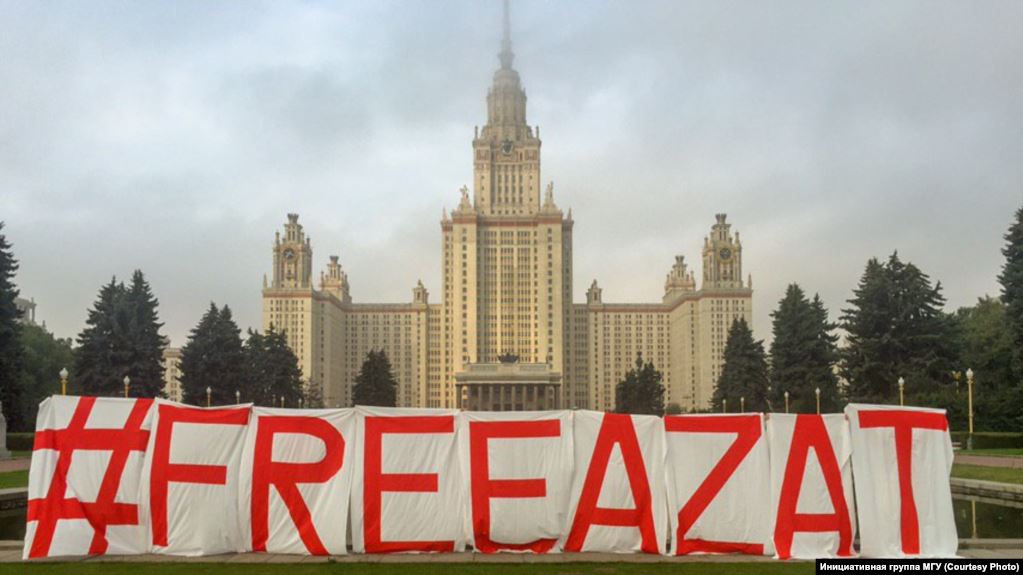
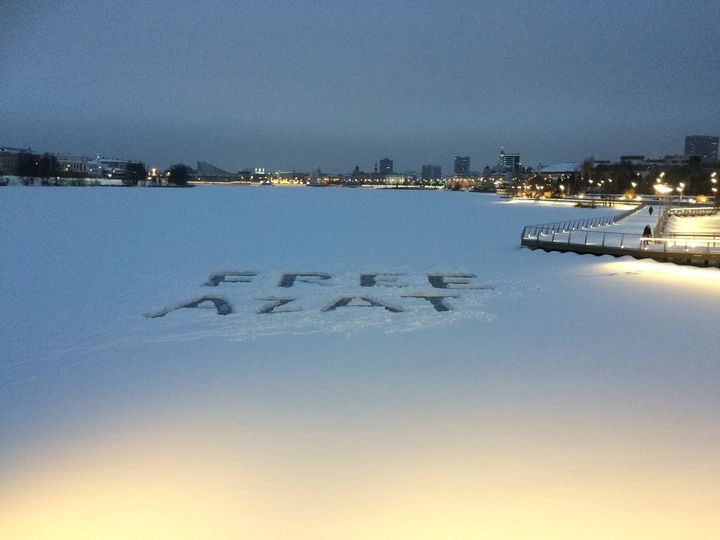
Today, someone spelled out the message “FREE AZAT” on Lake Kaban in Kazan. This was protest action in support of mathematician and anarchist Azat Miftakhov. On January 11, at 12:00 p.m., the Golovinsky District Court will announce the verdict. The prosecution has asked for six years in prison for the young academic. If you have the opportunity, be sure to come to the hearing!

Boris Vishnevsky
Facebook
January 9, 2021

In our country, Roskomnadzor can block any media outlet or website that tells truths that the authorities find unpleasant.

But this does not cause popular outrage.

In our country, people are put in jail for reposting things on the internet.

But this does not cause popular outrage.

In our country, hundreds of political prisoners are being held on falsified charges, starting with Yuri Dmitriev and ending with the defendants in the Ingush protest movement trial.

But this does not cause popular outrage, and rallies and pickets in support of these people attract almost no attention.

In our country, anyone who disagrees with the authorities can be declared a foreign agent.

But this does not cause popular outrage.

In our country, the president has been given lifelong immunity from prosecution for any and all crimes, and he does not even need to pardon himself in advance.

But this does not cause popular outrage.

But what an explosion of indignation there has been over the blocking of Trump’s Twitter account. It has been the main topic of discussion in Russia!

As long as this is the case, the Kremlin can rest easy.

__________________

Sergey Abashin
Facebook
January 9, 2021

It’s stunning. Russia has hundreds of political prisoners, political assassinations and political persecution, two ongoing wars involving tens of thousands of dead and the occupation of territory in several [foreign] countries, a personal dictatorship that has been de facto and legally established, and laws that permit total censorship in the mainstream media. And yet Russian intellectuals are hotly debating whether it is right or wrong to block the American president’s Twitter account two weeks before the end of his official term.

Translated by the Russian Reader

A Letter to the International Congress of Mathematicians on the Azat Miftakhov Case

January 4, 2021

To the members of the Executive Organizing Committee and Local Organizing Committee of the International Congress of Mathematicians (ICM):

Dear ICM Organizers,

The international mathematical community is deeply concerned about the situation of Azat Miftakhov, the graduate student from Moscow State University who has been detained by Russian state authorities for nearly two years.

Azat is a talented young mathematician who comes from the Tatarstan region in the Russian Federation. Already in school he won prizes in several math competitions and received support given to talented young people by the Ministry of Education and Science. As a student in Moscow he became involved with the anarchist movement. In February 2019, right after his return from a conference in Nizhni Novgorod where Azat gave his first talk in English, he was detained by the police and accused of manufacturing explosives. He was tortured at the police station. After three days Azat was released, since the court found no evidence to justify his detention. Less than two days later, on February 9, 2019, he was again arrested and accused of destruction of an office window of the United Russia political party, an act which had taken place more than a year earlier. He has been kept in jail since then. The lack of evidence in Azat’s case is disturbing, as is the fact that, for most of the time since his arrest, he has remained in pre-trial detention.

Azat pleads not guilty. During his detention he has managed to publish two mathematical preprints on arxiv.

Azat Miftakhov has been recognized as a political prisoner by the Russian human rights organization Memorial. The American Mathematical Society and Société Mathématique de France have issued statements of concern. A recent petition in support of Azat has been signed by more than 2000 mathematicians from more than 15 countries.

On December 23, 2020 it was announced that Azat faces six years of prison if convicted.

While Russia is going to host the ICM in less than two years, Miftakhov’s trial reminds us of the host country’s frequent violations of human rights and repression of freedoms, which are regularly condemned by human rights organizations. Let us recall that in 1982 the International Congress in Warsaw was postponed by one year, during which various actions were taken by the international mathematical community to free political prisoners in Poland.

Freedom is one of the highest values for us as scientists. Attending the congress while our colleague Azat Miftakhov is arbitrarily detained will pose a serious dilemma for us and for the entire mathematical community. We kindly ask you to take an active position on this case and to communicate with the state authorities to free Azat.

[Signatories]

Ahmed Abbes, mathematician, Director of research at CNRS, Paris

Zofia Adamowicz, Professor, Institute of Mathematics of the Polish Academy of Sciences

Fabrizio Andreatta, Professor of mathematics, Università Statale di Milano

Michèle Audin, mathematician and writer

Viviane Baladi, mathematician, Director of research at CNRS, Paris

Arnaud Beauville, Professor emeritus of mathematics, Université Côte d’Azur

Michel Broué, Professor emeritus of mathematics at the University of Paris

Antoine Chambert-Loir, Professor of mathematics, Université de Paris

Bruno Chiarellotto, Professor of mathematics, Università degli studi di Padova

Henri Darmon, Professor of mathematics, McGill University

Chandler Davis, Professor emeritus of mathematics at the University of Toronto

Adrien Deloro, Associate professor of mathematics at Sorbonne Université

Fabien Durand, Président de la Société Mathématique de France, Professor of mathematics, Université de Picardie Jules Verne

Ivar Ekeland, FRSC, Professor emeritus of mathematics and former President, University of Paris-Dauphine

Pavel Etingof, Department of Mathematics, MIT

Javier Fresán, Professor, École polytechnique

Dennis Gaitsgory, Professor of mathematics, Harvard University

Paul Garrett, Professor of mathematics, University of Minnesota

Damien Gayet, Professor of mathematics at Institut Fourier and Editor-in-chief of the Gazette des mathématiciens

Catherine Goldstein, Director of research at CNRS, Institut de mathématiques de Jussieu-Paris Gauche, Paris

Timothy Gowers, Professor of combinatorics, Collège de France

Michael Harris, Professor of mathematics, Columbia University

Frédéric Hélein, Professor, Université de Paris

Ilya Kapovich, Professor of mathematics, Hunter College of CUNY, Chair, Committee on the Human Rights of Mathematicians, American Mathematical Society

Vincent Lafforgue, mathematician, Director of research at CNRS, Grenoble

François Loeser, Professor of mathematics, Sorbonne University

Wiesława Nizioł, mathematician, Director of research at CNRS, IMJ-PRG, Sorbonne University

Joseph Oesterlé, Professor emeritus of mathematics at Sorbonne University, Paris

Arthur Ogus, Professor emeritus of mathematics, University of California at Berkeley

Fabrice Planchon, Professor of mathematics, Sorbonne University

Bjorn Poonen, Distinguished professor in science, Massachusetts Institute of Technology

Raphaël Rouquier, Professor of mathematics at the University of California at Los Angeles

Claude Sabbah, Director of research at CNRS, Université de Paris-Saclay

Takeshi Saito, Professor of mathematics at the University of Tokyo

Peter Sarnak, Professor of mathematics, Princeton

Pierre Schapira, Professor emeritus of mathematics, Sorbonne Université

Peter Scholze, Professor of mathematics at the University of Bonn and Director of Max Planck Institute for Mathematics in Bonn

Adam Skalski, Institute of Mathematics of the Polish Academy of Sciences

Stephen Smale, Professor emeritus of mathematics, University of California at Berkeley

Christophe Soulé, mathematician, member of the French Academy of Science

Bernard Teissier, mathematician, Director of research emeritus at CNRS, Paris

Dylan Thurston, Professor of mathematics, Indiana University, Bloomington

Claude Viterbo, Professor of mathematics at the University of Paris-Saclay and at the École normale supérieure de Paris

Masha Vlasenko, Professor, Institute of Mathematics of the Polish Academy of Sciences

David A. Vogan, Jr., Professor emeritus of mathematics, MIT

Jarosław A. Wiśniewski, Professor of mathematics at the University of Warsaw and corresponding Member of the Polish Academy of Sciences

Hatem Zaag, mathematician, Director of research at CNRS, Paris

Thanks to the authors of this letter for sending it to me. Photo courtesy of MSU Pressure Group and Radio Svoboda

Stopping Foreign Agents, Killing Russian Education

“Entry is prohibited”

Control, Censorship and Foreign Agents: How the Amendments to the Law “On Education” Will Affect All of Us
Ella Rossman
Mel
December 24, 2020

On December 23, the State Duma passed in its first reading a bill that would amend the law “On Education.” After the bill is passed into law, “anti-Russian forces” will no longer be able to “freely conduct a wide range of propaganda activities among schoolchildren and university students.” Tatyana Glushkova, a lawyer at the Memorial Human Rights Center, joined us to figure out what is happening.

Regulation International Cooperation
On November 18, 2020, fifteen Russian MPs proposed amendments to the law “On Education” that would regulate international cooperation on the part of educational organizations, as well as all educational activities in Russia itself.

The law would regulate interactions between educational organizations (i.e. licensed organizations) and foreigners. If the law is adopted, schools and universities would, in fact, be banned from engaging in all types of international cooperation without the approval of federal authorities. In this case, any interaction by an educational organization with foreign organizations or individuals would fall under the definition of “international cooperation.”

“International cooperation is when a Russian educational organization develops and implements joint educational programs with an organization or individual, sends pupils, students and instructors abroad (and they receive scholarships there), accepts foreign students and instructors to study and work in Russian organizations, conducts joint scholarly research, organizes international conferences and participates in them, and simply exchanges educational or scholarly literature with an entity or individual. After the law is adopted, all these activities, except for the admission of foreign students, would be possible only with permission from the Ministry of Science and Higher Education or the Ministry of Education.”
—Tatyana Glushkova, lawyer

According to Glushkova, the procedure for issuing permits would  be established by the government. “How would this affect international cooperation on the part of educational organizations? Obviously, negatively.”

“This is actually a revival of the idea that instructors should have to obtain permission to take part in international conferences, not to mention more meaningful interactions with foreign colleagues. Moreover, these permits would not even be issued by university administrations, but by a ministry.

“Given such conditions, universities and schools would engage in much less international cooperation. Obtaining any permission is a bureaucratic process that requires resources. It would be easier for some organizations to cancel international events than to get approval for them,” Glushkova says.

According to Glushkova, it is currently unclear what conditions would need to be met in order to obtain permissions. This would be established by new Russian government regulations, and so far we can only guess what they would look like.

Control of All “Educational Activities”
As the bill’s authors write in an explanatory note, the new bill must be adopted, since without it, “anti-Russian forces” can almost freely conduct a “wide range of propaganda activities” among schoolchildren and university students.

The Russian MPs argue that many such events are “aimed at discrediting Russian state policy,” as well as at revising attitudes toward history and “undermining the constitutional order.”

The amendments would affect both official educational organizations in Russia (schools and universities) and those engaged in “educational activities” outside of these institutions. At the same time, the proposed law defines the concept of “educational activities” as broadly as possible—in fact, it encompasses all activities in which new skills, knowledge, values or experiences are taught “outside the framework of educational programs.”

Anyone from tutors to bloggers could fall into this category.

The bill gives the authorities the right to regulate the entire sphere of educational activities. It not yet clear of how this would be organized: the details of what would be controlled and how it would be controlled are not spelled out in the bill.

Sergei Lukashevsky, director of the Sakharov Center, dubbed the amendments “revolutionary in the sad sense of the word,” as they would allow the government to declare the exchange of almost any type of information as “education” and therefore subject to regulation, that is, to what amounts to censorship.

Glushkova outlined the context in the new bill has emerged.

The bill was submitted to the State Duma at the same time as a whole package of other bills that, formally, would significantly limit the activities of different civil society organizations in Russia.

To put it simply, they would simply crush the remnants of Russian civil society that haven’t been killed off yet.

One of these bills would institute full government control over NGOs listed in the register of “foreign agents.” It would give the Ministry of Justice the right to suspend (in whole or in part) the activities of such organizations at any time. Another bill introduces the concept of “unregistered foreign-agent organizations,” and also expands the scope for designating individuals as “foreign agents.”

If an unregistered organization or individual is included in the register of foreign agents, they would be required to report to the Ministry of Justice, including their expenses. At the same time, all founders, members, managers and employees of foreign-agent organizations (whether registered or not) would be required to declare their status as “foreign agents” when making any public statement concerning the government.

For example, if a cleaning lady who works for an NGO wanted to write on her social network page that her apartment is poorly heated, she would have to indicate that she is affiliated with a “foreign agent.” Naturally, sanctions are provided for violations of all these regulations, and in some cases they include criminal liability.

In my opinion, these bills are not a reaction on the part of the authorities to any actual foreign or domestic political events. They are just another round of “tightening the screws” and attacking civil society.

The regime’s ultimate goal is the ability to do anything, however lawless, without suffering the consequences and without having to endure even critical feedback from society. This process has been going on since 2012 at least.

In order to achieve this goal, the regime seeks, first, to declare everything that has at least some connection with foreign countries (which, in its opinion, are the main source of criticism of events in our country) suspicious, unreliable and harmful. Second, it is trying to take maximum control of all public activities related to the dissemination of information and the expression of civic stances.

The amendments to the law “On Education” would affect not only all educators, but also people who probably have never considered themselves educators. For example, if I publish an article on the internet on what to do if you buy a defective product, I am engaged in “activities aimed at disseminating knowledge.”

If I do a master class on embroidery, that would be deemed “an activity aimed at disseminating skills.”

Both activities would fall under the definition of educational activities. In fact, any dissemination of information could be declared an “educational activity.” All educational activities, according to the bill, would now have to be implemented on the terms established by Russian federal government and under its control.

We still do not know what the rules will be. They could be quite mild, or they could be harsh. Don’t forget that an indulgent regime can be tightened at any time. You merely need to adopt a regulation—not a law, whose approval entails a complex procedure, but only a government decree.

Thanks to Valentina Koganzon for the heads-up. Photo and translation by the Russian Reader

The New Authoritarianism & Memory Activism (Upcoming Web Lectures)

Russia’s New Authoritarianism: Putin and the Politics of Order
Wednesday, December 9, 2020
11:00am-12:00pm
Virtual Event

Webex Session:

https://gwu.webex.com/gwu/onstage/g.php?MTID=e2bb03137d78716ed2604aa06059d9676

David Lewis’s recent book Russia’s New Authoritarianism: Putin and the Politics of Order takes a new conceptual approach to understanding the nature of the Putinist regime in Russia. The book explores how illiberal ideas have shaped Russia’s political debates and influenced both domestic and foreign policy. It highlights the affinity of many aspects of Russian illiberalism with the ideas of the controversial jurist and Nazi supporter Carl Schmitt, particularly the ideas of sovereignty and exceptionality, which are illustrated in the book by case-studies of Russia’s judicial system and the annexation of Crimea. In foreign policy, the book discusses the importance of spheres of influence in Russia’s worldview, and explores the messianic elements involved in Russian policy in Syria. It concludes with a discussion of how Russia’s authoritarian turn fits within a wider global trend towards illiberal politics and authoritarianism.

David G. Lewis is Associate Professor of International Relations in the Department of Politics at the University of Exeter. Before joining the University of Exeter, David held academic posts in the Department of Peace Studies, University of Bradford, and worked for the International Crisis Group in Central Asia and in Sri Lanka. He has written extensively on politics and security in Russia, Central Asia and the Caucasus, and on different aspects of international relations and peace and conflict studies. His books include The Temptations of Tyranny in Central Asia (Hurst, 2008) and Russia’s New Authoritarianism: Putin and the Politics of Order (Edinburgh University Press, 2020). His recent research has been on the rise of illiberal ideas and authoritarian practices in global politics, particularly in relation to conflict management and peace-making. He is currently (2019-2021) on part-time secondment as an ESRC-AHRC Research Fellow at the UK Foreign and Commonwealth Office in London.

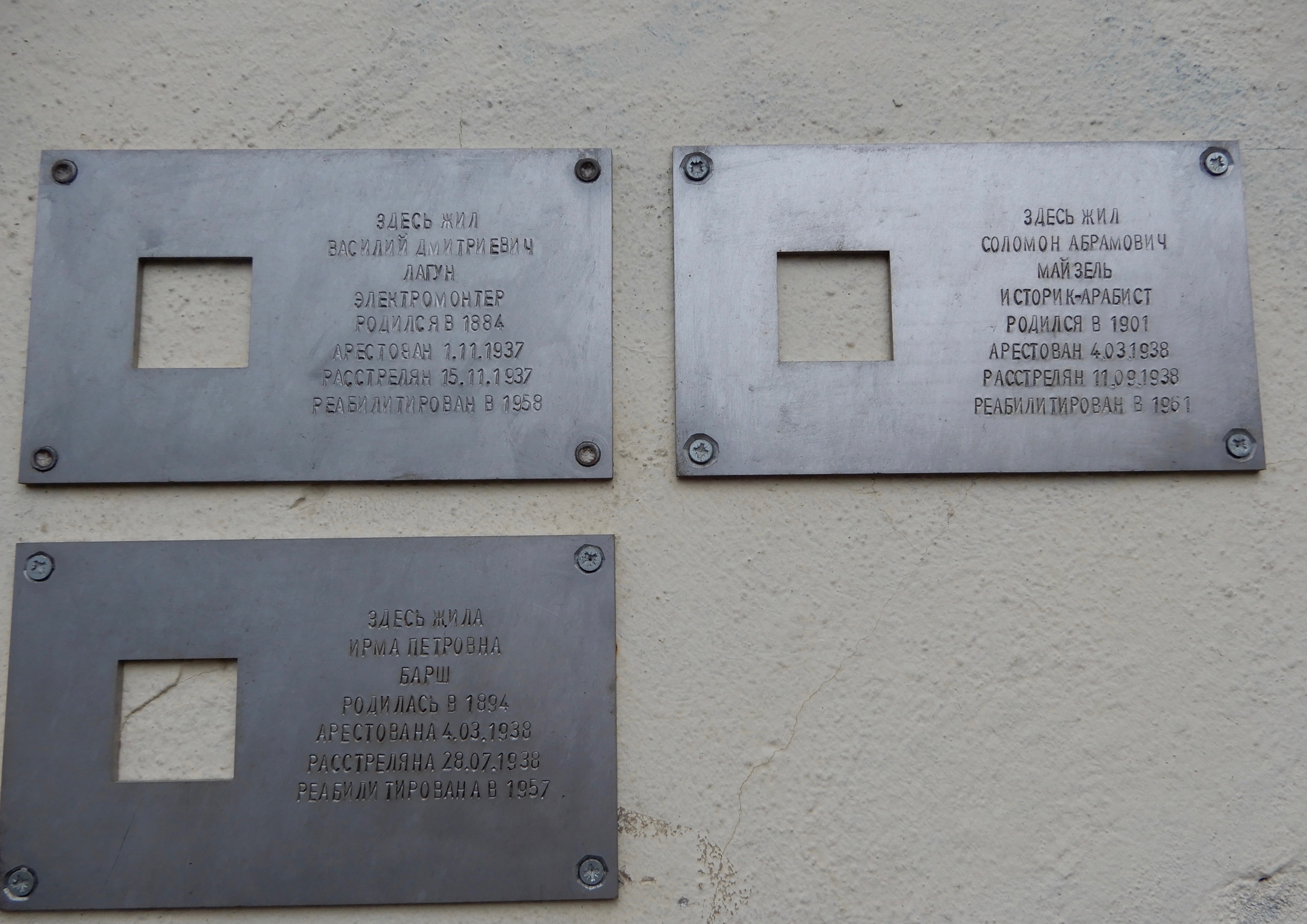
Last Address memorial plaques in Petersburg
Dear all, you are warmly invited to the next CEES/CRCEES seminar on Wednesday, December 9th, 4:00-5:30pm. All are welcome!

Wednesday, December 9th

4:00-5:30pm

Zoom Meeting link:

https://uofglasgow.zoom.us/j/94413559725?pwd=ZW5jOTVTVURra2MyTzhrMzF2T2kxZz09

Meeting ID: 944 1355 9725

Passcode: 073247

Dr Galina Oustinova-Stjepanovic 

Department of Anthropology 

University of St. Andrews 

The Name and the Number of the Dead in Memory Activism in Moscow 

Every fortnight, anti-Stalinist activists in Moscow install name plaques on the façades of houses where someone was arrested in the period between 1937 and the early 1950s. On October 29, on the eve of the official day of commemoration of victims of political repressions, thousands of Muscovites participate in the annual name reading ceremony at the Solovetsky stone, a monument to the victims of political repressions, placed outside the Federal Security Services headquarters (previously, NKVD and KGB) on Lubyanka square. Daily, memory activists and volunteers rake through archives and attics in a relentless quest for forgotten names and diaries, and record these names in memory books and catalogues, as well as copy, multiply, digitise and publish them in online archives.

The impetus for my key argument is an ethnographic observation that the memory activists I met in today’s Moscow give primacy to the singular names of each victim over the final total number of people executed during Stalin’s reign. Such activities reflect a familiar but largely unacknowledged and undertheorized propensity to document, catalogue and speak out the names of victims of atrocities, be it a military conflict or acts of political terror. Arranged as an alphabetical or random sequence, the names are guarded against statistical reason, or the “mania for exact numbers” (Merridale 2000:5) of the official national historiography in Russia. Importantly, the lists of names do not differentiate between a victim and an executioner, between an atheist and a devout priest, or between a Russian and a Jew. This way, the names do not contribute to boundary-policing of sovereignties, national mourning, and aspirations to national unity. Instead, the activists simultaneously assign each name a value of singularity and collect the names into infinitely long registers that establish an undifferentiated, nonnumerical kind of totality: a multitude of the living and the dead. I will argue that the practices of collecting and monumentalizing names of the dead afford an understanding of how the relationship to an unwitnessed historical mass murder and its absent subjects is instituted.

The CEES Seminar Series is kindly supported by the Macfie Bequest.

Thanks to Gabriel Levy and CISR for the heads-up. || TRR

One Easy Way Merkel Could Punish Putin for Poisoning Navalny

The Dialogue of Civilizations (DOC) Research Institute, a front used by the Putin regime to co-opt the oddly named international community’s brahmins and bigwigs, is a twenty-minute walk from the Bundestag, and it is surrounded by German ministry buildings. What better way for the German government to express its distress with the Russian government’s poisoning of Alexei Navalny than by shutting the DOC down?

If Angela Merkel actually wants to get tough on Putinist Russia, I can tell her how and where to start: by closing down the Dialogue of Civilizations Research Institute, an extraordinarily well-organized, aggressive “soft power” front for co-opting international opinion leaders, decision makers, policy wonks, public intellectuals, and academics, run by high-level Putin crony Vladimir Yakunin, and located at Französische Str. 23 in the heart of the German capital, a mere twenty-minute walk from the German parliament, the Bundestag.

But of course that will never happen because Merkel is not going to do anything of the sort. Shame on her. \\ TRR

No Culture Icons

putin-icon

[File under: You can’t make this stuff up; With friends like these who needs enemies?]

“Though in recent months Putin’s popularity has frayed at the edges, the dearth of comparably powerful and experienced political leaders leaves no doubt that he will continue to be a key political figure. During his tenure as Russia’s President and subsequently as Prime Minister, Putin transcended politics, to become the country’s major cultural icon. This book examines the nature of his iconic status. It explores his public persona as glamorous hero, endowed with vision, wisdom, moral and physical strength—the man uniquely capable of restoring Russia’s reputation as a global power. In analysing cultural representations of Putin, the book assesses the role of the media in constructing and disseminating this image and weighs the Russian populace’s contribution to the extraordinary acclamation he enjoyed throughout the first decade of the new millennium, challenged only by a tiny minority.” (Description of Putin as Celebrity and Cultural Icon, a volume of scholarly essays published by Routledge in 2013; my emphasis.)

Half a Million Migrants in Moscow Have Lost All Sources of Income

d8a5aa0e-9470-11ea-be48-fa163e074e61Photo by Sergei Lantyukhov for NEWS.ru

Study: Half a Million Migrants in Moscow Have Lost All Sources of Income
Sociologists say government should introduce social security for foreigners, otherwise “social tension” inevitable
Sergei Vilkov
NEWS.ru
May 12, 2020

More than half the migrants in Moscow have lost their jobs, and a significant portion of them have also lost all sources of income, according to a study done by a group of sociologists, led by Evgeni Varshaver, at the Center for Regional and Urban Studies in RANEPA’s Institute for Applied Economic Research. NEWS.ru took a look at their preliminary findings, which have been presented to the Russian government in the form of a briefing paper. The sociologists analyzed the risk of a sharp uptick in crime and social unrest among migrants, as well as making recommendations, one of which was to provide migrants with social security and health insurance. The lead author of the study backed up the findings with his own arguments.

An Invisible Army

While 32% of Moscow residents who are Russian nationals have lost their jobs or been sent on unpaid leave [due to the coronavirus pandemic], 54% of those who come from other countries have lost their jobs in the Russian capital. 32% of migrants have lost all sources of income, while among Muscovites who are Russian nationals this figure is 17%. Only about one in ten guest workers reported that their financial situation had not changed, the report says. (NEWS.ru has a copy of the report.)

If one extrapolates the data from the study to all migrant workers in Moscow, then, given that their number has been estimated by experts at about 1.5 million people, around 500,000 people have completely lost their livelihoods, according to the briefing paper. Reports continue to appear about migrants who have lost their homes and remain in the Russian Federation with no fixed abode [i.e., they are homeless de jure, if not de facto—a critical distinction in Russia, where everyone is required by law to be registered with the authorities at their actual residence]. Migrants often do not receive the free medical care to which they are entitled by law, and other forms of medical care are often too expensive for them.

As the researchers note, migrants are, at the same time, at special risk for the epidemic. The apartments that they rent are, on average, twice as densely inhabited as those of Russian nationals.

Speaking of a possible increase in crime among migrants due to the pandemic, the researchers argue that “although it is possible to assume a slight increase in the number of property crimes by this category of persons, expectations of an explosive increase in crime among migrant workers are not borne out.”

The researchers argue that there was no surge in criminal activity among guest workers during previous crises. This was partly due to oversight by diasporas and similar communities.

When NEWS.ru asked whether diasporas can really control their fellow countrymen, the head of the research group, Evgeni Varshaver, warns against extreme views on this issue. Migrants, he says, like all other people, listen to figures of authority. It is also important to understand that if such respected people have been living in Russia for a long time, they have often been incorporated into local elites (albeit, sometimes, as something exotic), and it is in their interests to prevent the growth of crime among migrants, because in the eyes of their “partners” in Russia, they are responsible for the behavior of their compatriots. Varshaver admits, however, that this influence is often exaggerated.

“However, this does not mean that it does not exist at all. It does exist, and the smaller the locality, the more intense the communication among elites and ordinary migrants, and the more these two groups rely on each other: the first can help with money or put in a word with the migration service; the second, if push comes to shove, can stage a protest rally.  In a large city, due to greater differentiation and multilayered social structure, this link is not so obvious, and the possibilities of atomization are greater. But now let’s get back to what prompted us to discuss diasporas, namely, whether migrants will commit more crimes. I think that they will, along, however, with other deprived groups, and this is understandable in circumstances of acute impoverishment, but this surge will not be as powerful as predicted in some pro-migrant and anti-migrant publications,” says Varshaver, a senior researcher and head of the Migration and Ethnicity Research Group at RANEPA.

In addition, the authors of the study refer to the findings of sociological studies of past years, indicating that among migrant workers in Russia, “the prevailing attitude has been to comply with the laws of the country of residence.”

In 2016, RANEPA sociologists surveyed 2,412 migrant workers in different regions of Russia. 83% of them indicated that it was absolutely necessary to comply with the laws of the host country. However, it would be strange to expect respondents to say the opposite, although even in that study, 3% of migrants chose the option “No, it’s okay if not all the rules are followed.”

A Reason for Welfare

Separately, the researchers considered measures to support migrants. They identified as positive the fact that the presidential decree of April 18 granted foreigners the right to stay in Russia regardless of the length of their residence permits. The requirement to obtain a work permit was then temporarily lifted, meaning that if migrants were out of work and their permit expired, they would not have to buy one. From the same decree, it followed that migrants no longer had to work in the region where they were issued a work permit. The ability to move to another region without bureaucratic barriers has significantly expanded the options of migrants for finding work in crisis conditions, according to the authors of the study. Simultaneously, volunteer aid programs have been implemented, and some migrants are now able to receive charitable support in the form of food and compensation for housing costs.

However, these measures do not solve the problem. According to the RANEPA researchers, it is necessary to ensure that the minimum needs for food and housing of migrants who remain in Russia are met until they have been employed or they can return to their countries of origin. During an epidemic, the link between the well-being of local residents and the circumstances of migrants is more pronounced than in other periods, including after the the risk of property crimes has been taken into account, they argue. In addition, it is necessary to ensure better access to medical care for migrants and to lessen the load on temporary detention centers for foreign nationals subject to deportation.

“This will inevitably be an unpopular decision; moreover, such assistance should be provided along with the assistance that is provided to non-migrants,” explains Varshaver. “A pained reaction on the part of nationalistically minded Russians to the decision to provide this assistance is inevitable, but on the other side of the scale you have total impoverishment accompanied by real hunger, a possible increase in crime, and other negative social consequences, and so it is necessary to make an informed decision, which obviously is to take care of all those who were forced to stay in Russia when the borders closed and hence cannot go anywhere.”

These measures seem to be necessary at the moment. Otherwise, a significant number of migrants will lose their livelihoods, which, regardless of how valid current alarmist expectations are, will lead to significant social tension, the authors of the study claim.

cd21b5aa-9471-11ea-a603-fa163e074e61Photo by Kirill Zykov for Moskva News Agency

When asked how the end of “non-workdays,” as announced by President Vladimir Putin, would affect the circumstances of migrants, Varshaver explains that it is difficult to make forecasts.

“On the one hand, there has been a lot of talk about the situation with migrants, and aid resources have been mobilized, which is why the crisis has been dampened as much as possible. On the other hand, every day of quarantine has a negative impact on the economy as a whole and on migrants in particular. On the third hand, yes, of course, the exit from the quarantine, for example, of the construction industry (I wonder if it has really gone into a full lockdown?) will also enable migrants working in construction to start earning money. On the fourth hand, not all migrants work in construction. There is also, say, the hospitality sector, which the crisis has affected and will continue to affect much more, and this is the second important area of migrant employment, and many who were employed, say, as waiters, are now out of work. On the fifth hand, the summer season is beginning, and this means dacha construction and agricultural work, which means additional jobs. Generally, predicting is not easy, but that the lives of migrants are now no bowl of cherries is a fact, and most likely they are no bowl of cherries to an even greater extent than life for Russian nationals,” says Varshaver.

In late March, NEWS.ru investigated how the crisis brought on by the coronavirus epidemic had severely affected people from Central Asia who work in Russia or even found themselves passing through the country. Transit areas in some of the capital’s airports experienced a collapse due to flight cancellations. Workers and visitors from neighboring countries faced not only being forced to wait for weeks to be sent home without having a source of income. NEWS.ru talked to migrants waiting to leave and found out how the spread of COVID-19 and related quarantine measures had affected these people. We also learned that problems with departing Russia were not the only ones that had impacted migrants, further aggravating the situation of one of the most vulnerable groups in Moscow.

Additional reporting by Marina Yagodkina

Translated by the Russian Reader